Questions as text
Q1 · Why should a trader provide for the depreciation of a non-current asset? 0452/12 Feb/March 2020
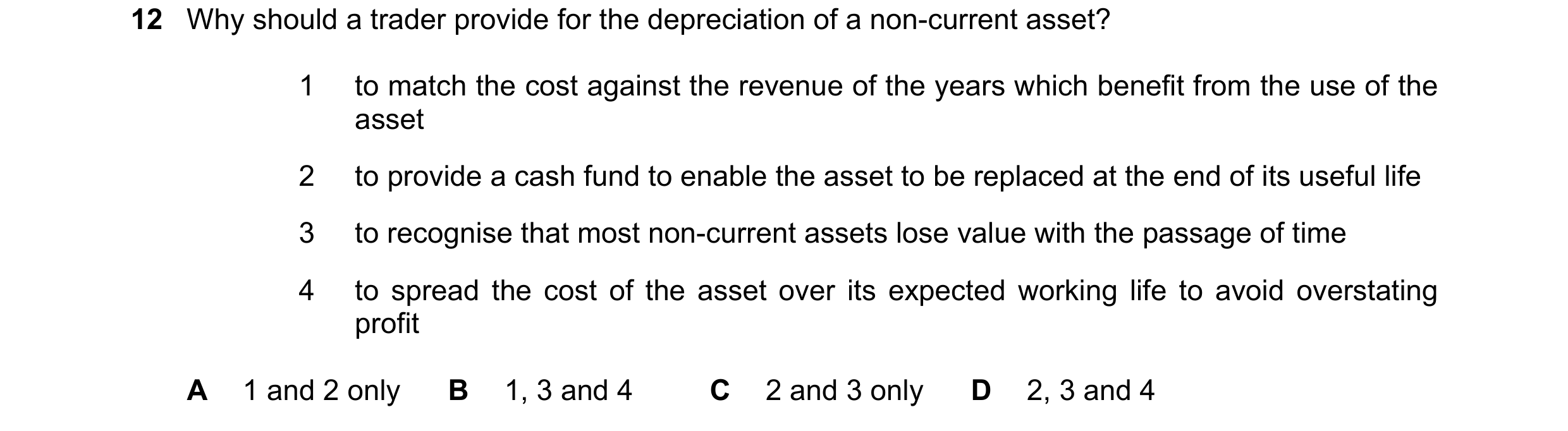
12 Why should a trader provide for the depreciation of a non-current asset? 1 to match the cost against the revenue of the years which benefit from the use of the asset 2 to provide a cash fund to enable the asset to be replaced at the end of its useful life 3 to recognise that most non-current assets lose value with the passage of time 4 to spread the cost of the asset over its expected working life to avoid overstating profit A 1 and 2 only B 1, 3 and 4 C 2 and 3 only D 2, 3 and 4
1 marks
Answer: B
This question in 0452/12 Feb/March 2020
Q2 · Equipment costing $20 000 was purchased on 1 January 2019 0452/12 Feb/March 2020
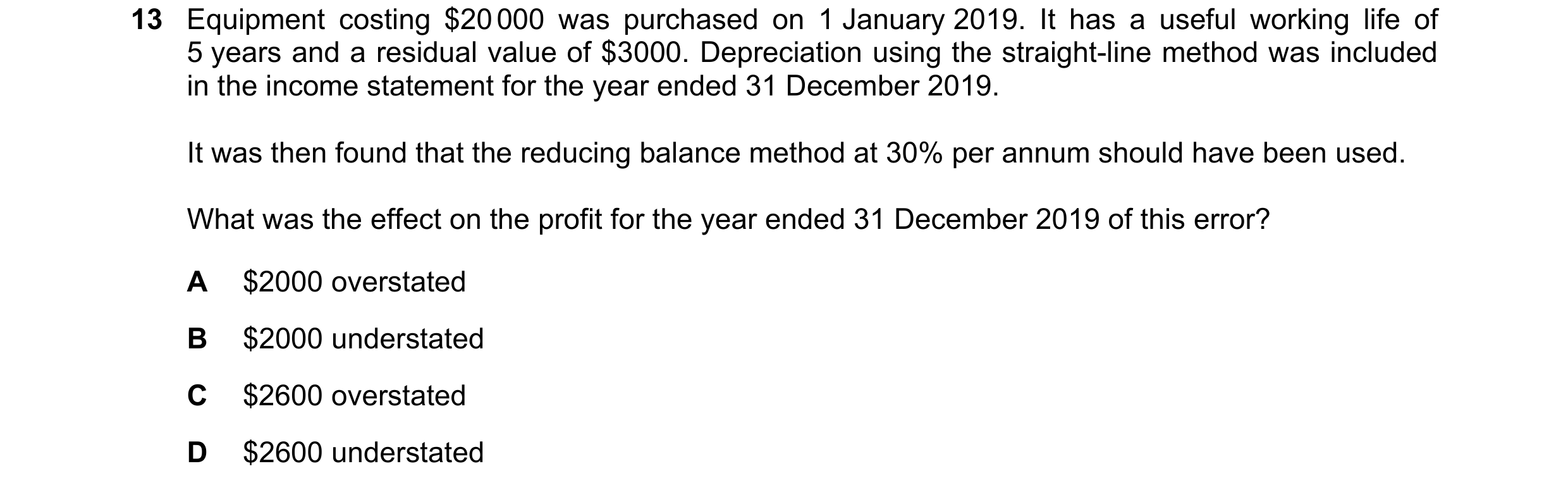
13 Equipment costing $20 000 was purchased on 1 January 2019. It has a useful working life of 5 years and a residual value of $3000. Depreciation using the straight-line method was included in the income statement for the year ended 31 December 2019. It was then found that the reducing balance method at 30% per annum should have been used. What was the effect on the profit for the year ended 31 December 2019 of this error? A $2000 overstated B $2000 understated C $2600 overstated D $2600 understated
1 marks
Answer: C
This question in 0452/12 Feb/March 2020
Q3 · A non-current asset was depreciated at the end of the first year of ownership using the… 0452/11 May/June 2020
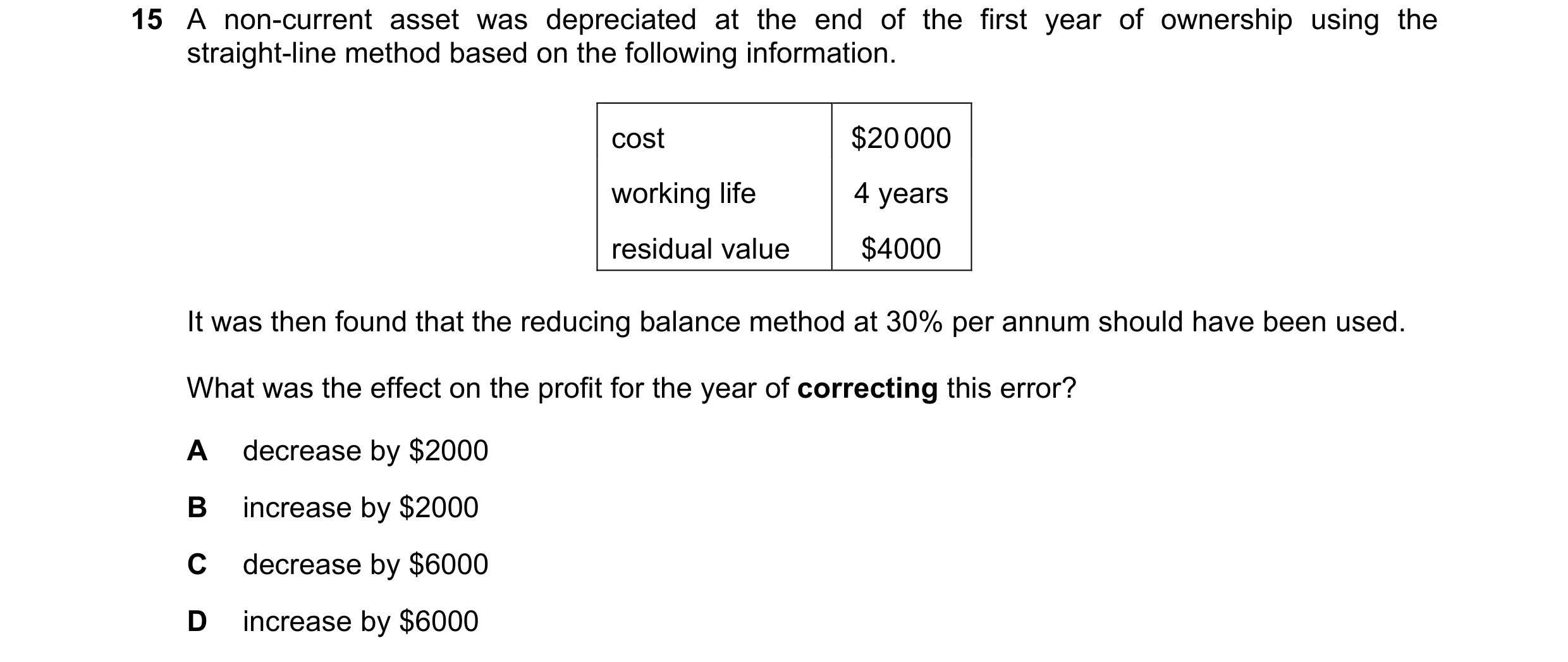
15 A non-current asset was depreciated at the end of the first year of ownership using the straight-line method based on the following information. cost $20 000 working life 4 years residual value $4000 It was then found that the reducing balance method at 30% per annum should have been used. What was the effect on the profit for the year of correcting this error? A decrease by $2000 B increase by $2000 C decrease by $6000 D increase by $6000
1 marks
Answer: A
This question in 0452/11 May/June 2020
Q4 · Brad purchased a machine for $1000 on 1 January 2019 0452/11 May/June 2020
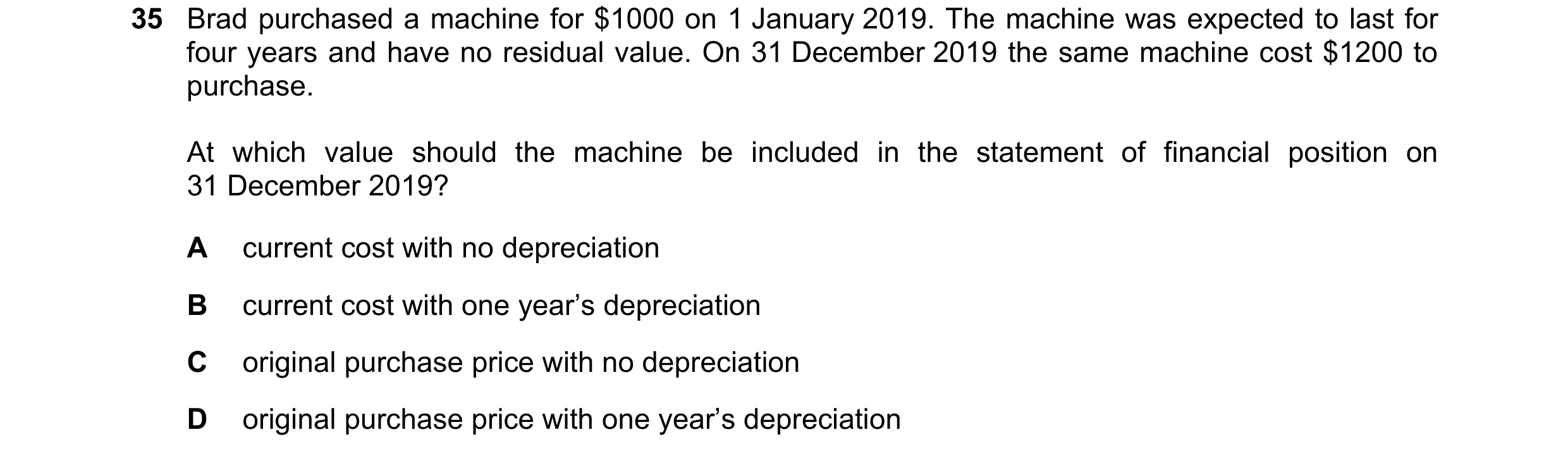
35 Brad purchased a machine for $1000 on 1 January 2019. The machine was expected to last for four years and have no residual value. On 31 December 2019 the same machine cost $1200 to purchase. At which value should the machine be included in the statement of financial position on 31 December 2019? A current cost with no depreciation B current cost with one year’s depreciation C original purchase price with no depreciation D original purchase price with one year’s depreciation
1 marks
Answer: D
This question in 0452/11 May/June 2020
Q5 · Sita discovers that $1000 received from the sale of fixtures had been entered in the… 0452/12 May/June 2020
10 Sita discovers that $1000 received from the sale of fixtures had been entered in the sales account. Which journal entry corrected this error? debit credit $ $ bank 1000 A disposal of fixtures 1000 bank 1000 B fixtures 1000 sales 1000 C disposal of fixtures 1000 sales 1000 D fixtures 1000
1 marks
Answer: C
This question in 0452/12 May/June 2020
Q6 · A non-current asset was depreciated at the end of the first year of ownership using the… 0452/12 May/June 2020
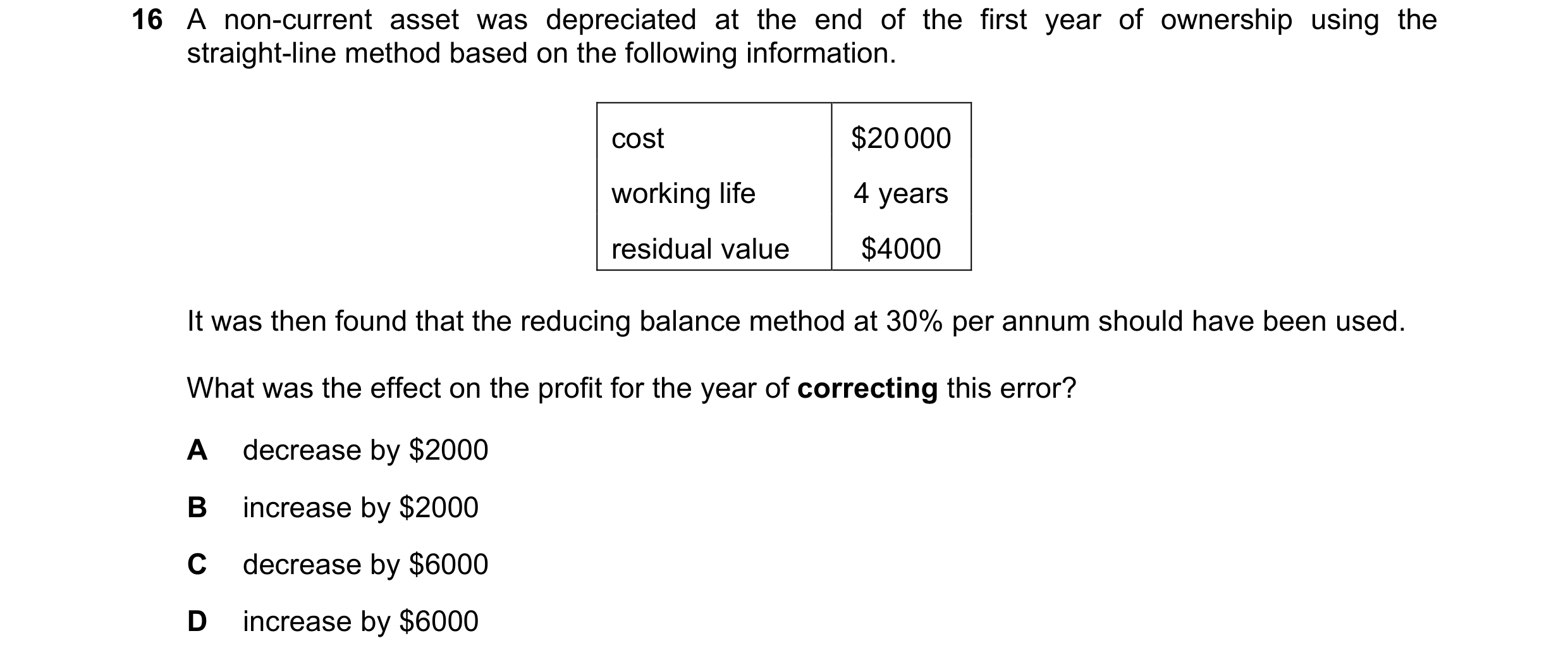
16 A non-current asset was depreciated at the end of the first year of ownership using the straight-line method based on the following information. cost $20 000 working life 4 years residual value $4000 It was then found that the reducing balance method at 30% per annum should have been used. What was the effect on the profit for the year of correcting this error? A decrease by $2000 B increase by $2000 C decrease by $6000 D increase by $6000
1 marks
Answer: A
This question in 0452/12 May/June 2020
Q7 · Elzevir purchased a motor vehicle costing $8000 on 1 January 2018 0452/12 May/June 2020
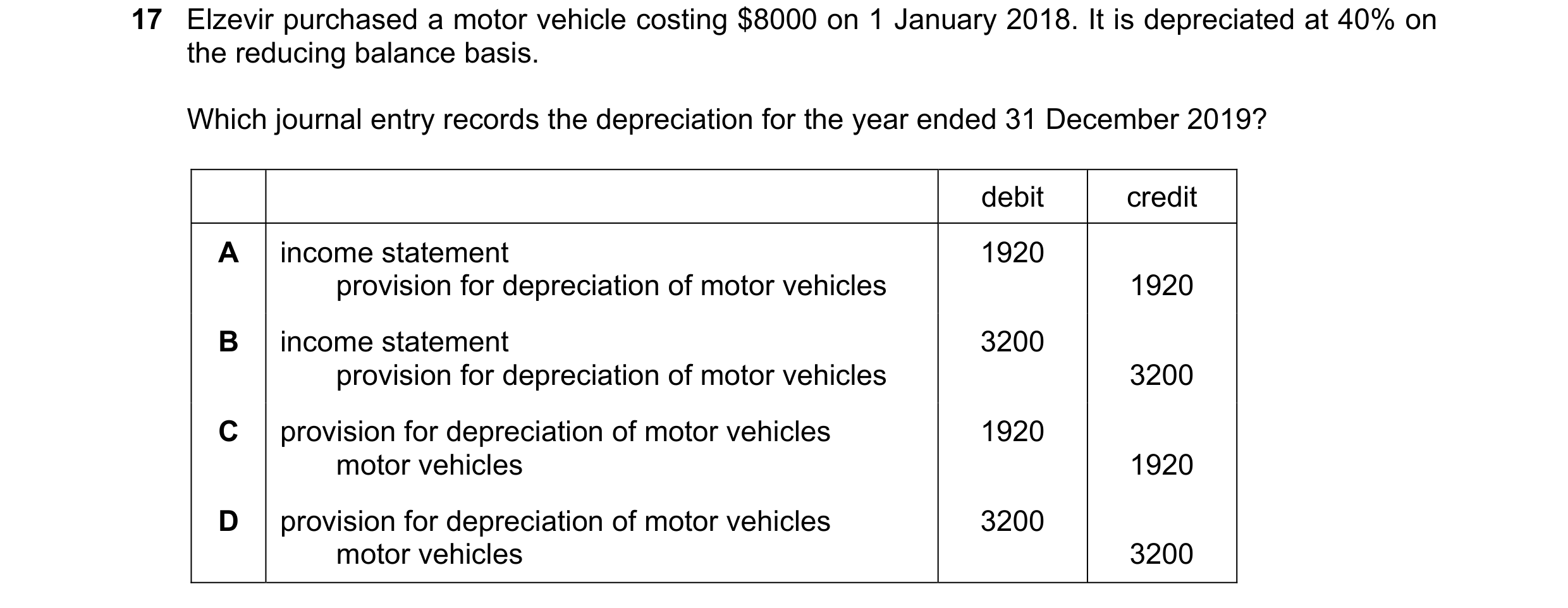
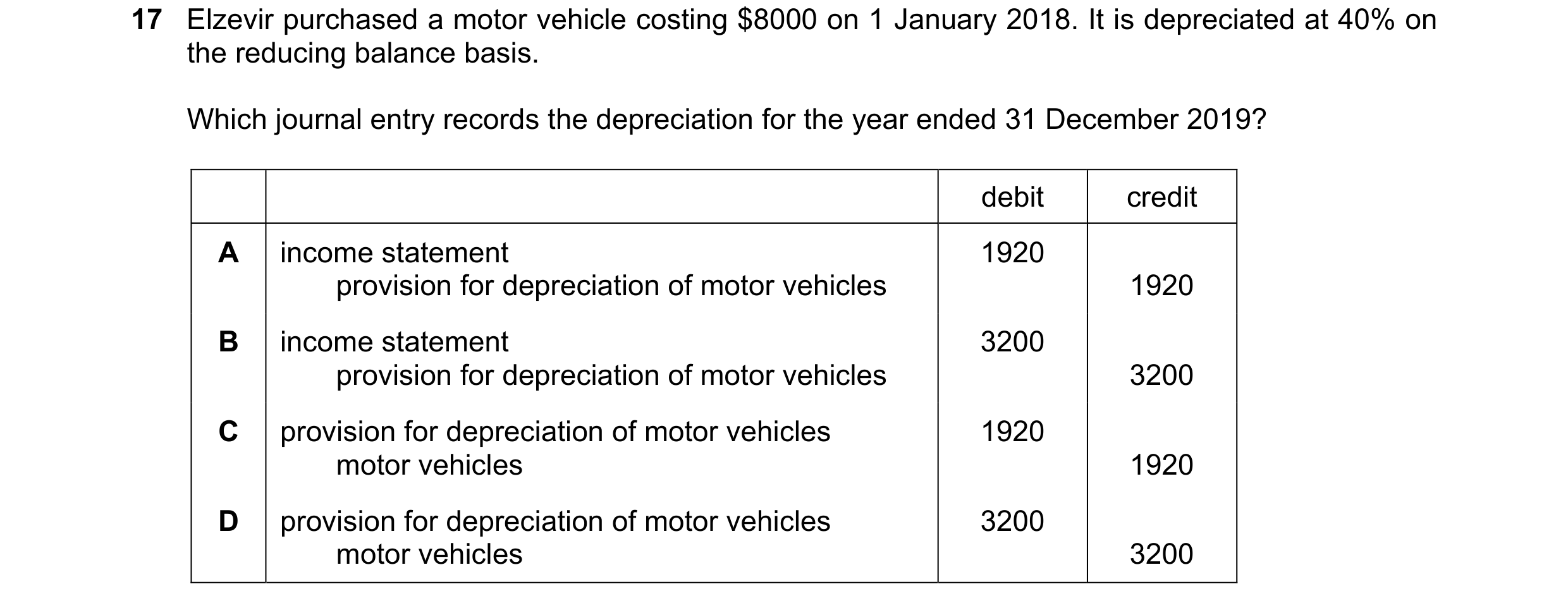
17 Elzevir purchased a motor vehicle costing $8000 on 1 January 2018. It is depreciated at 40% on the reducing balance basis. Which journal entry records the depreciation for the year ended 31 December 2019? debit credit A income statement 1920 provision for depreciation of motor vehicles 1920 B income statement 3200 provision for depreciation of motor vehicles 3200 C provision for depreciation of motor vehicles 1920 motor vehicles 1920 D provision for depreciation of motor vehicles 3200 motor vehicles 3200
1 marks
Answer: A
This question in 0452/12 May/June 2020
Q8 · A non-current asset was depreciated at the end of the first year of ownership using the… 0452/13 May/June 2020
16 A non-current asset was depreciated at the end of the first year of ownership using the straight-line method based on the following information. cost $20 000 working life 4 years residual value $4000 It was then found that the reducing balance method at 30% per annum should have been used. What was the effect on the profit for the year of correcting this error? A decrease by $2000 B increase by $2000 C decrease by $6000 D increase by $6000
1 marks
Answer: A
This question in 0452/13 May/June 2020
Q9 · Elzevir purchased a motor vehicle costing $8000 on 1 January 2018 0452/13 May/June 2020
17 Elzevir purchased a motor vehicle costing $8000 on 1 January 2018. It is depreciated at 40% on the reducing balance basis. Which journal entry records the depreciation for the year ended 31 December 2019? debit credit A income statement 1920 provision for depreciation of motor vehicles 1920 B income statement 3200 provision for depreciation of motor vehicles 3200 C provision for depreciation of motor vehicles 1920 motor vehicles 1920 D provision for depreciation of motor vehicles 3200 motor vehicles 3200
1 marks
Answer: A
This question in 0452/13 May/June 2020
Q10 · A trader uses the reducing balance method of depreciation 0452/11 Oct/Nov 2020
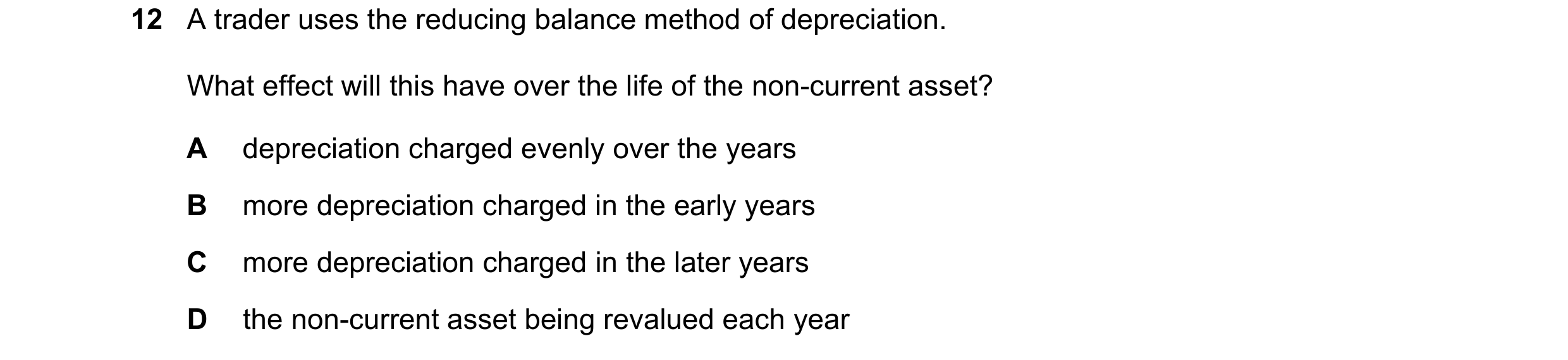
12 A trader uses the reducing balance method of depreciation. What effect will this have over the life of the non-current asset? A depreciation charged evenly over the years B more depreciation charged in the early years C more depreciation charged in the later years D the non-current asset being revalued each year
1 marks
Answer: B
This question in 0452/11 Oct/Nov 2020
Q11 · Rashid provided the following information at 31 December 0452/11 Oct/Nov 2020
13 Rashid provided the following information at 31 December. $ machinery at cost 52 000 provision for depreciation of machinery 23 000 Depreciation for the year is calculated at 20% on cost. After the statement of financial position was prepared it was found that the machinery repairs costing $2000 had been debited to the machinery account. What is the correct balance on the provision for the depreciation of machinery account? A $21 000 B $22 600 C $23 400 D $25 000
1 marks
Answer: B
This question in 0452/11 Oct/Nov 2020
Q12 · Zak has depreciated his machinery at the rate of 20% per annum using the straight-line… 0452/11 Oct/Nov 2020
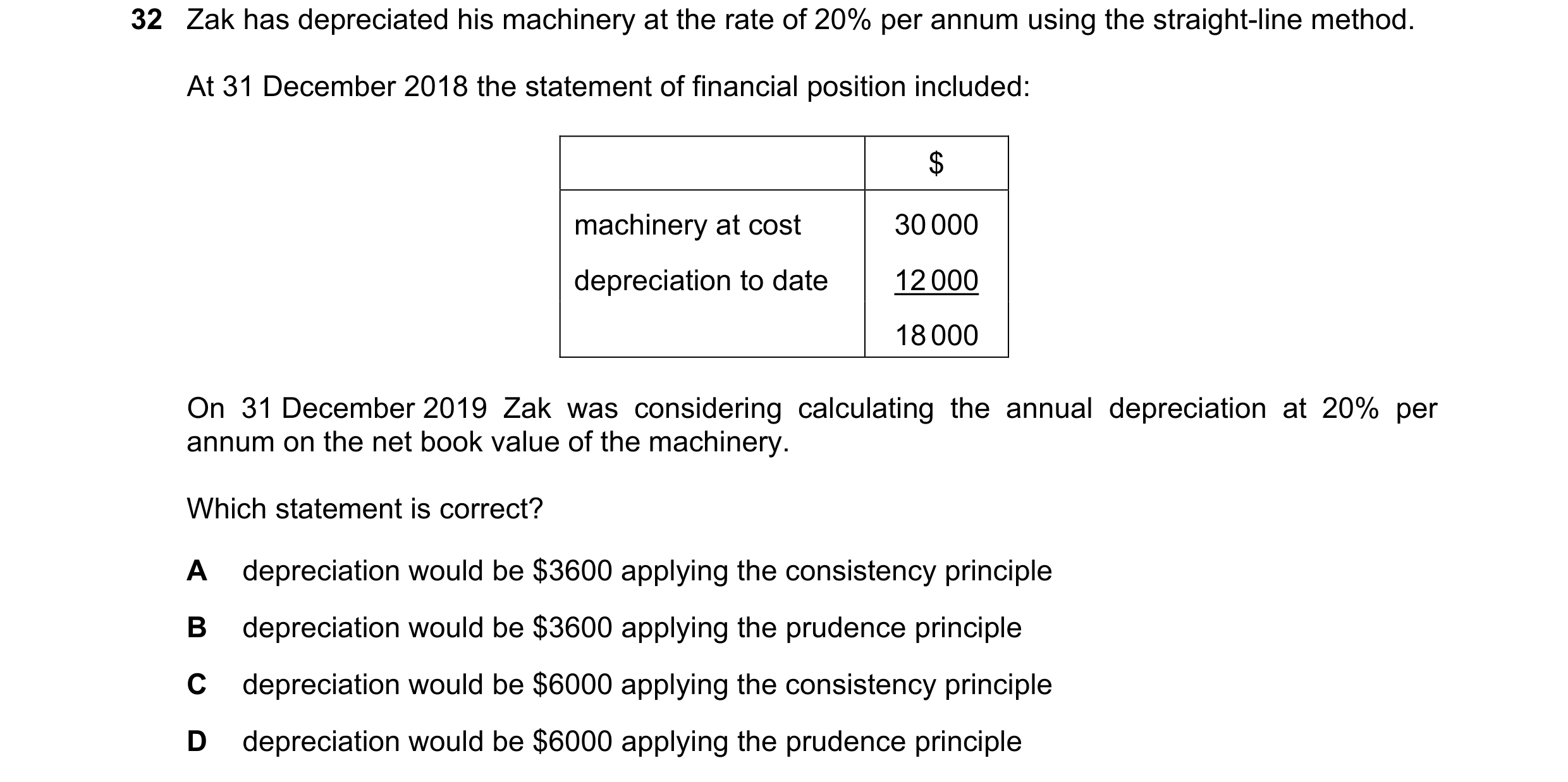
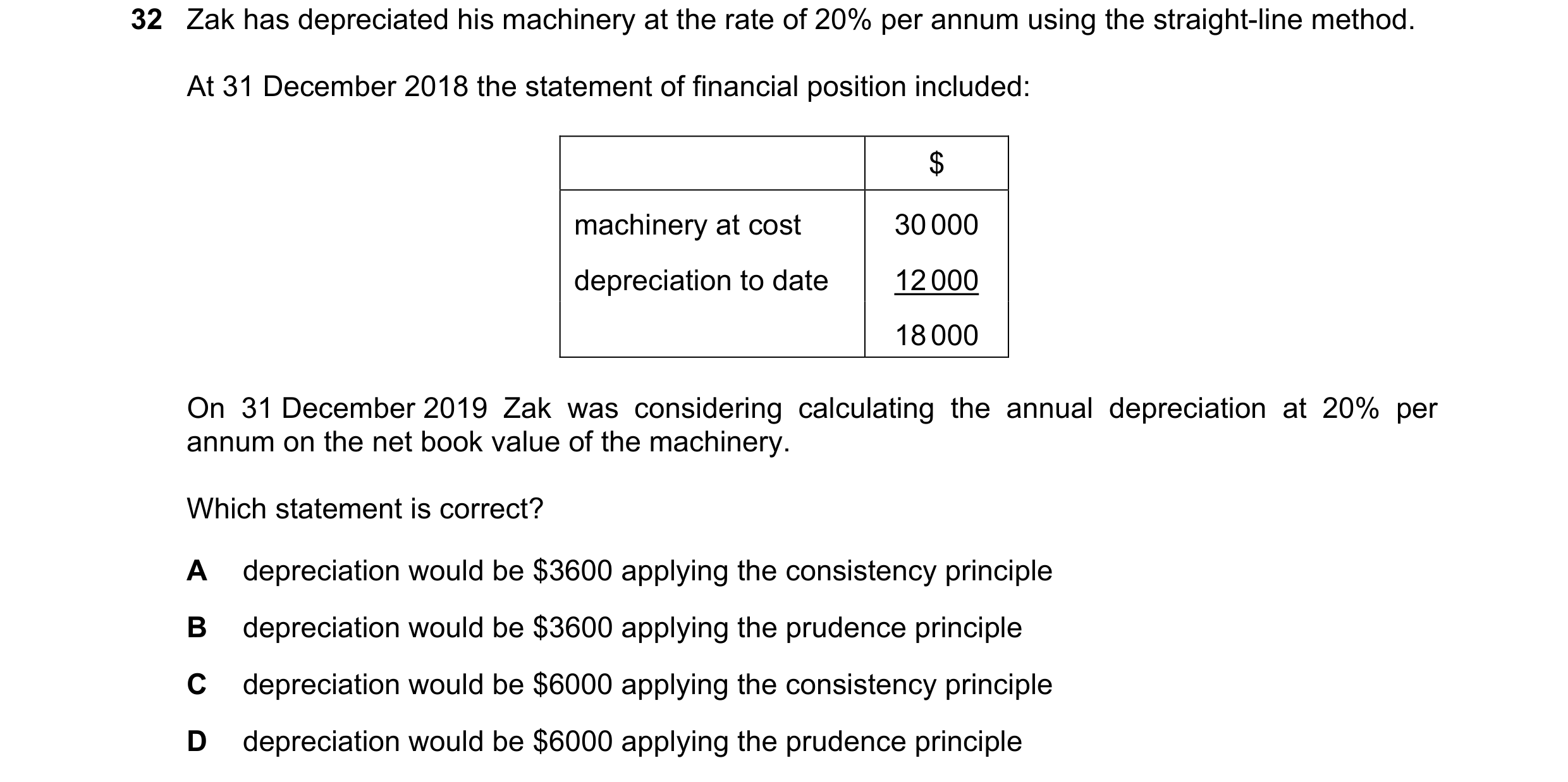
32 Zak has depreciated his machinery at the rate of 20% per annum using the straight-line method. At 31 December 2018 the statement of financial position included: $ machinery at cost 30 000 depreciation to date 12 000 18 000 On 31 December 2019 Zak was considering calculating the annual depreciation at 20% per annum on the net book value of the machinery. Which statement is correct? A depreciation would be $3600 applying the consistency principle B depreciation would be $3600 applying the prudence principle C depreciation would be $6000 applying the consistency principle D depreciation would be $6000 applying the prudence principle
1 marks
Answer: C
This question in 0452/11 Oct/Nov 2020
Q13 · Rashid provided the following information at 31 December 0452/12 Oct/Nov 2020
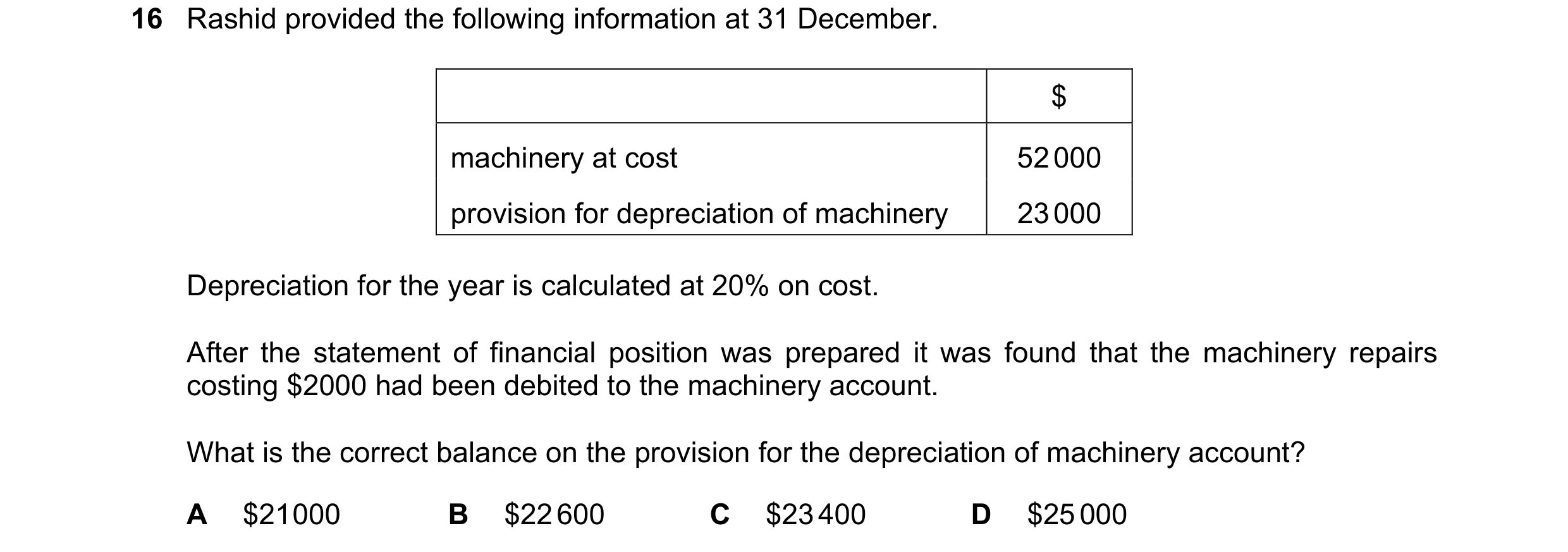
16 Rashid provided the following information at 31 December. $ machinery at cost 52 000 provision for depreciation of machinery 23 000 Depreciation for the year is calculated at 20% on cost. After the statement of financial position was prepared it was found that the machinery repairs costing $2000 had been debited to the machinery account. What is the correct balance on the provision for the depreciation of machinery account? A $21 000 B $22 600 C $23 400 D $25 000
1 marks
Answer: B
This question in 0452/12 Oct/Nov 2020
Q14 · A machine which cost $32 000 was sold for $14 000 0452/12 Oct/Nov 2020
17 A machine which cost $32 000 was sold for $14 000. The total depreciation at the date of disposal was $15 000. What was the profit or loss on disposal? A $3000 profit B $3000 loss C $18 000 profit D $18 000 loss
1 marks
Answer: B
This question in 0452/12 Oct/Nov 2020
Q15 · A trader uses the reducing balance method of depreciation 0452/13 Oct/Nov 2020
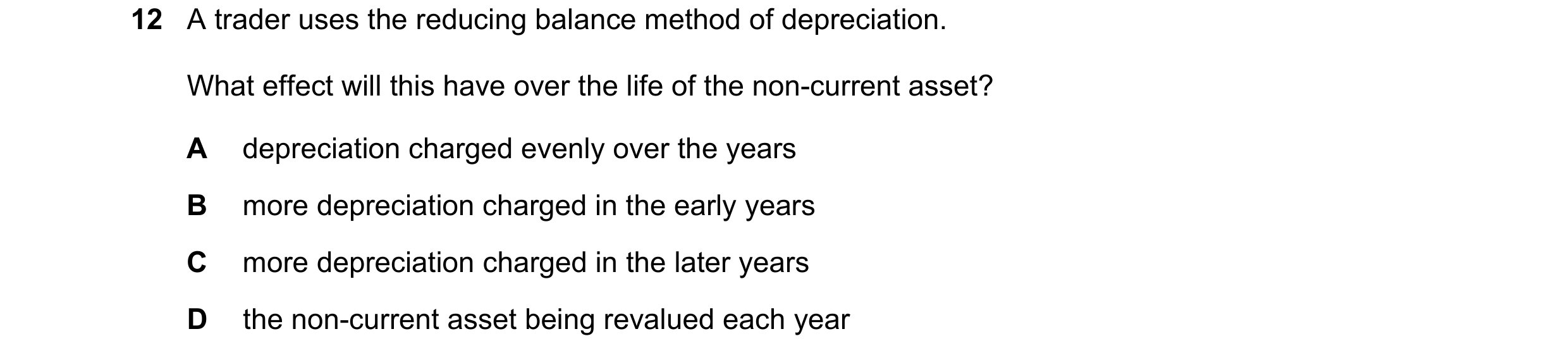
12 A trader uses the reducing balance method of depreciation. What effect will this have over the life of the non-current asset? A depreciation charged evenly over the years B more depreciation charged in the early years C more depreciation charged in the later years D the non-current asset being revalued each year
1 marks
Answer: B
This question in 0452/13 Oct/Nov 2020
Q16 · Rashid provided the following information at 31 December 0452/13 Oct/Nov 2020
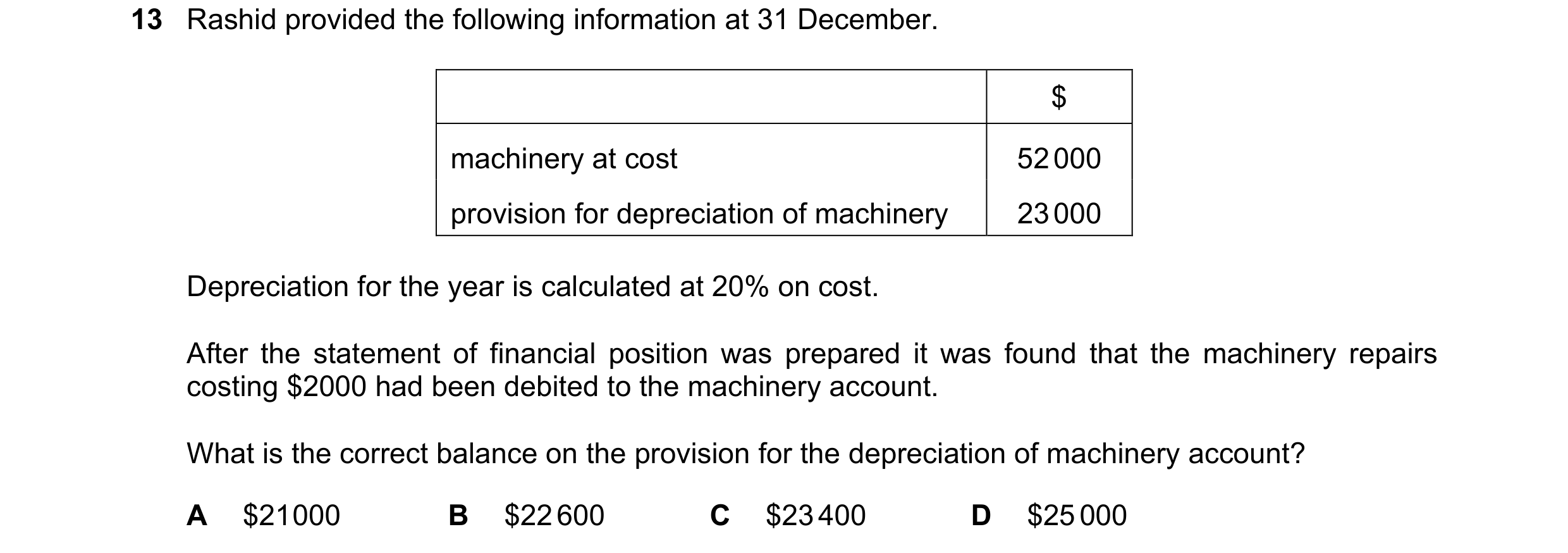
13 Rashid provided the following information at 31 December. $ machinery at cost 52 000 provision for depreciation of machinery 23 000 Depreciation for the year is calculated at 20% on cost. After the statement of financial position was prepared it was found that the machinery repairs costing $2000 had been debited to the machinery account. What is the correct balance on the provision for the depreciation of machinery account? A $21 000 B $22 600 C $23 400 D $25 000
1 marks
Answer: B
This question in 0452/13 Oct/Nov 2020
Q17 · Zak has depreciated his machinery at the rate of 20% per annum using the straight-line… 0452/13 Oct/Nov 2020
32 Zak has depreciated his machinery at the rate of 20% per annum using the straight-line method. At 31 December 2018 the statement of financial position included: $ machinery at cost 30 000 depreciation to date 12 000 18 000 On 31 December 2019 Zak was considering calculating the annual depreciation at 20% per annum on the net book value of the machinery. Which statement is correct? A depreciation would be $3600 applying the consistency principle B depreciation would be $3600 applying the prudence principle C depreciation would be $6000 applying the consistency principle D depreciation would be $6000 applying the prudence principle
1 marks
Answer: C
This question in 0452/13 Oct/Nov 2020
Q18 · Motor vehicle repairs, $2000, were debited to the motor vehicles account 0452/12 Feb/March 2021
13 Motor vehicle repairs, $2000, were debited to the motor vehicles account. Motor vehicles are depreciated at 20% per annum on the balance of the account at the year end. What was the effect of the error? effect on motor vehicles effect on in statement of financial profit for the year position $ $ A overstated 1600 overstated 1600 B overstated 2000 overstated 2000 C understated 1600 understated 1600 D understated 2000 understated 2000
1 marks
Answer: A
This question in 0452/12 Feb/March 2021
Q19 · Mandeep depreciates his motor vehicles at the rate of 20% using the straight-line method 0452/12 Feb/March 2021
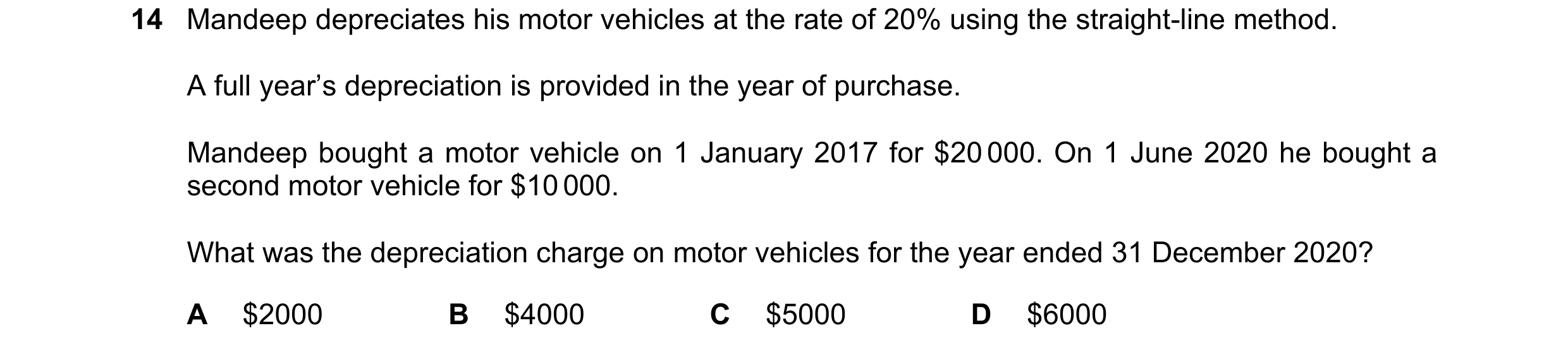
14 Mandeep depreciates his motor vehicles at the rate of 20% using the straight-line method. A full year’s depreciation is provided in the year of purchase. Mandeep bought a motor vehicle on 1 January 2017 for $20 000. On 1 June 2020 he bought a second motor vehicle for $10 000. What was the depreciation charge on motor vehicles for the year ended 31 December 2020? A $2000 B $4000 C $5000 D $6000
1 marks
Answer: D
This question in 0452/12 Feb/March 2021
Q20 · What is the effect of treating an item of capital expenditure as revenue expenditure? 0452/11 May/June 2021
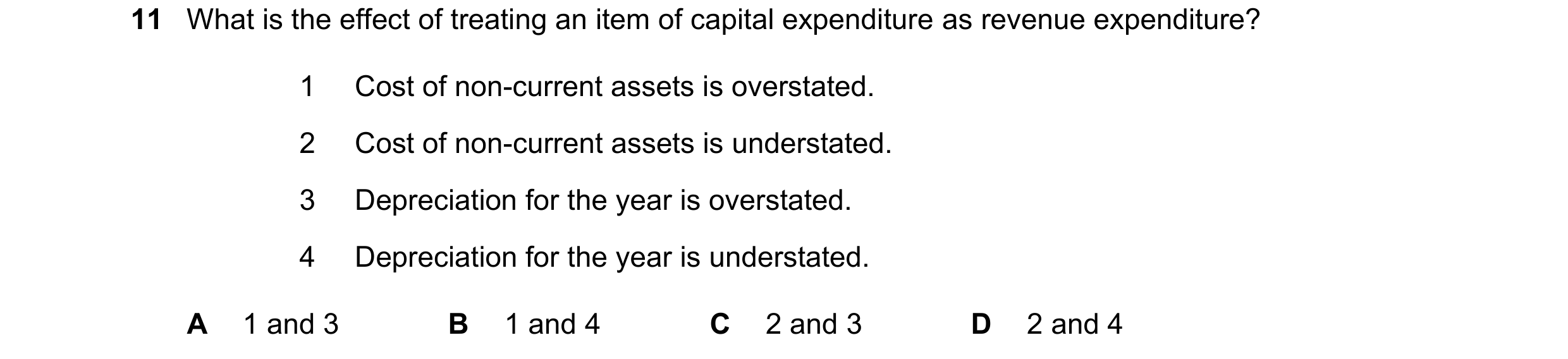
11 What is the effect of treating an item of capital expenditure as revenue expenditure? 1 Cost of non-current assets is overstated. 2 Cost of non-current assets is understated. 3 Depreciation for the year is overstated. 4 Depreciation for the year is understated. A 1 and 3 B 1 and 4 C 2 and 3 D 2 and 4
1 marks
Answer: D
This question in 0452/11 May/June 2021
Q21 · Why does a business provide for depreciation on non-current assets? 0452/11 May/June 2021
12 Why does a business provide for depreciation on non-current assets? A to charge the cost of non-current assets against profit in the year of purchase B to ensure that non-current assets appear at book value in the statement of financial position C to ensure that the matching principle is applied when preparing financial statements D to retain cash in the business for replacement of non-current assets
1 marks
Answer: C
This question in 0452/11 May/June 2021
Q22 · Machinery which had cost $6290 was sold for $3100 0452/11 May/June 2021
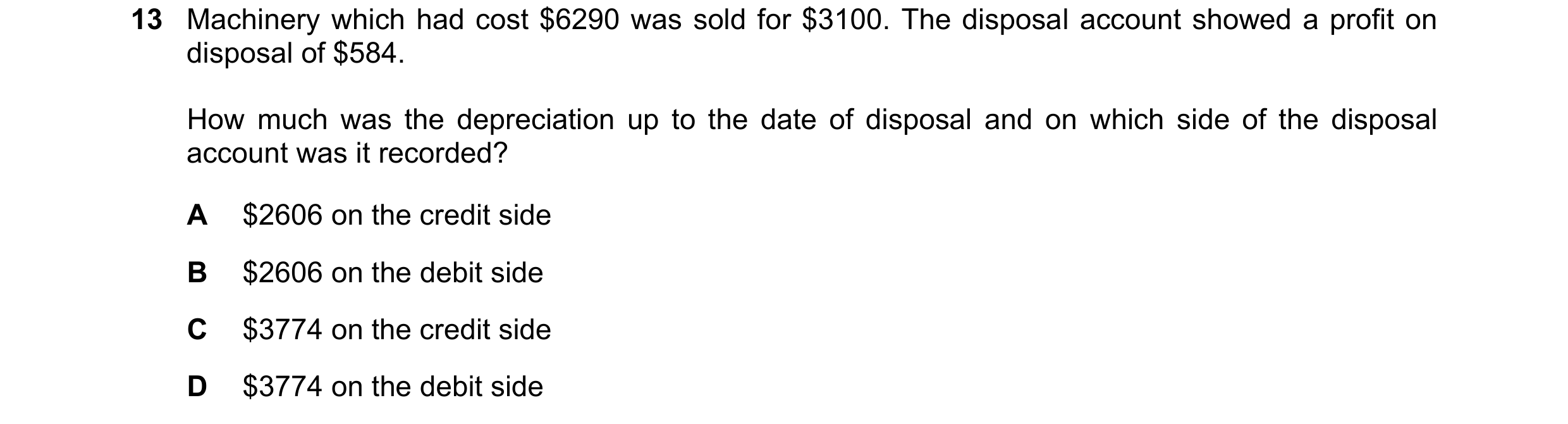
13 Machinery which had cost $6290 was sold for $3100. The disposal account showed a profit on disposal of $584. How much was the depreciation up to the date of disposal and on which side of the disposal account was it recorded? A $2606 on the credit side B $2606 on the debit side C $3774 on the credit side D $3774 on the debit side
1 marks
Answer: C
This question in 0452/11 May/June 2021
Q23 · Why does a business provide for depreciation on non-current assets? 0452/12 May/June 2021
17 Why does a business provide for depreciation on non-current assets? A to charge the cost of non-current assets against profit in the year of purchase B to ensure that non-current assets appear at book value in the statement of financial position C to ensure that the matching principle is applied when preparing financial statements D to retain cash in the business for replacement of non-current assets
1 marks
Answer: C
This question in 0452/12 May/June 2021
Q24 · A machine with an original cost of $10 000 had been depreciated for two years at the rate… 0452/12 May/June 2021
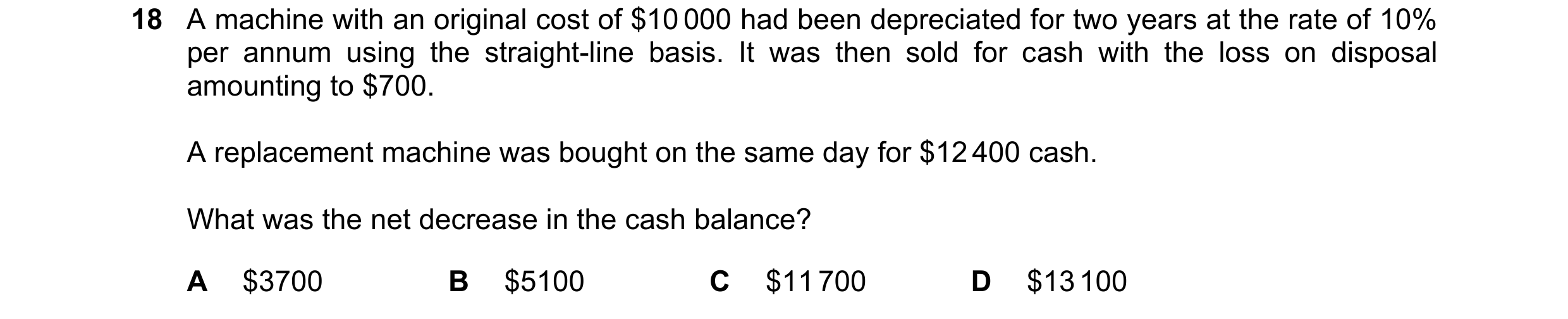
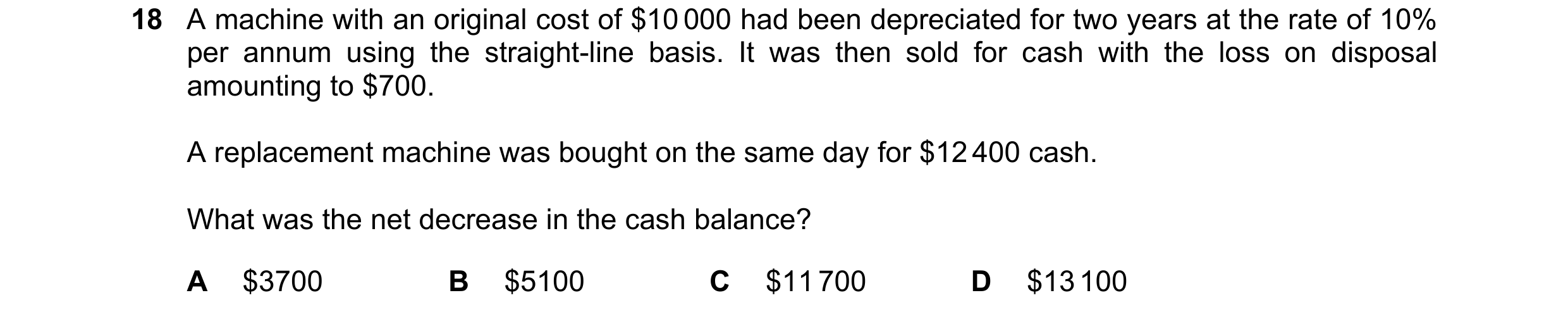
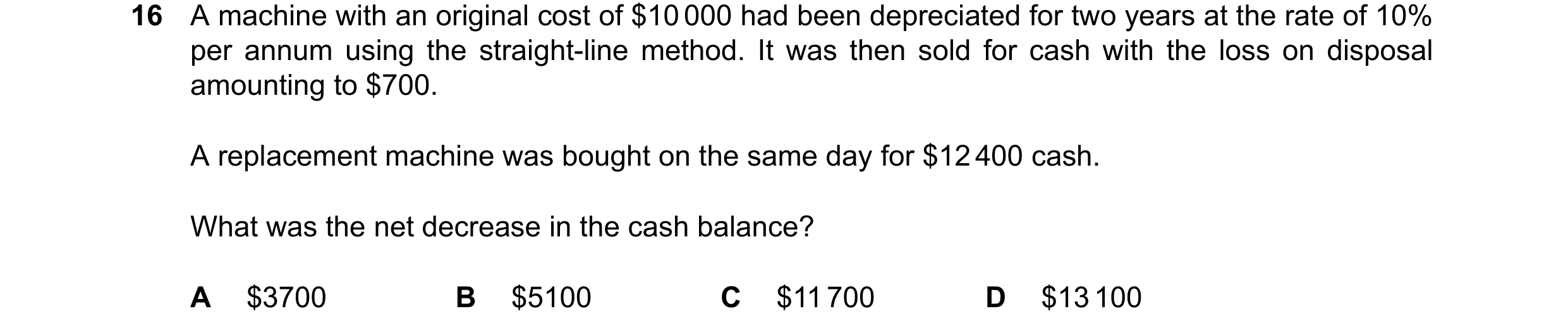
18 A machine with an original cost of $10 000 had been depreciated for two years at the rate of 10% per annum using the straight-line basis. It was then sold for cash with the loss on disposal amounting to $700. A replacement machine was bought on the same day for $12 400 cash. What was the net decrease in the cash balance? A $3700 B $5100 C $11 700 D $13 100
1 marks
Answer: B
This question in 0452/12 May/June 2021
Q25 · Nia sold equipment with a net book value of $200 0452/13 May/June 2021
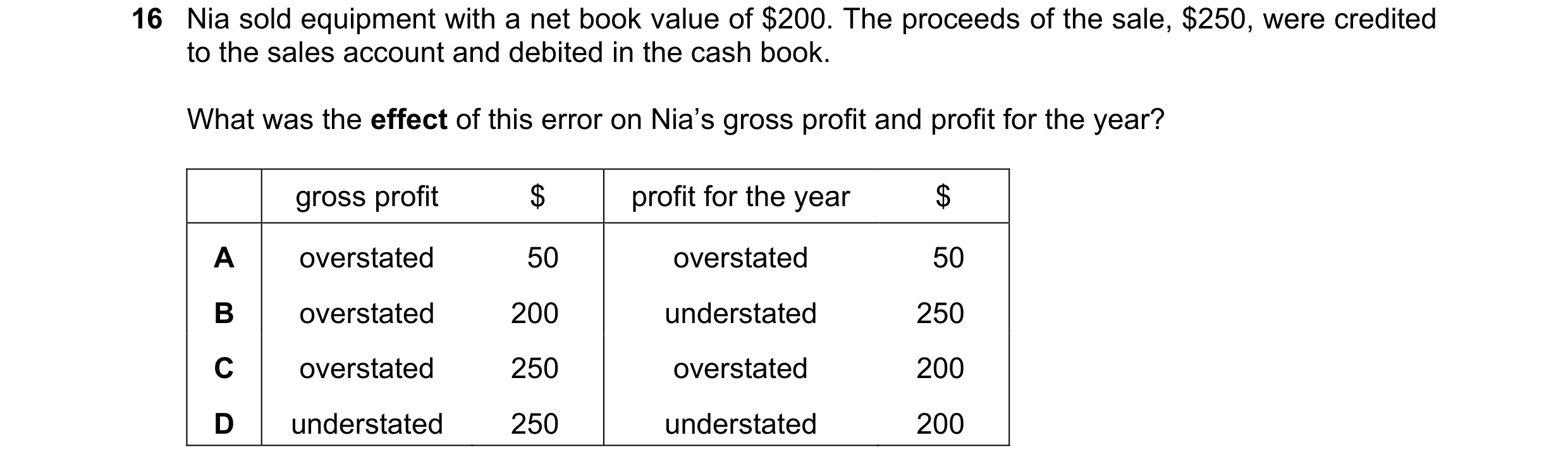
16 Nia sold equipment with a net book value of $200. The proceeds of the sale, $250, were credited to the sales account and debited in the cash book. What was the effect of this error on Nia’s gross profit and profit for the year? gross profit $ profit for the year $ A overstated 50 overstated 50 B overstated 200 understated 250 C overstated 250 overstated 200 D understated 250 understated 200
1 marks
Answer: C
This question in 0452/13 May/June 2021
Q26 · Why does a business provide for depreciation on non-current assets? 0452/13 May/June 2021
17 Why does a business provide for depreciation on non-current assets? A to charge the cost of non-current assets against profit in the year of purchase B to ensure that non-current assets appear at book value in the statement of financial position C to ensure that the matching principle is applied when preparing financial statements D to retain cash in the business for replacement of non-current assets
1 marks
Answer: C
This question in 0452/13 May/June 2021
Q27 · A machine with an original cost of $10 000 had been depreciated for two years at the rate… 0452/13 May/June 2021
18 A machine with an original cost of $10 000 had been depreciated for two years at the rate of 10% per annum using the straight-line basis. It was then sold for cash with the loss on disposal amounting to $700. A replacement machine was bought on the same day for $12 400 cash. What was the net decrease in the cash balance? A $3700 B $5100 C $11 700 D $13 100
1 marks
Answer: B
This question in 0452/13 May/June 2021
Q28 · Two companies each purchased a motor vehicle for $10 000 at the beginning of year 1 0452/11 Oct/Nov 2021
13 Two companies each purchased a motor vehicle for $10 000 at the beginning of year 1. Company G used the straight-line method of depreciation at a rate of 15% per annum, while Company H used the reducing balance method at a rate of 20% per annum. What was the difference in the depreciation charge between the two companies for year 2? A $100 greater for G B $100 greater for H C $500 greater for G D $500 greater for H
1 marks
Answer: B
This question in 0452/11 Oct/Nov 2021
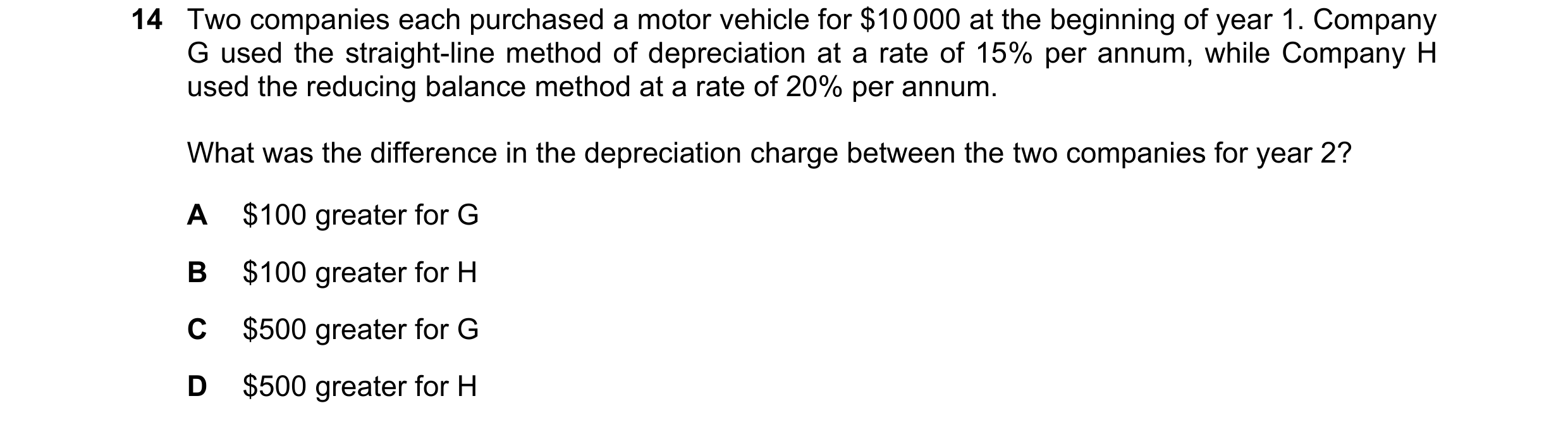
Q29 · Two companies each purchased a motor vehicle for $10 000 at the beginning of year 1 0452/12 Oct/Nov 2021
14 Two companies each purchased a motor vehicle for $10 000 at the beginning of year 1. Company G used the straight-line method of depreciation at a rate of 15% per annum, while Company H used the reducing balance method at a rate of 20% per annum. What was the difference in the depreciation charge between the two companies for year 2? A $100 greater for G B $100 greater for H C $500 greater for G D $500 greater for H
1 marks
Answer: B
This question in 0452/12 Oct/Nov 2021
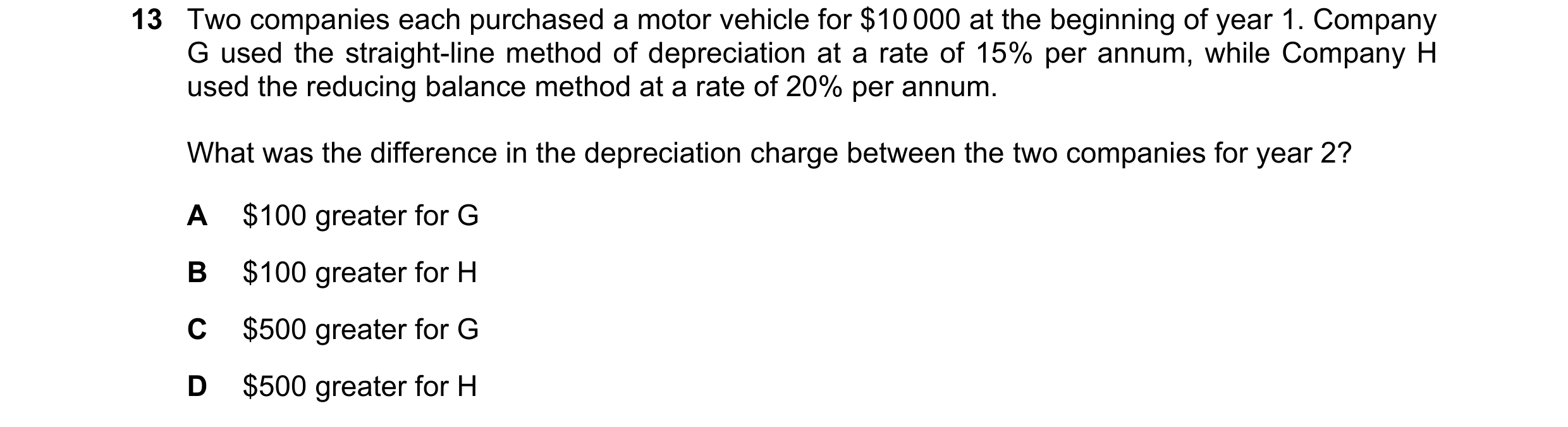
Q30 · Two companies each purchased a motor vehicle for $10 000 at the beginning of year 1 0452/13 Oct/Nov 2021
13 Two companies each purchased a motor vehicle for $10 000 at the beginning of year 1. Company G used the straight-line method of depreciation at a rate of 15% per annum, while Company H used the reducing balance method at a rate of 20% per annum. What was the difference in the depreciation charge between the two companies for year 2? A $100 greater for G B $100 greater for H C $500 greater for G D $500 greater for H
1 marks
Answer: B
This question in 0452/13 Oct/Nov 2021
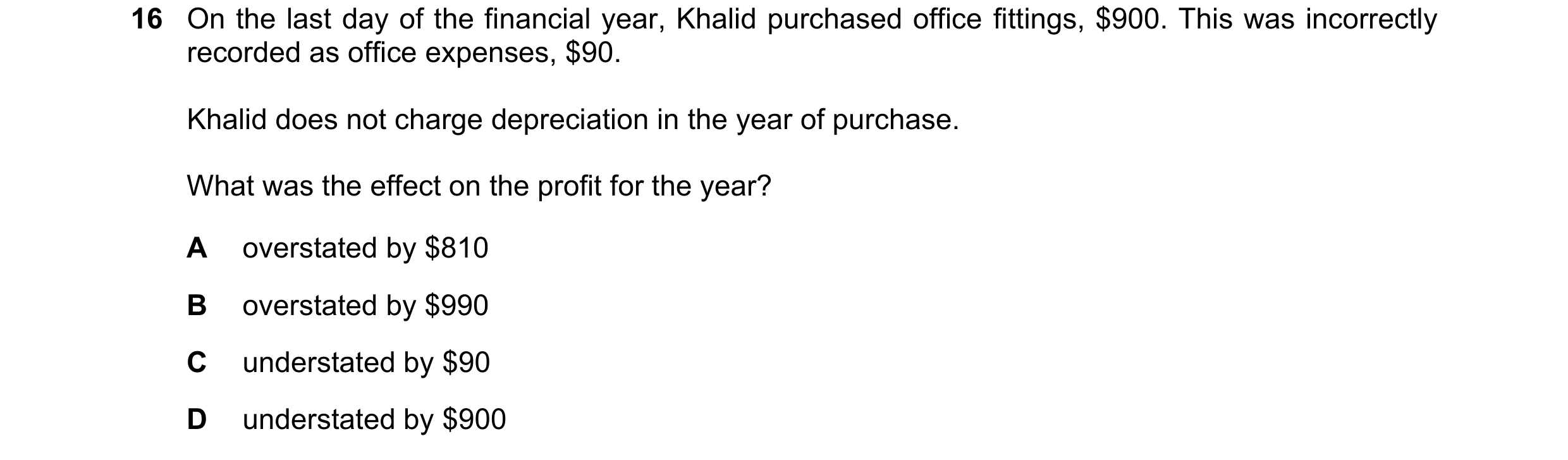
Q31 · On the last day of the financial year, Khalid purchased office fittings, $900 0452/12 Feb/March 2022
16 On the last day of the financial year, Khalid purchased office fittings, $900. This was incorrectly recorded as office expenses, $90. Khalid does not charge depreciation in the year of purchase. What was the effect on the profit for the year? A overstated by $810 B overstated by $990 C understated by $90 D understated by $900
1 marks
Answer: C
This question in 0452/12 Feb/March 2022
Q32 · Aggie is a trader 0452/12 Feb/March 2022
17 Aggie is a trader. She uses the following methods of depreciation for different types of non-current asset. straight-line at 20% per annum reducing balance at 25% per annum revaluation On 1 January year 1, Aggie purchased small items of equipment costing a total of $2400 and fittings costing $8000. On 31 December year 2, Aggie estimated that the equipment was worth 70% of its original cost. The statement of financial position showed the net book value of equipment as $1680 and fittings as $4800. Which depreciation methods has Aggie used? equipment fittings A reducing balance straight-line B revaluation reducing balance C revaluation straight-line D straight-line revaluation
1 marks
Answer: C
This question in 0452/12 Feb/March 2022
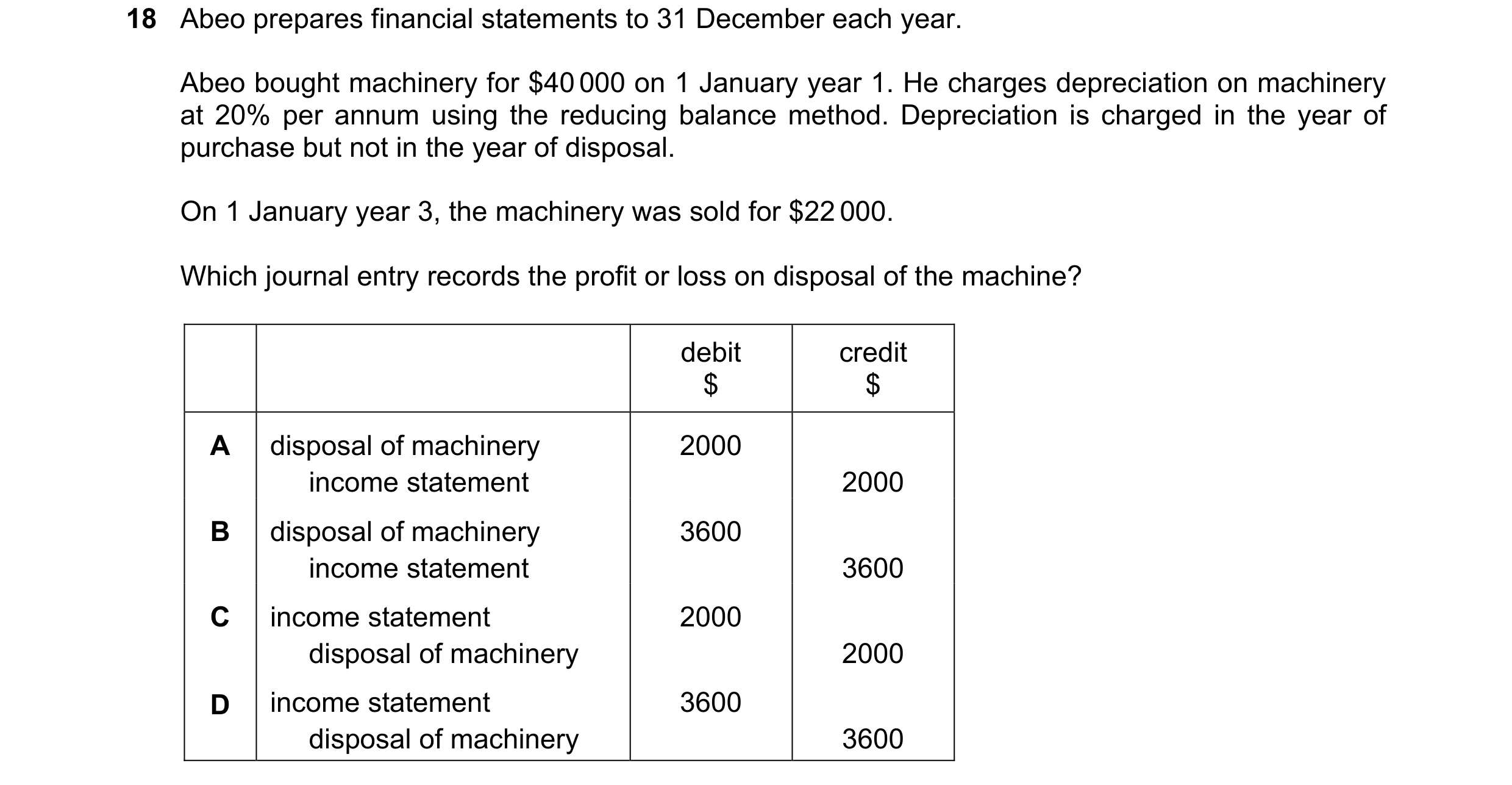
Q33 · Abeo prepares financial statements to 31 December each year 0452/12 Feb/March 2022
18 Abeo prepares financial statements to 31 December each year. Abeo bought machinery for $40 000 on 1 January year 1. He charges depreciation on machinery at 20% per annum using the reducing balance method. Depreciation is charged in the year of purchase but not in the year of disposal. On 1 January year 3, the machinery was sold for $22 000. Which journal entry records the profit or loss on disposal of the machine? debit credit $ $ A disposal of machinery 2000 income statement 2000 B disposal of machinery 3600 income statement 3600 C income statement 2000 disposal of machinery 2000 D income statement 3600 disposal of machinery 3600
1 marks
Answer: D
This question in 0452/12 Feb/March 2022
Q34 · On 1 January, Zac entered the cost of repairing equipment, $420, in the equipment account 0452/11 May/June 2022
15 On 1 January, Zac entered the cost of repairing equipment, $420, in the equipment account. On 31 December, depreciation of 20% per annum, using the straight-line method, was charged on the balance of the equipment account. What was the overall effect on the book value of the equipment on 31 December? A $84 understated B $336 overstated C $420 overstated D $504 understated
1 marks
Answer: B
This question in 0452/11 May/June 2022
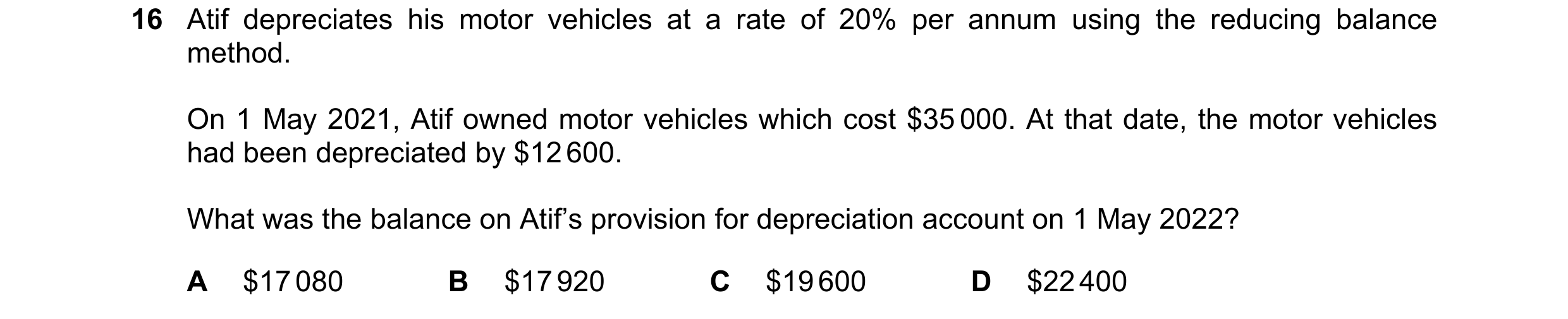
Q35 · Atif depreciates his motor vehicles at a rate of 20% per annum using the reducing balance… 0452/11 May/June 2022
16 Atif depreciates his motor vehicles at a rate of 20% per annum using the reducing balance method. On 1 May 2021, Atif owned motor vehicles which cost $35 000. At that date, the motor vehicles had been depreciated by $12 600. What was the balance on Atif’s provision for depreciation account on 1 May 2022? A $17 080 B $17 920 C $19 600 D $22 400
1 marks
Answer: A
This question in 0452/11 May/June 2022
Q36 · The financial year of Yeung ends on 31 March 0452/11 May/June 2022
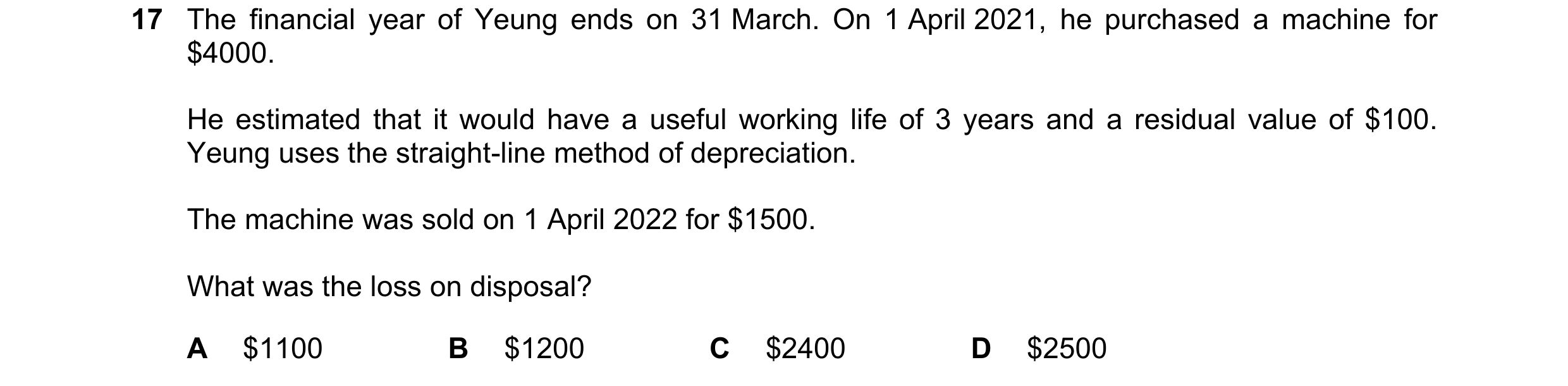
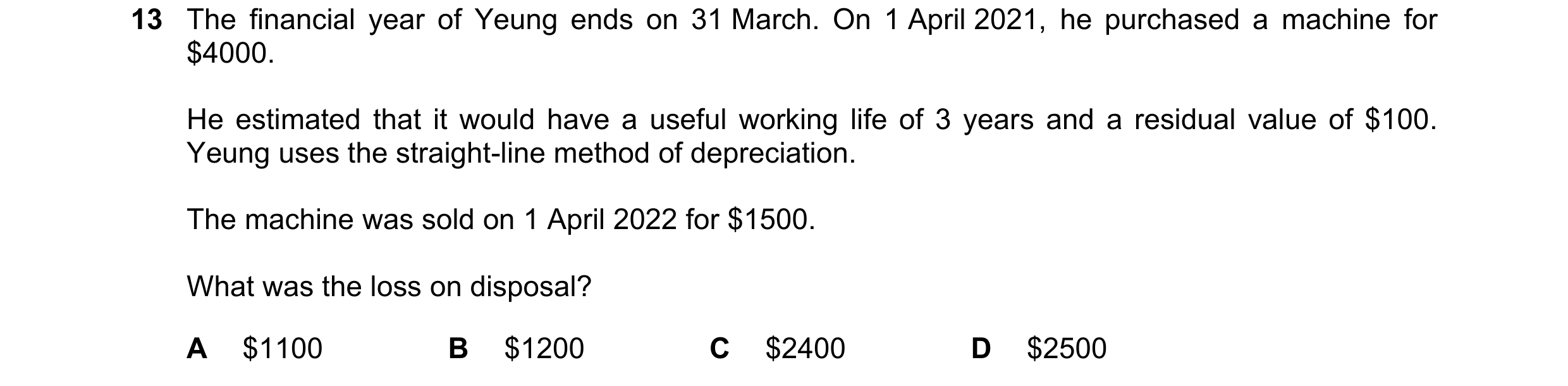
17 The financial year of Yeung ends on 31 March. On 1 April 2021, he purchased a machine for $4000. He estimated that it would have a useful working life of 3 years and a residual value of $100. Yeung uses the straight-line method of depreciation. The machine was sold on 1 April 2022 for $1500. What was the loss on disposal? A $1100 B $1200 C $2400 D $2500
1 marks
Answer: B
This question in 0452/11 May/June 2022
Q37 · Which statement about the reducing balance method of depreciation is not correct? 0452/12 May/June 2022
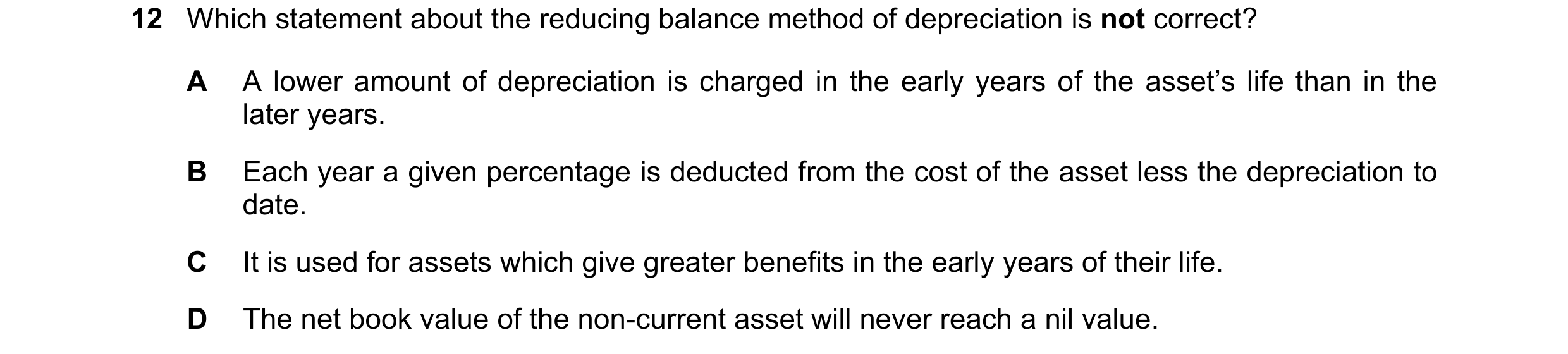
12 Which statement about the reducing balance method of depreciation is not correct? A A lower amount of depreciation is charged in the early years of the asset’s life than in the later years. B Each year a given percentage is deducted from the cost of the asset less the depreciation to date. C It is used for assets which give greater benefits in the early years of their life. D The net book value of the non-current asset will never reach a nil value.
1 marks
Answer: A
This question in 0452/12 May/June 2022
Q38 · The financial year of Yeung ends on 31 March 0452/12 May/June 2022
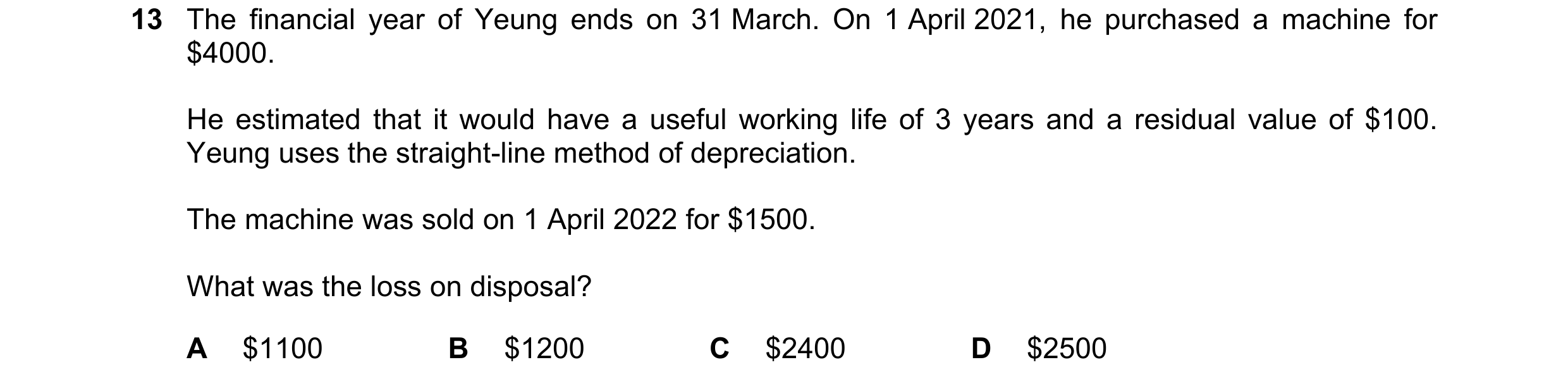
13 The financial year of Yeung ends on 31 March. On 1 April 2021, he purchased a machine for $4000. He estimated that it would have a useful working life of 3 years and a residual value of $100. Yeung uses the straight-line method of depreciation. The machine was sold on 1 April 2022 for $1500. What was the loss on disposal? A $1100 B $1200 C $2400 D $2500
1 marks
Answer: B
This question in 0452/12 May/June 2022
Q39 · Which statement about the reducing balance method of depreciation is not correct? 0452/13 May/June 2022
12 Which statement about the reducing balance method of depreciation is not correct? A A lower amount of depreciation is charged in the early years of the asset’s life than in the later years. B Each year a given percentage is deducted from the cost of the asset less the depreciation to date. C It is used for assets which give greater benefits in the early years of their life. D The net book value of the non-current asset will never reach a nil value.
1 marks
Answer: A
This question in 0452/13 May/June 2022
Q40 · The financial year of Yeung ends on 31 March 0452/13 May/June 2022
13 The financial year of Yeung ends on 31 March. On 1 April 2021, he purchased a machine for $4000. He estimated that it would have a useful working life of 3 years and a residual value of $100. Yeung uses the straight-line method of depreciation. The machine was sold on 1 April 2022 for $1500. What was the loss on disposal? A $1100 B $1200 C $2400 D $2500
1 marks
Answer: B
This question in 0452/13 May/June 2022
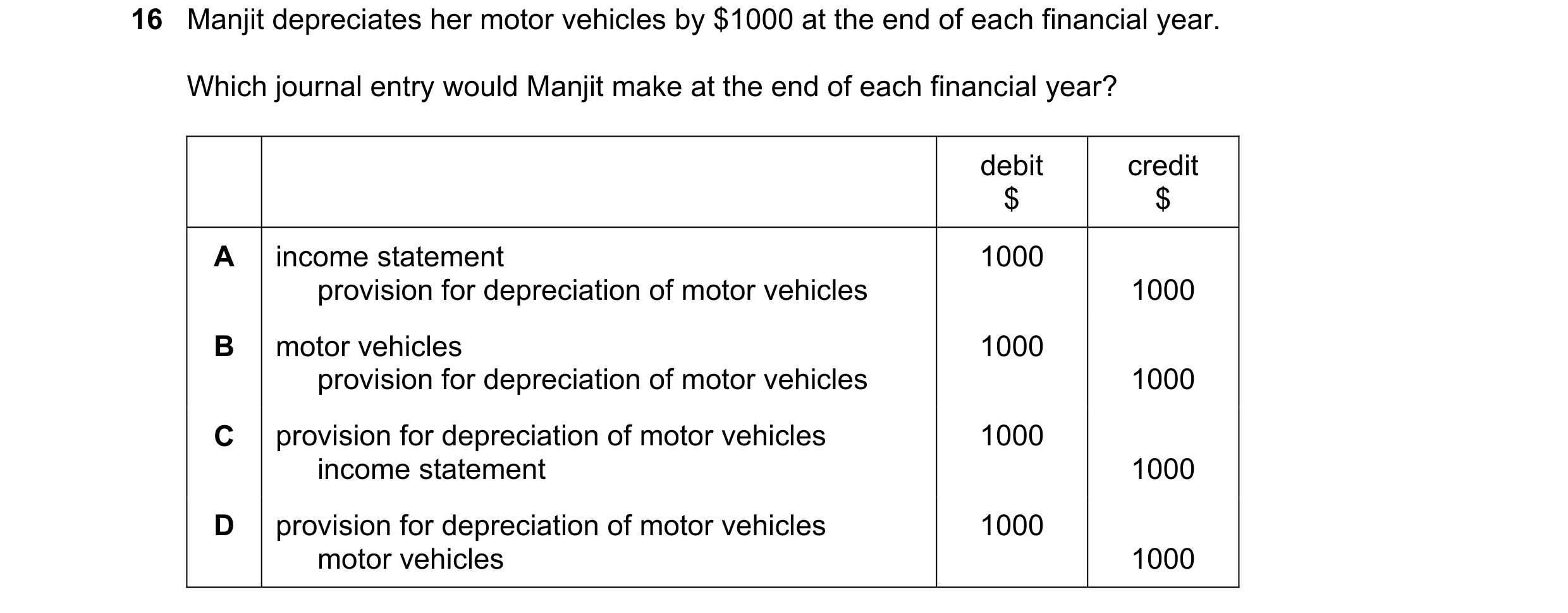
Q41 · Manjit depreciates her motor vehicles by $1000 at the end of each financial year 0452/11 Oct/Nov 2022
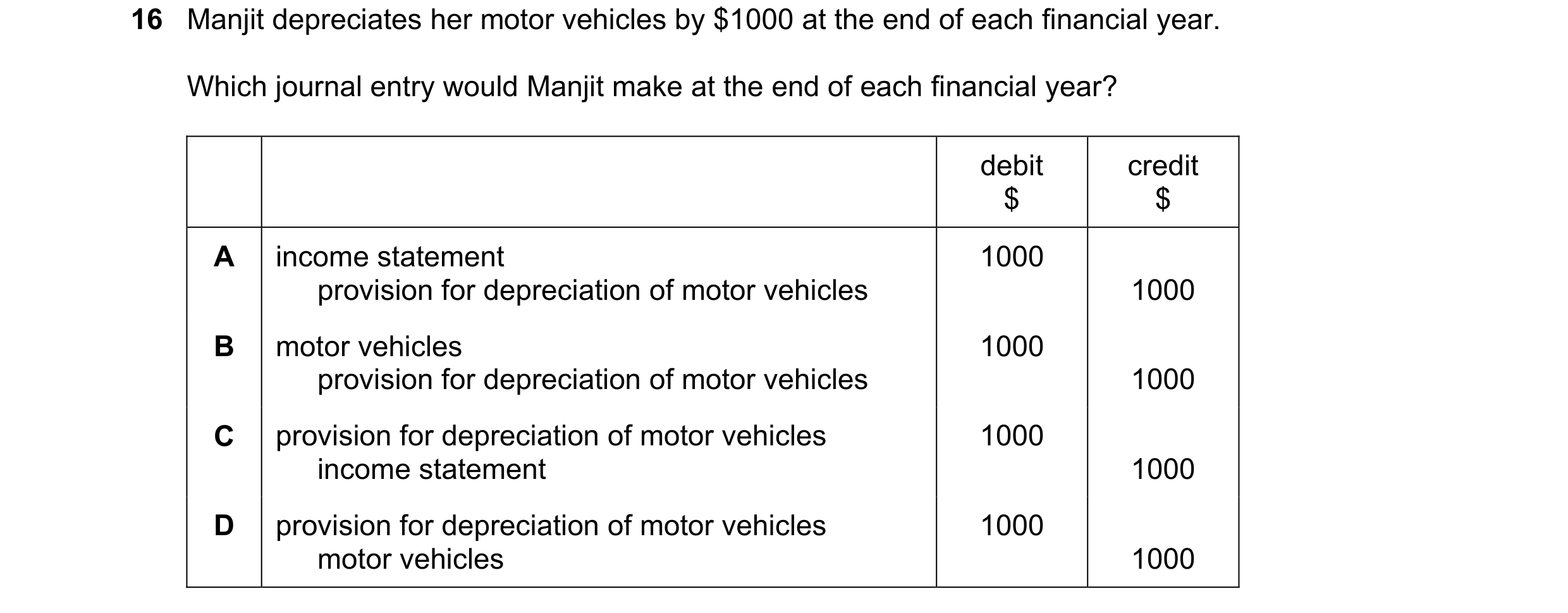
16 Manjit depreciates her motor vehicles by $1000 at the end of each financial year. Which journal entry would Manjit make at the end of each financial year? debit credit $ $ A income statement 1000 provision for depreciation of motor vehicles 1000 B motor vehicles 1000 provision for depreciation of motor vehicles 1000 C provision for depreciation of motor vehicles 1000 income statement 1000 D provision for depreciation of motor vehicles 1000 motor vehicles 1000
1 marks
Answer: A
This question in 0452/11 Oct/Nov 2022
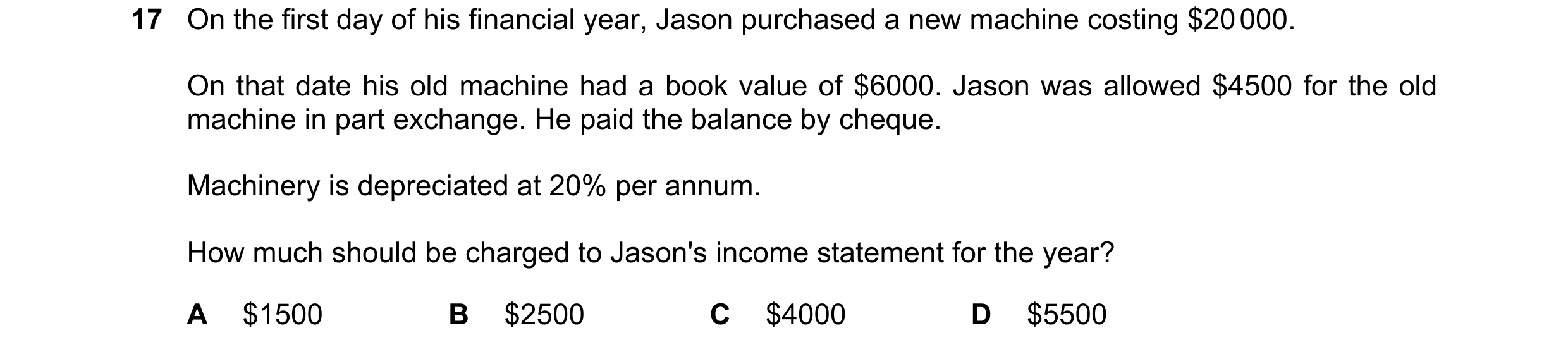
Q42 · On the first day of his financial year, Jason purchased a new machine costing $20 000 0452/11 Oct/Nov 2022
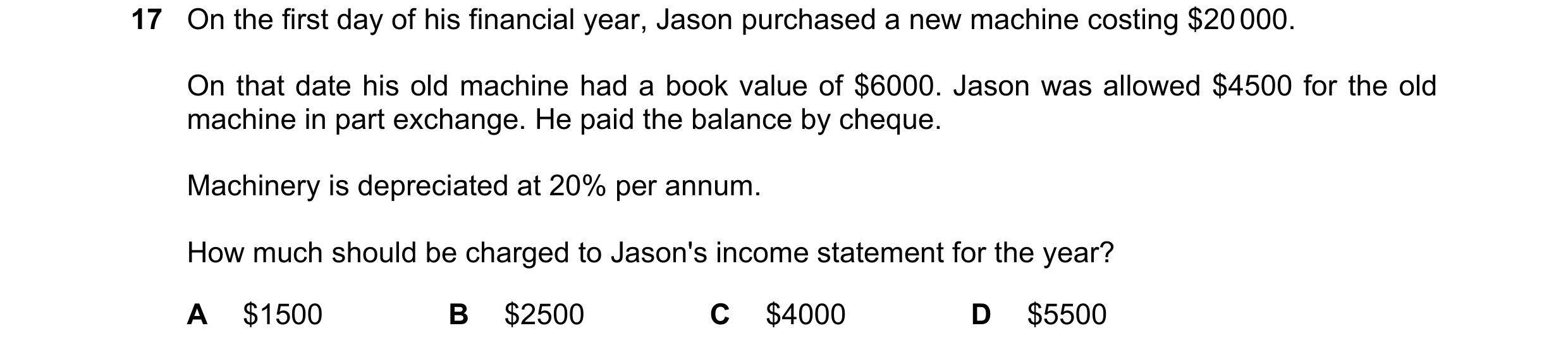
17 On the first day of his financial year, Jason purchased a new machine costing $20 000. On that date his old machine had a book value of $6000. Jason was allowed $4500 for the old machine in part exchange. He paid the balance by cheque. Machinery is depreciated at 20% per annum. How much should be charged to Jason's income statement for the year? A $1500 B $2500 C $4000 D $5500
1 marks
Answer: D
This question in 0452/11 Oct/Nov 2022
Q43 · Wentile purchased a motor vehicle for $35 000 0452/12 Oct/Nov 2022
13 Wentile purchased a motor vehicle for $35 000. He estimated it would be used for five years and then sold for $5000. Wentile depreciated the motor vehicle using the straight-line method at a rate of 20% per annum. What was the accumulated depreciation on this motor vehicle at the end of year 2? A $10 800 B $12 000 C $12 600 D $14 000
1 marks
Answer: B
This question in 0452/12 Oct/Nov 2022
Q44 · On the first day of his financial year, Jason purchased a new machine costing $20 000 0452/12 Oct/Nov 2022
14 On the first day of his financial year, Jason purchased a new machine costing $20 000. On that date his old machine had a book value of $6000. Jason was allowed $4500 for the old machine in part exchange. He paid the balance by cheque. Machinery is depreciated at 20% per annum. How much should be charged to Jason's income statement for the year? A $1500 B $2500 C $4000 D $5500
1 marks
Answer: D
This question in 0452/12 Oct/Nov 2022
Q45 · Manjit depreciates her motor vehicles by $1000 at the end of each financial year 0452/13 Oct/Nov 2022
16 Manjit depreciates her motor vehicles by $1000 at the end of each financial year. Which journal entry would Manjit make at the end of each financial year? debit credit $ $ A income statement 1000 provision for depreciation of motor vehicles 1000 B motor vehicles 1000 provision for depreciation of motor vehicles 1000 C provision for depreciation of motor vehicles 1000 income statement 1000 D provision for depreciation of motor vehicles 1000 motor vehicles 1000
1 marks
Answer: A
This question in 0452/13 Oct/Nov 2022
Q46 · On the first day of his financial year, Jason purchased a new machine costing $20 000 0452/13 Oct/Nov 2022
17 On the first day of his financial year, Jason purchased a new machine costing $20 000. On that date his old machine had a book value of $6000. Jason was allowed $4500 for the old machine in part exchange. He paid the balance by cheque. Machinery is depreciated at 20% per annum. How much should be charged to Jason's income statement for the year? A $1500 B $2500 C $4000 D $5500
1 marks
Answer: D
This question in 0452/13 Oct/Nov 2022
Q47 · Why should a manufacturer charge depreciation on her factory equipment? 0452/12 Feb/March 2023
16 Why should a manufacturer charge depreciation on her factory equipment? A to calculate the residual value of the equipment B to provide for the replacement of the equipment C to spread the flow of cash over a number of years D to spread the cost of the equipment over its useful life
1 marks
Answer: D
This question in 0452/12 Feb/March 2023
Q48 · A manufacturer provided the following information 0452/12 Feb/March 2023
17 A manufacturer provided the following information. $ at 1 January 2022 machinery at cost 20 000 provision for depreciation of machinery 7 200 loose tools at valuation 2 100 Machinery is depreciated at 20% per annum using the reducing balance method. Additional loose tools were purchased in August 2022 for $300. No depreciation is provided on loose tools purchased during the financial year. On 31 December 2022, loose tools more than 12 months old were valued at $1850. What was the depreciation charge for the year ended 31 December 2022? machinery loose tools $ $ A 2560 250 B 2560 550 C 4000 250 D 4000 550
1 marks
Answer: A
This question in 0452/12 Feb/March 2023
Q49 · Which statement about depreciation is correct? 0452/11 May/June 2023
16 Which statement about depreciation is correct? A It is a cash fund to replace a non-current asset. B It is a monetary expense as it involves the outflow of money. C It is an estimate of the loss in value of a current asset over its expected life. D It is recorded in the nominal ledger and the income statement.
1 marks
Answer: D
This question in 0452/11 May/June 2023
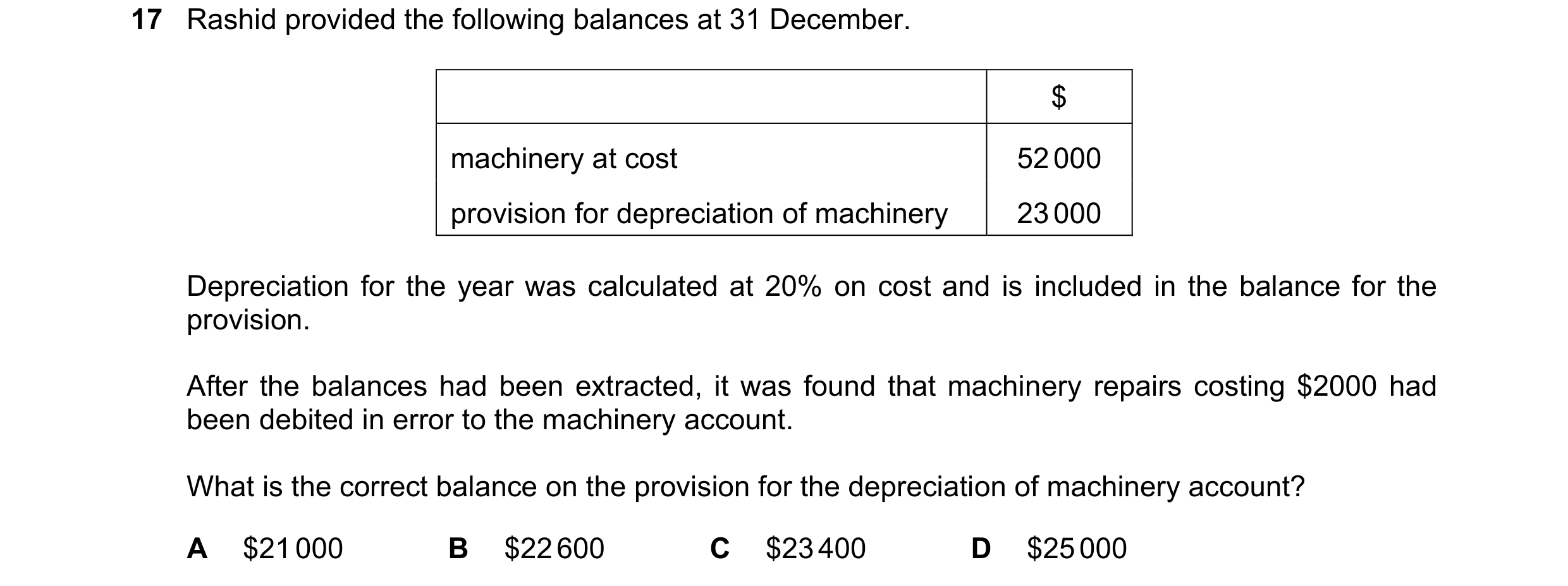
Q50 · Rashid provided the following balances at 31 December 0452/11 May/June 2023
17 Rashid provided the following balances at 31 December. $ machinery at cost 52 000 provision for depreciation of machinery 23 000 Depreciation for the year was calculated at 20% on cost and is included in the balance for the provision. After the balances had been extracted, it was found that machinery repairs costing $2000 had been debited in error to the machinery account. What is the correct balance on the provision for the depreciation of machinery account? A $21 000 B $22 600 C $23 400 D $25 000
1 marks
Answer: B
This question in 0452/11 May/June 2023
Q51 · Maya depreciates her motor vehicle at 25% per annum using the straight-line method 0452/12 May/June 2023
10 Maya depreciates her motor vehicle at 25% per annum using the straight-line method. The motor vehicle cost $15 000. The depreciation for the current financial year was incorrectly calculated at 15% per annum. How will correcting the error affect the profit for the year? A decrease $1500 B decrease $2250 C increase $1500 D increase $2250
1 marks
Answer: A
This question in 0452/12 May/June 2023
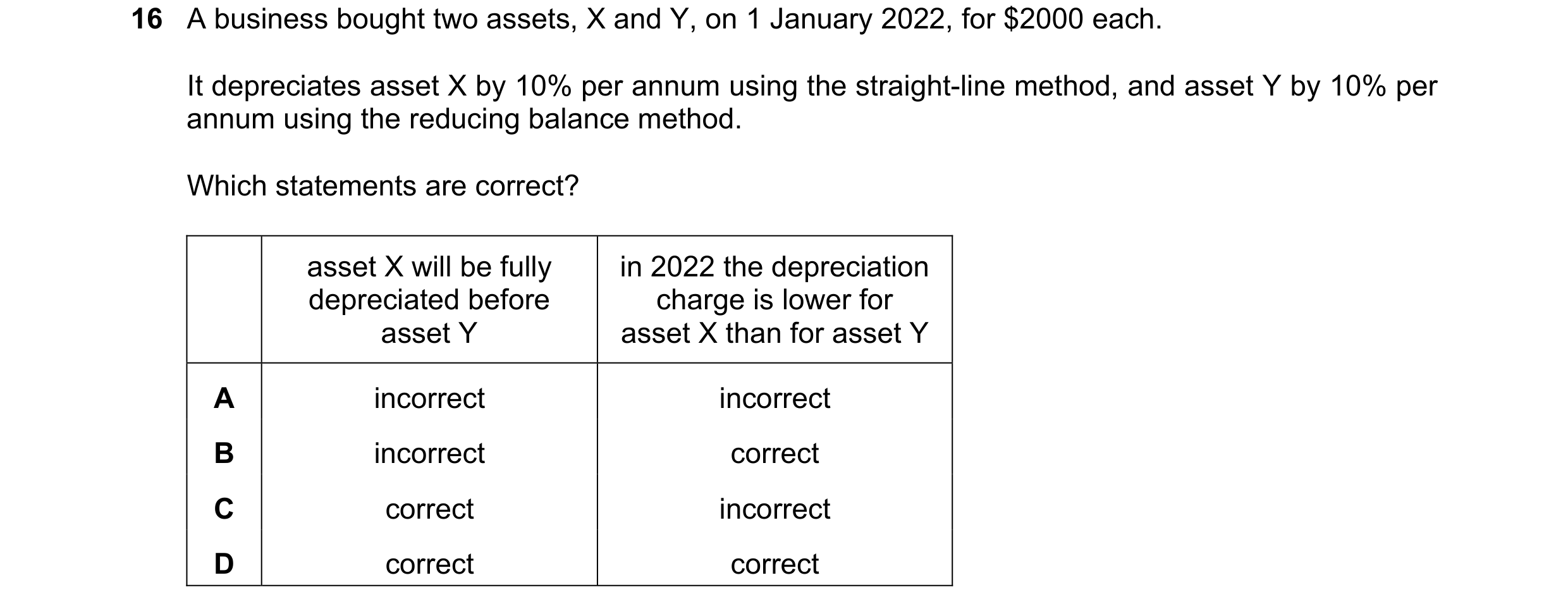
Q52 · A business bought two assets, X and Y, on 1 January 2022, for $2000 each 0452/12 May/June 2023
16 A business bought two assets, X and Y, on 1 January 2022, for $2000 each. It depreciates asset X by 10% per annum using the straight-line method, and asset Y by 10% per annum using the reducing balance method. Which statements are correct? asset X will be fully in 2022 the depreciation depreciated before charge is lower for asset Y asset X than for asset Y A incorrect incorrect B incorrect correct C correct incorrect D correct correct
1 marks
Answer: C
This question in 0452/12 May/June 2023
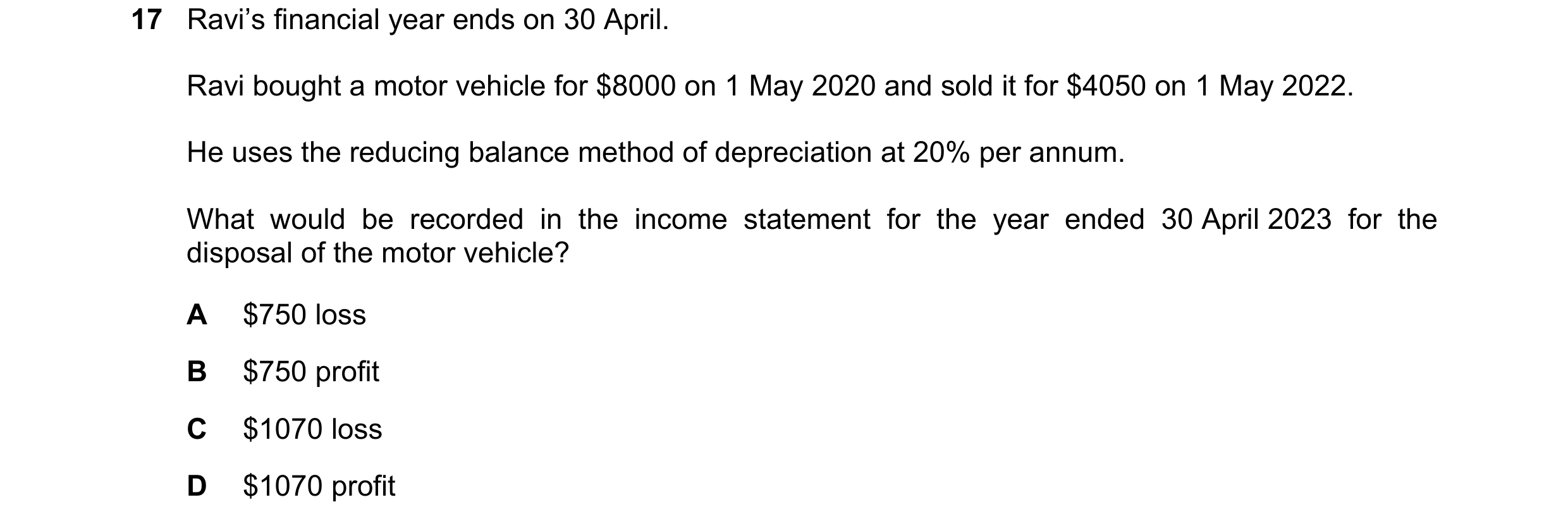
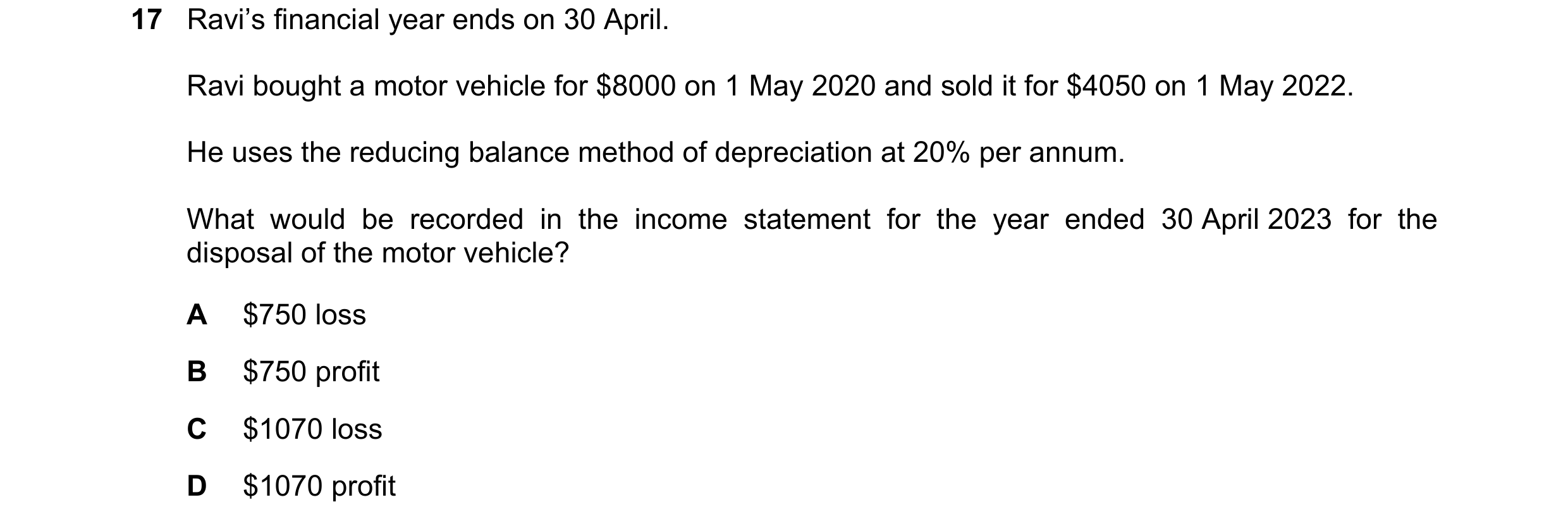
Q53 · Ravi’s financial year ends on 30 April 0452/12 May/June 2023
17 Ravi’s financial year ends on 30 April. Ravi bought a motor vehicle for $8000 on 1 May 2020 and sold it for $4050 on 1 May 2022. He uses the reducing balance method of depreciation at 20% per annum. What would be recorded in the income statement for the year ended 30 April 2023 for the disposal of the motor vehicle? A $750 loss B $750 profit C $1070 loss D $1070 profit
1 marks
Answer: C
This question in 0452/12 May/June 2023
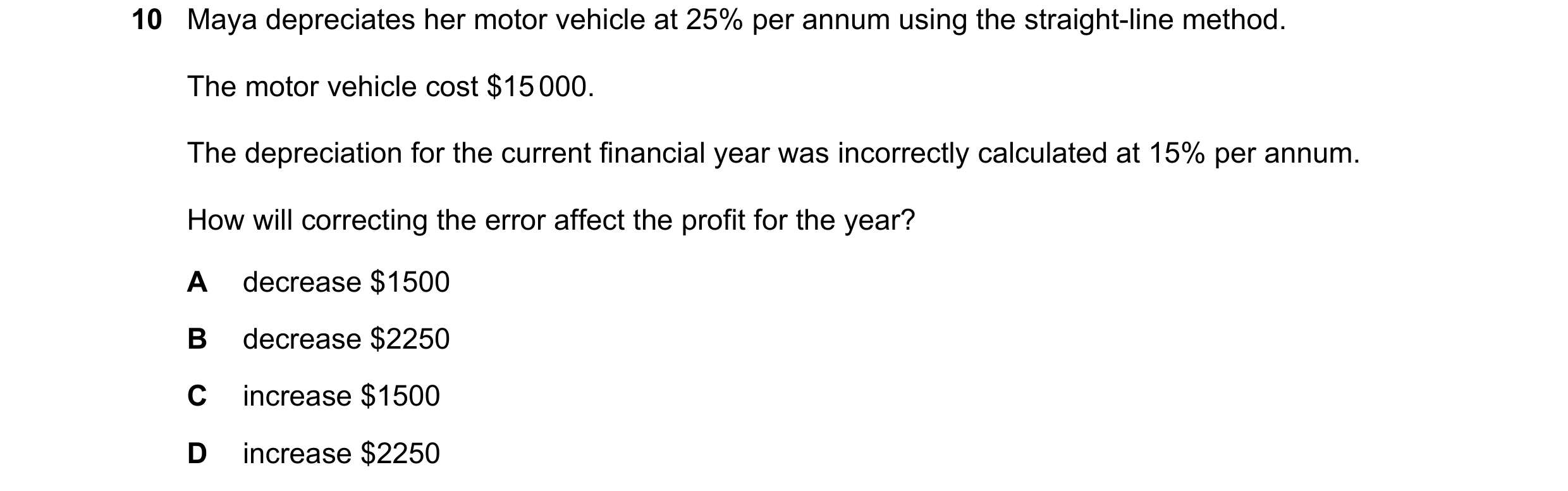
Q54 · Maya depreciates her motor vehicle at 25% per annum using the straight-line method 0452/13 May/June 2023
10 Maya depreciates her motor vehicle at 25% per annum using the straight-line method. The motor vehicle cost $15 000. The depreciation for the current financial year was incorrectly calculated at 15% per annum. How will correcting the error affect the profit for the year? A decrease $1500 B decrease $2250 C increase $1500 D increase $2250
1 marks
Answer: A
This question in 0452/13 May/June 2023
Q55 · A business bought two assets, X and Y, on 1 January 2022, for $2000 each 0452/13 May/June 2023
16 A business bought two assets, X and Y, on 1 January 2022, for $2000 each. It depreciates asset X by 10% per annum using the straight-line method, and asset Y by 10% per annum using the reducing balance method. Which statements are correct? asset X will be fully in 2022 the depreciation depreciated before charge is lower for asset Y asset X than for asset Y A incorrect incorrect B incorrect correct C correct incorrect D correct correct
1 marks
Answer: C
This question in 0452/13 May/June 2023
Q56 · Ravi’s financial year ends on 30 April 0452/13 May/June 2023
17 Ravi’s financial year ends on 30 April. Ravi bought a motor vehicle for $8000 on 1 May 2020 and sold it for $4050 on 1 May 2022. He uses the reducing balance method of depreciation at 20% per annum. What would be recorded in the income statement for the year ended 30 April 2023 for the disposal of the motor vehicle? A $750 loss B $750 profit C $1070 loss D $1070 profit
1 marks
Answer: C
This question in 0452/13 May/June 2023
Q57 · What is a reason for charging depreciation on a non-current asset? 0452/11 Oct/Nov 2023
17 What is a reason for charging depreciation on a non-current asset? A to build up a fund of money that can be used to replace the asset B to charge the cost of the asset over the years which benefit from its use C to ensure that profit is not understated in the income statement D to show the asset at its market value in the statement of financial position
1 marks
Answer: B
This question in 0452/11 Oct/Nov 2023
Q58 · Which non-current asset should be depreciated using the revaluation method? 0452/11 Oct/Nov 2023
18 Which non-current asset should be depreciated using the revaluation method? A loose tools B mines and wells C motor vehicles D office equipment
1 marks
Answer: A
This question in 0452/11 Oct/Nov 2023
Q59 · A motor van originally cost $11 500 and had been depreciated by $9000 0452/11 Oct/Nov 2023
19 A motor van originally cost $11 500 and had been depreciated by $9000. The van was sold for $2750. How should the profit or loss on the sale of the van be shown in the disposal account? A $250 credit B $250 debit C $2500 credit D $2500 debit
1 marks
Answer: B
This question in 0452/11 Oct/Nov 2023
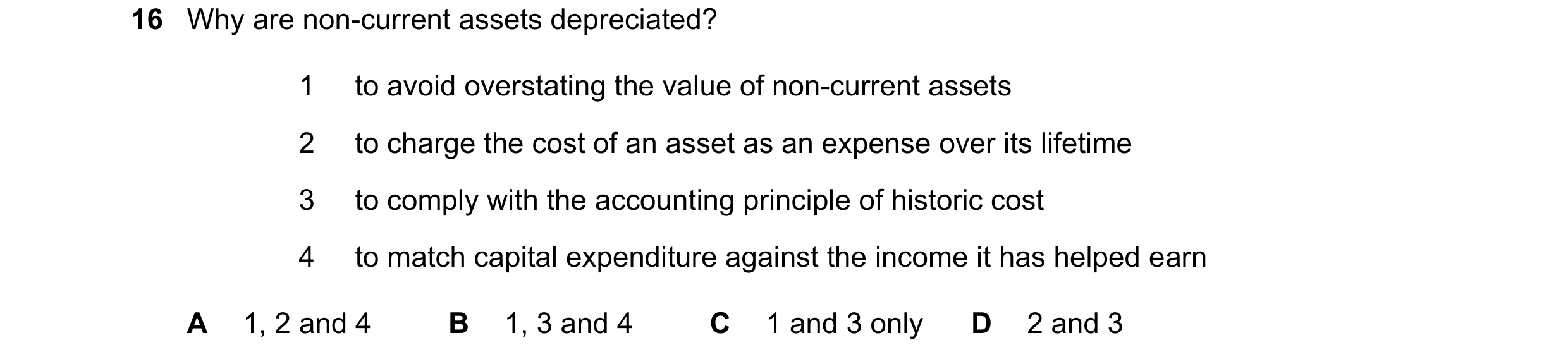
Q60 · Why are non-current assets depreciated? 0452/12 Oct/Nov 2023
16 Why are non-current assets depreciated? 1 to avoid overstating the value of non-current assets 2 to charge the cost of an asset as an expense over its lifetime 3 to comply with the accounting principle of historic cost 4 to match capital expenditure against the income it has helped earn A 1, 2 and 4 B 1, 3 and 4 C 1 and 3 only D 2 and 3
1 marks
Answer: A
This question in 0452/12 Oct/Nov 2023
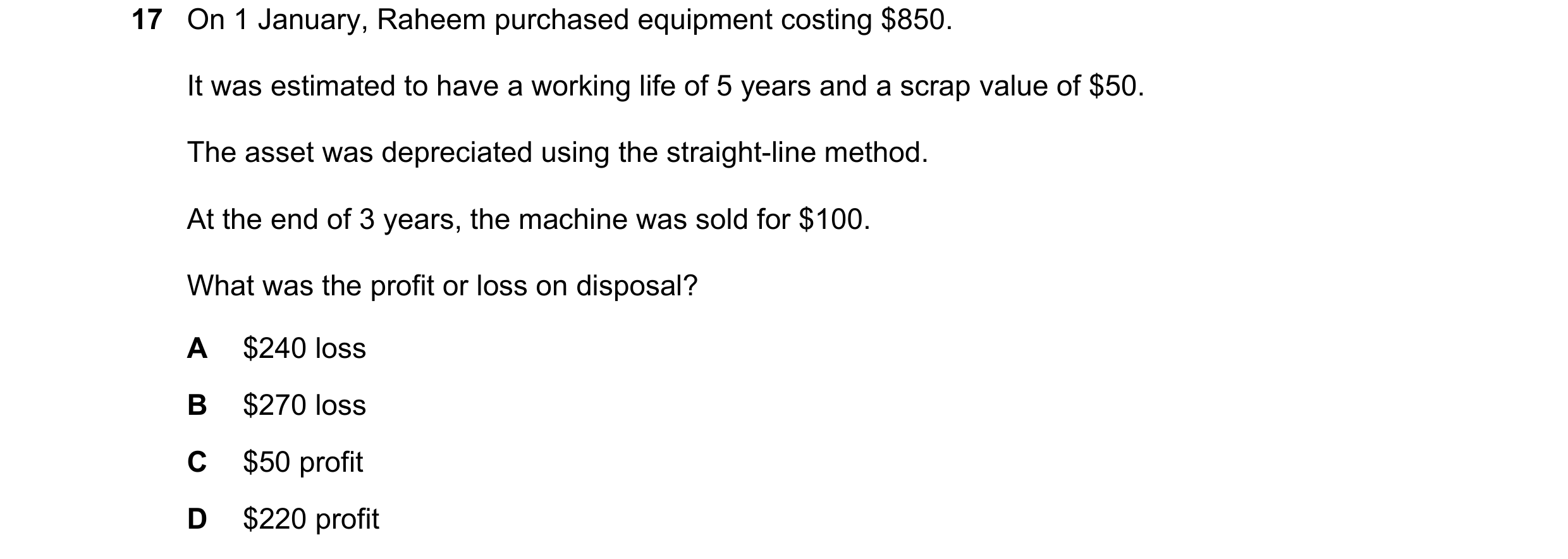
Q61 · On 1 January, Raheem purchased equipment costing $850 0452/12 Oct/Nov 2023
17 On 1 January, Raheem purchased equipment costing $850. It was estimated to have a working life of 5 years and a scrap value of $50. The asset was depreciated using the straight-line method. At the end of 3 years, the machine was sold for $100. What was the profit or loss on disposal? A $240 loss B $270 loss C $50 profit D $220 profit
1 marks
Answer: B
This question in 0452/12 Oct/Nov 2023
Q62 · What is a reason for charging depreciation on a non-current asset? 0452/13 Oct/Nov 2023
17 What is a reason for charging depreciation on a non-current asset? A to build up a fund of money that can be used to replace the asset B to charge the cost of the asset over the years which benefit from its use C to ensure that profit is not understated in the income statement D to show the asset at its market value in the statement of financial position
1 marks
Answer: B
This question in 0452/13 Oct/Nov 2023
Q63 · Which non-current asset should be depreciated using the revaluation method? 0452/13 Oct/Nov 2023
18 Which non-current asset should be depreciated using the revaluation method? A loose tools B mines and wells C motor vehicles D office equipment
1 marks
Answer: A
This question in 0452/13 Oct/Nov 2023
Q64 · A motor van originally cost $11 500 and had been depreciated by $9000 0452/13 Oct/Nov 2023
19 A motor van originally cost $11 500 and had been depreciated by $9000. The van was sold for $2750. How should the profit or loss on the sale of the van be shown in the disposal account? A $250 credit B $250 debit C $2500 credit D $2500 debit
1 marks
Answer: B
This question in 0452/13 Oct/Nov 2023
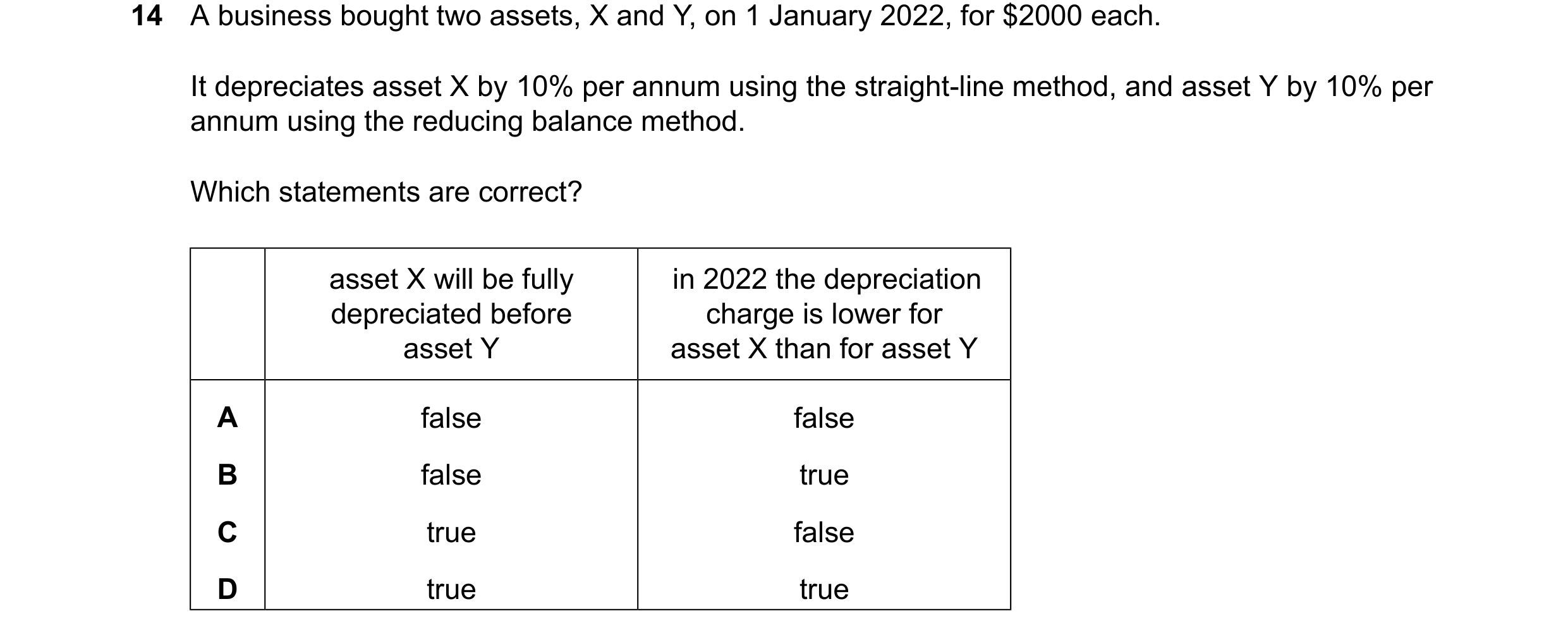
Q65 · A business bought two assets, X and Y, on 1 January 2022, for $2000 each 0452/12 Feb/March 2024
14 A business bought two assets, X and Y, on 1 January 2022, for $2000 each. It depreciates asset X by 10% per annum using the straight-line method, and asset Y by 10% per annum using the reducing balance method. Which statements are correct? asset X will be fully in 2022 the depreciation depreciated before charge is lower for asset Y asset X than for asset Y A false false B false true C true false D true true
1 marks
Answer: C
This question in 0452/12 Feb/March 2024
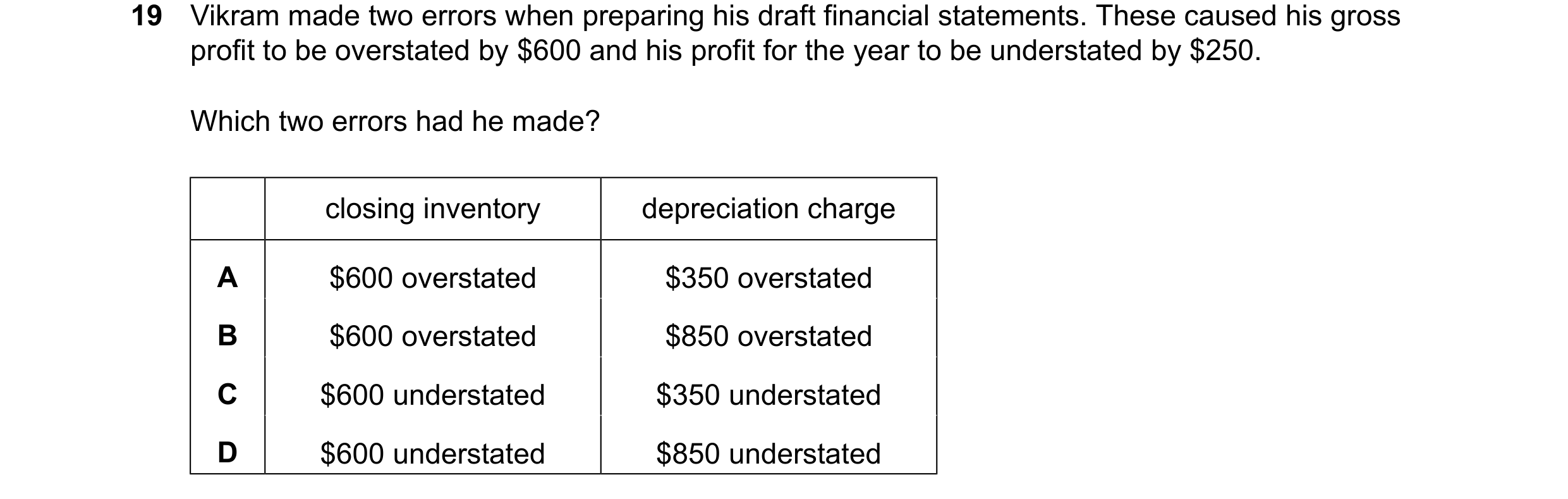
Q66 · Vikram made two errors when preparing his draft financial statements 0452/12 Feb/March 2024
19 Vikram made two errors when preparing his draft financial statements. These caused his gross profit to be overstated by $600 and his profit for the year to be understated by $250. Which two errors had he made? closing inventory depreciation charge A $600 overstated $350 overstated B $600 overstated $850 overstated C $600 understated $350 understated D $600 understated $850 understated
1 marks
Answer: B
This question in 0452/12 Feb/March 2024
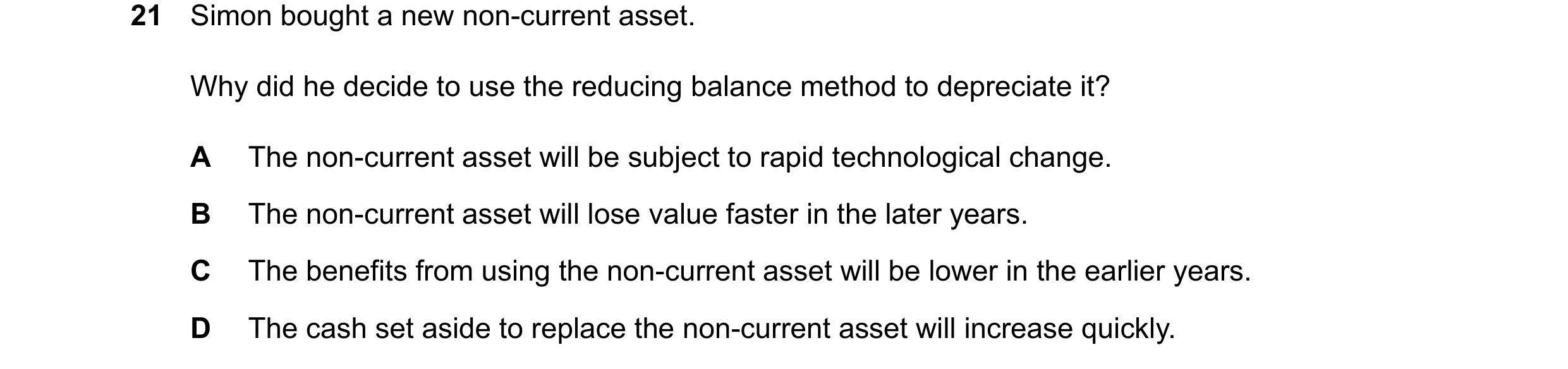
Q67 · Simon bought a new non-current asset 0452/12 Feb/March 2024
21 Simon bought a new non-current asset. Why did he decide to use the reducing balance method to depreciate it? A The non-current asset will be subject to rapid technological change. B The non-current asset will lose value faster in the later years. C The benefits from using the non-current asset will be lower in the earlier years. D The cash set aside to replace the non-current asset will increase quickly.
1 marks
Answer: A
This question in 0452/12 Feb/March 2024
Q68 · Mandeep depreciates his motor vehicles at the rate of 20% using the straight-line method 0452/11 May/June 2024
16 Mandeep depreciates his motor vehicles at the rate of 20% using the straight-line method. A full year’s depreciation is provided in the year of purchase. Mandeep bought a motor vehicle on 1 January 2017 for $20000. On 1 June 2020 he bought a second motor vehicle for $10000. What was the depreciation charge on motor vehicles for the year ended 31 December 2020? A $2000 B $4000 C $5000 D $6000
1 marks
Answer: D
This question in 0452/11 May/June 2024
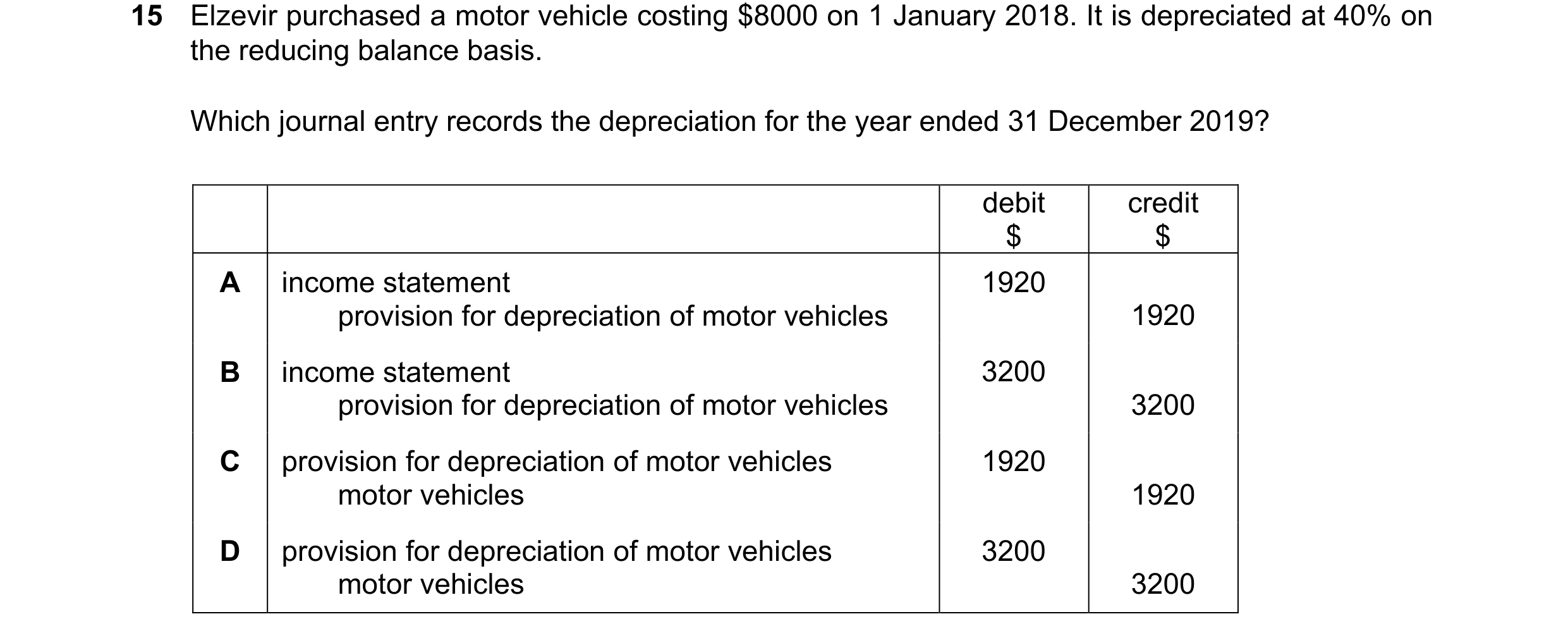
Q69 · Elzevir purchased a motor vehicle costing $8000 on 1 January 2018 0452/12 May/June 2024
15 Elzevir purchased a motor vehicle costing $8000 on 1 January 2018. It is depreciated at 40% on the reducing balance basis. Which journal entry records the depreciation for the year ended 31 December 2019? debit credit $ $ A income statement 1920 provision for depreciation of motor vehicles 1920 B income statement 3200 provision for depreciation of motor vehicles 3200 C provision for depreciation of motor vehicles 1920 motor vehicles 1920 D provision for depreciation of motor vehicles 3200 motor vehicles 3200
1 marks
Answer: A
This question in 0452/12 May/June 2024
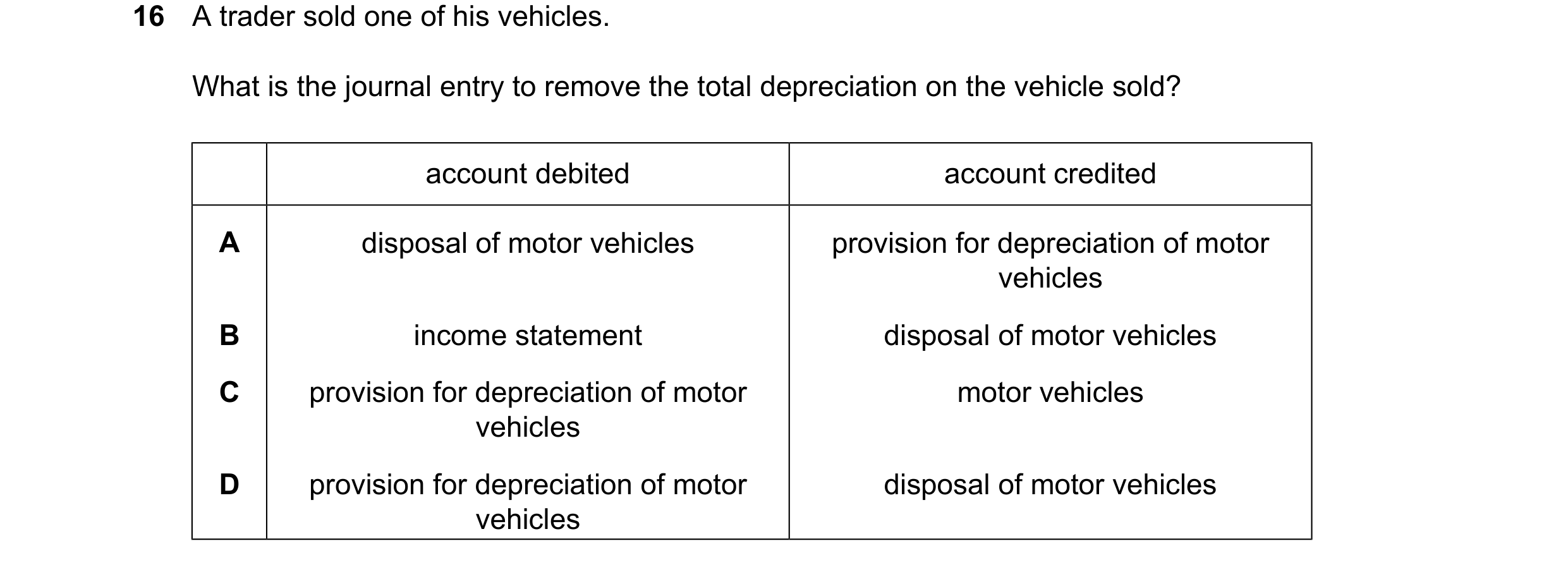
Q70 · A trader sold one of his vehicles 0452/12 May/June 2024
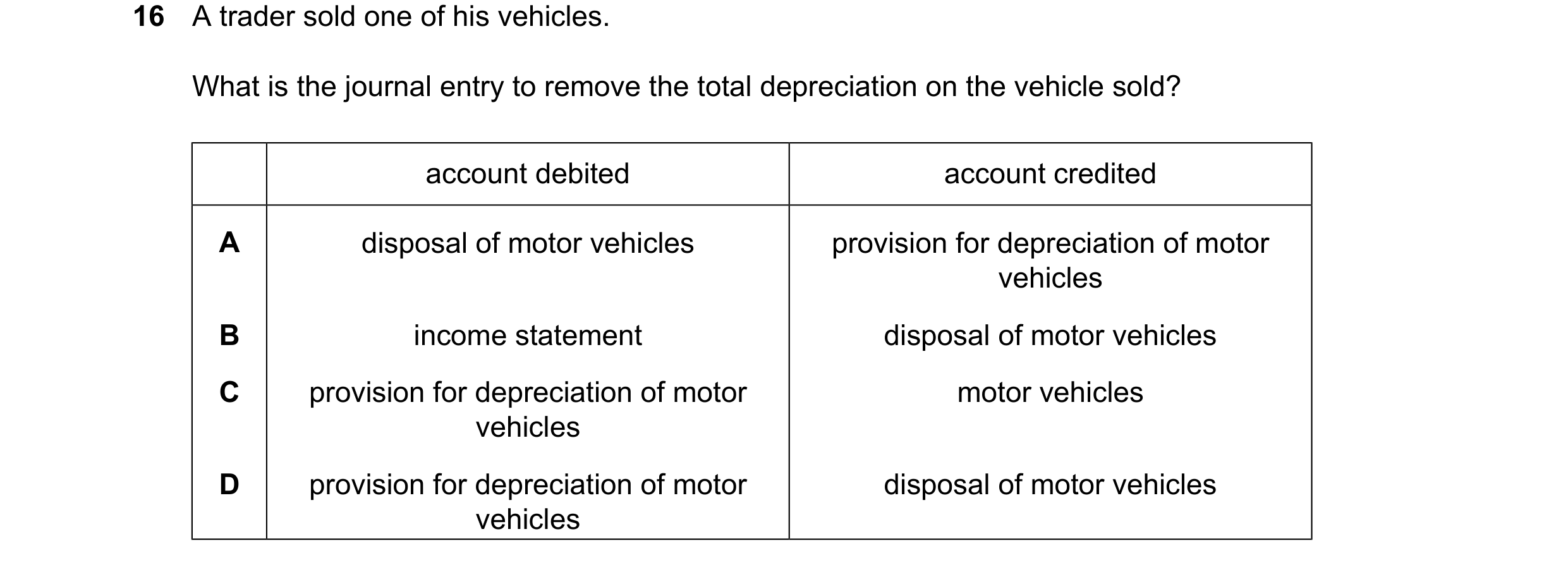
16 A trader sold one of his vehicles. What is the journal entry to remove the total depreciation on the vehicle sold? account debited account credited A disposal of motor vehicles provision for depreciation of motor vehicles B income statement disposal of motor vehicles C provision for depreciation of motor motor vehicles vehicles D provision for depreciation of motor disposal of motor vehicles vehicles
1 marks
Answer: D
This question in 0452/12 May/June 2024
Q71 · Elzevir purchased a motor vehicle costing $8000 on 1 January 2018 0452/13 May/June 2024
15 Elzevir purchased a motor vehicle costing $8000 on 1 January 2018. It is depreciated at 40% on the reducing balance basis. Which journal entry records the depreciation for the year ended 31 December 2019? debit credit $ $ A income statement 1920 provision for depreciation of motor vehicles 1920 B income statement 3200 provision for depreciation of motor vehicles 3200 C provision for depreciation of motor vehicles 1920 motor vehicles 1920 D provision for depreciation of motor vehicles 3200 motor vehicles 3200
1 marks
Answer: A
This question in 0452/13 May/June 2024
Q72 · A trader sold one of his vehicles 0452/13 May/June 2024
16 A trader sold one of his vehicles. What is the journal entry to remove the total depreciation on the vehicle sold? account debited account credited A disposal of motor vehicles provision for depreciation of motor vehicles B income statement disposal of motor vehicles C provision for depreciation of motor motor vehicles vehicles D provision for depreciation of motor disposal of motor vehicles vehicles
1 marks
Answer: D
This question in 0452/13 May/June 2024
Q73 · On 1 January 2023 Kate paid $400 for a two-year maintenance contract on her machinery… 0452/11 Oct/Nov 2024
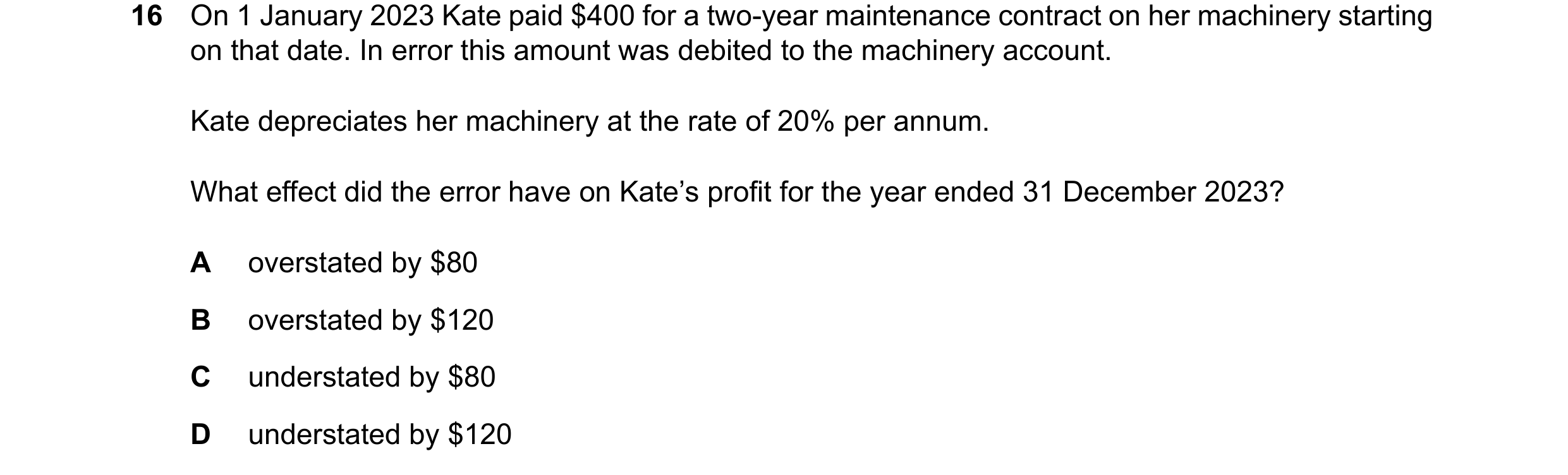
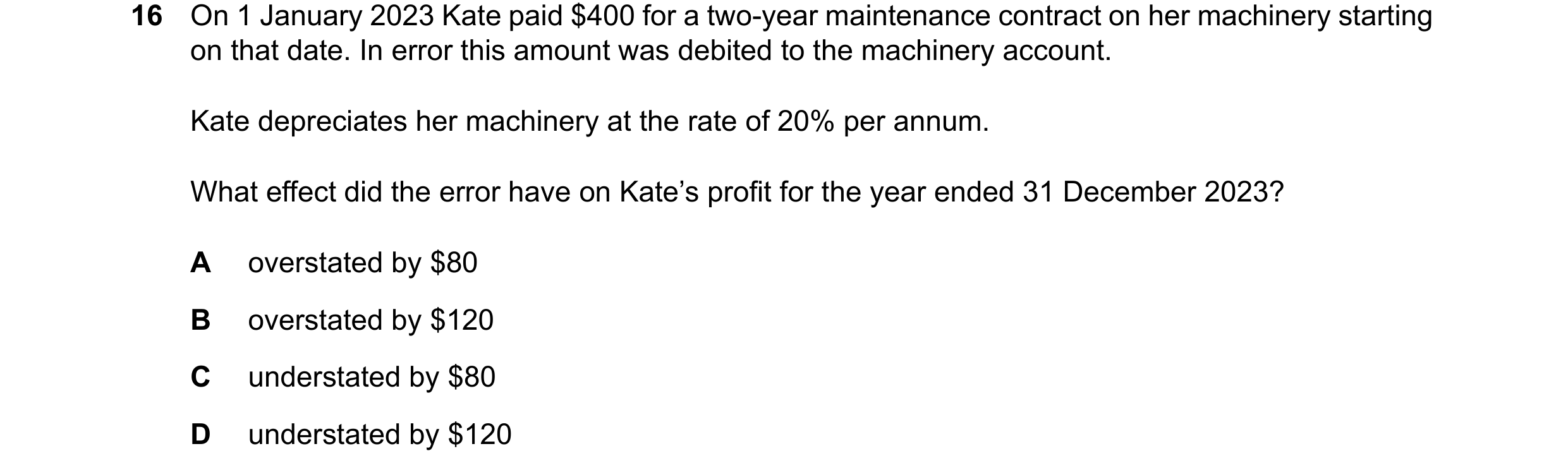
16 On 1 January 2023 Kate paid $400 for a two-year maintenance contract on her machinery starting on that date. In error this amount was debited to the machinery account. Kate depreciates her machinery at the rate of 20% per annum. What effect did the error have on Kate’s profit for the year ended 31 December 2023? A overstated by $80 B overstated by $120 C understated by $80 D understated by $120
1 marks
Answer: B
This question in 0452/11 Oct/Nov 2024
Q74 · Why should a business depreciate its non-current assets? 0452/11 Oct/Nov 2024
17 Why should a business depreciate its non-current assets? A to charge the cost of an asset as an expense in the year of purchase B to ensure that cash is available to replace the non-current assets C to ensure the value of non-current assets is not understated D to match capital expenditure against the revenue it has helped to earn
1 marks
Answer: D
This question in 0452/11 Oct/Nov 2024
Q75 · Which statements are correct about depreciation? 0452/12 Oct/Nov 2024
15 Which statements are correct about depreciation? 1 It is a non-cash expense item. 2 It is an estimated amount. 3 It is the amount of money set aside to replace a non-current asset. 4 It is a gradual loss in the value of a current asset. A 1, 2 and 3 B 1 and 2 only C 2, 3 and 4 D 2 and 4 only
1 marks
Answer: B
This question in 0452/12 Oct/Nov 2024
Q76 · A machine with an original cost of $10000 had been depreciated for two years at the rate… 0452/12 Oct/Nov 2024
16 A machine with an original cost of $10000 had been depreciated for two years at the rate of 10% per annum using the straight-line method. It was then sold for cash with the loss on disposal amounting to $700. A replacement machine was bought on the same day for $12400 cash. What was the net decrease in the cash balance? A $3700 B $5100 C $11700 D $13100
1 marks
Answer: B
This question in 0452/12 Oct/Nov 2024
Q77 · On 1 January 2023 Kate paid $400 for a two-year maintenance contract on her machinery… 0452/13 Oct/Nov 2024
16 On 1 January 2023 Kate paid $400 for a two-year maintenance contract on her machinery starting on that date. In error this amount was debited to the machinery account. Kate depreciates her machinery at the rate of 20% per annum. What effect did the error have on Kate’s profit for the year ended 31 December 2023? A overstated by $80 B overstated by $120 C understated by $80 D understated by $120
1 marks
Answer: B
This question in 0452/13 Oct/Nov 2024
Q78 · Why should a business depreciate its non-current assets? 0452/13 Oct/Nov 2024
17 Why should a business depreciate its non-current assets? A to charge the cost of an asset as an expense in the year of purchase B to ensure that cash is available to replace the non-current assets C to ensure the value of non-current assets is not understated D to match capital expenditure against the revenue it has helped to earn
1 marks
Answer: D
This question in 0452/13 Oct/Nov 2024
Q79 · Samuel started his business on 1 January 2023 and bought two delivery vans for $12000 each 0452/12 Feb/March 2025
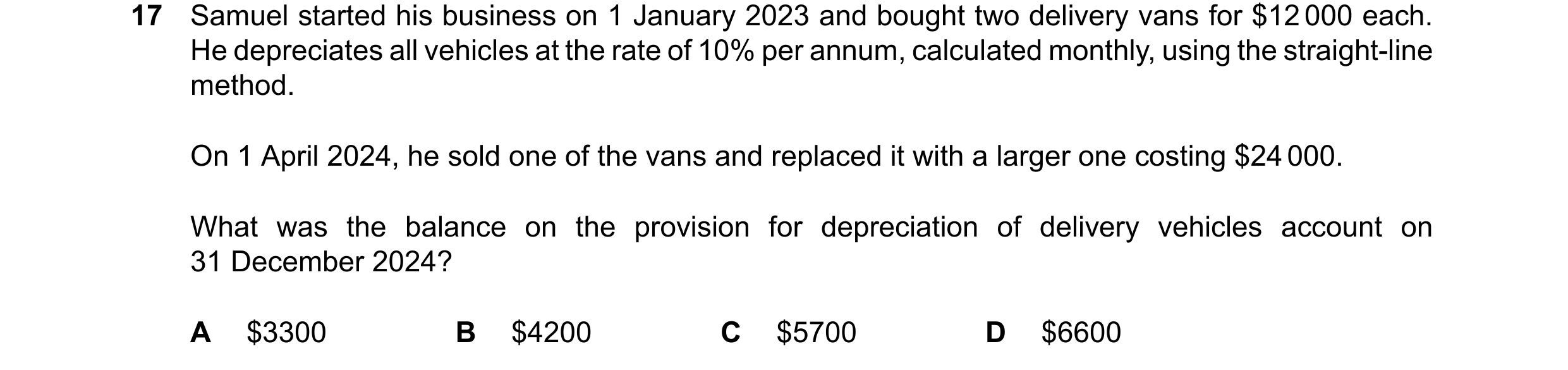
17 Samuel started his business on 1 January 2023 and bought two delivery vans for $12000 each. He depreciates all vehicles at the rate of 10% per annum, calculated monthly, using the straight-line method. On 1 April 2024, he sold one of the vans and replaced it with a larger one costing $24000. What was the balance on the provision for depreciation of delivery vehicles account on 31 December 2024? A $3300 B $4200 C $5700 D $6600
1 marks
Answer: B
This question in 0452/12 Feb/March 2025
Q80 · A carpenter uses the revaluation method of depreciation for the hand tools used in the… 0452/12 Feb/March 2025
18 A carpenter uses the revaluation method of depreciation for the hand tools used in the business. All hand tools in use at the end of the financial year, including those bought during the year, are revalued. New hand tools were purchased during the year, but no hand tools were disposed of. Which value of hand tools shows the calculation of the depreciation for the year? A value at the start of the year less cost of new tools less value at the end of the year B value at the start of the year less value at the end of the year C value at the start of the year plus value at the end of the year less new hand tools purchased D value at the start of the year plus new hand tools purchased less value at the end of the year
1 marks
Answer: D
This question in 0452/12 Feb/March 2025
Q81 · Atif depreciates his motor vehicles at a rate of 20% per annum, using the reducing… 0452/11 May/June 2025
15 Atif depreciates his motor vehicles at a rate of 20% per annum, using the reducing balance method. On 1 May 2024, Atif owned motor vehicles which had cost $35 000. The accumulated depreciation on these motor vehicles was $12 600 on 1 May 2024. What will be the balance on Atif’s provision for depreciation account on 30 April 2025? A $17 080 B $17 920 C $22 400 D $26 880
1 marks
Answer: A
This question in 0452/11 May/June 2025
Q82 · On 1 January 2023, equipment was purchased for $50000 0452/12 May/June 2025
15 On 1 January 2023, equipment was purchased for $50000. The equipment is expected to have a useful life of five years and a residual value of $10000. The straight-line method of depreciation is used. What was the balance on the provision for depreciation of equipment account on 31 December 2024? A $8000 B $10000 C $16000 D $20000
1 marks
Answer: C
This question in 0452/12 May/June 2025
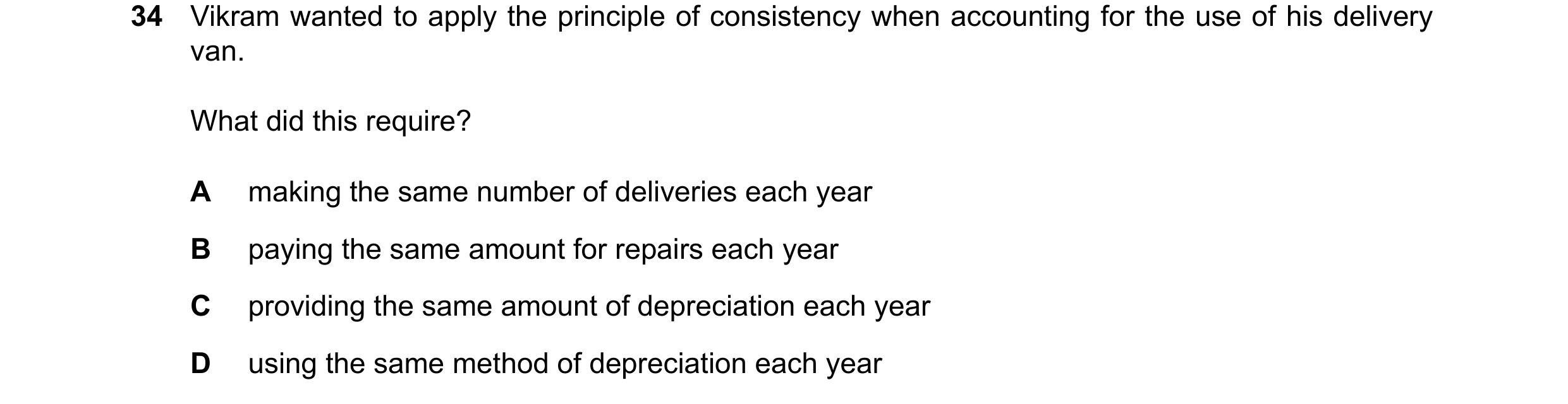
Q83 · Vikram wanted to apply the principle of consistency when accounting for the use of his… 0452/12 May/June 2025
34 Vikram wanted to apply the principle of consistency when accounting for the use of his delivery van. What did this require? A making the same number of deliveries each year B paying the same amount for repairs each year C providing the same amount of depreciation each year D using the same method of depreciation each year
1 marks
Answer: D
This question in 0452/12 May/June 2025
Q84 · Atif depreciates his motor vehicles at a rate of 20% per annum, using the reducing… 0452/13 May/June 2025
15 Atif depreciates his motor vehicles at a rate of 20% per annum, using the reducing balance method. On 1 May 2024, Atif owned motor vehicles which had cost $35 000. The accumulated depreciation on these motor vehicles was $12 600 on 1 May 2024. What will be the balance on Atif’s provision for depreciation account on 30 April 2025? A $17 080 B $17 920 C $22 400 D $26 880
1 marks
Answer: A
This question in 0452/13 May/June 2025
Q85 · At the beginning of the year on 1 January, Zac paid $420 for an equipment repair 0452/12 Oct/Nov 2025
15 At the beginning of the year on 1 January, Zac paid $420 for an equipment repair. He entered this amount in the equipment account. At the end of the year on 31 December, depreciation of 20% per annum was charged on the balance of the equipment account, using the straight-line method. What was the overall effect on the book value of the equipment on 31 December? A $84 understated B $336 overstated C $420 overstated D $504 understated
1 marks
Answer: B
This question in 0452/12 Oct/Nov 2025
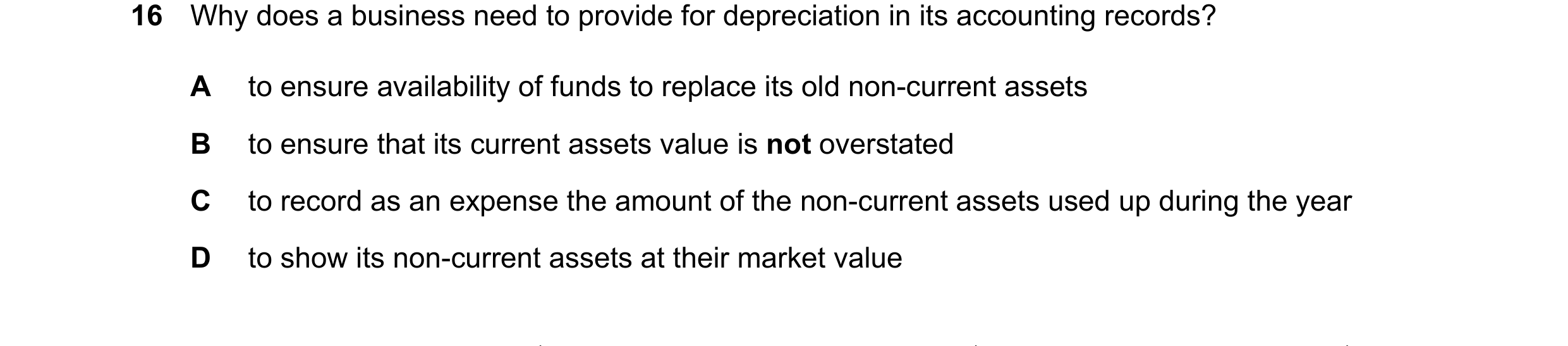
Q86 · Why does a business need to provide for depreciation in its accounting records? 0452/12 Oct/Nov 2025
16 Why does a business need to provide for depreciation in its accounting records? A to ensure availability of funds to replace its old non-current assets B to ensure that its current assets value is not overstated C to record as an expense the amount of the non-current assets used up during the year D to show its non-current assets at their market value
1 marks
Answer: C
This question in 0452/12 Oct/Nov 2025
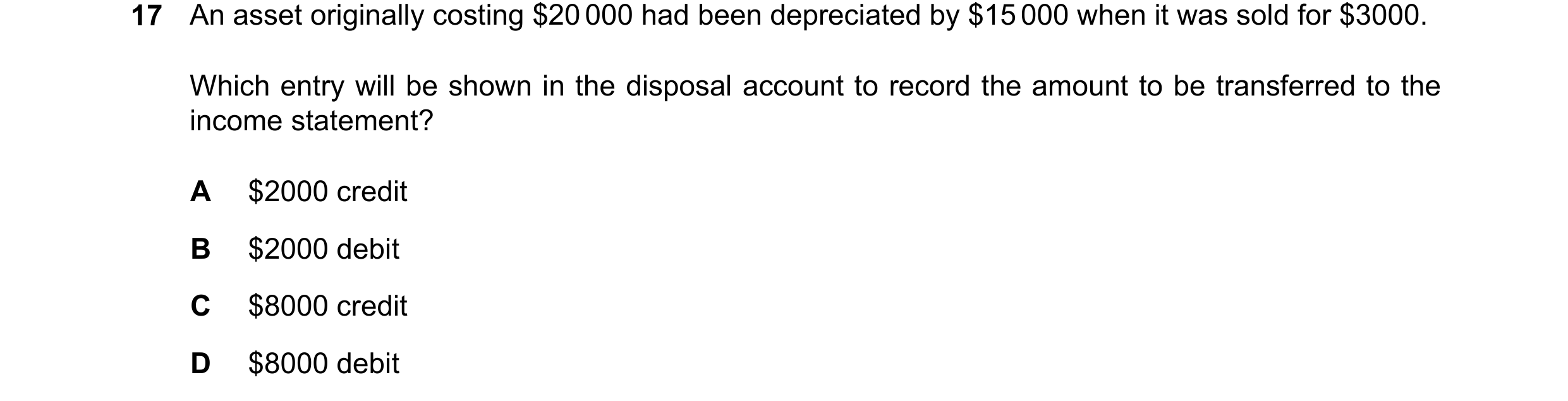
Q87 · An asset originally costing $20 000 had been depreciated by $15 000 when it was sold for… 0452/12 Oct/Nov 2025
17 An asset originally costing $20 000 had been depreciated by $15 000 when it was sold for $3000. Which entry will be shown in the disposal account to record the amount to be transferred to the income statement? A $2000 credit B $2000 debit C $8000 credit D $8000 debit
1 marks
Answer: A
This question in 0452/12 Oct/Nov 2025
Q88 · A motor vehicle was bought by T Limited for $30000 on 1 January 2022 0452/13 Oct/Nov 2025
16 A motor vehicle was bought by T Limited for $30000 on 1 January 2022. It was depreciated at the rate of 30% per annum using the reducing balance method. The financial year end of T Limited is 31 December. What is the net book value of the motor vehicle at 31 December 2024? A $3000 B $10290 C $12000 D $14700
1 marks
Answer: B
This question in 0452/13 Oct/Nov 2025
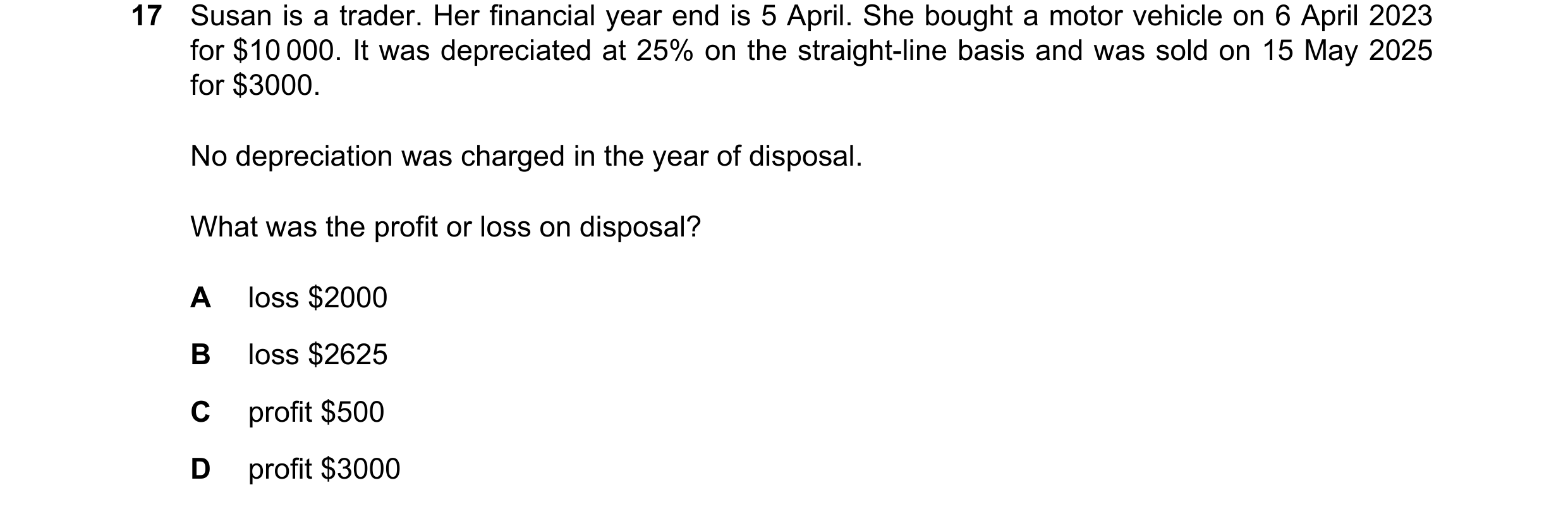
Q89 · Susan is a trader 0452/13 Oct/Nov 2025
17 Susan is a trader. Her financial year end is 5 April. She bought a motor vehicle on 6 April 2023 for $10 000. It was depreciated at 25% on the straight-line basis and was sold on 15 May 2025 for $3000. No depreciation was charged in the year of disposal. What was the profit or loss on disposal? A loss $2000 B loss $2625 C profit $500 D profit $3000
1 marks
Answer: A
This question in 0452/13 Oct/Nov 2025
 1 / 22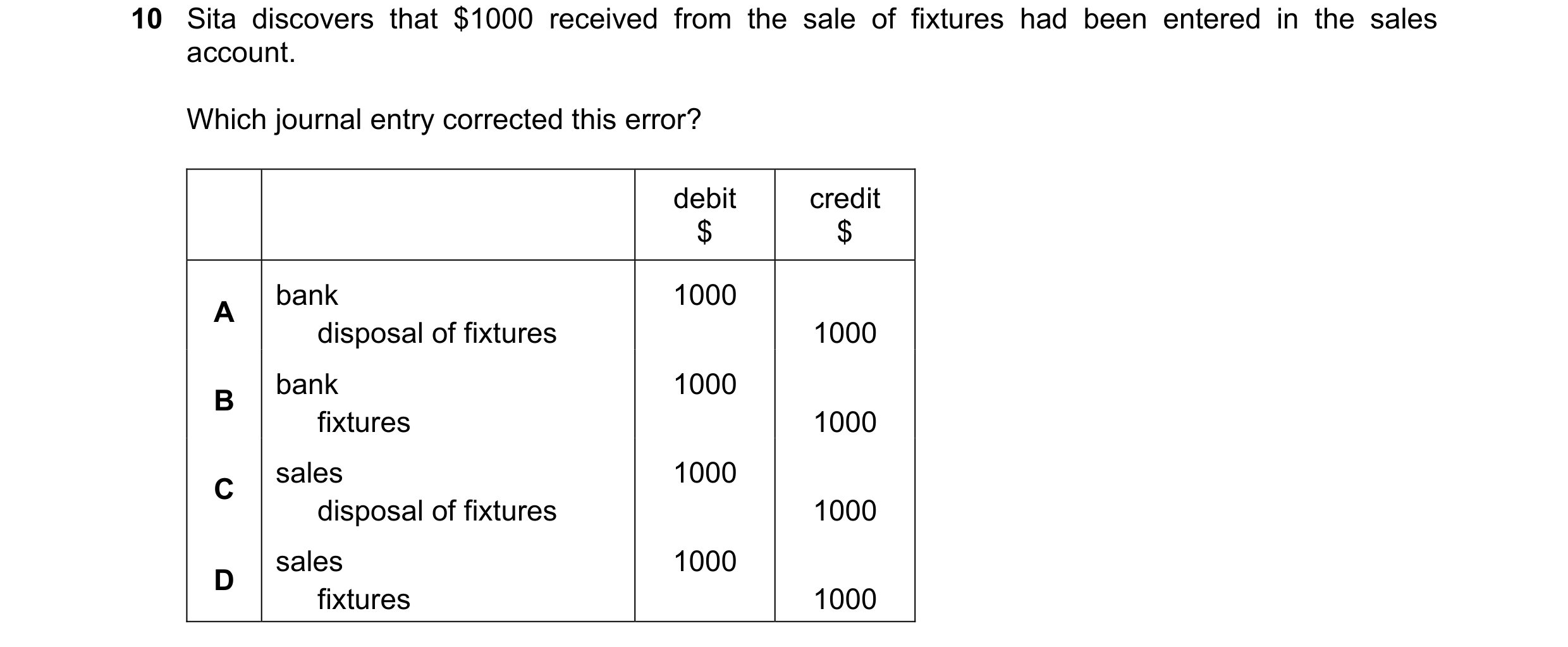
 2 / 22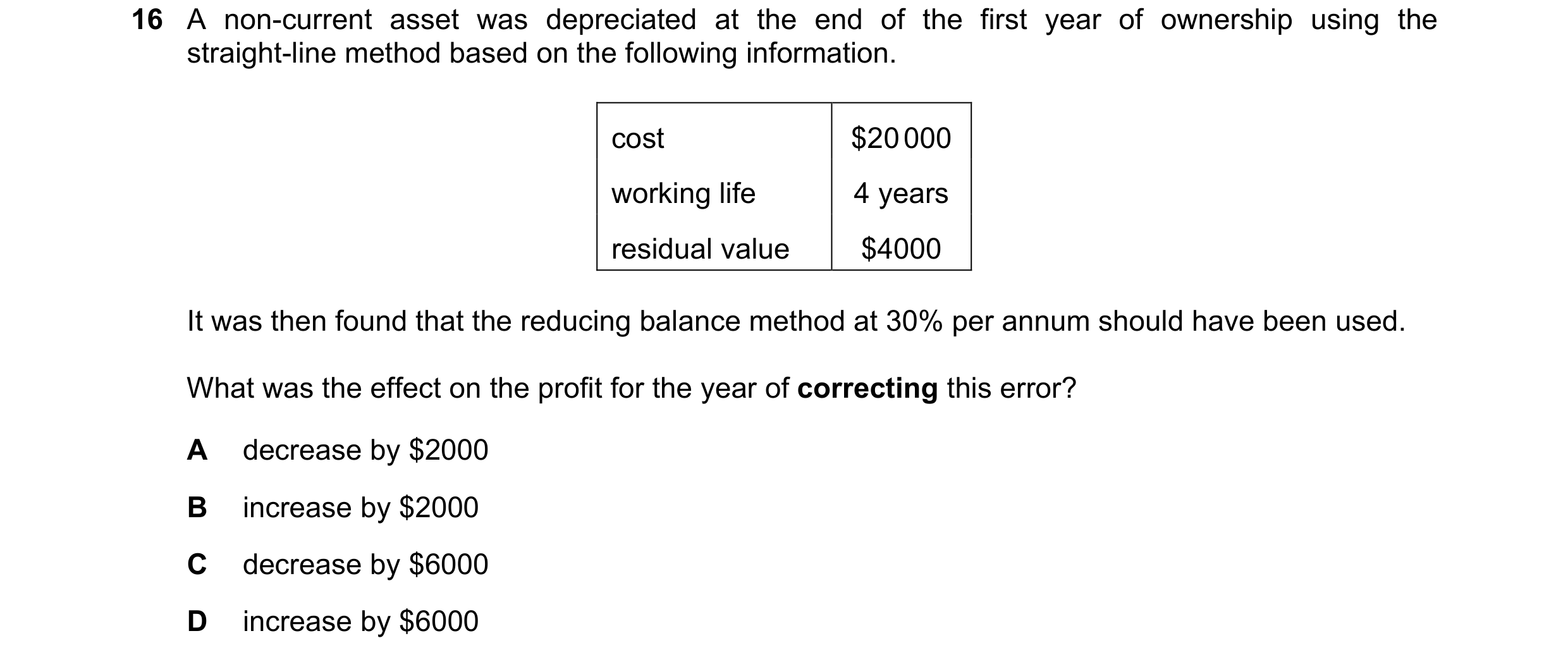
 3 / 22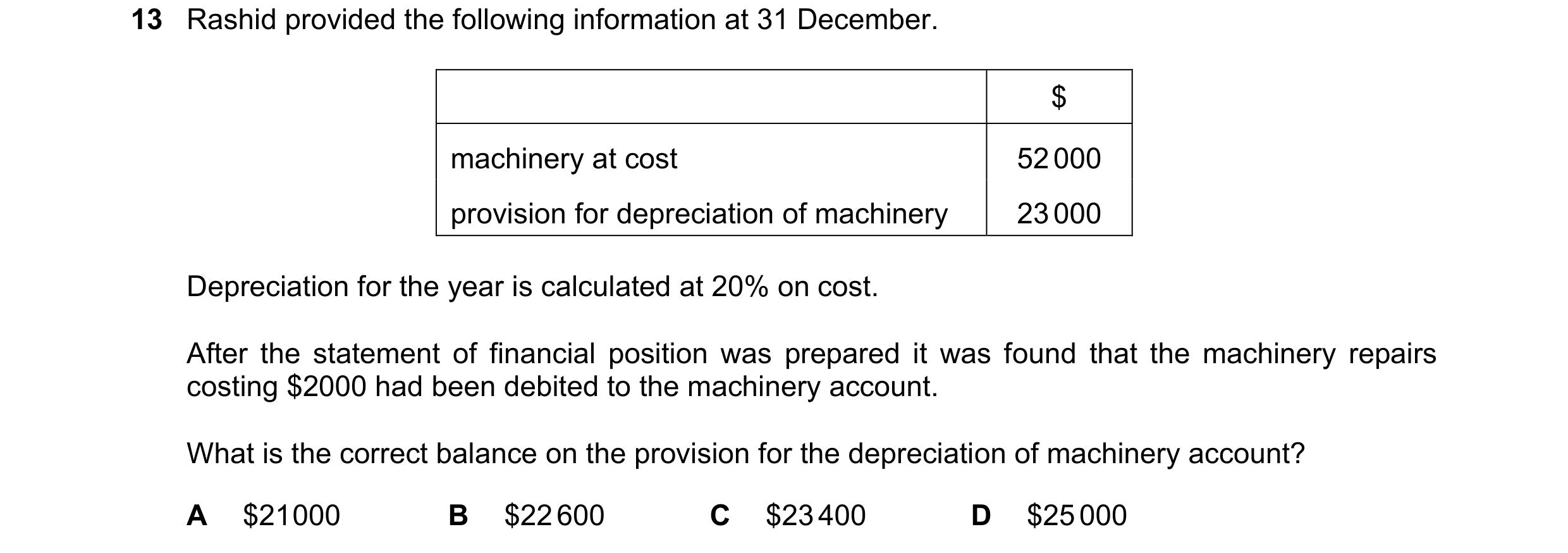
 4 / 22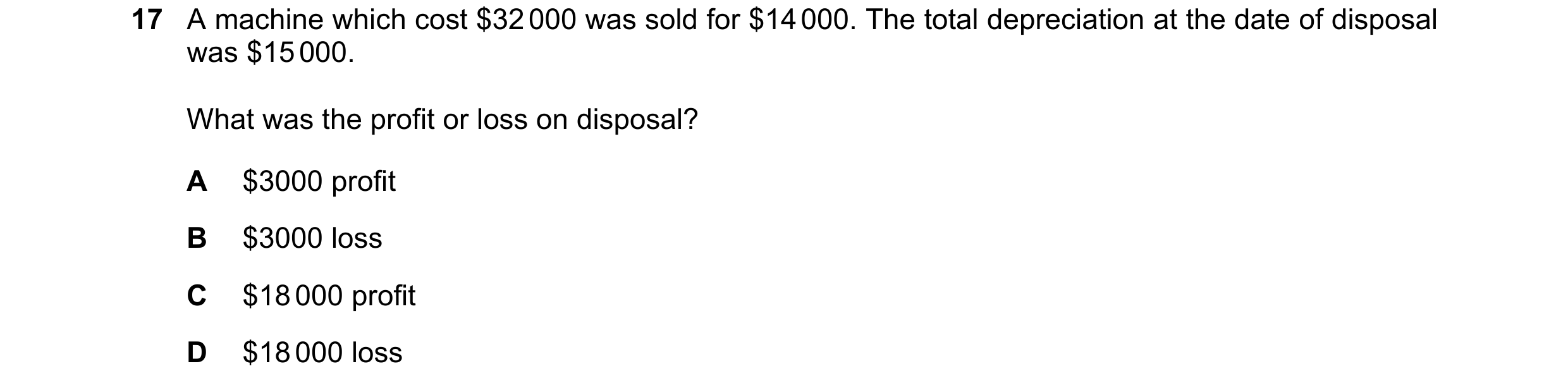
 5 / 22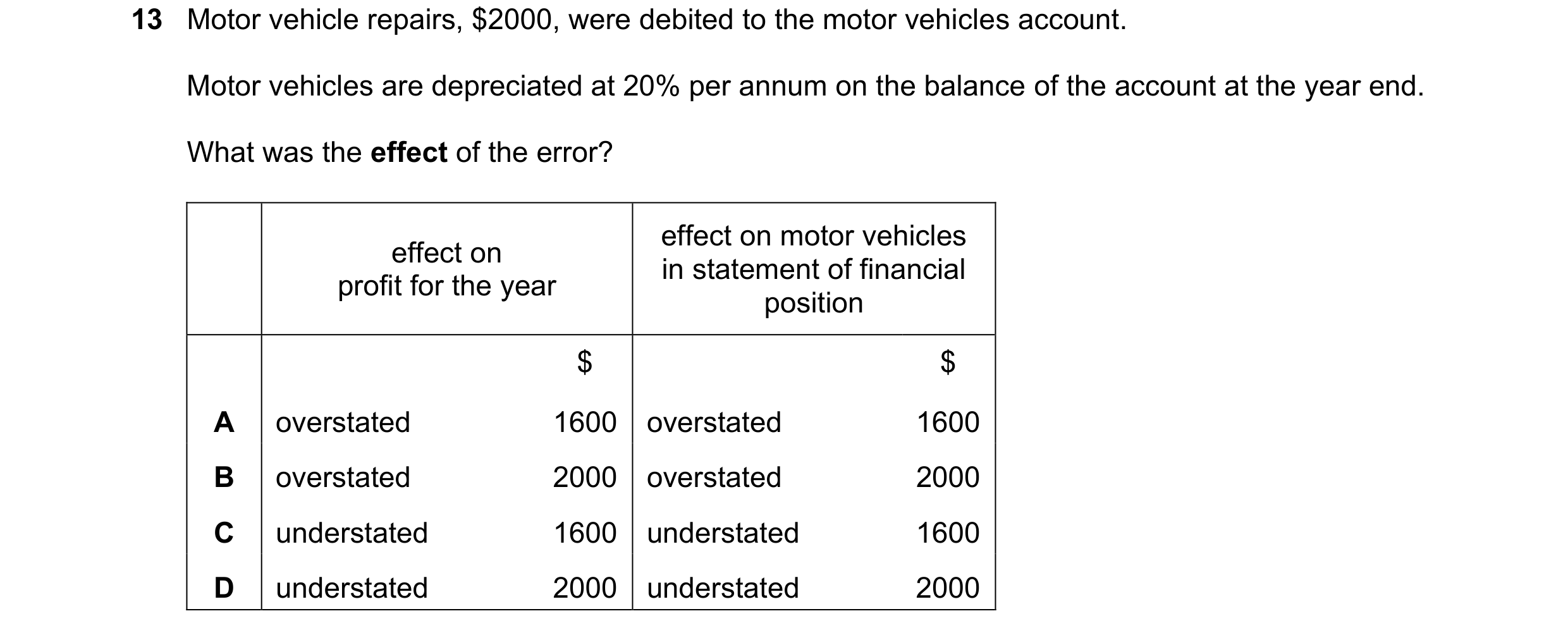

 6 / 22

 7 / 22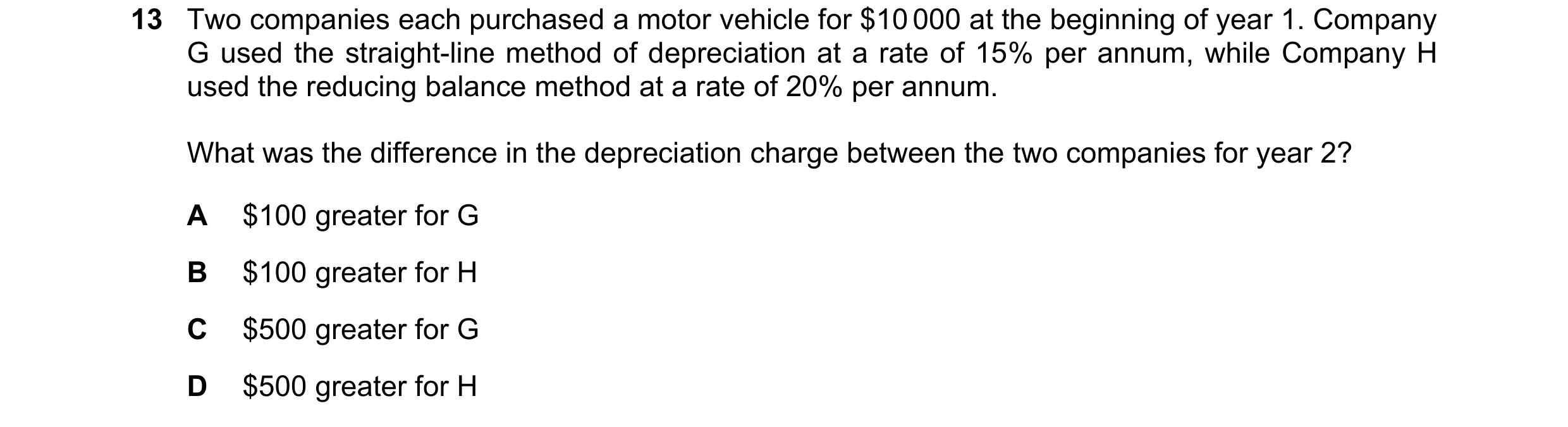
 8 / 22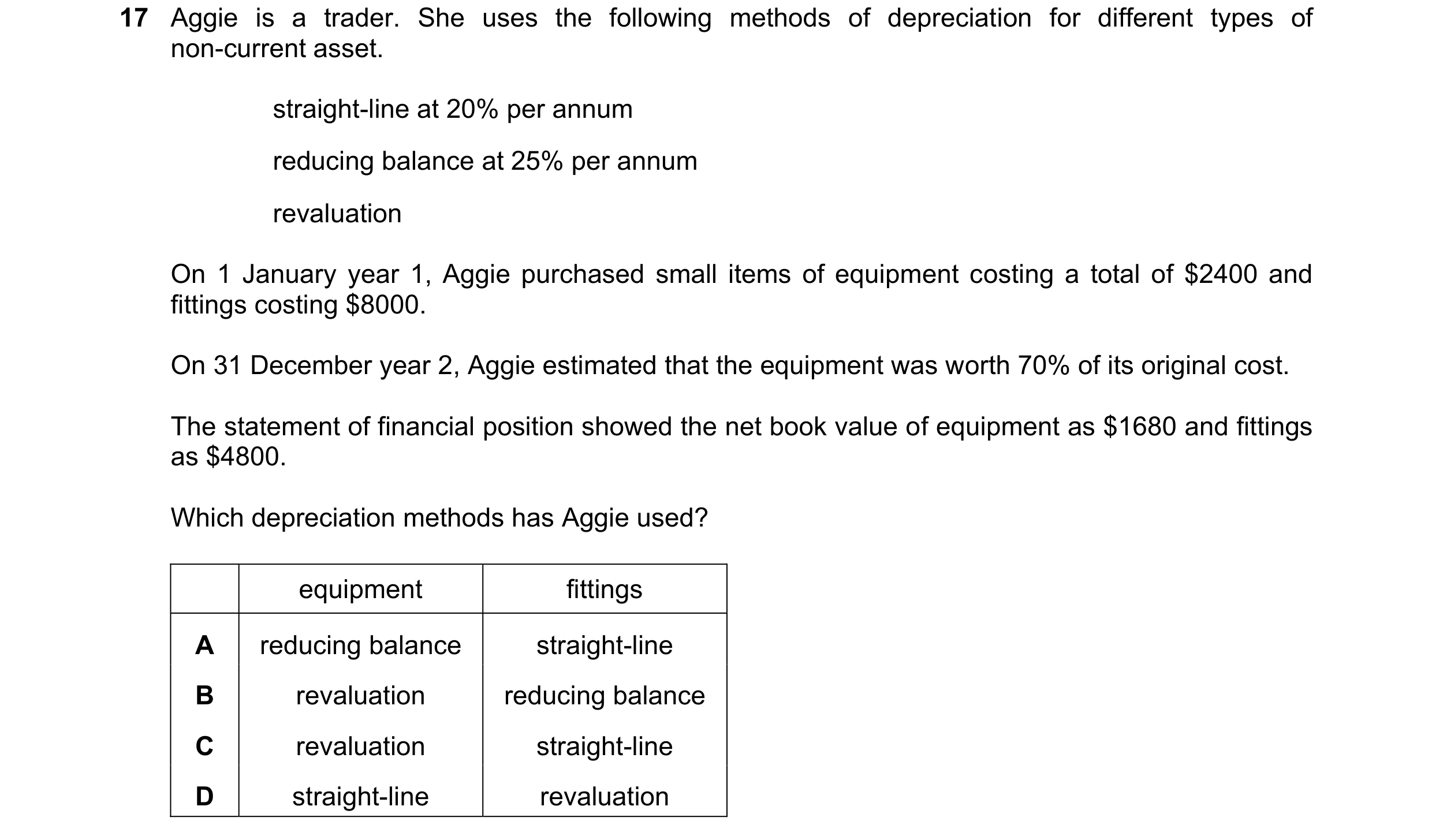
 9 / 22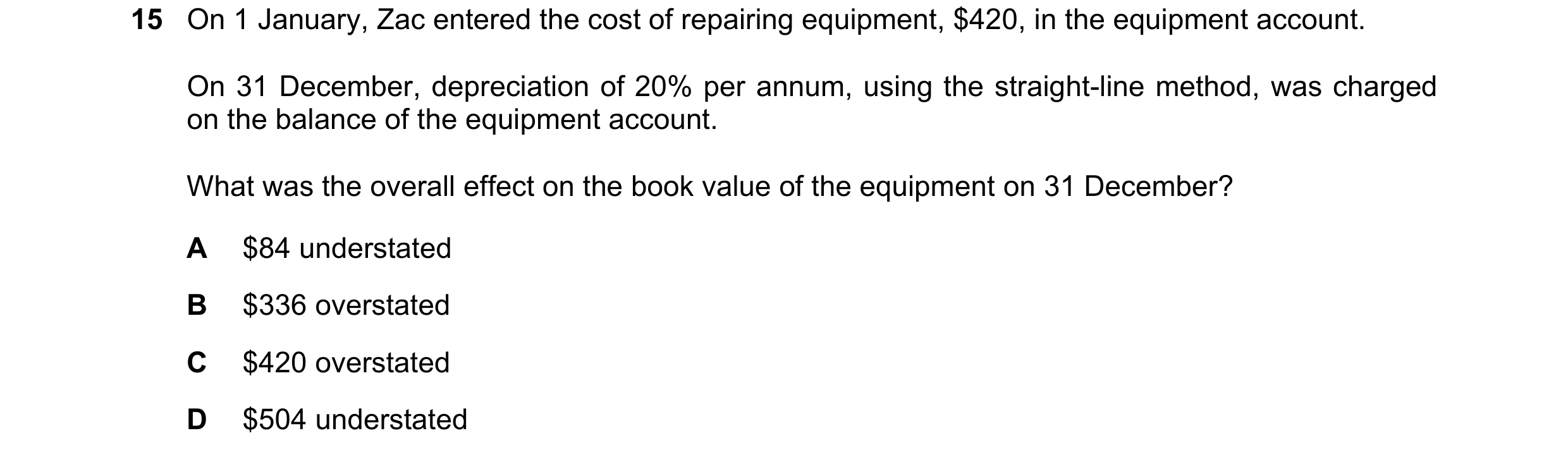
 10 / 22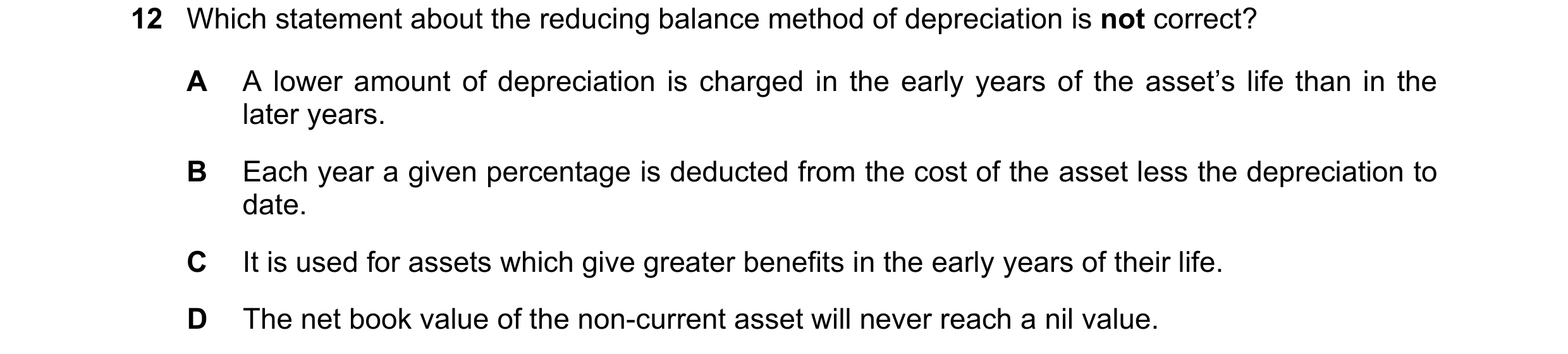
 11 / 22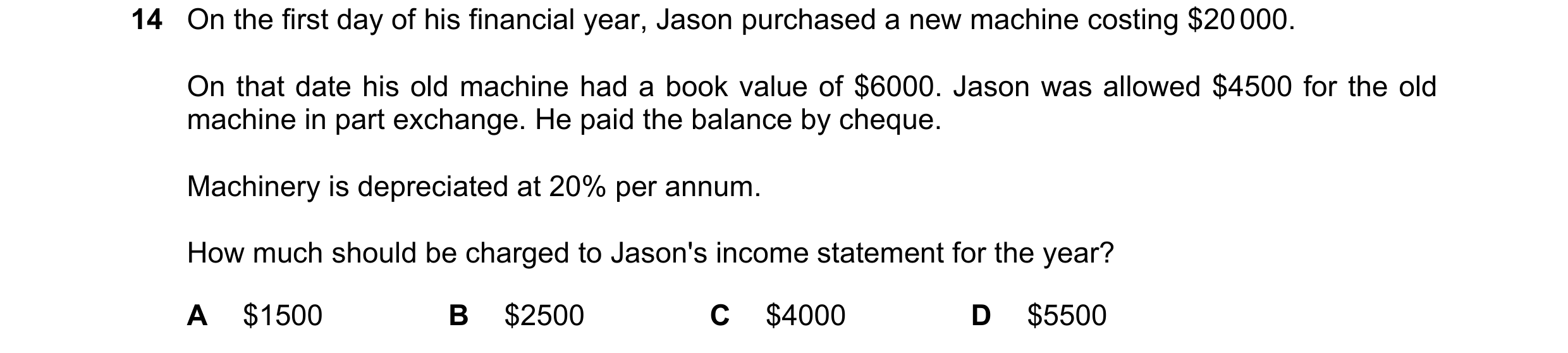
 12 / 22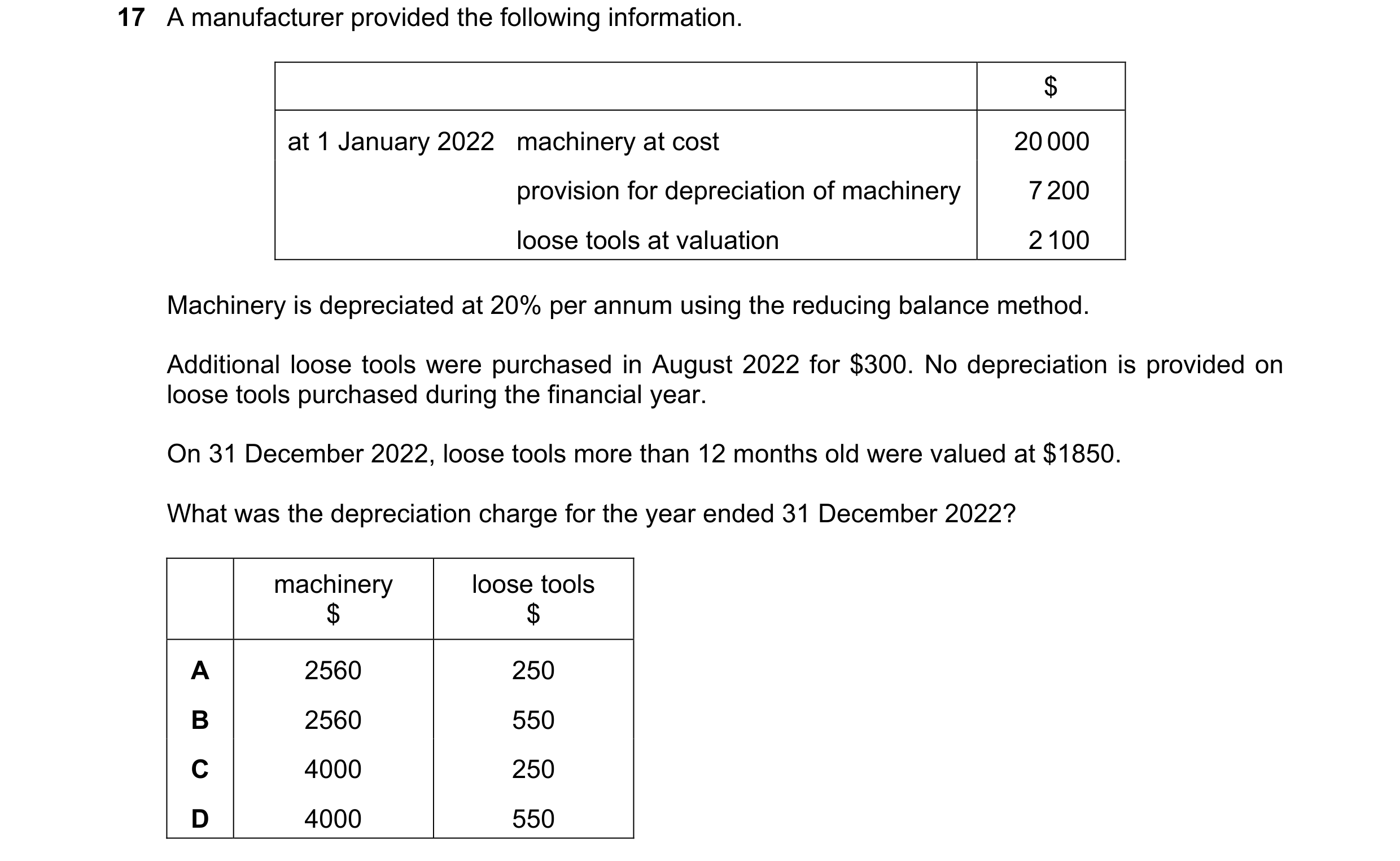

 13 / 22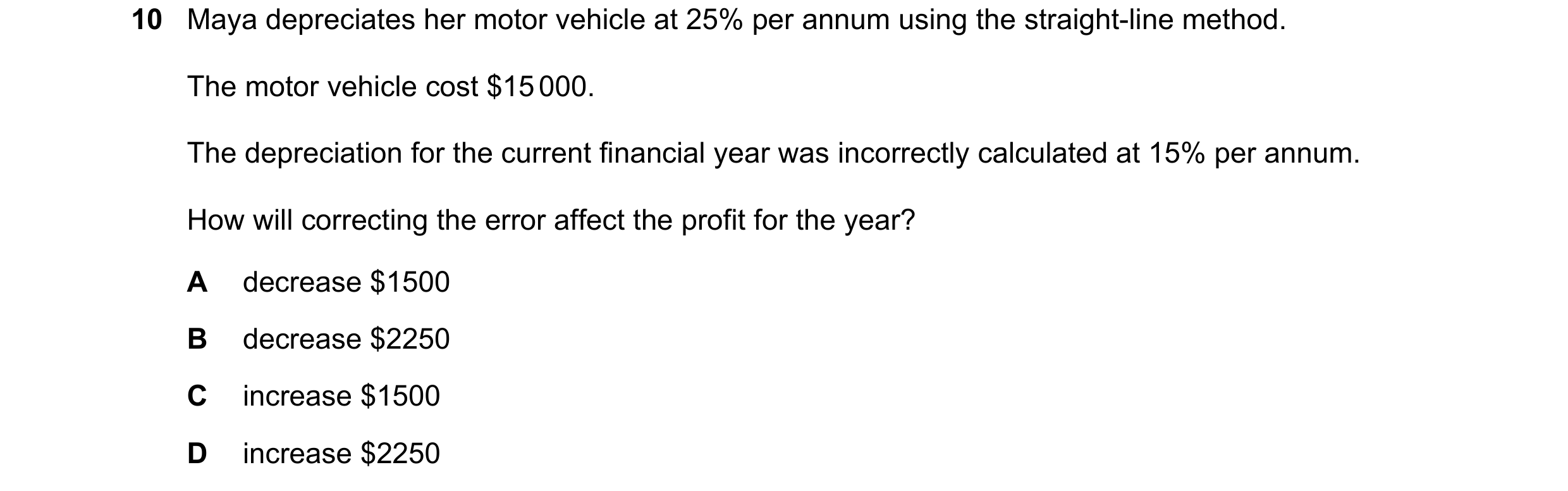
 14 / 22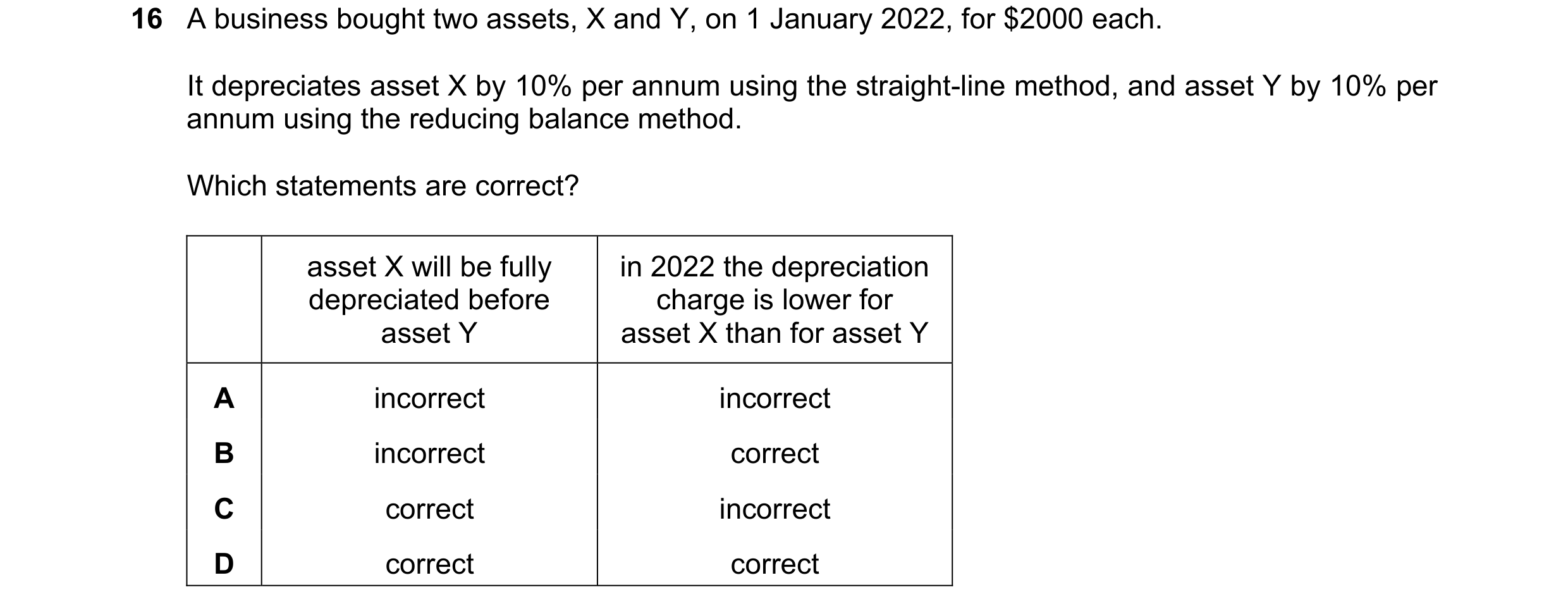

 15 / 22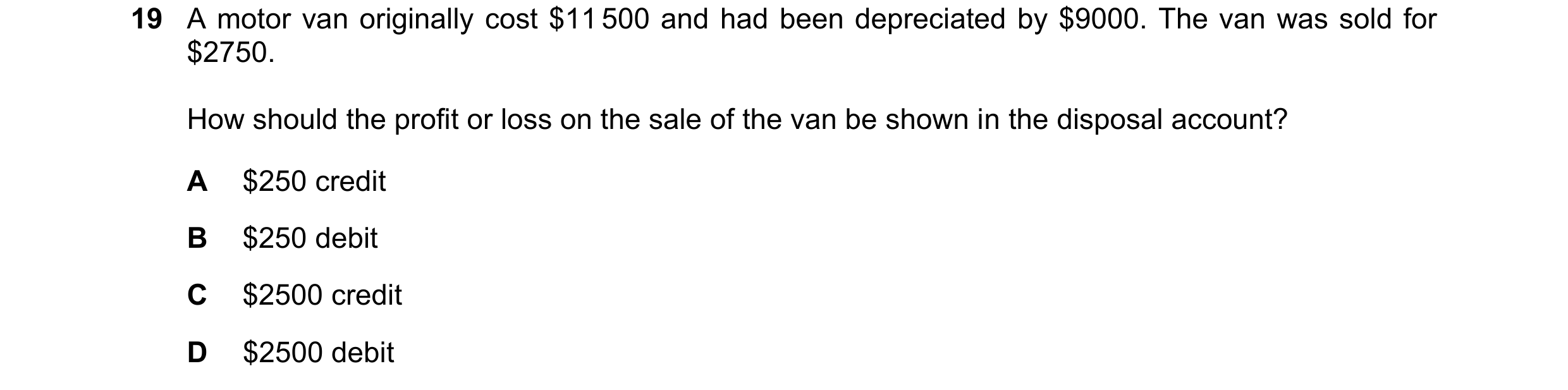

 16 / 22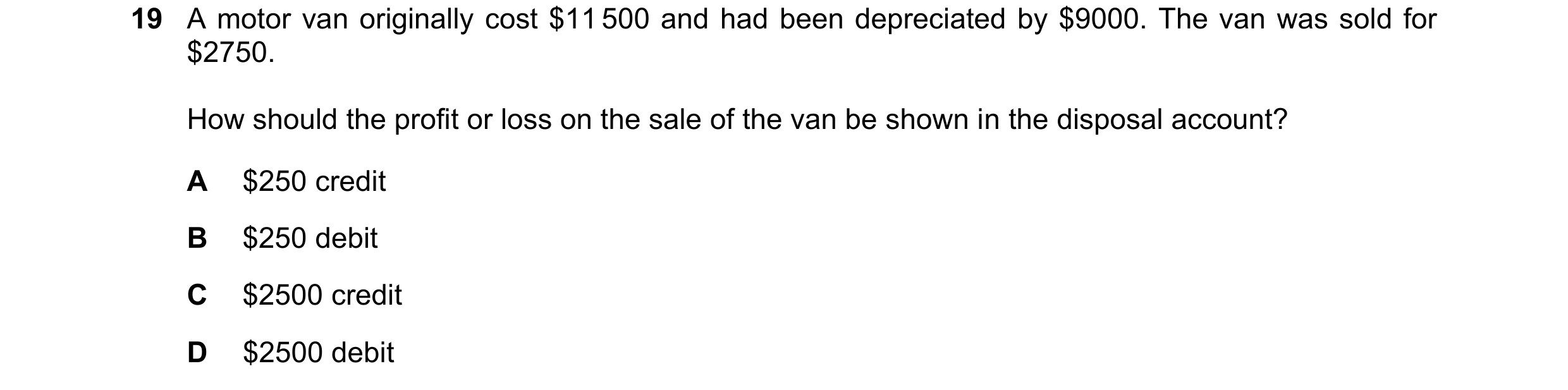
 17 / 22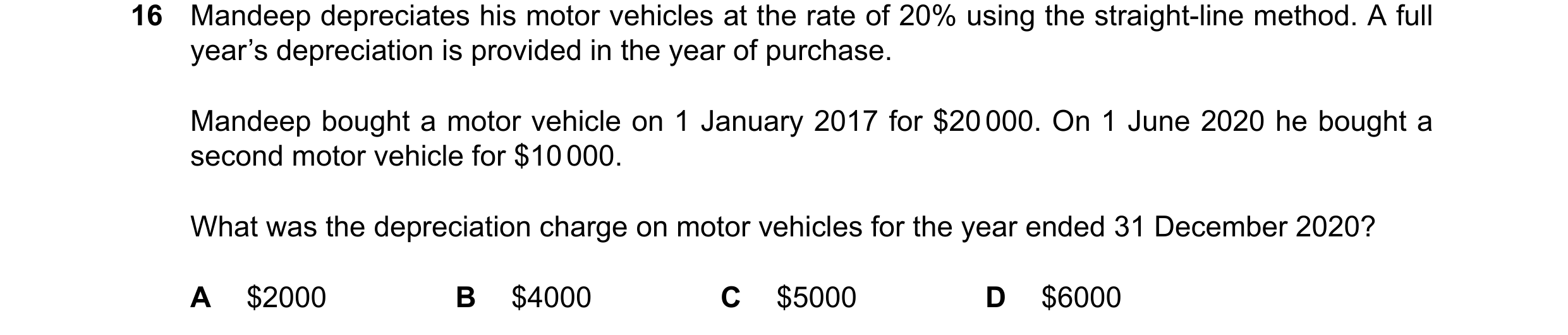
 18 / 22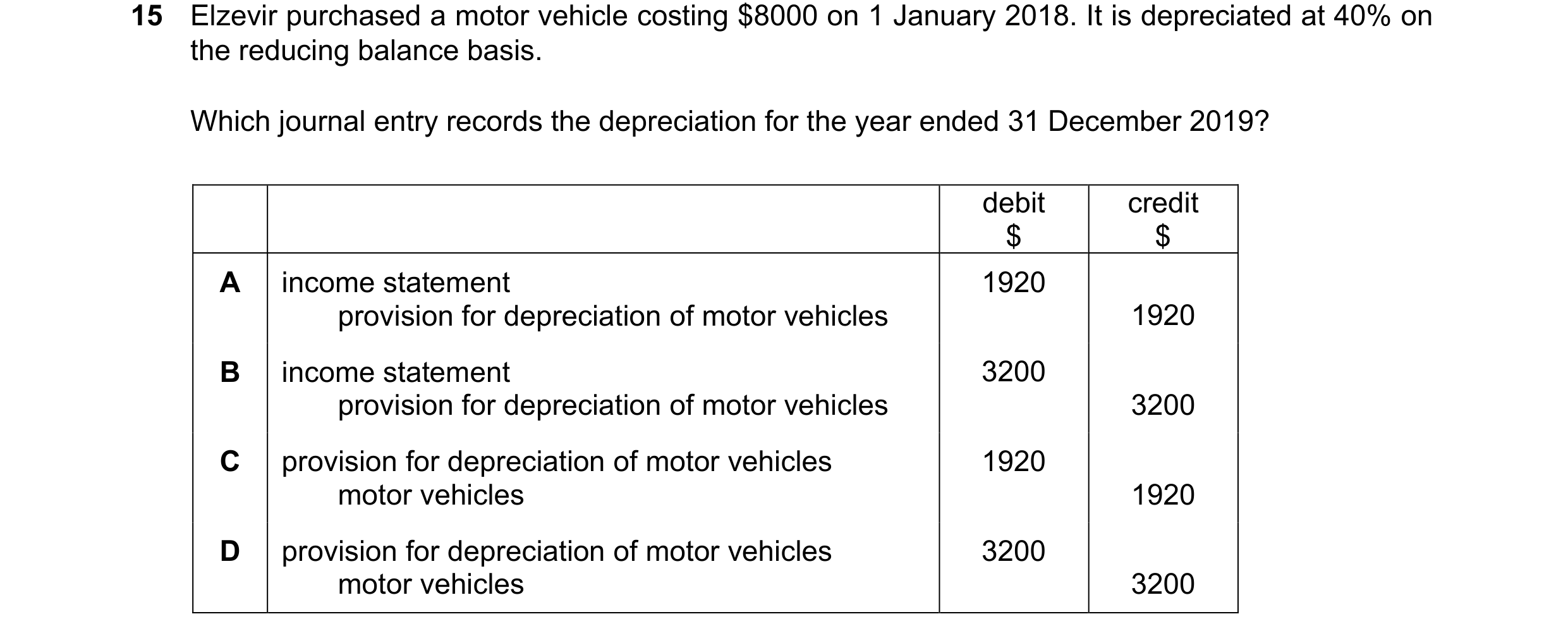
 19 / 22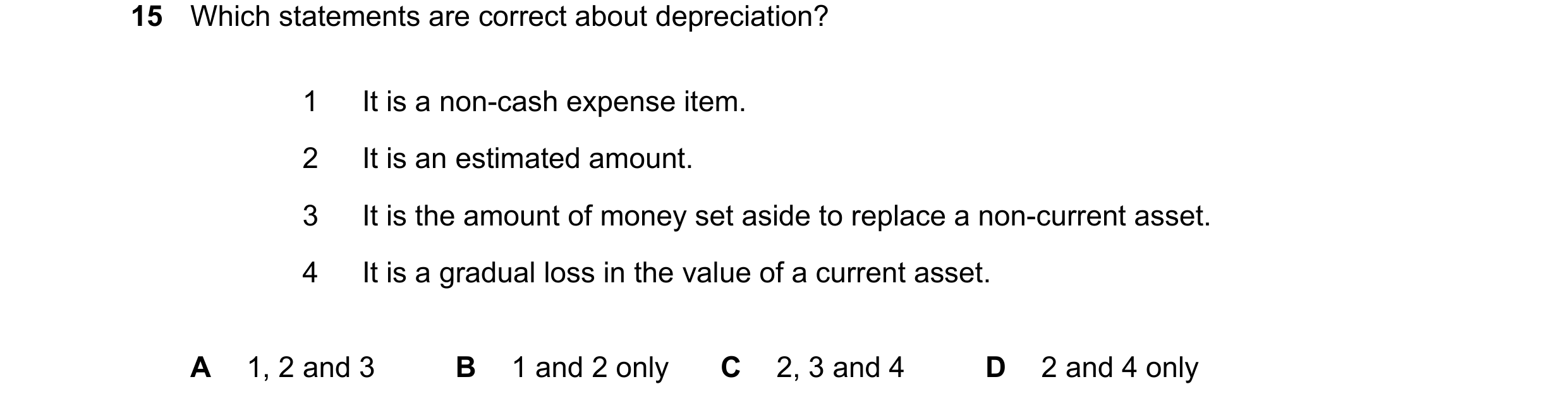

 20 / 22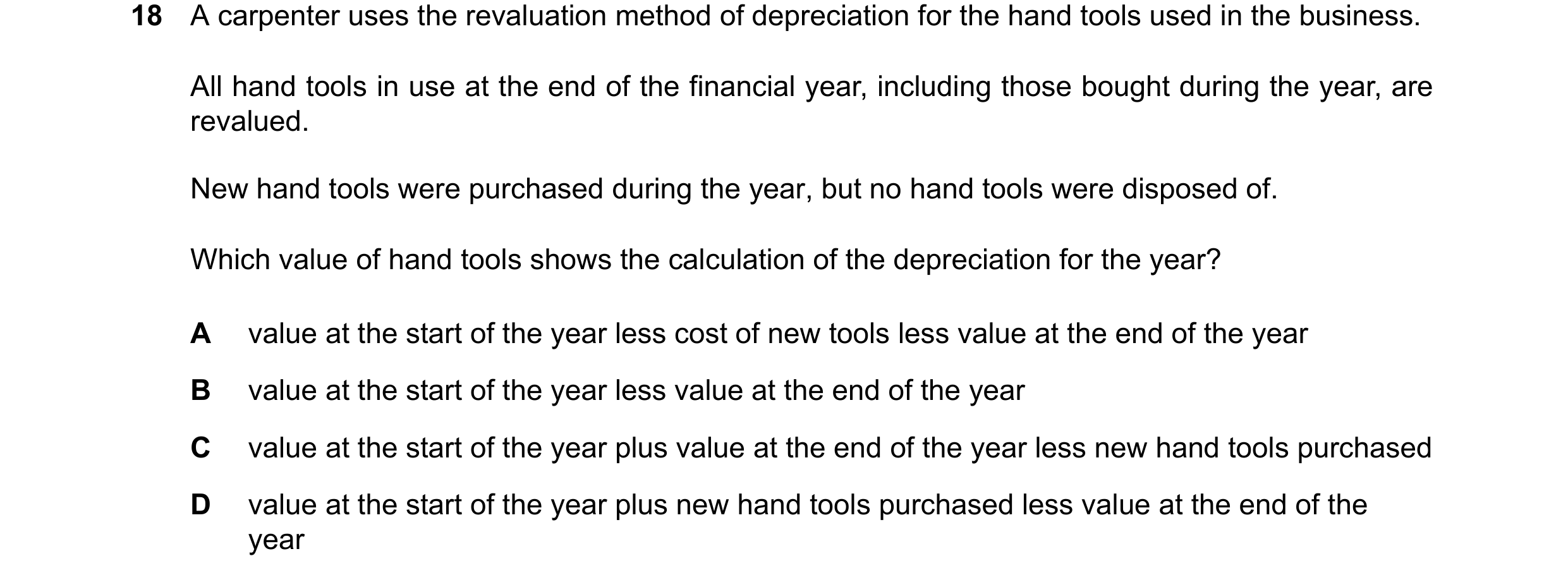


 21 / 22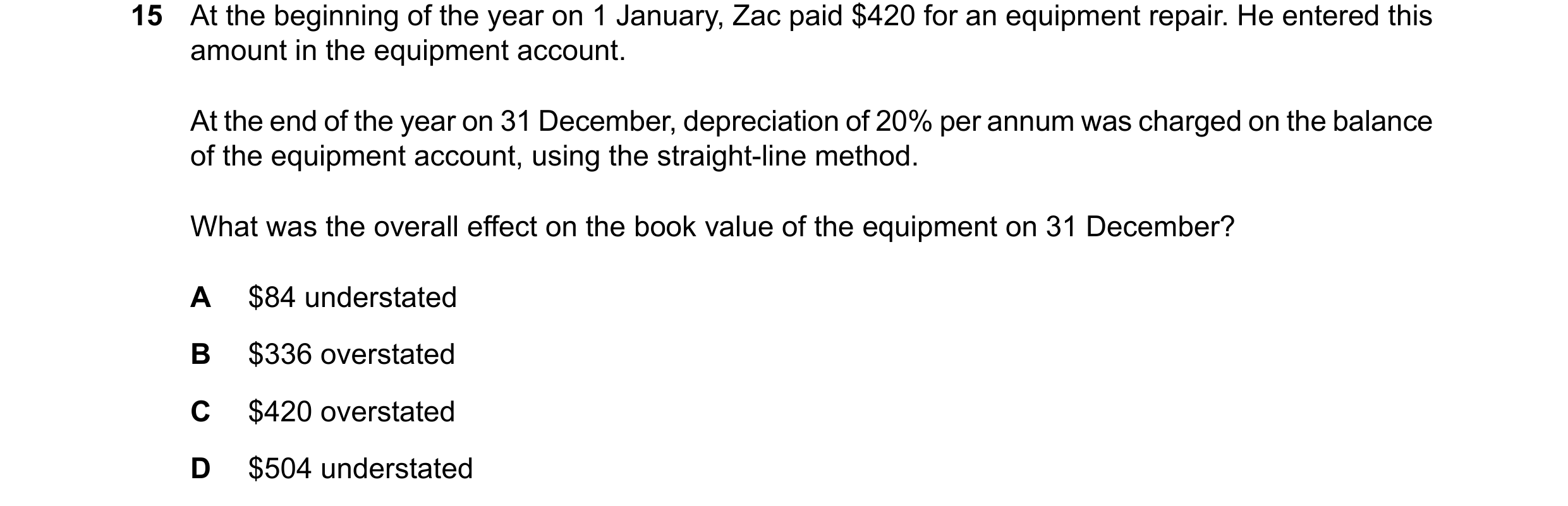

 22 / 22