Questions as text
Q1 · Define the binding energy of a nucleus 9702/42 Feb/March 2017
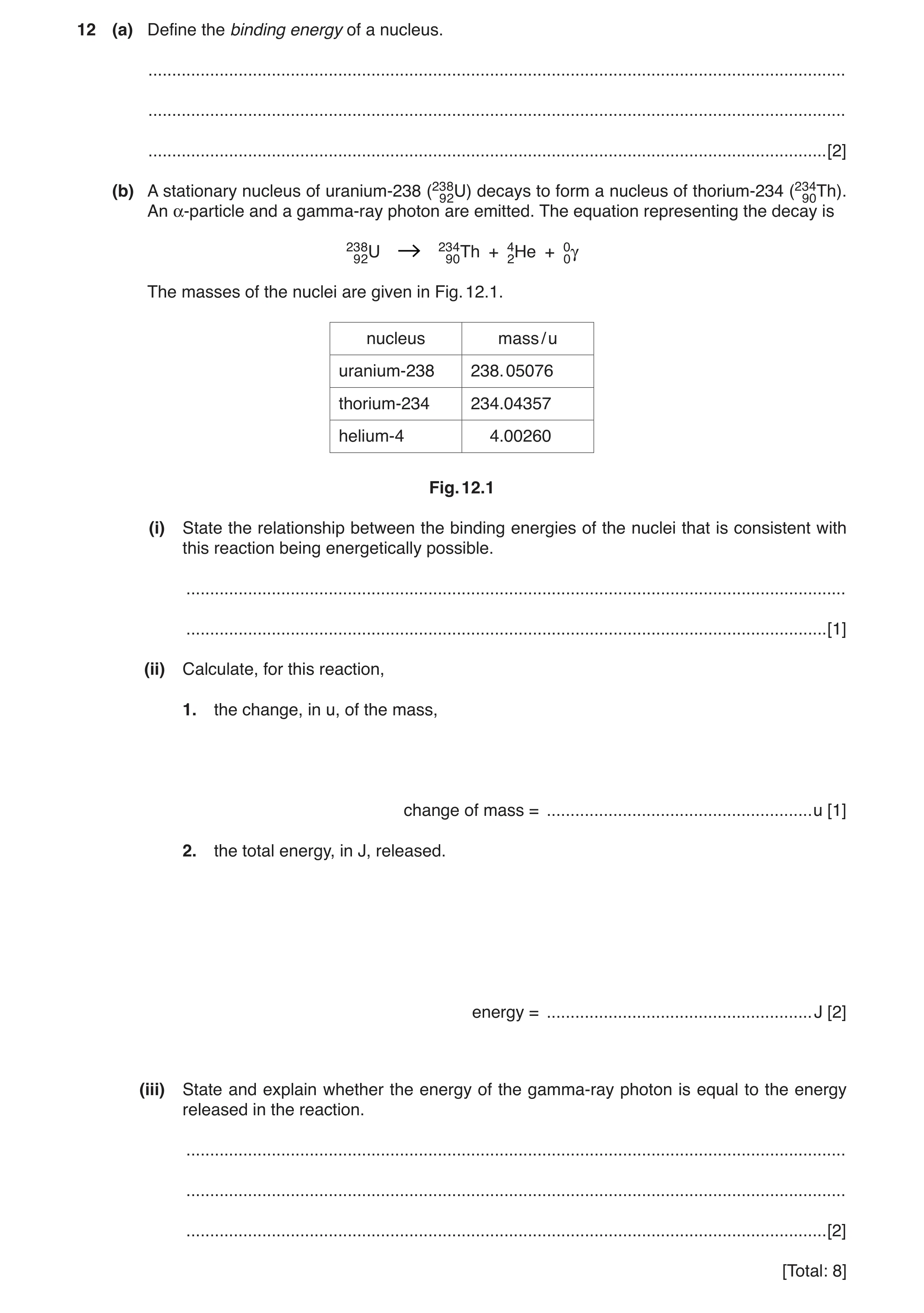
12 (a) Define the binding energy of a nucleus. … … … [2] (b) A stationary nucleus of uranium-238 (23982U) decays to form a nucleus of thorium-234 (239 40Th). An α-particle and a gamma-ray photon are emitted. The equation representing the decay is 23 9 82U 23940Th + 42He + 00γ The masses of the nuclei are given in Fig. 12.1. nucleus mass / u uranium-238 238. 05076 thorium-234 234.04357 helium-4 4.00260 Fig. 12.1 (i) State the relationship between the binding energies of the nuclei that is consistent with this reaction being energetically possible. … … [1] (ii) Calculate, for this reaction, 1. the change, in u, of the mass, change of mass = … u [1] 2. the total energy, in J, released. energy = … J [2] (iii) State and explain whether the energy of the gamma-ray photon is equal to the energy released in the reaction. … … … [2] [Total: 8]
8 marks
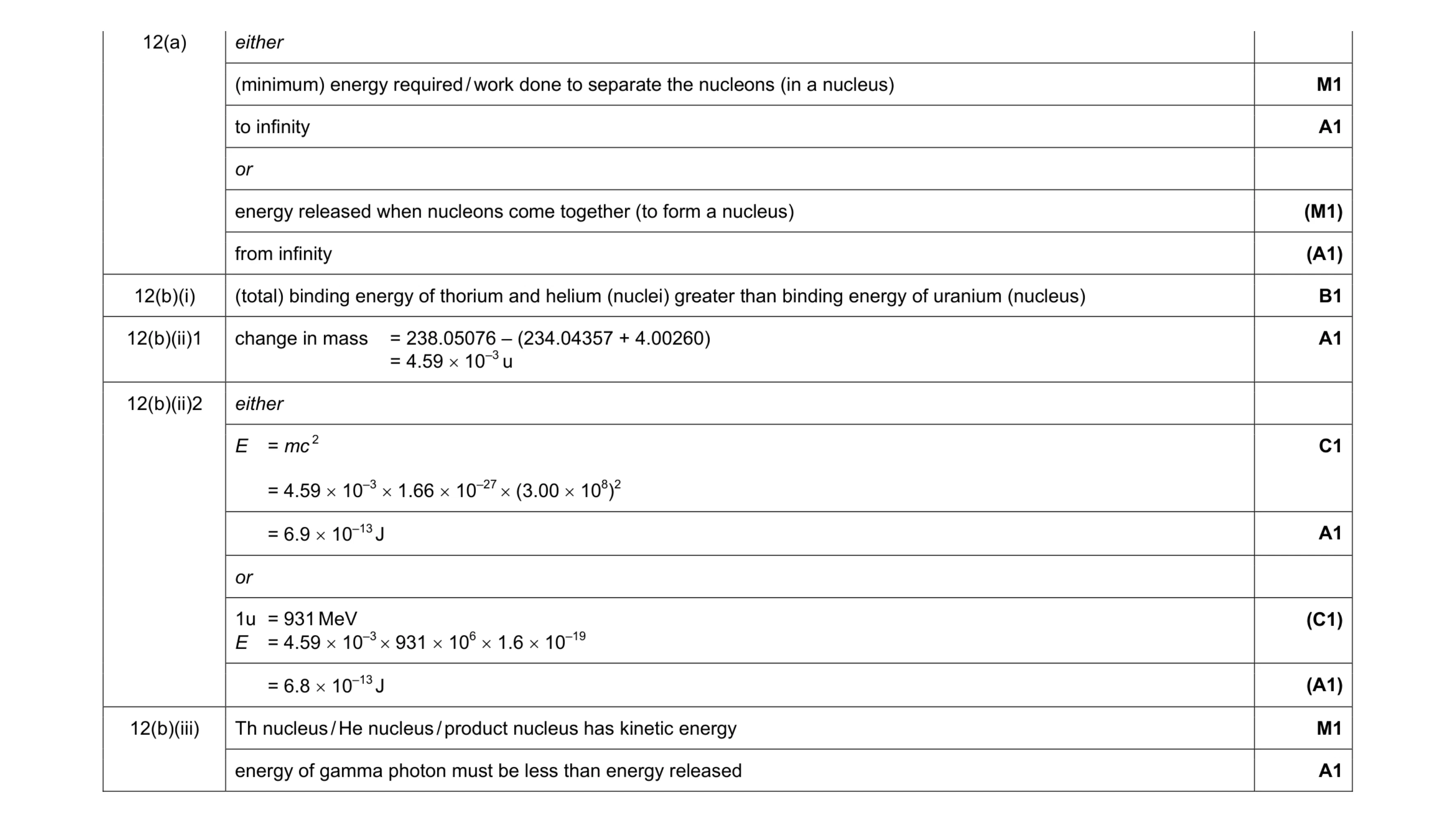
Mark scheme: 12(a) either (minimum) energy required / work done to separate the nucleons (in a nucleus) M1 to infinity A1 or energy released when nucleons come together (to form a nucleus) (M1) from infinity (A1) 12(b)(i) (total) binding energy of thorium and helium (nuclei) greater than binding energy of uranium (nucleus) B1 12(b)(ii)1 change in mass = 238.05076 – (234.04357 + 4.00260) = 4.59 × 10⁻³ u A1 12(b)(ii)2 either E = mc 2 = 4.59 × 10–3 × 1.66 × 10–27 × (3.00 × 108)2 C1 = 6.9 × 10⁻¹³ J A1 or 1u = 931 MeV E = 4.59 × 10–3 × 931 × 106 × 1.6 × 10–19 (C1) = 6.8 × 10⁻¹³ J (A1) 12(b)(iii) Th nucleus / He nucleus / product nucleus has kinetic energy M1 energy of gamma photon must be less than energy released A1
This question in 9702/42 Feb/March 2017
Q2 · One possible nuclear reaction that takes place in a nuclear reactor is given by the… 9702/41 May/June 2017
12 One possible nuclear reaction that takes place in a nuclear reactor is given by the equation 23592U + 10n 9542Mo + 13957La + 210n + x –1e0 Data for the nuclei and particles are given in Fig. 12.1. nucleus or particle mass / u 23592U 235.123 9542Mo 94.945 13957La 138.955 10n 1.00863 –1e0 5.49 × 10⁻⁴ Fig. 12.1 (a) Determine, for this nuclear reaction, the value of x. x = … [1] (b) (i) Show that the energy equivalent to 1.00 u is 934 MeV. [3] (ii) Calculate the energy, in MeV, released in this reaction. Give your answer to three significant figures. energy = … MeV [3] (c) Suggest the forms of energy into which the energy calculated in (b)(ii) is transformed. … … … … [2] [Total: 9]
9 marks
Mark scheme: 12(a) x = 7 A1 12(b)(i) E = mc2 C1 = 1.66 × 10–27 × (3.0 × 108)2 = 1.494 × 10⁻¹⁰ J C1 division by 1.6 × 10⁻¹³ clear to give 934 MeV A1 12(b)(ii) ∆m = (235.123 + 1.00863) – (94.945 + 138.955 + 2 × 1.00863 + 7 × 5.49 × 10–4) or ∆m = 235.123 – (94.945 + 138.955 + 1 × 1.00863 + 7 × 5.49 × 10–4) C1 = 0.21053 u C1 energy = 0.21053 × 934 = 197 MeV A1 12(c) kinetic energy of nuclei/particles/products/fragments B1 γ–ray photon energy B1
This question in 9702/41 May/June 2017
Q3 · One nuclear reaction that can take place in a nuclear reactor may be represented, in… 9702/42 May/June 2017
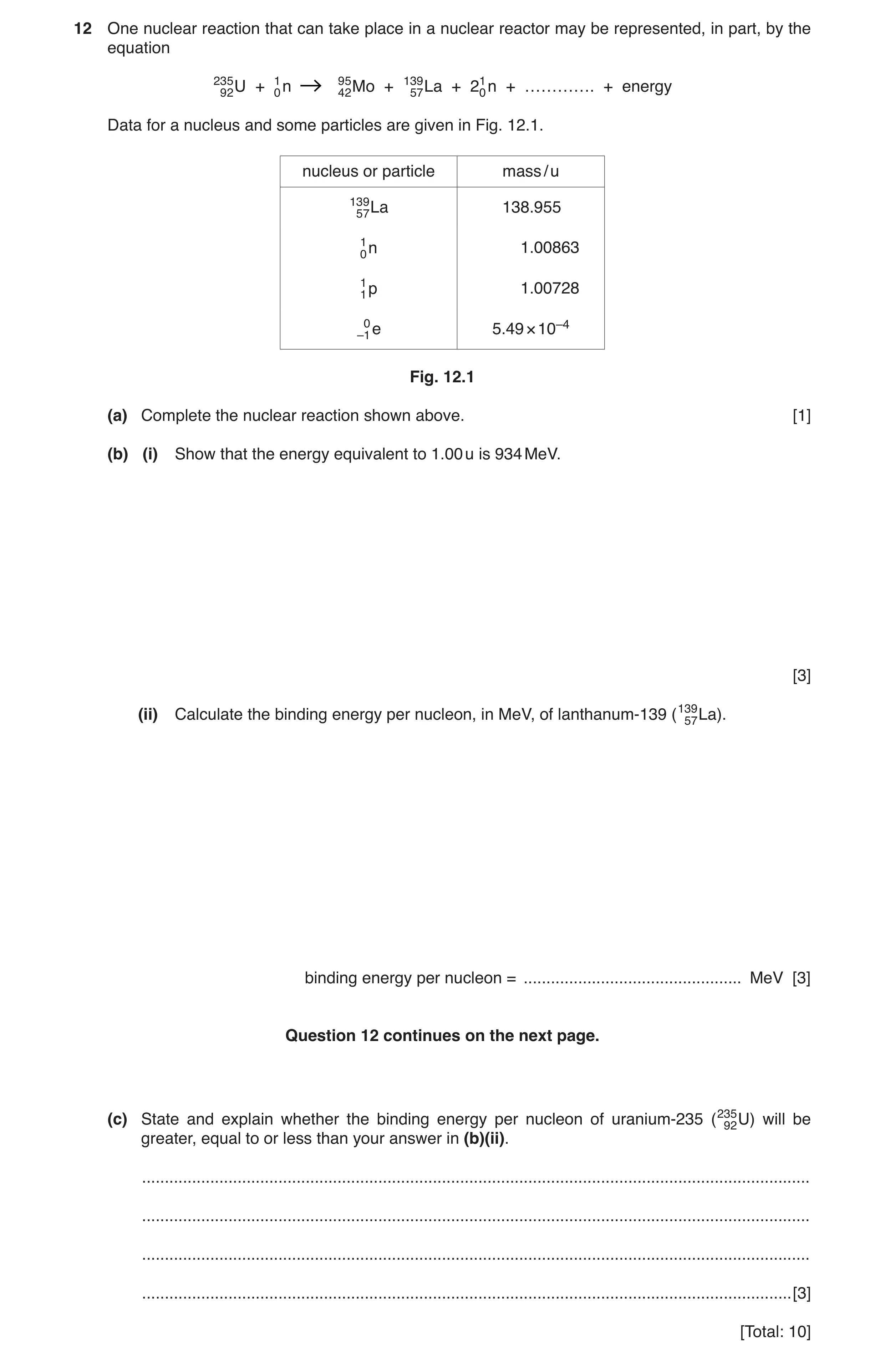
12 One nuclear reaction that can take place in a nuclear reactor may be represented, in part, by the equation 23592 U + 10 n 9542 Mo + 13957 La + 210 n + …………. + energy Data for a nucleus and some particles are given in Fig. 12.1. nucleus or particle mass / u 13957 La 138.955 10 n 1.00863 11 p 1.00728 –1 e0 5.49 × 10⁻⁴ Fig. 12.1 (a) Complete the nuclear reaction shown above. [1] (b) (i) Show that the energy equivalent to 1.00 u is 934 MeV. [3] (ii) Calculate the binding energy per nucleon, in MeV, of lanthanum-139 (13957 La). binding energy per nucleon = … MeV [3] Question 12 continues on the next page. (c) State and explain whether the binding energy per nucleon of uranium-235 (23592 U) will be greater, equal to or less than your answer in (b)(ii). … … … … [3] [Total: 10]
10 marks
Mark scheme: 12(a) 7 e 0 1 − A1 12(b)(i) E = mc2 C1 = 1.66 × 10–27 × (3.00 × 108)2 M1 = 1.494 × 10⁻¹⁰ J division by 1.60 × 10⁻¹³ clear to give 934 MeV A1 12(b)(ii) ∆m = (82 × 1.00863u) + (57 × 1.00728u) – 138.955u = (–) 1.16762 (u) C1 energy = 1.16762 × 934 C1 energy per nucleon = (1.16762 × 934) / 139 = 7.85 MeV A1 12(c) above A = 56, binding energy per nucleon decreases as A increases B1 U-235 has larger nucleon number M1 so less (binding energy per nucleon) A1 or fission takes place with uranium (B1) fission reaction releases energy (M1) binding energy per nucleon less (for uranium than for products) (A1)
This question in 9702/42 May/June 2017
Q4 · One possible nuclear reaction that takes place in a nuclear reactor is given by the… 9702/43 May/June 2017
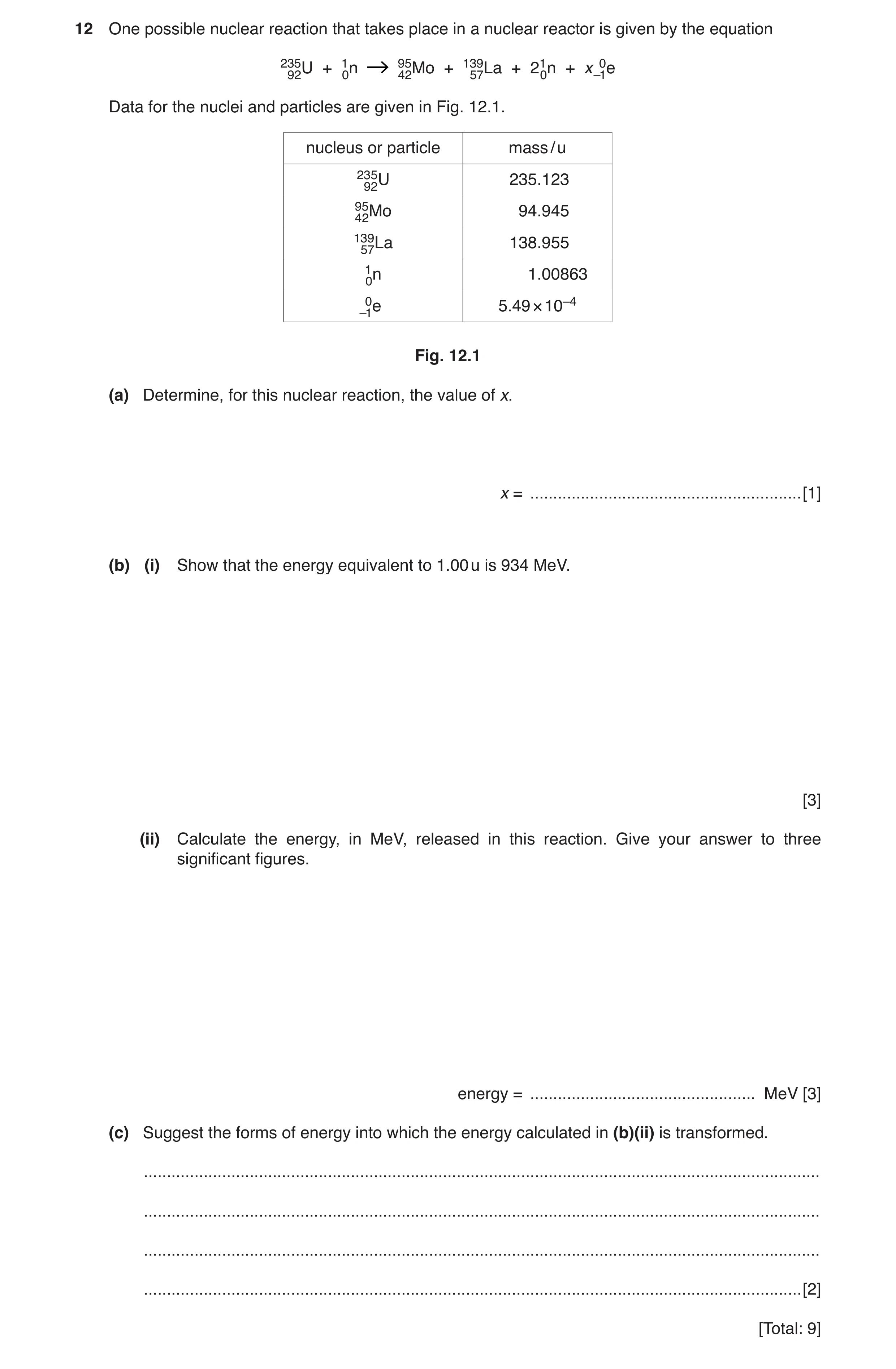
12 One possible nuclear reaction that takes place in a nuclear reactor is given by the equation 23592U + 10n 9542Mo + 13957La + 210n + x –1e0 Data for the nuclei and particles are given in Fig. 12.1. nucleus or particle mass / u 23592U 235.123 9542Mo 94.945 13957La 138.955 10n 1.00863 –1e0 5.49 × 10⁻⁴ Fig. 12.1 (a) Determine, for this nuclear reaction, the value of x. x = … [1] (b) (i) Show that the energy equivalent to 1.00 u is 934 MeV. [3] (ii) Calculate the energy, in MeV, released in this reaction. Give your answer to three significant figures. energy = … MeV [3] (c) Suggest the forms of energy into which the energy calculated in (b)(ii) is transformed. … … … … [2] [Total: 9]
9 marks
Mark scheme: 12(a) x = 7 A1 12(b)(i) E = mc2 C1 = 1.66 × 10–27 × (3.0 × 108)2 = 1.494 × 10⁻¹⁰ J C1 division by 1.6 × 10⁻¹³ clear to give 934 MeV A1 12(b)(ii) ∆m = (235.123 + 1.00863) – (94.945 + 138.955 + 2 × 1.00863 + 7 × 5.49 × 10–4) or ∆m = 235.123 – (94.945 + 138.955 + 1 × 1.00863 + 7 × 5.49 × 10–4) C1 = 0.21053 u C1 energy = 0.21053 × 934 = 197 MeV A1 12(c) kinetic energy of nuclei/particles/products/fragments B1 γ–ray photon energy B1
This question in 9702/43 May/June 2017
Q5 · A mass is undergoing simple harmonic motion with amplitude x0 9702/42 Feb/March 2018
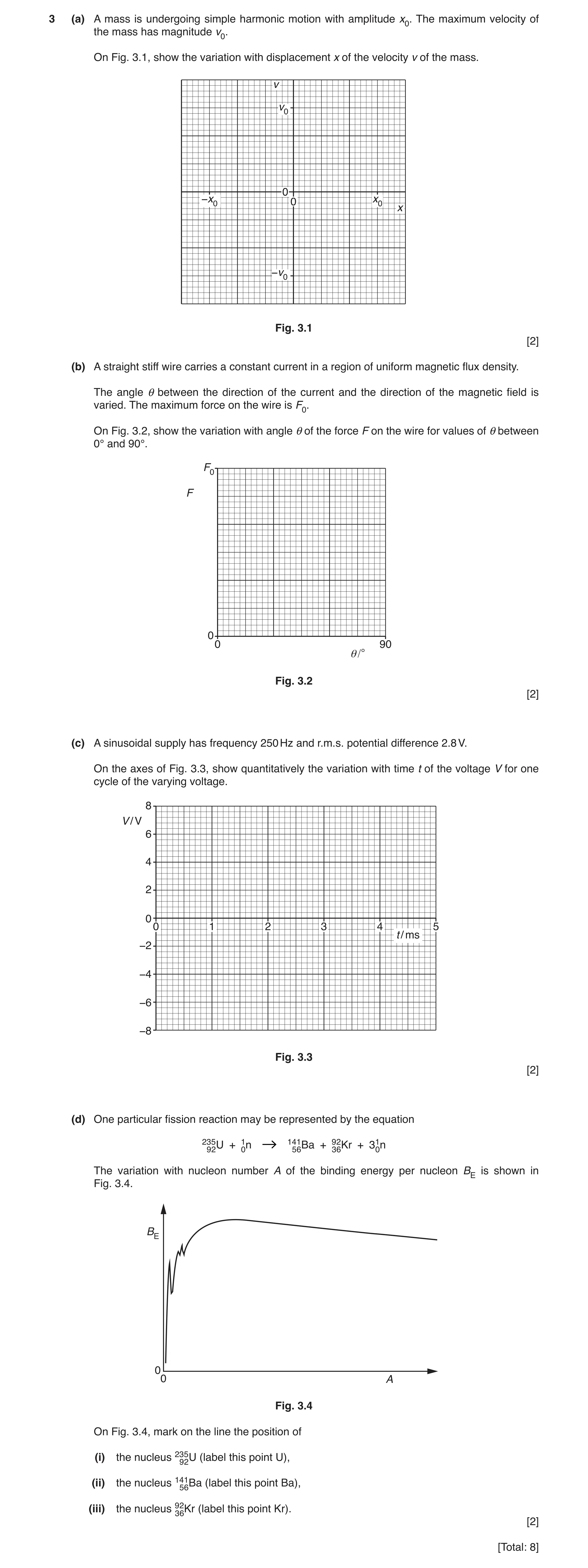
3 (a) A mass is undergoing simple harmonic motion with amplitude x0. The maximum velocity of the mass has magnitude v0. On Fig. 3.1, show the variation with displacement x of the velocity v of the mass. v v0 0 −x0 0 x0 x −v0 Fig. 3.1 [2] (b) A straight stiff wire carries a constant current in a region of uniform magnetic flux density. The angle θ between the direction of the current and the direction of the magnetic field is varied. The maximum force on the wire is F0. On Fig. 3.2, show the variation with angle θ of the force F on the wire for values of θ between 0° and 90°. F0 F 0 0 90 θ/° Fig. 3.2 [2] (c) A sinusoidal supply has frequency 250 Hz and r.m.s. potential difference 2.8 V. On the axes of Fig. 3.3, show quantitatively the variation with time t of the voltage V for one cycle of the varying voltage. 8 V / V 6 4 2 00 1 2 3 4 5 t / ms −2 −4 −6 −8 Fig. 3.3 [2] (d) One particular fission reaction may be represented by the equation 23 9 52U + 10n 14516Ba + 9326Kr + 310n The variation with nucleon number A of the binding energy per nucleon BE is shown in Fig. 3.4. BE 0 0 A Fig. 3.4 On Fig. 3.4, mark on the line the position of (i) the nucleus 23952U (label this point U), (ii) the nucleus 14516Ba (label this point Ba), (iii) the nucleus 9326Kr (label this point Kr). [2] [Total: 8]
8 marks
Mark scheme: 3(a) reasonably shaped circle or oval surrounding the origin B1 closed loop passing through (0,±v0) and (±x0,0) B1 3(b) line from (0,0) to (90, F0) B1 curve with decreasing positive gradient, zero gradient at θ = 90 B1 3(c) reasonable sinusoidal wave, one cycle, period 4.0 ms B1 amplitude at 4.0 V B1 3(d) U near right-hand end of line with Ba between U and peak of graph B1 Ba on right hand side of peak and Kr between Ba and peak of graph B1
This question in 9702/42 Feb/March 2018
Q6 · A stationary isolated nucleus emits a γ-ray photon of energy 0.51MeV 9702/41 Oct/Nov 2018
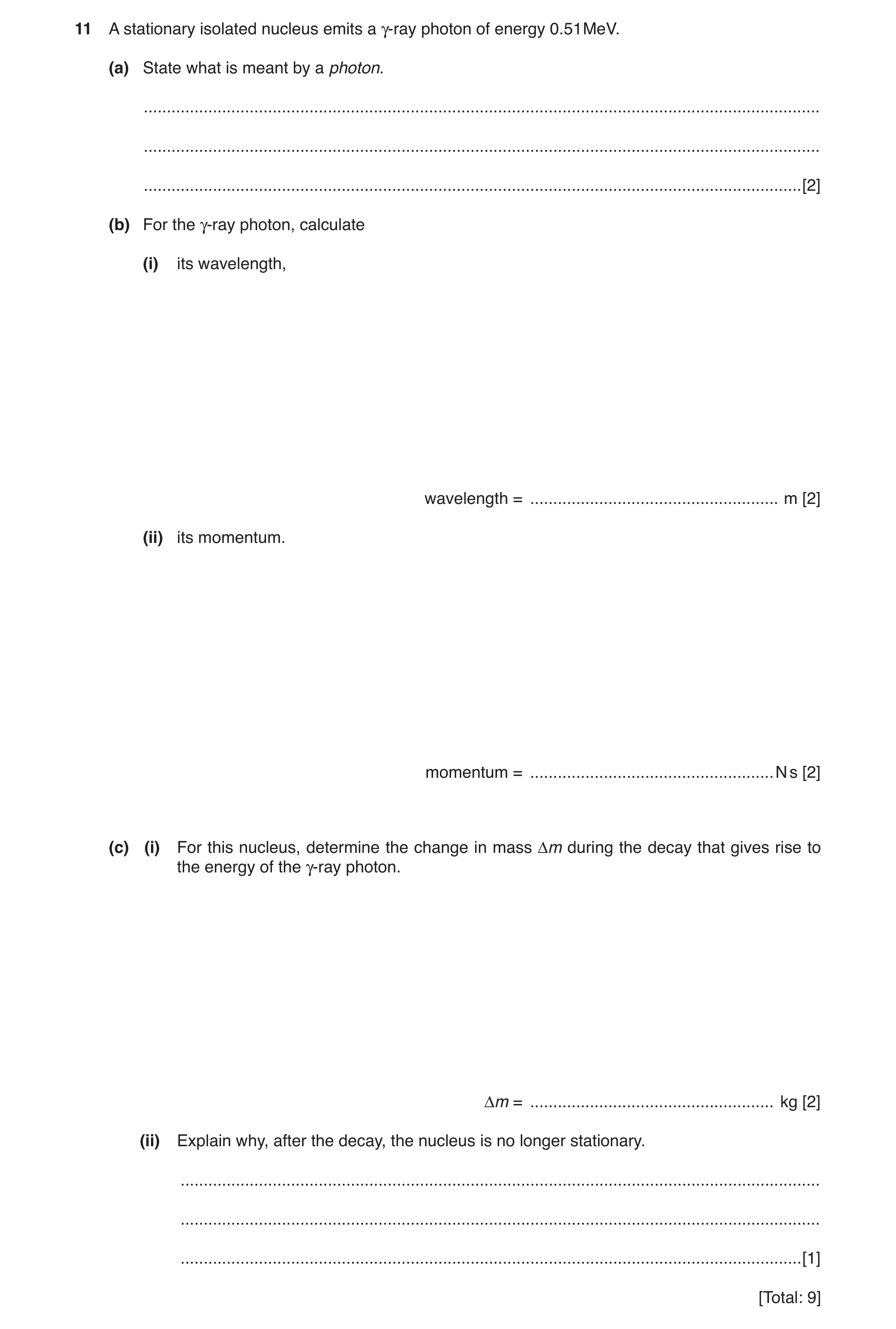
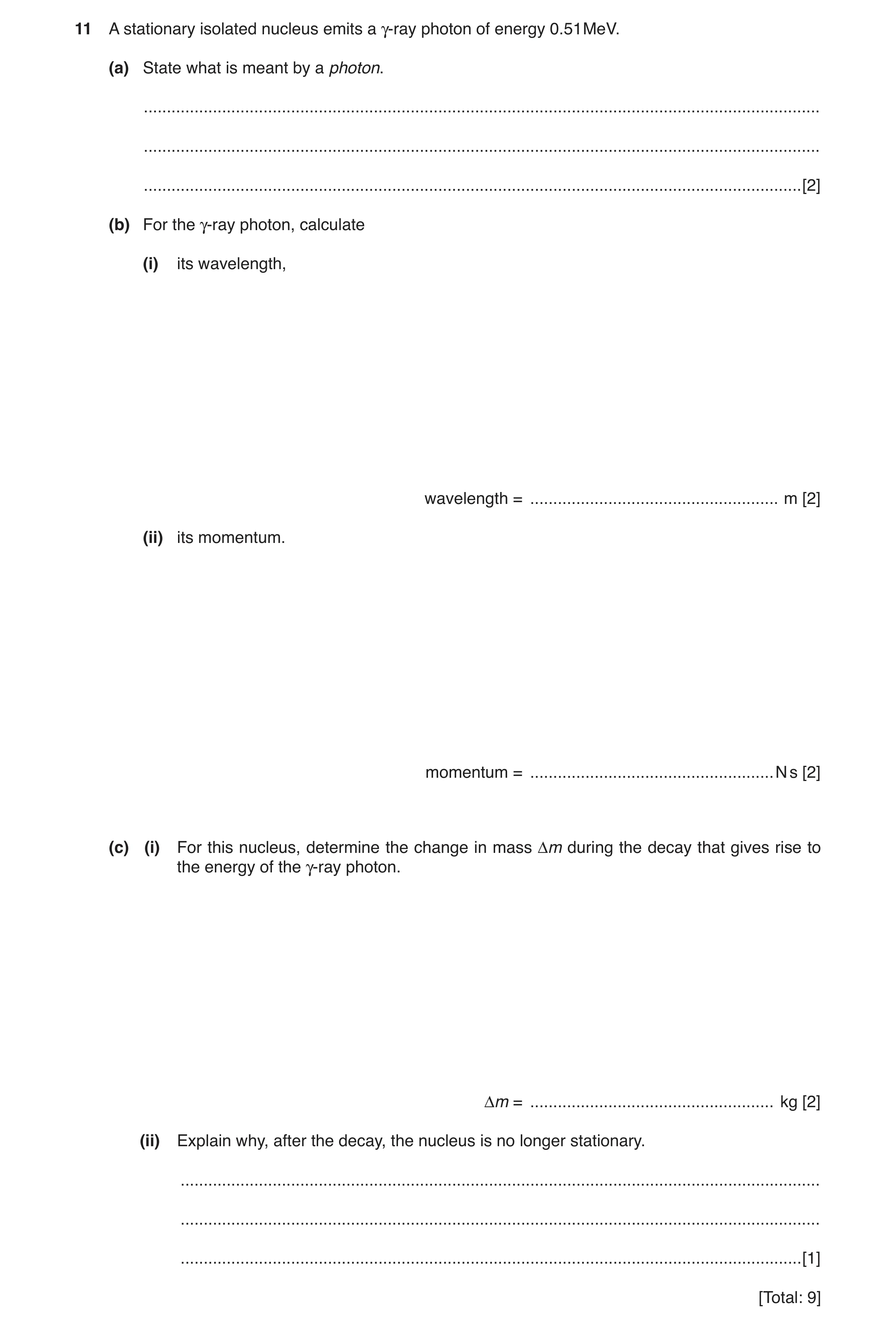
11 A stationary isolated nucleus emits a γ-ray photon of energy 0.51MeV. (a) State what is meant by a photon. … … … [2] (b) For the γ-ray photon, calculate (i) its wavelength, wavelength = … m [2] (ii) its momentum. momentum = … N s [2] (c) (i) For this nucleus, determine the change in mass Δm during the decay that gives rise to the energy of the γ-ray photon. Δm = … kg [2] (ii) Explain why, after the decay, the nucleus is no longer stationary. … … … [1] [Total: 9]
9 marks
Mark scheme: 11(a) discrete amount/quantum/packet of energy M1 of electromagnetic radiation A1 11(b)(i) energy = hc / λ C1 λ = (6.63 × 10–34 × 3.00 × 108) / (0.51 × 106 × 1.60 × 10–19) = 2.4 × 10⁻¹² m A1 11(b)(ii) p = h / λ = (6.63 × 10⁻³⁴) / (2.44 × 10⁻¹²) or p = E / c = (0.51 × 1.60 × 10–13) / (3.00 × 10⁸) C1 p = 2.7 × 10⁻²² N s A1 11(c)(i) E = c2∆m C1 ∆m = (0.51 × 1.60 × 10–13) / (3.00 × 10⁸)2 = 9.1 × 10⁻³¹ kg A1 11(c)(ii) (momentum is conserved so) nucleus must have momentum in opposite direction to photon B1
This question in 9702/41 Oct/Nov 2018
Q7 · State what is meant by an ideal gas 9702/42 Oct/Nov 2018
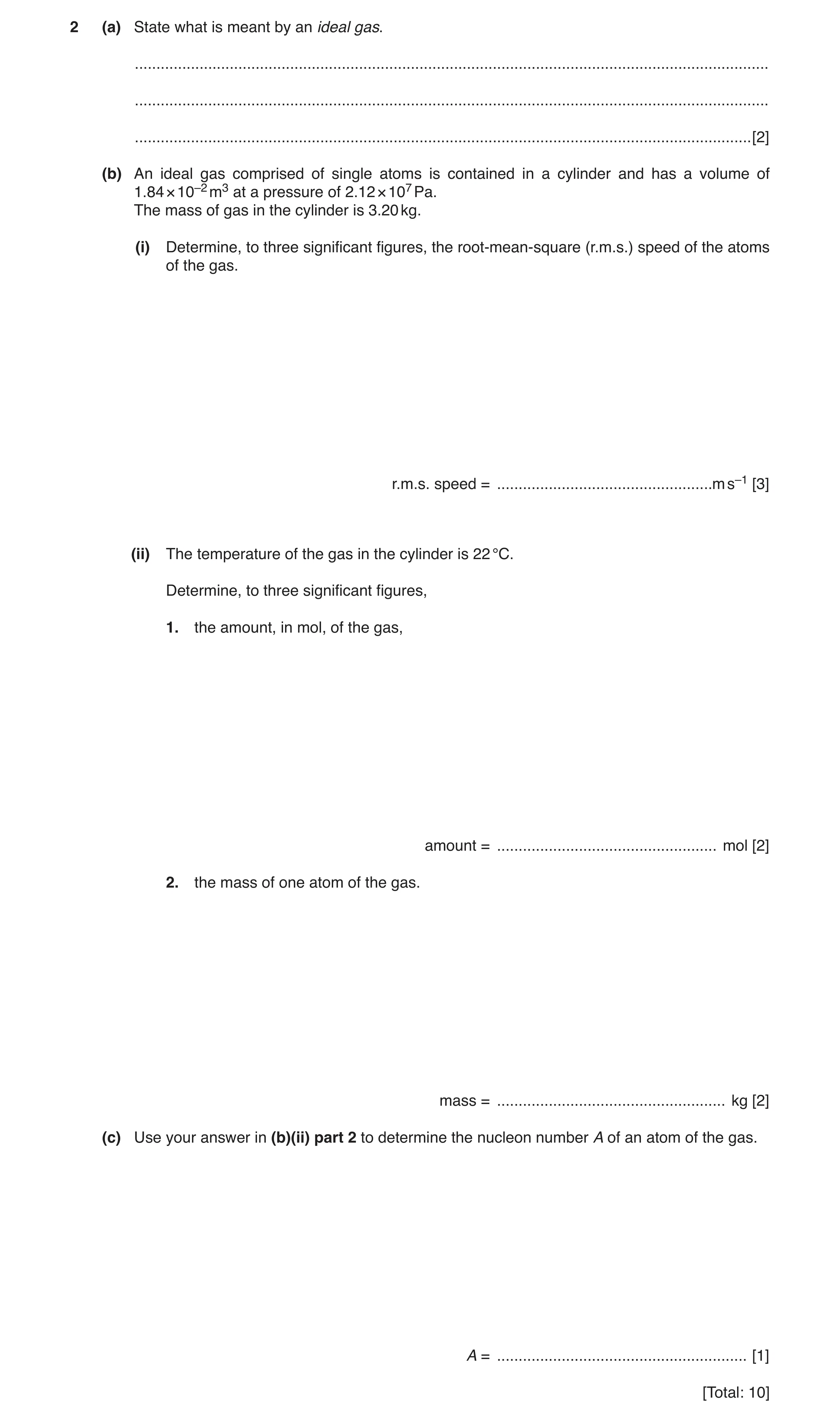
2 (a) State what is meant by an ideal gas. … … … [2] (b) An ideal gas comprised of single atoms is contained in a cylinder and has a volume of 1.84 × 10⁻² m3 at a pressure of 2.12 × 10⁷ Pa. The mass of gas in the cylinder is 3.20 kg. (i) Determine, to three significant figures, the root-mean-square (r.m.s.) speed of the atoms of the gas. r.m.s. speed = … m s–1 [3] (ii) The temperature of the gas in the cylinder is 22 °C. Determine, to three significant figures, 1. the amount, in mol, of the gas, amount = … mol [2] 2. the mass of one atom of the gas. mass = … kg [2] (c) Use your answer in (b)(ii) part 2 to determine the nucleon number A of an atom of the gas. A = … [1] [Total: 10]
10 marks
Mark scheme: 2(a) M1 symbols p,V and T explained A1 2(b)(i) pV = ⅓ Nm<c2> and M = Nm (and so) p = ⅓ρ <c2> C1 2.12 × 107 = ⅓ × [3.20 / (1.84 × 10⁻²)] × <c2> C1 cr.m.s. = 605 m s–1 A1 2(b)(ii) 1. pV = nRT and T = (22 + 273) K C1 n = (2.12 × 107 × 1.84 × 10–2) / (8.31 × 295) = 159 mol A1 2. mass = 3.20 / (159 × 6.02 × 1023) or mass = [2 × (3 / 2) × 1.38 × 10–23 × 295] / 6052 C1 mass = 3.34 × 10⁻²⁶ kg A1 2(c) A = (3.34 × 10⁻²⁶) / (1.66 × 10⁻²⁷) = 20 A1
This question in 9702/42 Oct/Nov 2018
Q8 · State what is meant by nuclear fusion and nuclear fission 9702/42 Oct/Nov 2018
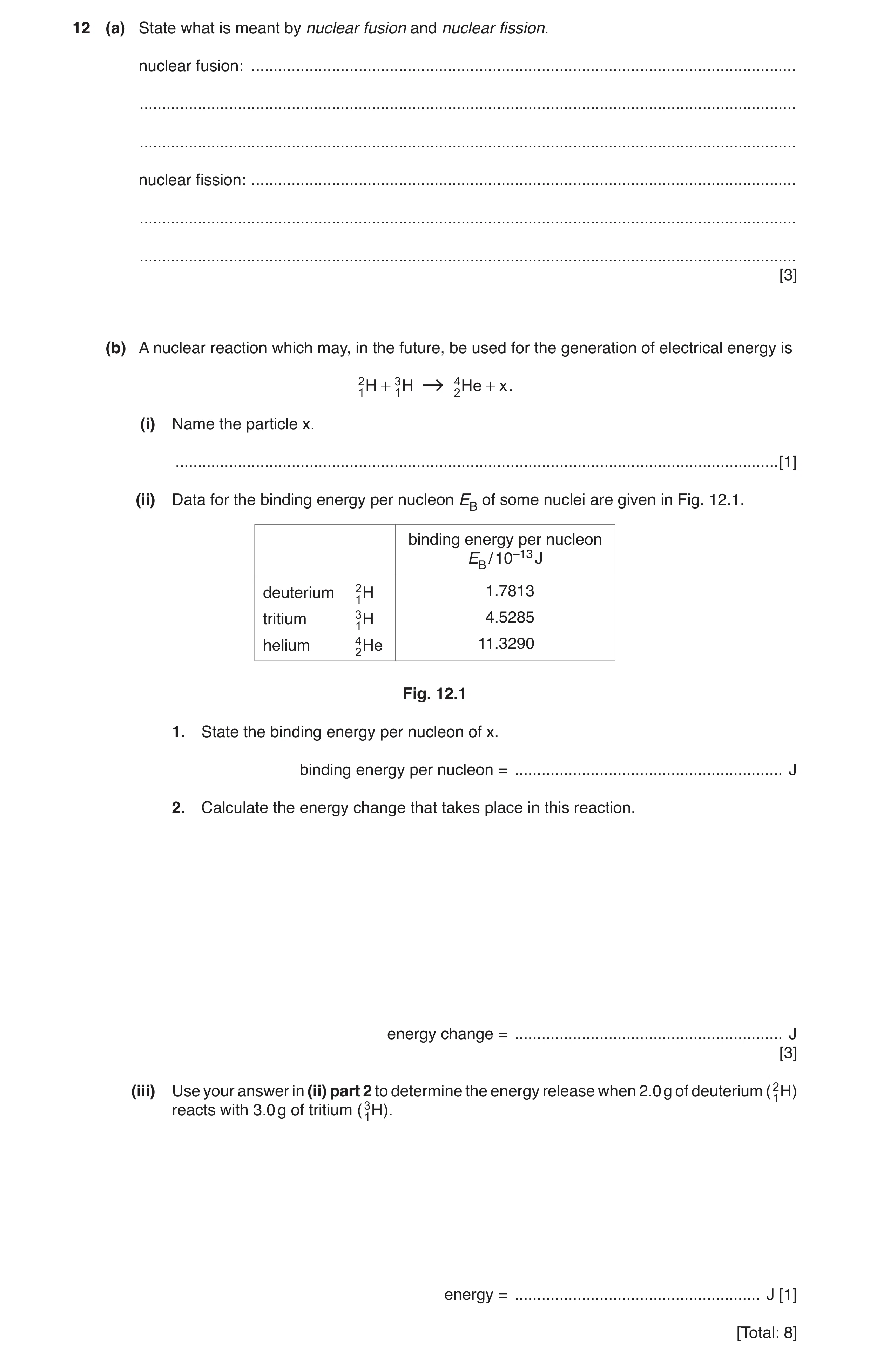
12 (a) State what is meant by nuclear fusion and nuclear fission. nuclear fusion: … … … nuclear fission: … … … [3] (b) A nuclear reaction which may, in the future, be used for the generation of electrical energy is 2 3 4 1 H + 1 H 2 He + x . (i) Name the particle x. … [1] (ii) Data for the binding energy per nucleon EB of some nuclei are given in Fig. 12.1. binding energy per nucleon EB / 10–13 J deuterium 21 H 1.7813 tritium 31 H 4.5285 helium 42 He 11.3290 Fig. 12.1 1. State the binding energy per nucleon of x. binding energy per nucleon = … J 2. Calculate the energy change that takes place in this reaction. energy change = … J [3] (iii) Use your answer in (ii) part 2 to determine the energy release when 2.0 g of deuterium ( 21 H ) reacts with 3.0 g of tritium ( 31 H ). energy = … J [1] [Total: 8]
8 marks
Mark scheme: 12(a) fusion: two nuclei combine to form a (single) nucleus B1 fission: a (single) large nucleus divides to form (smaller) nuclei B1 Any one from: • fusion is initiated by (very) high temperatures • fission is initiated by neutron bombardment • resulting nuclei in fission are of similar size • (both processes) release energy • binding energy per nucleon increases • total binding energy increases • fission involves release of neutrons B1 12(b)(i) neutron B1 12(b)(ii) 1. zero A1 2. (4 × 11.3290 × 10–13) – (2 × 1.7813 × 10–13) – (3 × 4.5285 × 10–13) C1 energy change = 45.316 × 10⁻¹³ – 17.148 × 10–13 = 2.82 × 10⁻¹² J A1 12(b)(iii) 1.0 mol or NA nuclei of each energy = 2.817 × 10–12 × 6.02 × 1023 = 1.7 × 10¹² J A1
This question in 9702/42 Oct/Nov 2018
Q9 · A stationary isolated nucleus emits a γ-ray photon of energy 0.51MeV 9702/43 Oct/Nov 2018
11 A stationary isolated nucleus emits a γ-ray photon of energy 0.51MeV. (a) State what is meant by a photon. … … … [2] (b) For the γ-ray photon, calculate (i) its wavelength, wavelength = … m [2] (ii) its momentum. momentum = … N s [2] (c) (i) For this nucleus, determine the change in mass Δm during the decay that gives rise to the energy of the γ-ray photon. Δm = … kg [2] (ii) Explain why, after the decay, the nucleus is no longer stationary. … … … [1] [Total: 9]
9 marks
Mark scheme: 11(a) discrete amount/quantum/packet of energy M1 of electromagnetic radiation A1 11(b)(i) energy = hc / λ C1 λ = (6.63 × 10–34 × 3.00 × 108) / (0.51 × 106 × 1.60 × 10–19) = 2.4 × 10⁻¹² m A1 11(b)(ii) p = h / λ = (6.63 × 10⁻³⁴) / (2.44 × 10⁻¹²) or p = E / c = (0.51 × 1.60 × 10–13) / (3.00 × 10⁸) C1 p = 2.7 × 10⁻²² N s A1 11(c)(i) E = c2∆m C1 ∆m = (0.51 × 1.60 × 10–13) / (3.00 × 10⁸)2 = 9.1 × 10⁻³¹ kg A1 11(c)(ii) (momentum is conserved so) nucleus must have momentum in opposite direction to photon B1
This question in 9702/43 Oct/Nov 2018
Q10 · The incomplete nuclear equation for one possible reaction that takes place in the core of… 9702/42 Feb/March 2019
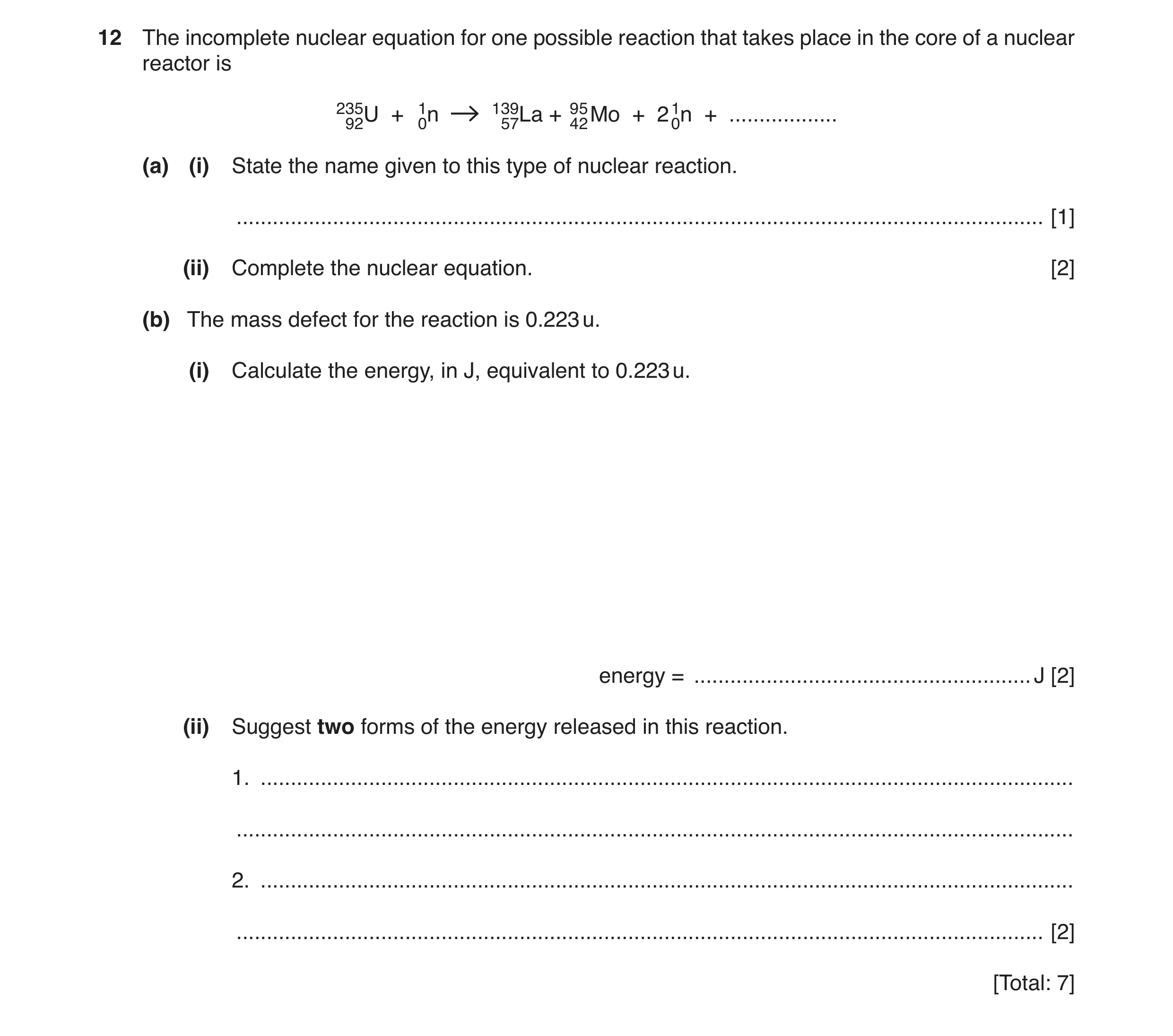
12 The incomplete nuclear equation for one possible reaction that takes place in the core of a nuclear reactor is 23592U + 10n 13957La + 9542Mo + 210n + … (a) (i) State the name given to this type of nuclear reaction. … [1] (ii) Complete the nuclear equation. [2] (b) The mass defect for the reaction is 0.223 u. (i) Calculate the energy, in J, equivalent to 0.223 u. energy = … J [2] (ii) Suggest two forms of the energy released in this reaction. 1. … … 2. … … [2] [Total: 7]
7 marks
Mark scheme: 12(a)(i) fission B1 12(a)(ii) either 0–1e or 0–1β M1 7 A1 12(b)(i) energy = c2 ∆m = 0.223 × 1.66 × 10–27 × (3.00 × 108)2 C1 = 3.33 × 10⁻¹¹ J A1 Question Answer Marks 12(b)(ii) Any 2 from: kinetic energy of products gamma photons neutrinos B2
This question in 9702/42 Feb/March 2019
Q11 · A sample of a radioactive isotope contains N nuclei of the isotope at time T 9702/41 May/June 2019
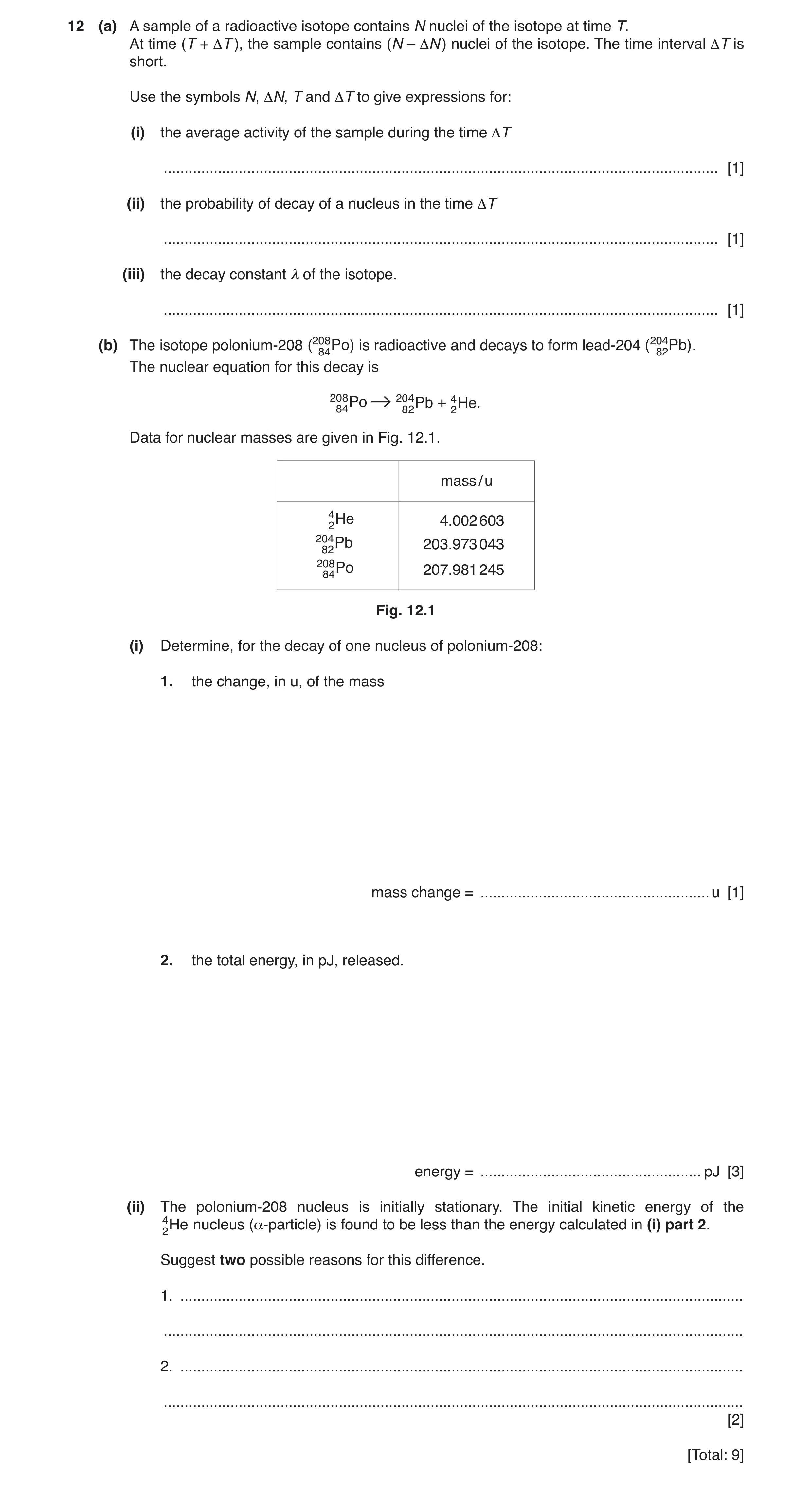
12 (a) A sample of a radioactive isotope contains N nuclei of the isotope at time T. At time (T + ΔT ), the sample contains (N – ΔN ) nuclei of the isotope. The time interval ΔT is short. Use the symbols N, ΔN, T and ΔT to give expressions for: (i) the average activity of the sample during the time ΔT … [1] (ii) the probability of decay of a nucleus in the time ΔT … [1] (iii) the decay constant λ of the isotope. … [1] (b) The isotope polonium-208 (20884 Po) is radioactive and decays to form lead-204 ( 20482 Pb). The nuclear equation for this decay is 208 84 Po 20482 Pb + 42 He. Data for nuclear masses are given in Fig. 12.1. mass / u 4 2 He 4.002 603 204 82 Pb 203.973 043 208 84 Po 207.981 245 Fig. 12.1 (i) Determine, for the decay of one nucleus of polonium-208: 1. the change, in u, of the mass mass change = … u [1] 2. the total energy, in pJ, released. energy = … pJ [3] (ii) The polonium-208 nucleus is initially stationary. The initial kinetic energy of the 4 2 He nucleus (α-particle) is found to be less than the energy calculated in (i) part 2. Suggest two possible reasons for this difference. 1. … … 2. … … [2] [Total: 9]
9 marks
Mark scheme: 12(a)(i) B1 12(a)(ii) ∆N / N B1 12(a)(iii) ∆N / (N ∆T) B1 12(b)(i) 1. mass change = 5.60 × 10⁻³ u A1 2. energy = (∆)mc2 C1 = 5.6 × 10–3 × 1.66 × 10–27 × (3.0 × 108)2 ( = 8.36 × 10⁻¹³ J) C1 = 0.84 pJ A1 12(b)(ii) kinetic energy (of recoil) of lead (nucleus) B1 energy of γ-ray photon B1
This question in 9702/41 May/June 2019
Q12 · State what is meant by the binding energy of a nucleus 9702/42 May/June 2019
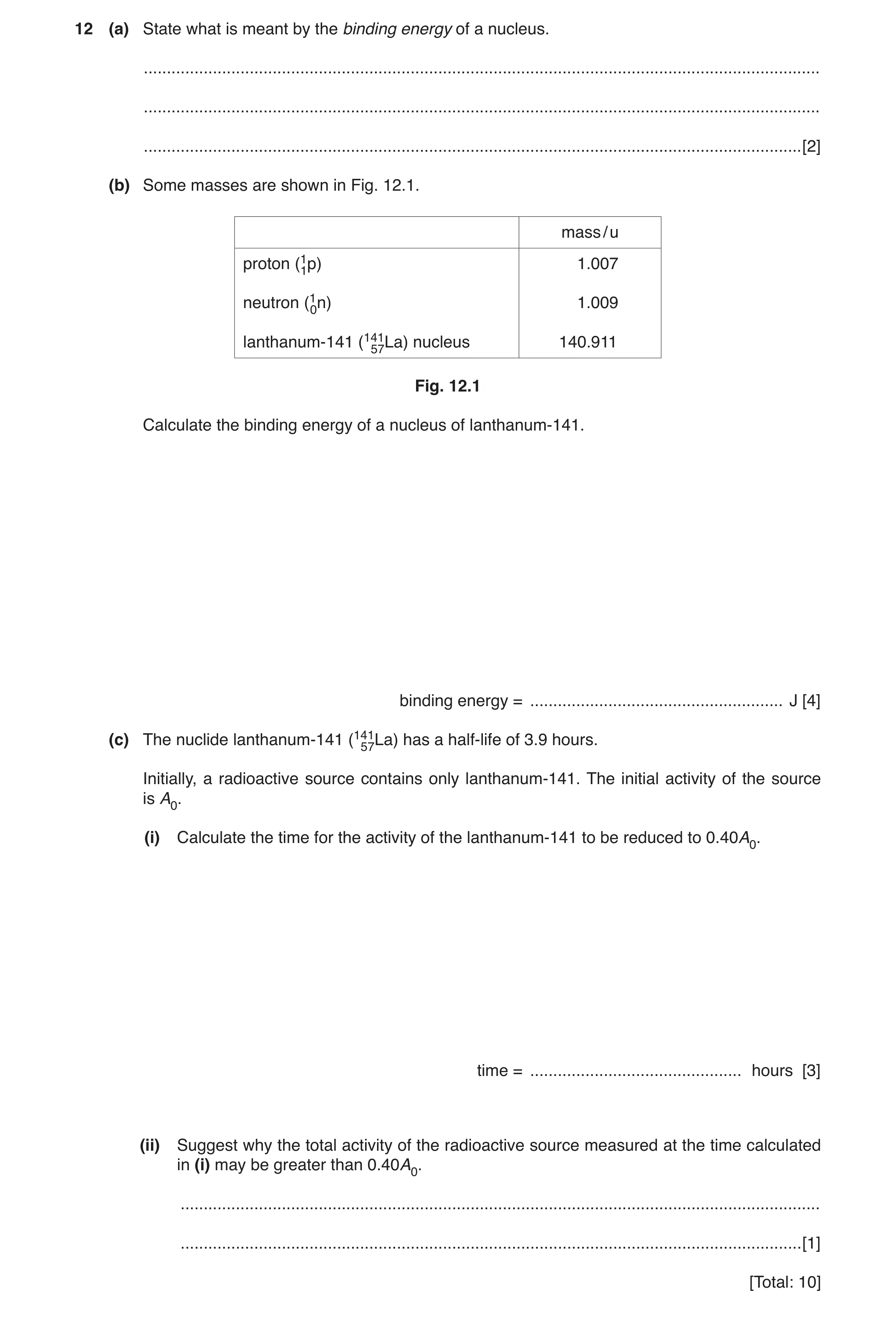
12 (a) State what is meant by the binding energy of a nucleus. … … … [2] (b) Some masses are shown in Fig. 12.1. mass / u proton (11p) 1.007 neutron (10n) 1.009 lanthanum-141 (14157La) nucleus 140.911 Fig. 12.1 Calculate the binding energy of a nucleus of lanthanum-141. binding energy = … J [4] (c) The nuclide lanthanum-141 (14157La) has a half-life of 3.9 hours. Initially, a radioactive source contains only lanthanum-141. The initial activity of the source is A0. (i) Calculate the time for the activity of the lanthanum-141 to be reduced to 0.40A0. time = … hours [3] (ii) Suggest why the total activity of the radioactive source measured at the time calculated in (i) may be greater than 0.40A0. … … [1] [Total: 10]
10 marks
Mark scheme: 12(a) energy required to separate the nucleons (in a nucleus) M1 to infinity A1 or energy released when nucleons come together (to form nucleus) (M1) from infinity (A1) 12(b) mass defect = 140.911 – (57 × 1.007) – (84 × 1.009) C1 = 140.911 – 142.155 = (–)1.244 (u) C1 energy = c2(∆)m C1 = (3.00 × 10⁸)2 × 1.244 × 1.66 × 10–27 = 1.9 × 10⁻¹⁰ J A1 12(c)(i) A = A0e–λt and ln 2 = λt½ C1 0.40 = exp(–ln 2 × t / 3.9) C1 or (0.5)n = 0.40 (C1) n = 1.32 and t = 1.32 × 3.9 (C1) t = 5.2 hours A1 12(c)(ii) daughter product may be radioactive or random nature of decay B1
This question in 9702/42 May/June 2019
Q13 · A sample of a radioactive isotope contains N nuclei of the isotope at time T 9702/43 May/June 2019
12 (a) A sample of a radioactive isotope contains N nuclei of the isotope at time T. At time (T + ΔT ), the sample contains (N – ΔN ) nuclei of the isotope. The time interval ΔT is short. Use the symbols N, ΔN, T and ΔT to give expressions for: (i) the average activity of the sample during the time ΔT … [1] (ii) the probability of decay of a nucleus in the time ΔT … [1] (iii) the decay constant λ of the isotope. … [1] (b) The isotope polonium-208 (20884 Po) is radioactive and decays to form lead-204 ( 20482 Pb). The nuclear equation for this decay is 208 84 Po 20482 Pb + 42 He. Data for nuclear masses are given in Fig. 12.1. mass / u 4 2 He 4.002 603 204 82 Pb 203.973 043 208 84 Po 207.981 245 Fig. 12.1 (i) Determine, for the decay of one nucleus of polonium-208: 1. the change, in u, of the mass mass change = … u [1] 2. the total energy, in pJ, released. energy = … pJ [3] (ii) The polonium-208 nucleus is initially stationary. The initial kinetic energy of the 4 2 He nucleus (α-particle) is found to be less than the energy calculated in (i) part 2. Suggest two possible reasons for this difference. 1. … … 2. … … [2] [Total: 9]
9 marks
Mark scheme: 12(a)(i) B1 12(a)(ii) ∆N / N B1 12(a)(iii) ∆N / (N ∆T) B1 12(b)(i) 1. mass change = 5.60 × 10⁻³ u A1 2. energy = (∆)mc2 C1 = 5.6 × 10–3 × 1.66 × 10–27 × (3.0 × 108)2 ( = 8.36 × 10⁻¹³ J) C1 = 0.84 pJ A1 12(b)(ii) kinetic energy (of recoil) of lead (nucleus) B1 energy of γ-ray photon B1
This question in 9702/43 May/June 2019
Q14 · One possible nuclear reaction that takes place is 23 9 52U + 10n 9452Mo + 1357La9 + 210n… 9702/41 Oct/Nov 2019
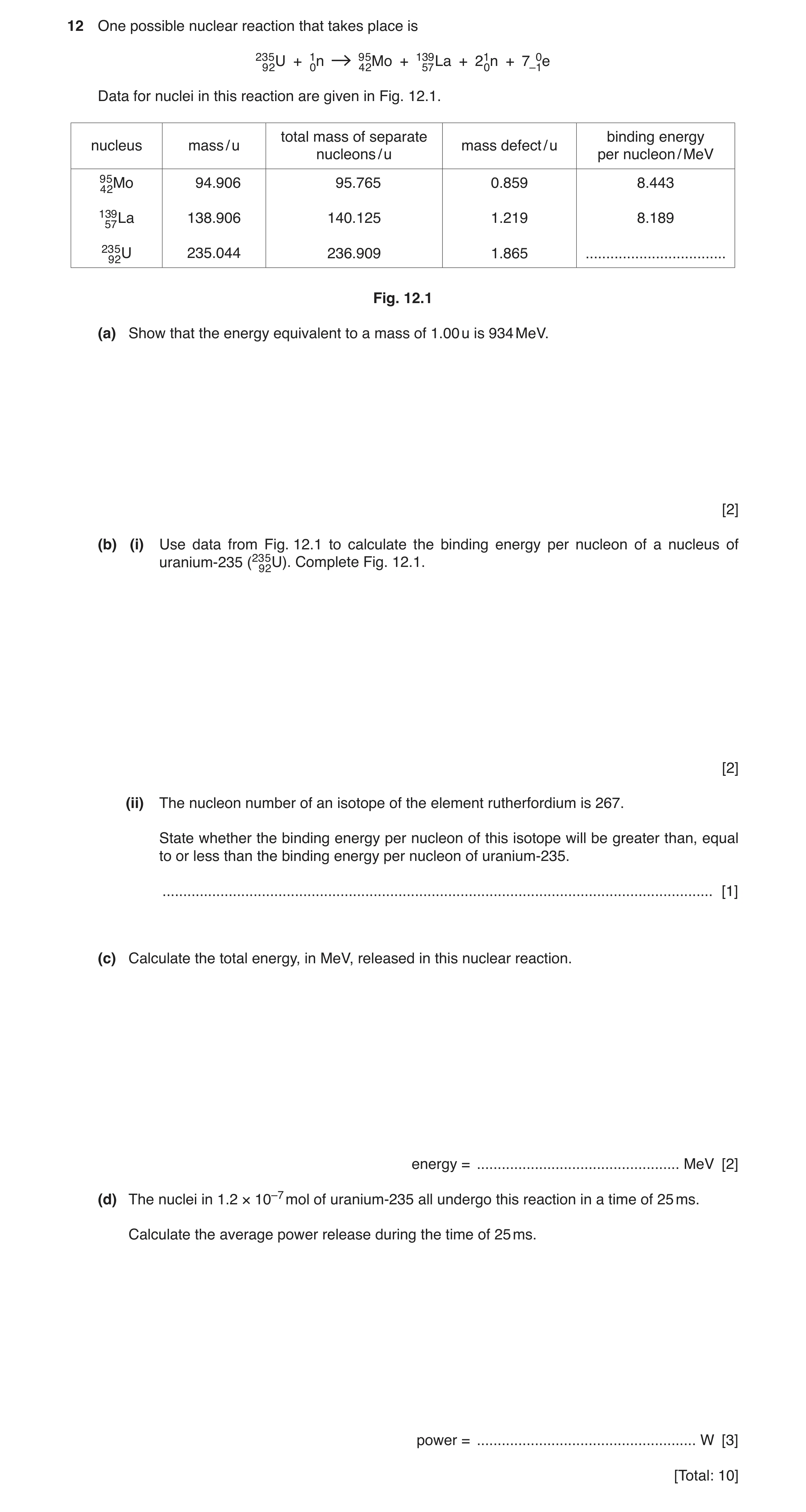
12 One possible nuclear reaction that takes place is 23 9 52U + 10n 9452Mo + 1357La9 + 210n + 7–10e Data for nuclei in this reaction are given in Fig. 12.1. total mass of separate binding energy nucleus mass / u mass defect / u nucleons / u per nucleon / MeV 9 4 52Mo 94.906 95.765 0.859 8.443 13 57La9 138.906 140.125 1.219 8.189 23 9 52U 235.044 236.909 1.865 … Fig. 12.1 (a) Show that the energy equivalent to a mass of 1.00 u is 934 MeV. [2] (b) (i) Use data from Fig. 12.1 to calculate the binding energy per nucleon of a nucleus of uranium-235 (23952U). Complete Fig. 12.1. [2] (ii) The nucleon number of an isotope of the element rutherfordium is 267. State whether the binding energy per nucleon of this isotope will be greater than, equal to or less than the binding energy per nucleon of uranium-235. … [1] (c) Calculate the total energy, in MeV, released in this nuclear reaction. energy = … MeV [2] (d) The nuclei in 1.2 × 10⁻⁷ mol of uranium-235 all undergo this reaction in a time of 25 ms. Calculate the average power release during the time of 25 ms. power = … W [3] [Total: 10]
10 marks
Mark scheme: 12(a) M1 E = (1.49 × 10⁻¹⁰) / (1.60 × 10⁻¹⁹) = 9.34 × 108 = 934 MeV A1 or binding energy = 8.443 × 95 [or equivalent using La-139 nucleus] (M1) binding energy / mass defect = (8.443 × 95) / 0.859 = 934 MeV (A1) 12(b)(i) binding energy = 1.865 × 934 (= 1741.91 MeV) C1 binding energy per nucleon = 1741.91 / 235 = 7.41 (MeV) A1 12(b)(ii) less (than) B1 12(c) energy = {(1.219 + 0.859) – 1.865)} × 934 or energy = (95 × 8.443) + (139 × 8.189) – (235 × 7.412) C1 = 199 MeV A1 12(d) number of reactions = 1.2 × 10–7 × 6.02 × 1023 = 7.22 × 10¹⁶ C1 energy release (for one reaction) = 199 × 1.60 × 10–13 (= 3.18 × 10⁻¹¹ J) C1 power = (7.22 × 1016 × 3.18 × 10–11) / (25 × 10–3) = 9.2 × 10⁷ W A1
This question in 9702/41 Oct/Nov 2019
Q15 · One possible nuclear reaction that takes place is 23 9 52U + 10n 9452Mo + 1357La9 + 210n… 9702/43 Oct/Nov 2019
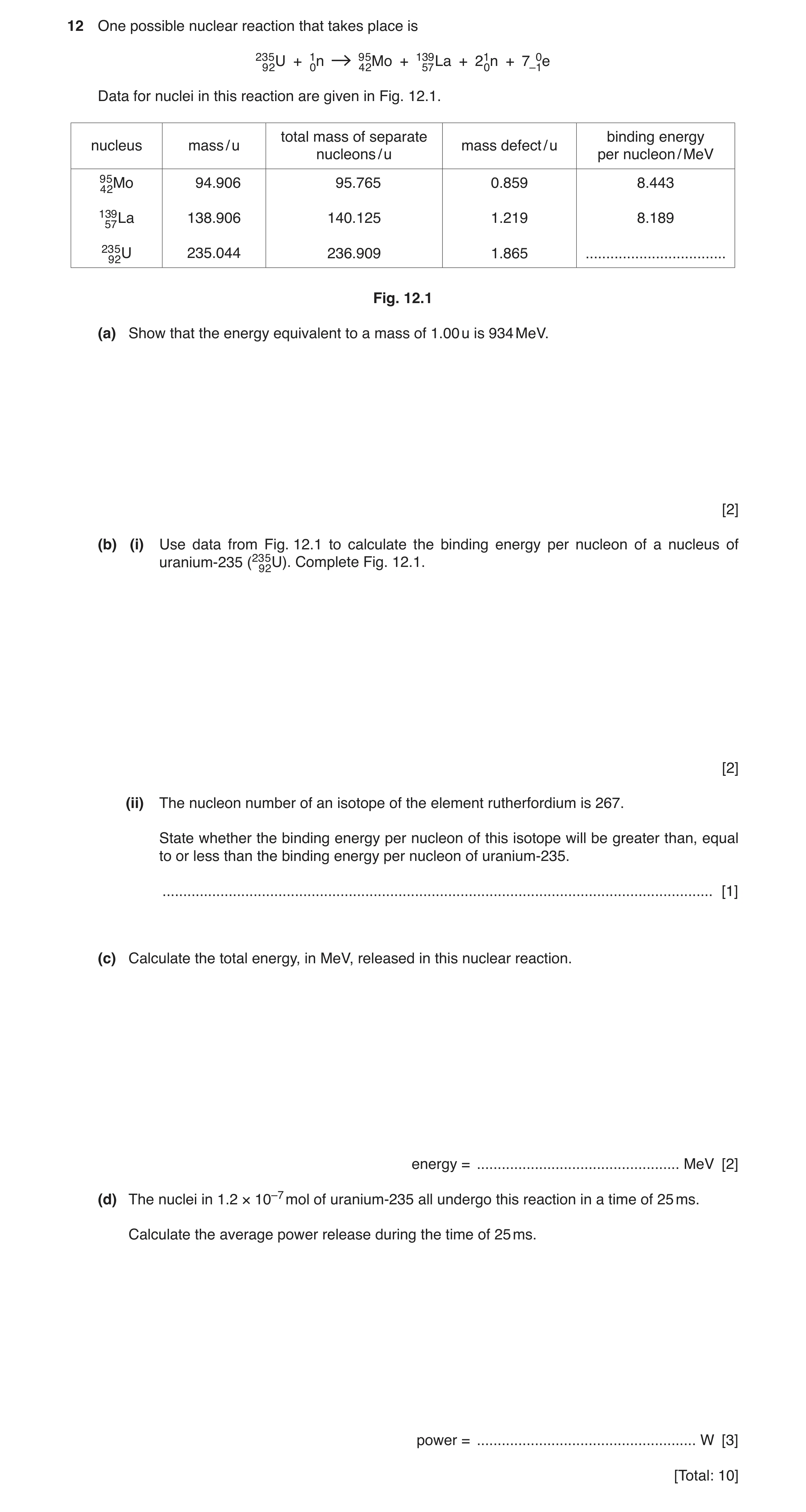
12 One possible nuclear reaction that takes place is 23 9 52U + 10n 9452Mo + 1357La9 + 210n + 7–10e Data for nuclei in this reaction are given in Fig. 12.1. total mass of separate binding energy nucleus mass / u mass defect / u nucleons / u per nucleon / MeV 9 4 52Mo 94.906 95.765 0.859 8.443 13 57La9 138.906 140.125 1.219 8.189 23 9 52U 235.044 236.909 1.865 … Fig. 12.1 (a) Show that the energy equivalent to a mass of 1.00 u is 934 MeV. [2] (b) (i) Use data from Fig. 12.1 to calculate the binding energy per nucleon of a nucleus of uranium-235 (23952U). Complete Fig. 12.1. [2] (ii) The nucleon number of an isotope of the element rutherfordium is 267. State whether the binding energy per nucleon of this isotope will be greater than, equal to or less than the binding energy per nucleon of uranium-235. … [1] (c) Calculate the total energy, in MeV, released in this nuclear reaction. energy = … MeV [2] (d) The nuclei in 1.2 × 10⁻⁷ mol of uranium-235 all undergo this reaction in a time of 25 ms. Calculate the average power release during the time of 25 ms. power = … W [3] [Total: 10]
10 marks
Mark scheme: 12(a) M1 E = (1.49 × 10⁻¹⁰) / (1.60 × 10⁻¹⁹) = 9.34 × 108 = 934 MeV A1 or binding energy = 8.443 × 95 [or equivalent using La-139 nucleus] (M1) binding energy / mass defect = (8.443 × 95) / 0.859 = 934 MeV (A1) 12(b)(i) binding energy = 1.865 × 934 (= 1741.91 MeV) C1 binding energy per nucleon = 1741.91 / 235 = 7.41 (MeV) A1 12(b)(ii) less (than) B1 12(c) energy = {(1.219 + 0.859) – 1.865)} × 934 or energy = (95 × 8.443) + (139 × 8.189) – (235 × 7.412) C1 = 199 MeV A1 12(d) number of reactions = 1.2 × 10–7 × 6.02 × 1023 = 7.22 × 10¹⁶ C1 energy release (for one reaction) = 199 × 1.60 × 10–13 (= 3.18 × 10⁻¹¹ J) C1 power = (7.22 × 1016 × 3.18 × 10–11) / (25 × 10–3) = 9.2 × 10⁷ W A1
This question in 9702/43 Oct/Nov 2019
Q16 · Explain what is meant by the binding energy of a nucleus 9702/42 Feb/March 2020
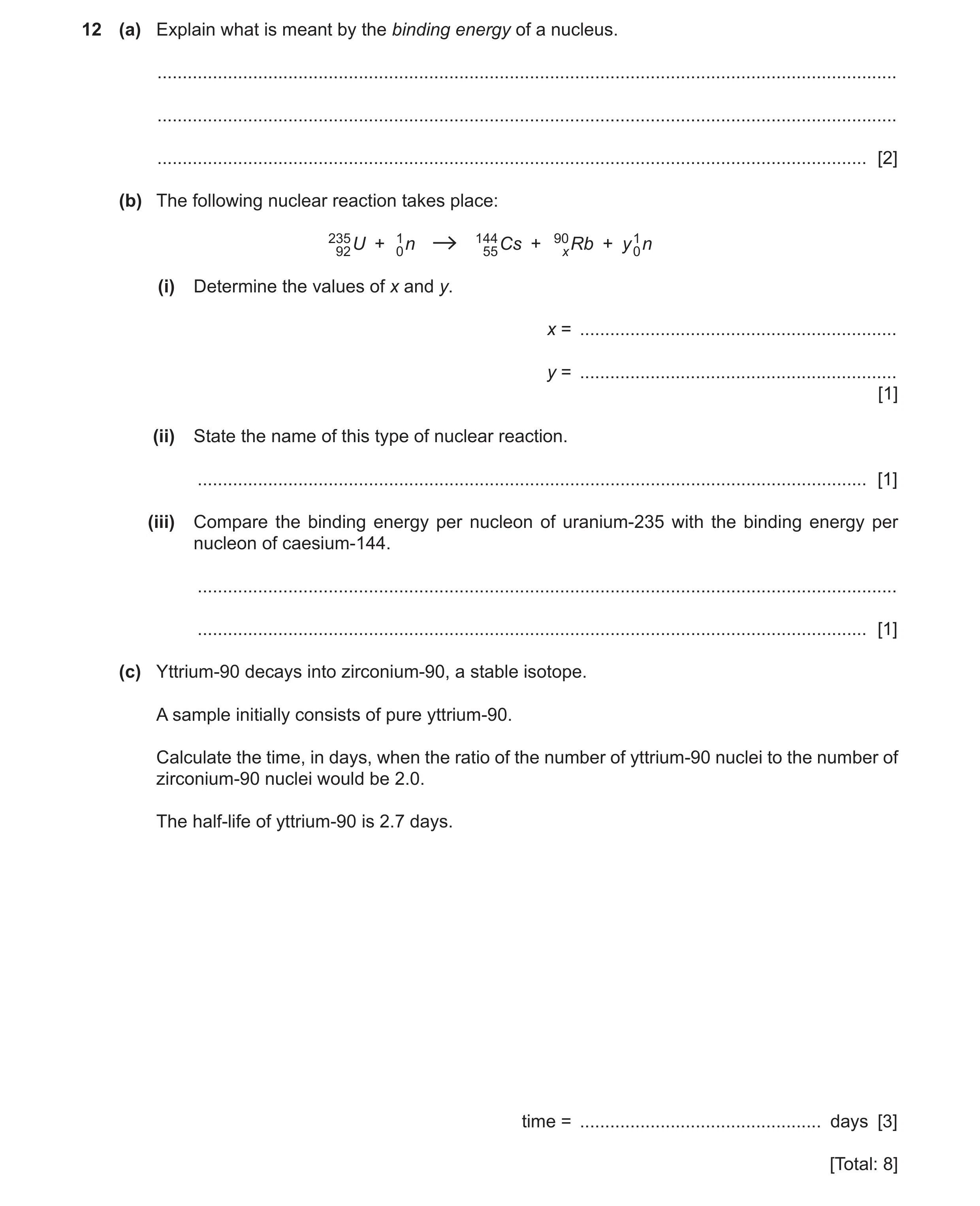
12 (a) Explain what is meant by the binding energy of a nucleus. … … … [2] (b) The following nuclear reaction takes place: 23592 U + 10 n 14455 Cs + 90x Rb + y10 n (i) Determine the values of x and y. x = … y = … [1] (ii) State the name of this type of nuclear reaction. … [1] (iii) Compare the binding energy per nucleon of uranium-235 with the binding energy per nucleon of caesium-144. … … [1] (c) Yttrium-90 decays into zirconium-90, a stable isotope. A sample initially consists of pure yttrium-90. Calculate the time, in days, when the ratio of the number of yttrium-90 nuclei to the number of zirconium-90 nuclei would be 2.0. The half-life of yttrium-90 is 2.7 days. time = … days [3] [Total: 8]
8 marks
Mark scheme: 12(a) (minimum) energy required to separate the nucleons M1 to infinity A1 12(b)(i) 37 2 B1 12(b)(ii) fission B1 12(b)(iii) binding energy per nucleon smaller for U than for Cs B1 12(c) Current ratio 2 Y to 1 Zr, so initially 3 Y 2 = 3 e–λt λ = 0.693 / 2.7 C1 ln(2 / 3) = – (ln 2 / 2.7)t C1 t = 1.6 days A1 or (½)n = 2 / 3 (C1) n = 0.585 (C1) time = 0.585 × 2.7 = 1.6 days (A1)
This question in 9702/42 Feb/March 2020
Q17 · An electron, at rest, has mass me and charge –q 9702/41 May/June 2020
11 An electron, at rest, has mass me and charge –q. A positron is a particle that, at rest, has mass me and charge +q. A positron interacts with an electron. The electron and the positron may be considered to be at rest. The outcome of this interaction is that the electron and the positron become two gamma-ray (γ-ray) photons, each having the same energy. (a) Calculate, for one of the γ-ray photons: (i) the photon energy, in J energy = … J [2] (ii) its momentum. momentum = … N s [2] (b) State and explain the direction, relative to each other, in which the γ-ray photons are emitted. … … … … [2] [Total: 6]
6 marks
Mark scheme: 11(a)(i) E = mc2 C1 = 9.11 × 10–31 × (3.0 × 108)2 = 8.2 × 10⁻¹⁴ J A1 11(a)(ii) p = h / λ and E = hc / λ or E = pc C1 p = (8.2 × 10⁻¹⁴) / (3.0 × 10⁸) = 2.7 × 10⁻²² N s A1 11(b) total momentum (before and after interaction) is zero or momentum must be conserved (in the interaction) or momentum of the photons must be equal and opposite B1 (photons emitted in) opposite directions B1
This question in 9702/41 May/June 2020
Q18 · State what is meant by the mass defect of a nucleus 9702/42 May/June 2020
12 (a) State what is meant by the mass defect of a nucleus. … … … [2] (b) Some masses are shown in Table 12.1. Table 12.1 mass / u proton 11p 1.007 276 neutron 10n 1.008 665 helium‑4 (42He) nucleus 4.001 506 Show that: (i) the energy equivalence of 1.00 u is 934 MeV [2] (ii) the binding energy per nucleon of a helium-4 nucleus is 7.09 MeV. [2] (c) Isotopes of hydrogen have binding energies per nucleon of less than 3 MeV. Suggest why a nucleus of helium‑4 does not spontaneously break down to become nuclei of hydrogen. … … … [2] [Total: 8] To avoid the issue of disclosure of answer‑related information to candidates, all copyright acknowledgements are reproduced online in the Cambridge Assessment International Education Copyright Acknowledgements Booklet. This is produced for each series of examinations and is freely available to download
8 marks
Mark scheme: 12(a) difference between mass of nucleus and mass of (constituent) nucleons M1 where nucleons are separated to infinity A1 12(b)(i) E = mc2 C1 = 1.66 × 10–27 × (3.00 × 108)2 / (1.60 × 10⁻¹³) = 934 MeV A1 12(b)(ii) mass defect = 2 × (1.007276 + 1.008665) – 4.001506 ( = 0.030376) B1 binding energy per nucleon = (0.030376 × 934) / 4 = 7.09 MeV A1 12(c) binding energy per nucleon is much greater M1 so would require a large amount of energy to separate the nucleons in helium A1 or amount of energy released in forming hydrogen isotopes (M1) is less than energy required to break apart helium nucleus (A1)
This question in 9702/42 May/June 2020
Q19 · An electron, at rest, has mass me and charge –q 9702/43 May/June 2020
11 An electron, at rest, has mass me and charge –q. A positron is a particle that, at rest, has mass me and charge +q. A positron interacts with an electron. The electron and the positron may be considered to be at rest. The outcome of this interaction is that the electron and the positron become two gamma-ray (γ-ray) photons, each having the same energy. (a) Calculate, for one of the γ-ray photons: (i) the photon energy, in J energy = … J [2] (ii) its momentum. momentum = … N s [2] (b) State and explain the direction, relative to each other, in which the γ-ray photons are emitted. … … … … [2] [Total: 6]
6 marks
Mark scheme: 11(a)(i) E = mc2 C1 = 9.11 × 10–31 × (3.0 × 108)2 = 8.2 × 10⁻¹⁴ J A1 11(a)(ii) p = h / λ and E = hc / λ or E = pc C1 p = (8.2 × 10⁻¹⁴) / (3.0 × 10⁸) = 2.7 × 10⁻²² N s A1 11(b) total momentum (before and after interaction) is zero or momentum must be conserved (in the interaction) or momentum of the photons must be equal and opposite B1 (photons emitted in) opposite directions B1
This question in 9702/43 May/June 2020
Q20 · Define nuclear binding energy 9702/42 Oct/Nov 2020
12 (a) (i) Define nuclear binding energy. … … … [2] (ii) Explain what is meant by a nuclear fission reaction. … … … [2] (b) A student suggests that one possible nuclear reaction is 5626Fe + 10n 209F + 3717Cl. The binding energy per nucleon of a nucleus varies with the nucleon number. Use this variation to explain why the reaction would not result in an overall release of energy. … … … … … [3] [Total: 7]
7 marks
Mark scheme: 12(a)(i) energy required to separate nucleons (of nucleus) M1 to infinity A1 12(a)(ii) a (single) large nucleus divides to form (smaller) nuclei B1 any one point from: • initiated by neutron bombardment • resulting nuclei are of similar size • binding energy per nucleon increases • total binding energy increases • neutrons released • combined mass of smaller nuclei is less than mass of large nucleus B1 12(b) binding energy per nucleon is a maximum at around A = 56 B1 products of splitting a 56Fe nucleus must have a lower total binding energy B1 (reaction would require) a net input of energy B1
This question in 9702/42 Oct/Nov 2020
Q21 · State what is meant by luminosity of a star 9702/42 Feb/March 2022
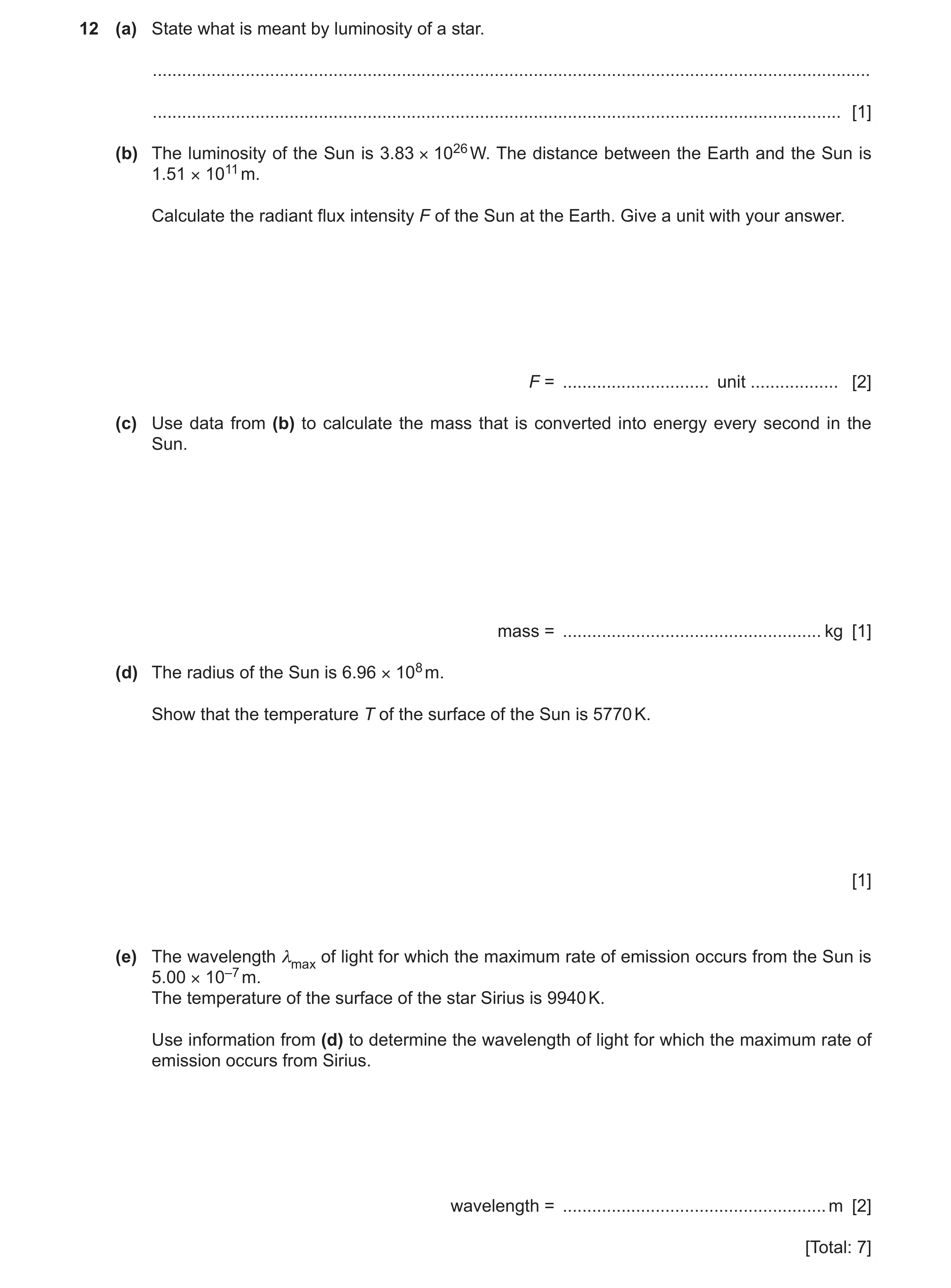
12 (a) State what is meant by luminosity of a star. … … [1] (b) The luminosity of the Sun is 3.83 × 1026 W. The distance between the Earth and the Sun is 1.51 × 10¹¹ m. Calculate the radiant flux intensity F of the Sun at the Earth. Give a unit with your answer. F = … unit … [2] (c) Use data from (b) to calculate the mass that is converted into energy every second in the Sun. mass = … kg [1] (d) The radius of the Sun is 6.96 × 10⁸ m. Show that the temperature T of the surface of the Sun is 5770 K. [1] (e) The wavelength λmax of light for which the maximum rate of emission occurs from the Sun is 5.00 × 10⁻⁷ m. The temperature of the surface of the star Sirius is 9940 K. Use information from (d) to determine the wavelength of light for which the maximum rate of emission occurs from Sirius. wavelength = … m [2] [Total: 7]
7 marks
Mark scheme: 12(a) total power of radiation emitted (by the star) B1 12(b) 2 L F = 4 d π 26 112 3.83 10 = 4 1.51 10 × × π × × C1 2 = 1340 W m− A1 Question Answer Marks 12(c) 2 E m c = 26 82 3.83 10 = 3.00 10 × × 9 = 4.26 10 kg × A1 12(d) 2 4 L = 4 T r πσ 26 8 82 4 3.83 10 = 4 5.67 10 6.96 10 T − × × π× × × × × leading to T = 5770 K B1 12(e) (max) 1 T ∝ λ 7 5.00 10 9940 5770 λ − × = C1 7 2.90 10 m − λ = × A1
This question in 9702/42 Feb/March 2022
Q22 · State what is meant by nuclear binding energy 9702/41 May/June 2022
8 (a) (i) State what is meant by nuclear binding energy. … … … [2] (ii) On Fig. 8.1, sketch a line to show the variation with nucleon number A of the binding energy per nucleon E of a nucleus. E 0 0 250 A Fig. 8.1 [2] (b) In one type of nuclear process, deuterium (21H) undergoes the reaction 21H + 21H 32He + 10n. (i) State the name of this type of nuclear process. … [1] (ii) Explain, with reference to your line in (a)(ii), why this reaction results in the release of energy. … … … [2] (c) Table 8.1 shows the masses of the particles involved in the reaction in (b). Table 8.1 particle mass / u 10n 1.008 665 21H 2.014 102 32He 3.016 029 Calculate the energy released when 1.00 mol of deuterium undergoes the reaction. energy = … J [5] [Total: 12]
12 marks
Mark scheme: 8(a)(i) energy required to separate the nucleons (in the nucleus) M1 to infinity A1 8(a)(ii) curve starting close to the origin and forming a single peak B1 peak shown to left of centre, with steep line on LHS of peak and shallow line on RHS of peak B1 8(b)(i) fusion B1 8(b)(ii) both particles have low A values or both particles are at left-hand end of graph B1 He-3 has higher binding energy (per nucleon) than H-2 B1 8(c) m = [(2 2.014102) – (3.016029 + 1.008665)] u ( = 0.00351 u) C1 E = mc2 C1 = 0.00351 1.66 10–27 (3.00 108)2 ( = 5.24 10–13 J) C1 1.00 mol of deuterium forms 0.500 mol of helium-3 C1 total energy = 0.500 6.02 1023 5.24 10–13 = 1.58 1011 J A1
This question in 9702/41 May/June 2022
Q23 · State what is meant by nuclear binding energy 9702/43 May/June 2022
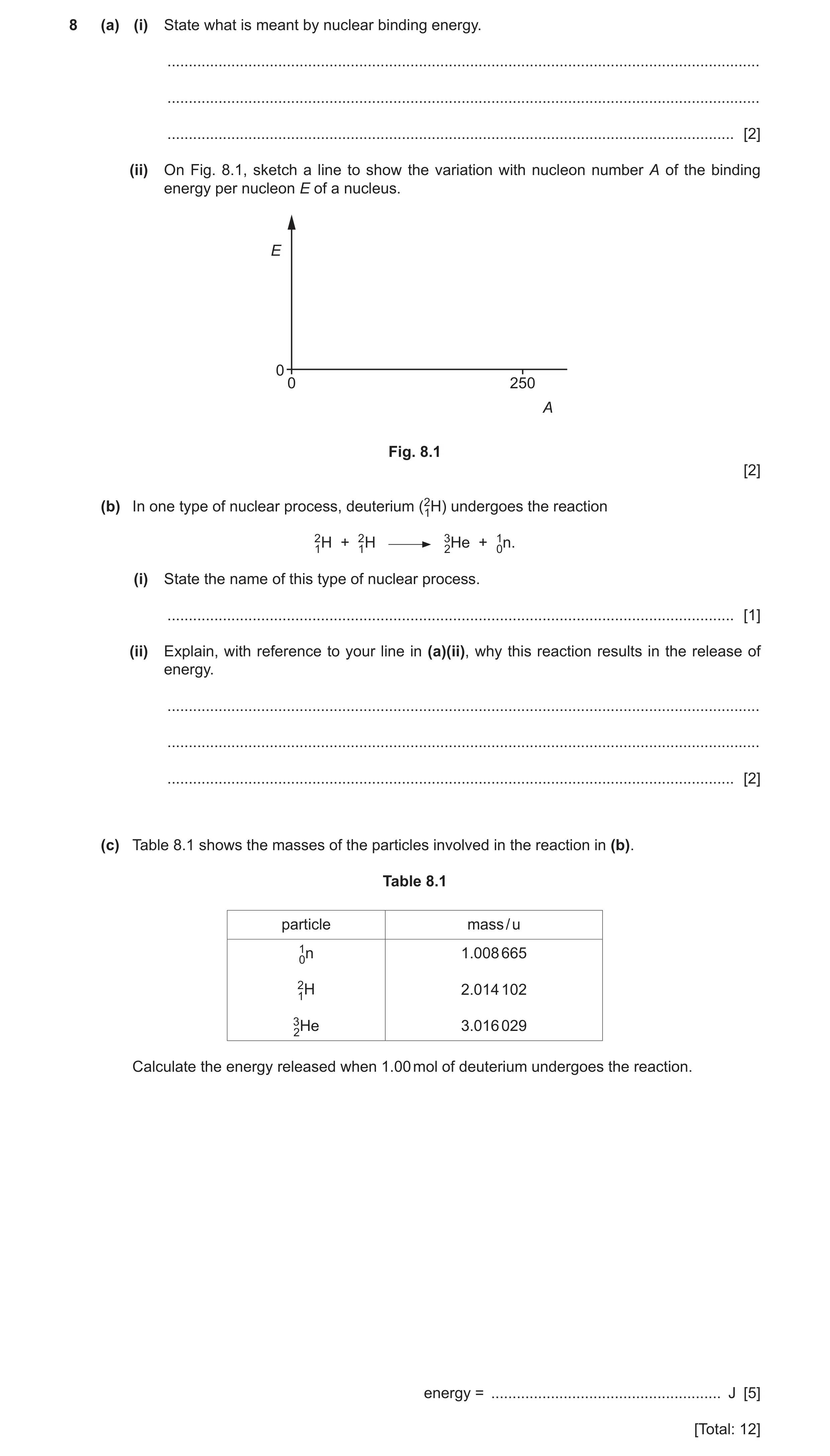
8 (a) (i) State what is meant by nuclear binding energy. … … … [2] (ii) On Fig. 8.1, sketch a line to show the variation with nucleon number A of the binding energy per nucleon E of a nucleus. E 0 0 250 A Fig. 8.1 [2] (b) In one type of nuclear process, deuterium (21H) undergoes the reaction 21H + 21H 32He + 10n. (i) State the name of this type of nuclear process. … [1] (ii) Explain, with reference to your line in (a)(ii), why this reaction results in the release of energy. … … … [2] (c) Table 8.1 shows the masses of the particles involved in the reaction in (b). Table 8.1 particle mass / u 10n 1.008 665 21H 2.014 102 32He 3.016 029 Calculate the energy released when 1.00 mol of deuterium undergoes the reaction. energy = … J [5] [Total: 12]
12 marks
Mark scheme: 8(a)(i) energy required to separate the nucleons (in the nucleus) M1 to infinity A1 8(a)(ii) curve starting close to the origin and forming a single peak B1 peak shown to left of centre, with steep line on LHS of peak and shallow line on RHS of peak B1 8(b)(i) fusion B1 8(b)(ii) both particles have low A values or both particles are at left-hand end of graph B1 He-3 has higher binding energy (per nucleon) than H-2 B1 8(c) m = [(2 2.014102) – (3.016029 + 1.008665)] u ( = 0.00351 u) C1 E = mc2 C1 = 0.00351 1.66 10–27 (3.00 108)2 ( = 5.24 10–13 J) C1 1.00 mol of deuterium forms 0.500 mol of helium-3 C1 total energy = 0.500 6.02 1023 5.24 10–13 = 1.58 1011 J A1
This question in 9702/43 May/June 2022
Q24 · Carbon-15 (156 C) is an isotope of carbon that undergoes radioactive decay to nitrogen-15… 9702/41 Oct/Nov 2022
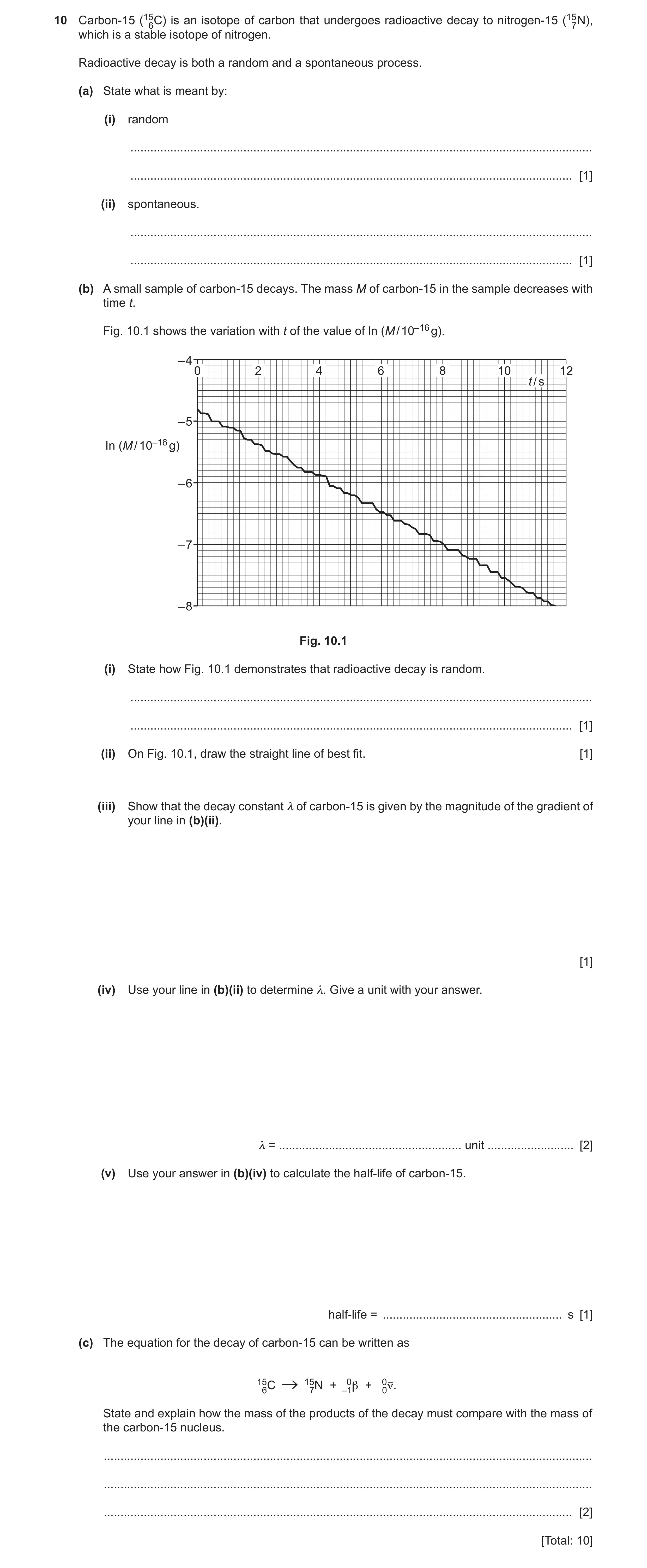
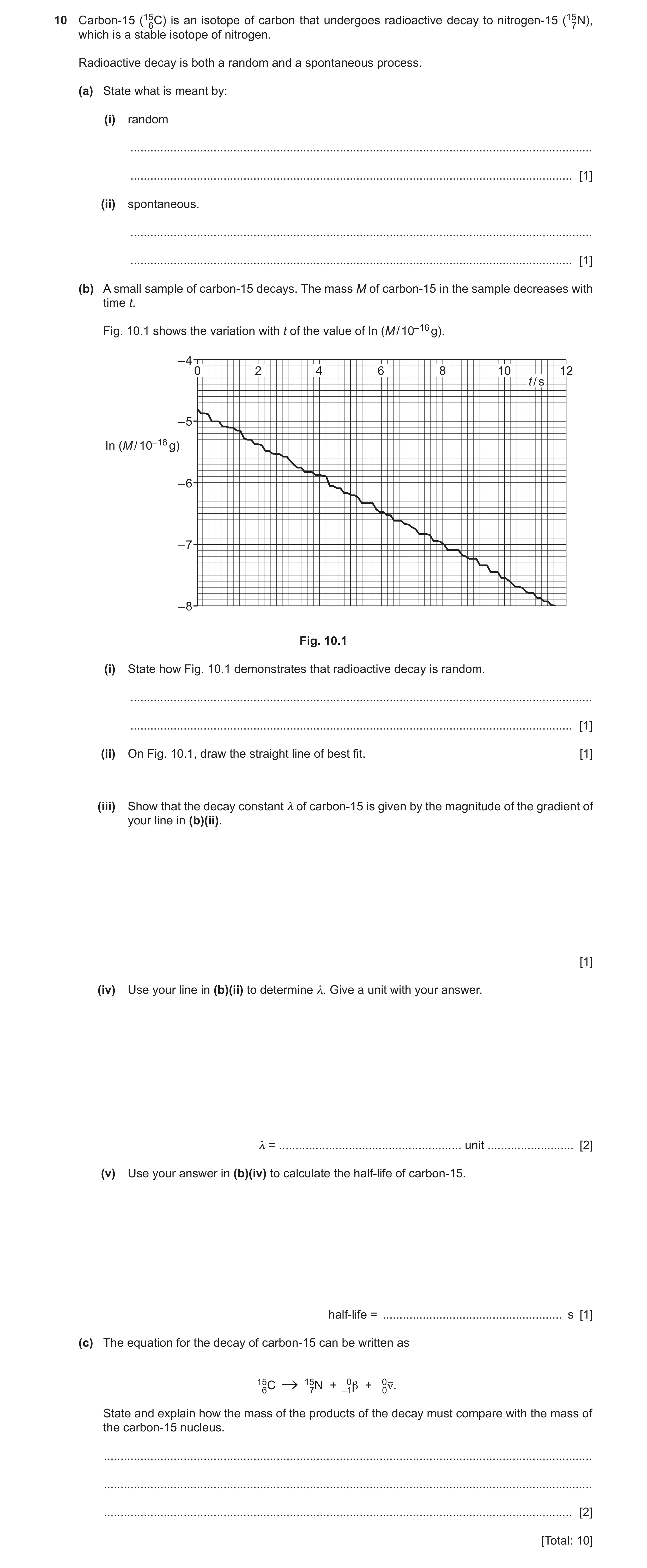
10 Carbon-15 (156 C) is an isotope of carbon that undergoes radioactive decay to nitrogen-15 (157 N), which is a stable isotope of nitrogen. Radioactive decay is both a random and a spontaneous process. (a) State what is meant by: (i) random … … [1] (ii) spontaneous. … … [1] (b) A small sample of carbon-15 decays. The mass M of carbon-15 in the sample decreases with time t. Fig. 10.1 shows the variation with t of the value of ln (M / 10–16 g). – 4 0 2 4 6 8 10 12 t / s – 5 In (M / 10–16 g) – 6 – 7 – 8 Fig. 10.1 (i) State how Fig. 10.1 demonstrates that radioactive decay is random. … … [1] (ii) On Fig. 10.1, draw the straight line of best fit. [1] (iii) Show that the decay constant λ of carbon-15 is given by the magnitude of the gradient of your line in (b)(ii). [1] (iv) Use your line in (b)(ii) to determine λ. Give a unit with your answer. λ = … unit … [2] (v) Use your answer in (b)(iv) to calculate the half-life of carbon-15. half-life = … s [1] (c) The equation for the decay of carbon-15 can be written as 156C 157N + –1β0 + 00ν. State and explain how the mass of the products of the decay must compare with the mass of the carbon-15 nucleus. … … … [2] [Total: 10]
10 marks
Mark scheme: 10(a)(i) cannot predict when a (particular) nucleus will decay B1 or cannot predict which nucleus will decay next 10(a)(ii) not affected by external / environmental factors B1 10(b)(i) line fluctuates B1 or trend is a straight line 10(b)(ii) straight line of best fit drawn on Fig. 10.1 B1 10(b)(iii) M = M0 exp (–t) B1 so ln M = ln M0 – t so gradient = –(and magnitude of gradient = ) 10(b)(iv) gradient = (–) (8.0 – 4.8) / (11.6 – 0) (allow any correct pair of values from Fig. 10.1) C1 = 0.28 s–1 A1 10(b)(v) half-life = 0.693 / A1 = 0.693 / 0.28 = 2.5 s 10(c) (for reaction to occur,) energy is released B1 energy release comes from fall in mass so total mass of products must be less (than mass of carbon-15) B1
This question in 9702/41 Oct/Nov 2022
Q25 · Carbon-15 (156 C) is an isotope of carbon that undergoes radioactive decay to nitrogen-15… 9702/43 Oct/Nov 2022
10 Carbon-15 (156 C) is an isotope of carbon that undergoes radioactive decay to nitrogen-15 (157 N), which is a stable isotope of nitrogen. Radioactive decay is both a random and a spontaneous process. (a) State what is meant by: (i) random … … [1] (ii) spontaneous. … … [1] (b) A small sample of carbon-15 decays. The mass M of carbon-15 in the sample decreases with time t. Fig. 10.1 shows the variation with t of the value of ln (M / 10–16 g). – 4 0 2 4 6 8 10 12 t / s – 5 In (M / 10–16 g) – 6 – 7 – 8 Fig. 10.1 (i) State how Fig. 10.1 demonstrates that radioactive decay is random. … … [1] (ii) On Fig. 10.1, draw the straight line of best fit. [1] (iii) Show that the decay constant λ of carbon-15 is given by the magnitude of the gradient of your line in (b)(ii). [1] (iv) Use your line in (b)(ii) to determine λ. Give a unit with your answer. λ = … unit … [2] (v) Use your answer in (b)(iv) to calculate the half-life of carbon-15. half-life = … s [1] (c) The equation for the decay of carbon-15 can be written as 156C 157N + –1β0 + 00ν. State and explain how the mass of the products of the decay must compare with the mass of the carbon-15 nucleus. … … … [2] [Total: 10]
10 marks
Mark scheme: 10(a)(i) cannot predict when a (particular) nucleus will decay B1 or cannot predict which nucleus will decay next 10(a)(ii) not affected by external / environmental factors B1 10(b)(i) line fluctuates B1 or trend is a straight line 10(b)(ii) straight line of best fit drawn on Fig. 10.1 B1 10(b)(iii) M = M0 exp (–t) B1 so ln M = ln M0 – t so gradient = –(and magnitude of gradient = ) 10(b)(iv) gradient = (–) (8.0 – 4.8) / (11.6 – 0) (allow any correct pair of values from Fig. 10.1) C1 = 0.28 s–1 A1 10(b)(v) half-life = 0.693 / A1 = 0.693 / 0.28 = 2.5 s 10(c) (for reaction to occur,) energy is released B1 energy release comes from fall in mass so total mass of products must be less (than mass of carbon-15) B1
This question in 9702/43 Oct/Nov 2022
Question 26 9702/42 May/June 2023
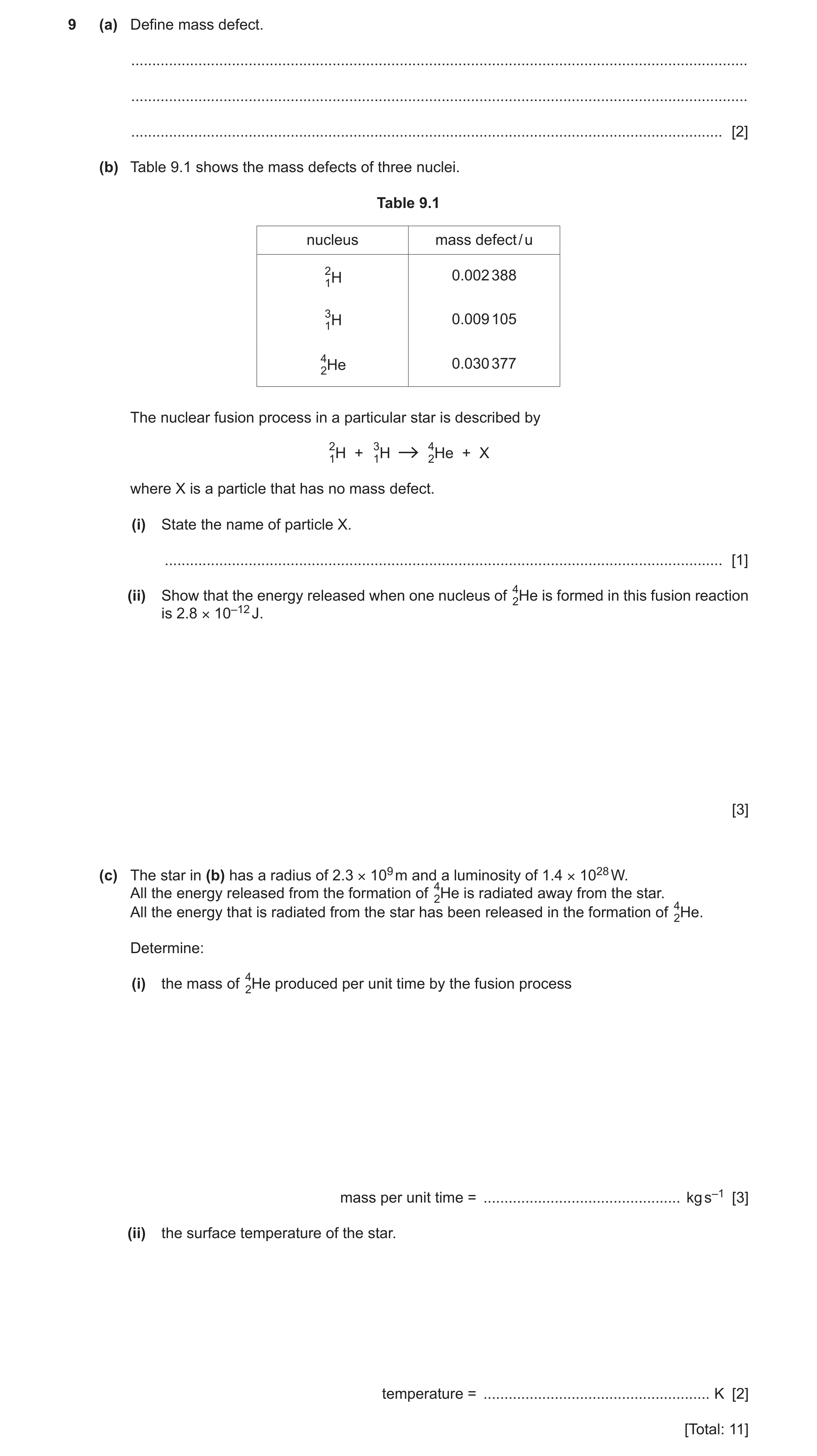
9 (a) Define mass defect. … … … [2] (b) Table 9.1 shows the mass defects of three nuclei. Table 9.1 nucleus mass defect / u 21H 0.002 388 31H 0.009 105 42He 0.030 377 The nuclear fusion process in a particular star is described by 21H + 31H 42He + X where X is a particle that has no mass defect. (i) State the name of particle X. … [1] (ii) Show that the energy released when one nucleus of 42He is formed in this fusion reaction is 2.8 × 10⁻¹² J. [3] (c) The star in (b) has a radius of 2.3 × 10⁹ m and a luminosity of 1.4 × 1028 W. All the energy released from the formation of 42He is radiated away from the star. All the energy that is radiated from the star has been released in the formation of 42He. Determine: (i) the mass of 42He produced per unit time by the fusion process mass per unit time = … kg s–1 [3] (ii) the surface temperature of the star. temperature = … K [2] [Total: 11]
11 marks
Mark scheme: 9(a) difference between mass of nucleus and (total) mass of nucleons M1 when infinitely separated A1 9(b)(i) neutron B1 9(b)(ii) E = m c2 C1 m = (0.030377 – 0.002388 – 0.009105)u ( = 0.018884u) C1 energy release = (0.030377 – 0.002388 – 0.009105) 1.66 10–27 (3.00 108)2 = 2.8 10–12 J A1 9(c)(i) number of atoms per unit time = (1.4 1028) / (2.8 10–12) ( = 5.0 1039 s–1) C1 mass of one atom = 4 1.66 10–27 or (4 10–3) / (6.02 1023) ( = 6.64 10–27 kg) C1 mass per unit time = 6.64 10–27 5.0 1039 = 3.3 1013 kg s–1 A1 9(c)(ii) L = 4σr2T4 1.4 1028 = 4 5.67 10–8 (2.3 109)2 T4 C1 T = 7800 K A1
This question in 9702/42 May/June 2023
Q27 · State what is meant by nuclear fusion 9702/41 Oct/Nov 2023
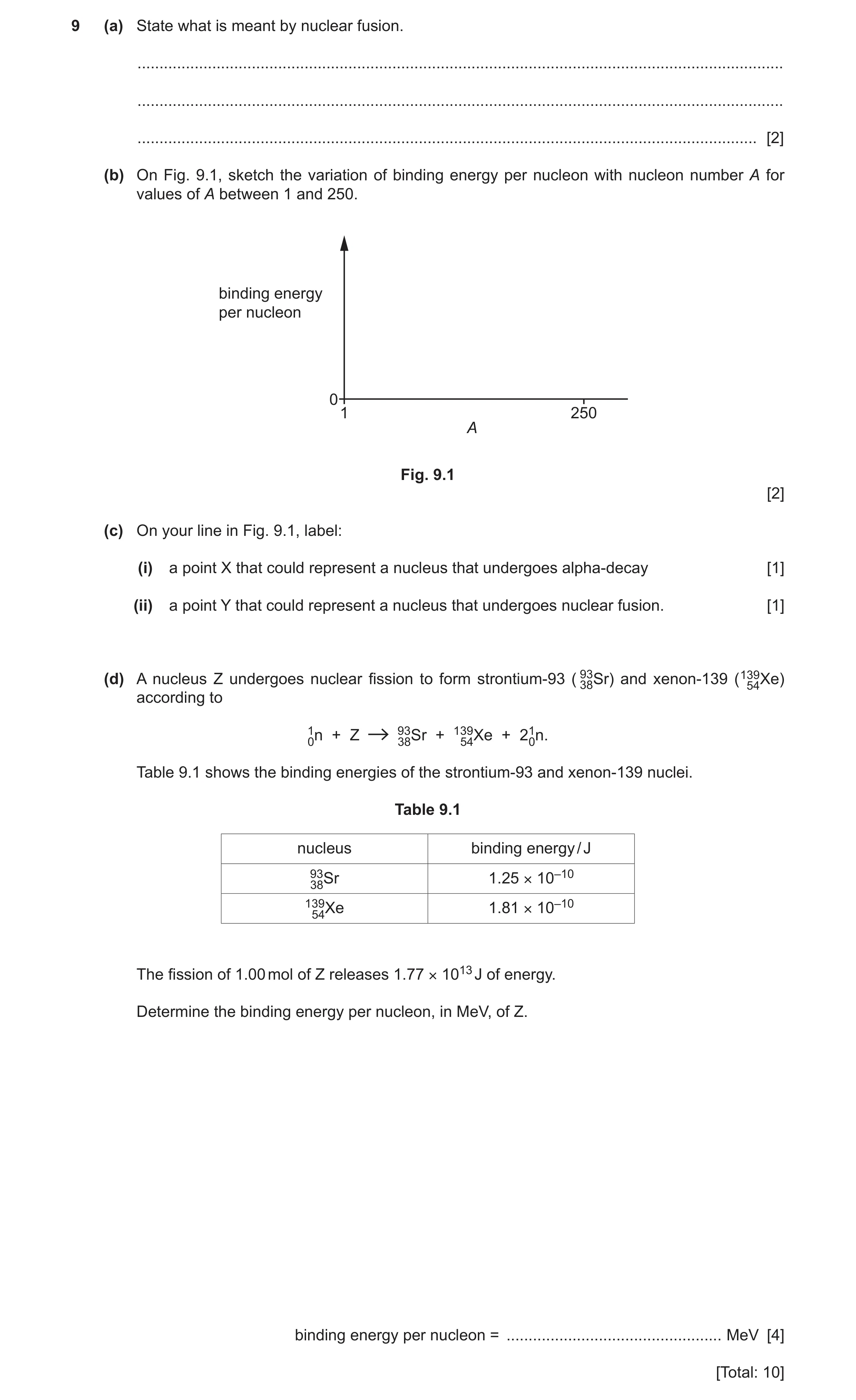
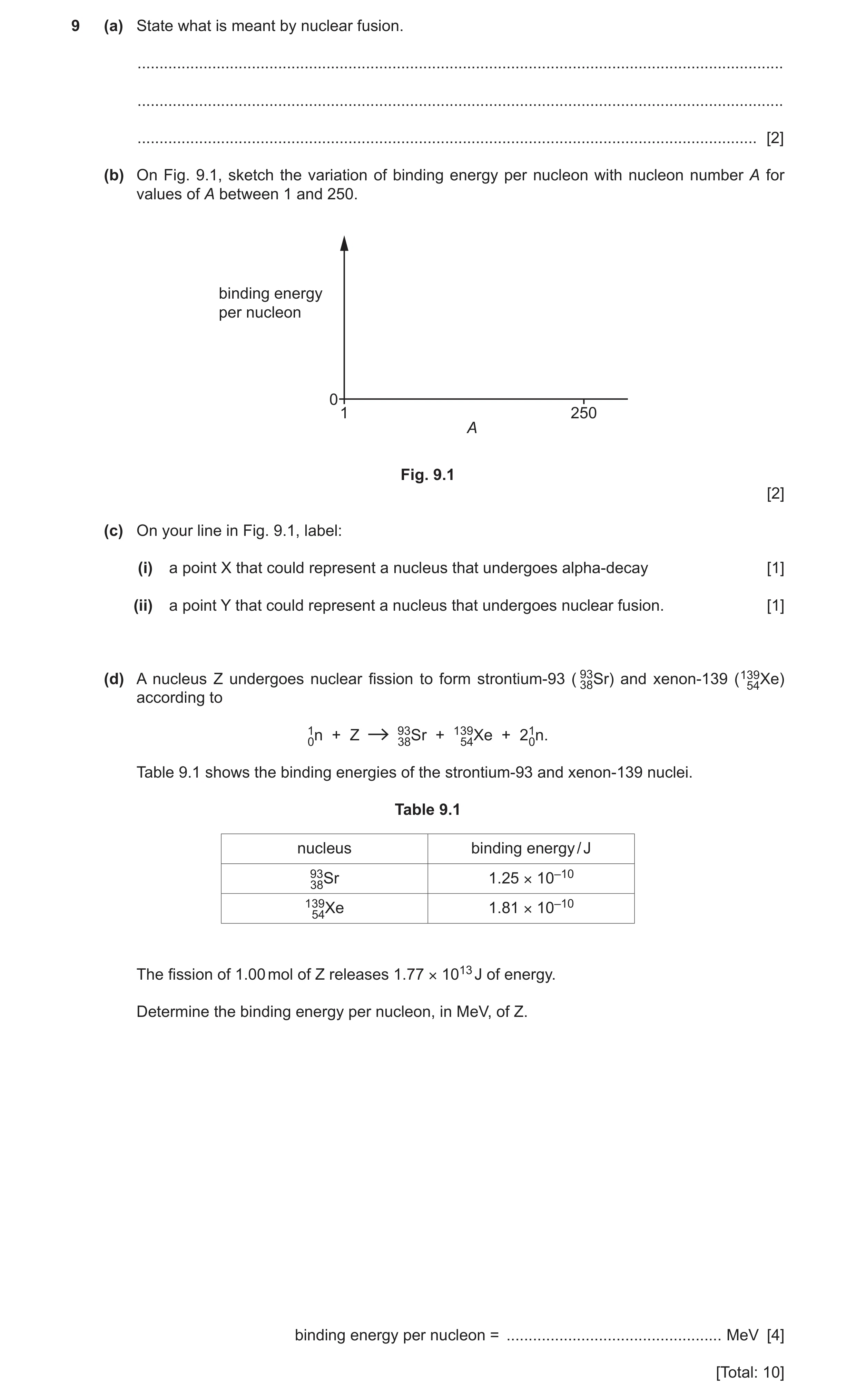
9 (a) State what is meant by nuclear fusion. … … … [2] (b) On Fig. 9.1, sketch the variation of binding energy per nucleon with nucleon number A for values of A between 1 and 250. binding energy per nucleon 0 1 250 A Fig. 9.1 [2] (c) On your line in Fig. 9.1, label: (i) a point X that could represent a nucleus that undergoes alpha-decay [1] (ii) a point Y that could represent a nucleus that undergoes nuclear fusion. [1] (d) A nucleus Z undergoes nuclear fission to form strontium-93 ( 9338Sr) and xenon-139 (13954Xe) according to 10n + Z 9338Sr + 13954Xe + 210n. Table 9.1 shows the binding energies of the strontium-93 and xenon-139 nuclei. Table 9.1 nucleus binding energy / J × 10–10 9338Sr 1.25 × 10⁻¹⁰ 13954Xe 1.81 The fission of 1.00 mol of Z releases 1.77 × 10¹³ J of energy. Determine the binding energy per nucleon, in MeV, of Z. binding energy per nucleon = … MeV [4] [Total: 10]
10 marks
Mark scheme: 9(a) (two small) nuclei join together M1 to form one larger nucleus A1 9(b) line with a peak at A 56 B1 line with steep initial positive gradient on the left of peak and shallower negative gradient at all points to the right of peak B1 and line does not return to 0 binding energy 9(c)(i) X shown at value of A to the right of the peak B1 9(c)(ii) Y shown at value of A close to 1 B1 9(d) energy from 1 nucleus = (1.77 1013) / (6.02 1023) C1 ( = 2.94 10–11 J) binding energy of Z = [(1.25 + 1.81) 10–10] – 2.94 10–11 C1 ( = 2.77 10–10 J) nucleon number of Z = 93 + 139 + 2 – 1 C1 ( = 233) binding energy per nucleon = (2.77 10–10) / (233 1.60 10–13) A1 = 7.43 MeV
This question in 9702/41 Oct/Nov 2023
Q28 · State what is meant by nuclear fusion 9702/43 Oct/Nov 2023
9 (a) State what is meant by nuclear fusion. … … … [2] (b) On Fig. 9.1, sketch the variation of binding energy per nucleon with nucleon number A for values of A between 1 and 250. binding energy per nucleon 0 1 250 A Fig. 9.1 [2] (c) On your line in Fig. 9.1, label: (i) a point X that could represent a nucleus that undergoes alpha-decay [1] (ii) a point Y that could represent a nucleus that undergoes nuclear fusion. [1] (d) A nucleus Z undergoes nuclear fission to form strontium-93 ( 9338Sr) and xenon-139 (13954Xe) according to 10n + Z 9338Sr + 13954Xe + 210n. Table 9.1 shows the binding energies of the strontium-93 and xenon-139 nuclei. Table 9.1 nucleus binding energy / J × 10–10 9338Sr 1.25 × 10⁻¹⁰ 13954Xe 1.81 The fission of 1.00 mol of Z releases 1.77 × 10¹³ J of energy. Determine the binding energy per nucleon, in MeV, of Z. binding energy per nucleon = … MeV [4] [Total: 10]
10 marks
Mark scheme: 9(a) (two small) nuclei join together M1 to form one larger nucleus A1 9(b) line with a peak at A 56 B1 line with steep initial positive gradient on the left of peak and shallower negative gradient at all points to the right of peak B1 and line does not return to 0 binding energy 9(c)(i) X shown at value of A to the right of the peak B1 9(c)(ii) Y shown at value of A close to 1 B1 9(d) energy from 1 nucleus = (1.77 1013) / (6.02 1023) C1 ( = 2.94 10–11 J) binding energy of Z = [(1.25 + 1.81) 10–10] – 2.94 10–11 C1 ( = 2.77 10–10 J) nucleon number of Z = 93 + 139 + 2 – 1 C1 ( = 233) binding energy per nucleon = (2.77 10–10) / (233 1.60 10–13) A1 = 7.43 MeV
This question in 9702/43 Oct/Nov 2023
Q29 · State what is meant by the binding energy of a nucleus 9702/42 May/June 2024
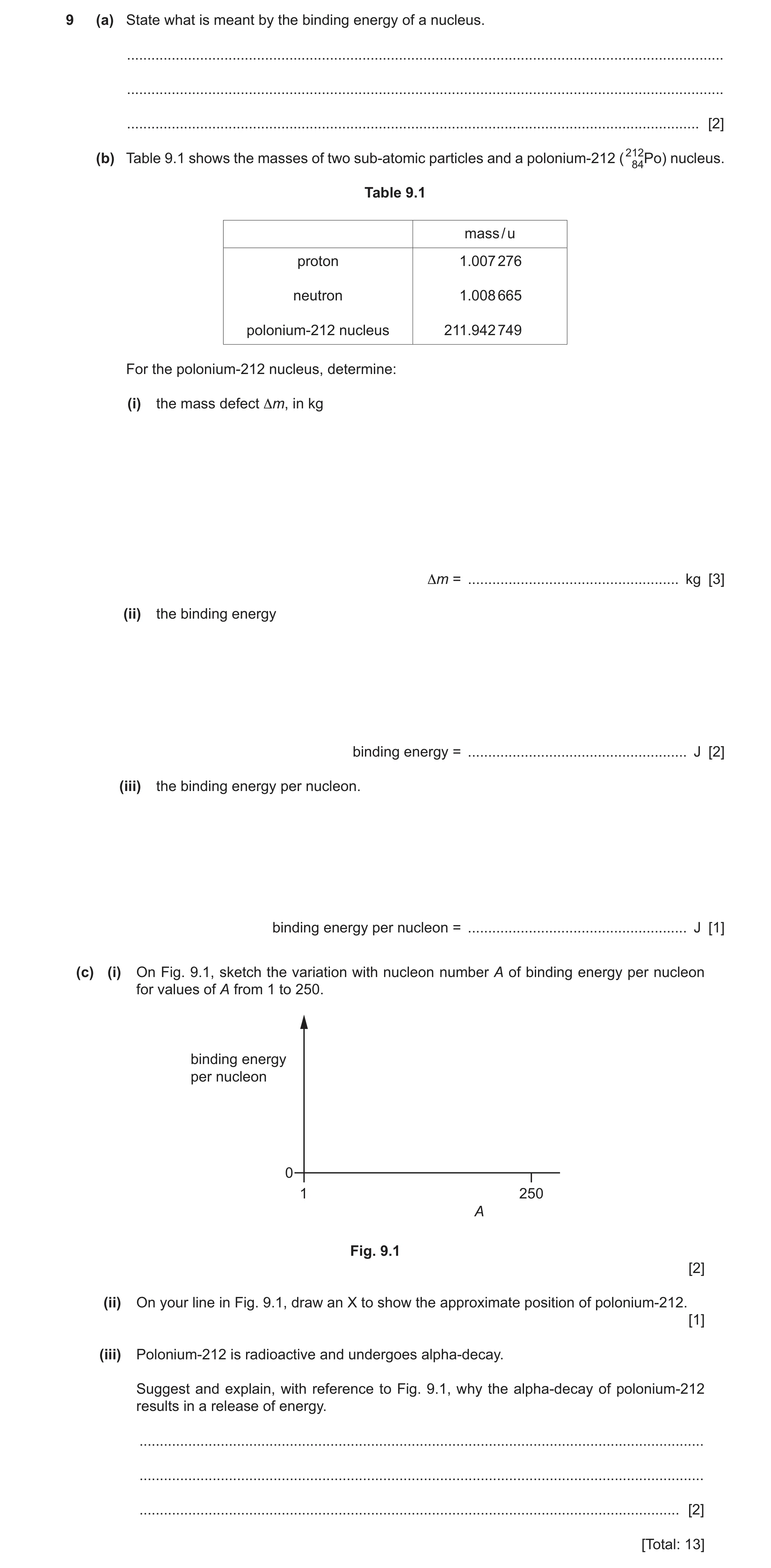
9 (a) State what is meant by the binding energy of a nucleus. … … … [2] (b) Table 9.1 shows the masses of two sub-atomic particles and a polonium-212 (21284Po) nucleus. Table 9.1 mass / u proton 1.007 276 neutron 1.008 665 polonium-212 nucleus 211.942 749 For the polonium-212 nucleus, determine: (i) the mass defect Δm, in kg Δm = … kg [3] (ii) the binding energy binding energy = … J [2] (iii) the binding energy per nucleon. binding energy per nucleon = … J [1] (c) (i) On Fig. 9.1, sketch the variation with nucleon number A of binding energy per nucleon for values of A from 1 to 250. binding energy per nucleon 0 1 250 A Fig. 9.1 [2] (ii) On your line in Fig. 9.1, draw an X to show the approximate position of polonium-212. [1] (iii) Polonium-212 is radioactive and undergoes alpha-decay. Suggest and explain, with reference to Fig. 9.1, why the alpha-decay of polonium-212 results in a release of energy. … … … [2] [Total: 13]
13 marks
Mark scheme: 9(a) energy required to separate (all) the nucleons (in the nucleus) M1 to infinity A1 9(b)(i) m = {[(84 1.007276) + (128 1.008665)] – 211.942749} (u) ( = 1.778 u) C1 = 1.778 1.66 10–27 (kg) C1 = 2.95 10–27 kg A1 9(b)(ii) E = ()mc2 C1 binding energy = 2.95 10–27 (3.00 108)2 = 2.66 10–10 J A1 9(b)(iii) binding energy per nucleon = (2.66 10–10) / 212 = 1.25 10–12 J A1 9(c)(i) line rising to a single peak that is to the left of the ‘9’ in the Fig. 9.1 label and then continually decreasing B1 steep positive gradient on the left of the peak and shallow negative gradient on the right B1 9(c)(ii) X shown on the line at a value of A that is to the right of the left-hand edge of the ‘A’ in the axis label, and to the left of ‘2’ in the 250 label B1 9(c)(iii) nucleus formed (as a result of the decay) has a lower nucleon number B1 (nucleus formed has a) greater binding energy per nucleon B1
This question in 9702/42 May/June 2024
Q30 · Radioactive decay is both random and spontaneous 9702/42 Oct/Nov 2024
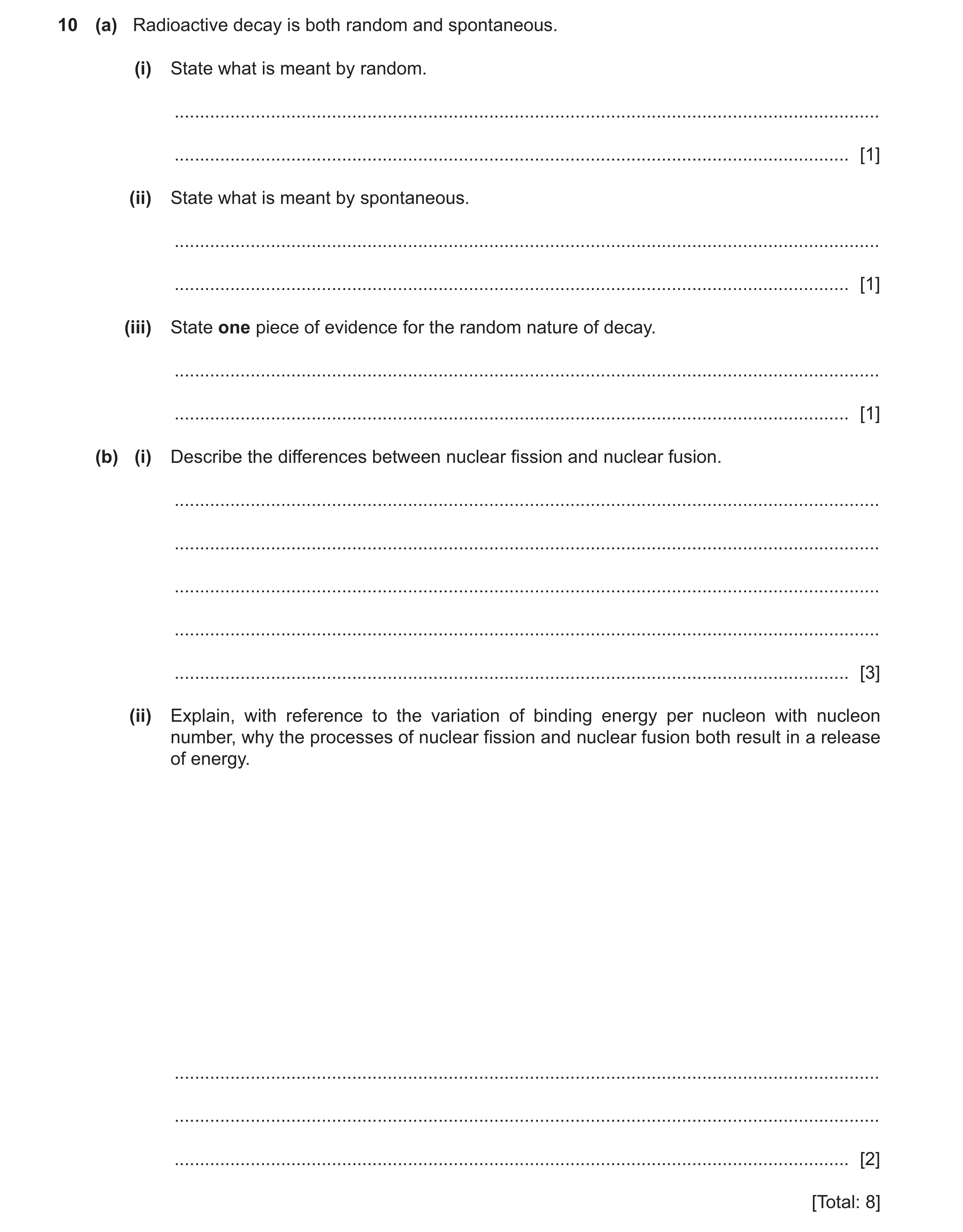
10 (a) Radioactive decay is both random and spontaneous. (i) State what is meant by random. … … [1] (ii) State what is meant by spontaneous. … … [1] (iii) State one piece of evidence for the random nature of decay. … … [1] (b) (i) Describe the differences between nuclear fission and nuclear fusion. … … … … … [3] (ii) Explain, with reference to the variation of binding energy per nucleon with nucleon number, why the processes of nuclear fission and nuclear fusion both result in a release of energy. … … … [2] [Total: 8]
8 marks
Mark scheme: 10(a)(i) cannot predict when a particular nucleus will decay B1 or cannot predict which nucleus will decay next 10(a)(ii) (decay is) not affected by external (environmental) factors B1 10(a)(iii) fluctuations in (measured) count rate B1 10(b)(i) • large nuclei undergo fission whereas small nuclei undergo fusion B3 • fission involves one nucleus splitting into two (or more) (smaller) nuclei • fusion involves two nuclei joining together to form one (larger) nucleus • fission is (usually) initiated by neutron bombardment • fusion is (usually) initiated by (very) high temperatures Any three points, 1 mark each 10(b)(ii) binding energy per nucleon is greatest for intermediate nucleon numbers B1 (may be shown on sketch graph with axes labelled ‘binding energy per nucleon’ and ‘nucleon number’) both fusion and fission involve an increase in binding energy (per nucleon) B1
This question in 9702/42 Oct/Nov 2024
Q31 · Polonium‑193 (19384Po) is an unstable nuclide 9702/42 Feb/March 2025
9 Polonium‑193 (19384Po) is an unstable nuclide. A nucleus of polonium‑193 decays to a nucleus of lead‑189 (18982Pb) by emitting an alpha‑particle. (a) Radioactive decay is both random and spontaneous. State what is meant by: (i) random … … [1] (ii) spontaneous. … … [1] (b) Define half‑life. … … … [1] (c) Data for the binding energy per nucleon of the particles involved in the decay of a nucleus of polonium‑193 are given in Table 9.1. Table 9.1 particle binding energy per nucleon / eV 19384Po 7.774 18982Pb 7.826 4α 7.074 2 Determine the energy, in eV, released when a nucleus of polonium‑193 decays into a nucleus of lead‑189. energy = … eV [2] (d) A pure sample of polonium‑193 contains N0 nuclei. After a time t the sample contains N nuclei of polonium‑193. The variation of ln (N / N0) with t is shown in Fig. 9.1. t / ms 0 0.2 0.4 0.6 0.8 1.0 0 –0.2 –0.4 –0.6 In (N / N0) –0.8 –1.0 –1.2 –1.4 Fig. 9.1 (i) State the name of the quantity that is represented by the magnitude of the gradient of the line in Fig. 9.1. … [1] (ii) Use Fig. 9.1 to determine the half‑life, in ms, of polonium‑193. half‑life = … ms [2] (e) Positron emission tomography (PET scanning) uses a radioactive tracer. (i) State what happens to the positrons emitted by the tracer. … … [1] (ii) Explain why a tracer with a half‑life of approximately 2 hours is a suitable tracer to use. … … [1] [Total: 10]
10 marks
Mark scheme: 9(a)(i) either: cannot predict when a (particular) nucleus will decay B1 or: cannot predict which nucleus will decay next 9(a)(ii) not affected by external / environmental factors B1 9(b) time for activity to halve B1 9(c) energy = (189 7.826) + (4 7.074) – (193 7.774) C1 = 7.03 eV A1 9(d)(i) decay constant A1 9(d)(ii) decay constant / magnitude of gradient = 1.4 / 0.84 C1 half-life = ln2 / (1.4 / 0.84) A1 = 0.42 ms 9(e)(i) positrons collide with electrons and annihilate B1 9(e)(ii) long enough to have time to conduct investigation, not so long as to cause patient unnecessary exposure to radiation B1
This question in 9702/42 Feb/March 2025
Q32 · The deuterium nucleus (21H) has a mass defect of 0.002 388 u 9702/44 May/June 2025
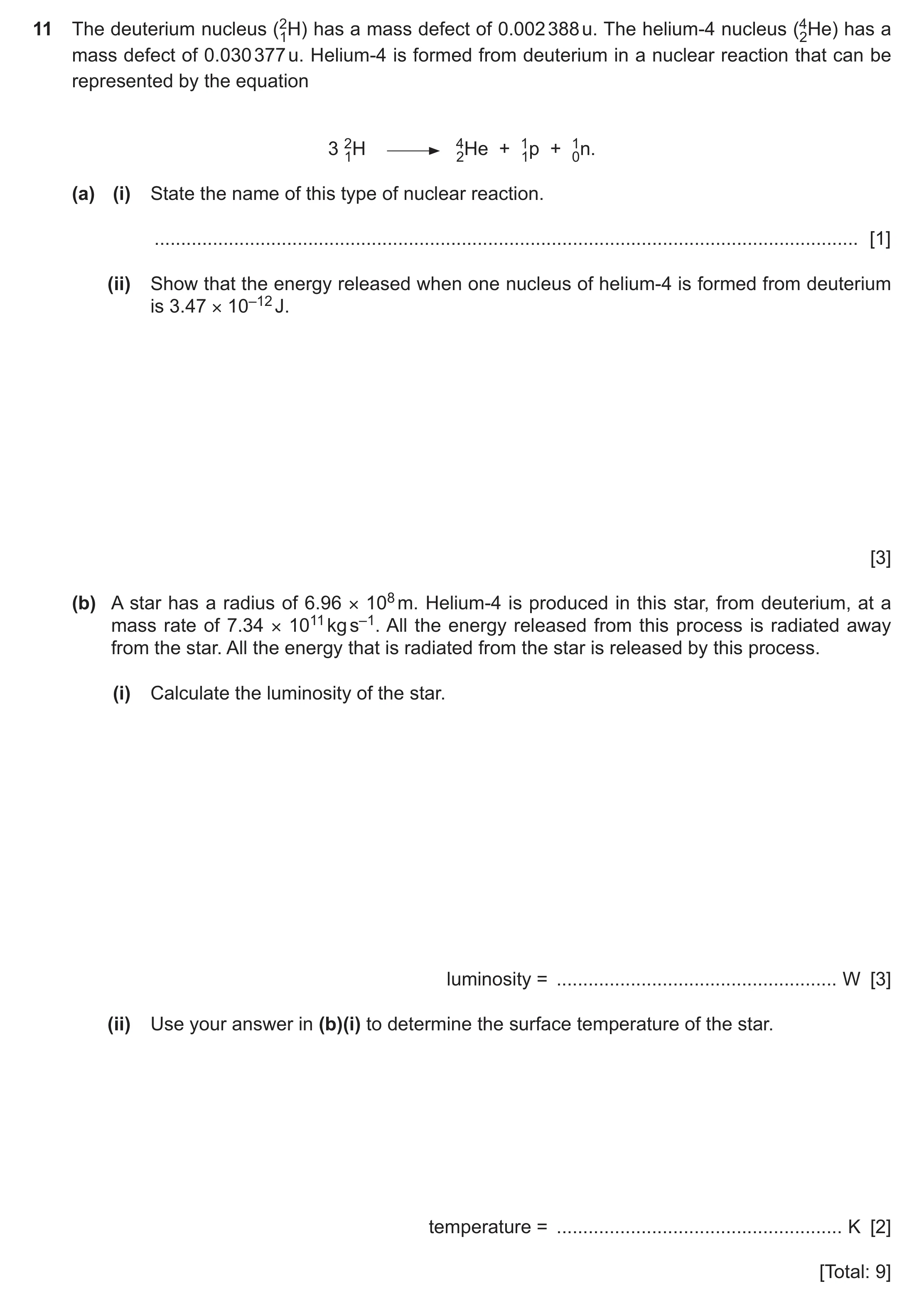
11 The deuterium nucleus (21H) has a mass defect of 0.002 388 u. The helium-4 nucleus (42He) has a mass defect of 0.030 377 u. Helium-4 is formed from deuterium in a nuclear reaction that can be represented by the equation 3 21H 42He + 11p + 10n. (a) (i) State the name of this type of nuclear reaction. … [1] (ii) Show that the energy released when one nucleus of helium-4 is formed from deuterium is 3.47 × 10⁻¹² J. [3] (b) A star has a radius of 6.96 × 10⁸ m. Helium-4 is produced in this star, from deuterium, at a mass rate of 7.34 × 10¹¹ kg s–1. All the energy released from this process is radiated away from the star. All the energy that is radiated from the star is released by this process. (i) Calculate the luminosity of the star. luminosity = … W [3] (ii) Use your answer in (b)(i) to determine the surface temperature of the star. temperature = … K [2] [Total: 9]
9 marks
Mark scheme: 11(a)(i) (nuclear) fusion B1 11(a)(ii) ∆m = [0.030377 – (3 0.002388)] u B1 ( = 0.023213 u) E = ∆m c2 C1 = 0.023213 1.66 10–27 (3.00 108)2 = 3.47 10–12 J A1 11(b)(i) mass of 1 mol of helium-4 = 4 g C1 or mass of 1 helium atom = 4 u N rate = (6.02 1023 7.34 1011) / (4 10–3) C1 or N rate = (7.34 1011) / (4 1.66 10–27) luminosity = 1.10 1038 3.47 10–12 A1 = 3.83 1026 W 11(b)(ii) L = 4r2T4 C1 3.83 1026 = 4 5.67 10–8 (6.96 108)2 T4 T = 5770 K A1
This question in 9702/44 May/June 2025
Q33 · State what is meant by a photon 9702/41 Oct/Nov 2025
8 (a) State what is meant by a photon. … … … [2] 238 (b) A stationary nucleus of uranium-238 ( 92U) undergoes alpha decay to produce a nucleus 234 of thorium-234 ( 90Th). The kinetic energy of the emitted alpha particle is 4.200 MeV. A gamma-ray photon is also emitted during the decay. Assume that the rebound kinetic energy of the thorium nucleus is negligible. Table 8.1 shows the masses of the nuclides involved in the decay reaction. The mass of the uranium-238 nuclide is missing. Table 8.1 nuclide nuclide mass / u 4 4.000 407 2α 234 233.915 174 90Th 238 92U The total energy released in the decay of the nucleus of uranium-238 is 4.274 MeV. (i) Calculate the mass, in u, of the uranium-238 nuclide. Give your answer to five decimal places. mass = … u [3] (ii) Determine a value for the wavelength of the gamma radiation emitted during the decay of the uranium-238 nucleus. wavelength = … m [3] (iii) In practice, the rebound kinetic energy of the thorium nucleus is not negligible. Explain, without further calculation, how your answer in (b)(ii) compares with the true wavelength of gamma radiation emitted during the decay of the uranium-238 nucleus. … … … [1] (c) Gamma radiation emitted during the decay of a sample of uranium-238 has a single wavelength. decay by beta emission, and also emit gamma radiation in the Nuclei of cobalt-60 (6027Co) process. Suggest why there is not a single wavelength for the gamma radiation emitted during the decay of a sample of cobalt-60. … … … [2] [Total: 11]
11 marks
Mark scheme: 8(a) packet / quantum of energy M1 of electromagnetic radiation A1 8(b)(i) E = c2m C1 m = (4.274 106 1.60 10–19) / (1.66 10–27 (3.00 108)2) C1 ( = 0.00458 u) m = 233.915174 + 4.000407 + 0.00458 A1 = 237.92016 u 8(b)(ii) E = hc / C1 or E = hf and c = f (4.274 – 4.200) 1.60 10–13 = (6.63 10–34 3.00 108) / C1 = 1.7 10–11 m A1 8(b)(iii) (true) energy of gamma photon is smaller so (true) wavelength is larger B1 8(c) (anti)neutrinos are emitted during beta decay B1 particles emitted during beta decay carry varying amounts of energy, so energy of gamma photon is also variable (between B1 decays)
This question in 9702/41 Oct/Nov 2025
Q34 · State what is meant by the mass defect of a nucleus 9702/42 Oct/Nov 2025
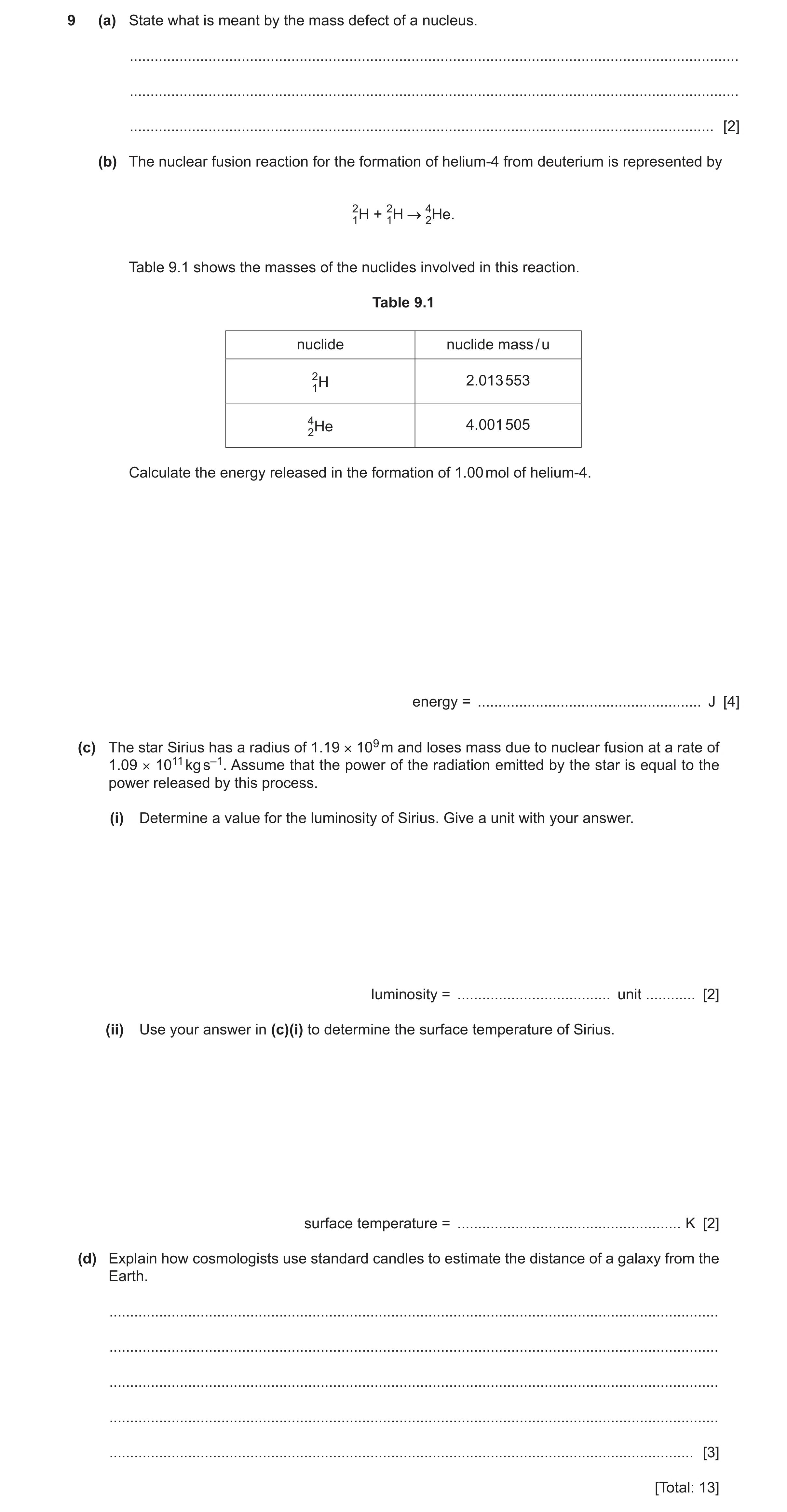
9 (a) State what is meant by the mass defect of a nucleus. … … … [2] (b) The nuclear fusion reaction for the formation of helium-4 from deuterium is represented by 21H + 21H 42He. Table 9.1 shows the masses of the nuclides involved in this reaction. Table 9.1 nuclide nuclide mass / u 21H 2.013 553 42He 4.001 505 Calculate the energy released in the formation of 1.00 mol of helium-4. energy = … J [4] (c) The star Sirius has a radius of 1.19 × 10⁹ m and loses mass due to nuclear fusion at a rate of 1.09 × 10¹¹ kg s–1. Assume that the power of the radiation emitted by the star is equal to the power released by this process. (i) Determine a value for the luminosity of Sirius. Give a unit with your answer. luminosity = … unit … [2] (ii) Use your answer in (c)(i) to determine the surface temperature of Sirius. surface temperature = … K [2] (d) Explain how cosmologists use standard candles to estimate the distance of a galaxy from the Earth. … … … … … [3] [Total: 13]
13 marks
Mark scheme: 9(a) difference between mass of nucleus and mass of (constituent) nucleons M1 when nucleons are separated to infinity A1 9(b) m = (2 2.013553) – (4.001505) (u) C1 ( = 0.025601 u) E = c2m C1 energy from one He-4 nucleus= 0.025601 1.66 10–27 (3.00 108)2 C1 (= 3.82 10–12 J) energy to form 1.00 mol= 3.82 10–12 6.02 1023 A1 = 2.30 1012 J 9(c)(i) L = 1.09 1011 (3.00 108)2 C1 = 9.81 1027 W A1 9(c)(ii) L = 4 r2T4 C1 9.81 1027 = 4 5.67 10–8 (1.19 109)2 T4 T = 9930 K A1 9(d) standard candles have known luminosity B1 radiant flux intensity (from star) measured (on the Earth) B1 distance found from F = L / (4d2) B1
This question in 9702/42 Oct/Nov 2025
Q35 · State what is meant by a photon 9702/43 Oct/Nov 2025
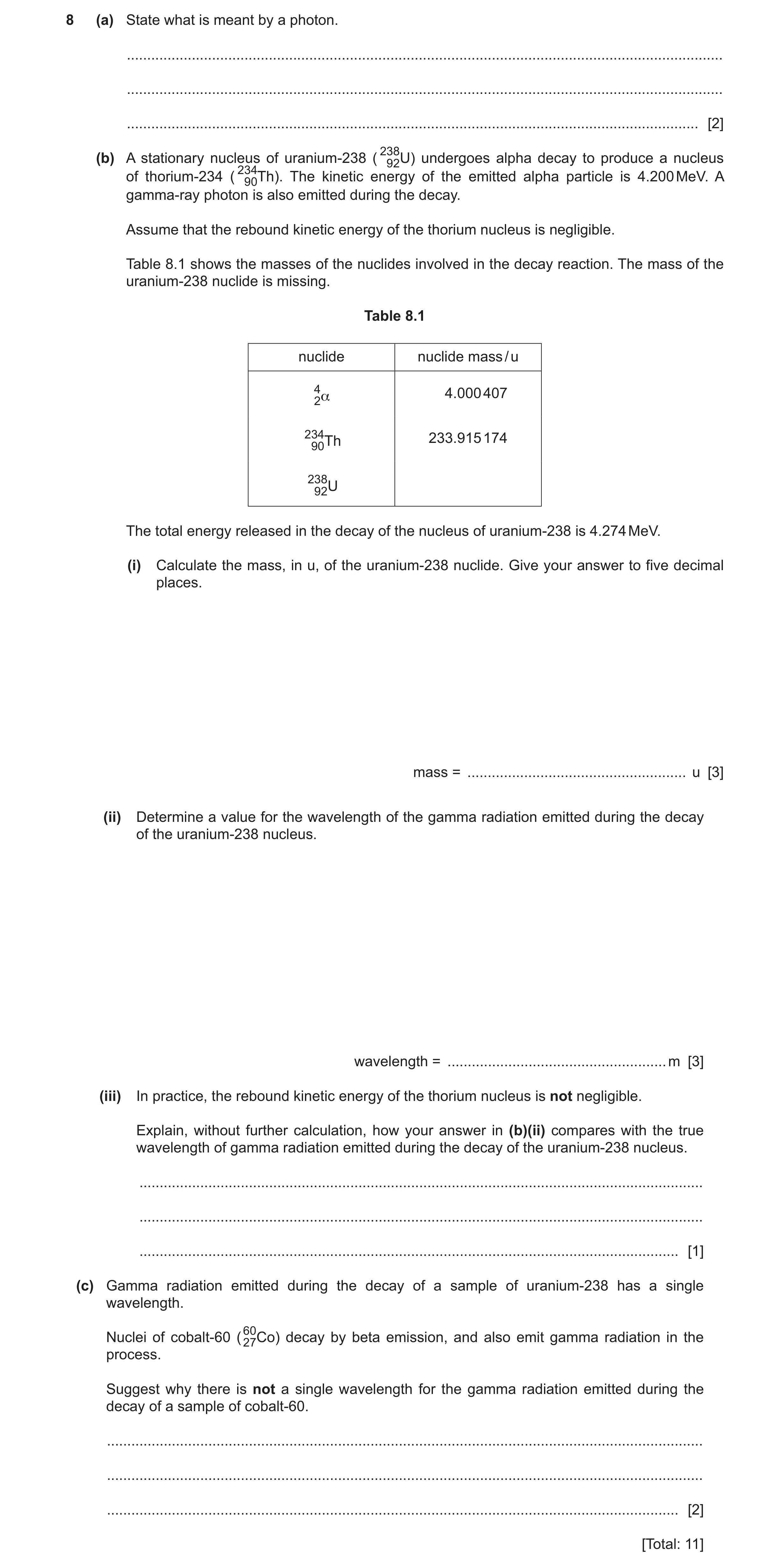
8 (a) State what is meant by a photon. … … … [2] 238 (b) A stationary nucleus of uranium-238 ( 92U) undergoes alpha decay to produce a nucleus 234 of thorium-234 ( 90Th). The kinetic energy of the emitted alpha particle is 4.200 MeV. A gamma-ray photon is also emitted during the decay. Assume that the rebound kinetic energy of the thorium nucleus is negligible. Table 8.1 shows the masses of the nuclides involved in the decay reaction. The mass of the uranium-238 nuclide is missing. Table 8.1 nuclide nuclide mass / u 4 4.000 407 2α 234 233.915 174 90Th 238 92U The total energy released in the decay of the nucleus of uranium-238 is 4.274 MeV. (i) Calculate the mass, in u, of the uranium-238 nuclide. Give your answer to five decimal places. mass = … u [3] (ii) Determine a value for the wavelength of the gamma radiation emitted during the decay of the uranium-238 nucleus. wavelength = … m [3] (iii) In practice, the rebound kinetic energy of the thorium nucleus is not negligible. Explain, without further calculation, how your answer in (b)(ii) compares with the true wavelength of gamma radiation emitted during the decay of the uranium-238 nucleus. … … … [1] (c) Gamma radiation emitted during the decay of a sample of uranium-238 has a single wavelength. decay by beta emission, and also emit gamma radiation in the Nuclei of cobalt-60 (6027Co) process. Suggest why there is not a single wavelength for the gamma radiation emitted during the decay of a sample of cobalt-60. … … … [2] [Total: 11]
11 marks
Mark scheme: 8(a) packet / quantum of energy M1 of electromagnetic radiation A1 8(b)(i) E = c2m C1 m = (4.274 106 1.60 10–19) / (1.66 10–27 (3.00 108)2) C1 ( = 0.00458 u) m = 233.915174 + 4.000407 + 0.00458 A1 = 237.92016 u 8(b)(ii) E = hc / C1 or E = hf and c = f (4.274 – 4.200) 1.60 10–13 = (6.63 10–34 3.00 108) / C1 = 1.7 10–11 m A1 8(b)(iii) (true) energy of gamma photon is smaller so (true) wavelength is larger B1 8(c) (anti)neutrinos are emitted during beta decay B1 particles emitted during beta decay carry varying amounts of energy, so energy of gamma photon is also variable (between B1 decays)
This question in 9702/43 Oct/Nov 2025
 1 / 48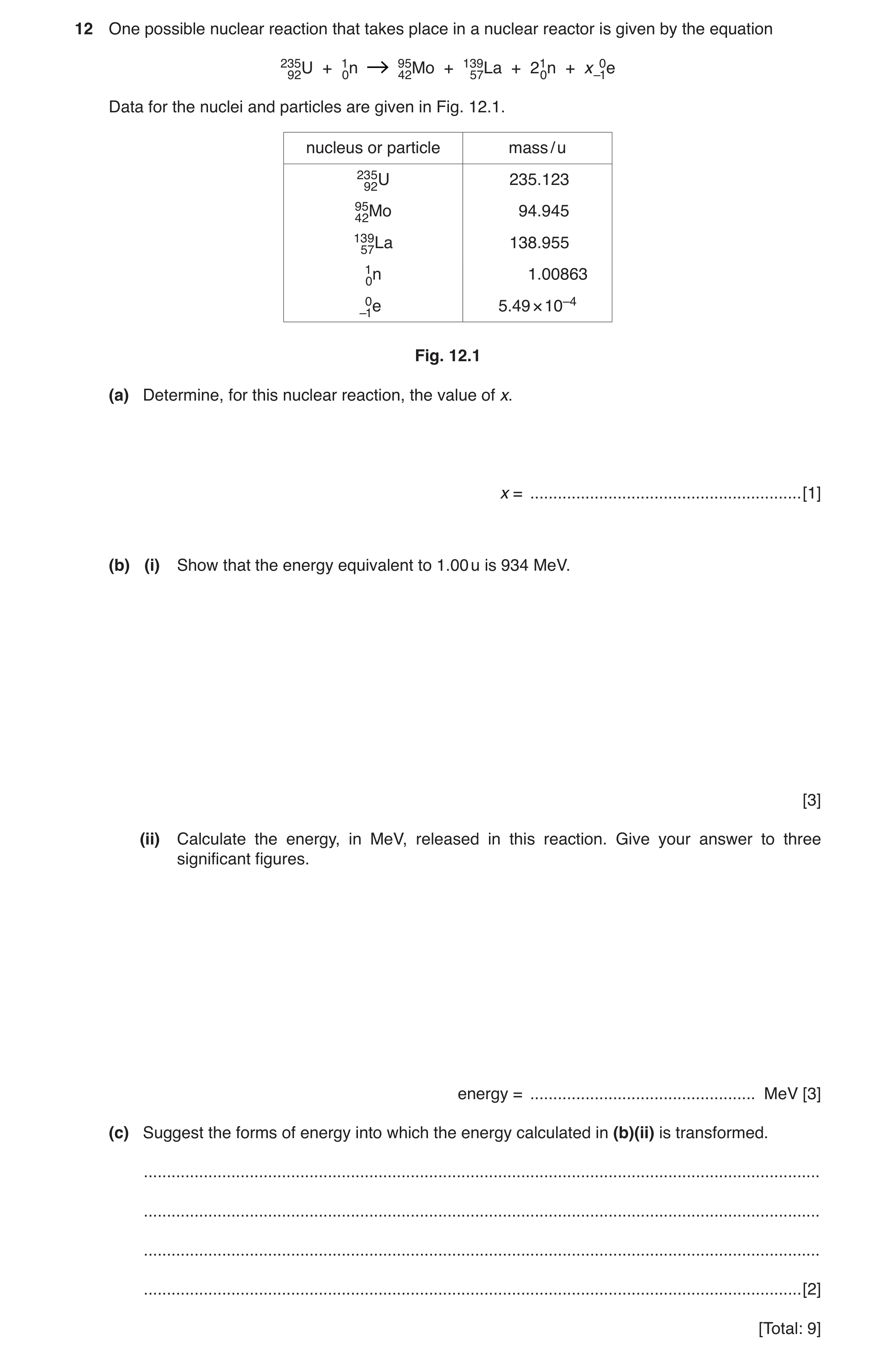
 13 / 48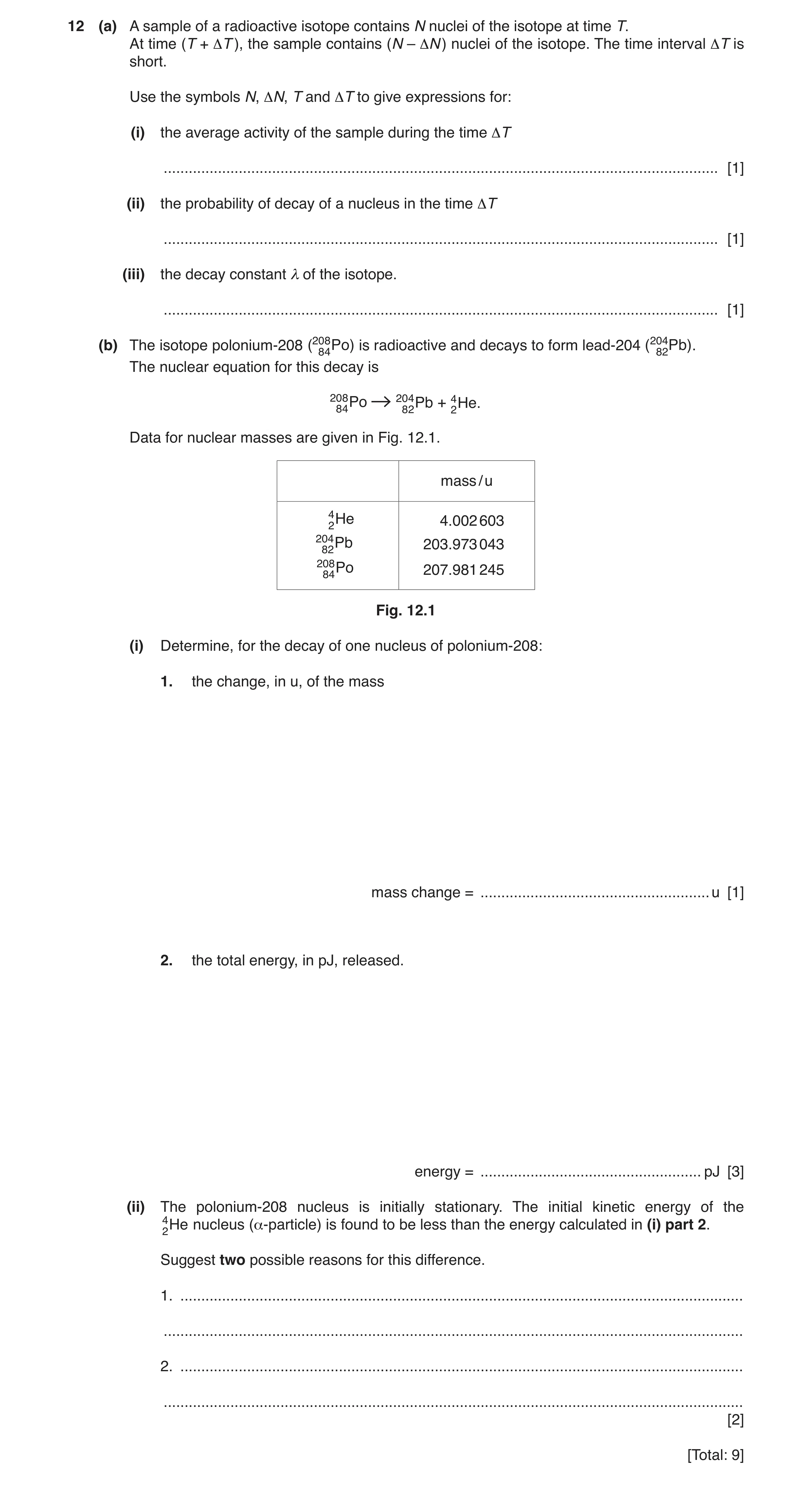
 21 / 48
 22 / 48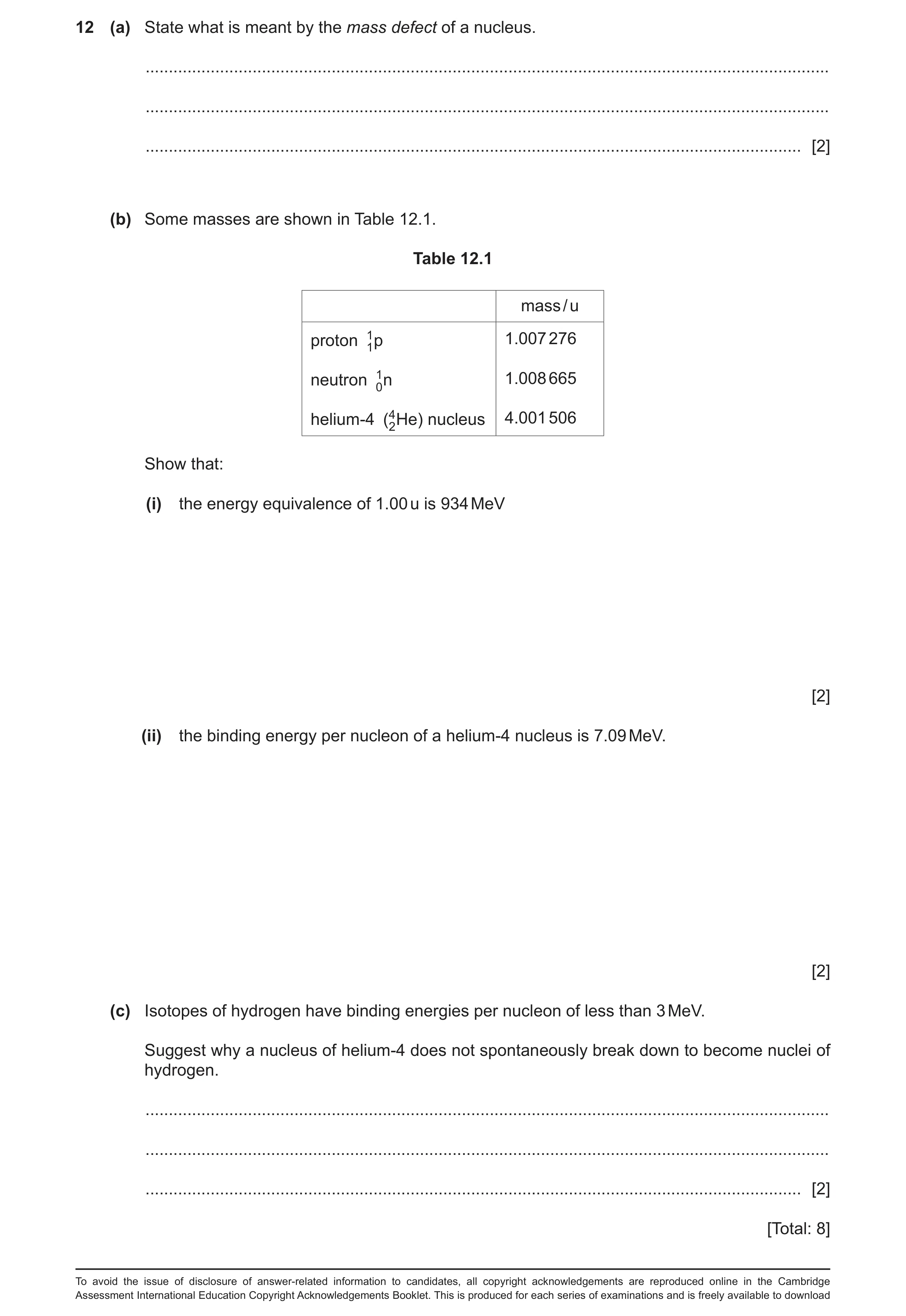
 24 / 48
 25 / 48
 26 / 48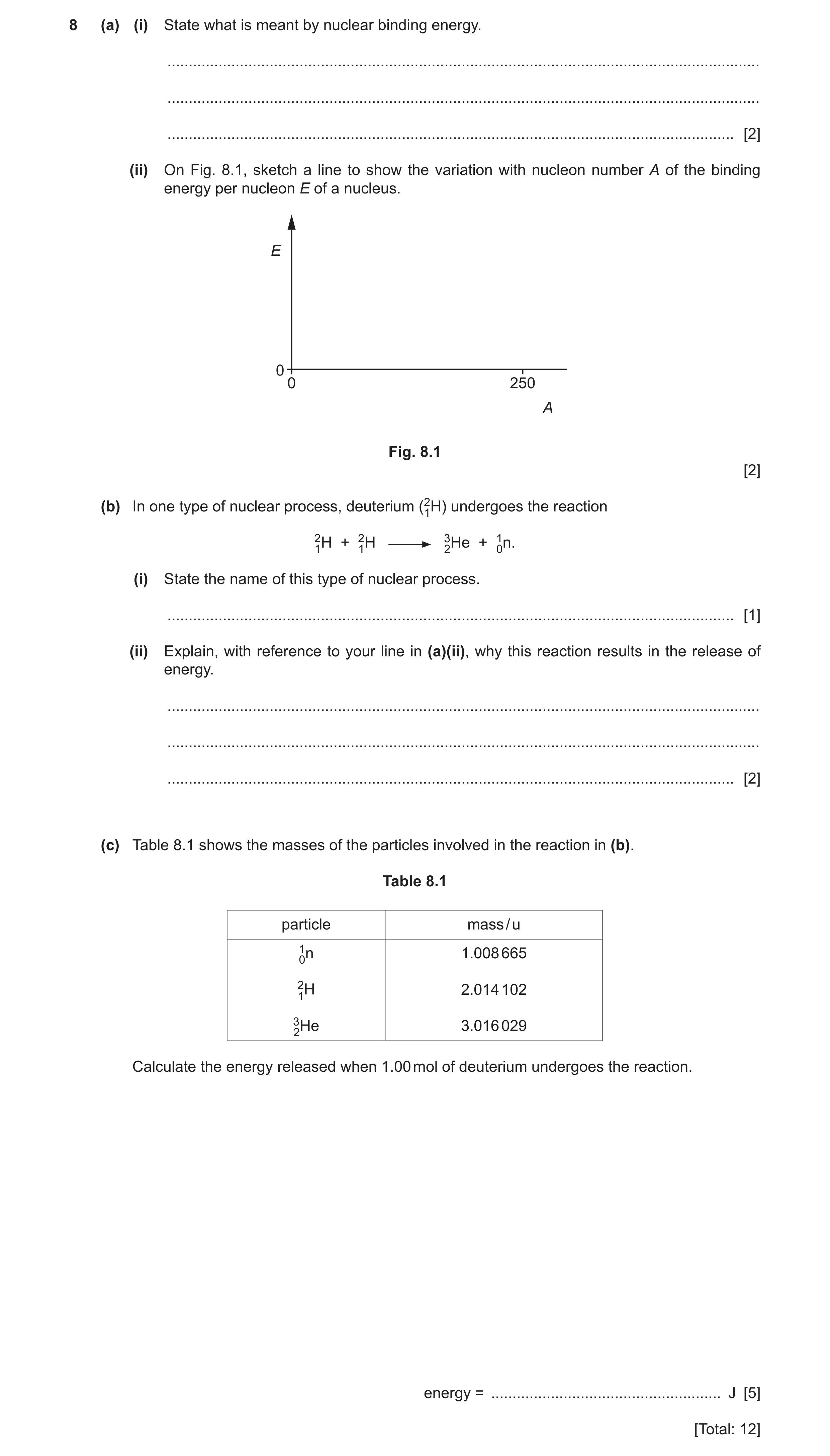
 39 / 48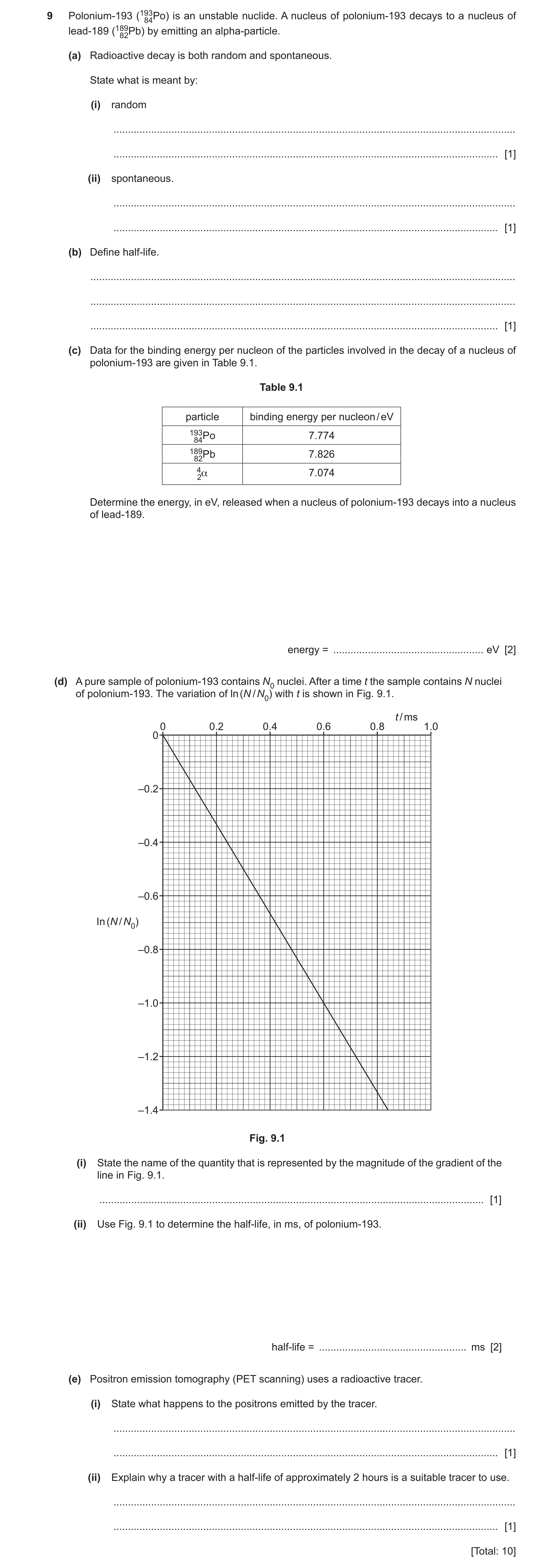
 43 / 48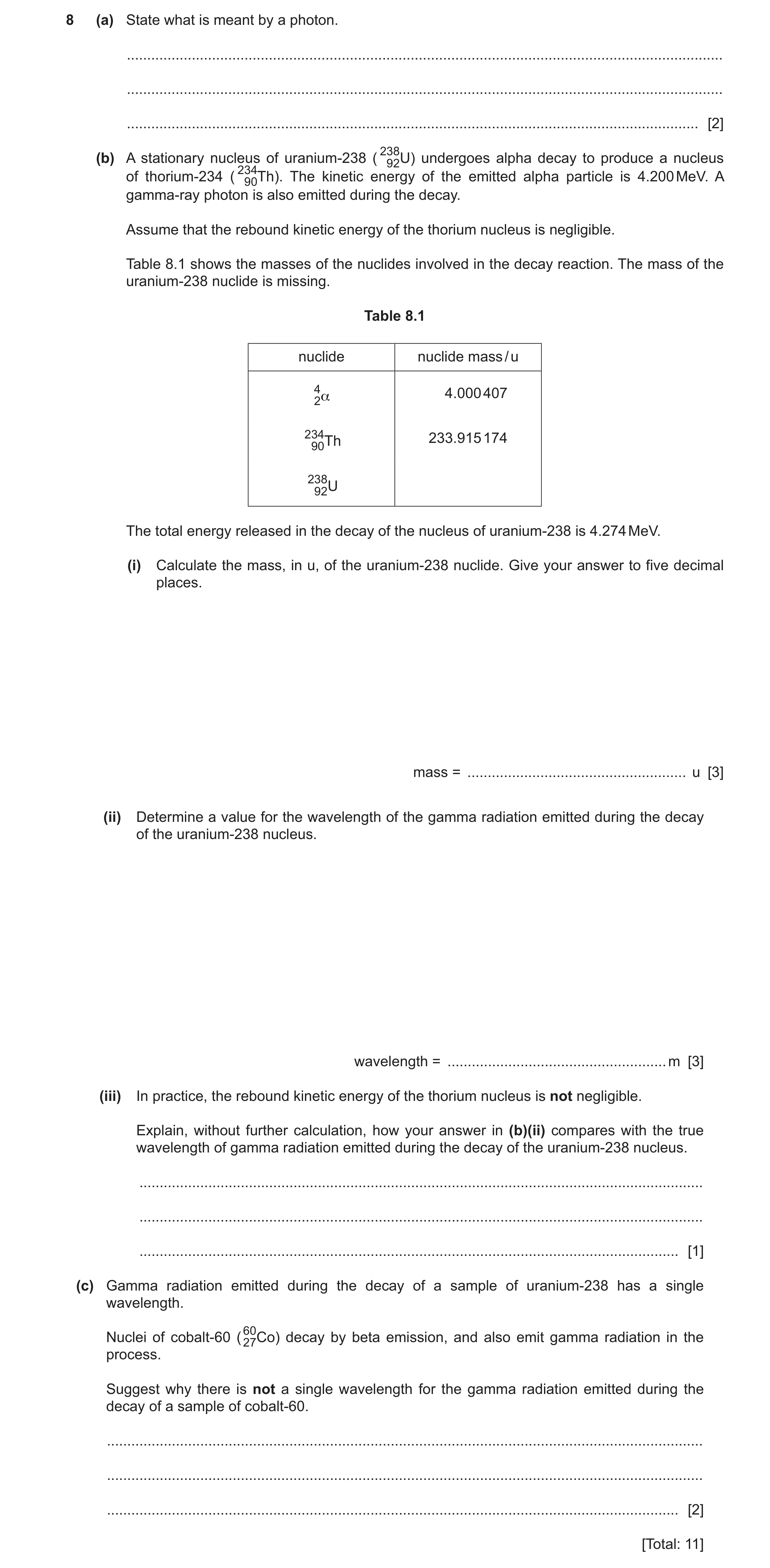
 8
8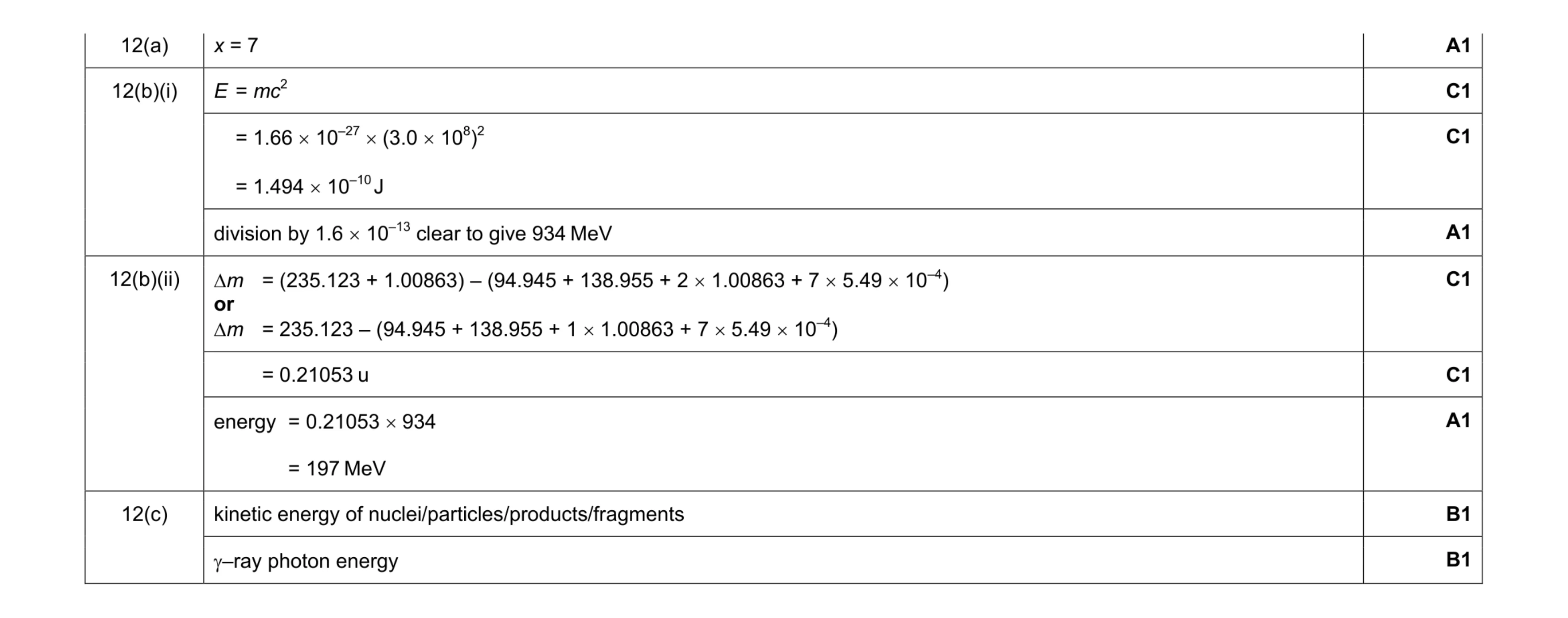 9
9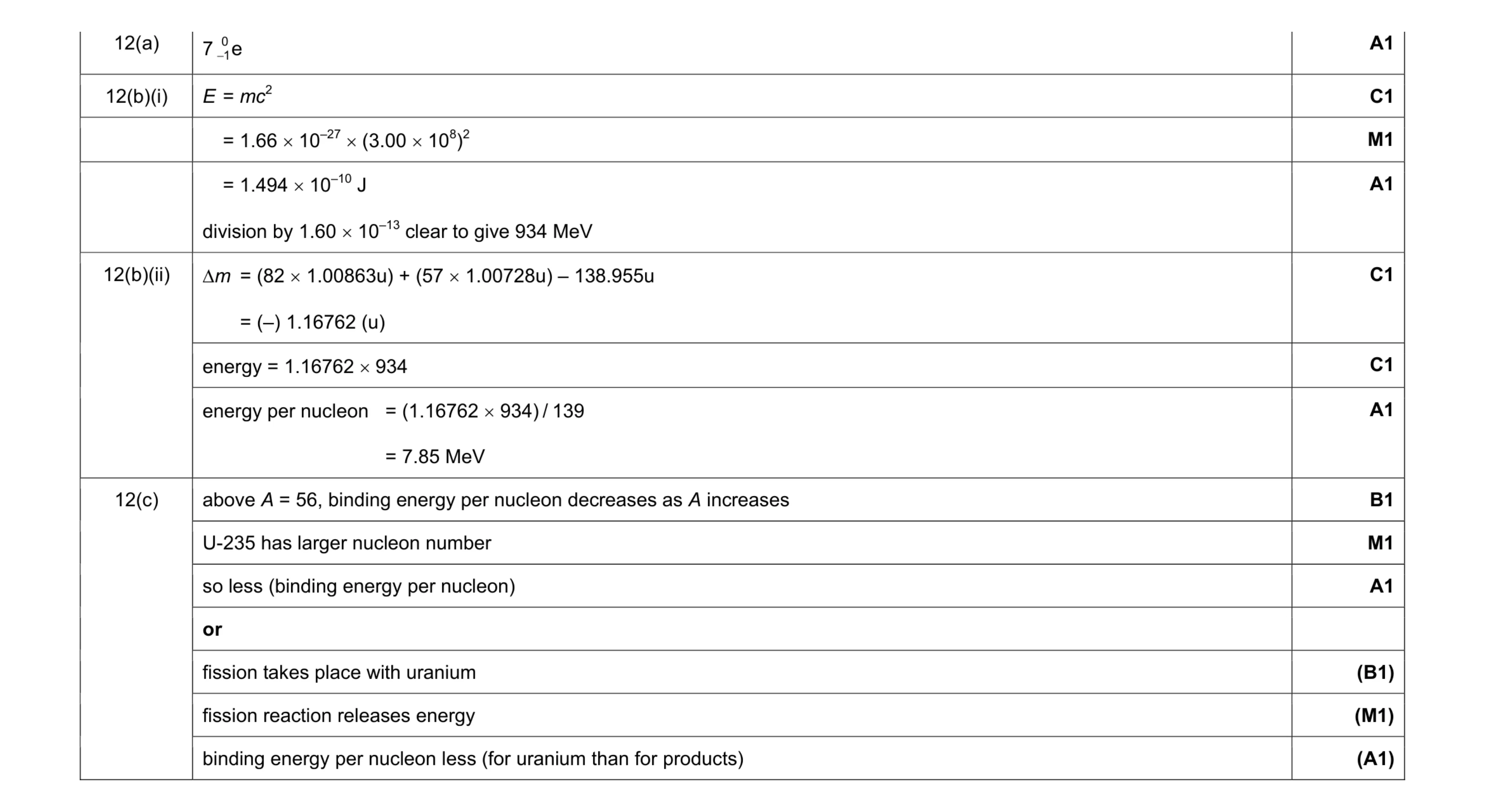 10
10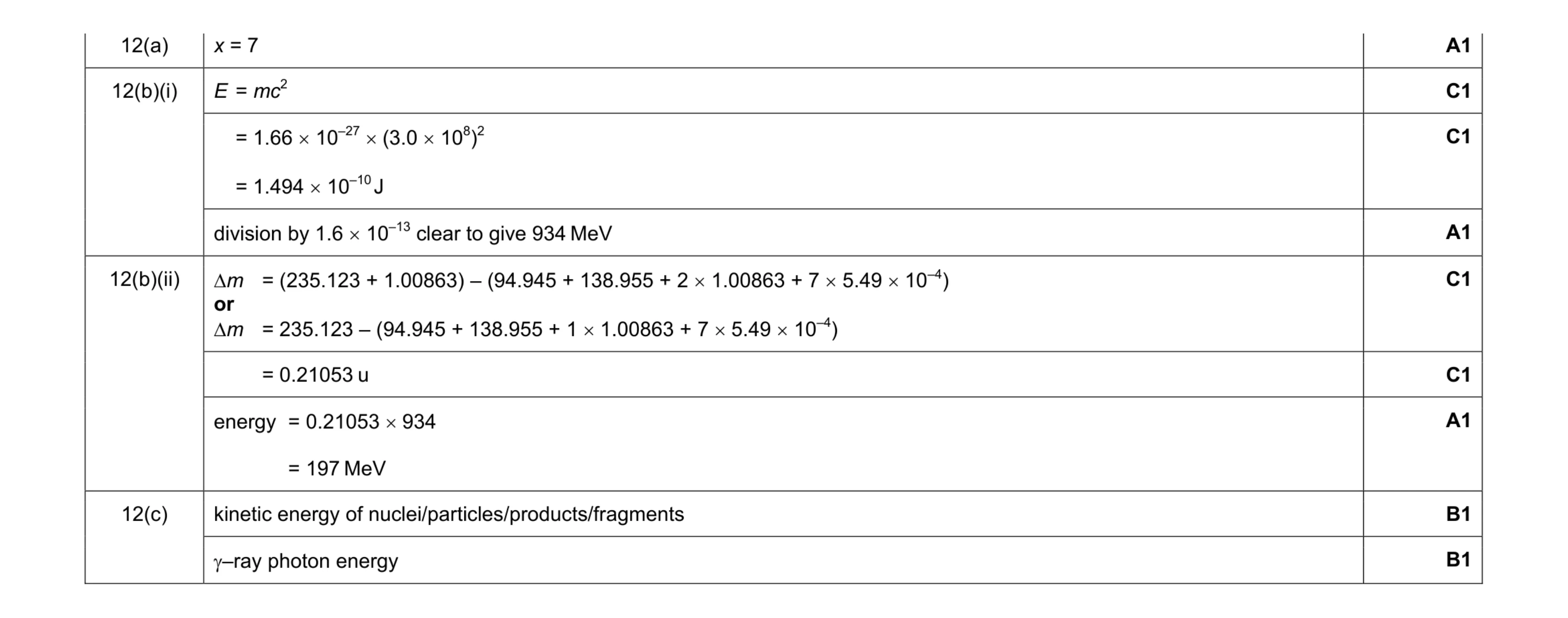 9
9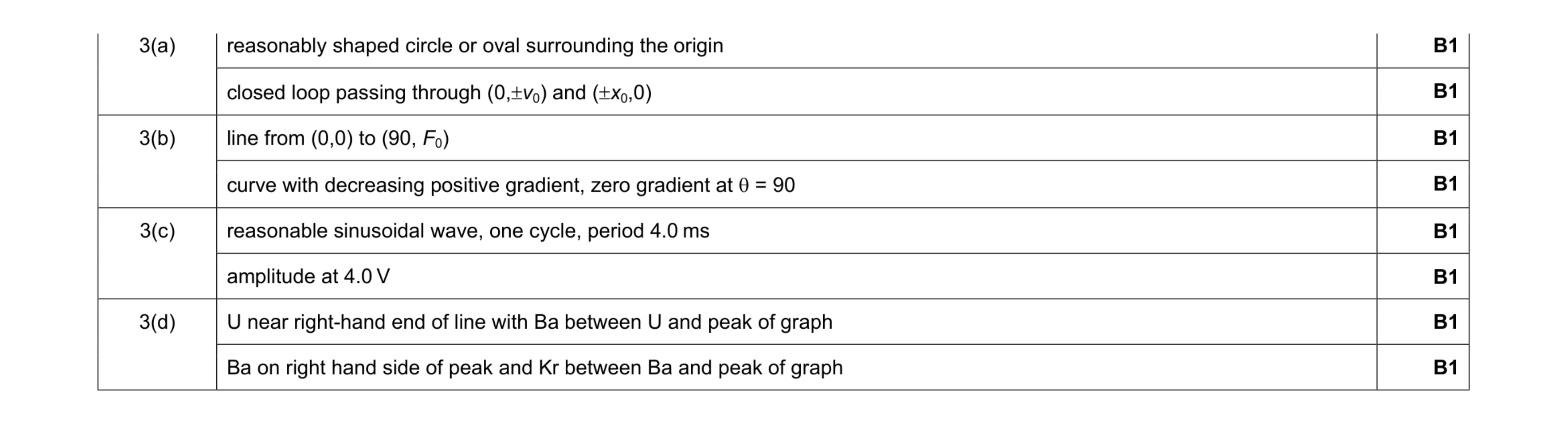 8
8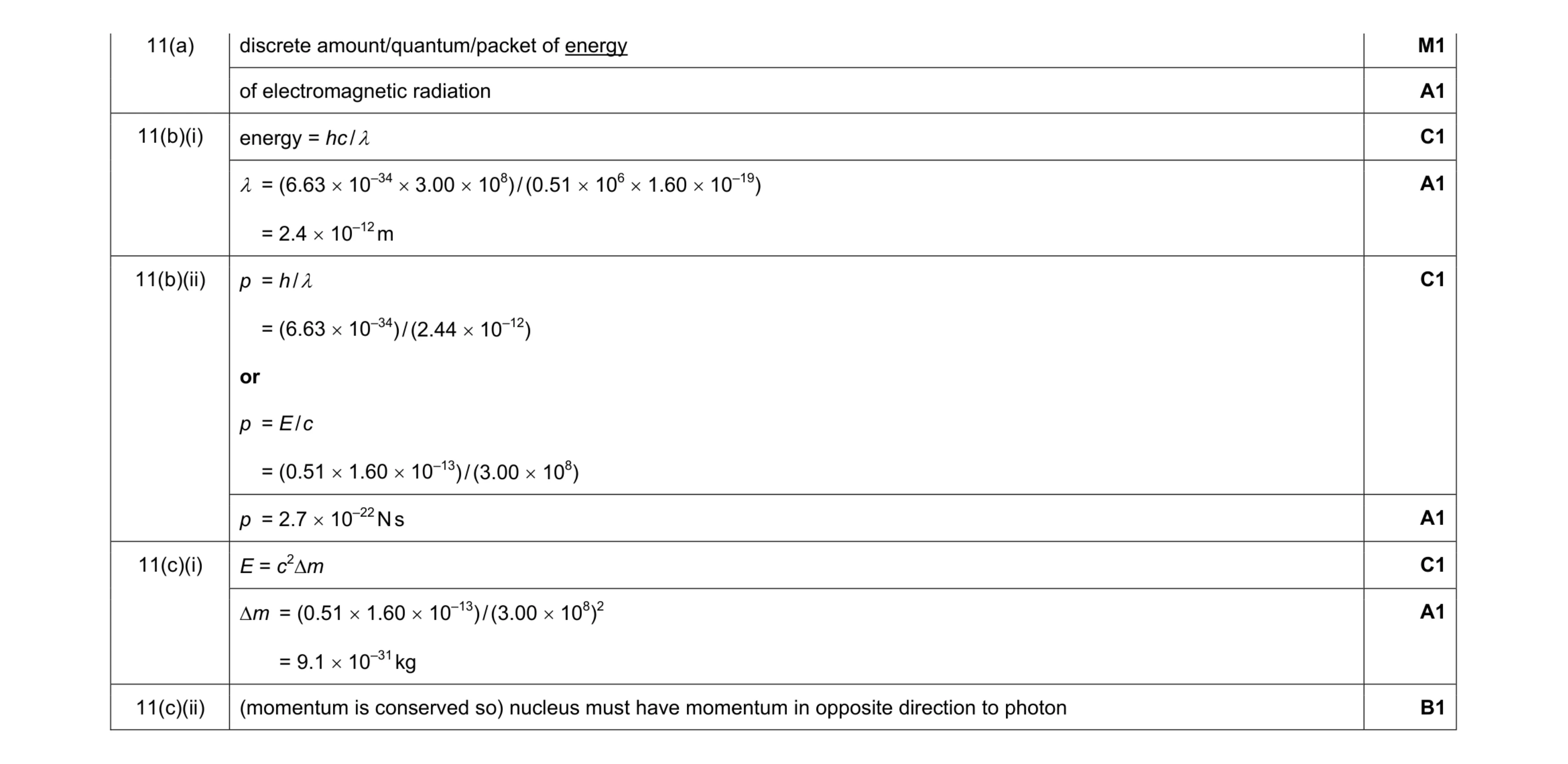 9
9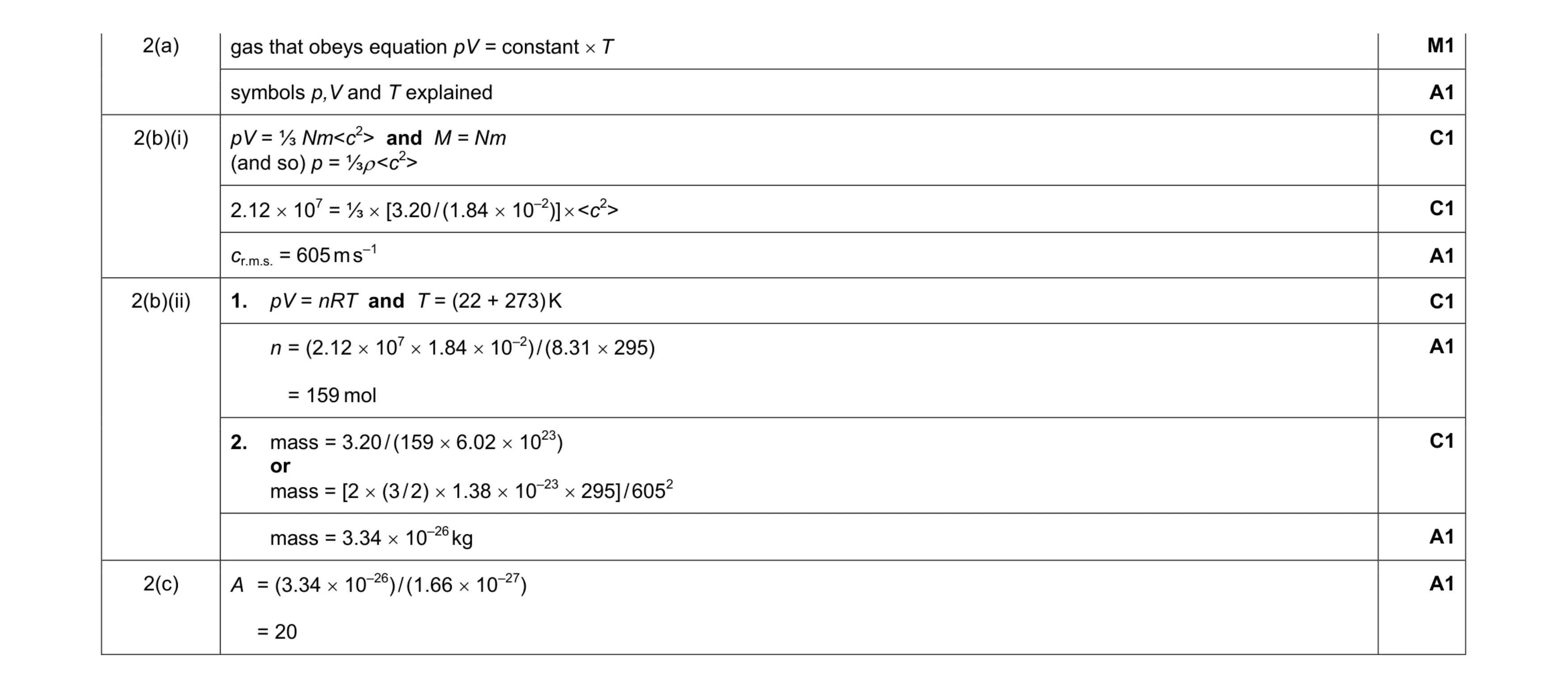 10
10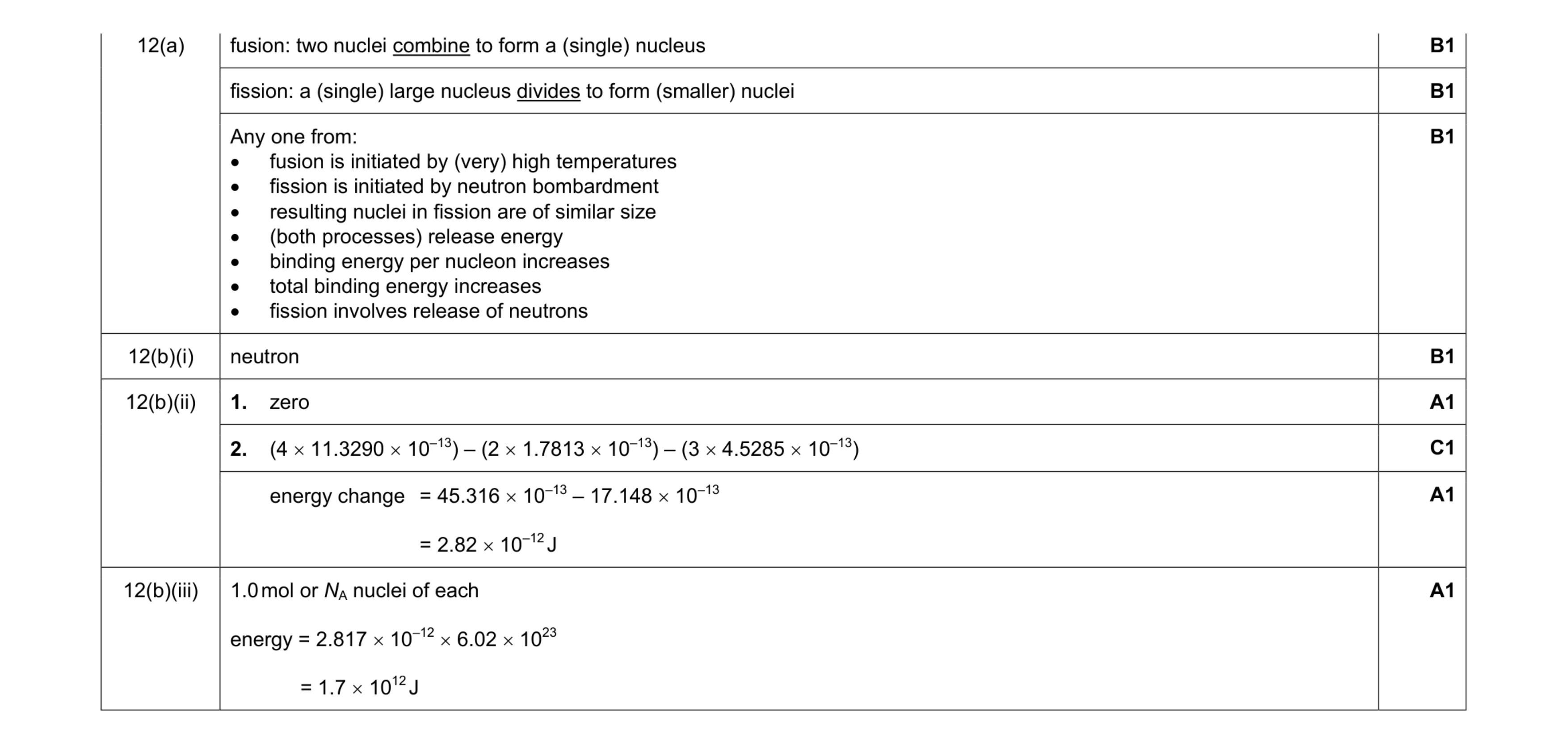 8
8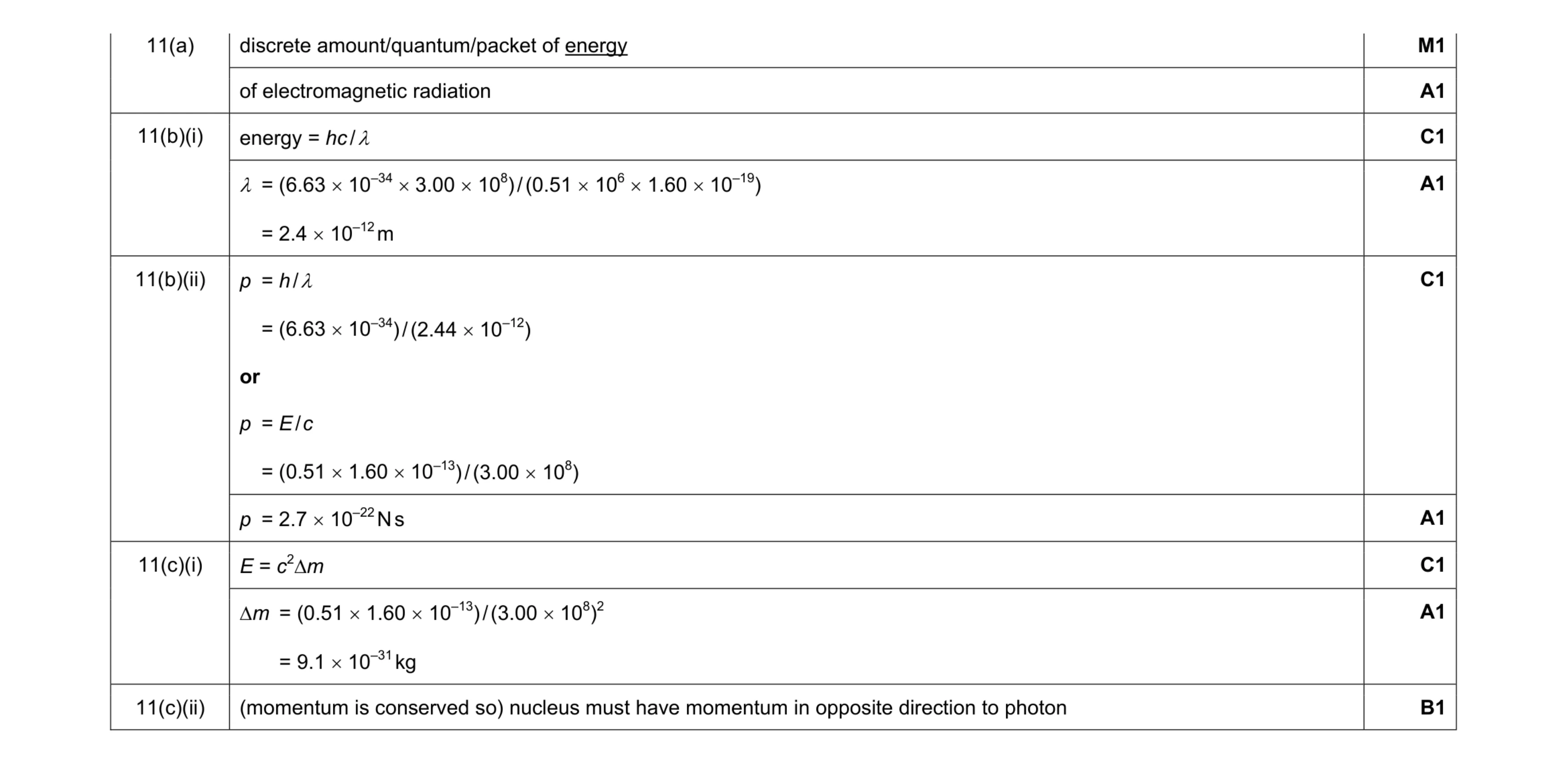 9
9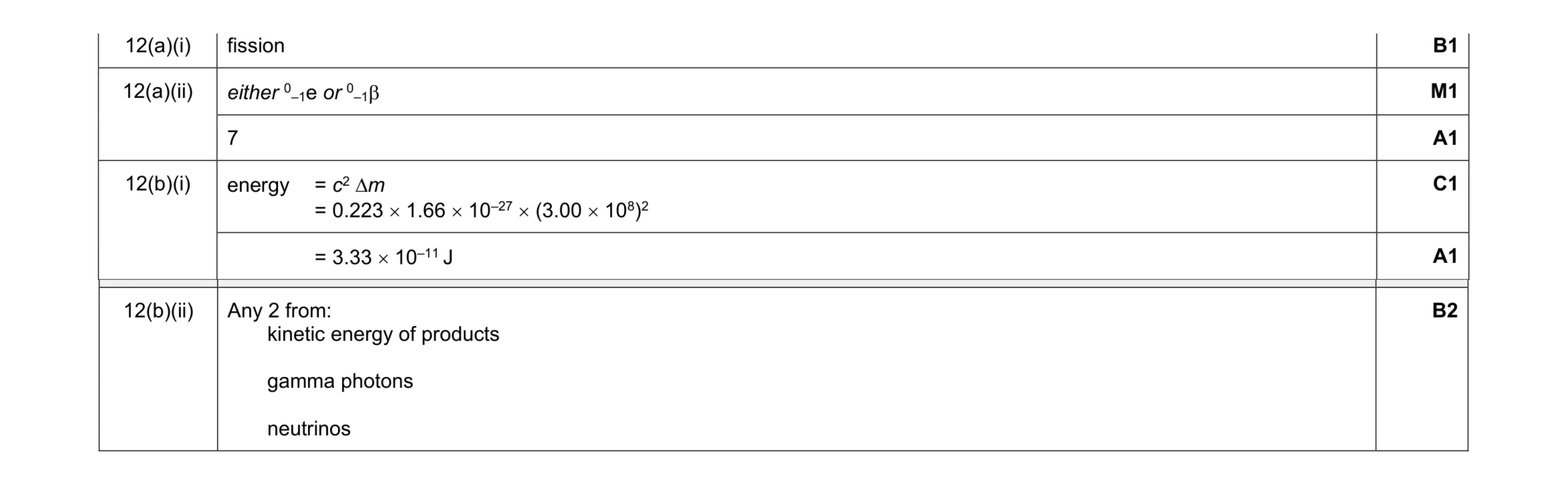 7
7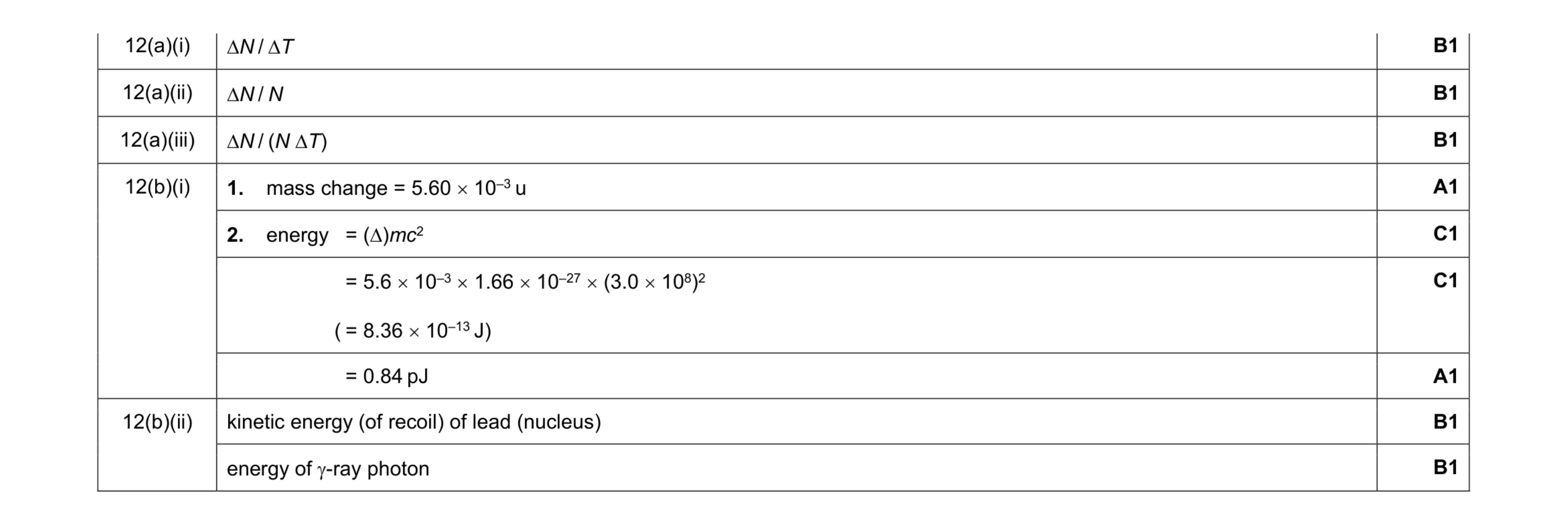 9
9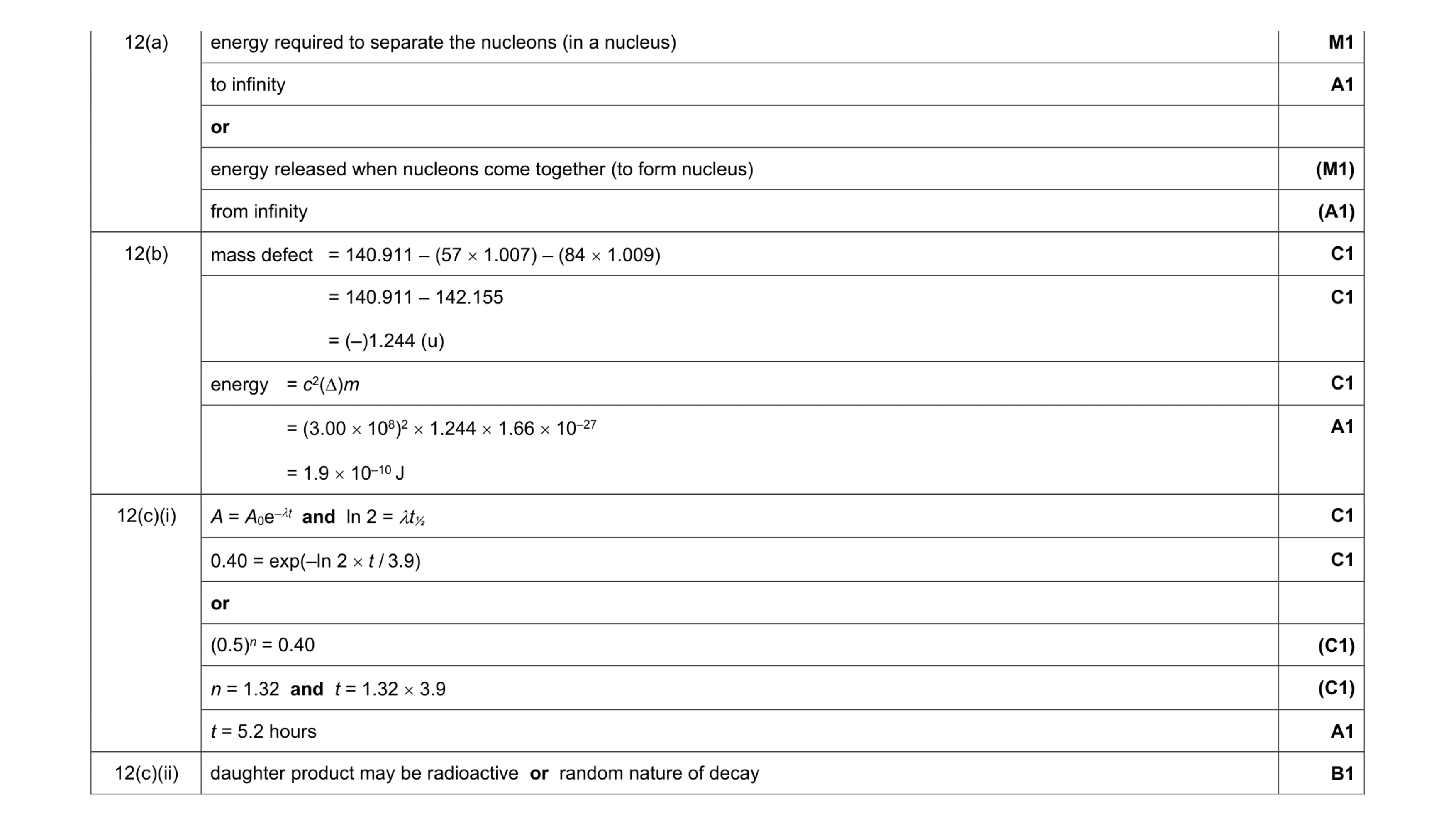 10
10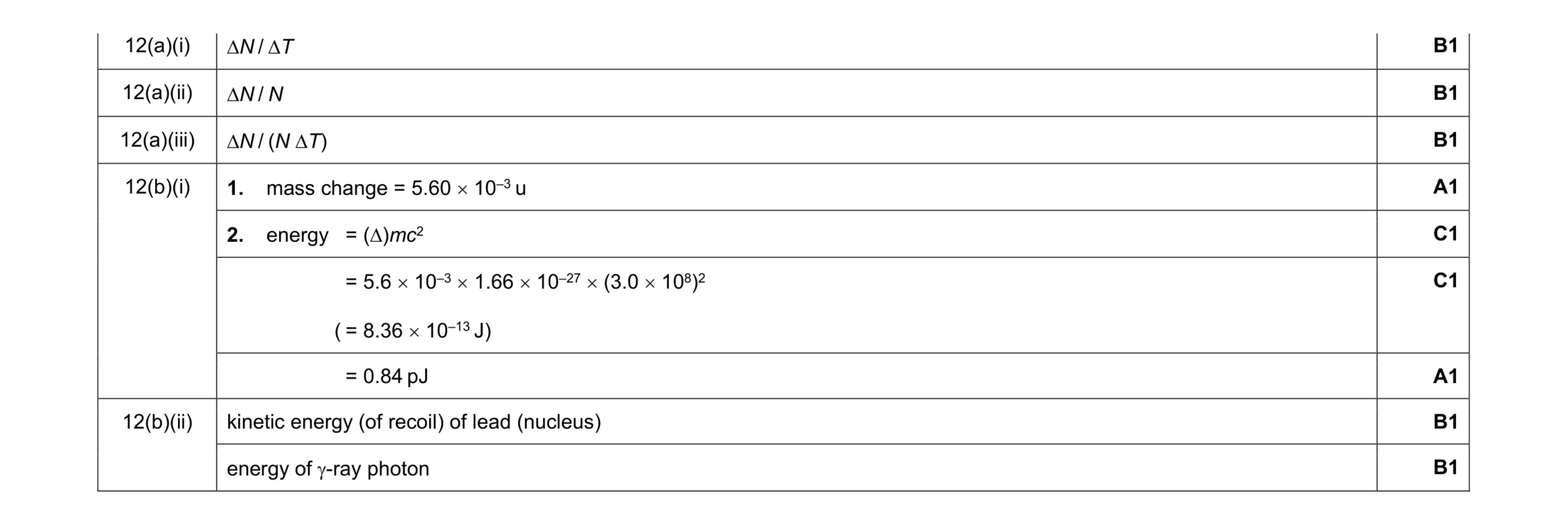 9
9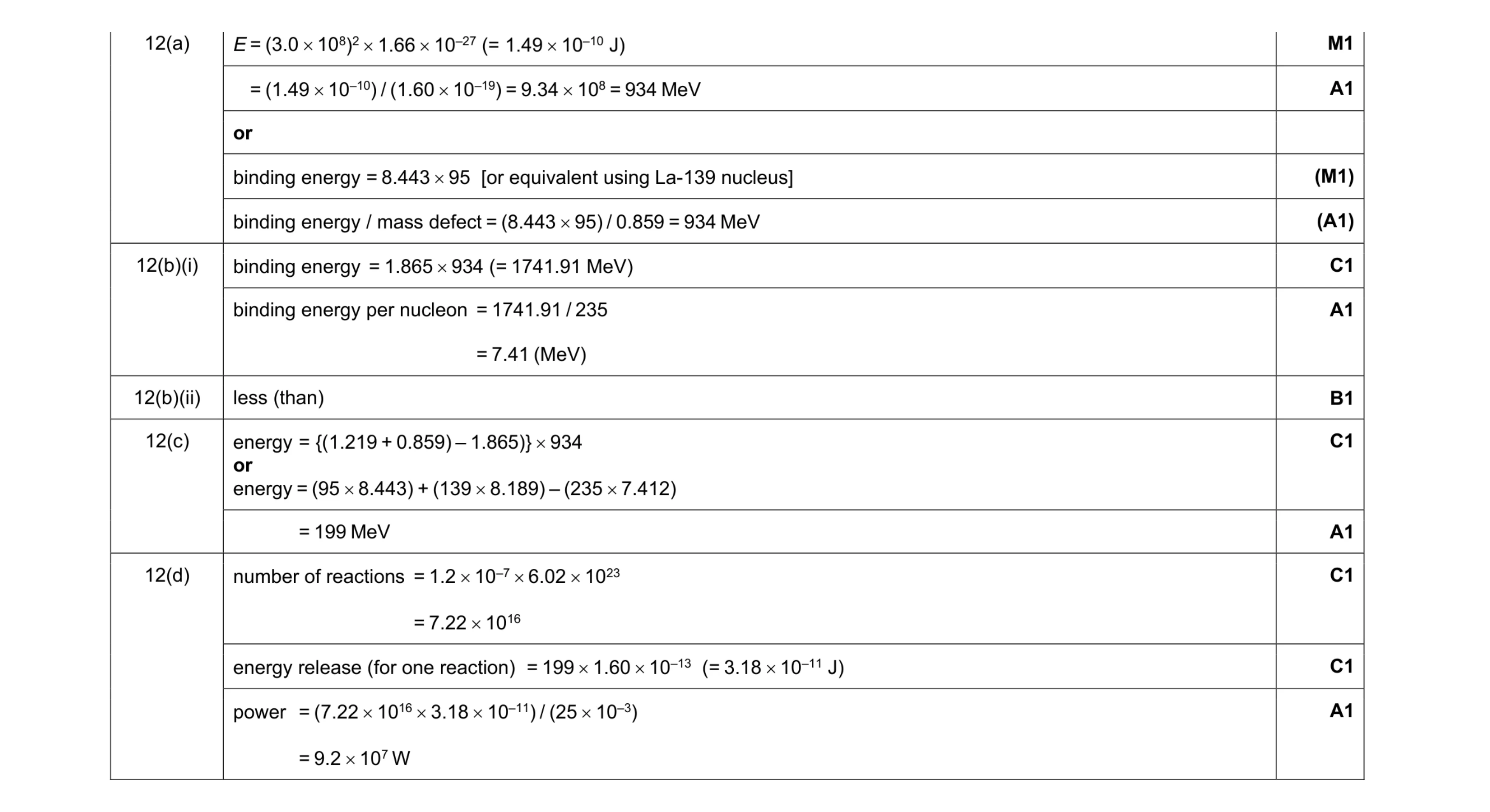 10
10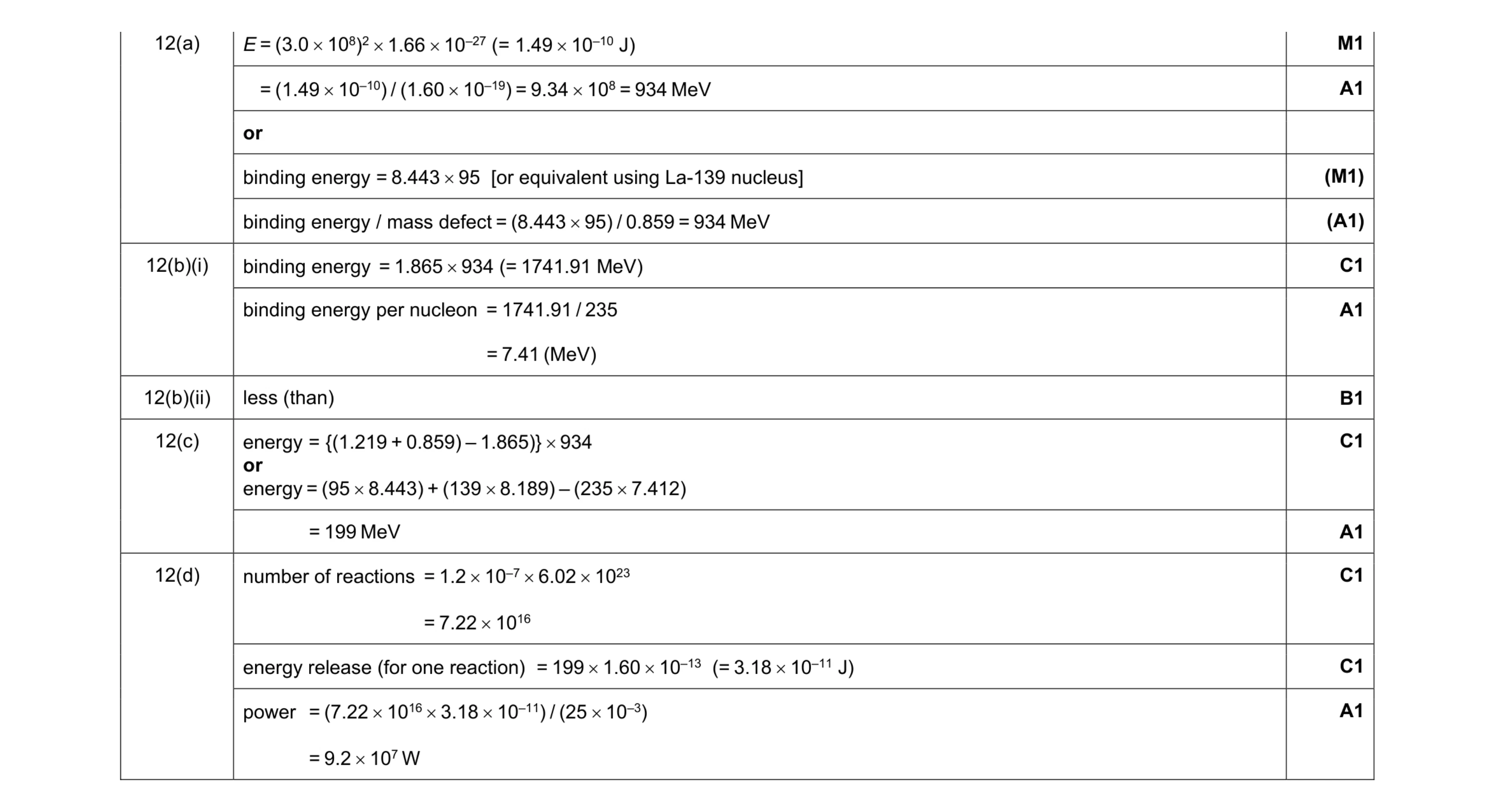 10
10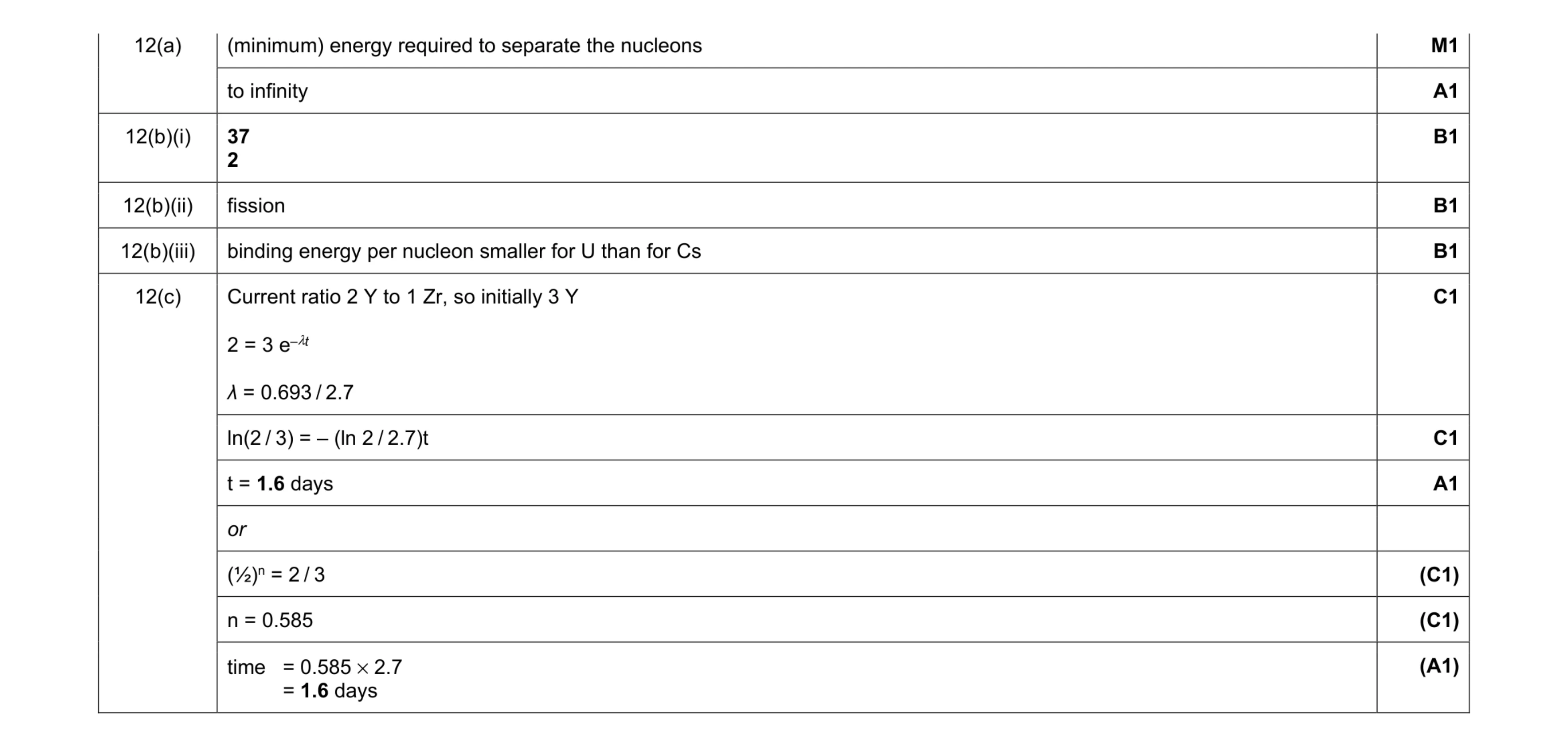 8
8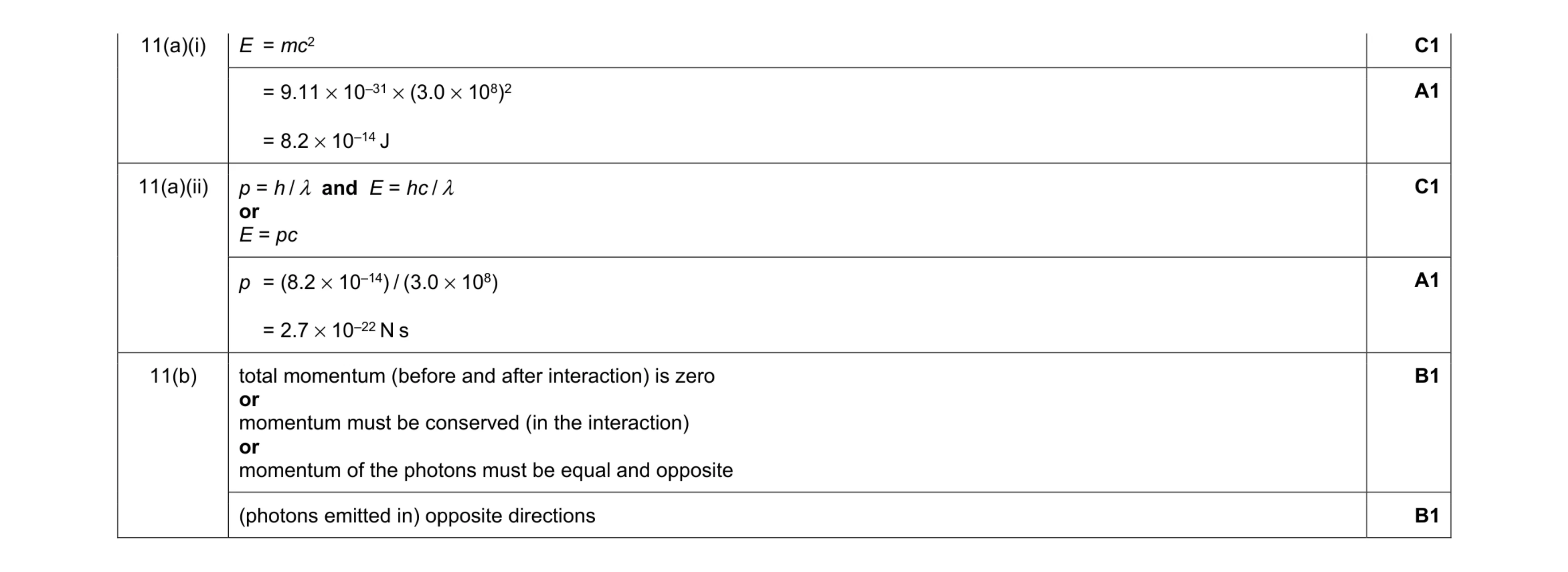 6
6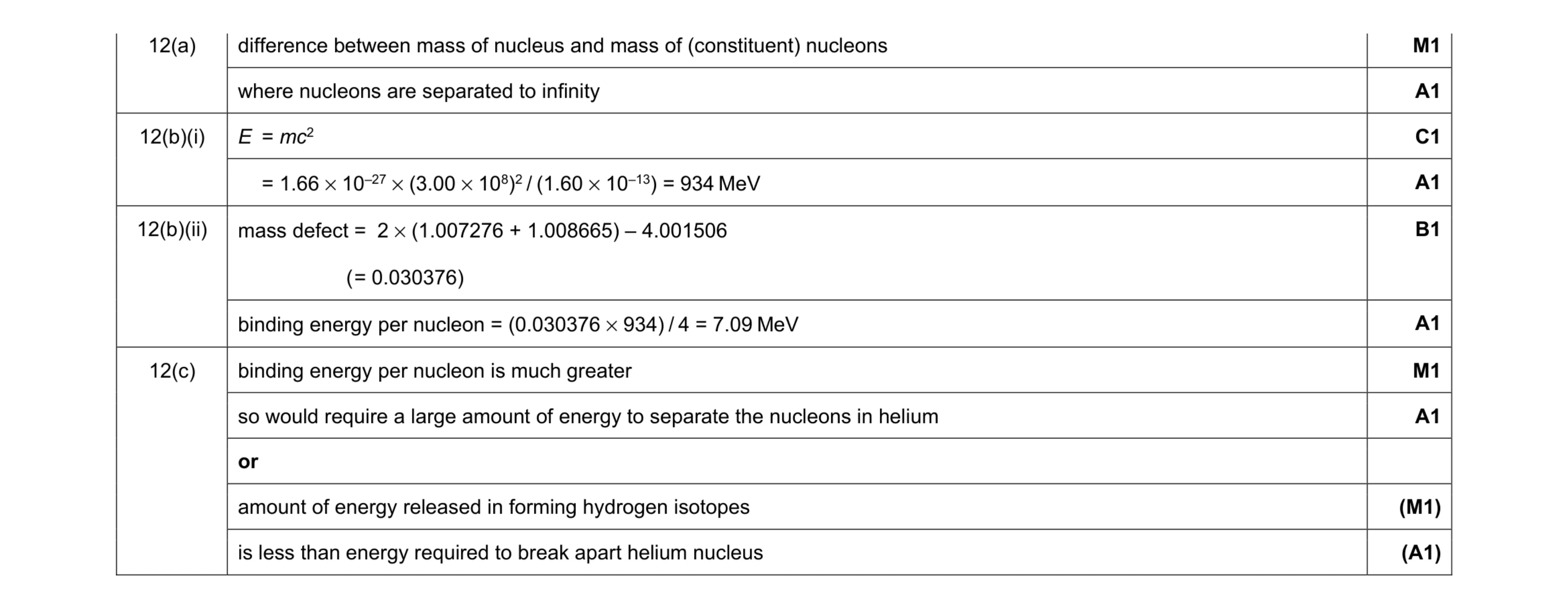 8
8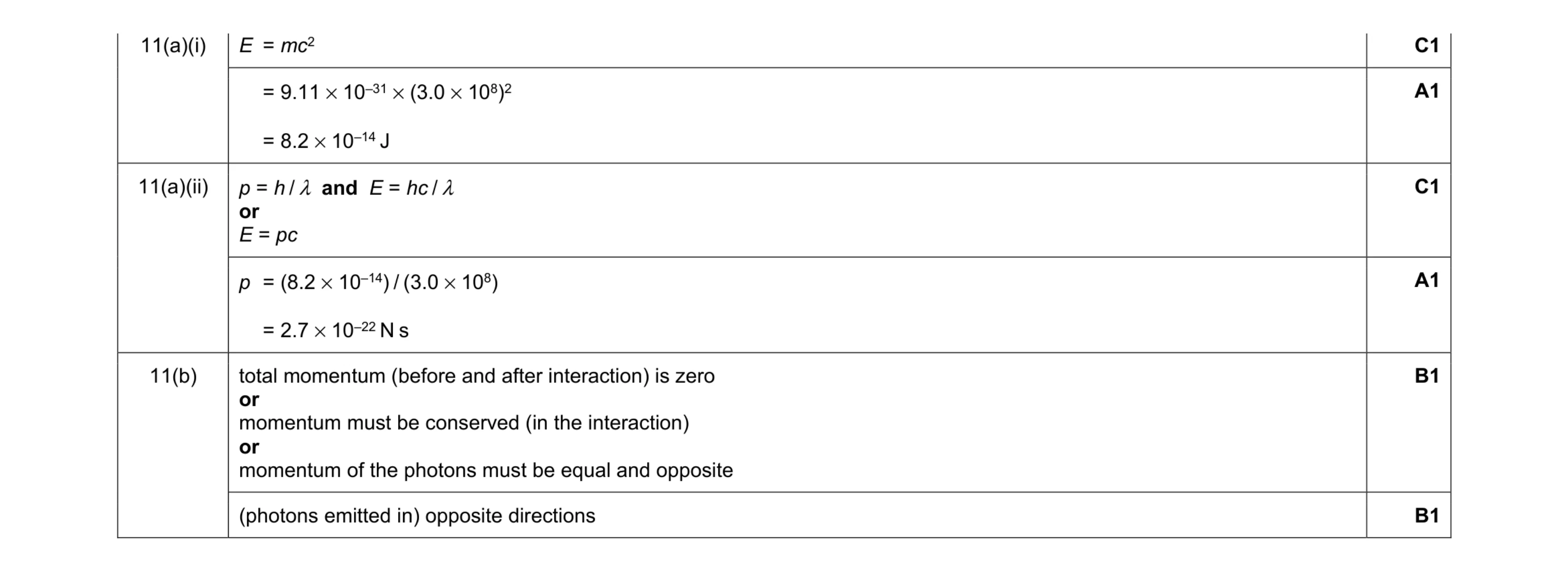 6
6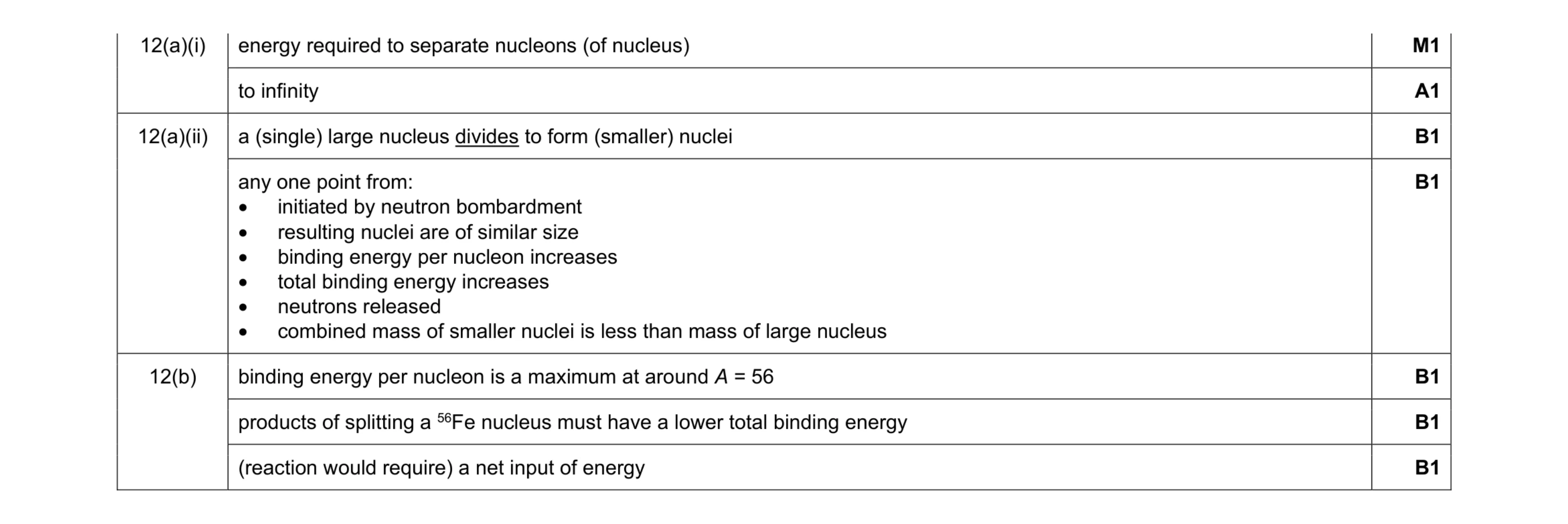 7
7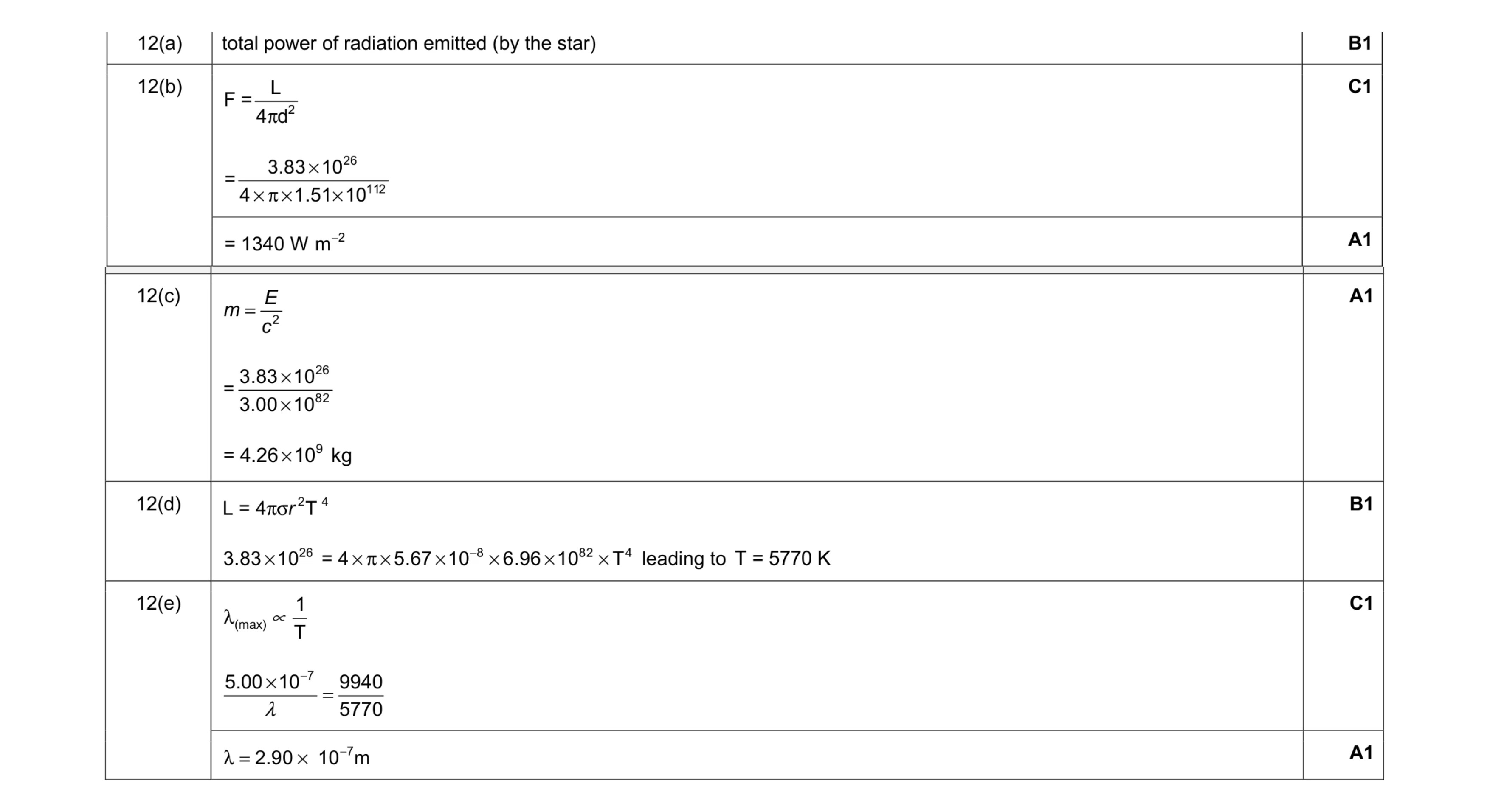 7
7 12
12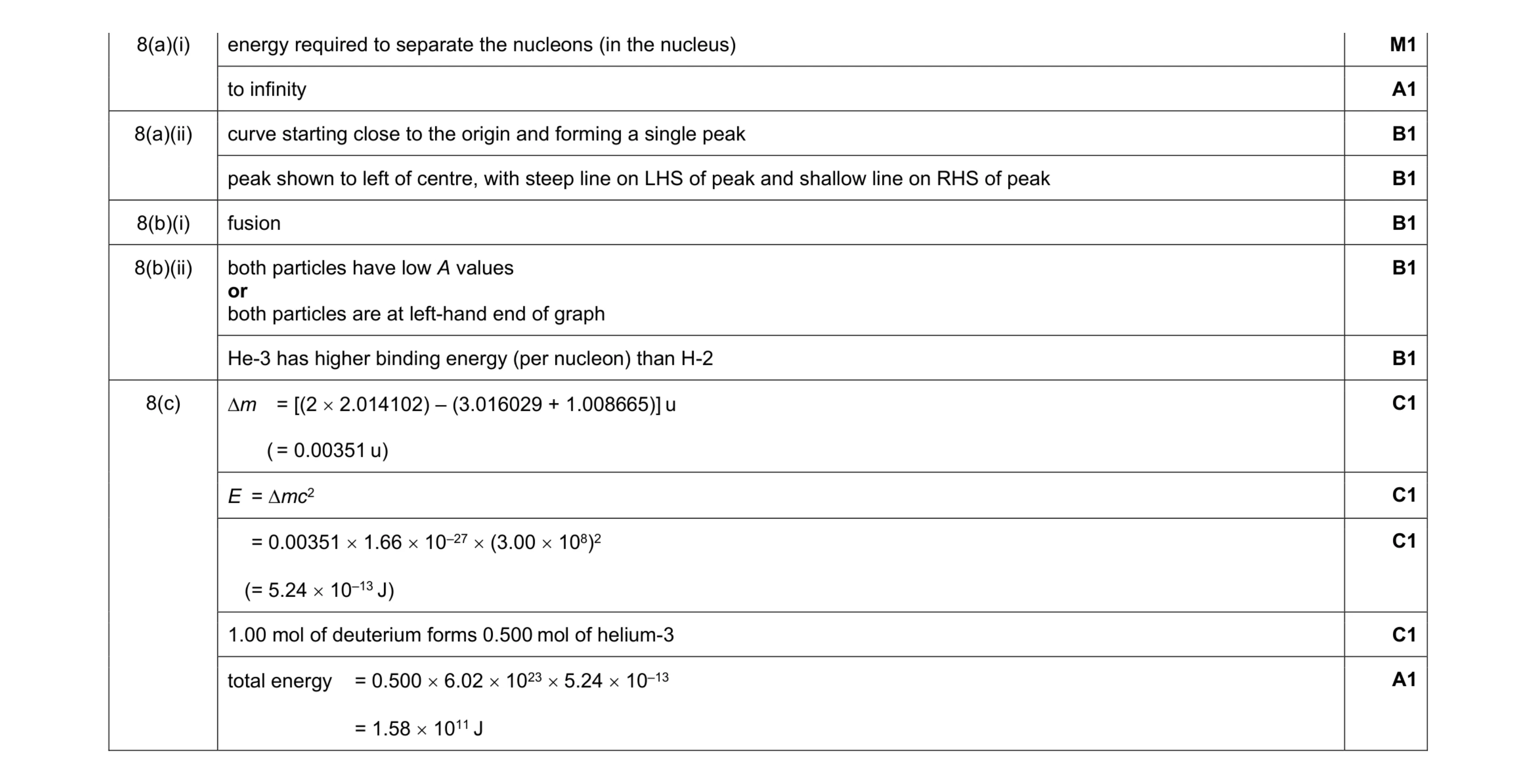 12
12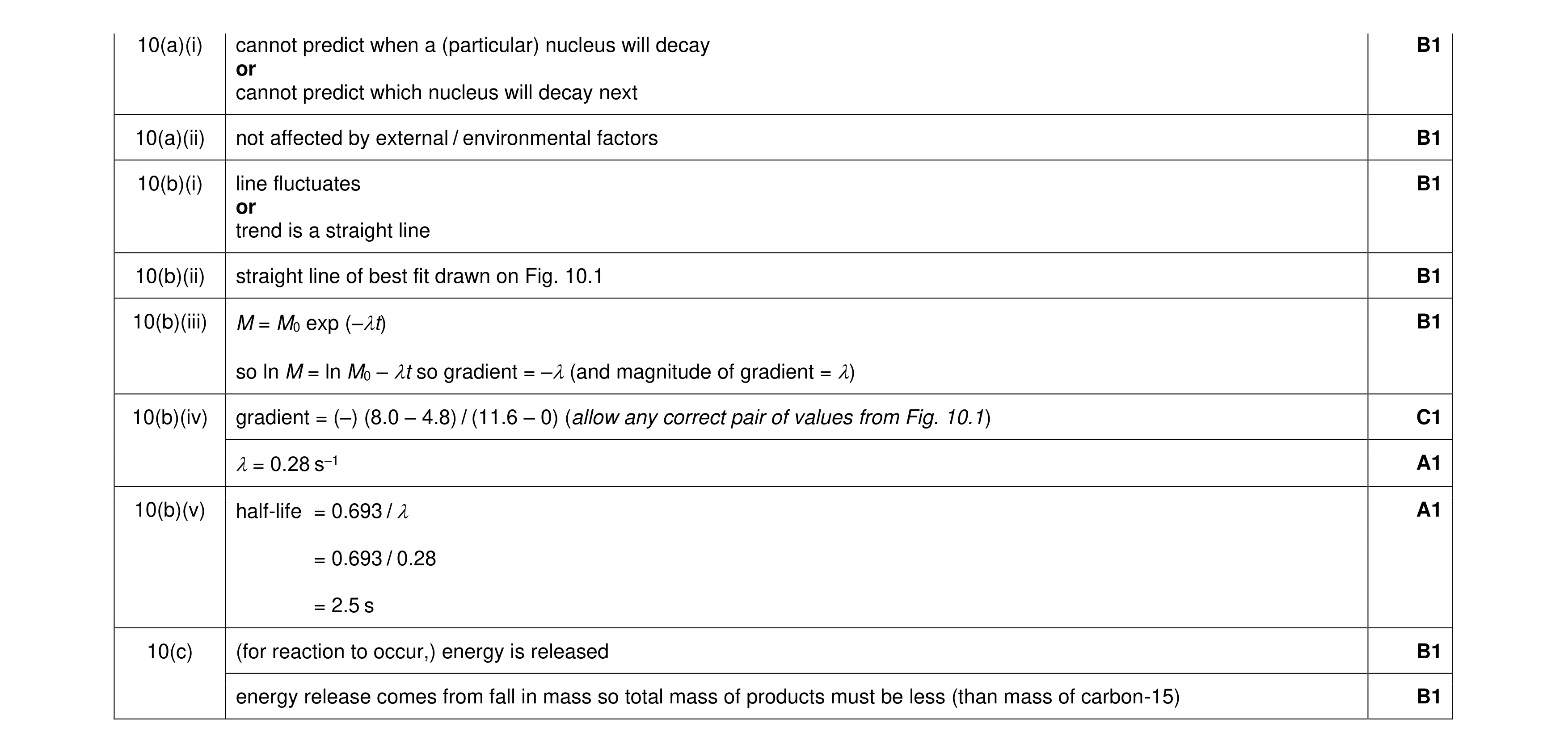 10
10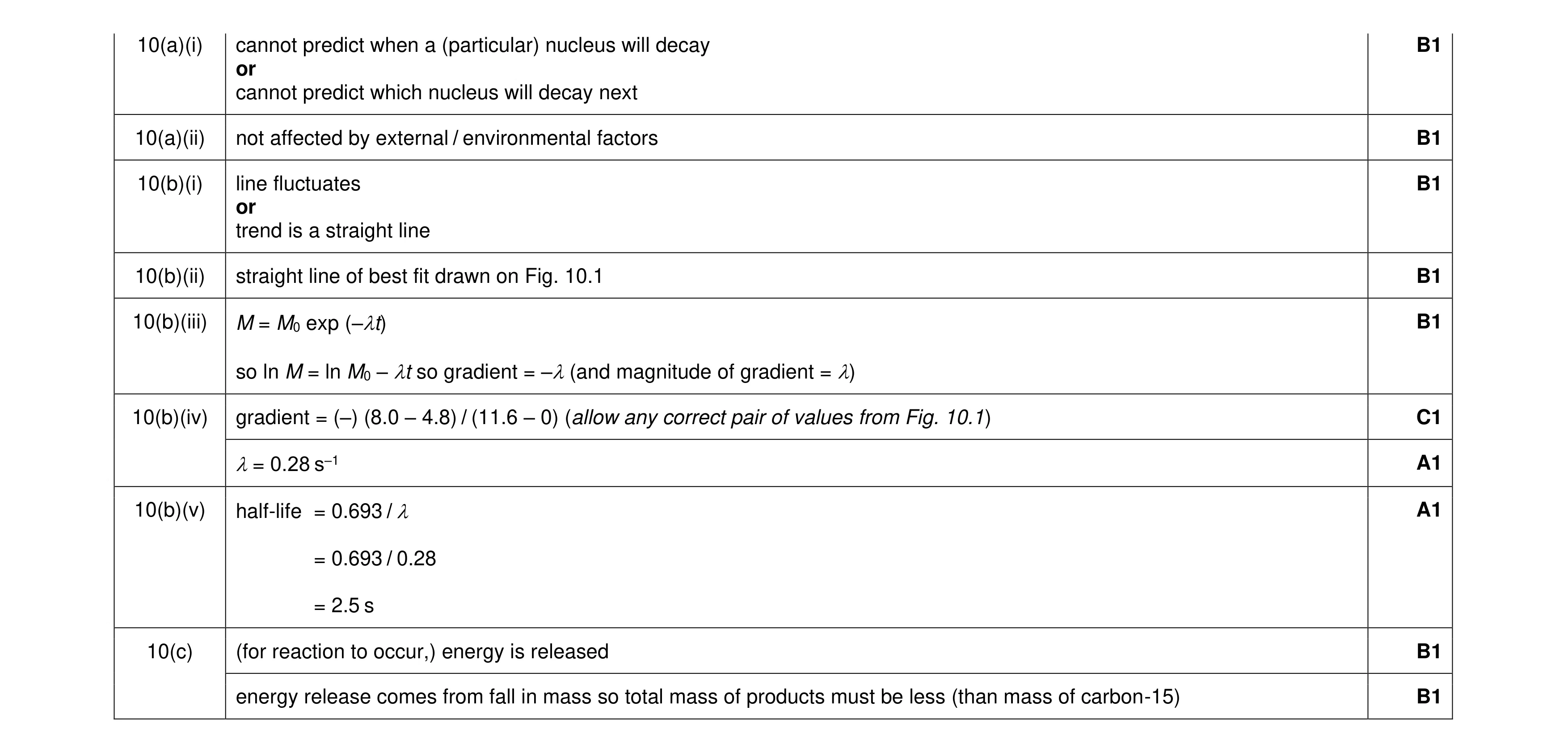 10
10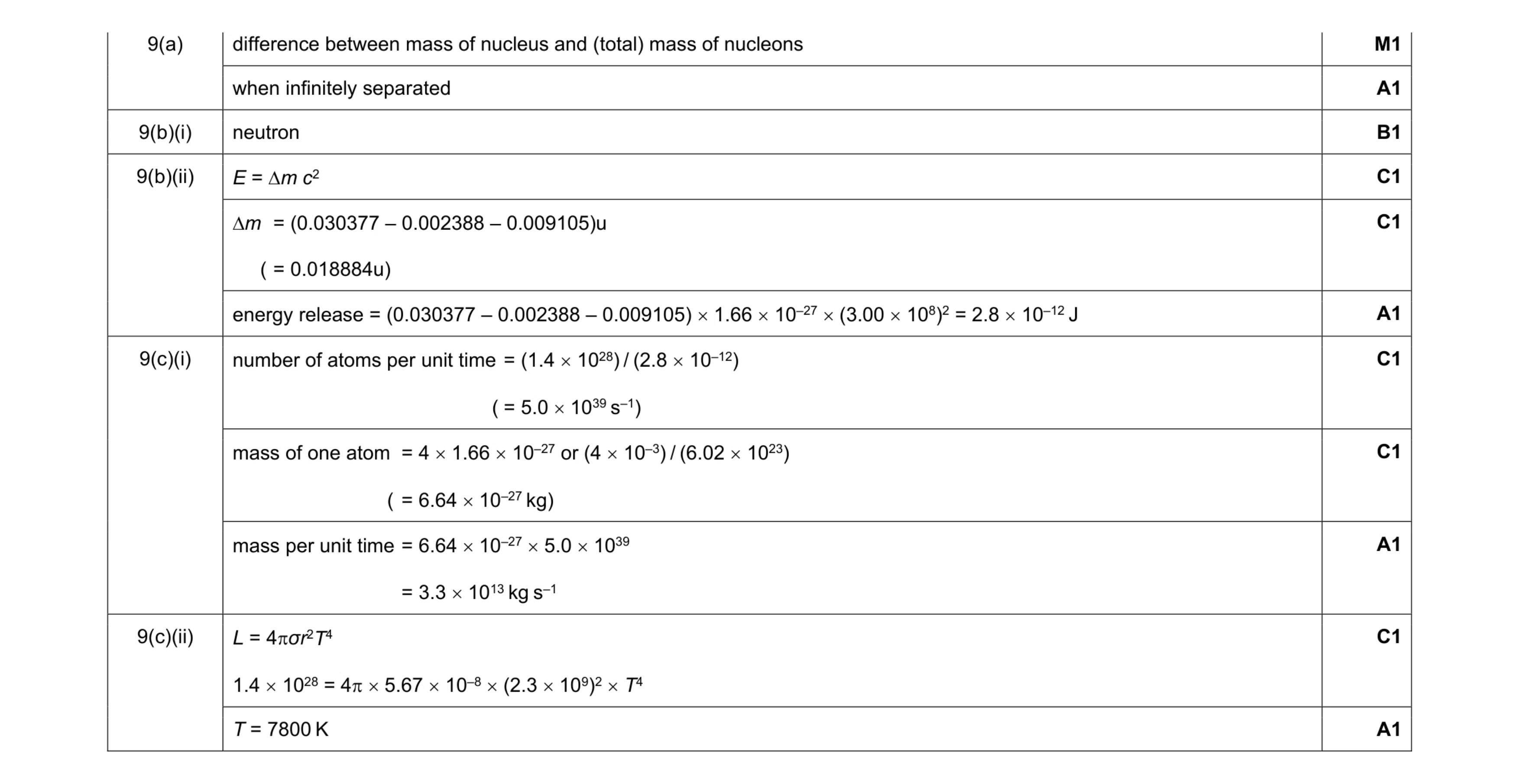 11
11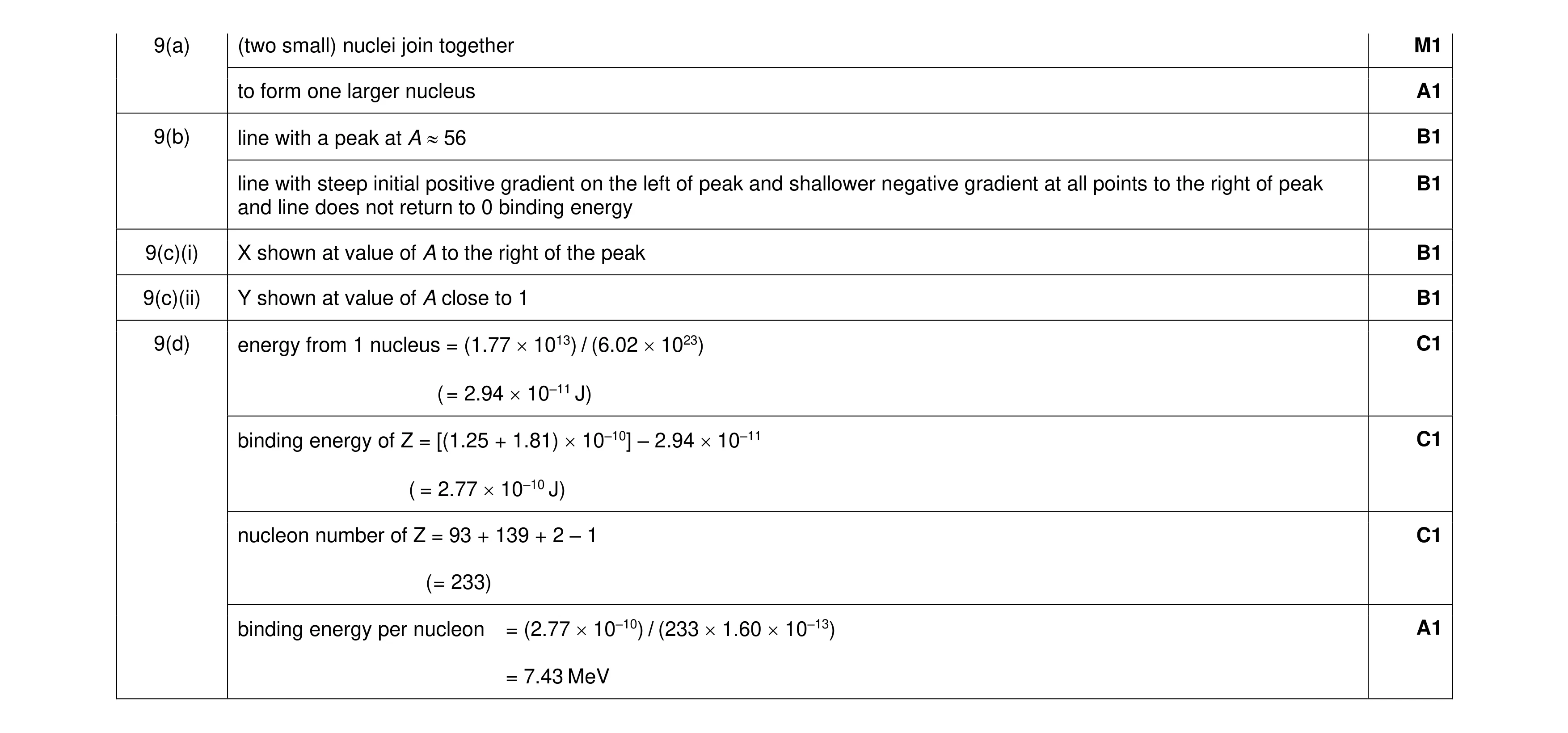 10
10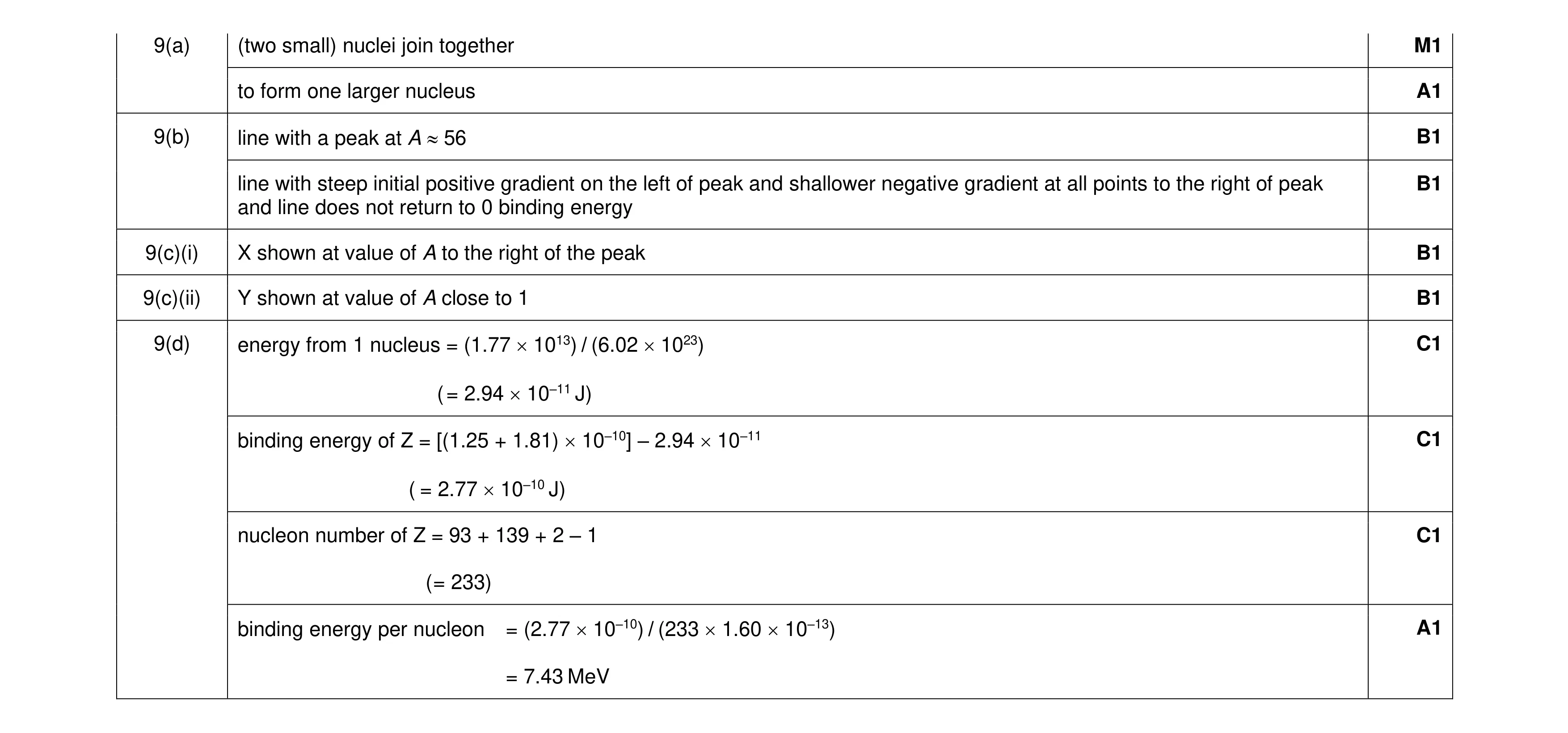 10
10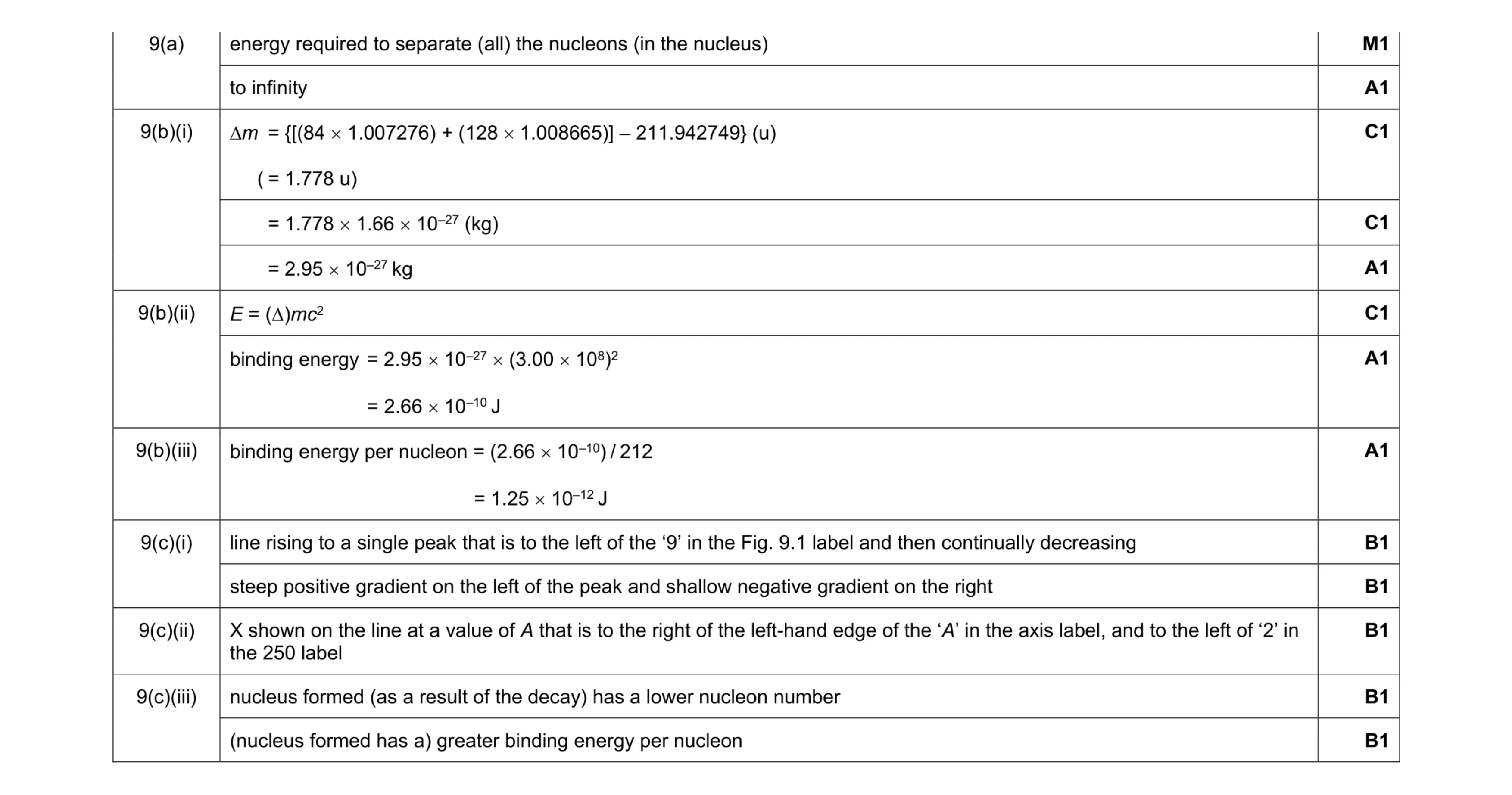 13
13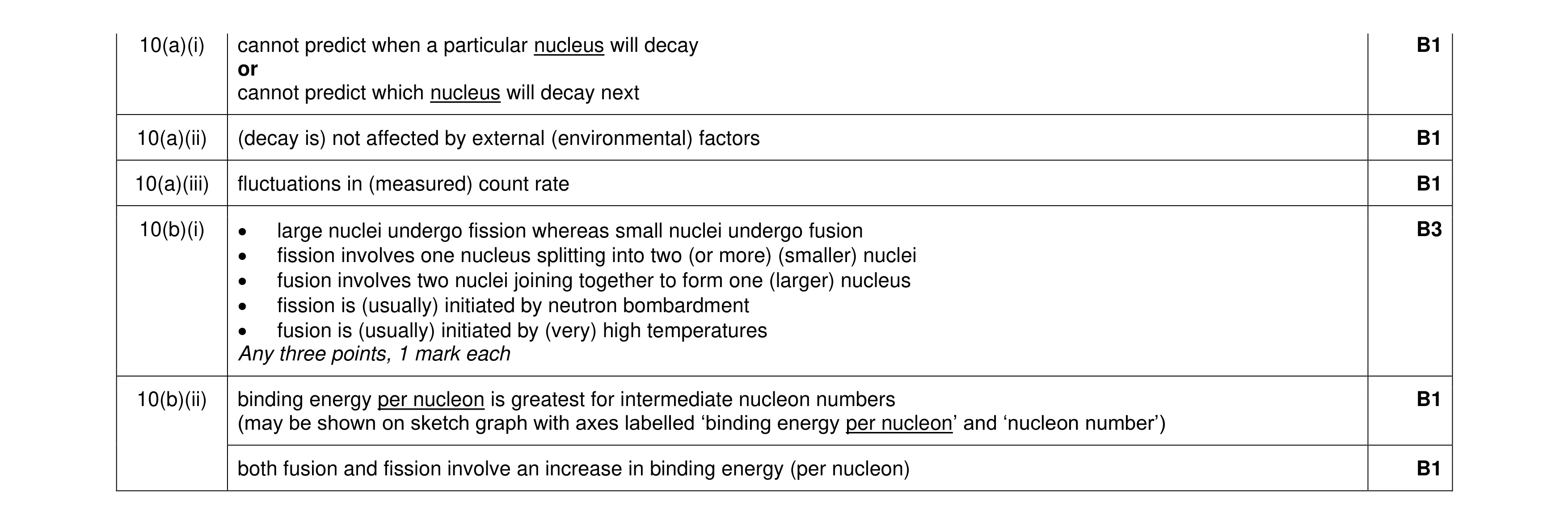 8
8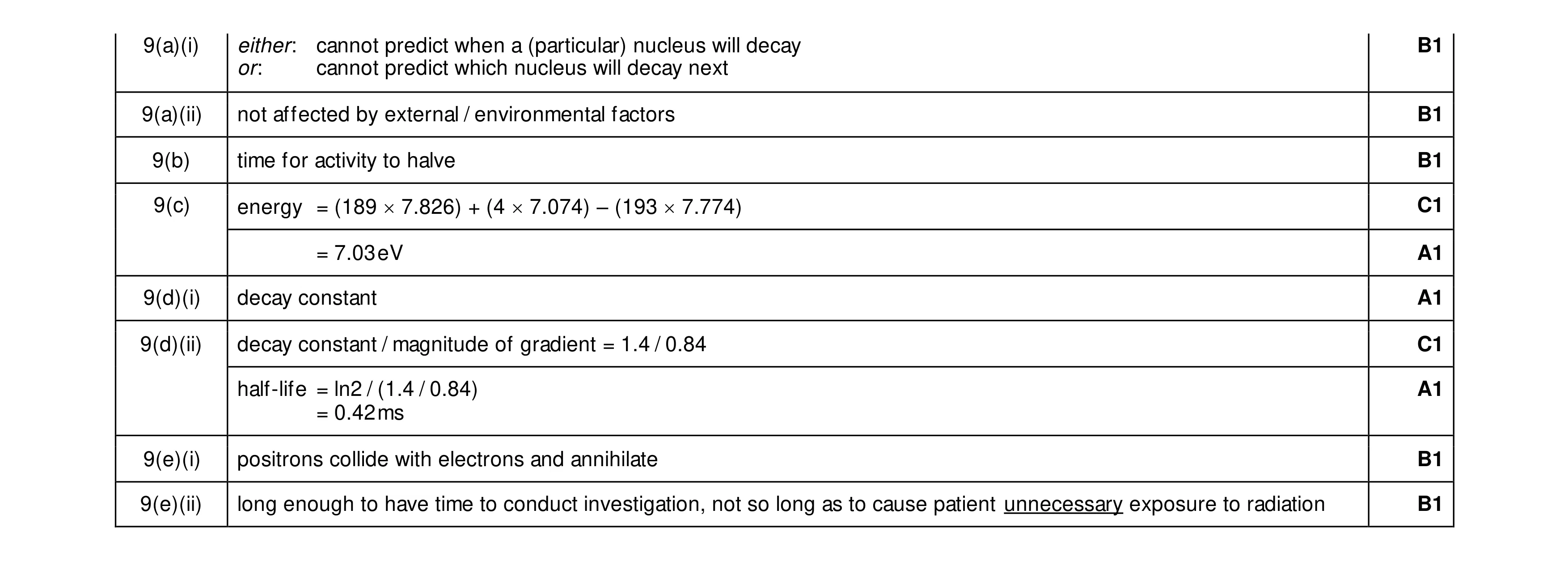 10
10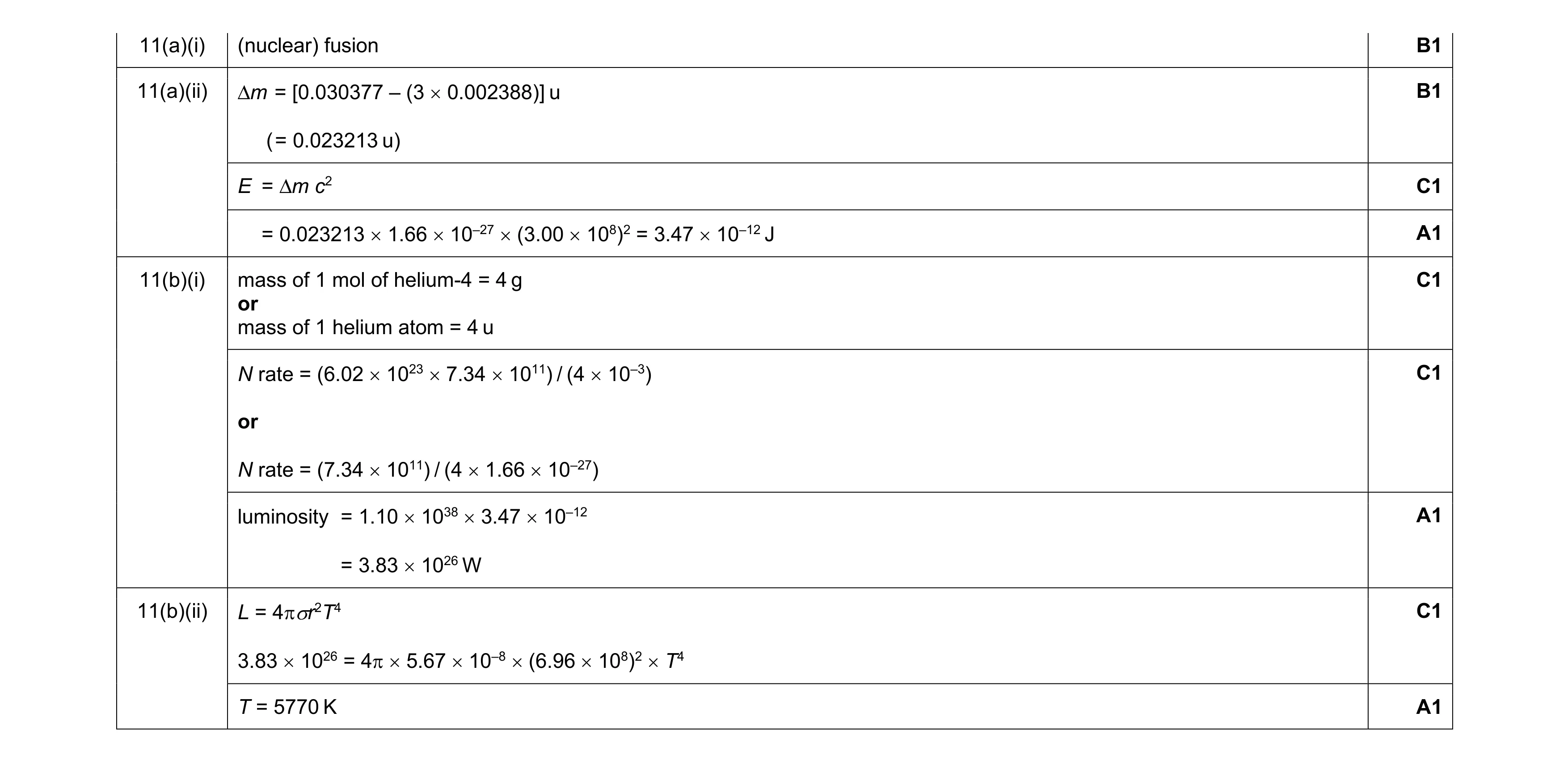 9
9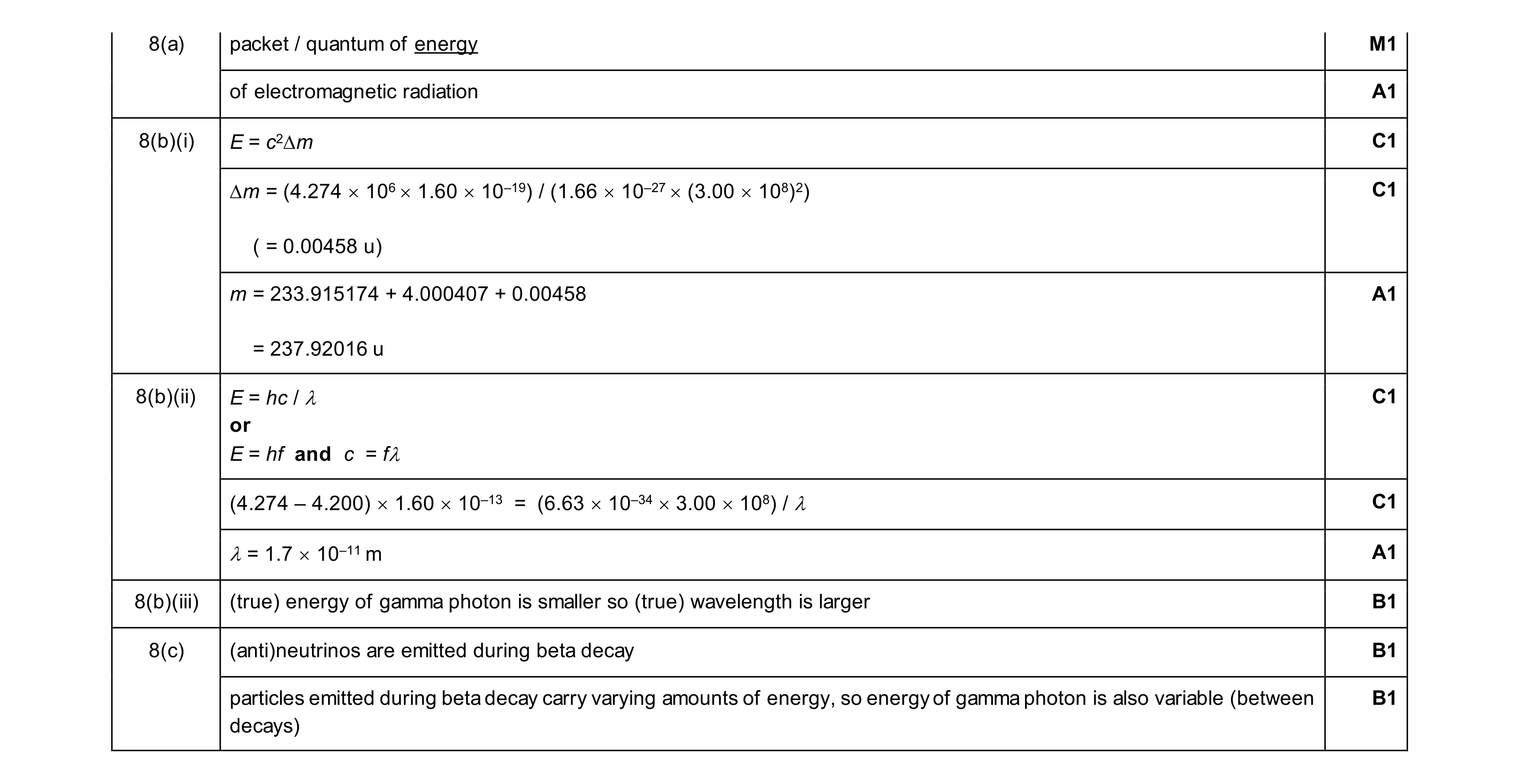 11
11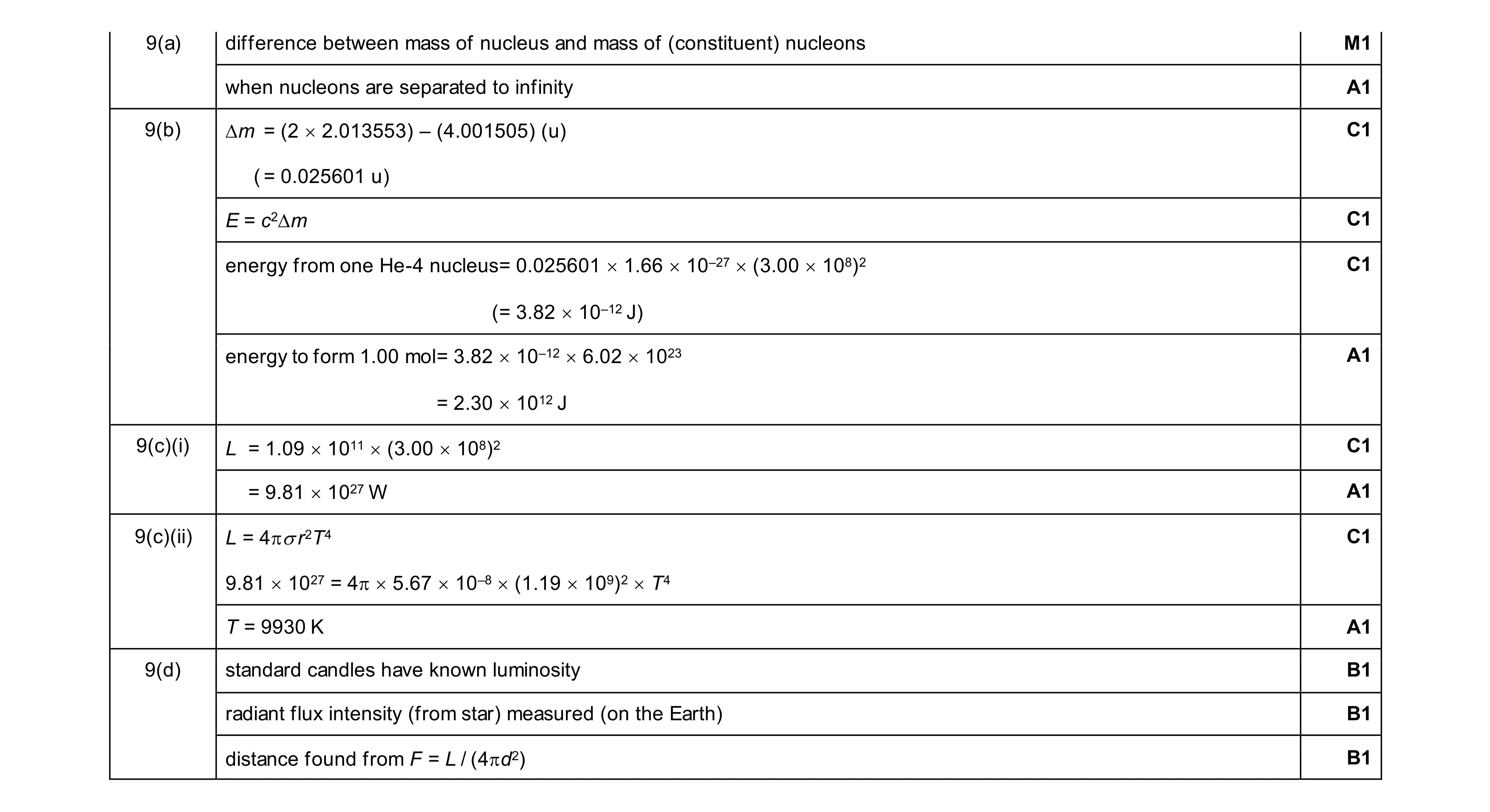 13
13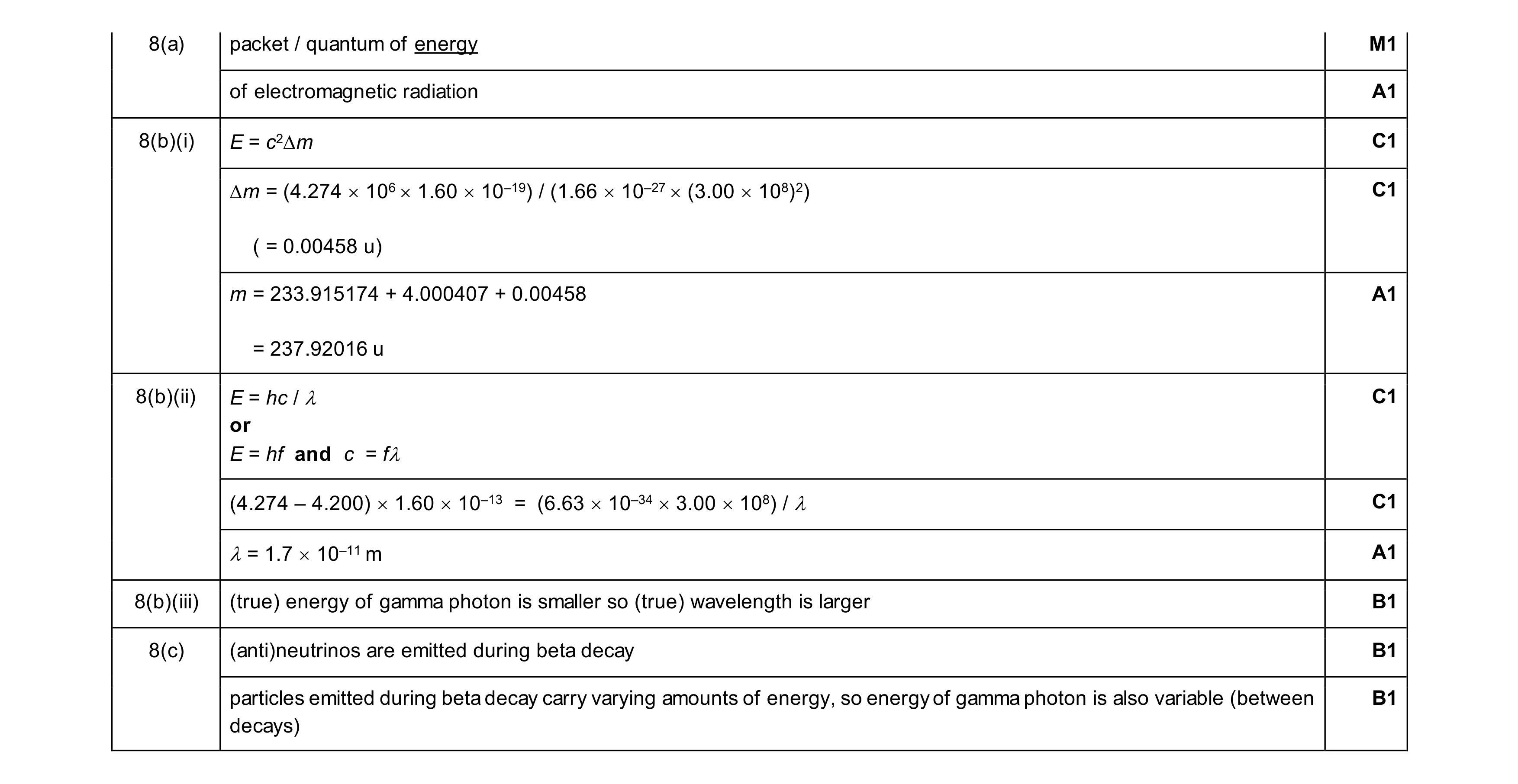 11
11