Questions as text
Q1 · Captain Smith has docked his UK registered ship in the Chinese port of Shanghai for some… 9084/23 May/June 2018
2 (a) Captain Smith has docked his UK registered ship in the Chinese port of Shanghai for some repairs. Dipak, a crew member, has been in trouble for fighting and as a punishment Captain Smith orders Dipak to paint part of the side of the ship. Dipak is looking for a life jacket when Captain Smith orders him to begin painting immediately. Dipak starts climbing down a ladder without a life jacket, falls into the water and drowns. Explain how the Merchant Shipping Act 1995 will apply to Captain Smith. [10] (b) Piotr is the engineer on a Japanese registered ship docked in the UK port of Southampton. A crew member tells Piotr that the engine is getting dangerously hot. Piotr has a quick look at the engine but decides that the crew member is mistaken. Normally, Piotr records all his work in a log book but as he has made no repairs he decides not to do so. The next day the ship leaves Southampton and five hours later the engine catches fire, causing £100 000 worth of damage. Explain how the Merchant Shipping Act 1995 will apply to Piotr. [10] (c) Isabella is employed as a navigator on a UK registered ship docked in London. She has trouble sleeping and a doctor prescribes medication, telling her to take only one tablet when she goes to bed. That night, Isabella takes one of the tablets. Nothing happens so she takes a second tablet and eventually falls asleep. The next morning, Isabella feels very sleepy but says nothing and starts work at 6am. She falls asleep in front of the navigation screen, causing the ship to crash into a fishing boat, killing its captain. Explain how the Merchant Shipping Act 1995 will apply to Isabella. [10] (d) Explain the pre-trial processes used in triable either way cases and assess their effectiveness. [20] Source material for Question 2 Merchant Shipping Act 1995 Section 58 Conduct endangering ships, structures or individuals (1) This section applies— (a) to the master of, or any seaman employed in, a United Kingdom ship; and (b) to the master of, or any seaman employed in, a ship which— (i) is registered under the law of any country outside the United Kingdom; and (ii) is in a port in the United Kingdom or within United Kingdom waters while proceeding to or from any such port. (2) If a person to whom this section applies, while on board his ship or in its immediate vicinity— (a) does any act which causes or is likely to cause— (i) the loss or destruction of or serious damage to his ship or its machinery, navigational equipment or safety equipment, or (ii) the loss or destruction of or serious damage to any other ship or any structure, or (iii) the death of or serious injury to any person, or (b) omits to do anything required— (i) to preserve his ship or its machinery, navigational equipment or safety equipment from being lost, destroyed or seriously damaged, or (ii) to preserve any person on board his ship from death or serious injury, or (iii) to prevent his ship from causing the loss or destruction of or serious damage to any other ship or any structure, or the death of or serious injury to any person not on board his ship, and either of the conditions specified in subsection (3) below is satisfied with respect to that act or omission, he shall … be guilty of an offence. (3) Those conditions are— (a) that the act or omission was deliberate or amounted to a breach or neglect of duty; (b) that the master or seaman in question was under the influence of drink or a drug at the time of the act or omission. … (5) A person guilty of an offence under this section shall be liable— (a) on summary conviction, to a fine not exceeding the statutory maximum; (b) on conviction on indictment, to imprisonment for a term not exceeding two years or a fine, or both.
50 marks
Mark scheme: 2(a) Explain how the Merchant Shipping Act 1995 will apply to Captain 10 Smith. Band 1 [0 marks] Irrelevant answer. Band 2–3 [1–5 marks] A candidate needs to be selective in choosing the correct part of the source material. • Principle without section – understanding that Captain Smith has committed an offence. and/or • Reference to s58 Merchant Shipping Act 1995 with little or no development. Band 4 [6–7 marks] Some development of s58(1)(a) and/or s58(2)(a)(iii) and/or s58(2)(b)(ii) and/or s58(3)(a) and/or s58(5)(b) and some application. Band 5 [8–10 marks] Full development of the relevant sections. Conclusion: Captain Smith has committed what is likely to be an indictable offence under s58(5)(b). He is the master of the ship under s58(1)(a) and the ship is registered in the UK. He does an act under s58(2)(a)(iii) in ordering Dipak over the side without a life jacket and this was deliberate under s58(3)(a). Credit an alternative argument based on an omission under s58(2)(b)(ii). Captain Smith has committed an offence under s58(5)(b) as Dipak has died. 2(b) Explain how the Merchant Shipping Act 1995 will apply to Piotr. 10 Band 1 [0 marks] Irrelevant answer. Band 2–3 [1–5 marks] A candidate needs to be selective in choosing the correct part of the source material. • Principle without section – understanding that Piotr has committed an offence. and/or • Reference to s58 Merchant Shipping Act 1995 with little or no development. Band 4 [6–7 marks] Some development of s58(1)(b)(i) and (ii) and/or s58(2)(b)(i) and/or s53(3)(a) and/or s58(5) and some application. Band 5 [8–10 marks] Full development of the relevant sections. Conclusion: Piotr has committed an offence under s58(5) – credit discussion of category of offence. Piotr is covered by s58(1)(b)(i) and (ii) as he is employed on a ship registered in Japan but docked in a UK port. He only has a quick look at the engine which brings him within s58(2)(b)(i) and his failure to check properly or to make any record in the log book comes under s58(3)(a). His offence will be covered by s58(5)(a) or (b) – credit can be gained for either alternative as long as there is reasoning to a logical conclusion. 2(c) Explain how the Merchant Shipping Act 1995 will apply to Isabella. 10 Band 1 [0 marks] Irrelevant answer. Band 2–3 [1–5 marks] A candidate needs to be selective in choosing the correct part of the source material. • Principle without section – understanding that Isabella has committed an offence. and/or • Reference to s58 Merchant Shipping Act 1995 with little or no development. Band 4 [6–7 marks] Some development of s58(1)(a) and/or s58(2)(b)(iii) and/or s58(3)(b) and/or s58(5) and some application. Band 5 [8–10 marks] Full development of the relevant sections. Conclusion: Isabella has committed an offence under s58(5) and it is likely to be (b) as the fishing boat captain is killed. She is covered by s58(1)(a) as she is employed on a UK registered ship. Under s58(2)(b)(iii) she has failed to say she feels unfit for work due to the sleeping pills she has taken which would bring her within s58(3)(a) and she also comes within s58(3)(b) as she was under the influence of the sleeping pills at the time the ship crashed. 2(d) Explain the pre-trial processes used in triable either way cases and 20 assess their effectiveness. Band 1 [0 marks] Irrelevant answer. Band 2 [1–6 marks] Describes and/or discusses pre-trial criminal procedures in triable either way offences in very general terms. Band 3 [7–13 marks] More detailed references to pre-trial criminal procedure in triable either way offences and some discussion of their effectiveness but with a largely factual basis. Band 4/5 [14–20 marks] Very good explanation of the pre-trial criminal procedures in triable wither way offences and a good discussion of their effectiveness. To reach higher marks candidates need to engage with both aspects of the question showing good critical awareness.
This question in 9084/23 May/June 2018
Q2 · Roger is a property developer who wants to build some houses on farmland 9084/22 Oct/Nov 2018
1 (a) Roger is a property developer who wants to build some houses on farmland. He knows a local farmer has land to sell but this has been blocked by the local council. Robert offers his friend Nigel, who is a member of the council, £10 000 to vote for the land to be sold at the next council meeting. Nigel says this is illegal. A day later, Roger transfers £10 000 to Nigel’s bank account. Nigel votes for the land to be sold at the next council meeting. Explain how the Bribery Act 2010 will apply to Roger. [10] (b) Angie opens a hairdressing and beauty salon on a street where Rupert already runs a hairdressing business from his home. Angie pays her friend, Sue, £500 to help her put Rupert out of business by telling the police that Rupert attacked her while she was in his house getting a haircut. Rupert is charged and the story is reported in the local newspaper. Rupert’s customers now go to Angie’s salon. Explain how the Bribery Act 2010 will apply to Angie. [10] (c) Gunther has developed a new car. He knows the car uses a lot of fuel so he tells Daniel, the government tester, that he will buy him an expensive holiday if he says the car uses little fuel. In the test the car does use a lot of fuel but in his report Daniel lies and says the car uses little fuel. As a result of Daniel’s report, Gunther sells many more cars than he expected and buys Daniel an expensive holiday. Explain how the Bribery Act 2010 will apply to Gunther. [10] (d) Describe the pre-trial processes used to allocate triable either way offences for trial. Assess the effectiveness of these processes. [20] Source material for Question 1 Bribery Act 2010 Section 1 Offences of bribing another person (1) A person (“P”) is guilty of an offence if either of the following cases applies (2) Case 1 is where— (a) P offers, promises or gives a financial or other advantage to another person, and (b) P intends the advantage— (i) to induce a person to perform improperly a relevant function or activity, or (ii) to reward a person for the improper performance of such a function or activity. (3) Case 2 is where— (a) P offers, promises or gives a financial or other advantage to another person, and (b) P knows or believes that the acceptance of the advantage would itself constitute the improper performance of a relevant function or activity. Section 3 Function or activity to which bribe relates (1) For the purposes of this Act a function or activity is a relevant function or activity if— (a) it falls within subsection (2), and (b) meets one or more of conditions A to C. (2) The following functions and activities fall within this subsection— (a) any function of a public nature, (b) any activity connected with a business, (c) any activity performed in the course of a person’s employment, (d) any activity performed by or on behalf of a body of persons (3) Condition A is that a person performing the function or activity is expected to perform it in good faith. (4) Condition B is that a person performing the function or activity is expected to perform it impartially. (5) Condition C is that a person performing the function or activity is in a position of trust by virtue of performing it. Section 4 Improper performance to which bribe relates (1) For the purposes of this Act a relevant function or activity— (a) is performed improperly if it is performed in breach of a relevant expectation, and (b) is to be treated as being performed improperly if there is a failure to perform the function or activity and that failure is itself a breach of a relevant expectation. (2) In subsection (1) “relevant expectation”— (a) in relation to a function or activity which meets condition A or B, means the expectation mentioned in the condition concerned, and (b) in relation to a function or activity which meets condition C, means any expectation as to the manner in which, or the reasons for which, the function or activity will be performed that arises from the position of trust mentioned in that condition.
50 marks
Mark scheme: Question Answer Marks 1(a) Explain how the Bribery Act 2010 will apply to Roger. 10 Band 1 [0 marks] Irrelevant answer. Band 2–3 [1–5 marks] A candidate needs to be selective in choosing the correct part of the source material. • Principle without section – understanding that Roger has committed a bribery offence. and/or • Reference to s1 and/or s3 Bribery Act 2010 with little or no development Band 4 [6–7 marks] Some development of any of s1 and/or s3 and some application Band 5 [8–10 marks] Full development of the relevant sections. Conclusion: Roger has committed an offence. It will be a Case 2 offence under s1(3) as he has given a financial advantage to Nigel under (a) and he knows this is unlawful under (b). Candidates can be credited for concluding this is a Case 1 offence under s1(2) with clear application. It is covered by s3(2)(a) as council business is of a public nature or s3(2)(b) as the situation involved a business. Nigel is in a position of trust under s3(5) which meets Condition C. Candidates can be credited for applying other Conditions if this is accompanied by clear citation and application. 1(b) Explain how the Bribery Act 2010 will apply to Angie. 10 Band 1 [0 marks] Irrelevant answer. Band 2–3 [1–5 marks] A candidate needs to be selective in choosing the correct part of the source material. • Principle without section – understanding that Angie has committed a bribery offence. and/or • Reference to s1 and/or s3 Bribery Act 2010 with little or no development. Band 4 [6–7 marks] Some development of any of s1 and/or s3 and some application. Band 5 [8–10 marks] Full development of the relevant sections. Conclusion: Angie has committed an offence. It will be a Case 1 offence under s1(2) as she pays Sue money under (a) and intends that this will persuade her to lie under (b)(i). This is covered by s3(2)(b) as it concerns a business and there is a breach of s3(3) as Sue does not report what happened in good faith which meets Condition A. 1(c) Explain how the Bribery Act 2010 will apply to Gunther. 10 Band 1 [0 marks] Irrelevant answer. Band 2–3 [1–5 marks] A candidate needs to be selective in choosing the correct part of the source material. • Principle without section – understanding that Gunther has committed a bribery offence. and/or • Reference to s1 and/or s3 and/or s4 Bribery Act 2010 with little or no development Band 4 [6–7 marks] Some development of some of s1 and/or s3 and/or s4 and some application. Band 5 [8–10 marks] Full development of the relevant sections. Conclusion: Gunther has committed an offence. This will be a Case 2 offence as Gunther believes his promise of a holiday will lead Daniel to lie in the course of his employment and so come under s1(3)(b). Candidates can be credited for concluding this is a Case 1 offence under s1(2) with clear application. Daniel’s misleading report would come under s3(2)(c) as he writes it in the course of his employment; candidates can also be credited for s3(2)(a) or (c) if there is clear application. Gunther is covered by any of s3(3), (4) or (5) depending on a candidate’s reasoning. He is also covered by s4(1) as he does not do his job properly. Candidates can reach the bottom of Band 5 without citation and application of s4. 1(d) Describe the pre-trial processes used to allocate triable either way 20 offences for trial. Assess the effectiveness of these processes. Band 1 [0 marks] Irrelevant answer. Band 2 [1–6 marks] Describes the pre-trial criminal processes for triable either way offences and/or their effectiveness in very general terms. Band 3 [7–13 marks] Some more detailed references to pre-trial criminal processes for triable either way offences but with a largely factual basis. Some general discussion of the effectiveness of these processes. Band 4/5 [14–20 marks] Very good detail on pre-trial criminal processes for triable either way offences and good discussion of their effectiveness. Factual content relates to pre-trial matters and not to the role of the police and the CPS in deciding whether to charge. Material on issues such as bail and legal aid are only relevant in the pre-trial context. Material on the trial process does not attract credit. To reach higher marks both aspects of the question need to be dealt with in some detail with good critical awareness.
This question in 9084/22 Oct/Nov 2018
Q3 · Graham has just bought himself a new sports car 9084/21 Oct/Nov 2019
2 (a) Graham has just bought himself a new sports car. The salesman tells him the car is very powerful and that Graham should take extra care until he gets used to the car. On his way home from the garage, Graham decides to see how fast the car will go. He is exceeding the speed limit and overtakes a tractor on a bend. Graham loses control of the car which crashes into a field, killing Dorothy who is out for a walk. Explain how the Road Traffic Act 1991 will apply to Graham. [10] (b) Carly lives in a house located on a bend in a road. The highway authority place a temporary traffic light outside her house and a warning sign on the footpath, so it is hard for her to get her car onto the road. Late one night, Carly moves the traffic light 100m so it is not outside her house. She puts the warning sign face down on the footpath as she thinks it is now in the wrong place. The following day, there is a crash when the traffic light Carly moved does not work and there is no warning sign. Explain how the Road Traffic Act 1991 will apply to Carly. [10] (c) Nick is having an open day at his farm. He puts a big sign above the farm gate which sticks out into the road by a few metres. A bus bringing visitors to the open day hits the sign and a child is injured. Nick wants to move some sheep from a field further down a busy road to his farm but his truck is not big enough. He ties an extra trailer onto the back of his truck with rope and starts to drive along the road. Explain how the Road Traffic Act 1991 will apply to Nick. [10] (d) Describe where ideas for law reform come from. Assess the effectiveness of the law reform system. [20] Source material for Question 2 Road Traffic Act 1991 Section 1 Causing death by dangerous driving A person who causes the death of another person by driving a mechanically propelled vehicle dangerously on a road or other public place is guilty of an offence. Section 2 Dangerous driving A person who drives a mechanically propelled vehicle dangerously on a road or other public place is guilty of an offence. (1) For the purposes of sections 1 and 2 above a person is to be regarded as driving dangerously if (and, subject to subsection (2) below, only if)— (a) the way he drives falls far below what would be expected of a competent and careful driver, and (b) it would be obvious to a competent and careful driver that driving in that way would be dangerous. (2) A person is also to be regarded as driving dangerously for the purposes of sections 1 and 2 above if it would be obvious to a competent and careful driver that driving the vehicle in its current state would be dangerous. (3) In subsections (1) and (2) above “dangerous” refers to danger either of injury to any person or of serious damage to property; and in determining for the purposes of those subsections what would be expected of, or obvious to, a competent and careful driver in a particular case, regard shall be had not only to the circumstances of which he could be expected to be aware but also to any circumstances shown to have been within the knowledge of the accused. (4) In determining for the purposes of subsection (2) above the state of a vehicle, regard may be had to anything attached to or carried on or in it and to the manner in which it is attached or carried. Section 22A Causing danger to road-users (1) A person is guilty of an offence if he intentionally and without lawful authority or reasonable cause— (a) causes anything to be on or over a road, or (b) interferes with a motor vehicle, trailer or cycle, or (c) interferes (directly or indirectly) with traffic equipment, in such circumstances that it would be obvious to a reasonable person that to do so would be dangerous. (2) In subsection (1) above “dangerous” refers to danger either of injury to any person while on or near a road, or of serious damage to property on or near a road; and in determining for the purposes of that subsection what would be obvious to a reasonable person in a particular case, regard shall be had not only to the circumstances of which he could be expected to be aware but also to any circumstances shown to have been within the knowledge of the accused. (3) In subsection (1) above “traffic equipment” means— (a) anything lawfully placed on or near a road by a highway authority; (b) a traffic sign lawfully placed on or near a road by a person other than a highway authority; (c) any fence, barrier or light lawfully placed on or near a road— (i) for guarding, lighting and signing in streets where works are undertaken, or (ii) by a constable or a person acting under the instructions (whether general or specific) of a chief officer of police. (4) For the purposes of subsection (3) above anything placed on or near a road shall unless the contrary is proved be deemed to have been lawfully placed there. (5) In this section “road” does not include a footpath or bridleway.
50 marks
Mark scheme: 2(a) Explain how the Road Traffic Act 1991 will apply to Graham. 10 Band 1 [0 marks] Irrelevant answer. Band 2–3 [1–5 marks] A candidate needs to be selective in choosing the correct part of the source material. • Principle without section – understanding that Graham has committed an offence. and/or • Reference to s1 and/or s2 Road Traffic Act 1991 with little or no development. Band 4 [6–7 marks] Some development of s1 and/or s2 and some application. Band 5 [8–10 marks] Full development of the relevant sections. Conclusion: Graham has committed an offence under s1 as Dorothy has died. He is also covered by s2(1)(a) and (b) as he is exceeding the speed limit and has been told to be careful by the salesman, which means he fulfils the requirements of (3). Credit an argument that Dorothy’s death might not have been foreseeable. 2(b) Explain how the Road Traffic Act 1991 will apply to Carly. 10 Band 1 [0 marks] Irrelevant answer. Band 2–3 [1–5 marks] A candidate needs to be selective in choosing the correct part of the source material. • Principle without section – understanding that Carly has committed an offence and/or • Reference to s22A Road Traffic Act 1991 with little or no development. Band 4 [6–7 marks] Some development of s22A and some application. Band 5 [8–10 marks] Full development of the relevant sections. Conclusion: Carly has committed an offence. She has moved the traffic light under s22A(1)(c) and because of the bend this is likely to be seen as dangerous by the reasonable person. In addition she is caught by (2) as she intentionally moved the light and the warning sign, which creates a risk of damage to a person or to property. The traffic light and sign come under (3)(a). She may escape liability for the warning sign as under (5) the sign is on a footpath. 2(c) Explain how the Road Traffic Act 1991 will apply to Nick. 10 Band 1 [0 marks] Irrelevant answer. Band 2–3 [1–5 marks] A candidate needs to be selective in choosing the correct part of the source material. • Principle without section – understanding that Nick has committed at least one offence. and/or • Reference to s2 and/or s22A Road Traffic Act 1991 with little or no development. Band 4 [6–7 marks] Some development of s2 and/or s22A and some application. Band 5 [8–10 marks] Full development of the relevant sections. Conclusion: Nick has committed an offence in relation to the truck and the sign. There is an offence under s2(2) as tying the extra trailer on with rope is a dangerous way to drive on a busy road. He is also liable under (3) as he knows the road is busy and under (4) as he knows he should not tie on the extra trailer. In relation to the sign he commits an offence under s22A(1)(a) as it sticks out into the road, which is unlikely to be reasonable, and under (2) it creates an obvious danger of injury to a person or serious damage to property. An argument based on s22A(1)(b) in that Nick interferes with the trailer by tying on an extra trailer with rope can be credited. 2(d) Describe where ideas for law reform come from. Assess the 20 effectiveness of the law reform system. Band 1 [0 marks] Irrelevant answer. Band 2 [1–6 marks] Describes the source of law reform ideas or makes some basic assessment of effectiveness in general terms. Band 3 [7–13 marks] Some more detailed references about the sources of law reform ideas, including examples such as pressure groups, MPs, the media and the Law Commission, but perhaps with a factual focus and some general assessment as to the effectiveness of the systembut lacking in detail or range. Band 4–5 [14–20 marks] Very good explanation of the sources of ideas for law reform as well as detailed assessment of their effectiveness. To reach higher marks all aspects of the question need to be dealt with in some detail with good critical awareness.
This question in 9084/21 Oct/Nov 2019
Q4 · Graham has just bought himself a new sports car 9084/23 Oct/Nov 2019
2 (a) Graham has just bought himself a new sports car. The salesman tells him the car is very powerful and that Graham should take extra care until he gets used to the car. On his way home from the garage, Graham decides to see how fast the car will go. He is exceeding the speed limit and overtakes a tractor on a bend. Graham loses control of the car which crashes into a field, killing Dorothy who is out for a walk. Explain how the Road Traffic Act 1991 will apply to Graham. [10] (b) Carly lives in a house located on a bend in a road. The highway authority place a temporary traffic light outside her house and a warning sign on the footpath, so it is hard for her to get her car onto the road. Late one night, Carly moves the traffic light 100m so it is not outside her house. She puts the warning sign face down on the footpath as she thinks it is now in the wrong place. The following day, there is a crash when the traffic light Carly moved does not work and there is no warning sign. Explain how the Road Traffic Act 1991 will apply to Carly. [10] (c) Nick is having an open day at his farm. He puts a big sign above the farm gate which sticks out into the road by a few metres. A bus bringing visitors to the open day hits the sign and a child is injured. Nick wants to move some sheep from a field further down a busy road to his farm but his truck is not big enough. He ties an extra trailer onto the back of his truck with rope and starts to drive along the road. Explain how the Road Traffic Act 1991 will apply to Nick. [10] (d) Describe where ideas for law reform come from. Assess the effectiveness of the law reform system. [20] Source material for Question 2 Road Traffic Act 1991 Section 1 Causing death by dangerous driving A person who causes the death of another person by driving a mechanically propelled vehicle dangerously on a road or other public place is guilty of an offence. Section 2 Dangerous driving A person who drives a mechanically propelled vehicle dangerously on a road or other public place is guilty of an offence. (1) For the purposes of sections 1 and 2 above a person is to be regarded as driving dangerously if (and, subject to subsection (2) below, only if)— (a) the way he drives falls far below what would be expected of a competent and careful driver, and (b) it would be obvious to a competent and careful driver that driving in that way would be dangerous. (2) A person is also to be regarded as driving dangerously for the purposes of sections 1 and 2 above if it would be obvious to a competent and careful driver that driving the vehicle in its current state would be dangerous. (3) In subsections (1) and (2) above “dangerous” refers to danger either of injury to any person or of serious damage to property; and in determining for the purposes of those subsections what would be expected of, or obvious to, a competent and careful driver in a particular case, regard shall be had not only to the circumstances of which he could be expected to be aware but also to any circumstances shown to have been within the knowledge of the accused. (4) In determining for the purposes of subsection (2) above the state of a vehicle, regard may be had to anything attached to or carried on or in it and to the manner in which it is attached or carried. Section 22A Causing danger to road-users (1) A person is guilty of an offence if he intentionally and without lawful authority or reasonable cause— (a) causes anything to be on or over a road, or (b) interferes with a motor vehicle, trailer or cycle, or (c) interferes (directly or indirectly) with traffic equipment, in such circumstances that it would be obvious to a reasonable person that to do so would be dangerous. (2) In subsection (1) above “dangerous” refers to danger either of injury to any person while on or near a road, or of serious damage to property on or near a road; and in determining for the purposes of that subsection what would be obvious to a reasonable person in a particular case, regard shall be had not only to the circumstances of which he could be expected to be aware but also to any circumstances shown to have been within the knowledge of the accused. (3) In subsection (1) above “traffic equipment” means— (a) anything lawfully placed on or near a road by a highway authority; (b) a traffic sign lawfully placed on or near a road by a person other than a highway authority; (c) any fence, barrier or light lawfully placed on or near a road— (i) for guarding, lighting and signing in streets where works are undertaken, or (ii) by a constable or a person acting under the instructions (whether general or specific) of a chief officer of police. (4) For the purposes of subsection (3) above anything placed on or near a road shall unless the contrary is proved be deemed to have been lawfully placed there. (5) In this section “road” does not include a footpath or bridleway.
50 marks
Mark scheme: 2(a) Explain how the Road Traffic Act 1991 will apply to Graham. 10 Band 1 [0 marks] Irrelevant answer. Band 2–3 [1–5 marks] A candidate needs to be selective in choosing the correct part of the source material. • Principle without section – understanding that Graham has committed an offence. and/or • Reference to s1 and/or s2 Road Traffic Act 1991 with little or no development. Band 4 [6–7 marks] Some development of s1 and/or s2 and some application. Band 5 [8–10 marks] Full development of the relevant sections. Conclusion: Graham has committed an offence under s1 as Dorothy has died. He is also covered by s2(1)(a) and (b) as he is exceeding the speed limit and has been told to be careful by the salesman, which means he fulfils the requirements of (3). Credit an argument that Dorothy’s death might not have been foreseeable. 2(b) Explain how the Road Traffic Act 1991 will apply to Carly. 10 Band 1 [0 marks] Irrelevant answer. Band 2–3 [1–5 marks] A candidate needs to be selective in choosing the correct part of the source material. • Principle without section – understanding that Carly has committed an offence and/or • Reference to s22A Road Traffic Act 1991 with little or no development. Band 4 [6–7 marks] Some development of s22A and some application. Band 5 [8–10 marks] Full development of the relevant sections. Conclusion: Carly has committed an offence. She has moved the traffic light under s22A(1)(c) and because of the bend this is likely to be seen as dangerous by the reasonable person. In addition she is caught by (2) as she intentionally moved the light and the warning sign, which creates a risk of damage to a person or to property. The traffic light and sign come under (3)(a). She may escape liability for the warning sign as under (5) the sign is on a footpath. 2(c) Explain how the Road Traffic Act 1991 will apply to Nick. 10 Band 1 [0 marks] Irrelevant answer. Band 2–3 [1–5 marks] A candidate needs to be selective in choosing the correct part of the source material. • Principle without section – understanding that Nick has committed at least one offence. and/or • Reference to s2 and/or s22A Road Traffic Act 1991 with little or no development. Band 4 [6–7 marks] Some development of s2 and/or s22A and some application. Band 5 [8–10 marks] Full development of the relevant sections. Conclusion: Nick has committed an offence in relation to the truck and the sign. There is an offence under s2(2) as tying the extra trailer on with rope is a dangerous way to drive on a busy road. He is also liable under (3) as he knows the road is busy and under (4) as he knows he should not tie on the extra trailer. In relation to the sign he commits an offence under s22A(1)(a) as it sticks out into the road, which is unlikely to be reasonable, and under (2) it creates an obvious danger of injury to a person or serious damage to property. An argument based on s22A(1)(b) in that Nick interferes with the trailer by tying on an extra trailer with rope can be credited. 2(d) Describe where ideas for law reform come from. Assess the 20 effectiveness of the law reform system. Band 1 [0 marks] Irrelevant answer. Band 2 [1–6 marks] Describes the source of law reform ideas or makes some basic assessment of effectiveness in general terms. Band 3 [7–13 marks] Some more detailed references about the sources of law reform ideas, including examples such as pressure groups, MPs, the media and the Law Commission, but perhaps with a factual focus and some general assessment as to the effectiveness of the systembut lacking in detail or range. Band 4–5 [14–20 marks] Very good explanation of the sources of ideas for law reform as well as detailed assessment of their effectiveness. To reach higher marks all aspects of the question need to be dealt with in some detail with good critical awareness.
This question in 9084/23 Oct/Nov 2019
Q5 · Simon and Miguel are football fans on their way to a match 9084/22 May/June 2020
1 (a) Simon and Miguel are football fans on their way to a match. Outside the football stadium they see some rival fans. Simon and Miguel start shouting. Simon runs towards the rival fans waving a metal bar and a fight begins. Phil, one of the rival fans, grabs Miguel and knocks him to the ground, ripping his coat. Another fan who is waiting to enter the stadium is frightened and calls the police. When the police arrive everyone is arrested. Miguel says he only shouted the name of his football club. Explain how the Public Order Act 1986 will apply in this situation. [10] (b) Junaid is eating in a restaurant. William, the waiter, spills some food on Junaid’s expensive new jacket. William is laughing as he apologises. Junaid gets up and pushes William, who pushes him back. Junaid throws a plate at William which almost hits someone at the next table. William throws a glass at Junaid. Scared diners run outside and call the police. As the police arrive Junaid runs out of the restaurant chased by William, who now has a large knife in his hand. One of the diners faints. William tries to attack a police officer with the knife before he is arrested. Explain how the Public Order Act 1986 will apply in this situation. [10] (c) Clare, a gang member, is inside her flat when she sees a rival gang member, Sue, in the street outside. Clare shouts out of the window: ‘I’m going to get you!’ Clare leaves her flat, taking her fierce dog with her, and she sees Sue in the town square. They start fighting and a worker in an office overlooking the square calls the police. As the police arrive, Clare and her dog run off. A police officer gives chase and Clare encourages her dog to attack the police officer before she is arrested. Explain how the Public Order Act 1986 will apply in this situation. [10] (d) Describe the tools, other than the rules of statutory interpretation, available to judges. Assess the effectiveness of these tools. [20] Source material for Question 1 Public Order Act 1986 Section 2 Violent disorder. (1) Where 3 or more persons who are present together use or threaten unlawful violence and the conduct of them (taken together) is such as would cause a person of reasonable firmness present at the scene to fear for his personal safety, each of the persons using or threatening unlawful violence is guilty of violent disorder. (2) It is immaterial whether or not the 3 or more use or threaten unlawful violence simultaneously. (3) No person of reasonable firmness need actually be, or be likely to be, present at the scene. (4) Violent disorder may be committed in private as well as in public places. R v NW (2010) Held: the term ‘present together’ in the Public Order Act 1986 s.2 meant no more than being in the same place at the same time; there was no requirement that there was a common purpose among those using or threatening violence. As such a school girl’s conviction for violent disorder, where she resisted arrest and members of the public became involved and issued threats of violence, was safe. Section 3 Affray. (1) A person is guilty of affray if he uses or threatens unlawful violence towards another and his conduct is such as would cause a person of reasonable firmness present at the scene to fear for his personal safety. (2) Where 2 or more persons use or threaten the unlawful violence, it is the conduct of them taken together that must be considered for the purposes of subsection (1). (3) For the purposes of this section a threat cannot be made by the use of words alone. (4) No person of reasonable firmness need actually be, or be likely to be, present at the scene. (5) Affray may be committed in private as well as in public places. Section 8 Interpretation. In this Part— ‘violence’ means any violent conduct, so that— (a) except in the context of affray, it includes violent conduct towards property as well as violent conduct towards persons, and (b) it is not restricted to conduct causing or intended to cause injury or damage but includes any other violent conduct (for example, throwing at or towards a person a missile of a kind capable of causing injury which does not hit or falls short). R v Dixon (1993) D was convicted of affray where he and his Alsatian type dog were pursued by two police officers and cornered in the driveway of a house and he repeated ‘go on, go on’ to the dog who ran forward and bit the police officers. D’s appeal failed. R v Sanchez (1996) S had been convicted of an affray when she had lunged at her boyfriend with a knife in a car park and her appeal succeeded. A ‘person of reasonable firmness’ who must be concerned for an affray offence to be committed, must be a third party, and not the victim of the affray. The trial judge had failed to direct the jury to consider whether a reasonable hypothetical bystander would have feared for his personal safety.
50 marks
Mark scheme: Question Answer Marks 1(a) Explain how the Public Order Act 1986 will apply in this situation. 10 Band 1 [0 marks] Irrelevant answer. Band 2/3 [1–5 marks] A candidate needs to be selective in choosing the correct part of the source material. • Principle without section – understanding that an offence of violent disorder has not been committed. and/or • Reference to s2 and/or s8 Public Order Act 1986 and/or R v NW with little or no development. Band 4 [6–7 marks] Some development of s2 and/or s8 Public Order Act 1986 and/or R v NW and some application. Band 5 [8–10 marks] Full development of the relevant sections. Conclusion: an offence of violent disorder has not been committed. Under s2(1) there are three or more persons as Simon and Miguel engage with the rival fans, Phil retaliates and a reasonable person in the form of the frightened fan calls the police. It does not matter under (2) that Phil’s force comes later and the violence occurs outside the football ground which is a public place under (4). R v NW would be applied in relation to Phil. Simon would be covered by s8 when he waves the metal bar. However, the offence is not committed if Miguel is only shouting the name of his football club as that is not a threat of violence. 1(b) Explain how the Public Order Act 1986 will apply in this situation. 10 Band 1 [0 marks] Irrelevant answer. Band 2/3 [1–5 marks] A candidate needs to be selective in choosing the correct part of the source material. • Principle without section – understanding that an offence has been committed. and/or • Reference to s3 and/or s8 Public Order Act 1986 and/or R v Sanchez with little or no development. Band 4 [6–7 marks] Some development of s3 and/or s8 Public Order Act 1986 and/or R v Sanchez and some application. Band 5 [8–10 marks] Full development of the relevant sections. Conclusion: an offence of affray has been committed. Under s3(1) the initial push by Junaid could be unlawful violence and the other diners are frightened. The behaviour of both Junaid and William would be covered by (2) when they throw things at each other. The throwing of the items at each other also satisfies s8(a) and (b). When William tries to attack the police officer with a knife and a diner faints R v Sanchez can be applied to complete the offence. 1(c) Explain how the Public Order Act 1986 will apply in this situation. 10 Band 1 [0 marks] Irrelevant answer. Band 2/3 [1–5 marks] A candidate needs to be selective in choosing the correct part of the source material. • Principle without section – understanding that an offence of affray has been committed. and/or • Reference to s3 and/or s8 Public Order Act 1986 and/or R v Dixon with little or no development. Band 4 [6–7 marks] Some development of s3 and/or s8 Public Order Act 1986 and/or R v Dixon and some application. Band 5 [8–10 marks] Full development of the relevant sections. Conclusion: an offence of affray has been committed. When Sue shouts at Clare from her flat there is no affray as under s3(5) the offence cannot be committed by words alone. There is an offence under s3(2) when Sue and Clare fight in the square and under (4) it does not matter that the person who is frightened and calls the police is not actually in the square. The town square is a public place, satisfying (5) and there is violent conduct sufficient under s8(a) and (b). When Clare urges her dog to attack the police officer this is covered by R v Dixon and an offence is committed. 1(d) Describe the tools, other than the rules of statutory interpretation, 20 available to judges. Assess the effectiveness of these tools. Band 1 [0 marks] Irrelevant answer. Band 2 [1–6 marks] Describes the tools judges can use and/or assess their effectiveness in very general terms. Band 3 [7–13 marks] Some more detailed description of the tools used by judges, perhaps with a factual approach, and/or some assessment of their effectiveness. Band 4/5 [14–20 marks] Very good discussion of both the tools judges can use (such as internal and external aids and rules of language) and good assessment of their effectiveness. To reach higher marks, candidates need to deal with both parts of the question, showing a good level of detail and good critical awareness linked to the question.
This question in 9084/22 May/June 2020
Q6 · Khalid buys a second hand car 9084/21 May/June 2021
2 (a) Khalid buys a second hand car. He fits four red lights to the front and a flashing amber light to the rear. He is questioned by police at 03:00 when he is sitting in his parked car on a road with all the lights on. They notice that his rear registration plate light is broken. Explain how the Road Vehicles Lighting Regulations 1989 will apply to Khalid. [10] (b) Francesca runs a business transporting children to and from school by bus. In July 2019 she buys and starts to use a brand new bus. On the front of the bus is a red and white chequered domed lamp which flashes when the bus is stationary to warn drivers that children are nearby. The bus has a rear light which indicates the route it is taking. Francesca attaches an advertising sign for her business to the rear of the bus. She is stopped by the police when she is driving to collect children at 15:00 on a very foggy day as the advertising sign has slipped and is covering her rear registration plate light. Explain how the Road Vehicles Lighting Regulations 1989 will apply to Francesca. [10] (c) Police Constable (PC) Smith is working undercover and she is on duty in her unmarked emergency police car. The car has flashing headlamps and a blue warning beacon fitted to the roof. The car also has front and rear flashing signs which say ‘Police’. PC Smith is chasing a suspect at speed at 23:00 with all the lights on her car clearly lit. She is stopped by another police car as the officers do not know PC Smith is working undercover. Explain how the Road Vehicles Lighting Regulations 1989 will apply to PC Smith. [10] (d) Describe the types of delegated legislation, using examples of each type in your answer. Assess the effectiveness of these types of delegated legislation. [20] Source material for Question 2 The Road Vehicles Lighting Regulations 1989 Regulation 11 – Colour of light shown by lamps and reflectors (1) No vehicle shall be fitted with a lamp which is capable of showing a red light to the front, except– (a) a red and white chequered domed lamp, or a red and white segmented mast‑mounted warning beacon, fitted to a fire service control vehicle and intended for use at the scene of an emergency; or (b) a side marker lamp or a side retro reflector. … (2) No vehicle shall be fitted with a lamp which is capable of showing any light to the rear, other than a red light, except– (a) amber light from a direction indicator or side marker lamp; (b) white light from a reversing lamp; … (e) light from an illuminated rear registration plate; … (g) in the case of a bus, light for the purposes of illuminating a route indicator; … (i) white light from a red and white chequered domed lamp, or a red and white segmented mast‑mounted warning beacon, fitted to a fire service control vehicle and intended for use at the scene of an emergency; … (k) blue light from a warning beacon or rear special warning lamp fitted to an emergency vehicle, or from any device fitted to a vehicle used for police purposes; (l) amber light from a warning beacon fitted to– (i) a road clearance vehicle; (ii) a vehicle constructed or adapted for the purpose of collecting refuse; (iii) a breakdown vehicle; … Regulation 13 – Lamps to show a steady light (1) Save as provided in paragraph (2), no vehicle shall be fitted with a lamp which automatically emits a flashing light. (2) Paragraph (1) does not apply in respect of– (a) a direction indicator; (b) a headlamp fitted to an emergency vehicle; … (d) a lamp or illuminated sign fitted to a vehicle used for police purposes. … Regulation 16 – Restrictions on fitting blue warning beacons, special warning lamps and similar devices No vehicle, other than an emergency vehicle, shall be fitted with– (a) a blue warning beacon or special warning lamp, or (b) a device which resembles a blue warning beacon or a special warning lamp, whether the same is in working order or not. Regulation 24 – Requirements about the use of front and rear position lamps, rear registration plate lamps, side marker lamps and end‑outline marker lamps (1) No person shall– (a) use, or cause or permit to be used, on a road any vehicle which is in motion– (i) between sunset and sunrise, or (ii) in seriously reduced visibility between sunrise and sunset; or (b) allow to remain at rest, or cause or permit to be allowed to remain at rest, on a road any vehicle between sunset and sunrise unless every front position lamp, rear position lamp, rear registration plate lamp, side marker lamp and end‑outline marker lamp with which the vehicle is required by these Regulations to be fitted is kept lit and unobscured. …
50 marks
Mark scheme: 2(a) Explain how the Road Vehicles Lighting Regulations 1989 will apply to 10 Khalid. Band 1 [0 marks] Irrelevant answer. Band 2–3 [1–5 marks] A candidate needs to be selective in choosing the correct part of the source material. • Principle without section – understanding that Khalid has breached several of the Regulations and/or • Reference to Regulations 11 and/or 13 and/or 24 of the Road Vehicles Lighting Regulations 1989 with little or no development. Band 4 [6–7 marks] Some development of Regulations 11 and/or 13 and/or 24 and some application. Band 5 [8–10 marks] Full development of the relevant sections. Conclusion: Khalid has breached several of the Regulations. He has breached 11(1)(a) as he has fitted red lights to the front of his car. He has also breached 11(2)(a) as he has an amber light on the back of his car. This breaches Regulation 13 as it flashes. Khalid also breaches Regulation 24(1)(b) as his rear registration plate light is broken when he is stopped by the police. 2(b) Explain how the Road Vehicles Lighting Regulations 1989 will apply to 10 Francesca. Band 1 [0 marks] Irrelevant answer. Band 2–3 [1–5 marks] A candidate needs to be selective in choosing the correct part of the source material. • Principle without section – understanding that Francesca has breached several of the Regulations and/or • Reference to Regulations 11 and/or 13 and/or 24 of the Road Vehicles Lighting Regulations 1989 with little or no development. Band 4 [6–7 marks] Some development of any of Regulations 11 and/or 13 and/or 24 and some application. Band 5 [8–10 marks] Full development of the relevant sections. Conclusion: Francesca has breached several Regulations. She breaches 11(1)(a) as the light on the front of the bus can only be used on fire control vehicles. She does meet 11(2)(g) as she is permitted to have a route indicator light at the rear of the bus. Francesca breaches 13(1) as the red light flashes. She also breaches 24(1)(a)(ii) as she is driving on a road during the day when visibility is severely reduced and one of the rear lights cannot be seen. 2(c) Explain how the Road Vehicles Lighting Regulations 1989 will apply to 10 PC Smith. Band 1 [0 marks] Irrelevant answer. Band 2–3 [1–5 marks] A candidate needs to be selective in choosing the correct part of the source material. • Principle without section – understanding that PC Smith complies with all of the Regulations and/or • Reference to Regulations 13 and/or 15 and/or 16 and/or 24 of the Road Vehicles Lighting Regulations 1989 with little or no development. Band 4 [6–7 marks] Some development of Regulations 13 and/or 16 and/or 24 and some application. Band 5 [8–10 marks] Full development of the relevant sections. Conclusion: PC Smith has complied with all of the Regulations. She meets 13(2)(b) as the headlamps are allowed to flash on an emergency vehicle and she meets 13(2)(d) as the flashing front and rear signs are on a police car. PC Smith also complies with 11(2)(k) for the front and rear flashing signs which say ‘Police’. Under 16(a) it is permissible to have a blue warning beacon on the roof of the car. Lastly, PC Smith complies with 24(1)(a)(i) as all her lights are properly lit when the car is stopped by the other police officers. 2(d) Describe the types of delegated legislation, using examples of each 20 type in your answer. Assess the effectiveness of these types of law making. Band 1 [0 marks] Irrelevant answer. Band 2 [1–6 marks] Describes the types of delegated legislation, with or without any reference to examples and/or assessment of their effectiveness in very general terms. Band 3 [7–13 marks] Some more detailed references to the types of delegated legislation, perhaps with a factual approach and some use of examples although not necessarily for each type and/or some general assessment of the effectiveness of these types of law making. Band 4/5 [14–20 marks] Very good detail on all types of delegated legislation, accompanied by wide ranging use of relevant examples and good assessment of the effectiveness of these types of law making.
This question in 9084/21 May/June 2021
Q7 · Archie plans to kidnap a famous celebrity who lives in a house near London 9084/22 May/June 2021
1 (a) Archie plans to kidnap a famous celebrity who lives in a house near London. On 1 August 2018 Archie hides in bushes opposite the house. He shines a laser beam at a car as it leaves the house. The car driver is dazzled and crashes into a wall. The celebrity is not in the car. Archie is arrested at the scene and the laser is found in his possession. At his trial for a summary offence, Archie says that he is a photographer and was preparing to take pictures of the celebrity. Explain how the Laser Misuse (Vehicles) Act 2018 will apply in this situation. [10] (b) Gina, an animal rights campaigner, is arrested by police on 11 July 2018 for shining a laser beam at the air traffic control tower of an airfield close to her home in Wales. She wants to stop an aircraft transporting zoo animals from taking off. Unknown to Gina, the control tower is fitted with special glass to stop people who work there being dazzled and the aircraft does take off. Gina is charged with a summary offence. Explain how the Laser Misuse (Vehicles) Act 2018 will apply in this situation. [10] (c) Imran is an architect redesigning a road and on 20 September 2019 he uses a laser to take measurements. Imran puts up a warning sign for drivers using the road and then points his laser at a measuring stick 50 m down the road. As Imran turns the laser on, he sneezes and the beam shines into the eyes of Belinda, who is driving a bus along the road. Belinda is dazzled and crashes her bus into a wall. Imran is charged with a summary offence. Explain how the Laser Misuse (Vehicles) Act 2018 will apply in this situation. [10] (d) Describe how lay magistrates are selected and trained. Assess the extent to which the selection and training of lay magistrates has improved their ability to do their job. [20] Source material for Question 1 Laser Misuse (Vehicles) Act 2018 (adapted) Section 1 Offence of shining or directing a laser beam towards a vehicle (1) A person commits an offence if— (a) the person shines or directs a laser beam towards a vehicle which is moving or ready to move, and (b) the laser beam dazzles or distracts, or is likely to dazzle or distract, a person with control of the vehicle. (2) It is a defence to show— (a) that the person had a reasonable excuse for shining or directing the laser beam towards the vehicle, or (b) that the person— (i) did not intend to shine or direct the laser beam towards the vehicle, and (ii) exercised all due diligence and took all reasonable precautions to avoid doing so. (3) A person is taken to have shown a fact mentioned in subsection (2) if— (a) sufficient evidence is adduced to raise an issue with respect to it, and (b) the contrary is not proved beyond reasonable doubt. (4) A person who commits an offence under this section is liable— (a) on summary conviction in England and Wales, to imprisonment for a term not exceeding 12 months, to a fine or to both; … Section 2 Offences relating to air traffic services (1) A person commits an offence if— (a) the person shines or directs a laser beam— (i) towards an air traffic facility, or (ii) towards a person providing air traffic services, and (b) the laser beam dazzles or distracts, or is likely to dazzle or distract, a person providing air traffic services. (2) It is a defence to show— (a) that the person had a reasonable excuse for shining or directing the laser beam towards the facility or person, or (b) that the person— (i) did not intend to shine or direct the laser beam towards the facility or person, and (ii) exercised all due diligence and took all reasonable precautions to avoid doing so. (3) A person is taken to have shown a fact mentioned in subsection (2) if— (a) sufficient evidence is adduced to raise an issue with respect to it, and (b) the contrary is not proved beyond reasonable doubt. (4) A person who commits an offence under this section is liable— (a) on summary conviction in England and Wales, to imprisonment for a term not exceeding 12 months, to a fine or to both; … (6) In this section “air traffic facility” means any building, structure, vehicle or other place from which air traffic services are provided. Section 3 Interpretation In this Act “vehicle” means any vehicle used for travel by land, water or air. Section 4 Commencement … (3) Section 1 and 2 come into force at the end of the period of two months beginning with the day on which this Act is passed, May 10 2018.
50 marks
Mark scheme: Question Answer Marks 1(a) Explain how the Laser Misuse (Vehicles) Act 2018 will apply in this 10 situation. Band 1 [0 marks] Irrelevant answer. Band 2–3 [1–5 marks] A candidate needs to be selective in choosing the correct part of the source material. • Principle without section – understanding that Archie has committed an offence and/or • Reference to s1 and/or s3 Laser Misuse (Vehicles) Act 2018 with little or no development Band 4 [6–7 marks] Some development of s1 and/or s3 and some application. Band 5 [8–10 marks] Full development of the relevant sections. Conclusion: Archie will be guilty of an offence. He breaches s1(1)(a) as he directs the laser at a moving vehicle and he meets s1(1)(b) as the driver crashes because they cannot see. His defence of a reasonable excuse under s1(2) is unlikely to be successful as under (3) there is no mention of him having a camera when he is arrested so his story is unlikely to be believed. Under s3 a car will be classed as a vehicle as it travels on land. If convicted he will be covered by s1(4). The offence occurs once the Act has come into force under s4(3). 1(b) Explain how the Laser Misuse (Vehicles) Act 2018 will apply in this 10 situation. Band 1 [0 marks] Irrelevant answer. Band 2–3 [1–5 marks] A candidate needs to be selective in choosing the correct part of the source material. • Principle without section – understanding that an offence has been committed and/or • Reference to s2 and/or s4 Laser Misuse (Vehicles) Act 2018 with little or no development. Band 4 [6–7 marks] Some development of s2 and/or s4 and some application. Band 5 [8–10 marks] Full development of the relevant sections. Conclusion: Gina will be guilty of an offence. She meets s2(1)(a)(i) as she points a beam at the control tower, a building which would be covered by s2(6) as it is a facility at the airfield. She is covered by s2(1)(b) as the beam would be likely to distract and this was Gina’s intention. It seems unlikely that she would have a valid defence under s2(2). Under s4(3) Gina can be charged as the Act has been live for two months and it applies in Wales so her sentence will be covered by s2(4)(a). Gina may raise a defence under s2(2) based on being an animal rights campaigner; this is unlikely to succeed but an alternative argument can be rewarded if logically and reasonably made. 1(c) Explain how the Laser Misuse (Vehicles) Act 2018 will apply in this 10 situation. Band 1 [0 marks] Irrelevant answer. Band 2 – 3 [1–5 marks] A candidate needs to be selective in choosing the correct part of the source material. • Principle without section – understanding that Imran has not committed an offence and/or • Reference to s1 and/or s3 and/or s4 Laser Misuse (Vehicles) Act 2018 with little or no development Band 4 [6–7 marks] Some development of s1 and/or s3 and/or s4 and some application. Band 5 [8–10 marks] Full development of the relevant sections. Conclusion: Imran will not be guilty of an offence. He can be charged under s4(3) as the potential offence occurs more than two months after the Act is passed. He is covered by s1(1)(a) as he did shine a laser beam at a moving bus and by s1(1)(b) as it dazzled Belinda, causing her to crash. However, he has a defence under s1(2)(b)(i) as he did not intend to dazzle Belinda. In addition under s1(1)(b)(ii) he had put up a warning sign for drivers. His defence will be valid under s1(2)(a) as there is evidence of the warning sign being on the road and under (b) it would be very hard to prove his sneeze was anything other than involuntary. Under s3 a bus is a vehicle used for travel by land. 1(d) Describe how lay magistrates are selected and trained. Assess the 20 extent to which the selection and training of lay magistrates has improved their ability to do their job. Band 1 [0 marks] Irrelevant answer. Band 2 [1–6 marks] Describes the selection and training process and/or evaluates its effectiveness in very general terms. Band 3 [7–13 marks] Some more detailed description of the selection and/or training processes for lay magistrates, perhaps with a factual approach such as the selection criteria and the interview process or the training programme required, and/or some assessment of the effectiveness or one or both of these processes, perhaps in terms of creating a more diverse and balanced lay magistracy which is well trained and so more able to deal with the cases before them. Band 4/5 [14–20 marks] Very good description of both the selection and training process, with a good level of detail on both aspects, and good assessment of the effectiveness of these processes, which may include wider policy issues. To reach higher marks, candidates need to deal with both parts of the question, showing a good level of detail and good critical awareness linked to the question.
This question in 9084/22 May/June 2021
Q8 · Guido owns and runs a circus which travels around England 9084/22 May/June 2022
2 (a) Guido owns and runs a circus which travels around England. The tigers are the main attraction. The tigers are brought into a special cage towards the end of the circus show and they walk about whilst Guido explains why tigers are at risk in some parts of the world. Explain how the Wild Animals in Circuses Act 2019 will apply in this situation. [10] (b) Shona is an inspector whose job is to check on animal welfare. A member of the public sends her a photograph of two lions performing in a travelling circus which has just arrived in the local town in England. Next day, Shona goes to the circus at 09.00 with a video camera, provided as part of her job, in her bag. She meets Casper, the circus owner, who asks her who she is and why she is there. Shona shows Casper her identity badge and the photograph sent by the member of the public. Casper takes Shona to see the lions and she makes a video recording of them. Explain how the Wild Animals in Circuses Act 2019 will apply in this situation. [10] (c) Artem operates a travelling circus in England where monkeys perform in the show as part of a comedy act with the clowns. Klaus, an inspector, has been told about the monkeys and he goes to the circus at 23.00 as Artem is getting ready to leave and move on to another town. At the entrance to the circus Klaus shouts at Artem that he is breaking the law. Klaus pushes Artem over to get to the monkeys and he marks each one of them with a special pen he uses in his job. Explain how the Wild Animals in Circuses Act 2019 will apply in this situation. [10] (d) Describe the different types of Bills used in the making of legislation. Evaluate the criticisms which are often made of the legislative process. [20] Source material for Question 2 Animal Welfare Act 2006 (as amended) Section 1 Animals to which the Act applies (1) In this Act “animal” means a vertebrate other than man. Wild Animals in Circuses Act 2019 Section 1 Prohibition on use of wild animals in travelling circuses in England (1) A circus operator may not use a wild animal in a travelling circus in England. (2) For the purposes of this section, a circus operator uses a wild animal in a travelling circus if the animal performs or is exhibited as part of the circus. (3) A circus operator who contravenes subsection (1) is guilty of an offence and liable on summary conviction to a fine. (4) … (5) In this Act— “animal” has the meaning given by section 1(1) of the Animal Welfare Act 2006; “circus operator”, in relation to a circus, means— (a) the owner of the circus, (b) any other person with overall responsibility for the operation of the circus, and (c) if neither the owner of the circus nor any person with overall responsibility for its operation is present in the United Kingdom, the person in the United Kingdom who is ultimately responsible for the operation of the circus; “wild animal” means an animal of a kind which is not commonly domesticated in Great Britain. Section 2 (Schedule) Inspections Powers of entry 2 An inspector may enter any premises (other than premises used only as a dwelling) if there are reasonable grounds for suspecting— (a) that an offence under section 1 is being, has been or is about to be committed on the premises, or (b) that evidence of the commission of an offence under section 1 may be found on the premises. Exercise of powers of entry 4(1) Before exercising a power of entry, an inspector must, if requested to do so by a person on the premises— (a) produce evidence of the inspector’s identity, and (b) outline the purpose for which the power is exercised. 5 An inspector exercising a power of entry must do so at a reasonable hour unless it appears to the inspector that the purpose of entry would be frustrated by entry at a reasonable hour. 6 An inspector exercising a power of entry may— (a) if necessary, use reasonable force to enter the premises; (b) take up to two other persons on to the premises; (c) take such equipment and materials on to the premises as appear to the inspector to be appropriate. Powers of inspection etc 7 An inspector exercising a power of entry may— (a) search the premises; (b) examine, measure or test anything, including an animal, that is found on the premises; (c) question any person on the premises; (d) require any person on the premises to give the inspector such assistance as the inspector may reasonably require; (e) take a sample (including a sample from an animal); (f) mark an animal found on the premises for identification purposes; (g) take a photograph or video recording of anything, including an animal, that is found on the
50 marks
Mark scheme: 2(a) Explain how the Wild Animals in Circuses Act 2019 will apply in this 10 situation Band 1 [0 marks] Irrelevant answer. Band 23 [15 marks] A candidate needs to be selective in choosing the correct part of the source material. Principle without section – understanding that Guido has committed an offence and/or Reference to s1 Wild Animals in Circuses Act 2019 and/or s1(1) Animal Welfare Act 1996 with little or no development Band 4 [67 marks] Some development of s1 Wild Animals in Circuses Act 2019 and s1(1) Animal Welfare Act 1996 and some application Band 5 [810 marks] Full development of the relevant sections. Conclusion: Guido has committed an offence and will be liable for a fine. He meets s1(1) as he uses tigers in a circus which travels around England and s1(2) as the tigers are exhibited in the circus. This means he commits an offence under s1(3). Guido meets s1(5) as a tiger is a vertebrate but not a man as under s1(1) Animal Welfare Act 1996 and under (c) they are not commonly domesticated in England. He also meets s1(5)(a) as he owns the circus. 2(b) Explain how the Wild Animals in Circuses Act 2019 will apply in this 10 situation. Band 1 [0 marks] Irrelevant answer. Band 23 [1-5 marks] A candidate needs to be selective in choosing the correct part of the source material. Principle without section – Shona has acted fully within her powers under the Act and Casper has committed an offence. and/or Reference to s1 and/or s2 (Schedule) Wild Animals in Circuses Act 2019 with little or no development. Band 4 [67 marks] Some development of s1 and s2 (Schedule) Wild Animals in Circuses Act 2019 and some application. Band 5 [810 marks] Full development of the relevant sections. Conclusion: Shona has acted within her powers and so a prosecution of Casper under the Act is likely to succeed. Under s2(2)(a) Shona is acting within her powers as using lions in the circus would be an offence under s1(1), under s1(2)(a) as they are performing in a circus and under s1(5)(a) as Casper owns the circus. As an inspector she has a right of entry under 2(2)(b) as she has evidence of the commission of an offence due to the photograph she has been sent. She also meets s4(1)(a) as she shows Casper her badge when she meets him and (b) as she has evidence of why she is at the circus. Shona meets s5 as visiting at 09.00 is a reasonable hour. She meets s6(c) as a video camera is equipment provided as part of her job and making a video recording is permitted under s7(g). Candidates can be rewarded for conclusions relating to Shona and/or Casper. 2(c) Explain how the Wild Animals in Circuses Act 2019 will apply in this 10 situation. Band 1 [0 marks] Irrelevant answer. Band 23 [15 marks] A candidate needs to be selective in choosing the correct part of the source material. Principle without section – understanding that Klaus may not have exercised his powers under the Act correctly and/or Reference to s1 and/or s2 (Schedule) Wild Animals in Circuses Act 2019 with little or no development Band 4 [67 marks] Some development of s1 and/or s2 (Schedule) Wild Animals in Circuses Act 2019 and some application. Band 5 [810 marks] Full development of the relevant sections. Conclusion: Klaus may not have exercised his powers correctly and so a prosecution under the Act might fail. Under s2 2(a) Klaus is acting within his powers he has been told about the use of monkeys in a performance which breaches s1(1) and s1(2), leading to an offence by Artem under s1(3) as he is the operator of the circus and so within s1(5)(b). There may be a problem under s2 4(1)(a) as although Klaus tells Artem he is breaking the law he does not show his identity badge; however, under s2 4(1) Artem has not asked Klaus for any information. Going to the circus at 23.00 may still meet s2 5 as he knows the circus is getting ready to leave. Klaus pushing Artem over would probably be classed as reasonable force (although candidates can argue this in the alternative as long as they provide evidence for their reasoning) under s2 6(a) and marking the monkeys with a pen is permitted under s2 7(f). 2(d) Describe the different types of Bills used in the making of legislation. 20 Evaluate the criticisms which are often made of the legislative process. Band 1 [0 marks] Irrelevant answer. Band 2 [16 marks] Describes the different types of Bills and/or evaluates the criticisms of the legislative process in very general terms. Band 3 [713 marks] Some more detailed references to a range of types of Bill, perhaps with some examples and/or some general evaluation of the criticisms or more focused evaluation on one criticism. Band 4/5 [1420 marks] Very good detail on the full range of Bills with a good range of examples as illustrations, and good evaluation of a range of criticisms such as language, lack of accessibility, cases resulting from poor drafting and difficulty in finding the correct law on a topic at any one time. To reach higher marks candidates need to deal with both parts of the question, showing a good level of detail and good critical awareness linked to the question.
This question in 9084/22 May/June 2022
Q9 · Andrew owns a factory, and he employs a security guard to protect the building at night 9084/21 May/June 2023
1 (a) Andrew owns a factory, and he employs a security guard to protect the building at night. Andrew owes a lot of money to his bank. He decides to set fire to part of his factory and claim the insurance money to clear his debts. He tells no one what he is going to do. Andrew buys several cans of fuel and goes to the factory at night. He turns off the fire alarm system, pours the fuel on the floor and uses it to start a fire. The whole factory is destroyed. Unknown to Andrew, the security guard was at home because he was ill. Explain how the source material will apply to Andrew. [10] (b) Fraser and Pascal are neighbours. Pascal often parks his van outside Fraser’s house. Fraser complains to Pascal, saying he must park his van elsewhere or ‘something will happen to it’. Pascal is frightened as Fraser has a reputation for having a bad temper. One night there is no other parking space, so Pascal parks his van outside Fraser’s house. Fraser is angry and he paints rude words on the side of the van. Next morning Pascal sees the words on his van but before he can do anything heavy rain washes them away. Explain how the source material will apply to Fraser. [10] (c) Mandeep runs a successful sandwich shop. Rana opens a café selling coffee and sandwiches opposite Mandeep’s shop. Mandeep’s sales go down and he goes to Rana’s café. He bangs a red hockey stick on a table, points it at her, and tells her that he will make her wish she had opened her café somewhere else. The next morning Rana finds that the windows of her café have been broken. A CCTV recording shows Mandeep breaking the windows with a red hockey stick which the police later find in his shop. Explain how the source material will apply to Mandeep. [10]
30 marks
Mark scheme: Question Answer Marks 1(a) Explain how the source material will apply to Andrew. 10 Use Table A to mark candidate responses to this question. AO1 out of 2 marks. AO2 out of 8 marks. Indicative content Responses may include: AO1 Knowledge and understanding • S1(2) and s1(3) are the likely offences. AO2 Analysis and application Analysis: • Andrew has completed a s1(2) offence as he intentionally destroyed the factory and was reckless as to where the security guard would be. • He commits a s1(3) offence as fire destroys the factory. • Andrew’s maximum penalty for these offences is life imprisonment. Application: • S1(2) is the appropriate offence because Andrew destroys his own property. • He meets (a) as he intends to at least damage part of the factory to get the insurance money. • He meets (b) as he is reckless as to where the security guard might be when the fire starts. • Andrew meets s1(3) as fire destroys the factory. • Andrew meets s3(b) as he has petrol which he has bought to start the fire. • Andrew will be sentenced under s4(1) as he has committed arson and he meets both requirements of s1(2). Accept all valid responses. AO1 2 AO2 8 1(b) Explain how the source material will apply to Fraser. 10 Use Table A to mark candidate responses to this question. AO1 out of 2 marks. AO2 out of 8 marks. Indicative content Responses may include: AO1 Knowledge and understanding • S1(1) and s2 are the likely offences. • Reference to Hardman v Chief Constable of Avon and Somerset (1986). AO2 Analysis and application Analysis: • Fraser has committed a s1(1) offence as he has painted words on Pascal’s van. • He may have committed an offence under s2(a) as he says something will happen to Pascal’s van. • The maximum penalty for this offence is 10 years. Application: • S1(1) – Fraser intentionally damages Pascal’s van by painting words on it. • S2(a) – when Fraser says to Pascal that something will happen to his van if he parks it in the same place, this could be a threat. • There is evidence Pascal is frightened, but it is not clear that Fraser intended Pascal to be frightened so this offence will be hard to prove. • Hardman v Chief Constable of Avon and Somerset (1986) suggests that as the paint washes away without Pascal having to spend time and money to remove it this will not be classed as damage. • As a consequence, a s1(1) offence will fail in relation to Fraser. Accept all valid responses. AO1 2 AO2 8 1(c) Explain how the source material will apply to Mandeep. 10 Use Table A to mark candidate responses to this question. AO1 out of 2 marks. AO2 out of 8 marks. Indicative content Responses may include: AO1 Knowledge and understanding • S1(1) and s2(a) are the likely offences. • There may also be an offence under s3(a). AO2 Analysis and application Analysis: • Mandeep has committed a s1(1) offence as he intentionally damages the windows at Rana’s cafe. • He commits a s2(a) offence as he threatens Rana with a hockey stick, and he commits a s3(a) offence as the hockey stick is found in his shop. • The maximum penalty for this offence is 10 years. Application: • S1(1) – Mandeep deliberately breaks the cafe windows and is seen doing so on CCTV so he commits an offence. • S2(a) – Mandeep intentionally threatens Rana as he uses intimidating words, bangs the hockey stick on a table and points it at her. • S3(a) – Mandeep uses the hockey stick he keeps in his shop to threaten Rana. The CCTV footage shows that he uses the same stick to cause the damage and he has no reasonable excuse for doing so. • Mandeep will be convicted under s4(2) as he has not committed arson or an offence under s1(2) so the maximum penalty will be 10 years. Accept all valid responses. AO1 2 AO2 8 Section B Table B Use this table to give marks for each candidate response for Questions 2(b) and 3(b). Level AO1 Knowledge and AO2 Analysis and AO3 Evaluation understanding application 9 marks 10 marks 6 marks Description Description Description 4 9–10 marks Accurate and detailed in most relevant areas. Thorough knowledge and understanding of the most appropriate legal concepts, principles and rules, key examples, cases and/or statutory authority, and legal terminology. 3 6–8 marks 5–6 marks 7–9 marks Mostly accurate but may Mostly focused and Mostly focused and not be detailed in some reasoned analysis reasoned evaluation of relevant areas. throughout. most of the relevant Good knowledge and The analysis is issues. understanding of supported by effective Effectively supported appropriate legal and well developed use by relevant material. concepts, principles and of legal concepts, Coherent argument. rules, examples, cases principles and rules, key and/or statutory authority, examples, cases and/or and legal terminology. statutory authority. 2 3–5 marks 3–4 marks 4–6 marks Some accuracy but lacks Some reasoned Some evaluation, detail in relevant areas. analysis. reasoned at times, of Some knowledge and The analysis is some of the relevant understanding of mostly supported by some issues. appropriate legal partially developed use Supported by some concepts, principles and of legal concepts, relevant material. rules, examples, cases principles and rules, Some coherent and/or statutory authority, examples, cases and/or argument. and legal terminology. statutory authority. 1 1–2 marks 1–2 marks 1–3 marks Limited accuracy. Limited analysis. Limited evaluation of a Limited knowledge and The analysis is relevant issue. understanding of legal supported by limited use Limited or no use of concepts, principles and or makes no use of legal relevant material. rules, examples, cases concepts, principles and Limited or no and/or statutory authority, rules, examples, cases argument. and legal terminology. and/or statutory authority. 0 0 marks 0 marks 0 marks No creditable content. No creditable content. No creditable content.
This question in 9084/21 May/June 2023
Q10 · Describe the chain of causation as an element of actus reus 9084/22 May/June 2023
2 (a) Describe the chain of causation as an element of actus reus. [5] (b) Evaluate the law of burglary. [25] OR
30 marks
Mark scheme: 2(a) Describe the chain of causation as an element of actus reus. 5 AO1 Knowledge and understanding The chain of causation is the link between the act of the defendant and the consequence. Causation is a matter of fact and law. It is an essential element in proving criminal liability. It must be unbroken in order to create criminal liability. It can be broken by the act of a third party. It can be broken by the victim’s own act. It can be broken by a natural but unpredictable event. If something is to break the chain of causation it must be sufficiently independent of the defendant’s conduct and sufficiently serious so as to remove responsibility from them. Each point made is worth 1 mark up to a maximum of 5. 2(b) Evaluate the law of burglary. 25 Use Table B to mark candidate responses to this question. AO1 out of 10 marks. AO2 out of 6 marks. AO3 out of 9 marks. Indicative content Responses may include: AO1 Knowledge and understanding Burglary is defined in s9 Theft Act 1968. There are two different offences – s9(1)(a) and (b) but both have some common elements. There must be entry, and this may be effective even if it is only partial – R v Brown (1985), R v Ryan (1996). Entry must under s9(4) be of a building or part of a building – B and S v Leathley (1979), Norfolk Constabulary v Seekings and Gould (1986), R v Rodmell (1994), R v Walkington (1979). There must be entry as a trespasser – this means having no permission to enter or having exceeded any permission given – R v Collins (1972), R v Jones and Smith (1976). The defendant must intend to trespass or be reckless as to whether they are trespassing. An offence under s9(1)(a) requires a defendant to enter with the intent to commit any of the offences contained in s9(2) – theft, GBH or criminal damage. The offence is complete at the point of entry. An offence under s9(1)(b) requires a defendant, having entered, to commit or attempt theft or GBH and they must have the necessary mens rea for the offence. Sentencing is in s9(3) – the maximum penalty in relation to a building is 10 years and 14 years for a dwelling. It is usually a triable either way offence. AO2 Analysis and application Analysis: Burglary is a serious offence, especially when it involves entering a dwelling, but it is also very common and relatively few offences are prosecuted which may mean the law is not very effective and does not offer enough protection. It is a complex and confusing offence which can make it hard for juries to understand and reach fair verdicts. Key terms are often not clearly defined and have changed over time which may not lead to fair labelling. The concept of trespasser is borrowed from civil law and is not necessarily helpful. It can seem odd to extend liability to those who exceed permission to be in a building or part of a building; the justification is higher sentencing, but a theft conviction would often be adequate. 2(b) AO3 Evaluation The Theft Act 1968 did clarify the law in many ways, but it does not define key elements of the offence of burglary. There is no definition of the common elements and judges have reached different decisions. Entry – given the fact that an entry now need only be partial and can be ineffective but still give rise to liability was this really what Parliament intended? Similar difficulties arise in defining a building can lead to difficulties in cases and inconsistent decisions. There are anomalies between the different ways of committing burglary as for s9(1)(a), there must be mens rea to commit certain offences whilst for s9(1)(b) mens rea need not be proved on entry but there must be mens rea for specific crimes attempted or committed. This means burglary covers a wider range of offenders as the former covers the intentional burglar and the latter the opportunistic burglary, which is good; however, it is not necessarily easy to justify these differences. There is an issue as to whether burglary is focused on protecting people or property. For s9(1)(a) an intention to damage property only needs to be slight but in relation to injuring a person there must be an intention to inflict GBH. This difference appears to put protection of property above the protection of people. However, for s9(1)(b) only theft or inflicting GBH can give rise to an offence and damage to property having entered a building or part of a building as a trespasser is not burglary leading to more inconsistency and complexity. The fact that judges have decided a person who is not a trespasser can become one when they go beyond the permission given to them can make it hard for juries to reach fair decisions. Accept all valid responses. AO1 10 AO2 6 AO3 9
This question in 9084/22 May/June 2023
Q11 · Describe omissions in actus reus 9084/23 May/June 2023
2 (a) Describe omissions in actus reus. [5] (b) Evaluate the law on appropriation in theft. [25] OR
30 marks
Mark scheme: 2(a) Describe omissions in actus reus. 5 AO1 Knowledge and understanding • Normally an actus reus is found in a positive and voluntary act. • An omission creates liability due to a failure to act in: • An Act of Parliament • A contractual duty to act • A relationship between the victim and the accused • A duty towards the victim has been taken on voluntarily • A duty due to an official position • A duty to act because a chain of events is set in motion. Each point made is worth 1 mark up to a maximum of 5. 2(b) Evaluate the law on appropriation in theft. 25 Use Table B to mark candidate responses to this question. AO1 out of 10 marks. AO2 out of 6 marks. AO3 out of 9 marks. Indicative content Responses may include: AO1 Knowledge and understanding • Appropriation is found in s3(1) Theft Act 1968. • It is one of the elements that must be proved to prove an offence of theft under s1. • It is part of the actus reus; a simple definition is that ‘any assumption by a person of the rights of an owner amounts to appropriation’. • Appropriation can be the act of taking something, destroying property, switching price labels on items or giving worthless cheques in payment for goods. • Any or all of the owner’s rights must be assumed for an appropriation – R v Vinall (2011), R v Pitham and Hehl (1977), R v Morris (1983) • There can be an appropriation even when the owner has given their consent – Lawrence v Commissioner MPC (1972), R v Gomez (1993) • There can be an appropriation in relation to a gift even if there is no deception – R v Hinks (2000) • An appropriation occurs at the first point when an owner’s rights are interfered with; if the other elements of theft are present the offence is complete at this point – R v Atakpu and Abrahams (1994) • Under s3(1) there is also appropriation if the defendant acquires property without stealing it but decides to keep or deal with the property as an owner – perhaps by keeping property which has been hired but is not returned. AO2 Analysis and application Analysis: • Appropriation is a key element as it is a physical act which can be seen and so helps with allocation of blame and sentencing. • The development of the law on appropriation is complex as statutory and common law definitions are not the same which can cause problems. • Appropriation is only one of the elements needed to prove a complete offence of theft and some of the others are difficult too. • There can be some inconsistency with other offences, such as robbery, which does not lead to fair labelling. • Issues relating to consent and gifts have caused particular difficulty. • Theft is an offence with a serious stigma, so juries need to understand appropriation if they are to be able to convict in the correct cases. 2(b) AO3 Evaluation • Appropriation has been extended since the Theft Act 1968 was passed and there is speculation as to how far the current law fits with Parliament’s intention. However, so many things have changed since the Act was passed; perhaps judges are better placed to keep up with those changes. • As appropriation in theft occurs at one point in time there is a conflict with robbery, and it is a potential problem having two offences in the same Act which define the same word differently. However, this does not seem to lead to huge issues in jury decisions. • Appropriation can occur even though the owner has consented to the act; critics argue that that such changes have made other offences in the Theft Act 1968 redundant which was not what Parliament intended. • The criminal and civil law work differently in relation to gifts – in the criminal law a lot relies on what is in the mind of the defendant which can be difficult to prove to a jury even though there has been an appropriation. • Issues around appropriation lead to a greater reliance on other elements to secure a conviction, such as dishonesty, which has its own problems. • In offences based on shopping the criminal law is not the same as the law of contract. Critics argue that it would often be easier to rely on fraud as this is a more straightforward offence than the modern law of theft. • The law has not been redrafted which perhaps suggests it works well enough even though there are clear inconsistencies. Accept all valid responses. AO1 10 AO2 6 AO3 9
This question in 9084/23 May/June 2023
Q12 · Describe the offence of handling stolen goods 9084/21 Oct/Nov 2023
2 (a) Describe the offence of handling stolen goods. [5] (b) Evaluate the law on causation in actus reus. [25] OR
30 marks
Mark scheme: 2(a) Describe the offence of handling stolen goods. 5 AO1 Knowledge and understanding • The offence is found in s22 Theft Act 1968. • The goods must already be stolen at the time of handling. • Goods and their proceeds can be handled. • Handling can mean receiving stolen goods, keeping, or removing or realising them for someone else’s benefit or arranging to do any of those things. • The defendant must know or believe the goods are stolen at the time of handling. • The defendant must also be dishonest. • The offence is triable either way. • The maximum sentence is 14 years on indictment. Each point made is worth 1 mark up to a maximum of 5. 2(b) Evaluate the law on causation in actus reus. 25 Use Table B to mark candidate responses to this question. AO1 out of 10 marks. AO2 out of 6 marks. AO3 out of 9 marks. Indicative content Responses may include: AO1 Knowledge and understanding • Causation is a vital element in proving the actus reus of an offence as it provides a link between the act of the defendant and the unlawful consequence. • The same act can lead to different offences depending on the consequence which occurs and the defendant’s mens rea. • Causation in fact means the consequence would not have occurred but for the action of the defendant – R v White (1910), R v Pagett (1983). • Causation in law means that the defendant’s act is the operative and substantial cause of the consequence – R v Smith (1959), R v Cheshire (1991), R v Jordan (1956). • The thin skull rule means that the defendant must take the victim as they find them – R v Blaue (1975). • The chain of causation can be broken the act of a third party – this is often linked to poor medical treatment. • The chain of causation can be broken by the victim’s own act – R v Roberts (1971), R v Williams (1992). • The chain of causation can be broken by a natural but unpredictable event. AO2 Analysis and application Analysis: • Causation plays a key role in establishing an actus reus as without it there cannot be an offence. • It is the starting point for liability as the same act can lead to different offences depending on the level of mens rea as long as the chain of causation is not broken which helps with fair labelling. • Causation is essential to prove as it helps with sentencing. • It can be useful in difficult areas such as poor medical treatment. • Sometimes causation appears too easy to prove and so may not lead to fair and consistent verdicts. 2(b) AO3 Evaluation • Reliance on factual causation can be said to be justifiable as the natural basis of liability but it can be too easy to prove and therefore unfair. • Causation in law can be a helpful test as it adds a tighter layer of responsibility and so can lead to better verdicts and more fair labelling. • However, it is not always easy to prove and policy can play a part, especially in relation to groups like medical staff, police officers and emergency service workers. • There are issues around the chain of causation and when it is broken which make the law complex. • One issue is when an intervening act is sufficiently independent and serious to break the chain of causation. This is not easy to define and explain to a jury which can lead to inconsistent verdicts. • There is also a problem when a victim has a medical condition which makes an injury more serious which the defendant does not know about. This can lead to liability but it could be seen as unjust if it is not something the defendant could have seen before they decided to act. • The breaking of the chain of causation due to the victim’s own acts is not always easy to decide and can lead to unfairness in verdicts. • As causation underpins an actus reus and is vague or uncertain in key areas, this could lead to a defendant being convicted unfairly or for more serious offences than were ever contemplated. • It can be hard to define when a chain of causation exists which is a problem as it is important in allocating blame effectively. Accept all valid responses. AO1 10 AO2 6 AO3 9
This question in 9084/21 Oct/Nov 2023
Q13 · Mary is dismissed from her job in England because her employer, Brendan, says she stole… 9084/22 Oct/Nov 2023
1 (a) Mary is dismissed from her job in England because her employer, Brendan, says she stole money from the business. Brendan will not pay Mary the £1500 she is owed in wages because that is the amount of money which was stolen. Mary can prove someone else stole the money. Mary repeatedly tries to tell Brendan the truth but he will not listen to her. Brendan moves to Australia. Mary sends Brendan emails saying she will post on social media and tell newspapers in England what has happened to her unless he pays her £5000. Explain how the source material will apply to Mary. [10] (b) Sanjay is arrested at a protest rally by Sergeant Jones, a female police officer. When Sanjay is interviewed at the police station Sergeant Jones discovers he is a solicitor. She informs Sanjay that he is to be charged with criminal damage. She suggests that Sanjay will be found guilty and lose his job. She tells Sanjay to return to the police station 24 hours later if he wants to avoid being charged. Next day they meet at the police station and she asks what he intends to do. Sanjay gives Sergeant Jones £1000. Sergeant Jones does not charge Sanjay with criminal damage. Explain how the source material will apply to Sergeant Jones. [10] (c) Charles lends Dave £500. He asks for the money back but Dave will not pay. A month later Charles is desperate for the £500 as he is in debt to a drug dealer. The drug dealer has threatened to seriously injure him if he does not pay what he owes. Charles knows Dave has a wealthy aunt. Charles telephones the aunt pretending to be Dave. He says he is being held hostage and that he will be seriously injured if he does not pay £500. The aunt pays Charles £500, thinking she is giving the money to Dave. Charles uses the money to settle the debt with his drug dealer. Explain how the source material will apply to Charles. [10]
30 marks
Mark scheme: Question Answer Marks 1(a) Explain how the source material will apply to Mary. 10 Use Table A to mark candidate responses to this question. AO1 out of 2 marks. AO2 out of 8 marks. Indicative content Responses may include: AO1 Knowledge and understanding • S21 is the likely offence. Credit can be given for s21(1)(a) or s21(1)(b). • Reference to Treacy v DPP (1971). AO2 Analysis and application Analysis: • Mary has made a demand with menaces and with a view to gain or intent to cause loss. Mary intended to make the demand but may argue it is unwarranted as she had no choice. • It does not matter that the email was sent to Australia as in Treacy. Application: • Under s21(1) Mary has made a demand for the £5000 which includes the £1500 she is owed by Brendan. • The demand is made with menaces as she has threatened to contact newspapers and post on social media. • The offence is committed in England as that is where Mary is when she sends the emails to Brendan in Australia. • She makes the demand intentionally and will gain from the money as well as Brendan losing £1500. • Mary may believe that the demand is not unwarranted and she has reasonable grounds for making it as she can prove she did not steal the money and has no alternative as Brendan will not listen to her but the amount she claims is more than she is owed. • It seems likely that Mary will be convicted of an offence. • Mary can be sentenced for a maximum of 14 years imprisonment. Accept all valid responses. AO1 2 AO2 8 1(b) Explain how the source material will apply to Sergeant Jones. 10 Use Table A to mark candidate responses to this question. AO1 out of 2 marks. AO2 out of 8 marks. Indicative content Responses may include: AO1 Knowledge and understanding • S21(1) is the likely offence. • Reference to R v Collister & Warhurst (1955). AO2 Analysis and application Analysis: • Sergeant Jones has made an unwarranted demand with menaces as she has suggested Sanjay has to do something to avoid being charged with an offence which could cost him his job. • Sergeant Jones would appear to have the mens rea for the offence as she makes the demand intentionally and intends to gain from it. Application: • Sergeant Jones may argue that there was no demand as she did not expressly demand money from Sanjay but Collister & Warhurst (1955) makes it clear a demand can be implied. • The demand is made with menaces as Sergeant Jones knows Sanjay will lose his job if he is charged and found guilty of the offence. • As Sergeant Jones knows what will happen to Sanjay she does intend the offence • Sergeant Jones also intends to make a gain as well as Sanjay suffering a loss. • It seems likely Sergeant Jones will be convicted of an offence under s21. • Under s21(3) the maximum sentence is 14 years imprisonment Accept all valid responses. AO1 2 AO2 8 1(c) Explain how the source material will apply to Charles. 10 Use Table A to mark candidate responses to this question. AO1 out of 2 marks. AO2 out of 8 marks. Indicative content Responses may include: AO1 Knowledge and understanding • S21(1) is the likely offence. • Reference to R v Lambert (2009) and R v Harvey (1981). AO2 Analysis and application Analysis: • Charles has made an unwarranted demand with menaces as he has pretended to be Dave to his wealthy aunt. • Charles has the mens rea as he makes the demand intentionally and this would not be reasonable as it is to pay a drug dealer. Application: • Charles has made a demand with menaces and due to Lambert it is does not matter that he is not the one who will carry out the threat. • It also does not matter that Charles is not able to carry out the threat. • Charles has intention as he needs the £500. • He may argue that he had reasonable grounds for making the demand as he was likely to suffer serious injury and he has no other way to get the money; using Harvey a jury would not see his actions as reasonable and necessary. • As a consequence, it seems likely Charles will be convicted under s21. • Under s21(3) the maximum penalty is 14 years imprisonment. Accept all valid responses. AO1 2 AO2 8 Section B Table B Use this table to give marks for each candidate response for Questions 2(b) and 3(b). Level AO1 Knowledge and AO2 Analysis and AO3 Evaluation understanding application 9 marks 10 marks 6 marks Description Description Description 4 9–10 marks • Accurate and detailed in most relevant areas. • Thorough knowledge and understanding of the most appropriate legal concepts, principles and rules, key examples, cases and/or statutory authority, and legal terminology. 3 6–8 marks 5–6 marks 7–9 marks • Mostly accurate but may • Mostly focused and • Mostly focused and not be detailed in some reasoned analysis reasoned evaluation of relevant areas. throughout. most of the relevant • Good knowledge and • The analysis is issues. understanding of supported by effective • Effectively supported appropriate legal and well developed use by relevant material. concepts, principles and of legal concepts, • Coherent argument. rules, examples, cases principles and rules, key and/or statutory authority, examples, cases and/or and legal terminology. statutory authority. 2 3–5 marks 3–4 marks 4–6 marks • Some accuracy but lacks • Some reasoned • Some evaluation, detail in relevant areas. analysis. reasoned at times, of • Some knowledge and • The analysis is some of the relevant understanding of mostly supported by some issues. appropriate legal partially developed use • Supported by some concepts, principles and of legal concepts, relevant material. rules, examples, cases principles and rules, • Some coherent and/or statutory authority, examples, cases and/or argument. and legal terminology. statutory authority. Level AO1 Knowledge and AO2 Analysis and AO3 Evaluation understanding application 9 marks 10 marks 6 marks Description Description Description 1 1–2 marks 1–2 marks 1–3 marks • Limited accuracy. • Limited analysis. • Limited evaluation of a • Limited knowledge and • The analysis is relevant issue. understanding of legal supported by limited use • Limited or no use of concepts, principles and or makes no use of legal relevant material. rules, examples, cases concepts, principles and • Limited or no and/or statutory authority, rules, examples, cases argument. and legal terminology. and/or statutory authority. 0 0 marks 0 marks 0 marks • No creditable content. • No creditable content. • No creditable content.
This question in 9084/22 Oct/Nov 2023
Q14 · Describe the offence of aggravated burglary 9084/22 Oct/Nov 2023
2 (a) Describe the offence of aggravated burglary. [5] (b) Evaluate the law on omissions in actus reus. [25] OR
30 marks
Mark scheme: 2(a) Describe the offence of aggravated burglary. 5 AO1 Knowledge and understanding • The offence is found in s10 Theft Act 1968. • There must be a s9(1)(a) or s9(1)(b) Theft Act 1968 burglary. • At the time the offender must have with them: • Any firearm or imitation firearm • Any weapon of offence • Any explosive • The maximum sentence on conviction is life imprisonment. Each point made is worth 1 mark up to a maximum of 5. 2(b) Evaluate the law on omissions in actus reus. 25 Use Table B to mark candidate responses to this question. AO1 out of 10 marks. AO2 out of 6 marks. AO3 out of 9 marks. Indicative content Responses may include: AO1 Knowledge and understanding • An actus reus is normally a voluntary and positive act. • There are some situations in which a failure to act can give rise to criminal liability. • Statutory duty – this is a duty imposed by an Act of Parliament, often as a means of raising standards of behaviour such as failing to provide a specimen of breath under s6 Road Traffic Act 1988. • Contractual duty – this often arises due to employment – R v Pittwood (1902). • Duty due to a relationship – this is a wide duty but can be between a parent and child or between other family members – R v Gibbins and Proctor (1918), R v Evans (2009). • Duty undertaken voluntarily – this covers a wide range of situations but may involve taking on caring for someone vulnerable – R v Stone and Dobinson (1977). • Duty arising from public office – this only applies to a small category of people, such as police officers – R v Dytham (1979). • Duty arising due to a dangerous situation - the defendant has failed to prevent harm as they have allowed a situation to become dangerous – R v Miller (1983), R v Evans (2009). AO2 Analysis and application Analysis: • An actus reus is a key element as without it there is no need to prove mens rea and there cannot be a criminal offence. • This means it is essential to prove as it is something which can be seen and so helps with sentencing. • The development of the law shows complexity as originally an actus reus had to be both positive and voluntary but this left gaps in the law. • This led to unfairness as those who did not do what they should have done avoided liability. • There can be inconsistency in duties as they do not always take account of whether the person involved is able to discharge it so there is an issue of fair labelling. • Some duties do not take account of the complex relationships those involved have or the pressures individuals can be under. • There is a question whether people have to intervene given the availability of emergency services. 2(b) AO3 Evaluation • The range of duties have been expanded over time to cover gaps in the law, which can make the law more effective. • Most developments have been made by judges suggesting that change is incremental and in step with society’s needs. • Statutory duties show Parliament acting as an agent of social paternalism and making people behave better – this might be in relation to large groups such as drivers, smaller groups such as family members who may be aware of someone else in the family abusing a vulnerable person or particular categories of people such as teachers having inappropriate relationships with students. • Contractual duties make sure that those with responsibility to others discharge them properly which make the law effective. • Duties due to relationships often deal with situations in families – this can be good and can overlap with statutory duties, as between a parent and child. However, it can be hard to define the extent of a relationship; there is a problem if the person to whom the duty is owed does not want it to be fulfilled. • A duty undertaken voluntarily can be good as it enables people to be cared for. However, the duty assumed may be impossible to carry out, the person who assumes it may not have realised its full implications and they may not be able to fulfil it due to their own shortcomings. • A duty arising from public office is good as those who are being paid to protect society should do so. However, there is a problem in how much they are then expected to do. • A duty arising out of a dangerous situation is good as it encourages people to behave better. However, they may not be able to see the dangerousness of the situation which raises questions of fairness. • There is also a problem as there is no Good Samaritan law so there is no obligation to rescue unless there is a duty; critics argue this is morally and legally wrong. • There is a problem that people can be caused to feel fearful or to intervene badly out of a fear of criminal proceedings. Accept all valid responses. AO1 10 AO2 6 AO3 9
This question in 9084/22 Oct/Nov 2023
Q15 · Describe the offence of handling stolen goods 9084/23 Oct/Nov 2023
2 (a) Describe the offence of handling stolen goods. [5] (b) Evaluate the law on causation in actus reus. [25] OR
30 marks
Mark scheme: 2(a) Describe the offence of handling stolen goods. 5 AO1 Knowledge and understanding • The offence is found in s22 Theft Act 1968. • The goods must already be stolen at the time of handling. • Goods and their proceeds can be handled. • Handling can mean receiving stolen goods, keeping, or removing or realising them for someone else’s benefit or arranging to do any of those things. • The defendant must know or believe the goods are stolen at the time of handling. • The defendant must also be dishonest. • The offence is triable either way. • The maximum sentence is 14 years on indictment. Each point made is worth 1 mark up to a maximum of 5. 2(b) Evaluate the law on causation in actus reus. 25 Use Table B to mark candidate responses to this question. AO1 out of 10 marks. AO2 out of 6 marks. AO3 out of 9 marks. Indicative content Responses may include: AO1 Knowledge and understanding • Causation is a vital element in proving the actus reus of an offence as it provides a link between the act of the defendant and the unlawful consequence. • The same act can lead to different offences depending on the consequence which occurs and the defendant’s mens rea. • Causation in fact means the consequence would not have occurred but for the action of the defendant – R v White (1910), R v Pagett (1983). • Causation in law means that the defendant’s act is the operative and substantial cause of the consequence – R v Smith (1959), R v Cheshire (1991), R v Jordan (1956). • The thin skull rule means that the defendant must take the victim as they find them – R v Blaue (1975). • The chain of causation can be broken the act of a third party – this is often linked to poor medical treatment. • The chain of causation can be broken by the victim’s own act – R v Roberts (1971), R v Williams (1992). • The chain of causation can be broken by a natural but unpredictable event. AO2 Analysis and application Analysis: • Causation plays a key role in establishing an actus reus as without it there cannot be an offence. • It is the starting point for liability as the same act can lead to different offences depending on the level of mens rea as long as the chain of causation is not broken which helps with fair labelling. • Causation is essential to prove as it helps with sentencing. • It can be useful in difficult areas such as poor medical treatment. • Sometimes causation appears too easy to prove and so may not lead to fair and consistent verdicts. 2(b) AO3 Evaluation • Reliance on factual causation can be said to be justifiable as the natural basis of liability but it can be too easy to prove and therefore unfair. • Causation in law can be a helpful test as it adds a tighter layer of responsibility and so can lead to better verdicts and more fair labelling. • However, it is not always easy to prove and policy can play a part, especially in relation to groups like medical staff, police officers and emergency service workers. • There are issues around the chain of causation and when it is broken which make the law complex. • One issue is when an intervening act is sufficiently independent and serious to break the chain of causation. This is not easy to define and explain to a jury which can lead to inconsistent verdicts. • There is also a problem when a victim has a medical condition which makes an injury more serious which the defendant does not know about. This can lead to liability but it could be seen as unjust if it is not something the defendant could have seen before they decided to act. • The breaking of the chain of causation due to the victim’s own acts is not always easy to decide and can lead to unfairness in verdicts. • As causation underpins an actus reus and is vague or uncertain in key areas, this could lead to a defendant being convicted unfairly or for more serious offences than were ever contemplated. • It can be hard to define when a chain of causation exists which is a problem as it is important in allocating blame effectively. Accept all valid responses. AO1 10 AO2 6 AO3 9
This question in 9084/23 Oct/Nov 2023
Q16 · Describe the offence of obtaining services dishonestly 9084/21 May/June 2024
3 (a) Describe the offence of obtaining services dishonestly. [5] (b) Evaluate the fairness of the law on omissions in actus reus. [25] Source material for Section A Question 1 Theft Act 1968 Section 3 ‘Appropriates’. (1) Any assumption by a person of the rights of an owner amounts to an appropriation, and this includes, where he has come by the property (innocently or not) without stealing it, any later assumption of a right to it by keeping or dealing with it as owner. Section 4 ‘Property’. (1) ‘Property’ includes money and all other property, real or personal, including things in action and other intangible property. (2) … (3) A person who picks mushrooms growing wild on any land, or who picks flowers, fruit or foliage from a plant growing wild on any land, does not (although not in possession of the land) steal what he picks, unless he does it for reward or for sale or other commercial purpose. For purposes of this subsection ‘mushroom’ includes any fungus, and ‘plant’ includes any shrub or tree. Section 5 ‘Belonging to another’. (1) Property shall be regarded as belonging to any person having possession or control of it, or having in it any proprietary right or interest (not being an equitable interest arising only from an agreement to transfer or grant an interest). (2) … (3) Where a person receives property from or on account of another, and is under an obligation to the other to retain and deal with that property or its proceeds in a particular way, the property or proceeds shall be regarded (as against him) as belonging to the other. (4) Where a person gets property by another’s mistake, and is under an obligation to make restoration (in whole or in part) of the property or its proceeds or of the value thereof, then to the extent of that obligation the property or proceeds shall be regarded (as against him) as belonging to the person entitled to restoration, and an intention not to make restoration shall be regarded accordingly as an intention to deprive that person of the property or proceeds. Attorney General’s Reference (No. 1 of 1983) (1985) The defendant, a police woman, received an overpayment in her wages by mistake. She had noticed that she had received more than she was entitled to but did not say anything to her employer. She did not withdraw any of the money from her bank account. The trial judge directed the jury to acquit. The Attorney General referred a question to the Court of Appeal. Held: It was possible for a theft conviction to arise where the defendant had not withdrawn the money. There was a legal obligation to return the money received by mistake. Ricketts v Basildon Magistrates’ Court (2010) The appellant took six bags containing used clothing and other items from outside charity shops owned by Oxfam and the British Heart Foundation (BHF). He intended to sell the items at a car boot sale. The bags from Oxfam were taken from a bin outside the shop in which people could leave donated items. The bags from BHF were simply placed outside the door to the shop. Held: The bags taken from the bins outside Oxfam could be taken to be in Oxfam’s possession at the time he appropriated them. However, with regard to the bags taken from outside BHF, no possession or proprietary interest could be taken to arise from them simply being left in the vicinity. However, it didn’t follow that the items had been abandoned. The donor intended the items to be a gift to the BHF, they had attempted delivery of the gift, and the gift would be complete once BHF took possession of the items. The items still belonged to the donor until BHF took possession.
30 marks
Mark scheme: 3(a) Describe the offence of obtaining services dishonestly. 5 AO1 Knowledge and understanding The offence is found in s11 Fraud Act 2006. It requires an act and cannot be committed by omission. The services must be actually obtained. Services are not defined but can include using false credit card details to obtain services on the internet or climbing over a wall and watching a football match without paying the entrance fee. The defendant must pay nothing or not pay in full for the service. The defendant has to obtain the service dishonestly, but it is not necessary to show they have deceived anyone. The defendant must know the services are, or might be, available only on the basis that payment has been or will be made for them. The defendant must intend not to pay or not to pay in full for the services. The offence is triable either way; the maximum penalty at the Crown Court is five years’ imprisonment. Each point made is worth 1 mark up to a maximum of 5. 3(b) Evaluate the fairness of the law on omissions in actus reus. 25 Use Table B to mark candidate responses to this question. AO1 out of 10 marks. AO2 out of 6 marks. AO3 out of 9 marks. Indicative content Responses may include: AO1 Knowledge and understanding An actus reus is normally a voluntary and positive act. In some situations, a failure to act can give rise to criminal liability. Statutory duty – a duty imposed by an Act of Parliament, often to raise standards of behaviour; for example: failing to provide a specimen of breath under s6 Road Traffic Act 1988. Contractual duty – this often arises due to employment – R v Pittwood (1902). Duty due to a relationship – this is widely defined but can be between a parent and child or between other family members - R v Gibbins and Proctor (1918), R v Evans (2009). Duty undertaken voluntarily – this is widely defined but may involve taking on caring for someone vulnerable – R v Stone and Dobinson (1977). Duty arising from public office – this applies to a small category of people, such as police officers - R v Dytham (1979). Duty arising due to a dangerous situation - the defendant fails to prevent harm as they allow a situation to become dangerous - R v Miller (1983), R v Evans (2009). AO2 Analysis and application Analysis: An actus reus is a key element; without it there is no need to prove mens rea and there cannot be a criminal offence. This means it is essential to prove as it is something which can be seen and so helps with sentencing. The development of the law shows complexity as originally an actus reus had be both positive and voluntary but this left gaps in the law. This led to unfairness as those who did not do what they should have done avoided liability. There can be inconsistency in duties as they do not always take account of whether the person involved is able to discharge it so there is an issue of fair labelling. Some duties do not take account of the complex relationships those involved have or the pressures individuals can be under. 3(b) AO3 Evaluation The range of duties has been expanded over time to cover gaps in the law, which can make the law fairer. Most developments have been made by judges suggesting that change is incremental and in step with society’s needs. Statutory duties show Parliament acting as an agent of social paternalism and making people behave better – this might be in relation to large groups such as drivers, smaller groups such as family members who may be aware of someone else in the family abusing a vulnerable person or particular categories of people such as teachers having inappropriate relationships with students which can help with fairness. Contractual duties make sure that those with responsibility to others discharge them properly which makes the law fair. Duties due to relationships often deal with situations in families – this can be good and can overlap with statutory duties, as between a parent and child. However, it can be hard to define the extent of a relationship; there is a problem if the person to whom the duty is owed does not want it to be fulfilled. A duty undertaken voluntarily can be good as it enables people to be cared for. However, the duty assumed may be impossible to carry out, the person who assumes it may not have realised its full implications and they may not be able to fulfil it due to their own shortcomings. A duty arising from public office is good as those who are being paid to protect society should do so. However, there is a problem in how much they are then expected to do. A duty arising out of a dangerous situation is good as it encourages people to behave better. However, they may not be able to see the dangerousness of the situation which raises questions of fairness. There is also a problem as there is no Good Samaritan law so there is no obligation to rescue unless there is a duty; critics argue this is morally and legally wrong and raises questions of fairness. Accept all valid responses. AO1 10 AO2 6 AO3 9
This question in 9084/21 May/June 2024
Q17 · Describe the law on direct intention in criminal law 9084/22 May/June 2024
3 (a) Describe the law on direct intention in criminal law. [5] (b) Evaluate the effectiveness of the law of fraud. [25] Source material for Section A Question 1 Sentencing Council Guidelines – Aggravated burglary – Section 10 Theft Act 1968 (adapted) Step 1 – Determining the offence category Category 1 – Greater harm and higher culpability Category 2 – Greater harm and lower culpability or lesser harm and higher culpability Category 3 – Lesser harm and lower culpability Factors indicating greater harm • Theft of/damage to property causing a significant degree of loss to the victim (whether economic, commercial, sentimental or personal value) • Soiling of property and/or extensive damage or disturbance to property • Victim at home or on the premises (or returns) while offender present • Significant physical or psychological injury or other significant trauma to the victim • Violence used or threatened against victim, particularly involving a weapon Factors indicating lesser harm • No physical or psychological injury or other significant trauma to the victim • No violence used or threatened, and a weapon is not produced Factors indicating higher culpability • A significant degree of planning or organisation • Equipped for burglary (for example, implements carried and/or use of vehicle) • Weapon present on entry • Member of a group or gang Factors indicating lower culpability • Offender exploited by others • Mental disorder or learning disability, where linked to the commission of the offence Step 2 – Starting point and category range Starting point Category range Offence category (applicable to all offenders) (applicable to all offenders) Category 1 10 years’ custody 9–13 years’ custody Category 2 6 years’ custody 4–9 years’ custody Category 3 2 years’ custody 1–4 years’ custody Factors increasing seriousness (aggravating factors) • Previous convictions • Offence committed whilst on bail • Offence committed at night • Abuse of power and/or position of trust Factors reducing seriousness (mitigating factors) • Subordinate role in a group or gang • Nothing stolen or only property of very low value to the victim (whether economic, commercial, sentimental or personal) • No previous convictions or no relevant/recent convictions • Remorse • Age and/or lack of maturity where it affects the responsibility of the offender
30 marks
Mark scheme: 3(a) Describe the law on direct intention in criminal law. 5 AO1 Knowledge and understanding • Intention is the highest level of mens rea • It is only required for a very small number of offences. • It is defined in common law, not statute. • Direct intent is defined a decision to bring about, in so far as it lies within the accused’s power the prohibited consequence whether they desired the consequence or not. • The leading case is R v Mohan (1975). • The defendant’s motive or reason for doing the act is irrelevant. • It is the clearest form of intention but is not always evident. • It is not seen very often. • Direct intent is distinguished from indirect/oblique intent. Each point made is worth 1 mark up to a maximum of 5. 3(b) Evaluate the effectiveness of the law of fraud. 25 Use Table B to mark candidate responses to this question. AO1 out of 10 marks. AO2 out of 6 marks. AO3 out of 9 marks. Indicative content Responses may include: AO1 Knowledge and understanding • S2 Fraud Act 2006 – fraud by false representation. The actus reus is that the defendant must make a representation which is false. A representation can be express or implied and made to a person or a machine. There do not need to be any consequences due to the representation - R v Hamilton (2008). For the mens rea there must be dishonesty using the test in theft, knowledge or a belief that the representation is untrue or misleading and an intention to make a gain or cause a loss - R v Barton and Booth (2020), R v Kapitene (2010), s34 Fraud Act 2006. • S3 Fraud Act 2006 – fraud by failing to disclose information. The actus reus is that the defendant must fail to disclose information where a legal duty to do so exists even if they do not know the duty exists and there are no consequences due to failing to disclose information - R v D (2019). The mens rea is the same dishonesty test as for theft and an intention to make a gain or cause a loss. • S4 Fraud Act 2006 – fraud by abuse of position. The actus reus is that the defendant was in a position in which they were expected to safeguard, or not to act against, the financial interests of another person and that they abused that position, often where there is a legal fiduciary duty - R v Valujevs (2014), R v Marshall (2009), R v Gayle (2008). The mens rea is the same as for a s3 offence. 3(b) • S11 Fraud Act 2006 – obtaining services dishonestly. The actus reus is that there must be an act and the defendant obtains services that are not paid for or not paid for in full. The mens rea is the same dishonesty test as for theft as well as knowledge that the services are, or might be, being made available on the basis that payment has been or will be made for them and an intention to make a gain or cause a loss. • All fraud offences are triable either way and have a maximum penalty of 10 years’ except S11 the maximum penalty is five years’ imprisonment. AO2 Analysis and application Analysis: • The Fraud Act 2006 is complex and lengthy, although in effect it only deals with one offence. • The terms in the Act are quite specific but not all are defined which can lead to difficulties of interpretation and therefore consistency. As an example, the meaning of an ‘implied false representation by conduct’ is not specifically given in the Act although there is an example in the explanatory notes. • Fraud cases often include a charge of theft and there is a clear overlap in the element of dishonesty – as in R v Barton and Booth (2020). The dishonesty test has been subject to change in theft, and it is not certain that the current interpretation will stand in the long term. • Some parts of the Act are very general which means that possibly the wrong sort of conduct is being criminalised; however, some moral complexities are overlooked so trivial disputes can end up as crimes. • s2 is capable of very wide use because it is the broadest and so can lead to unforeseen consequences; in 2(5), a representation can arise very early and as long as there is an intention to gain at some point the offence is complete. • In s2(2), a statement is false if it is untrue or misleading and the person making it knows that it is, or might be, untrue or misleading but this can make someone guilty too easily. AO3 Evaluation Evaluation: • As the Fraud Act 2006 is complex and lengthy in an attempt to cover lots of different varieties of one offence this can lead to inconsistency and can make charging decisions difficult; this can impact on effectiveness. • The lack of clear definitions of all terms might be deliberate in an effort to allow the law to grow; this can make it effective as it is adaptable but can also increase ineffectiveness if there is a lack of clarity. • The overlap with theft, especially in relation to the key element of dishonesty; this is often the hardest element to prove and recent developments in the law of theft appear to make conviction easier. The current law may not be a clear expression of what parliament intended; this may impact on effectiveness by convicting more people, but they are not ‘truly’ criminal. The meaning of dishonesty could also change again. • As some definitions are not clear the wrong sort of conduct can be criminalised and trivial disputes can end up as crimes, reducing the effectiveness of the law and its deterrent effect. • The breadth of the law can lead to unforeseen consequences in terms of convictions which are too easy and so reduces its effectiveness. 3(b) • However, the range of offences and the looseness of some definitions may well make the law more effective as there are more categories which offenders can come within. Accept all valid responses. AO1 10 AO2 6 AO3 9
This question in 9084/22 May/June 2024
Q18 · Describe the law on recklessness in criminal law 9084/21 Oct/Nov 2024
3 (a) Describe the law on recklessness in criminal law. [5] (b) Evaluate the effectiveness of the law of burglary. [25] Source material for Section A Question 1 Sentencing Council Guidelines – Arson – Section 1(3) Criminal Damage Act 1971 Step 1 Determining the offence category A – High culpability • High degree of planning or premeditation • Revenge attack • Use of accelerant (a substance used to aid the spread of fire) • Intention to cause very serious damage to property • Intention to create a high risk of injury to persons B – Medium culpability • Some planning • Recklessness as to whether very serious damage caused to property • Recklessness as to whether serious injury caused to persons C – Lesser culpability • Little or no planning; offence committed on impulse • Recklessness as to whether some damage to property caused • Offender’s responsibility substantially reduced by mental disorder or learning disability Harm: Category 1 • Serious physical and/or psychological harm caused • Serious consequential economic or social impact of offence • High value of damage caused Harm: Category 2 • Harm that falls between categories 1 and 3 Harm: Category 3 • No or minimal physical and/or psychological harm caused • Low value of damage caused Step 2 – Starting point (SP) and category range (R) Harm Culpability A Culpability B Culpability C Category 1 SP: 4 years’ custody SP: 1 year 6 months’ custody SP: 9 months’ custody R: 2 – 8 years’ custody R: 9 months – 3 years’ custody R: 6 – 18 months’ custody Category 2 SP: 2 years’ custody SP: 9 months’ custody SP: High community order R: 1 – 4 years’ custody R: 6 – 18 months’ custody R: Medium community order – 9 months’ custody Category 3 SP: 1 years’ custody SP: High level community SP: Low community order R: 6 months – 2 years’ order R: Discharge – High level custody R: Medium level community community order order – 9 months’ custody Factors increasing seriousness (aggravating factors) • Previous convictions • Offence committed for financial gain • Fire set in or near a public amenity • Significant impact on emergency services or resources Factors reducing seriousness (mitigating factors) • No previous convictions or no relevant/recent convictions • Steps taken to minimise the effect of the fire or summon assistance • Remorse • Good character and/or exemplary conduct
30 marks
Mark scheme: 3(a) Describe the law on recklessness in criminal law. 5 AO1 Knowledge and understanding • Recklessness is an element of mens rea. • Recklessness is a lower level of mens rea. • It is the most common level of mens rea. • There are very few offences where it is not sufficient. • A simple definition is that it is unjustified risk taking. • This fits with the idea that people take risks. • The test is subjective – this means that a defendant must have seen the risk and decided to take it. Each point made is worth 1 mark up to a maximum of 5. 3(b) Evaluate the effectiveness of the law of burglary. 25 Use Table B to mark candidate responses to this question. AO1 out of 10 marks. AO2 out of 6 marks. AO3 out of 9 marks. Indicative content Responses may include: AO1 Knowledge and understanding • Burglary is defined in s9 Theft Act 1968. • There are two offences – s9(1)(a) and (b). • Both have some common elements. • There must be entry and this may be effective even if it is only partial – R v Brown (1985), R v Ryan (1996). • Entry must under s9(4) be of a building or part of a building – B and S v Leathley (1979), Norfolk Constabulary v Seekings and Gould (1986), R v Rodmell (1994), R v Walkington (1979) • There must be entry as a trespasser – this means having no permission to enter or having exceeded any permission given – R v Collins (1972), R v Jones and Smith (1976) • The defendant must intend to trespass or be reckless as to whether they are trespassing. • An offence under s9(1)(a) requires a defendant to enter with the intent to commit any of the offences contained in s9(2) – theft, GBH or criminal damage. The offence is complete at the point of entry. • An offence under s9(1)(b) requires a defendant, having entered, to commit or attempt theft or GBH and they must have the necessary mens rea for the offence. • Sentencing is in s9(3) – the maximum penalty in relation to a building is 10 years and 14 years for a dwelling. It is usually a triable either way offence. 3(b) AO2 Analysis and application Analysis: • Burglary is a serious offence, especially when it involves entering a dwelling, but it is also very common and relatively few offences are prosecuted which may mean the law is not very effective. • It is a complex and confusing offence; this can make it hard for juries to understand and reach fair verdicts which can be bad for effectiveness. • Key terms are often not clearly defined and have changed over time which may not lead to fair labelling. • Mixing civil and criminal law concepts, as in the meaning of a trespasser, can impair consistency and effectiveness. • It seems odd to extend liability to those who exceed permission to be in a building or part of a building; the justification is higher sentencing but a theft conviction would often be adequate which can affect effectiveness. AO3 Evaluation • The Theft Act 1968 did clarify the law in many ways but it does not define key elements of the offence of burglary. There is no definition of the common elements; judges have reached different decisions which means the jury’s job is harder and this can make the law less effective. • As an entry now needs to be only partial and does not need to be effective it is not certain the law matches the intention of Parliament. • Similar issues arise in defining a building; this can lead to difficulties in cases and inconsistent decisions which impairs effectiveness. • There are anomalies between the different ways of committing burglary as for s9(1)(a), there must be mens rea to commit certain offences whilst for s9(1)(b) mens rea need not be proved on entry but there must be mens rea for specific crimes attempted or committed. This means burglary covers a wider range of offenders as the former covers the intentional burglar and the latter the opportunistic burglary. This can make the law more effective; but it is not necessarily easy to justify the differences. • There is an issue as to whether burglary is focused on protecting people or property. For s9(1)(a) an intention to damage property only needs to be slight but in relation to injuring a person there must be an intention to inflict GBH. This difference appears to put protection of property above the protection of people. However, for s9(1)(b) only theft or inflicting GBH can give rise to an offence and damage to property having entered a building or part of a building as a trespasser is not burglary. This leads to inconsistency and complexity which can impact on effectiveness. • The fact that judges have decided a person who is not a trespasser can become one if they exceed permission given to them can make it hard for juries to reach fair decisions and so the law may not be effective. Accept all valid responses. AO1 10 AO2 6 AO3 9
This question in 9084/21 Oct/Nov 2024
Q19 · Describe the law on recklessness in criminal law 9084/23 Oct/Nov 2024
3 (a) Describe the law on recklessness in criminal law. [5] (b) Evaluate the effectiveness of the law of burglary. [25] Source material for Section A Question 1 Sentencing Council Guidelines – Arson – Section 1(3) Criminal Damage Act 1971 Step 1 Determining the offence category A – High culpability • High degree of planning or premeditation • Revenge attack • Use of accelerant (a substance used to aid the spread of fire) • Intention to cause very serious damage to property • Intention to create a high risk of injury to persons B – Medium culpability • Some planning • Recklessness as to whether very serious damage caused to property • Recklessness as to whether serious injury caused to persons C – Lesser culpability • Little or no planning; offence committed on impulse • Recklessness as to whether some damage to property caused • Offender’s responsibility substantially reduced by mental disorder or learning disability Harm: Category 1 • Serious physical and/or psychological harm caused • Serious consequential economic or social impact of offence • High value of damage caused Harm: Category 2 • Harm that falls between categories 1 and 3 Harm: Category 3 • No or minimal physical and/or psychological harm caused • Low value of damage caused Step 2 – Starting point (SP) and category range (R) Harm Culpability A Culpability B Culpability C Category 1 SP: 4 years’ custody SP: 1 year 6 months’ custody SP: 9 months’ custody R: 2 – 8 years’ custody R: 9 months – 3 years’ custody R: 6 – 18 months’ custody Category 2 SP: 2 years’ custody SP: 9 months’ custody SP: High community order R: 1 – 4 years’ custody R: 6 – 18 months’ custody R: Medium community order – 9 months’ custody Category 3 SP: 1 years’ custody SP: High level community SP: Low community order R: 6 months – 2 years’ order R: Discharge – High level custody R: Medium level community community order order – 9 months’ custody Factors increasing seriousness (aggravating factors) • Previous convictions • Offence committed for financial gain • Fire set in or near a public amenity • Significant impact on emergency services or resources Factors reducing seriousness (mitigating factors) • No previous convictions or no relevant/recent convictions • Steps taken to minimise the effect of the fire or summon assistance • Remorse • Good character and/or exemplary conduct
30 marks
Mark scheme: 3(a) Describe the law on recklessness in criminal law. 5 AO1 Knowledge and understanding • Recklessness is an element of mens rea. • Recklessness is a lower level of mens rea. • It is the most common level of mens rea. • There are very few offences where it is not sufficient. • A simple definition is that it is unjustified risk taking. • This fits with the idea that people take risks. • The test is subjective – this means that a defendant must have seen the risk and decided to take it. Each point made is worth 1 mark up to a maximum of 5. 3(b) Evaluate the effectiveness of the law of burglary. 25 Use Table B to mark candidate responses to this question. AO1 out of 10 marks. AO2 out of 6 marks. AO3 out of 9 marks. Indicative content Responses may include: AO1 Knowledge and understanding • Burglary is defined in s9 Theft Act 1968. • There are two offences – s9(1)(a) and (b). • Both have some common elements. • There must be entry and this may be effective even if it is only partial – R v Brown (1985), R v Ryan (1996). • Entry must under s9(4) be of a building or part of a building – B and S v Leathley (1979), Norfolk Constabulary v Seekings and Gould (1986), R v Rodmell (1994), R v Walkington (1979) • There must be entry as a trespasser – this means having no permission to enter or having exceeded any permission given – R v Collins (1972), R v Jones and Smith (1976) • The defendant must intend to trespass or be reckless as to whether they are trespassing. • An offence under s9(1)(a) requires a defendant to enter with the intent to commit any of the offences contained in s9(2) – theft, GBH or criminal damage. The offence is complete at the point of entry. • An offence under s9(1)(b) requires a defendant, having entered, to commit or attempt theft or GBH and they must have the necessary mens rea for the offence. • Sentencing is in s9(3) – the maximum penalty in relation to a building is 10 years and 14 years for a dwelling. It is usually a triable either way offence. 3(b) AO2 Analysis and application Analysis: • Burglary is a serious offence, especially when it involves entering a dwelling, but it is also very common and relatively few offences are prosecuted which may mean the law is not very effective. • It is a complex and confusing offence; this can make it hard for juries to understand and reach fair verdicts which can be bad for effectiveness. • Key terms are often not clearly defined and have changed over time which may not lead to fair labelling. • Mixing civil and criminal law concepts, as in the meaning of a trespasser, can impair consistency and effectiveness. • It seems odd to extend liability to those who exceed permission to be in a building or part of a building; the justification is higher sentencing but a theft conviction would often be adequate which can affect effectiveness. AO3 Evaluation • The Theft Act 1968 did clarify the law in many ways but it does not define key elements of the offence of burglary. There is no definition of the common elements; judges have reached different decisions which means the jury’s job is harder and this can make the law less effective. • As an entry now needs to be only partial and does not need to be effective it is not certain the law matches the intention of Parliament. • Similar issues arise in defining a building; this can lead to difficulties in cases and inconsistent decisions which impairs effectiveness. • There are anomalies between the different ways of committing burglary as for s9(1)(a), there must be mens rea to commit certain offences whilst for s9(1)(b) mens rea need not be proved on entry but there must be mens rea for specific crimes attempted or committed. This means burglary covers a wider range of offenders as the former covers the intentional burglar and the latter the opportunistic burglary. This can make the law more effective; but it is not necessarily easy to justify the differences. • There is an issue as to whether burglary is focused on protecting people or property. For s9(1)(a) an intention to damage property only needs to be slight but in relation to injuring a person there must be an intention to inflict GBH. This difference appears to put protection of property above the protection of people. However, for s9(1)(b) only theft or inflicting GBH can give rise to an offence and damage to property having entered a building or part of a building as a trespasser is not burglary. This leads to inconsistency and complexity which can impact on effectiveness. • The fact that judges have decided a person who is not a trespasser can become one if they exceed permission given to them can make it hard for juries to reach fair decisions and so the law may not be effective. Accept all valid responses. AO1 10 AO2 6 AO3 9
This question in 9084/23 Oct/Nov 2024
Q20 · Describe indirect/oblique intention in mens rea 9084/21 May/June 2025
2 (a) Describe indirect/oblique intention in mens rea. [5] (b) Evaluate the effectiveness of the factors used when sentencing offenders. [25] OR
30 marks
Mark scheme: 2(a) Describe indirect/oblique intention in mens rea. 5 AO1 Knowledge and understanding • Indirect/oblique intention means that D’s main aim is not the prohibited consequence but in achieving it they foresee that the consequence would be caused – foresight of consequences. • Foresight of consequences is not the same as intention but can be evidence of it. • A jury may use this evidence to find that D had intention where the harm caused as a result of their actions was a virtual certainty and D realised this. • Indirect intention is much more common than direct intention. • It can make it easier to find a person liable for a serious offence. • It is a useful indicator of blameworthiness when sentencing. Each point made is worth 1 mark up to a maximum of 5. 2(b) Evaluate the effectiveness of the factors used when sentencing 25 offenders. Use Table B to mark candidate responses to this question. AO1 out of 10 marks. AO2 out of 6 marks. AO3 out of 9 marks. Indicative content Responses may include: AO1 Knowledge and understanding • Pre-sentence reports prepared by the probation service give information about the offender’s background and suitability for a sentence. • Medical reports are used when an offender has medical or psychiatric conditions to help to set an appropriate sentence. • Reduction in sentence for a guilty plea is on a sliding scale and can be for a range of reasons such as avoiding the need for trial, shortening the time between charge and sentence, saving money, and saving victims and witnesses from the stress of a trial. • An offender’s background is key in delivering an appropriate sentence. • Sentencing Council guidelines now exist for most offences and include aggravating and mitigating factors. • The starting point is how serious the offence is of its type – s143(1) Criminal Justice Act 2003. • Aggravating factors include: previous convictions for offences of a similar nature or relevant to the present offence; being on bail when the offence was committed; racial or religious hostility in the offence; hostility to disability or sexual orientation in the offence; if the offender pleaded not guilty; in theft how much was stolen and if there had been an abuse of trust; in an assault the level of injury, if there was premeditation and if the victim was vulnerable; where several offenders are convicted of committing a crime jointly if any of them played a greater part and who was involved in planning. • Mitigating factors include: no previous convictions; showing genuine remorse; playing a minor part in the offence; pleading guilty. 2(b) AO2 Analysis and application Analysis: • The range of factors when sentencing means that it is a skilled activity and needs to be undertaken carefully and after training. • The Sentencing Council set up in 2010 develops guidelines and monitors them to give greater consistency and transparency. • It promotes public awareness by publishing information about sentencing practice in Magistrates’ and Crown Courts. • Judges and magistrates have a duty to impose a sentence within the offence range set by the Council; they can only depart when it is in the interests of justice to do so to help produce consistent sentencing. • A lot of work has been done to make sure that a wide range of offences now have clear guidelines in the form of flow charts to be followed. • The range of factors can be extended or reduced to fit society’s needs and government policy. • The general aim of sentencing is to deal with convicted offenders appropriately, as well as reduce the number of appeals and give public confidence in the criminal justice system. AO3 Evaluation • Sentencing is complex and so it can be ineffective if judges and magistrates are not well trained. • The range of factors to be considered can help with effectiveness as it delivers more personalised sentencing which has the best chance of fulfilling the particular needs of a convicted offender. • Information produced about sentencing which the public can read enhances effectiveness as they can have confidence that an offender is being given an appropriate sentence. • Sentencing is seen as more effective as it is more consistent and transparent – individual judges and Magistrates can no longer make decisions based on their own beliefs or prejudices. • The practicalities of sentencing have to sit alongside the aims to be achieved and it can be hard to balance those which can impact effectiveness. • Adult and young offenders also need to be treated differently; this adds another layer of complexity but can also improve the effectiveness of a sentence. Accept all valid responses. AO1 10 AO2 6 AO3 9
This question in 9084/21 May/June 2025
Q21 · Describe indirect/oblique intention in mens rea 9084/23 May/June 2025
2 (a) Describe indirect/oblique intention in mens rea. [5] (b) Evaluate the effectiveness of the factors used when sentencing offenders. [25] OR
30 marks
Mark scheme: 2(a) Describe indirect/oblique intention in mens rea. 5 AO1 Knowledge and understanding • Indirect/oblique intention means that D’s main aim is not the prohibited consequence but in achieving it they foresee that the consequence would be caused – foresight of consequences. • Foresight of consequences is not the same as intention but can be evidence of it. • A jury may use this evidence to find that D had intention where the harm caused as a result of their actions was a virtual certainty and D realised this. • Indirect intention is much more common than direct intention. • It can make it easier to find a person liable for a serious offence. • It is a useful indicator of blameworthiness when sentencing. Each point made is worth 1 mark up to a maximum of 5. 2(b) Evaluate the effectiveness of the factors used when sentencing 25 offenders. Use Table B to mark candidate responses to this question. AO1 out of 10 marks. AO2 out of 6 marks. AO3 out of 9 marks. Indicative content Responses may include: AO1 Knowledge and understanding • Pre-sentence reports prepared by the probation service give information about the offender’s background and suitability for a sentence. • Medical reports are used when an offender has medical or psychiatric conditions to help to set an appropriate sentence. • Reduction in sentence for a guilty plea is on a sliding scale and can be for a range of reasons such as avoiding the need for trial, shortening the time between charge and sentence, saving money, and saving victims and witnesses from the stress of a trial. • An offender’s background is key in delivering an appropriate sentence. • Sentencing Council guidelines now exist for most offences and include aggravating and mitigating factors. • The starting point is how serious the offence is of its type – s143(1) Criminal Justice Act 2003. • Aggravating factors include: previous convictions for offences of a similar nature or relevant to the present offence; being on bail when the offence was committed; racial or religious hostility in the offence; hostility to disability or sexual orientation in the offence; if the offender pleaded not guilty; in theft how much was stolen and if there had been an abuse of trust; in an assault the level of injury, if there was premeditation and if the victim was vulnerable; where several offenders are convicted of committing a crime jointly if any of them played a greater part and who was involved in planning. • Mitigating factors include: no previous convictions; showing genuine remorse; playing a minor part in the offence; pleading guilty. 2(b) AO2 Analysis and application Analysis: • The range of factors when sentencing means that it is a skilled activity and needs to be undertaken carefully and after training. • The Sentencing Council set up in 2010 develops guidelines and monitors them to give greater consistency and transparency. • It promotes public awareness by publishing information about sentencing practice in Magistrates’ and Crown Courts. • Judges and magistrates have a duty to impose a sentence within the offence range set by the Council; they can only depart when it is in the interests of justice to do so to help produce consistent sentencing. • A lot of work has been done to make sure that a wide range of offences now have clear guidelines in the form of flow charts to be followed. • The range of factors can be extended or reduced to fit society’s needs and government policy. • The general aim of sentencing is to deal with convicted offenders appropriately, as well as reduce the number of appeals and give public confidence in the criminal justice system. AO3 Evaluation • Sentencing is complex and so it can be ineffective if judges and magistrates are not well trained. • The range of factors to be considered can help with effectiveness as it delivers more personalised sentencing which has the best chance of fulfilling the particular needs of a convicted offender. • Information produced about sentencing which the public can read enhances effectiveness as they can have confidence that an offender is being given an appropriate sentence. • Sentencing is seen as more effective as it is more consistent and transparent – individual judges and Magistrates can no longer make decisions based on their own beliefs or prejudices. • The practicalities of sentencing have to sit alongside the aims to be achieved and it can be hard to balance those which can impact effectiveness. • Adult and young offenders also need to be treated differently; this adds another layer of complexity but can also improve the effectiveness of a sentence. Accept all valid responses. AO1 10 AO2 6 AO3 9
This question in 9084/23 May/June 2025
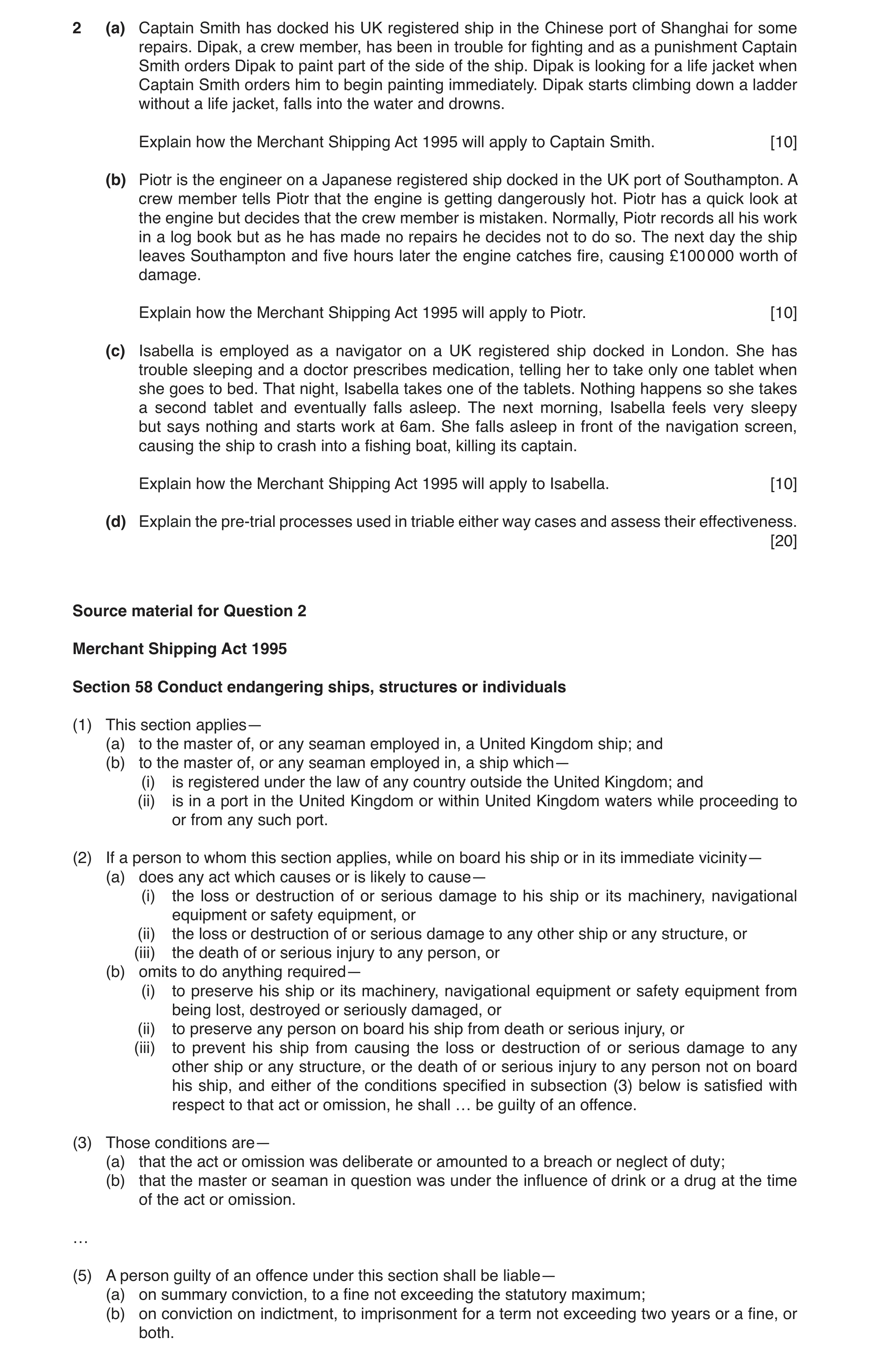
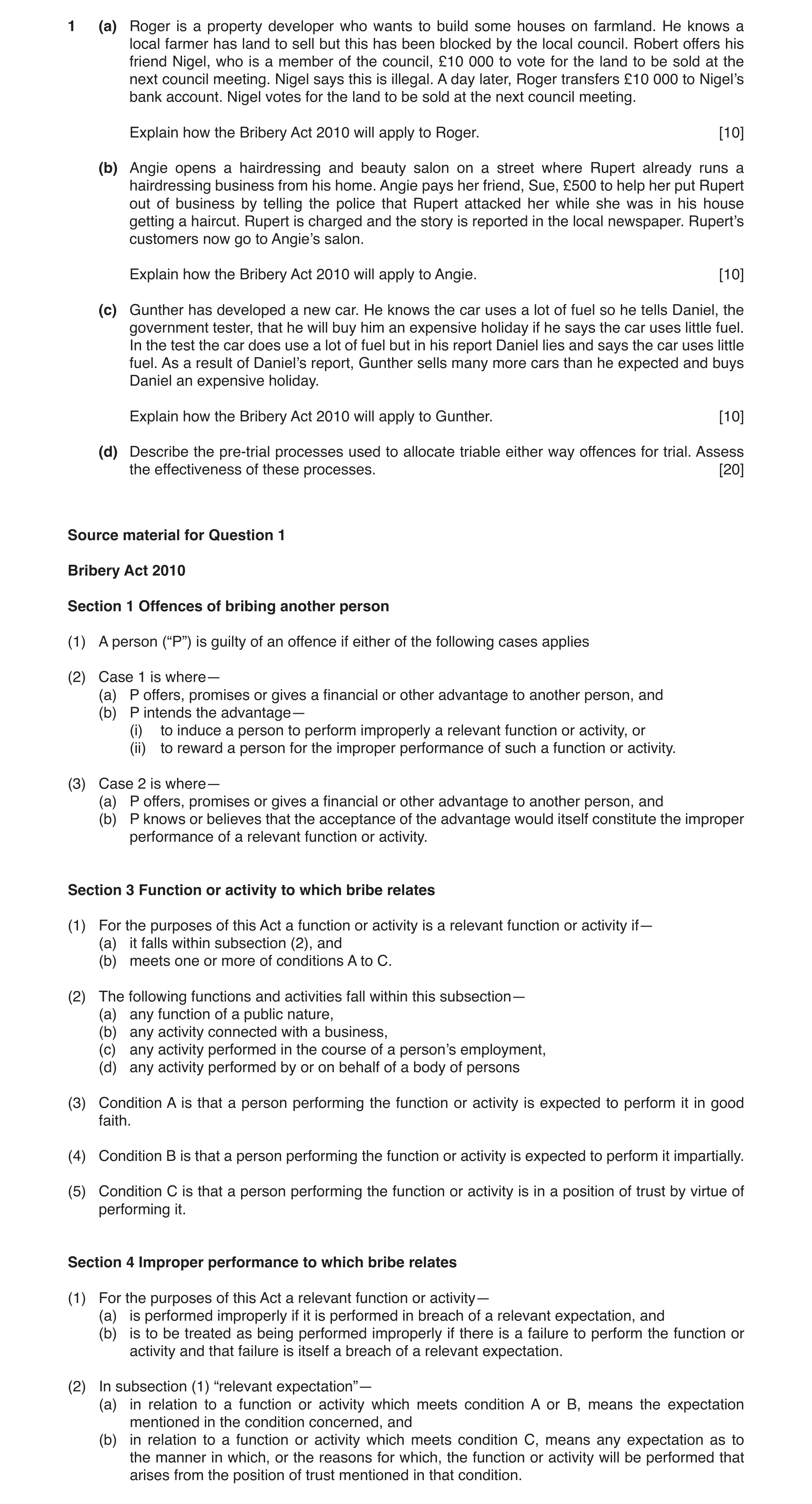
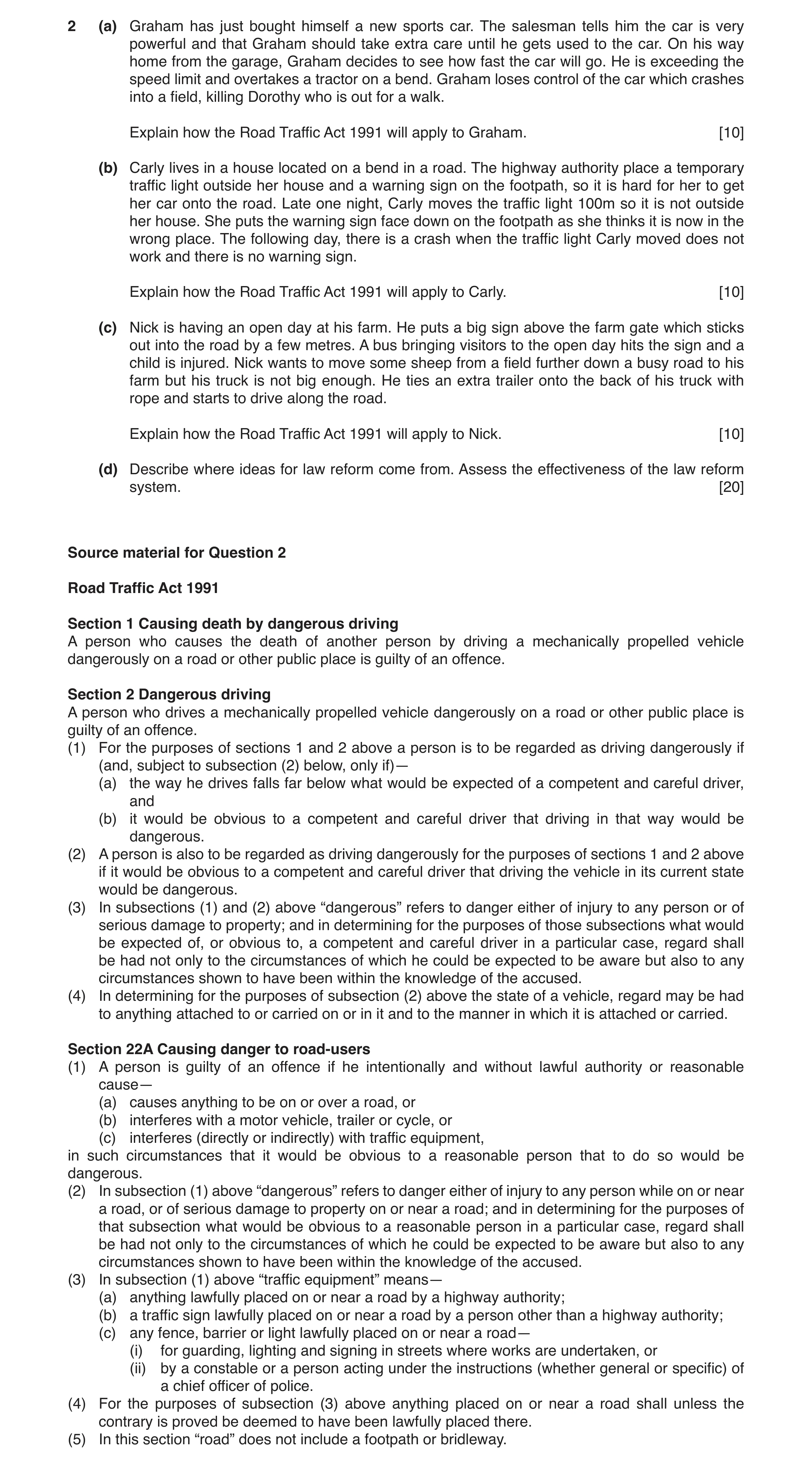
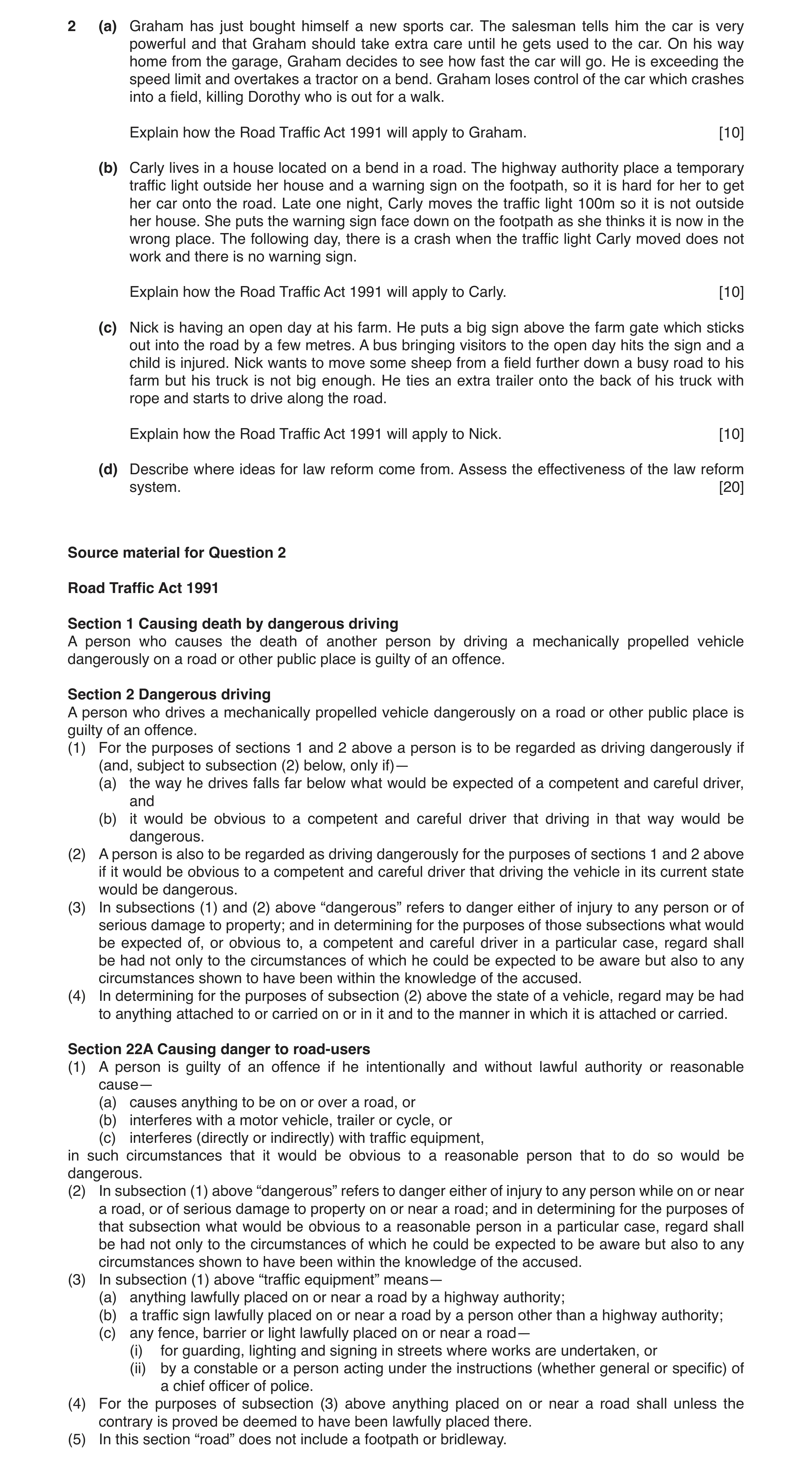
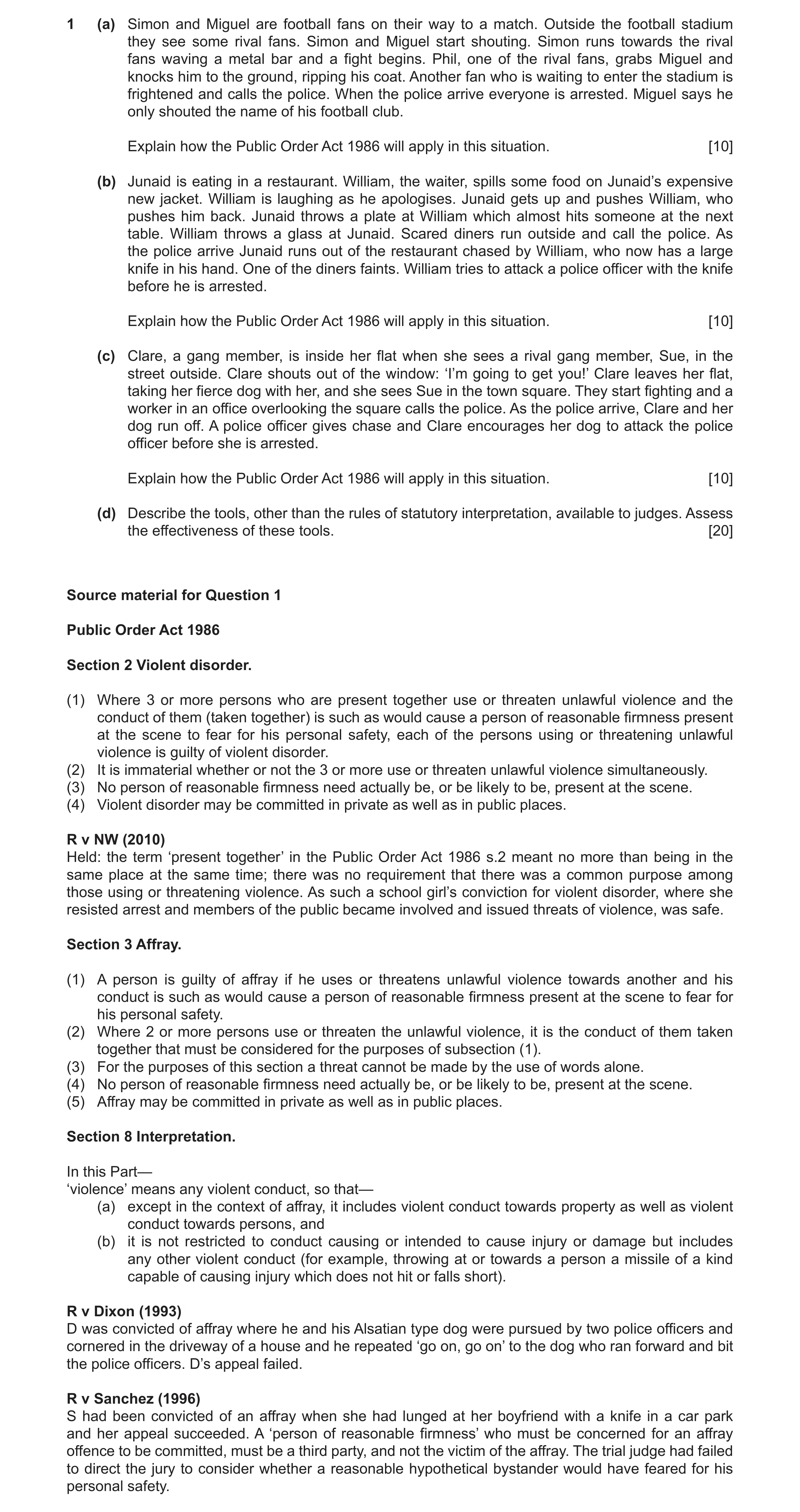
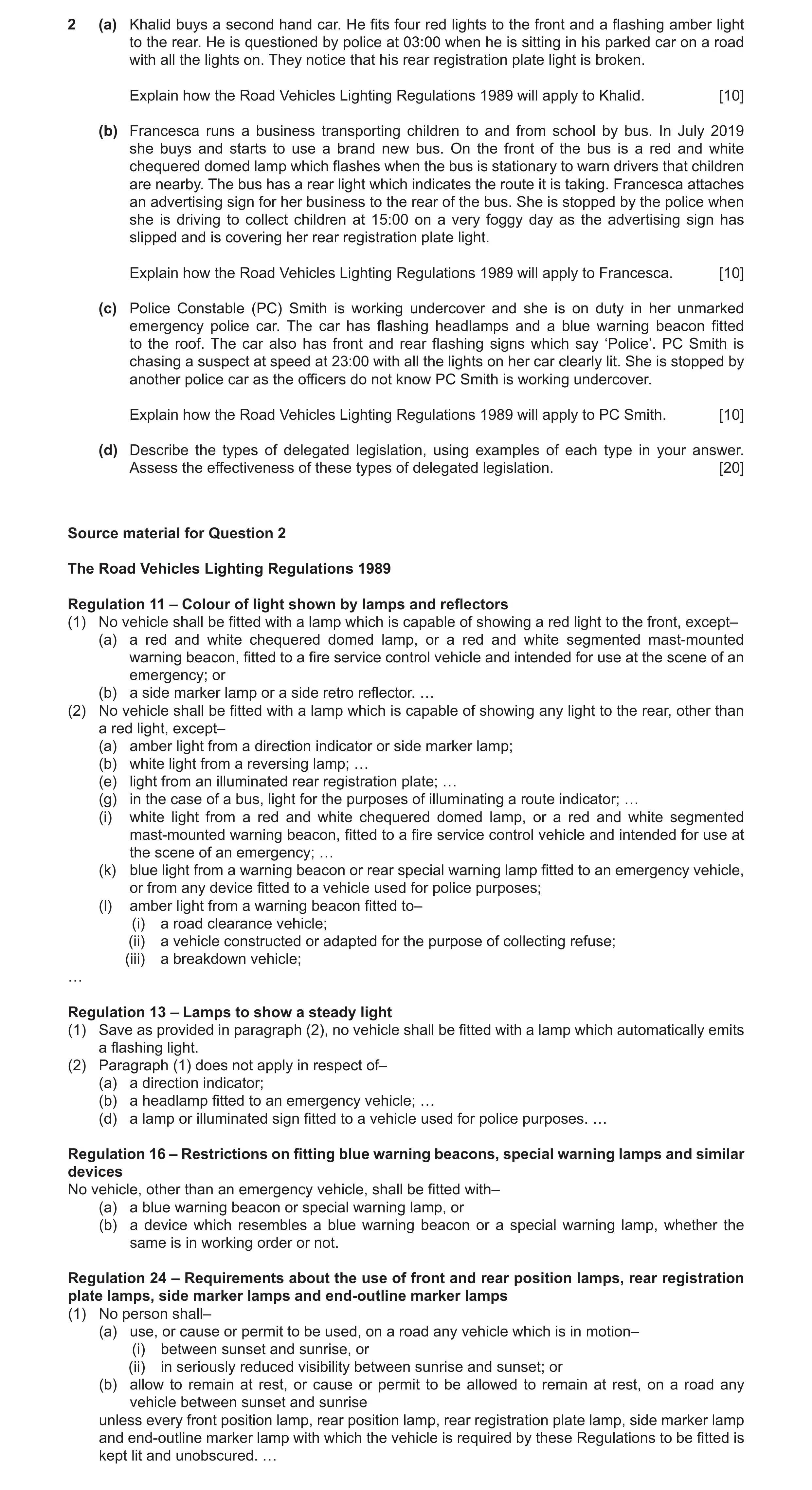
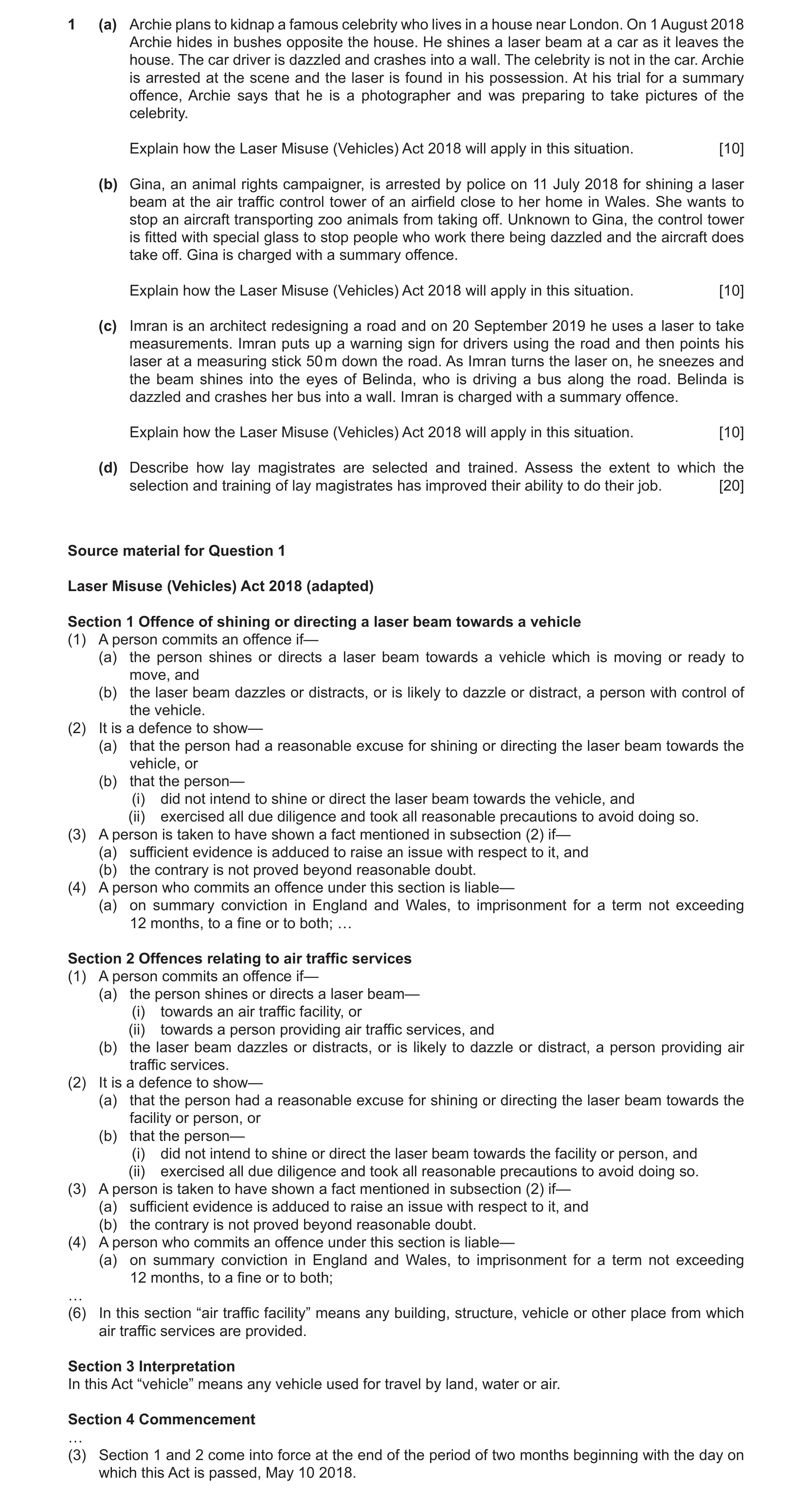
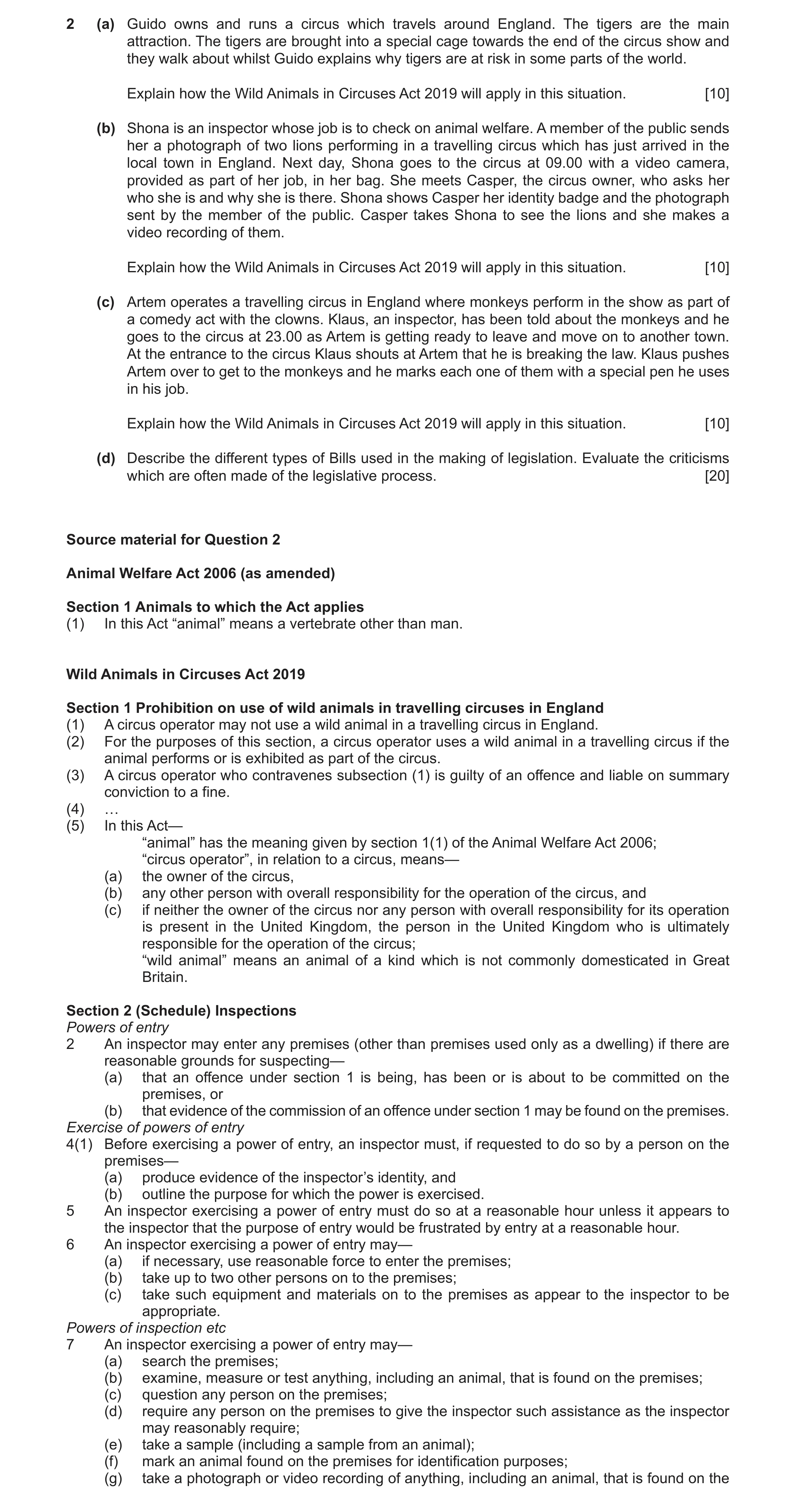
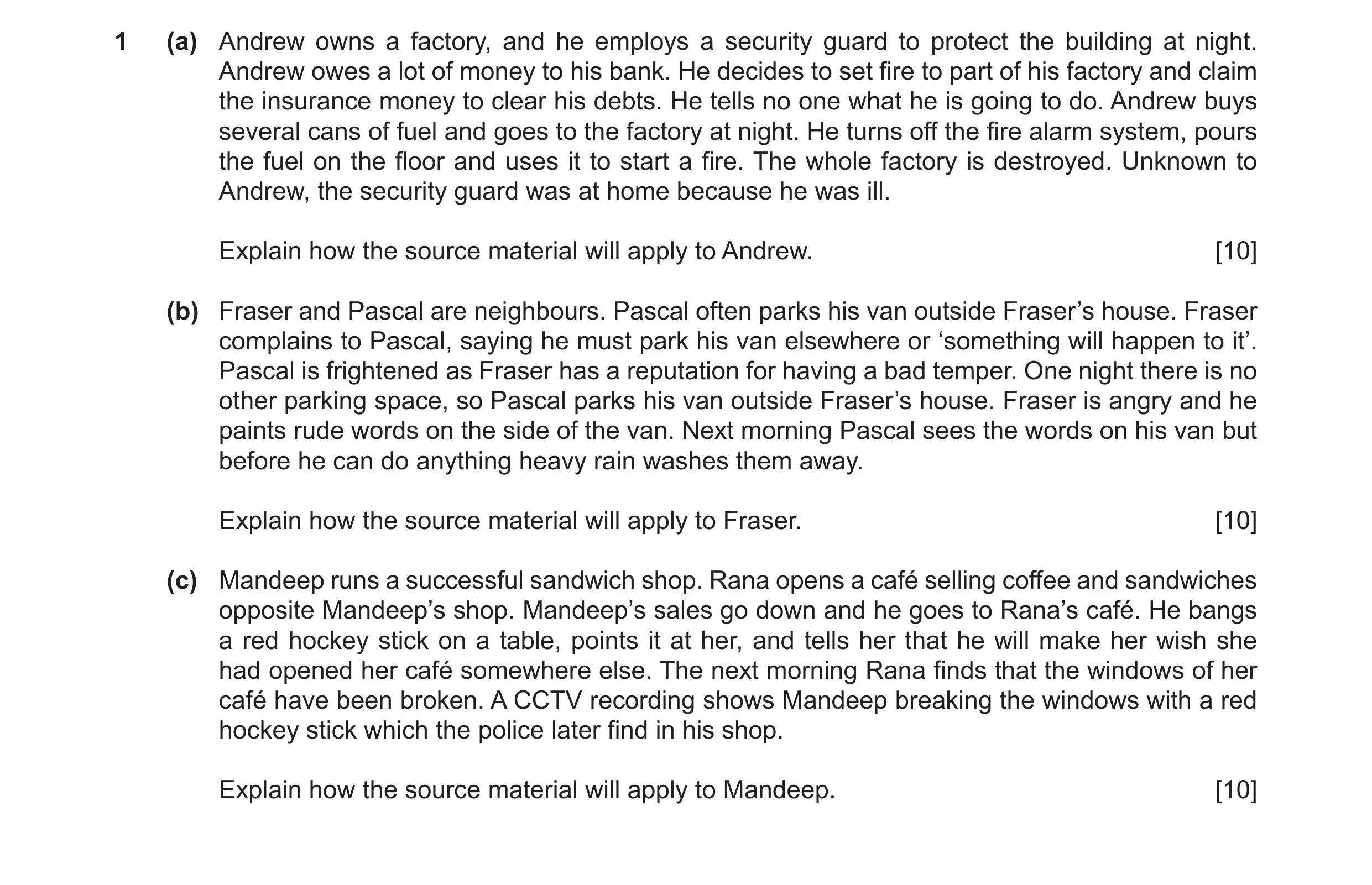 12 / 19
![Question 10: (a) Describe the chain of causation as an element of actus reus. [5] (b) Evaluate the law of burglary. [25] OR](https://img.pastlit.com/crops/5aacc016-1d05-4a17-b79a-58f86927af75/q2.webp)
![Question 11: (a) Describe omissions in actus reus. [5] (b) Evaluate the law on appropriation in theft. [25] OR](https://img.pastlit.com/crops/bee26cab-7a78-4ec5-81b4-6fc4fc002a8c/q2.webp)
![Question 12: (a) Describe the offence of handling stolen goods. [5] (b) Evaluate the law on causation in actus reus. [25] OR](https://img.pastlit.com/crops/b75bf2b0-bb72-499b-834d-d9ea3072a504/q2.webp)
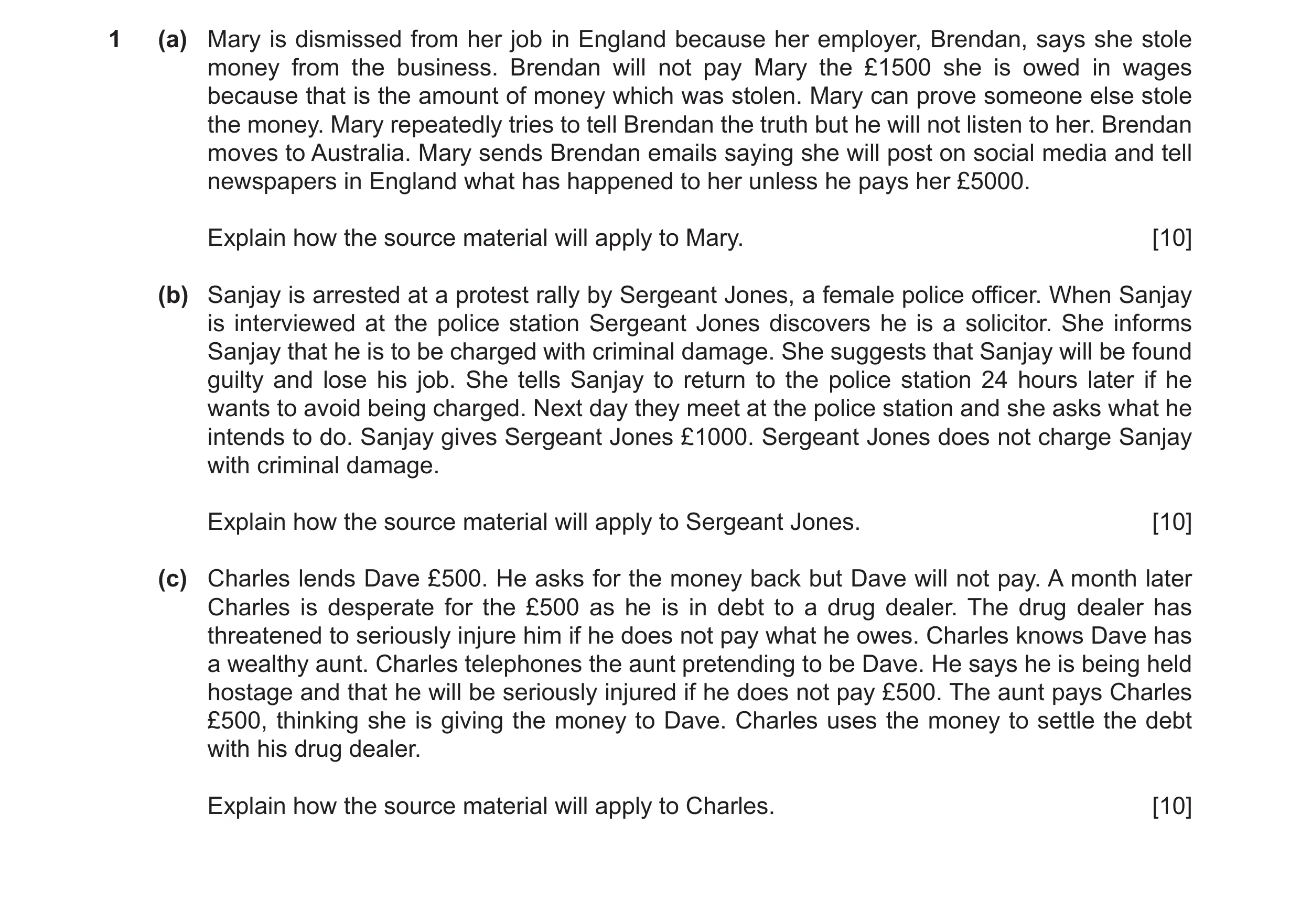 13 / 19
![Question 14: (a) Describe the offence of aggravated burglary. [5] (b) Evaluate the law on omissions in actus reus. [25] OR](https://img.pastlit.com/crops/f8be1518-8455-4542-a9b5-f533599c1f9b/q2.webp)
![Question 15: (a) Describe the offence of handling stolen goods. [5] (b) Evaluate the law on causation in actus reus. [25] OR](https://img.pastlit.com/crops/8ac62cc5-2ee8-48f7-ae51-446003056ed1/q2.webp) 14 / 19
14 / 19![Question 16: (a) Describe the offence of obtaining services dishonestly. [5] (b) Evaluate the fairness of the law on omissions in actus reus. [25] Sourc…](https://img.pastlit.com/crops/54863a47-7948-4f7b-810b-c5ce3d35ff7d/q3.webp) 15 / 19
15 / 19![Question 17: (a) Describe the law on direct intention in criminal law. [5] (b) Evaluate the effectiveness of the law of fraud. [25] Source material for …](https://img.pastlit.com/crops/e4b56bac-a168-4bba-b743-3f8b87bed074/q3.webp) 16 / 19
16 / 19![Question 18: (a) Describe the law on recklessness in criminal law. [5] (b) Evaluate the effectiveness of the law of burglary. [25] Source material for S…](https://img.pastlit.com/crops/95d55862-2c4c-45d0-9d68-efc3e9df5761/q3.webp) 17 / 19
17 / 19![Question 19: (a) Describe the law on recklessness in criminal law. [5] (b) Evaluate the effectiveness of the law of burglary. [25] Source material for S…](https://img.pastlit.com/crops/f27c4ac9-b013-4755-a1ba-a321467461e0/q3.webp) 18 / 19
18 / 19![Question 20: (a) Describe indirect/oblique intention in mens rea. [5] (b) Evaluate the effectiveness of the factors used when sentencing offenders. [25]…](https://img.pastlit.com/crops/3651a27d-8c66-4818-baaa-c99658539b85/q2.webp)
![Question 21: (a) Describe indirect/oblique intention in mens rea. [5] (b) Evaluate the effectiveness of the factors used when sentencing offenders. [25]…](https://img.pastlit.com/crops/130f1202-216e-42fd-9a5e-8010d105ece5/q2.webp) 19 / 19
19 / 19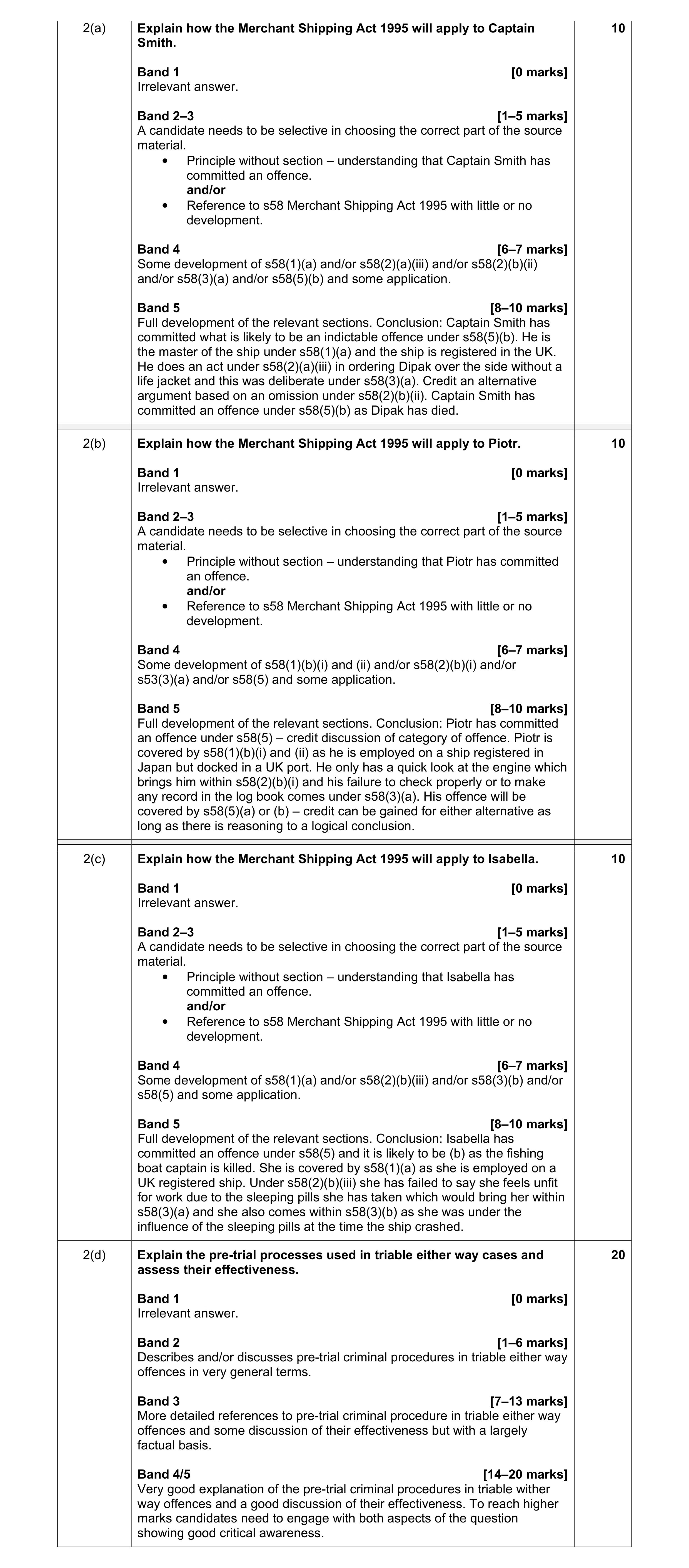 50
50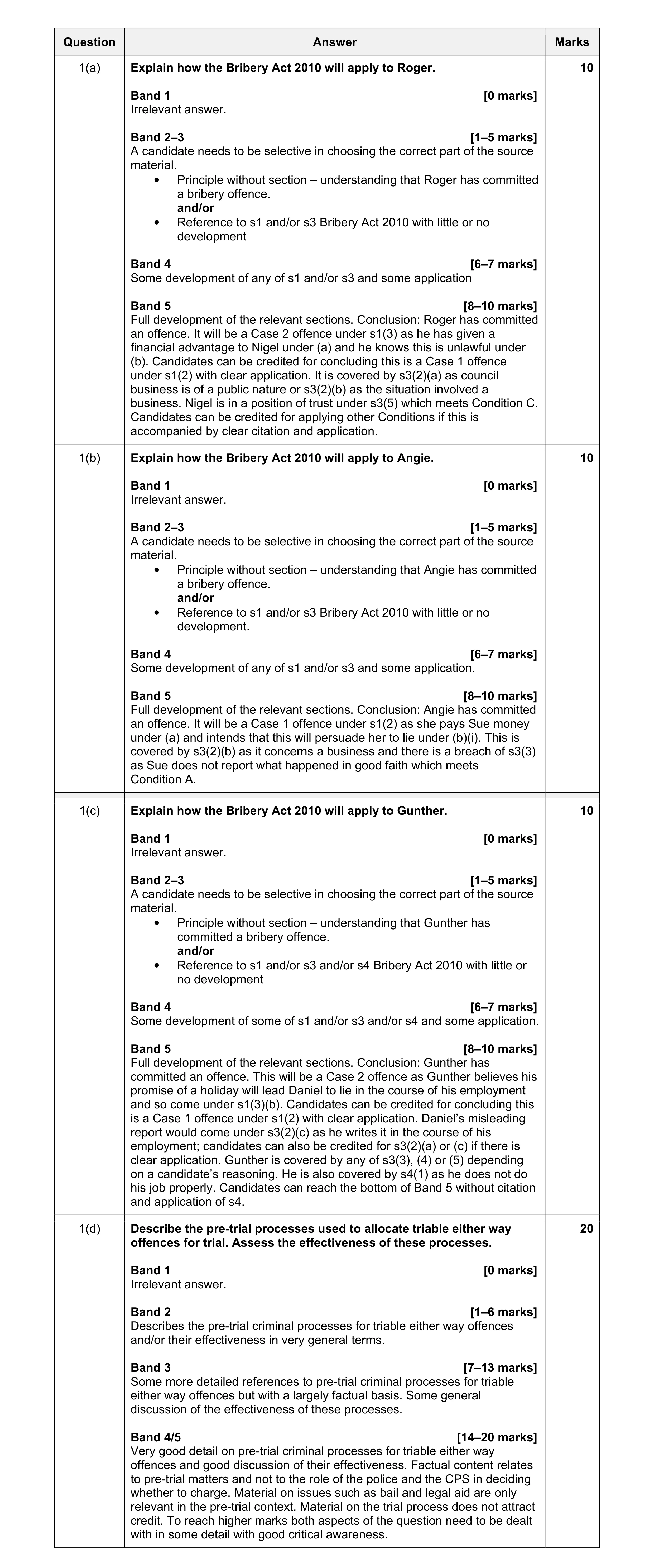 50
50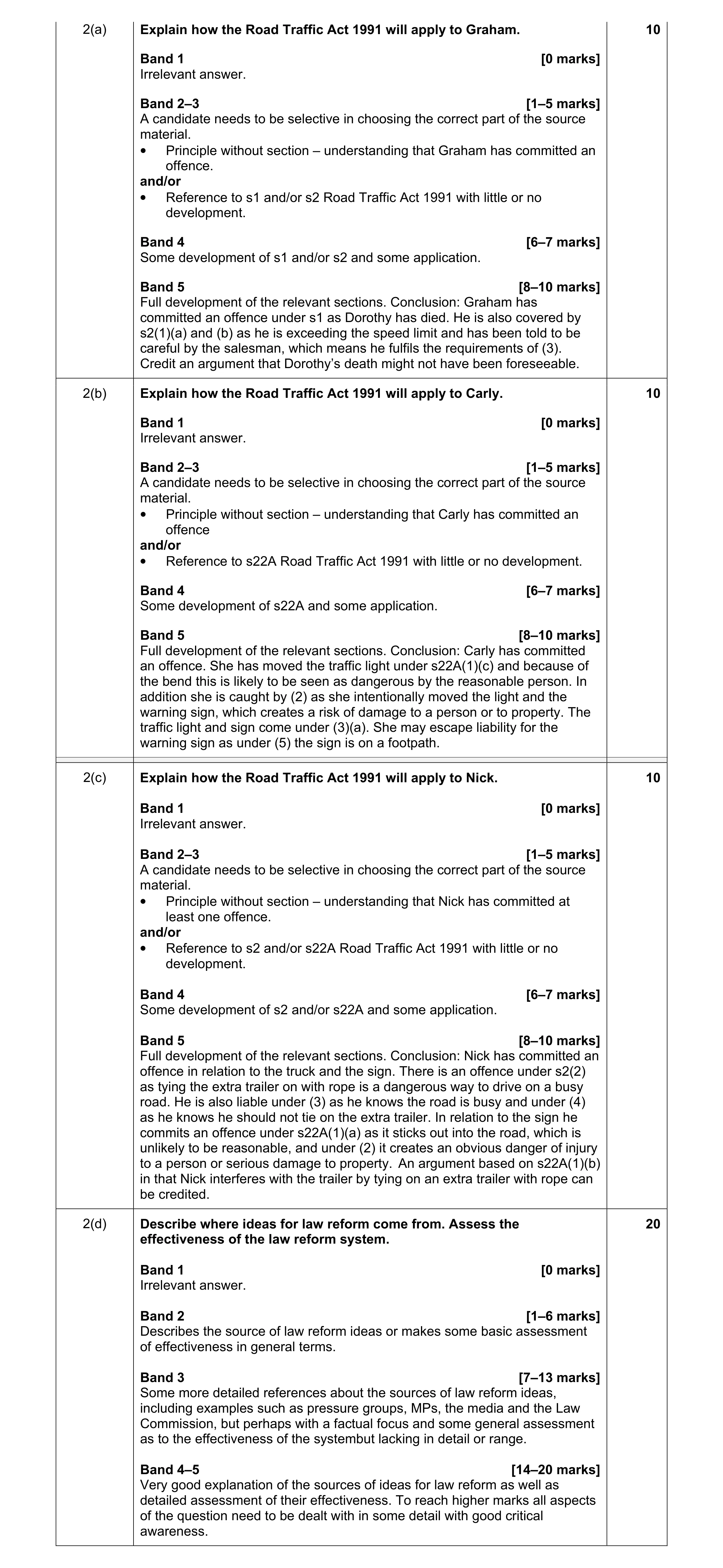 50
50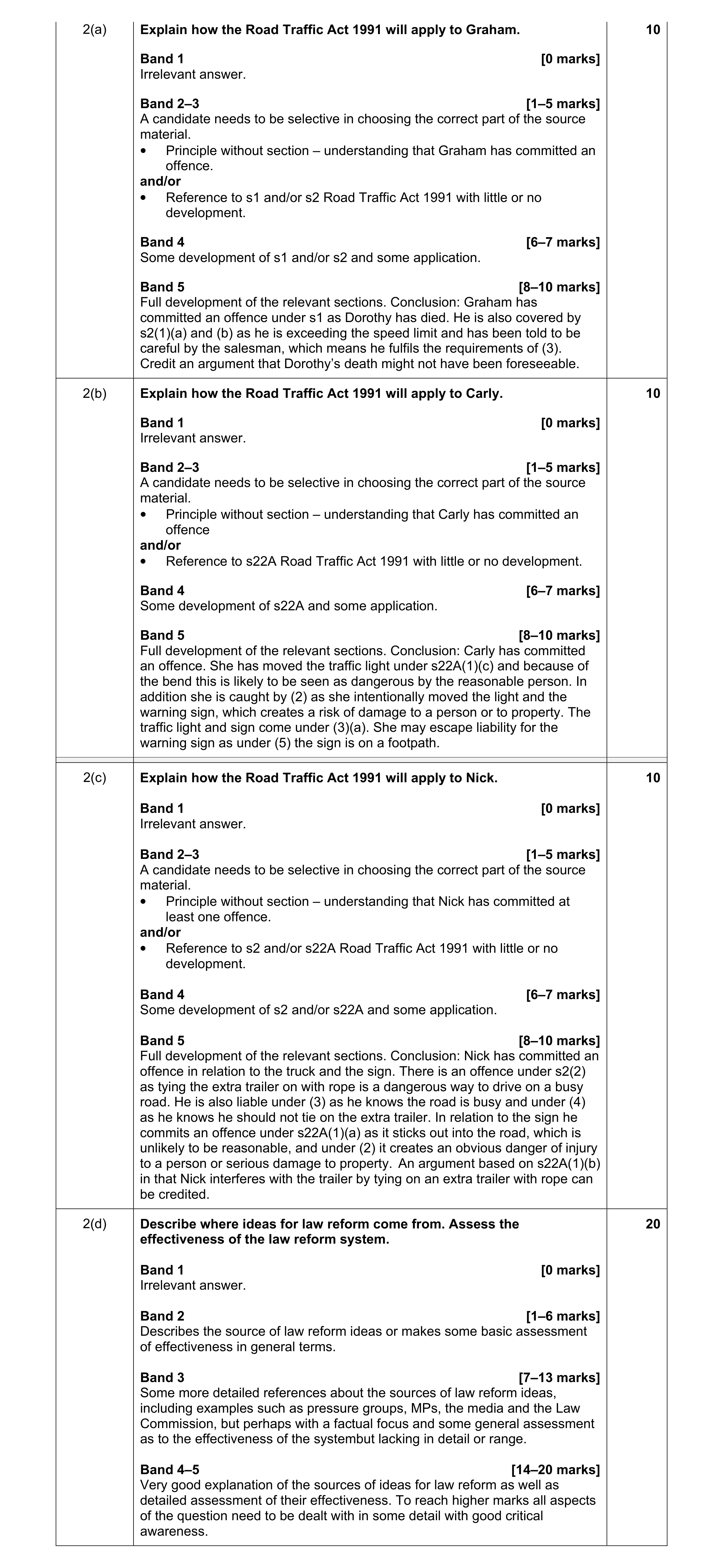 50
50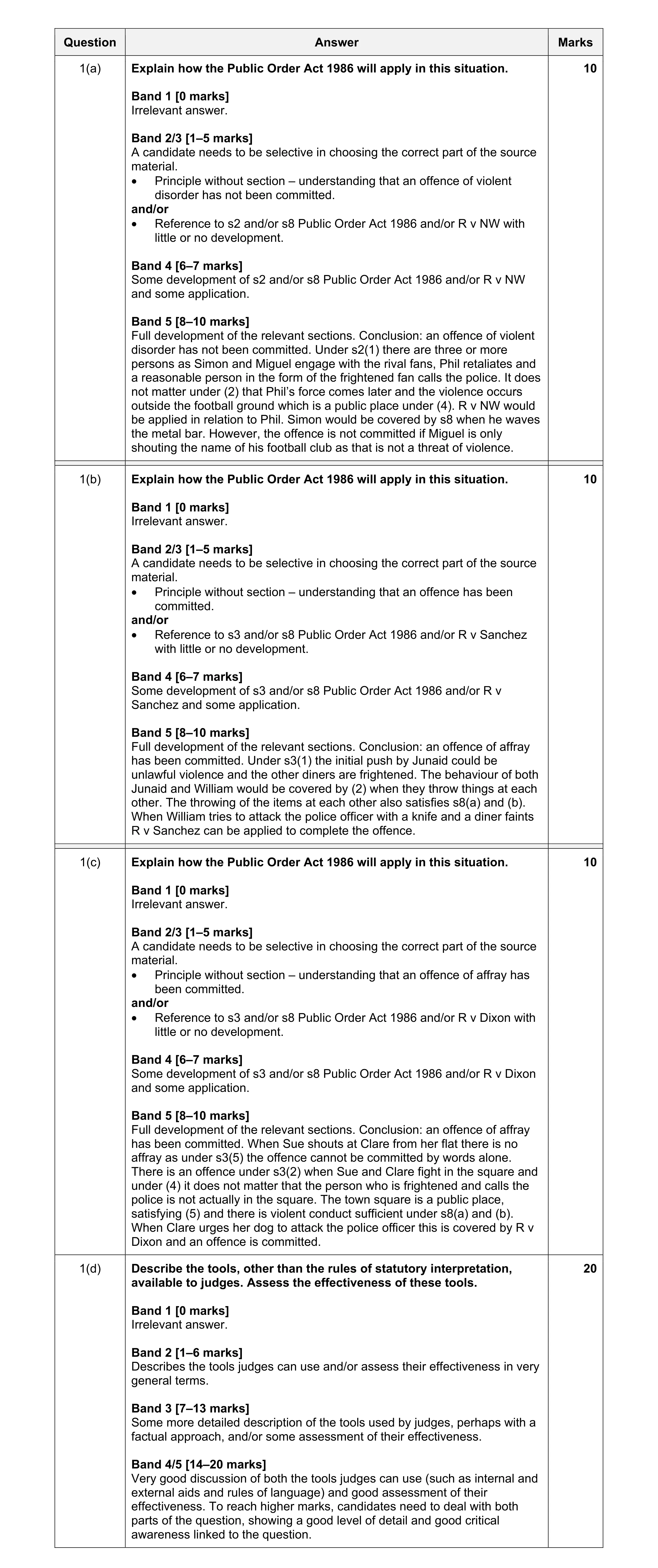 50
50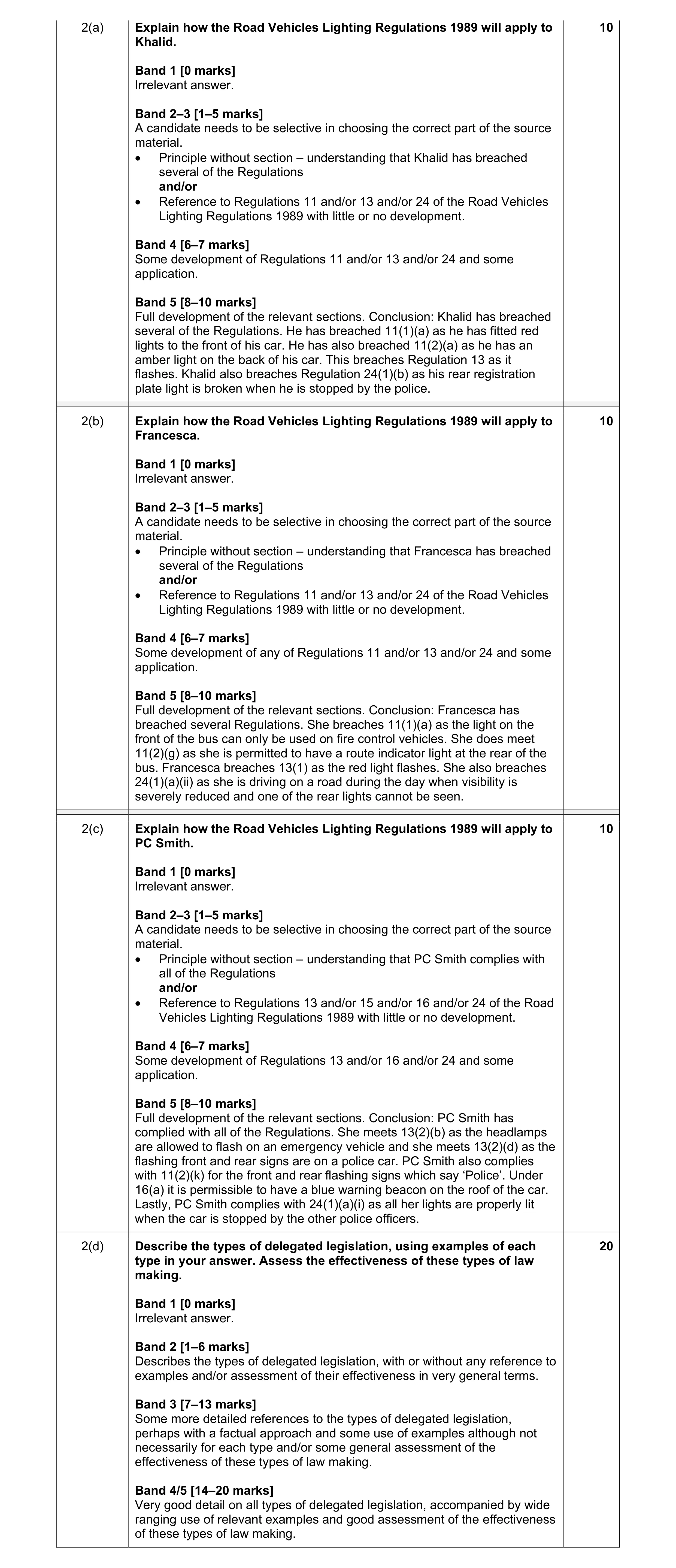 50
50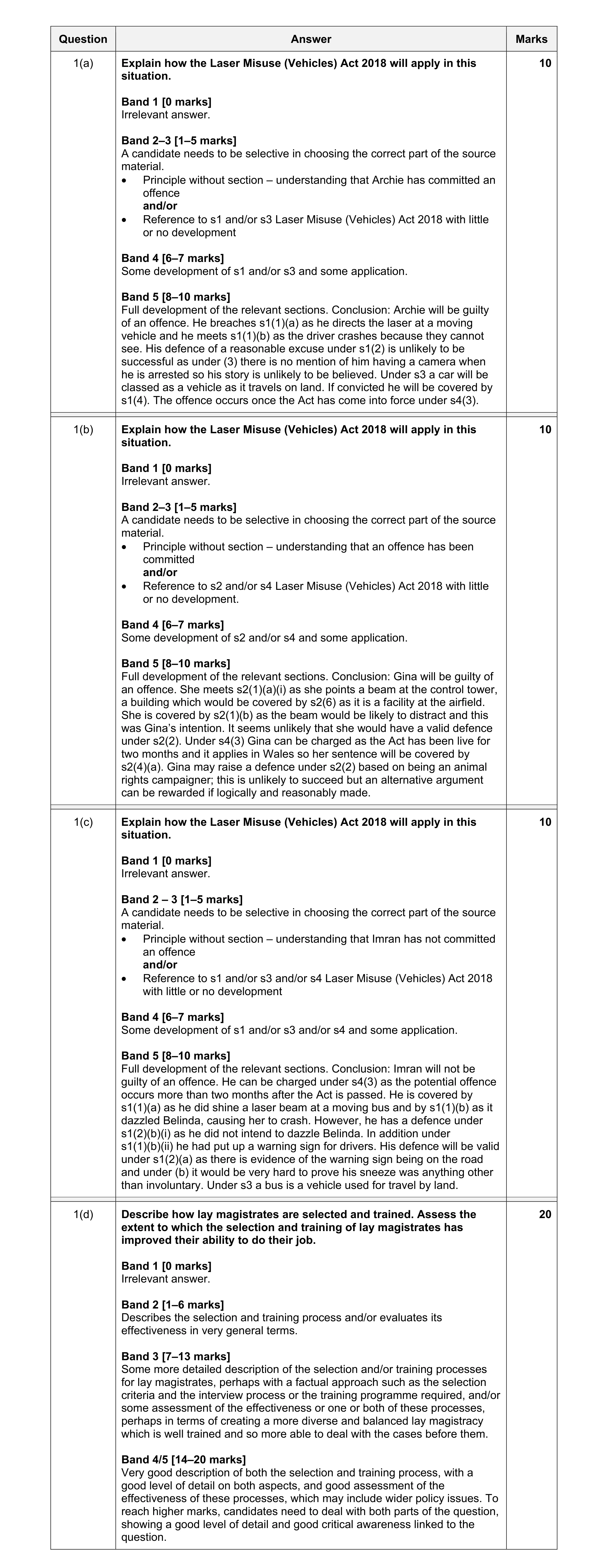 50
50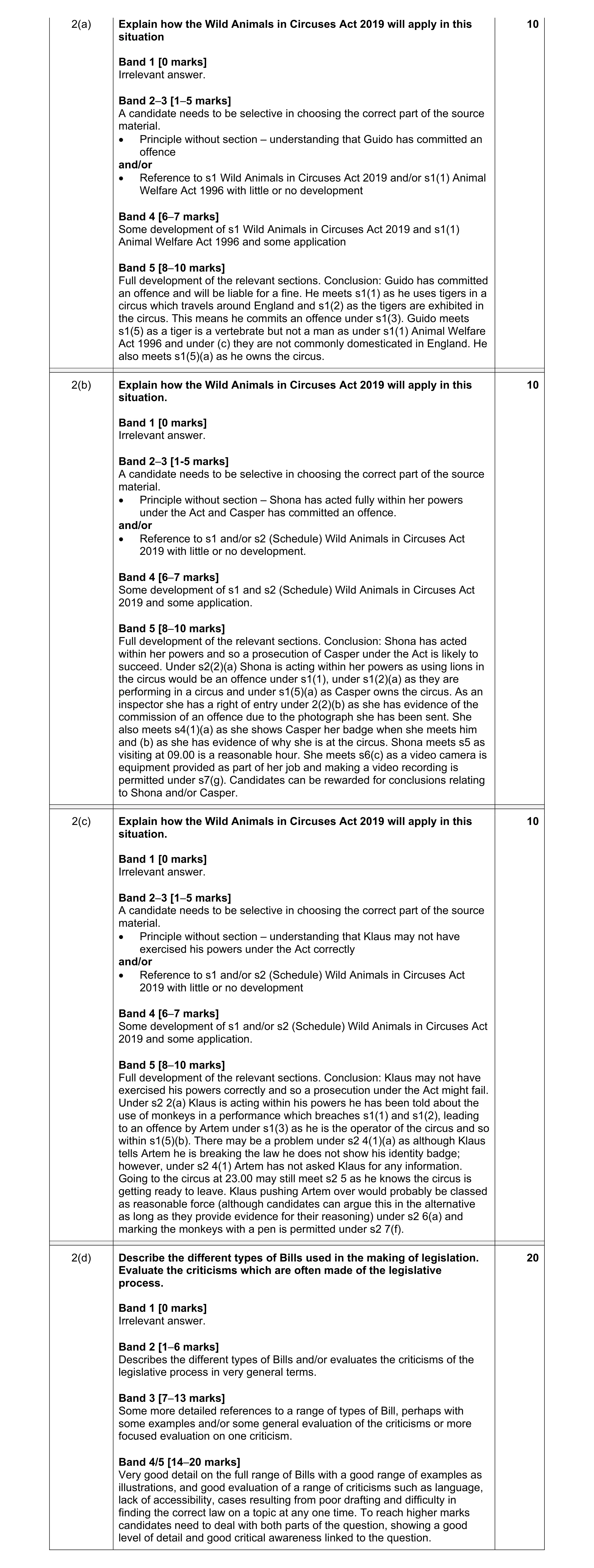 50
50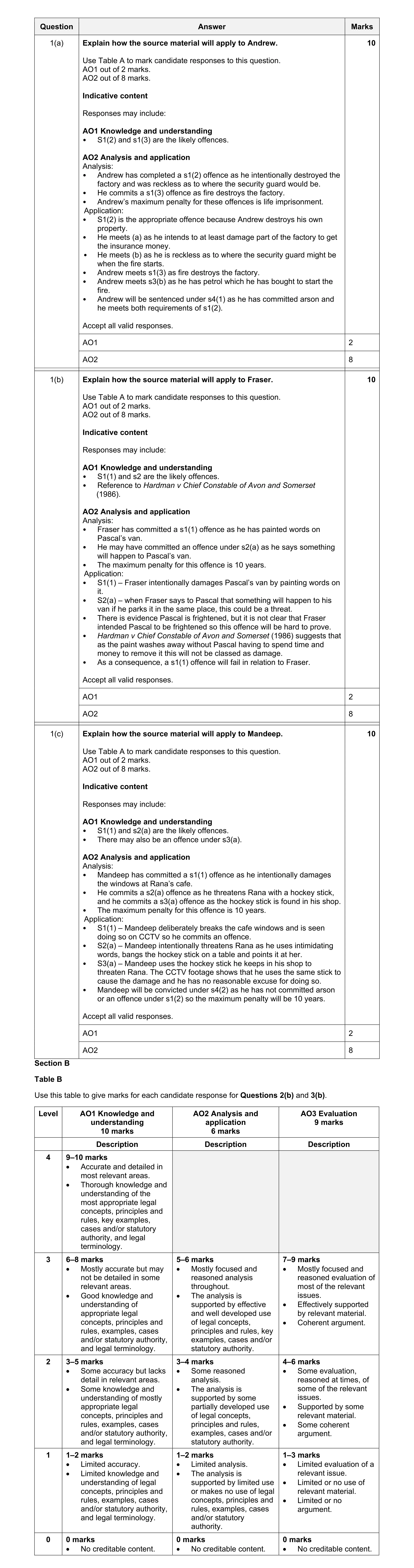 30
30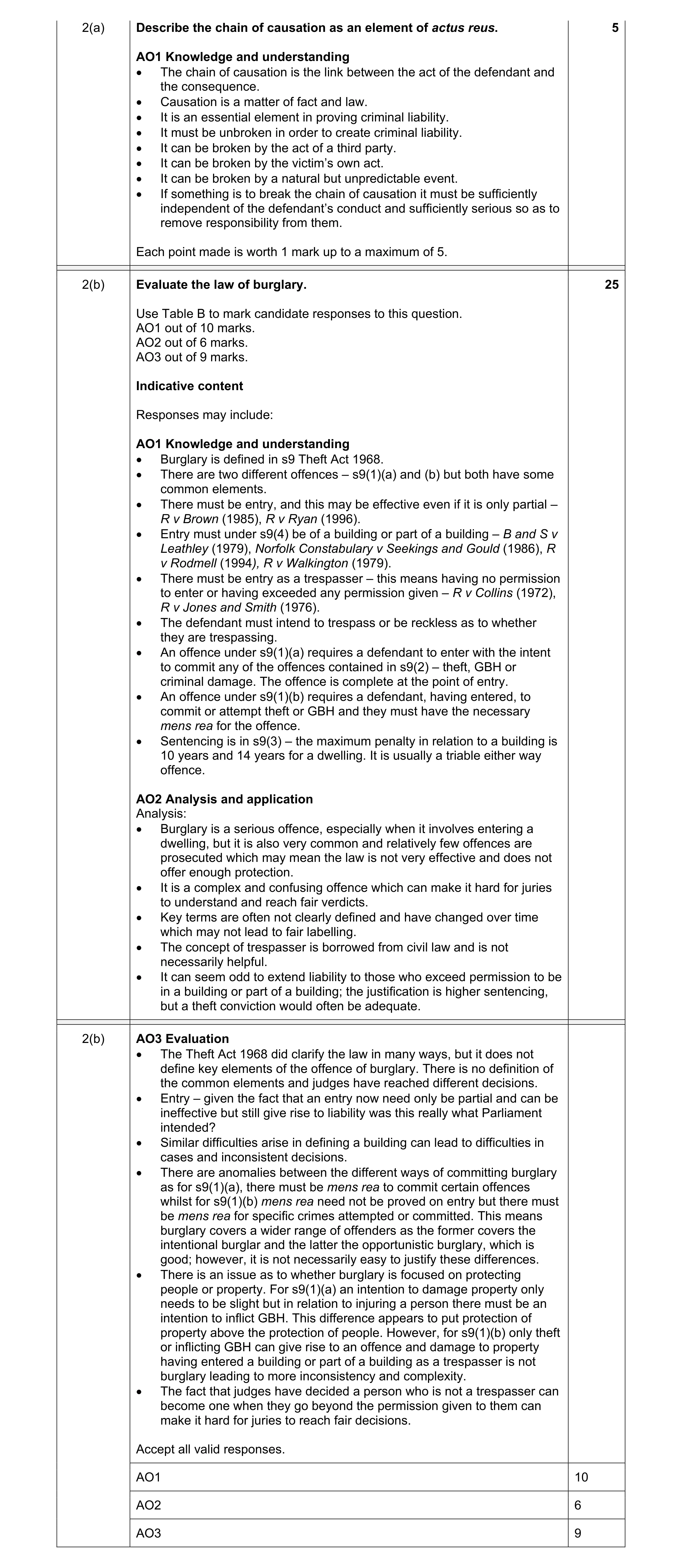 30
30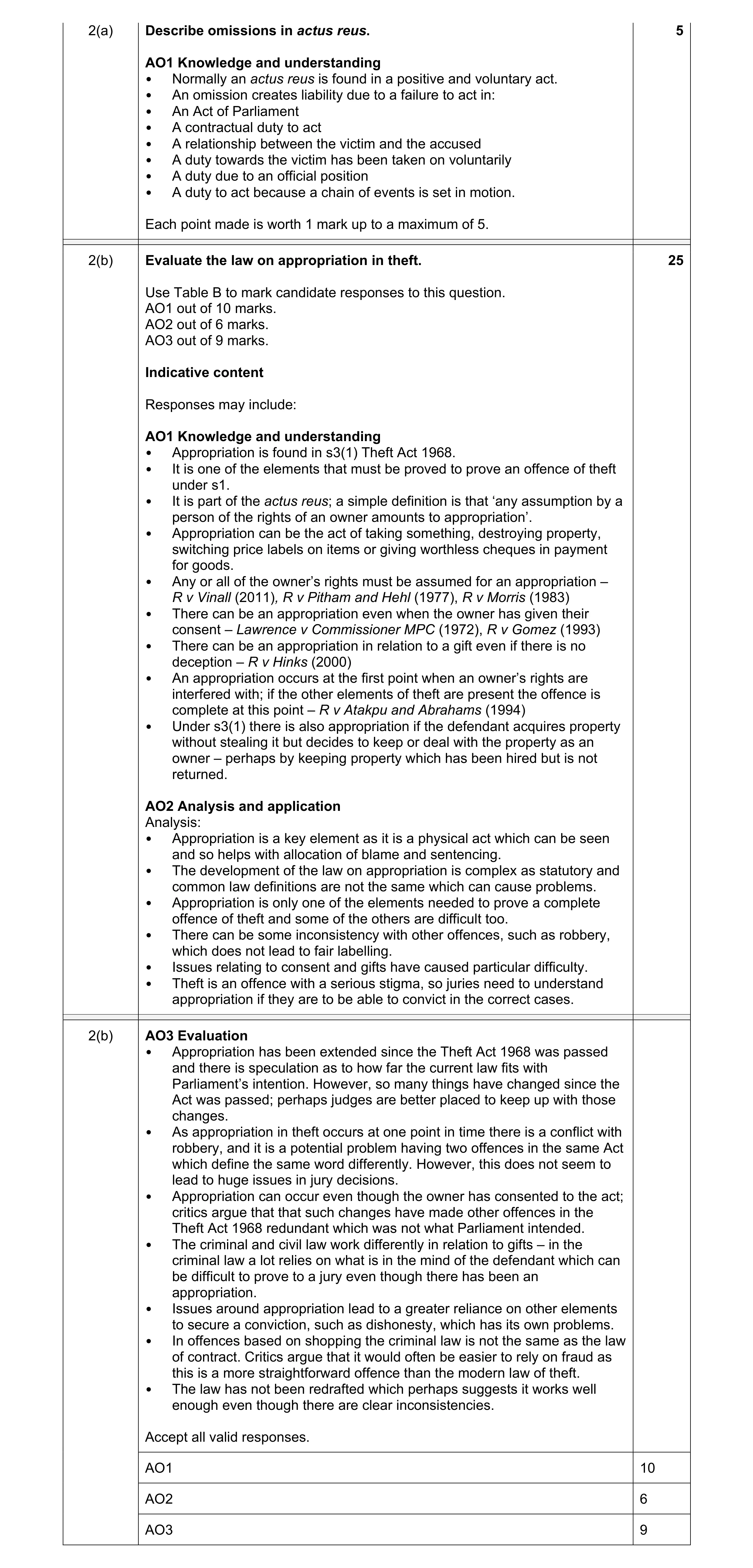 30
30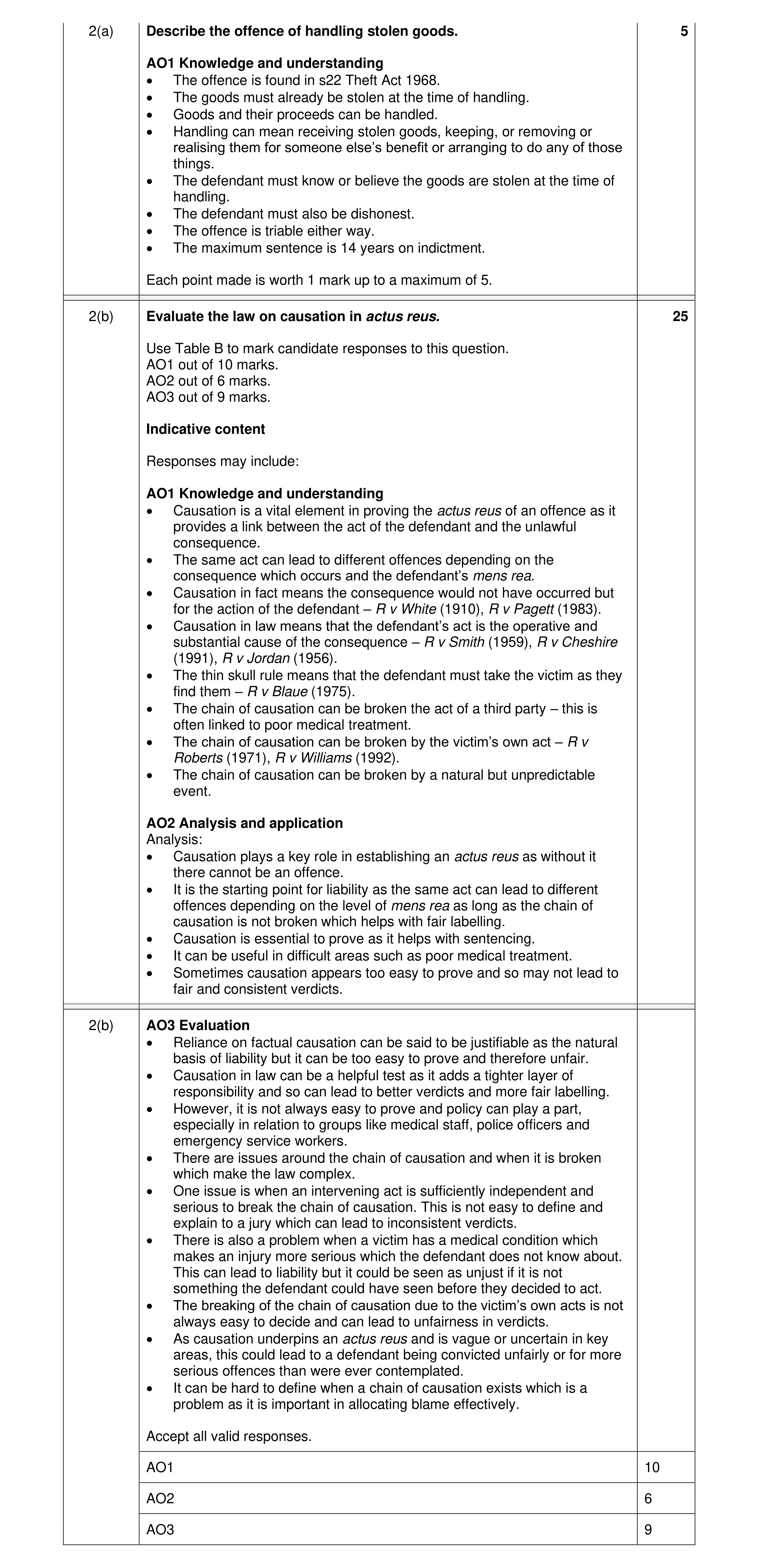 30
30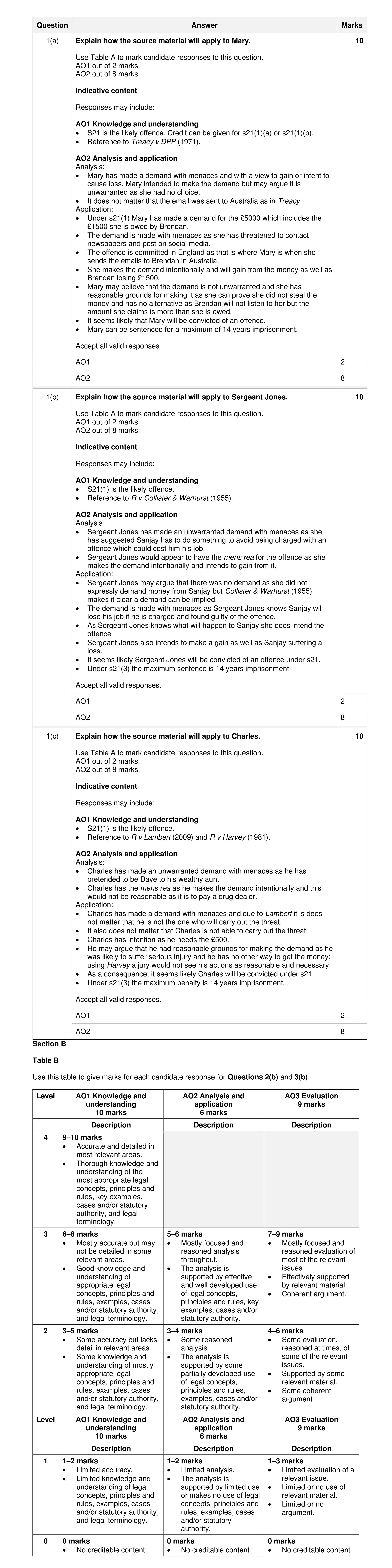 30
30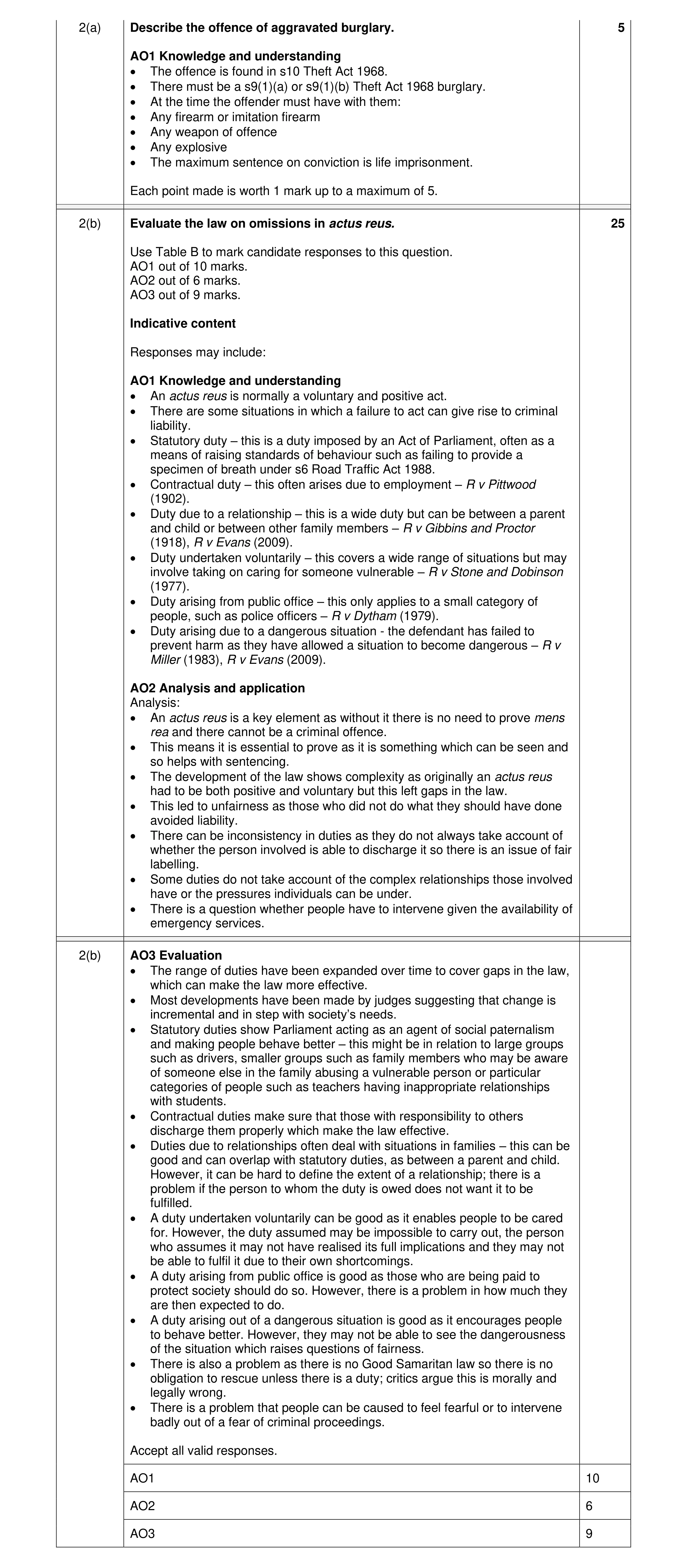 30
30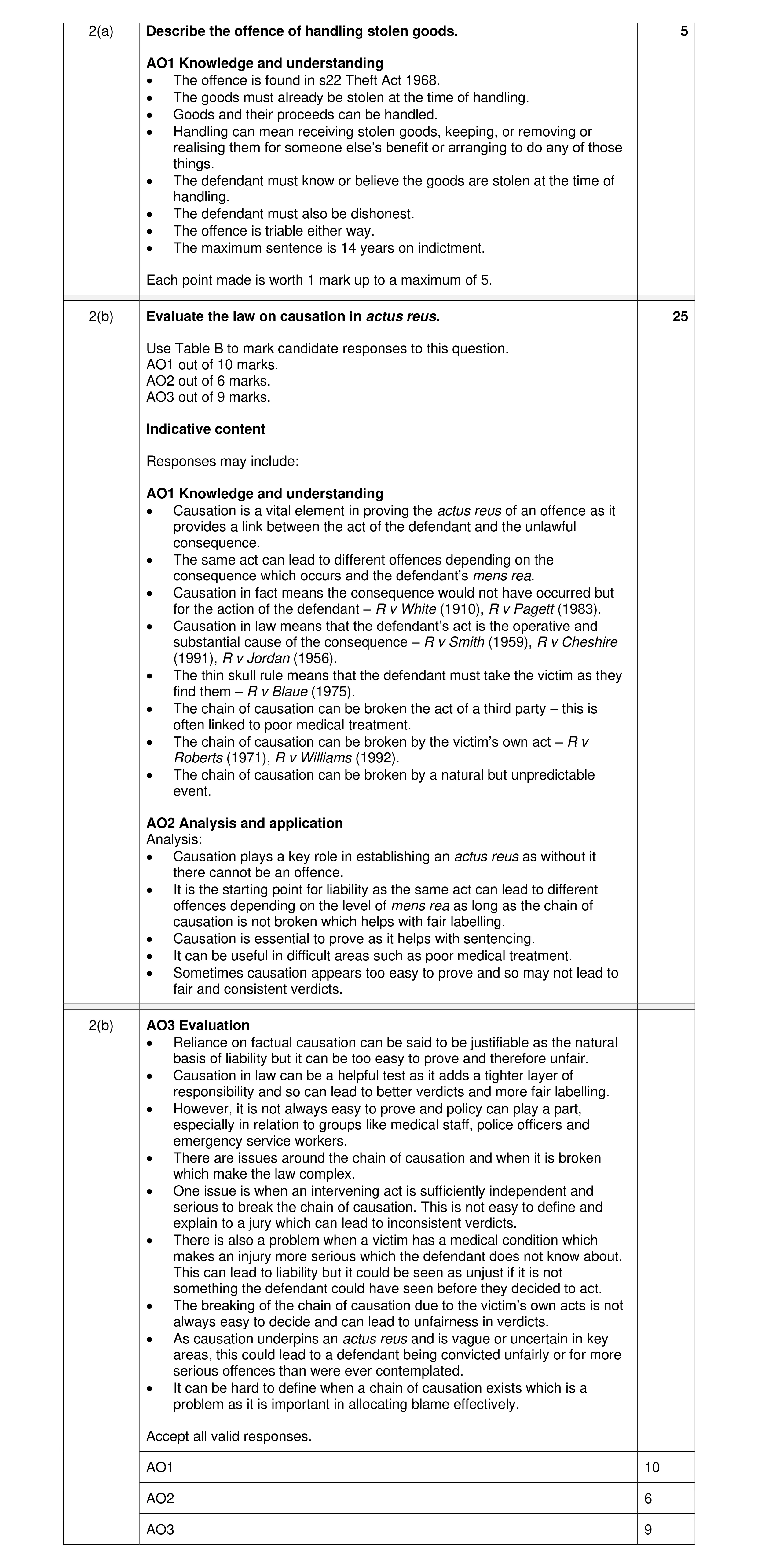 30
30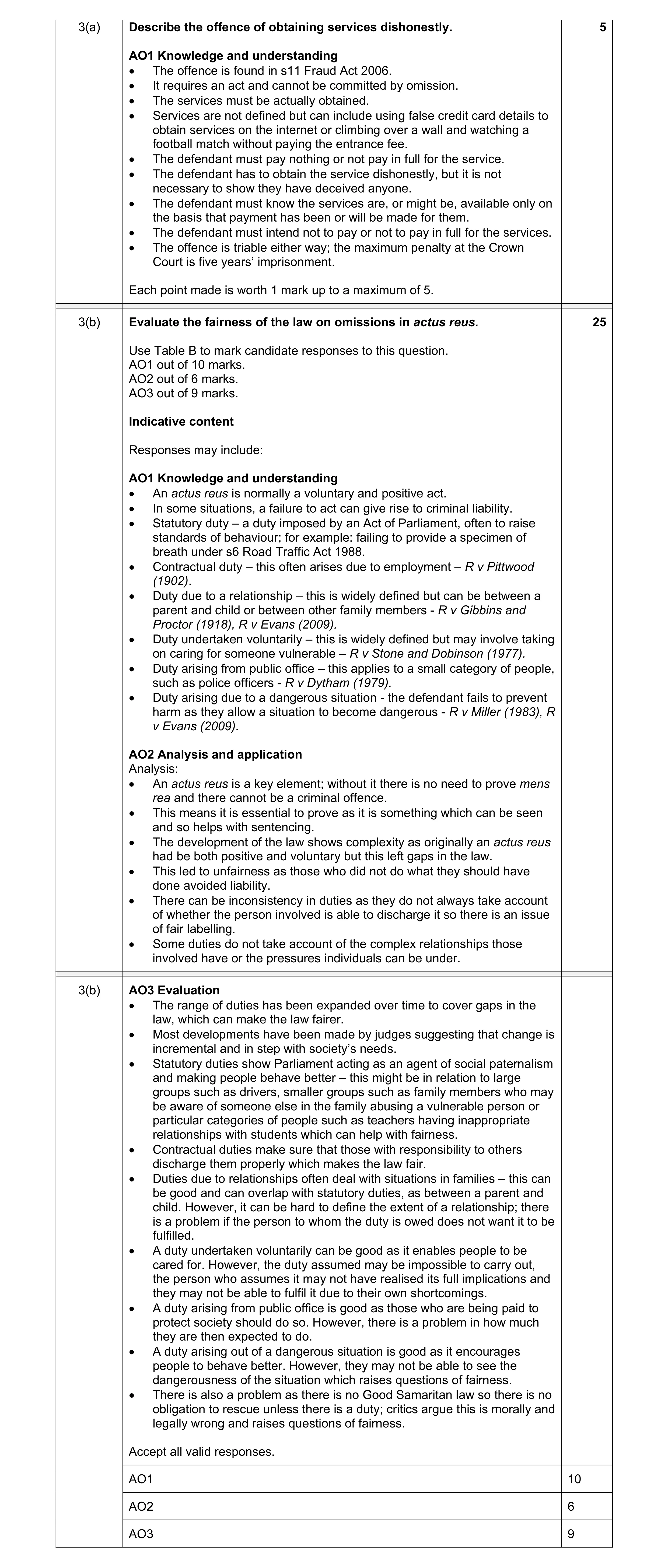 30
30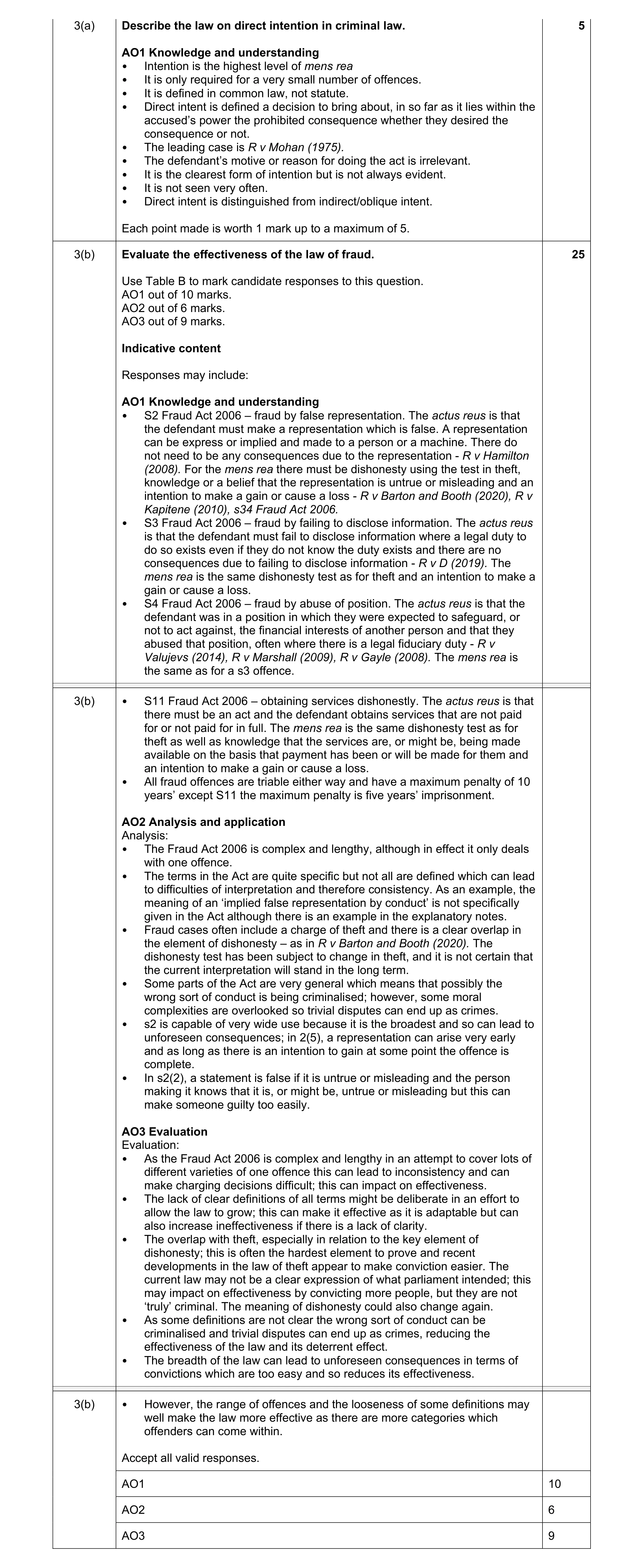 30
30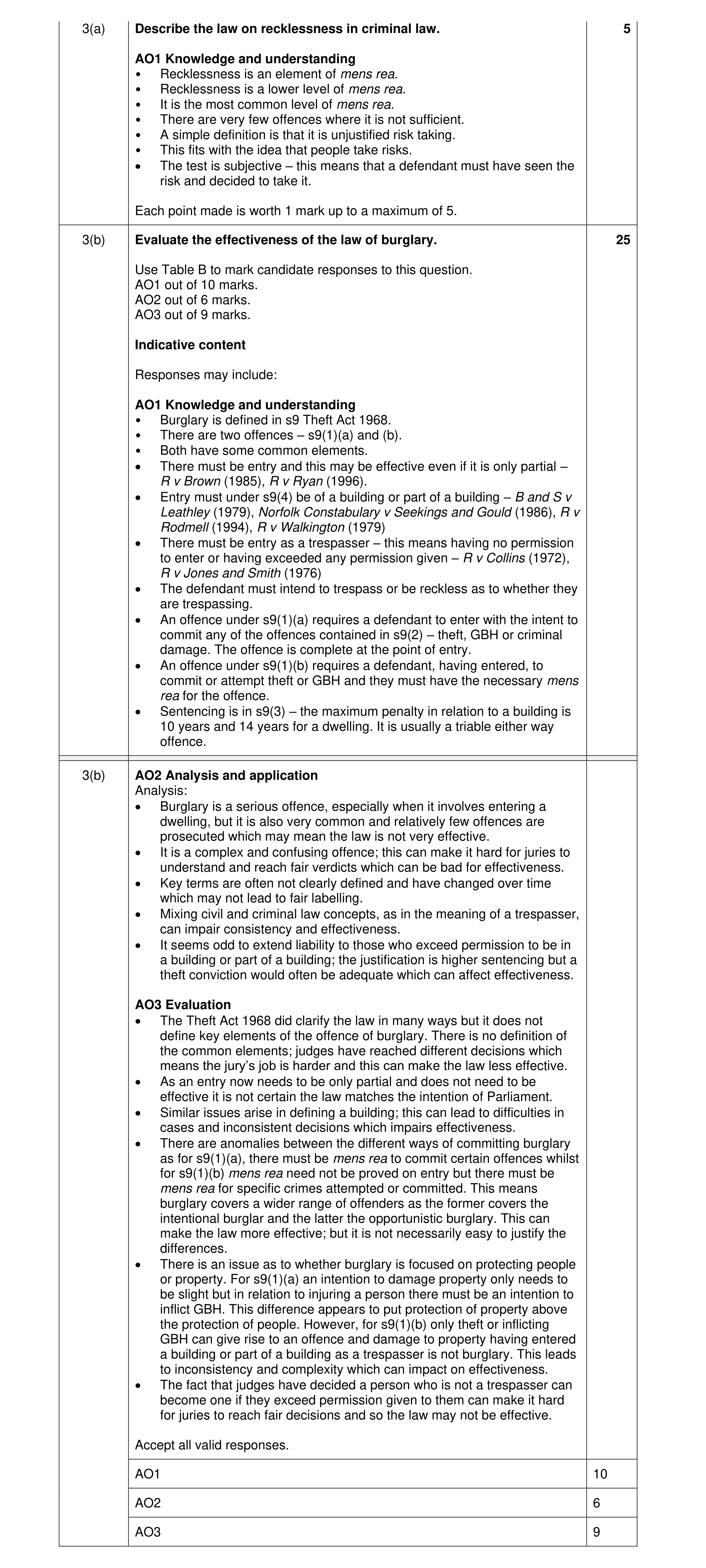 30
30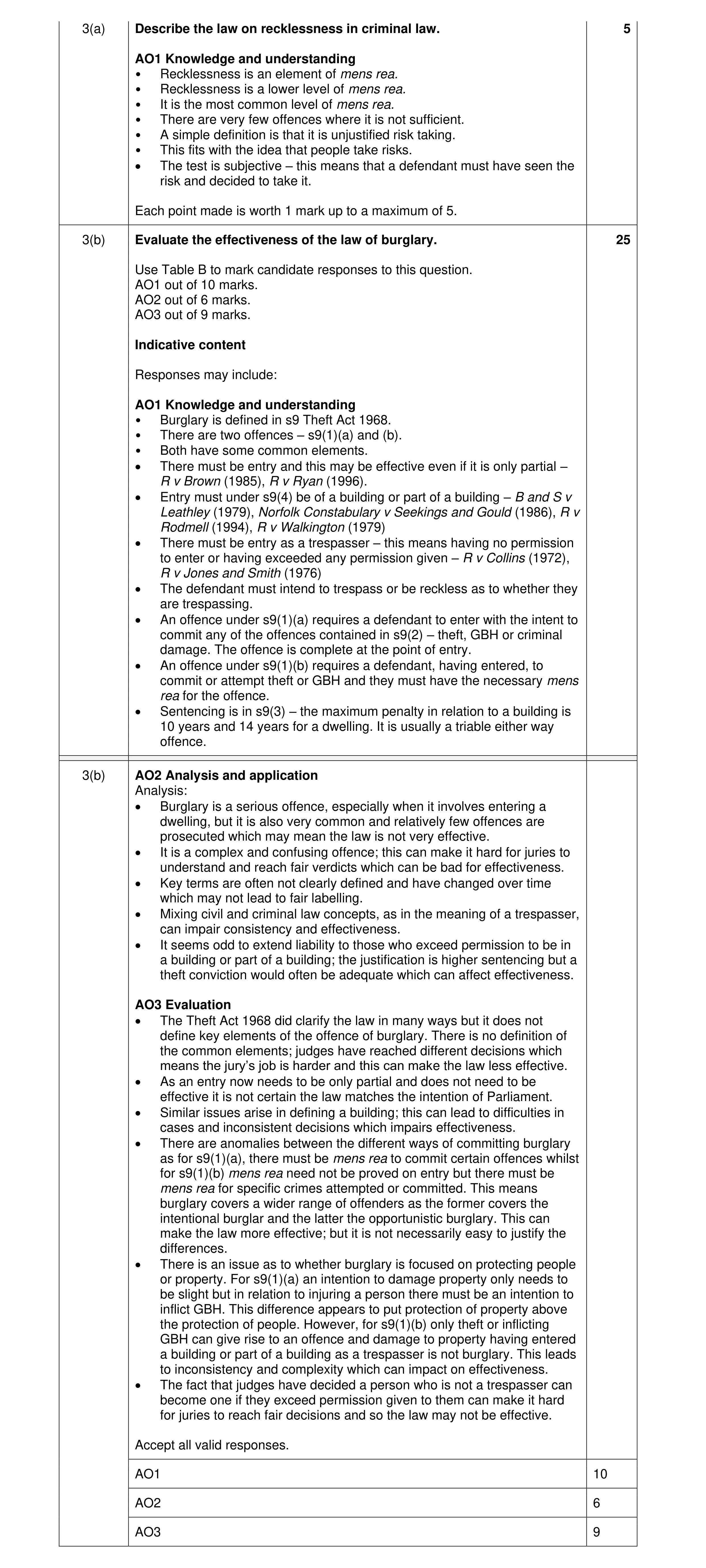 30
30 30
30 30
30