Cambridge A Level Law 9084 — 2024 Oct/Nov Paper 2 · Variant 3
9084/23/O/N/24 · 3 questions · 60 marks · ≈68 min
The question paper and its mark scheme, free to read here and free to download. This is Cambridge’s own paper, exactly as it was sat.
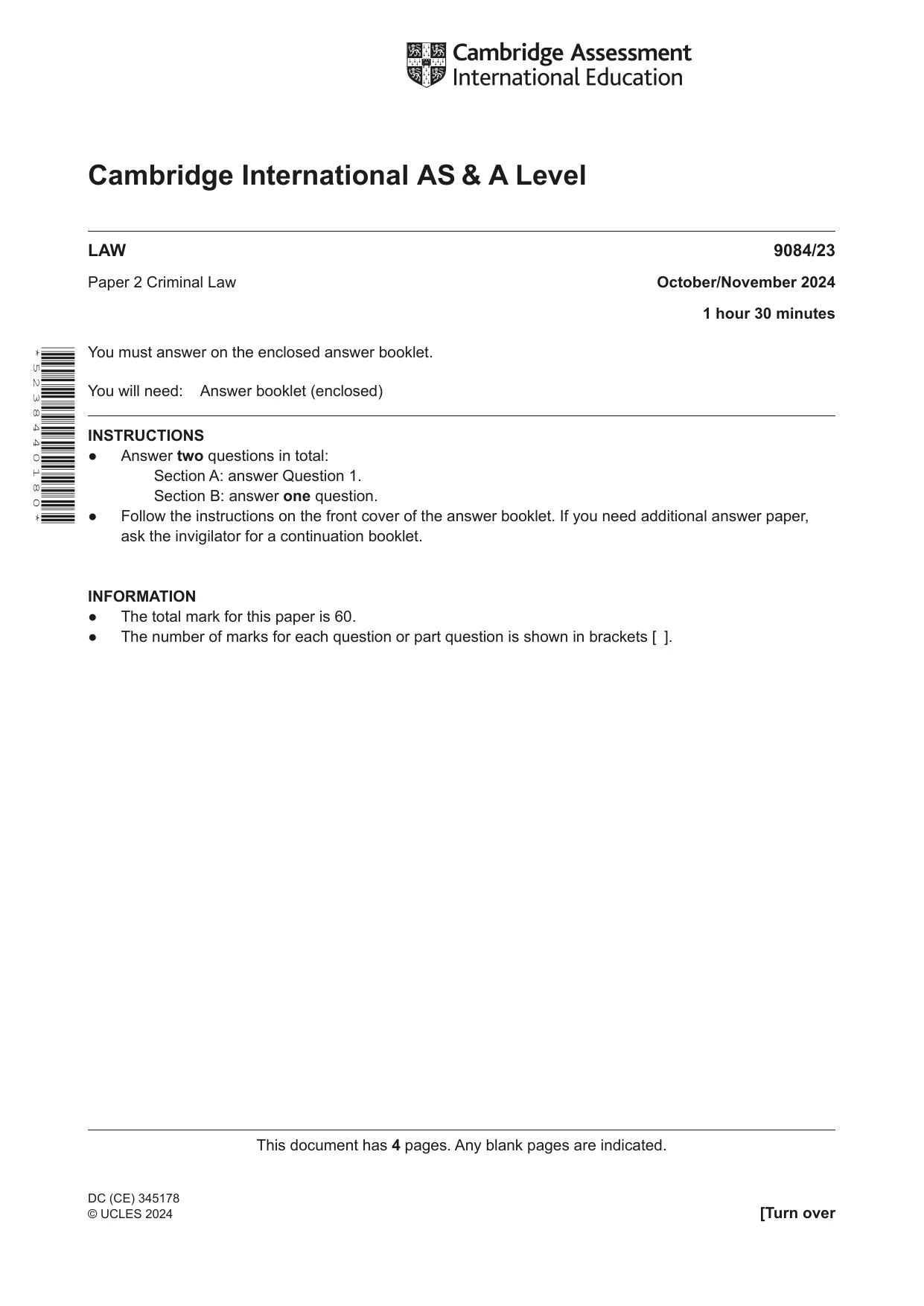
Question paper4 pages

Mark scheme17 pages
Answers below. Sit the paper first if you are practising.


Questions as text
Q1 · Gemma and Hannah live in houses next to each other
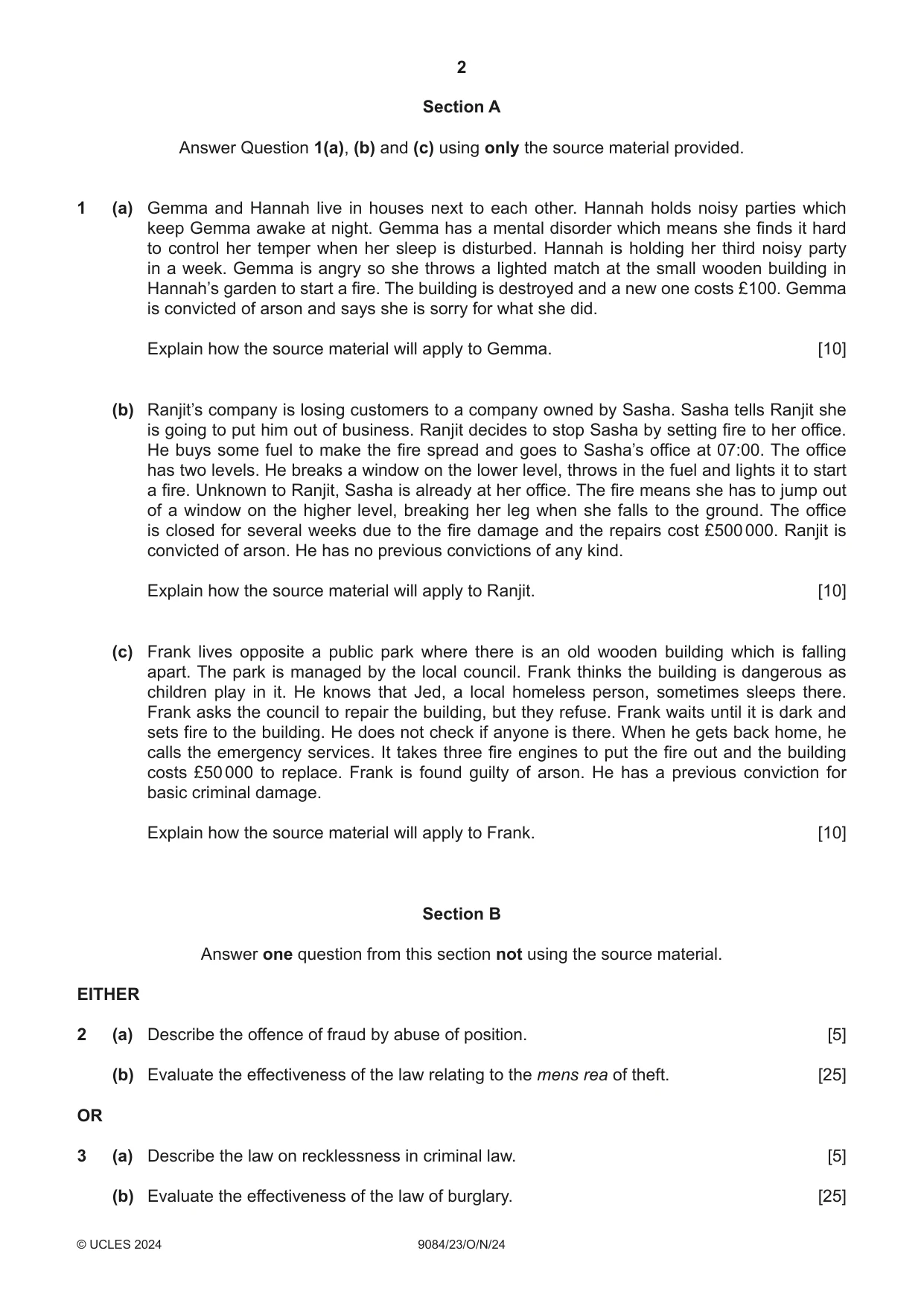
1 (a) Gemma and Hannah live in houses next to each other. Hannah holds noisy parties which keep Gemma awake at night. Gemma has a mental disorder which means she finds it hard to control her temper when her sleep is disturbed. Hannah is holding her third noisy party in a week. Gemma is angry so she throws a lighted match at the small wooden building in Hannah’s garden to start a fire. The building is destroyed and a new one costs £100. Gemma is convicted of arson and says she is sorry for what she did. Explain how the source material will apply to Gemma. [10] (b) Ranjit’s company is losing customers to a company owned by Sasha. Sasha tells Ranjit she is going to put him out of business. Ranjit decides to stop Sasha by setting fire to her office. He buys some fuel to make the fire spread and goes to Sasha’s office at 07:00. The office has two levels. He breaks a window on the lower level, throws in the fuel and lights it to start a fire. Unknown to Ranjit, Sasha is already at her office. The fire means she has to jump out of a window on the higher level, breaking her leg when she falls to the ground. The office is closed for several weeks due to the fire damage and the repairs cost £500 000. Ranjit is convicted of arson. He has no previous convictions of any kind. Explain how the source material will apply to Ranjit. [10] (c) Frank lives opposite a public park where there is an old wooden building which is falling apart. The park is managed by the local council. Frank thinks the building is dangerous as children play in it. He knows that Jed, a local homeless person, sometimes sleeps there. Frank asks the council to repair the building, but they refuse. Frank waits until it is dark and sets fire to the building. He does not check if anyone is there. When he gets back home, he calls the emergency services. It takes three fire engines to put the fire out and the building costs £50 000 to replace. Frank is found guilty of arson. He has a previous conviction for basic criminal damage. Explain how the source material will apply to Frank. [10]
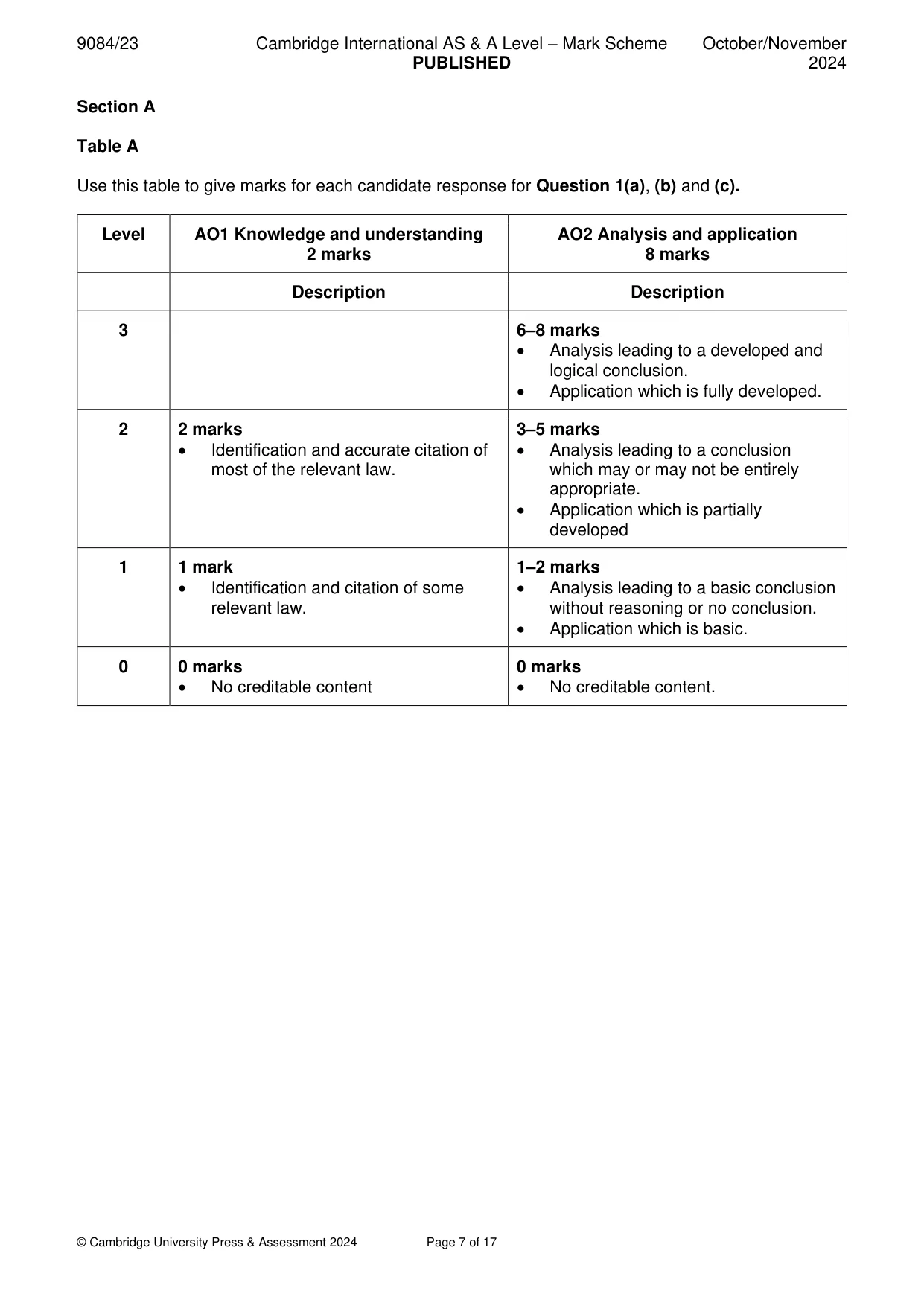
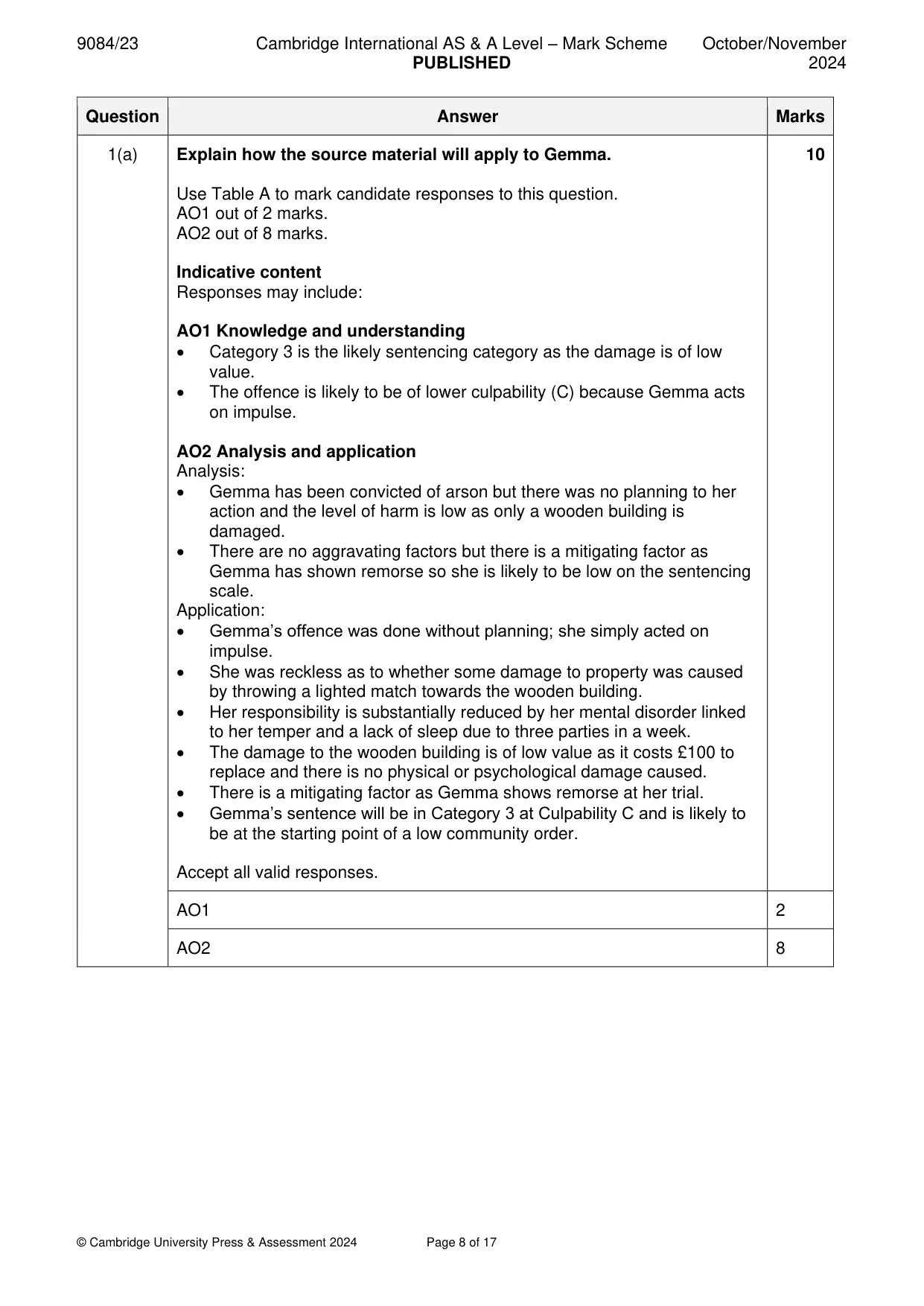
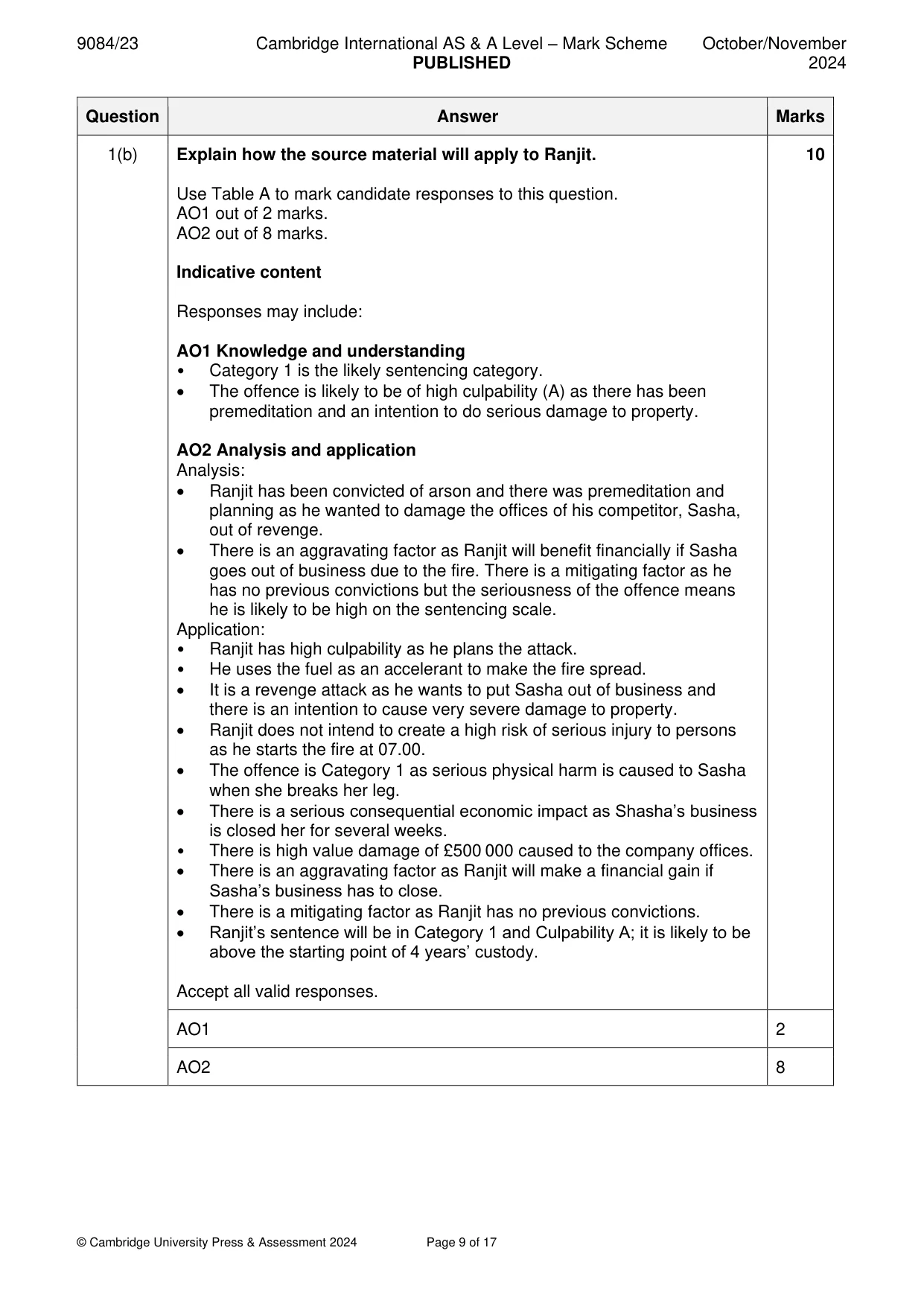
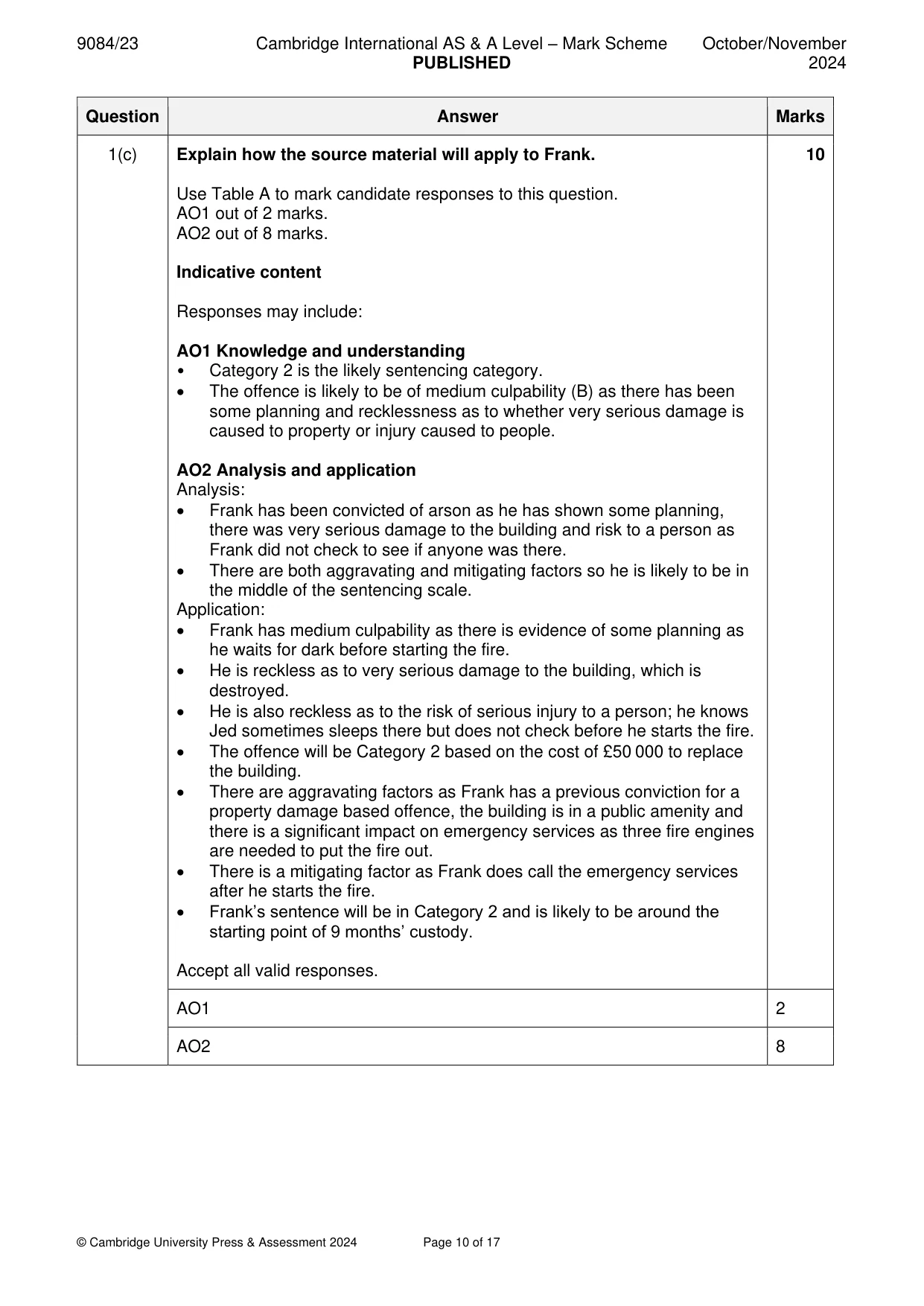
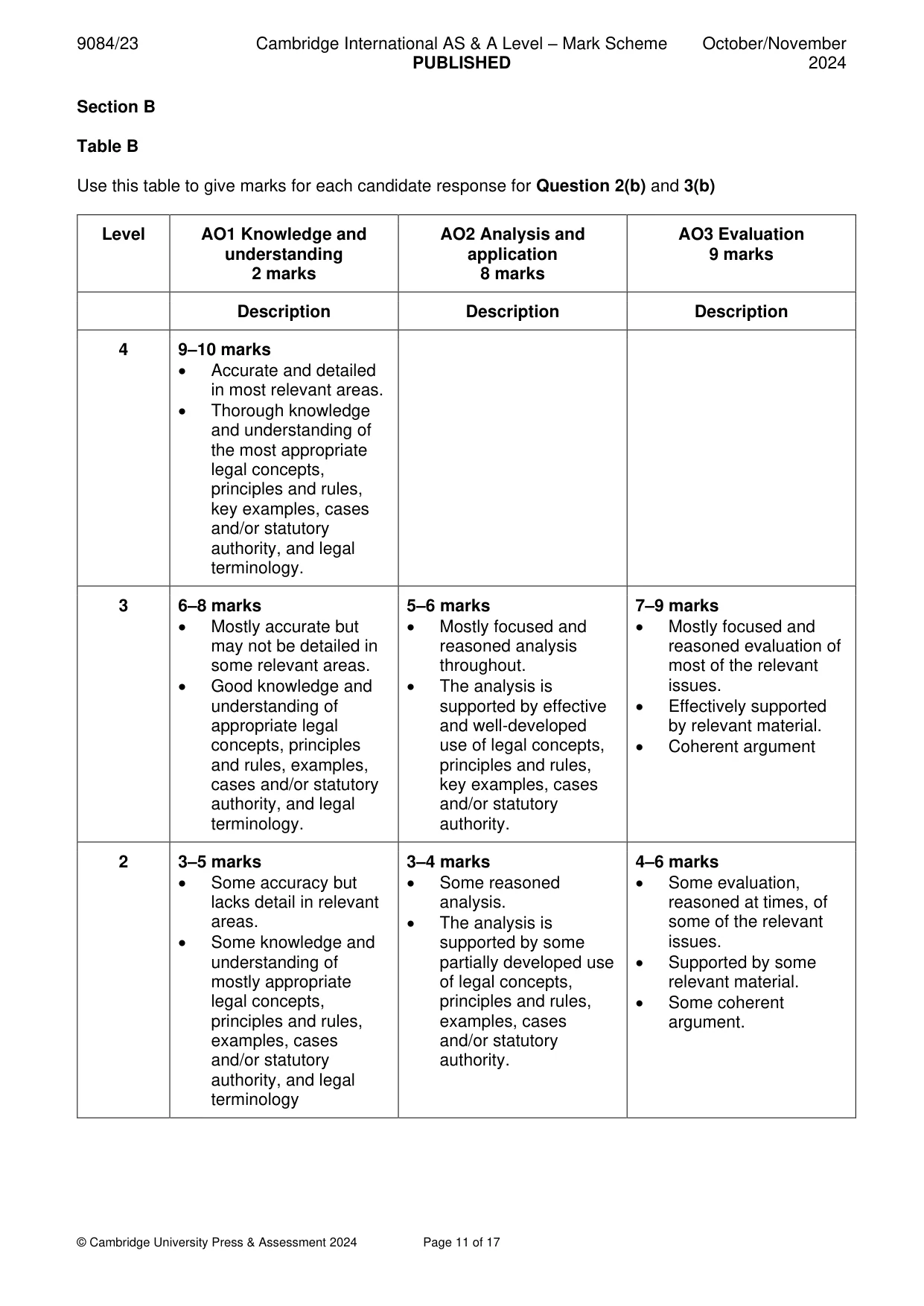
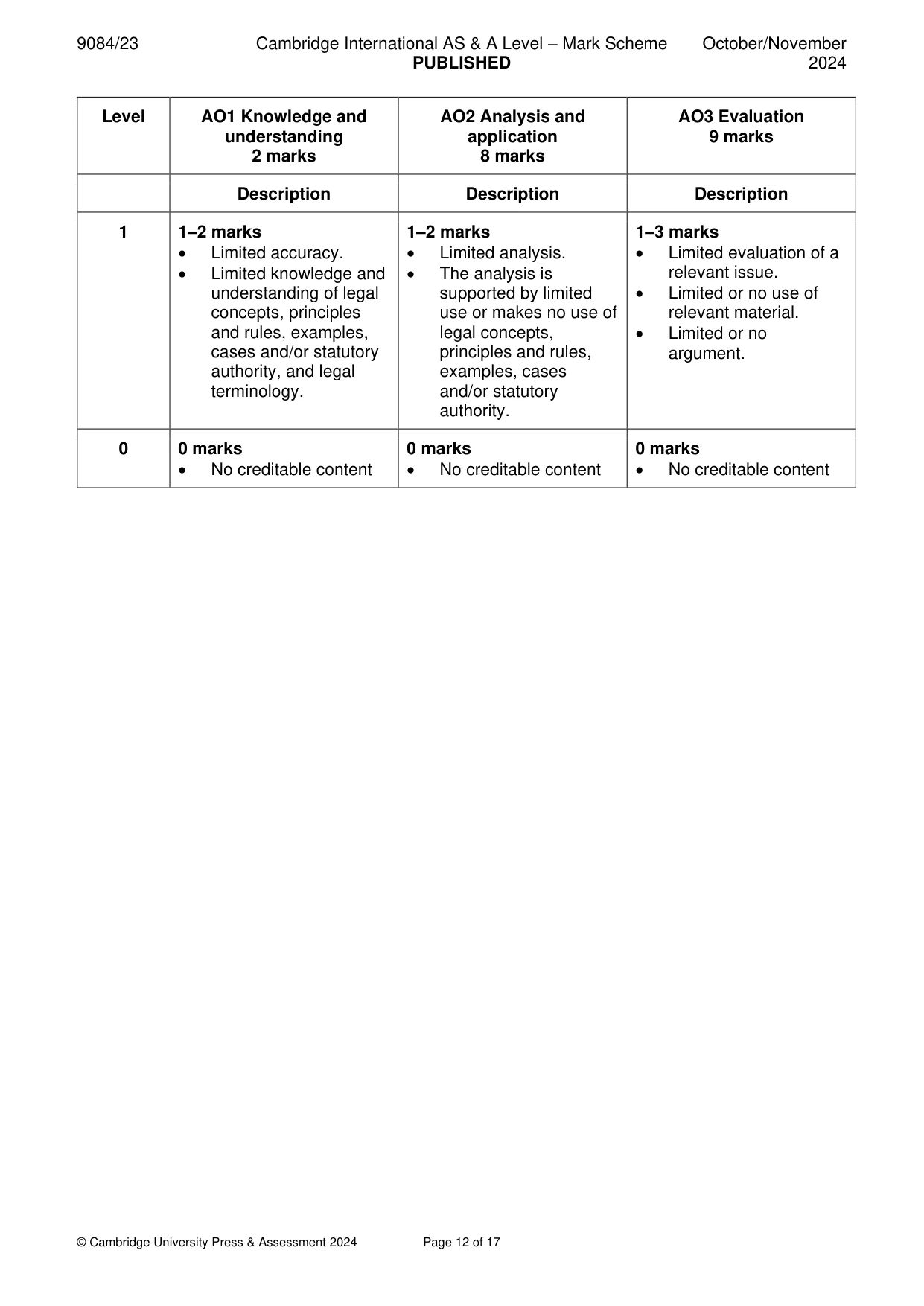
Mark scheme: Question Answer Marks 1(a) Explain how the source material will apply to Gemma. 10 Use Table A to mark candidate responses to this question. AO1 out of 2 marks. AO2 out of 8 marks. Indicative content Responses may include: AO1 Knowledge and understanding • Category 3 is the likely sentencing category as the damage is of low value. • The offence is likely to be of lower culpability (C) because Gemma acts on impulse. AO2 Analysis and application Analysis: • Gemma has been convicted of arson but there was no planning to her action and the level of harm is low as only a wooden building is damaged. • There are no aggravating factors but there is a mitigating factor as Gemma has shown remorse so she is likely to be low on the sentencing scale. Application: • Gemma’s offence was done without planning; she simply acted on impulse. • She was reckless as to whether some damage to property was caused by throwing a lighted match towards the wooden building. • Her responsibility is substantially reduced by her mental disorder linked to her temper and a lack of sleep due to three parties in a week. • The damage to the wooden building is of low value as it costs £100 to replace and there is no physical or psychological damage caused. • There is a mitigating factor as Gemma shows remorse at her trial. • Gemma’s sentence will be in Category 3 at Culpability C and is likely to be at the starting point of a low community order. Accept all valid responses. AO1 2 AO2 8 1(b) Explain how the source material will apply to Ranjit. 10 Use Table A to mark candidate responses to this question. AO1 out of 2 marks. AO2 out of 8 marks. Indicative content Responses may include: AO1 Knowledge and understanding • Category 1 is the likely sentencing category. • The offence is likely to be of high culpability (A) as there has been premeditation and an intention to do serious damage to property. AO2 Analysis and application Analysis: • Ranjit has been convicted of arson and there was premeditation and planning as he wanted to damage the offices of his competitor, Sasha, out of revenge. • There is an aggravating factor as Ranjit will benefit financially if Sasha goes out of business due to the fire. There is a mitigating factor as he has no previous convictions but the seriousness of the offence means he is likely to be high on the sentencing scale. Application: • Ranjit has high culpability as he plans the attack. • He uses the fuel as an accelerant to make the fire spread. • It is a revenge attack as he wants to put Sasha out of business and there is an intention to cause very severe damage to property. • Ranjit does not intend to create a high risk of serious injury to persons as he starts the fire at 07.00. • The offence is Category 1 as serious physical harm is caused to Sasha when she breaks her leg. • There is a serious consequential economic impact as Shasha’s business is closed her for several weeks. • There is high value damage of £500 000 caused to the company offices. • There is an aggravating factor as Ranjit will make a financial gain if Sasha’s business has to close. • There is a mitigating factor as Ranjit has no previous convictions. • Ranjit’s sentence will be in Category 1 and Culpability A; it is likely to be above the starting point of 4 years’ custody. Accept all valid responses. AO1 2 AO2 8 1(c) Explain how the source material will apply to Frank. 10 Use Table A to mark candidate responses to this question. AO1 out of 2 marks. AO2 out of 8 marks. Indicative content Responses may include: AO1 Knowledge and understanding • Category 2 is the likely sentencing category. • The offence is likely to be of medium culpability (B) as there has been some planning and recklessness as to whether very serious damage is caused to property or injury caused to people. AO2 Analysis and application Analysis: • Frank has been convicted of arson as he has shown some planning, there was very serious damage to the building and risk to a person as Frank did not check to see if anyone was there. • There are both aggravating and mitigating factors so he is likely to be in the middle of the sentencing scale. Application: • Frank has medium culpability as there is evidence of some planning as he waits for dark before starting the fire. • He is reckless as to very serious damage to the building, which is destroyed. • He is also reckless as to the risk of serious injury to a person; he knows Jed sometimes sleeps there but does not check before he starts the fire. • The offence will be Category 2 based on the cost of £50 000 to replace the building. • There are aggravating factors as Frank has a previous conviction for a property damage based offence, the building is in a public amenity and there is a significant impact on emergency services as three fire engines are needed to put the fire out. • There is a mitigating factor as Frank does call the emergency services after he starts the fire. • Frank’s sentence will be in Category 2 and is likely to be around the starting point of 9 months’ custody. Accept all valid responses. AO1 2 AO2 8 Section B Table B Use this table to give marks for each candidate response for Question 2(b) and 3(b) Level AO1 Knowledge and AO2 Analysis and AO3 Evaluation understanding application 9 marks 2 marks 8 marks Description Description Description 4 9–10 marks • Accurate and detailed in most relevant areas. • Thorough knowledge and understanding of the most appropriate legal concepts, principles and rules, key examples, cases and/or statutory authority, and legal terminology. 3 6–8 marks 5–6 marks 7–9 marks • Mostly accurate but • Mostly focused and • Mostly focused and may not be detailed in reasoned analysis reasoned evaluation of some relevant areas. throughout. most of the relevant • Good knowledge and • The analysis is issues. understanding of supported by effective • Effectively supported appropriate legal and well-developed by relevant material. concepts, principles use of legal concepts, • Coherent argument and rules, examples, principles and rules, cases and/or statutory key examples, cases authority, and legal and/or statutory terminology. authority. 2 3–5 marks 3–4 marks 4–6 marks • Some accuracy but • Some reasoned • Some evaluation, lacks detail in relevant analysis. reasoned at times, of areas. • The analysis is some of the relevant • Some knowledge and supported by some issues. understanding of partially developed use • Supported by some mostly appropriate of legal concepts, relevant material. legal concepts, principles and rules, • Some coherent principles and rules, examples, cases argument. examples, cases and/or statutory and/or statutory authority. authority, and legal terminology Level AO1 Knowledge and AO2 Analysis and AO3 Evaluation understanding application 9 marks 2 marks 8 marks Description Description Description 1 1–2 marks 1–2 marks 1–3 marks • Limited accuracy. • Limited analysis. • Limited evaluation of a • Limited knowledge and • The analysis is relevant issue. understanding of legal supported by limited • Limited or no use of concepts, principles use or makes no use of relevant material. and rules, examples, legal concepts, • Limited or no cases and/or statutory principles and rules, argument. authority, and legal examples, cases terminology. and/or statutory authority. 0 0 marks 0 marks 0 marks • No creditable content • No creditable content • No creditable content
Q2 · Describe the offence of fraud by abuse of position
2 (a) Describe the offence of fraud by abuse of position. [5] (b) Evaluate the effectiveness of the law relating to the mens rea of theft. [25] OR
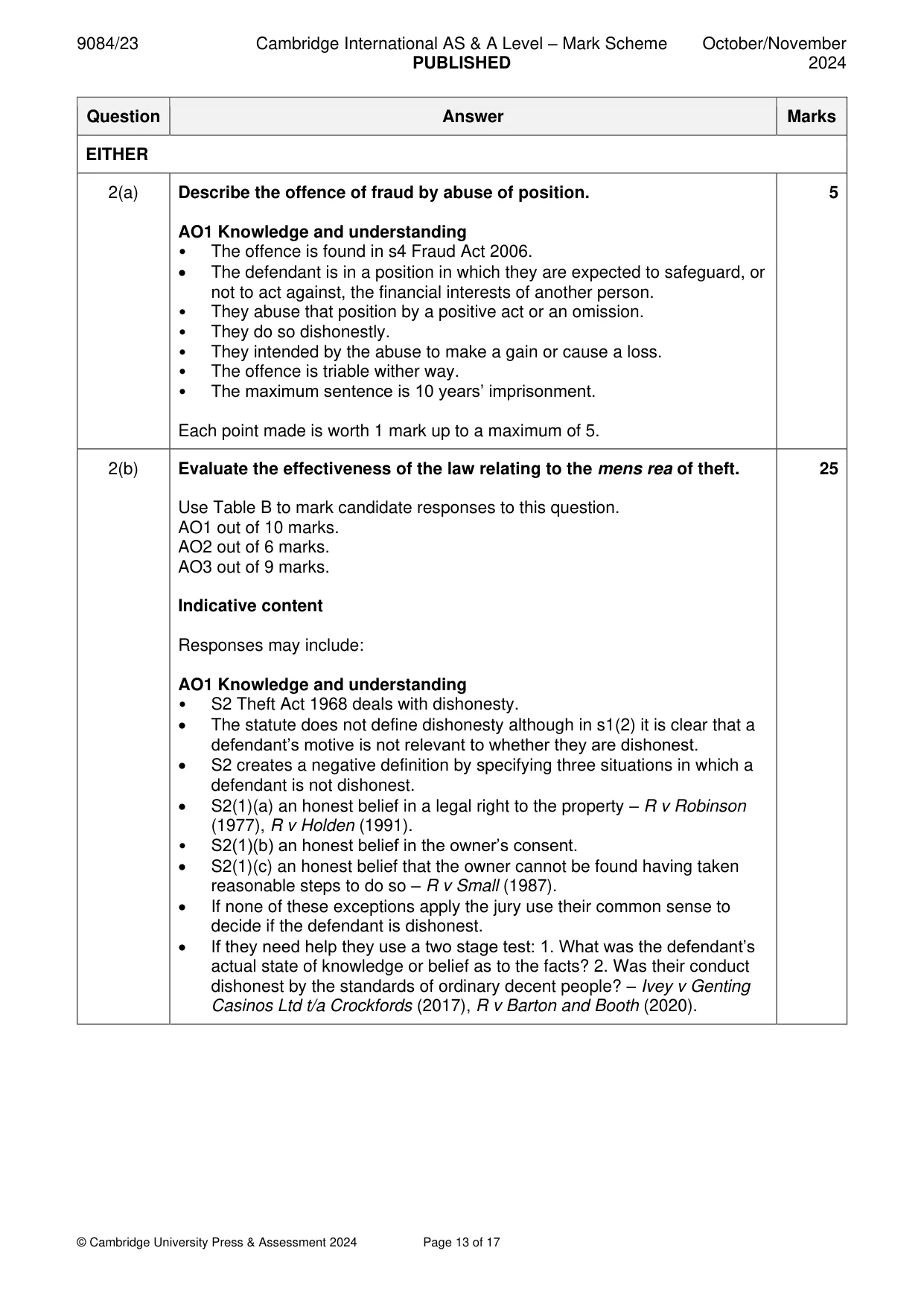
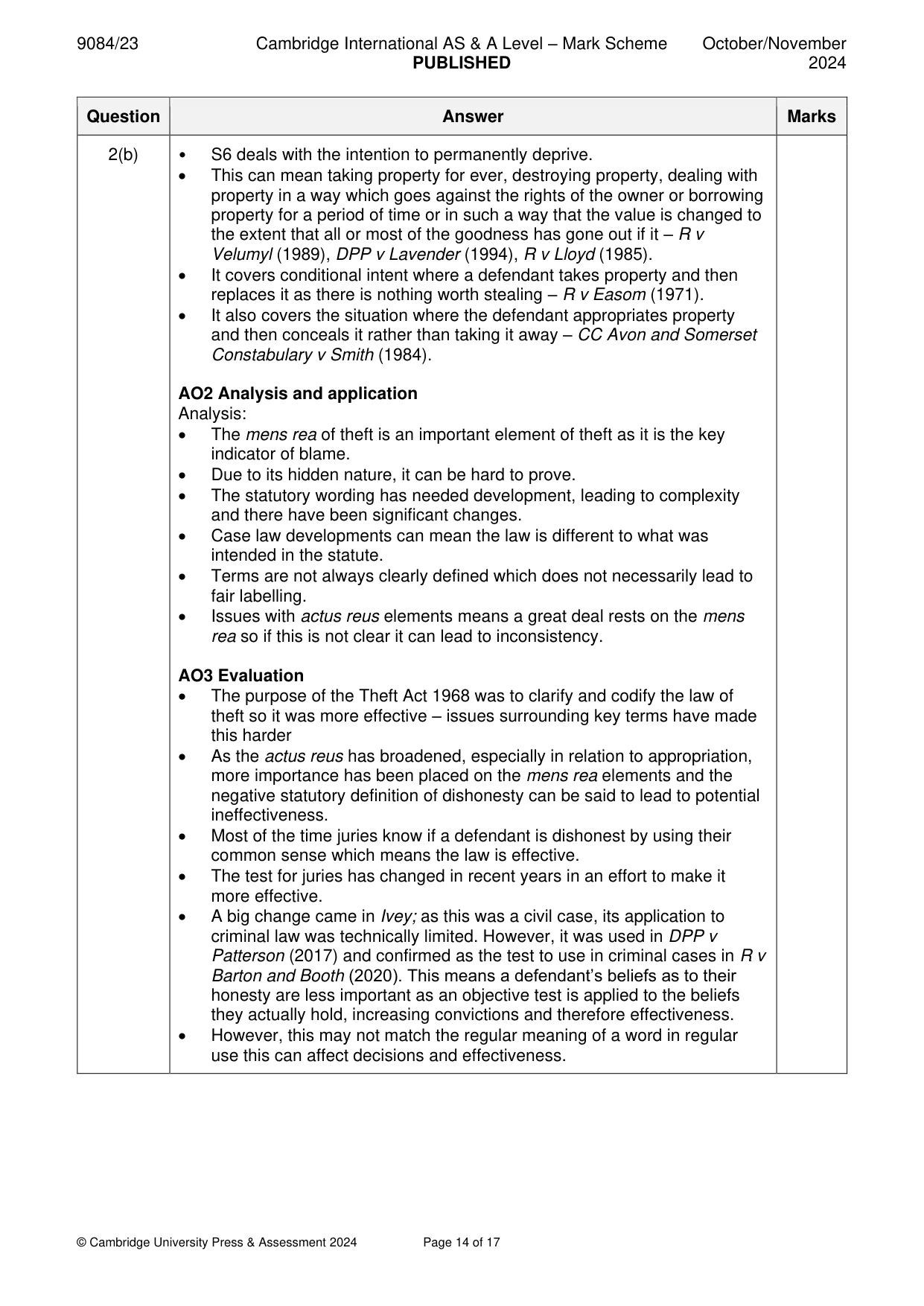
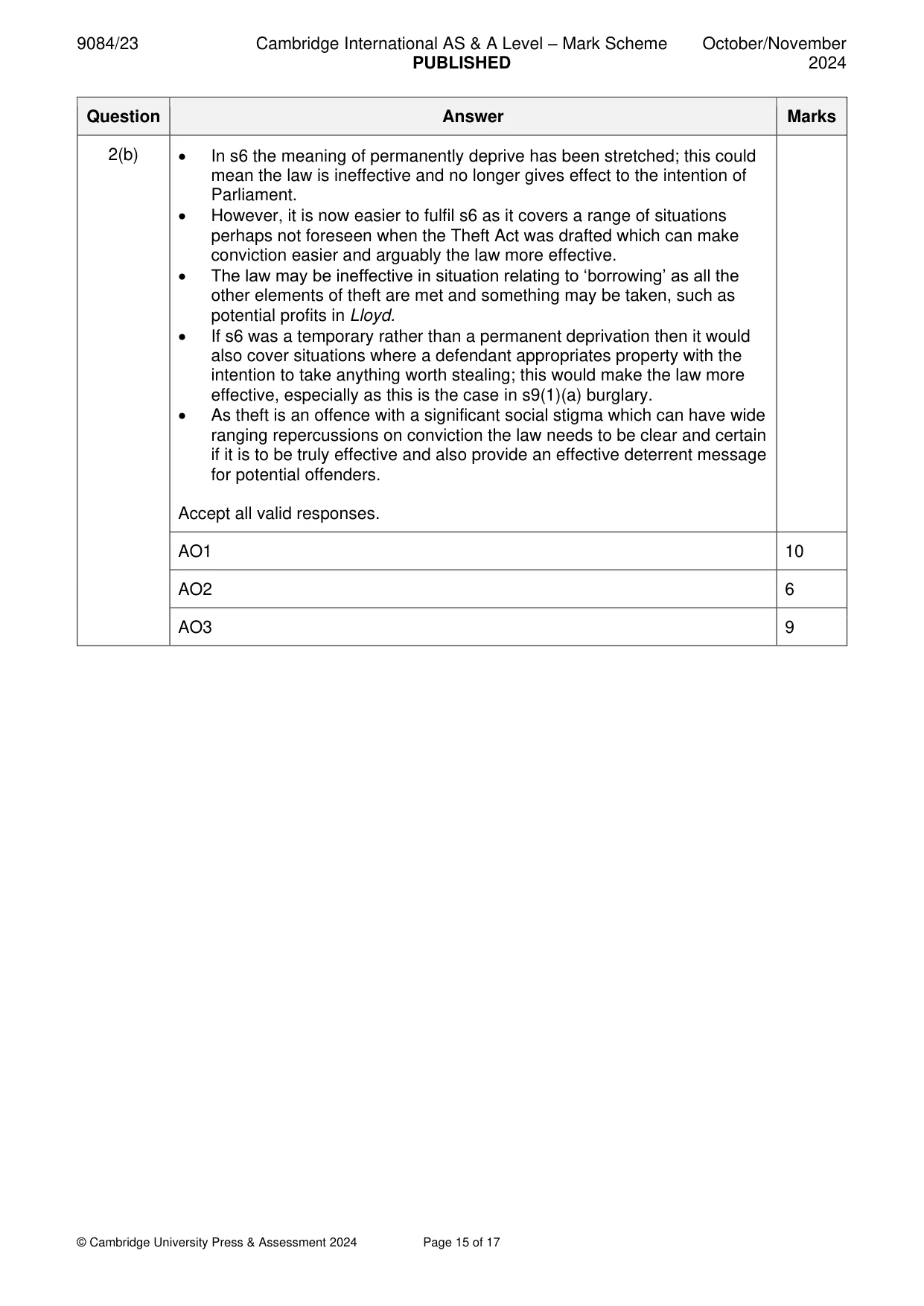
Mark scheme: 2(a) Describe the offence of fraud by abuse of position. 5 AO1 Knowledge and understanding • The offence is found in s4 Fraud Act 2006. • The defendant is in a position in which they are expected to safeguard, or not to act against, the financial interests of another person. • They abuse that position by a positive act or an omission. • They do so dishonestly. • They intended by the abuse to make a gain or cause a loss. • The offence is triable wither way. • The maximum sentence is 10 years’ imprisonment. Each point made is worth 1 mark up to a maximum of 5. 2(b) Evaluate the effectiveness of the law relating to the mens rea of theft. 25 Use Table B to mark candidate responses to this question. AO1 out of 10 marks. AO2 out of 6 marks. AO3 out of 9 marks. Indicative content Responses may include: AO1 Knowledge and understanding • S2 Theft Act 1968 deals with dishonesty. • The statute does not define dishonesty although in s1(2) it is clear that a defendant’s motive is not relevant to whether they are dishonest. • S2 creates a negative definition by specifying three situations in which a defendant is not dishonest. • S2(1)(a) an honest belief in a legal right to the property – R v Robinson (1977), R v Holden (1991). • S2(1)(b) an honest belief in the owner’s consent. • S2(1)(c) an honest belief that the owner cannot be found having taken reasonable steps to do so – R v Small (1987). • If none of these exceptions apply the jury use their common sense to decide if the defendant is dishonest. • If they need help they use a two stage test: 1. What was the defendant’s actual state of knowledge or belief as to the facts? 2. Was their conduct dishonest by the standards of ordinary decent people? – Ivey v Genting Casinos Ltd t/a Crockfords (2017), R v Barton and Booth (2020). 2(b) • S6 deals with the intention to permanently deprive. • This can mean taking property for ever, destroying property, dealing with property in a way which goes against the rights of the owner or borrowing property for a period of time or in such a way that the value is changed to the extent that all or most of the goodness has gone out if it – R v Velumyl (1989), DPP v Lavender (1994), R v Lloyd (1985). • It covers conditional intent where a defendant takes property and then replaces it as there is nothing worth stealing – R v Easom (1971). • It also covers the situation where the defendant appropriates property and then conceals it rather than taking it away – CC Avon and Somerset Constabulary v Smith (1984). AO2 Analysis and application Analysis: • The mens rea of theft is an important element of theft as it is the key indicator of blame. • Due to its hidden nature, it can be hard to prove. • The statutory wording has needed development, leading to complexity and there have been significant changes. • Case law developments can mean the law is different to what was intended in the statute. • Terms are not always clearly defined which does not necessarily lead to fair labelling. • Issues with actus reus elements means a great deal rests on the mens rea so if this is not clear it can lead to inconsistency. AO3 Evaluation • The purpose of the Theft Act 1968 was to clarify and codify the law of theft so it was more effective – issues surrounding key terms have made this harder • As the actus reus has broadened, especially in relation to appropriation, more importance has been placed on the mens rea elements and the negative statutory definition of dishonesty can be said to lead to potential ineffectiveness. • Most of the time juries know if a defendant is dishonest by using their common sense which means the law is effective. • The test for juries has changed in recent years in an effort to make it more effective. • A big change came in Ivey; as this was a civil case, its application to criminal law was technically limited. However, it was used in DPP v Patterson (2017) and confirmed as the test to use in criminal cases in R v Barton and Booth (2020). This means a defendant’s beliefs as to their honesty are less important as an objective test is applied to the beliefs they actually hold, increasing convictions and therefore effectiveness. • However, this may not match the regular meaning of a word in regular use this can affect decisions and effectiveness. 2(b) • In s6 the meaning of permanently deprive has been stretched; this could mean the law is ineffective and no longer gives effect to the intention of Parliament. • However, it is now easier to fulfil s6 as it covers a range of situations perhaps not foreseen when the Theft Act was drafted which can make conviction easier and arguably the law more effective. • The law may be ineffective in situation relating to ‘borrowing’ as all the other elements of theft are met and something may be taken, such as potential profits in Lloyd. • If s6 was a temporary rather than a permanent deprivation then it would also cover situations where a defendant appropriates property with the intention to take anything worth stealing; this would make the law more effective, especially as this is the case in s9(1)(a) burglary. • As theft is an offence with a significant social stigma which can have wide ranging repercussions on conviction the law needs to be clear and certain if it is to be truly effective and also provide an effective deterrent message for potential offenders. Accept all valid responses. AO1 10 AO2 6 AO3 9
Q3 · Describe the law on recklessness in criminal law
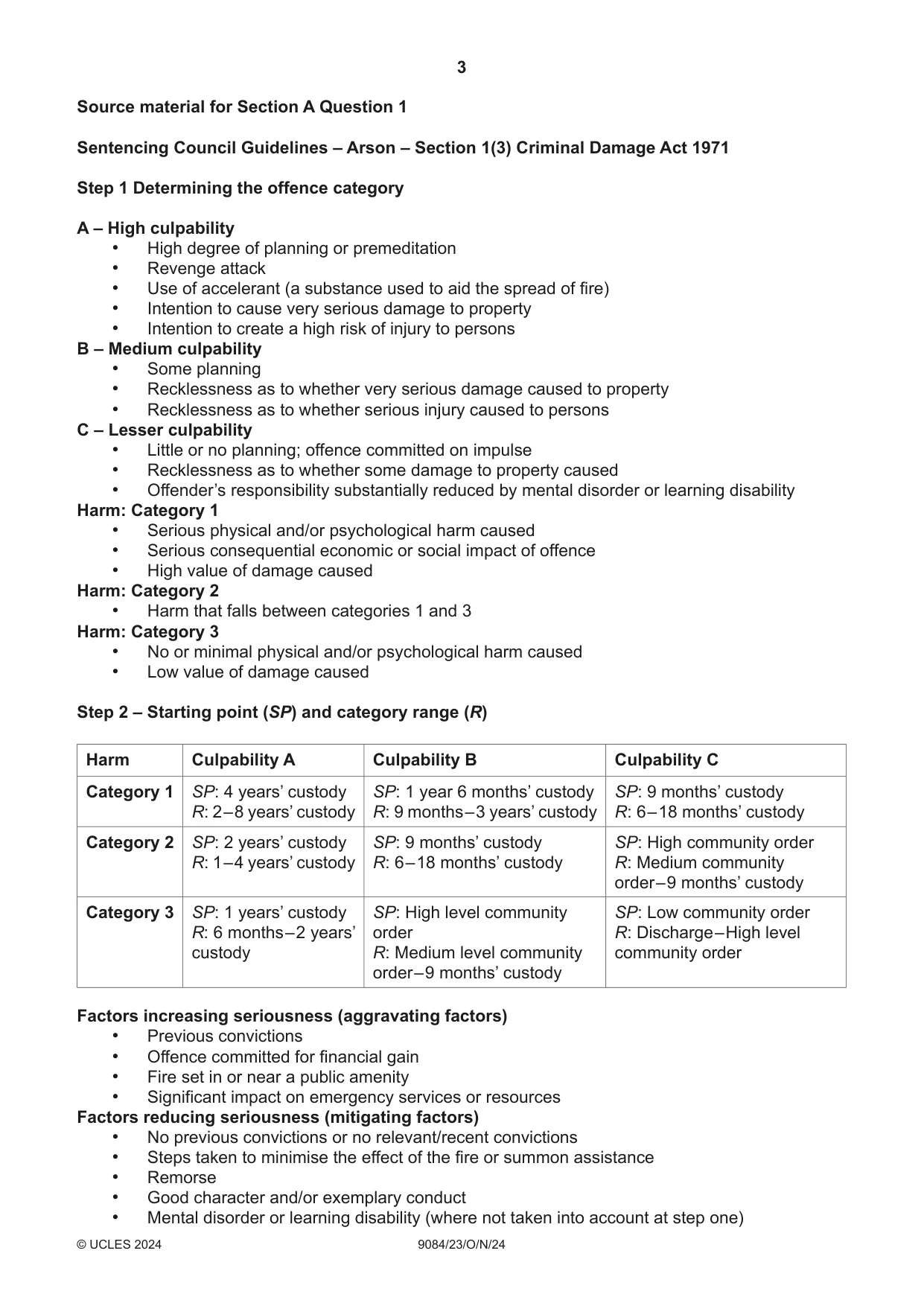
3 (a) Describe the law on recklessness in criminal law. [5] (b) Evaluate the effectiveness of the law of burglary. [25] Source material for Section A Question 1 Sentencing Council Guidelines – Arson – Section 1(3) Criminal Damage Act 1971 Step 1 Determining the offence category A – High culpability • High degree of planning or premeditation • Revenge attack • Use of accelerant (a substance used to aid the spread of fire) • Intention to cause very serious damage to property • Intention to create a high risk of injury to persons B – Medium culpability • Some planning • Recklessness as to whether very serious damage caused to property • Recklessness as to whether serious injury caused to persons C – Lesser culpability • Little or no planning; offence committed on impulse • Recklessness as to whether some damage to property caused • Offender’s responsibility substantially reduced by mental disorder or learning disability Harm: Category 1 • Serious physical and/or psychological harm caused • Serious consequential economic or social impact of offence • High value of damage caused Harm: Category 2 • Harm that falls between categories 1 and 3 Harm: Category 3 • No or minimal physical and/or psychological harm caused • Low value of damage caused Step 2 – Starting point (SP) and category range (R) Harm Culpability A Culpability B Culpability C Category 1 SP: 4 years’ custody SP: 1 year 6 months’ custody SP: 9 months’ custody R: 2 – 8 years’ custody R: 9 months – 3 years’ custody R: 6 – 18 months’ custody Category 2 SP: 2 years’ custody SP: 9 months’ custody SP: High community order R: 1 – 4 years’ custody R: 6 – 18 months’ custody R: Medium community order – 9 months’ custody Category 3 SP: 1 years’ custody SP: High level community SP: Low community order R: 6 months – 2 years’ order R: Discharge – High level custody R: Medium level community community order order – 9 months’ custody Factors increasing seriousness (aggravating factors) • Previous convictions • Offence committed for financial gain • Fire set in or near a public amenity • Significant impact on emergency services or resources Factors reducing seriousness (mitigating factors) • No previous convictions or no relevant/recent convictions • Steps taken to minimise the effect of the fire or summon assistance • Remorse • Good character and/or exemplary conduct
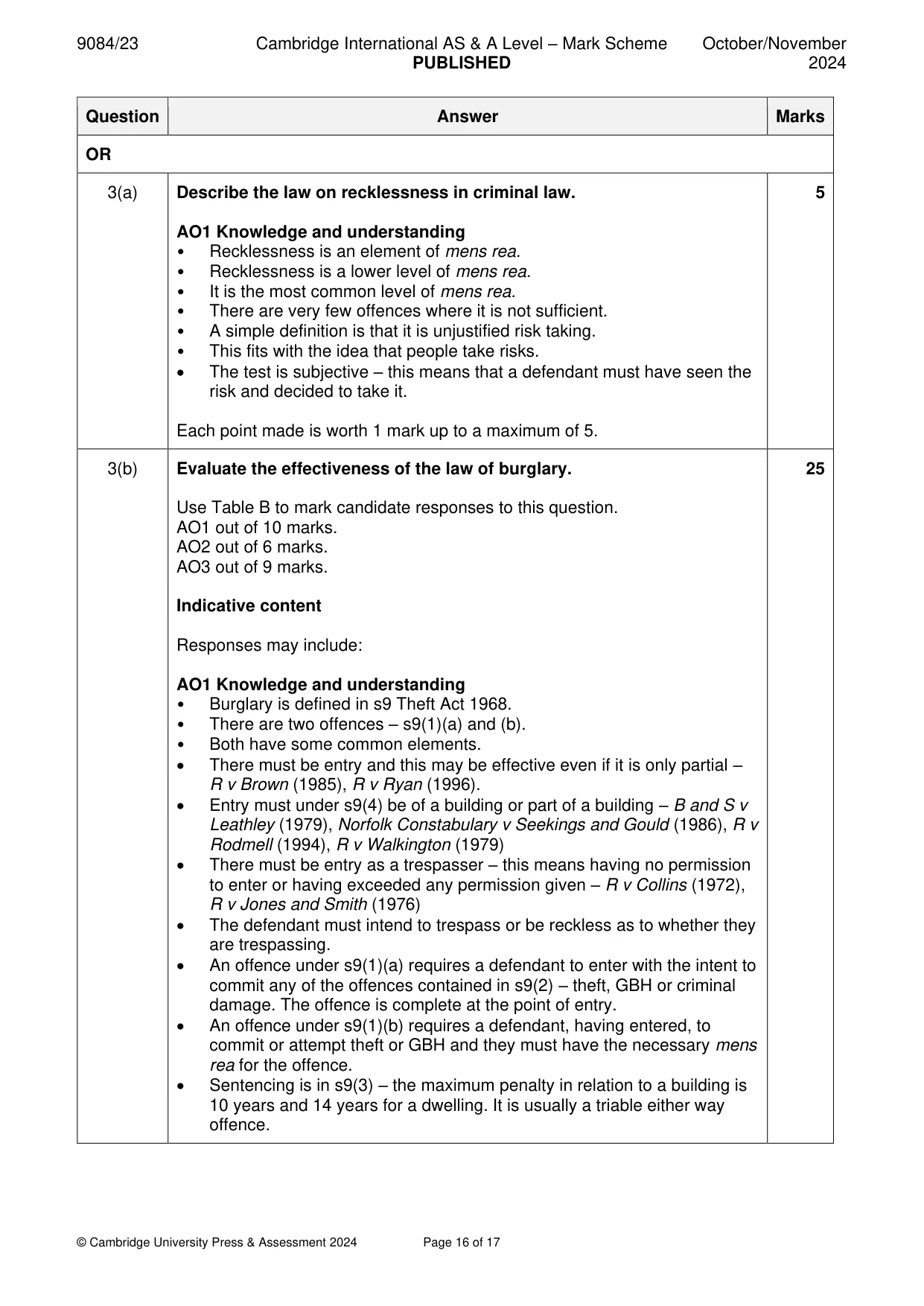
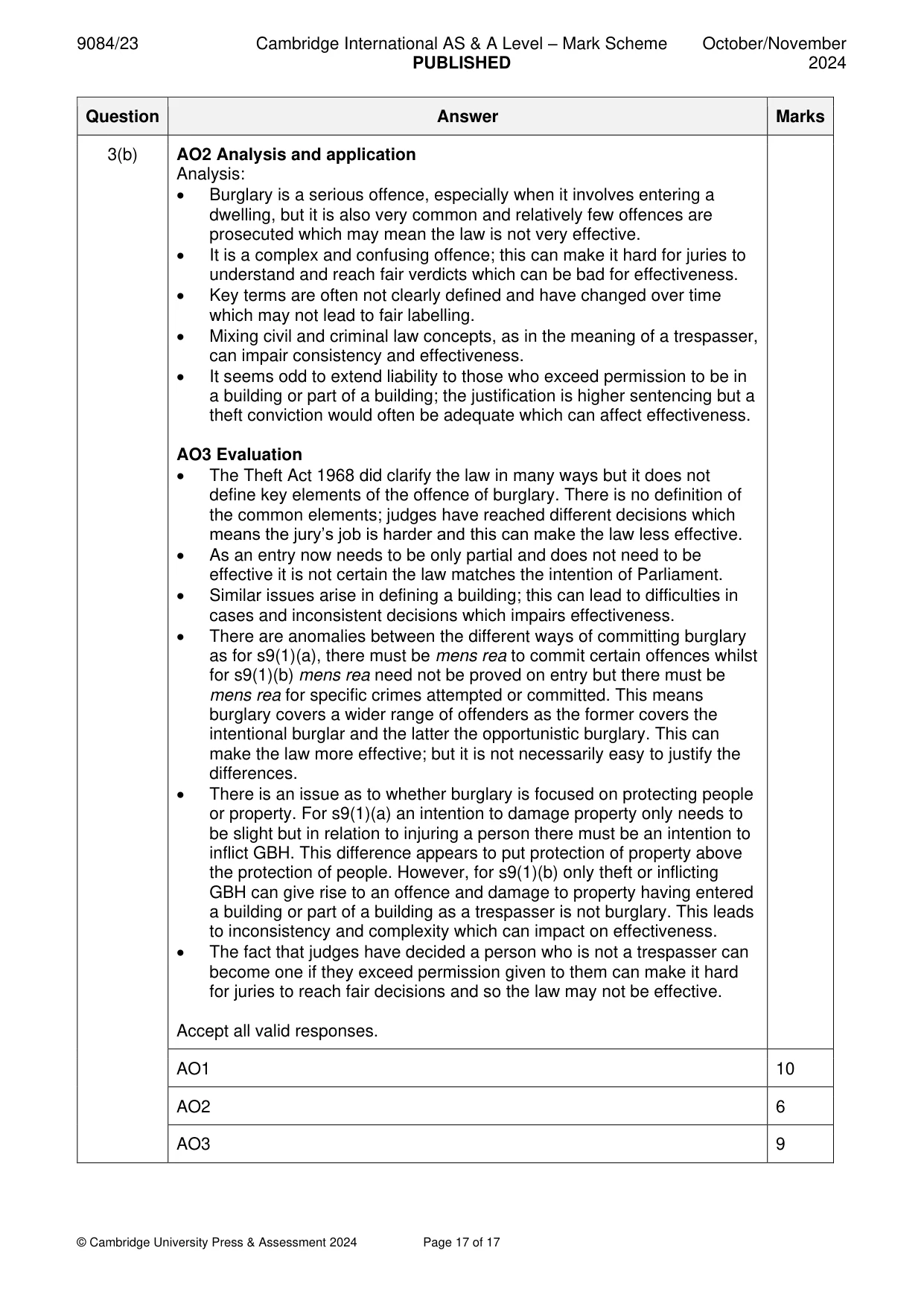
Mark scheme: 3(a) Describe the law on recklessness in criminal law. 5 AO1 Knowledge and understanding • Recklessness is an element of mens rea. • Recklessness is a lower level of mens rea. • It is the most common level of mens rea. • There are very few offences where it is not sufficient. • A simple definition is that it is unjustified risk taking. • This fits with the idea that people take risks. • The test is subjective – this means that a defendant must have seen the risk and decided to take it. Each point made is worth 1 mark up to a maximum of 5. 3(b) Evaluate the effectiveness of the law of burglary. 25 Use Table B to mark candidate responses to this question. AO1 out of 10 marks. AO2 out of 6 marks. AO3 out of 9 marks. Indicative content Responses may include: AO1 Knowledge and understanding • Burglary is defined in s9 Theft Act 1968. • There are two offences – s9(1)(a) and (b). • Both have some common elements. • There must be entry and this may be effective even if it is only partial – R v Brown (1985), R v Ryan (1996). • Entry must under s9(4) be of a building or part of a building – B and S v Leathley (1979), Norfolk Constabulary v Seekings and Gould (1986), R v Rodmell (1994), R v Walkington (1979) • There must be entry as a trespasser – this means having no permission to enter or having exceeded any permission given – R v Collins (1972), R v Jones and Smith (1976) • The defendant must intend to trespass or be reckless as to whether they are trespassing. • An offence under s9(1)(a) requires a defendant to enter with the intent to commit any of the offences contained in s9(2) – theft, GBH or criminal damage. The offence is complete at the point of entry. • An offence under s9(1)(b) requires a defendant, having entered, to commit or attempt theft or GBH and they must have the necessary mens rea for the offence. • Sentencing is in s9(3) – the maximum penalty in relation to a building is 10 years and 14 years for a dwelling. It is usually a triable either way offence. 3(b) AO2 Analysis and application Analysis: • Burglary is a serious offence, especially when it involves entering a dwelling, but it is also very common and relatively few offences are prosecuted which may mean the law is not very effective. • It is a complex and confusing offence; this can make it hard for juries to understand and reach fair verdicts which can be bad for effectiveness. • Key terms are often not clearly defined and have changed over time which may not lead to fair labelling. • Mixing civil and criminal law concepts, as in the meaning of a trespasser, can impair consistency and effectiveness. • It seems odd to extend liability to those who exceed permission to be in a building or part of a building; the justification is higher sentencing but a theft conviction would often be adequate which can affect effectiveness. AO3 Evaluation • The Theft Act 1968 did clarify the law in many ways but it does not define key elements of the offence of burglary. There is no definition of the common elements; judges have reached different decisions which means the jury’s job is harder and this can make the law less effective. • As an entry now needs to be only partial and does not need to be effective it is not certain the law matches the intention of Parliament. • Similar issues arise in defining a building; this can lead to difficulties in cases and inconsistent decisions which impairs effectiveness. • There are anomalies between the different ways of committing burglary as for s9(1)(a), there must be mens rea to commit certain offences whilst for s9(1)(b) mens rea need not be proved on entry but there must be mens rea for specific crimes attempted or committed. This means burglary covers a wider range of offenders as the former covers the intentional burglar and the latter the opportunistic burglary. This can make the law more effective; but it is not necessarily easy to justify the differences. • There is an issue as to whether burglary is focused on protecting people or property. For s9(1)(a) an intention to damage property only needs to be slight but in relation to injuring a person there must be an intention to inflict GBH. This difference appears to put protection of property above the protection of people. However, for s9(1)(b) only theft or inflicting GBH can give rise to an offence and damage to property having entered a building or part of a building as a trespasser is not burglary. This leads to inconsistency and complexity which can impact on effectiveness. • The fact that judges have decided a person who is not a trespasser can become one if they exceed permission given to them can make it hard for juries to reach fair decisions and so the law may not be effective. Accept all valid responses. AO1 10 AO2 6 AO3 9
What was in this paper
The subtopics covered by these 3 questions, and how many questions each got. Open one in a new tab to see every Cambridge question on it.
2Sentencing in England and Wales This topic is about the sentences that can be handed down to both adult and young offenders who have been convicted of offences. This topic is an opportunity to reflect on the key concepts of liability, justice, fairness, power and its limits, and effectiveness1What you needed in this session
Cambridge’s own grade thresholds for 2024 Oct/Nov, Paper 2 · Variant 3. A higher threshold means an easier paper — the bar moves with how the cohort did.