Cambridge A Level Law 9084 — 2024 May/June Paper 2 · Variant 1
9084/21/M/J/24 · 3 questions · 60 marks · ≈68 min
The question paper and its mark scheme, free to read here and free to download. This is Cambridge’s own paper, exactly as it was sat.
Question paper4 pages

Mark scheme17 pages
Answers below. Sit the paper first if you are practising.
Questions as text
Q1 · Amanda goes for a walk in a forest owned by Bob
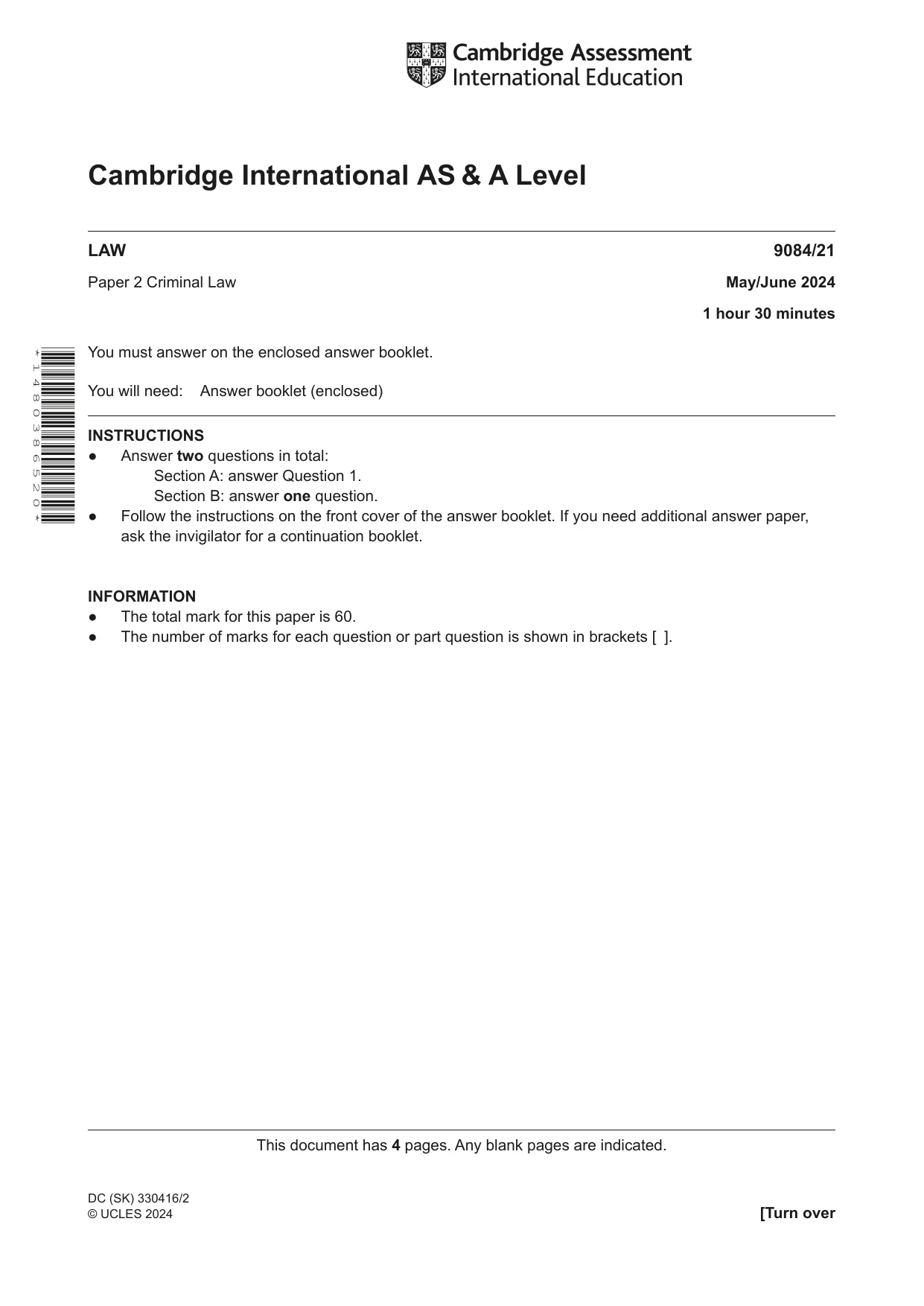
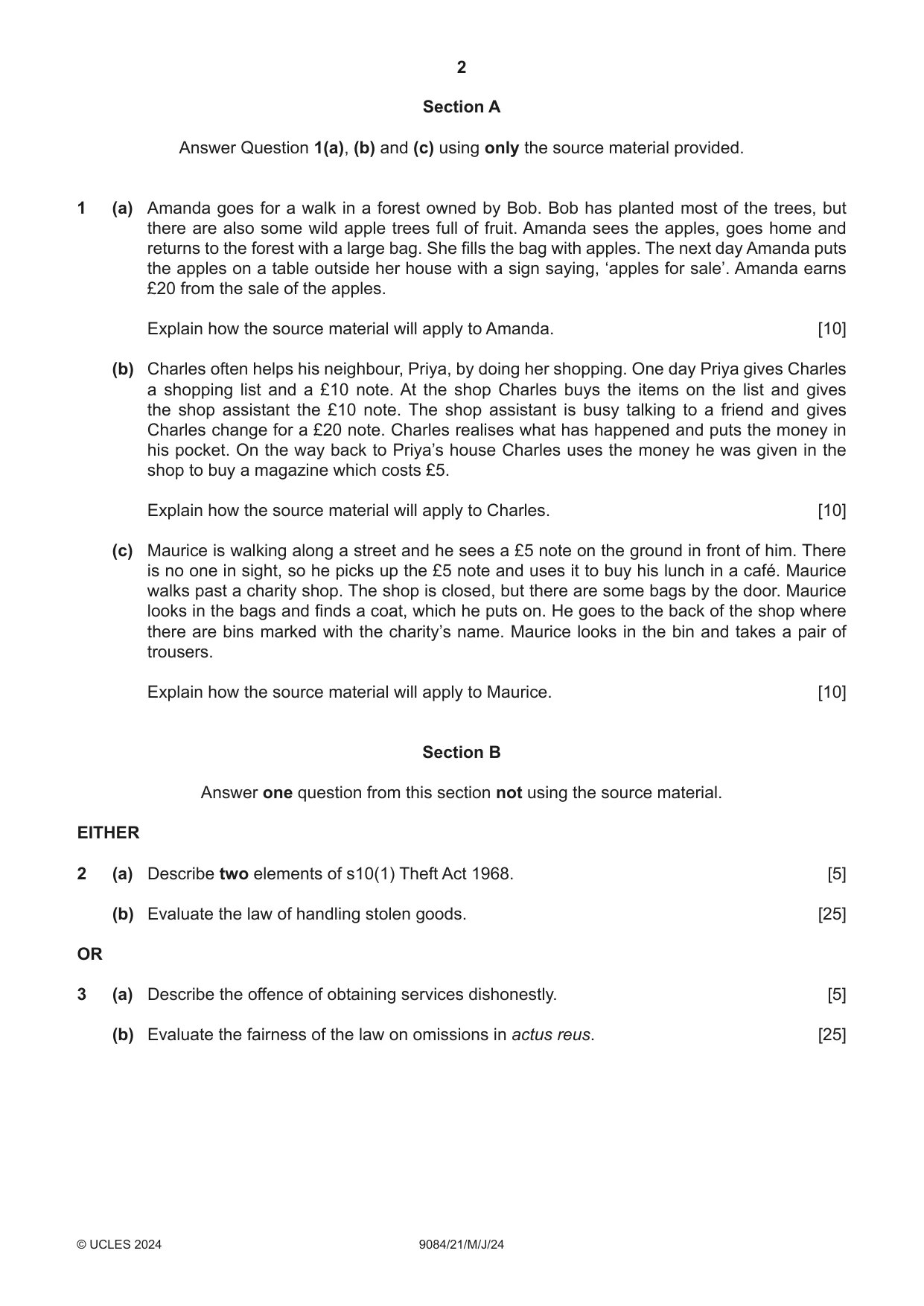
1 (a) Amanda goes for a walk in a forest owned by Bob. Bob has planted most of the trees, but there are also some wild apple trees full of fruit. Amanda sees the apples, goes home and returns to the forest with a large bag. She fills the bag with apples. The next day Amanda puts the apples on a table outside her house with a sign saying, ‘apples for sale’. Amanda earns £20 from the sale of the apples. Explain how the source material will apply to Amanda. [10] (b) Charles often helps his neighbour, Priya, by doing her shopping. One day Priya gives Charles a shopping list and a £10 note. At the shop Charles buys the items on the list and gives the shop assistant the £10 note. The shop assistant is busy talking to a friend and gives Charles change for a £20 note. Charles realises what has happened and puts the money in his pocket. On the way back to Priya’s house Charles uses the money he was given in the shop to buy a magazine which costs £5. Explain how the source material will apply to Charles. [10] (c) Maurice is walking along a street and he sees a £5 note on the ground in front of him. There is no one in sight, so he picks up the £5 note and uses it to buy his lunch in a café. Maurice walks past a charity shop. The shop is closed, but there are some bags by the door. Maurice looks in the bags and finds a coat, which he puts on. He goes to the back of the shop where there are bins marked with the charity’s name. Maurice looks in the bin and takes a pair of trousers. Explain how the source material will apply to Maurice. [10]
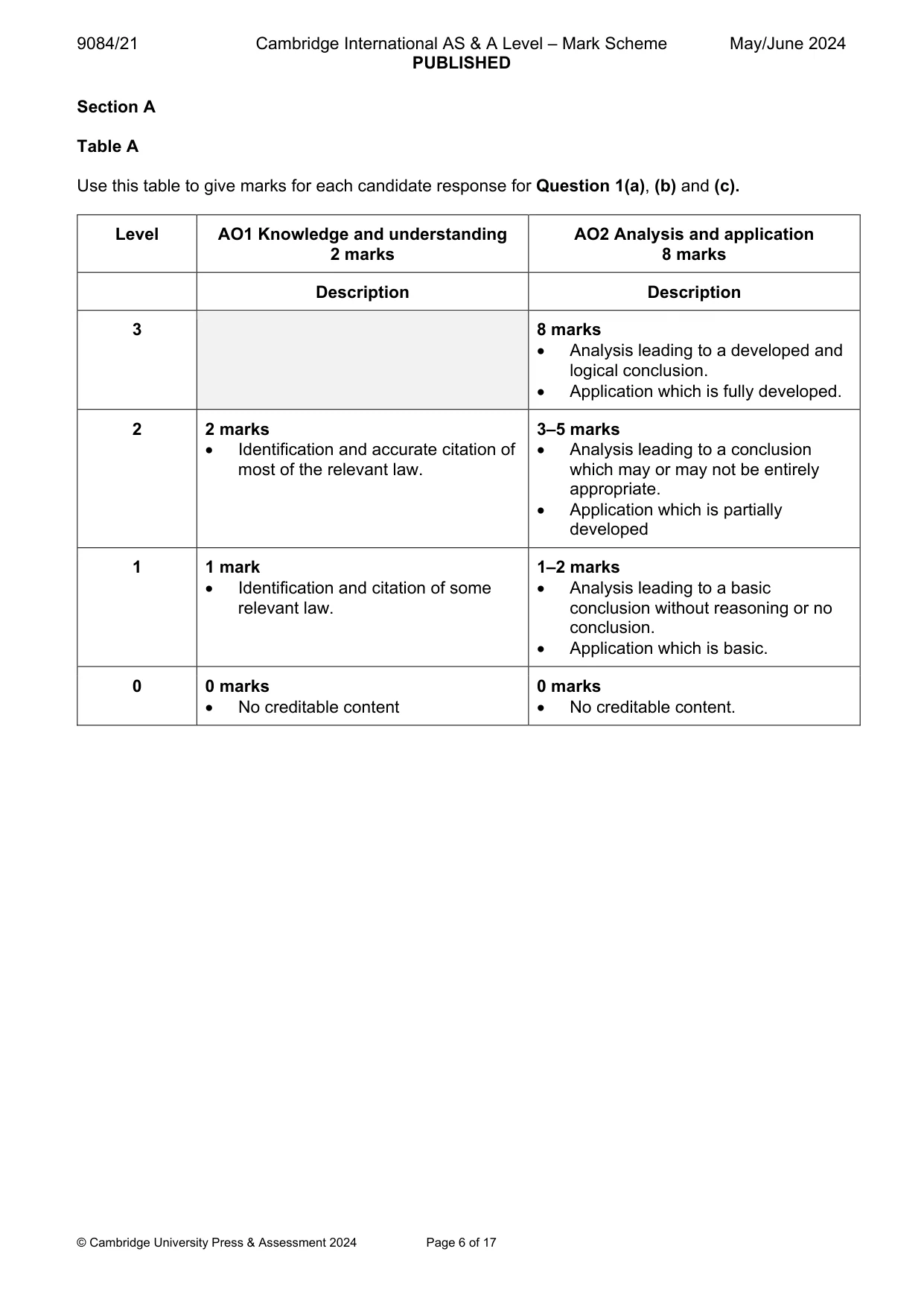
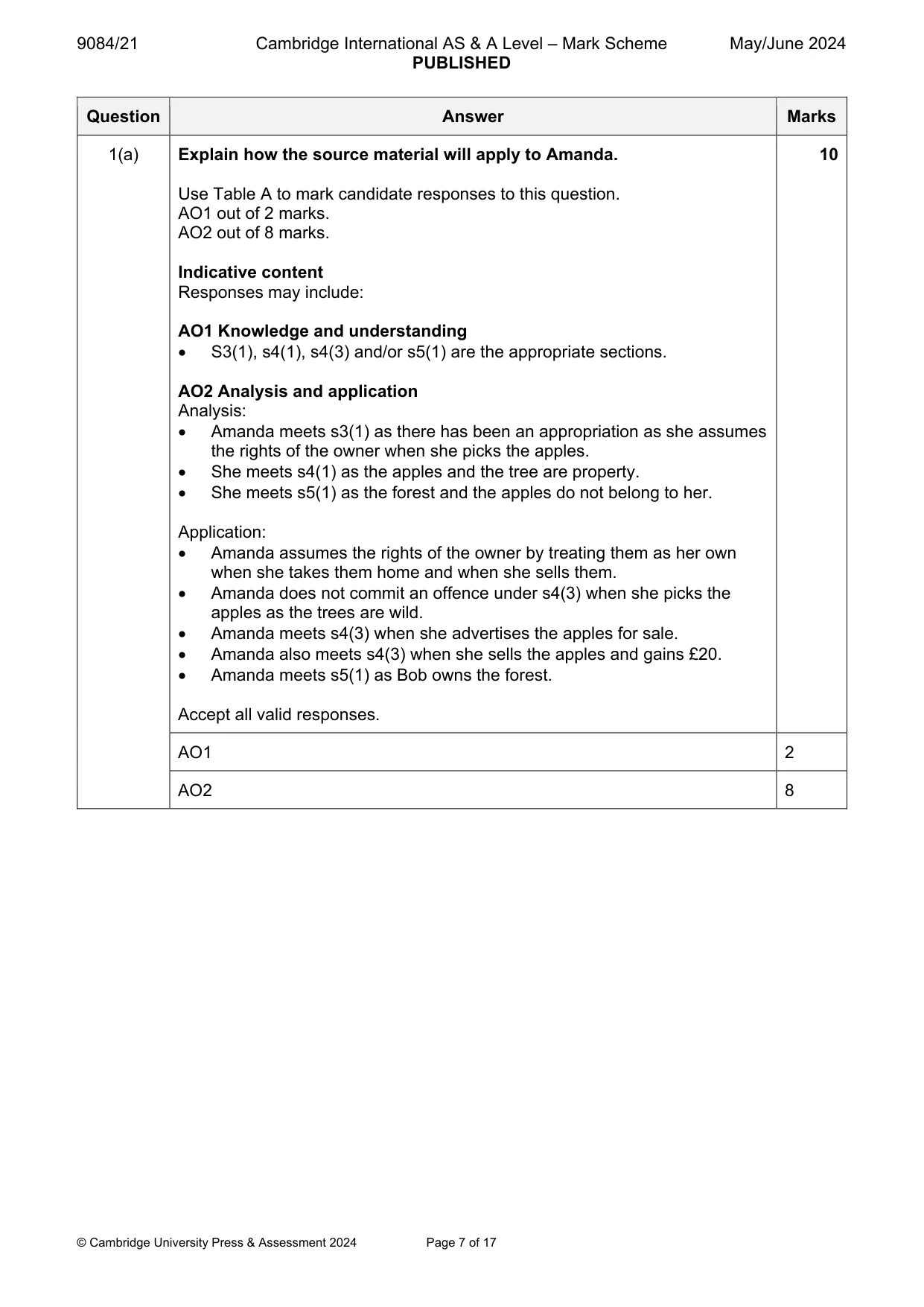
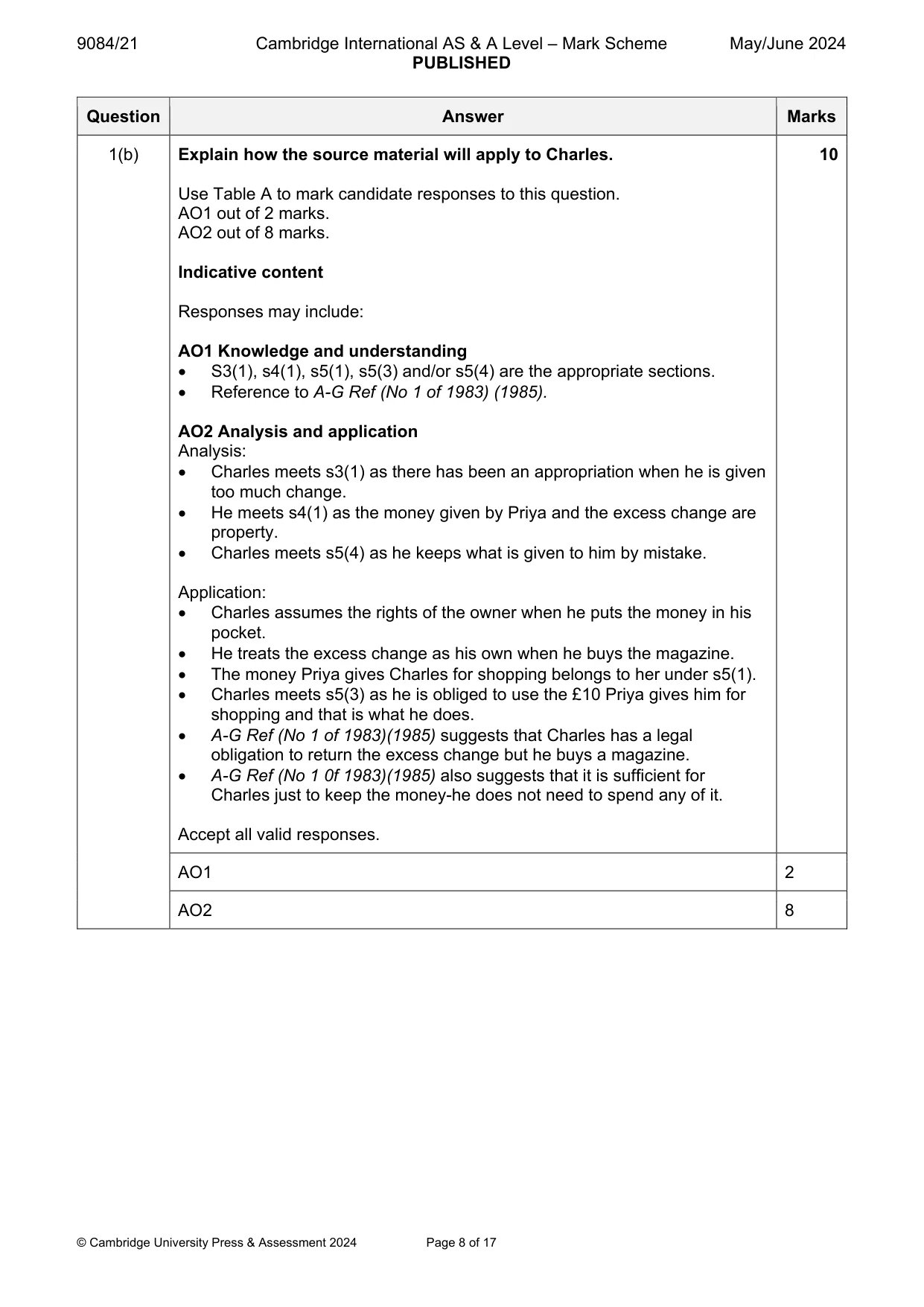
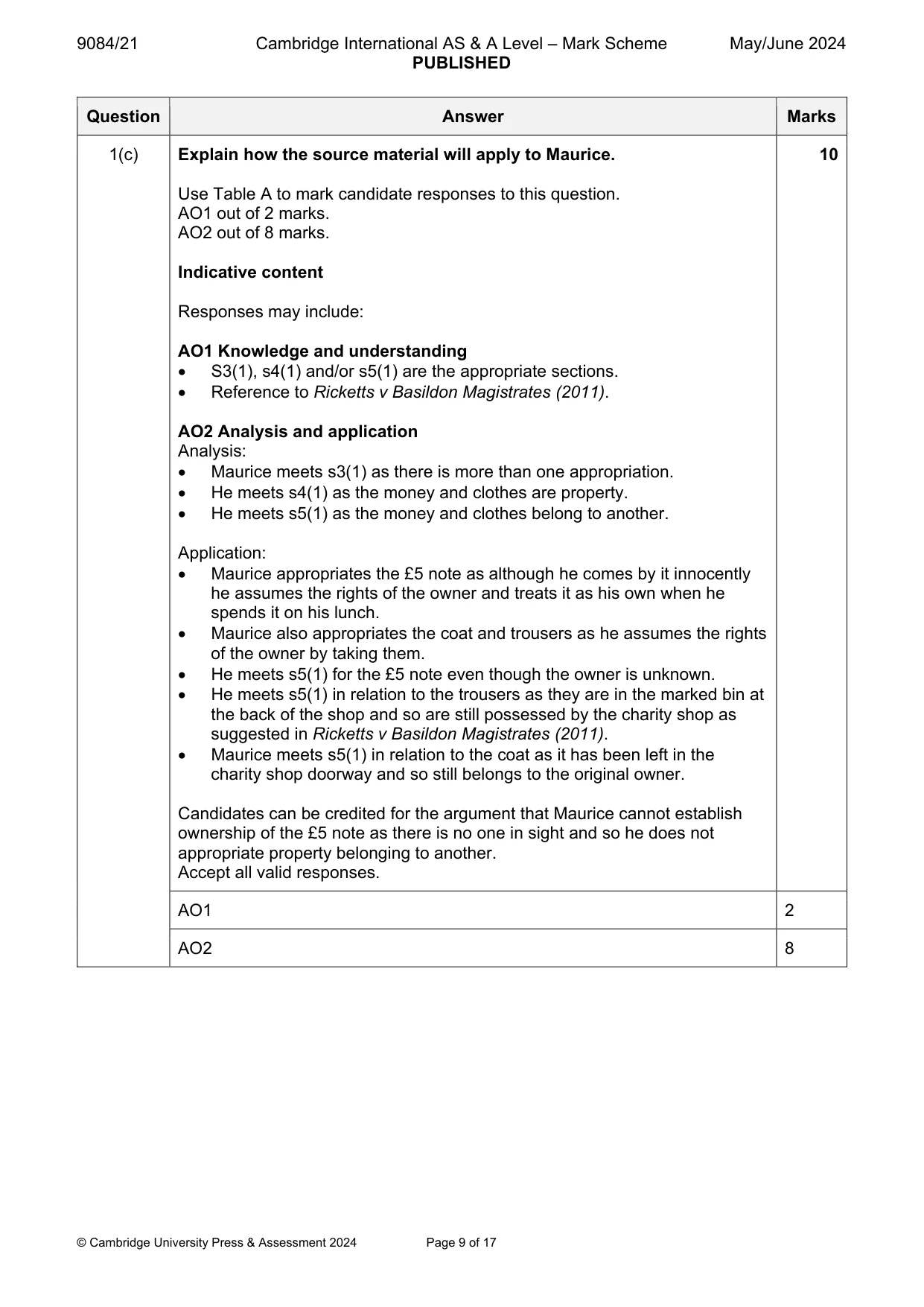
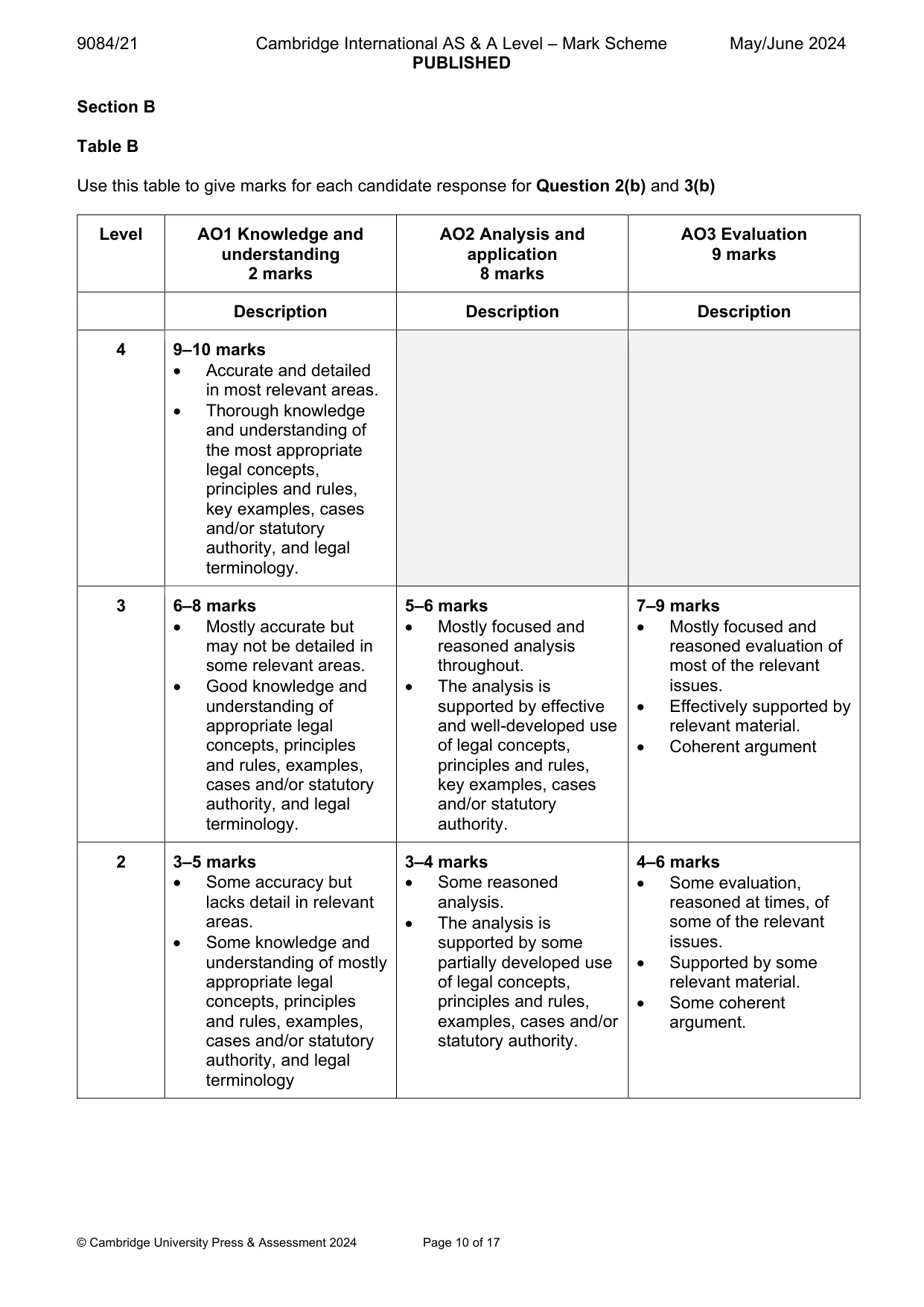
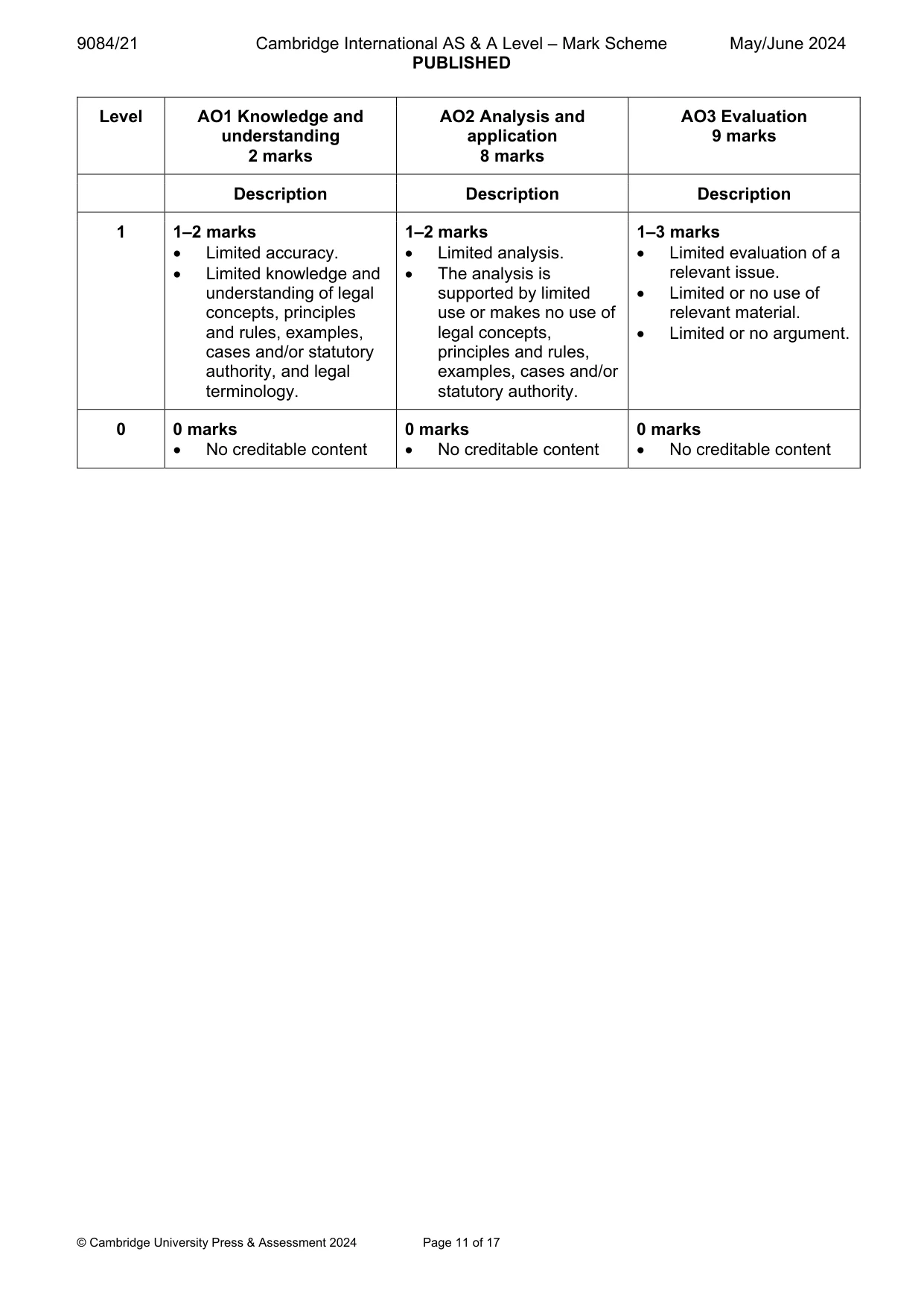
Mark scheme: Question Answer Marks 1(a) Explain how the source material will apply to Amanda. 10 Use Table A to mark candidate responses to this question. AO1 out of 2 marks. AO2 out of 8 marks. Indicative content Responses may include: AO1 Knowledge and understanding S3(1), s4(1), s4(3) and/or s5(1) are the appropriate sections. AO2 Analysis and application Analysis: Amanda meets s3(1) as there has been an appropriation as she assumes the rights of the owner when she picks the apples. She meets s4(1) as the apples and the tree are property. She meets s5(1) as the forest and the apples do not belong to her. Application: Amanda assumes the rights of the owner by treating them as her own when she takes them home and when she sells them. Amanda does not commit an offence under s4(3) when she picks the apples as the trees are wild. Amanda meets s4(3) when she advertises the apples for sale. Amanda also meets s4(3) when she sells the apples and gains £20. Amanda meets s5(1) as Bob owns the forest. Accept all valid responses. AO1 2 AO2 8 1(b) Explain how the source material will apply to Charles. 10 Use Table A to mark candidate responses to this question. AO1 out of 2 marks. AO2 out of 8 marks. Indicative content Responses may include: AO1 Knowledge and understanding S3(1), s4(1), s5(1), s5(3) and/or s5(4) are the appropriate sections. Reference to A-G Ref (No 1 of 1983) (1985). AO2 Analysis and application Analysis: Charles meets s3(1) as there has been an appropriation when he is given too much change. He meets s4(1) as the money given by Priya and the excess change are property. Charles meets s5(4) as he keeps what is given to him by mistake. Application: Charles assumes the rights of the owner when he puts the money in his pocket. He treats the excess change as his own when he buys the magazine. The money Priya gives Charles for shopping belongs to her under s5(1). Charles meets s5(3) as he is obliged to use the £10 Priya gives him for shopping and that is what he does. A-G Ref (No 1 of 1983)(1985) suggests that Charles has a legal obligation to return the excess change but he buys a magazine. A-G Ref (No 1 0f 1983)(1985) also suggests that it is sufficient for Charles just to keep the money-he does not need to spend any of it. Accept all valid responses. AO1 2 AO2 8 1(c) Explain how the source material will apply to Maurice. 10 Use Table A to mark candidate responses to this question. AO1 out of 2 marks. AO2 out of 8 marks. Indicative content Responses may include: AO1 Knowledge and understanding S3(1), s4(1) and/or s5(1) are the appropriate sections. Reference to Ricketts v Basildon Magistrates (2011). AO2 Analysis and application Analysis: Maurice meets s3(1) as there is more than one appropriation. He meets s4(1) as the money and clothes are property. He meets s5(1) as the money and clothes belong to another. Application: Maurice appropriates the £5 note as although he comes by it innocently he assumes the rights of the owner and treats it as his own when he spends it on his lunch. Maurice also appropriates the coat and trousers as he assumes the rights of the owner by taking them. He meets s5(1) for the £5 note even though the owner is unknown. He meets s5(1) in relation to the trousers as they are in the marked bin at the back of the shop and so are still possessed by the charity shop as suggested in Ricketts v Basildon Magistrates (2011). Maurice meets s5(1) in relation to the coat as it has been left in the charity shop doorway and so still belongs to the original owner. Candidates can be credited for the argument that Maurice cannot establish ownership of the £5 note as there is no one in sight and so he does not appropriate property belonging to another. Accept all valid responses. AO1 2 AO2 8 Section B Table B Use this table to give marks for each candidate response for Question 2(b) and 3(b) Level AO1 Knowledge and AO2 Analysis and AO3 Evaluation understanding application 9 marks 2 marks 8 marks Description Description Description 4 9–10 marks Accurate and detailed in most relevant areas. Thorough knowledge and understanding of the most appropriate legal concepts, principles and rules, key examples, cases and/or statutory authority, and legal terminology. 3 6–8 marks 5–6 marks 7–9 marks Mostly accurate but Mostly focused and Mostly focused and may not be detailed in reasoned analysis reasoned evaluation of some relevant areas. throughout. most of the relevant Good knowledge and The analysis is issues. understanding of supported by effective Effectively supported by appropriate legal and well-developed use relevant material. concepts, principles of legal concepts, Coherent argument and rules, examples, principles and rules, cases and/or statutory key examples, cases authority, and legal and/or statutory terminology. authority. 2 3–5 marks 3–4 marks 4–6 marks Some accuracy but Some reasoned Some evaluation, lacks detail in relevant analysis. reasoned at times, of areas. The analysis is some of the relevant Some knowledge and supported by some issues. understanding of mostly partially developed use Supported by some appropriate legal of legal concepts, relevant material. concepts, principles principles and rules, Some coherent and rules, examples, examples, cases and/or argument. cases and/or statutory statutory authority. authority, and legal terminology Level AO1 Knowledge and AO2 Analysis and AO3 Evaluation understanding application 9 marks 2 marks 8 marks Description Description Description 1 1–2 marks 1–2 marks 1–3 marks Limited accuracy. Limited analysis. Limited evaluation of a Limited knowledge and The analysis is relevant issue. understanding of legal supported by limited Limited or no use of concepts, principles use or makes no use of relevant material. and rules, examples, legal concepts, Limited or no argument. cases and/or statutory principles and rules, authority, and legal examples, cases and/or terminology. statutory authority. 0 0 marks 0 marks 0 marks No creditable content No creditable content No creditable content
Q2 · Describe two elements of s10(1) Theft Act 1968
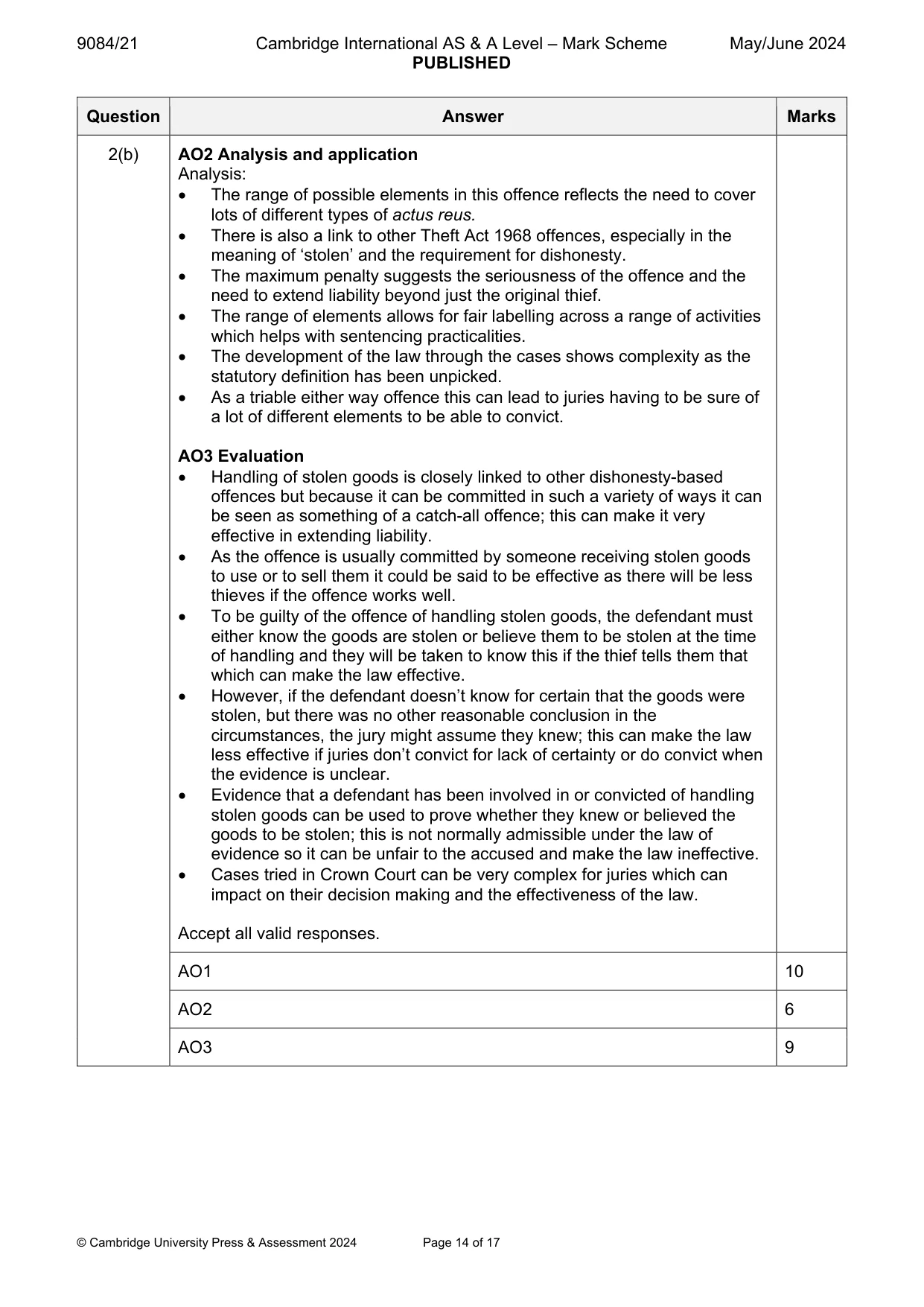
2 (a) Describe two elements of s10(1) Theft Act 1968. [5] (b) Evaluate the law of handling stolen goods. [25] OR
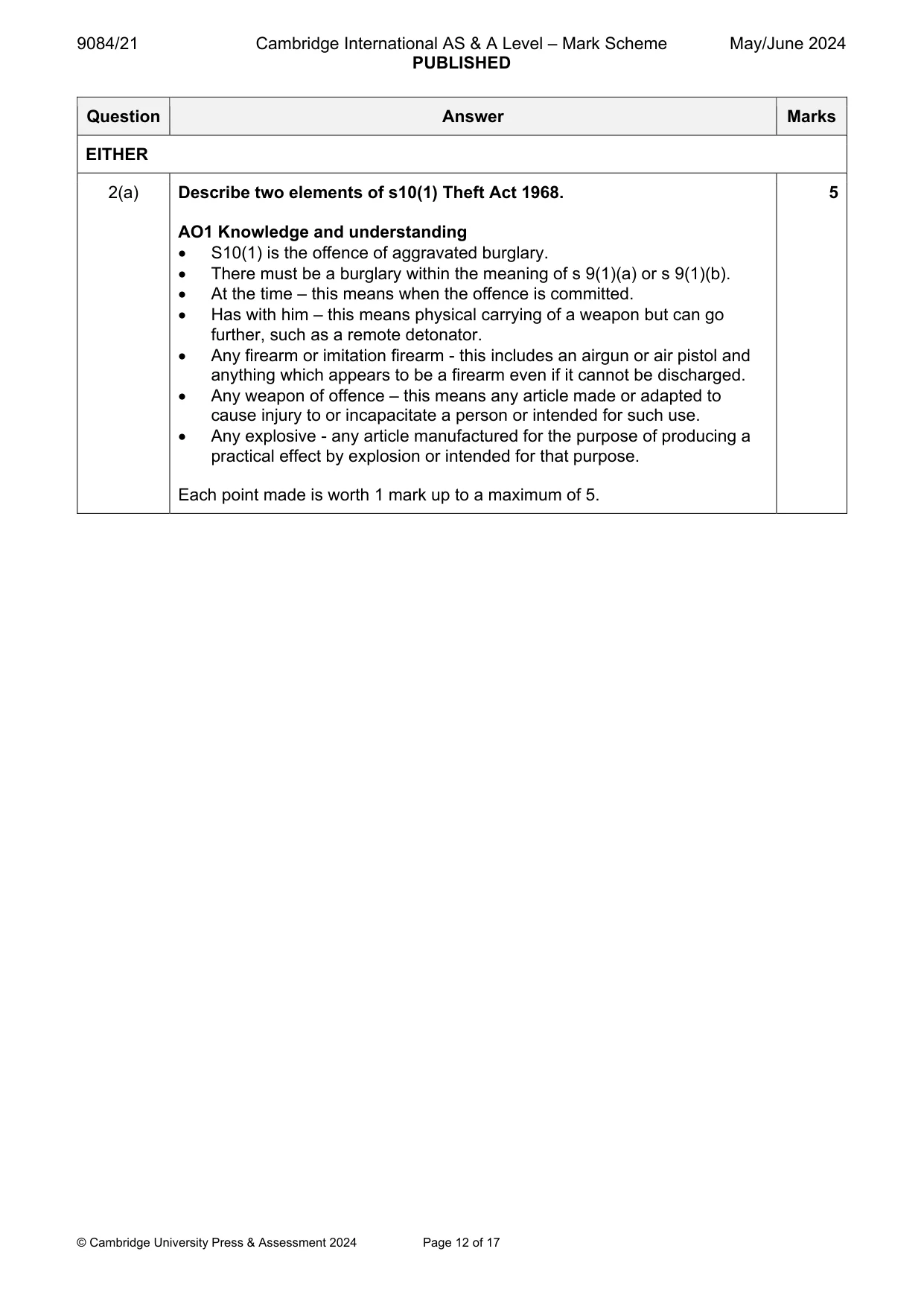
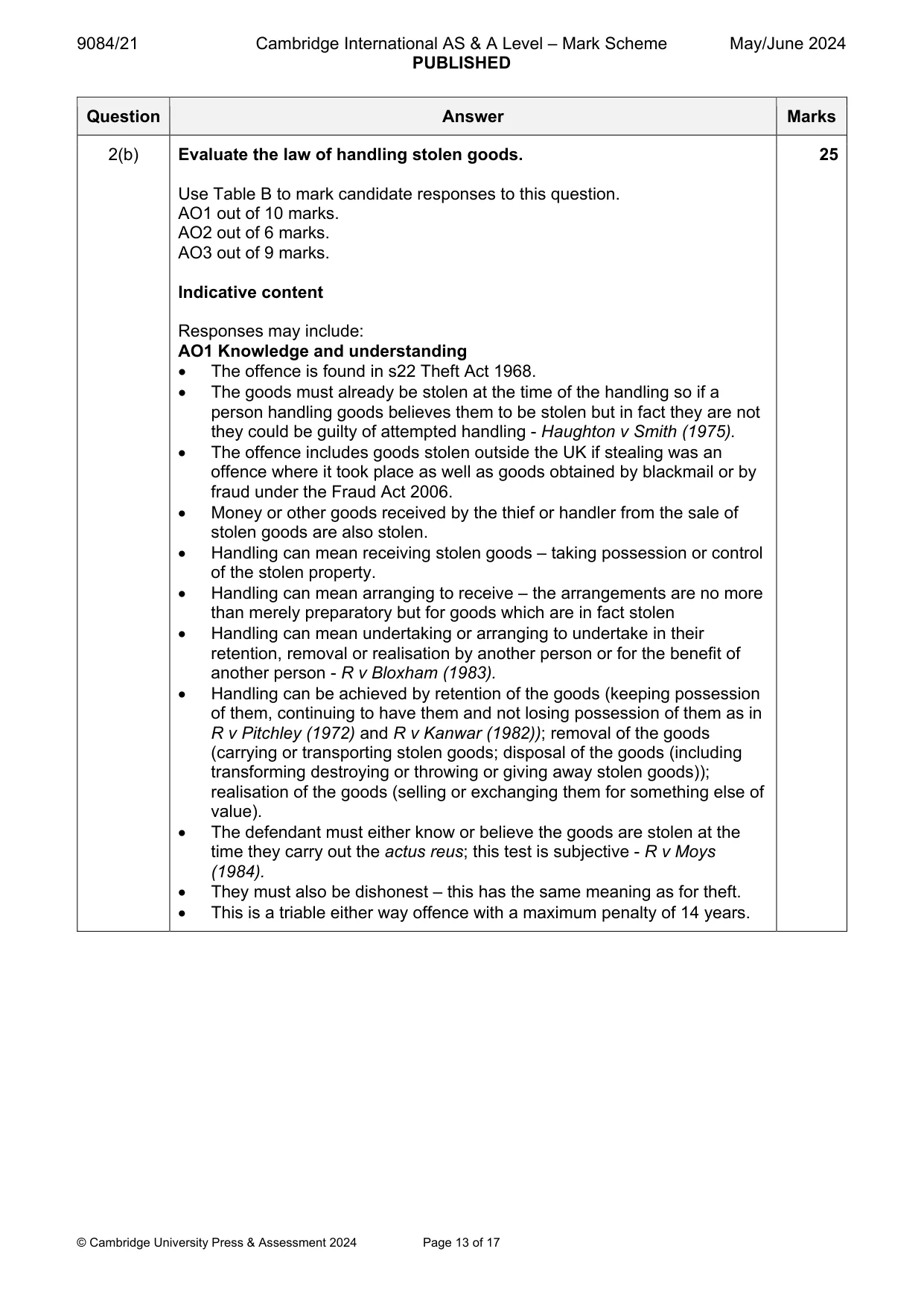
Mark scheme: 2(a) Describe two elements of s10(1) Theft Act 1968. 5 AO1 Knowledge and understanding S10(1) is the offence of aggravated burglary. There must be a burglary within the meaning of s 9(1)(a) or s 9(1)(b). At the time – this means when the offence is committed. Has with him – this means physical carrying of a weapon but can go further, such as a remote detonator. Any firearm or imitation firearm - this includes an airgun or air pistol and anything which appears to be a firearm even if it cannot be discharged. Any weapon of offence – this means any article made or adapted to cause injury to or incapacitate a person or intended for such use. Any explosive - any article manufactured for the purpose of producing a practical effect by explosion or intended for that purpose. Each point made is worth 1 mark up to a maximum of 5. 2(b) Evaluate the law of handling stolen goods. 25 Use Table B to mark candidate responses to this question. AO1 out of 10 marks. AO2 out of 6 marks. AO3 out of 9 marks. Indicative content Responses may include: AO1 Knowledge and understanding The offence is found in s22 Theft Act 1968. The goods must already be stolen at the time of the handling so if a person handling goods believes them to be stolen but in fact they are not they could be guilty of attempted handling - Haughton v Smith (1975). The offence includes goods stolen outside the UK if stealing was an offence where it took place as well as goods obtained by blackmail or by fraud under the Fraud Act 2006. Money or other goods received by the thief or handler from the sale of stolen goods are also stolen. Handling can mean receiving stolen goods – taking possession or control of the stolen property. Handling can mean arranging to receive – the arrangements are no more than merely preparatory but for goods which are in fact stolen Handling can mean undertaking or arranging to undertake in their retention, removal or realisation by another person or for the benefit of another person - R v Bloxham (1983). Handling can be achieved by retention of the goods (keeping possession of them, continuing to have them and not losing possession of them as in R v Pitchley (1972) and R v Kanwar (1982)); removal of the goods (carrying or transporting stolen goods; disposal of the goods (including transforming destroying or throwing or giving away stolen goods)); realisation of the goods (selling or exchanging them for something else of value). The defendant must either know or believe the goods are stolen at the time they carry out the actus reus; this test is subjective - R v Moys (1984). They must also be dishonest – this has the same meaning as for theft. This is a triable either way offence with a maximum penalty of 14 years. 2(b) AO2 Analysis and application Analysis: The range of possible elements in this offence reflects the need to cover lots of different types of actus reus. There is also a link to other Theft Act 1968 offences, especially in the meaning of ‘stolen’ and the requirement for dishonesty. The maximum penalty suggests the seriousness of the offence and the need to extend liability beyond just the original thief. The range of elements allows for fair labelling across a range of activities which helps with sentencing practicalities. The development of the law through the cases shows complexity as the statutory definition has been unpicked. As a triable either way offence this can lead to juries having to be sure of a lot of different elements to be able to convict. AO3 Evaluation Handling of stolen goods is closely linked to other dishonesty-based offences but because it can be committed in such a variety of ways it can be seen as something of a catch-all offence; this can make it very effective in extending liability. As the offence is usually committed by someone receiving stolen goods to use or to sell them it could be said to be effective as there will be less thieves if the offence works well. To be guilty of the offence of handling stolen goods, the defendant must either know the goods are stolen or believe them to be stolen at the time of handling and they will be taken to know this if the thief tells them that which can make the law effective. However, if the defendant doesn’t know for certain that the goods were stolen, but there was no other reasonable conclusion in the circumstances, the jury might assume they knew; this can make the law less effective if juries don’t convict for lack of certainty or do convict when the evidence is unclear. Evidence that a defendant has been involved in or convicted of handling stolen goods can be used to prove whether they knew or believed the goods to be stolen; this is not normally admissible under the law of evidence so it can be unfair to the accused and make the law ineffective. Cases tried in Crown Court can be very complex for juries which can impact on their decision making and the effectiveness of the law. Accept all valid responses. AO1 10 AO2 6 AO3 9
Q3 · Describe the offence of obtaining services dishonestly
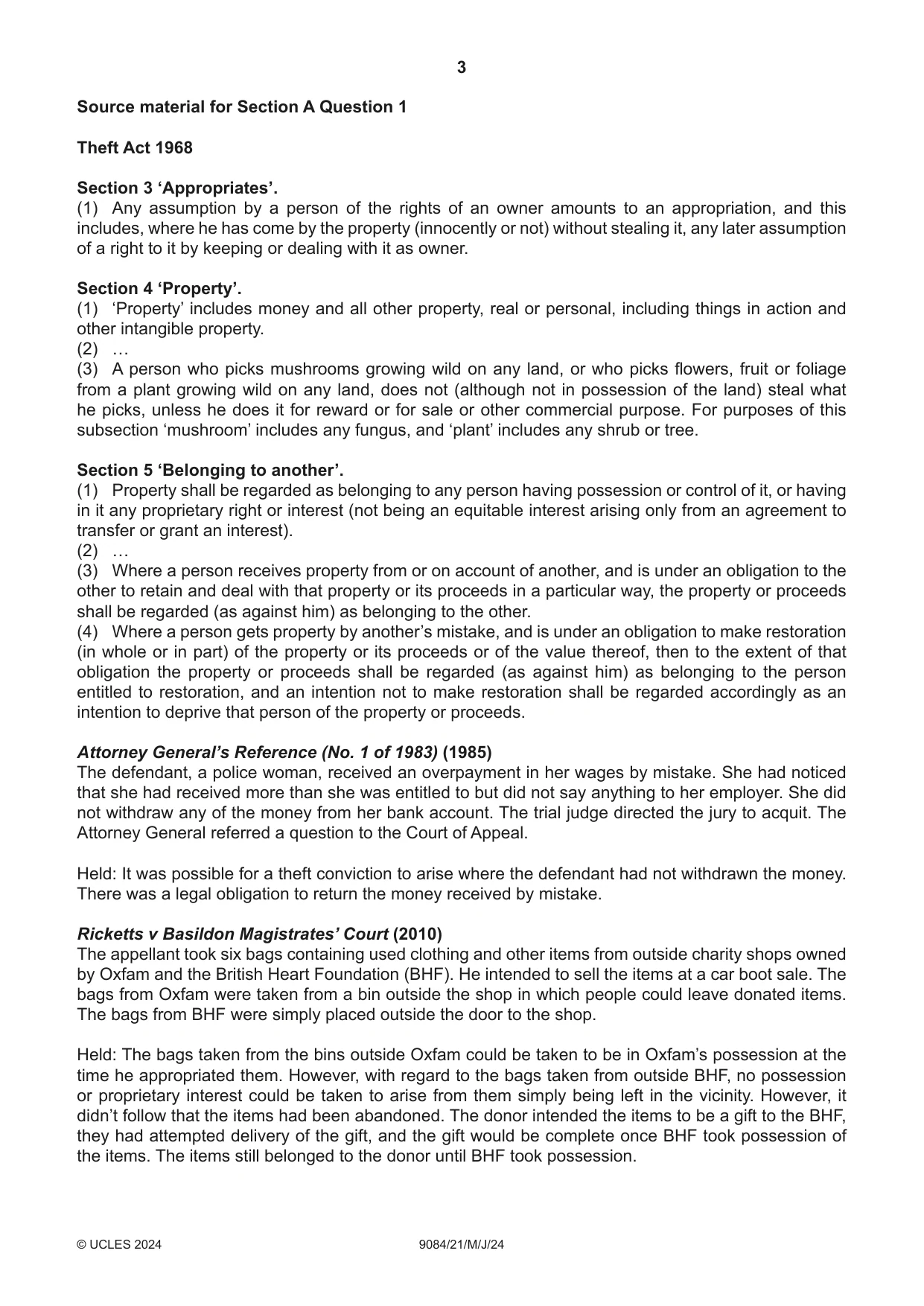
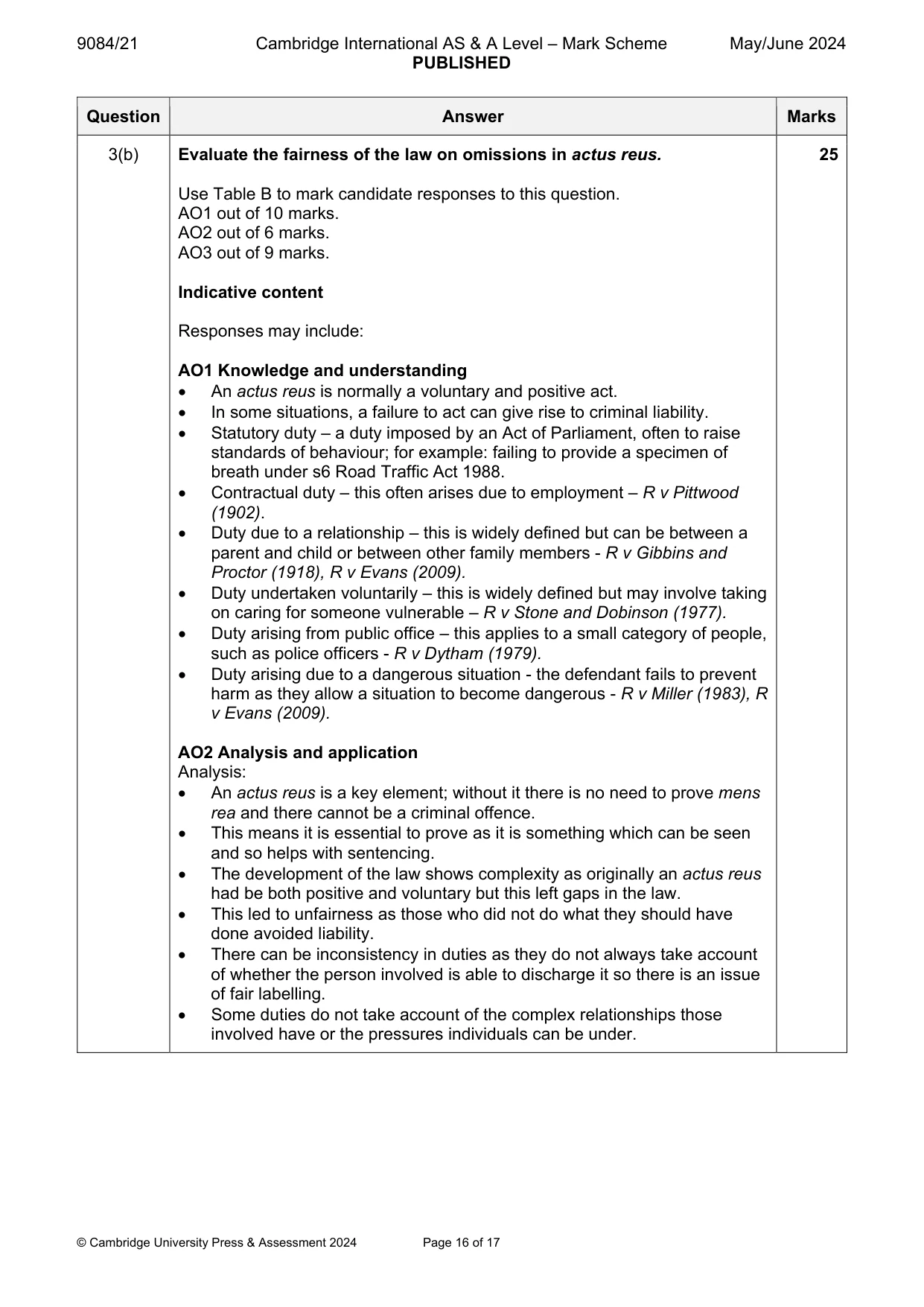
3 (a) Describe the offence of obtaining services dishonestly. [5] (b) Evaluate the fairness of the law on omissions in actus reus. [25] Source material for Section A Question 1 Theft Act 1968 Section 3 ‘Appropriates’. (1) Any assumption by a person of the rights of an owner amounts to an appropriation, and this includes, where he has come by the property (innocently or not) without stealing it, any later assumption of a right to it by keeping or dealing with it as owner. Section 4 ‘Property’. (1) ‘Property’ includes money and all other property, real or personal, including things in action and other intangible property. (2) … (3) A person who picks mushrooms growing wild on any land, or who picks flowers, fruit or foliage from a plant growing wild on any land, does not (although not in possession of the land) steal what he picks, unless he does it for reward or for sale or other commercial purpose. For purposes of this subsection ‘mushroom’ includes any fungus, and ‘plant’ includes any shrub or tree. Section 5 ‘Belonging to another’. (1) Property shall be regarded as belonging to any person having possession or control of it, or having in it any proprietary right or interest (not being an equitable interest arising only from an agreement to transfer or grant an interest). (2) … (3) Where a person receives property from or on account of another, and is under an obligation to the other to retain and deal with that property or its proceeds in a particular way, the property or proceeds shall be regarded (as against him) as belonging to the other. (4) Where a person gets property by another’s mistake, and is under an obligation to make restoration (in whole or in part) of the property or its proceeds or of the value thereof, then to the extent of that obligation the property or proceeds shall be regarded (as against him) as belonging to the person entitled to restoration, and an intention not to make restoration shall be regarded accordingly as an intention to deprive that person of the property or proceeds. Attorney General’s Reference (No. 1 of 1983) (1985) The defendant, a police woman, received an overpayment in her wages by mistake. She had noticed that she had received more than she was entitled to but did not say anything to her employer. She did not withdraw any of the money from her bank account. The trial judge directed the jury to acquit. The Attorney General referred a question to the Court of Appeal. Held: It was possible for a theft conviction to arise where the defendant had not withdrawn the money. There was a legal obligation to return the money received by mistake. Ricketts v Basildon Magistrates’ Court (2010) The appellant took six bags containing used clothing and other items from outside charity shops owned by Oxfam and the British Heart Foundation (BHF). He intended to sell the items at a car boot sale. The bags from Oxfam were taken from a bin outside the shop in which people could leave donated items. The bags from BHF were simply placed outside the door to the shop. Held: The bags taken from the bins outside Oxfam could be taken to be in Oxfam’s possession at the time he appropriated them. However, with regard to the bags taken from outside BHF, no possession or proprietary interest could be taken to arise from them simply being left in the vicinity. However, it didn’t follow that the items had been abandoned. The donor intended the items to be a gift to the BHF, they had attempted delivery of the gift, and the gift would be complete once BHF took possession of the items. The items still belonged to the donor until BHF took possession.
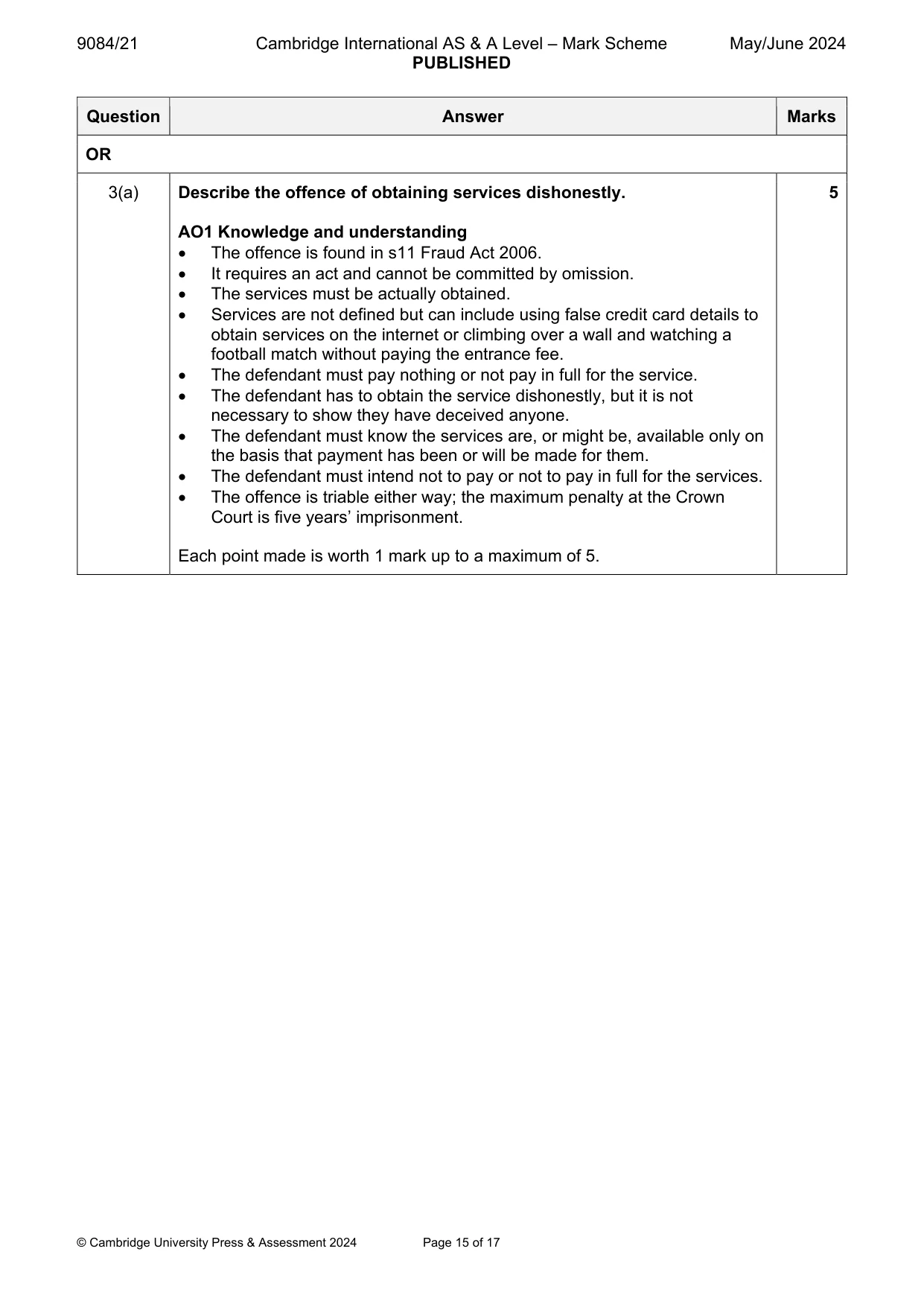
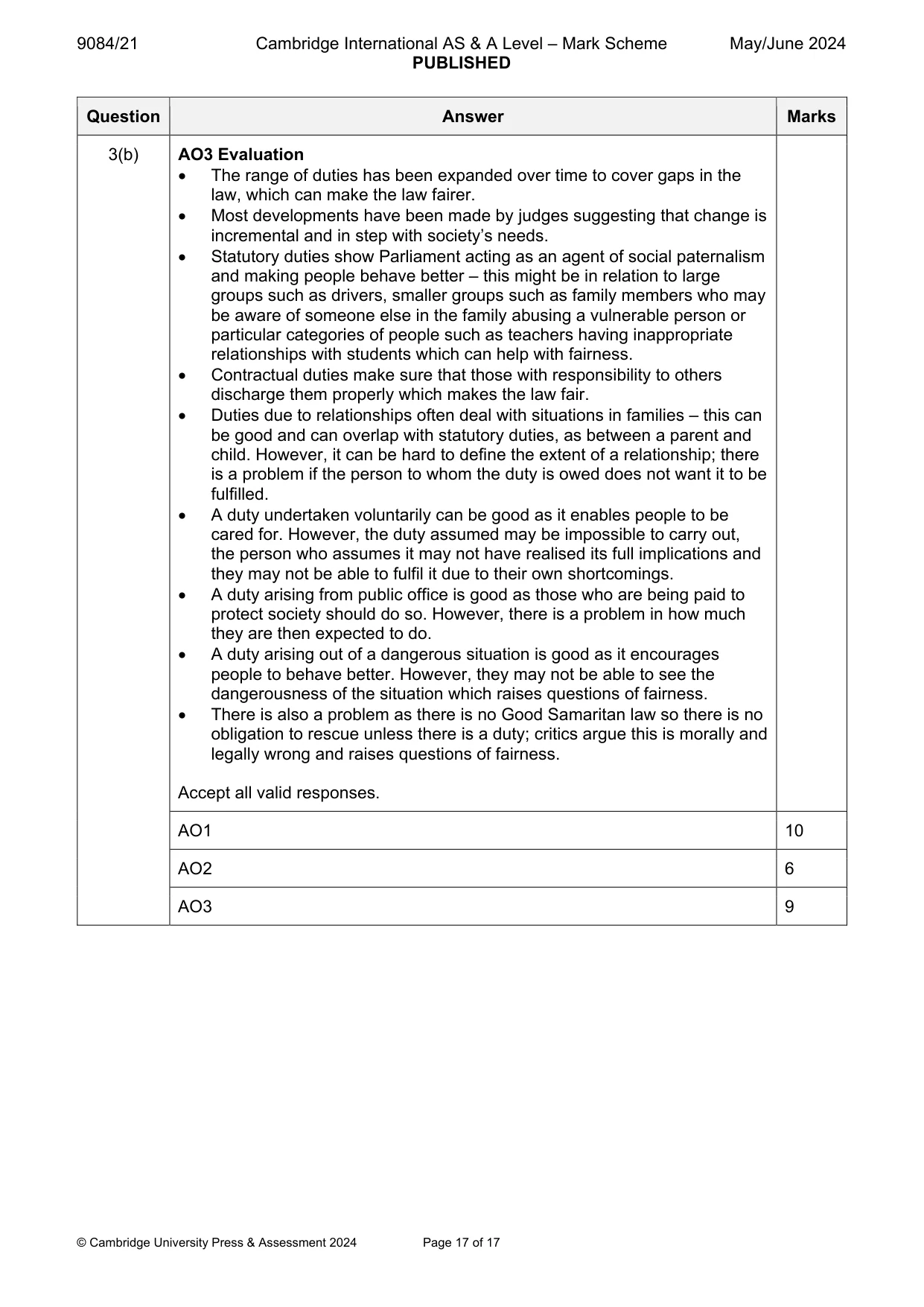
Mark scheme: 3(a) Describe the offence of obtaining services dishonestly. 5 AO1 Knowledge and understanding The offence is found in s11 Fraud Act 2006. It requires an act and cannot be committed by omission. The services must be actually obtained. Services are not defined but can include using false credit card details to obtain services on the internet or climbing over a wall and watching a football match without paying the entrance fee. The defendant must pay nothing or not pay in full for the service. The defendant has to obtain the service dishonestly, but it is not necessary to show they have deceived anyone. The defendant must know the services are, or might be, available only on the basis that payment has been or will be made for them. The defendant must intend not to pay or not to pay in full for the services. The offence is triable either way; the maximum penalty at the Crown Court is five years’ imprisonment. Each point made is worth 1 mark up to a maximum of 5. 3(b) Evaluate the fairness of the law on omissions in actus reus. 25 Use Table B to mark candidate responses to this question. AO1 out of 10 marks. AO2 out of 6 marks. AO3 out of 9 marks. Indicative content Responses may include: AO1 Knowledge and understanding An actus reus is normally a voluntary and positive act. In some situations, a failure to act can give rise to criminal liability. Statutory duty – a duty imposed by an Act of Parliament, often to raise standards of behaviour; for example: failing to provide a specimen of breath under s6 Road Traffic Act 1988. Contractual duty – this often arises due to employment – R v Pittwood (1902). Duty due to a relationship – this is widely defined but can be between a parent and child or between other family members - R v Gibbins and Proctor (1918), R v Evans (2009). Duty undertaken voluntarily – this is widely defined but may involve taking on caring for someone vulnerable – R v Stone and Dobinson (1977). Duty arising from public office – this applies to a small category of people, such as police officers - R v Dytham (1979). Duty arising due to a dangerous situation - the defendant fails to prevent harm as they allow a situation to become dangerous - R v Miller (1983), R v Evans (2009). AO2 Analysis and application Analysis: An actus reus is a key element; without it there is no need to prove mens rea and there cannot be a criminal offence. This means it is essential to prove as it is something which can be seen and so helps with sentencing. The development of the law shows complexity as originally an actus reus had be both positive and voluntary but this left gaps in the law. This led to unfairness as those who did not do what they should have done avoided liability. There can be inconsistency in duties as they do not always take account of whether the person involved is able to discharge it so there is an issue of fair labelling. Some duties do not take account of the complex relationships those involved have or the pressures individuals can be under. 3(b) AO3 Evaluation The range of duties has been expanded over time to cover gaps in the law, which can make the law fairer. Most developments have been made by judges suggesting that change is incremental and in step with society’s needs. Statutory duties show Parliament acting as an agent of social paternalism and making people behave better – this might be in relation to large groups such as drivers, smaller groups such as family members who may be aware of someone else in the family abusing a vulnerable person or particular categories of people such as teachers having inappropriate relationships with students which can help with fairness. Contractual duties make sure that those with responsibility to others discharge them properly which makes the law fair. Duties due to relationships often deal with situations in families – this can be good and can overlap with statutory duties, as between a parent and child. However, it can be hard to define the extent of a relationship; there is a problem if the person to whom the duty is owed does not want it to be fulfilled. A duty undertaken voluntarily can be good as it enables people to be cared for. However, the duty assumed may be impossible to carry out, the person who assumes it may not have realised its full implications and they may not be able to fulfil it due to their own shortcomings. A duty arising from public office is good as those who are being paid to protect society should do so. However, there is a problem in how much they are then expected to do. A duty arising out of a dangerous situation is good as it encourages people to behave better. However, they may not be able to see the dangerousness of the situation which raises questions of fairness. There is also a problem as there is no Good Samaritan law so there is no obligation to rescue unless there is a duty; critics argue this is morally and legally wrong and raises questions of fairness. Accept all valid responses. AO1 10 AO2 6 AO3 9
What was in this paper
The subtopics covered by these 3 questions, and how many questions each got. Open one in a new tab to see every Cambridge question on it.
2Elements of a crime This topic is about the principles underpinning fault in the criminal law and considers the elements which make up a crime. This topic is an opportunity to reflect on the key concepts of rights, duties and responsibilities alongside liability, justice, fairness, and effectiveness1What you needed in this session
Cambridge’s own grade thresholds for 2024 May/June, Paper 2 · Variant 1. A higher threshold means an easier paper — the bar moves with how the cohort did.