Cambridge A Level Law 9084 — 2023 May/June Paper 2 · Variant 2
9084/22/M/J/23 · 3 questions · 60 marks · ≈68 min
The question paper and its mark scheme, free to read here and free to download. This is Cambridge’s own paper, exactly as it was sat.
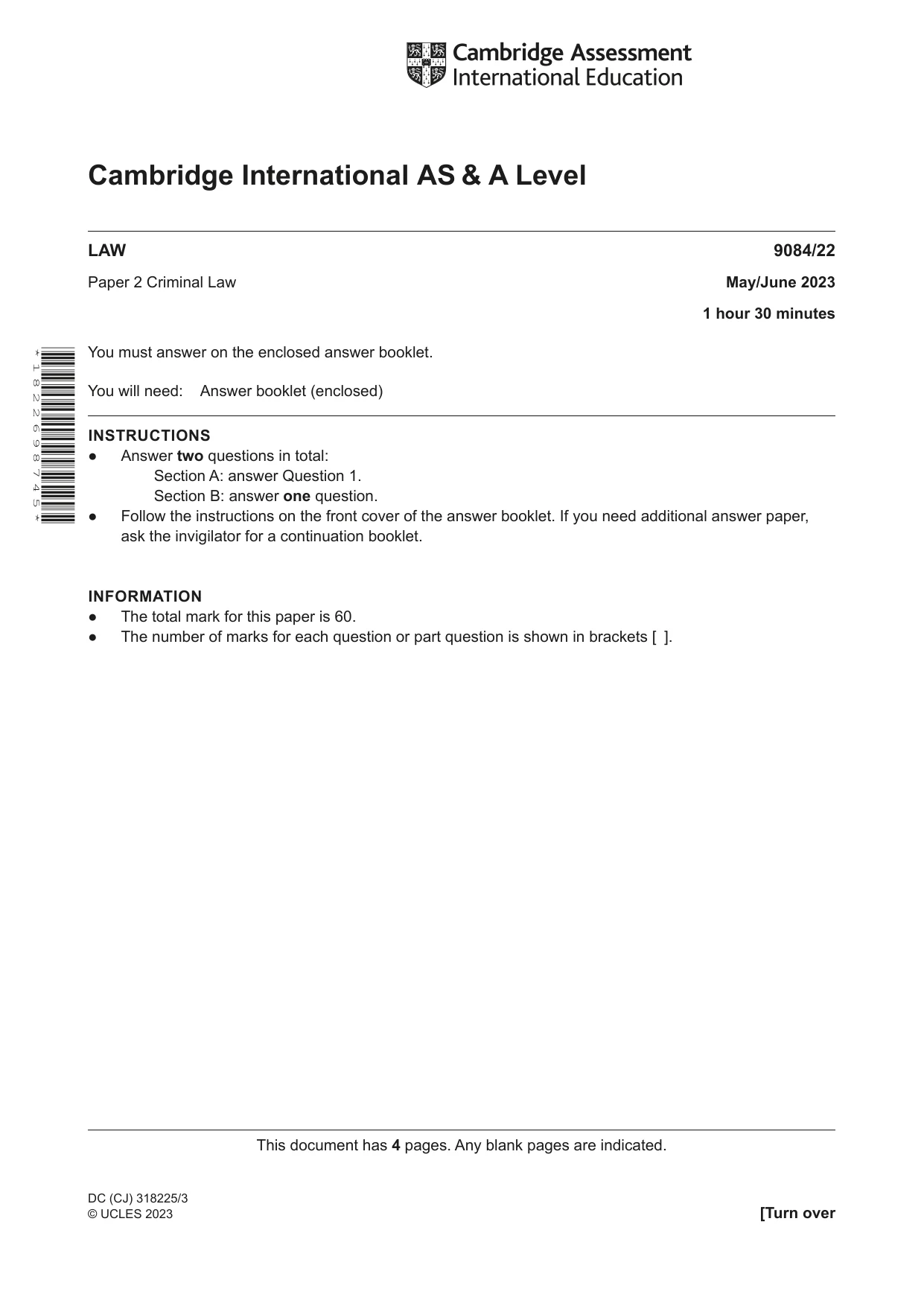
Question paper4 pages

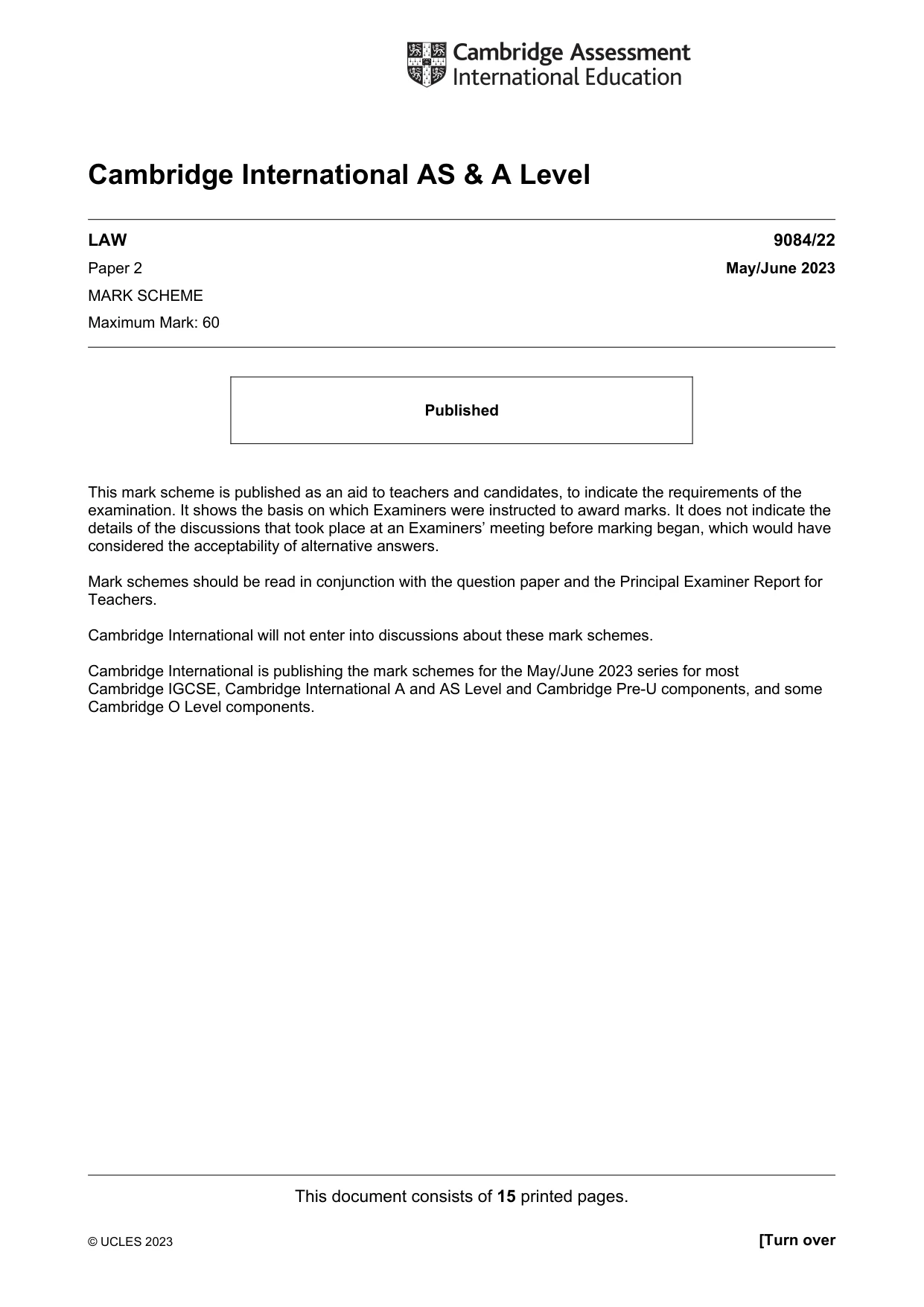
Mark scheme15 pages
Answers below. Sit the paper first if you are practising.
Questions as text
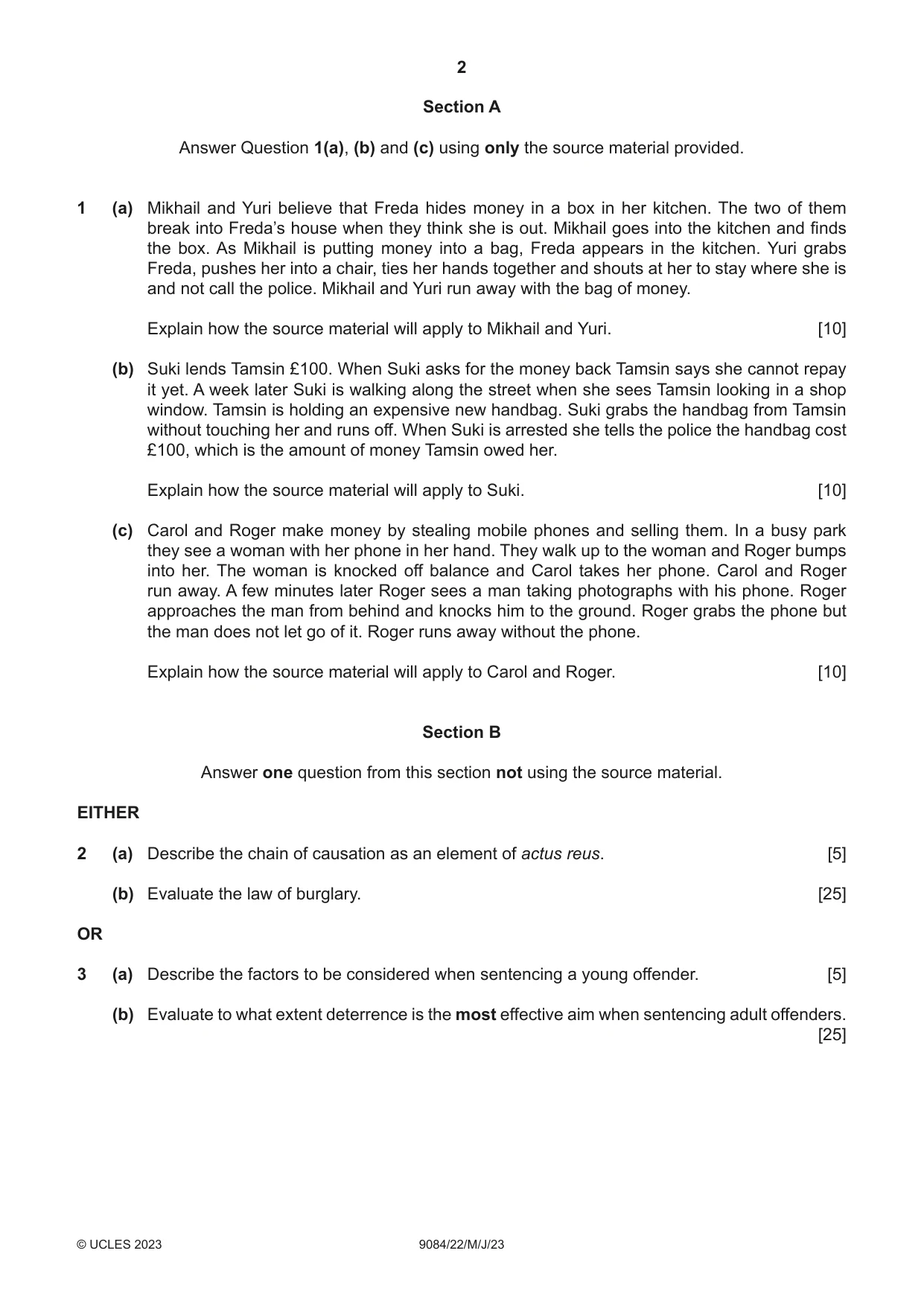
Q1 · Mikhail and Yuri believe that Freda hides money in a box in her kitchen
1 (a) Mikhail and Yuri believe that Freda hides money in a box in her kitchen. The two of them break into Freda’s house when they think she is out. Mikhail goes into the kitchen and finds the box. As Mikhail is putting money into a bag, Freda appears in the kitchen. Yuri grabs Freda, pushes her into a chair, ties her hands together and shouts at her to stay where she is and not call the police. Mikhail and Yuri run away with the bag of money. Explain how the source material will apply to Mikhail and Yuri. [10] (b) Suki lends Tamsin £100. When Suki asks for the money back Tamsin says she cannot repay it yet. A week later Suki is walking along the street when she sees Tamsin looking in a shop window. Tamsin is holding an expensive new handbag. Suki grabs the handbag from Tamsin without touching her and runs off. When Suki is arrested she tells the police the handbag cost £100, which is the amount of money Tamsin owed her. Explain how the source material will apply to Suki. [10] (c) Carol and Roger make money by stealing mobile phones and selling them. In a busy park they see a woman with her phone in her hand. They walk up to the woman and Roger bumps into her. The woman is knocked off balance and Carol takes her phone. Carol and Roger run away. A few minutes later Roger sees a man taking photographs with his phone. Roger approaches the man from behind and knocks him to the ground. Roger grabs the phone but the man does not let go of it. Roger runs away without the phone. Explain how the source material will apply to Carol and Roger. [10]
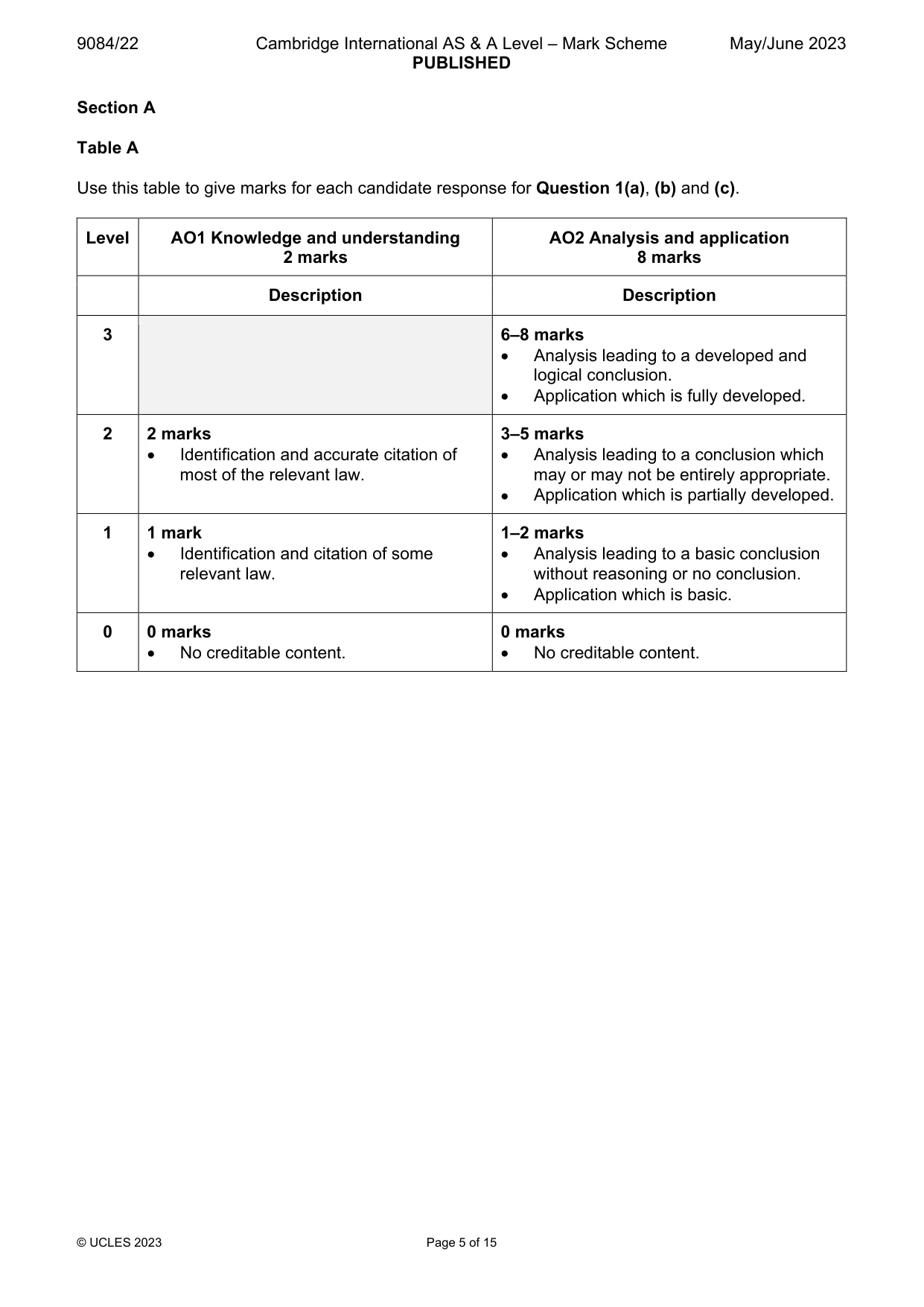
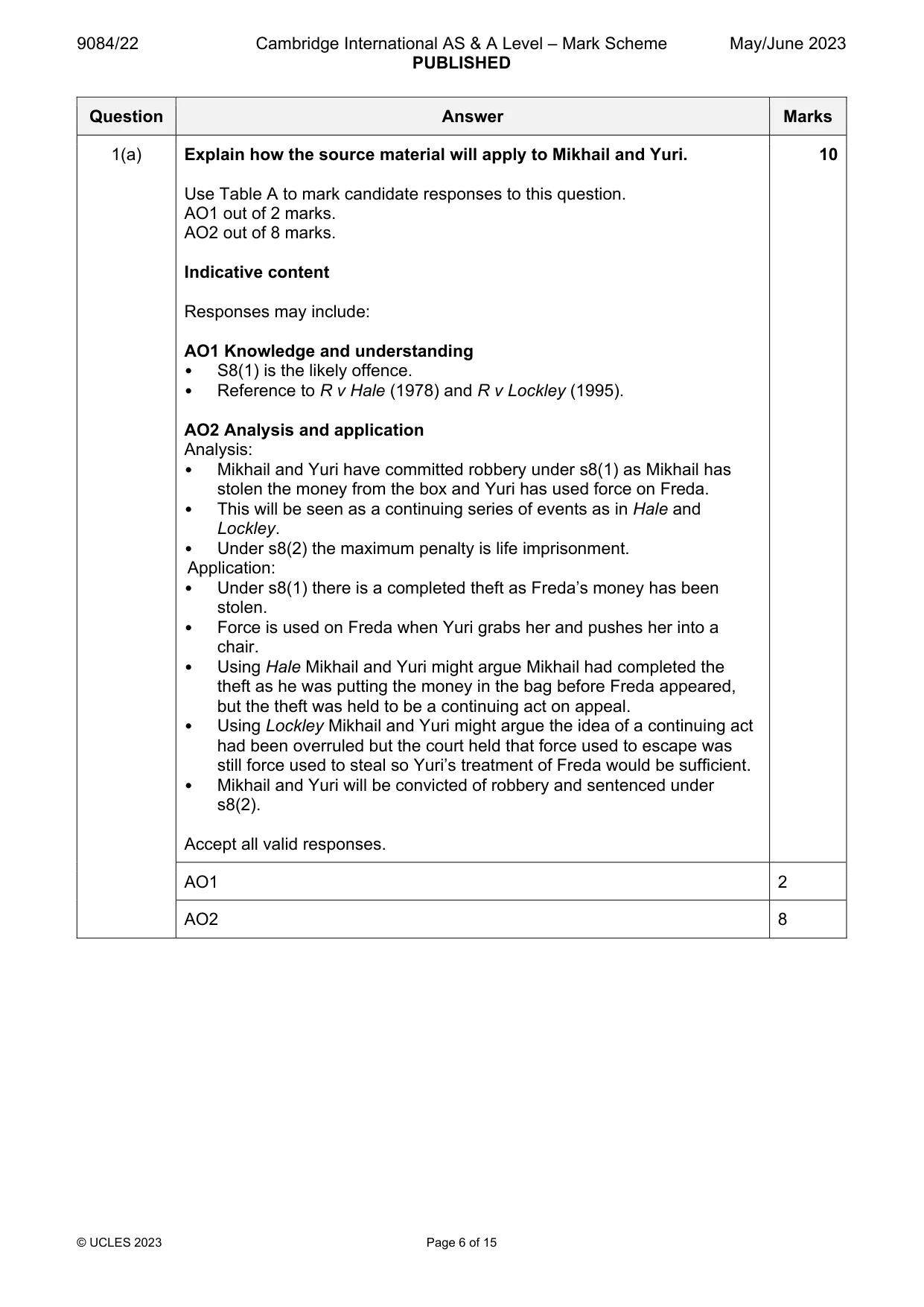
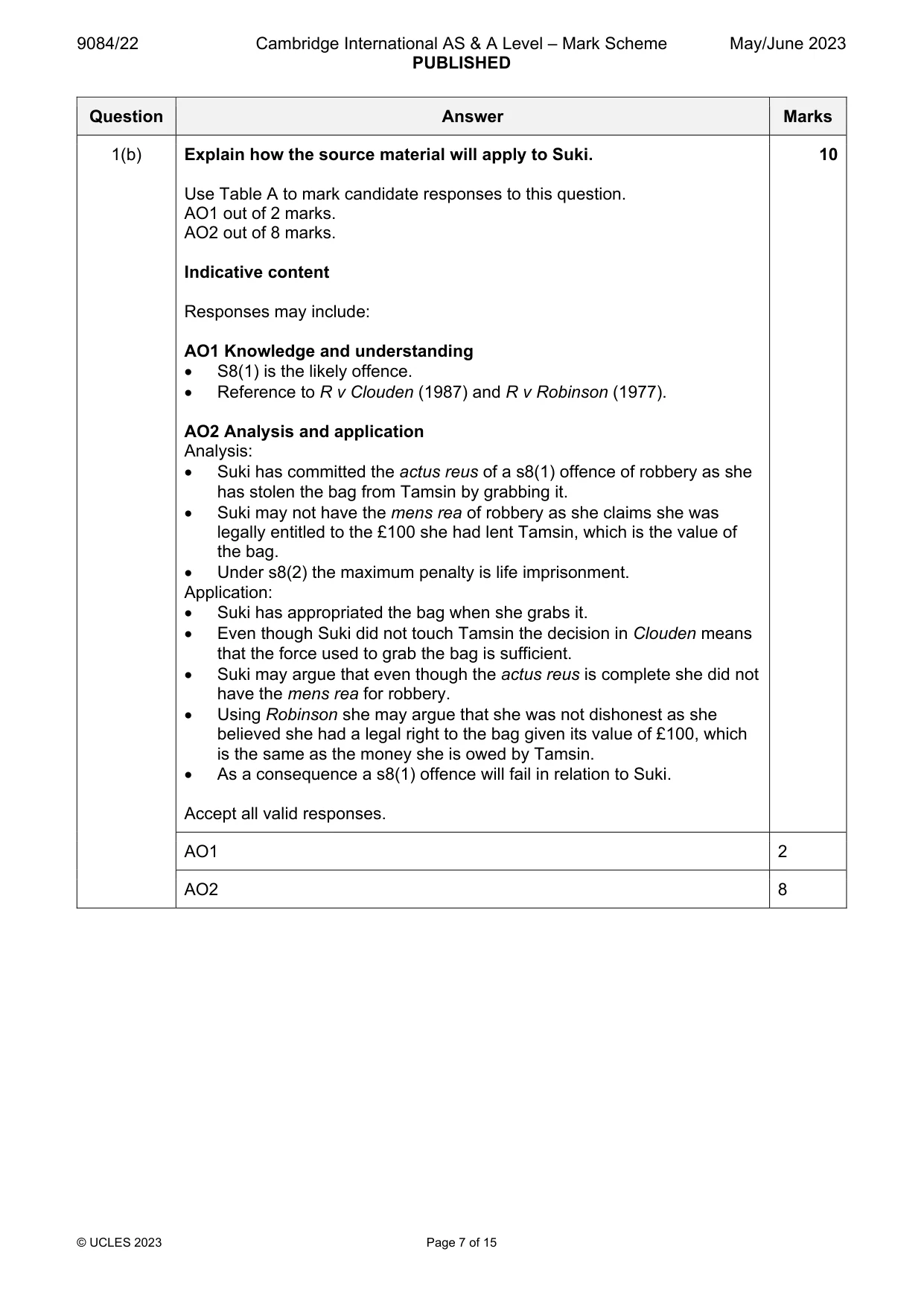
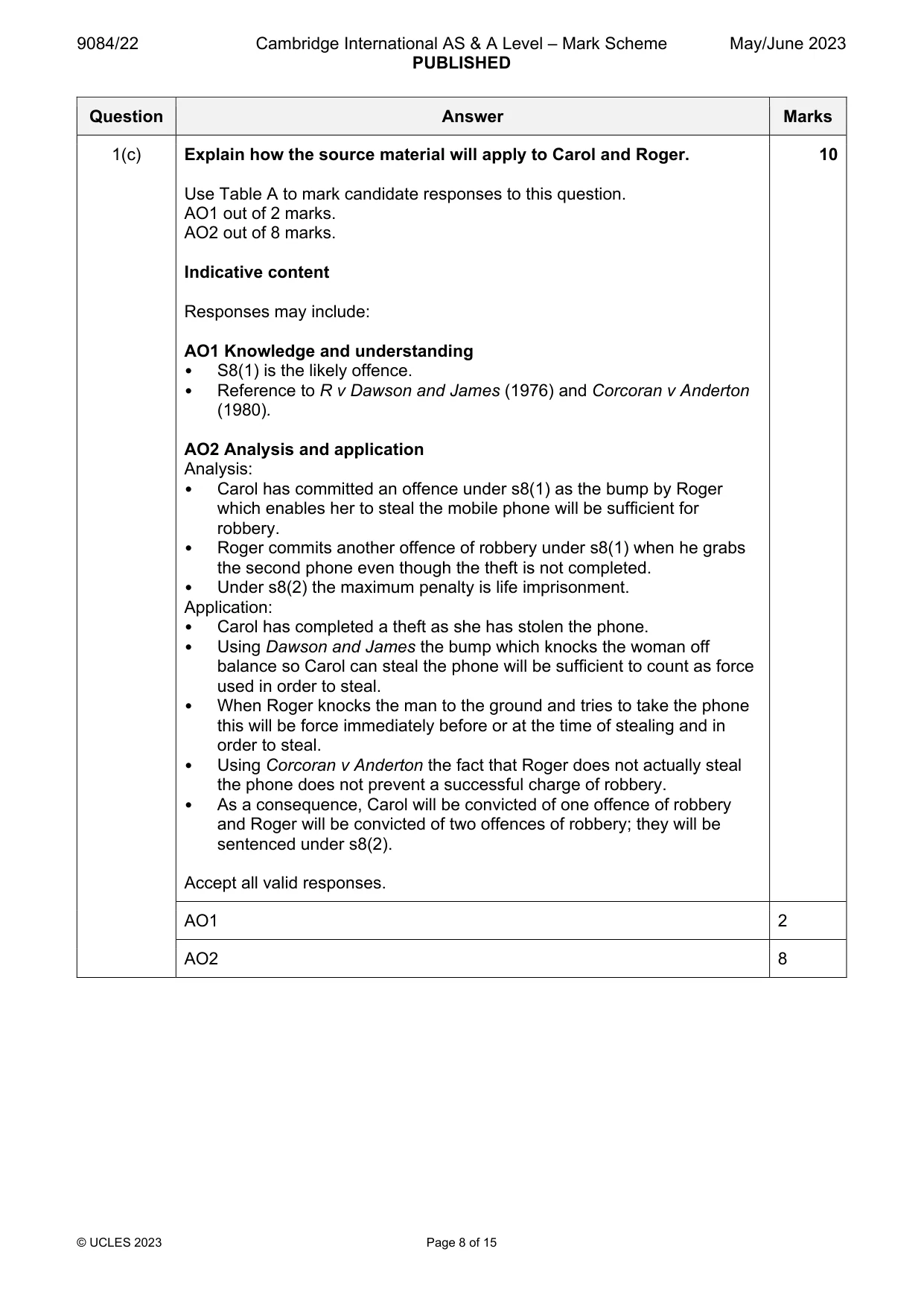
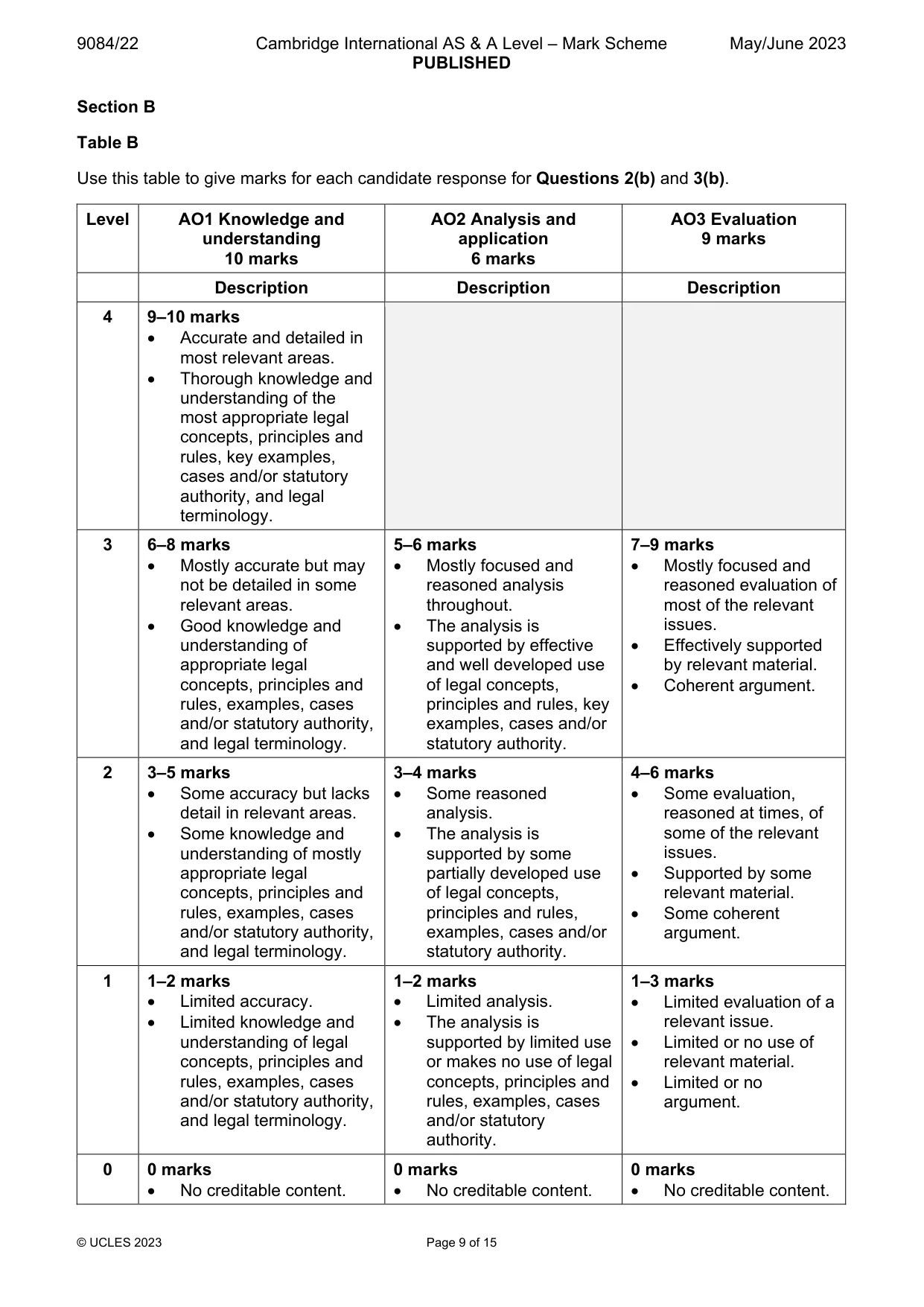
Mark scheme: Question Answer Marks 1(a) Explain how the source material will apply to Mikhail and Yuri. 10 Use Table A to mark candidate responses to this question. AO1 out of 2 marks. AO2 out of 8 marks. Indicative content Responses may include: AO1 Knowledge and understanding • S8(1) is the likely offence. • Reference to R v Hale (1978) and R v Lockley (1995). AO2 Analysis and application Analysis: • Mikhail and Yuri have committed robbery under s8(1) as Mikhail has stolen the money from the box and Yuri has used force on Freda. • This will be seen as a continuing series of events as in Hale and Lockley. • Under s8(2) the maximum penalty is life imprisonment. Application: • Under s8(1) there is a completed theft as Freda’s money has been stolen. • Force is used on Freda when Yuri grabs her and pushes her into a chair. • Using Hale Mikhail and Yuri might argue Mikhail had completed the theft as he was putting the money in the bag before Freda appeared, but the theft was held to be a continuing act on appeal. • Using Lockley Mikhail and Yuri might argue the idea of a continuing act had been overruled but the court held that force used to escape was still force used to steal so Yuri’s treatment of Freda would be sufficient. • Mikhail and Yuri will be convicted of robbery and sentenced under s8(2). Accept all valid responses. AO1 2 AO2 8 1(b) Explain how the source material will apply to Suki. 10 Use Table A to mark candidate responses to this question. AO1 out of 2 marks. AO2 out of 8 marks. Indicative content Responses may include: AO1 Knowledge and understanding S8(1) is the likely offence. Reference to R v Clouden (1987) and R v Robinson (1977). AO2 Analysis and application Analysis: Suki has committed the actus reus of a s8(1) offence of robbery as she has stolen the bag from Tamsin by grabbing it. Suki may not have the mens rea of robbery as she claims she was legally entitled to the £100 she had lent Tamsin, which is the value of the bag. Under s8(2) the maximum penalty is life imprisonment. Application: Suki has appropriated the bag when she grabs it. Even though Suki did not touch Tamsin the decision in Clouden means that the force used to grab the bag is sufficient. Suki may argue that even though the actus reus is complete she did not have the mens rea for robbery. Using Robinson she may argue that she was not dishonest as she believed she had a legal right to the bag given its value of £100, which is the same as the money she is owed by Tamsin. As a consequence a s8(1) offence will fail in relation to Suki. Accept all valid responses. AO1 2 AO2 8 1(c) Explain how the source material will apply to Carol and Roger. 10 Use Table A to mark candidate responses to this question. AO1 out of 2 marks. AO2 out of 8 marks. Indicative content Responses may include: AO1 Knowledge and understanding • S8(1) is the likely offence. • Reference to R v Dawson and James (1976) and Corcoran v Anderton (1980). AO2 Analysis and application Analysis: • Carol has committed an offence under s8(1) as the bump by Roger which enables her to steal the mobile phone will be sufficient for robbery. • Roger commits another offence of robbery under s8(1) when he grabs the second phone even though the theft is not completed. • Under s8(2) the maximum penalty is life imprisonment. Application: • Carol has completed a theft as she has stolen the phone. • Using Dawson and James the bump which knocks the woman off balance so Carol can steal the phone will be sufficient to count as force used in order to steal. • When Roger knocks the man to the ground and tries to take the phone this will be force immediately before or at the time of stealing and in order to steal. • Using Corcoran v Anderton the fact that Roger does not actually steal the phone does not prevent a successful charge of robbery. • As a consequence, Carol will be convicted of one offence of robbery and Roger will be convicted of two offences of robbery; they will be sentenced under s8(2). Accept all valid responses. AO1 2 AO2 8 Section B Table B Use this table to give marks for each candidate response for Questions 2(b) and 3(b). Level AO1 Knowledge and AO2 Analysis and AO3 Evaluation understanding application 9 marks 10 marks 6 marks Description Description Description 4 9–10 marks Accurate and detailed in most relevant areas. Thorough knowledge and understanding of the most appropriate legal concepts, principles and rules, key examples, cases and/or statutory authority, and legal terminology. 3 6–8 marks 5–6 marks 7–9 marks Mostly accurate but may Mostly focused and Mostly focused and not be detailed in some reasoned analysis reasoned evaluation of relevant areas. throughout. most of the relevant Good knowledge and The analysis is issues. understanding of supported by effective Effectively supported appropriate legal and well developed use by relevant material. concepts, principles and of legal concepts, Coherent argument. rules, examples, cases principles and rules, key and/or statutory authority, examples, cases and/or and legal terminology. statutory authority. 2 3–5 marks 3–4 marks 4–6 marks Some accuracy but lacks Some reasoned Some evaluation, detail in relevant areas. analysis. reasoned at times, of Some knowledge and The analysis is some of the relevant understanding of mostly supported by some issues. appropriate legal partially developed use Supported by some concepts, principles and of legal concepts, relevant material. rules, examples, cases principles and rules, Some coherent and/or statutory authority, examples, cases and/or argument. and legal terminology. statutory authority. 1 1–2 marks 1–2 marks 1–3 marks Limited accuracy. Limited analysis. Limited evaluation of a Limited knowledge and The analysis is relevant issue. understanding of legal supported by limited use Limited or no use of concepts, principles and or makes no use of legal relevant material. rules, examples, cases concepts, principles and Limited or no and/or statutory authority, rules, examples, cases argument. and legal terminology. and/or statutory authority. 0 0 marks 0 marks 0 marks No creditable content. No creditable content. No creditable content.
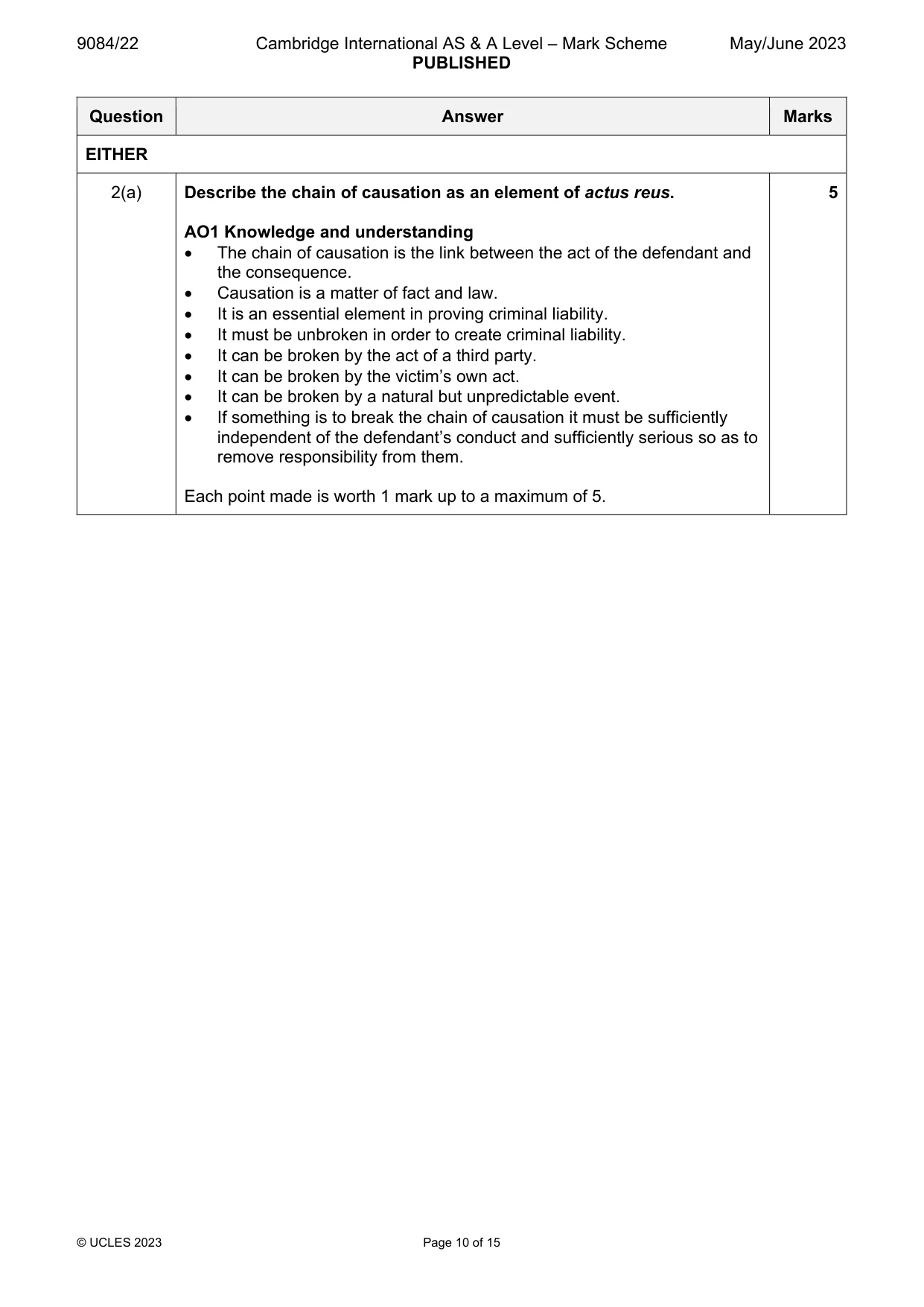
Q2 · Describe the chain of causation as an element of actus reus
2 (a) Describe the chain of causation as an element of actus reus. [5] (b) Evaluate the law of burglary. [25] OR
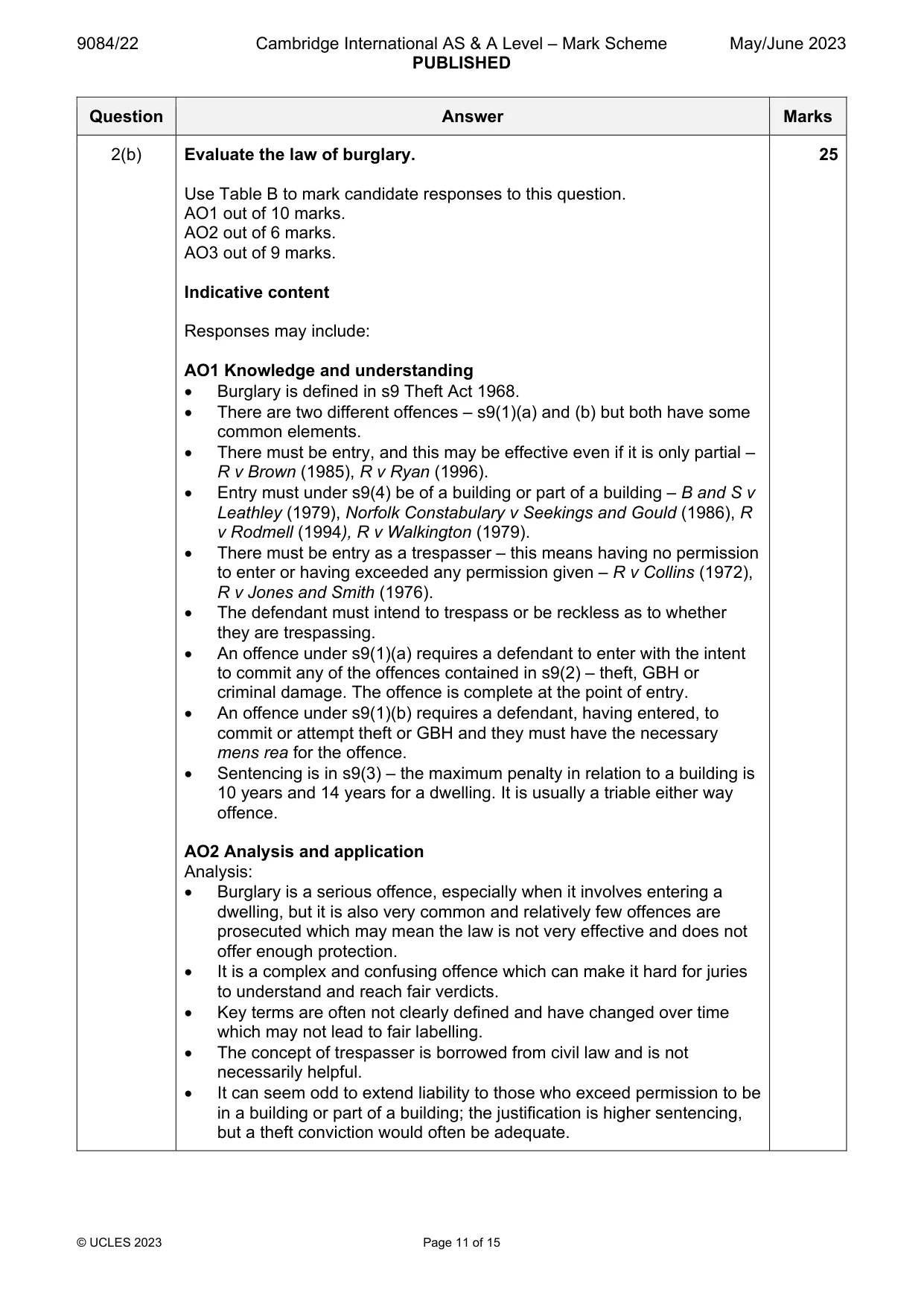
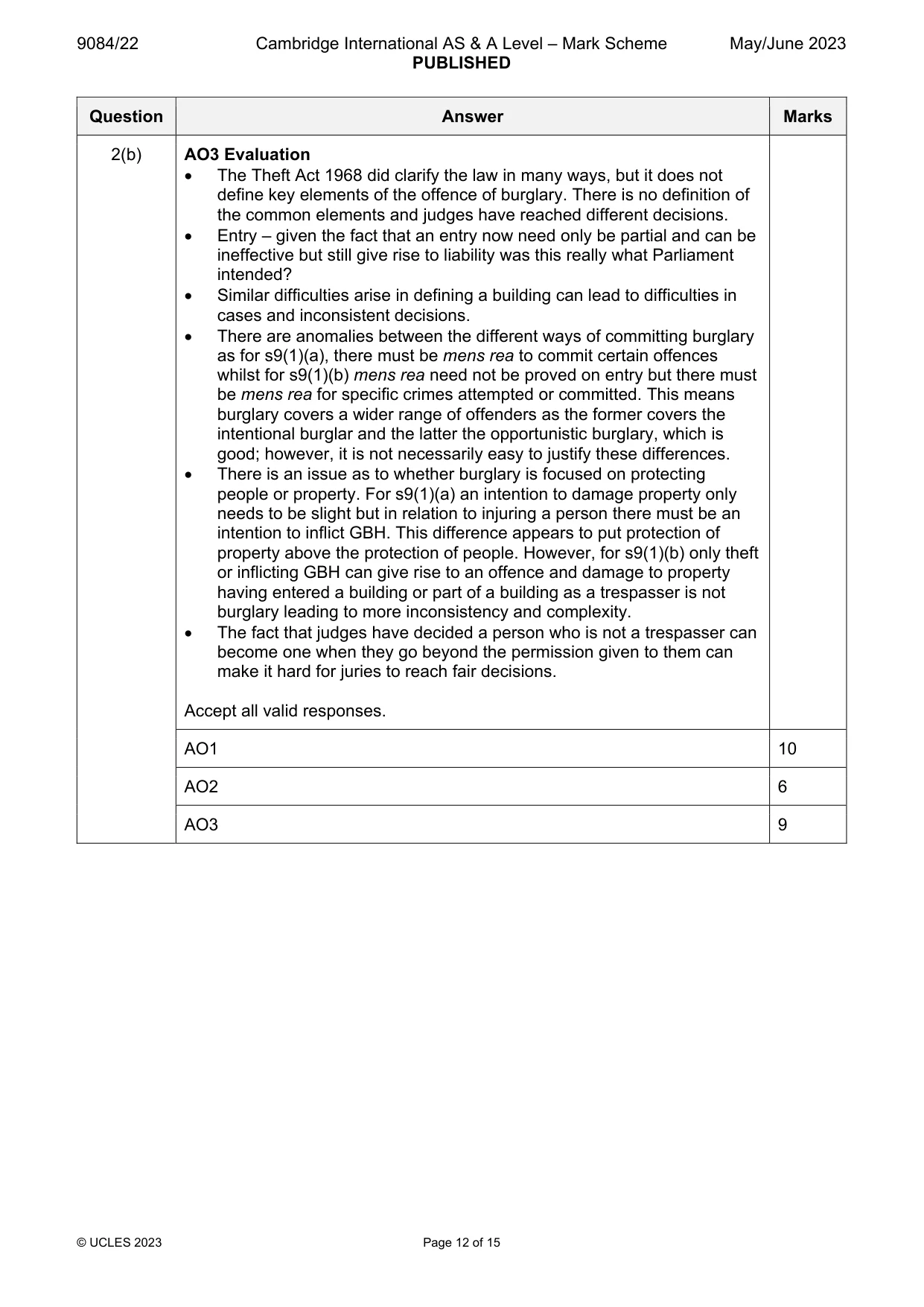
Mark scheme: 2(a) Describe the chain of causation as an element of actus reus. 5 AO1 Knowledge and understanding The chain of causation is the link between the act of the defendant and the consequence. Causation is a matter of fact and law. It is an essential element in proving criminal liability. It must be unbroken in order to create criminal liability. It can be broken by the act of a third party. It can be broken by the victim’s own act. It can be broken by a natural but unpredictable event. If something is to break the chain of causation it must be sufficiently independent of the defendant’s conduct and sufficiently serious so as to remove responsibility from them. Each point made is worth 1 mark up to a maximum of 5. 2(b) Evaluate the law of burglary. 25 Use Table B to mark candidate responses to this question. AO1 out of 10 marks. AO2 out of 6 marks. AO3 out of 9 marks. Indicative content Responses may include: AO1 Knowledge and understanding Burglary is defined in s9 Theft Act 1968. There are two different offences – s9(1)(a) and (b) but both have some common elements. There must be entry, and this may be effective even if it is only partial – R v Brown (1985), R v Ryan (1996). Entry must under s9(4) be of a building or part of a building – B and S v Leathley (1979), Norfolk Constabulary v Seekings and Gould (1986), R v Rodmell (1994), R v Walkington (1979). There must be entry as a trespasser – this means having no permission to enter or having exceeded any permission given – R v Collins (1972), R v Jones and Smith (1976). The defendant must intend to trespass or be reckless as to whether they are trespassing. An offence under s9(1)(a) requires a defendant to enter with the intent to commit any of the offences contained in s9(2) – theft, GBH or criminal damage. The offence is complete at the point of entry. An offence under s9(1)(b) requires a defendant, having entered, to commit or attempt theft or GBH and they must have the necessary mens rea for the offence. Sentencing is in s9(3) – the maximum penalty in relation to a building is 10 years and 14 years for a dwelling. It is usually a triable either way offence. AO2 Analysis and application Analysis: Burglary is a serious offence, especially when it involves entering a dwelling, but it is also very common and relatively few offences are prosecuted which may mean the law is not very effective and does not offer enough protection. It is a complex and confusing offence which can make it hard for juries to understand and reach fair verdicts. Key terms are often not clearly defined and have changed over time which may not lead to fair labelling. The concept of trespasser is borrowed from civil law and is not necessarily helpful. It can seem odd to extend liability to those who exceed permission to be in a building or part of a building; the justification is higher sentencing, but a theft conviction would often be adequate. 2(b) AO3 Evaluation The Theft Act 1968 did clarify the law in many ways, but it does not define key elements of the offence of burglary. There is no definition of the common elements and judges have reached different decisions. Entry – given the fact that an entry now need only be partial and can be ineffective but still give rise to liability was this really what Parliament intended? Similar difficulties arise in defining a building can lead to difficulties in cases and inconsistent decisions. There are anomalies between the different ways of committing burglary as for s9(1)(a), there must be mens rea to commit certain offences whilst for s9(1)(b) mens rea need not be proved on entry but there must be mens rea for specific crimes attempted or committed. This means burglary covers a wider range of offenders as the former covers the intentional burglar and the latter the opportunistic burglary, which is good; however, it is not necessarily easy to justify these differences. There is an issue as to whether burglary is focused on protecting people or property. For s9(1)(a) an intention to damage property only needs to be slight but in relation to injuring a person there must be an intention to inflict GBH. This difference appears to put protection of property above the protection of people. However, for s9(1)(b) only theft or inflicting GBH can give rise to an offence and damage to property having entered a building or part of a building as a trespasser is not burglary leading to more inconsistency and complexity. The fact that judges have decided a person who is not a trespasser can become one when they go beyond the permission given to them can make it hard for juries to reach fair decisions. Accept all valid responses. AO1 10 AO2 6 AO3 9
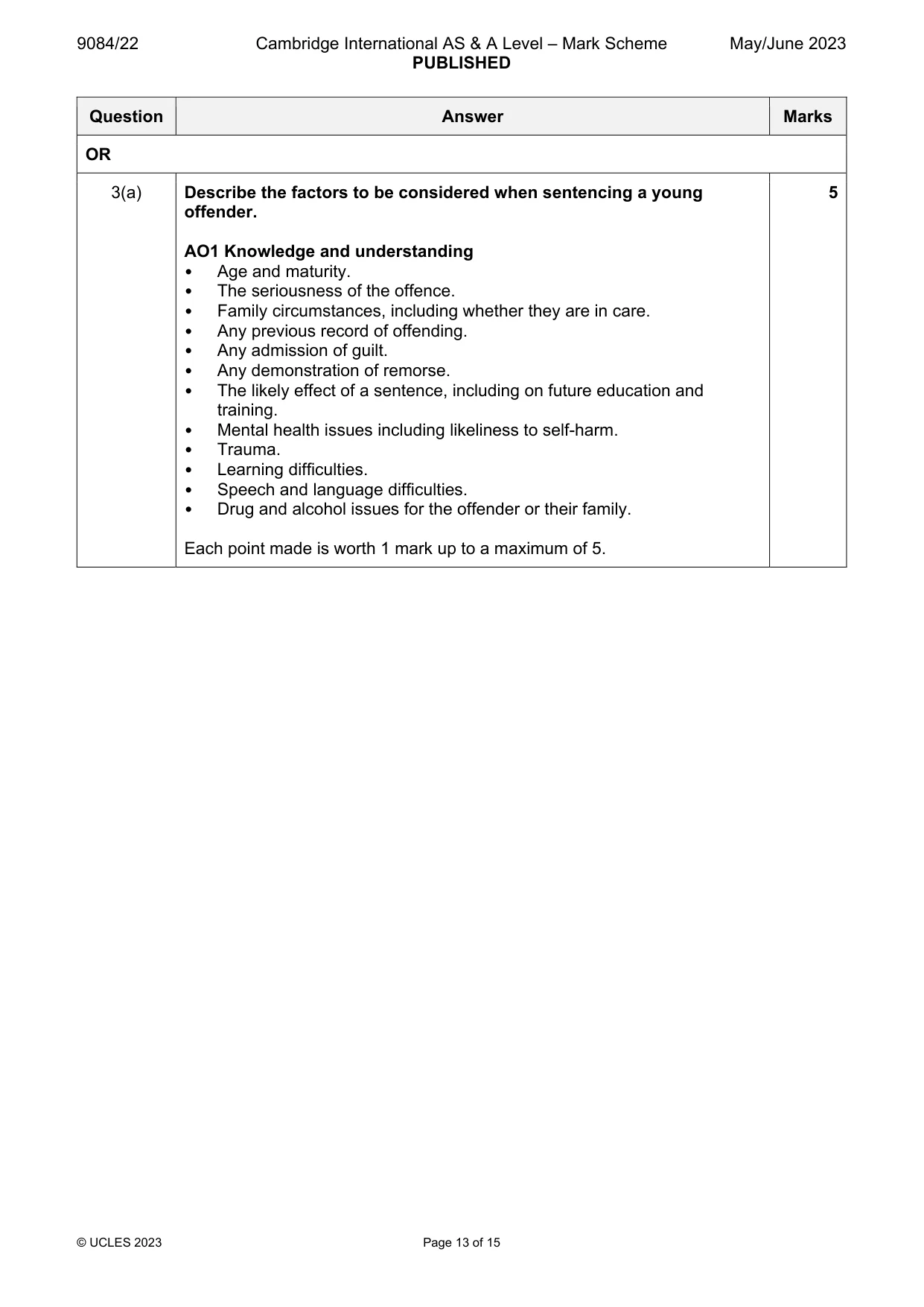
Q3 · Describe the factors to be considered when sentencing a young offender
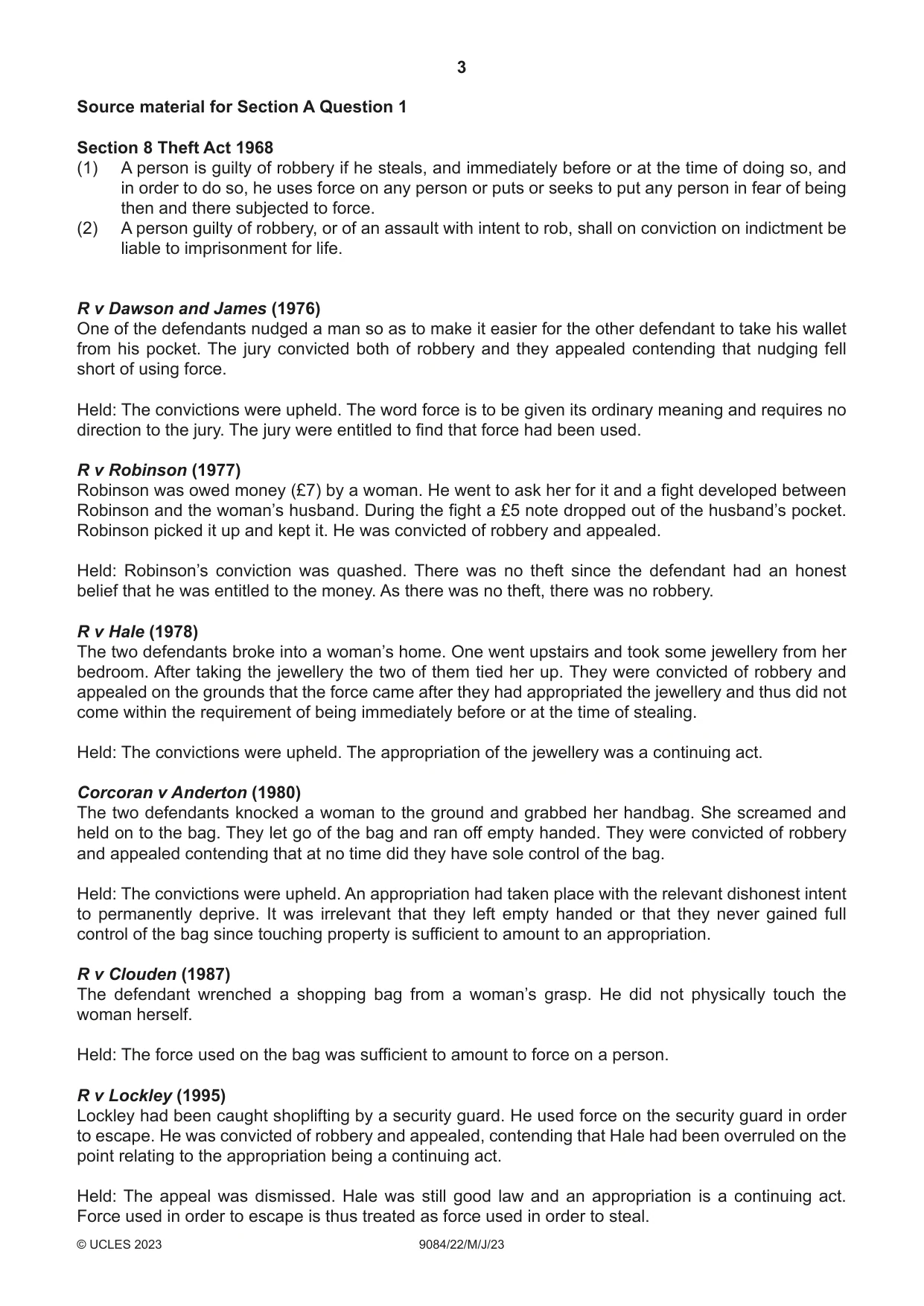
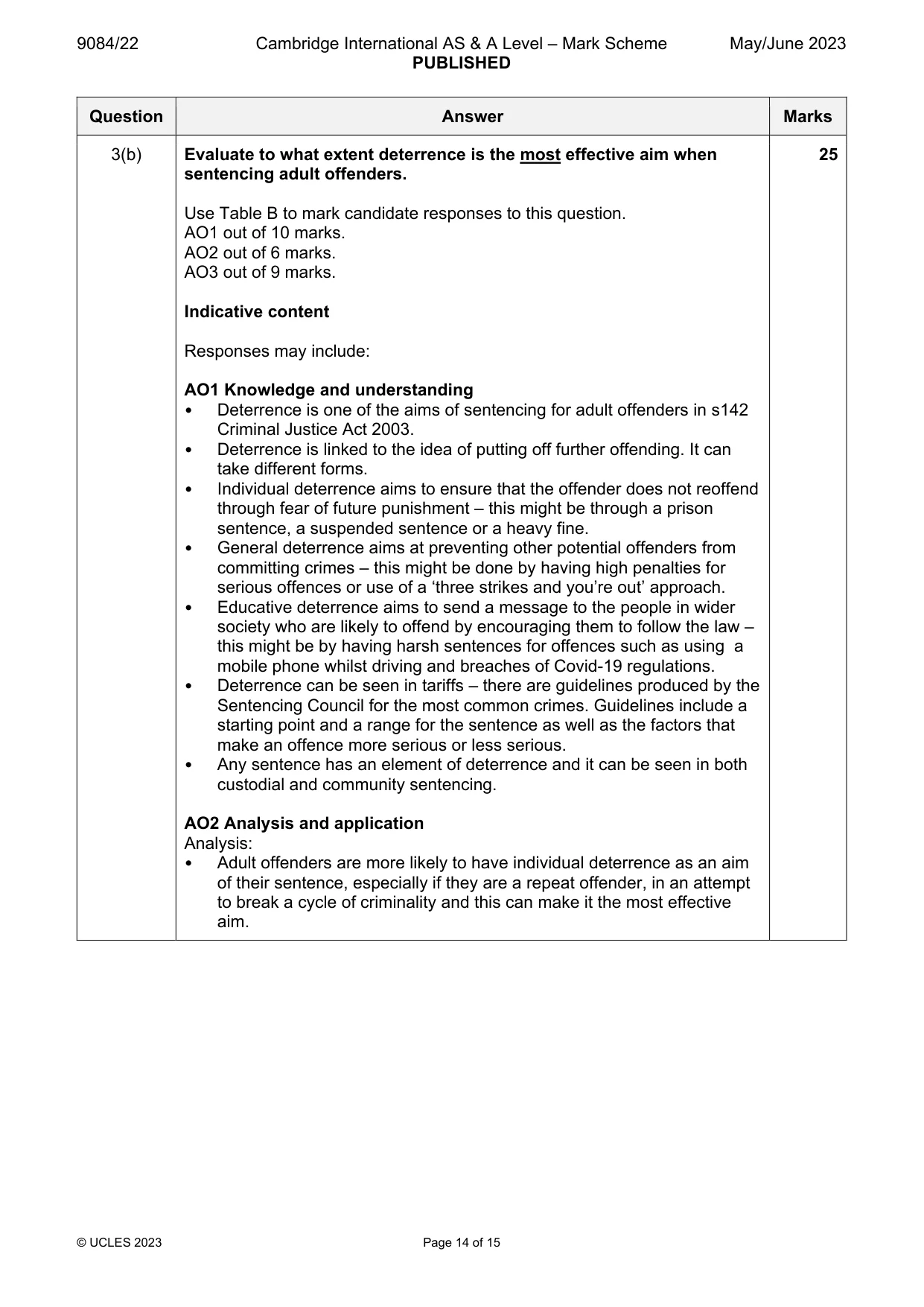
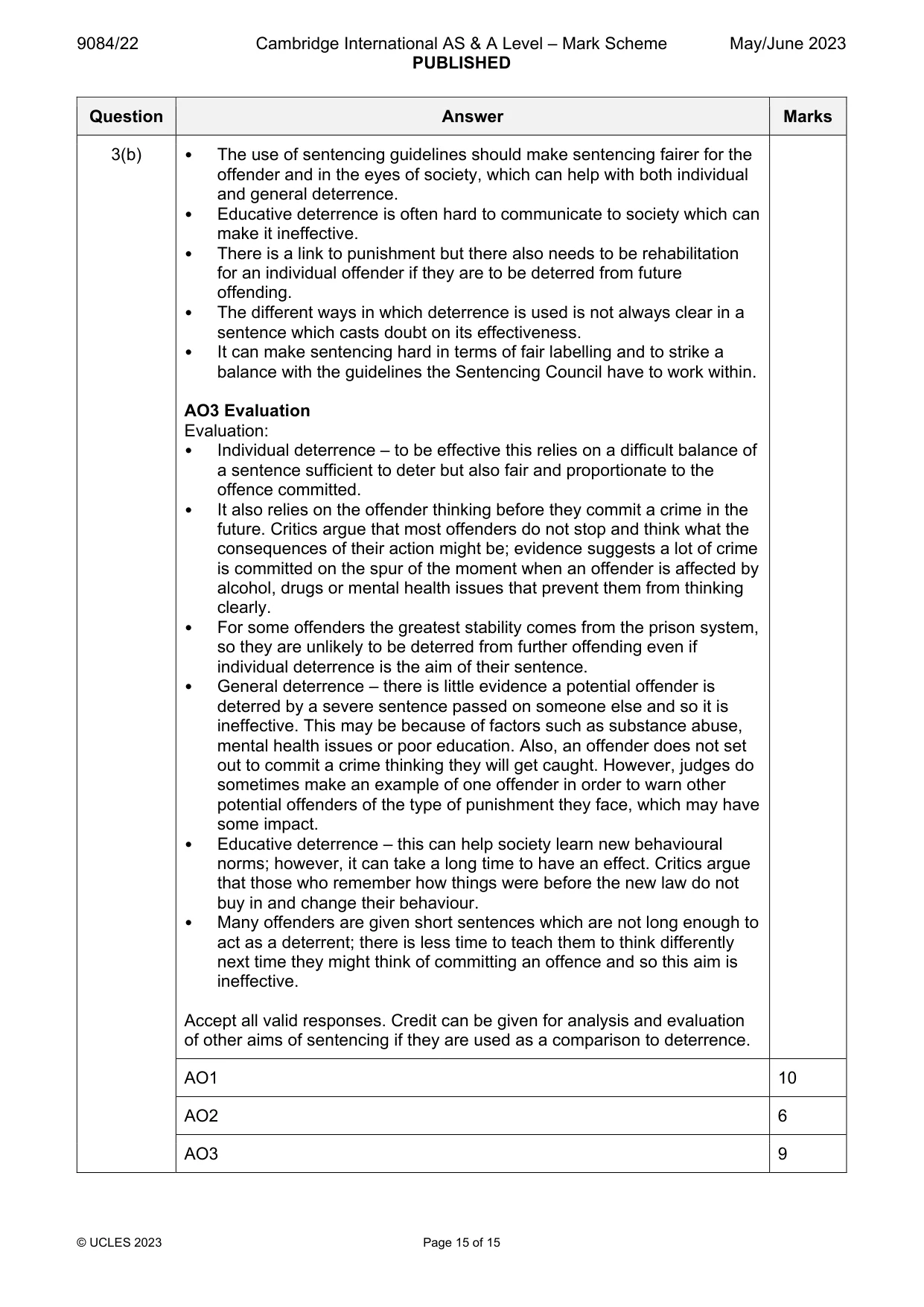
3 (a) Describe the factors to be considered when sentencing a young offender. [5] (b) Evaluate to what extent deterrence is the most effective aim when sentencing adult offenders. [25] Source material for Section A Question 1 Section 8 Theft Act 1968 (1) A person is guilty of robbery if he steals, and immediately before or at the time of doing so, and in order to do so, he uses force on any person or puts or seeks to put any person in fear of being then and there subjected to force. (2) A person guilty of robbery, or of an assault with intent to rob, shall on conviction on indictment be liable to imprisonment for life. R v Dawson and James (1976) One of the defendants nudged a man so as to make it easier for the other defendant to take his wallet from his pocket. The jury convicted both of robbery and they appealed contending that nudging fell short of using force. Held: The convictions were upheld. The word force is to be given its ordinary meaning and requires no direction to the jury. The jury were entitled to find that force had been used. R v Robinson (1977) Robinson was owed money (£7) by a woman. He went to ask her for it and a fight developed between Robinson and the woman’s husband. During the fight a £5 note dropped out of the husband’s pocket. Robinson picked it up and kept it. He was convicted of robbery and appealed. Held: Robinson’s conviction was quashed. There was no theft since the defendant had an honest belief that he was entitled to the money. As there was no theft, there was no robbery. R v Hale (1978) The two defendants broke into a woman’s home. One went upstairs and took some jewellery from her bedroom. After taking the jewellery the two of them tied her up. They were convicted of robbery and appealed on the grounds that the force came after they had appropriated the jewellery and thus did not come within the requirement of being immediately before or at the time of stealing. Held: The convictions were upheld. The appropriation of the jewellery was a continuing act. Corcoran v Anderton (1980) The two defendants knocked a woman to the ground and grabbed her handbag. She screamed and held on to the bag. They let go of the bag and ran off empty handed. They were convicted of robbery and appealed contending that at no time did they have sole control of the bag. Held: The convictions were upheld. An appropriation had taken place with the relevant dishonest intent to permanently deprive. It was irrelevant that they left empty handed or that they never gained full control of the bag since touching property is sufficient to amount to an appropriation. R v Clouden (1987) The defendant wrenched a shopping bag from a woman’s grasp. He did not physically touch the woman herself. Held: The force used on the bag was sufficient to amount to force on a person. R v Lockley (1995) Lockley had been caught shoplifting by a security guard. He used force on the security guard in order to escape. He was convicted of robbery and appealed, contending that Hale had been overruled on the point relating to the appropriation being a continuing act. Held: The appeal was dismissed. Hale was still good law and an appropriation is a continuing act.
Mark scheme: 3(a) Describe the factors to be considered when sentencing a young 5 offender. AO1 Knowledge and understanding • Age and maturity. • The seriousness of the offence. • Family circumstances, including whether they are in care. • Any previous record of offending. • Any admission of guilt. • Any demonstration of remorse. • The likely effect of a sentence, including on future education and training. • Mental health issues including likeliness to self-harm. • Trauma. • Learning difficulties. • Speech and language difficulties. • Drug and alcohol issues for the offender or their family. Each point made is worth 1 mark up to a maximum of 5. 3(b) Evaluate to what extent deterrence is the most effective aim when 25 sentencing adult offenders. Use Table B to mark candidate responses to this question. AO1 out of 10 marks. AO2 out of 6 marks. AO3 out of 9 marks. Indicative content Responses may include: AO1 Knowledge and understanding • Deterrence is one of the aims of sentencing for adult offenders in s142 Criminal Justice Act 2003. • Deterrence is linked to the idea of putting off further offending. It can take different forms. • Individual deterrence aims to ensure that the offender does not reoffend through fear of future punishment – this might be through a prison sentence, a suspended sentence or a heavy fine. • General deterrence aims at preventing other potential offenders from committing crimes – this might be done by having high penalties for serious offences or use of a ‘three strikes and you’re out’ approach. • Educative deterrence aims to send a message to the people in wider society who are likely to offend by encouraging them to follow the law – this might be by having harsh sentences for offences such as using a mobile phone whilst driving and breaches of Covid-19 regulations. • Deterrence can be seen in tariffs – there are guidelines produced by the Sentencing Council for the most common crimes. Guidelines include a starting point and a range for the sentence as well as the factors that make an offence more serious or less serious. • Any sentence has an element of deterrence and it can be seen in both custodial and community sentencing. AO2 Analysis and application Analysis: • Adult offenders are more likely to have individual deterrence as an aim of their sentence, especially if they are a repeat offender, in an attempt to break a cycle of criminality and this can make it the most effective aim. 3(b) • The use of sentencing guidelines should make sentencing fairer for the offender and in the eyes of society, which can help with both individual and general deterrence. • Educative deterrence is often hard to communicate to society which can make it ineffective. • There is a link to punishment but there also needs to be rehabilitation for an individual offender if they are to be deterred from future offending. • The different ways in which deterrence is used is not always clear in a sentence which casts doubt on its effectiveness. • It can make sentencing hard in terms of fair labelling and to strike a balance with the guidelines the Sentencing Council have to work within. AO3 Evaluation Evaluation: • Individual deterrence – to be effective this relies on a difficult balance of a sentence sufficient to deter but also fair and proportionate to the offence committed. • It also relies on the offender thinking before they commit a crime in the future. Critics argue that most offenders do not stop and think what the consequences of their action might be; evidence suggests a lot of crime is committed on the spur of the moment when an offender is affected by alcohol, drugs or mental health issues that prevent them from thinking clearly. • For some offenders the greatest stability comes from the prison system, so they are unlikely to be deterred from further offending even if individual deterrence is the aim of their sentence. • General deterrence – there is little evidence a potential offender is deterred by a severe sentence passed on someone else and so it is ineffective. This may be because of factors such as substance abuse, mental health issues or poor education. Also, an offender does not set out to commit a crime thinking they will get caught. However, judges do sometimes make an example of one offender in order to warn other potential offenders of the type of punishment they face, which may have some impact. • Educative deterrence – this can help society learn new behavioural norms; however, it can take a long time to have an effect. Critics argue that those who remember how things were before the new law do not buy in and change their behaviour. • Many offenders are given short sentences which are not long enough to act as a deterrent; there is less time to teach them to think differently next time they might think of committing an offence and so this aim is ineffective. Accept all valid responses. Credit can be given for analysis and evaluation of other aims of sentencing if they are used as a comparison to deterrence. AO1 10 AO2 6 AO3 9
What was in this paper
The subtopics covered by these 3 questions, and how many questions each got. Open one in a new tab to see every Cambridge question on it.
2Sentencing in England and Wales This topic is about the sentences that can be handed down to both adult and young offenders who have been convicted of offences. This topic is an opportunity to reflect on the key concepts of liability, justice, fairness, power and its limits, and effectiveness1What you needed in this session
Cambridge’s own grade thresholds for 2023 May/June, Paper 2 · Variant 2. A higher threshold means an easier paper — the bar moves with how the cohort did.