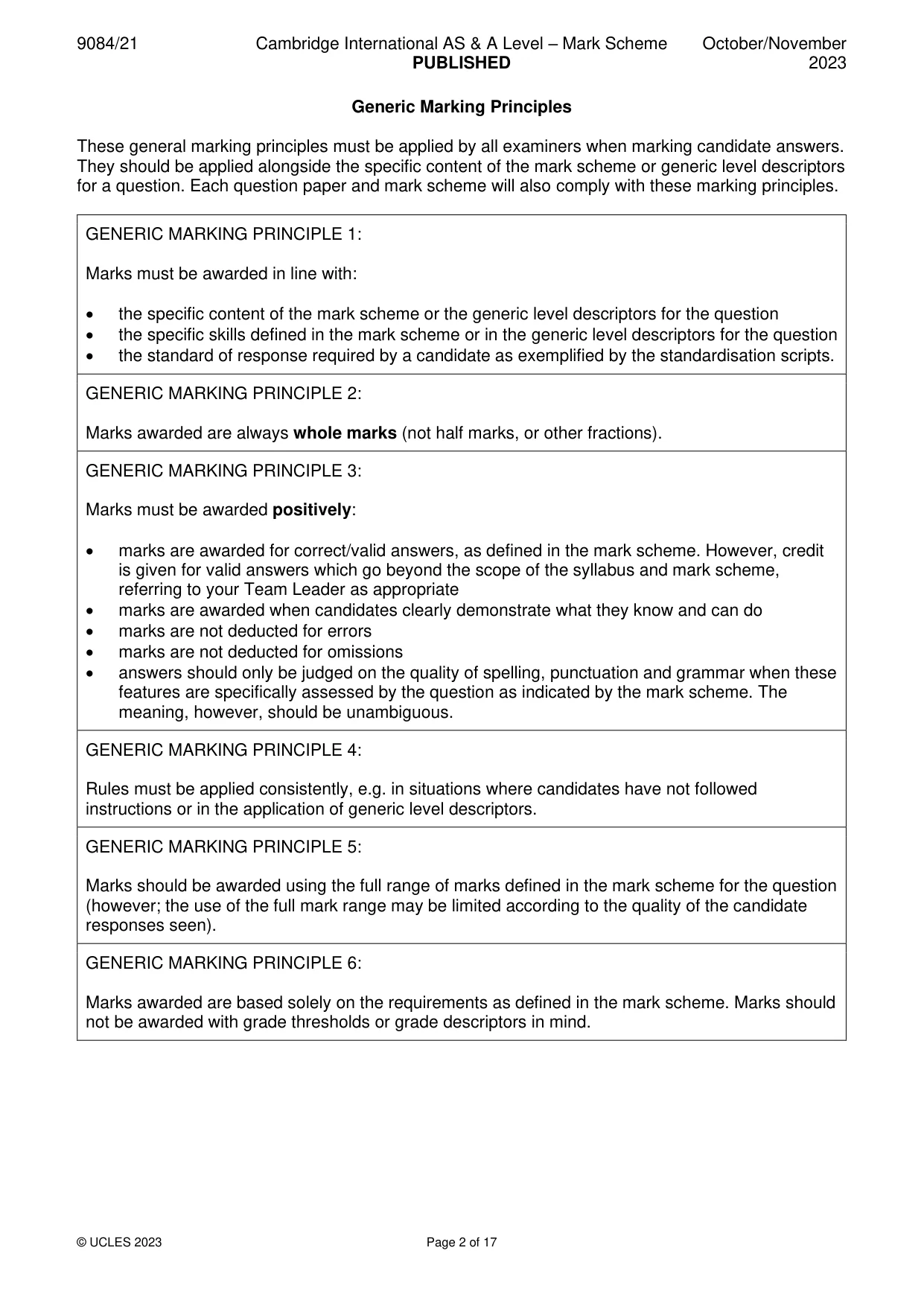
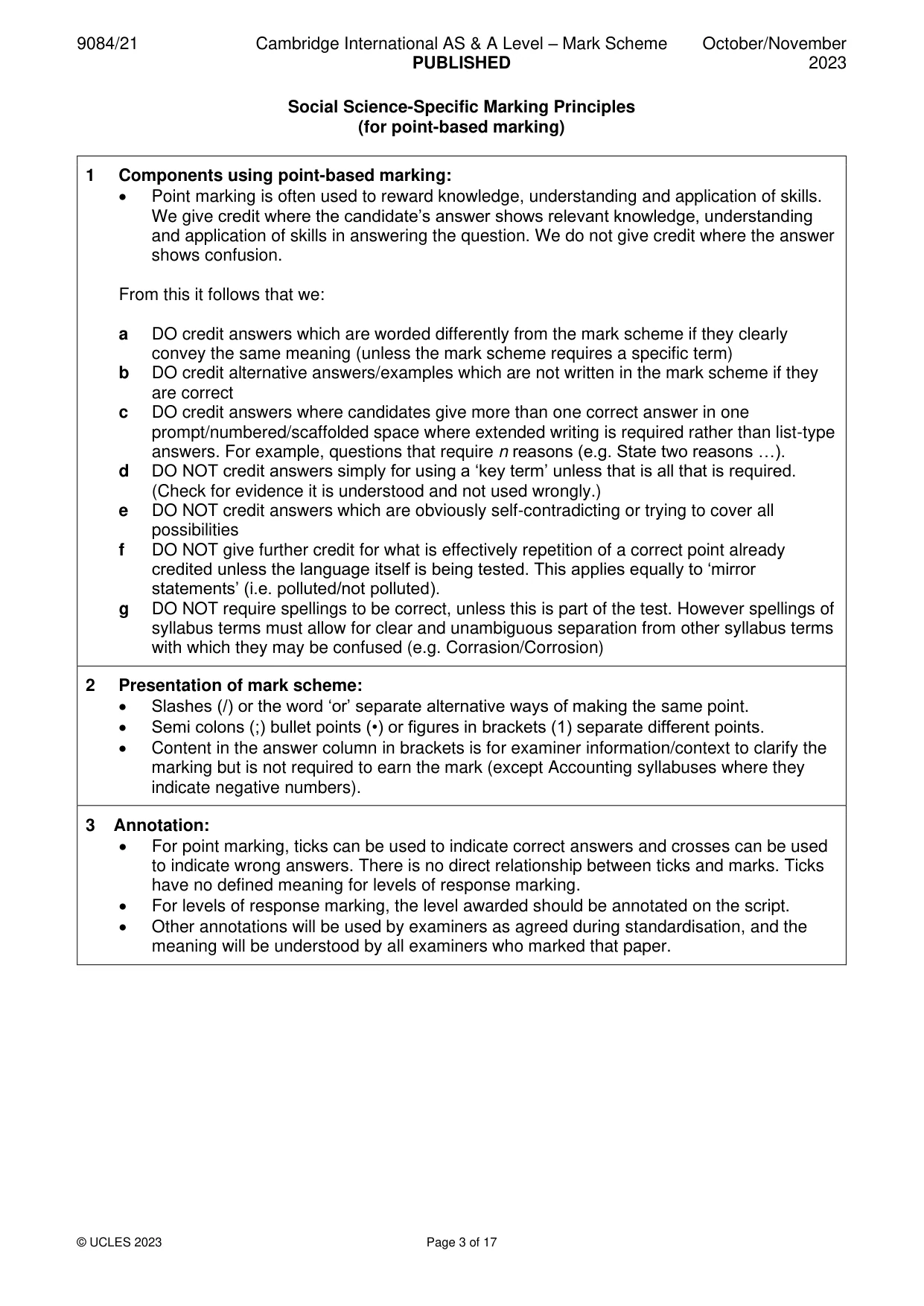
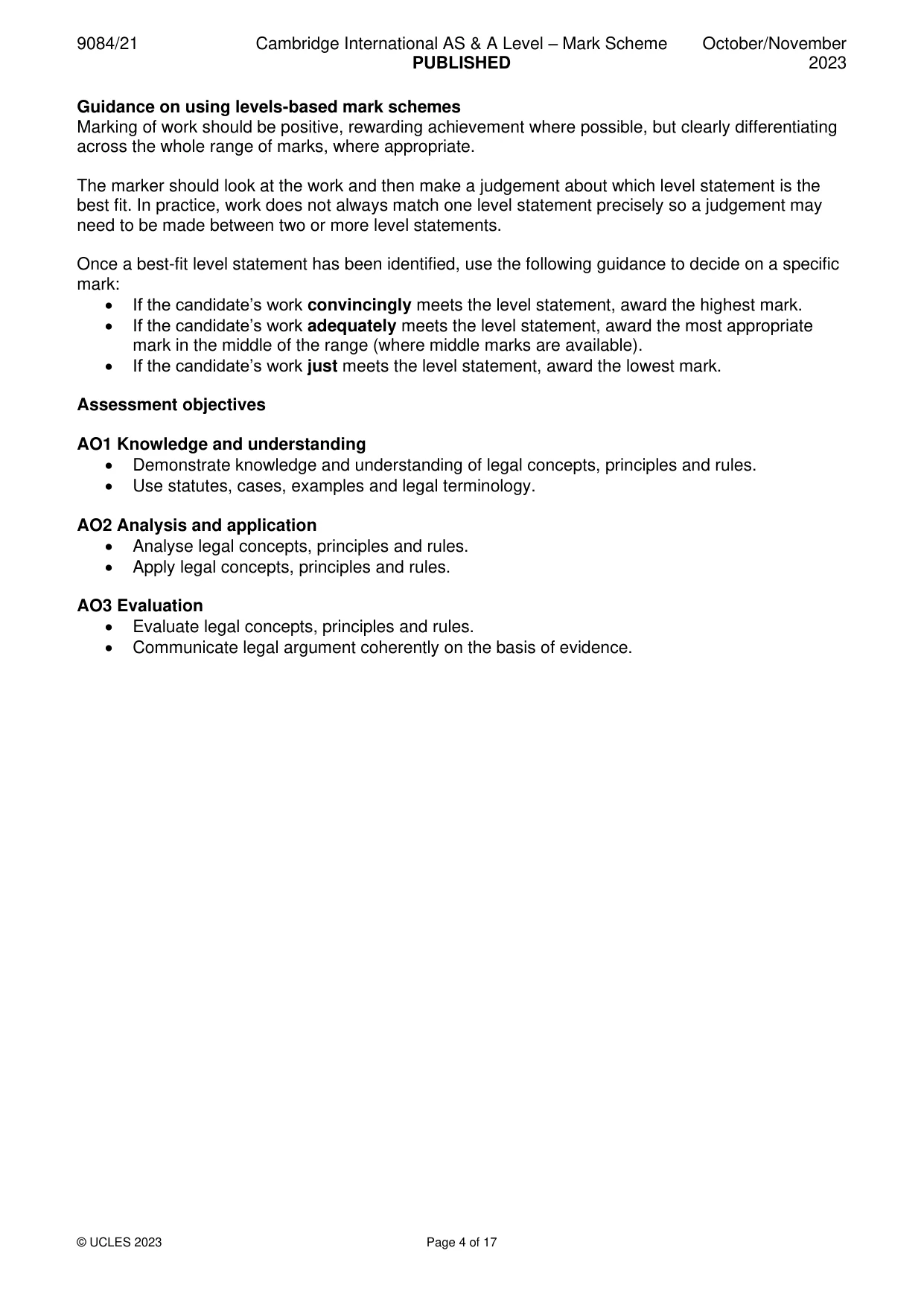
Cambridge A Level Law 9084 — 2023 Oct/Nov Paper 2 · Variant 1
9084/21/O/N/23 · 3 questions · 60 marks · ≈68 min
The question paper and its mark scheme, free to read here and free to download. This is Cambridge’s own paper, exactly as it was sat.
Question paper4 pages
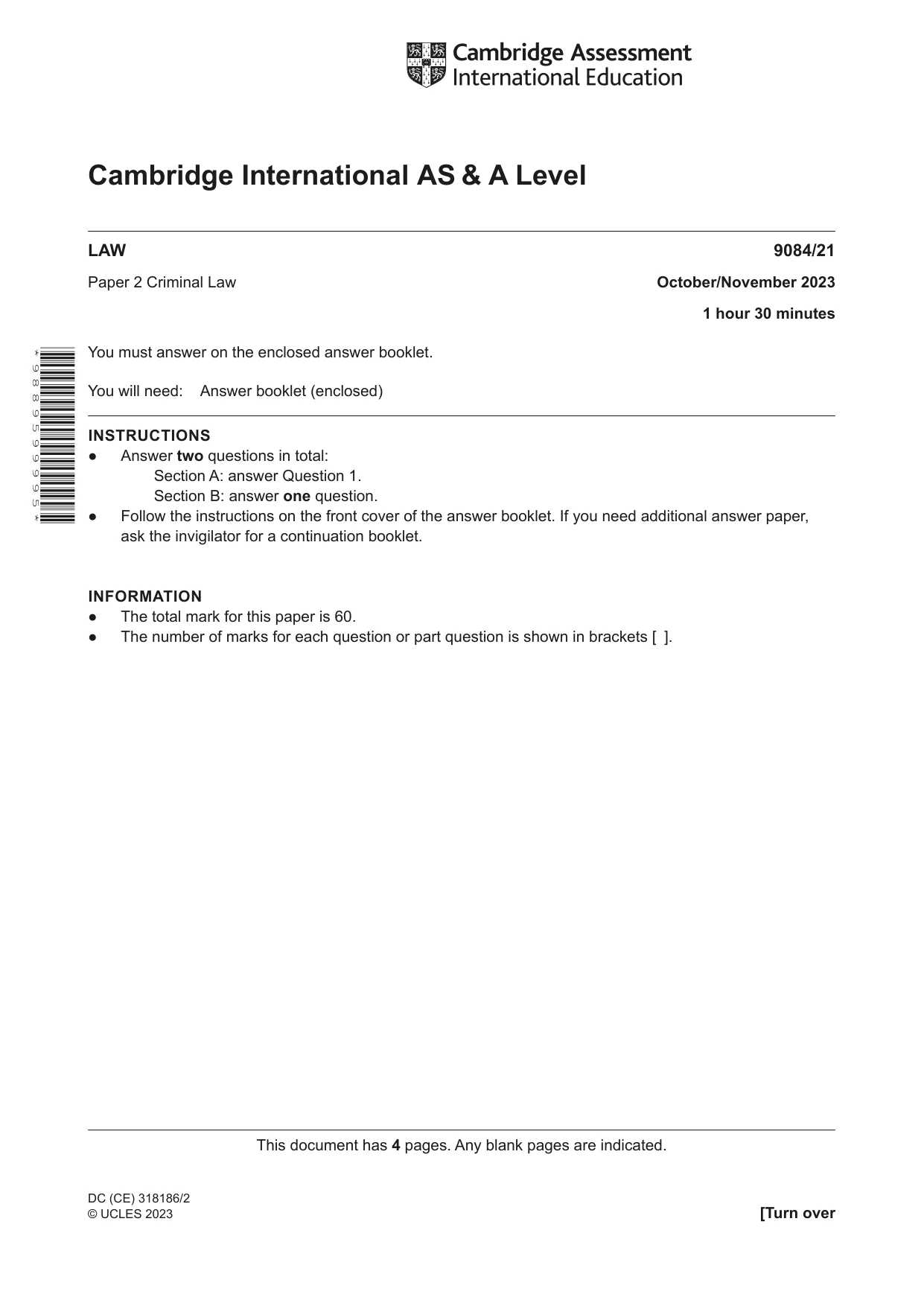
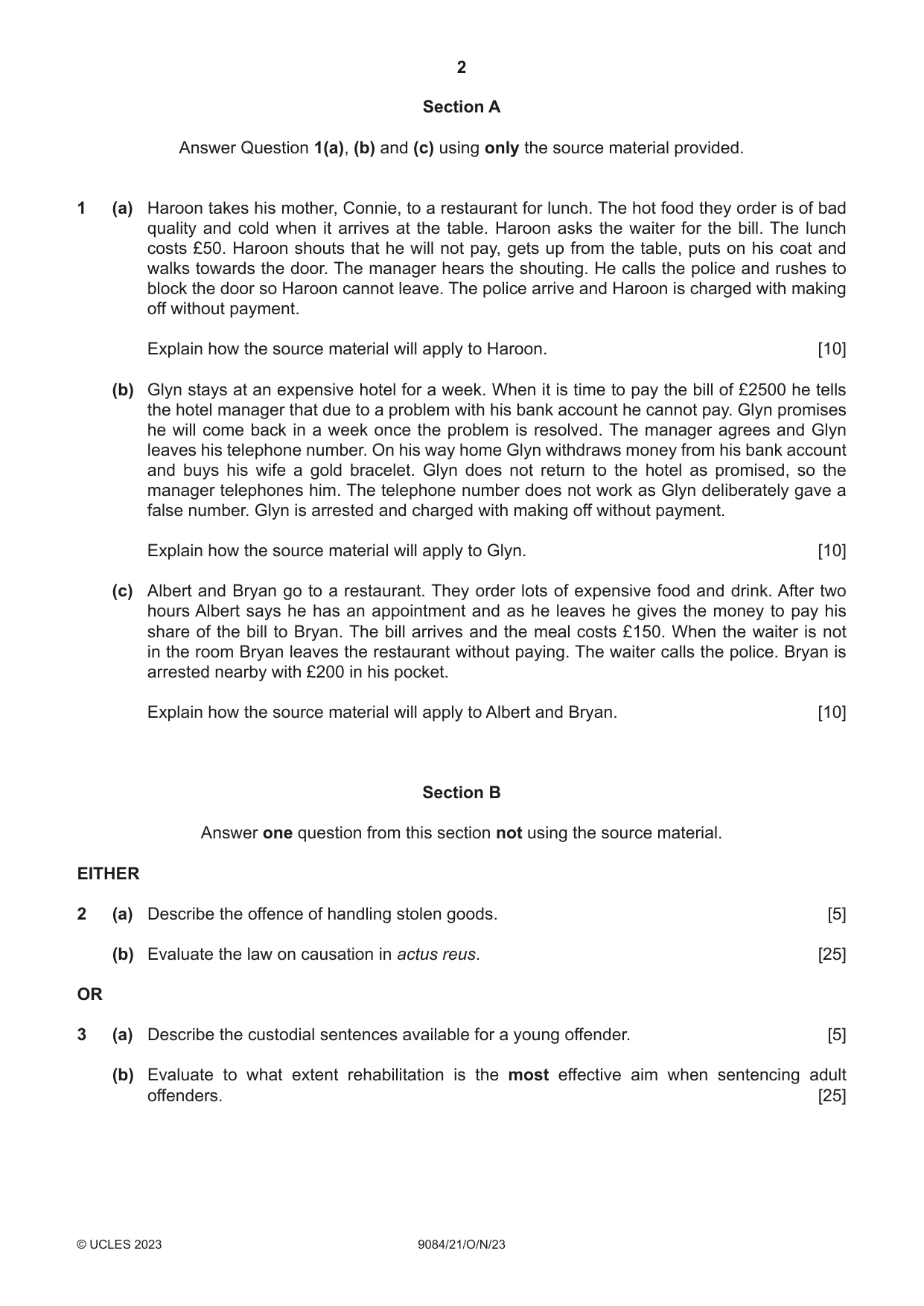
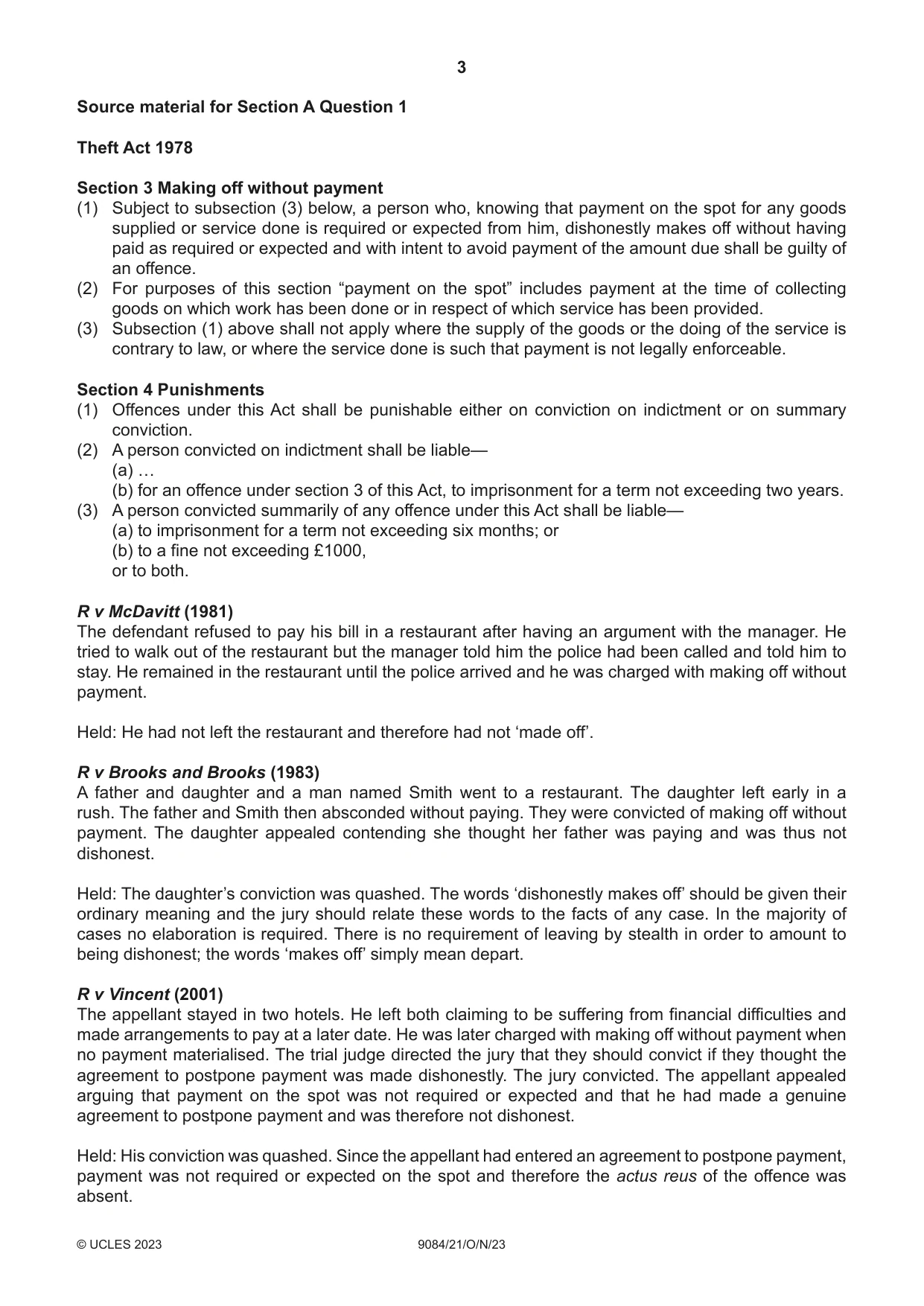

Mark scheme17 pages
Answers below. Sit the paper first if you are practising.

Questions as text
Q1 · Haroon takes his mother, Connie, to a restaurant for lunch
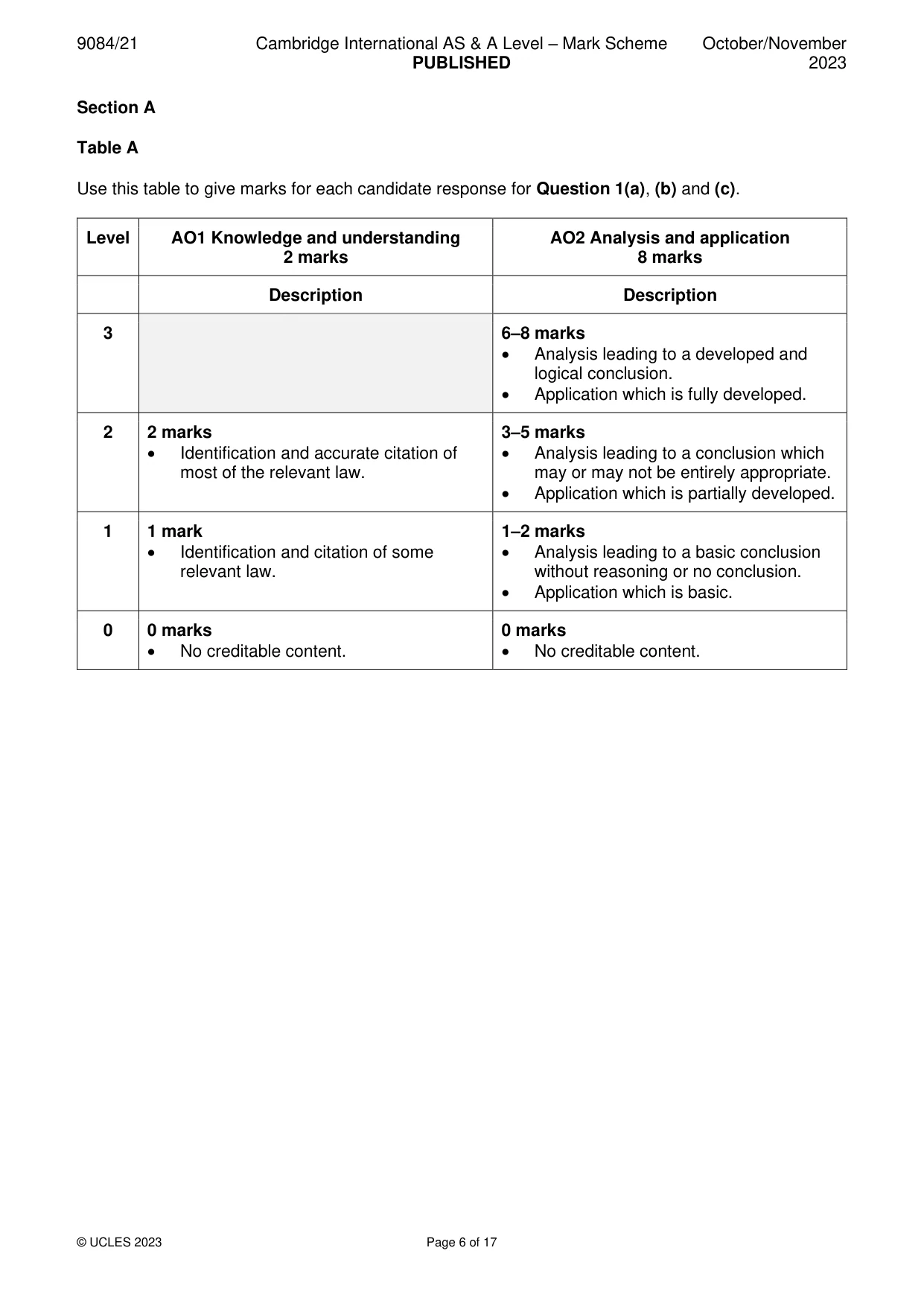
1 (a) Haroon takes his mother, Connie, to a restaurant for lunch. The hot food they order is of bad quality and cold when it arrives at the table. Haroon asks the waiter for the bill. The lunch costs £50. Haroon shouts that he will not pay, gets up from the table, puts on his coat and walks towards the door. The manager hears the shouting. He calls the police and rushes to block the door so Haroon cannot leave. The police arrive and Haroon is charged with making off without payment. Explain how the source material will apply to Haroon. [10] (b) Glyn stays at an expensive hotel for a week. When it is time to pay the bill of £2500 he tells the hotel manager that due to a problem with his bank account he cannot pay. Glyn promises he will come back in a week once the problem is resolved. The manager agrees and Glyn leaves his telephone number. On his way home Glyn withdraws money from his bank account and buys his wife a gold bracelet. Glyn does not return to the hotel as promised, so the manager telephones him. The telephone number does not work as Glyn deliberately gave a false number. Glyn is arrested and charged with making off without payment. Explain how the source material will apply to Glyn. [10] (c) Albert and Bryan go to a restaurant. They order lots of expensive food and drink. After two hours Albert says he has an appointment and as he leaves he gives the money to pay his share of the bill to Bryan. The bill arrives and the meal costs £150. When the waiter is not in the room Bryan leaves the restaurant without paying. The waiter calls the police. Bryan is arrested nearby with £200 in his pocket. Explain how the source material will apply to Albert and Bryan. [10]
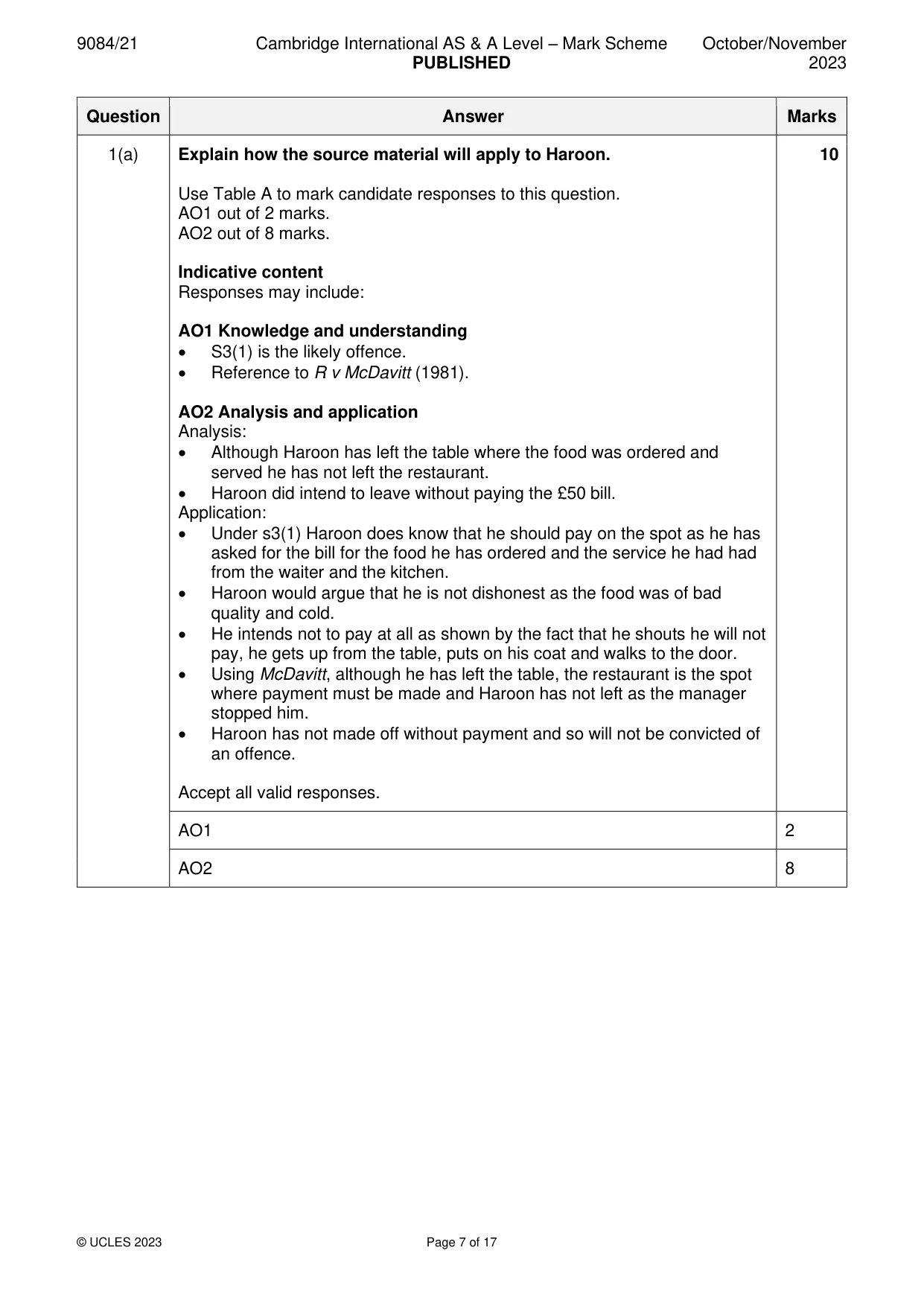
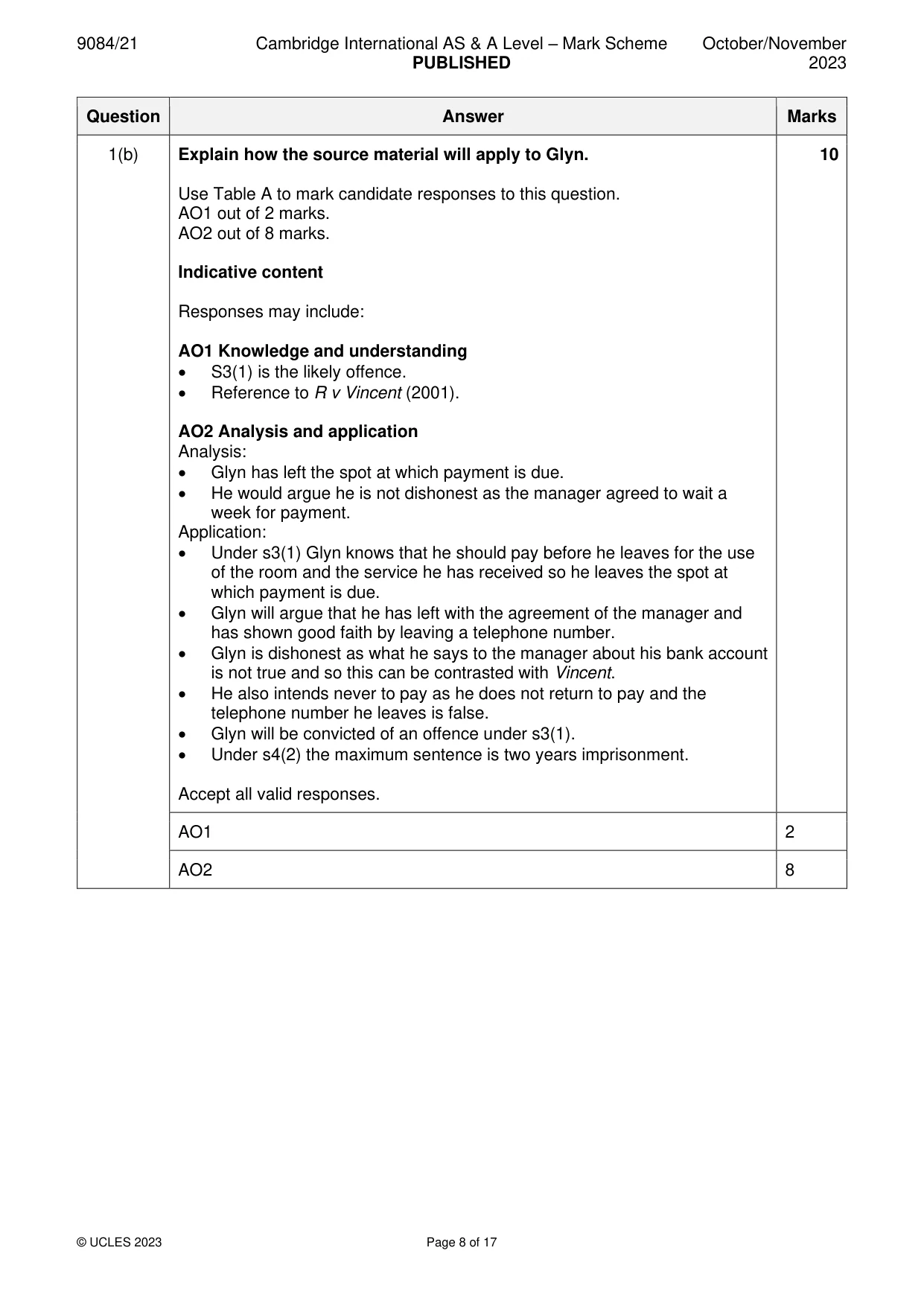
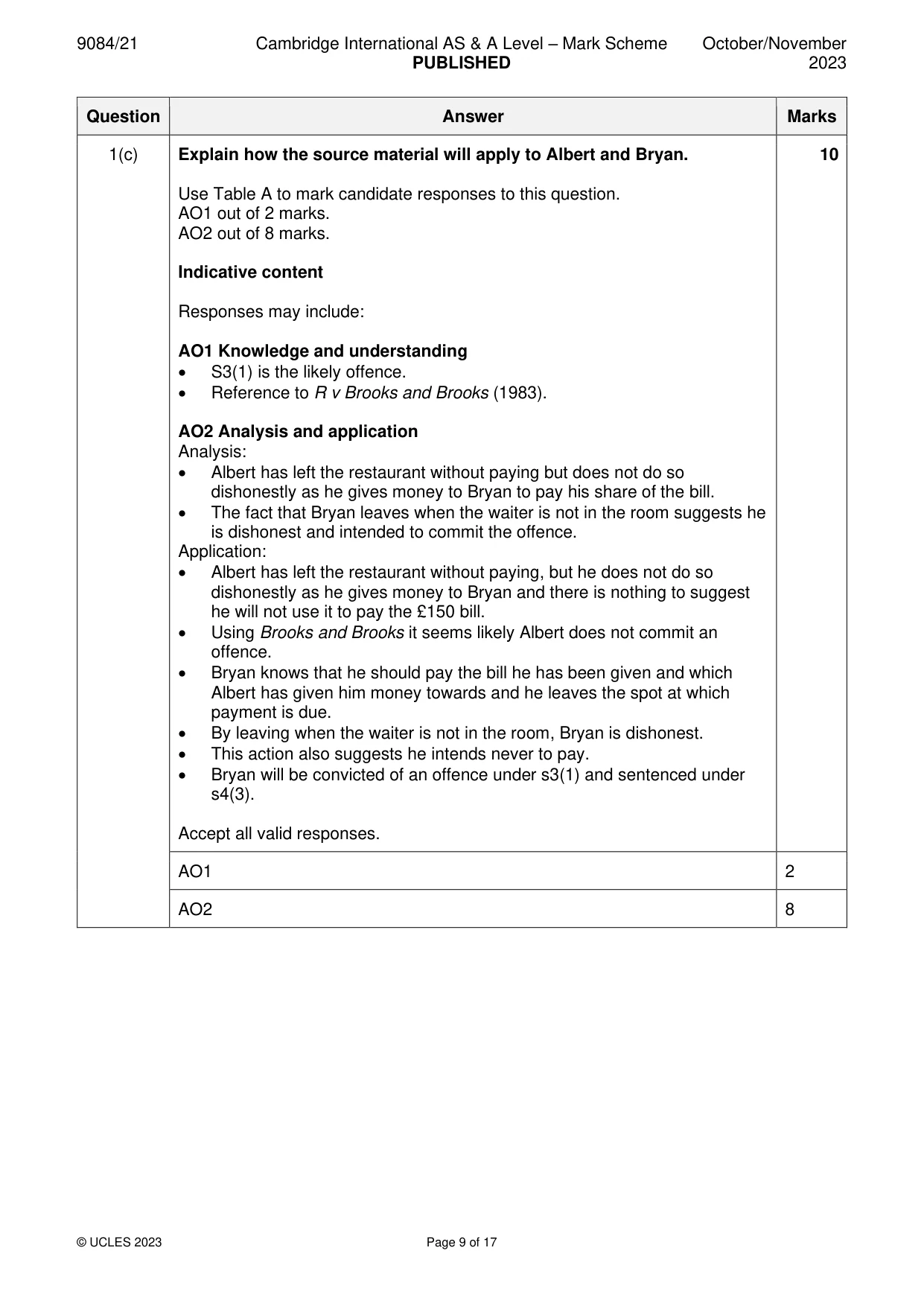
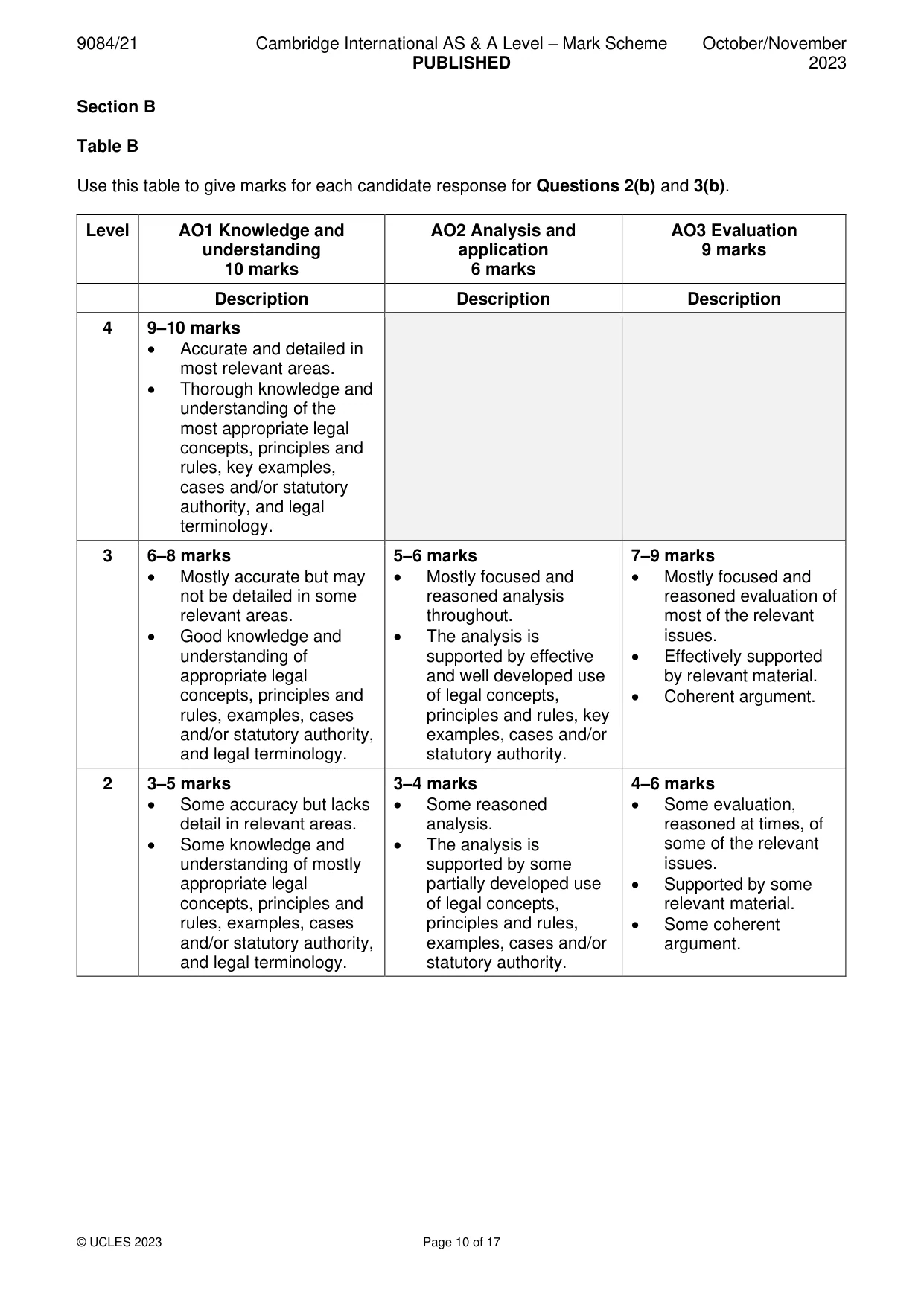
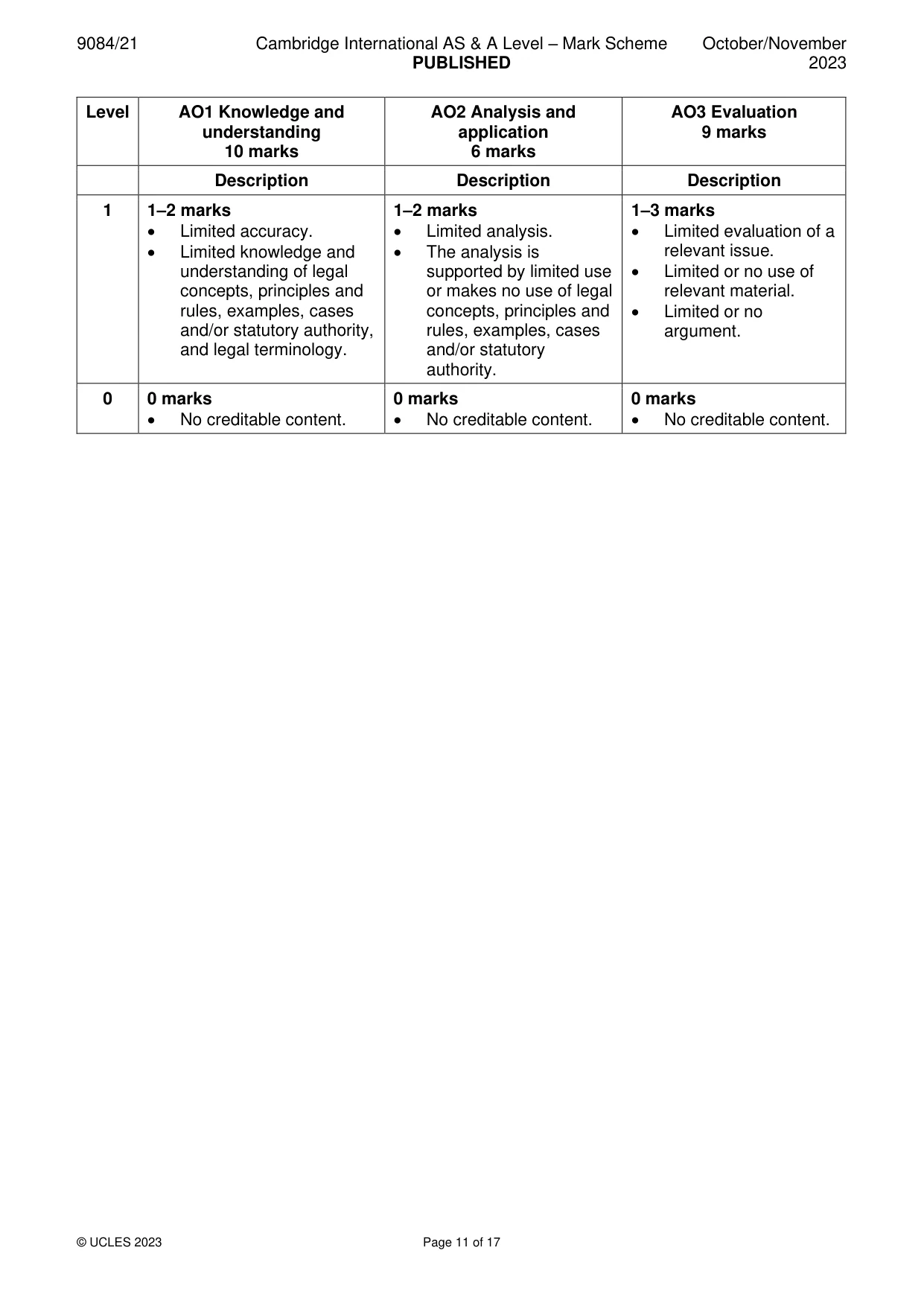
Mark scheme: Question Answer Marks 1(a) Explain how the source material will apply to Haroon. 10 Use Table A to mark candidate responses to this question. AO1 out of 2 marks. AO2 out of 8 marks. Indicative content Responses may include: AO1 Knowledge and understanding • S3(1) is the likely offence. • Reference to R v McDavitt (1981). AO2 Analysis and application Analysis: • Although Haroon has left the table where the food was ordered and served he has not left the restaurant. • Haroon did intend to leave without paying the £50 bill. Application: • Under s3(1) Haroon does know that he should pay on the spot as he has asked for the bill for the food he has ordered and the service he had had from the waiter and the kitchen. • Haroon would argue that he is not dishonest as the food was of bad quality and cold. • He intends not to pay at all as shown by the fact that he shouts he will not pay, he gets up from the table, puts on his coat and walks to the door. • Using McDavitt, although he has left the table, the restaurant is the spot where payment must be made and Haroon has not left as the manager stopped him. • Haroon has not made off without payment and so will not be convicted of an offence. Accept all valid responses. AO1 2 AO2 8 1(b) Explain how the source material will apply to Glyn. 10 Use Table A to mark candidate responses to this question. AO1 out of 2 marks. AO2 out of 8 marks. Indicative content Responses may include: AO1 Knowledge and understanding • S3(1) is the likely offence. • Reference to R v Vincent (2001). AO2 Analysis and application Analysis: • Glyn has left the spot at which payment is due. • He would argue he is not dishonest as the manager agreed to wait a week for payment. Application: • Under s3(1) Glyn knows that he should pay before he leaves for the use of the room and the service he has received so he leaves the spot at which payment is due. • Glyn will argue that he has left with the agreement of the manager and has shown good faith by leaving a telephone number. • Glyn is dishonest as what he says to the manager about his bank account is not true and so this can be contrasted with Vincent. • He also intends never to pay as he does not return to pay and the telephone number he leaves is false. • Glyn will be convicted of an offence under s3(1). • Under s4(2) the maximum sentence is two years imprisonment. Accept all valid responses. AO1 2 AO2 8 1(c) Explain how the source material will apply to Albert and Bryan. 10 Use Table A to mark candidate responses to this question. AO1 out of 2 marks. AO2 out of 8 marks. Indicative content Responses may include: AO1 Knowledge and understanding • S3(1) is the likely offence. • Reference to R v Brooks and Brooks (1983). AO2 Analysis and application Analysis: • Albert has left the restaurant without paying but does not do so dishonestly as he gives money to Bryan to pay his share of the bill. • The fact that Bryan leaves when the waiter is not in the room suggests he is dishonest and intended to commit the offence. Application: • Albert has left the restaurant without paying, but he does not do so dishonestly as he gives money to Bryan and there is nothing to suggest he will not use it to pay the £150 bill. • Using Brooks and Brooks it seems likely Albert does not commit an offence. • Bryan knows that he should pay the bill he has been given and which Albert has given him money towards and he leaves the spot at which payment is due. • By leaving when the waiter is not in the room, Bryan is dishonest. • This action also suggests he intends never to pay. • Bryan will be convicted of an offence under s3(1) and sentenced under s4(3). Accept all valid responses. AO1 2 AO2 8 Section B Table B Use this table to give marks for each candidate response for Questions 2(b) and 3(b). Level AO1 Knowledge and AO2 Analysis and AO3 Evaluation understanding application 9 marks 10 marks 6 marks Description Description Description 4 9–10 marks • Accurate and detailed in most relevant areas. • Thorough knowledge and understanding of the most appropriate legal concepts, principles and rules, key examples, cases and/or statutory authority, and legal terminology. 3 6–8 marks 5–6 marks 7–9 marks • Mostly accurate but may • Mostly focused and • Mostly focused and not be detailed in some reasoned analysis reasoned evaluation of relevant areas. throughout. most of the relevant • Good knowledge and • The analysis is issues. understanding of supported by effective • Effectively supported appropriate legal and well developed use by relevant material. concepts, principles and of legal concepts, • Coherent argument. rules, examples, cases principles and rules, key and/or statutory authority, examples, cases and/or and legal terminology. statutory authority. 2 3–5 marks 3–4 marks 4–6 marks • Some accuracy but lacks • Some reasoned • Some evaluation, detail in relevant areas. analysis. reasoned at times, of • Some knowledge and • The analysis is some of the relevant understanding of mostly supported by some issues. appropriate legal partially developed use • Supported by some concepts, principles and of legal concepts, relevant material. rules, examples, cases principles and rules, • Some coherent and/or statutory authority, examples, cases and/or argument. and legal terminology. statutory authority. Level AO1 Knowledge and AO2 Analysis and AO3 Evaluation understanding application 9 marks 10 marks 6 marks Description Description Description 1 1–2 marks 1–2 marks 1–3 marks • Limited accuracy. • Limited analysis. • Limited evaluation of a • Limited knowledge and • The analysis is relevant issue. understanding of legal supported by limited use • Limited or no use of concepts, principles and or makes no use of legal relevant material. rules, examples, cases concepts, principles and • Limited or no and/or statutory authority, rules, examples, cases argument. and legal terminology. and/or statutory authority. 0 0 marks 0 marks 0 marks • No creditable content. • No creditable content. • No creditable content.
Q2 · Describe the offence of handling stolen goods
2 (a) Describe the offence of handling stolen goods. [5] (b) Evaluate the law on causation in actus reus. [25] OR
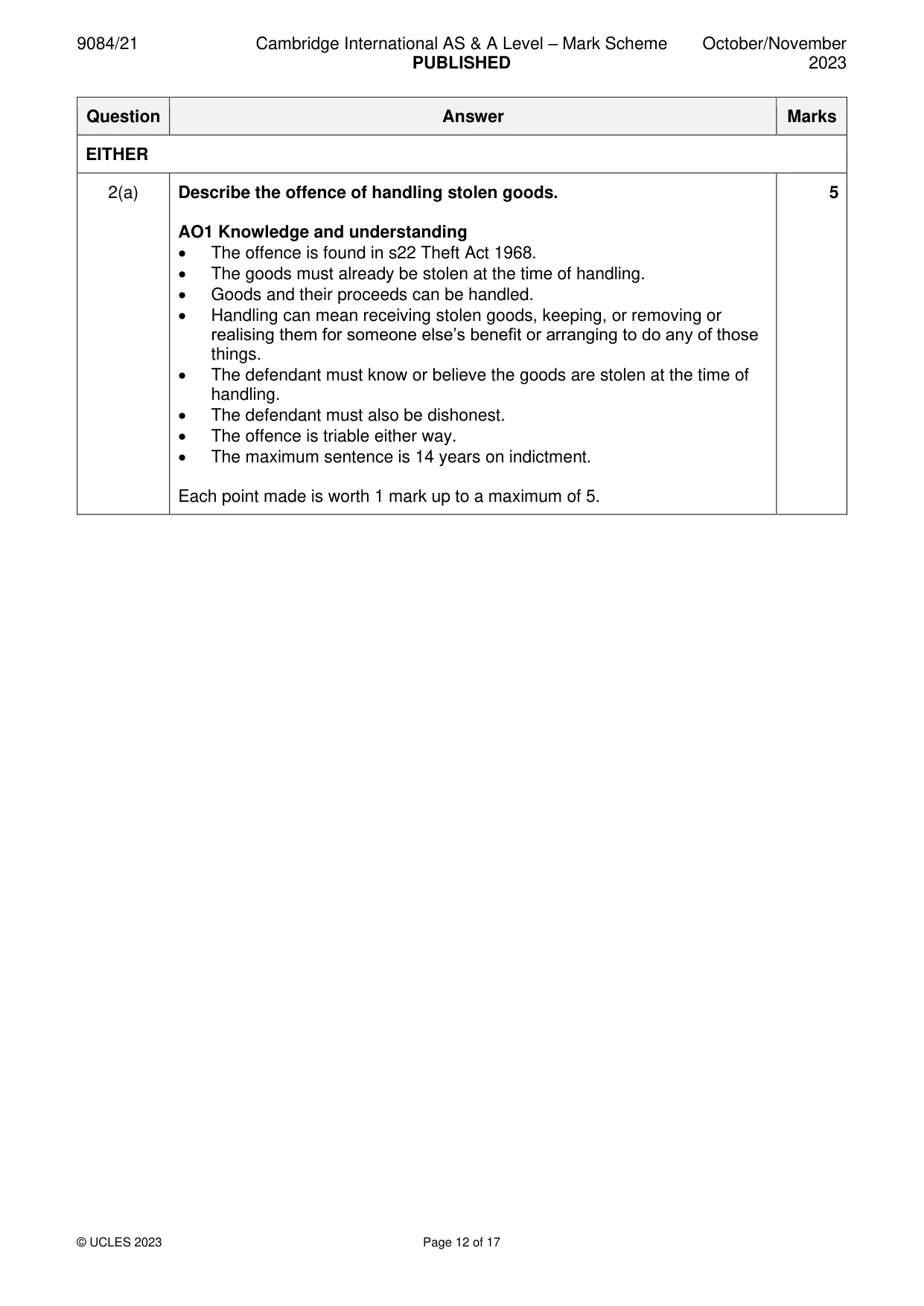
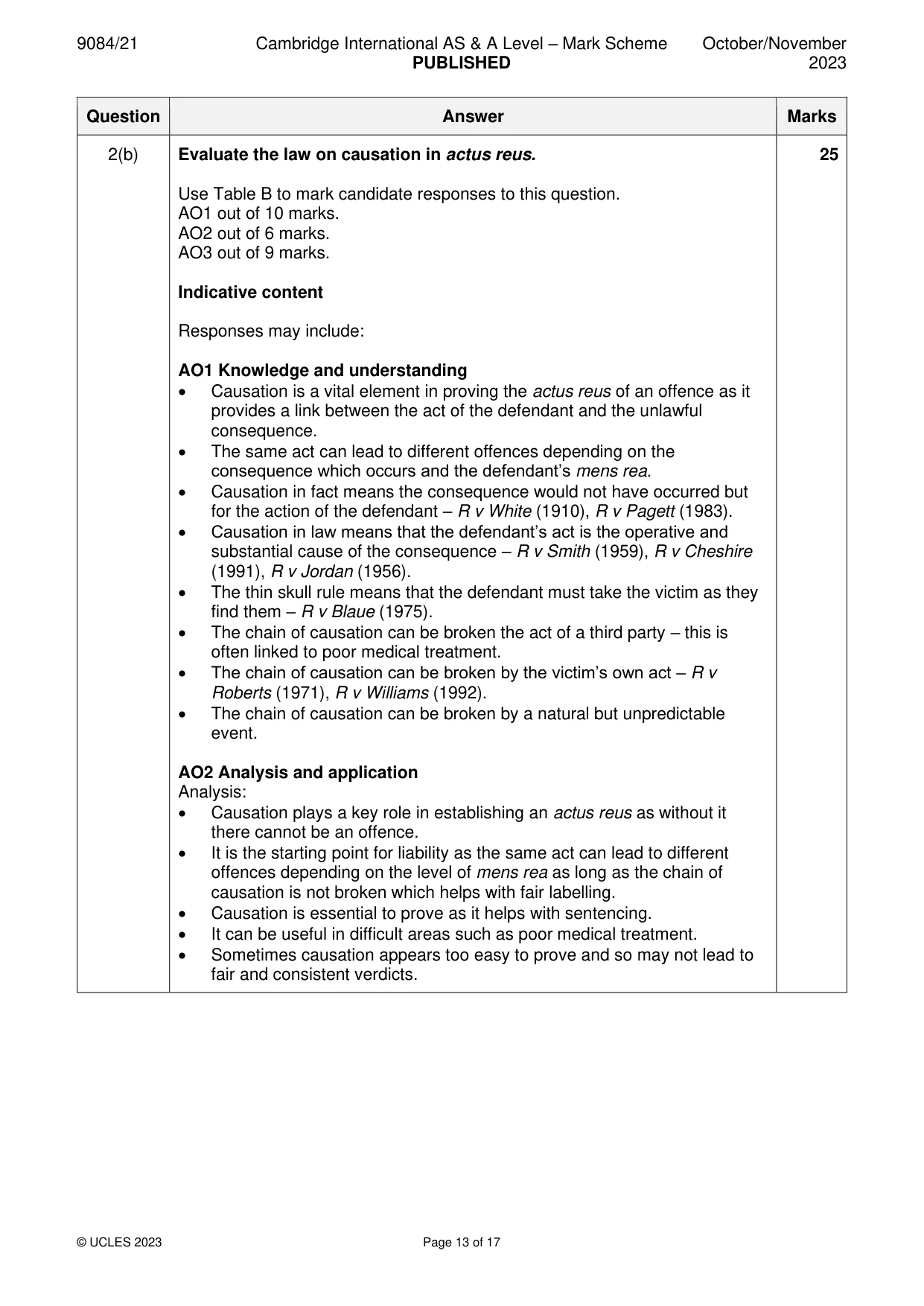
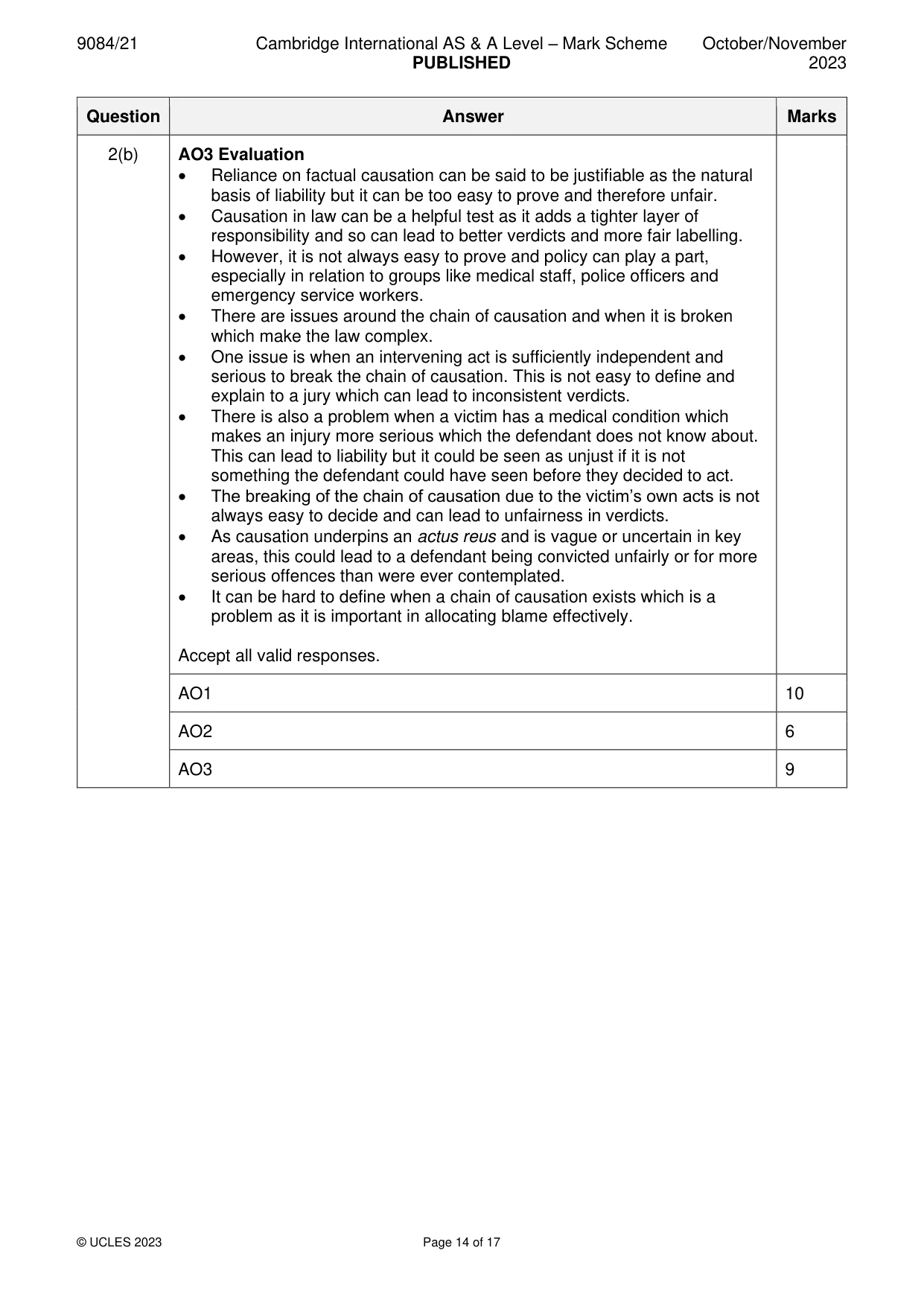
Mark scheme: 2(a) Describe the offence of handling stolen goods. 5 AO1 Knowledge and understanding • The offence is found in s22 Theft Act 1968. • The goods must already be stolen at the time of handling. • Goods and their proceeds can be handled. • Handling can mean receiving stolen goods, keeping, or removing or realising them for someone else’s benefit or arranging to do any of those things. • The defendant must know or believe the goods are stolen at the time of handling. • The defendant must also be dishonest. • The offence is triable either way. • The maximum sentence is 14 years on indictment. Each point made is worth 1 mark up to a maximum of 5. 2(b) Evaluate the law on causation in actus reus. 25 Use Table B to mark candidate responses to this question. AO1 out of 10 marks. AO2 out of 6 marks. AO3 out of 9 marks. Indicative content Responses may include: AO1 Knowledge and understanding • Causation is a vital element in proving the actus reus of an offence as it provides a link between the act of the defendant and the unlawful consequence. • The same act can lead to different offences depending on the consequence which occurs and the defendant’s mens rea. • Causation in fact means the consequence would not have occurred but for the action of the defendant – R v White (1910), R v Pagett (1983). • Causation in law means that the defendant’s act is the operative and substantial cause of the consequence – R v Smith (1959), R v Cheshire (1991), R v Jordan (1956). • The thin skull rule means that the defendant must take the victim as they find them – R v Blaue (1975). • The chain of causation can be broken the act of a third party – this is often linked to poor medical treatment. • The chain of causation can be broken by the victim’s own act – R v Roberts (1971), R v Williams (1992). • The chain of causation can be broken by a natural but unpredictable event. AO2 Analysis and application Analysis: • Causation plays a key role in establishing an actus reus as without it there cannot be an offence. • It is the starting point for liability as the same act can lead to different offences depending on the level of mens rea as long as the chain of causation is not broken which helps with fair labelling. • Causation is essential to prove as it helps with sentencing. • It can be useful in difficult areas such as poor medical treatment. • Sometimes causation appears too easy to prove and so may not lead to fair and consistent verdicts. 2(b) AO3 Evaluation • Reliance on factual causation can be said to be justifiable as the natural basis of liability but it can be too easy to prove and therefore unfair. • Causation in law can be a helpful test as it adds a tighter layer of responsibility and so can lead to better verdicts and more fair labelling. • However, it is not always easy to prove and policy can play a part, especially in relation to groups like medical staff, police officers and emergency service workers. • There are issues around the chain of causation and when it is broken which make the law complex. • One issue is when an intervening act is sufficiently independent and serious to break the chain of causation. This is not easy to define and explain to a jury which can lead to inconsistent verdicts. • There is also a problem when a victim has a medical condition which makes an injury more serious which the defendant does not know about. This can lead to liability but it could be seen as unjust if it is not something the defendant could have seen before they decided to act. • The breaking of the chain of causation due to the victim’s own acts is not always easy to decide and can lead to unfairness in verdicts. • As causation underpins an actus reus and is vague or uncertain in key areas, this could lead to a defendant being convicted unfairly or for more serious offences than were ever contemplated. • It can be hard to define when a chain of causation exists which is a problem as it is important in allocating blame effectively. Accept all valid responses. AO1 10 AO2 6 AO3 9
Q3 · Describe the custodial sentences available for a young offender
3 (a) Describe the custodial sentences available for a young offender. [5] (b) Evaluate to what extent rehabilitation is the most effective aim when sentencing adult offenders. [25] Source material for Section A Question 1 Theft Act 1978 Section 3 Making off without payment (1) Subject to subsection (3) below, a person who, knowing that payment on the spot for any goods supplied or service done is required or expected from him, dishonestly makes off without having paid as required or expected and with intent to avoid payment of the amount due shall be guilty of an offence. (2) For purposes of this section “payment on the spot” includes payment at the time of collecting goods on which work has been done or in respect of which service has been provided. (3) Subsection (1) above shall not apply where the supply of the goods or the doing of the service is contrary to law, or where the service done is such that payment is not legally enforceable. Section 4 Punishments (1) Offences under this Act shall be punishable either on conviction on indictment or on summary conviction. (2) A person convicted on indictment shall be liable— (a) … (b) for an offence under section 3 of this Act, to imprisonment for a term not exceeding two years. (3) A person convicted summarily of any offence under this Act shall be liable— (a) to imprisonment for a term not exceeding six months; or (b) to a fine not exceeding £1000, or to both. R v McDavitt (1981) The defendant refused to pay his bill in a restaurant after having an argument with the manager. He tried to walk out of the restaurant but the manager told him the police had been called and told him to stay. He remained in the restaurant until the police arrived and he was charged with making off without payment. Held: He had not left the restaurant and therefore had not ‘made off’. R v Brooks and Brooks (1983) A father and daughter and a man named Smith went to a restaurant. The daughter left early in a rush. The father and Smith then absconded without paying. They were convicted of making off without payment. The daughter appealed contending she thought her father was paying and was thus not dishonest. Held: The daughter’s conviction was quashed. The words ‘dishonestly makes off’ should be given their ordinary meaning and the jury should relate these words to the facts of any case. In the majority of cases no elaboration is required. There is no requirement of leaving by stealth in order to amount to being dishonest; the words ‘makes off’ simply mean depart. R v Vincent (2001) The appellant stayed in two hotels. He left both claiming to be suffering from financial difficulties and made arrangements to pay at a later date. He was later charged with making off without payment when no payment materialised. The trial judge directed the jury that they should convict if they thought the agreement to postpone payment was made dishonestly. The jury convicted. The appellant appealed arguing that payment on the spot was not required or expected and that he had made a genuine agreement to postpone payment and was therefore not dishonest. Held: His conviction was quashed. Since the appellant had entered an agreement to postpone payment, payment was not required or expected on the spot and therefore the actus reus of the offence was absent.
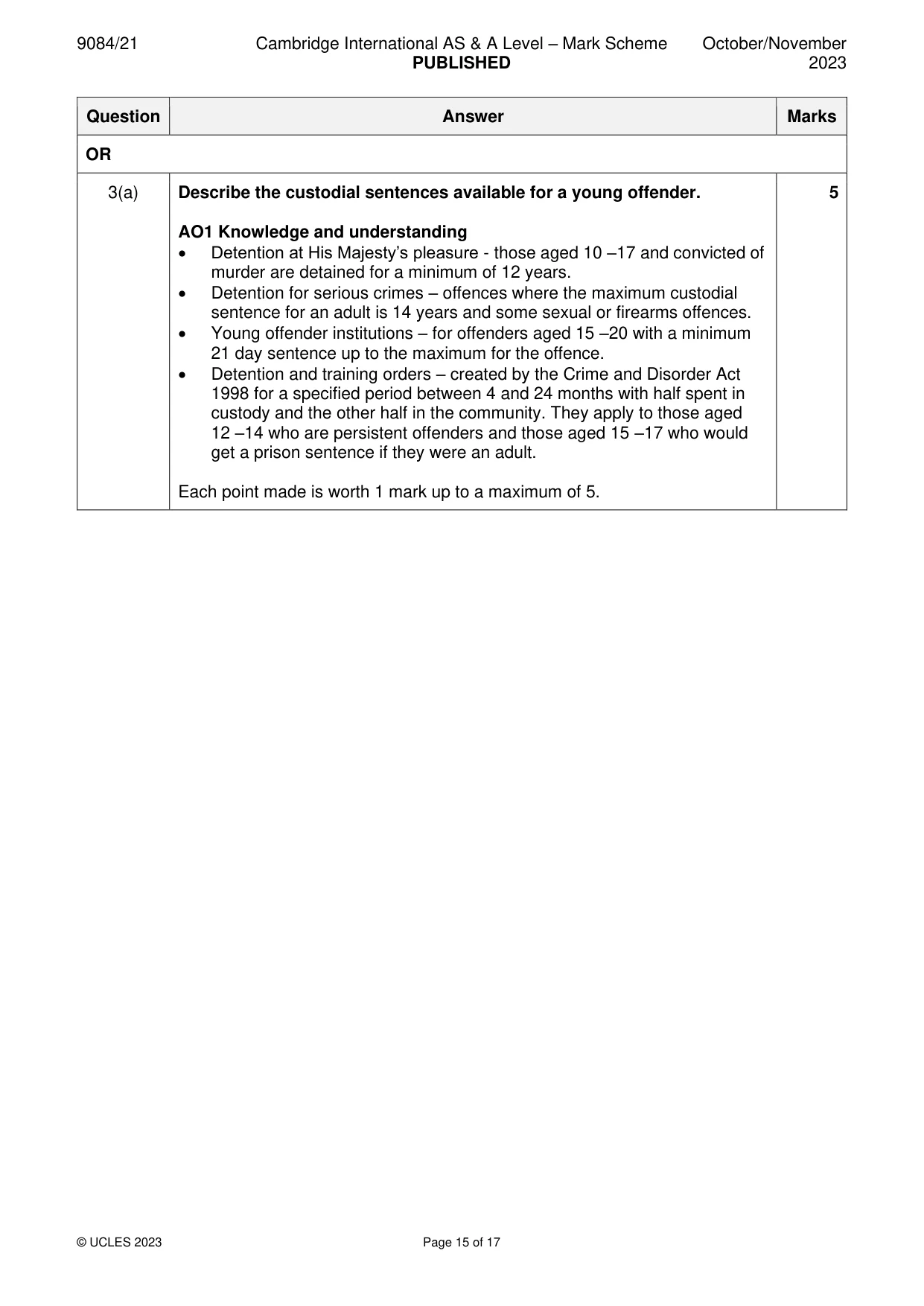
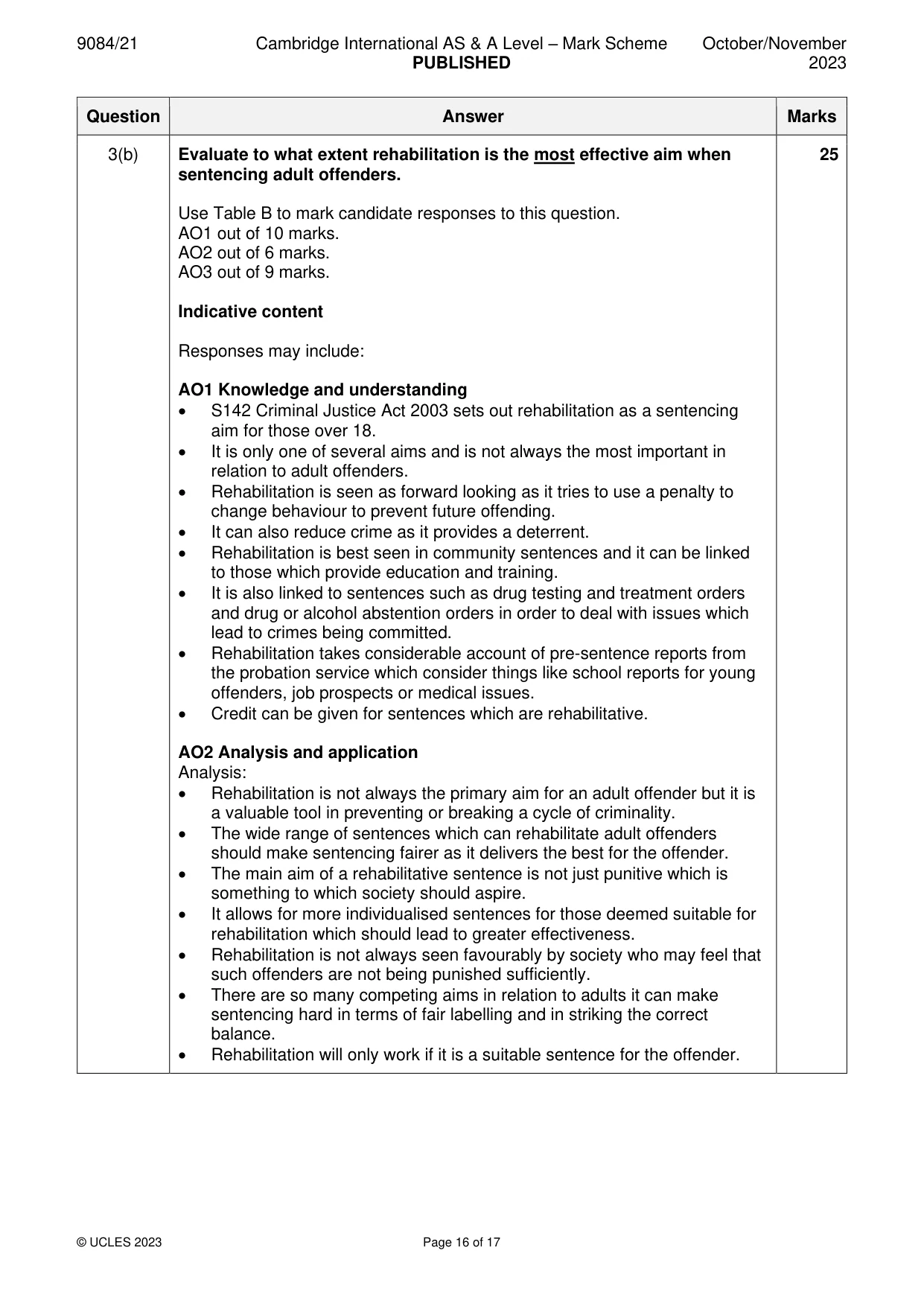
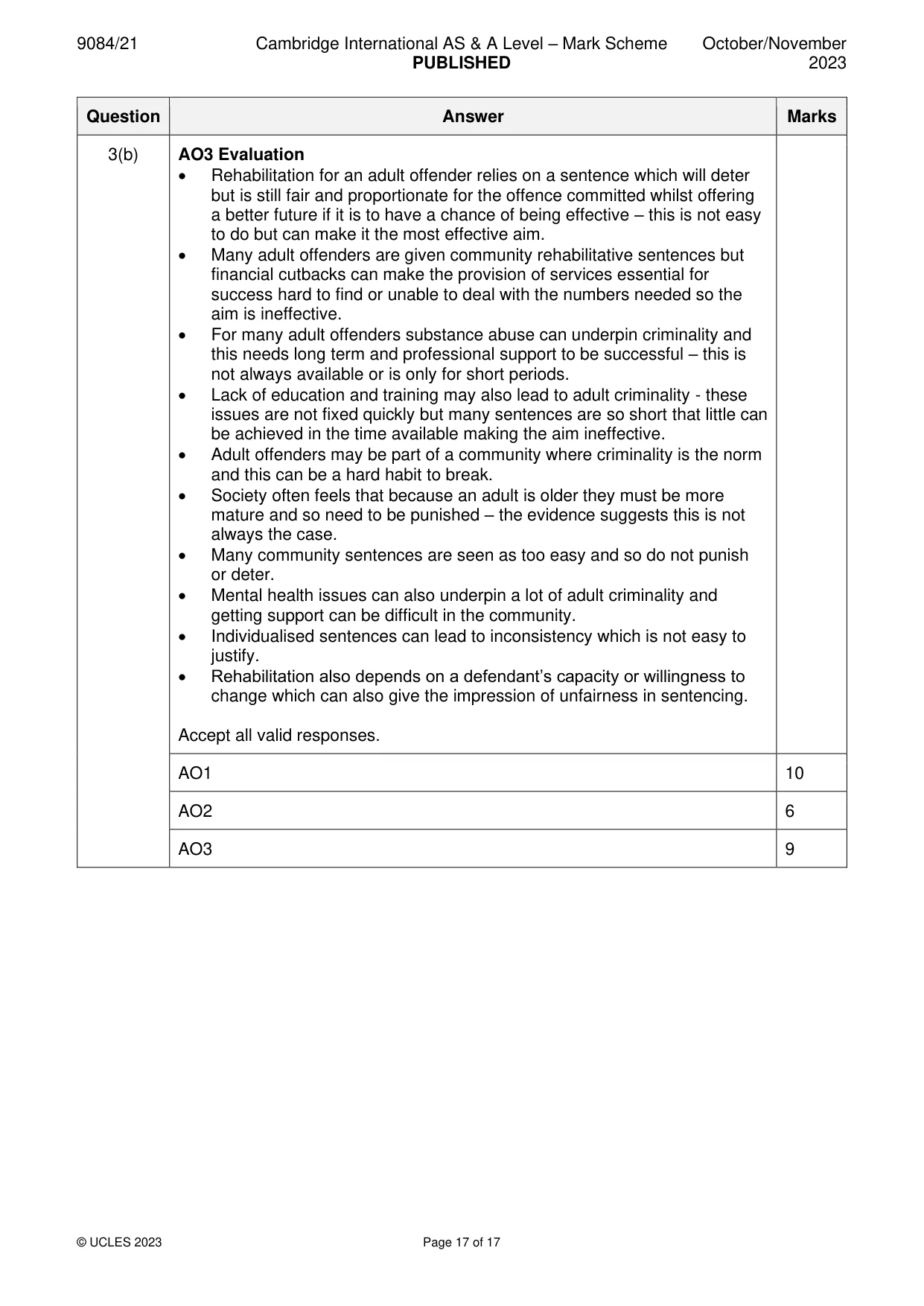
Mark scheme: 3(a) Describe the custodial sentences available for a young offender. 5 AO1 Knowledge and understanding • Detention at His Majesty’s pleasure - those aged 10 –17 and convicted of murder are detained for a minimum of 12 years. • Detention for serious crimes – offences where the maximum custodial sentence for an adult is 14 years and some sexual or firearms offences. • Young offender institutions – for offenders aged 15 –20 with a minimum 21 day sentence up to the maximum for the offence. • Detention and training orders – created by the Crime and Disorder Act 1998 for a specified period between 4 and 24 months with half spent in custody and the other half in the community. They apply to those aged 12 –14 who are persistent offenders and those aged 15 –17 who would get a prison sentence if they were an adult. Each point made is worth 1 mark up to a maximum of 5. 3(b) Evaluate to what extent rehabilitation is the most effective aim when 25 sentencing adult offenders. Use Table B to mark candidate responses to this question. AO1 out of 10 marks. AO2 out of 6 marks. AO3 out of 9 marks. Indicative content Responses may include: AO1 Knowledge and understanding • S142 Criminal Justice Act 2003 sets out rehabilitation as a sentencing aim for those over 18. • It is only one of several aims and is not always the most important in relation to adult offenders. • Rehabilitation is seen as forward looking as it tries to use a penalty to change behaviour to prevent future offending. • It can also reduce crime as it provides a deterrent. • Rehabilitation is best seen in community sentences and it can be linked to those which provide education and training. • It is also linked to sentences such as drug testing and treatment orders and drug or alcohol abstention orders in order to deal with issues which lead to crimes being committed. • Rehabilitation takes considerable account of pre-sentence reports from the probation service which consider things like school reports for young offenders, job prospects or medical issues. • Credit can be given for sentences which are rehabilitative. AO2 Analysis and application Analysis: • Rehabilitation is not always the primary aim for an adult offender but it is a valuable tool in preventing or breaking a cycle of criminality. • The wide range of sentences which can rehabilitate adult offenders should make sentencing fairer as it delivers the best for the offender. • The main aim of a rehabilitative sentence is not just punitive which is something to which society should aspire. • It allows for more individualised sentences for those deemed suitable for rehabilitation which should lead to greater effectiveness. • Rehabilitation is not always seen favourably by society who may feel that such offenders are not being punished sufficiently. • There are so many competing aims in relation to adults it can make sentencing hard in terms of fair labelling and in striking the correct balance. • Rehabilitation will only work if it is a suitable sentence for the offender. 3(b) AO3 Evaluation • Rehabilitation for an adult offender relies on a sentence which will deter but is still fair and proportionate for the offence committed whilst offering a better future if it is to have a chance of being effective – this is not easy to do but can make it the most effective aim. • Many adult offenders are given community rehabilitative sentences but financial cutbacks can make the provision of services essential for success hard to find or unable to deal with the numbers needed so the aim is ineffective. • For many adult offenders substance abuse can underpin criminality and this needs long term and professional support to be successful – this is not always available or is only for short periods. • Lack of education and training may also lead to adult criminality - these issues are not fixed quickly but many sentences are so short that little can be achieved in the time available making the aim ineffective. • Adult offenders may be part of a community where criminality is the norm and this can be a hard habit to break. • Society often feels that because an adult is older they must be more mature and so need to be punished – the evidence suggests this is not always the case. • Many community sentences are seen as too easy and so do not punish or deter. • Mental health issues can also underpin a lot of adult criminality and getting support can be difficult in the community. • Individualised sentences can lead to inconsistency which is not easy to justify. • Rehabilitation also depends on a defendant’s capacity or willingness to change which can also give the impression of unfairness in sentencing. Accept all valid responses. AO1 10 AO2 6 AO3 9
What was in this paper
The subtopics covered by these 3 questions, and how many questions each got. Open one in a new tab to see every Cambridge question on it.
1Offences against property This topic is about the components of substantive offences against property. This topic is an opportunity to reflect on the key concepts of liability, justice, fairness, effectiveness and certainty1Sentencing in England and Wales This topic is about the sentences that can be handed down to both adult and young offenders who have been convicted of offences. This topic is an opportunity to reflect on the key concepts of liability, justice, fairness, power and its limits, and effectiveness1What you needed in this session
Cambridge’s own grade thresholds for 2023 Oct/Nov, Paper 2 · Variant 1. A higher threshold means an easier paper — the bar moves with how the cohort did.