Cambridge A Level Law 9084 — 2023 May/June Paper 2 · Variant 1
9084/21/M/J/23 · 3 questions · 60 marks · ≈68 min
The question paper and its mark scheme, free to read here and free to download. This is Cambridge’s own paper, exactly as it was sat.
Question paper4 pages
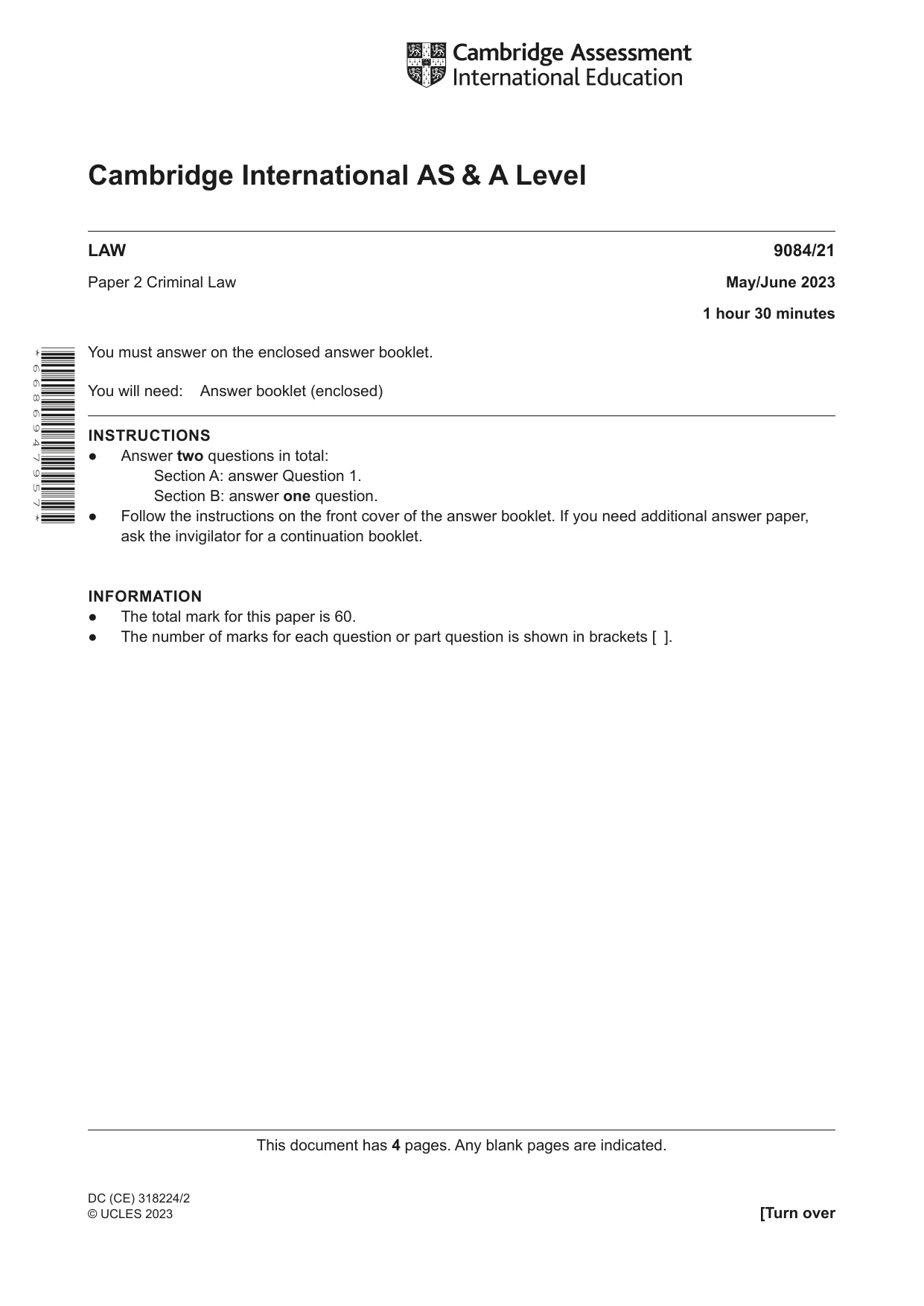
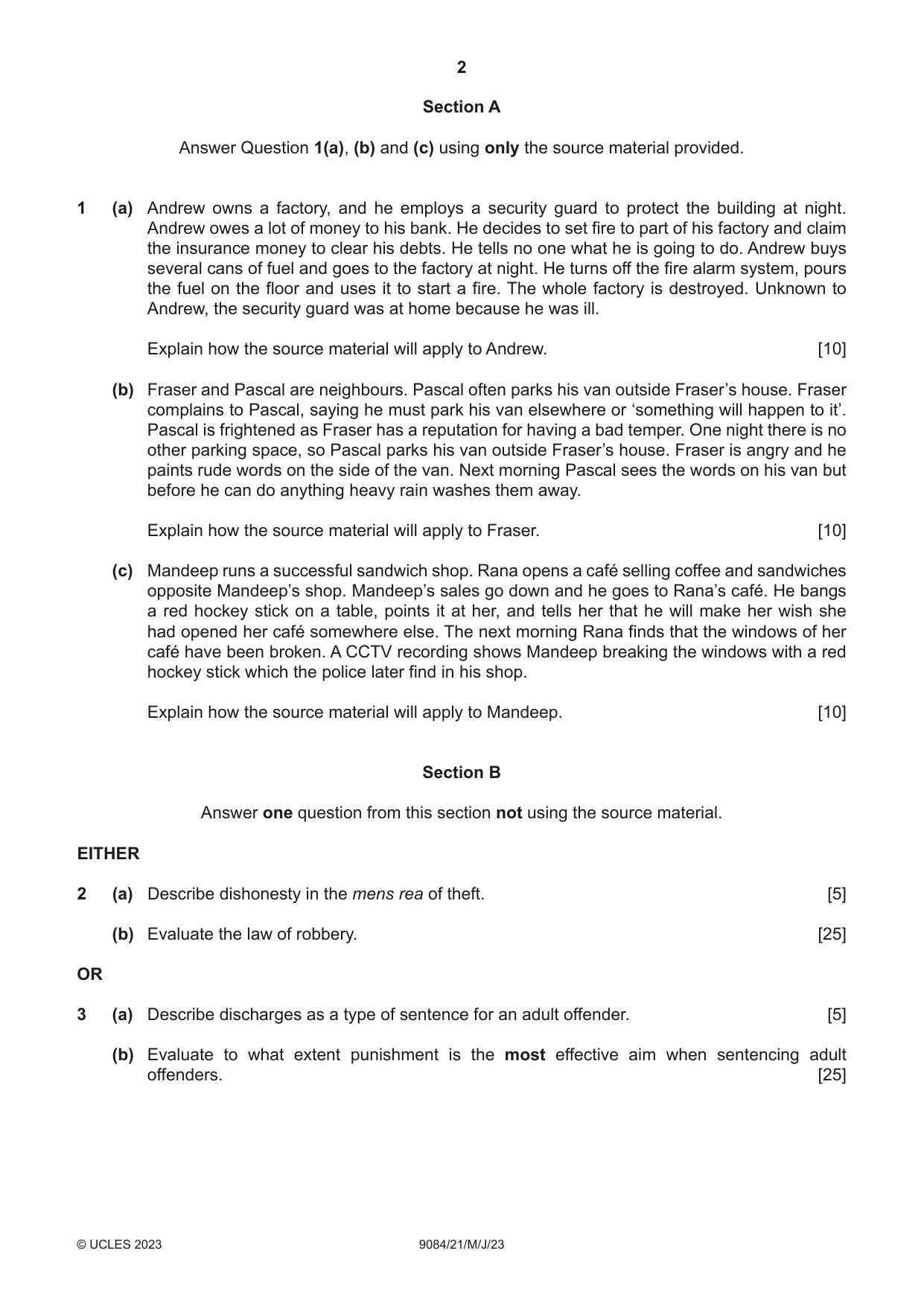
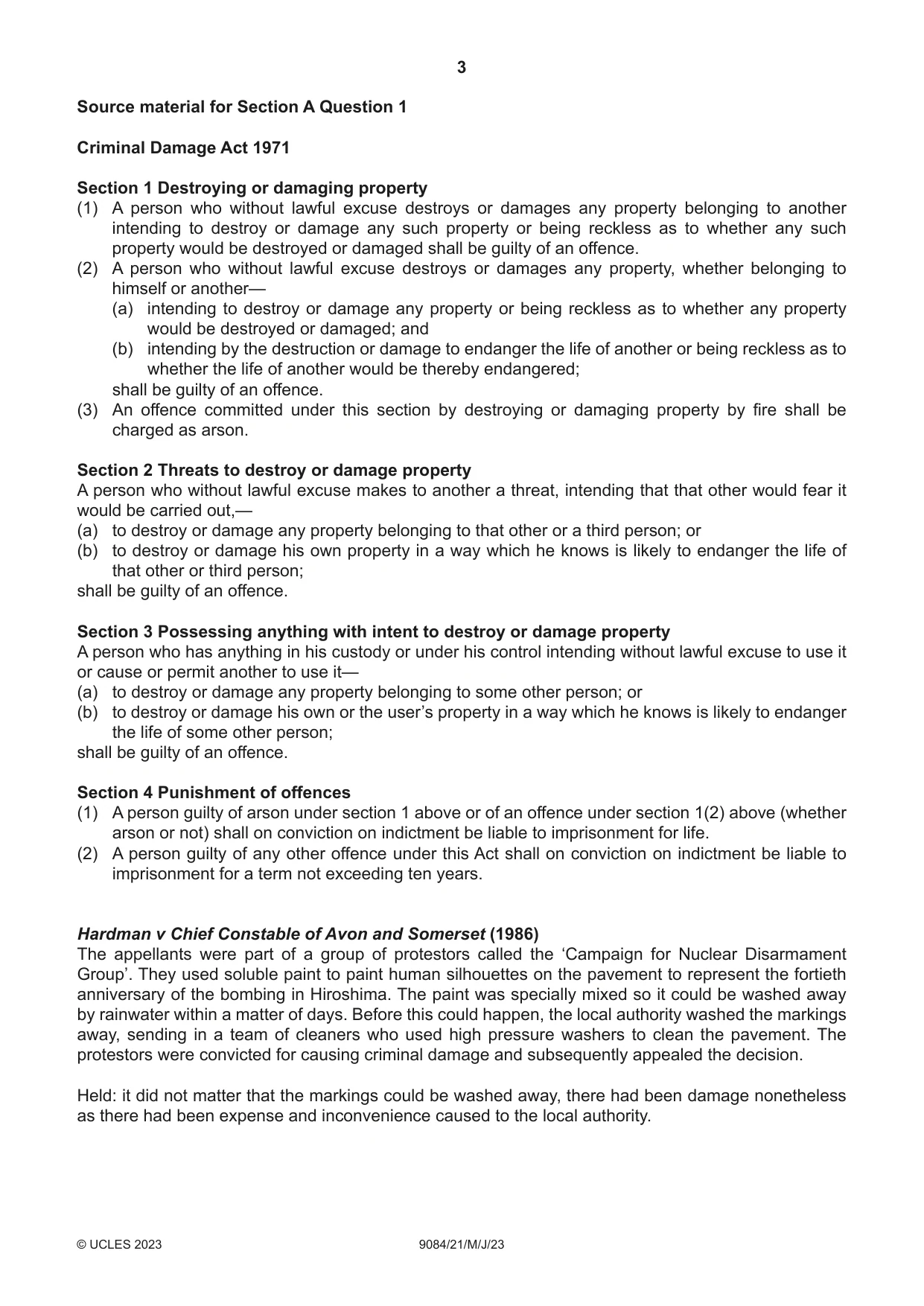

Mark scheme15 pages
Answers below. Sit the paper first if you are practising.
Questions as text
Q1 · Andrew owns a factory, and he employs a security guard to protect the building at night
1 (a) Andrew owns a factory, and he employs a security guard to protect the building at night. Andrew owes a lot of money to his bank. He decides to set fire to part of his factory and claim the insurance money to clear his debts. He tells no one what he is going to do. Andrew buys several cans of fuel and goes to the factory at night. He turns off the fire alarm system, pours the fuel on the floor and uses it to start a fire. The whole factory is destroyed. Unknown to Andrew, the security guard was at home because he was ill. Explain how the source material will apply to Andrew. [10] (b) Fraser and Pascal are neighbours. Pascal often parks his van outside Fraser’s house. Fraser complains to Pascal, saying he must park his van elsewhere or ‘something will happen to it’. Pascal is frightened as Fraser has a reputation for having a bad temper. One night there is no other parking space, so Pascal parks his van outside Fraser’s house. Fraser is angry and he paints rude words on the side of the van. Next morning Pascal sees the words on his van but before he can do anything heavy rain washes them away. Explain how the source material will apply to Fraser. [10] (c) Mandeep runs a successful sandwich shop. Rana opens a café selling coffee and sandwiches opposite Mandeep’s shop. Mandeep’s sales go down and he goes to Rana’s café. He bangs a red hockey stick on a table, points it at her, and tells her that he will make her wish she had opened her café somewhere else. The next morning Rana finds that the windows of her café have been broken. A CCTV recording shows Mandeep breaking the windows with a red hockey stick which the police later find in his shop. Explain how the source material will apply to Mandeep. [10]
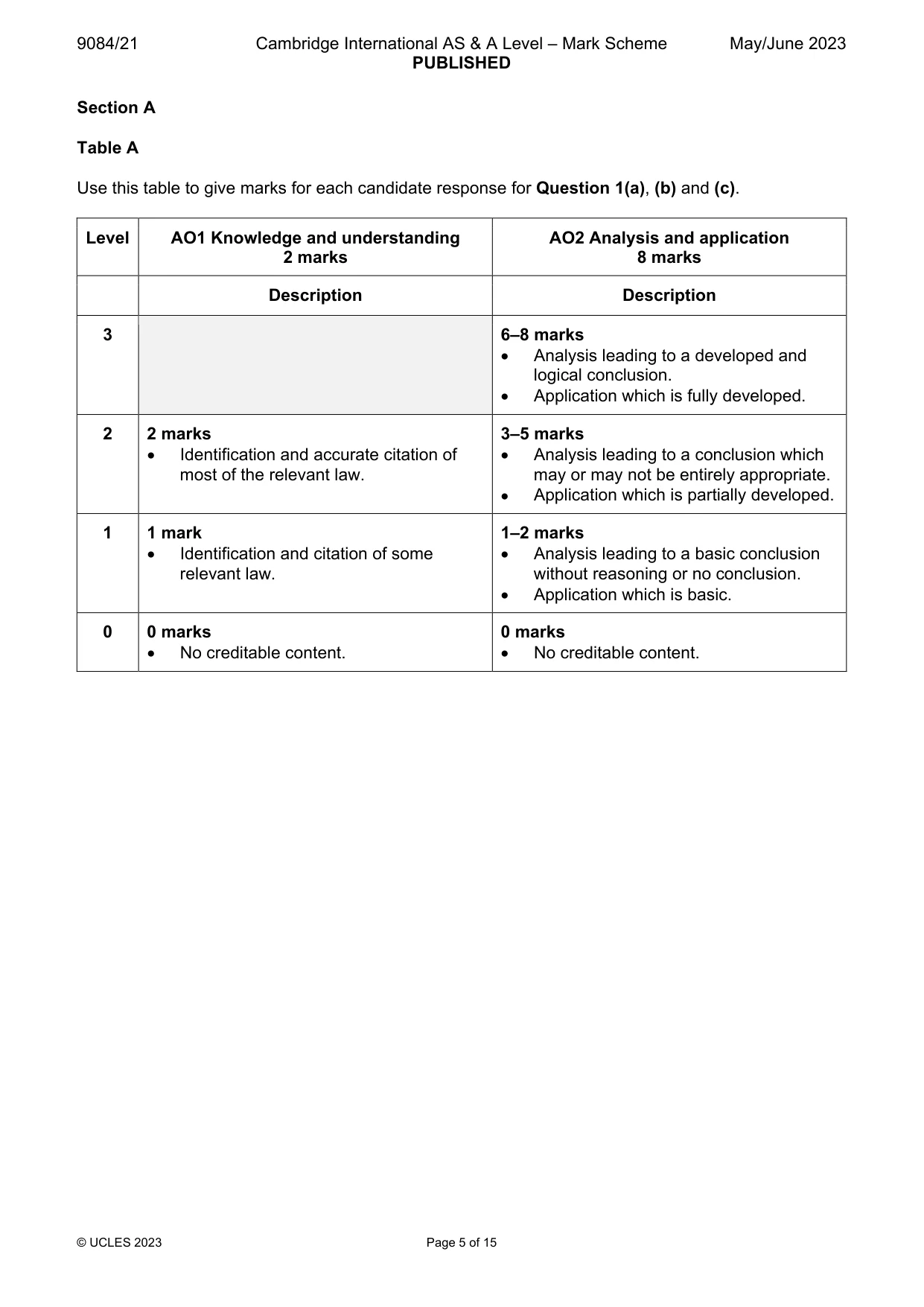
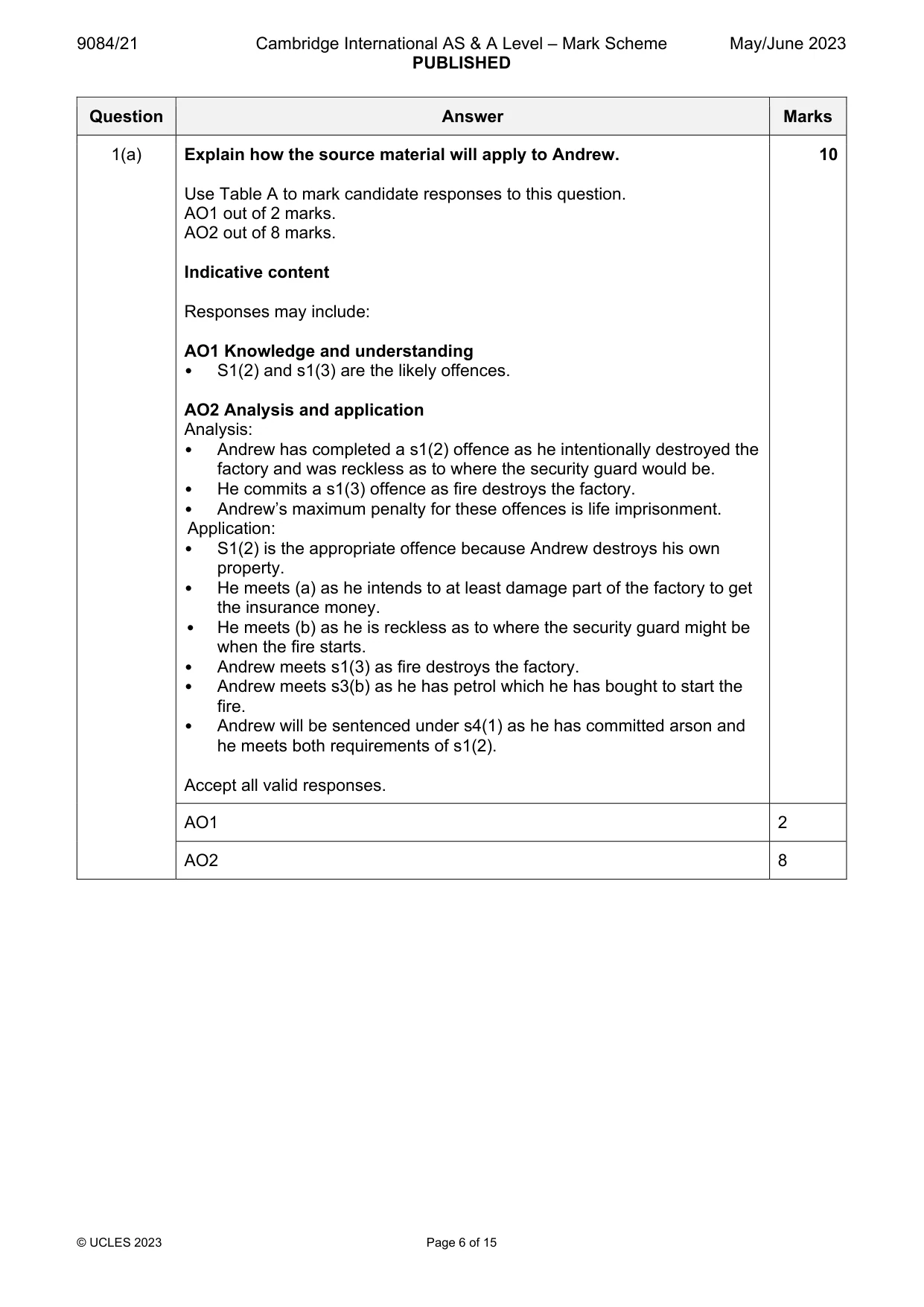
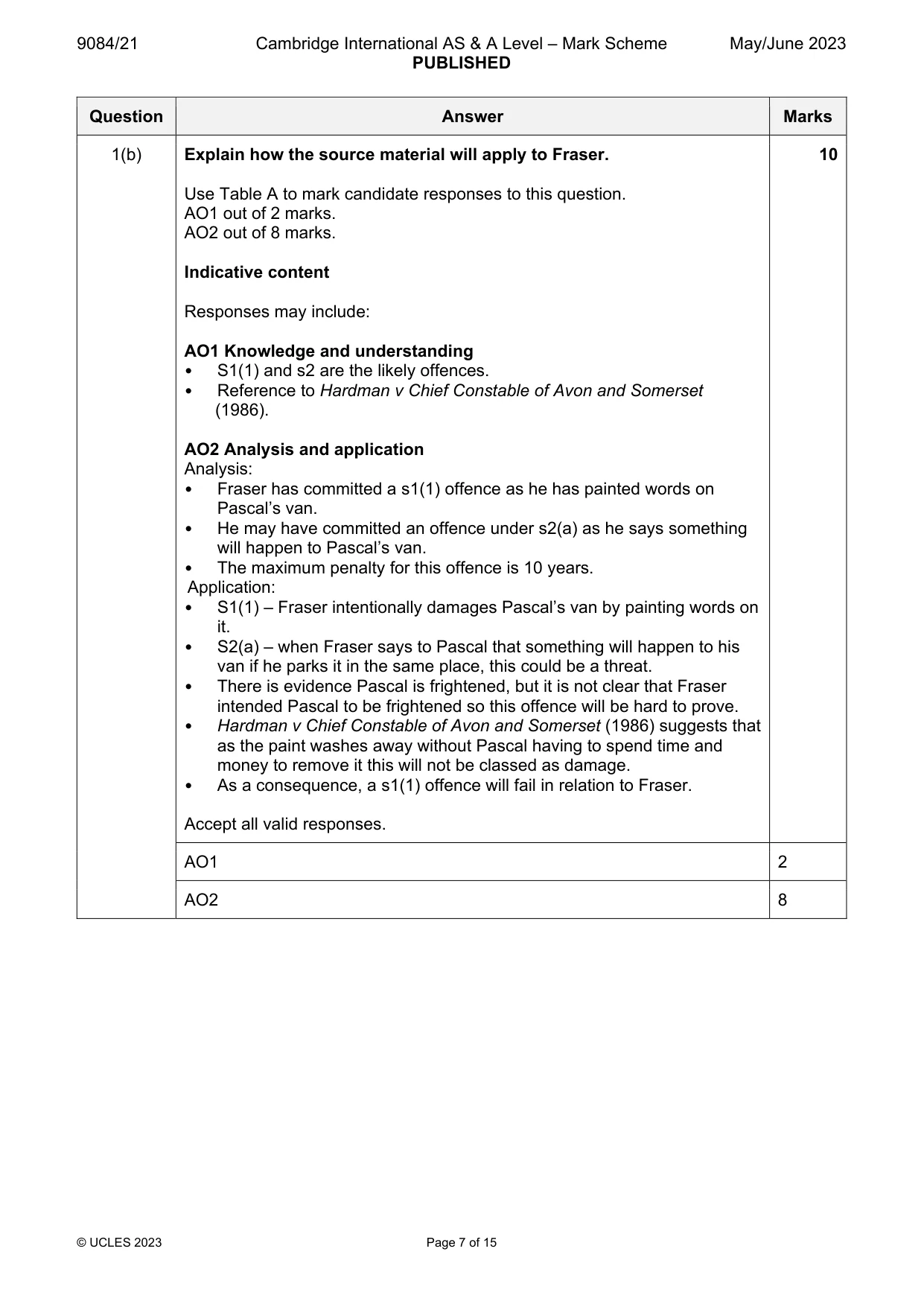
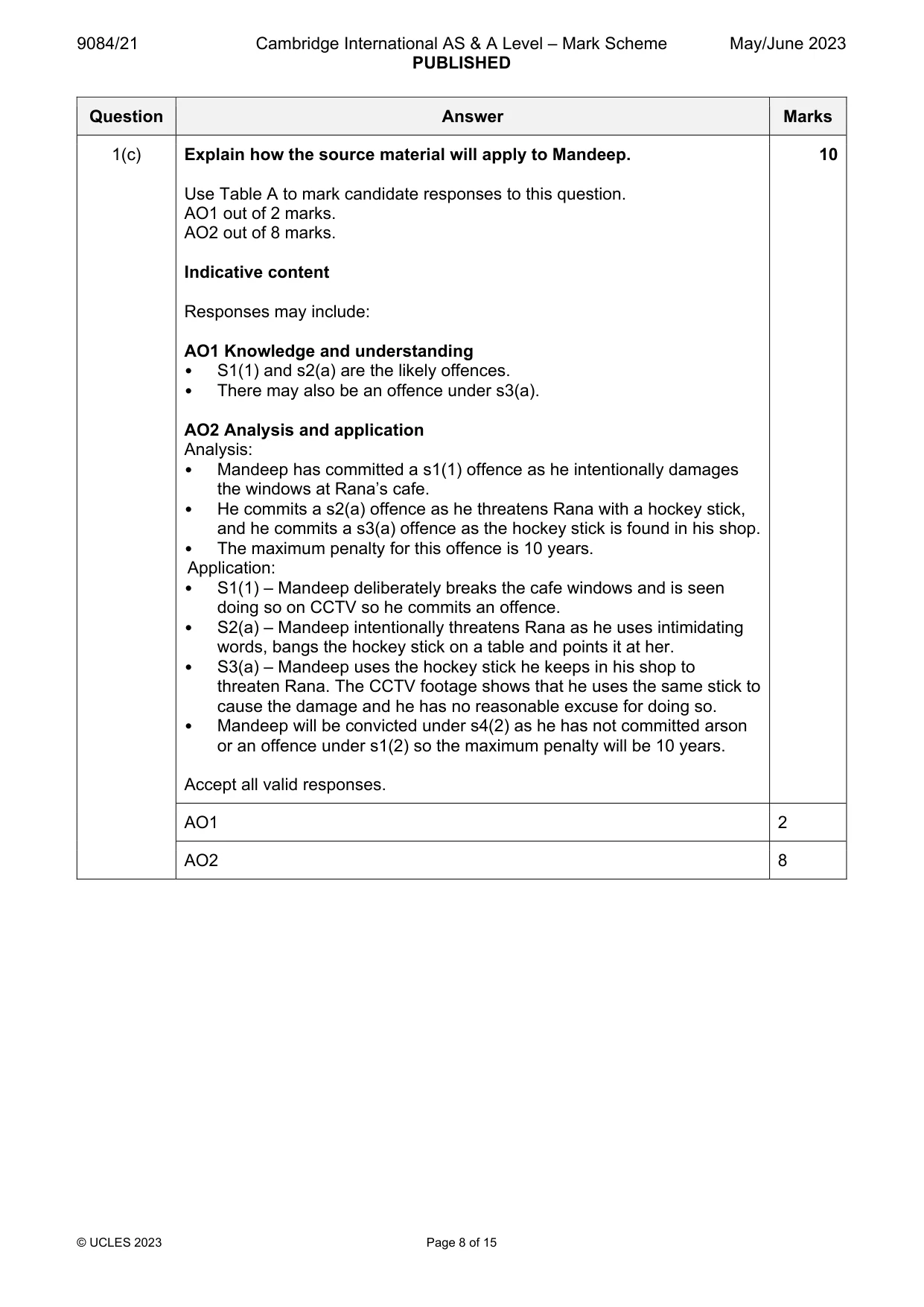
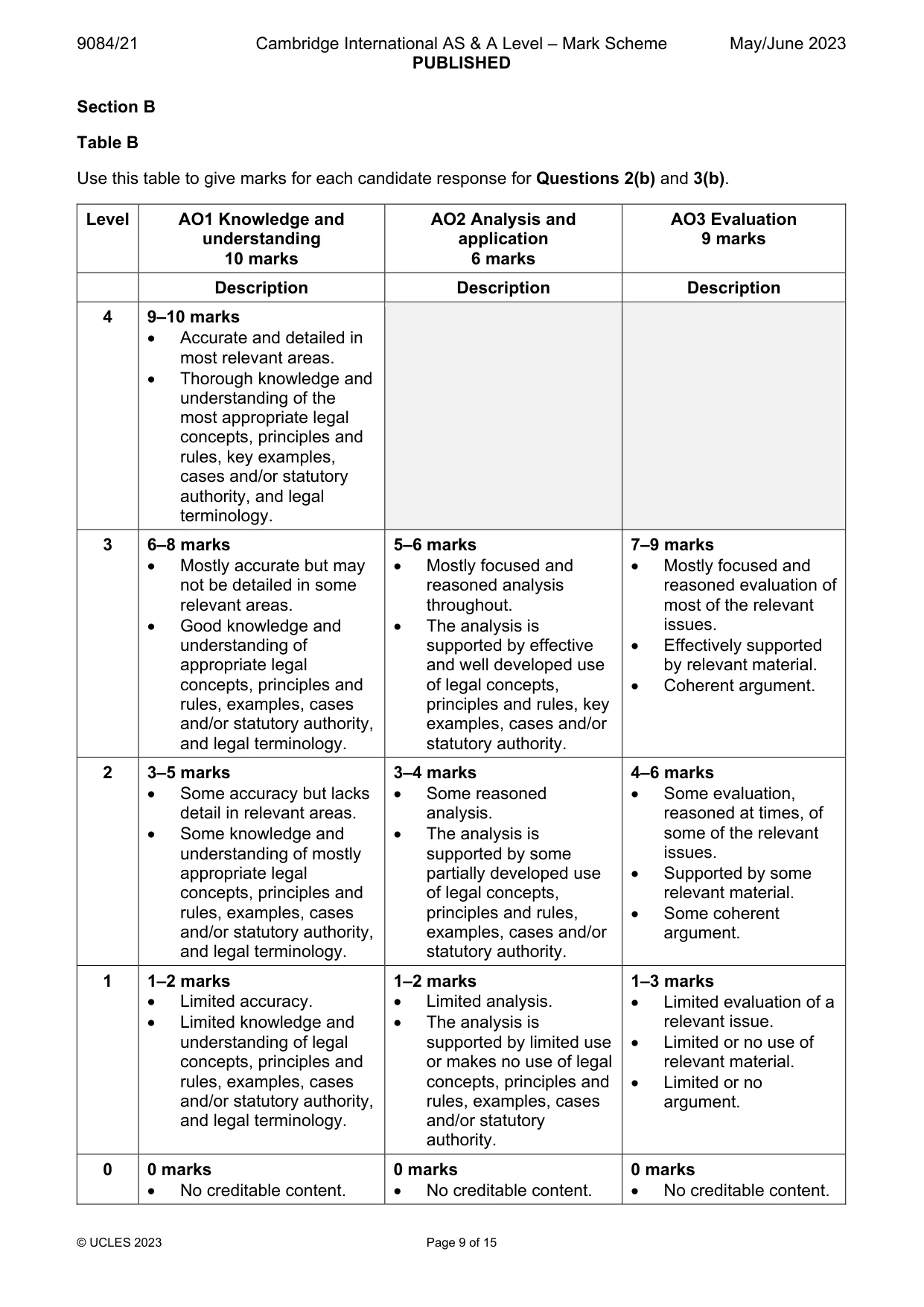
Mark scheme: Question Answer Marks 1(a) Explain how the source material will apply to Andrew. 10 Use Table A to mark candidate responses to this question. AO1 out of 2 marks. AO2 out of 8 marks. Indicative content Responses may include: AO1 Knowledge and understanding • S1(2) and s1(3) are the likely offences. AO2 Analysis and application Analysis: • Andrew has completed a s1(2) offence as he intentionally destroyed the factory and was reckless as to where the security guard would be. • He commits a s1(3) offence as fire destroys the factory. • Andrew’s maximum penalty for these offences is life imprisonment. Application: • S1(2) is the appropriate offence because Andrew destroys his own property. • He meets (a) as he intends to at least damage part of the factory to get the insurance money. • He meets (b) as he is reckless as to where the security guard might be when the fire starts. • Andrew meets s1(3) as fire destroys the factory. • Andrew meets s3(b) as he has petrol which he has bought to start the fire. • Andrew will be sentenced under s4(1) as he has committed arson and he meets both requirements of s1(2). Accept all valid responses. AO1 2 AO2 8 1(b) Explain how the source material will apply to Fraser. 10 Use Table A to mark candidate responses to this question. AO1 out of 2 marks. AO2 out of 8 marks. Indicative content Responses may include: AO1 Knowledge and understanding • S1(1) and s2 are the likely offences. • Reference to Hardman v Chief Constable of Avon and Somerset (1986). AO2 Analysis and application Analysis: • Fraser has committed a s1(1) offence as he has painted words on Pascal’s van. • He may have committed an offence under s2(a) as he says something will happen to Pascal’s van. • The maximum penalty for this offence is 10 years. Application: • S1(1) – Fraser intentionally damages Pascal’s van by painting words on it. • S2(a) – when Fraser says to Pascal that something will happen to his van if he parks it in the same place, this could be a threat. • There is evidence Pascal is frightened, but it is not clear that Fraser intended Pascal to be frightened so this offence will be hard to prove. • Hardman v Chief Constable of Avon and Somerset (1986) suggests that as the paint washes away without Pascal having to spend time and money to remove it this will not be classed as damage. • As a consequence, a s1(1) offence will fail in relation to Fraser. Accept all valid responses. AO1 2 AO2 8 1(c) Explain how the source material will apply to Mandeep. 10 Use Table A to mark candidate responses to this question. AO1 out of 2 marks. AO2 out of 8 marks. Indicative content Responses may include: AO1 Knowledge and understanding • S1(1) and s2(a) are the likely offences. • There may also be an offence under s3(a). AO2 Analysis and application Analysis: • Mandeep has committed a s1(1) offence as he intentionally damages the windows at Rana’s cafe. • He commits a s2(a) offence as he threatens Rana with a hockey stick, and he commits a s3(a) offence as the hockey stick is found in his shop. • The maximum penalty for this offence is 10 years. Application: • S1(1) – Mandeep deliberately breaks the cafe windows and is seen doing so on CCTV so he commits an offence. • S2(a) – Mandeep intentionally threatens Rana as he uses intimidating words, bangs the hockey stick on a table and points it at her. • S3(a) – Mandeep uses the hockey stick he keeps in his shop to threaten Rana. The CCTV footage shows that he uses the same stick to cause the damage and he has no reasonable excuse for doing so. • Mandeep will be convicted under s4(2) as he has not committed arson or an offence under s1(2) so the maximum penalty will be 10 years. Accept all valid responses. AO1 2 AO2 8 Section B Table B Use this table to give marks for each candidate response for Questions 2(b) and 3(b). Level AO1 Knowledge and AO2 Analysis and AO3 Evaluation understanding application 9 marks 10 marks 6 marks Description Description Description 4 9–10 marks Accurate and detailed in most relevant areas. Thorough knowledge and understanding of the most appropriate legal concepts, principles and rules, key examples, cases and/or statutory authority, and legal terminology. 3 6–8 marks 5–6 marks 7–9 marks Mostly accurate but may Mostly focused and Mostly focused and not be detailed in some reasoned analysis reasoned evaluation of relevant areas. throughout. most of the relevant Good knowledge and The analysis is issues. understanding of supported by effective Effectively supported appropriate legal and well developed use by relevant material. concepts, principles and of legal concepts, Coherent argument. rules, examples, cases principles and rules, key and/or statutory authority, examples, cases and/or and legal terminology. statutory authority. 2 3–5 marks 3–4 marks 4–6 marks Some accuracy but lacks Some reasoned Some evaluation, detail in relevant areas. analysis. reasoned at times, of Some knowledge and The analysis is some of the relevant understanding of mostly supported by some issues. appropriate legal partially developed use Supported by some concepts, principles and of legal concepts, relevant material. rules, examples, cases principles and rules, Some coherent and/or statutory authority, examples, cases and/or argument. and legal terminology. statutory authority. 1 1–2 marks 1–2 marks 1–3 marks Limited accuracy. Limited analysis. Limited evaluation of a Limited knowledge and The analysis is relevant issue. understanding of legal supported by limited use Limited or no use of concepts, principles and or makes no use of legal relevant material. rules, examples, cases concepts, principles and Limited or no and/or statutory authority, rules, examples, cases argument. and legal terminology. and/or statutory authority. 0 0 marks 0 marks 0 marks No creditable content. No creditable content. No creditable content.
Q2 · Describe dishonesty in the mens rea of theft
2 (a) Describe dishonesty in the mens rea of theft. [5] (b) Evaluate the law of robbery. [25] OR
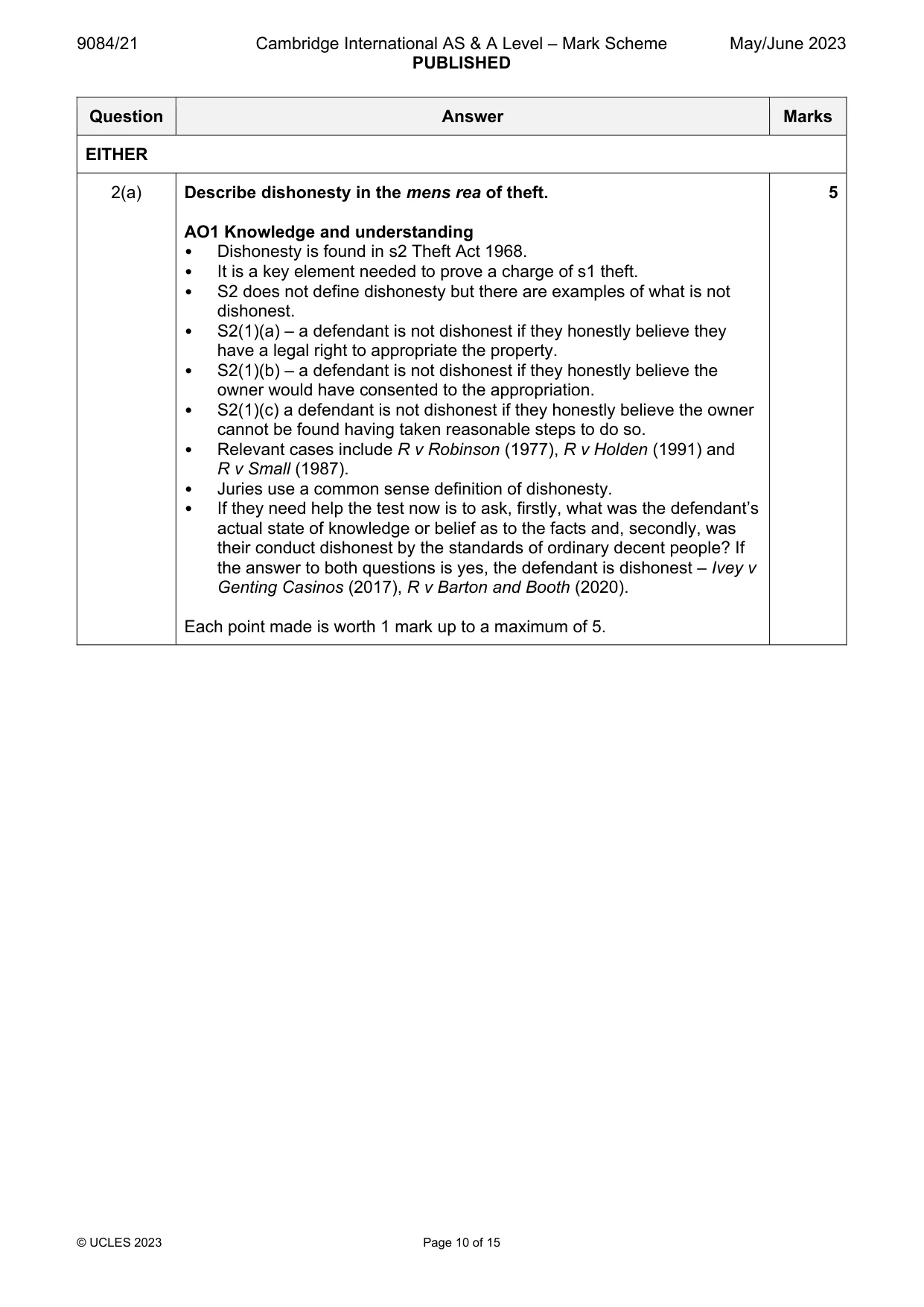
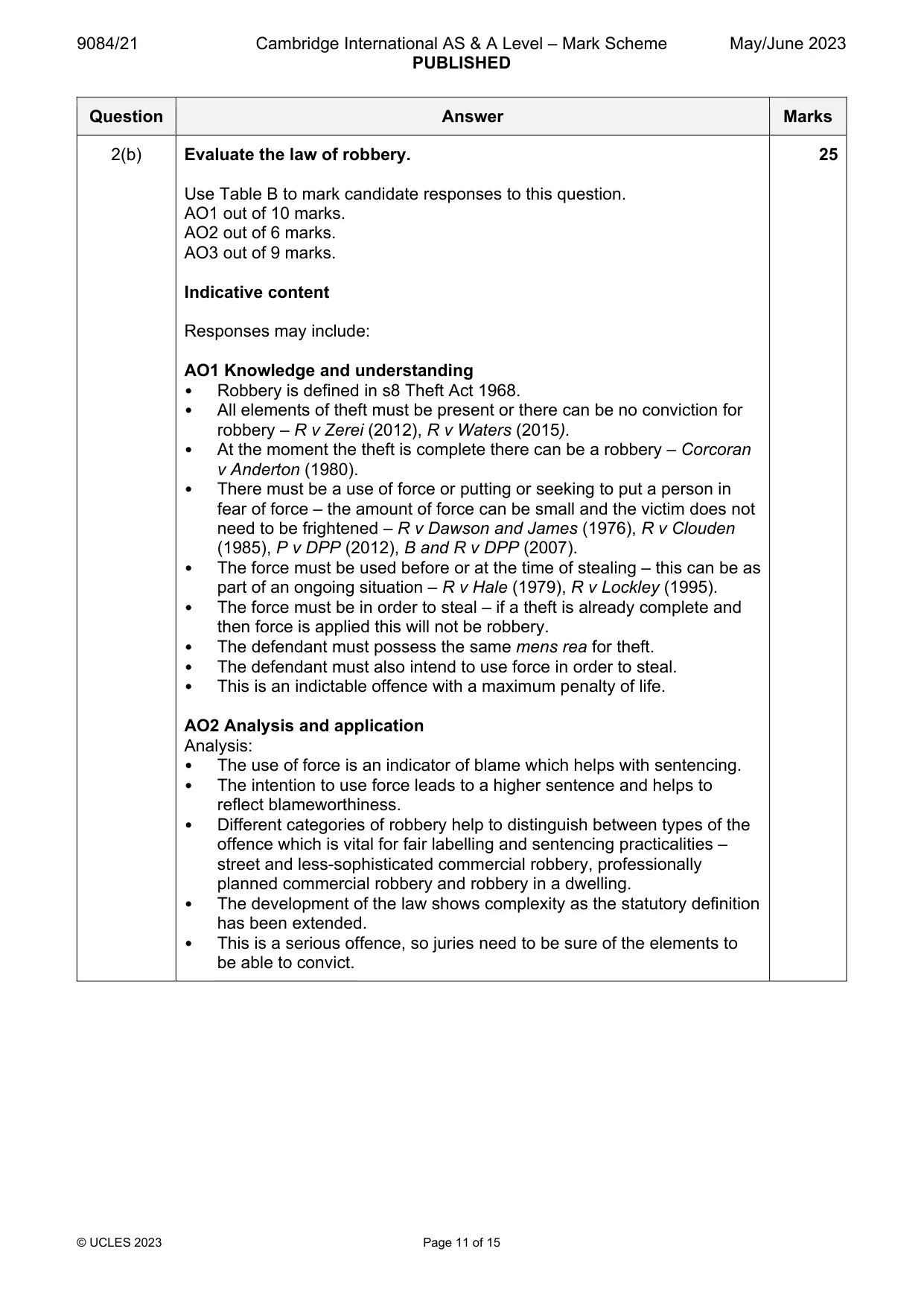
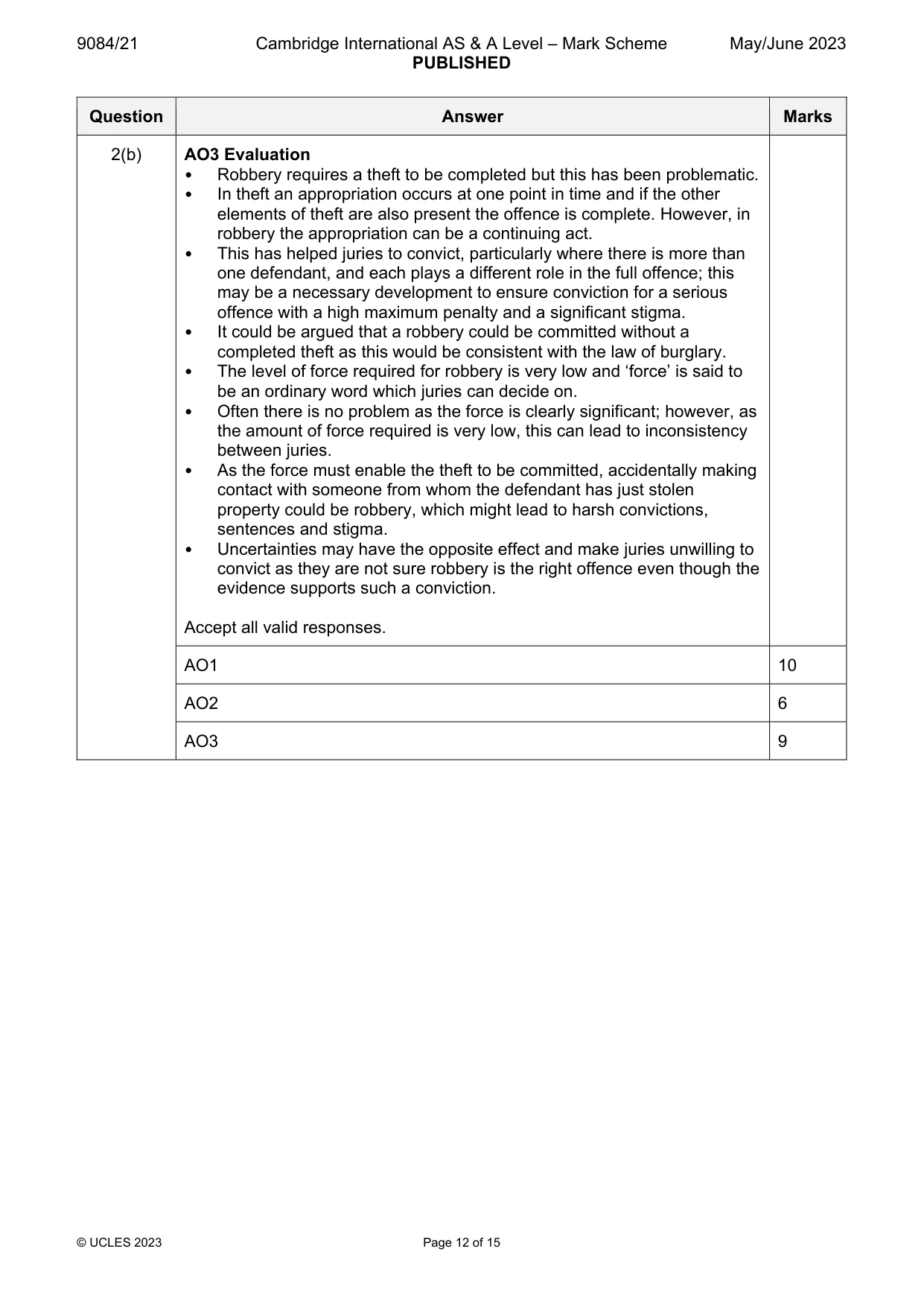
Mark scheme: 2(a) Describe dishonesty in the mens rea of theft. 5 AO1 Knowledge and understanding • Dishonesty is found in s2 Theft Act 1968. • It is a key element needed to prove a charge of s1 theft. • S2 does not define dishonesty but there are examples of what is not dishonest. • S2(1)(a) – a defendant is not dishonest if they honestly believe they have a legal right to appropriate the property. • S2(1)(b) – a defendant is not dishonest if they honestly believe the owner would have consented to the appropriation. • S2(1)(c) a defendant is not dishonest if they honestly believe the owner cannot be found having taken reasonable steps to do so. • Relevant cases include R v Robinson (1977), R v Holden (1991) and R v Small (1987). • Juries use a common sense definition of dishonesty. • If they need help the test now is to ask, firstly, what was the defendant’s actual state of knowledge or belief as to the facts and, secondly, was their conduct dishonest by the standards of ordinary decent people? If the answer to both questions is yes, the defendant is dishonest – Ivey v Genting Casinos (2017), R v Barton and Booth (2020). Each point made is worth 1 mark up to a maximum of 5. 2(b) Evaluate the law of robbery. 25 Use Table B to mark candidate responses to this question. AO1 out of 10 marks. AO2 out of 6 marks. AO3 out of 9 marks. Indicative content Responses may include: AO1 Knowledge and understanding • Robbery is defined in s8 Theft Act 1968. • All elements of theft must be present or there can be no conviction for robbery – R v Zerei (2012), R v Waters (2015). • At the moment the theft is complete there can be a robbery – Corcoran v Anderton (1980). • There must be a use of force or putting or seeking to put a person in fear of force – the amount of force can be small and the victim does not need to be frightened – R v Dawson and James (1976), R v Clouden (1985), P v DPP (2012), B and R v DPP (2007). • The force must be used before or at the time of stealing – this can be as part of an ongoing situation – R v Hale (1979), R v Lockley (1995). • The force must be in order to steal – if a theft is already complete and then force is applied this will not be robbery. • The defendant must possess the same mens rea for theft. • The defendant must also intend to use force in order to steal. • This is an indictable offence with a maximum penalty of life. AO2 Analysis and application Analysis: • The use of force is an indicator of blame which helps with sentencing. • The intention to use force leads to a higher sentence and helps to reflect blameworthiness. • Different categories of robbery help to distinguish between types of the offence which is vital for fair labelling and sentencing practicalities – street and less-sophisticated commercial robbery, professionally planned commercial robbery and robbery in a dwelling. • The development of the law shows complexity as the statutory definition has been extended. • This is a serious offence, so juries need to be sure of the elements to be able to convict. 2(b) AO3 Evaluation • Robbery requires a theft to be completed but this has been problematic. • In theft an appropriation occurs at one point in time and if the other elements of theft are also present the offence is complete. However, in robbery the appropriation can be a continuing act. • This has helped juries to convict, particularly where there is more than one defendant, and each plays a different role in the full offence; this may be a necessary development to ensure conviction for a serious offence with a high maximum penalty and a significant stigma. • It could be argued that a robbery could be committed without a completed theft as this would be consistent with the law of burglary. • The level of force required for robbery is very low and ‘force’ is said to be an ordinary word which juries can decide on. • Often there is no problem as the force is clearly significant; however, as the amount of force required is very low, this can lead to inconsistency between juries. • As the force must enable the theft to be committed, accidentally making contact with someone from whom the defendant has just stolen property could be robbery, which might lead to harsh convictions, sentences and stigma. • Uncertainties may have the opposite effect and make juries unwilling to convict as they are not sure robbery is the right offence even though the evidence supports such a conviction. Accept all valid responses. AO1 10 AO2 6 AO3 9
Q3 · Describe discharges as a type of sentence for an adult offender
3 (a) Describe discharges as a type of sentence for an adult offender. [5] (b) Evaluate to what extent punishment is the most effective aim when sentencing adult offenders. [25] Source material for Section A Question 1 Criminal Damage Act 1971 Section 1 Destroying or damaging property (1) A person who without lawful excuse destroys or damages any property belonging to another intending to destroy or damage any such property or being reckless as to whether any such property would be destroyed or damaged shall be guilty of an offence. (2) A person who without lawful excuse destroys or damages any property, whether belonging to himself or another— (a) intending to destroy or damage any property or being reckless as to whether any property would be destroyed or damaged; and (b) intending by the destruction or damage to endanger the life of another or being reckless as to whether the life of another would be thereby endangered; shall be guilty of an offence. (3) An offence committed under this section by destroying or damaging property by fire shall be charged as arson. Section 2 Threats to destroy or damage property A person who without lawful excuse makes to another a threat, intending that that other would fear it would be carried out,— (a) to destroy or damage any property belonging to that other or a third person; or (b) to destroy or damage his own property in a way which he knows is likely to endanger the life of that other or third person; shall be guilty of an offence. Section 3 Possessing anything with intent to destroy or damage property A person who has anything in his custody or under his control intending without lawful excuse to use it or cause or permit another to use it— (a) to destroy or damage any property belonging to some other person; or (b) to destroy or damage his own or the user’s property in a way which he knows is likely to endanger the life of some other person; shall be guilty of an offence. Section 4 Punishment of offences (1) A person guilty of arson under section 1 above or of an offence under section 1(2) above (whether arson or not) shall on conviction on indictment be liable to imprisonment for life. (2) A person guilty of any other offence under this Act shall on conviction on indictment be liable to imprisonment for a term not exceeding ten years. Hardman v Chief Constable of Avon and Somerset (1986) The appellants were part of a group of protestors called the ‘Campaign for Nuclear Disarmament Group’. They used soluble paint to paint human silhouettes on the pavement to represent the fortieth anniversary of the bombing in Hiroshima. The paint was specially mixed so it could be washed away by rainwater within a matter of days. Before this could happen, the local authority washed the markings away, sending in a team of cleaners who used high pressure washers to clean the pavement. The protestors were convicted for causing criminal damage and subsequently appealed the decision. Held: it did not matter that the markings could be washed away, there had been damage nonetheless as there had been expense and inconvenience caused to the local authority.
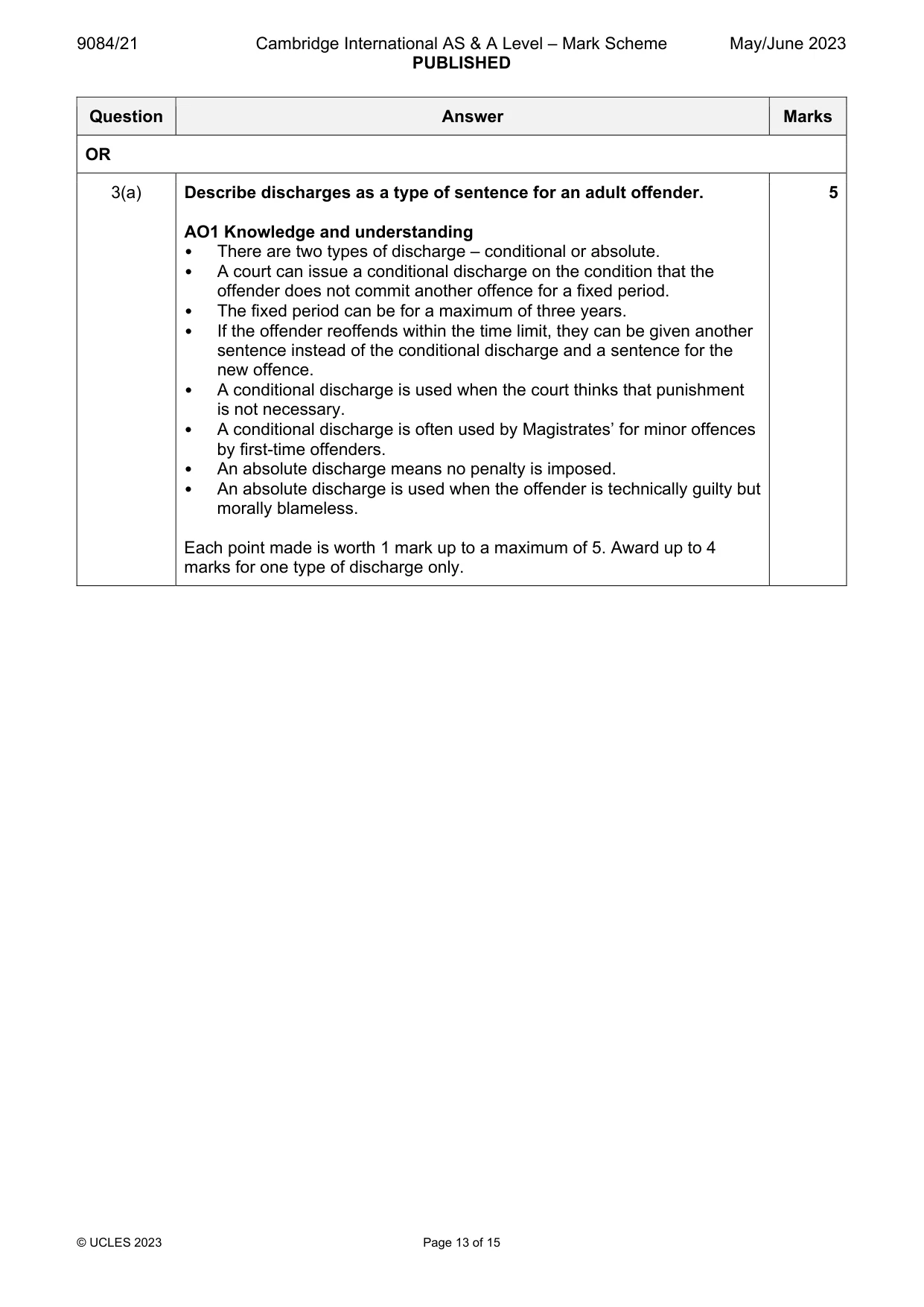
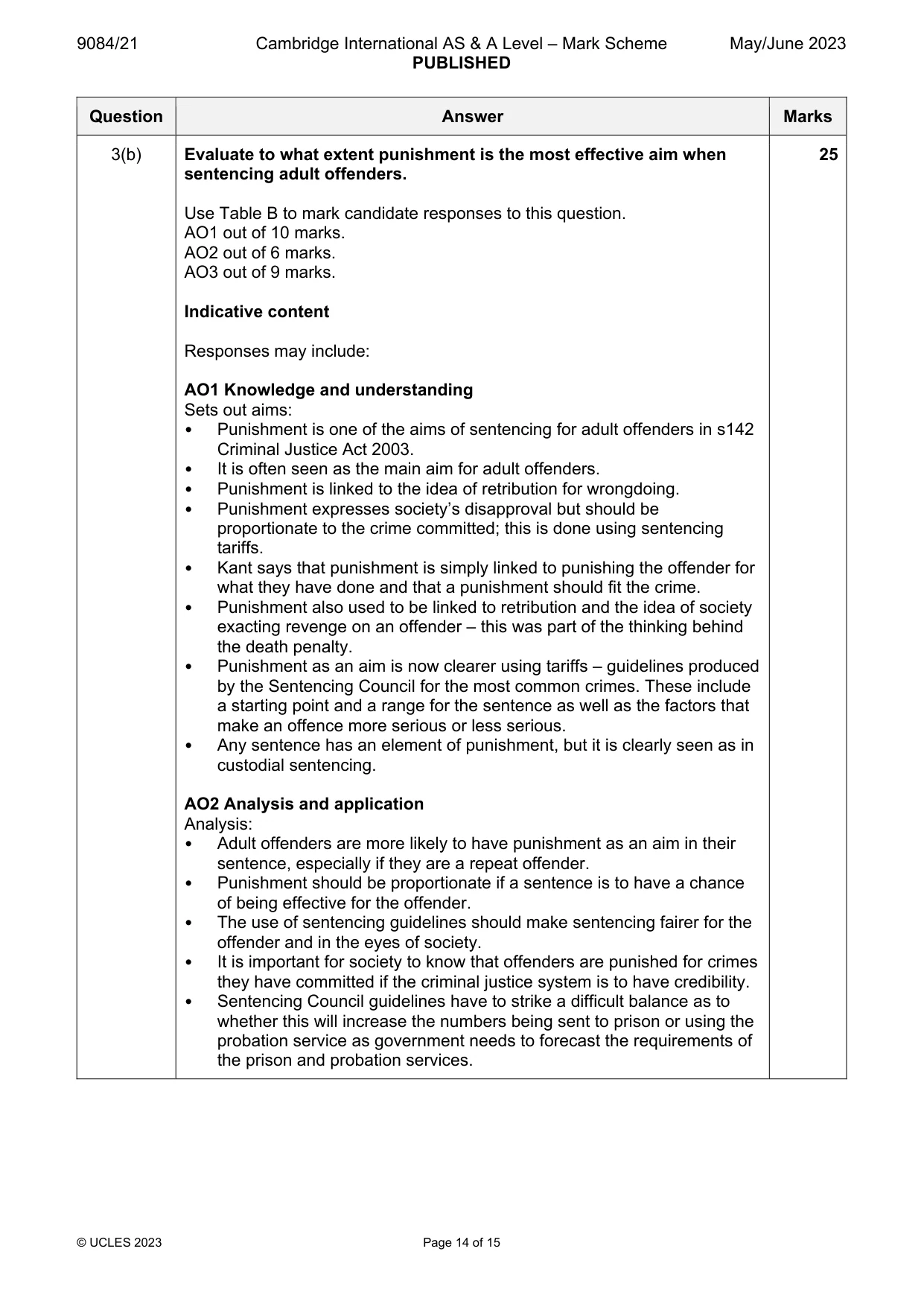
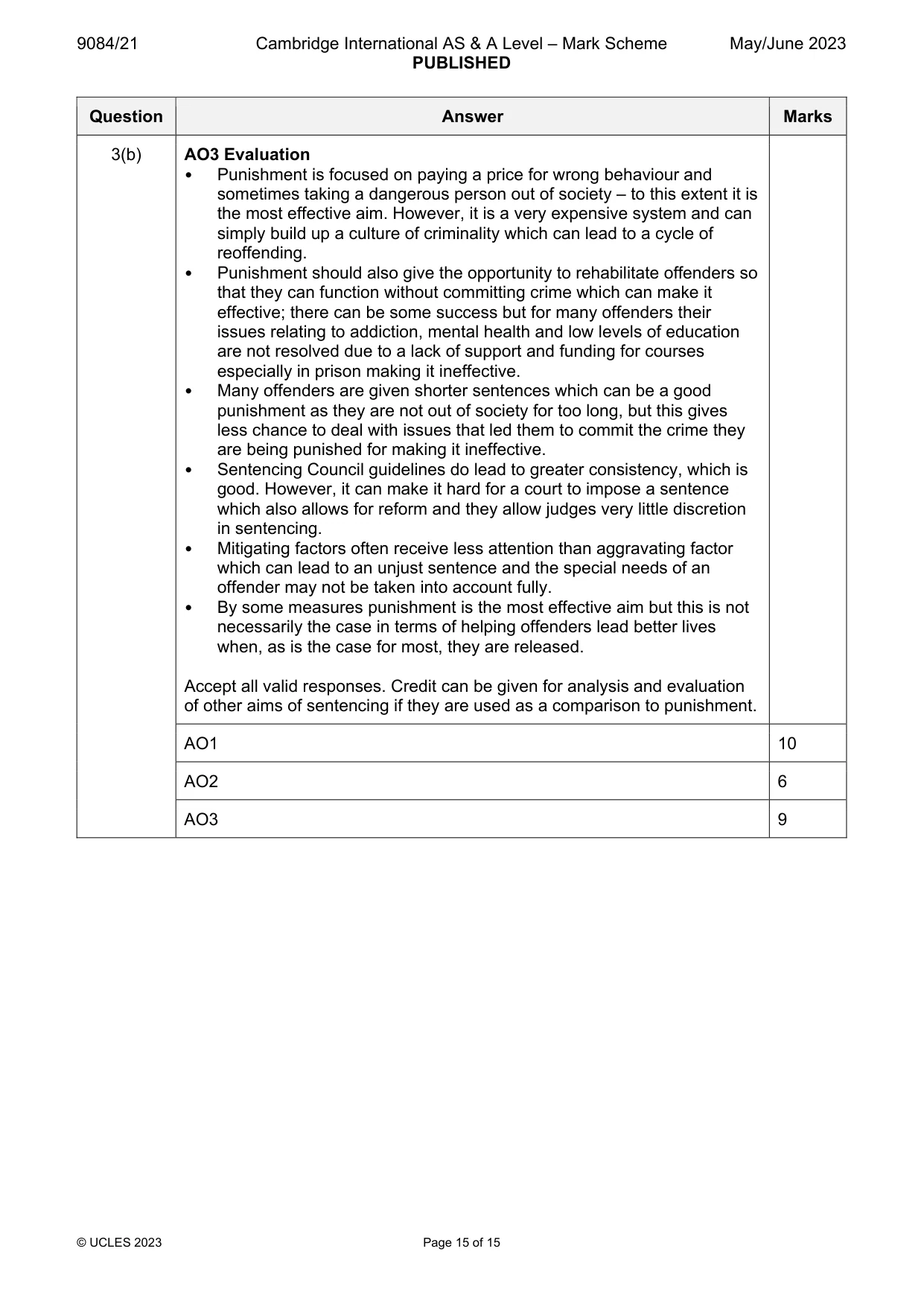
Mark scheme: 3(a) Describe discharges as a type of sentence for an adult offender. 5 AO1 Knowledge and understanding • There are two types of discharge – conditional or absolute. • A court can issue a conditional discharge on the condition that the offender does not commit another offence for a fixed period. • The fixed period can be for a maximum of three years. • If the offender reoffends within the time limit, they can be given another sentence instead of the conditional discharge and a sentence for the new offence. • A conditional discharge is used when the court thinks that punishment is not necessary. • A conditional discharge is often used by Magistrates’ for minor offences by first-time offenders. • An absolute discharge means no penalty is imposed. • An absolute discharge is used when the offender is technically guilty but morally blameless. Each point made is worth 1 mark up to a maximum of 5. Award up to 4 marks for one type of discharge only. 3(b) Evaluate to what extent punishment is the most effective aim when 25 sentencing adult offenders. Use Table B to mark candidate responses to this question. AO1 out of 10 marks. AO2 out of 6 marks. AO3 out of 9 marks. Indicative content Responses may include: AO1 Knowledge and understanding Sets out aims: • Punishment is one of the aims of sentencing for adult offenders in s142 Criminal Justice Act 2003. • It is often seen as the main aim for adult offenders. • Punishment is linked to the idea of retribution for wrongdoing. • Punishment expresses society’s disapproval but should be proportionate to the crime committed; this is done using sentencing tariffs. • Kant says that punishment is simply linked to punishing the offender for what they have done and that a punishment should fit the crime. • Punishment also used to be linked to retribution and the idea of society exacting revenge on an offender – this was part of the thinking behind the death penalty. • Punishment as an aim is now clearer using tariffs – guidelines produced by the Sentencing Council for the most common crimes. These include a starting point and a range for the sentence as well as the factors that make an offence more serious or less serious. • Any sentence has an element of punishment, but it is clearly seen as in custodial sentencing. AO2 Analysis and application Analysis: • Adult offenders are more likely to have punishment as an aim in their sentence, especially if they are a repeat offender. • Punishment should be proportionate if a sentence is to have a chance of being effective for the offender. • The use of sentencing guidelines should make sentencing fairer for the offender and in the eyes of society. • It is important for society to know that offenders are punished for crimes they have committed if the criminal justice system is to have credibility. • Sentencing Council guidelines have to strike a difficult balance as to whether this will increase the numbers being sent to prison or using the probation service as government needs to forecast the requirements of the prison and probation services. 3(b) AO3 Evaluation • Punishment is focused on paying a price for wrong behaviour and sometimes taking a dangerous person out of society – to this extent it is the most effective aim. However, it is a very expensive system and can simply build up a culture of criminality which can lead to a cycle of reoffending. • Punishment should also give the opportunity to rehabilitate offenders so that they can function without committing crime which can make it effective; there can be some success but for many offenders their issues relating to addiction, mental health and low levels of education are not resolved due to a lack of support and funding for courses especially in prison making it ineffective. • Many offenders are given shorter sentences which can be a good punishment as they are not out of society for too long, but this gives less chance to deal with issues that led them to commit the crime they are being punished for making it ineffective. • Sentencing Council guidelines do lead to greater consistency, which is good. However, it can make it hard for a court to impose a sentence which also allows for reform and they allow judges very little discretion in sentencing. • Mitigating factors often receive less attention than aggravating factor which can lead to an unjust sentence and the special needs of an offender may not be taken into account fully. • By some measures punishment is the most effective aim but this is not necessarily the case in terms of helping offenders lead better lives when, as is the case for most, they are released. Accept all valid responses. Credit can be given for analysis and evaluation of other aims of sentencing if they are used as a comparison to punishment. AO1 10 AO2 6 AO3 9
What was in this paper
The subtopics covered by these 3 questions, and how many questions each got. Open one in a new tab to see every Cambridge question on it.
1Offences against property This topic is about the components of substantive offences against property. This topic is an opportunity to reflect on the key concepts of liability, justice, fairness, effectiveness and certainty1Sentencing in England and Wales This topic is about the sentences that can be handed down to both adult and young offenders who have been convicted of offences. This topic is an opportunity to reflect on the key concepts of liability, justice, fairness, power and its limits, and effectiveness1What you needed in this session
Cambridge’s own grade thresholds for 2023 May/June, Paper 2 · Variant 1. A higher threshold means an easier paper — the bar moves with how the cohort did.