Cambridge A Level Law 9084 — 2023 May/June Paper 2 · Variant 3
9084/23/M/J/23 · 3 questions · 60 marks · ≈68 min
The question paper and its mark scheme, free to read here and free to download. This is Cambridge’s own paper, exactly as it was sat.
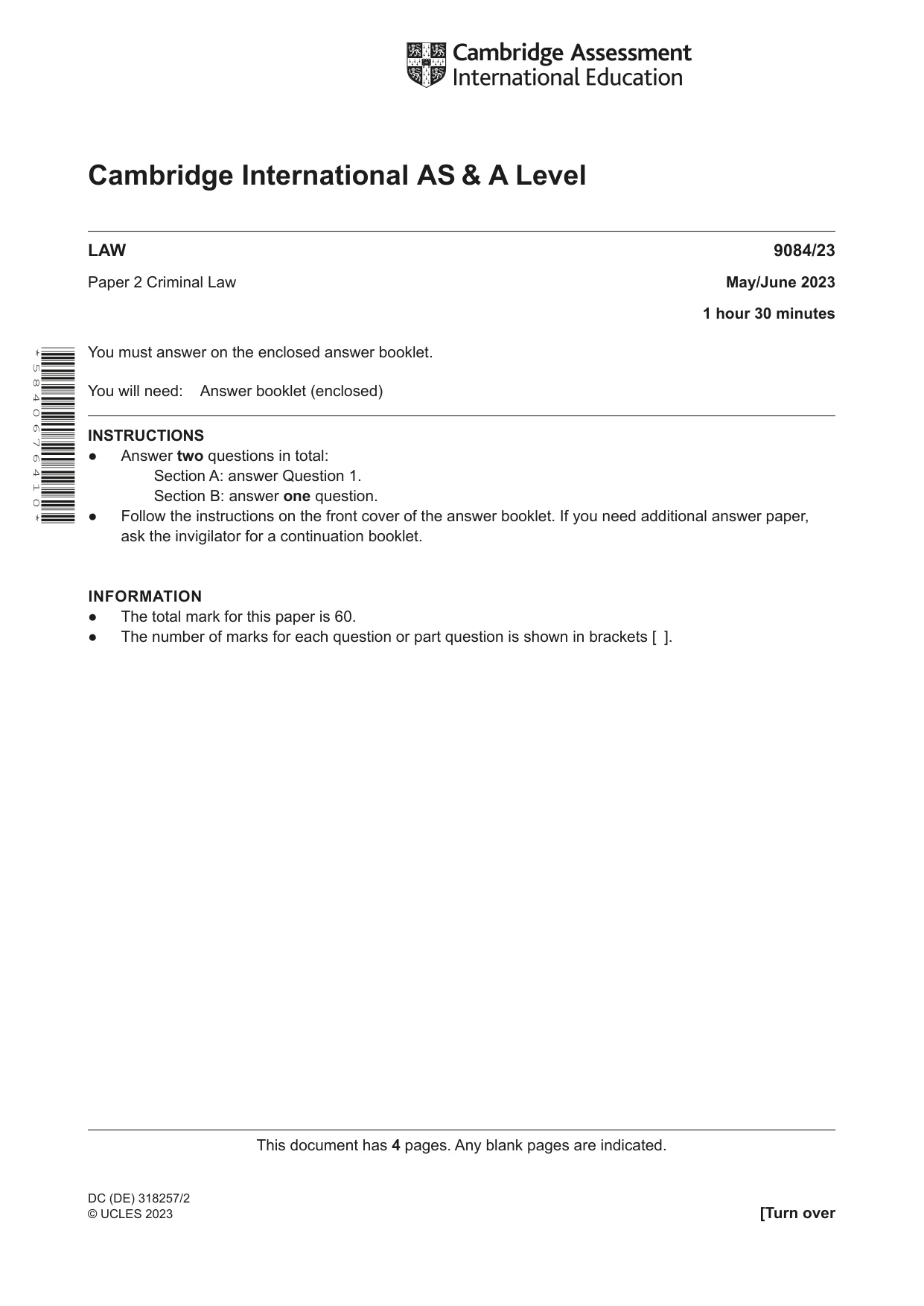
Question paper4 pages

Mark scheme15 pages
Answers below. Sit the paper first if you are practising.

Questions as text
Q1 · Jonathan advertises a horse for sale for £10 000
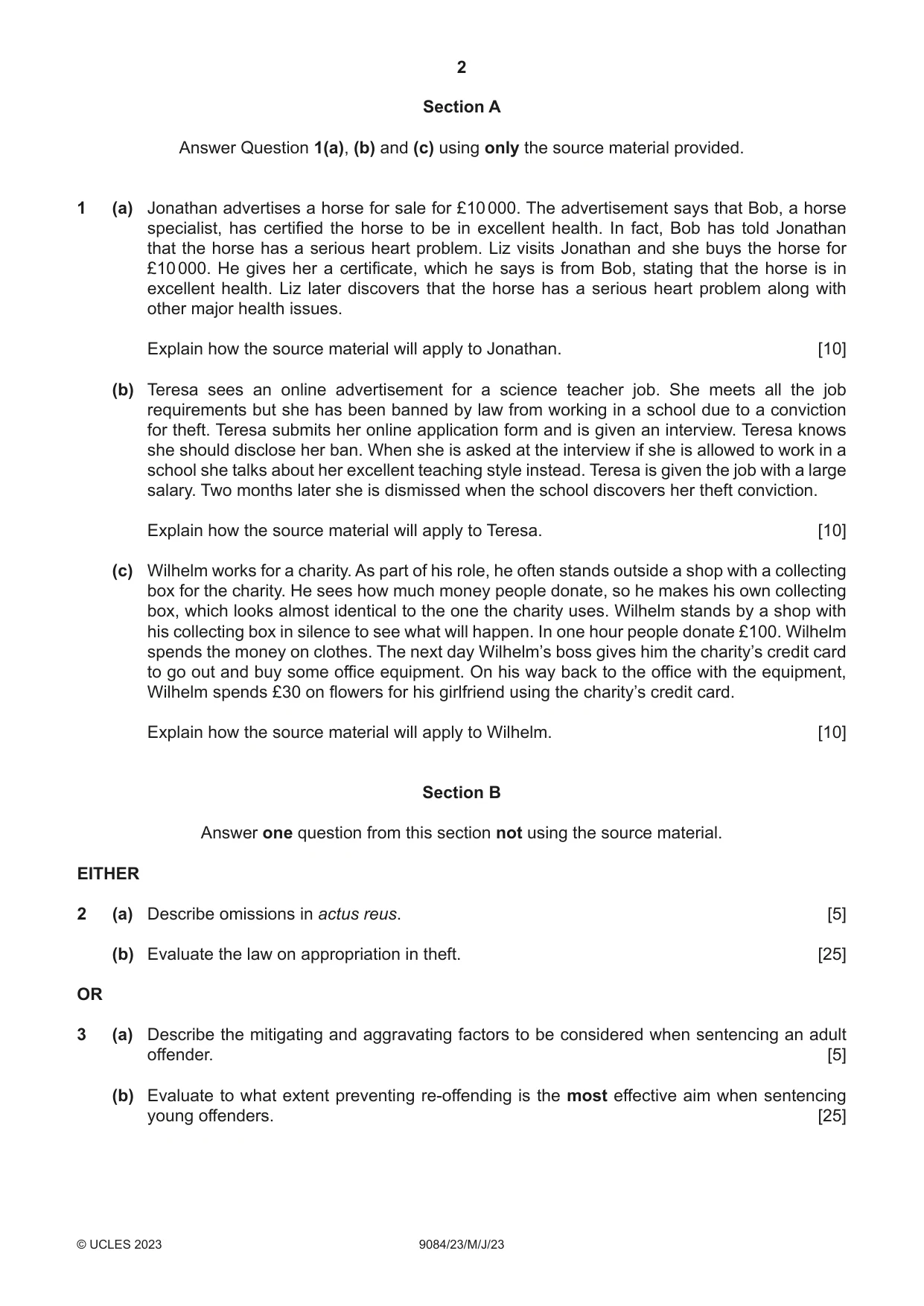
1 (a) Jonathan advertises a horse for sale for £10 000. The advertisement says that Bob, a horse specialist, has certified the horse to be in excellent health. In fact, Bob has told Jonathan that the horse has a serious heart problem. Liz visits Jonathan and she buys the horse for £10 000. He gives her a certificate, which he says is from Bob, stating that the horse is in excellent health. Liz later discovers that the horse has a serious heart problem along with other major health issues. Explain how the source material will apply to Jonathan. [10] (b) Teresa sees an online advertisement for a science teacher job. She meets all the job requirements but she has been banned by law from working in a school due to a conviction for theft. Teresa submits her online application form and is given an interview. Teresa knows she should disclose her ban. When she is asked at the interview if she is allowed to work in a school she talks about her excellent teaching style instead. Teresa is given the job with a large salary. Two months later she is dismissed when the school discovers her theft conviction. Explain how the source material will apply to Teresa. [10] (c) Wilhelm works for a charity. As part of his role, he often stands outside a shop with a collecting box for the charity. He sees how much money people donate, so he makes his own collecting box, which looks almost identical to the one the charity uses. Wilhelm stands by a shop with his collecting box in silence to see what will happen. In one hour people donate £100. Wilhelm spends the money on clothes. The next day Wilhelm’s boss gives him the charity’s credit card to go out and buy some office equipment. On his way back to the office with the equipment, Wilhelm spends £30 on flowers for his girlfriend using the charity’s credit card. Explain how the source material will apply to Wilhelm. [10]
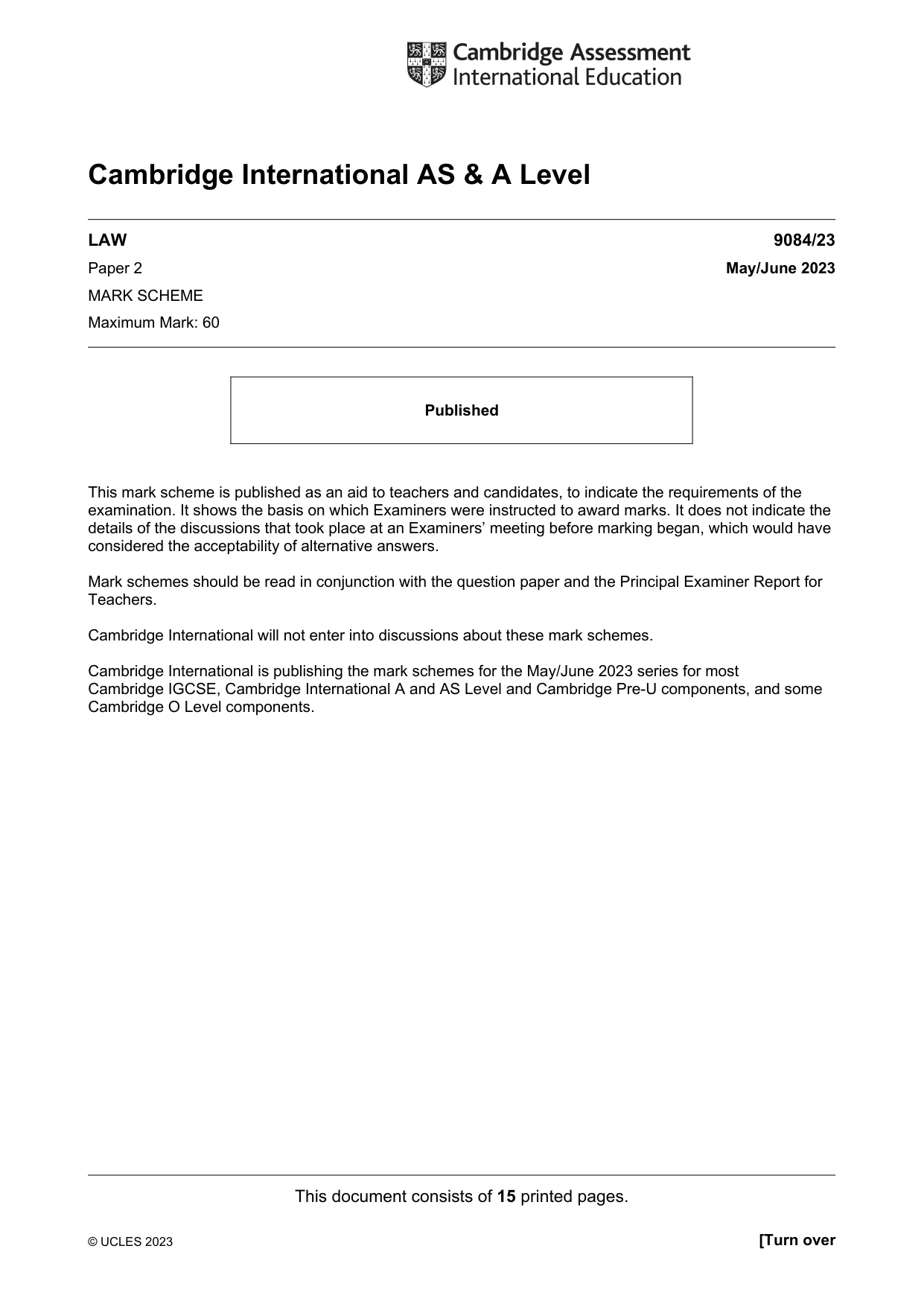
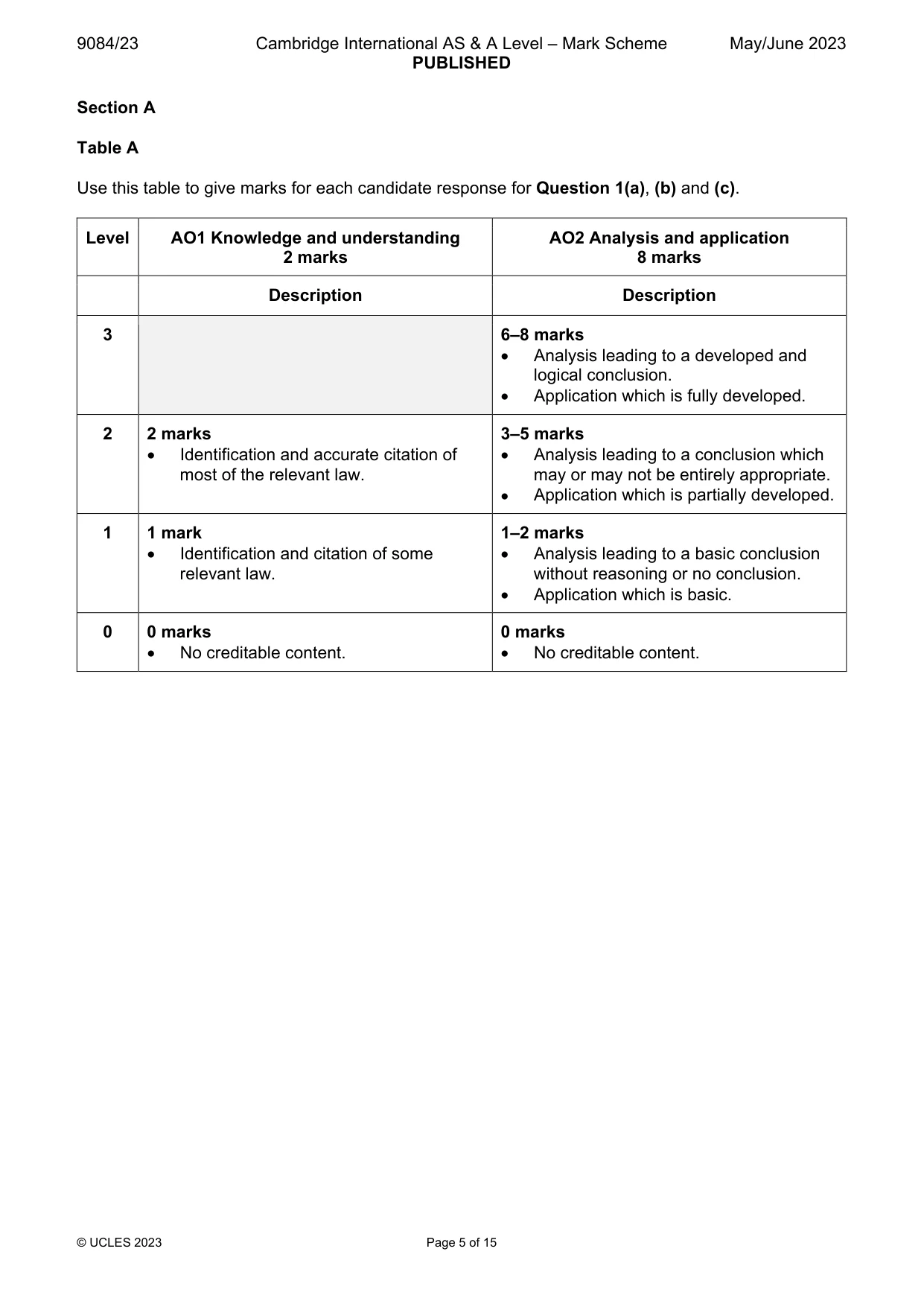
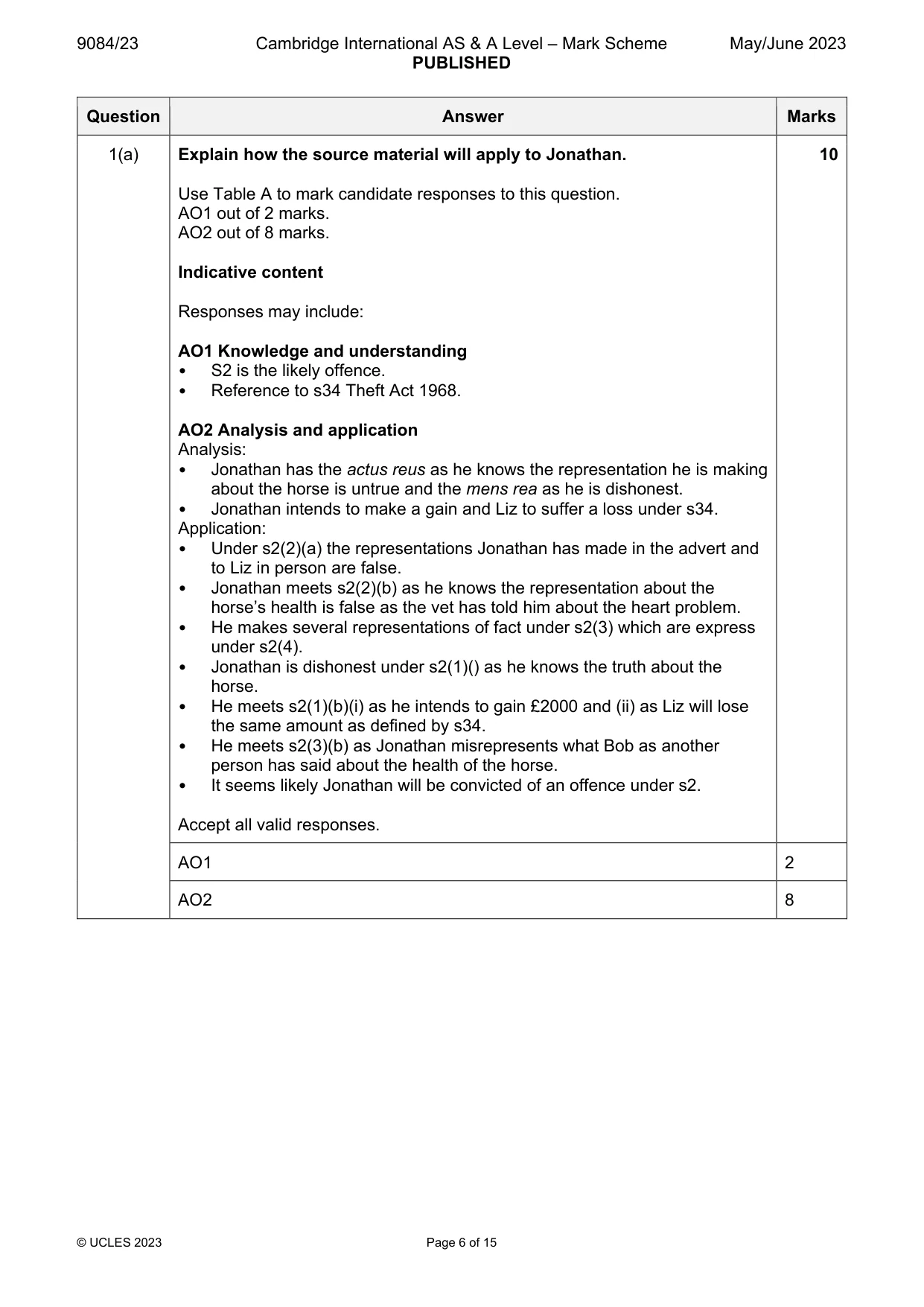
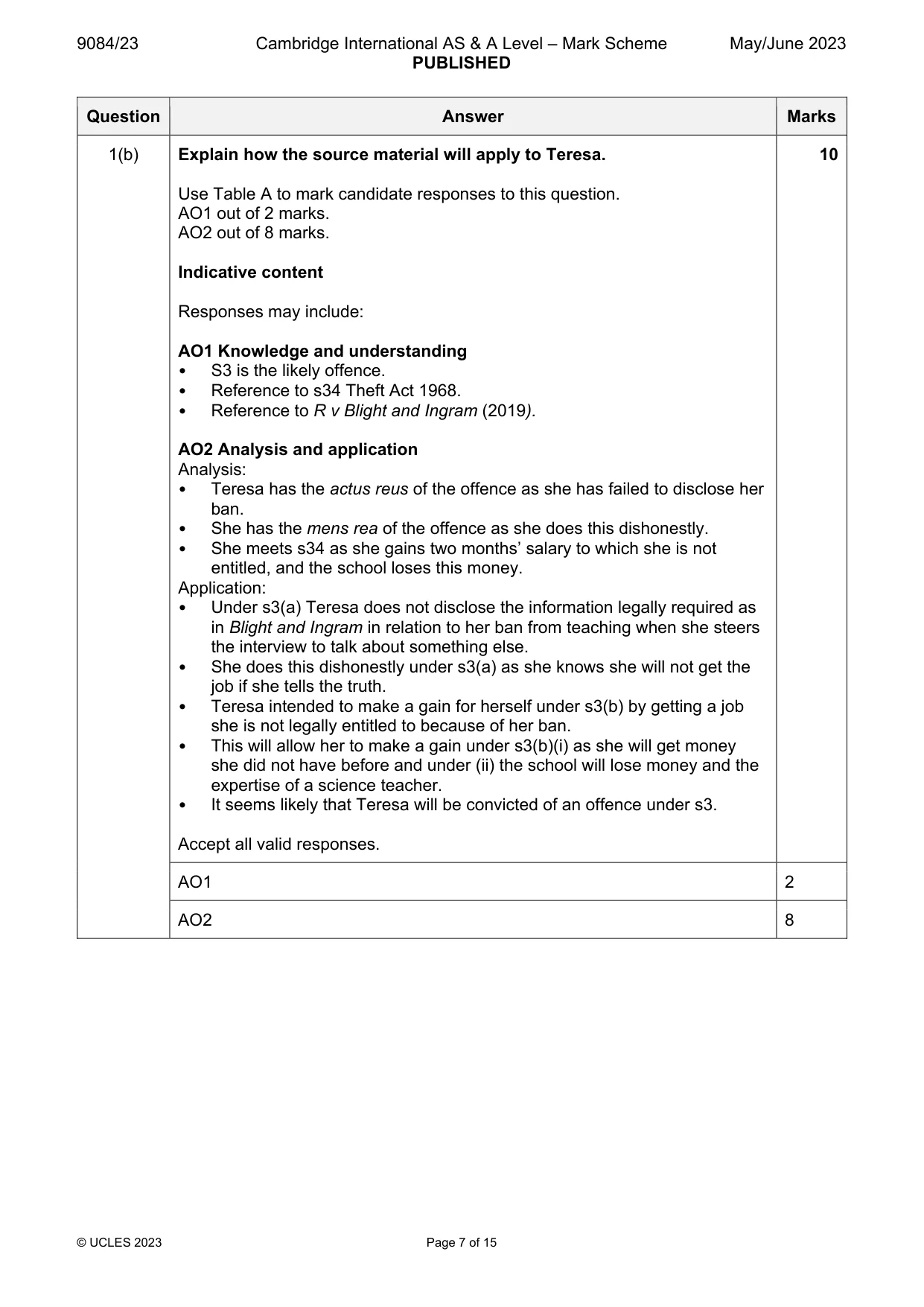
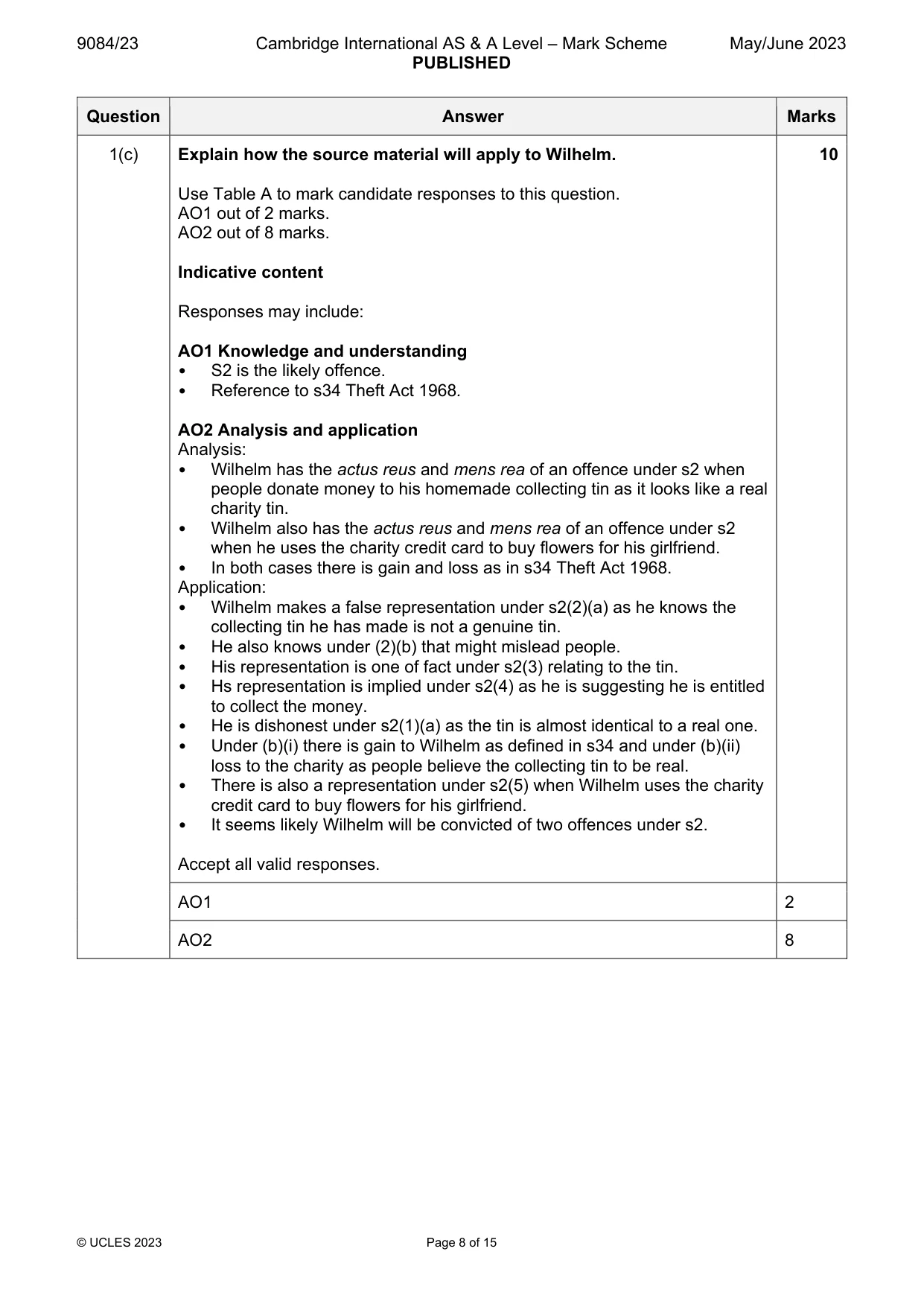
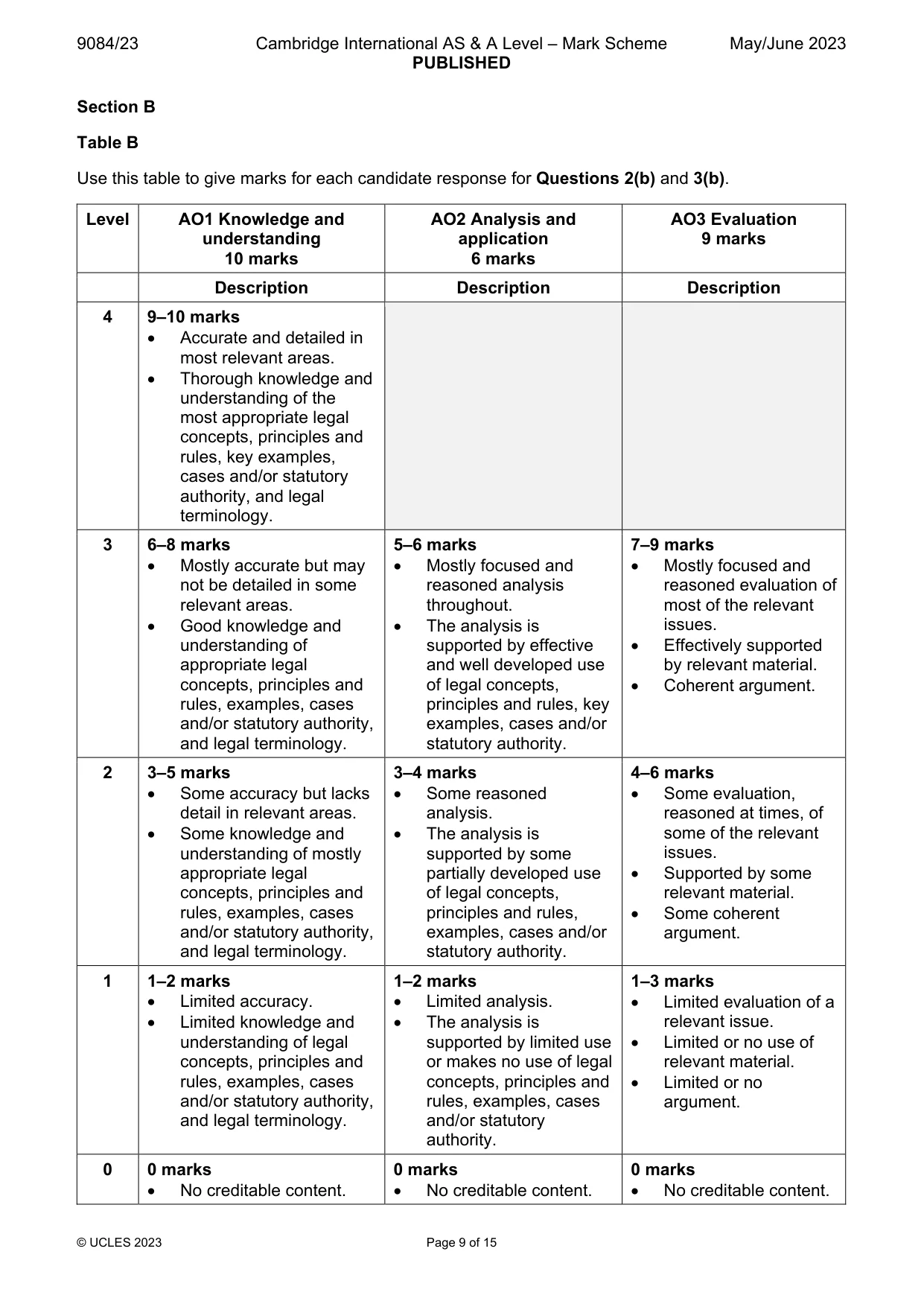
Mark scheme: Question Answer Marks 1(a) Explain how the source material will apply to Jonathan. 10 Use Table A to mark candidate responses to this question. AO1 out of 2 marks. AO2 out of 8 marks. Indicative content Responses may include: AO1 Knowledge and understanding • S2 is the likely offence. • Reference to s34 Theft Act 1968. AO2 Analysis and application Analysis: • Jonathan has the actus reus as he knows the representation he is making about the horse is untrue and the mens rea as he is dishonest. • Jonathan intends to make a gain and Liz to suffer a loss under s34. Application: • Under s2(2)(a) the representations Jonathan has made in the advert and to Liz in person are false. • Jonathan meets s2(2)(b) as he knows the representation about the horse’s health is false as the vet has told him about the heart problem. • He makes several representations of fact under s2(3) which are express under s2(4). • Jonathan is dishonest under s2(1)() as he knows the truth about the horse. • He meets s2(1)(b)(i) as he intends to gain £2000 and (ii) as Liz will lose the same amount as defined by s34. • He meets s2(3)(b) as Jonathan misrepresents what Bob as another person has said about the health of the horse. • It seems likely Jonathan will be convicted of an offence under s2. Accept all valid responses. AO1 2 AO2 8 1(b) Explain how the source material will apply to Teresa. 10 Use Table A to mark candidate responses to this question. AO1 out of 2 marks. AO2 out of 8 marks. Indicative content Responses may include: AO1 Knowledge and understanding • S3 is the likely offence. • Reference to s34 Theft Act 1968. • Reference to R v Blight and Ingram (2019). AO2 Analysis and application Analysis: • Teresa has the actus reus of the offence as she has failed to disclose her ban. • She has the mens rea of the offence as she does this dishonestly. • She meets s34 as she gains two months’ salary to which she is not entitled, and the school loses this money. Application: • Under s3(a) Teresa does not disclose the information legally required as in Blight and Ingram in relation to her ban from teaching when she steers the interview to talk about something else. • She does this dishonestly under s3(a) as she knows she will not get the job if she tells the truth. • Teresa intended to make a gain for herself under s3(b) by getting a job she is not legally entitled to because of her ban. • This will allow her to make a gain under s3(b)(i) as she will get money she did not have before and under (ii) the school will lose money and the expertise of a science teacher. • It seems likely that Teresa will be convicted of an offence under s3. Accept all valid responses. AO1 2 AO2 8 1(c) Explain how the source material will apply to Wilhelm. 10 Use Table A to mark candidate responses to this question. AO1 out of 2 marks. AO2 out of 8 marks. Indicative content Responses may include: AO1 Knowledge and understanding • S2 is the likely offence. • Reference to s34 Theft Act 1968. AO2 Analysis and application Analysis: • Wilhelm has the actus reus and mens rea of an offence under s2 when people donate money to his homemade collecting tin as it looks like a real charity tin. • Wilhelm also has the actus reus and mens rea of an offence under s2 when he uses the charity credit card to buy flowers for his girlfriend. • In both cases there is gain and loss as in s34 Theft Act 1968. Application: • Wilhelm makes a false representation under s2(2)(a) as he knows the collecting tin he has made is not a genuine tin. • He also knows under (2)(b) that might mislead people. • His representation is one of fact under s2(3) relating to the tin. • Hs representation is implied under s2(4) as he is suggesting he is entitled to collect the money. • He is dishonest under s2(1)(a) as the tin is almost identical to a real one. • Under (b)(i) there is gain to Wilhelm as defined in s34 and under (b)(ii) loss to the charity as people believe the collecting tin to be real. • There is also a representation under s2(5) when Wilhelm uses the charity credit card to buy flowers for his girlfriend. • It seems likely Wilhelm will be convicted of two offences under s2. Accept all valid responses. AO1 2 AO2 8 Section B Table B Use this table to give marks for each candidate response for Questions 2(b) and 3(b). Level AO1 Knowledge and AO2 Analysis and AO3 Evaluation understanding application 9 marks 10 marks 6 marks Description Description Description 4 9–10 marks Accurate and detailed in most relevant areas. Thorough knowledge and understanding of the most appropriate legal concepts, principles and rules, key examples, cases and/or statutory authority, and legal terminology. 3 6–8 marks 5–6 marks 7–9 marks Mostly accurate but may Mostly focused and Mostly focused and not be detailed in some reasoned analysis reasoned evaluation of relevant areas. throughout. most of the relevant Good knowledge and The analysis is issues. understanding of supported by effective Effectively supported appropriate legal and well developed use by relevant material. concepts, principles and of legal concepts, Coherent argument. rules, examples, cases principles and rules, key and/or statutory authority, examples, cases and/or and legal terminology. statutory authority. 2 3–5 marks 3–4 marks 4–6 marks Some accuracy but lacks Some reasoned Some evaluation, detail in relevant areas. analysis. reasoned at times, of Some knowledge and The analysis is some of the relevant understanding of mostly supported by some issues. appropriate legal partially developed use Supported by some concepts, principles and of legal concepts, relevant material. rules, examples, cases principles and rules, Some coherent and/or statutory authority, examples, cases and/or argument. and legal terminology. statutory authority. 1 1–2 marks 1–2 marks 1–3 marks Limited accuracy. Limited analysis. Limited evaluation of a Limited knowledge and The analysis is relevant issue. understanding of legal supported by limited use Limited or no use of concepts, principles and or makes no use of legal relevant material. rules, examples, cases concepts, principles and Limited or no and/or statutory authority, rules, examples, cases argument. and legal terminology. and/or statutory authority. 0 0 marks 0 marks 0 marks No creditable content. No creditable content. No creditable content.
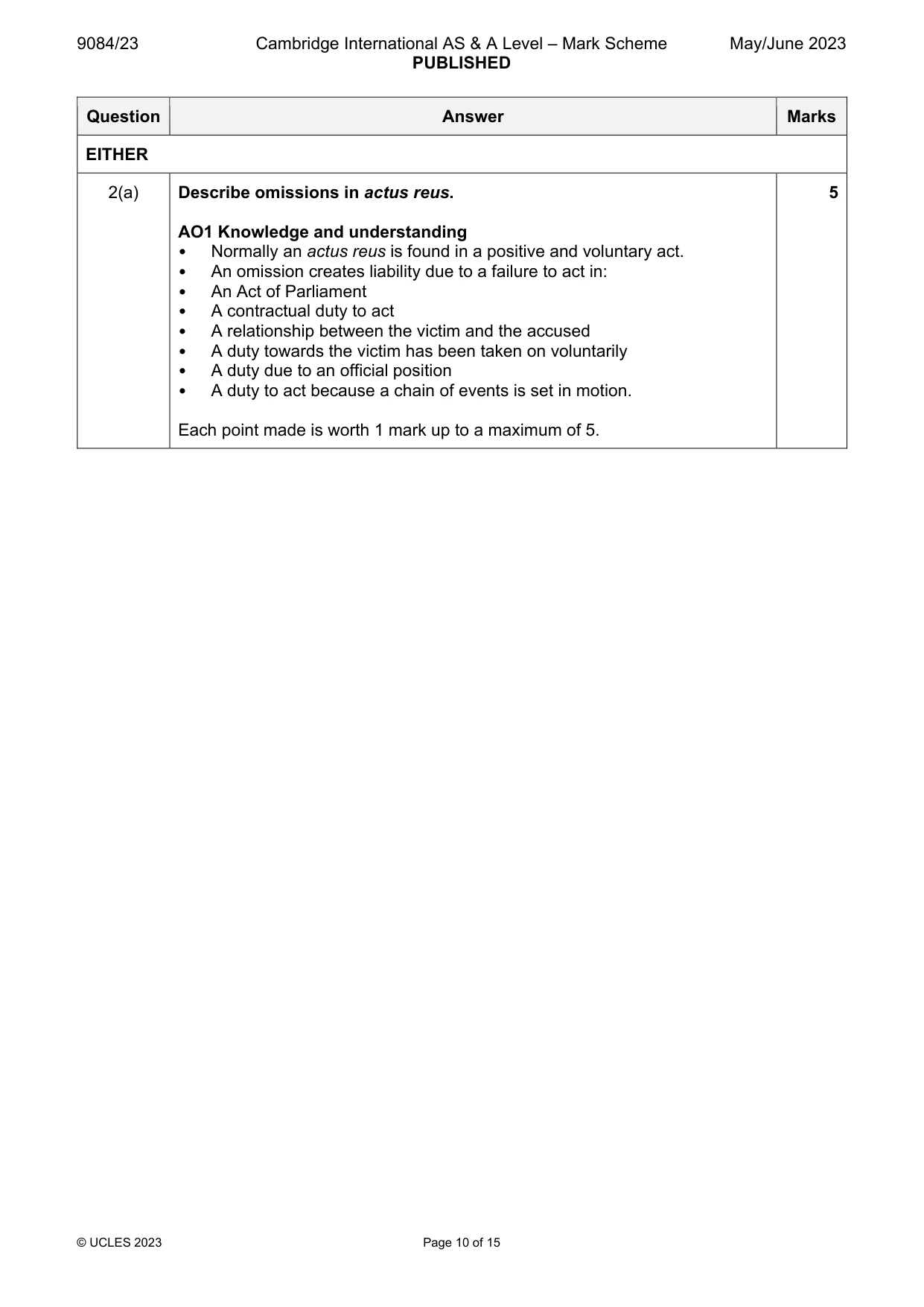
Q2 · Describe omissions in actus reus
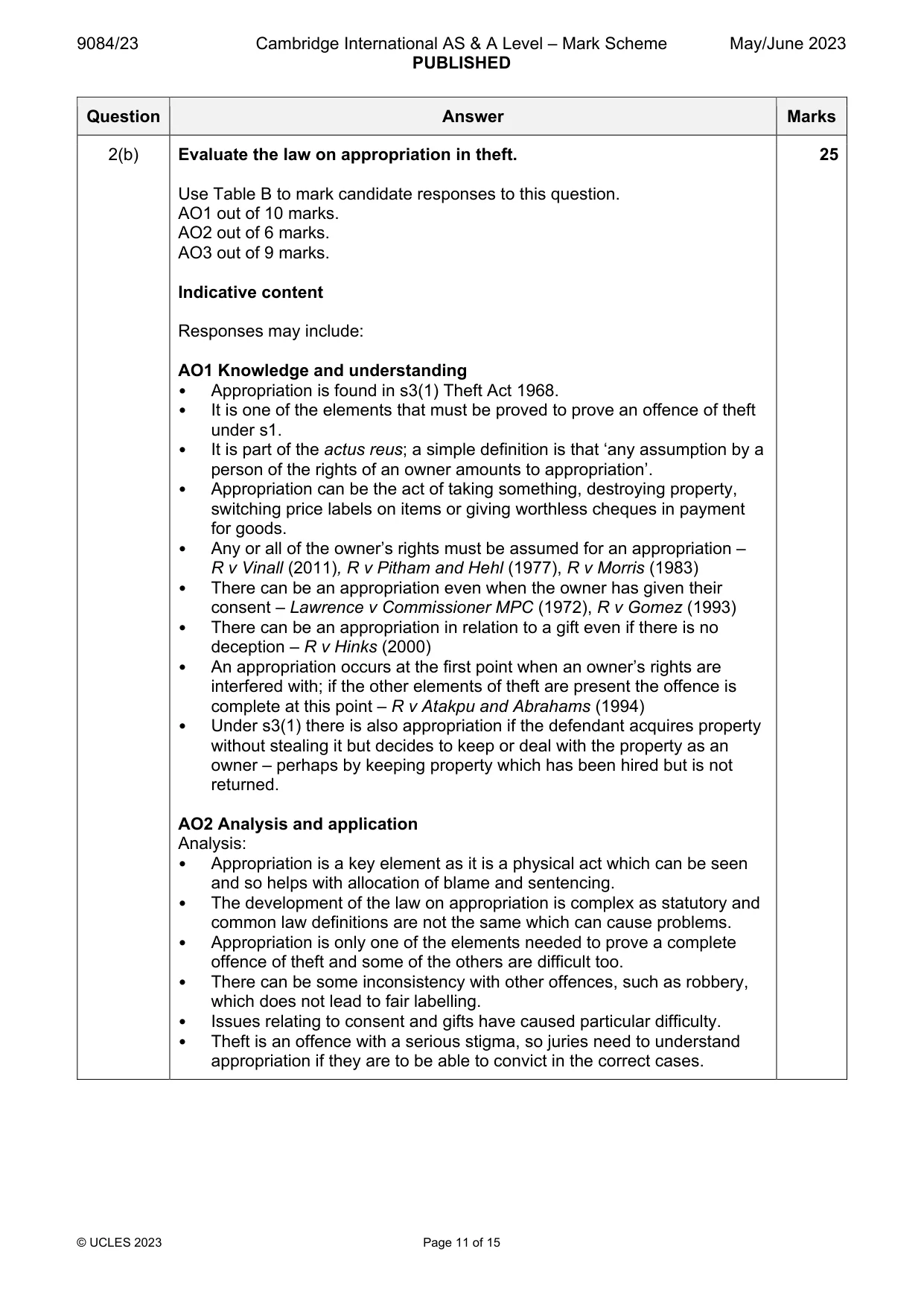
2 (a) Describe omissions in actus reus. [5] (b) Evaluate the law on appropriation in theft. [25] OR
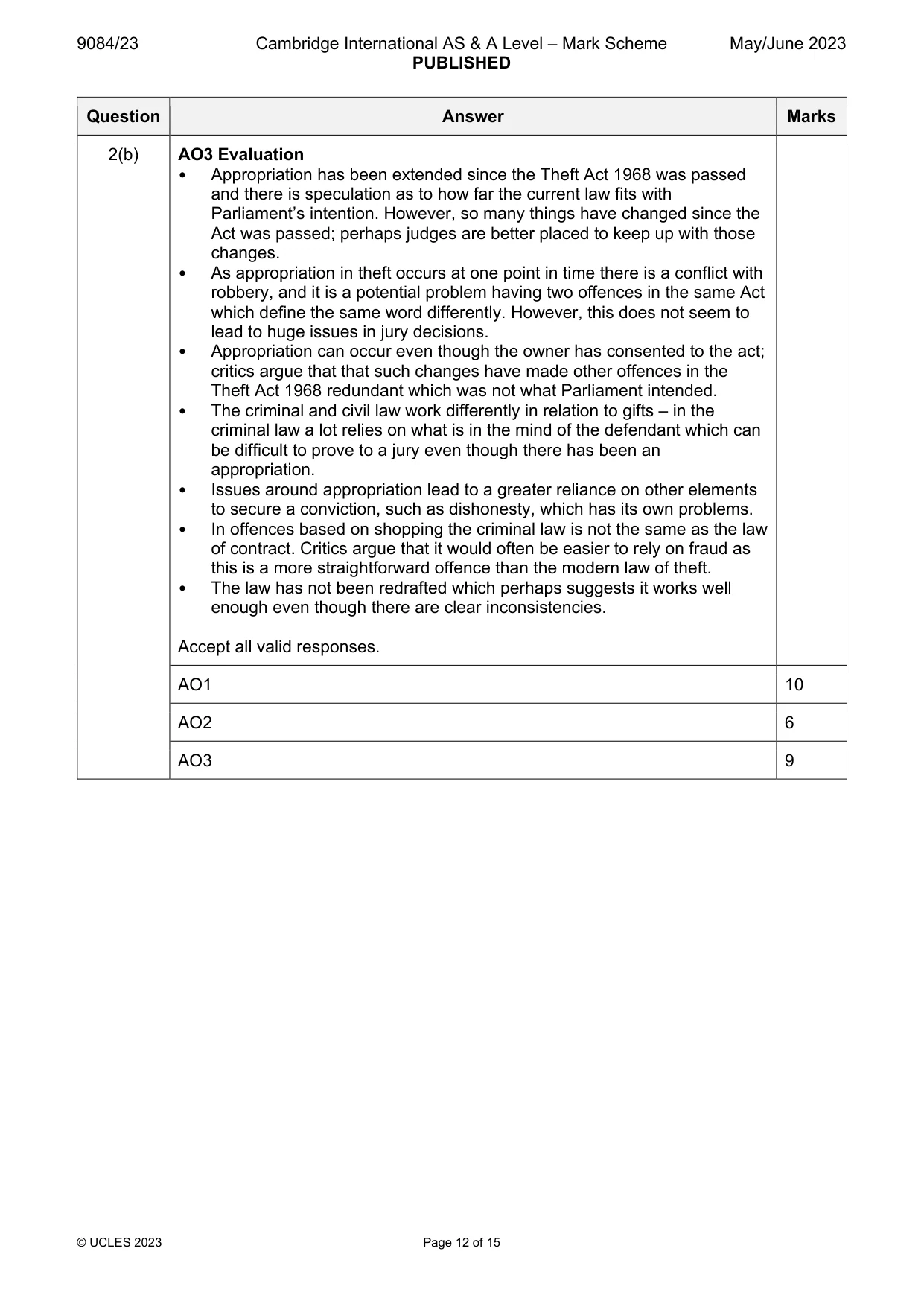
Mark scheme: 2(a) Describe omissions in actus reus. 5 AO1 Knowledge and understanding • Normally an actus reus is found in a positive and voluntary act. • An omission creates liability due to a failure to act in: • An Act of Parliament • A contractual duty to act • A relationship between the victim and the accused • A duty towards the victim has been taken on voluntarily • A duty due to an official position • A duty to act because a chain of events is set in motion. Each point made is worth 1 mark up to a maximum of 5. 2(b) Evaluate the law on appropriation in theft. 25 Use Table B to mark candidate responses to this question. AO1 out of 10 marks. AO2 out of 6 marks. AO3 out of 9 marks. Indicative content Responses may include: AO1 Knowledge and understanding • Appropriation is found in s3(1) Theft Act 1968. • It is one of the elements that must be proved to prove an offence of theft under s1. • It is part of the actus reus; a simple definition is that ‘any assumption by a person of the rights of an owner amounts to appropriation’. • Appropriation can be the act of taking something, destroying property, switching price labels on items or giving worthless cheques in payment for goods. • Any or all of the owner’s rights must be assumed for an appropriation – R v Vinall (2011), R v Pitham and Hehl (1977), R v Morris (1983) • There can be an appropriation even when the owner has given their consent – Lawrence v Commissioner MPC (1972), R v Gomez (1993) • There can be an appropriation in relation to a gift even if there is no deception – R v Hinks (2000) • An appropriation occurs at the first point when an owner’s rights are interfered with; if the other elements of theft are present the offence is complete at this point – R v Atakpu and Abrahams (1994) • Under s3(1) there is also appropriation if the defendant acquires property without stealing it but decides to keep or deal with the property as an owner – perhaps by keeping property which has been hired but is not returned. AO2 Analysis and application Analysis: • Appropriation is a key element as it is a physical act which can be seen and so helps with allocation of blame and sentencing. • The development of the law on appropriation is complex as statutory and common law definitions are not the same which can cause problems. • Appropriation is only one of the elements needed to prove a complete offence of theft and some of the others are difficult too. • There can be some inconsistency with other offences, such as robbery, which does not lead to fair labelling. • Issues relating to consent and gifts have caused particular difficulty. • Theft is an offence with a serious stigma, so juries need to understand appropriation if they are to be able to convict in the correct cases. 2(b) AO3 Evaluation • Appropriation has been extended since the Theft Act 1968 was passed and there is speculation as to how far the current law fits with Parliament’s intention. However, so many things have changed since the Act was passed; perhaps judges are better placed to keep up with those changes. • As appropriation in theft occurs at one point in time there is a conflict with robbery, and it is a potential problem having two offences in the same Act which define the same word differently. However, this does not seem to lead to huge issues in jury decisions. • Appropriation can occur even though the owner has consented to the act; critics argue that that such changes have made other offences in the Theft Act 1968 redundant which was not what Parliament intended. • The criminal and civil law work differently in relation to gifts – in the criminal law a lot relies on what is in the mind of the defendant which can be difficult to prove to a jury even though there has been an appropriation. • Issues around appropriation lead to a greater reliance on other elements to secure a conviction, such as dishonesty, which has its own problems. • In offences based on shopping the criminal law is not the same as the law of contract. Critics argue that it would often be easier to rely on fraud as this is a more straightforward offence than the modern law of theft. • The law has not been redrafted which perhaps suggests it works well enough even though there are clear inconsistencies. Accept all valid responses. AO1 10 AO2 6 AO3 9
Q3 · Describe the mitigating and aggravating factors to be considered when sentencing an adult…
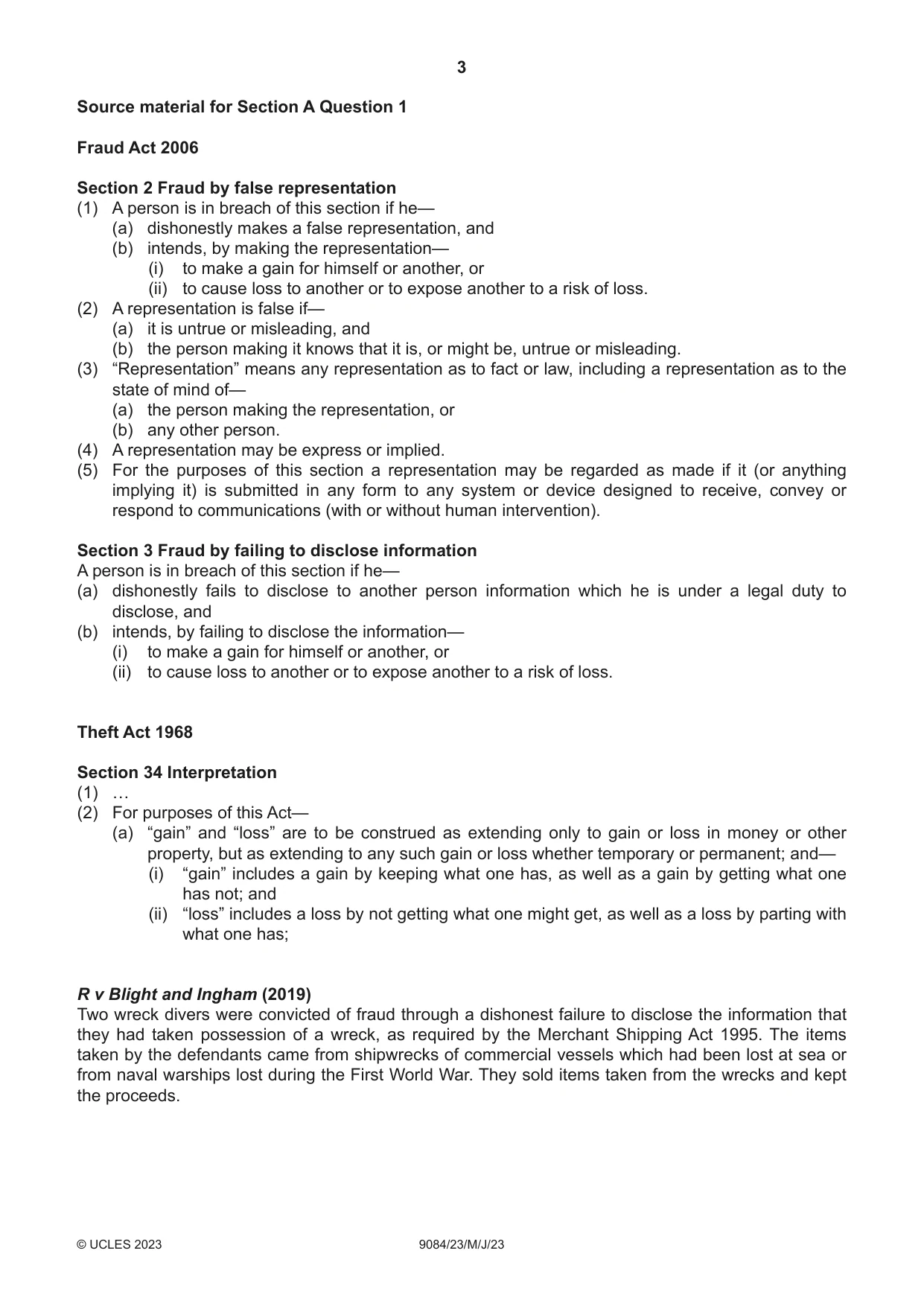
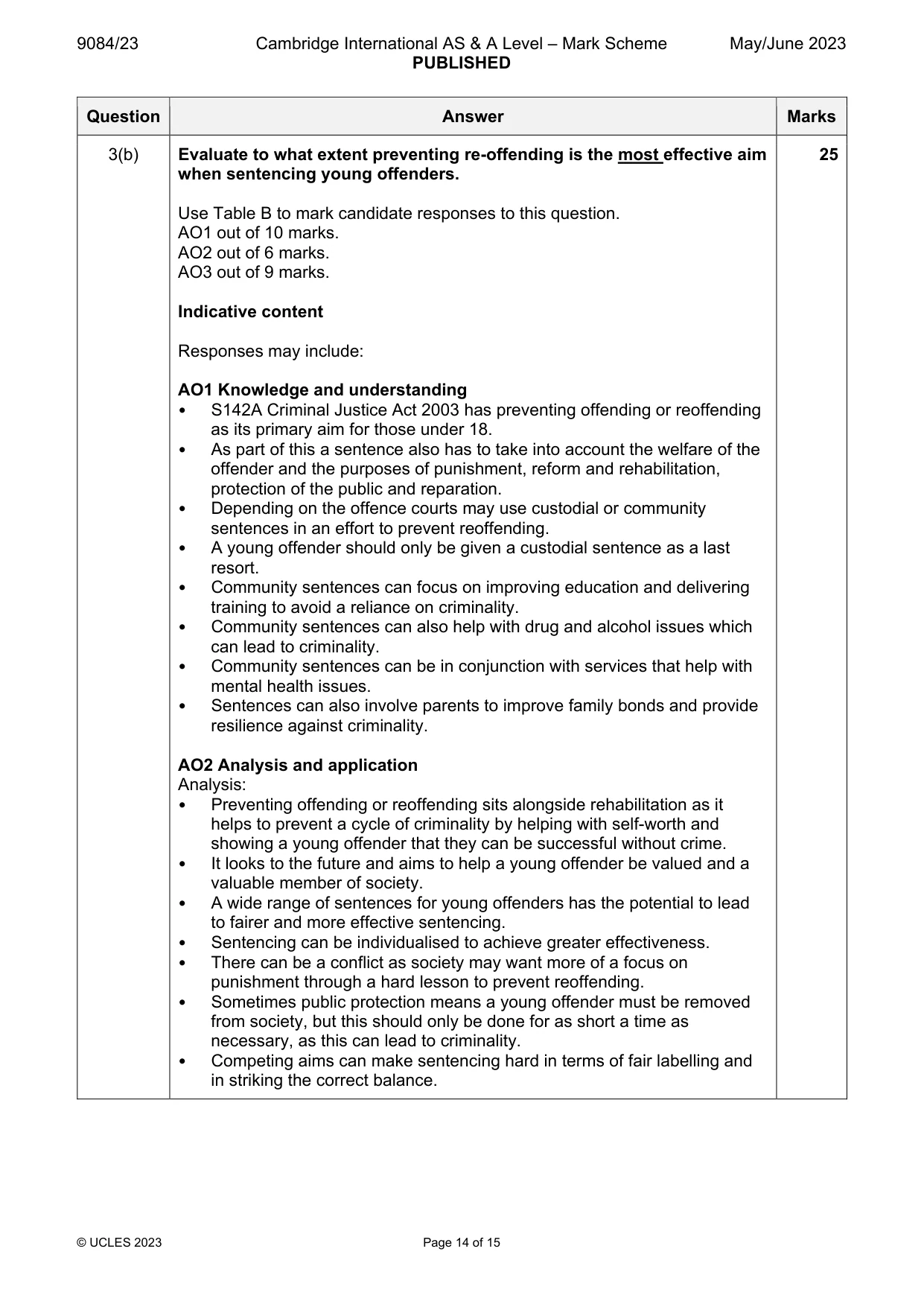
3 (a) Describe the mitigating and aggravating factors to be considered when sentencing an adult offender. [5] (b) Evaluate to what extent preventing re-offending is the most effective aim when sentencing young offenders. [25] Source material for Section A Question 1 Fraud Act 2006 Section 2 Fraud by false representation (1) A person is in breach of this section if he— (a) dishonestly makes a false representation, and (b) intends, by making the representation— (i) to make a gain for himself or another, or (ii) to cause loss to another or to expose another to a risk of loss. (2) A representation is false if— (a) it is untrue or misleading, and (b) the person making it knows that it is, or might be, untrue or misleading. (3) “Representation” means any representation as to fact or law, including a representation as to the state of mind of— (a) the person making the representation, or (b) any other person. (4) A representation may be express or implied. (5) For the purposes of this section a representation may be regarded as made if it (or anything implying it) is submitted in any form to any system or device designed to receive, convey or respond to communications (with or without human intervention). Section 3 Fraud by failing to disclose information A person is in breach of this section if he— (a) dishonestly fails to disclose to another person information which he is under a legal duty to disclose, and (b) intends, by failing to disclose the information— (i) to make a gain for himself or another, or (ii) to cause loss to another or to expose another to a risk of loss. Theft Act 1968 Section 34 Interpretation (1) … (2) For purposes of this Act— (a) “gain” and “loss” are to be construed as extending only to gain or loss in money or other property, but as extending to any such gain or loss whether temporary or permanent; and— (i) “gain” includes a gain by keeping what one has, as well as a gain by getting what one has not; and (ii) “loss” includes a loss by not getting what one might get, as well as a loss by parting with what one has; R v Blight and Ingham (2019) Two wreck divers were convicted of fraud through a dishonest failure to disclose the information that they had taken possession of a wreck, as required by the Merchant Shipping Act 1995. The items taken by the defendants came from shipwrecks of commercial vessels which had been lost at sea or from naval warships lost during the First World War. They sold items taken from the wrecks and kept the proceeds.
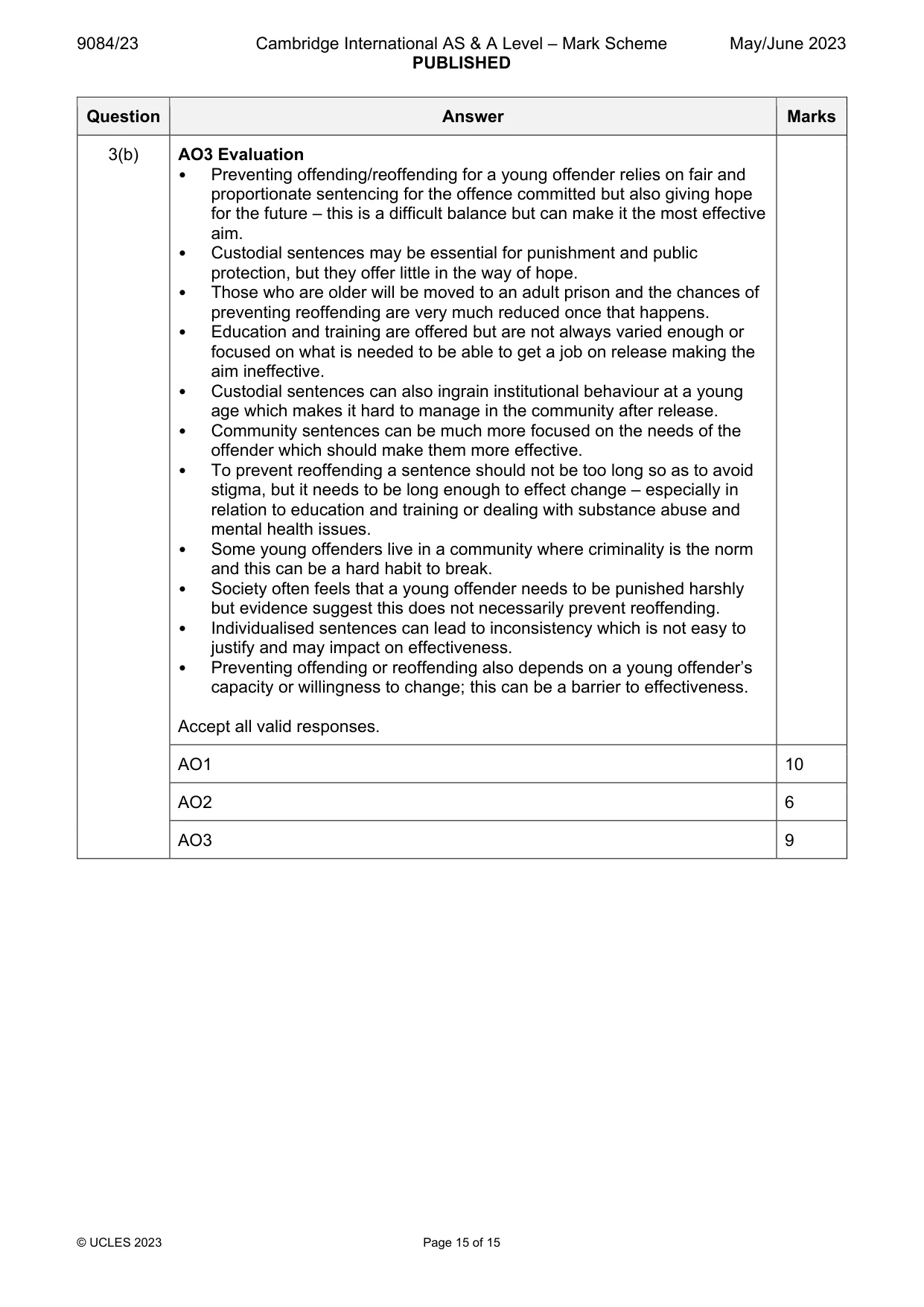
Mark scheme: 3(a) Describe the mitigating and aggravating factors to be considered when 5 sentencing an adult offender. AO1 Knowledge and understanding Aggravating factors make an offence more serious: • previous convictions for similar offences or an offence relevant to the one they have just committed • being on bail when the offence was committed • racial or religious hostility in the offence • hostility to disability or sexual orientation in the offence • pleading not guilty • victim of the offence is a vulnerable person • offences relating to sexual violence Mitigating factors can help reduce a sentence: • no previous convictions • genuine remorse • having a minor part in the offence • pleading guilty • mental health or addiction issues. Each point made is worth 1 mark up to a maximum of 5. 3(b) Evaluate to what extent preventing re-offending is the most effective aim 25 when sentencing young offenders. Use Table B to mark candidate responses to this question. AO1 out of 10 marks. AO2 out of 6 marks. AO3 out of 9 marks. Indicative content Responses may include: AO1 Knowledge and understanding • S142A Criminal Justice Act 2003 has preventing offending or reoffending as its primary aim for those under 18. • As part of this a sentence also has to take into account the welfare of the offender and the purposes of punishment, reform and rehabilitation, protection of the public and reparation. • Depending on the offence courts may use custodial or community sentences in an effort to prevent reoffending. • A young offender should only be given a custodial sentence as a last resort. • Community sentences can focus on improving education and delivering training to avoid a reliance on criminality. • Community sentences can also help with drug and alcohol issues which can lead to criminality. • Community sentences can be in conjunction with services that help with mental health issues. • Sentences can also involve parents to improve family bonds and provide resilience against criminality. AO2 Analysis and application Analysis: • Preventing offending or reoffending sits alongside rehabilitation as it helps to prevent a cycle of criminality by helping with self-worth and showing a young offender that they can be successful without crime. • It looks to the future and aims to help a young offender be valued and a valuable member of society. • A wide range of sentences for young offenders has the potential to lead to fairer and more effective sentencing. • Sentencing can be individualised to achieve greater effectiveness. • There can be a conflict as society may want more of a focus on punishment through a hard lesson to prevent reoffending. • Sometimes public protection means a young offender must be removed from society, but this should only be done for as short a time as necessary, as this can lead to criminality. • Competing aims can make sentencing hard in terms of fair labelling and in striking the correct balance. 3(b) AO3 Evaluation • Preventing offending/reoffending for a young offender relies on fair and proportionate sentencing for the offence committed but also giving hope for the future – this is a difficult balance but can make it the most effective aim. • Custodial sentences may be essential for punishment and public protection, but they offer little in the way of hope. • Those who are older will be moved to an adult prison and the chances of preventing reoffending are very much reduced once that happens. • Education and training are offered but are not always varied enough or focused on what is needed to be able to get a job on release making the aim ineffective. • Custodial sentences can also ingrain institutional behaviour at a young age which makes it hard to manage in the community after release. • Community sentences can be much more focused on the needs of the offender which should make them more effective. • To prevent reoffending a sentence should not be too long so as to avoid stigma, but it needs to be long enough to effect change – especially in relation to education and training or dealing with substance abuse and mental health issues. • Some young offenders live in a community where criminality is the norm and this can be a hard habit to break. • Society often feels that a young offender needs to be punished harshly but evidence suggest this does not necessarily prevent reoffending. • Individualised sentences can lead to inconsistency which is not easy to justify and may impact on effectiveness. • Preventing offending or reoffending also depends on a young offender’s capacity or willingness to change; this can be a barrier to effectiveness. Accept all valid responses. AO1 10 AO2 6 AO3 9
What was in this paper
The subtopics covered by these 3 questions, and how many questions each got. Open one in a new tab to see every Cambridge question on it.
1Offences against property This topic is about the components of substantive offences against property. This topic is an opportunity to reflect on the key concepts of liability, justice, fairness, effectiveness and certainty1Sentencing in England and Wales This topic is about the sentences that can be handed down to both adult and young offenders who have been convicted of offences. This topic is an opportunity to reflect on the key concepts of liability, justice, fairness, power and its limits, and effectiveness1What you needed in this session
Cambridge’s own grade thresholds for 2023 May/June, Paper 2 · Variant 3. A higher threshold means an easier paper — the bar moves with how the cohort did.