Cambridge A Level Law 9084 — 2025 May/June Paper 2 · Variant 1
9084/21/M/J/25 · 3 questions · 60 marks · ≈68 min
The question paper and its mark scheme, free to read here and free to download. This is Cambridge’s own paper, exactly as it was sat.
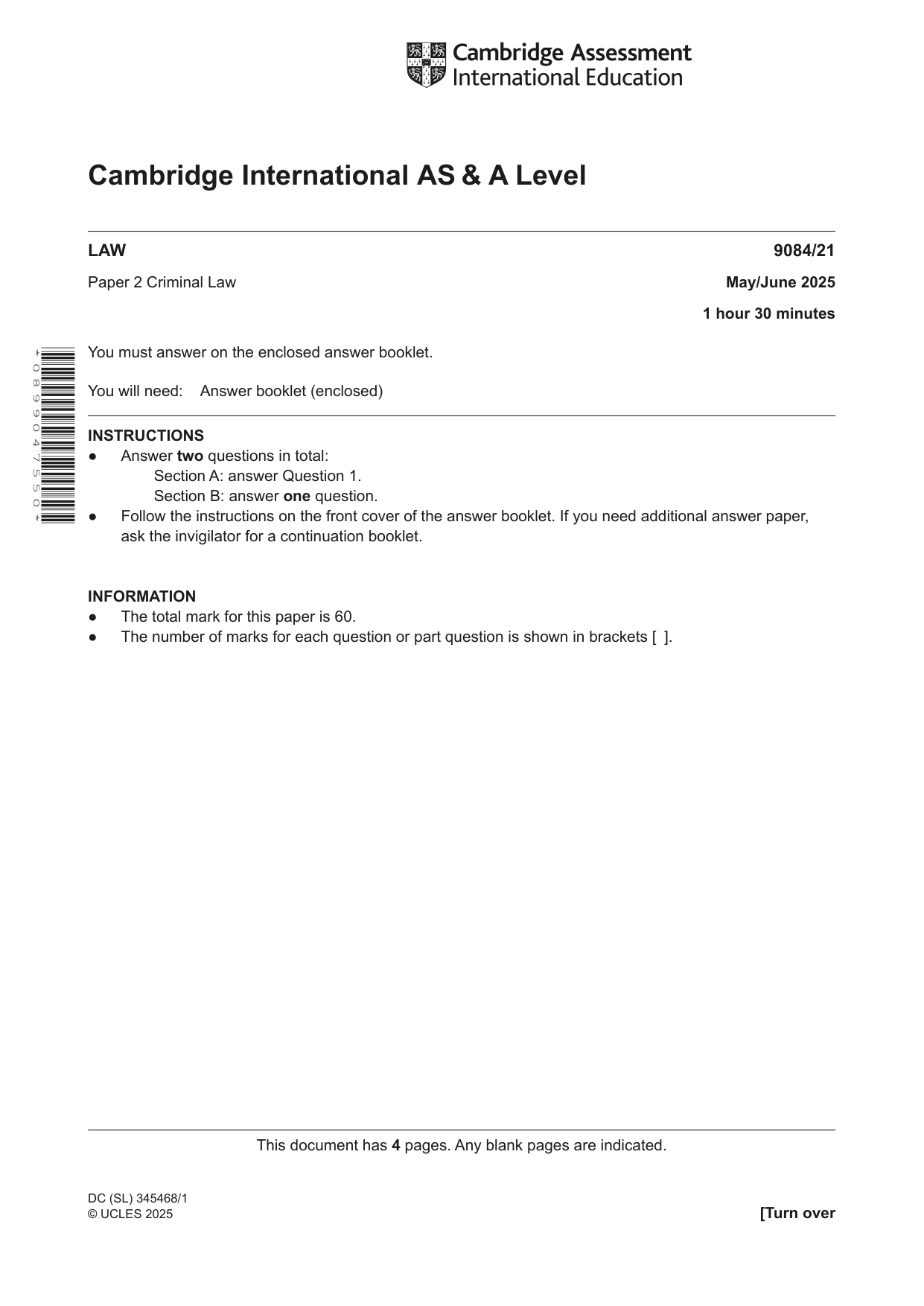
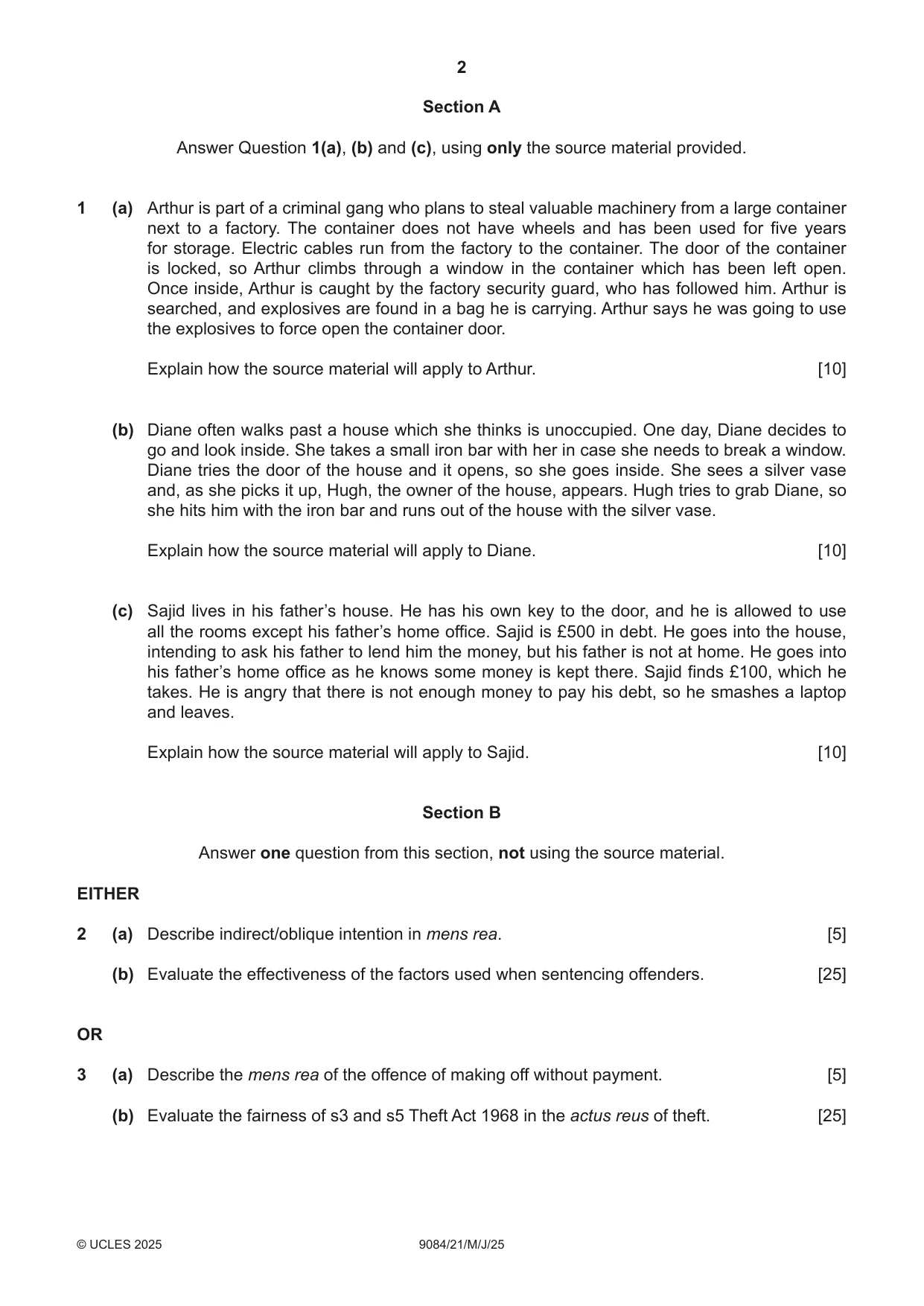
Question paper4 pages

Mark scheme18 pages
Answers below. Sit the paper first if you are practising.

Questions as text
Q1 · Arthur is part of a criminal gang who plans to steal valuable machinery from a large…
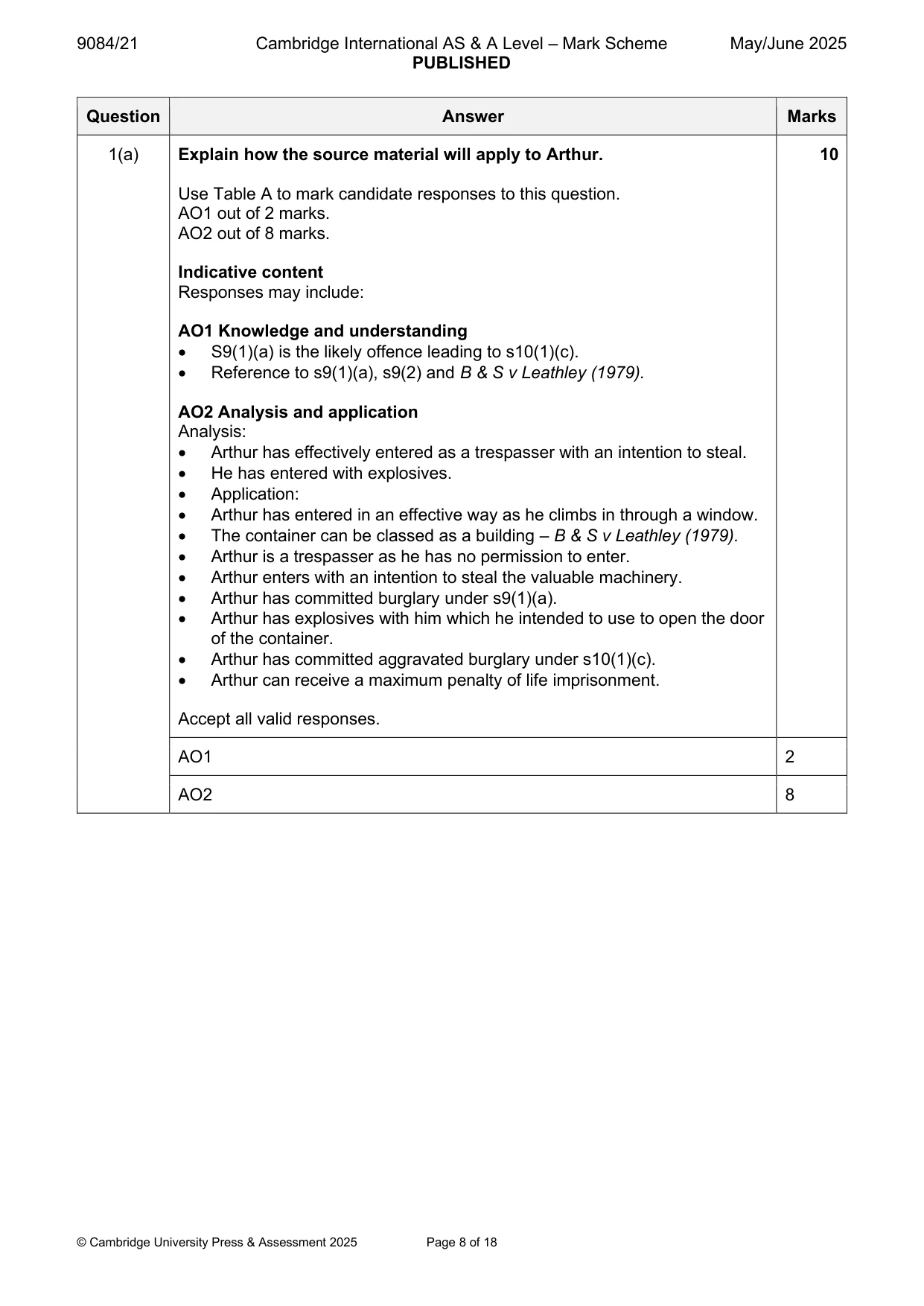
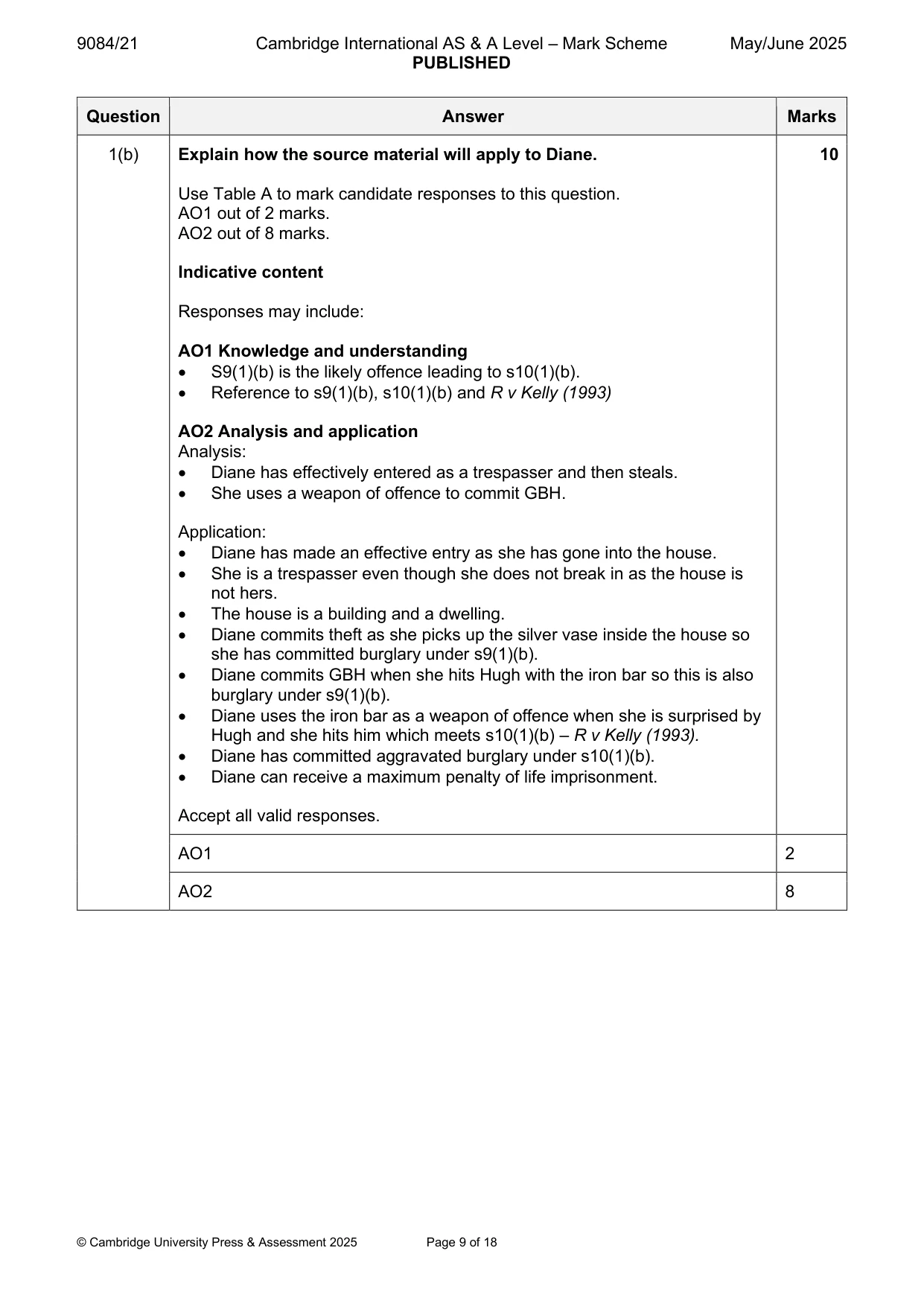
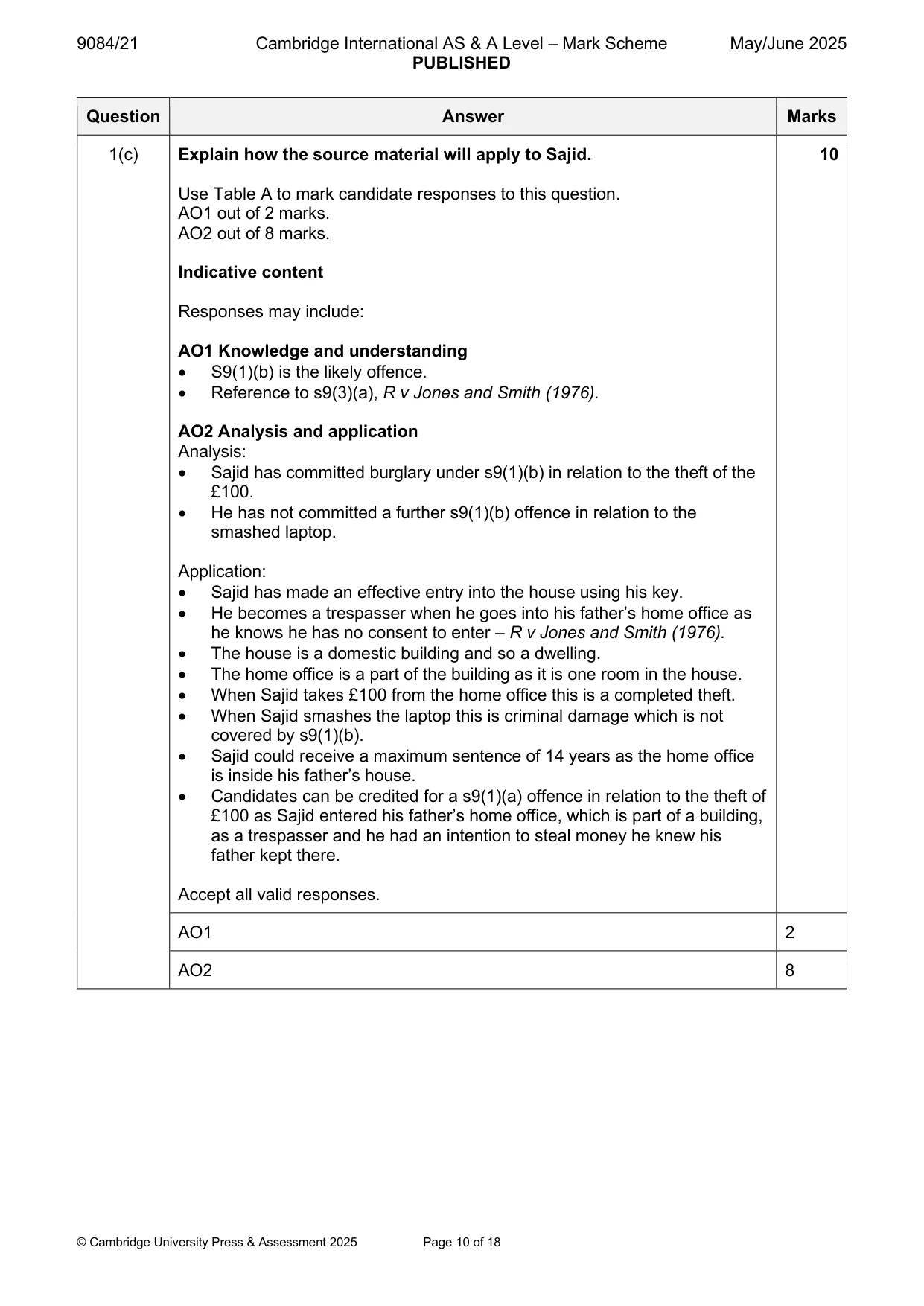
1 (a) Arthur is part of a criminal gang who plans to steal valuable machinery from a large container next to a factory. The container does not have wheels and has been used for five years for storage. Electric cables run from the factory to the container. The door of the container is locked, so Arthur climbs through a window in the container which has been left open. Once inside, Arthur is caught by the factory security guard, who has followed him. Arthur is searched, and explosives are found in a bag he is carrying. Arthur says he was going to use the explosives to force open the container door. Explain how the source material will apply to Arthur. [10] (b) Diane often walks past a house which she thinks is unoccupied. One day, Diane decides to go and look inside. She takes a small iron bar with her in case she needs to break a window. Diane tries the door of the house and it opens, so she goes inside. She sees a silver vase and, as she picks it up, Hugh, the owner of the house, appears. Hugh tries to grab Diane, so she hits him with the iron bar and runs out of the house with the silver vase. Explain how the source material will apply to Diane. [10] (c) Sajid lives in his father’s house. He has his own key to the door, and he is allowed to use all the rooms except his father’s home office. Sajid is £500 in debt. He goes into the house, intending to ask his father to lend him the money, but his father is not at home. He goes into his father’s home office as he knows some money is kept there. Sajid finds £100, which he takes. He is angry that there is not enough money to pay his debt, so he smashes a laptop and leaves. Explain how the source material will apply to Sajid. [10]
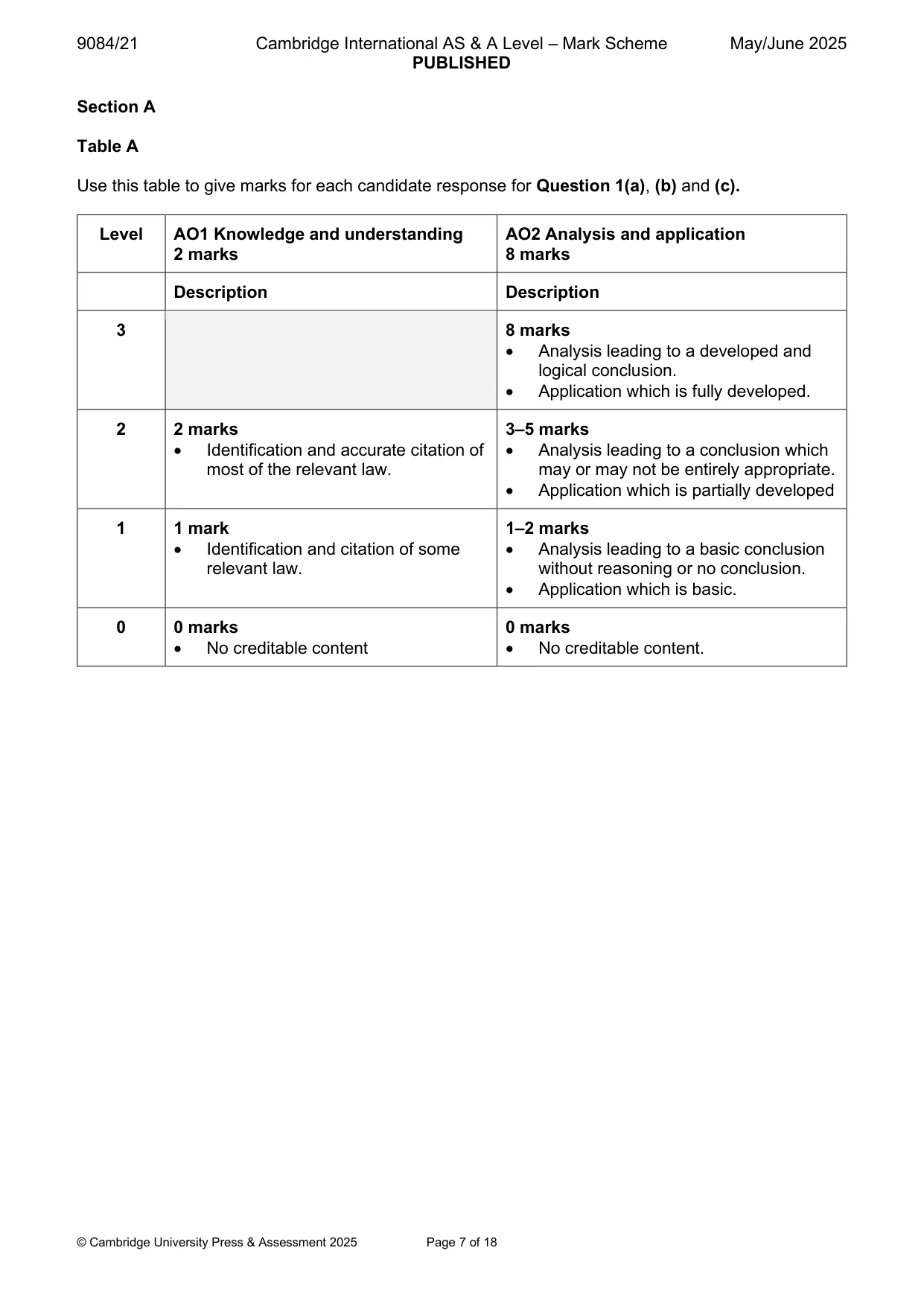
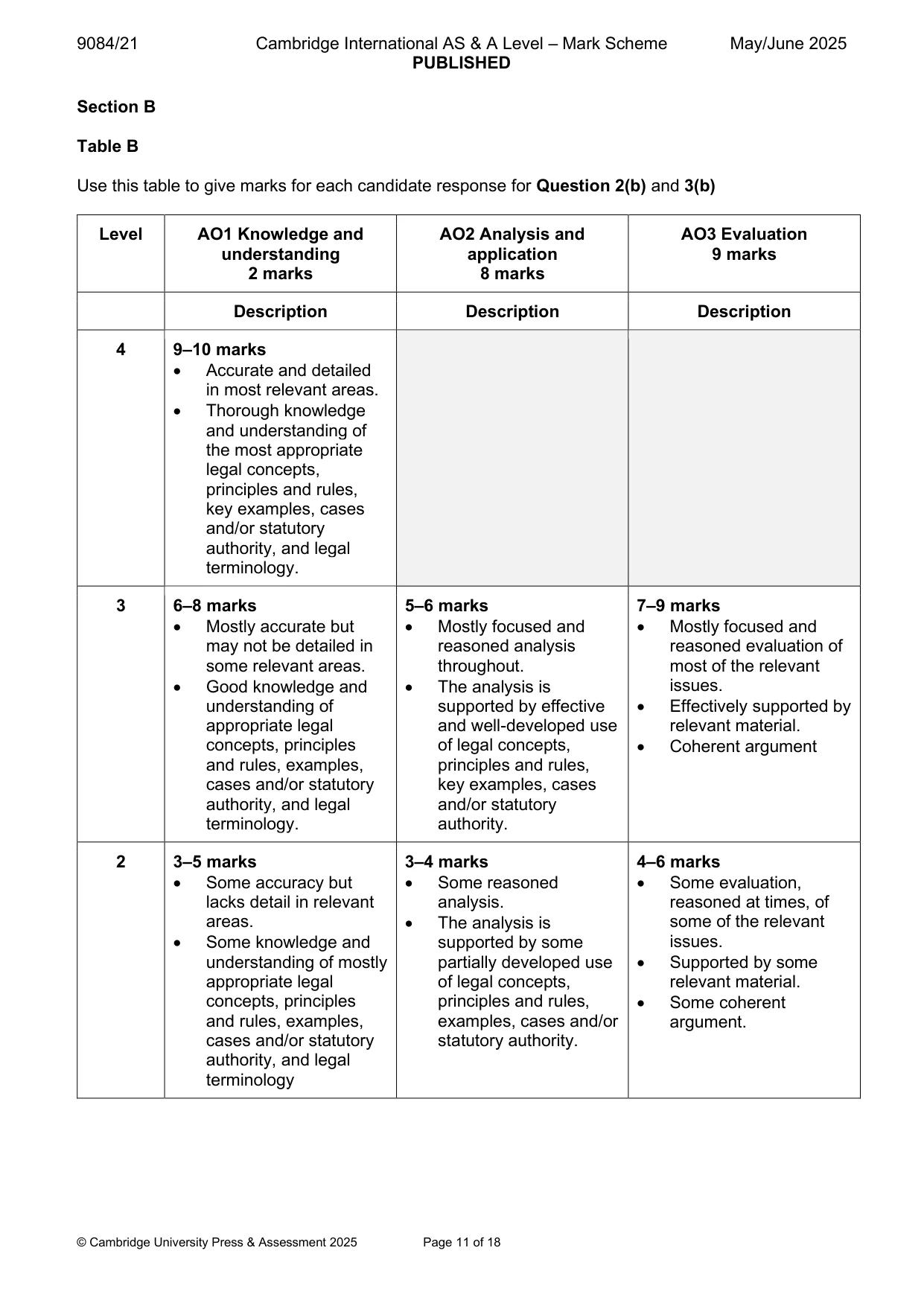
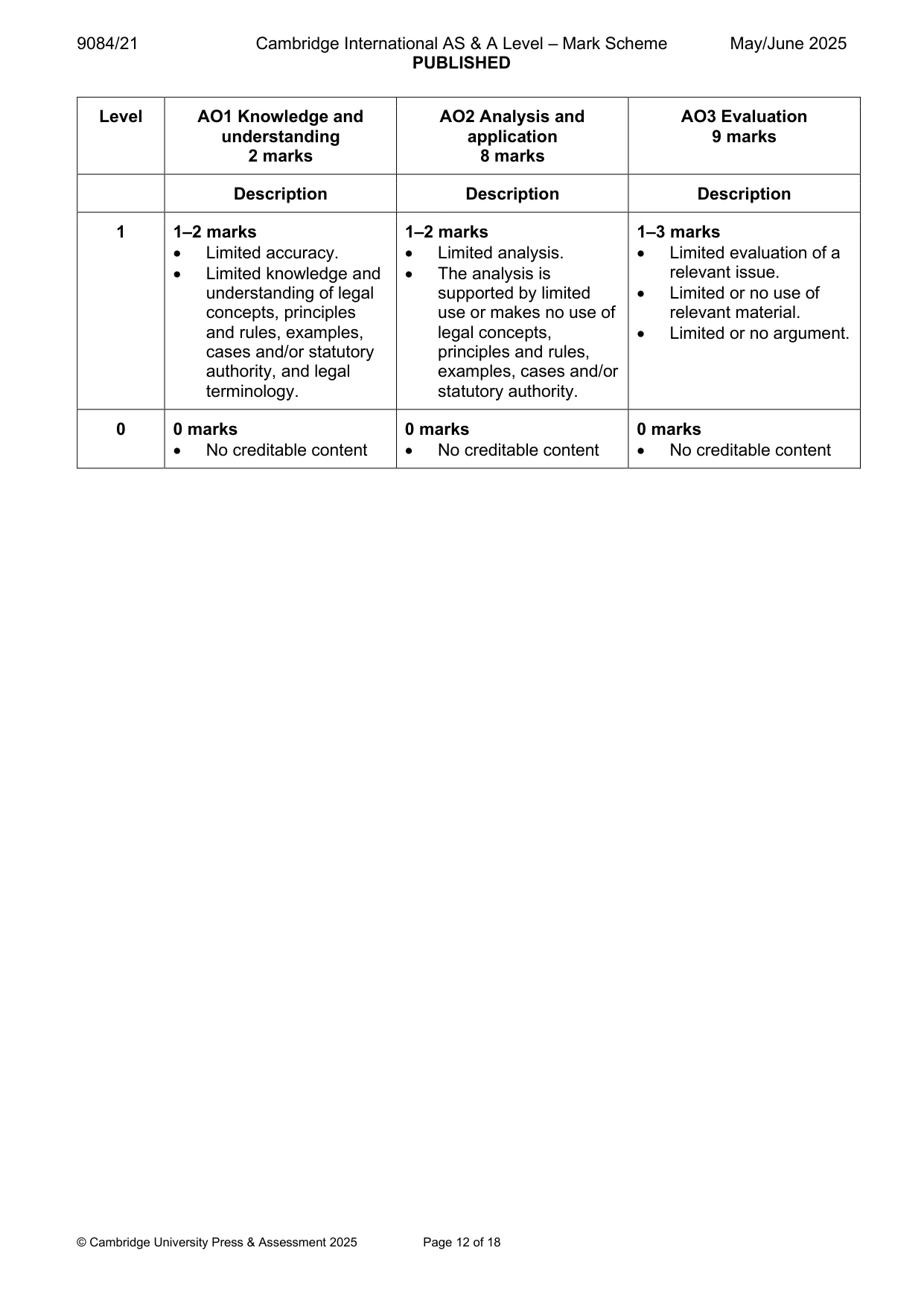
Mark scheme: Question Answer Marks 1(a) Explain how the source material will apply to Arthur. 10 Use Table A to mark candidate responses to this question. AO1 out of 2 marks. AO2 out of 8 marks. Indicative content Responses may include: AO1 Knowledge and understanding • S9(1)(a) is the likely offence leading to s10(1)(c). • Reference to s9(1)(a), s9(2) and B & S v Leathley (1979). AO2 Analysis and application Analysis: • Arthur has effectively entered as a trespasser with an intention to steal. • He has entered with explosives. • Application: • Arthur has entered in an effective way as he climbs in through a window. • The container can be classed as a building – B & S v Leathley (1979). • Arthur is a trespasser as he has no permission to enter. • Arthur enters with an intention to steal the valuable machinery. • Arthur has committed burglary under s9(1)(a). • Arthur has explosives with him which he intended to use to open the door of the container. • Arthur has committed aggravated burglary under s10(1)(c). • Arthur can receive a maximum penalty of life imprisonment. Accept all valid responses. AO1 2 AO2 8 1(b) Explain how the source material will apply to Diane. 10 Use Table A to mark candidate responses to this question. AO1 out of 2 marks. AO2 out of 8 marks. Indicative content Responses may include: AO1 Knowledge and understanding • S9(1)(b) is the likely offence leading to s10(1)(b). • Reference to s9(1)(b), s10(1)(b) and R v Kelly (1993) AO2 Analysis and application Analysis: • Diane has effectively entered as a trespasser and then steals. • She uses a weapon of offence to commit GBH. Application: • Diane has made an effective entry as she has gone into the house. • She is a trespasser even though she does not break in as the house is not hers. • The house is a building and a dwelling. • Diane commits theft as she picks up the silver vase inside the house so she has committed burglary under s9(1)(b). • Diane commits GBH when she hits Hugh with the iron bar so this is also burglary under s9(1)(b). • Diane uses the iron bar as a weapon of offence when she is surprised by Hugh and she hits him which meets s10(1)(b) – R v Kelly (1993). • Diane has committed aggravated burglary under s10(1)(b). • Diane can receive a maximum penalty of life imprisonment. Accept all valid responses. AO1 2 AO2 8 1(c) Explain how the source material will apply to Sajid. 10 Use Table A to mark candidate responses to this question. AO1 out of 2 marks. AO2 out of 8 marks. Indicative content Responses may include: AO1 Knowledge and understanding • S9(1)(b) is the likely offence. • Reference to s9(3)(a), R v Jones and Smith (1976). AO2 Analysis and application Analysis: • Sajid has committed burglary under s9(1)(b) in relation to the theft of the £100. • He has not committed a further s9(1)(b) offence in relation to the smashed laptop. Application: • Sajid has made an effective entry into the house using his key. • He becomes a trespasser when he goes into his father’s home office as he knows he has no consent to enter – R v Jones and Smith (1976). • The house is a domestic building and so a dwelling. • The home office is a part of the building as it is one room in the house. • When Sajid takes £100 from the home office this is a completed theft. • When Sajid smashes the laptop this is criminal damage which is not covered by s9(1)(b). • Sajid could receive a maximum sentence of 14 years as the home office is inside his father’s house. • Candidates can be credited for a s9(1)(a) offence in relation to the theft of £100 as Sajid entered his father’s home office, which is part of a building, as a trespasser and he had an intention to steal money he knew his father kept there. Accept all valid responses. AO1 2 AO2 8 Section B Table B Use this table to give marks for each candidate response for Question 2(b) and 3(b) Level AO1 Knowledge and AO2 Analysis and AO3 Evaluation understanding application 9 marks 2 marks 8 marks Description Description Description 4 9–10 marks • Accurate and detailed in most relevant areas. • Thorough knowledge and understanding of the most appropriate legal concepts, principles and rules, key examples, cases and/or statutory authority, and legal terminology. 3 6–8 marks 5–6 marks 7–9 marks • Mostly accurate but • Mostly focused and • Mostly focused and may not be detailed in reasoned analysis reasoned evaluation of some relevant areas. throughout. most of the relevant • Good knowledge and • The analysis is issues. understanding of supported by effective • Effectively supported by appropriate legal and well-developed use relevant material. concepts, principles of legal concepts, • Coherent argument and rules, examples, principles and rules, cases and/or statutory key examples, cases authority, and legal and/or statutory terminology. authority. 2 3–5 marks 3–4 marks 4–6 marks • Some accuracy but • Some reasoned • Some evaluation, lacks detail in relevant analysis. reasoned at times, of areas. • The analysis is some of the relevant • Some knowledge and supported by some issues. understanding of mostly partially developed use • Supported by some appropriate legal of legal concepts, relevant material. concepts, principles principles and rules, • Some coherent and rules, examples, examples, cases and/or argument. cases and/or statutory statutory authority. authority, and legal terminology Level AO1 Knowledge and AO2 Analysis and AO3 Evaluation understanding application 9 marks 2 marks 8 marks Description Description Description 1 1–2 marks 1–2 marks 1–3 marks • Limited accuracy. • Limited analysis. • Limited evaluation of a • Limited knowledge and • The analysis is relevant issue. understanding of legal supported by limited • Limited or no use of concepts, principles use or makes no use of relevant material. and rules, examples, legal concepts, • Limited or no argument. cases and/or statutory principles and rules, authority, and legal examples, cases and/or terminology. statutory authority. 0 0 marks 0 marks 0 marks • No creditable content • No creditable content • No creditable content
Q2 · Describe indirect/oblique intention in mens rea
2 (a) Describe indirect/oblique intention in mens rea. [5] (b) Evaluate the effectiveness of the factors used when sentencing offenders. [25] OR
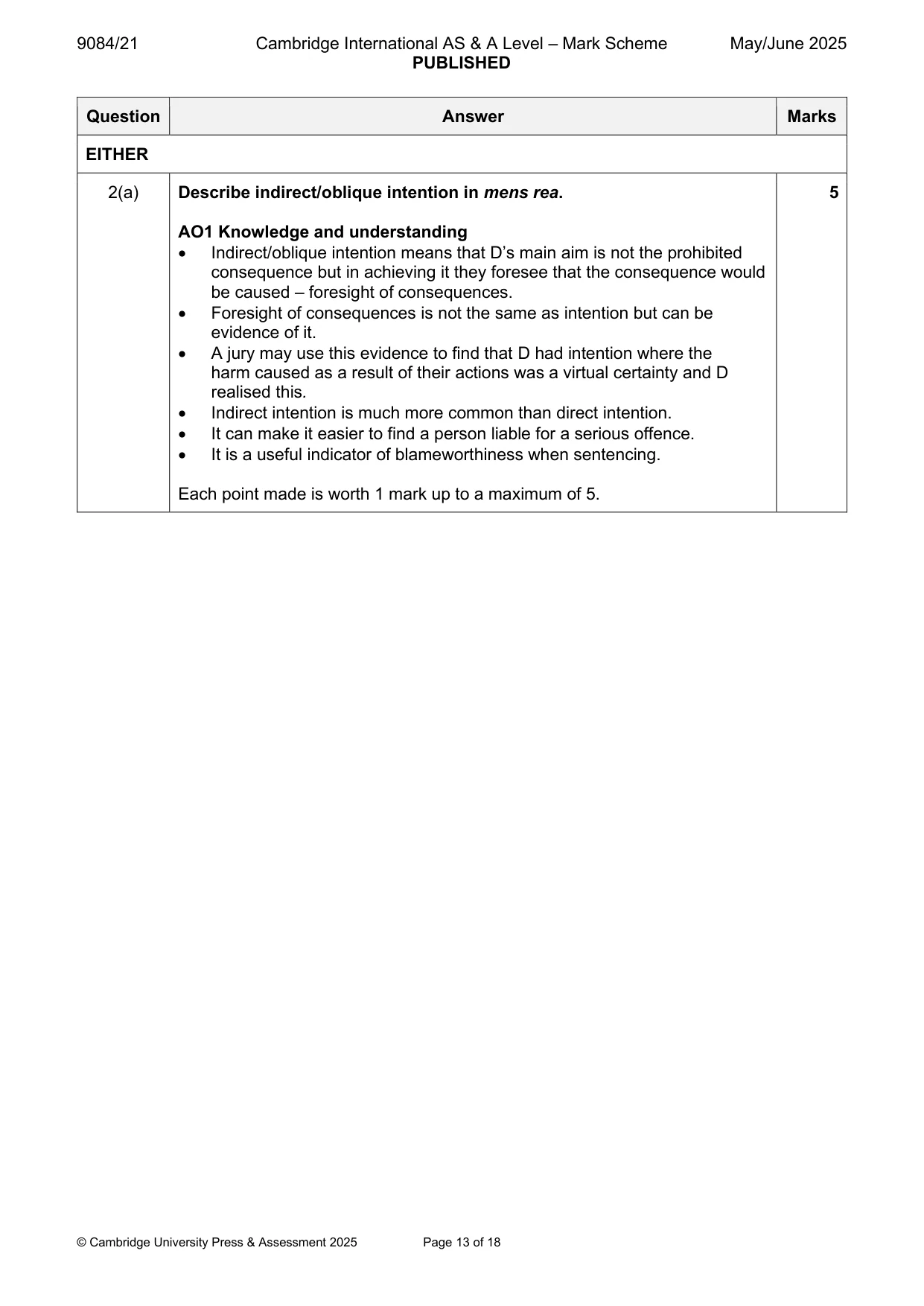
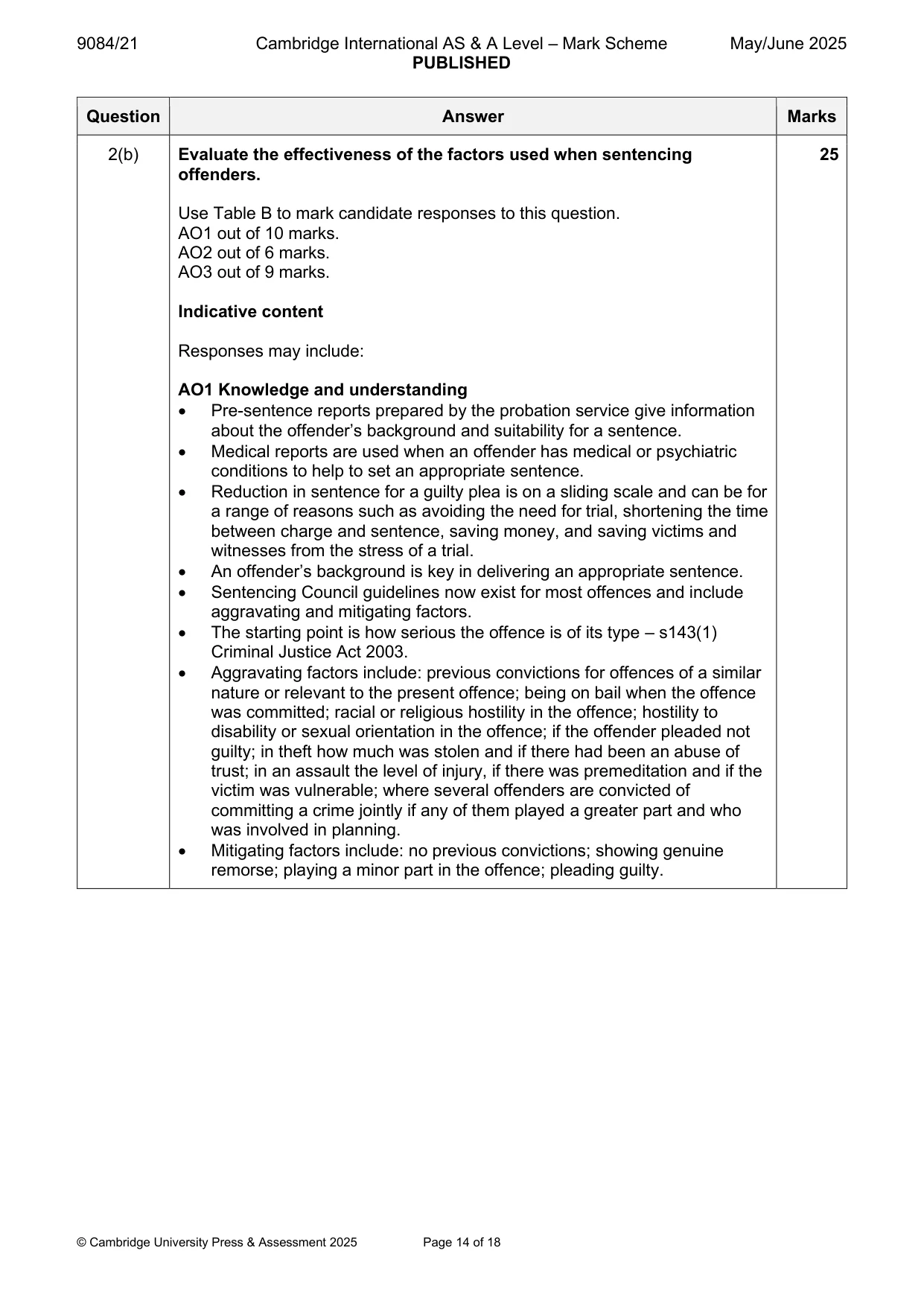
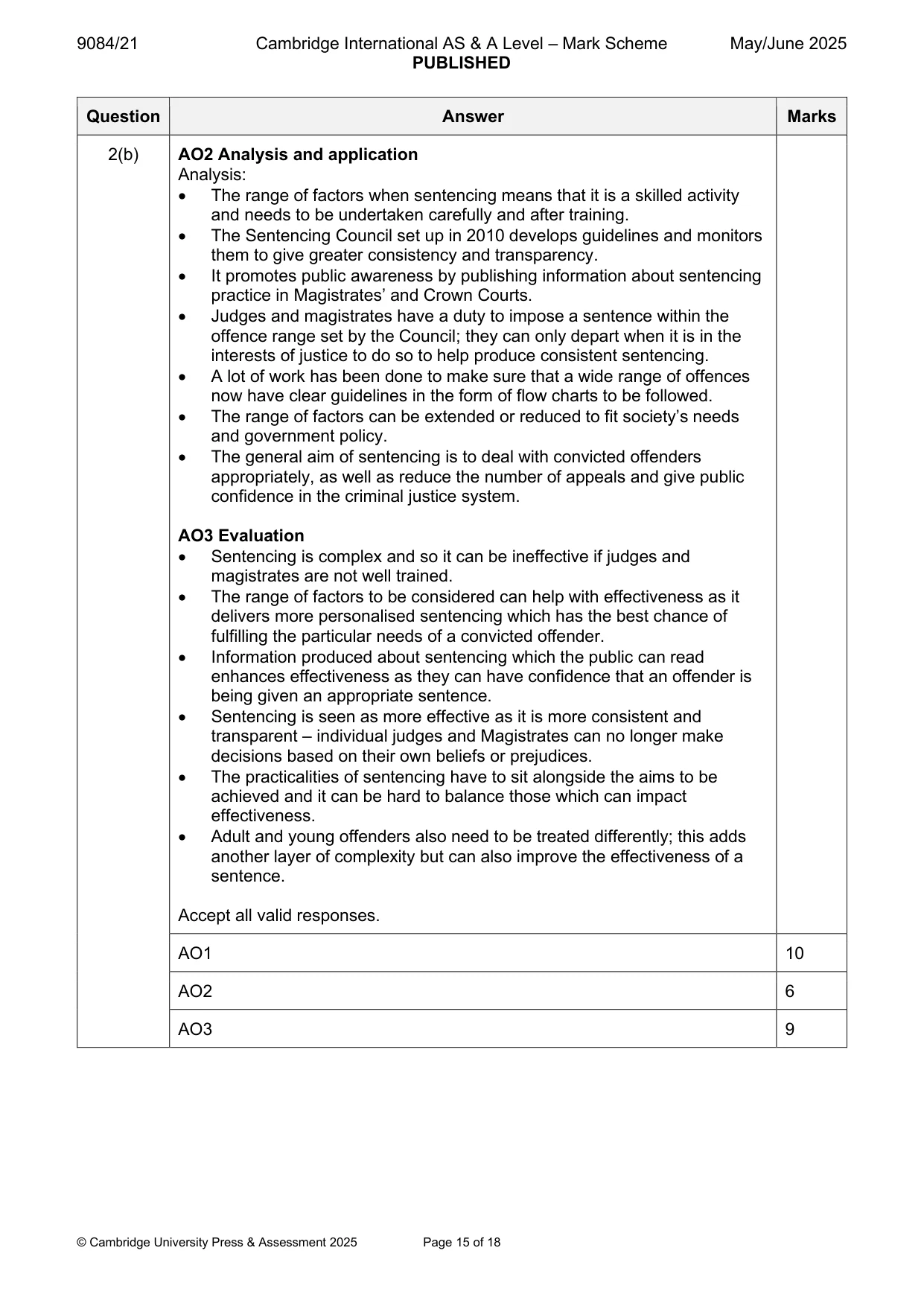
Mark scheme: 2(a) Describe indirect/oblique intention in mens rea. 5 AO1 Knowledge and understanding • Indirect/oblique intention means that D’s main aim is not the prohibited consequence but in achieving it they foresee that the consequence would be caused – foresight of consequences. • Foresight of consequences is not the same as intention but can be evidence of it. • A jury may use this evidence to find that D had intention where the harm caused as a result of their actions was a virtual certainty and D realised this. • Indirect intention is much more common than direct intention. • It can make it easier to find a person liable for a serious offence. • It is a useful indicator of blameworthiness when sentencing. Each point made is worth 1 mark up to a maximum of 5. 2(b) Evaluate the effectiveness of the factors used when sentencing 25 offenders. Use Table B to mark candidate responses to this question. AO1 out of 10 marks. AO2 out of 6 marks. AO3 out of 9 marks. Indicative content Responses may include: AO1 Knowledge and understanding • Pre-sentence reports prepared by the probation service give information about the offender’s background and suitability for a sentence. • Medical reports are used when an offender has medical or psychiatric conditions to help to set an appropriate sentence. • Reduction in sentence for a guilty plea is on a sliding scale and can be for a range of reasons such as avoiding the need for trial, shortening the time between charge and sentence, saving money, and saving victims and witnesses from the stress of a trial. • An offender’s background is key in delivering an appropriate sentence. • Sentencing Council guidelines now exist for most offences and include aggravating and mitigating factors. • The starting point is how serious the offence is of its type – s143(1) Criminal Justice Act 2003. • Aggravating factors include: previous convictions for offences of a similar nature or relevant to the present offence; being on bail when the offence was committed; racial or religious hostility in the offence; hostility to disability or sexual orientation in the offence; if the offender pleaded not guilty; in theft how much was stolen and if there had been an abuse of trust; in an assault the level of injury, if there was premeditation and if the victim was vulnerable; where several offenders are convicted of committing a crime jointly if any of them played a greater part and who was involved in planning. • Mitigating factors include: no previous convictions; showing genuine remorse; playing a minor part in the offence; pleading guilty. 2(b) AO2 Analysis and application Analysis: • The range of factors when sentencing means that it is a skilled activity and needs to be undertaken carefully and after training. • The Sentencing Council set up in 2010 develops guidelines and monitors them to give greater consistency and transparency. • It promotes public awareness by publishing information about sentencing practice in Magistrates’ and Crown Courts. • Judges and magistrates have a duty to impose a sentence within the offence range set by the Council; they can only depart when it is in the interests of justice to do so to help produce consistent sentencing. • A lot of work has been done to make sure that a wide range of offences now have clear guidelines in the form of flow charts to be followed. • The range of factors can be extended or reduced to fit society’s needs and government policy. • The general aim of sentencing is to deal with convicted offenders appropriately, as well as reduce the number of appeals and give public confidence in the criminal justice system. AO3 Evaluation • Sentencing is complex and so it can be ineffective if judges and magistrates are not well trained. • The range of factors to be considered can help with effectiveness as it delivers more personalised sentencing which has the best chance of fulfilling the particular needs of a convicted offender. • Information produced about sentencing which the public can read enhances effectiveness as they can have confidence that an offender is being given an appropriate sentence. • Sentencing is seen as more effective as it is more consistent and transparent – individual judges and Magistrates can no longer make decisions based on their own beliefs or prejudices. • The practicalities of sentencing have to sit alongside the aims to be achieved and it can be hard to balance those which can impact effectiveness. • Adult and young offenders also need to be treated differently; this adds another layer of complexity but can also improve the effectiveness of a sentence. Accept all valid responses. AO1 10 AO2 6 AO3 9
Q3 · Describe the mens rea of the offence of making off without payment
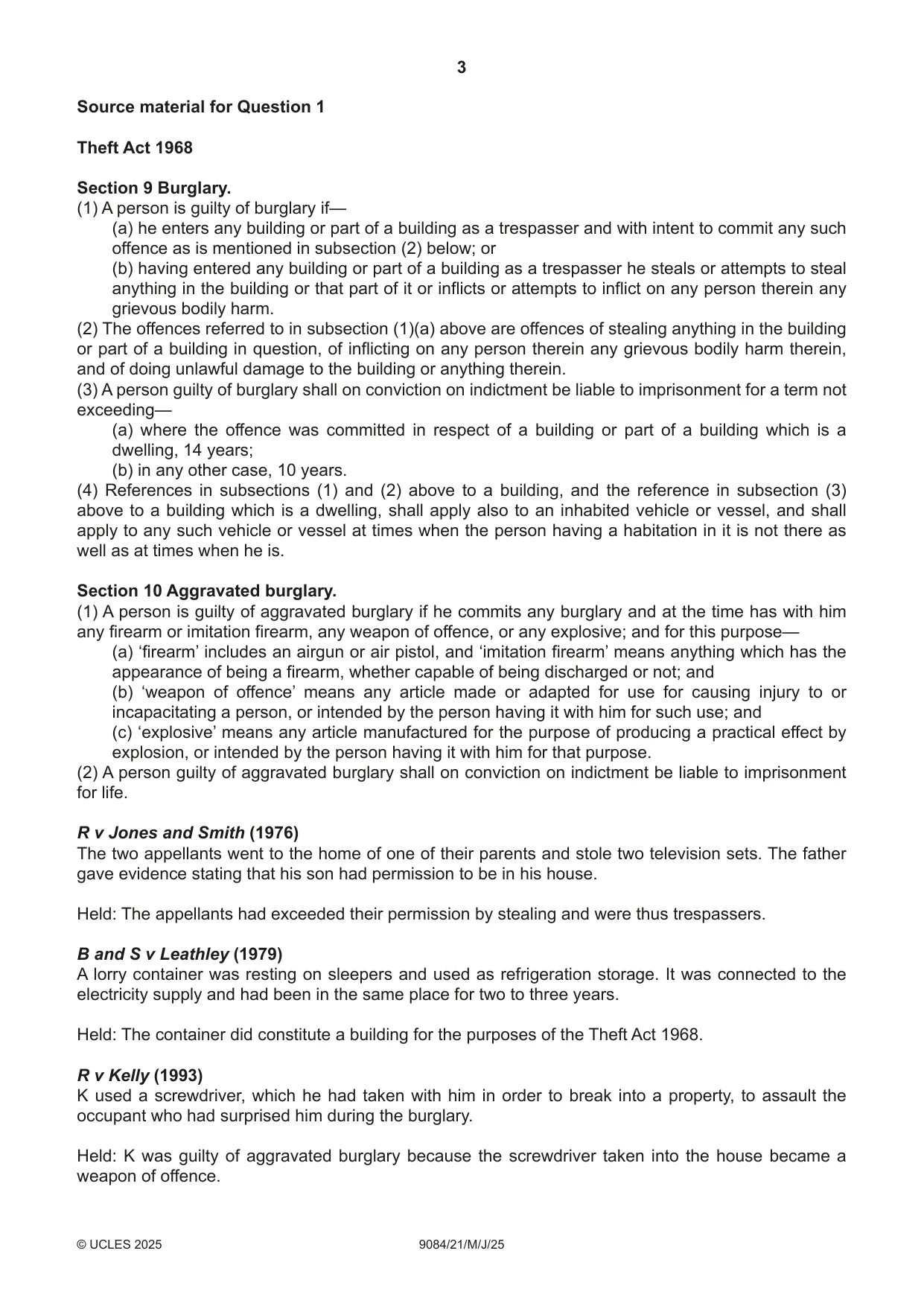
3 (a) Describe the mens rea of the offence of making off without payment. [5] (b) Evaluate the fairness of s3 and s5 Theft Act 1968 in the actus reus of theft. [25] Source material for Question 1 Theft Act 1968 Section 9 Burglary. (1) A person is guilty of burglary if— (a) he enters any building or part of a building as a trespasser and with intent to commit any such offence as is mentioned in subsection (2) below; or (b) having entered any building or part of a building as a trespasser he steals or attempts to steal anything in the building or that part of it or inflicts or attempts to inflict on any person therein any grievous bodily harm. (2) The offences referred to in subsection (1)(a) above are offences of stealing anything in the building or part of a building in question, of inflicting on any person therein any grievous bodily harm therein, and of doing unlawful damage to the building or anything therein. (3) A person guilty of burglary shall on conviction on indictment be liable to imprisonment for a term not exceeding— (a) where the offence was committed in respect of a building or part of a building which is a dwelling, 14 years; (b) in any other case, 10 years. (4) References in subsections (1) and (2) above to a building, and the reference in subsection (3) above to a building which is a dwelling, shall apply also to an inhabited vehicle or vessel, and shall apply to any such vehicle or vessel at times when the person having a habitation in it is not there as well as at times when he is. Section 10 Aggravated burglary. (1) A person is guilty of aggravated burglary if he commits any burglary and at the time has with him any firearm or imitation firearm, any weapon of offence, or any explosive; and for this purpose— (a) ‘firearm’ includes an airgun or air pistol, and ‘imitation firearm’ means anything which has the appearance of being a firearm, whether capable of being discharged or not; and (b) ‘weapon of offence’ means any article made or adapted for use for causing injury to or incapacitating a person, or intended by the person having it with him for such use; and (c) ‘explosive’ means any article manufactured for the purpose of producing a practical effect by explosion, or intended by the person having it with him for that purpose. (2) A person guilty of aggravated burglary shall on conviction on indictment be liable to imprisonment for life. R v Jones and Smith (1976) The two appellants went to the home of one of their parents and stole two television sets. The father gave evidence stating that his son had permission to be in his house. Held: The appellants had exceeded their permission by stealing and were thus trespassers. B and S v Leathley (1979) A lorry container was resting on sleepers and used as refrigeration storage. It was connected to the electricity supply and had been in the same place for two to three years. Held: The container did constitute a building for the purposes of the Theft Act 1968. R v Kelly (1993) K used a screwdriver, which he had taken with him in order to break into a property, to assault the occupant who had surprised him during the burglary. Held: K was guilty of aggravated burglary because the screwdriver taken into the house became a weapon of offence.
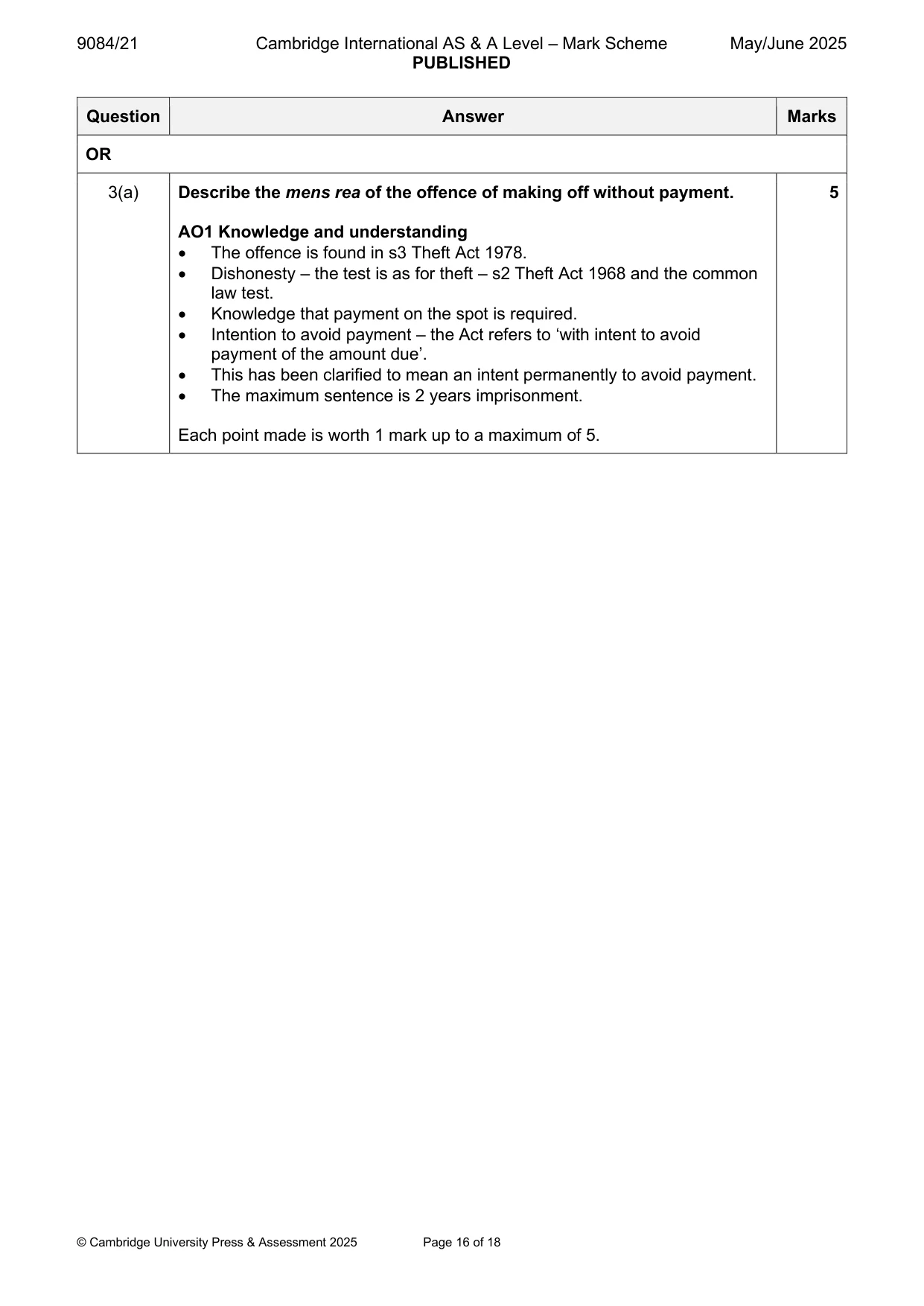
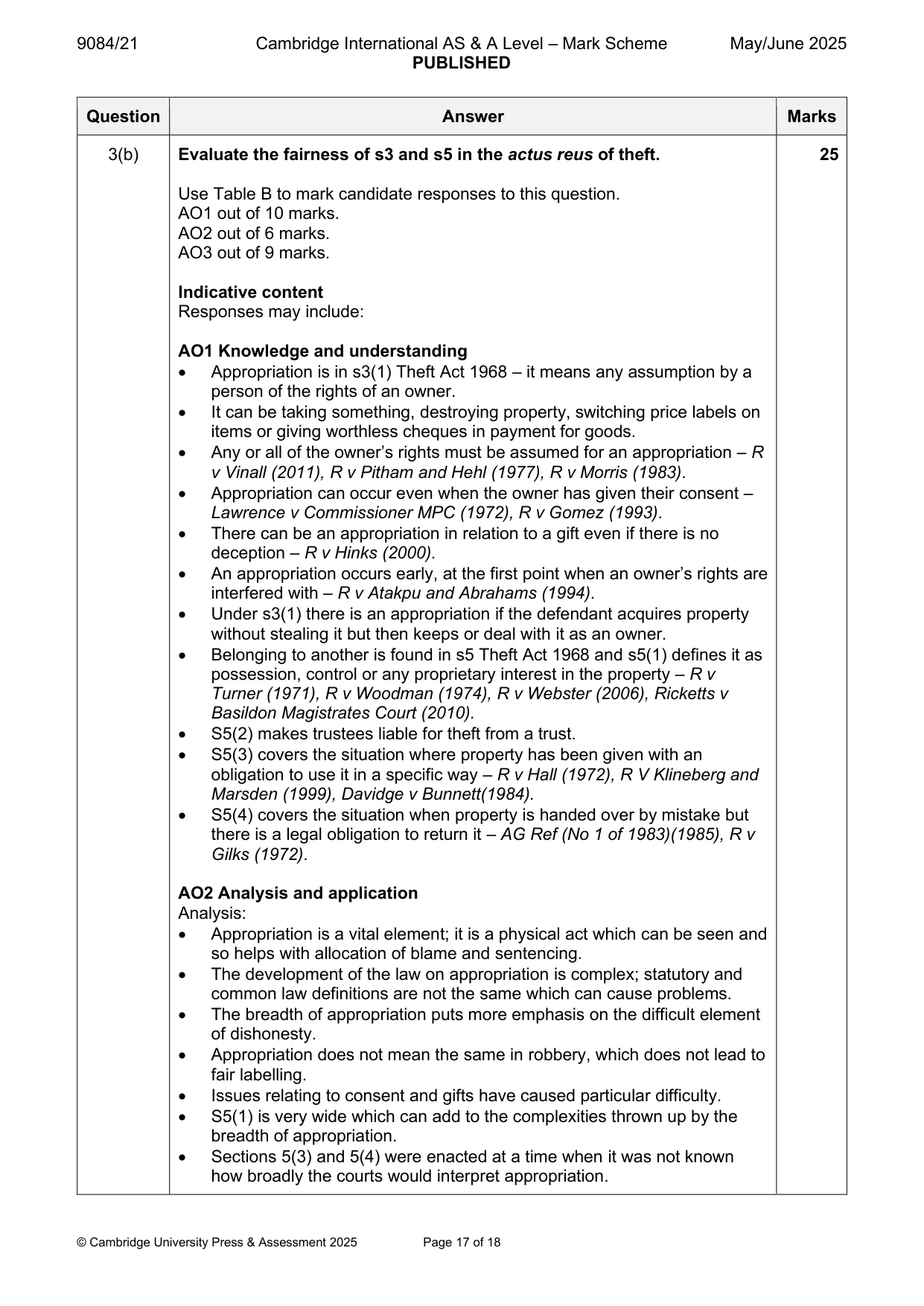
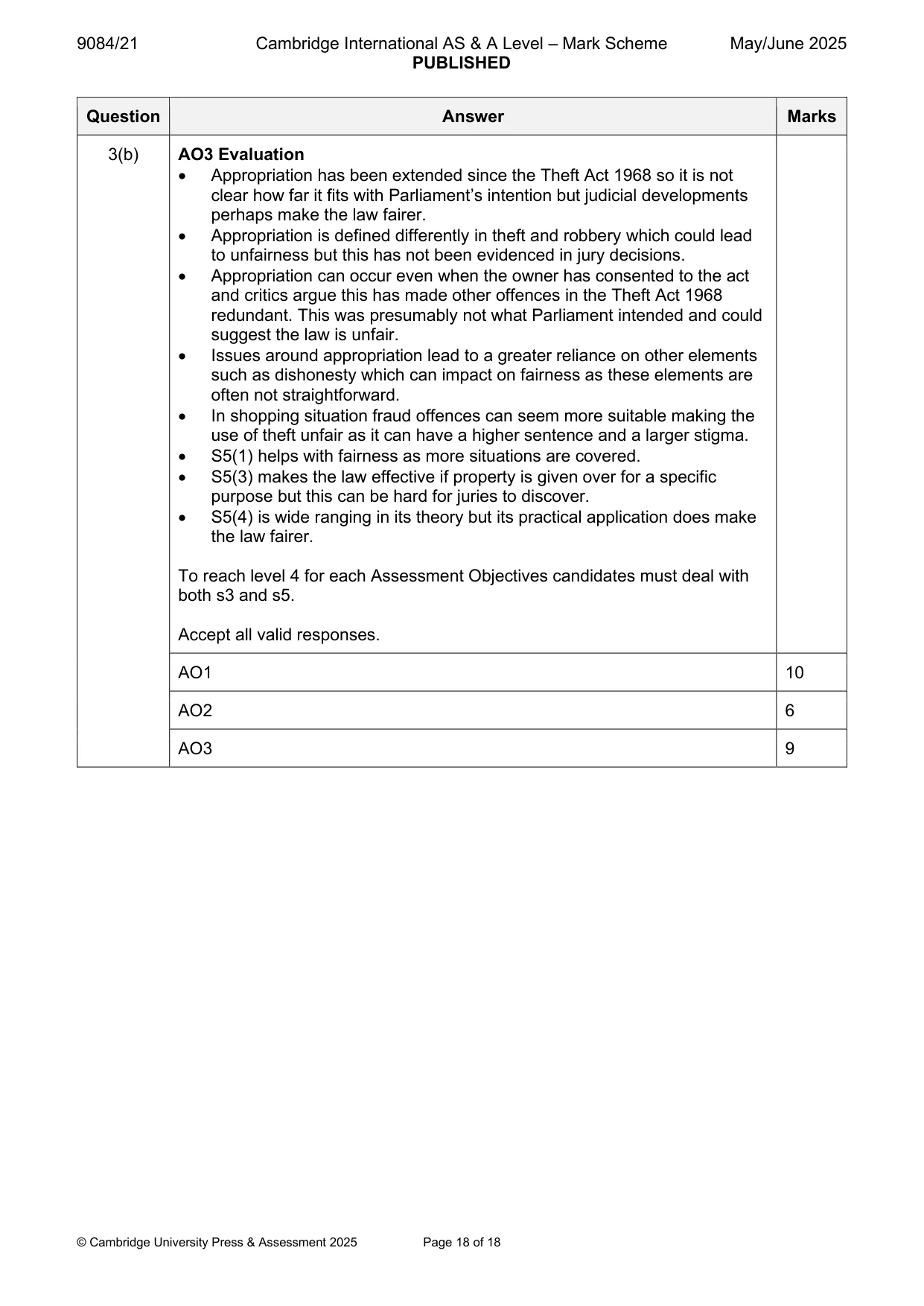
Mark scheme: 3(a) Describe the mens rea of the offence of making off without payment. 5 AO1 Knowledge and understanding • The offence is found in s3 Theft Act 1978. • Dishonesty – the test is as for theft – s2 Theft Act 1968 and the common law test. • Knowledge that payment on the spot is required. • Intention to avoid payment – the Act refers to ‘with intent to avoid payment of the amount due’. • This has been clarified to mean an intent permanently to avoid payment. • The maximum sentence is 2 years imprisonment. Each point made is worth 1 mark up to a maximum of 5. 3(b) Evaluate the fairness of s3 and s5 in the actus reus of theft. 25 Use Table B to mark candidate responses to this question. AO1 out of 10 marks. AO2 out of 6 marks. AO3 out of 9 marks. Indicative content Responses may include: AO1 Knowledge and understanding • Appropriation is in s3(1) Theft Act 1968 – it means any assumption by a person of the rights of an owner. • It can be taking something, destroying property, switching price labels on items or giving worthless cheques in payment for goods. • Any or all of the owner’s rights must be assumed for an appropriation – R v Vinall (2011), R v Pitham and Hehl (1977), R v Morris (1983). • Appropriation can occur even when the owner has given their consent – Lawrence v Commissioner MPC (1972), R v Gomez (1993). • There can be an appropriation in relation to a gift even if there is no deception – R v Hinks (2000). • An appropriation occurs early, at the first point when an owner’s rights are interfered with – R v Atakpu and Abrahams (1994). • Under s3(1) there is an appropriation if the defendant acquires property without stealing it but then keeps or deal with it as an owner. • Belonging to another is found in s5 Theft Act 1968 and s5(1) defines it as possession, control or any proprietary interest in the property – R v Turner (1971), R v Woodman (1974), R v Webster (2006), Ricketts v Basildon Magistrates Court (2010). • S5(2) makes trustees liable for theft from a trust. • S5(3) covers the situation where property has been given with an obligation to use it in a specific way – R v Hall (1972), R V Klineberg and Marsden (1999), Davidge v Bunnett(1984). • S5(4) covers the situation when property is handed over by mistake but there is a legal obligation to return it – AG Ref (No 1 of 1983)(1985), R v Gilks (1972). AO2 Analysis and application Analysis: • Appropriation is a vital element; it is a physical act which can be seen and so helps with allocation of blame and sentencing. • The development of the law on appropriation is complex; statutory and common law definitions are not the same which can cause problems. • The breadth of appropriation puts more emphasis on the difficult element of dishonesty. • Appropriation does not mean the same in robbery, which does not lead to fair labelling. • Issues relating to consent and gifts have caused particular difficulty. • S5(1) is very wide which can add to the complexities thrown up by the breadth of appropriation. • Sections 5(3) and 5(4) were enacted at a time when it was not known how broadly the courts would interpret appropriation. 3(b) AO3 Evaluation • Appropriation has been extended since the Theft Act 1968 so it is not clear how far it fits with Parliament’s intention but judicial developments perhaps make the law fairer. • Appropriation is defined differently in theft and robbery which could lead to unfairness but this has not been evidenced in jury decisions. • Appropriation can occur even when the owner has consented to the act and critics argue this has made other offences in the Theft Act 1968 redundant. This was presumably not what Parliament intended and could suggest the law is unfair. • Issues around appropriation lead to a greater reliance on other elements such as dishonesty which can impact on fairness as these elements are often not straightforward. • In shopping situation fraud offences can seem more suitable making the use of theft unfair as it can have a higher sentence and a larger stigma. • S5(1) helps with fairness as more situations are covered. • S5(3) makes the law effective if property is given over for a specific purpose but this can be hard for juries to discover. • S5(4) is wide ranging in its theory but its practical application does make the law fairer. To reach level 4 for each Assessment Objectives candidates must deal with both s3 and s5. Accept all valid responses. AO1 10 AO2 6 AO3 9
What was in this paper
The subtopics covered by these 3 questions, and how many questions each got. Open one in a new tab to see every Cambridge question on it.
2Sentencing in England and Wales This topic is about the sentences that can be handed down to both adult and young offenders who have been convicted of offences. This topic is an opportunity to reflect on the key concepts of liability, justice, fairness, power and its limits, and effectiveness1What you needed in this session
Cambridge’s own grade thresholds for 2025 May/June, Paper 2 · Variant 1. A higher threshold means an easier paper — the bar moves with how the cohort did.