Cambridge A Level Law 9084 — 2023 Oct/Nov Paper 2 · Variant 2
9084/22/O/N/23 · 3 questions · 60 marks · ≈68 min
The question paper and its mark scheme, free to read here and free to download. This is Cambridge’s own paper, exactly as it was sat.
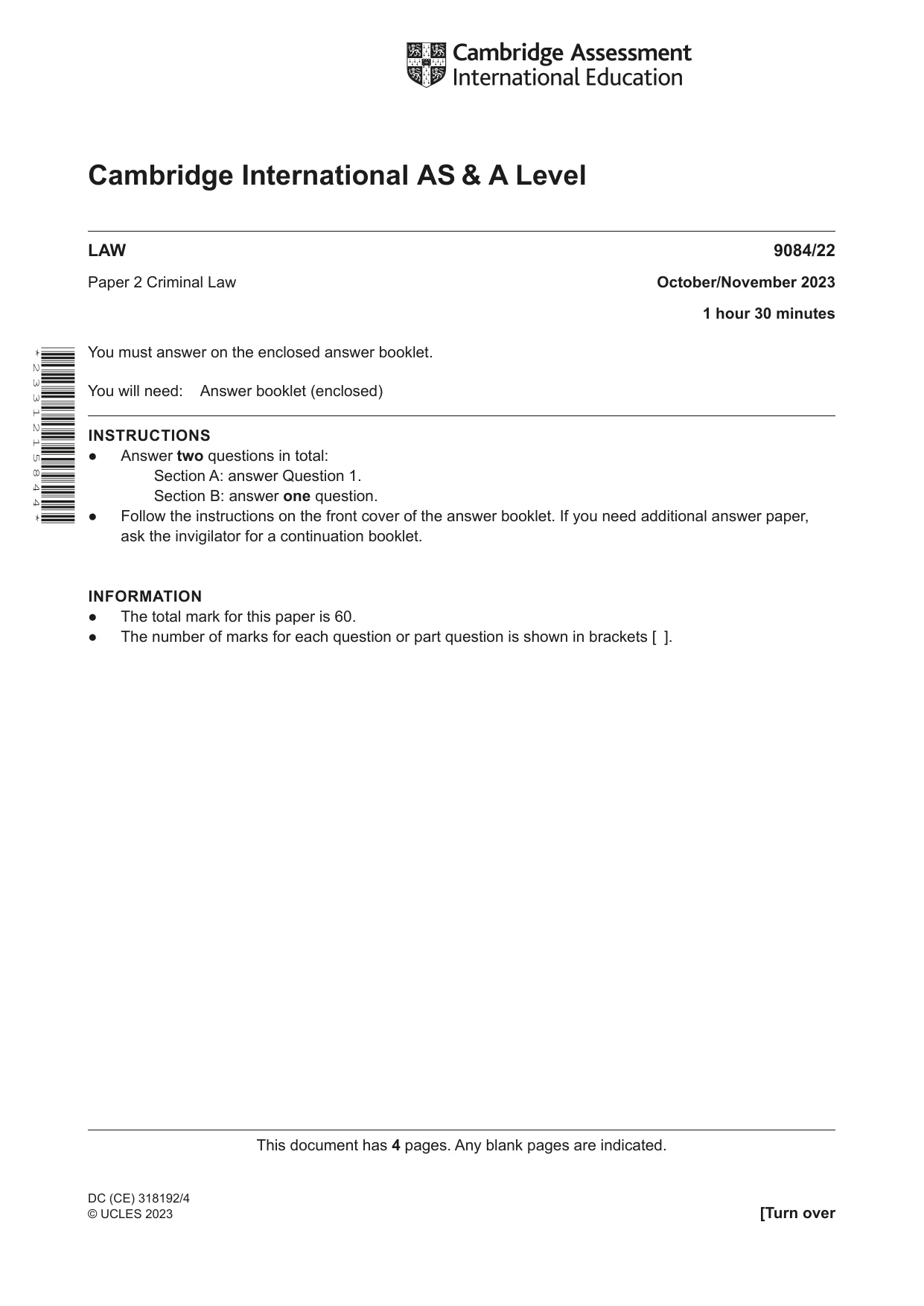
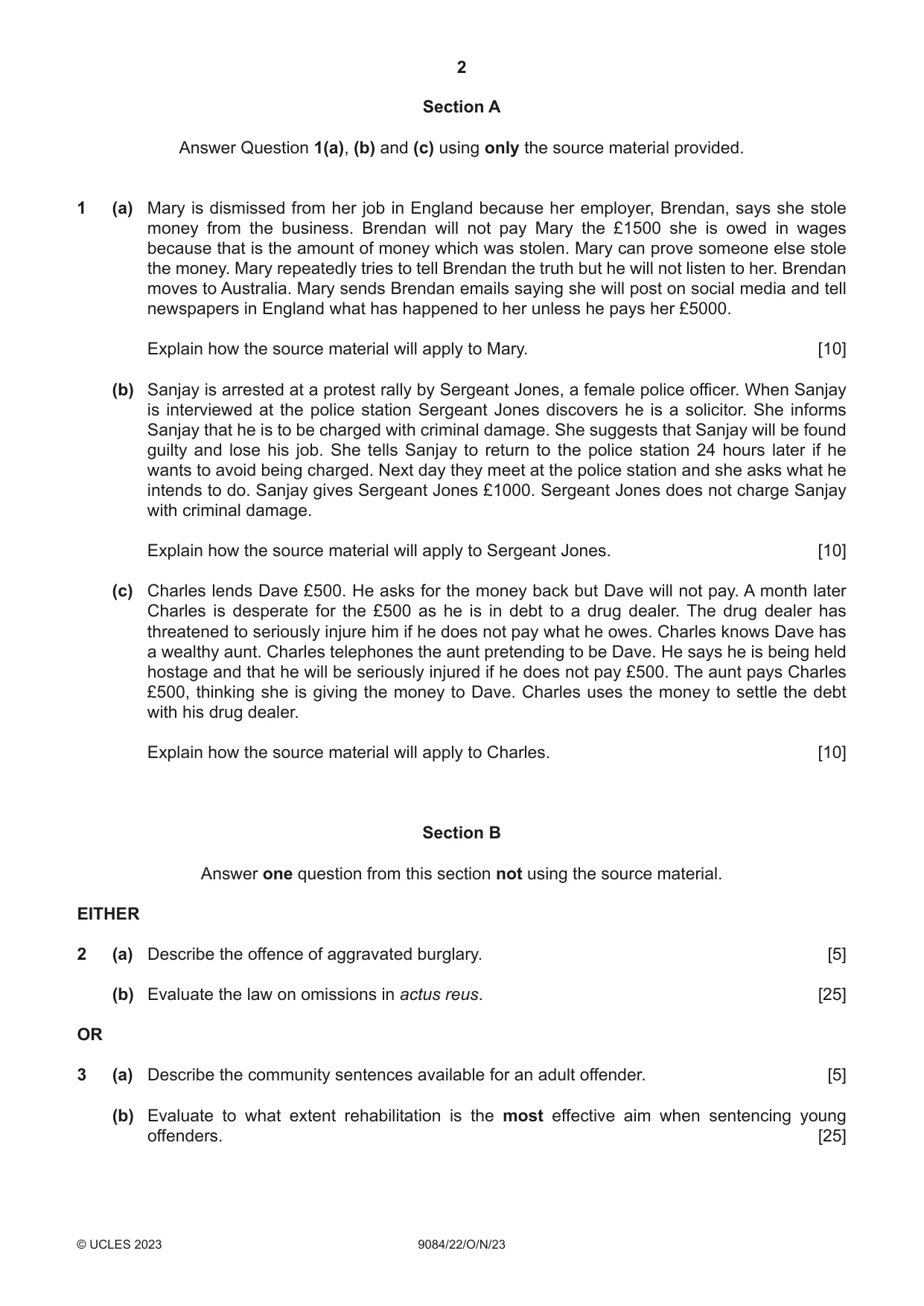
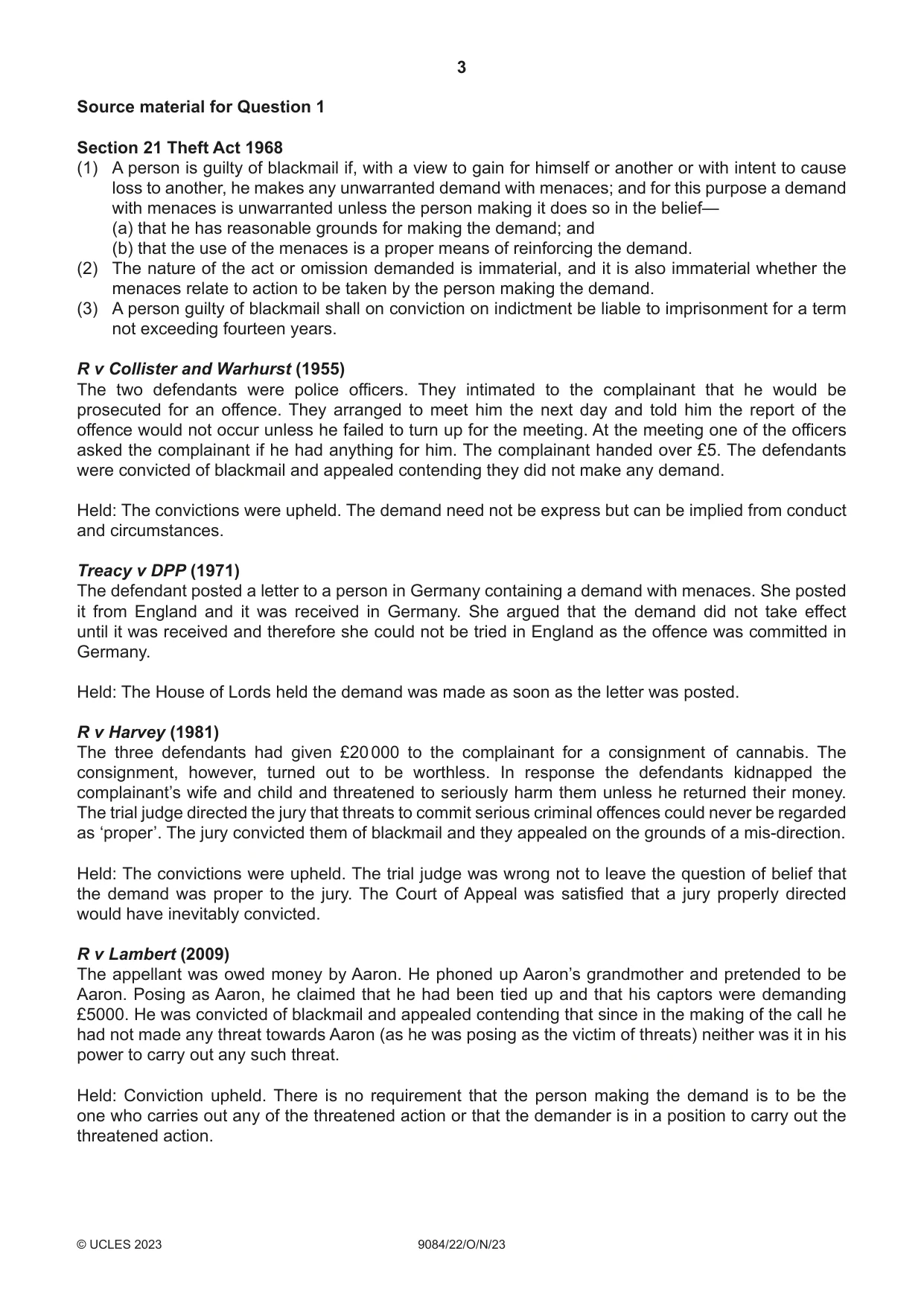
Question paper4 pages

Mark scheme18 pages
Answers below. Sit the paper first if you are practising.
Questions as text
Q1 · Mary is dismissed from her job in England because her employer, Brendan, says she stole…
1 (a) Mary is dismissed from her job in England because her employer, Brendan, says she stole money from the business. Brendan will not pay Mary the £1500 she is owed in wages because that is the amount of money which was stolen. Mary can prove someone else stole the money. Mary repeatedly tries to tell Brendan the truth but he will not listen to her. Brendan moves to Australia. Mary sends Brendan emails saying she will post on social media and tell newspapers in England what has happened to her unless he pays her £5000. Explain how the source material will apply to Mary. [10] (b) Sanjay is arrested at a protest rally by Sergeant Jones, a female police officer. When Sanjay is interviewed at the police station Sergeant Jones discovers he is a solicitor. She informs Sanjay that he is to be charged with criminal damage. She suggests that Sanjay will be found guilty and lose his job. She tells Sanjay to return to the police station 24 hours later if he wants to avoid being charged. Next day they meet at the police station and she asks what he intends to do. Sanjay gives Sergeant Jones £1000. Sergeant Jones does not charge Sanjay with criminal damage. Explain how the source material will apply to Sergeant Jones. [10] (c) Charles lends Dave £500. He asks for the money back but Dave will not pay. A month later Charles is desperate for the £500 as he is in debt to a drug dealer. The drug dealer has threatened to seriously injure him if he does not pay what he owes. Charles knows Dave has a wealthy aunt. Charles telephones the aunt pretending to be Dave. He says he is being held hostage and that he will be seriously injured if he does not pay £500. The aunt pays Charles £500, thinking she is giving the money to Dave. Charles uses the money to settle the debt with his drug dealer. Explain how the source material will apply to Charles. [10]
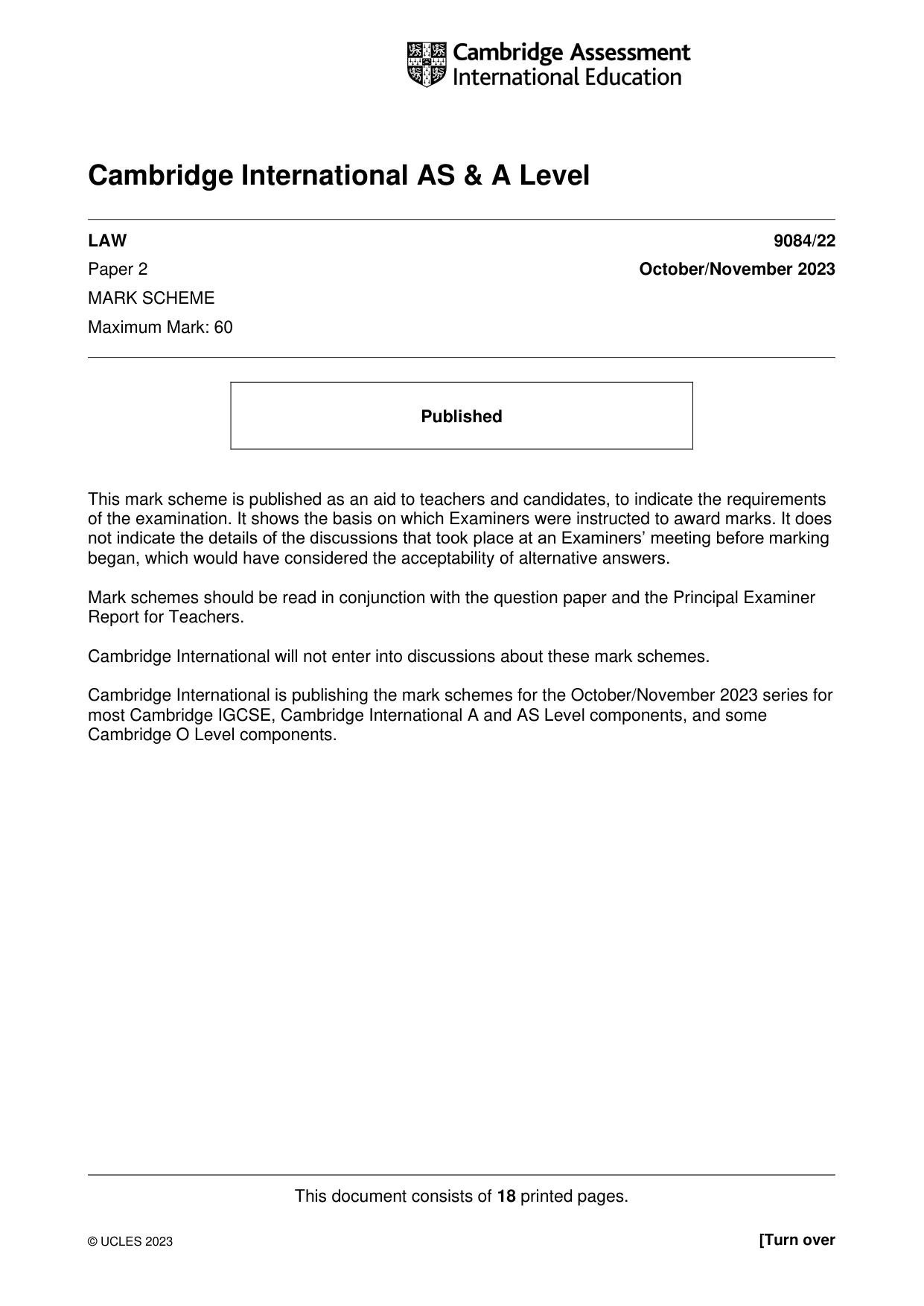
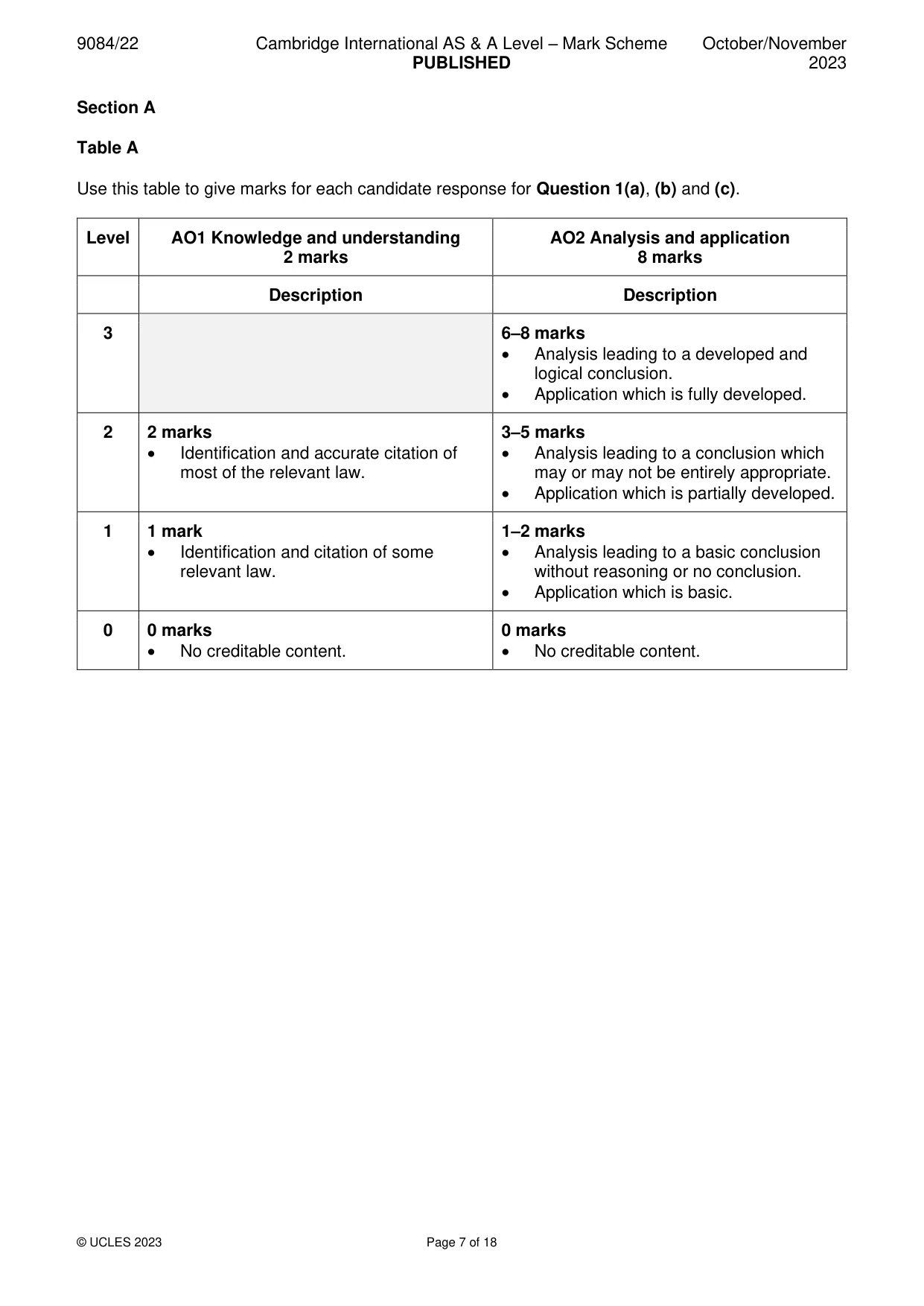
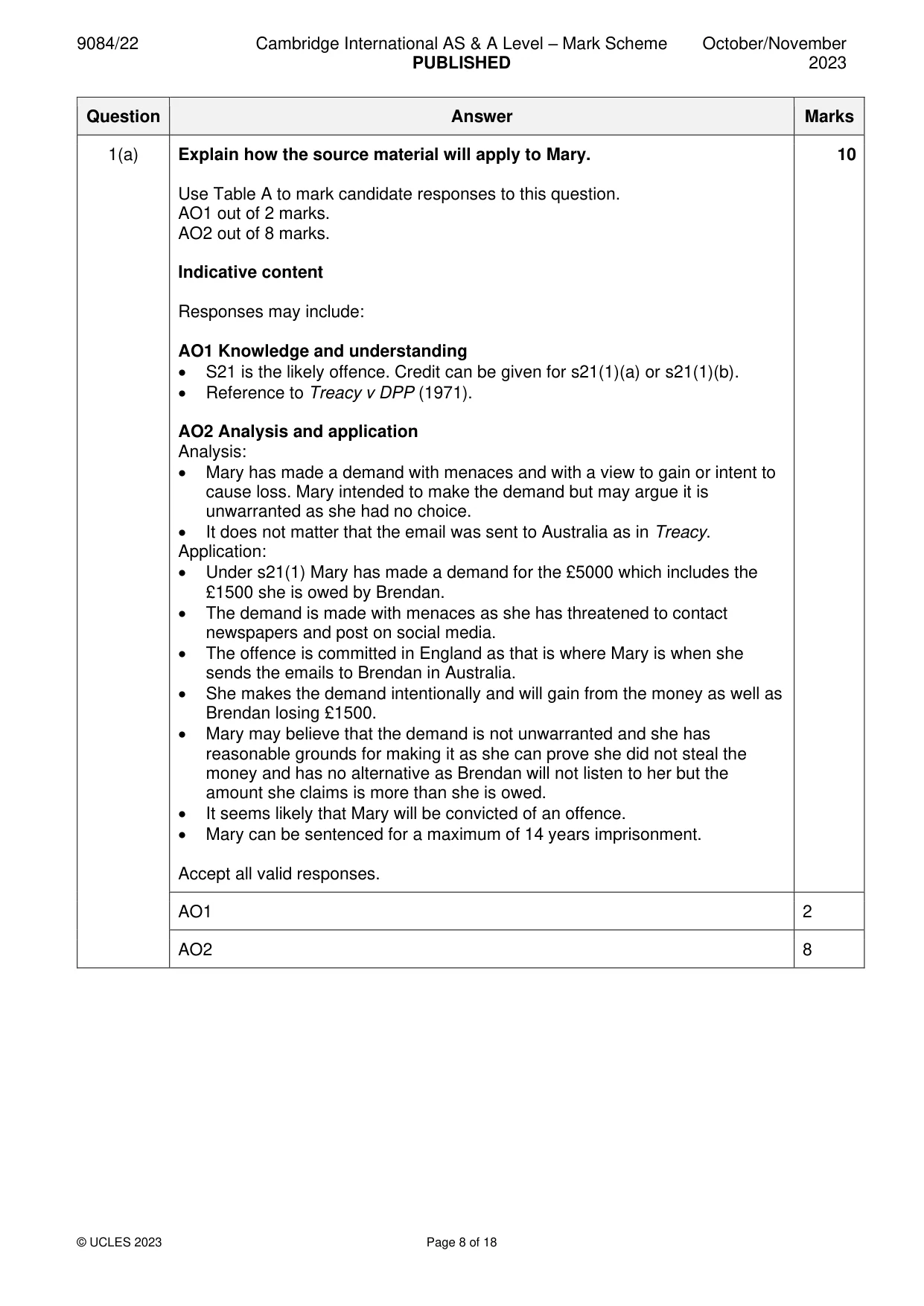
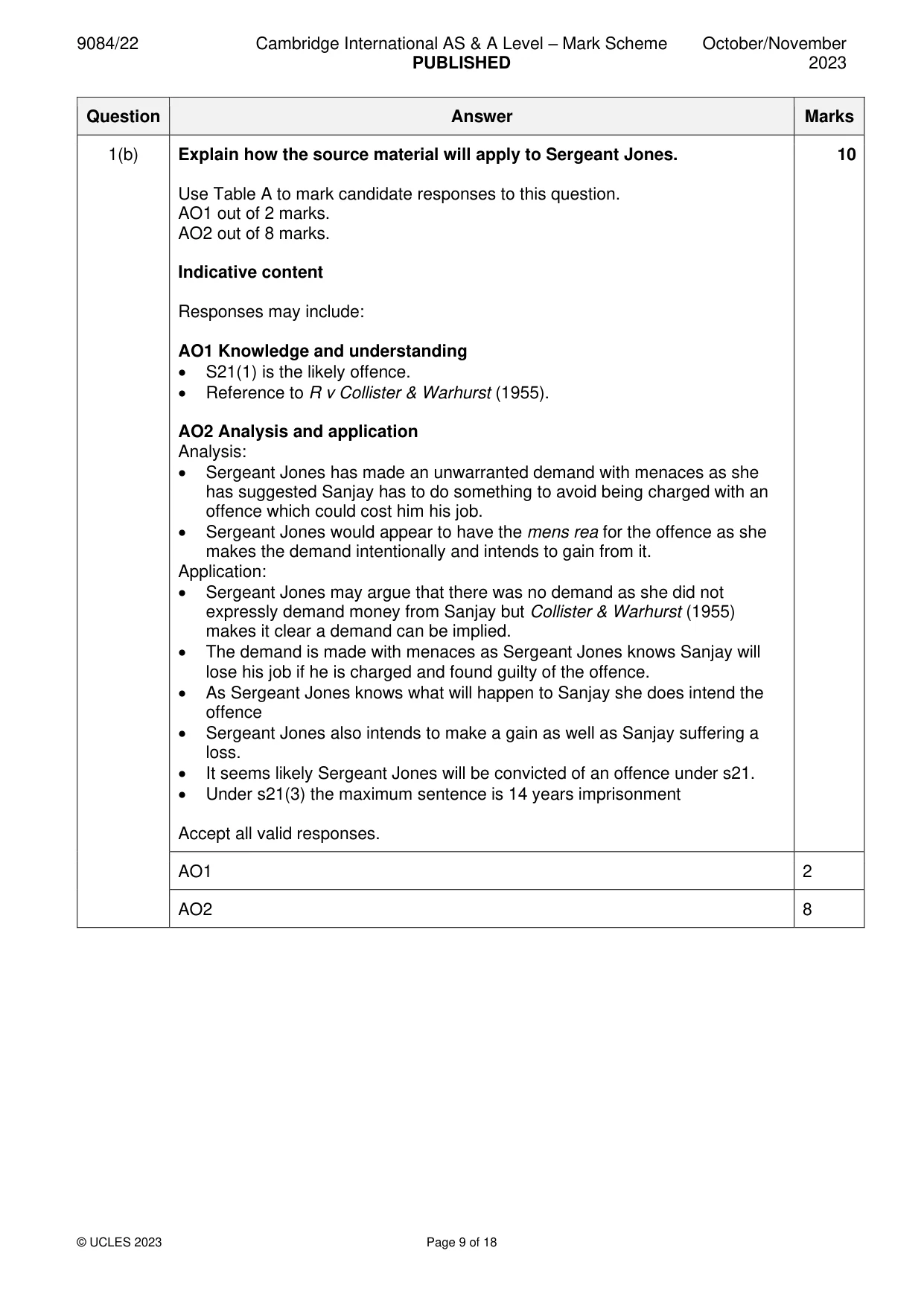
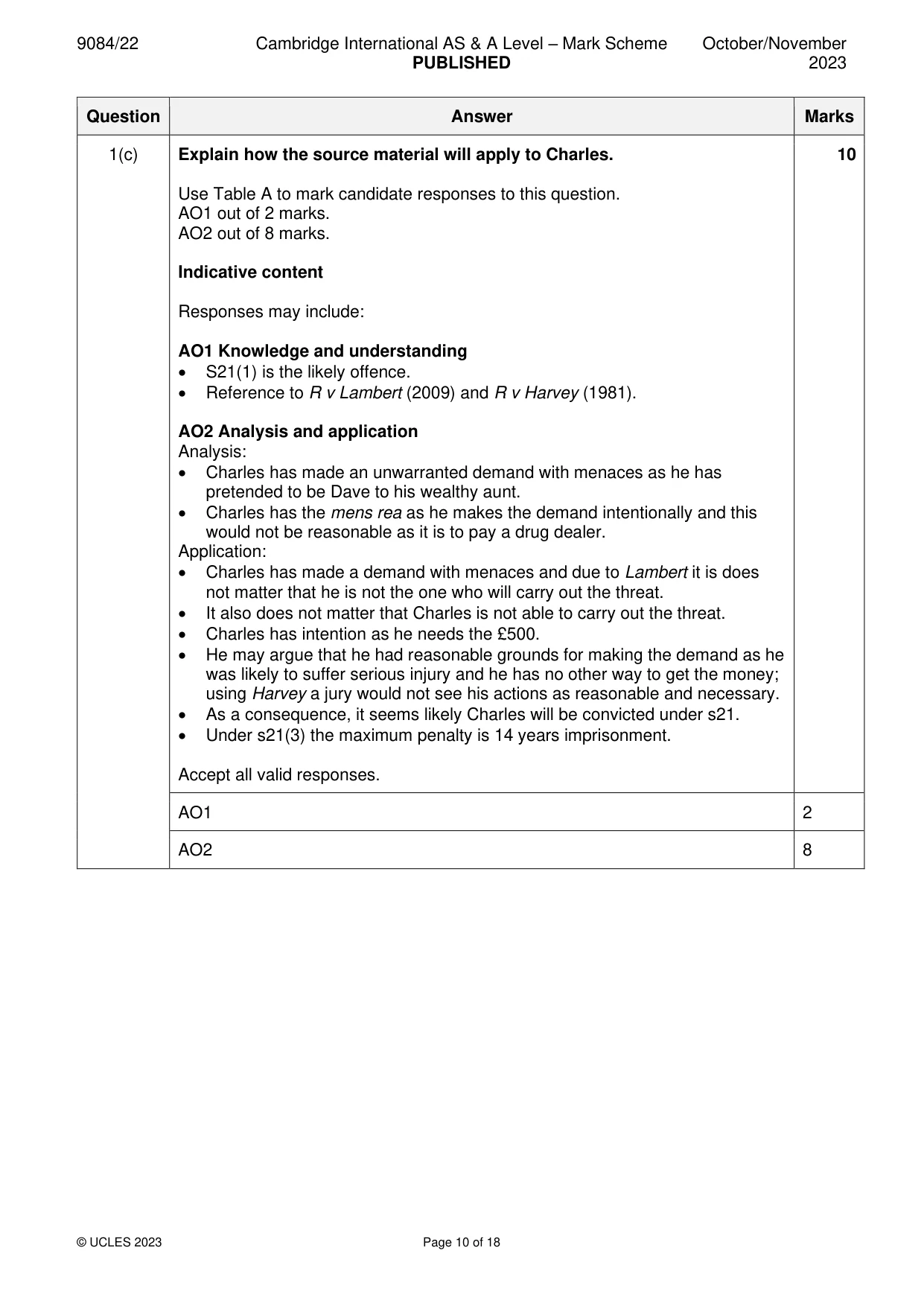
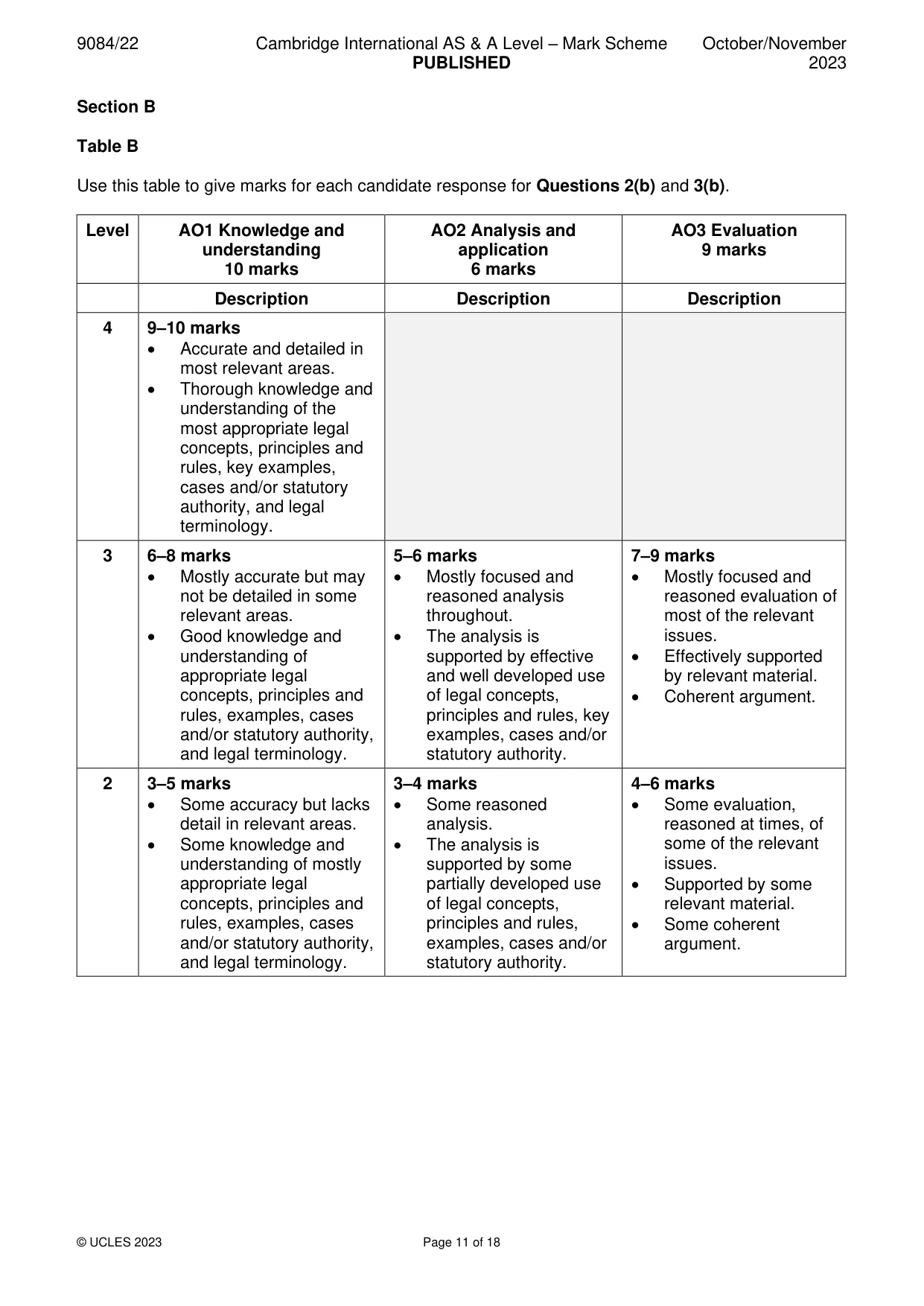
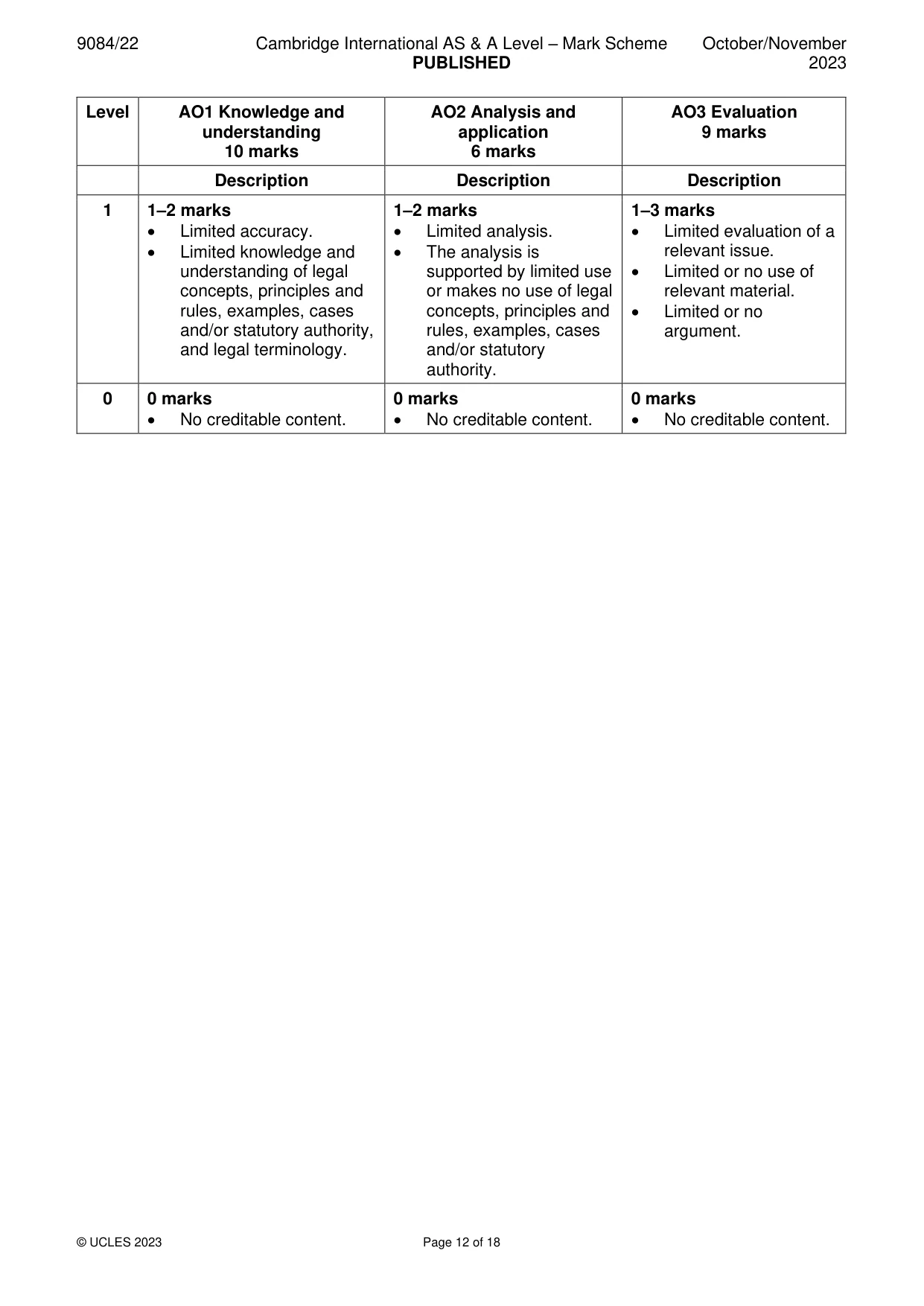
Mark scheme: Question Answer Marks 1(a) Explain how the source material will apply to Mary. 10 Use Table A to mark candidate responses to this question. AO1 out of 2 marks. AO2 out of 8 marks. Indicative content Responses may include: AO1 Knowledge and understanding • S21 is the likely offence. Credit can be given for s21(1)(a) or s21(1)(b). • Reference to Treacy v DPP (1971). AO2 Analysis and application Analysis: • Mary has made a demand with menaces and with a view to gain or intent to cause loss. Mary intended to make the demand but may argue it is unwarranted as she had no choice. • It does not matter that the email was sent to Australia as in Treacy. Application: • Under s21(1) Mary has made a demand for the £5000 which includes the £1500 she is owed by Brendan. • The demand is made with menaces as she has threatened to contact newspapers and post on social media. • The offence is committed in England as that is where Mary is when she sends the emails to Brendan in Australia. • She makes the demand intentionally and will gain from the money as well as Brendan losing £1500. • Mary may believe that the demand is not unwarranted and she has reasonable grounds for making it as she can prove she did not steal the money and has no alternative as Brendan will not listen to her but the amount she claims is more than she is owed. • It seems likely that Mary will be convicted of an offence. • Mary can be sentenced for a maximum of 14 years imprisonment. Accept all valid responses. AO1 2 AO2 8 1(b) Explain how the source material will apply to Sergeant Jones. 10 Use Table A to mark candidate responses to this question. AO1 out of 2 marks. AO2 out of 8 marks. Indicative content Responses may include: AO1 Knowledge and understanding • S21(1) is the likely offence. • Reference to R v Collister & Warhurst (1955). AO2 Analysis and application Analysis: • Sergeant Jones has made an unwarranted demand with menaces as she has suggested Sanjay has to do something to avoid being charged with an offence which could cost him his job. • Sergeant Jones would appear to have the mens rea for the offence as she makes the demand intentionally and intends to gain from it. Application: • Sergeant Jones may argue that there was no demand as she did not expressly demand money from Sanjay but Collister & Warhurst (1955) makes it clear a demand can be implied. • The demand is made with menaces as Sergeant Jones knows Sanjay will lose his job if he is charged and found guilty of the offence. • As Sergeant Jones knows what will happen to Sanjay she does intend the offence • Sergeant Jones also intends to make a gain as well as Sanjay suffering a loss. • It seems likely Sergeant Jones will be convicted of an offence under s21. • Under s21(3) the maximum sentence is 14 years imprisonment Accept all valid responses. AO1 2 AO2 8 1(c) Explain how the source material will apply to Charles. 10 Use Table A to mark candidate responses to this question. AO1 out of 2 marks. AO2 out of 8 marks. Indicative content Responses may include: AO1 Knowledge and understanding • S21(1) is the likely offence. • Reference to R v Lambert (2009) and R v Harvey (1981). AO2 Analysis and application Analysis: • Charles has made an unwarranted demand with menaces as he has pretended to be Dave to his wealthy aunt. • Charles has the mens rea as he makes the demand intentionally and this would not be reasonable as it is to pay a drug dealer. Application: • Charles has made a demand with menaces and due to Lambert it is does not matter that he is not the one who will carry out the threat. • It also does not matter that Charles is not able to carry out the threat. • Charles has intention as he needs the £500. • He may argue that he had reasonable grounds for making the demand as he was likely to suffer serious injury and he has no other way to get the money; using Harvey a jury would not see his actions as reasonable and necessary. • As a consequence, it seems likely Charles will be convicted under s21. • Under s21(3) the maximum penalty is 14 years imprisonment. Accept all valid responses. AO1 2 AO2 8 Section B Table B Use this table to give marks for each candidate response for Questions 2(b) and 3(b). Level AO1 Knowledge and AO2 Analysis and AO3 Evaluation understanding application 9 marks 10 marks 6 marks Description Description Description 4 9–10 marks • Accurate and detailed in most relevant areas. • Thorough knowledge and understanding of the most appropriate legal concepts, principles and rules, key examples, cases and/or statutory authority, and legal terminology. 3 6–8 marks 5–6 marks 7–9 marks • Mostly accurate but may • Mostly focused and • Mostly focused and not be detailed in some reasoned analysis reasoned evaluation of relevant areas. throughout. most of the relevant • Good knowledge and • The analysis is issues. understanding of supported by effective • Effectively supported appropriate legal and well developed use by relevant material. concepts, principles and of legal concepts, • Coherent argument. rules, examples, cases principles and rules, key and/or statutory authority, examples, cases and/or and legal terminology. statutory authority. 2 3–5 marks 3–4 marks 4–6 marks • Some accuracy but lacks • Some reasoned • Some evaluation, detail in relevant areas. analysis. reasoned at times, of • Some knowledge and • The analysis is some of the relevant understanding of mostly supported by some issues. appropriate legal partially developed use • Supported by some concepts, principles and of legal concepts, relevant material. rules, examples, cases principles and rules, • Some coherent and/or statutory authority, examples, cases and/or argument. and legal terminology. statutory authority. Level AO1 Knowledge and AO2 Analysis and AO3 Evaluation understanding application 9 marks 10 marks 6 marks Description Description Description 1 1–2 marks 1–2 marks 1–3 marks • Limited accuracy. • Limited analysis. • Limited evaluation of a • Limited knowledge and • The analysis is relevant issue. understanding of legal supported by limited use • Limited or no use of concepts, principles and or makes no use of legal relevant material. rules, examples, cases concepts, principles and • Limited or no and/or statutory authority, rules, examples, cases argument. and legal terminology. and/or statutory authority. 0 0 marks 0 marks 0 marks • No creditable content. • No creditable content. • No creditable content.
Q2 · Describe the offence of aggravated burglary
2 (a) Describe the offence of aggravated burglary. [5] (b) Evaluate the law on omissions in actus reus. [25] OR
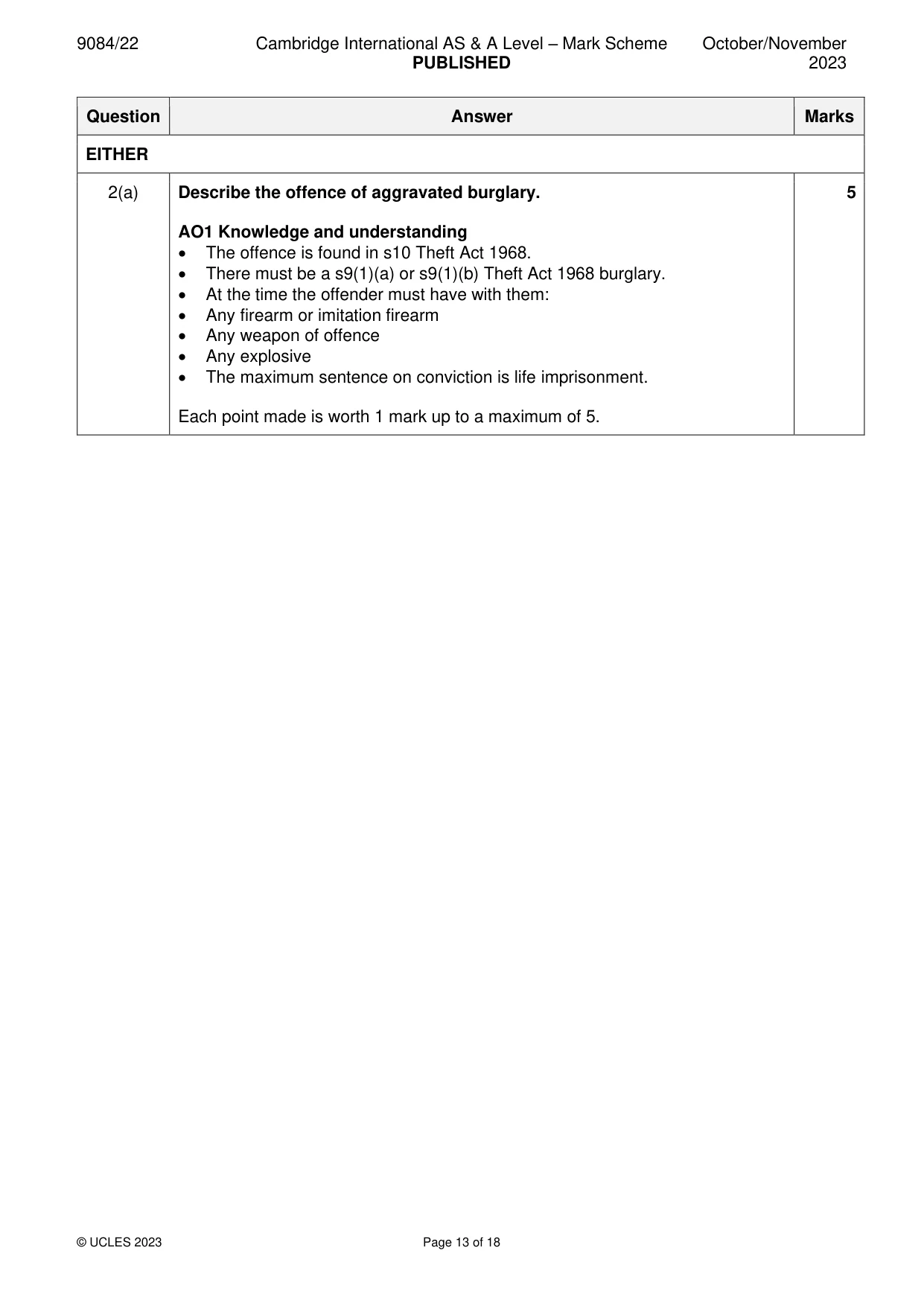
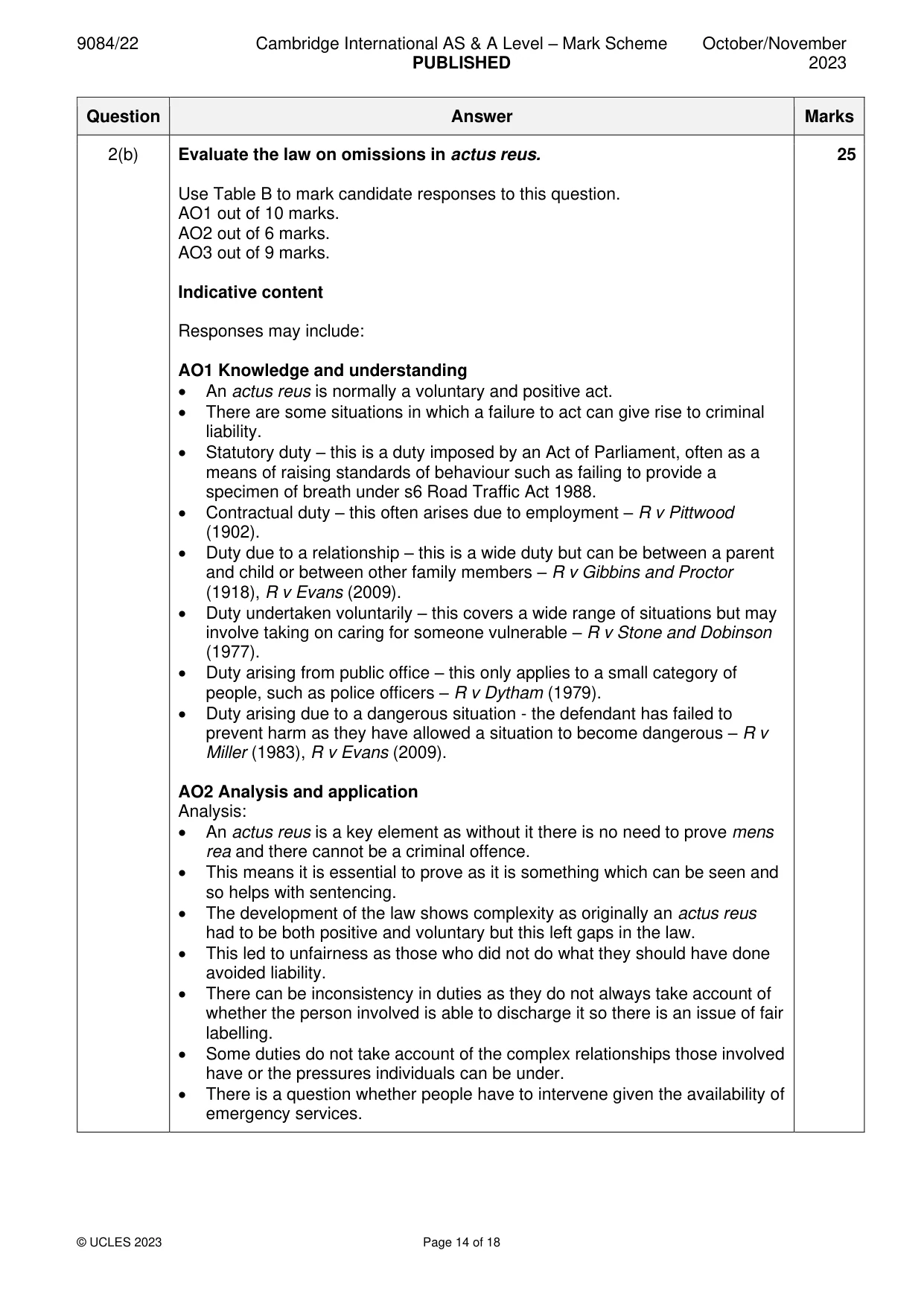
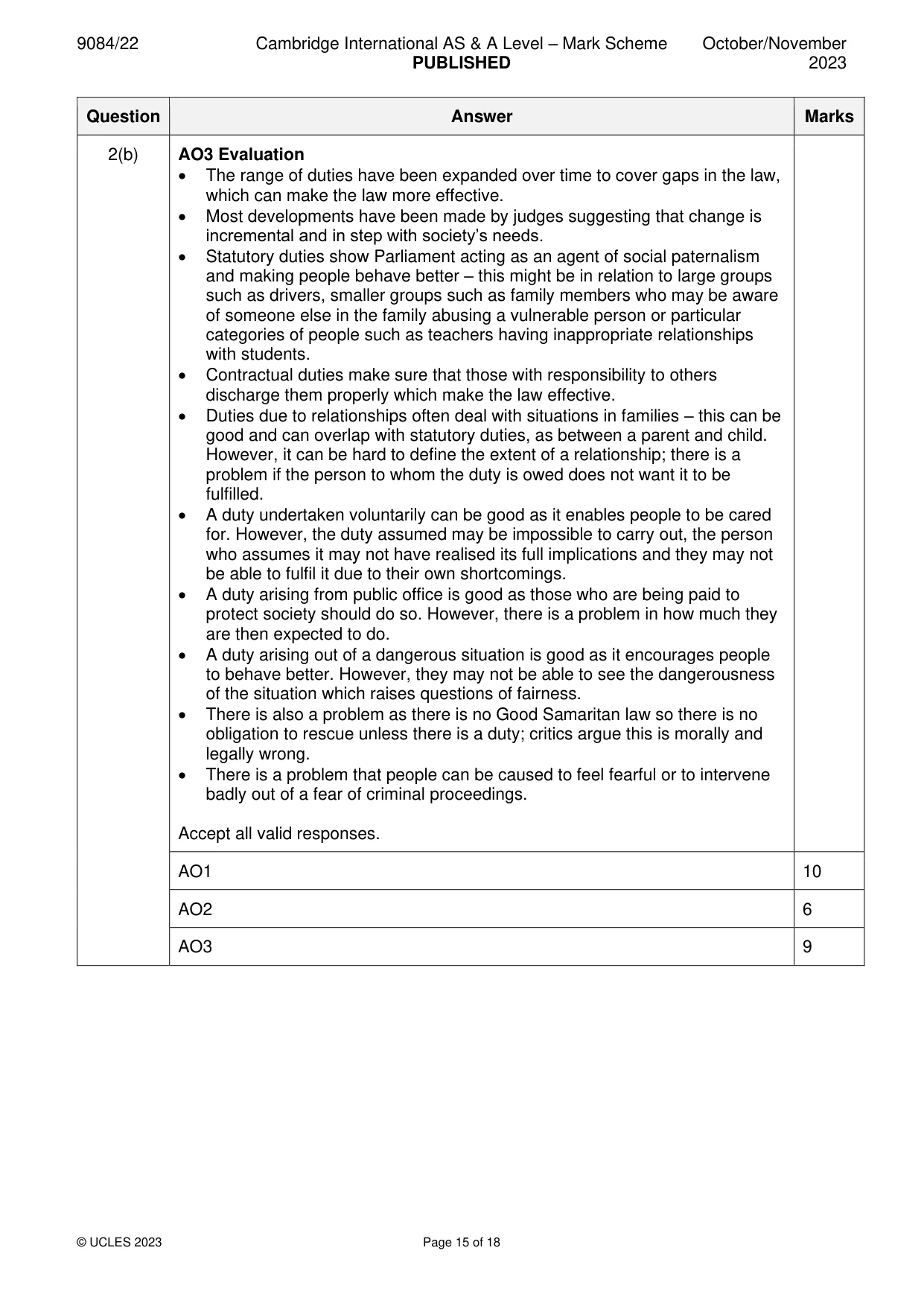
Mark scheme: 2(a) Describe the offence of aggravated burglary. 5 AO1 Knowledge and understanding • The offence is found in s10 Theft Act 1968. • There must be a s9(1)(a) or s9(1)(b) Theft Act 1968 burglary. • At the time the offender must have with them: • Any firearm or imitation firearm • Any weapon of offence • Any explosive • The maximum sentence on conviction is life imprisonment. Each point made is worth 1 mark up to a maximum of 5. 2(b) Evaluate the law on omissions in actus reus. 25 Use Table B to mark candidate responses to this question. AO1 out of 10 marks. AO2 out of 6 marks. AO3 out of 9 marks. Indicative content Responses may include: AO1 Knowledge and understanding • An actus reus is normally a voluntary and positive act. • There are some situations in which a failure to act can give rise to criminal liability. • Statutory duty – this is a duty imposed by an Act of Parliament, often as a means of raising standards of behaviour such as failing to provide a specimen of breath under s6 Road Traffic Act 1988. • Contractual duty – this often arises due to employment – R v Pittwood (1902). • Duty due to a relationship – this is a wide duty but can be between a parent and child or between other family members – R v Gibbins and Proctor (1918), R v Evans (2009). • Duty undertaken voluntarily – this covers a wide range of situations but may involve taking on caring for someone vulnerable – R v Stone and Dobinson (1977). • Duty arising from public office – this only applies to a small category of people, such as police officers – R v Dytham (1979). • Duty arising due to a dangerous situation - the defendant has failed to prevent harm as they have allowed a situation to become dangerous – R v Miller (1983), R v Evans (2009). AO2 Analysis and application Analysis: • An actus reus is a key element as without it there is no need to prove mens rea and there cannot be a criminal offence. • This means it is essential to prove as it is something which can be seen and so helps with sentencing. • The development of the law shows complexity as originally an actus reus had to be both positive and voluntary but this left gaps in the law. • This led to unfairness as those who did not do what they should have done avoided liability. • There can be inconsistency in duties as they do not always take account of whether the person involved is able to discharge it so there is an issue of fair labelling. • Some duties do not take account of the complex relationships those involved have or the pressures individuals can be under. • There is a question whether people have to intervene given the availability of emergency services. 2(b) AO3 Evaluation • The range of duties have been expanded over time to cover gaps in the law, which can make the law more effective. • Most developments have been made by judges suggesting that change is incremental and in step with society’s needs. • Statutory duties show Parliament acting as an agent of social paternalism and making people behave better – this might be in relation to large groups such as drivers, smaller groups such as family members who may be aware of someone else in the family abusing a vulnerable person or particular categories of people such as teachers having inappropriate relationships with students. • Contractual duties make sure that those with responsibility to others discharge them properly which make the law effective. • Duties due to relationships often deal with situations in families – this can be good and can overlap with statutory duties, as between a parent and child. However, it can be hard to define the extent of a relationship; there is a problem if the person to whom the duty is owed does not want it to be fulfilled. • A duty undertaken voluntarily can be good as it enables people to be cared for. However, the duty assumed may be impossible to carry out, the person who assumes it may not have realised its full implications and they may not be able to fulfil it due to their own shortcomings. • A duty arising from public office is good as those who are being paid to protect society should do so. However, there is a problem in how much they are then expected to do. • A duty arising out of a dangerous situation is good as it encourages people to behave better. However, they may not be able to see the dangerousness of the situation which raises questions of fairness. • There is also a problem as there is no Good Samaritan law so there is no obligation to rescue unless there is a duty; critics argue this is morally and legally wrong. • There is a problem that people can be caused to feel fearful or to intervene badly out of a fear of criminal proceedings. Accept all valid responses. AO1 10 AO2 6 AO3 9
Q3 · Describe the community sentences available for an adult offender
3 (a) Describe the community sentences available for an adult offender. [5] (b) Evaluate to what extent rehabilitation is the most effective aim when sentencing young offenders. [25] Source material for Question 1 Section 21 Theft Act 1968 (1) A person is guilty of blackmail if, with a view to gain for himself or another or with intent to cause loss to another, he makes any unwarranted demand with menaces; and for this purpose a demand with menaces is unwarranted unless the person making it does so in the belief— (a) that he has reasonable grounds for making the demand; and (b) that the use of the menaces is a proper means of reinforcing the demand. (2) The nature of the act or omission demanded is immaterial, and it is also immaterial whether the menaces relate to action to be taken by the person making the demand. (3) A person guilty of blackmail shall on conviction on indictment be liable to imprisonment for a term not exceeding fourteen years. R v Collister and Warhurst (1955) The two defendants were police officers. They intimated to the complainant that he would be prosecuted for an offence. They arranged to meet him the next day and told him the report of the offence would not occur unless he failed to turn up for the meeting. At the meeting one of the officers asked the complainant if he had anything for him. The complainant handed over £5. The defendants were convicted of blackmail and appealed contending they did not make any demand. Held: The convictions were upheld. The demand need not be express but can be implied from conduct and circumstances. Treacy v DPP (1971) The defendant posted a letter to a person in Germany containing a demand with menaces. She posted it from England and it was received in Germany. She argued that the demand did not take effect until it was received and therefore she could not be tried in England as the offence was committed in Germany. Held: The House of Lords held the demand was made as soon as the letter was posted. R v Harvey (1981) The three defendants had given £20 000 to the complainant for a consignment of cannabis. The consignment, however, turned out to be worthless. In response the defendants kidnapped the complainant’s wife and child and threatened to seriously harm them unless he returned their money. The trial judge directed the jury that threats to commit serious criminal offences could never be regarded as ‘proper’. The jury convicted them of blackmail and they appealed on the grounds of a mis-direction. Held: The convictions were upheld. The trial judge was wrong not to leave the question of belief that the demand was proper to the jury. The Court of Appeal was satisfied that a jury properly directed would have inevitably convicted. R v Lambert (2009) The appellant was owed money by Aaron. He phoned up Aaron’s grandmother and pretended to be Aaron. Posing as Aaron, he claimed that he had been tied up and that his captors were demanding £5000. He was convicted of blackmail and appealed contending that since in the making of the call he had not made any threat towards Aaron (as he was posing as the victim of threats) neither was it in his power to carry out any such threat. Held: Conviction upheld. There is no requirement that the person making the demand is to be the one who carries out any of the threatened action or that the demander is in a position to carry out the threatened action.
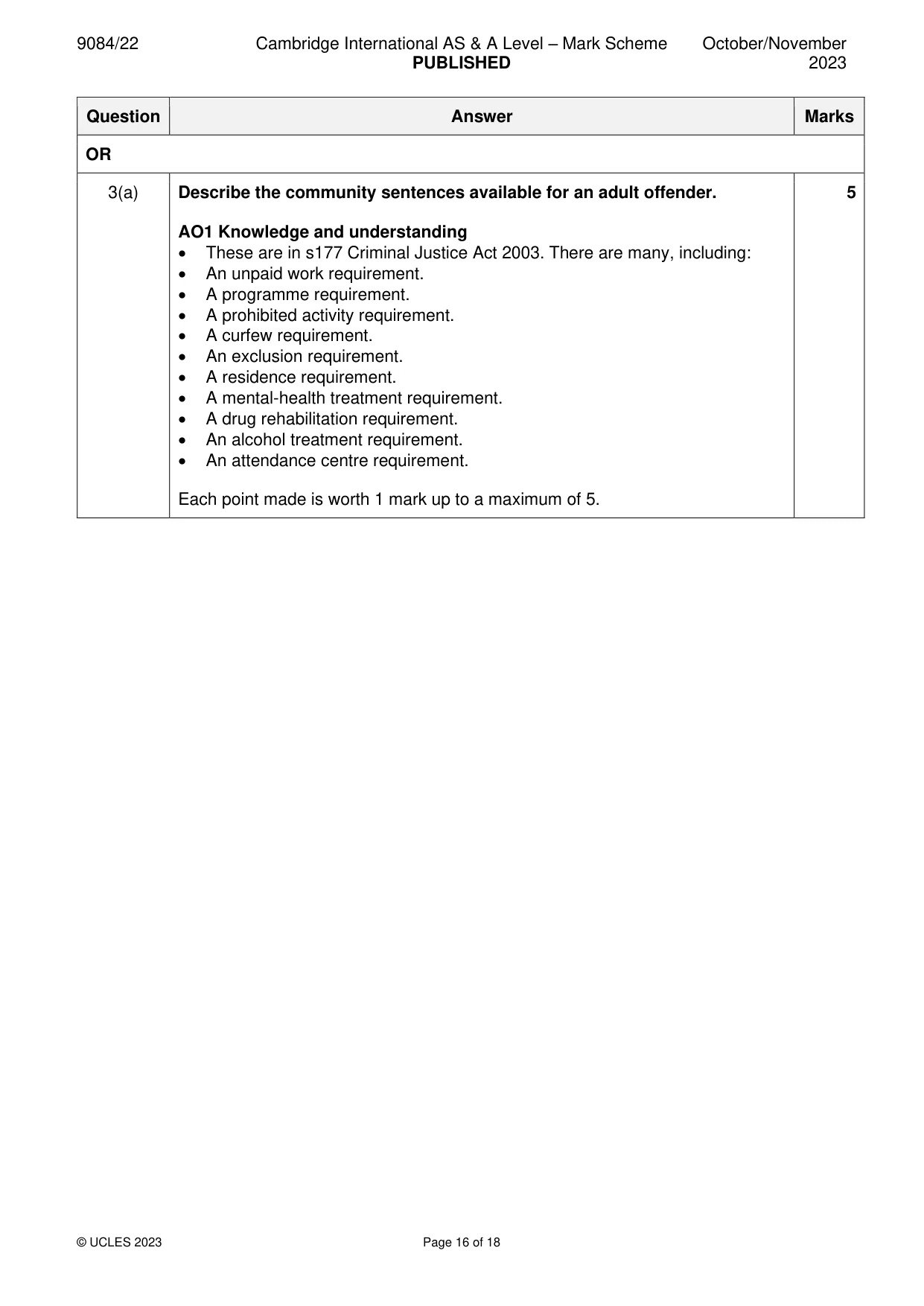
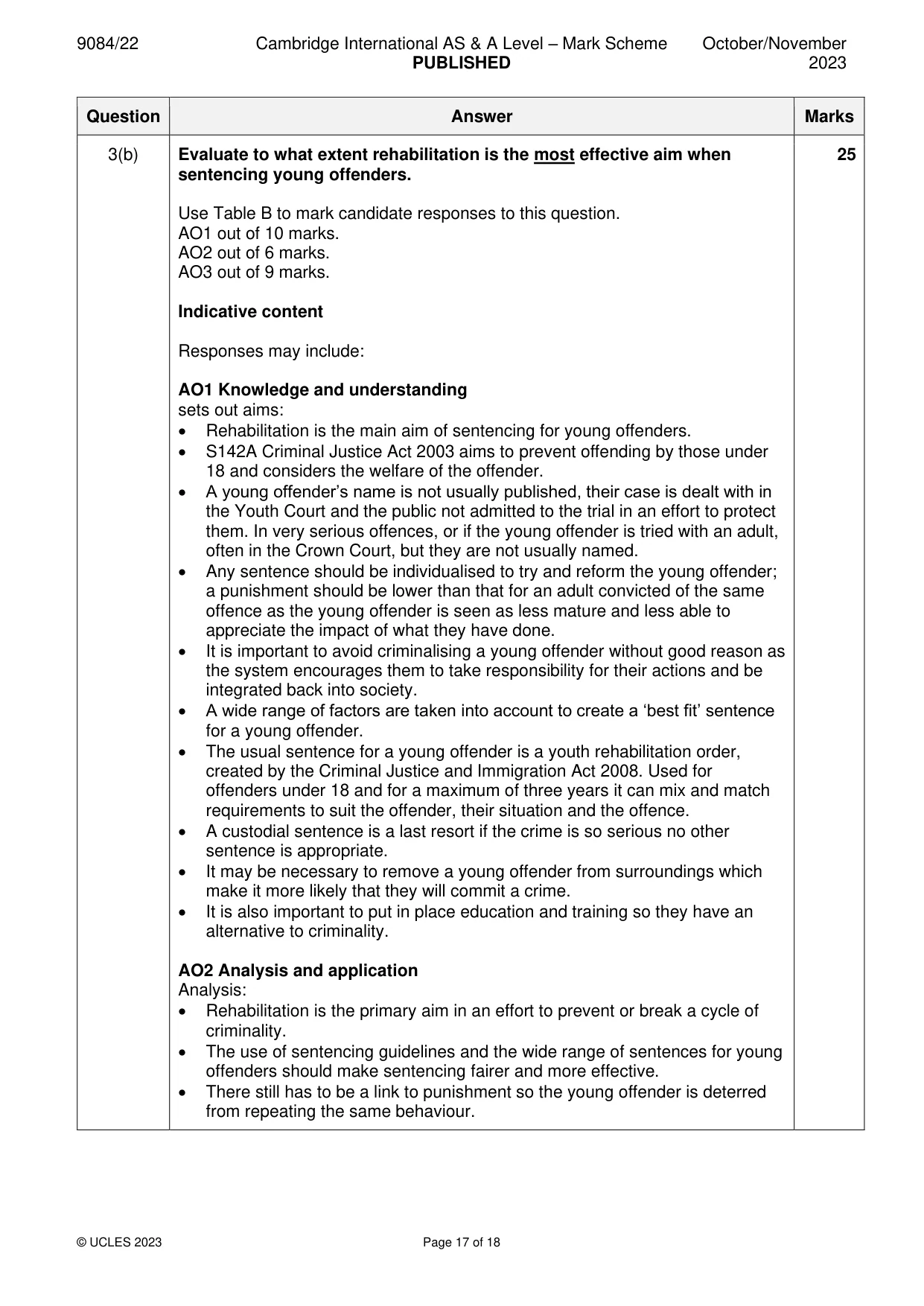
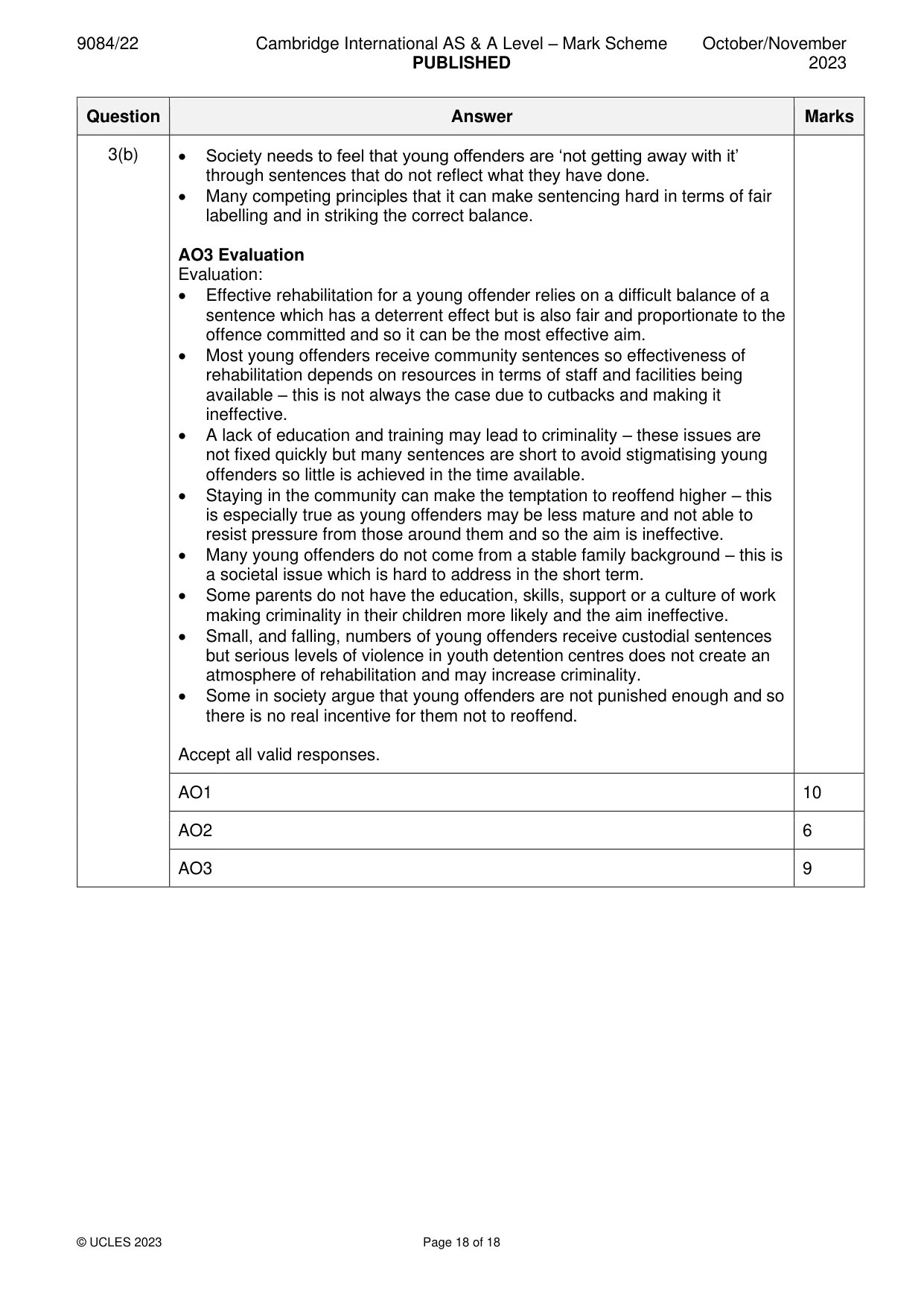
Mark scheme: 3(a) Describe the community sentences available for an adult offender. 5 AO1 Knowledge and understanding • These are in s177 Criminal Justice Act 2003. There are many, including: • An unpaid work requirement. • A programme requirement. • A prohibited activity requirement. • A curfew requirement. • An exclusion requirement. • A residence requirement. • A mental-health treatment requirement. • A drug rehabilitation requirement. • An alcohol treatment requirement. • An attendance centre requirement. Each point made is worth 1 mark up to a maximum of 5. 3(b) Evaluate to what extent rehabilitation is the most effective aim when 25 sentencing young offenders. Use Table B to mark candidate responses to this question. AO1 out of 10 marks. AO2 out of 6 marks. AO3 out of 9 marks. Indicative content Responses may include: AO1 Knowledge and understanding sets out aims: • Rehabilitation is the main aim of sentencing for young offenders. • S142A Criminal Justice Act 2003 aims to prevent offending by those under 18 and considers the welfare of the offender. • A young offender’s name is not usually published, their case is dealt with in the Youth Court and the public not admitted to the trial in an effort to protect them. In very serious offences, or if the young offender is tried with an adult, often in the Crown Court, but they are not usually named. • Any sentence should be individualised to try and reform the young offender; a punishment should be lower than that for an adult convicted of the same offence as the young offender is seen as less mature and less able to appreciate the impact of what they have done. • It is important to avoid criminalising a young offender without good reason as the system encourages them to take responsibility for their actions and be integrated back into society. • A wide range of factors are taken into account to create a ‘best fit’ sentence for a young offender. • The usual sentence for a young offender is a youth rehabilitation order, created by the Criminal Justice and Immigration Act 2008. Used for offenders under 18 and for a maximum of three years it can mix and match requirements to suit the offender, their situation and the offence. • A custodial sentence is a last resort if the crime is so serious no other sentence is appropriate. • It may be necessary to remove a young offender from surroundings which make it more likely that they will commit a crime. • It is also important to put in place education and training so they have an alternative to criminality. AO2 Analysis and application Analysis: • Rehabilitation is the primary aim in an effort to prevent or break a cycle of criminality. • The use of sentencing guidelines and the wide range of sentences for young offenders should make sentencing fairer and more effective. • There still has to be a link to punishment so the young offender is deterred from repeating the same behaviour. 3(b) • Society needs to feel that young offenders are ‘not getting away with it’ through sentences that do not reflect what they have done. • Many competing principles that it can make sentencing hard in terms of fair labelling and in striking the correct balance. AO3 Evaluation Evaluation: • Effective rehabilitation for a young offender relies on a difficult balance of a sentence which has a deterrent effect but is also fair and proportionate to the offence committed and so it can be the most effective aim. • Most young offenders receive community sentences so effectiveness of rehabilitation depends on resources in terms of staff and facilities being available – this is not always the case due to cutbacks and making it ineffective. • A lack of education and training may lead to criminality – these issues are not fixed quickly but many sentences are short to avoid stigmatising young offenders so little is achieved in the time available. • Staying in the community can make the temptation to reoffend higher – this is especially true as young offenders may be less mature and not able to resist pressure from those around them and so the aim is ineffective. • Many young offenders do not come from a stable family background – this is a societal issue which is hard to address in the short term. • Some parents do not have the education, skills, support or a culture of work making criminality in their children more likely and the aim ineffective. • Small, and falling, numbers of young offenders receive custodial sentences but serious levels of violence in youth detention centres does not create an atmosphere of rehabilitation and may increase criminality. • Some in society argue that young offenders are not punished enough and so there is no real incentive for them not to reoffend. Accept all valid responses. AO1 10 AO2 6 AO3 9
What was in this paper
The subtopics covered by these 3 questions, and how many questions each got. Open one in a new tab to see every Cambridge question on it.
1Offences against property This topic is about the components of substantive offences against property. This topic is an opportunity to reflect on the key concepts of liability, justice, fairness, effectiveness and certainty1Sentencing in England and Wales This topic is about the sentences that can be handed down to both adult and young offenders who have been convicted of offences. This topic is an opportunity to reflect on the key concepts of liability, justice, fairness, power and its limits, and effectiveness1What you needed in this session
Cambridge’s own grade thresholds for 2023 Oct/Nov, Paper 2 · Variant 2. A higher threshold means an easier paper — the bar moves with how the cohort did.