Cambridge A Level Law 9084 — 2024 May/June Paper 2 · Variant 2
9084/22/M/J/24 · 3 questions · 60 marks · ≈68 min
The question paper and its mark scheme, free to read here and free to download. This is Cambridge’s own paper, exactly as it was sat.
Question paper4 pages
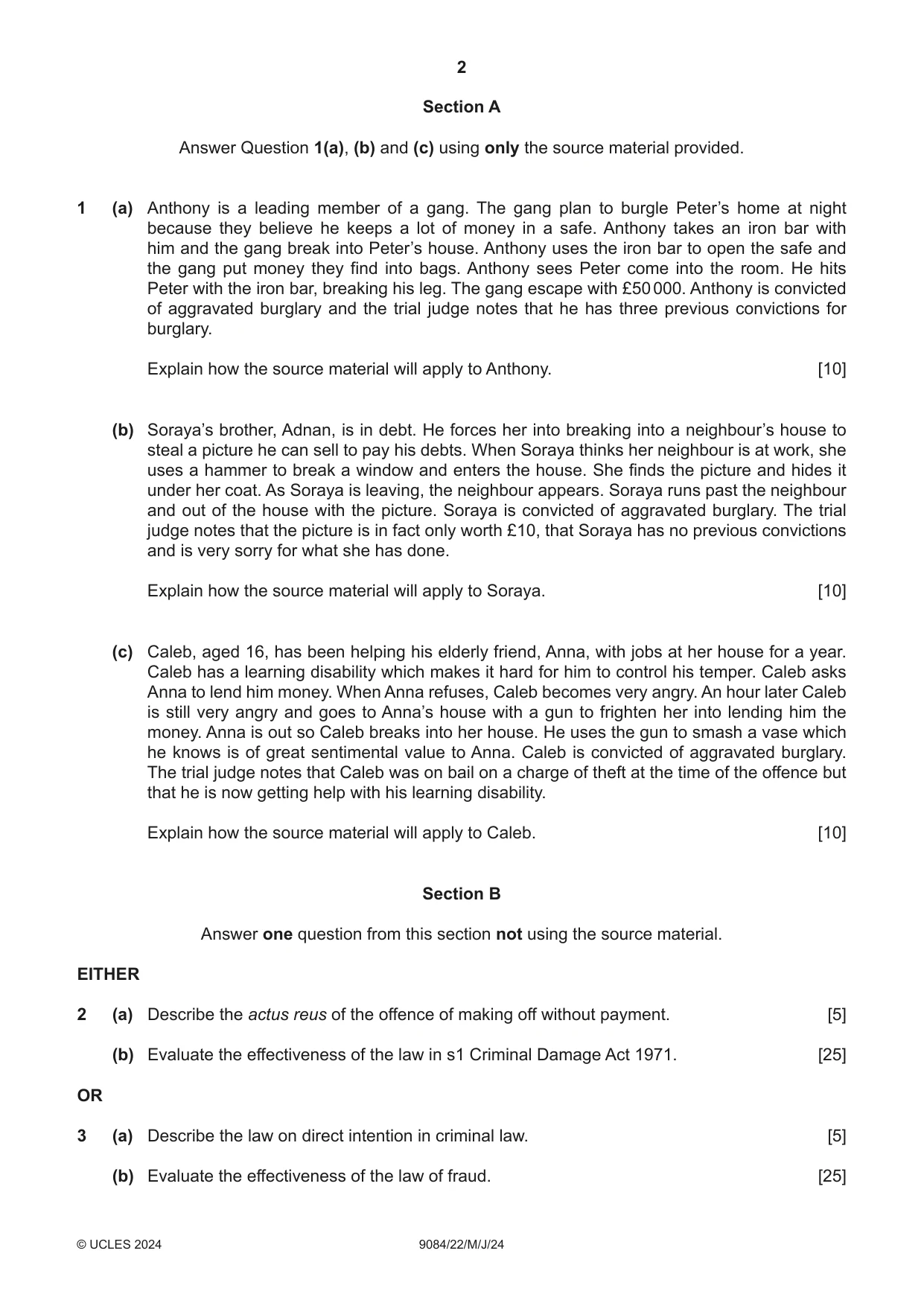
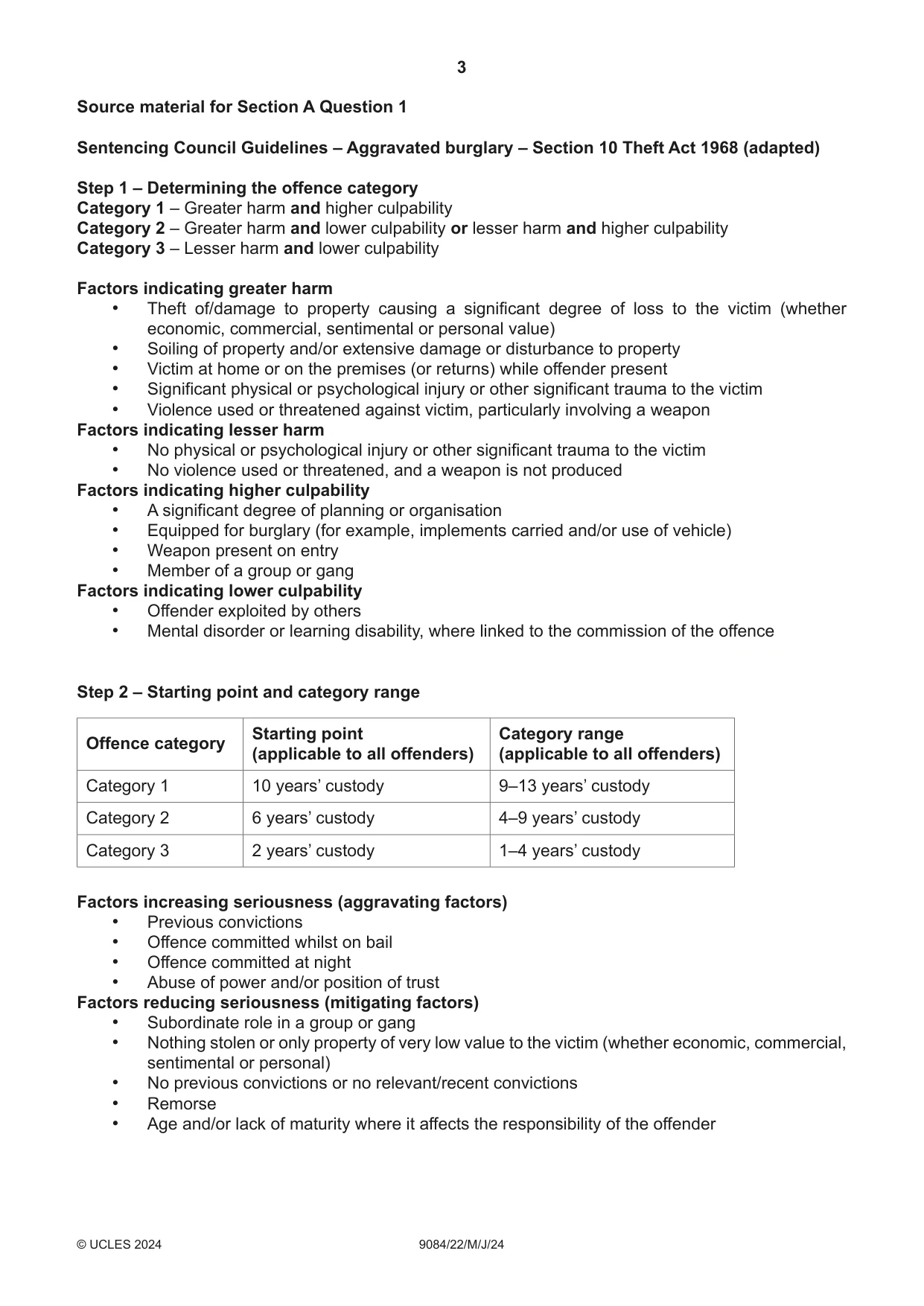

Mark scheme16 pages
Answers below. Sit the paper first if you are practising.

Questions as text
Q1 · Anthony is a leading member of a gang
1 (a) Anthony is a leading member of a gang. The gang plan to burgle Peter’s home at night because they believe he keeps a lot of money in a safe. Anthony takes an iron bar with him and the gang break into Peter’s house. Anthony uses the iron bar to open the safe and the gang put money they find into bags. Anthony sees Peter come into the room. He hits Peter with the iron bar, breaking his leg. The gang escape with £50 000. Anthony is convicted of aggravated burglary and the trial judge notes that he has three previous convictions for burglary. Explain how the source material will apply to Anthony. [10] (b) Soraya’s brother, Adnan, is in debt. He forces her into breaking into a neighbour’s house to steal a picture he can sell to pay his debts. When Soraya thinks her neighbour is at work, she uses a hammer to break a window and enters the house. She finds the picture and hides it under her coat. As Soraya is leaving, the neighbour appears. Soraya runs past the neighbour and out of the house with the picture. Soraya is convicted of aggravated burglary. The trial judge notes that the picture is in fact only worth £10, that Soraya has no previous convictions and is very sorry for what she has done. Explain how the source material will apply to Soraya. [10] (c) Caleb, aged 16, has been helping his elderly friend, Anna, with jobs at her house for a year. Caleb has a learning disability which makes it hard for him to control his temper. Caleb asks Anna to lend him money. When Anna refuses, Caleb becomes very angry. An hour later Caleb is still very angry and goes to Anna’s house with a gun to frighten her into lending him the money. Anna is out so Caleb breaks into her house. He uses the gun to smash a vase which he knows is of great sentimental value to Anna. Caleb is convicted of aggravated burglary. The trial judge notes that Caleb was on bail on a charge of theft at the time of the offence but that he is now getting help with his learning disability. Explain how the source material will apply to Caleb. [10]
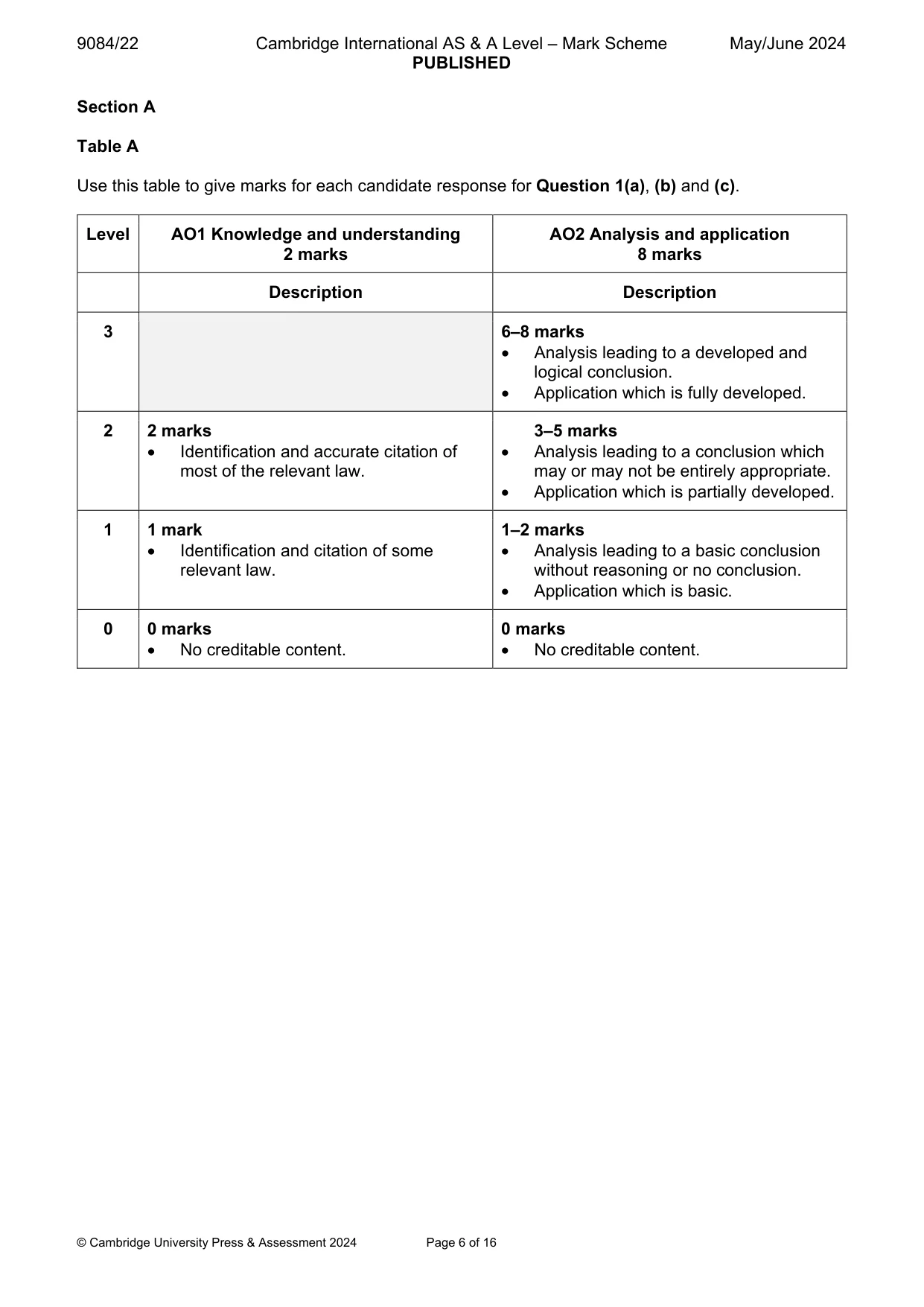
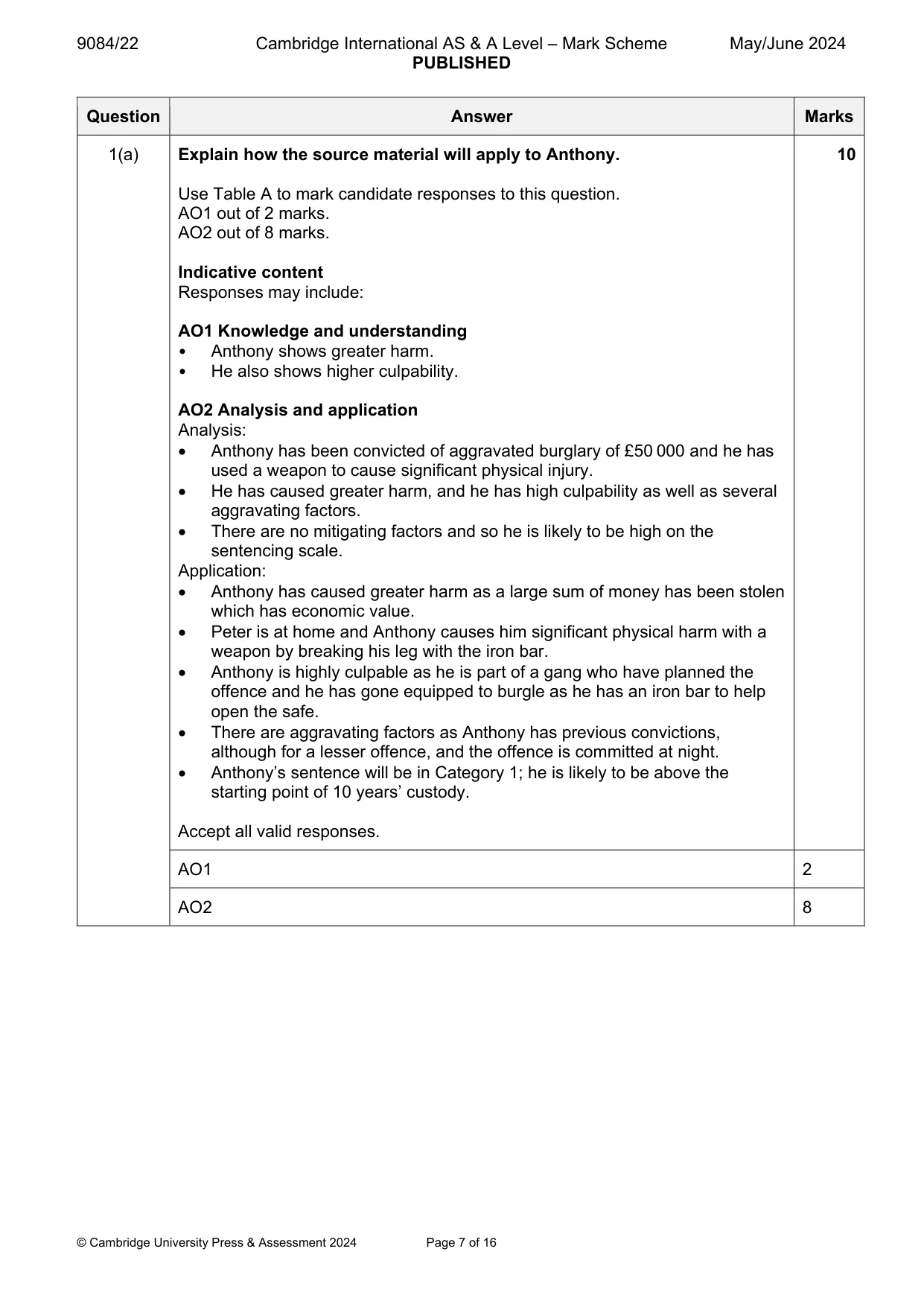
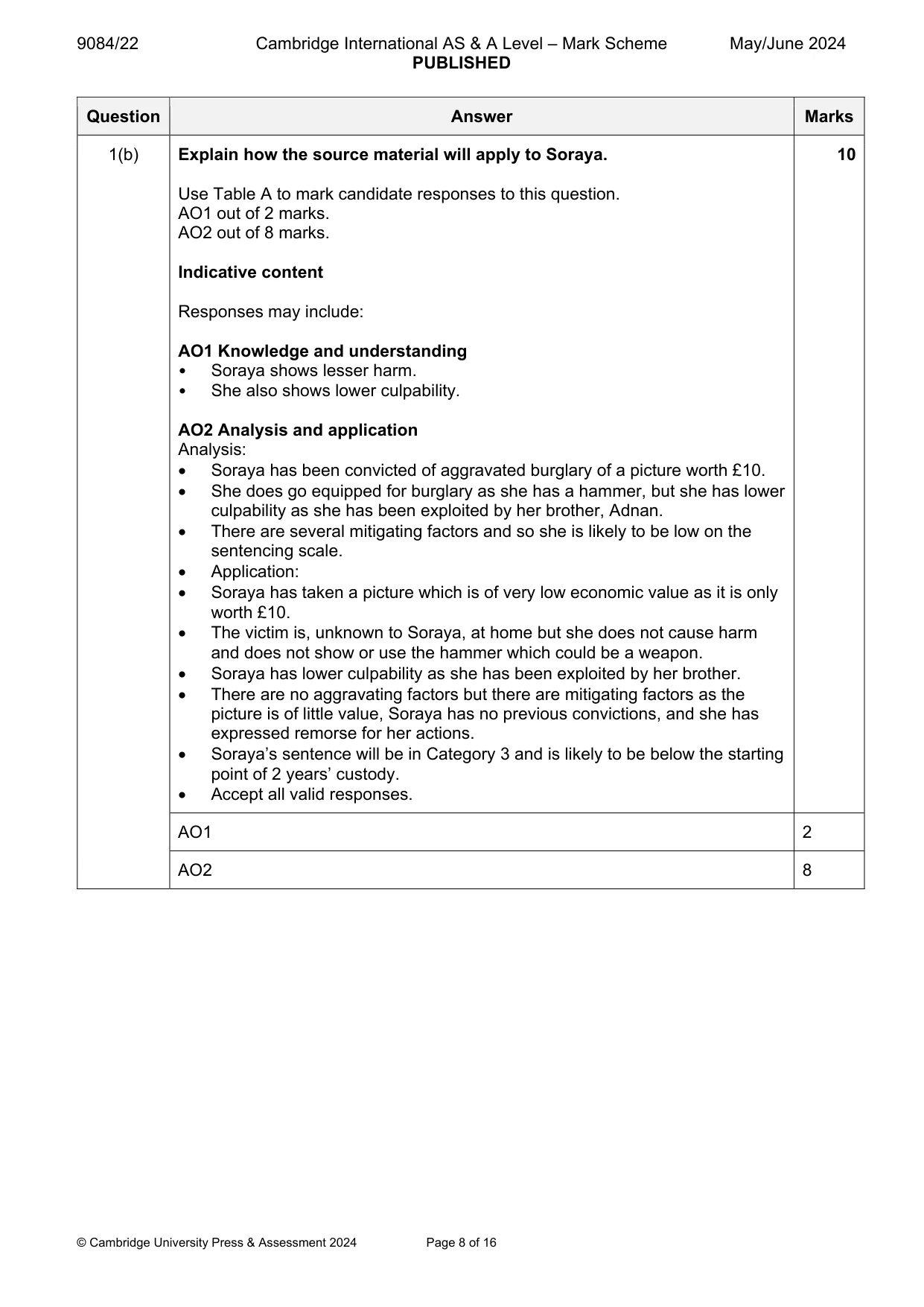
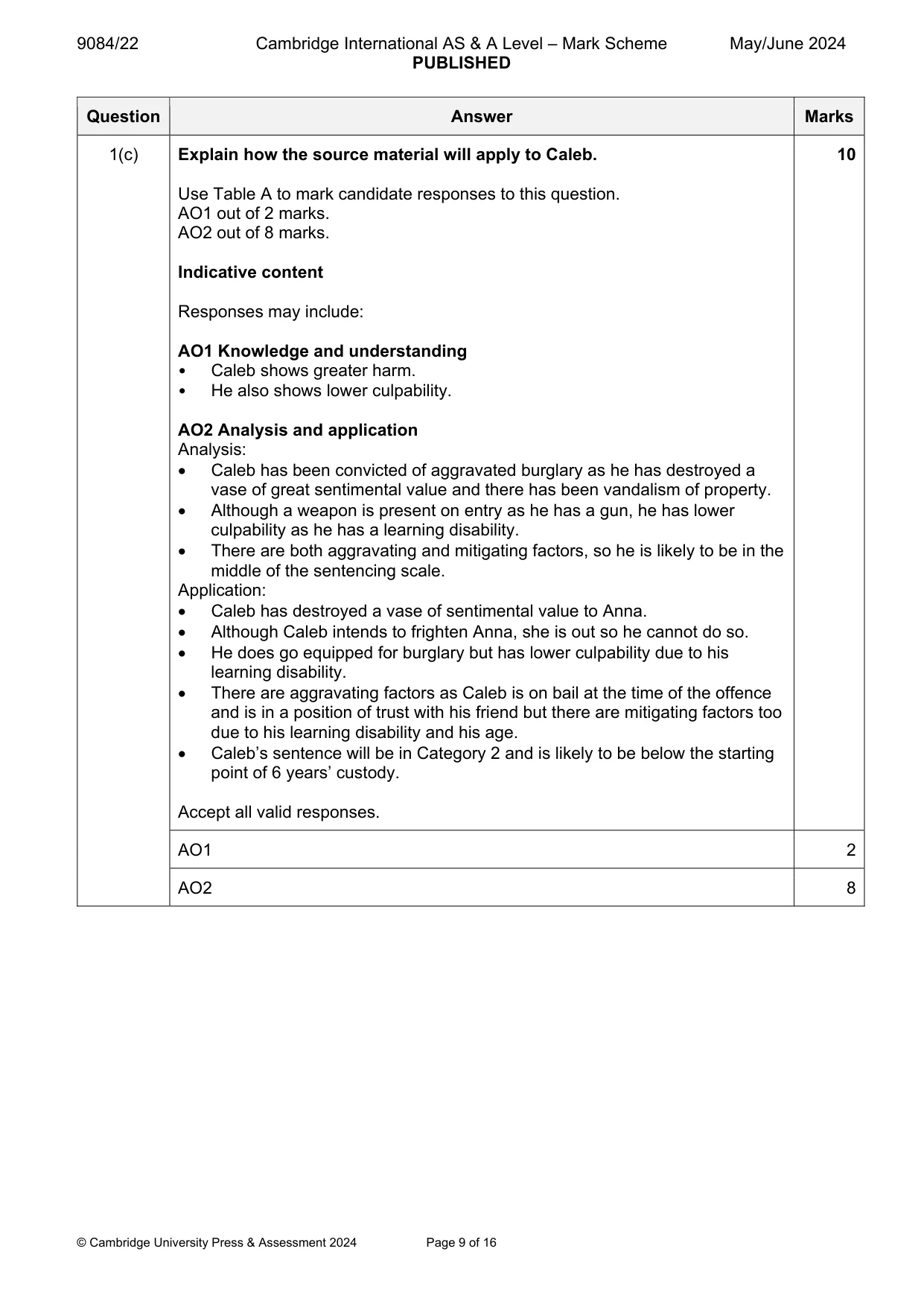
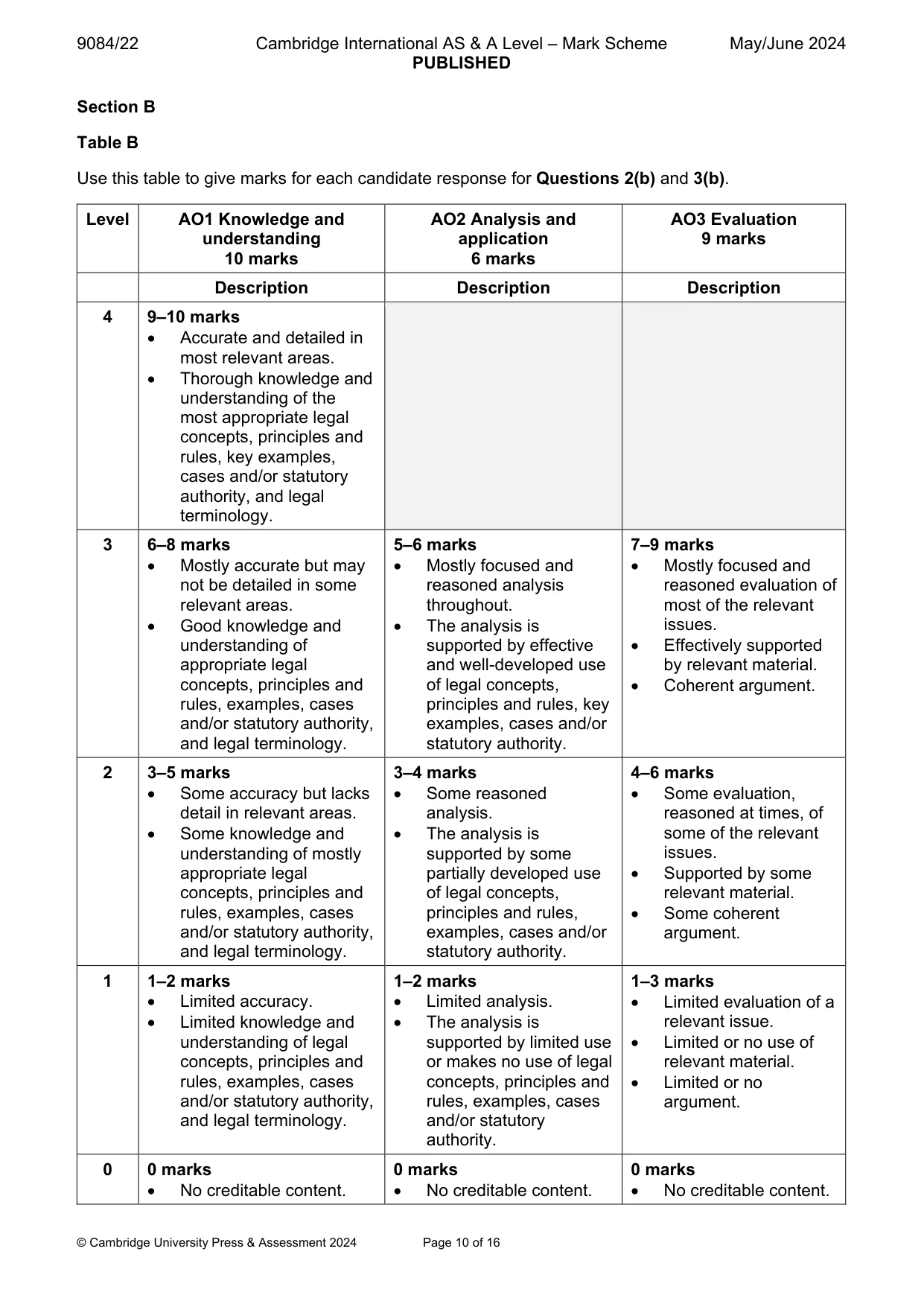
Mark scheme: Question Answer Marks 1(a) Explain how the source material will apply to Anthony. 10 Use Table A to mark candidate responses to this question. AO1 out of 2 marks. AO2 out of 8 marks. Indicative content Responses may include: AO1 Knowledge and understanding • Anthony shows greater harm. • He also shows higher culpability. AO2 Analysis and application Analysis: Anthony has been convicted of aggravated burglary of £50 000 and he has used a weapon to cause significant physical injury. He has caused greater harm, and he has high culpability as well as several aggravating factors. There are no mitigating factors and so he is likely to be high on the sentencing scale. Application: Anthony has caused greater harm as a large sum of money has been stolen which has economic value. Peter is at home and Anthony causes him significant physical harm with a weapon by breaking his leg with the iron bar. Anthony is highly culpable as he is part of a gang who have planned the offence and he has gone equipped to burgle as he has an iron bar to help open the safe. There are aggravating factors as Anthony has previous convictions, although for a lesser offence, and the offence is committed at night. Anthony’s sentence will be in Category 1; he is likely to be above the starting point of 10 years’ custody. Accept all valid responses. AO1 2 AO2 8 1(b) Explain how the source material will apply to Soraya. 10 Use Table A to mark candidate responses to this question. AO1 out of 2 marks. AO2 out of 8 marks. Indicative content Responses may include: AO1 Knowledge and understanding • Soraya shows lesser harm. • She also shows lower culpability. AO2 Analysis and application Analysis: Soraya has been convicted of aggravated burglary of a picture worth £10. She does go equipped for burglary as she has a hammer, but she has lower culpability as she has been exploited by her brother, Adnan. There are several mitigating factors and so she is likely to be low on the sentencing scale. Application: Soraya has taken a picture which is of very low economic value as it is only worth £10. The victim is, unknown to Soraya, at home but she does not cause harm and does not show or use the hammer which could be a weapon. Soraya has lower culpability as she has been exploited by her brother. There are no aggravating factors but there are mitigating factors as the picture is of little value, Soraya has no previous convictions, and she has expressed remorse for her actions. Soraya’s sentence will be in Category 3 and is likely to be below the starting point of 2 years’ custody. Accept all valid responses. AO1 2 AO2 8 1(c) Explain how the source material will apply to Caleb. 10 Use Table A to mark candidate responses to this question. AO1 out of 2 marks. AO2 out of 8 marks. Indicative content Responses may include: AO1 Knowledge and understanding • Caleb shows greater harm. • He also shows lower culpability. AO2 Analysis and application Analysis: Caleb has been convicted of aggravated burglary as he has destroyed a vase of great sentimental value and there has been vandalism of property. Although a weapon is present on entry as he has a gun, he has lower culpability as he has a learning disability. There are both aggravating and mitigating factors, so he is likely to be in the middle of the sentencing scale. Application: Caleb has destroyed a vase of sentimental value to Anna. Although Caleb intends to frighten Anna, she is out so he cannot do so. He does go equipped for burglary but has lower culpability due to his learning disability. There are aggravating factors as Caleb is on bail at the time of the offence and is in a position of trust with his friend but there are mitigating factors too due to his learning disability and his age. Caleb’s sentence will be in Category 2 and is likely to be below the starting point of 6 years’ custody. Accept all valid responses. AO1 2 AO2 8 Section B Table B Use this table to give marks for each candidate response for Questions 2(b) and 3(b). Level AO1 Knowledge and AO2 Analysis and AO3 Evaluation understanding application 9 marks 10 marks 6 marks Description Description Description 4 9–10 marks Accurate and detailed in most relevant areas. Thorough knowledge and understanding of the most appropriate legal concepts, principles and rules, key examples, cases and/or statutory authority, and legal terminology. 3 6–8 marks 5–6 marks 7–9 marks Mostly accurate but may Mostly focused and Mostly focused and not be detailed in some reasoned analysis reasoned evaluation of relevant areas. throughout. most of the relevant Good knowledge and The analysis is issues. understanding of supported by effective Effectively supported appropriate legal and well-developed use by relevant material. concepts, principles and of legal concepts, Coherent argument. rules, examples, cases principles and rules, key and/or statutory authority, examples, cases and/or and legal terminology. statutory authority. 2 3–5 marks 3–4 marks 4–6 marks Some accuracy but lacks Some reasoned Some evaluation, detail in relevant areas. analysis. reasoned at times, of Some knowledge and The analysis is some of the relevant understanding of mostly supported by some issues. appropriate legal partially developed use Supported by some concepts, principles and of legal concepts, relevant material. rules, examples, cases principles and rules, Some coherent and/or statutory authority, examples, cases and/or argument. and legal terminology. statutory authority. 1 1–2 marks 1–2 marks 1–3 marks Limited accuracy. Limited analysis. Limited evaluation of a Limited knowledge and The analysis is relevant issue. understanding of legal supported by limited use Limited or no use of concepts, principles and or makes no use of legal relevant material. rules, examples, cases concepts, principles and Limited or no and/or statutory authority, rules, examples, cases argument. and legal terminology. and/or statutory authority. 0 0 marks 0 marks 0 marks No creditable content. No creditable content. No creditable content.
Q2 · Describe the actus reus of the offence of making off without payment
2 (a) Describe the actus reus of the offence of making off without payment. [5] (b) Evaluate the effectiveness of the law in s1 Criminal Damage Act 1971. [25] OR
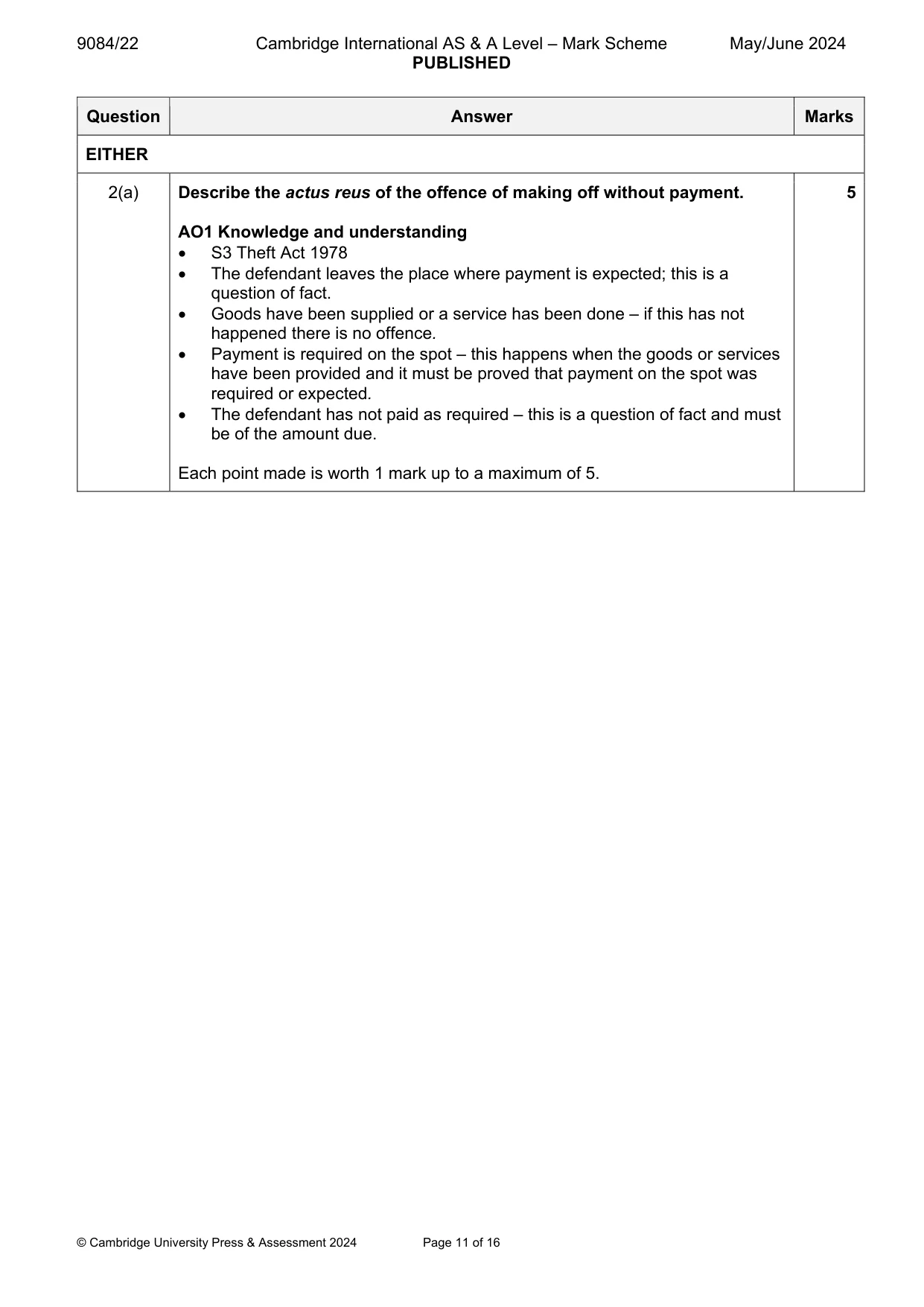
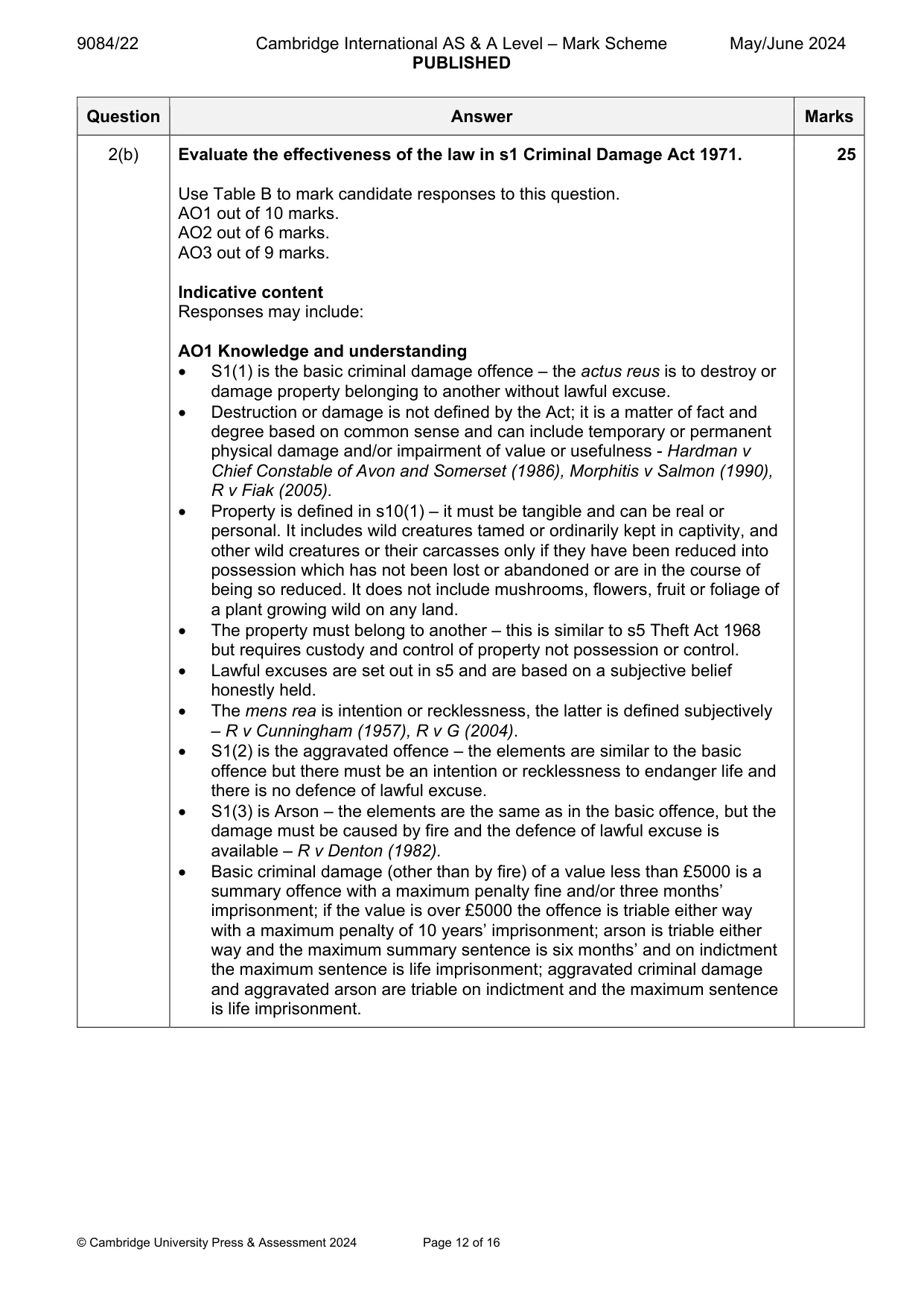
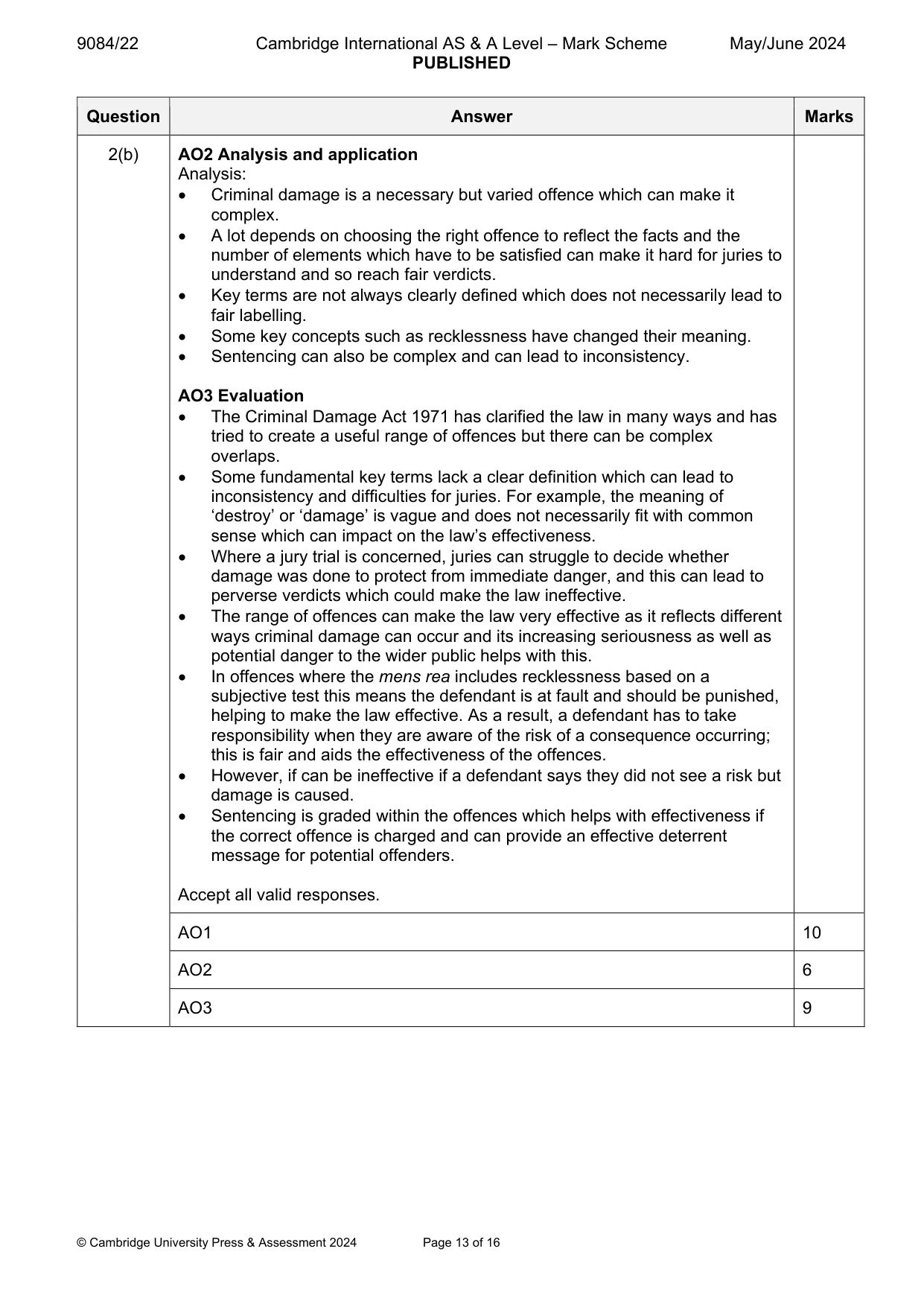
Mark scheme: 2(a) Describe the actus reus of the offence of making off without payment. 5 AO1 Knowledge and understanding S3 Theft Act 1978 The defendant leaves the place where payment is expected; this is a question of fact. Goods have been supplied or a service has been done – if this has not happened there is no offence. Payment is required on the spot – this happens when the goods or services have been provided and it must be proved that payment on the spot was required or expected. The defendant has not paid as required – this is a question of fact and must be of the amount due. Each point made is worth 1 mark up to a maximum of 5. 2(b) Evaluate the effectiveness of the law in s1 Criminal Damage Act 1971. 25 Use Table B to mark candidate responses to this question. AO1 out of 10 marks. AO2 out of 6 marks. AO3 out of 9 marks. Indicative content Responses may include: AO1 Knowledge and understanding S1(1) is the basic criminal damage offence – the actus reus is to destroy or damage property belonging to another without lawful excuse. Destruction or damage is not defined by the Act; it is a matter of fact and degree based on common sense and can include temporary or permanent physical damage and/or impairment of value or usefulness - Hardman v Chief Constable of Avon and Somerset (1986), Morphitis v Salmon (1990), R v Fiak (2005). Property is defined in s10(1) – it must be tangible and can be real or personal. It includes wild creatures tamed or ordinarily kept in captivity, and other wild creatures or their carcasses only if they have been reduced into possession which has not been lost or abandoned or are in the course of being so reduced. It does not include mushrooms, flowers, fruit or foliage of a plant growing wild on any land. The property must belong to another – this is similar to s5 Theft Act 1968 but requires custody and control of property not possession or control. Lawful excuses are set out in s5 and are based on a subjective belief honestly held. The mens rea is intention or recklessness, the latter is defined subjectively – R v Cunningham (1957), R v G (2004). S1(2) is the aggravated offence – the elements are similar to the basic offence but there must be an intention or recklessness to endanger life and there is no defence of lawful excuse. S1(3) is Arson – the elements are the same as in the basic offence, but the damage must be caused by fire and the defence of lawful excuse is available – R v Denton (1982). Basic criminal damage (other than by fire) of a value less than £5000 is a summary offence with a maximum penalty fine and/or three months’ imprisonment; if the value is over £5000 the offence is triable either way with a maximum penalty of 10 years’ imprisonment; arson is triable either way and the maximum summary sentence is six months’ and on indictment the maximum sentence is life imprisonment; aggravated criminal damage and aggravated arson are triable on indictment and the maximum sentence is life imprisonment. 2(b) AO2 Analysis and application Analysis: Criminal damage is a necessary but varied offence which can make it complex. A lot depends on choosing the right offence to reflect the facts and the number of elements which have to be satisfied can make it hard for juries to understand and so reach fair verdicts. Key terms are not always clearly defined which does not necessarily lead to fair labelling. Some key concepts such as recklessness have changed their meaning. Sentencing can also be complex and can lead to inconsistency. AO3 Evaluation The Criminal Damage Act 1971 has clarified the law in many ways and has tried to create a useful range of offences but there can be complex overlaps. Some fundamental key terms lack a clear definition which can lead to inconsistency and difficulties for juries. For example, the meaning of ‘destroy’ or ‘damage’ is vague and does not necessarily fit with common sense which can impact on the law’s effectiveness. Where a jury trial is concerned, juries can struggle to decide whether damage was done to protect from immediate danger, and this can lead to perverse verdicts which could make the law ineffective. The range of offences can make the law very effective as it reflects different ways criminal damage can occur and its increasing seriousness as well as potential danger to the wider public helps with this. In offences where the mens rea includes recklessness based on a subjective test this means the defendant is at fault and should be punished, helping to make the law effective. As a result, a defendant has to take responsibility when they are aware of the risk of a consequence occurring; this is fair and aids the effectiveness of the offences. However, if can be ineffective if a defendant says they did not see a risk but damage is caused. Sentencing is graded within the offences which helps with effectiveness if the correct offence is charged and can provide an effective deterrent message for potential offenders. Accept all valid responses. AO1 10 AO2 6 AO3 9
Q3 · Describe the law on direct intention in criminal law
3 (a) Describe the law on direct intention in criminal law. [5] (b) Evaluate the effectiveness of the law of fraud. [25] Source material for Section A Question 1 Sentencing Council Guidelines – Aggravated burglary – Section 10 Theft Act 1968 (adapted) Step 1 – Determining the offence category Category 1 – Greater harm and higher culpability Category 2 – Greater harm and lower culpability or lesser harm and higher culpability Category 3 – Lesser harm and lower culpability Factors indicating greater harm • Theft of/damage to property causing a significant degree of loss to the victim (whether economic, commercial, sentimental or personal value) • Soiling of property and/or extensive damage or disturbance to property • Victim at home or on the premises (or returns) while offender present • Significant physical or psychological injury or other significant trauma to the victim • Violence used or threatened against victim, particularly involving a weapon Factors indicating lesser harm • No physical or psychological injury or other significant trauma to the victim • No violence used or threatened, and a weapon is not produced Factors indicating higher culpability • A significant degree of planning or organisation • Equipped for burglary (for example, implements carried and/or use of vehicle) • Weapon present on entry • Member of a group or gang Factors indicating lower culpability • Offender exploited by others • Mental disorder or learning disability, where linked to the commission of the offence Step 2 – Starting point and category range Starting point Category range Offence category (applicable to all offenders) (applicable to all offenders) Category 1 10 years’ custody 9–13 years’ custody Category 2 6 years’ custody 4–9 years’ custody Category 3 2 years’ custody 1–4 years’ custody Factors increasing seriousness (aggravating factors) • Previous convictions • Offence committed whilst on bail • Offence committed at night • Abuse of power and/or position of trust Factors reducing seriousness (mitigating factors) • Subordinate role in a group or gang • Nothing stolen or only property of very low value to the victim (whether economic, commercial, sentimental or personal) • No previous convictions or no relevant/recent convictions • Remorse • Age and/or lack of maturity where it affects the responsibility of the offender
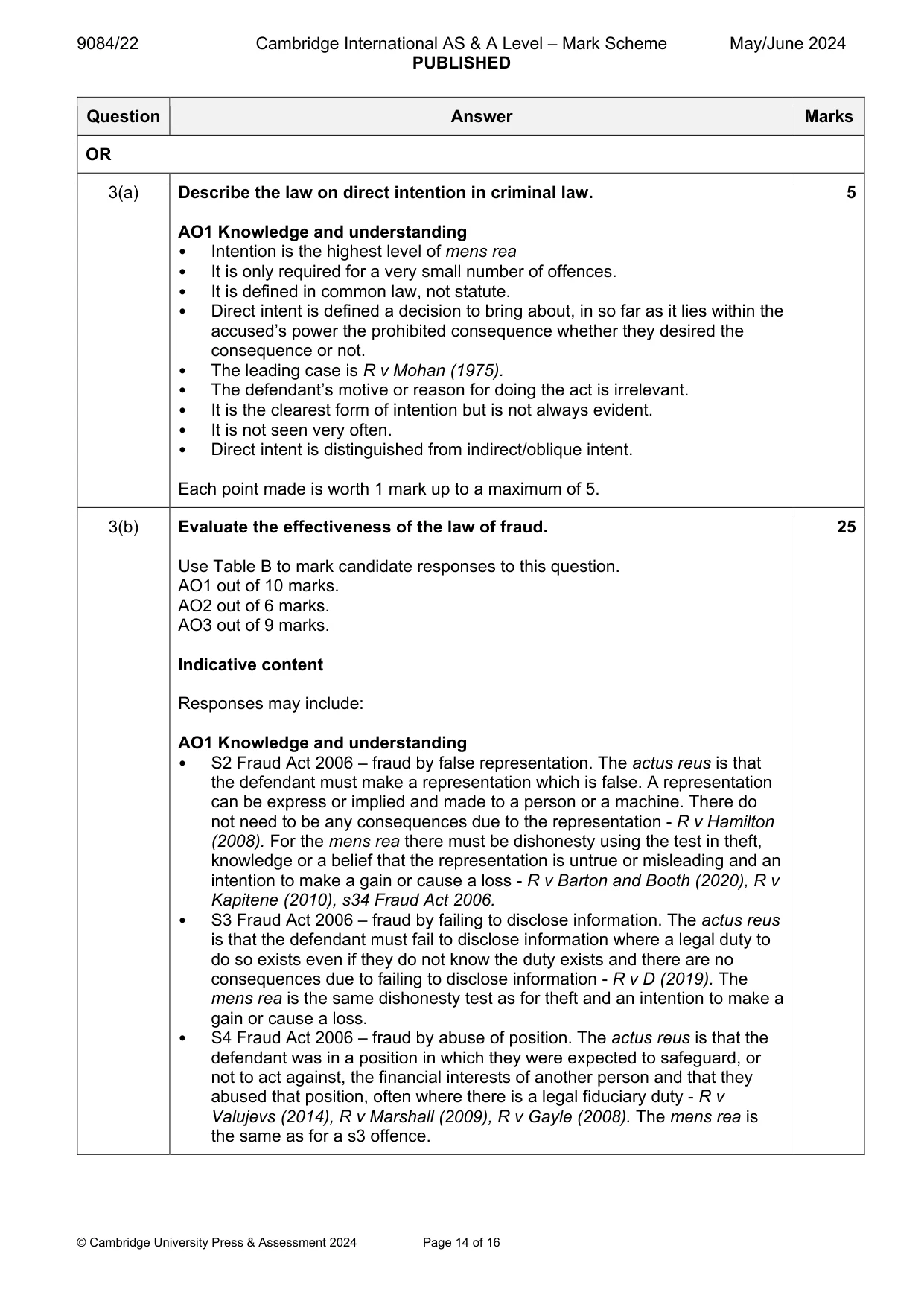
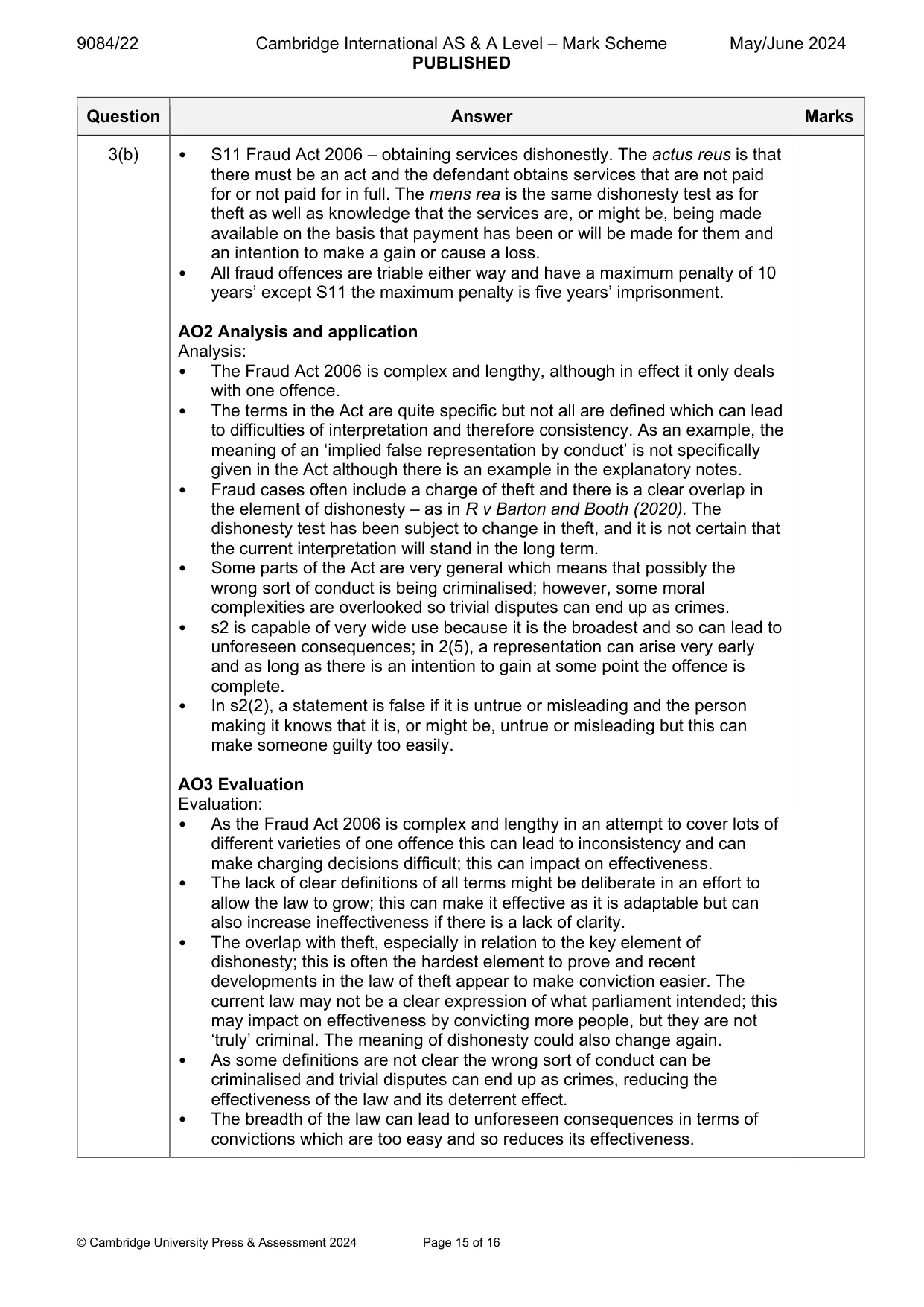
Mark scheme: 3(a) Describe the law on direct intention in criminal law. 5 AO1 Knowledge and understanding • Intention is the highest level of mens rea • It is only required for a very small number of offences. • It is defined in common law, not statute. • Direct intent is defined a decision to bring about, in so far as it lies within the accused’s power the prohibited consequence whether they desired the consequence or not. • The leading case is R v Mohan (1975). • The defendant’s motive or reason for doing the act is irrelevant. • It is the clearest form of intention but is not always evident. • It is not seen very often. • Direct intent is distinguished from indirect/oblique intent. Each point made is worth 1 mark up to a maximum of 5. 3(b) Evaluate the effectiveness of the law of fraud. 25 Use Table B to mark candidate responses to this question. AO1 out of 10 marks. AO2 out of 6 marks. AO3 out of 9 marks. Indicative content Responses may include: AO1 Knowledge and understanding • S2 Fraud Act 2006 – fraud by false representation. The actus reus is that the defendant must make a representation which is false. A representation can be express or implied and made to a person or a machine. There do not need to be any consequences due to the representation - R v Hamilton (2008). For the mens rea there must be dishonesty using the test in theft, knowledge or a belief that the representation is untrue or misleading and an intention to make a gain or cause a loss - R v Barton and Booth (2020), R v Kapitene (2010), s34 Fraud Act 2006. • S3 Fraud Act 2006 – fraud by failing to disclose information. The actus reus is that the defendant must fail to disclose information where a legal duty to do so exists even if they do not know the duty exists and there are no consequences due to failing to disclose information - R v D (2019). The mens rea is the same dishonesty test as for theft and an intention to make a gain or cause a loss. • S4 Fraud Act 2006 – fraud by abuse of position. The actus reus is that the defendant was in a position in which they were expected to safeguard, or not to act against, the financial interests of another person and that they abused that position, often where there is a legal fiduciary duty - R v Valujevs (2014), R v Marshall (2009), R v Gayle (2008). The mens rea is the same as for a s3 offence. 3(b) • S11 Fraud Act 2006 – obtaining services dishonestly. The actus reus is that there must be an act and the defendant obtains services that are not paid for or not paid for in full. The mens rea is the same dishonesty test as for theft as well as knowledge that the services are, or might be, being made available on the basis that payment has been or will be made for them and an intention to make a gain or cause a loss. • All fraud offences are triable either way and have a maximum penalty of 10 years’ except S11 the maximum penalty is five years’ imprisonment. AO2 Analysis and application Analysis: • The Fraud Act 2006 is complex and lengthy, although in effect it only deals with one offence. • The terms in the Act are quite specific but not all are defined which can lead to difficulties of interpretation and therefore consistency. As an example, the meaning of an ‘implied false representation by conduct’ is not specifically given in the Act although there is an example in the explanatory notes. • Fraud cases often include a charge of theft and there is a clear overlap in the element of dishonesty – as in R v Barton and Booth (2020). The dishonesty test has been subject to change in theft, and it is not certain that the current interpretation will stand in the long term. • Some parts of the Act are very general which means that possibly the wrong sort of conduct is being criminalised; however, some moral complexities are overlooked so trivial disputes can end up as crimes. • s2 is capable of very wide use because it is the broadest and so can lead to unforeseen consequences; in 2(5), a representation can arise very early and as long as there is an intention to gain at some point the offence is complete. • In s2(2), a statement is false if it is untrue or misleading and the person making it knows that it is, or might be, untrue or misleading but this can make someone guilty too easily. AO3 Evaluation Evaluation: • As the Fraud Act 2006 is complex and lengthy in an attempt to cover lots of different varieties of one offence this can lead to inconsistency and can make charging decisions difficult; this can impact on effectiveness. • The lack of clear definitions of all terms might be deliberate in an effort to allow the law to grow; this can make it effective as it is adaptable but can also increase ineffectiveness if there is a lack of clarity. • The overlap with theft, especially in relation to the key element of dishonesty; this is often the hardest element to prove and recent developments in the law of theft appear to make conviction easier. The current law may not be a clear expression of what parliament intended; this may impact on effectiveness by convicting more people, but they are not ‘truly’ criminal. The meaning of dishonesty could also change again. • As some definitions are not clear the wrong sort of conduct can be criminalised and trivial disputes can end up as crimes, reducing the effectiveness of the law and its deterrent effect. • The breadth of the law can lead to unforeseen consequences in terms of convictions which are too easy and so reduces its effectiveness. 3(b) • However, the range of offences and the looseness of some definitions may well make the law more effective as there are more categories which offenders can come within. Accept all valid responses. AO1 10 AO2 6 AO3 9
What was in this paper
The subtopics covered by these 3 questions, and how many questions each got. Open one in a new tab to see every Cambridge question on it.
2Sentencing in England and Wales This topic is about the sentences that can be handed down to both adult and young offenders who have been convicted of offences. This topic is an opportunity to reflect on the key concepts of liability, justice, fairness, power and its limits, and effectiveness1What you needed in this session
Cambridge’s own grade thresholds for 2024 May/June, Paper 2 · Variant 2. A higher threshold means an easier paper — the bar moves with how the cohort did.