Questions as text
Q1 · Empire and the emergence of world powers, 1870–1919 (a) Explain why Cuba was the cause of… 9489/22 May/June 2021
7 Empire and the emergence of world powers, 1870–1919 (a) Explain why Cuba was the cause of conflict between Spain and the USA in 1898. [10] (b) How significant was German interference in the conflict between Britain and the Boers to British imperial policy in the late nineteenth century? [20]
30 marks
Mark scheme: 7(a) Explain why Cuba was the cause of conflict between Spain and the 10 USA in 1898. Responses will be expected to cover longer term and immediate causes of intervention and may include: • Monroe Doctrine and growing US desire to reduce European influence in the Caribbean and South America. • Revolutionary War in Cuba from 1895. • Growing public sympathy in US for rebels. • US business concerns over economic instability in the region caused by the ongoing war. • Sinking of the battleship Maine in Havana harbour. Accept any other valid responses. 7(b) How significant was German interference in the conflict between 20 Britain and the Boer in the development of British imperial policy? A clear explanation will need to demonstrate a basic understanding of all the issues raised by the Boer war to make a judgement about relative importance of factors. Important Support for Boers angered Britain because it made the task of subduing them more difficult. It made Britain increasingly suspicious of German ambitions and intentions. The Kruger telegram incited anti-German sentiment amongst the British public (jingoism). It made the government more determined to end the Boer problem. It also highlighted Britain’s isolation and vulnerability and led to a move away from isolation. Not Important The German search for ‘a place in the Sun’ (Weltpolotik) was already causing growing concern and Kruger telegram simply confirmed British suspicions. German Navy Laws had already influenced naval policy (and the introduction of the ‘Dreadnought’ class later increased competition). Commercial pressures and the role of key individuals like Cecil Rhodes drove British interests. Following Fashoda, the reduction of Anglo-French confrontation led to growing closeness culminating in Anglo-French Entente. Given the unspecified date, a reference to the First Moroccan Crisis would be appropriate. It is also possible that a few candidates may mention personal animosity between Edward VII and his nephew. Overall, the balance of the argument might be that the Boer conflict was a factor, but that change was already underway. On the other hand, it could be seen as pivotal in bringing about a shift in British Foreign Policy and ending the country’s isolation, with new alliances directed specifically against Germany. Accept any other valid responses.
This question in 9489/22 May/June 2021
Q2 · Empire and the emergence of world powers, 1870–1919 (a) Explain why the Fashoda incident… 9489/23 May/June 2021
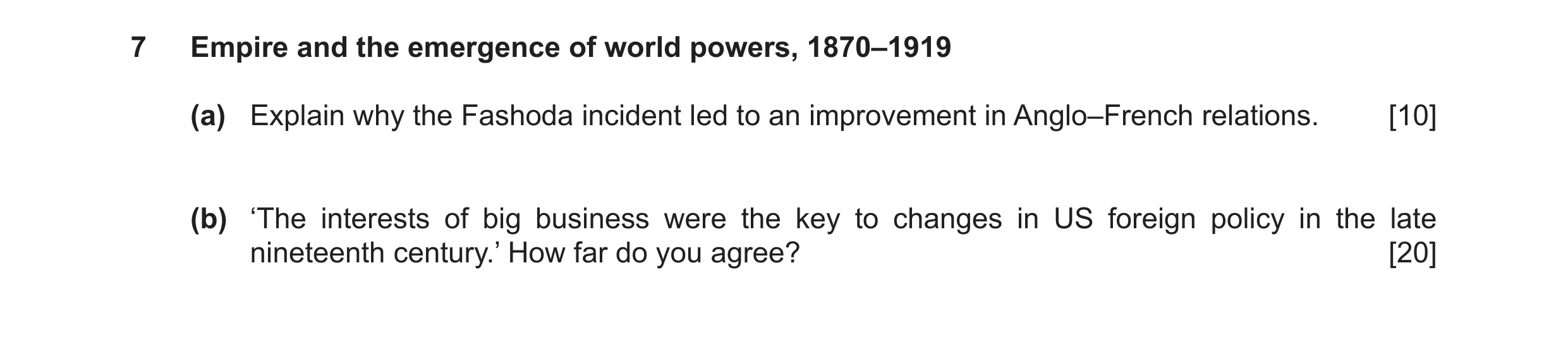
7 Empire and the emergence of world powers, 1870–1919 (a) Explain why the Fashoda incident led to an improvement in Anglo‒French relations. [10] (b) ‘The interests of big business were the key to changes in US foreign policy in the late nineteenth century.’ How far do you agree? [20]
30 marks
Mark scheme: 7(a) Explain why the Fashoda incident led to an improvement in Anglo‒ 10 French relations. It may be useful to outline the conflicting ambitions that led to the Fashoda incident if this is clearly linked to the outcomes • Led to settlement of conflict over the Sudan (which at that time included South Sudan and Uganda) a key area of Central Africa in terms of the British ambitions for a ‘Cape to Cairo’ railway and French aims for an East-West axis for the control of trade with the interior of Africa • British agreed to support French ambitions in Morocco; led to Moroccan Crises • Led to recognition that Germany was a more significant challenge to both of them • Formation of the Entente Cordiale Accept other valid responses. 7(b) ‘The interests of big business were the key to changes in US foreign 20 policy in the late nineteenth century.’ How far do you agree? There will need to be an identification of specific way in which business influenced policy and a comparison with other factors that might have played a significant role. The US economy was growing rapidly in the late nineteenth century and businessmen were always looking for new markets. The closing of the frontier made entrepreneurs look increasingly to overseas suppliers and markets to continue expanding their industries. Also, a possible threat to business interests in Cuba made intervention in the Cuban Civil War increasingly likely as business pressure on the government to act, was increased. Additionally, economic crash of early 1890s led to businesses seeking greater diversity in their markets. The change was simply an extension of ‘Manifest Destiny’ – once expansion was completed to the Pacific then the next step was into the wider world. Expansionist presidents McKinley and Theodore Roosevelt actively promoted a more expansionist policy. Policy was still in line with the Monroe Doctrine – aimed to exclude/limits European expansion in the Caribbean and South America. There was growing concern about European imperialism, esp. Scramble for Africa. The popular press played its part in in activating public opinion in support of a more expansionist policy. Decline/ collapse of Spanish Empire – US did not want anyone else replacing them. Accept other valid responses.
This question in 9489/23 May/June 2021
Q3 · Empire and the emergence of world powers, 1870–1919 (a) Explain why US foreign policy… 9489/21 Oct/Nov 2021
7 Empire and the emergence of world powers, 1870–1919 (a) Explain why US foreign policy changed during the presidency of McKinley. [10] (b) To what extent was British imperial policy up to 1902 based on fear of other European powers? [20]
30 marks
Mark scheme: 7(a) Explain why US foreign policy changed during the presidency of 10 McKinley. Answers may focus on immediate and/or longer-term shifts that resulted. • The growing popularity of the belief amongst militant Protestants that God had favoured the USA in order to serve the divinely ordained purpose of ‘civilising’ the peoples of the Caribbean, Central America and Asia. Kipling’s the ‘White Man’s Burden’ (1899) was addressed directly to America to undertake the colonisation and annexation of the Philippines. • The economic depression of 1893 fostered the belief that the economic dislocation and social unrest could only be cured by the acquisition of foreign territories. • The outbreak of rebellion (1896) in Cuba against Spanish control seemed to provide an opportunity to enact this divine plan and acquire foreign territories. • The ‘USS Maine’ explosion provided the means whereby public opinion (‘remember the Maine, to hell with Spain’) pushed USA into war with Spain in 1898. • Acquisition of former Spanish colonies Puerto Rico, Guam and Philippines went against the anti-imperialist rhetoric which had been a by- word of American foreign policy since the late eighteenth century. • Assassination – succeeded by Theodore Roosevelt who was even more imperialistically minded. This meant the developments seen under McKinley continued. Accept any other valid responses. 7(b) To what extent was British imperial policy up to 1902 based on fear of 20 other European powers? Responses will need to demonstrate an understanding of a range of factors influencing British policy, some based on the issue of relations with other European states but others related to more general reasons for imperialistic expansion. Issues relating to European powers might include conflict with France leading up to the Fashoda incident (1898), as well as concerns about control of the Suez Canal zone and other powers controlling the route to India, may have prompted actions in taking control of Egypt. There were also worries over rival naval powers (France and Russia), hence the adoption of the two-power standard (1889) and the naval challenge of Germany after 1898. Kaiser Wilhelm II’s Kruger telegram of 1896 raised fears of German support for the Boers in South Africa. There was also concern about Russian expansionism in the Far East which led to the Anglo-Japanese Treaty of 1902. There were economic factors, such as pressure of industrialists for new resources/markets, for example, scramble for Africa. Also, the ambitions of key individuals, for example, Cecil Rhodes and his ‘Cape to Cairo’ plan. The Boer issue in South Africa played a significant role, leading to two wars (1880–81 and 1899–1902). There were also problems of maintaining control of local populations, for example, India. Basic issues of maintaining a global empire arose as well; naval resources, while plentiful, were spread thinly across the globe. Finally, some people were concerned about the strategic significance of certain areas, such as the Cape and the Canal. Accept any other valid responses.
This question in 9489/21 Oct/Nov 2021
Q4 · Empire and the emergence of world powers, 1870–1919 (a) Explain why Japan succeeded in… 9489/22 Oct/Nov 2021
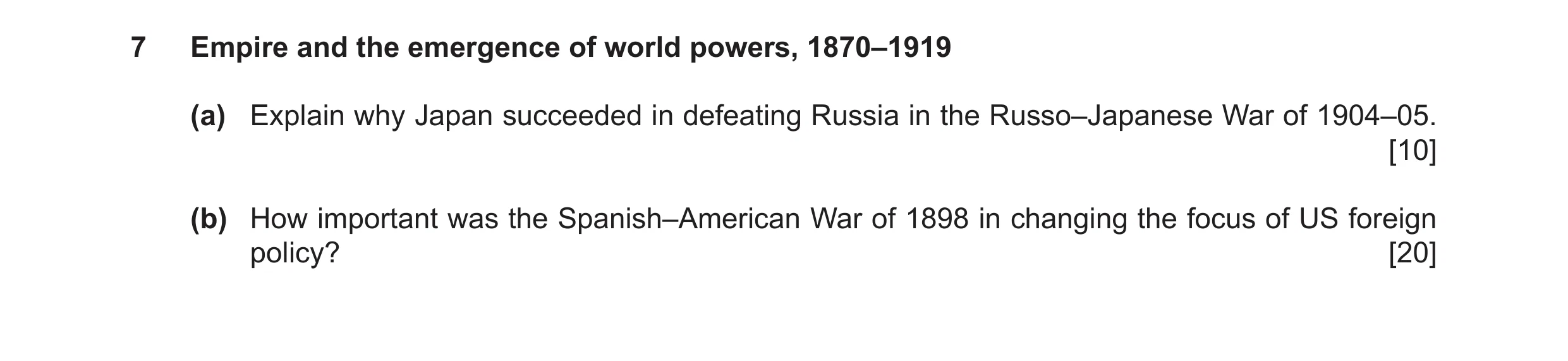
7 Empire and the emergence of world powers, 1870–1919 (a) Explain why Japan succeeded in defeating Russia in the Russo–Japanese War of 1904–05. [10] (b) How important was the Spanish–American War of 1898 in changing the focus of US foreign policy? [20]
30 marks
Mark scheme: 7(a) Explain why Japan succeeded in defeating Russia in the Russo‒ 10 Japanese War of 1904‒05. Factors might cover both the strengths of the Japanese and the weaknesses of the Russians and include: • Japan had a modern and well-equipped fleet. • Japanese were fighting close to their home base and had easy lines of communication and support. • Japan launched a surprise attack on poorly equipped and numerically inferior Russian forces in Port Arthur. • Trans-Siberian Railway was not adequate to transfer sufficient support to troops in Port Arthur. • British impeded Russian attempts to transfer Baltic Fleet to Far East. • Baltic fleet sunk ignominiously at Battle of Tsushima. Accept any other valid responses. 7(b) How important was the Spanish‒American War of 1898 in changing the 20 focus of US foreign policy? Well-constructed responses will include a consideration of the effects of the Spanish-American War, setting these against other possible influences on the direction of US policy. Spanish American War: It was a major step outside the continental boundaries of the US. It gave the US an overseas Empire which they then needed to defend and maintain. It led to further steps like Open Door Policy in China. It re-focusses the US public from internal expansion to overseas growth. Other factors: There was concern over European imperialist expansion, as seen in the Scramble for Africa and a potential threat to the Monroe doctrine. There was pressure from industrialists for development of overseas trade. The presidential leadership of McKinley and then Roosevelt (Roosevelt Corollary) was also significant. It had the support of the ‘yellow’ press. The US became involved in the Panama Canal Project. Accept any other valid responses.
This question in 9489/22 Oct/Nov 2021
Q5 · Empire and the emergence of world powers, 1870–1919 (a) Explain why the USA needed to… 9489/23 Oct/Nov 2021
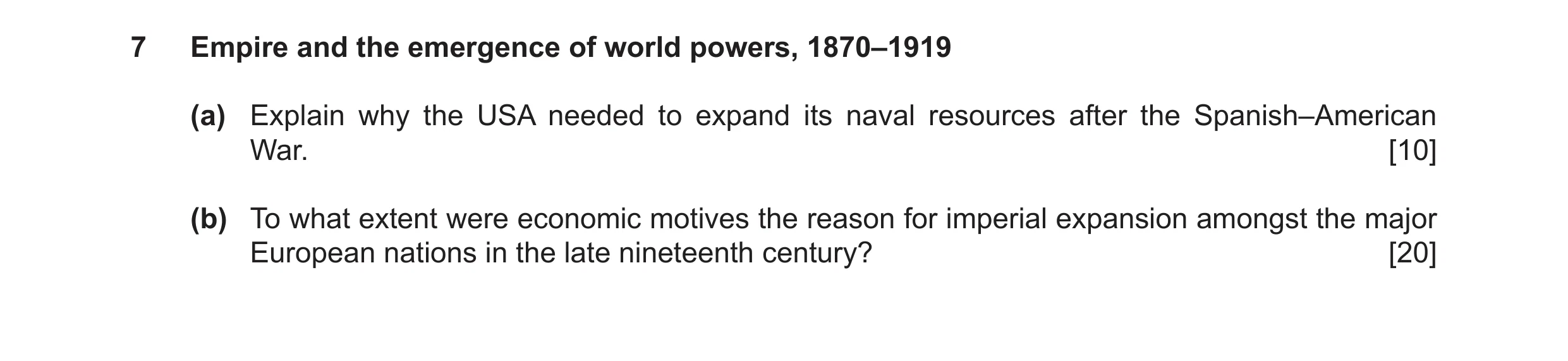
7 Empire and the emergence of world powers, 1870–1919 (a) Explain why the USA needed to expand its naval resources after the Spanish‒American War. [10] (b) To what extent were economic motives the reason for imperial expansion amongst the major European nations in the late nineteenth century? [20]
30 marks
Mark scheme: 7(a) Explain why the USA needed to expand its naval resources after the 10 Spanish‒American War. Responses should consider and evaluate a range of factors: • Acquisition of remnants of Spanish Empire in 1899. • New mood of imperialism in US public and press. • Ambitions of presidents. • Wanted to establish US as one of the Great Powers with a navy of comparable strength to the European nations and Japan. Accept any other valid responses. 7(b) To what extent were economic motives the reason for imperial 20 expansion amongst the major European nations in the late nineteenth century? There are a number of factors to be considered and with some obvious overlap between economic and other factors it should be possible for the better candidates to draw valid conclusions on relative importance of economic vs. other motives. Economic motives: Responses should consider the effects of industrial revolution, search for new markets and raw materials. Also important is control of trade routes; Suez Canal, South Africa etc. European powers developed the Open Door policy in China. Imperialist ambitions were fuelled by newly discovered resources such as diamonds in Southern Africa – Boer Wars. Other motives: An important consideration was avoiding war in Europe. The search for international prestige also played a part. Each European Power wanting to have more colonies and a bigger empire than its rival powers. Improved technology added impetus to expansion with better weapons and new medicines. Some Europeans were also driven by religious/cultural imperative. Finally, there were specific national factors to be considered, e.g., German Weltpolitik Accept any other valid responses.
This question in 9489/23 Oct/Nov 2021
Q6 · Empire and the emergence of world powers, 1870–1919 (a) Explain why people in Britain… 9489/22 Feb/March 2022
7 Empire and the emergence of world powers, 1870–1919 (a) Explain why people in Britain supported overseas expansion in the late nineteenth century. [10] (b) ‘The United States went to war with Spain in 1898 in support of the independence movement in Cuba.’ How far do you agree with this statement? [20]
30 marks
Mark scheme: 7(a) Explain why people in Britain supported overseas expansion in the late 10 nineteenth century. Indicative content There were a variety of reasons, economic, social, religious and nationalistic, that might be identified. These include: • Industrialists and traders were interested in new resources and expanding markets. • Belief in spreading European ‘civilisation’. • To spread the Christian religion. • To maintain leading position in the world. • Rise of newspapers that supported overseas ventures/national pride – jingoism. Accept any other valid responses. 7(b) ‘The United States went to war with Spain in 1898 in support of the 20 independence movement in Cuba.’ How far do you agree with this statement? Indicative content Whilst there had been a civil war in Cuba for several years with some support for the independence movement from the US there were also a lot of ulterior motives. Agree Civil war began in 1895 and Spain adopted extreme measures to try and crush the rebellion. McKinley described the tactics used as ‘not civil war but extermination’. Public sympathy was raised by the ‘yellow press’ which condemned Spain and agitated public opinion with dramatic reporting of Spanish atrocities. This led to growing public pressure for intervention to help the Cubans gain their independence in line with the founding principles of the US. Disagree There were other considerations in the US decision to go to war. It supported the underlying principles of the Monroe Doctrine. US government did not want war and tried to reach a negotiated settlement between the two sides. But when, despite repeated promises, Spain failed to make any progress towards reform, US patience ran out. Some US industrialists saw a growing role for US business in the Caribbean now that the occupation of territory in the West had been completed (closing of the Frontier). The trigger was the sinking of the US battleship Maine in Havana harbour which the US government blamed on the Spanish authorities and used as a ‘casus bellum’ though the cause of the incident has never been conclusively demonstrated. Accept any other valid responses.
This question in 9489/22 Feb/March 2022
Q7 · Empire and the emergence of world powers, 1870–1919 (a) Explain why the sinking of the… 9489/23 May/June 2022
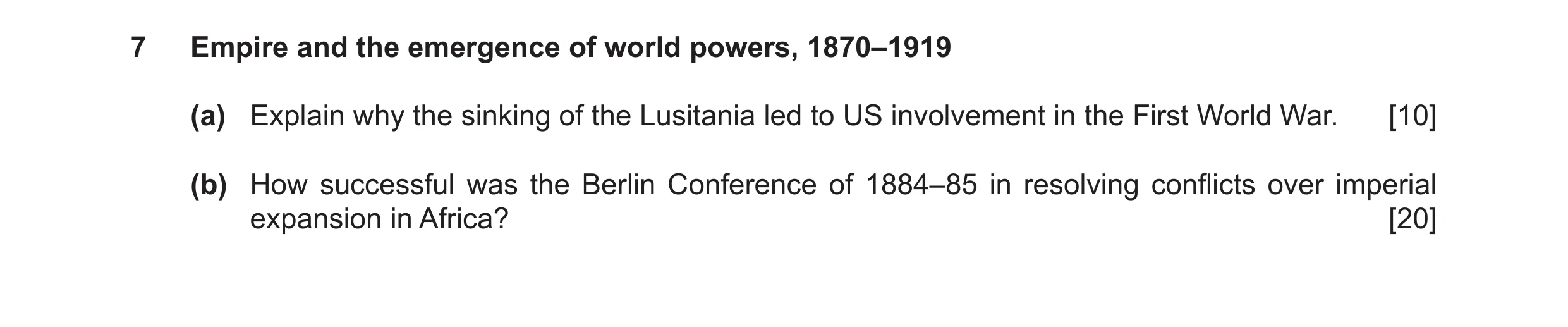
7 Empire and the emergence of world powers, 1870–1919 (a) Explain why the sinking of the Lusitania led to US involvement in the First World War. [10] (b) How successful was the Berlin Conference of 1884–85 in resolving conflicts over imperial expansion in Africa? [20]
30 marks
Mark scheme: 7(a) Explain why the sinking of the Lusitania led to US involvement in the 10 First World War. Indicative content Answers will need to set the sinking in the wider context of US response the war in Europe, establishing the sinking as a short-term cause, possibly ‘trigger’, to US declaration of war by crystallising public opinion against Germany. At the start of the war Wilson was strongly opposed to US involvement and was supported by the majority of US public opinion but: Even before the war US opinion towards Germany was generally more negative than towards other European countries. US banks made huge loans to Britain and France allowing them to buy war materials from US producers. In April 1915 Germany warned against US citizens boarding British ships suspected of carrying these good to Britain and on May 7th sank the Lusitania with the loss of 128 US lives – this outraged public opinion but not enough to lead to war. However, it marked a turning point and Wilson only narrowly won the 1916 election. It took all-out submarine warfare and the Zimmerman Telegram to finally push US into war. Accept any other valid responses. 7(b) How successful was the Berlin Conference of 1884-85 in resolving 20 conflicts over imperial expansion in Africa? Indicative content Effective responses will probably set consideration of the achievements of the Berlin conference against the continuing appearance of crises and conflicts over the European Powers’ involvement in African colonial expansion. The idea of success revolves around the outcome of the conference. Called predominately to discuss the issue of access to the Congo basin it also created a general framework for expansion in Africa as well as settling a number of individual conflicts. It confirmed Belgian ownership of the Congo but allowed freedom of navigation along the Congo river for other nations. It defined specific areas for each country’s further expansion and established the ‘principle of effectivity’ which meant that countries could not just claim lands that thy might have explored, they had to demonstrate that they had effectively occupied those areas. In exploring the limitations of the treaty candidates are likely to cover a range of conflicts that arose after 1885 despite the Treaty. Anglo French conflict over sub-Saharan Africa was not finally resolved until after the Fashoda incident in 1898. The Boer Wars was effectively a war between rival groups of European settlers and also raised Anglo German tensions. The two Moroccan crises raised tensions between rival powers in Europe which were not fully resolved despite the negotiations that ended them and may eventually have contributed to the outbreak of the First World War. Accept any other valid responses.
This question in 9489/23 May/June 2022
Q8 · Empire and the emergence of world powers, 1870–1919 (a) Explain why the United States… 9489/21 Oct/Nov 2022
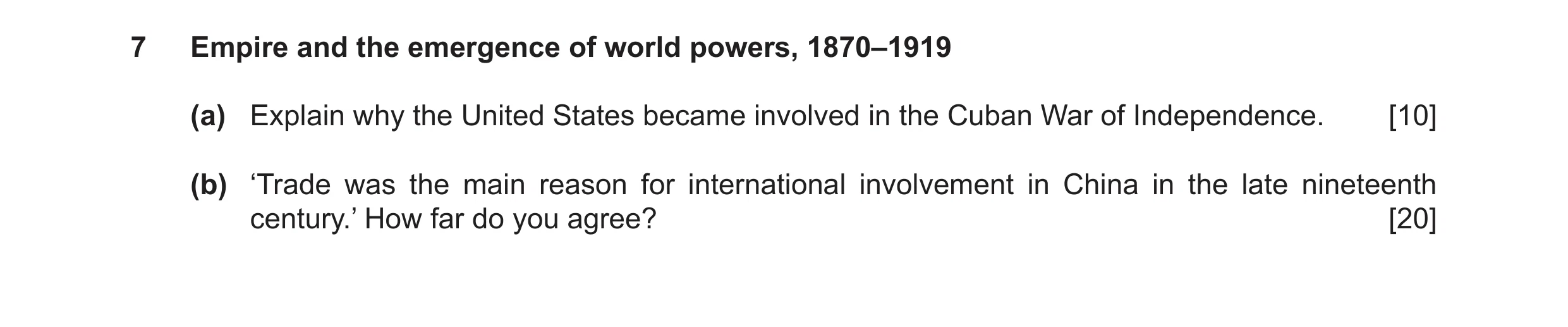
7 Empire and the emergence of world powers, 1870–1919 (a) Explain why the United States became involved in the Cuban War of Independence. [10] (b) ‘Trade was the main reason for international involvement in China in the late nineteenth century.’ How far do you agree? [20]
30 marks
Mark scheme: 7(a) Explain why the United States became involved in the Cuban War of 10 Independence. Indicative content A number of political and economic factors could be developed to explain the intervention of the US in Cuba including: • Monroe Doctrine. • A sense of its own history – a colonial people struggling against a European power to achieve independence and democracy. • Cuba Libre’ movement had offices in Florida that held fundraising events and mounted a large and successful propaganda campaign across the US. • US business domination of the Cuban sugar industry – by the 1890’s 90% of Cuba’s production went to the US. • US businesses also supplied 40% of Cuba’s imports. • Role of the ‘yellow press’ which agitated public opinion with reports of Spanish atrocities. • Aggressive support of T Roosevelt as Assistant Secretary of the Navy. • Sinking of the Maine was the trigger for war. Accept any other valid responses. 7(b) ‘Trade was the main reason for international involvement in China in 20 the late nineteenth century.’ How far do you agree? Indicative content Economic issues were undoubtably important, but a number of other factors may be identified as contributing to the growing interest in China in the late nineteenth century. Trade: In the mid-nineteenth century the weak Chinese government of the Qing dynasty had been forced into a series of concessions to European countries that included the granting of treaty ports or trading centres for the great powers (Hong Kong, Shanghai etc.) This included legalising trade in opium from which western traders made huge profits and removing all internal barriers to European trade. This was reinforced when the USA joined the imperialist race for control and proposed the Open-Door Policy to regulate foreign trading in China Other factors: Whilst trade was the primary focus, governments saw supporting trade as a matter of international status so European rivalry played a part. USA became more involved because acquisition of the Philippines turned US enterprise toward the possibility of developing trade with China where Europeans were already making large profits. Japan, having carried our extensive modernisation was interested in establishing itself as a world power and as the strongest indigenous power in East Asia and so wanted to seize control of Chinese territory, especially control of Korea (First Sino– Japanese War 1894–95 & Treaty of Shimonoseki). Role of missionaries might also be included, and all factors can be drawn together in the response to the Boxer rising (1900–01). Accept any other valid responses.
This question in 9489/21 Oct/Nov 2022
Q9 · Empire and the emergence of world powers, 1870–1919 (a) Explain why Wilhelm II sent the… 9489/22 Oct/Nov 2022
7 Empire and the emergence of world powers, 1870–1919 (a) Explain why Wilhelm II sent the Kruger Telegram in 1896. [10] (b) ‘Up to 1917 the USA consistently avoided involvement in the affairs of European nations.’ How far do you agree with this statement? [20]
30 marks
Mark scheme: 7(a) Explain why Wilhelm II, sent the Kruger Telegram in 1896. 10 Indicative content On New Years’ Day 1896 the Jameson raid was launched by the British into Transvaal on the excuse of helping British miners (uitlanders) who were being discriminated against by Kruger’s Government. It was meant to trigger an Uitlander uprising but this failed to materialise and the raid failed. • The telegram was to congratulate Kruger on repelling the Raid. • The telegram was interpreted in the Transvaal as a sign of possible German support in the future. • William’s intention was to demonstrate to the British that they were diplomatically isolated. • Wilhelm wanted to win ‘a place in the sun’ and hoped for British support in this • It was an attempt to encourage Britain to become more friendly with Germany. This proved to be a diplomatic and psychological blunder. Accept any other valid responses. 7(b) ‘Up to 1917 the USA consistently avoided involvement in the affairs of 20 European nations.’ How far do you agree with this statement? Indicative content This is a question with clear alternatives from which a balanced judgement can be made. In support of the claim: The US had, from the time of the Monroe Doctrine, isolated itself from European affairs. Even following the acquisition of the remnants of the Spanish Empire the US focused on developing its Pacific, avoiding involvement in European affairs. Given that many of its citizens came from different European countries and many had migrated to avoid persecution and escape poverty there was little appetite amongst many Americans for involvement with the other world powers. When the First World War began the US immediately asserted its neutrality and President Wilson was strongly opposed to involvement. Wilson fought the 1916 election campaign on a platform of continuing neutrality and won a second term. Challenging the claim: The Progressive presidents from McKinley onwards pursued a more active overseas policy and engaged in international negotiations like the Treaty of Portsmouth (Russo-Japanese War). Roosevelt built up a modern navy and sent it on an international tour to enhance US prestige in 1907–09 (the Great White Fleet). The US increasingly got involved in situations when its growing international interest were threatened (e.g. Boxer Rising). US banks made large loans to Britain and France that were used to buy US manufactured equipment in the early years of the war and the actions of German submarines turned popular opinion increasingly against Germany with Wilson only narrowly winning the 1916 election; the Zimmermann Telegram was just the last straw. Accept any other valid responses.
This question in 9489/22 Oct/Nov 2022
Q10 · Empire and the emergence of world powers, 1870–1919 (a) Explain why economic pressures… 9489/23 Oct/Nov 2022
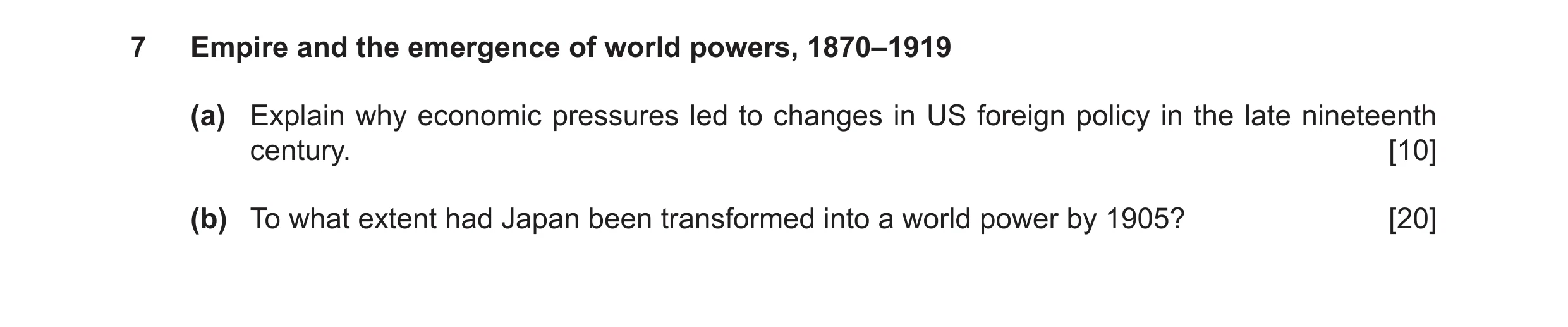
7 Empire and the emergence of world powers, 1870–1919 (a) Explain why economic pressures led to changes in US foreign policy in the late nineteenth century. [10] (b) To what extent had Japan been transformed into a world power by 1905? [20]
30 marks
Mark scheme: 7(a) Explain why economic pressures led to changes in US foreign policy 10 in the late nineteenth century. Indicative content ‘Economic pressures’ covers the general growth of the economy and the pressures it created and might include: • Rapid expansion of the economy during the Gilded Age – search for new markets. • Closing of the frontier. With no further internal territorial expansion possible the opportunity for developing internal trade and resources were reduced. • The Panics of 1893 and 1896. • Involvement in Cuba was largely a response to US economic interests. • Acquisition of remnants of the Spanish Empire in Central America and The Pacific provided opportunities for economic expansion into new fields. Accept any other valid responses. 7(b) To what extent had Japan been transformed into a world power by 20 1905? Indicative content This offers the possibility of alternative interpretations of the international achievements of Japan in the late nineteenth and early twentieth centuries from which a balanced judgement should be possible. Answers may identify a significant difference between potential and acceptance. In support of the argument: It might be suggested that as a result of the Meiji Restoration the country had undergone a rapid industrial and military transformation that brought its economy and armed forces up to the standard of the Western powers. This was demonstrated in its gains from the First Sino-Japanese War (Treaty of Shimonoseki) which also confirmed Japan as a more significant regional power than China. In 1902 it signed its first major international treaty with a western power – the Anglo-Japanese Treaty and it was also successful in the Russo-Japanese War culminating in an international conference and the Treaty of Portsmouth in which it made significant gains. The way they were treated by western powers convinced the military elite in Japan that rather than seeking economic advantage they should develop a more imperialistic policy. Against the argument: The three western powers (Britain, France and Russia) were unhappy with some of the provisions of the Treaty of Shimonoseki and staged the ‘triple intervention’ in which they forced Japan to return the Liaodong peninsula to China. Their treatment did not even rate Japan as a regional power. The Treaty with Britain was a purely regional arrangement to help the British deal with the threat of other powers, especially Russia, to their Asian empire – it did not really constitute recognition of Japan as an equal power. Finally, the defeat of Russia was seen largely as a sign of Russian weakness and disorganisation rather than a success that placed Japan on equal terms with the western powers. Note: the question is about Japan in 1905 – comparison with Japan in 1918 is NOT a valid response. Accept any other valid responses.
This question in 9489/23 Oct/Nov 2022
Q11 · Empire and the emergence of world powers, 1870–1919 (a) Explain why the United States… 9489/22 Feb/March 2024
7 Empire and the emergence of world powers, 1870–1919 (a) Explain why the United States began an extensive modernisation of its navy in the late nineteenth century. [10] (b) ‘The Second Boer War made little difference to Britain’s relations with other European powers.’ How far do you agree? [20]
30 marks
Mark scheme: 7(a) Explain why the United States began an extensive modernisation of its 10 navy in the late nineteenth century. Indicative content The 1890s saw a significant shift of direction in US foreign policy that necessitated the refurbishment and expansion of the US navy to meet the increased need for its presence in the international sphere. • After the civil war there had been little development of the navy and many of its ships were out of date. • In 1890 Alfred Mahon published his book on ‘The Influence of Sea Power in History’. This led to increasing pressure for an increase in US naval capacity. • The Panic of 1893 led industrialists to increasingly seek expansion of overseas trade which increased the need of naval support for the growing merchant fleet. • President McKinley and his Secretary of the Navy, Theodore Roosevelt, were both expansionists and promoted naval development. • The Spanish American War of 1898 saw the acquisition of a substantial overseas empire. A modernised navy was needed in order to defend and support these territories. Accept any other valid responses. 7(b) ‘The Second Boer War made little difference to Britain’s relations with 20 other European powers.’ How far do you agree? Indicative content The Second Boer War lasted from 1899 to 1902 and saw Britain come under severe international criticism for its scorched earth tactics and use of internment camps to control the civilian population. Whilst it is clear that, in the following years, Britain had largely abandoned its policy of ‘splendid isolation’, it is possible to trace some of these changes to events and actions already in progress before the effects of the Boer War impinged on policy making. So, the key question is whether this was a turning point in international relations or was it simply a continuation of trends already set in motion. Turning point: Prior to 1900 Britain had largely avoided commitment to involvement with other powers though it had taken part in international agreements like the Treaty of Berlin. However, the weaknesses exposed by the Boer war led to a change in policy. Britain had struggled to defeat the Boers and to focus its not inconsiderable resources on a specific conflict. The attempt to recruit a bigger army had revealed serious weakness in term of fitness of its population for military service and had shown how concentration on one war left other areas of its vast empire exposed. So in 1902 the Anglo-Japanese Treaty was concluded in which they committed themselves to mutual assistance in the event of conflict in the Far East caused by Russian expansionist aims, and in 1904 the Entente Cordiale marked a significant shift towards closer links with France. Before this Britain had set itself the aim of maintaining the two-power standard in the size of its navy but the Entente eased this necessity due to the mutual support it offered. The Boer War also marked a significant deterioration of Anglo-German relations thanks to the Kruger Telegram and the overt support of the Boers offered by the Kaiser. Continuity: Though not in formal alliance with other states Britain co-operated with other powers in seeking to avoid international conflict. The Treaty of Berlin was a case in point providing a formula for the claiming of territory in Africa whilst avoiding war. This eventually saw agreement between France and Britain over the Fashoda confrontation (1898) which began a period of increased cooperation culminating in the Entente Cordiale. International co-operation also saw joint action in response to the Boxer Rising (1900). At the same time relations with Germany had begun to deteriorate once Wilhelm II came to power and especially after his dismissal of Bismarck and adoption of a more aggressive foreign policy specifically in his search for ‘a place in the sun’. This was compounded by the Navy Laws of 1898 and 1900 proposing the rapid expansion of the German navy. This made Britain very suspicious of German intentions and pushed them towards closer relations with the French who had long standing grievances with Germany and later with Russia which was France’s other major ally. Accept any other valid responses.
This question in 9489/22 Feb/March 2024
Q12 · Empire and the emergence of world powers, 1870–1919 (a) Explain why US foreign policy… 9489/21 May/June 2024
7 Empire and the emergence of world powers, 1870–1919 (a) Explain why US foreign policy became more imperialistic after 1898. [10] (b) To what extent was the Boxer Rebellion a response to European imperialism in the late nineteenth century? [20]
30 marks
Mark scheme: 7(a) Explain why US foreign policy became more imperialistic after 1898. 10 Indicative content A range of factors made the US more expansive after 1898. Foremost amongst these was necessity. The Spanish–American War and US victory gave the US an instant empire with the acquisition of former Spanish territories in the Caribbean and the Pacific. Philippines civil war – the Filipino population objected to being handed over to a different power and demanded independence. The US sent in its army to crush the opposition. The closing of the frontier and the Panic of 1893 had alerted businessmen to the need to expand their trading options beyond the internal market of the US. The Boxer Rising – because of growing interest in the Chinese Market the US joined the western powers in suppressing the Rising and reimposing the Open Door Policy. Both McKinley and his successor Roosevelt were supporters of a more expansionist foreign policy. Roosevelt acquired the rights to the building of the Panama Canal from the French. Accept any other valid responses. 7(b) To what extent was the Boxer Rebellion a response to European 20 imperialism in the late nineteenth century? Indicative content With the scramble for Africa under way and the earlier colonisation of large areas of Asia by European powers, China was one of the last major areas offering a potential for the establishment of new trading opportunities. Though European powers led the way, by the 1890s both Japan and the US were increasingly involved economically in China. Also to be considered is the response of the Chinese government and its effects on the population of China. European involvement stemmed from the British defeat of China in the Opium Wars which ended with the Treaty of Tientsin in 1958 granting Britain preferential trading right and control of Hong Kong and opening China’s ports to foreign traders. This opened the way for an influx of Europeans who came for a variety of reasons; as diplomatic representative of foreign governments, as independent traders and as missionaries. Major coastal cities like Shanghai and Canton all developed enclaves for foreign traders and European traders all established their own spheres of influence where they built railways, set up factories and generally ignored local Chinese laws and authorities. Responses may discuss the influence of other powers. In 1894 after increasing conflict the first Sino–Japanese War broke out over control of the Korean Peninsula. This was a disaster for China whose troops were disorganised and poorly led, and the result was a humiliating defeat and the Treaty of Shimoshenko which gave Korea, Taiwan and the key military facility of Port Arthur to Japan. Then in 1899 the US entered the fray. Having recently gained the Philippines from Spain, McKinley wanted to expand US trading opportunities in the Far East and negotiated an ‘open door policy’ to ensure all foreign countries enjoyed equal benefits. However, this was negotiated with the other foreign powers not the Chinese authorities who were merely told about it. Internal pressures might also be considered, and the cumulative effect of the increasing foreign intervention was a growing nationalist movement aimed at driving out the foreigners who were taking control of their country. It was also a response to the influx of Christian missionaries who were believed to be undermining traditional Chinese values. There was also growing dissatisfaction with the ineffectiveness of the Imperial government in dealing with these foreigners. Accept any other valid responses.
This question in 9489/21 May/June 2024
Q13 · Empire and the emergence of world powers, 1870–1919 (a) Explain why political… 9489/23 Oct/Nov 2024
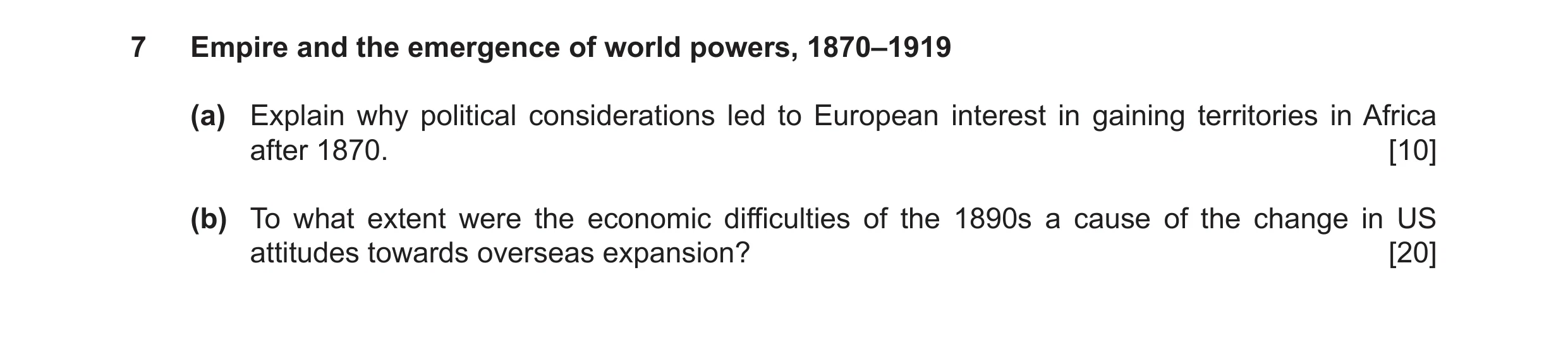
7 Empire and the emergence of world powers, 1870–1919 (a) Explain why political considerations led to European interest in gaining territories in Africa after 1870. [10] (b) To what extent were the economic difficulties of the 1890s a cause of the change in US attitudes towards overseas expansion? [20]
30 marks
Mark scheme: 7(a) Explain why political considerations led to European interest in gaining 10 territories in Africa after 1870. Indicative content The latter part of the nineteenth century saw a rising political awareness amongst the working class and education became more widespread and the popular press began to develop. Imperialism was seen as a way of diverting the rising interest of the lower classes in political issues. • Political power was in the hands of wealthy landowners and industrialists who stood to gain form imperial expansion and would thus support it. • Senior politician like Joseph Chamberlain in Britain and French PM Jules Ferry saw this as a way of diverting popular attention away from social and economic inequalities at home. • Politicians justified imperialism as a way of funding reforms at home. • Politicians used the popular press to whip up support for Imperialism – development of ‘jingoism’. • Overall politicians used imperialism to unite their people, regardless of wealth or class, in a common aim – imperial glory through overseas expansion. Accept any other valid responses. 7(b) To what extent were the economic difficulties of the 1890s a cause of the 20 change in US attitudes towards overseas expansion? Indicative content In 1893 a spate of bankruptcies sparked an economic crisis in the USA and unemployment rose from 3.7m in 1892 to12.3 m in 1894. This ’panic’ was one of a number of factors that together led to a significant shift in US overseas policy. In terms of economic problems during the the late nineteenth century expansion westward and the development of trans-continental railways and the rapid growth of population through mass immigration, led to a rapidly expanding industrial base and rising production in all spheres of the economy. However, the downturn of 1893 highlighted the problem of overreliance on the domestic economic growth. Businesses of all types were relatively limited by the domestic market and the need to develop overseas markets was an obvious way of allowing continuing expansion. One of the obvious targets for economic expansion was Cuba which was only 90 miles off the Florida coast and where increasing conflict between Cuban and Spanish authorities gave the US a reason for intervention. Discussion of other factors might consider the fact that the economic downturn coincided with the ‘closing of the frontier’ produced a two-pronged impetus to expansion overseas. Driven by the idea of manifest destiny, the USA had expanded steadily to link up its east and west coast settlements but now that westward expansion was completed the idea took hold that the frontier should now be expanded outwards beyond the continental boundaries of the USA. They already had an interest in the Caribbean because of the Monroe Doctrine and this, to many, justified their action against the Spanish and the acquisition of Spanish territories there following the war on 1898. The US had also already established trade links with Japan and saw expansion into China as another lucrative possibility. The acquisition Spain’s Pacific territories promoted interest in this development. The election of expansionist President McKinley in 1896 and the growth of popularity of the yellow press, who strongly supported overseas intervention, also promoted the idea of developing overseas trade links and territories. McKinley’s successor, Theodore Roosevelt was even more enthusiastic and under him the Panama Canal Project was taken over by the USA and pushed ahead as a matter of priority. Accept any other valid responses.
This question in 9489/23 Oct/Nov 2024
Q14 · Empire and the emergence of world powers, 1870–1919 (a) Explain why there was a… 9489/21 May/June 2025
7 Empire and the emergence of world powers, 1870–1919 (a) Explain why there was a conference of European powers in Berlin in 1884–85. [10] (b) To what extent had the USA abandoned an isolationist foreign policy by 1914? [20]
30 marks
Mark scheme: 7(a) Explain why there was a conference of European powers in Berlin in 10 1884–85. Indicative content The conference was called to set parameters of the future of European expansion in Africa. • The growth of New Imperialism led to growing interest in acquiring colonies in Africa. • New technologies were making exploration of the African interior a more viable proposition for more countries. • Because of the risk of starting a European war the countries interested in Africa were willing to establish a set of rules for claiming lands in Africa and this was the purpose of the Conference. • Bismarck was encouraged to call the conference by pressure from German merchants and industrialists who were anxious to gain access to African resources and markets. Accept any other valid responses. 7(b) To what extent had the USA abandoned an isolationist foreign policy by 20 1914? Indicative content In support of the statement a number of events had moved the US into a higher profile international position and candidates may discuss a range, including: the Spanish American War of 1898 which resulted in the US becoming an imperial power as it took control of all the Spanish territories in the Caribbean and the Pacific; the influence of presidents McKinley and Roosevelt who were both actively in support of a more expansionist US policy and America’s role as mediator in the Russo Japanese war leading to the signing of the Treaty of Portsmouth. Responses may also include discussion of the Panama Canal Project which the US took over from France and the building of the Great White Fleet and its subsequent world tour were an indication that the US was seeking to assert its place as a global power. The US also abandoned isolation due to involvement through the Open Door policy in the Asian markets. In challenging the statement responses may discuss how the change in policy still reflected the importance in US decision making of commercial and economic interests and did not show and significant intention of engaging with other world powers other than where these interests were threatened. Hence the introduction, in 1904, of Roosevelt’s Corollary to the Monroe Doctrine and Roosevelt’s intervention in the Russo-Japanese War. In 1914 war broke out in Europe but Wilson was firmly committed to keeping the US out of the war as he saw no benefits for the US in intervention. This was supported by many Americans who had moved to the country to escape European conflicts and were drawn from both sides of the current war. However, the US continued to benefit from trade as result of the war taking over many South American markets from European producers. Accept any other valid responses.
This question in 9489/21 May/June 2025
Q15 · Empire and the emergence of world powers, 1870–1919 (a) Explain why Roosevelt introduced… 9489/22 May/June 2025
7 Empire and the emergence of world powers, 1870–1919 (a) Explain why Roosevelt introduced the Corollary to the Monroe Doctrine in 1904. [10] (b) To what extent did the Second Boer War lead to a change in British relations with other Imperial powers? [20]
30 marks
Mark scheme: 7(a) Explain why Roosevelt introduced the Corollary to the Monroe Doctrine 10 in 1904. Indicative content • Roosevelt was re-asserting US pre-eminence in intervention in the affairs of any of the countries of the Americas. • Most of Africa had now been claimed by European powers and the US was worried they might turn their eyes towards the Americas again. • To reassert the original intention of the Monroe Doctrine which was to warn Europeans to stay out of the region. The corollary extended this by threatening armed intervention in any county in Latin America threatened by external or internal factors. In 1905 marines were sent into the Dominican Republic to protect US commercial interests. • The acquisition of remains of Spanish empire after 1898 had given the US a more direct interest in protecting its territories in the Caribbean in particular. • In 1902 the Spooner Act endorsed the purchase of the assets of the French Panama Canal company and in 1903 with US support Panama gained independence from Columbia and the US began work on the project. This also increased US concerns about the security of its interest in the Caribbean. Accept any other valid responses. 7(b) To what extent did the Second Boer War lead to a change in British 20 relations with other imperial powers? Indicative content The Second Boer War exposed weaknesses of British Empire with overstretched resources. The British army had struggled to beat colonial farmers which highlighted the military limitations of the British army. The British had been heavily criticised internationally for its tactics, especially its treatment of the civilian Boer population. This highlighted the isolation of the British and together with the other weaknesses exposed in the war, raised concerns about continuing this policy. The traditional British policy of ‘splendid isolation’ seemed increasingly untenable. Discussion of other factors influencing relations might consider the Fashoda incident, when British and French forces came close to conflict over Sudan and led to a settlement of outstanding disputes between Britain and France and an improvement in relations. It may also consider Kaiser Wilhelm’s search of ‘a place in the sun’ led to a more aggressive policy of acquisition by Germany (Weltpolitik). Wilhelm resented the fact that other countries, especially the British, had already claimed much of the ‘best’ territory in Africa and elsewhere and wanted to change this. Germany also began a programme of naval expansion with a series of naval laws beginning in 1898 which intensified with the development of the Dreadnought in 1906. Britain saw this as a challenge to their global empire’s security which depend on the two- power standard – having a navy as big as the next two largest together. In 1904 this changing relationship led to the signing of the Entente Cordiale with France which settled remaining disputes in North Africa and in which Britain supported French claims to Morocco. Kaiser Wilhelm immediately decided to test this and precipitated the First Moroccan Crisis in 1905, but rather than wrecking the Entente it brought the British and French closer together. Accept any other valid responses.
This question in 9489/22 May/June 2025
Q16 · Empire and the emergence of world powers, 1870–1919 (a) Explain why the Jameson Raid led… 9489/23 May/June 2025
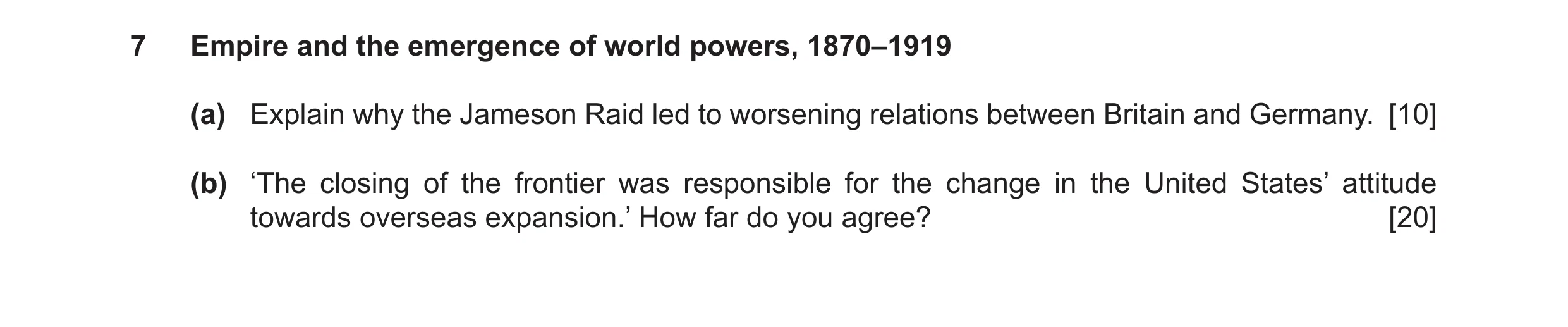
7 Empire and the emergence of world powers, 1870–1919 (a) Explain why the Jameson Raid led to worsening relations between Britain and Germany. [10] (b) ‘The closing of the frontier was responsible for the change in the United States’ attitude towards overseas expansion.’ How far do you agree? [20]
30 marks
Mark scheme: 7(a) Explain why the Jameson Raid led to worsening relations between 10 Britain and Germany. Indicative content The Jameson raid was devised by Cecil Rhodes to give the British a reason to intervene in The Boer colony of Transvaal on the excuse of coming to the aid of discontented and rebellious British settlers there. The raid went ahead, even though there was no rebellion, and was repulsed by the Boers under the leadership of Paul Kruger. • The Kaiser sent a telegram to Kruger congratulating him on his success which angered the British government who saw it as interference in their sphere of influence. • It also seemed to suggest that the Germans were prepared to send aid to the Boers if the conflict developed in a bid to replace British interests with German prominence in the Boer states. • The jingoistic British press raised substantial anti-German feeling amongst the British public. • Similarly, the German press was able to portray British aggression against a small independent state which raised the level of anti-British feeling in Germany. • Britain already had concerns about the policy of Weltpolitik and these moves seemed to confirm their worries. Accept any other valid responses. 7(b) The closing of the frontier was responsible for the change in the United 20 States’ attitude towards overseas expansion.’ How far do you agree? Indicative content In support of the closing of the frontier the census of 189 revealed that settlement had been established right across the continental USA, with states or Territories established, leaving no new land to be ‘tamed’ and no new opportunities. Because of this, Americans began to look abroad for fresh opportunities and challenges. Some Americans believed it was their duty, having overcome the native Americans, to continue spreading democracy and Christianity to what they saw as ‘less fortunate’ peoples. Industrialists realised that now that the frontier was closed, they would need to find new commercial opportunities beyond Continental America if they were to continue expanding their businesses. When considering other factors, discussion might include how industrial development in the decades following the end of the Civil war was stimulated by new sources of raw material, new developments and processes in industries, growth of railways and by rapid population growth because of immigration. However, the economic crash of 1893 highlighted the problems of relying on the internal market. The Spanish-American War of 1898 saw the USA victory over Spain and the Treaty of Paris made the US an imperial power by ceding former Spanish territories in the Caribbean and Pacific to the USA. New polices were needed regarding the governing and exploitation of these territories. The acquisition of the Philippines encouraged the development of plans for other East Asian markets, especially in China. The Yellow Press in the USA behaved in a similar way to the British in encouraging jingoistic imperialism and getting the public behind the idea of further expansion of US territories. Presidents McKinley and Roosevelt were both supporters of a more active foreign policy. Accept any other valid responses.
This question in 9489/23 May/June 2025
Q17 · Empire and the emergence of world powers, 1870–1919 (a) Explain why the Treaty of Paris… 9489/21 Oct/Nov 2025
7 Empire and the emergence of world powers, 1870–1919 (a) Explain why the Treaty of Paris, 1898, marked an important development in US overseas policy. [10] (b) How important was technological innovation in the development of New Imperialism after 1871? [20]
30 marks
Mark scheme: 7(a) Explain why the Treaty of Paris 1898 marked an important development 10 in US overseas policy. Indicative content Following the Civil War, the US had concentrated on Reconstruction, internal growth, industrial development, and westward expansion. This changed in the late 1890s. in 1898 they fought and won the Spanish American War which was ended by this treaty. • It marked the emergence of the USA as an imperial power. • Cuba though nominally independent fell under effective US control and provided an immediate focus for economic expansion. • The Philippines were ceded to the US and almost immediately began a war of independence which the US ruthlessly crushed. • Isolationists objected to this development but their candidate in the 1900 election was strongly defeated by the expansionist McKinley. • To defend its new territories the US had to review and develop its naval power along the lines suggested in Mahan’s book on the History of Sea Power published in 1890. Accept any other valid responses. 7(b) How important was technological innovation in the development of New 20 Imperialism after 1871? Indicative content Technological innovation gave the means to conquer, control and exploit areas. Iron hulled steamships were much more reliable for exploration along the rivers that ran towards the heart of Africa like the Congo. Steamships and railroads facilitated the rapid transport of troops and resources. At the same time more effective guns were developed which gave Europeans a big advantage over indigenous tribesmen. The telegraph allowed coordination and control over long distances. Medical developments - development of new treatments to tackle the tropical diseases that had such a disastrous effect on earlier exploration allowed safer incursion into the African interior. Discussion of alternative influences might include opposition to slavery. By the mid nineteenth century European countries had largely banned slavery, but it continued to be practiced in parts of Africa and some Europeans sought to put an end to this. Another influence that might be considered are Christian missionaries. They believed it was their duty to take the word of God to the uneducated natives of Africa- all the Christian churches began to send missionaries to convert local tribes. Some responses might also discuss the influence of racial theories. Europeans began to develop theories of racial superiority and believed it was their duty to take over and educate the less developed peoples of Africa and teach them to be more like Europeans. National pride. It became a matter of national pride to have more colonies than other countries. The development of the popular press in particular encouraged this. Industrialisation and expansion of trade also encouraged imperialism and attracted new countries to imperial ambitions, particularly Belgium, Italy and Germany. Africa was one of the few areas available for these newly ambitious states. Avoiding war between European powers also became a major issue and, as most of Africa was not ‘claimed’, it was relatively easy to meet in Berlin in 1884–5 and draw up a set of rules for the establishing of colonies and claiming territory, in Africa. Accept any other valid responses.
This question in 9489/21 Oct/Nov 2025
Q18 · Empire and the emergence of world powers, 1870–1919 (a) Explain why the USA became… 9489/23 Oct/Nov 2025
7 Empire and the emergence of world powers, 1870–1919 (a) Explain why the USA became involved in Panama from 1902 onwards. [10] (b) To what extent was internal reform responsible for the emergence of Japan as a world power? [20]
30 marks
Mark scheme: 7(a) Explain why the USA became involved in Panama from 1902 onwards. 10 Indicative content There had for some time been American interest in building a canal to link the Atlantic and Pacific and thus avoid the long sea journey round South America. A previous plan in the nineteenth century had failed to meet senate approval. • By 1902 following the Spanish War, the US had become an imperial nation with land in both the Caribbean and the Pacific. • After the assassination of McKinley, Roosevelt, an enthusiastic expansionist, became president. • In 1902 the Spooner Act, with presidential support, was passed authorising the purchase by the US government of the assets of a French company that had been unsuccessfully trying to build a canal in Panama. • Panama was under the control Columbia but when they showed no interest in the US proposal the US threw their support behind Panamanian nationalist and in 1903 helped them win their independence. • the US then purchased a strip of land, 16 miles wide, across the Isthmus of Panama and commenced construction of the canal which was opened in 1914. • The Canal Zone became a de facto territory of the US until 1979 when it was returned to Panama. • The Monroe Doctrine had defined an American sphere of influence and the Roosevelt Corollary allowed for active intervention to restore order in central and southern America to protect the interests of US business. Accept any other valid responses. 7(b) To what extent was internal reform responsible for the emergence of 20 Japan as a world power? Indicative content Consideration of the influence of internal reforms might discuss how, in the 1850s, the US and several European nations forced Japan to sign a series of agreements giving them access to Japanese ports for trading purpose with the obvious risk of further incursions. The response of the Japanese was to demand a return to imperial rule to replace the samurai dominated shogunate. The Meiji restoration in 1867 marked the beginning of intense change for Japan. By 1869 a centralised administration was established with a national capital to replace all the previously independent regional governments Following on from this a new constitution was established based on that being set up by Bismarck for the united Germany. To build up and modernise their defensive capacity they needed industries that could supply modern weapons. Using western style technology, the government set up the basics of modern heavy industry, some of which was then released into private ownership. They adopted western infrastructure, building railways and telegraph lines. They also developed their export trade, especially in textiles and used the income from these to further fund their military development. One third of the national budget was spent on the army and navy and military service was made compulsory. Discussion of other factors might consider how, by the late nineteenth century, these reforms had converted Japan into a modernised industrial country with its own imperial ambitions that stemmed from its lack of natural resources. Its first target was China and the first Sino-Japanese war that broke out in 1894 the result was a substantial victory ending with the Tray of Shimonoseki. However, Japan was prevented from keeping all its gains by the Triple intervention. Japan was now concerned about Russian expansion into north-eastern China after they seized Port Arthur. Britain, isolated after the Boer war, was also feeling threatened by Russia in India and in 1902 proposed a treaty of mutual defence. This saw recognition of Japan as a regionally significant power. Finally in 1904–5 the Japanese crushed Russian forces in the Russo-Japanese firmly establishing their regional importance and emerging onto the world stage. Accept any other valid responses.
This question in 9489/23 Oct/Nov 2025
![Question 1: Empire and the emergence of world powers, 1870–1919 (a) Explain why Cuba was the cause of conflict between Spain and the USA in 1898. [10] …](https://img.pastlit.com/crops/6c7ef1dc-7c08-460e-b4bd-4c71c646eae8/q7.webp)
![Question 3: Empire and the emergence of world powers, 1870–1919 (a) Explain why US foreign policy changed during the presidency of McKinley. [10] (b) T…](https://img.pastlit.com/crops/63a88974-9d8b-4fde-90de-0e3bfda623dc/q7.webp)
 1 / 4
1 / 4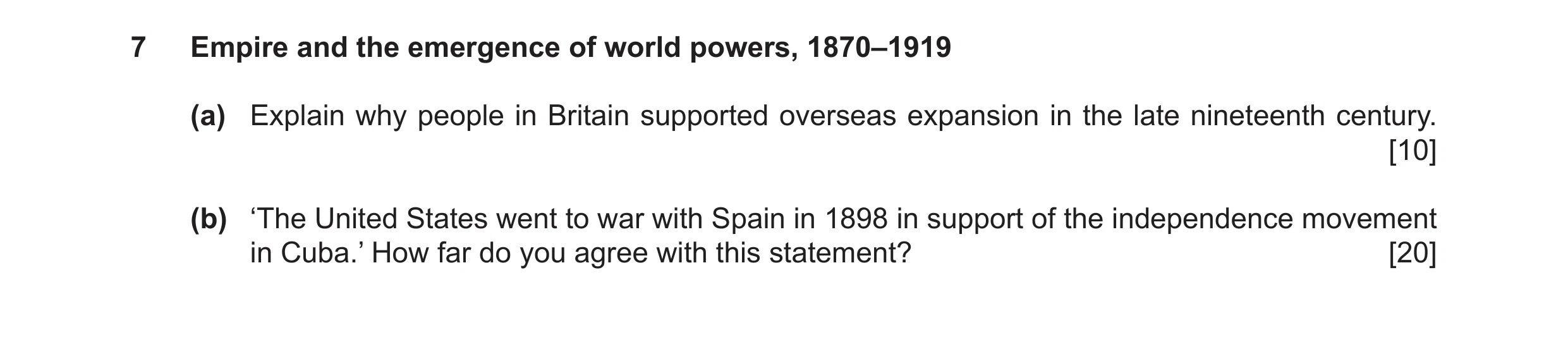
![Question 9: Empire and the emergence of world powers, 1870–1919 (a) Explain why Wilhelm II sent the Kruger Telegram in 1896. [10] (b) ‘Up to 1917 the U…](https://img.pastlit.com/crops/124b0c92-4203-4199-9793-a06889ebec9c/q7.webp)
 2 / 4
2 / 4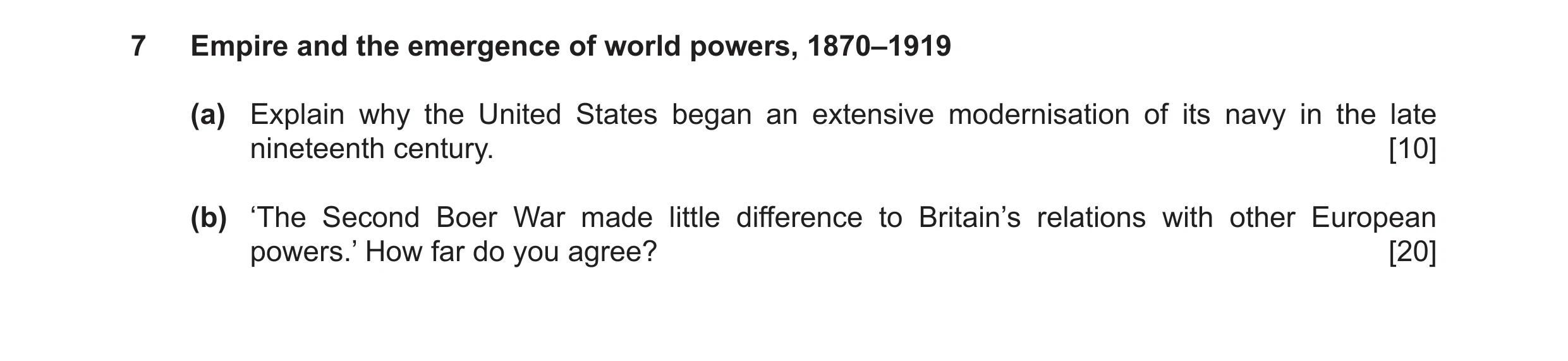
![Question 12: Empire and the emergence of world powers, 1870–1919 (a) Explain why US foreign policy became more imperialistic after 1898. [10] (b) To wha…](https://img.pastlit.com/crops/1e9768d7-c225-4abe-a9c2-55fadd798beb/q7.webp)
![Question 14: Empire and the emergence of world powers, 1870–1919 (a) Explain why there was a conference of European powers in Berlin in 1884–85. [10] (b…](https://img.pastlit.com/crops/437c8215-73eb-4aff-b91b-9fe5da52cbf3/q7.webp)
![Question 15: Empire and the emergence of world powers, 1870–1919 (a) Explain why Roosevelt introduced the Corollary to the Monroe Doctrine in 1904. [10]…](https://img.pastlit.com/crops/f0ed21d0-0f48-4734-a6b3-a4cb32722fc7/q7.webp)
 3 / 4
3 / 4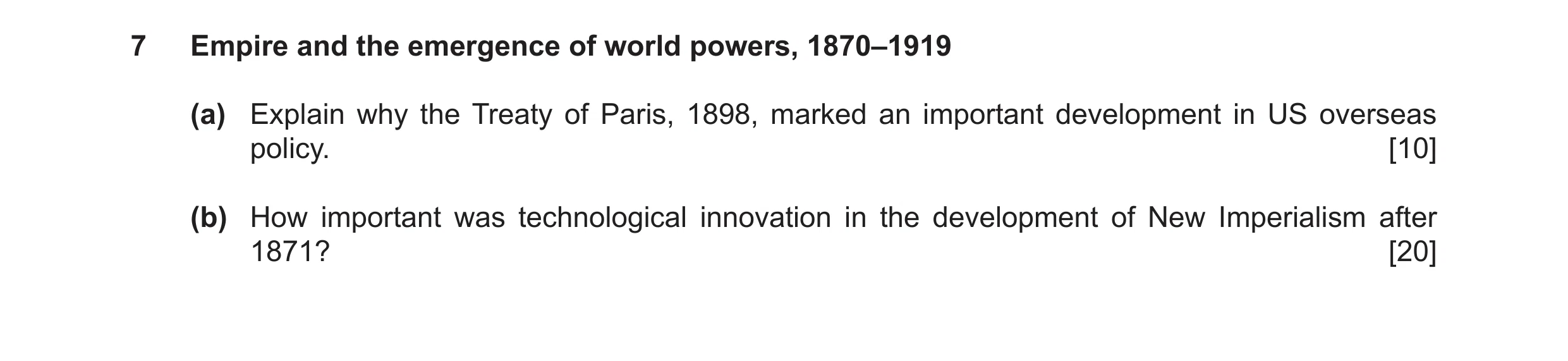
![Question 18: Empire and the emergence of world powers, 1870–1919 (a) Explain why the USA became involved in Panama from 1902 onwards. [10] (b) To what e…](https://img.pastlit.com/crops/2b5bfc49-c8bb-4041-b0c0-cf9d22e3808b/q7.webp) 4 / 4
4 / 4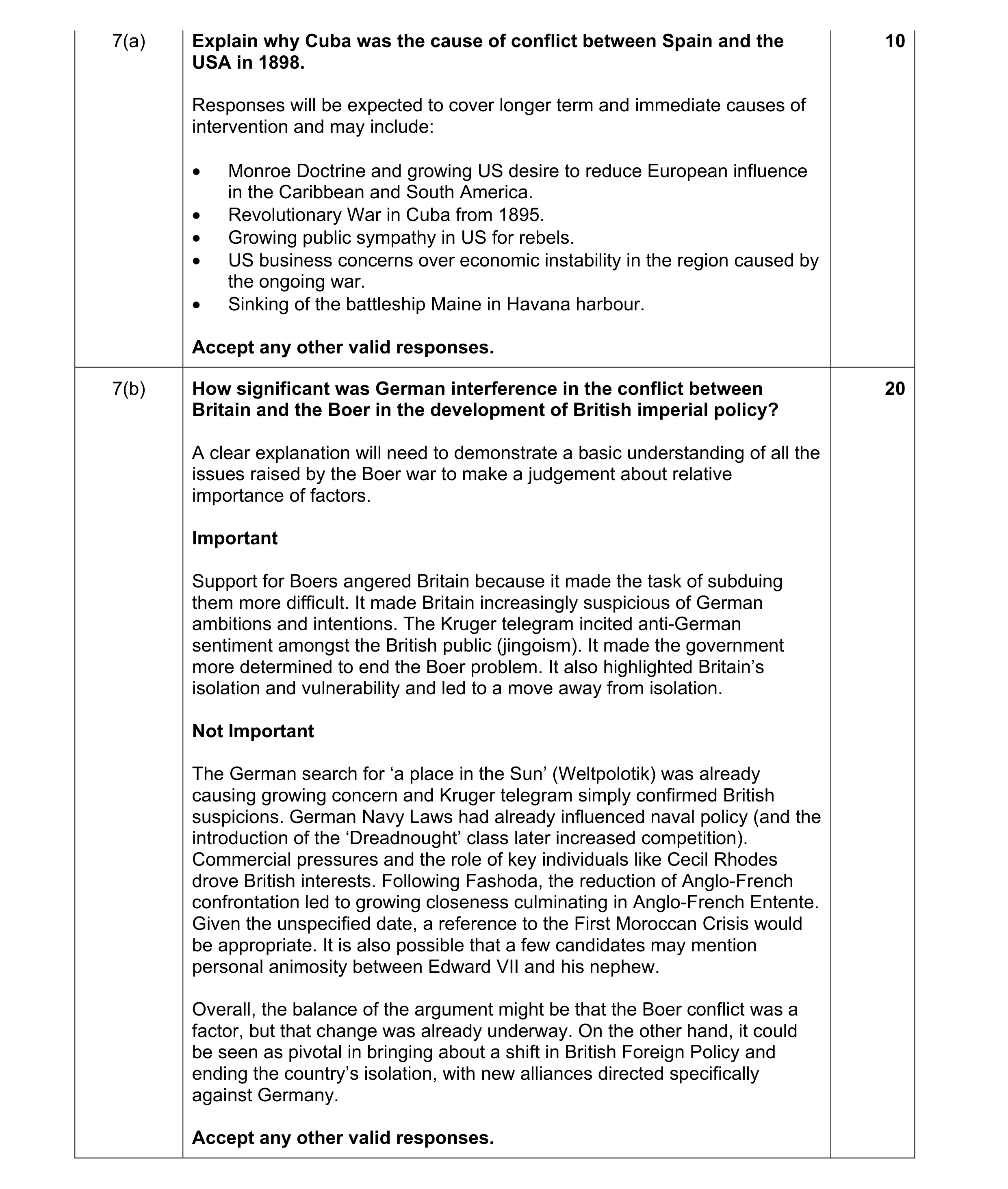 30
30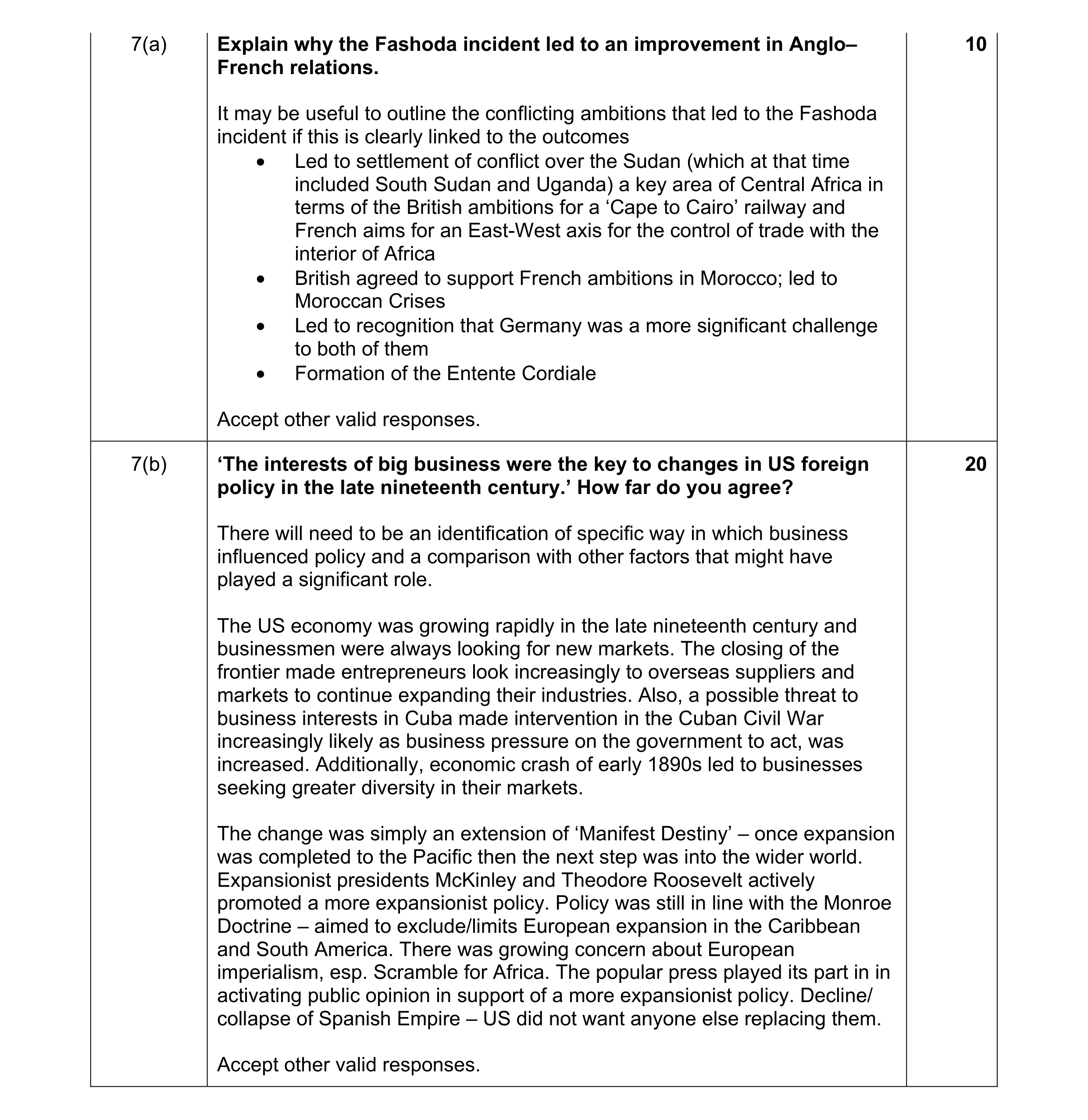 30
30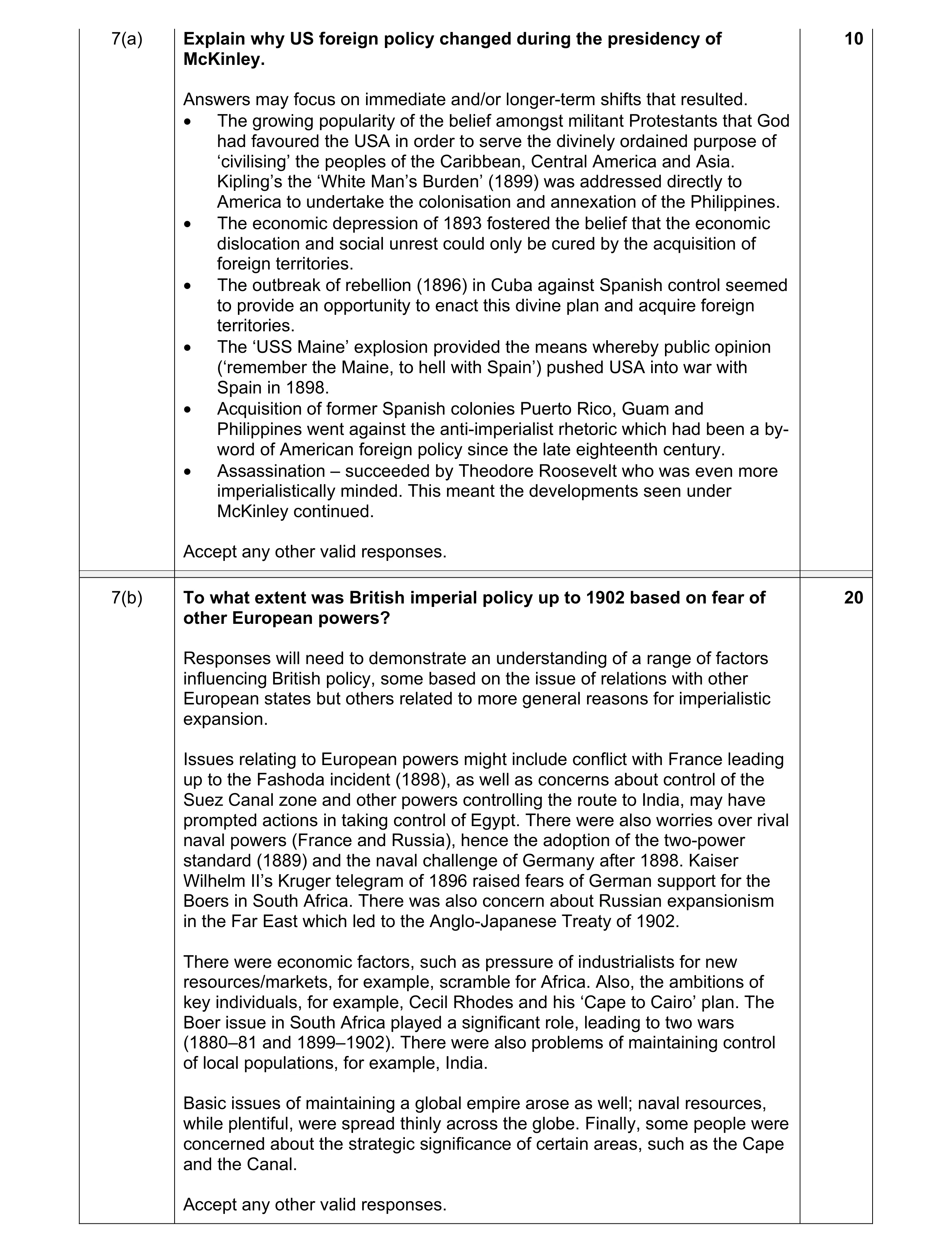 30
30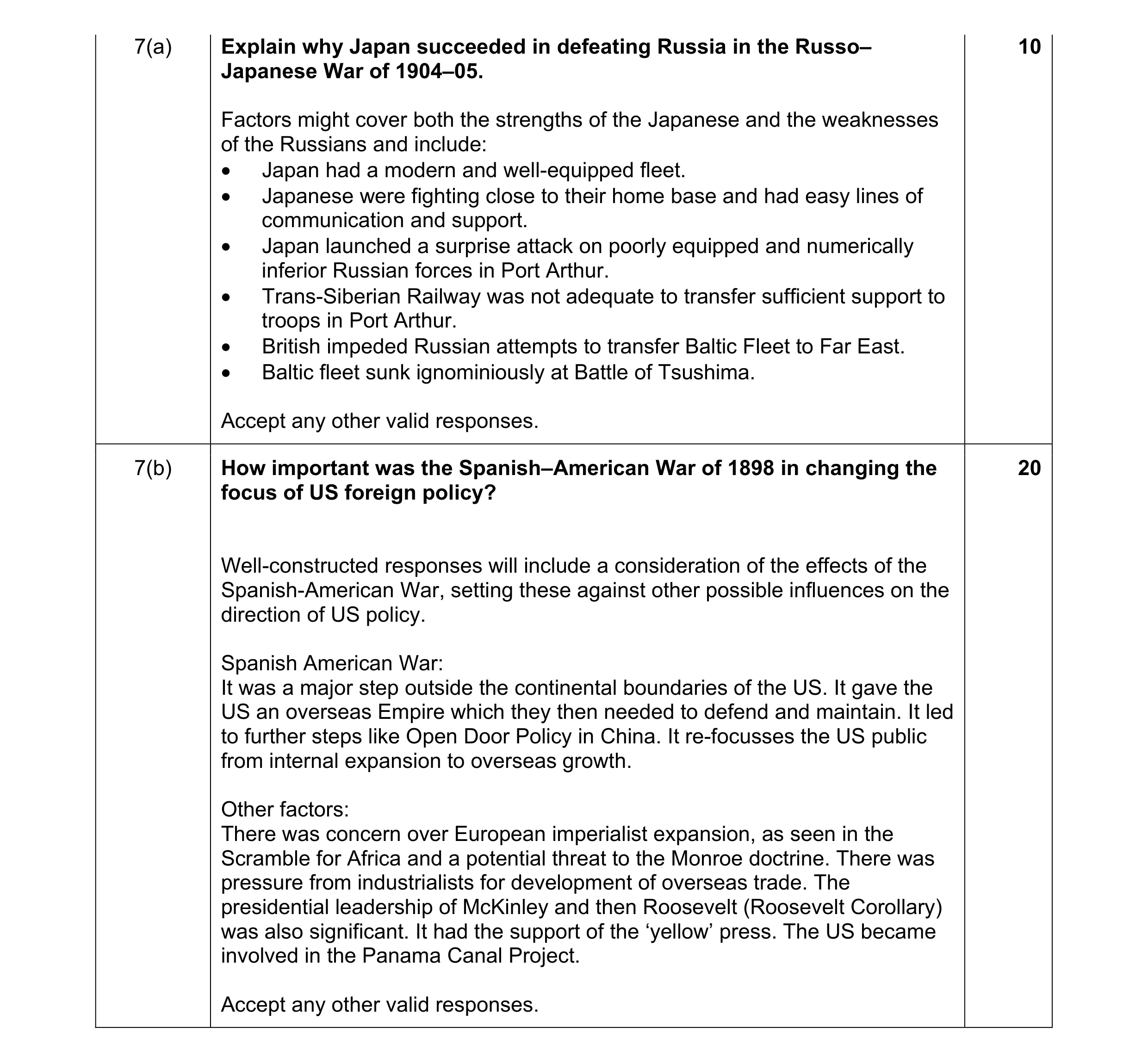 30
30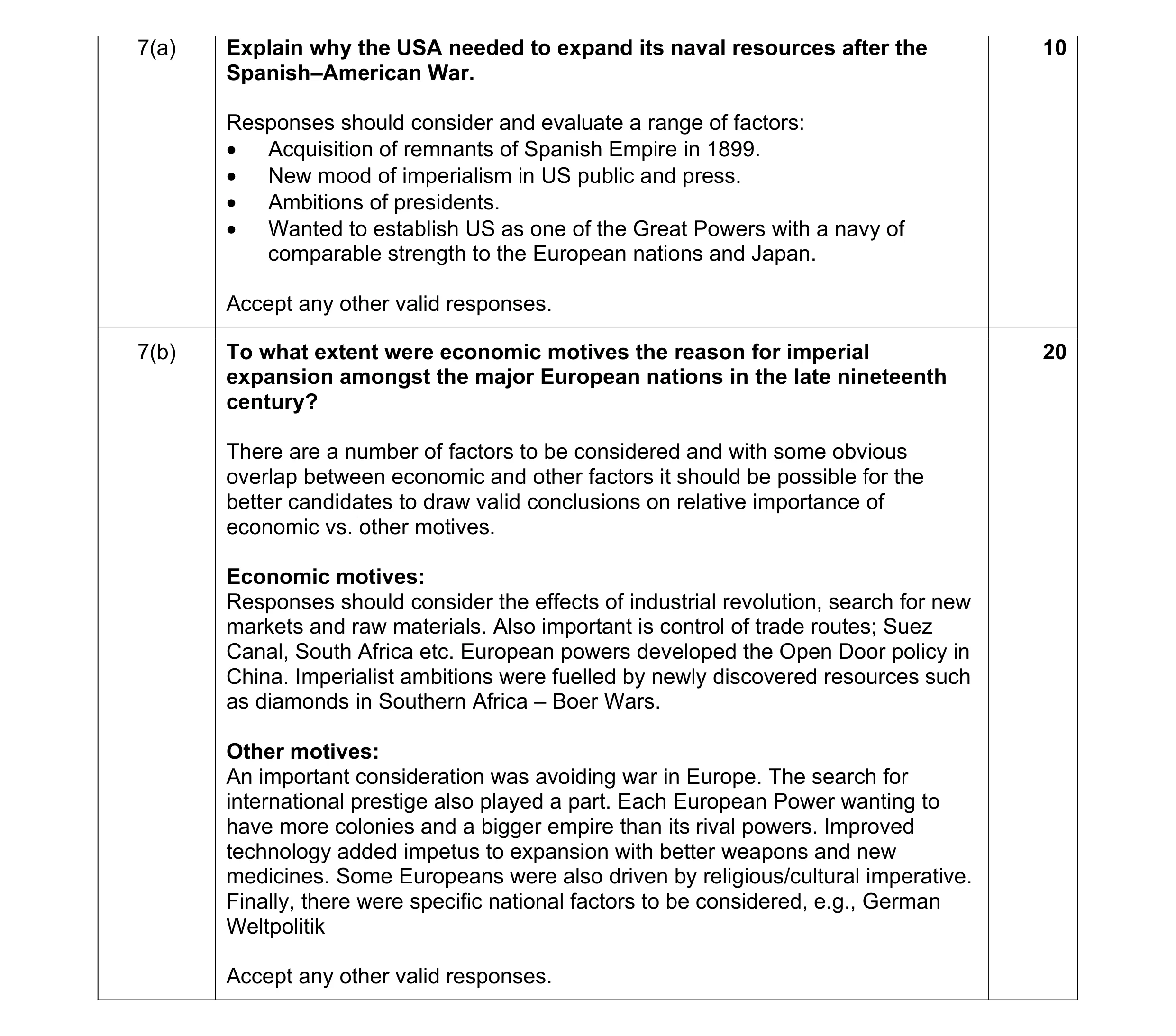 30
30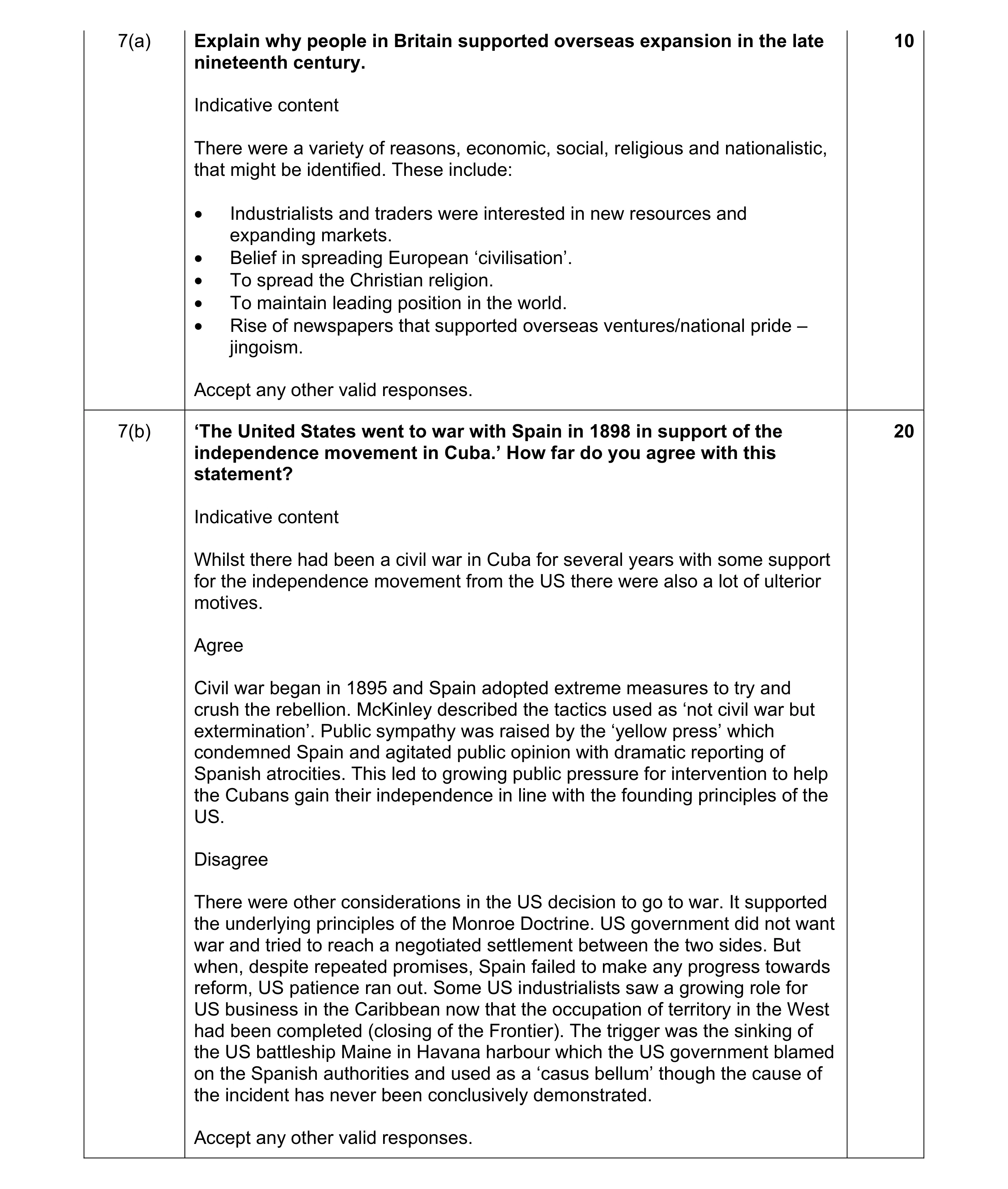 30
30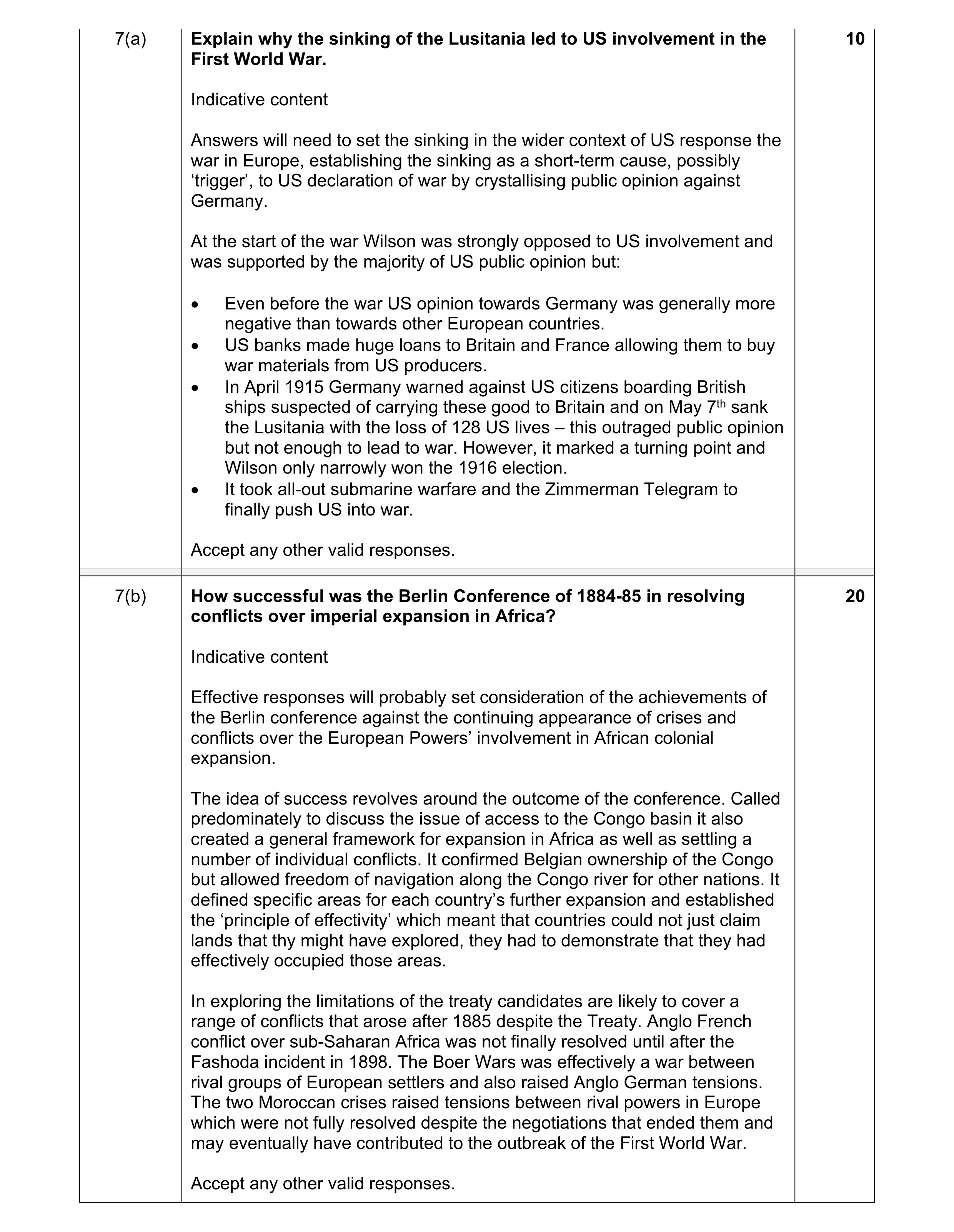 30
30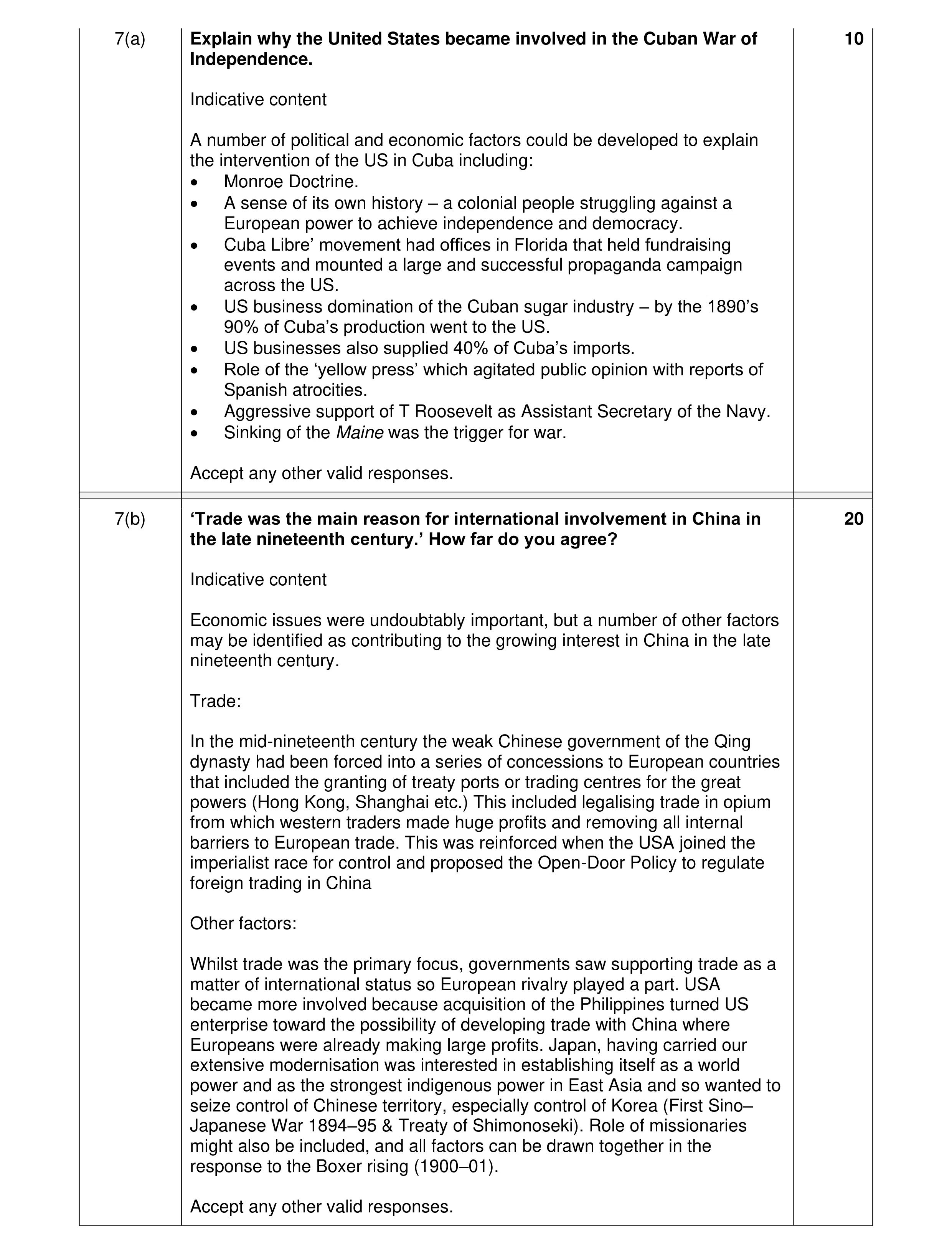 30
30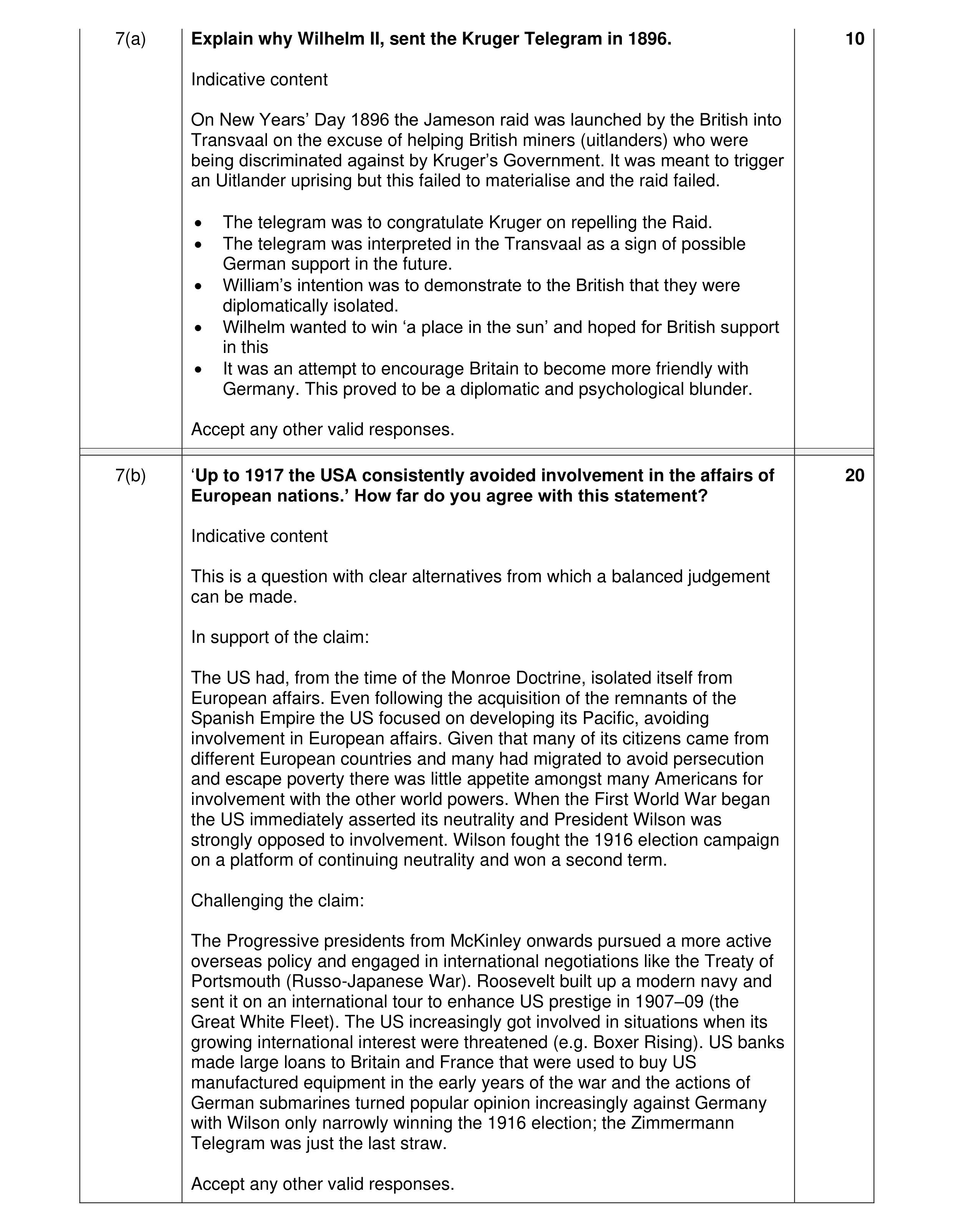 30
30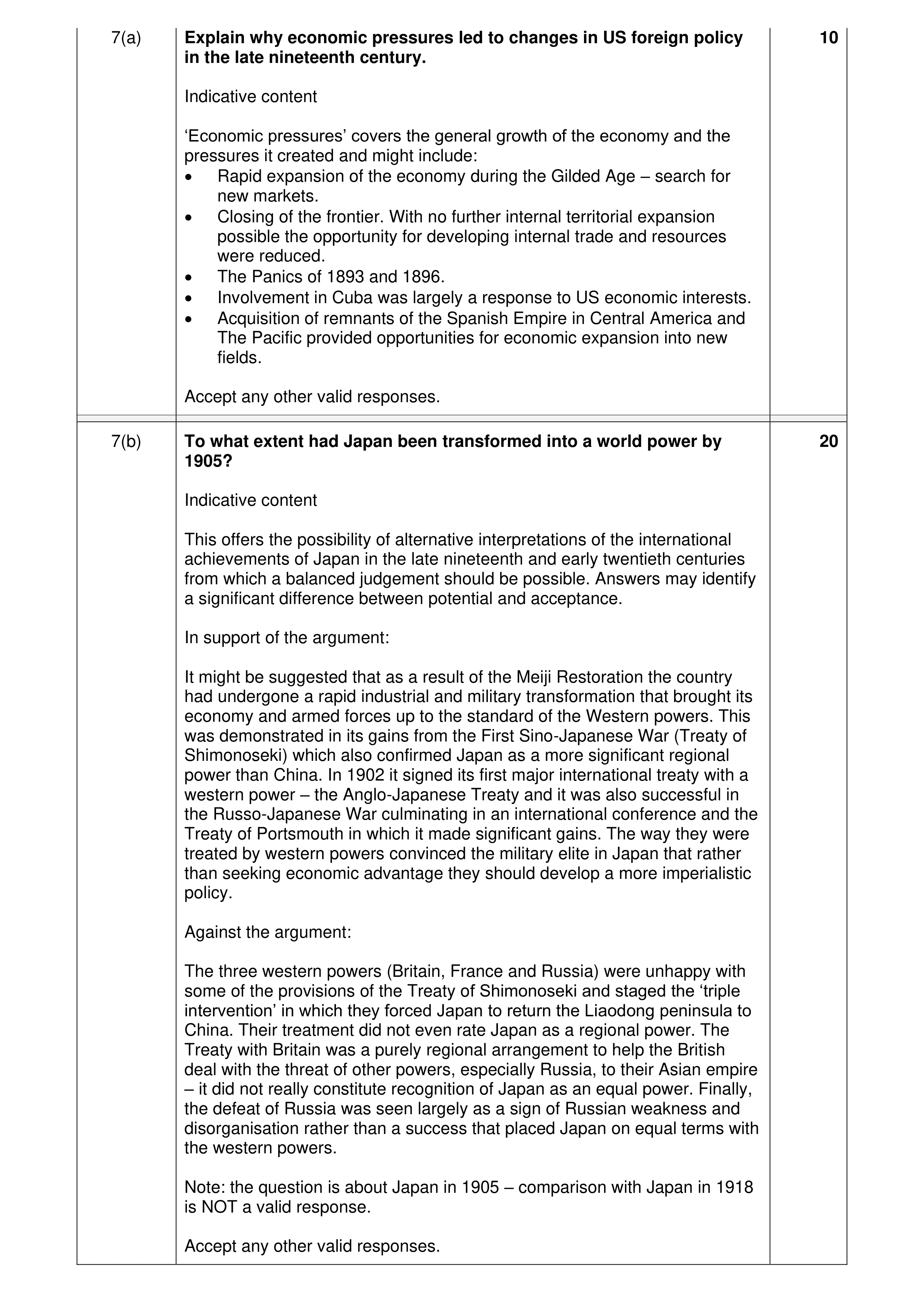 30
30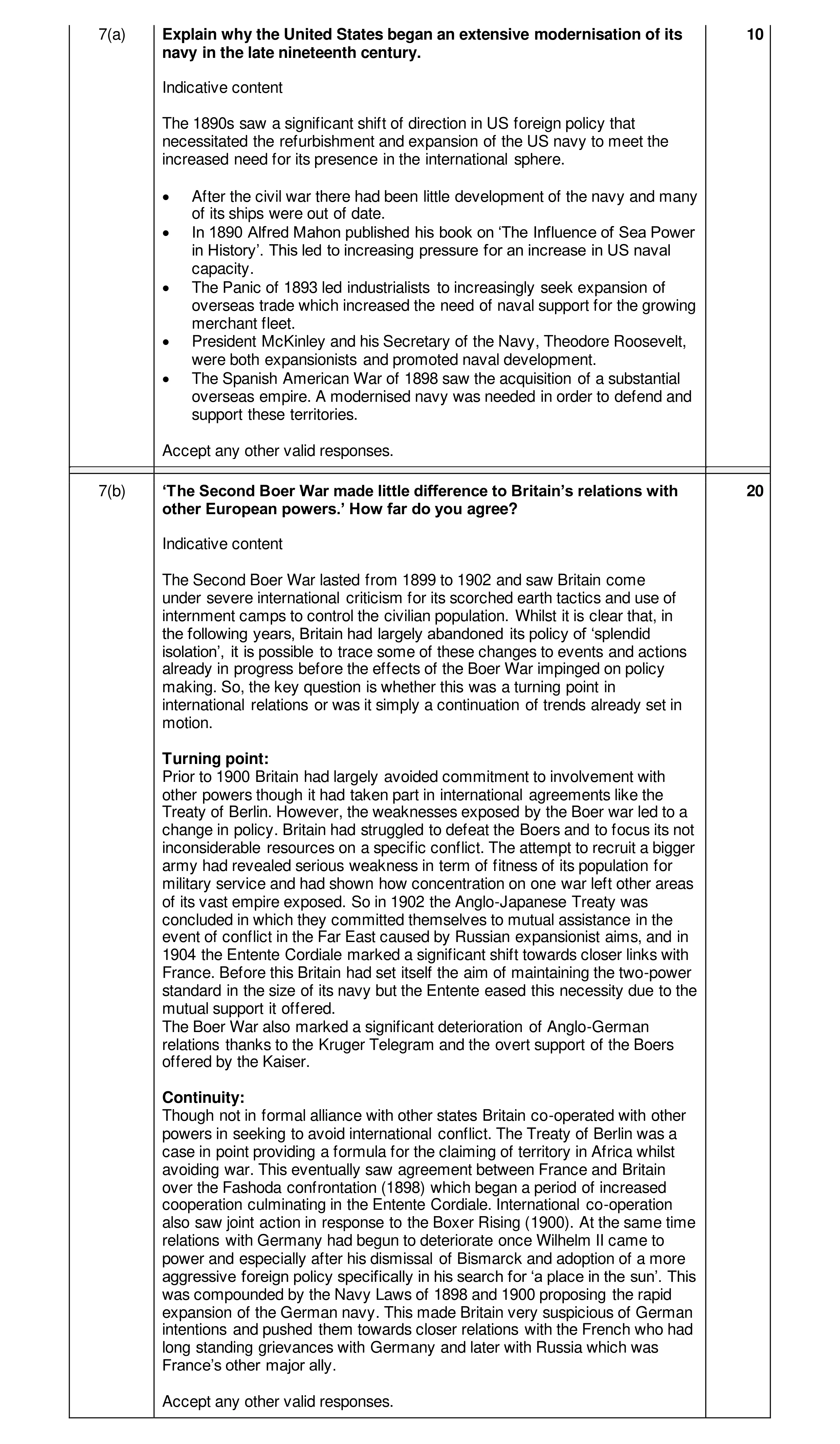 30
30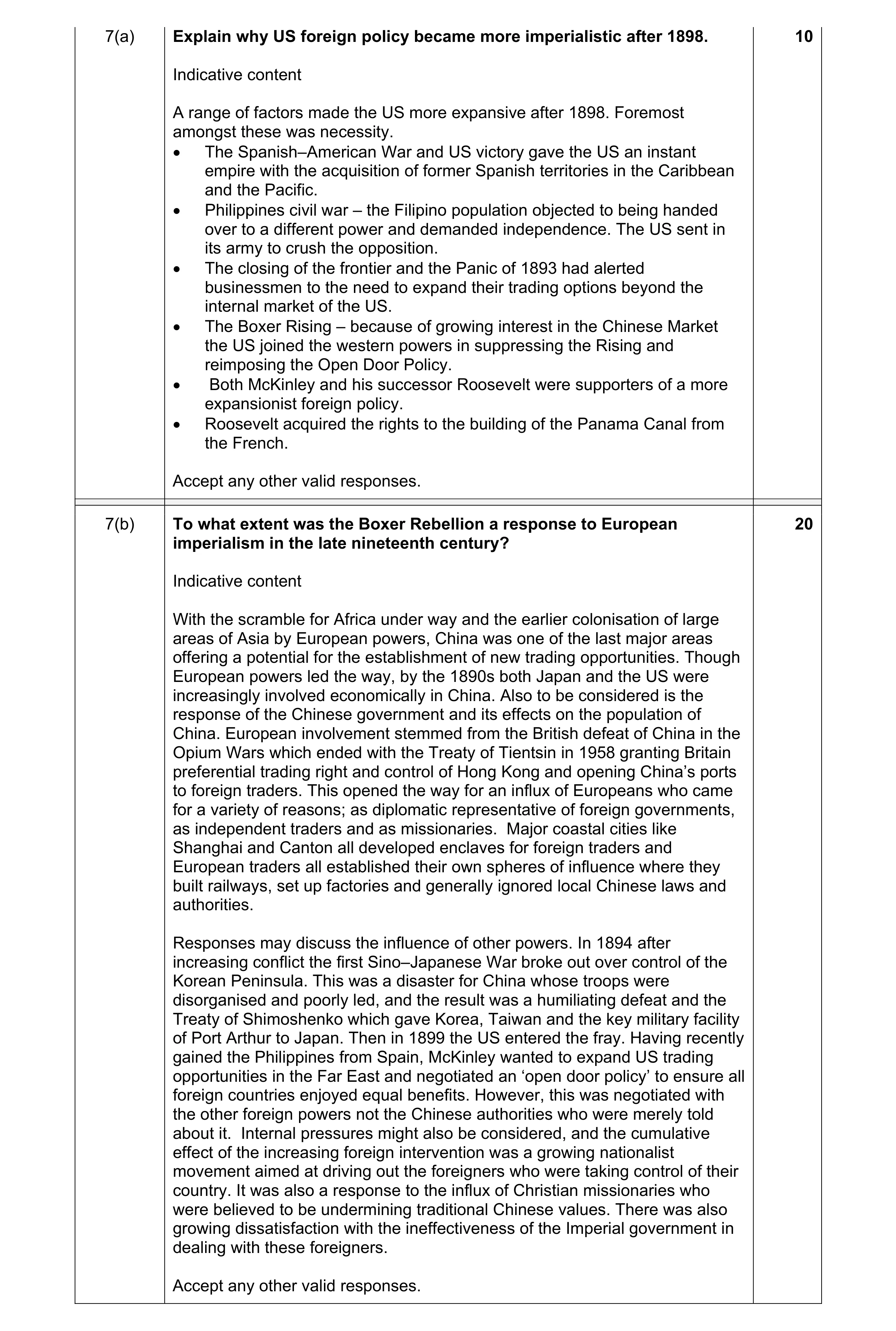 30
30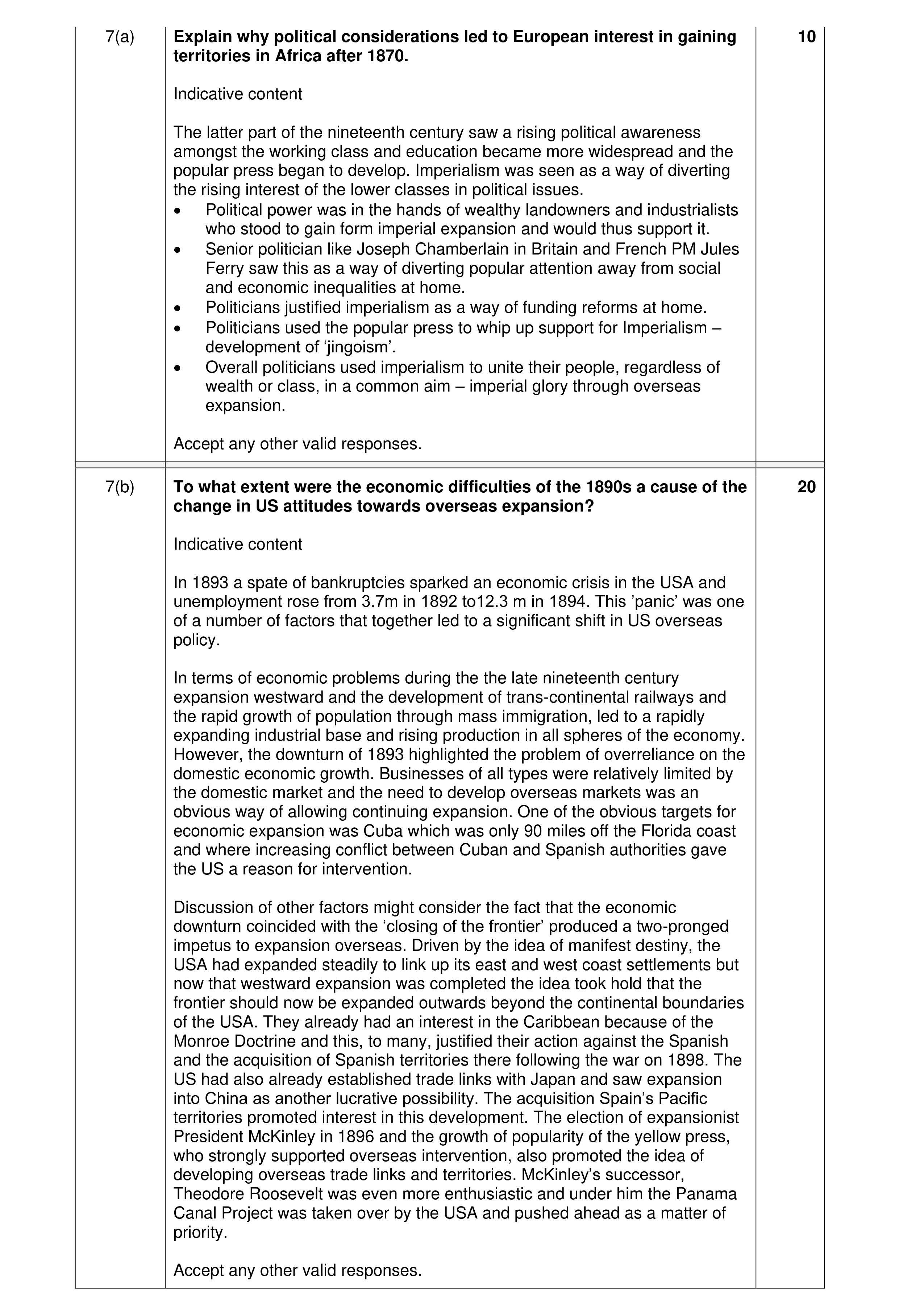 30
30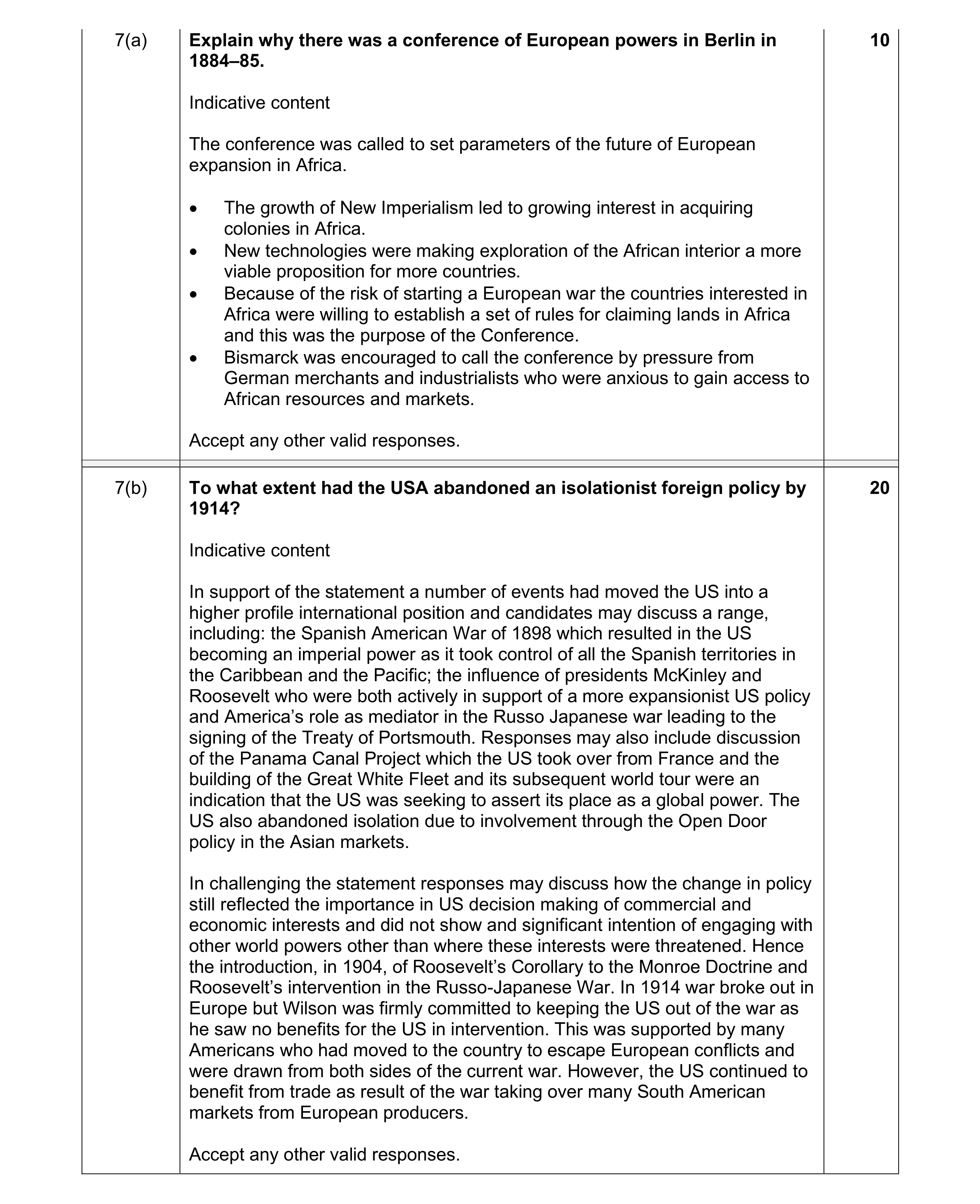 30
30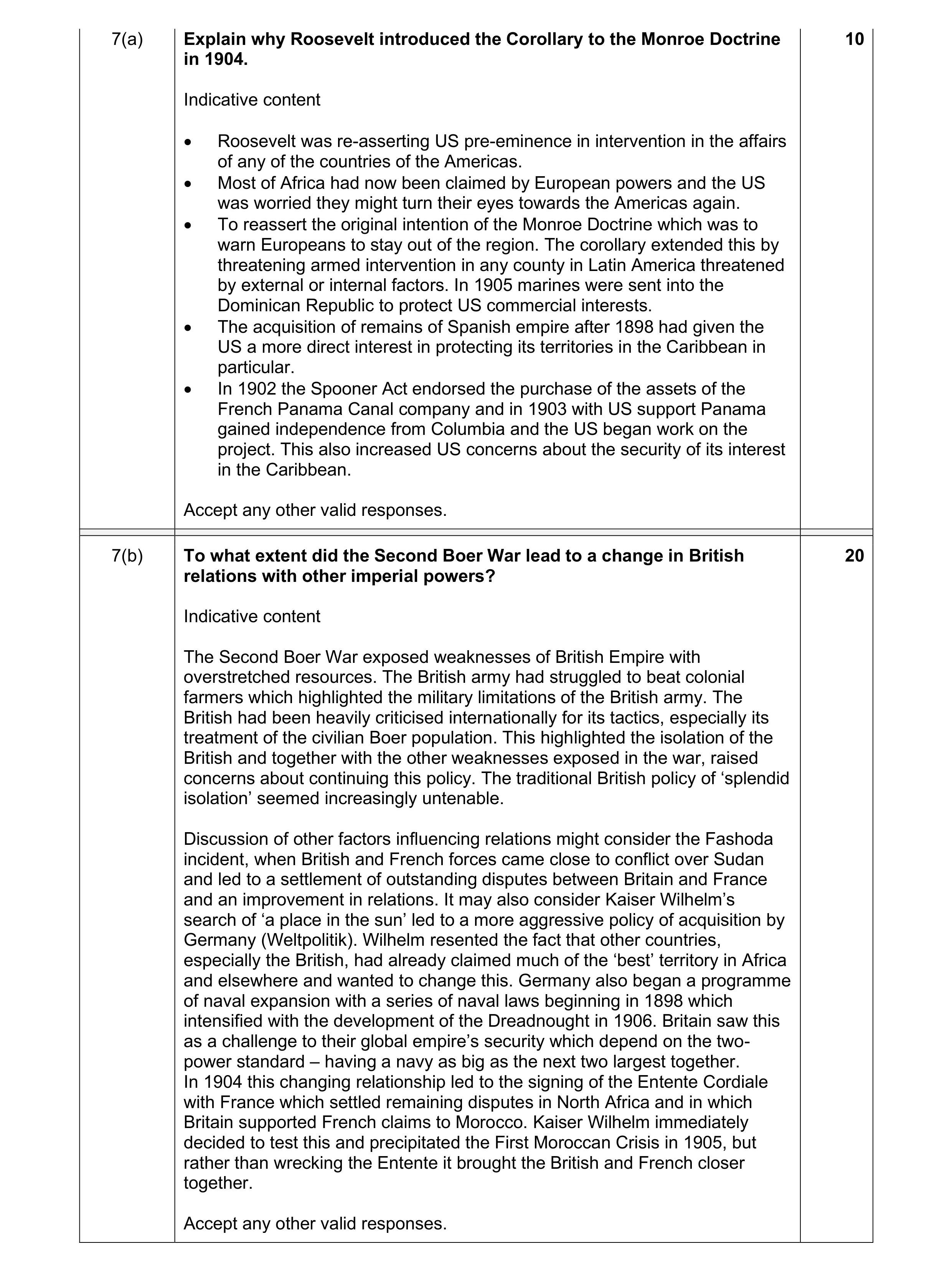 30
30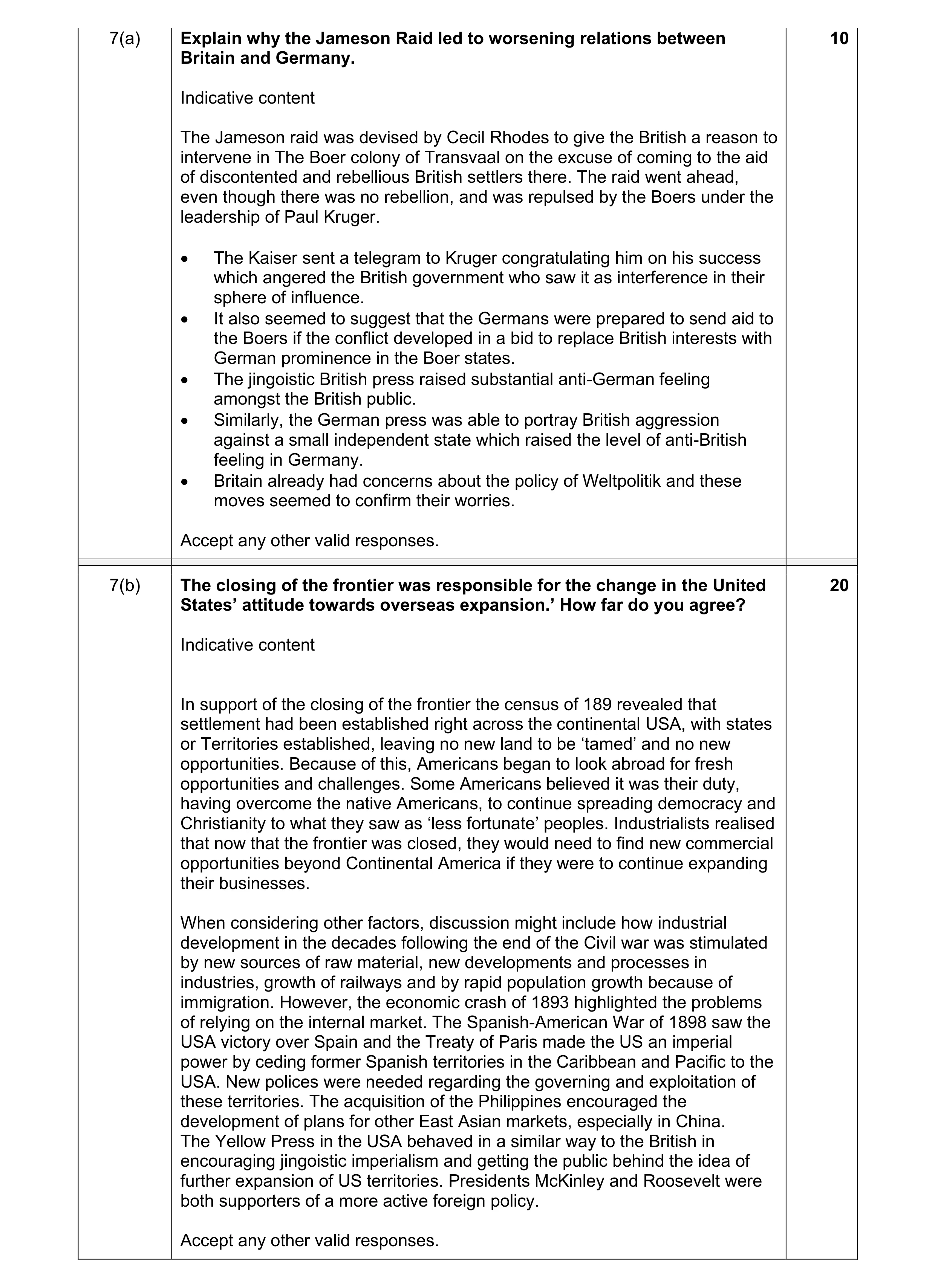 30
30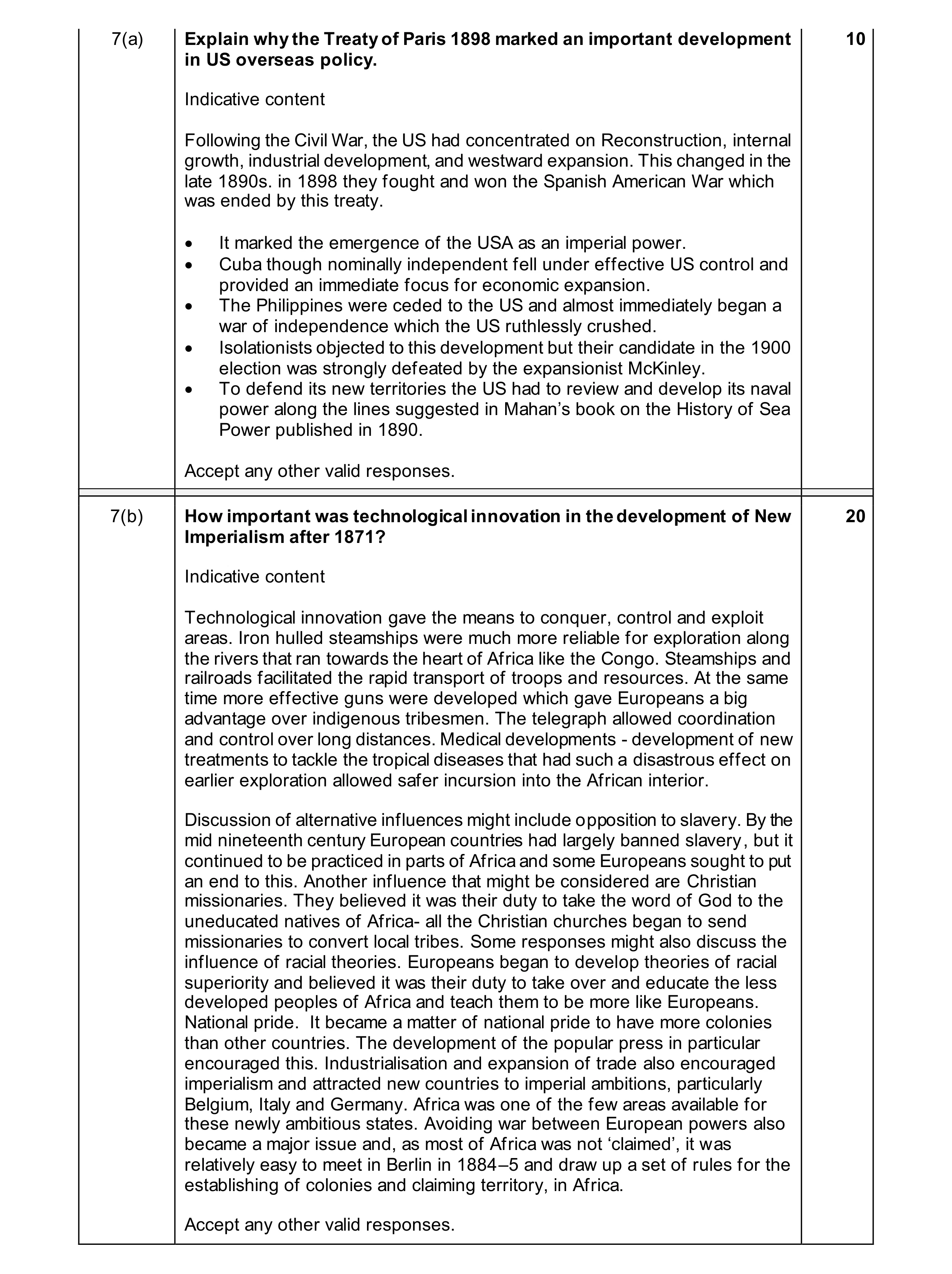 30
30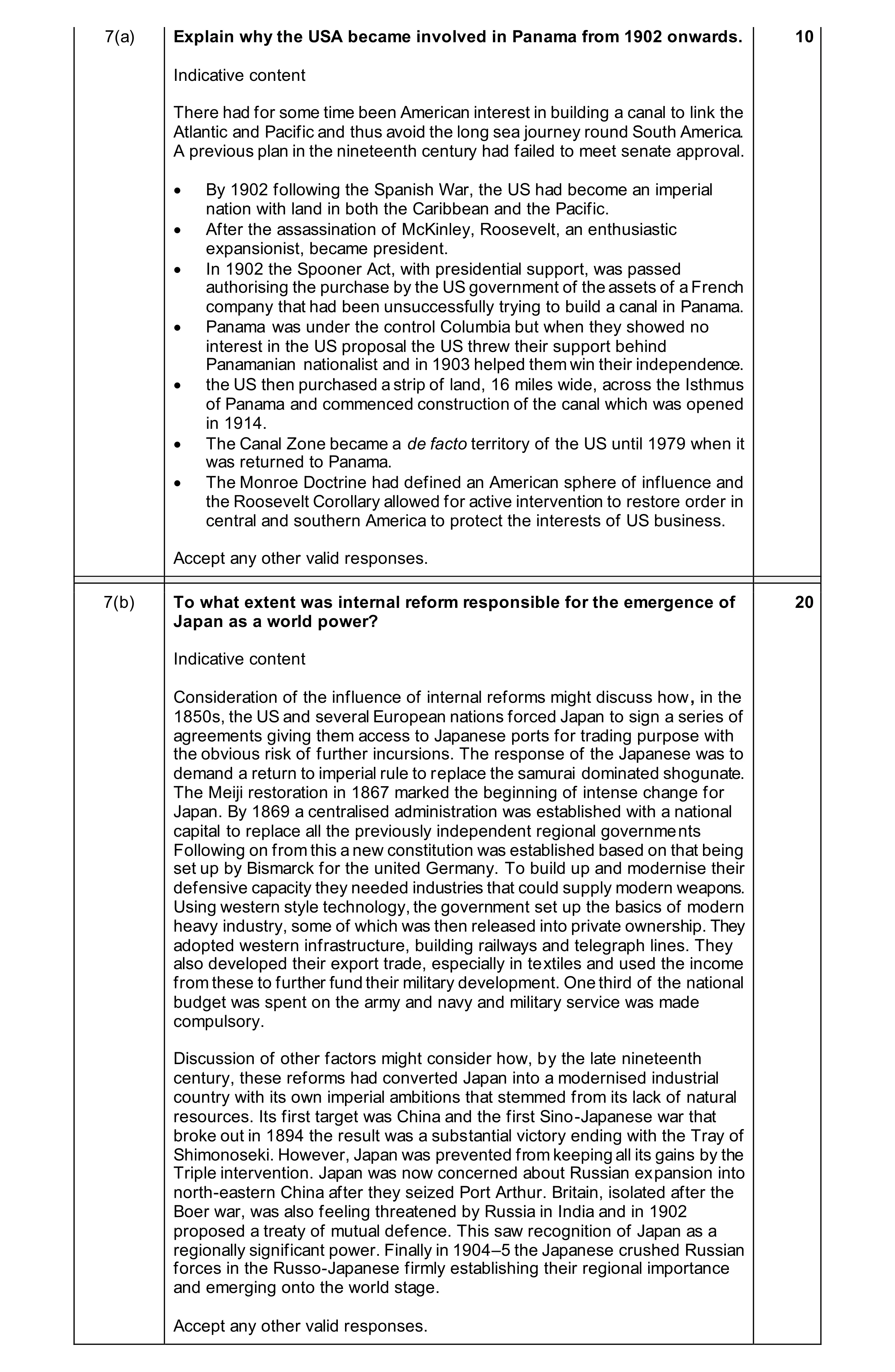 30
30