Questions as text
Q1 · ‘It was the failure of the US post-war policy in China which enabled the Chinese… 9489/42 Feb/March 2021
10 ‘It was the failure of the US post-war policy in China which enabled the Chinese Communist Party to gain power in 1949.’ Assess this view. [30]
30 marks
Mark scheme: 10 ‘It was the failure of the US post-war policy in China which enabled the 30 Chinese Communist Party to gain power in 1949.’ Assess this view. After the surrender of Japan on 10 August 1945, Chiang Kai-shek’s Nationalist China was admitted to the UN as a permanent member of the Security Council. The United States still hoped to maintain Nationalist China as an ally to stop the advance of communism. Truman wished to avoid a renewal of the Chinese civil war. However, US forces were over-stretched in Europe and Asia and heavy military commitment in China was unrealistic. General George Marshall was sent to persuade Mao and Chiang to form a government of national unity. Marshall arrived in China on 20 December 1945. His goal was to unify the Nationalists and Communists hoping that a strong, non-Communist China, would prevent the intervention of the Soviet Union. Even though Marshall conducted negotiations with both sides, no significant agreements were reached and in January 1947 Marshall left China. Although the United States were aware of the corruption of Chiang’s administration, they wished to contain communism They therefore increased their aid to the Nationalists, supplying aircraft and sending teams to Taiwan to train their troops. American public opinion was firmly against fighting a war in China. The United States supported the losing side and they limited their commitment in the area. Responses may also consider other factors that influenced the communist victory, such as how it was the Nationalists themselves that helped the Communists secure victory. Chiang’s troops often turned and fled rather than face the enemy. His army also had a reputation for arrogance and cowardice and was accused of looting and stealing. He lost support in the cities because of heavy taxes, inflation, unemployment and food shortages. Economic discontent led to strikes and there were protests demanding an end to the civil war and the creation of a government that included the Communists. The Nationalists responded with repression including censorship, mass arrests and assassinations. The Nationalists supported business and the landlords; they ignored the suffering of the peasants. Giving more US funds to the corrupt Nationalists would have been a huge waste of money. The Nationalists played a large part in their own defeat. However, the Communists themselves played a huge part in their victory. The People’s Liberation Army was unified under a tightly controlled central command. In 1945 the CCP’s liberated zone contained 19 base areas which included about a quarter of the country’s territory. The Soviet Union turned over all of its captured Japanese weapons to the CCP who also received Manchuria from the Soviets. Mao appointed loyal generals including Lin Biao and Zhu De whose tactics contributed greatly to the Communist success. The ordinary soldiers in the army were treated with respect and, in contrast, thousands of Nationalists deserted. Large numbers of well-trained KMT deserted and joined the communists and they were able to take full advantage of their skills. In June 1947 the Communists successfully defeated the KMT New First Army; they now had tanks and heavy artillery at their disposal. In 1948 they launched an attack south of the Great Wall that cut off Nationalist troops from their supply bases in Xi’an. They then secured the South East Central section of China and by the end of January 1949 most of China was in the hands of the Communists.
This question in 9489/42 Feb/March 2021
Q2 · Assess the extent to which the US policy of rebuilding the economies of Japan and Western… 9489/41 May/June 2021
8 Assess the extent to which the US policy of rebuilding the economies of Japan and Western Europe was motivated primarily by ideology. [30] Section C: International history, 1945–92
30 marks
Mark scheme: 8 Assess the extent to which the US policy of rebuilding the economies 30 of Japan and Western Europe was motivated primarily by ideology. On one hand, post-war policies aimed to prevent spread of communism by restricting the economic hardship that had caused its rise in Russia and China. They could, on the other hand, be described as providing markets, pursuing dollar diplomacy, or establishing strategic control. In the four years following 1948, the European Recovery Program resulted in a $13m dollar US investment into the Western European economies. It was stated that the aim was directed against hunger and poverty in the aftermath of war, not against any country and doctrine. However, as a result of the Truman Doctrine’s political aims and the USSR’s rejection of it, it came to be seen as ideologically motivated. It demonstrated the USA’s huge economic strength, which is based on capitalism and enterprise, and it appeared to link economic hardship with support for communist doctrines. The policy was a change from simply giving aid – the US had already contributed $9 million to investments in infrastructure. This was an indication that a motive was to establish a regenerated western Europe, which would be open to US trade and investment. The USSR saw that its economic aims were linked to growing US influence and economic policy, US power, and the spread of a capitalist ideology. On the other hand, despite the influx of US money, the economies of Western Europe were in need and there was a huge task of rebuilding. The British government, as a major recipient, saw the plan as one of generosity. It may have been motivated by fears that if decisive action were not taken, the economies of western Europe would take 20 years to recover. This would have serious financial consequences for the US, whereas the Marshall Aid programme, by promoting a more rapid and self-generated recovery, would benefit the US economically and reduce defence commitments as Western Europe became more capable of funding its own defence capabilities. The more complex motives for US economic policy may have been distorted by the political and ideological elements of the US as a leader and defender of the Free World. A key element was that the aid would allow Europeans to rebuild and cooperate in integrating western Germany into an economic and political framework that would keep the peace and prevent the US from being drawn into a third Germany-based European conflict. Thus, there is possible discussion about the motivations and the relative importance as ideology as a justification for high levels of overseas spending. 8 The immediate problems of occupation in Japan were far worse than the problems the US encountered in Germany’s shattered cities, and the responsibility of direct rule for providing necessities was significant. Japan was regarded as a vital component of strategic defence, and the US was slower to recognise a distinct communist threat in Asia than in Europe, and the CCP’s victory, followed by the invasion of South Korea, increased the need to ensure that Japan remained stable. The first phase of economic rebuilding was ideologically based in the sense that the US wanted to change the cult of militarism and emperor worship and lead Japan towards constitutional democracy along the lines of its model Asian state, the Philippines. To break the power of the Japanese elites, economic aid was allied to land reforms to deal with immediate problems and a dismantling of larger industrial concerns. After 1947, economic policy shifted to the ‘reverse course’ as the threat from the CCP became more evident, and there was greater concern for infrastructure recovery and larger industrial concerns as Japan became a supply base for the war in Korea. Thus, policy was driven by a different sort of ideology concern, but also by the need to maintain the strategic defence ring in the Pacific.
This question in 9489/41 May/June 2021
Q3 · Assess the impact of involvement in the Korean War on US foreign policy in the period… 9489/41 May/June 2022
8 Assess the impact of involvement in the Korean War on US foreign policy in the period 1950–63. [30] Section C: International history, 1945–92
30 marks
Mark scheme: 8 Assess the impact of involvement in the Korean War on US foreign 30 policy. The war brought home the costs of direct military action and this impacted foreign policy. In economic terms the war caused tax rises on personal and corporate income and a variety of purchase taxes. Initially the war led to a big expansion of demand and consumer spending and inflation which was repeated in 1951. Truman introduced price controls and a tight control on deficit spending and money supply. There were 139 000 casualties, and the war took up 14% of GDP. At 37 000 deaths the human costs were much less than World War Two, but brought much less tangible results as the war merely restored the status quo in Korea and a peace settlement was delayed. In terms of US policy, the lack of cohesion in policy prior to 1950 was replaced by a greater determination to resists Communist expansion even at the costs of supporting undemocratic regimes such as that of Rhee and the war, together with the loss of China encouraged a ‘domino effect’ mentality in policy making. One of the significant results of the Korean War was that it gave the US reason to increase its military expenditure four-fold. Under Truman, military expenditure increased rapidly, laying the foundations for the so-called military industrial complex that existed throughout the Cold War, it was during the Korean War that black and white troops were first integrated in the US army, an important step on the road to civil rights. The Korean War also strengthened the US relationship with Britain, which sent troops for the UN peacekeeping force. Finally, it was during the Korean War (and partially because of it) that the Democratic monopoly of the Presidency, finally ended with the election of Eisenhower. The US commitment to Asia was increased with important consequences, for example Vietnam and relations with China. However, the costs made the US wary about direct intervention and the subsequent involvement in Vietnam was more in terms of escalation than a decisive decision to commit US forces as in 1950. Thus, discussion might be in terms of whether Cold War tensions were escalated, and policy hardened or whether the war offered a warning about the problems of large scale land warfare leading to a rise in anti-communist rhetoric but careful consideration of any actions taken to rollback.
This question in 9489/41 May/June 2022
Q4 · ‘The United States’ involvement in the Middle East during the Cold War was mainly to… 9489/42 May/June 2022
12 ‘The United States’ involvement in the Middle East during the Cold War was mainly to prevent Soviet influence in the region.’ Evaluate this view. [30]
30 marks
Mark scheme: 12 ‘The United States’ involvement in the Middle East during the Cold War 30 was mainly to prevent Soviet influence in the region.’ Evaluate this view. The US’ overriding concern was to deny Soviets access to Middle Eastern territory and, through the policy of containment, inhibit the expansion of the Soviet sphere of influence. However, it also wanted to maintain access to facilities and resources in the Middle East including waterways like the Persian Gulf and the Suez Canal as well as the region’s vast oil reserves. It therefore aimed to promote peace and stability and to contain Soviet expansion. The belief was that the Soviets would take advantage of unstable states and it would prefer the status quo. During the first two post- war decades, the US made little progress. The 1950 Tripartite Declaration seeking to promote peace and stability achieved little. The Baghdad Pact, a defensive organisation for promoting shared political, military, and economic goals, was also ineffective. The Soviet Union exploited Arab nationalism in both Egypt and Syria as well as the Arab-Israel enmity, supplying arms to both and supported Nasser in the Suez Crisis. This led to Soviet acquisition of naval and air facilities enabling them to begin a naval build-up in the area and to limit the US influence The US responded in 1957 with the Eisenhower Doctrine; a country could request American economic and military aid if it was facing armed aggression from another state. In the early 1960s, Kennedy tried to repair US relations with the Arab states by approaching Nasser and by reaffirming continuing support in Saudi Arabia and Jordan. His aim was to contain the communist threat and to secure the neutrality of the Arab world. In contrast, the Soviet Union sympathised with the Arab position. By the 1960s, the US relationship with the Middle East had deteriorated. It had made little progress in promoting peace and stability and enlisting regional partners to strengthen its position in the Cold War. It decided to take a new proactive stance through a commitment to Israel. Despite this strong support for Israel, the policy on the Arab-Israeli conflict was subordinated to building a more active system of containment and appearing impartial. However, the relationship with Israel damaged that image, and led to Arab distrust. The US felt that they had ‘lost’ Egypt to the Soviets, who were supplying Nasser with military aid; they reacted by selling defensive weapons to Israel in 1962 and offensive weapons in 1966. In 1967 the US tacitly consented to an Israeli military assault on Egypt to deal with Nasser's blockade of the Straits of Tiran; it shipped military equipment and ammunition to Israel. The US showed that the benefits of close ties with Israel were usually considered more important than strained relations with the Arabs. In September 1970, civil war broke out in Jordan between the PLO and King Hussein. Unable to send troops, Nixon alerted the Israelis to be ready to act if necessary. The troops did mobilise, but war was averted as the PLO backed down. The partnership with Israel had been reaffirmed. US commitment to the stalemate in the Middle East was a temporary solution to the goals of peace and Soviet containment. The Yom Kippur War 1973 and the ensuing oil embargo scared the US and forced them to reconsider the stalemate policy and the Israeli alliance. 12 In September 1978, Sadat visited Jerusalem and the peace process in the Middle East began. The Israeli Prime Minister was willing to return the occupied territories in Sinai in exchange for peace. It was a good first step towards real peace, which became a realistic possibility with the decline of the Soviet Union and the Cold War in the 1980s.
This question in 9489/42 May/June 2022
Q5 · Assess the extent to which President Reagan was responsible for the outbreak of the… 9489/43 May/June 2022
9 Assess the extent to which President Reagan was responsible for the outbreak of the Second Cold War. [30]
30 marks
Mark scheme: 9 Assess the extent to which President Reagan was responsible for the 30 outbreak of the Second Cold War. Tension had already increased between the two superpowers before the election of Reagan in 1980. During the period of détente in the late 1960s and 1970s Cold War mistrust persisted and both the Soviet Union and the United States secretly supported political leaders, revolutionaries and paramilitary groups around the world, mainly in Africa and South America. Both superpowers continued to initiate and support secret operations. President Ford began the Team B project in May 1976, inviting a group of outside experts to evaluate classified intelligence on the Soviet Union. Their report claimed American intelligence agencies had grossly underestimated the Soviet Union’s nuclear arsenal, weapons systems and battle plans. Though many of the findings were later discredited, they helped bring about the end of détente and the Carter administration began to increase military spending. The Soviet invasion of Afghanistan in December 1979 to prop up the left-wing regime there was regarded by Carter as ‘the most serious threat to peace since the Second World War’. He ordered grain and goods shipments to Russia be halted and supported a US boycott of the 1980 Olympic Games held in Moscow. Thus, the ground had already been prepared to revive the Cold War and détente was crumbling. Reagan was elected in 1980 and he rejected the idea of peaceful co- existence with the Soviet Union believing that détente had been a disaster for the United States. The first years of Reagan’s presidency were marked by increases in military spending and hostile rhetoric. Yuri Andropov and Konstantin Chernenko responded likewise giving rise to the term, ‘Second Cold War’. Reagan argued that the Cold War was a fight between good and evil. He urged Americans not to ‘ignore facts of history and the aggressive impulses of an evil empire’. He increased defence spending and revived the arms race. The United States believed there was a missile gap with the Soviets. He resolved to roll-back communism. In 1983, he initiated the Strategic Defence Initiative (SDI) to defend the United States from a ballistic missile attack. This would be accomplished by ground-based defences and, eventually, through the use of space technology. The programme became known as ‘Star Wars’. However, it can also be argued that what Reagan was aiming to do was to end the Cold War. National Security Decision Directive 75, a policy directive issued by Reagan in January 1983 outlined how he planned to win the Cold War. The United States would ‘contain and over time reverse Soviet expansionism’. He was aware of the economic problems the Soviet economy was facing and he wanted to pressure the Soviet Union to speed up change. The arms race would put more pressure on the Soviet economy. However, Gorbachev’s policies of glasnost and perestroika ultimately led to huge changes in Eastern Europe leading to the collapse of communism. Reagan, too, in his second term discovered that Gorbachev was a man he could negotiate with. In December 1987, he and Reagan signed the Intermediate-Range Nuclear Forces Treaty calling for the elimination of intermediate-range missiles.
This question in 9489/43 May/June 2022
Q6 · ‘The Marshall Plan was more an act of US self-interest than a humanitarian policy.’… 9489/41 Oct/Nov 2022
8 ‘The Marshall Plan was more an act of US self-interest than a humanitarian policy.’ Discuss this view. [30] Section C: International history, 1945–92
30 marks
Mark scheme: 8 ‘The Marshall Plan was more an act of US self-interest than a 30 humanitarian policy.’ Discuss this view. Indicative content The question reflects a debate about the programme of aid to Europe that Marshall introduced in 1948. In terms of humanitarianism, there was a genuine concern for the state of post-war Europe which Marshall had witnessed in person. Not only were there shortages but the destruction of a lot of infrastructure was impeding growth and the physical ravages of war were evident. The association of poverty with the rise of political extremism in the 1930s promoted concern that the peoples of Europe were in both economic and political danger. The context was the spread of Communist regimes in Eastern Europe by Stalin’s exploiting divisions among the anti-Communist parties and economic discontents and the danger of communist parties in France and Italy. Even when there was no danger of a revolution as in Britain, the economic problems might well weaken resolve to support actions against the spread of Communism. Potential allies and countries which were in danger of succumbing to radical political change needed economic support for political reasons as well as in terms of meeting real economic needs. The programme was offered to all European countries, but the question remains about whether it was ever expected that it would be taken up by the Eastern bloc as it was likely to be seen as part of a Containment policy expressed in the Truman doctrine. The alternative interpretation made at the time by the Soviet Union was that the policy was simply dollar diplomacy. The US needed to secure European markets and maintain its influence which would serve its financial and economic self-interest. This view has been supported by the US policy of opposing German unification and the creation of a new currency to link the western zones and accusations that Marshall aid went primarily to its political allies and to prevent the growth of communist parties. It is possible that US policy did not make a distinction between self-interest and humanitarianism – prosperity and liberal capitalism were seen as self- evident goods even if they were in the best interests of the US.
This question in 9489/41 Oct/Nov 2022
Q7 · Analyse how far the issue of Taiwan affected Sino–US relations during the Cold War 9489/41 Oct/Nov 2022
10 Analyse how far the issue of Taiwan affected Sino–US relations during the Cold War. [30]
30 marks
Mark scheme: 10 Analyse how far the issue of Taiwan affected Sino–US relations during 30 the Cold War. Indicative content The ability of the People’s Republic of China (PRC) and the United States to find common ground when the communist state was established was impeded by both domestic politics and global tensions. Truman’s administration was accused of having ‘lost’ China. The fact that there was an exiled Nationalist Government and army on Taiwan increased the feeling among US anti-communists that the outcome of the struggle could be reversed. The outbreak of the Korean War in 1950 in which the PRC and the United States were on opposing sides ended any opportunity for an agreement between the PRC and the United States. Truman wished to prevent the Korean conflict from spreading south and this led to the US policy of protecting the Chiang Kai-shek government in Taiwan. In 1954 the PRC began to bombard Jinmen, Mazu and the Dachen Islands in the Taiwan Straits and the United States signed the Mutual Defense Treaty with the Republic of China (ROC). It promised support if the ROC engaged in a broader conflict with the PRC. In January 1955, the US Congress passed the ‘Formosa Resolution’ which gave President Eisenhower total authority to defend Taiwan and the off-shore islands. However, Chiang Kai-shek agreed to withdraw his troops from Dachen. In 1958 the PRC shelled Nationalist outposts on Jinmen and Mazu Islands and the United States again intervened by sending ships into the Taiwan Straits. For more than twenty years after the Chinese revolution of 1949, there were few contacts, limited trade and no diplomatic ties between the two countries. President Nixon wanted to take advantage of the Sino–Soviet split to drive a deeper wedge between the Soviet Union and the PRC wanted an ally. In October 1971 the UN voted to give the PRC a place on the UN Security Council which was supported by the United States although it voted against Taiwan’s expulsion from the General Assembly. In 1972 Nixon met with Mao Zedong and Zhou Enlai. The Shanghai Communiqué pledged that it was in the interest of all nations for the United States and China to work towards the normalisation of their relations. The United States and China also agreed that neither they nor any other power should seek to dominate the Asia-Pacific region. The Soviets were very concerned about Nixon’s visit as two major enemies seemed to have resolved their differences. The rapprochement with China altered the Cold War context and made possible the détente with the Soviet Union. In 1979 the Joint Communiqué on the Establishment of Diplomatic Relations normalised relations with the PRC, the ‘One China’ policy, but President Carter signalled that the United States would continue to sell arms to Taiwan, which almost derailed the normalisation process. Congress in the Taiwan Relations Act of April 1979 authorised continued arms sales to Taiwan and stated a US political commitment to the island’s security. In August 1982, the Reagan administration agreed to a communiqué with 10 China that Beijing believed included a US commitment to reduce the quantity and quality of US arms provided to Taiwan and then stop arms sales. The communiqué caused tension between the two countries as US continued arms sales were justified because China continued to acquire military capabilities. The student protests in 1989 badly hurt the PRC’s reputation in the United States at the same time as Taiwan had begun the transition towards democracy. With the collapse of the Soviet Union the need for China’s help had gone and US politicians began calling for positive changes in the Taiwan policy.
This question in 9489/41 Oct/Nov 2022
Q8 · Evaluate the consequences of the United States’ failure in Vietnam 9489/42 Oct/Nov 2022
10 Evaluate the consequences of the United States’ failure in Vietnam. [30]
30 marks
Mark scheme: 10 Evaluate the consequences of the United States’ failure in Vietnam. 30 Indicative content The United States’ failure in Vietnam led to the unification of the country and the establishment of a communist state. After years of warfare, an estimated 2 million Vietnamese were killed, while 3 million were wounded and another 12 million became refugees. The country’s infrastructure was ravaged by bombing and landmines, and parts of its landscape had been stripped by toxic chemicals like Agent Orange. In 1976, Vietnam was unified as the Socialist Republic of Vietnam, though sporadic violence continued over the next 15 years, including conflicts with neighbouring China and Cambodia. After withdrawing from the country in 1975, the United States imposed a trade embargo on Vietnam, which cut off imports and exports from the United States and other countries. US pressure was also put on international bodies not to help Vietnam. The North Vietnamese government took several steps to consolidate its political control over the south. This included eliminating potential rivals, ‘re-educating’ those who were suspected of disloyalty, and preventing other ideologies and beliefs from competing with socialism. A mass exodus in 1975 of people loyal to the South Vietnamese cause was followed in 1978 by another wave of ‘boat people’, refugees fleeing the economic restructuring imposed by the communist regime. However, by the early 1980s, Vietnam’s government realised that communism would not provide a miracle cure for growing its economy. A broad free market policy was put in place in 1986, and the economy began to improve. Trade and diplomatic relations between Vietnam and the United States resumed in the 1990s. The United States had intervened in a civil war in Vietnam with the purpose of preventing the spread of communism and pursuing its policy of containment. The policy of containment had failed militarily. Despite the United States’ vast military strength, it could not stop the spread of communism. The guerrilla tactics used by the Vietcong and their absolute commitment to the cause, far outweighed the desire of the Americans to keep going. The policy had also failed politically. The United States’ actions in Laos and Cambodia also helped to bring communist governments to power there. The image of the United States was tarnished because of the atrocities it had committed such as the use of chemical weapons. The Vietnam War had far-reaching consequences for the United States. It led Congress to replace the military draft with an all-volunteer force and the country to reduce the voting age to 18. The War Powers Act 1973 restricted a president's ability to send American forces into combat without explicit Congressional approval. The Vietnam War severely damaged the US economy. Unwilling to raise taxes to pay for the war, President Johnson unleashed a cycle of inflation. The war also weakened US military morale and undermined, for a time, the US commitment to internationalism. During the 1970s and 1980s, the United States was wary of getting involved anywhere else in the world out of fear of another Vietnam. Equally important, the war undermined liberal reform and made many Americans deeply suspicious of government. Psychologically, the effects 10 ran even deeper. The United States was not invincible, and the war had divided the nation. Many returning veterans faced negative reactions from both the opponents of the war who viewed them as having killed innocent civilians and its supporters who blamed them for losing the war. They had also suffered physical damage including the effects of exposure to the toxic herbicide agent orange.
This question in 9489/42 Oct/Nov 2022
Q9 · Assess the obstacles to improving relations between the US and China in the period 1950–63 9489/41 May/June 2023
8 Assess the obstacles to improving relations between the US and China in the period 1950–63. [30] Section C: International history, 1945–92
30 marks
Mark scheme: 8 Assess the obstacles to improving relations between the US and China 30 in the period 1950–63. The shock of the Communist victory of 1949 and the political backwash of McCarthyism might be seen as a major obstacle by 1950. The US recognition of China as the nationalist remnant in Taiwan rather than the Communist state on the mainland was a massive obstacle. But the Korean War seemed to confirm the dangers of a spread of Chinese inspired communist in Asia which threatened US economic and strategic interests and was linked in some minds to the dangers in Europe of possible communist expansion with the Berlin Blockade. The military clashes with Chinese volunteers meant that US citizens pulled out of China and US support for Jiang Jieshi in Taiwan increased. Truman sent the Seventh Fleet to the straits of Taiwan and in 1951 a military assistance and advisory group was established on the island by the US. Taiwan became a major obstacle to better relations. There was a danger of the Korean War escalating into an invasion of China and the use of atomic weapons, but MacArthur’s dismissal was a sign that the US eschewed this policy. However, the policy of Containment was clearly applied to Taiwan and a potential threat by the Communists was met by a show of US military support for Taiwan. The mindset of the US was that there was a real threat in Asia and relations at the Geneva conference of 1954 were hostile. Dulles refused even to acknowledge the presence of Zhou Enlai. Only limited diplomatic contacts were maintained by ongoing talks between Chinese and US ambassadors in Geneva. In 1958 more hostility over Taiwan occurred when the Chinese shelled the Nationalist islands of Jinmen and Mazu. The Taiwan issue undermined even modest attempts at communication. US fears about China seemed to be confirmed by internal events – the Great Leap Forward and then the Cultural Revolution, undermining hopes that China could be treated diplomatically liker other great powers. However, the split between China and the USSR did cast doubts on a monolithic Communist bloc. This was not exploited in the period because of ideological concerns and the political fears of being ‘soft on communism’ at a time when tensions with the Communist world remained high.
This question in 9489/41 May/June 2023
Q10 · ‘The Marshall Plan was the most important factor in the US leadership of the global… 9489/42 May/June 2023
8 ‘The Marshall Plan was the most important factor in the US leadership of the global economy during the 1940s.’ Assess this view. [30] Section C: International history, 1945–92
30 marks
Mark scheme: 8 ‘The Marshall Plan was the most important factor in the US leadership 30 of the global economy during the 1940s.’ Assess this view. Indicative content The Marshall Plan was formally known as the European Recovery Programme. It represented the US taking leadership by aiming to stimulate European production, to develop stable economies and to increase trade. As international trade was stagnating in the aftermath of war, this was seen as an example of US economic leadership and stood in contrast with the isolationism that followed the First World War. The plan delivered $13.3 billion in aid to 16 countries. Two agencies coordinated the programme – the OECD and ECA. Recipients were obliged to promote trade and production. Admirers of the plan point out its positive impacts, European agricultural and industrial production were higher, the balance of trade and related ‘dollar gap’ much improved, and steps had been taken toward trade liberalisation. It could be argued that the Marshall Plan was an indication of new commitment by the US to end its non-interventionist policies of the inter war years which saw the dominant international economic power turn inwards despite the roleplayed by the US in the Great Depression. The significance of the Plan was a linking of political and economic elements. The support given to the economies of Western Europe was associated with the espousal of liberal capitalism values, of free trade where possible and government interferences only when necessary for stability. Encouragement of free trade areas were part of a US global economic world view based on US economic strength. However, some may see the Bretton Woods agreement of 1944 as more significant and long lasting with the IMF and World Bank the high point of US economic leadership. The Bretton Woods agreement of 1944 created the World Bank and the International Monetary Fund. It established the International Trade Organization which was hoped to be the basis for free trade which was the US hope for a more stable and prosperous world after the closed economic systems of the pre-war period. But the US Senate refused to ratify the Havana Charter of 1948 and the US and other nations ratified the GATT while waiting for the more ambitious ITO which would have set up a distinct organisation.
This question in 9489/42 May/June 2023
Q11 · ‘The formation of SEATO was the most important consequence of US involvement in the… 9489/42 May/June 2023
10 ‘The formation of SEATO was the most important consequence of US involvement in the Korean War.’ Discuss this view. [30]
30 marks
Mark scheme: 10 ‘The formation of SEATO was the most important consequence of US 30 involvement in the Korean War.’ Discuss this view. Indicative content The Korean War had a serious impact on US foreign policy and showed Truman the necessity of strengthening the US military position in the Far East, especially with North Korea remaining communist when the Korean War Armistice was signed in 1953. In 1954, Eisenhower made his ‘Domino Theory’ speech expressing his concern about the growth of communist influence in Indochina and the wider region. The South-East Asia Collective Defence Treaty, or Manila Pact, aimed to contain the spread of communism in the region by creating SEATO. The signatories to the Manila Pact were Australia, France, New Zealand, Pakistan, the Philippines, Thailand, Britain and the United States. The United States urged its allies in the region to stand up to the communists. The treaty aimed to protect the nations of Southeast Asia against possible communist aggression or subversion and to stabilise the areas facing a hostile Communist China, particularly in the Indo-China region. Although Vietnam, Laos, and Cambodia were not official members of this treaty, they were also offered protection. This made the US obliged to assist Southeast Asian countries in the case of a threat from communist countries. However, SEATO had no joint command or standing forces. An attack on one member was not automatically seen as an attack on all. Each member could block any collective SEATO action. With French and British interest in the region declining, SEATO’s effectiveness as a collective security organisation was debatable. When war broke out in South Vietnam, SEATO was unable to reach a consensus on intervention. The US tried unsuccessfully to make the Vietnam War a collective defence issue for SEATO but some of its members opposed the war. The United States managed to prevent South Korea falling into communist hands, arguably the most important consequence of the war both for South Korea itself and because the fear of the domino theory was to impact on US foreign policy decisions for the next 20 years. The war led to massive American rearmament. Their defence budget shot up to $48 billion in 1951 and $60 billion by 1952 and the arms race continued to escalate. Because of Japan’s successful economic reconstruction and China’s rise in Asia during the Korean War, American policy makers began to regard South Korea as a buffer zone between the Communist World and the Free World. The United States still refused to normalise relations with the People’s Republic of China, a situation that remained until the 1970s. China’s involvement in the war meant that it lost the opportunity to unite Taiwan with China. Truman had assumed that Taiwan would inevitably fall to Beijing, but the outbreak of the Korean War prompted him to intervene again and send the Seventh Fleet to neutralise the Taiwan Strait. US efforts to save South Korea from Communist invasion accelerated attempts to restore Japan to a respected international position and make that country a prosperous ally of the United States. The Treaty of San Francisco 1951 ended the state of war between Japan and 47 of the Allies; it concluded the American Occupation and excused the Japanese from reparations for the war. The treaty allowed the United States to station troops in Japan and made the Japanese islands into an important part of the US global containment structure. To American leaders, Japan was transformed from World War II enemy to vital ally, and Korea went from a peripheral region to a key battle ground in the Cold War.
This question in 9489/42 May/June 2023
Q12 · Assess the reasons why US leadership of the global economy was being challenged by 1970 9489/43 May/June 2023
8 Assess the reasons why US leadership of the global economy was being challenged by 1970. [30] Section C: International history, 1945–92
30 marks
Mark scheme: 8 Assess the reasons why US leadership of the global economy was 30 being challenged by 1970. US leadership had been based on its role in establishing key institutions like IMF and World Bank in 1944; its support for free trade and a world economy based on trade with the US increasing both trade and capital movements as a percentage of GDP and its encouragement of a consensus on economic policy: liberal capitalism – free trade as far as possible and state intervention to prevent instability. It was also based on Cold War links between US military guarantee of Japan and Europe in return for a tacit acceptance of US economic leadership based on the economic successes of the United States after the war. By 1970s this was breaking down. The technological advances and the pull of US products had started to decline, The US share of global trade which could be seen as a key element in its economic leadership was 40% in 1960 but had fallen to 35% in 1970 and would continue to decline to its position of around 25% by 2020. The effects of decolonisation led to new protectionist and statist economic policies in many new countries. The emergence of trade blocs undermined the key feature of free trade, The loss of China in 1949 has been seen as a signal of the decline of the US position in Asia. US balance of payments problems were to lead to a return to protectionist policies in 1971; the decline of the Cold War made US influence less strong politically; inflationary pressures were starting to build, and the consensus of liberal capitalism and limited intervention was loosening. Answers could balance internal factors within the US and the changing world context in assessing reasons
This question in 9489/43 May/June 2023
Q13 · Assess how far the United States was responsible for the development of the nuclear arms… 9489/43 May/June 2023
9 Assess how far the United States was responsible for the development of the nuclear arms race in the 1950s and 1960s. [30]
30 marks
Mark scheme: 9 Assess how far the United States was responsible for the development 30 of the nuclear arms race in the 1950s and 1960s. President Truman was determined to contain communism and maintain US superiority over the USSR. He wanted to retain the existing hierarchical power structure with the United States as the foremost power. The United States began the era of nuclear weapons and initially built more atomic bombs after 1945 to help to discourage Soviet communist expansion but in 1949 the USSR tested its own atomic bomb beginning a competition between the two superpowers. The United States was spurred on by its determination not to let the USSR takes the lead. In 1952 the United States tested the hydrogen bomb and the USSR followed suit in 1953. Eisenhower’s ‘New Look’ foreign policy included using nuclear weapons, massive retaliation and the use of brinkmanship. By 1953, the United States was spending $50 billion on the arms race, while the USSR was spending $25 billion. Four years later, both countries tested their first intercontinental ballistic missiles and the arms race intensified. Throughout the 1950s, the United States became convinced that the USSR had better missile capability that, if launched, could not be defended against. This theory, known as the Missile Gap, was eventually disproved by the CIA but not before causing grave concern to US officials. The development of the nuclear arms race was due to mutual fear. As the different ideologies of the US and the USSR clashed, tensions naturally began to rise. Having superior weapons would, it was thought, deter opponents. By the 1950s each country had developed enough nuclear weapons to destroy the other. The USSR wanted to ensure that it could rival the United States. In 1955 Khrushchev set up the Warsaw Pact; its members had plans of how to wage nuclear war against NATO. The Soviet’s launch of the first Sputnik satellite on 4 October 1957, stunned and concerned the United States and the rest of the world, as the Cold War arms race soon became the Space Race. The United States successfully launched its first satellite into space on 31 January 1958, and the Space Race continued as both countries researched new technology to create more powerful weapons. Both continued to build up arms in the 1960s. In 1962 the Cuban Missile Crisis further fuelled the tensions between the two superpowers with many fearing that the world was on the brink of a nuclear war. During the late 1960s the United States was concerned that the USSR was aiming to achieve parity with the United States by building up ICBMs. In January 1967 President Johnson announced that the USSR had begun to construct a limited ABM defence system around Moscow. By the mid-1960s unilateral deterrence gave way to mutual deterrence. The superpowers would refrain from attacking each other because of the certainty of mutual assured destruction (MAD). The United States also played a role in trying to limit nuclear weapons during this period. The end of the Cuban Missile Crisis led to the Limited Test Ban Treaty in 1963 signed by the USA, Britain and the USSR. A hotline was also set up connecting the leaders of the United States and USSR. Johnson initiated the SALT talks in 1967 and met Kosygin in New Jersey. The Nuclear Non-Proliferation Treaty was signed on 1 July 1968. Richard Nixon, also believed in SALT and on 17 November 1969 the formal SALT talks began in Helsinki, Finland.
This question in 9489/43 May/June 2023
Q14 · Assess the impact of the Vietnam War on Sino-US relations during the Cold War 9489/41 Oct/Nov 2023
10 Assess the impact of the Vietnam War on Sino-US relations during the Cold War. [30]
30 marks
Mark scheme: 10 Assess the impact of the Vietnam War on Sino-US relations during the 30 Cold War. When the Chinese communists defeated the Nationalists in 1949, the People’s Republic of China (PRC) and the United States turned from allies to bitter enemies. The right wing of the Republican Party refused to give the PRC the UN Security Council seat, or even to talk with it for the next two decades. The United States gave economic and military aid to South Vietnam, while the USSR and the PRC offered assistance to North Vietnam. The Chinese presence in North Vietnam was known to US officials and President Johnson ruled out the possibility of a ground invasion of North Vietnam for fear of repeating the Korean War. However, the disastrous outcome of the Vietnam War for the United States provided the opportunity for rapprochement; its containment policy was in tatters and the PRC could be useful in helping to contain the USSR. Johnson escalated the US military presence in Vietnam from 1964 to 1967 but the Tet Offensive in 1968 turned Americans against the war. When Johnson decided to wind down the war in 1968, the PRC felt that the United States was no longer interested in expanding in Asia. In his inaugural address, Nixon stated that the two countries were entering an era of negotiation after an era of confrontation. From 1969 Nixon reduced the levels of combat troops and without combat support Saigon finally fell in 1975. The United States still saw the USSR as its main adversary but in the aftermath of the war and at a time of relative economic decline, it found its ability to use force severely restricted. The PRC and the United States could provide mutual assurance and undermine the influence of the USSR. Thus, the Sino-US relationship that emerged was, for the remainder of the Cold War, mainly a strategic partnership. It was not the impact of the war alone that motivated the PRC as its evaluation of US and Soviet imperialism changed. After the Soviet invasion of Czechoslovakia in 1968, the PRC regarded the USSR as the leading imperialist country; the two countries were already on poor terms due to the Sino-Soviet split. Moscow’s announcement of the Brezhnev Doctrine justifying military intervention in socialist states led to the PRC arguing that the USSR was now its main ideological enemy. In addition, Mao’s ‘continuous revolution’. idea was losing momentum in the PRC’s foreign policy. The Chinese understood that the Soviets viewed the Chinese version of communism under Mao as a perversion of socialism and feared an invasion. Sino-Soviet border conflicts of 1969 raised the possibility of Soviet intervention to attempt to overthrow Mao’s regime. Ping-pong diplomacy began in 1971 and on 15 July Nixon revealed that he had accepted an invitation to visit the PRC in the following year. In 1972 the Shanghai Communiqué was issued with both sides pledging to work towards normalisation of relations. The PRC benefited greatly from the rapprochement with the United States which increased its security for the rest of the Cold War. In 1977, President Carter reaffirmed the goals of the Shanghai Communiqué. The United States transferred diplomatic recognition from Taipei to Beijing; it reiterated that there is only one the PRC and that Taiwan is a part of the PRC. Deng Xiaoping became the PRC’s leader in the late 1970s; he wished to combine successful reform and openness to capitalistic international economy with the continued one-party rule of the Chinese Communist Party.
This question in 9489/41 Oct/Nov 2023
Q15 · Assess the impact of the Vietnam War on party politics in the 1960s and 1970s 9489/43 Oct/Nov 2023
6 Assess the impact of the Vietnam War on party politics in the 1960s and 1970s. [30]
30 marks
Mark scheme: 6 Assess the impact of the Vietnam War on party politics in the 1960s and 30 1970s. Kennedy and Johnson were under pressure not to appear to be giving in to aggression. But there was increasing concern by Democrats about the war and the way it was being waged. The war in Vietnam deeply split the Democratic Party. The war alienated many blue-collar Democrats, many of whom became political independents or Republicans. Many former party supporters viewed the party as dominated by its anti-war faction, weak in the area of foreign policy, and uncertain about America's proper role in the world. It could be argued that the war was not the only divisive issue – concern about economic issues and affirmative action and social unrest also put pressure on the party. The war drew the Democrats away from a key element in their policies, as resources for the Great Society were diverted. It also prevented the reforms attracting many previous and potential supporters who were alienated by the war. There is a view that political conflict over the Vietnam War helped to bring together different elements on the American right into a cohesive movement and was important in bringing Nixon and then Ronald Reagan to power. The protest movements and the activities of demonstrators and the New Left brought together many conservatives. The disapproval of unpatriotic criticism was combined with concerns about the Great Society extension of federal power and the concessions to Civil Rights. Given Nixon’s efforts to end the war, it might be argued that other factors were more significant, though Nixon was portrayed as having to deal with mismanagement of the war by Johnson. The war put Johnson under strain as he feared a revival of attacks on the Democrats in the 1950s for losing China and he also feared that conservative attacks on foreign policy might underline his all-important domestic agenda. Therefore, the war brought more complex problems for the Democrats. Though this should have been true of the Republicans, Nixon managed to avoid doing harm to party unity by pulling out and instead Watergate and personal feelings became the key issue. Assessment might weigh the impact of the war against other factors which affected party politics, but the main thrust of the question is Vietnam and other issues should be compared with that.
This question in 9489/43 Oct/Nov 2023
Q16 · Assess the political importance of the Iran–Contra Affair 9489/43 Oct/Nov 2023
7 Assess the political importance of the Iran–Contra Affair. [30]
30 marks
Mark scheme: 7 Assess the political importance of the Iran-Contra Affair. 30 The Iran-Contra affair had the potential to be politically devastating for Reagan. It involved an exchange of weapons for hostages. In return for being able to buy anti-tank missiles, Iran worked for release of American hostages being released from captivity by groups in Lebanon. The money from the sales was then used to fund the Contra anti-communist guerrillas fighting against the Marxist government in Nicaragua. All the elements involved seemed to show a foreign policy that was out of control by Congress, delivered by figures like Colonel Oliver North rather than usual diplomatic personnel and having little concern for normal ethics. Reagan had committed to not negotiating with terrorists and hostage-takers. Congress had explicitly placed an embargo on weapons sales to Iran. In addition, the Boland amendment had limited assistance to the Contras. The evidence of their torture and murder of civilians raised ethical and human rights issues as well as issues of US undermining governments and pushing influence in Latin America that seemed more redolent of earlier policies. The key political point as that the administration was seeming to act illegally. The way that information about these activities emerged through investigative reporters seemed to show a lack of openness. A major political issue was the presidential style of Reagan. While he concerned himself with broad brush strategies, he seemed to be content to allow subordinates a high degree of attitude, which his opponents claimed showed that he was out of control – something that resonated with criticisms of Nixon earlier. An important point was that all this put Reagan in a position where he might have been impeached. However, there was a gap between the theoretical importance of the issues raised by the affair and the actual political consequences. Reagan claimed that though he had condoned the measures to free hostages – which seemed a valid humanitarian concern and a better way forward than attempted military action, he did not know about the more contentious diverting of money to Nicaragua. The public was not faced with a foreign policy which involved dangerous military commitment or loss of US military and were relatively indifferent to the issues. Reagan rode the storm and there was more interest in domestic policy. Answers should analyse the political issues rather than merely describing events and could consider why the affair did not have the major consequences for Reagan that might have been expected.
This question in 9489/43 Oct/Nov 2023
Q17 · Analyse the extent to which the Korean War was responsible for Sino-US hostility in the… 9489/42 May/June 2024
10 Analyse the extent to which the Korean War was responsible for Sino-US hostility in the 1950s and 1960s. [30]
30 marks
Mark scheme: 10 Analyse the extent to which the Korean War was responsible for Sino– 30 US hostility in the 1950s and 1960s. Candidates might focus on the fact that Sino–-US relations were already tense when the Korean War erupted in June 1950 and that the enmity they displayed during the war affected their future relations. However, differences of ideology and political ambitions were also responsible for Sino–US hostility. The Korean War began in June 1950. General MacArthur, commander of the US forces, not satisfied with the reconquest of South Korea, crossed the 38th parallel. Afraid that the USA was interested in taking North Korea as a base for operations against Manchuria, the PRC secretly sent an army across the Yalu River with Soviet backing. By 31 December 1950, US forces had been driven back to the 38th parallel and were retreating. In June 1951 more UN troops were deployed to Korea and the communists were eventually driven back. The war ended with an armistice signed on 27 July 1953 with North Korea remaining communist. Sino–US hostility persisted. The PRC’s involvement in the Korean War led to a change from minimal US support of the Nationalist government to protection for it. The two Taiwan Straits crises of 1954-1955 and 1958 brought the PRC and the USA to the verge of another direct military confrontation. The USA continued to work to prevent the PRC from taking China's seat in the UN and placed an embargo on trade with the PRC. Despite the Sino–Soviet split in the 1960s, Sino–US relations remained hostile until the 1970s. However, when the Chinese communists defeated the Nationalists in 1949, the PRC and the USA turned from allies to bitter enemies. ‘Marxism-Leninism- Mao Zedong Thought’ was proclaimed as the ideological foundation of the PRC. The USA tried to disrupt and destabilise the PRC’s communist government believing that communism needed to be contained and that the PRC was a major threat to its key interest in Asia and to the security of Japan. The Sino–Soviet Treaty of Friendship, Alliance, and Mutual Assistance, signed in February 1950, changed the balance of power in Asia from the USA to the USSR. Their different beliefs, aims and ambitions ensured that hostility persisted. Mao labelled the USA as a dangerous imperialist power while to the USA the PRC was an aggressive, expansionist power. In September 1951 the ANZUS Treaty was signed to protect security in the Pacific and in September 1954, the Southeast Asian Treaty Organization was formed. US entry into the war in Vietnam in 1965 was made to contain communism; the PRC assisted the North. The USA encouraged its allies not to enter into diplomatic relations with the PRC, cut off trade and orchestrated an international embargo of the PRC. Mao believed that a strong coalition of countries in the Third World could be decisive in Cold War confrontations; he supported national liberation struggles to force out the remaining colonial regimes and to reject the West.
This question in 9489/42 May/June 2024
Q18 · ‘The USA benefited more than the People’s Republic of China from improved Sino–US… 9489/43 May/June 2025
10 ‘The USA benefited more than the People’s Republic of China from improved Sino–US relations in the 1970s and 1980s.’ Evaluate this view. [30]
30 marks
Mark scheme: 10 ‘The USA benefited more than the People’s Republic of China from 30 improved Sino–US relations in the 1970s and 1980s.’ Evaluate this view. Responses should weigh up the benefits of improved relations to both nations and reach a clear judgement about the view. Both political and economic aspects should be discussed. Politically, it could be argued that both countries benefited equally. Sino- Soviet tension contributed to the People’s Republic of China’s (PRC) desire for a rapprochement with the USA. A major diplomatic triumph for the PRC was US support for its place on the UN Security Council in October 1971. This was followed by Nixon’s visit in 1972. The Shanghai Communiqué pledged that it was in the interest of the USA and PRC to work towards the normalisation of their relations. This was achieved on 1 January 1979 when the USA reiterated the Communiqué's acknowledgment of the Chinese position that there is only one China and that Taiwan is a part of China. They also agreed that neither they nor any other power should seek to dominate the Asia-Pacific region, of particular importance to the PRC who shared a border with the USSR. The USA also benefited. The war in Vietnam led it to seek improved relations with the PRC hoping to diplomatically isolate North Vietnam and increase US leverage against the USSR. Rapprochement altered the context of the Cold War and influenced the subsequent détente between the USA and the USSR. Talks began towards actual limits in their nuclear weapons which ultimately led to the signing of the SALT I treaty in 1972. The PRC enabled the USA to play triangular diplomacy and undermine the USSR’s influence. It took time for the strategy to succeed but, in 1989, the Berlin Wall fell and the USSR imploded. However, it might be argued that rapprochement cleared the way for the PRC’s economic opening to the world and the PRC did little to reciprocate. Nixon’s visit may have led to North Vietnam being more open to US efforts to end the Vietnam War and the USSR was very concerned about rapprochement, but these were only short-term benefits for the USA. Some may also suggest that the US president’s 1972 visit to China was a huge strategic blunder. Nixon’s opening of the PRC secured the nation’s rise to great-power status. It is unclear what it had achieved for the USA which, in the ensuing years, faced a government in the PRC often opposed to its interests in Asia and elsewhere. China certainly gained substantially more than the USA in economic terms. Without rapprochement Deng Xiaoping would have needed more time to trigger China’s economic opening to the world. In 1979 Deng visited the USA meeting both Carter and Kissinger. Deng was able to advance the PRC’s globalisation through his visit, emphasising its open-door policy. In 1984 when Reagan visited the PRC, agreements were made on scientific and cultural exchanges, economic cooperation and the development of nuclear energy. The annual value of Sino–American trade by the late 1980s was over $20 billion. While US companies benefited, the gains were far more obvious for the PRC, whose GDP annual growth rates averaged over 10% in the 1980s. Already in 1989 Chinese sales to the USA were more than twice as high as US sales to the PRC.
This question in 9489/43 May/June 2025
Q19 · ‘The Iran–Contra Affair was deeply damaging to Reagan and the Republican Party.’ Discuss… 9489/41 Oct/Nov 2025
7 ‘The Iran–Contra Affair was deeply damaging to Reagan and the Republican Party.’ Discuss this view. [30]
30 marks
Mark scheme: 7 ‘The Iran–Contra Affair was deeply damaging for Reagan and the 30 Republicans.’ Discuss this view The deal by which weapons were delivered to Iran via Israel in return for the release of hostages and the payments diverted to right wing rebels in Nicaragua should have been one of the greatest scandals of the Reagan era and had the potential to destroy Reagan’s reputation. It ran contrary to congressional legislation and also to the Reagan doctrine. It raised issues of Reagan’s integrity if he sanctioned the deal or his competence if his underlings had proceeded without his knowledge. It raised issues of presidential power and the transparency of foreign policy and relations with both Iran and Israel and also of US claims to be a leader of the free world. It seemed once again that as with Watergate officials had got out of control. As hostage taking continued, the actions had no long-term effects on relations with Iran However despite being hounded by the Tower commission from 1987 and trials of Colonel North and the head of the Security Commission surprisingly little results. Only one person was actually imprisoned. Reagan left office with a very high personal and political reputation and Bush without much opposition pardoned most of those concerned. So, the significance could either be the issued raised, or why there was so little short or long-term impact in electoral terms or on the power and conduct of the president.
This question in 9489/41 Oct/Nov 2025

![Question 2: Assess the extent to which the US policy of rebuilding the economies of Japan and Western Europe was motivated primarily by ideology. [30] …](https://img.pastlit.com/crops/203deb20-462a-4127-9091-d9dc60db5f9d/q8.webp)
![Question 3: Assess the impact of involvement in the Korean War on US foreign policy in the period 1950–63. [30] Section C: International history, 1945–…](https://img.pastlit.com/crops/5ab749f5-d062-439b-ae8c-a7c3ab0f037b/q8.webp)

![Question 5: Assess the extent to which President Reagan was responsible for the outbreak of the Second Cold War. [30]](https://img.pastlit.com/crops/d7fe6fa7-c02a-4c14-898f-c9b58ddad0da/q9.webp)
![Question 6: ‘The Marshall Plan was more an act of US self-interest than a humanitarian policy.’ Discuss this view. [30] Section C: International histor…](https://img.pastlit.com/crops/6896396d-c9b6-433c-9be9-14eb5c1f5d67/q8.webp)
![Question 7: Analyse how far the issue of Taiwan affected Sino–US relations during the Cold War. [30]](https://img.pastlit.com/crops/6896396d-c9b6-433c-9be9-14eb5c1f5d67/q10.webp)
![Question 8: Evaluate the consequences of the United States’ failure in Vietnam. [30]](https://img.pastlit.com/crops/3fd09b96-2dd6-4af5-a596-eb657beec32d/q10.webp) 1 / 3
1 / 3![Question 9: Assess the obstacles to improving relations between the US and China in the period 1950–63. [30] Section C: International history, 1945–92](https://img.pastlit.com/crops/9a41763f-5b61-48aa-a1cb-0d4e0ed785e3/q8.webp)
![Question 10: ‘The Marshall Plan was the most important factor in the US leadership of the global economy during the 1940s.’ Assess this view. [30] Secti…](https://img.pastlit.com/crops/66176dc8-16e1-4d06-bfa4-2ebf96d480df/q8.webp)
![Question 11: ‘The formation of SEATO was the most important consequence of US involvement in the Korean War.’ Discuss this view. [30]](https://img.pastlit.com/crops/66176dc8-16e1-4d06-bfa4-2ebf96d480df/q10.webp)
![Question 12: Assess the reasons why US leadership of the global economy was being challenged by 1970. [30] Section C: International history, 1945–92](https://img.pastlit.com/crops/68c70623-55be-4a25-b929-2242be7ea5e3/q8.webp)
![Question 13: Assess how far the United States was responsible for the development of the nuclear arms race in the 1950s and 1960s. [30]](https://img.pastlit.com/crops/68c70623-55be-4a25-b929-2242be7ea5e3/q9.webp)
![Question 14: Assess the impact of the Vietnam War on Sino-US relations during the Cold War. [30]](https://img.pastlit.com/crops/6da671e8-2410-43a3-8f1f-6836c69bfcb4/q10.webp)
![Question 15: Assess the impact of the Vietnam War on party politics in the 1960s and 1970s. [30]](https://img.pastlit.com/crops/6772bdf6-831b-4612-a297-7bbabd20e2d7/q6.webp)
![Question 16: Assess the political importance of the Iran–Contra Affair. [30]](https://img.pastlit.com/crops/6772bdf6-831b-4612-a297-7bbabd20e2d7/q7.webp) 2 / 3
2 / 3![Question 17: Analyse the extent to which the Korean War was responsible for Sino-US hostility in the 1950s and 1960s. [30]](https://img.pastlit.com/crops/38a691fa-fa16-49dd-a73b-2ee6792db946/q10.webp)

![Question 19: ‘The Iran–Contra Affair was deeply damaging to Reagan and the Republican Party.’ Discuss this view. [30]](https://img.pastlit.com/crops/15404279-e3b0-4f18-a0a4-8170be89fbb9/q7.webp) 3 / 3
3 / 3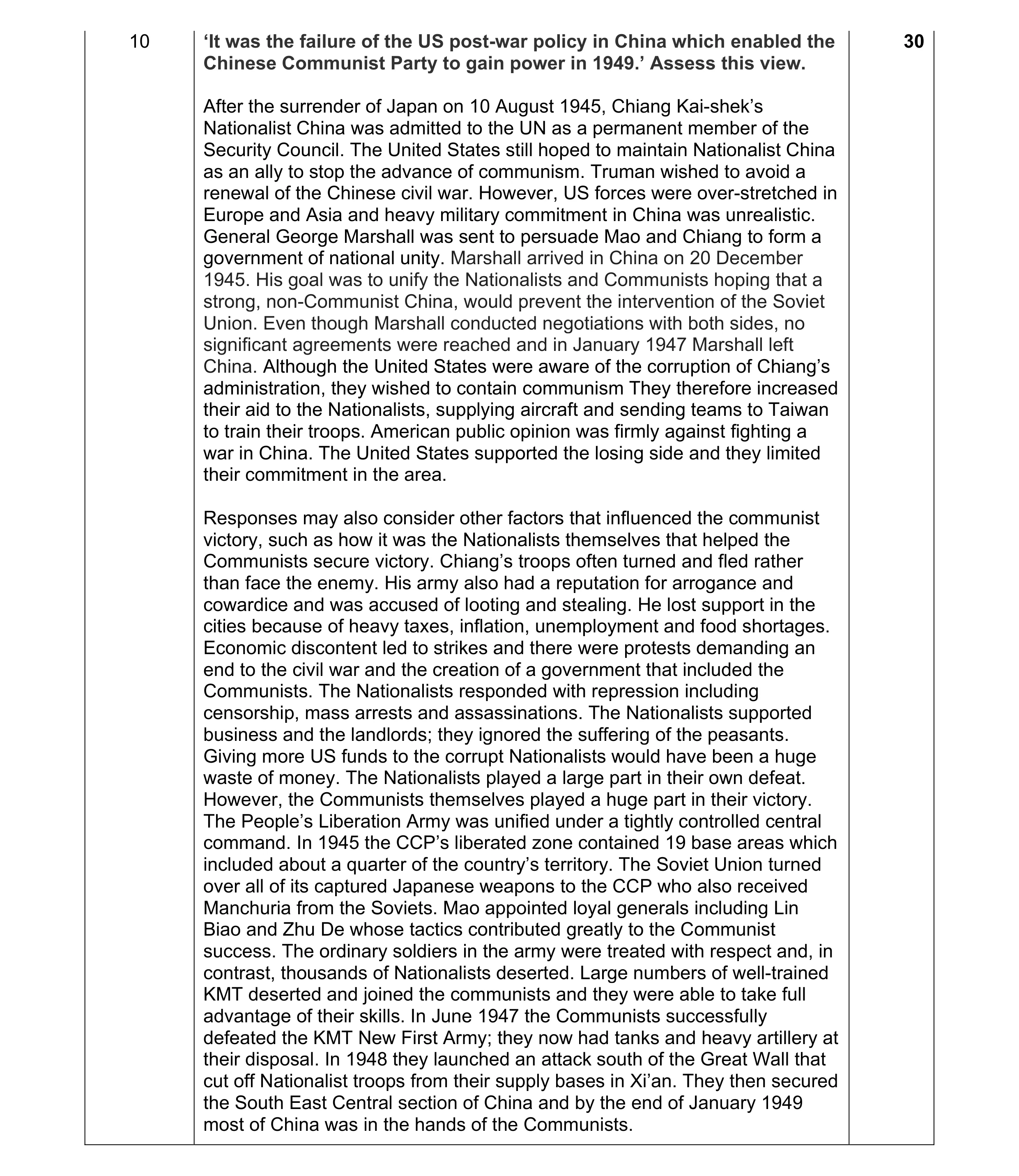 30
30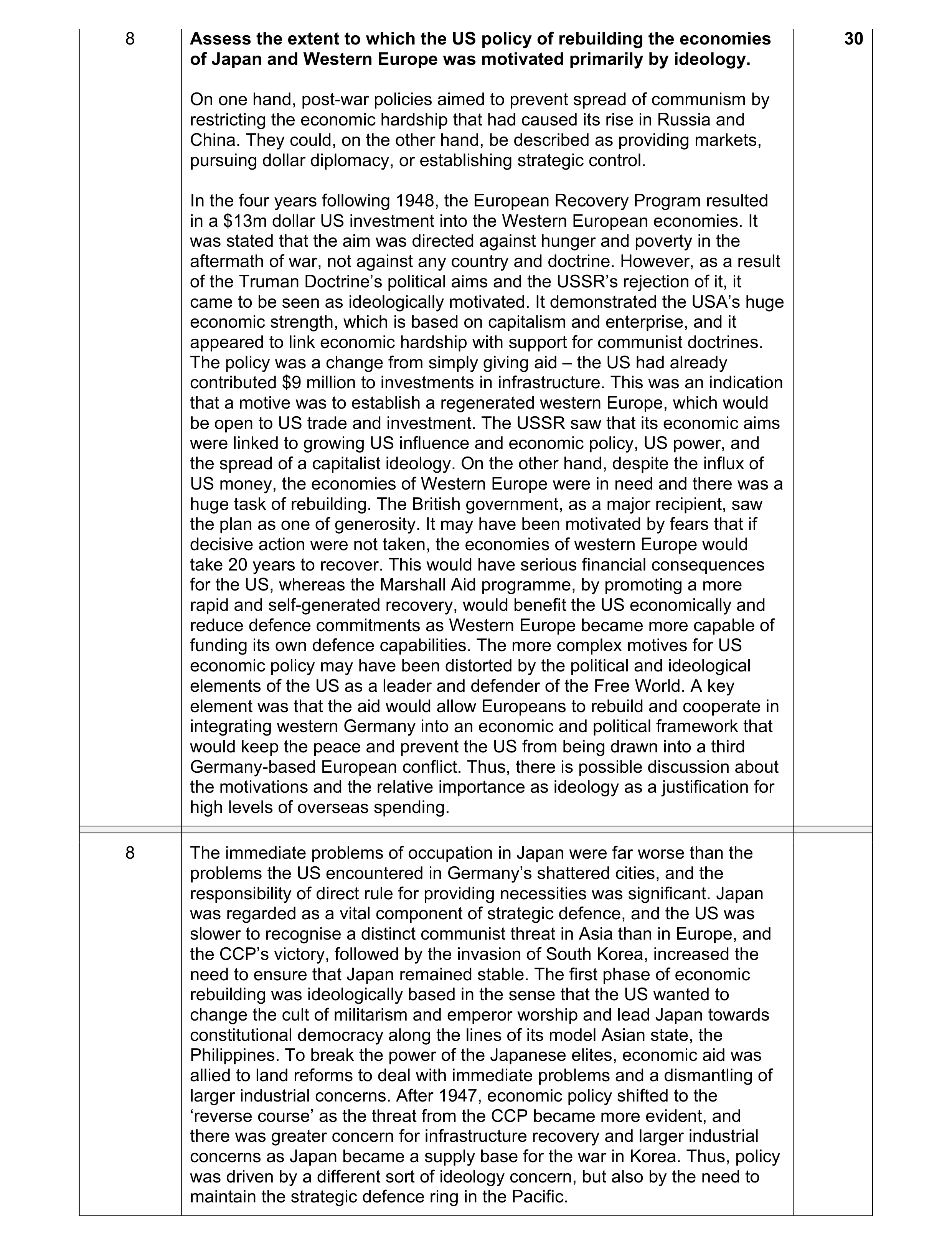 30
30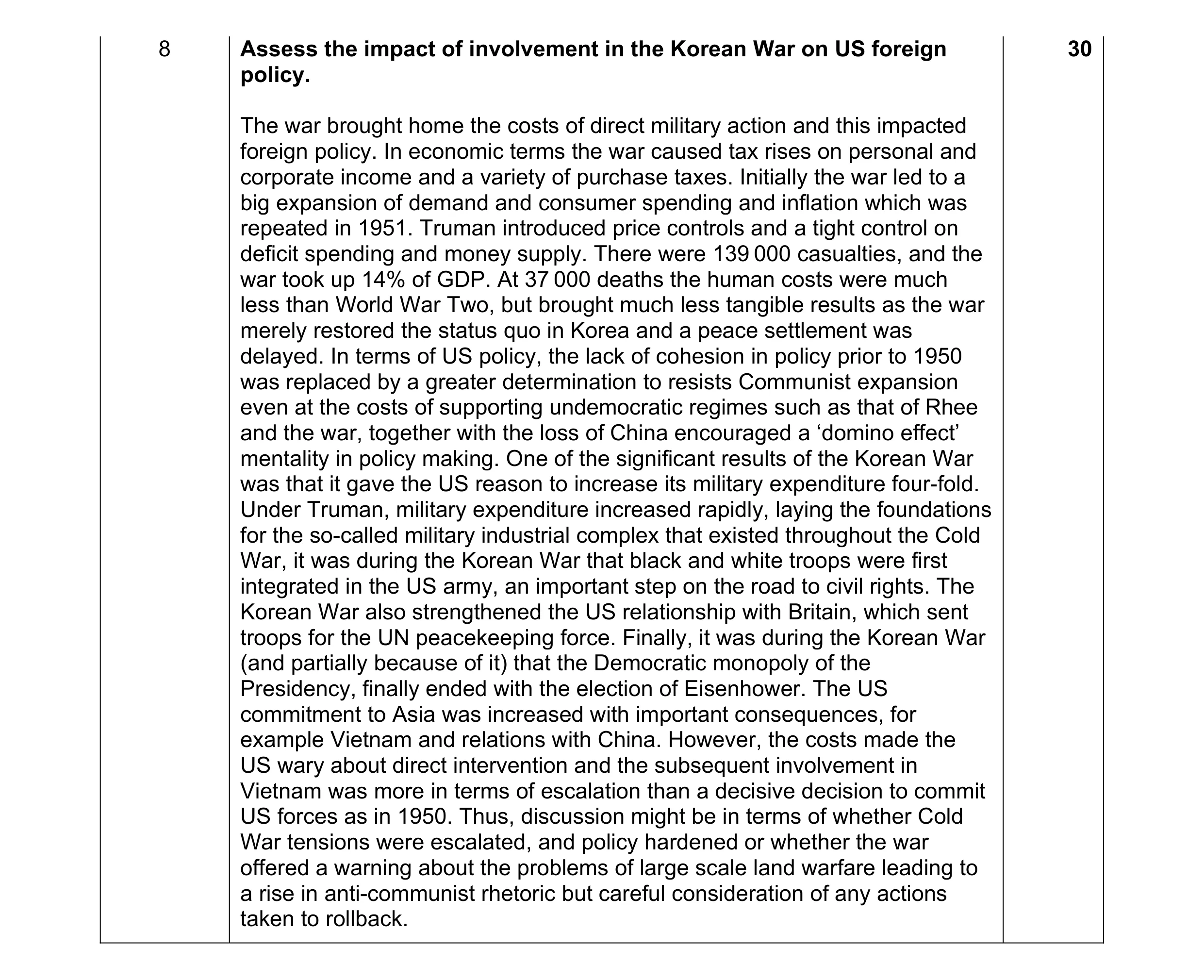 30
30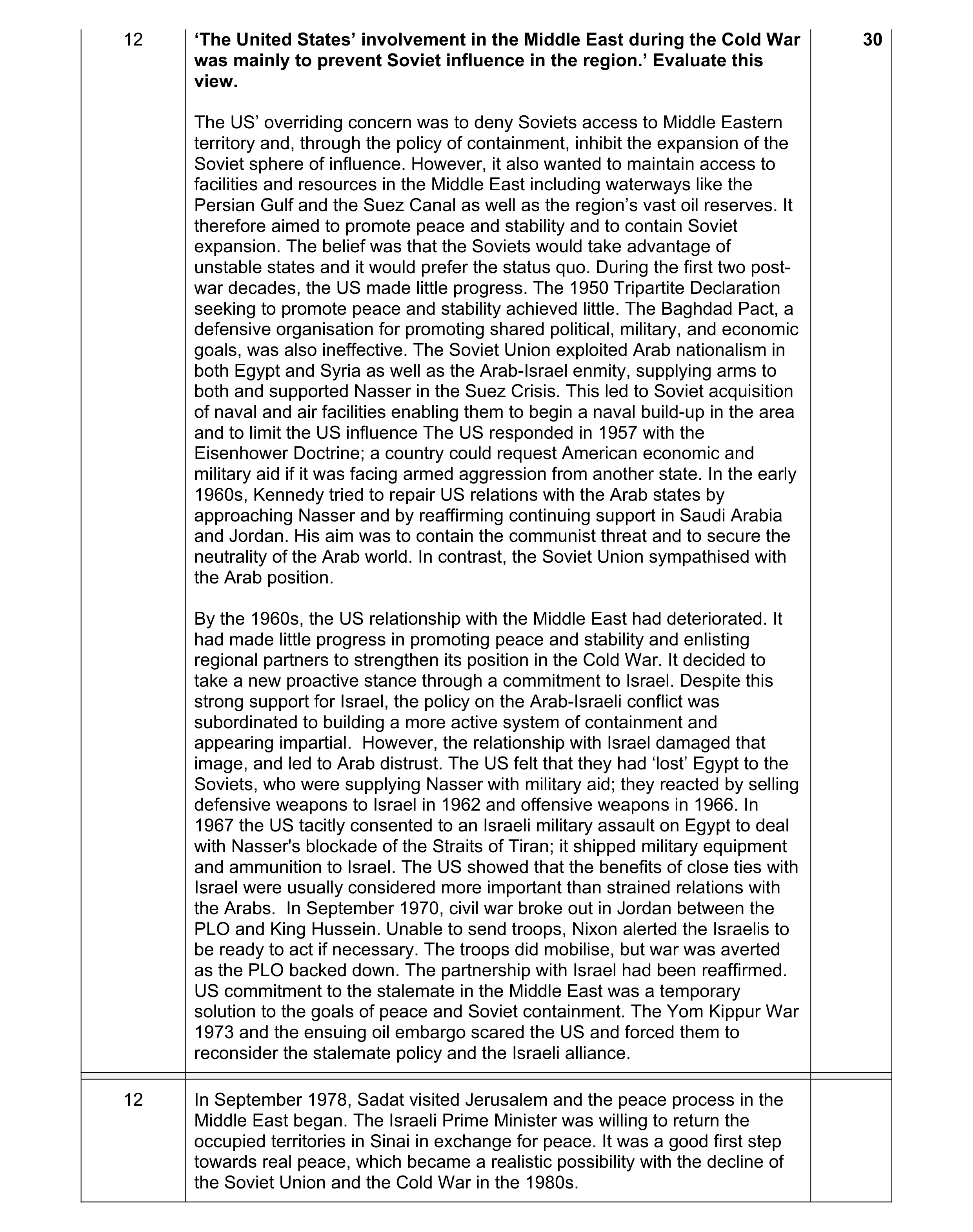 30
30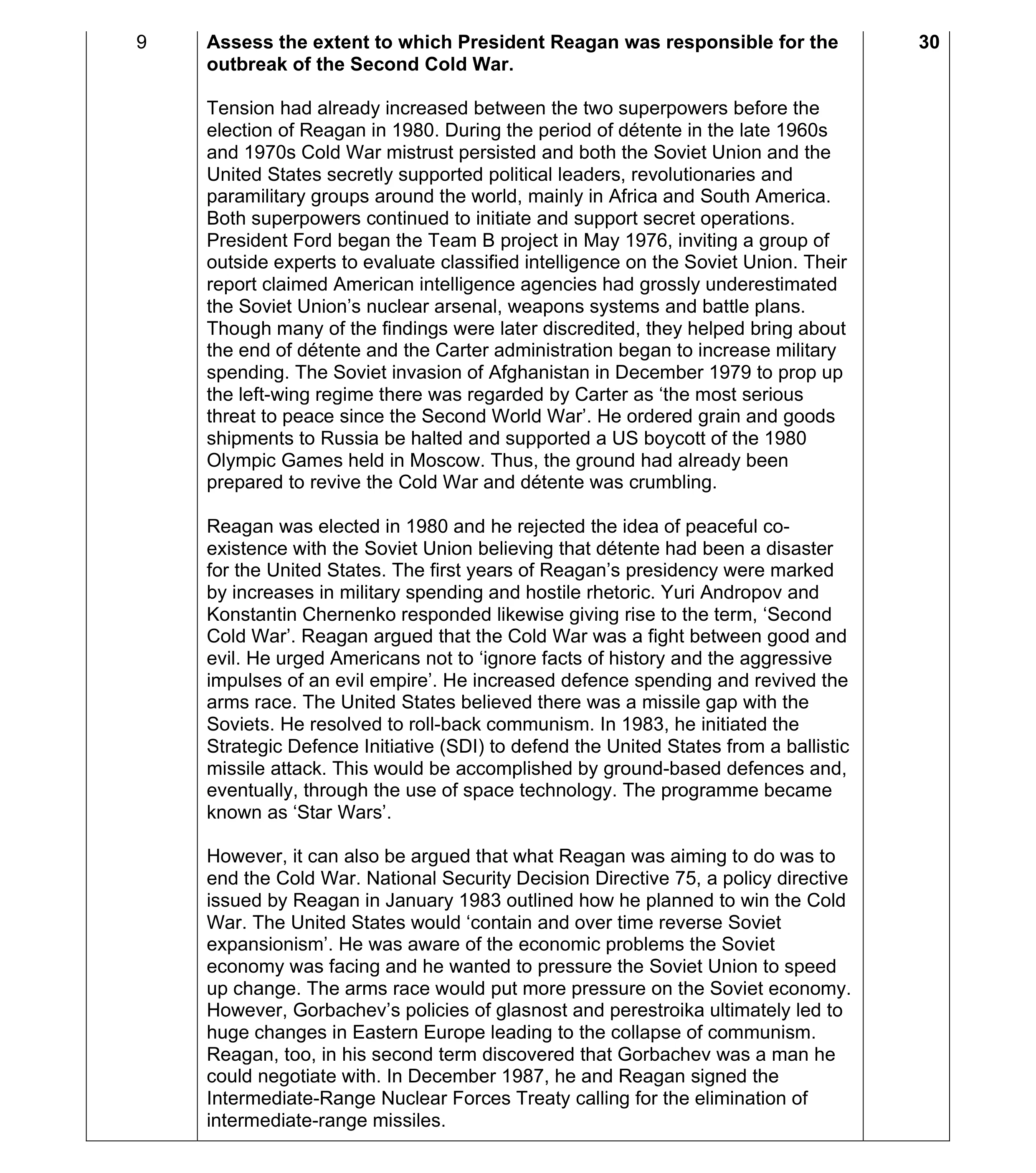 30
30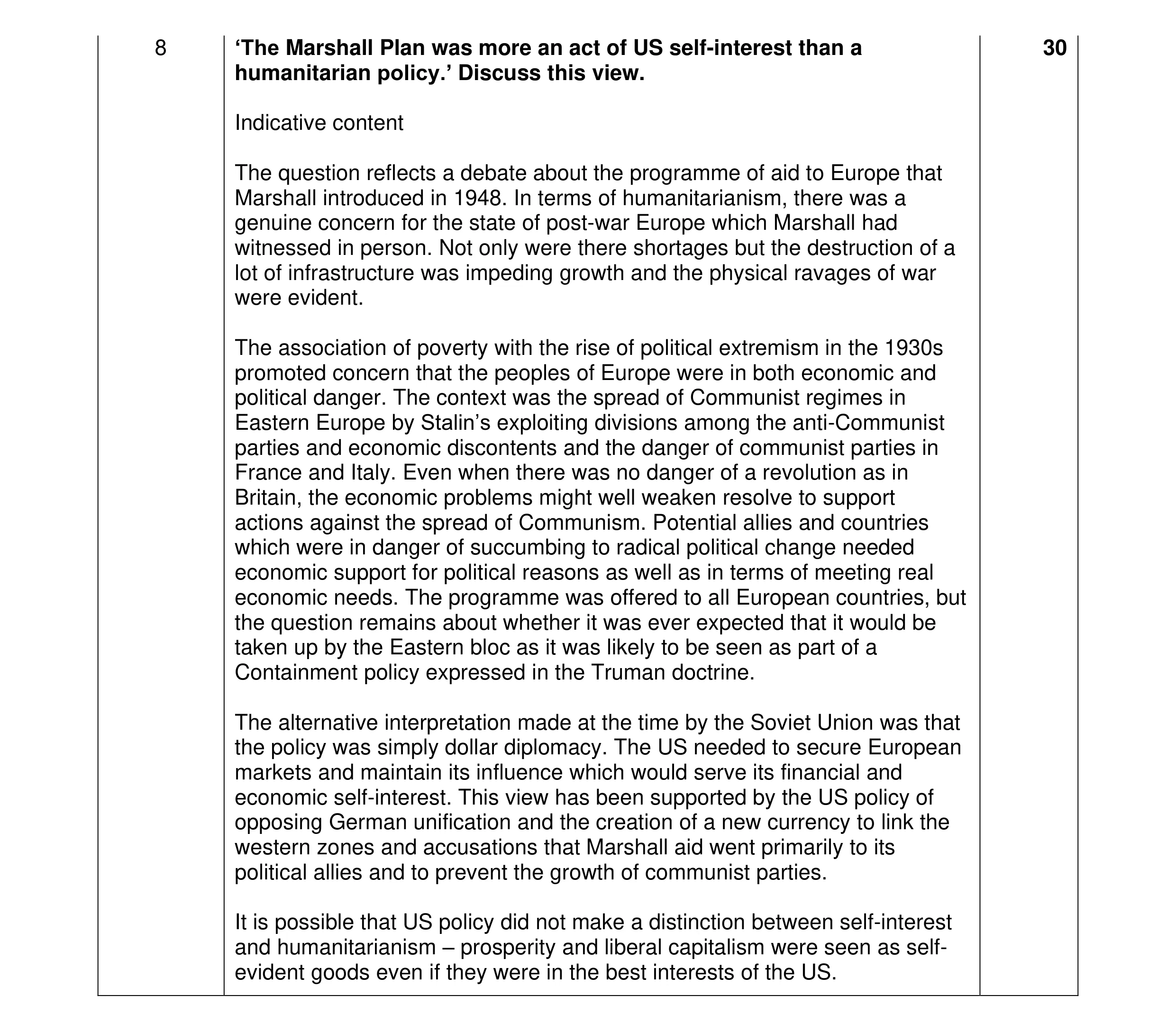 30
30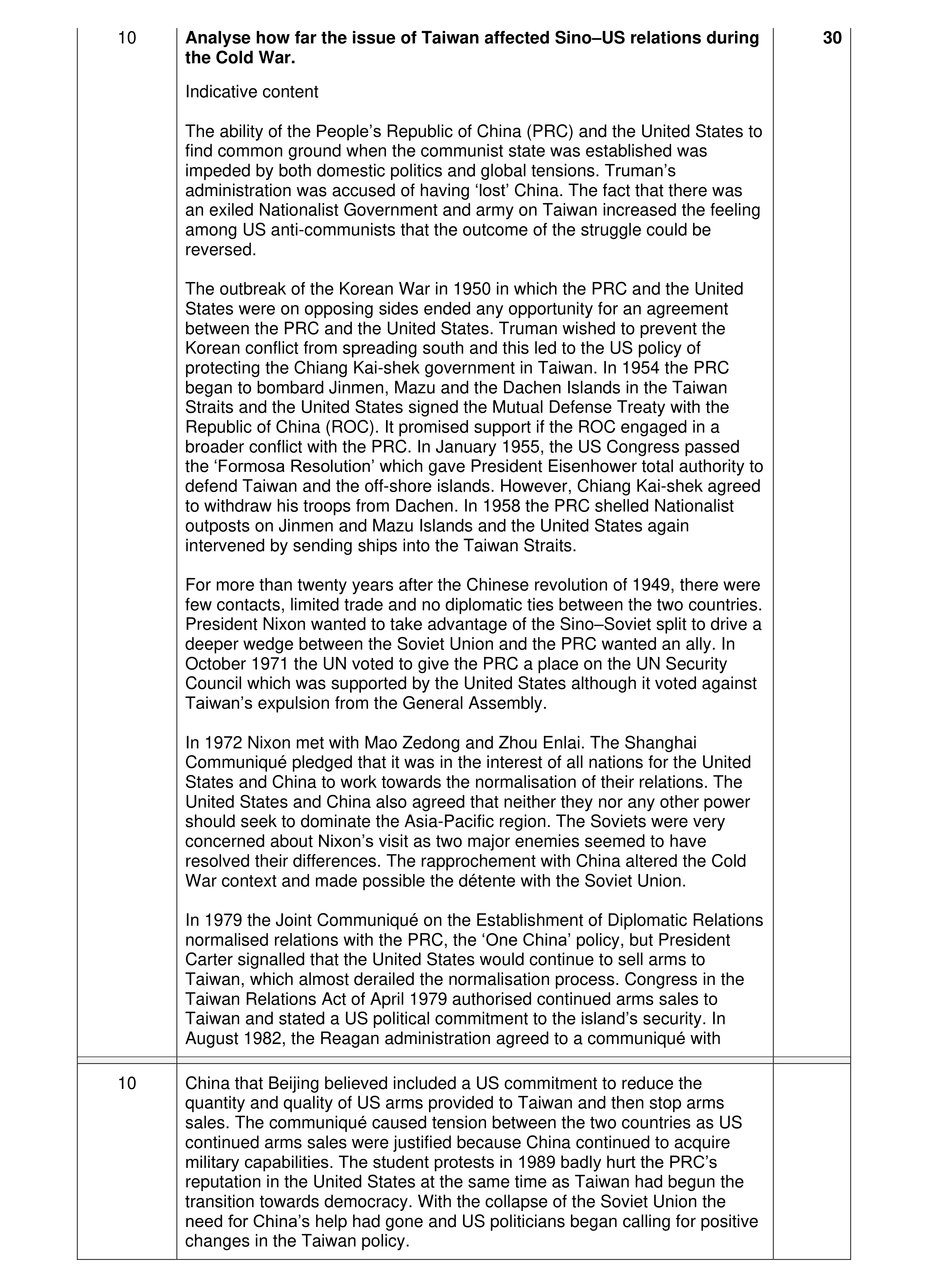 30
30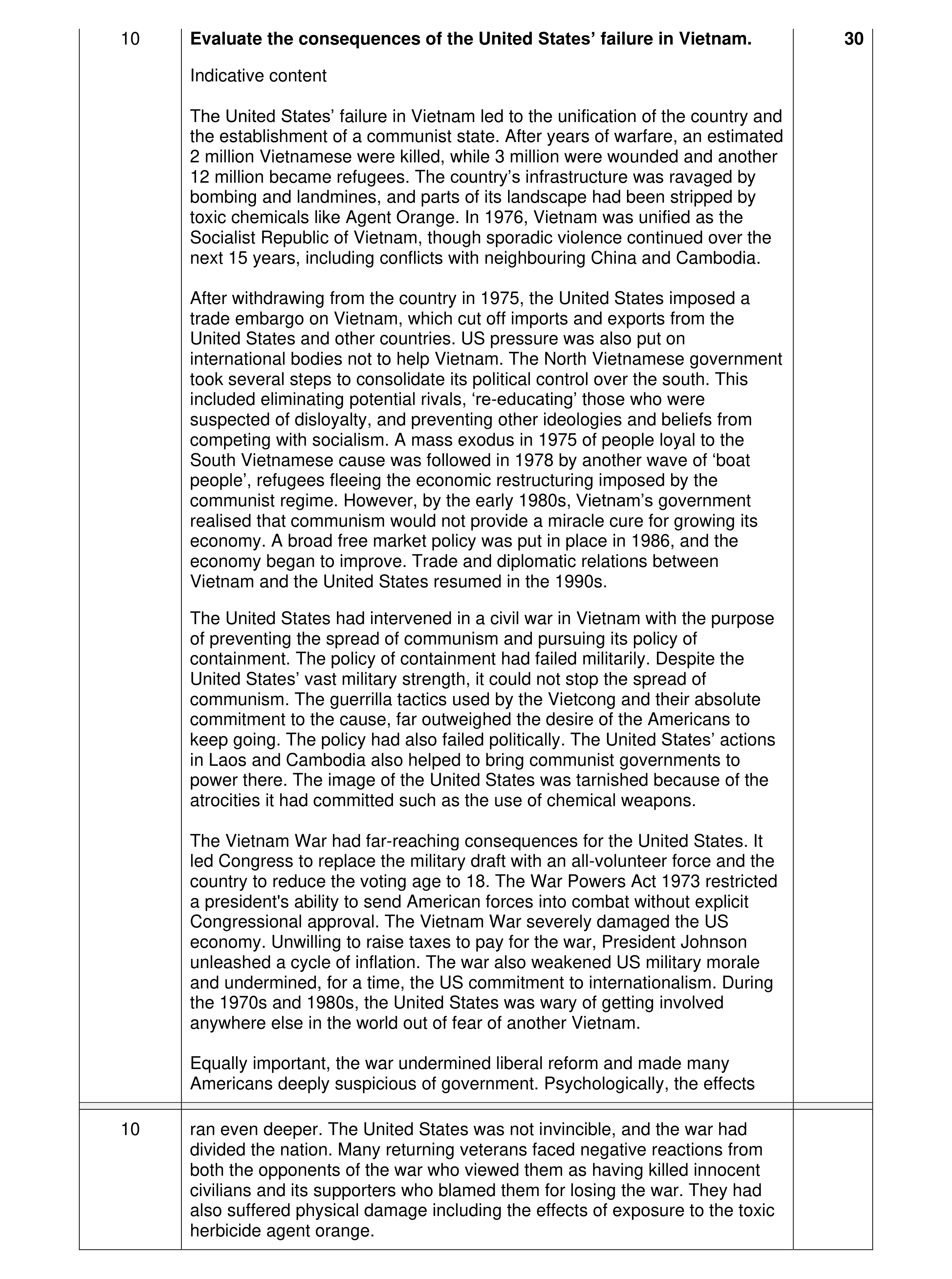 30
30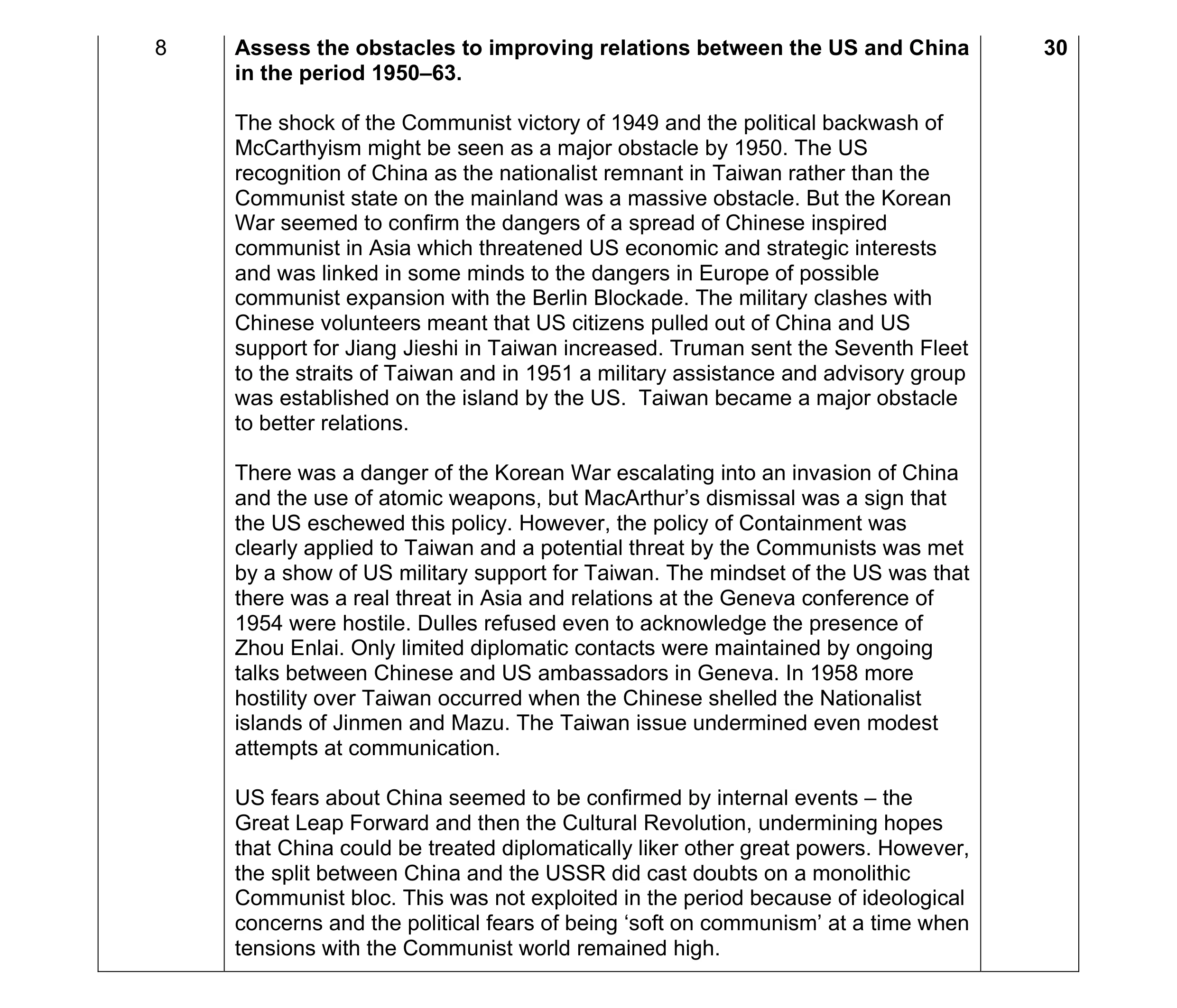 30
30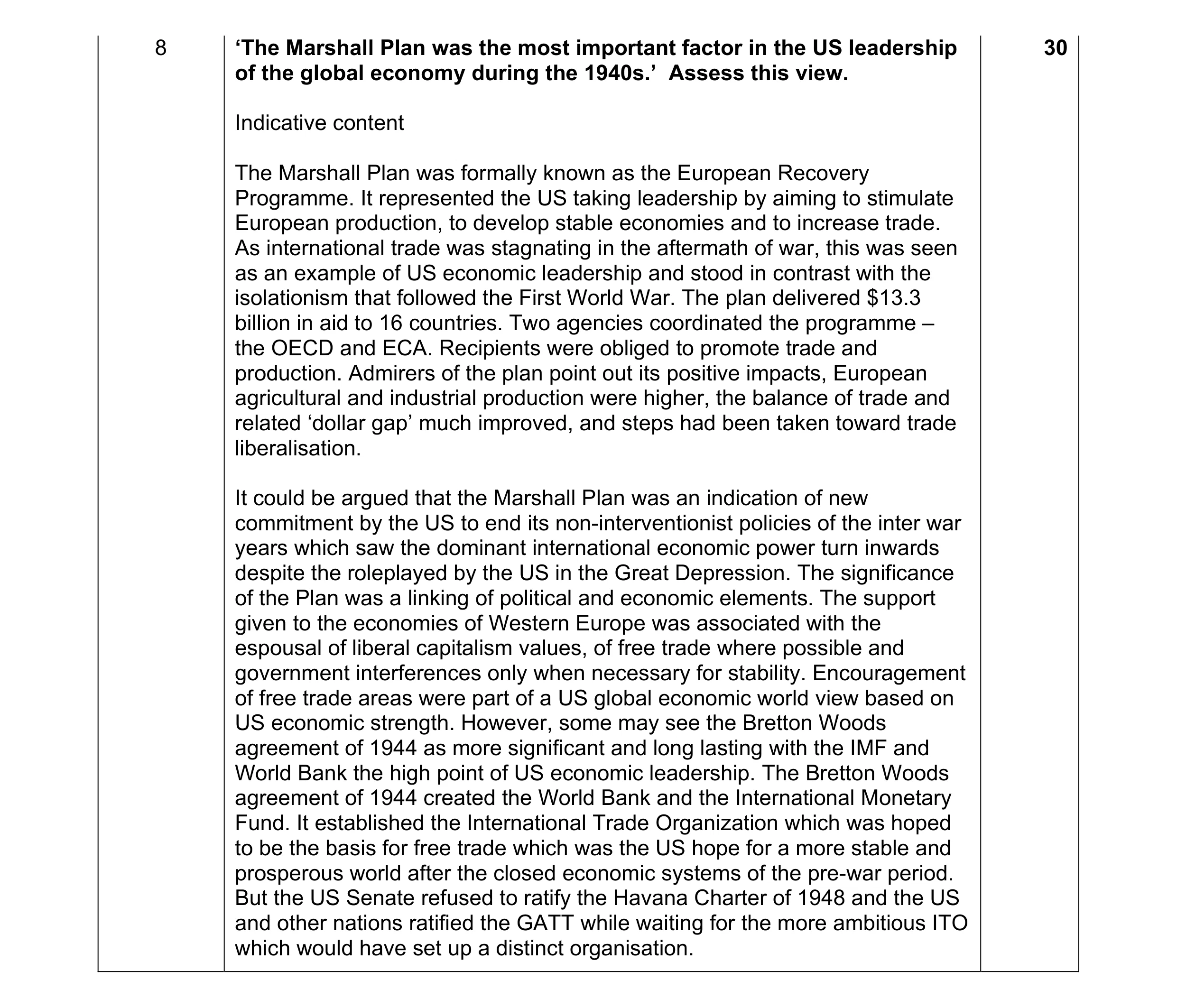 30
30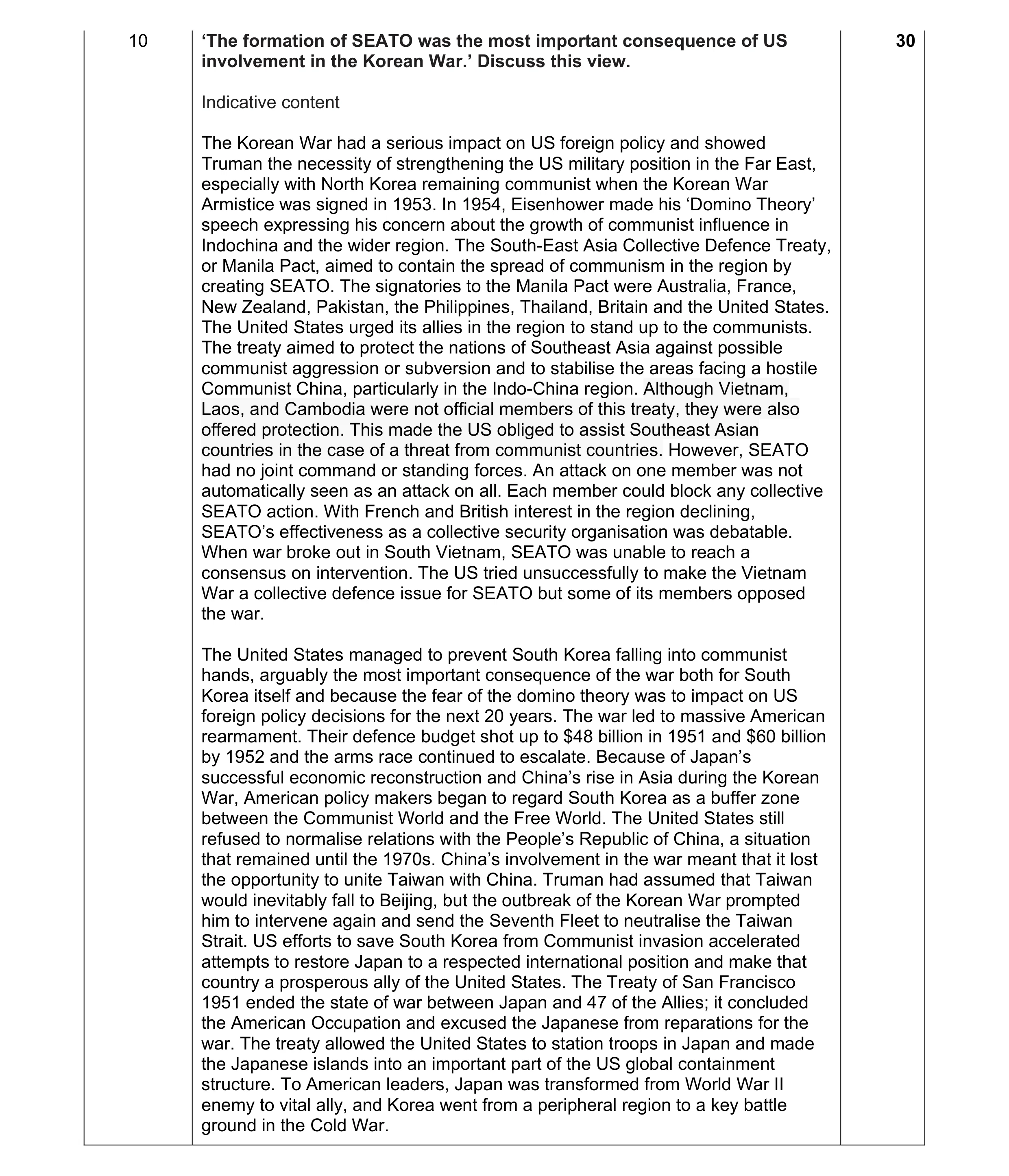 30
30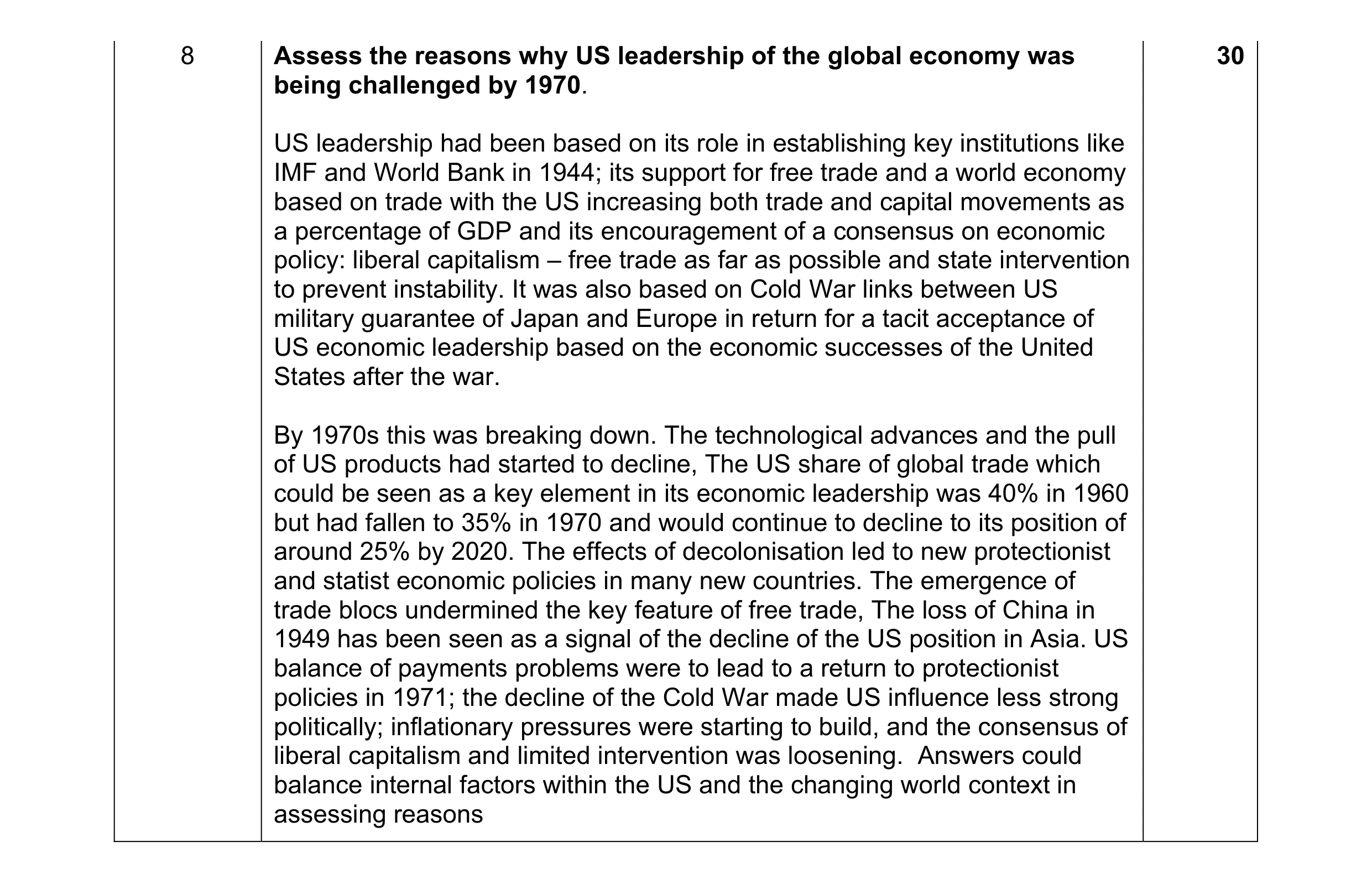 30
30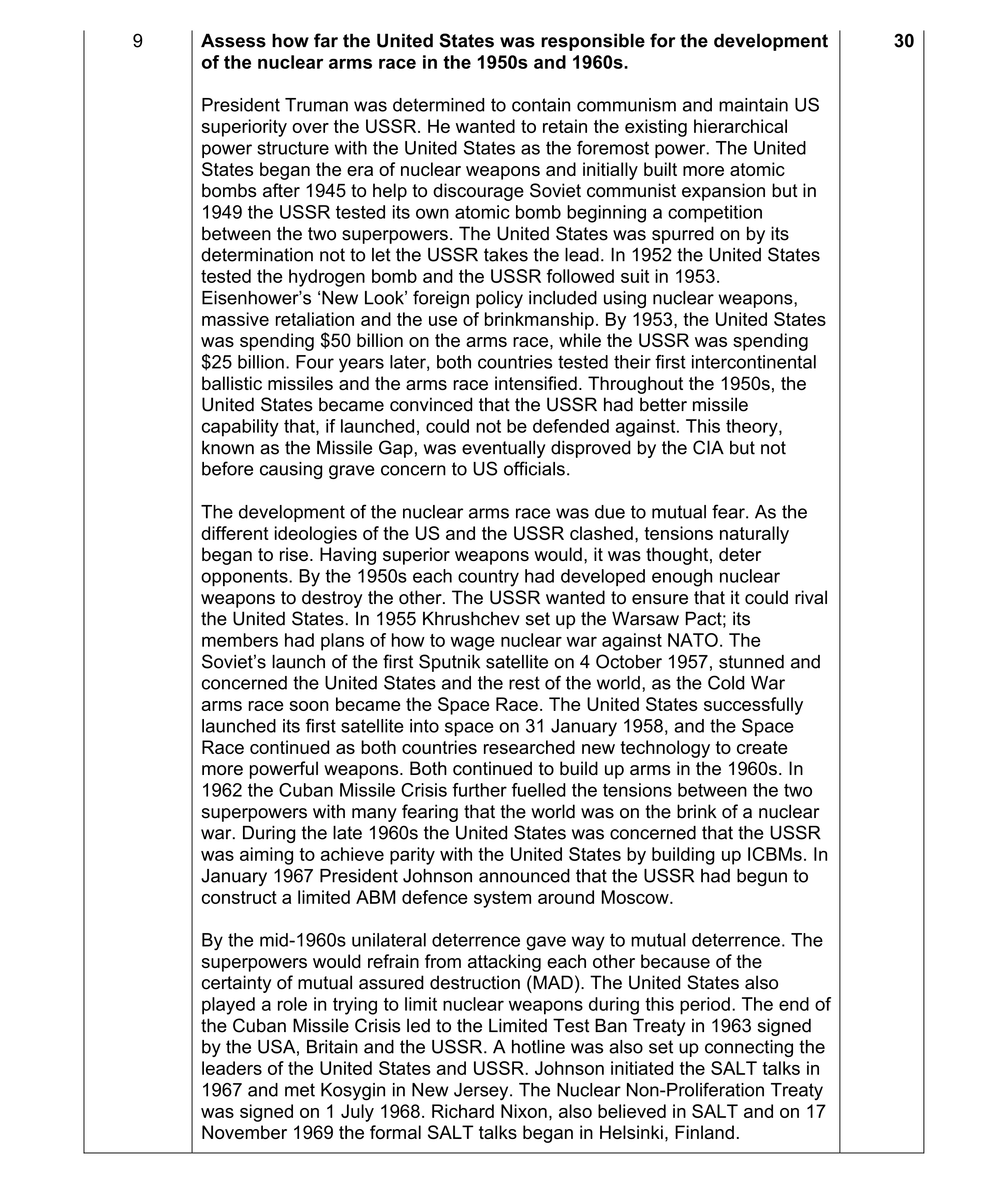 30
30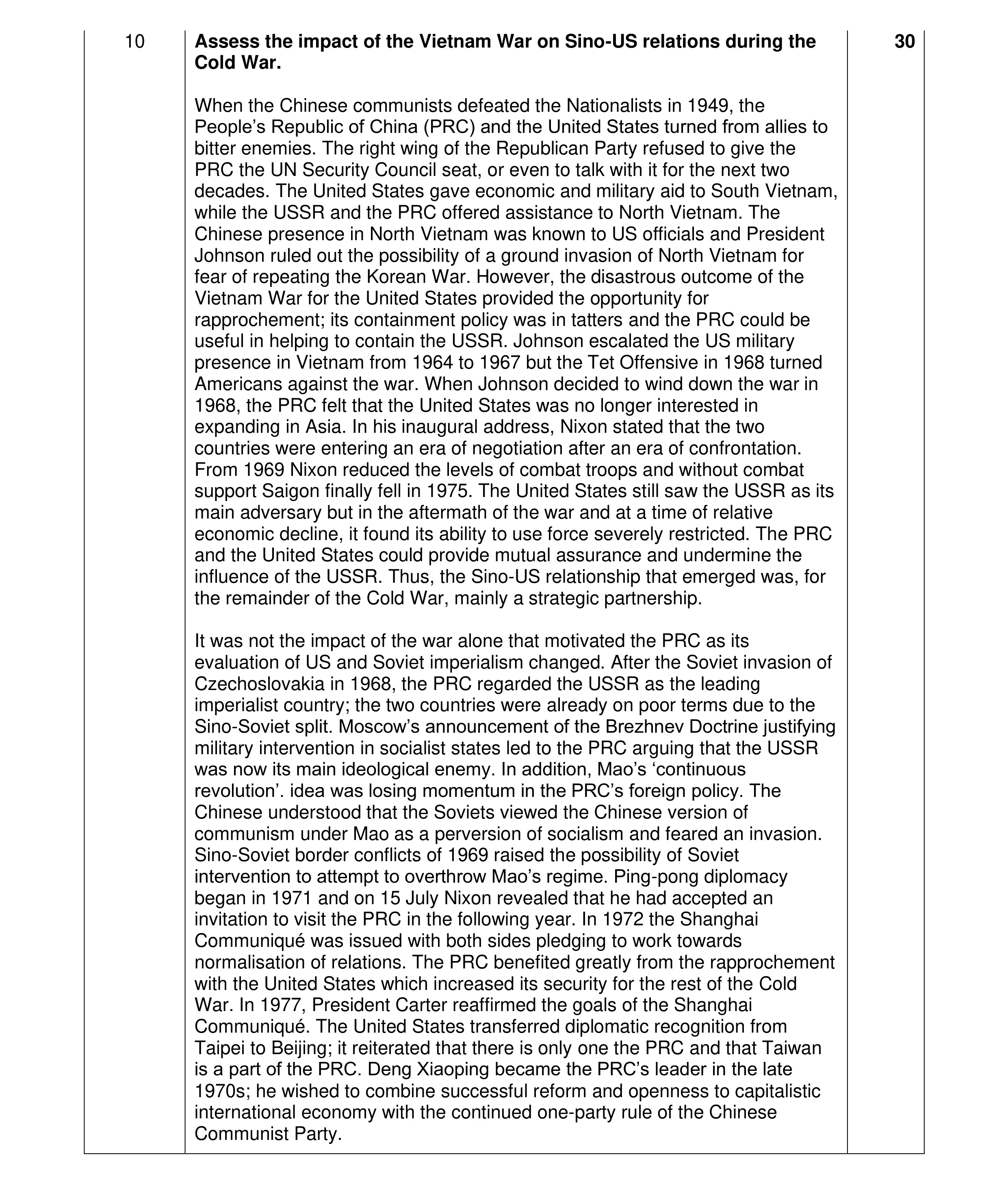 30
30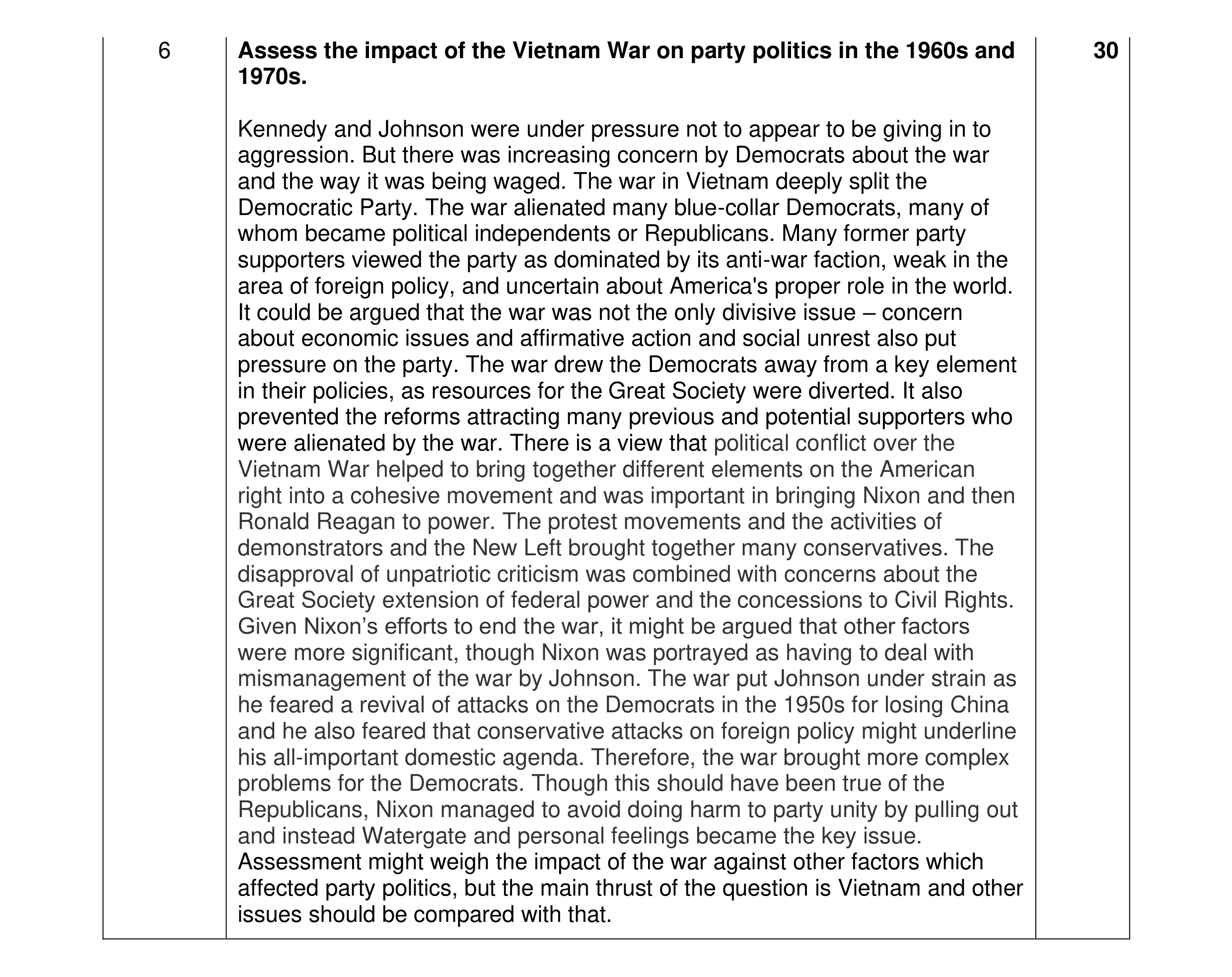 30
30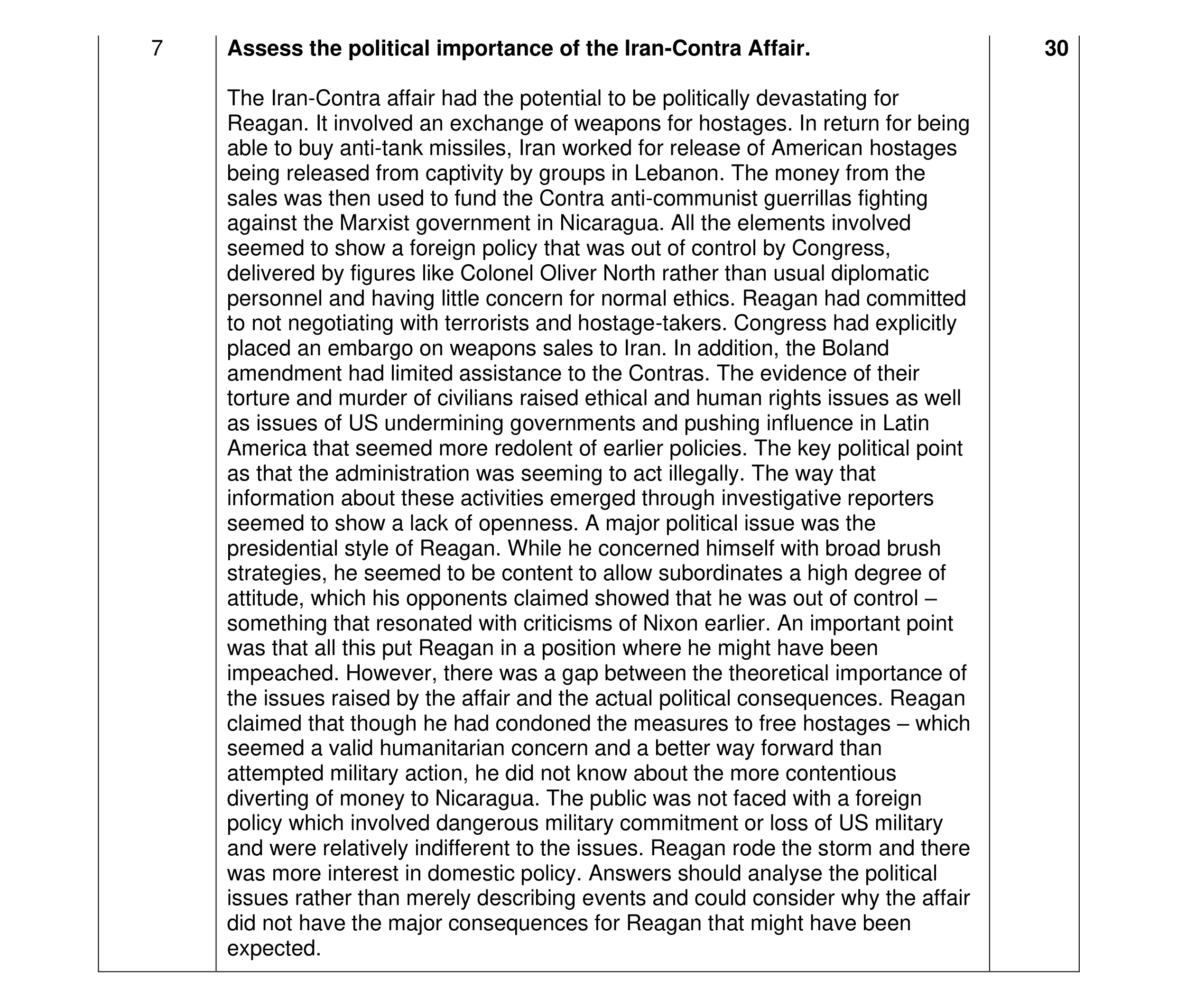 30
30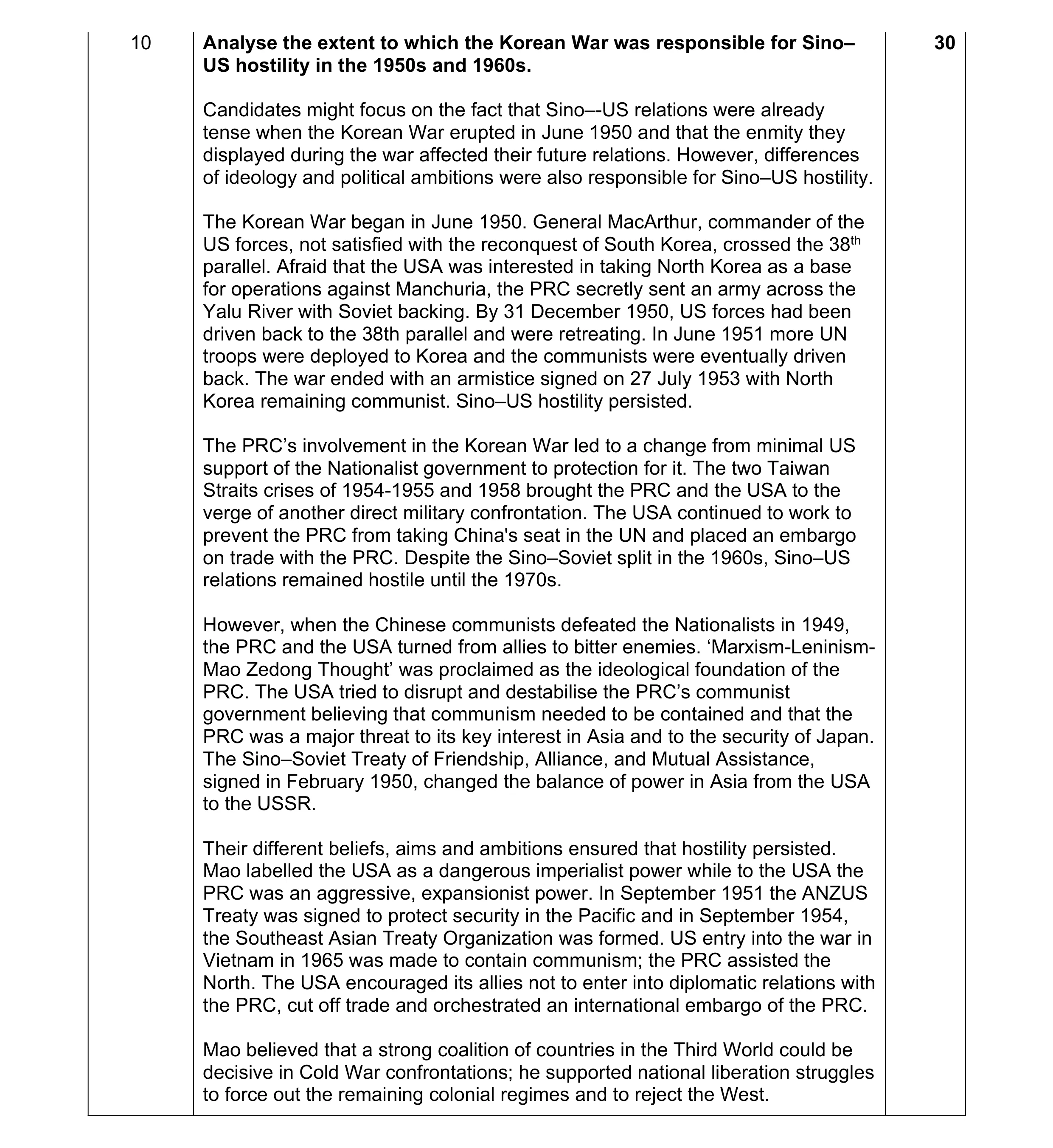 30
30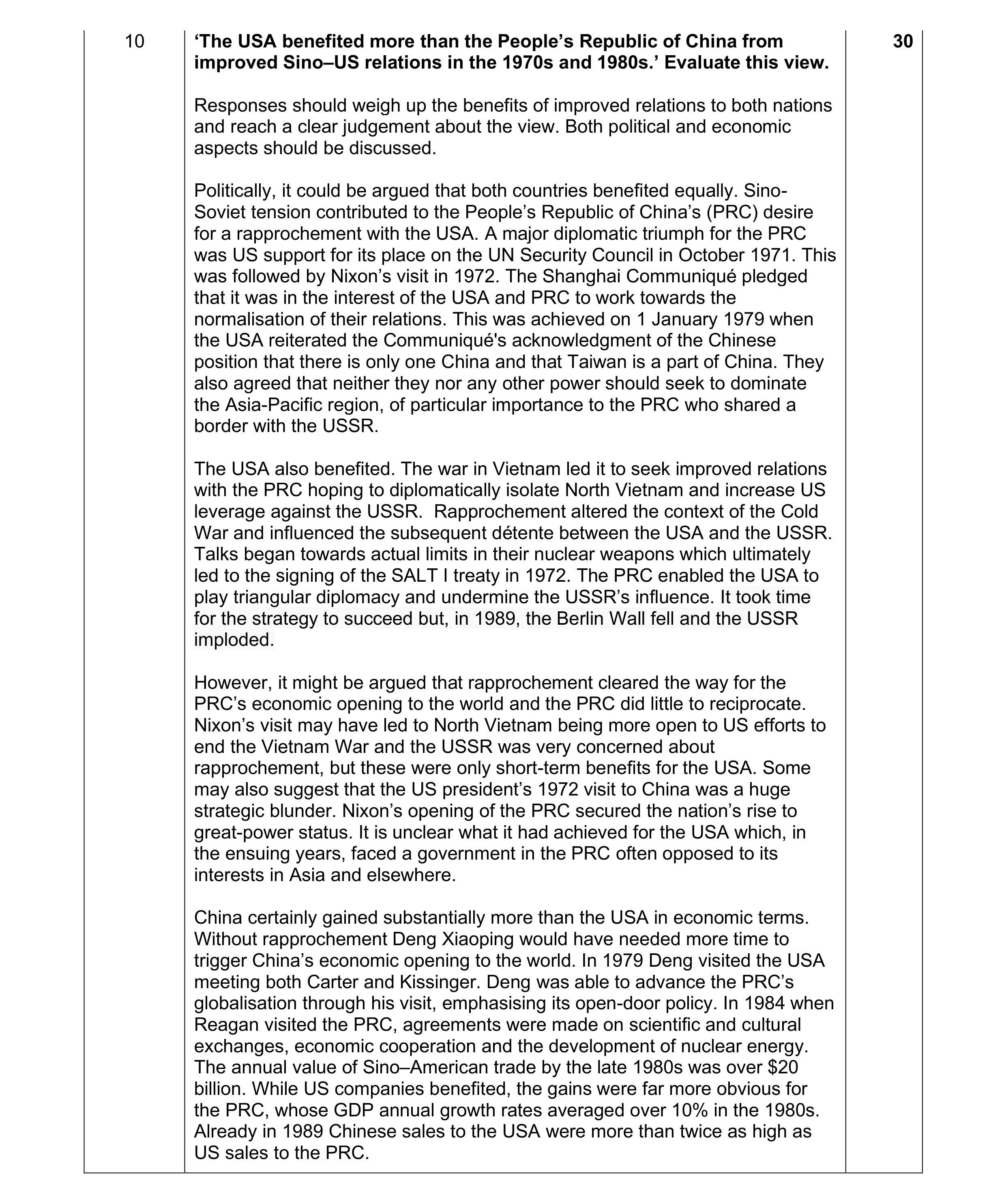 30
30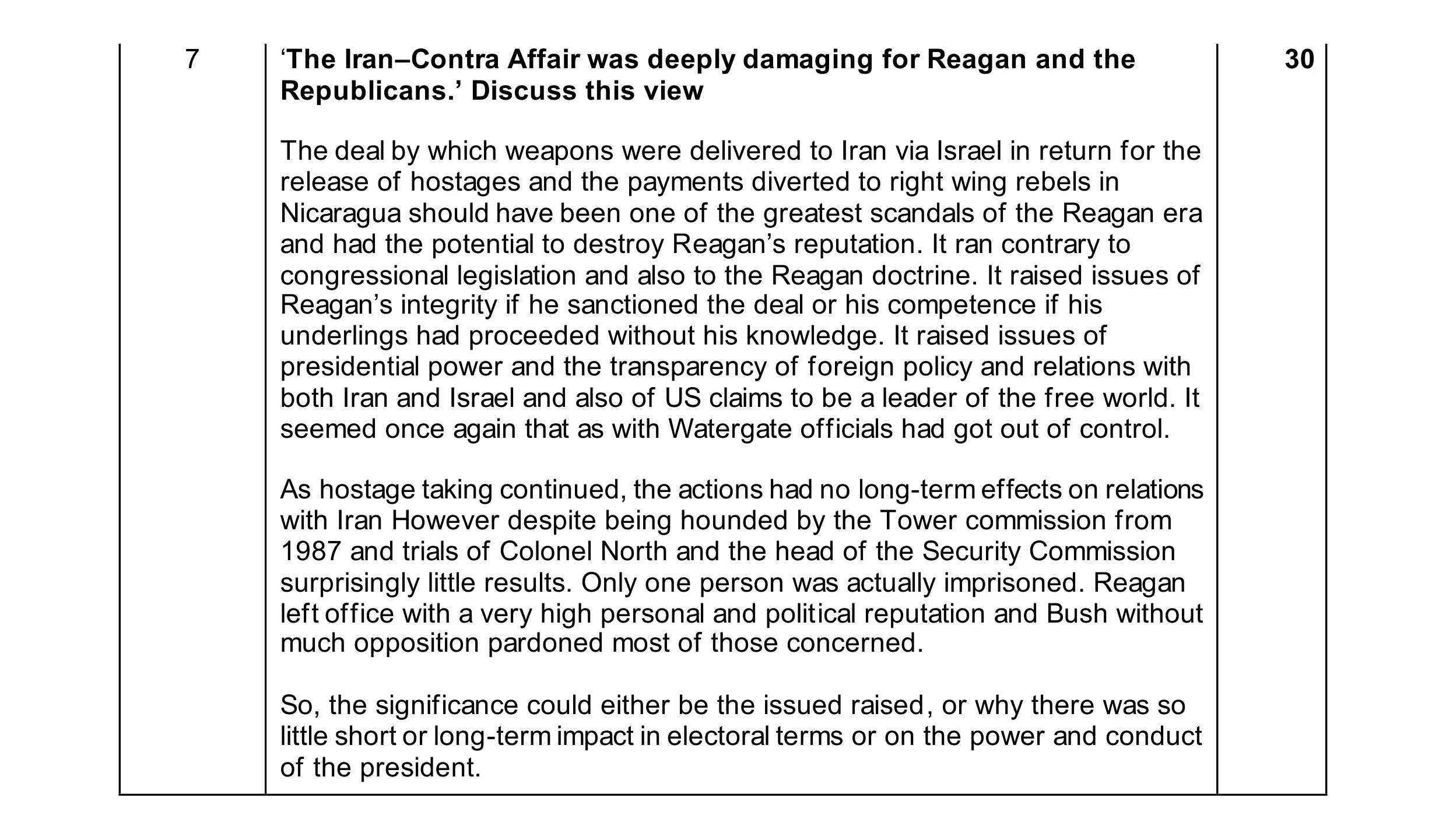 30
30