Cambridge A Level History 9489 — 2022 Oct/Nov Paper 2 · Variant 1
9489/21/O/N/22 · 9 questions · 60 marks · ≈68 min
The question paper and its mark scheme, free to read here and free to download. This is Cambridge’s own paper, exactly as it was sat.
Question paper4 pages
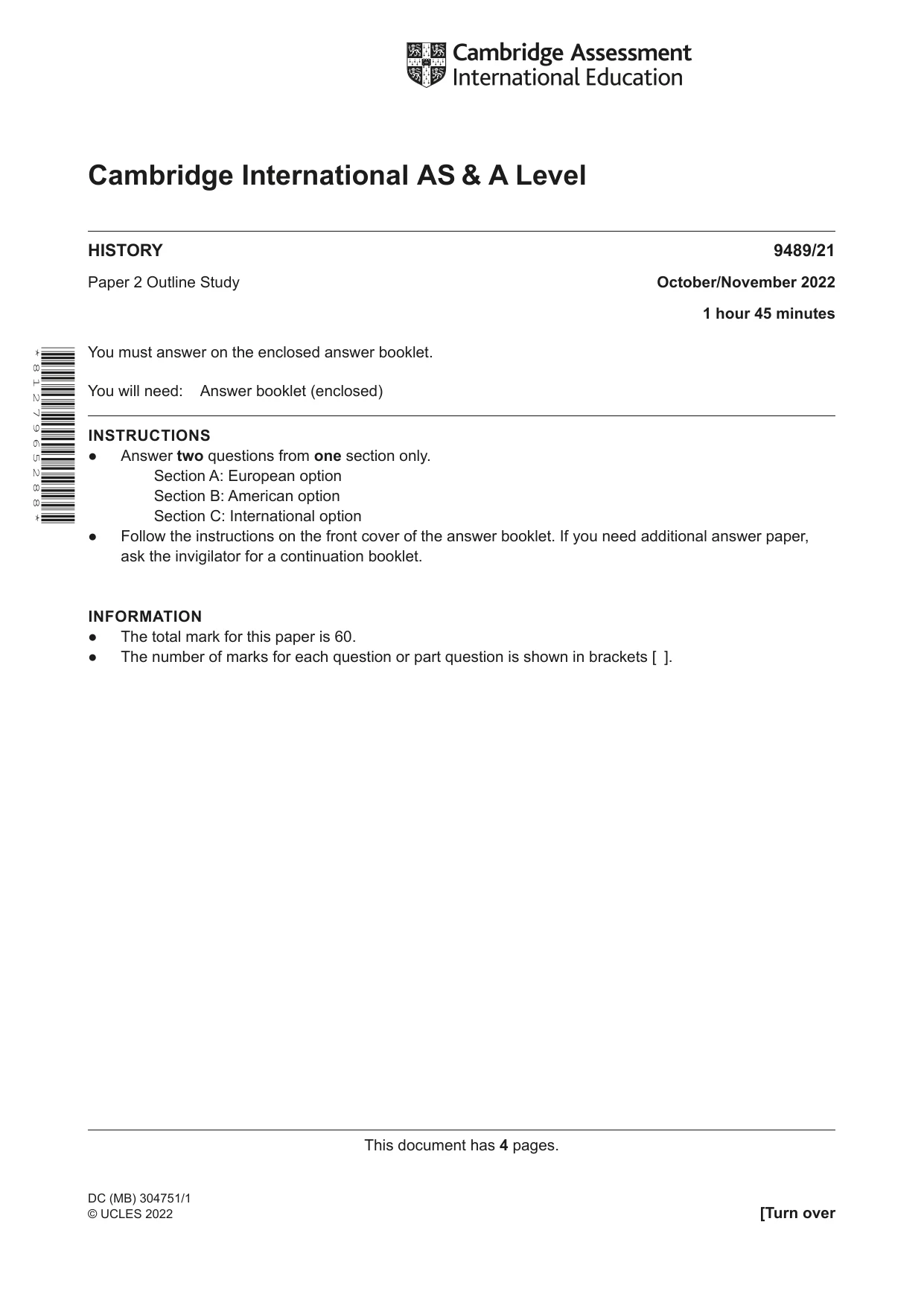
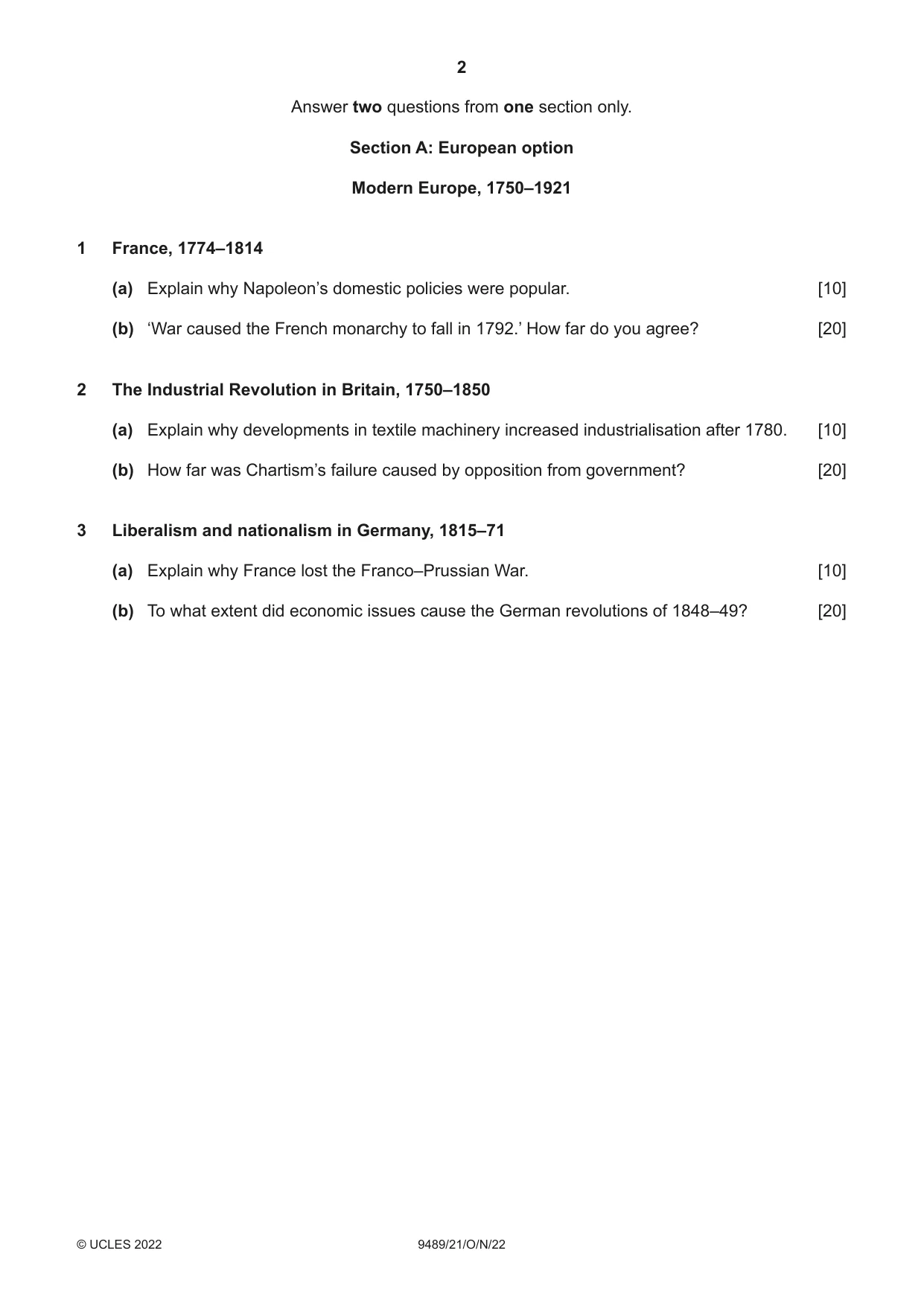
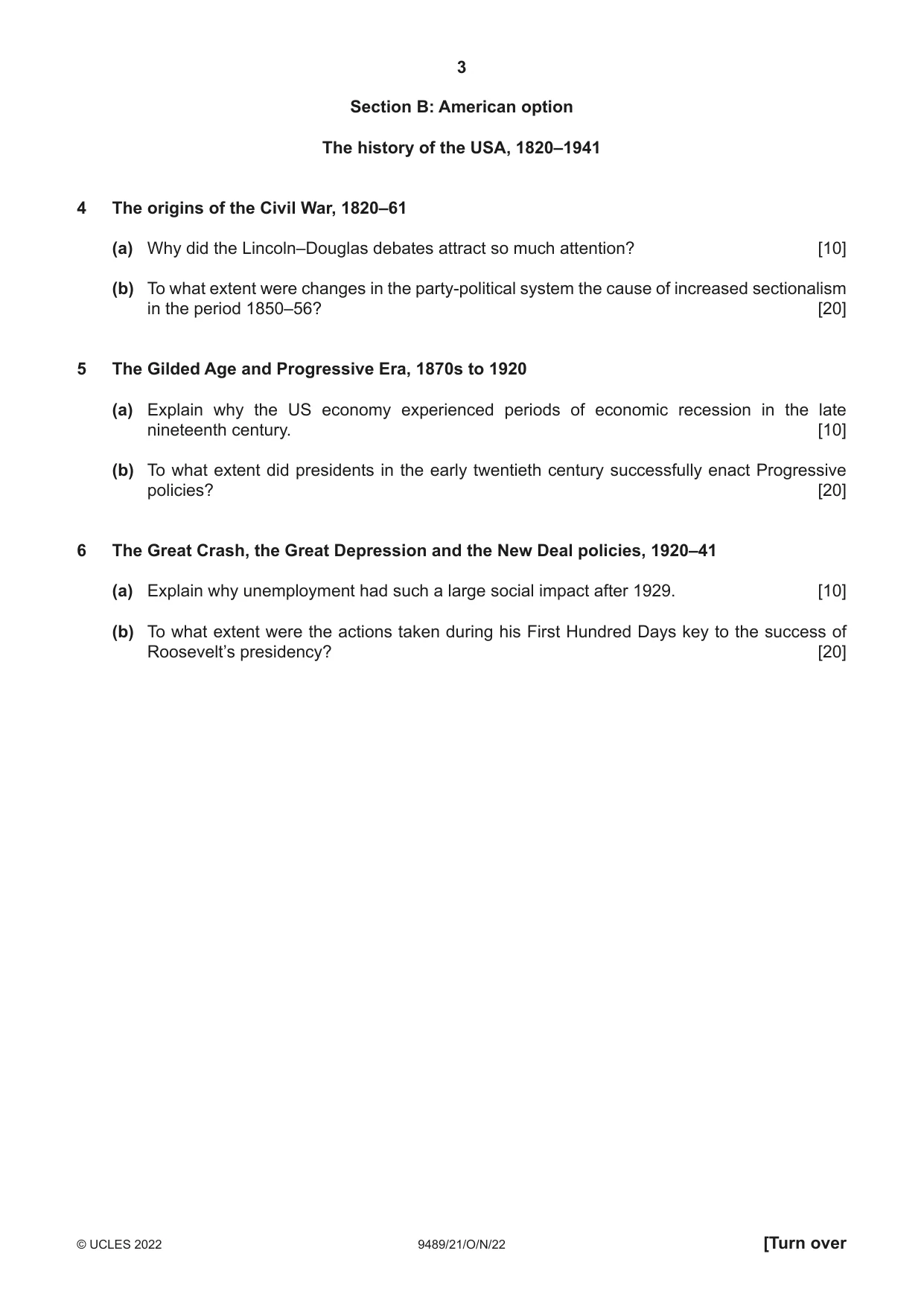
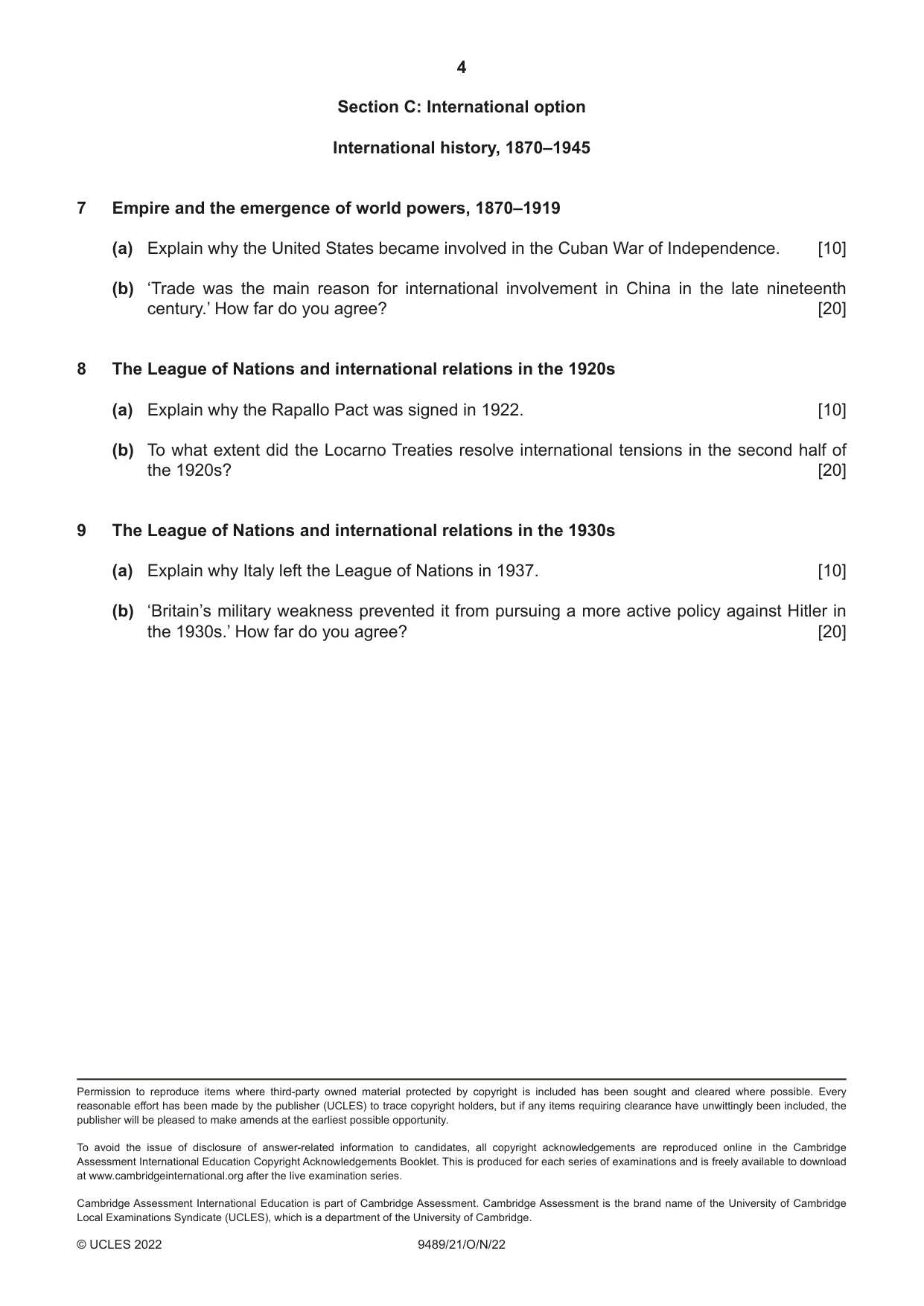
Mark scheme20 pages
Answers below. Sit the paper first if you are practising.
Questions as text
Q1 · France, 1774–1814 (a) Explain why Napoleon’s domestic policies were popular
1 France, 1774–1814 (a) Explain why Napoleon’s domestic policies were popular. [10] (b) ‘War caused the French monarchy to fall in 1792.’ How far do you agree? [20]
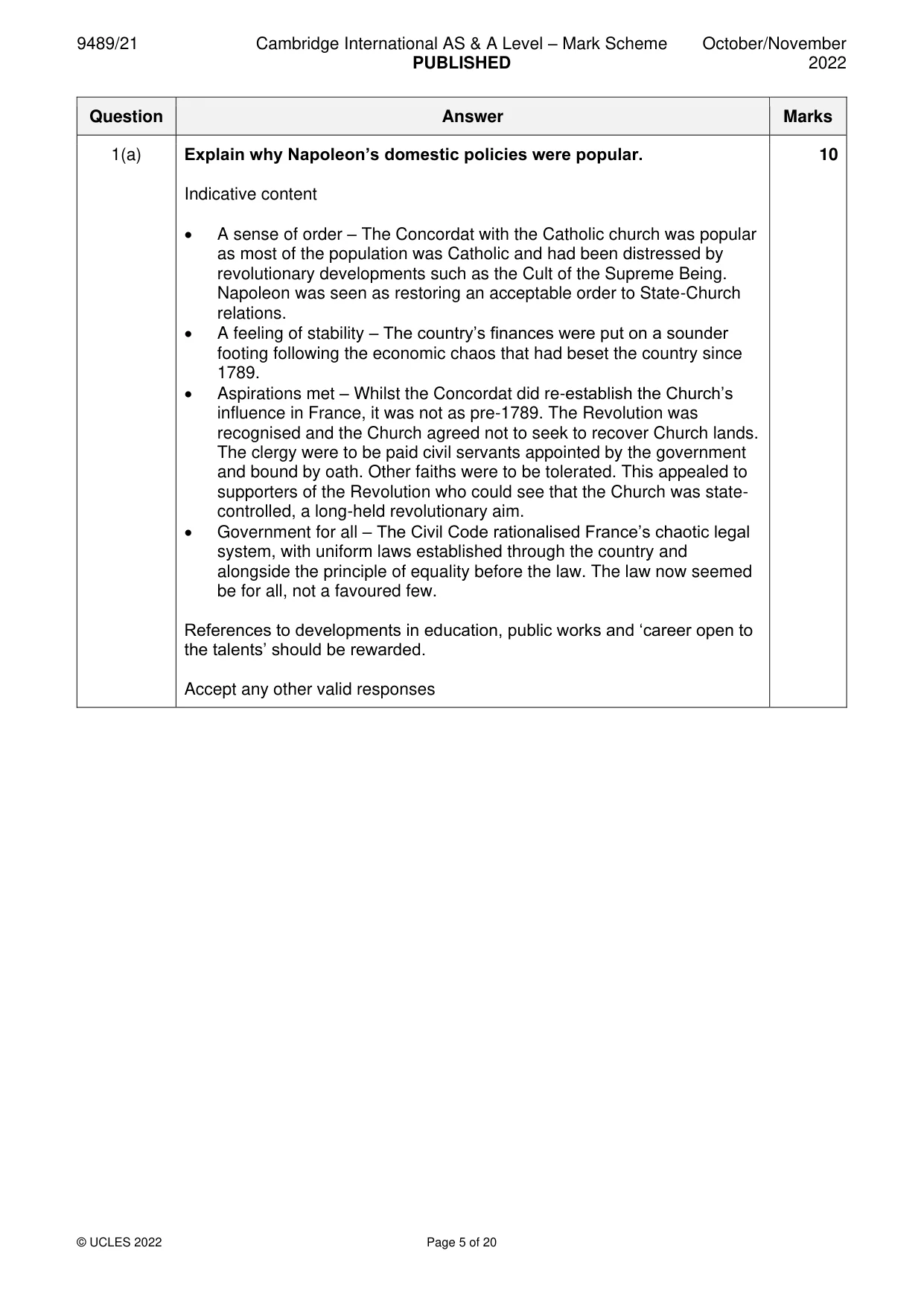
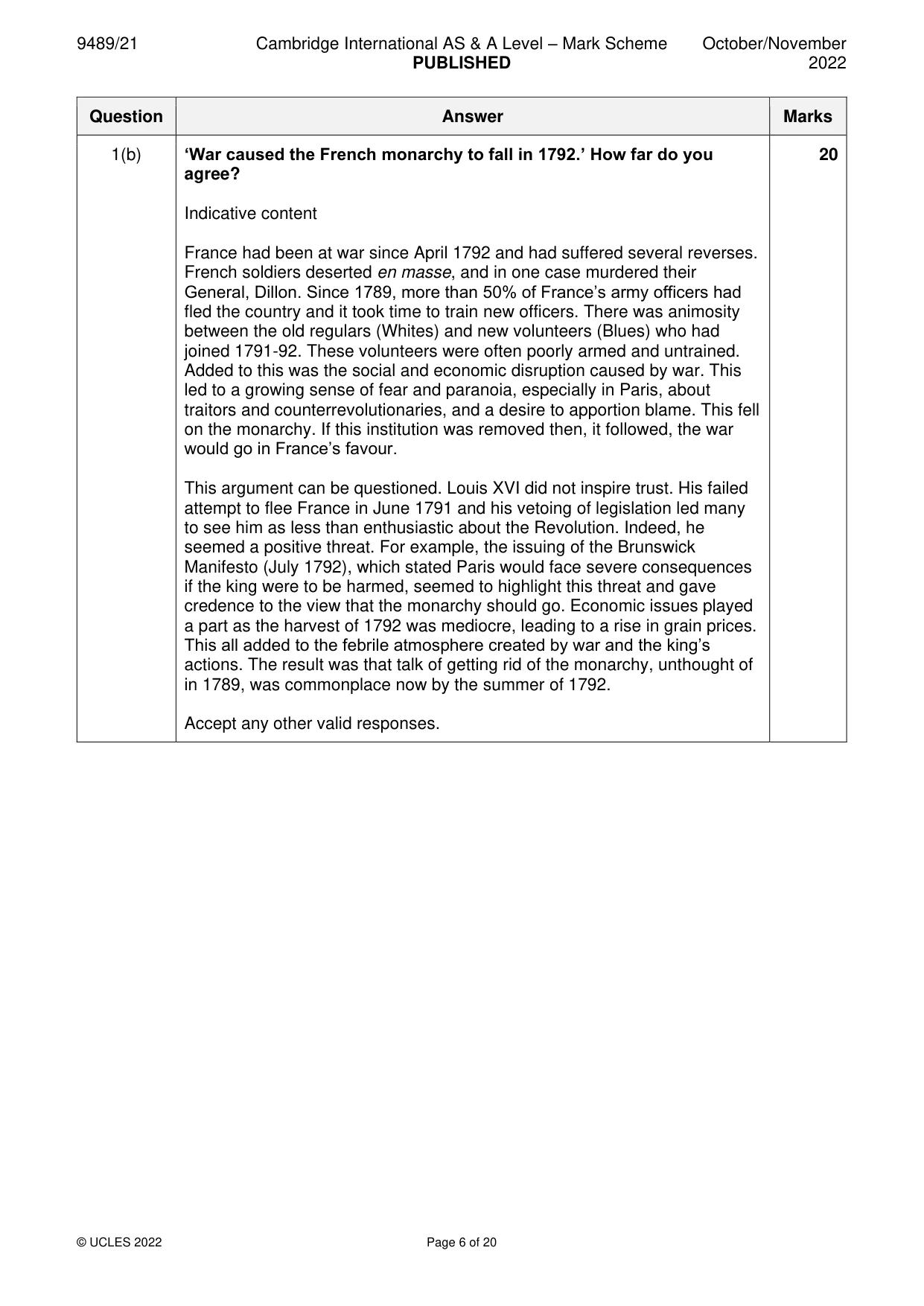
Mark scheme: Question Answer Marks 1(a) Explain why Napoleon’s domestic policies were popular. 10 Indicative content • A sense of order – The Concordat with the Catholic church was popular as most of the population was Catholic and had been distressed by revolutionary developments such as the Cult of the Supreme Being. Napoleon was seen as restoring an acceptable order to State-Church relations. • A feeling of stability – The country’s finances were put on a sounder footing following the economic chaos that had beset the country since 1789. • Aspirations met – Whilst the Concordat did re-establish the Church’s influence in France, it was not as pre-1789. The Revolution was recognised and the Church agreed not to seek to recover Church lands. The clergy were to be paid civil servants appointed by the government and bound by oath. Other faiths were to be tolerated. This appealed to supporters of the Revolution who could see that the Church was state- controlled, a long-held revolutionary aim. • Government for all – The Civil Code rationalised France’s chaotic legal system, with uniform laws established through the country and alongside the principle of equality before the law. The law now seemed be for all, not a favoured few. References to developments in education, public works and ‘career open to the talents’ should be rewarded. Accept any other valid responses 1(b) ‘War caused the French monarchy to fall in 1792.’ How far do you 20 agree? Indicative content France had been at war since April 1792 and had suffered several reverses. French soldiers deserted en masse, and in one case murdered their General, Dillon. Since 1789, more than 50% of France’s army officers had fled the country and it took time to train new officers. There was animosity between the old regulars (Whites) and new volunteers (Blues) who had joined 1791-92. These volunteers were often poorly armed and untrained. Added to this was the social and economic disruption caused by war. This led to a growing sense of fear and paranoia, especially in Paris, about traitors and counterrevolutionaries, and a desire to apportion blame. This fell on the monarchy. If this institution was removed then, it followed, the war would go in France’s favour. This argument can be questioned. Louis XVI did not inspire trust. His failed attempt to flee France in June 1791 and his vetoing of legislation led many to see him as less than enthusiastic about the Revolution. Indeed, he seemed a positive threat. For example, the issuing of the Brunswick Manifesto (July 1792), which stated Paris would face severe consequences if the king were to be harmed, seemed to highlight this threat and gave credence to the view that the monarchy should go. Economic issues played a part as the harvest of 1792 was mediocre, leading to a rise in grain prices. This all added to the febrile atmosphere created by war and the king’s actions. The result was that talk of getting rid of the monarchy, unthought of in 1789, was commonplace now by the summer of 1792. Accept any other valid responses.
More questions on How and why did France become a republic by 1792?
Q2 · The Industrial Revolution in Britain, 1750–1850 (a) Explain why developments in textile…
2 The Industrial Revolution in Britain, 1750–1850 (a) Explain why developments in textile machinery increased industrialisation after 1780. [10] (b) How far was Chartism’s failure caused by opposition from government? [20]
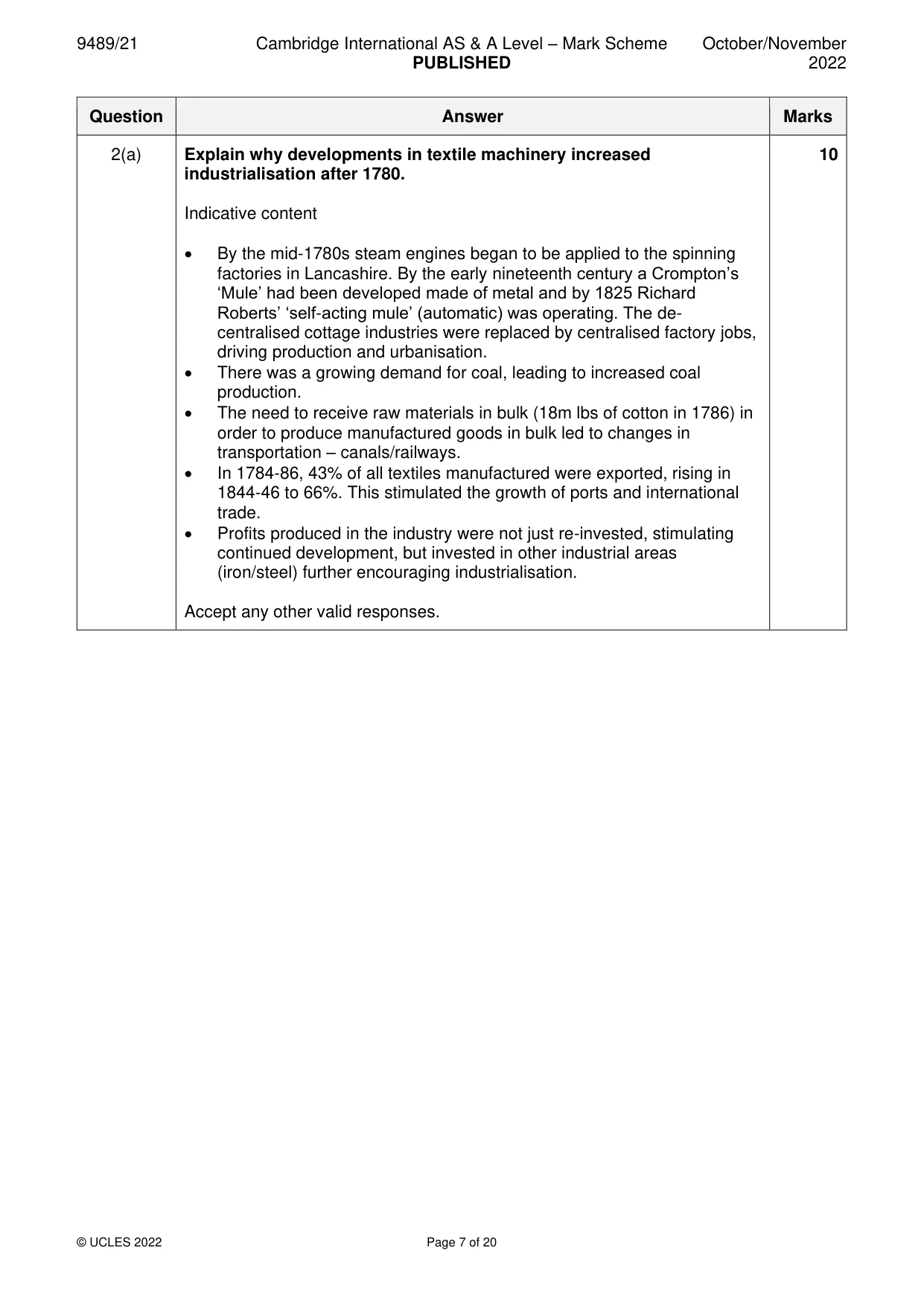
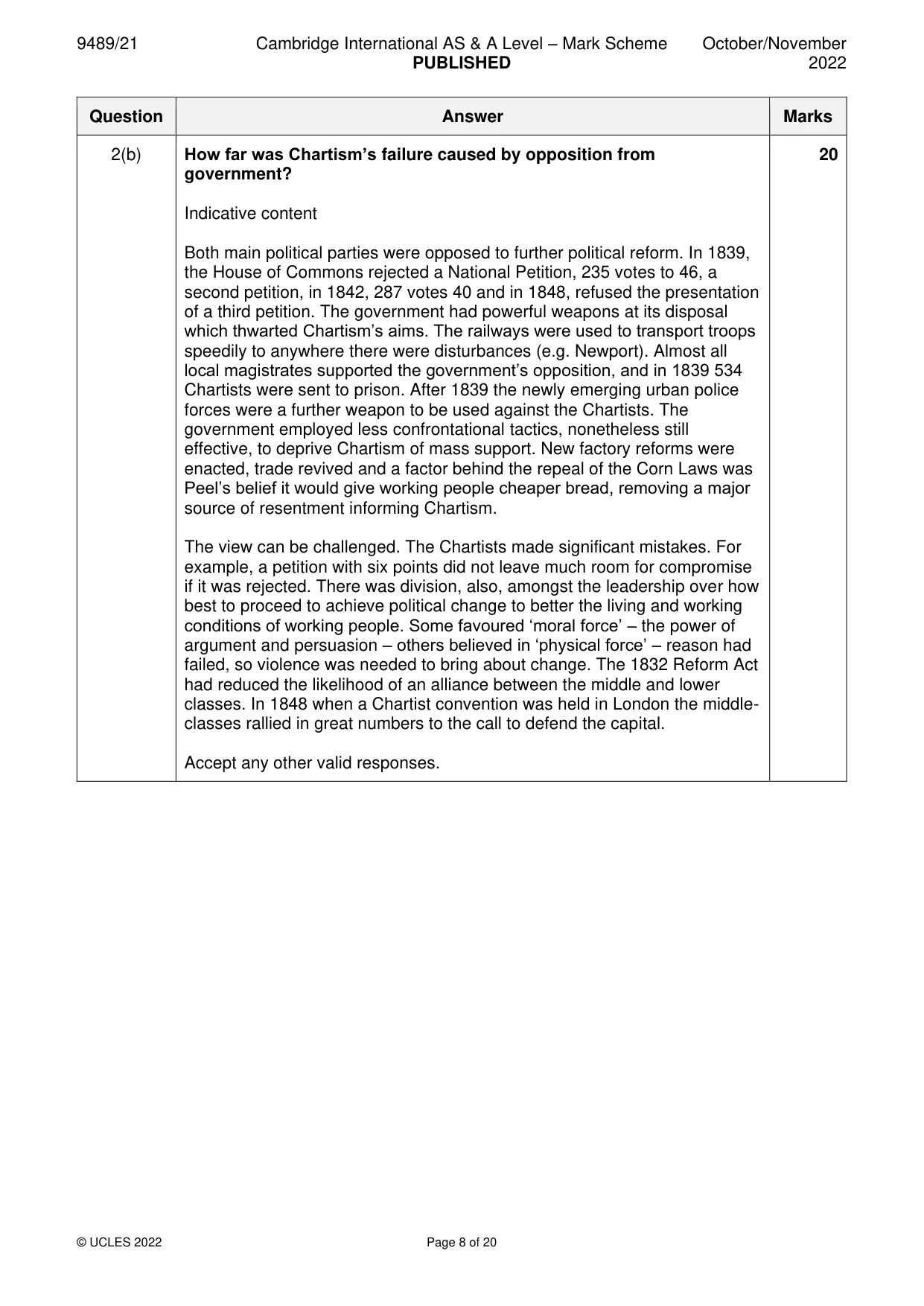
Mark scheme: 2(a) Explain why developments in textile machinery increased 10 industrialisation after 1780. Indicative content • By the mid-1780s steam engines began to be applied to the spinning factories in Lancashire. By the early nineteenth century a Crompton’s ‘Mule’ had been developed made of metal and by 1825 Richard Roberts’ ‘self-acting mule’ (automatic) was operating. The de- centralised cottage industries were replaced by centralised factory jobs, driving production and urbanisation. • There was a growing demand for coal, leading to increased coal production. • The need to receive raw materials in bulk (18m lbs of cotton in 1786) in order to produce manufactured goods in bulk led to changes in transportation – canals/railways. • In 1784-86, 43% of all textiles manufactured were exported, rising in 1844-46 to 66%. This stimulated the growth of ports and international trade. • Profits produced in the industry were not just re-invested, stimulating continued development, but invested in other industrial areas (iron/steel) further encouraging industrialisation. Accept any other valid responses. 2(b) How far was Chartism’s failure caused by opposition from 20 government? Indicative content Both main political parties were opposed to further political reform. In 1839, the House of Commons rejected a National Petition, 235 votes to 46, a second petition, in 1842, 287 votes 40 and in 1848, refused the presentation of a third petition. The government had powerful weapons at its disposal which thwarted Chartism’s aims. The railways were used to transport troops speedily to anywhere there were disturbances (e.g. Newport). Almost all local magistrates supported the government’s opposition, and in 1839 534 Chartists were sent to prison. After 1839 the newly emerging urban police forces were a further weapon to be used against the Chartists. The government employed less confrontational tactics, nonetheless still effective, to deprive Chartism of mass support. New factory reforms were enacted, trade revived and a factor behind the repeal of the Corn Laws was Peel’s belief it would give working people cheaper bread, removing a major source of resentment informing Chartism. The view can be challenged. The Chartists made significant mistakes. For example, a petition with six points did not leave much room for compromise if it was rejected. There was division, also, amongst the leadership over how best to proceed to achieve political change to better the living and working conditions of working people. Some favoured ‘moral force’ – the power of argument and persuasion – others believed in ‘physical force’ – reason had failed, so violence was needed to bring about change. The 1832 Reform Act had reduced the likelihood of an alliance between the middle and lower classes. In 1848 when a Chartist convention was held in London the middle- classes rallied in great numbers to the call to defend the capital. Accept any other valid responses.
More questions on How successful was the Progressive Movement from 1890 to 1920?
Q3 · Liberalism and nationalism in Germany, 1815–71 (a) Explain why France lost the…
3 Liberalism and nationalism in Germany, 1815–71 (a) Explain why France lost the Franco–Prussian War. [10] (b) To what extent did economic issues cause the German revolutions of 1848–49? [20]
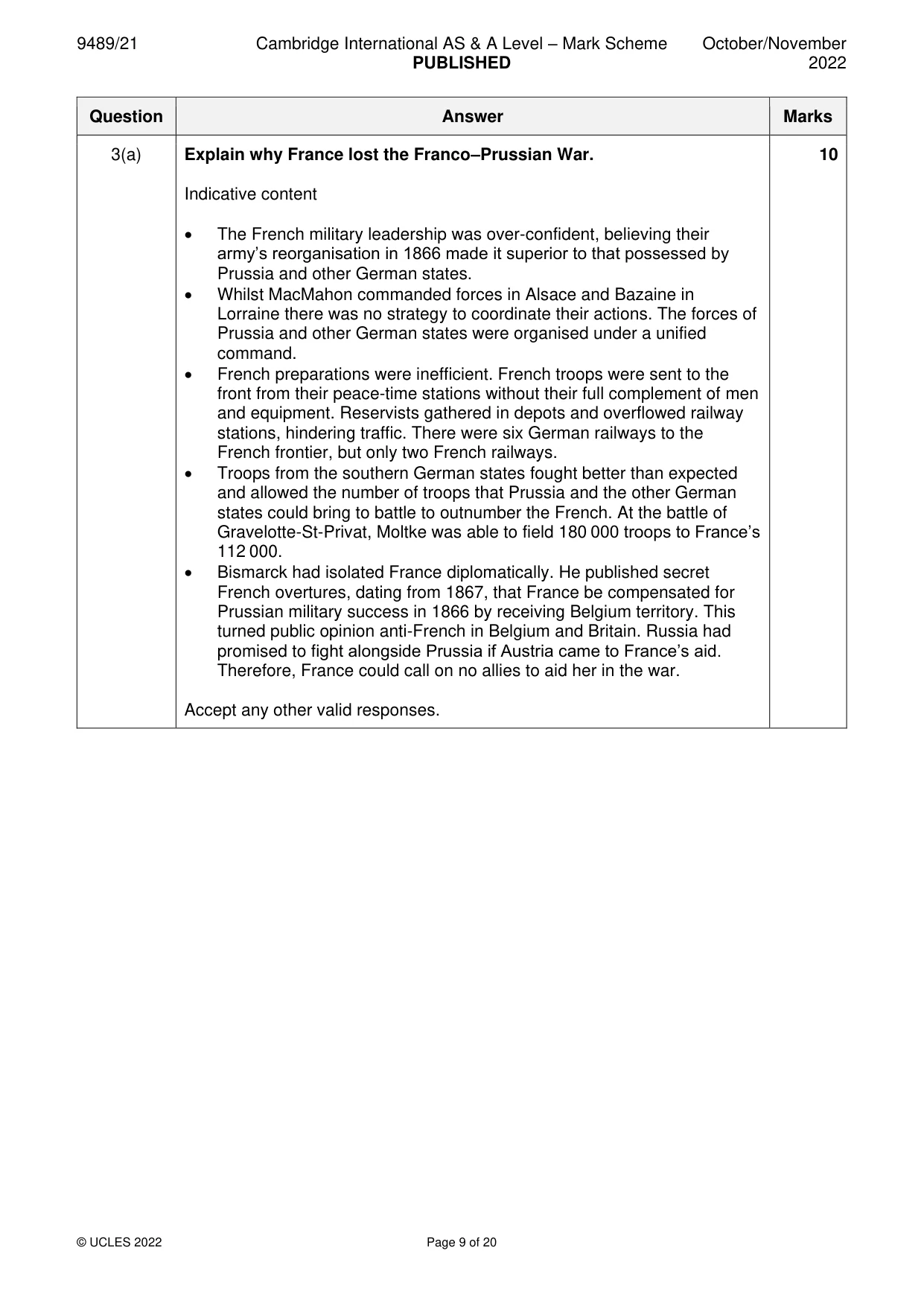
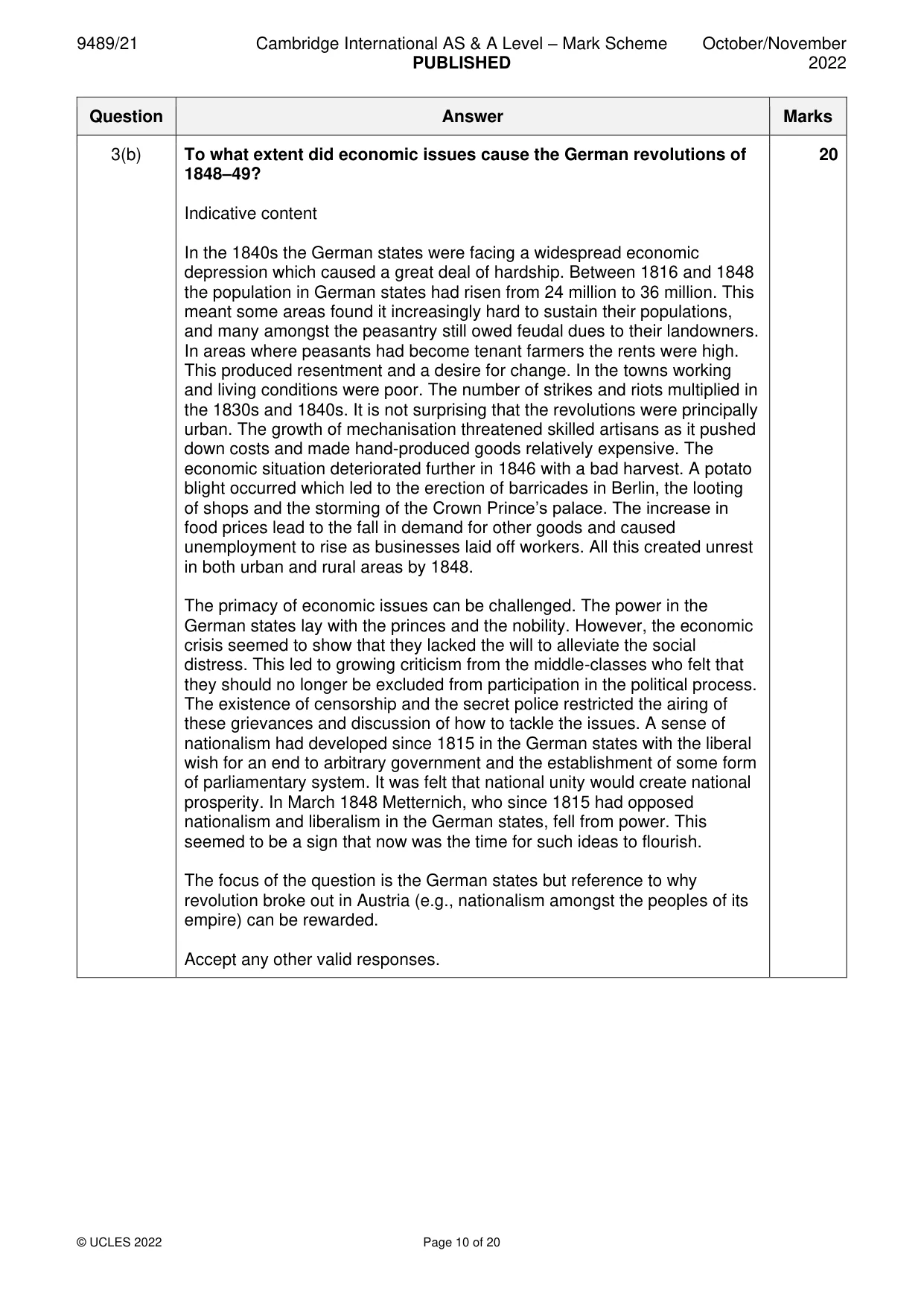
Mark scheme: 3(a) Explain why France lost the Franco–Prussian War. 10 Indicative content • The French military leadership was over-confident, believing their army’s reorganisation in 1866 made it superior to that possessed by Prussia and other German states. • Whilst MacMahon commanded forces in Alsace and Bazaine in Lorraine there was no strategy to coordinate their actions. The forces of Prussia and other German states were organised under a unified command. • French preparations were inefficient. French troops were sent to the front from their peace-time stations without their full complement of men and equipment. Reservists gathered in depots and overflowed railway stations, hindering traffic. There were six German railways to the French frontier, but only two French railways. • Troops from the southern German states fought better than expected and allowed the number of troops that Prussia and the other German states could bring to battle to outnumber the French. At the battle of Gravelotte-St-Privat, Moltke was able to field 180 000 troops to France’s 112 000. • Bismarck had isolated France diplomatically. He published secret French overtures, dating from 1867, that France be compensated for Prussian military success in 1866 by receiving Belgium territory. This turned public opinion anti-French in Belgium and Britain. Russia had promised to fight alongside Prussia if Austria came to France’s aid. Therefore, France could call on no allies to aid her in the war. Accept any other valid responses. 3(b) To what extent did economic issues cause the German revolutions of 20 1848–49? Indicative content In the 1840s the German states were facing a widespread economic depression which caused a great deal of hardship. Between 1816 and 1848 the population in German states had risen from 24 million to 36 million. This meant some areas found it increasingly hard to sustain their populations, and many amongst the peasantry still owed feudal dues to their landowners. In areas where peasants had become tenant farmers the rents were high. This produced resentment and a desire for change. In the towns working and living conditions were poor. The number of strikes and riots multiplied in the 1830s and 1840s. It is not surprising that the revolutions were principally urban. The growth of mechanisation threatened skilled artisans as it pushed down costs and made hand-produced goods relatively expensive. The economic situation deteriorated further in 1846 with a bad harvest. A potato blight occurred which led to the erection of barricades in Berlin, the looting of shops and the storming of the Crown Prince’s palace. The increase in food prices lead to the fall in demand for other goods and caused unemployment to rise as businesses laid off workers. All this created unrest in both urban and rural areas by 1848. The primacy of economic issues can be challenged. The power in the German states lay with the princes and the nobility. However, the economic crisis seemed to show that they lacked the will to alleviate the social distress. This led to growing criticism from the middle-classes who felt that they should no longer be excluded from participation in the political process. The existence of censorship and the secret police restricted the airing of these grievances and discussion of how to tackle the issues. A sense of nationalism had developed since 1815 in the German states with the liberal wish for an end to arbitrary government and the establishment of some form of parliamentary system. It was felt that national unity would create national prosperity. In March 1848 Metternich, who since 1815 had opposed nationalism and liberalism in the German states, fell from power. This seemed to be a sign that now was the time for such ideas to flourish. The focus of the question is the German states but reference to why revolution broke out in Austria (e.g., nationalism amongst the peoples of its empire) can be rewarded. Accept any other valid responses.
More questions on What were the causes of the Revolutions of 1848?
Q4 · The origins of the Civil War, 1820–61 (a) Why did the Lincoln–Douglas debates attract so…
4 The origins of the Civil War, 1820–61 (a) Why did the Lincoln–Douglas debates attract so much attention? [10] (b) To what extent were changes in the party-political system the cause of increased sectionalism in the period 1850–56? [20]
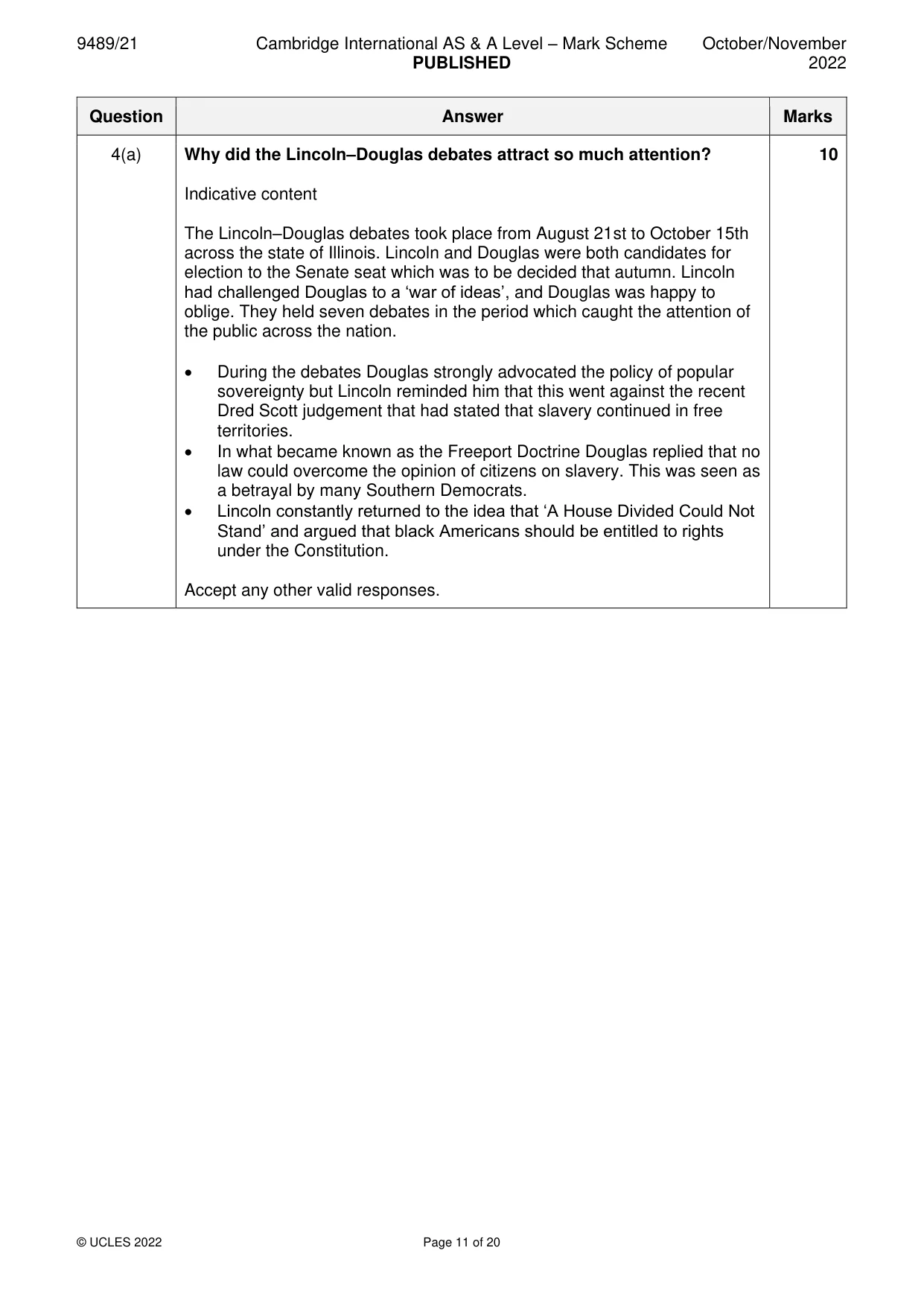
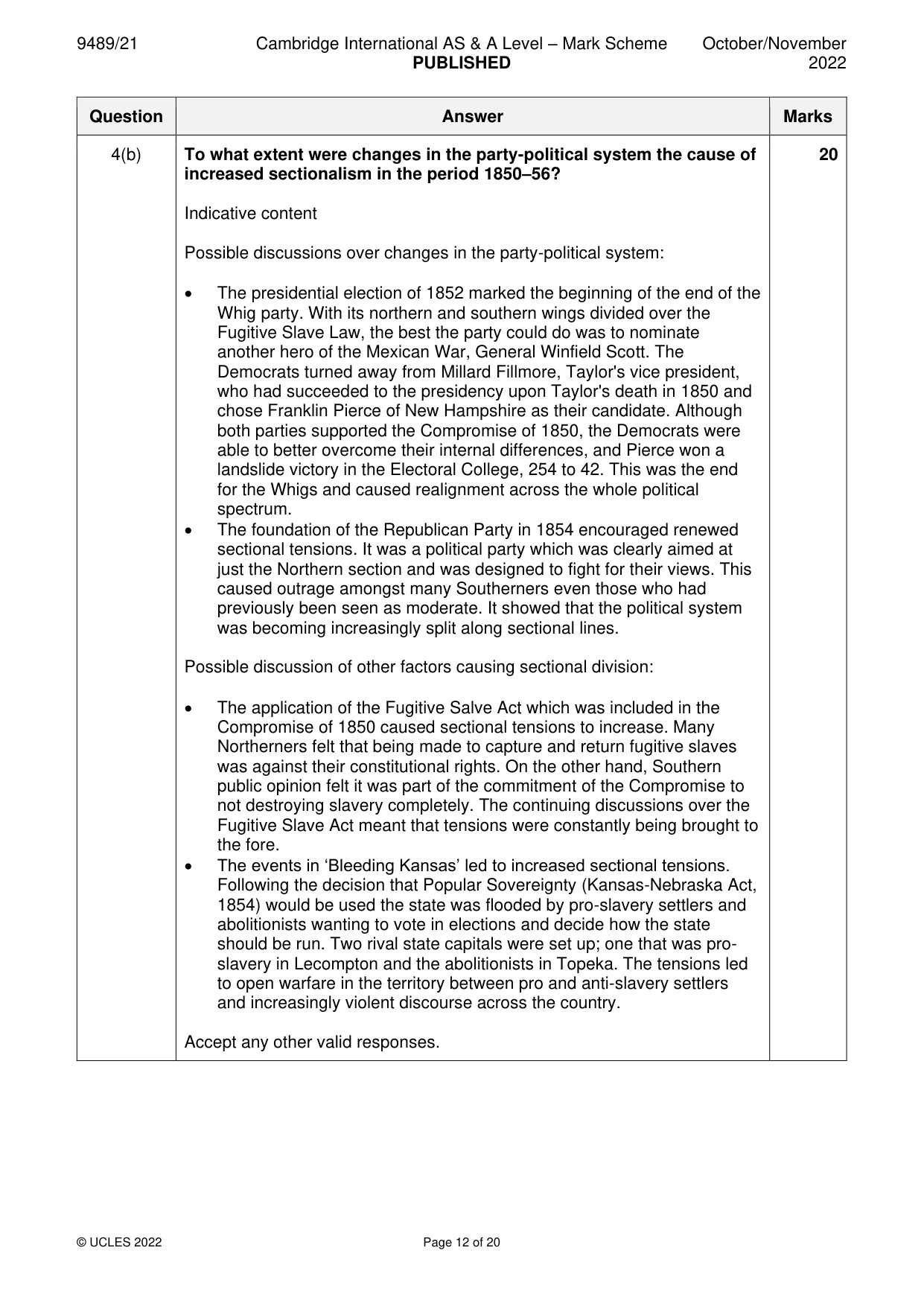
Mark scheme: 4(a) Why did the Lincoln–Douglas debates attract so much attention? 10 Indicative content The Lincoln–Douglas debates took place from August 21st to October 15th across the state of Illinois. Lincoln and Douglas were both candidates for election to the Senate seat which was to be decided that autumn. Lincoln had challenged Douglas to a ‘war of ideas’, and Douglas was happy to oblige. They held seven debates in the period which caught the attention of the public across the nation. • During the debates Douglas strongly advocated the policy of popular sovereignty but Lincoln reminded him that this went against the recent Dred Scott judgement that had stated that slavery continued in free territories. • In what became known as the Freeport Doctrine Douglas replied that no law could overcome the opinion of citizens on slavery. This was seen as a betrayal by many Southern Democrats. • Lincoln constantly returned to the idea that ‘A House Divided Could Not Stand’ and argued that black Americans should be entitled to rights under the Constitution. Accept any other valid responses. 4(b) To what extent were changes in the party-political system the cause of 20 increased sectionalism in the period 1850–56? Indicative content Possible discussions over changes in the party-political system: • The presidential election of 1852 marked the beginning of the end of the Whig party. With its northern and southern wings divided over the Fugitive Slave Law, the best the party could do was to nominate another hero of the Mexican War, General Winfield Scott. The Democrats turned away from Millard Fillmore, Taylor's vice president, who had succeeded to the presidency upon Taylor's death in 1850 and chose Franklin Pierce of New Hampshire as their candidate. Although both parties supported the Compromise of 1850, the Democrats were able to better overcome their internal differences, and Pierce won a landslide victory in the Electoral College, 254 to 42. This was the end for the Whigs and caused realignment across the whole political spectrum. • The foundation of the Republican Party in 1854 encouraged renewed sectional tensions. It was a political party which was clearly aimed at just the Northern section and was designed to fight for their views. This caused outrage amongst many Southerners even those who had previously been seen as moderate. It showed that the political system was becoming increasingly split along sectional lines. Possible discussion of other factors causing sectional division: • The application of the Fugitive Salve Act which was included in the Compromise of 1850 caused sectional tensions to increase. Many Northerners felt that being made to capture and return fugitive slaves was against their constitutional rights. On the other hand, Southern public opinion felt it was part of the commitment of the Compromise to not destroying slavery completely. The continuing discussions over the Fugitive Slave Act meant that tensions were constantly being brought to the fore. • The events in ‘Bleeding Kansas’ led to increased sectional tensions. Following the decision that Popular Sovereignty (Kansas-Nebraska Act, 1854) would be used the state was flooded by pro-slavery settlers and abolitionists wanting to vote in elections and decide how the state should be run. Two rival state capitals were set up; one that was pro- slavery in Lecompton and the abolitionists in Topeka. The tensions led to open warfare in the territory between pro and anti-slavery settlers and increasingly violent discourse across the country. Accept any other valid responses.
More questions on Why was there increasing tension between the North and the South before 1860?
Q5 · The Gilded Age and Progressive Era, 1870s to 1920 (a) Explain why the US economy…
5 The Gilded Age and Progressive Era, 1870s to 1920 (a) Explain why the US economy experienced periods of economic recession in the late nineteenth century. [10] (b) To what extent did presidents in the early twentieth century successfully enact Progressive policies? [20]
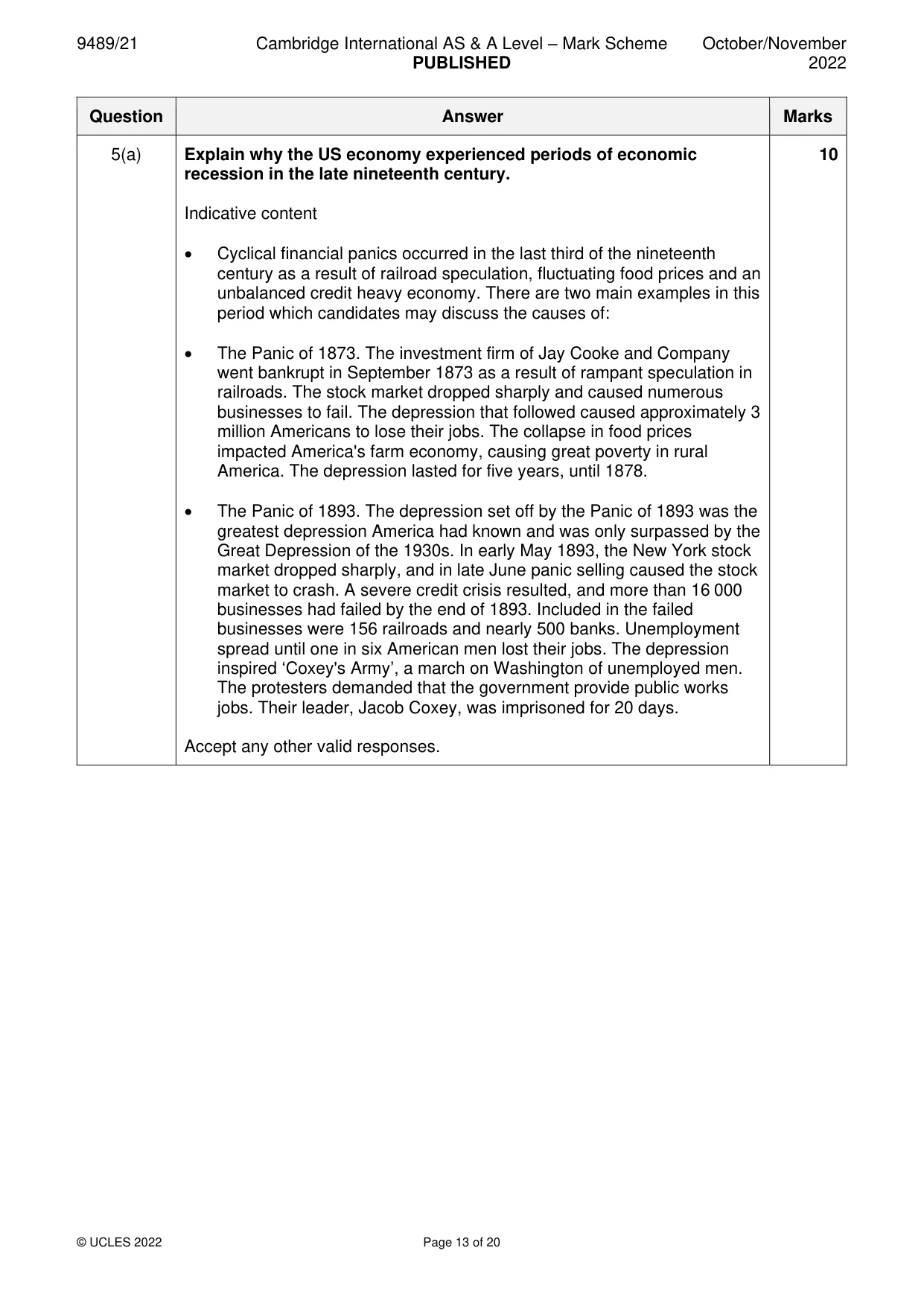
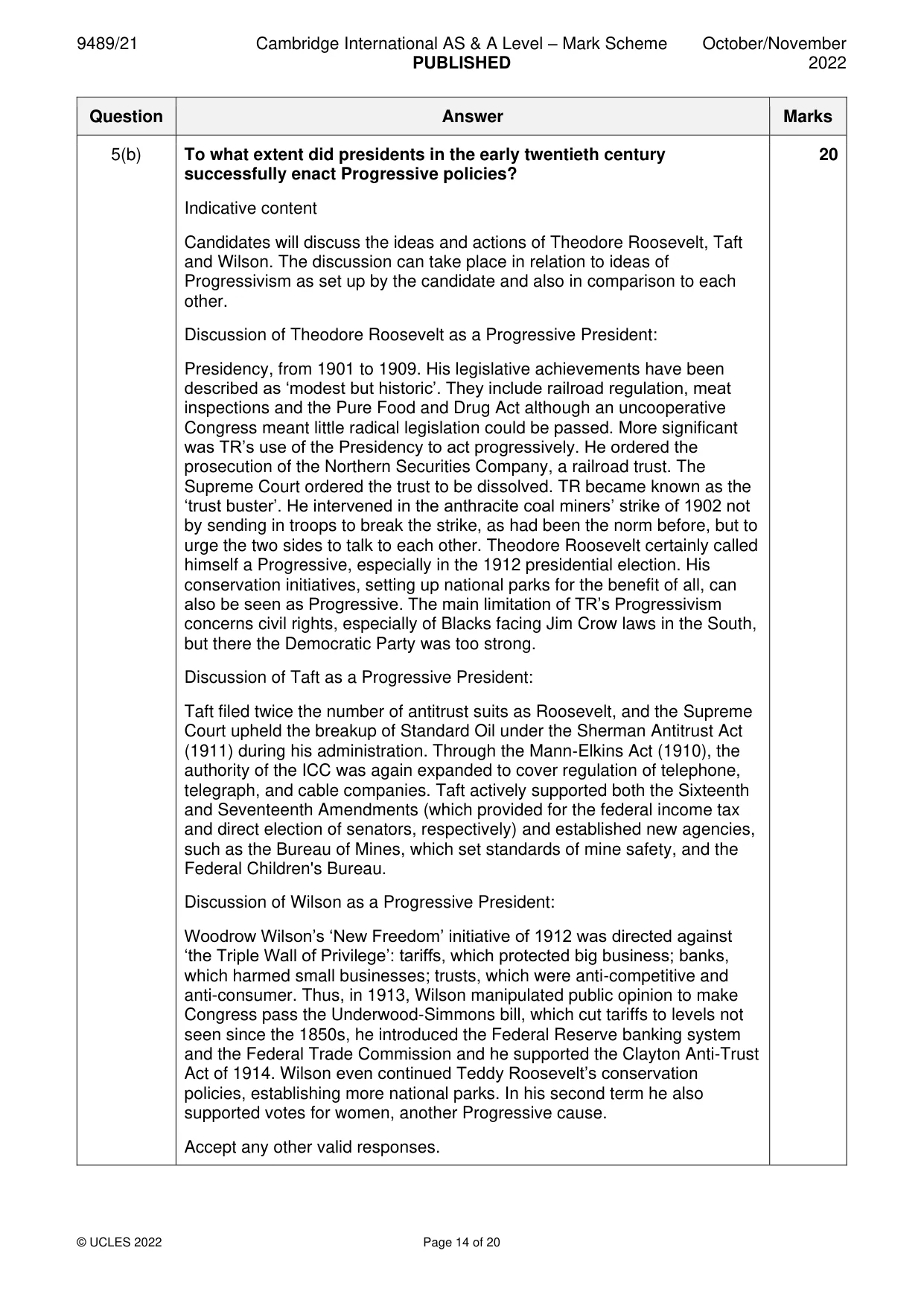
Mark scheme: 5(a) Explain why the US economy experienced periods of economic 10 recession in the late nineteenth century. Indicative content • Cyclical financial panics occurred in the last third of the nineteenth century as a result of railroad speculation, fluctuating food prices and an unbalanced credit heavy economy. There are two main examples in this period which candidates may discuss the causes of: • The Panic of 1873. The investment firm of Jay Cooke and Company went bankrupt in September 1873 as a result of rampant speculation in railroads. The stock market dropped sharply and caused numerous businesses to fail. The depression that followed caused approximately 3 million Americans to lose their jobs. The collapse in food prices impacted America's farm economy, causing great poverty in rural America. The depression lasted for five years, until 1878. • The Panic of 1893. The depression set off by the Panic of 1893 was the greatest depression America had known and was only surpassed by the Great Depression of the 1930s. In early May 1893, the New York stock market dropped sharply, and in late June panic selling caused the stock market to crash. A severe credit crisis resulted, and more than 16 000 businesses had failed by the end of 1893. Included in the failed businesses were 156 railroads and nearly 500 banks. Unemployment spread until one in six American men lost their jobs. The depression inspired ‘Coxey's Army’, a march on Washington of unemployed men. The protesters demanded that the government provide public works jobs. Their leader, Jacob Coxey, was imprisoned for 20 days. Accept any other valid responses. 5(b) To what extent did presidents in the early twentieth century 20 successfully enact Progressive policies? Indicative content Candidates will discuss the ideas and actions of Theodore Roosevelt, Taft and Wilson. The discussion can take place in relation to ideas of Progressivism as set up by the candidate and also in comparison to each other. Discussion of Theodore Roosevelt as a Progressive President: Presidency, from 1901 to 1909. His legislative achievements have been described as ‘modest but historic’. They include railroad regulation, meat inspections and the Pure Food and Drug Act although an uncooperative Congress meant little radical legislation could be passed. More significant was TR’s use of the Presidency to act progressively. He ordered the prosecution of the Northern Securities Company, a railroad trust. The Supreme Court ordered the trust to be dissolved. TR became known as the ‘trust buster’. He intervened in the anthracite coal miners’ strike of 1902 not by sending in troops to break the strike, as had been the norm before, but to urge the two sides to talk to each other. Theodore Roosevelt certainly called himself a Progressive, especially in the 1912 presidential election. His conservation initiatives, setting up national parks for the benefit of all, can also be seen as Progressive. The main limitation of TR’s Progressivism concerns civil rights, especially of Blacks facing Jim Crow laws in the South, but there the Democratic Party was too strong. Discussion of Taft as a Progressive President: Taft filed twice the number of antitrust suits as Roosevelt, and the Supreme Court upheld the breakup of Standard Oil under the Sherman Antitrust Act (1911) during his administration. Through the Mann‐Elkins Act (1910), the authority of the ICC was again expanded to cover regulation of telephone, telegraph, and cable companies. Taft actively supported both the Sixteenth and Seventeenth Amendments (which provided for the federal income tax and direct election of senators, respectively) and established new agencies, such as the Bureau of Mines, which set standards of mine safety, and the Federal Children's Bureau. Discussion of Wilson as a Progressive President: Woodrow Wilson’s ‘New Freedom’ initiative of 1912 was directed against ‘the Triple Wall of Privilege’: tariffs, which protected big business; banks, which harmed small businesses; trusts, which were anti-competitive and anti-consumer. Thus, in 1913, Wilson manipulated public opinion to make Congress pass the Underwood-Simmons bill, which cut tariffs to levels not seen since the 1850s, he introduced the Federal Reserve banking system and the Federal Trade Commission and he supported the Clayton Anti-Trust Act of 1914. Wilson even continued Teddy Roosevelt’s conservation policies, establishing more national parks. In his second term he also supported votes for women, another Progressive cause. Accept any other valid responses.
More questions on How successful was the Progressive Movement from 1890 to 1920?
Q6 · The Great Crash, the Great Depression and the New Deal policies, 1920–41 (a) Explain why…
6 The Great Crash, the Great Depression and the New Deal policies, 1920–41 (a) Explain why unemployment had such a large social impact after 1929. [10] (b) To what extent were the actions taken during his First Hundred Days key to the success of Roosevelt’s presidency? [20] Section C: International option International history, 1870–1945
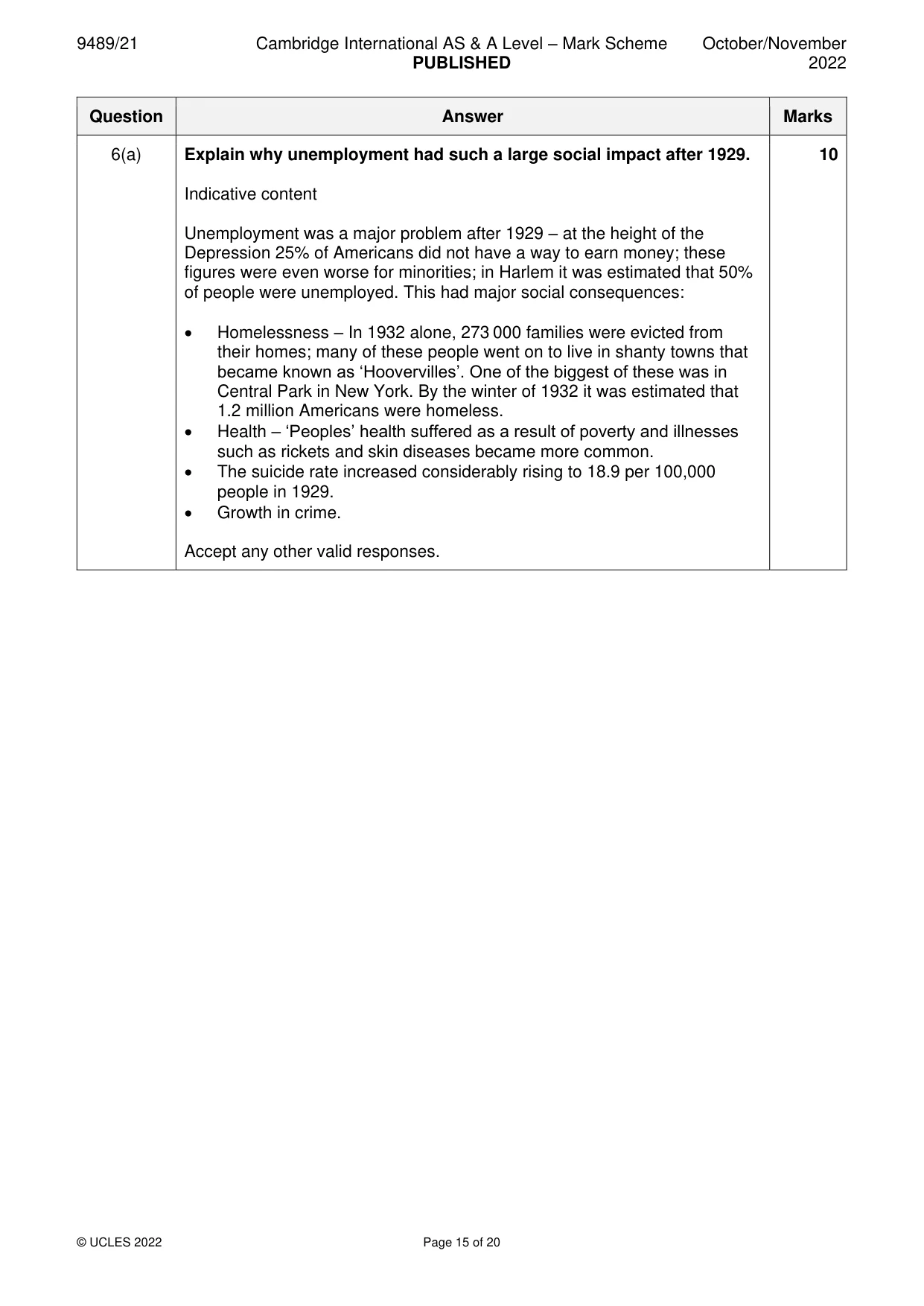
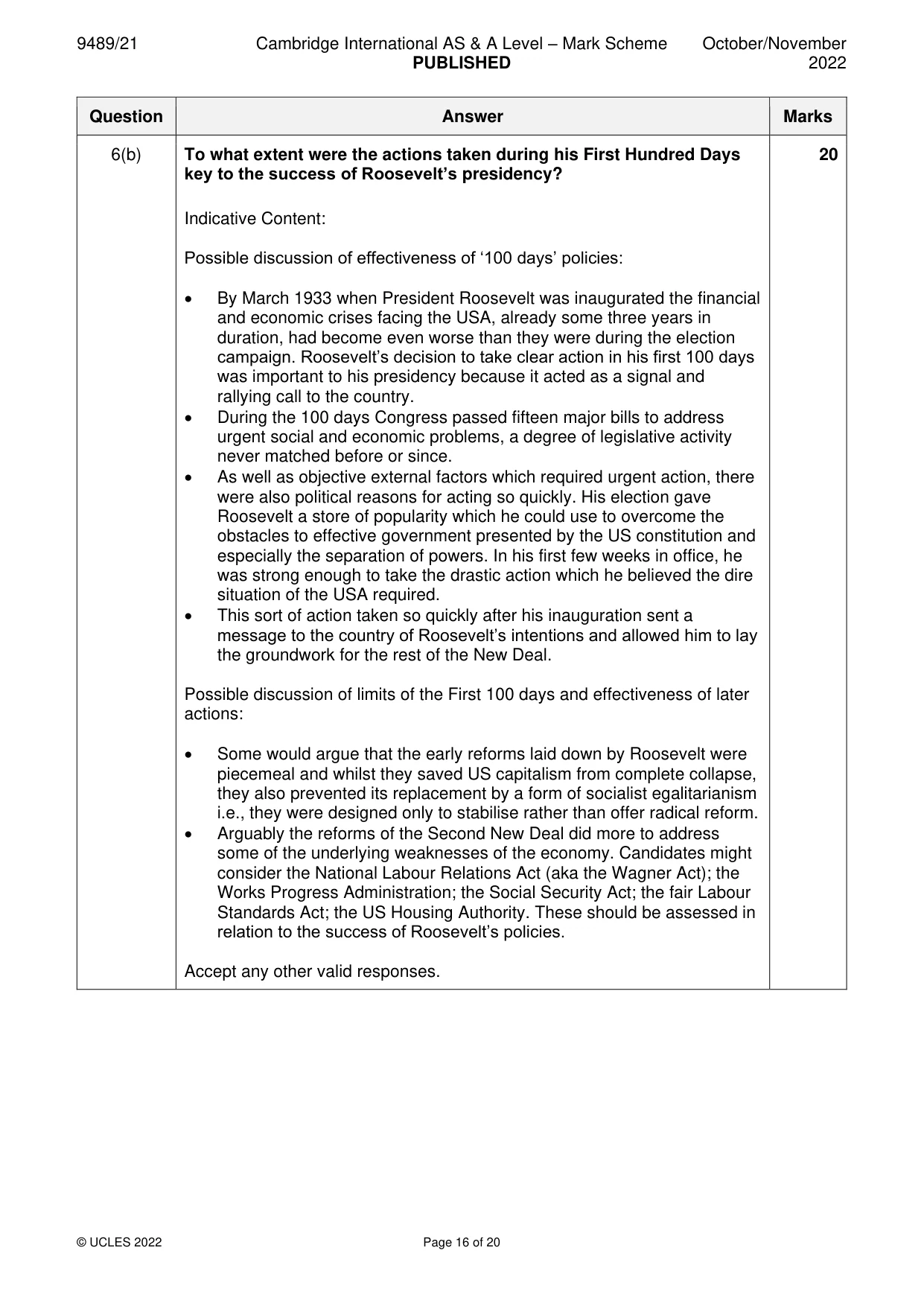
Mark scheme: 6(a) Explain why unemployment had such a large social impact after 1929. 10 Indicative content Unemployment was a major problem after 1929 – at the height of the Depression 25% of Americans did not have a way to earn money; these figures were even worse for minorities; in Harlem it was estimated that 50% of people were unemployed. This had major social consequences: • Homelessness – In 1932 alone, 273 000 families were evicted from their homes; many of these people went on to live in shanty towns that became known as ‘Hoovervilles’. One of the biggest of these was in Central Park in New York. By the winter of 1932 it was estimated that 1.2 million Americans were homeless. • Health – ‘Peoples’ health suffered as a result of poverty and illnesses such as rickets and skin diseases became more common. • The suicide rate increased considerably rising to 18.9 per 100,000 people in 1929. • Growth in crime. Accept any other valid responses. 6(b) To what extent were the actions taken during his First Hundred Days 20 key to the success of Roosevelt’s presidency? Indicative Content: Possible discussion of effectiveness of ‘100 days’ policies: • By March 1933 when President Roosevelt was inaugurated the financial and economic crises facing the USA, already some three years in duration, had become even worse than they were during the election campaign. Roosevelt’s decision to take clear action in his first 100 days was important to his presidency because it acted as a signal and rallying call to the country. • During the 100 days Congress passed fifteen major bills to address urgent social and economic problems, a degree of legislative activity never matched before or since. • As well as objective external factors which required urgent action, there were also political reasons for acting so quickly. His election gave Roosevelt a store of popularity which he could use to overcome the obstacles to effective government presented by the US constitution and especially the separation of powers. In his first few weeks in office, he was strong enough to take the drastic action which he believed the dire situation of the USA required. • This sort of action taken so quickly after his inauguration sent a message to the country of Roosevelt’s intentions and allowed him to lay the groundwork for the rest of the New Deal. Possible discussion of limits of the First 100 days and effectiveness of later actions: • Some would argue that the early reforms laid down by Roosevelt were piecemeal and whilst they saved US capitalism from complete collapse, they also prevented its replacement by a form of socialist egalitarianism i.e., they were designed only to stabilise rather than offer radical reform. • Arguably the reforms of the Second New Deal did more to address some of the underlying weaknesses of the economy. Candidates might consider the National Labour Relations Act (aka the Wagner Act); the Works Progress Administration; the Social Security Act; the fair Labour Standards Act; the US Housing Authority. These should be assessed in relation to the success of Roosevelt’s policies. Accept any other valid responses.
More questions on How successful was Roosevelt’s first New Deal?
Q7 · Empire and the emergence of world powers, 1870–1919 (a) Explain why the United States…
7 Empire and the emergence of world powers, 1870–1919 (a) Explain why the United States became involved in the Cuban War of Independence. [10] (b) ‘Trade was the main reason for international involvement in China in the late nineteenth century.’ How far do you agree? [20]
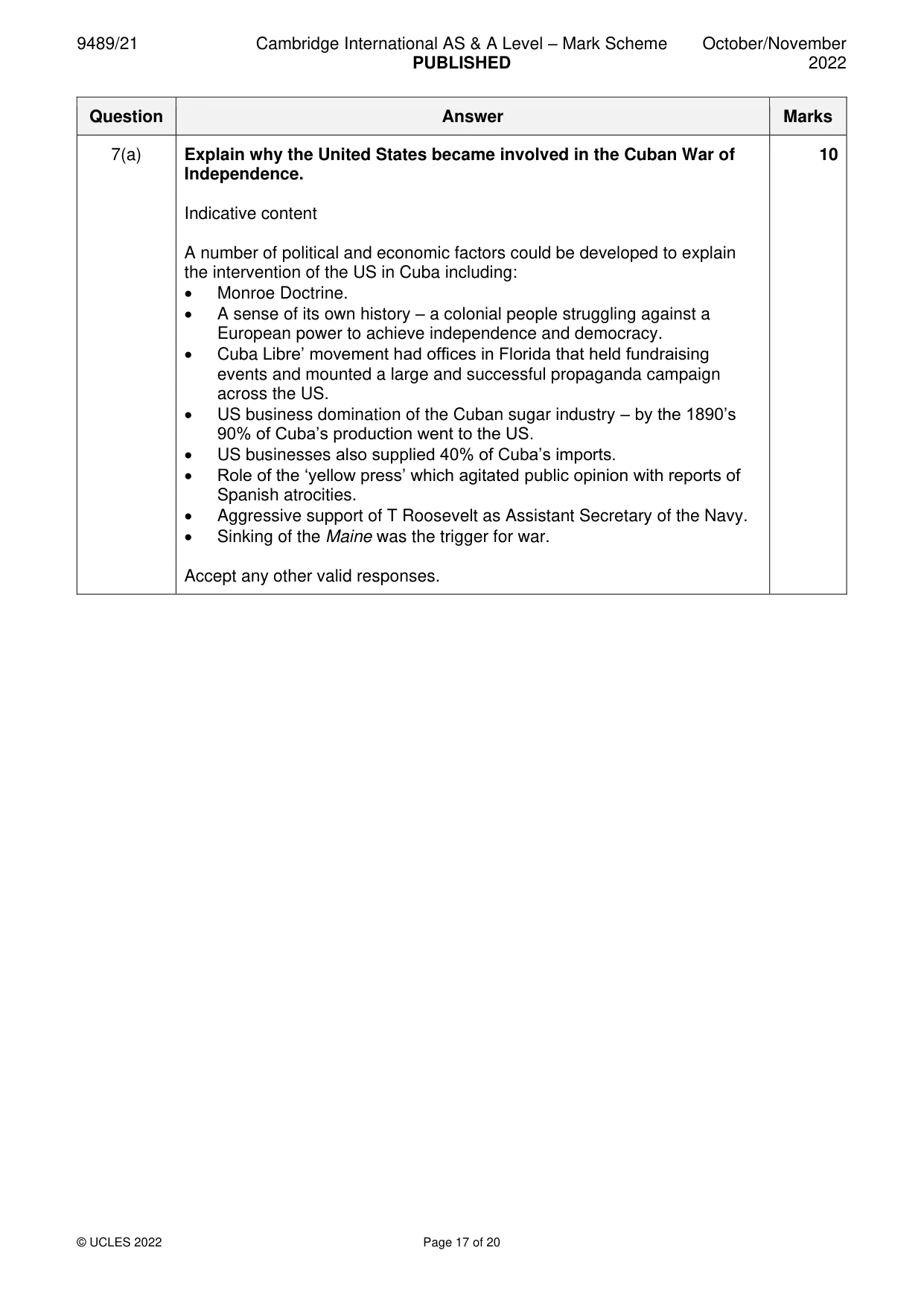
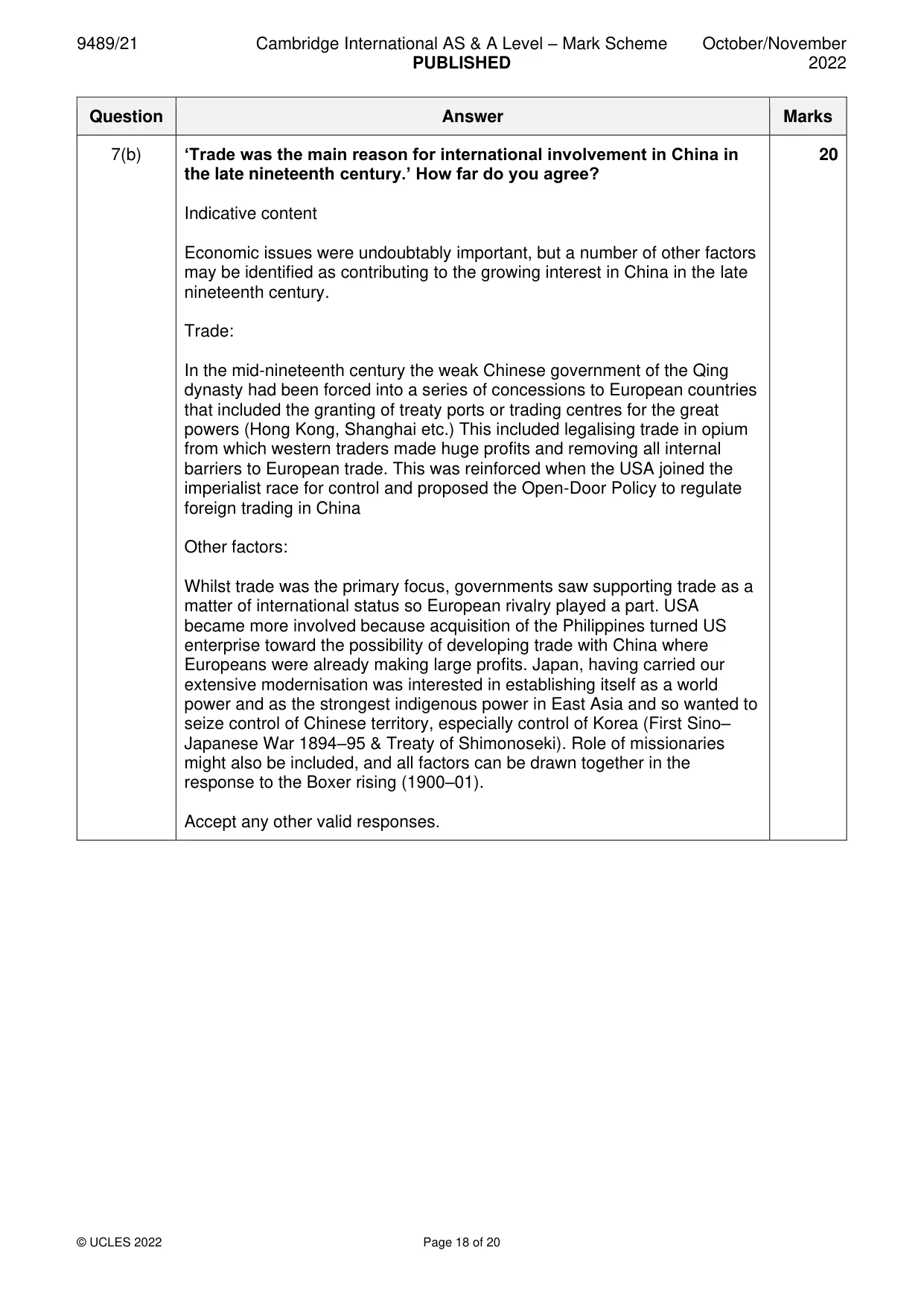
Mark scheme: 7(a) Explain why the United States became involved in the Cuban War of 10 Independence. Indicative content A number of political and economic factors could be developed to explain the intervention of the US in Cuba including: • Monroe Doctrine. • A sense of its own history – a colonial people struggling against a European power to achieve independence and democracy. • Cuba Libre’ movement had offices in Florida that held fundraising events and mounted a large and successful propaganda campaign across the US. • US business domination of the Cuban sugar industry – by the 1890’s 90% of Cuba’s production went to the US. • US businesses also supplied 40% of Cuba’s imports. • Role of the ‘yellow press’ which agitated public opinion with reports of Spanish atrocities. • Aggressive support of T Roosevelt as Assistant Secretary of the Navy. • Sinking of the Maine was the trigger for war. Accept any other valid responses. 7(b) ‘Trade was the main reason for international involvement in China in 20 the late nineteenth century.’ How far do you agree? Indicative content Economic issues were undoubtably important, but a number of other factors may be identified as contributing to the growing interest in China in the late nineteenth century. Trade: In the mid-nineteenth century the weak Chinese government of the Qing dynasty had been forced into a series of concessions to European countries that included the granting of treaty ports or trading centres for the great powers (Hong Kong, Shanghai etc.) This included legalising trade in opium from which western traders made huge profits and removing all internal barriers to European trade. This was reinforced when the USA joined the imperialist race for control and proposed the Open-Door Policy to regulate foreign trading in China Other factors: Whilst trade was the primary focus, governments saw supporting trade as a matter of international status so European rivalry played a part. USA became more involved because acquisition of the Philippines turned US enterprise toward the possibility of developing trade with China where Europeans were already making large profits. Japan, having carried our extensive modernisation was interested in establishing itself as a world power and as the strongest indigenous power in East Asia and so wanted to seize control of Chinese territory, especially control of Korea (First Sino– Japanese War 1894–95 & Treaty of Shimonoseki). Role of missionaries might also be included, and all factors can be drawn together in the response to the Boxer rising (1900–01). Accept any other valid responses.
More questions on Why did Japan emerge as a world power and what was the impact on international
Q8 · The League of Nations and international relations in the 1920s (a) Explain why the…
8 The League of Nations and international relations in the 1920s (a) Explain why the Rapallo Pact was signed in 1922. [10] (b) To what extent did the Locarno Treaties resolve international tensions in the second half of the 1920s? [20]
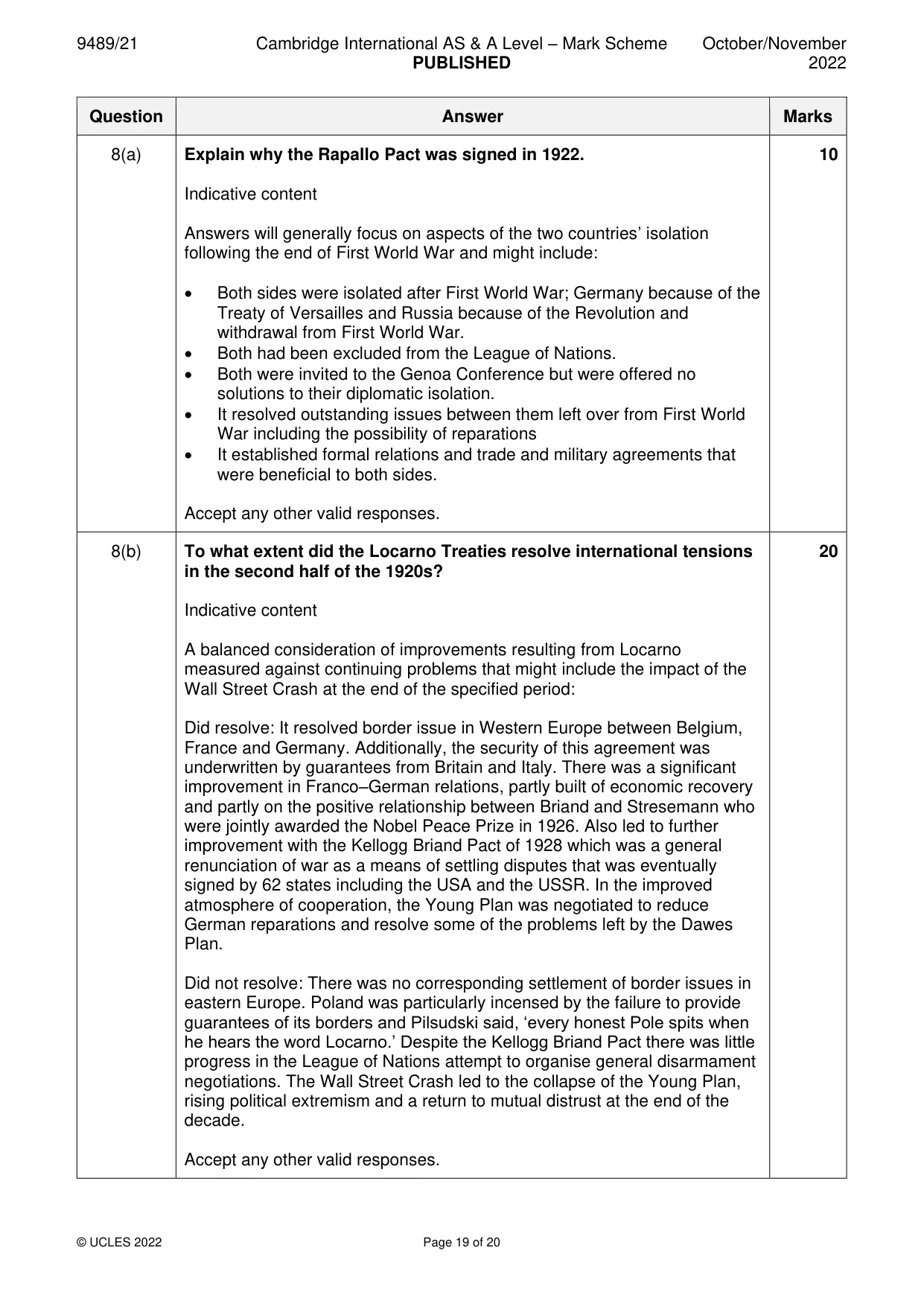
Mark scheme: 8(a) Explain why the Rapallo Pact was signed in 1922. 10 Indicative content Answers will generally focus on aspects of the two countries’ isolation following the end of First World War and might include: • Both sides were isolated after First World War; Germany because of the Treaty of Versailles and Russia because of the Revolution and withdrawal from First World War. • Both had been excluded from the League of Nations. • Both were invited to the Genoa Conference but were offered no solutions to their diplomatic isolation. • It resolved outstanding issues between them left over from First World War including the possibility of reparations • It established formal relations and trade and military agreements that were beneficial to both sides. Accept any other valid responses. 8(b) To what extent did the Locarno Treaties resolve international tensions 20 in the second half of the 1920s? Indicative content A balanced consideration of improvements resulting from Locarno measured against continuing problems that might include the impact of the Wall Street Crash at the end of the specified period: Did resolve: It resolved border issue in Western Europe between Belgium, France and Germany. Additionally, the security of this agreement was underwritten by guarantees from Britain and Italy. There was a significant improvement in Franco–German relations, partly built of economic recovery and partly on the positive relationship between Briand and Stresemann who were jointly awarded the Nobel Peace Prize in 1926. Also led to further improvement with the Kellogg Briand Pact of 1928 which was a general renunciation of war as a means of settling disputes that was eventually signed by 62 states including the USA and the USSR. In the improved atmosphere of cooperation, the Young Plan was negotiated to reduce German reparations and resolve some of the problems left by the Dawes Plan. Did not resolve: There was no corresponding settlement of border issues in eastern Europe. Poland was particularly incensed by the failure to provide guarantees of its borders and Pilsudski said, ‘every honest Pole spits when he hears the word Locarno.’ Despite the Kellogg Briand Pact there was little progress in the League of Nations attempt to organise general disarmament negotiations. The Wall Street Crash led to the collapse of the Young Plan, rising political extremism and a return to mutual distrust at the end of the decade. Accept any other valid responses.
More questions on How and why did international relations improve, 1924–29?
Q9 · The League of Nations and international relations in the 1930s (a) Explain why Italy left…
9 The League of Nations and international relations in the 1930s (a) Explain why Italy left the League of Nations in 1937. [10] (b) ‘Britain’s military weakness prevented it from pursuing a more active policy against Hitler in the 1930s.’ How far do you agree? [20]
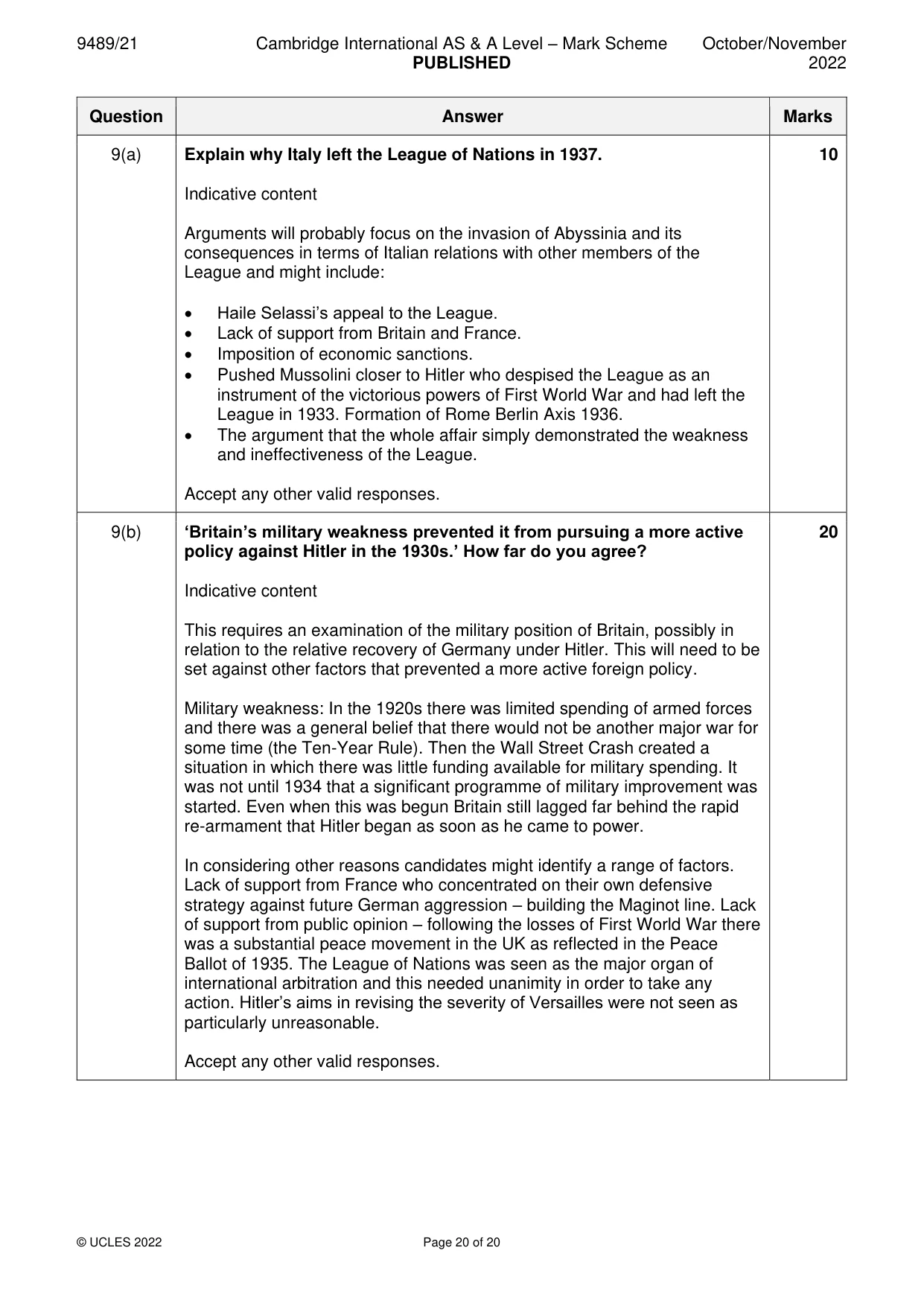
Mark scheme: 9(a) Explain why Italy left the League of Nations in 1937. 10 Indicative content Arguments will probably focus on the invasion of Abyssinia and its consequences in terms of Italian relations with other members of the League and might include: • Haile Selassi’s appeal to the League. • Lack of support from Britain and France. • Imposition of economic sanctions. • Pushed Mussolini closer to Hitler who despised the League as an instrument of the victorious powers of First World War and had left the League in 1933. Formation of Rome Berlin Axis 1936. • The argument that the whole affair simply demonstrated the weakness and ineffectiveness of the League. Accept any other valid responses. 9(b) ‘Britain’s military weakness prevented it from pursuing a more active 20 policy against Hitler in the 1930s.’ How far do you agree? Indicative content This requires an examination of the military position of Britain, possibly in relation to the relative recovery of Germany under Hitler. This will need to be set against other factors that prevented a more active foreign policy. Military weakness: In the 1920s there was limited spending of armed forces and there was a general belief that there would not be another major war for some time (the Ten-Year Rule). Then the Wall Street Crash created a situation in which there was little funding available for military spending. It was not until 1934 that a significant programme of military improvement was started. Even when this was begun Britain still lagged far behind the rapid re-armament that Hitler began as soon as he came to power. In considering other reasons candidates might identify a range of factors. Lack of support from France who concentrated on their own defensive strategy against future German aggression – building the Maginot line. Lack of support from public opinion – following the losses of First World War there was a substantial peace movement in the UK as reflected in the Peace Ballot of 1935. The League of Nations was seen as the major organ of international arbitration and this needed unanimity in order to take any action. Hitler’s aims in revising the severity of Versailles were not seen as particularly unreasonable. Accept any other valid responses.
More questions on Why, and with what effects, did Britain and France pursue a policy of appeasement?
What was in this paper
The subtopics covered by these 9 questions, and how many questions each got. Open one in a new tab to see every Cambridge question on it.
2How and why did France become a republic by 1792?1How and why did international relations improve, 1924–29?1How successful was Roosevelt’s first New Deal?1What were the causes of the Revolutions of 1848?1Why did Japan emerge as a world power and what was the impact on international1Why was there increasing tension between the North and the South before 1860?1Why, and with what effects, did Britain and France pursue a policy of appeasement?1What you needed in this session
Cambridge’s own grade thresholds for 2022 Oct/Nov, Paper 2 · Variant 1. A higher threshold means an easier paper — the bar moves with how the cohort did.