Cambridge A Level History 9489 — 2022 Feb/March Paper 2 · Variant 2
9489/22/F/M/22 · 9 questions · 60 marks · ≈68 min
The question paper and its mark scheme, free to read here and free to download. This is Cambridge’s own paper, exactly as it was sat.
Question paper4 pages
Mark scheme19 pages
Answers below. Sit the paper first if you are practising.

Questions as text
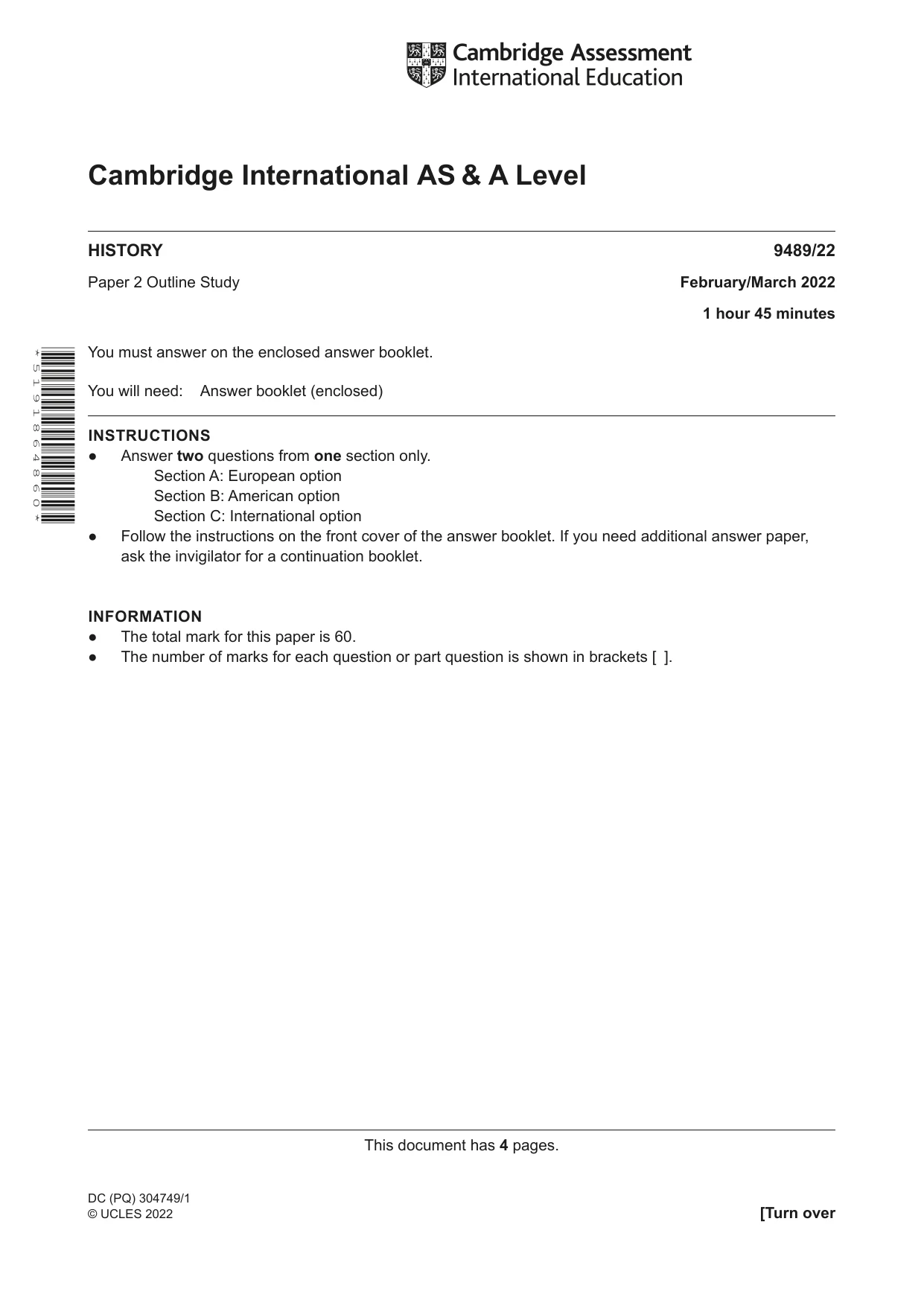
Q1 · France, 1774–1814 (a) Explain why Necker resigned in 1781
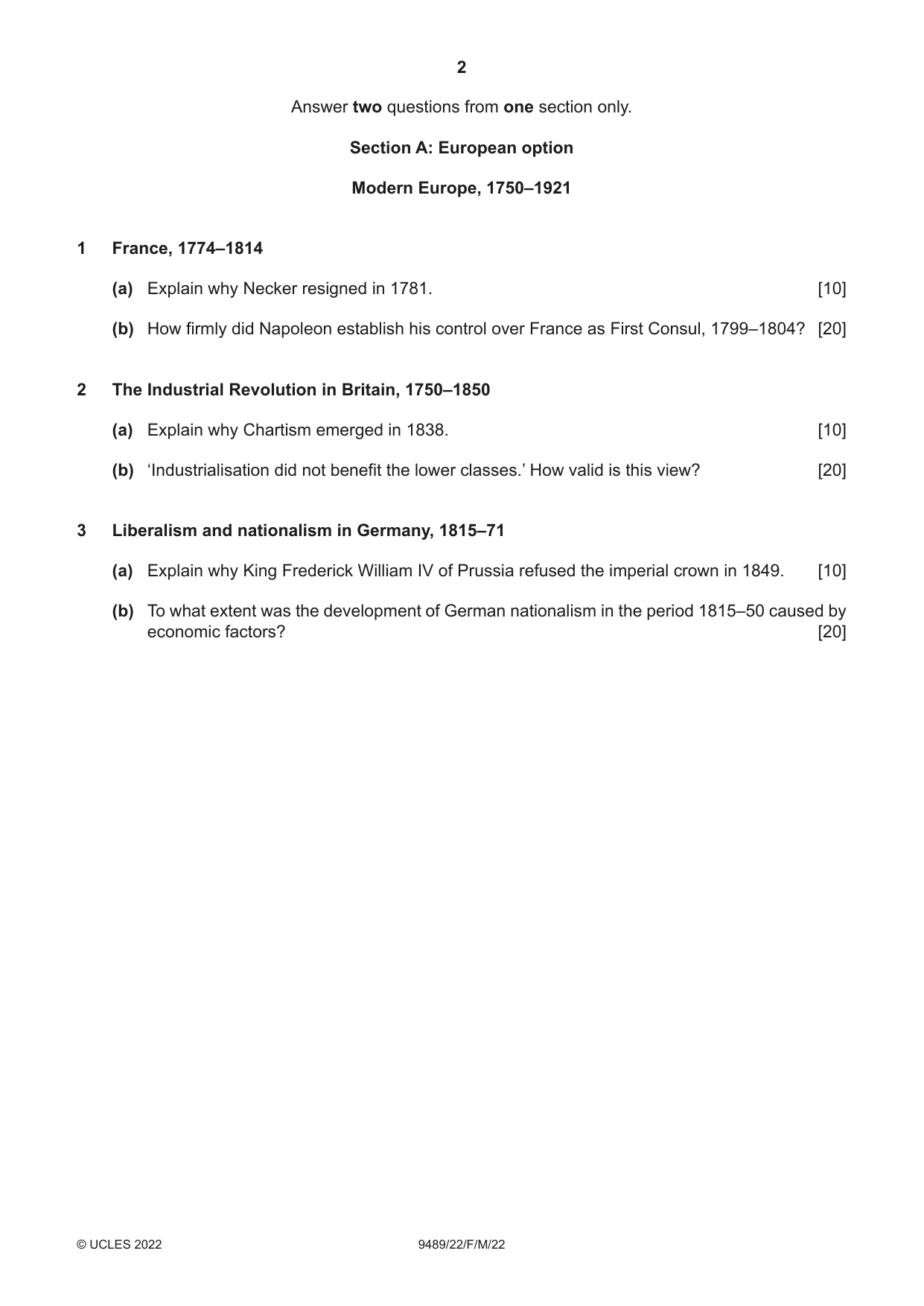
1 France, 1774–1814 (a) Explain why Necker resigned in 1781. [10] (b) How firmly did Napoleon establish his control over France as First Consul, 1799–1804? [20]
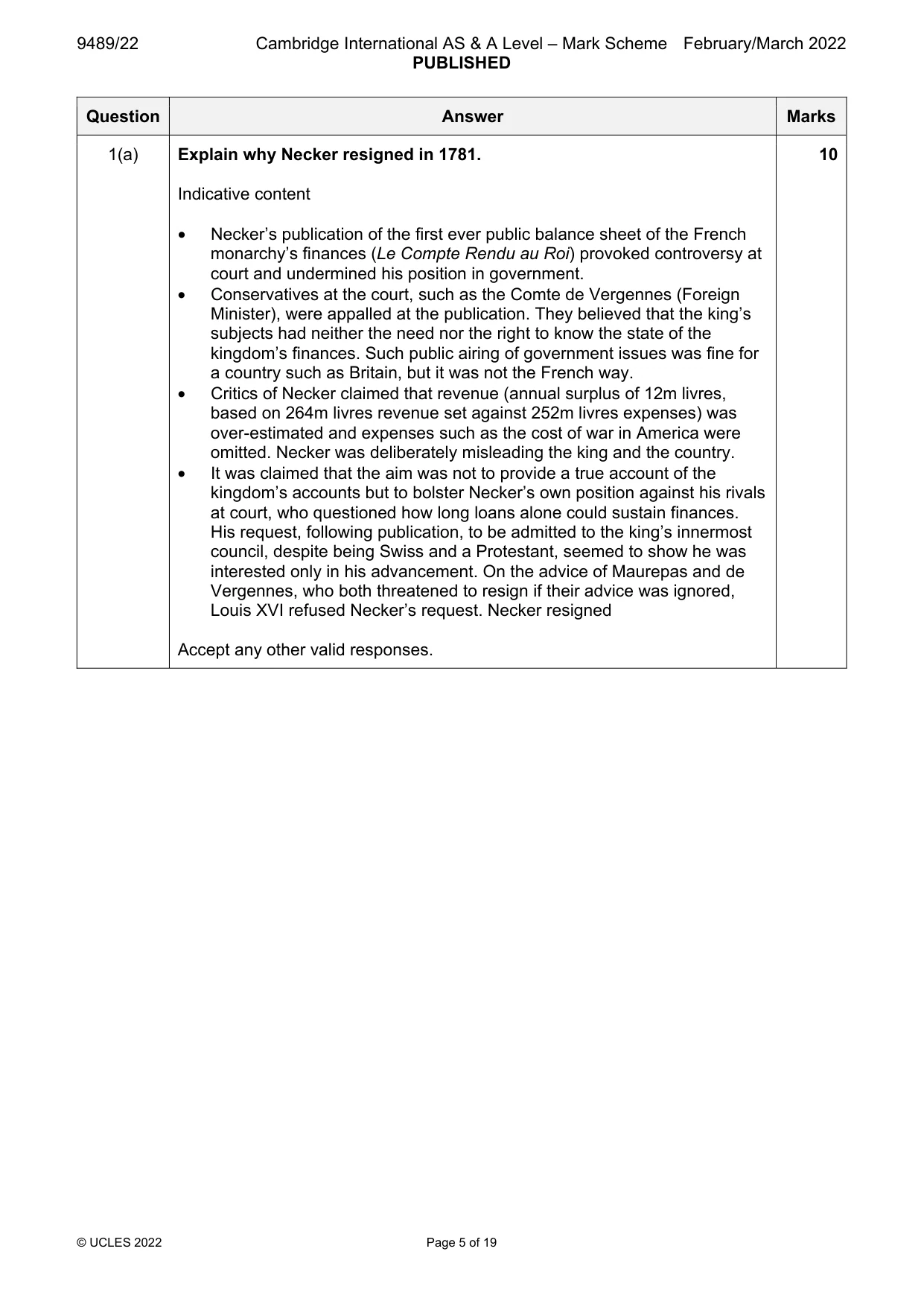
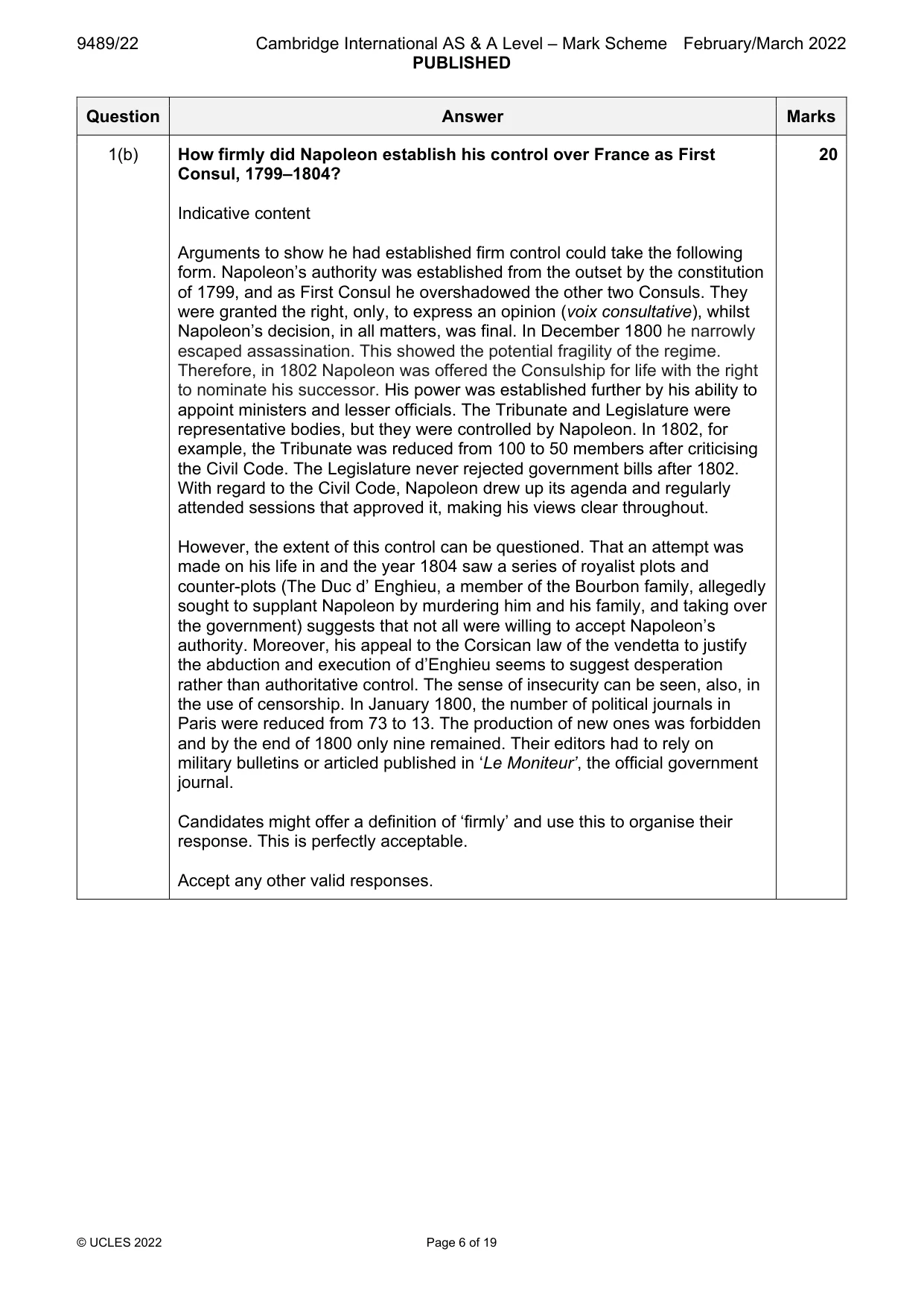
Mark scheme: Question Answer Marks 1(a) Explain why Necker resigned in 1781. 10 Indicative content • Necker’s publication of the first ever public balance sheet of the French monarchy’s finances (Le Compte Rendu au Roi) provoked controversy at court and undermined his position in government. • Conservatives at the court, such as the Comte de Vergennes (Foreign Minister), were appalled at the publication. They believed that the king’s subjects had neither the need nor the right to know the state of the kingdom’s finances. Such public airing of government issues was fine for a country such as Britain, but it was not the French way. • Critics of Necker claimed that revenue (annual surplus of 12m livres, based on 264m livres revenue set against 252m livres expenses) was over-estimated and expenses such as the cost of war in America were omitted. Necker was deliberately misleading the king and the country. • It was claimed that the aim was not to provide a true account of the kingdom’s accounts but to bolster Necker’s own position against his rivals at court, who questioned how long loans alone could sustain finances. His request, following publication, to be admitted to the king’s innermost council, despite being Swiss and a Protestant, seemed to show he was interested only in his advancement. On the advice of Maurepas and de Vergennes, who both threatened to resign if their advice was ignored, Louis XVI refused Necker’s request. Necker resigned Accept any other valid responses. 1(b) How firmly did Napoleon establish his control over France as First 20 Consul, 1799–1804? Indicative content Arguments to show he had established firm control could take the following form. Napoleon’s authority was established from the outset by the constitution of 1799, and as First Consul he overshadowed the other two Consuls. They were granted the right, only, to express an opinion (voix consultative), whilst Napoleon’s decision, in all matters, was final. In December 1800 he narrowly escaped assassination. This showed the potential fragility of the regime. Therefore, in 1802 Napoleon was offered the Consulship for life with the right to nominate his successor. His power was established further by his ability to appoint ministers and lesser officials. The Tribunate and Legislature were representative bodies, but they were controlled by Napoleon. In 1802, for example, the Tribunate was reduced from 100 to 50 members after criticising the Civil Code. The Legislature never rejected government bills after 1802. With regard to the Civil Code, Napoleon drew up its agenda and regularly attended sessions that approved it, making his views clear throughout. However, the extent of this control can be questioned. That an attempt was made on his life in and the year 1804 saw a series of royalist plots and counter-plots (The Duc d’ Enghieu, a member of the Bourbon family, allegedly sought to supplant Napoleon by murdering him and his family, and taking over the government) suggests that not all were willing to accept Napoleon’s authority. Moreover, his appeal to the Corsican law of the vendetta to justify the abduction and execution of d’Enghieu seems to suggest desperation rather than authoritative control. The sense of insecurity can be seen, also, in the use of censorship. In January 1800, the number of political journals in Paris were reduced from 73 to 13. The production of new ones was forbidden and by the end of 1800 only nine remained. Their editors had to rely on military bulletins or articled published in ‘Le Moniteur’, the official government journal. Candidates might offer a definition of ‘firmly’ and use this to organise their response. This is perfectly acceptable. Accept any other valid responses.
More questions on What caused the rise and fall of Napoleon Bonaparte?
Q2 · The Industrial Revolution in Britain, 1750–1850 (a) Explain why Chartism emerged in 1838
2 The Industrial Revolution in Britain, 1750–1850 (a) Explain why Chartism emerged in 1838. [10] (b) ‘Industrialisation did not benefit the lower classes.’ How valid is this view? [20]
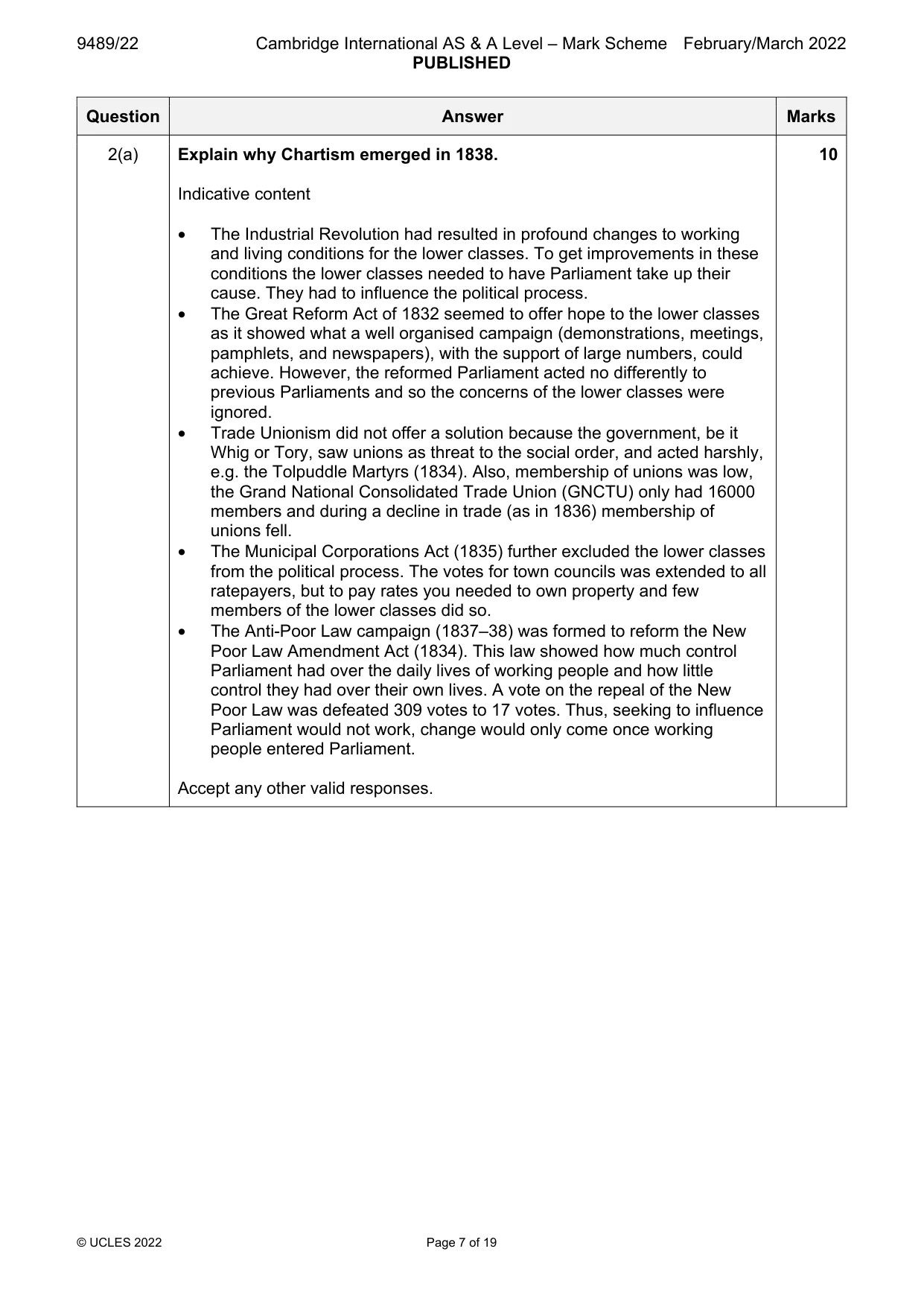
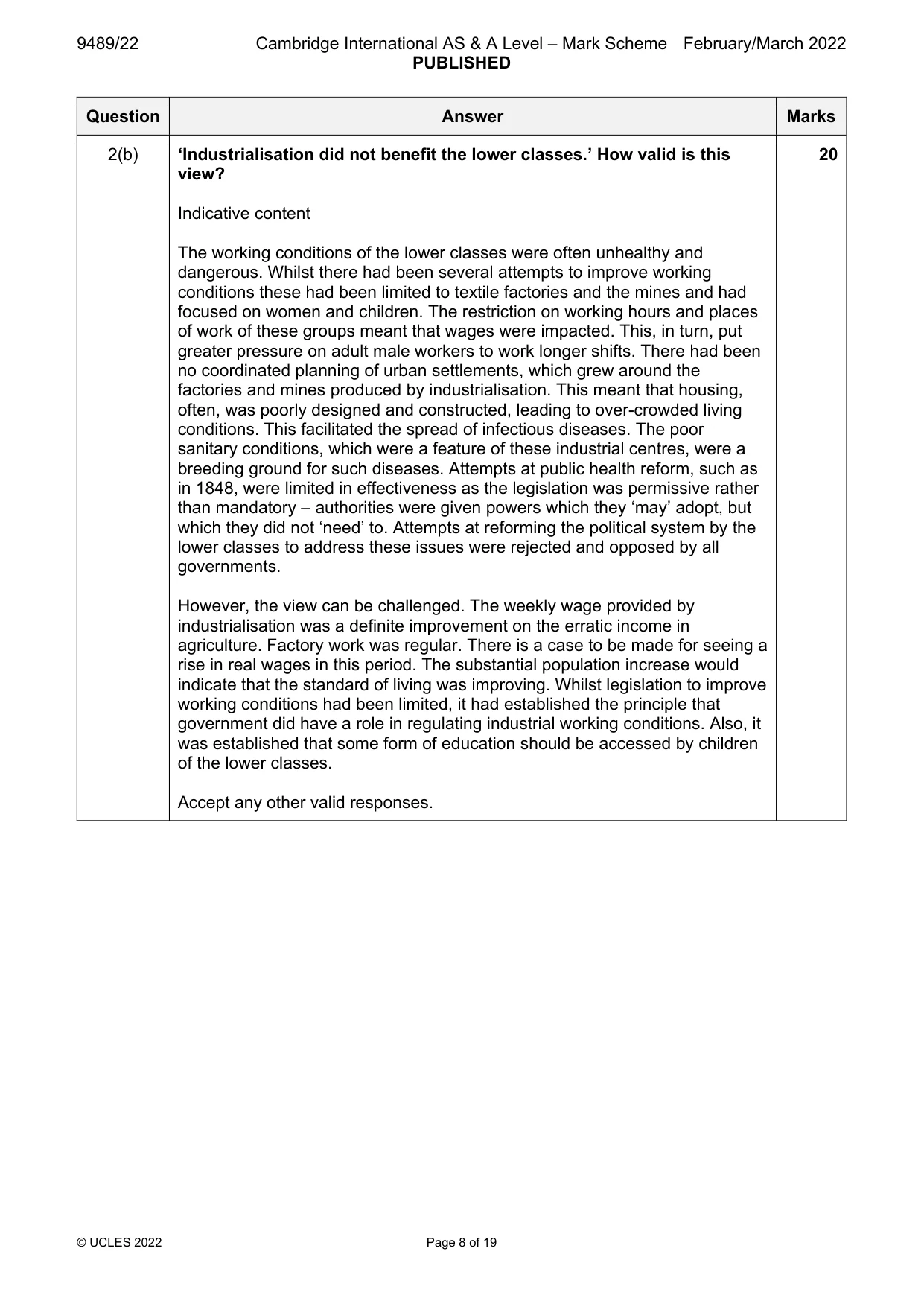
Mark scheme: 2(a) Explain why Chartism emerged in 1838. 10 Indicative content • The Industrial Revolution had resulted in profound changes to working and living conditions for the lower classes. To get improvements in these conditions the lower classes needed to have Parliament take up their cause. They had to influence the political process. • The Great Reform Act of 1832 seemed to offer hope to the lower classes as it showed what a well organised campaign (demonstrations, meetings, pamphlets, and newspapers), with the support of large numbers, could achieve. However, the reformed Parliament acted no differently to previous Parliaments and so the concerns of the lower classes were ignored. • Trade Unionism did not offer a solution because the government, be it Whig or Tory, saw unions as threat to the social order, and acted harshly, e.g. the Tolpuddle Martyrs (1834). Also, membership of unions was low, the Grand National Consolidated Trade Union (GNCTU) only had 16000 members and during a decline in trade (as in 1836) membership of unions fell. • The Municipal Corporations Act (1835) further excluded the lower classes from the political process. The votes for town councils was extended to all ratepayers, but to pay rates you needed to own property and few members of the lower classes did so. • The Anti-Poor Law campaign (1837–38) was formed to reform the New Poor Law Amendment Act (1834). This law showed how much control Parliament had over the daily lives of working people and how little control they had over their own lives. A vote on the repeal of the New Poor Law was defeated 309 votes to 17 votes. Thus, seeking to influence Parliament would not work, change would only come once working people entered Parliament. Accept any other valid responses. 2(b) ‘Industrialisation did not benefit the lower classes.’ How valid is this 20 view? Indicative content The working conditions of the lower classes were often unhealthy and dangerous. Whilst there had been several attempts to improve working conditions these had been limited to textile factories and the mines and had focused on women and children. The restriction on working hours and places of work of these groups meant that wages were impacted. This, in turn, put greater pressure on adult male workers to work longer shifts. There had been no coordinated planning of urban settlements, which grew around the factories and mines produced by industrialisation. This meant that housing, often, was poorly designed and constructed, leading to over-crowded living conditions. This facilitated the spread of infectious diseases. The poor sanitary conditions, which were a feature of these industrial centres, were a breeding ground for such diseases. Attempts at public health reform, such as in 1848, were limited in effectiveness as the legislation was permissive rather than mandatory – authorities were given powers which they ‘may’ adopt, but which they did not ‘need’ to. Attempts at reforming the political system by the lower classes to address these issues were rejected and opposed by all governments. However, the view can be challenged. The weekly wage provided by industrialisation was a definite improvement on the erratic income in agriculture. Factory work was regular. There is a case to be made for seeing a rise in real wages in this period. The substantial population increase would indicate that the standard of living was improving. Whilst legislation to improve working conditions had been limited, it had established the principle that government did have a role in regulating industrial working conditions. Also, it was established that some form of education should be accessed by children of the lower classes. Accept any other valid responses.
More questions on What were the consequences of the rapid economic growth after 1870?
Q3 · Liberalism and nationalism in Germany, 1815–71 (a) Explain why King Frederick William IV…
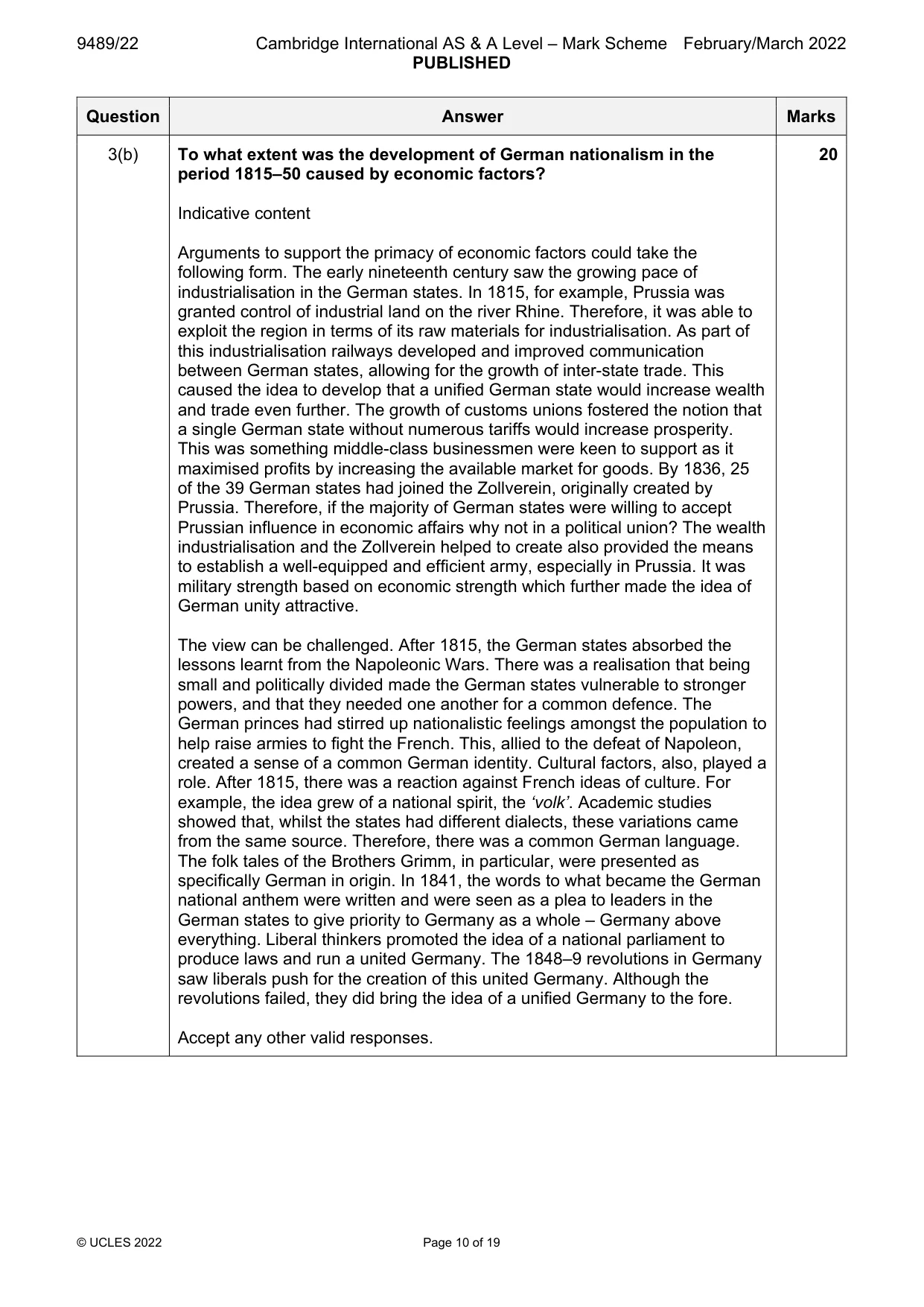
3 Liberalism and nationalism in Germany, 1815–71 (a) Explain why King Frederick William IV of Prussia refused the imperial crown in 1849. [10] (b) To what extent was the development of German nationalism in the period 1815–50 caused by economic factors? [20]
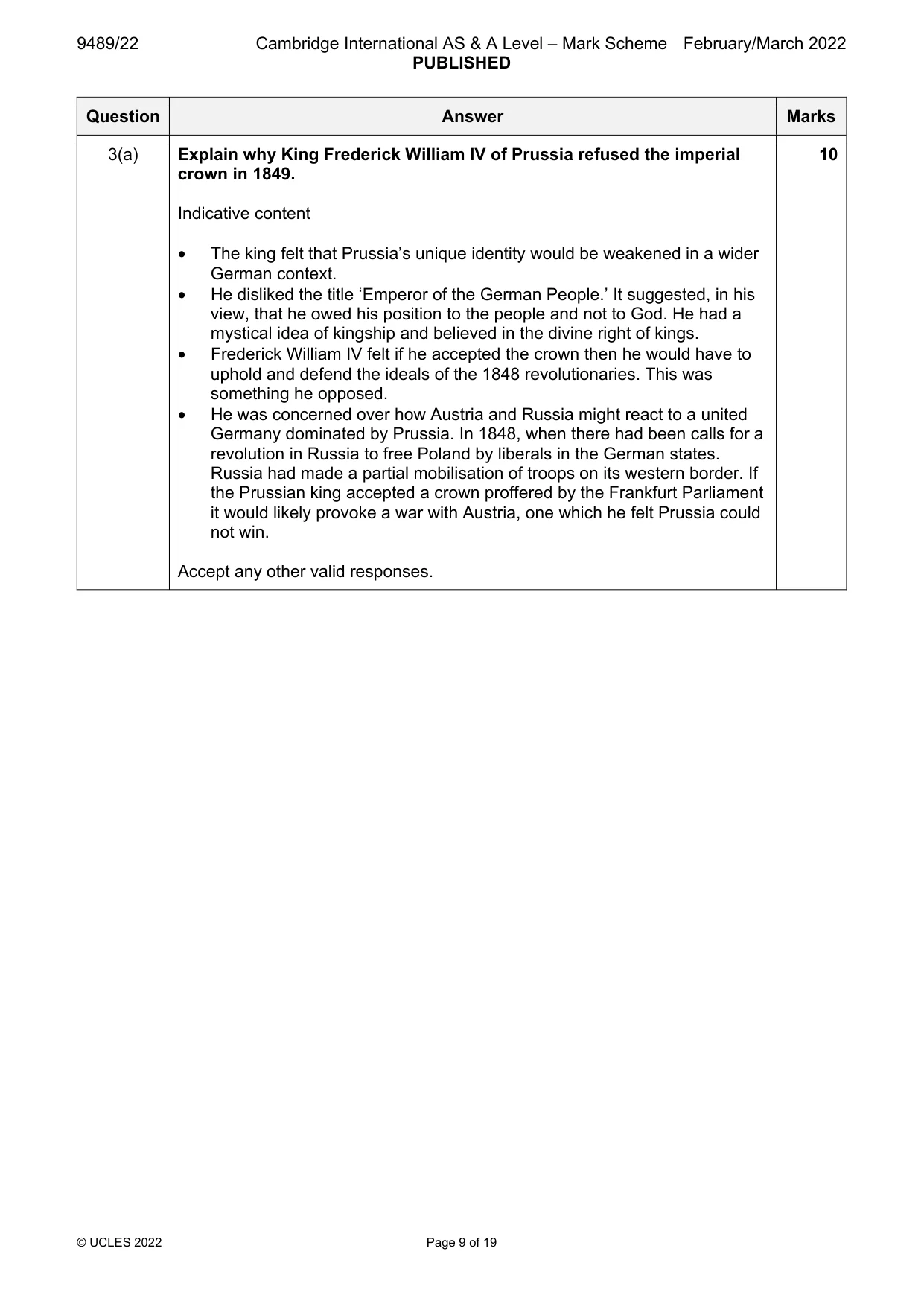
Mark scheme: 3(a) Explain why King Frederick William IV of Prussia refused the imperial 10 crown in 1849. Indicative content • The king felt that Prussia’s unique identity would be weakened in a wider German context. • He disliked the title ‘Emperor of the German People.’ It suggested, in his view, that he owed his position to the people and not to God. He had a mystical idea of kingship and believed in the divine right of kings. • Frederick William IV felt if he accepted the crown then he would have to uphold and defend the ideals of the 1848 revolutionaries. This was something he opposed. • He was concerned over how Austria and Russia might react to a united Germany dominated by Prussia. In 1848, when there had been calls for a revolution in Russia to free Poland by liberals in the German states. Russia had made a partial mobilisation of troops on its western border. If the Prussian king accepted a crown proffered by the Frankfurt Parliament it would likely provoke a war with Austria, one which he felt Prussia could not win. Accept any other valid responses. 3(b) To what extent was the development of German nationalism in the 20 period 1815–50 caused by economic factors? Indicative content Arguments to support the primacy of economic factors could take the following form. The early nineteenth century saw the growing pace of industrialisation in the German states. In 1815, for example, Prussia was granted control of industrial land on the river Rhine. Therefore, it was able to exploit the region in terms of its raw materials for industrialisation. As part of this industrialisation railways developed and improved communication between German states, allowing for the growth of inter-state trade. This caused the idea to develop that a unified German state would increase wealth and trade even further. The growth of customs unions fostered the notion that a single German state without numerous tariffs would increase prosperity. This was something middle-class businessmen were keen to support as it maximised profits by increasing the available market for goods. By 1836, 25 of the 39 German states had joined the Zollverein, originally created by Prussia. Therefore, if the majority of German states were willing to accept Prussian influence in economic affairs why not in a political union? The wealth industrialisation and the Zollverein helped to create also provided the means to establish a well-equipped and efficient army, especially in Prussia. It was military strength based on economic strength which further made the idea of German unity attractive. The view can be challenged. After 1815, the German states absorbed the lessons learnt from the Napoleonic Wars. There was a realisation that being small and politically divided made the German states vulnerable to stronger powers, and that they needed one another for a common defence. The German princes had stirred up nationalistic feelings amongst the population to help raise armies to fight the French. This, allied to the defeat of Napoleon, created a sense of a common German identity. Cultural factors, also, played a role. After 1815, there was a reaction against French ideas of culture. For example, the idea grew of a national spirit, the ‘volk’. Academic studies showed that, whilst the states had different dialects, these variations came from the same source. Therefore, there was a common German language. The folk tales of the Brothers Grimm, in particular, were presented as specifically German in origin. In 1841, the words to what became the German national anthem were written and were seen as a plea to leaders in the German states to give priority to Germany as a whole – Germany above everything. Liberal thinkers promoted the idea of a national parliament to produce laws and run a united Germany. The 1848–9 revolutions in Germany saw liberals push for the creation of this united Germany. Although the revolutions failed, they did bring the idea of a unified Germany to the fore. Accept any other valid responses.
More questions on What were the causes of the Revolutions of 1848?
Q4 · The origins of the Civil War, 1820–61 (a) Explain why the Dred Scott case caused…
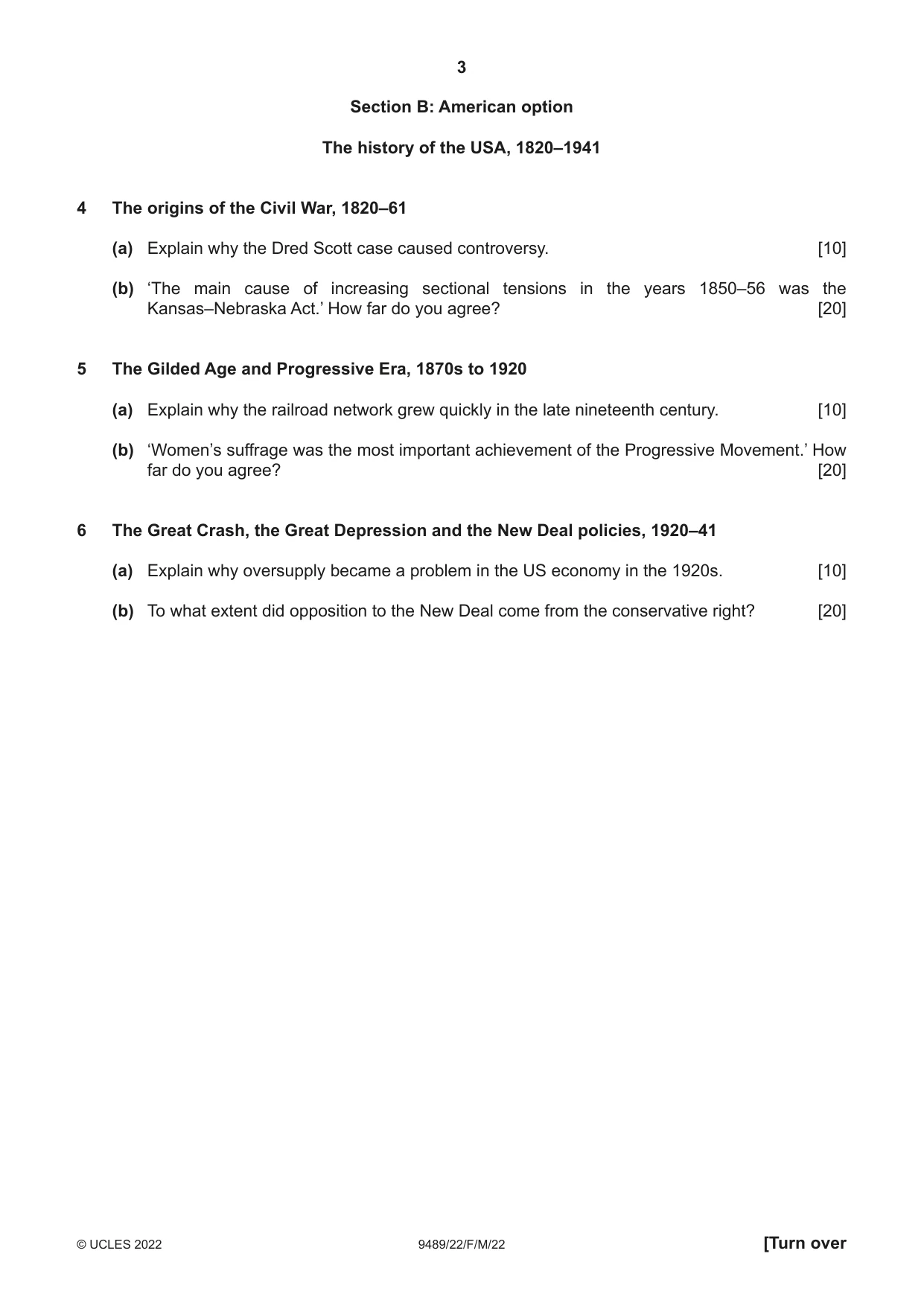
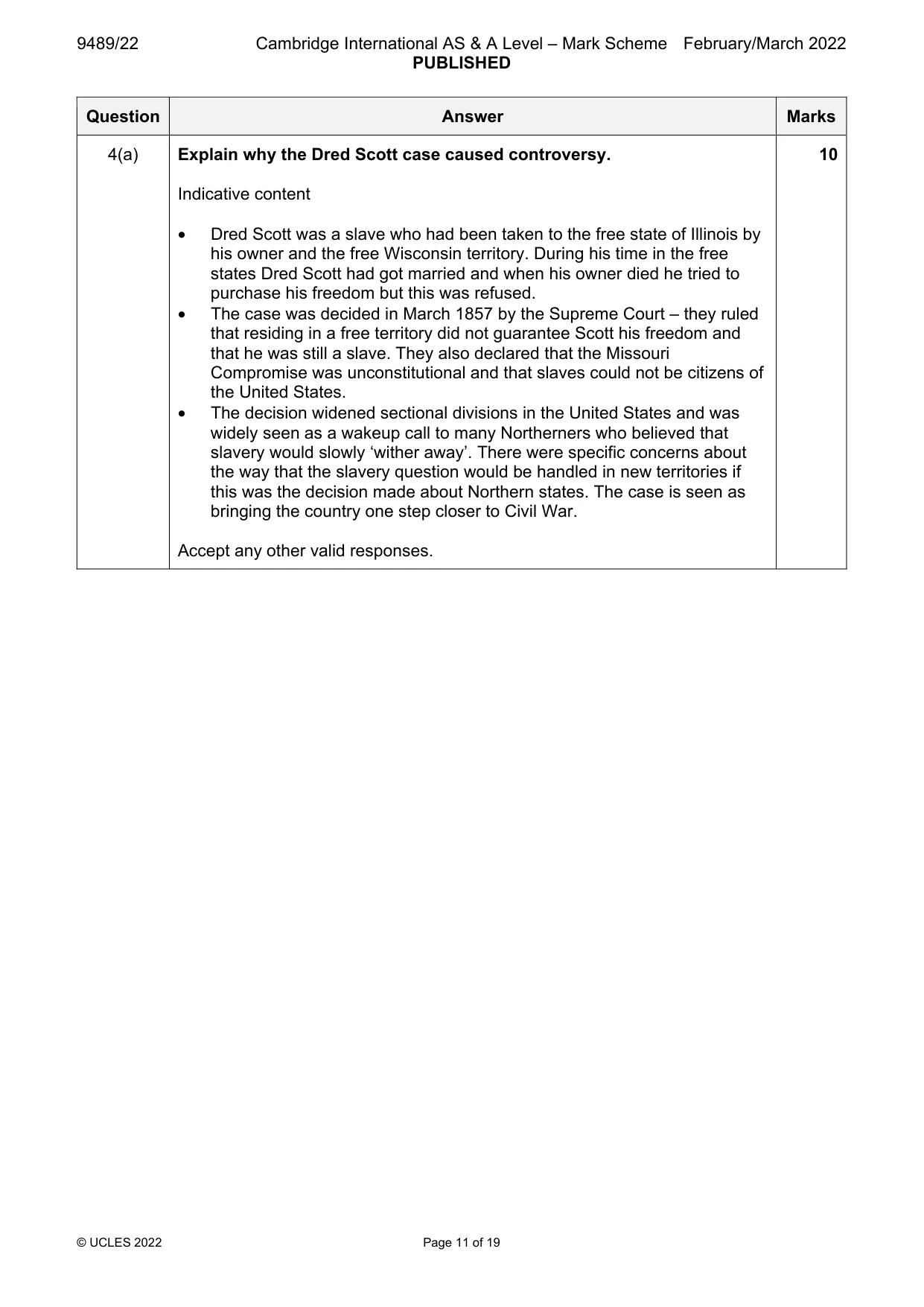
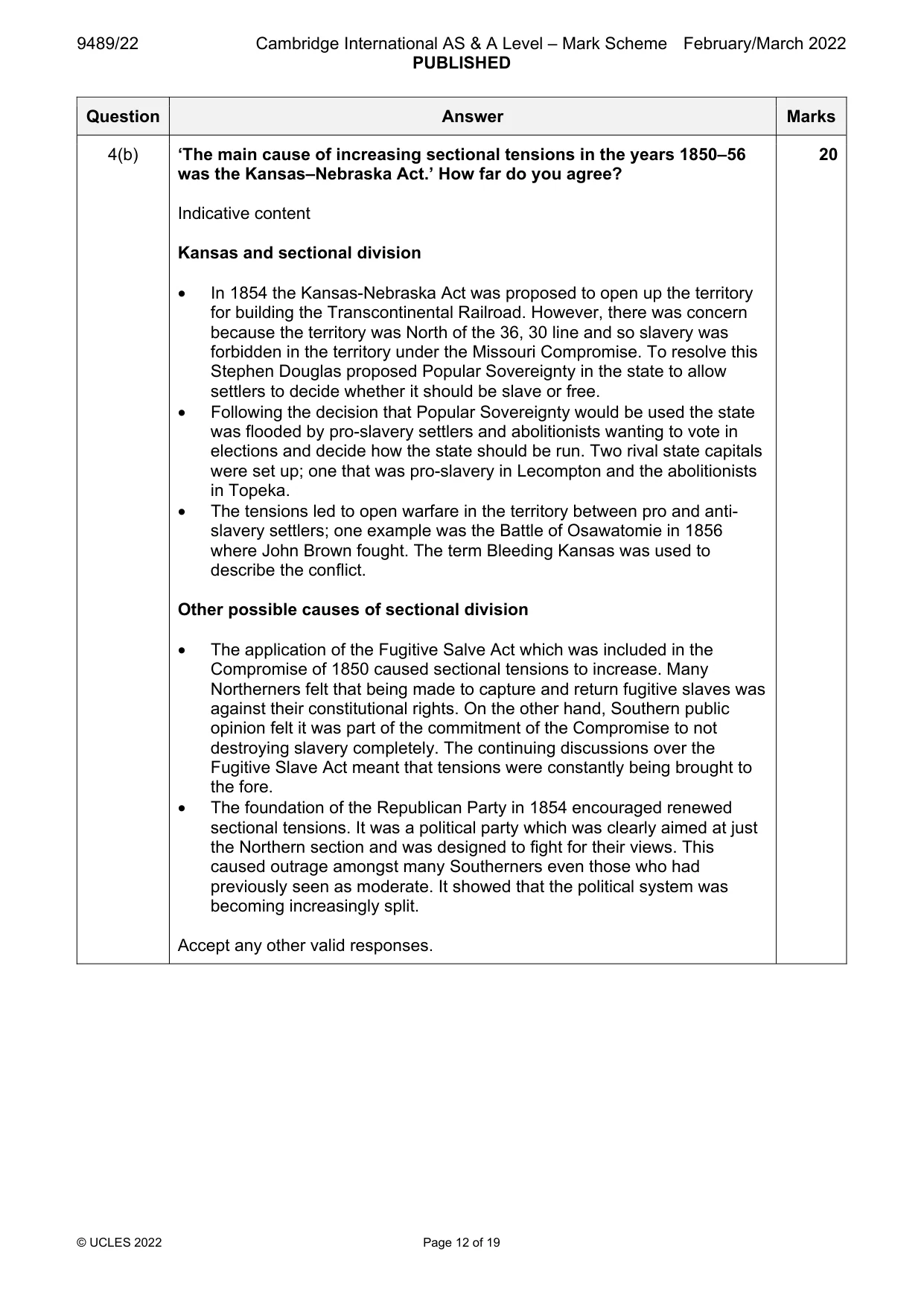
4 The origins of the Civil War, 1820–61 (a) Explain why the Dred Scott case caused controversy. [10] (b) ‘The main cause of increasing sectional tensions in the years 1850–56 was the Kansas–Nebraska Act.’ How far do you agree? [20]
Mark scheme: 4(a) Explain why the Dred Scott case caused controversy. 10 Indicative content • Dred Scott was a slave who had been taken to the free state of Illinois by his owner and the free Wisconsin territory. During his time in the free states Dred Scott had got married and when his owner died he tried to purchase his freedom but this was refused. • The case was decided in March 1857 by the Supreme Court – they ruled that residing in a free territory did not guarantee Scott his freedom and that he was still a slave. They also declared that the Missouri Compromise was unconstitutional and that slaves could not be citizens of the United States. • The decision widened sectional divisions in the United States and was widely seen as a wakeup call to many Northerners who believed that slavery would slowly ‘wither away’. There were specific concerns about the way that the slavery question would be handled in new territories if this was the decision made about Northern states. The case is seen as bringing the country one step closer to Civil War. Accept any other valid responses. 4(b) ‘The main cause of increasing sectional tensions in the years 1850–56 20 was the Kansas–Nebraska Act.’ How far do you agree? Indicative content Kansas and sectional division • In 1854 the Kansas-Nebraska Act was proposed to open up the territory for building the Transcontinental Railroad. However, there was concern because the territory was North of the 36, 30 line and so slavery was forbidden in the territory under the Missouri Compromise. To resolve this Stephen Douglas proposed Popular Sovereignty in the state to allow settlers to decide whether it should be slave or free. • Following the decision that Popular Sovereignty would be used the state was flooded by pro-slavery settlers and abolitionists wanting to vote in elections and decide how the state should be run. Two rival state capitals were set up; one that was pro-slavery in Lecompton and the abolitionists in Topeka. • The tensions led to open warfare in the territory between pro and anti- slavery settlers; one example was the Battle of Osawatomie in 1856 where John Brown fought. The term Bleeding Kansas was used to describe the conflict. Other possible causes of sectional division • The application of the Fugitive Salve Act which was included in the Compromise of 1850 caused sectional tensions to increase. Many Northerners felt that being made to capture and return fugitive slaves was against their constitutional rights. On the other hand, Southern public opinion felt it was part of the commitment of the Compromise to not destroying slavery completely. The continuing discussions over the Fugitive Slave Act meant that tensions were constantly being brought to the fore. • The foundation of the Republican Party in 1854 encouraged renewed sectional tensions. It was a political party which was clearly aimed at just the Northern section and was designed to fight for their views. This caused outrage amongst many Southerners even those who had previously seen as moderate. It showed that the political system was becoming increasingly split. Accept any other valid responses.
More questions on Why was there increasing tension between the North and the South before 1860?
Q5 · The Gilded Age and Progressive Era, 1870s to 1920 (a) Explain why the railroad network…
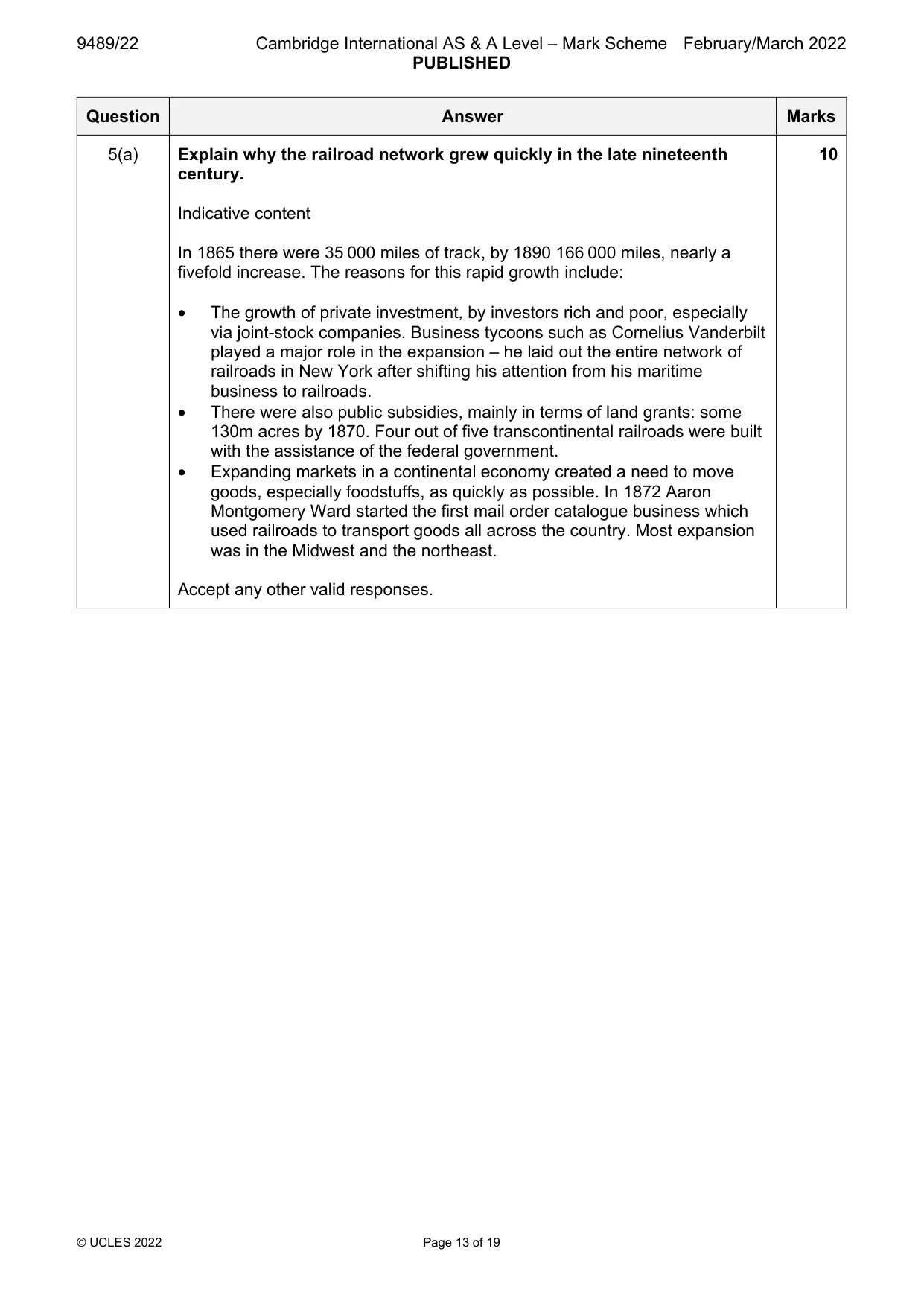
5 The Gilded Age and Progressive Era, 1870s to 1920 (a) Explain why the railroad network grew quickly in the late nineteenth century. [10] (b) ‘Women’s suffrage was the most important achievement of the Progressive Movement.’ How far do you agree? [20]
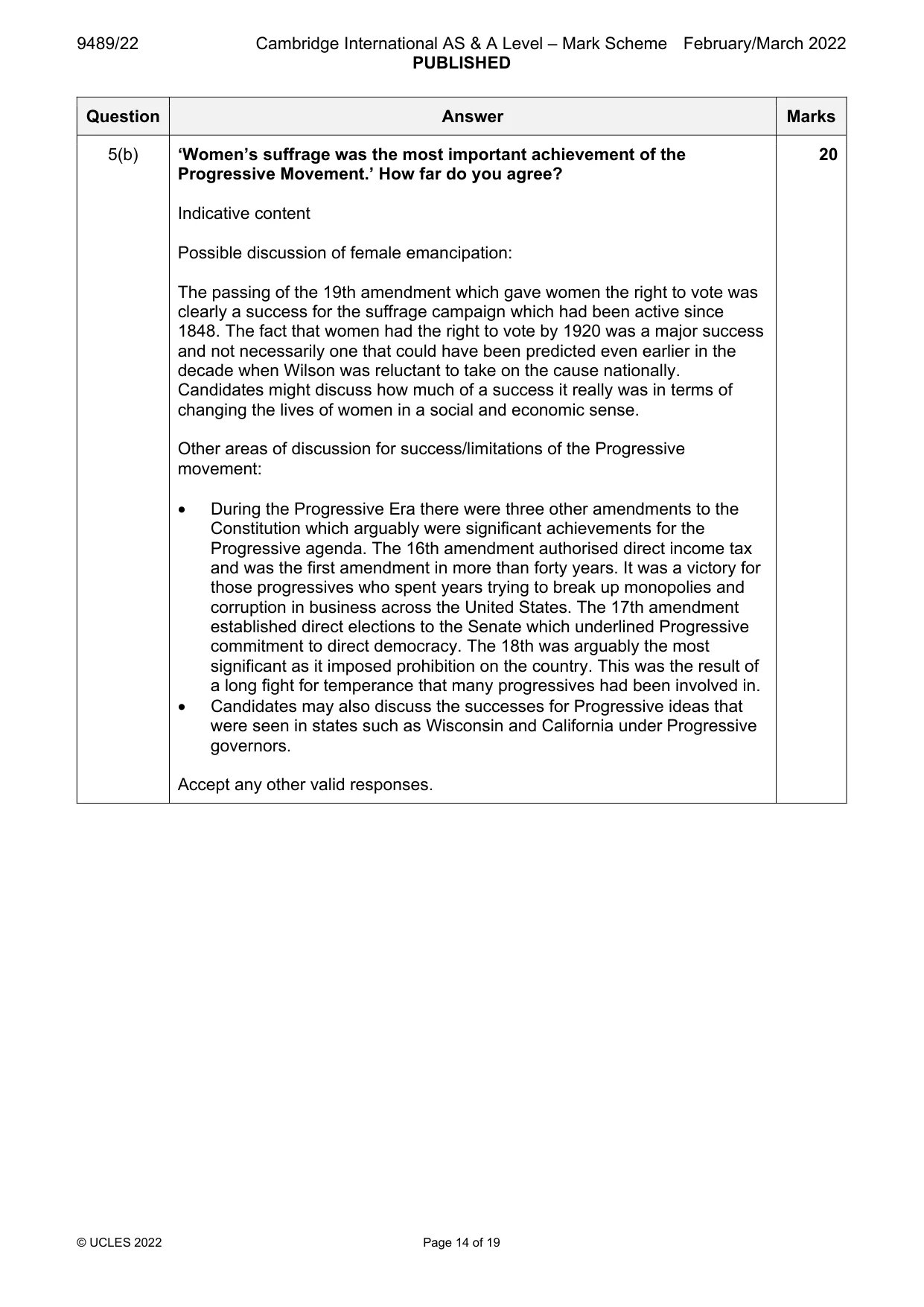
Mark scheme: 5(a) Explain why the railroad network grew quickly in the late nineteenth 10 century. Indicative content In 1865 there were 35 000 miles of track, by 1890 166 000 miles, nearly a fivefold increase. The reasons for this rapid growth include: • The growth of private investment, by investors rich and poor, especially via joint-stock companies. Business tycoons such as Cornelius Vanderbilt played a major role in the expansion – he laid out the entire network of railroads in New York after shifting his attention from his maritime business to railroads. • There were also public subsidies, mainly in terms of land grants: some 130m acres by 1870. Four out of five transcontinental railroads were built with the assistance of the federal government. • Expanding markets in a continental economy created a need to move goods, especially foodstuffs, as quickly as possible. In 1872 Aaron Montgomery Ward started the first mail order catalogue business which used railroads to transport goods all across the country. Most expansion was in the Midwest and the northeast. Accept any other valid responses. 5(b) ‘Women’s suffrage was the most important achievement of the 20 Progressive Movement.’ How far do you agree? Indicative content Possible discussion of female emancipation: The passing of the 19th amendment which gave women the right to vote was clearly a success for the suffrage campaign which had been active since 1848. The fact that women had the right to vote by 1920 was a major success and not necessarily one that could have been predicted even earlier in the decade when Wilson was reluctant to take on the cause nationally. Candidates might discuss how much of a success it really was in terms of changing the lives of women in a social and economic sense. Other areas of discussion for success/limitations of the Progressive movement: • During the Progressive Era there were three other amendments to the Constitution which arguably were significant achievements for the Progressive agenda. The 16th amendment authorised direct income tax and was the first amendment in more than forty years. It was a victory for those progressives who spent years trying to break up monopolies and corruption in business across the United States. The 17th amendment established direct elections to the Senate which underlined Progressive commitment to direct democracy. The 18th was arguably the most significant as it imposed prohibition on the country. This was the result of a long fight for temperance that many progressives had been involved in. • Candidates may also discuss the successes for Progressive ideas that were seen in states such as Wisconsin and California under Progressive governors. Accept any other valid responses.
More questions on How successful was the Progressive Movement from 1890 to 1920?
Q6 · The Great Crash, the Great Depression and the New Deal policies, 1920–41 (a) Explain why…
6 The Great Crash, the Great Depression and the New Deal policies, 1920–41 (a) Explain why oversupply became a problem in the US economy in the 1920s. [10] (b) To what extent did opposition to the New Deal come from the conservative right? [20] Section C: International option International history, 1870–1945
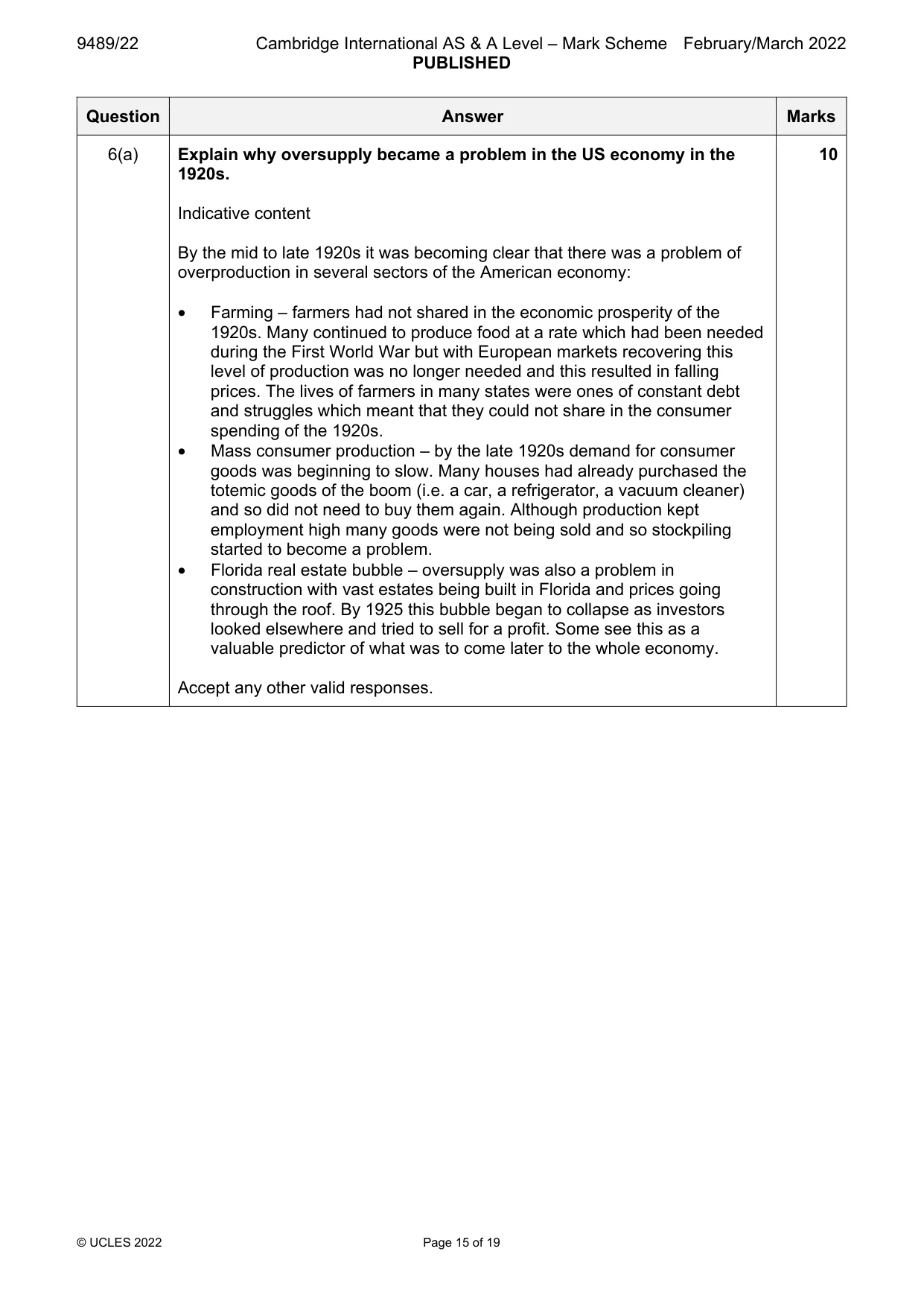
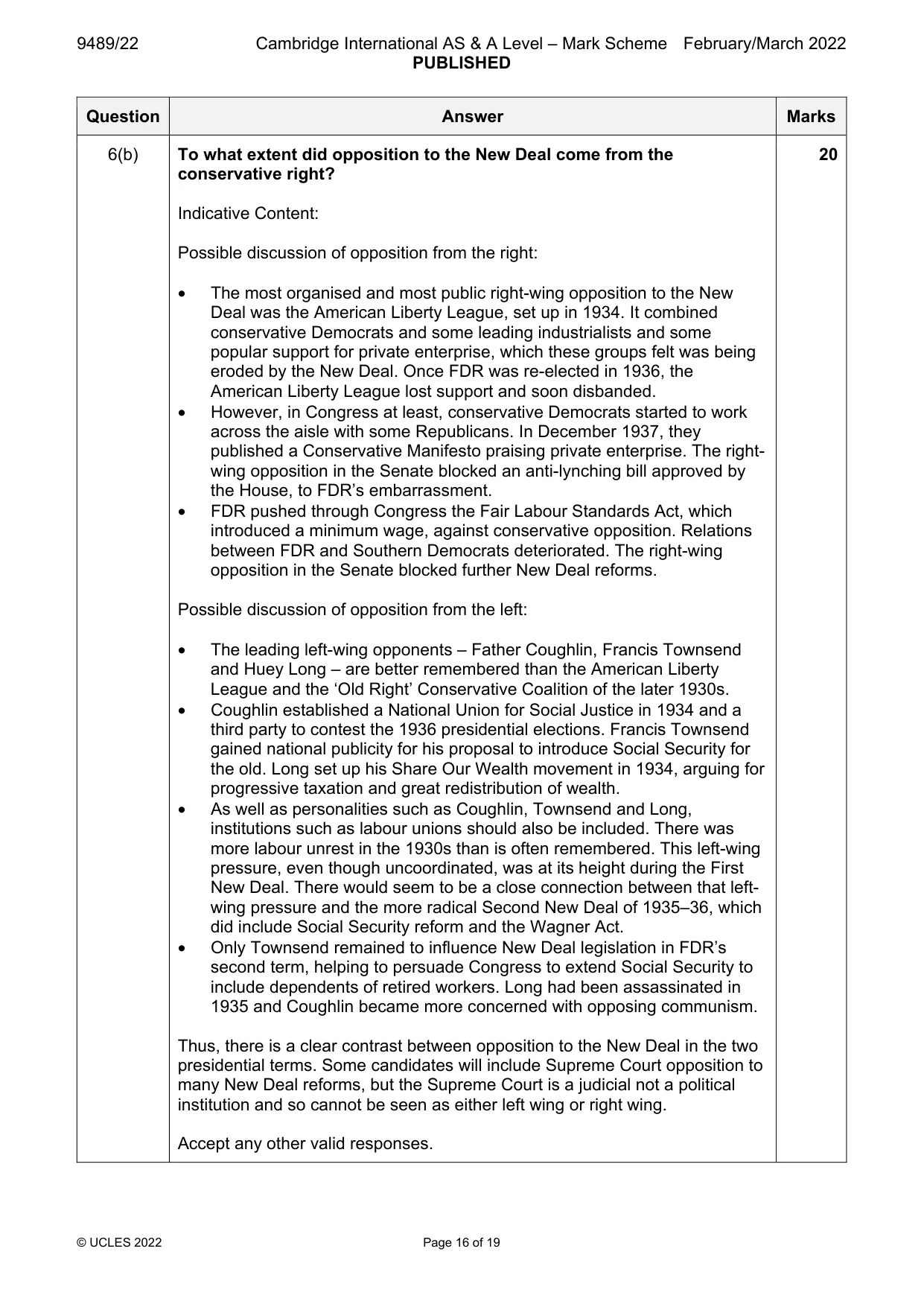
Mark scheme: 6(a) Explain why oversupply became a problem in the US economy in the 10 1920s. Indicative content By the mid to late 1920s it was becoming clear that there was a problem of overproduction in several sectors of the American economy: • Farming – farmers had not shared in the economic prosperity of the 1920s. Many continued to produce food at a rate which had been needed during the First World War but with European markets recovering this level of production was no longer needed and this resulted in falling prices. The lives of farmers in many states were ones of constant debt and struggles which meant that they could not share in the consumer spending of the 1920s. • Mass consumer production – by the late 1920s demand for consumer goods was beginning to slow. Many houses had already purchased the totemic goods of the boom (i.e. a car, a refrigerator, a vacuum cleaner) and so did not need to buy them again. Although production kept employment high many goods were not being sold and so stockpiling started to become a problem. • Florida real estate bubble – oversupply was also a problem in construction with vast estates being built in Florida and prices going through the roof. By 1925 this bubble began to collapse as investors looked elsewhere and tried to sell for a profit. Some see this as a valuable predictor of what was to come later to the whole economy. Accept any other valid responses. 6(b) To what extent did opposition to the New Deal come from the 20 conservative right? Indicative Content: Possible discussion of opposition from the right: • The most organised and most public right-wing opposition to the New Deal was the American Liberty League, set up in 1934. It combined conservative Democrats and some leading industrialists and some popular support for private enterprise, which these groups felt was being eroded by the New Deal. Once FDR was re-elected in 1936, the American Liberty League lost support and soon disbanded. • However, in Congress at least, conservative Democrats started to work across the aisle with some Republicans. In December 1937, they published a Conservative Manifesto praising private enterprise. The right- wing opposition in the Senate blocked an anti-lynching bill approved by the House, to FDR’s embarrassment. • FDR pushed through Congress the Fair Labour Standards Act, which introduced a minimum wage, against conservative opposition. Relations between FDR and Southern Democrats deteriorated. The right-wing opposition in the Senate blocked further New Deal reforms. Possible discussion of opposition from the left: • The leading left-wing opponents – Father Coughlin, Francis Townsend and Huey Long – are better remembered than the American Liberty League and the ‘Old Right’ Conservative Coalition of the later 1930s. • Coughlin established a National Union for Social Justice in 1934 and a third party to contest the 1936 presidential elections. Francis Townsend gained national publicity for his proposal to introduce Social Security for the old. Long set up his Share Our Wealth movement in 1934, arguing for progressive taxation and great redistribution of wealth. • As well as personalities such as Coughlin, Townsend and Long, institutions such as labour unions should also be included. There was more labour unrest in the 1930s than is often remembered. This left-wing pressure, even though uncoordinated, was at its height during the First New Deal. There would seem to be a close connection between that left- wing pressure and the more radical Second New Deal of 1935–36, which did include Social Security reform and the Wagner Act. • Only Townsend remained to influence New Deal legislation in FDR’s second term, helping to persuade Congress to extend Social Security to include dependents of retired workers. Long had been assassinated in 1935 and Coughlin became more concerned with opposing communism. Thus, there is a clear contrast between opposition to the New Deal in the two presidential terms. Some candidates will include Supreme Court opposition to many New Deal reforms, but the Supreme Court is a judicial not a political institution and so cannot be seen as either left wing or right wing. Accept any other valid responses.
More questions on Why was there a second New Deal and how successful was it?
Q7 · Empire and the emergence of world powers, 1870–1919 (a) Explain why people in Britain…
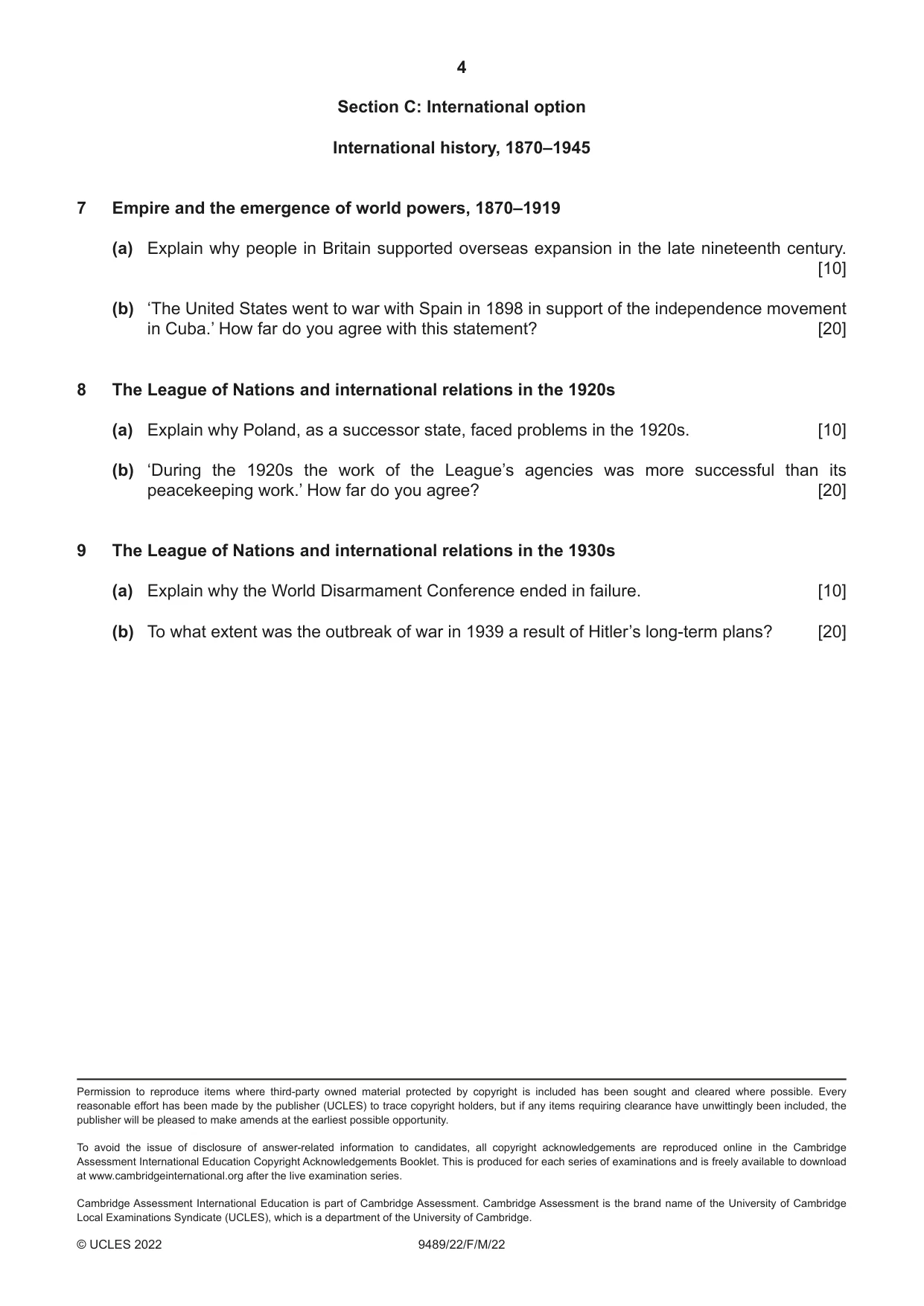
7 Empire and the emergence of world powers, 1870–1919 (a) Explain why people in Britain supported overseas expansion in the late nineteenth century. [10] (b) ‘The United States went to war with Spain in 1898 in support of the independence movement in Cuba.’ How far do you agree with this statement? [20]
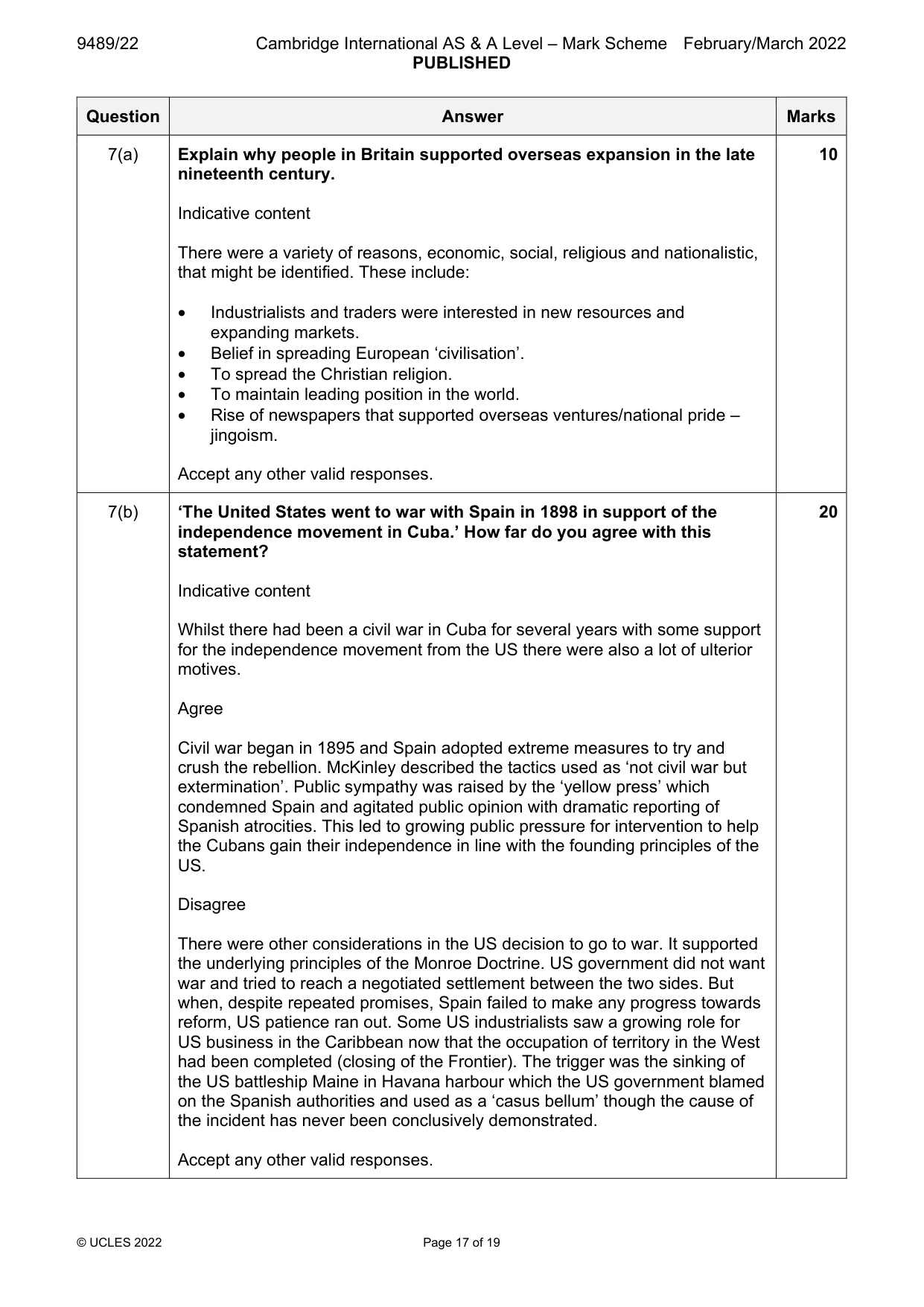
Mark scheme: 7(a) Explain why people in Britain supported overseas expansion in the late 10 nineteenth century. Indicative content There were a variety of reasons, economic, social, religious and nationalistic, that might be identified. These include: • Industrialists and traders were interested in new resources and expanding markets. • Belief in spreading European ‘civilisation’. • To spread the Christian religion. • To maintain leading position in the world. • Rise of newspapers that supported overseas ventures/national pride – jingoism. Accept any other valid responses. 7(b) ‘The United States went to war with Spain in 1898 in support of the 20 independence movement in Cuba.’ How far do you agree with this statement? Indicative content Whilst there had been a civil war in Cuba for several years with some support for the independence movement from the US there were also a lot of ulterior motives. Agree Civil war began in 1895 and Spain adopted extreme measures to try and crush the rebellion. McKinley described the tactics used as ‘not civil war but extermination’. Public sympathy was raised by the ‘yellow press’ which condemned Spain and agitated public opinion with dramatic reporting of Spanish atrocities. This led to growing public pressure for intervention to help the Cubans gain their independence in line with the founding principles of the US. Disagree There were other considerations in the US decision to go to war. It supported the underlying principles of the Monroe Doctrine. US government did not want war and tried to reach a negotiated settlement between the two sides. But when, despite repeated promises, Spain failed to make any progress towards reform, US patience ran out. Some US industrialists saw a growing role for US business in the Caribbean now that the occupation of territory in the West had been completed (closing of the Frontier). The trigger was the sinking of the US battleship Maine in Havana harbour which the US government blamed on the Spanish authorities and used as a ‘casus bellum’ though the cause of the incident has never been conclusively demonstrated. Accept any other valid responses.
More questions on Why did the USA emerge as a world power and what was the impact on international
Q8 · The League of Nations and international relations in the 1920s (a) Explain why Poland, as…
8 The League of Nations and international relations in the 1920s (a) Explain why Poland, as a successor state, faced problems in the 1920s. [10] (b) ‘During the 1920s the work of the League’s agencies was more successful than its peacekeeping work.’ How far do you agree? [20]
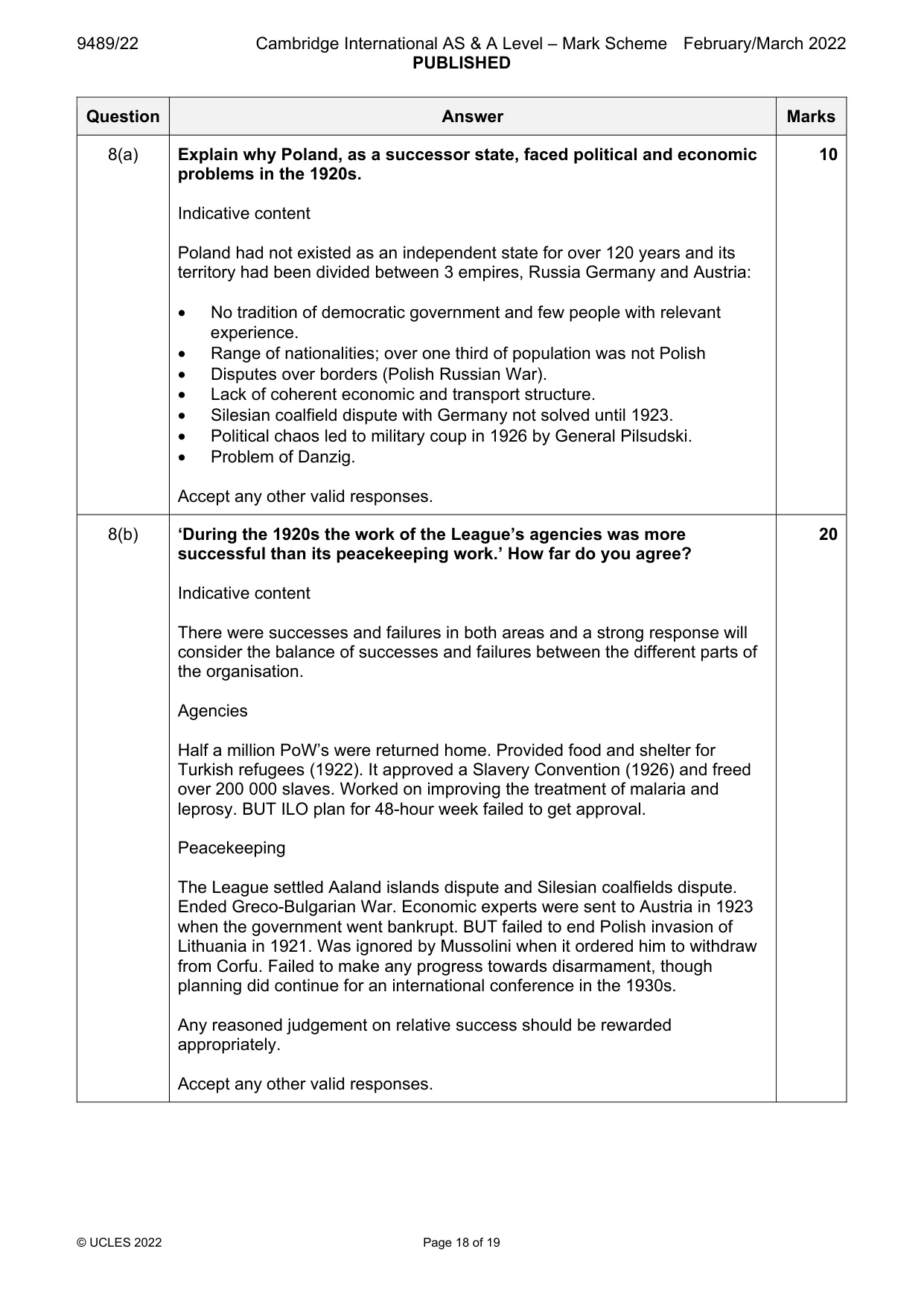
Mark scheme: 8(a) Explain why Poland, as a successor state, faced political and economic 10 problems in the 1920s. Indicative content Poland had not existed as an independent state for over 120 years and its territory had been divided between 3 empires, Russia Germany and Austria: • No tradition of democratic government and few people with relevant experience. • Range of nationalities; over one third of population was not Polish • Disputes over borders (Polish Russian War). • Lack of coherent economic and transport structure. • Silesian coalfield dispute with Germany not solved until 1923. • Political chaos led to military coup in 1926 by General Pilsudski. • Problem of Danzig. Accept any other valid responses. 8(b) ‘During the 1920s the work of the League’s agencies was more 20 successful than its peacekeeping work.’ How far do you agree? Indicative content There were successes and failures in both areas and a strong response will consider the balance of successes and failures between the different parts of the organisation. Agencies Half a million PoW’s were returned home. Provided food and shelter for Turkish refugees (1922). It approved a Slavery Convention (1926) and freed over 200 000 slaves. Worked on improving the treatment of malaria and leprosy. BUT ILO plan for 48-hour week failed to get approval. Peacekeeping The League settled Aaland islands dispute and Silesian coalfields dispute. Ended Greco-Bulgarian War. Economic experts were sent to Austria in 1923 when the government went bankrupt. BUT failed to end Polish invasion of Lithuania in 1921. Was ignored by Mussolini when it ordered him to withdraw from Corfu. Failed to make any progress towards disarmament, though planning did continue for an international conference in the 1930s. Any reasoned judgement on relative success should be rewarded appropriately. Accept any other valid responses.
Q9 · The League of Nations and international relations in the 1930s (a) Explain why the World…
9 The League of Nations and international relations in the 1930s (a) Explain why the World Disarmament Conference ended in failure. [10] (b) To what extent was the outbreak of war in 1939 a result of Hitler’s long-term plans? [20]
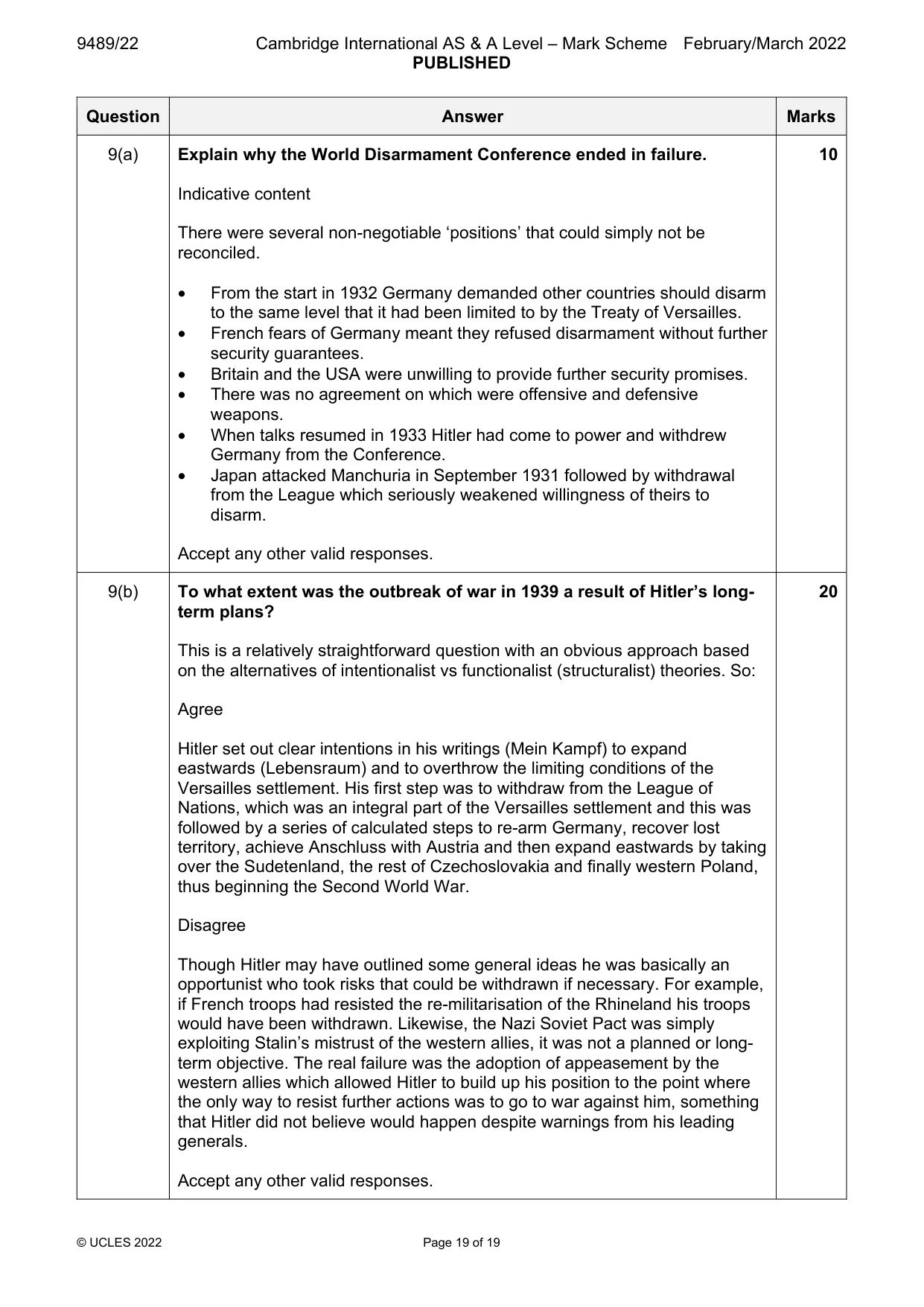
Mark scheme: 9(a) Explain why the World Disarmament Conference ended in failure. 10 Indicative content There were several non-negotiable ‘positions’ that could simply not be reconciled. • From the start in 1932 Germany demanded other countries should disarm to the same level that it had been limited to by the Treaty of Versailles. • French fears of Germany meant they refused disarmament without further security guarantees. • Britain and the USA were unwilling to provide further security promises. • There was no agreement on which were offensive and defensive weapons. • When talks resumed in 1933 Hitler had come to power and withdrew Germany from the Conference. • Japan attacked Manchuria in September 1931 followed by withdrawal from the League which seriously weakened willingness of theirs to disarm. Accept any other valid responses. 9(b) To what extent was the outbreak of war in 1939 a result of Hitler’s long- 20 term plans? This is a relatively straightforward question with an obvious approach based on the alternatives of intentionalist vs functionalist (structuralist) theories. So: Agree Hitler set out clear intentions in his writings (Mein Kampf) to expand eastwards (Lebensraum) and to overthrow the limiting conditions of the Versailles settlement. His first step was to withdraw from the League of Nations, which was an integral part of the Versailles settlement and this was followed by a series of calculated steps to re-arm Germany, recover lost territory, achieve Anschluss with Austria and then expand eastwards by taking over the Sudetenland, the rest of Czechoslovakia and finally western Poland, thus beginning the Second World War. Disagree Though Hitler may have outlined some general ideas he was basically an opportunist who took risks that could be withdrawn if necessary. For example, if French troops had resisted the re-militarisation of the Rhineland his troops would have been withdrawn. Likewise, the Nazi Soviet Pact was simply exploiting Stalin’s mistrust of the western allies, it was not a planned or long- term objective. The real failure was the adoption of appeasement by the western allies which allowed Hitler to build up his position to the point where the only way to resist further actions was to go to war against him, something that Hitler did not believe would happen despite warnings from his leading generals. Accept any other valid responses.
What was in this paper
The subtopics covered by these 9 questions, and how many questions each got. Open one in a new tab to see every Cambridge question on it.
1What caused the rise and fall of Napoleon Bonaparte?1What were the causes of the Revolutions of 1848?1What were the consequences of the rapid economic growth after 1870?1Why did the USA emerge as a world power and what was the impact on international1Why did war break out in 1939?1Why was the League of Nations created and what challenges did it face in the 1920s?1Why was there a second New Deal and how successful was it?1Why was there increasing tension between the North and the South before 1860?1What you needed in this session
Cambridge’s own grade thresholds for 2022 Feb/March, Paper 2 · Variant 2. A higher threshold means an easier paper — the bar moves with how the cohort did.