Questions as text
Q1 · Evaluate the causes of the Great Terror 9489/42 Feb/March 2021
2 Evaluate the causes of the Great Terror. [30]
30 marks
Mark scheme: 2 Evaluate the causes of the Great Terror. 30 The murder of Kirov in 1934 is usually seen as a starting point of the Great Terror and the fact that Stalin felt threatened at the 17th party Congress and there was pen questioning of his economic policies. This lead on to the removal of former Bolsheviks and rivals in the show trials of the 16, 17 and 21. These were state managed with pre-determined outcomes and held in public to demonstrate Stalin’s power. Rivals such as Zinoviev, Kamenev, Bukharin, Rykov and Tomsky were all removed. The Yezhovschina starting in 1936 was a mass and indiscriminate use of terror orchestrated by Yezhov, who had in turn replaced Yagoda, who was later executed. These purges involved wholesale murder and involved the general population and were designed to subdue the population. In 1938 Yezhov was replaced by Beria, who continued terror and made the Gulags part of the economic system of the Soviet Union. Yezhov was executed to show that no one was safe and indeed, he was publicly blamed for the excesses of the Yezhovschina. During the Great Terror there was also the purge of the military. Motives might include removing rivals, subduing the population, providing cheap labour for the Five-Year Plans, but also the character of Stalin and the nature of the Soviet State. This also leads on the degree of centralised control or local excess by the NKVD and local party bosses.
This question in 9489/42 Feb/March 2021
Q2 · Assess the extent to which Stalin was successful in ‘building socialism in one country’ 9489/41 May/June 2021
2 Assess the extent to which Stalin was successful in ‘building socialism in one country’. [30]
30 marks
Mark scheme: 2 Assess the extent to which Stalin was successful in ‘building 30 socialism in one country’. This essay requires an explanation of ‘socialism in one country’ and an assessment of how successful Stalin was in building it. There could be consideration of how ‘socialist’ the outcomes of his policies were in political, social, and economic terms. His aims were to focus on the Soviet Union, to strengthen her industrial base and military might before spreading revolution throughout the world. To this end, he rejected the New Economic Policy and introduced Collectivisation in agriculture as a precursor to the Five-Year Plans, which would focus on the development of heavy industry and the Soviet Union’s economic power base. Agriculture was a support service to industry, providing cheap food for the industrial workers and controlling the peasantry, whom Stalin never trusted. Successes and failures of Collectivisation, the famines, human suffering, and the fall in production all need to be examined. The real focus, however, should be on the Five-Year Plans, where Stalin felt that the Soviet Union was fifty to one hundred years behind the West, and must make up this gap in ten years or be crushed. He was very anxious of a Western invasion, and so the First and Second Five Year Plans focused on heavy industry and later chemicals. The consumer sector was disregarded with no attempt to produce a balanced economy. Production increases in iron, steel, and coal production were remarkable, but they came at a huge human cost. The founding of the Stakhanovite movement involved new industrial cities such as Magnitogorsk, the relocation of factories eastward behind the Urals, and the application of military discipline to the work force. The Third Five Year Plan was focused on military production, and despite its achievements, the Soviet Union did need additional supplies from the US during World War Ⅱ. The purges of the officer corps hampered military advances. Ultimately, Stalin had great success in building ‘socialism in one country’ but at massive human cost. It could also be argued that Collectivisation and the nationalisation of the means of production all moved the Soviet Union from the mixed economy of the New Economic Policy to a more socialist economy and society.
This question in 9489/41 May/June 2021
Q3 · Assess the reasons for the introduction of Stalin’s first five-year plan in 1928 9489/42 May/June 2021
2 Assess the reasons for the introduction of Stalin’s first five-year plan in 1928. [30]
30 marks
Mark scheme: 2 Assess the reasons for the introduction of Stalin’s first five-year plan 30 in 1928. This question requires a careful examination and analysis of the causes and then an evaluation of them. Causes might include the failure of the New Economic Policy by 1927, the need to remove his final rival in the power struggle, Bukharin, the need to assert his control over the Communist Party and dictate policy, the aim to achieve ‘Socialism in One Country’ and the ideological desire to turn the Soviet Union more towards communism than the mixed economy of the New Economic Policy had allowed. Fear of invasion also played a part in the change of direction. Prior to 1928, the Soviet Union had followed a policy of War Communism to win the Civil War and then took a step backwards and adopted the New Economic Policy, which allowed a mixed economy and was a temporary measure. However, by 1927 the New Economic Policy was failing, and Stalin had eliminated all leadership rivals apart from Bukharin. There were political and economic motives for the change of economic policy. The first five-year plan was to build ‘socialism in one country’. This meant building up the industrial base of the country and its military might and in addition move towards real socialism and away from the mixed economy. The first five-year plan introduced Collectivisation to make sure that agriculture supported industry and any peasant resistance was overcome. This policy was largely disastrous. On the Industrial side there was a focus on heavy industry, including iron, steel, and coal to build up the economic strength of the country. The first five-year plan also allowed class war to be unleashed, the liquidation of the Kulaks to begin and the removal of the NEPMEN. This essay needs to examine the political, economic, and ideological motives for the introduction of the first five-year plan and to assess and evaluate them in a logical and sustained manner.
This question in 9489/42 May/June 2021
Q4 · Assess the extent to which the use of propaganda by Stalin’s regime changed Soviet society 9489/43 May/June 2021
2 Assess the extent to which the use of propaganda by Stalin’s regime changed Soviet society. [30]
30 marks
Mark scheme: 2 Assess the extent to which the use of propaganda by Stalin’s regime 30 changed Soviet society. Stalin used extensive propaganda throughout his period in office to buttress his own power and to create a Soviet Society that he wanted. Types of propaganda that might be examined include the media (Pravda, Izvestiya, Red Sport), speeches, radio announcements, and military parades. The Cult of Personality was a key element in the propaganda portraying Stalin as a benign father of the nation, family man, military leader as needed. Control of the Arts and Culture was crucial via Glavlit and the development of Socialist Realism. Literature, art, architecture, and music all had to represent the Soviet Union as Stalin wished. Stalin also wanted to sell his policies so posters and art were mobilised to support Collectivisation and the Five Year Plans and heroes created such as Alexis Stakhanov and the Stakhanovite movement to urge workers to work ever harder for Socialism in One Country. Once Stalin introduced The Great Retreat as a policy, he began to use propaganda to encourage family values and the value of children. The Komsomol was created to indoctrinate the young and the May Day parades in Red Square were a symbol of all the things that the Soviet Union valued, with young, women, workers, farmers, and military power on display. Propaganda could also be used to manufacture statistics as to how successful Collectivisation and the Five-Year Plans were. Propaganda was also used to disgrace rivals, for example, airbrushing Trotsky out of history or the Show Trials of the 1930s, as these were stated managed to portray a predetermined outcome. Certain projects were also undertaken to show the strength of the Soviet Union, for example, the building of the Moscow Metro. Attacks on the Orthodox Church also sought to portray the church as the enemy of the people, except during World War Two when it was asked to preach for war and mobilise the people. During the war, Stalin was shown as a great military leader and even shown as liberating Berlin, albeit he was in Moscow. Having examined the various methods and aims, it is important that their impact is assessed. Undoubtedly, the Soviet Union was a totalitarian single party state and propaganda was there to buttress the regime, but people were still aware of the hardships they endured including the terror and lack of freedom. As it was a closed society, people became accustomed to the nature and ideas of Stalinist Russia, but did they really change their mindset? People had to conform in public to survive and thrive in this society and there were no open revolts against Stalin’s regime.
This question in 9489/43 May/June 2021
Q5 · Assess the impact that the Soviet regime had on families 9489/42 Oct/Nov 2021
2 Assess the impact that the Soviet regime had on families. [30]
30 marks
Mark scheme: 2 Assess the impact that the Soviet regime had on families. 30 Lenin had been anti-family, seeing it as a bourgeois construct and allowing easier divorces and abortions. In 1926, a new Family Code consolidated earlier rights, and gave women in ‘common law’ marriages the same rights as those in registered marriages. In Muslim regions, where feudal forms of social structure remained, women were a subject class. The communists raised the minimum age of marriage in these regions to 16 (it was 18 in the European parts of Soviet Russia), and polygamy and bride money were banned. They also organised mass political activity, known as the khudzhum, to mobilise women to oppose traditional practices. At the same time, education was provided equally for both males and females. State nurseries and workplace crèches and canteens were provided to enable mothers to work outside the home. However, under Stalin some of these reforms and benefits were reduced or removed. Fear of war was growing following Hitler’s rise to power in Germany in 1933, and Soviet population growth was in decline. For these reasons, from 1935 Stalin decided on policies to promote ‘traditional’ family values in order to increase the Soviet population. Although most of the rights established by the 1926 Code remained intact, a new family law was introduced in 1936. This made divorce more difficult, with a rising fee for each divorce, and restricted abortion to those required for medical reasons only. In addition, in order to encourage bigger families and so raise the birth rate, tax exemptions were given to families with large numbers of children. From 1944, only registered marriages were recognised, children born outside marriage were no longer allowed to inherit property from their father, and divorce became even more difficult and expensive. During the Second World War, medals were awarded to mothers with large families and unmarried people were taxed more heavily. However, women benefited from new welfare reforms introduced under Stalin – a free health service, accident insurance at work, the expansion of kindergartens for working mothers with children, and paid holidays for many workers. Equal educational provision continued. Nonetheless, the provision of sufficient and adequate housing continued to be a problem. In employment, women had traditionally been found mainly in agriculture, textiles, and services. Their position improved considerably under the Bolsheviks, and even more so under Stalin’s rule. Women were actively encouraged to play their part in the economic development of Soviet Russia, and all employment was thrown open to women, who had the same rights as men. By 1939, a third of all engineers and 79% of doctors were women. In 1928, the number of women listed as ‘workers–employees’ had been 2 795 000. By 1939, this had risen to just over 13 million. By 1933, women made up 33% of the industrial workforce, rising to 43% by 1940. Despite the emphasis on family life during the 1930s, women of all ages continued to work. There were many women ‘hero-workers’ in the Stakhanovite movement, though in a smaller proportion than men; by 1936, a quarter of all female trade unionists were classified as workers who had exceeded their production targets. However, access to the higher administrative posts was unequal and the patriarchal tradition was still widespread in society, leaving many working women with the bulk of household chores. Despite these realities, the attitude of the Stalinist state to women was very different from that in Nazi Germany. Communists believed in total equality between the sexes in education, employment, and the law.
This question in 9489/42 Oct/Nov 2021
Q6 · Analyse the reasons why Stalin had gained control of the Communist Party in the USSR by… 9489/42 Feb/March 2022
2 Analyse the reasons why Stalin had gained control of the Communist Party in the USSR by 1928. [30]
30 marks
Mark scheme: 2 Analyse the reasons why Stalin had gained control of the Communist 30 Party in the USSR by 1928. There could be a discussion between the skills shown by Stalin and the opportunities open to him by the rivalries in the party and the context of the situation in the USSR after Lenin’s death. Stalin demonstrated important political skills. He had seen the importance of organisation and a power base in the party in his role as Party Secretary and also the value of establishing links with regional parties as Commissar for Nationalities. He exploited the cult of Lenin and managed to evade the opprobrium of Lenin’s criticisms of him in the Political Testament. By seeming to carry on the policy of NEP he gained the support of the party’s right and managed by skilful means to isolate Trotsky and his supporters, even though these included party figured who had been of greater importance than himself in the Revolution and the Lenin era. Stalin demonstrated expertise in the political in-fighting that resulted in the marginalisation and eventual exile of Trotsky. Through his knowledge of the membership and organisation, he was also adept as ‘Comrade Card Index’ in solidifying a base of support. However, against this is the weakness of his enemies – Trotsky could not compete effectively enough. Marginalised by not appearing at Lenin’s funeral, he and those who feared Stalin’s influence could not make use of the warnings made by Lenin or mount a concerted opposition to Stalin’s rise to power. Despite his links with the Red Army and the huge contribution to the Revolution, and the victory in the Civil War, Trotsky could not exploit his potential popular appeal. But as well as political and personal factors there was the substantial issue of policy. An exhausted USSR needed the economic breathing space afforded by NEP and a policy of socialist capital accumulation. Though supported by some in the party, it was seen as dangerous. Many, especially Bukharin who was highly regarded, were happy to accept Lenin’s justifications for the policy at least until economic problems, revealed by the Scissors Crisis, made it more compelling to act. By that time, Stalin had enough power in the party for a volte face which essentially adopted Trotsky’s policies. In addition, the policy of Socialism in One Country seemed the only practical way forward as the world revolution had not happened, and the USSR needed to focus on the considerable domestic problems it faced after the Civil War. The inheritance of repression and the calls for party discipline in the war meant that the scope for open discussion was far less, and Stalin was able to exploit this to make his critics seem disloyal.
This question in 9489/42 Feb/March 2022
Q7 · Assess the impact of collectivisation on the people of the Soviet Union 9489/41 May/June 2022
2 Assess the impact of collectivisation on the people of the Soviet Union. [30]
30 marks
Mark scheme: 2 Assess the impact of Collectivization on the people of the Soviet 30 Union. Collectivization resumed the revolution after the compromise of NEP and was linked to a drive for industrialization and to provide capital for broader economic growth. It was intended to solve problems in grain distributions and also create surpluses for export. Begun on a large scale in 1928 and part of a general five-year plan it intensified after 1929 and by the mid-1930s 90% of land was in some form of collective, whether a Kolkhoz or a more centrally directed Sovkhoz. The effects on the mass of peasantry were considerable. Richer peasants or those designated ‘Kulaks’ suffered land seizures, deportations and 20 000 deaths by execution as class warfare accompanied enforced collectivization. The reaction of peasants to requisitioning and then collectivization brought about a virtual war in many areas. The disruption caused by such a rapid and often inefficient transition reduced production and productivity. Probably productivity did not recover until 1940. As Kulaks were a small minority in fact the definition was widened to include better off peasants so successful farmers were punished and expropriated, causing hardships in both rural areas and also in urban areas struggling with the disruptive effects of mass industrialization and there were widespread food shortages. Livestock farming was hit by the peasants slaughtering animals rather than surrendering them and this sector did not recover until the 1980s. Richer farming areas such as the Volga suffered most. But the principal burden of the policy fell on Ukraine, Northern Caucasus, Volga Region and Kazakhstan, the South Urals, and West Siberia. The new collectives often did not have the necessary equipment, expertise, or transport. The policy was defended as necessary to create an industrial base that would prevent the USSR becoming an overwhelmingly peasant country unable to defend itself. The targets for industrial growth were too high to be met but collectivization did allow a substantial industrial growth which had a considerable effect on the Soviet people in terms of lifestyle, urban growth, opportunities, and some might argue ultimate survival in the Second World War. The political results of the struggle for Collectivization might be seen in the greater repression and the Purges. In this life-or-death economic struggle there had to be no dissent and utter control by the party which meant a terror and repression of hitherto unknown ferocity and scale. Answers might balance the damage done and the deaths and hardships with longer term advances and gain and assess the relative importance of economic dislocation with social and political impacts.
This question in 9489/41 May/June 2022
Q8 · ‘Stalin came to power because Lenin failed to plan for his succession.’ Assess this view 9489/43 May/June 2022
2 ‘Stalin came to power because Lenin failed to plan for his succession.’ Assess this view. [30]
30 marks
Mark scheme: 2 ‘Stalin came to power because Lenin failed to plan for his successor.’ 30 Assess this view. Lenin’s later months in power were marred by illness – the effects of an assassination attempt and a stroke. The factional struggles within the party were allowed to grow and Lenin’s Testament which warned against Stalin who had built a power based as Secretary and Commissar for nationalities was never the basis for any action after Lenin’s death because Trotsky had internal enemies. Lenin left not only a divided hierarchy but internal problems and contradictions. Internal disturbances had led to a retreat with NEP, however ingenious the political justification and the world revolution had had to be shelved. So, Lenin’s legacy was not just a failure to establish one group with a clear line of succession but to leave a gap between the ideology and the practical needs to build up food supplies and to allow enough industrial goods to fulfil basic demands. Trotsky adhered to a belief in the need to establish the true rule of the party-led proletariat, but that proletariat hardly existed. However much he wanted a world revolution, the failures of revolutions in Germany, Hungary and the establishment of the cordon sanitaire round the USSR made this unachievable. The supporters of NEP like Bukharin and the political and personal enemies of Trotsky ensured that there were divisions at the top of the party which could be exploited by Stalin. Against the explanations that Lenin’s failure to establish a clear succession are the more fundamental divides and the political abilities of Stalin to use his party base and his skills to isolate Trotsky and to establish his supremacy by 1928 before adopting key policies of his exiled political foe. This was helped by Trotsky’s own limitations and the failure to attend Lenin’s funeral might be explored. Stalin used the cult of Lenin that developed to his advantage. He also used his powers of advancement and patronage in the party and his influence in the Republics. Trotsky’s skills as orator, theoretician and war minister were not those which helped him dominate committees, gain key supporters and to know how to isolate his opponents. ‘The grey blur’ or ‘comrade card index’ knew how to use and exploit the police state that the Bolsheviks had created to win the civil war and the party discipline of the Lenin period. To many in the party it was Trotsky who seemed to pose more of a threat of domination and of undermining the gains of NEP. Factional rivalry played a huge role and Stalin’s ability to build support while obviously lacking the more threatening intellectual and leadership abilities of his rival was key. If Lenin had been more decisive in removing or demoting a leader whom he perceived as potentially damaging, then obviously this would have been crucial but in the end it was a mixture of Stalin’s political skills and the position he took on the key issues of the 1920s that exploited both Lenin’s failure to effect a successor and Trotsky’s unwillingness or inability to offer enough resistance to demotion and banishment that might be seen as more significant.
This question in 9489/43 May/June 2022
Q9 · Evaluate the importance of propaganda in the Soviet Union in the period 1928–41 9489/41 Oct/Nov 2022
2 Evaluate the importance of propaganda in the Soviet Union in the period 1928–41. [30]
30 marks
Mark scheme: 2 Evaluate the importance of propaganda in the Soviet Union in the 30 period 1928–41. Indicative content From the start the party had understood the importance of using a variety of methods to convey its message to gain and retain support. With mass illiteracy in many areas, films, direct slogans, pictorial images with a clear message, music and song were deployed. Images often connected the party with historic Russian images and traditions. Propaganda was employed widely to create a cult of Stalin and to push forward huge social and economic change with collectivisation and industrialisation. It showed people overcoming enemies and engaging in heroic struggles. Industrialisation especially was portrayed as a massive communal undertaking similar to a war. The arts were deployed as instruments of persuasion – not just the visual arts which employed socialist realism and traditional formats very different from the artistic ethos of the immediate post-revolutionary period. Music celebrated Russian traditions and the diversity of the USSR, portraying some key themes – even factories and railways or forest shames. Prokofiev returned to Russia and produced an ode to Stalin. Other composers were equally or even more sycophantic and obliging. Even Shostakovich withdrew his Avant guard 4th Symphony to produce work more likely to inspire the ordinary people to support the march to socialism. Film was a potent means of persuasion showing Stalin’s heroic past and leadership strengths. Poetry and even architecture were employed to spread the message. What is less easy to assess is the impact but as well as those who suffered and resisted change many were genuinely inspired by industrial growth and even in the camps many believed in the wisdom of Stalin’s leadership. However, propaganda has to be seen in the context of fear as an explanation of control and the massive opposition in the countryside to requisition and collectivization reveals its limitations. Usually, propaganda reinforces what is already accepted and many did see that urban and industrial growth and protection against overseas enemies was necessary. However, when it came to the confiscation of lands and the destruction of the richer peasants and the man-made famine, then propaganda was less important in taking policies forward than force and the use of a very developed repressive system which culminated in the great terror and the creation of a formidable network of gulags.
This question in 9489/41 Oct/Nov 2022
Q10 · Assess how far the economic conditions of workers improved in the Soviet Union in the… 9489/42 Oct/Nov 2022
2 Assess how far the economic conditions of workers improved in the Soviet Union in the period 1928–41. [30]
30 marks
Mark scheme: 2 Assess how far the economic conditions of workers improved in the 30 Soviet Union in the period 1928–41. Indicative content Though industrialisation was a feature of the whole period, the greatest structural change was 1928–34 and the greatest period of actual economic growth was 1934-37. The rapid changes of the initial period produced considerable strains for workers and economic conditions in terms of wages, consumption and working conditions probably did not see an improvement from the days of NEP or 1913. As millions of rural workers moved to industries there was adjustment to new conditions. The disruption of food supplies by Collectivisation meant shortages. The state provided key industrial workers with housing, welfare, education and training and cheap food. However, government stores were often bare and workers depended often on the black market. Much depended on individual factories and the nature of the workforce. As a change from depressed rural areas work in industrial areas of the service industries presented better opportunities and conditions for some. Infrastructure such as mass housing and transport facilities, free universal primary education (1930) and more equality between men and women with improved welfare did mean better conditions. However, the workforce also included prisoner labour and foreign labour and a change from working in small units to much larger units or on public works projects. For many work was long and dangerous. As the pace of industrialisation proceeded a 6-day week in which days were numbered so that factories and sites worked continuously was the norm. Ambitious targets put pressure on managers and workforces. The introduction of internal passports and the loss of a free labour market meant compulsion and a high level of discipline. Imprisonment and even death for ‘sabotage’ and the threat of the gulags had to be balanced against an improvement in wages and consumption from 1935 when Stalin announced, ‘Life is joyful’. Consumption did increase by 20% from the 1929 level by 1938, but was at a lower level than in 1913. Output however rose 50% 1913-1940 suggesting that progress was achieved by economic exploitation of the workforce.
This question in 9489/42 Oct/Nov 2022
Q11 · ‘Stalin’s fear of opposition was the main cause of the Great Terror.’ Discuss this view 9489/43 Oct/Nov 2022
2 ‘Stalin’s fear of opposition was the main cause of the Great Terror.’ Discuss this view. [30]
30 marks
Mark scheme: 2 ‘Stalin’s fear of opposition was the main cause of the Great Terror.’ 30 Discuss this view. Indicative content The massive campaign of terror has been seen as a result of the suspicions of Stalin. Increasingly isolated after the death of his wife, he has been seen as a paranoid dictator aware of previous jealousies and opposition within the party and determined to rid himself of any potential rival and to surround himself with sycophants and even purging his most enthusiastic hangmen like Yezhov. Previous groups within the party like those who admired Bukharin were destroyed as were those close to Lenin. A potential rival, Kirov, was murdered suspiciously. Even those like Molotov close to Stalin were kept in check by control of family members; Stalin personally oversaw lists of arrests. Another view was this was more than fear but a delight in the wielding of personal power. The all-knowing leader could be seen as the expert in every field because of the fear generated for those who might be critical and the cult of Stalin which was an essential element for ruling could be maintained. In this analysis the goals of power and the means to achieve them are more emphasised than fear. The transformation caused by economic policies of peasant collectivization and industrialization were seen as essential for the defence of the Soviet Union and its development as a Communist state. There could be an element of fear of opposition – peasant unrest was widespread after 1928 and there was always the danger in a time of disruptive change that old nationalism such as that in the Ukraine might surface. There was also the danger of foreign intervention, especially with the German resurgence. However, though enemies were often accused of being spies for foreign nations and richer peasants categorised as class enemies, the actual fear from opposition as opposed to a determination to crush any block to a second transformative revolution may be questioned. There is also an explanation which sees the Great Terror having a strong element of impetus from below. Party enthusiasts had been unhappy about the compromises of NEP. Within the Party there was a strong belief in terror as policy. The vision of a more developed socialist economy and state was very strong and activists often urged terror as a means of driving this quickly, The model of a top down terror has been challenged but the main debate may be between explanation which stress fear at the very top and those which see terror more as a means to an end – whether driven by Stalin’s vision and linked to his cult of personality or more widely shared by the Party.
This question in 9489/43 Oct/Nov 2022
Q12 · Analyse the extent to which Stalin’s industrialisation policies were successful 9489/42 Feb/March 2023
2 Analyse the extent to which Stalin’s industrialisation policies were successful. [30]
30 marks
Mark scheme: 2 Analyse the extent to which Stalin’s industrialisation policies were 30 successful. Some consideration of the aims of Stalin’s attempts to industrialise the Soviet Union would be helpful in assessing success. Responses might consider a range of different influences, both practical and ideological, behind Stalin’s drive for modernisation. Stalin wanted to increase the Soviet Union’s military strength to provide security for the world’s only socialist state, surrounded by enemies. Stalin talked of the Soviet Union being fifty to a hundred years behind the advanced western countries and failure to catch up would lead the Soviet Union to being ‘crushed’. Industrialisation was successful in transforming heavy industry and would ultimately lay the foundations for the survival of the Soviet Union in World War II. The goal to increase self-sufficiency was linked to the search for security. There was a huge expansion of economic output. Coal production increased from 60 million tons in 1930 to 150 million in 1940. Steel production went up from 5 million tons to 18 million tons in the same period. Oil production also increased significantly. Production of electricity rose by over 400% in the decade. These were genuine achievements of a modern economy. However, there were failures. The economy was badly imbalanced and consumer goods were neglected throughout. Modern techniques were not always employed, and resources were squandered, for examples on projects such as the White Sea Canal. Stalin also aimed to move towards a more socialist and proletarian society, increasing the size and influence of the urban working class. He also wanted to establish his own authority and personal prestige. It can be argued that despite the huge increase in the size of the proletariat, the creation of the so-called ‘quicksand society’ meaning the rapid turnover of workers, led to the introduction of wage differentials, bonuses and other privileges, which limited to extent of equality to be expected in such a society. The creation of a command economy would, alongside repression, enhance both state, and Stalin’s own personal, control. The successful economic transformation of the Soviet Union allowed Stalin to position himself as an equal and worthy successor to Lenin. The obvious failure of the industrialisation programme was in its impact on living standards. This was the particularly the case during the first Five Year Plan, when consumer goods were very limited, and food was rationed. Living conditions were often terrible – overcrowded and unhygienic. Some attention might be paid to improved opportunities for women, although they were usually less well-paid, likely to be promoted and often juggled work with family responsibilities.
This question in 9489/42 Feb/March 2023
Q13 · ‘Winning popular support was the main reason why the Communists were able to establish… 9489/41 May/June 2023
10 ‘Winning popular support was the main reason why the Communists were able to establish the People’s Republic of China in 1949.’ Discuss this view. [30]
30 marks
Mark scheme: 10 ‘Winning popular support was the main reason why the Communists 30 were able to establish the People’s Republic of China in 1949.’ Discuss this view. The CCP was a powerful force among the peasants seemingly standing for democracy, freedom and individual liberty. Whenever the Communists secured an area during the civil war, Mao’s cadres organised village ‘struggle meetings’. Peasants and labourers, who owned little or no land, met to force wealthy landlords to confess their bad treatment of the poor. The cadres then cancelled all debts owed to the landlords and distributed their land and other property to the poor peasants and labourers. What they received became their own private property and they knew if the Nationalists won, they would lose everything. Therefore, they increasingly supported Mao Zedong who destroyed the traditional landlord power structure in the villages and replaced it with new peasant leadership under the control of the CCP. Their support for the People’s Liberation Army played a crucial role in the victory. It was unified under a tightly controlled central command. In 1945 the USSR turned over all of its captured Japanese weapons to the CCP who also received Manchuria from the Soviets. Mao appointed loyal generals including Lin Biao and Zhu De whose tactics contributed greatly to the Communist success. The ordinary soldiers in the army were treated with respect. Large numbers of well-trained KMT deserted and joined the Communists who took full advantage of their skills. In June 1947, the Communists successfully defeated the KMT New First Army; they now had tanks and heavy artillery at their disposal. In 1948 they launched an attack south of the Great Wall that cut off Nationalist troops from their supply bases in Xi’an. They then secured the Southeast Central section of China and by the end of January 1949 most of China was in the hands of the Communists. The shortcomings of the Nationalists also helped to secure a Communist victory. Chiang Kai-shek experienced difficulties leading China through the Second World War; the government and party he presided over consisted of different factions which he struggled to reunite. His government was weak and failed to save millions from being murdered by the Japanese. Civil war between the Nationalists and Communists erupted again in 1946 following the end of the war with Japan and the failure of a truce between the two sides. Chiang’s troops often turned and fled rather than face the enemy. His army also had a reputation for arrogance and cowardice and was accused of looting and stealing. He lost support in the cities because of heavy taxes, inflation, unemployment and food shortages. Economic discontent led to strikes and there were protests demanding an end to the civil war and the creation of a government that included the Communists. The Nationalists responded with repression including censorship, mass arrests and assassinations. The Nationalists supported business and the landlords; they ignored the suffering of the peasants. 10 However, the United States still hoped to maintain Nationalist China as an ally to stop the advance of communism even though they were aware of the corruption of Chiang’s administration. They increased their aid to the Nationalists, supplying aircraft and sending teams to Taiwan to train their troops but US public opinion was firmly against fighting a war in China. The United States limited their commitment in the area. Thus, the weakness of the Nationalists and the limited commitment of the United States to their cause placed the Communists in a strong position. The People’s Republic of China was proclaimed on 1 October 1949.
This question in 9489/41 May/June 2023
Q14 · Analyse the view that Stalin’s political skill was the main reason for his rise to power… 9489/42 May/June 2023
2 Analyse the view that Stalin’s political skill was the main reason for his rise to power by 1929. [30]
30 marks
Mark scheme: 2 Analyse the view that Stalin’s political skill was the main reason for his 30 rise to power by 1929. Indicative content Points raised to agree with the stated factor might include how Stalin used Lenin’s funeral to advance his position, ensuring Trotsky’s non- attendance and acting as a pallbearer before making a speech designed to present himself as Lenin’s disciple. He was also prepared to take on administrative positions, which allowed him to build up a strong power base. He skilfully used his position as Party Secretary in order to control Politburo meetings. Furthermore, he was able to control key appointments through his roles in Orgburo and Secretariat to ensure his supporters were represented at regional and local level. His supervision of the ‘Lenin Enrolment’ led to an influx of young urban workers who were less interested in ideological debate and more attracted by Stalin’s policies. Stalin was also politically very skilful and cunning. He remained in the background and played the role of a moderate peacemaker. He played his opponents off against each other very effectively in the power struggle. His policy of ‘Socialism in one Country’ was popular and helped him to defeat the left in the power struggle. He then advocated rapid industrialisation to see off the right. Party members generally approve of his policies. Balance might be achieved by examining the mistakes and weaknesses of his opponents, chiefly Trotsky. For example, unlike Stalin, Trotsky did not have proletarian roots or was a long serving member, having only joined the Bolsheviks in 1917. There was a suspicion that he might attempt to assume dictatorship. Trotsky also had a great intellect but was considered by many to be arrogant and unwilling to build a power base in the party. He lacked the political skills that Stalin possessed and fatally underestimated the threat posed by Stalin. Lenin’s secret testament was critical of Stalin, but Kamenev and Zinoviev urged its suppression and Trotsky failed to intervene. Stalin could have been stopped at this point had Lenin’s opinions on him become more widely known. Analysis is expected to provide a supported judgement on the stated factor and to balance it against other factors to reach a conclusion based on a logical line of reasoning.
This question in 9489/42 May/June 2023
Q15 · ‘Stalin’s policies towards women and children improved their lives.’ Discuss 9489/43 May/June 2023
2 ‘Stalin’s policies towards women and children improved their lives.’ Discuss. [30]
30 marks
Mark scheme: 2 ‘Stalin’s policies towards women and children improved their lives’. 30 Discuss. Policies in the 1920s had noticeably weakened the family as a social institution. Instability caused by the ‘quicksand society’ meant that a ‘Great Retreat’ was carried out, in order to reinforce the family’s central role in society. The Family Code of 1936 was the most important element of this. It outlawed abortion, except in extreme circumstances. Divorce was made more difficult to obtain and child support payments were increased. Rewards were issued to mothers of six children. The birth rate, which had been falling, did rise from under 25 to 1000 in 1935 to almost 31 in 1940. Both divorce and marriage rates declined, and many women continued to be deserted as they had in the 1920s. Women were increasingly required to support the industrialisation drive. 3 million women were employed in the industrial workforce in 1928 compared to 13 million in 1940. Women remained less well paid, and few reached high positions. Women also dominated in professions, particularly medicine and teaching. This meant that women often carried the double burden of bringing up families and of contributing to the modernisation of the Soviet Union. Women’s role in the party was diminished by the lapsing of the Zhenotdel in 1930 and creation of the Housewives’ Movement in 1936. Education policy also saw a return to traditional ideas following the liberalisation of the 1920s. Stalin needed a better educated and disciplined workforce to carry out his economic reforms. Examinations, homework, textbooks and rote learning were reintroduced, with a renewed emphasis on teachers’ authority. A core curriculum was set out. Ten years of free compulsory schooling for all children, with fees for education of 15- to 18- year-olds, limiting the extent of egalitarianism somewhat. Increased numbers of students attended school and literacy rates were as high as 88% by 1940. The Komsomol continued and played a key role in the Cultural Revolution. Knowledge of policies relating to both women and children is expected and the assessment of change in necessary for AO2 marks.
This question in 9489/43 May/June 2023
Q16 · ‘It was the failings of Stalin’s rivals that best explain his rise to power by 1929.’… 9489/41 Oct/Nov 2023
2 ‘It was the failings of Stalin’s rivals that best explain his rise to power by 1929.’ Discuss this view. [30]
30 marks
Mark scheme: 2 ‘It was the failings of Stalin’s rivals that best explain his rise to power by 30 1929.’ Discuss this view. Factors used to support the argument might include how Trotsky was perceived by many within the party as arrogant and high-minded and did not develop any power base. He found it difficult to establish his authority among colleagues through persuasion. He was unwilling and unable to become involved in political intrigue, making concessions and alliances. He and other leading Bolsheviks also seriously underestimated Stalin and therefore saw no need to treat him as a rival for leadership. They perceived him as a mediocrity and as an unsophisticated administrator. Members of the Politburo also refused to publish Lenin’s Testament, which would have seriously harmed Stalin’s reputation, given Lenin’s criticism of him. However, the document also criticised Trotsky, Zinoviev and Kamenev and so it was suppressed. Counterarguments might include arguments about Stalin’s own personal abilities, in particular how he was politically skilful and used cunning to advance his own position. He understood the importance of administrative roles such as General Secretary, his role in Politburo and control of party organisation and membership. He was able to appoint supports to key roles and employ patronage to ensure that he had built up a loyal base within the party. Stalin was also popular with the members, as a rare example of a true proletarian with long service in the party, unlike Trotsky. He also supervised the Lenin Enrolment which filled the party with young urban workers, less likely to be persuaded by theoretical arguments used by his opponents. His policies were popular with party members and he seemed to understand their desires. Socialism in One Country appealed to party members’ sense of nationalism.
This question in 9489/41 Oct/Nov 2023
Q17 · ‘Stalin’s fear of being overthrown was the main reason for the purges.’ Assess this view 9489/42 Oct/Nov 2023
2 ‘Stalin’s fear of being overthrown was the main reason for the purges.’ Assess this view. [30]
30 marks
Mark scheme: 2 ‘Stalin’s fear of being overthrown was the main reason for the purges.’ 30 Assess this view. It can be argued that Stalin’s personality was the driving force behind the terror and responses may discuss his suspicion of others and paranoia which led him to believe that he was surrounded by enemies. He was vindictive and vengeful, desiring to take revenge on those who had belittled him in the past. He had an inferiority complex about his intellectual capabilities compared to some of his rivals and former colleagues. These factors might explain why he had to dispose of Old Bolsheviks, who knew his limitations and had belittled him as mediocre and dull before he rose to power. He believed that any deviation from his policies would prove to be disastrous for the Soviet Union and so he wanted control of the party and the people in order to crush any opposition. A balanced argument could be made by introducing other factors such as the economic problems in the late 1930’s which led to the need to find scapegoats so that failures could be blamed on wreckers rather than poor planning. The social instability created by the Five-Year Plans led to hostility towards the government and so the purges were designed to keep control and to stifle criticism of the leadership by encouraging denunciations of managers and officials instead. Those arrested and sent to the gulags could be used as slave labour to carry out dangerous work in inhospitable regions of the country. There were also external threats from Germany demanded greater efforts to industrialise and prepare for war. It was increasingly important to Stalin to ensure that opposition was purged. Some response may also consider how the NKVD was internally divided and operated outside of Moscow’s control. The purges were driven by the desire to increase the power and influence of the NKVD.
This question in 9489/42 Oct/Nov 2023
Q18 · ‘The USSR’s involvement in Afghanistan was the main reason for the collapse of the Soviet… 9489/42 Oct/Nov 2023
9 ‘The USSR’s involvement in Afghanistan was the main reason for the collapse of the Soviet system.’ Assess this view. [30]
30 marks
Mark scheme: 9 ‘The USSR’s involvement in Afghanistan was the main reason for the 30 collapse of the Soviet system.’ Assess this view. In December 1991, Ukraine, Byelorussia, and Russia declared independence and the USSR was dissolved. The Soviets intervened in Afghanistan in December 1979 and from a small-scale intervention, it grew into a decade- long war involving nearly a million Soviet soldiers. It ended in February 1989, but large-scale Soviet military and economic assistance continued. Afghanistan became the USSR’s Vietnam, an expensive war with little hope of victory. The repeated failures in this war changed the Soviet leadership’s opinion of the effectiveness of using force to keep non-Soviet nationalities within the Union, devastated the morale of the army and speeded up glasnost. By late 1986, the Afghanistan war had significantly impacted on Soviet domestic politics. For non-Russians, the war became a unifying symbol of their opposition to Moscow’s rule. The decision to withdraw from Afghanistan in 1989 signalled Soviet military weakness and demonstrated that the army was vulnerable. Since the Soviet army held the different Soviet Republics together, its defeat in Afghanistan had profound implications for the future of the USSR. The war accelerated glasnost as the media began to report non- official war stories. Soviet leaders before Gorbachev believed that they could employ the military to hold together their country but in 1986 Gorbachev referred to the Afghanistan war as a ‘bleeding wound’. Soviet political leaders began distancing themselves from the decision to intervene in Afghanistan. Since a major focus of perestroika and glasnost was the demilitarisation of Soviet society, the war became a rallying point against the military. Thus, the discrediting of the Soviet army due to its failures in Afghanistan was disastrous for the stability of the Soviet regime. However, it was Gorbachev who created the circumstances that enabled the collapse to happen so rapidly. Gorbachev came to power in 1985 during a period of economic stagnation; he saw the inefficiency of the communist system. He wanted moderate change with perestroika and glasnost to restore the legitimacy of the Communist Party; instead, the public became aware of its shortcomings. The USSR was also losing its grip on its satellite states and ethnic groups sought to free themselves from Soviet control. Gorbachev did not realise that communism would be destroyed once factors like nationalism took hold. By the summer of 1989, East Europeans had more freedom and they rejected communism. By November 1989, the Berlin Wall had fallen. Gorbachev was responsible for the loosening of governmental power which created a domino effect in which Eastern European alliances began to crumble, inspiring countries such as Estonia, Lithuania and Latvia to declare their independence. His reforms caused a revolution driven from below which, because of his refusal to use force, destroyed the communist system and ended the Soviet Empire. Gorbachev wanted to demilitarise Soviet foreign policy so that he could divert resources to fixing a broken economy. Gorbachev was convinced that Reagan did not intend to make a first strike against the USSR. Finally, in December 1987, they agreed the INF Treaty, the first agreement on actually reducing nuclear weapons. He believed in co- operation and in holding only a minimal number of nuclear weapons for protection.
This question in 9489/42 Oct/Nov 2023
Q19 · Assess the extent to which workers benefited from the economic changes in the USSR from… 9489/42 May/June 2024
2 Assess the extent to which workers benefited from the economic changes in the USSR from 1924 to 41. [30]
30 marks
Mark scheme: 2 Assess the extent to which workers benefited from the economic 30 changes in the USSR from 1924 to 41. This question relates specifically to the economic transformation experienced in the Soviet Union under Stalin. The focus is on the impact of these changes on the working classes. A balanced argument is expected to reach the higher levels of AO2 marks. There might be some consideration of the popularity of the Five-Year Plans with many urban workers, particularly among the younger and more idealistic sections of society. The policy of proletarianism was popular with many and it could be argued that workers expected to receive benefits that NEP had not delivered to them. To some extent, their hopes were fulfilled. There were greater opportunities for those with technical skills to improve their position and those fitted to benefit from advanced technical education were able to do so in many cases. Their standard of living improved significantly more than the remainder of the working class. There were rewards such as higher pay, improved working conditions and, possibly, living conditions for those who toed the line and exceeded their targets. When wage differentials were introduced in 1931, some workers received better pay and other privileges. There were also opportunities for women in the workplace, with millions entering the workforce, albeit generally receiving lower pay and fewer opportunities for advancement than men. Other social improvements such as education and health might also be discussed to argue against the statement. However, counter-arguments might be based upon the extent of control exerted on workers, with the introduction of labour books, internal passports and stiff penalties for absenteeism or poor performance. It might also be expected that there will be some attention paid to living standards in the rapidly expanding industrial cities. Candidates might wish to challenge Stalin’s assertion that ‘life has become better comrades’ by discussing poor quality housing in over-crowded barracks with dismal standards of hygiene and the continued lack of consumer products available for purchase. Candidates might also choose to discuss the impact of policy on the peasantry. Consequences of collectivization might include dekulakisation and the famine experienced in Ukraine in 193233. Candidates might reach the conclusion that the evidence points towards only a minority of workers benefitting from economic developments in this period. Their criteria could encompass living and working conditions, opportunities, both in the workplace and through education, and for women.
This question in 9489/42 May/June 2024
Q20 · Assess the reasons for Stalin’s policy of ‘building socialism in one country’ 9489/43 May/June 2024
2 Assess the reasons for Stalin’s policy of ‘building socialism in one country’. [30]
30 marks
Mark scheme: 2 Assess the reasons for Stalin’s policy of ‘building socialism in one 30 country’. This question demands an explanation of ‘socialism in one country’ and an assessment why Stalin introduced it. It is likely to be linked to the power struggle and Stalin’s ultimate victory. Candidates might place this policy in the context of Lenin’s death and the power vacuum which was created as a result. However, it is not intended to be a question about how Stalin came to power. There could be discussion of how the Soviet Union had become the sole Communist state by the 1920s and a discussion of how Trotsky and Stalin’s views on this situation differed. There may be reference to Trotsky’s theory of Permanent Revolution and the importance of supporting working class revolutions in industrialised European nations to help the USSR to survive in a hostile world. There might also be some consideration of how Trotsky envisaged the development of Soviet society along more ‘socialist’ lines. Stalin’s policy platform of ‘socialism in one country’ was based on the argument that world revolution was not likely in the short-term and that the Soviet people should consolidate the revolution without external support, appealing to patriotic and nationalist sentiments particularly within Russia. The creation of a superior society would prove that socialism was ‘better’ than capitalism. Responses may choose to discuss how far Stalin used his programme to attack and defeat Trotsky and help to secure his own path to power. The appeal of his policy with party members, including the new influx of young working-class recruits following the Lenin Enrolment, also helped his ascent to power. An argument should be made that this policy was tactical and was an example of Stalin portraying himself as a patriotic leader of the Russian people. Responses might also advance the view that Stalin’s ideas were based on a pragmatic and realistic view of the prospect of world revolution and that the avoidance of conflict with the west while the Soviet Union built up its strength was crucial in ensuring its survival. There might be some discussion of how the policy complemented the NEP in helping the nation to recover from the ravages of the Civil War.
This question in 9489/43 May/June 2024
Q21 · Analyse the impact of Stalin’s propaganda and personality cult on the Russian people from… 9489/41 Oct/Nov 2024
2 Analyse the impact of Stalin’s propaganda and personality cult on the Russian people from 1929. [30]
30 marks
Mark scheme: 2 Analyse the impact of Stalin’s propaganda and personality cult on the 30 Russian people from 1929. Responses might discuss how culture and the media were used to extol Stalin’s virtues at every opportunity, including the role of Socialist Realist art and official newspapers such as Pravda and Isvestiya. There could be discussion of the celebrations for Stalin’s birthday and the re-writing of history in books like the Short Course might also feature in discussions of the cult. It is also reasonable for candidates to make the point that determining genuine enthusiasm in any totalitarian society is difficult and that the context of the Soviet Union in the 1930s make this even more apparent. However, historians have ventured opinions on the degree of adulation that Stalin received. There are interpretations that there was a wide-spread belief that Stalin was personally responsible for the improvements in their lives and was seen as a benefactor and as a traditional defender of the Russian people, in much the same way that the Tsar had been. Some may have perceived Stalin as a charismatic figure akin to a god, reflected in the quasi-religious use of icons of Stalin. There is also evidence that individuals considered the deification of Stalin to be ridiculous and there were criticisms of the constant emphasis upon him and that extensive propaganda became counterproductive and led to cynicism by the late 1930s. Candidates might also discuss the widespread use of terror and repression to challenge the view that propaganda was successful. It is worth re-iterating that the nature of Soviet society means that it is difficult to make definitive judgements about how widespread such sentiments actually were, however.
This question in 9489/41 Oct/Nov 2024
Q22 · Evaluate the impact of Stalin’s policies towards non-Russian nationalities 9489/42 Oct/Nov 2024
2 Evaluate the impact of Stalin’s policies towards non-Russian nationalities. [30]
30 marks
Mark scheme: 2 Evaluate the impact of Stalin’s policies towards non-Russian 30 nationalities. The USSR was created in 1924 as a federal organisation of several different national territories. During most of the 1920s, policies were carried out which aimed to promote the national, economic, and cultural advancement of the non-Russians: priority to the local language, a massive increase in native language schools, development of national cultures, and staffing the Soviet administration as far as possible with local nationals. Collectively, these policies were known as korenizatsiya, or ‘rooting’. However, there was a shift in policy towards non-Russian from the late 1920s throughout the 1930s was saw a greater focus on the supremacy of Russian culture and history leading to the partial abandonment of korenizatsiya and the growing dominance of Russians in the non-Russian areas of the Soviet Union. By the late 1930s many national leaders had been replaced by Russians and a law of 1938 made the study of Russian compulsory in all schools. National regiments within the Red Army lasted until 1938. It is expected that good responses would show awareness of the appeal to patriotism associated with Stalin’s policy of Socialism in One Country and might make some comment on the extent to which this resembled Russification. There might also be some understanding of how propaganda was used to emphasise unity amongst different nationalities, especially as the threat of war led to fears about the loyalty of some. Responses might consider the Purges were directed at minority groups, for example in Georgia where two state prime ministers, four out of five of the regional party secretaries and thousands of lesser officials lost their posts. The impact of Collectivization of the people of Ukraine might also be used as a case study, although a detailed discussion of the policy is not required. Another consequence might be the widespread movement of peasants to urban areas and the subsequent destruction of traditional cultures such as that of the Kazakhs. A further example might be antisemitism within the Soviet Union. There were concessions and cultures continued to be celebrated, the constitutional status of the republics was unreformed and local national politicians, and the national language continued to play a major role in the life of the republics. It is however, anticipated that responses will focus to a greater extent on the negative aspects of policies undertaken.
This question in 9489/42 Oct/Nov 2024
Q23 · ‘Trotsky’s mistakes and weaknesses were the main reason for Stalin’s rise to power by… 9489/41 May/June 2025
2 ‘Trotsky’s mistakes and weaknesses were the main reason for Stalin’s rise to power by 1928.’ Discuss this view. [30]
30 marks
Mark scheme: 2 ‘Trotsky’s mistakes and weaknesses were the main reason for Stalin’s 30 rise to power by 1928.’ Discuss this view. The main focus might be on considering the failures and weaknesses of Stalin’s rivals, principally Trotsky. Exploration of his inability to match Stalin’s political manoeuvring and reasons why other senior Bolsheviks were suspicious of him might be expected. This might incorporate his personality, anti-semitism, his background as a Menshevik and the possibility of him emerging as Russian Napoleon with the support of the Red Army. There could also be discussion of the failure to publish Lenin’s Testament, and the power vacuum left behind by Lenin’s death. Responses may expand this argument to explain how other leading Bolsheviks, for instance Zinoviev and Kamenev, were also culpable, and to what extent. Responses might challenge the statement by referring to Stalin’s lowly status within the party during the events of 1917. They could also explore the nature of Stalin’s power base within the party bureaucracy and how other senior party members failed to appreciate its significance, linking different reasons together as a result. The perception among other more apparently intellectual figures in the hierarchy was that he was a mediocrity – expect to see references to the ‘grey blur’ or ‘Comrade Card Index.’ His stance as a moderate and conciliatory figure also led to him being underestimated during the power struggle. Alternatives are likely to relate to Stalin’s political skill and cunning. This should relate to how he made the most of his positions in the party organisation in order to create support, referring to his role as General Secretary and Commissar for Nationalities, for instance. There could be discussion of his management of party membership and the Lenin Enrolment which led to the influx of young, proletarian members who were more likely to be attracted by Stalin’s background and policies. This then could encompass discussion of policy stances such as Socialism in One Country which were used to defeat rivals in the years following 1924. It is highly likely that candidates might relate to Stalin’s actions in the aftermath of Lenin’s death, for example his management of the funeral and mourning.
This question in 9489/41 May/June 2025
Q24 · ‘Stalin’s control of the Soviet Union in the years 1928 to 1941 was mainly the result of… 9489/42 May/June 2025
2 ‘Stalin’s control of the Soviet Union in the years 1928 to 1941 was mainly the result of successful propaganda.’ Discuss this view. [30]
30 marks
Mark scheme: 2 ‘Stalin’s control of the Soviet Union in the years 1928 to 1941 was mainly 30 the result of successful propaganda.’ Discuss this view. The question seeks to address the issue of the reasons for Stalin’s personal control of the Soviet Union and a comparison of the use of propaganda with alternatives such as terror is likely in a balanced analysis. Arguments that Stalin’s control was principally due to his employment of propaganda techniques could be based on the use of the cult of personality which had the effect of persuading millions of Soviet citizens that he was the ‘vozhd’ and that his position was unassailable and unquestioned. There might also be some discussion of how a link could be drawn between Stalin and Lenin as a result of the personality cult. Further discussion of the propaganda machine more widely is expected and the extent to which arts, culture and the media was controlled by the regime should be assessed. In terms of control, responses might reach the judgement that the suppression of dissenting voices towards the regime made Stalin’s control absolute. Responses might also focus on the significance of organisations that principally aimed to secure increased loyalty to Stalin such as the Komsomol, the Stakhanovite movement and League of the Militant Godless. Alternatively, responses might place more weight on the use of repression and terror to explain control. There could be attention paid to the purges and Show Trials and, in particular to Stalin’s elimination of rivals such as Bukharin and Trotsky by 1929 and of Zinoviev and Kamenev in the 1930s which left him in a position of greater security and control. There might also be some discussion of the role of the NKVD and its employment of widespread arrests and executions which gave Stalin the ability to exercise control through terror and of the effects of Stalin’s policies of collectivisation and dekulakization in the countryside which ultimately removed opposition and gave him greater control over the rural population of the Soviet Union. There could also be focus of the extent to which Stalin and his policies received genuine support, especially from within the cities and from those who tended to benefit from his economic policies, again allowing for greater control.
This question in 9489/42 May/June 2025
Q25 · ‘Stalin’s concern for the security of the Soviet Union was the main cause of the Great… 9489/43 May/June 2025
2 ‘Stalin’s concern for the security of the Soviet Union was the main cause of the Great Terror.’ Assess this view. [30]
30 marks
Mark scheme: 2 ‘Stalin’s concern for the security of the Soviet Union was the main cause 30 of the Great Terror.’ Assess this view. In order to agree with the statement, responses might argue that the purges and terror were a direct result of the growing threat of war with Nazi Germany. The fear of invasion meant that rapid industrialisation had to be undertaken, and the purges were a way of forcing ever greater sacrifices out of the people. Stalin feared that internal opposition would help the enemy and disloyalty needed to be rooted out. This helps to explain the purges of the armed forces. Alternatively, balance might be achieved by arguing that the Great Terror was a result of Stalin’s paranoid and vindictive personality. It could be argued that he aimed to achieve revenge on any senior Bolshevik who had previously challenged or humiliated him. It could be argued that his personality defects drove him to present himself as the hero of the revolution, saving it from traitors and removing those who understood his limitations. This could explain the determination to rid himself of rivals among the ‘old Bolsheviks.’ It could be argued that Stalin wanted ultimate power and was prepared to remove any potential challengers and that the purges were sparked by the existence of internal threats and opposition such as Ryutin and Kirov. Alternatively, responses might point towards economic difficulties and that the wider purges were an attempt to provide scapegoats for these problems and an attempt to encourage criticism of managers from below. The purges were therefore partly caused by an attempt to deflect the blame for failures of the Five Year Plans. In addition, it could be argued that the gulags proved slave labour to aid in the rapid industrialisation programme. It can further be argued that the purges were a result of the nature of the party and the NKVD. There were purges under Lenin and the elimination of ‘class enemies’ was part of the system. The Terror could also be discussed in light of the difficulties that the central party in Moscow often had in controlling local party administrators and that purges were a response to this and an attempt to tighten central control. There might also be reference to the role of the NKVD, who became increasingly powerful as a result. There might be some debate about the nature of the purges. They can be seen as being driven by Stalin personally, in order to increase his security and power, or by other factors relating to the central authority. Alternatively, there is a debate that the purges developed their own momentum ‘from below.’ A balanced argument is expected, weighing up Stalin’s concerns for the security of the Soviet Union, with other alternatives.
This question in 9489/43 May/June 2025
Q26 · ‘Stalin’s economic policies brought few benefits to the workers and peasants in the… 9489/41 Oct/Nov 2025
2 ‘Stalin’s economic policies brought few benefits to the workers and peasants in the Soviet Union.’ Discuss this view. [30]
30 marks
Mark scheme: 2 ‘Stalin’s economic policies brought few benefits to the workers and 30 peasants in the Soviet Union.’ Discuss this view. Arguments which agree with the statement could include living and working conditions. Industrial workers faced challenging working conditions, such as long hours; harsh discipline as absenteeism and poor punctuality meant dismissal and eviction; damaging machinery or leaving a job without permission was a criminal offence; strikes were made illegal; internal passports and labour books recorded employment, skills and disciplinary records. Living conditions in urban centres were also often very difficult. Overcrowding, lack of privacy and poor sanitation were commonplace. The rapid growth of towns and cities meant that the infrastructure was insufficient to maintain decent living standards. Food shortages and rationing were typical and consumer goods were scarce due to the focus on heavy industry in the Five Year Plans. Peasants struggled to adapt to the different demands of urban life – there was a great deal of dislocation and instability – the ‘quicksand society.’ In the countryside, Stalin’s collectivisation policies were highly unpopular and led to opposition. Worst affected were the wealthier peasants, the kulaks, who faced elimination as a class. Obstruction to the move towards collective farming saw a drop in output and, combined with forced requisitioning to feed the cities, led to famine in 1932-3, particularly in Ukraine. Many peasants were forced off the land and into urban areas in search of work, as a result of mechanisation. Counter-arguments which highlight benefits could focus on how industrialisation raised real wages for skilled workers because of demand and wage differentials meant that committed workers could prosper. There were opportunities for technical education and training to enable promotion. The Stakhanovite movement also provided benefits for the hard-working and indicated that some workers took pride in their efforts. Some workers enjoyed better working conditions and facilities such as canteens and shops. It can also be argued that provision of consumer goods and food improved during the ‘three good years’ of 1935-37. Responses might also consider improved access to and provision of education, health, societies and leisure activities and also to greater opportunities in the workplace for women, although the limitations of these could also be used to argue for the statement. Peasants could now rely on a regular wage and were still able to farm private plots of land in order to sell excess production at market. They benefitted from improved machinery and advice on fertilisation techniques. Education and health improvements applied in rural areas too.
This question in 9489/41 Oct/Nov 2025
Q27 · Analyse the reasons for Stalin’s industrialisation programme 9489/42 Oct/Nov 2025
2 Analyse the reasons for Stalin’s industrialisation programme. [30]
30 marks
Mark scheme: 2 Assess the reasons for Stalin’s industrialisation programme. 30 Examples which might be considered could include military preparations, economic improvements and political considerations. Responses could discuss the extent to which industrialisation was chiefly motivated by Stalin’s fear of attack. He knew that the Soviet Union’s industrial base was insufficient to produce the quantity of munitions necessary for a war against a fully industrialised opponent. The war scare in the late 1920s and subsequent developments in the 1930s emphasised the urgency with which Stalin had to act. Furthermore, developing the Soviet Union into a fully modernised country would lessen the extent to which it was reliant on potential enemies and create self-sufficiency. Economically, there could be some consideration of the extent to which Stalin was influenced by the desire to improve the lives of Soviet citizens by improving their standards of living. The development of a modern industry would allow for the production of consumer goods and the development of modern cities. Responses might also take note of the political aspects of Stalin’s decision making. Industrialisation would have the benefit of increasing the number and strength of the proletariat, which would move towards a more socialist society. Industrialisation and the linked policy of collectivisation would allow Stalin to strike at his class enemies, such as Nepmen and kulaks. On a personal note, the successful and rapid industrialisation of the Soviet Union would allow Stalin to present himself as both the worthy successor to, and equal of, Lenin. It would ensure that his legacy was secured. Conclusions might consider the extent to which each of these explanations contributed and their relative significance.
This question in 9489/42 Oct/Nov 2025
Q28 · ‘Stalin’s policies towards women and children made little improvement to their lives.’… 9489/43 Oct/Nov 2025
2 ‘Stalin’s policies towards women and children made little improvement to their lives.’ Discuss this view. [30]
30 marks
Mark scheme: 2 ‘Stalin’s policies towards women and children made little improvement 30 to their lives.’ Discuss this view. In relation to women there should be reference to the ‘Great Retreat’ and the Family Code of 1936. Changes were made to strengthen traditional family values in line with Stalin’s more conservative approach. Details relating to abortion, divorce, child support, encouragement of increased childbirth might be made. Stalin ordered the ending of the Zhenotdel in 1930. Greater opportunities in the workplace became available during the industrialisation programme. Impacts of these policies included the rise of birth rate and in illegal abortions. Rates of both divorce and marriage declined. A higher proportion of women were involved in employment, with education and medicine areas that they were particularly able to take part in. However, women were paid less than men for the same work and were much less likely to receive advancement in the workplace. Women retained chief responsibility for domestic work and now often took on dual roles, making life more challenging in many respects. When considering children, reference might be made to the stamping down on juvenile crime and attempts to limit child homelessness which were consequences of previous policy. There was a reversal in policy relating to education, with traditional approaches reintroduced. References could be made to examinations, homework, rote learning, discipline, uniforms and a core curriculum leading to increased central control. The impact might highlight the increased numbers of children in formal education and improvements in literacy. There might also be some balance achieved through discussion of the lack of egalitarianism as access to post-15 education was not guaranteed and was not always based on academic ability – the children of party members had an advantage here. Responses might consider Stalin’s motivations – he was not generally driven by the desire to achieve egalitarianism for women and could conclude that some of the unintended consequences of 1920s social measures were dealt with, but the impact of Stalin’s policies was not entirely positive.
This question in 9489/43 Oct/Nov 2025
![Question 1: Evaluate the causes of the Great Terror. [30]](https://img.pastlit.com/crops/690a1aac-b0de-4fa4-b419-a9759e3a4de2/q2.webp)
![Question 2: Assess the extent to which Stalin was successful in ‘building socialism in one country’. [30]](https://img.pastlit.com/crops/203deb20-462a-4127-9091-d9dc60db5f9d/q2.webp)
![Question 3: Assess the reasons for the introduction of Stalin’s first five-year plan in 1928. [30]](https://img.pastlit.com/crops/27cc7add-1fda-4183-8878-9d8ed6399411/q2.webp)
![Question 4: Assess the extent to which the use of propaganda by Stalin’s regime changed Soviet society. [30]](https://img.pastlit.com/crops/5d5af204-39ae-45b1-9d8b-46c00cdfcfb3/q2.webp)
![Question 5: Assess the impact that the Soviet regime had on families. [30]](https://img.pastlit.com/crops/bfbb7893-c3b7-4f70-a15a-90bd55fd5fe6/q2.webp)
![Question 6: Analyse the reasons why Stalin had gained control of the Communist Party in the USSR by 1928. [30]](https://img.pastlit.com/crops/be090d48-a06b-44e5-98ea-9f1307ae03ef/q2.webp)
![Question 7: Assess the impact of collectivisation on the people of the Soviet Union. [30]](https://img.pastlit.com/crops/5ab749f5-d062-439b-ae8c-a7c3ab0f037b/q2.webp)
![Question 8: ‘Stalin came to power because Lenin failed to plan for his succession.’ Assess this view. [30]](https://img.pastlit.com/crops/d7fe6fa7-c02a-4c14-898f-c9b58ddad0da/q2.webp)
![Question 9: Evaluate the importance of propaganda in the Soviet Union in the period 1928–41. [30]](https://img.pastlit.com/crops/6896396d-c9b6-433c-9be9-14eb5c1f5d67/q2.webp)
![Question 10: Assess how far the economic conditions of workers improved in the Soviet Union in the period 1928–41. [30]](https://img.pastlit.com/crops/3fd09b96-2dd6-4af5-a596-eb657beec32d/q2.webp)
![Question 11: ‘Stalin’s fear of opposition was the main cause of the Great Terror.’ Discuss this view. [30]](https://img.pastlit.com/crops/a500d44d-e3ce-4f25-93a1-742c1f8fd87e/q2.webp) 1 / 3
1 / 3![Question 12: Analyse the extent to which Stalin’s industrialisation policies were successful. [30]](https://img.pastlit.com/crops/8468a86d-d25c-44c2-bbba-0d92c802c57e/q2.webp)

![Question 14: Analyse the view that Stalin’s political skill was the main reason for his rise to power by 1929. [30]](https://img.pastlit.com/crops/66176dc8-16e1-4d06-bfa4-2ebf96d480df/q2.webp)
![Question 15: ‘Stalin’s policies towards women and children improved their lives.’ Discuss. [30]](https://img.pastlit.com/crops/68c70623-55be-4a25-b929-2242be7ea5e3/q2.webp)
![Question 16: ‘It was the failings of Stalin’s rivals that best explain his rise to power by 1929.’ Discuss this view. [30]](https://img.pastlit.com/crops/6da671e8-2410-43a3-8f1f-6836c69bfcb4/q2.webp)
![Question 17: ‘Stalin’s fear of being overthrown was the main reason for the purges.’ Assess this view. [30]](https://img.pastlit.com/crops/67914094-ddff-4842-9dee-6c65146669e9/q2.webp)
![Question 18: ‘The USSR’s involvement in Afghanistan was the main reason for the collapse of the Soviet system.’ Assess this view. [30]](https://img.pastlit.com/crops/67914094-ddff-4842-9dee-6c65146669e9/q9.webp)
![Question 19: Assess the extent to which workers benefited from the economic changes in the USSR from 1924 to 41. [30]](https://img.pastlit.com/crops/38a691fa-fa16-49dd-a73b-2ee6792db946/q2.webp)
![Question 20: Assess the reasons for Stalin’s policy of ‘building socialism in one country’. [30]](https://img.pastlit.com/crops/a8c236e1-df78-4ef5-bbbf-2cd9a3f1ada5/q2.webp)
![Question 21: Analyse the impact of Stalin’s propaganda and personality cult on the Russian people from 1929. [30]](https://img.pastlit.com/crops/f6187812-7f6c-4e66-b74a-7a4ca993a0a4/q2.webp) 2 / 3
2 / 3![Question 22: Evaluate the impact of Stalin’s policies towards non-Russian nationalities. [30]](https://img.pastlit.com/crops/24db16d7-863b-4f30-ad97-efe5236f743c/q2.webp)
![Question 23: ‘Trotsky’s mistakes and weaknesses were the main reason for Stalin’s rise to power by 1928.’ Discuss this view. [30]](https://img.pastlit.com/crops/82423ed5-7ec0-4cb3-989f-048cb933ad49/q2.webp)
![Question 24: ‘Stalin’s control of the Soviet Union in the years 1928 to 1941 was mainly the result of successful propaganda.’ Discuss this view. [30]](https://img.pastlit.com/crops/78846cd6-e6fa-4e18-8e27-47abbb61a53f/q2.webp)
![Question 25: ‘Stalin’s concern for the security of the Soviet Union was the main cause of the Great Terror.’ Assess this view. [30]](https://img.pastlit.com/crops/77fd4149-11bf-46bd-830f-c19a0ab13150/q2.webp)
![Question 26: ‘Stalin’s economic policies brought few benefits to the workers and peasants in the Soviet Union.’ Discuss this view. [30]](https://img.pastlit.com/crops/15404279-e3b0-4f18-a0a4-8170be89fbb9/q2.webp)
![Question 27: Analyse the reasons for Stalin’s industrialisation programme. [30]](https://img.pastlit.com/crops/d9a1dfa7-e72d-45e1-894d-c697206f166c/q2.webp)
![Question 28: ‘Stalin’s policies towards women and children made little improvement to their lives.’ Discuss this view. [30]](https://img.pastlit.com/crops/0fdfaa7f-8a26-469f-a282-4971fee6da14/q2.webp) 3 / 3
3 / 3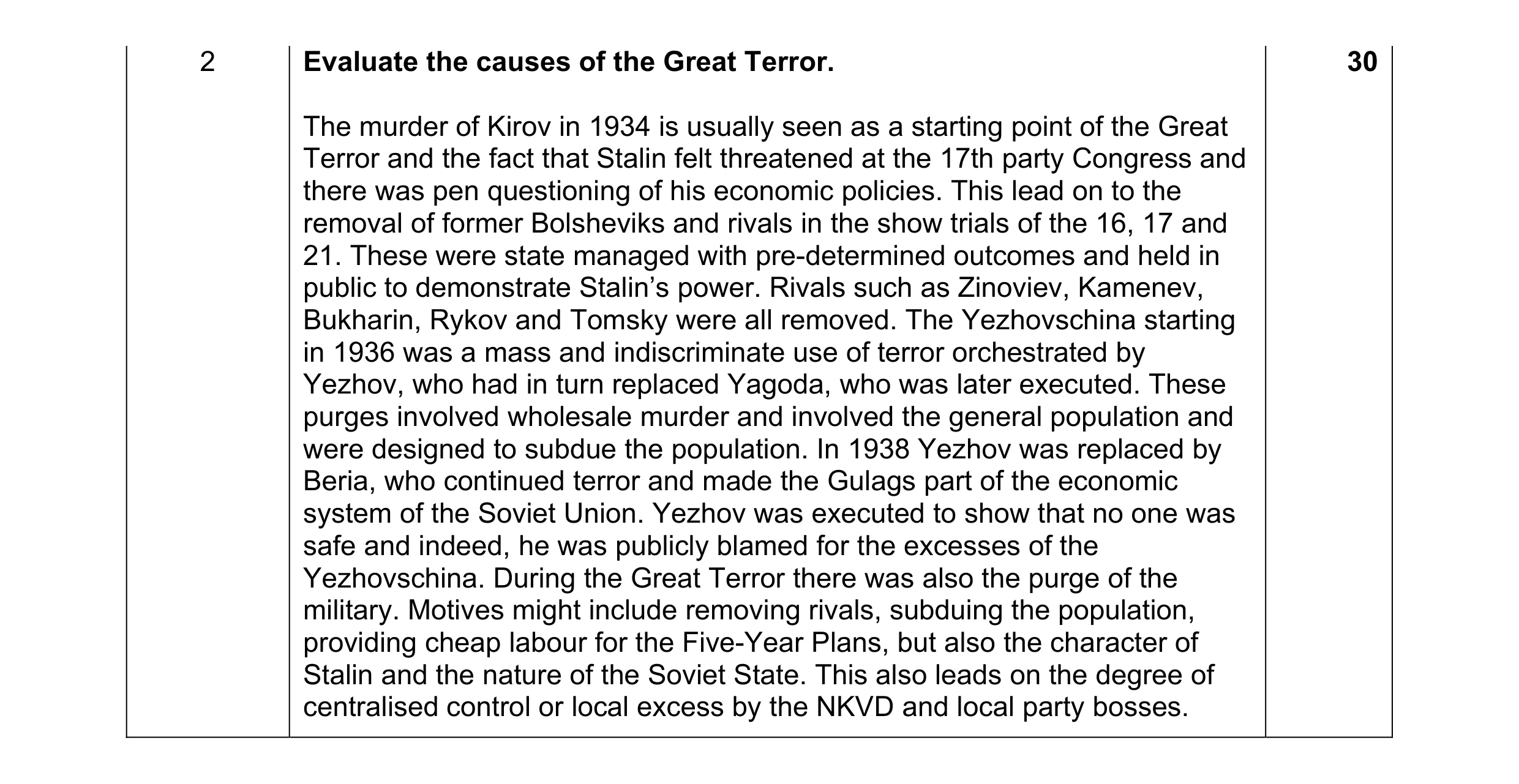 30
30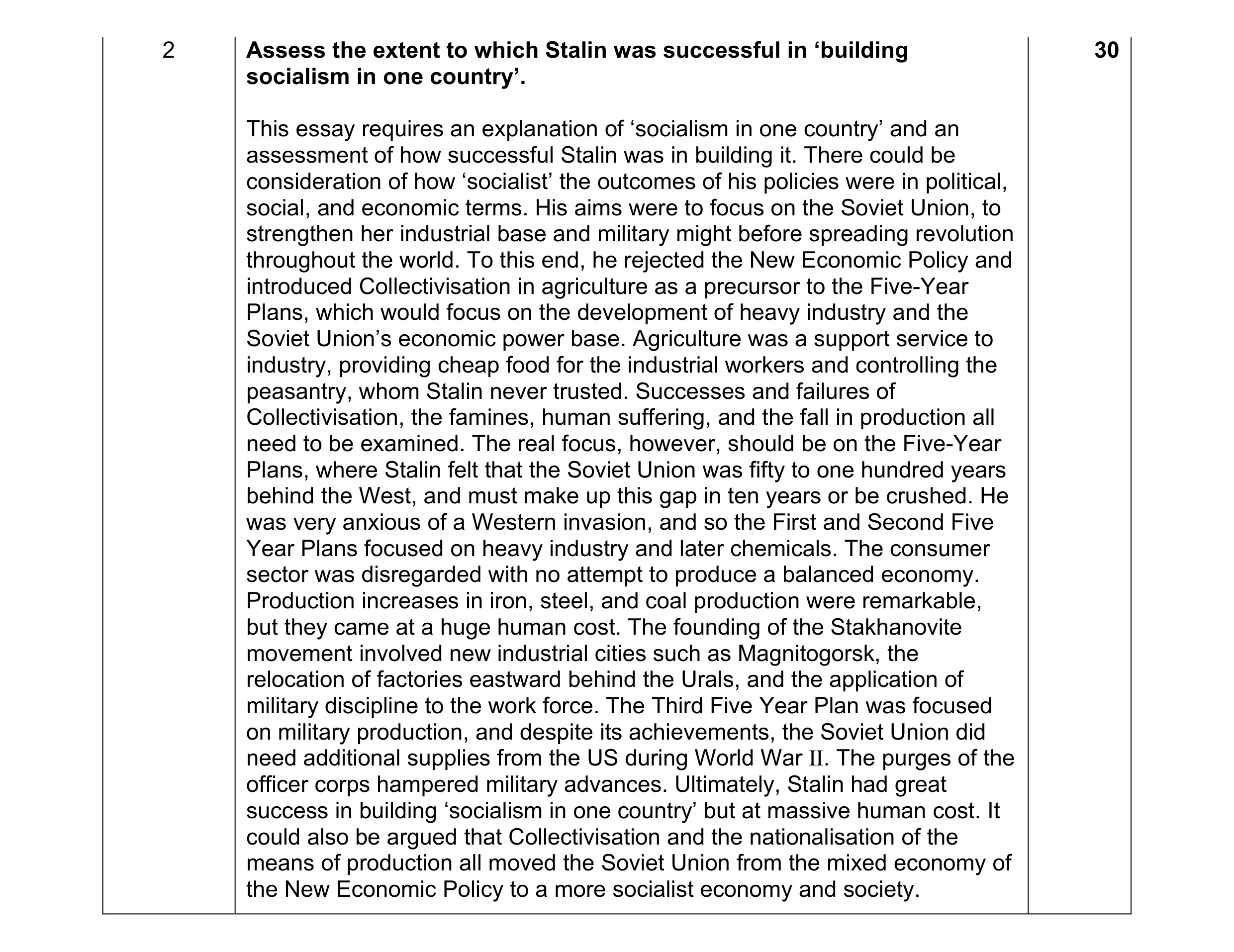 30
30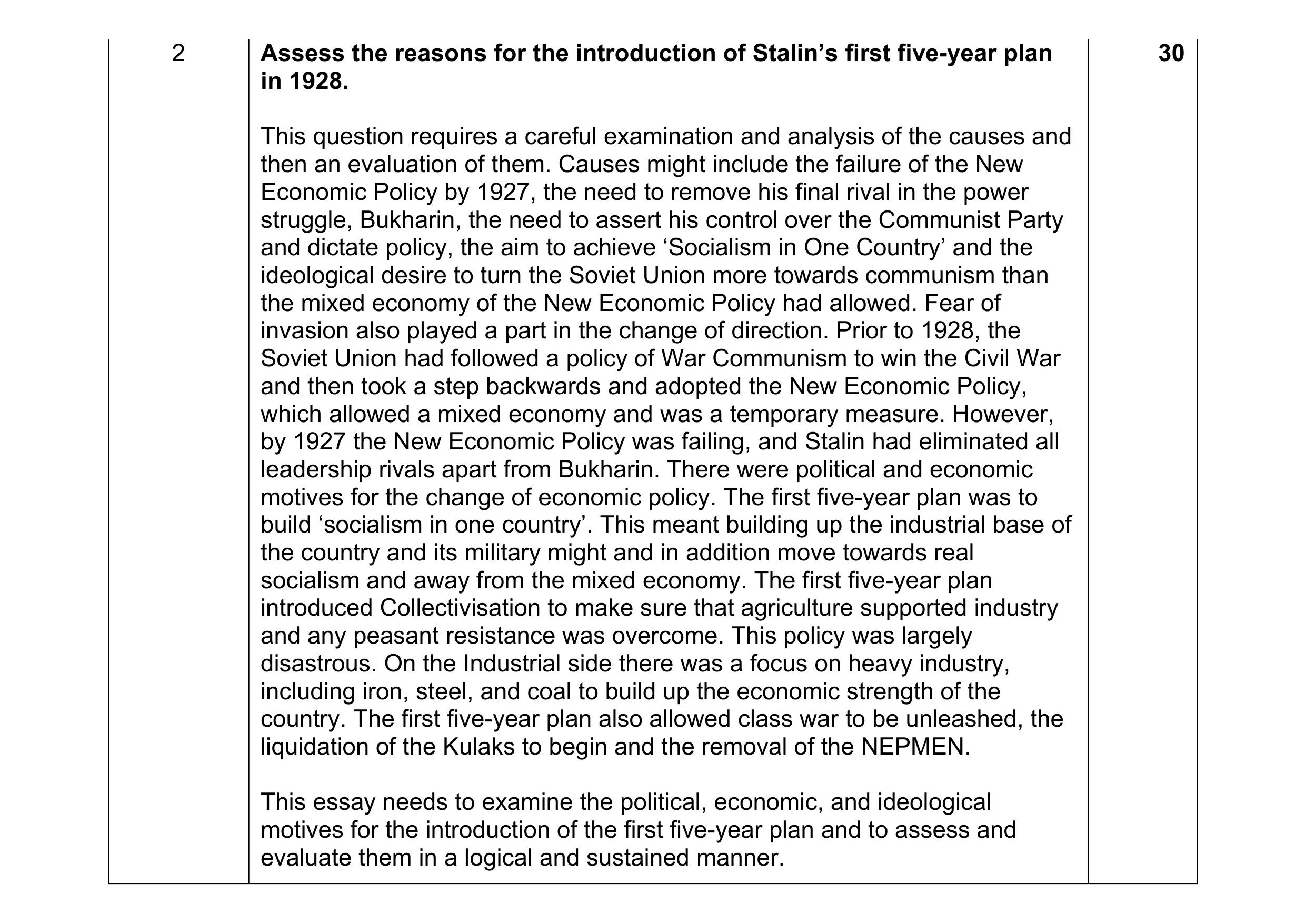 30
30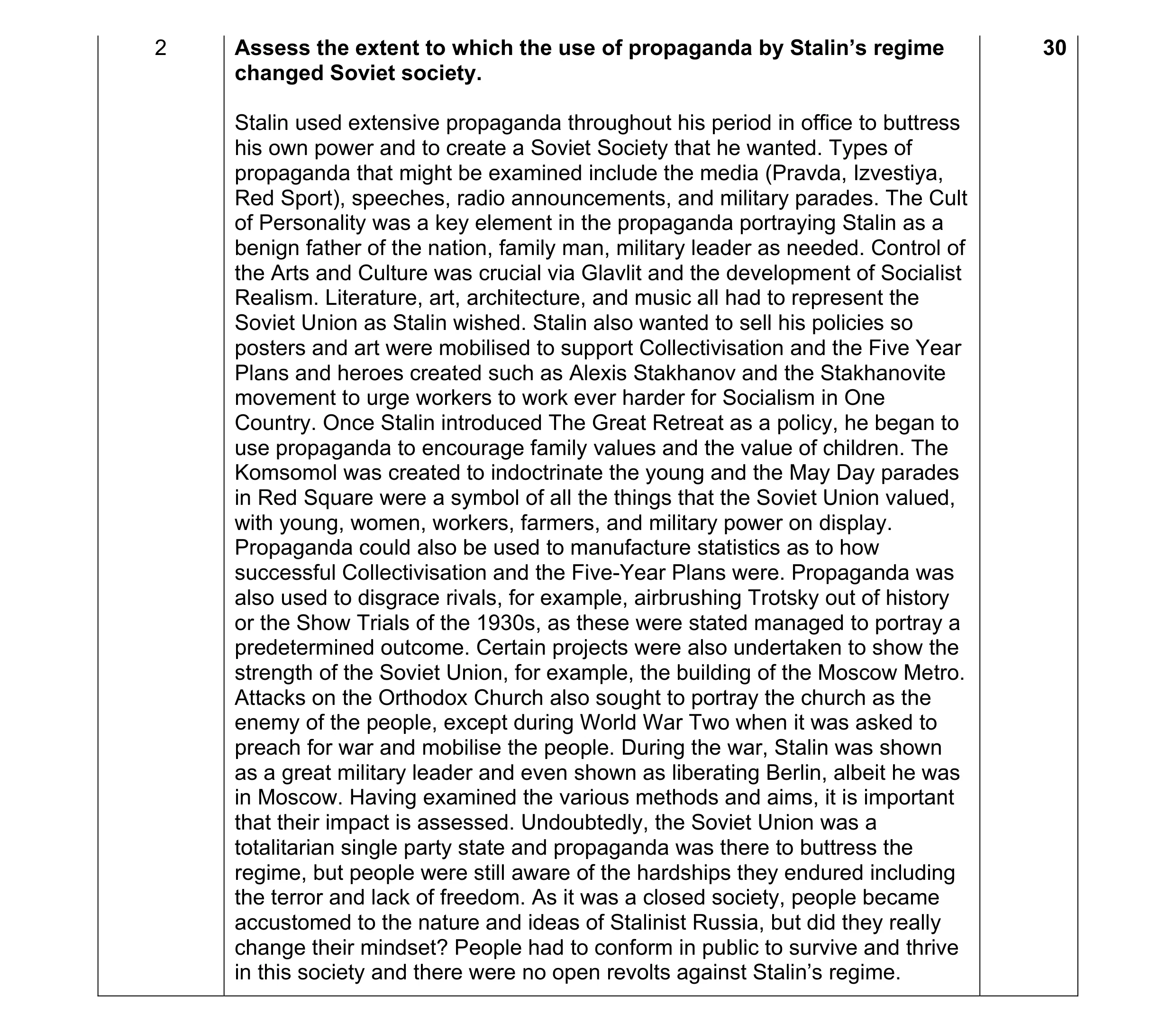 30
30 30
30 30
30 30
30 30
30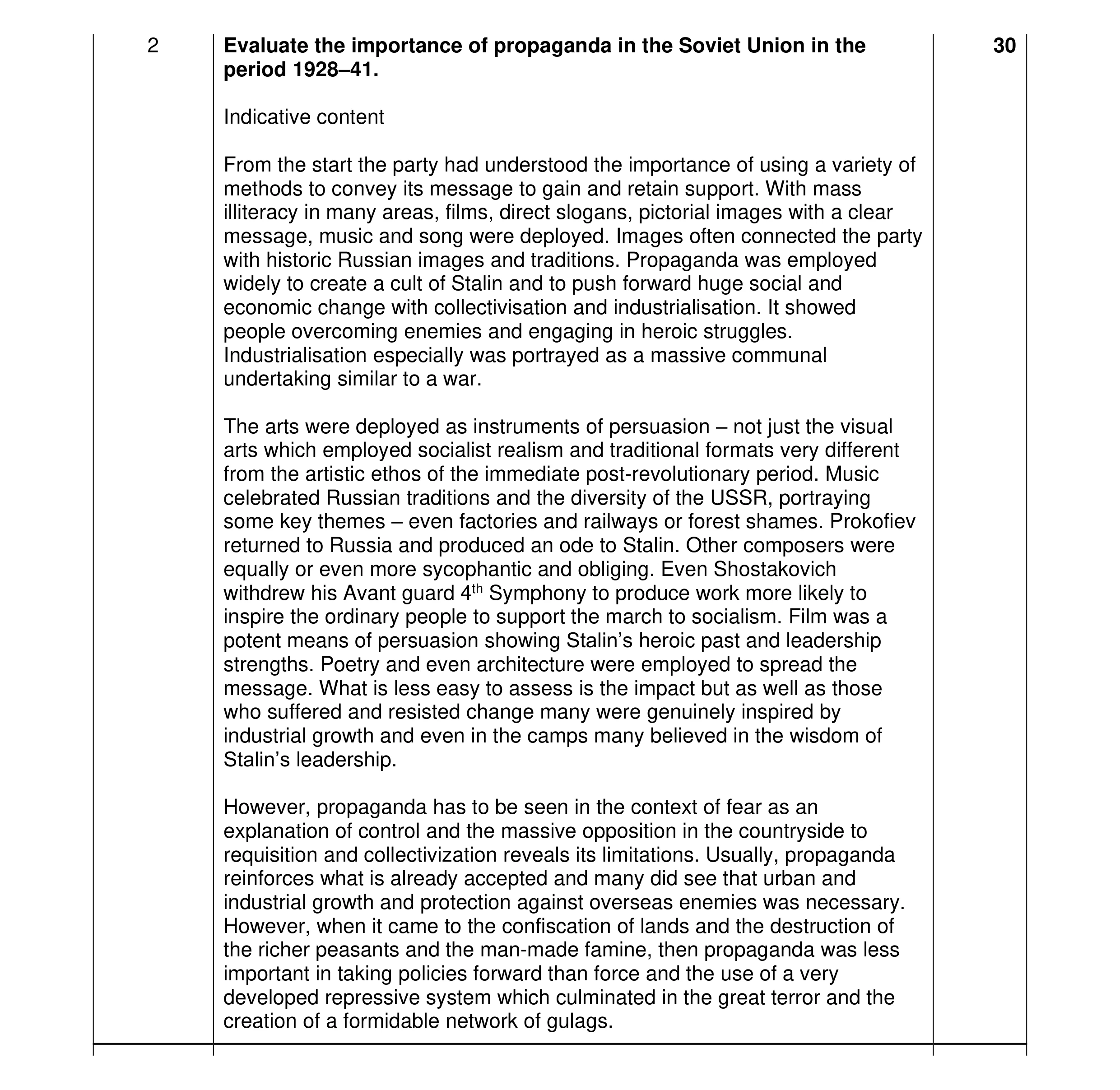 30
30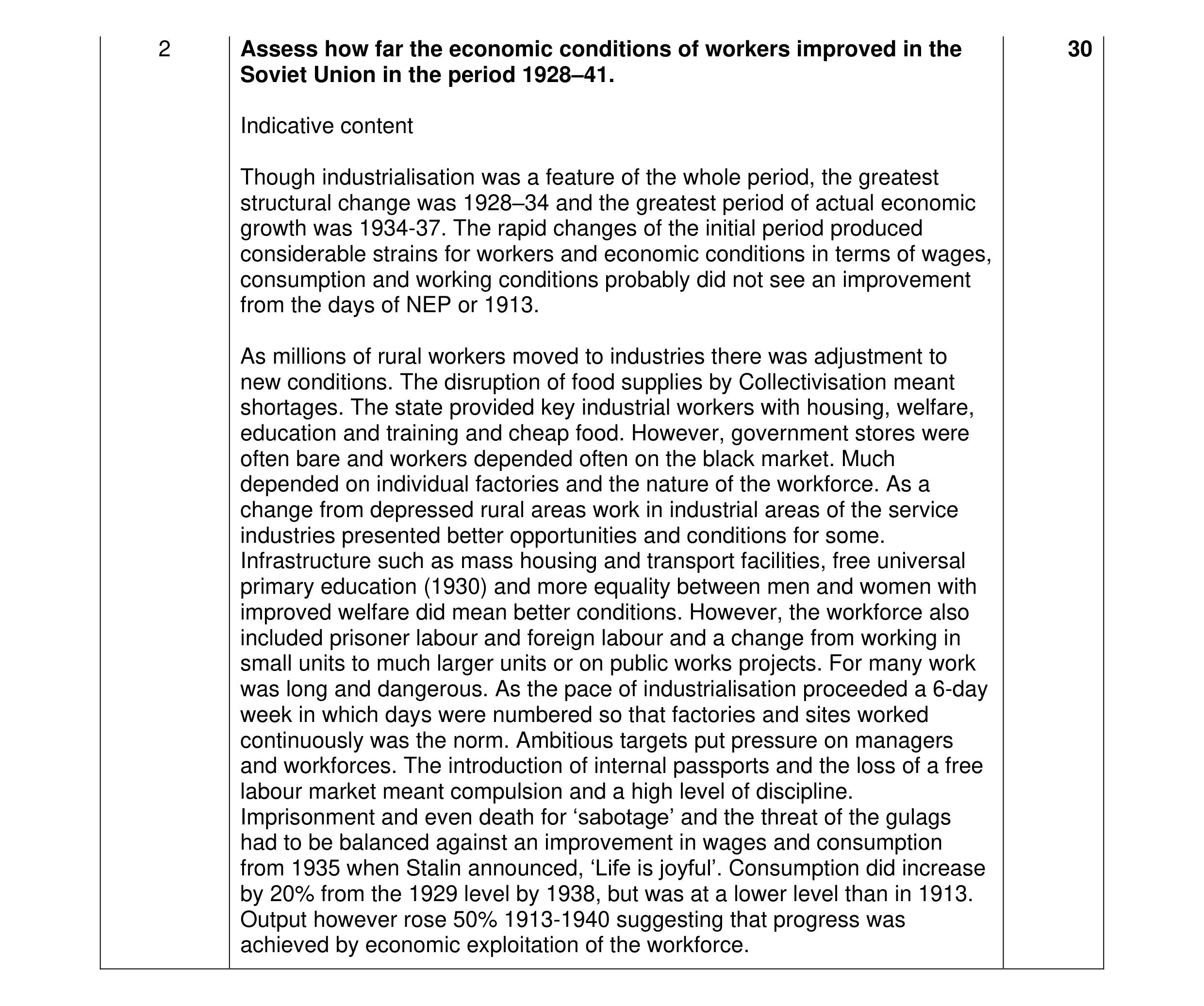 30
30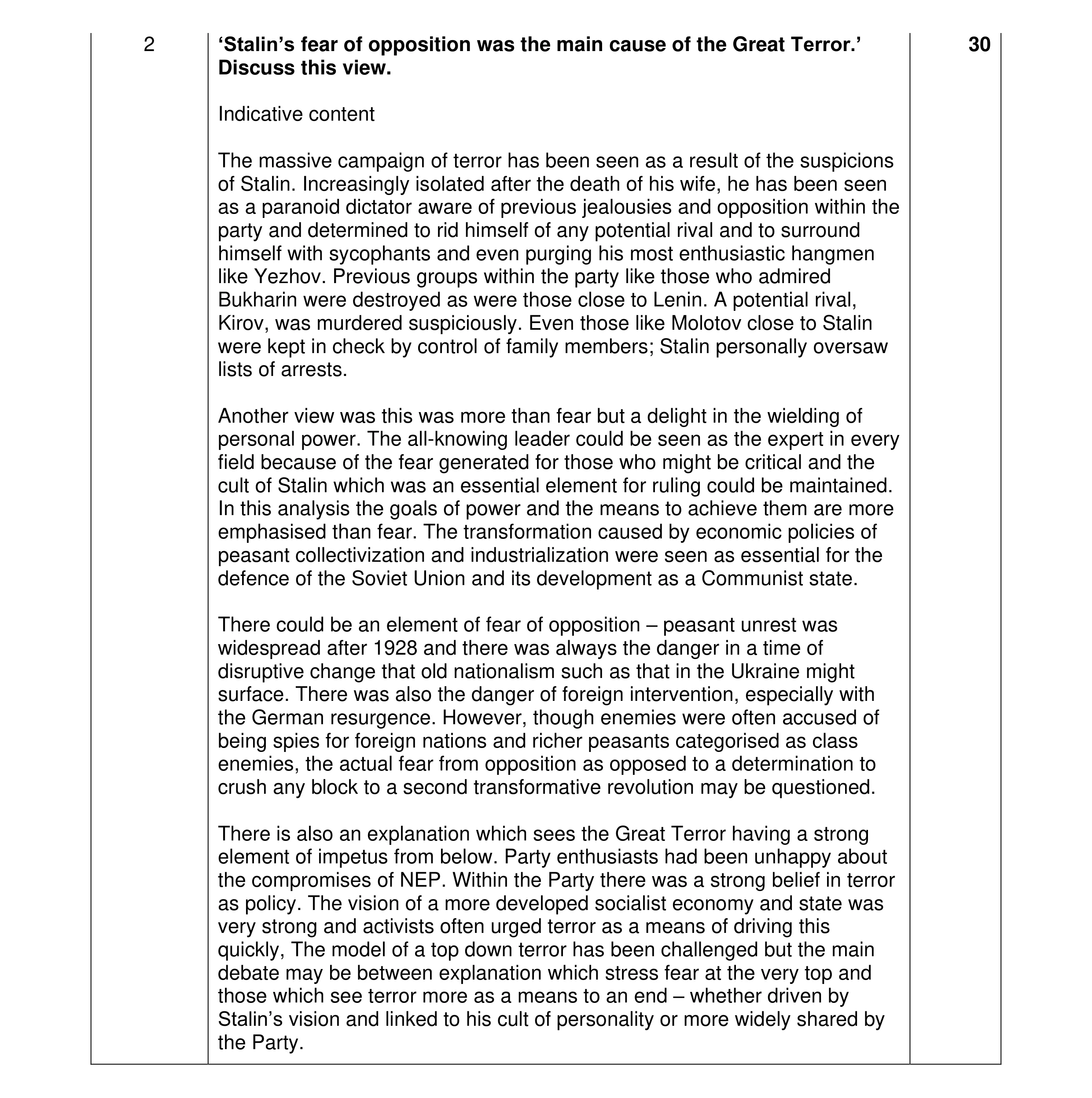 30
30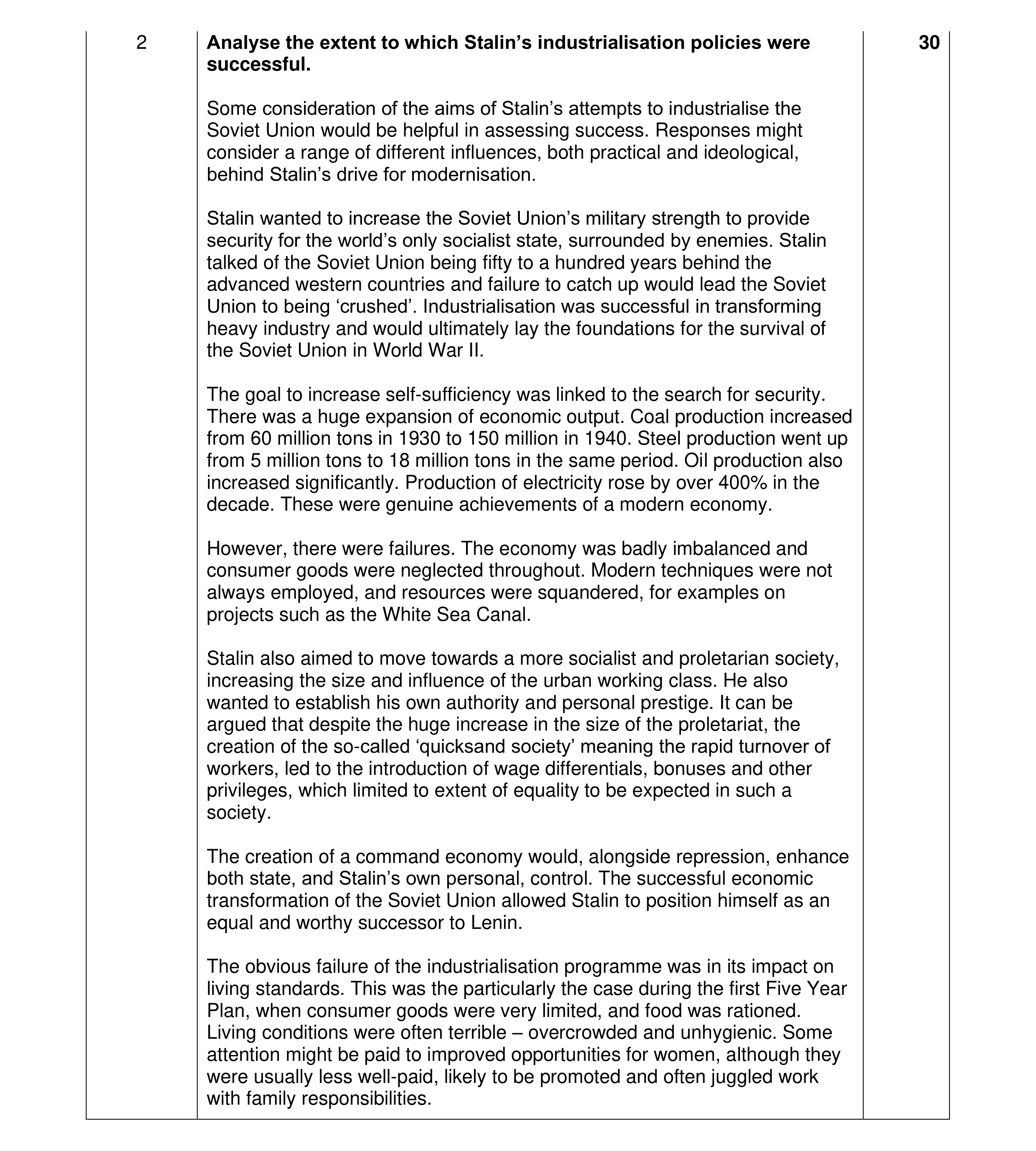 30
30 30
30 30
30 30
30 30
30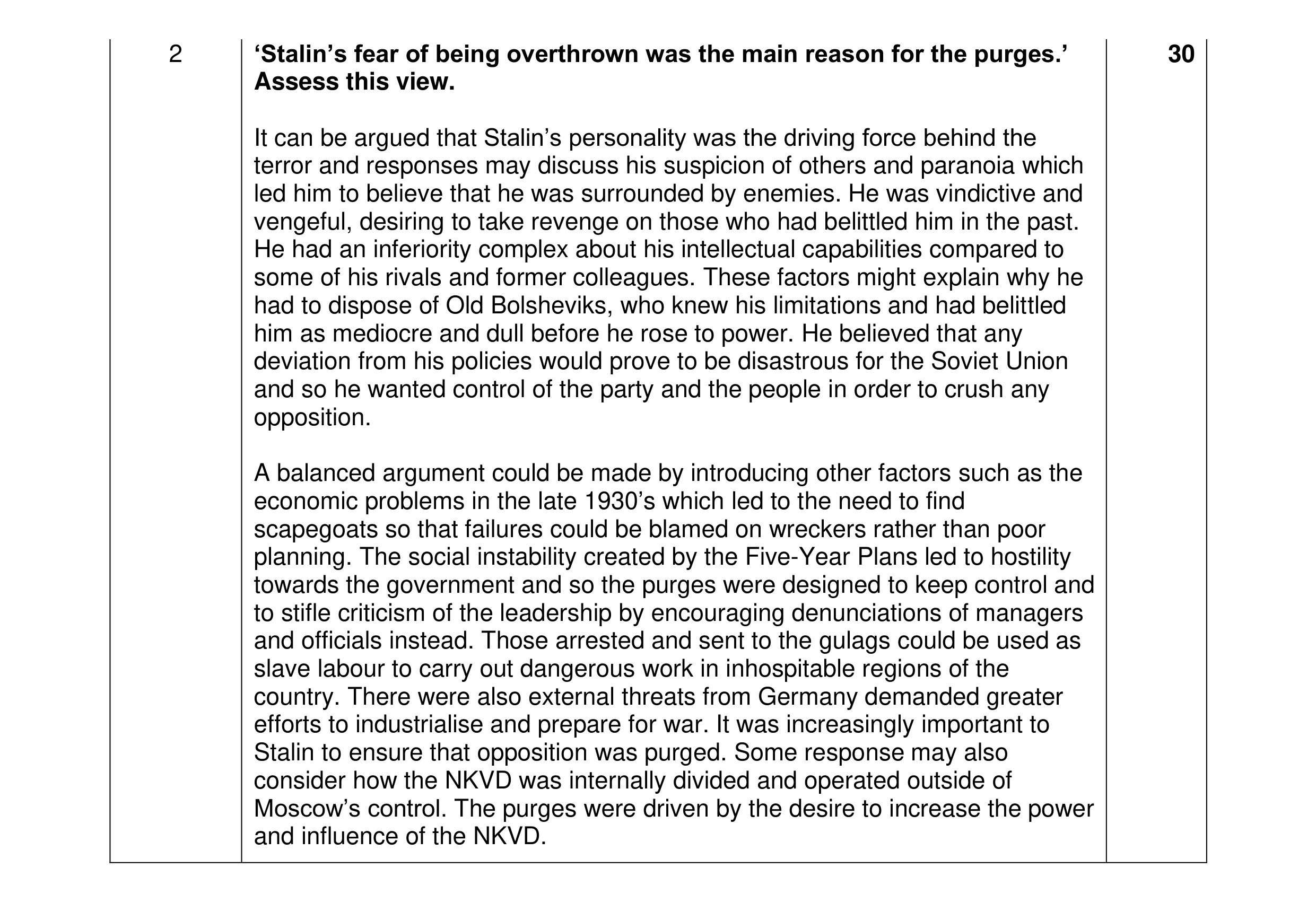 30
30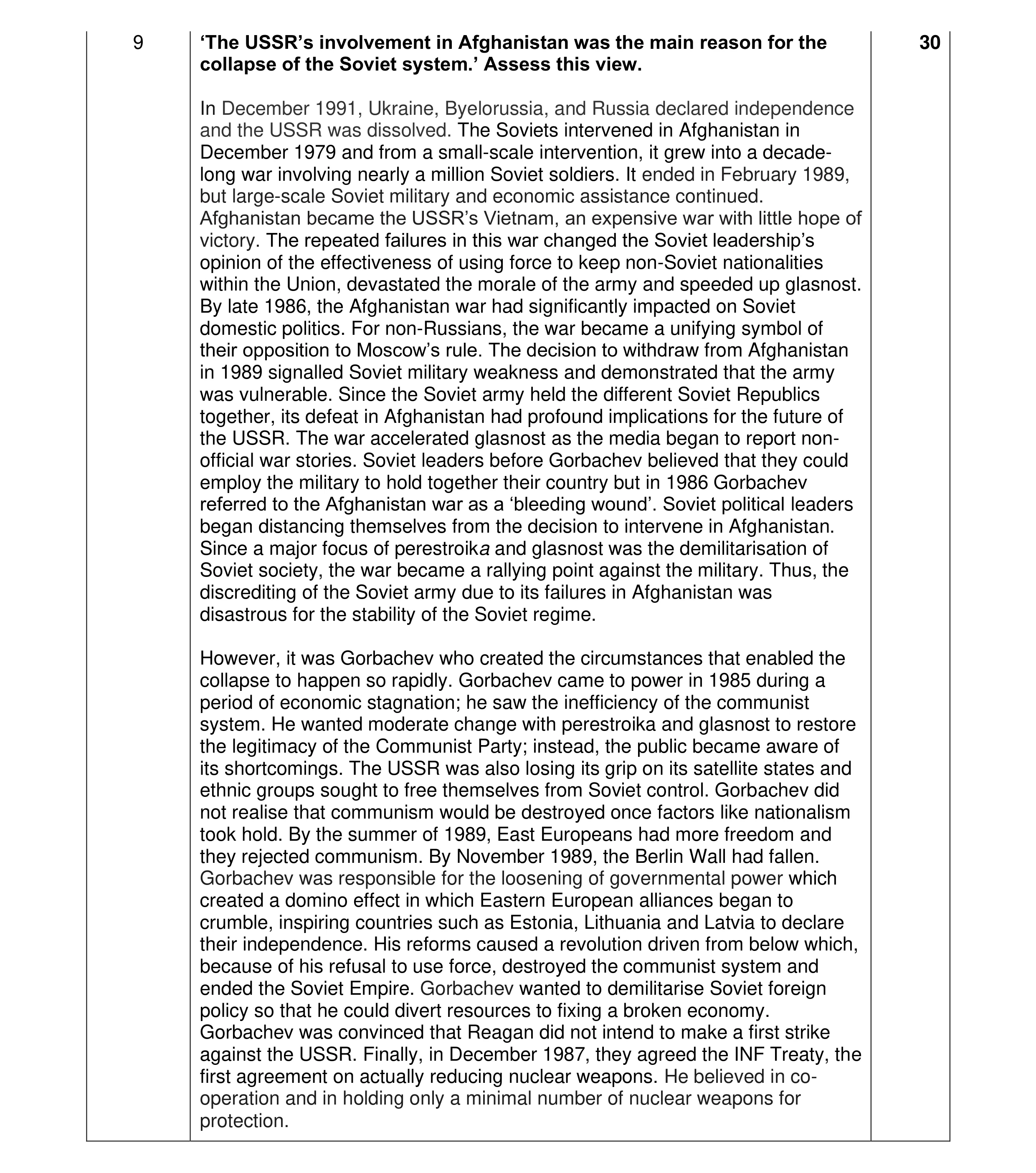 30
30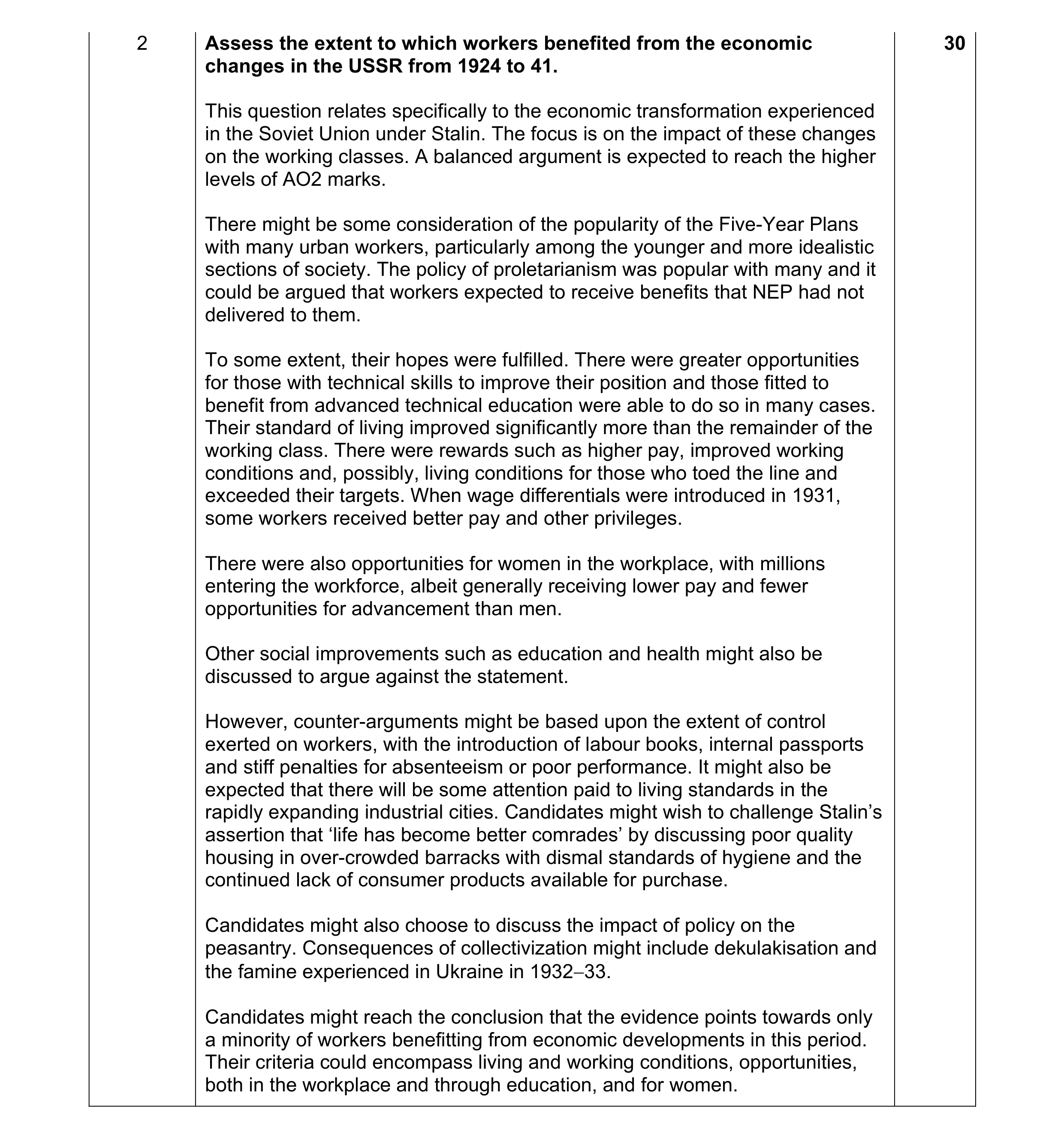 30
30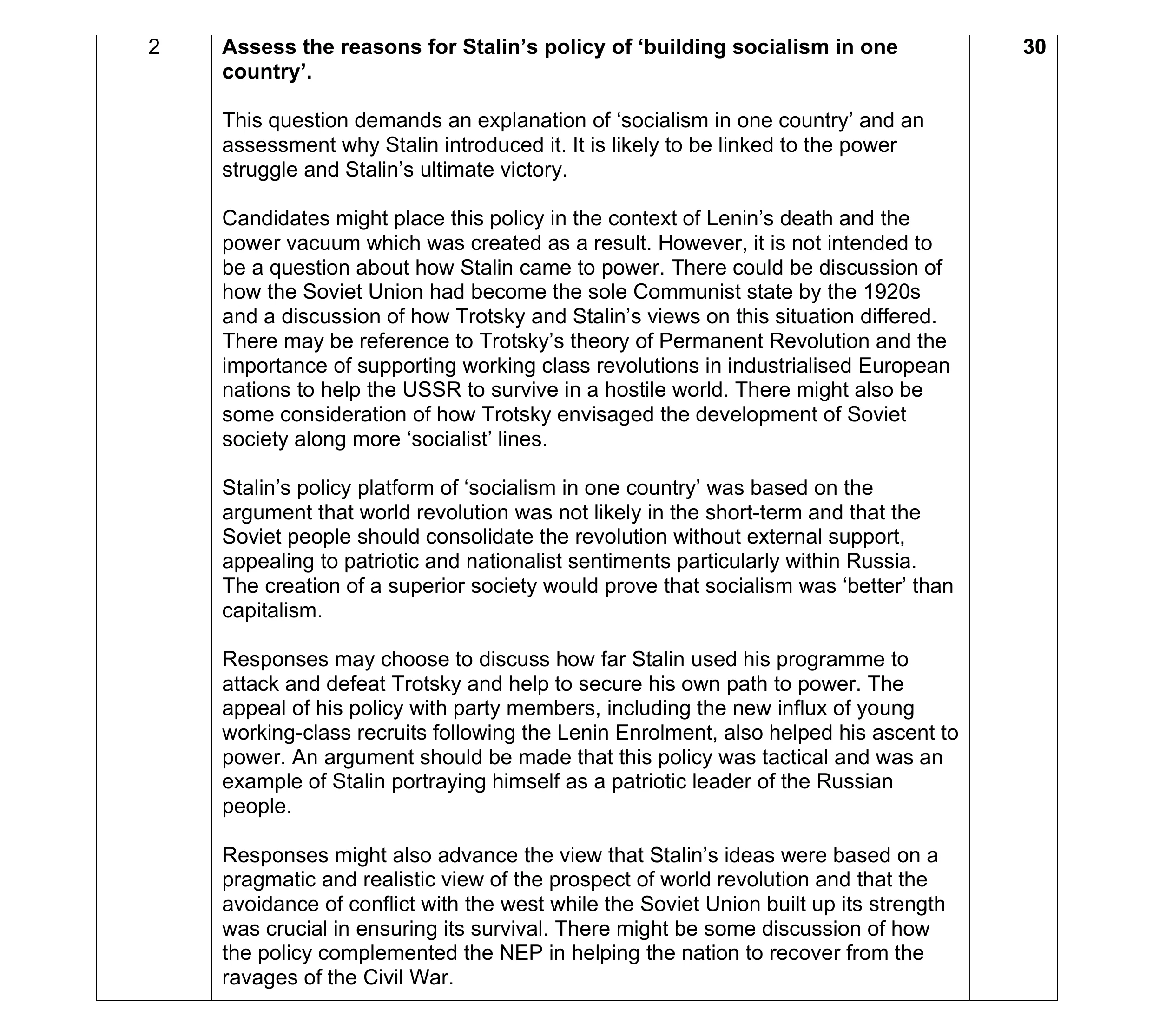 30
30 30
30 30
30 30
30 30
30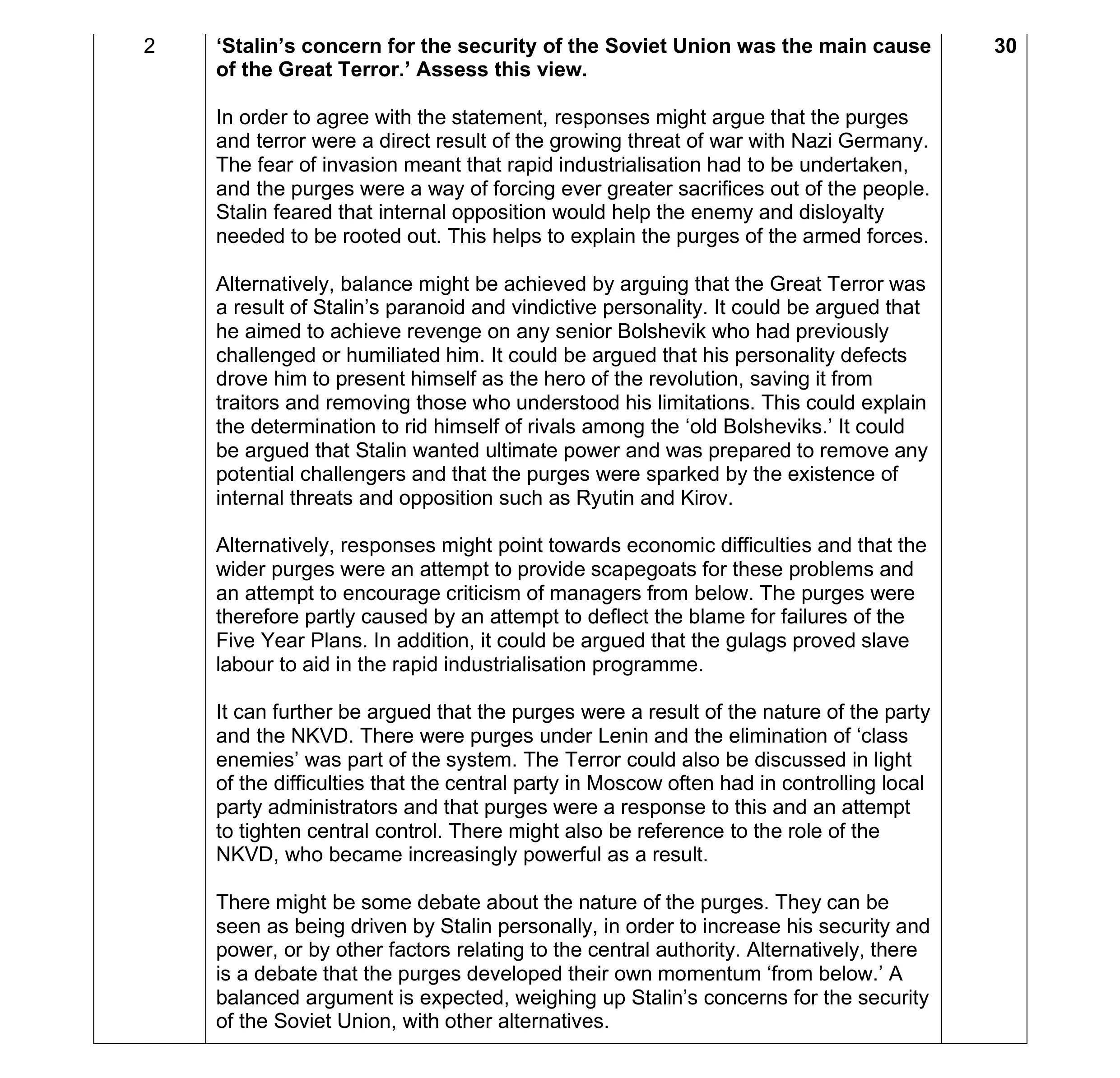 30
30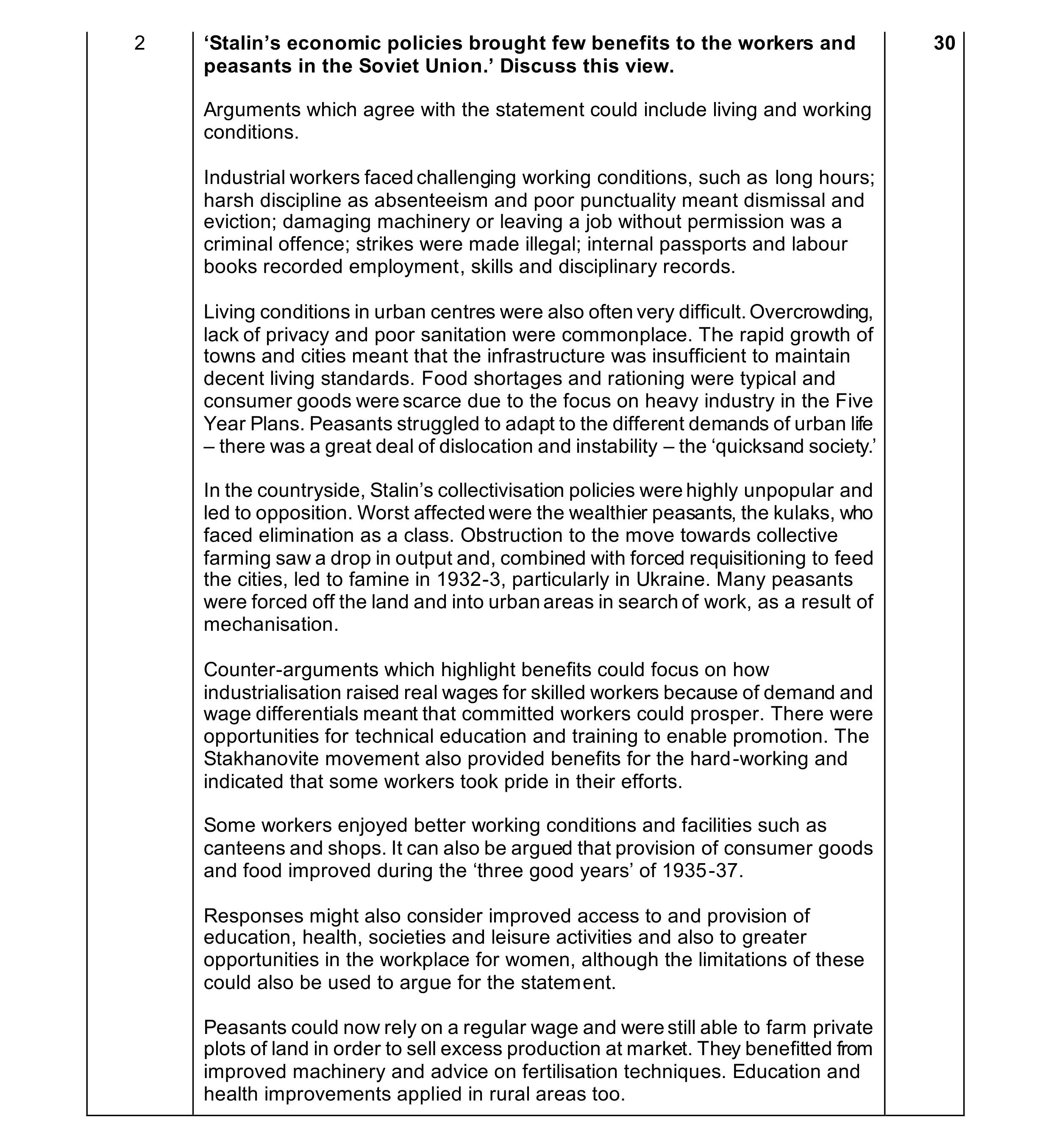 30
30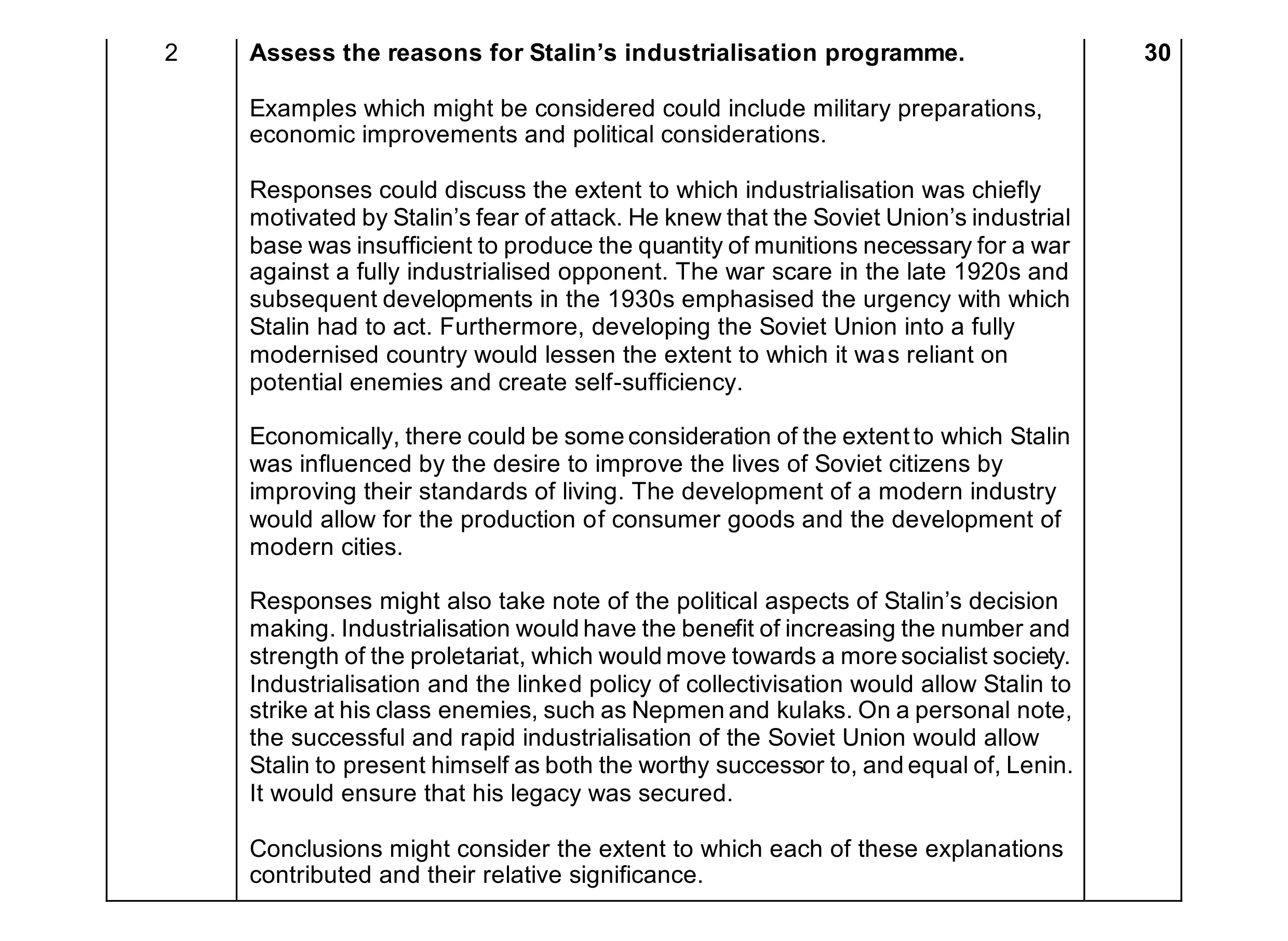 30
30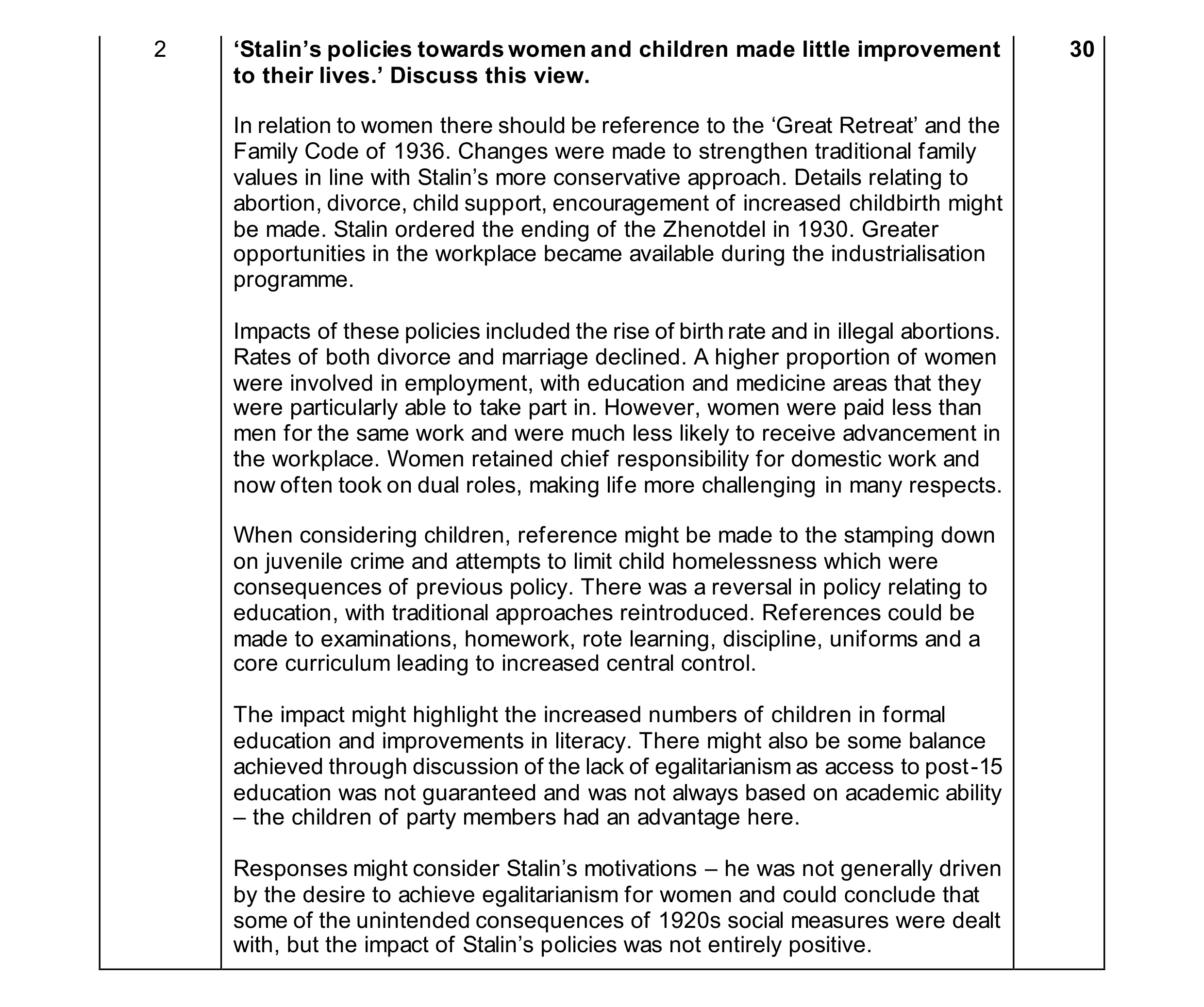 30
30