Cambridge A Level History 9489 — 2023 May/June Paper 4 · Variant 3
9489/43/M/J/23 · 11 questions · 60 marks · ≈68 min
The question paper and its mark scheme, free to read here and free to download. This is Cambridge’s own paper, exactly as it was sat.
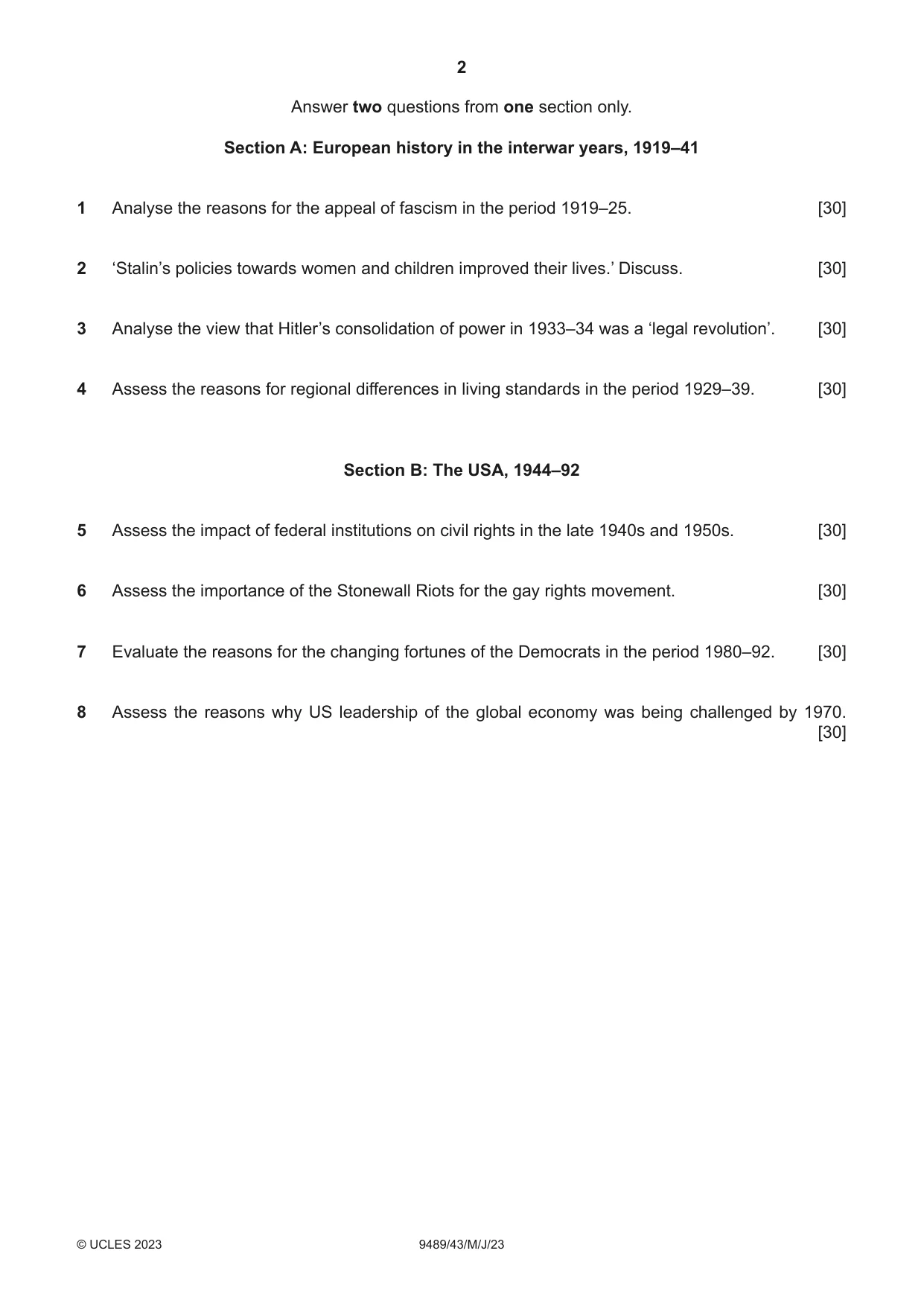
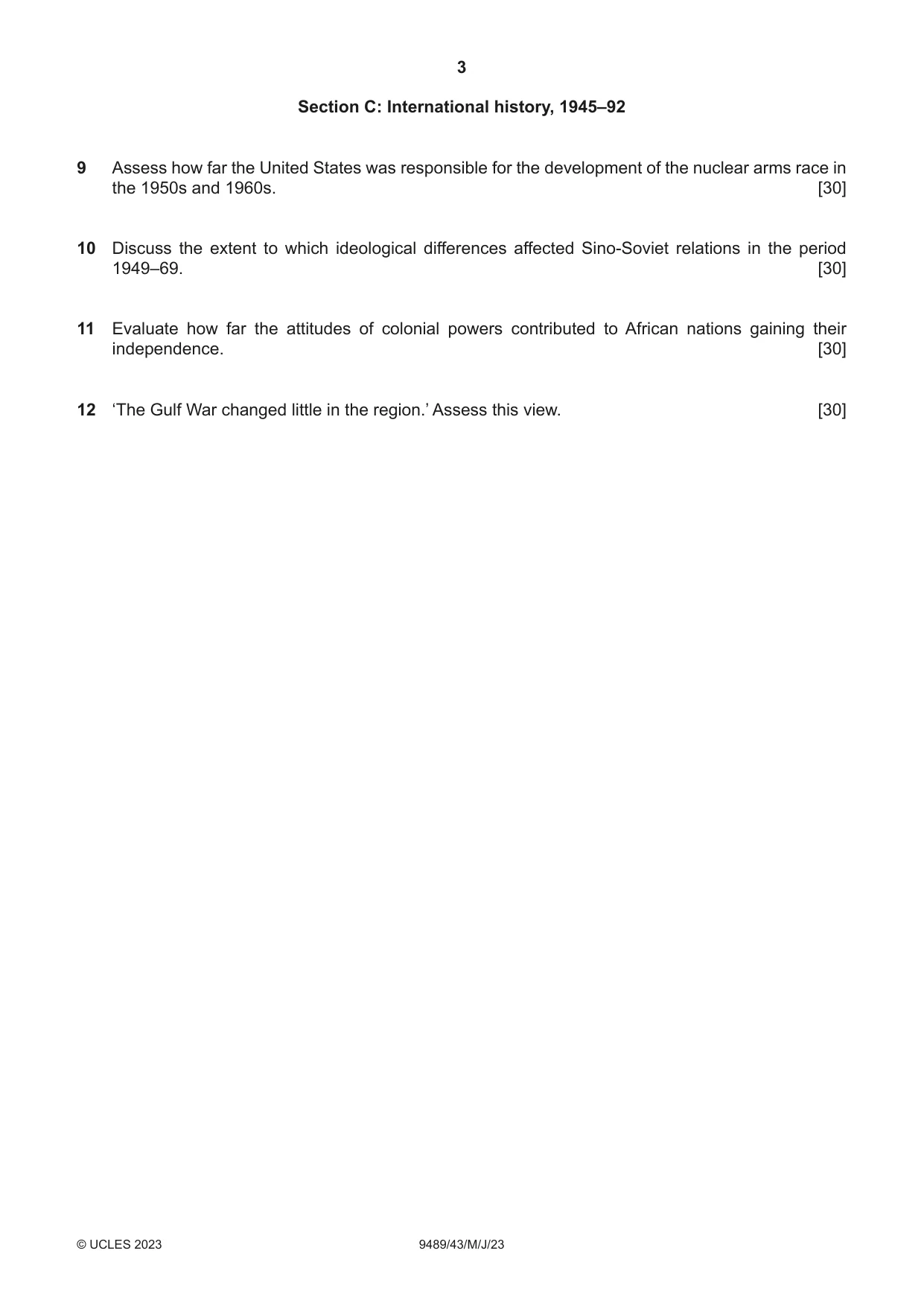
Question paper4 pages

Mark scheme18 pages
Answers below. Sit the paper first if you are practising.

Questions as text
Q1 · Analyse the reasons for the appeal of fascism in the period 1919–25
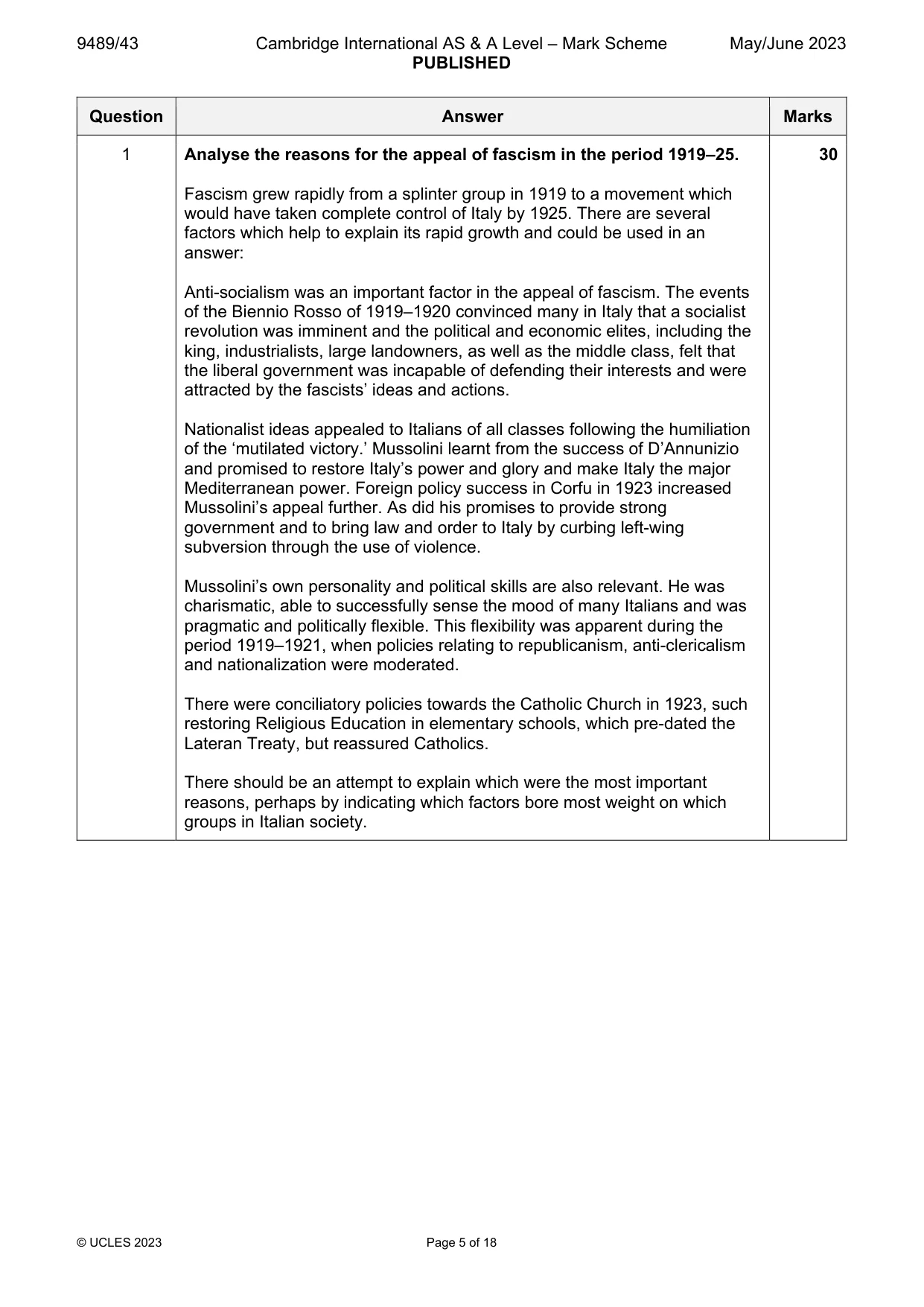
1 Analyse the reasons for the appeal of fascism in the period 1919–25. [30]
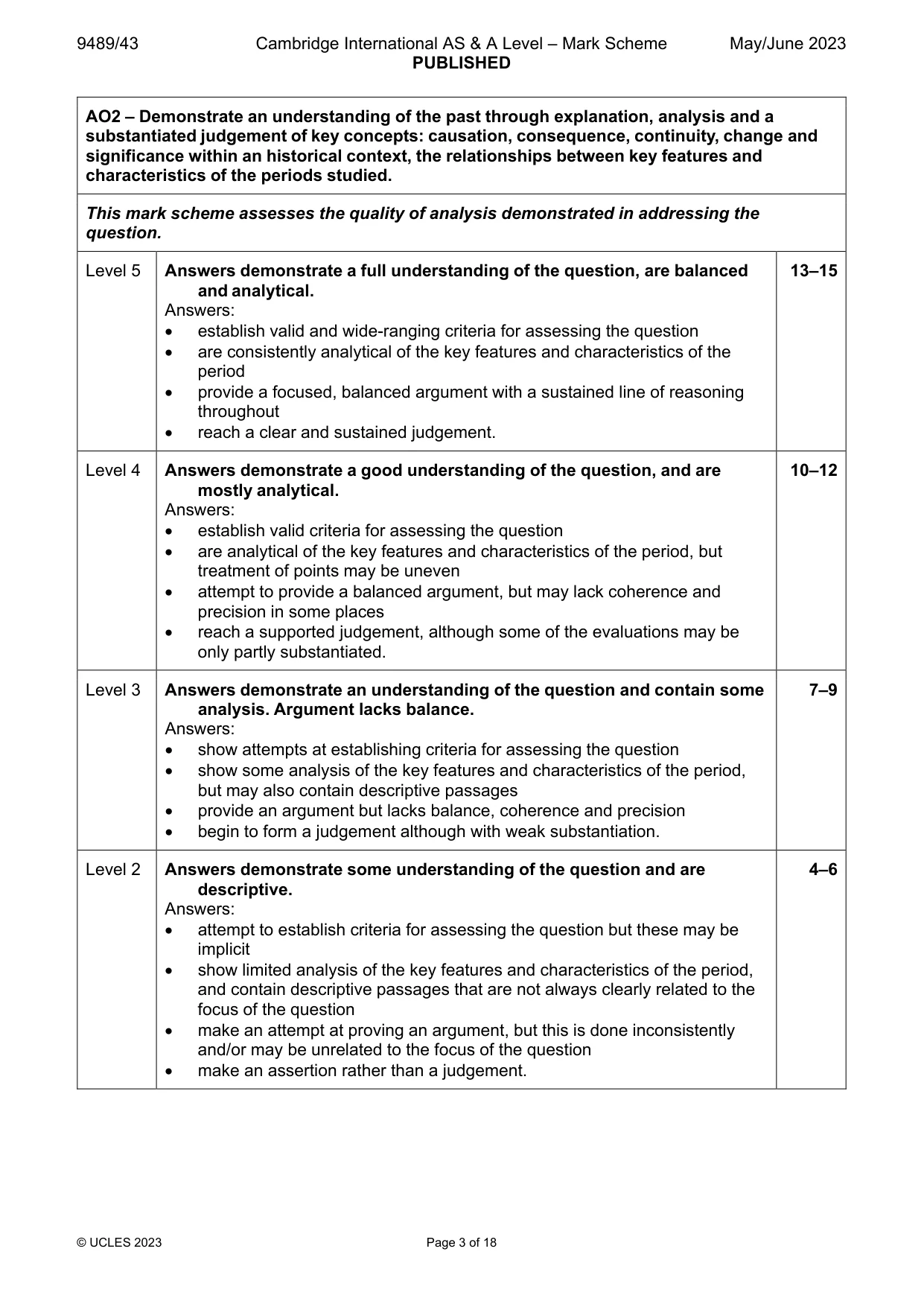
Mark scheme: Question Answer Marks 1 Analyse the reasons for the appeal of fascism in the period 1919–25. 30 Fascism grew rapidly from a splinter group in 1919 to a movement which would have taken complete control of Italy by 1925. There are several factors which help to explain its rapid growth and could be used in an answer: Anti-socialism was an important factor in the appeal of fascism. The events of the Biennio Rosso of 1919–1920 convinced many in Italy that a socialist revolution was imminent and the political and economic elites, including the king, industrialists, large landowners, as well as the middle class, felt that the liberal government was incapable of defending their interests and were attracted by the fascists’ ideas and actions. Nationalist ideas appealed to Italians of all classes following the humiliation of the ‘mutilated victory.’ Mussolini learnt from the success of D’Annunizio and promised to restore Italy’s power and glory and make Italy the major Mediterranean power. Foreign policy success in Corfu in 1923 increased Mussolini’s appeal further. As did his promises to provide strong government and to bring law and order to Italy by curbing left-wing subversion through the use of violence. Mussolini’s own personality and political skills are also relevant. He was charismatic, able to successfully sense the mood of many Italians and was pragmatic and politically flexible. This flexibility was apparent during the period 1919–1921, when policies relating to republicanism, anti-clericalism and nationalization were moderated. There were conciliatory policies towards the Catholic Church in 1923, such restoring Religious Education in elementary schools, which pre-dated the Lateran Treaty, but reassured Catholics. There should be an attempt to explain which were the most important reasons, perhaps by indicating which factors bore most weight on which groups in Italian society.
More questions on How did the rise of extremism affect international relations?
Q2 · ‘Stalin’s policies towards women and children improved their lives.’ Discuss
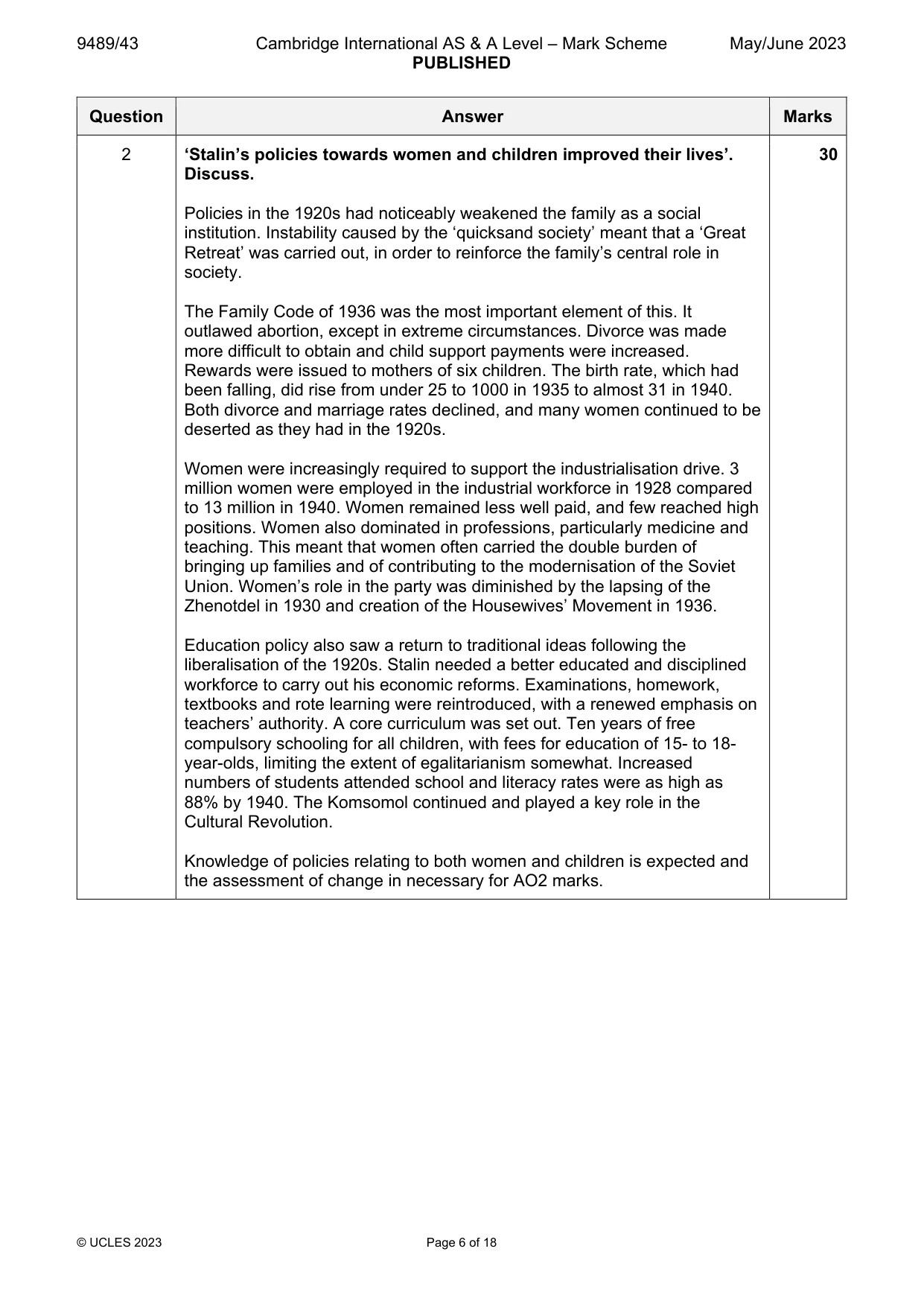
2 ‘Stalin’s policies towards women and children improved their lives.’ Discuss. [30]
Mark scheme: 2 ‘Stalin’s policies towards women and children improved their lives’. 30 Discuss. Policies in the 1920s had noticeably weakened the family as a social institution. Instability caused by the ‘quicksand society’ meant that a ‘Great Retreat’ was carried out, in order to reinforce the family’s central role in society. The Family Code of 1936 was the most important element of this. It outlawed abortion, except in extreme circumstances. Divorce was made more difficult to obtain and child support payments were increased. Rewards were issued to mothers of six children. The birth rate, which had been falling, did rise from under 25 to 1000 in 1935 to almost 31 in 1940. Both divorce and marriage rates declined, and many women continued to be deserted as they had in the 1920s. Women were increasingly required to support the industrialisation drive. 3 million women were employed in the industrial workforce in 1928 compared to 13 million in 1940. Women remained less well paid, and few reached high positions. Women also dominated in professions, particularly medicine and teaching. This meant that women often carried the double burden of bringing up families and of contributing to the modernisation of the Soviet Union. Women’s role in the party was diminished by the lapsing of the Zhenotdel in 1930 and creation of the Housewives’ Movement in 1936. Education policy also saw a return to traditional ideas following the liberalisation of the 1920s. Stalin needed a better educated and disciplined workforce to carry out his economic reforms. Examinations, homework, textbooks and rote learning were reintroduced, with a renewed emphasis on teachers’ authority. A core curriculum was set out. Ten years of free compulsory schooling for all children, with fees for education of 15- to 18- year-olds, limiting the extent of egalitarianism somewhat. Increased numbers of students attended school and literacy rates were as high as 88% by 1940. The Komsomol continued and played a key role in the Cultural Revolution. Knowledge of policies relating to both women and children is expected and the assessment of change in necessary for AO2 marks.
More questions on How were the Bolsheviks able to consolidate their power up to 1924?
Q3 · Analyse the view that Hitler’s consolidation of power in 1933–34 was a ‘legal revolution’
3 Analyse the view that Hitler’s consolidation of power in 1933–34 was a ‘legal revolution’. [30]
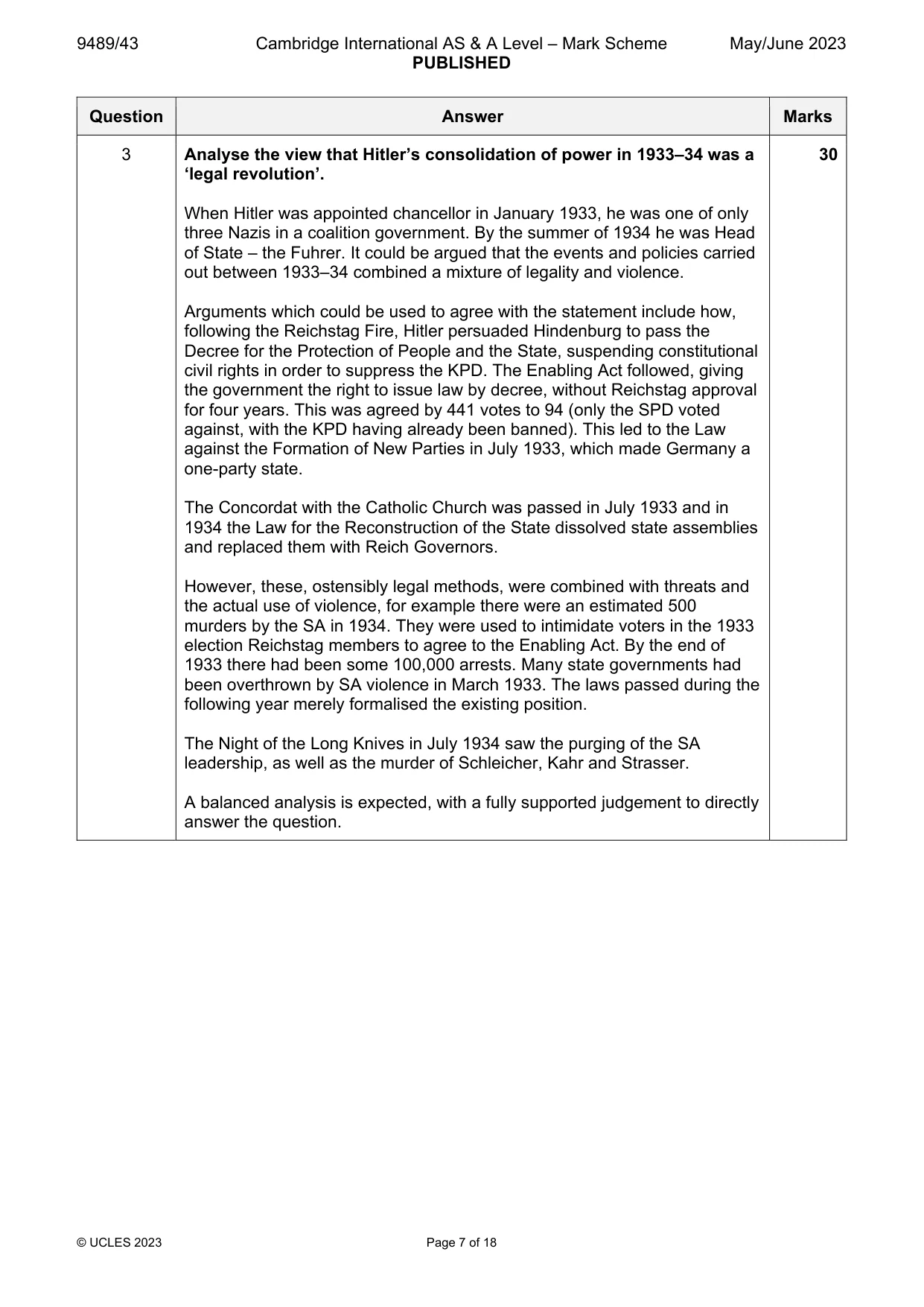
Mark scheme: 3 Analyse the view that Hitler’s consolidation of power in 1933–34 was a 30 ‘legal revolution’. When Hitler was appointed chancellor in January 1933, he was one of only three Nazis in a coalition government. By the summer of 1934 he was Head of State – the Fuhrer. It could be argued that the events and policies carried out between 1933–34 combined a mixture of legality and violence. Arguments which could be used to agree with the statement include how, following the Reichstag Fire, Hitler persuaded Hindenburg to pass the Decree for the Protection of People and the State, suspending constitutional civil rights in order to suppress the KPD. The Enabling Act followed, giving the government the right to issue law by decree, without Reichstag approval for four years. This was agreed by 441 votes to 94 (only the SPD voted against, with the KPD having already been banned). This led to the Law against the Formation of New Parties in July 1933, which made Germany a one-party state. The Concordat with the Catholic Church was passed in July 1933 and in 1934 the Law for the Reconstruction of the State dissolved state assemblies and replaced them with Reich Governors. However, these, ostensibly legal methods, were combined with threats and the actual use of violence, for example there were an estimated 500 murders by the SA in 1934. They were used to intimidate voters in the 1933 election Reichstag members to agree to the Enabling Act. By the end of 1933 there had been some 100,000 arrests. Many state governments had been overthrown by SA violence in March 1933. The laws passed during the following year merely formalised the existing position. The Night of the Long Knives in July 1934 saw the purging of the SA leadership, as well as the murder of Schleicher, Kahr and Strasser. A balanced analysis is expected, with a fully supported judgement to directly answer the question.
More questions on How did the rise of extremism affect international relations?
Q4 · Assess the reasons for regional differences in living standards in the period 1929–39
4 Assess the reasons for regional differences in living standards in the period 1929–39. [30]
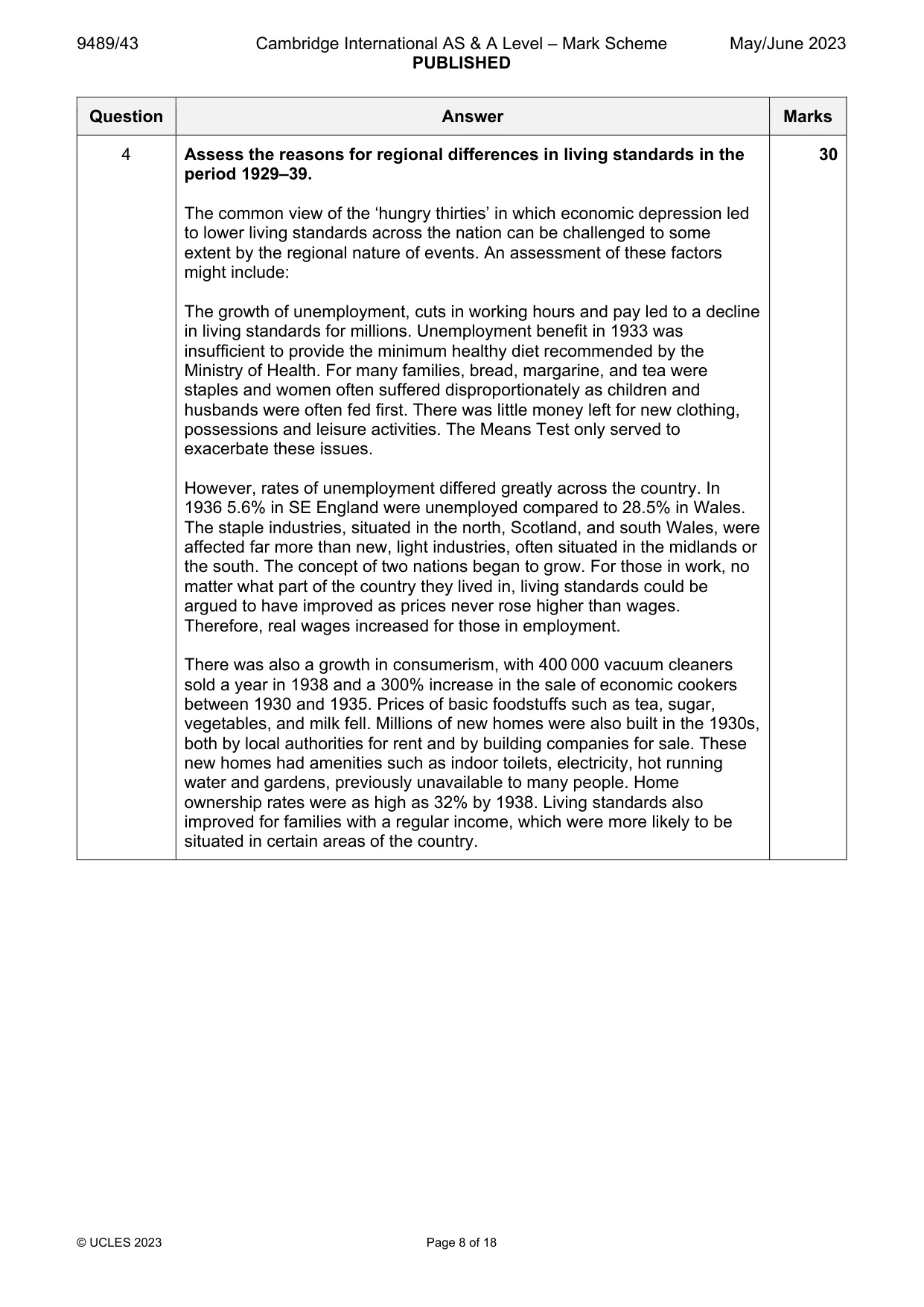
Mark scheme: 4 Assess the reasons for regional differences in living standards in the 30 period 1929–39. The common view of the ‘hungry thirties’ in which economic depression led to lower living standards across the nation can be challenged to some extent by the regional nature of events. An assessment of these factors might include: The growth of unemployment, cuts in working hours and pay led to a decline in living standards for millions. Unemployment benefit in 1933 was insufficient to provide the minimum healthy diet recommended by the Ministry of Health. For many families, bread, margarine, and tea were staples and women often suffered disproportionately as children and husbands were often fed first. There was little money left for new clothing, possessions and leisure activities. The Means Test only served to exacerbate these issues. However, rates of unemployment differed greatly across the country. In 1936 5.6% in SE England were unemployed compared to 28.5% in Wales. The staple industries, situated in the north, Scotland, and south Wales, were affected far more than new, light industries, often situated in the midlands or the south. The concept of two nations began to grow. For those in work, no matter what part of the country they lived in, living standards could be argued to have improved as prices never rose higher than wages. Therefore, real wages increased for those in employment. There was also a growth in consumerism, with 400 000 vacuum cleaners sold a year in 1938 and a 300% increase in the sale of economic cookers between 1930 and 1935. Prices of basic foodstuffs such as tea, sugar, vegetables, and milk fell. Millions of new homes were also built in the 1930s, both by local authorities for rent and by building companies for sale. These new homes had amenities such as indoor toilets, electricity, hot running water and gardens, previously unavailable to many people. Home ownership rates were as high as 32% by 1938. Living standards also improved for families with a regular income, which were more likely to be situated in certain areas of the country.
Q5 · Assess the impact of federal institutions on civil rights in the late 1940s and 1950s
5 Assess the impact of federal institutions on civil rights in the late 1940s and 1950s. [30]
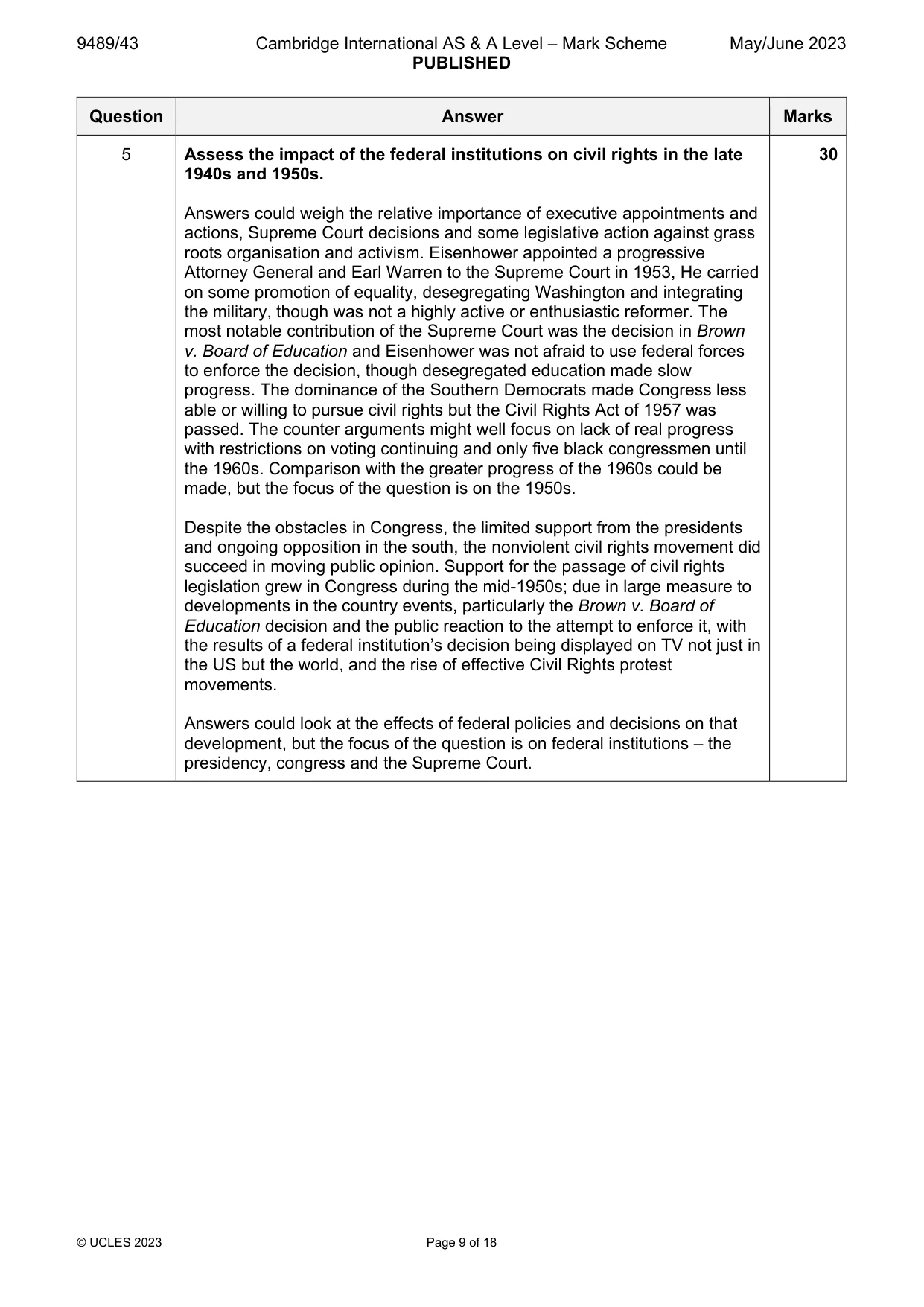
Mark scheme: 5 Assess the impact of the federal institutions on civil rights in the late 30 1940s and 1950s. Answers could weigh the relative importance of executive appointments and actions, Supreme Court decisions and some legislative action against grass roots organisation and activism. Eisenhower appointed a progressive Attorney General and Earl Warren to the Supreme Court in 1953, He carried on some promotion of equality, desegregating Washington and integrating the military, though was not a highly active or enthusiastic reformer. The most notable contribution of the Supreme Court was the decision in Brown v. Board of Education and Eisenhower was not afraid to use federal forces to enforce the decision, though desegregated education made slow progress. The dominance of the Southern Democrats made Congress less able or willing to pursue civil rights but the Civil Rights Act of 1957 was passed. The counter arguments might well focus on lack of real progress with restrictions on voting continuing and only five black congressmen until the 1960s. Comparison with the greater progress of the 1960s could be made, but the focus of the question is on the 1950s. Despite the obstacles in Congress, the limited support from the presidents and ongoing opposition in the south, the nonviolent civil rights movement did succeed in moving public opinion. Support for the passage of civil rights legislation grew in Congress during the mid-1950s; due in large measure to developments in the country events, particularly the Brown v. Board of Education decision and the public reaction to the attempt to enforce it, with the results of a federal institution’s decision being displayed on TV not just in the US but the world, and the rise of effective Civil Rights protest movements. Answers could look at the effects of federal policies and decisions on that development, but the focus of the question is on federal institutions – the presidency, congress and the Supreme Court.
More questions on How successful was the Progressive Movement from 1890 to 1920?
Q6 · Assess the importance of the Stonewall Riots for the gay rights movement
6 Assess the importance of the Stonewall Riots for the gay rights movement. [30]
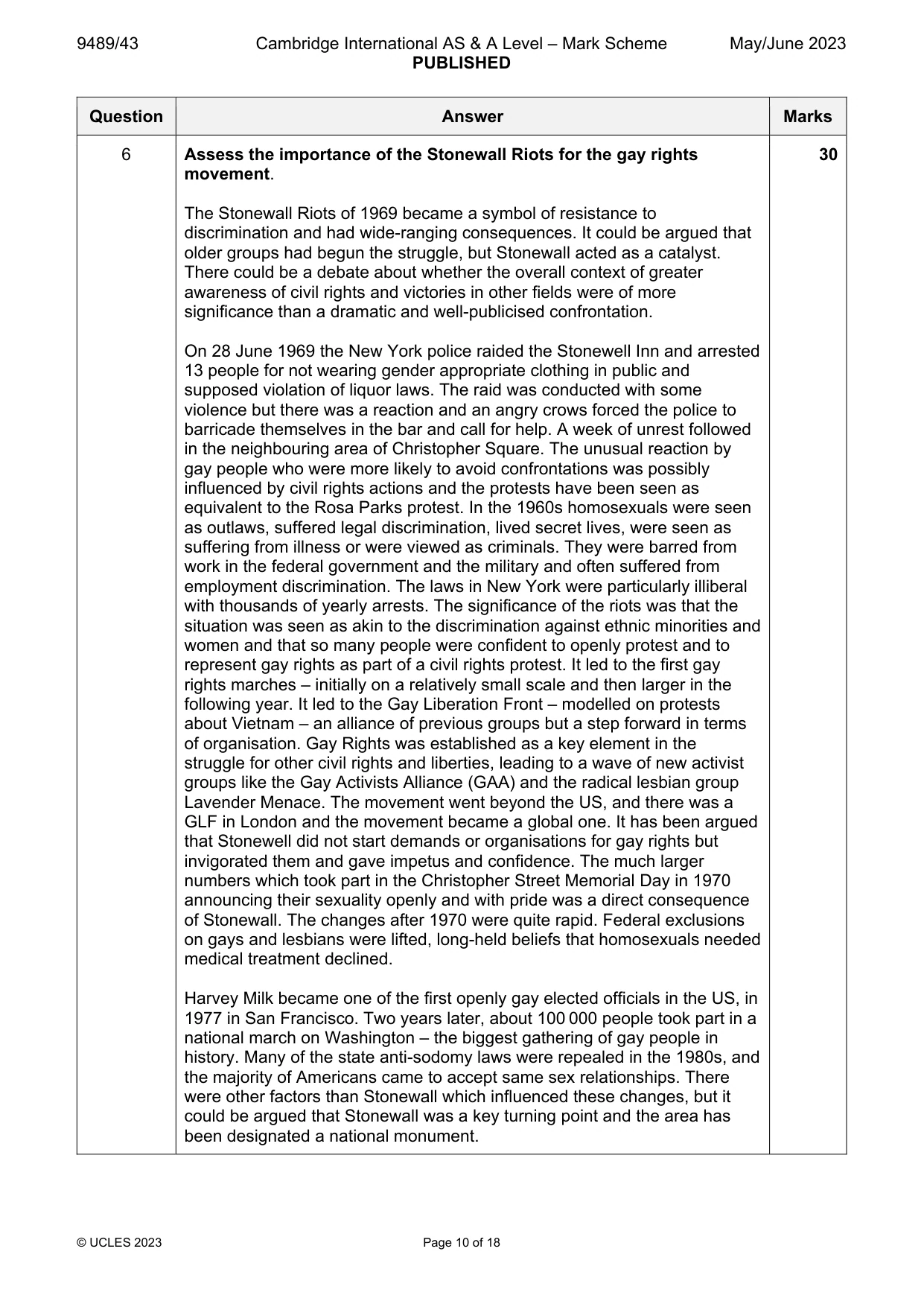
Mark scheme: 6 Assess the importance of the Stonewall Riots for the gay rights 30 movement. The Stonewall Riots of 1969 became a symbol of resistance to discrimination and had wide-ranging consequences. It could be argued that older groups had begun the struggle, but Stonewall acted as a catalyst. There could be a debate about whether the overall context of greater awareness of civil rights and victories in other fields were of more significance than a dramatic and well-publicised confrontation. On 28 June 1969 the New York police raided the Stonewell Inn and arrested 13 people for not wearing gender appropriate clothing in public and supposed violation of liquor laws. The raid was conducted with some violence but there was a reaction and an angry crows forced the police to barricade themselves in the bar and call for help. A week of unrest followed in the neighbouring area of Christopher Square. The unusual reaction by gay people who were more likely to avoid confrontations was possibly influenced by civil rights actions and the protests have been seen as equivalent to the Rosa Parks protest. In the 1960s homosexuals were seen as outlaws, suffered legal discrimination, lived secret lives, were seen as suffering from illness or were viewed as criminals. They were barred from work in the federal government and the military and often suffered from employment discrimination. The laws in New York were particularly illiberal with thousands of yearly arrests. The significance of the riots was that the situation was seen as akin to the discrimination against ethnic minorities and women and that so many people were confident to openly protest and to represent gay rights as part of a civil rights protest. It led to the first gay rights marches – initially on a relatively small scale and then larger in the following year. It led to the Gay Liberation Front – modelled on protests about Vietnam – an alliance of previous groups but a step forward in terms of organisation. Gay Rights was established as a key element in the struggle for other civil rights and liberties, leading to a wave of new activist groups like the Gay Activists Alliance (GAA) and the radical lesbian group Lavender Menace. The movement went beyond the US, and there was a GLF in London and the movement became a global one. It has been argued that Stonewell did not start demands or organisations for gay rights but invigorated them and gave impetus and confidence. The much larger numbers which took part in the Christopher Street Memorial Day in 1970 announcing their sexuality openly and with pride was a direct consequence of Stonewall. The changes after 1970 were quite rapid. Federal exclusions on gays and lesbians were lifted, long-held beliefs that homosexuals needed medical treatment declined. Harvey Milk became one of the first openly gay elected officials in the US, in 1977 in San Francisco. Two years later, about 100 000 people took part in a national march on Washington – the biggest gathering of gay people in history. Many of the state anti-sodomy laws were repealed in the 1980s, and the majority of Americans came to accept same sex relationships. There were other factors than Stonewall which influenced these changes, but it could be argued that Stonewall was a key turning point and the area has been designated a national monument.
More questions on How successful was the Progressive Movement from 1890 to 1920?
Q7 · Evaluate the reasons for the changing fortunes of the Democrats in the period 1980–92
7 Evaluate the reasons for the changing fortunes of the Democrats in the period 1980–92. [30]
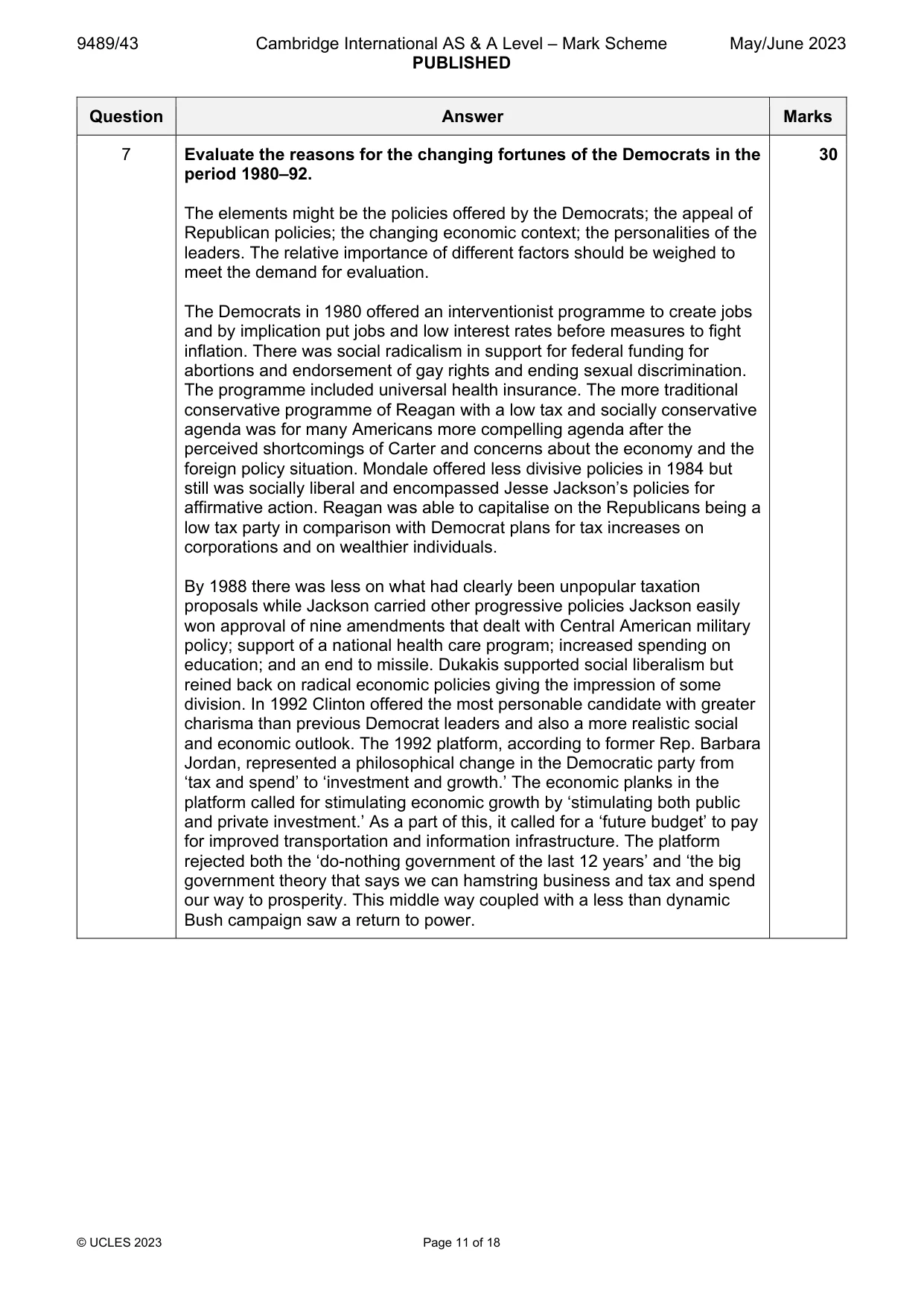
Mark scheme: 7 Evaluate the reasons for the changing fortunes of the Democrats in the 30 period 1980–92. The elements might be the policies offered by the Democrats; the appeal of Republican policies; the changing economic context; the personalities of the leaders. The relative importance of different factors should be weighed to meet the demand for evaluation. The Democrats in 1980 offered an interventionist programme to create jobs and by implication put jobs and low interest rates before measures to fight inflation. There was social radicalism in support for federal funding for abortions and endorsement of gay rights and ending sexual discrimination. The programme included universal health insurance. The more traditional conservative programme of Reagan with a low tax and socially conservative agenda was for many Americans more compelling agenda after the perceived shortcomings of Carter and concerns about the economy and the foreign policy situation. Mondale offered less divisive policies in 1984 but still was socially liberal and encompassed Jesse Jackson’s policies for affirmative action. Reagan was able to capitalise on the Republicans being a low tax party in comparison with Democrat plans for tax increases on corporations and on wealthier individuals. By 1988 there was less on what had clearly been unpopular taxation proposals while Jackson carried other progressive policies Jackson easily won approval of nine amendments that dealt with Central American military policy; support of a national health care program; increased spending on education; and an end to missile. Dukakis supported social liberalism but reined back on radical economic policies giving the impression of some division. In 1992 Clinton offered the most personable candidate with greater charisma than previous Democrat leaders and also a more realistic social and economic outlook. The 1992 platform, according to former Rep. Barbara Jordan, represented a philosophical change in the Democratic party from ‘tax and spend’ to ‘investment and growth.’ The economic planks in the platform called for stimulating economic growth by ‘stimulating both public and private investment.’ As a part of this, it called for a ‘future budget’ to pay for improved transportation and information infrastructure. The platform rejected both the ‘do-nothing government of the last 12 years’ and ‘the big government theory that says we can hamstring business and tax and spend our way to prosperity. This middle way coupled with a less than dynamic Bush campaign saw a return to power.
More questions on Why was there a second New Deal and how successful was it?
Q8 · Assess the reasons why US leadership of the global economy was being challenged by 1970
8 Assess the reasons why US leadership of the global economy was being challenged by 1970. [30] Section C: International history, 1945–92
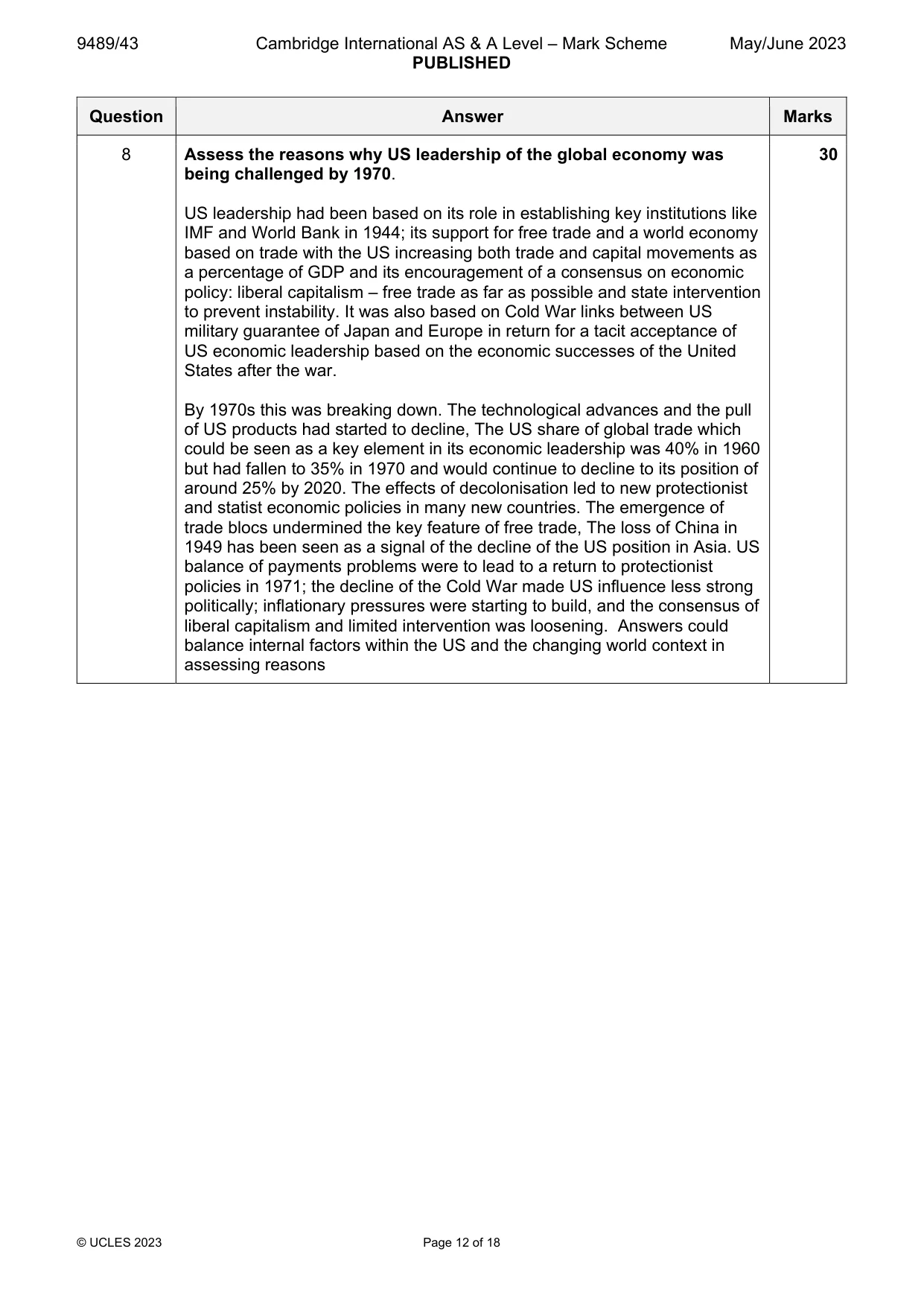
Mark scheme: 8 Assess the reasons why US leadership of the global economy was 30 being challenged by 1970. US leadership had been based on its role in establishing key institutions like IMF and World Bank in 1944; its support for free trade and a world economy based on trade with the US increasing both trade and capital movements as a percentage of GDP and its encouragement of a consensus on economic policy: liberal capitalism – free trade as far as possible and state intervention to prevent instability. It was also based on Cold War links between US military guarantee of Japan and Europe in return for a tacit acceptance of US economic leadership based on the economic successes of the United States after the war. By 1970s this was breaking down. The technological advances and the pull of US products had started to decline, The US share of global trade which could be seen as a key element in its economic leadership was 40% in 1960 but had fallen to 35% in 1970 and would continue to decline to its position of around 25% by 2020. The effects of decolonisation led to new protectionist and statist economic policies in many new countries. The emergence of trade blocs undermined the key feature of free trade, The loss of China in 1949 has been seen as a signal of the decline of the US position in Asia. US balance of payments problems were to lead to a return to protectionist policies in 1971; the decline of the Cold War made US influence less strong politically; inflationary pressures were starting to build, and the consensus of liberal capitalism and limited intervention was loosening. Answers could balance internal factors within the US and the changing world context in assessing reasons
More questions on Why did the USA emerge as a world power and what was the impact on international
Q9 · Assess how far the United States was responsible for the development of the nuclear arms…
9 Assess how far the United States was responsible for the development of the nuclear arms race in the 1950s and 1960s. [30]
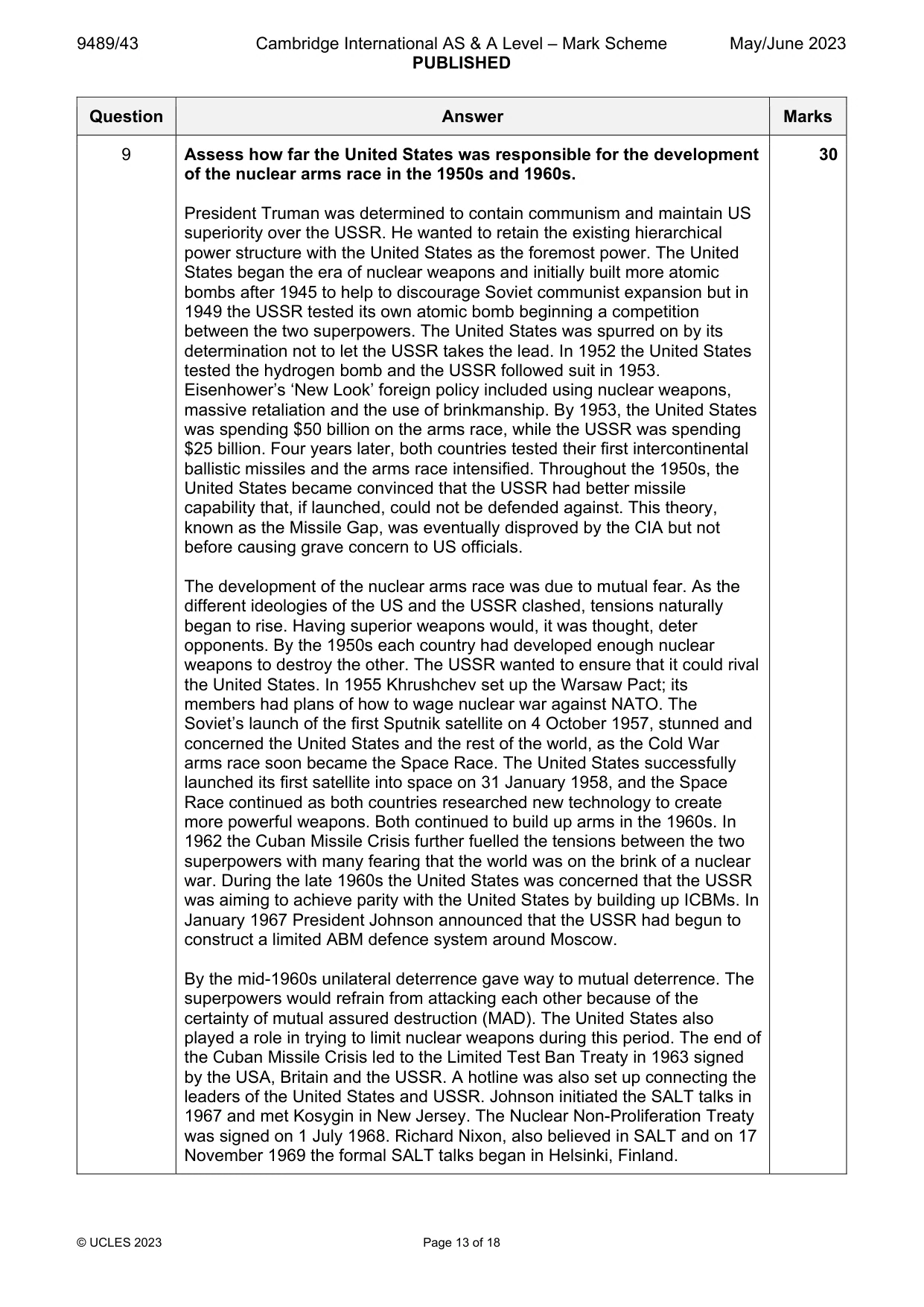
Mark scheme: 9 Assess how far the United States was responsible for the development 30 of the nuclear arms race in the 1950s and 1960s. President Truman was determined to contain communism and maintain US superiority over the USSR. He wanted to retain the existing hierarchical power structure with the United States as the foremost power. The United States began the era of nuclear weapons and initially built more atomic bombs after 1945 to help to discourage Soviet communist expansion but in 1949 the USSR tested its own atomic bomb beginning a competition between the two superpowers. The United States was spurred on by its determination not to let the USSR takes the lead. In 1952 the United States tested the hydrogen bomb and the USSR followed suit in 1953. Eisenhower’s ‘New Look’ foreign policy included using nuclear weapons, massive retaliation and the use of brinkmanship. By 1953, the United States was spending $50 billion on the arms race, while the USSR was spending $25 billion. Four years later, both countries tested their first intercontinental ballistic missiles and the arms race intensified. Throughout the 1950s, the United States became convinced that the USSR had better missile capability that, if launched, could not be defended against. This theory, known as the Missile Gap, was eventually disproved by the CIA but not before causing grave concern to US officials. The development of the nuclear arms race was due to mutual fear. As the different ideologies of the US and the USSR clashed, tensions naturally began to rise. Having superior weapons would, it was thought, deter opponents. By the 1950s each country had developed enough nuclear weapons to destroy the other. The USSR wanted to ensure that it could rival the United States. In 1955 Khrushchev set up the Warsaw Pact; its members had plans of how to wage nuclear war against NATO. The Soviet’s launch of the first Sputnik satellite on 4 October 1957, stunned and concerned the United States and the rest of the world, as the Cold War arms race soon became the Space Race. The United States successfully launched its first satellite into space on 31 January 1958, and the Space Race continued as both countries researched new technology to create more powerful weapons. Both continued to build up arms in the 1960s. In 1962 the Cuban Missile Crisis further fuelled the tensions between the two superpowers with many fearing that the world was on the brink of a nuclear war. During the late 1960s the United States was concerned that the USSR was aiming to achieve parity with the United States by building up ICBMs. In January 1967 President Johnson announced that the USSR had begun to construct a limited ABM defence system around Moscow. By the mid-1960s unilateral deterrence gave way to mutual deterrence. The superpowers would refrain from attacking each other because of the certainty of mutual assured destruction (MAD). The United States also played a role in trying to limit nuclear weapons during this period. The end of the Cuban Missile Crisis led to the Limited Test Ban Treaty in 1963 signed by the USA, Britain and the USSR. A hotline was also set up connecting the leaders of the United States and USSR. Johnson initiated the SALT talks in 1967 and met Kosygin in New Jersey. The Nuclear Non-Proliferation Treaty was signed on 1 July 1968. Richard Nixon, also believed in SALT and on 17 November 1969 the formal SALT talks began in Helsinki, Finland.
More questions on Why did the USA emerge as a world power and what was the impact on international
Q10 · Discuss the extent to which ideological differences affected Sino-Soviet relations in the…
10 Discuss the extent to which ideological differences affected Sino-Soviet relations in the period 1949–69. [30]
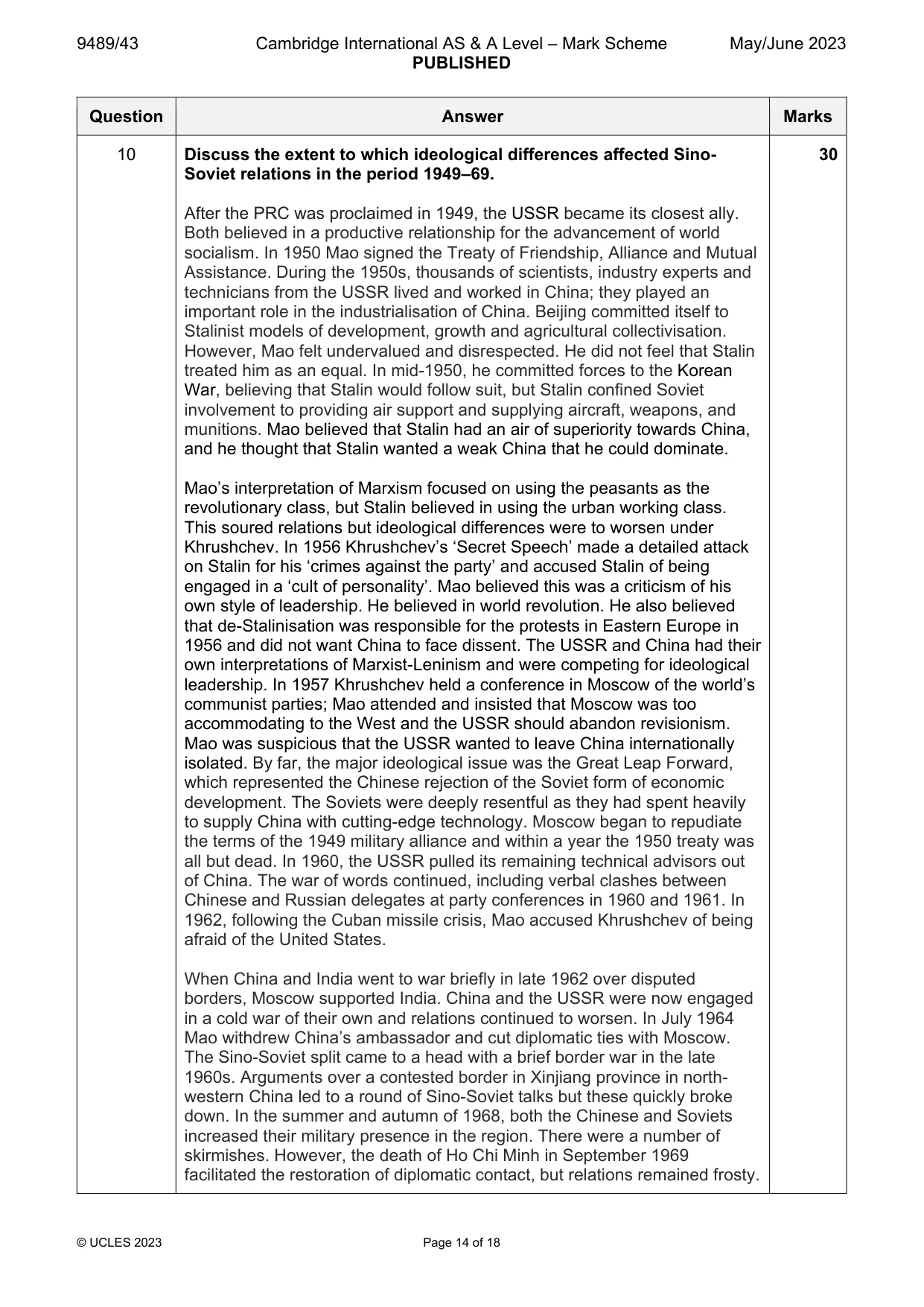
Mark scheme: 10 Discuss the extent to which ideological differences affected Sino- 30 Soviet relations in the period 1949–69. After the PRC was proclaimed in 1949, the USSR became its closest ally. Both believed in a productive relationship for the advancement of world socialism. In 1950 Mao signed the Treaty of Friendship, Alliance and Mutual Assistance. During the 1950s, thousands of scientists, industry experts and technicians from the USSR lived and worked in China; they played an important role in the industrialisation of China. Beijing committed itself to Stalinist models of development, growth and agricultural collectivisation. However, Mao felt undervalued and disrespected. He did not feel that Stalin treated him as an equal. In mid-1950, he committed forces to the Korean War, believing that Stalin would follow suit, but Stalin confined Soviet involvement to providing air support and supplying aircraft, weapons, and munitions. Mao believed that Stalin had an air of superiority towards China, and he thought that Stalin wanted a weak China that he could dominate. Mao’s interpretation of Marxism focused on using the peasants as the revolutionary class, but Stalin believed in using the urban working class. This soured relations but ideological differences were to worsen under Khrushchev. In 1956 Khrushchev’s ‘Secret Speech’ made a detailed attack on Stalin for his ‘crimes against the party’ and accused Stalin of being engaged in a ‘cult of personality’. Mao believed this was a criticism of his own style of leadership. He believed in world revolution. He also believed that de-Stalinisation was responsible for the protests in Eastern Europe in 1956 and did not want China to face dissent. The USSR and China had their own interpretations of Marxist-Leninism and were competing for ideological leadership. In 1957 Khrushchev held a conference in Moscow of the world’s communist parties; Mao attended and insisted that Moscow was too accommodating to the West and the USSR should abandon revisionism. Mao was suspicious that the USSR wanted to leave China internationally isolated. By far, the major ideological issue was the Great Leap Forward, which represented the Chinese rejection of the Soviet form of economic development. The Soviets were deeply resentful as they had spent heavily to supply China with cutting-edge technology. Moscow began to repudiate the terms of the 1949 military alliance and within a year the 1950 treaty was all but dead. In 1960, the USSR pulled its remaining technical advisors out of China. The war of words continued, including verbal clashes between Chinese and Russian delegates at party conferences in 1960 and 1961. In 1962, following the Cuban missile crisis, Mao accused Khrushchev of being afraid of the United States. When China and India went to war briefly in late 1962 over disputed borders, Moscow supported India. China and the USSR were now engaged in a cold war of their own and relations continued to worsen. In July 1964 Mao withdrew China’s ambassador and cut diplomatic ties with Moscow. The Sino-Soviet split came to a head with a brief border war in the late 1960s. Arguments over a contested border in Xinjiang province in north- western China led to a round of Sino-Soviet talks but these quickly broke down. In the summer and autumn of 1968, both the Chinese and Soviets increased their military presence in the region. There were a number of skirmishes. However, the death of Ho Chi Minh in September 1969 facilitated the restoration of diplomatic contact, but relations remained frosty.
More questions on How did the rise of extremism affect international relations?
Q11 · Evaluate how far the attitudes of colonial powers contributed to African nations gaining…
11 Evaluate how far the attitudes of colonial powers contributed to African nations gaining their independence. [30]
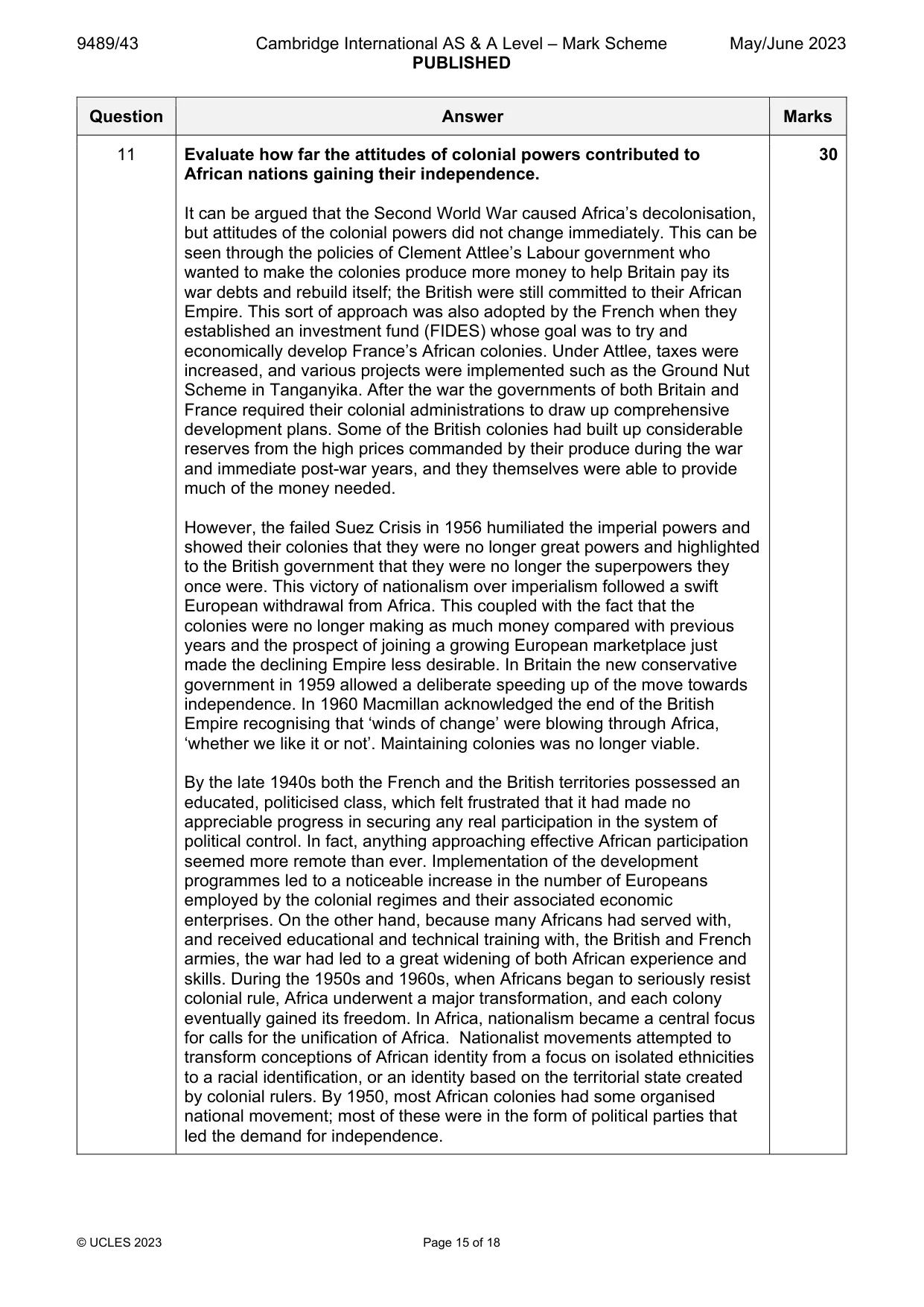
Mark scheme: 11 Evaluate how far the attitudes of colonial powers contributed to 30 African nations gaining their independence. It can be argued that the Second World War caused Africa’s decolonisation, but attitudes of the colonial powers did not change immediately. This can be seen through the policies of Clement Attlee’s Labour government who wanted to make the colonies produce more money to help Britain pay its war debts and rebuild itself; the British were still committed to their African Empire. This sort of approach was also adopted by the French when they established an investment fund (FIDES) whose goal was to try and economically develop France’s African colonies. Under Attlee, taxes were increased, and various projects were implemented such as the Ground Nut Scheme in Tanganyika. After the war the governments of both Britain and France required their colonial administrations to draw up comprehensive development plans. Some of the British colonies had built up considerable reserves from the high prices commanded by their produce during the war and immediate post-war years, and they themselves were able to provide much of the money needed. However, the failed Suez Crisis in 1956 humiliated the imperial powers and showed their colonies that they were no longer great powers and highlighted to the British government that they were no longer the superpowers they once were. This victory of nationalism over imperialism followed a swift European withdrawal from Africa. This coupled with the fact that the colonies were no longer making as much money compared with previous years and the prospect of joining a growing European marketplace just made the declining Empire less desirable. In Britain the new conservative government in 1959 allowed a deliberate speeding up of the move towards independence. In 1960 Macmillan acknowledged the end of the British Empire recognising that ‘winds of change’ were blowing through Africa, ‘whether we like it or not’. Maintaining colonies was no longer viable. By the late 1940s both the French and the British territories possessed an educated, politicised class, which felt frustrated that it had made no appreciable progress in securing any real participation in the system of political control. In fact, anything approaching effective African participation seemed more remote than ever. Implementation of the development programmes led to a noticeable increase in the number of Europeans employed by the colonial regimes and their associated economic enterprises. On the other hand, because many Africans had served with, and received educational and technical training with, the British and French armies, the war had led to a great widening of both African experience and skills. During the 1950s and 1960s, when Africans began to seriously resist colonial rule, Africa underwent a major transformation, and each colony eventually gained its freedom. In Africa, nationalism became a central focus for calls for the unification of Africa. Nationalist movements attempted to transform conceptions of African identity from a focus on isolated ethnicities to a racial identification, or an identity based on the territorial state created by colonial rulers. By 1950, most African colonies had some organised national movement; most of these were in the form of political parties that led the demand for independence. 11 These movements were more broad-based in their appeal. Political parties helped to organise national movements across Africa. Popular parties included the Kenyan African National Union (KANU) in Kenya and the Convention People’s Party in Ghana. In general, these political parties were led by charismatic nationalist figures like Nkrumah, Kenyatta and Azikiwe. They were all keen advocates of national independence.
More questions on Why was imperialism a significant force in Africa from 1870?
What was in this paper
The subtopics covered by these 11 questions, and how many questions each got. Open one in a new tab to see every Cambridge question on it.
3How successful was the Progressive Movement from 1890 to 1920?2Why did the USA emerge as a world power and what was the impact on international2How were the Bolsheviks able to consolidate their power up to 1924?1What was the impact of the Great Crash and the Great Depression in the United States?1Why was imperialism a significant force in Africa from 1870?1Why was there a second New Deal and how successful was it?1What you needed in this session
Cambridge’s own grade thresholds for 2023 May/June, Paper 4 · Variant 3. A higher threshold means an easier paper — the bar moves with how the cohort did.