Questions as text
Q1 · Assuming a constant income velocity of circulation of money, if the rate of growth of the… 9708/31 Oct/Nov 2009
17 Assuming a constant income velocity of circulation of money, if the rate of growth of the money supply is 8 % and the average price level increases by 5 %, what will be the approximate change in real output? A –3 % B +3 % C +8 % D +13 %
1 marks
Answer: B
This question in 9708/31 Oct/Nov 2009
Q2 · According to monetarist theory, what will be the short-run effect of an unexpected… 9708/31 Oct/Nov 2009
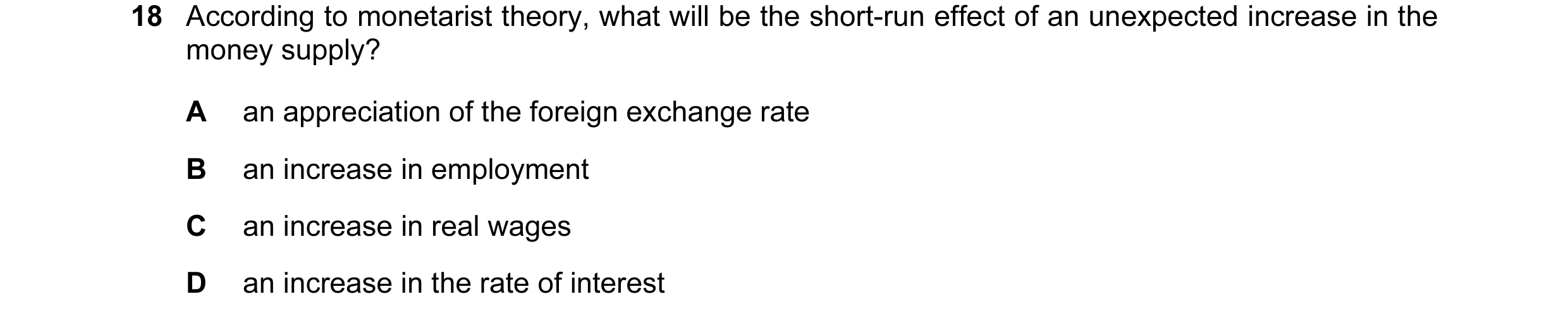
18 According to monetarist theory, what will be the short-run effect of an unexpected increase in the money supply? A an appreciation of the foreign exchange rate B an increase in employment C an increase in real wages D an increase in the rate of interest
1 marks
Answer: B
This question in 9708/31 Oct/Nov 2009
Q3 · The government sells $1 million of bonds to the commercial banks 9708/31 Oct/Nov 2009
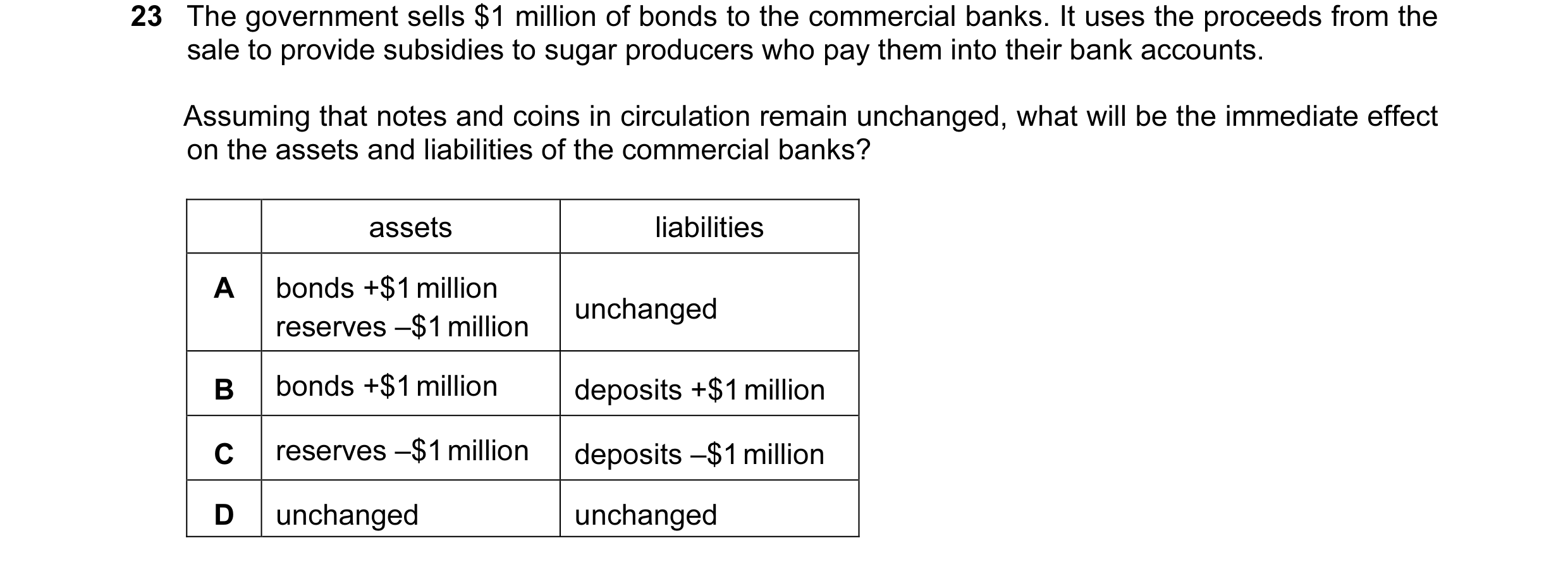
23 The government sells $1 million of bonds to the commercial banks. It uses the proceeds from the sale to provide subsidies to sugar producers who pay them into their bank accounts. Assuming that notes and coins in circulation remain unchanged, what will be the immediate effect on the assets and liabilities of the commercial banks? assets liabilities A bonds +$1 million unchanged reserves –$1 million B bonds +$1 million deposits +$1 million C reserves –$1 million deposits –$1 million D unchanged unchanged
1 marks
Answer: B
This question in 9708/31 Oct/Nov 2009
Q4 · According to loanable funds theory, what will cause the rate of interest to rise? 9708/31 Oct/Nov 2009
24 According to loanable funds theory, what will cause the rate of interest to rise? A an increase in the rate of investment B an increase in liquidity preference C an increase in the level of savings D an increase in the supply of money
1 marks
Answer: A
This question in 9708/31 Oct/Nov 2009
Q5 · Assuming a constant income velocity of circulation of money, if the rate of growth of the… 9708/32 Oct/Nov 2009
16 Assuming a constant income velocity of circulation of money, if the rate of growth of the money supply is 8 % and the average price level increases by 5 %, what will be the approximate change in real output? A –3 % B +3 % C +8 % D +13 %
1 marks
Answer: B
This question in 9708/32 Oct/Nov 2009
Q6 · According to monetarist theory, what will be the short-run effect of an unexpected… 9708/32 Oct/Nov 2009
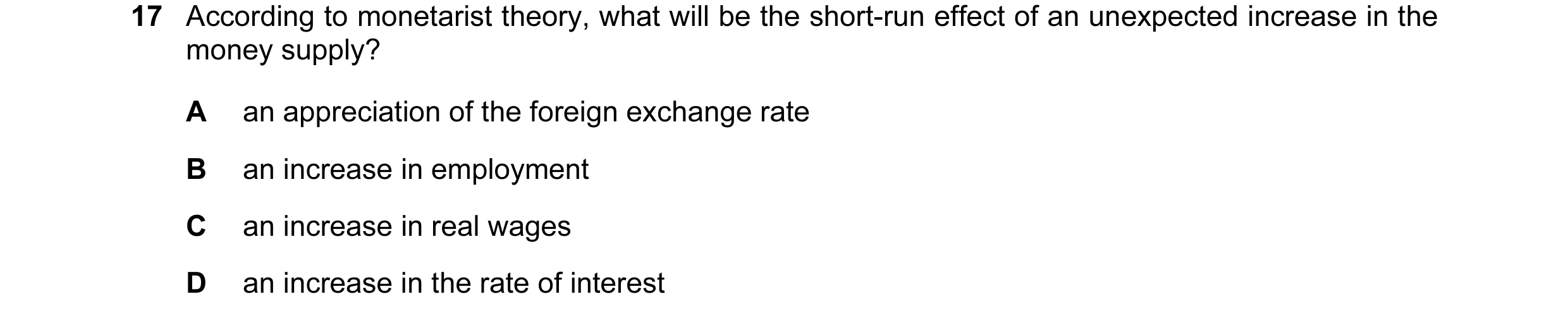
17 According to monetarist theory, what will be the short-run effect of an unexpected increase in the money supply? A an appreciation of the foreign exchange rate B an increase in employment C an increase in real wages D an increase in the rate of interest
1 marks
Answer: B
This question in 9708/32 Oct/Nov 2009
Q7 · The government sells $1 million of bonds to the commercial banks 9708/32 Oct/Nov 2009
22 The government sells $1 million of bonds to the commercial banks. It uses the proceeds from the sale to provide subsidies to sugar producers who pay them into their bank accounts. Assuming that notes and coins in circulation remain unchanged, what will be the immediate effect on the assets and liabilities of the commercial banks? assets liabilities A bonds +$1 million unchanged reserves –$1 million B bonds +$1 million deposits +$1 million C reserves –$1 million deposits –$1 million D unchanged unchanged
1 marks
Answer: B
This question in 9708/32 Oct/Nov 2009
Q8 · According to loanable funds theory, what will cause the rate of interest to rise? 9708/32 Oct/Nov 2009
23 According to loanable funds theory, what will cause the rate of interest to rise? A an increase in the rate of investment B an increase in liquidity preference C an increase in the level of savings D an increase in the supply of money
1 marks
Answer: A
This question in 9708/32 Oct/Nov 2009
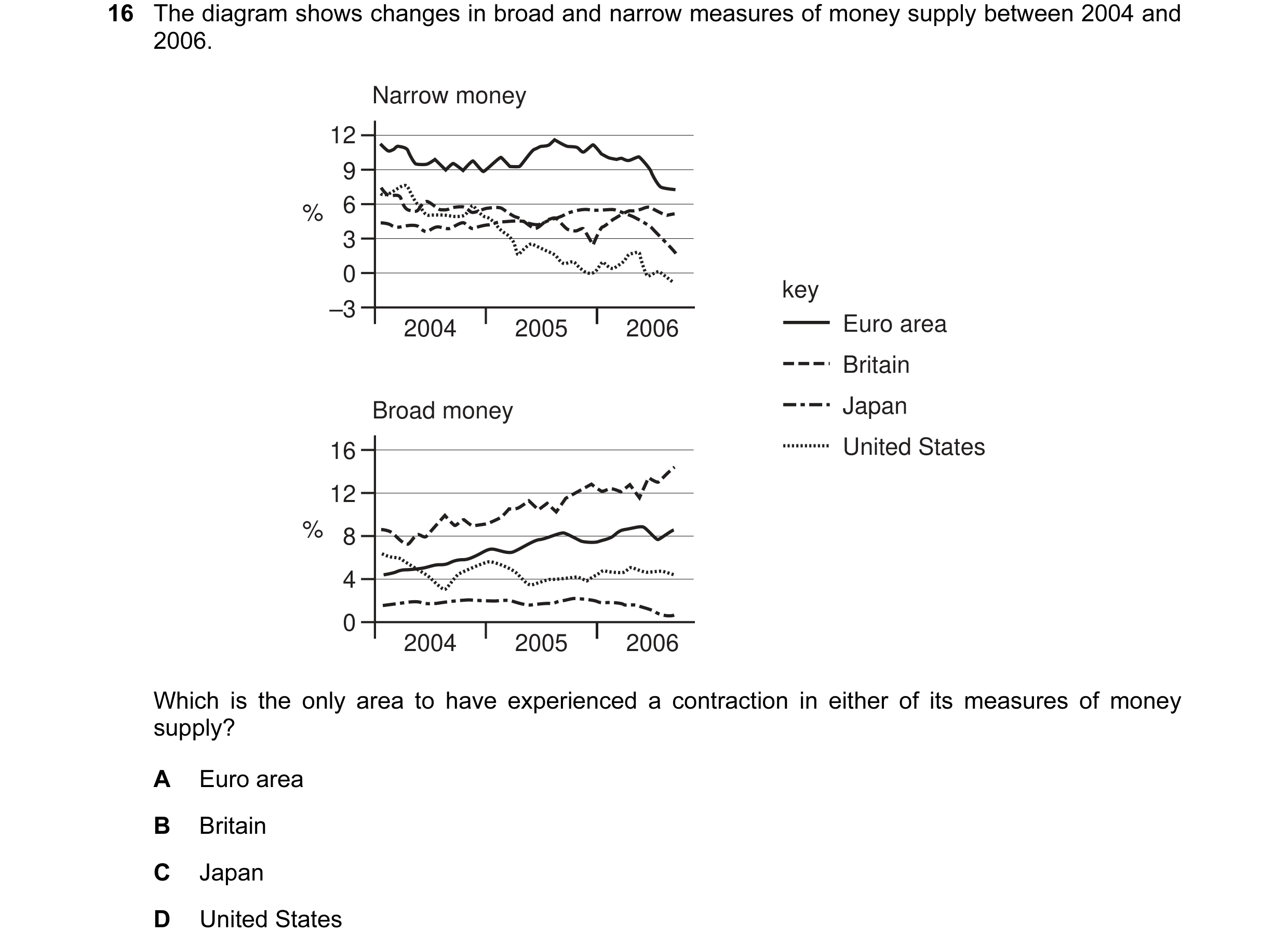
Q9 · The diagram shows changes in broad and narrow measures of money supply between 2004 and… 9708/31 May/June 2010
16 The diagram shows changes in broad and narrow measures of money supply between 2004 and 2006. Narrow money 12 9 % 6 3 0 key –3 2004 2005 2006 Euro area Britain Broad money Japan 16 United States 12 % 8 4 0 2004 2005 2006 Which is the only area to have experienced a contraction in either of its measures of money supply? A Euro area B Britain C Japan D United States
1 marks
Answer: D
This question in 9708/31 May/June 2010
Q10 · What is a central assertion of monetarist economics? 9708/31 May/June 2010
17 What is a central assertion of monetarist economics? A Fiscal policy should be used for the continuous management of the economy. B Major recessions can occur despite an unchanged money supply. C The money supply is the main determinant of aggregate monetary expenditure. D The velocity of circulation of money is unstable over time.
1 marks
Answer: C
This question in 9708/31 May/June 2010
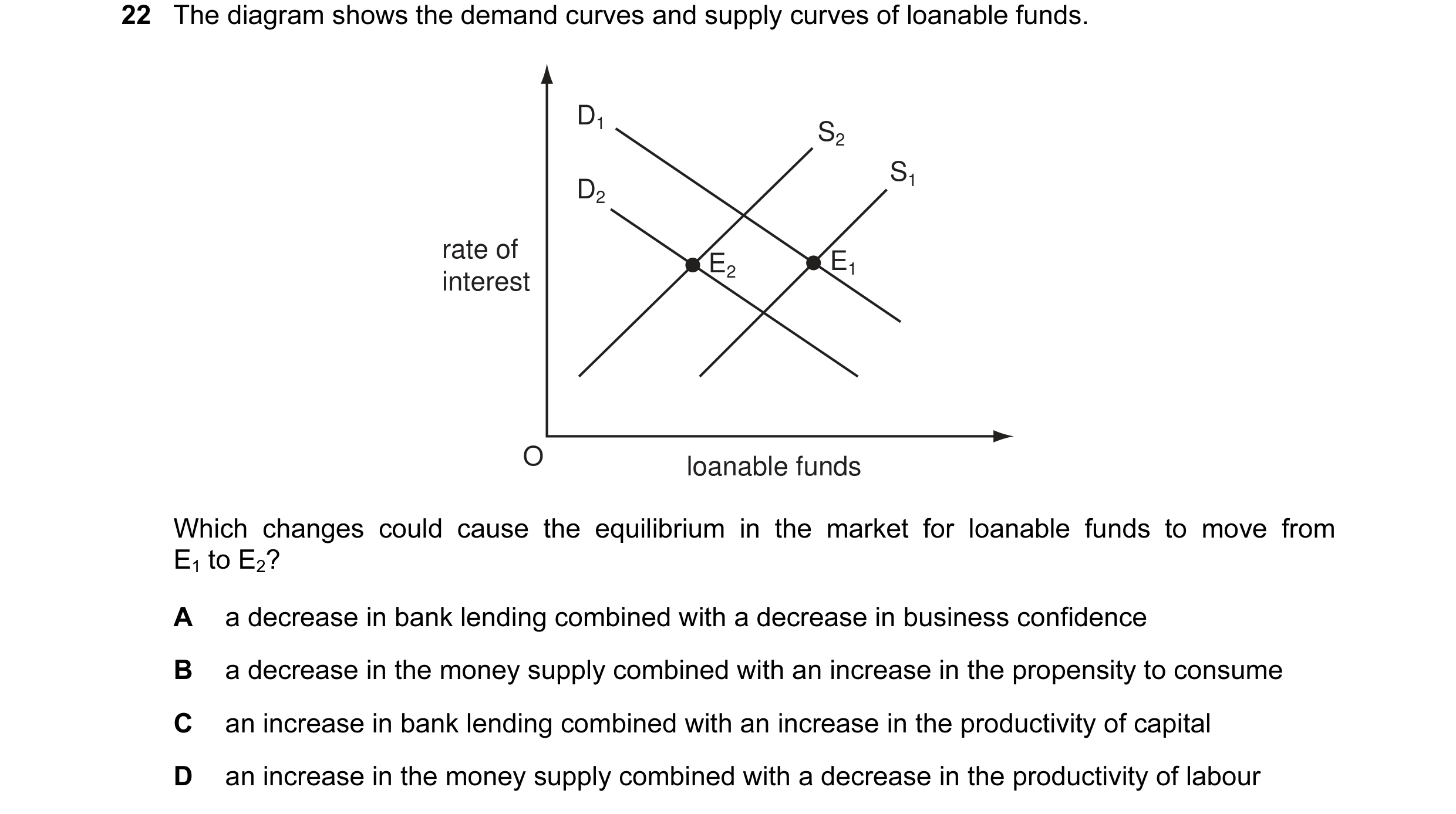
Q11 · The diagram shows the demand curves and supply curves of loanable funds 9708/31 May/June 2010
22 The diagram shows the demand curves and supply curves of loanable funds. D1 S2 S1 D2 rate of E1 E2 interest O loanable funds Which changes could cause the equilibrium in the market for loanable funds to move from E1 to E2? A a decrease in bank lending combined with a decrease in business confidence B a decrease in the money supply combined with an increase in the propensity to consume C an increase in bank lending combined with an increase in the productivity of capital D an increase in the money supply combined with a decrease in the productivity of labour
1 marks
Answer: A
This question in 9708/31 May/June 2010
Q12 · If the money supply is fixed, a decrease in economic activity A increases interest rates 9708/31 May/June 2010
23 If the money supply is fixed, a decrease in economic activity A increases interest rates. B increases the transactions demand for money. C raises the liquidity preference schedule. D reduces the income velocity of circulation.
1 marks
Answer: D
This question in 9708/31 May/June 2010
Q13 · An economy has underemployed resources 9708/31 May/June 2010
29 An economy has underemployed resources. Which method of financing an increase in government expenditure is likely to have the greatest expansionary effect? A borrowing from the central bank B borrowing from the non-bank private sector C increased direct taxation D increased indirect taxation
1 marks
Answer: A
This question in 9708/31 May/June 2010
Q14 · The diagram shows changes in broad and narrow measures of money supply between 2004 and… 9708/32 May/June 2010
15 The diagram shows changes in broad and narrow measures of money supply between 2004 and 2006. Narrow money 12 9 % 6 3 0 key –3 2004 2005 2006 Euro area Britain Broad money Japan 16 United States 12 % 8 4 0 2004 2005 2006 Which is the only area to have experienced a contraction in either of its measures of money supply? A Euro area B Britain C Japan D United States
1 marks
Answer: D
This question in 9708/32 May/June 2010
Q15 · What is a central assertion of monetarist economics? 9708/32 May/June 2010
16 What is a central assertion of monetarist economics? A Fiscal policy should be used for the continuous management of the economy. B Major recessions can occur despite an unchanged money supply. C The money supply is the main determinant of aggregate monetary expenditure. D The velocity of circulation of money is unstable over time.
1 marks
Answer: C
This question in 9708/32 May/June 2010
Q16 · The diagram shows the demand curves and supply curves of loanable funds 9708/32 May/June 2010
21 The diagram shows the demand curves and supply curves of loanable funds. D1 S2 S1 D2 rate of E1 E2 interest O loanable funds Which changes could cause the equilibrium in the market for loanable funds to move from E1 to E2? A a decrease in bank lending combined with a decrease in business confidence B a decrease in the money supply combined with an increase in the propensity to consume C an increase in bank lending combined with an increase in the productivity of capital D an increase in the money supply combined with a decrease in the productivity of labour
1 marks
Answer: A
This question in 9708/32 May/June 2010
Q17 · If the money supply is fixed, a decrease in economic activity A increases interest rates 9708/32 May/June 2010
22 If the money supply is fixed, a decrease in economic activity A increases interest rates. B increases the transactions demand for money. C raises the liquidity preference schedule. D reduces the income velocity of circulation.
1 marks
Answer: D
This question in 9708/32 May/June 2010
Q18 · An economy is operating at its natural rate of unemployment 9708/32 May/June 2010
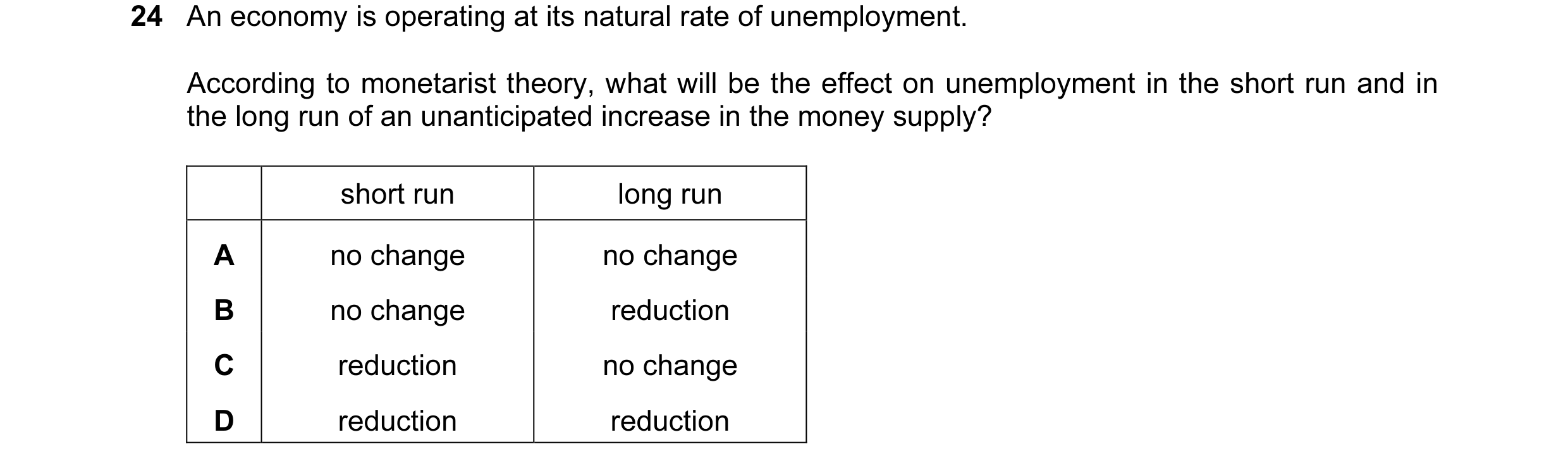
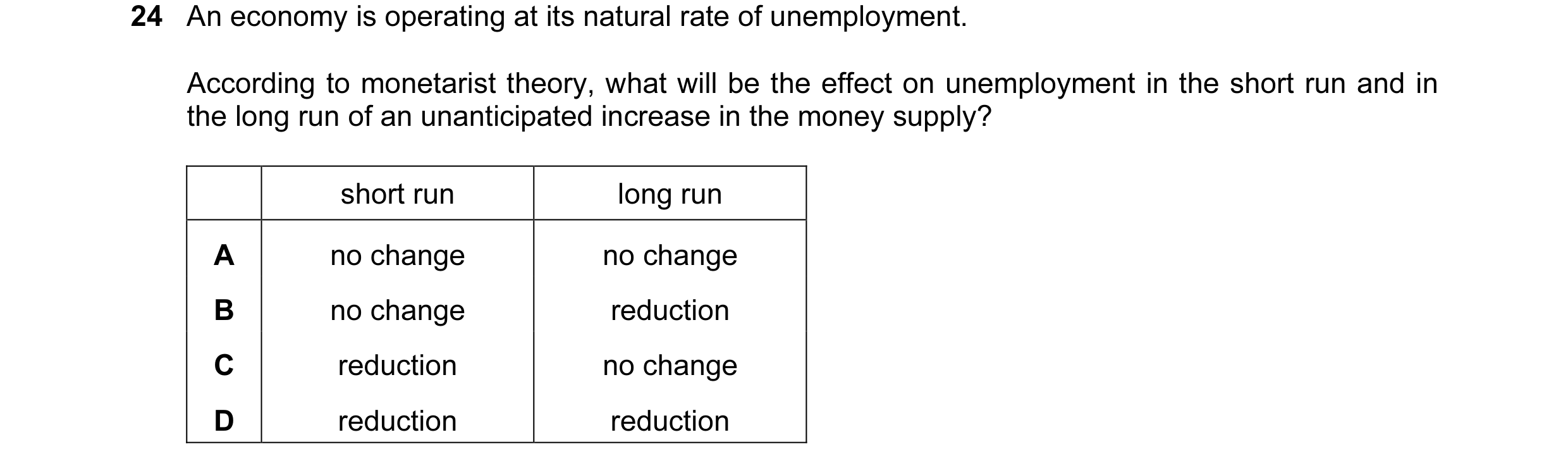
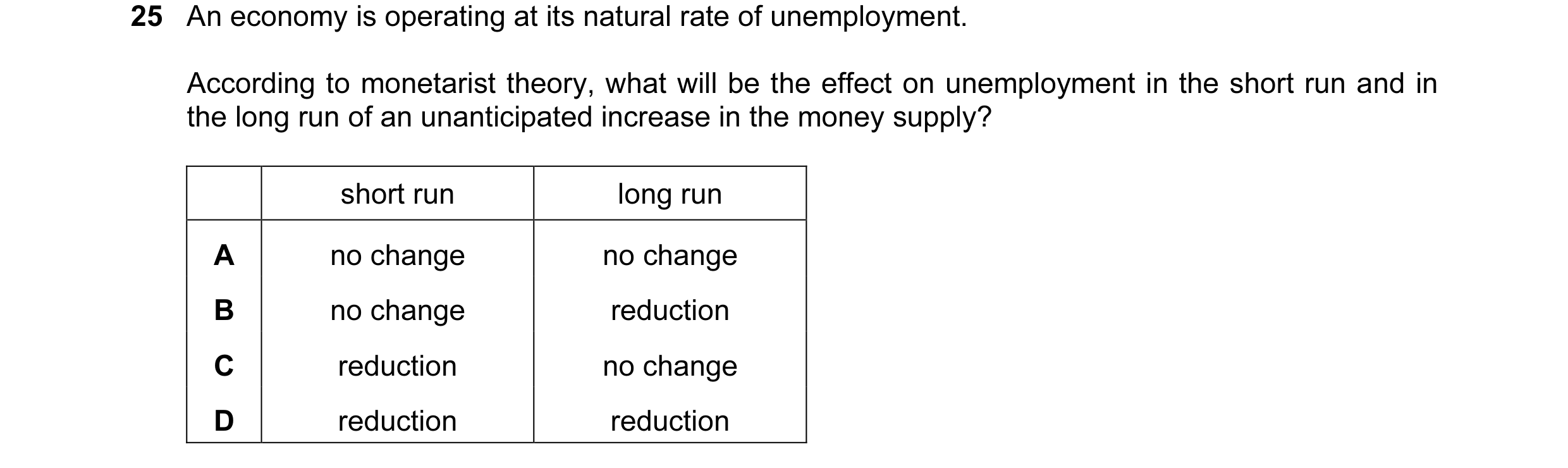
24 An economy is operating at its natural rate of unemployment. According to monetarist theory, what will be the effect on unemployment in the short run and in the long run of an unanticipated increase in the money supply? short run long run A no change no change B no change reduction C reduction no change D reduction reduction
1 marks
Answer: C
This question in 9708/32 May/June 2010
Q19 · An economy has underemployed resources 9708/32 May/June 2010
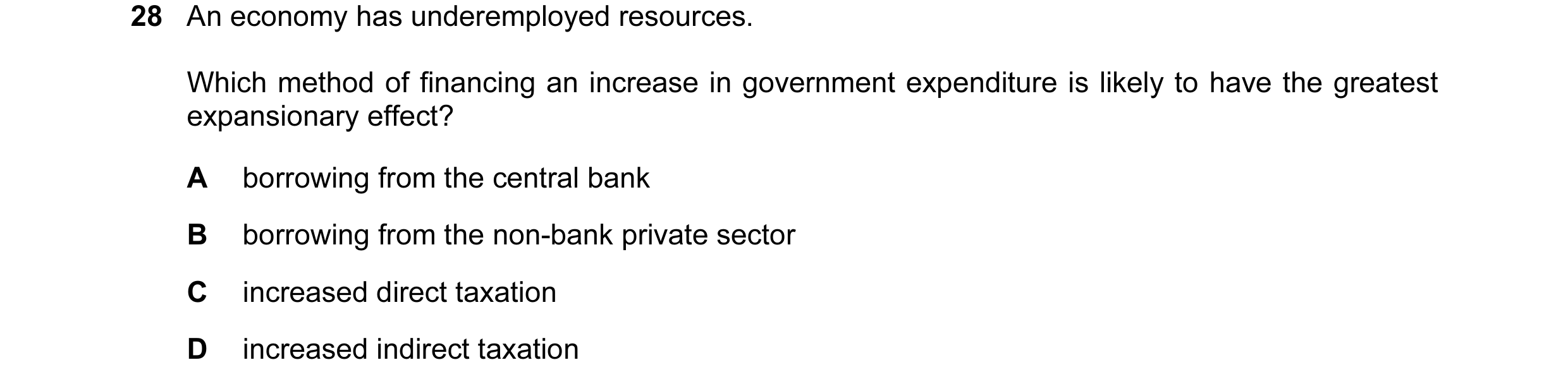
28 An economy has underemployed resources. Which method of financing an increase in government expenditure is likely to have the greatest expansionary effect? A borrowing from the central bank B borrowing from the non-bank private sector C increased direct taxation D increased indirect taxation
1 marks
Answer: A
This question in 9708/32 May/June 2010
Q20 · The diagram shows changes in broad and narrow measures of money supply between 2004 and… 9708/33 May/June 2010
15 The diagram shows changes in broad and narrow measures of money supply between 2004 and 2006. Narrow money 12 9 % 6 3 0 key –3 2004 2005 2006 Euro area Britain Broad money Japan 16 United States 12 % 8 4 0 2004 2005 2006 Which is the only area to have experienced a contraction in either of its measures of money supply? A Euro area B Britain C Japan D United States
1 marks
Answer: D
This question in 9708/33 May/June 2010
Q21 · What is a central assertion of monetarist economics? 9708/33 May/June 2010
16 What is a central assertion of monetarist economics? A Fiscal policy should be used for the continuous management of the economy. B Major recessions can occur despite an unchanged money supply. C The money supply is the main determinant of aggregate monetary expenditure. D The velocity of circulation of money is unstable over time.
1 marks
Answer: C
This question in 9708/33 May/June 2010
Q22 · The diagram shows the demand curves and supply curves of loanable funds 9708/33 May/June 2010
21 The diagram shows the demand curves and supply curves of loanable funds. D1 S2 S1 D2 rate of E1 E2 interest O loanable funds Which changes could cause the equilibrium in the market for loanable funds to move from E1 to E2? A a decrease in bank lending combined with a decrease in business confidence B a decrease in the money supply combined with an increase in the propensity to consume C an increase in bank lending combined with an increase in the productivity of capital D an increase in the money supply combined with a decrease in the productivity of labour
1 marks
Answer: A
This question in 9708/33 May/June 2010
Q23 · If the money supply is fixed, a decrease in economic activity A increases interest rates 9708/33 May/June 2010
22 If the money supply is fixed, a decrease in economic activity A increases interest rates. B increases the transactions demand for money. C raises the liquidity preference schedule. D reduces the income velocity of circulation.
1 marks
Answer: D
This question in 9708/33 May/June 2010
Q24 · An economy is operating at its natural rate of unemployment 9708/33 May/June 2010
24 An economy is operating at its natural rate of unemployment. According to monetarist theory, what will be the effect on unemployment in the short run and in the long run of an unanticipated increase in the money supply? short run long run A no change no change B no change reduction C reduction no change D reduction reduction
1 marks
Answer: C
This question in 9708/33 May/June 2010
Q25 · An economy has underemployed resources 9708/33 May/June 2010
28 An economy has underemployed resources. Which method of financing an increase in government expenditure is likely to have the greatest expansionary effect? A borrowing from the central bank B borrowing from the non-bank private sector C increased direct taxation D increased indirect taxation
1 marks
Answer: A
This question in 9708/33 May/June 2010
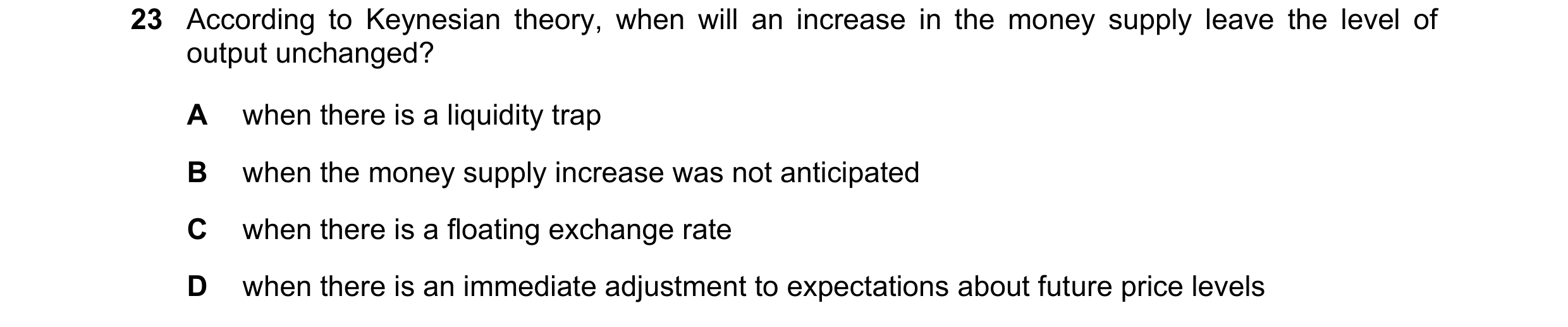
Q26 · According to Keynesian theory, when will an increase in the money supply leave the level… 9708/31 Oct/Nov 2010
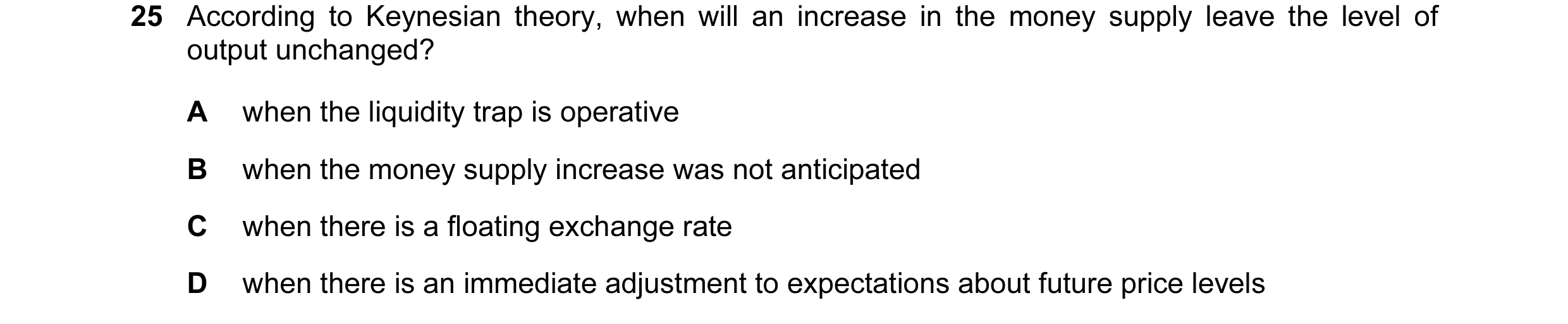
17 According to Keynesian theory, when will an increase in the money supply leave the level of output unchanged? A when the liquidity trap is operative B when the money supply increase was not anticipated C when there is a floating exchange rate D when there is an immediate adjustment to expectations about future price levels
1 marks
Answer: A
This question in 9708/31 Oct/Nov 2010
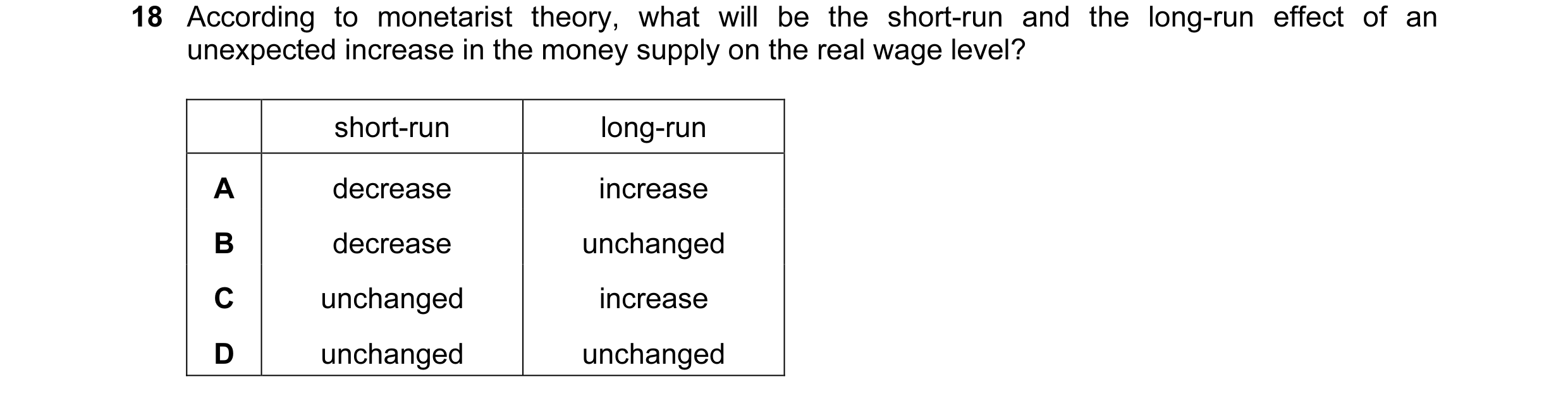
Q27 · According to monetarist theory, what will be the short-run and the long-run effect of an… 9708/31 Oct/Nov 2010
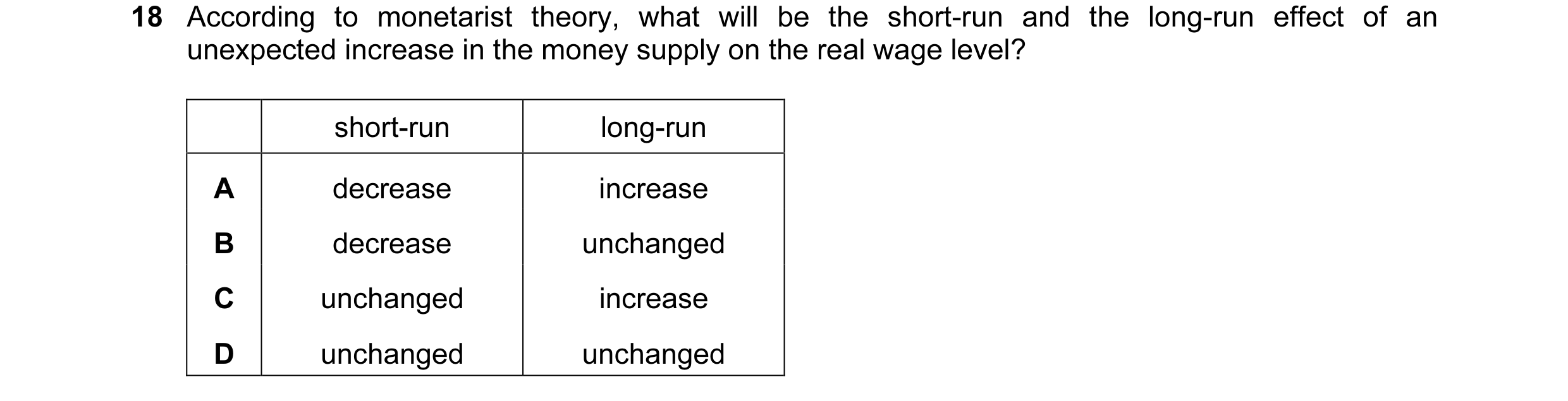
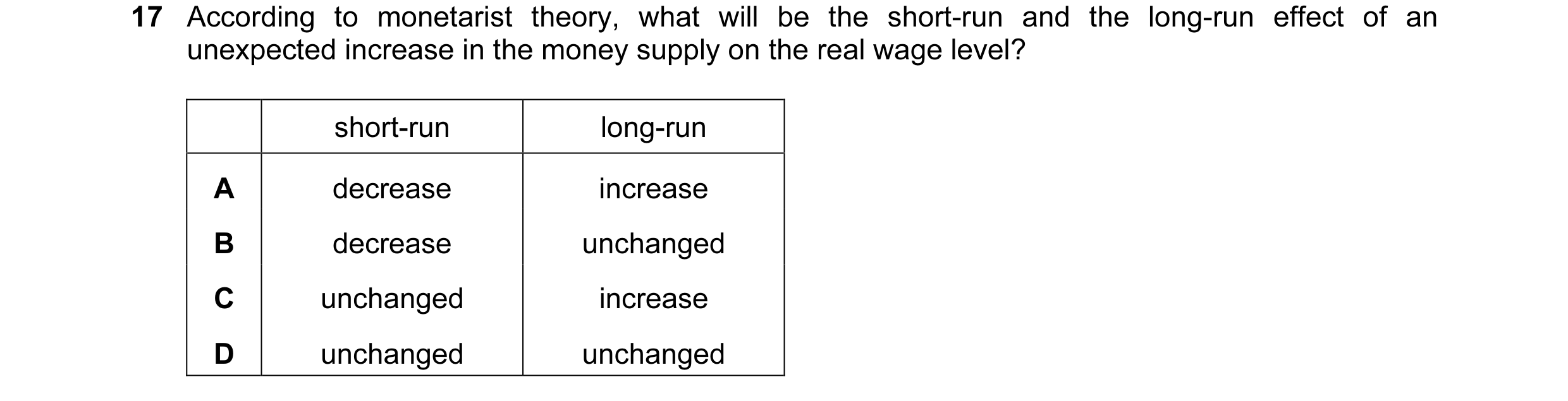
18 According to monetarist theory, what will be the short-run and the long-run effect of an unexpected increase in the money supply on the real wage level? short-run long-run A decrease increase B decrease unchanged C unchanged increase D unchanged unchanged
1 marks
Answer: B
This question in 9708/31 Oct/Nov 2010
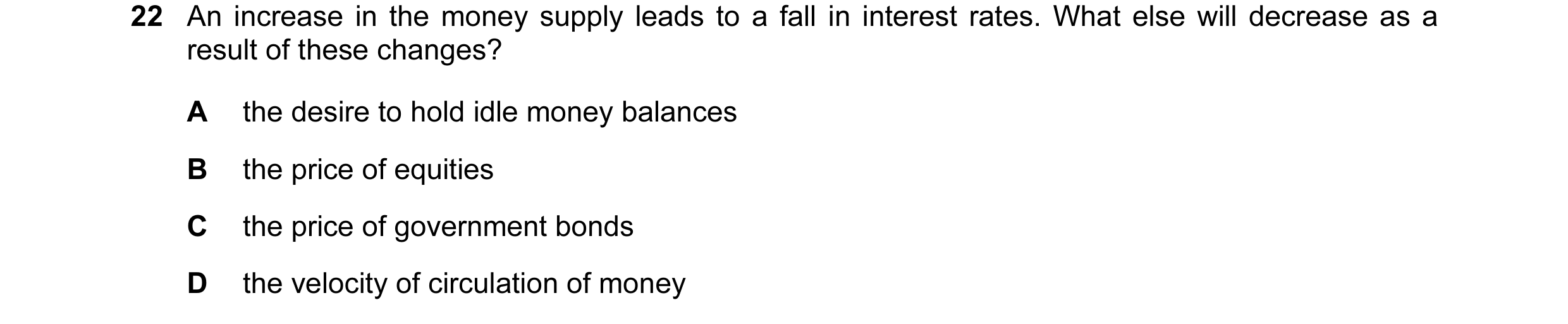
Q28 · An increase in the money supply leads to a fall in interest rates 9708/31 Oct/Nov 2010
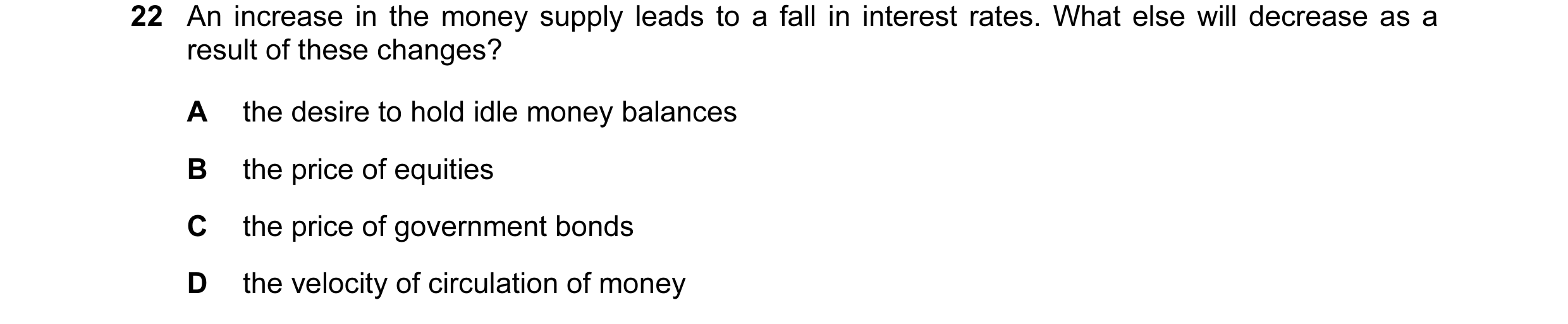
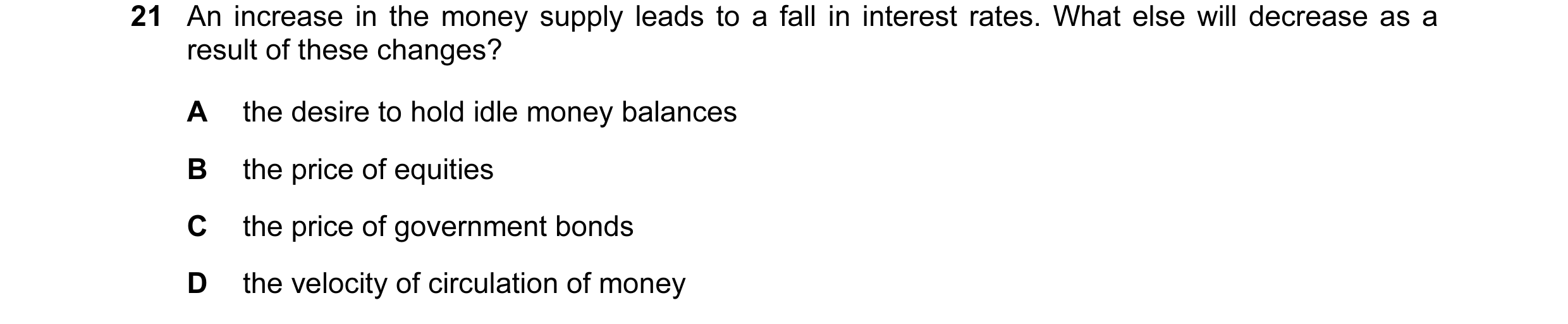
22 An increase in the money supply leads to a fall in interest rates. What else will decrease as a result of these changes? A the desire to hold idle money balances B the price of equities C the price of government bonds D the velocity of circulation of money
1 marks
Answer: D
This question in 9708/31 Oct/Nov 2010
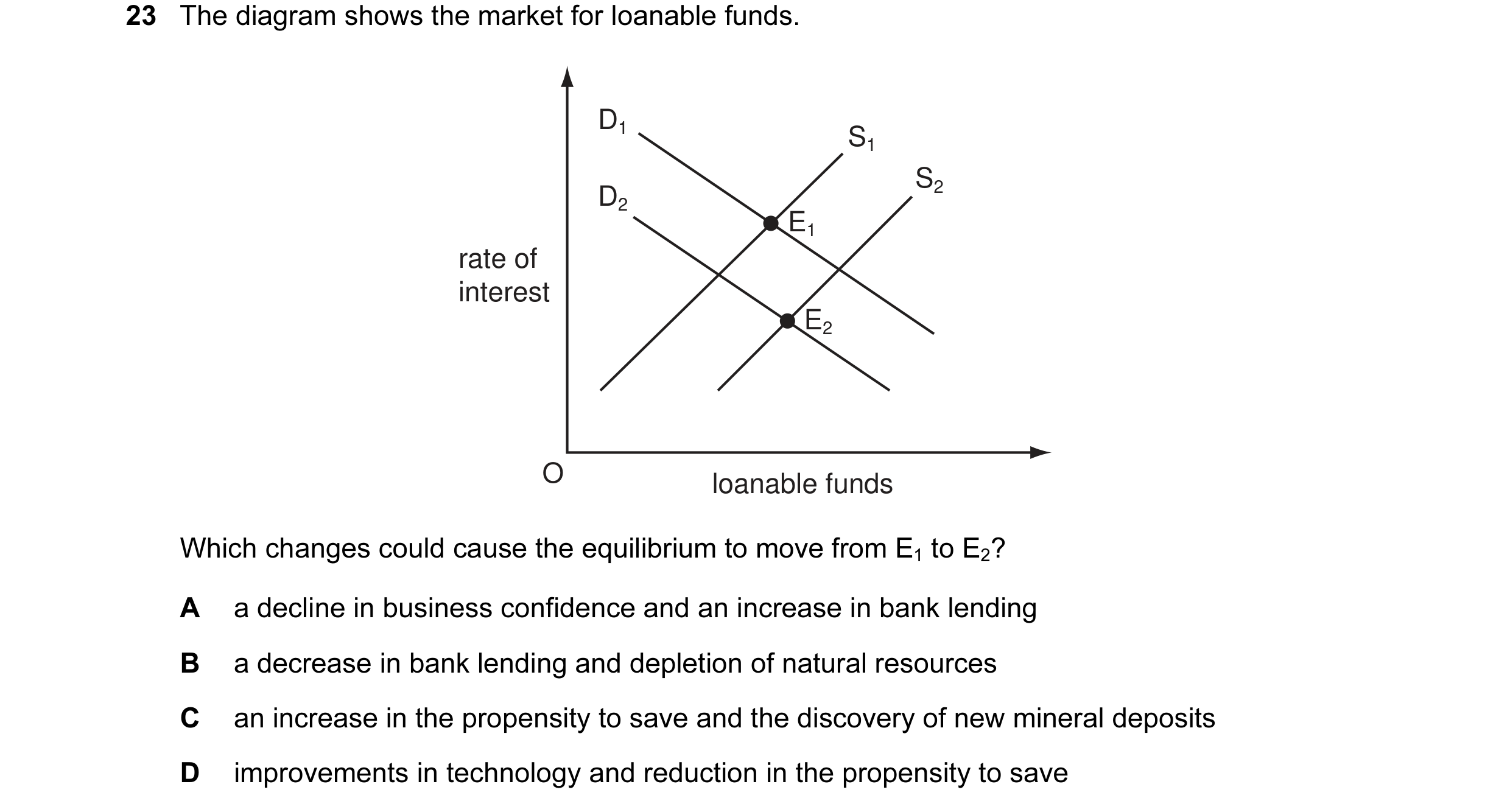
Q29 · The diagram shows the market for loanable funds 9708/31 Oct/Nov 2010
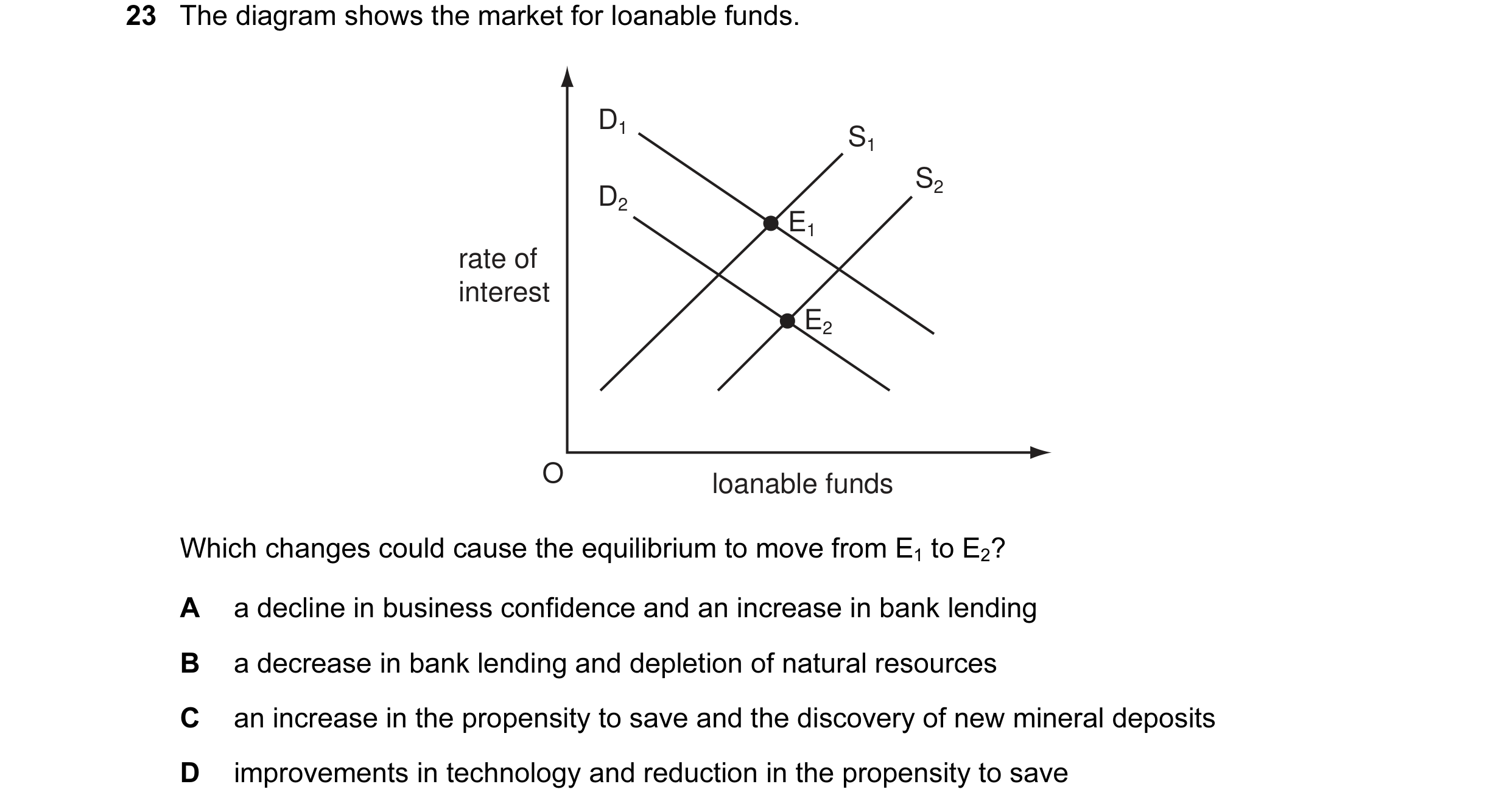
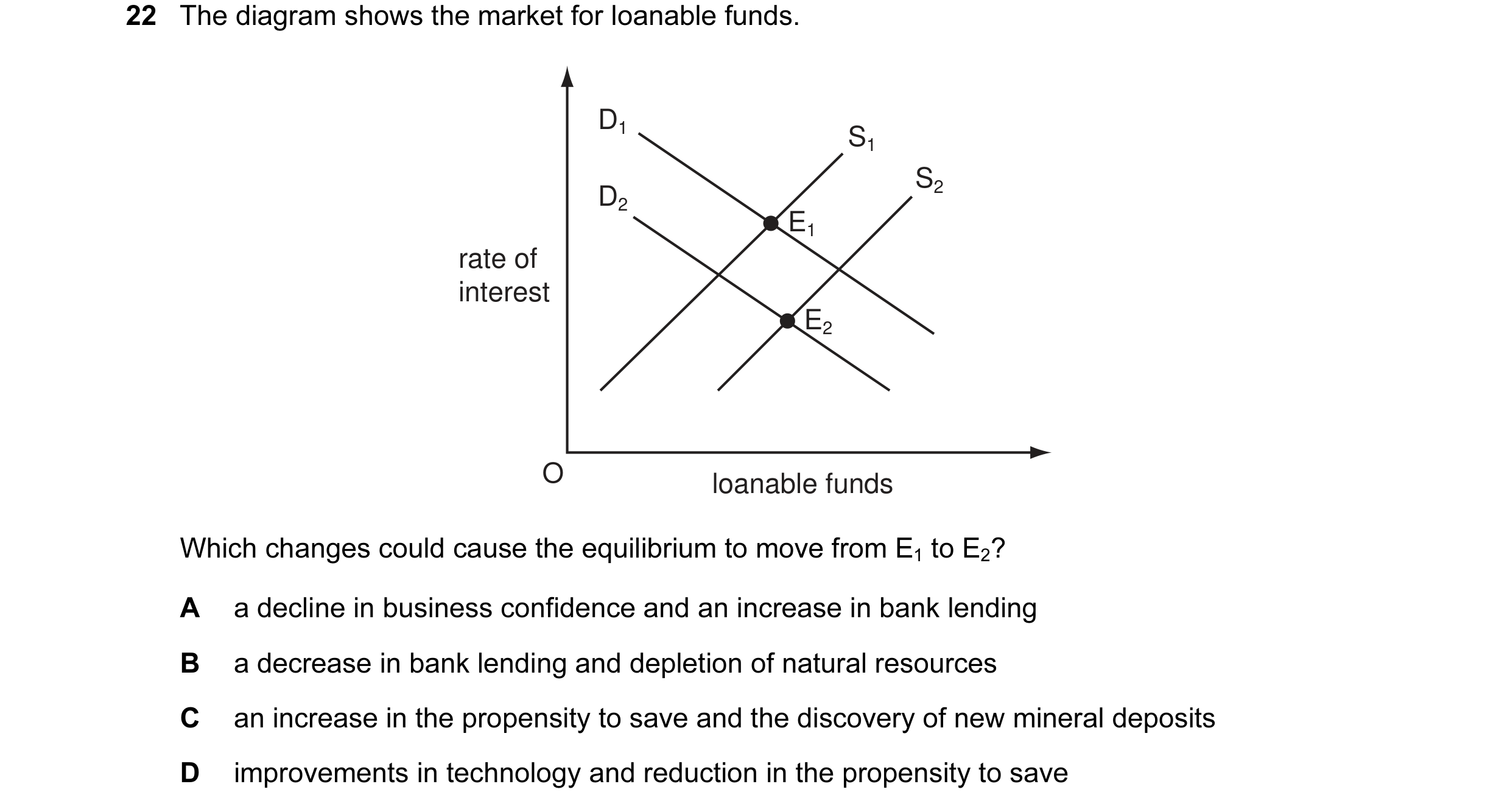
23 The diagram shows the market for loanable funds. D1 S1 S2 D2 E1 rate of interest E2 O loanable funds Which changes could cause the equilibrium to move from E1 to E2? A a decline in business confidence and an increase in bank lending B a decrease in bank lending and depletion of natural resources C an increase in the propensity to save and the discovery of new mineral deposits D improvements in technology and reduction in the propensity to save
1 marks
Answer: A
This question in 9708/31 Oct/Nov 2010
Q30 · According to Keynesian theory, when will an increase in the money supply leave the level… 9708/32 Oct/Nov 2010
17 According to Keynesian theory, when will an increase in the money supply leave the level of output unchanged? A when the liquidity trap is operative B when the money supply increase was not anticipated C when there is a floating exchange rate D when there is an immediate adjustment to expectations about future price levels
1 marks
Answer: A
This question in 9708/32 Oct/Nov 2010
Q31 · According to monetarist theory, what will be the short-run and the long-run effect of an… 9708/32 Oct/Nov 2010
18 According to monetarist theory, what will be the short-run and the long-run effect of an unexpected increase in the money supply on the real wage level? short-run long-run A decrease increase B decrease unchanged C unchanged increase D unchanged unchanged
1 marks
Answer: B
This question in 9708/32 Oct/Nov 2010
Q32 · An increase in the money supply leads to a fall in interest rates 9708/32 Oct/Nov 2010
22 An increase in the money supply leads to a fall in interest rates. What else will decrease as a result of these changes? A the desire to hold idle money balances B the price of equities C the price of government bonds D the velocity of circulation of money
1 marks
Answer: D
This question in 9708/32 Oct/Nov 2010
Q33 · The diagram shows the market for loanable funds 9708/32 Oct/Nov 2010
23 The diagram shows the market for loanable funds. D1 S1 S2 D2 E1 rate of interest E2 O loanable funds Which changes could cause the equilibrium to move from E1 to E2? A a decline in business confidence and an increase in bank lending B a decrease in bank lending and depletion of natural resources C an increase in the propensity to save and the discovery of new mineral deposits D improvements in technology and reduction in the propensity to save
1 marks
Answer: A
This question in 9708/32 Oct/Nov 2010
Q34 · According to Keynesian theory, when will an increase in the money supply leave the level… 9708/33 Oct/Nov 2010
16 According to Keynesian theory, when will an increase in the money supply leave the level of output unchanged? A when the liquidity trap is operative B when the money supply increase was not anticipated C when there is a floating exchange rate D when there is an immediate adjustment to expectations about future price levels
1 marks
Answer: A
This question in 9708/33 Oct/Nov 2010
Q35 · According to monetarist theory, what will be the short-run and the long-run effect of an… 9708/33 Oct/Nov 2010
17 According to monetarist theory, what will be the short-run and the long-run effect of an unexpected increase in the money supply on the real wage level? short-run long-run A decrease increase B decrease unchanged C unchanged increase D unchanged unchanged
1 marks
Answer: B
This question in 9708/33 Oct/Nov 2010
Q36 · An increase in the money supply leads to a fall in interest rates 9708/33 Oct/Nov 2010
21 An increase in the money supply leads to a fall in interest rates. What else will decrease as a result of these changes? A the desire to hold idle money balances B the price of equities C the price of government bonds D the velocity of circulation of money
1 marks
Answer: D
This question in 9708/33 Oct/Nov 2010
Q37 · The diagram shows the market for loanable funds 9708/33 Oct/Nov 2010
22 The diagram shows the market for loanable funds. D1 S1 S2 D2 E1 rate of interest E2 O loanable funds Which changes could cause the equilibrium to move from E1 to E2? A a decline in business confidence and an increase in bank lending B a decrease in bank lending and depletion of natural resources C an increase in the propensity to save and the discovery of new mineral deposits D improvements in technology and reduction in the propensity to save
1 marks
Answer: A
This question in 9708/33 Oct/Nov 2010
Q38 · An economy is operating at its natural rate of unemployment 9708/31 May/June 2011
15 An economy is operating at its natural rate of unemployment. According to monetarist theory, what will be the effect on unemployment in the short run and in the long run of an unanticipated increase in the money supply? short run long run A no change no change B no change reduction C reduction no change D reduction reduction
1 marks
Answer: C
This question in 9708/31 May/June 2011
Q39 · What will expand the money supply in an open economy? 9708/31 May/June 2011
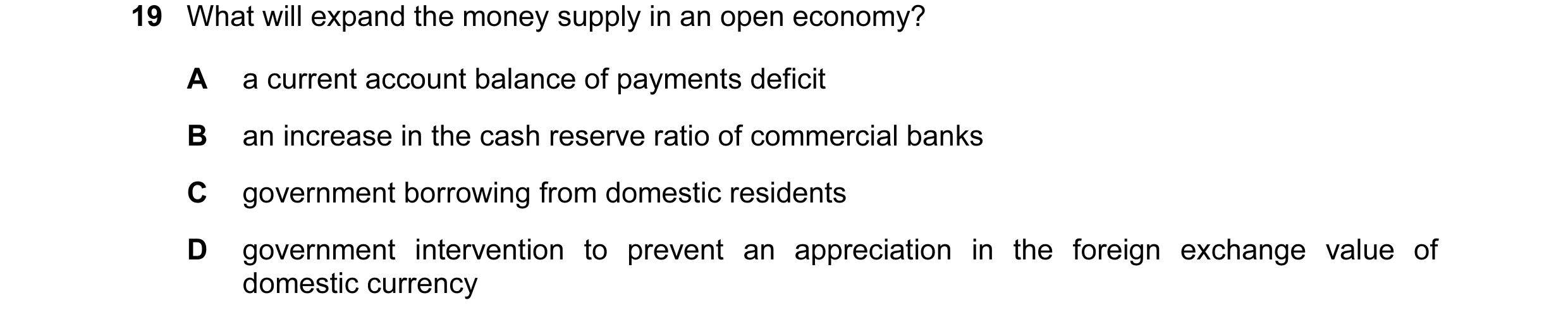
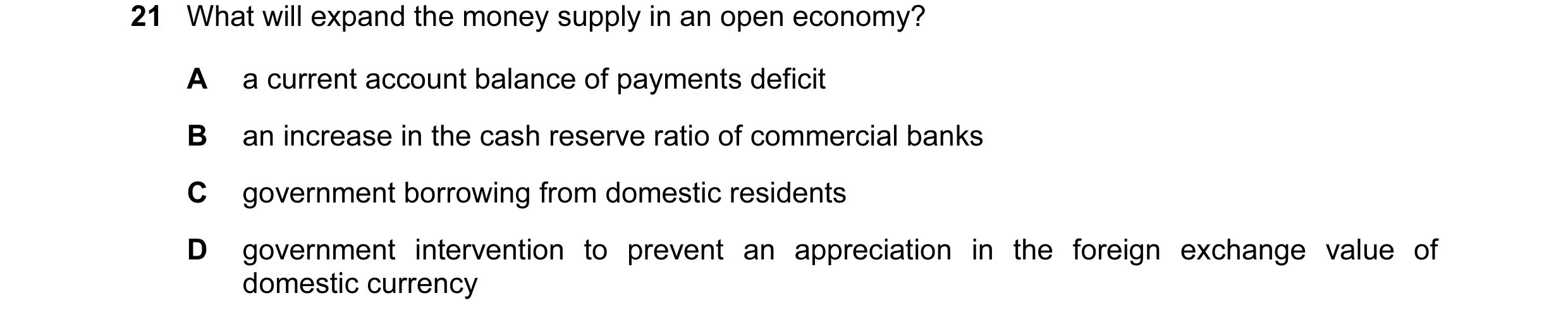
19 What will expand the money supply in an open economy? A a current account balance of payments deficit B an increase in the cash reserve ratio of commercial banks C government borrowing from domestic residents D government intervention to prevent an appreciation in the foreign exchange value of domestic currency
1 marks
Answer: D
This question in 9708/31 May/June 2011
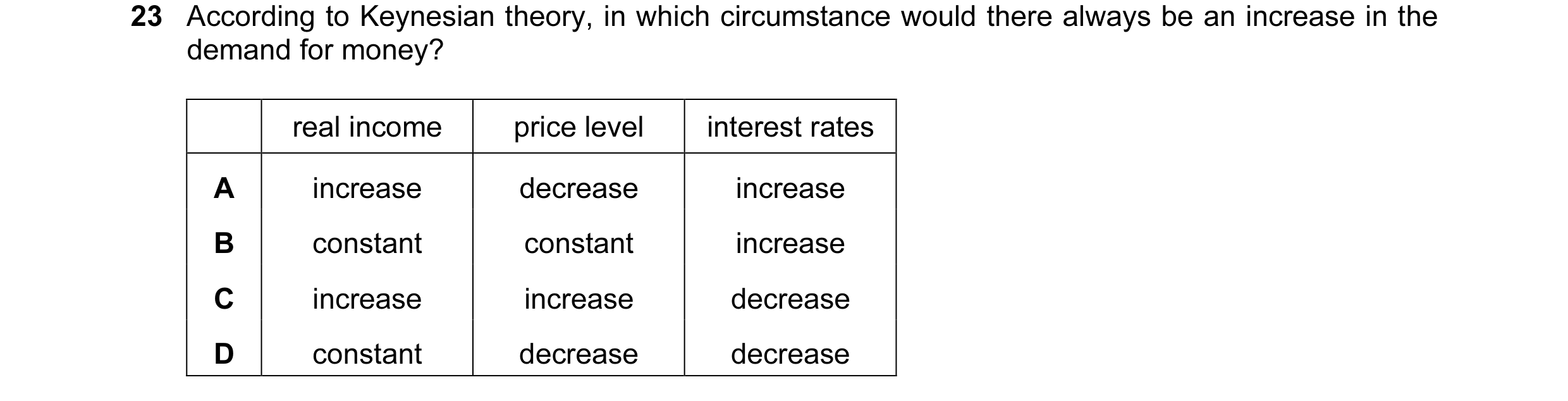
Q40 · According to Keynesian theory, in which circumstance will there always be an increase in… 9708/31 May/June 2011
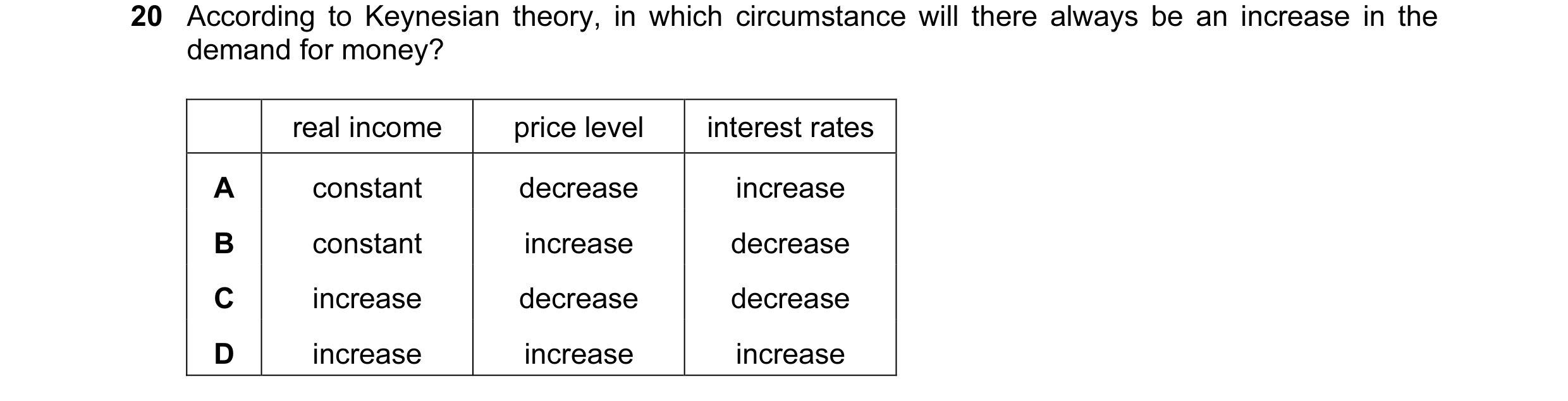
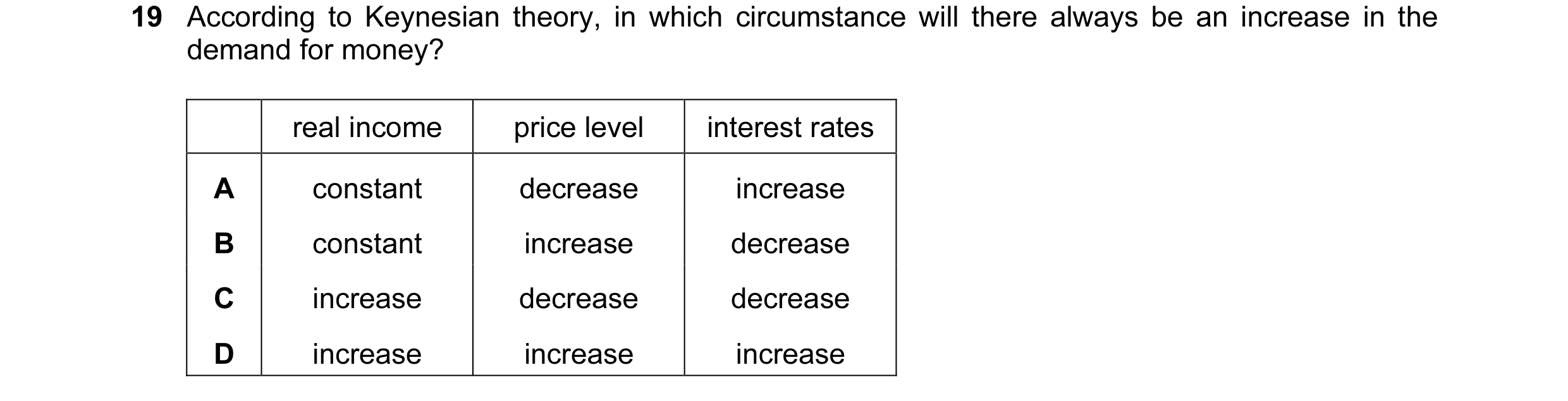
20 According to Keynesian theory, in which circumstance will there always be an increase in the demand for money? real income price level interest rates A constant decrease increase B constant increase decrease C increase decrease decrease D increase increase increase
1 marks
Answer: B
This question in 9708/31 May/June 2011
Q41 · What will expand the money supply in an open economy? 9708/32 May/June 2011
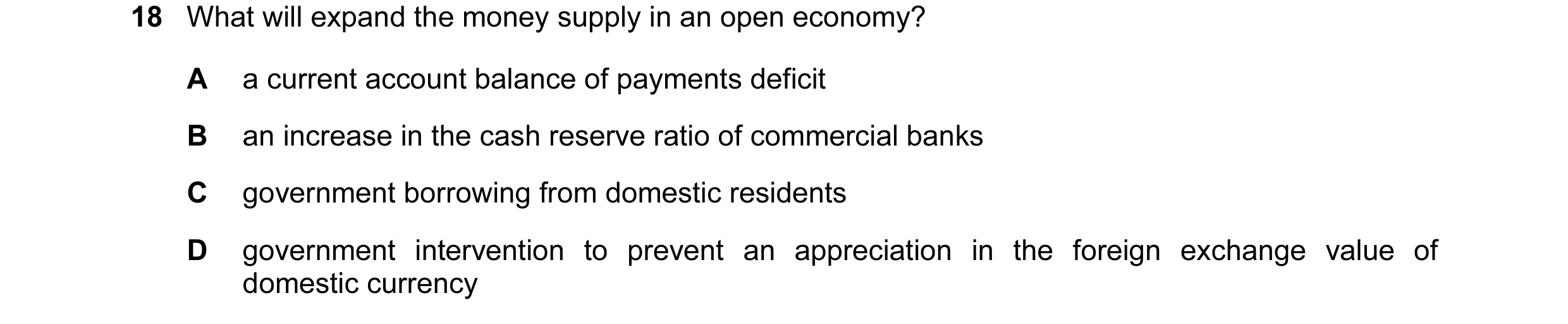
18 What will expand the money supply in an open economy? A a current account balance of payments deficit B an increase in the cash reserve ratio of commercial banks C government borrowing from domestic residents D government intervention to prevent an appreciation in the foreign exchange value of domestic currency
1 marks
Answer: D
This question in 9708/32 May/June 2011
Q42 · According to Keynesian theory, in which circumstance will there always be an increase in… 9708/32 May/June 2011
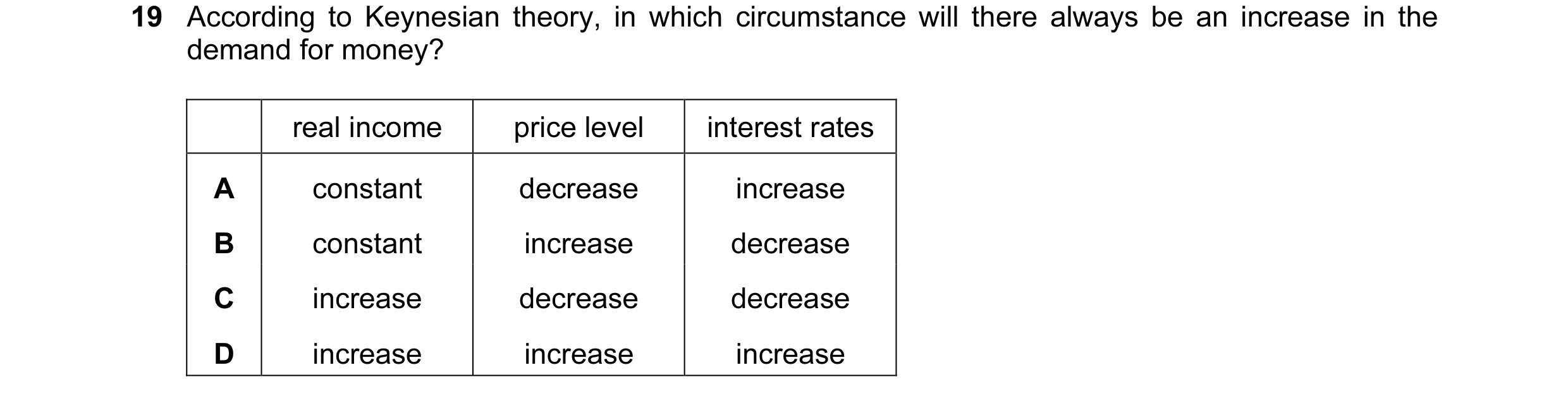
19 According to Keynesian theory, in which circumstance will there always be an increase in the demand for money? real income price level interest rates A constant decrease increase B constant increase decrease C increase decrease decrease D increase increase increase
1 marks
Answer: B
This question in 9708/32 May/June 2011
Q43 · What will expand the money supply in an open economy? 9708/33 May/June 2011
18 What will expand the money supply in an open economy? A a current account balance of payments deficit B an increase in the cash reserve ratio of commercial banks C government borrowing from domestic residents D government intervention to prevent an appreciation in the foreign exchange value of domestic currency
1 marks
Answer: D
This question in 9708/33 May/June 2011
Q44 · According to Keynesian theory, in which circumstance will there always be an increase in… 9708/33 May/June 2011
19 According to Keynesian theory, in which circumstance will there always be an increase in the demand for money? real income price level interest rates A constant decrease increase B constant increase decrease C increase decrease decrease D increase increase increase
1 marks
Answer: B
This question in 9708/33 May/June 2011
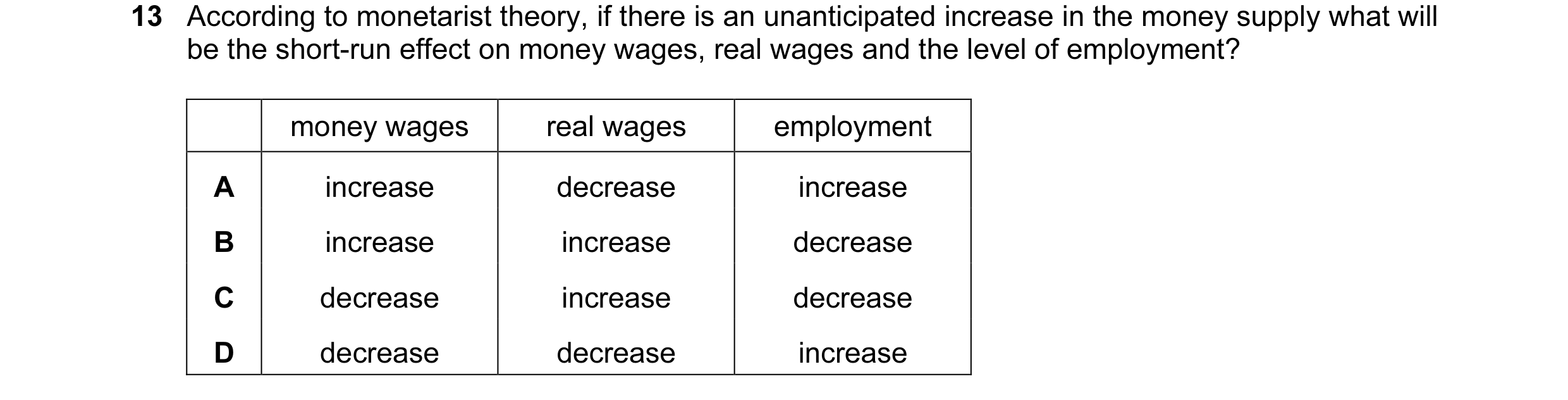
Q45 · According to monetarist theory, if there is an unanticipated increase in the money supply… 9708/31 Oct/Nov 2011
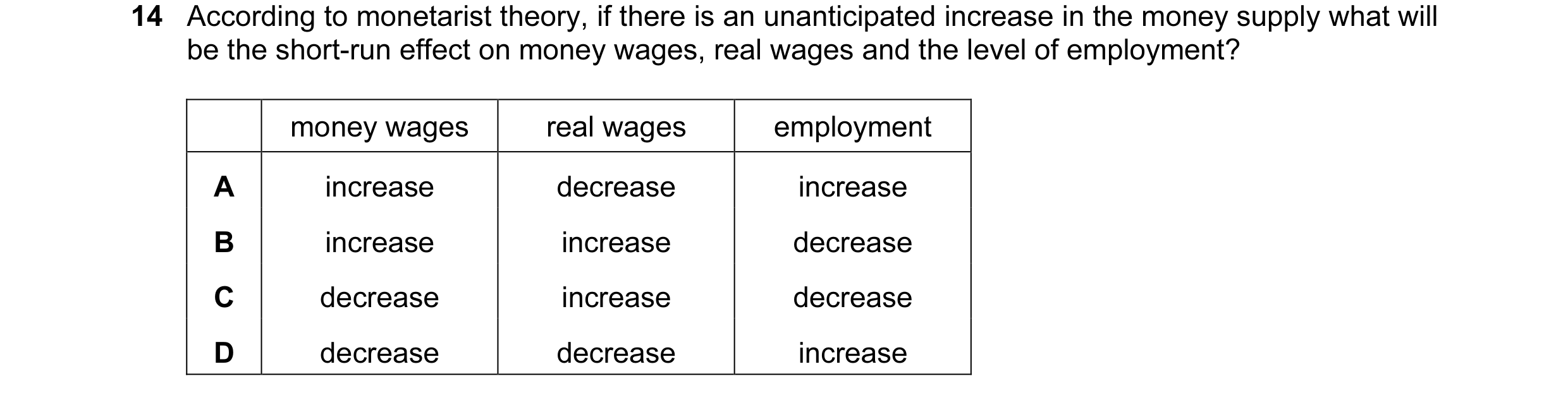
14 According to monetarist theory, if there is an unanticipated increase in the money supply what will be the short-run effect on money wages, real wages and the level of employment? money wages real wages employment A increase decrease increase B increase increase decrease C decrease increase decrease D decrease decrease increase
1 marks
Answer: A
This question in 9708/31 Oct/Nov 2011
Q46 · In the diagram, AD1 and AS are an economy’s original aggregate demand and aggregate… 9708/31 Oct/Nov 2011
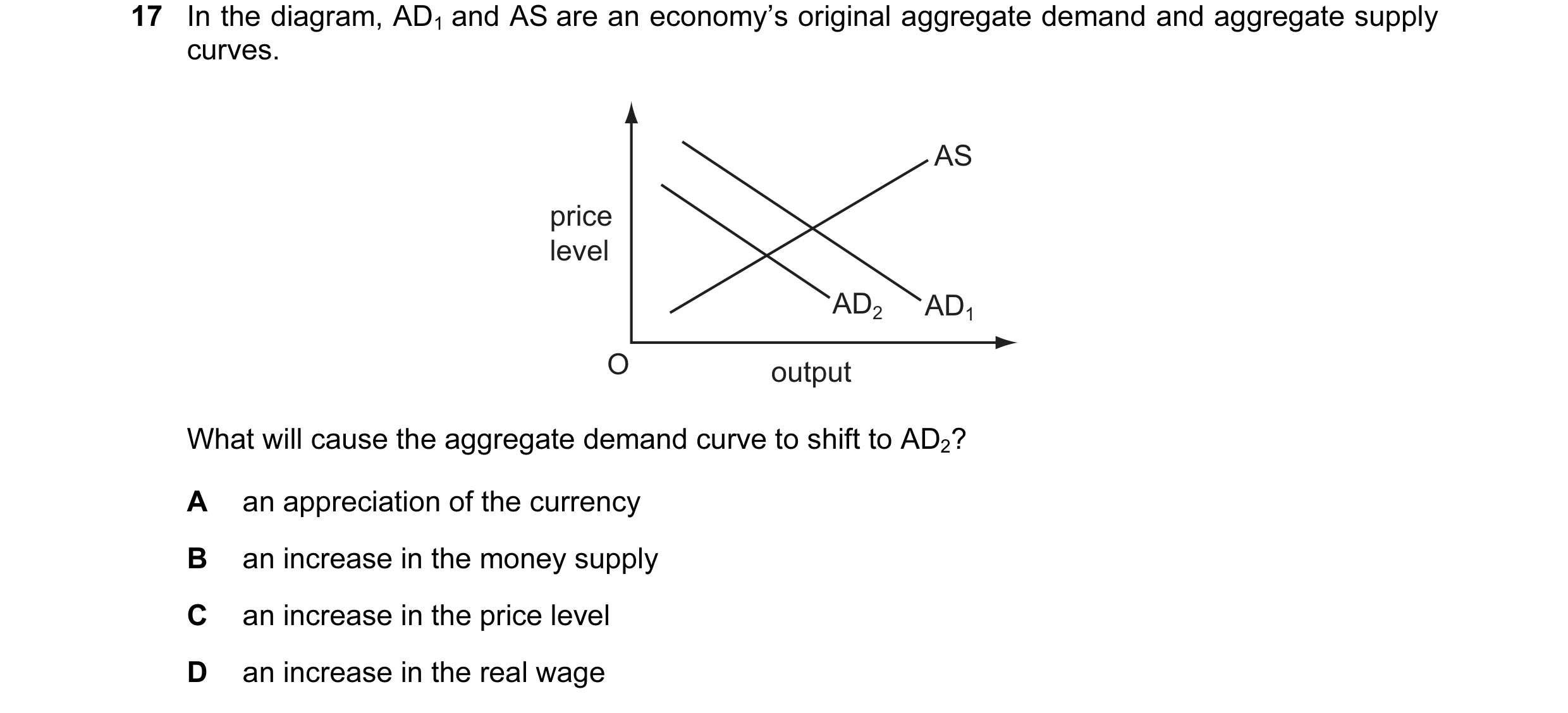
17 In the diagram, AD1 and AS are an economy’s original aggregate demand and aggregate supply curves. AS price level AD2 AD1 O output What will cause the aggregate demand curve to shift to AD2? A an appreciation of the currency B an increase in the money supply C an increase in the price level D an increase in the real wage
1 marks
Answer: A
This question in 9708/31 Oct/Nov 2011
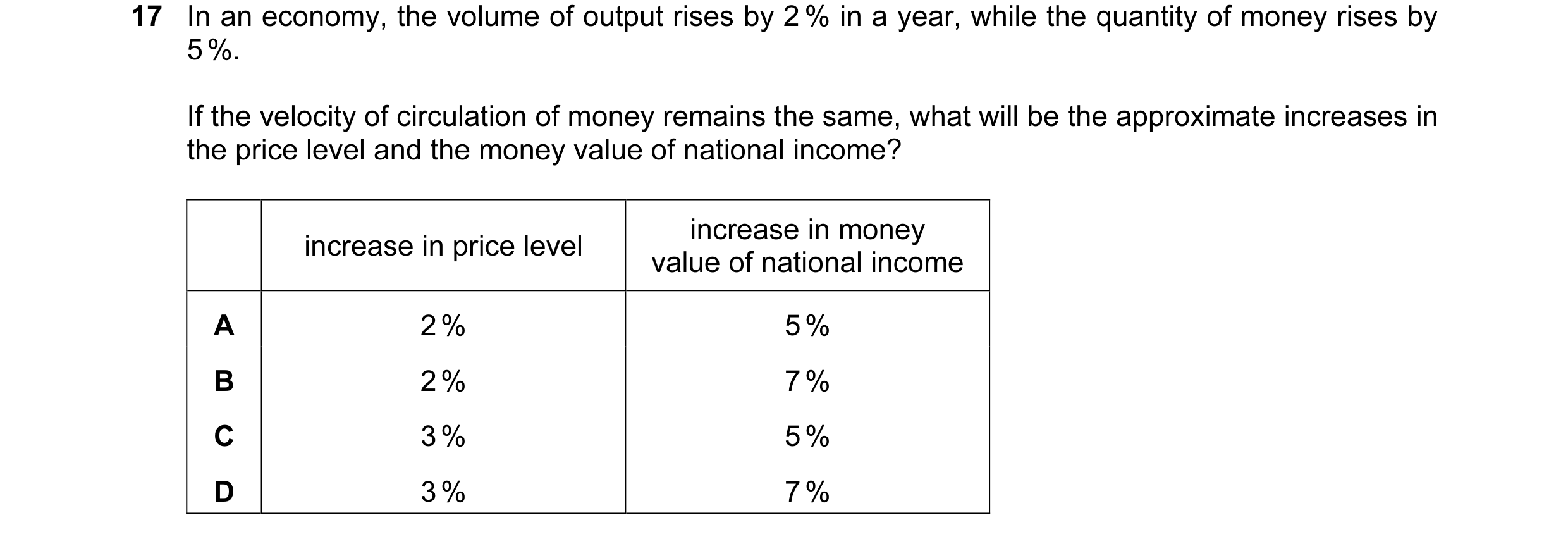
Q47 · In an economy, the volume of output rises by 2 % in a year, while the quantity of money… 9708/31 Oct/Nov 2011
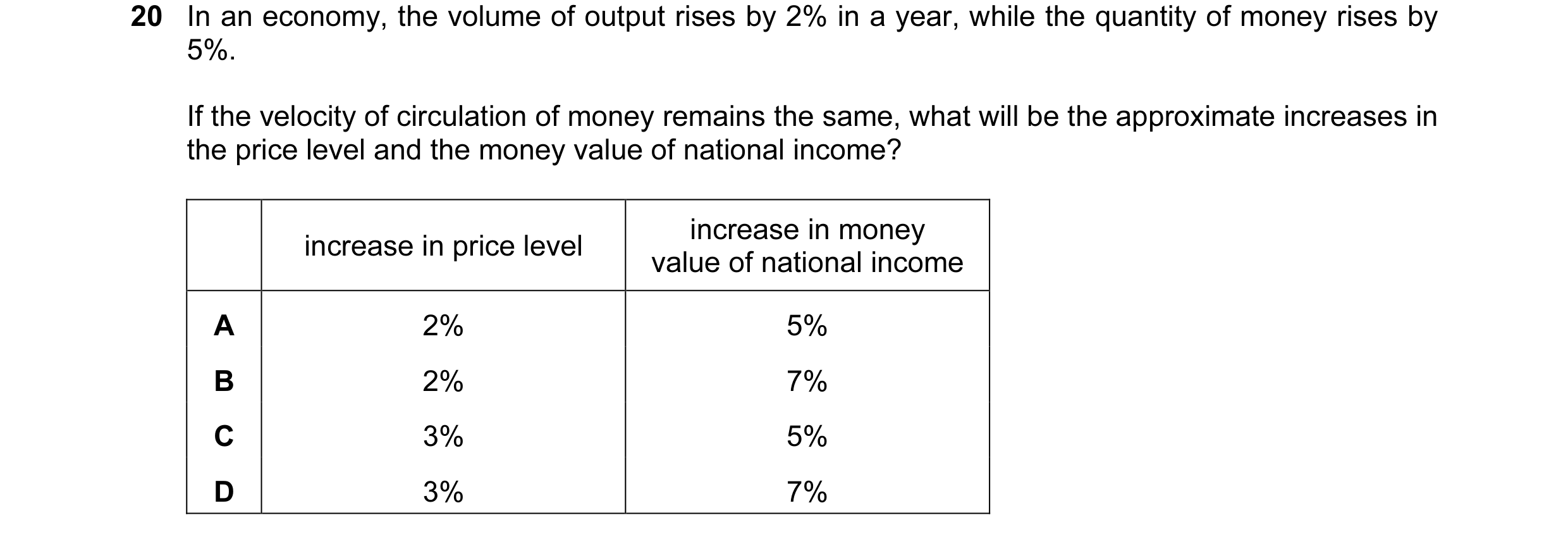
18 In an economy, the volume of output rises by 2 % in a year, while the quantity of money rises by 5 %. If the velocity of circulation of money remains the same, what will be the approximate increases in the price level and the money value of national income? increase in money increase in price level value of national income A 2 % 5 % B 2 % 7 % C 3 % 5 % D 3 % 7 %
1 marks
Answer: C
This question in 9708/31 Oct/Nov 2011
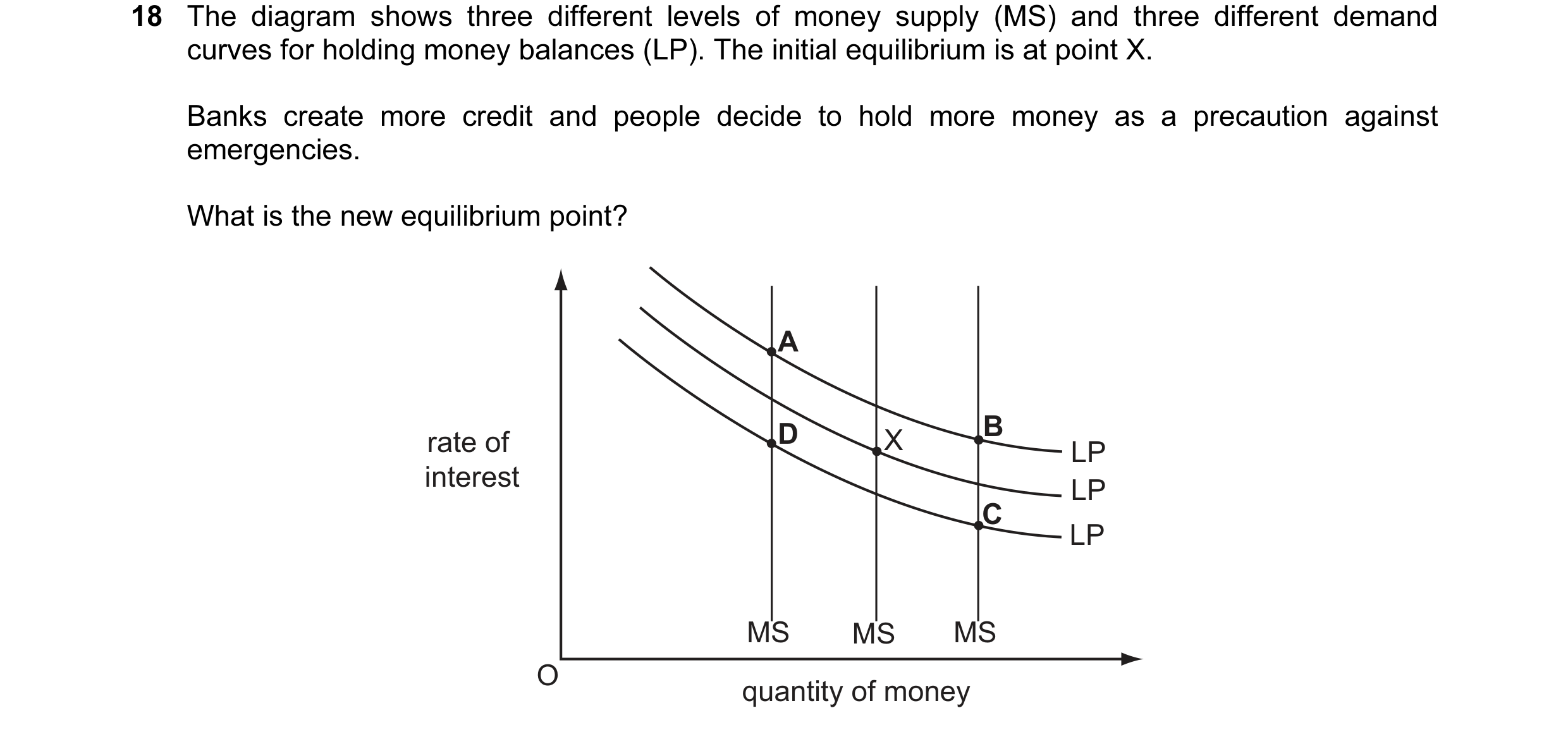
Q48 · The diagram shows three different levels of money supply (MS) and three different demand… 9708/31 Oct/Nov 2011
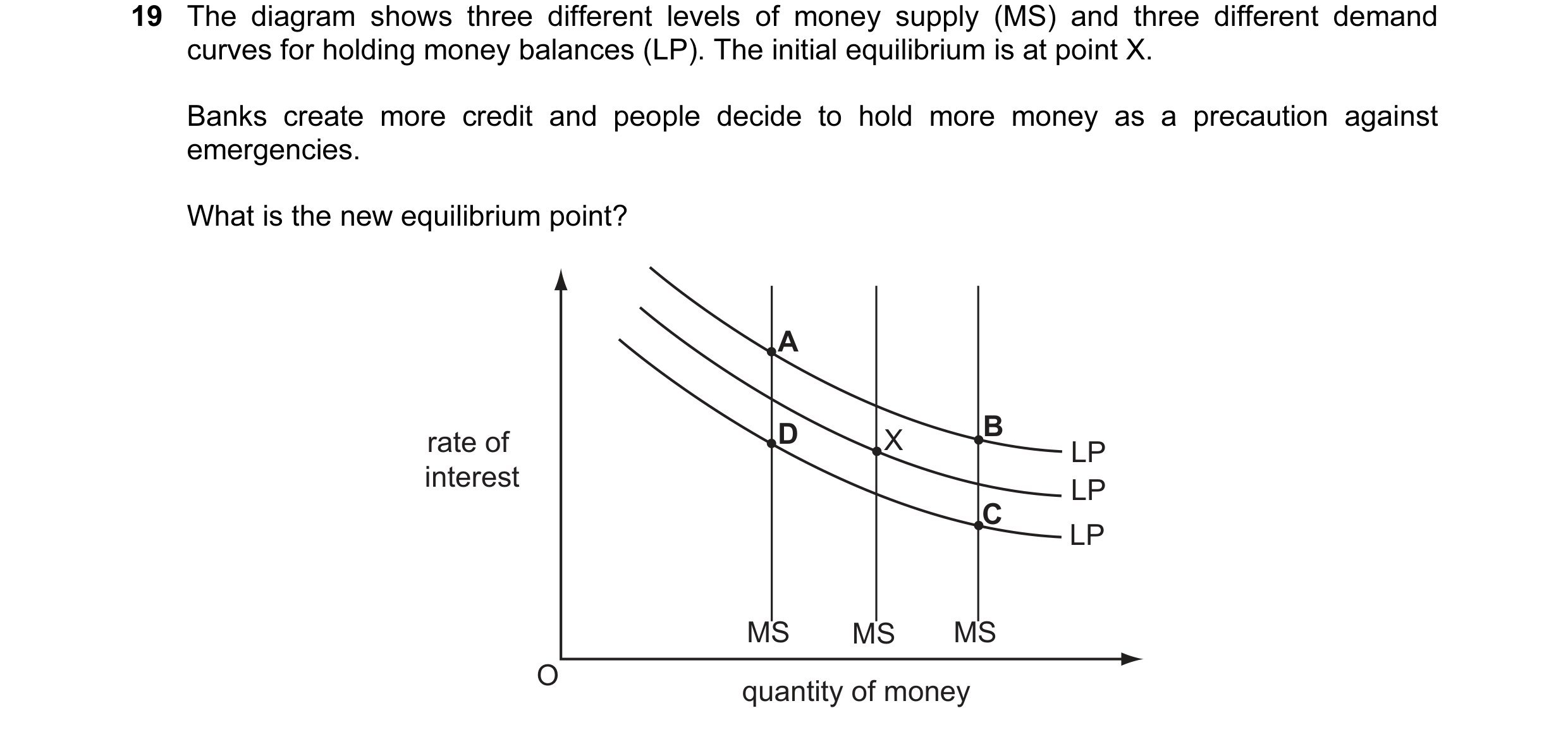
19 The diagram shows three different levels of money supply (MS) and three different demand curves for holding money balances (LP). The initial equilibrium is at point X. Banks create more credit and people decide to hold more money as a precaution against emergencies. What is the new equilibrium point? A D B rate of X LP interest LP C LP MS MS MS O quantity of money
1 marks
Answer: B
This question in 9708/31 Oct/Nov 2011
Q49 · Despite a government budget deficit, a country’s money supply remains unchanged 9708/32 Oct/Nov 2011
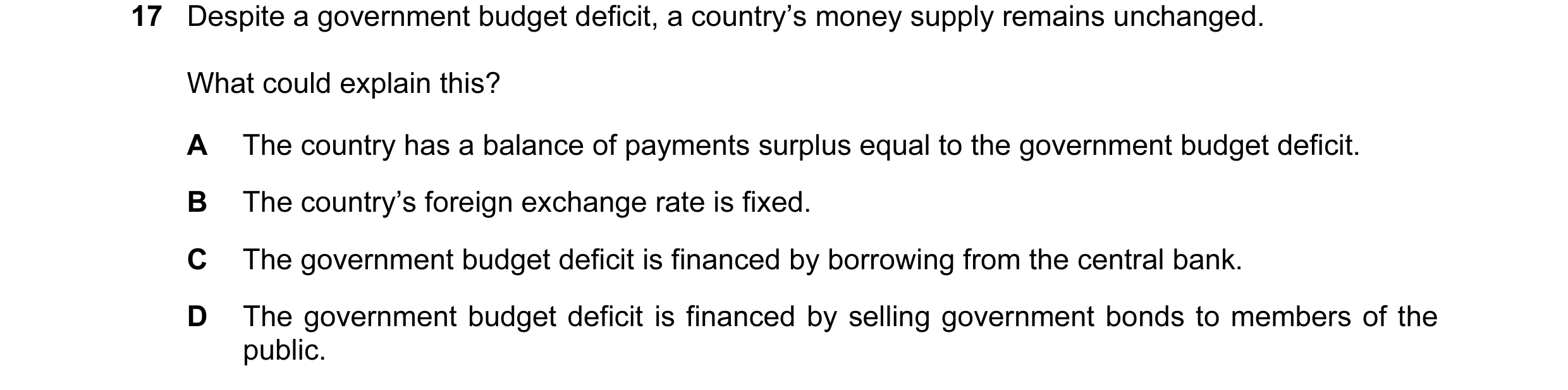
17 Despite a government budget deficit, a country’s money supply remains unchanged. What could explain this? A The country has a balance of payments surplus equal to the government budget deficit. B The country’s foreign exchange rate is fixed. C The government budget deficit is financed by borrowing from the central bank. D The government budget deficit is financed by selling government bonds to members of the public.
1 marks
Answer: D
This question in 9708/32 Oct/Nov 2011
Q50 · According to Keynesian analysis, what will be the result of a decrease in the money… 9708/32 Oct/Nov 2011
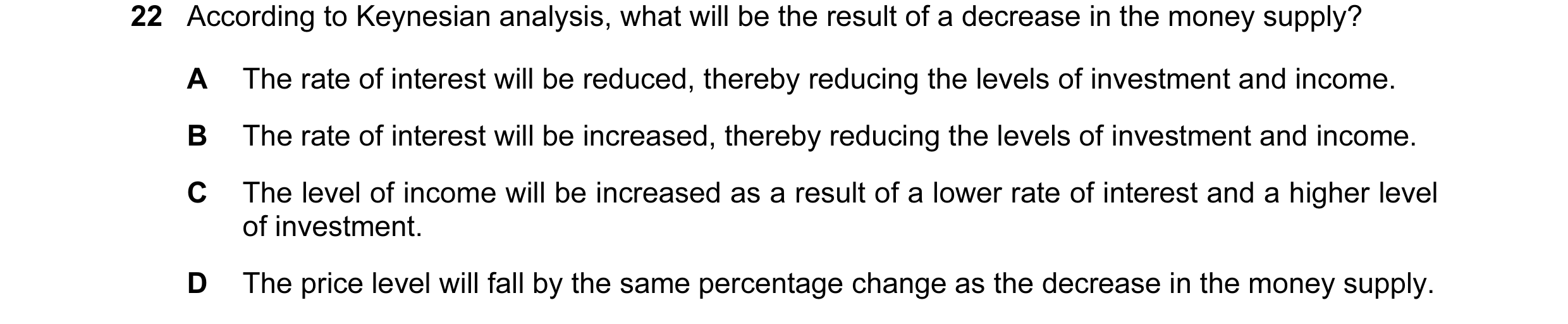
22 According to Keynesian analysis, what will be the result of a decrease in the money supply? A The rate of interest will be reduced, thereby reducing the levels of investment and income. B The rate of interest will be increased, thereby reducing the levels of investment and income. C The level of income will be increased as a result of a lower rate of interest and a higher level of investment. D The price level will fall by the same percentage change as the decrease in the money supply.
1 marks
Answer: B
This question in 9708/32 Oct/Nov 2011
Q51 · What will be the likely effects on interest rates and bond prices of an increase in the… 9708/32 Oct/Nov 2011
23 What will be the likely effects on interest rates and bond prices of an increase in the demand for money? interest rates bond prices A fall fall B fall rise C rise fall D rise rise
1 marks
Answer: C
This question in 9708/32 Oct/Nov 2011
Q52 · According to monetarist theory, if there is an unanticipated increase in the money supply… 9708/33 Oct/Nov 2011
13 According to monetarist theory, if there is an unanticipated increase in the money supply what will be the short-run effect on money wages, real wages and the level of employment? money wages real wages employment A increase decrease increase B increase increase decrease C decrease increase decrease D decrease decrease increase
1 marks
Answer: A
This question in 9708/33 Oct/Nov 2011
Q53 · In an economy, the volume of output rises by 2 % in a year, while the quantity of money… 9708/33 Oct/Nov 2011
17 In an economy, the volume of output rises by 2 % in a year, while the quantity of money rises by 5 %. If the velocity of circulation of money remains the same, what will be the approximate increases in the price level and the money value of national income? increase in money increase in price level value of national income A 2 % 5 % B 2 % 7 % C 3 % 5 % D 3 % 7 %
1 marks
Answer: C
This question in 9708/33 Oct/Nov 2011
Q54 · The diagram shows three different levels of money supply (MS) and three different demand… 9708/33 Oct/Nov 2011
18 The diagram shows three different levels of money supply (MS) and three different demand curves for holding money balances (LP). The initial equilibrium is at point X. Banks create more credit and people decide to hold more money as a precaution against emergencies. What is the new equilibrium point? A D B rate of X LP interest LP C LP MS MS MS O quantity of money
1 marks
Answer: B
This question in 9708/33 Oct/Nov 2011
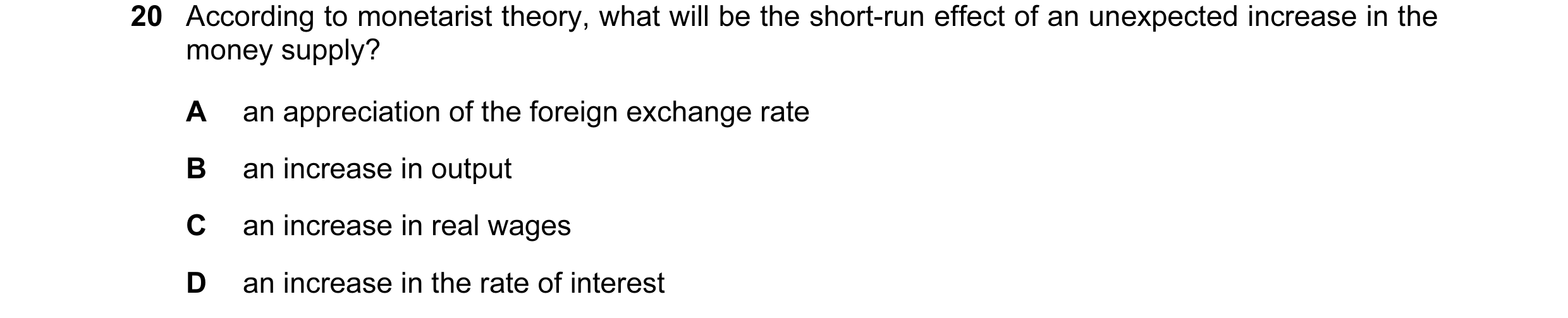
Q55 · According to monetarist theory, what will be the short-run effect of an unexpected… 9708/31 May/June 2012
20 According to monetarist theory, what will be the short-run effect of an unexpected increase in the money supply? A an appreciation of the foreign exchange rate B an increase in output C an increase in real wages D an increase in the rate of interest
1 marks
Answer: B
This question in 9708/31 May/June 2012
Q56 · Other things being equal, the money supply in an open economy will increase if A domestic… 9708/31 May/June 2012
22 Other things being equal, the money supply in an open economy will increase if A domestic banks increase their lending to foreign borrowers. B the central bank buys foreign currency in the foreign exchange market. C the government sells bonds to domestic residents. D there is an increase in the volume of imports to the economy.
1 marks
Answer: B
This question in 9708/31 May/June 2012
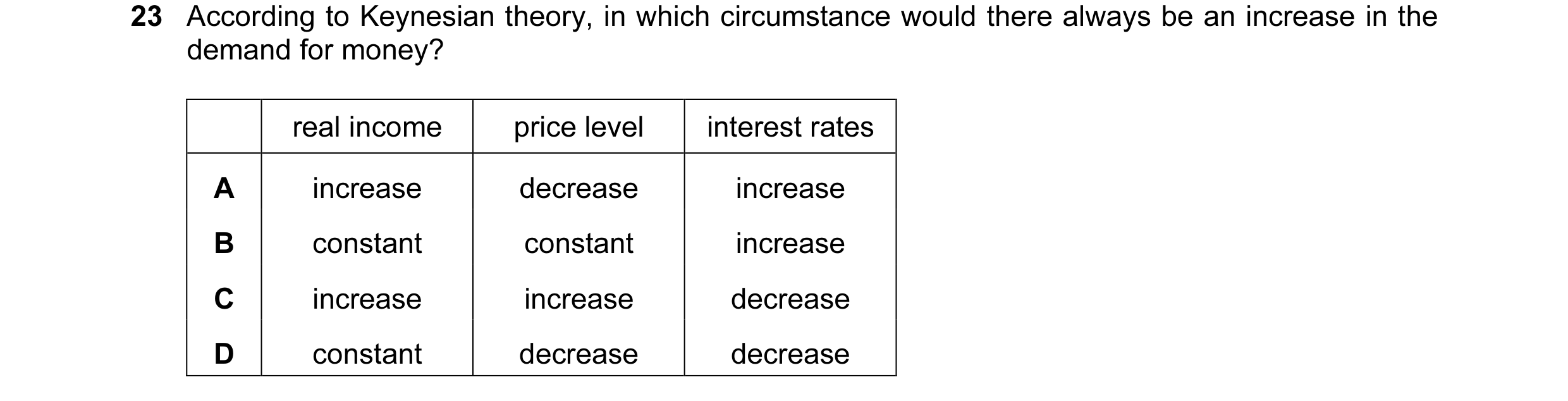
Q57 · According to Keynesian theory, in which circumstance would there always be an increase in… 9708/31 May/June 2012
23 According to Keynesian theory, in which circumstance would there always be an increase in the demand for money? real income price level interest rates A increase decrease increase B constant constant increase C increase increase decrease D constant decrease decrease
1 marks
Answer: C
This question in 9708/31 May/June 2012
Q58 · In a banking system all banks maintain 10 % of deposits as cash 9708/31 May/June 2012
24 In a banking system all banks maintain 10 % of deposits as cash. Customers withdraw $20 000 in cash. Assuming no subsequent net change in notes and coins in circulation, by how much will the banks have to reduce their net loans? A $2000 B $18 000 C $180 000 D $220 000
1 marks
Answer: C
This question in 9708/31 May/June 2012
Q59 · According to monetarist theory, what will be the short-run effect of an unexpected… 9708/32 May/June 2012
20 According to monetarist theory, what will be the short-run effect of an unexpected increase in the money supply? A an appreciation of the foreign exchange rate B an increase in output C an increase in real wages D an increase in the rate of interest
1 marks
Answer: B
This question in 9708/32 May/June 2012
Q60 · What would result in an increase in the volume of bank deposits? 9708/32 May/June 2012
23 What would result in an increase in the volume of bank deposits? A an increase in the public’s desire to hold cash B an increase in government expenditure financed by borrowing from the central bank C an increase in the proportion of their deposits that banks hold in cash D an open market sale of securities by the central bank
1 marks
Answer: B
This question in 9708/32 May/June 2012
Q61 · In a banking system all banks maintain 10 % of deposits as cash 9708/32 May/June 2012
24 In a banking system all banks maintain 10 % of deposits as cash. Customers withdraw $20 000 in cash. Assuming no subsequent net change in notes and coins in circulation, by how much will the banks have to reduce their net loans? A $2000 B $18 000 C $180 000 D $220 000
1 marks
Answer: C
This question in 9708/32 May/June 2012
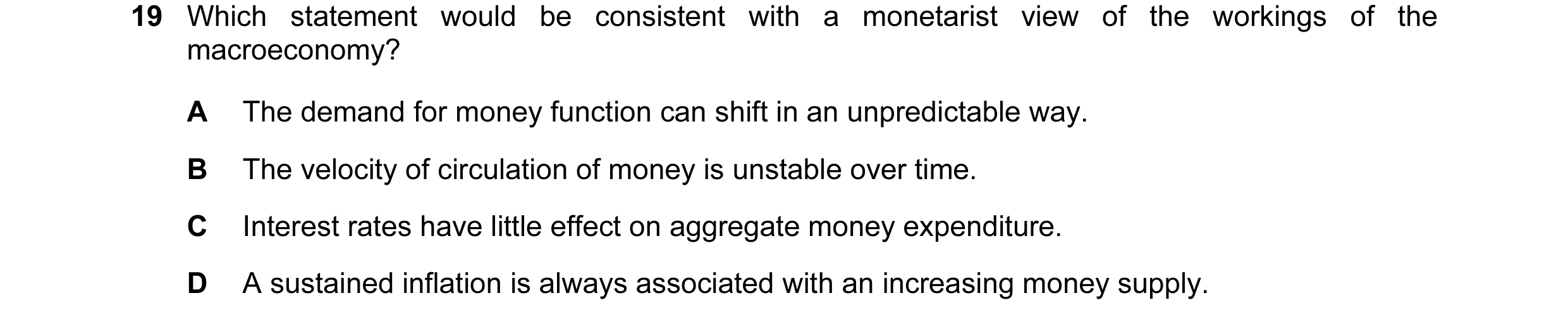
Q62 · Which statement would be consistent with a monetarist view of the workings of the… 9708/33 May/June 2012
19 Which statement would be consistent with a monetarist view of the workings of the macroeconomy? A The demand for money function can shift in an unpredictable way. B The velocity of circulation of money is unstable over time. C Interest rates have little effect on aggregate money expenditure. D A sustained inflation is always associated with an increasing money supply.
1 marks
Answer: D
This question in 9708/33 May/June 2012
Q63 · Other things being equal, the money supply in an open economy will increase if A domestic… 9708/33 May/June 2012
22 Other things being equal, the money supply in an open economy will increase if A domestic banks increase their lending to foreign borrowers. B the central bank buys foreign currency in the foreign exchange market. C the government sells bonds to domestic residents. D there is an increase in the volume of imports to the economy.
1 marks
Answer: B
This question in 9708/33 May/June 2012
Q64 · According to Keynesian theory, in which circumstance would there always be an increase in… 9708/33 May/June 2012
23 According to Keynesian theory, in which circumstance would there always be an increase in the demand for money? real income price level interest rates A increase decrease increase B constant constant increase C increase increase decrease D constant decrease decrease
1 marks
Answer: C
This question in 9708/33 May/June 2012
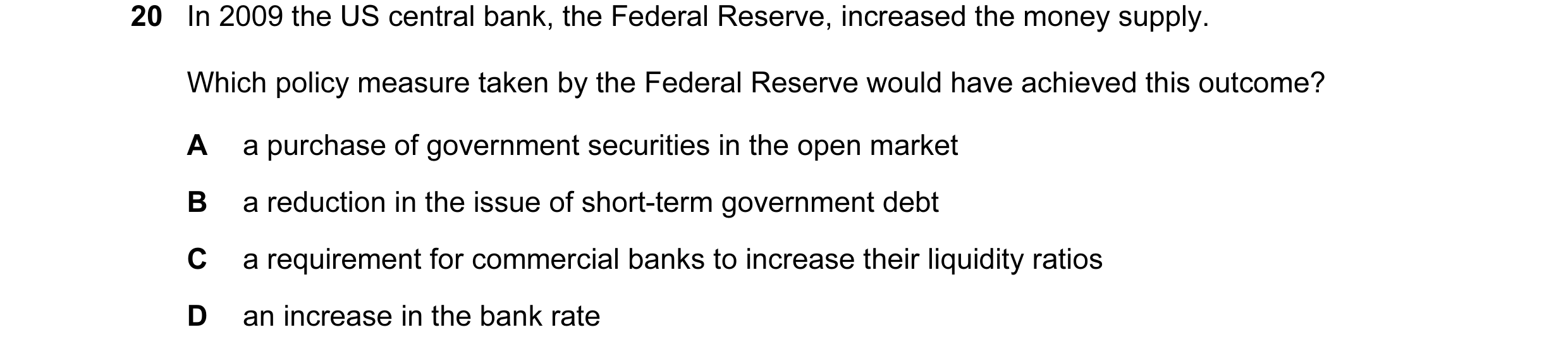
Q65 · In 2009 the US central bank, the Federal Reserve, increased the money supply 9708/32 Oct/Nov 2012
20 In 2009 the US central bank, the Federal Reserve, increased the money supply. Which policy measure taken by the Federal Reserve would have achieved this outcome? A a purchase of government securities in the open market B a reduction in the issue of short-term government debt C a requirement for commercial banks to increase their liquidity ratios D an increase in the bank rate
1 marks
Answer: A
This question in 9708/32 Oct/Nov 2012
Q66 · The diagram shows three different levels of money supply (MS) and three different demand… 9708/32 Oct/Nov 2012
21 The diagram shows three different levels of money supply (MS) and three different demand curves for holding money balances (LP). The initial equilibrium is at point X. Banks create more credit and people decide to hold more money as a precaution against emergencies. What is the new equilibrium point? A D B X rate of LP interest LP C LP MS MS MS O quantity of money
1 marks
Answer: B
This question in 9708/32 Oct/Nov 2012
Q67 · Assuming a constant income velocity of circulation of money, if real output grows by 4 %… 9708/33 Oct/Nov 2012
21 Assuming a constant income velocity of circulation of money, if real output grows by 4 %, and the money supply grows by 3 %, what will be the approximate change in the price level? A –1 % B +1 % C +3 % D +7 %
1 marks
This question in 9708/33 Oct/Nov 2012
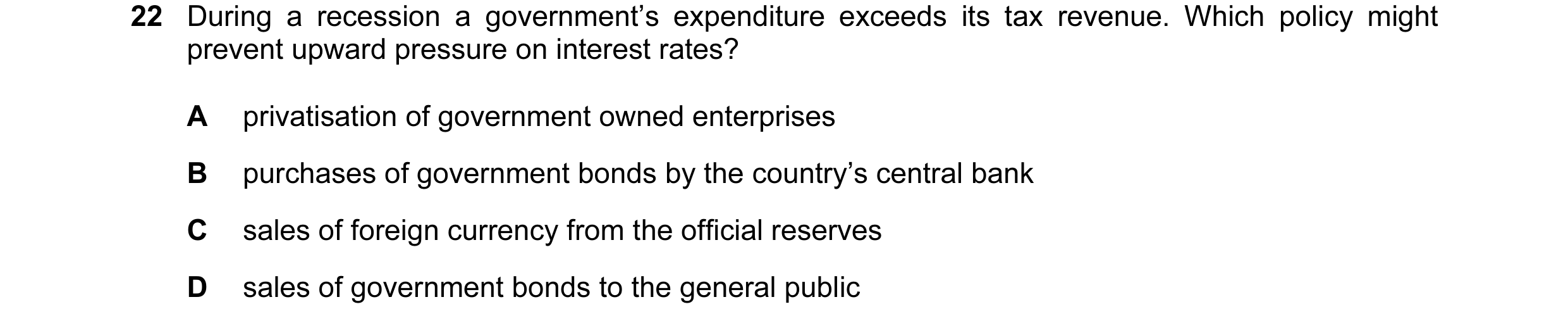
Q68 · During a recession a government’s expenditure exceeds its tax revenue 9708/33 Oct/Nov 2012
22 During a recession a government’s expenditure exceeds its tax revenue. Which policy might prevent upward pressure on interest rates? A privatisation of government owned enterprises B purchases of government bonds by the country’s central bank C sales of foreign currency from the official reserves D sales of government bonds to the general public
1 marks
This question in 9708/33 Oct/Nov 2012
Q69 · What will result from a rise in interest rates? 9708/31 May/June 2013
19 What will result from a rise in interest rates? A a depreciation in the exchange rate B a fall in the price of bonds C an increase in capital spending D an increase in the demand for money
1 marks
Answer: B
This question in 9708/31 May/June 2013
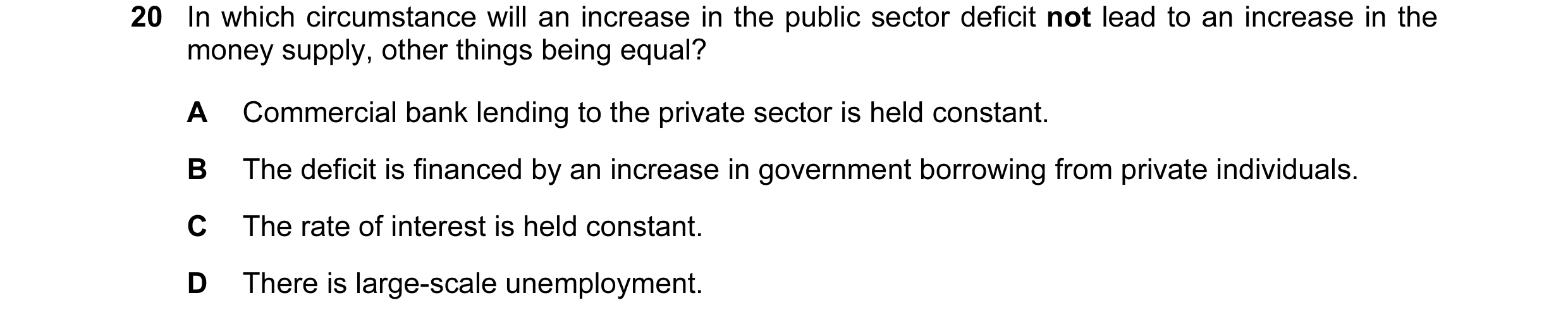
Q70 · In which circumstance will an increase in the public sector deficit not lead to an… 9708/31 May/June 2013
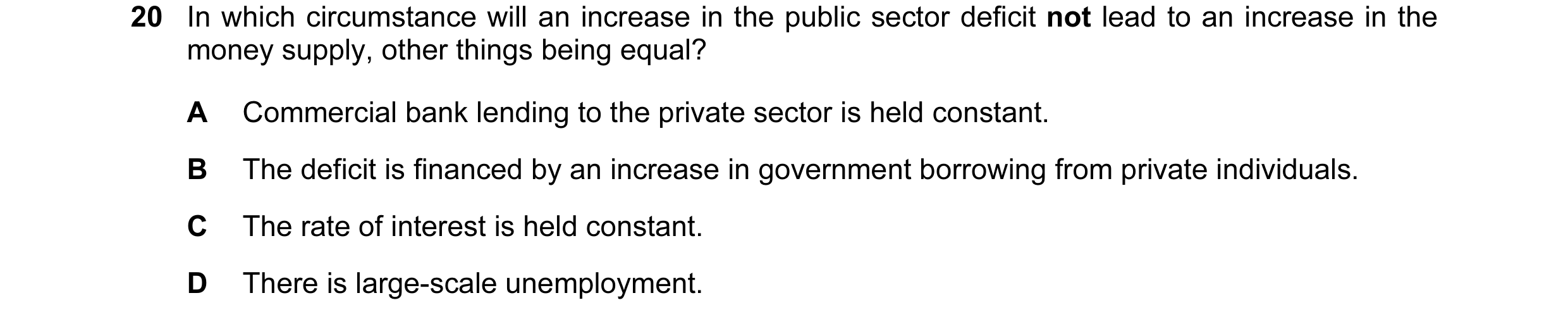
20 In which circumstance will an increase in the public sector deficit not lead to an increase in the money supply, other things being equal? A Commercial bank lending to the private sector is held constant. B The deficit is financed by an increase in government borrowing from private individuals. C The rate of interest is held constant. D There is large-scale unemployment.
1 marks
Answer: B
This question in 9708/31 May/June 2013
Q71 · What is meant by liquidity preference? 9708/31 May/June 2013
21 What is meant by liquidity preference? A a desire to be paid in cash rather than by cheque B a desire to be paid monthly rather than weekly C a desire to hold assets that are convertible into cash D a desire to hold money rather than other assets
1 marks
Answer: D
This question in 9708/31 May/June 2013
Q72 · A country’s central bank engages in a policy of quantitative easing (open market purchase… 9708/32 May/June 2013
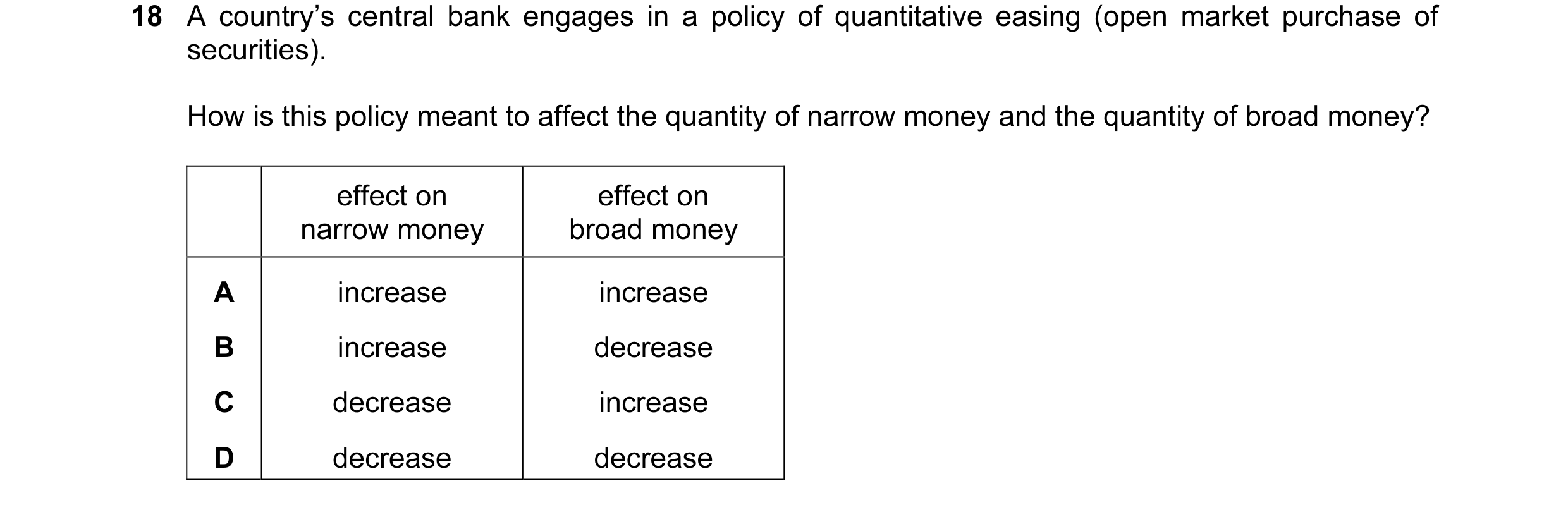
18 A country’s central bank engages in a policy of quantitative easing (open market purchase of securities). How is this policy meant to affect the quantity of narrow money and the quantity of broad money? effect on effect on narrow money broad money A increase increase B increase decrease C decrease increase D decrease decrease
1 marks
Answer: A
This question in 9708/32 May/June 2013
Q73 · According to monetarist theory, what will be the short-run effect on the level of output… 9708/32 May/June 2013
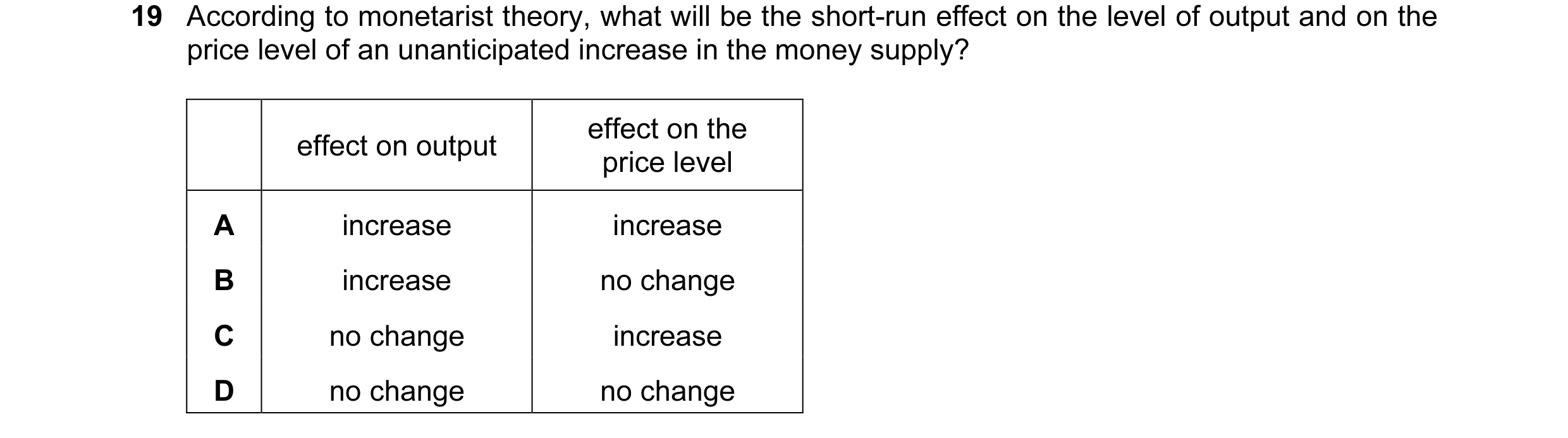
19 According to monetarist theory, what will be the short-run effect on the level of output and on the price level of an unanticipated increase in the money supply? effect on the effect on output price level A increase increase B increase no change C no change increase D no change no change
1 marks
Answer: A
This question in 9708/32 May/June 2013
Q74 · Other things remaining unchanged, what is likely to be a consequence of an increase in… 9708/32 May/June 2013
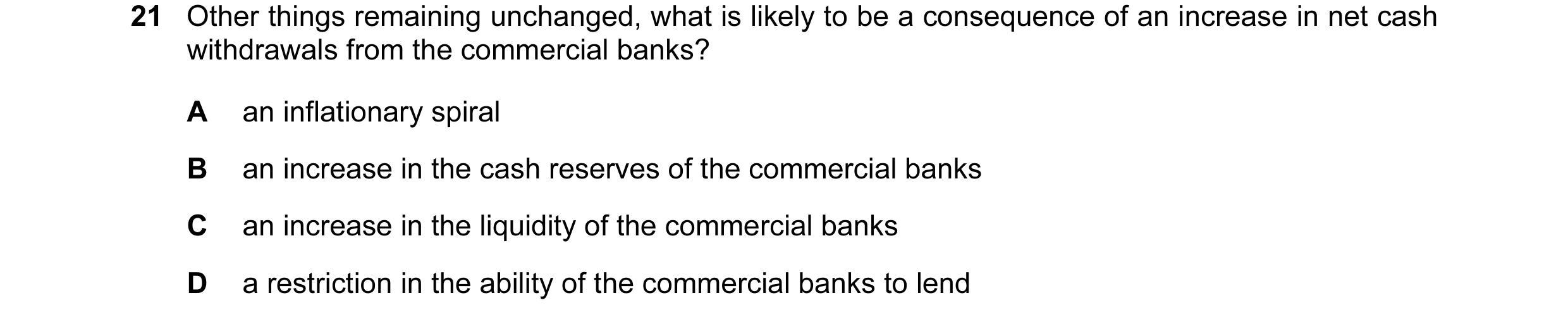
21 Other things remaining unchanged, what is likely to be a consequence of an increase in net cash withdrawals from the commercial banks? A an inflationary spiral B an increase in the cash reserves of the commercial banks C an increase in the liquidity of the commercial banks D a restriction in the ability of the commercial banks to lend
1 marks
Answer: D
This question in 9708/32 May/June 2013
Q75 · The diagram shows the determination of the rate of interest in an economy where MS… 9708/32 May/June 2013
22 The diagram shows the determination of the rate of interest in an economy where MS represents the money supply and LP represents liquidity preference. MS LP1 LP2 rate of interest r2 r1 O quantity of money The rate of interest rises as a result of a shift in the liquidity preference curve from LP1 to LP2. Which policy might be used to try to maintain the rate at r1? A increased government expenditure B increases in indirect taxes C reductions in income tax rates D the purchase of bonds in the open market
1 marks
Answer: D
This question in 9708/32 May/June 2013
Q76 · What will result from a rise in interest rates? 9708/33 May/June 2013
19 What will result from a rise in interest rates? A a depreciation in the exchange rate B a fall in the price of bonds C an increase in capital spending D an increase in the demand for money
1 marks
Answer: B
This question in 9708/33 May/June 2013
Q77 · In which circumstance will an increase in the public sector deficit not lead to an… 9708/33 May/June 2013
20 In which circumstance will an increase in the public sector deficit not lead to an increase in the money supply, other things being equal? A Commercial bank lending to the private sector is held constant. B The deficit is financed by an increase in government borrowing from private individuals. C The rate of interest is held constant. D There is large-scale unemployment.
1 marks
Answer: B
This question in 9708/33 May/June 2013
Q78 · What is meant by liquidity preference? 9708/33 May/June 2013
21 What is meant by liquidity preference? A a desire to be paid in cash rather than by cheque B a desire to be paid monthly rather than weekly C a desire to hold assets that are convertible into cash D a desire to hold money rather than other assets
1 marks
Answer: D
This question in 9708/33 May/June 2013
Q79 · Which assets are included within the definition of broad money but not within the… 9708/31 Oct/Nov 2013
18 Which assets are included within the definition of broad money but not within the definition of narrow money? A commercial banks’ deposits at the central bank B commercial banks’ till money C notes and coins in circulation D private sector savings (deposit) accounts
1 marks
Answer: D
This question in 9708/31 Oct/Nov 2013
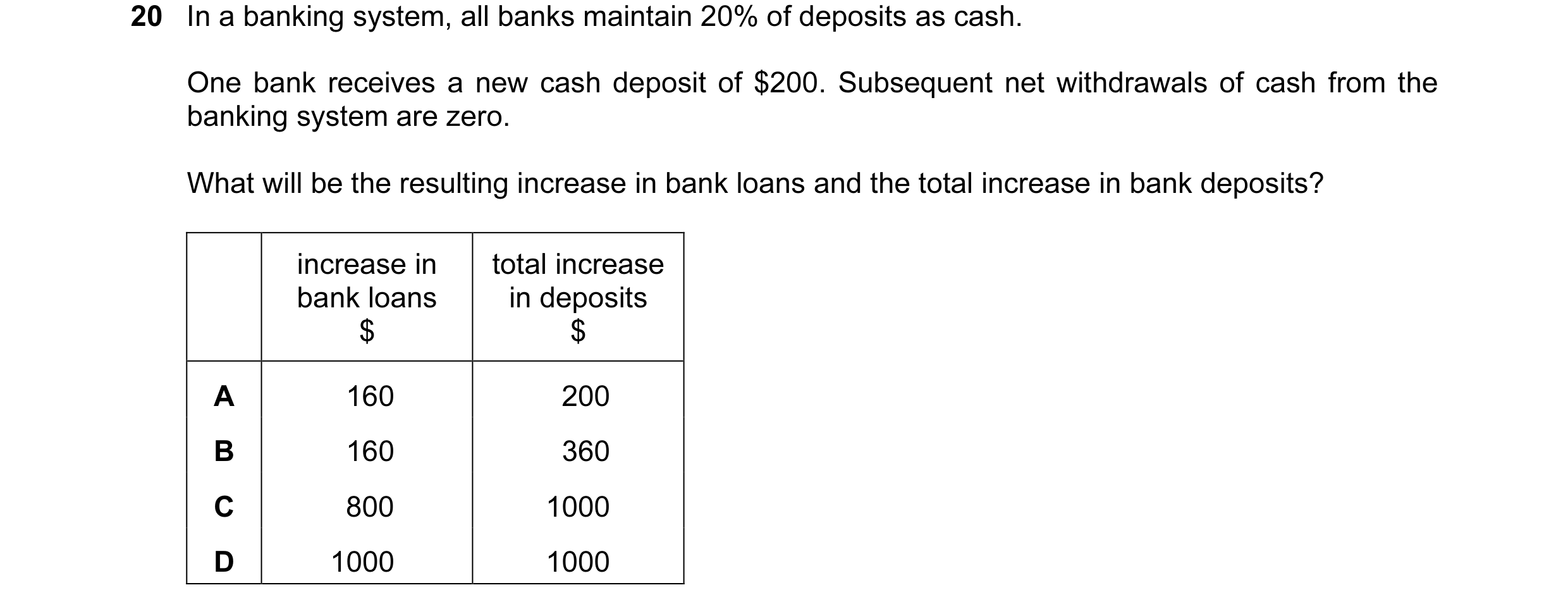
Q80 · In a banking system, all banks maintain 20% of deposits as cash 9708/31 Oct/Nov 2013
20 In a banking system, all banks maintain 20% of deposits as cash. One bank receives a new cash deposit of $200. Subsequent net withdrawals of cash from the banking system are zero. What will be the resulting increase in bank loans and the total increase in bank deposits? increase in total increase bank loans in deposits $ $ A 160 200 B 160 360 C 800 1000 D 1000 1000
1 marks
Answer: C
This question in 9708/31 Oct/Nov 2013
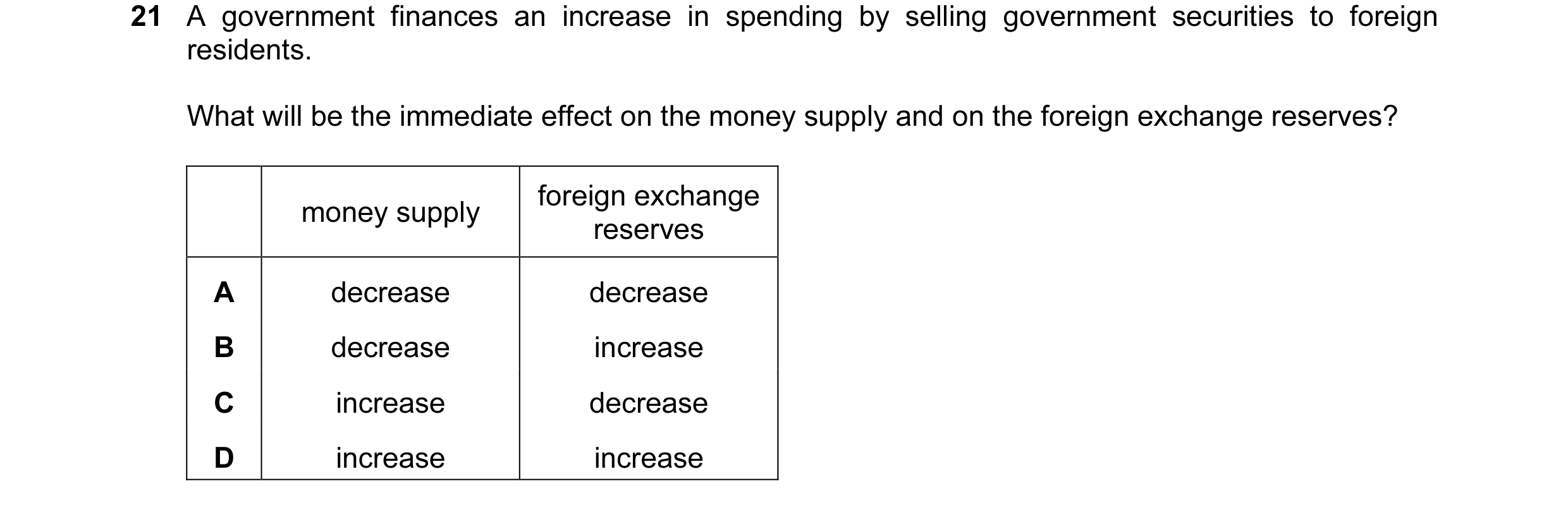
Q81 · A government finances an increase in spending by selling government securities to foreign… 9708/31 Oct/Nov 2013
21 A government finances an increase in spending by selling government securities to foreign residents. What will be the immediate effect on the money supply and on the foreign exchange reserves? foreign exchange money supply reserves A decrease decrease B decrease increase C increase decrease D increase increase
1 marks
Answer: D
This question in 9708/31 Oct/Nov 2013
Q82 · What will cause a fall in the quantity of money demanded? 9708/31 Oct/Nov 2013
22 What will cause a fall in the quantity of money demanded? A a rise in interest rates B a rise in national income C a rise in the price level D a rise in wealth
1 marks
Answer: A
This question in 9708/31 Oct/Nov 2013
Q83 · An economy has a low level of unemployment 9708/31 Oct/Nov 2013
30 An economy has a low level of unemployment. The government increases its expenditure. Which method of financing the additional expenditure is most likely to cause inflation? A an increase in borrowing from the Central Bank B an increase in income taxes C an increase in sales of state assets to the non-bank private sector D an issue of bonds to the non-bank private sector
1 marks
Answer: A
This question in 9708/31 Oct/Nov 2013
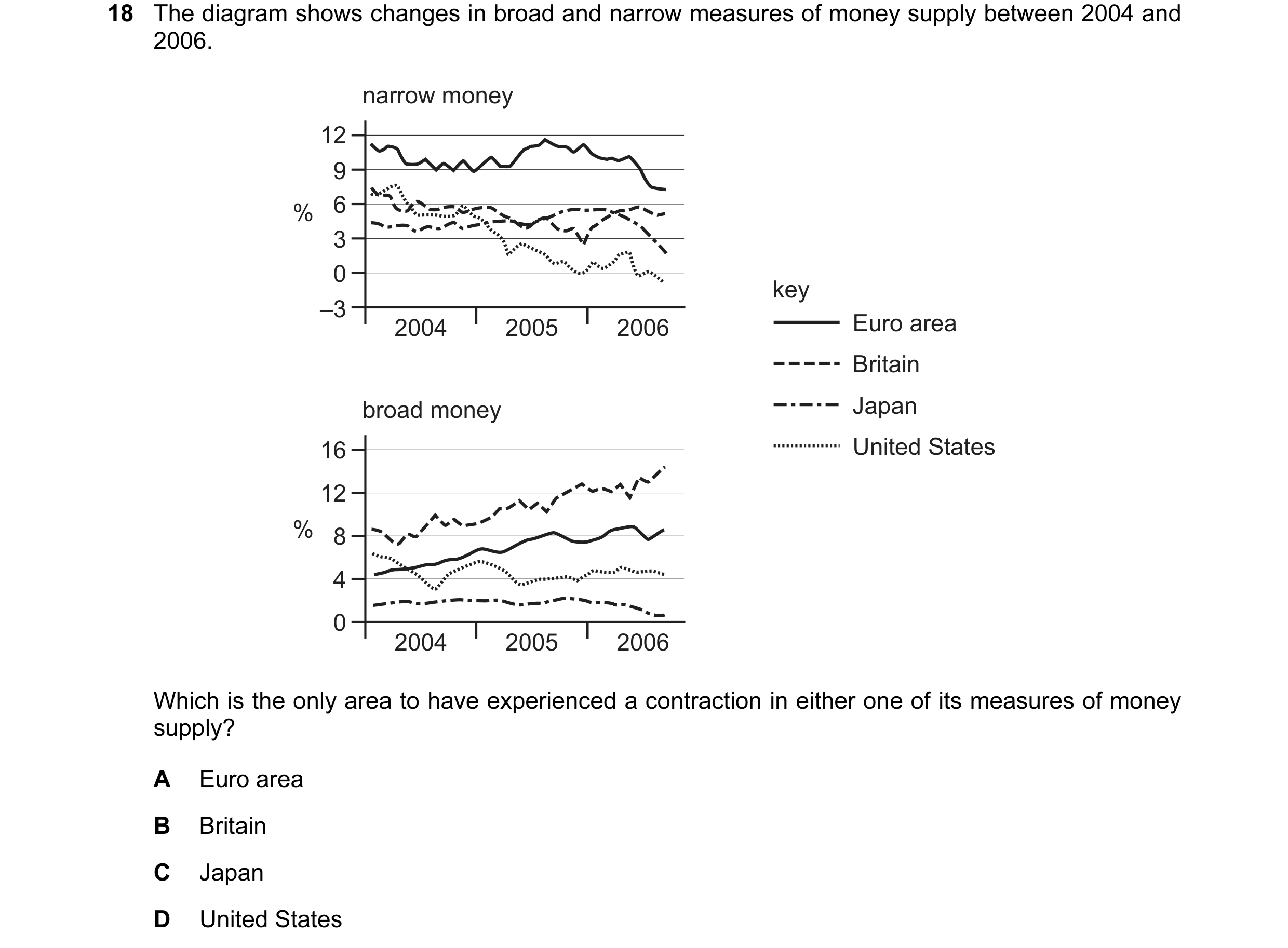
Q84 · The diagram shows changes in broad and narrow measures of money supply between 2004 and… 9708/32 Oct/Nov 2013
18 The diagram shows changes in broad and narrow measures of money supply between 2004 and 2006. narrow money 12 9 % 6 3 0 key –3 2004 2005 2006 Euro area Britain broad money Japan 16 United States 12 % 8 4 0 2004 2005 2006 Which is the only area to have experienced a contraction in either one of its measures of money supply? A Euro area B Britain C Japan D United States
1 marks
Answer: D
This question in 9708/32 Oct/Nov 2013
Q85 · Which assertion could be described as monetarist rather than Keynesian? 9708/32 Oct/Nov 2013
19 Which assertion could be described as monetarist rather than Keynesian? A The interest elasticity of investment expenditure is close to zero. B The money supply is the main determinant of aggregate monetary expenditure. C The money supply is the main determinant of output in the long-run. D The velocity of circulation of money is unstable over time.
1 marks
Answer: B
This question in 9708/32 Oct/Nov 2013
Q86 · According to loanable funds theory, what will cause the rate of interest to rise? 9708/32 Oct/Nov 2013
21 According to loanable funds theory, what will cause the rate of interest to rise? A a decrease in the demand for money B an increase in the level of savings C an increase in the rate of investment D an increase in the supply of money
1 marks
Answer: C
This question in 9708/32 Oct/Nov 2013
Q87 · According to monetarist theory, what will be affected in the long run by a change in the… 9708/33 Oct/Nov 2013
17 According to monetarist theory, what will be affected in the long run by a change in the money supply? the level the price the level of of output level unemployment A no no yes B no yes no C yes no yes D yes yes no
1 marks
Answer: B
This question in 9708/33 Oct/Nov 2013
Q88 · In a banking system, all banks maintain 20% of deposits as cash 9708/33 Oct/Nov 2013
20 In a banking system, all banks maintain 20% of deposits as cash. One bank receives a new cash deposit of $200. Subsequent net withdrawals of cash from the banking system are zero. What will be the total increase in deposits within the system? A $20 B $200 C $800 D $1000
1 marks
Answer: D
This question in 9708/33 Oct/Nov 2013
Q89 · A 6% increase in the money supply leads to a 4% increase in the level of money income 9708/33 Oct/Nov 2013
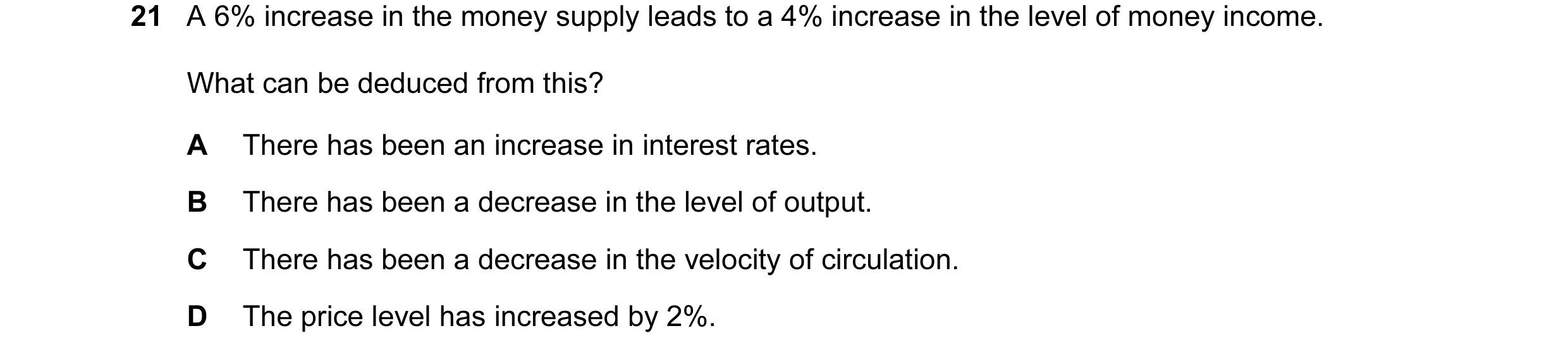
21 A 6% increase in the money supply leads to a 4% increase in the level of money income. What can be deduced from this? A There has been an increase in interest rates. B There has been a decrease in the level of output. C There has been a decrease in the velocity of circulation. D The price level has increased by 2%.
1 marks
Answer: C
This question in 9708/33 Oct/Nov 2013
Q90 · The diagram shows the market for loanable funds 9708/33 Oct/Nov 2013
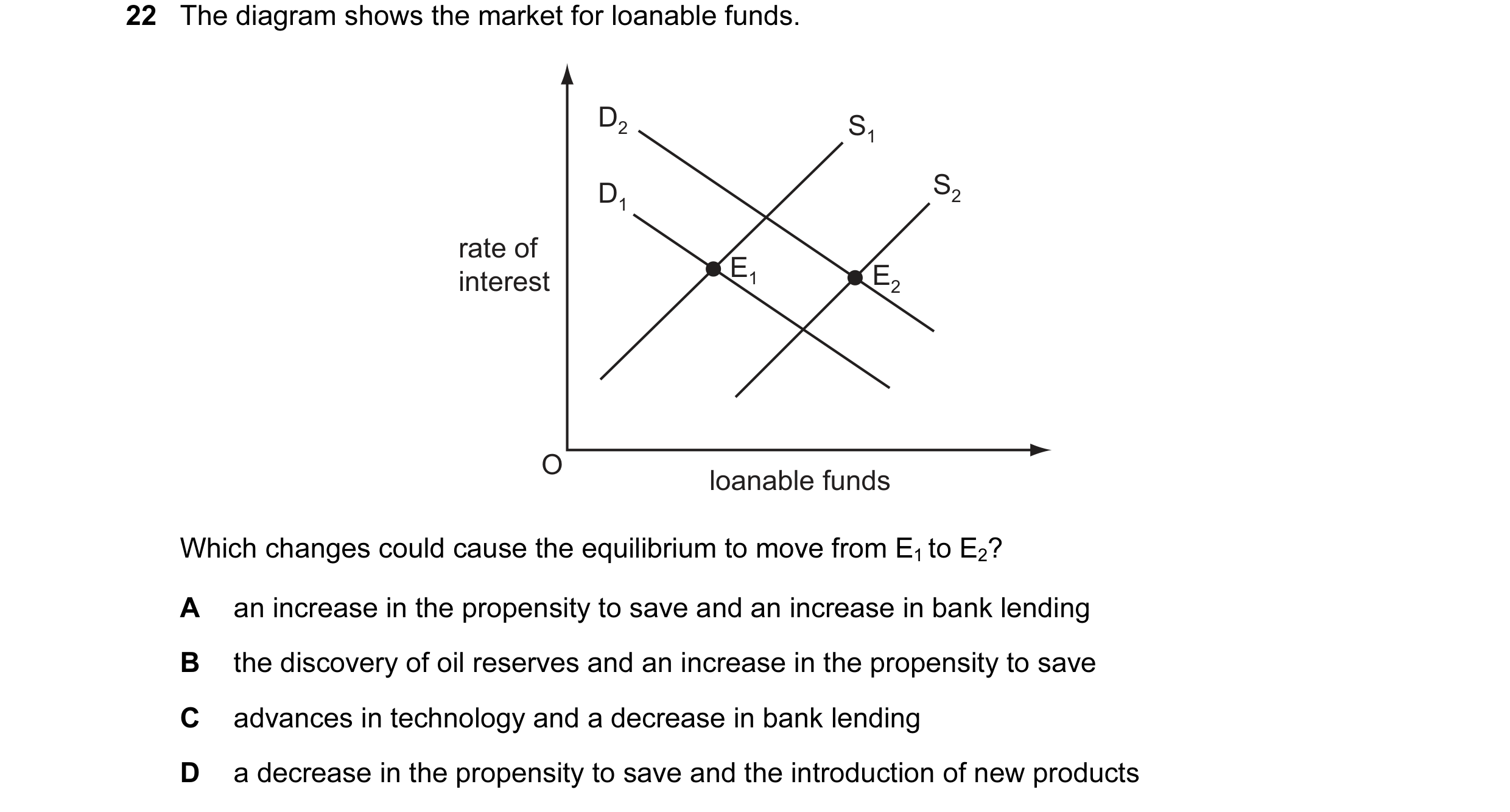
22 The diagram shows the market for loanable funds. D2 S1 D1 S2 rate of E1 E2 interest O loanable funds Which changes could cause the equilibrium to move from E1 to E2? A an increase in the propensity to save and an increase in bank lending B the discovery of oil reserves and an increase in the propensity to save C advances in technology and a decrease in bank lending D a decrease in the propensity to save and the introduction of new products
1 marks
Answer: B
This question in 9708/33 Oct/Nov 2013
Q91 · A central bank purchases government securities as part of a policy of quantitative easing 9708/31 Oct/Nov 2014
18 A central bank purchases government securities as part of a policy of quantitative easing. What is likely to be the effect on interest rates and the supply of money? interest rates money supply A decrease decrease B decrease increase C increase decrease D increase increase
1 marks
Answer: B
This question in 9708/31 Oct/Nov 2014
Q92 · An economy is operating at its natural rate of unemployment 9708/31 Oct/Nov 2014
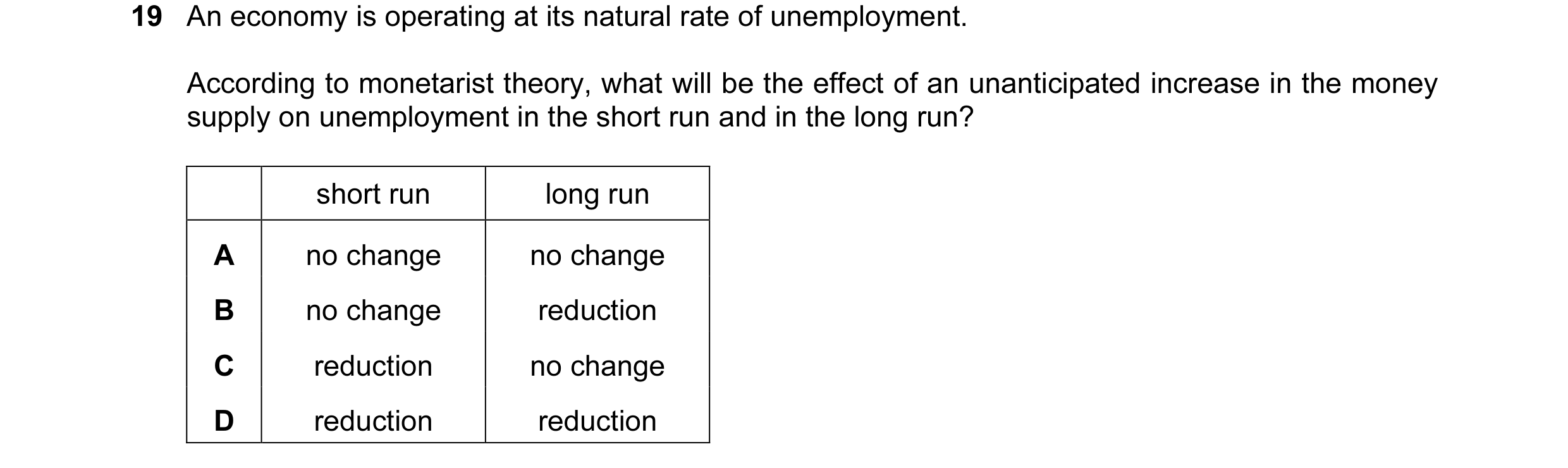
19 An economy is operating at its natural rate of unemployment. According to monetarist theory, what will be the effect of an unanticipated increase in the money supply on unemployment in the short run and in the long run? short run long run A no change no change B no change reduction C reduction no change D reduction reduction
1 marks
Answer: C
This question in 9708/31 Oct/Nov 2014
Q93 · Assuming a constant income velocity of circulation of money, if the rate of inflation is… 9708/31 Oct/Nov 2014
22 Assuming a constant income velocity of circulation of money, if the rate of inflation is 10% and the rate of growth of the money supply is 7%, what will be the approximate change in the volume of national output? A –7% B –3% C +3% D +13%
1 marks
Answer: B
This question in 9708/31 Oct/Nov 2014
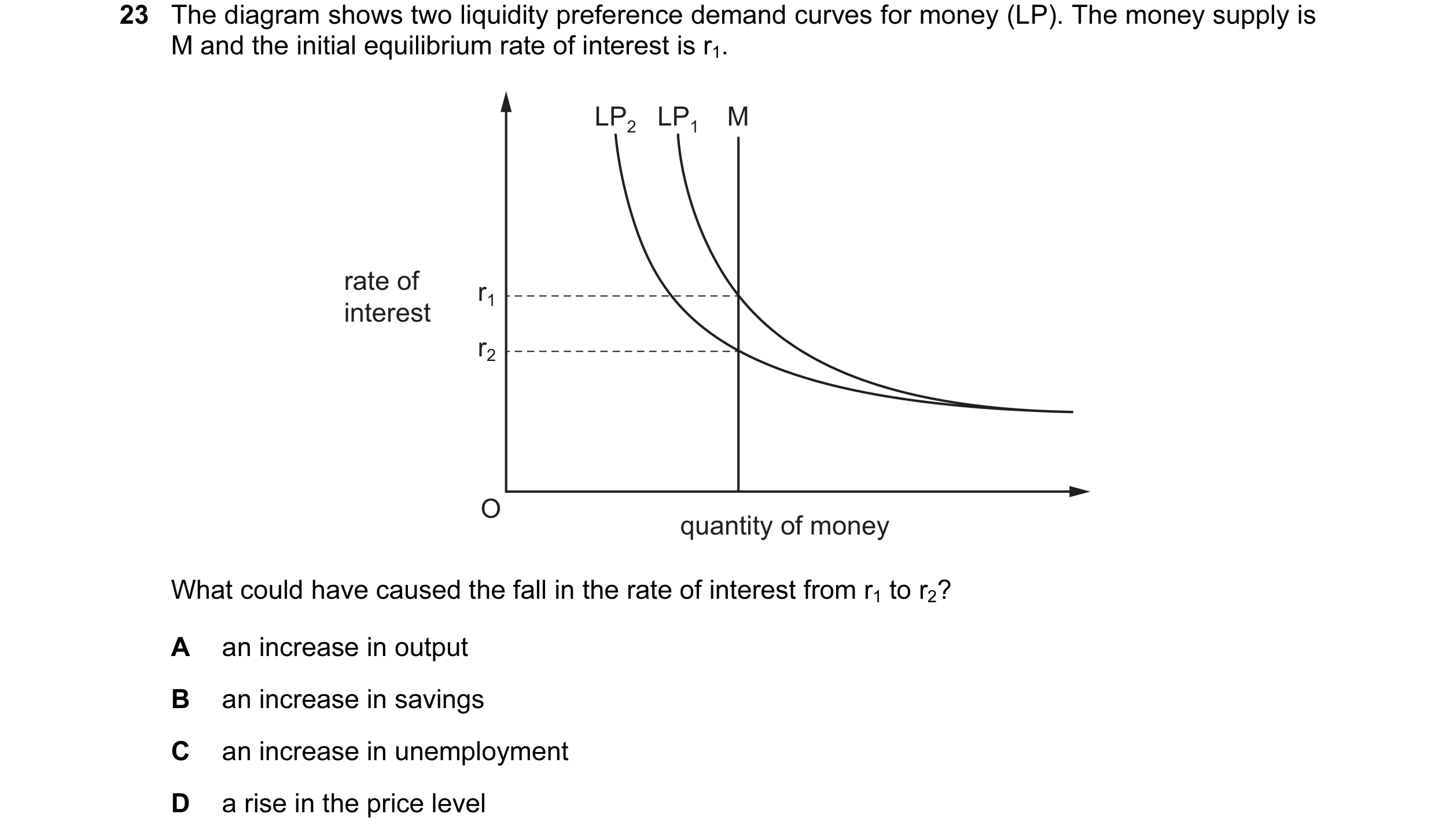
Q94 · The diagram shows two liquidity preference demand curves for money (LP) 9708/31 Oct/Nov 2014
23 The diagram shows two liquidity preference demand curves for money (LP). The money supply is M and the initial equilibrium rate of interest is r1. LP2 LP1 M rate of r1 interest r2 O quantity of money What could have caused the fall in the rate of interest from r1 to r2? A an increase in output B an increase in savings C an increase in unemployment D a rise in the price level
1 marks
Answer: C
This question in 9708/31 Oct/Nov 2014
Q95 · Despite a government budget deficit, a country’s money supply remains unchanged 9708/33 Oct/Nov 2014
18 Despite a government budget deficit, a country’s money supply remains unchanged. What could explain this? A The country has a balance of payments surplus equal to the government budget deficit. B The country’s foreign exchange rate is fixed. C The government budget deficit is financed by borrowing from the central bank. D The government budget deficit is financed by selling government bonds to members of the public.
1 marks
Answer: D
This question in 9708/33 Oct/Nov 2014
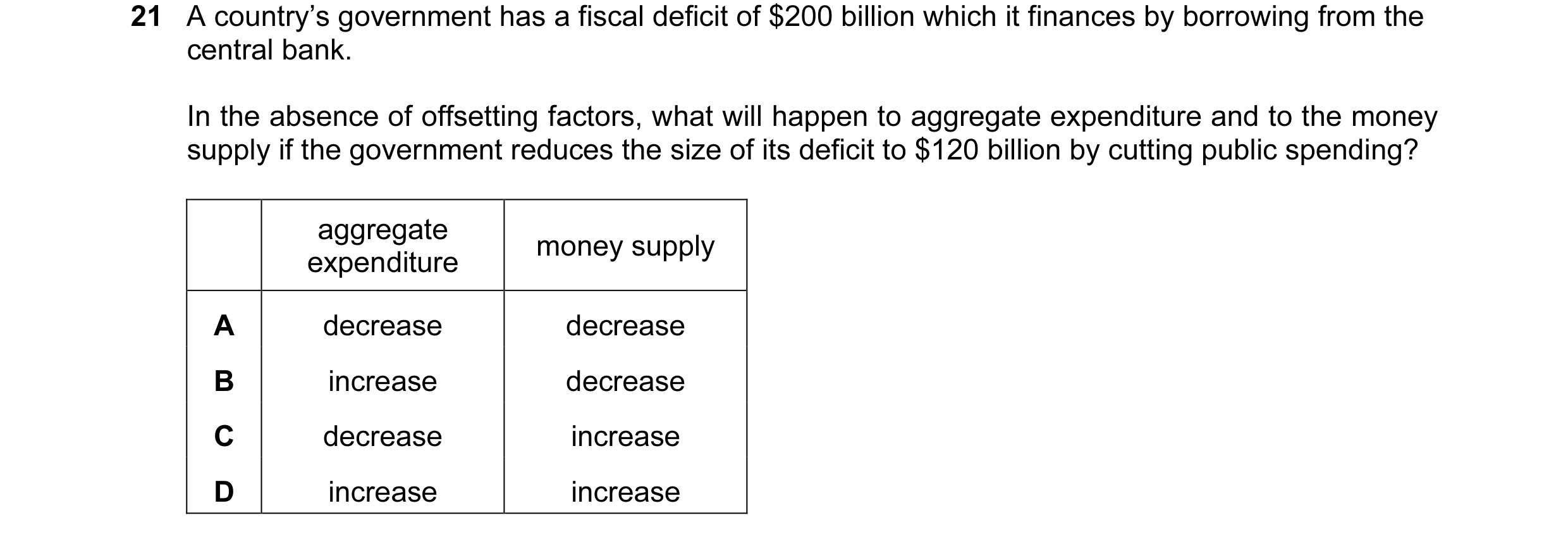
Q96 · A country’s government has a fiscal deficit of $200 billion which it finances by… 9708/33 Oct/Nov 2014
21 A country’s government has a fiscal deficit of $200 billion which it finances by borrowing from the central bank. In the absence of offsetting factors, what will happen to aggregate expenditure and to the money supply if the government reduces the size of its deficit to $120 billion by cutting public spending? aggregate money supply expenditure A decrease decrease B increase decrease C decrease increase D increase increase
1 marks
Answer: C
This question in 9708/33 Oct/Nov 2014
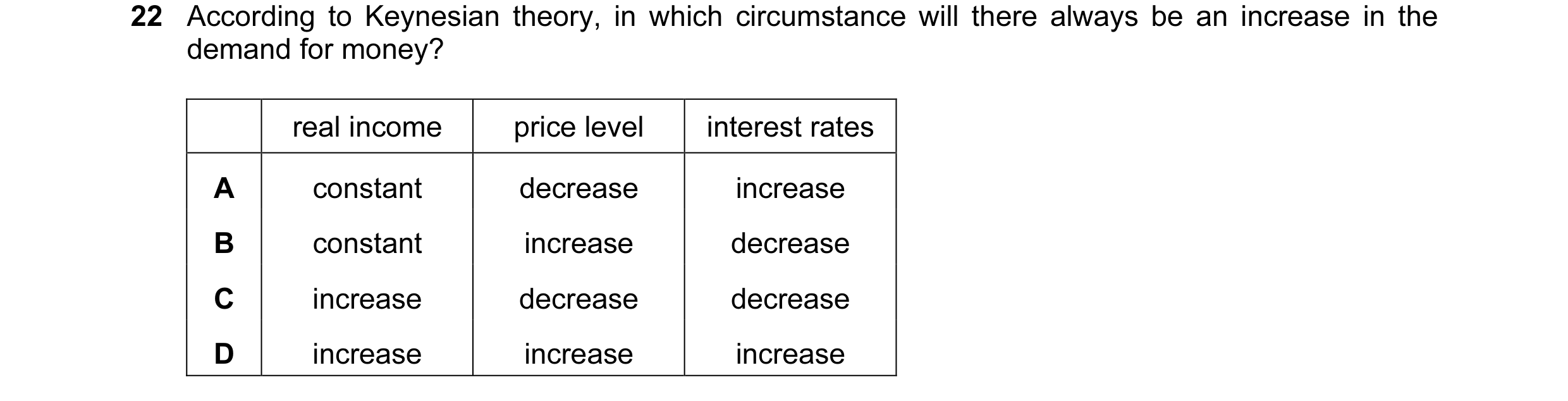
Q97 · According to Keynesian theory, in which circumstance will there always be an increase in… 9708/33 Oct/Nov 2014
22 According to Keynesian theory, in which circumstance will there always be an increase in the demand for money? real income price level interest rates A constant decrease increase B constant increase decrease C increase decrease decrease D increase increase increase
1 marks
Answer: B
This question in 9708/33 Oct/Nov 2014
Q98 · According to loanable funds theory, what will cause the rate of interest to rise? 9708/33 Oct/Nov 2014
23 According to loanable funds theory, what will cause the rate of interest to rise? A a decrease in the demand for money B an increase in the level of savings C an increase in the rate of investment D an increase in the supply of money
1 marks
Answer: C
This question in 9708/33 Oct/Nov 2014
Q99 · The income velocity of circulation is equal to 2.0 9708/31 May/June 2015
20 The income velocity of circulation is equal to 2.0. If the rate of growth of the money supply is 8% and the average price level increases by 4%, what will be the change in real output (transactions)? A +4% B +8% C +12% D +16%
1 marks
Answer: A
This question in 9708/31 May/June 2015
Q100 · The diagram shows the demand curves and supply curves of loanable funds 9708/31 May/June 2015
21 The diagram shows the demand curves and supply curves of loanable funds. The market is in equilibrium at point X. What would be the new equilibrium point if there were an increase in business confidence and a reduction in the propensity to save? S1 D3 D2 S2 D1 B S3 A rate of C X interest D O loanable funds
1 marks
Answer: B
This question in 9708/31 May/June 2015
Q101 · In an open economy, what is most likely to cause the money supply to fall? 9708/31 May/June 2015
29 In an open economy, what is most likely to cause the money supply to fall? A a balance of payments surplus B an increase in the ratio of cash reserves to total deposits in the commercial banking sector C central bank bond purchases from the non-bank private sector D government borrowing from the commercial banking sector
1 marks
Answer: B
This question in 9708/31 May/June 2015
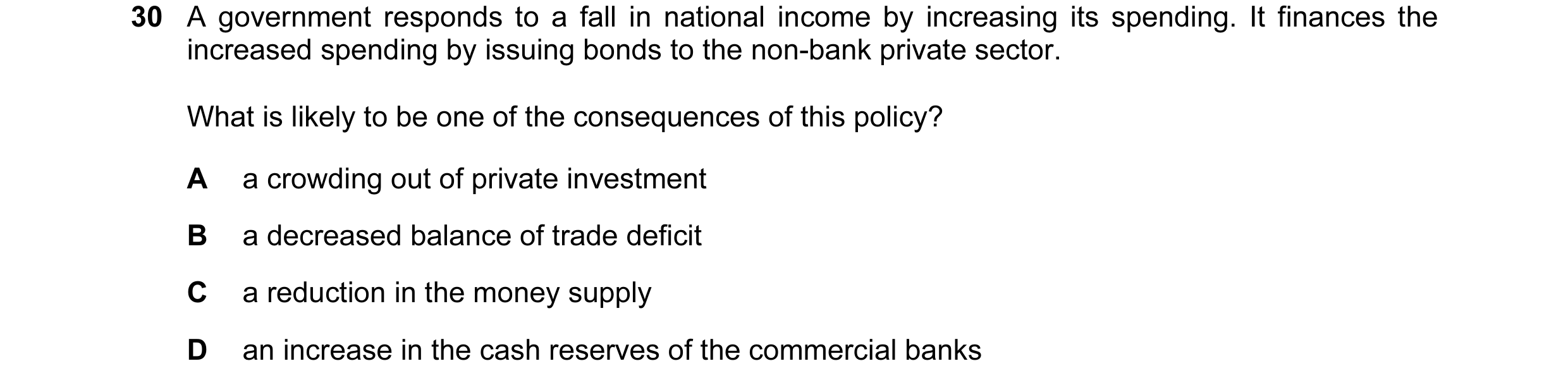
Q102 · A government responds to a fall in national income by increasing its spending 9708/31 May/June 2015
30 A government responds to a fall in national income by increasing its spending. It finances the increased spending by issuing bonds to the non-bank private sector. What is likely to be one of the consequences of this policy? A a crowding out of private investment B a decreased balance of trade deficit C a reduction in the money supply D an increase in the cash reserves of the commercial banks
1 marks
Answer: A
This question in 9708/31 May/June 2015
Q103 · Other things being equal, the money supply in an open economy will increase if A domestic… 9708/32 May/June 2015
18 Other things being equal, the money supply in an open economy will increase if A domestic banks increase their lending to foreign borrowers. B the central bank buys foreign currency in the foreign exchange market. C the government sells bonds to domestic residents. D there is an increase in the volume of imports to the economy.
1 marks
Answer: B
This question in 9708/32 May/June 2015
Q104 · Assuming a constant income velocity of circulation of money, if the price level increases… 9708/32 May/June 2015
22 Assuming a constant income velocity of circulation of money, if the price level increases by 5% and the money supply grows by 2%, what will be the approximate change in real output (transactions)? A –3% B –2.5% C +3% D +7%
1 marks
Answer: A
This question in 9708/32 May/June 2015
Q105 · Why will an inflationary process be brought to a halt if the money supply is held… 9708/32 May/June 2015
23 Why will an inflationary process be brought to a halt if the money supply is held constant? A Consumption will decrease as money incomes decline. B Government expenditure will have to be reduced as government revenues decline. C The rate of interest will rise as more money is required for transactions purposes. D The stimulus to invest will decline as the real burden of company debt rises.
1 marks
Answer: C
This question in 9708/32 May/June 2015
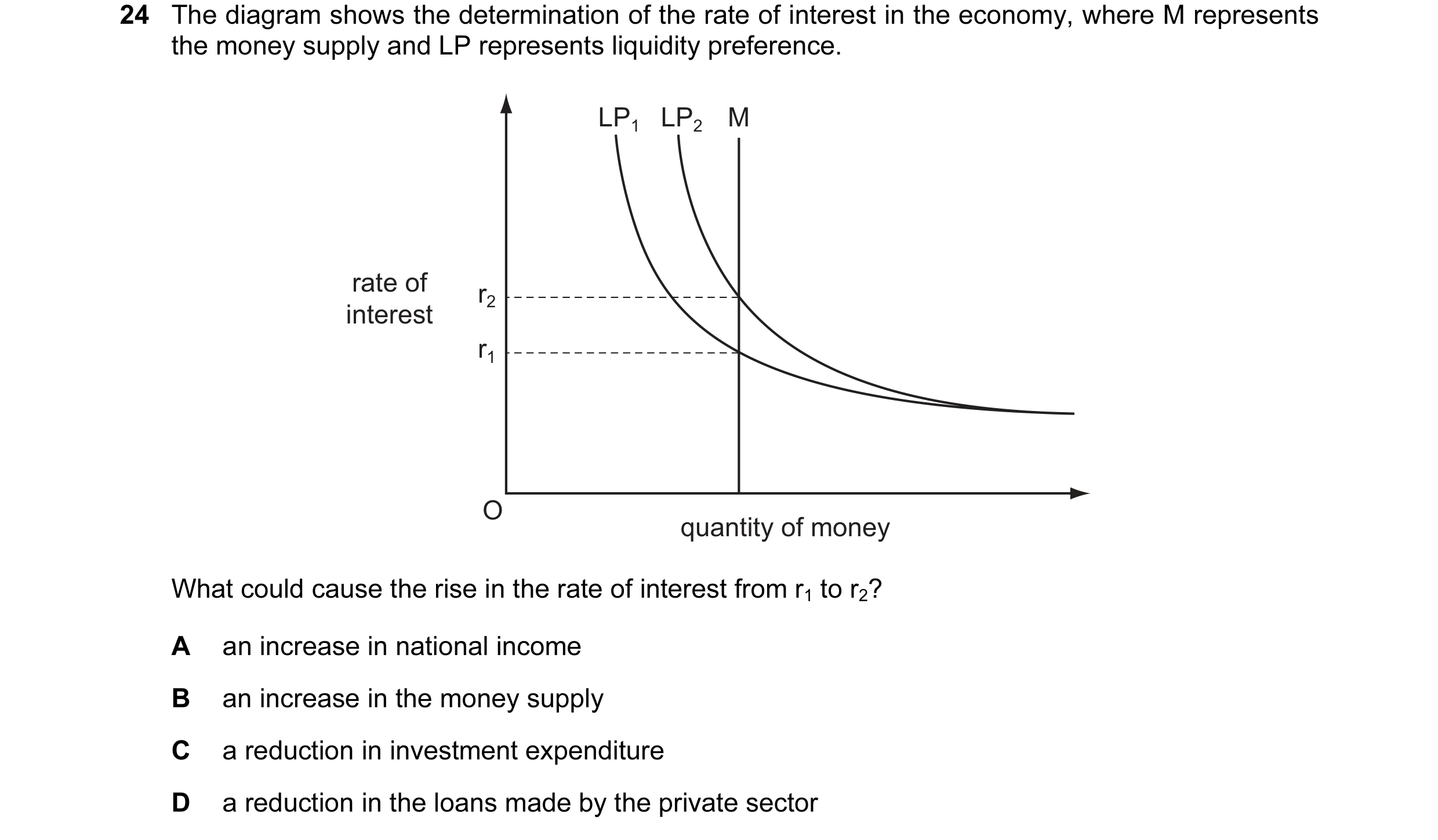
Q106 · The diagram shows the determination of the rate of interest in the economy, where M… 9708/32 May/June 2015
24 The diagram shows the determination of the rate of interest in the economy, where M represents the money supply and LP represents liquidity preference. LP1 LP2 M rate of r2 interest r1 O quantity of money What could cause the rise in the rate of interest from r1 to r2? A an increase in national income B an increase in the money supply C a reduction in investment expenditure D a reduction in the loans made by the private sector
1 marks
Answer: A
This question in 9708/32 May/June 2015
Q107 · What must result from a rise in the supply of money, if the income velocity of… 9708/31 Oct/Nov 2015
17 What must result from a rise in the supply of money, if the income velocity of circulation remains unchanged? A a fall in unemployment B a rise in the volume of output C a rise in the general level of prices D a rise in the money value of national income
1 marks
This question in 9708/31 Oct/Nov 2015
Q108 · In an economy, the volume of output rises by 2% in a year, while the quantity of money… 9708/31 Oct/Nov 2015
20 In an economy, the volume of output rises by 2% in a year, while the quantity of money rises by 5%. If the velocity of circulation of money remains the same, what will be the approximate increases in the price level and the money value of national income? increase in money increase in price level value of national income A 2% 5% B 2% 7% C 3% 5% D 3% 7%
1 marks
This question in 9708/31 Oct/Nov 2015
Q109 · The diagram shows three different levels of money supply (MS) and three different demand… 9708/31 Oct/Nov 2015
21 The diagram shows three different levels of money supply (MS) and three different demand curves for holding money balances (LP). The initial equilibrium is at point X. There is a reduction in bank lending and people decide to hold more money as a precaution against emergencies. What could be the new equilibrium point? A D B rate of X LP interest LP C LP MS MS MS O quantity of money
1 marks
This question in 9708/31 Oct/Nov 2015
Q110 · Over one year the money income in an economy increased by 6% 9708/32 Oct/Nov 2015
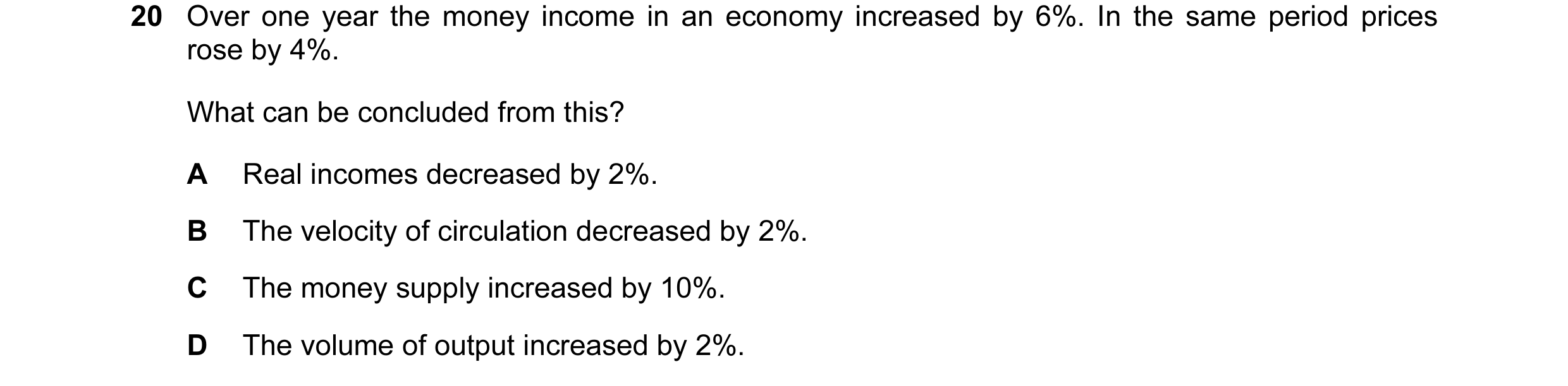
20 Over one year the money income in an economy increased by 6%. In the same period prices rose by 4%. What can be concluded from this? A Real incomes decreased by 2%. B The velocity of circulation decreased by 2%. C The money supply increased by 10%. D The volume of output increased by 2%.
1 marks
Answer: D
This question in 9708/32 Oct/Nov 2015
Q111 · What is likely to be the effect on interest rates and the supply of money of a purchase… 9708/32 Oct/Nov 2015
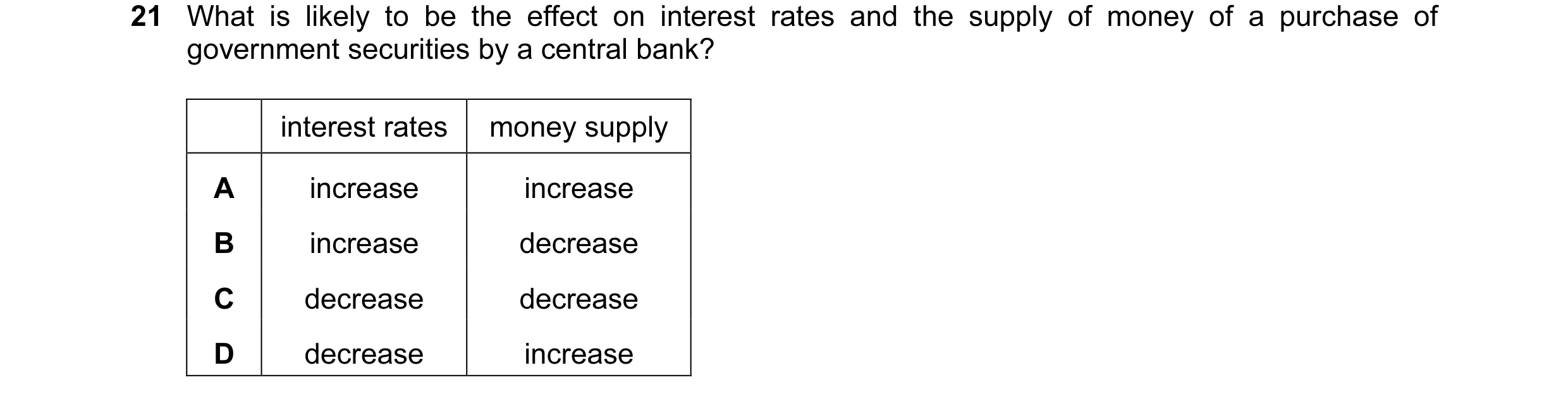
21 What is likely to be the effect on interest rates and the supply of money of a purchase of government securities by a central bank? interest rates money supply A increase increase B increase decrease C decrease decrease D decrease increase
1 marks
Answer: D
This question in 9708/32 Oct/Nov 2015
Q112 · An economy is operating at its natural rate of unemployment 9708/32 Oct/Nov 2015
25 An economy is operating at its natural rate of unemployment. According to monetarist theory, what will be the effect on unemployment in the short run and in the long run of an unanticipated increase in the money supply? short run long run A no change no change B no change reduction C reduction no change D reduction reduction
1 marks
Answer: C
This question in 9708/32 Oct/Nov 2015
Q113 · The table shows how the government finances its budget deficit in a closed economy 9708/32 Oct/Nov 2015
28 The table shows how the government finances its budget deficit in a closed economy. $ budget deficit 200 billion sale of government securities to the central bank 50 billion sale of government securities to the non-bank private sector 150 billion If there is no change in notes and coins in circulation and commercial banks maintain a 10% cash reserve ratio, what will be the resulting increase in the money supply? A $50 billion B $150 billion C $200 billion D $500 billion
1 marks
Answer: D
This question in 9708/32 Oct/Nov 2015
Q114 · What will expand the money supply in an open economy? 9708/33 Oct/Nov 2015
21 What will expand the money supply in an open economy? A a current account balance of payments deficit B an increase in the cash reserve ratio of commercial banks C government borrowing from domestic residents D government intervention to prevent an appreciation in the foreign exchange value of domestic currency
1 marks
Answer: D
This question in 9708/33 Oct/Nov 2015
Q115 · According to Keynesian theory, what will cause the rate of interest to rise? 9708/33 Oct/Nov 2015
27 According to Keynesian theory, what will cause the rate of interest to rise? A a decrease in liquidity preference B a decrease in the level of national income C a decrease in the rate of investment D a decrease in the supply of money
1 marks
Answer: D
This question in 9708/33 Oct/Nov 2015
Q116 · According to Keynesian theory, when will an increase in the money supply leave the level… 9708/32 May/June 2016
25 According to Keynesian theory, when will an increase in the money supply leave the level of output unchanged? A when the liquidity trap is operative B when the money supply increase was not anticipated C when there is a floating exchange rate D when there is an immediate adjustment to expectations about future price levels
1 marks
Answer: A
This question in 9708/32 May/June 2016
Q117 · Which is likely to cause a decrease in the public’s desired ratio of cash to bank… 9708/33 May/June 2016
25 Which is likely to cause a decrease in the public’s desired ratio of cash to bank deposits? A a decrease in the number of reported street crimes B an extension of bank opening hours C the introduction of a charge per transaction on accounts D the introduction of annual charges for the use of credit cards
1 marks
Answer: B
This question in 9708/33 May/June 2016
Q118 · What would cause an increase in the transactions demand for money? 9708/32 Oct/Nov 2016
26 What would cause an increase in the transactions demand for money? A a fall in the price of bonds B an increase in nominal national income C an increase in the rate of interest D an increase in unemployment
1 marks
Answer: B
This question in 9708/32 Oct/Nov 2016
Q119 · Which policy pursued by a central bank represents a contractionary monetary policy? 9708/32 Oct/Nov 2016
29 Which policy pursued by a central bank represents a contractionary monetary policy? A a reduction in the interest rate at which it will lend to banks B a reduction in the minimum cash to deposit ratios of banks C the purchase of foreign currency to influence the country’s exchange rate D the sale of government bonds in the open market
1 marks
Answer: D
This question in 9708/32 Oct/Nov 2016
Q120 · Which is most likely to cause an increase in a country’s money supply? 9708/33 Oct/Nov 2016
27 Which is most likely to cause an increase in a country’s money supply? A a balance of payments surplus B a government budget surplus C cash withdrawals by commercial bank depositors D the recall of loans by the commercial banks
1 marks
Answer: A
This question in 9708/33 Oct/Nov 2016
Q121 · In the absence of offsetting factors, how will an increase in interest rates affect share… 9708/33 Oct/Nov 2016
30 In the absence of offsetting factors, how will an increase in interest rates affect share prices? A It will decrease share prices because financial investors will prefer to purchase bonds. B It will decrease share prices because inflationary pressure will increase. C It will increase share prices because company profits will rise. D It will increase share prices because saving will become less attractive.
1 marks
Answer: A
This question in 9708/33 Oct/Nov 2016
Q122 · How do commercial banks create money? 9708/33 May/June 2017
22 How do commercial banks create money? A by cashing cheques for their customers B by increasing their reserves at the central bank C by making loans to customers D by charging customers for banking services
1 marks
Answer: C
This question in 9708/33 May/June 2017
Q123 · The diagram outlines the monetary transmission mechanism following an expansionary… 9708/32 Oct/Nov 2018
26 The diagram outlines the monetary transmission mechanism following an expansionary central bank intervention (quantitative easing). Key actions have been omitted from the process. central bank … 1 … government assets ↓ short-term interest rates … 2 … ↓ investment demand … 3 … ↓ real GDP rises Which words complete gaps 1, 2 and 3? 1 2 3 A buys fall rises B buys rise falls C sells fall rises D sells rise falls
1 marks
Answer: A
This question in 9708/32 Oct/Nov 2018
Q124 · In Keynesian monetary theory, when will an increase in the supply of money not cause a… 9708/32 Oct/Nov 2018
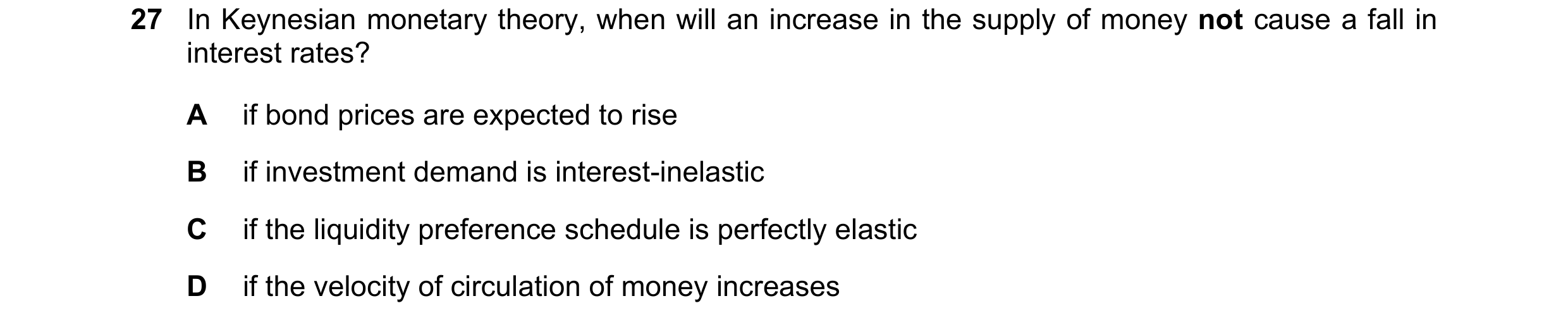
27 In Keynesian monetary theory, when will an increase in the supply of money not cause a fall in interest rates? A if bond prices are expected to rise B if investment demand is interest-inelastic C if the liquidity preference schedule is perfectly elastic D if the velocity of circulation of money increases
1 marks
Answer: C
This question in 9708/32 Oct/Nov 2018
Q125 · The central bank of a country creates cash to purchase government bonds from the… 9708/32 Feb/March 2019
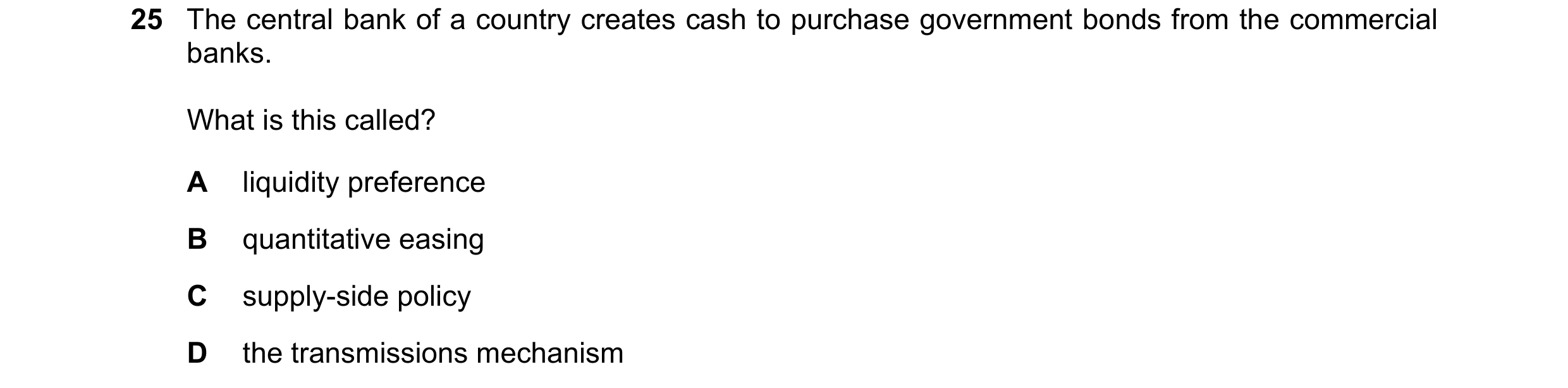
25 The central bank of a country creates cash to purchase government bonds from the commercial banks. What is this called? A liquidity preference B quantitative easing C supply-side policy D the transmissions mechanism
1 marks
Answer: B
This question in 9708/32 Feb/March 2019
Q126 · The diagram shows a liquidity preference curve (LP) representing the demand to hold money… 9708/32 May/June 2019
26 The diagram shows a liquidity preference curve (LP) representing the demand to hold money in relation to the rate of interest and the money supply (MS) in an economy. The market is in equilibrium at interest rate r. MS rate of interest r LP O quantity of money If the government increases the money supply, what will be the effect on the interest rate? A falls below zero B falls to zero C increases D no effect
1 marks
Answer: D
This question in 9708/32 May/June 2019
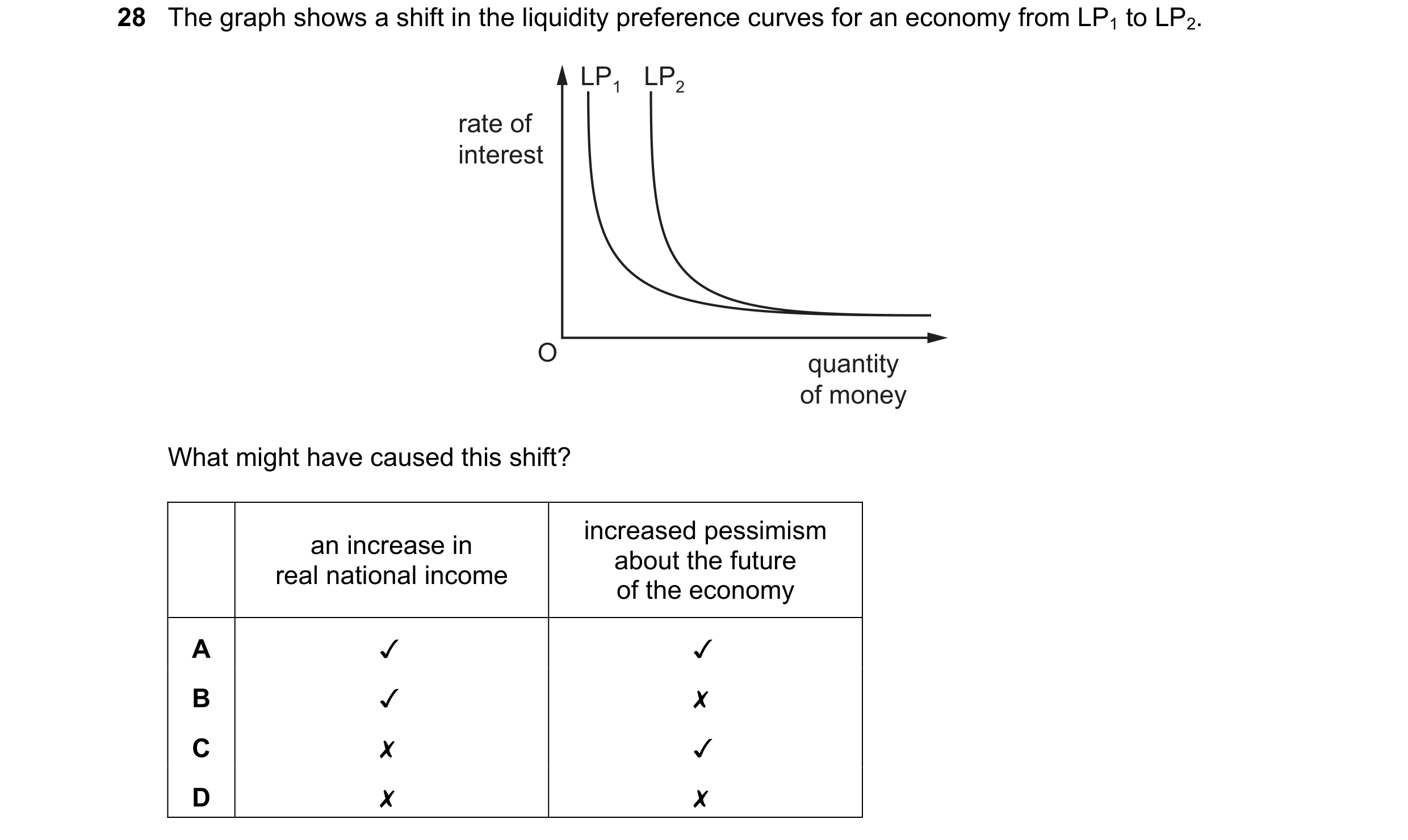
Q127 · The graph shows a shift in the liquidity preference curves for an economy from LP; to LP2 9708/32 May/June 2019
28 The graph shows a shift in the liquidity preference curves for an economy from LP; to LP2.
LP, LP,
rate of
interest
O quantity
of money
What might have caused this shift?
increased pessimism
about the future
of the economy
an increase in
real national income
A v v
B v x
Cc x v
D x x
1 marks
Answer: A
This question in 9708/32 May/June 2019
Q128 · Which diagram shows the effect of a policy of quantitative easing on the rate of interest? 9708/32 Feb/March 2020
28 Which diagram shows the effect of a policy of quantitative easing on the rate of interest? A B rate of rate of interest interest LP2 LP1 LP1 O MS1 MS2 O MS1 quantity quantity of money of money C D rate of rate of interest interest LP1 LP1 LP2 O MS2 MS1 O MS1 quantity quantity of money of money
1 marks
Answer: A
This question in 9708/32 Feb/March 2020
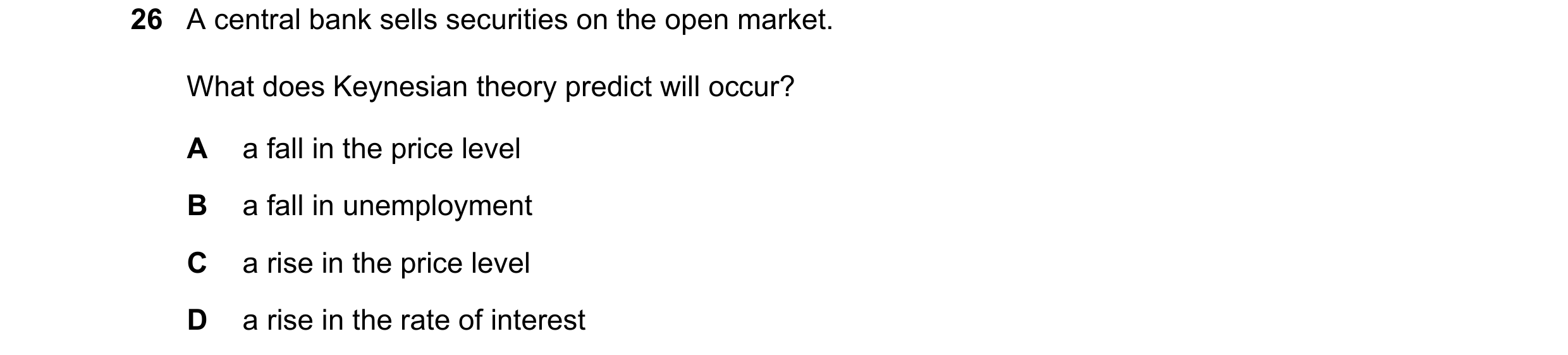
Q129 · A central bank sells securities on the open market 9708/31 Oct/Nov 2020
26 A central bank sells securities on the open market. What does Keynesian theory predict will occur? A a fall in the price level B a fall in unemployment C a rise in the price level D a rise in the rate of interest
1 marks
Answer: D
This question in 9708/31 Oct/Nov 2020
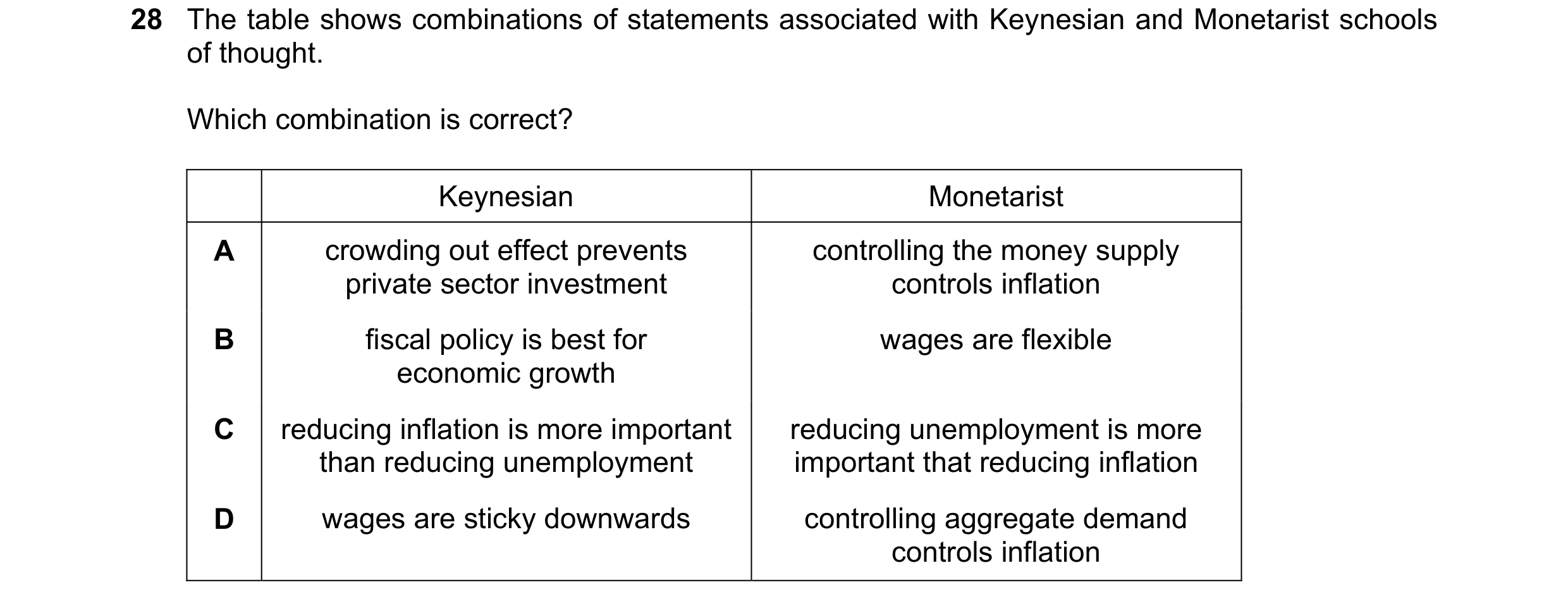
Q130 · The table shows combinations of statements associated with Keynesian and Monetarist… 9708/31 Oct/Nov 2020
28 The table shows combinations of statements associated with Keynesian and Monetarist schools of thought. Which combination is correct? Keynesian Monetarist A crowding out effect prevents controlling the money supply private sector investment controls inflation B fiscal policy is best for wages are flexible economic growth C reducing inflation is more important reducing unemployment is more than reducing unemployment important that reducing inflation D wages are sticky downwards controlling aggregate demand controls inflation
1 marks
Answer: B
This question in 9708/31 Oct/Nov 2020
Q131 · What is included in ‘narrow money’? 9708/32 Oct/Nov 2020
23 What is included in ‘narrow money’?
notes and coins current (checking) banks’ liquid assets treasury
in circulation account deposits at the central bank bills
A JV JV Jv x
B Jv Jv x x
Cc Jv x x x
D x x Jv JV
1 marks
Answer: A
This question in 9708/32 Oct/Nov 2020
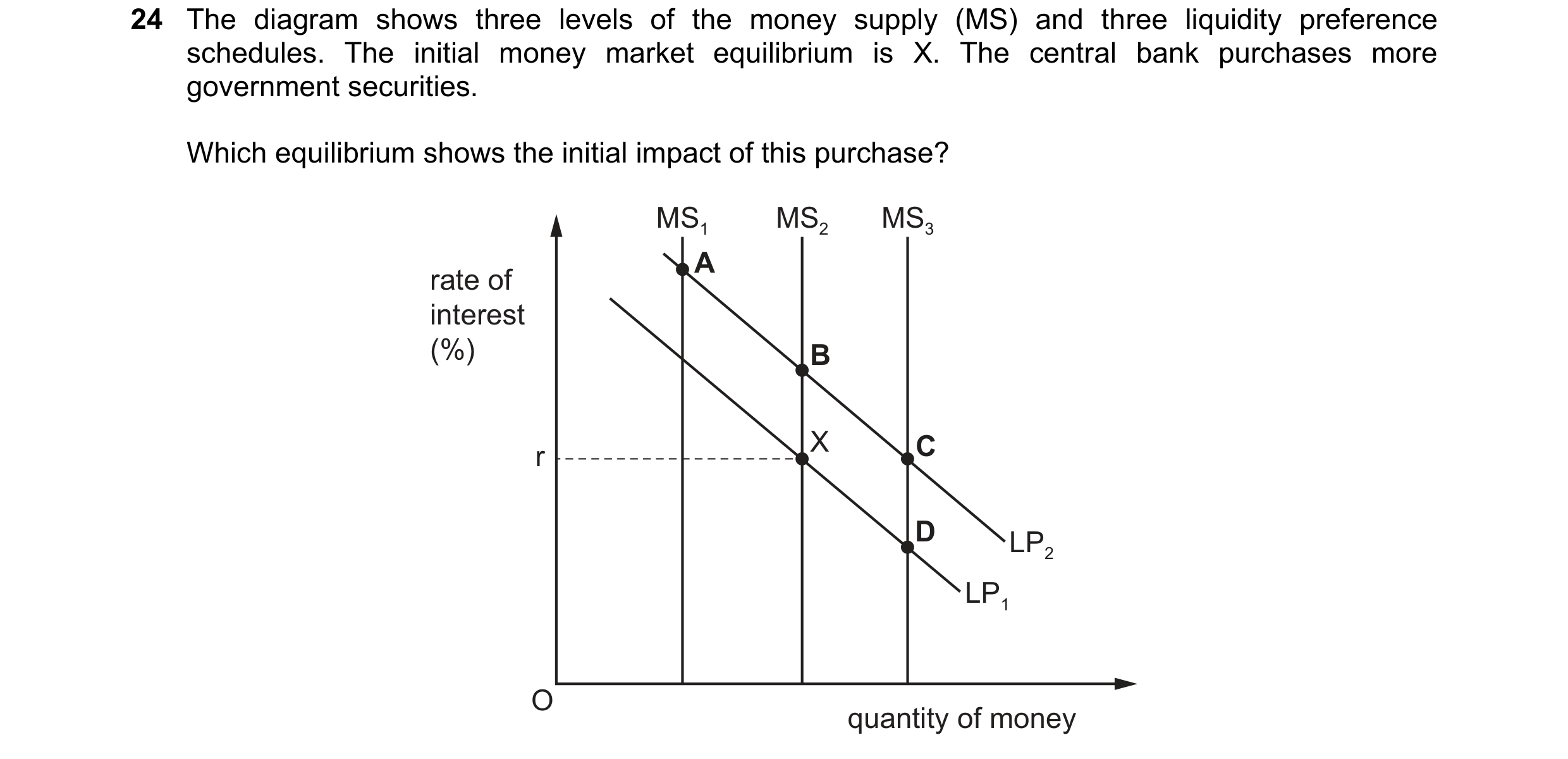
Q132 · The diagram shows three levels of the money supply (MS) and three liquidity preference… 9708/32 Oct/Nov 2020
24 The diagram shows three levels of the money supply (MS) and three liquidity preference schedules. The initial money market equilibrium is X. The central bank purchases more government securities. Which equilibrium shows the initial impact of this purchase? MS1 MS2 MS3 A rate of interest (%) B X C r D LP2 LP1 O quantity of money
1 marks
Answer: D
This question in 9708/32 Oct/Nov 2020
Q133 · What is an important assumption of Monetarism? 9708/32 Oct/Nov 2020
25 What is an important assumption of Monetarism? A Fiscal policy is more effective than monetary policy in reducing inflation. B Long-term unemployment results from deficient demand. C The interest elasticity of investment spending is low. D The velocity of circulation is stable.
1 marks
Answer: D
This question in 9708/32 Oct/Nov 2020
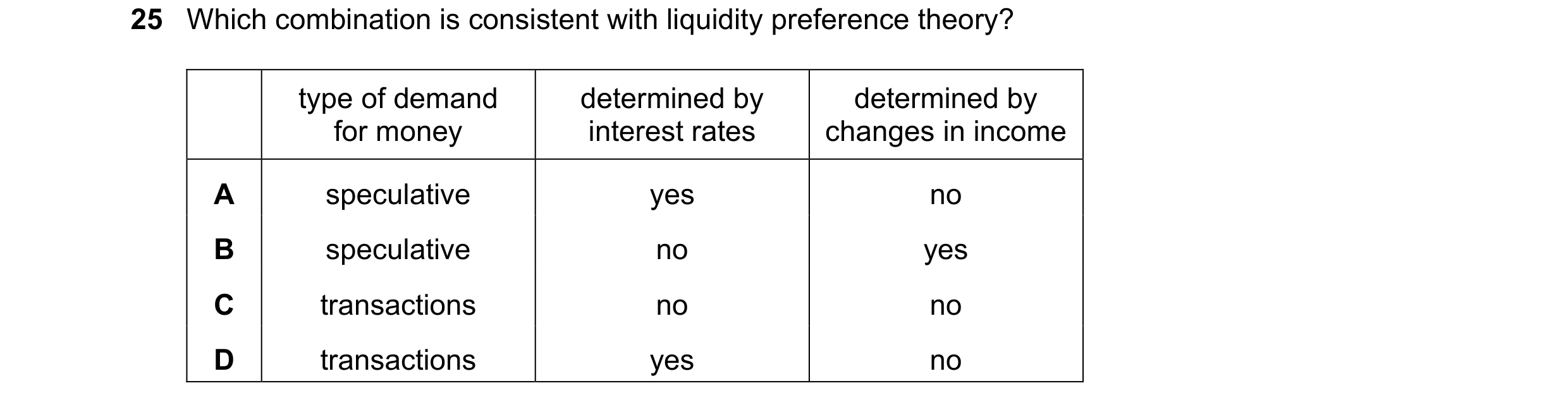
Q134 · Which combination is consistent with liquidity preference theory? 9708/32 Feb/March 2021
25 Which combination is consistent with liquidity preference theory? type of demand determined by determined by for money interest rates changes in income A speculative yes no B speculative no yes C transactions no no D transactions yes no
1 marks
Answer: A
This question in 9708/32 Feb/March 2021
Q135 · Which policy does a central bank undertake to pursue quantitative easing? 9708/31 May/June 2021
26 Which policy does a central bank undertake to pursue quantitative easing? A purchase long-term government debt from the public B purchase short-term government debt from the public C sell long-term government debt to the public D sell short-term government debt to the public
1 marks
Answer: A
This question in 9708/31 May/June 2021
Q136 · Which change will allow an increase in an economy’s money supply? 9708/32 May/June 2021
25 Which change will allow an increase in an economy’s money supply? A An outflow of currency for trade and capital purposes becomes an inflow. B The central bank instructs commercial banks to keep higher ratios of cash to deposits. C The government budget balance moves from a deficit to a surplus. D The government replaces borrowing from the banks with borrowing from the general public.
1 marks
Answer: A
This question in 9708/32 May/June 2021
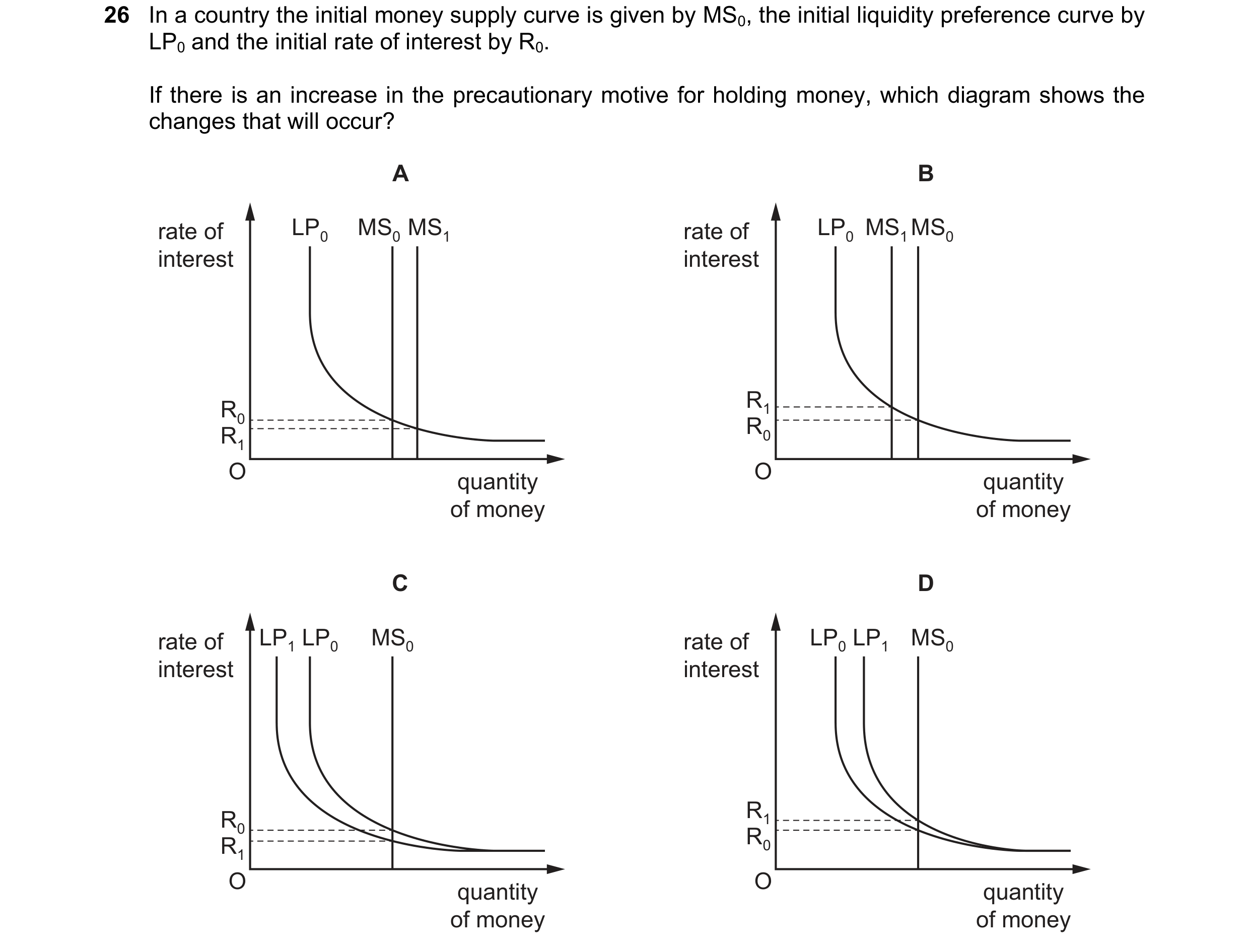
Q137 · In a country the initial money supply curve is given by MS0, the initial liquidity… 9708/32 May/June 2021
26 In a country the initial money supply curve is given by MS0, the initial liquidity preference curve by LP0 and the initial rate of interest by R0. If there is an increase in the precautionary motive for holding money, which diagram shows the changes that will occur? A B rate of LP0 MS0 MS1 rate of LP0 MS1 MS0 interest interest R0 R1 R1 R0 O quantity O quantity of money of money C D rate of LP1 LP0 MS0 rate of LP0 LP1 MS0 interest interest R0 R1 R1 R0 O quantity O quantity of money of money
1 marks
Answer: D
This question in 9708/32 May/June 2021
Q138 · A government attempts to stimulate growth by cutting its main interest rate 9708/33 May/June 2021
18 A government attempts to stimulate growth by cutting its main interest rate. What might reduce the effectiveness of this? A if investors’ expectations are rising B if more borrowing is taking place C if savings are falling D if the marginal propensity to consume is falling
1 marks
Answer: D
This question in 9708/33 May/June 2021
Q139 · Which policy does a central bank undertake to pursue quantitative easing? 9708/33 May/June 2021
26 Which policy does a central bank undertake to pursue quantitative easing? A purchase long-term government debt from the public B purchase short-term government debt from the public C sell long-term government debt to the public D sell short-term government debt to the public
1 marks
Answer: A
This question in 9708/33 May/June 2021
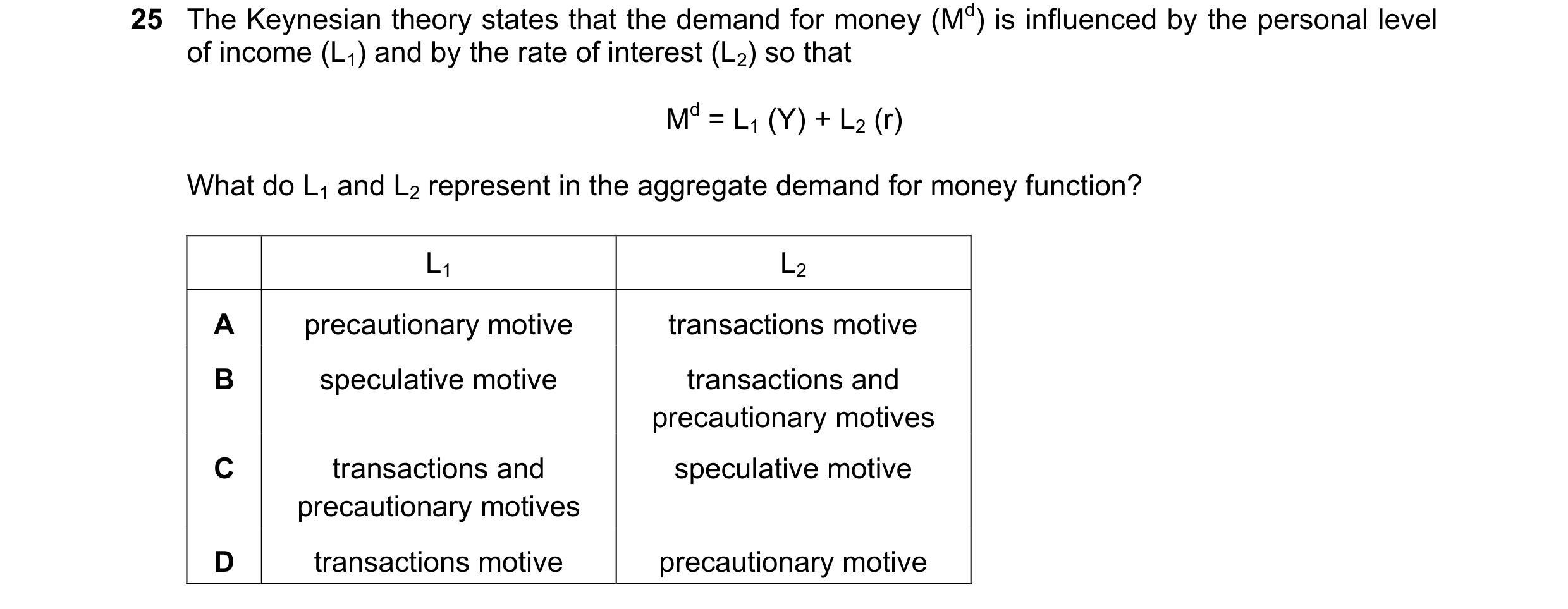
Q140 · The Keynesian theory states that the demand for money (Md) is influenced by the personal… 9708/31 Oct/Nov 2021
25 The Keynesian theory states that the demand for money (Md) is influenced by the personal level of income (L1) and by the rate of interest (L2) so that Md = L1 (Y) + L2 (r) What do L1 and L2 represent in the aggregate demand for money function? L1 L2 A precautionary motive transactions motive B speculative motive transactions and precautionary motives C transactions and speculative motive precautionary motives D transactions motive precautionary motive
1 marks
Answer: C
This question in 9708/31 Oct/Nov 2021
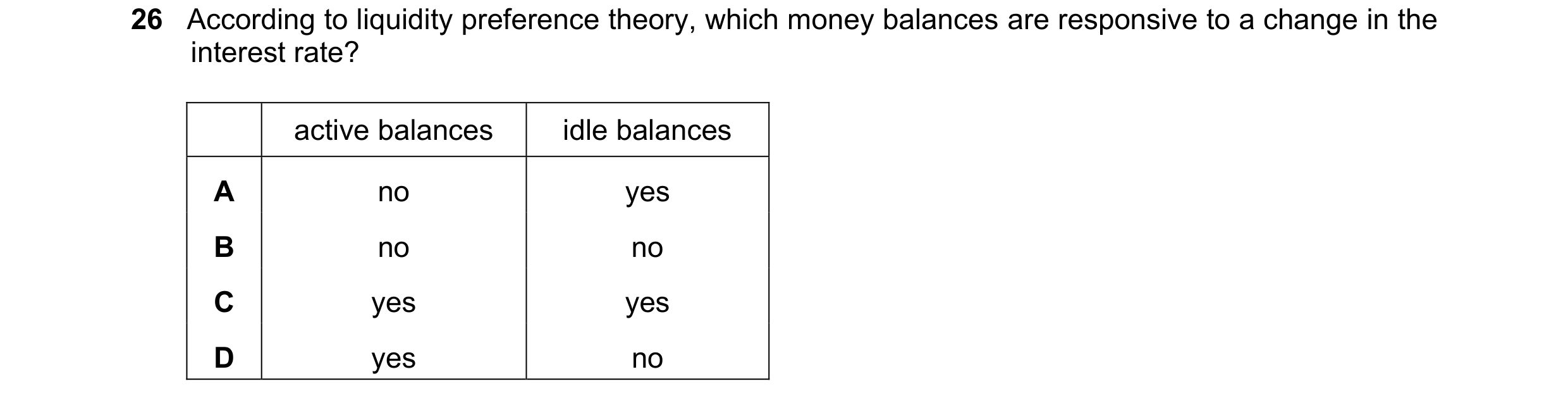
Q141 · According to liquidity preference theory, which money balances are responsive to a change… 9708/32 Oct/Nov 2021
26 According to liquidity preference theory, which money balances are responsive to a change in the interest rate? active balances idle balances A no yes B no no C yes yes D yes no
1 marks
Answer: A
This question in 9708/32 Oct/Nov 2021
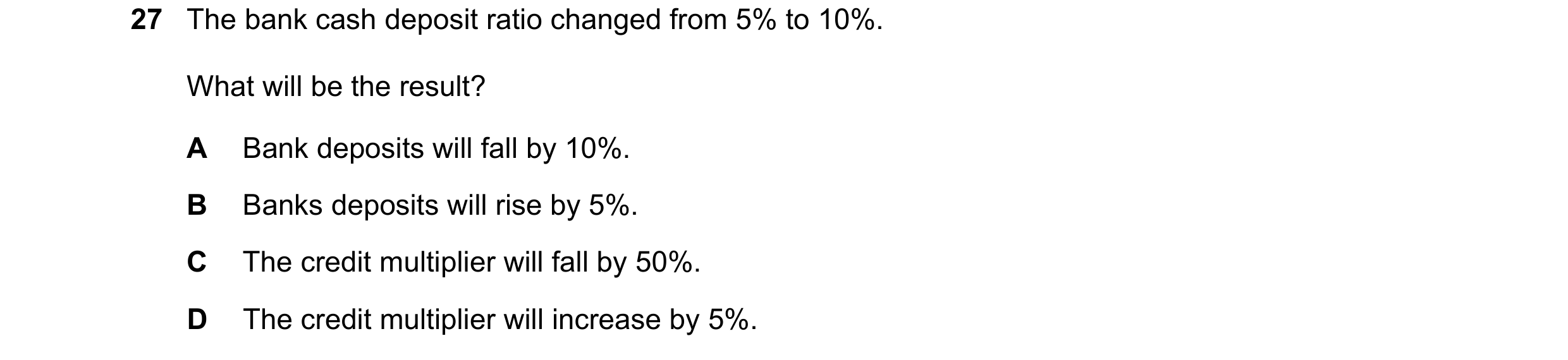
Q142 · The bank cash deposit ratio changed from 5% to 10% 9708/32 Oct/Nov 2021
27 The bank cash deposit ratio changed from 5% to 10%. What will be the result? A Bank deposits will fall by 10%. B Banks deposits will rise by 5%. C The credit multiplier will fall by 50%. D The credit multiplier will increase by 5%.
1 marks
Answer: C
This question in 9708/32 Oct/Nov 2021
Q143 · Which statement about the Keynesian liquidity preference demand for money model is… 9708/31 May/June 2022
25 Which statement about the Keynesian liquidity preference demand for money model is correct? A Both the transactions and precautionary motives for holding liquidity are interest rate elastic. B The demand for liquidity is completely interest rate inelastic at low rates of interest. C The demand to hold liquidity by households is stable. D The rate of interest on long-term government securities is inversely related to their price.
1 marks
Answer: D
This question in 9708/31 May/June 2022
Q144 · An increase in which factor will cause a decrease in investment spending? 9708/31 May/June 2022
28 An increase in which factor will cause a decrease in investment spending? A business confidence B company profits C interest rates D national income
1 marks
Answer: C
This question in 9708/31 May/June 2022
Q145 · Which statement about the Keynesian liquidity preference demand for money model is… 9708/33 May/June 2022
25 Which statement about the Keynesian liquidity preference demand for money model is correct? A Both the transactions and precautionary motives for holding liquidity are interest rate elastic. B The demand for liquidity is completely interest rate inelastic at low rates of interest. C The demand to hold liquidity by households is stable. D The rate of interest on long-term government securities is inversely related to their price.
1 marks
Answer: D
This question in 9708/33 May/June 2022
Q146 · What is the definition of liquidity? 9708/31 Oct/Nov 2022
23 What is the definition of liquidity? A the ability of the foreign exchange market to buy foreign currency B the support a central bank provides for commercial banks C the ease with which an asset can be converted into cash D the reaction of governments to a global financial crisis
1 marks
Answer: C
This question in 9708/31 Oct/Nov 2022
Q147 · According to Keynesian theory, when will an increase in the money supply leave the level… 9708/32 Oct/Nov 2022
23 According to Keynesian theory, when will an increase in the money supply leave the level of output unchanged? A when there is a liquidity trap B when the money supply increase was not anticipated C when there is a floating exchange rate D when there is an immediate adjustment to expectations about future price levels
1 marks
Answer: A
This question in 9708/32 Oct/Nov 2022
Q148 · What do Monetarists believe? 9708/32 Oct/Nov 2022
25 What do Monetarists believe? A Economies are naturally unstable. B Policy makers should follow set rules targeting the money supply. C The aggregate supply curve has a slight slope. D Wage movements are ‘sticky’ downwards.
1 marks
Answer: B
This question in 9708/32 Oct/Nov 2022
Q149 · Which components of the Quantity Theory of Money are considered constant and which are… 9708/33 Oct/Nov 2022
23 Which components of the Quantity Theory of Money are considered constant and which are considered variable? money velocity of price level transactions supply circulation A constant variable constant variable B constant constant variable constant C variable constant variable constant D variable variable constant variable
1 marks
Answer: C
This question in 9708/33 Oct/Nov 2022
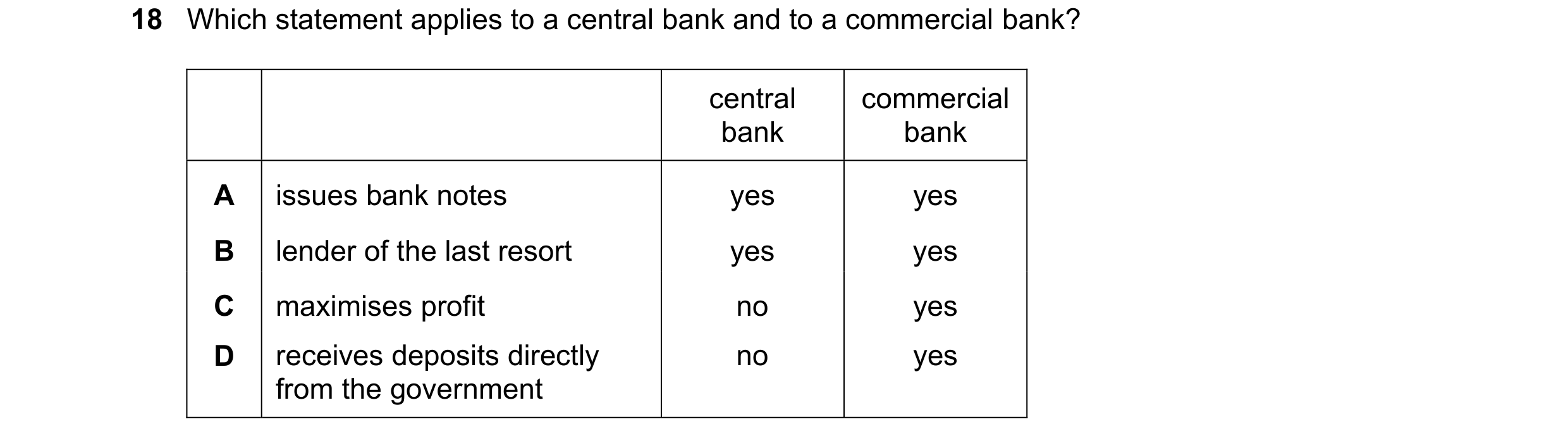
Q150 · Which statement applies to a central bank and to a commercial bank? 9708/32 Feb/March 2023
18 Which statement applies to a central bank and to a commercial bank? central commercial bank bank A issues bank notes yes yes B lender of the last resort yes yes C maximises profit no yes D receives deposits directly no yes from the government
1 marks
Answer: C
This question in 9708/32 Feb/March 2023
Q151 · What is a function of money? 9708/33 Oct/Nov 2023
17 What is a function of money? A It can be divided into small units. B It can be easily carried. C It is a standard of deferred payment. D It is widely accepted.
1 marks
Answer: C
This question in 9708/33 Oct/Nov 2023
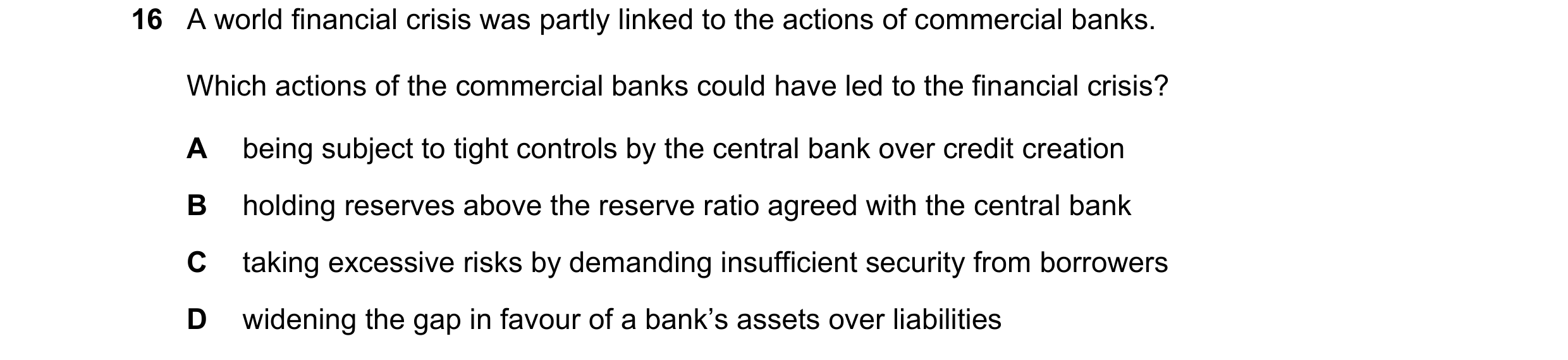
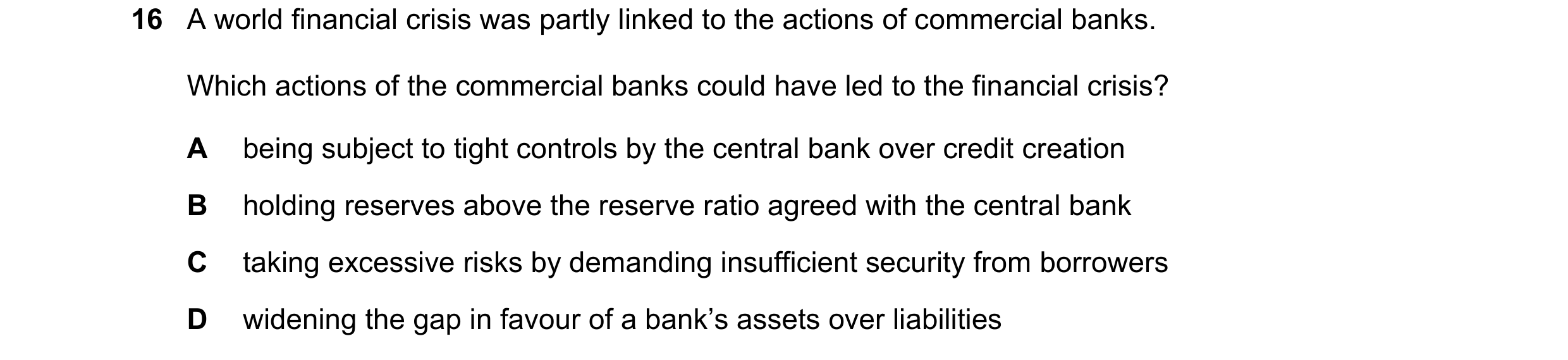
Q152 · A world financial crisis was partly linked to the actions of commercial banks 9708/31 May/June 2024
16 A world financial crisis was partly linked to the actions of commercial banks. Which actions of the commercial banks could have led to the financial crisis? A being subject to tight controls by the central bank over credit creation B holding reserves above the reserve ratio agreed with the central bank C taking excessive risks by demanding insufficient security from borrowers D widening the gap in favour of a bank’s assets over liabilities
1 marks
Answer: C
This question in 9708/31 May/June 2024
Q153 · A world financial crisis was partly linked to the actions of commercial banks 9708/33 May/June 2024
16 A world financial crisis was partly linked to the actions of commercial banks. Which actions of the commercial banks could have led to the financial crisis? A being subject to tight controls by the central bank over credit creation B holding reserves above the reserve ratio agreed with the central bank C taking excessive risks by demanding insufficient security from borrowers D widening the gap in favour of a bank’s assets over liabilities
1 marks
Answer: C
This question in 9708/33 May/June 2024
Q154 · In the quantity theory of money equation, MV = PT, V is defined as the income velocity of… 9708/32 Feb/March 2025
17 In the quantity theory of money equation, MV = PT, V is defined as the income velocity of circulation. Which change would tend to reduce the value of V? A a move to monthly rather than weekly salary payments by firms B an increase in interest rates C an increase in the use of cash machines to reduce money balances held D a decrease in the use of credit cards by individuals
1 marks
Answer: A
This question in 9708/32 Feb/March 2025
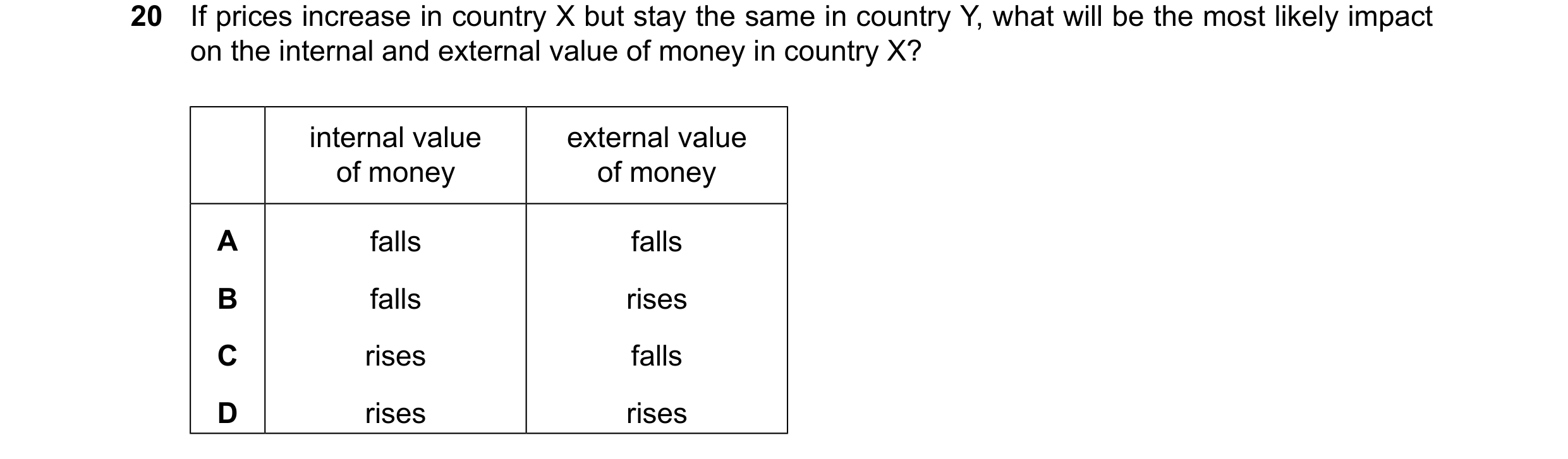
Q155 · If prices increase in country X but stay the same in country Y, what will be the most… 9708/32 Feb/March 2025
20 If prices increase in country X but stay the same in country Y, what will be the most likely impact on the internal and external value of money in country X? internal value external value of money of money A falls falls B falls rises C rises falls D rises rises
1 marks
Answer: A
This question in 9708/32 Feb/March 2025



 1 / 38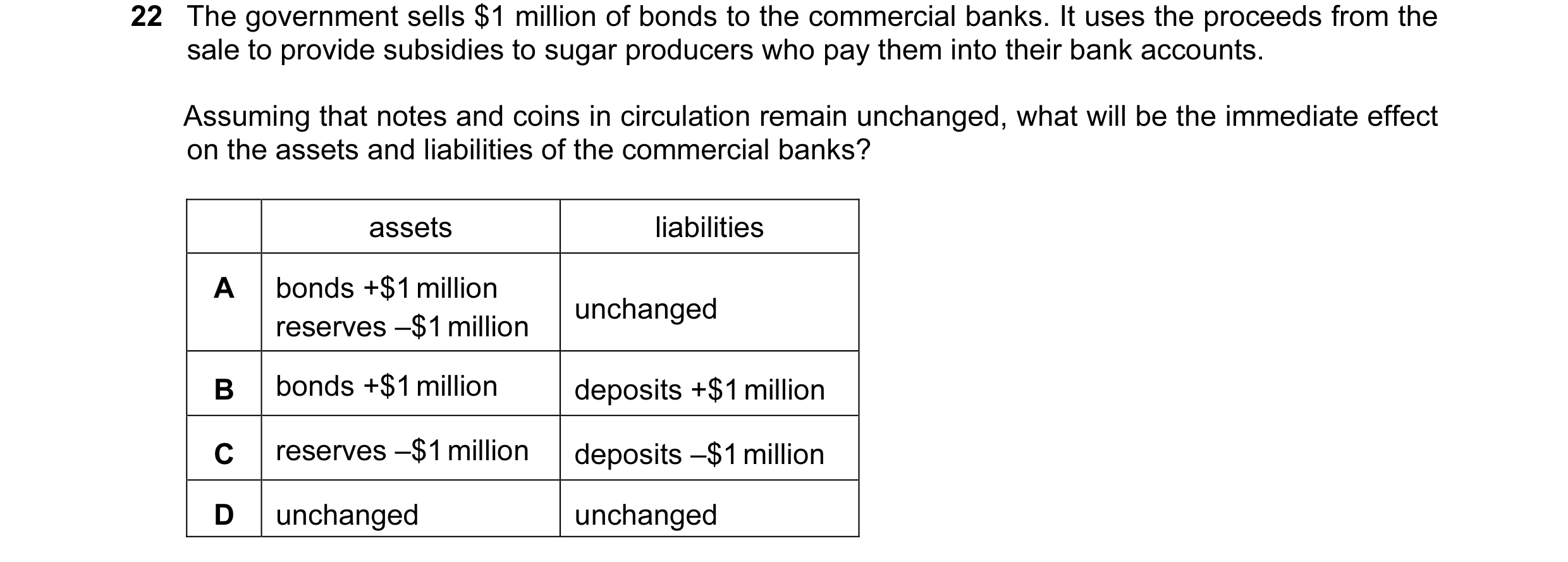

 2 / 38

 3 / 38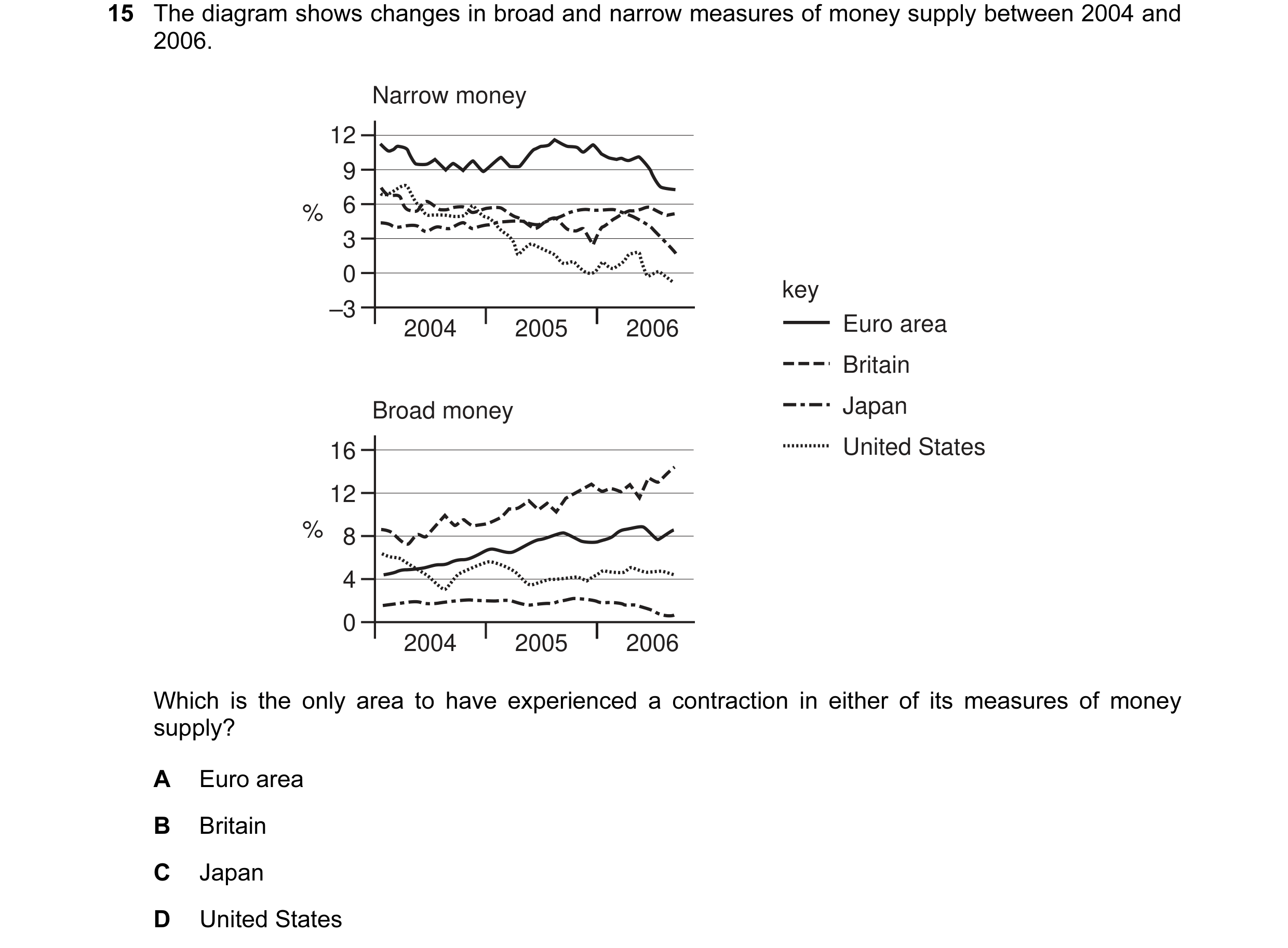
 4 / 38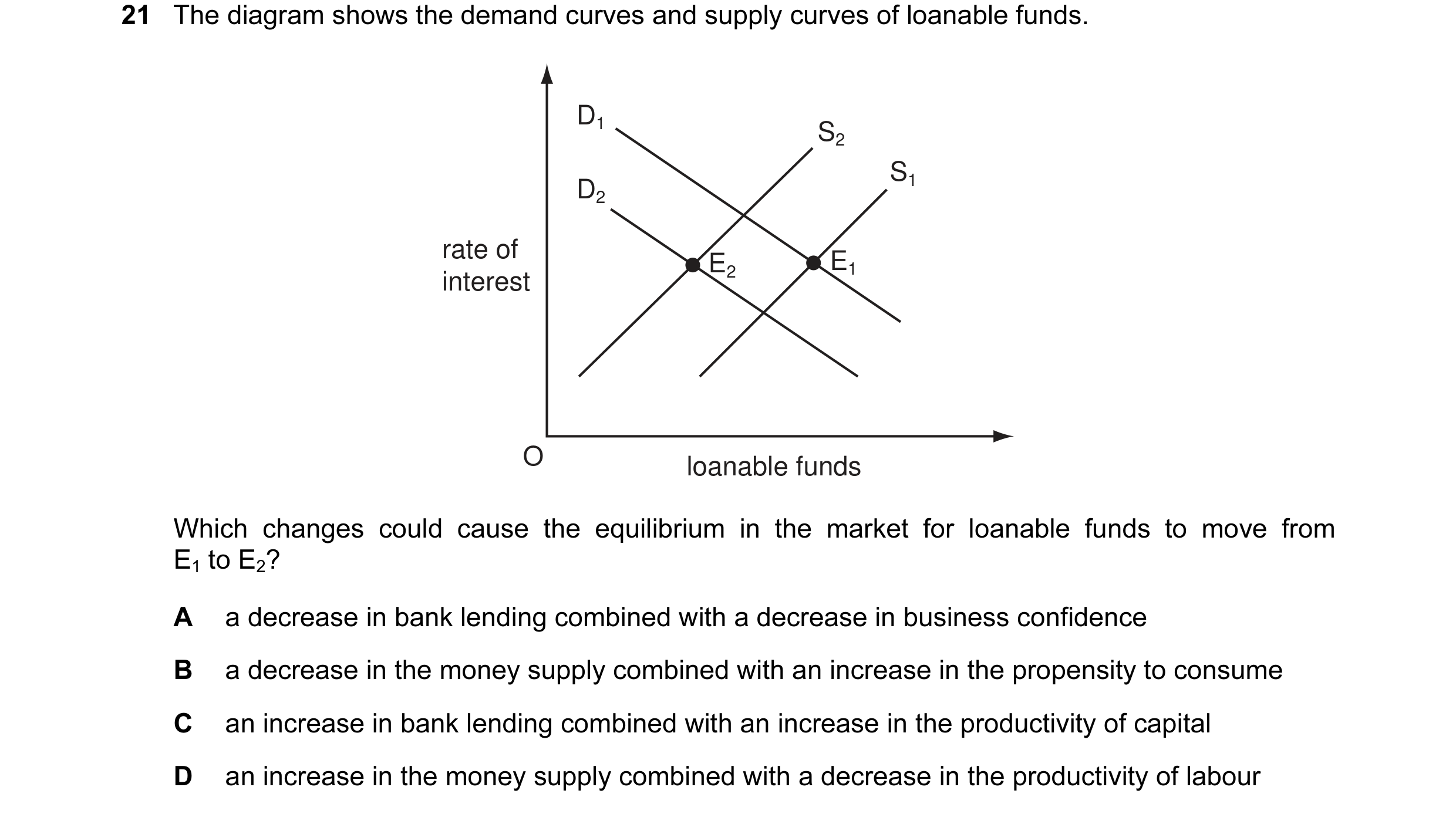

 5 / 38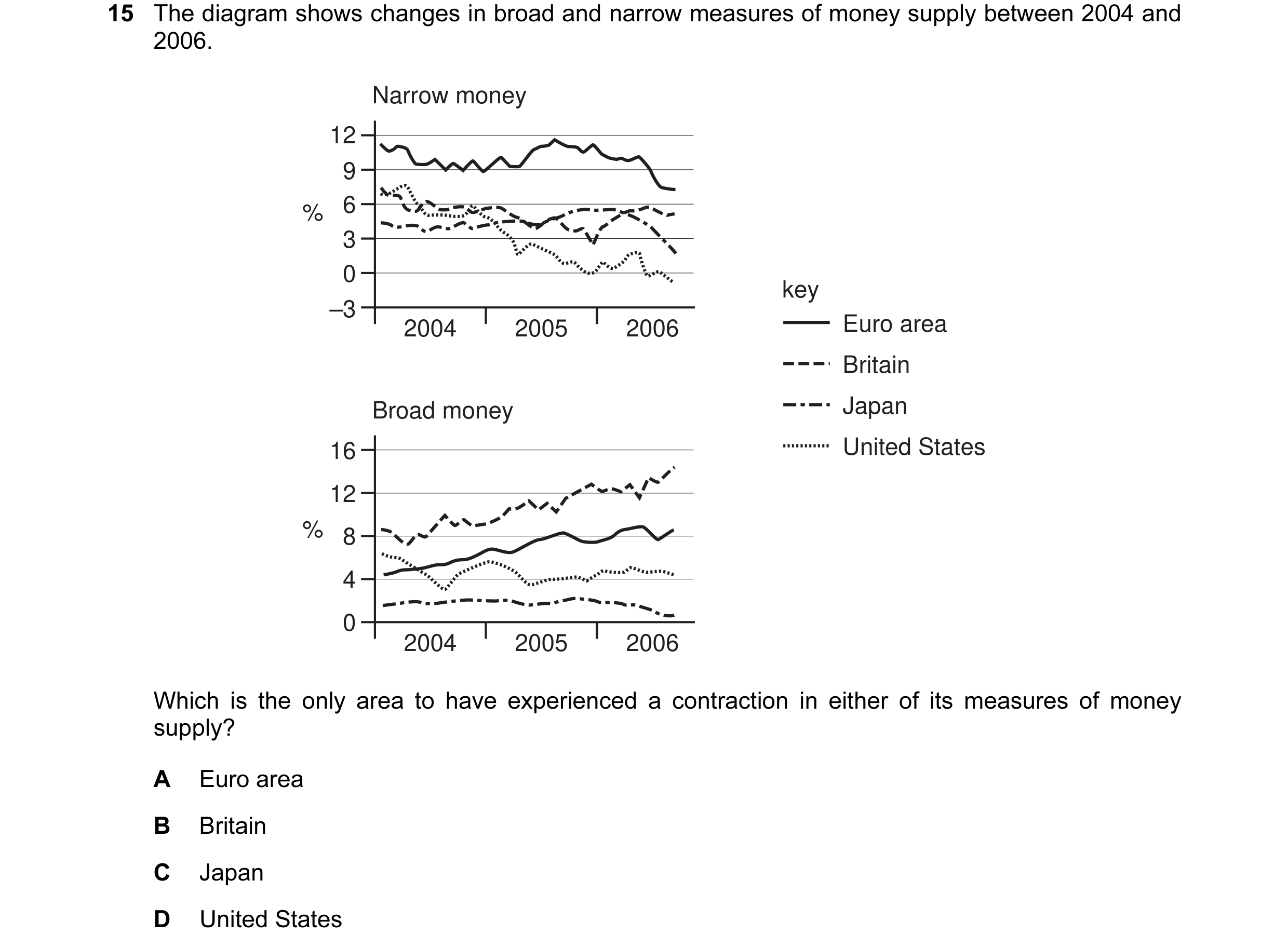
 6 / 38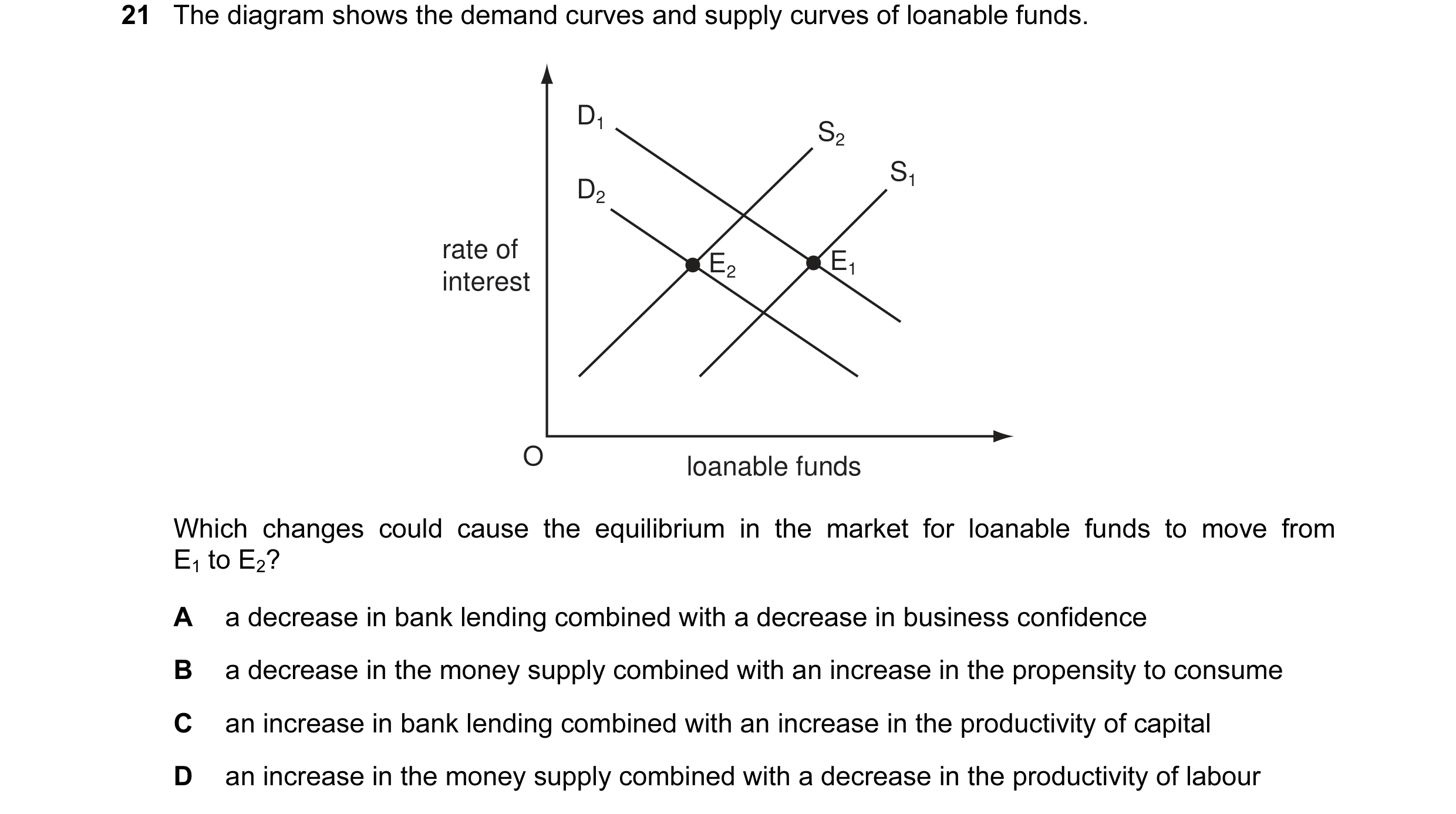

 7 / 38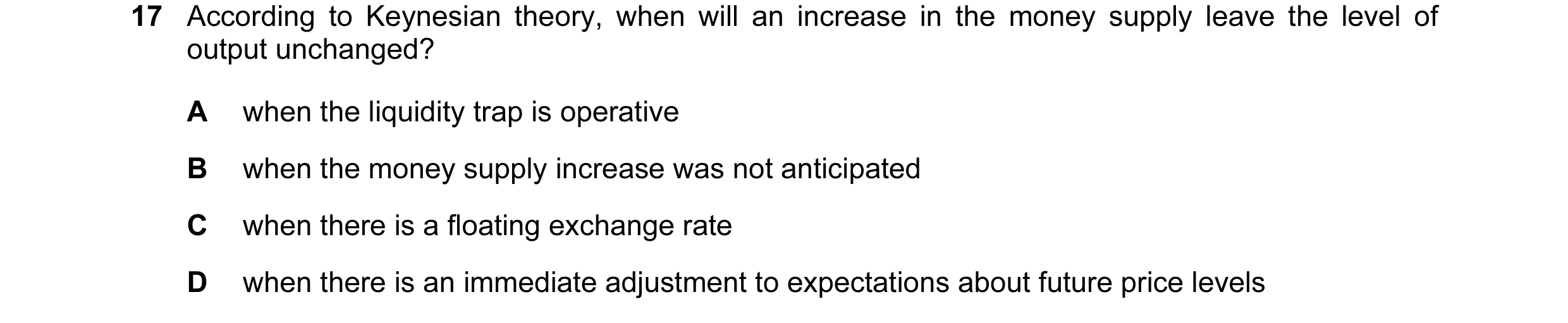
 8 / 38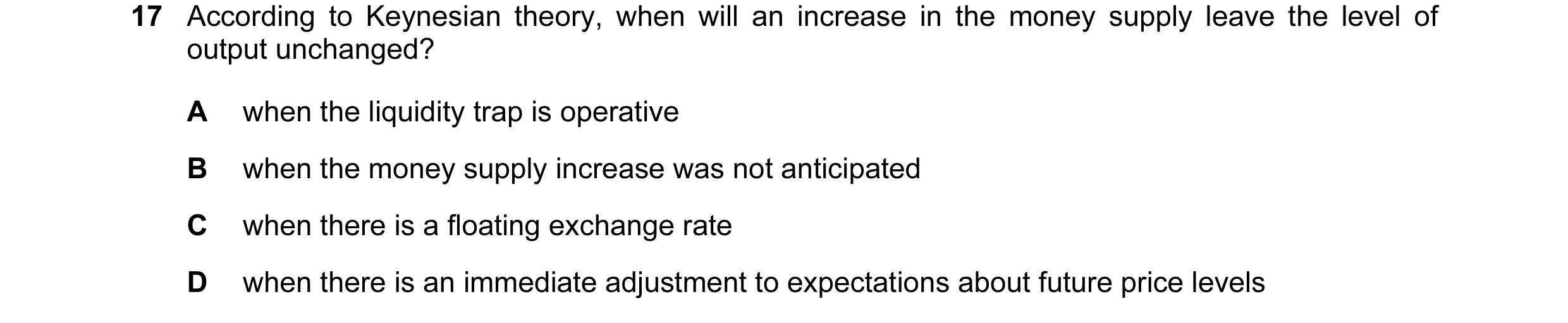
 9 / 38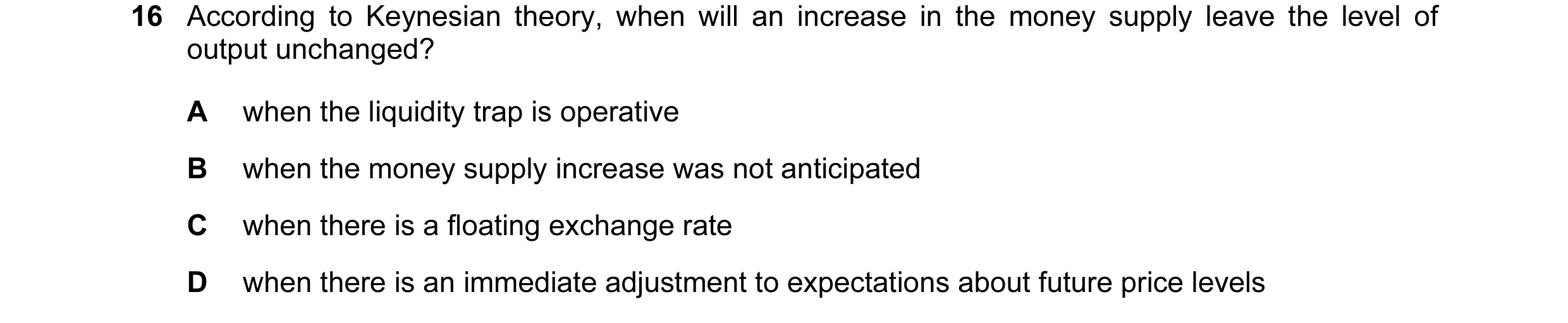
 10 / 38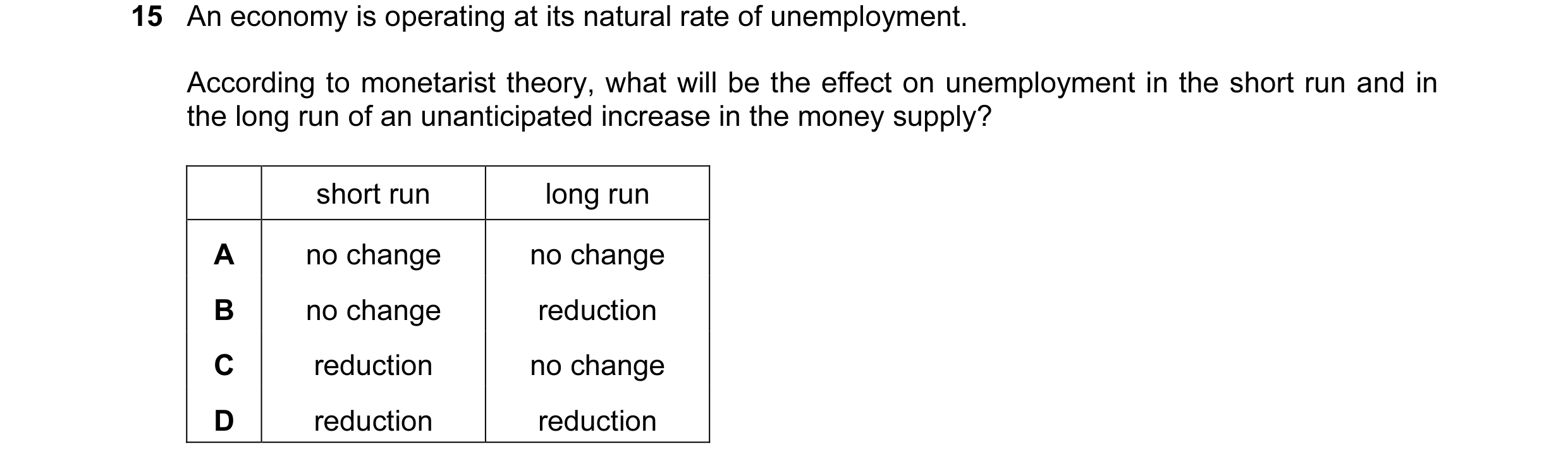
 11 / 38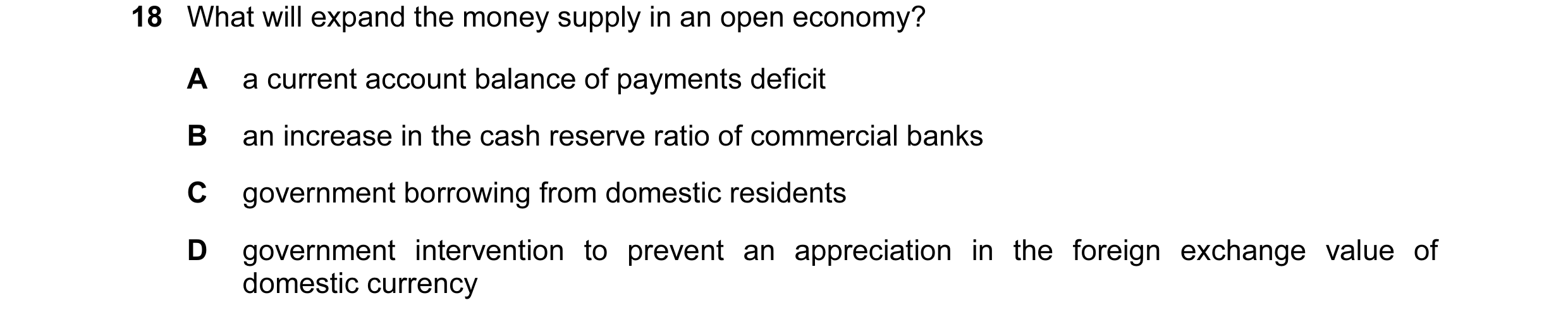
 12 / 38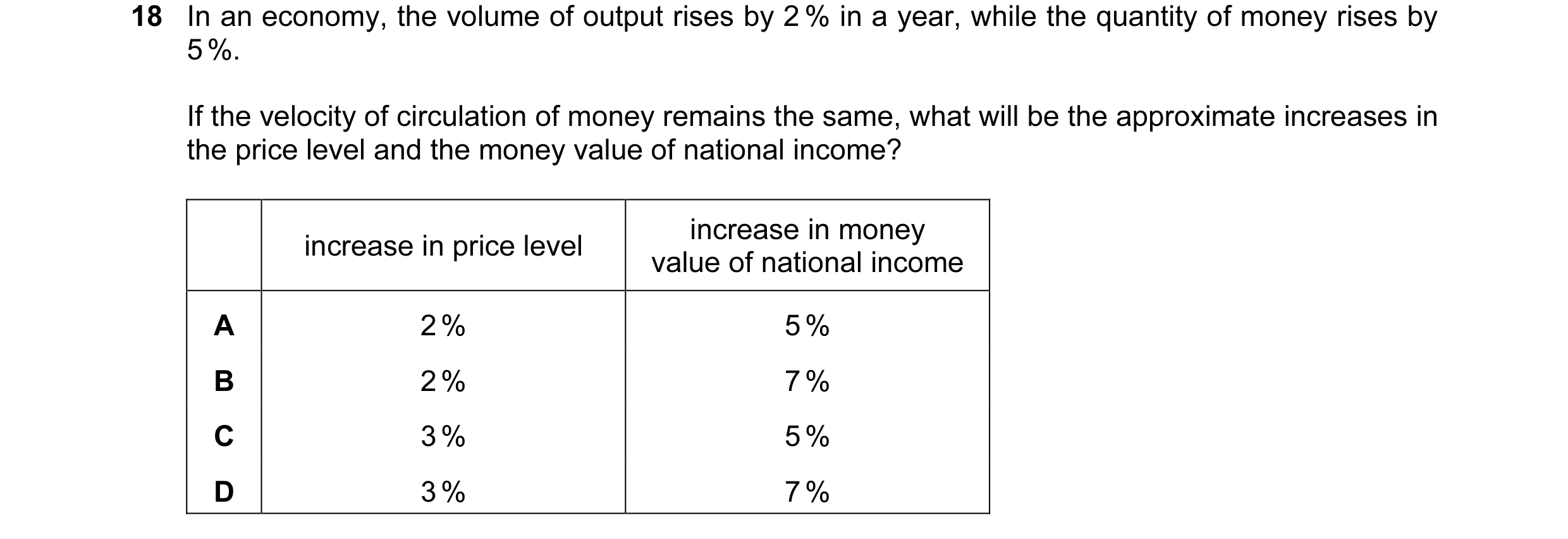
 13 / 38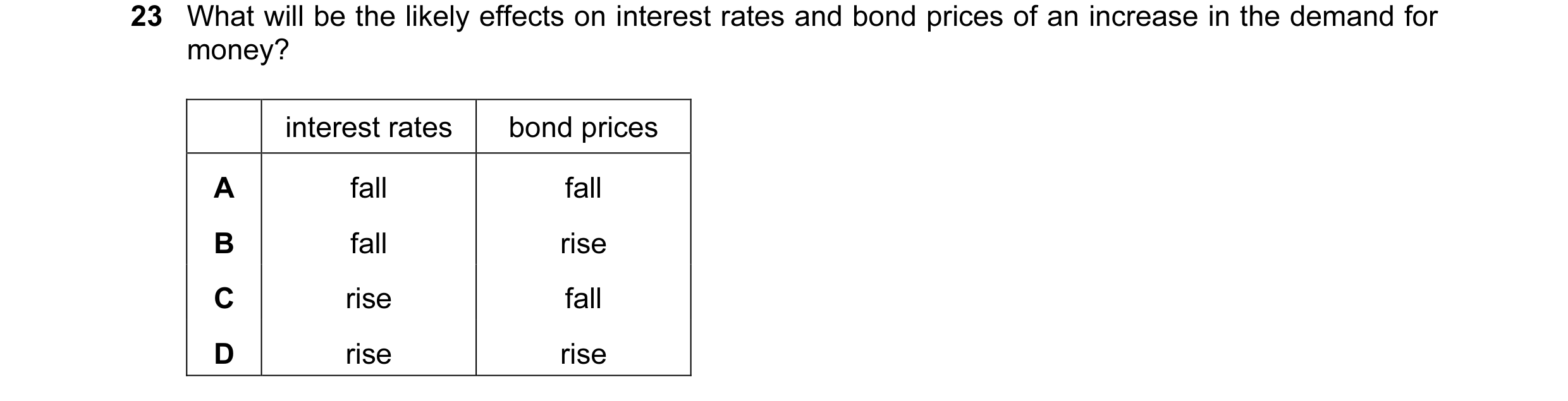
 14 / 38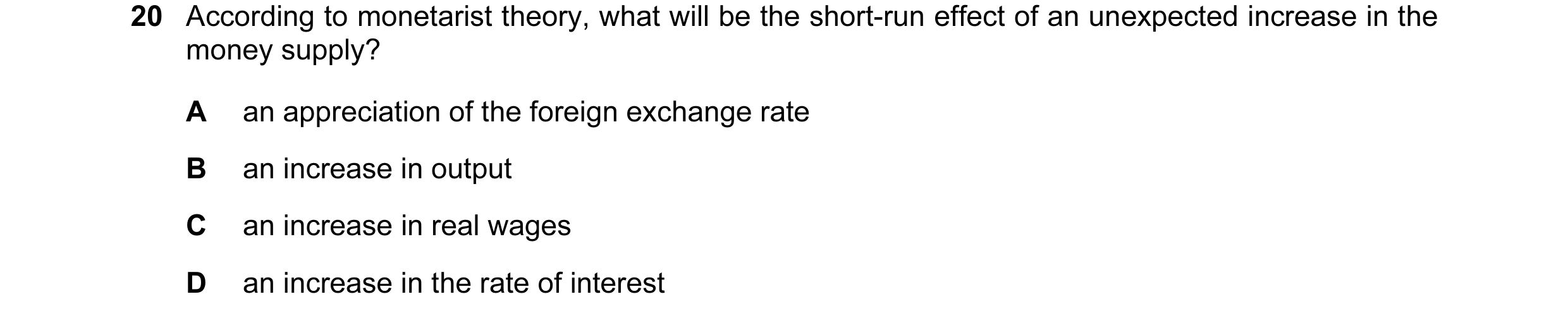


 15 / 38

 16 / 38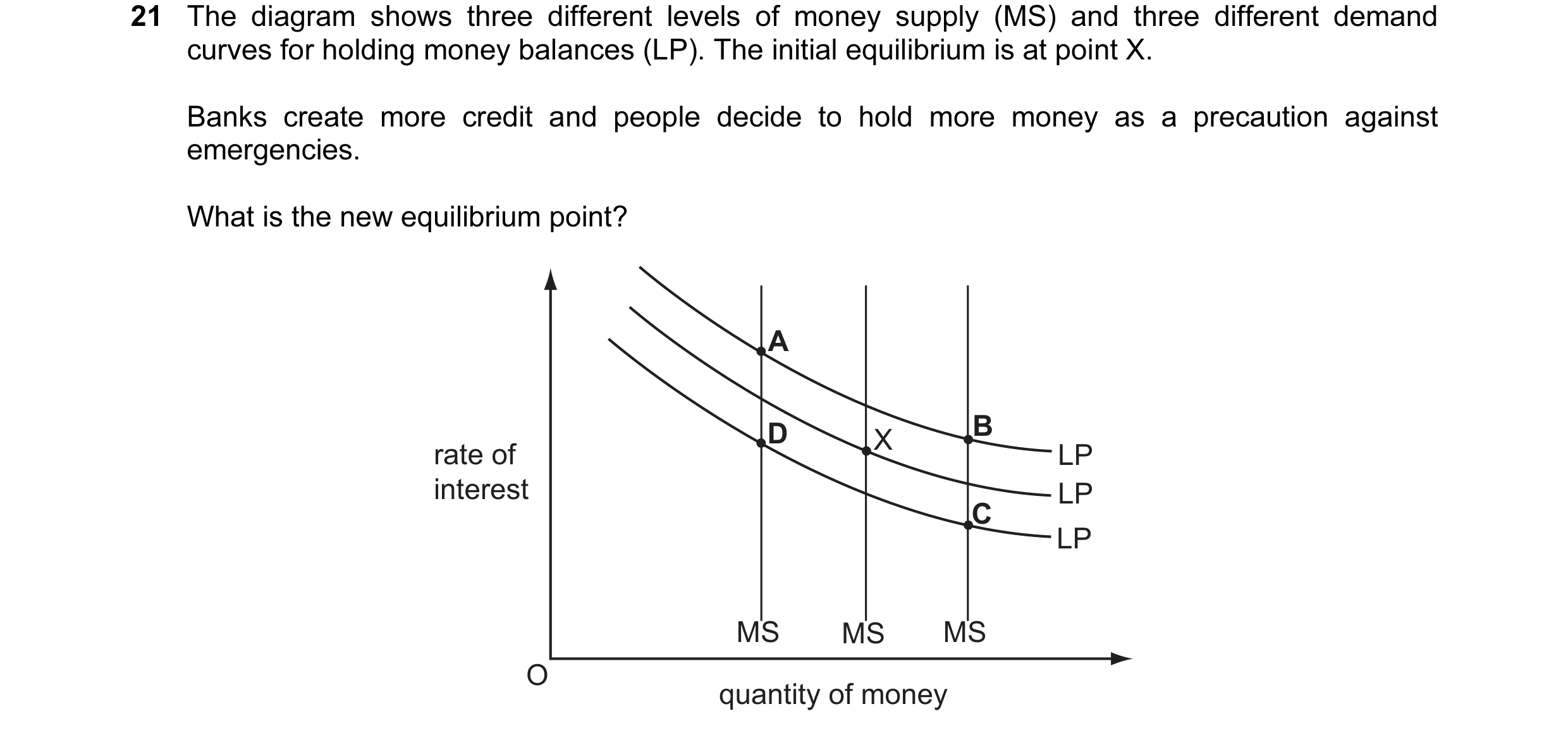


 17 / 38
 18 / 38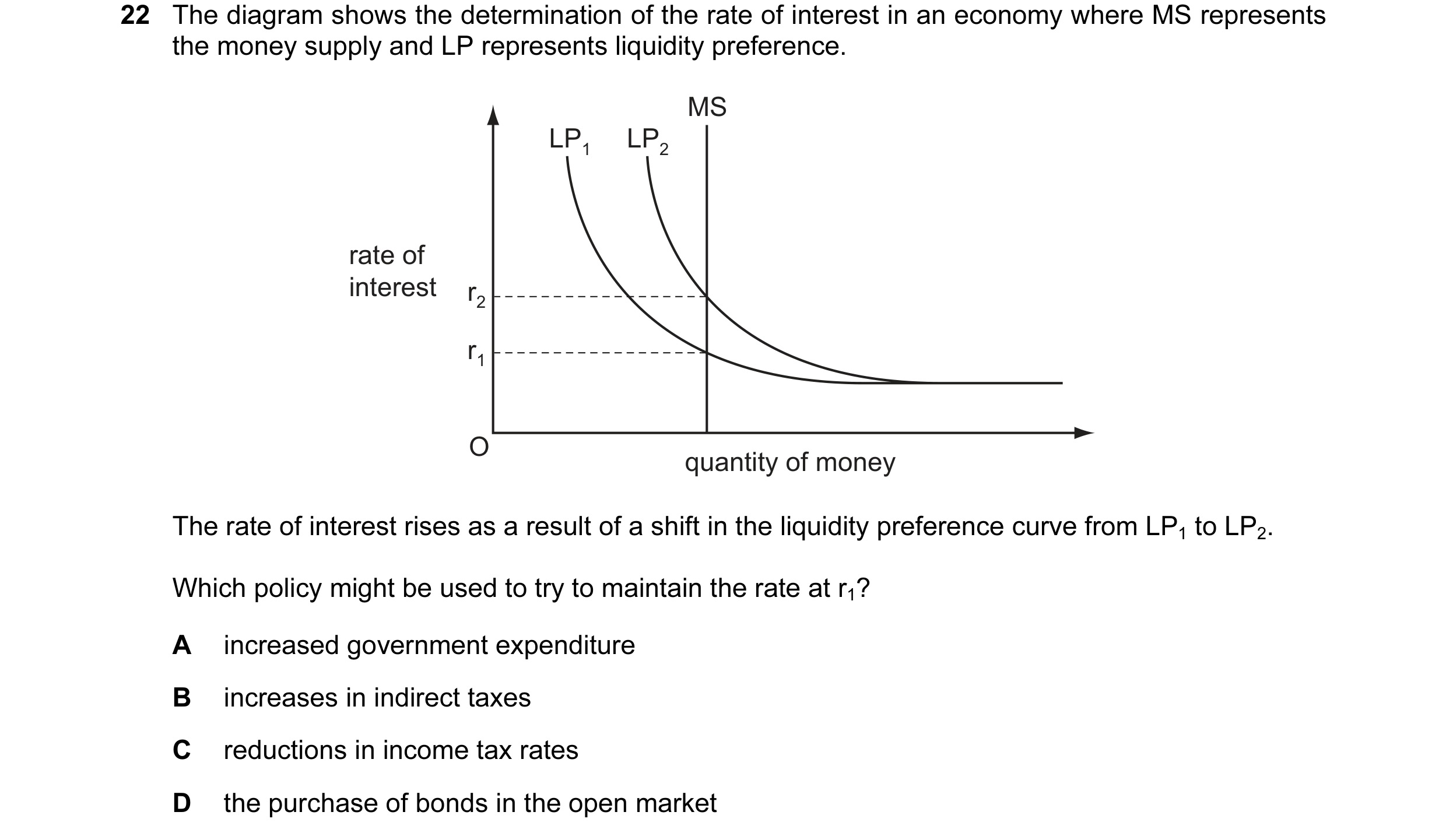

 19 / 38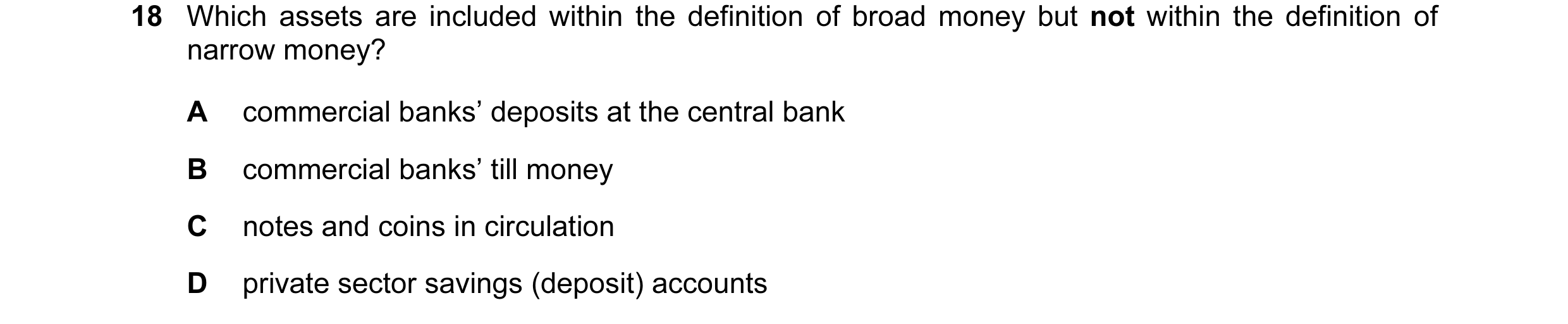
 20 / 38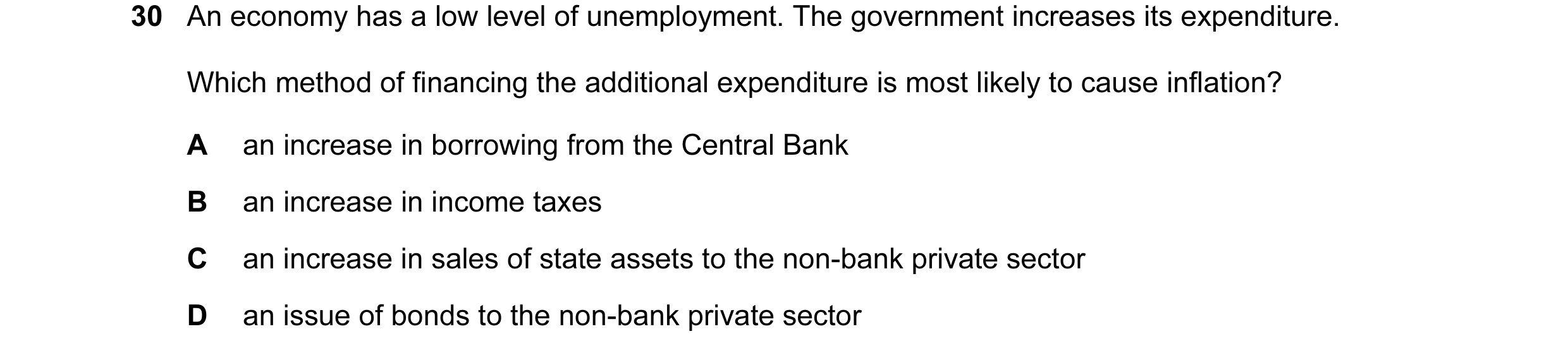

 21 / 38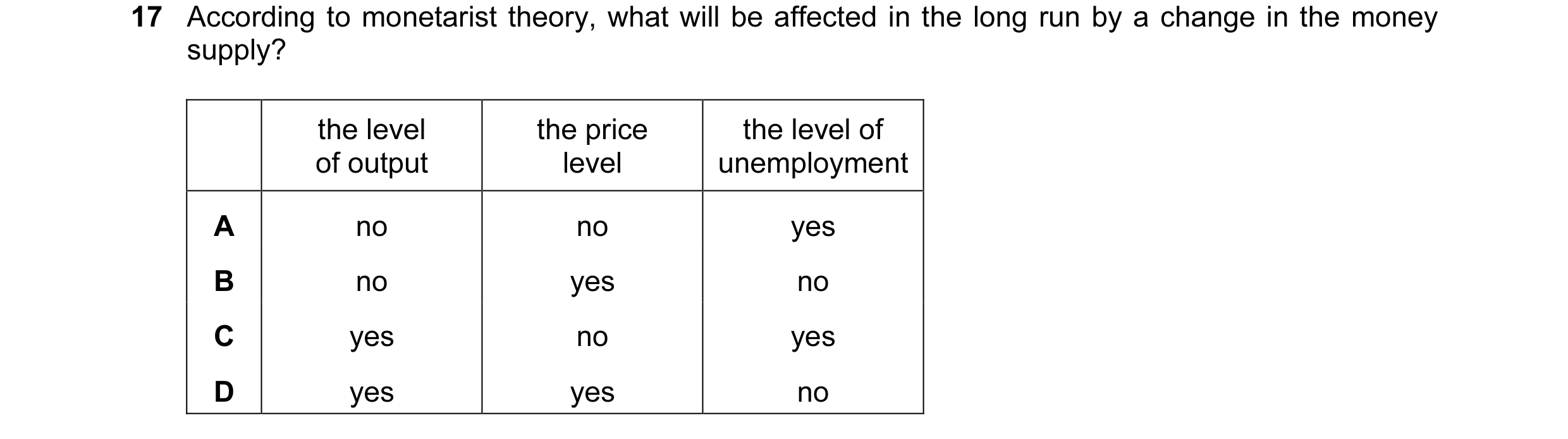

 22 / 38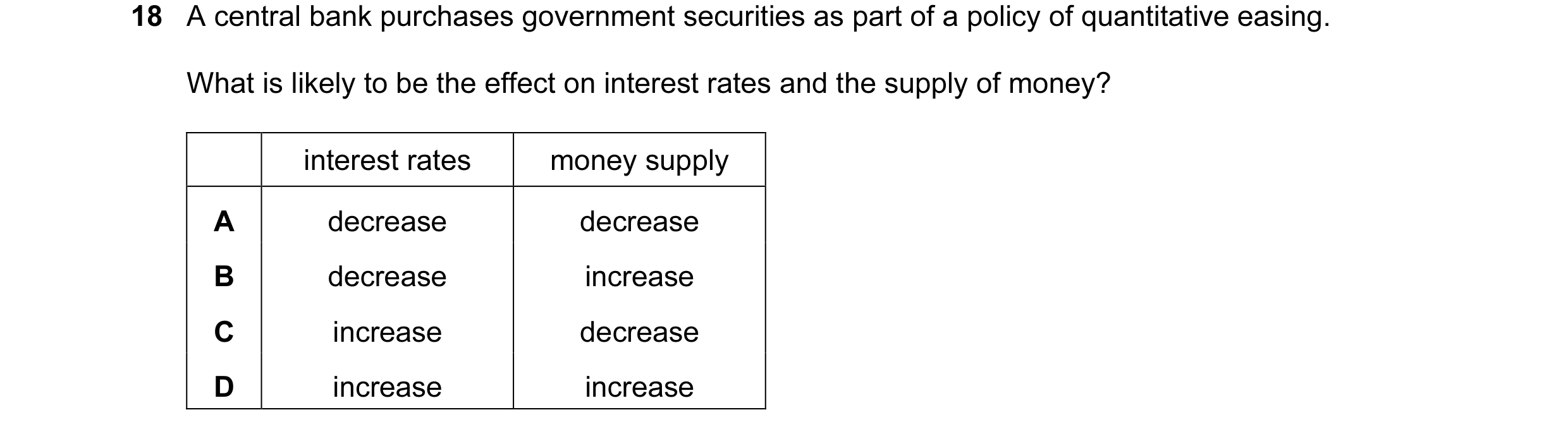

 23 / 38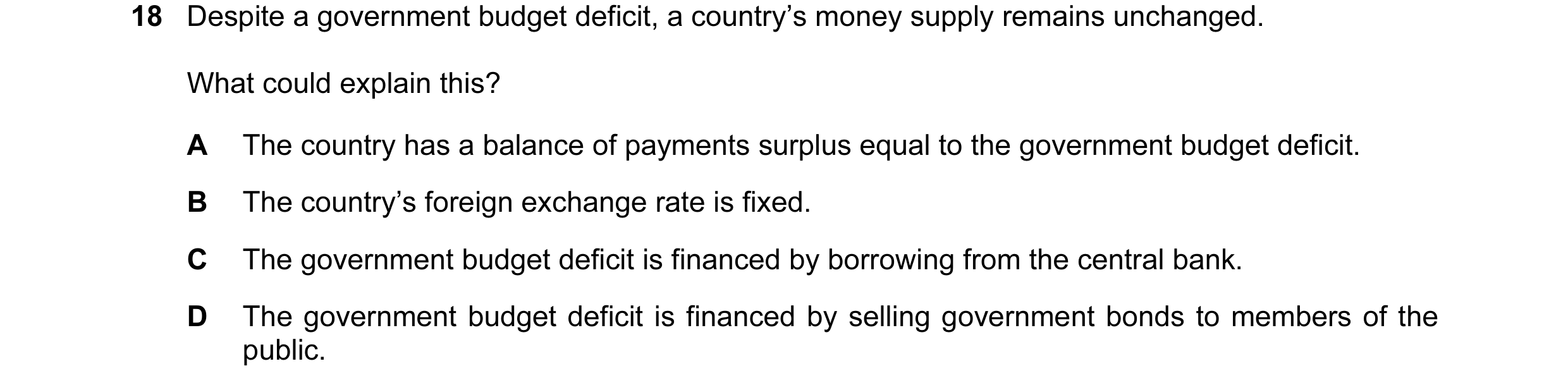

 24 / 38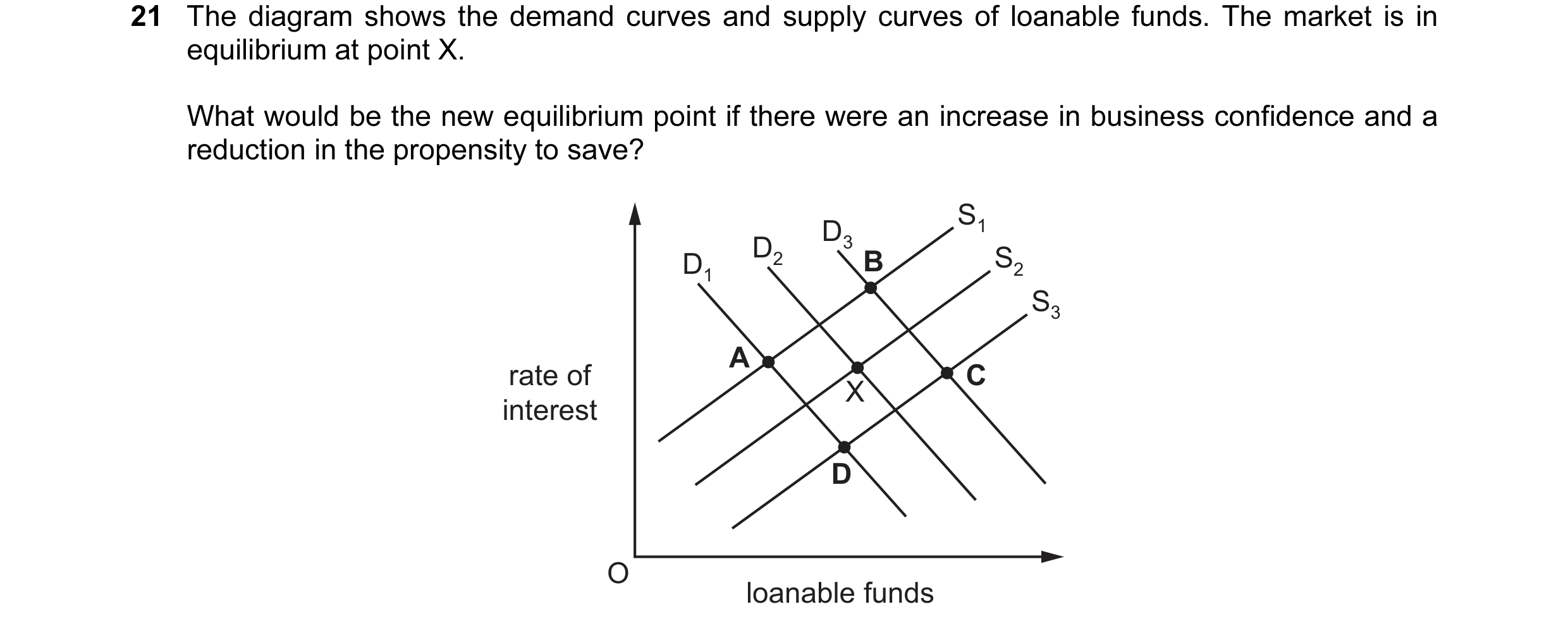


 25 / 38
 26 / 38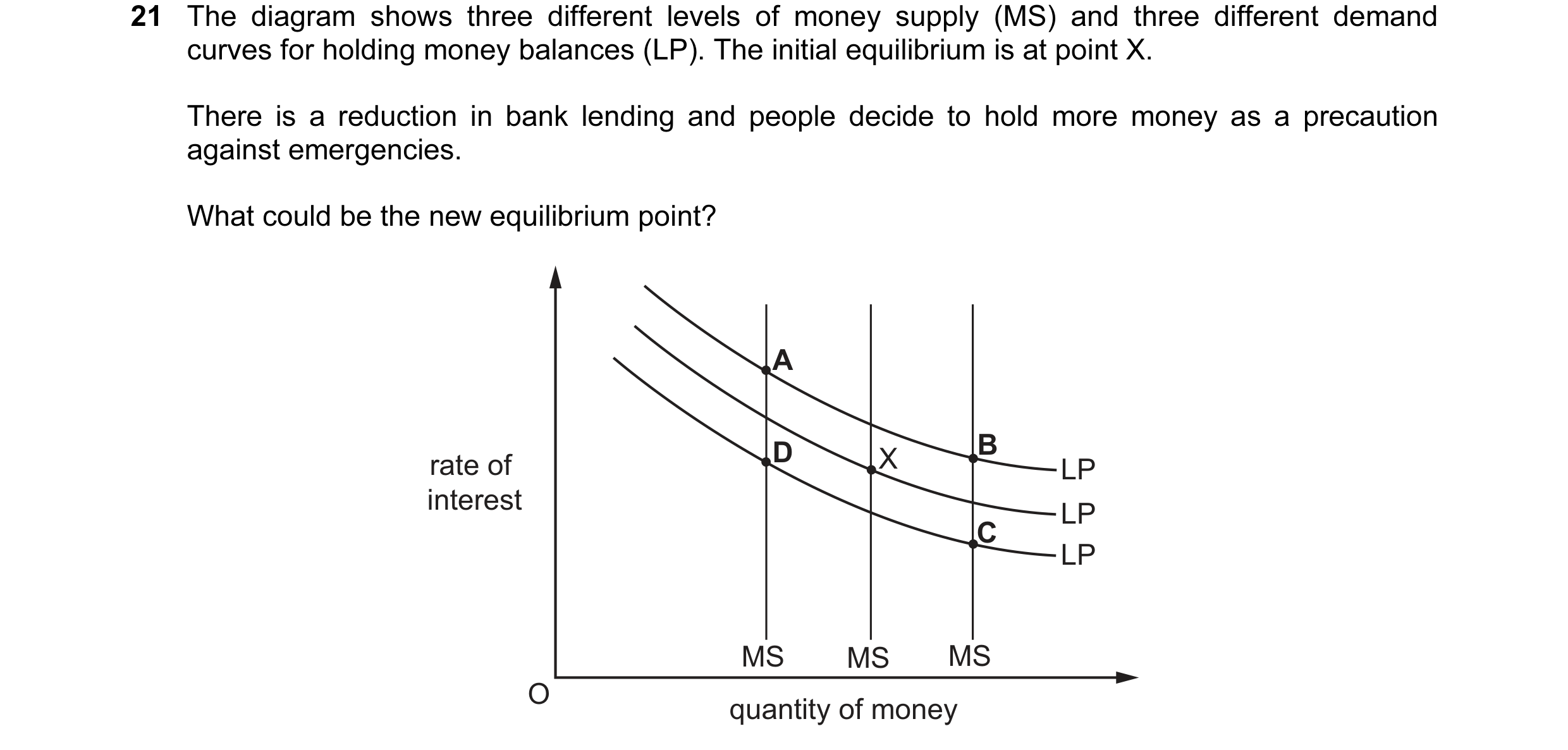
 27 / 38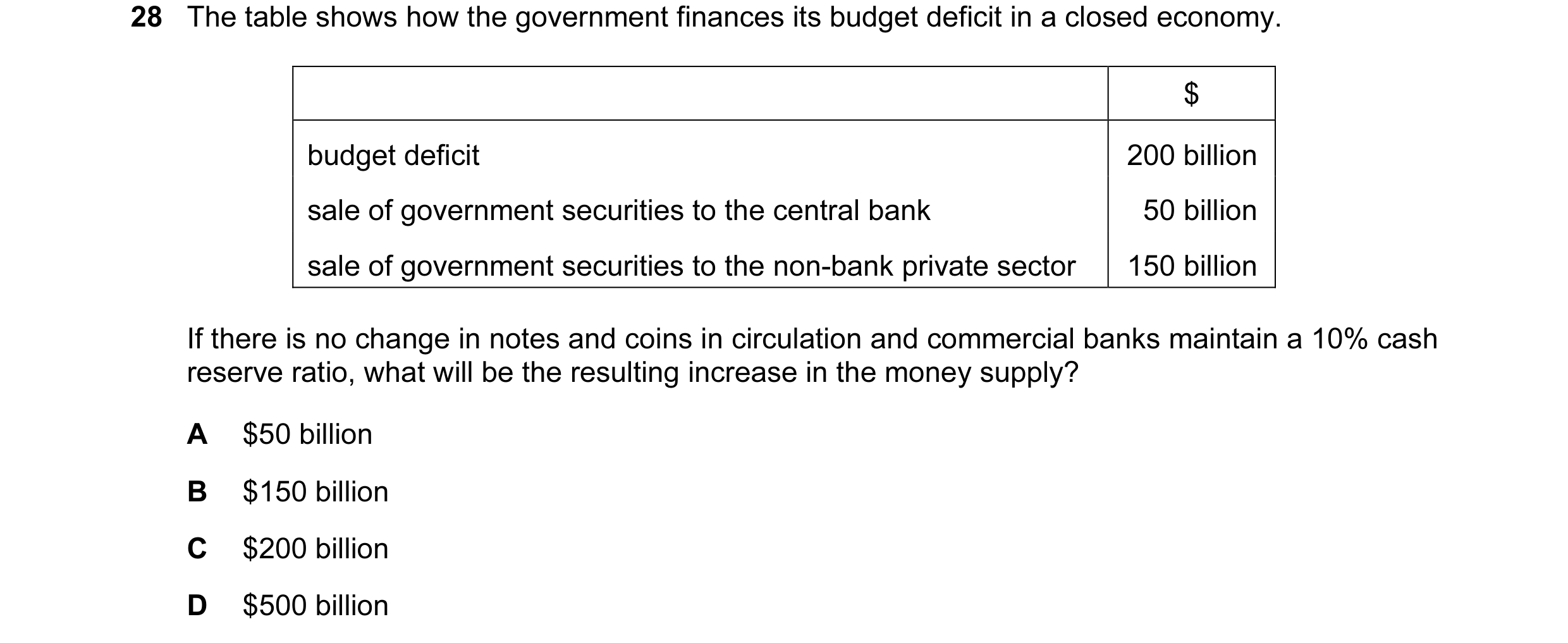

 28 / 38



 29 / 38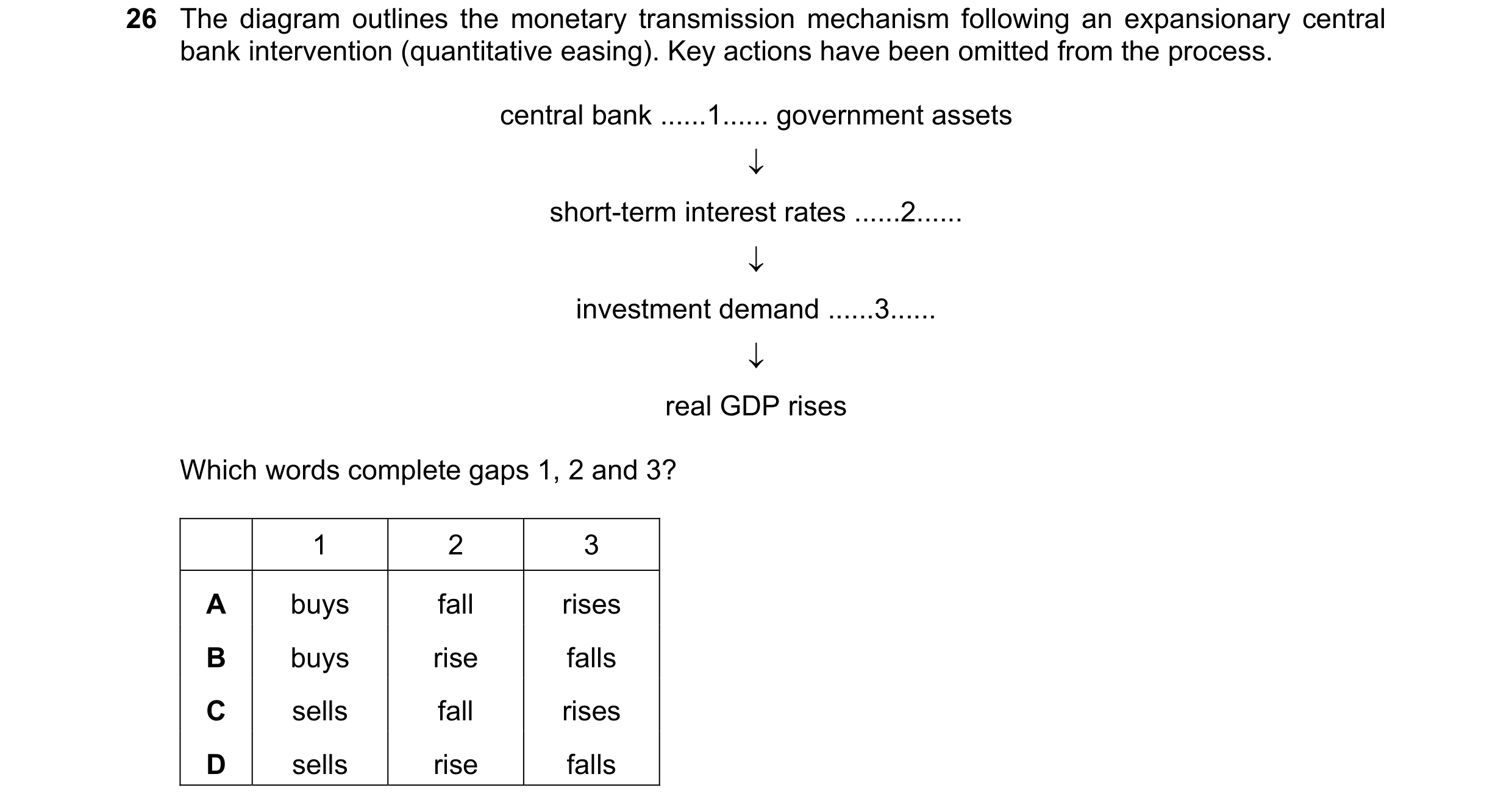
 30 / 38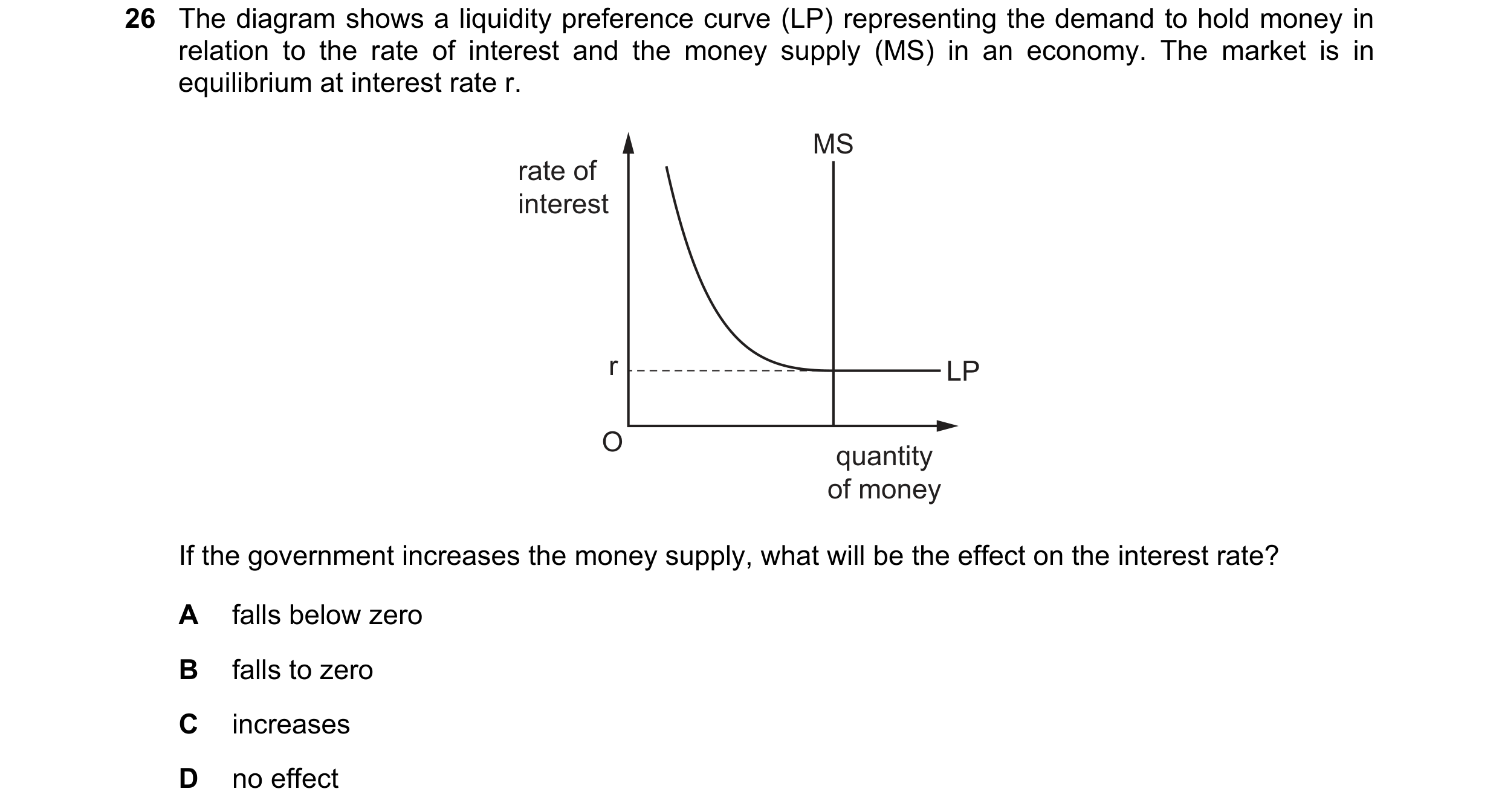
 31 / 38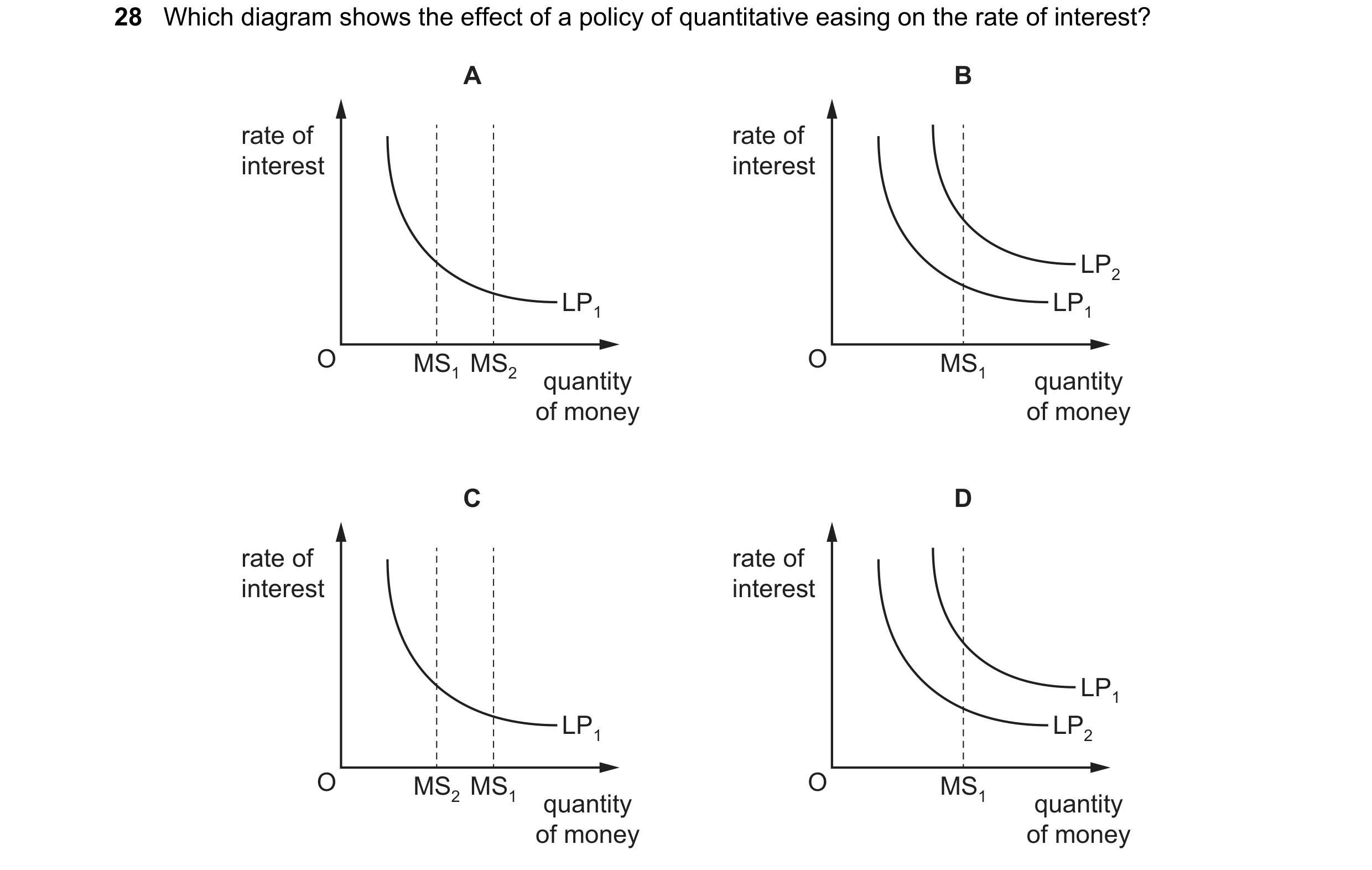
 32 / 38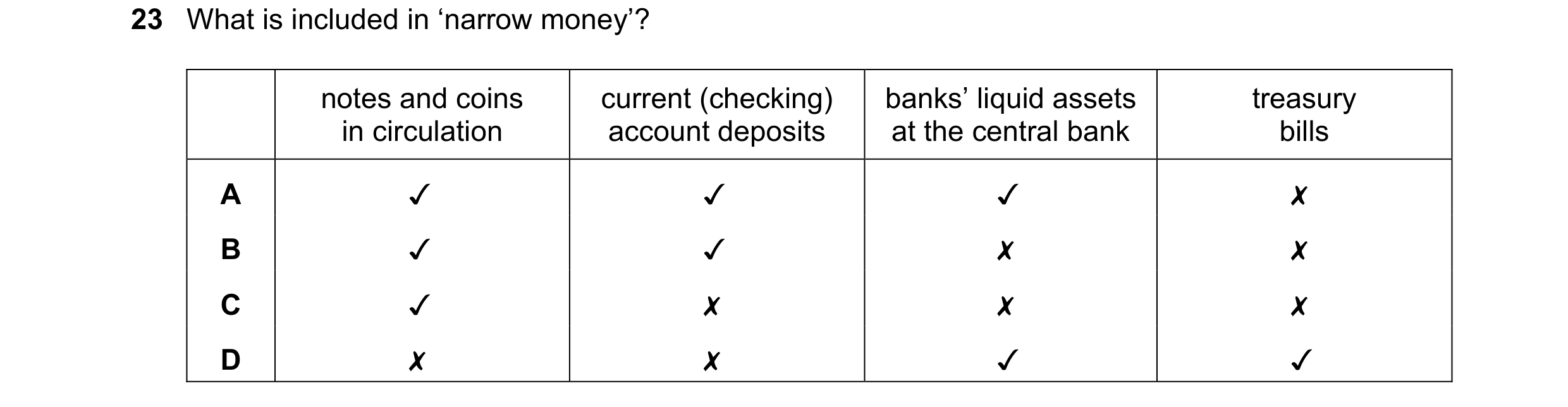

 33 / 38

 34 / 38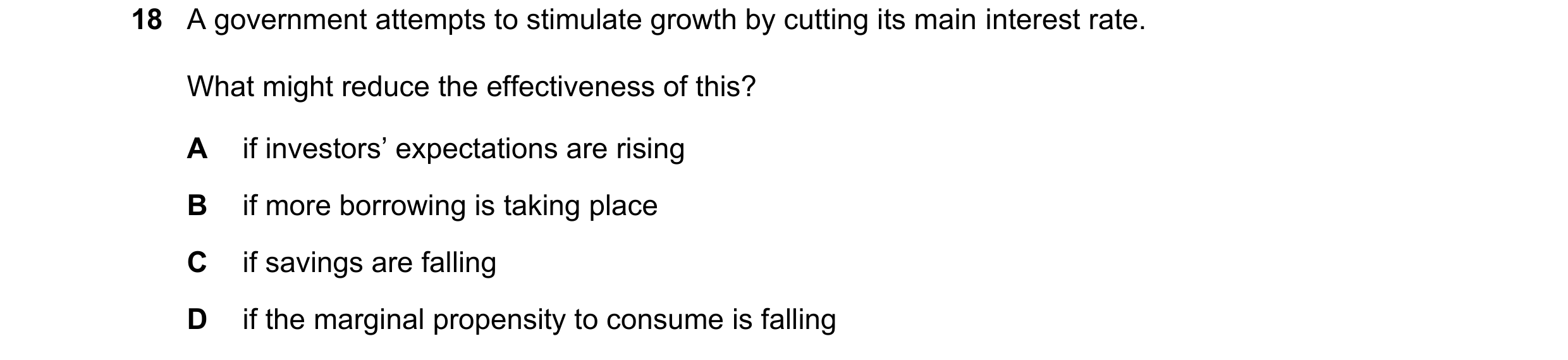

 35 / 38



 36 / 38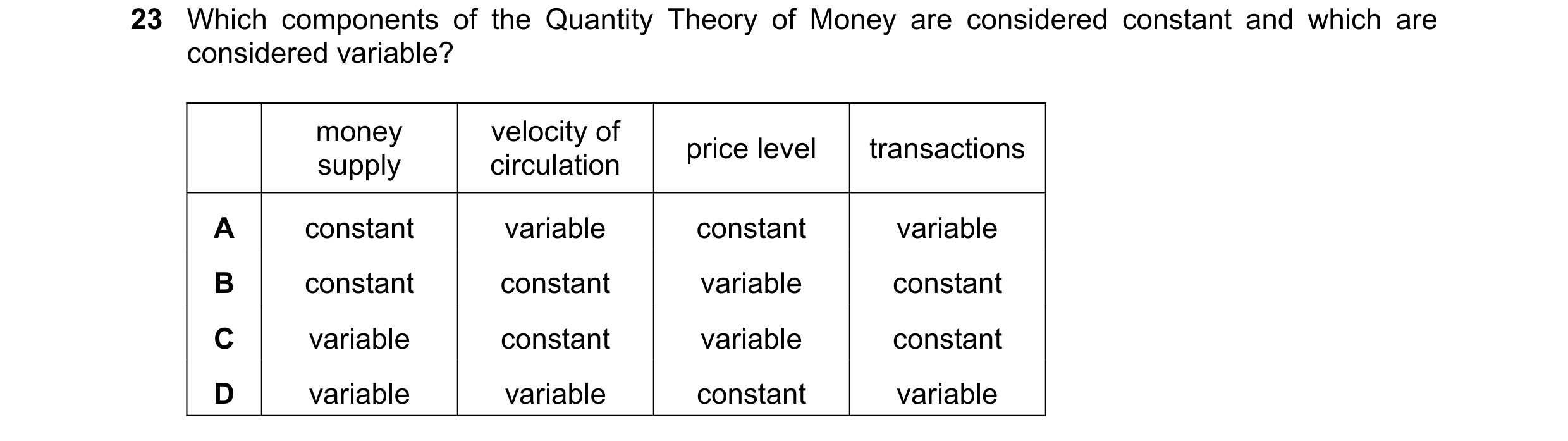

 37 / 38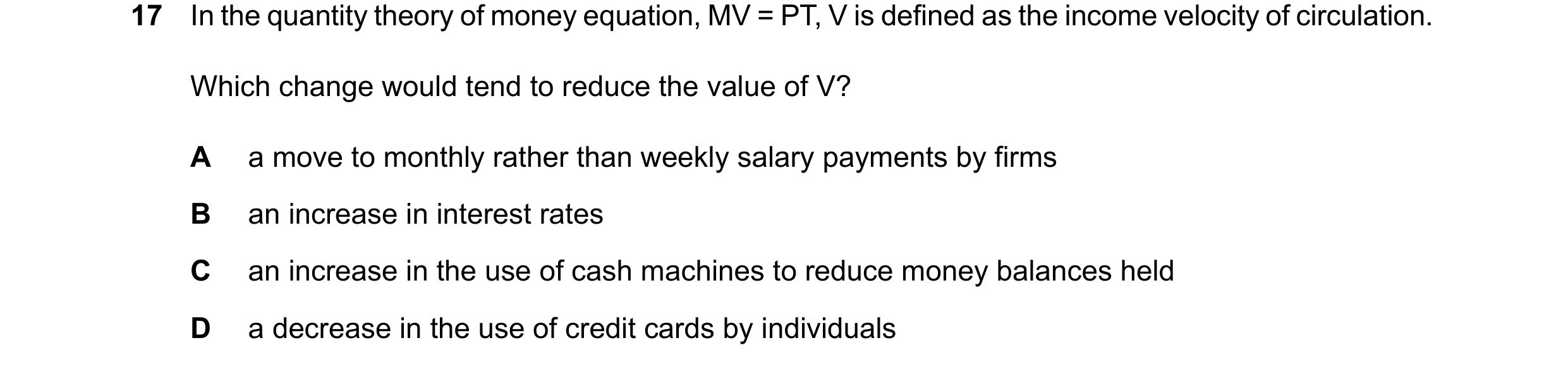
 38 / 38