Cambridge A Level Economics 9708 — 2012 May/June Paper 3 · Variant 3
9708/33/M/J/12 · 30 questions · 30 marks · ≈34 min
The question paper and its mark scheme, free to read here and free to download. This is Cambridge’s own paper, exactly as it was sat.
Question paper12 pages



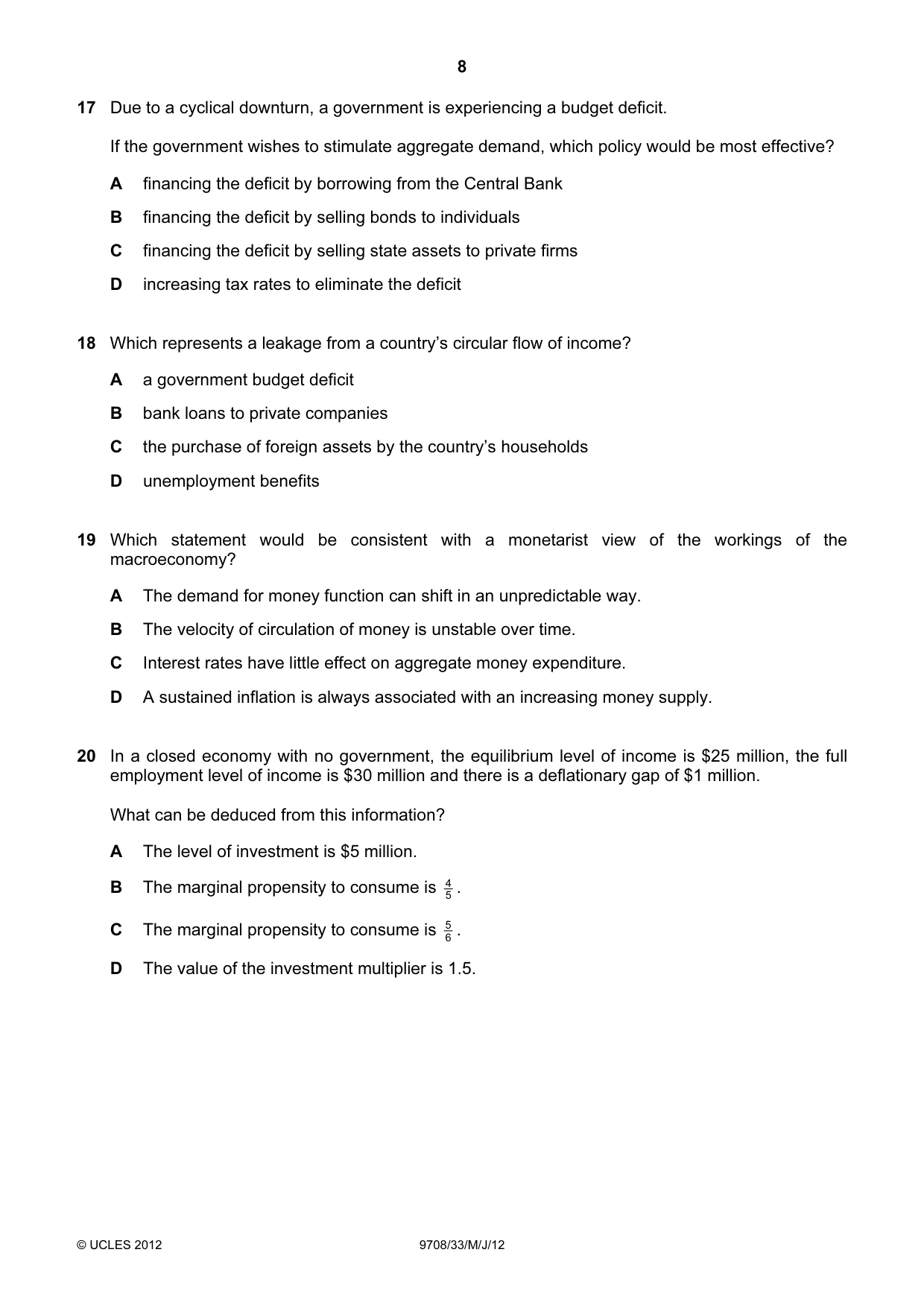
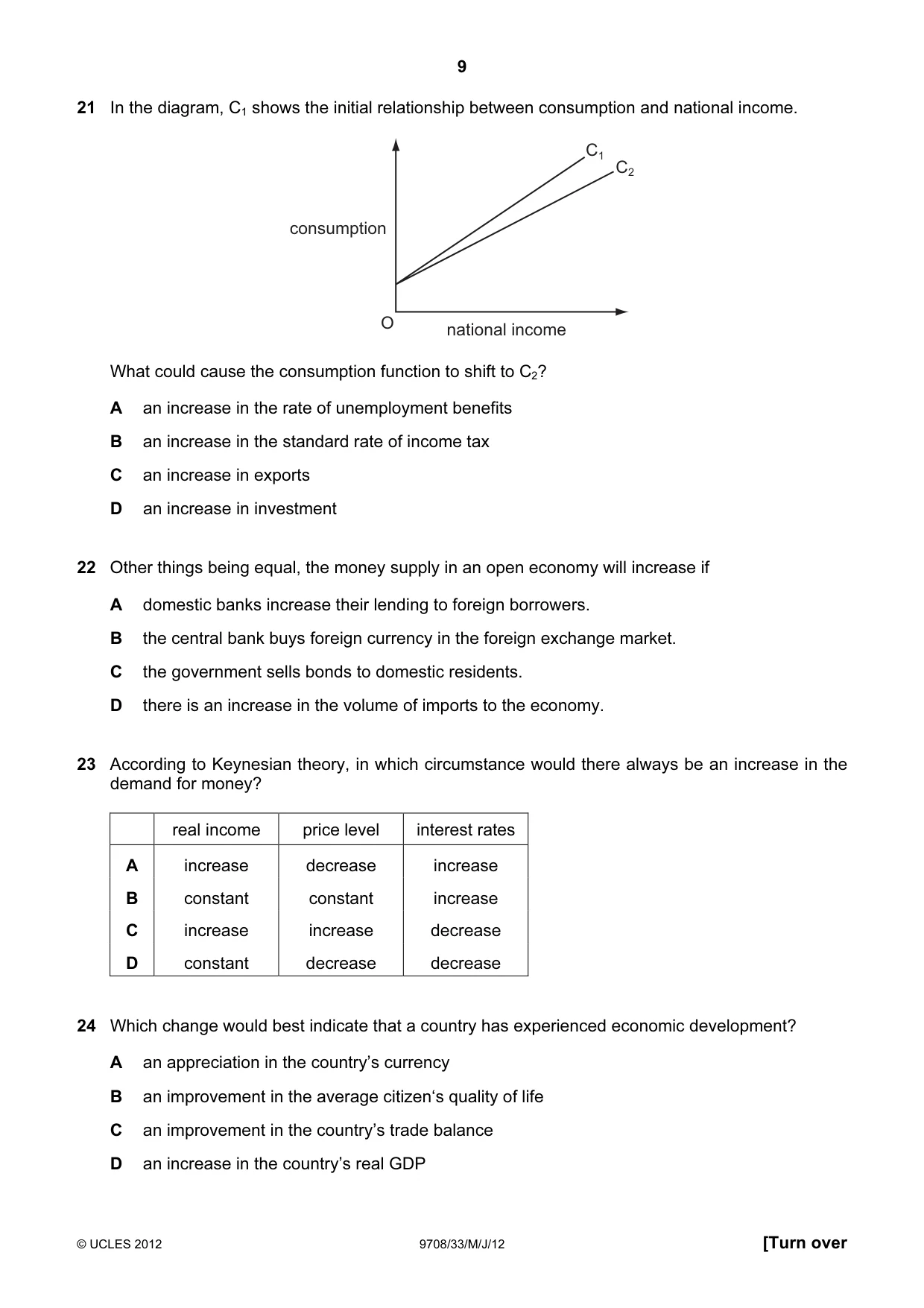
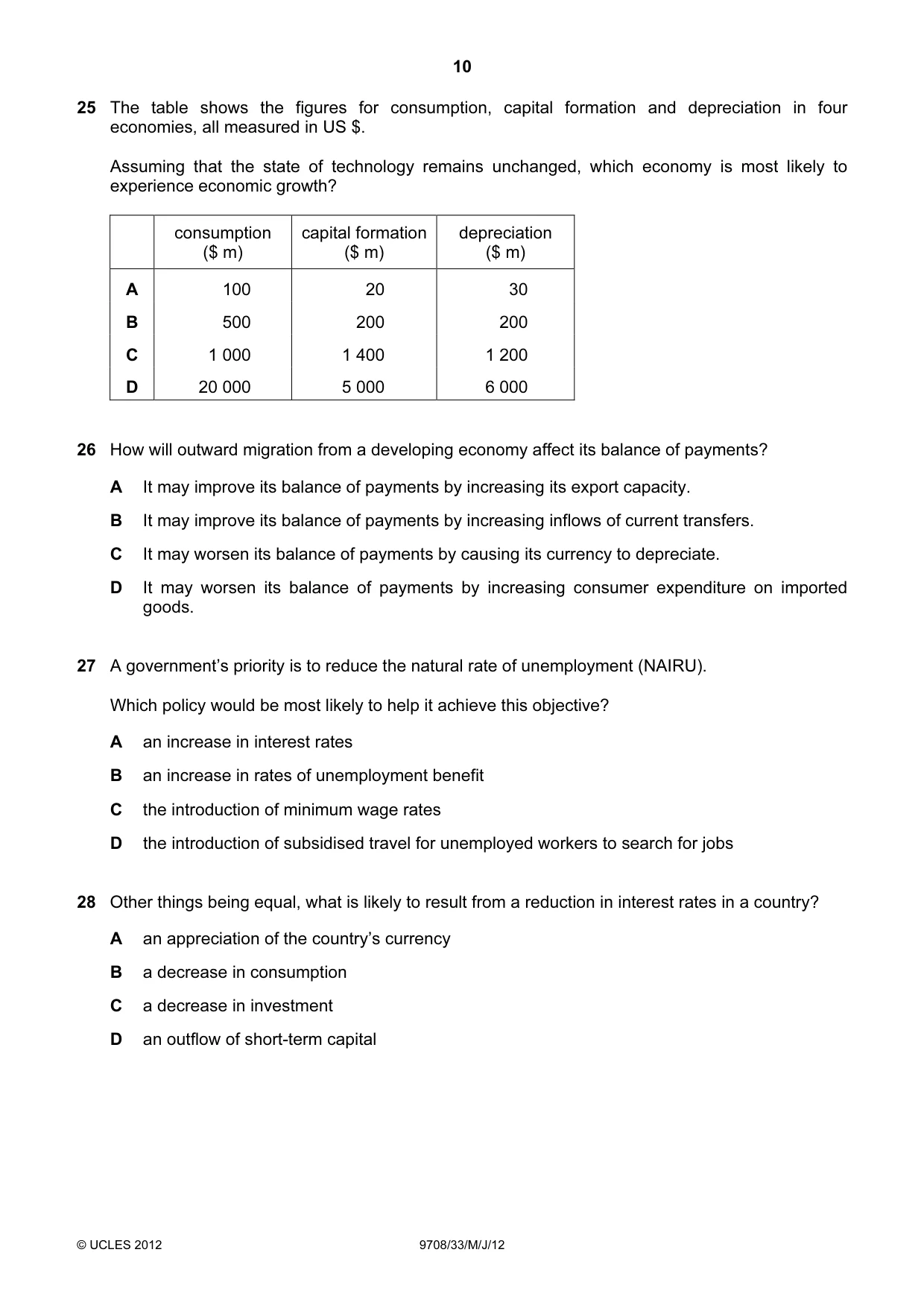
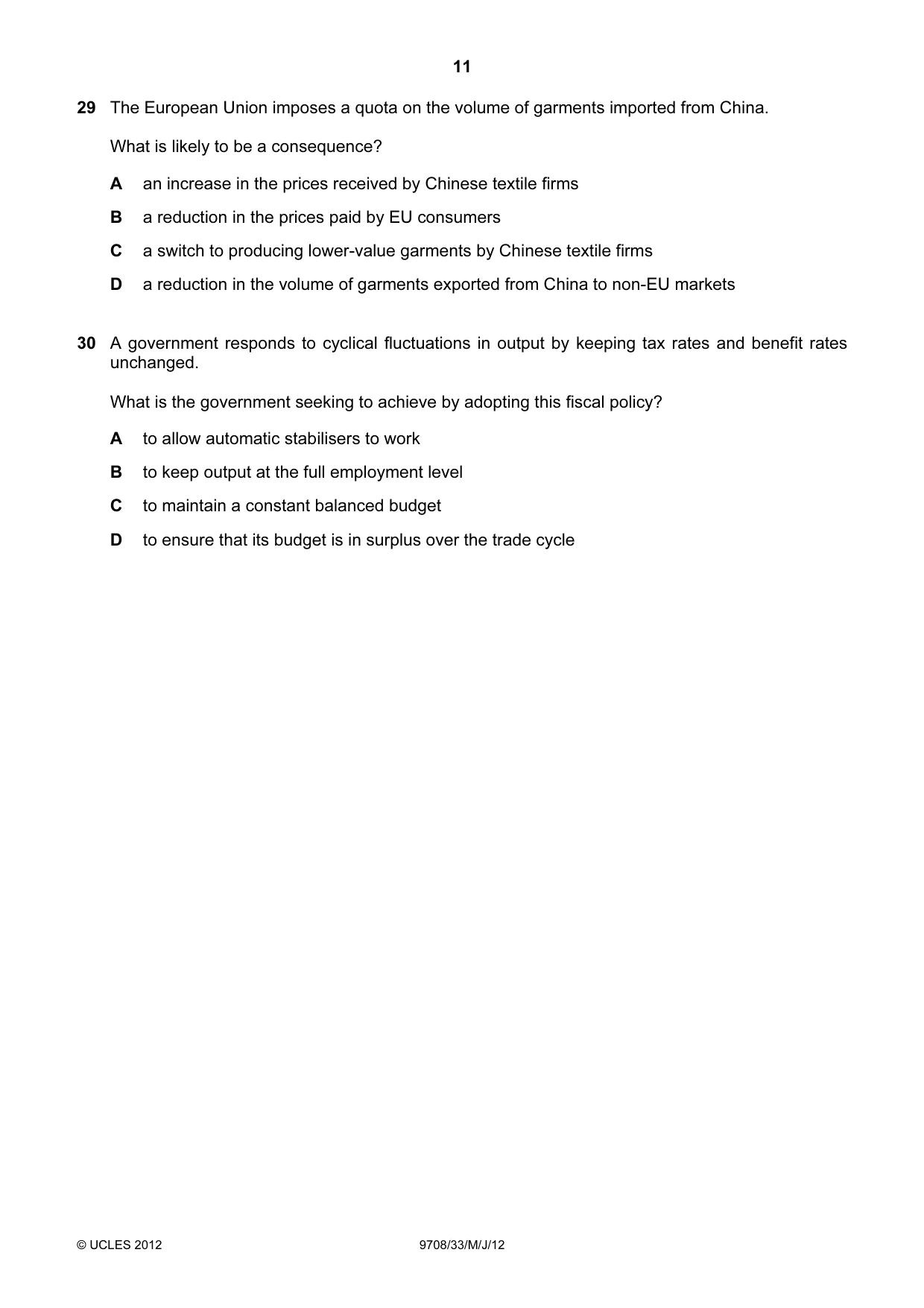

Mark scheme2 pages
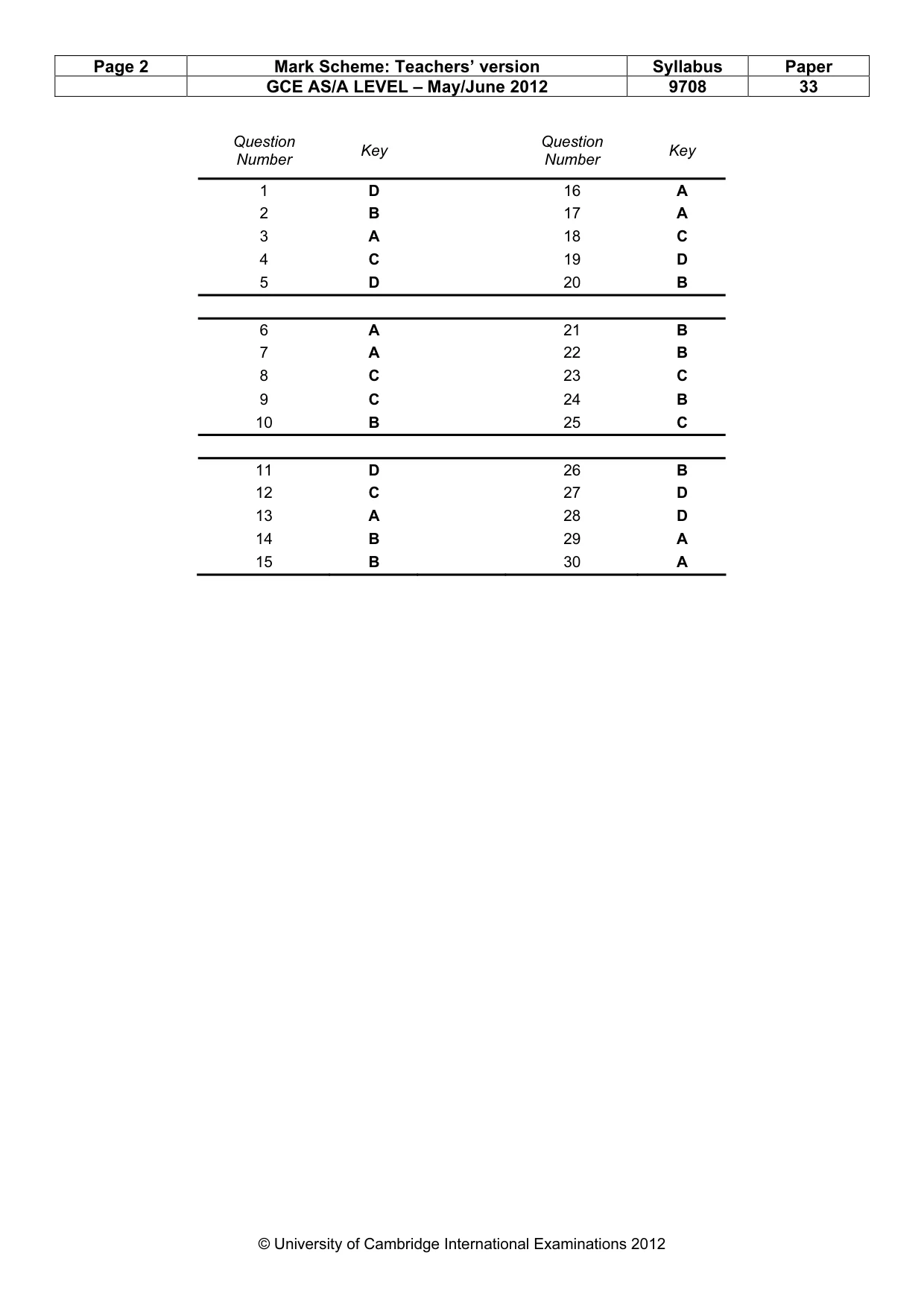
Answers below. Sit the paper first if you are practising.
Questions as text
Q1 · Which condition must be met for economic efficiency to be achieved?
1 Which condition must be met for economic efficiency to be achieved? A Marginal social costs are zero in the production of all goods. B Marginal social costs are at a minimum in the production of all goods. C Marginal social benefits are at a maximum in the production of all goods. D Marginal social costs equal marginal social benefits in the production of all goods.
Mark scheme: D
Q2 · A utility maximising consumer spends the whole of his disposable income of $40 on food…
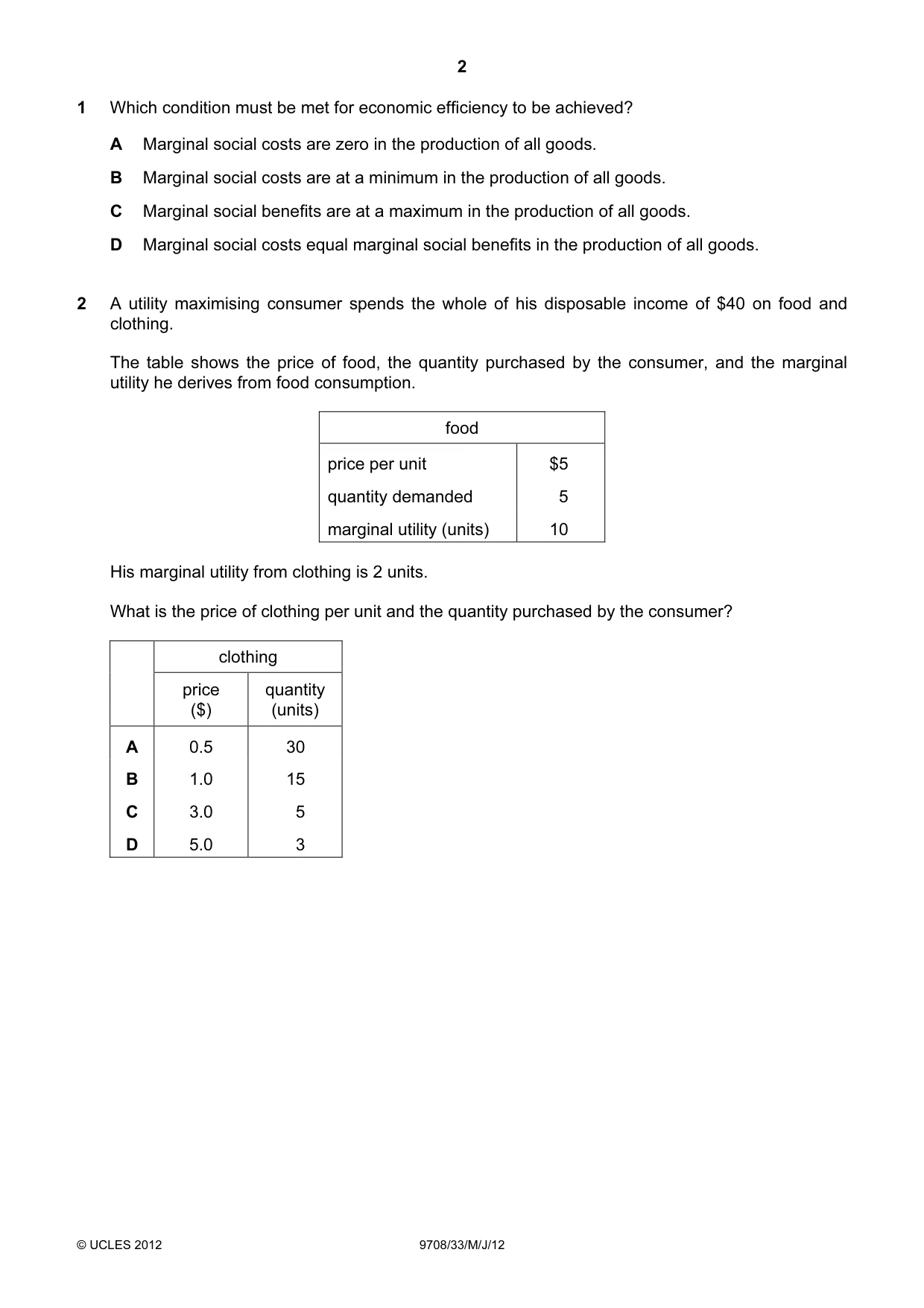
2 A utility maximising consumer spends the whole of his disposable income of $40 on food and clothing. The table shows the price of food, the quantity purchased by the consumer, and the marginal utility he derives from food consumption. food price per unit $5 quantity demanded 5 marginal utility (units) 10 His marginal utility from clothing is 2 units. What is the price of clothing per unit and the quantity purchased by the consumer? clothing price quantity ($) (units) A 0.5 30 B 1.0 15 C 3.0 5 D 5.0 3
Mark scheme: B
Q3 · The curve JK in the diagram is a consumer’s initial budget line
3 The curve JK in the diagram is a consumer’s initial budget line. G J good Y O H K good X Which combination could cause the budget line to shift to GH? consumer’s price of money income good Y A decrease decrease B decrease increase C increase decrease D increase increase
Mark scheme: A
Q4 · A firm employs two factors, X and Y, to produce a good which is sold for $4
4 A firm employs two factors, X and Y, to produce a good which is sold for $4. The table shows its factor productivities and factor prices. marginal physical factor price factor product ($) X 3 15 Y 5 12 What should the firm do? A employ less of both X and Y B employ more of X and less of Y C employ more of Y and less of X D employ more of both X and Y
Mark scheme: C
More questions on Types of cost, revenue and profit, short-run and long-run production
Q5 · The diagram shows the total product of labour curve for a firm whose only variable factor…
5 The diagram shows the total product of labour curve for a firm whose only variable factor input is labour. TPL total product of labour O number employed What explains the shape of the curve? A diminishing marginal disutility of work B increasing marginal disutility of work C technical diseconomies of scale D the law of variable proportions
Mark scheme: D
More questions on Types of cost, revenue and profit, short-run and long-run production
Q6 · A worker responds to an increase in his hourly wage rate by reducing the number of hours…
6 A worker responds to an increase in his hourly wage rate by reducing the number of hours he works per week. What would explain this? A The income effect of the wage rate increase outweighs the substitution effect. B The substitution effect of the wage rate increase outweighs the income effect. C The worker’s supply of labour is wage elastic. D The worker’s supply of labour is wage inelastic.
Mark scheme: A
More questions on Labour market forces and government intervention
Q7 · There is an increase in the supply of female labour
7 There is an increase in the supply of female labour. What will be the likely effect on male and female wages? male wages female wages A decrease decrease B decrease increase C increase decrease D increase increase
Mark scheme: A
More questions on Labour market forces and government intervention
Q8 · Samsung Electronics, which began as a semiconductor firm making simple memory chips, has…
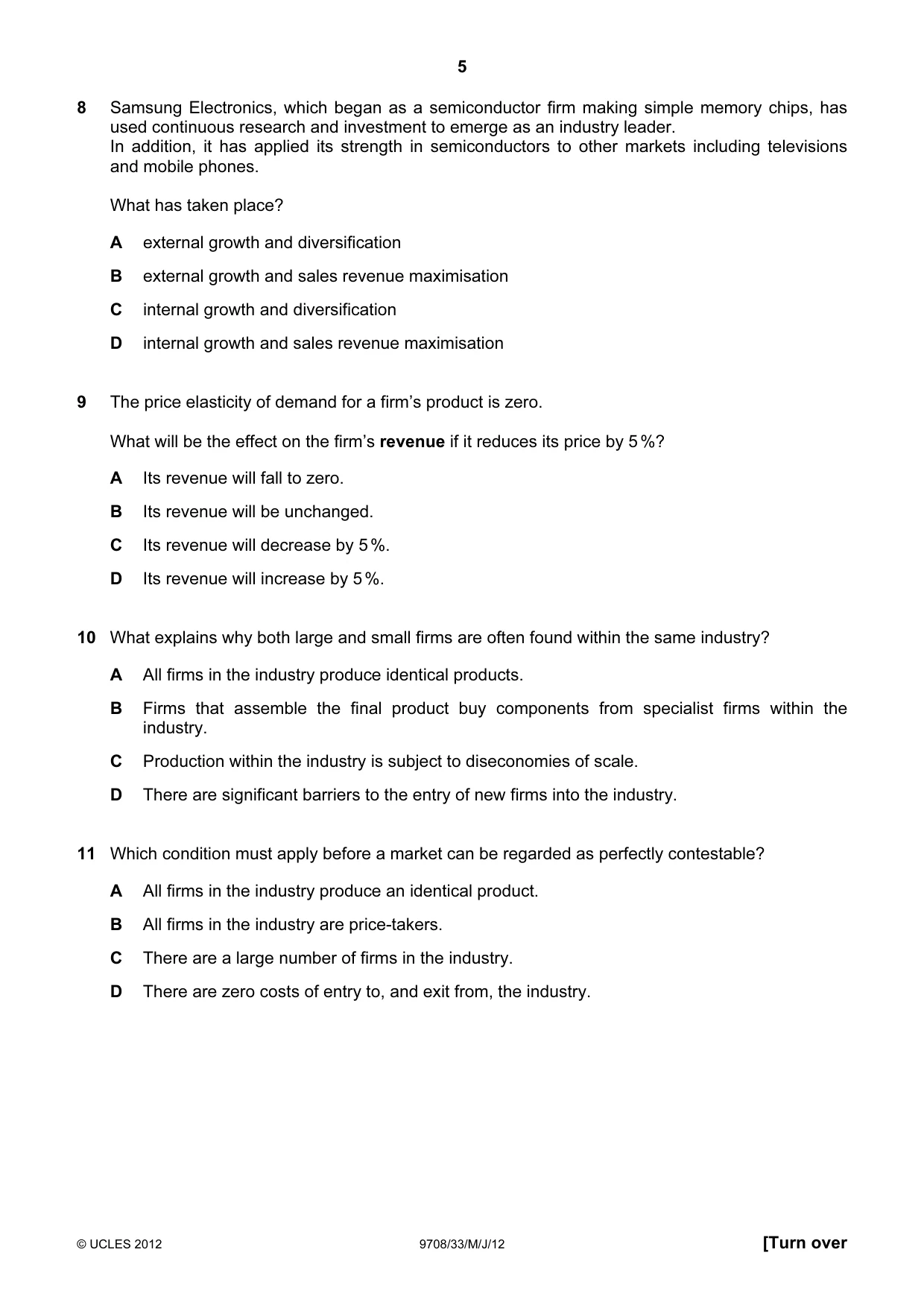
8 Samsung Electronics, which began as a semiconductor firm making simple memory chips, has used continuous research and investment to emerge as an industry leader. In addition, it has applied its strength in semiconductors to other markets including televisions and mobile phones. What has taken place? A external growth and diversification B external growth and sales revenue maximisation C internal growth and diversification D internal growth and sales revenue maximisation
Mark scheme: C
Q9 · The price elasticity of demand for a firm’s product is zero
9 The price elasticity of demand for a firm’s product is zero. What will be the effect on the firm’s revenue if it reduces its price by 5 %? A Its revenue will fall to zero. B Its revenue will be unchanged. C Its revenue will decrease by 5 %. D Its revenue will increase by 5 %.
Mark scheme: C
More questions on Price elasticity, income elasticity and cross elasticity of demand
Q10 · What explains why both large and small firms are often found within the same industry?
10 What explains why both large and small firms are often found within the same industry? A All firms in the industry produce identical products. B Firms that assemble the final product buy components from specialist firms within the industry. C Production within the industry is subject to diseconomies of scale. D There are significant barriers to the entry of new firms into the industry.
Mark scheme: B
Q11 · Which condition must apply before a market can be regarded as perfectly contestable?
11 Which condition must apply before a market can be regarded as perfectly contestable? A All firms in the industry produce an identical product. B All firms in the industry are price-takers. C There are a large number of firms in the industry. D There are zero costs of entry to, and exit from, the industry.
Mark scheme: D
Q12 · The table shows the total revenue and marginal cost of a firm at different levels of…
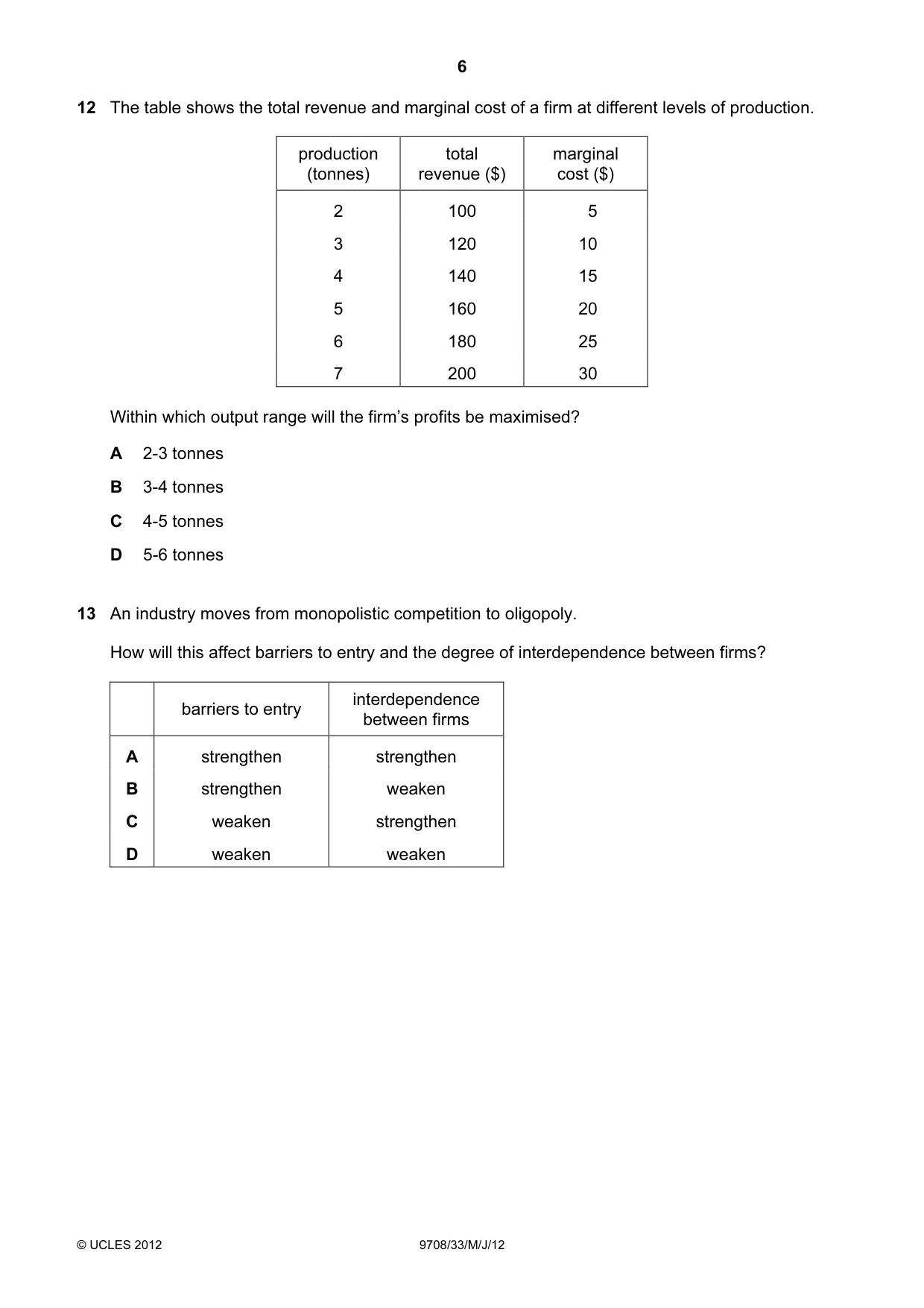
12 The table shows the total revenue and marginal cost of a firm at different levels of production. production total marginal (tonnes) revenue ($) cost ($) 2 100 5 3 120 10 4 140 15 5 160 20 6 180 25 7 200 30 Within which output range will the firm’s profits be maximised? A 2-3 tonnes B 3-4 tonnes C 4-5 tonnes D 5-6 tonnes
Mark scheme: C
More questions on Differing objectives and policies of firms
Q13 · An industry moves from monopolistic competition to oligopoly
13 An industry moves from monopolistic competition to oligopoly. How will this affect barriers to entry and the degree of interdependence between firms? interdependence barriers to entry between firms A strengthen strengthen B strengthen weaken C weaken strengthen D weaken weaken
Mark scheme: A
Q14 · In the diagram, D is a country’s demand curve for an imported good
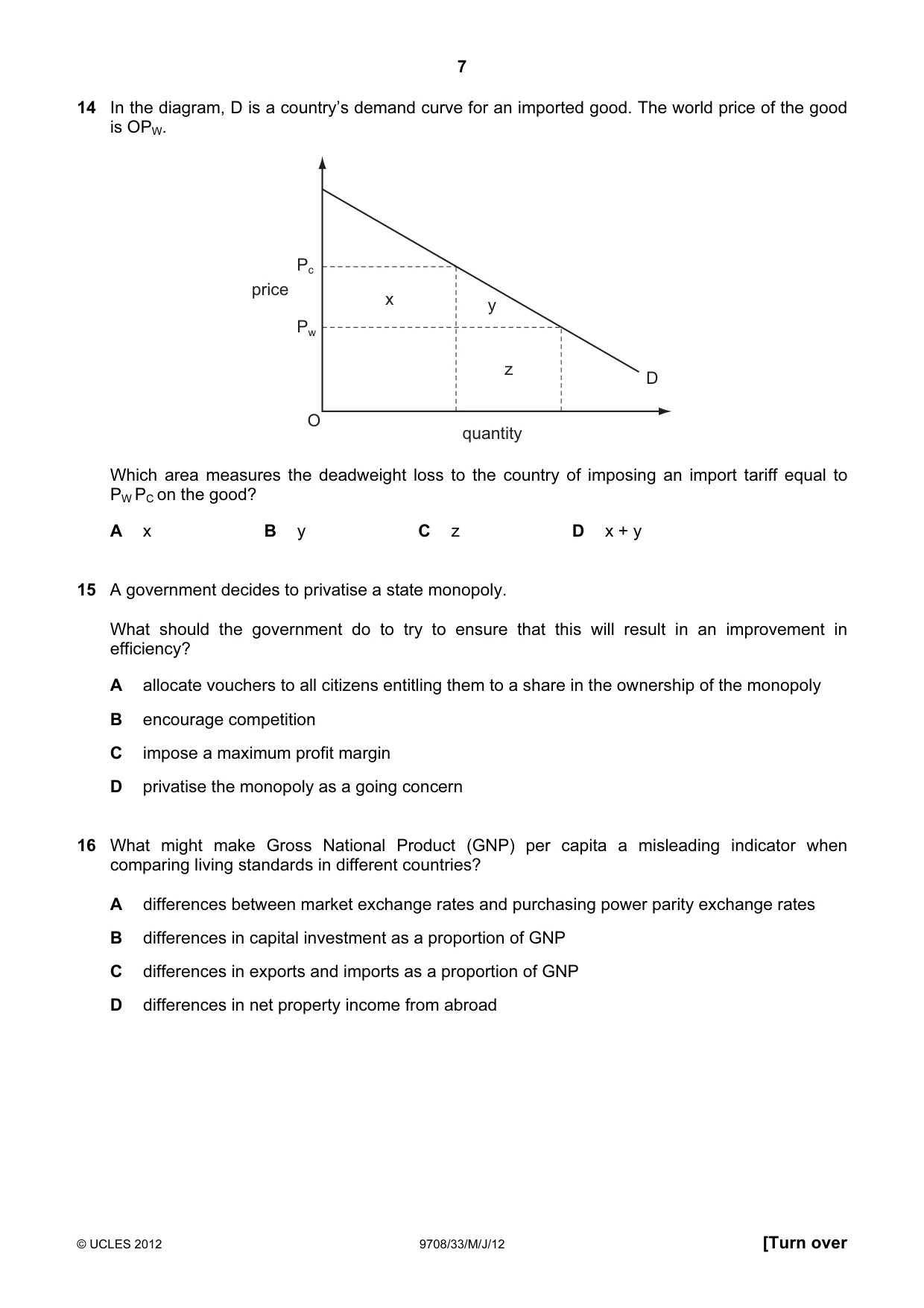
14 In the diagram, D is a country’s demand curve for an imported good. The world price of the good is OPW. Pc price x y Pw z D O quantity Which area measures the deadweight loss to the country of imposing an import tariff equal to PW PC on the good? A x B y C z D x + y
Mark scheme: B
Q15 · A government decides to privatise a state monopoly
15 A government decides to privatise a state monopoly. What should the government do to try to ensure that this will result in an improvement in efficiency? A allocate vouchers to all citizens entitling them to a share in the ownership of the monopoly B encourage competition C impose a maximum profit margin D privatise the monopoly as a going concern
Mark scheme: B
Q16 · What might make Gross National Product (GNP) per capita a misleading indicator when…
16 What might make Gross National Product (GNP) per capita a misleading indicator when comparing living standards in different countries? A differences between market exchange rates and purchasing power parity exchange rates B differences in capital investment as a proportion of GNP C differences in exports and imports as a proportion of GNP D differences in net property income from abroad
Mark scheme: A
Q17 · Due to a cyclical downturn, a government is experiencing a budget deficit
17 Due to a cyclical downturn, a government is experiencing a budget deficit. If the government wishes to stimulate aggregate demand, which policy would be most effective? A financing the deficit by borrowing from the Central Bank B financing the deficit by selling bonds to individuals C financing the deficit by selling state assets to private firms D increasing tax rates to eliminate the deficit
Mark scheme: A
Q18 · Which represents a leakage from a country’s circular flow of income?
18 Which represents a leakage from a country’s circular flow of income? A a government budget deficit B bank loans to private companies C the purchase of foreign assets by the country’s households D unemployment benefits
Mark scheme: C
Q19 · Which statement would be consistent with a monetarist view of the workings of the…
19 Which statement would be consistent with a monetarist view of the workings of the macroeconomy? A The demand for money function can shift in an unpredictable way. B The velocity of circulation of money is unstable over time. C Interest rates have little effect on aggregate money expenditure. D A sustained inflation is always associated with an increasing money supply.
Mark scheme: D
Q20 · In a closed economy with no government, the equilibrium level of income is $25 million…
20 In a closed economy with no government, the equilibrium level of income is $25 million, the full employment level of income is $30 million and there is a deflationary gap of $1 million. What can be deduced from this information? A The level of investment is $5 million. B The marginal propensity to consume is 5 4 . C The marginal propensity to consume is 6 5 . D The value of the investment multiplier is 1.5.
Mark scheme: B
Q21 · In the diagram, C1 shows the initial relationship between consumption and national income
21 In the diagram, C1 shows the initial relationship between consumption and national income. C1 C2 consumption O national income What could cause the consumption function to shift to C2? A an increase in the rate of unemployment benefits B an increase in the standard rate of income tax C an increase in exports D an increase in investment
Mark scheme: B
Q22 · Other things being equal, the money supply in an open economy will increase if A domestic…
22 Other things being equal, the money supply in an open economy will increase if A domestic banks increase their lending to foreign borrowers. B the central bank buys foreign currency in the foreign exchange market. C the government sells bonds to domestic residents. D there is an increase in the volume of imports to the economy.
Mark scheme: B
Q23 · According to Keynesian theory, in which circumstance would there always be an increase in…
23 According to Keynesian theory, in which circumstance would there always be an increase in the demand for money? real income price level interest rates A increase decrease increase B constant constant increase C increase increase decrease D constant decrease decrease
Mark scheme: C
Q24 · Which change would best indicate that a country has experienced economic development?
24 Which change would best indicate that a country has experienced economic development? A an appreciation in the country’s currency B an improvement in the average citizen‘s quality of life C an improvement in the country’s trade balance D an increase in the country’s real GDP
Mark scheme: B
Q25 · The table shows the figures for consumption, capital formation and depreciation in four…
25 The table shows the figures for consumption, capital formation and depreciation in four economies, all measured in US $. Assuming that the state of technology remains unchanged, which economy is most likely to experience economic growth? consumption capital formation depreciation ($ m) ($ m) ($ m) A 100 20 30 B 500 200 200 C 1 000 1 400 1 200 D 20 000 5 000 6 000
Mark scheme: C
Q26 · How will outward migration from a developing economy affect its balance of payments?
26 How will outward migration from a developing economy affect its balance of payments? A It may improve its balance of payments by increasing its export capacity. B It may improve its balance of payments by increasing inflows of current transfers. C It may worsen its balance of payments by causing its currency to depreciate. D It may worsen its balance of payments by increasing consumer expenditure on imported goods.
Mark scheme: B
More questions on Relationship between countries at different levels of development
Q27 · A government’s priority is to reduce the natural rate of unemployment (NAIRU)
27 A government’s priority is to reduce the natural rate of unemployment (NAIRU). Which policy would be most likely to help it achieve this objective? A an increase in interest rates B an increase in rates of unemployment benefit C the introduction of minimum wage rates D the introduction of subsidised travel for unemployed workers to search for jobs
Mark scheme: D
Q28 · Other things being equal, what is likely to result from a reduction in interest rates in…
28 Other things being equal, what is likely to result from a reduction in interest rates in a country? A an appreciation of the country’s currency B a decrease in consumption C a decrease in investment D an outflow of short-term capital
Mark scheme: D
Q29 · The European Union imposes a quota on the volume of garments imported from China
29 The European Union imposes a quota on the volume of garments imported from China. What is likely to be a consequence? A an increase in the prices received by Chinese textile firms B a reduction in the prices paid by EU consumers C a switch to producing lower-value garments by Chinese textile firms D a reduction in the volume of garments exported from China to non-EU markets
Mark scheme: A
Q30 · A government responds to cyclical fluctuations in output by keeping tax rates and benefit…
30 A government responds to cyclical fluctuations in output by keeping tax rates and benefit rates unchanged. What is the government seeking to achieve by adopting this fiscal policy? A to allow automatic stabilisers to work B to keep output at the full employment level C to maintain a constant balanced budget D to ensure that its budget is in surplus over the trade cycle
Mark scheme: A
What was in this paper
The subtopics covered by these 30 questions, and how many questions each got. Open one in a new tab to see every Cambridge question on it.
3The circular flow of income3Different market structures2Economic development2Fiscal policy2Growth and survival of firms2Labour market forces and government intervention2Protectionism2Types of cost, revenue and profit, short-run and long-run production2Differing objectives and policies of firms1Economic growth and sustainability1Efficiency and market failure1Government policies to achieve efficient resource allocation and correct market failure1Indifference curves and budget lines1Monetary policy1Price elasticity, income elasticity and cross elasticity of demand1Relationship between countries at different levels of development1Supply-side policy1Utility1What you needed in this session
Cambridge’s own grade thresholds for 2012 May/June, Paper 3 · Variant 3. A higher threshold means an easier paper — the bar moves with how the cohort did.