Cambridge A Level Economics 9708 — 2023 Feb/March Paper 3 · Variant 2
9708/32/F/M/23 · 30 questions · 30 marks · ≈34 min
The question paper and its mark scheme, free to read here and free to download. This is Cambridge’s own paper, exactly as it was sat.
Question paper12 pages


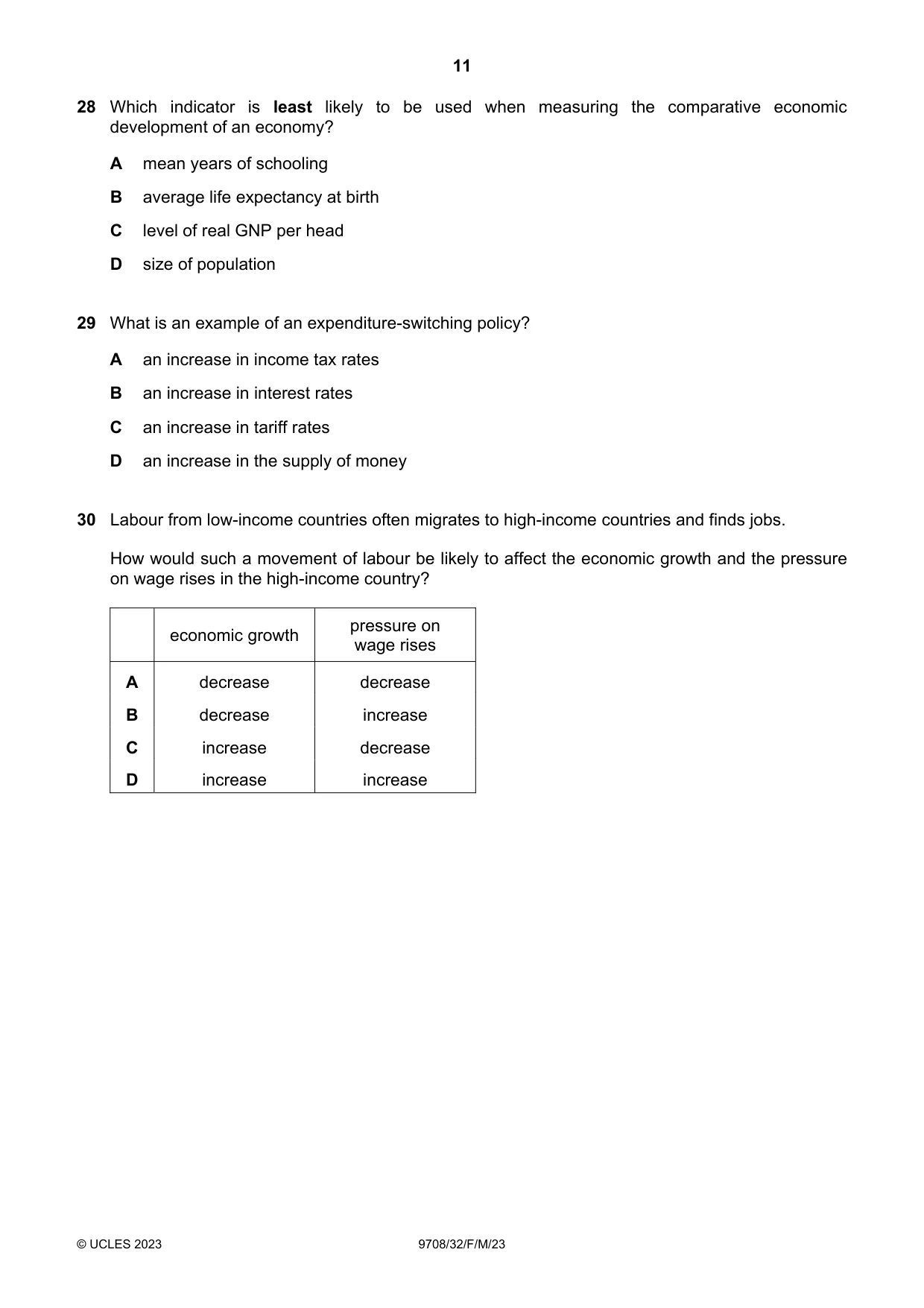

Mark scheme3 pages
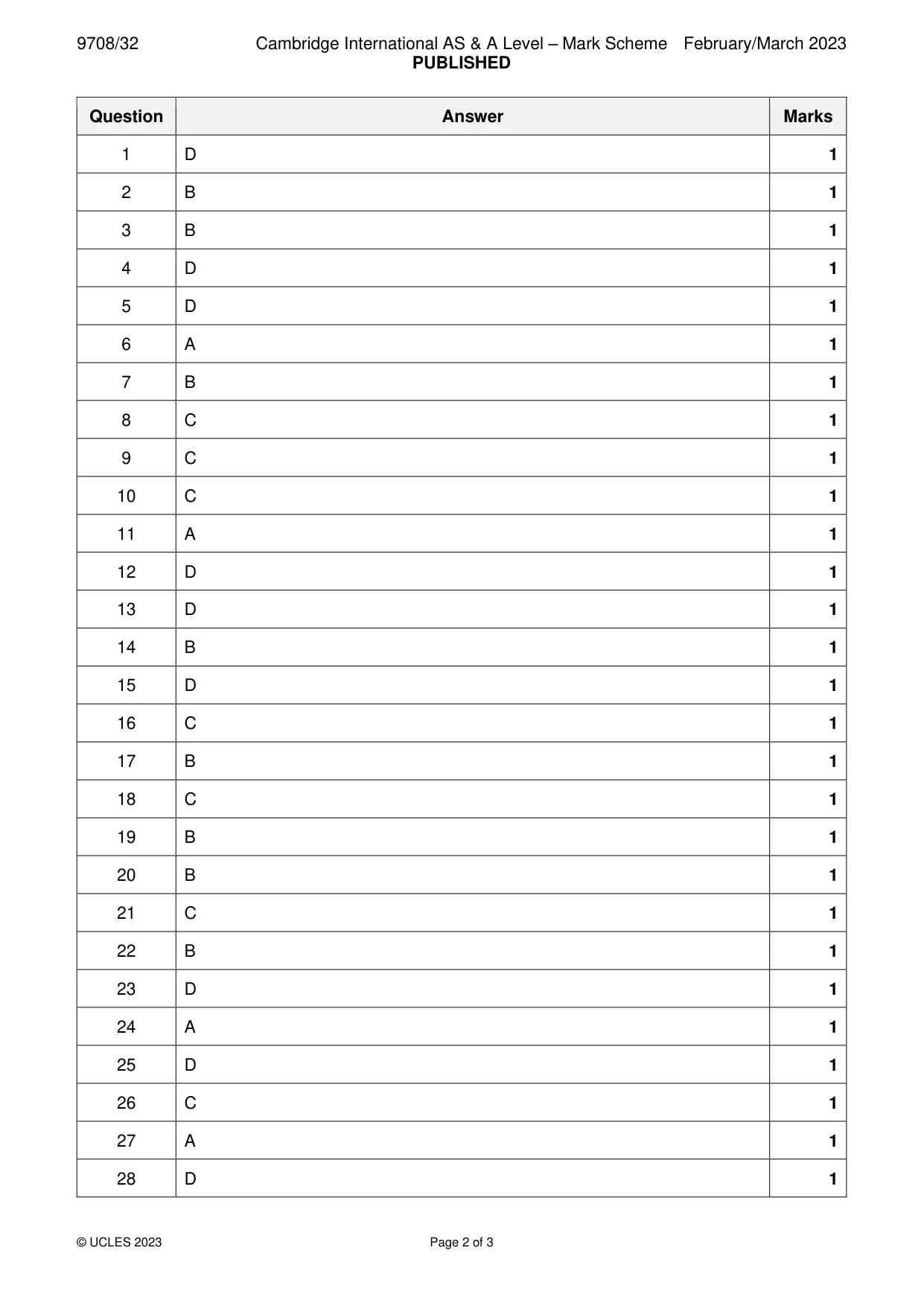
Answers below. Sit the paper first if you are practising.

Questions as text
Q1 · Utility theory is based on the assumption of the ‘rational consumer’
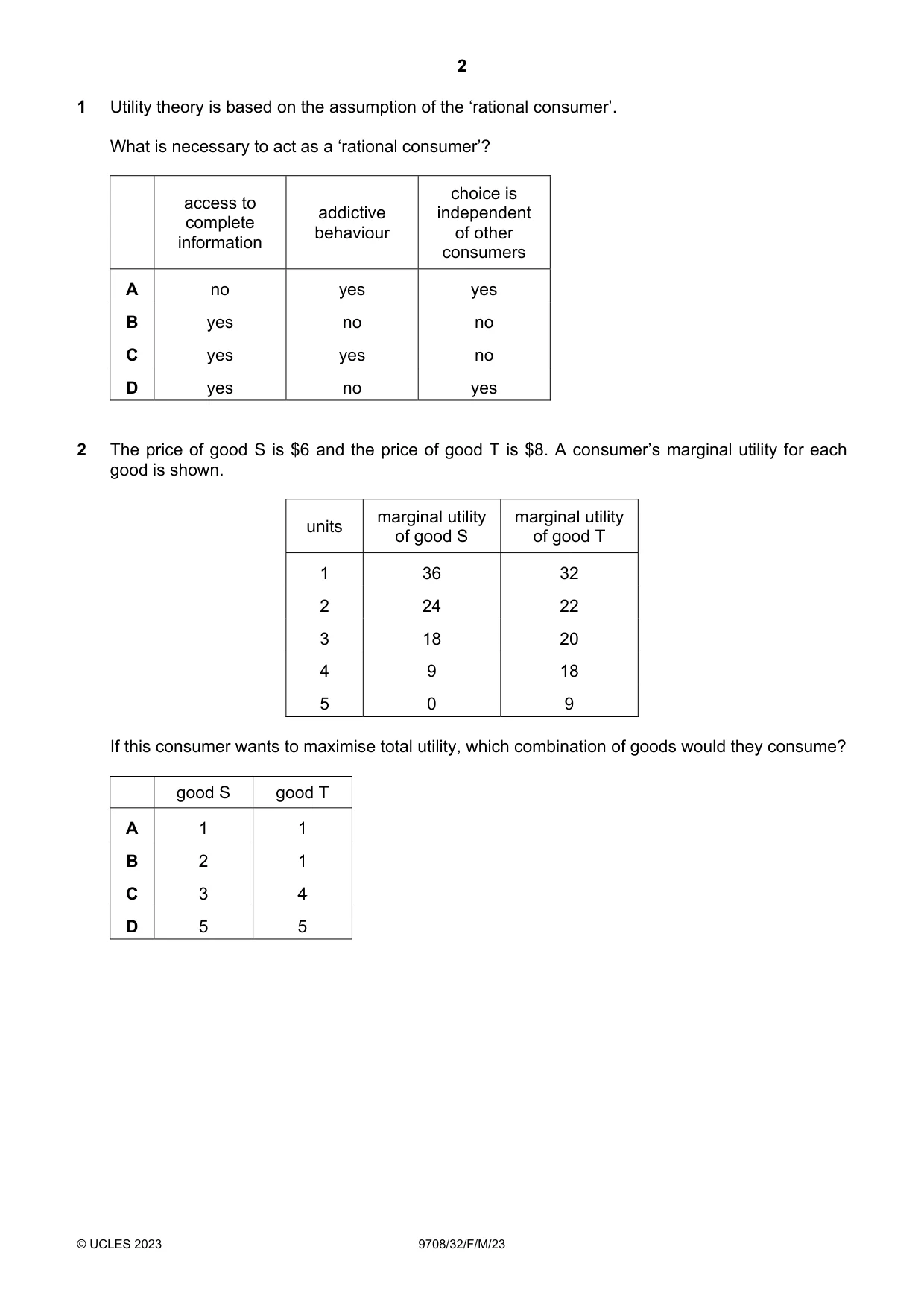
1 Utility theory is based on the assumption of the ‘rational consumer’. What is necessary to act as a ‘rational consumer’? choice is access to addictive independent complete behaviour of other information consumers A no yes yes B yes no no C yes yes no D yes no yes
Mark scheme: D
Q2 · The price of good S is $6 and the price of good T is $8
2 The price of good S is $6 and the price of good T is $8. A consumer’s marginal utility for each good is shown. marginal utility marginal utility units of good S of good T 1 36 32 2 24 22 3 18 20 4 9 18 5 0 9 If this consumer wants to maximise total utility, which combination of goods would they consume? good S good T A 1 1 B 2 1 C 3 4 D 5 5
Mark scheme: B
Q3 · The diagram shows the effect of a price change on an individual consumer’s equilibrium…
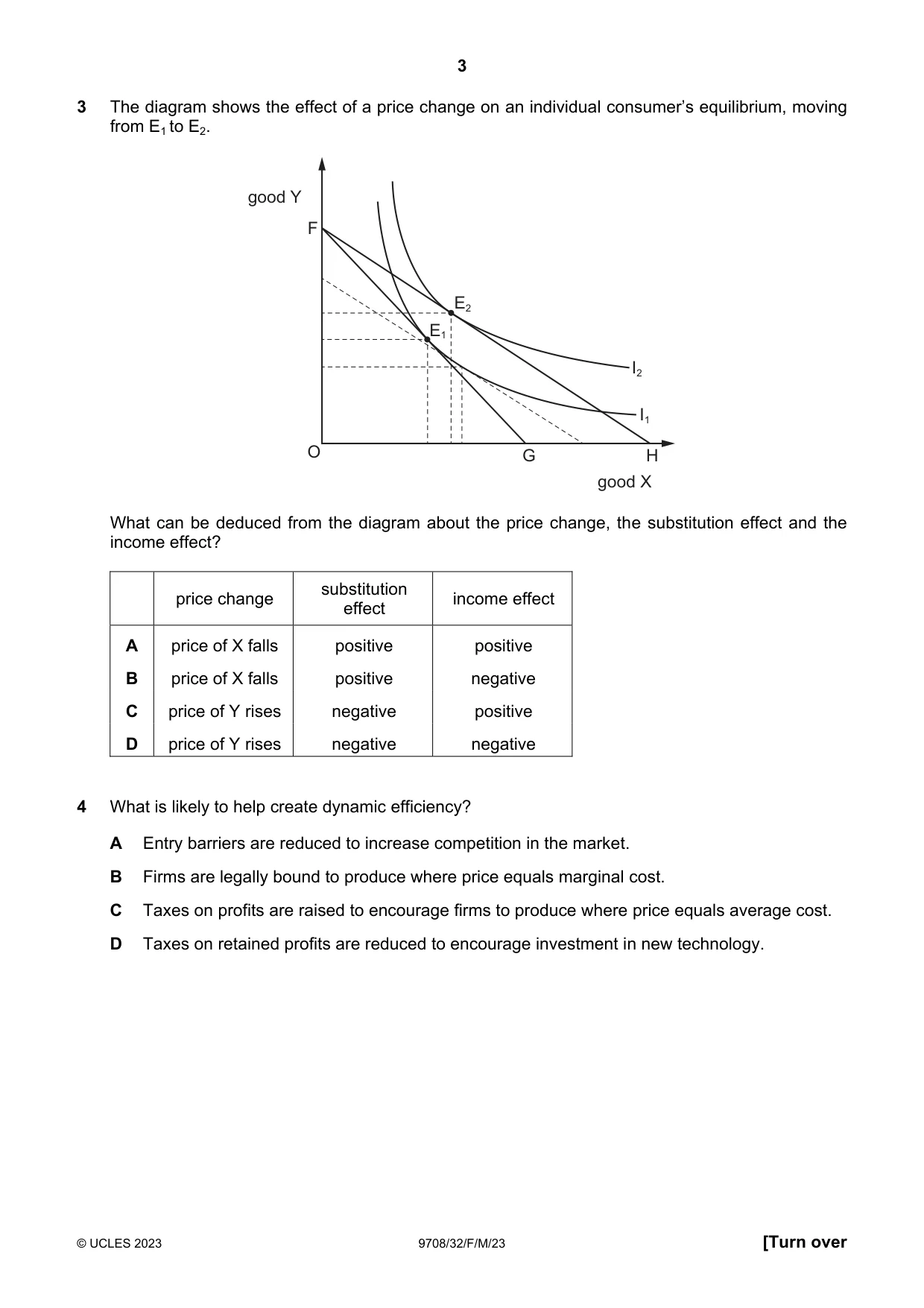
3 The diagram shows the effect of a price change on an individual consumer’s equilibrium, moving from E1 to E2. good Y F E2 E1 I2 I1 O G H good X What can be deduced from the diagram about the price change, the substitution effect and the income effect? substitution price change income effect effect A price of X falls positive positive B price of X falls positive negative C price of Y rises negative positive D price of Y rises negative negative
Mark scheme: B
Q4 · What is likely to help create dynamic efficiency?
4 What is likely to help create dynamic efficiency? A Entry barriers are reduced to increase competition in the market. B Firms are legally bound to produce where price equals marginal cost. C Taxes on profits are raised to encourage firms to produce where price equals average cost. D Taxes on retained profits are reduced to encourage investment in new technology.
Mark scheme: D
Q5 · At which level of output is sales maximisation achieved consistent with earning normal…
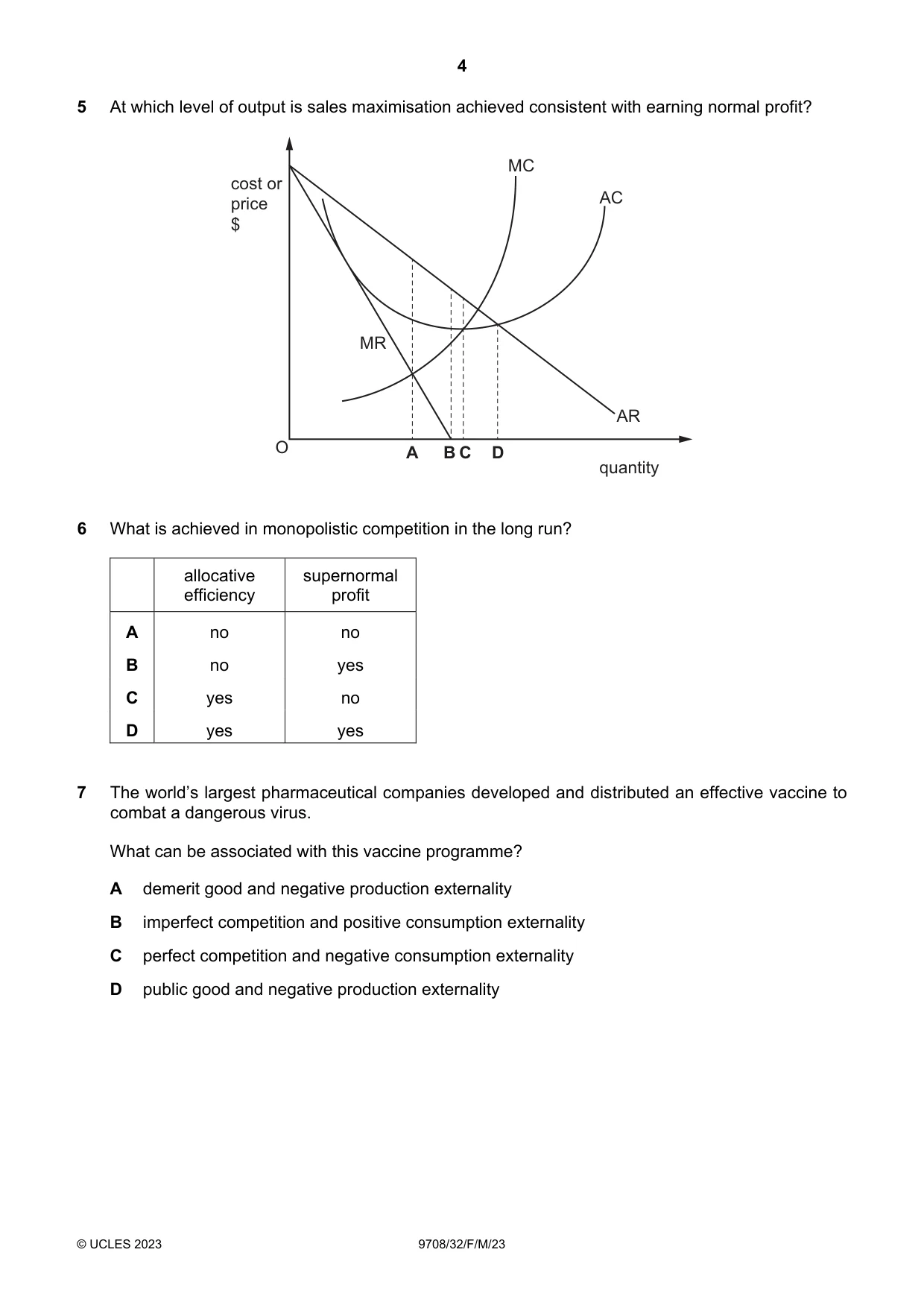
5 At which level of output is sales maximisation achieved consistent with earning normal profit? MC cost or price AC $ MR AR O A B C D quantity
Mark scheme: D
More questions on Differing objectives and policies of firms
Q6 · What is achieved in monopolistic competition in the long run?
6 What is achieved in monopolistic competition in the long run? allocative supernormal efficiency profit A no no B no yes C yes no D yes yes
Mark scheme: A
Q7 · The world’s largest pharmaceutical companies developed and distributed an effective…
7 The world’s largest pharmaceutical companies developed and distributed an effective vaccine to combat a dangerous virus. What can be associated with this vaccine programme? A demerit good and negative production externality B imperfect competition and positive consumption externality C perfect competition and negative consumption externality D public good and negative production externality
Mark scheme: B
More questions on Private costs and benefits, externalities and social costs and benefits
Q8 · A landlord owns a house which is rented to tenants
8 A landlord owns a house which is rented to tenants. The tenants are required to pay the electricity and water bills. The landlord is required to decorate and repair damage to the house and its gardens. What is not an example of the principal-agent problem? A The tenants forget to switch off a tap when filling a bath and water overflows, damaging the floor. B The tenants have a party and their guests cause damage to the interior of the house. C The tenants leave the lights and the TV on when they go out for an evening meal. D The tenants park their car in the garden, damaging the grass and the surrounding hedge.
Mark scheme: C
More questions on Differing objectives and policies of firms
Q9 · The result of a cost-benefit analysis of a proposed government road-building project is…
9 The result of a cost-benefit analysis of a proposed government road-building project is that there will be a positive net social benefit of $50 million. Why might the government not proceed with the project? A The project would not be profitable for a private firm. B The project would cause negative externalities. C There is limited capital available for government projects. D There would be more who lost than gained.
Mark scheme: C
More questions on Private costs and benefits, externalities and social costs and benefits
Q10 · If the marginal cost of a good is lower than its price, allocative efficiency has not…
10 If the marginal cost of a good is lower than its price, allocative efficiency has not been achieved. What is likely to remedy this situation? production of price of the good the good A decrease decrease B decrease increase C increase decrease D increase increase
Mark scheme: C
Q11 · The diagram shows an industry’s demand for and supply of labour
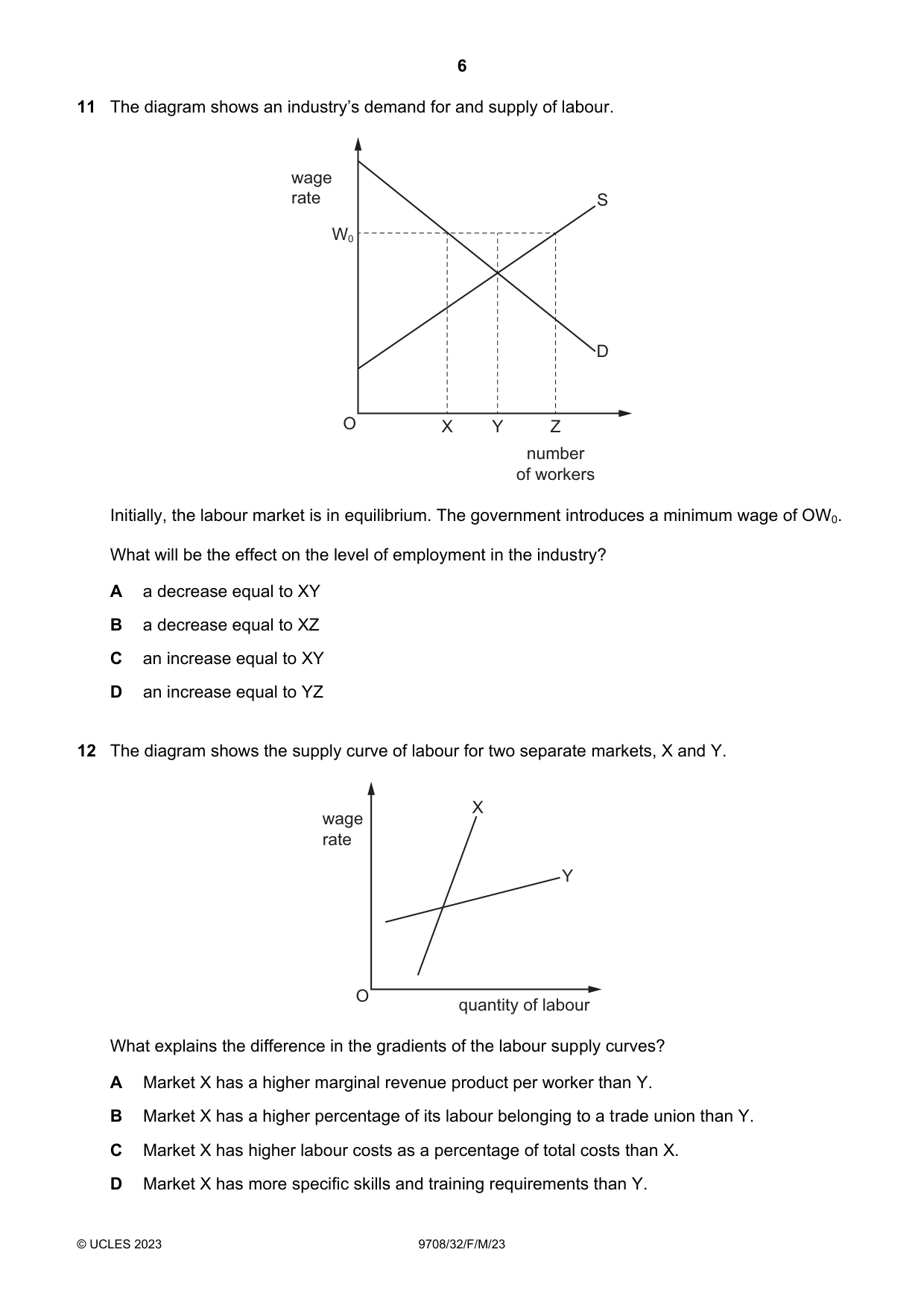
11 The diagram shows an industry’s demand for and supply of labour. wage rate S W0 D O X Y Z number of workers Initially, the labour market is in equilibrium. The government introduces a minimum wage of OW0. What will be the effect on the level of employment in the industry? A a decrease equal to XY B a decrease equal to XZ C an increase equal to XY D an increase equal to YZ
Mark scheme: A
More questions on Labour market forces and government intervention
Q12 · The diagram shows the supply curve of labour for two separate markets, X and Y
12 The diagram shows the supply curve of labour for two separate markets, X and Y. X wage rate Y O quantity of labour What explains the difference in the gradients of the labour supply curves? A Market X has a higher marginal revenue product per worker than Y. B Market X has a higher percentage of its labour belonging to a trade union than Y. C Market X has higher labour costs as a percentage of total costs than X. D Market X has more specific skills and training requirements than Y.
Mark scheme: D
More questions on Labour market forces and government intervention
Q13 · The table shows the main characteristics of employment in two occupations
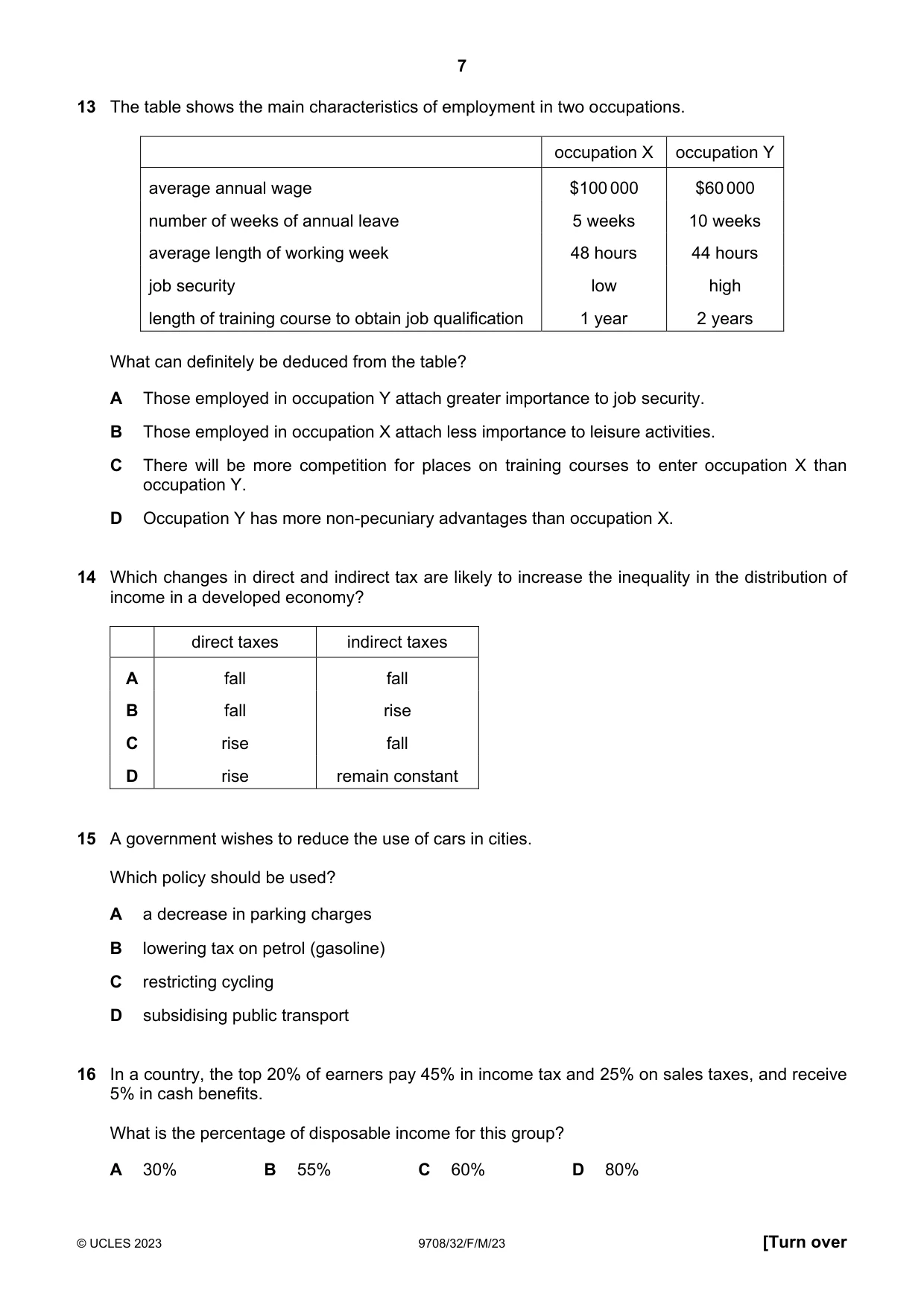
13 The table shows the main characteristics of employment in two occupations. occupation X occupation Y average annual wage $100 000 $60 000 number of weeks of annual leave 5 weeks 10 weeks average length of working week 48 hours 44 hours job security low high length of training course to obtain job qualification 1 year 2 years What can definitely be deduced from the table? A Those employed in occupation Y attach greater importance to job security. B Those employed in occupation X attach less importance to leisure activities. C There will be more competition for places on training courses to enter occupation X than occupation Y. D Occupation Y has more non-pecuniary advantages than occupation X.
Mark scheme: D
More questions on Labour market forces and government intervention
Q14 · Which changes in direct and indirect tax are likely to increase the inequality in the…
14 Which changes in direct and indirect tax are likely to increase the inequality in the distribution of income in a developed economy? direct taxes indirect taxes A fall fall B fall rise C rise fall D rise remain constant
Mark scheme: B
More questions on Equity and redistribution of income and wealth
Q15 · A government wishes to reduce the use of cars in cities
15 A government wishes to reduce the use of cars in cities. Which policy should be used? A a decrease in parking charges B lowering tax on petrol (gasoline) C restricting cycling D subsidising public transport
Mark scheme: D
Q16 · In a country, the top 20% of earners pay 45% in income tax and 25% on sales taxes, and…
16 In a country, the top 20% of earners pay 45% in income tax and 25% on sales taxes, and receive 5% in cash benefits. What is the percentage of disposable income for this group? A 30% B 55% C 60% D 80%
Mark scheme: C
More questions on Equity and redistribution of income and wealth
Q17 · Which combination of circumstances is most likely to lead to an increase in a country’s…
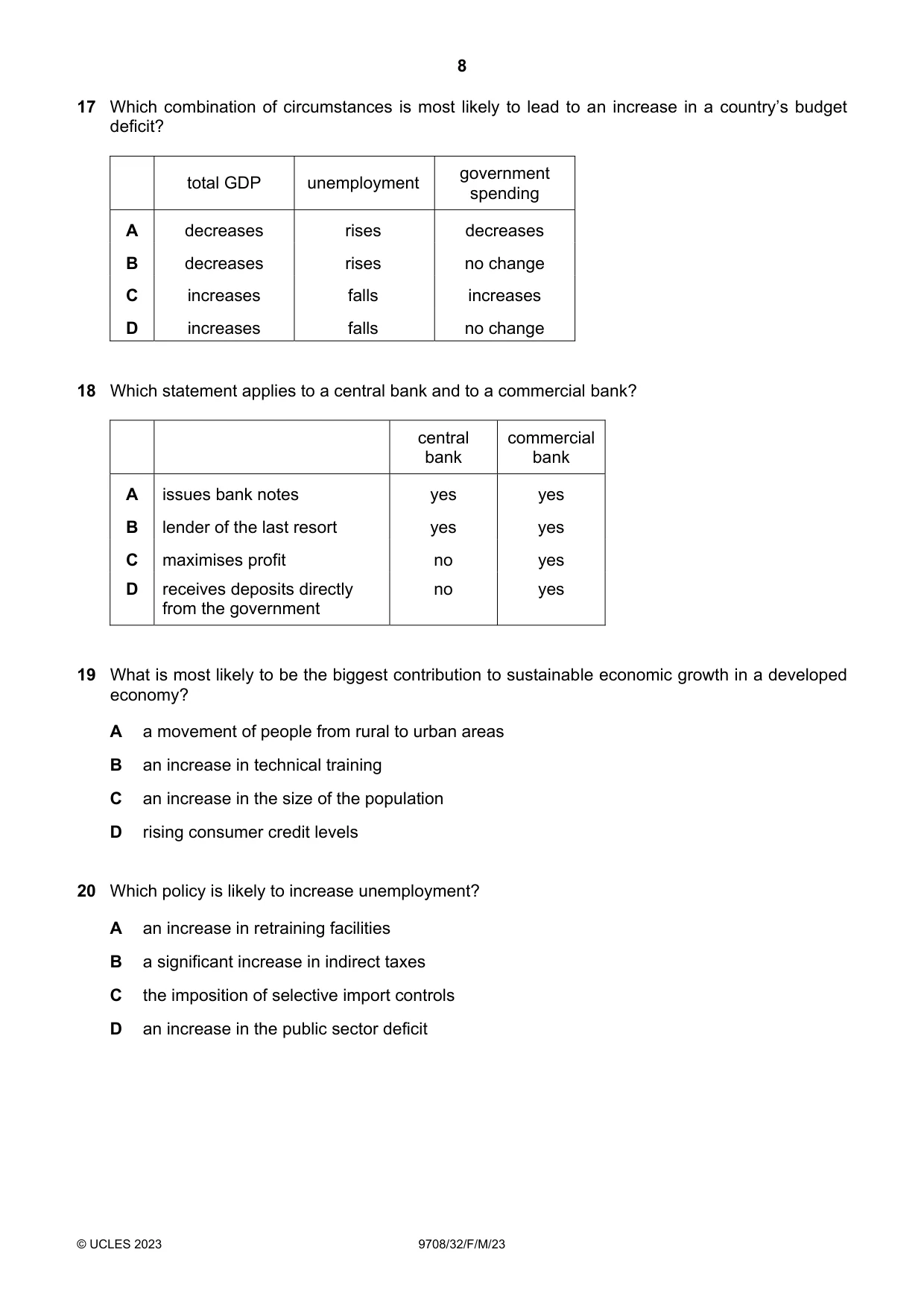
17 Which combination of circumstances is most likely to lead to an increase in a country’s budget deficit? government total GDP unemployment spending A decreases rises decreases B decreases rises no change C increases falls increases D increases falls no change
Mark scheme: B
Q18 · Which statement applies to a central bank and to a commercial bank?
18 Which statement applies to a central bank and to a commercial bank? central commercial bank bank A issues bank notes yes yes B lender of the last resort yes yes C maximises profit no yes D receives deposits directly no yes from the government
Mark scheme: C
Q19 · What is most likely to be the biggest contribution to sustainable economic growth in a…
19 What is most likely to be the biggest contribution to sustainable economic growth in a developed economy? A a movement of people from rural to urban areas B an increase in technical training C an increase in the size of the population D rising consumer credit levels
Mark scheme: B
Q20 · Which policy is likely to increase unemployment?
20 Which policy is likely to increase unemployment? A an increase in retraining facilities B a significant increase in indirect taxes C the imposition of selective import controls D an increase in the public sector deficit
Mark scheme: B
Q21 · What does the accelerator principle state?
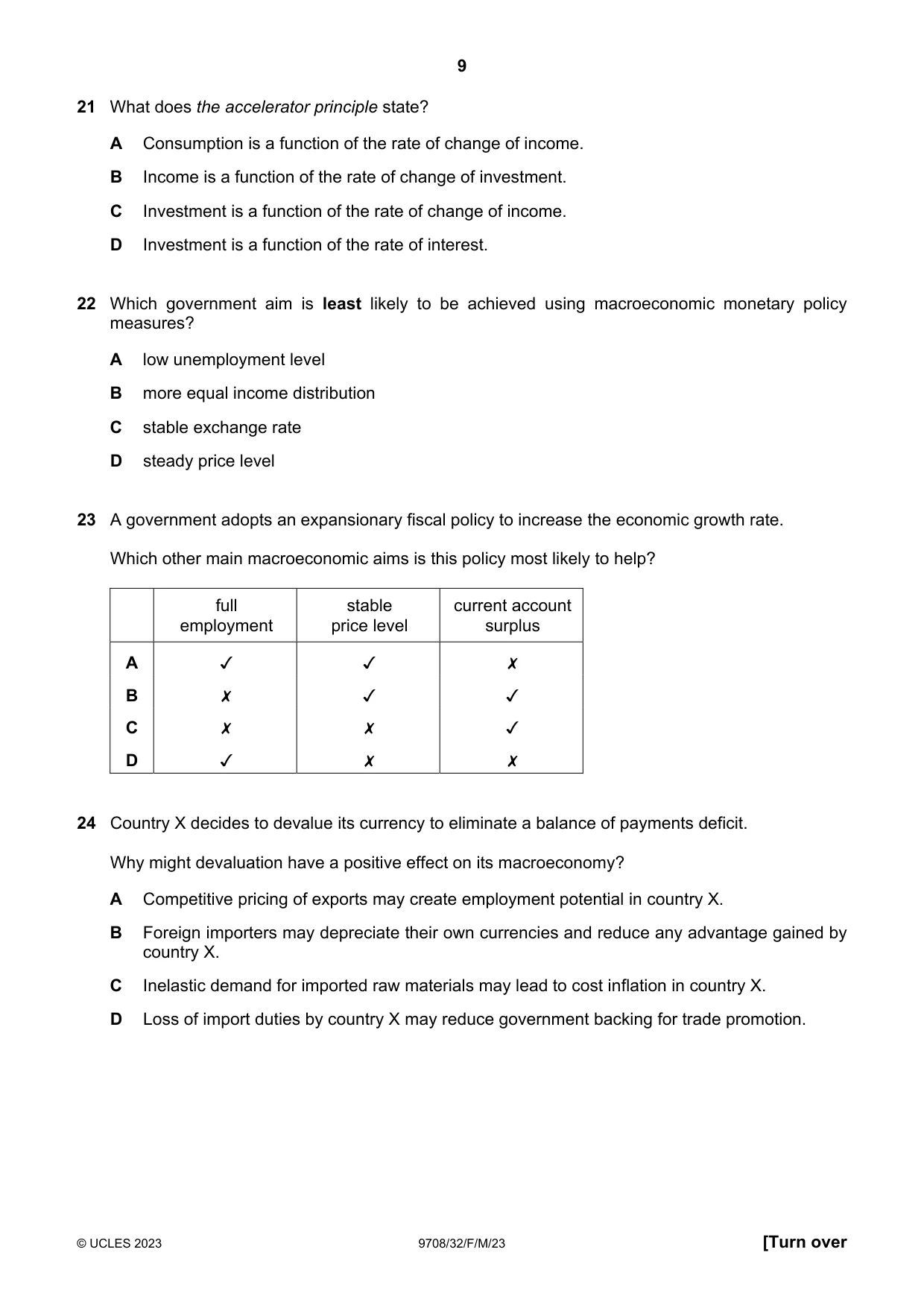
21 What does the accelerator principle state? A Consumption is a function of the rate of change of income. B Income is a function of the rate of change of investment. C Investment is a function of the rate of change of income. D Investment is a function of the rate of interest.
Mark scheme: C
Q22 · Which government aim is least likely to be achieved using macroeconomic monetary policy…
22 Which government aim is least likely to be achieved using macroeconomic monetary policy measures? A low unemployment level B more equal income distribution C stable exchange rate D steady price level
Mark scheme: B
More questions on Effectiveness of policy options to meet all macroeconomic objectives
Q23 · A government adopts an expansionary fiscal policy to increase the economic growth rate
23 A government adopts an expansionary fiscal policy to increase the economic growth rate. Which other main macroeconomic aims is this policy most likely to help? full stable current account employment price level surplus 0 OD > \ -« x «x KM «x \OK
Mark scheme: D
More questions on Links between macroeconomic problems and their interrelatedness
Q24 · Country X decides to devalue its currency to eliminate a balance of payments deficit
24 Country X decides to devalue its currency to eliminate a balance of payments deficit. Why might devaluation have a positive effect on its macroeconomy? A Competitive pricing of exports may create employment potential in country X. B Foreign importers may depreciate their own currencies and reduce any advantage gained by country X. C Inelastic demand for imported raw materials may lead to cost inflation in country X. D Loss of import duties by country X may reduce government backing for trade promotion.
Mark scheme: A
More questions on Policies to correct disequilibrium in the balance of payments
Q25 · Which cause of economic growth would involve the least cost for present and future…
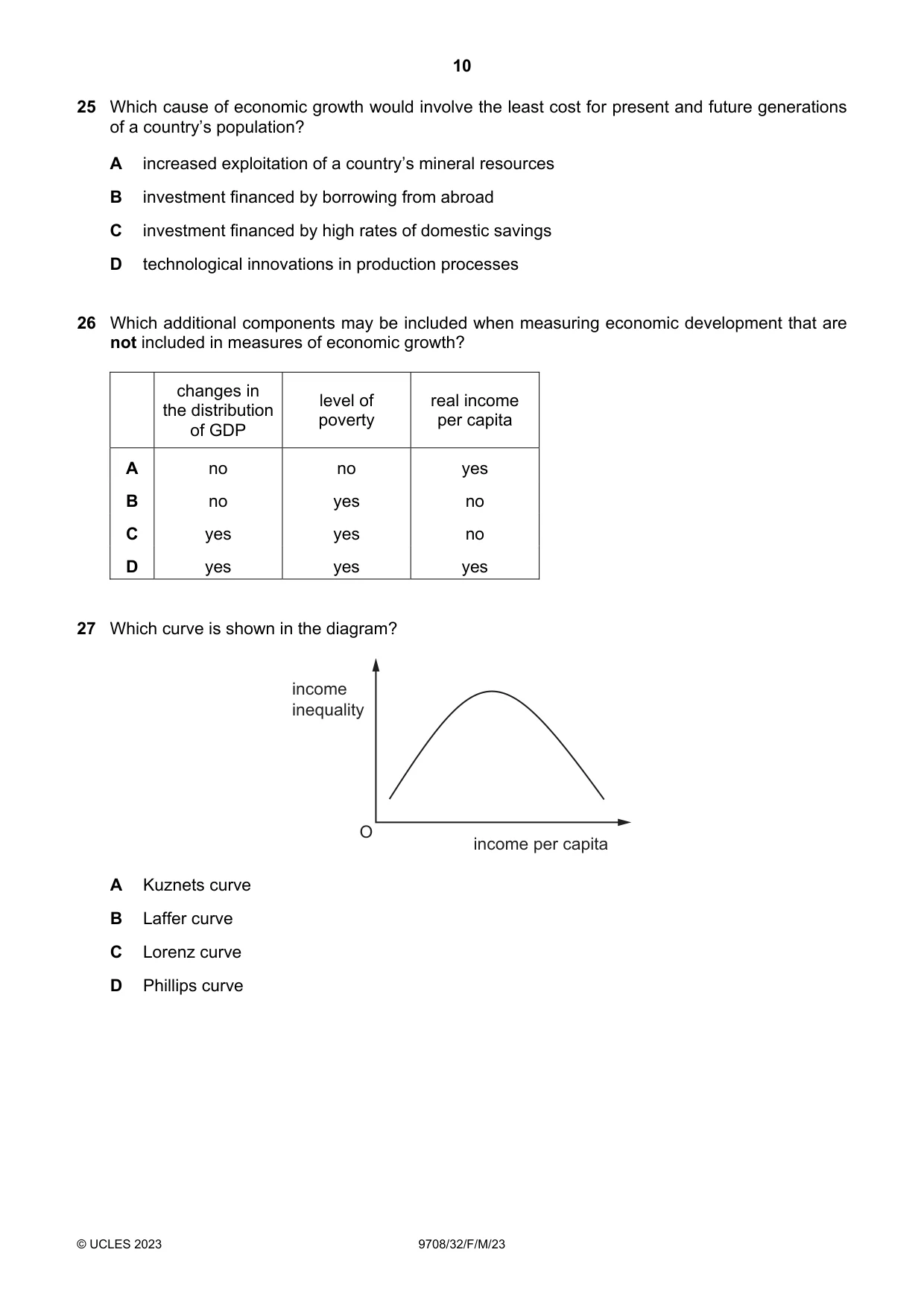
25 Which cause of economic growth would involve the least cost for present and future generations of a country’s population? A increased exploitation of a country’s mineral resources B investment financed by borrowing from abroad C investment financed by high rates of domestic savings D technological innovations in production processes
Mark scheme: D
Q26 · Which additional components may be included when measuring economic development that are…
26 Which additional components may be included when measuring economic development that are not included in measures of economic growth? changes in level of real income the distribution poverty per capita of GDP A no no yes B no yes no C yes yes no D yes yes yes
Mark scheme: C
Q27 · Which curve is shown in the diagram?
27 Which curve is shown in the diagram? income inequality O income per capita A Kuznets curve B Laffer curve C Lorenz curve D Phillips curve
Mark scheme: A
More questions on Characteristics of countries at different levels of development
Q28 · Which indicator is least likely to be used when measuring the comparative economic…
28 Which indicator is least likely to be used when measuring the comparative economic development of an economy? A mean years of schooling B average life expectancy at birth C level of real GNP per head D size of population
Mark scheme: D
More questions on Characteristics of countries at different levels of development
Q29 · What is an example of an expenditure-switching policy?
29 What is an example of an expenditure-switching policy? A an increase in income tax rates B an increase in interest rates C an increase in tariff rates D an increase in the supply of money
Mark scheme: C
More questions on Policies to correct disequilibrium in the balance of payments
Q30 · Labour from low-income countries often migrates to high-income countries and finds jobs
30 Labour from low-income countries often migrates to high-income countries and finds jobs. How would such a movement of labour be likely to affect the economic growth and the pressure on wage rises in the high-income country? pressure on economic growth wage rises A decrease decrease B decrease increase C increase decrease D increase increase
Mark scheme: C
More questions on Relationship between countries at different levels of development
What was in this paper
The subtopics covered by these 30 questions, and how many questions each got. Open one in a new tab to see every Cambridge question on it.
3Characteristics of countries at different levels of development2Differing objectives and policies of firms2Economic development2Efficiency and market failure2Equity and redistribution of income and wealth2Fiscal policy2Policies to correct disequilibrium in the balance of payments2Private costs and benefits, externalities and social costs and benefits2Utility2Different market structures1Economic growth and sustainability1Effectiveness of policy options to meet all macroeconomic objectives1Government policies to achieve efficient resource allocation and correct market failure1Indifference curves and budget lines1Links between macroeconomic problems and their interrelatedness1Money and banking1Relationship between countries at different levels of development1The circular flow of income1What you needed in this session
Cambridge’s own grade thresholds for 2023 Feb/March, Paper 3 · Variant 2. A higher threshold means an easier paper — the bar moves with how the cohort did.