Questions as text
Q1 · Which characteristic of money is essential, if it is to be used as a medium of exchange? 9708/11 Oct/Nov 2006
4 Which characteristic of money is essential, if it is to be used as a medium of exchange? A It must be durable. B It must be legal tender. C It must be limited in supply. D It must have intrinsic value.
1 marks
Answer: C
This question in 9708/11 Oct/Nov 2006
Q2 · What is not an essential characteristic of money? 9708/11 May/June 2008
4 What is not an essential characteristic of money? A It must have intrinsic value. B It must be generally acceptable as a means of settling debts. C It must serve as a unit of account. D It must be limited in supply.
1 marks
Answer: A
This question in 9708/11 May/June 2008
Q3 · In 2001, the Argentinian economy was in serious economic difficulties 9708/11 May/June 2009
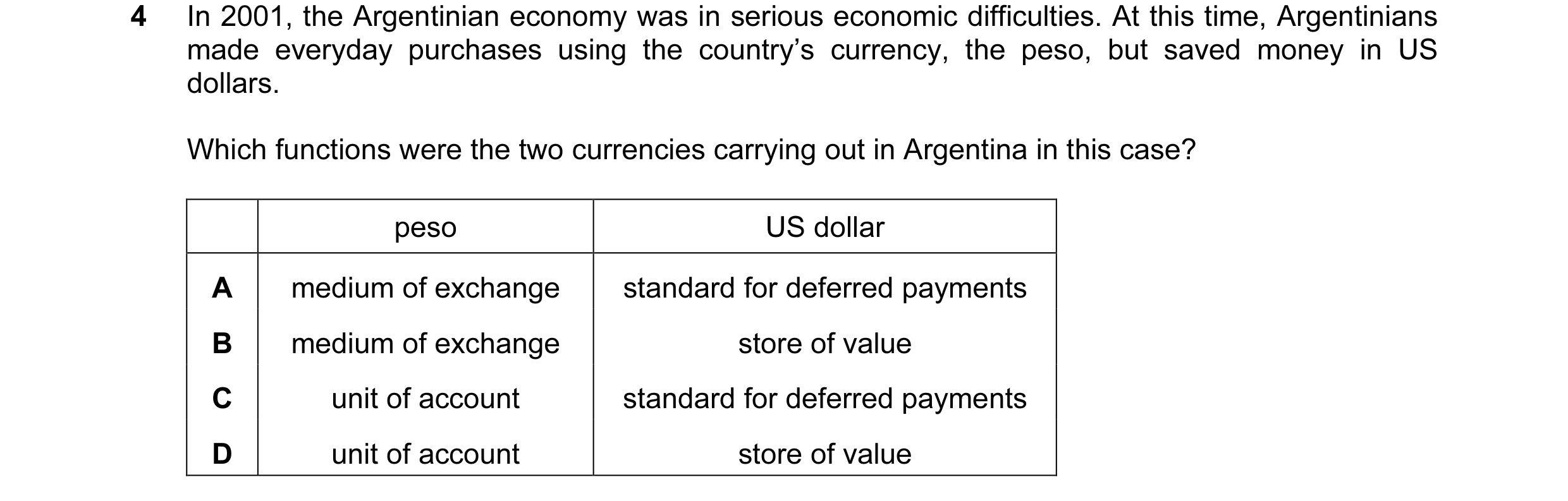
4 In 2001, the Argentinian economy was in serious economic difficulties. At this time, Argentinians made everyday purchases using the country’s currency, the peso, but saved money in US dollars. Which functions were the two currencies carrying out in Argentina in this case? peso US dollar A medium of exchange standard for deferred payments B medium of exchange store of value C unit of account standard for deferred payments D unit of account store of value
1 marks
Answer: B
This question in 9708/11 May/June 2009
Q4 · Which statement about inflation is correct? 9708/13 May/June 2010
23 Which statement about inflation is correct? A Cost-push inflation is likely to occur when the government increases its expenditure. B Demand-pull inflation is likely to occur when the country’s exchange rate appreciates. C The Quantity Theory of Money predicts that changes in money supply can cause inflation. D When inflation is unanticipated real values remain unchanged.
1 marks
Answer: C
This question in 9708/13 May/June 2010
Q5 · What is a correct statement about money? 9708/11 Oct/Nov 2010
4 What is a correct statement about money? A Its functions mean the characteristics that it possesses. B Its liquidity means its use as legal tender. C Its supply means the total value of banknotes in circulation. D Its value means its purchasing power.
1 marks
Answer: D
This question in 9708/11 Oct/Nov 2010
Q6 · What is a correct statement about money? 9708/12 Oct/Nov 2010
4 What is a correct statement about money? A Its functions mean the characteristics that it possesses. B Its liquidity means its use as legal tender. C Its supply means the total value of banknotes in circulation. D Its value means its purchasing power.
1 marks
Answer: D
This question in 9708/12 Oct/Nov 2010
Q7 · What is a correct statement about money? 9708/13 Oct/Nov 2010
3 What is a correct statement about money? A Its functions mean the characteristics that it possesses. B Its liquidity means its use as legal tender. C Its supply means the total value of banknotes in circulation. D Its value means its purchasing power.
1 marks
Answer: D
This question in 9708/13 Oct/Nov 2010
Q8 · What might cause a country’s currency notes to cease to act as money? 9708/12 Oct/Nov 2012
4 What might cause a country’s currency notes to cease to act as money? A the notes are issued in smaller denominations B the notes become harder to counterfeit C the notes become more long lasting D the notes become unlimited in supply
1 marks
Answer: D
This question in 9708/12 Oct/Nov 2012
Q9 · A person who has bought a DVD player using a credit card does not have to settle the… 9708/13 Oct/Nov 2012
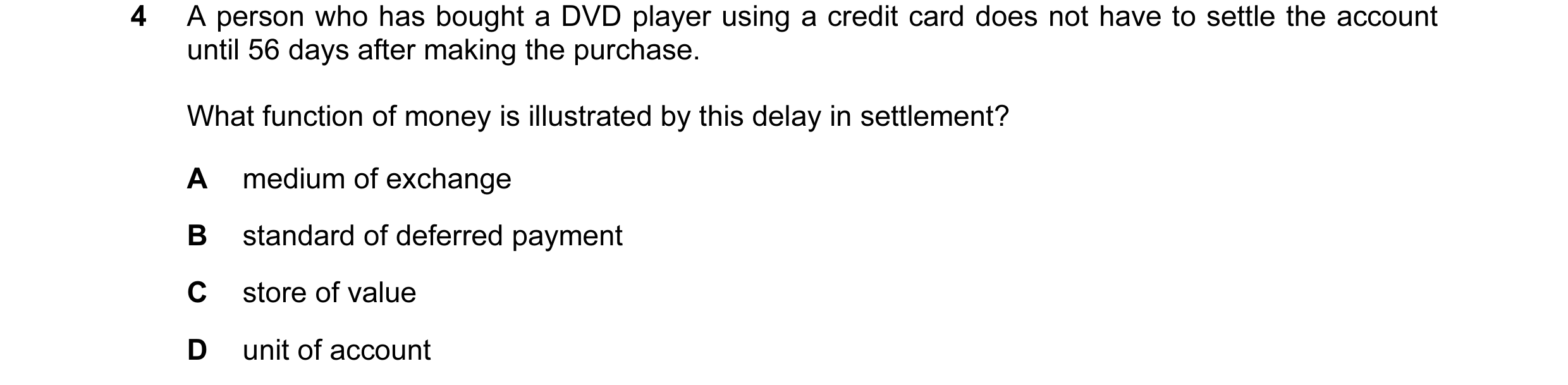
4 A person who has bought a DVD player using a credit card does not have to settle the account until 56 days after making the purchase. What function of money is illustrated by this delay in settlement? A medium of exchange B standard of deferred payment C store of value D unit of account
1 marks
Answer: B
This question in 9708/13 Oct/Nov 2012
Q10 · After hyperinflation, the Zimbabwe dollar was no longer used and instead the country used… 9708/11 May/June 2013
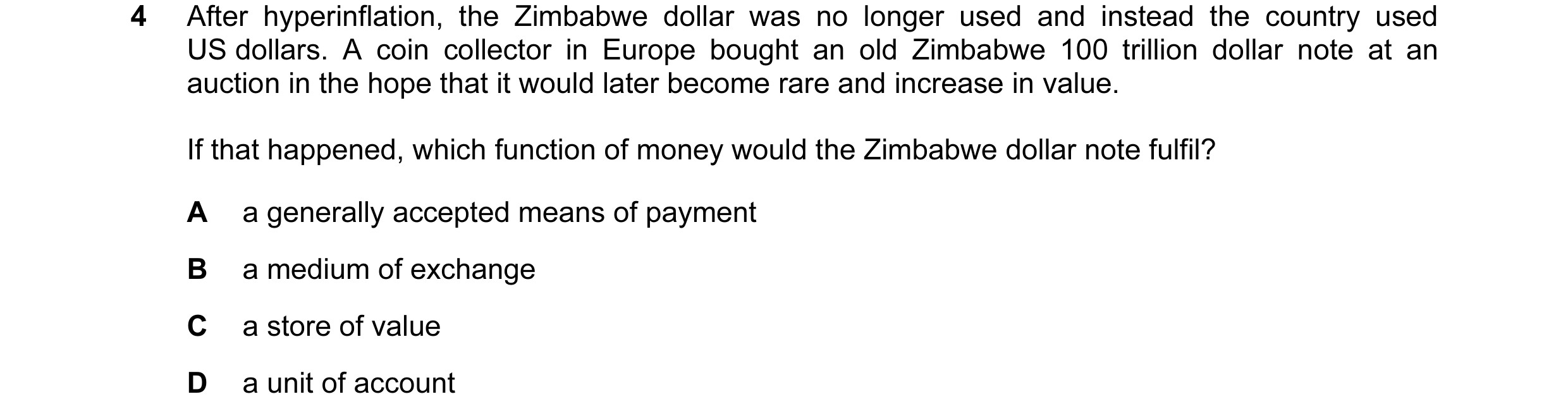
4 After hyperinflation, the Zimbabwe dollar was no longer used and instead the country used US dollars. A coin collector in Europe bought an old Zimbabwe 100 trillion dollar note at an auction in the hope that it would later become rare and increase in value. If that happened, which function of money would the Zimbabwe dollar note fulfil? A a generally accepted means of payment B a medium of exchange C a store of value D a unit of account
1 marks
Answer: C
This question in 9708/11 May/June 2013
Q11 · The table identifies the functions of money and the principal benefit that each function… 9708/13 May/June 2013
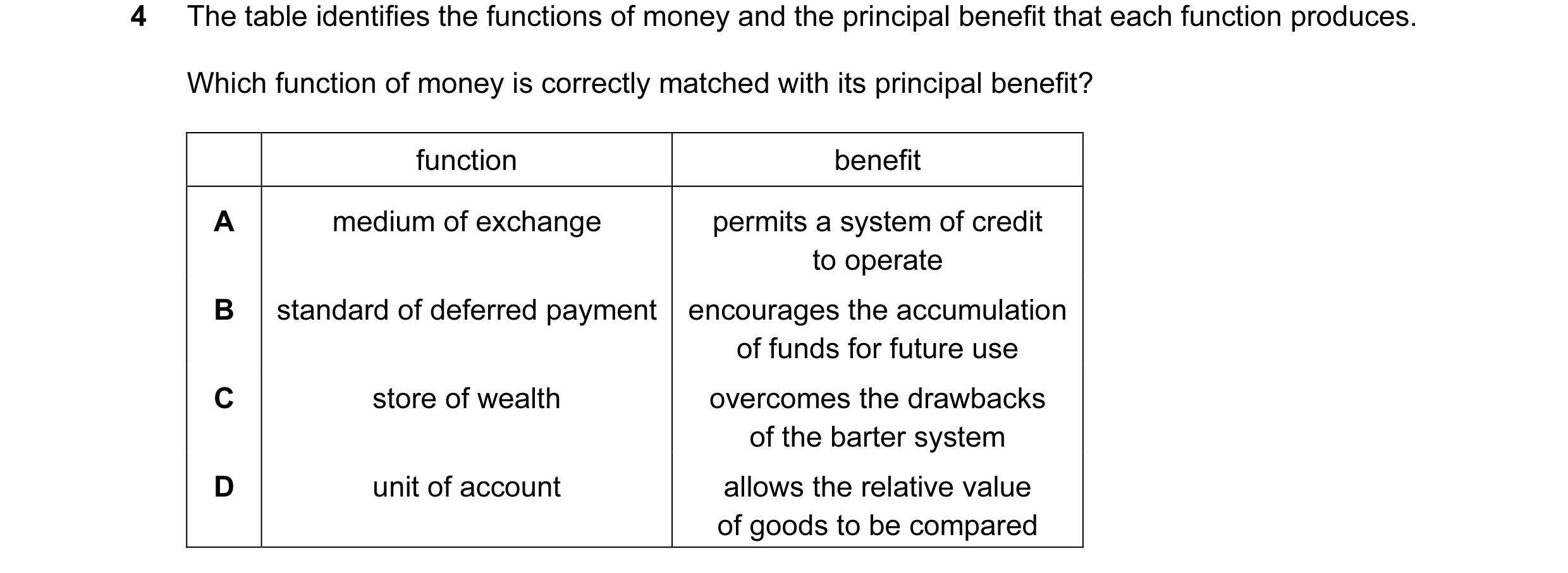
4 The table identifies the functions of money and the principal benefit that each function produces. Which function of money is correctly matched with its principal benefit? function benefit A medium of exchange permits a system of credit to operate B standard of deferred payment encourages the accumulation of funds for future use C store of wealth overcomes the drawbacks of the barter system D unit of account allows the relative value of goods to be compared
1 marks
Answer: D
This question in 9708/13 May/June 2013
Q12 · A website compares the prices of groceries 9708/11 Oct/Nov 2013
4 A website compares the prices of groceries. Which function of money is illustrated by this? A medium of exchange B standard of deferred payment C store of value D unit of account
1 marks
Answer: D
This question in 9708/11 Oct/Nov 2013
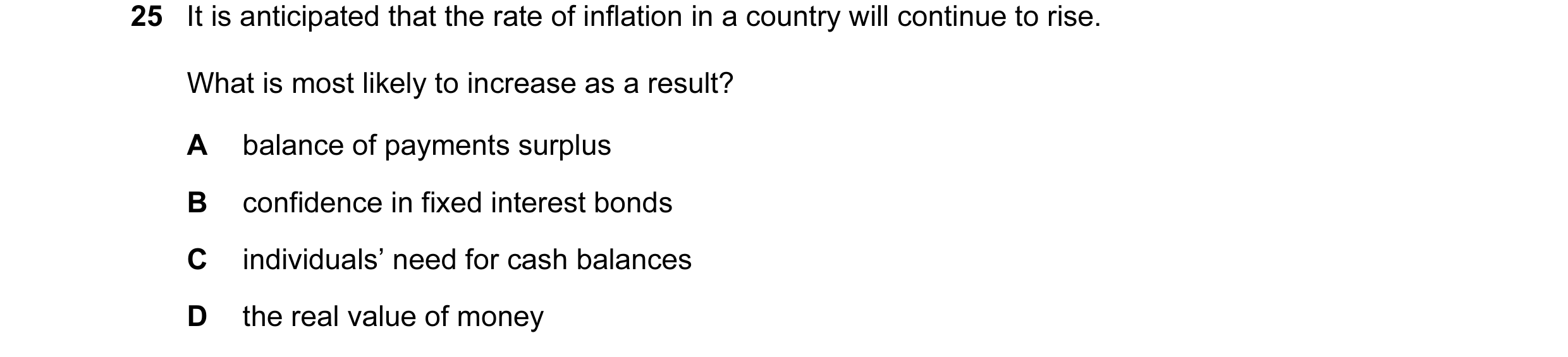
Q13 · It is anticipated that the rate of inflation in a country will continue to rise 9708/11 Oct/Nov 2013
25 It is anticipated that the rate of inflation in a country will continue to rise. What is most likely to increase as a result? A balance of payments surplus B confidence in fixed interest bonds C individuals’ need for cash balances D the real value of money
1 marks
Answer: C
This question in 9708/11 Oct/Nov 2013
Q14 · What advantage do banknotes (paper money) have over coins (metallic money)? 9708/12 Oct/Nov 2013
4 What advantage do banknotes (paper money) have over coins (metallic money)? A They are cheaper to produce. B They are more useful for low value transactions. C They are the only form of legal tender. D They have greater intrinsic value.
1 marks
Answer: A
This question in 9708/12 Oct/Nov 2013
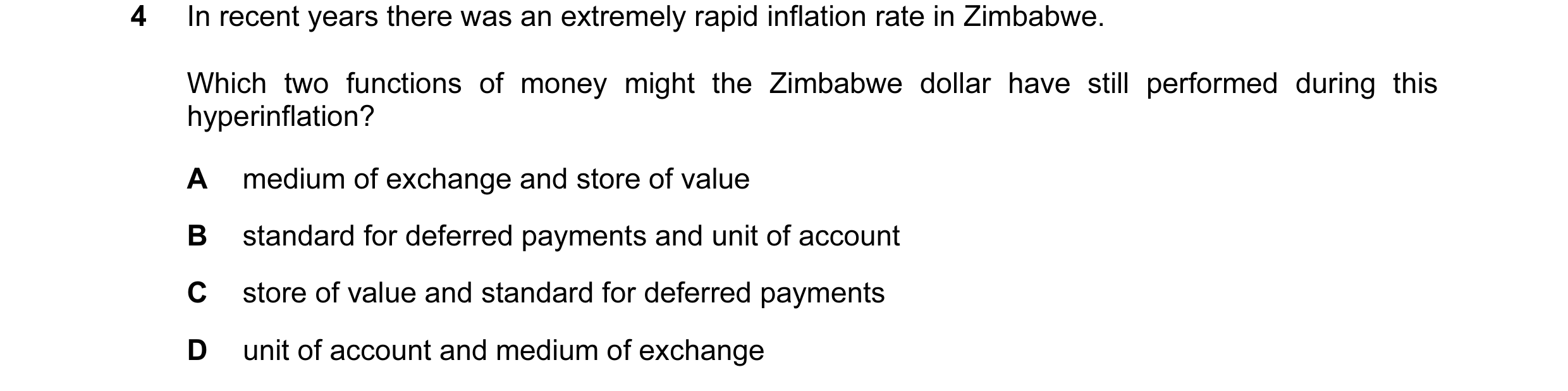
Q15 · In recent years there was an extremely rapid inflation rate in Zimbabwe 9708/13 Oct/Nov 2013
4 In recent years there was an extremely rapid inflation rate in Zimbabwe. Which two functions of money might the Zimbabwe dollar have still performed during this hyperinflation? A medium of exchange and store of value B standard for deferred payments and unit of account C store of value and standard for deferred payments D unit of account and medium of exchange
1 marks
Answer: D
This question in 9708/13 Oct/Nov 2013
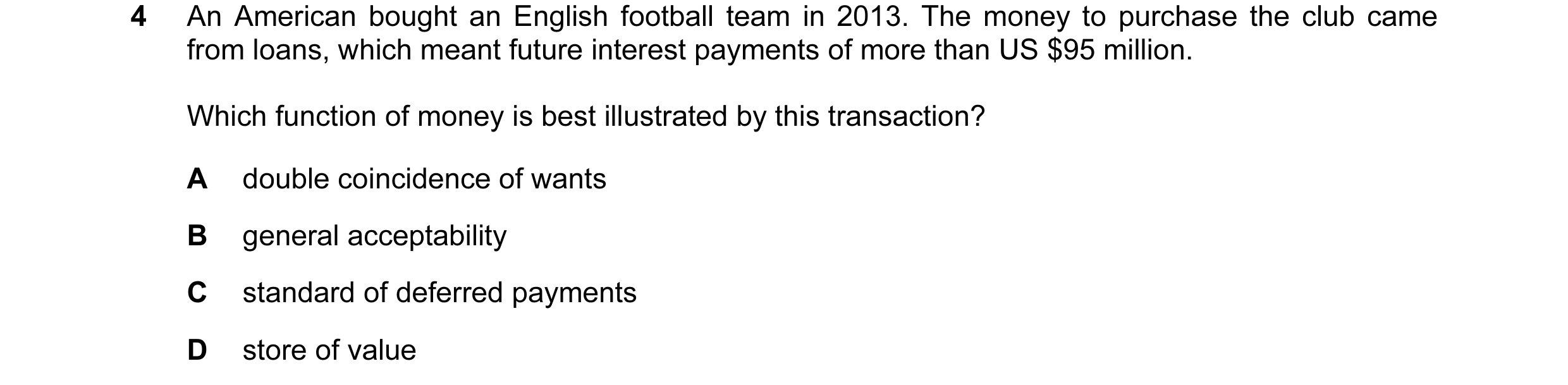
Q16 · An American bought an English football team in 2013 9708/11 May/June 2014
4 An American bought an English football team in 2013. The money to purchase the club came from loans, which meant future interest payments of more than US $95 million. Which function of money is best illustrated by this transaction? A double coincidence of wants B general acceptability C standard of deferred payments D store of value
1 marks
Answer: C
This question in 9708/11 May/June 2014
Q17 · In what circumstances will money lose its value? 9708/11 May/June 2014
26 In what circumstances will money lose its value? A The economy experiences a period of deflation. B The general level of prices is falling. C The growth of money supply falls below the growth of output. D The rate of inflation is positive.
1 marks
Answer: D
This question in 9708/11 May/June 2014
Q18 · Which statement about inflation is correct? 9708/13 Oct/Nov 2014
25 Which statement about inflation is correct? A Cost-push inflation is likely to occur when the government increases its expenditure. B Demand-pull inflation is likely to occur when the country’s exchange rate appreciates. C The Quantity Theory of Money predicts that changes in money supply can cause inflation. D When inflation is unanticipated real values remain unchanged.
1 marks
Answer: C
This question in 9708/13 Oct/Nov 2014
Q19 · Which characteristic of money is most essential if it is to serve effectively as a store… 9708/11 May/June 2015
3 Which characteristic of money is most essential if it is to serve effectively as a store of value? A divisibility B liquidity C portability D scarcity
1 marks
Answer: D
This question in 9708/11 May/June 2015
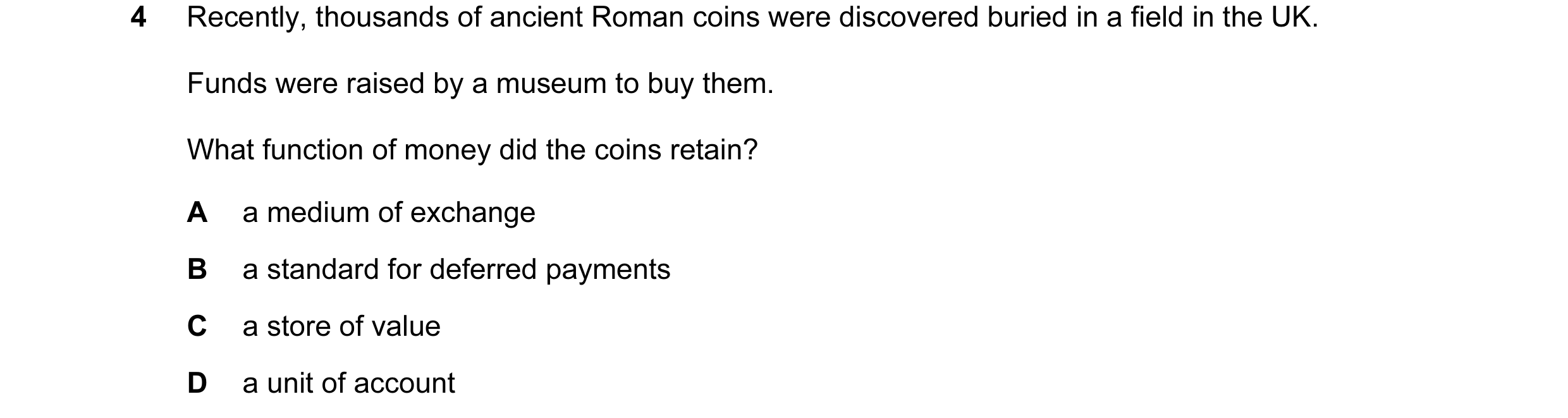
Q20 · Recently, thousands of ancient Roman coins were discovered buried in a field in the UK 9708/12 May/June 2016
4 Recently, thousands of ancient Roman coins were discovered buried in a field in the UK. Funds were raised by a museum to buy them. What function of money did the coins retain? A a medium of exchange B a standard for deferred payments C a store of value D a unit of account
1 marks
Answer: C
This question in 9708/12 May/June 2016
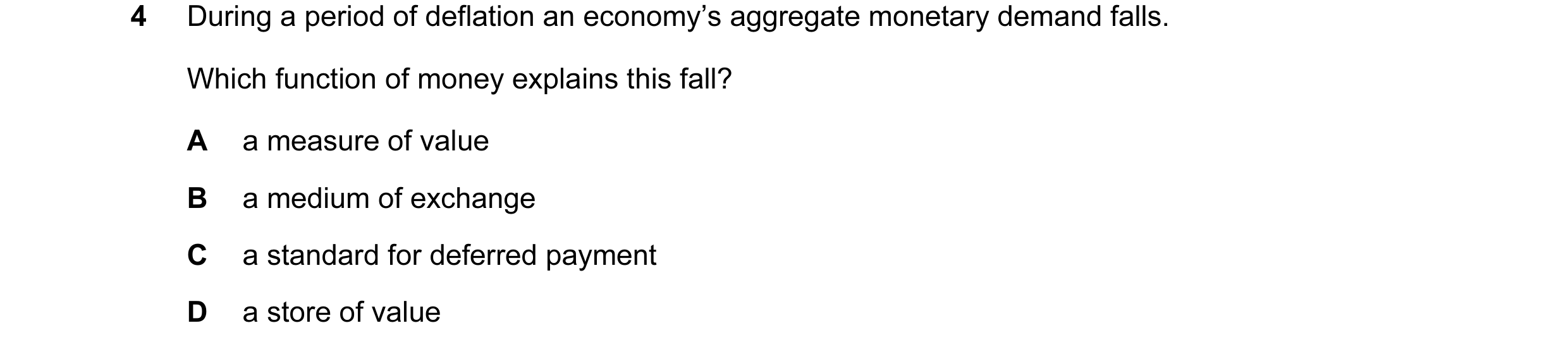
Q21 · During a period of deflation an economy’s aggregate monetary demand falls 9708/13 Oct/Nov 2016
4 During a period of deflation an economy’s aggregate monetary demand falls. Which function of money explains this fall? A a measure of value B a medium of exchange C a standard for deferred payment D a store of value
1 marks
Answer: D
This question in 9708/13 Oct/Nov 2016
Q22 · Four students are given the following list of assets 9708/12 May/June 2017
4 Four students are given the following list of assets. ● a three bedroom house ● banknotes and coins in a purse ● money in a bank savings account ● shares in a public limited company The students are asked to order the assets from the most liquid to the least liquid and the table shows their choices. Which student is correct? most liquid least liquid A notes and coins savings account shares house B notes and coins savings account house shares C notes and coins shares savings account house D savings account notes and coins shares house
1 marks
Answer: A
This question in 9708/12 May/June 2017
Q23 · What is most likely to severely affect the ability of money to act as a medium of… 9708/12 Oct/Nov 2017
4 What is most likely to severely affect the ability of money to act as a medium of exchange? A a devaluation of a country’s rate of exchange for foreign currency B an increase in the money supply C a very high rate of inflation D a very high rate of interest
1 marks
Answer: C
This question in 9708/12 Oct/Nov 2017
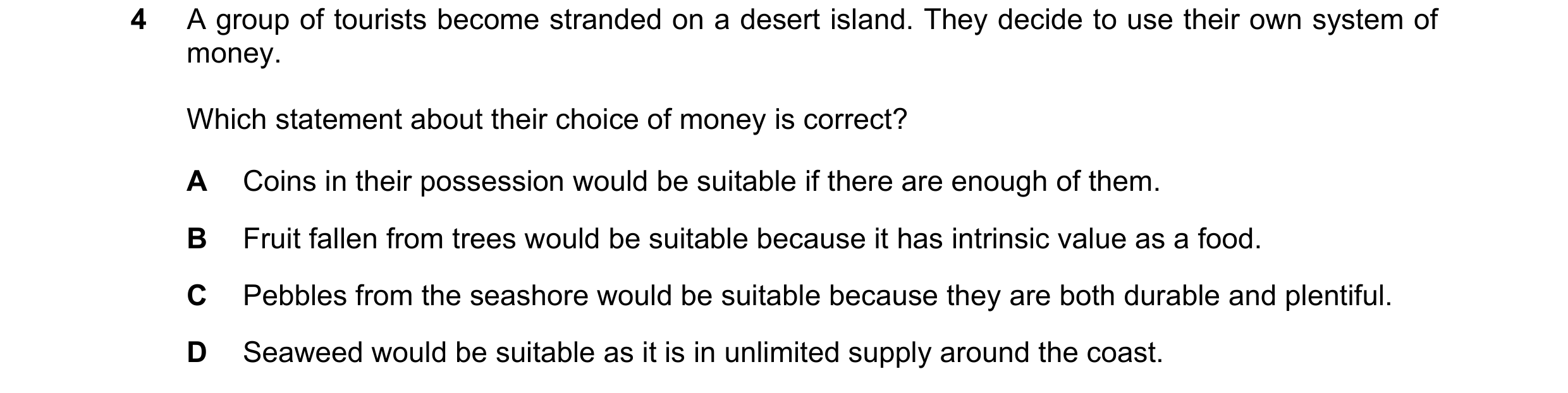
Q24 · A group of tourists become stranded on a desert island 9708/13 May/June 2018
4 A group of tourists become stranded on a desert island. They decide to use their own system of money. Which statement about their choice of money is correct? A Coins in their possession would be suitable if there are enough of them. B Fruit fallen from trees would be suitable because it has intrinsic value as a food. C Pebbles from the seashore would be suitable because they are both durable and plentiful. D Seaweed would be suitable as it is in unlimited supply around the coast.
1 marks
Answer: A
This question in 9708/13 May/June 2018
Q25 · John sells cakes for $10 9708/11 Oct/Nov 2018
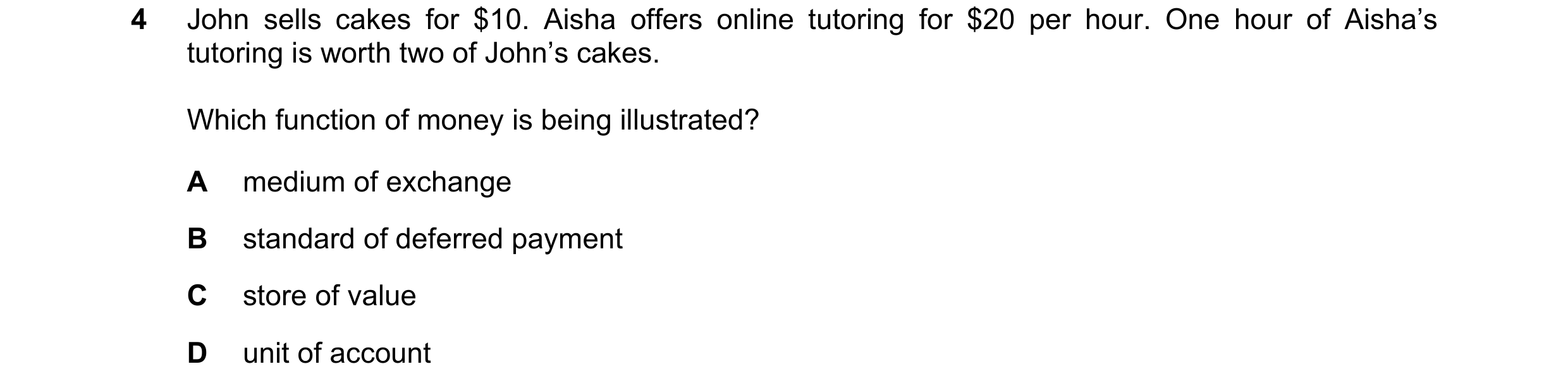
4 John sells cakes for $10. Aisha offers online tutoring for $20 per hour. One hour of Aisha’s tutoring is worth two of John’s cakes. Which function of money is being illustrated? A medium of exchange B standard of deferred payment C store of value D unit of account
1 marks
Answer: D
This question in 9708/11 Oct/Nov 2018
Q26 · What is likely to be the least effective store of value during a period of rapid… 9708/13 May/June 2019
26 What is likely to be the least effective store of value during a period of rapid inflation? A antique furniture B fixed interest government securities C houses D shares of industrial companies
1 marks
Answer: B
This question in 9708/13 May/June 2019
Q27 · In Zimbabwe there was hyperinflation 9708/11 Oct/Nov 2019
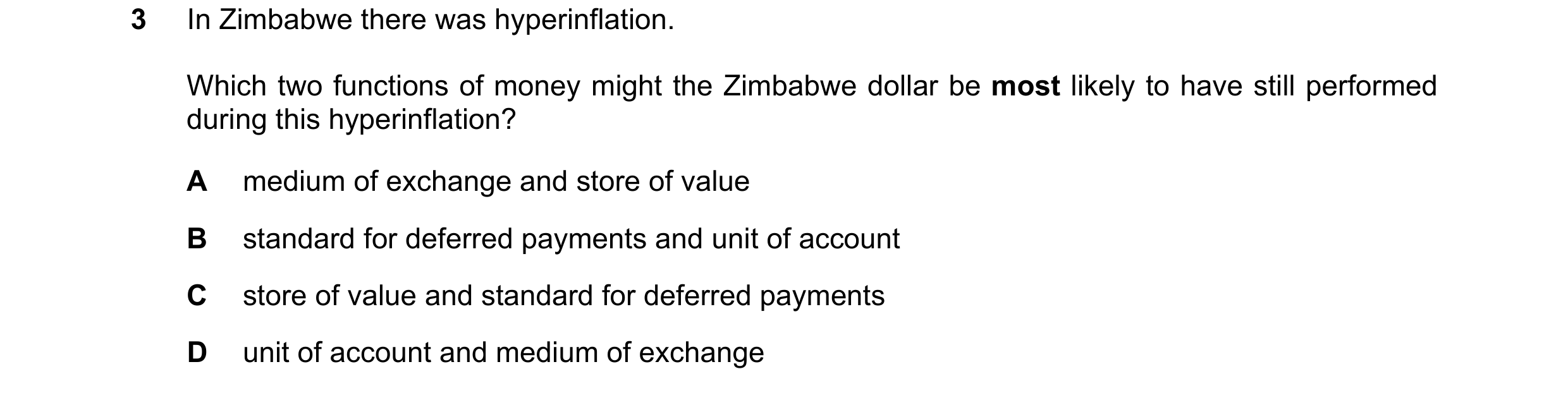
3 In Zimbabwe there was hyperinflation. Which two functions of money might the Zimbabwe dollar be most likely to have still performed during this hyperinflation? A medium of exchange and store of value B standard for deferred payments and unit of account C store of value and standard for deferred payments D unit of account and medium of exchange
1 marks
Answer: D
This question in 9708/11 Oct/Nov 2019
Q28 · What would not be considered a barter transaction? 9708/12 May/June 2020
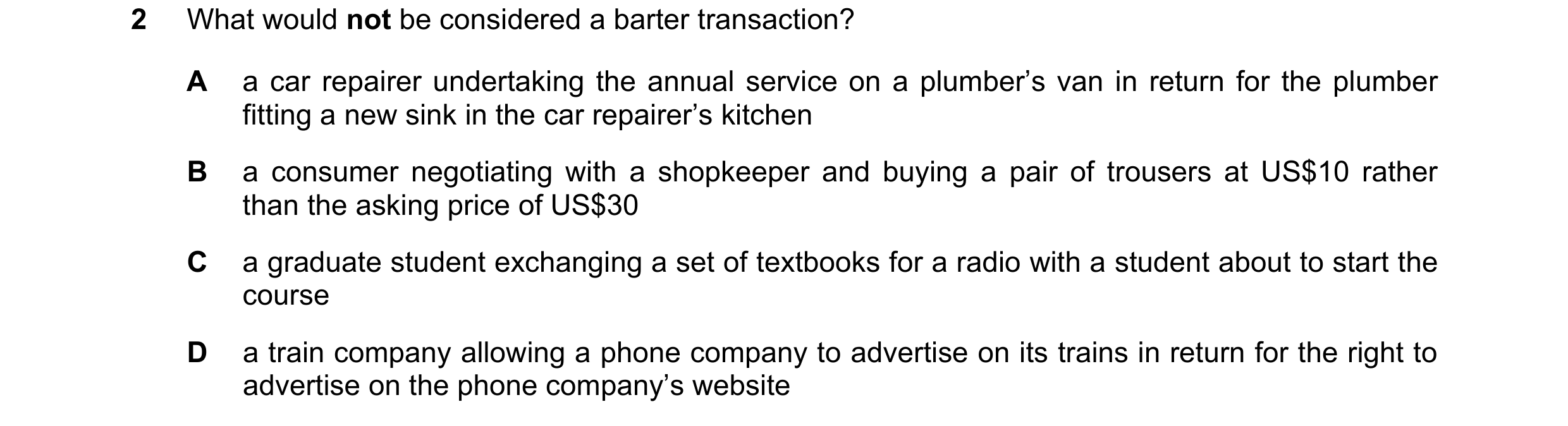
2 What would not be considered a barter transaction? A a car repairer undertaking the annual service on a plumber’s van in return for the plumber fitting a new sink in the car repairer’s kitchen B a consumer negotiating with a shopkeeper and buying a pair of trousers at US$10 rather than the asking price of US$30 C a graduate student exchanging a set of textbooks for a radio with a student about to start the course D a train company allowing a phone company to advertise on its trains in return for the right to advertise on the phone company’s website
1 marks
Answer: B
This question in 9708/12 May/June 2020
Q29 · Which characteristic of money is the most important if it is to function as a medium of… 9708/11 Oct/Nov 2020
3 Which characteristic of money is the most important if it is to function as a medium of exchange? A acceptable B divisible C durable D portable
1 marks
Answer: A
This question in 9708/11 Oct/Nov 2020
Q30 · What is a characteristic of money but not a function of money? 9708/12 Oct/Nov 2020
4 What is a characteristic of money but not a function of money? A medium of exchange B portability C standard of deferred payment D store of value
1 marks
Answer: B
This question in 9708/12 Oct/Nov 2020
Q31 · The British pound is the national currency of the UK 9708/13 May/June 2021
4 The British pound is the national currency of the UK. In Brixton in south London it is possible to get a distinctively marked currency called the Brixton pound from special cash machines. This can be spent with 150 local shopkeepers. Similar schemes are found in towns in the US, Italy and France. Should Brixton pounds be considered money? A no, because it is not possible to have two currencies in a country B no, because they are not generally acceptable outside of Brixton C yes, because some shopkeepers are willing to accept them D yes, because they fulfil all the functions of money
1 marks
Answer: D
This question in 9708/13 May/June 2021
Q32 · What is a function of money? 9708/12 Oct/Nov 2021
2 What is a function of money? A divisibility B durability C portability D medium of exchange
1 marks
Answer: D
This question in 9708/12 Oct/Nov 2021
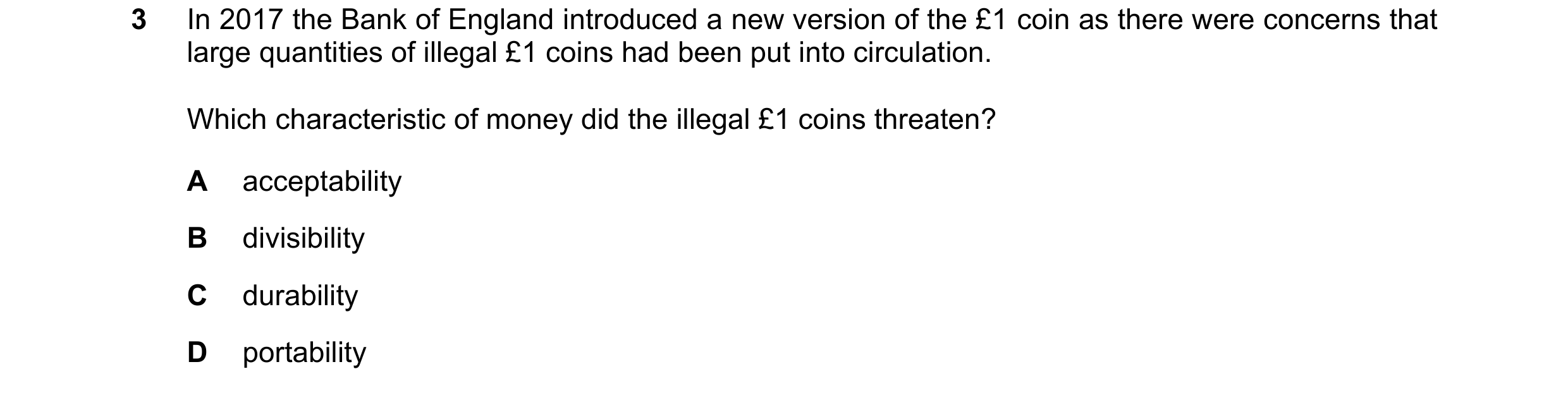
Q33 · In 2017 the Bank of England introduced a new version of the £1 coin as there were… 9708/13 Oct/Nov 2021
3 In 2017 the Bank of England introduced a new version of the £1 coin as there were concerns that large quantities of illegal £1 coins had been put into circulation. Which characteristic of money did the illegal £1 coins threaten? A acceptability B divisibility C durability D portability
1 marks
Answer: A
This question in 9708/13 Oct/Nov 2021
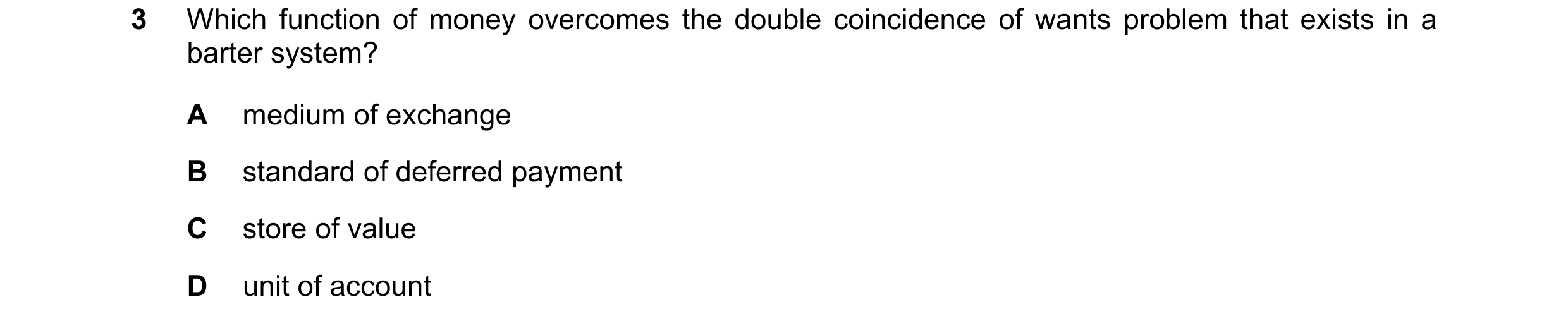
Q34 · Which function of money overcomes the double coincidence of wants problem that exists in… 9708/12 Feb/March 2022
3 Which function of money overcomes the double coincidence of wants problem that exists in a barter system? A medium of exchange B standard of deferred payment C store of value D unit of account
1 marks
Answer: A
This question in 9708/12 Feb/March 2022
Q35 · What is not a function of money? 9708/11 May/June 2022
4 What is not a function of money? A It is a medium of exchange. B It is a store of value. C It is a unit of account. D It is a measure of satisfaction.
1 marks
Answer: D
This question in 9708/11 May/June 2022
Q36 · Four students have to complete a table showing the functions of money 9708/12 May/June 2022
4 Four students have to complete a table showing the functions of money.
Which student is correct?
medium of store of unit of
exchange value account
v v v
0 0O WwW >
v v x
x v v
v x v
1 marks
Answer: A
This question in 9708/12 May/June 2022
Q37 · Which statement about money is correct? 9708/13 May/June 2022
1 Which statement about money is correct? A Deflation reduces the internal purchasing power of money. B Most financial assets are more liquid than physical assets. C When money acts as a medium of exchange, it requires a double coincidence of wants. D When money acts as a store of value, it must be unlimited in supply.
1 marks
Answer: B
This question in 9708/13 May/June 2022
Q38 · What would make online payment methods less acceptable as a medium of exchange? 9708/14 May/June 2022
3 What would make online payment methods less acceptable as a medium of exchange? A a fee charged for use of the online payment service B both high and low priced goods can be paid for using the online service C payments can be made at any time of day and night D the online payment service can be accessed through a smartphone
1 marks
Answer: A
This question in 9708/14 May/June 2022
Q39 · What is a function of money? 9708/12 Oct/Nov 2022
1 What is a function of money? A to act as a medium of exchange B to be divisible into small units C to enable bartering to take place D to maintain its value when inflation is high
1 marks
Answer: A
This question in 9708/12 Oct/Nov 2022




 1 / 8
1 / 8

 2 / 8
2 / 8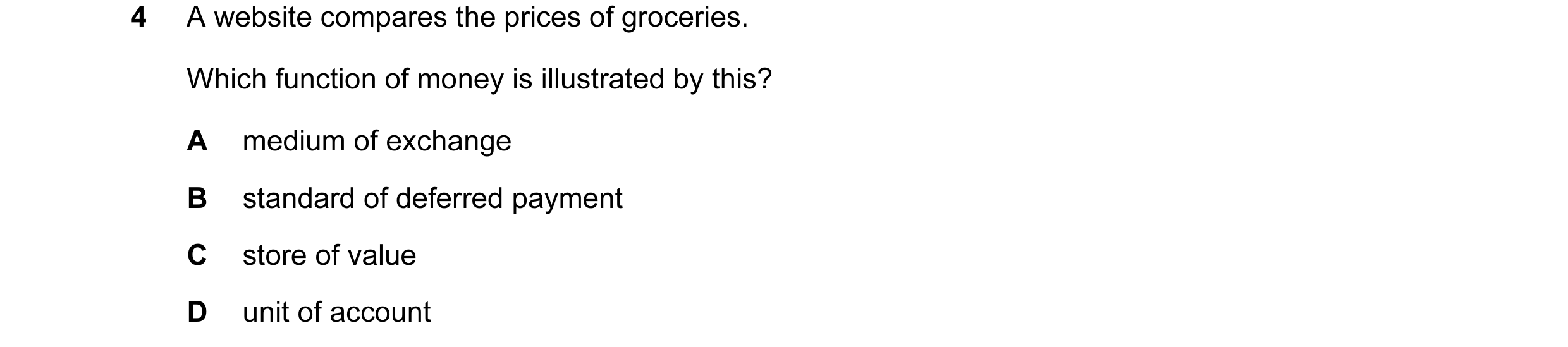

 3 / 8
3 / 8


 4 / 8
4 / 8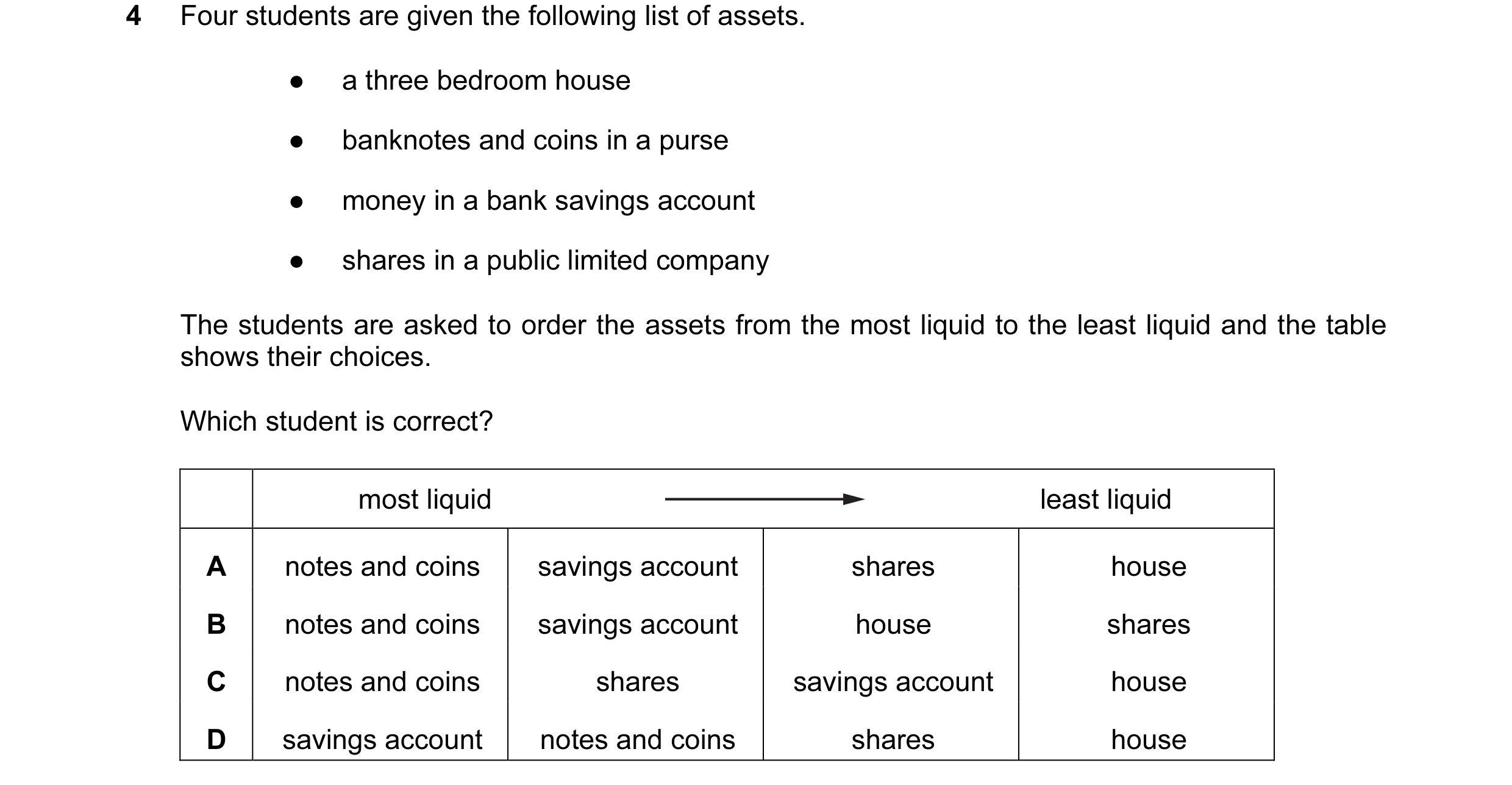

 5 / 8
5 / 8

 6 / 8
6 / 8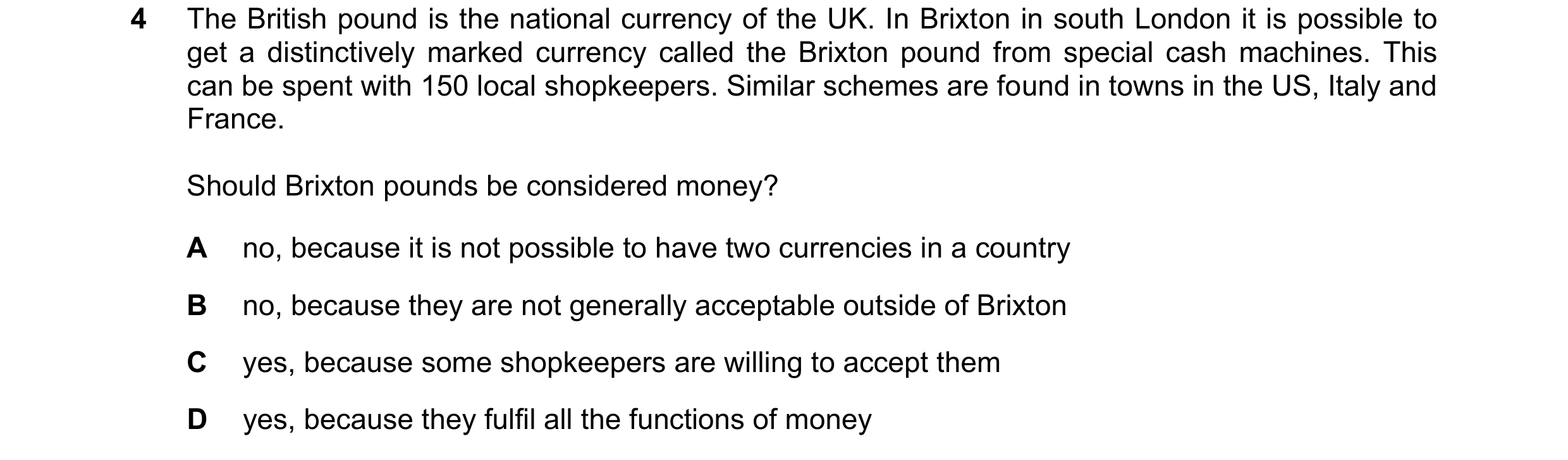

 7 / 8
7 / 8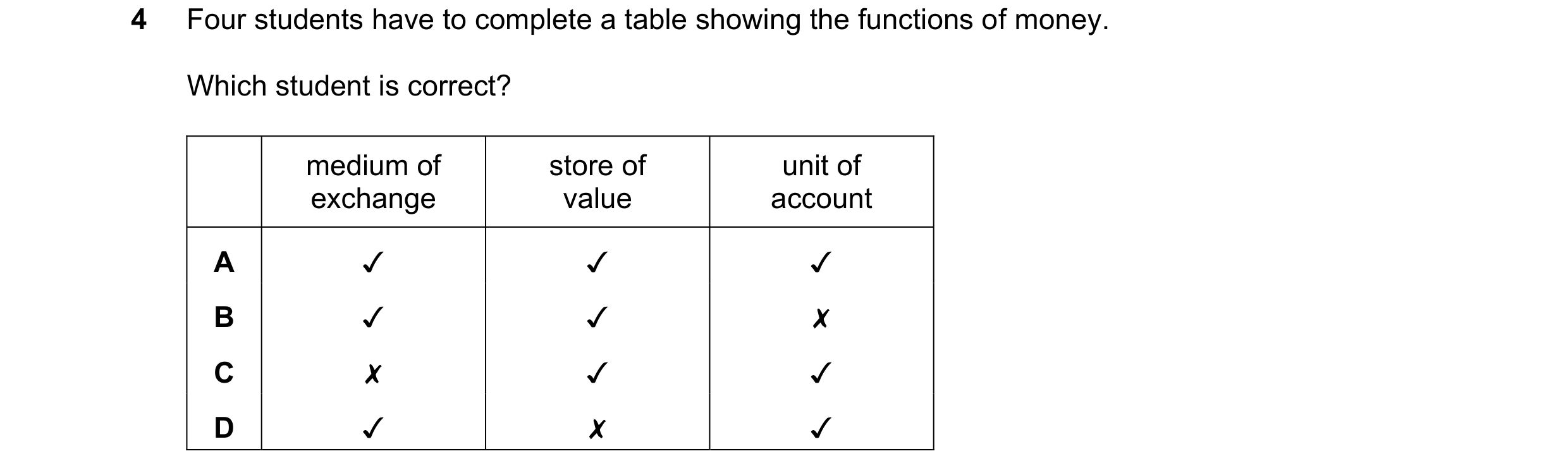


 8 / 8
8 / 8