Cambridge A Level Economics 9708 — 2021 Oct/Nov Paper 3 · Variant 2
9708/32/O/N/21 · 30 questions · 30 marks · ≈34 min
The question paper and its mark scheme, free to read here and free to download. This is Cambridge’s own paper, exactly as it was sat.
Question paper12 pages



Mark scheme3 pages
Answers below. Sit the paper first if you are practising.

Questions as text
Q1 · Which statement best defines productive efficiency?
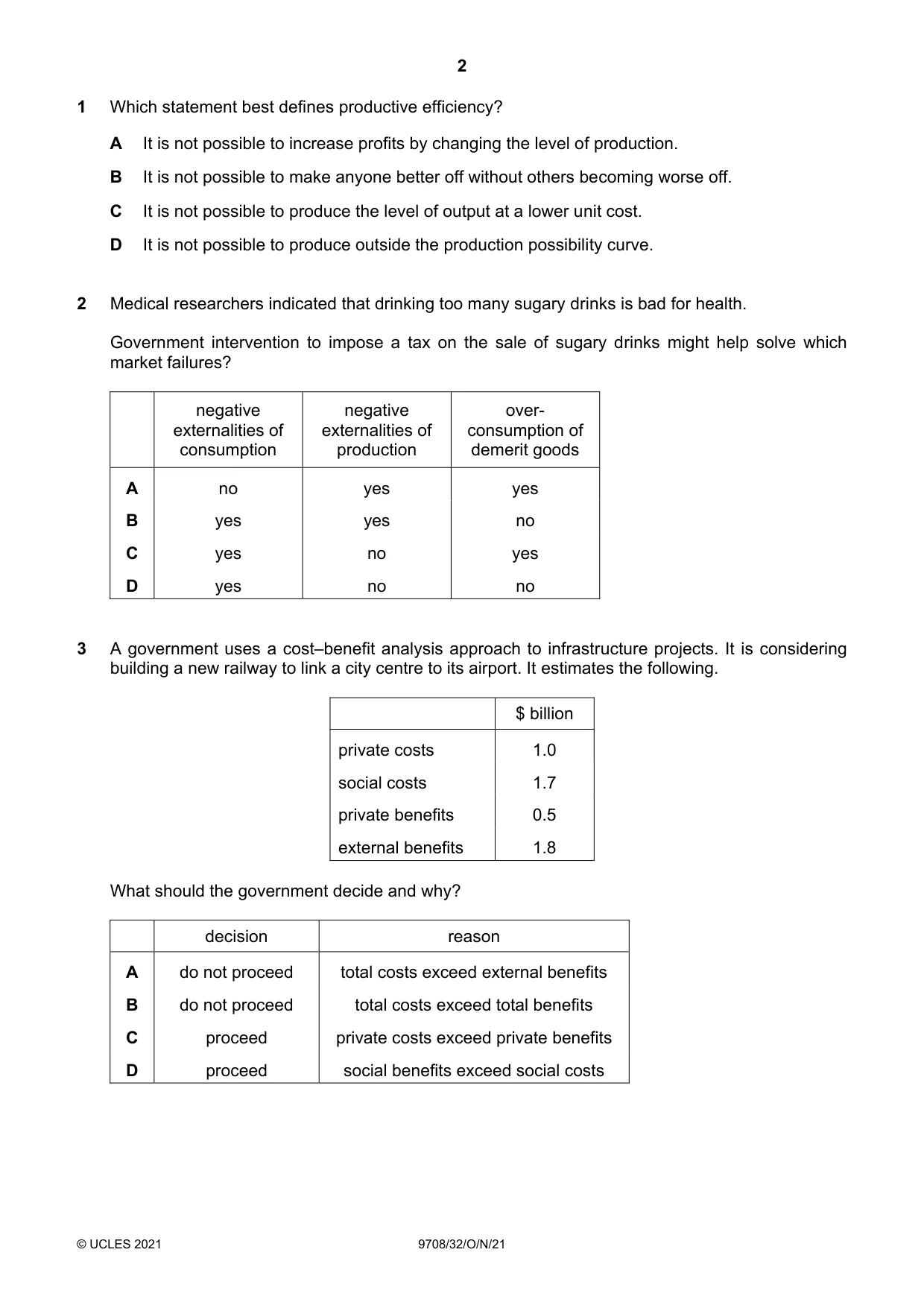
1 Which statement best defines productive efficiency? A It is not possible to increase profits by changing the level of production. B It is not possible to make anyone better off without others becoming worse off. C It is not possible to produce the level of output at a lower unit cost. D It is not possible to produce outside the production possibility curve.
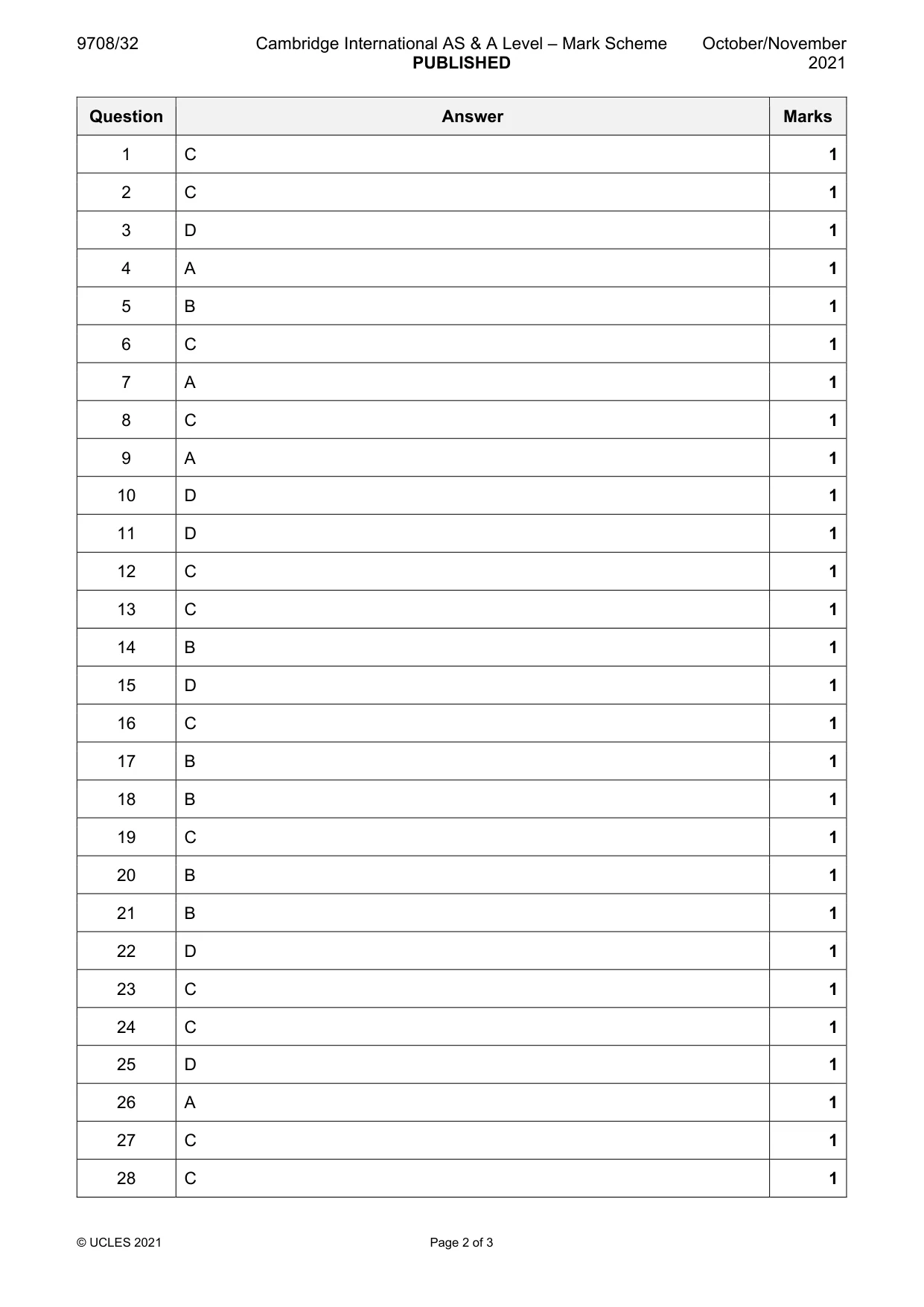
Mark scheme: C
Q2 · Medical researchers indicated that drinking too many sugary drinks is bad for health
2 Medical researchers indicated that drinking too many sugary drinks is bad for health. Government intervention to impose a tax on the sale of sugary drinks might help solve which market failures? negative negative over- externalities of externalities of consumption of consumption production demerit goods A no yes yes B yes yes no C yes no yes D yes no no
Mark scheme: C
More questions on Private costs and benefits, externalities and social costs and benefits
Q3 · A government uses a cost–benefit analysis approach to infrastructure projects
3 A government uses a cost–benefit analysis approach to infrastructure projects. It is considering building a new railway to link a city centre to its airport. It estimates the following. $ billion private costs 1.0 social costs 1.7 private benefits 0.5 external benefits 1.8 What should the government decide and why? decision reason A do not proceed total costs exceed external benefits B do not proceed total costs exceed total benefits C proceed private costs exceed private benefits D proceed social benefits exceed social costs
Mark scheme: D
More questions on Private costs and benefits, externalities and social costs and benefits
Q4 · A consumer currently consumes 10 units of good X and 10 units of good Y at point Z on an…
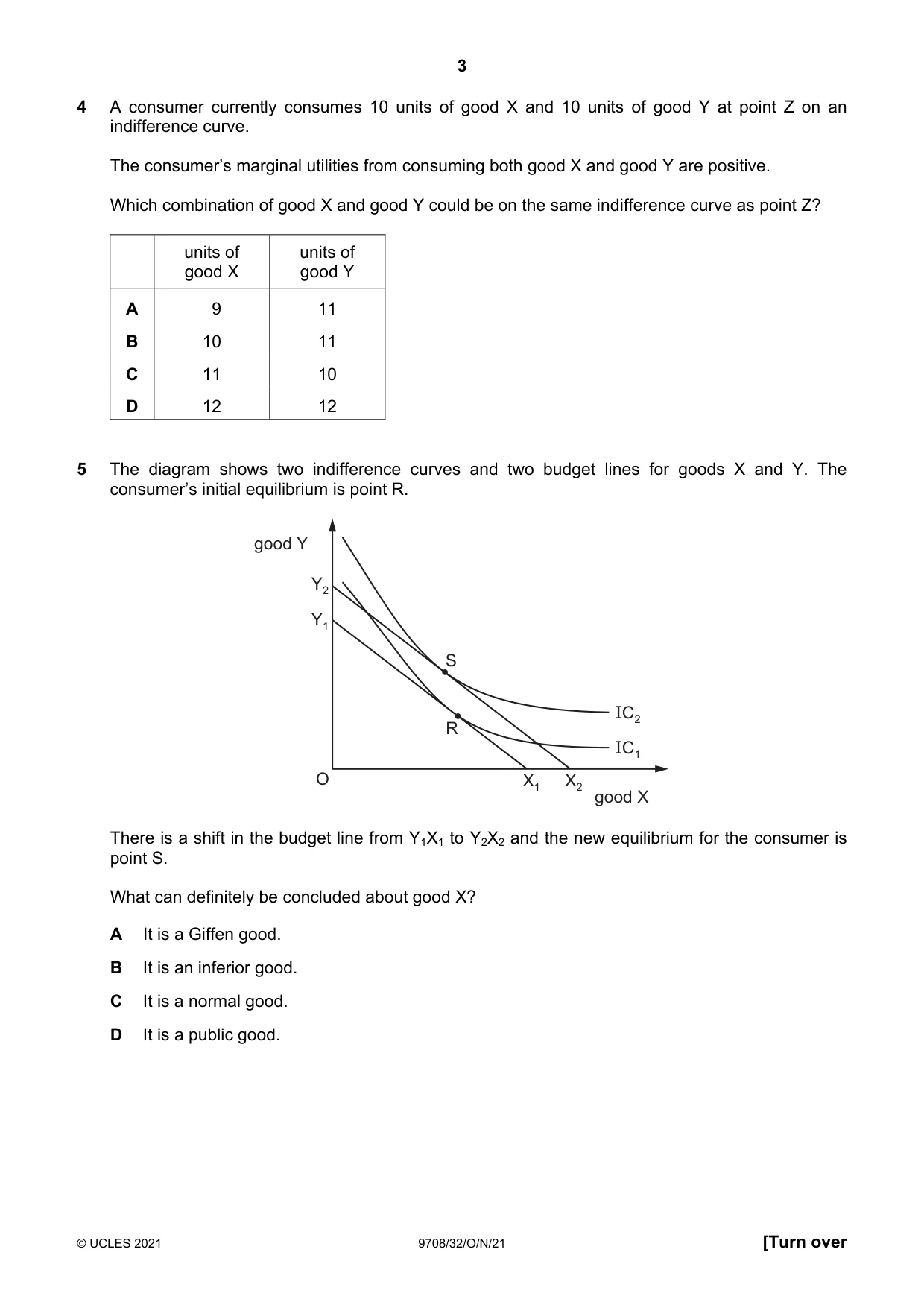
4 A consumer currently consumes 10 units of good X and 10 units of good Y at point Z on an indifference curve. The consumer’s marginal utilities from consuming both good X and good Y are positive. Which combination of good X and good Y could be on the same indifference curve as point Z? units of units of good X good Y A 9 11 B 10 11 C 11 10 D 12 12
Mark scheme: A
Q5 · The diagram shows two indifference curves and two budget lines for goods X and Y
5 The diagram shows two indifference curves and two budget lines for goods X and Y. The consumer’s initial equilibrium is point R. good Y Y2 Y1 S IC2 R IC1 O X1 X2 good X There is a shift in the budget line from Y1X1 to Y2X2 and the new equilibrium for the consumer is point S. What can definitely be concluded about good X? A It is a Giffen good. B It is an inferior good. C It is a normal good. D It is a public good.
Mark scheme: B
Q6 · What are the correct formulae for calculating average cost (AC) and average revenue (AR)?
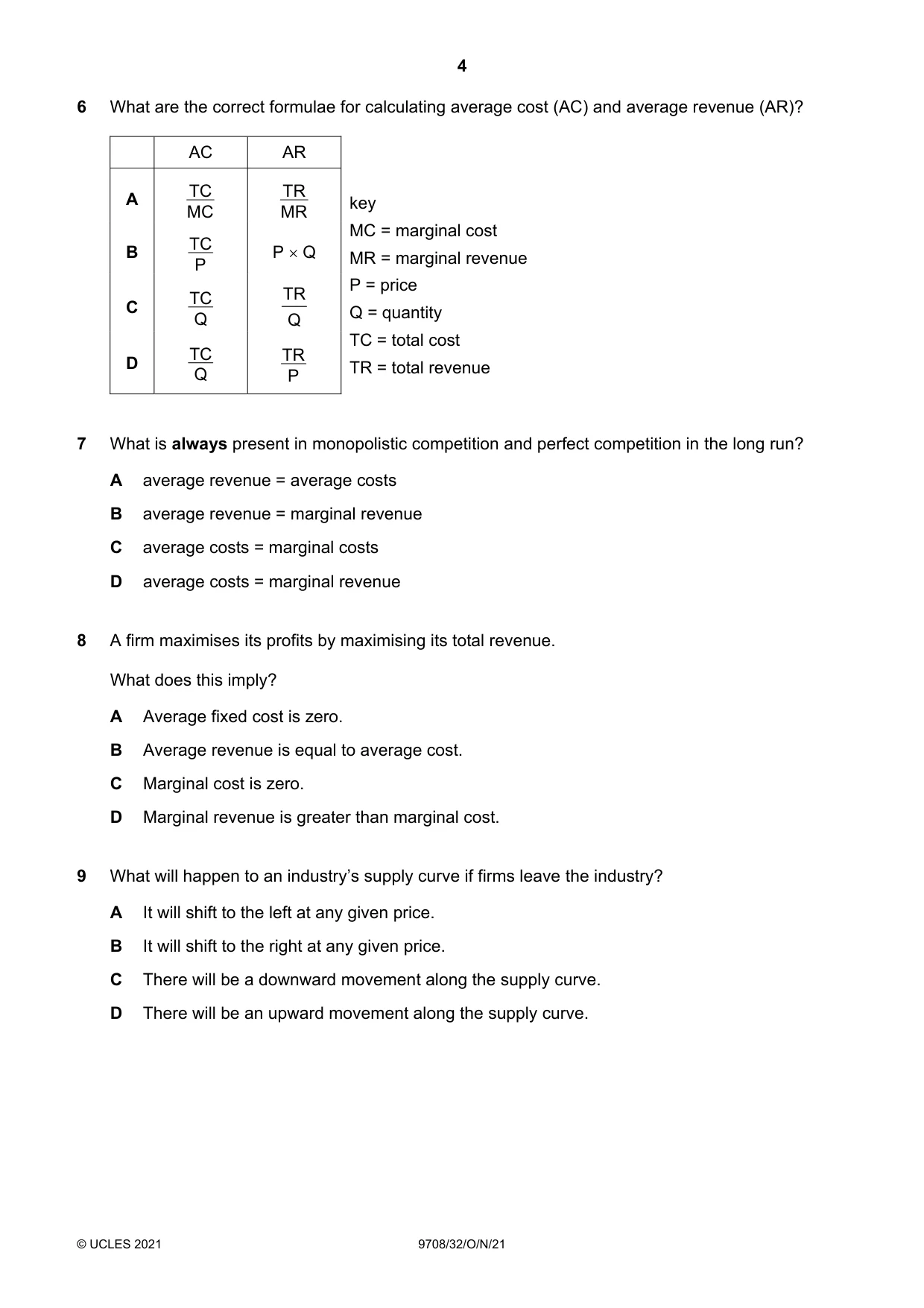
6 What are the correct formulae for calculating average cost (AC) and average revenue (AR)? AC AR TC TR A key MC MR MC = marginal cost TC P Q B MR = marginal revenue P P = price TC TR C Q = quantity Q Q TC = total cost TC TR D TR = total revenue Q P
Mark scheme: C
More questions on Types of cost, revenue and profit, short-run and long-run production
Q7 · What is always present in monopolistic competition and perfect competition in the long…
7 What is always present in monopolistic competition and perfect competition in the long run? A average revenue = average costs B average revenue = marginal revenue C average costs = marginal costs D average costs = marginal revenue
Mark scheme: A
Q8 · A firm maximises its profits by maximising its total revenue
8 A firm maximises its profits by maximising its total revenue. What does this imply? A Average fixed cost is zero. B Average revenue is equal to average cost. C Marginal cost is zero. D Marginal revenue is greater than marginal cost.
Mark scheme: C
More questions on Differing objectives and policies of firms
Q9 · What will happen to an industry’s supply curve if firms leave the industry?
9 What will happen to an industry’s supply curve if firms leave the industry? A It will shift to the left at any given price. B It will shift to the right at any given price. C There will be a downward movement along the supply curve. D There will be an upward movement along the supply curve.
Mark scheme: A
Q10 · Which characteristic of a market is a reason for a firm to remain small?
10 Which characteristic of a market is a reason for a firm to remain small? A The minimum efficient scale is high. B The potential for x-inefficiency is high. C There are significant economies of scale. D There is limited access to financial capital.
Mark scheme: D
Q11 · What is an example of the principal–agent problem?
11 What is an example of the principal–agent problem? A the disincentive effect for entrepreneurs of high government tax rates B the existence of a trade union to put forward workers’ views to managers C the lack of consumer knowledge of the quality of firms’ products D the separation of the owners of a firm from the firm’s managers
Mark scheme: D
More questions on Differing objectives and policies of firms
Q12 · The diagram shows a firm in imperfect competition
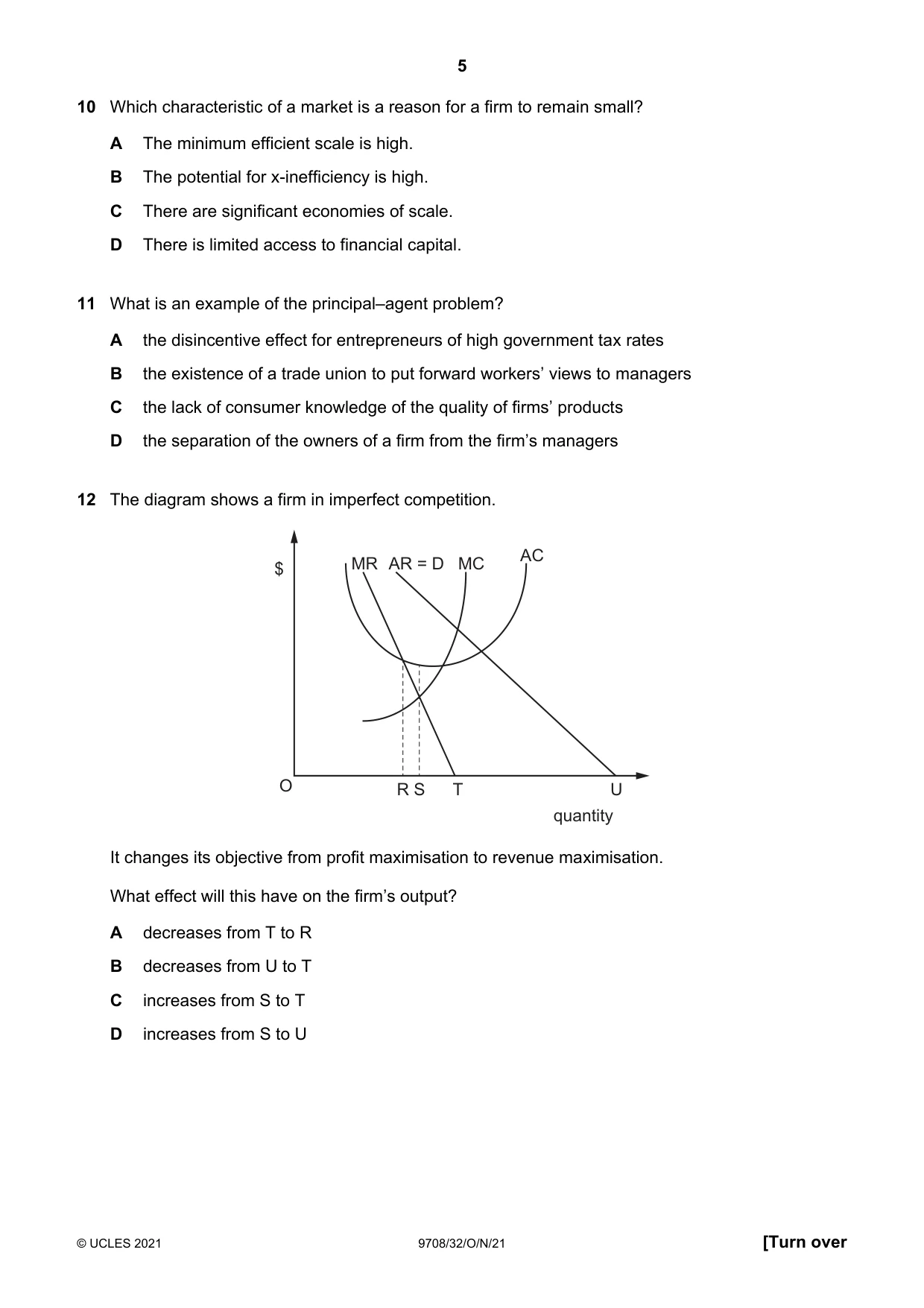
12 The diagram shows a firm in imperfect competition. MR AR = D MC AC $ O R S T U quantity It changes its objective from profit maximisation to revenue maximisation. What effect will this have on the firm’s output? A decreases from T to R B decreases from U to T C increases from S to T D increases from S to U
Mark scheme: C
More questions on Differing objectives and policies of firms
Q13 · Which statement explains why a government decides to increase the highest rates of tax on…
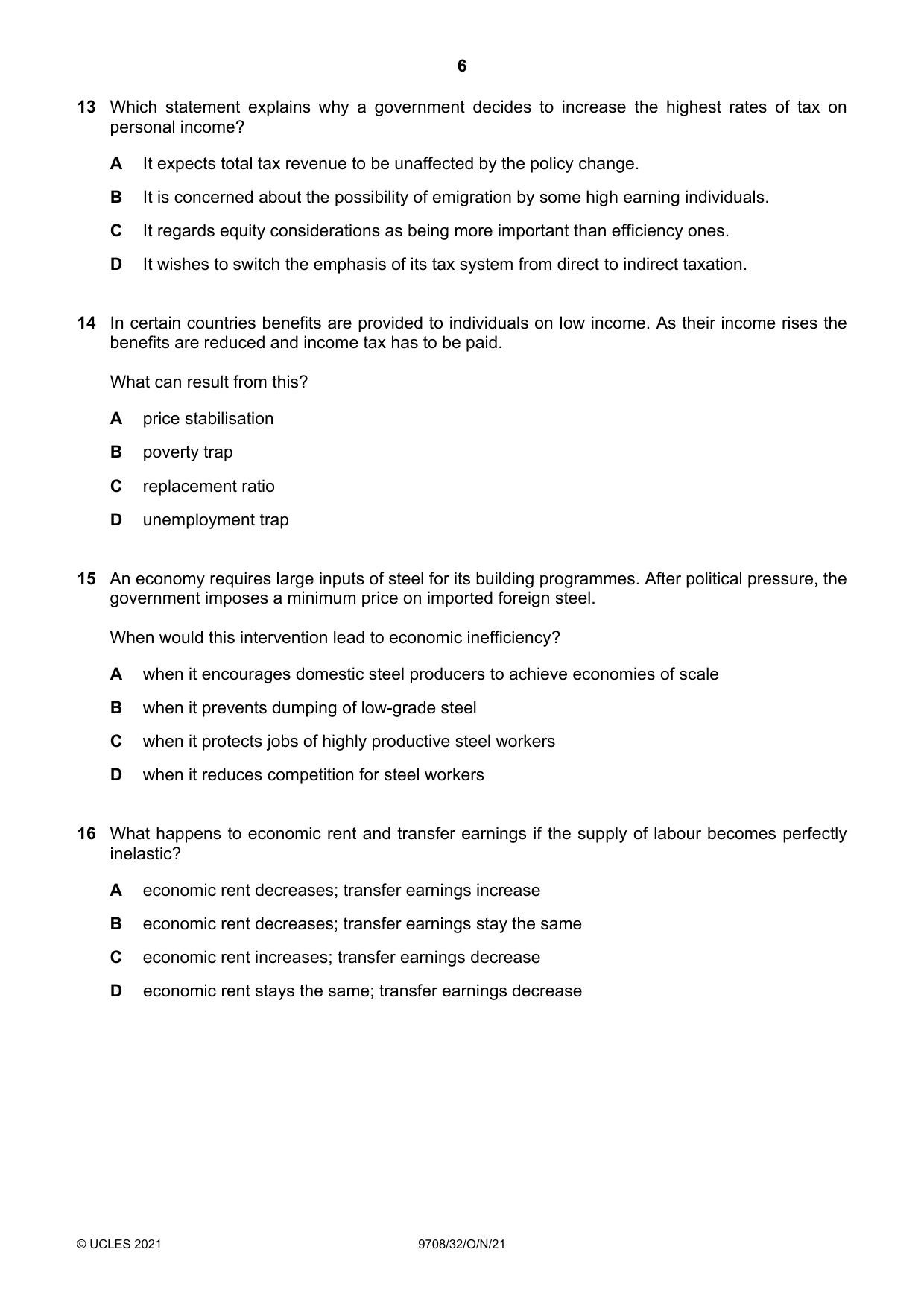
13 Which statement explains why a government decides to increase the highest rates of tax on personal income? A It expects total tax revenue to be unaffected by the policy change. B It is concerned about the possibility of emigration by some high earning individuals. C It regards equity considerations as being more important than efficiency ones. D It wishes to switch the emphasis of its tax system from direct to indirect taxation.
Mark scheme: C
More questions on Equity and redistribution of income and wealth
Q14 · In certain countries benefits are provided to individuals on low income
14 In certain countries benefits are provided to individuals on low income. As their income rises the benefits are reduced and income tax has to be paid. What can result from this? A price stabilisation B poverty trap C replacement ratio D unemployment trap
Mark scheme: B
More questions on Labour market forces and government intervention
Q15 · An economy requires large inputs of steel for its building programmes
15 An economy requires large inputs of steel for its building programmes. After political pressure, the government imposes a minimum price on imported foreign steel. When would this intervention lead to economic inefficiency? A when it encourages domestic steel producers to achieve economies of scale B when it prevents dumping of low-grade steel C when it protects jobs of highly productive steel workers D when it reduces competition for steel workers
Mark scheme: D
Q16 · What happens to economic rent and transfer earnings if the supply of labour becomes…
16 What happens to economic rent and transfer earnings if the supply of labour becomes perfectly inelastic? A economic rent decreases; transfer earnings increase B economic rent decreases; transfer earnings stay the same C economic rent increases; transfer earnings decrease D economic rent stays the same; transfer earnings decrease
Mark scheme: C
More questions on Labour market forces and government intervention
Q17 · The diagram shows the effect of the introduction of a minimum wage (WM) in the labour…
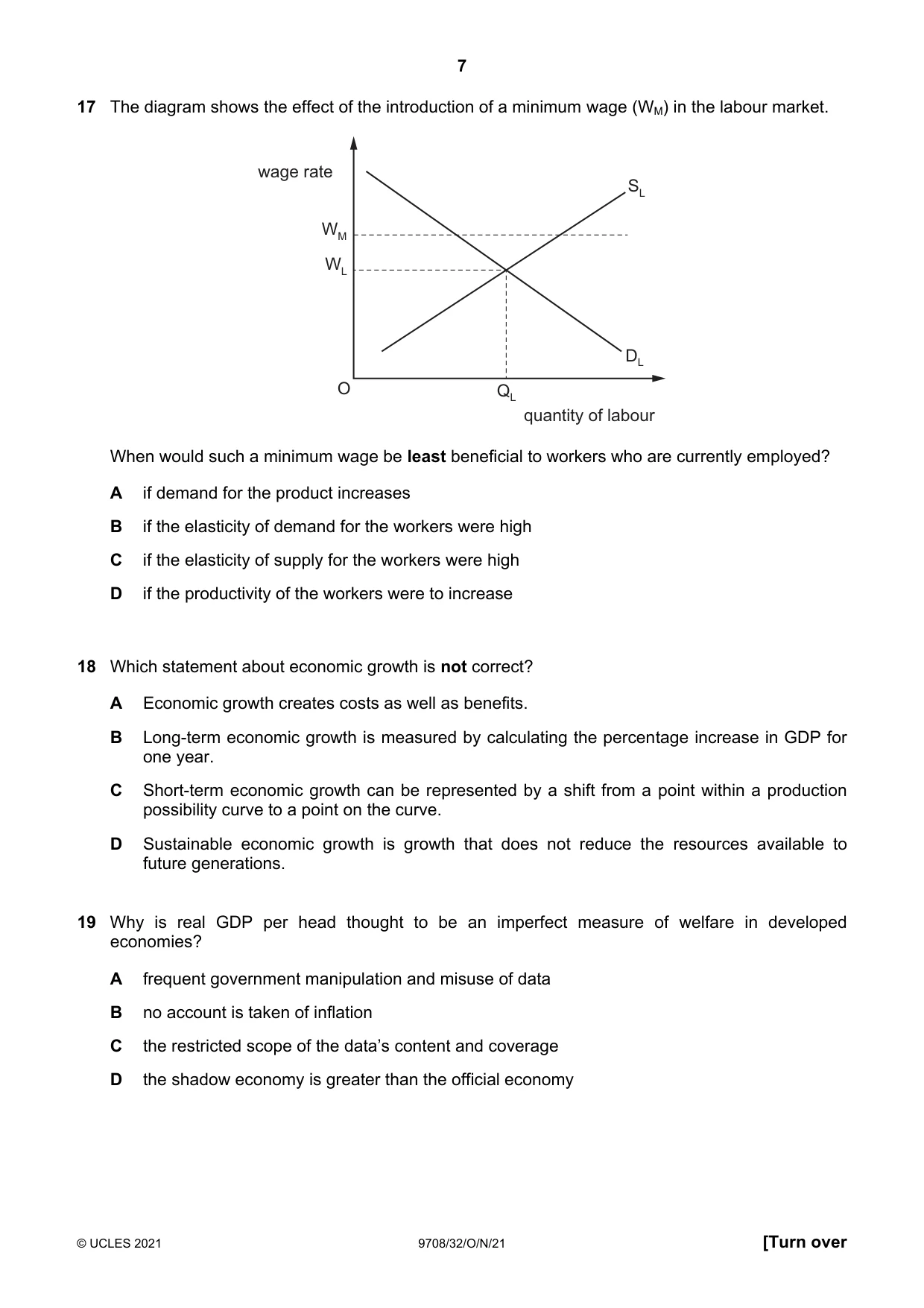
17 The diagram shows the effect of the introduction of a minimum wage (WM) in the labour market. wage rate SL WM WL DL O QL quantity of labour When would such a minimum wage be least beneficial to workers who are currently employed? A if demand for the product increases B if the elasticity of demand for the workers were high C if the elasticity of supply for the workers were high D if the productivity of the workers were to increase
Mark scheme: B
More questions on Labour market forces and government intervention
Q18 · Which statement about economic growth is not correct?
18 Which statement about economic growth is not correct? A Economic growth creates costs as well as benefits. B Long-term economic growth is measured by calculating the percentage increase in GDP for one year. C Short-term economic growth can be represented by a shift from a point within a production possibility curve to a point on the curve. D Sustainable economic growth is growth that does not reduce the resources available to future generations.
Mark scheme: B
Q19 · Why is real GDP per head thought to be an imperfect measure of welfare in developed…
19 Why is real GDP per head thought to be an imperfect measure of welfare in developed economies? A frequent government manipulation and misuse of data B no account is taken of inflation C the restricted scope of the data’s content and coverage D the shadow economy is greater than the official economy
Mark scheme: C
Q20 · What changes are most likely to reduce the level of income inequality in an economy?
20 What changes are most likely to reduce the level of income inequality in an economy? A additional government regulation of product and factor markets B increased progressive direct taxation and decreased indirect taxation C increased trade union power and reduced labour market flexibility D reduced welfare benefits and increased rate of interest
Mark scheme: B
More questions on Equity and redistribution of income and wealth
Q21 · The table gives labour market statistics for Malaysia for January to March 2019
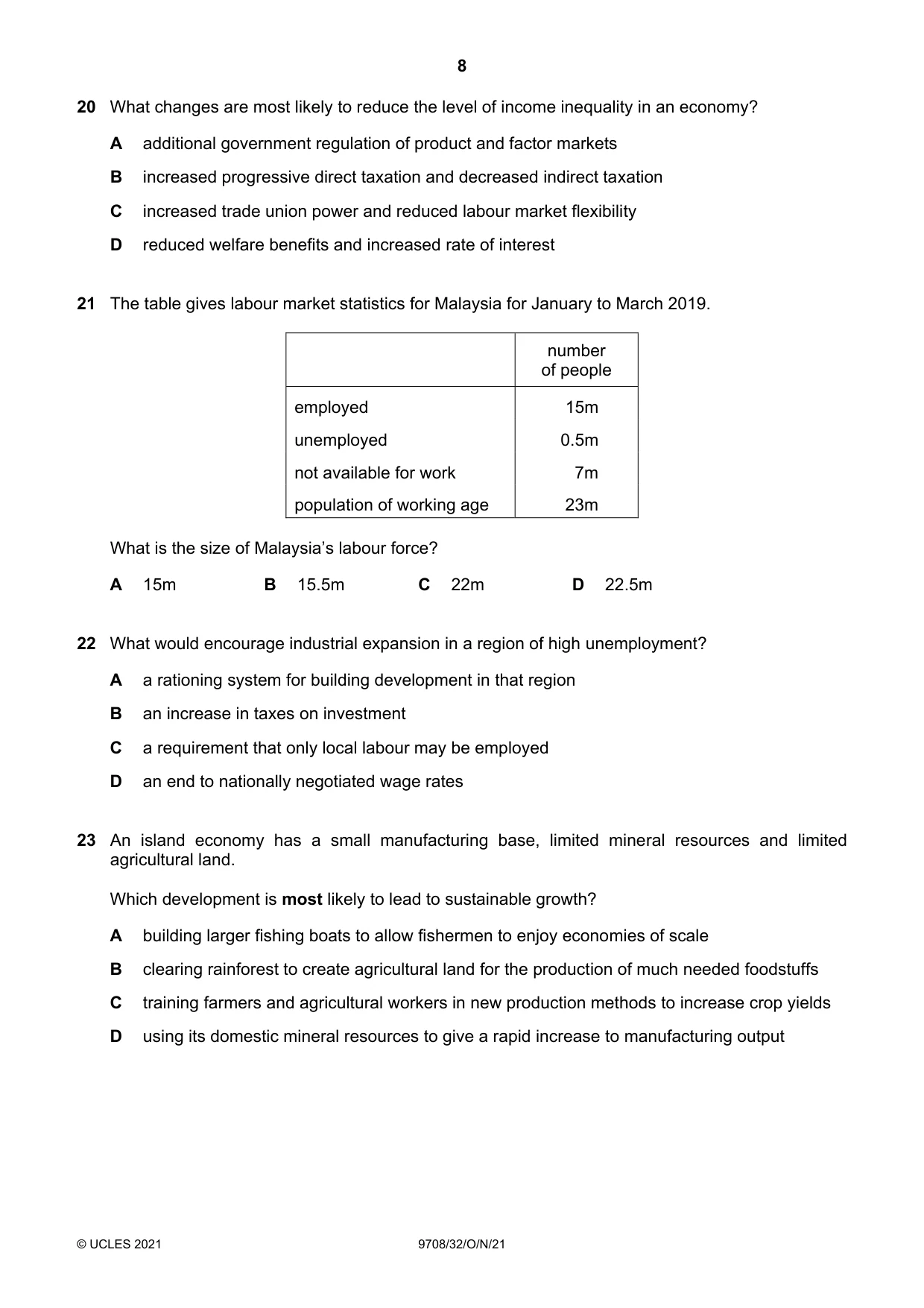
21 The table gives labour market statistics for Malaysia for January to March 2019. number of people employed 15m unemployed 0.5m not available for work 7m population of working age 23m What is the size of Malaysia’s labour force? A 15m B 15.5m C 22m D 22.5m
Mark scheme: B
Q22 · What would encourage industrial expansion in a region of high unemployment?
22 What would encourage industrial expansion in a region of high unemployment? A a rationing system for building development in that region B an increase in taxes on investment C a requirement that only local labour may be employed D an end to nationally negotiated wage rates
Mark scheme: D
Q23 · An island economy has a small manufacturing base, limited mineral resources and limited…
23 An island economy has a small manufacturing base, limited mineral resources and limited agricultural land. Which development is most likely to lead to sustainable growth? A building larger fishing boats to allow fishermen to enjoy economies of scale B clearing rainforest to create agricultural land for the production of much needed foodstuffs C training farmers and agricultural workers in new production methods to increase crop yields D using its domestic mineral resources to give a rapid increase to manufacturing output
Mark scheme: C
Q24 · The information in the table is taken from a country’s national income accounts
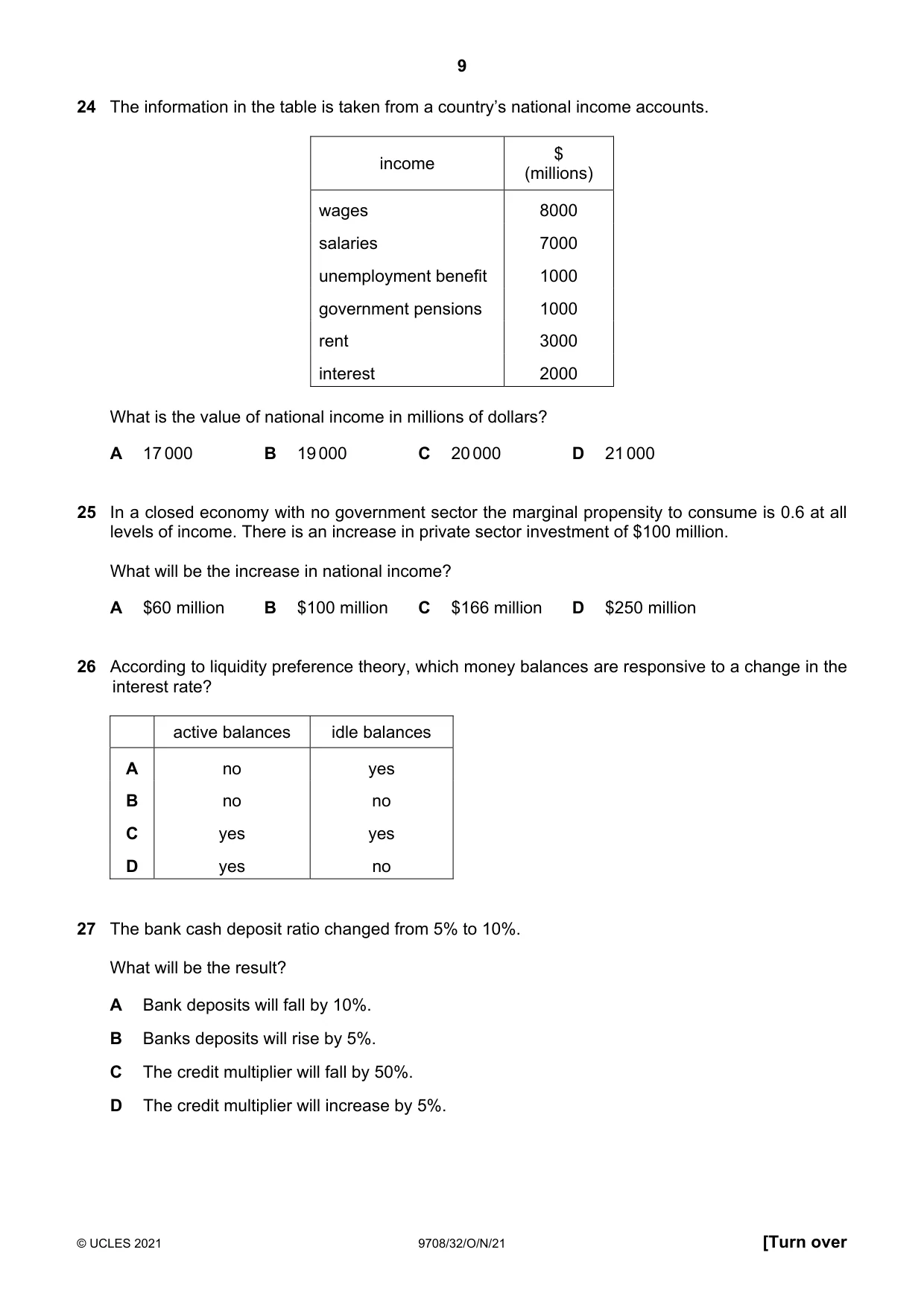
24 The information in the table is taken from a country’s national income accounts. $ income (millions) wages 8000 salaries 7000 unemployment benefit 1000 government pensions 1000 rent 3000 interest 2000 What is the value of national income in millions of dollars? A 17 000 B 19 000 C 20 000 D 21 000
Mark scheme: C
Q25 · In a closed economy with no government sector the marginal propensity to consume is 0.6…
25 In a closed economy with no government sector the marginal propensity to consume is 0.6 at all levels of income. There is an increase in private sector investment of $100 million. What will be the increase in national income? A $60 million B $100 million C $166 million D $250 million
Mark scheme: D
Q26 · According to liquidity preference theory, which money balances are responsive to a change…
26 According to liquidity preference theory, which money balances are responsive to a change in the interest rate? active balances idle balances A no yes B no no C yes yes D yes no
Mark scheme: A
Q27 · The bank cash deposit ratio changed from 5% to 10%
27 The bank cash deposit ratio changed from 5% to 10%. What will be the result? A Bank deposits will fall by 10%. B Banks deposits will rise by 5%. C The credit multiplier will fall by 50%. D The credit multiplier will increase by 5%.
Mark scheme: C
Q28 · In a developing economy, which policy is most likely to increase the rate of economic…
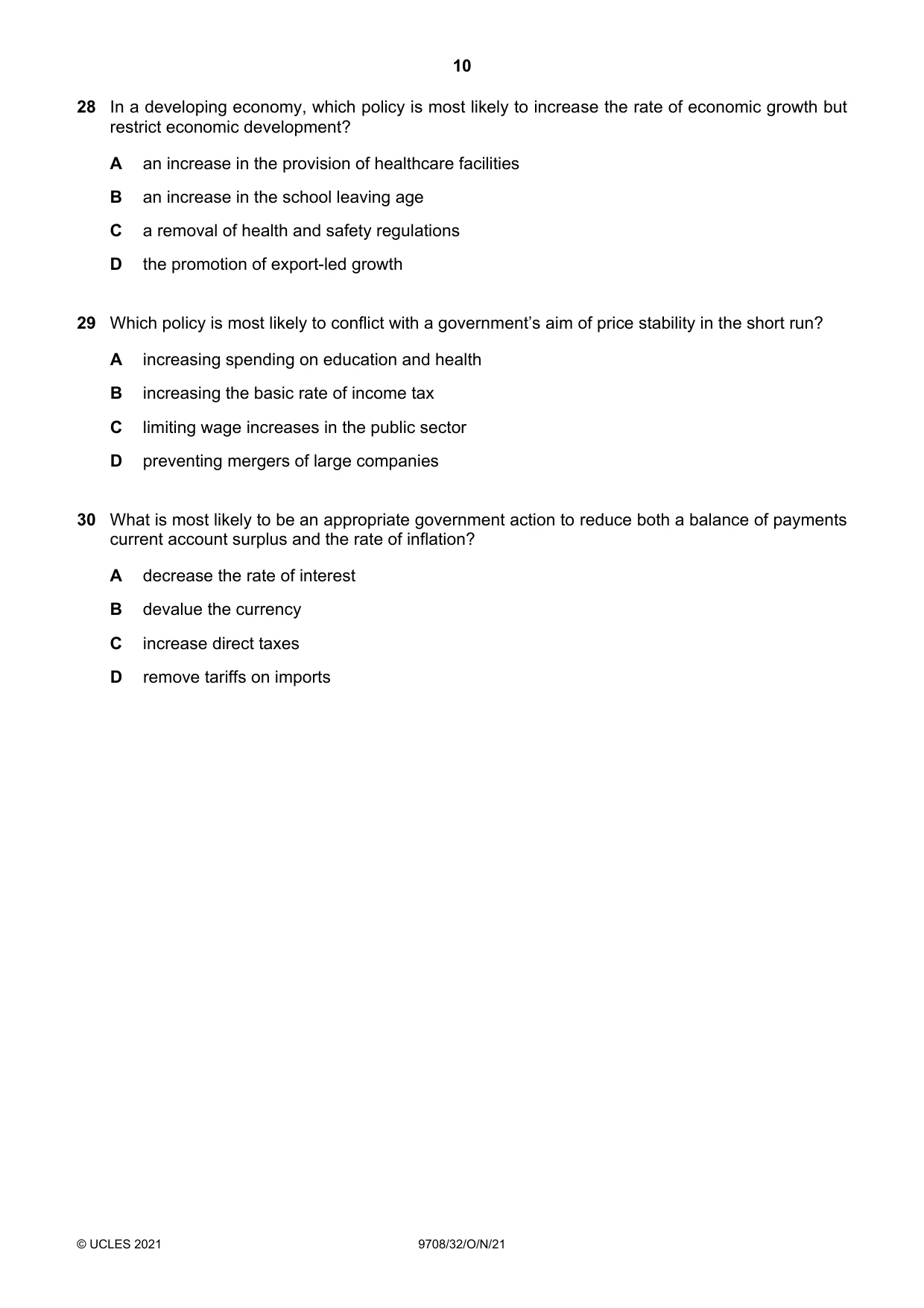
28 In a developing economy, which policy is most likely to increase the rate of economic growth but restrict economic development? A an increase in the provision of healthcare facilities B an increase in the school leaving age C a removal of health and safety regulations D the promotion of export-led growth
Mark scheme: C
Q29 · Which policy is most likely to conflict with a government’s aim of price stability in the…
29 Which policy is most likely to conflict with a government’s aim of price stability in the short run? A increasing spending on education and health B increasing the basic rate of income tax C limiting wage increases in the public sector D preventing mergers of large companies
Mark scheme: A
Q30 · What is most likely to be an appropriate government action to reduce both a balance of…
30 What is most likely to be an appropriate government action to reduce both a balance of payments current account surplus and the rate of inflation? A decrease the rate of interest B devalue the currency C increase direct taxes D remove tariffs on imports
Mark scheme: D
More questions on Policies to correct disequilibrium in the balance of payments
What was in this paper
The subtopics covered by these 30 questions, and how many questions each got. Open one in a new tab to see every Cambridge question on it.
3Labour market forces and government intervention3Equity and redistribution of income and wealth2Indifference curves and budget lines2Money and banking2National income statistics2Private costs and benefits, externalities and social costs and benefits2Demand and supply curves1Different market structures1Economic development1Economic growth1Economic growth and sustainability1Efficiency and market failure1Employment/unemployment1Fiscal policy1Growth and survival of firms1Policies to correct disequilibrium in the balance of payments1Protectionism1Supply-side policy1The circular flow of income1Types of cost, revenue and profit, short-run and long-run production1What you needed in this session
Cambridge’s own grade thresholds for 2021 Oct/Nov, Paper 3 · Variant 2. A higher threshold means an easier paper — the bar moves with how the cohort did.