Cambridge A Level Economics 9708 — 2021 Feb/March Paper 3 · Variant 2
9708/32/F/M/21 · 30 questions · 30 marks · ≈34 min
The question paper and its mark scheme, free to read here and free to download. This is Cambridge’s own paper, exactly as it was sat.
Question paper12 pages
Mark scheme3 pages
Answers below. Sit the paper first if you are practising.
Questions as text
Q1 · Over time the average total cost curve of a firm is lowered
1 Over time the average total cost curve of a firm is lowered. Which form of efficiency does this represent? A allocative B dynamic C Pareto D productive
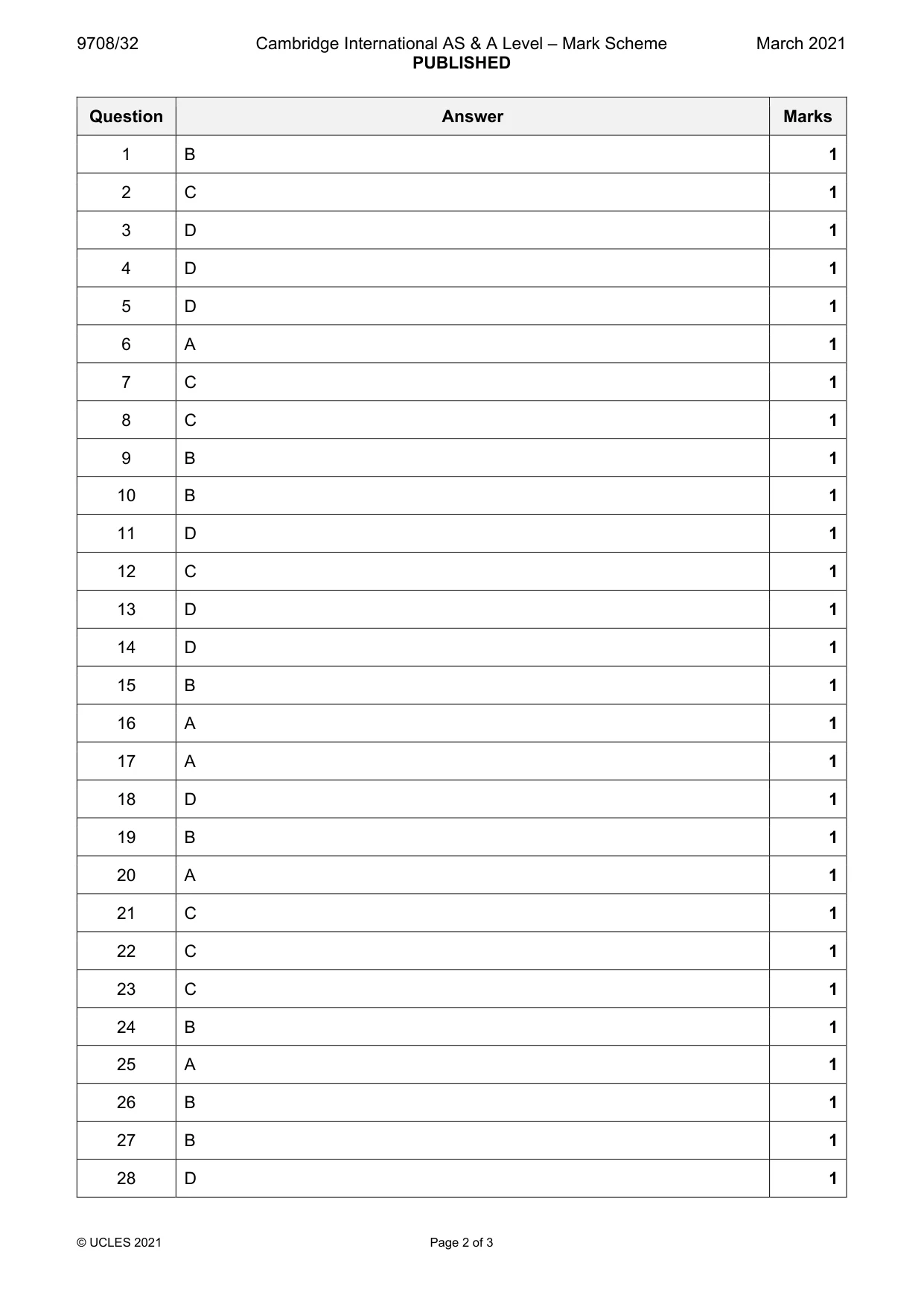
Mark scheme: B
More questions on Types of cost, revenue and profit, short-run and long-run production
Q2 · The diagram shows the private and social marginal costs and benefits curves for the…
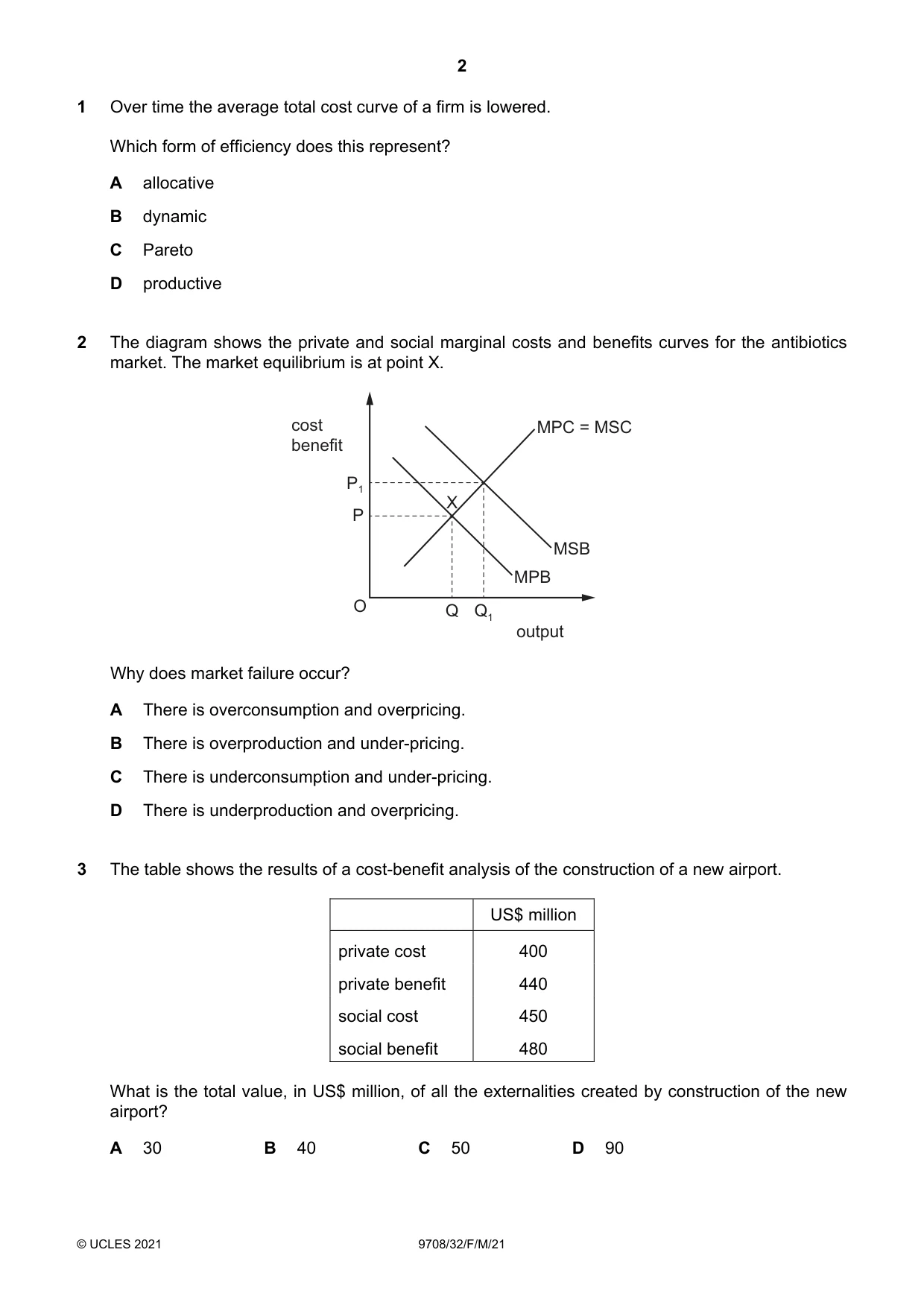
2 The diagram shows the private and social marginal costs and benefits curves for the antibiotics market. The market equilibrium is at point X. cost MPC = MSC benefit P1 X P MSB MPB O Q Q1 output Why does market failure occur? A There is overconsumption and overpricing. B There is overproduction and under-pricing. C There is underconsumption and under-pricing. D There is underproduction and overpricing.
Mark scheme: C
More questions on Private costs and benefits, externalities and social costs and benefits
Q3 · The table shows the results of a cost-benefit analysis of the construction of a new…
3 The table shows the results of a cost-benefit analysis of the construction of a new airport. US$ million private cost 400 private benefit 440 social cost 450 social benefit 480 What is the total value, in US$ million, of all the externalities created by construction of the new airport? A 30 B 40 C 50 D 90
Mark scheme: D
More questions on Private costs and benefits, externalities and social costs and benefits
Q4 · A utility-maximising consumer has a fixed income and can choose between good X and good Y
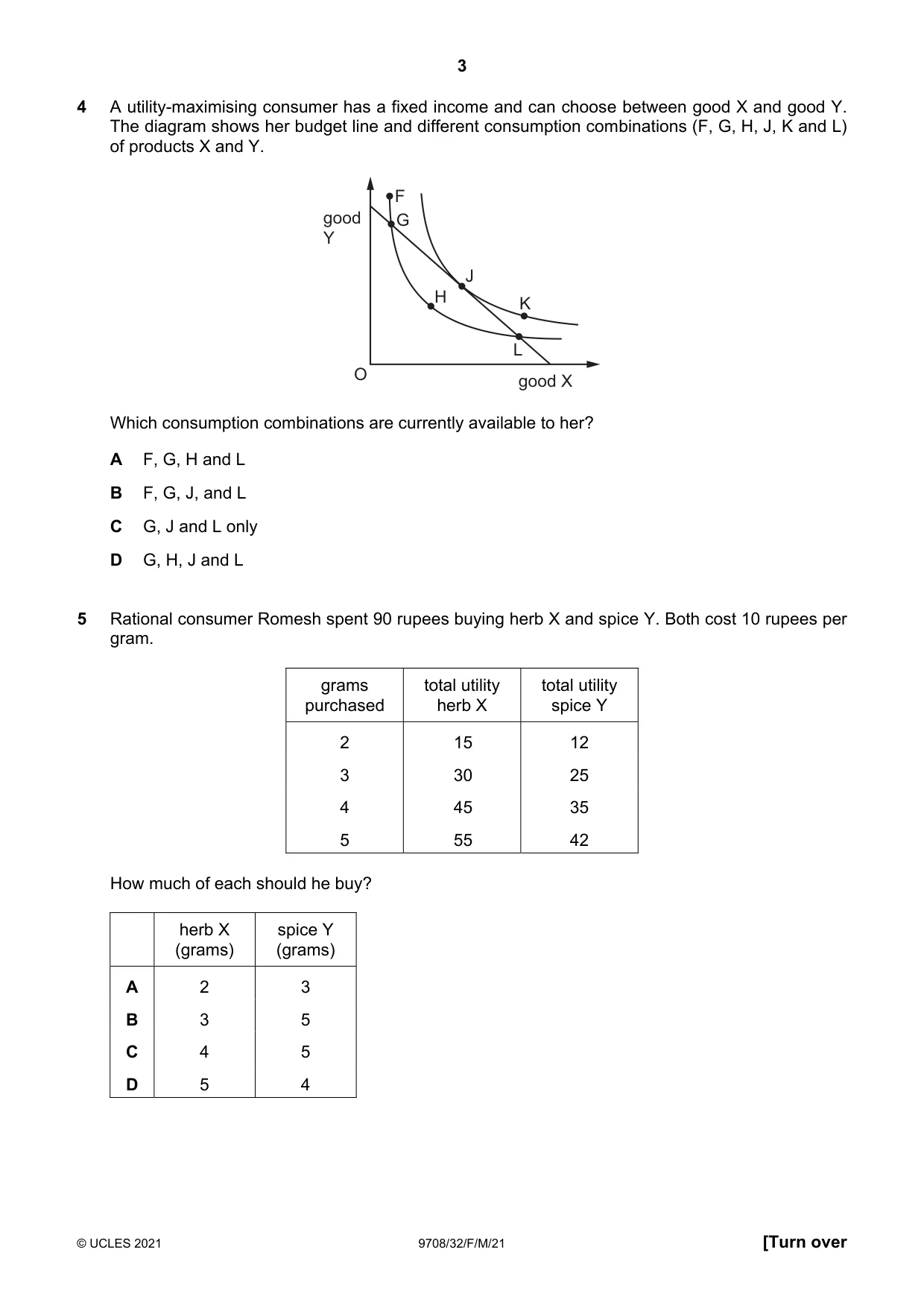
4 A utility-maximising consumer has a fixed income and can choose between good X and good Y. The diagram shows her budget line and different consumption combinations (F, G, H, J, K and L) of products X and Y. F good G Y J H K L O good X Which consumption combinations are currently available to her? A F, G, H and L B F, G, J, and L C G, J and L only D G, H, J and L
Mark scheme: D
Q5 · Rational consumer Romesh spent 90 rupees buying herb X and spice Y
5 Rational consumer Romesh spent 90 rupees buying herb X and spice Y. Both cost 10 rupees per gram. grams total utility total utility purchased herb X spice Y 2 15 12 3 30 25 4 45 35 5 55 42 How much of each should he buy? herb X spice Y (grams) (grams) A 2 3 B 3 5 C 4 5 D 5 4
Mark scheme: D
Q6 · In the diagram, TC is a firm’s short-run total cost curve
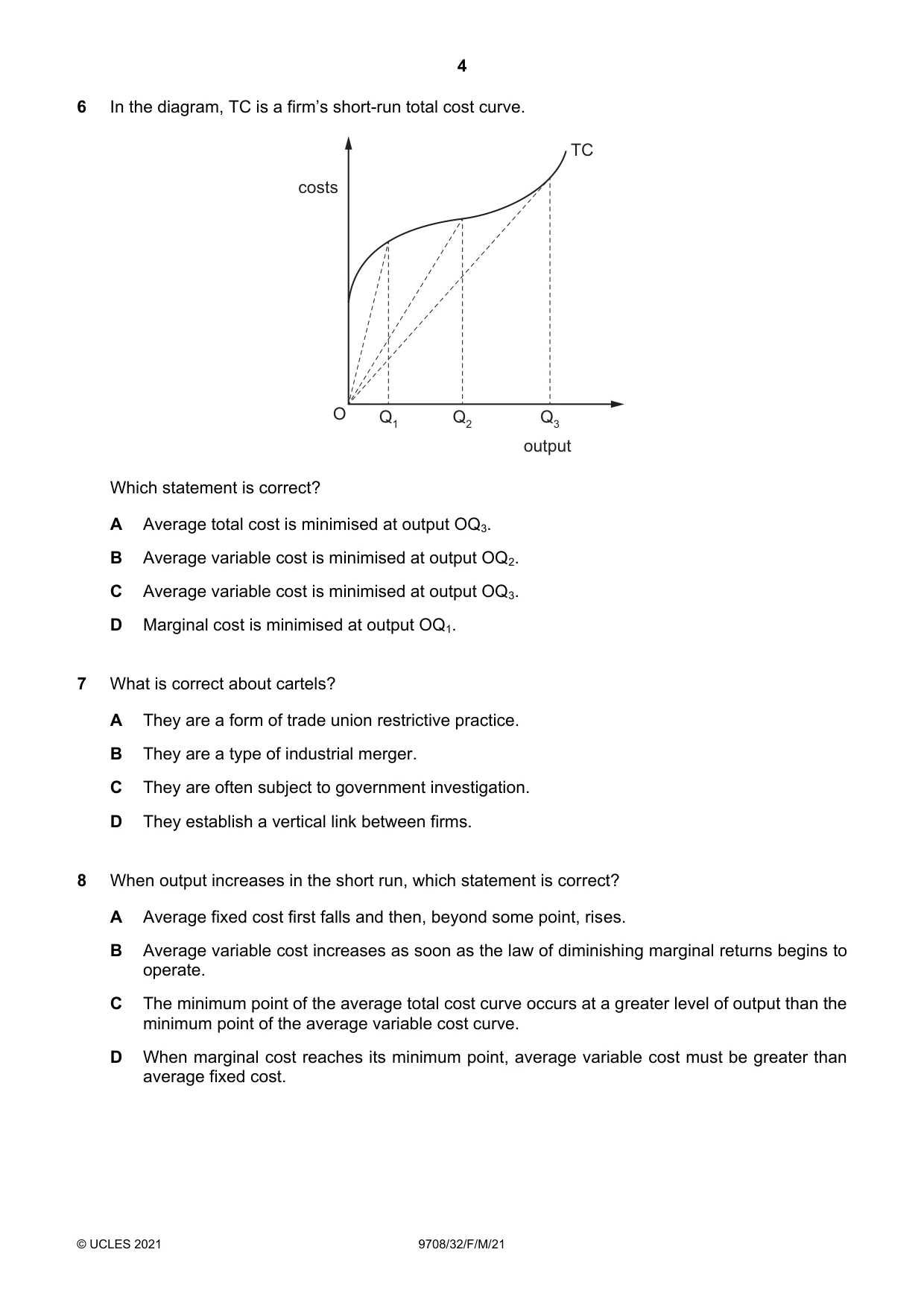
6 In the diagram, TC is a firm’s short-run total cost curve. TC costs O Q1 Q2 Q3 output Which statement is correct? A Average total cost is minimised at output OQ3. B Average variable cost is minimised at output OQ2. C Average variable cost is minimised at output OQ3. D Marginal cost is minimised at output OQ1.
Mark scheme: A
More questions on Types of cost, revenue and profit, short-run and long-run production
Q7 · What is correct about cartels?
7 What is correct about cartels? A They are a form of trade union restrictive practice. B They are a type of industrial merger. C They are often subject to government investigation. D They establish a vertical link between firms.
Mark scheme: C
Q8 · When output increases in the short run, which statement is correct?
8 When output increases in the short run, which statement is correct? A Average fixed cost first falls and then, beyond some point, rises. B Average variable cost increases as soon as the law of diminishing marginal returns begins to operate. C The minimum point of the average total cost curve occurs at a greater level of output than the minimum point of the average variable cost curve. D When marginal cost reaches its minimum point, average variable cost must be greater than average fixed cost.
Mark scheme: C
More questions on Types of cost, revenue and profit, short-run and long-run production
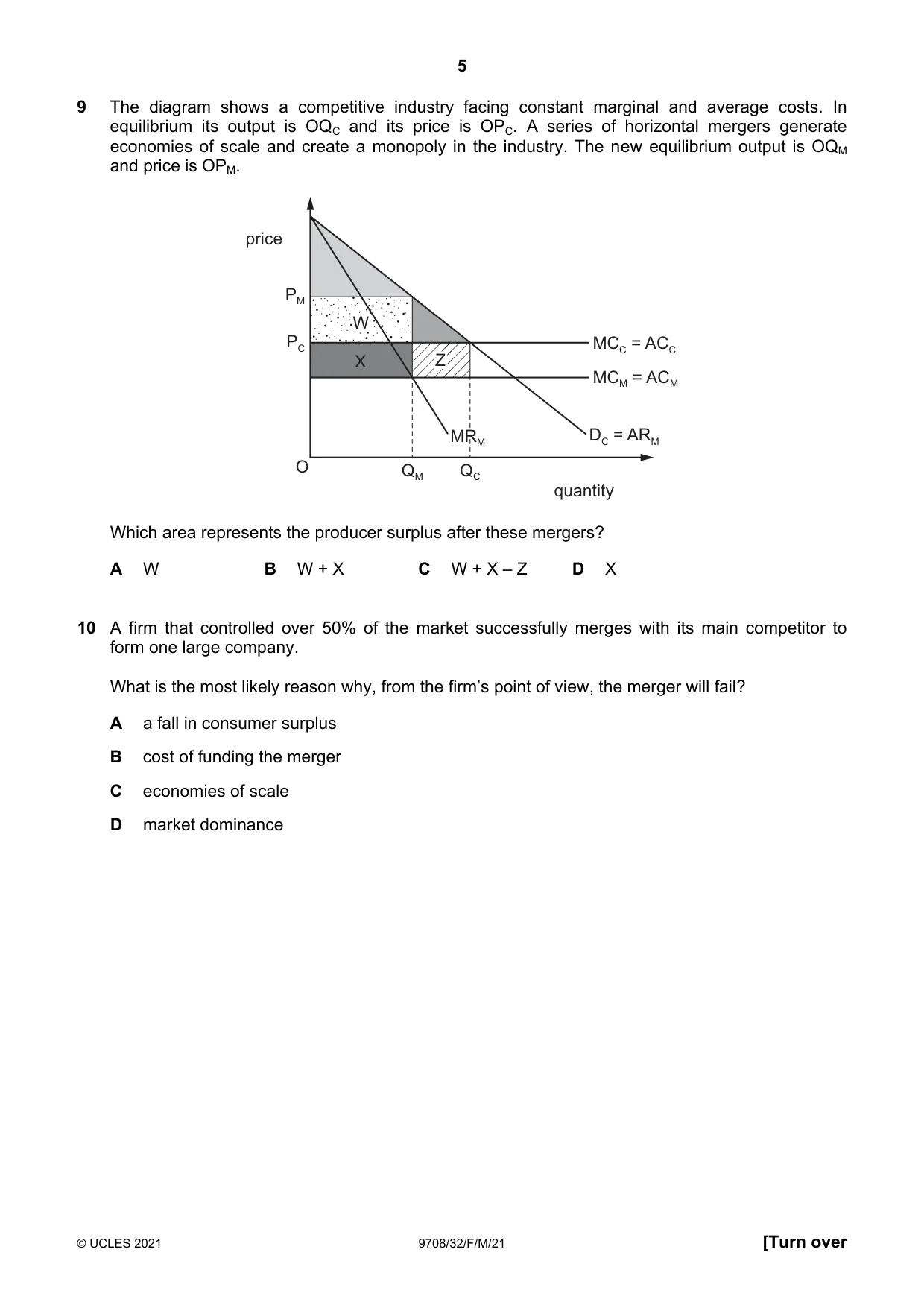
Q9 · The diagram shows a competitive industry facing constant marginal and average costs
9 The diagram shows a competitive industry facing constant marginal and average costs. In equilibrium its output is OQC and its price is OPC. A series of horizontal mergers generate economies of scale and create a monopoly in the industry. The new equilibrium output is OQM and price is OPM. price PM W W PC MCC = ACC X Z Z MCM = ACM MRM DC = ARM O QM QC quantity Which area represents the producer surplus after these mergers? A W B W + X C W + X – Z D X
Mark scheme: B
Q10 · A firm that controlled over 50% of the market successfully merges with its main…
10 A firm that controlled over 50% of the market successfully merges with its main competitor to form one large company. What is the most likely reason why, from the firm’s point of view, the merger will fail? A a fall in consumer surplus B cost of funding the merger C economies of scale D market dominance
Mark scheme: B
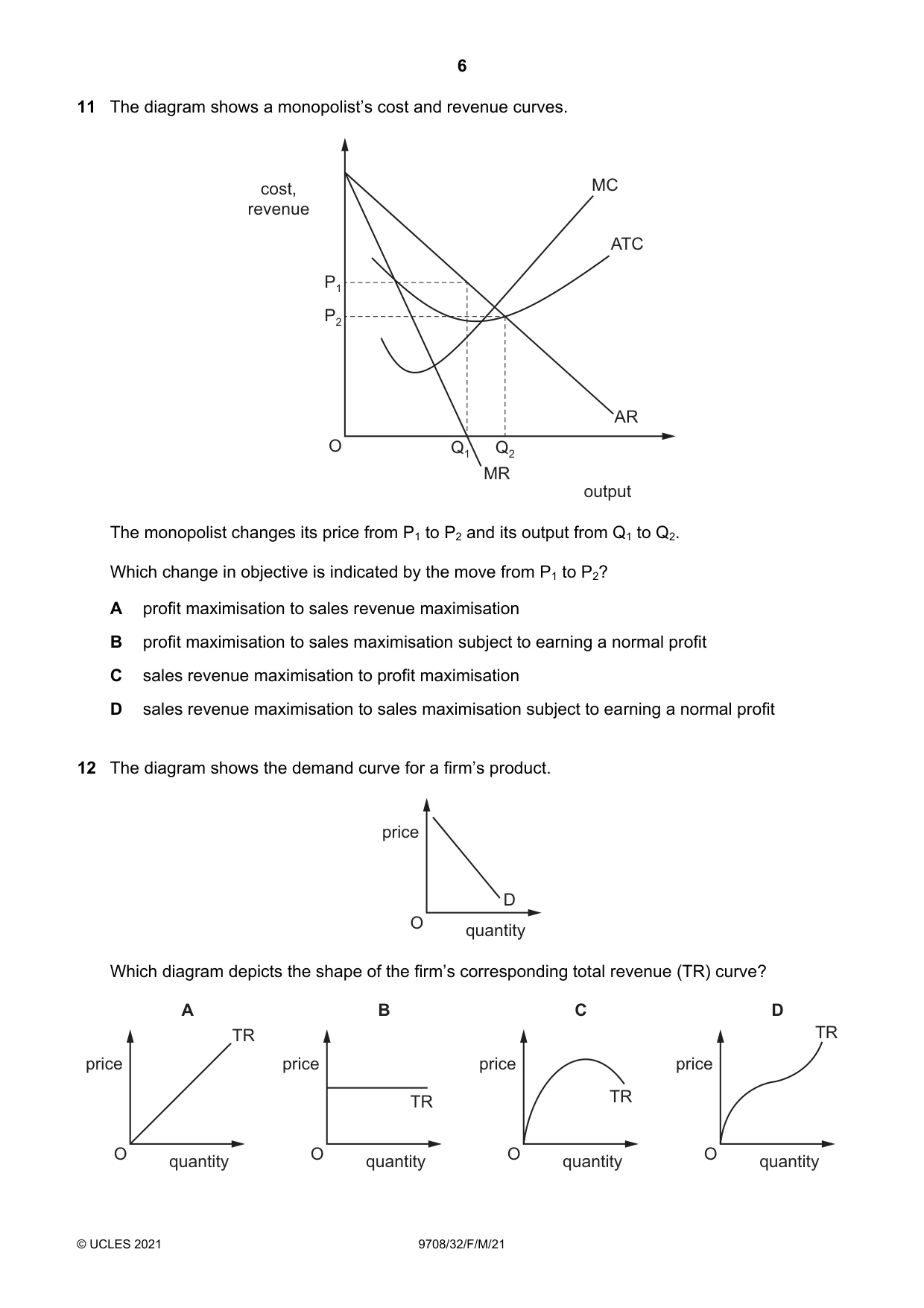
Q11 · The diagram shows a monopolist’s cost and revenue curves
11 The diagram shows a monopolist’s cost and revenue curves. cost, MC revenue ATC P1 P2 AR O Q1 Q2 MR output The monopolist changes its price from P1 to P2 and its output from Q1 to Q2. Which change in objective is indicated by the move from P1 to P2? A profit maximisation to sales revenue maximisation B profit maximisation to sales maximisation subject to earning a normal profit C sales revenue maximisation to profit maximisation D sales revenue maximisation to sales maximisation subject to earning a normal profit
Mark scheme: D
More questions on Differing objectives and policies of firms
Q12 · The diagram shows the demand curve for a firm’s product
12 The diagram shows the demand curve for a firm’s product. price D O quantity Which diagram depicts the shape of the firm’s corresponding total revenue (TR) curve? A B C D TR TR price price price price TR TR O quantity O quantity O quantity O quantity
Mark scheme: C
More questions on Types of cost, revenue and profit, short-run and long-run production
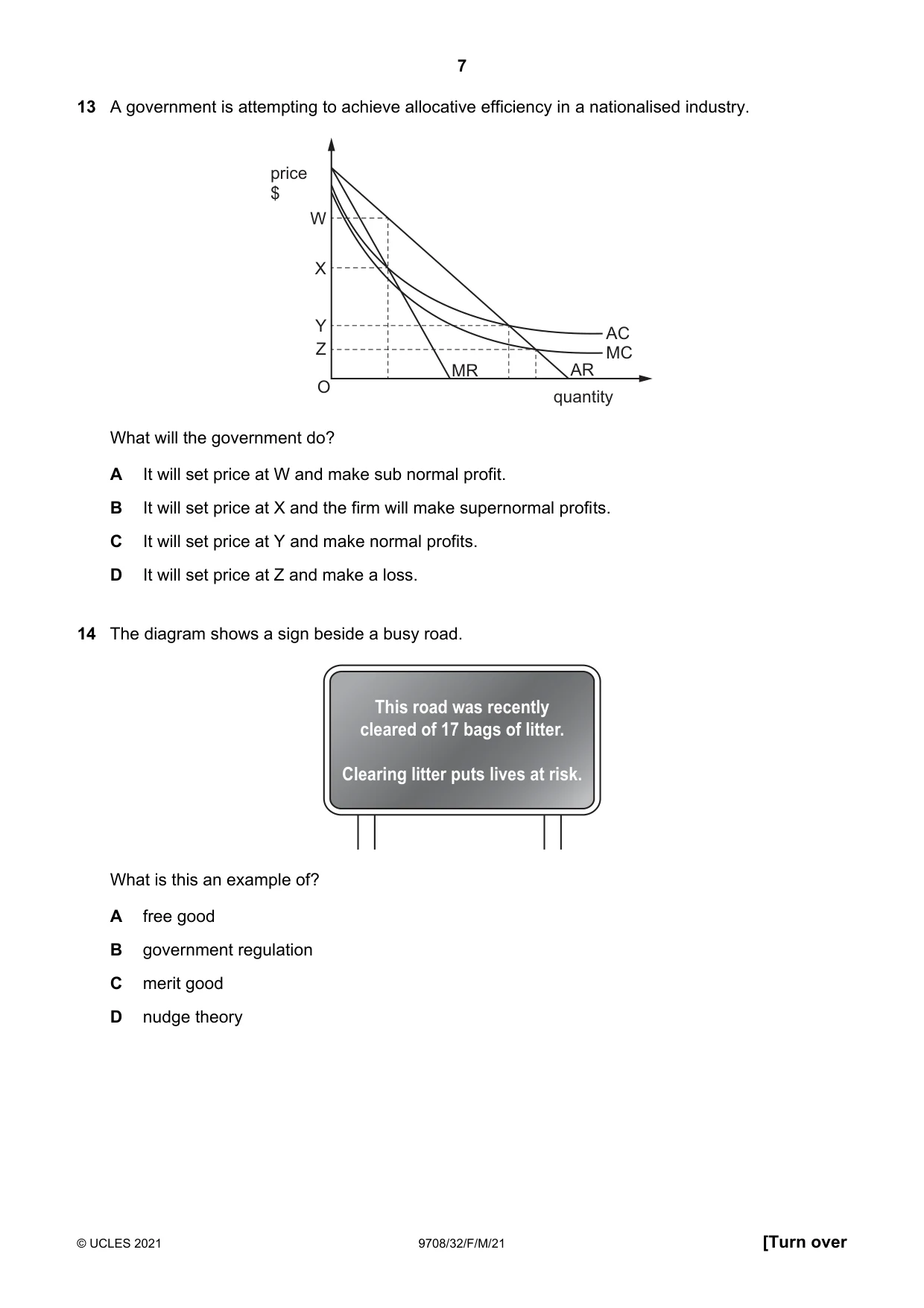
Q13 · A government is attempting to achieve allocative efficiency in a nationalised industry
13 A government is attempting to achieve allocative efficiency in a nationalised industry. price $ W X Y AC Z MC MR AR O quantity What will the government do? A It will set price at W and make sub normal profit. B It will set price at X and the firm will make supernormal profits. C It will set price at Y and make normal profits. D It will set price at Z and make a loss.
Mark scheme: D
Q14 · The diagram shows a sign beside a busy road
14 The diagram shows a sign beside a busy road. This road was recently cleared of 17 bags of litter. Clearing litter puts lives at risk. What is this an example of? A free good B government regulation C merit good D nudge theory
Mark scheme: D
More questions on Private costs and benefits, externalities and social costs and benefits
Q15 · Recent research has shown that consumption of some foods might be harmful
15 Recent research has shown that consumption of some foods might be harmful. A government committee considers how to intervene in the markets. Which intervention is most likely to reduce consumption of these foods without reducing income equality? A a minimum price for the harmful foods B a subsidy for substitute foods C an ad valorem tax on the harmful foods D an indirect tax on the harmful foods
Mark scheme: B
Q16 · In which circumstances is a poverty trap least likely to operate?
16 In which circumstances is a poverty trap least likely to operate? A A female worker is paid less than a male worker for doing the same job. B A worker is paid the minimum wage and refuses a higher paid job because net income is lower after tax. C A worker refuses higher paid work as it means more expensive travel and childcare costs. D An unemployed worker refuses a job because earnings are less than unemployment benefit.
Mark scheme: A
More questions on Equity and redistribution of income and wealth
Q17 · What would be most likely to cause the demand for labour in an industry to be inelastic?
17 What would be most likely to cause the demand for labour in an industry to be inelastic? A Labour costs are a small percentage of total cost. B The demand for the final product has a price elasticity of demand that is greater than one. C The workforce belongs to a strong trade union. D There is a large pool of readily available labour.
Mark scheme: A
More questions on Labour market forces and government intervention
Q18 · Which influence is least likely to promote sustainable economic growth in a developing…
18 Which influence is least likely to promote sustainable economic growth in a developing economy? A high saving rates B involvement in free trade C protected property rights D rapid population growth
Mark scheme: D
Q19 · Governments are interested in providing statistics on the standard of living
19 Governments are interested in providing statistics on the standard of living. They measure the value of material goods and services. Non-material characteristics that affect the standard of living cannot easily be measured. What is an example of a non-material characteristic? A the failure to include unpaid work in the home B the freedom to make informed economic choices C the proportion of GNP used for weapons of war D the removal of taxes from all forms of consumer expenditure
Mark scheme: B
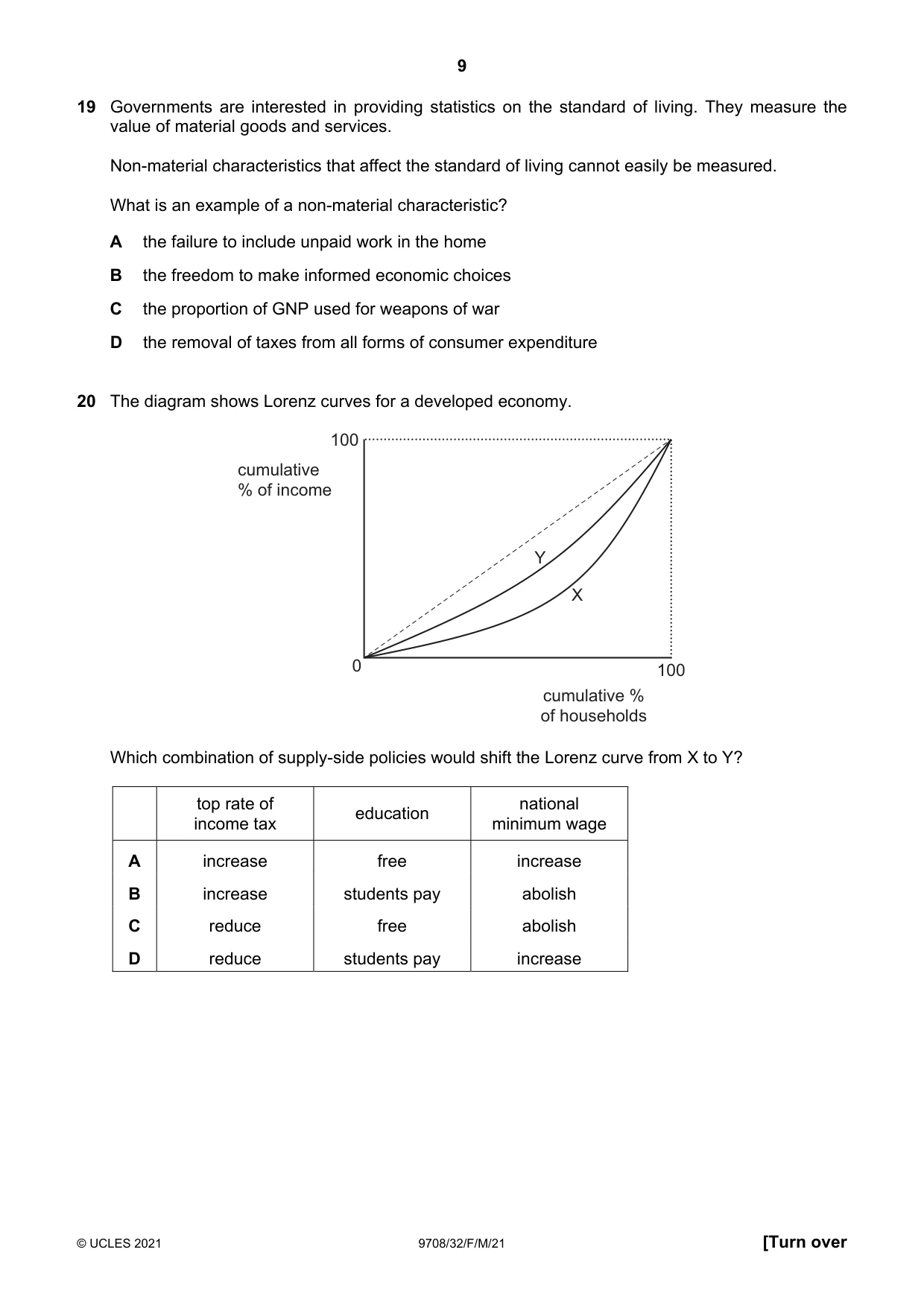
Q20 · The diagram shows Lorenz curves for a developed economy
20 The diagram shows Lorenz curves for a developed economy. 100 cumulative % of income Y X 0 100 cumulative % of households Which combination of supply-side policies would shift the Lorenz curve from X to Y? top rate of national education income tax minimum wage A increase free increase B increase students pay abolish C reduce free abolish D reduce students pay increase
Mark scheme: A
More questions on Equity and redistribution of income and wealth
Q21 · Two members of the Hernandez family have recently become unemployed
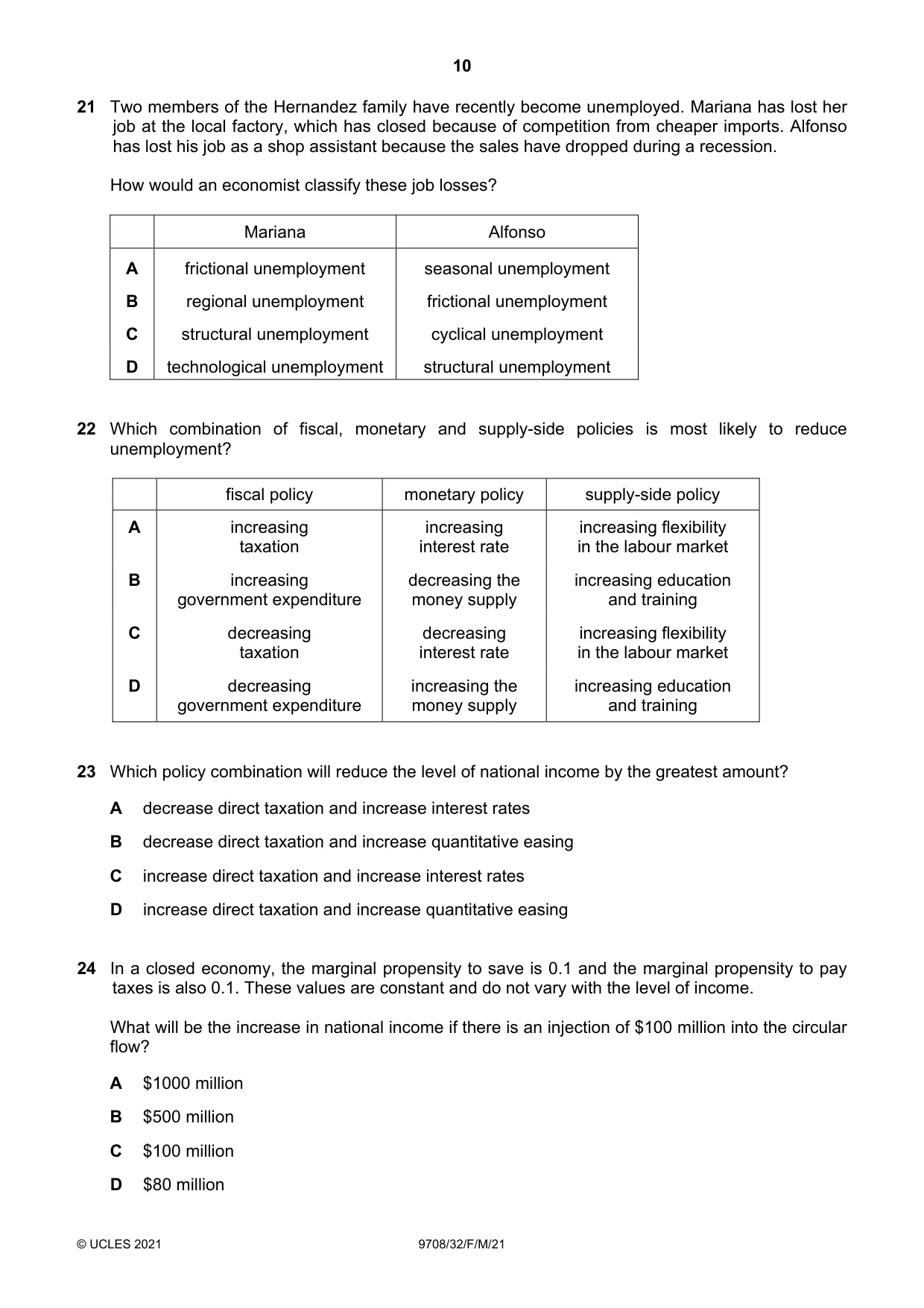
21 Two members of the Hernandez family have recently become unemployed. Mariana has lost her job at the local factory, which has closed because of competition from cheaper imports. Alfonso has lost his job as a shop assistant because the sales have dropped during a recession. How would an economist classify these job losses? Mariana Alfonso A frictional unemployment seasonal unemployment B regional unemployment frictional unemployment C structural unemployment cyclical unemployment D technological unemployment structural unemployment
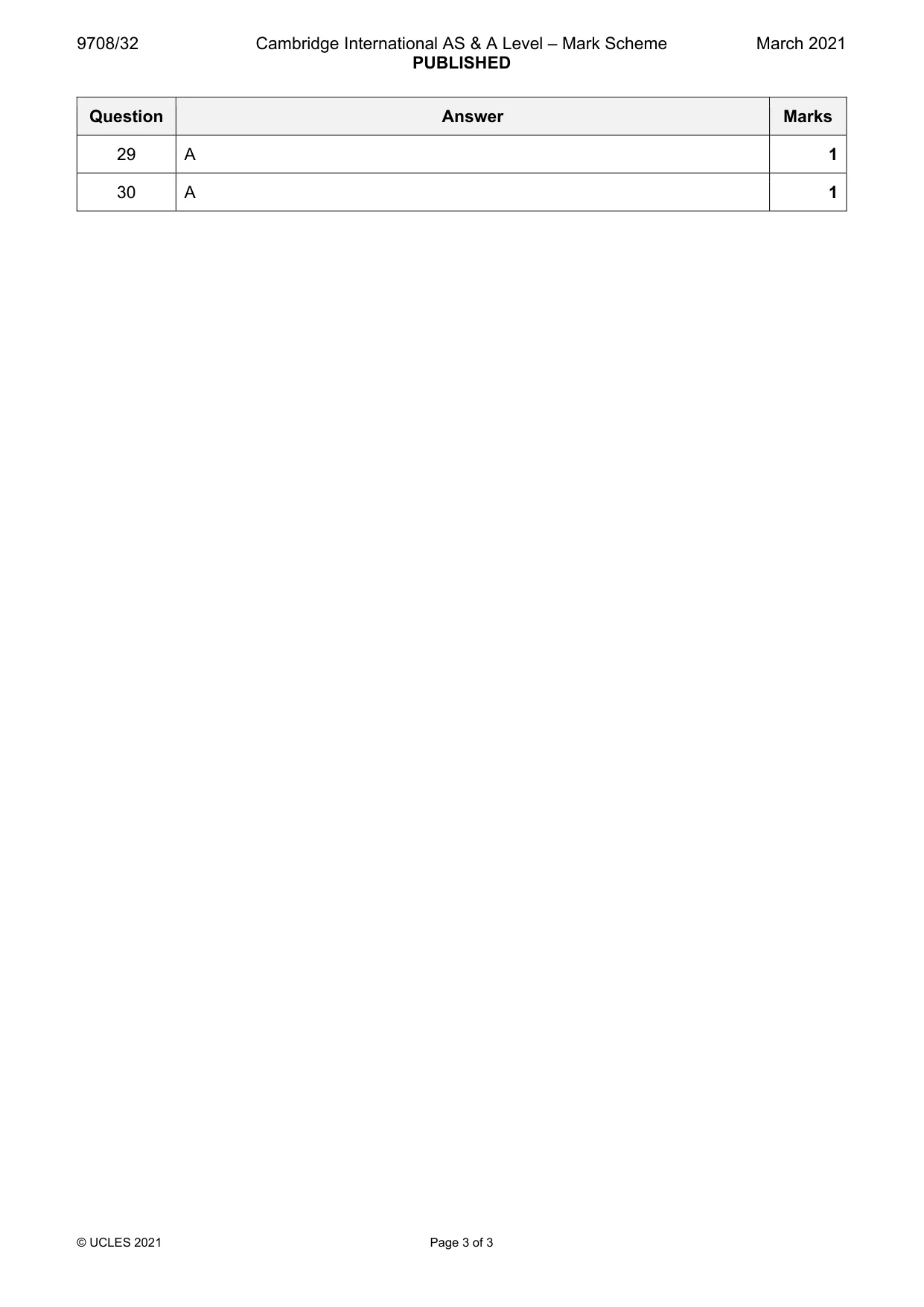
Mark scheme: C
Q22 · Which combination of fiscal, monetary and supply-side policies is most likely to reduce…
22 Which combination of fiscal, monetary and supply-side policies is most likely to reduce unemployment? fiscal policy monetary policy supply-side policy A increasing increasing increasing flexibility taxation interest rate in the labour market B increasing decreasing the increasing education government expenditure money supply and training C decreasing decreasing increasing flexibility taxation interest rate in the labour market D decreasing increasing the increasing education government expenditure money supply and training
Mark scheme: C
More questions on Effectiveness of policy options to meet all macroeconomic objectives
Q23 · Which policy combination will reduce the level of national income by the greatest amount?
23 Which policy combination will reduce the level of national income by the greatest amount? A decrease direct taxation and increase interest rates B decrease direct taxation and increase quantitative easing C increase direct taxation and increase interest rates D increase direct taxation and increase quantitative easing
Mark scheme: C
More questions on Effectiveness of policy options to meet all macroeconomic objectives
Q24 · In a closed economy, the marginal propensity to save is 0.1 and the marginal propensity…
24 In a closed economy, the marginal propensity to save is 0.1 and the marginal propensity to pay taxes is also 0.1. These values are constant and do not vary with the level of income. What will be the increase in national income if there is an injection of $100 million into the circular flow? A $1000 million B $500 million C $100 million D $80 million
Mark scheme: B
Q25 · Which combination is consistent with liquidity preference theory?
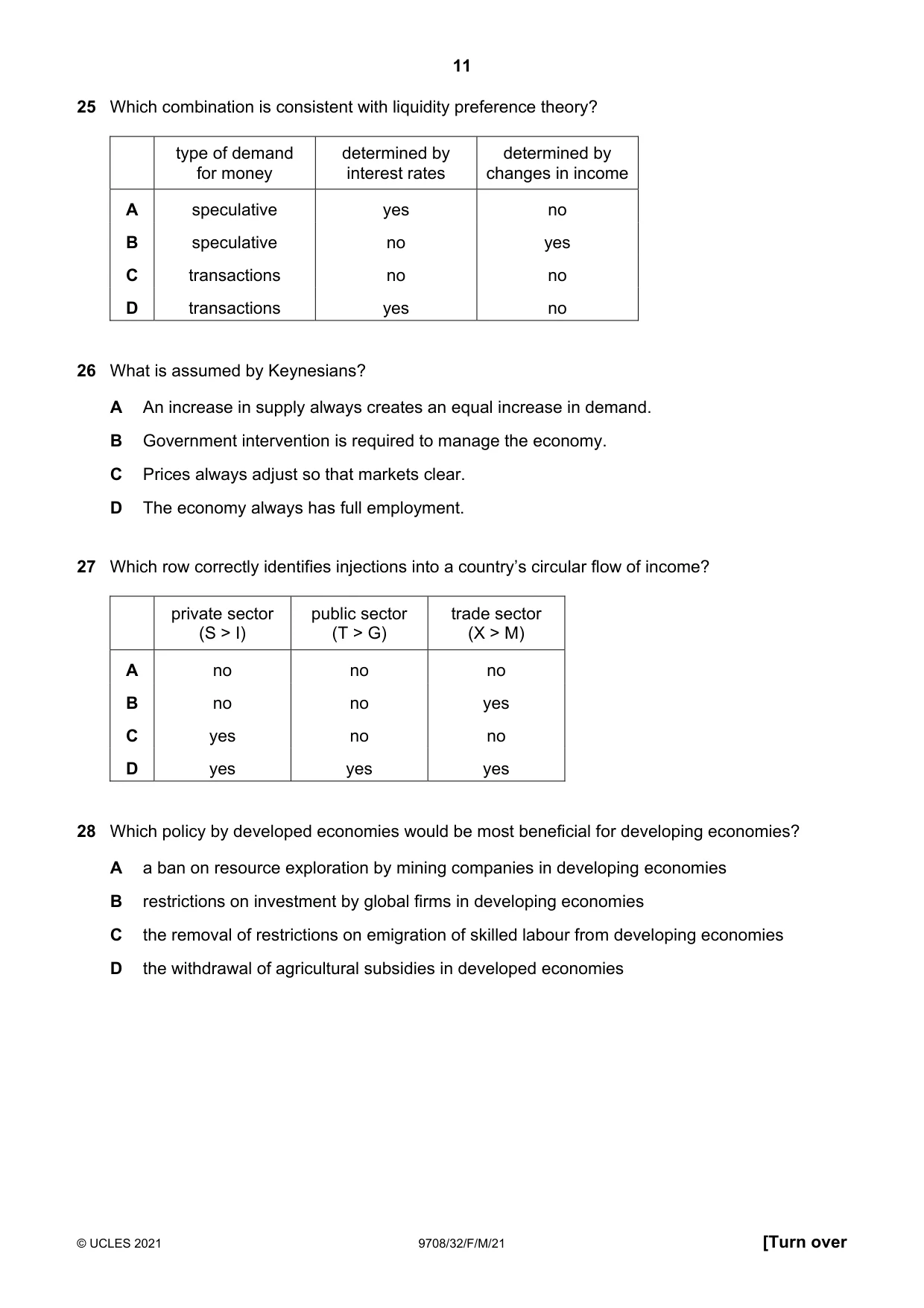
25 Which combination is consistent with liquidity preference theory? type of demand determined by determined by for money interest rates changes in income A speculative yes no B speculative no yes C transactions no no D transactions yes no
Mark scheme: A
Q26 · What is assumed by Keynesians?
26 What is assumed by Keynesians? A An increase in supply always creates an equal increase in demand. B Government intervention is required to manage the economy. C Prices always adjust so that markets clear. D The economy always has full employment.
Mark scheme: B
Q27 · Which row correctly identifies injections into a country’s circular flow of income?
27 Which row correctly identifies injections into a country’s circular flow of income? private sector public sector trade sector (S > I) (T > G) (X > M) A no no no B no no yes C yes no no D yes yes yes
Mark scheme: B
Q28 · Which policy by developed economies would be most beneficial for developing economies?
28 Which policy by developed economies would be most beneficial for developing economies? A a ban on resource exploration by mining companies in developing economies B restrictions on investment by global firms in developing economies C the removal of restrictions on emigration of skilled labour from developing economies D the withdrawal of agricultural subsidies in developed economies
Mark scheme: D
More questions on Relationship between countries at different levels of development
Q29 · The natural rate of unemployment in an economy is 5%
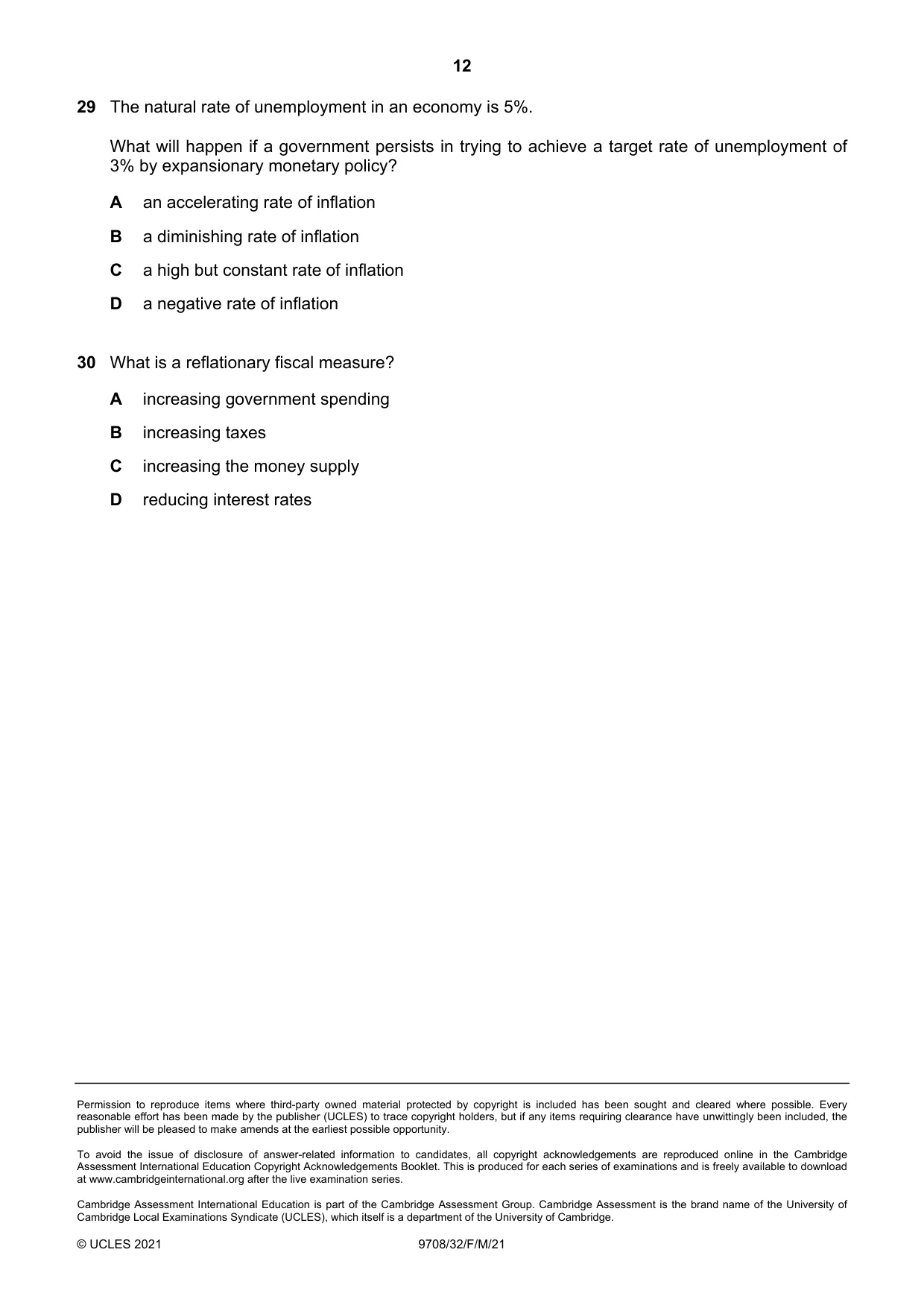
29 The natural rate of unemployment in an economy is 5%. What will happen if a government persists in trying to achieve a target rate of unemployment of 3% by expansionary monetary policy? A an accelerating rate of inflation B a diminishing rate of inflation C a high but constant rate of inflation D a negative rate of inflation
Mark scheme: A
Q30 · What is a reflationary fiscal measure?
30 What is a reflationary fiscal measure? A increasing government spending B increasing taxes C increasing the money supply D reducing interest rates
Mark scheme: A
What was in this paper
The subtopics covered by these 30 questions, and how many questions each got. Open one in a new tab to see every Cambridge question on it.
4Private costs and benefits, externalities and social costs and benefits3The circular flow of income3Different market structures2Effectiveness of policy options to meet all macroeconomic objectives2Employment/unemployment2Equity and redistribution of income and wealth2Government policies to achieve efficient resource allocation and correct market failure2Differing objectives and policies of firms1Economic development1Economic growth and sustainability1Fiscal policy1Growth and survival of firms1Indifference curves and budget lines1Labour market forces and government intervention1Money and banking1Relationship between countries at different levels of development1Utility1What you needed in this session
Cambridge’s own grade thresholds for 2021 Feb/March, Paper 3 · Variant 2. A higher threshold means an easier paper — the bar moves with how the cohort did.