Cambridge A Level Economics 9708 — 2020 Oct/Nov Paper 3 · Variant 1
9708/31/O/N/20 · 30 questions · 30 marks · ≈34 min
The question paper and its mark scheme, free to read here and free to download. This is Cambridge’s own paper, exactly as it was sat.
Question paper12 pages


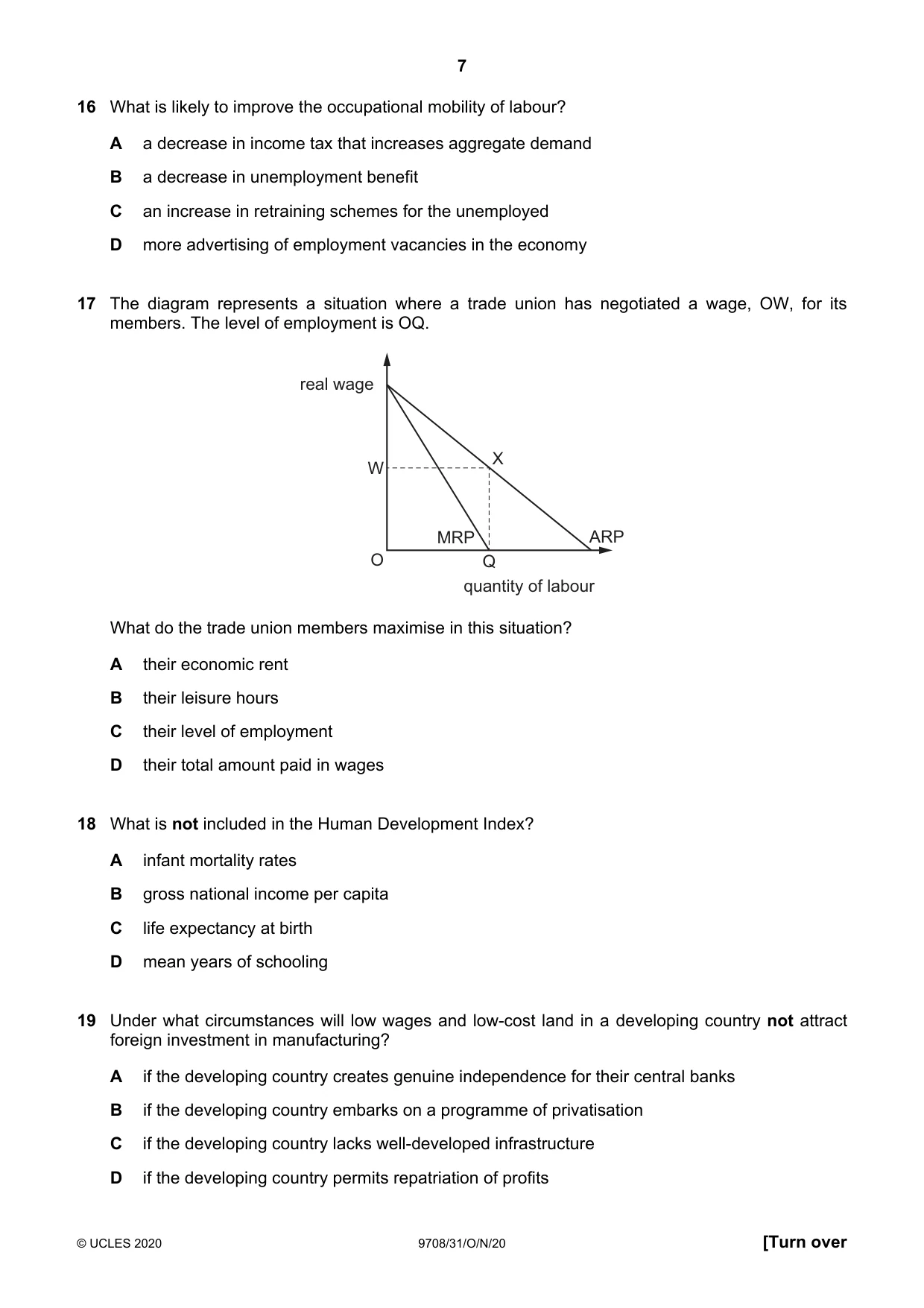

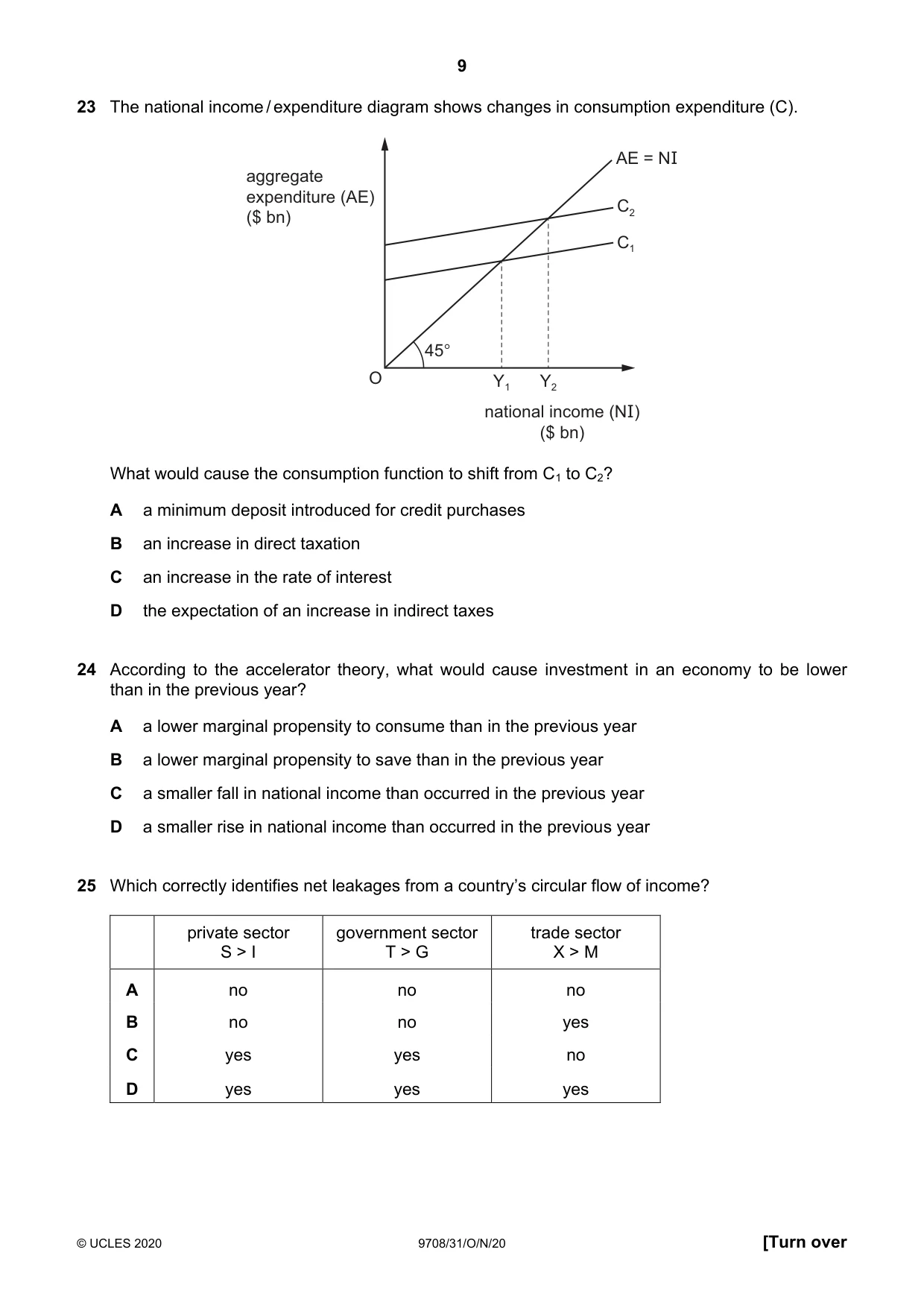
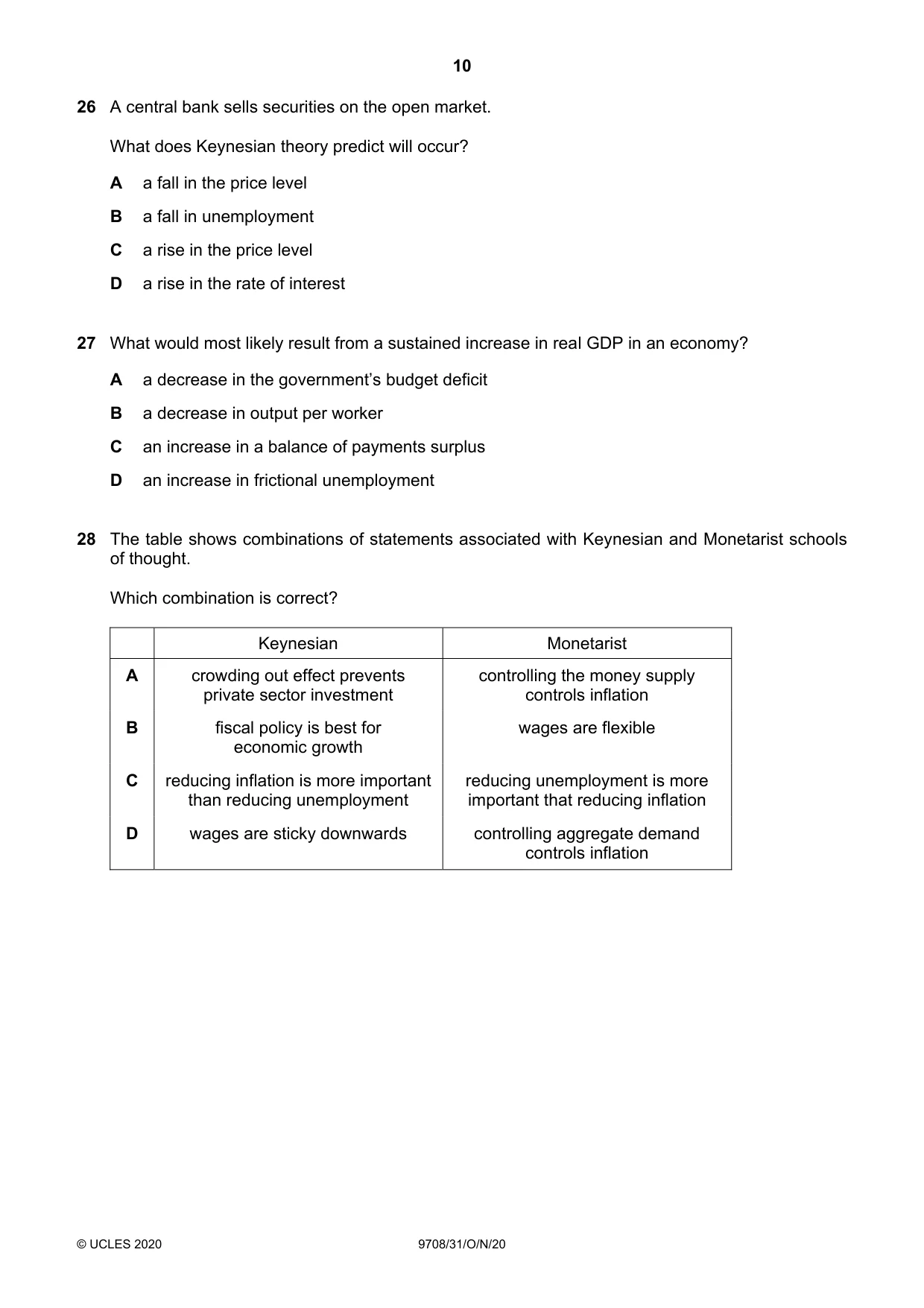
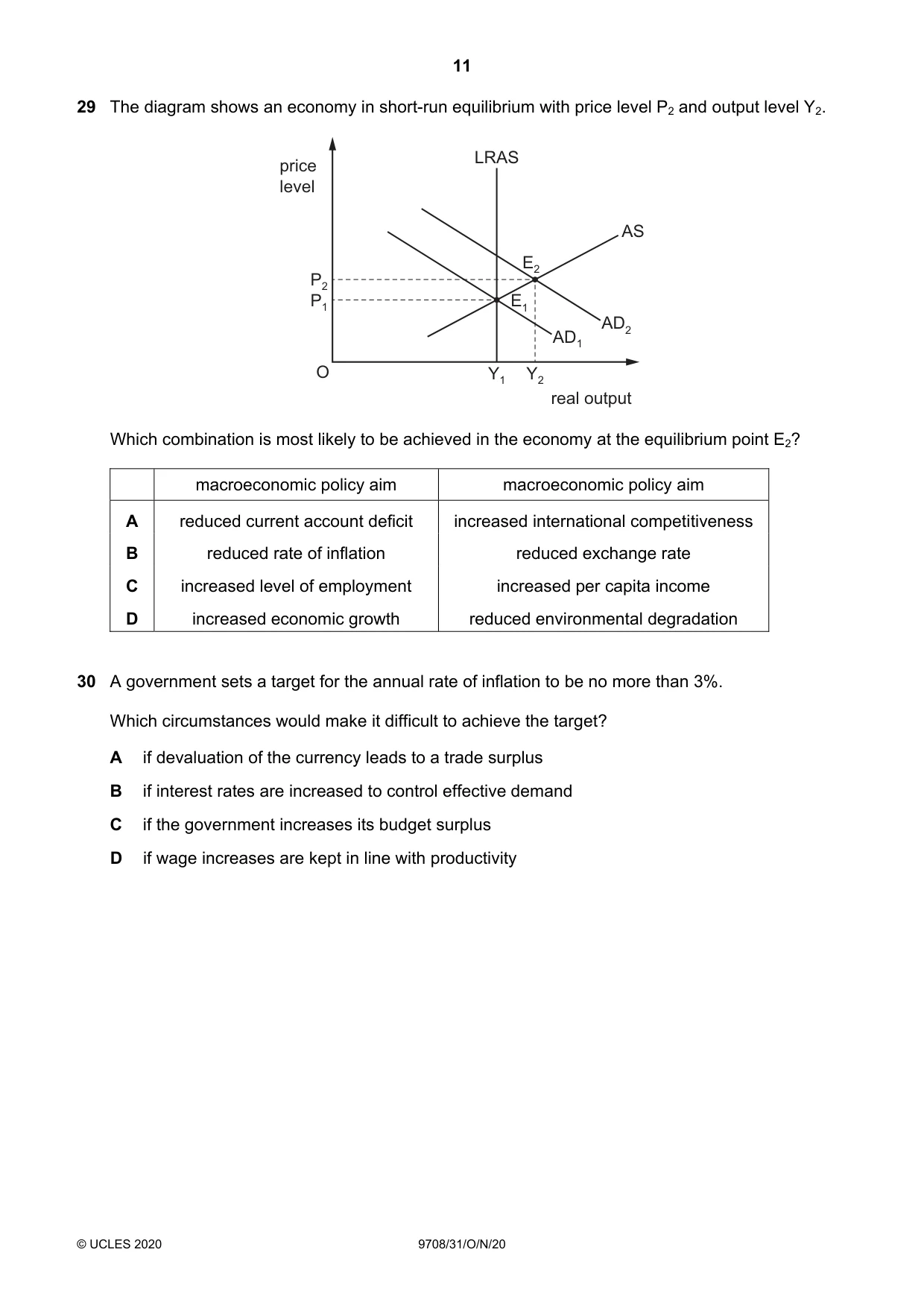

Mark scheme3 pages
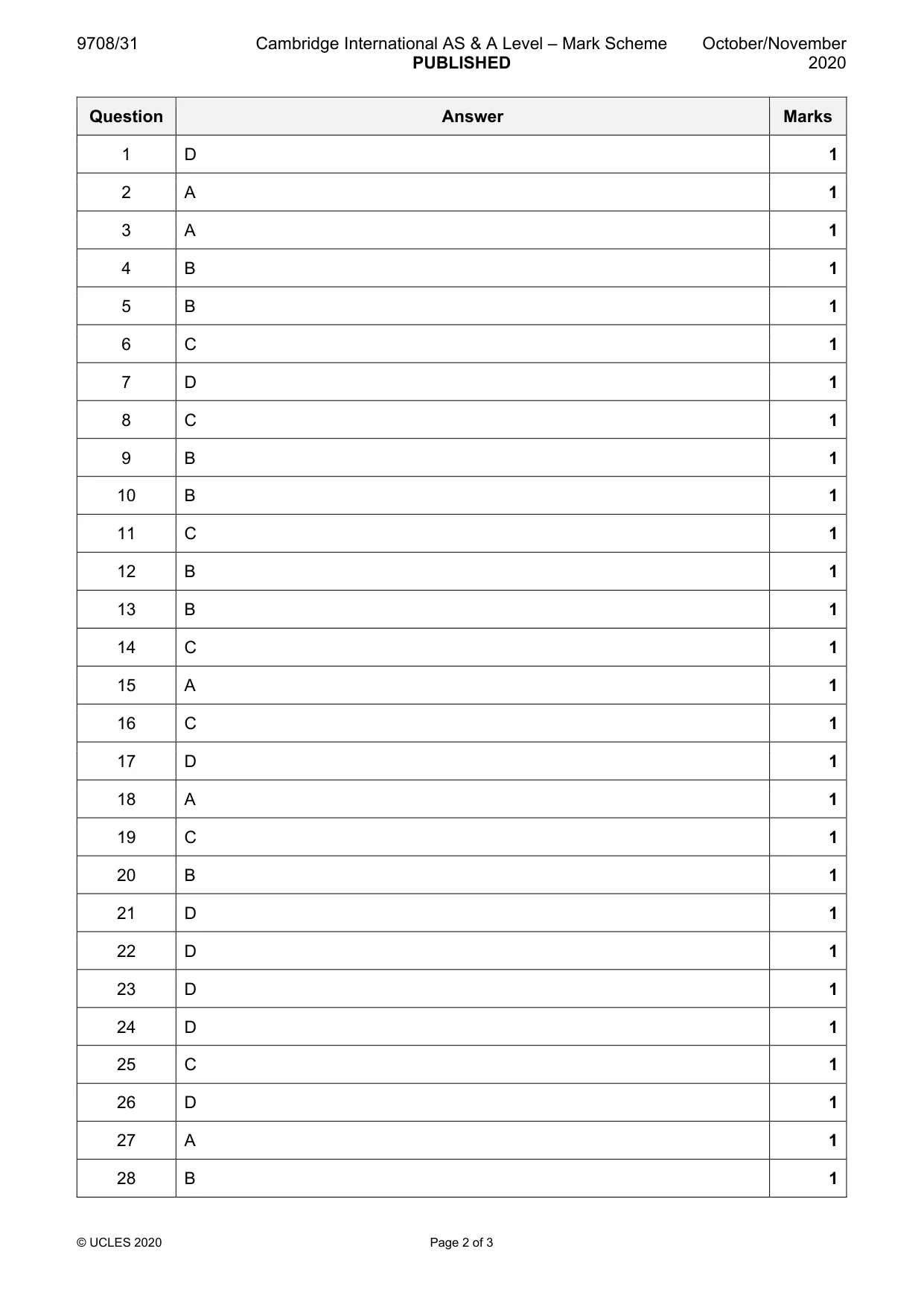
Answers below. Sit the paper first if you are practising.


Questions as text
Q1 · What is the main aim of cost-benefit analysis?
1 What is the main aim of cost-benefit analysis? A to allow firms to maximise their private benefit and minimise the external cost B to equate total social benefit to the total social cost of a project C to find the correct level of direct tax to internalise the external cost of a project D to find the highest positive difference between total benefit and total cost
Mark scheme: D
More questions on Private costs and benefits, externalities and social costs and benefits
Q2 · The diagram shows a firm in perfect competition that creates pollution
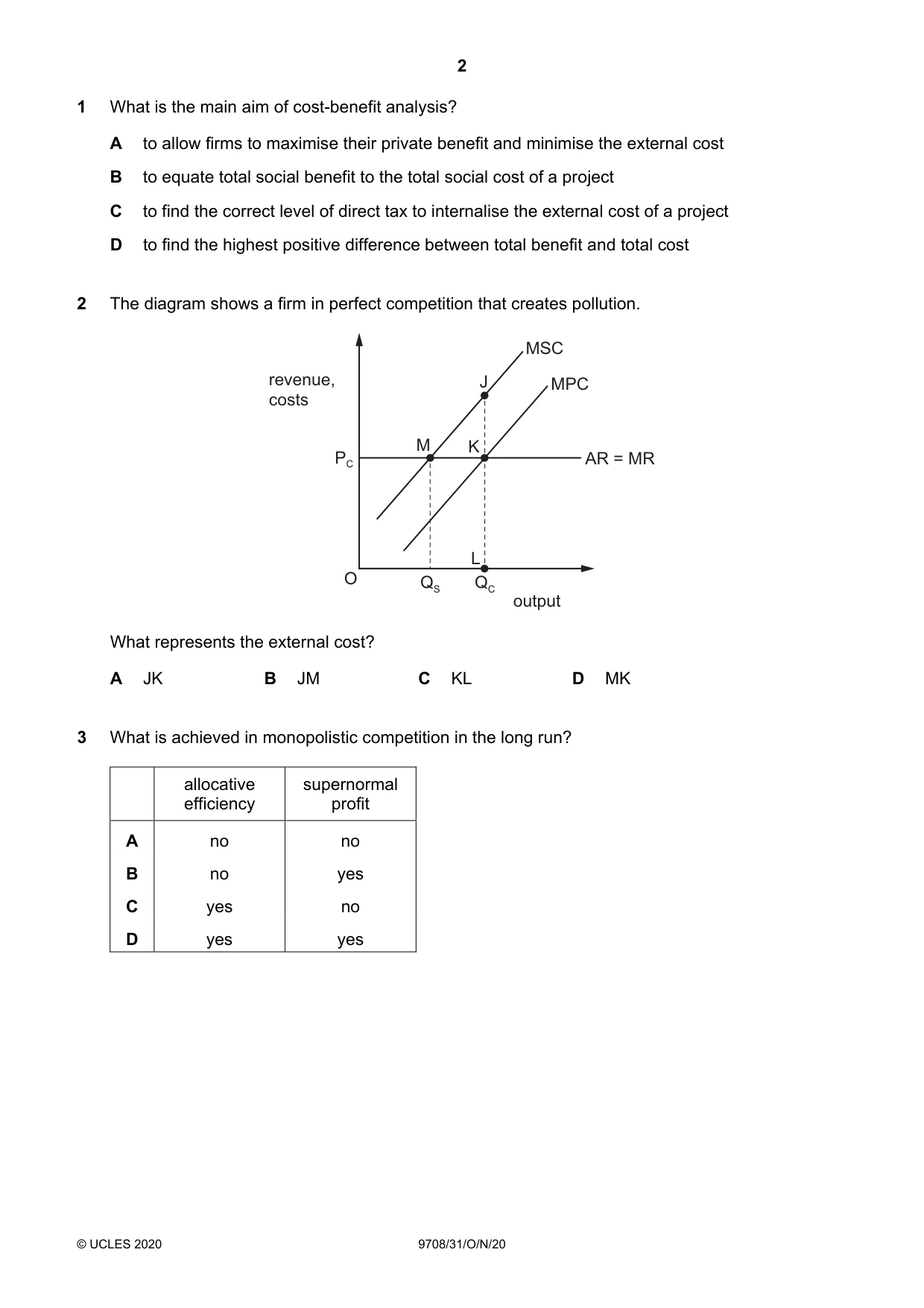
2 The diagram shows a firm in perfect competition that creates pollution. MSC revenue, J MPC costs M K PC AR = MR L O QS QC output What represents the external cost? A JK B JM C KL D MK
Mark scheme: A
More questions on Private costs and benefits, externalities and social costs and benefits
Q3 · What is achieved in monopolistic competition in the long run?
3 What is achieved in monopolistic competition in the long run? allocative supernormal efficiency profit A no no B no yes C yes no D yes yes
Mark scheme: A
Q4 · The table contains data on the total utility gained by a consumer from eating biscuits…
4 The table contains data on the total utility gained by a consumer from eating biscuits and chocolates in one day. biscuits / chocolates total utility (units) eaten biscuits chocolates 1 20 10 2 38 20 3 52 32 4 62 38 5 70 42 6 74 42 7 74 40 What can be concluded from the table? A The consumer gets diminishing marginal utility after eating the first chocolate. B The consumer gets negative marginal utility from the seventh chocolate eaten. C The consumer will never eat chocolates if biscuits are available. D The second biscuit eaten gives the same marginal utility as the fourth chocolate eaten.
Mark scheme: B
Q5 · The indifference curve diagram shows the effect of an increase in income on the…
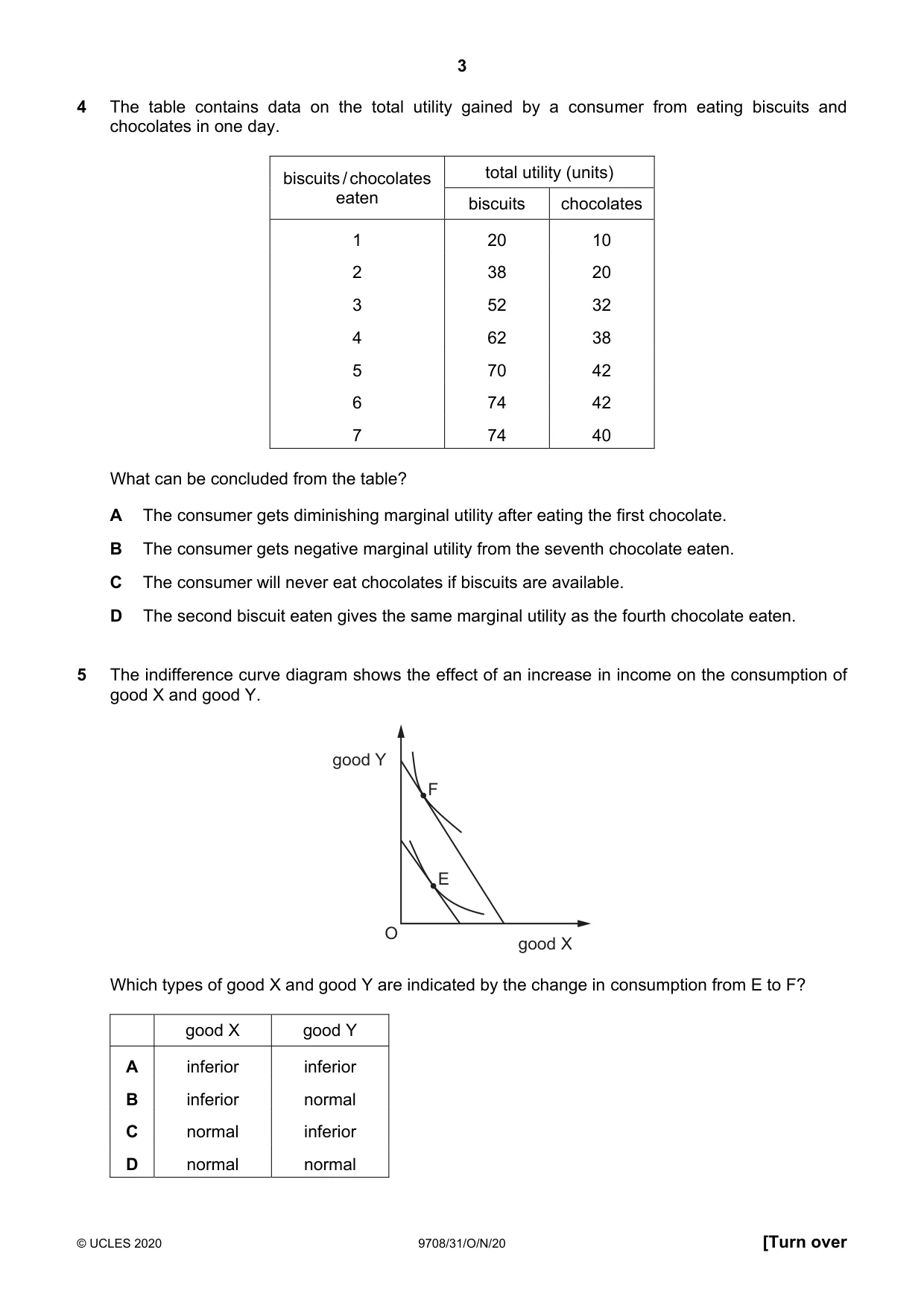
5 The indifference curve diagram shows the effect of an increase in income on the consumption of good X and good Y. good Y F E O good X Which types of good X and good Y are indicated by the change in consumption from E to F? good X good Y A inferior inferior B inferior normal C normal inferior D normal normal
Mark scheme: B
Q6 · A Chinese firm has total fixed costs of 1000 Yuan
6 A Chinese firm has total fixed costs of 1000 Yuan. The firm’s average variable cost is 10 Yuan and its average total cost is 15 Yuan. What is the firm’s output? A 10 units B 66 units C 200 units D 5000 units
Mark scheme: C
More questions on Types of cost, revenue and profit, short-run and long-run production
Q7 · What is not a requirement for the law of diminishing returns to operate in the short run?
7 What is not a requirement for the law of diminishing returns to operate in the short run? A At least one factor will be fixed in quantity. B Average returns to a variable factor will increase then fall. C Marginal product of a variable factor will increase then fall. D Inputs of all of the factors will be variable.
Mark scheme: D
More questions on Types of cost, revenue and profit, short-run and long-run production
Q8 · The diagram shows the costs and revenues of a firm that is producing output Qe with a…
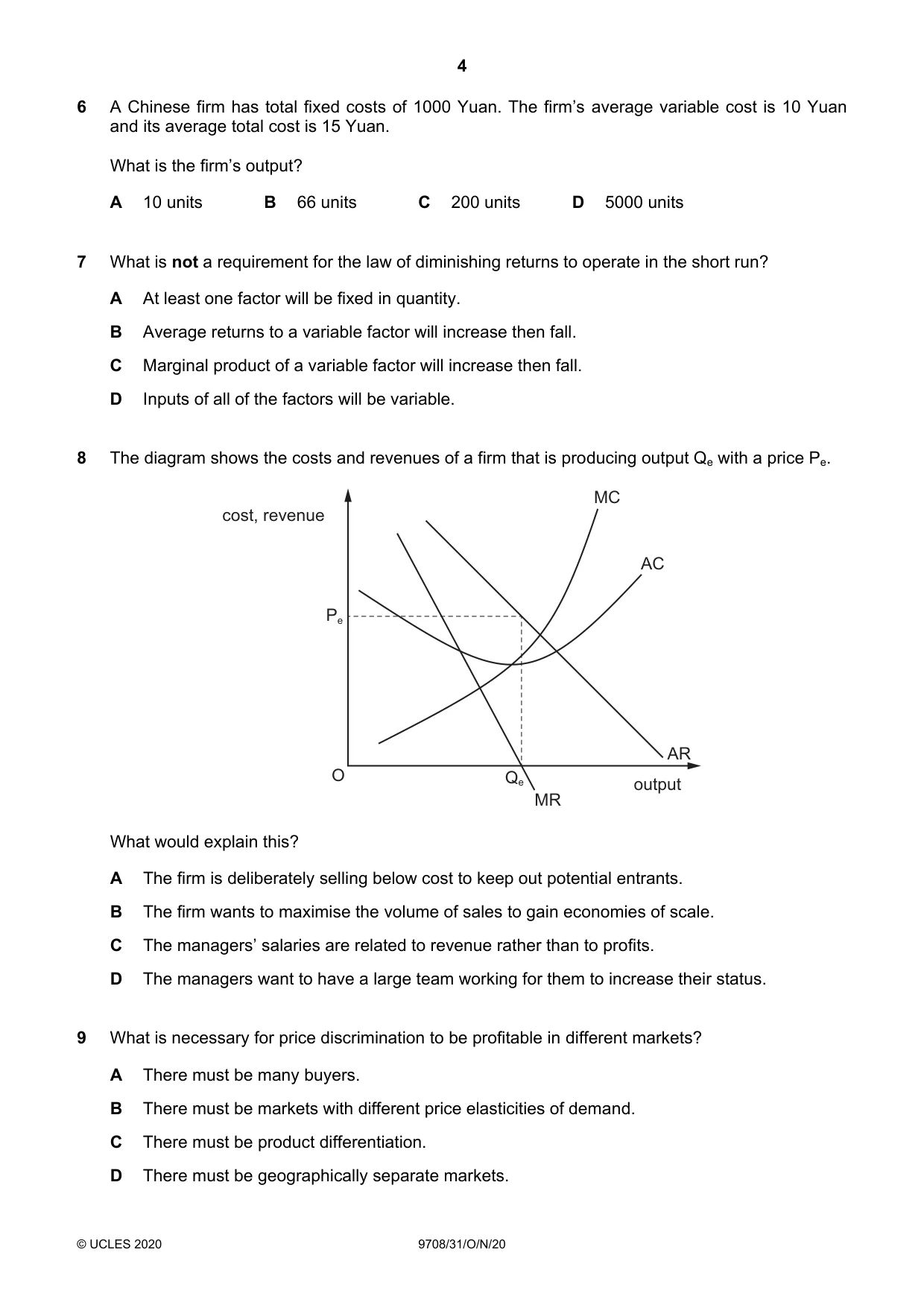
8 The diagram shows the costs and revenues of a firm that is producing output Qe with a price Pe. MC cost, revenue AC Pe AR O Qe output MR What would explain this? A The firm is deliberately selling below cost to keep out potential entrants. B The firm wants to maximise the volume of sales to gain economies of scale. C The managers’ salaries are related to revenue rather than to profits. D The managers want to have a large team working for them to increase their status.
Mark scheme: C
More questions on Differing objectives and policies of firms
Q9 · What is necessary for price discrimination to be profitable in different markets?
9 What is necessary for price discrimination to be profitable in different markets? A There must be many buyers. B There must be markets with different price elasticities of demand. C There must be product differentiation. D There must be geographically separate markets.
Mark scheme: B
Q10 · The diagram shows a firm’s short-run average cost curve
10 The diagram shows a firm’s short-run average cost curve. SRAC cost O output What explains the shape of the curve? A the law of diminishing marginal utility B the law of variable proportions C fixed costs exceeding variable costs D technical diseconomies
Mark scheme: B
More questions on Types of cost, revenue and profit, short-run and long-run production
Q11 · A firm successfully engages in a policy of predatory pricing
11 A firm successfully engages in a policy of predatory pricing. What will happen to the prices charged by the firm in the short run and in the long run? prices in the prices in the short run long run A rise rise B rise fall C fall rise D fall fall
Mark scheme: C
Q12 · Which is not a reason for the existence of small firms in a market dominated by large…
12 Which is not a reason for the existence of small firms in a market dominated by large companies? A Small firms can concentrate on providing specialist services. B Small firms enjoy greater economies of scale. C Small firms enter the market with new innovative ideas. D Small firms have good knowledge of local markets.
Mark scheme: B
Q13 · The diagram shows an industry’s supply and demand curves
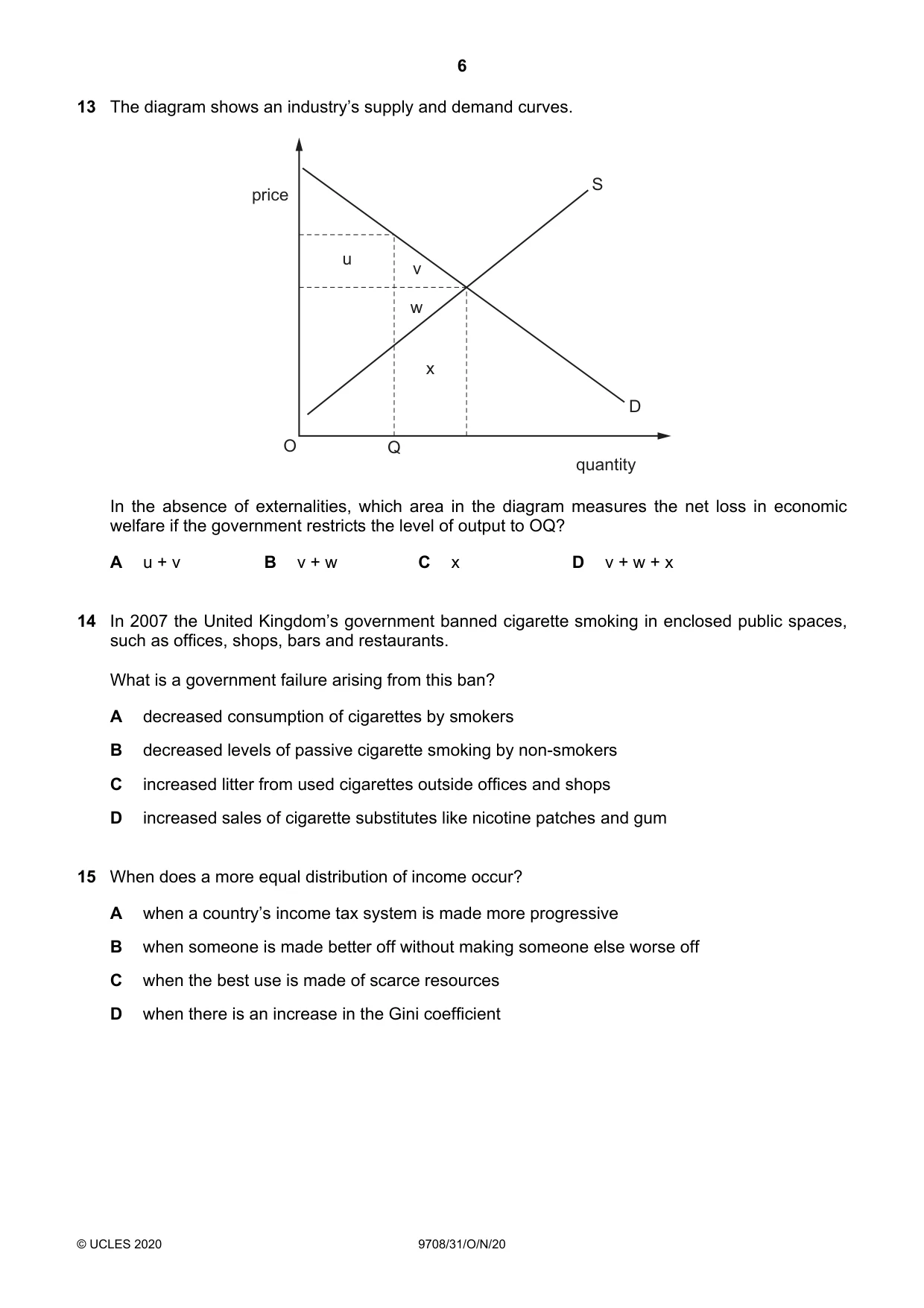
13 The diagram shows an industry’s supply and demand curves. S price u v w x D O Q quantity In the absence of externalities, which area in the diagram measures the net loss in economic welfare if the government restricts the level of output to OQ? A u + v B v + w C x D v + w + x
Mark scheme: B
Q14 · In 2007 the United Kingdom’s government banned cigarette smoking in enclosed public…
14 In 2007 the United Kingdom’s government banned cigarette smoking in enclosed public spaces, such as offices, shops, bars and restaurants. What is a government failure arising from this ban? A decreased consumption of cigarettes by smokers B decreased levels of passive cigarette smoking by non-smokers C increased litter from used cigarettes outside offices and shops D increased sales of cigarette substitutes like nicotine patches and gum
Mark scheme: C
Q15 · When does a more equal distribution of income occur?
15 When does a more equal distribution of income occur? A when a country’s income tax system is made more progressive B when someone is made better off without making someone else worse off C when the best use is made of scarce resources D when there is an increase in the Gini coefficient
Mark scheme: A
More questions on Equity and redistribution of income and wealth
Q16 · What is likely to improve the occupational mobility of labour?
16 What is likely to improve the occupational mobility of labour? A a decrease in income tax that increases aggregate demand B a decrease in unemployment benefit C an increase in retraining schemes for the unemployed D more advertising of employment vacancies in the economy
Mark scheme: C
More questions on Labour market forces and government intervention
Q17 · The diagram represents a situation where a trade union has negotiated a wage, OW, for its…
17 The diagram represents a situation where a trade union has negotiated a wage, OW, for its members. The level of employment is OQ. real wage X W MRP ARP O Q quantity of labour What do the trade union members maximise in this situation? A their economic rent B their leisure hours C their level of employment D their total amount paid in wages
Mark scheme: D
More questions on Labour market forces and government intervention
Q18 · What is not included in the Human Development Index?
18 What is not included in the Human Development Index? A infant mortality rates B gross national income per capita C life expectancy at birth D mean years of schooling
Mark scheme: A
More questions on Characteristics of countries at different levels of development
Q19 · Under what circumstances will low wages and low-cost land in a developing country not…
19 Under what circumstances will low wages and low-cost land in a developing country not attract foreign investment in manufacturing? A if the developing country creates genuine independence for their central banks B if the developing country embarks on a programme of privatisation C if the developing country lacks well-developed infrastructure D if the developing country permits repatriation of profits
Mark scheme: C
Q20 · An individual was temporarily unemployed but found a job quickly
20 An individual was temporarily unemployed but found a job quickly. What type of unemployment is this? A cyclical unemployment B frictional unemployment C seasonal unemployment D structural unemployment
Mark scheme: B
Q21 · In 2012 a United Nations report calculated the stock of wealth of 20 countries in terms…
21 In 2012 a United Nations report calculated the stock of wealth of 20 countries in terms of human, natural and produced resources. This was measured as the Inclusive Wealth Index (IWI). The diagram shows the annual percentage (%) change in the IWI between 1990 and 2008 of four economies. It also shows their 2008 GDP per head ($). GDP per key change in IWI, 1990–2008 (%) head ($) human China 3 404 resources Kenya 722 natural Nigeria 1 401 resources Russia 11 704 produced resources –25 0 25 50 75 IWI What can be concluded from the diagram? A A low level of GDP per head meant an inability to build stocks of wealth. B All countries were able to prevent depletion of their natural resources. C The faster the growth in a country’s IWI the higher was its GDP. D There was an increase in human resources in all four countries.
Mark scheme: D
More questions on Characteristics of countries at different levels of development
Q22 · What would represent a monetarist anti-inflationary policy?
22 What would represent a monetarist anti-inflationary policy? A an increase in indirect taxation B direct foreign exchange rate intervention C the introduction of maximum prices D the sale of securities on the open market
Mark scheme: D
Q23 · The national income / expenditure diagram shows changes in consumption expenditure (C)
23 The national income / expenditure diagram shows changes in consumption expenditure (C). AE = NI aggregate expenditure (AE) C2 ($ bn) C1 45° O Y1 Y2 national income (NI) ($ bn) What would cause the consumption function to shift from C1 to C2? A a minimum deposit introduced for credit purchases B an increase in direct taxation C an increase in the rate of interest D the expectation of an increase in indirect taxes
Mark scheme: D
Q24 · According to the accelerator theory, what would cause investment in an economy to be…
24 According to the accelerator theory, what would cause investment in an economy to be lower than in the previous year? A a lower marginal propensity to consume than in the previous year B a lower marginal propensity to save than in the previous year C a smaller fall in national income than occurred in the previous year D a smaller rise in national income than occurred in the previous year
Mark scheme: D
Q25 · Which correctly identifies net leakages from a country’s circular flow of income?
25 Which correctly identifies net leakages from a country’s circular flow of income? private sector government sector trade sector S > I T > G X > M A no no no B no no yes C yes yes no D yes yes yes
Mark scheme: C
Q26 · A central bank sells securities on the open market
26 A central bank sells securities on the open market. What does Keynesian theory predict will occur? A a fall in the price level B a fall in unemployment C a rise in the price level D a rise in the rate of interest
Mark scheme: D
Q27 · What would most likely result from a sustained increase in real GDP in an economy?
27 What would most likely result from a sustained increase in real GDP in an economy? A a decrease in the government’s budget deficit B a decrease in output per worker C an increase in a balance of payments surplus D an increase in frictional unemployment
Mark scheme: A
Q28 · The table shows combinations of statements associated with Keynesian and Monetarist…
28 The table shows combinations of statements associated with Keynesian and Monetarist schools of thought. Which combination is correct? Keynesian Monetarist A crowding out effect prevents controlling the money supply private sector investment controls inflation B fiscal policy is best for wages are flexible economic growth C reducing inflation is more important reducing unemployment is more than reducing unemployment important that reducing inflation D wages are sticky downwards controlling aggregate demand controls inflation
Mark scheme: B
Q29 · The diagram shows an economy in short-run equilibrium with price level P2 and output…
29 The diagram shows an economy in short-run equilibrium with price level P2 and output level Y2. LRAS price level AS E2 P2 P1 E1 AD2 AD1 O Y1 Y2 real output Which combination is most likely to be achieved in the economy at the equilibrium point E2? macroeconomic policy aim macroeconomic policy aim A reduced current account deficit increased international competitiveness B reduced rate of inflation reduced exchange rate C increased level of employment increased per capita income D increased economic growth reduced environmental degradation
Mark scheme: C
Q30 · A government sets a target for the annual rate of inflation to be no more than 3%
30 A government sets a target for the annual rate of inflation to be no more than 3%. Which circumstances would make it difficult to achieve the target? A if devaluation of the currency leads to a trade surplus B if interest rates are increased to control effective demand C if the government increases its budget surplus D if wage increases are kept in line with productivity
Mark scheme: A
More questions on Government macroeconomic policy objectives
What was in this paper
The subtopics covered by these 30 questions, and how many questions each got. Open one in a new tab to see every Cambridge question on it.
3Economic growth and sustainability3Types of cost, revenue and profit, short-run and long-run production3Characteristics of countries at different levels of development2Employment/unemployment2Government policies to achieve efficient resource allocation and correct market failure2Labour market forces and government intervention2Private costs and benefits, externalities and social costs and benefits2The circular flow of income2Differing objectives and policies of firms1Economic development1Equity and redistribution of income and wealth1Government macroeconomic policy objectives1Growth and survival of firms1Indifference curves and budget lines1Monetary policy1Money and banking1Utility1What you needed in this session
Cambridge’s own grade thresholds for 2020 Oct/Nov, Paper 3 · Variant 1. A higher threshold means an easier paper — the bar moves with how the cohort did.