Questions as text
Q1 · The information in the table is taken from a country’s national income accounts 9708/31 Oct/Nov 2009
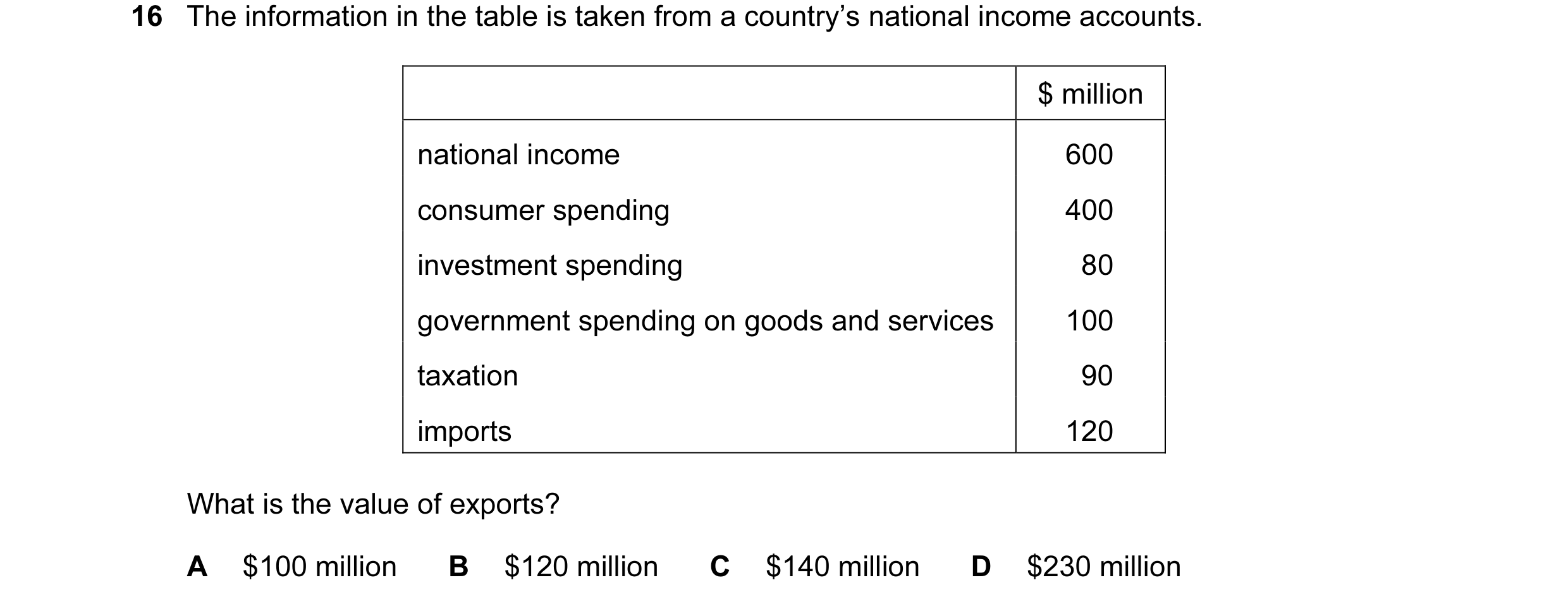
16 The information in the table is taken from a country’s national income accounts. $ million national income 600 consumer spending 400 investment spending 80 government spending on goods and services 100 taxation 90 imports 120 What is the value of exports? A $100 million B $120 million C $140 million D $230 million
1 marks
Answer: C
This question in 9708/31 Oct/Nov 2009
Q2 · Out of any addition to national income, 20 % is spent on imports, 15 % is paid in taxes… 9708/31 Oct/Nov 2009
20 Out of any addition to national income, 20 % is spent on imports, 15 % is paid in taxes, 5 % is saved and the rest is spent on domestically-produced goods. What is the value of the multiplier? A 2.5 B 5 C 6 D 20
1 marks
Answer: A
This question in 9708/31 Oct/Nov 2009
Q3 · The diagram shows the relationship between household income and household consumption 9708/31 May/June 2010
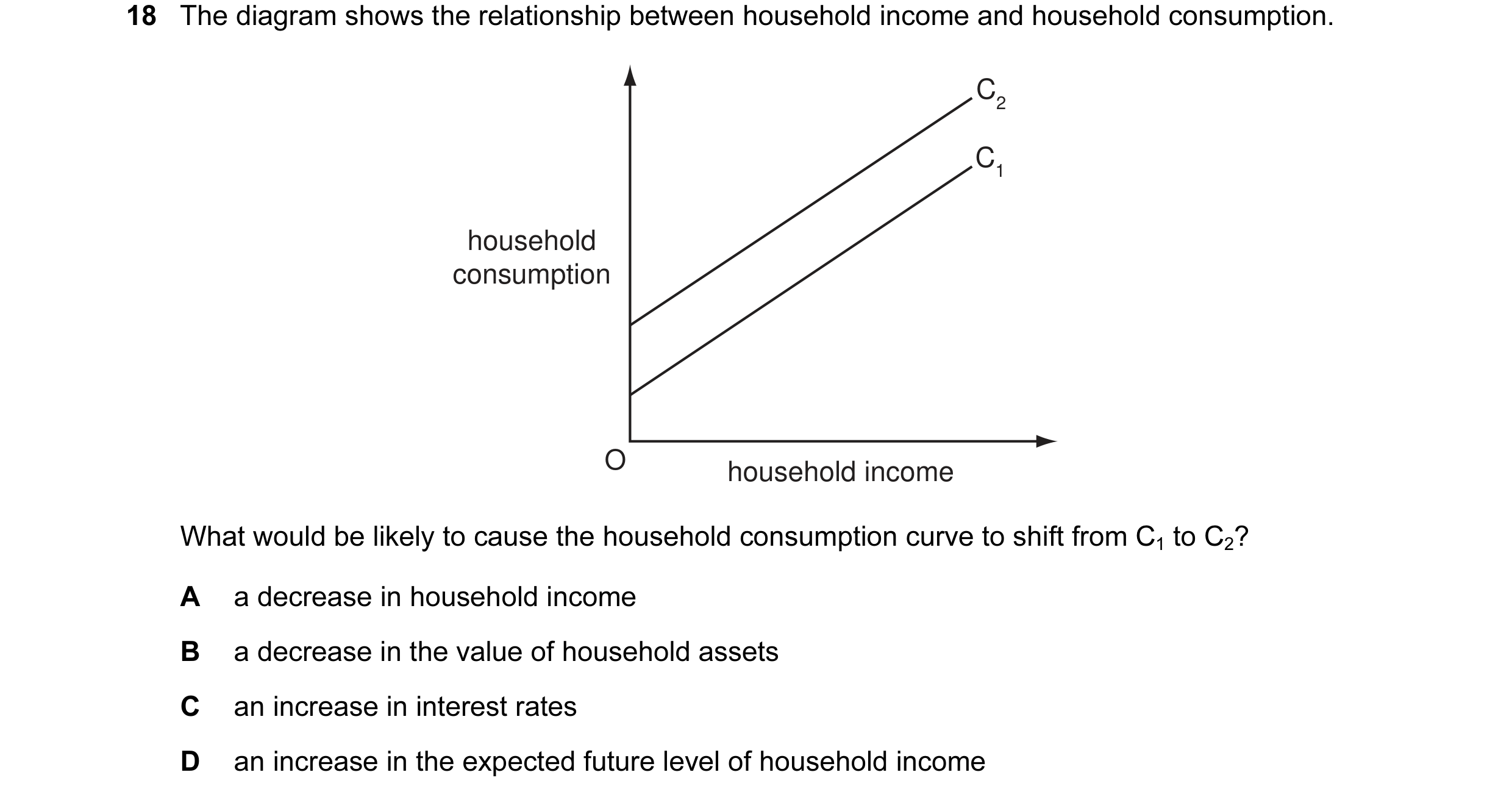
18 The diagram shows the relationship between household income and household consumption. C2 C1 household consumption O household income What would be likely to cause the household consumption curve to shift from C1 to C2? A a decrease in household income B a decrease in the value of household assets C an increase in interest rates D an increase in the expected future level of household income
1 marks
Answer: D
This question in 9708/31 May/June 2010
Q4 · The diagram shows a consumption function for a closed economy with no government 9708/31 May/June 2010
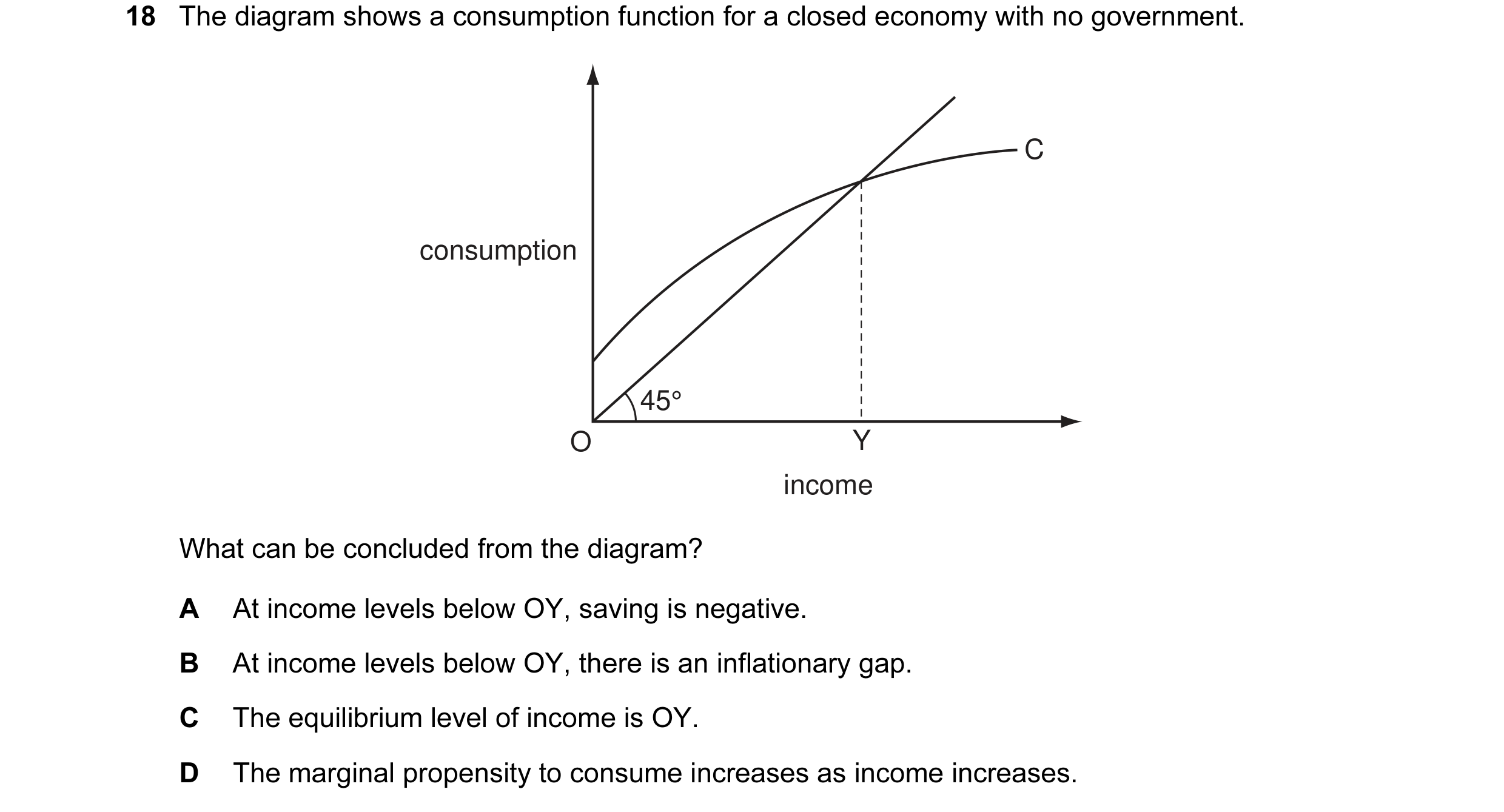
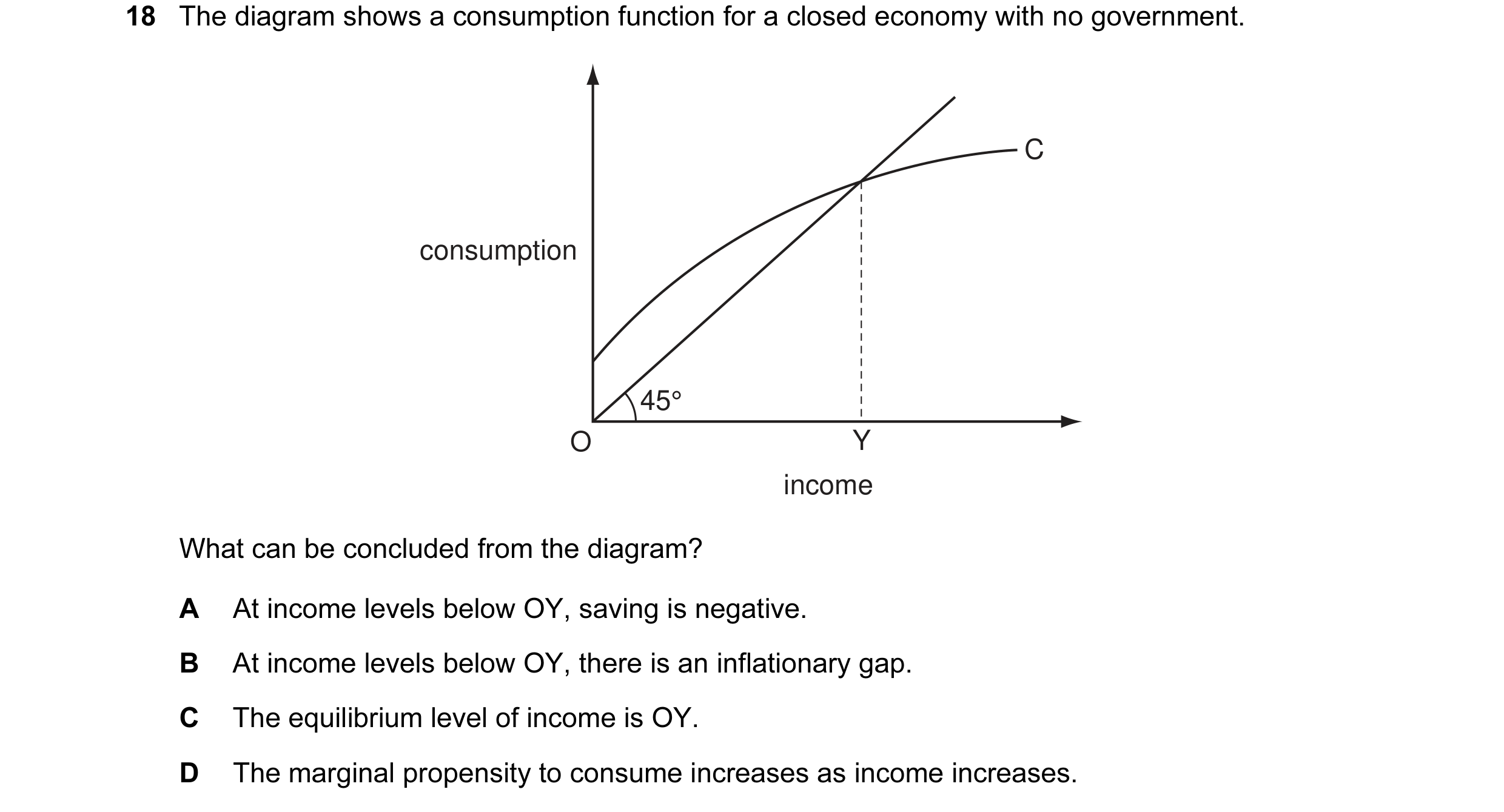
19 The diagram shows a consumption function for a closed economy with no government. C consumption 45° O Y income What can be concluded from the diagram? A At income levels below OY, saving is negative. B At income levels below OY, there is an inflationary gap. C The equilibrium level of income is OY. D The marginal propensity to consume increases as income increases.
1 marks
Answer: A
This question in 9708/31 May/June 2010
Q5 · When national income equals $40 000 million and government spending equals $15 000… 9708/31 May/June 2010
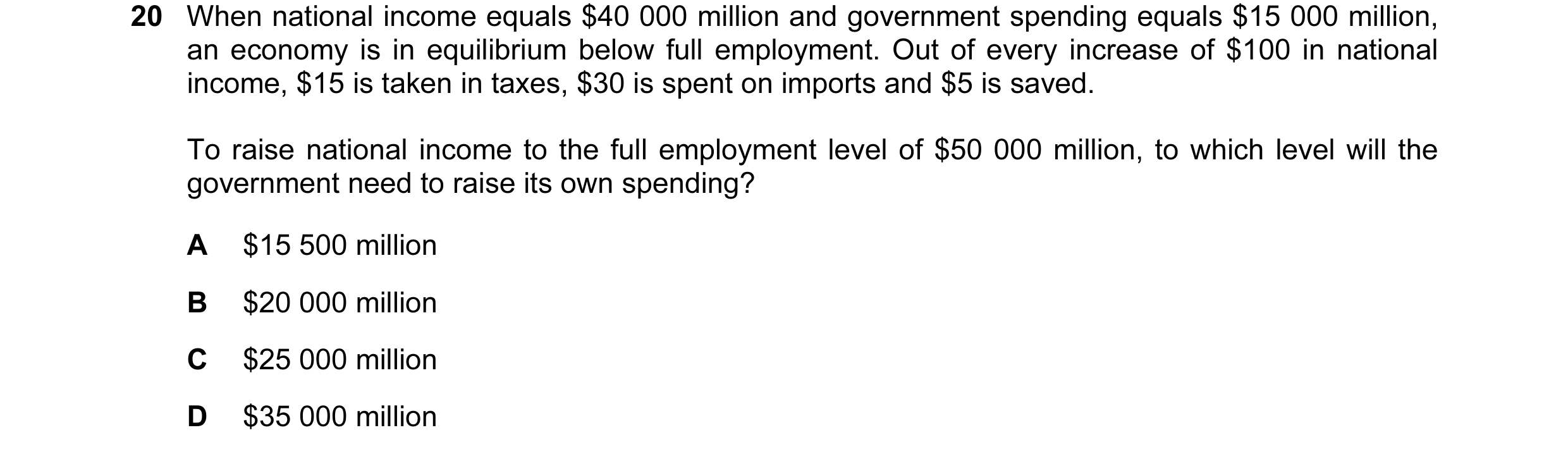
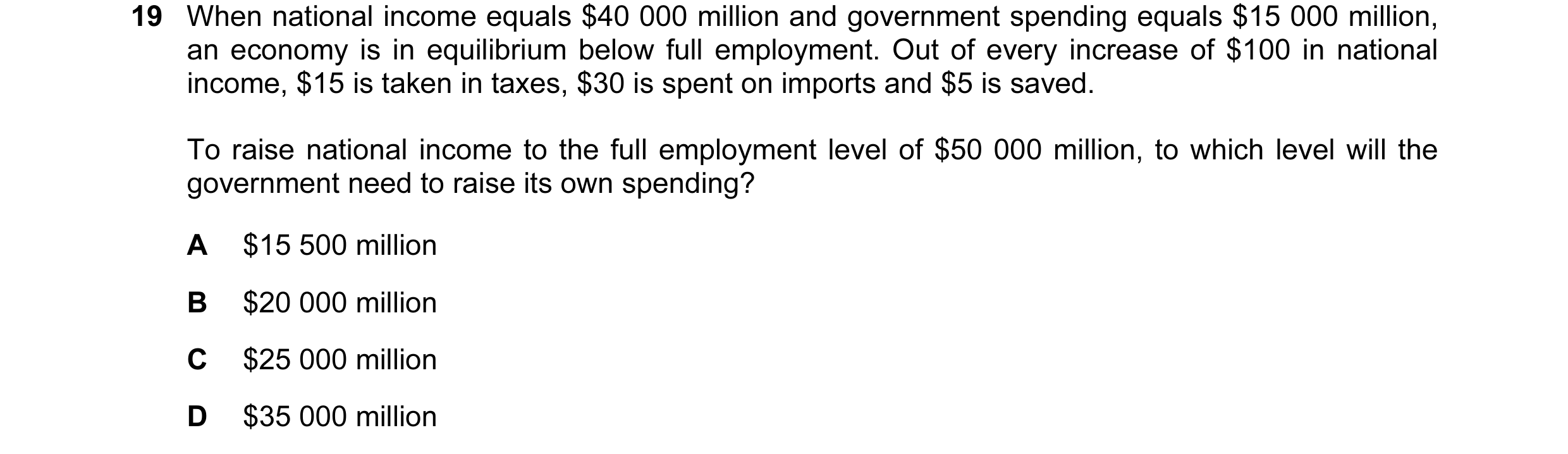
20 When national income equals $40 000 million and government spending equals $15 000 million, an economy is in equilibrium below full employment. Out of every increase of $100 in national income, $15 is taken in taxes, $30 is spent on imports and $5 is saved. To raise national income to the full employment level of $50 000 million, to which level will the government need to raise its own spending? A $15 500 million B $20 000 million C $25 000 million D $35 000 million
1 marks
Answer: B
This question in 9708/31 May/June 2010
Q6 · The diagram shows a consumption function for a closed economy with no government 9708/32 May/June 2010
18 The diagram shows a consumption function for a closed economy with no government. C consumption 45° O Y income What can be concluded from the diagram? A At income levels below OY, saving is negative. B At income levels below OY, there is an inflationary gap. C The equilibrium level of income is OY. D The marginal propensity to consume increases as income increases.
1 marks
Answer: A
This question in 9708/32 May/June 2010
Q7 · When national income equals $40 000 million and government spending equals $15 000… 9708/32 May/June 2010
19 When national income equals $40 000 million and government spending equals $15 000 million, an economy is in equilibrium below full employment. Out of every increase of $100 in national income, $15 is taken in taxes, $30 is spent on imports and $5 is saved. To raise national income to the full employment level of $50 000 million, to which level will the government need to raise its own spending? A $15 500 million B $20 000 million C $25 000 million D $35 000 million
1 marks
Answer: B
This question in 9708/32 May/June 2010
Q8 · What will be the impact of an increase in marginal tax rates? 9708/32 May/June 2010
29 What will be the impact of an increase in marginal tax rates? A an increase in the propensity to save B an increase in the value of the investment multiplier C a strengthening of work incentives D a strengthening in the operation of automatic stabilisers
1 marks
Answer: D
This question in 9708/32 May/June 2010
Q9 · The diagram shows a consumption function for a closed economy with no government 9708/33 May/June 2010
18 The diagram shows a consumption function for a closed economy with no government. C consumption 45° O Y income What can be concluded from the diagram? A At income levels below OY, saving is negative. B At income levels below OY, there is an inflationary gap. C The equilibrium level of income is OY. D The marginal propensity to consume increases as income increases.
1 marks
Answer: A
This question in 9708/33 May/June 2010
Q10 · When national income equals $40 000 million and government spending equals $15 000… 9708/33 May/June 2010
19 When national income equals $40 000 million and government spending equals $15 000 million, an economy is in equilibrium below full employment. Out of every increase of $100 in national income, $15 is taken in taxes, $30 is spent on imports and $5 is saved. To raise national income to the full employment level of $50 000 million, to which level will the government need to raise its own spending? A $15 500 million B $20 000 million C $25 000 million D $35 000 million
1 marks
Answer: B
This question in 9708/33 May/June 2010
Q11 · What is not a leakage from the circular flow of income? 9708/31 Oct/Nov 2010
16 What is not a leakage from the circular flow of income? A expenditure on foreign goods B indirect taxes C undistributed profits D unemployment benefits
1 marks
Answer: D
This question in 9708/31 Oct/Nov 2010
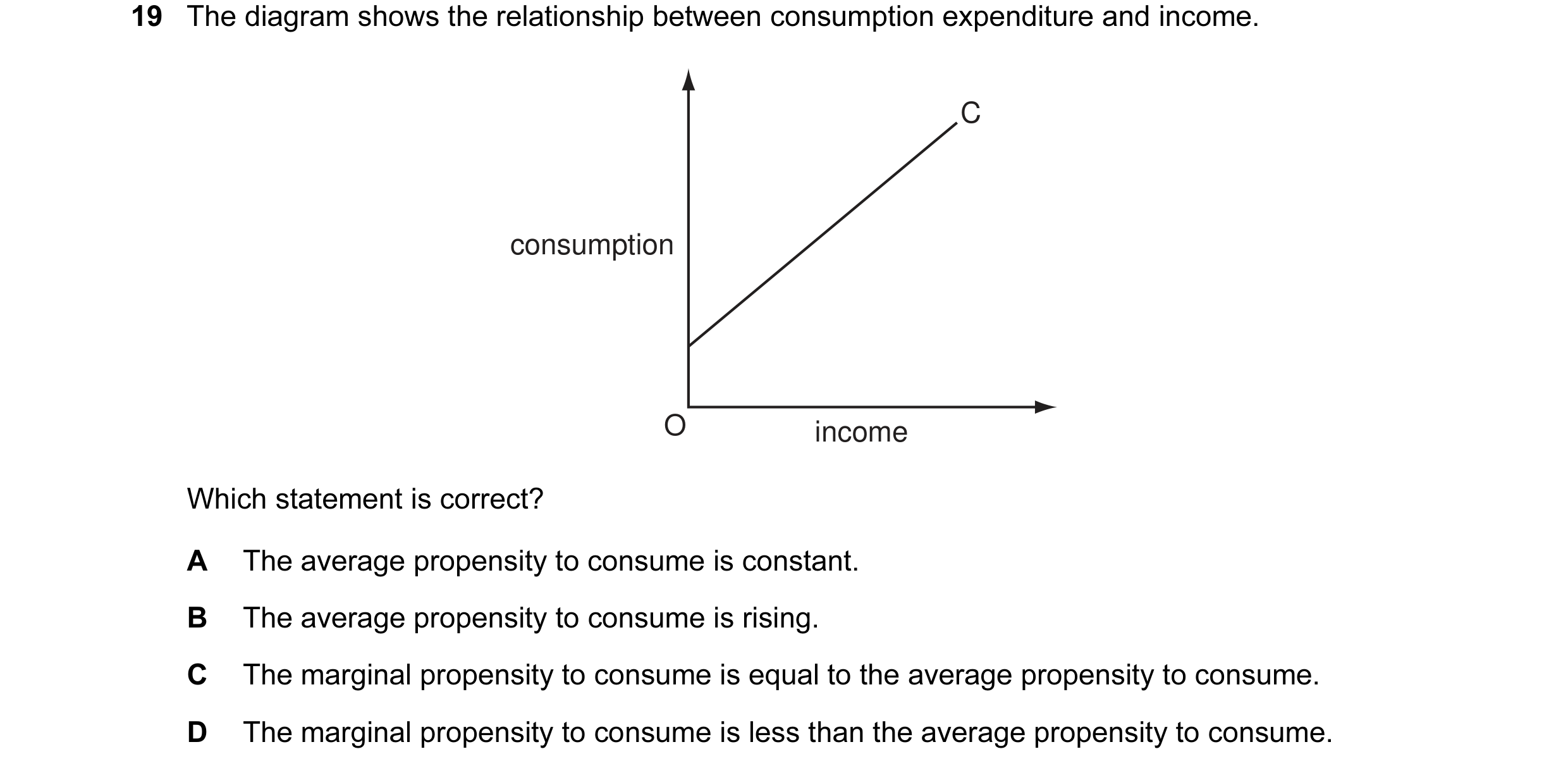
Q12 · The diagram shows the relationship between consumption expenditure and income 9708/31 Oct/Nov 2010
19 The diagram shows the relationship between consumption expenditure and income. C consumption O income Which statement is correct? A The average propensity to consume is constant. B The average propensity to consume is rising. C The marginal propensity to consume is equal to the average propensity to consume. D The marginal propensity to consume is less than the average propensity to consume.
1 marks
Answer: D
This question in 9708/31 Oct/Nov 2010
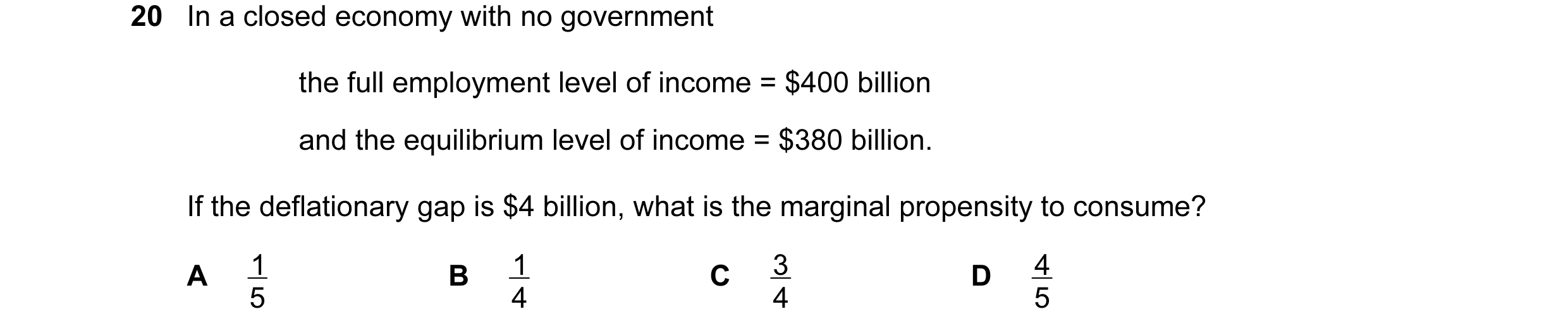
Q13 · In a closed economy with no government the full employment level of income = $400 billion… 9708/31 Oct/Nov 2010
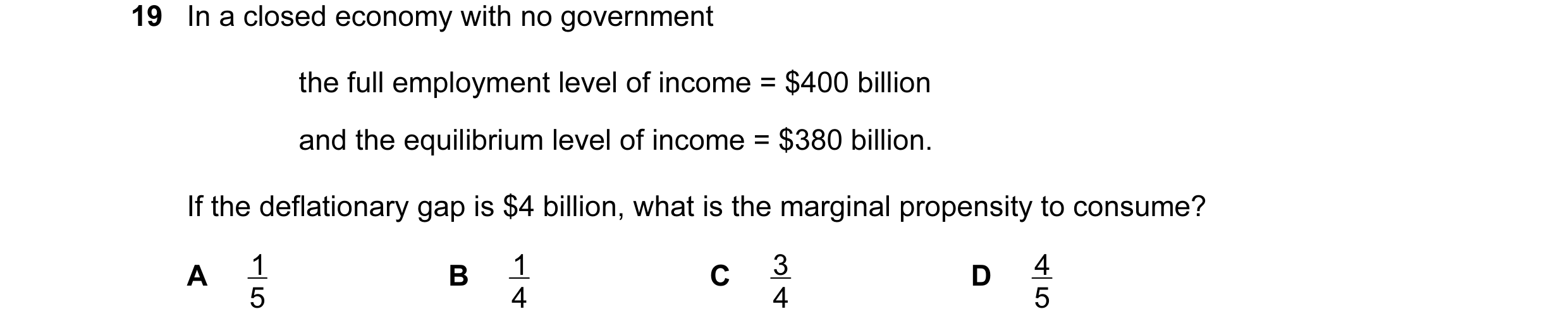
20 In a closed economy with no government the full employment level of income = $400 billion and the equilibrium level of income = $380 billion. If the deflationary gap is $4 billion, what is the marginal propensity to consume? A 1 B 1 C 3 D 4 5 4 4 5
1 marks
Answer: D
This question in 9708/31 Oct/Nov 2010
Q14 · What is not a leakage from the circular flow of income? 9708/32 Oct/Nov 2010
16 What is not a leakage from the circular flow of income? A expenditure on foreign goods B indirect taxes C undistributed profits D unemployment benefits
1 marks
Answer: D
This question in 9708/32 Oct/Nov 2010
Q15 · The diagram shows the relationship between consumption expenditure and income 9708/32 Oct/Nov 2010
19 The diagram shows the relationship between consumption expenditure and income. C consumption O income Which statement is correct? A The average propensity to consume is constant. B The average propensity to consume is rising. C The marginal propensity to consume is equal to the average propensity to consume. D The marginal propensity to consume is less than the average propensity to consume.
1 marks
Answer: D
This question in 9708/32 Oct/Nov 2010
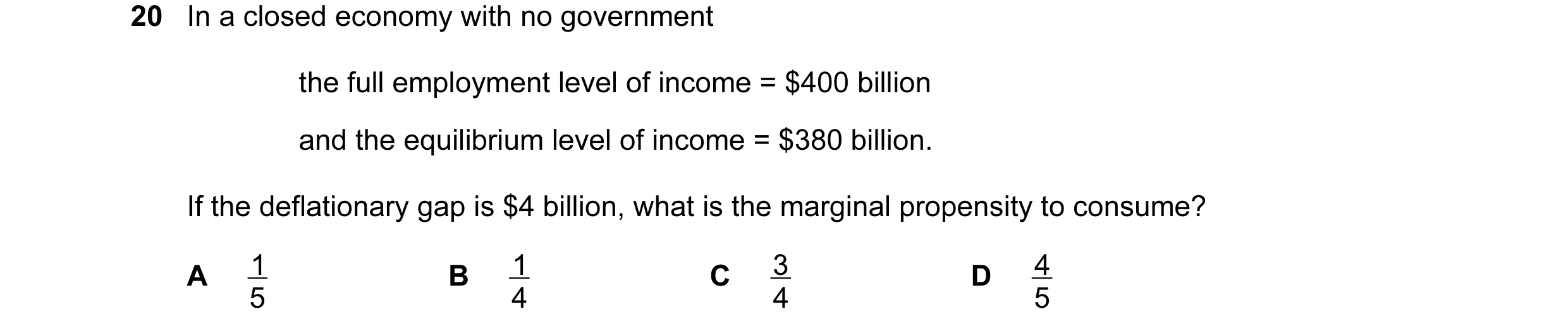
Q16 · In a closed economy with no government the full employment level of income = $400 billion… 9708/32 Oct/Nov 2010
20 In a closed economy with no government the full employment level of income = $400 billion and the equilibrium level of income = $380 billion. If the deflationary gap is $4 billion, what is the marginal propensity to consume? A 1 B 1 C 3 D 4 5 4 4 5
1 marks
Answer: D
This question in 9708/32 Oct/Nov 2010
Q17 · What is not a leakage from the circular flow of income? 9708/33 Oct/Nov 2010
15 What is not a leakage from the circular flow of income? A expenditure on foreign goods B indirect taxes C undistributed profits D unemployment benefits
1 marks
Answer: D
This question in 9708/33 Oct/Nov 2010
Q18 · The diagram shows the relationship between consumption expenditure and income 9708/33 Oct/Nov 2010
18 The diagram shows the relationship between consumption expenditure and income. C consumption O income Which statement is correct? A The average propensity to consume is constant. B The average propensity to consume is rising. C The marginal propensity to consume is equal to the average propensity to consume. D The marginal propensity to consume is less than the average propensity to consume.
1 marks
Answer: D
This question in 9708/33 Oct/Nov 2010
Q19 · In a closed economy with no government the full employment level of income = $400 billion… 9708/33 Oct/Nov 2010
19 In a closed economy with no government the full employment level of income = $400 billion and the equilibrium level of income = $380 billion. If the deflationary gap is $4 billion, what is the marginal propensity to consume? A 1 B 1 C 3 D 4 5 4 4 5
1 marks
Answer: D
This question in 9708/33 Oct/Nov 2010
Q20 · What will reduce the value of the investment multiplier? 9708/31 May/June 2011
16 What will reduce the value of the investment multiplier? A a low marginal propensity to import B automatic stabilisers C low marginal tax rates D low rates of unemployment benefit
1 marks
Answer: B
This question in 9708/31 May/June 2011
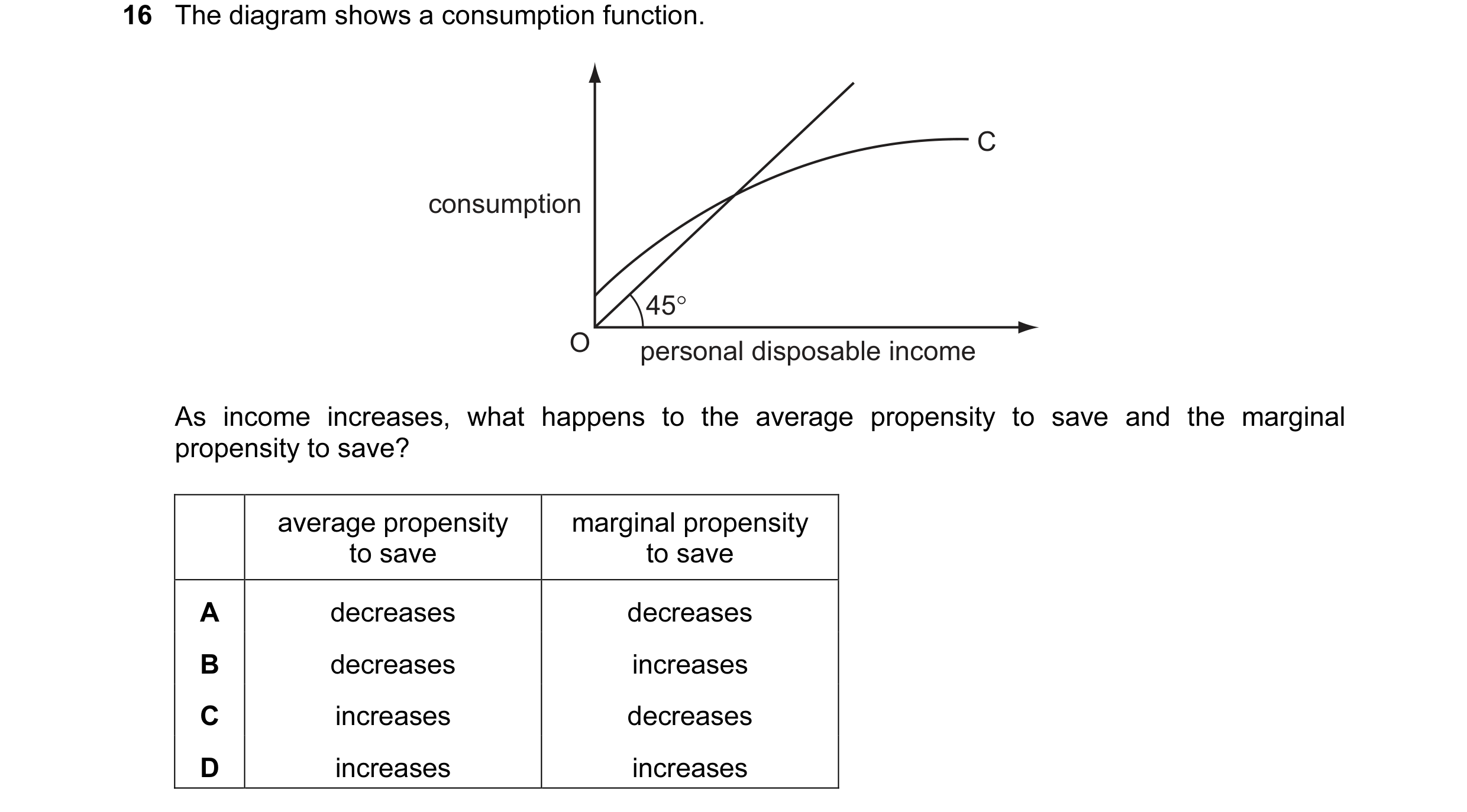
Q21 · The diagram shows a consumption function 9708/31 May/June 2011
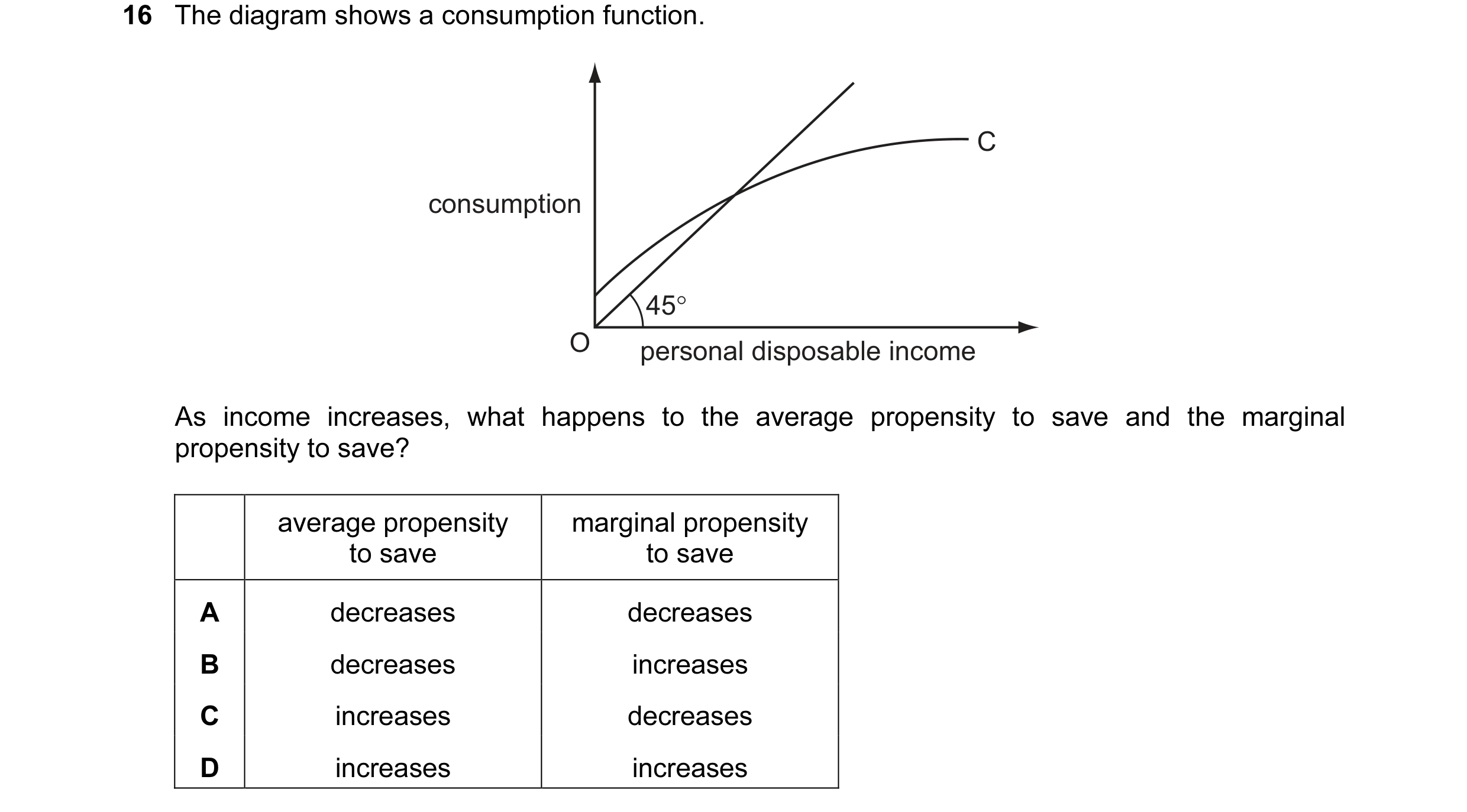
17 The diagram shows a consumption function. C consumption 45° O personal disposable income As income increases, what happens to the average propensity to save and the marginal propensity to save? average propensity marginal propensity to save to save A decreases decreases B decreases increases C increases decreases D increases increases
1 marks
Answer: D
This question in 9708/31 May/June 2011
Q22 · What will reduce the value of the investment multiplier? 9708/32 May/June 2011
15 What will reduce the value of the investment multiplier? A a low marginal propensity to import B automatic stabilisers C low marginal tax rates D low rates of unemployment benefit
1 marks
Answer: B
This question in 9708/32 May/June 2011
Q23 · The diagram shows a consumption function 9708/32 May/June 2011
16 The diagram shows a consumption function. C consumption 45° O personal disposable income As income increases, what happens to the average propensity to save and the marginal propensity to save? average propensity marginal propensity to save to save A decreases decreases B decreases increases C increases decreases D increases increases
1 marks
Answer: D
This question in 9708/32 May/June 2011
Q24 · What will reduce the value of the investment multiplier? 9708/33 May/June 2011
15 What will reduce the value of the investment multiplier? A a low marginal propensity to import B automatic stabilisers C low marginal tax rates D low rates of unemployment benefit
1 marks
Answer: B
This question in 9708/33 May/June 2011
Q25 · The diagram shows a consumption function 9708/33 May/June 2011
16 The diagram shows a consumption function. C consumption 45° O personal disposable income As income increases, what happens to the average propensity to save and the marginal propensity to save? average propensity marginal propensity to save to save A decreases decreases B decreases increases C increases decreases D increases increases
1 marks
Answer: D
This question in 9708/33 May/June 2011
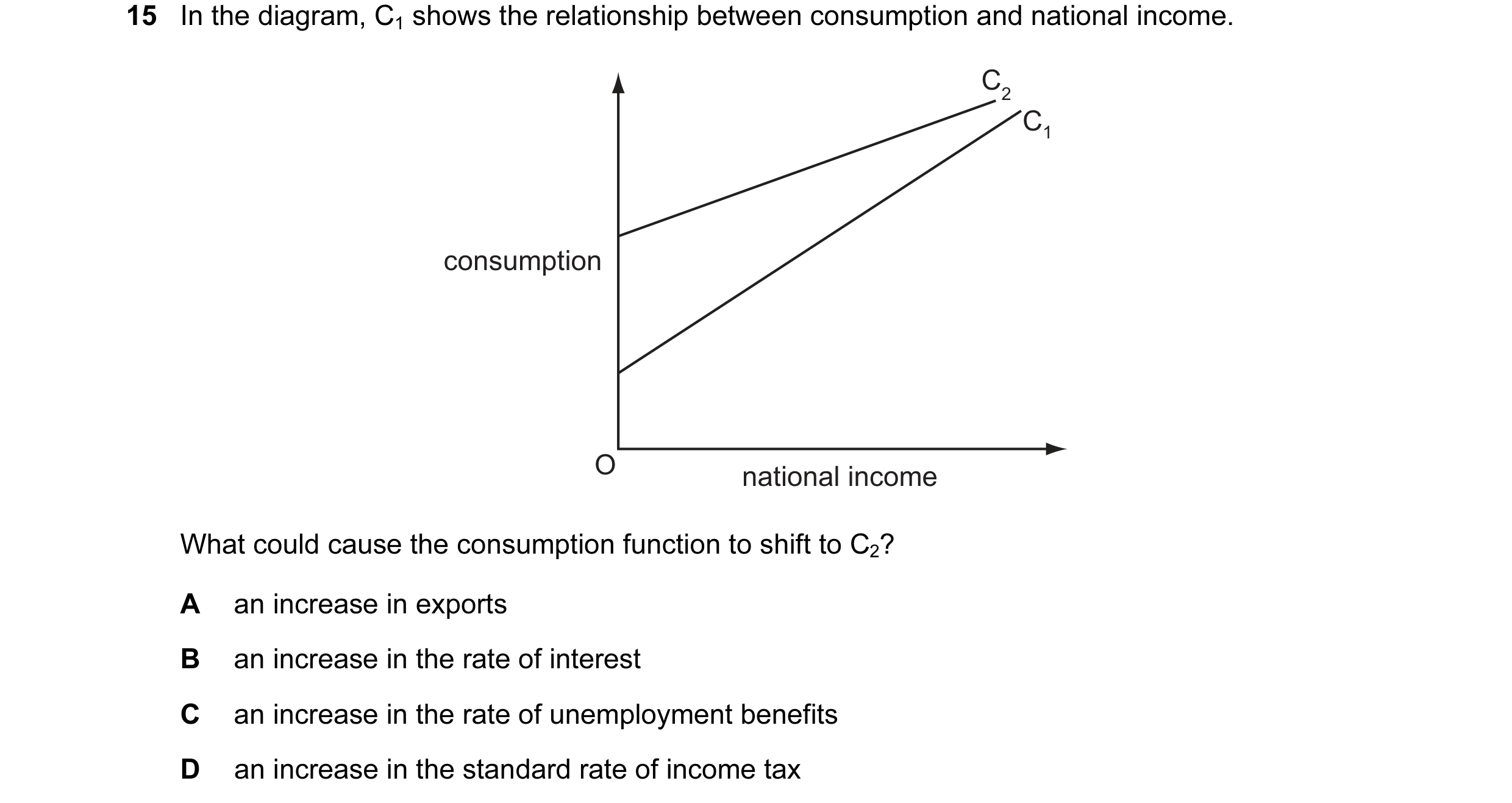
Q26 · In the diagram, C1 shows the relationship between consumption and national income 9708/31 Oct/Nov 2011
15 In the diagram, C1 shows the relationship between consumption and national income. C2 C1 consumption O national income What could cause the consumption function to shift to C2? A an increase in exports B an increase in the rate of interest C an increase in the rate of unemployment benefits D an increase in the standard rate of income tax
1 marks
Answer: C
This question in 9708/31 Oct/Nov 2011
Q27 · In a closed economy with no government, the value of the investment multiplier is 5 9708/31 Oct/Nov 2011
16 In a closed economy with no government, the value of the investment multiplier is 5. By how much will consumption increase, if investment increases by $300? A $540 B $1000 C $1200 D $1500
1 marks
Answer: C
This question in 9708/31 Oct/Nov 2011
Q28 · In a closed economy, households pay $0.10 in tax on every $1 increase in their gross… 9708/32 Oct/Nov 2011
18 In a closed economy, households pay $0.10 in tax on every $1 increase in their gross income, and spend 5/6 of every increase in their disposable income. What is the value of the multiplier? A 1.5 B 4.0 C 6.0 D 7.5
1 marks
Answer: B
This question in 9708/32 Oct/Nov 2011
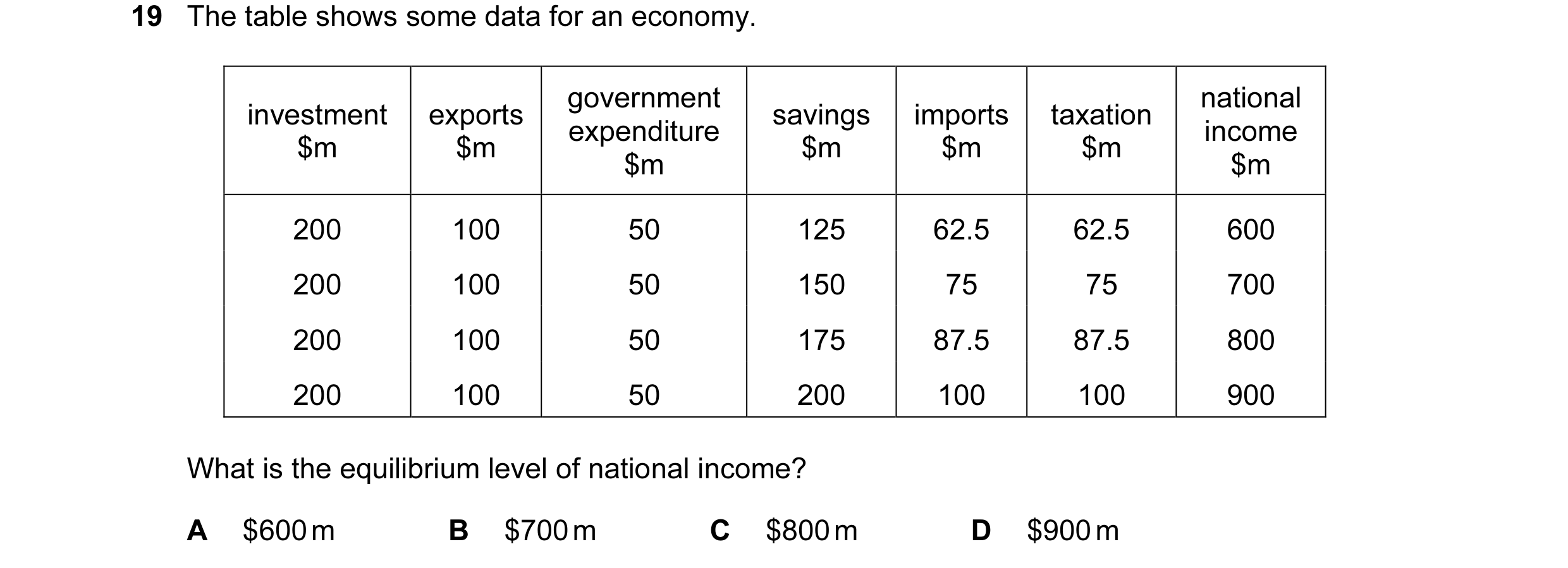
Q29 · The table shows some data for an economy 9708/32 Oct/Nov 2011
19 The table shows some data for an economy. government national investment exports savings imports taxation expenditure income $m $m $m $m $m $m $m 200 100 50 125 62.5 62.5 600 200 100 50 150 75 75 700 200 100 50 175 87.5 87.5 800 200 100 50 200 100 100 900 What is the equilibrium level of national income? A $600 m B $700 m C $800 m D $900 m
1 marks
Answer: C
This question in 9708/32 Oct/Nov 2011
Q30 · In a closed economy with no government, the value of the investment multiplier is 5 9708/33 Oct/Nov 2011
15 In a closed economy with no government, the value of the investment multiplier is 5. By how much will consumption increase, if investment increases by $300? A $540 B $1000 C $1200 D $1500
1 marks
Answer: C
This question in 9708/33 Oct/Nov 2011
Q31 · Which represents an injection into an economy’s circular flow of income? 9708/31 May/June 2012
19 Which represents an injection into an economy’s circular flow of income? A a balance of trade surplus B a government budget surplus C the retained profits of private companies D household saving
1 marks
Answer: A
This question in 9708/31 May/June 2012
Q32 · In the diagram, C1 shows the initial relationship between consumption and national income 9708/31 May/June 2012
21 In the diagram, C1 shows the initial relationship between consumption and national income. C1 C2 consumption O national income What could cause the consumption function to shift to C2? A an increase in the rate of unemployment benefits B an increase in the standard rate of income tax C an increase in exports D an increase in investment
1 marks
Answer: B
This question in 9708/31 May/June 2012
Q33 · Which represents an injection into an economy’s circular flow of income? 9708/32 May/June 2012
19 Which represents an injection into an economy’s circular flow of income? A a balance of trade surplus B a government budget surplus C the retained profits of private companies D household saving
1 marks
Answer: A
This question in 9708/32 May/June 2012
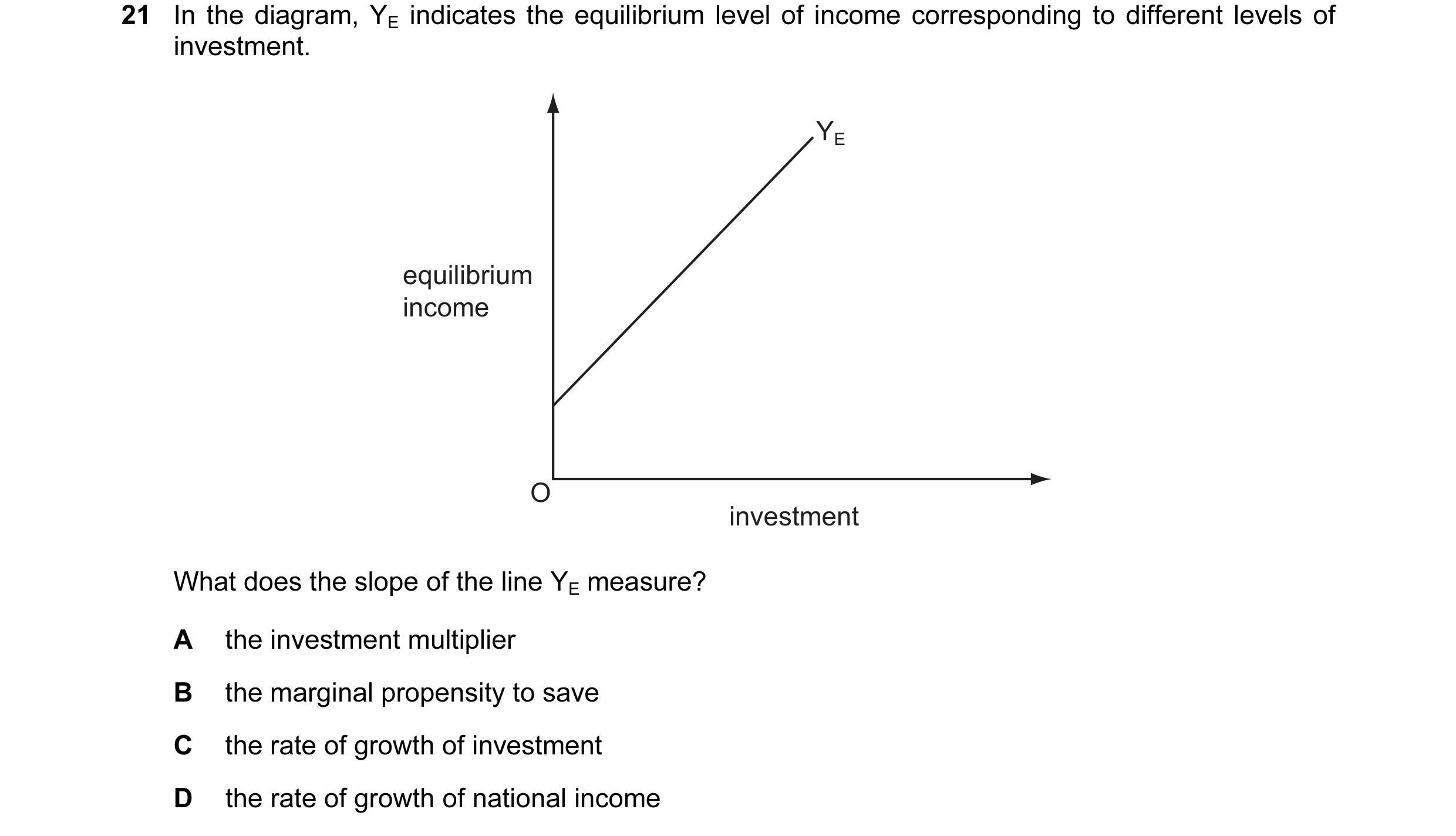
Q34 · In the diagram, YE indicates the equilibrium level of income corresponding to different… 9708/32 May/June 2012
21 In the diagram, YE indicates the equilibrium level of income corresponding to different levels of investment. YE equilibrium income O investment What does the slope of the line YE measure? A the investment multiplier B the marginal propensity to save C the rate of growth of investment D the rate of growth of national income
1 marks
Answer: A
This question in 9708/32 May/June 2012
Q35 · In the diagram, C is an economy’s initial relationship between consumption and national… 9708/32 May/June 2012
22 In the diagram, C is an economy’s initial relationship between consumption and national income. C4 C3 C C2 C1 consumption O national income Which curve could show the economy’s new consumption function following a reduction in the rate of unemployment benefits? A C1 B C2 C C3 D C4
1 marks
Answer: B
This question in 9708/32 May/June 2012
Q36 · Which represents a leakage from a country’s circular flow of income? 9708/33 May/June 2012
18 Which represents a leakage from a country’s circular flow of income? A a government budget deficit B bank loans to private companies C the purchase of foreign assets by the country’s households D unemployment benefits
1 marks
Answer: C
This question in 9708/33 May/June 2012
Q37 · In a closed economy with no government, the equilibrium level of income is $25 million… 9708/33 May/June 2012
20 In a closed economy with no government, the equilibrium level of income is $25 million, the full employment level of income is $30 million and there is a deflationary gap of $1 million. What can be deduced from this information? A The level of investment is $5 million. B The marginal propensity to consume is 5 4 . C The marginal propensity to consume is 6 5 . D The value of the investment multiplier is 1.5.
1 marks
Answer: B
This question in 9708/33 May/June 2012
Q38 · In the diagram, C1 shows the initial relationship between consumption and national income 9708/33 May/June 2012
21 In the diagram, C1 shows the initial relationship between consumption and national income. C1 C2 consumption O national income What could cause the consumption function to shift to C2? A an increase in the rate of unemployment benefits B an increase in the standard rate of income tax C an increase in exports D an increase in investment
1 marks
Answer: B
This question in 9708/33 May/June 2012
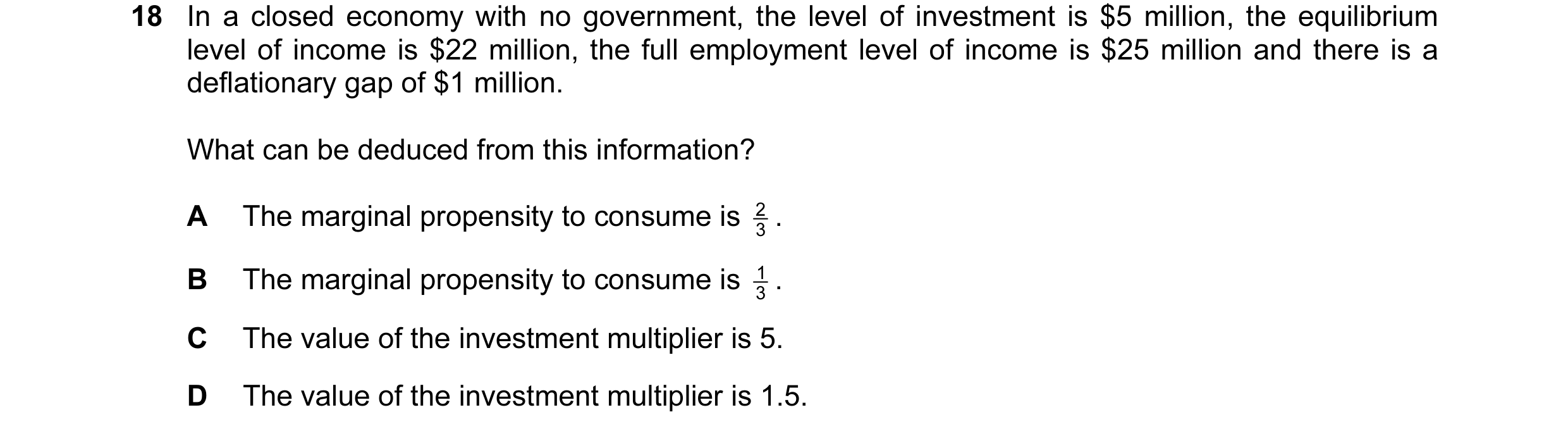
Q39 · In a closed economy with no government, the level of investment is $5 million, the… 9708/32 Oct/Nov 2012
18 In a closed economy with no government, the level of investment is $5 million, the equilibrium level of income is $22 million, the full employment level of income is $25 million and there is a deflationary gap of $1 million. What can be deduced from this information? A The marginal propensity to consume is 3 2 . B The marginal propensity to consume is 3 1 . C The value of the investment multiplier is 5. D The value of the investment multiplier is 1.5.
1 marks
Answer: A
This question in 9708/32 Oct/Nov 2012
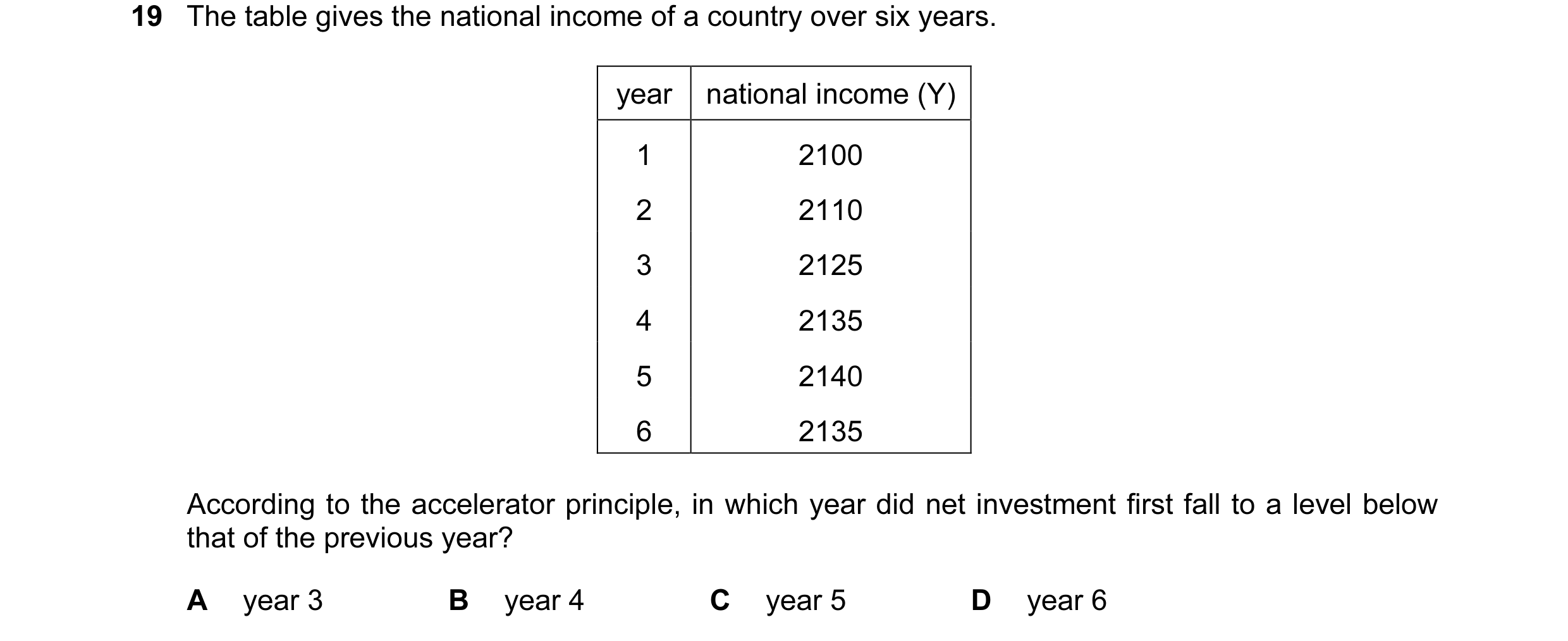
Q40 · The table gives the national income of a country over six years 9708/32 Oct/Nov 2012
19 The table gives the national income of a country over six years. year national income (Y) 1 2100 2 2110 3 2125 4 2135 5 2140 6 2135 According to the accelerator principle, in which year did net investment first fall to a level below that of the previous year? A year 3 B year 4 C year 5 D year 6
1 marks
Answer: B
This question in 9708/32 Oct/Nov 2012
Q41 · During a recession, a government increases its expenditure on goods and services by $10… 9708/32 Oct/Nov 2012
28 During a recession, a government increases its expenditure on goods and services by $10 million but leaves tax rates unchanged. Why might the subsequent increase in national income be less than $10 million? A Increased government borrowing increases interest rates. B The marginal propensity to consume is less than 1. C The marginal propensity to import is greater than 0. D There is no accelerator effect on investment.
1 marks
Answer: A
This question in 9708/32 Oct/Nov 2012
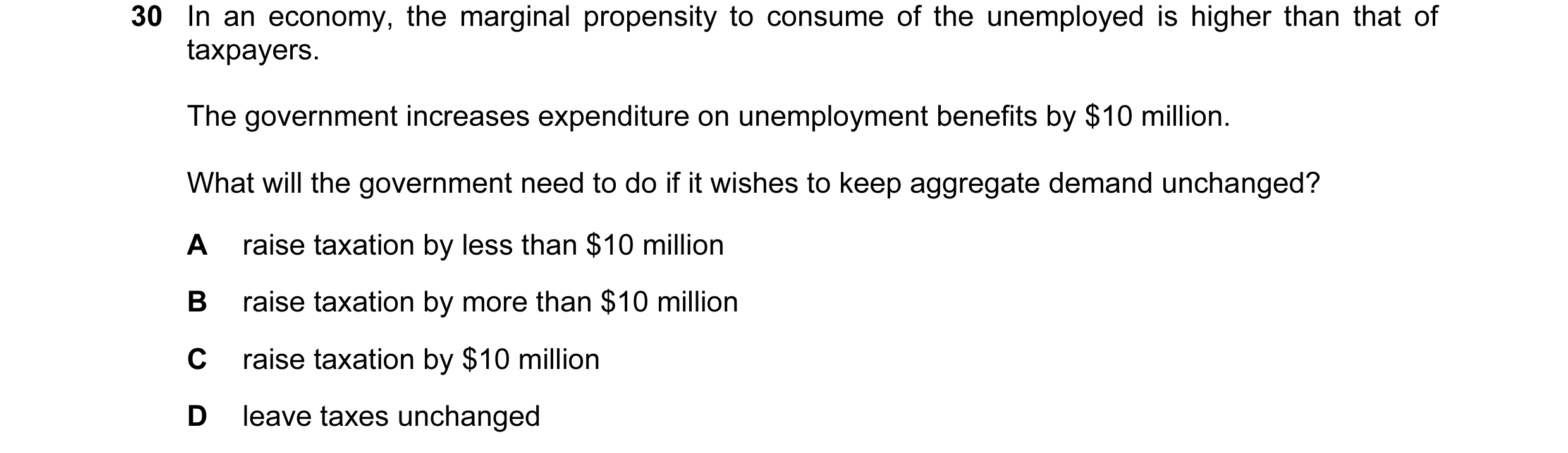
Q42 · In an economy, the marginal propensity to consume of the unemployed is higher than that… 9708/32 Oct/Nov 2012
30 In an economy, the marginal propensity to consume of the unemployed is higher than that of taxpayers. The government increases expenditure on unemployment benefits by $10 million. What will the government need to do if it wishes to keep aggregate demand unchanged? A raise taxation by less than $10 million B raise taxation by more than $10 million C raise taxation by $10 million D leave taxes unchanged
1 marks
Answer: B
This question in 9708/32 Oct/Nov 2012
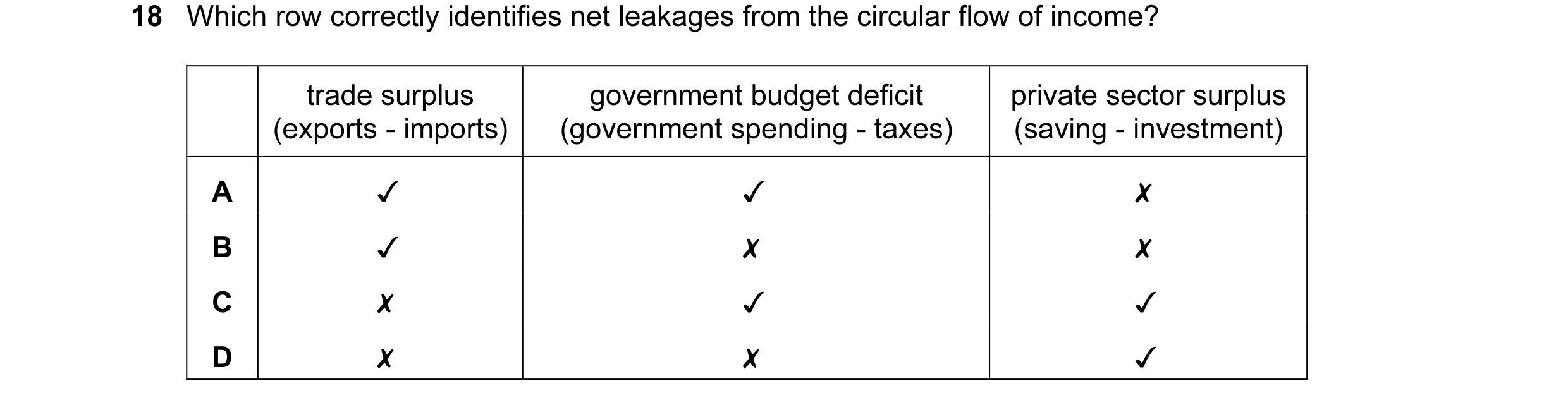
Q43 · Which row correctly identifies net leakages from the circular flow of income? 9708/33 Oct/Nov 2012
18 Which row correctly identifies net leakages from the circular flow of income?
trade surplus
(exports - imports)
government budget deficit
(government spending - taxes)
private sector surplus
(saving - investment)
0 ON WD >
v
v
x
x
v
x
v
x
<< x x
1 marks
This question in 9708/33 Oct/Nov 2012
Q44 · Let C = consumption, I = investment, X = exports, M = imports, Y = national income in an… 9708/33 Oct/Nov 2012
20 Let C = consumption, I = investment, X = exports, M = imports, Y = national income in an economy with no government sector. If C = 20 + 0.9Y, I = 60, X = 120 and M = 100, what will be the equilibrium level of Y? A 100 B 180 C 1000 D 2000
1 marks
This question in 9708/33 Oct/Nov 2012
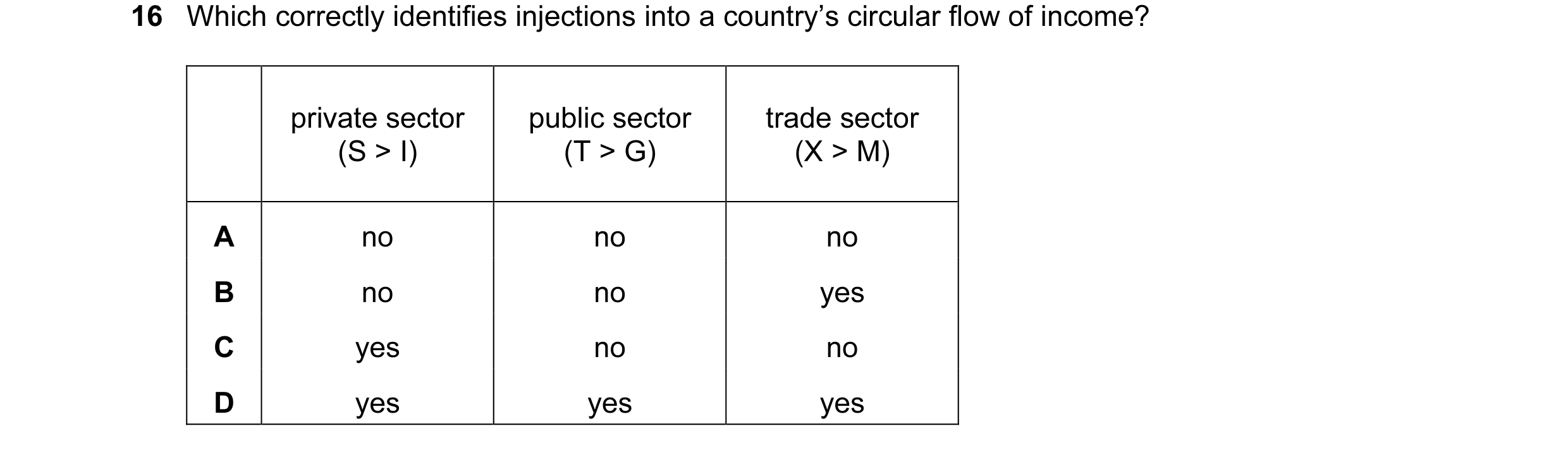
Q45 · Which correctly identifies injections into a country’s circular flow of income? 9708/31 May/June 2013
16 Which correctly identifies injections into a country’s circular flow of income? private sector public sector trade sector (S > I) (T > G) (X > M) A no no no B no no yes C yes no no D yes yes yes
1 marks
Answer: B
This question in 9708/31 May/June 2013
Q46 · A closed economy with no government has a marginal propensity to consume of 0.9 9708/31 May/June 2013
17 A closed economy with no government has a marginal propensity to consume of 0.9. Its full employment national income is $60 000 m. Its current national income is $40 000 m. To achieve full employment, by how much must investment be increased? A $2000 m B $6000 m C $18 000 m D $20 000 m
1 marks
Answer: A
This question in 9708/31 May/June 2013
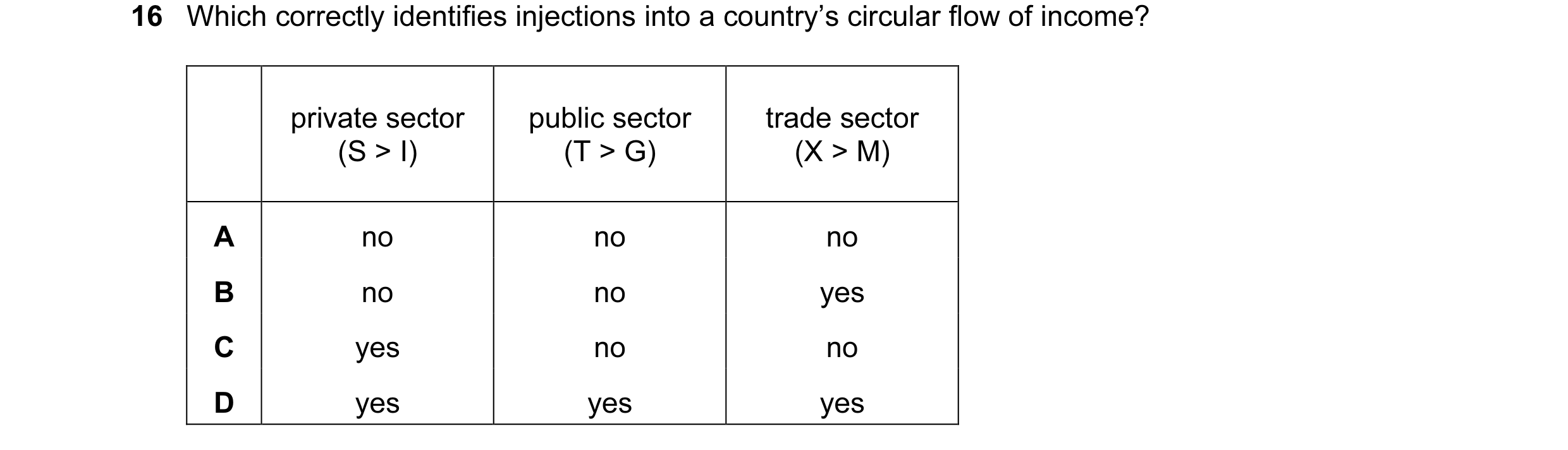
Q47 · Which correctly identifies injections into a country’s circular flow of income? 9708/33 May/June 2013
16 Which correctly identifies injections into a country’s circular flow of income? private sector public sector trade sector (S > I) (T > G) (X > M) A no no no B no no yes C yes no no D yes yes yes
1 marks
Answer: B
This question in 9708/33 May/June 2013
Q48 · A closed economy with no government has a marginal propensity to consume of 0.9 9708/33 May/June 2013
17 A closed economy with no government has a marginal propensity to consume of 0.9. Its full employment national income is $60 000 m. Its current national income is $40 000 m. To achieve full employment, by how much must investment be increased? A $2000 m B $6000 m C $18 000 m D $20 000 m
1 marks
Answer: A
This question in 9708/33 May/June 2013
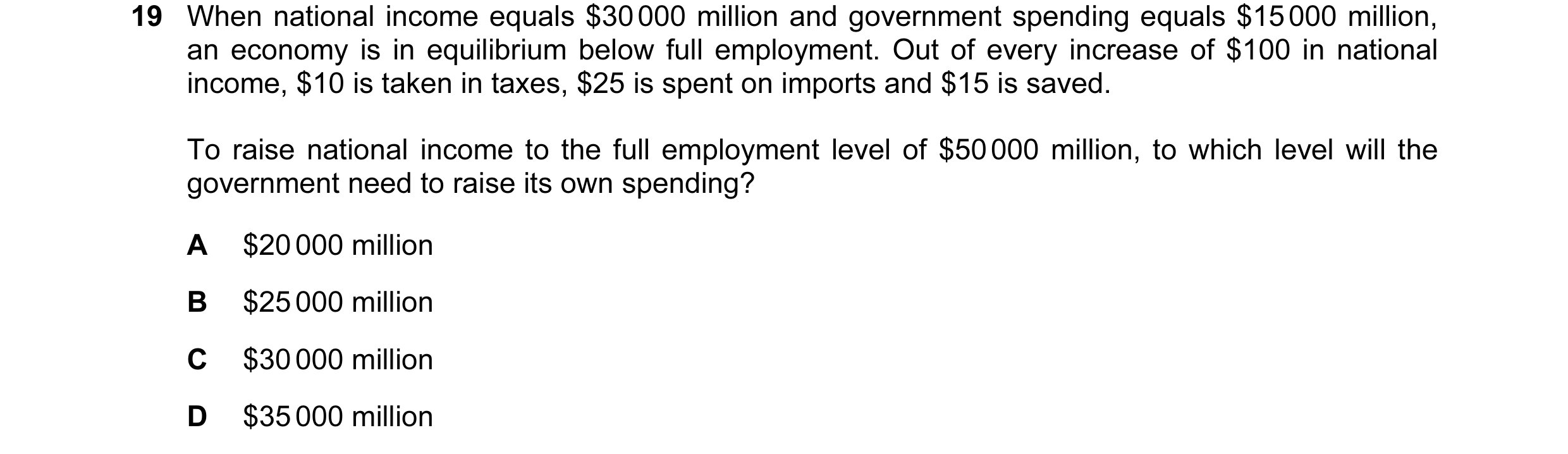
Q49 · When national income equals $30 000 million and government spending equals $15 000… 9708/31 Oct/Nov 2013
19 When national income equals $30 000 million and government spending equals $15 000 million, an economy is in equilibrium below full employment. Out of every increase of $100 in national income, $10 is taken in taxes, $25 is spent on imports and $15 is saved. To raise national income to the full employment level of $50 000 million, to which level will the government need to raise its own spending? A $20 000 million B $25 000 million C $30 000 million D $35 000 million
1 marks
Answer: B
This question in 9708/31 Oct/Nov 2013
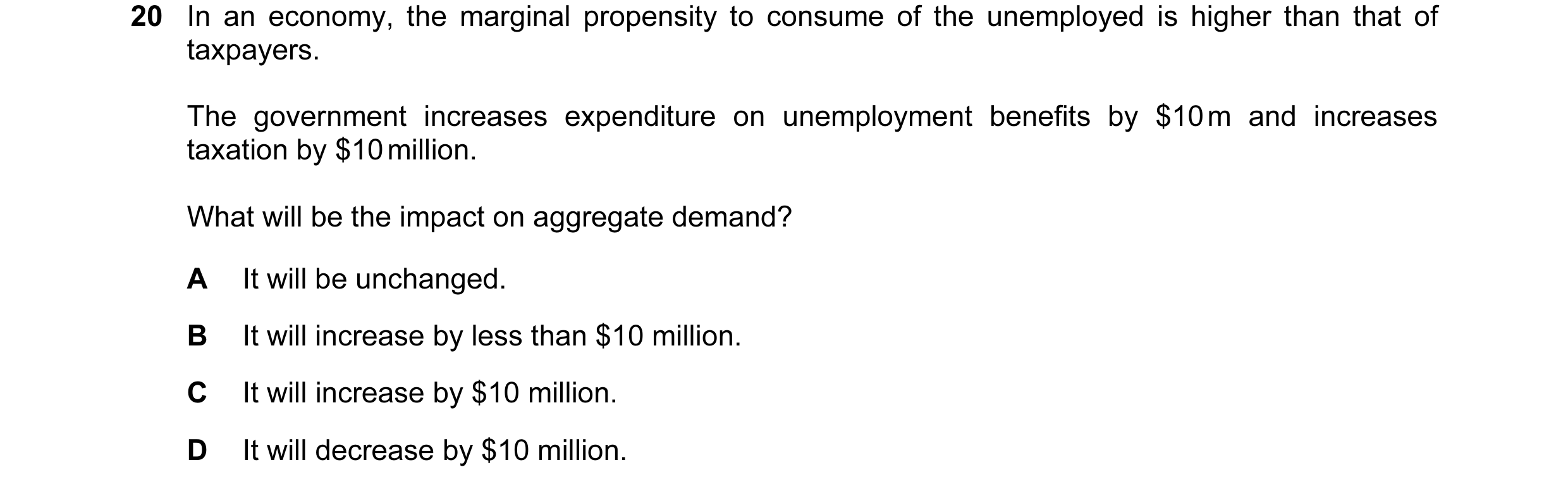
Q50 · In an economy, the marginal propensity to consume of the unemployed is higher than that… 9708/32 Oct/Nov 2013
20 In an economy, the marginal propensity to consume of the unemployed is higher than that of taxpayers. The government increases expenditure on unemployment benefits by $10 m and increases taxation by $10 million. What will be the impact on aggregate demand? A It will be unchanged. B It will increase by less than $10 million. C It will increase by $10 million. D It will decrease by $10 million.
1 marks
Answer: B
This question in 9708/32 Oct/Nov 2013
Q51 · Which correctly identifies leakages from a country’s circular flow of income? 9708/33 Oct/Nov 2013
18 Which correctly identifies leakages from a country’s circular flow of income? private sector government sector trade sector S > I T > G X > M A no no no B no no yes C yes yes no D yes yes yes
1 marks
Answer: C
This question in 9708/33 Oct/Nov 2013
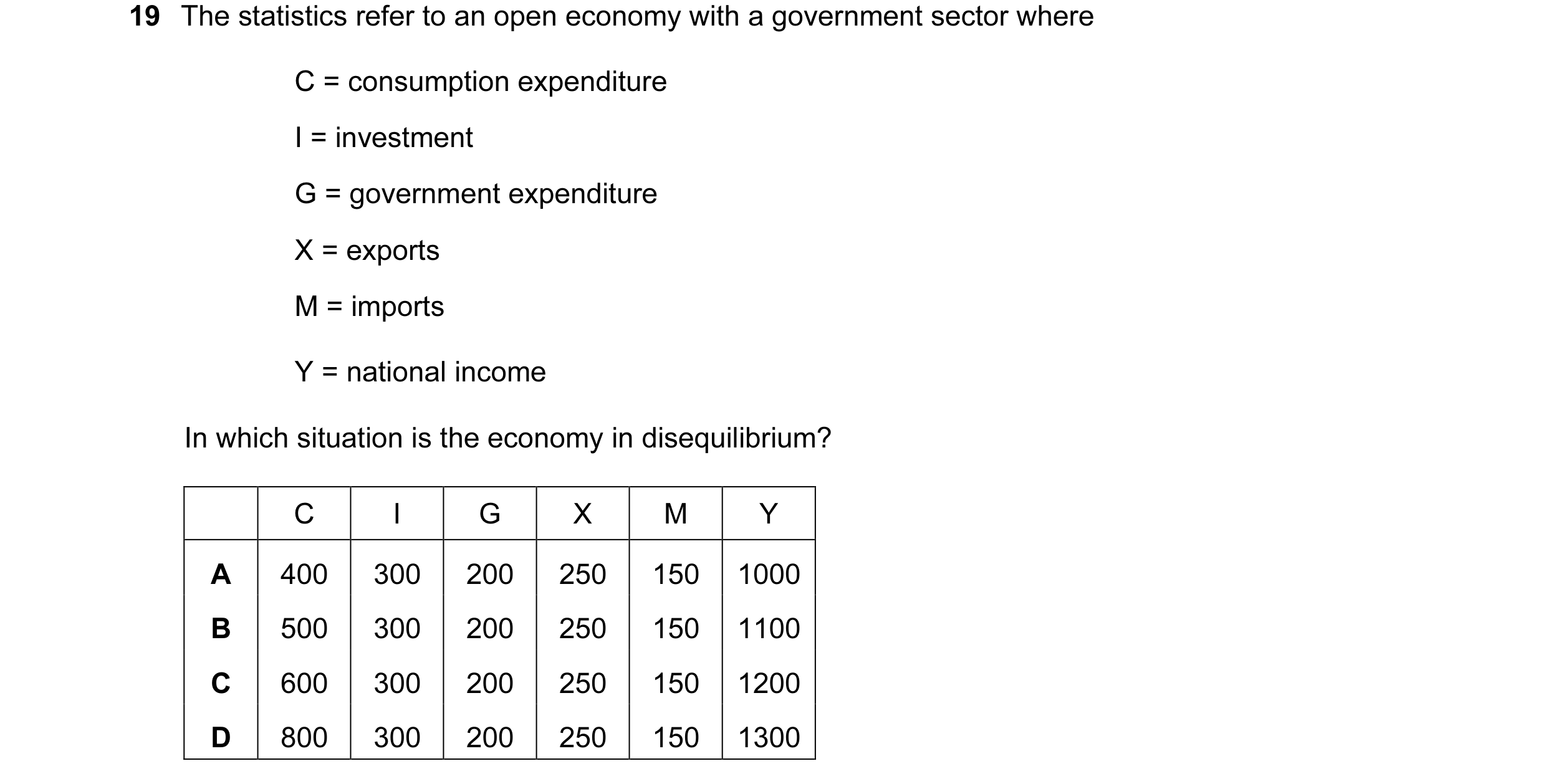
Q52 · The statistics refer to an open economy with a government sector where C = consumption… 9708/33 Oct/Nov 2013
19 The statistics refer to an open economy with a government sector where C = consumption expenditure I = investment G = government expenditure X = exports M = imports Y = national income In which situation is the economy in disequilibrium? C I G X M Y A 400 300 200 250 150 1000 B 500 300 200 250 150 1100 C 600 300 200 250 150 1200 D 800 300 200 250 150 1300
1 marks
Answer: D
This question in 9708/33 Oct/Nov 2013
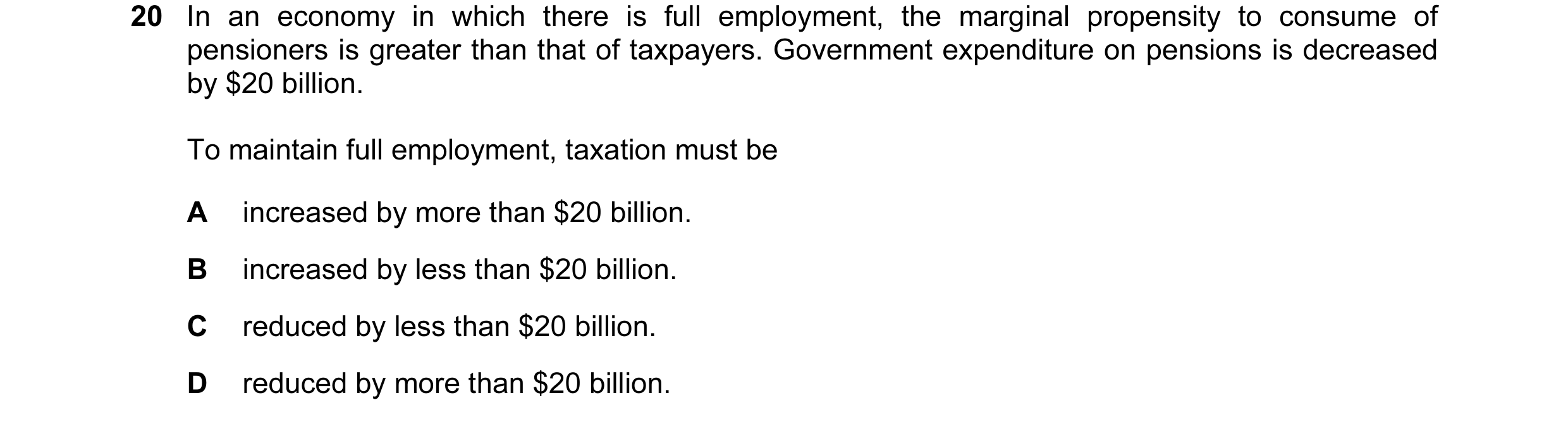
Q53 · In an economy in which there is full employment, the marginal propensity to consume of… 9708/31 Oct/Nov 2014
20 In an economy in which there is full employment, the marginal propensity to consume of pensioners is greater than that of taxpayers. Government expenditure on pensions is decreased by $20 billion. To maintain full employment, taxation must be A increased by more than $20 billion. B increased by less than $20 billion. C reduced by less than $20 billion. D reduced by more than $20 billion.
1 marks
Answer: D
This question in 9708/31 Oct/Nov 2014
Q54 · The table shows some data for an economy 9708/31 Oct/Nov 2014
21 The table shows some data for an economy. government national investment exports savings imports taxation expenditure income $m $m $m $m $m $m $m 200 100 100 100 120 100 700 200 100 100 120 140 100 800 200 100 100 130 170 100 900 200 100 100 140 200 280 1000 What is the equilibrium level of national income? A $700 m B $800 m C $900 m D $1000 m
1 marks
Answer: C
This question in 9708/31 Oct/Nov 2014
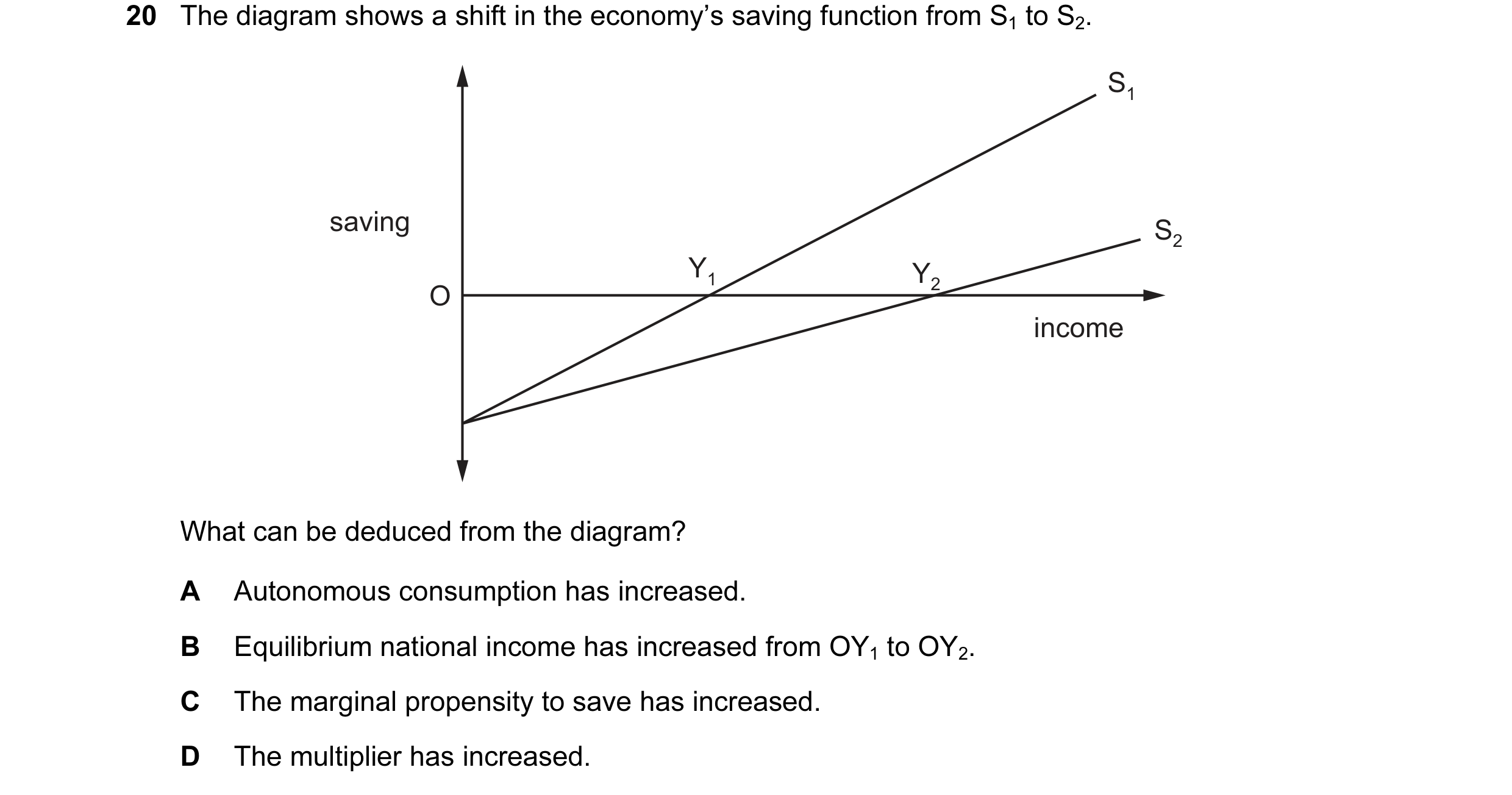
Q55 · The diagram shows a shift in the economy’s saving function from S1 to S2 9708/33 Oct/Nov 2014
20 The diagram shows a shift in the economy’s saving function from S1 to S2. S1 saving S2 Y1 Y2 O income What can be deduced from the diagram? A Autonomous consumption has increased. B Equilibrium national income has increased from OY1 to OY2. C The marginal propensity to save has increased. D The multiplier has increased.
1 marks
Answer: D
This question in 9708/33 Oct/Nov 2014
Q56 · An economy with unemployed resources experiences an increase in government expenditure… 9708/33 Oct/Nov 2014
29 An economy with unemployed resources experiences an increase in government expenditure financed by borrowing from the non-bank private sector. What would diminish the resulting increase in GDP? A an expansion of the money supply B an increase in private investment C a reduction in the marginal propensity to save D a rise in the level of interest rates
1 marks
Answer: D
This question in 9708/33 Oct/Nov 2014
Q57 · Which represents an injection into an economy’s circular flow of income? 9708/31 May/June 2015
18 Which represents an injection into an economy’s circular flow of income? A a balance of trade deficit B a government budget deficit C household saving D the retained profits of private companies
1 marks
Answer: B
This question in 9708/31 May/June 2015
Q58 · In a closed economy with no government sector, investment is increased by $100 million… 9708/31 May/June 2015
19 In a closed economy with no government sector, investment is increased by $100 million and real income increases by $500 million. What is the marginal propensity to consume? A 0.2 B 0.4 C 0.8 D 5.0
1 marks
Answer: C
This question in 9708/31 May/June 2015
Q59 · Which is not an injection into a country’s circular flow of national income? 9708/32 May/June 2015
19 Which is not an injection into a country’s circular flow of national income? A inward direct investment by multinational corporations B private gross domestic fixed capital formation C the sale of government bonds to members of the public D wages paid to civil servants
1 marks
Answer: C
This question in 9708/32 May/June 2015
Q60 · The national income is initially in equilibrium 9708/32 May/June 2015
20 The national income is initially in equilibrium. If there is an increase in exports, which change of equivalent value will restore national income to its initial equilibrium level? A a decrease in imports B a decrease in investment C an increase in government expenditure on goods and services D a reduction in taxation
1 marks
Answer: B
This question in 9708/32 May/June 2015
Q61 · In a closed economy with no government, investment increases by $400 9708/32 May/June 2015
21 In a closed economy with no government, investment increases by $400. At the new equilibrium level of income, consumption has increased by $1200. What is the value of the investment multiplier? A 2 B 3 C 4 D 8
1 marks
Answer: C
This question in 9708/32 May/June 2015
Q62 · The table shows data on a country’s gross domestic product (GDP) at market prices and on… 9708/31 Oct/Nov 2015
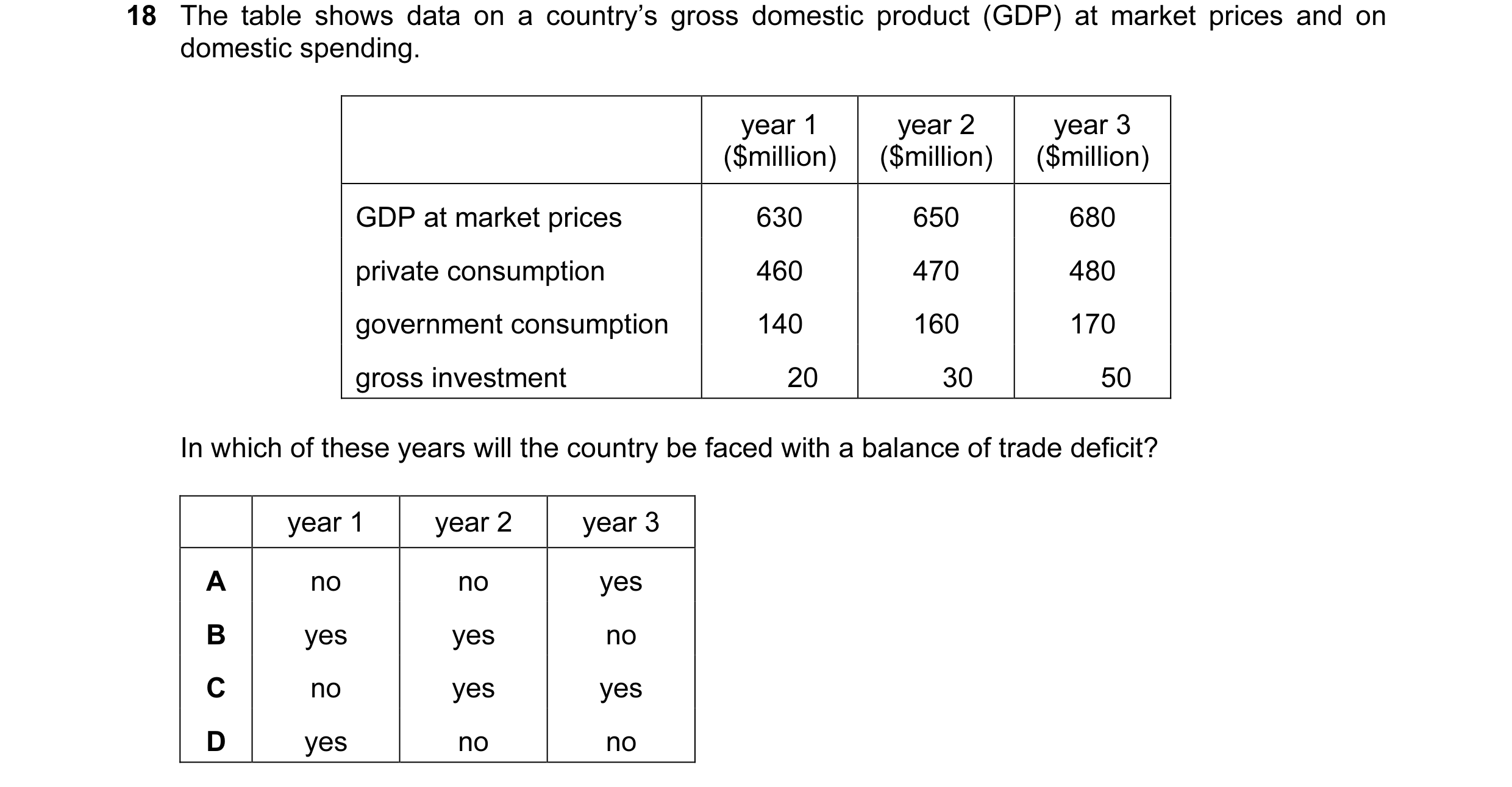
18 The table shows data on a country’s gross domestic product (GDP) at market prices and on domestic spending. year 1 year 2 year 3 ($million) ($million) ($million) GDP at market prices 630 650 680 private consumption 460 470 480 government consumption 140 160 170 gross investment 20 30 50 In which of these years will the country be faced with a balance of trade deficit? year 1 year 2 year 3 A no no yes B yes yes no C no yes yes D yes no no
1 marks
This question in 9708/31 Oct/Nov 2015
Q63 · In the diagram, S1 is an economy’s initial saving function 9708/31 Oct/Nov 2015
19 In the diagram, S1 is an economy’s initial saving function. S1 saving S2 O national income If the saving function shifts to S2, what effect will this have on the marginal propensity to consume and on the multiplier? marginal propensity multiplier to consume A decreases decreases B decreases increases C increases decreases D increases increases
1 marks
This question in 9708/31 Oct/Nov 2015
Q64 · In an economy operating below full employment, which combination of changes will… 9708/31 Oct/Nov 2015
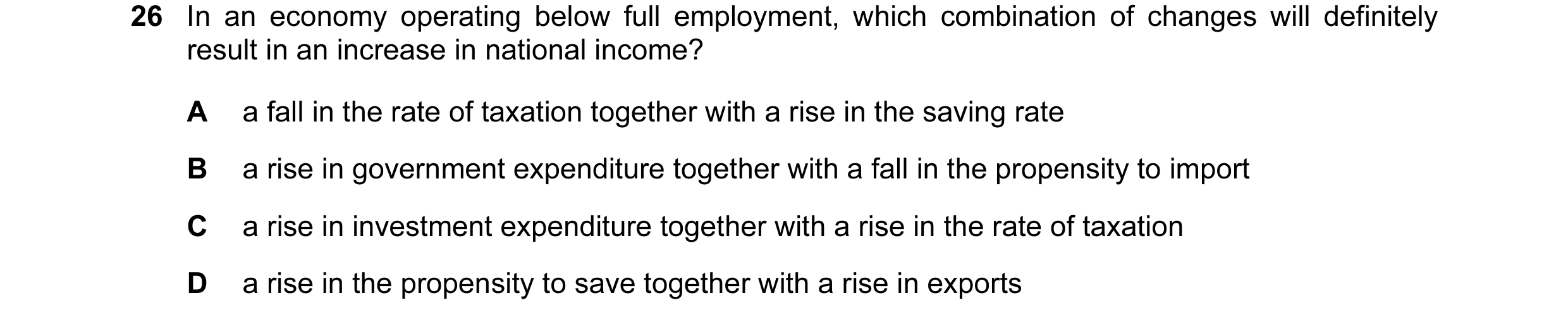
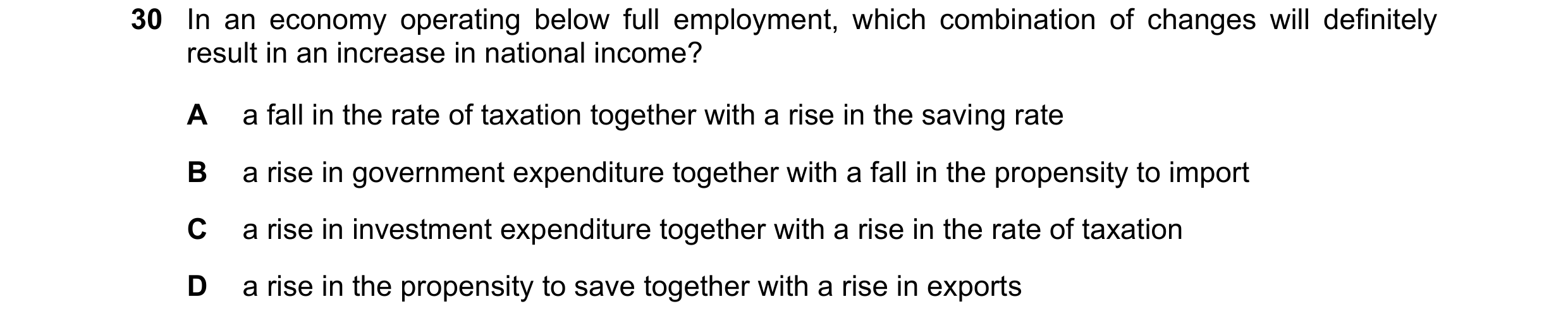
26 In an economy operating below full employment, which combination of changes will definitely result in an increase in national income? A a fall in the rate of taxation together with a rise in the saving rate B a rise in government expenditure together with a fall in the propensity to import C a rise in investment expenditure together with a rise in the rate of taxation D a rise in the propensity to save together with a rise in exports
1 marks
This question in 9708/31 Oct/Nov 2015
Q65 · The information in the table is taken from a country’s national income accounts 9708/32 Oct/Nov 2015
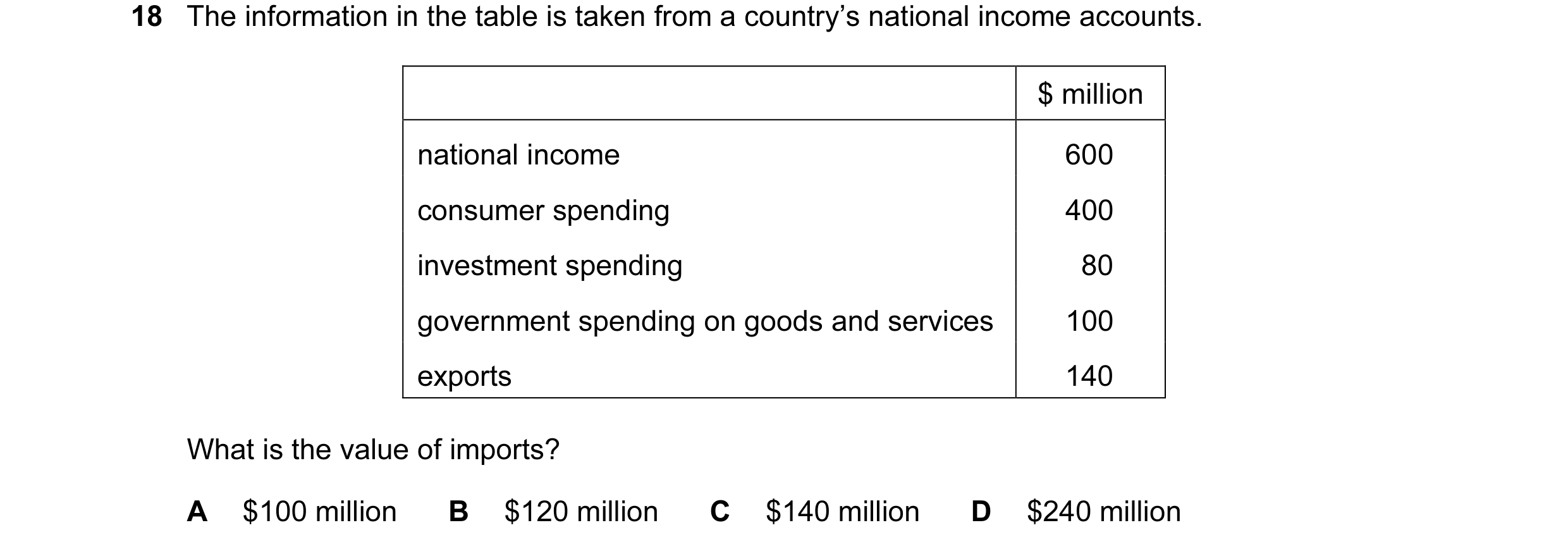
18 The information in the table is taken from a country’s national income accounts. $ million national income 600 consumer spending 400 investment spending 80 government spending on goods and services 100 exports 140 What is the value of imports? A $100 million B $120 million C $140 million D $240 million
1 marks
Answer: B
This question in 9708/32 Oct/Nov 2015
Q66 · Which represents an injection into a country’s circular flow of income? 9708/32 Oct/Nov 2015
19 Which represents an injection into a country’s circular flow of income? A corporate taxes B interest payments on government bonds C the payment of dividends to foreign shareholders D the repayment of bank loans
1 marks
Answer: B
This question in 9708/32 Oct/Nov 2015
Q67 · The table shows the level of consumption at various levels of national income for a… 9708/33 Oct/Nov 2015
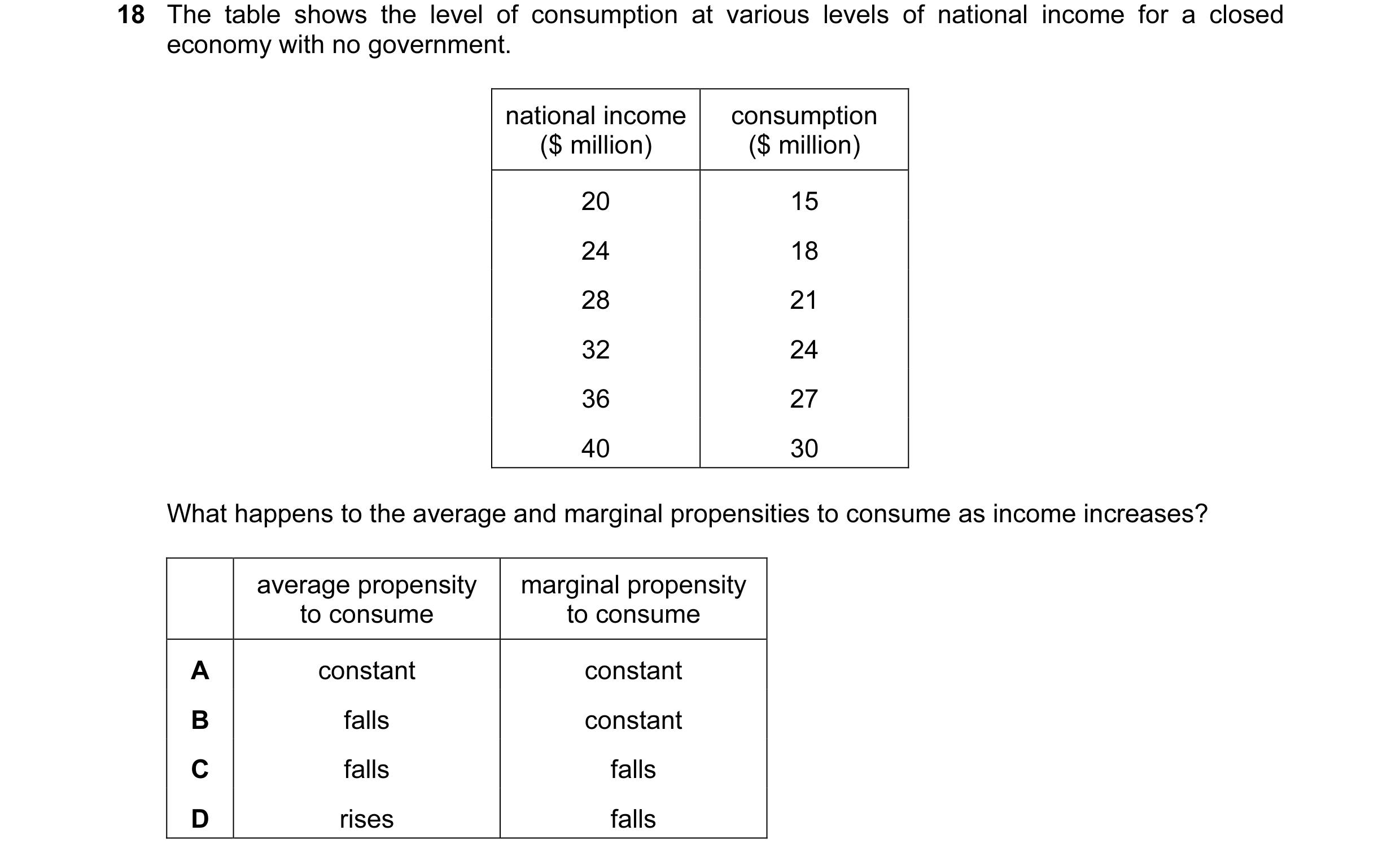
18 The table shows the level of consumption at various levels of national income for a closed economy with no government. national income consumption ($ million) ($ million) 20 15 24 18 28 21 32 24 36 27 40 30 What happens to the average and marginal propensities to consume as income increases? average propensity marginal propensity to consume to consume A constant constant B falls constant C falls falls D rises falls
1 marks
Answer: A
This question in 9708/33 Oct/Nov 2015
Q68 · In a closed economy with no government, the equilibrium level of income is $22 million… 9708/33 Oct/Nov 2015
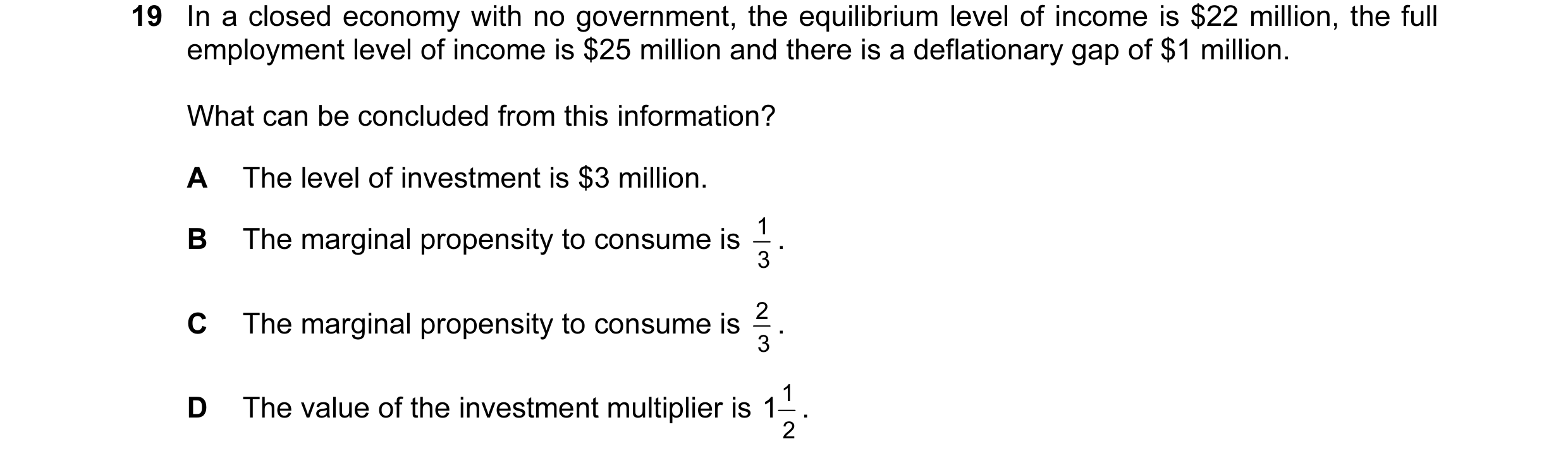
19 In a closed economy with no government, the equilibrium level of income is $22 million, the full employment level of income is $25 million and there is a deflationary gap of $1 million. What can be concluded from this information? A The level of investment is $3 million. 1 . B The marginal propensity to consume is 3 2 . C The marginal propensity to consume is 3 D The value of the investment multiplier is 1 1 . 2
1 marks
Answer: C
This question in 9708/33 Oct/Nov 2015
Q69 · The table shows some data for an economy 9708/33 Oct/Nov 2015
20 The table shows some data for an economy. government investment exports savings imports taxation national income expenditure ($ million) ($ million) ($ million) ($ million) ($ million) ($ million) ($ million) 200 100 50 125 62.5 62.5 600 200 100 50 150 75 75 700 200 100 50 175 87.5 87.5 800 200 100 50 200 100 100 900 What is the equilibrium level of national income? A $600 million B $700 million C $800 million D $900 million
1 marks
Answer: C
This question in 9708/33 Oct/Nov 2015
Q70 · In an economy operating below full employment, which combination of changes will… 9708/33 Oct/Nov 2015
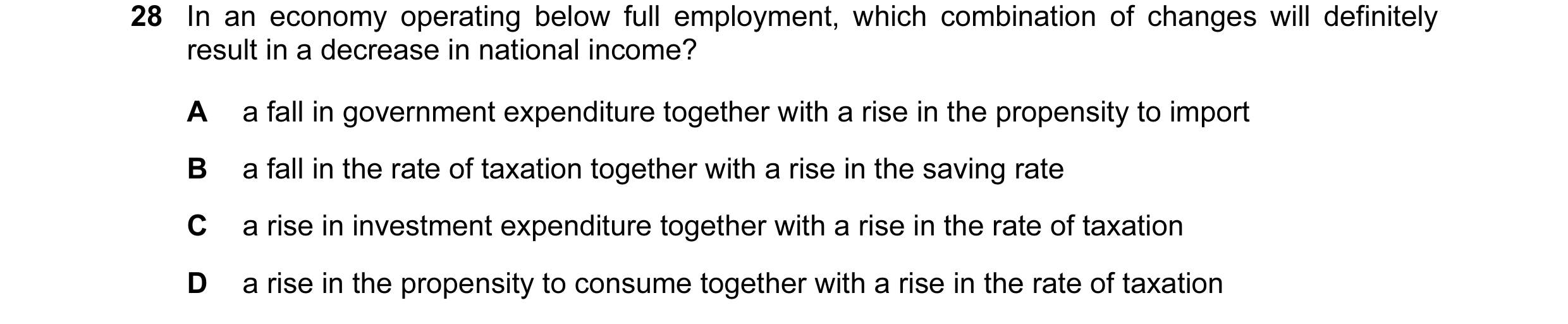
28 In an economy operating below full employment, which combination of changes will definitely result in a decrease in national income? A a fall in government expenditure together with a rise in the propensity to import B a fall in the rate of taxation together with a rise in the saving rate C a rise in investment expenditure together with a rise in the rate of taxation D a rise in the propensity to consume together with a rise in the rate of taxation
1 marks
Answer: A
This question in 9708/33 Oct/Nov 2015
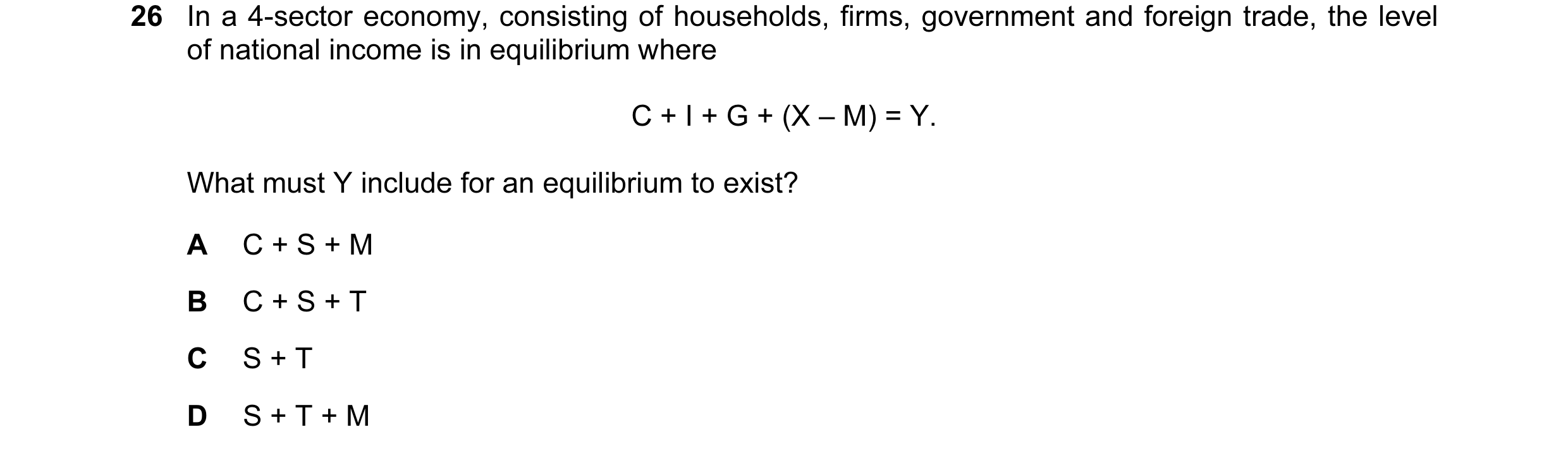
Q71 · In a 4-sector economy, consisting of households, firms, government and foreign trade, the… 9708/32 May/June 2016
26 In a 4-sector economy, consisting of households, firms, government and foreign trade, the level of national income is in equilibrium where C + I + G + (X – M) = Y. What must Y include for an equilibrium to exist? A C + S + M B C + S + T C S + T D S + T + M
1 marks
Answer: B
This question in 9708/32 May/June 2016
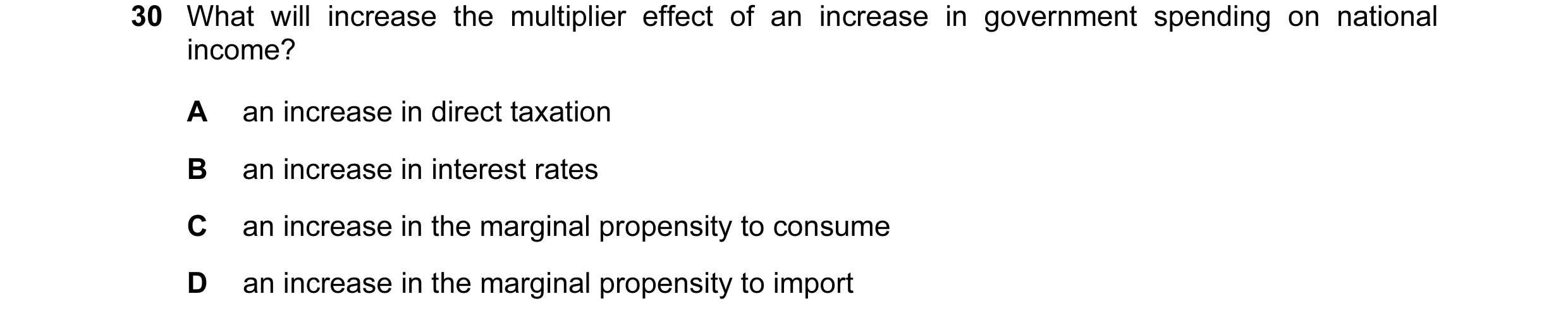
Q72 · What will increase the multiplier effect of an increase in government spending on… 9708/32 May/June 2016
30 What will increase the multiplier effect of an increase in government spending on national income? A an increase in direct taxation B an increase in interest rates C an increase in the marginal propensity to consume D an increase in the marginal propensity to import
1 marks
Answer: C
This question in 9708/32 May/June 2016
Q73 · Investment is involved in both the accelerator and the multiplier 9708/33 May/June 2016
26 Investment is involved in both the accelerator and the multiplier. What is the nature of the investment in each case? accelerator multiplier A autonomous autonomous B autonomous induced C induced autonomous D induced induced
1 marks
Answer: C
This question in 9708/33 May/June 2016
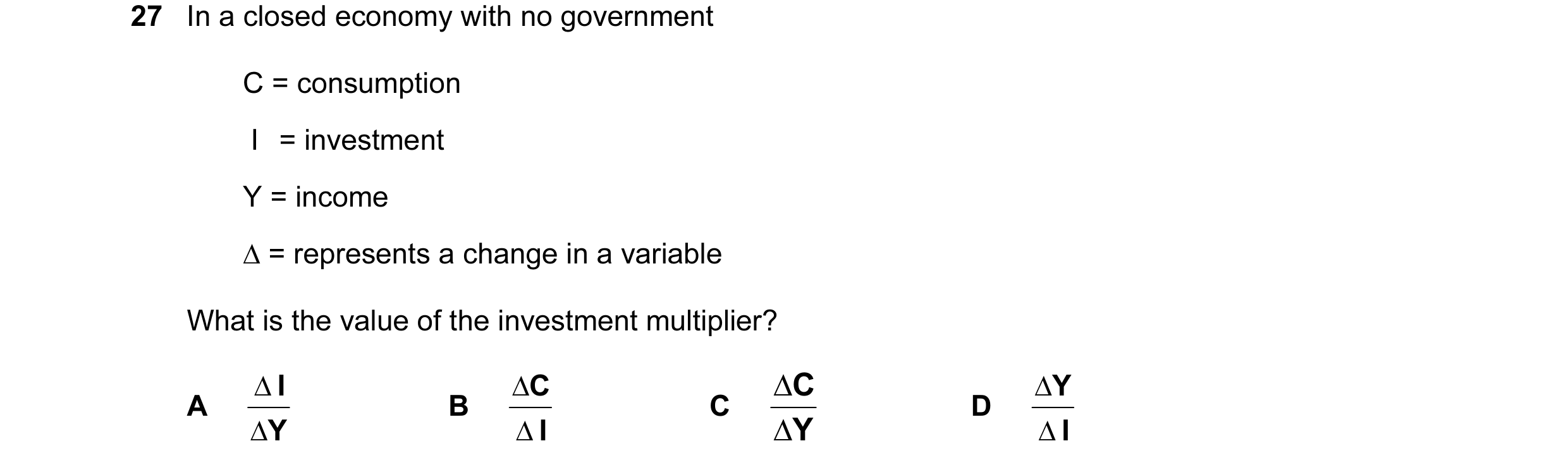
Q74 · In a closed economy with no government C = consumption I = investment Y = income ∆ =… 9708/33 May/June 2016
27 In a closed economy with no government C = consumption I = investment Y = income ∆ = represents a change in a variable What is the value of the investment multiplier? ∆ I ∆ C ∆ C ∆ Y A B C D ∆ Y ∆ I ∆ Y ∆ I
1 marks
Answer: D
This question in 9708/33 May/June 2016
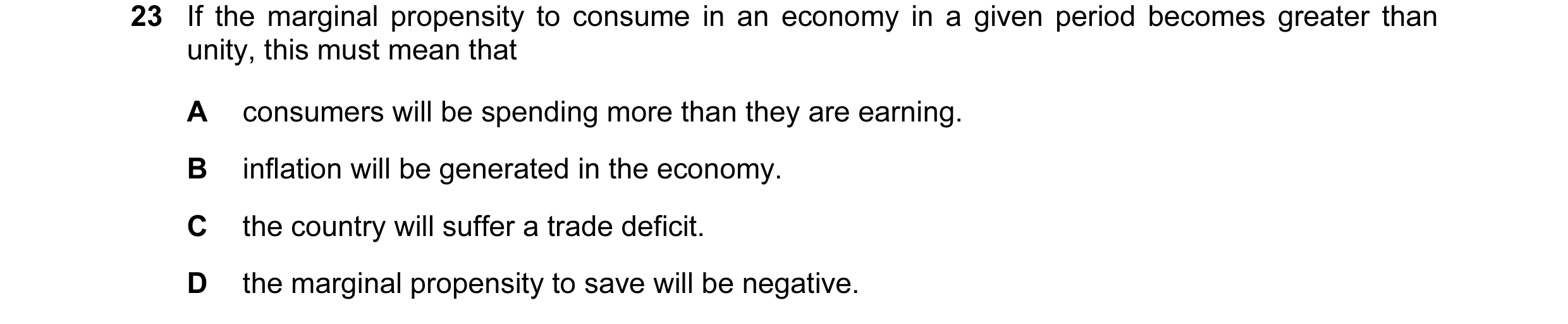
Q75 · If the marginal propensity to consume in an economy in a given period becomes greater… 9708/32 Oct/Nov 2016
23 If the marginal propensity to consume in an economy in a given period becomes greater than unity, this must mean that A consumers will be spending more than they are earning. B inflation will be generated in the economy. C the country will suffer a trade deficit. D the marginal propensity to save will be negative.
1 marks
Answer: D
This question in 9708/32 Oct/Nov 2016
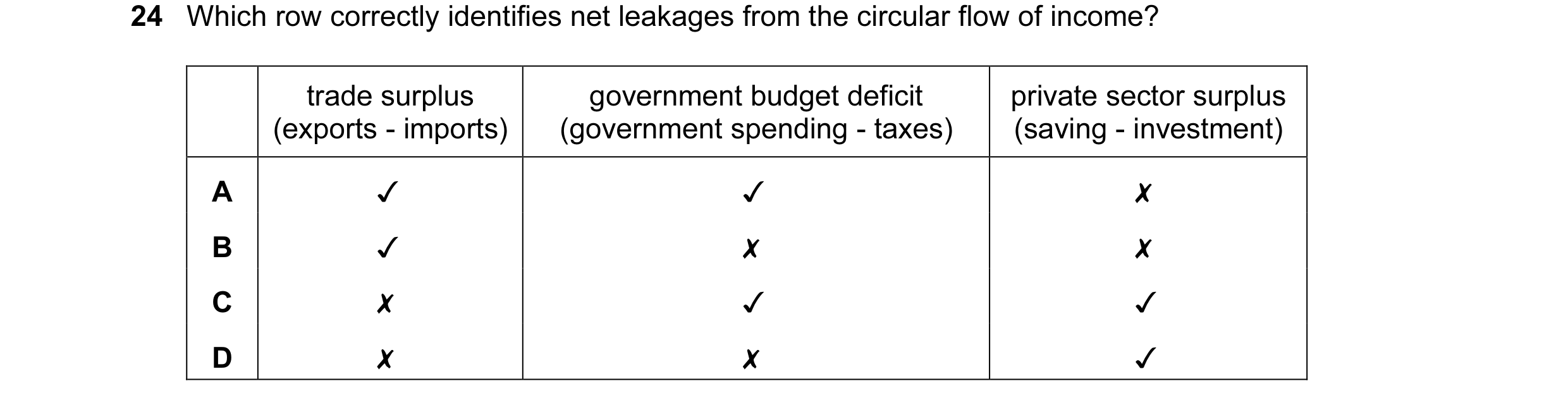
Q76 · Which row correctly identifies net leakages from the circular flow of income? 9708/32 Oct/Nov 2016
24 Which row correctly identifies net leakages from the circular flow of income?
trade surplus
(exports - imports)
government budget deficit
(government spending - taxes)
private sector surplus
(saving - investment)
0 0O WwW D>
v
v
x
x
v
x
v
x
\ <x x
1 marks
Answer: D
This question in 9708/32 Oct/Nov 2016
Q77 · The table shows the levels of consumption expenditure and savings for given family incomes 9708/32 Oct/Nov 2016
25 The table shows the levels of consumption expenditure and savings for given family incomes. disposable consumption savings family income expenditure ($) ($) ($) 2000 2150 –150 3000 3100 –100 4000 4000 0 5000 4850 150 6000 5650 350 7000 6380 620 Over the range of disposable income shown, as income rises the marginal propensity to consume A falls and then rises. B falls continuously. C rises and then falls. D rises continuously.
1 marks
Answer: B
This question in 9708/32 Oct/Nov 2016
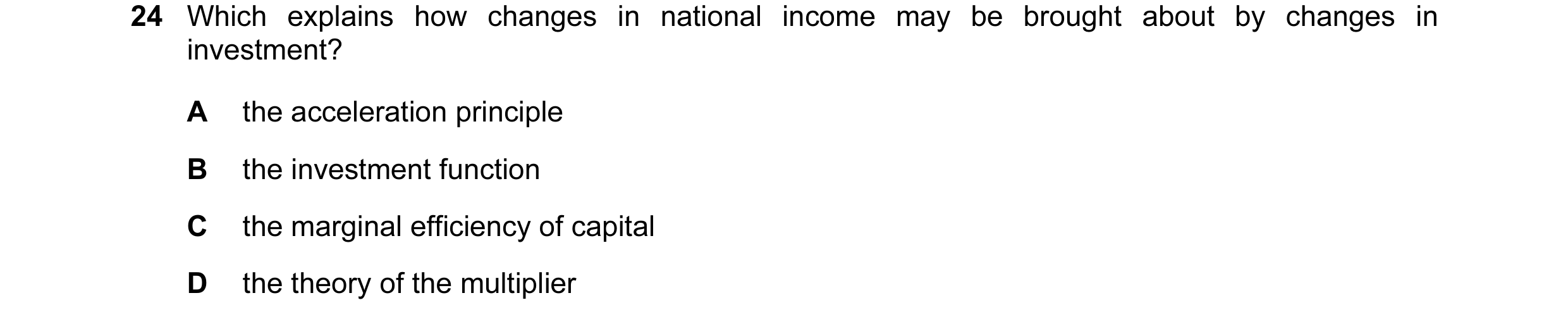
Q78 · Which explains how changes in national income may be brought about by changes in… 9708/33 Oct/Nov 2016
24 Which explains how changes in national income may be brought about by changes in investment? A the acceleration principle B the investment function C the marginal efficiency of capital D the theory of the multiplier
1 marks
Answer: D
This question in 9708/33 Oct/Nov 2016
Q79 · In a closed economy with no government, the equilibrium level of income occurs where A… 9708/33 Oct/Nov 2016
25 In a closed economy with no government, the equilibrium level of income occurs where A planned consumption is equal to desired investment. B planned consumption is equal to desired savings. C planned investment is equal to desired savings. D planned savings plus desired investment is equal to consumption.
1 marks
Answer: C
This question in 9708/33 Oct/Nov 2016
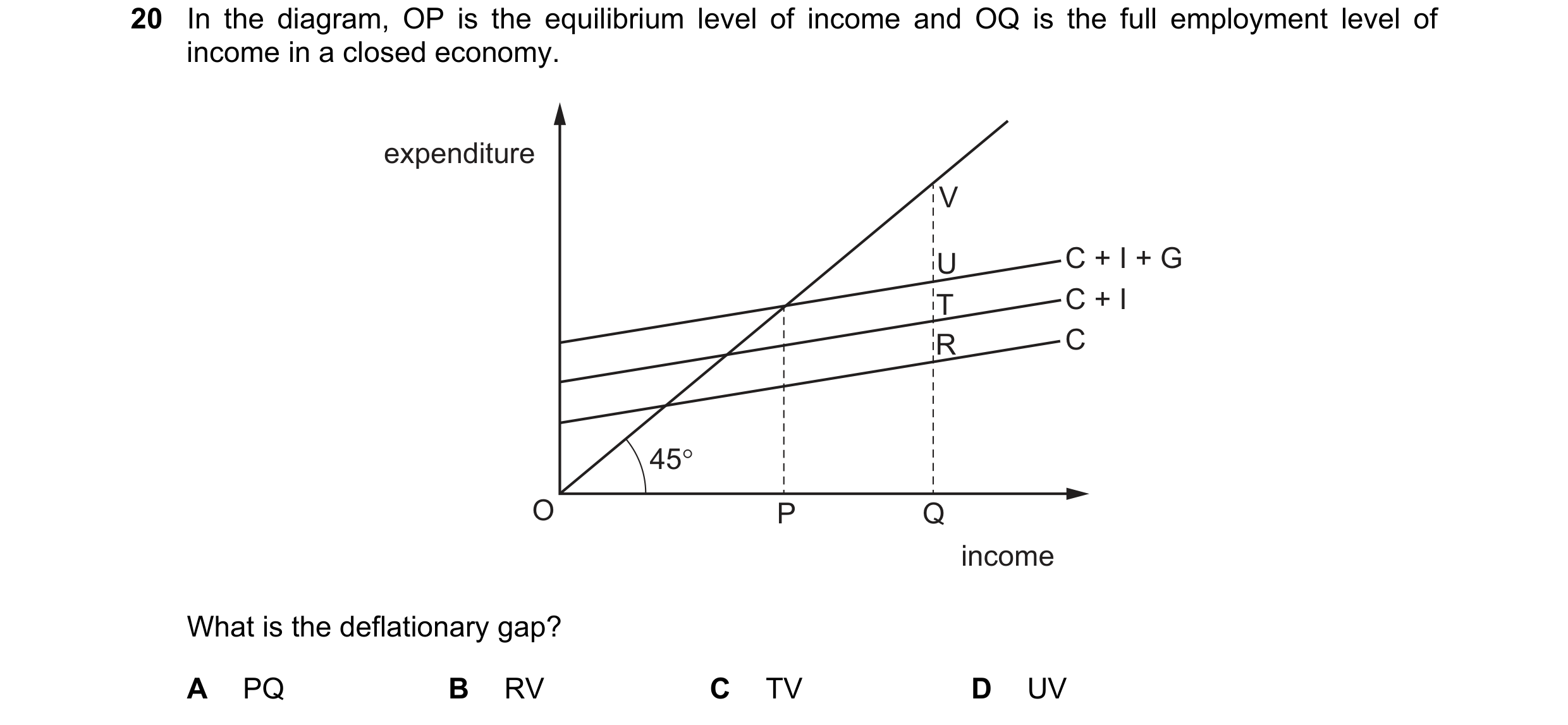
Q80 · In the diagram, OP is the equilibrium level of income and OQ the full employment level of… 9708/33 Oct/Nov 2016
26 In the diagram, OP is the equilibrium level of income and OQ the full employment level of income in a closed economy. V U C + I + G expenditure T C + I R C 45° O P Q income What is the deflationary gap? A PQ B RV C TV D UV
1 marks
Answer: D
This question in 9708/33 Oct/Nov 2016
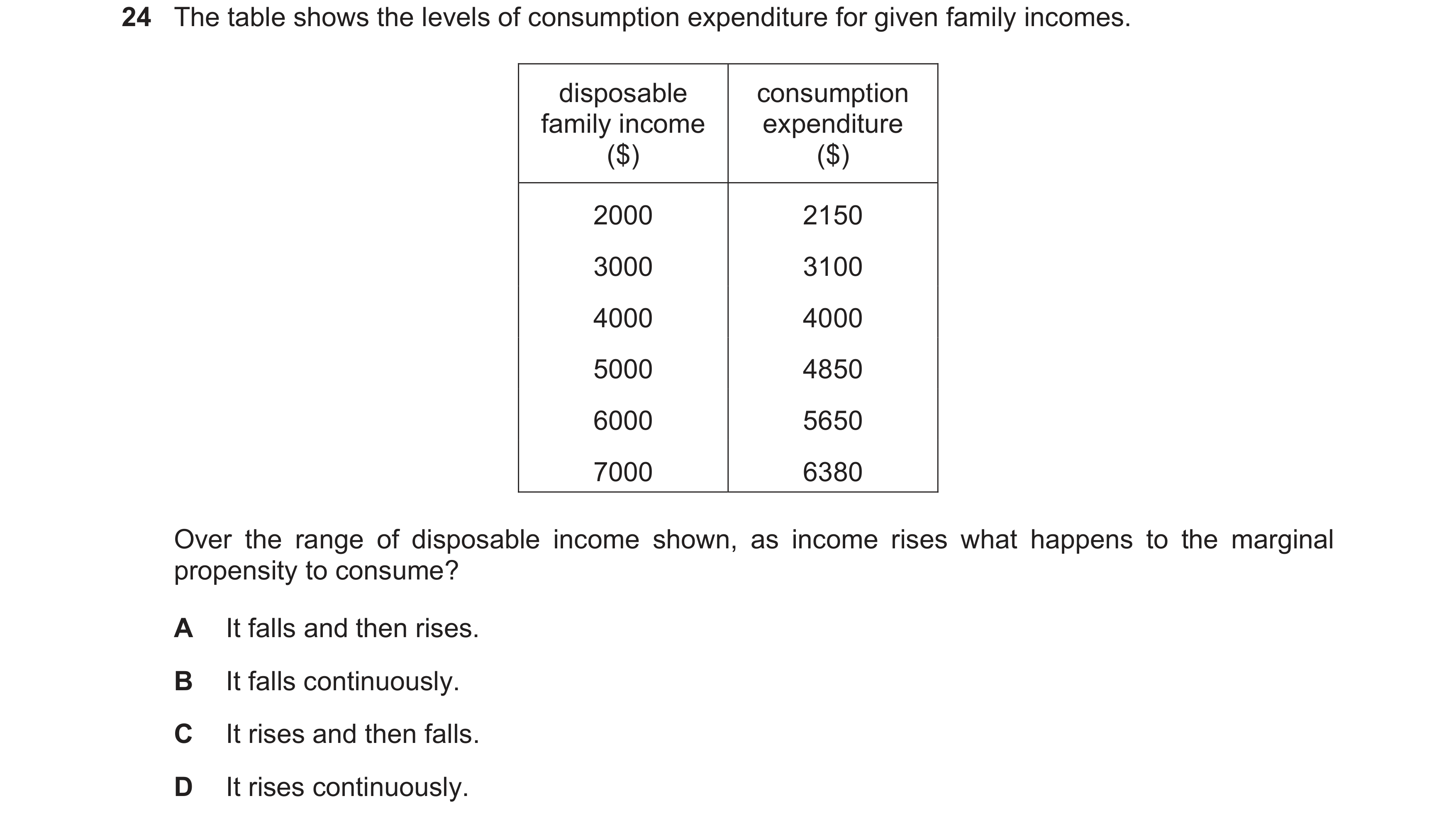
Q81 · The table shows the levels of consumption expenditure for given family incomes 9708/32 May/June 2017
24 The table shows the levels of consumption expenditure for given family incomes. disposable consumption family income expenditure ($) ($) 2000 2150 3000 3100 4000 4000 5000 4850 6000 5650 7000 6380 Over the range of disposable income shown, as income rises what happens to the marginal propensity to consume? A It falls and then rises. B It falls continuously. C It rises and then falls. D It rises continuously.
1 marks
Answer: B
This question in 9708/32 May/June 2017
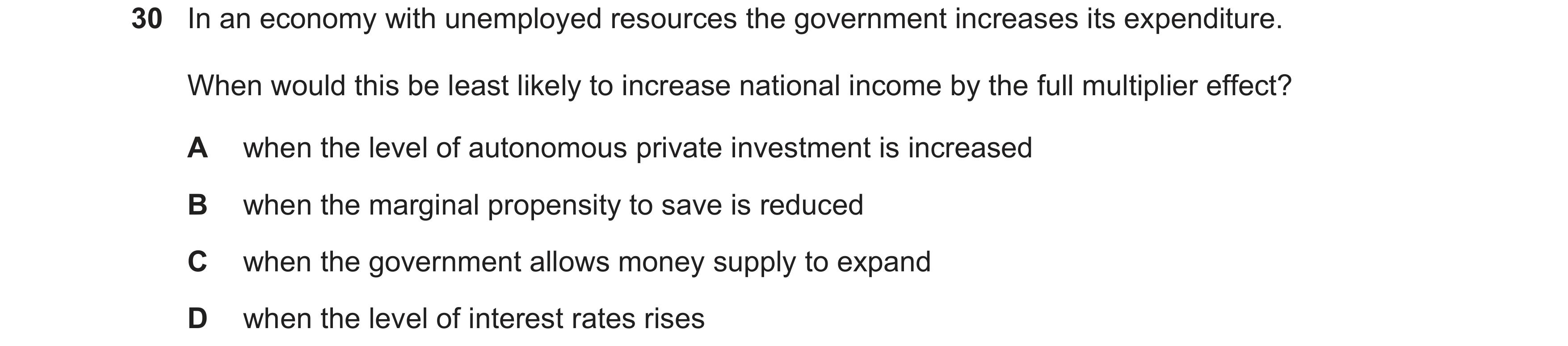
Q82 · In an economy with unemployed resources the government increases its expenditure 9708/32 May/June 2017
30 In an economy with unemployed resources the government increases its expenditure. When would this be least likely to increase national income by the full multiplier effect? A when the level of autonomous private investment is increased B when the marginal propensity to save is reduced C when the government allows money supply to expand D when the level of interest rates rises
1 marks
Answer: D
This question in 9708/32 May/June 2017
Q83 · It has been observed that increased growth in consumer spending results in an increase in… 9708/33 May/June 2017
19 It has been observed that increased growth in consumer spending results in an increase in investment by firms. Which principle of macroeconomic theory explains this relationship? A the accelerator B the liquidity trap C the marginal efficiency of capital D the multiplier
1 marks
Answer: A
This question in 9708/33 May/June 2017
Q84 · What is the value of the multiplier in an economy with no government where the marginal… 9708/33 May/June 2017
20 What is the value of the multiplier in an economy with no government where the marginal propensity to save is 6 1 and the marginal propensity to import is 3 1 ? A 1 B 1 2 1 C 2 D 3 2
1 marks
Answer: C
This question in 9708/33 May/June 2017
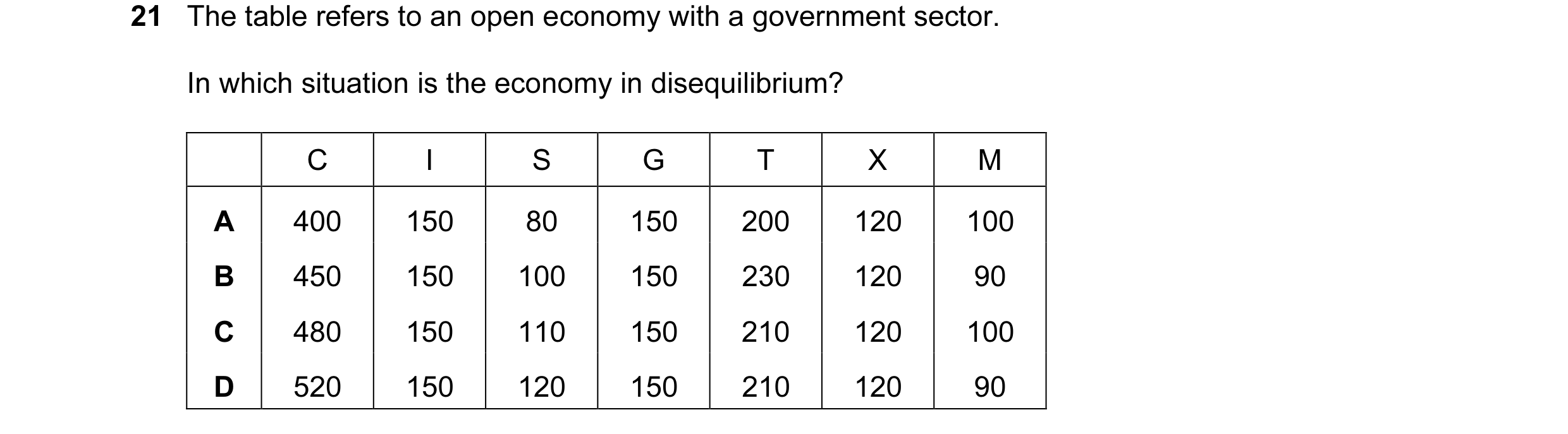
Q85 · The table refers to an open economy with a government sector 9708/33 May/June 2017
21 The table refers to an open economy with a government sector. In which situation is the economy in disequilibrium? C I S G T X M A 400 150 80 150 200 120 100 B 450 150 100 150 230 120 90 C 480 150 110 150 210 120 100 D 520 150 120 150 210 120 90
1 marks
Answer: A
This question in 9708/33 May/June 2017
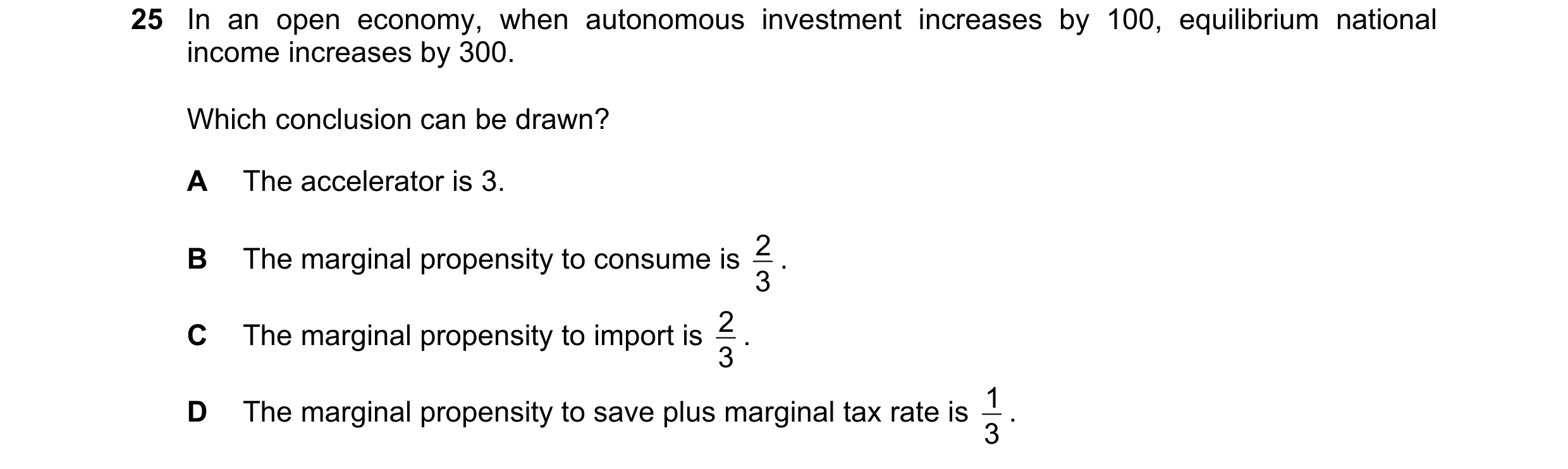
Q86 · In an open economy, when autonomous investment increases by 100, equilibrium national… 9708/32 Oct/Nov 2018
25 In an open economy, when autonomous investment increases by 100, equilibrium national income increases by 300. Which conclusion can be drawn? A The accelerator is 3. 2 . B The marginal propensity to consume is 3 2 . C The marginal propensity to import is 3 1 . D The marginal propensity to save plus marginal tax rate is 3
1 marks
Answer: B
This question in 9708/32 Oct/Nov 2018
Q87 · In an open economy with a government sector, the marginal propensity to import is 0.3… 9708/32 Feb/March 2019
23 In an open economy with a government sector, the marginal propensity to import is 0.3, the marginal propensity to tax is 0.3 and the marginal propensity to save is 0.2. What is the value of the multiplier? A 1.25 B 2 C 2.5 D 5
1 marks
Answer: A
This question in 9708/32 Feb/March 2019
Q88 · In a closed economy with no government expenditure and no taxation, the initial income is… 9708/32 May/June 2019
25 In a closed economy with no government expenditure and no taxation, the initial income is $5000 million. All savings are carried out by consumers, who save 20% of any additional income received above $5000 million. Firms plan to invest $1000 million. What is the value of the multiplier? A 0.8 B 4 C 5 D 8
1 marks
Answer: C
This question in 9708/32 May/June 2019
Q89 · In the diagram, OP is the equilibrium level of income and OQ the full employment level of… 9708/32 Oct/Nov 2019
21 In the diagram, OP is the equilibrium level of income and OQ the full employment level of income in a closed economy. expenditure V U C + I + G T C + I R C 45° O P Q income What is the deflationary gap? A PQ B RV C TV D UV
1 marks
Answer: D
This question in 9708/32 Oct/Nov 2019
Q90 · What represents an injection into a country’s circular flow of income? 9708/32 Oct/Nov 2019
22 What represents an injection into a country’s circular flow of income? A corporate taxes B interest payments on government bonds C the payment of dividends to foreign shareholders D the repayment of bank loans
1 marks
Answer: B
This question in 9708/32 Oct/Nov 2019
Q91 · When calculating national income by the income method, what would not be included? 9708/32 Feb/March 2020
19 When calculating national income by the income method, what would not be included? A income from abroad B profits of private sector businesses C rent from the ownership of land D transfer payments
1 marks
Answer: D
This question in 9708/32 Feb/March 2020
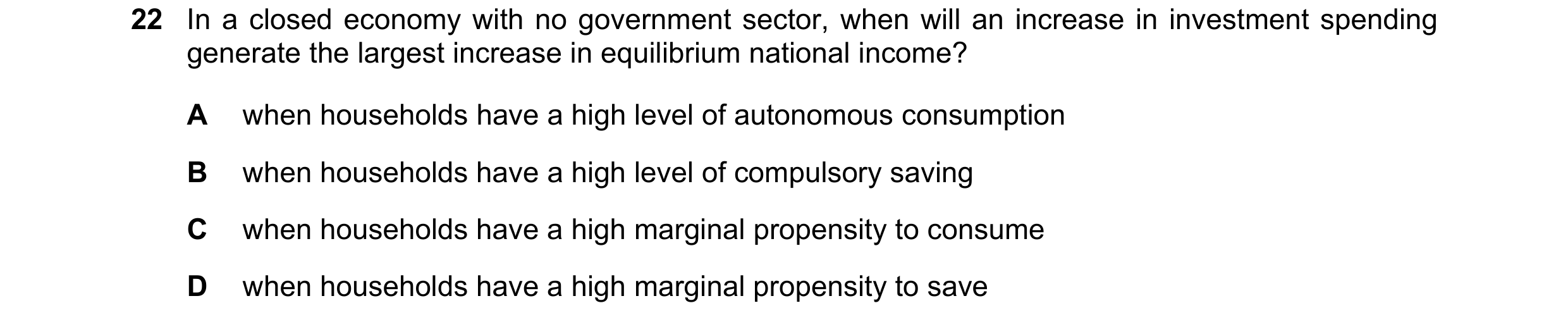
Q92 · In a closed economy with no government sector, when will an increase in investment… 9708/32 Feb/March 2020
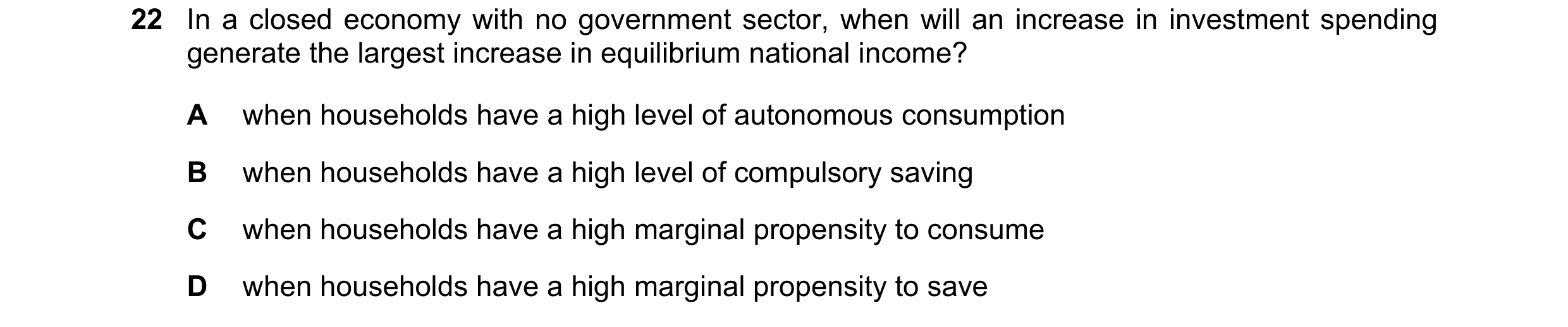
21 In a closed economy with no government sector, when will an increase in investment spending generate the largest increase in equilibrium national income? A when households have a high level of autonomous consumption B when households have a high level of compulsory saving C when households have a high marginal propensity to consume D when households have a high marginal propensity to save
1 marks
Answer: C
This question in 9708/32 Feb/March 2020
Q93 · The national income / expenditure diagram shows changes in consumption expenditure (C) 9708/31 Oct/Nov 2020
23 The national income / expenditure diagram shows changes in consumption expenditure (C). AE = NI aggregate expenditure (AE) C2 ($ bn) C1 45° O Y1 Y2 national income (NI) ($ bn) What would cause the consumption function to shift from C1 to C2? A a minimum deposit introduced for credit purchases B an increase in direct taxation C an increase in the rate of interest D the expectation of an increase in indirect taxes
1 marks
Answer: D
This question in 9708/31 Oct/Nov 2020
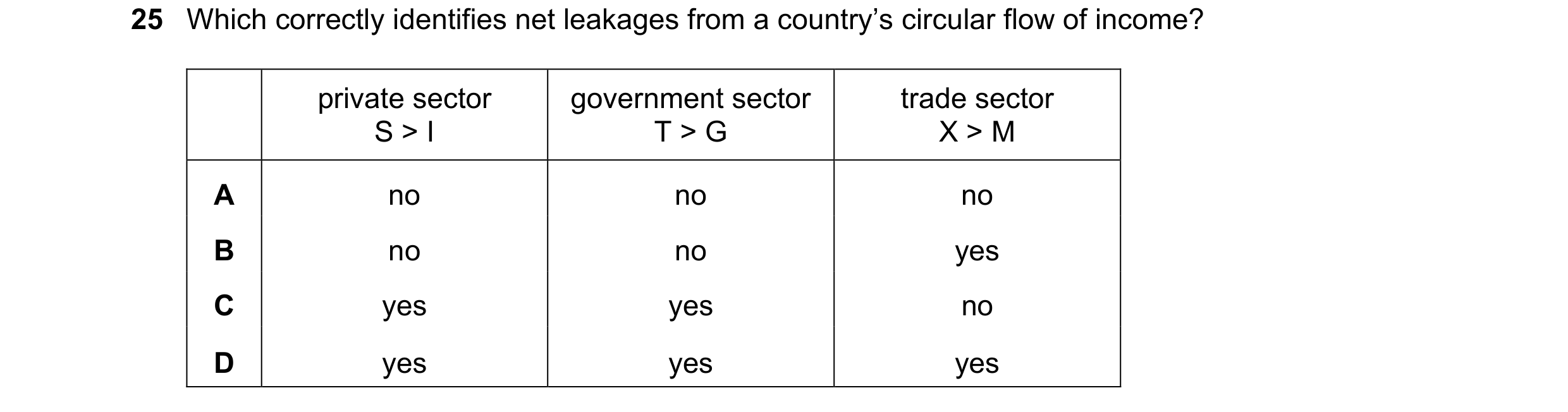
Q94 · Which correctly identifies net leakages from a country’s circular flow of income? 9708/31 Oct/Nov 2020
25 Which correctly identifies net leakages from a country’s circular flow of income? private sector government sector trade sector S > I T > G X > M A no no no B no no yes C yes yes no D yes yes yes
1 marks
Answer: C
This question in 9708/31 Oct/Nov 2020
Q95 · The diagram shows the consumption function of a country 9708/32 Oct/Nov 2020
21 The diagram shows the consumption function of a country. consumption expenditure C2 ($ bn) C1 45° O income ($ bn) What could cause the consumption function to shift upwards from C1 to C2? A an increase in interest rates B an increase in direct taxation C an increase in the proportion of income saved by households D the expectation of an increase in the rate of sales taxes
1 marks
Answer: D
This question in 9708/32 Oct/Nov 2020
Q96 · The accelerator principle refers to a relationship between investment and A the level of… 9708/32 Oct/Nov 2020
22 The accelerator principle refers to a relationship between investment and A the level of GDP. B changes in GDP. C the level of interest rates. D changes in interest rates.
1 marks
Answer: B
This question in 9708/32 Oct/Nov 2020
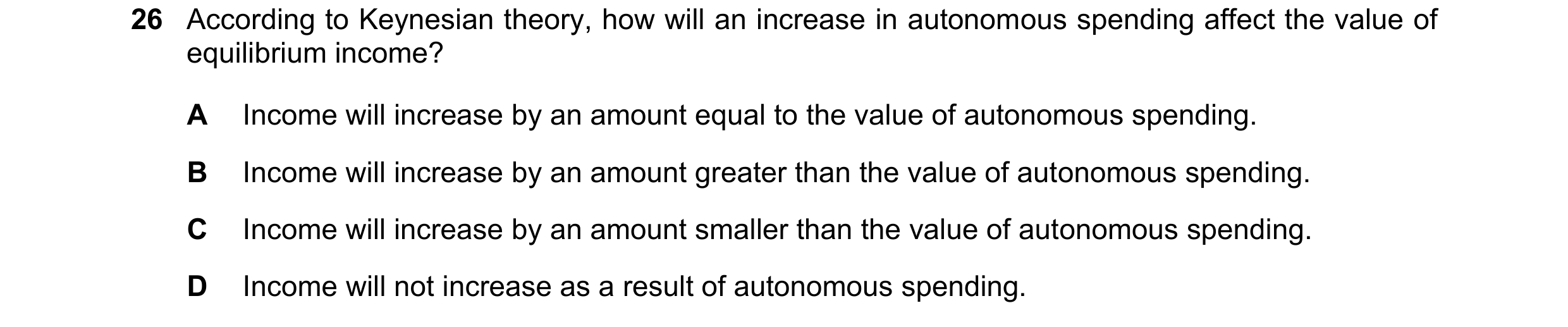
Q97 · According to Keynesian theory, how will an increase in autonomous spending affect the… 9708/32 Oct/Nov 2020
26 According to Keynesian theory, how will an increase in autonomous spending affect the value of equilibrium income? A Income will increase by an amount equal to the value of autonomous spending. B Income will increase by an amount greater than the value of autonomous spending. C Income will increase by an amount smaller than the value of autonomous spending. D Income will not increase as a result of autonomous spending.
1 marks
Answer: B
This question in 9708/32 Oct/Nov 2020
Q98 · What reduces the value of the multiplier? 9708/33 Oct/Nov 2020
23 What reduces the value of the multiplier? A an increase in government investment expenditure B an increase in consumption C an increase in the rate of taxation D an increase in the volume of exports
1 marks
Answer: C
This question in 9708/33 Oct/Nov 2020
Q99 · Which condition for macroeconomic equilibrium is correct? 9708/33 Oct/Nov 2020
27 Which condition for macroeconomic equilibrium is correct? A G – T = S + I + X – M B I – S = G – T + M – X C M – X = I – S + G – T D X – M + G = S + I – T
1 marks
Answer: C
This question in 9708/33 Oct/Nov 2020
Q100 · In a closed economy, the marginal propensity to save is 0.1 and the marginal propensity… 9708/32 Feb/March 2021
24 In a closed economy, the marginal propensity to save is 0.1 and the marginal propensity to pay taxes is also 0.1. These values are constant and do not vary with the level of income. What will be the increase in national income if there is an injection of $100 million into the circular flow? A $1000 million B $500 million C $100 million D $80 million
1 marks
Answer: B
This question in 9708/32 Feb/March 2021
Q101 · What is assumed by Keynesians? 9708/32 Feb/March 2021
26 What is assumed by Keynesians? A An increase in supply always creates an equal increase in demand. B Government intervention is required to manage the economy. C Prices always adjust so that markets clear. D The economy always has full employment.
1 marks
Answer: B
This question in 9708/32 Feb/March 2021
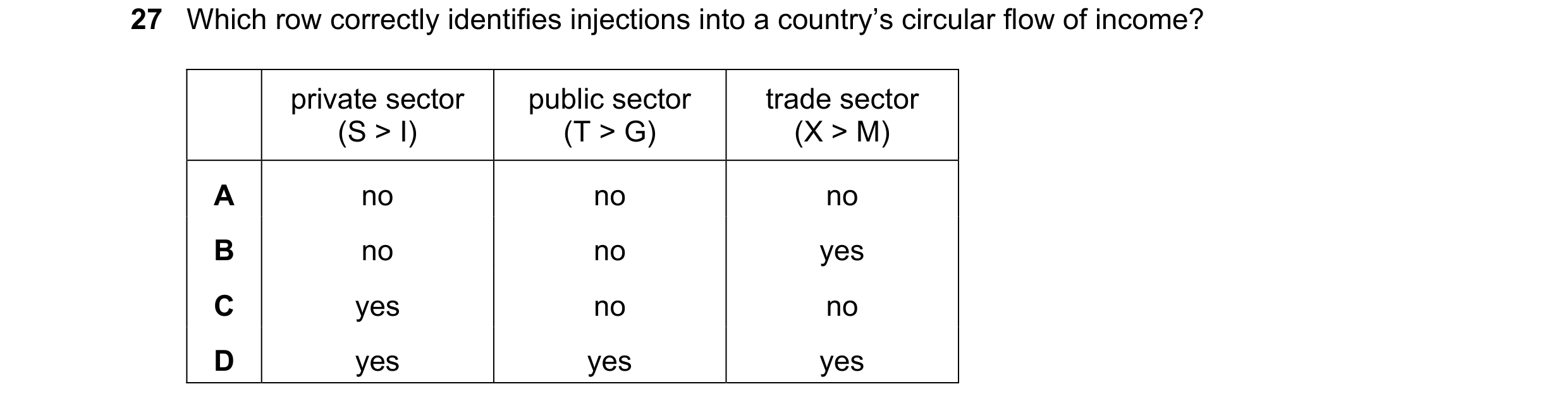
Q102 · Which row correctly identifies injections into a country’s circular flow of income? 9708/32 Feb/March 2021
27 Which row correctly identifies injections into a country’s circular flow of income? private sector public sector trade sector (S > I) (T > G) (X > M) A no no no B no no yes C yes no no D yes yes yes
1 marks
Answer: B
This question in 9708/32 Feb/March 2021
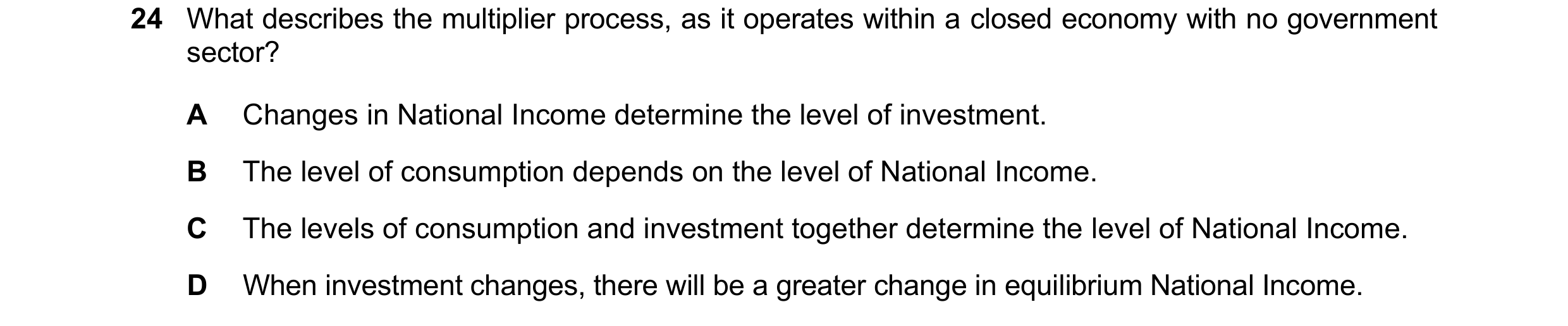
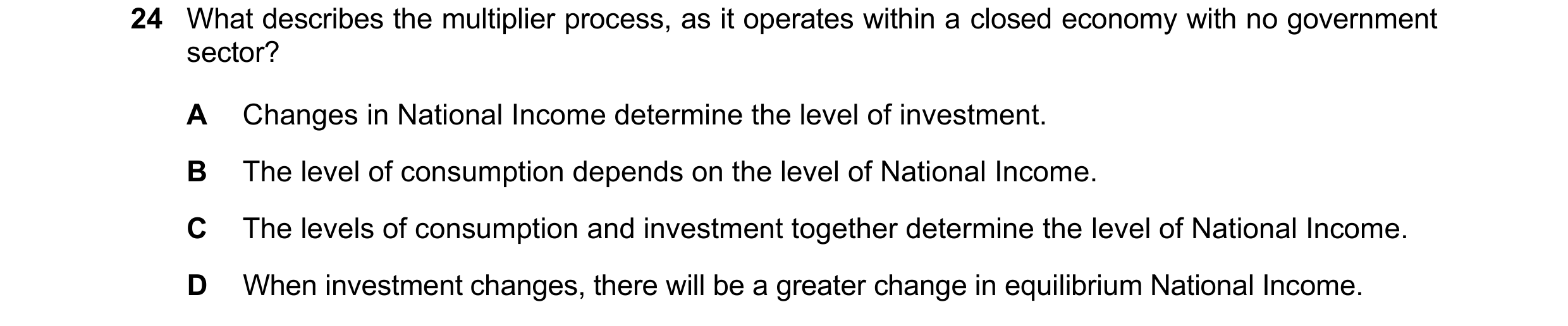
Q103 · What describes the multiplier process, as it operates within a closed economy with no… 9708/31 May/June 2021
24 What describes the multiplier process, as it operates within a closed economy with no government sector? A Changes in National Income determine the level of investment. B The level of consumption depends on the level of National Income. C The levels of consumption and investment together determine the level of National Income. D When investment changes, there will be a greater change in equilibrium National Income.
1 marks
Answer: D
This question in 9708/31 May/June 2021
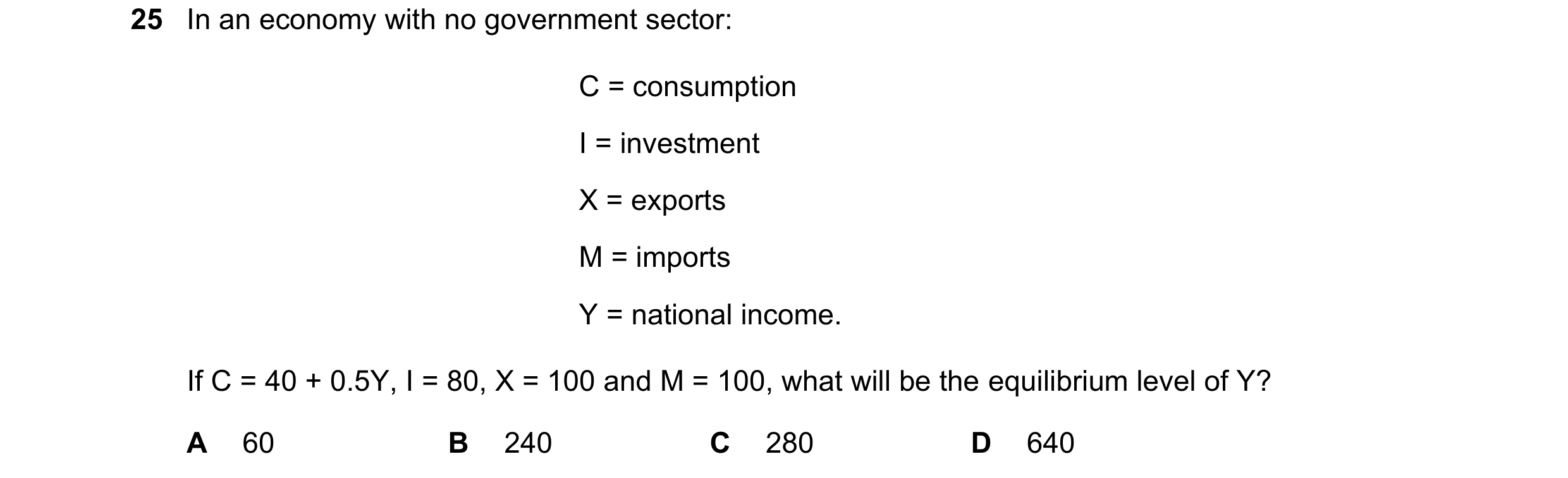
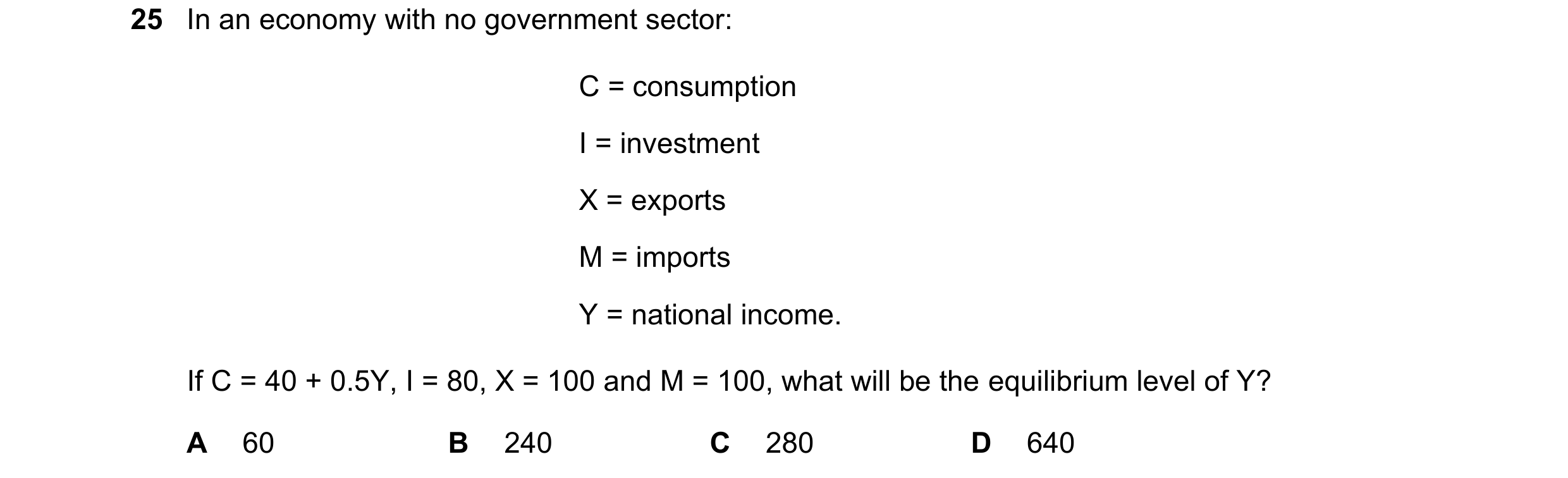
Q104 · In an economy with no government sector: C = consumption I = investment X = exports M =… 9708/31 May/June 2021
25 In an economy with no government sector: C = consumption I = investment X = exports M = imports Y = national income. If C = 40 + 0.5Y, I = 80, X = 100 and M = 100, what will be the equilibrium level of Y? A 60 B 240 C 280 D 640
1 marks
Answer: B
This question in 9708/31 May/June 2021
Q105 · What would be an increase in leakages or withdrawals from the circular flow of income? 9708/31 May/June 2021
27 What would be an increase in leakages or withdrawals from the circular flow of income? A increase in government spending on anti-smoking campaigns B increase in spending on imports of luxury cars C increase in spending on transfer payments D increase in wages paid to government employees
1 marks
Answer: B
This question in 9708/31 May/June 2021
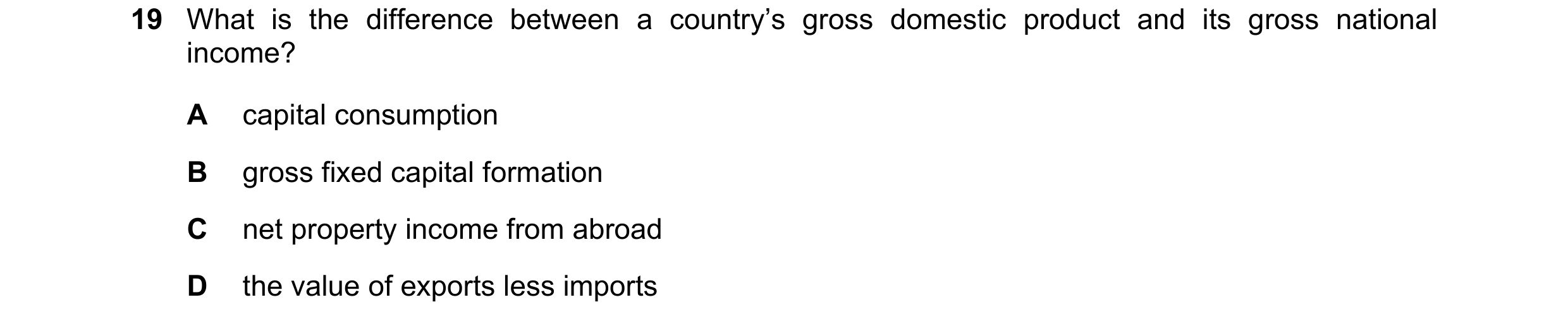
Q106 · What is the difference between a country’s gross domestic product and its gross national… 9708/32 May/June 2021
19 What is the difference between a country’s gross domestic product and its gross national income? A capital consumption B gross fixed capital formation C net property income from abroad D the value of exports less imports
1 marks
Answer: C
This question in 9708/32 May/June 2021
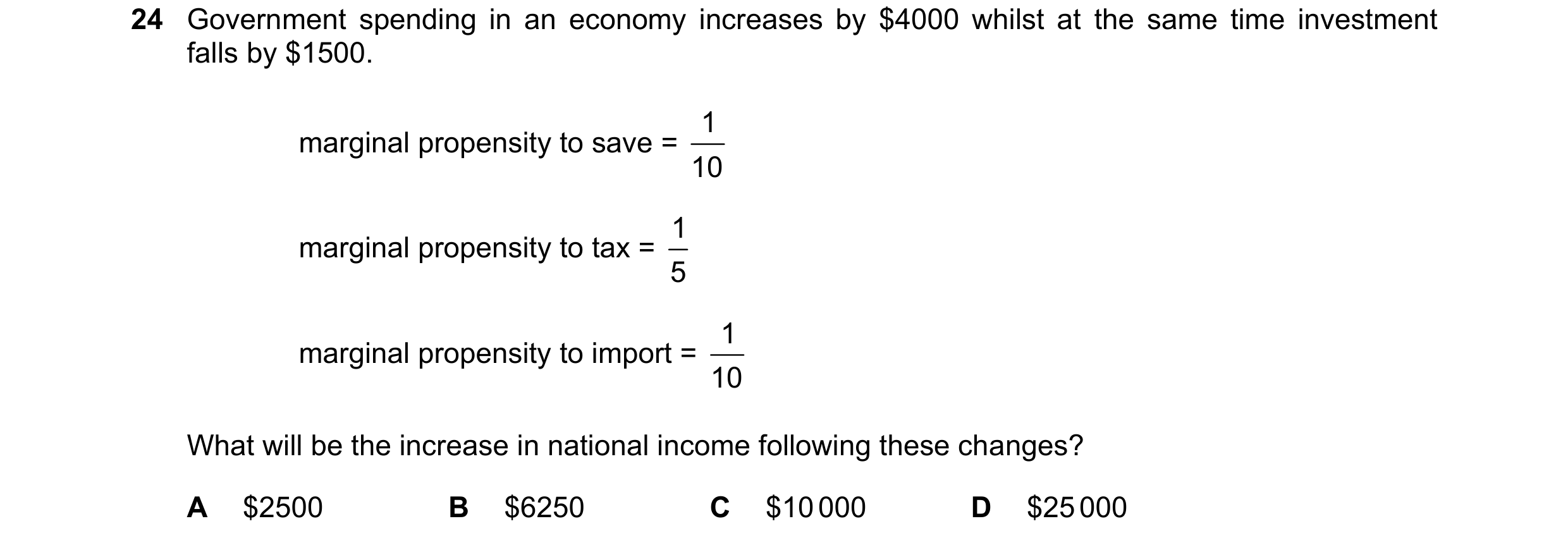
Q107 · Government spending in an economy increases by $4000 whilst at the same time investment… 9708/32 May/June 2021
24 Government spending in an economy increases by $4000 whilst at the same time investment falls by $1500. marginal propensity to save = 1 10 marginal propensity to tax = 1 5 marginal propensity to import = 1 10 What will be the increase in national income following these changes? A $2500 B $6250 C $10 000 D $25 000
1 marks
Answer: B
This question in 9708/32 May/June 2021
Q108 · What describes the multiplier process, as it operates within a closed economy with no… 9708/33 May/June 2021
24 What describes the multiplier process, as it operates within a closed economy with no government sector? A Changes in National Income determine the level of investment. B The level of consumption depends on the level of National Income. C The levels of consumption and investment together determine the level of National Income. D When investment changes, there will be a greater change in equilibrium National Income.
1 marks
Answer: D
This question in 9708/33 May/June 2021
Q109 · In an economy with no government sector: C = consumption I = investment X = exports M =… 9708/33 May/June 2021
25 In an economy with no government sector: C = consumption I = investment X = exports M = imports Y = national income. If C = 40 + 0.5Y, I = 80, X = 100 and M = 100, what will be the equilibrium level of Y? A 60 B 240 C 280 D 640
1 marks
Answer: B
This question in 9708/33 May/June 2021
Q110 · What would be an increase in leakages or withdrawals from the circular flow of income? 9708/33 May/June 2021
27 What would be an increase in leakages or withdrawals from the circular flow of income? A increase in government spending on anti-smoking campaigns B increase in spending on imports of luxury cars C increase in spending on transfer payments D increase in wages paid to government employees
1 marks
Answer: B
This question in 9708/33 May/June 2021
Q111 · In a closed economy with no government there is an initial equilibrium level of national… 9708/31 Oct/Nov 2021
24 In a closed economy with no government there is an initial equilibrium level of national income of $500 billion. The economy’s households always spend a constant fraction of every $1 of income they receive. When investment spending increases by $20 billion the economy moves to a new equilibrium level of national income of $600 billion. What is the marginal propensity to consume of the economy’s households? A 0.20 B 0.80 C 0.83 D 1.00
1 marks
Answer: B
This question in 9708/31 Oct/Nov 2021
Q112 · In an economy operating below full employment, which combination of changes will… 9708/31 Oct/Nov 2021
30 In an economy operating below full employment, which combination of changes will definitely result in an increase in national income? A a fall in the rate of taxation together with a rise in the saving rate B a rise in government expenditure together with a fall in the propensity to import C a rise in investment expenditure together with a rise in the rate of taxation D a rise in the propensity to save together with a rise in exports
1 marks
Answer: B
This question in 9708/31 Oct/Nov 2021
Q113 · The information in the table is taken from a country’s national income accounts 9708/32 Oct/Nov 2021
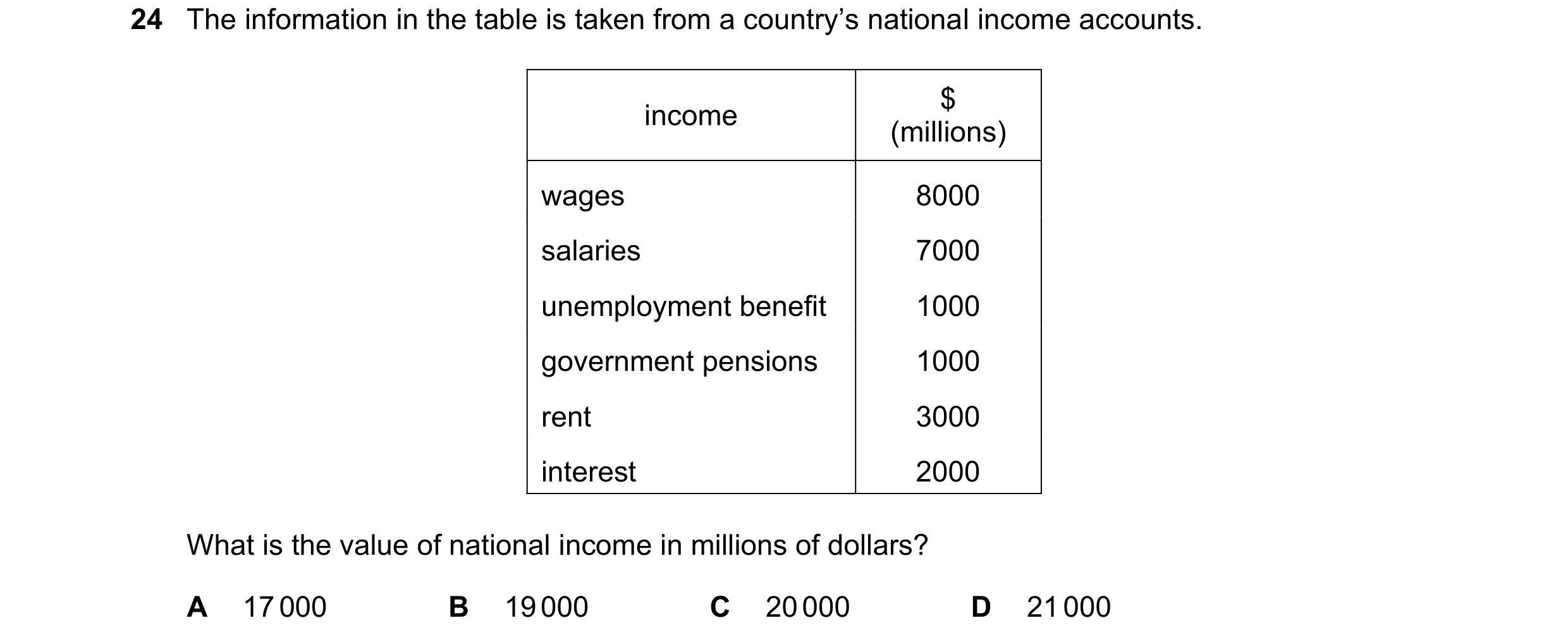
24 The information in the table is taken from a country’s national income accounts. $ income (millions) wages 8000 salaries 7000 unemployment benefit 1000 government pensions 1000 rent 3000 interest 2000 What is the value of national income in millions of dollars? A 17 000 B 19 000 C 20 000 D 21 000
1 marks
Answer: C
This question in 9708/32 Oct/Nov 2021
Q114 · In a closed economy with no government sector the marginal propensity to consume is 0.6… 9708/32 Oct/Nov 2021
25 In a closed economy with no government sector the marginal propensity to consume is 0.6 at all levels of income. There is an increase in private sector investment of $100 million. What will be the increase in national income? A $60 million B $100 million C $166 million D $250 million
1 marks
Answer: D
This question in 9708/32 Oct/Nov 2021
Q115 · What would not exist in a free-market, open economy? 9708/31 May/June 2022
23 What would not exist in a free-market, open economy? A autonomous investment B household saving C import spending D indirect taxation
1 marks
Answer: D
This question in 9708/31 May/June 2022
Q116 · The table shows an individual’s planned consumption at different levels of income 9708/31 May/June 2022
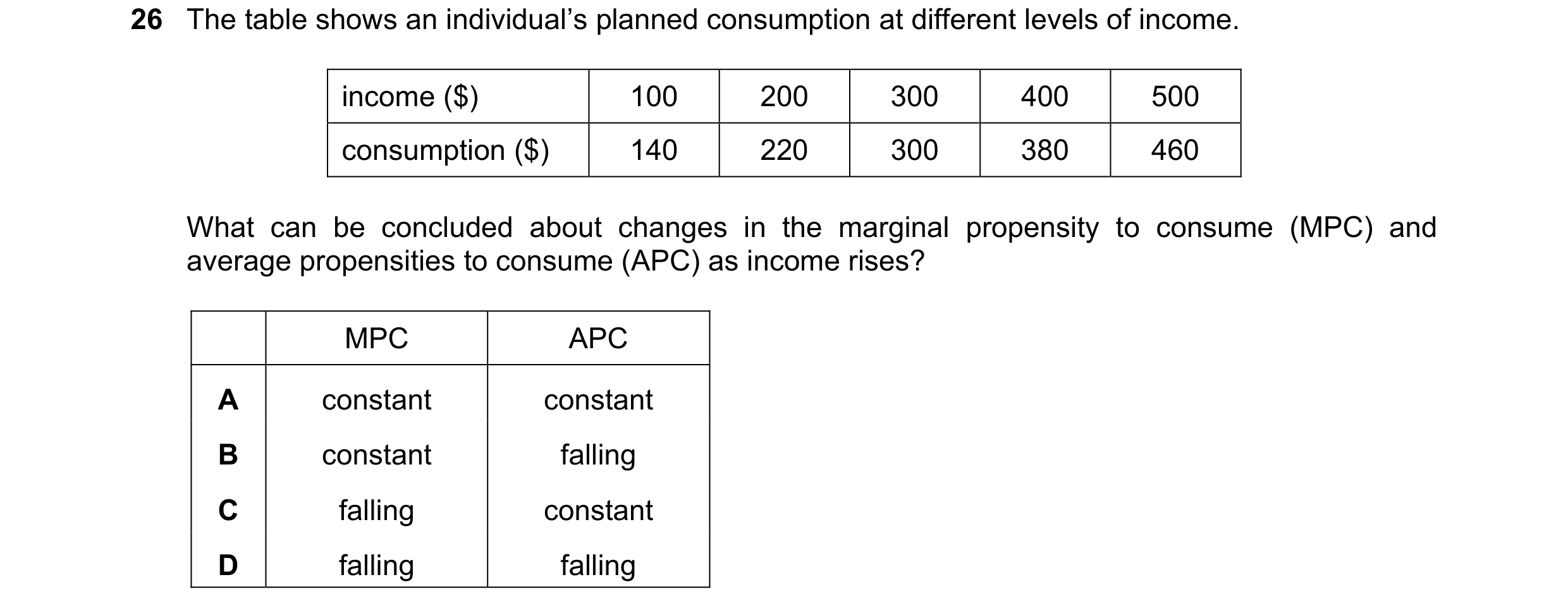
26 The table shows an individual’s planned consumption at different levels of income. income ($) 100 200 300 400 500 consumption ($) 140 220 300 380 460 What can be concluded about changes in the marginal propensity to consume (MPC) and average propensities to consume (APC) as income rises? MPC APC A constant constant B constant falling C falling constant D falling falling
1 marks
Answer: B
This question in 9708/31 May/June 2022
Q117 · An increase in which factor will cause a decrease in investment spending? 9708/31 May/June 2022
28 An increase in which factor will cause a decrease in investment spending? A business confidence B company profits C interest rates D national income
1 marks
Answer: C
This question in 9708/31 May/June 2022
Q118 · What would not exist in a free-market, open economy? 9708/33 May/June 2022
23 What would not exist in a free-market, open economy? A autonomous investment B household saving C import spending D indirect taxation
1 marks
Answer: D
This question in 9708/33 May/June 2022
Q119 · The table shows an individual’s planned consumption at different levels of income 9708/33 May/June 2022
26 The table shows an individual’s planned consumption at different levels of income. income ($) 100 200 300 400 500 consumption ($) 140 220 300 380 460 What can be concluded about changes in the marginal propensity to consume (MPC) and average propensities to consume (APC) as income rises? MPC APC A constant constant B constant falling C falling constant D falling falling
1 marks
Answer: B
This question in 9708/33 May/June 2022
Q120 · An increase in which factor will cause a decrease in investment spending? 9708/33 May/June 2022
28 An increase in which factor will cause a decrease in investment spending? A business confidence B company profits C interest rates D national income
1 marks
Answer: C
This question in 9708/33 May/June 2022
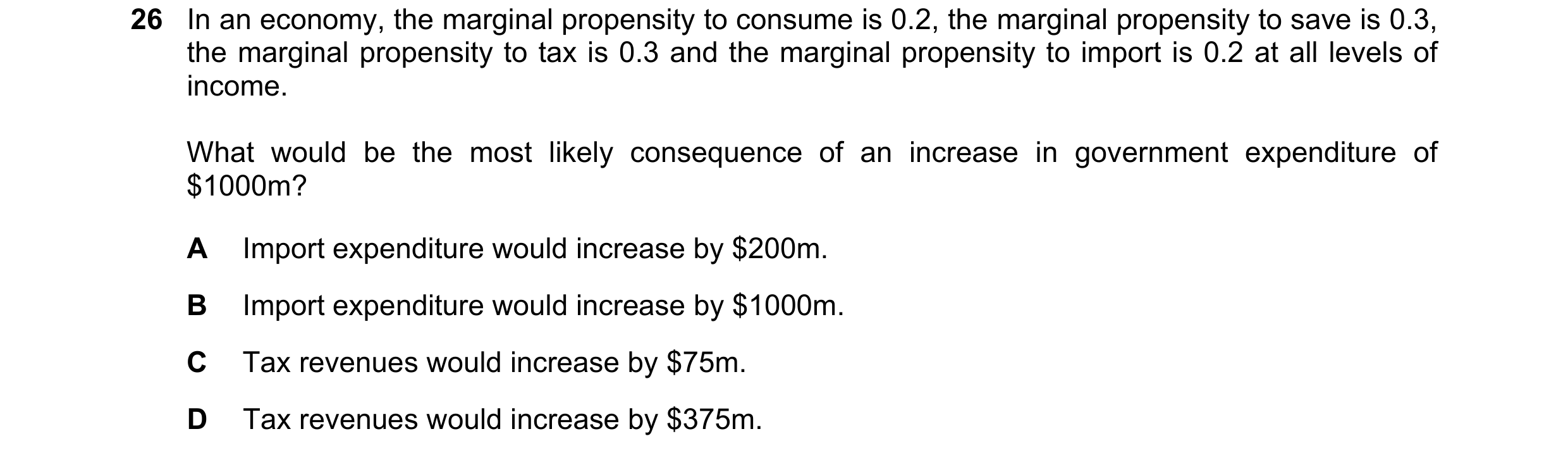
Q121 · In an economy, the marginal propensity to consume is 0.2, the marginal propensity to save… 9708/31 Oct/Nov 2022
26 In an economy, the marginal propensity to consume is 0.2, the marginal propensity to save is 0.3, the marginal propensity to tax is 0.3 and the marginal propensity to import is 0.2 at all levels of income. What would be the most likely consequence of an increase in government expenditure of $1000m? A Import expenditure would increase by $200m. B Import expenditure would increase by $1000m. C Tax revenues would increase by $75m. D Tax revenues would increase by $375m.
1 marks
Answer: D
This question in 9708/31 Oct/Nov 2022
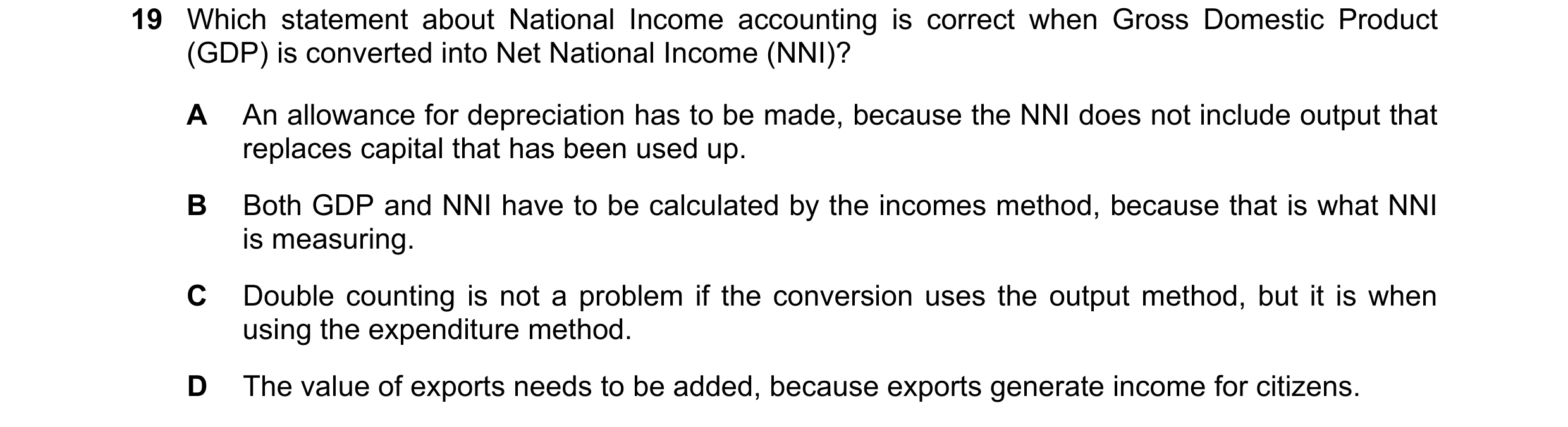
Q122 · Which statement about National Income accounting is correct when Gross Domestic Product… 9708/33 Oct/Nov 2022
19 Which statement about National Income accounting is correct when Gross Domestic Product (GDP) is converted into Net National Income (NNI)? A An allowance for depreciation has to be made, because the NNI does not include output that replaces capital that has been used up. B Both GDP and NNI have to be calculated by the incomes method, because that is what NNI is measuring. C Double counting is not a problem if the conversion uses the output method, but it is when using the expenditure method. D The value of exports needs to be added, because exports generate income for citizens.
1 marks
Answer: A
This question in 9708/33 Oct/Nov 2022
Q123 · Four students are asked to complete a table showing the aggregate demand equation and the… 9708/33 Oct/Nov 2022
24 Four students are asked to complete a table showing the aggregate demand equation and the multiplier formula for a closed economy without a government. Which student is correct? aggregate demand multiplier 1 A C + I marginal propensity to consume 1 B C + I marginal propensity to save 1 C C + I – S marginal propensity to consume 1 D C + I – S marginal propensity to save
1 marks
Answer: B
This question in 9708/33 Oct/Nov 2022
Q124 · What does the accelerator principle state? 9708/32 Feb/March 2023
21 What does the accelerator principle state? A Consumption is a function of the rate of change of income. B Income is a function of the rate of change of investment. C Investment is a function of the rate of change of income. D Investment is a function of the rate of interest.
1 marks
Answer: C
This question in 9708/32 Feb/March 2023
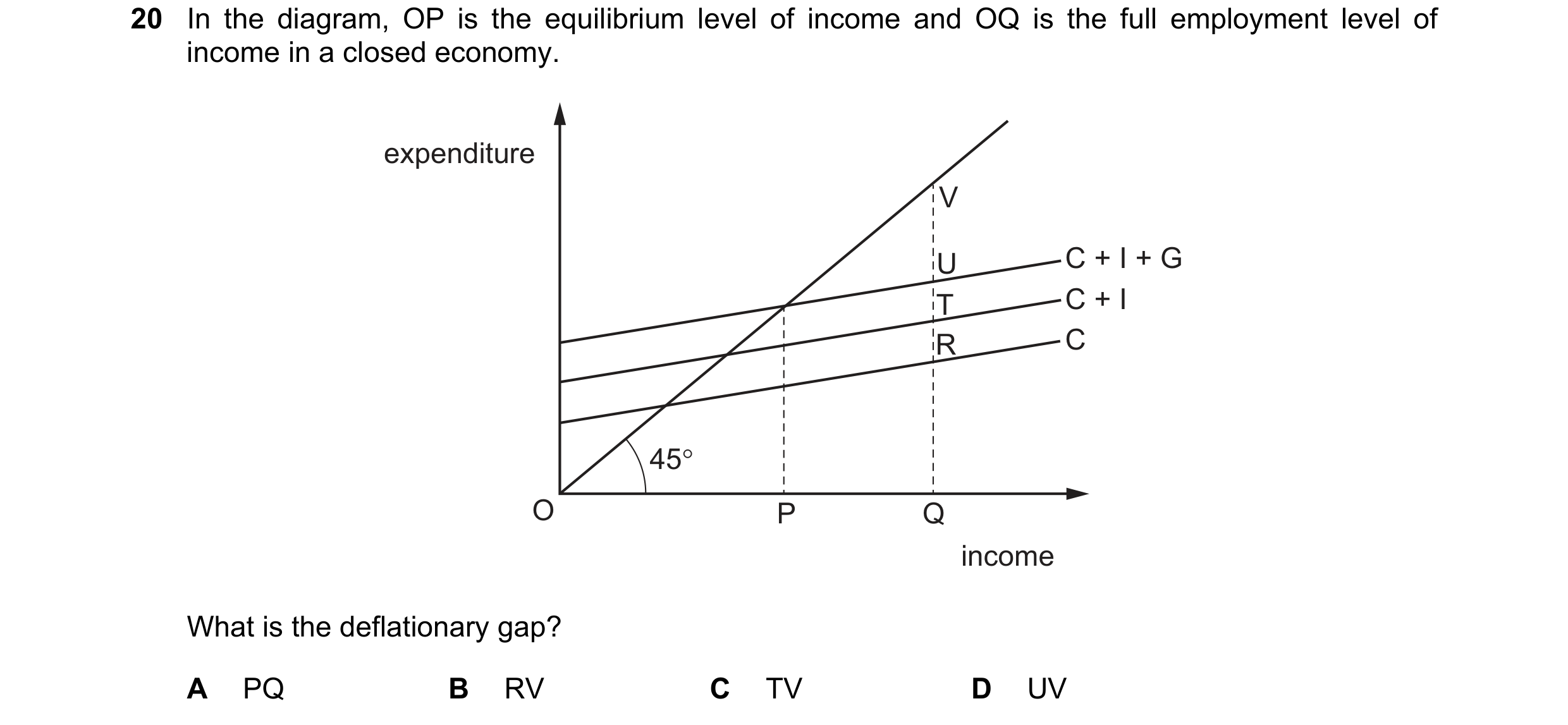
Q125 · In the diagram, OP is the equilibrium level of income and OQ is the full employment level… 9708/31 May/June 2023
20 In the diagram, OP is the equilibrium level of income and OQ is the full employment level of income in a closed economy. expenditure V U C + I + G T C + I R C 45° O P Q income What is the deflationary gap? A PQ B RV C TV D UV
1 marks
Answer: D
This question in 9708/31 May/June 2023
Q126 · In a closed economy with no government sector, when will an increase in investment… 9708/31 May/June 2023
22 In a closed economy with no government sector, when will an increase in investment spending generate the largest increase in equilibrium national income? A when households have a high level of autonomous consumption B when households have a high level of compulsory saving C when households have a high marginal propensity to consume D when households have a high marginal propensity to save
1 marks
Answer: C
This question in 9708/31 May/June 2023
Q127 · An open economy has injections, J, into the circular flow of income and withdrawals, W 9708/32 May/June 2023
20 An open economy has injections, J, into the circular flow of income and withdrawals, W. W injections and withdrawals S T J R O Q E national income If the full employment level of national income is OQ, what represents the inflationary gap? A QE B RT C SR D ST
1 marks
Answer: C
This question in 9708/32 May/June 2023
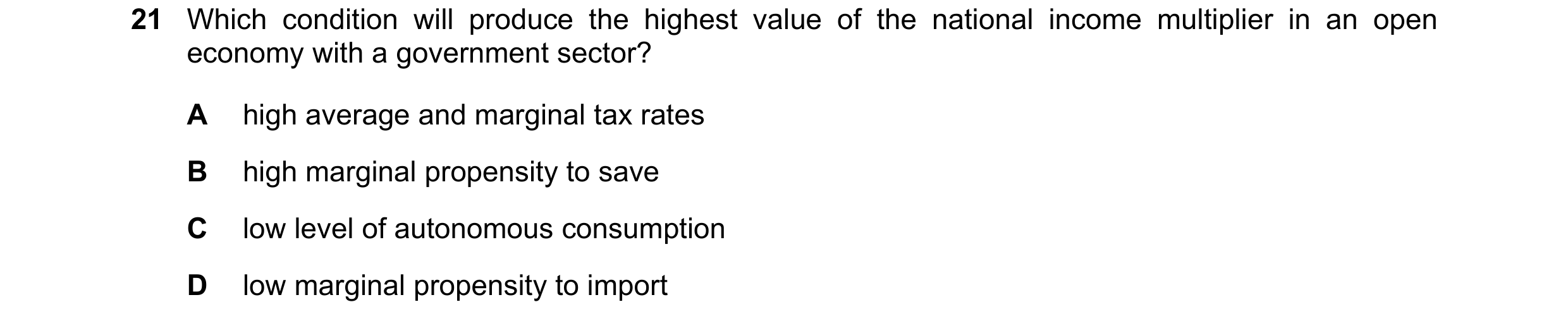
Q128 · Which condition will produce the highest value of the national income multiplier in an… 9708/32 May/June 2023
21 Which condition will produce the highest value of the national income multiplier in an open economy with a government sector? A high average and marginal tax rates B high marginal propensity to save C low level of autonomous consumption D low marginal propensity to import
1 marks
Answer: D
This question in 9708/32 May/June 2023
Q129 · In the diagram, OP is the equilibrium level of income and OQ is the full employment level… 9708/33 May/June 2023
20 In the diagram, OP is the equilibrium level of income and OQ is the full employment level of income in a closed economy. expenditure V U C + I + G T C + I R C 45° O P Q income What is the deflationary gap? A PQ B RV C TV D UV
1 marks
Answer: D
This question in 9708/33 May/June 2023
Q130 · In a closed economy with no government sector, when will an increase in investment… 9708/33 May/June 2023
22 In a closed economy with no government sector, when will an increase in investment spending generate the largest increase in equilibrium national income? A when households have a high level of autonomous consumption B when households have a high level of compulsory saving C when households have a high marginal propensity to consume D when households have a high marginal propensity to save
1 marks
Answer: C
This question in 9708/33 May/June 2023
Q131 · What might decrease if a closed economy with a government sector decides to allow… 9708/31 Oct/Nov 2023
17 What might decrease if a closed economy with a government sector decides to allow international trade? A components of aggregate expenditure B number of injections into the circular flow of income C number of leakages from the circular flow of income D value of the economy’s multiplier
1 marks
Answer: D
This question in 9708/31 Oct/Nov 2023
Q132 · The diagram shows a closed economy in which the full employment level of income is YF 9708/31 Oct/Nov 2023
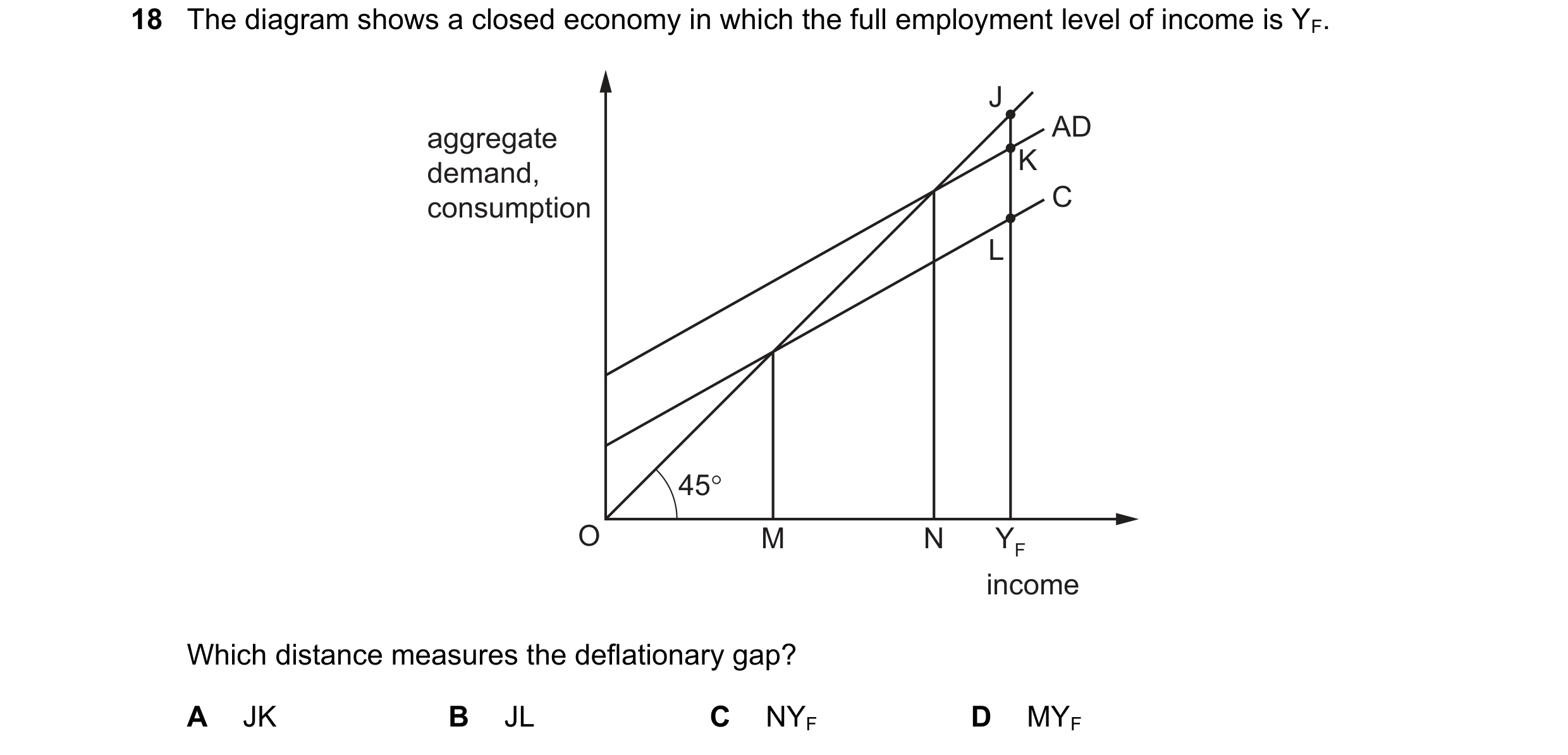
18 The diagram shows a closed economy in which the full employment level of income is YF. J aggregate AD demand, K consumption C L 45° O M N YF income Which distance measures the deflationary gap? A JK B JL C NYF D MYF
1 marks
Answer: A
This question in 9708/31 Oct/Nov 2023
Q133 · When is an increase in national income most likely to induce an increase in investment… 9708/33 Oct/Nov 2023
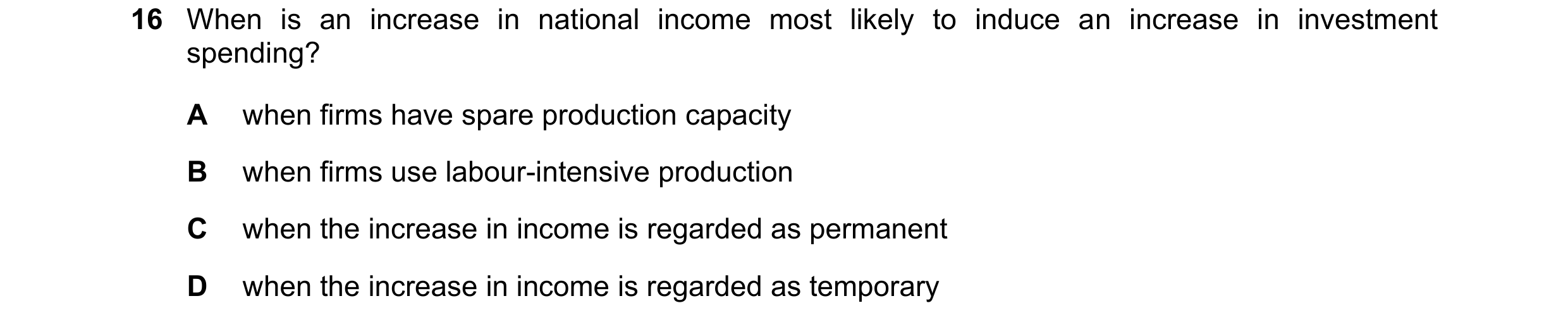
16 When is an increase in national income most likely to induce an increase in investment spending? A when firms have spare production capacity B when firms use labour-intensive production C when the increase in income is regarded as permanent D when the increase in income is regarded as temporary
1 marks
Answer: C
This question in 9708/33 Oct/Nov 2023
Q134 · Other things remaining equal, what will reduce the level of national income in an economy? 9708/33 Oct/Nov 2023
20 Other things remaining equal, what will reduce the level of national income in an economy? A a fall in planned savings B a fall in the marginal propensity to import C an increase in the average propensity to consume D a reduction in the level of defence expenditure
1 marks
Answer: D
This question in 9708/33 Oct/Nov 2023
Q135 · What, according to the accelerator principle, will cause the level of investment to fall? 9708/33 Oct/Nov 2023
21 What, according to the accelerator principle, will cause the level of investment to fall? A a decrease in confidence B a decrease in the rate of growth of national income C an increase in the price of capital equipment D an increase in the rate of interest
1 marks
Answer: B
This question in 9708/33 Oct/Nov 2023
Q136 · What is a necessary assumption of the Keynesian multiplier model? 9708/31 May/June 2024
19 What is a necessary assumption of the Keynesian multiplier model? A increasing average propensity to save B flexible costs and prices C full employment of resources D open economies
1 marks
Answer: A
This question in 9708/31 May/June 2024
Q137 · What is a necessary assumption of the Keynesian multiplier model? 9708/33 May/June 2024
19 What is a necessary assumption of the Keynesian multiplier model? A increasing average propensity to save B flexible costs and prices C full employment of resources D open economies
1 marks
Answer: A
This question in 9708/33 May/June 2024
Q138 · What does the accelerator principle explain? 9708/32 Feb/March 2025
15 What does the accelerator principle explain? A how changes in consumption lead to changes in income B how changes in income lead to changes in consumption C how changes in income lead to changes in investment D how changes in investment lead to changes in income
1 marks
Answer: C
This question in 9708/32 Feb/March 2025
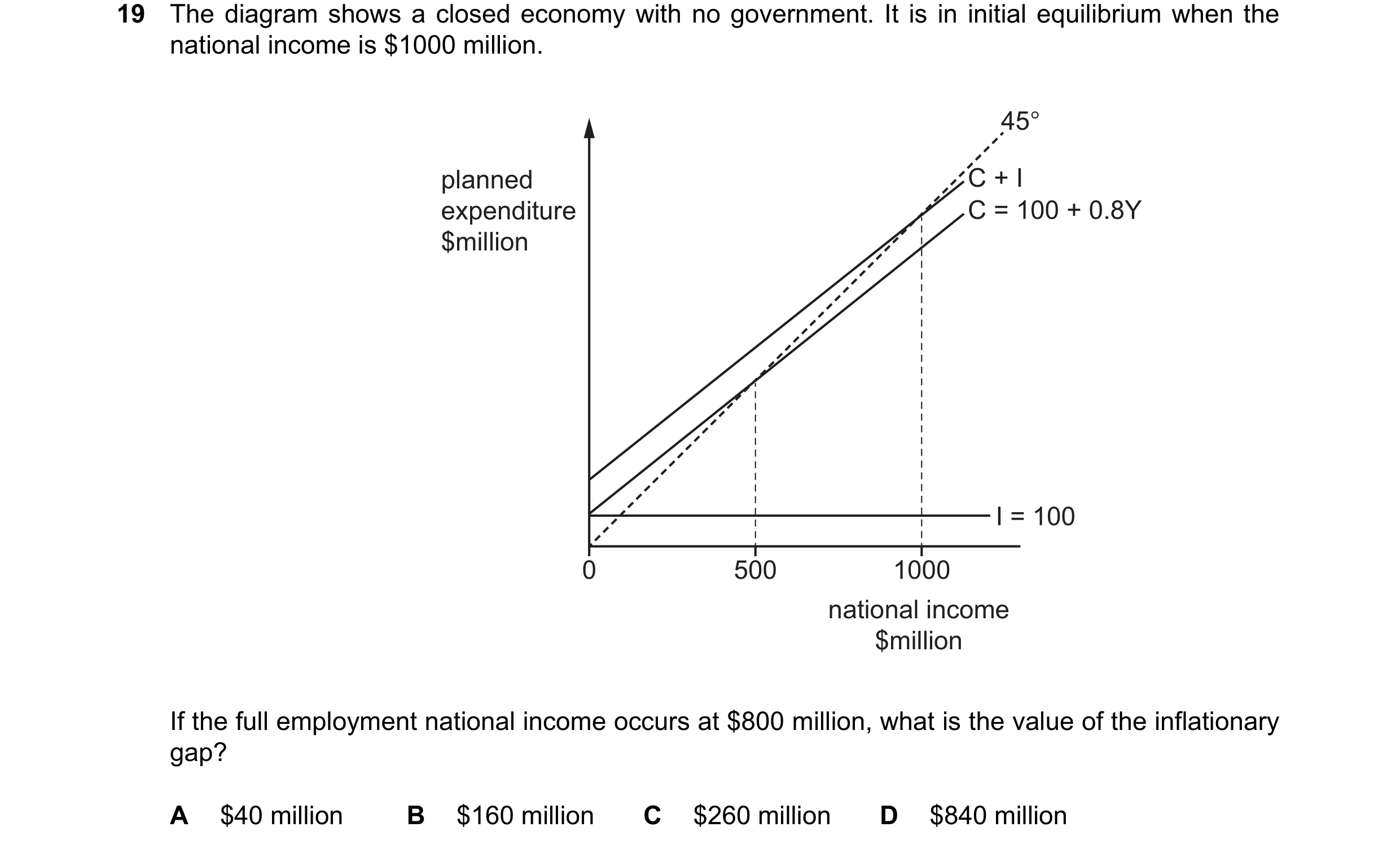
Q139 · The diagram shows a closed economy with no government 9708/32 Feb/March 2025
19 The diagram shows a closed economy with no government. It is in initial equilibrium when the national income is $1000 million. 45° planned C + I expenditure C = 100 + 0.8Y $million I = 100 0 500 1000 national income $million If the full employment national income occurs at $800 million, what is the value of the inflationary gap? A $40 million B $160 million C $260 million D $840 million
1 marks
Answer: A
This question in 9708/32 Feb/March 2025
Q140 · In an economy with unemployed resources the marginal propensity to consume is 0.2 9708/32 Feb/March 2025
24 In an economy with unemployed resources the marginal propensity to consume is 0.2. The government increases its budget deficit and finances it by selling bonds to the non-bank private sector. What is the likely consequence of this? A The currency will depreciate, increasing exports and reducing the trade deficit. B The increase in real output will be limited as the value of the multiplier is low. C The money supply will fall, leading to a reduction in aggregate demand. D There will be a decrease in the rate of interest, causing demand-pull inflation.
1 marks
Answer: B
This question in 9708/32 Feb/March 2025

 1 / 37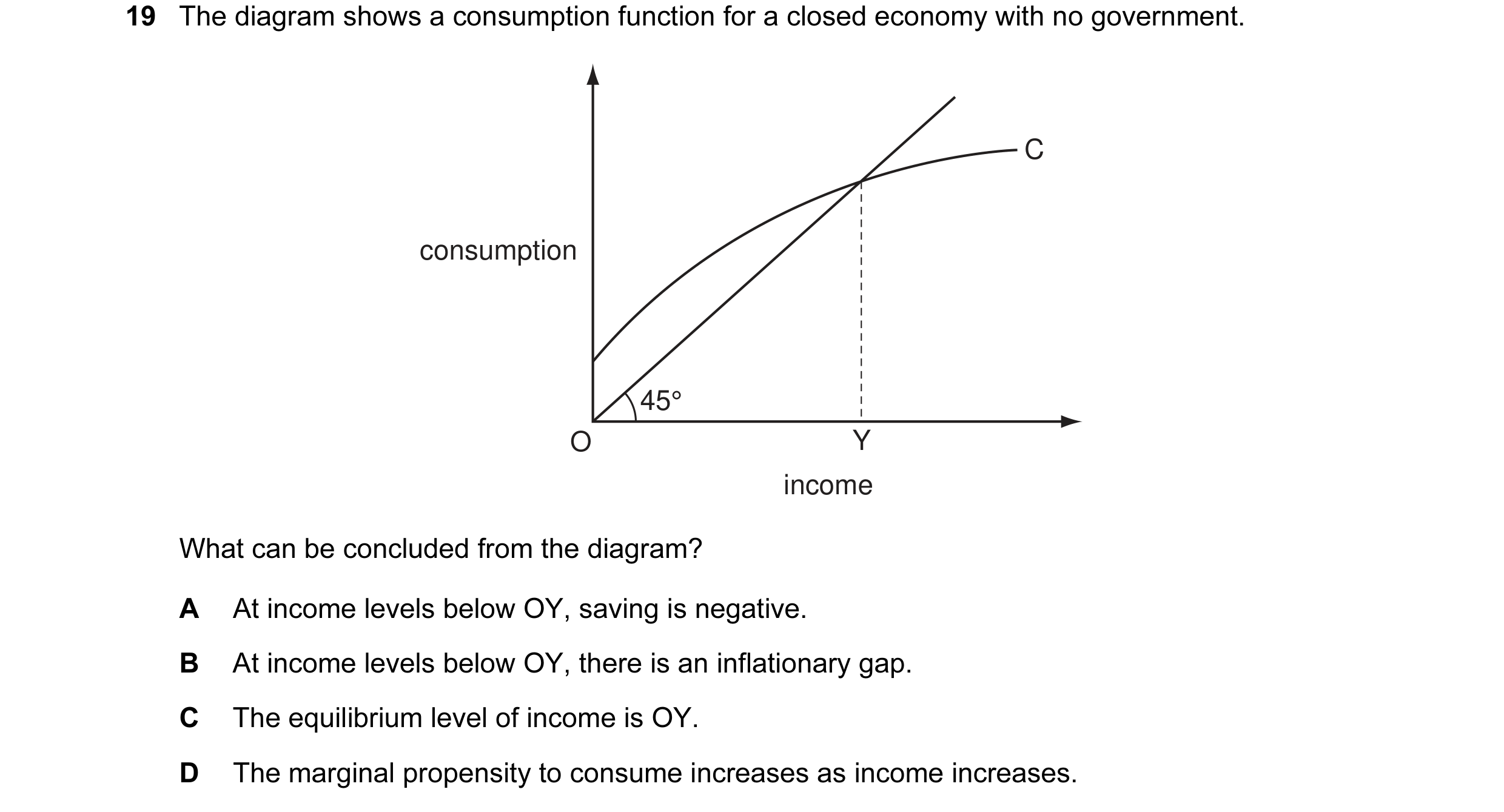
 2 / 37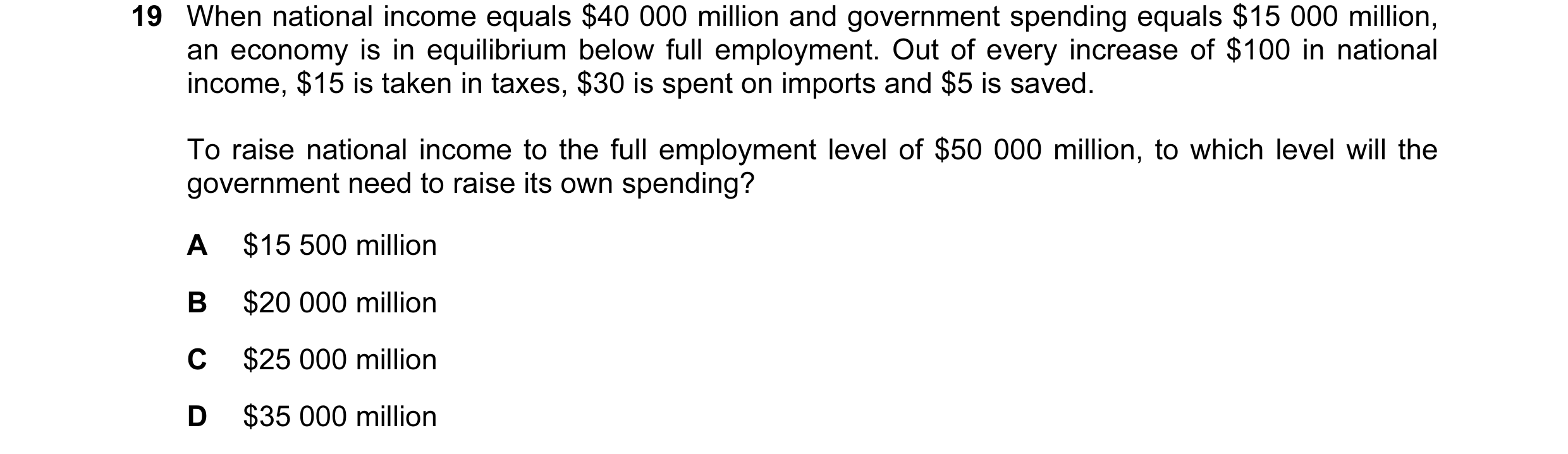

 3 / 37
 4 / 37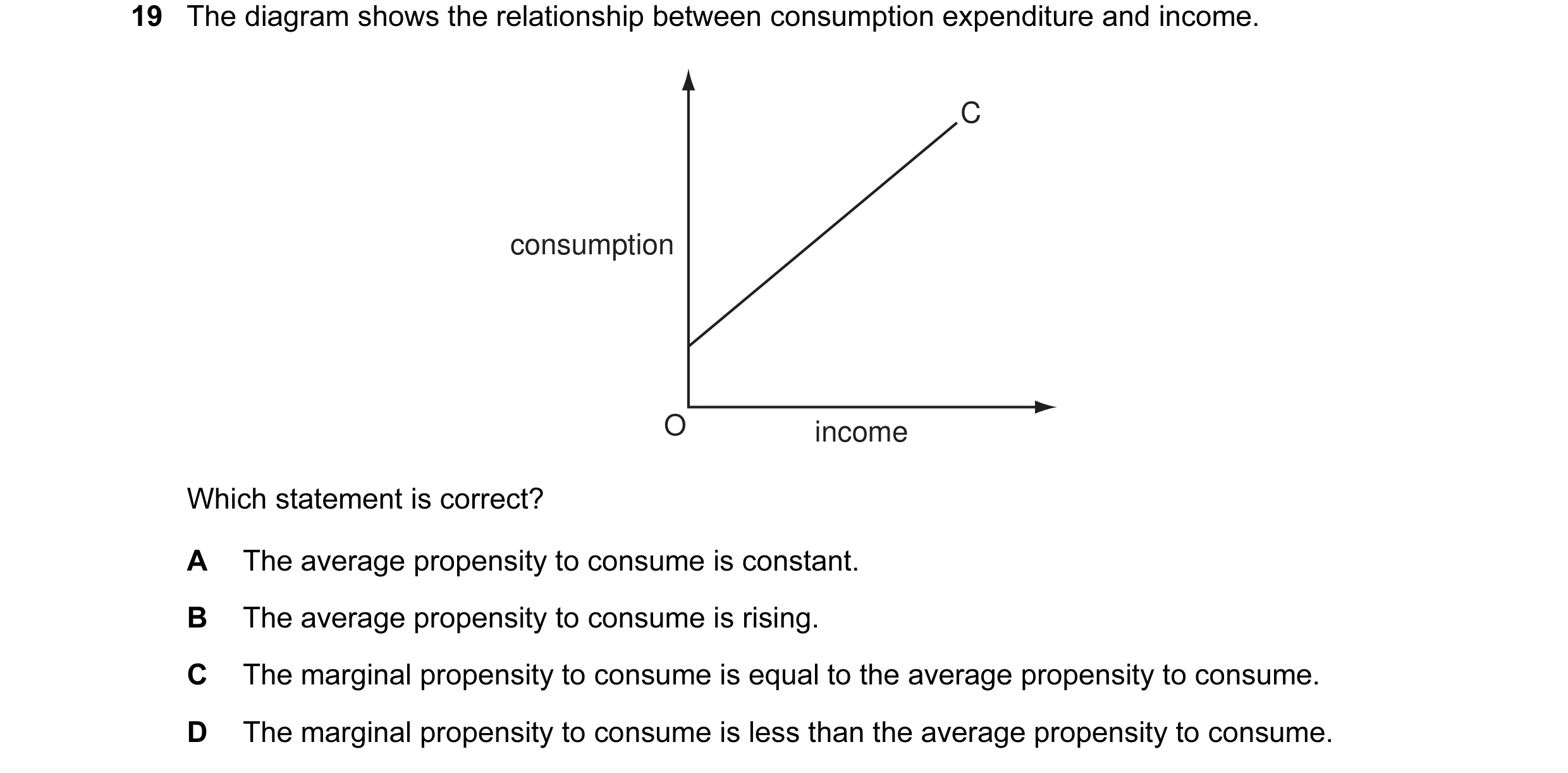
 5 / 37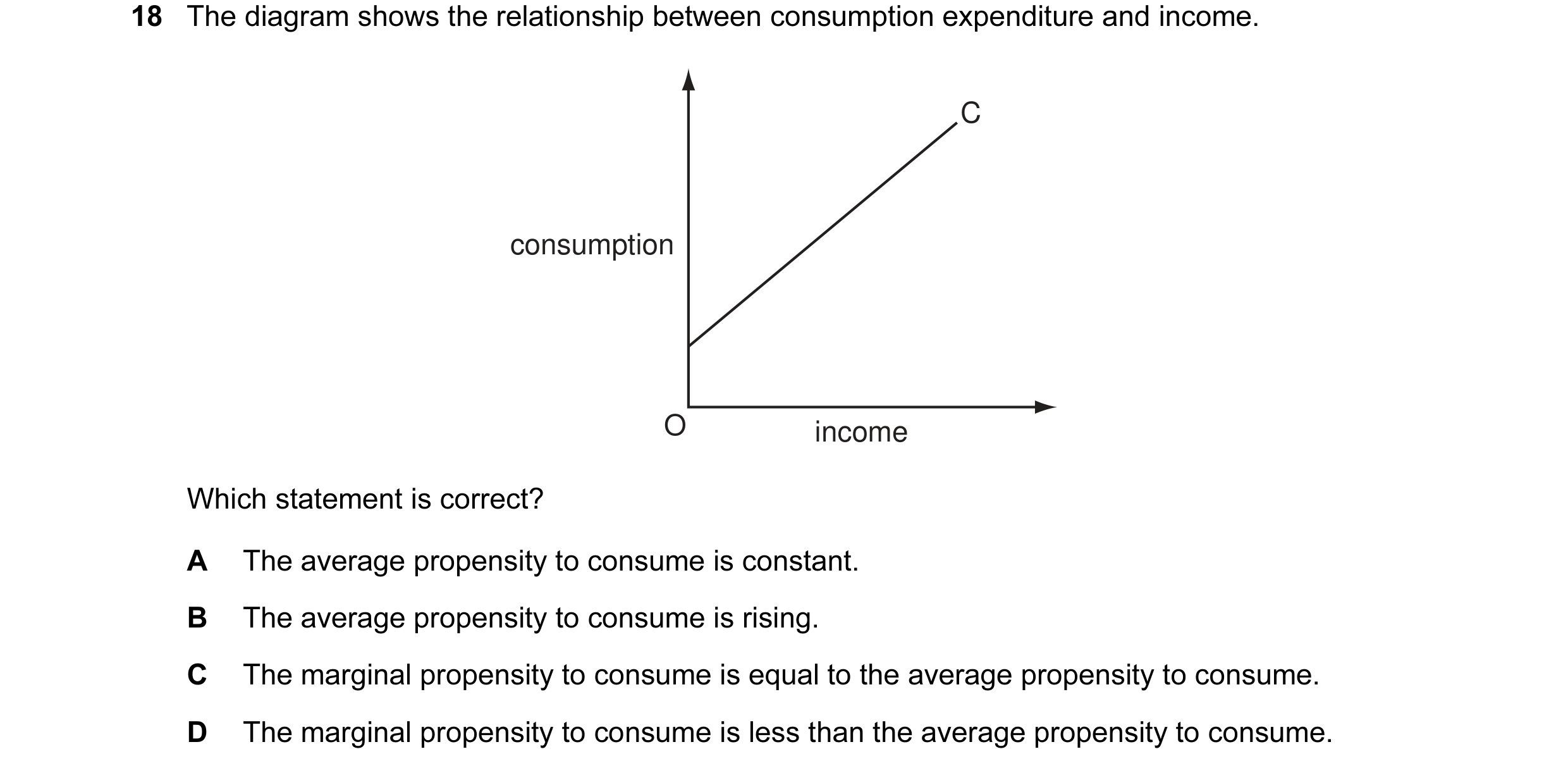
 6 / 37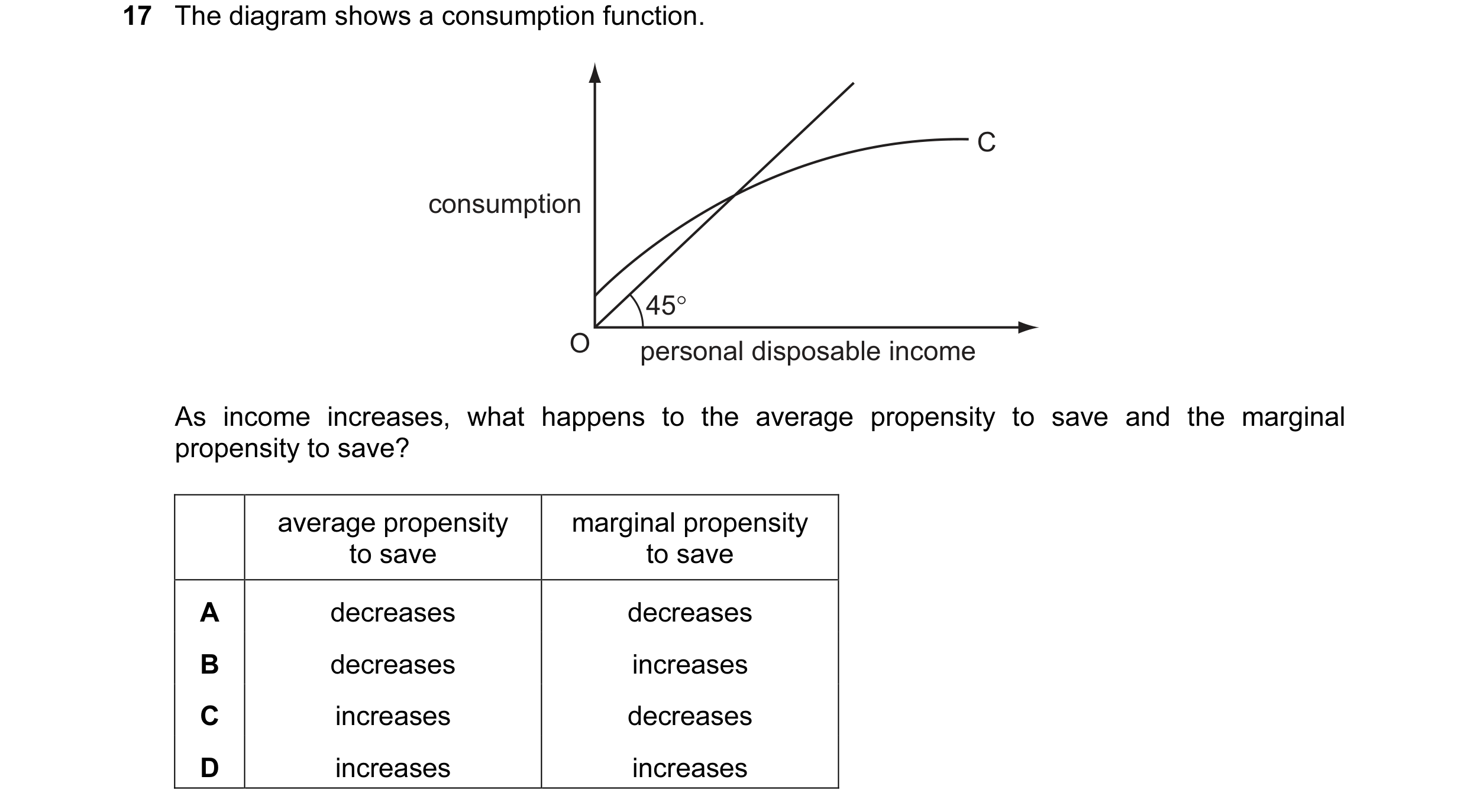

 7 / 37
 8 / 37


 9 / 37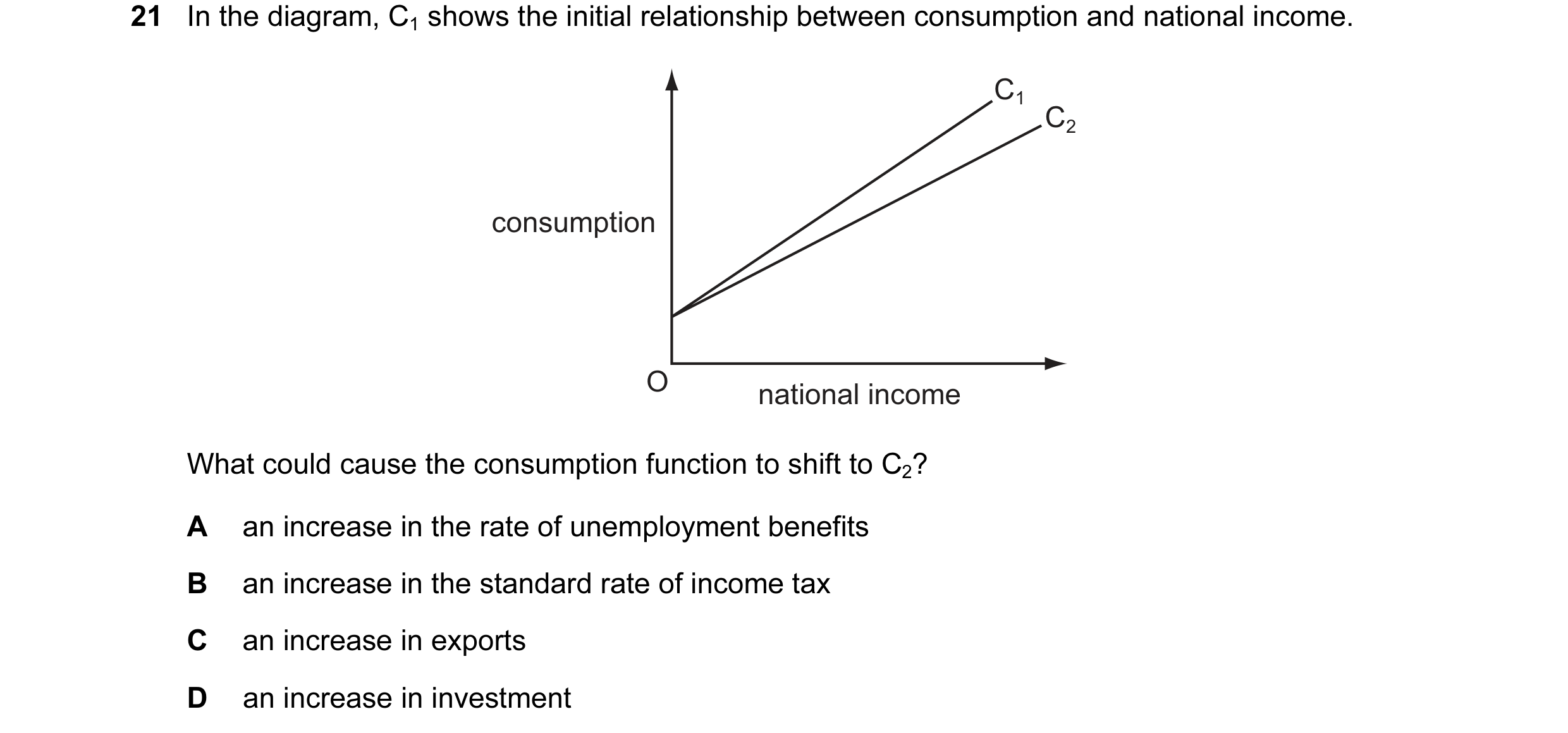

 10 / 37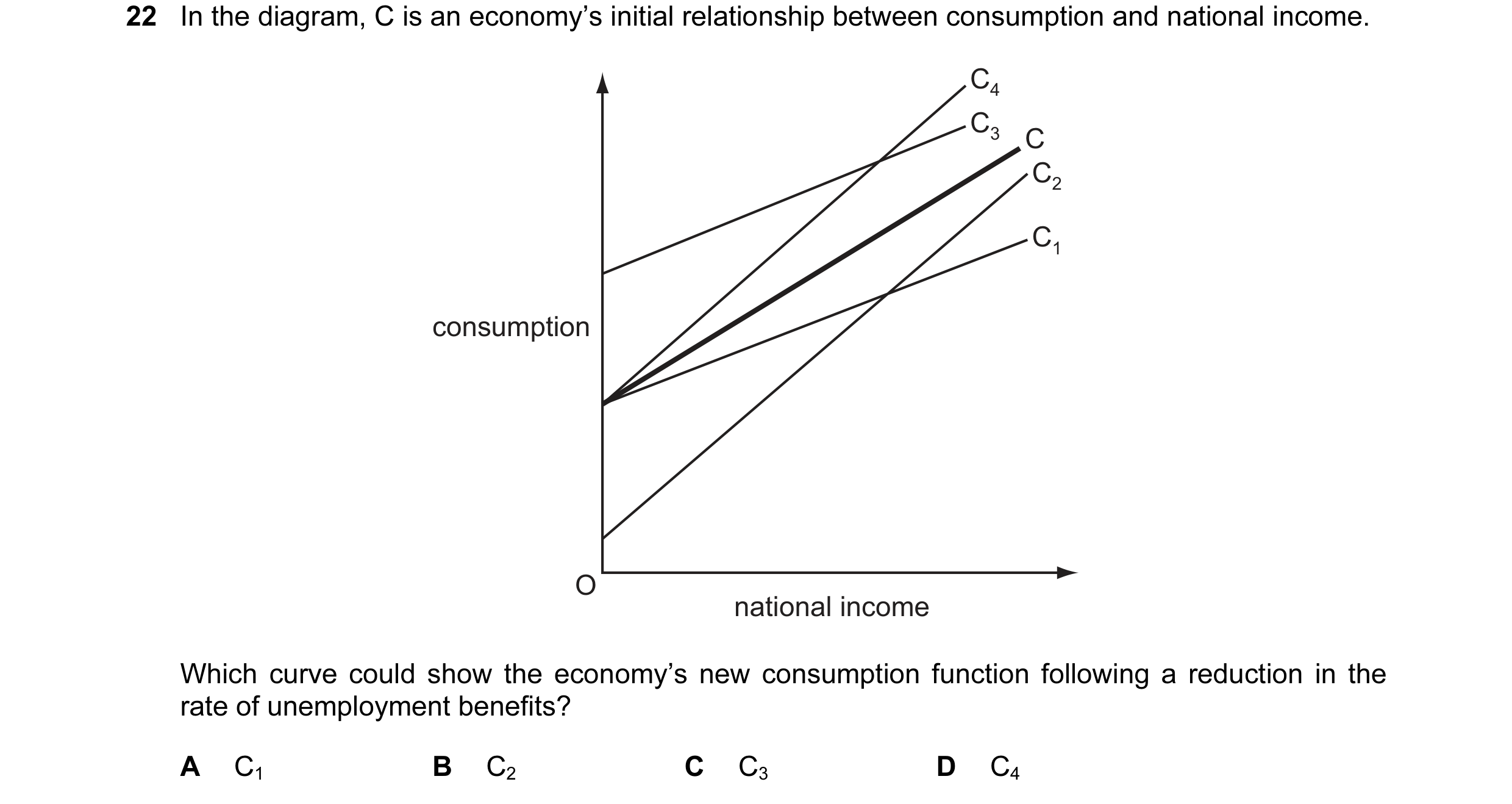

 11 / 37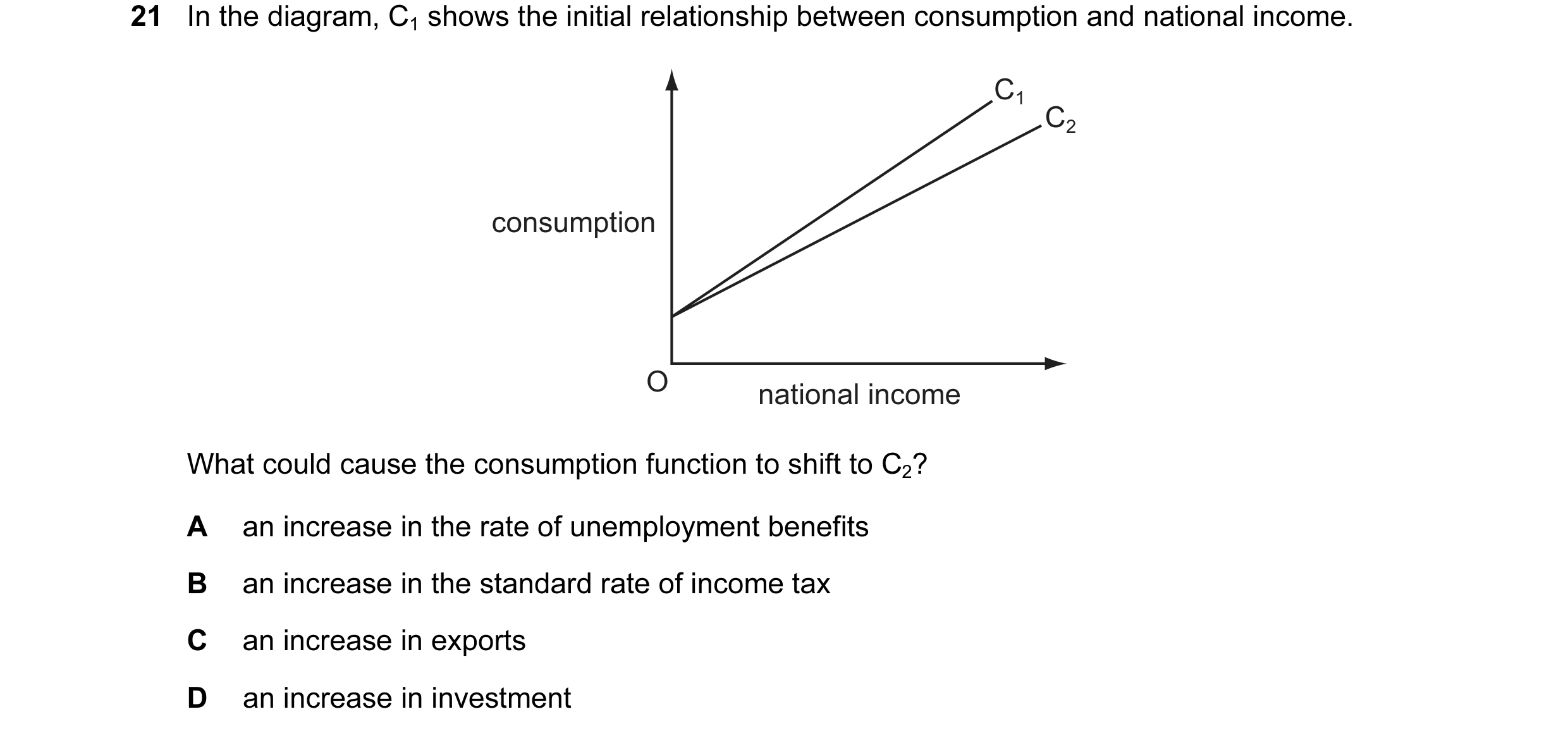
 12 / 37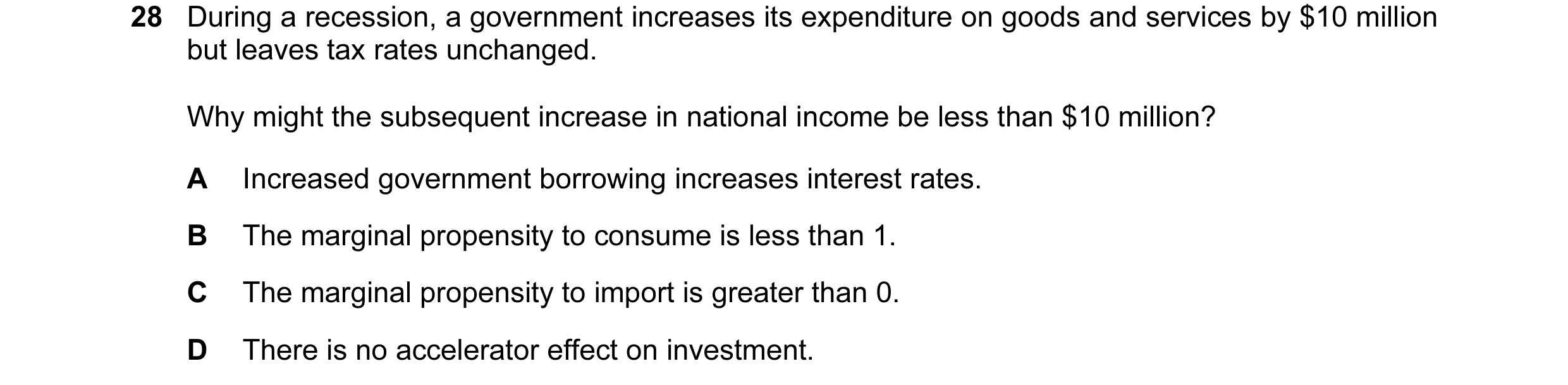

 13 / 37

 14 / 37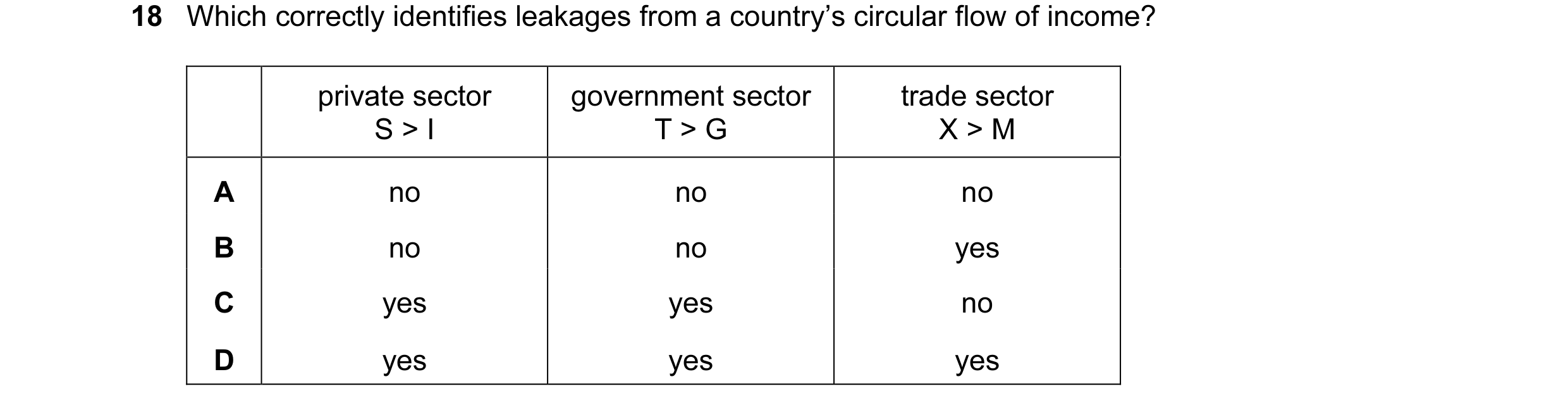
 15 / 37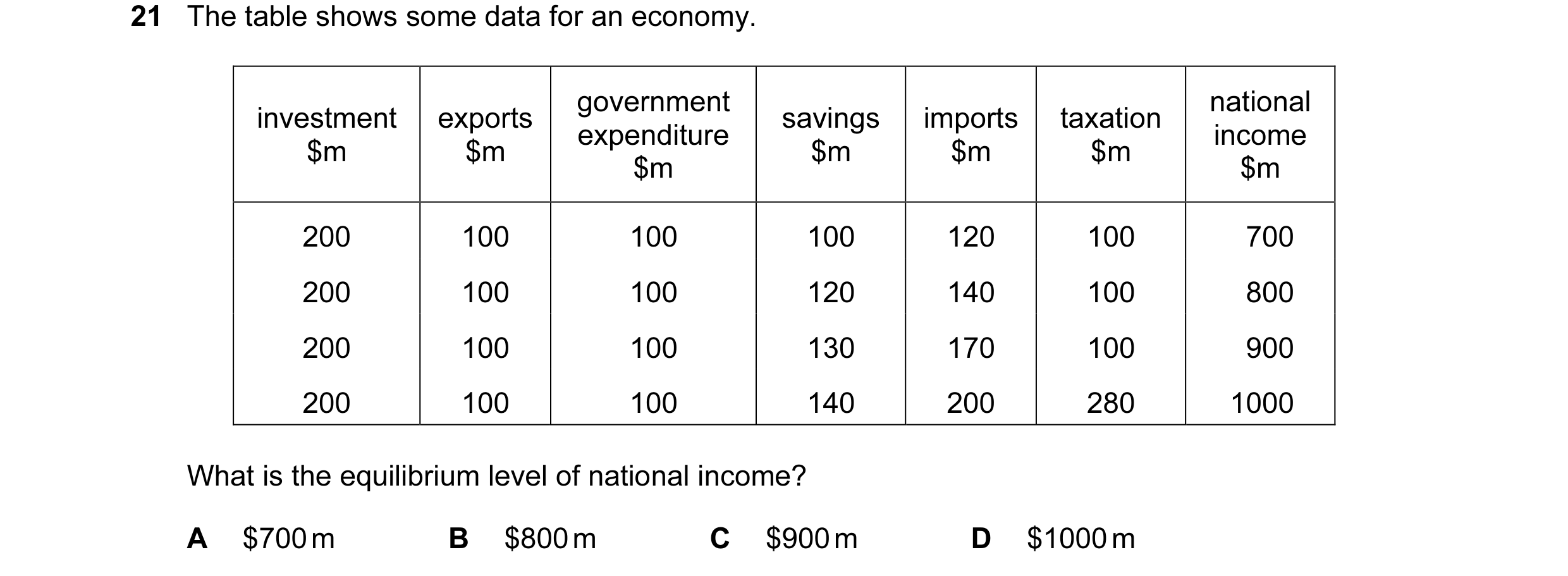
 16 / 37


 17 / 37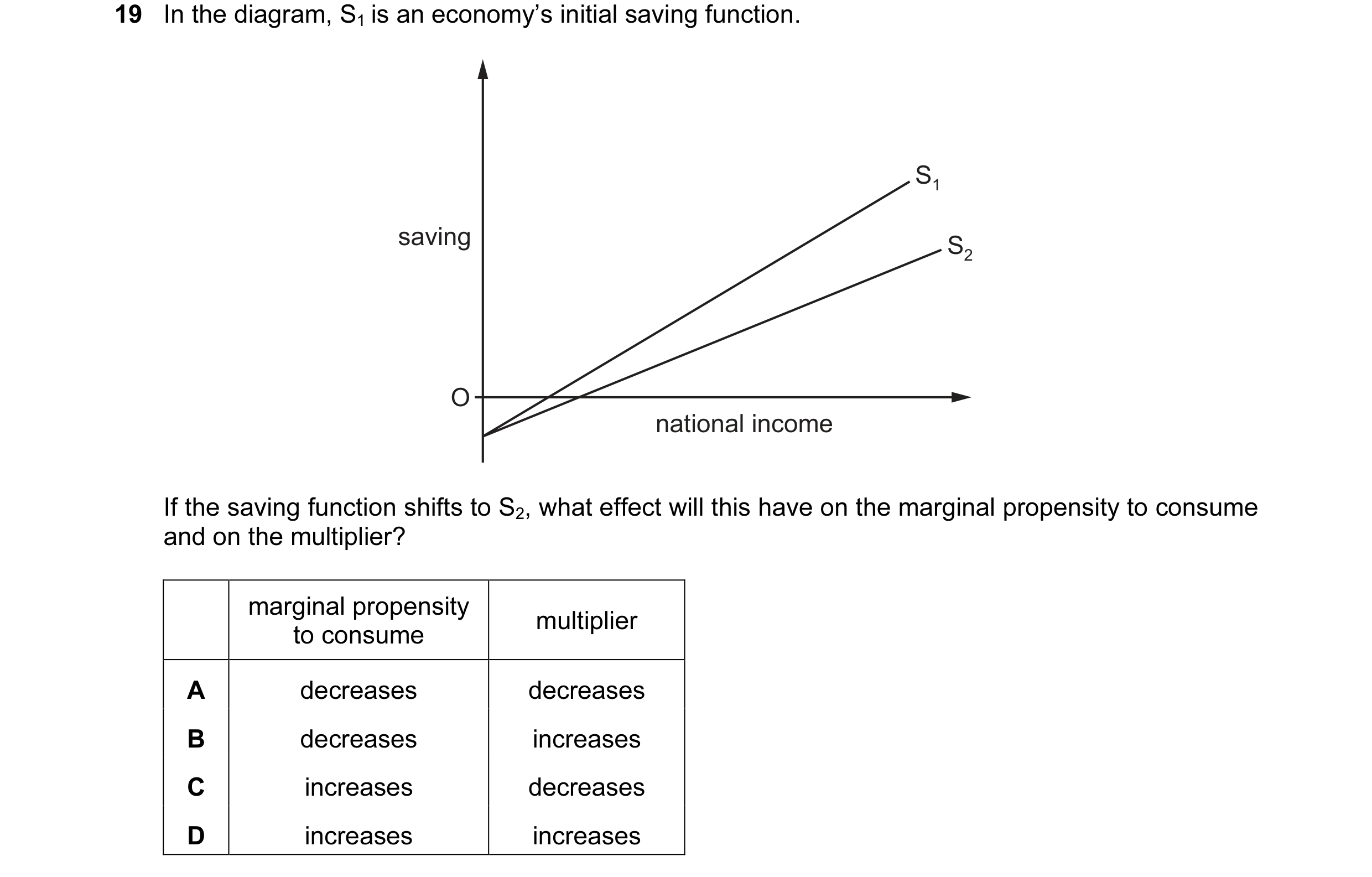
 18 / 37
 19 / 37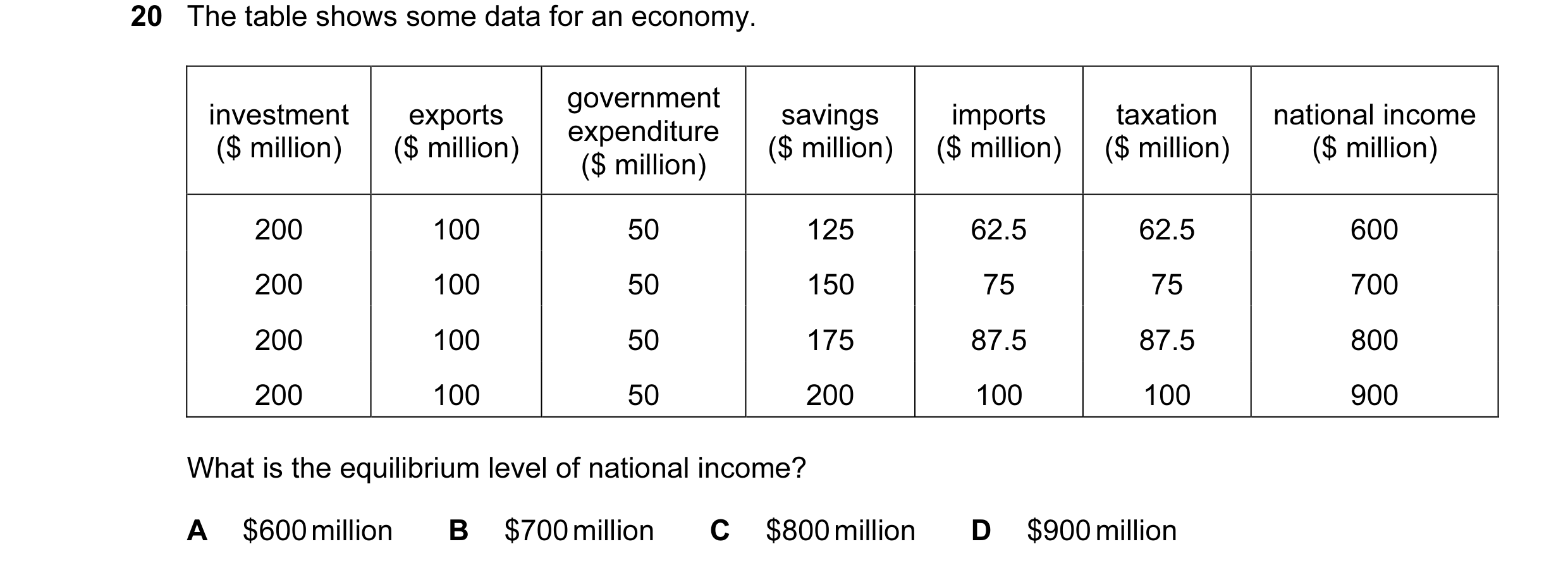
 20 / 37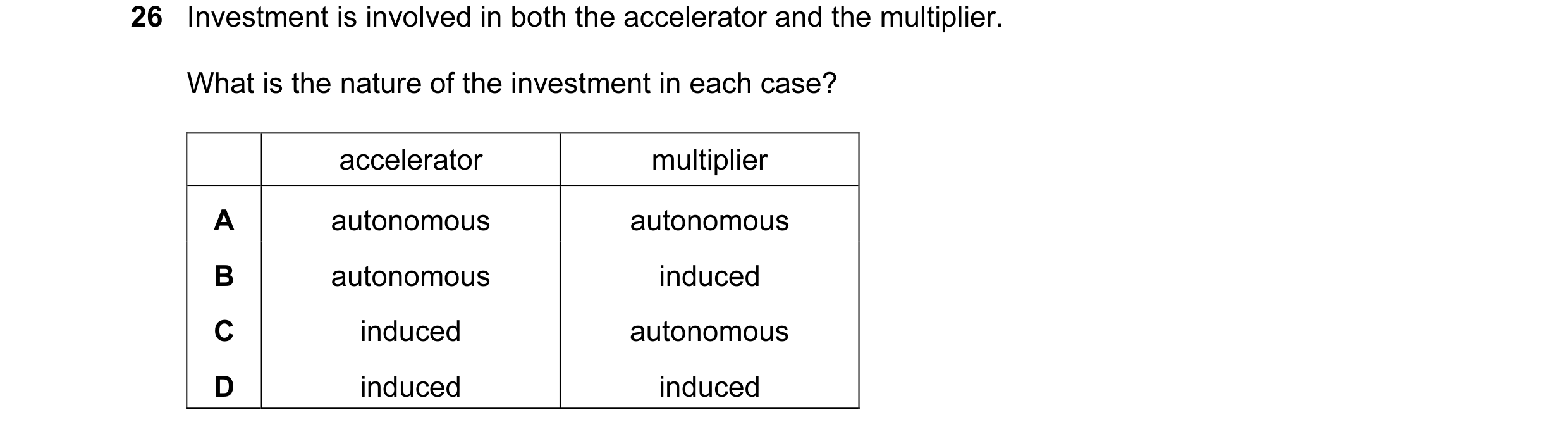
 21 / 37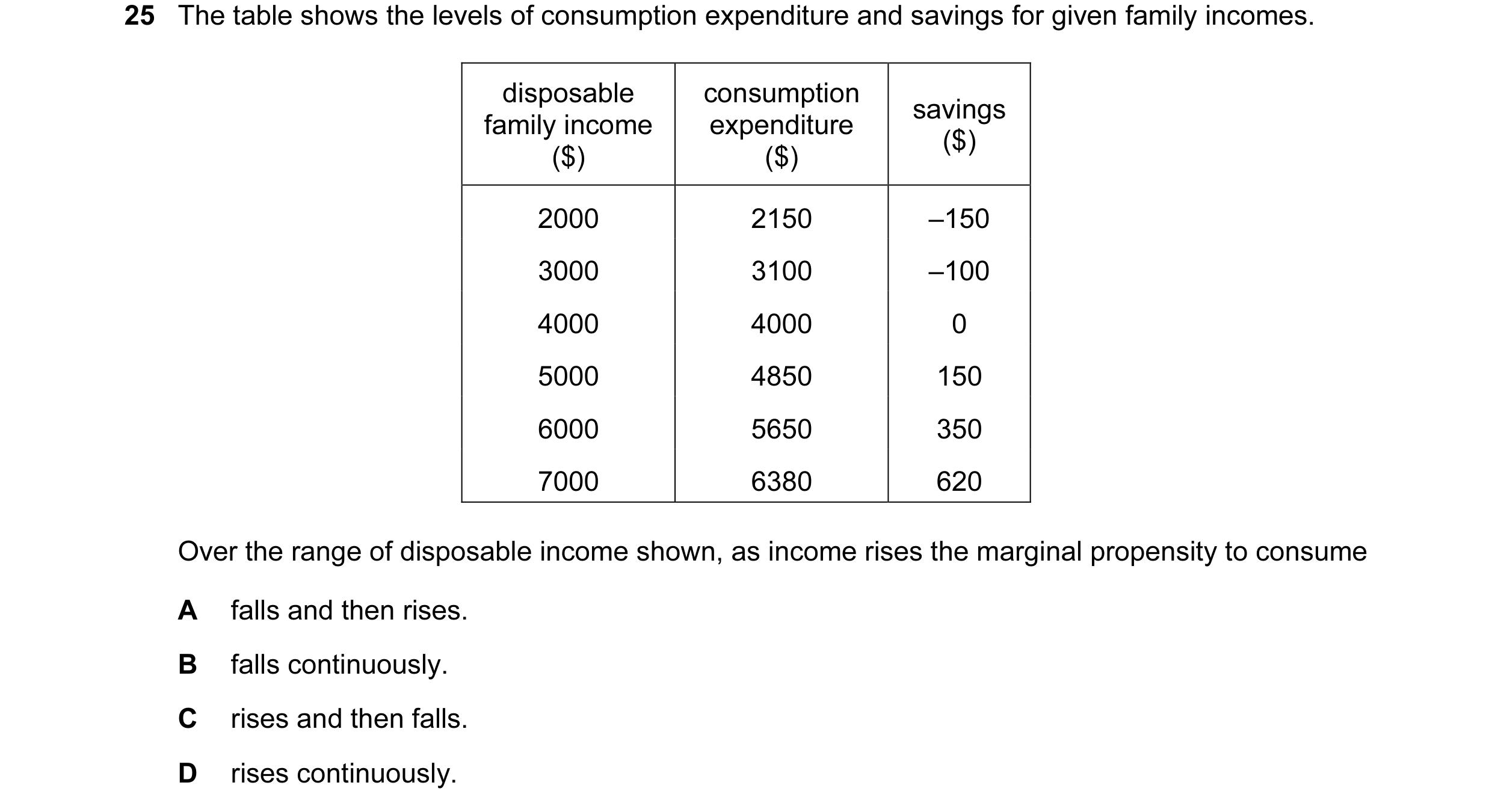
 22 / 37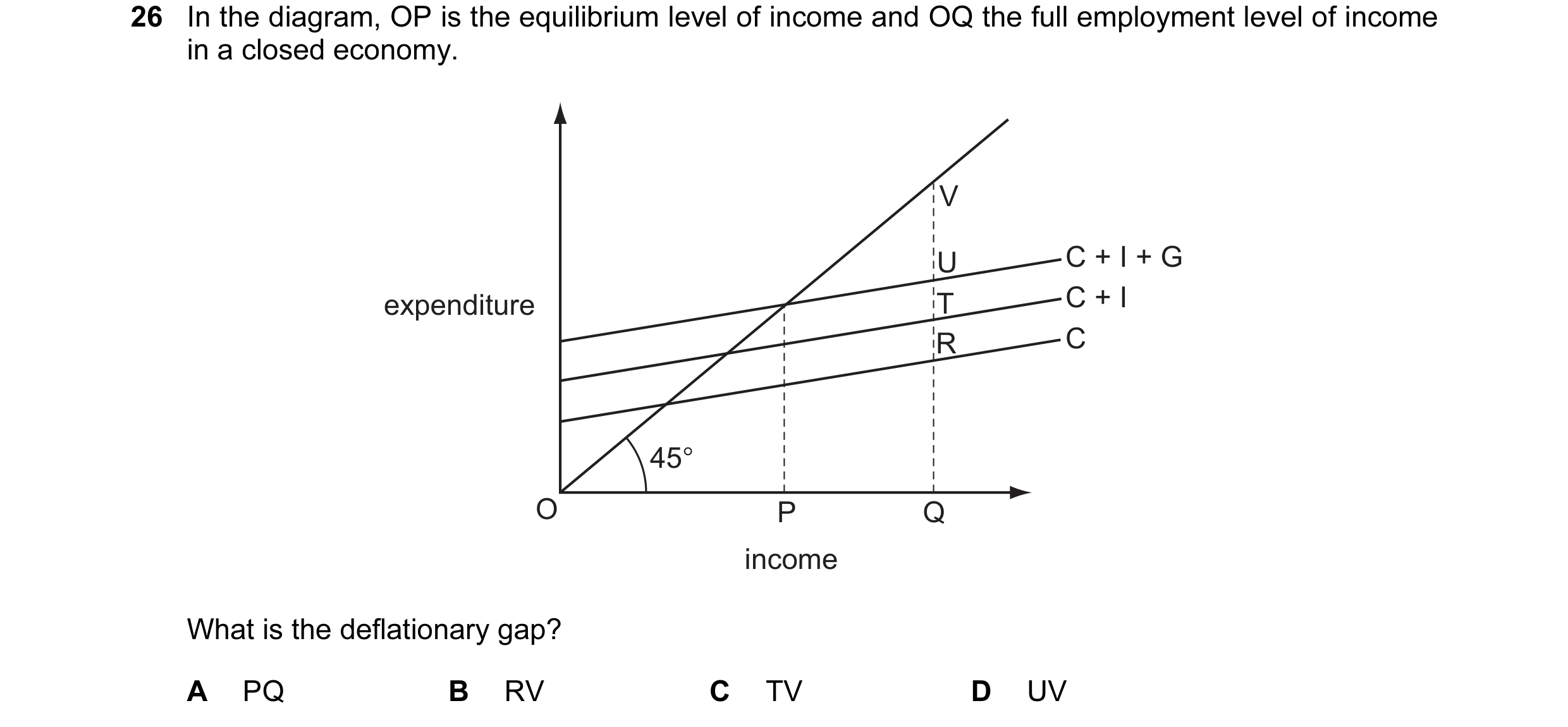
 23 / 37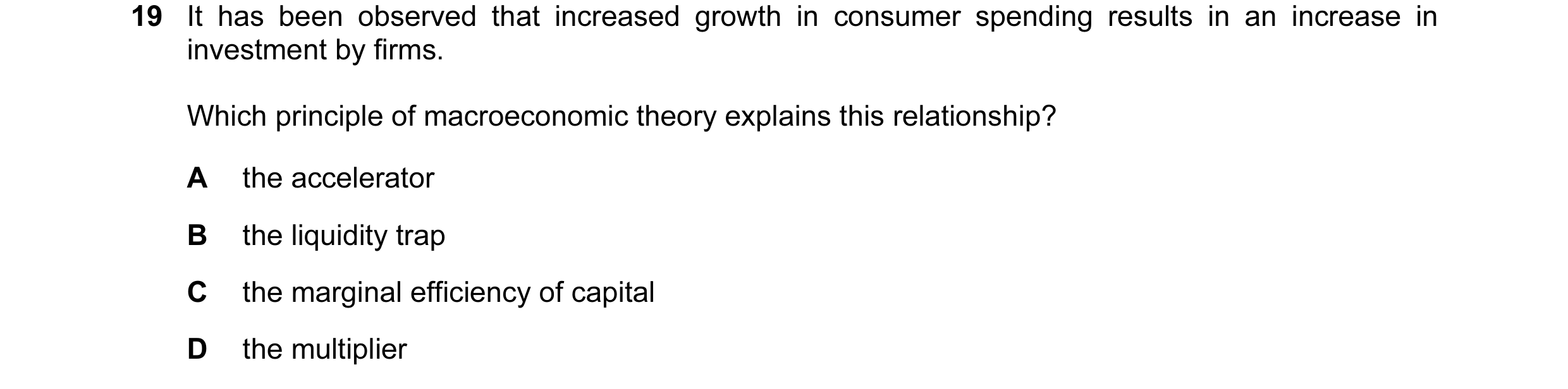


 24 / 37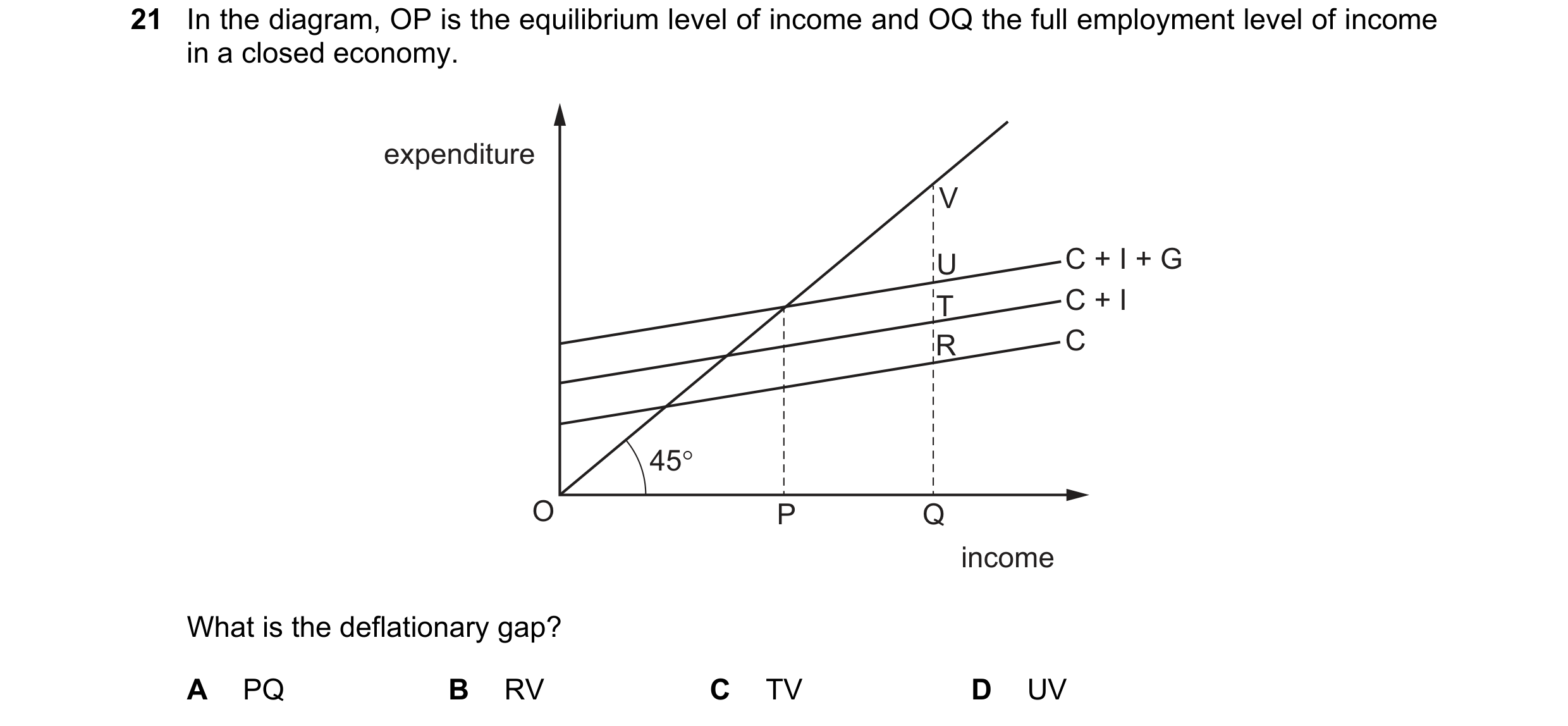


 25 / 37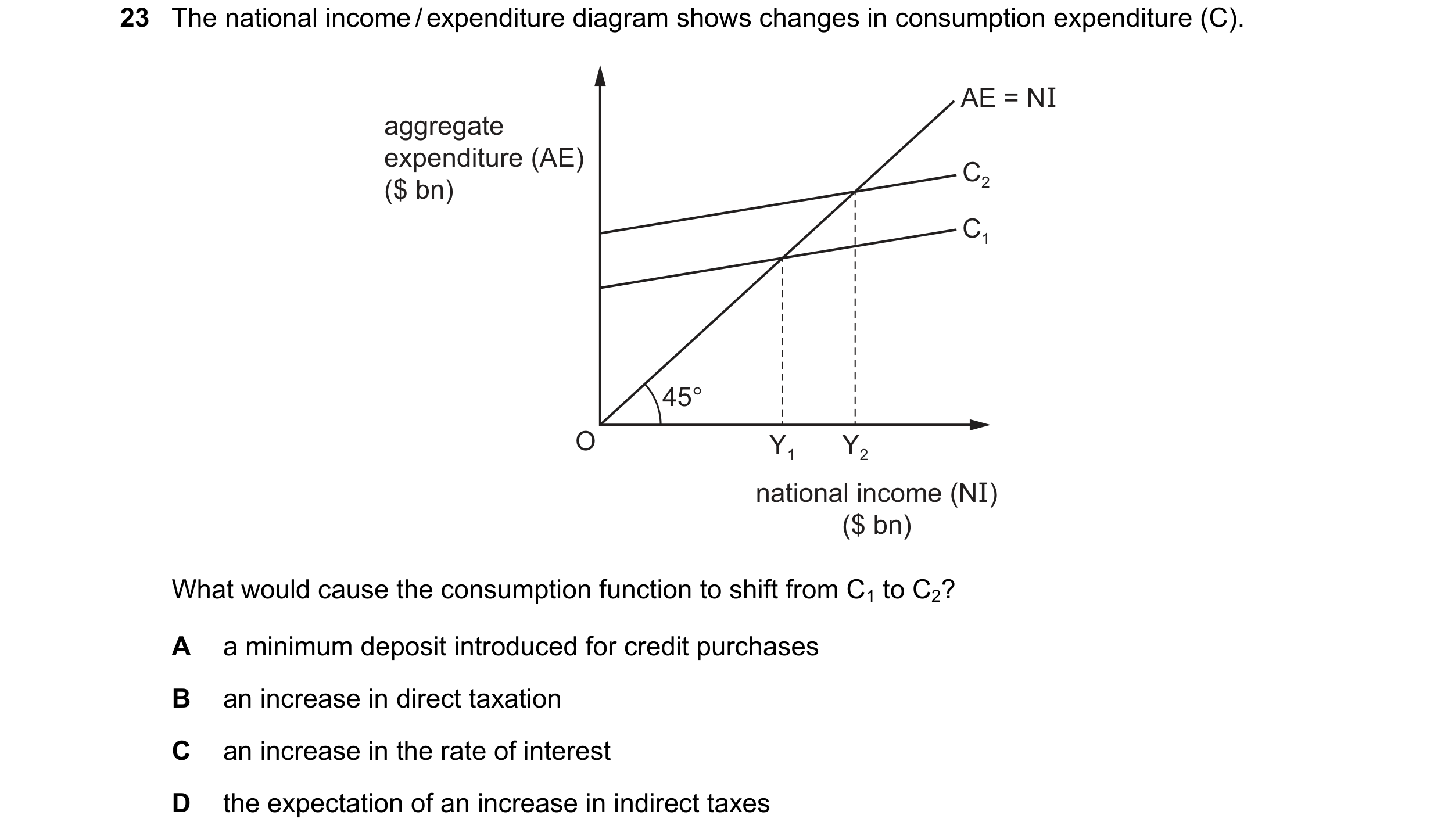
 26 / 37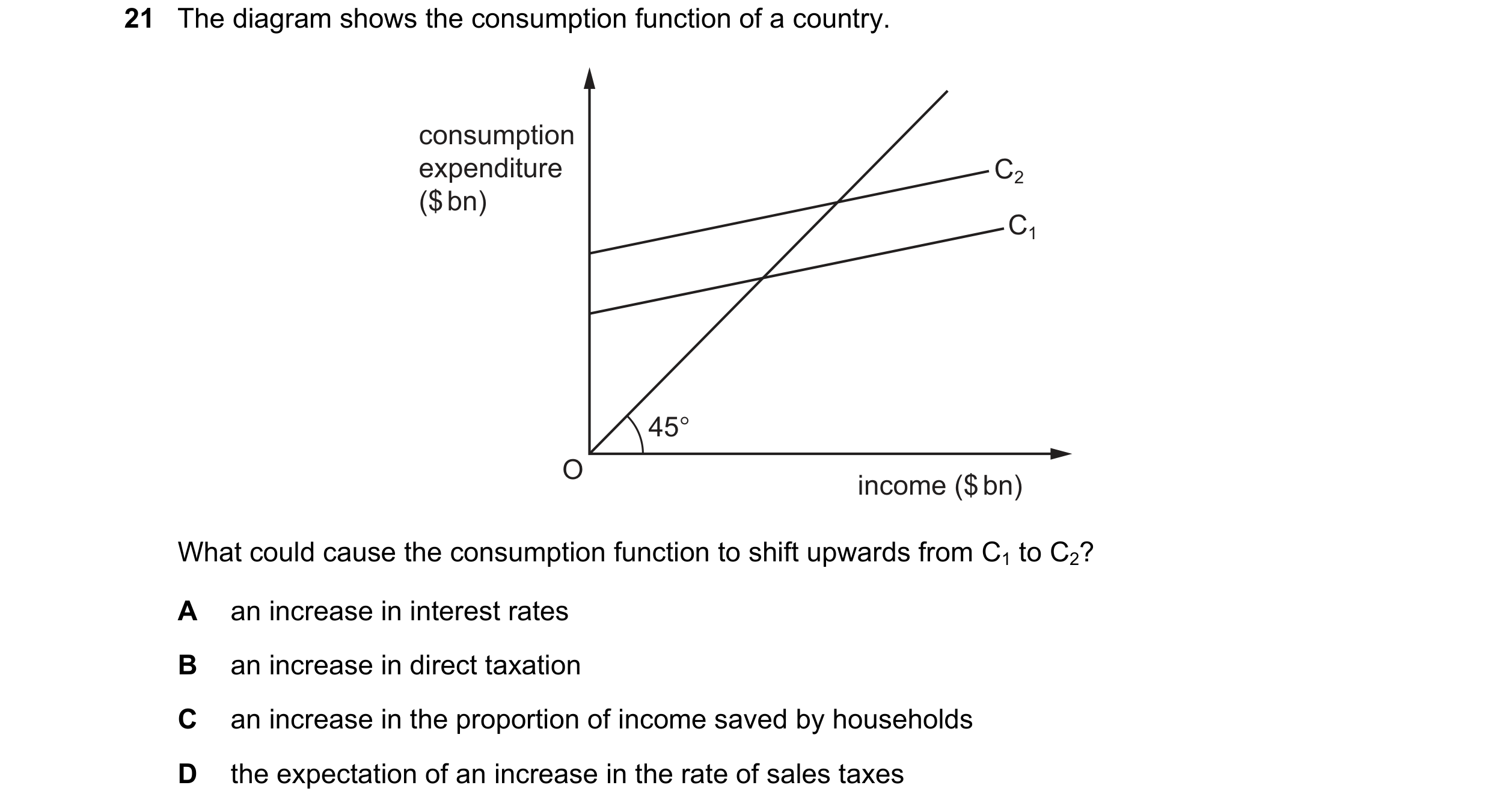


 27 / 37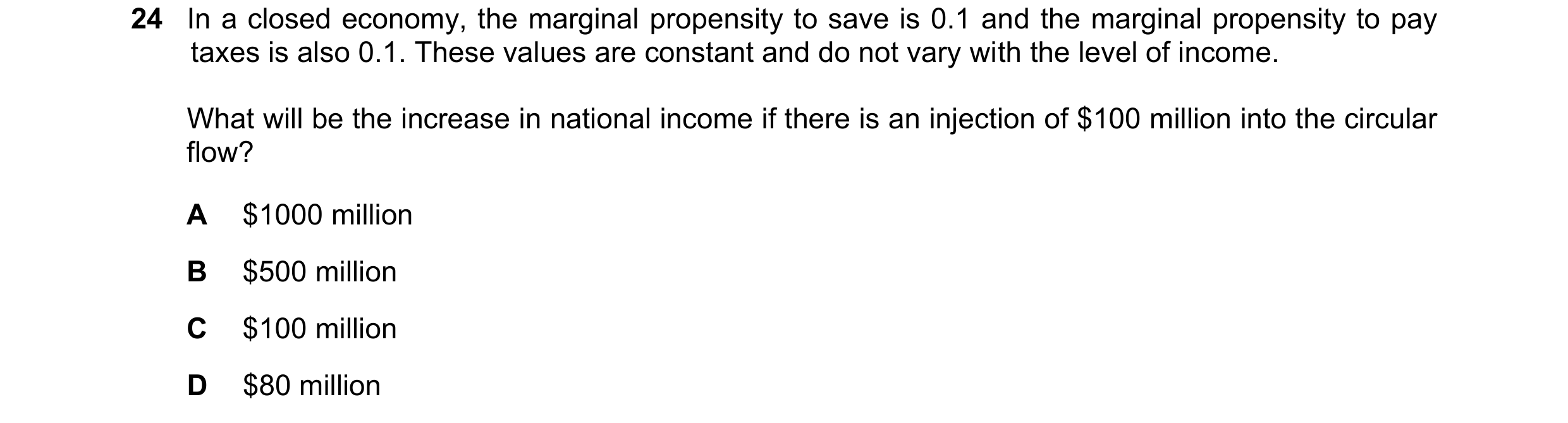

 28 / 37
 29 / 37

 30 / 37

 31 / 37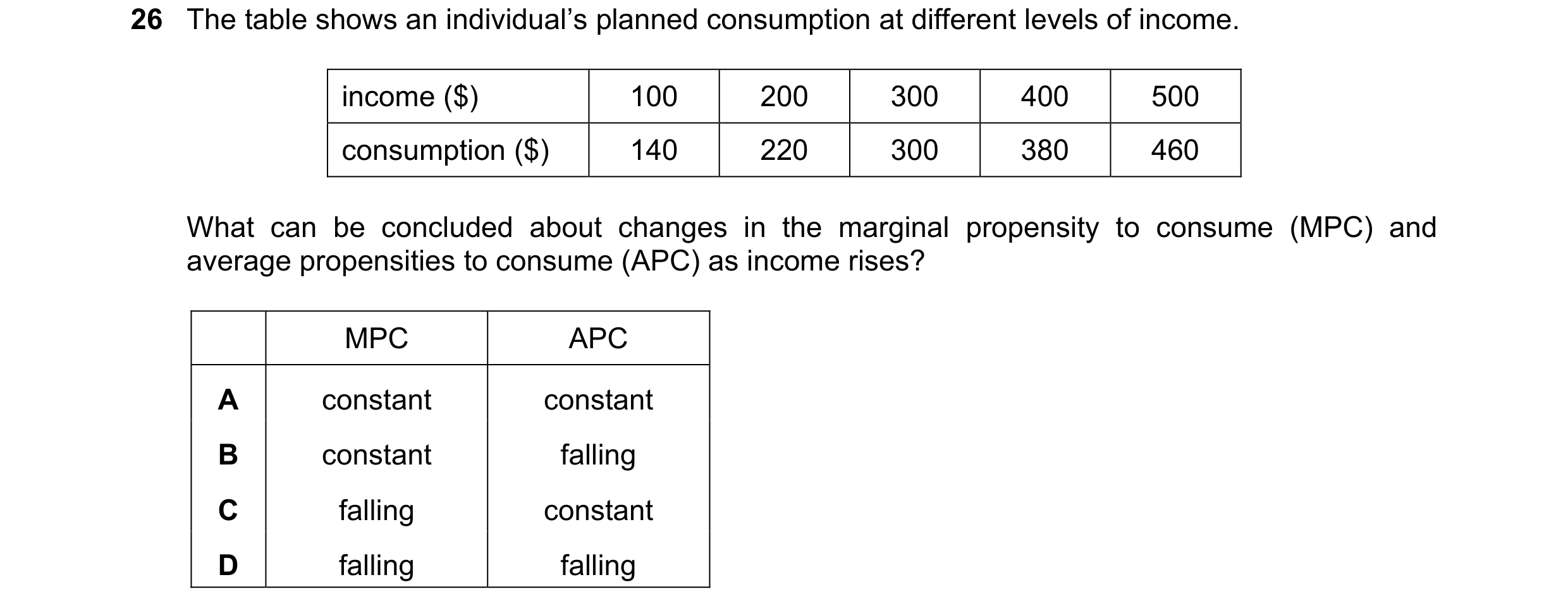

 32 / 37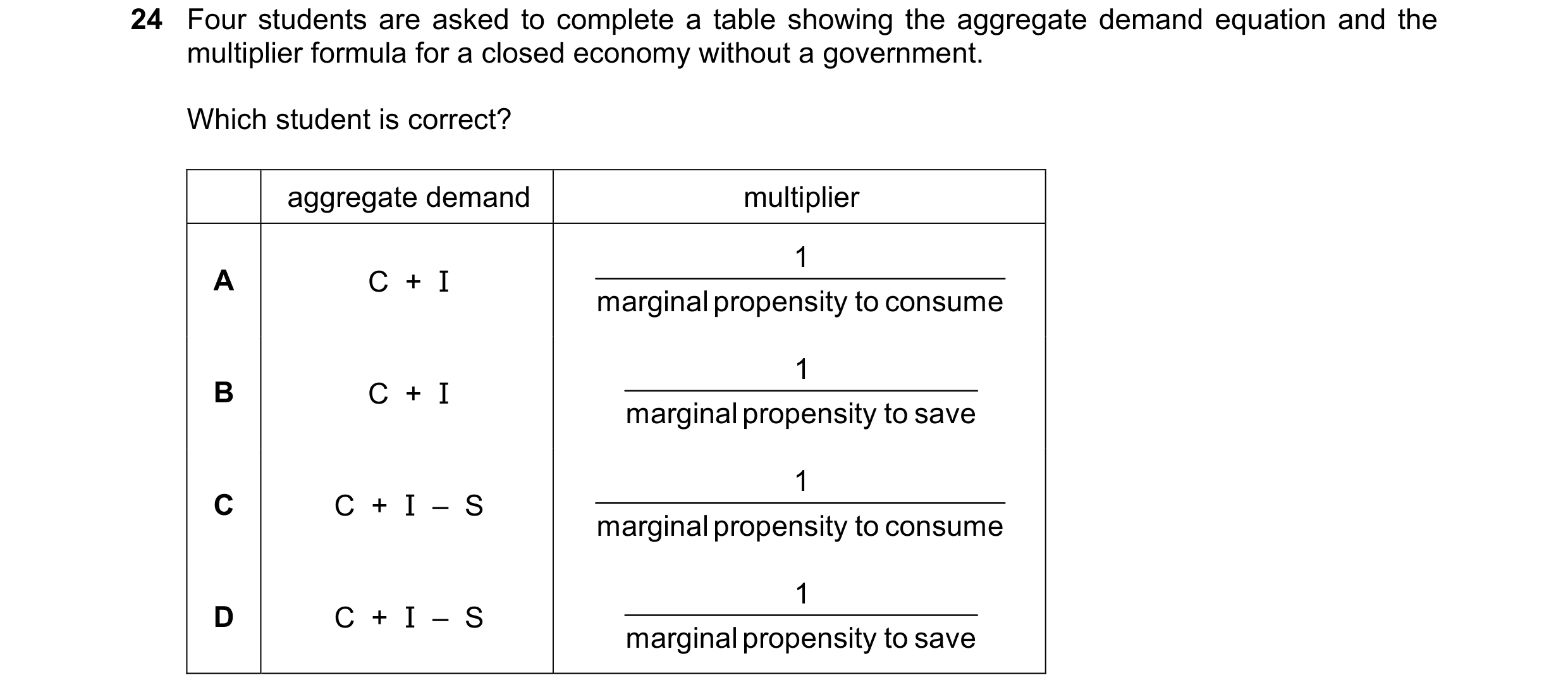

 33 / 37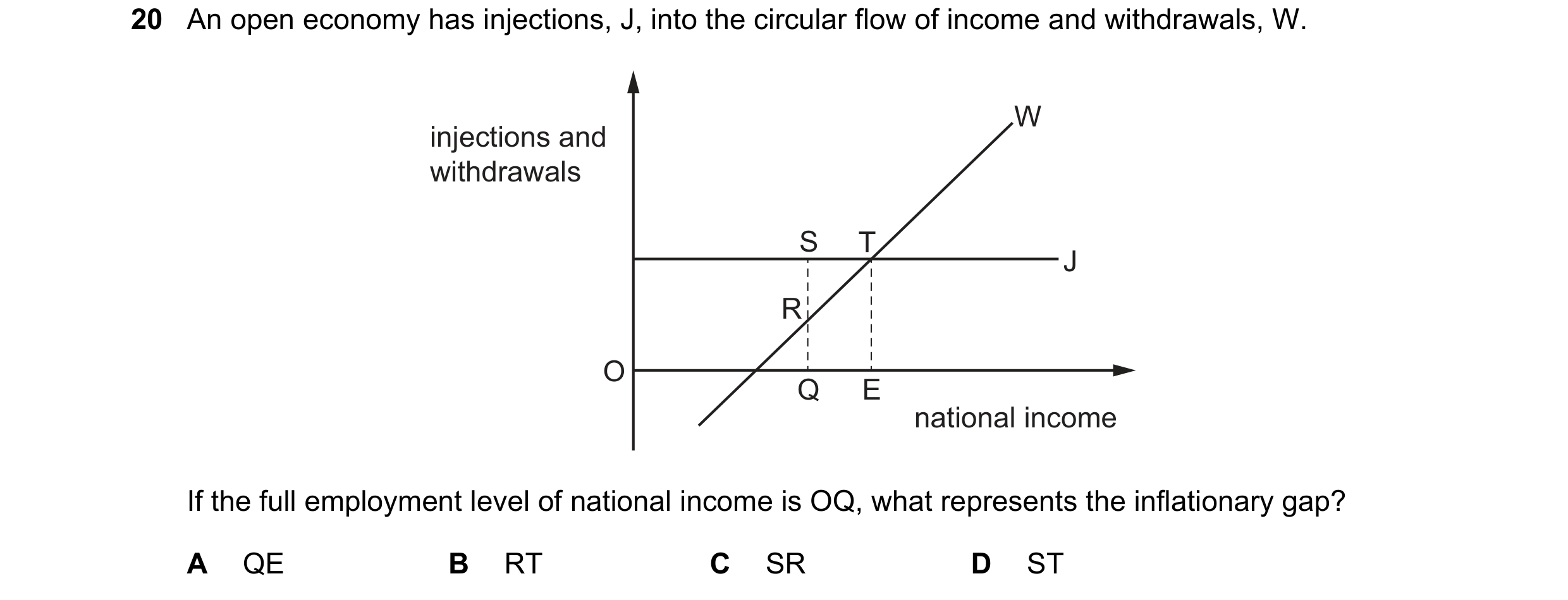
 34 / 37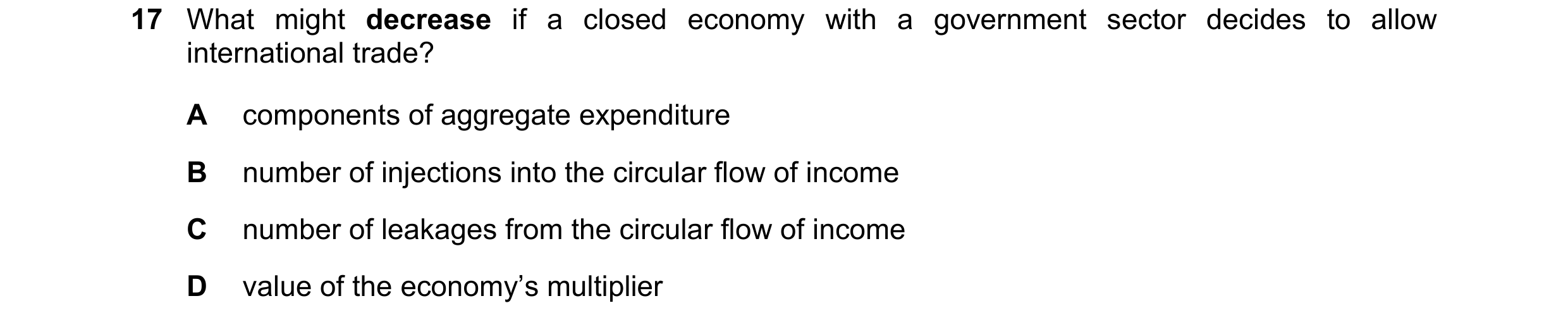

 35 / 37


 36 / 37
 37 / 37