Cambridge A Level Economics 9708 — 2020 Oct/Nov Paper 3 · Variant 3
9708/33/O/N/20 · 30 questions · 30 marks · ≈34 min
The question paper and its mark scheme, free to read here and free to download. This is Cambridge’s own paper, exactly as it was sat.
Question paper12 pages



Mark scheme3 pages
Answers below. Sit the paper first if you are practising.



Questions as text
Q1 · Which statement is correct?
1 Which statement is correct? A marginal social benefit = marginal private benefit – marginal external benefit B marginal social cost = marginal private cost + marginal external cost C negative externality = marginal social benefit – marginal social cost D positive externality = marginal private benefit
Mark scheme: B
More questions on Private costs and benefits, externalities and social costs and benefits
Q2 · The diagram shows the costs and benefits of the production of a good
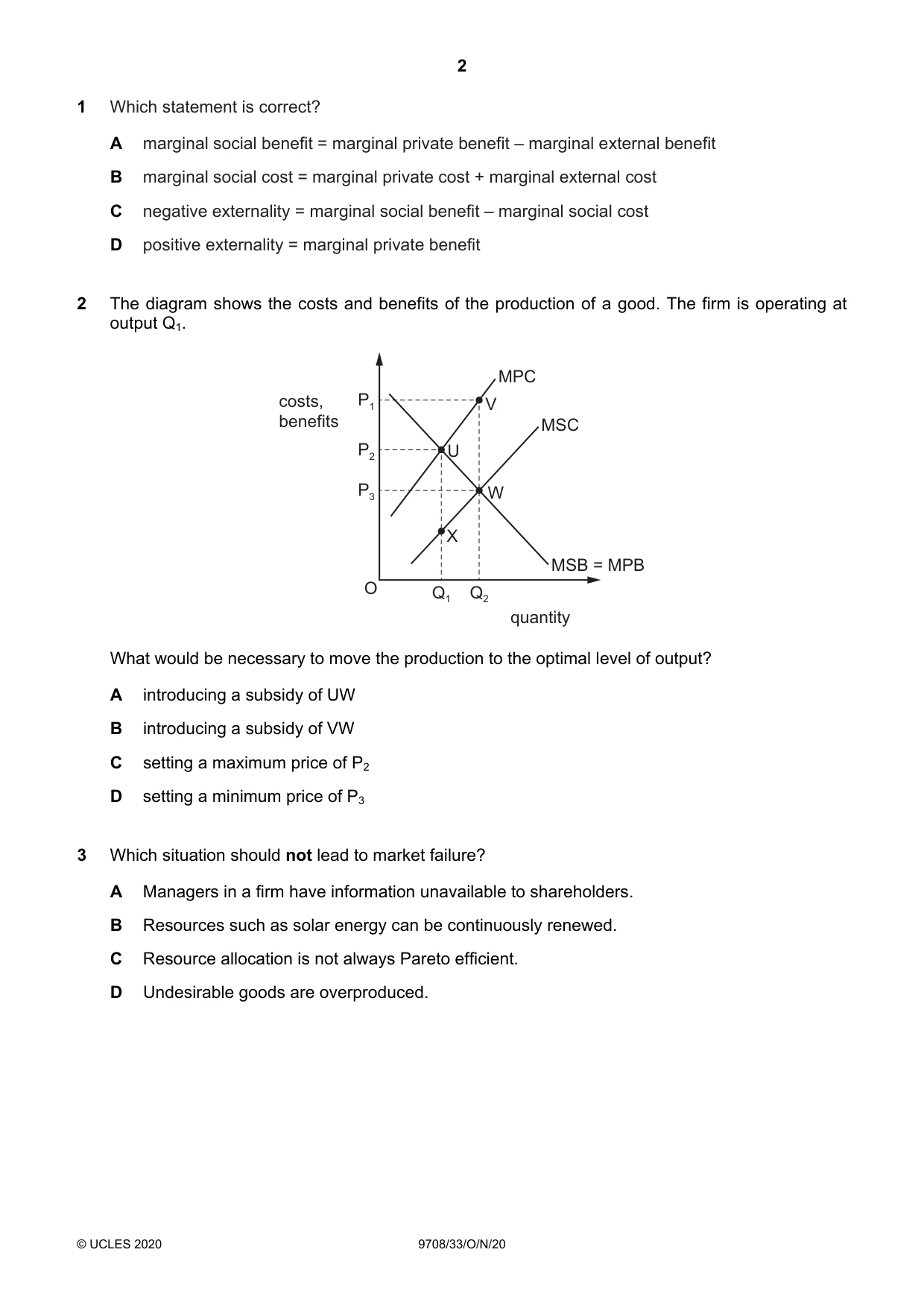
2 The diagram shows the costs and benefits of the production of a good. The firm is operating at output Q1. MPC costs, P1 V benefits MSC P2 U P3 W X MSB = MPB O Q1 Q2 quantity What would be necessary to move the production to the optimal level of output? A introducing a subsidy of UW B introducing a subsidy of VW C setting a maximum price of P2 D setting a minimum price of P3
Mark scheme: B
Q3 · Which situation should not lead to market failure?
3 Which situation should not lead to market failure? A Managers in a firm have information unavailable to shareholders. B Resources such as solar energy can be continuously renewed. C Resource allocation is not always Pareto efficient. D Undesirable goods are overproduced.
Mark scheme: B
Q4 · The diagram below shows a customer’s budget line for two goods, X and Y
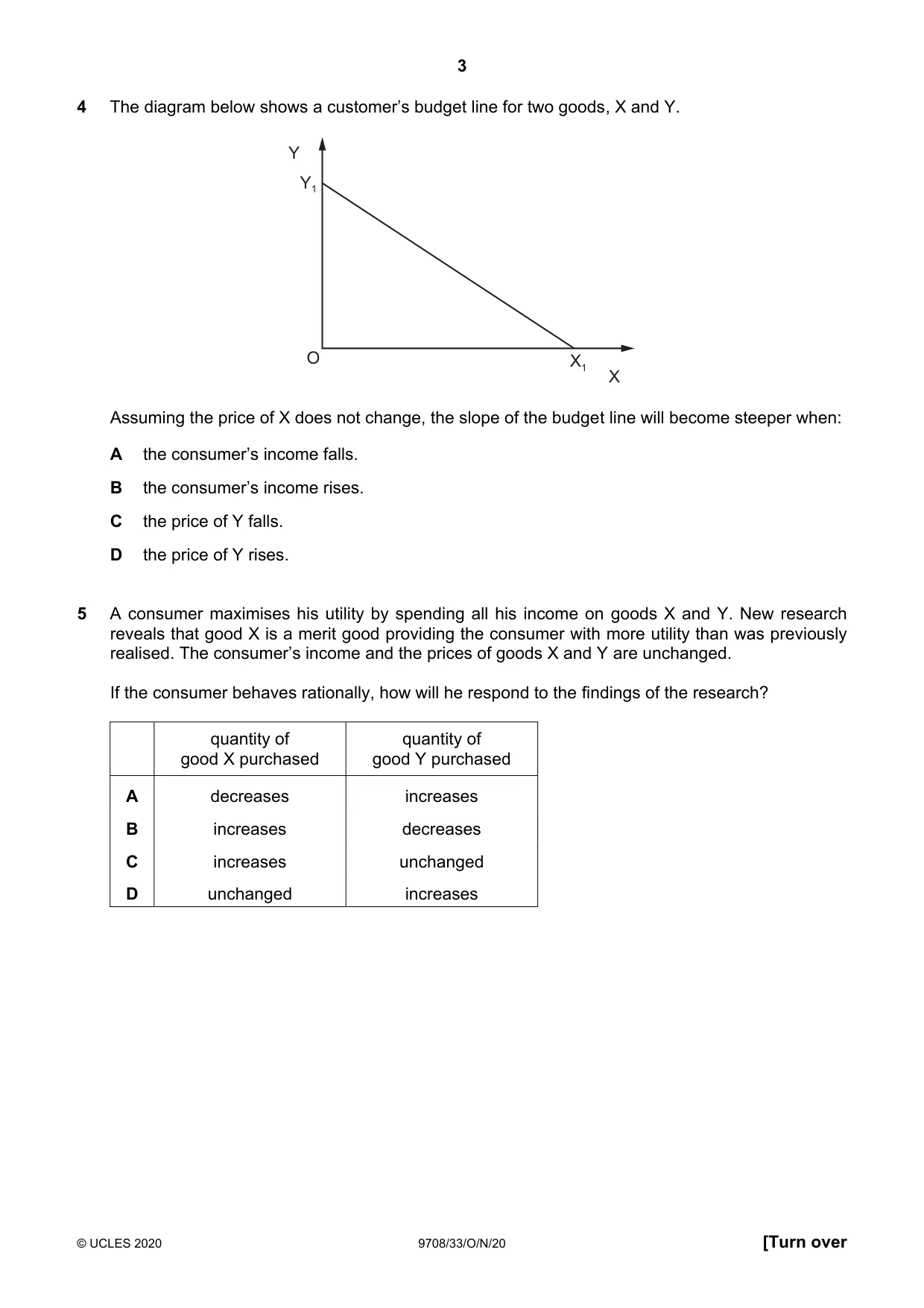
4 The diagram below shows a customer’s budget line for two goods, X and Y. Y Y1 O X1 X Assuming the price of X does not change, the slope of the budget line will become steeper when: A the consumer’s income falls. B the consumer’s income rises. C the price of Y falls. D the price of Y rises.
Mark scheme: C
Q5 · A consumer maximises his utility by spending all his income on goods X and Y
5 A consumer maximises his utility by spending all his income on goods X and Y. New research reveals that good X is a merit good providing the consumer with more utility than was previously realised. The consumer’s income and the prices of goods X and Y are unchanged. If the consumer behaves rationally, how will he respond to the findings of the research? quantity of quantity of good X purchased good Y purchased A decreases increases B increases decreases C increases unchanged D unchanged increases
Mark scheme: B
Q6 · The table shows a firm’s total and marginal costs
6 The table shows a firm’s total and marginal costs. output total cost ($) marginal cost ($) 1 200 20 2 215 15 3 225 10 4 240 15 5 260 20 What is the average fixed cost of producing 6 units? A $20 B $30 C $180 D $200
Mark scheme: B
More questions on Types of cost, revenue and profit, short-run and long-run production
Q7 · Which combination indicates monopolistic competition?
7 Which combination indicates monopolistic competition? freedom of entry product demand curve A high barriers differentiated downward sloping B high barriers unique downward sloping C low barriers differentiated downward sloping D low barriers homogenous horizontal
Mark scheme: C
Q8 · The diagram shows the costs and revenues of a profit-maximising cartel
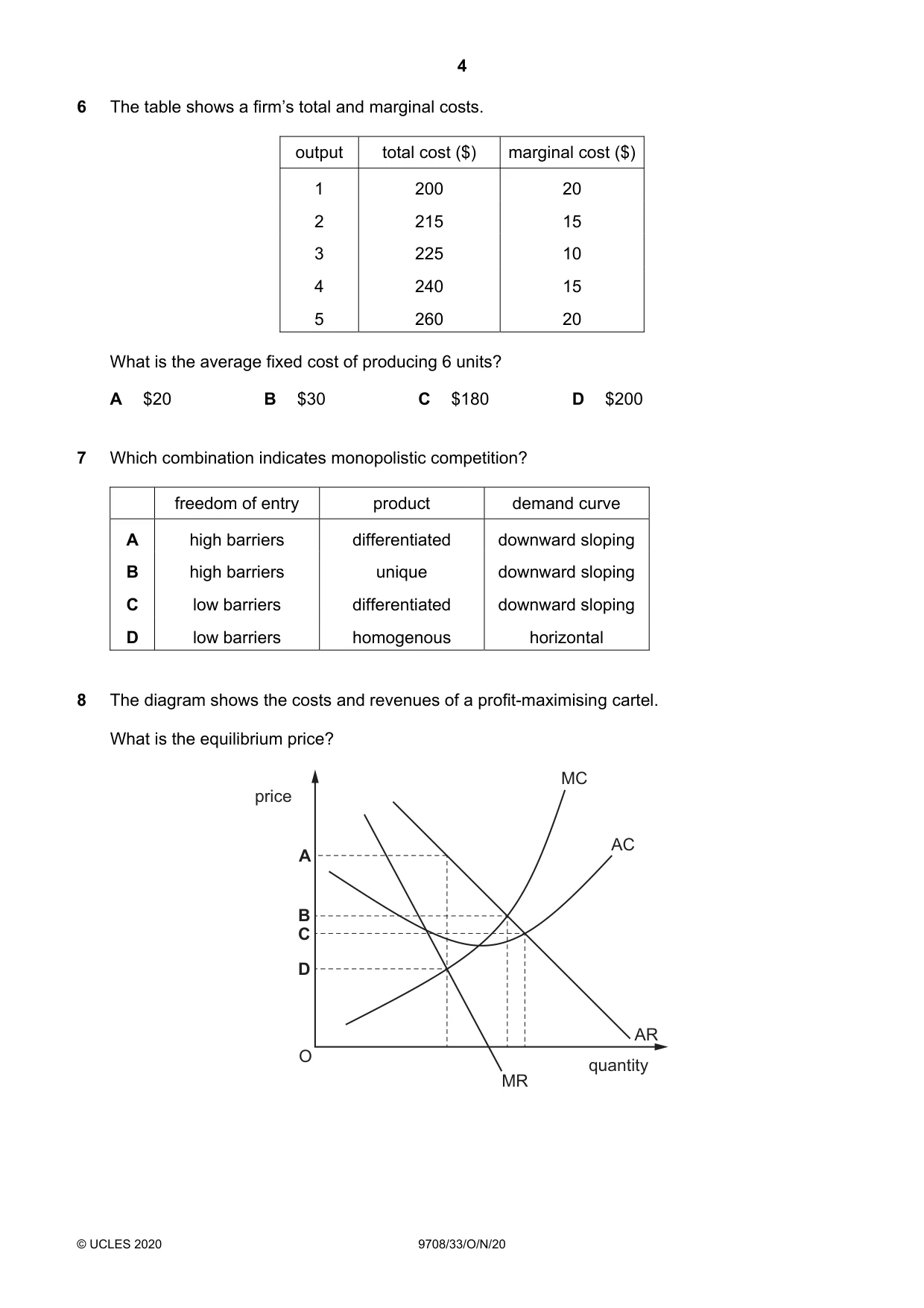
8 The diagram shows the costs and revenues of a profit-maximising cartel. What is the equilibrium price? MC price AC A B C D AR O quantity MR
Mark scheme: A
More questions on Differing objectives and policies of firms
Q9 · The total cost curve for a firm
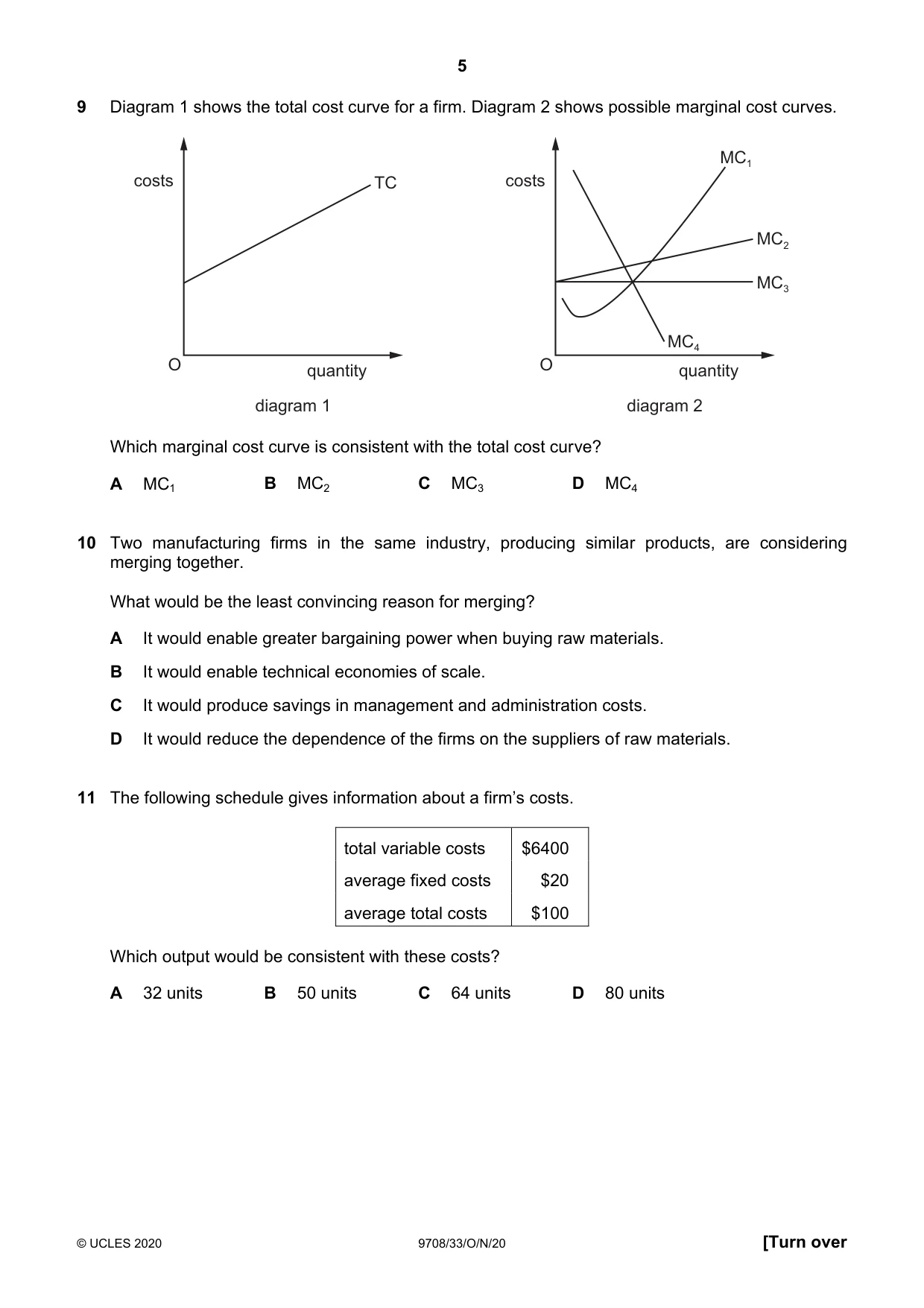
9 Diagram 1 shows the total cost curve for a firm. Diagram 2 shows possible marginal cost curves. MC1 costs TC costs MC2 MC3 MC4 O quantity O quantity diagram 1 diagram 2 Which marginal cost curve is consistent with the total cost curve? A MC1 B MC2 C MC3 D MC4
Mark scheme: C
More questions on Types of cost, revenue and profit, short-run and long-run production
Q10 · Two manufacturing firms in the same industry, producing similar products, are considering…
10 Two manufacturing firms in the same industry, producing similar products, are considering merging together. What would be the least convincing reason for merging? A It would enable greater bargaining power when buying raw materials. B It would enable technical economies of scale. C It would produce savings in management and administration costs. D It would reduce the dependence of the firms on the suppliers of raw materials.
Mark scheme: D
Q11 · The following schedule gives information about a firm’s costs
11 The following schedule gives information about a firm’s costs. total variable costs $6400 average fixed costs $20 average total costs $100 Which output would be consistent with these costs? A 32 units B 50 units C 64 units D 80 units
Mark scheme: D
More questions on Types of cost, revenue and profit, short-run and long-run production
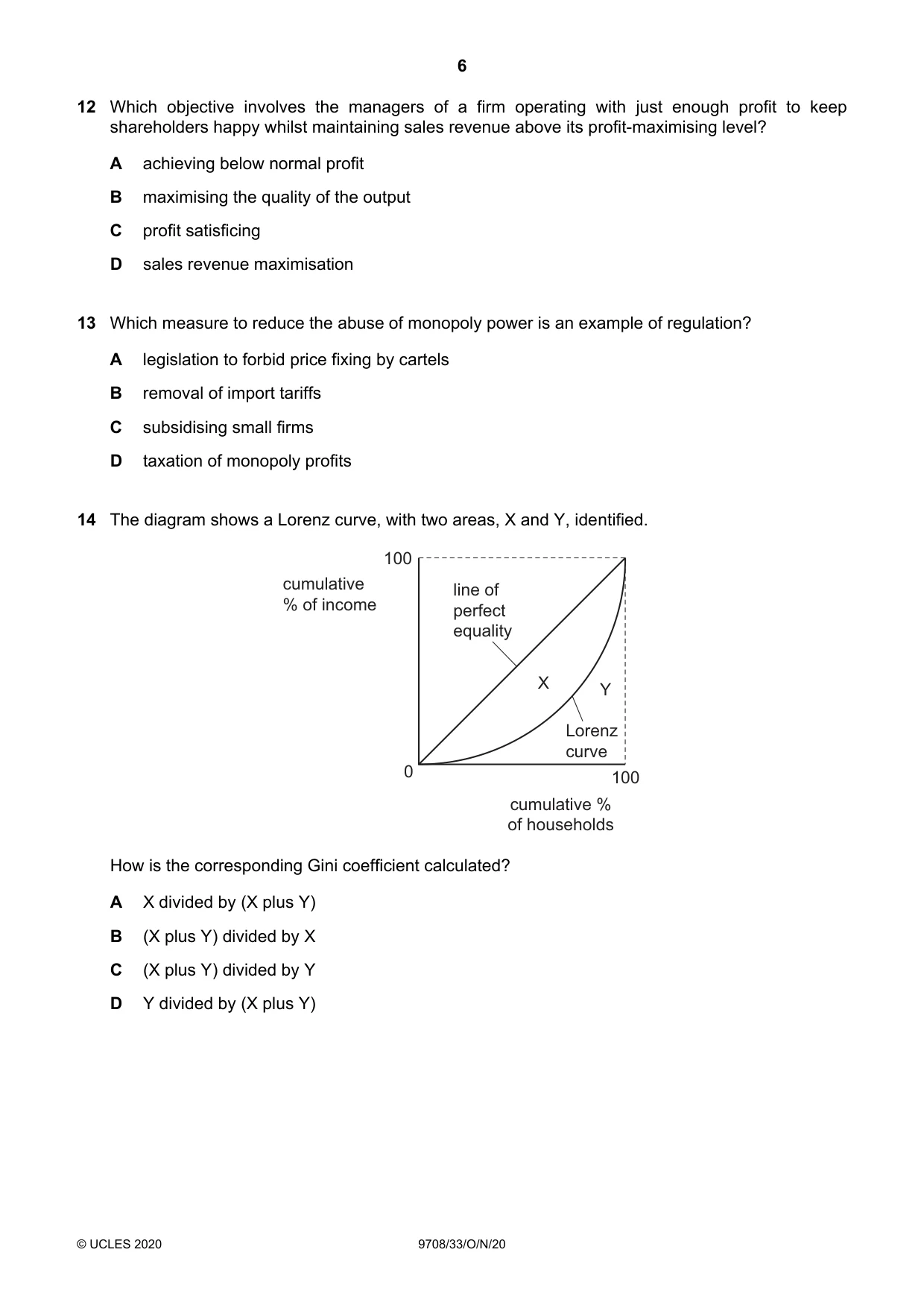
Q12 · Which objective involves the managers of a firm operating with just enough profit to keep…
12 Which objective involves the managers of a firm operating with just enough profit to keep shareholders happy whilst maintaining sales revenue above its profit-maximising level? A achieving below normal profit B maximising the quality of the output C profit satisficing D sales revenue maximisation
Mark scheme: C
More questions on Differing objectives and policies of firms
Q13 · Which measure to reduce the abuse of monopoly power is an example of regulation?
13 Which measure to reduce the abuse of monopoly power is an example of regulation? A legislation to forbid price fixing by cartels B removal of import tariffs C subsidising small firms D taxation of monopoly profits
Mark scheme: A
Q14 · The diagram shows a Lorenz curve, with two areas, X and Y, identified
14 The diagram shows a Lorenz curve, with two areas, X and Y, identified. 100 cumulative line of % of income perfect equality X Y Lorenz curve 0 100 cumulative % of households How is the corresponding Gini coefficient calculated? A X divided by (X plus Y) B (X plus Y) divided by X C (X plus Y) divided by Y D Y divided by (X plus Y)
Mark scheme: A
More questions on Equity and redistribution of income and wealth
Q15 · Which combination of government policies will be most likely to affect inter-generational…
15 Which combination of government policies will be most likely to affect inter-generational equity? A a fall in overseas aid expenditure and a rise in domestic military spending B a fall in the top rate of income tax and a rise in the sales tax (VAT) on luxury goods C a rise in educational maintenance allowances and a fall in state pensions D a rise in unemployment benefits and a rise in national insurance contributions
Mark scheme: C
More questions on Equity and redistribution of income and wealth
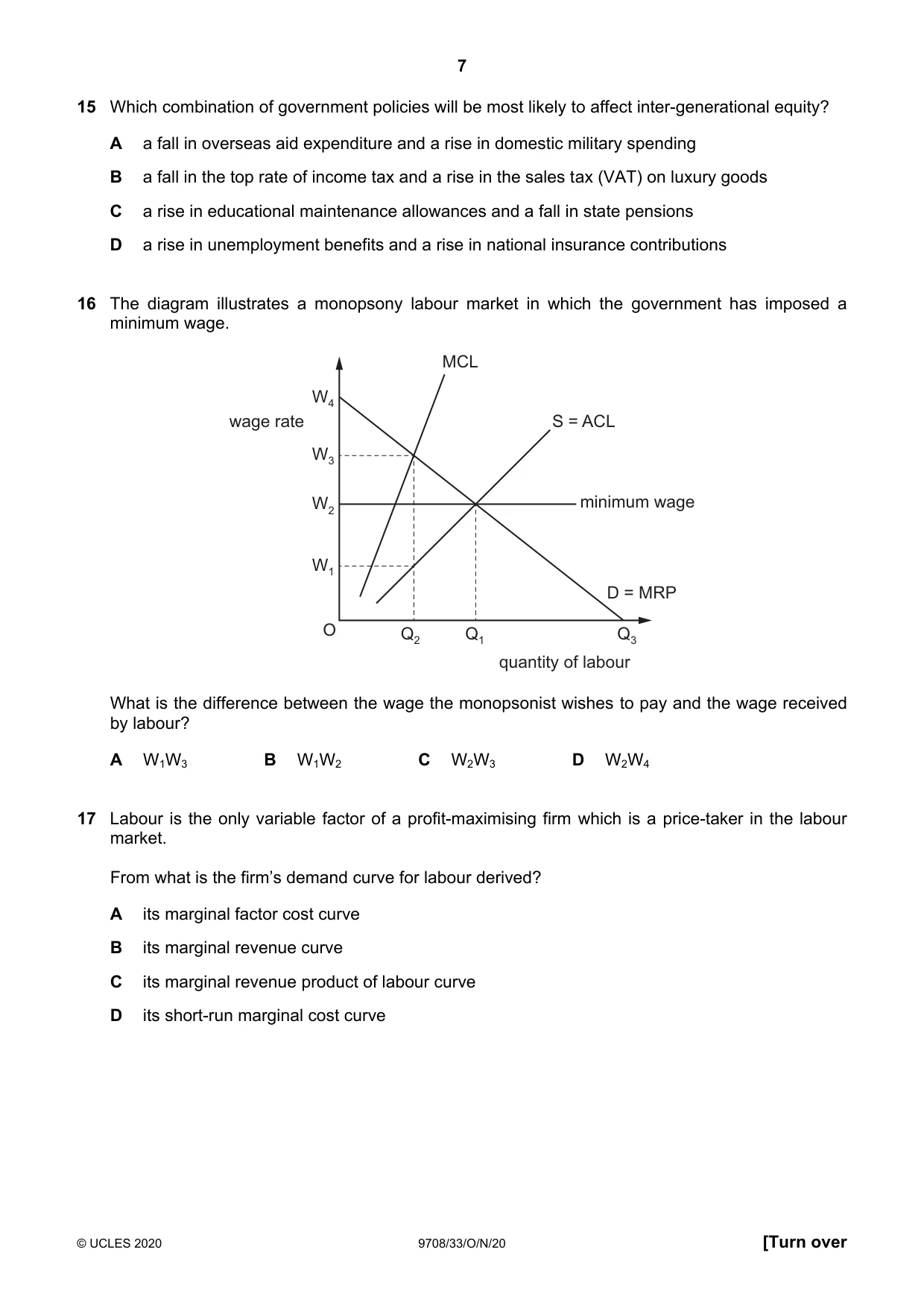
Q16 · The diagram illustrates a monopsony labour market in which the government has imposed a…
16 The diagram illustrates a monopsony labour market in which the government has imposed a minimum wage. MCL W4 wage rate S = ACL W3 W2 minimum wage W1 D = MRP O Q2 Q1 Q3 quantity of labour What is the difference between the wage the monopsonist wishes to pay and the wage received by labour? A W1W3 B W1W2 C W2W3 D W2W4
Mark scheme: B
More questions on Labour market forces and government intervention
Q17 · Labour is the only variable factor of a profit-maximising firm which is a price-taker in…
17 Labour is the only variable factor of a profit-maximising firm which is a price-taker in the labour market. From what is the firm’s demand curve for labour derived? A its marginal factor cost curve B its marginal revenue curve C its marginal revenue product of labour curve D its short-run marginal cost curve
Mark scheme: C
More questions on Labour market forces and government intervention
Q18 · A developing country receiving foreign financial aid is most likely to experience…
18 A developing country receiving foreign financial aid is most likely to experience economic growth in the long run if it uses the money to: A boost welfare benefits for the poorest households. B pay for imports of capital goods. C reduce environmental pollution. D reduce income tax for all households.
Mark scheme: B
Q19 · The Multidimensional Poverty Index uses benchmarks to measure the severity of poverty
19 The Multidimensional Poverty Index uses benchmarks to measure the severity of poverty. Which country suffers most from deprivation in health and living standards compared with deprivation of education? deprivation contribution to overall poverty (%) country living education health standards A Bangladesh 28.4 26.1 45.5 B Burkino Faso 39.0 22.5 38.5 C Lesotho 14.8 33.8 51.4 D Yemen 29.5 32.2 38.2
Mark scheme: C
More questions on Characteristics of countries at different levels of development
Q20 · Which is the most accurate statement about developing economies?
20 Which is the most accurate statement about developing economies? A A possible dependency on primary products for export revenues means that developing economies are reliant on the industrialised world for manufactured products. B High levels of capital per head mean that developing economies must rely on overseas trade if they are to achieve higher growth rates. C High real GDP per head, plus high rates of population growth, reduce the ability of developing economies to increase their standard of living. D Migration of labour from rural to urban areas is of significance only if it results in labour shortages in the rural economy.
Mark scheme: A
More questions on Characteristics of countries at different levels of development
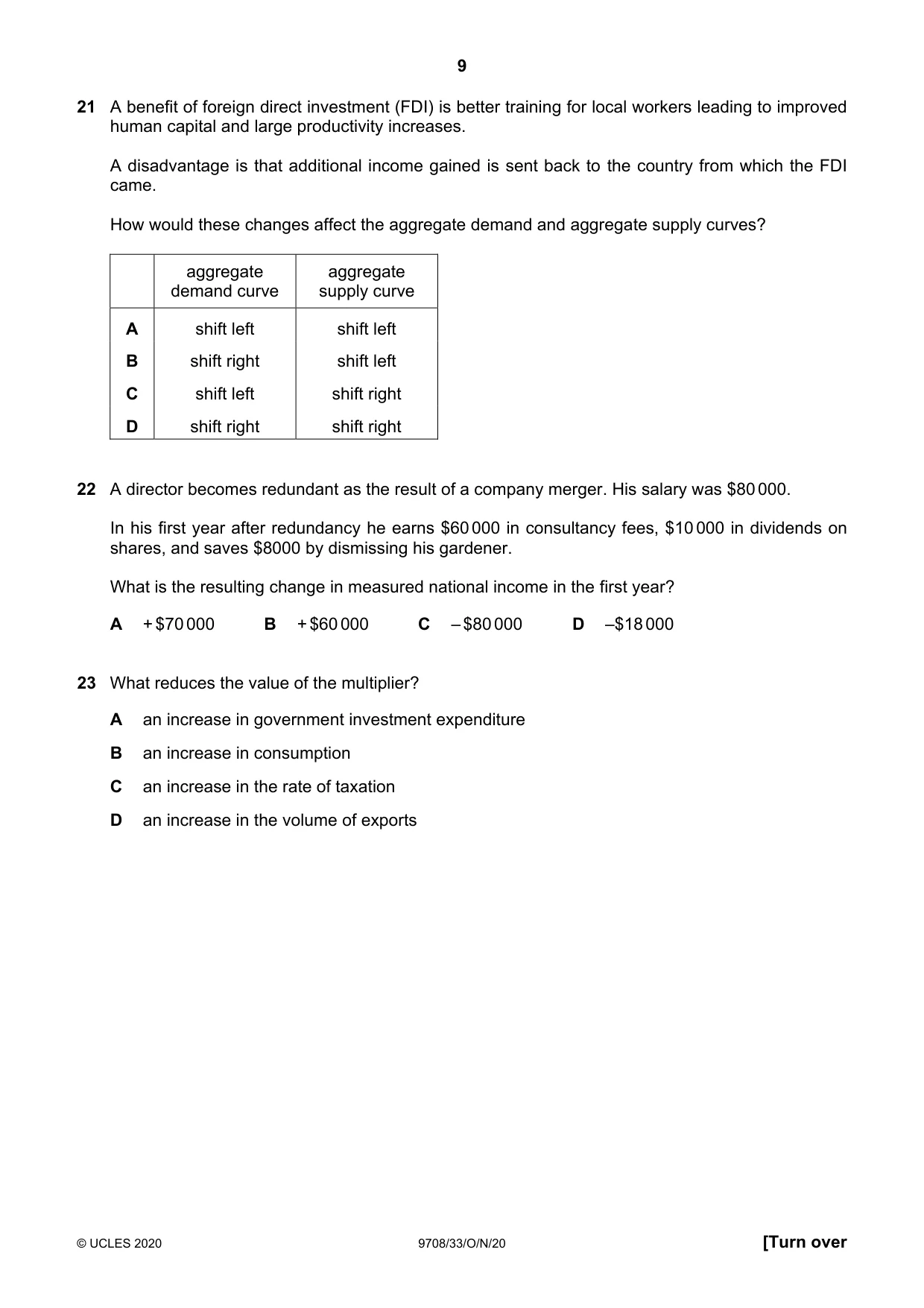
Q21 · A benefit of foreign direct investment (FDI) is better training for local workers leading…
21 A benefit of foreign direct investment (FDI) is better training for local workers leading to improved human capital and large productivity increases. A disadvantage is that additional income gained is sent back to the country from which the FDI came. How would these changes affect the aggregate demand and aggregate supply curves? aggregate aggregate demand curve supply curve A shift left shift left B shift right shift left C shift left shift right D shift right shift right
Mark scheme: C
Q22 · A director becomes redundant as the result of a company merger
22 A director becomes redundant as the result of a company merger. His salary was $80 000. In his first year after redundancy he earns $60 000 in consultancy fees, $10 000 in dividends on shares, and saves $8000 by dismissing his gardener. What is the resulting change in measured national income in the first year? A + $70 000 B + $60 000 C – $80 000 D –$18 000
Mark scheme: D
Q23 · What reduces the value of the multiplier?
23 What reduces the value of the multiplier? A an increase in government investment expenditure B an increase in consumption C an increase in the rate of taxation D an increase in the volume of exports
Mark scheme: C
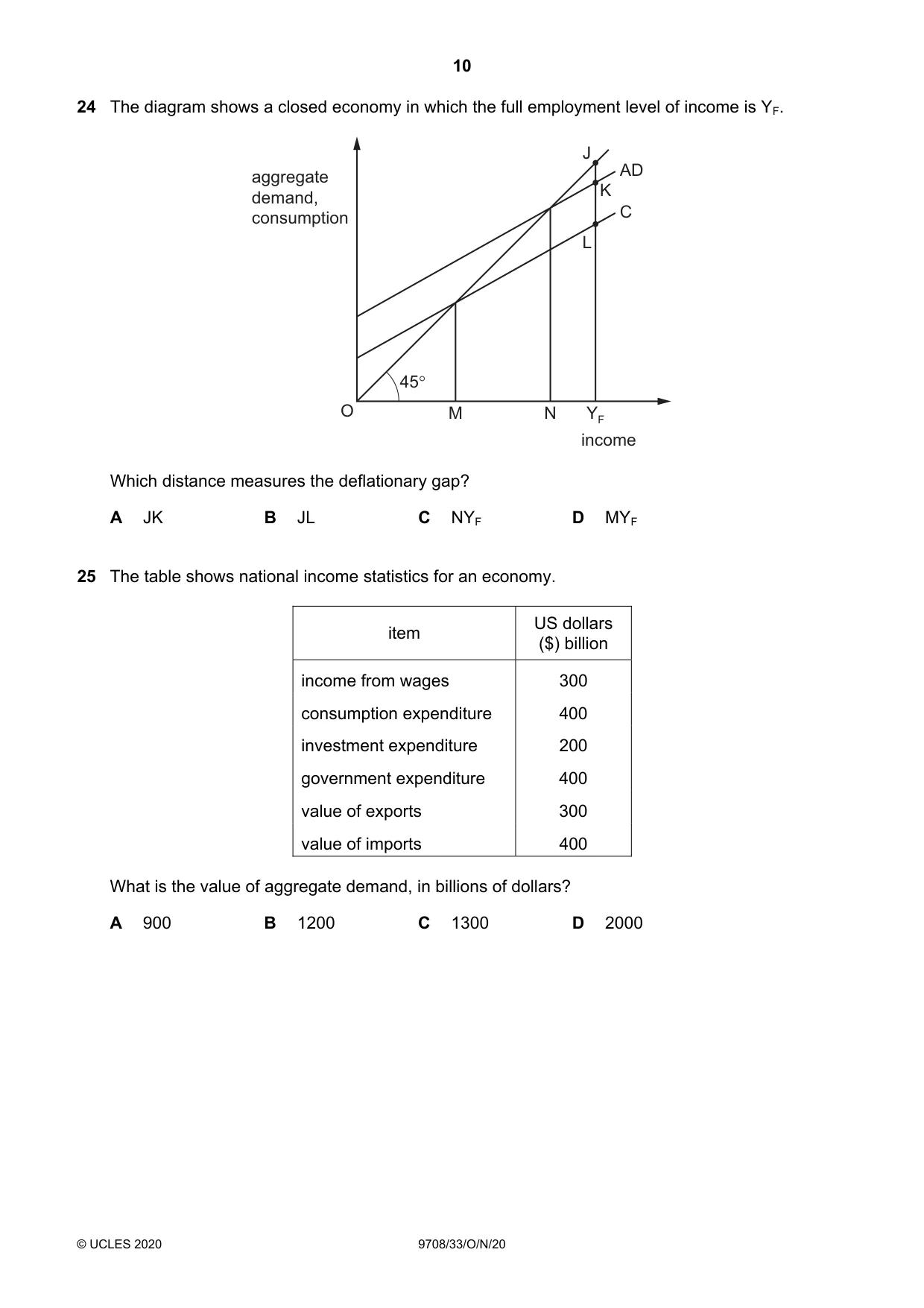
Q24 · The diagram shows a closed economy in which the full employment level of income is YF
24 The diagram shows a closed economy in which the full employment level of income is YF. J aggregate AD demand, K consumption C L 45° O M N YF income Which distance measures the deflationary gap? A JK B JL C NYF D MYF
Mark scheme: A
Q25 · The table shows national income statistics for an economy
25 The table shows national income statistics for an economy. US dollars item ($) billion income from wages 300 consumption expenditure 400 investment expenditure 200 government expenditure 400 value of exports 300 value of imports 400 What is the value of aggregate demand, in billions of dollars? A 900 B 1200 C 1300 D 2000
Mark scheme: A
More questions on Aggregate Demand and Aggregate Supply analysis
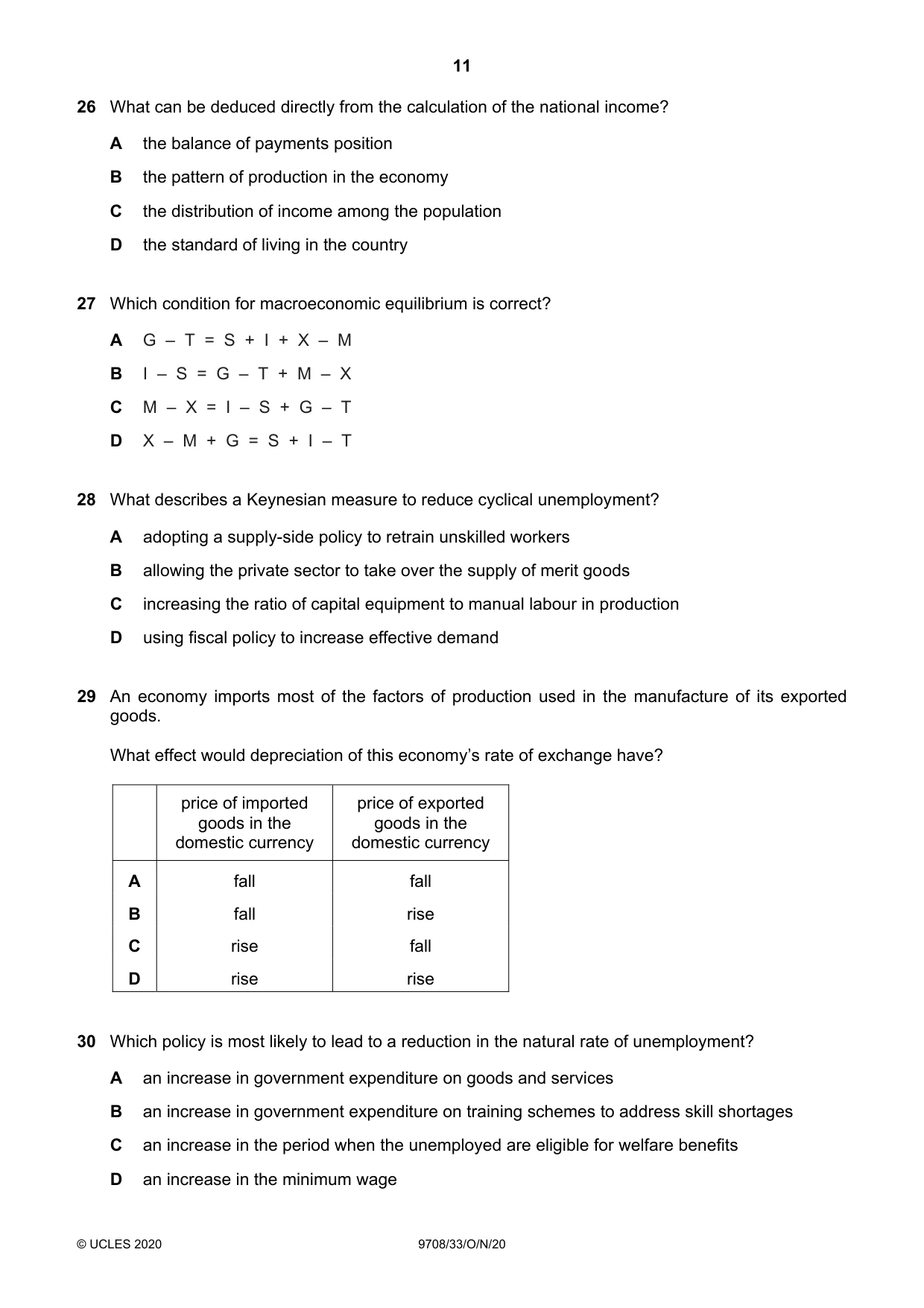
Q26 · What can be deduced directly from the calculation of the national income?
26 What can be deduced directly from the calculation of the national income? A the balance of payments position B the pattern of production in the economy C the distribution of income among the population D the standard of living in the country
Mark scheme: B
Q27 · Which condition for macroeconomic equilibrium is correct?
27 Which condition for macroeconomic equilibrium is correct? A G – T = S + I + X – M B I – S = G – T + M – X C M – X = I – S + G – T D X – M + G = S + I – T
Mark scheme: C
Q28 · What describes a Keynesian measure to reduce cyclical unemployment?
28 What describes a Keynesian measure to reduce cyclical unemployment? A adopting a supply-side policy to retrain unskilled workers B allowing the private sector to take over the supply of merit goods C increasing the ratio of capital equipment to manual labour in production D using fiscal policy to increase effective demand
Mark scheme: D
More questions on Effectiveness of policy options to meet all macroeconomic objectives
Q29 · An economy imports most of the factors of production used in the manufacture of its…
29 An economy imports most of the factors of production used in the manufacture of its exported goods. What effect would depreciation of this economy’s rate of exchange have? price of imported price of exported goods in the goods in the domestic currency domestic currency A fall fall B fall rise C rise fall D rise rise
Mark scheme: D
Q30 · Which policy is most likely to lead to a reduction in the natural rate of unemployment?
30 Which policy is most likely to lead to a reduction in the natural rate of unemployment? A an increase in government expenditure on goods and services B an increase in government expenditure on training schemes to address skill shortages C an increase in the period when the unemployed are eligible for welfare benefits D an increase in the minimum wage
Mark scheme: B
What was in this paper
The subtopics covered by these 30 questions, and how many questions each got. Open one in a new tab to see every Cambridge question on it.
3Characteristics of countries at different levels of development2Differing objectives and policies of firms2Employment/unemployment2Equity and redistribution of income and wealth2Government policies to achieve efficient resource allocation and correct market failure2Labour market forces and government intervention2National income statistics2The circular flow of income2Aggregate Demand and Aggregate Supply analysis1Different market structures1Economic development1Effectiveness of policy options to meet all macroeconomic objectives1Efficiency and market failure1Exchange rates1Globalisation1Growth and survival of firms1Indifference curves and budget lines1Private costs and benefits, externalities and social costs and benefits1Utility1What you needed in this session
Cambridge’s own grade thresholds for 2020 Oct/Nov, Paper 3 · Variant 3. A higher threshold means an easier paper — the bar moves with how the cohort did.