Questions as text
Q1 · The diagram shows an industry producing under conditions of constant average costs 9708/31 Oct/Nov 2009
10 The diagram shows an industry producing under conditions of constant average costs. Y X $ Z T LRAC, LRMC W AR O S MR V output Under perfect competition, the industry produces output OV. Which area measures the loss in consumer surplus if it were to become a monopoly? A YWZ B XYWT C XYZT D SYZV
1 marks
Answer: C
This question in 9708/31 Oct/Nov 2009
Q2 · The diagram shows the short-run position of a monopolist who believes that, in the long… 9708/31 Oct/Nov 2009
12 The diagram shows the short-run position of a monopolist who believes that, in the long run, excessive profits might attract new entrants to the industry. If the monopolist believes that at prices above Pe new competitors would enter, which output would he choose to protect his long-run profits? $ Pe MC = AC AR MR O A B C D output
1 marks
Answer: C
This question in 9708/31 Oct/Nov 2009
Q3 · The diagram shows the cost and revenue curves of a monopoly producer whose only cost of… 9708/31 Oct/Nov 2009
13 The diagram shows the cost and revenue curves of a monopoly producer whose only cost of production is a fixed cost. $ X Y AFC AR O MR output What will such a monopolist do? A set a price of OX in the short run and the long run B set a price of OY in the short run and the long run C set a price of OX in the short run, but discontinue production in the long run D set a price of OY in the short run, but discontinue production in the long run
1 marks
Answer: D
This question in 9708/31 Oct/Nov 2009
Q4 · A country’s steel producers are members of a cartel 9708/31 Oct/Nov 2009
14 A country’s steel producers are members of a cartel. Each member is allocated a production quota, and initially produces the maximum allowed under its quota. What will be the effect on total steel production and the industry’s total profits of allowing the producers to trade the quotas among themselves? effect on production effect on total profits A increase increase B increase no change C no change increase D no change no change
1 marks
Answer: C
This question in 9708/31 Oct/Nov 2009
Q5 · The diagram shows an industry producing under conditions of constant average costs 9708/32 Oct/Nov 2009
9 The diagram shows an industry producing under conditions of constant average costs. Y X $ Z T LRAC, LRMC W AR O S MR V output Under perfect competition, the industry produces output OV. Which area measures the loss in consumer surplus if it were to become a monopoly? A YWZ B XYWT C XYZT D SYZV
1 marks
Answer: C
This question in 9708/32 Oct/Nov 2009
Q6 · The diagram shows the short-run position of a monopolist who believes that, in the long… 9708/32 Oct/Nov 2009
11 The diagram shows the short-run position of a monopolist who believes that, in the long run, excessive profits might attract new entrants to the industry. If the monopolist believes that at prices above Pe new competitors would enter, which output would he choose to protect his long-run profits? $ Pe MC = AC AR MR O A B C D output
1 marks
Answer: C
This question in 9708/32 Oct/Nov 2009
Q7 · The diagram shows the cost and revenue curves of a monopoly producer whose only cost of… 9708/32 Oct/Nov 2009
12 The diagram shows the cost and revenue curves of a monopoly producer whose only cost of production is a fixed cost. $ X Y AFC AR O MR output What will such a monopolist do? A set a price of OX in the short run and the long run B set a price of OY in the short run and the long run C set a price of OX in the short run, but discontinue production in the long run D set a price of OY in the short run, but discontinue production in the long run
1 marks
Answer: D
This question in 9708/32 Oct/Nov 2009
Q8 · A country’s steel producers are members of a cartel 9708/32 Oct/Nov 2009
13 A country’s steel producers are members of a cartel. Each member is allocated a production quota, and initially produces the maximum allowed under its quota. What will be the effect on total steel production and the industry’s total profits of allowing the producers to trade the quotas among themselves? effect on production effect on total profits A increase increase B increase no change C no change increase D no change no change
1 marks
Answer: C
This question in 9708/32 Oct/Nov 2009
Q9 · In the absence of regulation, why is it likely that the market for air travel on the… 9708/31 May/June 2010
10 In the absence of regulation, why is it likely that the market for air travel on the Singapore-Sydney route would be highly contestable? A An airline entering the market would lose little if it later exited that market. B The airline industry’s capacity to expand its operations in the short-run is limited. C The demand for air travel on the Singapore-Sydney route is price-elastic. D There is no effective substitute for air travel for journeys between Singapore and Sydney.
1 marks
Answer: A
This question in 9708/31 May/June 2010
Q10 · The diagram shows a firm’s marginal and average cost curves 9708/31 May/June 2010
12 The diagram shows a firm’s marginal and average cost curves. The firm enters a collusive agreement with other firms in the industry. It is agreed that each firm will charge a common price, OP, and will restrict the level of its output to a production quota set by the industry cartel. The firm is allocated a production quota, Oq. MC AC G H P $ L K M J N O q quantity The firm decides to cheat in order to maximise its profits. What is its short-run increase in profits? A PGKL B PHJL C PHJL minus PGNM D PGKL minus LKNM
1 marks
Answer: C
This question in 9708/31 May/June 2010
Q11 · A competitive market becomes a monopoly 9708/31 May/June 2010
13 A competitive market becomes a monopoly. What is likely to happen? A Consumer surplus will be reduced by the amount of the deadweight loss. B Producer surplus will be reduced by the amount of the deadweight loss. C The loss in consumer surplus will be balanced by the increase in producer surplus. D There will be a transfer of surplus from consumer to producer.
1 marks
Answer: D
This question in 9708/31 May/June 2010
Q12 · A firm’s workers join a trade union which negotiates an increase in the workers’ wage rate 9708/32 May/June 2010
5 A firm’s workers join a trade union which negotiates an increase in the workers’ wage rate. The increase in the wage rate results in an increase in the number employed by the firm. What could explain this? A The demand for the firm’s product is price-elastic. B The firm is a monopsonist within its local labour market. C The firm operates in a perfectly competitive labour market. D There is a high degree of substitutability between capital and labour.
1 marks
Answer: B
This question in 9708/32 May/June 2010
Q13 · In the absence of regulation, why is it likely that the market for air travel on the… 9708/32 May/June 2010
9 In the absence of regulation, why is it likely that the market for air travel on the Singapore-Sydney route would be highly contestable? A An airline entering the market would lose little if it later exited that market. B The airline industry’s capacity to expand its operations in the short-run is limited. C The demand for air travel on the Singapore-Sydney route is price-elastic. D There is no effective substitute for air travel for journeys between Singapore and Sydney.
1 marks
Answer: A
This question in 9708/32 May/June 2010
Q14 · The diagram shows a firm’s marginal and average cost curves 9708/32 May/June 2010
11 The diagram shows a firm’s marginal and average cost curves. The firm enters a collusive agreement with other firms in the industry. It is agreed that each firm will charge a common price, OP, and will restrict the level of its output to a production quota set by the industry cartel. The firm is allocated a production quota, Oq. MC AC G H P $ L K M J N O q quantity The firm decides to cheat in order to maximise its profits. What is its short-run increase in profits? A PGKL B PHJL C PHJL minus PGNM D PGKL minus LKNM
1 marks
Answer: C
This question in 9708/32 May/June 2010
Q15 · A competitive market becomes a monopoly 9708/32 May/June 2010
12 A competitive market becomes a monopoly. What is likely to happen? A Consumer surplus will be reduced by the amount of the deadweight loss. B Producer surplus will be reduced by the amount of the deadweight loss. C The loss in consumer surplus will be balanced by the increase in producer surplus. D There will be a transfer of surplus from consumer to producer.
1 marks
Answer: D
This question in 9708/32 May/June 2010
Q16 · A firm’s workers join a trade union which negotiates an increase in the workers’ wage rate 9708/33 May/June 2010
5 A firm’s workers join a trade union which negotiates an increase in the workers’ wage rate. The increase in the wage rate results in an increase in the number employed by the firm. What could explain this? A The demand for the firm’s product is price-elastic. B The firm is a monopsonist within its local labour market. C The firm operates in a perfectly competitive labour market. D There is a high degree of substitutability between capital and labour.
1 marks
Answer: B
This question in 9708/33 May/June 2010
Q17 · The diagram shows a firm’s demand curve and its marginal revenue curve 9708/33 May/June 2010
8 The diagram shows a firm’s demand curve and its marginal revenue curve. P price D O MR quantity What is the approximate price elasticity of demand at price OP? A 0.25 B 0.5 C 1 D 2
1 marks
Answer: D
This question in 9708/33 May/June 2010
Q18 · In the absence of regulation, why is it likely that the market for air travel on the… 9708/33 May/June 2010
9 In the absence of regulation, why is it likely that the market for air travel on the Singapore-Sydney route would be highly contestable? A An airline entering the market would lose little if it later exited that market. B The airline industry’s capacity to expand its operations in the short-run is limited. C The demand for air travel on the Singapore-Sydney route is price-elastic. D There is no effective substitute for air travel for journeys between Singapore and Sydney.
1 marks
Answer: A
This question in 9708/33 May/June 2010
Q19 · The table shows information about a profit-maximising firm 9708/33 May/June 2010
10 The table shows information about a profit-maximising firm. output 17 000 units price per unit $1.75 fixed costs $10 000 variable costs per unit $1.70 What should the firm do? A close down immediately because it is not covering its fixed costs B close down immediately because it is not covering its average costs C close down immediately because it is not covering its total costs D continue production in the short run because it is covering its variable costs
1 marks
Answer: D
This question in 9708/33 May/June 2010
Q20 · The diagram shows a firm’s marginal and average cost curves 9708/33 May/June 2010
11 The diagram shows a firm’s marginal and average cost curves. The firm enters a collusive agreement with other firms in the industry. It is agreed that each firm will charge a common price, OP, and will restrict the level of its output to a production quota set by the industry cartel. The firm is allocated a production quota, Oq. MC AC G H P $ L K M J N O q quantity The firm decides to cheat in order to maximise its profits. What is its short-run increase in profits? A PGKL B PHJL C PHJL minus PGNM D PGKL minus LKNM
1 marks
Answer: C
This question in 9708/33 May/June 2010
Q21 · A competitive market becomes a monopoly 9708/33 May/June 2010
12 A competitive market becomes a monopoly. What is likely to happen? A Consumer surplus will be reduced by the amount of the deadweight loss. B Producer surplus will be reduced by the amount of the deadweight loss. C The loss in consumer surplus will be balanced by the increase in producer surplus. D There will be a transfer of surplus from consumer to producer.
1 marks
Answer: D
This question in 9708/33 May/June 2010
Q22 · The diagram shows a firm’s cost and revenue curves 9708/31 Oct/Nov 2010
9 The diagram shows a firm’s cost and revenue curves. MC $ AC O MR Q AR output What could explain why the firm produces output OQ? A It is operating in a contestable market. B It is operating in a perfectly competitive market. C It is seeking to maximise profits. D It is seeking to maximise sales revenue.
1 marks
Answer: A
This question in 9708/31 Oct/Nov 2010
Q23 · A firm wishes to acquire some of the consumer surplus its customers currently enjoy 9708/31 Oct/Nov 2010
10 A firm wishes to acquire some of the consumer surplus its customers currently enjoy. How might it achieve this? A by introducing price discrimination B by reducing operating costs C by setting a price that maximises revenue D by taking advantage of economies of scale
1 marks
Answer: A
This question in 9708/31 Oct/Nov 2010
Q24 · A perfectly competitive firm finds that at its current level of output, marginal revenue… 9708/31 Oct/Nov 2010
11 A perfectly competitive firm finds that at its current level of output, marginal revenue is $2.00 and marginal cost is $2.50. If the firm is a profit maximiser, what will happen to its price and output? price output A increases decreases B increases unchanged C unchanged decreases D unchanged unchanged
1 marks
Answer: C
This question in 9708/31 Oct/Nov 2010
Q25 · The diagram shows the outcome when a perfectly competitive market is taken over by a… 9708/31 Oct/Nov 2010
12 The diagram shows the outcome when a perfectly competitive market is taken over by a monopoly. $ X AC MR D O quantity What does area X represent? A monopoly profit B the reduction in consumer surplus C the resulting deadweight loss D transfer earnings
1 marks
Answer: C
This question in 9708/31 Oct/Nov 2010
Q26 · The diagram shows a firm’s cost and revenue curves 9708/32 Oct/Nov 2010
9 The diagram shows a firm’s cost and revenue curves. MC $ AC O MR Q AR output What could explain why the firm produces output OQ? A It is operating in a contestable market. B It is operating in a perfectly competitive market. C It is seeking to maximise profits. D It is seeking to maximise sales revenue.
1 marks
Answer: A
This question in 9708/32 Oct/Nov 2010
Q27 · A firm wishes to acquire some of the consumer surplus its customers currently enjoy 9708/32 Oct/Nov 2010
10 A firm wishes to acquire some of the consumer surplus its customers currently enjoy. How might it achieve this? A by introducing price discrimination B by reducing operating costs C by setting a price that maximises revenue D by taking advantage of economies of scale
1 marks
Answer: A
This question in 9708/32 Oct/Nov 2010
Q28 · A perfectly competitive firm finds that at its current level of output, marginal revenue… 9708/32 Oct/Nov 2010
11 A perfectly competitive firm finds that at its current level of output, marginal revenue is $2.00 and marginal cost is $2.50. If the firm is a profit maximiser, what will happen to its price and output? price output A increases decreases B increases unchanged C unchanged decreases D unchanged unchanged
1 marks
Answer: C
This question in 9708/32 Oct/Nov 2010
Q29 · The diagram shows the outcome when a perfectly competitive market is taken over by a… 9708/32 Oct/Nov 2010
12 The diagram shows the outcome when a perfectly competitive market is taken over by a monopoly. $ X AC MR D O quantity What does area X represent? A monopoly profit B the reduction in consumer surplus C the resulting deadweight loss D transfer earnings
1 marks
Answer: C
This question in 9708/32 Oct/Nov 2010
Q30 · The diagram shows a firm’s cost and revenue curves 9708/33 Oct/Nov 2010
8 The diagram shows a firm’s cost and revenue curves. MC $ AC O MR Q AR output What could explain why the firm produces output OQ? A It is operating in a contestable market. B It is operating in a perfectly competitive market. C It is seeking to maximise profits. D It is seeking to maximise sales revenue.
1 marks
Answer: A
This question in 9708/33 Oct/Nov 2010
Q31 · A firm wishes to acquire some of the consumer surplus its customers currently enjoy 9708/33 Oct/Nov 2010
9 A firm wishes to acquire some of the consumer surplus its customers currently enjoy. How might it achieve this? A by introducing price discrimination B by reducing operating costs C by setting a price that maximises revenue D by taking advantage of economies of scale
1 marks
Answer: A
This question in 9708/33 Oct/Nov 2010
Q32 · A perfectly competitive firm finds that at its current level of output, marginal revenue… 9708/33 Oct/Nov 2010
10 A perfectly competitive firm finds that at its current level of output, marginal revenue is $2.00 and marginal cost is $2.50. If the firm is a profit maximiser, what will happen to its price and output? price output A increases decreases B increases unchanged C unchanged decreases D unchanged unchanged
1 marks
Answer: C
This question in 9708/33 Oct/Nov 2010
Q33 · The diagram shows the outcome when a perfectly competitive market is taken over by a… 9708/33 Oct/Nov 2010
11 The diagram shows the outcome when a perfectly competitive market is taken over by a monopoly. $ X AC MR D O quantity What does area X represent? A monopoly profit B the reduction in consumer surplus C the resulting deadweight loss D transfer earnings
1 marks
Answer: C
This question in 9708/33 Oct/Nov 2010
Q34 · What is the likely outcome for producers and consumers when a market moves from being… 9708/31 May/June 2011
9 What is the likely outcome for producers and consumers when a market moves from being non-contestable to being a contestable market? producers consumers A gain from higher prices gain from a wider choice of products B gain from likely higher profits lose from likely higher prices C lose from likely lower output lose from a reduced choice of products D lose from likely lower profits gain from likely lower prices
1 marks
Answer: D
This question in 9708/31 May/June 2011
Q35 · A firm is engaging in price discrimination 9708/31 May/June 2011
10 A firm is engaging in price discrimination. In order to maximise profits, what should the firm do? A charge a higher price to consumers earning higher incomes B charge a higher price to consumers earning lower incomes C charge a higher price to consumers whose demand for the product is price inelastic D charge a higher price to consumers whose demand for the product is price elastic
1 marks
Answer: C
This question in 9708/31 May/June 2011
Q36 · What is the likely outcome for producers and consumers when a market moves from being… 9708/32 May/June 2011
8 What is the likely outcome for producers and consumers when a market moves from being non-contestable to being a contestable market? producers consumers A gain from higher prices gain from a wider choice of products B gain from likely higher profits lose from likely higher prices C lose from likely lower output lose from a reduced choice of products D lose from likely lower profits gain from likely lower prices
1 marks
Answer: D
This question in 9708/32 May/June 2011
Q37 · A firm is engaging in price discrimination 9708/32 May/June 2011
9 A firm is engaging in price discrimination. In order to maximise profits, what should the firm do? A charge a higher price to consumers earning higher incomes B charge a higher price to consumers earning lower incomes C charge a higher price to consumers whose demand for the product is price inelastic D charge a higher price to consumers whose demand for the product is price elastic
1 marks
Answer: C
This question in 9708/32 May/June 2011
Q38 · What is the likely outcome for producers and consumers when a market moves from being… 9708/33 May/June 2011
8 What is the likely outcome for producers and consumers when a market moves from being non-contestable to being a contestable market? producers consumers A gain from higher prices gain from a wider choice of products B gain from likely higher profits lose from likely higher prices C lose from likely lower output lose from a reduced choice of products D lose from likely lower profits gain from likely lower prices
1 marks
Answer: D
This question in 9708/33 May/June 2011
Q39 · A firm is engaging in price discrimination 9708/33 May/June 2011
9 A firm is engaging in price discrimination. In order to maximise profits, what should the firm do? A charge a higher price to consumers earning higher incomes B charge a higher price to consumers earning lower incomes C charge a higher price to consumers whose demand for the product is price inelastic D charge a higher price to consumers whose demand for the product is price elastic
1 marks
Answer: C
This question in 9708/33 May/June 2011
Q40 · Which practices would be classified as price discrimination? 9708/31 Oct/Nov 2011
9 Which practices would be classified as price discrimination? charging lower return fares from Kuala charging higher rail fares for peak Lumpur to Hong Kong for passengers period travel to meet the additional who stay overnight on a Saturday in costs of train companies Hong Kong A no no B no yes C yes no D yes yes
1 marks
Answer: B
This question in 9708/31 Oct/Nov 2011
Q41 · The diagram shows a firm’s long-run cost and revenue curves 9708/32 Oct/Nov 2011
2 The diagram shows a firm’s long-run cost and revenue curves. LRMC LRAC costs, revenue AR MR O A B C D output At which level of output is the firm both allocatively and productively efficient? A OA B OB C OC D OD
1 marks
Answer: C
This question in 9708/32 Oct/Nov 2011
Q42 · Which would be least likely to practise price discrimination? 9708/32 Oct/Nov 2011
10 Which would be least likely to practise price discrimination? A a baker B a cinema C a hairdressing salon D a restaurant
1 marks
Answer: A
This question in 9708/32 Oct/Nov 2011
Q43 · What will increase the likelihood that the firms in an industry will collude to maximise… 9708/32 Oct/Nov 2011
12 What will increase the likelihood that the firms in an industry will collude to maximise their joint profits? A The industry consists of a large number of producers. B The industry has many differentiated products. C The industry is characterised by rapid technological change. D There are significant barriers to prevent new firms entering the industry.
1 marks
Answer: D
This question in 9708/32 Oct/Nov 2011
Q44 · Which practices would be classified as price discrimination? 9708/33 Oct/Nov 2011
8 Which practices would be classified as price discrimination? charging lower return fares from Kuala charging higher rail fares for peak Lumpur to Hong Kong for passengers period travel to meet the additional who stay overnight on a Saturday in costs of train companies Hong Kong A no no B no yes C yes no D yes yes
1 marks
Answer: B
This question in 9708/33 Oct/Nov 2011
Q45 · The five firm concentration ratio for an industry changes from 50 % to 60 % 9708/31 May/June 2012
10 The five firm concentration ratio for an industry changes from 50 % to 60 %. Which statement about the industry is correct? A Each firm has become more efficient. B The industry has become more oligopolistic. C The industry has benefited from external economies of scale. D The industry now has fewer barriers to entry.
1 marks
Answer: B
This question in 9708/31 May/June 2012
Q46 · Which condition must apply before a market can be regarded as perfectly contestable? 9708/31 May/June 2012
11 Which condition must apply before a market can be regarded as perfectly contestable? A All firms in the industry produce an identical product. B All firms in the industry are price-takers. C There are a large number of firms in the industry. D There are zero costs of entry to, and exit from, the industry.
1 marks
Answer: D
This question in 9708/31 May/June 2012
Q47 · A perfectly competitive firm is currently producing at a level of output where its… 9708/31 May/June 2012
12 A perfectly competitive firm is currently producing at a level of output where its marginal cost is above both its average total cost and the market price. What will be the effect on price and output if the firm were to maximise its profit? effect on output effect on price A decrease increase B decrease unchanged C increase decrease D increase unchanged
1 marks
Answer: B
This question in 9708/31 May/June 2012
Q48 · An industry moves from monopolistic competition to oligopoly 9708/31 May/June 2012
13 An industry moves from monopolistic competition to oligopoly. How will this affect barriers to entry and the degree of interdependence between firms? interdependence barriers to entry between firms A strengthen strengthen B strengthen weaken C weaken strengthen D weaken weaken
1 marks
Answer: A
This question in 9708/31 May/June 2012
Q49 · A government decides to privatise a state monopoly 9708/31 May/June 2012
15 A government decides to privatise a state monopoly. What should the government do to try to ensure that this will result in an improvement in efficiency? A allocate vouchers to all citizens entitling them to a share in the ownership of the monopoly B encourage competition C impose a maximum profit margin D privatise the monopoly as a going concern
1 marks
Answer: B
This question in 9708/31 May/June 2012
Q50 · The diagram shows the long-run cost and revenue curves of a monopolist 9708/31 May/June 2012
16 The diagram shows the long-run cost and revenue curves of a monopolist. AR revenue, costs LRAC LRMC O W X Y Z MR output Which level of output satisfies the condition for an efficient allocation of resources? A OW B OX C OY D OZ
1 marks
Answer: D
This question in 9708/31 May/June 2012
Q51 · The five firm concentration ratio for an industry changes from 50 % to 60 % 9708/32 May/June 2012
10 The five firm concentration ratio for an industry changes from 50 % to 60 %. Which statement about the industry is correct? A Each firm has become more efficient. B The industry has become more oligopolistic. C The industry has benefited from external economies of scale. D The industry now has fewer barriers to entry.
1 marks
Answer: B
This question in 9708/32 May/June 2012
Q52 · The diagram shows the cost curves of a firm in a perfectly competitive market 9708/32 May/June 2012
11 The diagram shows the cost curves of a firm in a perfectly competitive market. MC Z ATC AVC X cost W V U O output Which segment of a curve shows the quantity that the firm would be willing to supply to the market in the short-run? A VX B UZ C VZ D WZ
1 marks
Answer: C
This question in 9708/32 May/June 2012
Q53 · A perfectly competitive firm is currently producing at a level of output where its… 9708/32 May/June 2012
12 A perfectly competitive firm is currently producing at a level of output where its marginal cost is above both its average total cost and the market price. What will be the effect on price and output if the firm were to maximise its profit? effect on output effect on price A decrease increase B decrease unchanged C increase decrease D increase unchanged
1 marks
Answer: B
This question in 9708/32 May/June 2012
Q54 · A good gives rise to external benefits and is produced under conditions of imperfect… 9708/32 May/June 2012
15 A good gives rise to external benefits and is produced under conditions of imperfect competition. Which statement must be true? A Benefits to consumers exceed the benefits to society. B Firms producing the good will make a loss. C Output of the good is below the socially optimum level. D Social costs of production exceed private costs.
1 marks
Answer: C
This question in 9708/32 May/June 2012
Q55 · The diagram shows the long-run cost and revenue curves of a monopolist 9708/32 May/June 2012
16 The diagram shows the long-run cost and revenue curves of a monopolist. AR revenue, costs LRAC LRMC O W X Y Z MR output Which level of output satisfies the condition for an efficient allocation of resources? A OW B OX C OY D OZ
1 marks
Answer: D
This question in 9708/32 May/June 2012
Q56 · Which condition must apply before a market can be regarded as perfectly contestable? 9708/33 May/June 2012
11 Which condition must apply before a market can be regarded as perfectly contestable? A All firms in the industry produce an identical product. B All firms in the industry are price-takers. C There are a large number of firms in the industry. D There are zero costs of entry to, and exit from, the industry.
1 marks
Answer: D
This question in 9708/33 May/June 2012
Q57 · An industry moves from monopolistic competition to oligopoly 9708/33 May/June 2012
13 An industry moves from monopolistic competition to oligopoly. How will this affect barriers to entry and the degree of interdependence between firms? interdependence barriers to entry between firms A strengthen strengthen B strengthen weaken C weaken strengthen D weaken weaken
1 marks
Answer: A
This question in 9708/33 May/June 2012
Q58 · In the diagram, MRPL is a firm’s marginal revenue product of labour curve, S is its… 9708/32 Oct/Nov 2012
4 In the diagram, MRPL is a firm’s marginal revenue product of labour curve, S is its supply of labour curve, and MCL its marginal cost of labour curve. MCL W4 S W3 $ W2 W1 MRPL O N1 N2 labour Assuming profit maximisation, how many workers will the firm employ and what wage will it pay? number wage employed A N1 W1 B N1 W3 C N2 W2 D N2 W4
1 marks
Answer: A
This question in 9708/32 Oct/Nov 2012
Q59 · What would be the effect of imposing a specific tax on each item produced by a profit… 9708/32 Oct/Nov 2012
7 What would be the effect of imposing a specific tax on each item produced by a profit maximising monopolist? A Average revenue falls by the amount of the tax. B Marginal costs rise by the amount of the tax. C Price increases by the amount of the tax. D There will be no change in price or output.
1 marks
Answer: B
This question in 9708/32 Oct/Nov 2012
Q60 · What is meant by a four firm concentration ratio of 25 %? 9708/32 Oct/Nov 2012
11 What is meant by a four firm concentration ratio of 25 %? A The largest four firms’ market share totals 25 %. B The largest four firms have a market share of 25 % each. C There are only four firms in the industry. D The largest firm has a 25 % market share.
1 marks
Answer: A
This question in 9708/32 Oct/Nov 2012
Q61 · Instead of charging all its customers the same price, a firm decides to charge different… 9708/32 Oct/Nov 2012
12 Instead of charging all its customers the same price, a firm decides to charge different prices in different markets. How is this likely to affect consumer surplus and the firm's marketing costs? consumer surplus marketing costs A decrease decrease B decrease increase C increase decrease D increase increase
1 marks
Answer: B
This question in 9708/32 Oct/Nov 2012
Q62 · The diagram shows a profit-maximising firm’s cost and revenue curves 9708/32 Oct/Nov 2012
13 The diagram shows a profit-maximising firm’s cost and revenue curves. MC MR AC cost , revenue AR O W X Y Z output What would be the increase in the firm’s output if it was required to charge a price equal to marginal cost? A WX B XY C WY D XZ
1 marks
Answer: C
This question in 9708/32 Oct/Nov 2012
Q63 · The diagram shows a perfectly competitive firm’s average product of labour and marginal… 9708/33 Oct/Nov 2012
4 The diagram shows a perfectly competitive firm’s average product of labour and marginal product of labour curves. J K wage ($), labour product (units) M L APL MPL O number employed The market price of the firm’s product is $1. Which segment of the curves represents the firm’s demand for labour curve? A OJ B JK C KL D KM
1 marks
This question in 9708/33 Oct/Nov 2012
Q64 · The diagram shows the cost and revenue curves of a monopoly 9708/33 Oct/Nov 2012
9 The diagram shows the cost and revenue curves of a monopoly. MC AC $ MR AR O X output What is the firm’s objective if it produces output OX? A to achieve normal profit B to maximise profit C to maximise total revenue D to minimise average cost
1 marks
This question in 9708/33 Oct/Nov 2012
Q65 · The table shows a firm’s total costs corresponding to different levels of output 9708/33 Oct/Nov 2012
10 The table shows a firm’s total costs corresponding to different levels of output. units of output 1 2 3 4 5 6 7 8 total cost ($) 8 14 18 22 28 36 46 58 If the market price is $8, within which range of output would a profit maximising firm in a perfectly competitive industry produce in the short run? A 1 - 2 units B 3 - 4 units C 5 - 6 units D 7 - 8 units
1 marks
This question in 9708/33 Oct/Nov 2012
Q66 · The diagram shows the cost and revenue curves of a profit-maximising monopolist 9708/33 Oct/Nov 2012
11 The diagram shows the cost and revenue curves of a profit-maximising monopolist. ATC MC J revenue, cost K M AR MR O Q output What measures the total monopoly profit made by the firm? A JM B JK C JM × OQ D JK × OQ
1 marks
This question in 9708/33 Oct/Nov 2012
Q67 · Some of the firms in an industry agree to set the same price 9708/33 Oct/Nov 2012
12 Some of the firms in an industry agree to set the same price. What might threaten the continuation of the agreement? A differences in cost structures between firms B homogeneity of the product C the inclusion of the dominant firm in the industry D significant barriers to entry into the industry
1 marks
This question in 9708/33 Oct/Nov 2012
Q68 · A perfectly competitive industry becomes a profit-maximising monopoly 9708/31 May/June 2013
10 A perfectly competitive industry becomes a profit-maximising monopoly. The marginal cost curve of the monopolist is identical to the supply curve of the perfectly competitive industry. How will output and price be affected? output price A decreases decreases B decreases increases C increases decreases D increases increases
1 marks
Answer: B
This question in 9708/31 May/June 2013
Q69 · A firm earns supernormal profit when its profit is A above that earned by competing firms 9708/31 May/June 2013
11 A firm earns supernormal profit when its profit is A above that earned by competing firms. B above that needed to cover its fixed costs. C above that needed to keep the firm in production in the short run. D above that required to keep its resources in their present use in the long run.
1 marks
Answer: D
This question in 9708/31 May/June 2013
Q70 · In which market situation will a firm take account of the reactions of its competitors… 9708/32 May/June 2013
1 In which market situation will a firm take account of the reactions of its competitors before deciding to cut its price? A monopoly B monopolistic competition C oligopoly D perfect competition
1 marks
Answer: C
This question in 9708/32 May/June 2013
Q71 · Which change would make it easier for a cartel to operate effectively? 9708/32 May/June 2013
13 Which change would make it easier for a cartel to operate effectively? A an increase in competition from closely related industries B an increase in the number of firms in the industry C an increase in the range of products made by cartel members D an increase in the stability of the market for its products
1 marks
Answer: D
This question in 9708/32 May/June 2013
Q72 · A perfectly competitive industry becomes a profit-maximising monopoly 9708/33 May/June 2013
10 A perfectly competitive industry becomes a profit-maximising monopoly. The marginal cost curve of the monopolist is identical to the supply curve of the perfectly competitive industry. How will output and price be affected? output price A decreases decreases B decreases increases C increases decreases D increases increases
1 marks
Answer: B
This question in 9708/33 May/June 2013
Q73 · A firm earns supernormal profit when its profit is A above that earned by competing firms 9708/33 May/June 2013
11 A firm earns supernormal profit when its profit is A above that earned by competing firms. B above that needed to cover its fixed costs. C above that needed to keep the firm in production in the short run. D above that required to keep its resources in their present use in the long run.
1 marks
Answer: D
This question in 9708/33 May/June 2013
Q74 · A market structure in which a small number of firms face competition from potential… 9708/31 Oct/Nov 2013
11 A market structure in which a small number of firms face competition from potential entrants. What does this describe? A a contestable market B a monopoly C perfect oligopoly D monopolistic competition
1 marks
Answer: A
This question in 9708/31 Oct/Nov 2013
Q75 · At its current level of output, a monopolist is on the price-inelastic part of its demand… 9708/31 Oct/Nov 2013
12 At its current level of output, a monopolist is on the price-inelastic part of its demand curve. What will be the effect of an increase in the price charged by the firm on its output and on its profits? output profits A decrease increase B decrease uncertain C increase increase D increase uncertain
1 marks
Answer: A
This question in 9708/31 Oct/Nov 2013
Q76 · A government regulates the price charged by a monopolist 9708/31 Oct/Nov 2013
16 A government regulates the price charged by a monopolist. In which circumstance will such intervention improve economic efficiency? A The government sets the price where average revenue equals marginal cost. B The government sets the price where marginal cost is below average cost. C The intervention results in an increase in producer surplus. D The intervention results in predatory pricing.
1 marks
Answer: A
This question in 9708/31 Oct/Nov 2013
Q77 · The table shows some of the assumptions of perfect competition and monopolistic… 9708/32 Oct/Nov 2013
11 The table shows some of the assumptions of perfect competition and monopolistic competition. Which pairing is correct? perfect competition monopolistic competition A barriers to entry small number of firms B differentiated products large number of firms C freedom of entry and exit barriers to entry D large number of firms differentiated products
1 marks
Answer: D
This question in 9708/32 Oct/Nov 2013
Q78 · The diagram shows the initial cost and revenue curves of a profit-maximising monopolist 9708/32 Oct/Nov 2013
12 The diagram shows the initial cost and revenue curves of a profit-maximising monopolist. MC costs, revenue P AR MR O J K output What would cause the firm to increase its output from OJ to OK? A The government fixes the price at OP. B The government requires the firm to charge a price equal to marginal cost. C The government imposes an indirect tax on the firm’s product. D The firm is allowed to earn only a normal profit.
1 marks
Answer: A
This question in 9708/32 Oct/Nov 2013
Q79 · The firms in a perfectly competitive industry combine to form a monopoly 9708/32 Oct/Nov 2013
16 The firms in a perfectly competitive industry combine to form a monopoly. What would prevent a deadweight welfare loss resulting? A The government imposes an indirect tax on the monopolist’s product. B The government requires the monopolist to charge a price equal to average cost. C The monopolist adopts marginal cost pricing. D The monopolist charges the same price to all consumers.
1 marks
Answer: C
This question in 9708/32 Oct/Nov 2013
Q80 · The demand for a firm’s product is perfectly elastic 9708/33 Oct/Nov 2013
11 The demand for a firm’s product is perfectly elastic. What will be the effect on the firm’s revenue if it increases its price by 5%? A Its revenue will be unchanged. B Its revenue will decrease by 5%. C Its revenue will fall to zero. D Its revenue will increase by 5%.
1 marks
Answer: C
This question in 9708/33 Oct/Nov 2013
Q81 · The table shows some of the assumptions of perfect competition and monopolistic… 9708/33 Oct/Nov 2013
12 The table shows some of the assumptions of perfect competition and monopolistic competition. Which pairing is correct? perfect competition monopolistic competition A identical products freedom of entry and exit B barriers to entry differentiated products C large number of firms small number of firms D differentiated products barriers to entry
1 marks
Answer: A
This question in 9708/33 Oct/Nov 2013
Q82 · What is an assumption underlying the kinked demand curve in oligopoly? 9708/31 Oct/Nov 2014
12 What is an assumption underlying the kinked demand curve in oligopoly? A A firm will increase its price in response to a price increase by a rival. B A firm will not match a price cut by a rival. C Consumers are less sensitive to price increases than price decreases. D Rivals are expected to match any reduction in price.
1 marks
Answer: D
This question in 9708/31 Oct/Nov 2014
Q83 · At its current level of output a monopolist is on the price-inelastic part of its demand… 9708/31 Oct/Nov 2014
13 At its current level of output a monopolist is on the price-inelastic part of its demand curve. What would happen to price and output if it maximised its profits? price output A decrease decrease B decrease increase C increase decrease D increase increase
1 marks
Answer: C
This question in 9708/31 Oct/Nov 2014
Q84 · In many countries, laws exist which prohibit firms from copying innovations introduced by… 9708/31 Oct/Nov 2014
14 In many countries, laws exist which prohibit firms from copying innovations introduced by other firms. What is the economic reason behind these laws? A A degree of monopoly power can help to achieve allocative efficiency. B A degree of monopoly power may be helpful in achieving technical progress. C Research and development is best conducted by government organisations. D The prices of goods produced by monopolies need to be regulated.
1 marks
Answer: B
This question in 9708/31 Oct/Nov 2014
Q85 · A good gives rise to external benefits and is produced under conditions of monopolistic… 9708/31 Oct/Nov 2014
16 A good gives rise to external benefits and is produced under conditions of monopolistic competition. Which statement must be correct? A Output of the good is at the socially optimum level. B Output of the good is above the socially optimum level. C Private costs exceed social benefits. D Social benefits exceed private benefits.
1 marks
Answer: D
This question in 9708/31 Oct/Nov 2014
Q86 · The diagram shows a firm’s cost and revenue curves 9708/33 Oct/Nov 2014
9 The diagram shows a firm’s cost and revenue curves. MC AC cost, revenue AR O MR Q output What could explain why the firm produces output OQ? A It is operating in a perfectly competitive market. B It is seeking to achieve satisfying profits. C It is seeking to maximise profits. D It is seeking to maximise sales revenue.
1 marks
Answer: B
This question in 9708/33 Oct/Nov 2014
Q87 · The diagram shows the percentage market share of mobile network operators in the US in… 9708/33 Oct/Nov 2014
11 The diagram shows the percentage market share of mobile network operators in the US in January 2011. key all cellphones AT&T T-Mobile smartphones Verizon Wireless Sprint Nextel 0 20 40 60 80 100 other percent What can be concluded from the diagram? A AT&T has the largest share of both markets. B Small firms are unable to survive in either market. C The four firm concentration ratio is greater than 80% in both markets. D The market for smartphones is more competitive than the market for all cellphones.
1 marks
Answer: C
This question in 9708/33 Oct/Nov 2014
Q88 · In the diagram, MC and AC are a profit-maximising monopolist’s marginal and average cost… 9708/33 Oct/Nov 2014
12 In the diagram, MC and AC are a profit-maximising monopolist’s marginal and average cost curves, and MR and AR, its initial marginal and average revenue curves. AC MC cost, P revenue AR MR O J K L M output Which distance will measure excess demand if the government sets a maximum price of P? A JK B KL C KM D LM
1 marks
Answer: C
This question in 9708/33 Oct/Nov 2014
Q89 · What makes it easier for a small firm to compete against large firms in the same industry? 9708/31 May/June 2015
10 What makes it easier for a small firm to compete against large firms in the same industry? A The nature of the industry’s product is highly standardised. B The product specification demanded by each customer is different. C There are significant barriers facing potential new entrants. D Transport costs are low relative to the value of the product.
1 marks
Answer: B
This question in 9708/31 May/June 2015
Q90 · The diagram shows the cost and revenue curves of a monopolistically competitive firm in… 9708/31 May/June 2015
13 The diagram shows the cost and revenue curves of a monopolistically competitive firm in long-run equilibrium. LRAC LRMC cost, revenue AR MR O output Which statements correctly describe the performance of this firm? the firm is the firm is fully operating with exploiting available excess capacity economies of scale A no no B no yes C yes yes D yes no
1 marks
Answer: D
This question in 9708/31 May/June 2015
Q91 · The firms in an industry all produce a homogeneous product, but each firm is able to… 9708/32 May/June 2015
11 The firms in an industry all produce a homogeneous product, but each firm is able to influence the price it charges for its own product. In which market structure do the firms operate? A perfect competition B monopolistic competition C oligopoly D monopoly
1 marks
Answer: C
This question in 9708/32 May/June 2015
Q92 · The diagram shows the cost and revenue curves of a monopoly 9708/32 May/June 2015
12 The diagram shows the cost and revenue curves of a monopoly. MC AC cost, revenue MR AR O X output What is the firm’s objective if it produces output OX? A to achieve normal profit B to maximise profit C to maximise total revenue D to minimise average cost
1 marks
Answer: C
This question in 9708/32 May/June 2015
Q93 · The table shows information about a profit-maximising firm 9708/32 May/June 2015
13 The table shows information about a profit-maximising firm. price per unit $1.70 fixed costs $10 000 variable costs per unit $1.75 What can be concluded about the firm’s behaviour? A It should close down immediately because it is not covering its average costs. B It should close down immediately because it is not covering its variable costs. C It should continue production in the long-run because it is covering its total costs. D It should continue production in the short-run because it is covering its fixed costs.
1 marks
Answer: B
This question in 9708/32 May/June 2015
Q94 · A country’s steel producers are members of a cartel 9708/32 May/June 2015
16 A country’s steel producers are members of a cartel. Each member is allocated a production quota and initially produces the maximum allowed under its quota. What will be the effect on productive efficiency and on the industry’s profits if the producers are allowed to trade the quotas amongst themselves? effect on effect productive on profits efficiency A improvement increase B improvement no change C no change increase D no change no change
1 marks
Answer: A
This question in 9708/32 May/June 2015
Q95 · What is most likely to explain why both large and small firms are often found within the… 9708/31 Oct/Nov 2015
8 What is most likely to explain why both large and small firms are often found within the same industry? A All firms in the industry produce identical products. B Firms that assemble the final product buy components from specialist firms within the industry. C Production within the industry is subject to diseconomies of scale. D There are significant barriers to the entry of new firms into the industry.
1 marks
This question in 9708/31 Oct/Nov 2015
Q96 · A firm takes over one of its main competitors 9708/31 Oct/Nov 2015
10 A firm takes over one of its main competitors. What is likely to happen to the price elasticity of demand for the firm’s product and what will be the impact of the takeover on its average cost of production? price elasticity average cost of demand A decreases increases B decreases uncertain C increases increases D increases uncertain
1 marks
This question in 9708/31 Oct/Nov 2015
Q97 · In the UK, four bus companies control more than two-thirds of the market 9708/31 Oct/Nov 2015
12 In the UK, four bus companies control more than two-thirds of the market. Critics claim that the big four agree to fix prices on some routes to maximise revenue whilst temporarily lowering prices on other routes to drive out smaller competitors. Which anti-competitive practices are the big four bus companies accused of? A collusion and limit pricing B collusion and predatory pricing C limit pricing and price discrimination D price discrimination and predatory pricing
1 marks
This question in 9708/31 Oct/Nov 2015
Q98 · What will increase the likelihood that the firms in an industry will collude to maximise… 9708/31 Oct/Nov 2015
13 What will increase the likelihood that the firms in an industry will collude to maximise their joint profits? A The industry consists of a large number of producers. B The industry has many differentiated products. C The industry is characterised by rapid technological change. D There are significant barriers to prevent new firms entering the industry.
1 marks
This question in 9708/31 Oct/Nov 2015
Q99 · A firm, operating in an imperfectly competitive market, produces at the level of output… 9708/32 Oct/Nov 2015
11 A firm, operating in an imperfectly competitive market, produces at the level of output where the price elasticity of demand for its product is equal to unity. What has the firm achieved? A normal profit B maximum profits C maximum revenue D maximum sales volume
1 marks
Answer: C
This question in 9708/32 Oct/Nov 2015
Q100 · The table shows the five-firm concentration ratios for a selection of industries in an… 9708/32 Oct/Nov 2015
12 The table shows the five-firm concentration ratios for a selection of industries in an economy. percentage of total sales industry accounted for by the five largest firms in the industry (%) tobacco 95 steel 60 water supply 60 printing 12 What can be concluded from the table? A The firms are of equal size in the steel industry and the water supply industry. B The printing industry is more competitive than the tobacco industry. C The tobacco industry is a monopoly market. D There are more firms in the tobacco industry than in the water supply industry.
1 marks
Answer: B
This question in 9708/32 Oct/Nov 2015
Q101 · The diagram shows the initial cost and revenue curves of a profit-maximising monopolist 9708/32 Oct/Nov 2015
13 The diagram shows the initial cost and revenue curves of a profit-maximising monopolist. MC cost, revenue P AR MR O J K L M output What output will the firm produce if the government fixes the price at OP? A OJ B OK C OL D OM
1 marks
Answer: B
This question in 9708/32 Oct/Nov 2015
Q102 · Instead of charging all of its customers the same price, a firm decides to charge… 9708/32 Oct/Nov 2015
14 Instead of charging all of its customers the same price, a firm decides to charge different prices in different markets. How is this likely to affect consumer surplus and the firm's marketing costs? consumer surplus marketing costs A decrease decrease B decrease increase C increase decrease D increase increase
1 marks
Answer: B
This question in 9708/32 Oct/Nov 2015
Q103 · The diagram shows the demand curve, DC, and supply curve, SC, of a perfectly competitive… 9708/32 Oct/Nov 2015
15 The diagram shows the demand curve, DC, and supply curve, SC, of a perfectly competitive industry. cost, revenue PC SC = LRACM DC = ARM O QC output The industry is taken over by a monopolist. The monopolist’s long-run average cost curve, LRACM, is identical to the supply curve of the perfectly competitive industry. What will be the effects of the takeover on profit and allocative efficiency? allocative profit efficiency A decreases decreases B decreases increases C increases decreases D increases increases
1 marks
Answer: C
This question in 9708/32 Oct/Nov 2015
Q104 · The diagram shows a monopolist’s cost and revenue curves 9708/33 Oct/Nov 2015
12 The diagram shows a monopolist’s cost and revenue curves. MC ATC cost, P1 revenue P2 AR O Q1 Q2 MR output The monopolist changes its price from P1 to P2 and its output from Q1 to Q2. Which change in objective is indicated by the move from P1 to P2? A profit maximisation to sales revenue maximisation B profit maximisation to sales maximisation subject to earning a normal profit C sales revenue maximisation to profit maximisation D sales revenue maximisation to sales maximisation subject to earning a normal profit
1 marks
Answer: D
This question in 9708/33 Oct/Nov 2015
Q105 · An industry has an oligopolistic structure, but operates in a market which is highly… 9708/33 Oct/Nov 2015
13 An industry has an oligopolistic structure, but operates in a market which is highly contestable. What is most likely to result? A Collectively, the firms will behave like a monopoly. B Firms will earn normal profits in the long run. C Government price regulation will be required to prevent the exploitation of consumers. D There will be substantial barriers to the entry of new firms.
1 marks
Answer: B
This question in 9708/33 Oct/Nov 2015
Q106 · Which statement about the ‘kinked demand curve’ model of oligopoly is incorrect? 9708/32 May/June 2016
6 Which statement about the ‘kinked demand curve’ model of oligopoly is incorrect? A The kink in the demand curve of each firm is based on expectations about other firms’ responses to changes in its price. B The marginal revenue curve of the firm has a vertical segment at the market price. C The model explains how the equilibrium market price is determined. D The model suggests price stickiness within a certain range of marginal costs.
1 marks
Answer: C
This question in 9708/32 May/June 2016
Q107 · The diagram shows the cost and revenue curves of a firm 9708/32 May/June 2016
9 The diagram shows the cost and revenue curves of a firm. MC ATC cost, revenue D MR O quantity What does the diagram represent? A a firm in monopolistic competition making normal profit B a firm in monopolistic competition making short-term losses C a firm in perfect competition at long-run equilibrium D a monopoly making abnormal profits
1 marks
Answer: A
This question in 9708/32 May/June 2016
Q108 · A firm wishes to eliminate competition and become a monopoly 9708/32 May/June 2016
11 A firm wishes to eliminate competition and become a monopoly. What should it do? A maximise output B maximise profit C reduce prices D reduce the number of its suppliers
1 marks
Answer: C
This question in 9708/32 May/June 2016
Q109 · In many developed economies, clothes are designed by small firms and retailed by large… 9708/32 May/June 2016
12 In many developed economies, clothes are designed by small firms and retailed by large firms. What is the most likely explanation for this pattern? clothes design firms clothes retail firms A need to be flexible to cope need to exploit marketing with frequent fashion changes economies of scale B need to employ highly need to operate at a low specialised and skilled workers minimum efficient scale C need to operate at a high need to offer a wide range minimum efficient scale of products to survive D need to overcome high need to take advantage of barriers to entry into the industry technical economies of scale
1 marks
Answer: A
This question in 9708/32 May/June 2016
Q110 · What is likely to have its cause in the separation of ownership and control in a firm? 9708/32 May/June 2016
13 What is likely to have its cause in the separation of ownership and control in a firm? A contestable markets B diseconomies of scale C principal-agent problem D prisoner’s dilemma
1 marks
Answer: C
This question in 9708/32 May/June 2016
Q111 · For which market structure can a market supply curve be constructed? 9708/33 May/June 2016
6 For which market structure can a market supply curve be constructed? A imperfect competition B monopoly C oligopoly D perfect competition
1 marks
Answer: D
This question in 9708/33 May/June 2016
Q112 · In September 2008 Google introduced its Chrome web browser 9708/33 May/June 2016
8 In September 2008 Google introduced its Chrome web browser. The table shows the market percentage (%) share of different web browsers between September 2008 and June 2014. % share in % share in web browser September 2008 June 2014 Internet Explorer 67.2 21.0 Firefox 25.8 17.9 Safari 3.0 10.3 Opera 2.8 1.8 Chrome 1.0 45.5 others 0.2 3.5 What can be concluded from the table about the change in market concentration ratios between 2008 and 2014? 5-firm 3-firm concentration concentration ratio ratio A fell fell B fell rose C rose fell D rose rose
1 marks
Answer: A
This question in 9708/33 May/June 2016
Q113 · A firm is operating in a perfectly competitive market 9708/33 May/June 2016
14 A firm is operating in a perfectly competitive market. Why does the marginal revenue product of a factor of production employed by the firm fall as more of the factor is employed? A Its average revenue falls. B Its marginal physical product falls. C Its marginal revenue falls. D The supply price of the factor rises.
1 marks
Answer: B
This question in 9708/33 May/June 2016
Q114 · What would cause a perfectly competitive firm’s marginal revenue product of labour curve… 9708/33 May/June 2016
16 What would cause a perfectly competitive firm’s marginal revenue product of labour curve to shift to the right? A a higher rate of sales tax B a rise in the price of the final product C an increase in labour supply D an increase in wages
1 marks
Answer: B
This question in 9708/33 May/June 2016
Q115 · The organisers of a major sporting event produce official souvenir products 9708/32 Oct/Nov 2016
7 The organisers of a major sporting event produce official souvenir products. Cheaper unofficial souvenirs are also produced by street traders who sell them to people walking to the event. Of what is this an example? A a contestable market B perfect competition C price discrimination D price leadership
1 marks
Answer: A
This question in 9708/32 Oct/Nov 2016
Q116 · Which condition must apply before a market can be regarded as perfectly contestable? 9708/32 Oct/Nov 2016
11 Which condition must apply before a market can be regarded as perfectly contestable? A All firms in the industry are price-takers. B All firms in the industry produce an identical product. C There are a large number of firms in the industry. D There are zero costs of entry to, and exit from, the industry.
1 marks
Answer: D
This question in 9708/32 Oct/Nov 2016
Q117 · The diagram shows the average and marginal revenue curves of an oligopolistic firm 9708/32 Oct/Nov 2016
12 The diagram shows the average and marginal revenue curves of an oligopolistic firm. OQ is the profit-maximising output. Which curve could be the firm’s marginal cost curve? A MR B C costs / D revenue AR MR O Q output
1 marks
Answer: C
This question in 9708/32 Oct/Nov 2016
Q118 · What is most likely to be found when comparing the long-run equilibrium outcome in… 9708/32 Oct/Nov 2016
13 What is most likely to be found when comparing the long-run equilibrium outcome in monopolistic competition with that in perfect competition? A a greater degree of excess capacity in monopolistic competition B a higher level of profit in monopolistic competition C a larger number of firms in monopolistic competition D a more price-elastic demand curve in monopolistic competition
1 marks
Answer: A
This question in 9708/32 Oct/Nov 2016
Q119 · The table shows average total cost and marginal cost for a firm in perfect competition… 9708/33 Oct/Nov 2016
8 The table shows average total cost and marginal cost for a firm in perfect competition for a range of output. output 1 2 3 4 5 average total cost $ 12 7.5 6 5.25 4.8 marginal cost $ 3 3 3 3 3 What can be concluded from the above information? A The firm is operating with diseconomies of scale. B The firm’s average variable cost is constant. C The firm’s fixed costs are $12. D The firm’s revenue will not cover cost for this output.
1 marks
Answer: B
This question in 9708/33 Oct/Nov 2016
Q120 · A firm in monopolistic competition increases its expenditure on marketing its product 9708/33 Oct/Nov 2016
10 A firm in monopolistic competition increases its expenditure on marketing its product. What will it not be able to achieve as a result? A a higher long-run profit B a higher selling price C a more differentiated product D a more inelastic demand
1 marks
Answer: A
This question in 9708/33 Oct/Nov 2016
Q121 · A market structure in which a small number of firms face competition from potential… 9708/33 Oct/Nov 2016
11 A market structure in which a small number of firms face competition from potential entrants. What does this describe? A a contestable market B a monopoly C monopolistic competition D perfect oligopoly
1 marks
Answer: A
This question in 9708/33 Oct/Nov 2016
Q122 · The diagram shows cost and revenue of a monopoly that decides to produce at OX 9708/33 Oct/Nov 2016
12 The diagram shows cost and revenue of a monopoly that decides to produce at OX. total cost total revenue cost, revenue O X output What can definitely be confirmed as the firm’s aim? A growth rate maximisation B long-run profit maximisation C sales revenue maximisation D short-run profit maximisation
1 marks
Answer: C
This question in 9708/33 Oct/Nov 2016
Q123 · What is most likely to be the reason why monopolistically competitive firms are able to… 9708/33 Oct/Nov 2016
13 What is most likely to be the reason why monopolistically competitive firms are able to influence price? A The firms in the industry are able to prevent the entry of new firms when abnormal profits are earned. B The firms produce where average costs are falling and so experience excess capacity. C The output is where marginal revenue exceeds average revenue. D The products are differentiated and so are not perfect substitutes.
1 marks
Answer: D
This question in 9708/33 Oct/Nov 2016
Q124 · Where is the long-run equilibrium output of a perfectly competitive firm? 9708/32 May/June 2017
6 Where is the long-run equilibrium output of a perfectly competitive firm? A where average costs are at a minimum B where average costs are falling C where marginal costs are at a minimum D where marginal costs are falling
1 marks
Answer: A
This question in 9708/32 May/June 2017
Q125 · The diagram shows a firm’s cost and revenue curves 9708/32 May/June 2017
8 The diagram shows a firm’s cost and revenue curves. cost, revenue MC AC MR AR O output The firm changes its objective from profit maximisation to sales revenue maximisation. Which groups are likely to be winners and losers as a result of this change? winners losers A customers shareholders B managers customers C workers managers D shareholders workers
1 marks
Answer: A
This question in 9708/32 May/June 2017
Q126 · A firm in monopolistic competition that is producing at its profit maximising output is… 9708/32 May/June 2017
10 A firm in monopolistic competition that is producing at its profit maximising output is making a loss in the short run. For it to continue in production, what must be correct about its average revenue (AR), marginal revenue (MR) and average variable cost (AVC)? A AR = MR; AVC > AR B AR = MR; AVC < AR C AR > MR; AVC > AR D AR > MR; AVC < AR
1 marks
Answer: D
This question in 9708/32 May/June 2017
Q127 · The diagram shows a firm in monopoly producing OQ units 9708/32 May/June 2017
12 The diagram shows a firm in monopoly producing OQ units. MC ATC price $ AVC MR D O Q quantity Which outcome can be observed in the diagram? A loss minimisation B profit satisficing C revenue maximisation D unit cost minimisation
1 marks
Answer: A
This question in 9708/32 May/June 2017
Q128 · Which feature of oligopoly is being assumed when the demand curve for an individual firm… 9708/32 May/June 2017
13 Which feature of oligopoly is being assumed when the demand curve for an individual firm is as shown? price D D O quantity A price discrimination B price leadership by the dominant firm C interdependence between firms D collusion between firms
1 marks
Answer: C
This question in 9708/32 May/June 2017
Q129 · In the diagram MC = marginal cost; AC = average cost; MR = marginal revenue; AR = average… 9708/33 May/June 2017
8 In the diagram MC = marginal cost; AC = average cost; MR = marginal revenue; AR = average revenue. MC MR cost, revenue AC AR O W X Y Z output What will be the output of a profit-maximising firm whose cost and revenue functions are shown above? A OW B OX C OY D OZ
1 marks
Answer: A
This question in 9708/33 May/June 2017
Q130 · Firms in a market advertise their products with different brand names 9708/33 May/June 2017
11 Firms in a market advertise their products with different brand names. Some make more profit than others in the short run but all make normal profit in the long run. Which market structure is this? A perfect competition B monopolistic competition C oligopoly D monopoly
1 marks
Answer: B
This question in 9708/33 May/June 2017
Q131 · Which feature of an oligopoly can be explained by the kinked demand curve model? 9708/33 May/June 2017
12 Which feature of an oligopoly can be explained by the kinked demand curve model? A collusion between firms in the determination of the industry price B price leadership by one firm in the industry C the ability of firms to earn abnormal profits in the long run D the reluctance of firms to alter prices
1 marks
Answer: D
This question in 9708/33 May/June 2017
Q132 · The table shows percentage (%) market share of smartphone operating systems (OS) for… 9708/33 May/June 2017
13 The table shows percentage (%) market share of smartphone operating systems (OS) for Great Britain (GB) and the United States (US) in January 2012 and July 2015. OS system GB 2012 (%) GB 2015 (%) US 2012 (%) US 2015 (%) V 49.3 54.3 43.0 65.6 W 15.7 1.0 3.3 0.4 X 29.3 32.7 50.6 30.1 Y 2.4 12.0 2.1 3.8 Z 3.3 0.0 1.0 0.1 What can be concluded from the table about changes between 2012 and 2015? A The dominant firm in each country increased its market power. B The firms counted in the three-firm concentration ratio remained the same in both countries. C The three-firm concentration ratio decreased in both countries. D The three-firm concentration ratio showed the same trend in both countries.
1 marks
Answer: D
This question in 9708/33 May/June 2017
Q133 · What must be found in two markets for price discrimination to be profitable? 9708/32 Oct/Nov 2018
7 What must be found in two markets for price discrimination to be profitable? A different price elasticities of demand B different price elasticities of supply C different producers D different products
1 marks
Answer: A
This question in 9708/32 Oct/Nov 2018
Q134 · The diagram shows the costs and revenue for a firm in imperfect competition 9708/32 Oct/Nov 2018
10 The diagram shows the costs and revenue for a firm in imperfect competition. Which level of output would produce only a normal profit? $ MC AC AR O A B C D B quantity MR
1 marks
Answer: D
This question in 9708/32 Oct/Nov 2018
Q135 · What is the implication of a dominant oligopoly following a limit pricing policy? 9708/32 Oct/Nov 2018
12 What is the implication of a dominant oligopoly following a limit pricing policy? A The industry will be restricted to a target number of firms. B The industry will contract as rival oligopolists are eliminated. C The oligopolist will achieve a satisficing level of profit. D The oligopolist will sacrifice short-term profit for long-term profit.
1 marks
Answer: D
This question in 9708/32 Oct/Nov 2018
Q136 · The diagram shows the cost and revenue curves for a firm 9708/32 Feb/March 2019
2 The diagram shows the cost and revenue curves for a firm. At which price does allocative efficiency occur? price MC AC A B C D MR AR O quantity
1 marks
Answer: A
This question in 9708/32 Feb/March 2019
Q137 · The diagram shows a profit-maximising monopolist 9708/32 Feb/March 2019
7 The diagram shows a profit-maximising monopolist. cost, revenue MC AC R S T U O MR AR output What would be the change in price if this monopolist changed from profit maximisation to revenue maximisation? A R to S B R to T C U to S D U to T
1 marks
Answer: A
This question in 9708/32 Feb/March 2019
Q138 · A monopoly firm makes only normal profit in the long run 9708/32 Feb/March 2019
9 A monopoly firm makes only normal profit in the long run. What is most likely to explain this? A The firm has decreasing long-run average costs. B The firm is a public company with numerous shareholders. C The firm is owned by a small number of financial institutions. D The market in this industry is highly contestable.
1 marks
Answer: D
This question in 9708/32 Feb/March 2019
Q139 · The diagram shows the average fixed cost (AFC), average variable cost (AVC) and average… 9708/32 Feb/March 2019
10 The diagram shows the average fixed cost (AFC), average variable cost (AVC) and average total cost (ATC) curves faced by three firms X, Y and Z. DX, DY and DZ are the three respective demand curves. All three firms seek to make a profit. ATC DZ price, ATC cost AFC AVC DY DZ AVC DX DY AFC DX O quantity Which statement is not correct? A Firm X will choose not to produce at all. B Firm Y is likely to operate in the long run but not in the short run. C Firm Y is likely to operate in the short run but not in the long run. D Firm Z will operate in both the short run and the long run.
1 marks
Answer: B
This question in 9708/32 Feb/March 2019
Q140 · The market structure of an industry changed from being an oligopoly to monopolistic… 9708/32 May/June 2019
9 The market structure of an industry changed from being an oligopoly to monopolistic competition. What is most likely to have increased? A an individual firm’s ability to influence the market price B an individual firm’s degree of interdependence in the market C the concentration ratio in the market D the number of firms in the market
1 marks
Answer: D
This question in 9708/32 May/June 2019
Q141 · What is a characteristic of monopolistic competition? 9708/32 May/June 2019
11 What is a characteristic of monopolistic competition? A abnormal profits in the long run B advertising supporting product differentiation C all firms charge the same price D barriers to entry are high
1 marks
Answer: B
This question in 9708/32 May/June 2019
Q142 · The diagram shows the marginal cost (MC), average variable cost (AVC) and average total… 9708/32 May/June 2019
12 The diagram shows the marginal cost (MC), average variable cost (AVC) and average total cost (ATC) curves of a profit maximising firm in a perfectly competitive market. MC cost ATC AVC P4 P3 P2 P1 O output Which market price would mean the firm would operate in the short run but not in the long run? A P1 B P2 C P3 D P4
1 marks
Answer: B
This question in 9708/32 May/June 2019
Q143 · In which type of market structure are commercial banks usually found? 9708/32 Oct/Nov 2019
9 In which type of market structure are commercial banks usually found? A perfect competition, because they all link their interest rates to that of the central bank B perfect competition, because they offer identical products and services C monopolistic competition, because a competitive market prevents them making excess profits D oligopoly, because they are affected by the actions of other banks
1 marks
Answer: D
This question in 9708/32 Oct/Nov 2019
Q144 · What is a condition for operating a successful cartel? 9708/32 Oct/Nov 2019
10 What is a condition for operating a successful cartel? A a large number of firms in the industry B each firm has a differentiated product C low barriers of entry to the industry D strictly enforced production quotas
1 marks
Answer: D
This question in 9708/32 Oct/Nov 2019
Q145 · Which assumption is essential for a market to be contestable? 9708/32 Oct/Nov 2019
11 Which assumption is essential for a market to be contestable? A The market is supplied by a large number of firms. B Firms are free to enter and leave the market. C Firms cannot earn abnormal profits in the short run. D Firms produce differentiated goods.
1 marks
Answer: B
This question in 9708/32 Oct/Nov 2019
Q146 · What is correct if a firm in a perfectly competitive market is maximising its long-run… 9708/32 Feb/March 2020
2 What is correct if a firm in a perfectly competitive market is maximising its long-run profits? it is allocatively it is productively efficient efficient A no no B no yes C yes no D yes yes
1 marks
Answer: D
This question in 9708/32 Feb/March 2020
Q147 · The diagram shows that a producer increases output from Q1 to Q2 9708/32 Feb/March 2020
9 The diagram shows that a producer increases output from Q1 to Q2. MC cost, revenue AC AR O Q1 Q2 quantity MR What will be the result? total profit total revenue A increased increased B increased reduced C reduced increased D reduced reduced
1 marks
Answer: C
This question in 9708/32 Feb/March 2020
Q148 · What is most likely to be found when comparing the long-run equilibrium outcome in… 9708/32 Feb/March 2020
11 What is most likely to be found when comparing the long-run equilibrium outcome in monopolistic competition with that in perfect competition? A a greater degree of excess capacity in monopolistic competition B a higher level of profit in monopolistic competition C a larger number of firms in monopolistic competition D a more price-elastic demand curve in monopolistic competition
1 marks
Answer: A
This question in 9708/32 Feb/March 2020
Q149 · A government divides a nationalised rail service and sells it to five private companies 9708/32 Feb/March 2020
12 A government divides a nationalised rail service and sells it to five private companies. The largest of these companies dominates the four smaller companies. How will these changes affect the market structure for rail services? A It will change from monopoly to monopolistic competition. B It will create an oligopoly with the possibility of price leadership. C It will encourage freedom of entry due to lower capital costs. D It will guarantee ticket prices based on average costs.
1 marks
Answer: B
This question in 9708/32 Feb/March 2020
Q150 · What is achieved in monopolistic competition in the long run? 9708/31 Oct/Nov 2020
3 What is achieved in monopolistic competition in the long run? allocative supernormal efficiency profit A no no B no yes C yes no D yes yes
1 marks
Answer: A
This question in 9708/31 Oct/Nov 2020
Q151 · What is necessary for price discrimination to be profitable in different markets? 9708/31 Oct/Nov 2020
9 What is necessary for price discrimination to be profitable in different markets? A There must be many buyers. B There must be markets with different price elasticities of demand. C There must be product differentiation. D There must be geographically separate markets.
1 marks
Answer: B
This question in 9708/31 Oct/Nov 2020
Q152 · A firm successfully engages in a policy of predatory pricing 9708/31 Oct/Nov 2020
11 A firm successfully engages in a policy of predatory pricing. What will happen to the prices charged by the firm in the short run and in the long run? prices in the prices in the short run long run A rise rise B rise fall C fall rise D fall fall
1 marks
Answer: C
This question in 9708/31 Oct/Nov 2020
Q153 · Which combination of statements about small firms and large firms is correct? 9708/32 Oct/Nov 2020
9 Which combination of statements about small firms and large firms is correct? small firms large firms A are more common in face high barriers to exit manufacturing than in services B are more numerous do not experience than large ones diseconomies of scale C can do well when each item may arise from internal produced must be different growth or mergers D cannot have any monopoly power cannot earn supernormal profits
1 marks
Answer: C
This question in 9708/32 Oct/Nov 2020
Q154 · Why might the long-run equilibrium of a profit-maximising firm in a monopolistically… 9708/32 Oct/Nov 2020
10 Why might the long-run equilibrium of a profit-maximising firm in a monopolistically competitive market differ from its short-run equilibrium? A Advertising expenditure is possible. B There are low barriers to entry. C Firms experience diminishing returns. D Innovation reduces the monopoly power of firms.
1 marks
Answer: B
This question in 9708/32 Oct/Nov 2020
Q155 · The diagram shows the cost and revenue curves of a monopolist 9708/32 Oct/Nov 2020
11 The diagram shows the cost and revenue curves of a monopolist. price MC AC P1 AR O Q1 quantity MR What would be the aim of the firm if it chose to produce at Q1P1? A revenue maximisation B profit maximisation C sales maximisation D growth maximisation
1 marks
Answer: A
This question in 9708/32 Oct/Nov 2020
Q156 · What does the ‘kinked demand curve’ model suggest about the equilibrium price in an… 9708/32 Oct/Nov 2020
12 What does the ‘kinked demand curve’ model suggest about the equilibrium price in an oligopoly market? A It will be stable because there is little incentive for firms to change prices. B It will be stable because there is a lot of competition. C It will change frequently because there is a lot of competition. D It will change frequently because price is determined by demand and supply.
1 marks
Answer: A
This question in 9708/32 Oct/Nov 2020
Q157 · Which combination indicates monopolistic competition? 9708/33 Oct/Nov 2020
7 Which combination indicates monopolistic competition? freedom of entry product demand curve A high barriers differentiated downward sloping B high barriers unique downward sloping C low barriers differentiated downward sloping D low barriers homogenous horizontal
1 marks
Answer: C
This question in 9708/33 Oct/Nov 2020
Q158 · The diagram shows the costs and revenues of a profit-maximising cartel 9708/33 Oct/Nov 2020
8 The diagram shows the costs and revenues of a profit-maximising cartel. What is the equilibrium price? MC price AC A B C D AR O quantity MR
1 marks
Answer: A
This question in 9708/33 Oct/Nov 2020
Q159 · What is correct about cartels? 9708/32 Feb/March 2021
7 What is correct about cartels? A They are a form of trade union restrictive practice. B They are a type of industrial merger. C They are often subject to government investigation. D They establish a vertical link between firms.
1 marks
Answer: C
This question in 9708/32 Feb/March 2021
Q160 · The diagram shows a competitive industry facing constant marginal and average costs 9708/32 Feb/March 2021
9 The diagram shows a competitive industry facing constant marginal and average costs. In equilibrium its output is OQC and its price is OPC. A series of horizontal mergers generate economies of scale and create a monopoly in the industry. The new equilibrium output is OQM and price is OPM. price PM W W PC MCC = ACC X Z Z MCM = ACM MRM DC = ARM O QM QC quantity Which area represents the producer surplus after these mergers? A W B W + X C W + X – Z D X
1 marks
Answer: B
This question in 9708/32 Feb/March 2021
Q161 · A firm that controlled over 50% of the market successfully merges with its main… 9708/32 Feb/March 2021
10 A firm that controlled over 50% of the market successfully merges with its main competitor to form one large company. What is the most likely reason why, from the firm’s point of view, the merger will fail? A a fall in consumer surplus B cost of funding the merger C economies of scale D market dominance
1 marks
Answer: B
This question in 9708/32 Feb/March 2021
Q162 · The diagram shows a monopolist’s cost and revenue curves 9708/32 Feb/March 2021
11 The diagram shows a monopolist’s cost and revenue curves. cost, MC revenue ATC P1 P2 AR O Q1 Q2 MR output The monopolist changes its price from P1 to P2 and its output from Q1 to Q2. Which change in objective is indicated by the move from P1 to P2? A profit maximisation to sales revenue maximisation B profit maximisation to sales maximisation subject to earning a normal profit C sales revenue maximisation to profit maximisation D sales revenue maximisation to sales maximisation subject to earning a normal profit
1 marks
Answer: D
This question in 9708/32 Feb/March 2021
Q163 · A government is attempting to achieve allocative efficiency in a nationalised industry 9708/32 Feb/March 2021
13 A government is attempting to achieve allocative efficiency in a nationalised industry. price $ W X Y AC Z MC MR AR O quantity What will the government do? A It will set price at W and make sub normal profit. B It will set price at X and the firm will make supernormal profits. C It will set price at Y and make normal profits. D It will set price at Z and make a loss.
1 marks
Answer: D
This question in 9708/32 Feb/March 2021
Q164 · A kinked demand curve is often used when economists attempt to analyse the way in which… 9708/31 May/June 2021
6 A kinked demand curve is often used when economists attempt to analyse the way in which oligopolists operate. What does the kinked demand curve indicate? A Oligopolists are unable to achieve profit maximisation. B Satisficing is the best objective for firms that operate under conditions of oligopoly. C There are always benefits available for oligopolists if they reduce price, but not if they increase it. D There is a tendency towards price stability when firms operate under conditions of oligopoly.
1 marks
Answer: D
This question in 9708/31 May/June 2021
Q165 · The diagram shows the cost and revenue curves of a profit-maximising monopolist 9708/31 May/June 2021
9 The diagram shows the cost and revenue curves of a profit-maximising monopolist. revenue, ATC cost MC J K M AR MR O Q output What measures the total monopoly profit made by the firm? A JM B JK C JM OQ D JK OQ
1 marks
Answer: D
This question in 9708/31 May/June 2021
Q166 · What identifies the output level required to meet the stated aim of a monopoly firm? 9708/31 May/June 2021
12 What identifies the output level required to meet the stated aim of a monopoly firm? aim of firm produce at output where A maximum efficiency marginal cost is at a minimum B profit maximising marginal cost is equal to average revenue C quantity of sales maximising marginal revenue is equal to average cost D revenue maximising marginal revenue is zero
1 marks
Answer: D
This question in 9708/31 May/June 2021
Q167 · A firm operates under perfect competition in both product and factor markets with labour… 9708/31 May/June 2021
17 A firm operates under perfect competition in both product and factor markets with labour as the only variable factor input. In the diagram, the line JK shows the relationship between the marginal physical product of labour and the hours worked. J 10 marginal physical product of labour 8 (units) 6 4 2 K 0 0 1 2 3 4 5 thousand hours When the marginal revenue of the product is $1.60, the firm uses 3000 hours of labour. What is the hourly wage? A $0.40 B $2.40 C $5.60 D $6.40
1 marks
Answer: D
This question in 9708/31 May/June 2021
Q168 · The diagram shows a monopolistically competitive firm 9708/32 May/June 2021
1 The diagram shows a monopolistically competitive firm. Which point represents allocative efficiency? MC cost and revenue AC C B D A MR D=AR O quantity
1 marks
Answer: C
This question in 9708/32 May/June 2021
Q169 · What is the most likely reason that barriers to entry might lead to x-inefficiency? 9708/32 May/June 2021
9 What is the most likely reason that barriers to entry might lead to x-inefficiency? A The firm does not account for any external benefits. B The firm has no incentive to cut its costs of production. C The firm’s price is set higher than its average costs. D The firm’s price is set higher than its marginal costs.
1 marks
Answer: B
This question in 9708/32 May/June 2021
Q170 · The information gives the characteristics for a market structure 9708/32 May/June 2021
11 The information gives the characteristics for a market structure. ● The two leading brands control 60% of the market. ● Other large firms and a few smaller firms exist in the market. ● Prices tend to be stable. ● There are significant barriers to entry. Which market structure is this most likely to be? A monopolistic competition B monopoly C oligopoly D perfect competition
1 marks
Answer: C
This question in 9708/32 May/June 2021
Q171 · The diagram shows a firm in imperfect competition 9708/32 May/June 2021
12 The diagram shows a firm in imperfect competition. It changed its aim from profit maximising to sales revenue maximising. cost, MC revenue AC AR MR O output Which type of profit was it making in each case? profit sales revenue maximising maximising A normal profit supernormal profit B subnormal profit normal profit C supernormal profit normal profit D supernormal profit supernormal profit
1 marks
Answer: D
This question in 9708/32 May/June 2021
Q172 · In various countries, the supply of public utilities such as water and electricity have… 9708/32 May/June 2021
13 In various countries, the supply of public utilities such as water and electricity have been licensed by the government to a few private firms. What should governments do to persuade these profit-seeking private firms not to overcharge consumers? A allow private firms to merge to create a monopoly B appoint a regulatory body to guarantee supplies at all times C deregulate nationalised industries to create a free market D enable customers to switch easily from one private firm to another
1 marks
Answer: D
This question in 9708/32 May/June 2021
Q173 · A kinked demand curve is often used when economists attempt to analyse the way in which… 9708/33 May/June 2021
6 A kinked demand curve is often used when economists attempt to analyse the way in which oligopolists operate. What does the kinked demand curve indicate? A Oligopolists are unable to achieve profit maximisation. B Satisficing is the best objective for firms that operate under conditions of oligopoly. C There are always benefits available for oligopolists if they reduce price, but not if they increase it. D There is a tendency towards price stability when firms operate under conditions of oligopoly.
1 marks
Answer: D
This question in 9708/33 May/June 2021
Q174 · The diagram shows the cost and revenue curves of a profit-maximising monopolist 9708/33 May/June 2021
9 The diagram shows the cost and revenue curves of a profit-maximising monopolist. revenue, ATC cost MC J K M AR MR O Q output What measures the total monopoly profit made by the firm? A JM B JK C JM OQ D JK OQ
1 marks
Answer: D
This question in 9708/33 May/June 2021
Q175 · What identifies the output level required to meet the stated aim of a monopoly firm? 9708/33 May/June 2021
12 What identifies the output level required to meet the stated aim of a monopoly firm? aim of firm produce at output where A maximum efficiency marginal cost is at a minimum B profit maximising marginal cost is equal to average revenue C quantity of sales maximising marginal revenue is equal to average cost D revenue maximising marginal revenue is zero
1 marks
Answer: D
This question in 9708/33 May/June 2021
Q176 · A firm operates under perfect competition in both product and factor markets with labour… 9708/33 May/June 2021
17 A firm operates under perfect competition in both product and factor markets with labour as the only variable factor input. In the diagram, the line JK shows the relationship between the marginal physical product of labour and the hours worked. J 10 marginal physical product of labour 8 (units) 6 4 2 K 0 0 1 2 3 4 5 thousand hours When the marginal revenue of the product is $1.60, the firm uses 3000 hours of labour. What is the hourly wage? A $0.40 B $2.40 C $5.60 D $6.40
1 marks
Answer: D
This question in 9708/33 May/June 2021
Q177 · Firm X, which currently specialises in producing cars, takes over firm Y, which owns a… 9708/31 Oct/Nov 2021
6 Firm X, which currently specialises in producing cars, takes over firm Y, which owns a number of car retail outlets. How may this be described? A horizontal integration B the formation of a cartel C vertical integration backwards D vertical integration forwards
1 marks
Answer: D
This question in 9708/31 Oct/Nov 2021
Q178 · In large cities there are streets where many sellers of similar hot foods compete for… 9708/31 Oct/Nov 2021
7 In large cities there are streets where many sellers of similar hot foods compete for sales. Which type of market structure does this represent? A monopoly B monopolistic competition C oligopoly D perfect competition
1 marks
Answer: B
This question in 9708/31 Oct/Nov 2021
Q179 · What is always present in monopolistic competition and perfect competition in the long… 9708/32 Oct/Nov 2021
7 What is always present in monopolistic competition and perfect competition in the long run? A average revenue = average costs B average revenue = marginal revenue C average costs = marginal costs D average costs = marginal revenue
1 marks
Answer: A
This question in 9708/32 Oct/Nov 2021
Q180 · The diagram shows a firm in imperfect competition 9708/32 Oct/Nov 2021
12 The diagram shows a firm in imperfect competition. MR AR = D MC AC $ O R S T U quantity It changes its objective from profit maximisation to revenue maximisation. What effect will this have on the firm’s output? A decreases from T to R B decreases from U to T C increases from S to T D increases from S to U
1 marks
Answer: C
This question in 9708/32 Oct/Nov 2021
Q181 · Firms in a market decide to collude over the price that they charge for their products 9708/31 May/June 2022
7 Firms in a market decide to collude over the price that they charge for their products. What is not likely to be a feature of the market? A Firms have similar cost structures. B Products of the firms are close substitutes. C There are high barriers to entry into the market. D There is a large number of competing firms.
1 marks
Answer: D
This question in 9708/31 May/June 2022
Q182 · The diagram shows the short-run equilibrium for a firm operating in a monopolistically… 9708/31 May/June 2022
9 The diagram shows the short-run equilibrium for a firm operating in a monopolistically competitive market. cost, revenue AC MC P1 AR MR O Q1 quantity What is not likely to occur at the long-run equilibrium? A The individual firm’s demand curve is more elastic. B The individual firm’s demand curve has moved left. C The profit-maximising price is greater than average cost. D The profit-maximising price is greater than marginal cost.
1 marks
Answer: C
This question in 9708/31 May/June 2022
Q183 · The table shows a firm’s total costs corresponding to different levels of output 9708/31 May/June 2022
11 The table shows a firm’s total costs corresponding to different levels of output. units of output 1 2 3 4 5 6 7 8 total cost ($) 8 14 18 22 28 36 46 58 If the market price is $8, within which range of output would a profit-maximising firm in a perfectly competitive industry produce in the short run? A 1–2 units B 3–4 units C 5–6 units D 7–8 units
1 marks
Answer: C
This question in 9708/31 May/June 2022
Q184 · Firms in a market decide to collude over the price that they charge for their products 9708/33 May/June 2022
7 Firms in a market decide to collude over the price that they charge for their products. What is not likely to be a feature of the market? A Firms have similar cost structures. B Products of the firms are close substitutes. C There are high barriers to entry into the market. D There is a large number of competing firms.
1 marks
Answer: D
This question in 9708/33 May/June 2022
Q185 · The diagram shows the short-run equilibrium for a firm operating in a monopolistically… 9708/33 May/June 2022
9 The diagram shows the short-run equilibrium for a firm operating in a monopolistically competitive market. cost, revenue AC MC P1 AR MR O Q1 quantity What is not likely to occur at the long-run equilibrium? A The individual firm’s demand curve is more elastic. B The individual firm’s demand curve has moved left. C The profit-maximising price is greater than average cost. D The profit-maximising price is greater than marginal cost.
1 marks
Answer: C
This question in 9708/33 May/June 2022
Q186 · In which circumstance would direct provision of a product by the government be least… 9708/33 May/June 2022
10 In which circumstance would direct provision of a product by the government be least likely? A when fixed costs are very high B when the demand for the product is very high but unit costs are low C when the industry faces large natural barriers to entry D when the minimum efficient scale of production is above the level of demand at current prices
1 marks
Answer: B
This question in 9708/33 May/June 2022
Q187 · The table shows a firm’s total costs corresponding to different levels of output 9708/33 May/June 2022
11 The table shows a firm’s total costs corresponding to different levels of output. units of output 1 2 3 4 5 6 7 8 total cost ($) 8 14 18 22 28 36 46 58 If the market price is $8, within which range of output would a profit-maximising firm in a perfectly competitive industry produce in the short run? A 1–2 units B 3–4 units C 5–6 units D 7–8 units
1 marks
Answer: C
This question in 9708/33 May/June 2022
Q188 · The list provides characteristics of the market in which firm X operates 9708/31 Oct/Nov 2022
7 The list provides characteristics of the market in which firm X operates. ● Firms in the market spend a lot of money on advertising. ● Firms in the market experience a high level of uncertainty. ● Start-up costs for new firms entering the market are relatively high. ● The largest five firms in the market control 85% of total sales. In which market structure is firm X operating? A monopoly B monopolistic competition C oligopoly D perfect competition
1 marks
Answer: C
This question in 9708/31 Oct/Nov 2022
Q189 · What explains why, in long-run equilibrium in monopolistic competition, firms make only… 9708/31 Oct/Nov 2022
8 What explains why, in long-run equilibrium in monopolistic competition, firms make only normal profits? A consumer resistance B decreasing returns to scale C differentiated products D freedom of entry and exit
1 marks
Answer: D
This question in 9708/31 Oct/Nov 2022
Q190 · Which conditions enable price discrimination? 9708/31 Oct/Nov 2022
10 Which conditions enable price discrimination? 1 The firm can separate the total market into different sub-markets. 2 There are different price elasticities of demand (PED) in each separate sub-market. 3 The marginal revenue curve is the same in each separate market. A 1 and 2 only B 1 and 3 only C 2 and 3 only D 1, 2 and 3
1 marks
Answer: A
This question in 9708/31 Oct/Nov 2022
Q191 · Which change would make it easier for a cartel to operate effectively? 9708/31 Oct/Nov 2022
12 Which change would make it easier for a cartel to operate effectively? A an increase in competition from closely related industries B an increase in the number of firms in the industry C an increase in the range of products made by cartel members D an increase in the stability of the market for its products
1 marks
Answer: D
This question in 9708/31 Oct/Nov 2022
Q192 · What is most likely to improve the allocative efficiency of a market? 9708/32 Oct/Nov 2022
1 What is most likely to improve the allocative efficiency of a market? A a higher market concentration ratio B collusion between firms in the market C entry of new firms into the market D mergers of firms in the market
1 marks
Answer: C
This question in 9708/32 Oct/Nov 2022
Q193 · The diagram shows a firm in an imperfectly competitive market 9708/32 Oct/Nov 2022
7 The diagram shows a firm in an imperfectly competitive market. Which level of output would maximise total revenue? AR price $ MR MC AC O A B C D output
1 marks
Answer: B
This question in 9708/32 Oct/Nov 2022
Q194 · The diagram shows a decrease in demand for the product of a profit maximising monopolist 9708/32 Oct/Nov 2022
9 The diagram shows a decrease in demand for the product of a profit maximising monopolist. cost, revenue I H J M K MC = ATC L G MR2 MR1 D2 = AR2 D1 = AR1 O E F output Which area shows the change in the monopolist’s supernormal profit as a consequence of this decrease in demand? A IHGK B JMLK C IHGLMJ D IHFEMJ
1 marks
Answer: C
This question in 9708/32 Oct/Nov 2022
Q195 · Which phrase best describes the market structure illustrated by the diagram if the firm… 9708/32 Oct/Nov 2022
12 Which phrase best describes the market structure illustrated by the diagram if the firm produces at output Q1? $ AC MC MR AR O Q1 quantity A a monopolistic firm in short-run equilibrium B a monopoly making supernormal profits C an oligopoly engaged in a price war D a non-profit maximising state monopoly
1 marks
Answer: D
This question in 9708/32 Oct/Nov 2022
Q196 · In which type of market structure are commercial banks usually found? 9708/33 Oct/Nov 2022
7 In which type of market structure are commercial banks usually found? A perfect competition, because they all link their interest rates to that of the central bank B perfect competition, because they offer identical products and services C monopolistic competition, because a competitive market prevents them making excess profits D oligopoly, because they are affected by the actions of other banks
1 marks
Answer: D
This question in 9708/33 Oct/Nov 2022
Q197 · The manufacture of some sports equipment is dominated by very large firms but there are… 9708/33 Oct/Nov 2022
8 The manufacture of some sports equipment is dominated by very large firms but there are also smaller firms in the industry. What enables a small firm to exist in such an industry? A high concentration ratio that reduces competition B high start-up costs that occur in a contestable market C decreasing average cost as a large firm expands D a requirement for personalised equipment
1 marks
Answer: D
This question in 9708/33 Oct/Nov 2022
Q198 · The diagram shows the cost and revenue curves for a monopoly market structure 9708/33 Oct/Nov 2022
12 The diagram shows the cost and revenue curves for a monopoly market structure. price MC P1 P2 P3 MR AR O Q1 Q2 Q3 quantity A monopoly was producing at P1Q1 but changed its aim and now produces at P2Q2. What would not have caused this change? A It has stock it wants to sell. B It is concerned about new entrants. C It wants to benefit from greater economies of scale. D It wants to maximise profits.
1 marks
Answer: D
This question in 9708/33 Oct/Nov 2022
Q199 · What is achieved in monopolistic competition in the long run? 9708/32 Feb/March 2023
6 What is achieved in monopolistic competition in the long run? allocative supernormal efficiency profit A no no B no yes C yes no D yes yes
1 marks
Answer: A
This question in 9708/32 Feb/March 2023
Q200 · The costs and revenue of four firms operating in a monopolistically competitive market… 9708/31 May/June 2023
6 The costs and revenue of four firms operating in a monopolistically competitive market are shown. total total total firm variable cost fixed cost revenue $m $m $m W 20 10 15 X 40 50 80 Y 300 300 500 Z 600 100 550 Which firms will continue to operate in the short run but will shut down in the long run? A X and W B X and Y C W and Z D Y and Z
1 marks
Answer: B
This question in 9708/31 May/June 2023
Q201 · What is not necessary for successful price discrimination? 9708/32 May/June 2023
3 What is not necessary for successful price discrimination? A ability to separate markets B different price elasticities of demand in each market C monopoly power D price leadership
1 marks
Answer: D
This question in 9708/32 May/June 2023
Q202 · The diagram shows the cost curves of a firm 9708/32 May/June 2023
4 The diagram shows the cost curves of a firm. What is the level of output below which the firm will shut down in the long run? MC cost or ATC price $ AVC O A B C D quantity
1 marks
Answer: C
This question in 9708/32 May/June 2023
Q203 · A privately owned sole supplier of gas operates in an unregulated market with high… 9708/32 May/June 2023
9 A privately owned sole supplier of gas operates in an unregulated market with high barriers to entry and exit. Which row is most likely to indicate the economic efficiency resulting from the firm’s position in this market? productive allocative dynamic efficiency efficiency efficiency A no no no B no no yes C no yes yes D yes no yes
1 marks
Answer: B
This question in 9708/32 May/June 2023
Q204 · A government increases the protection that patents offer to inventors of new products and… 9708/32 May/June 2023
10 A government increases the protection that patents offer to inventors of new products and processes. Which barriers to entry into an industry are higher as a result of this increase? A cost barriers B legal barriers C market barriers D physical barriers
1 marks
Answer: B
This question in 9708/32 May/June 2023
Q205 · The costs and revenue of four firms operating in a monopolistically competitive market… 9708/33 May/June 2023
6 The costs and revenue of four firms operating in a monopolistically competitive market are shown. total total total firm variable cost fixed cost revenue $m $m $m W 20 10 15 X 40 50 80 Y 300 300 500 Z 600 100 550 Which firms will continue to operate in the short run but will shut down in the long run? A X and W B X and Y C W and Z D Y and Z
1 marks
Answer: B
This question in 9708/33 May/June 2023
Q206 · The diagram illustrates a monopsony labour market in which the government has imposed a… 9708/33 May/June 2023
14 The diagram illustrates a monopsony labour market in which the government has imposed a minimum wage. MCL W4 wage rate S = ACL W3 W2 minimum wage W1 D = MRP O Q2 Q1 Q3 quantity of labour What is the difference between the wage the monopsonist wishes to pay and the wage received by labour? A W1W3 B W1W2 C W2W3 D W2W4
1 marks
Answer: B
This question in 9708/33 May/June 2023
Q207 · Economics textbooks state that labour is a derived demand for a firm in imperfect… 9708/33 May/June 2023
15 Economics textbooks state that labour is a derived demand for a firm in imperfect competition. How is the demand curve for labour derived? A by multiplying the average physical product by the average revenue B by multiplying the average physical product by the marginal revenue C by multiplying the marginal physical product by the marginal cost D by multiplying the marginal physical product by the marginal revenue
1 marks
Answer: D
This question in 9708/33 May/June 2023
Q208 · Which market structures are contestable? 9708/31 Oct/Nov 2023
3 Which market structures are contestable? perfect monopolistic pure monopoly competition competition A no no yes B no yes yes C yes no no D yes yes no
1 marks
Answer: D
This question in 9708/31 Oct/Nov 2023
Q209 · Which combination of reactions by rivals results in a kinked demand curve for an… 9708/31 Oct/Nov 2023
5 Which combination of reactions by rivals results in a kinked demand curve for an oligopolist when a price is changed? A copying both a price rise and a price fall B copying a price rise and ignoring a price fall C ignoring a price rise and copying a price fall D ignoring both a price rise and a price fall
1 marks
Answer: C
This question in 9708/31 Oct/Nov 2023
Q210 · What is a key condition for effective price discrimination? 9708/31 Oct/Nov 2023
6 What is a key condition for effective price discrimination? A The product cannot be resold to another consumer. B The product must be price inelastic. C The profits from one market can be used to subsidise another market. D There are low barriers to entry into the market.
1 marks
Answer: A
This question in 9708/31 Oct/Nov 2023
Q211 · Which combination of cost conditions is most likely to act as a barrier to entry to a new… 9708/31 Oct/Nov 2023
7 Which combination of cost conditions is most likely to act as a barrier to entry to a new firm wanting to join an industry? fixed costs as minimum efficient level of a proportion of scale of firms in sunk costs total costs the industry A high high output high B high low output high C low high output low D low low output low
1 marks
Answer: A
This question in 9708/31 Oct/Nov 2023
Q212 · The diagrams relate to industry X 9708/33 Oct/Nov 2023
5 The diagrams relate to industry X. P5 is the original production possibility curve. average costs market for X production possibility curves price ATC1 price D S3 good P6 S4 $ $ Y ATC2 P5 P7 O quantity O quantity O good X An improvement takes place in manufacturing techniques in industry X. Which changes take place? new production average costs market for X possibility frontier A ATC1 to ATC2 S3 to S4 P7 B ATC1 to ATC2 S4 to S3 P6 C ATC2 to ATC1 S3 to S4 P6 D ATC2 to ATC1 S4 to S3 P7
1 marks
Answer: A
This question in 9708/33 Oct/Nov 2023
Q213 · Which condition is necessary for a firm to practise third degree price discrimination… 9708/33 Oct/Nov 2023
7 Which condition is necessary for a firm to practise third degree price discrimination effectively? A All consumers and producers must be in the same geographical location. B Customers must be divided into separate markets for the same product. C Each separate market must have identical price elasticities of demand. D Price undercutting is required to enter a monopolistic market.
1 marks
Answer: B
This question in 9708/33 Oct/Nov 2023
Q214 · Oligopoly firms seek to maximise profits 9708/31 May/June 2024
5 Oligopoly firms seek to maximise profits. How will this affect the pricing behaviour of oligopoly firms involved in a non-collusive market? A A price is fixed for the product that never changes throughout its life cycle. B Firms will agree on the level of advertising costs for a new product. C If one firm raises its price, other firms will maintain their original price to increase their market share. D If one firm lowers its price, other firms will increase their price.
1 marks
Answer: C
This question in 9708/31 May/June 2024
Q215 · Which assumption is essential for a market to be contestable? 9708/31 May/June 2024
7 Which assumption is essential for a market to be contestable? A The market is supplied by a large number of firms. B Firms are free to enter and leave the market. C Firms cannot earn abnormal profits in the short run. D Firms produce differentiated goods.
1 marks
Answer: B
This question in 9708/31 May/June 2024
Q216 · Which statement is correct for a firm classed as a natural monopoly? 9708/31 May/June 2024
10 Which statement is correct for a firm classed as a natural monopoly? A It will always operate in the public sector and earn normal profits. B It will have high barriers to entry and be the dominant producer. C It will easily benefit from external economies of scale. D It will have higher average costs than a monopolistically competitive firm.
1 marks
Answer: B
This question in 9708/31 May/June 2024
Q217 · Oligopoly firms seek to maximise profits 9708/33 May/June 2024
5 Oligopoly firms seek to maximise profits. How will this affect the pricing behaviour of oligopoly firms involved in a non-collusive market? A A price is fixed for the product that never changes throughout its life cycle. B Firms will agree on the level of advertising costs for a new product. C If one firm raises its price, other firms will maintain their original price to increase their market share. D If one firm lowers its price, other firms will increase their price.
1 marks
Answer: C
This question in 9708/33 May/June 2024
Q218 · Which assumption is essential for a market to be contestable? 9708/33 May/June 2024
7 Which assumption is essential for a market to be contestable? A The market is supplied by a large number of firms. B Firms are free to enter and leave the market. C Firms cannot earn abnormal profits in the short run. D Firms produce differentiated goods.
1 marks
Answer: B
This question in 9708/33 May/June 2024
Q219 · Which statement is correct for a firm classed as a natural monopoly? 9708/33 May/June 2024
10 Which statement is correct for a firm classed as a natural monopoly? A It will always operate in the public sector and earn normal profits. B It will have high barriers to entry and be the dominant producer. C It will easily benefit from external economies of scale. D It will have higher average costs than a monopolistically competitive firm.
1 marks
Answer: B
This question in 9708/33 May/June 2024
Q220 · What is likely to prevent the development of an effective cartel in an industry? 9708/32 Feb/March 2025
3 What is likely to prevent the development of an effective cartel in an industry? A a high concentration ratio B a limit-pricing policy C high fixed costs D low barriers to entry
1 marks
Answer: D
This question in 9708/32 Feb/March 2025
Q221 · A profit-maximising monopoly makes an abnormal profit and decides to reinvest some of… 9708/32 Feb/March 2025
7 A profit-maximising monopoly makes an abnormal profit and decides to reinvest some of this profit to improve its capital stock. What are the most likely outcomes from this change? allocative dynamic productive efficiency efficiency efficiency A improves improves improves B unchanged improves improves C improves unchanged unchanged D unchanged unchanged improves
1 marks
Answer: B
This question in 9708/32 Feb/March 2025
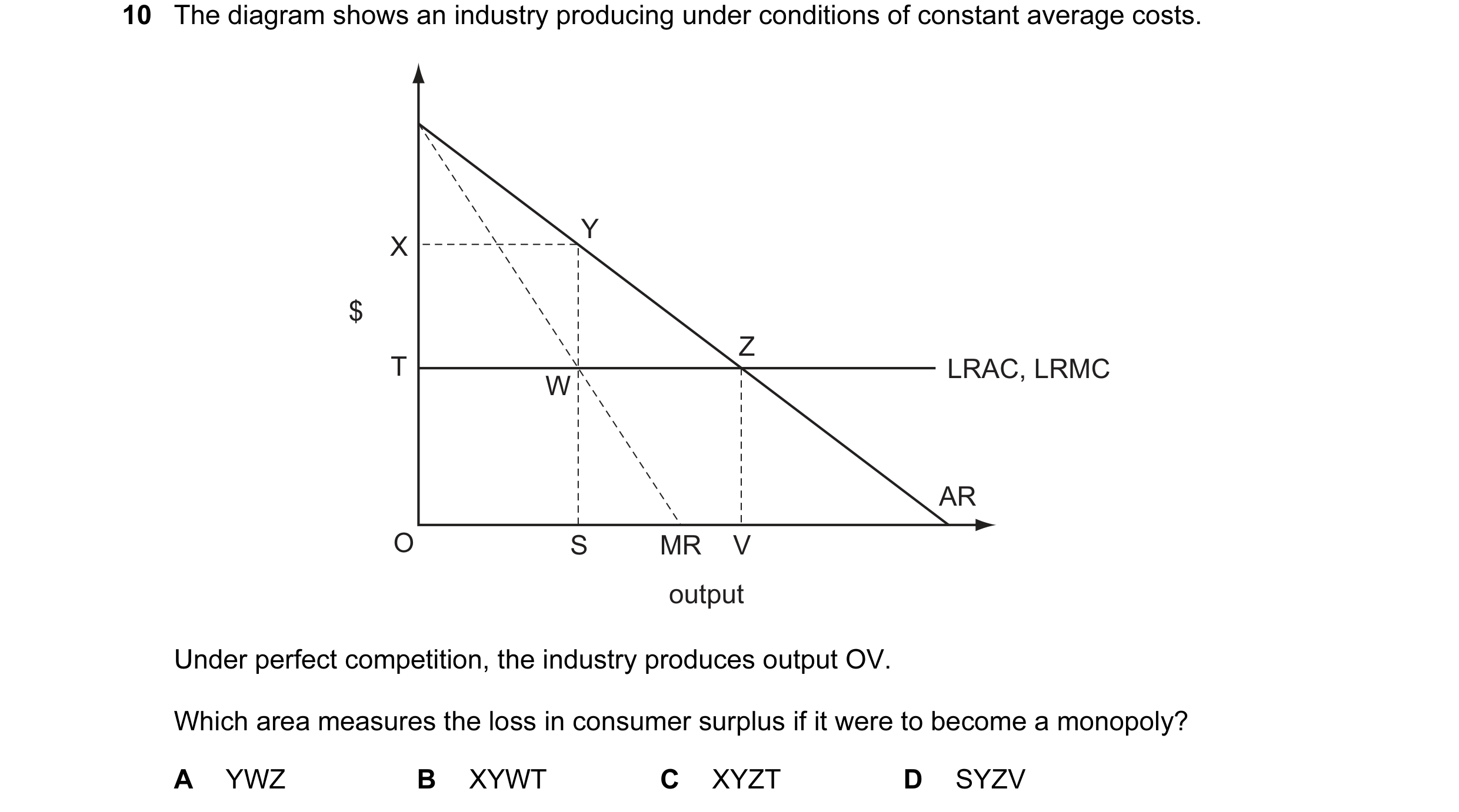
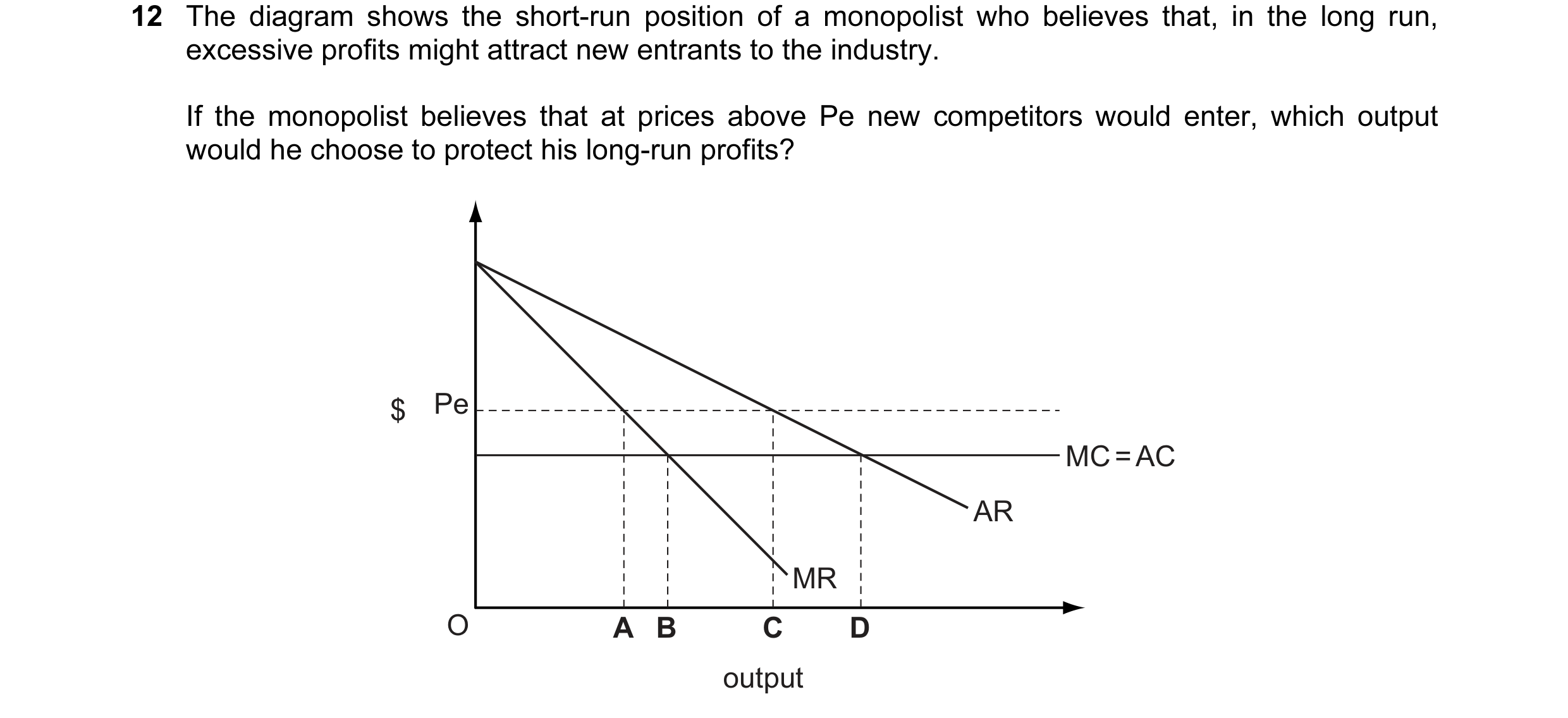 1 / 68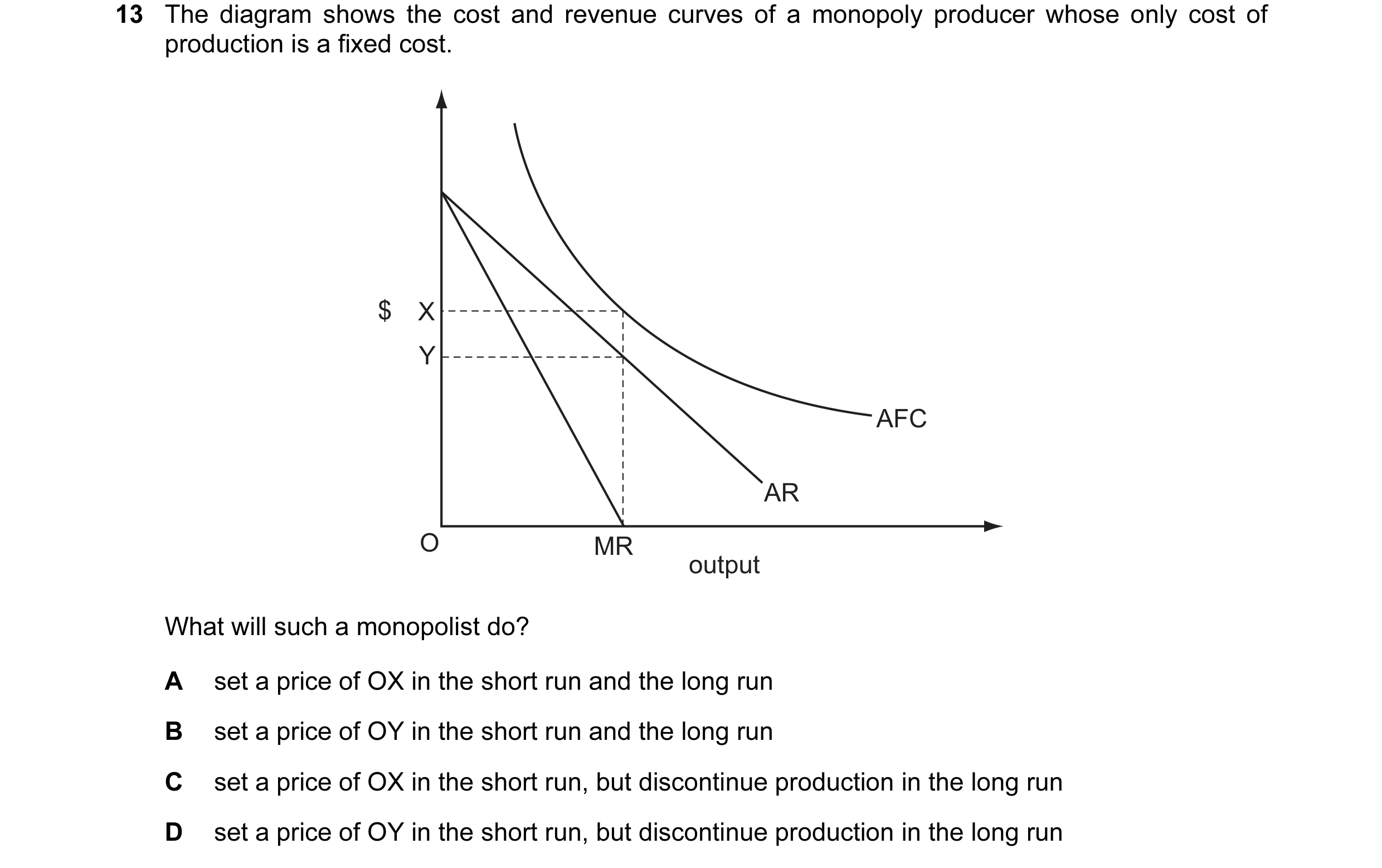
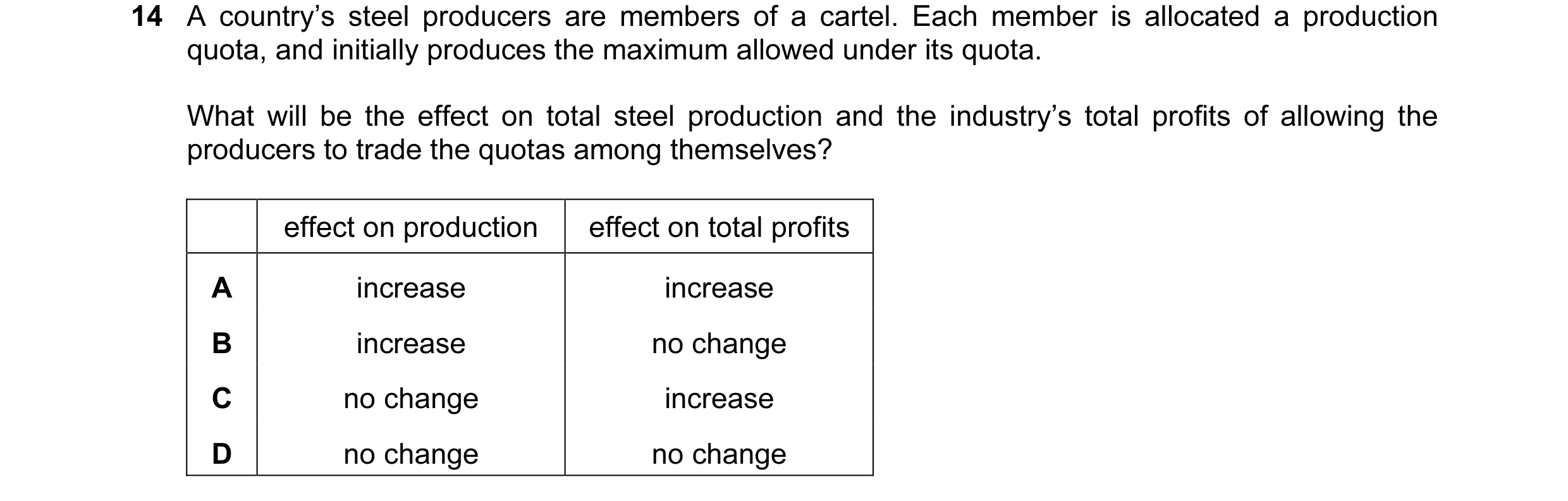 2 / 68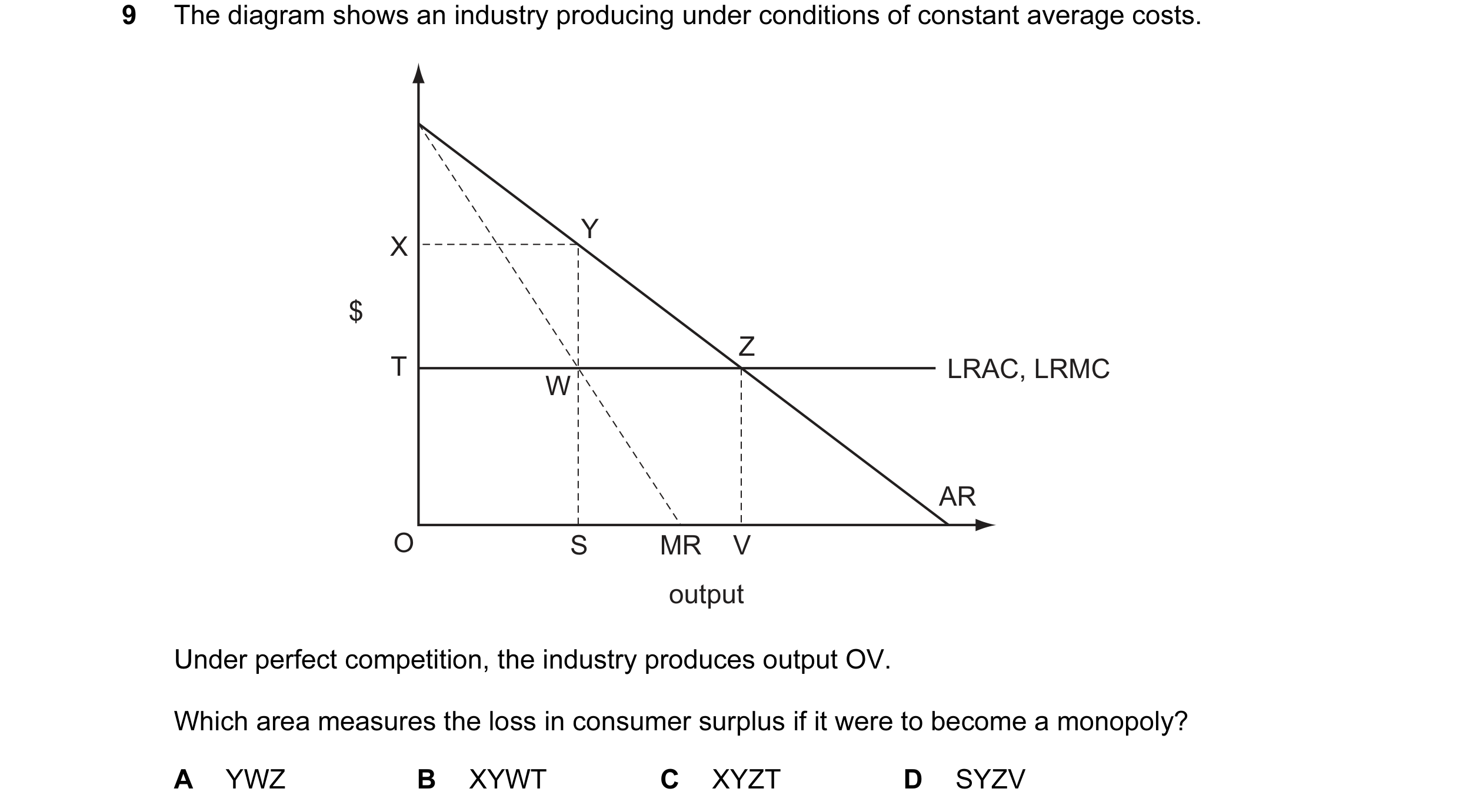
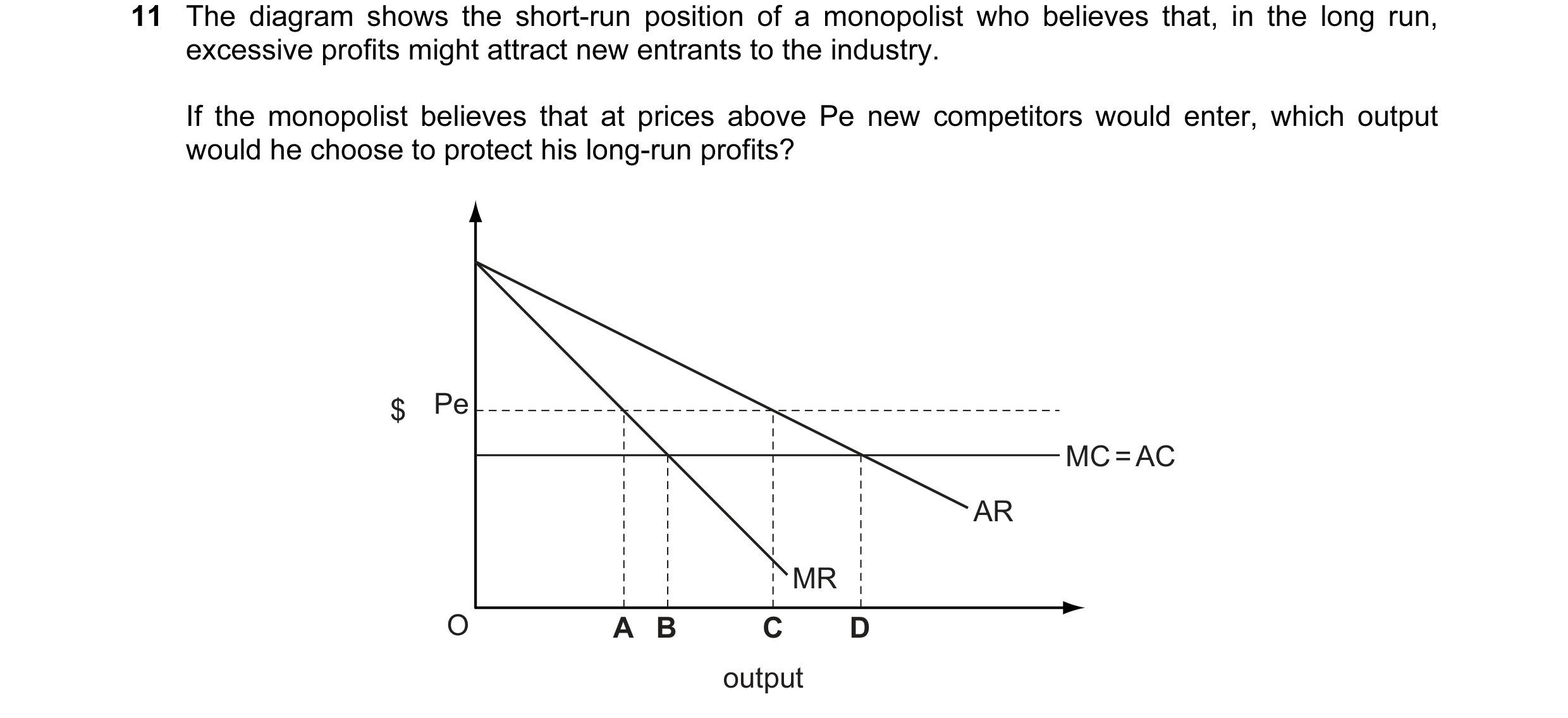 3 / 68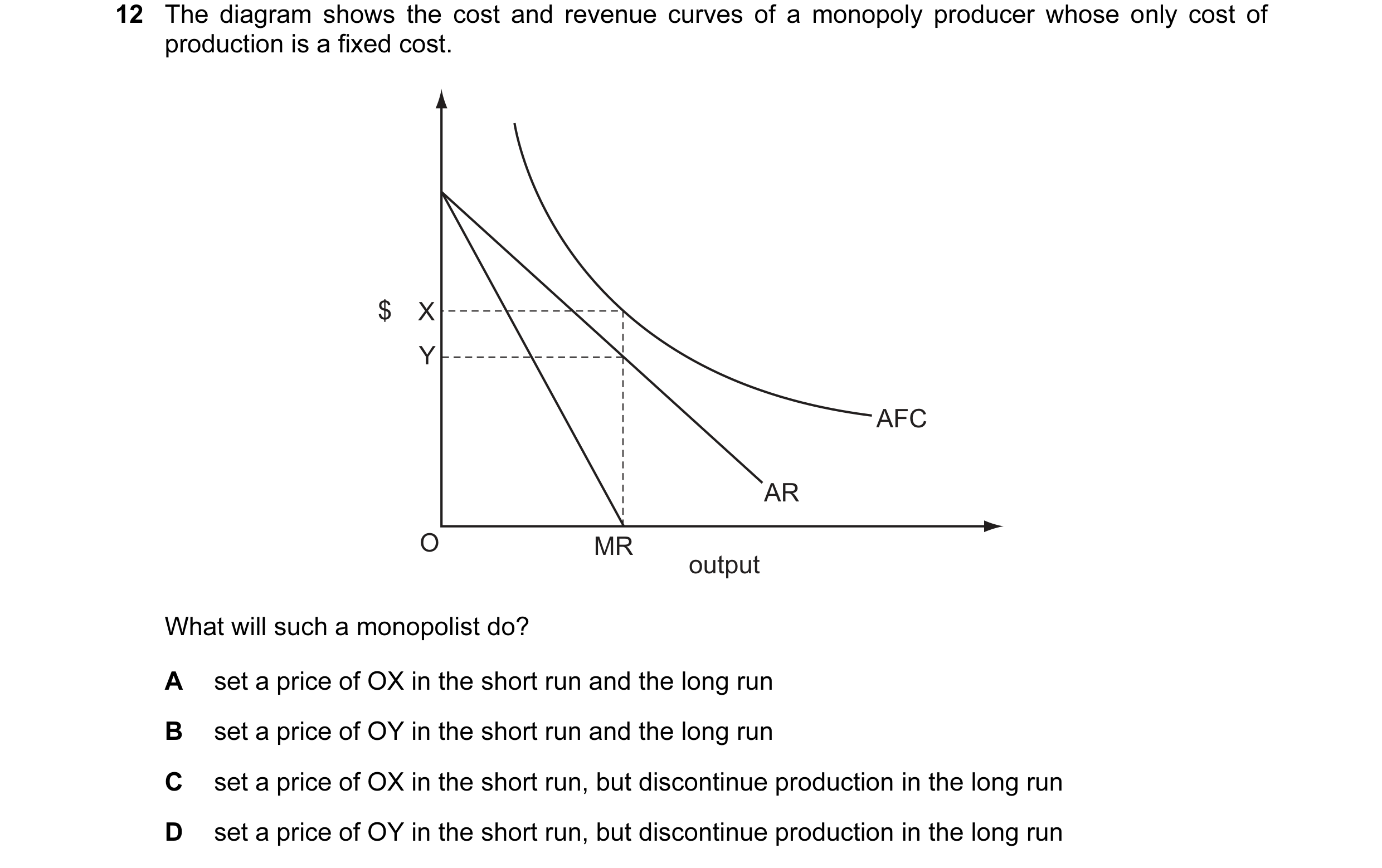
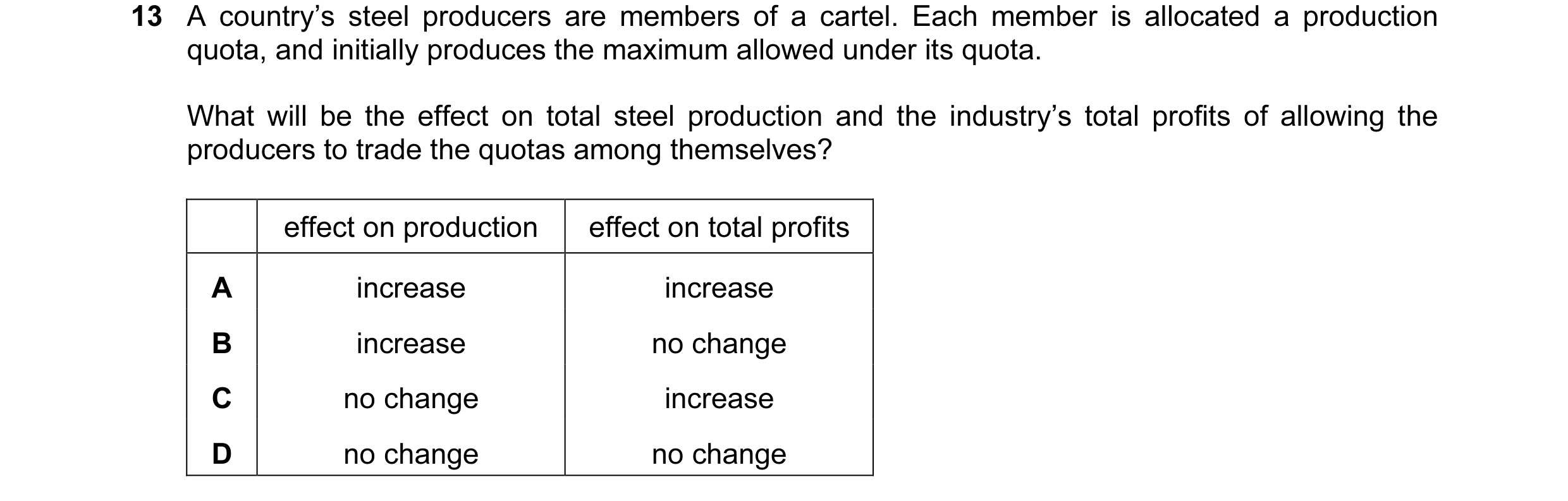
 4 / 68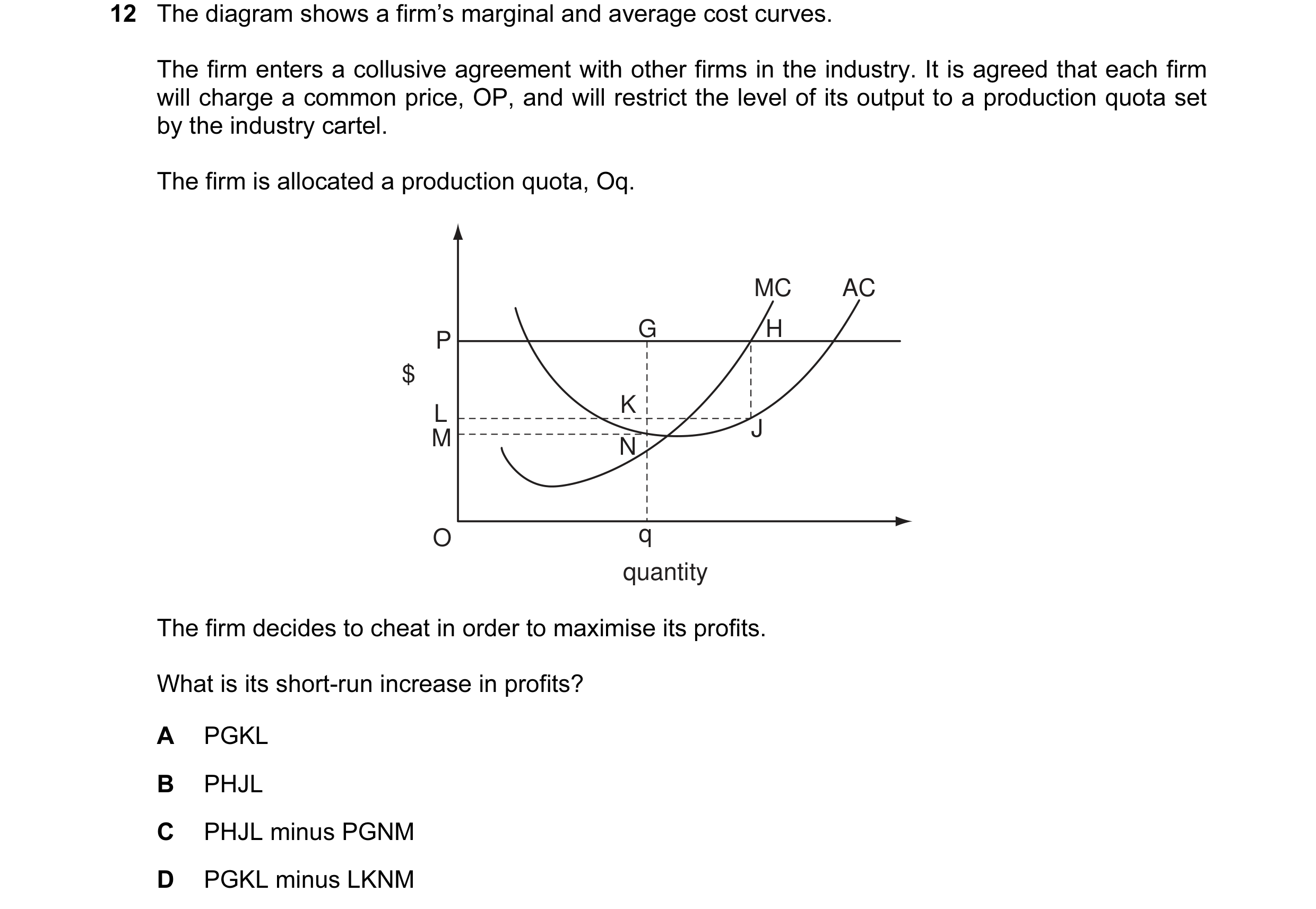
 5 / 68
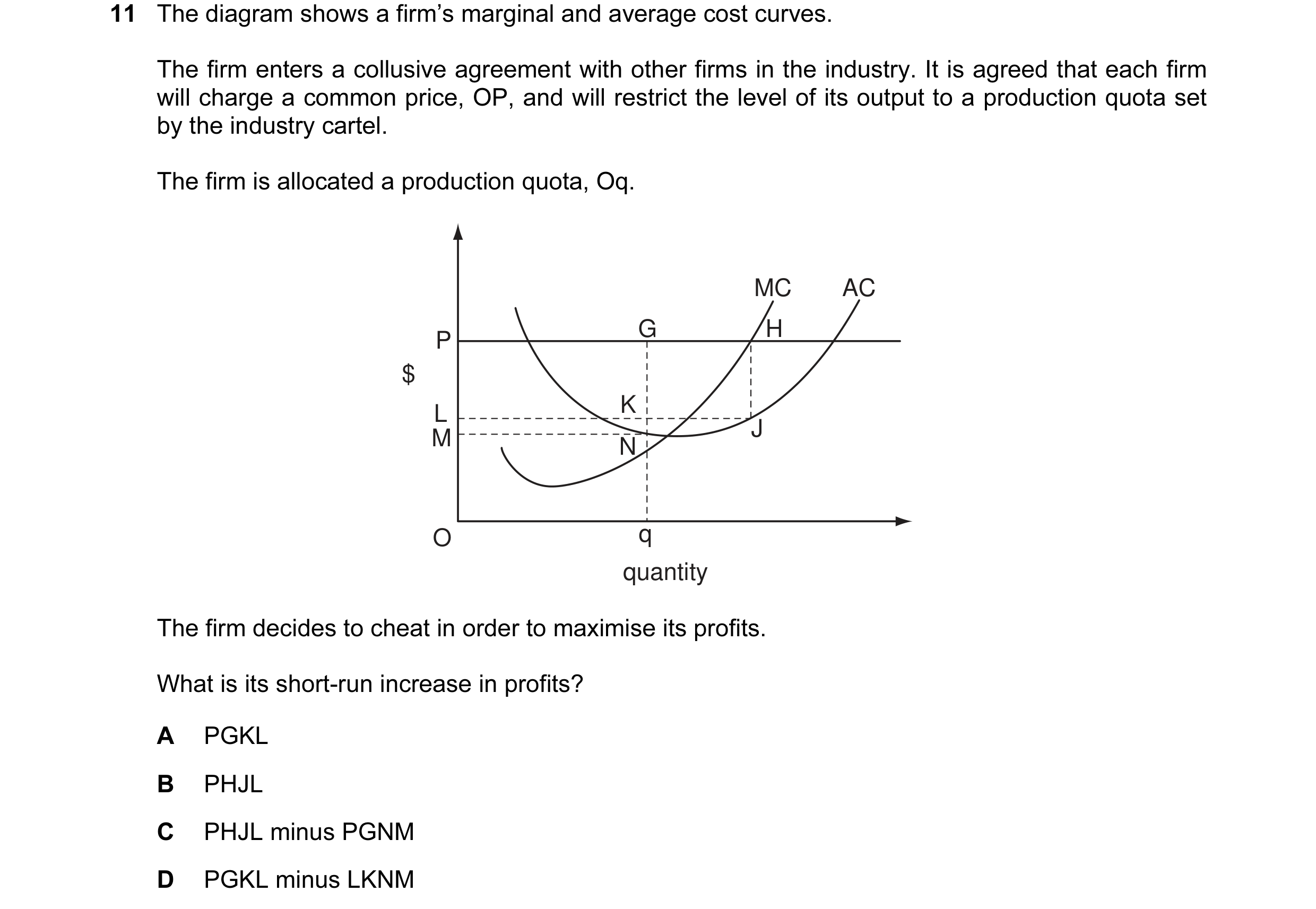
 6 / 68
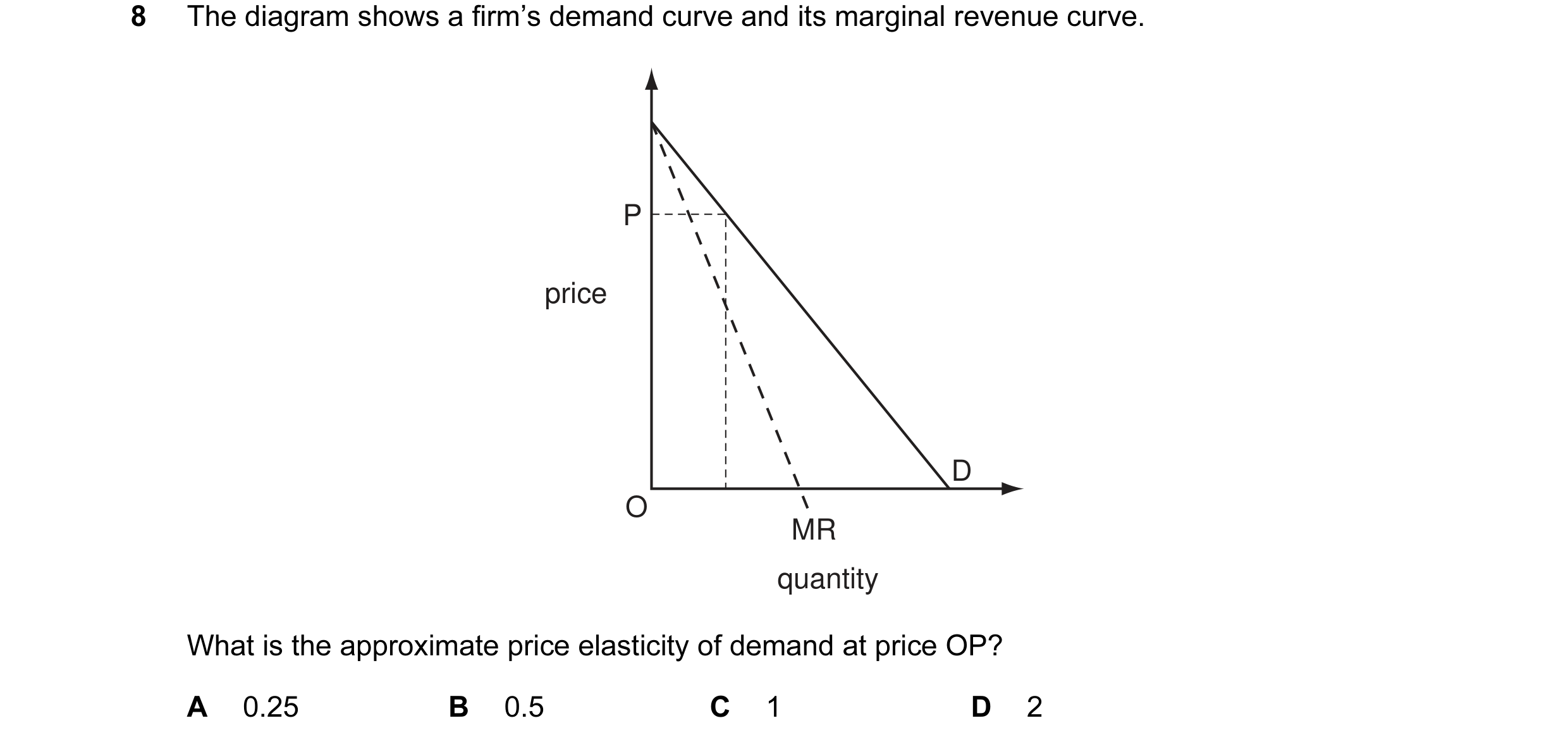
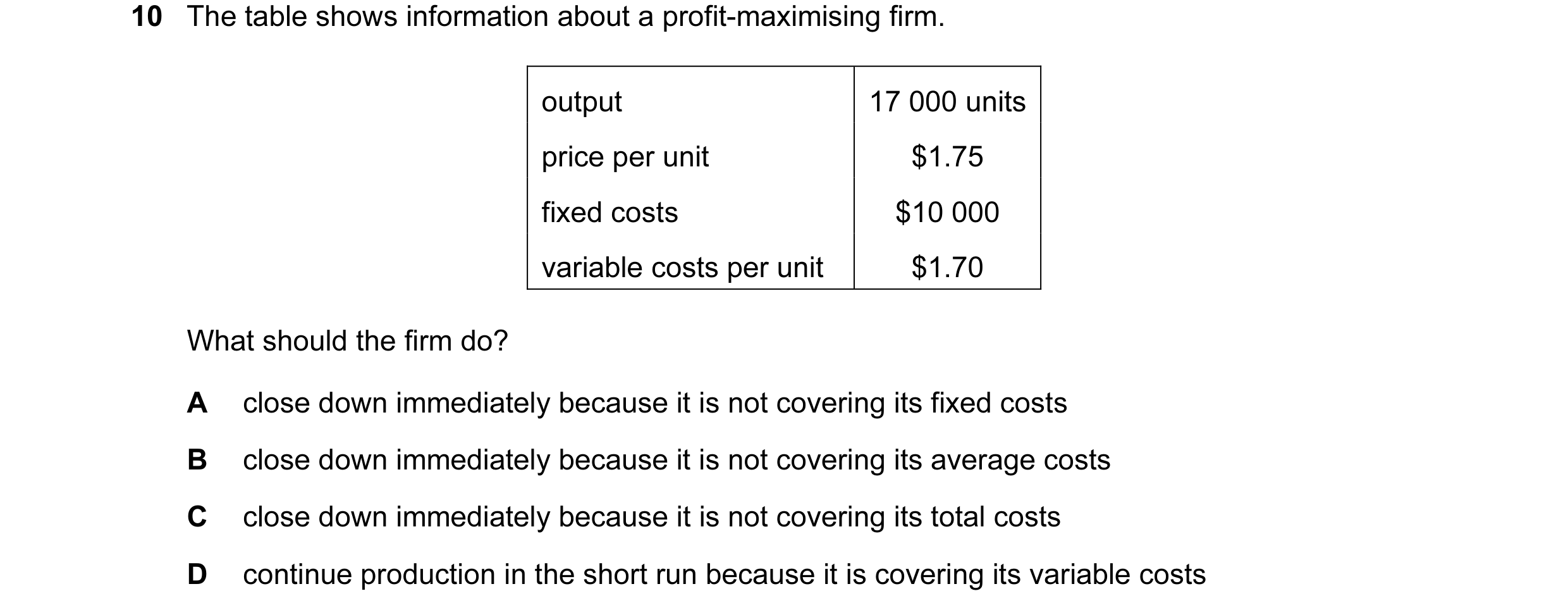 7 / 68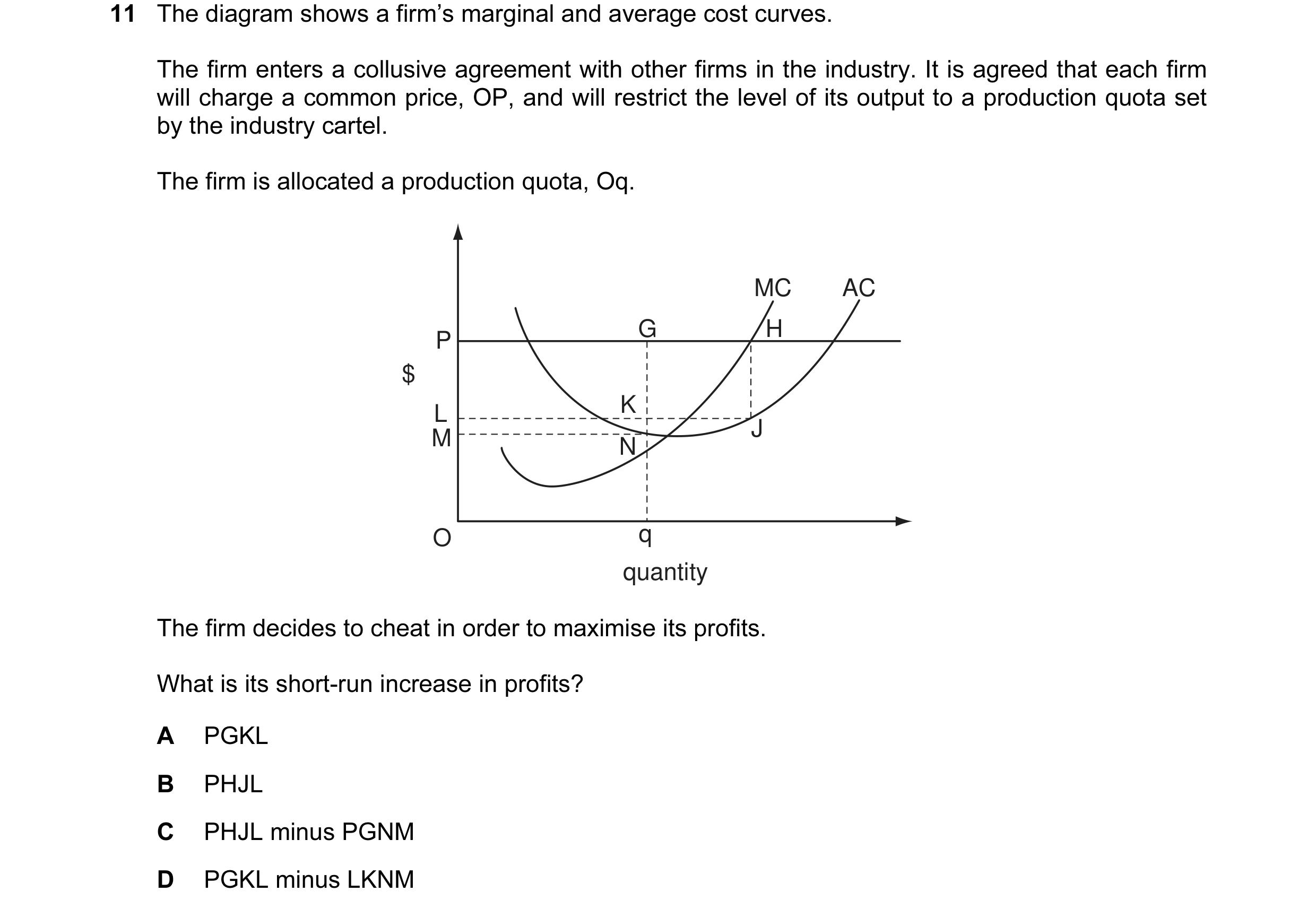
 8 / 68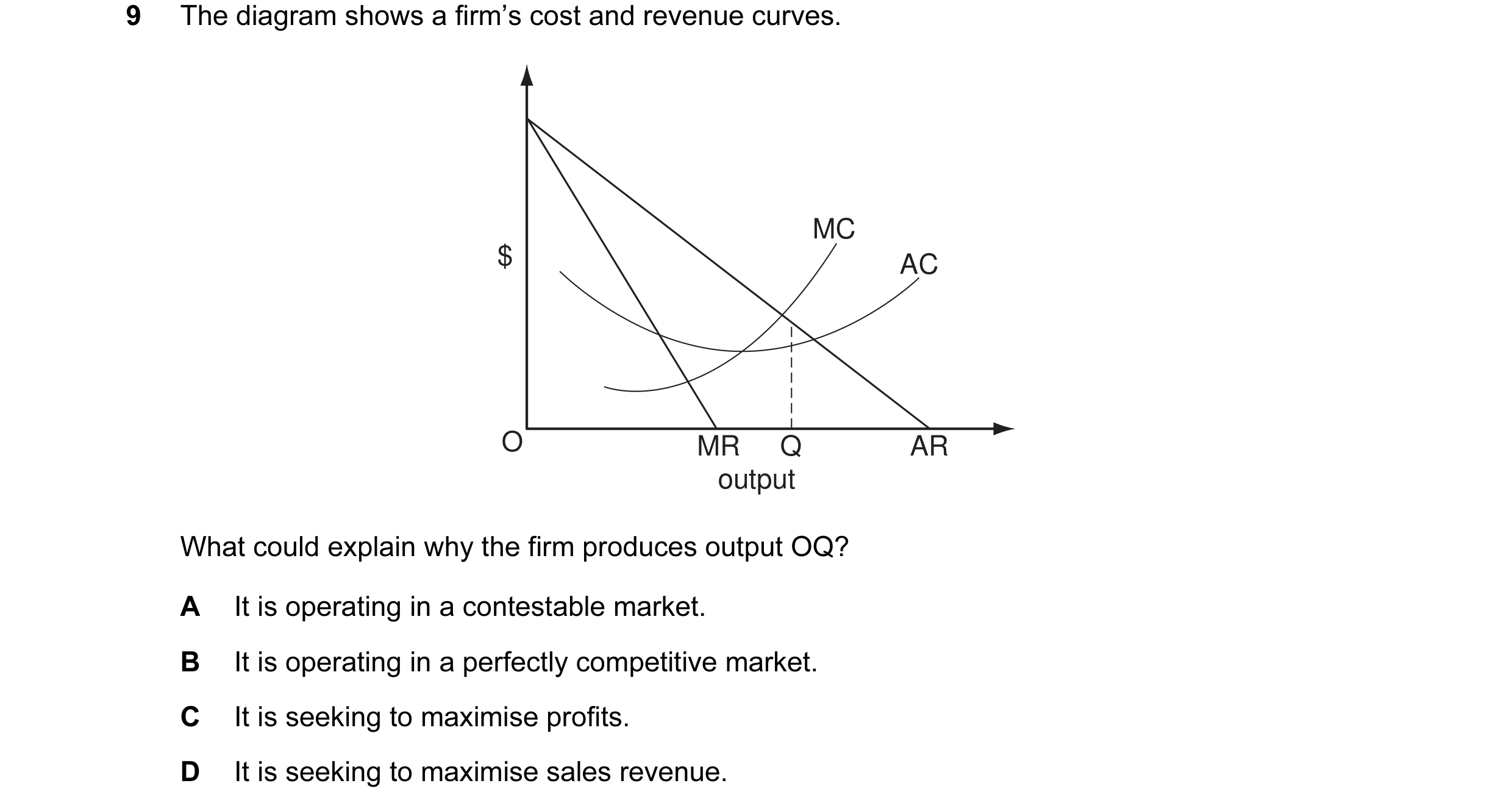
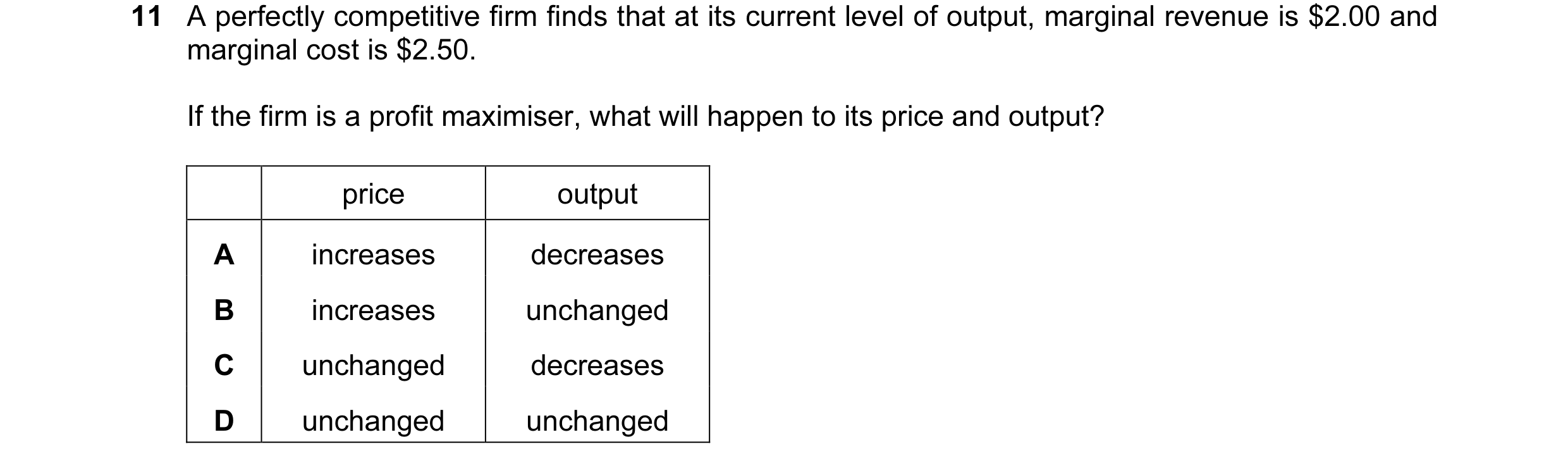 9 / 68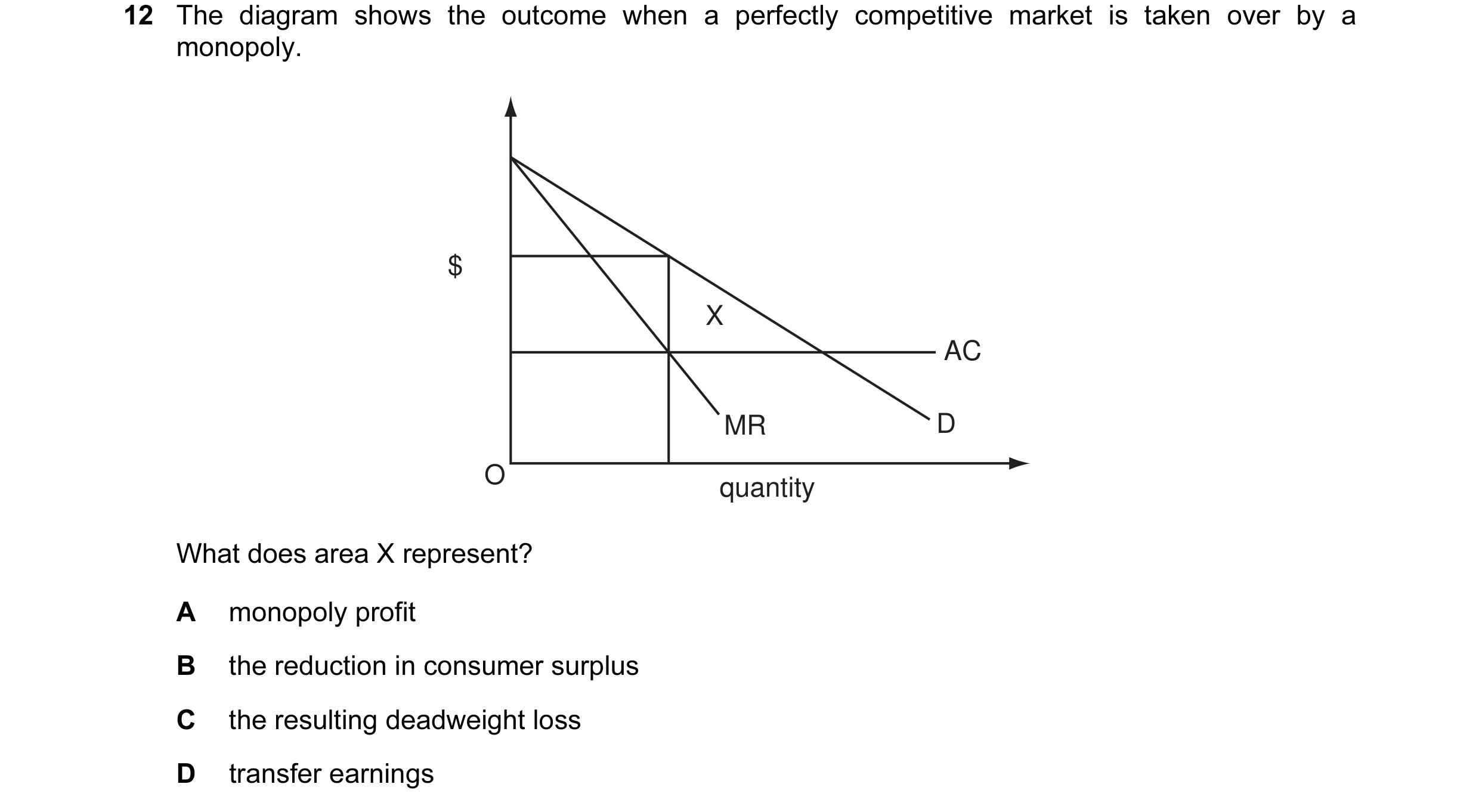
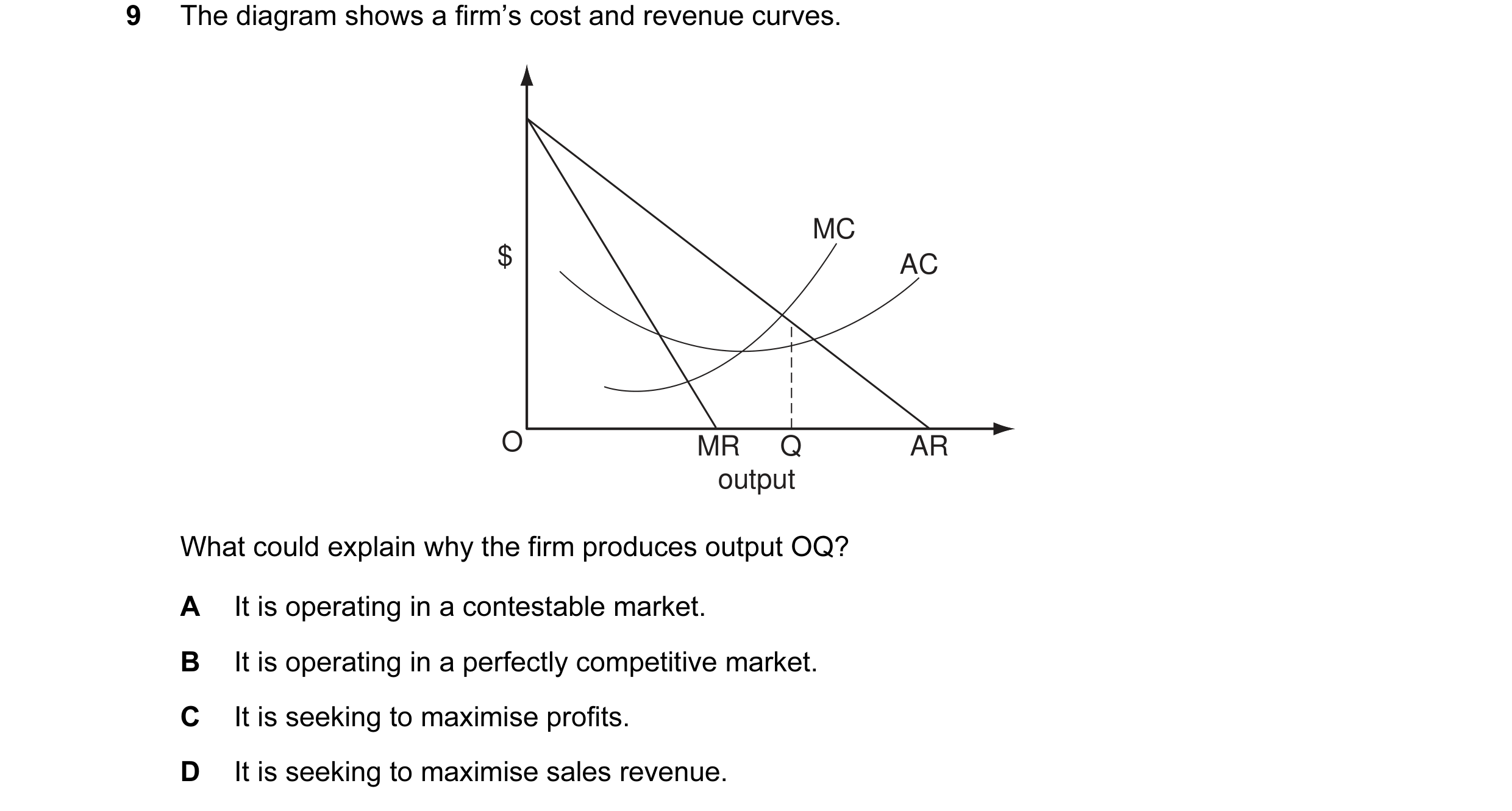
 10 / 68
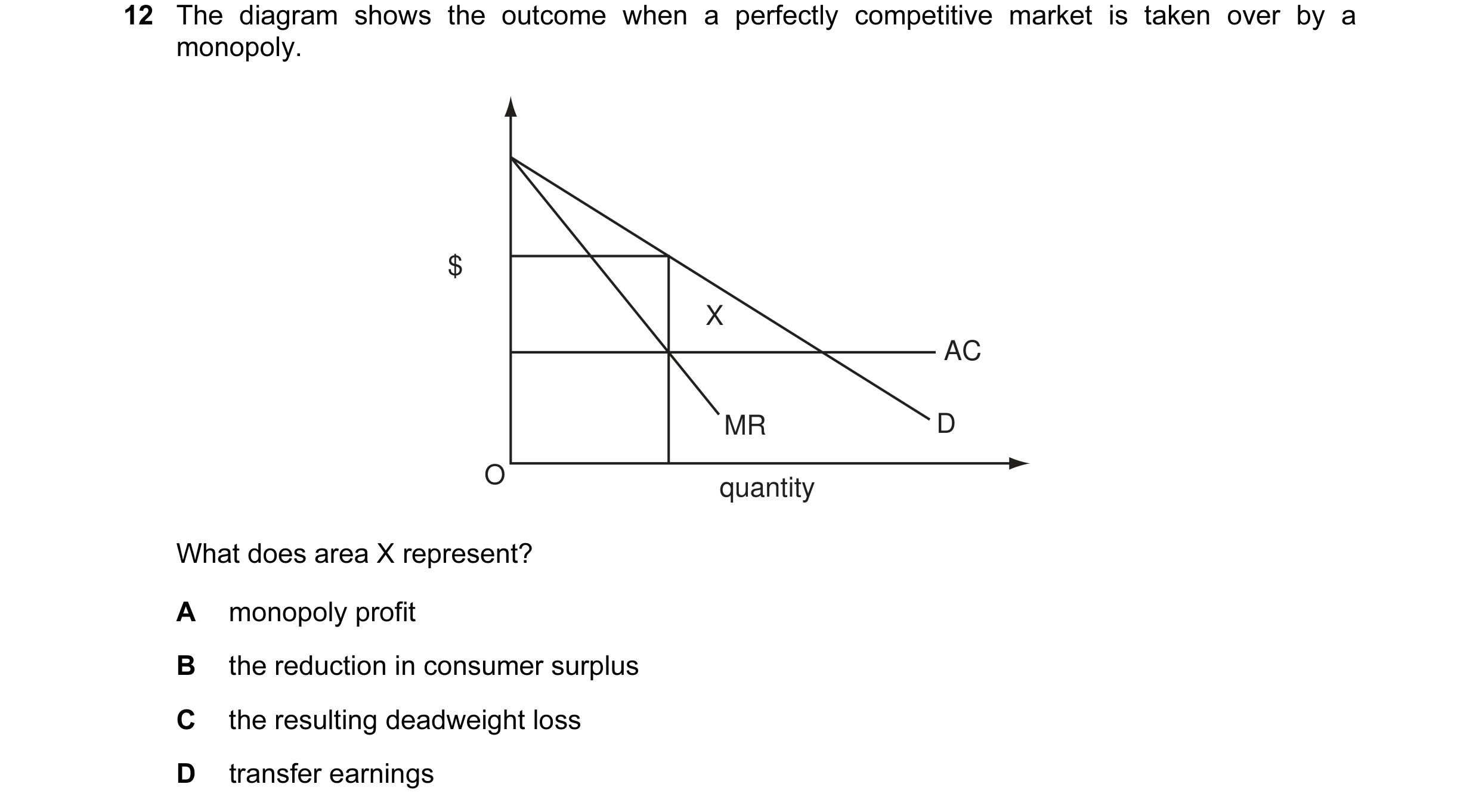
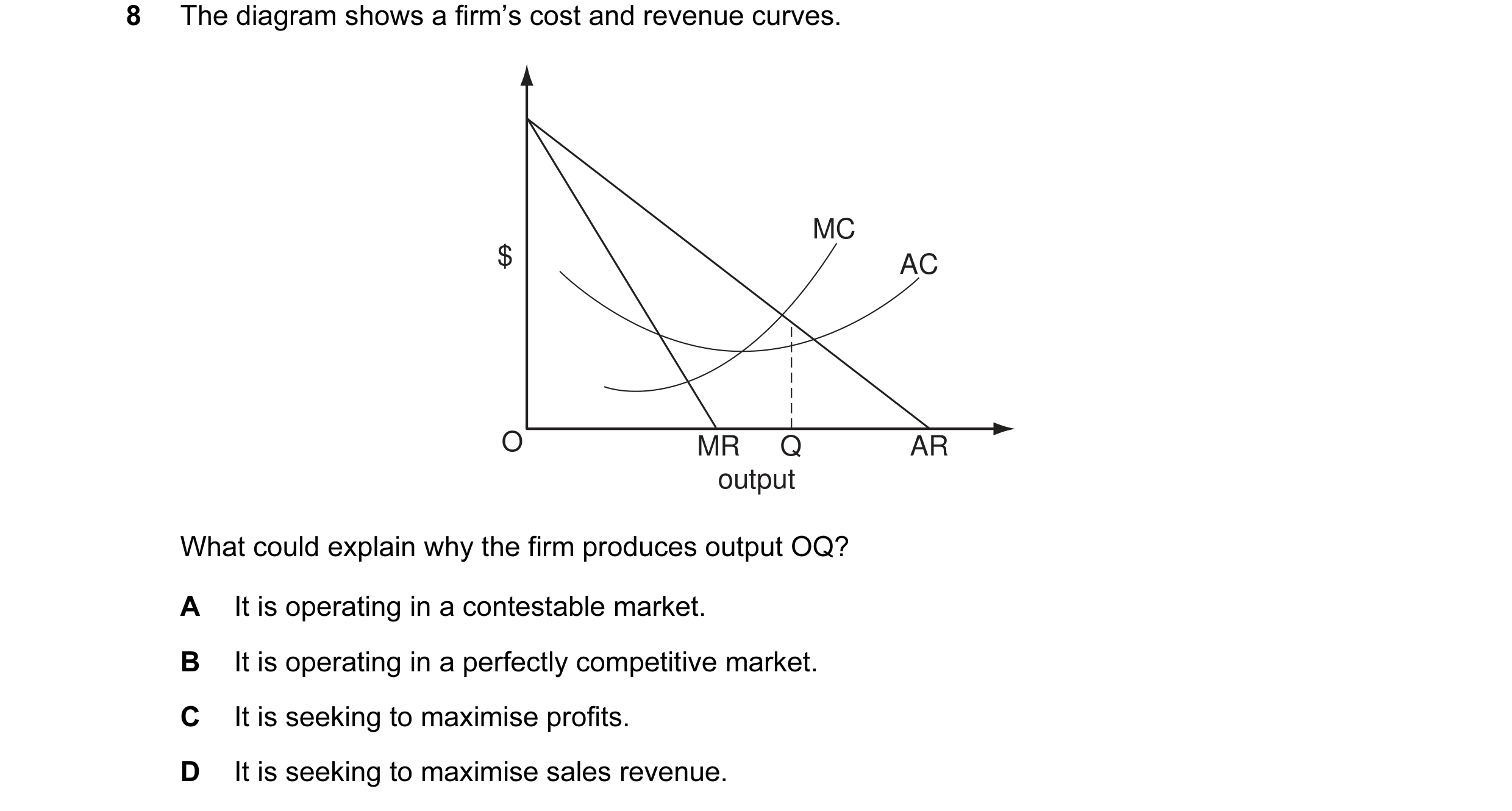 11 / 68
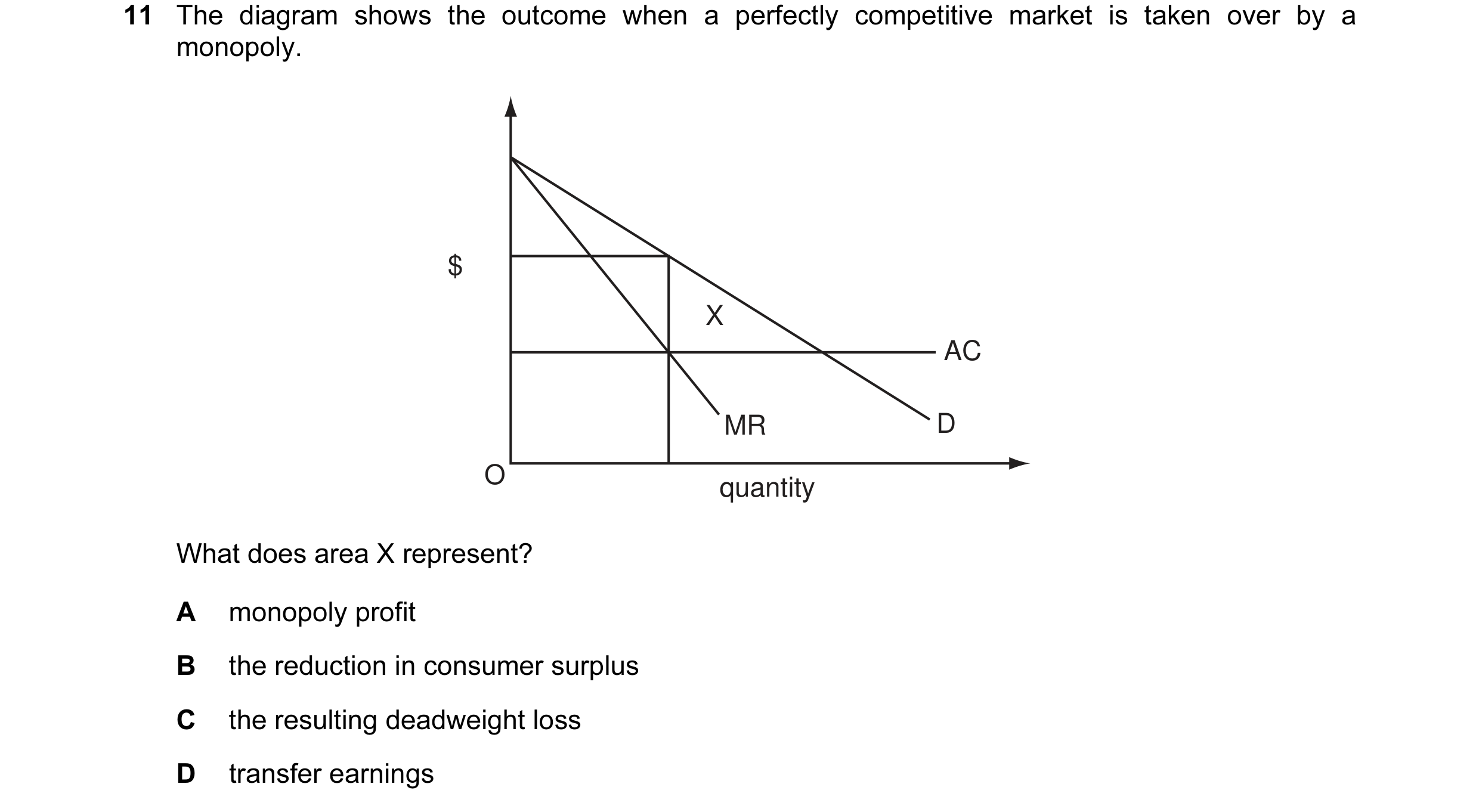
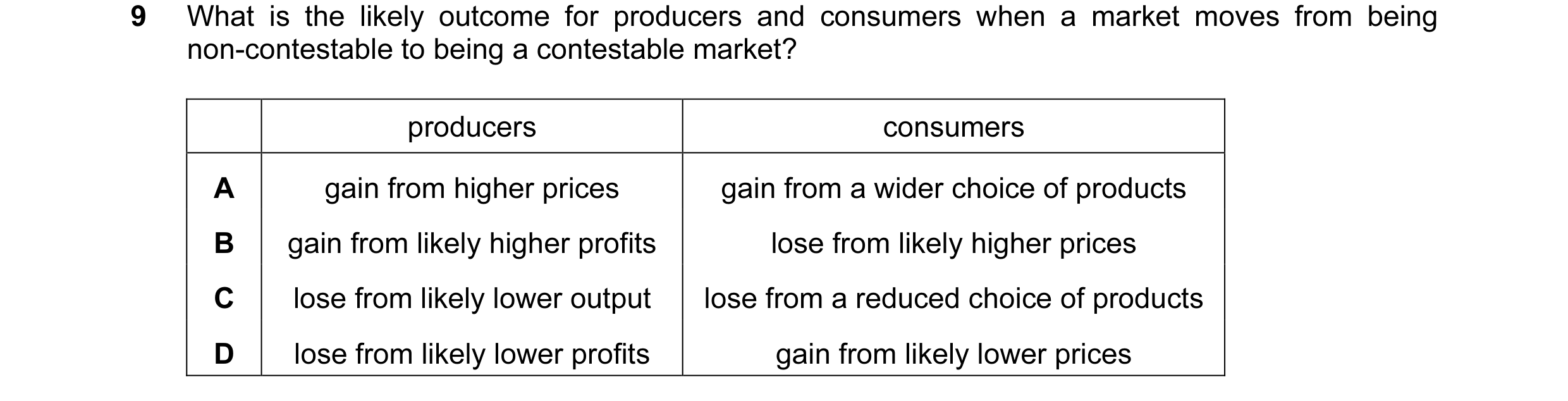 12 / 68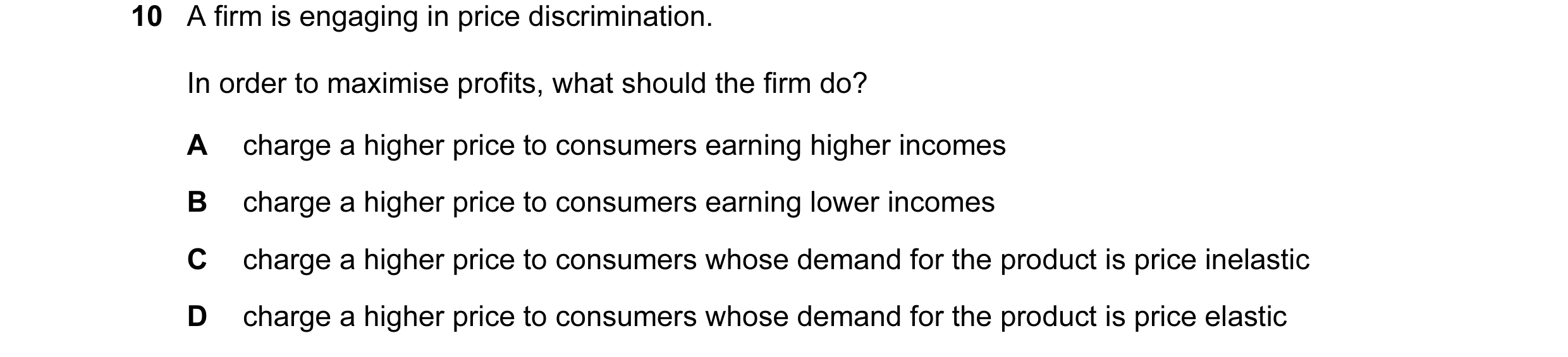
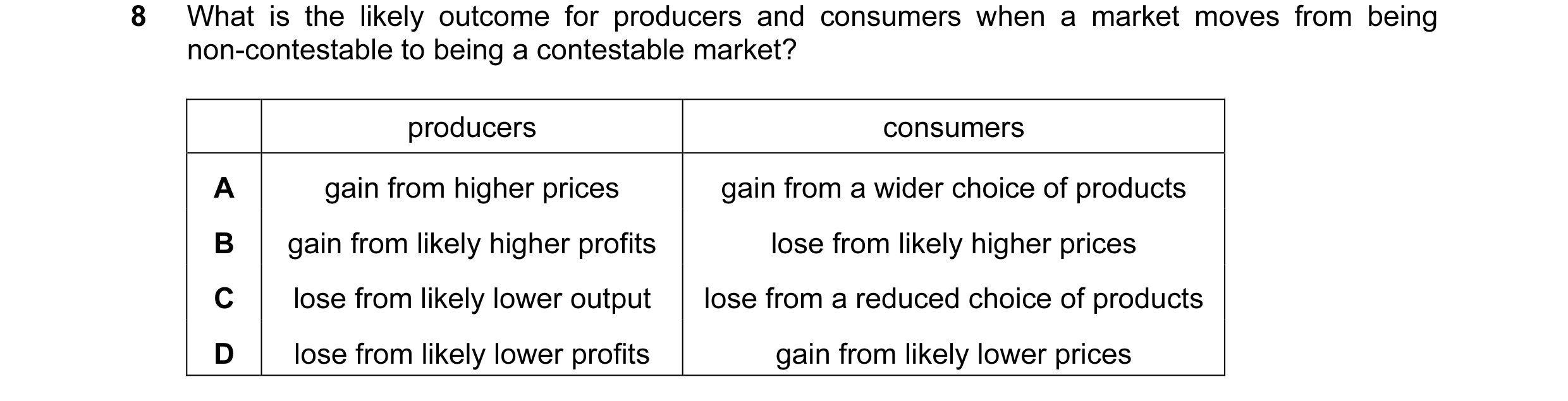
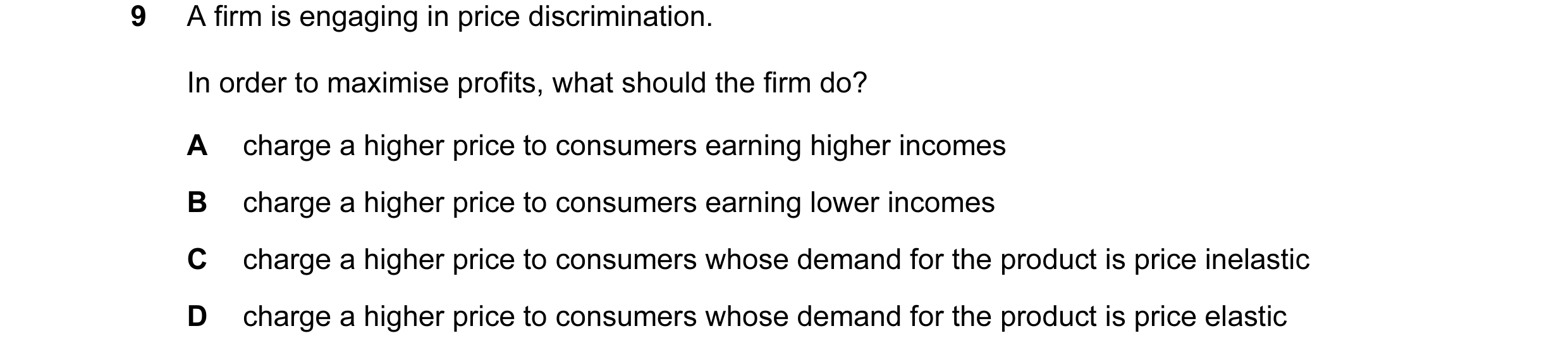
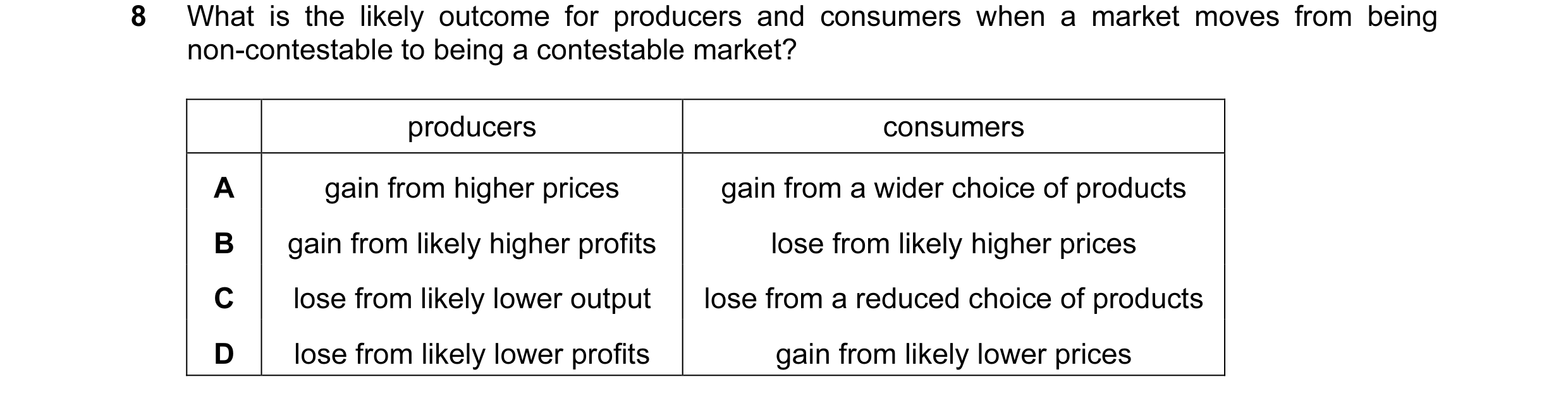
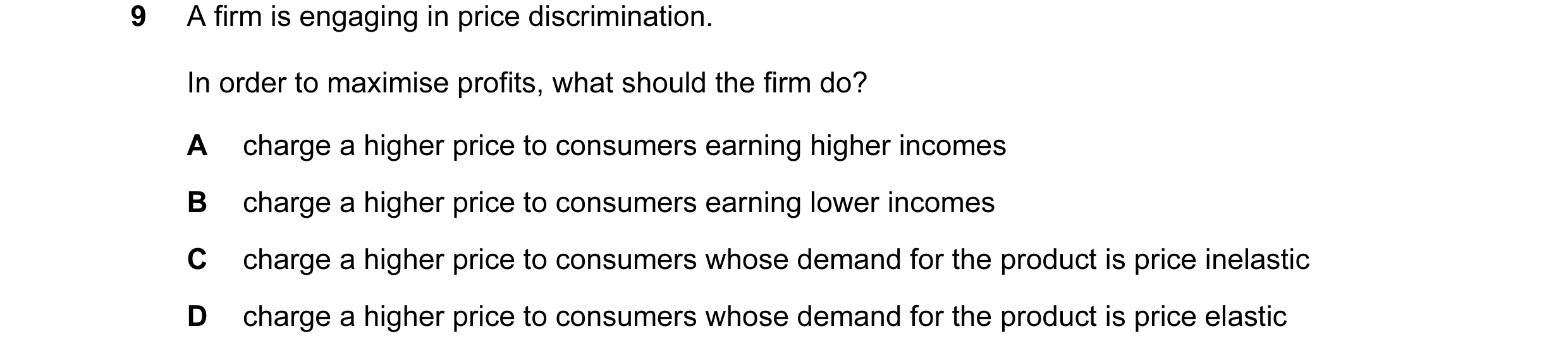 13 / 68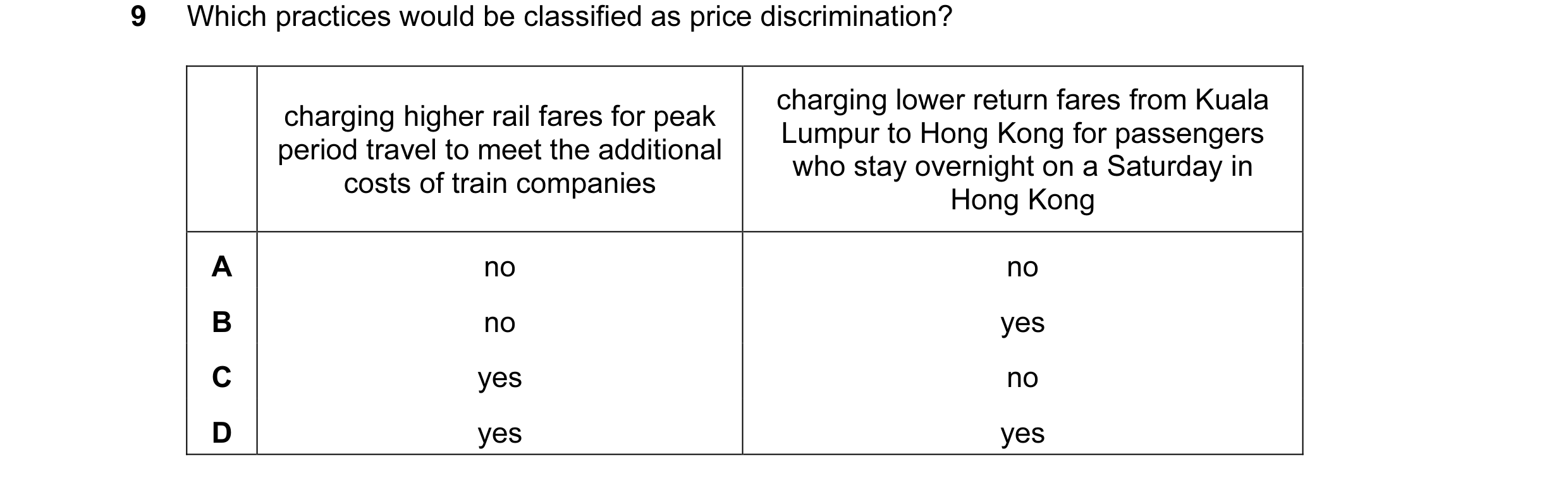
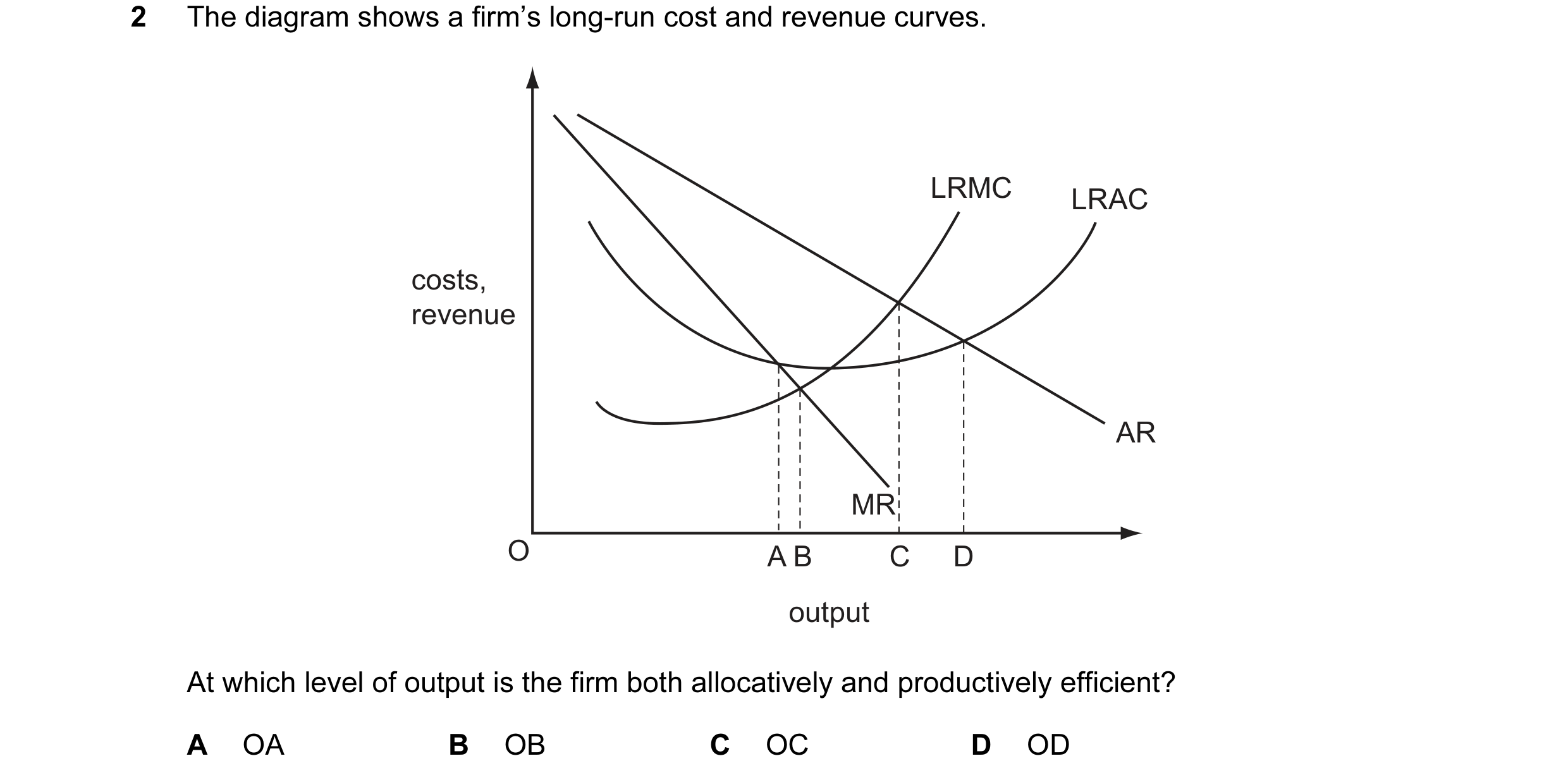

 14 / 68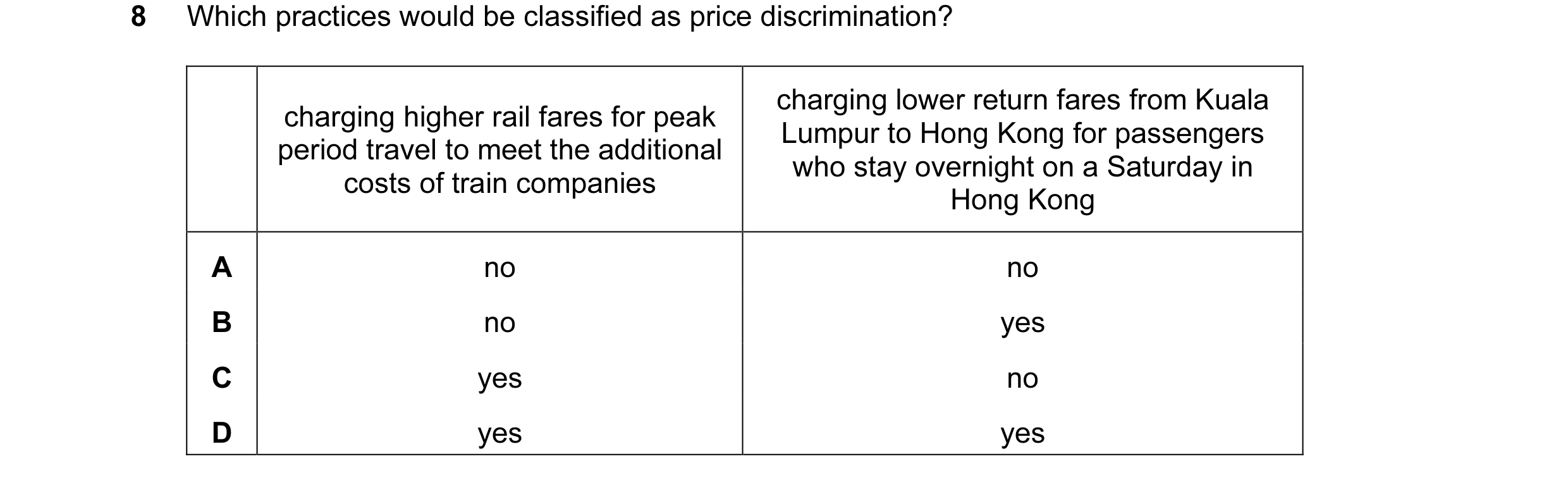

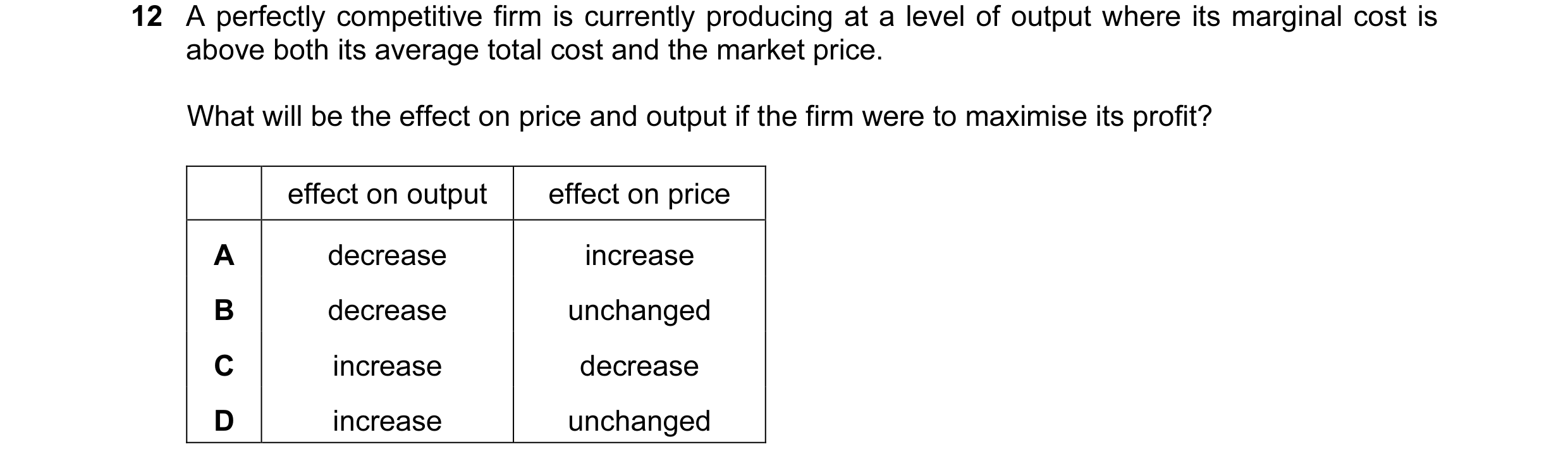
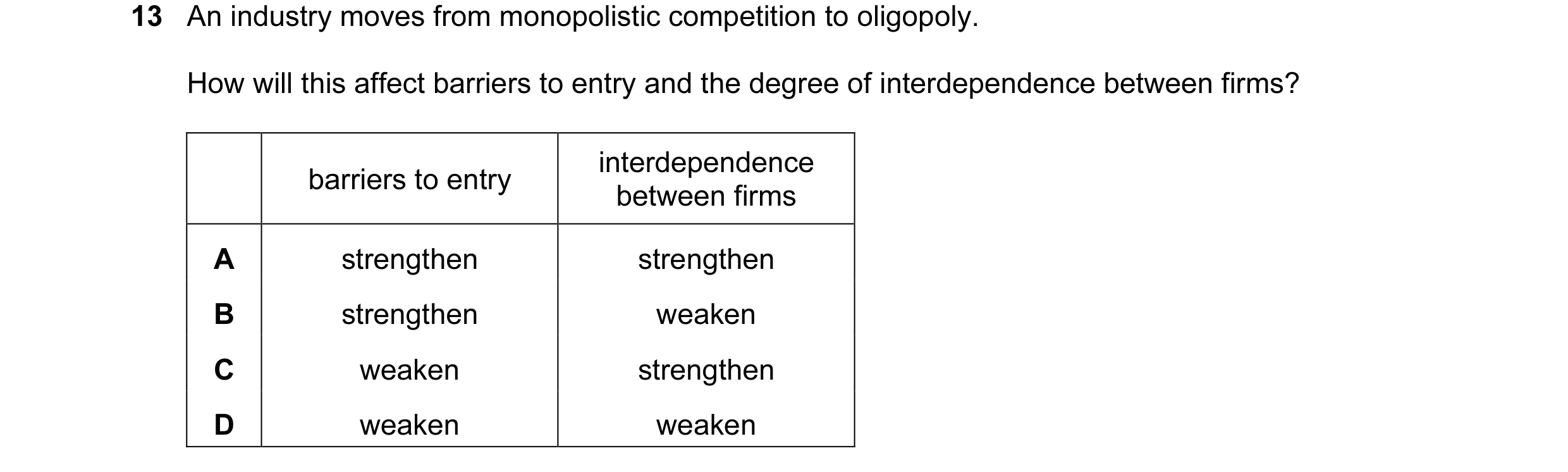 15 / 68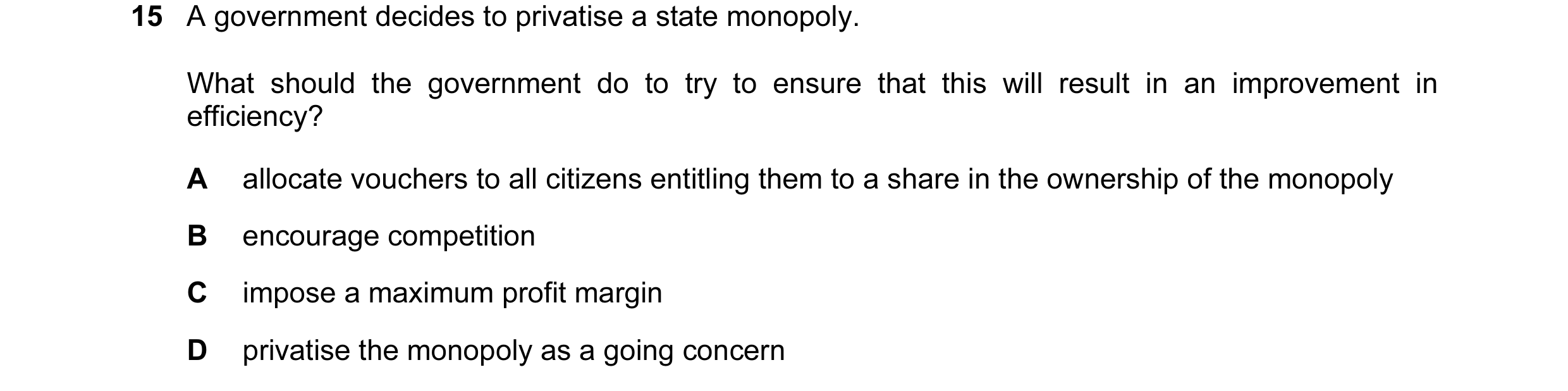
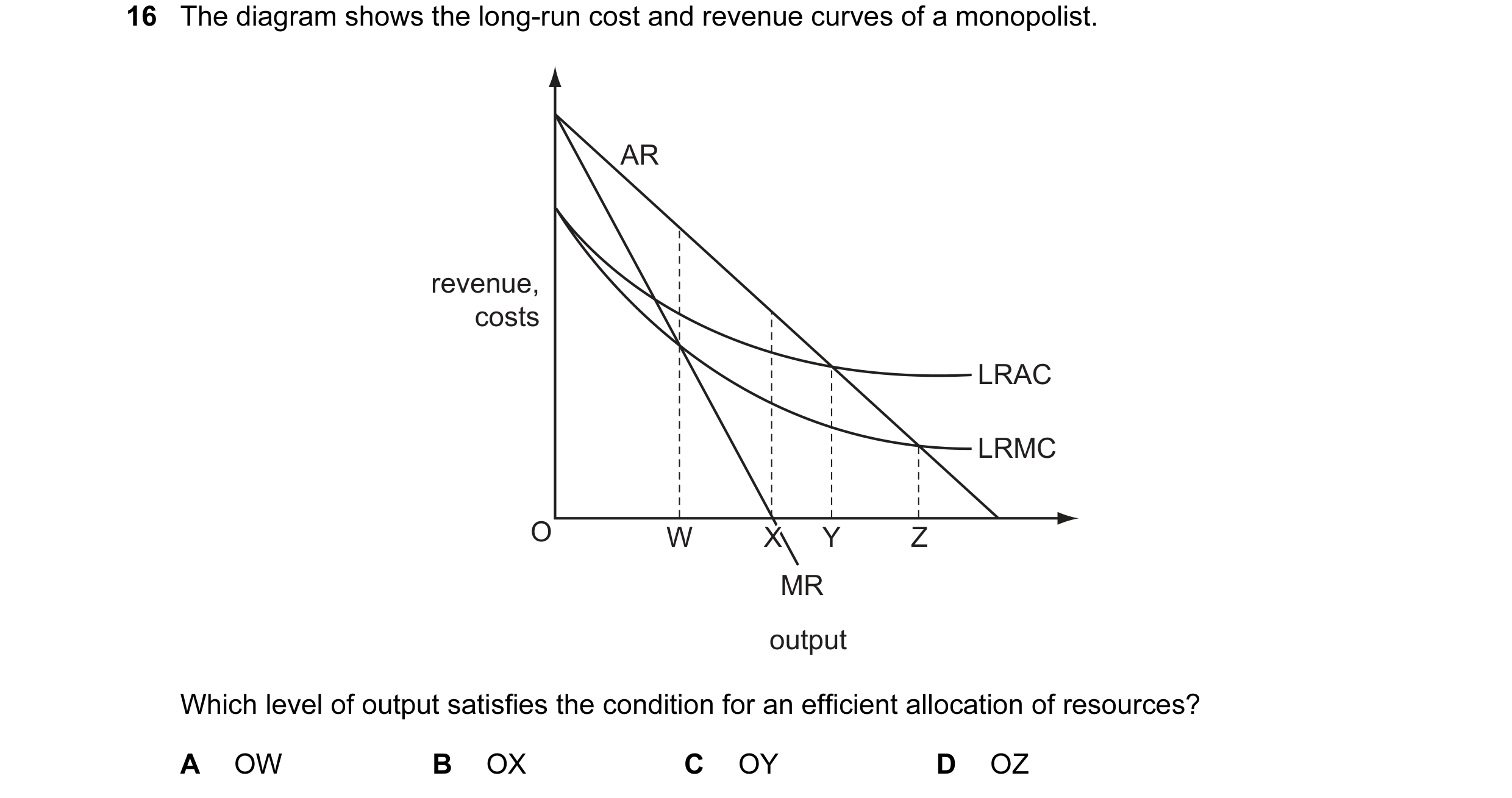
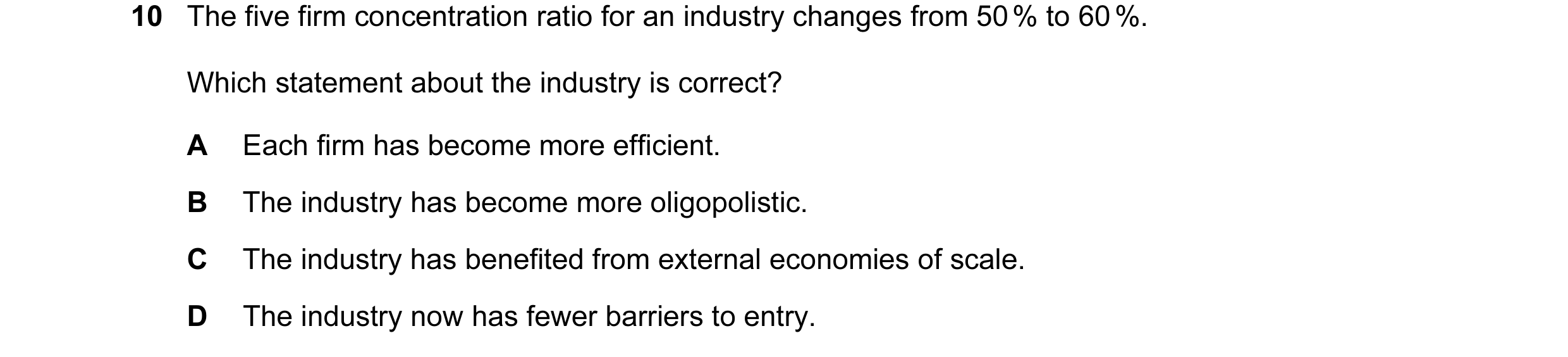 16 / 68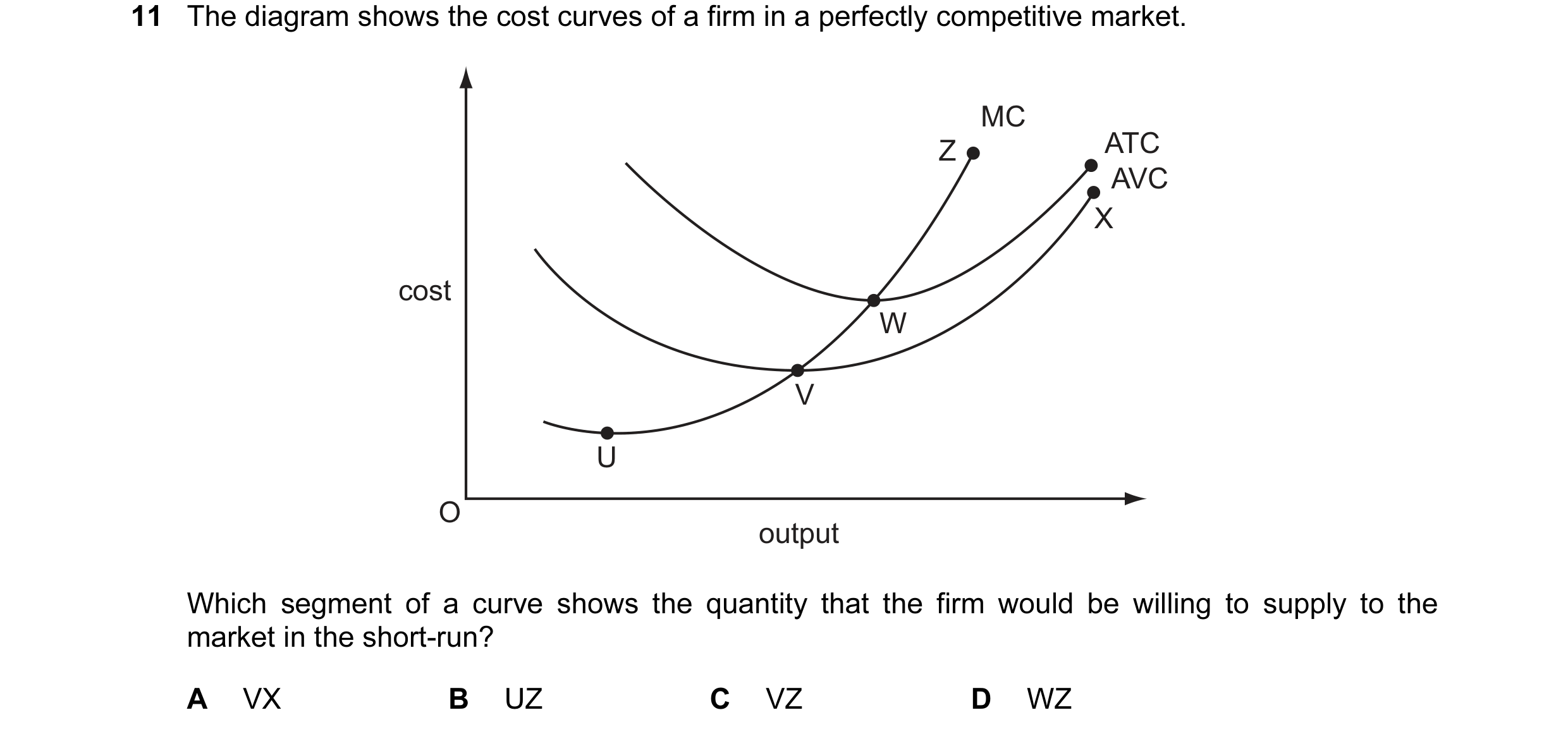
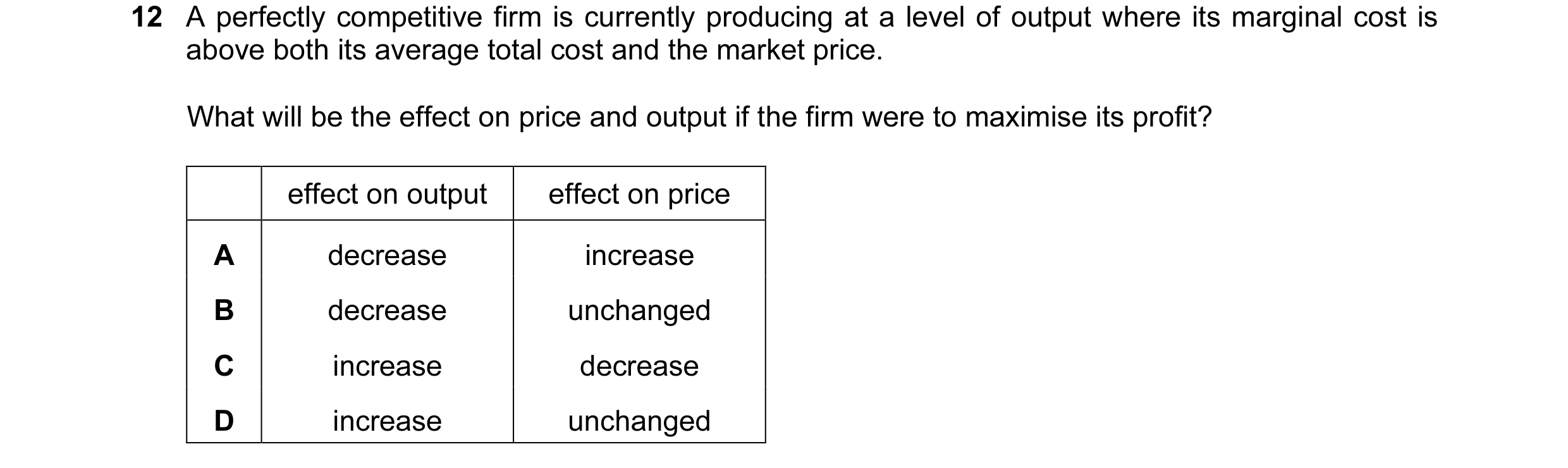
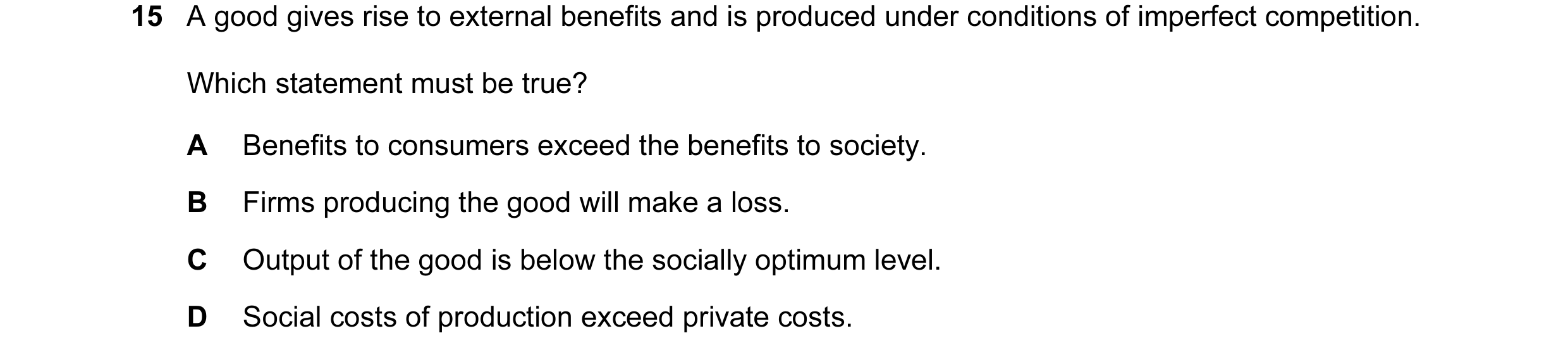 17 / 68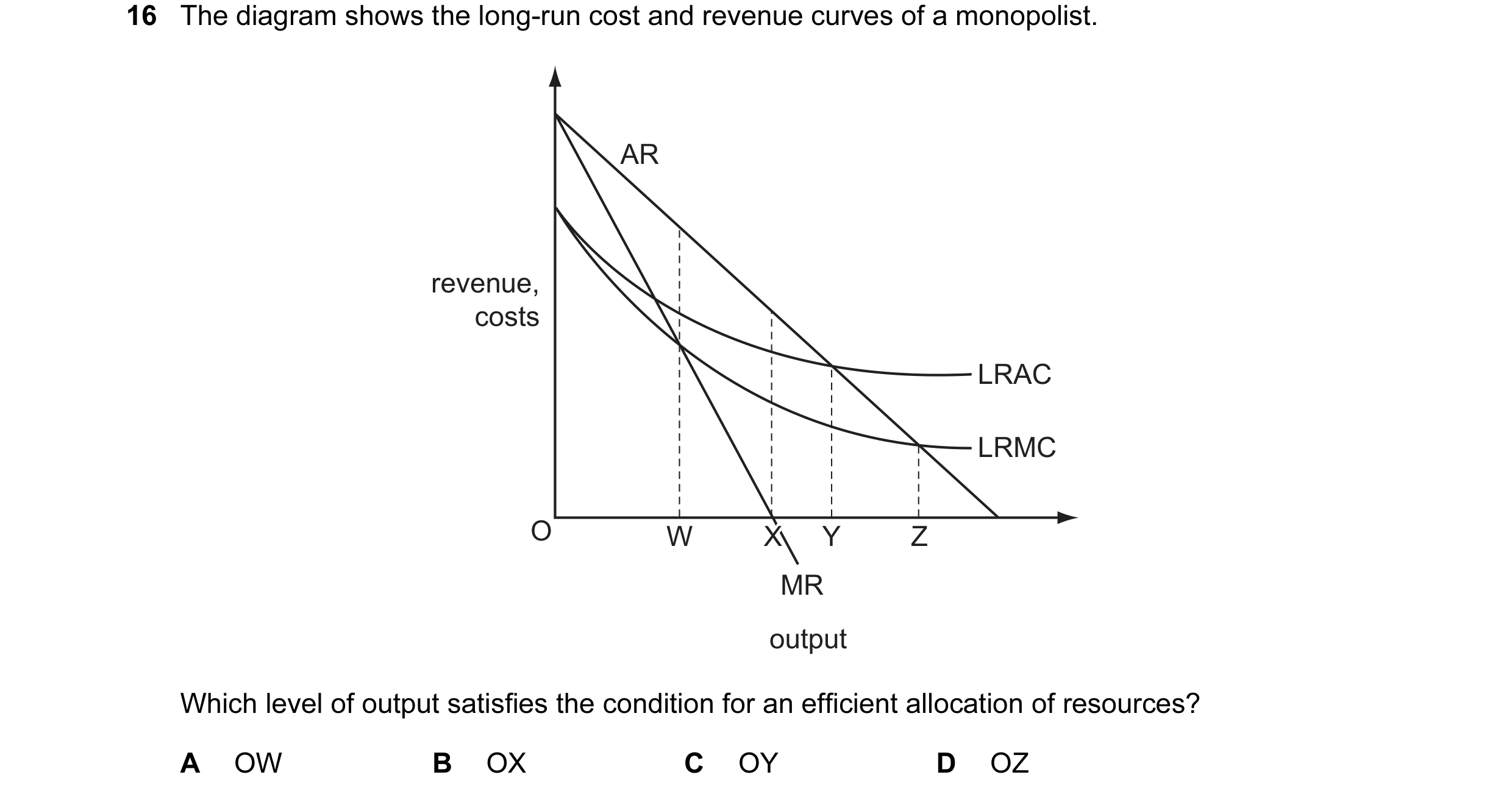

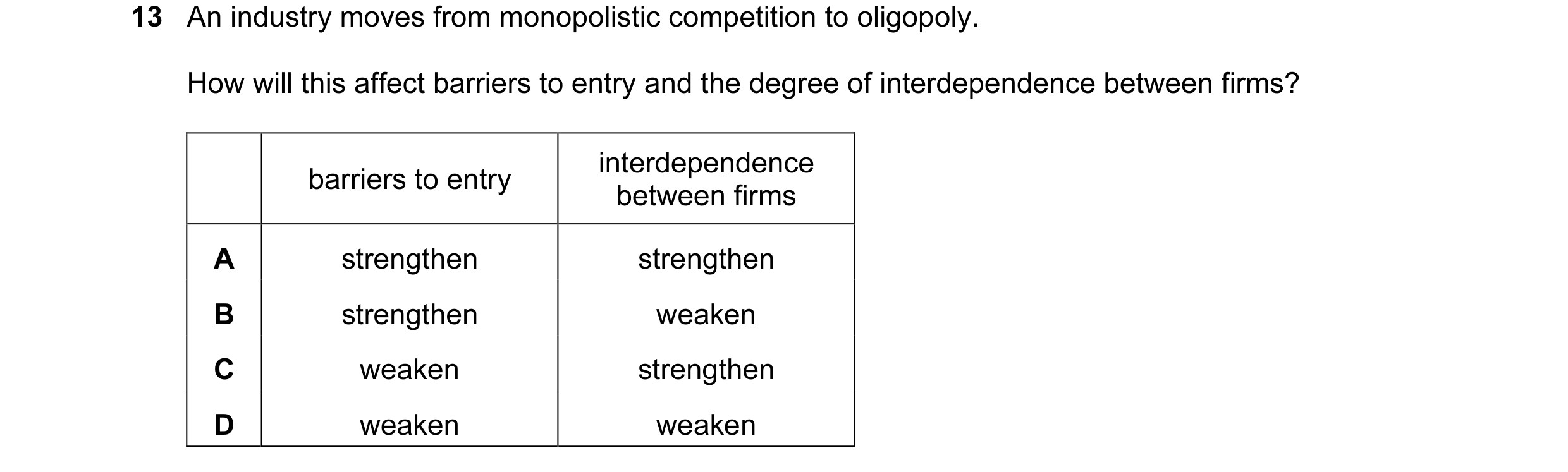 18 / 68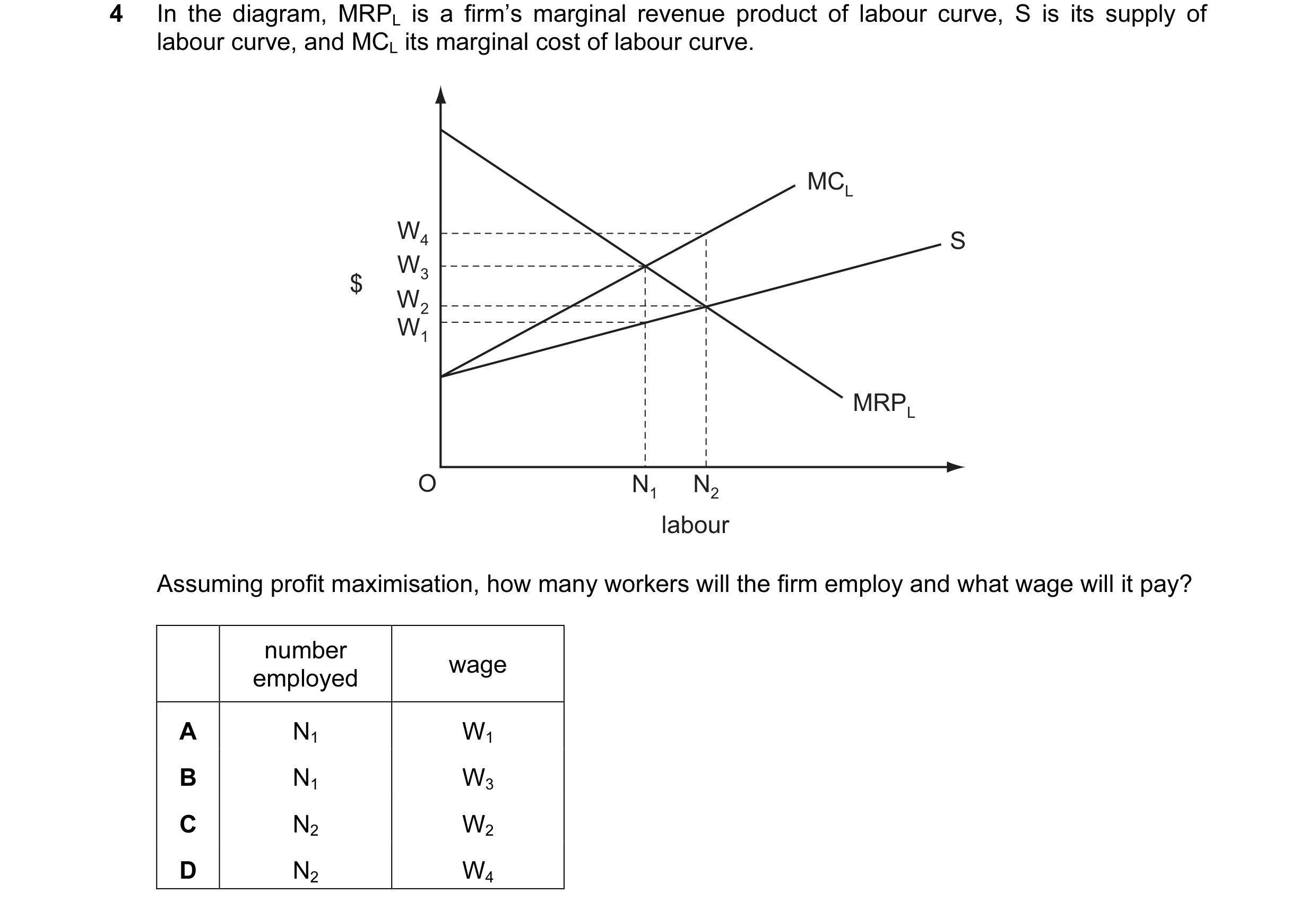
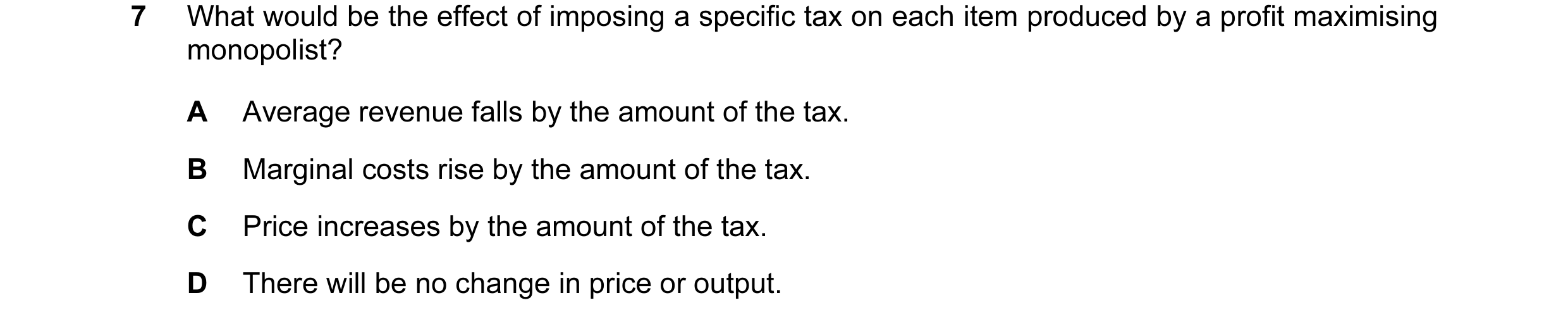
 19 / 68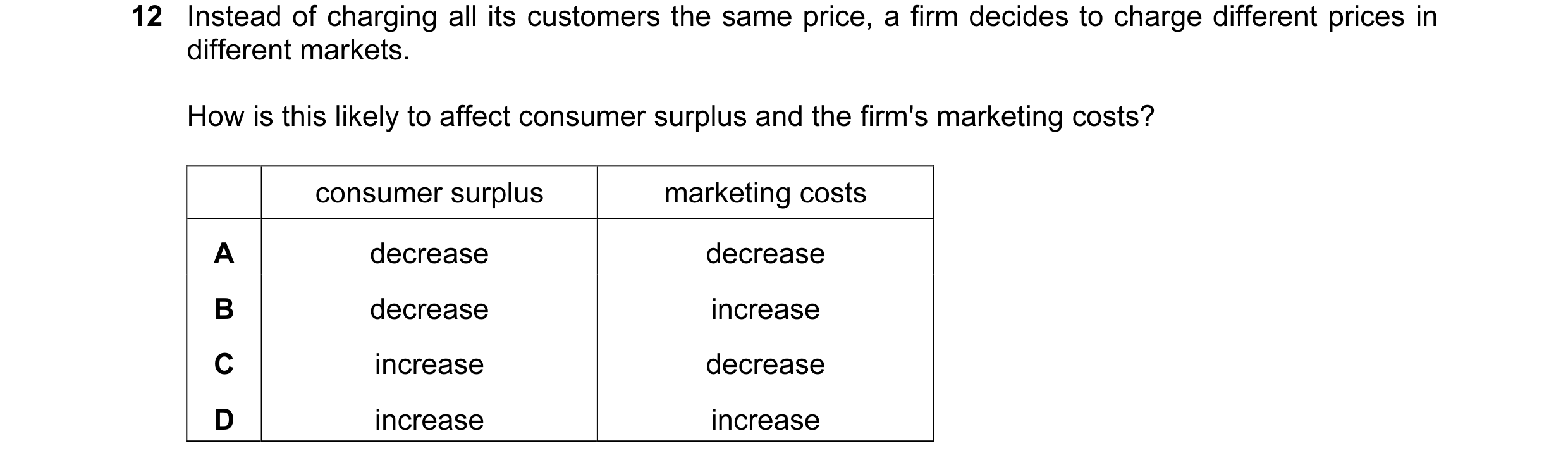
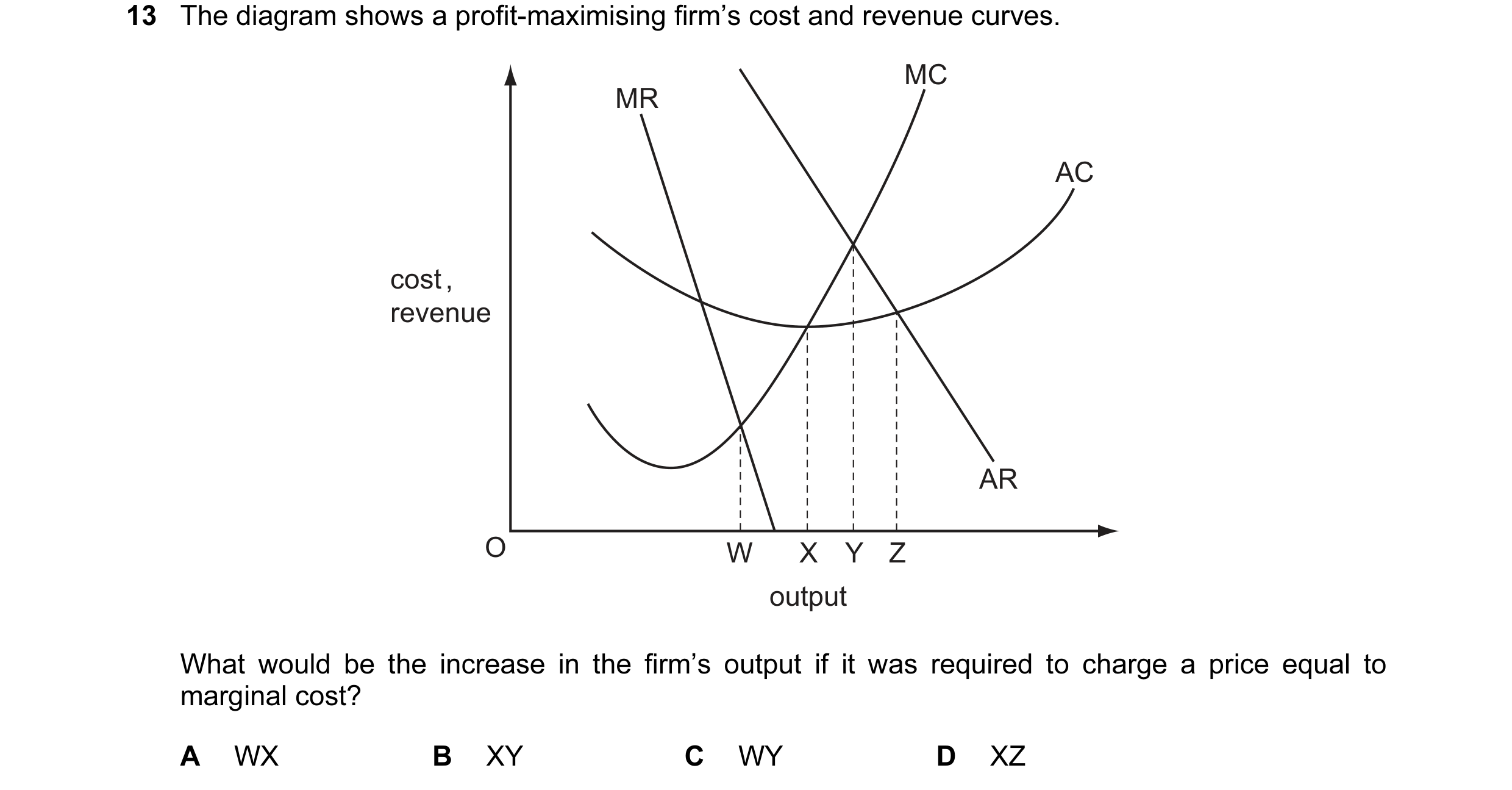
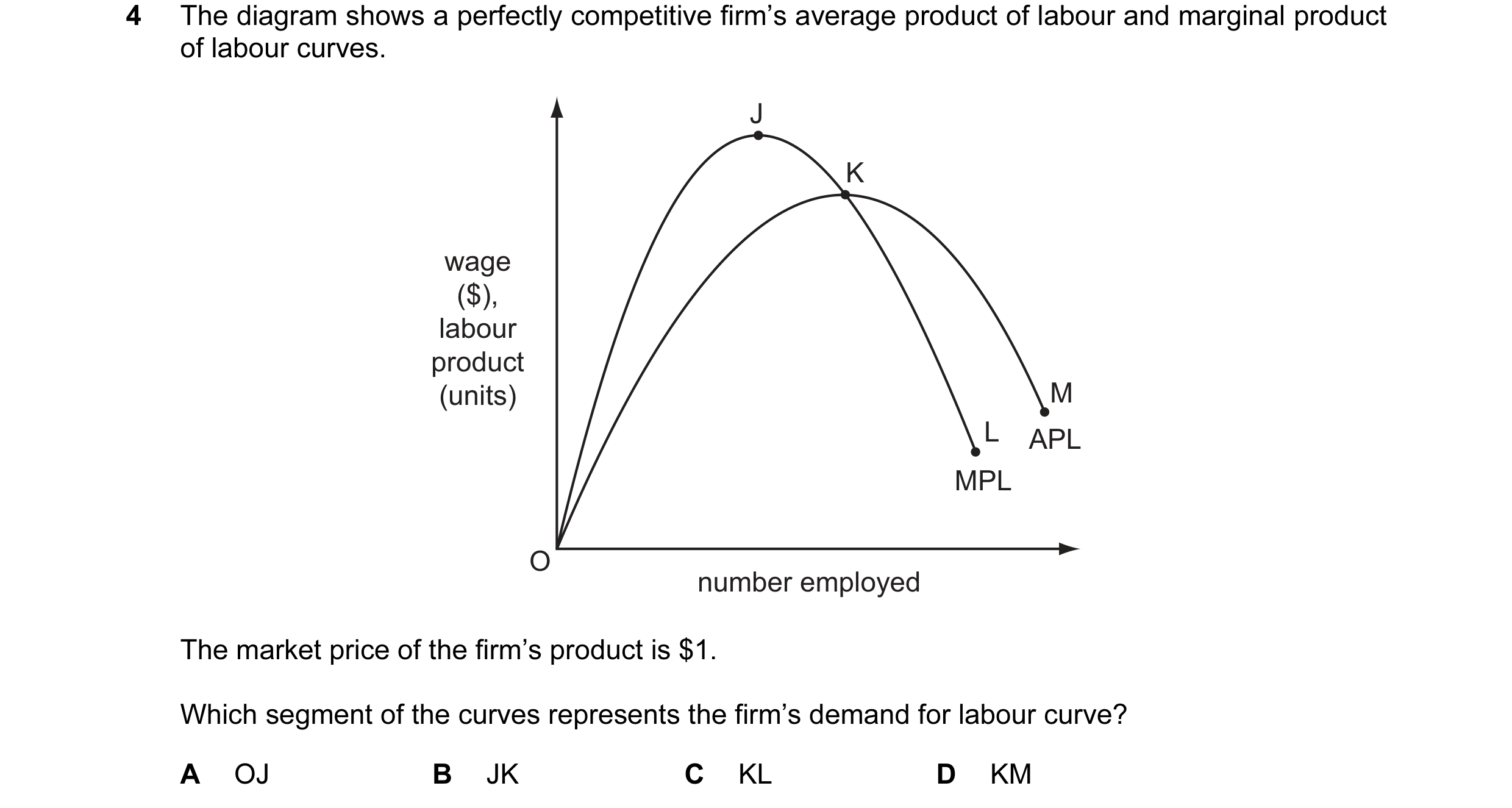 20 / 68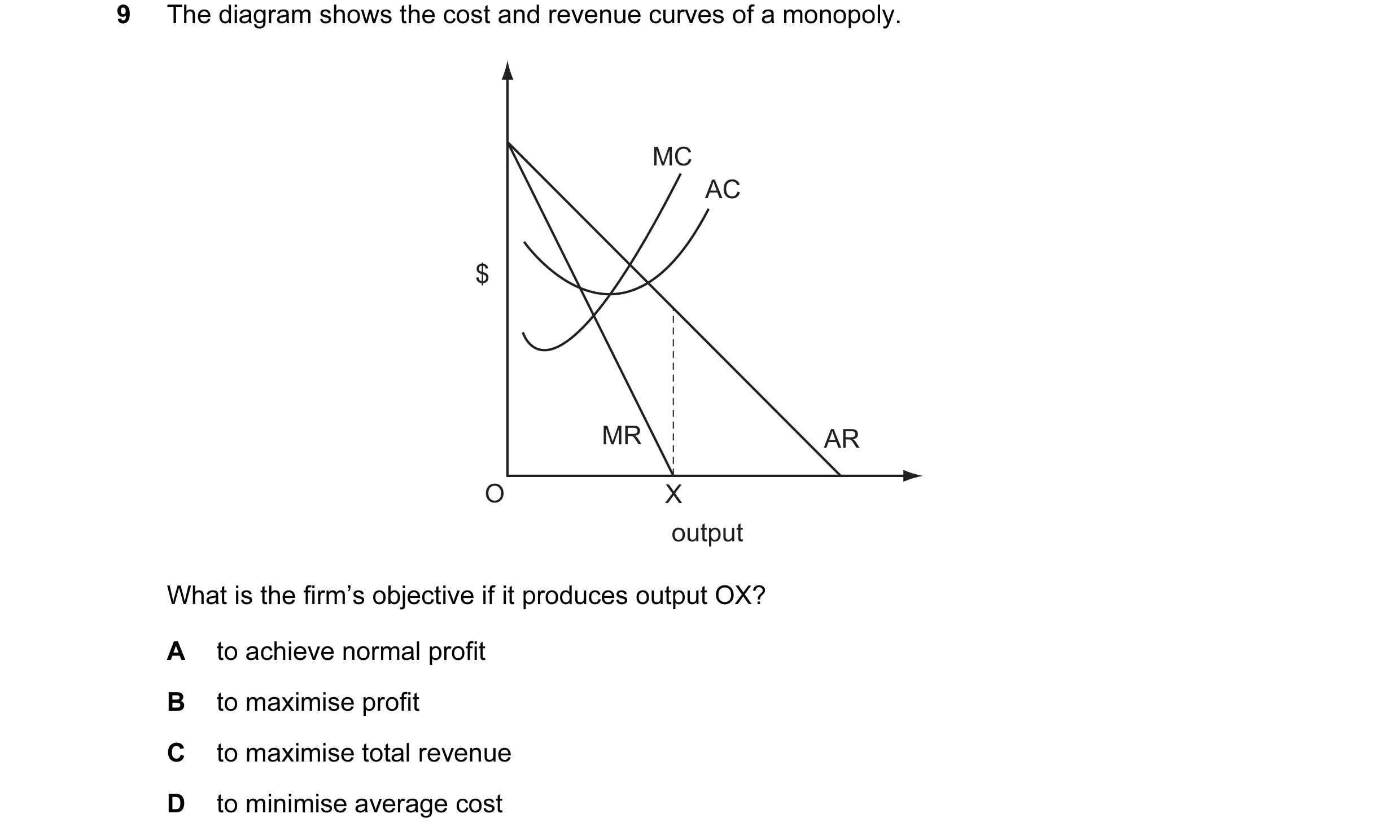
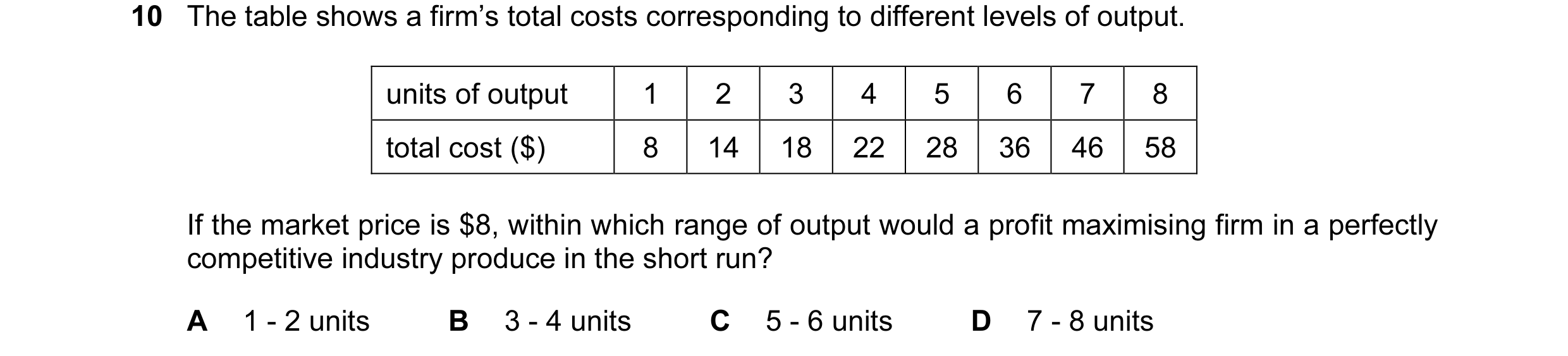
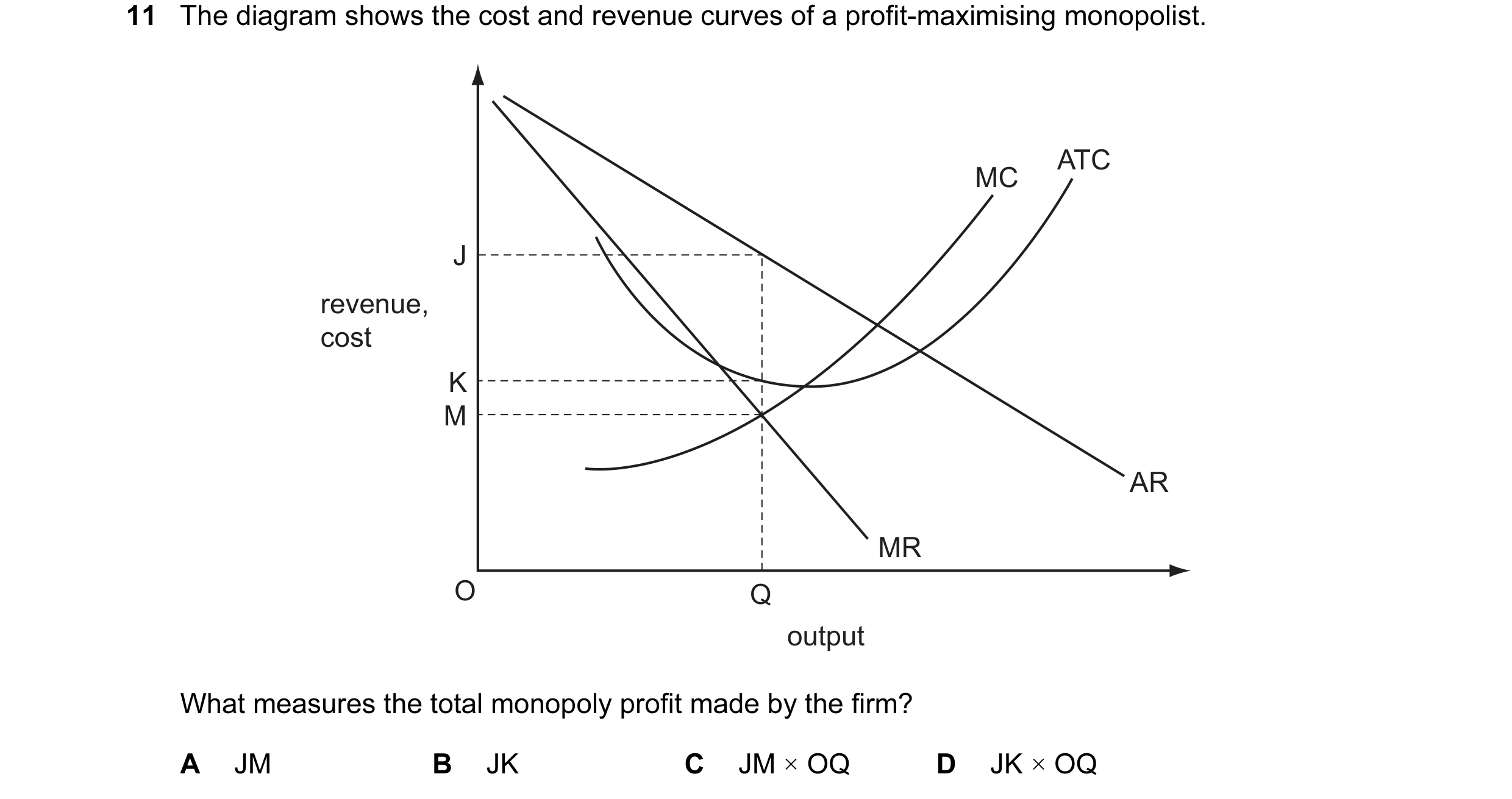 21 / 68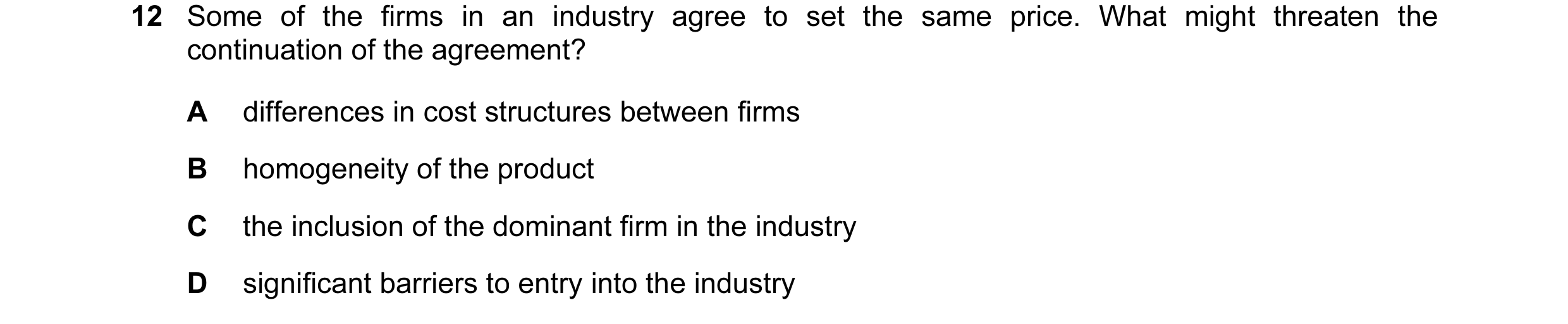
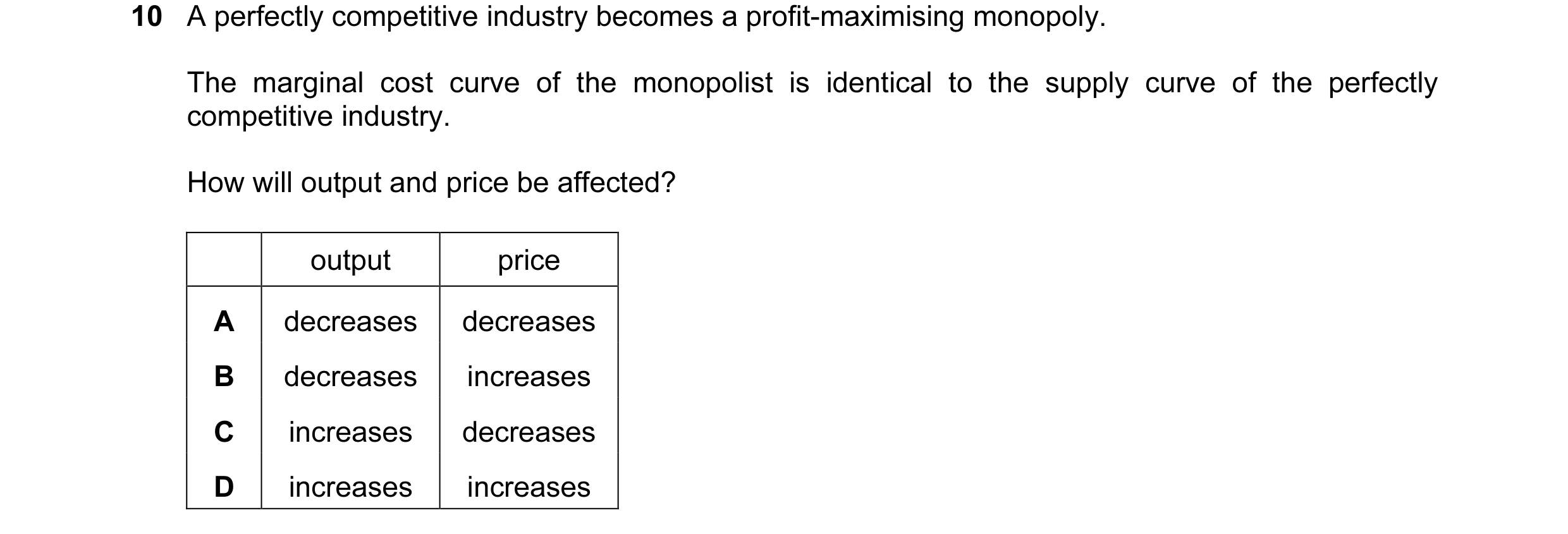

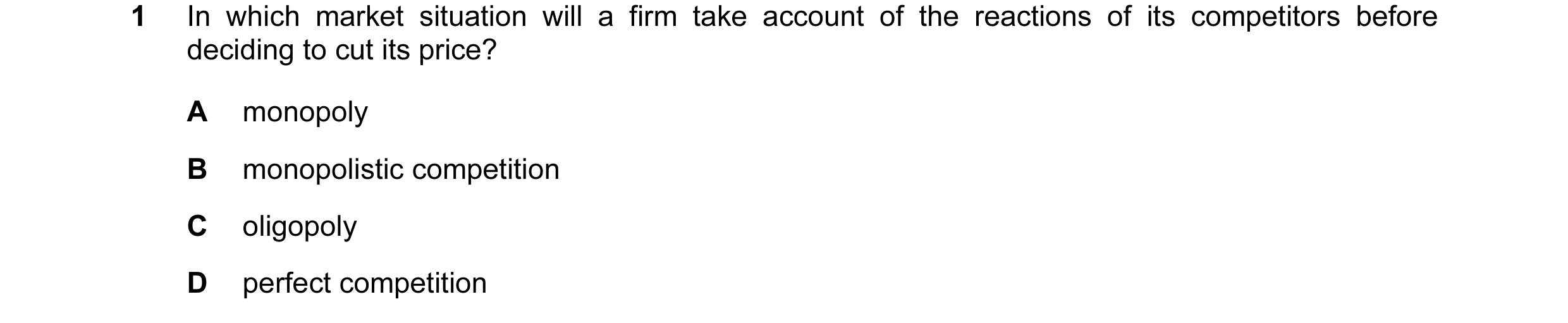
 22 / 68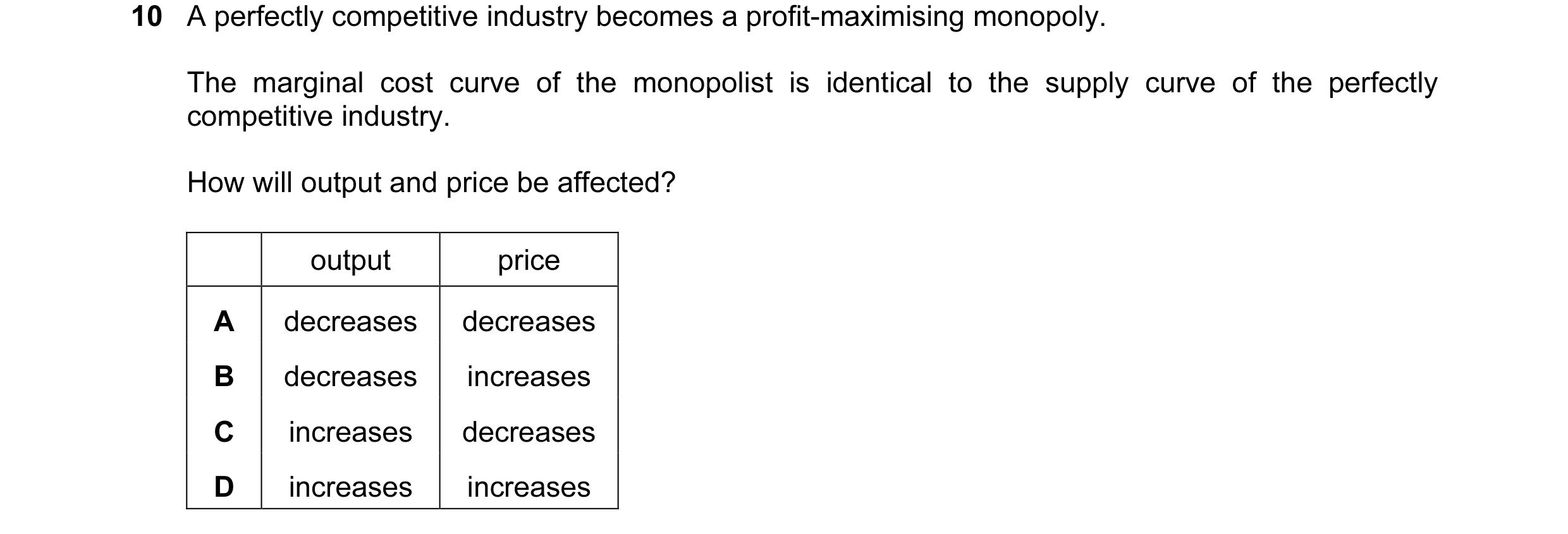

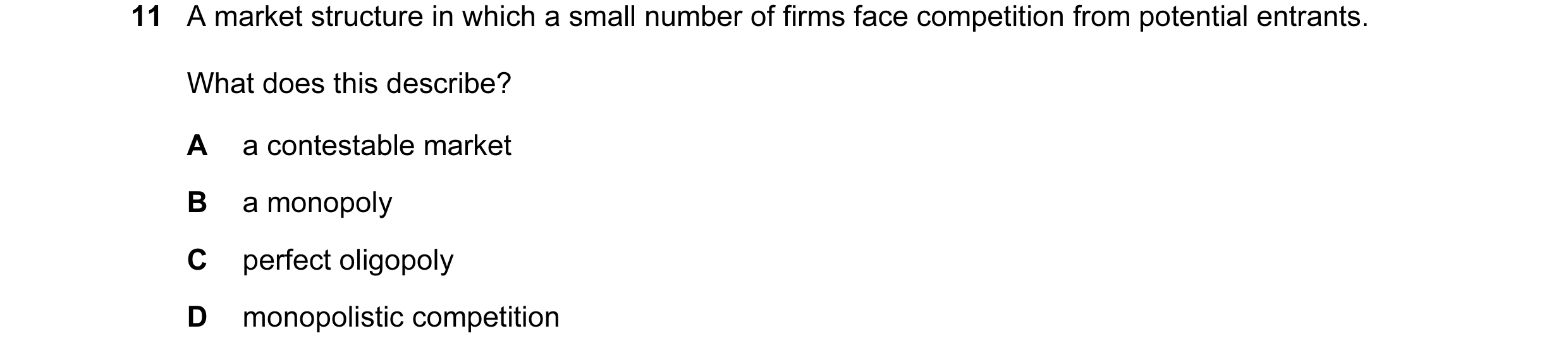
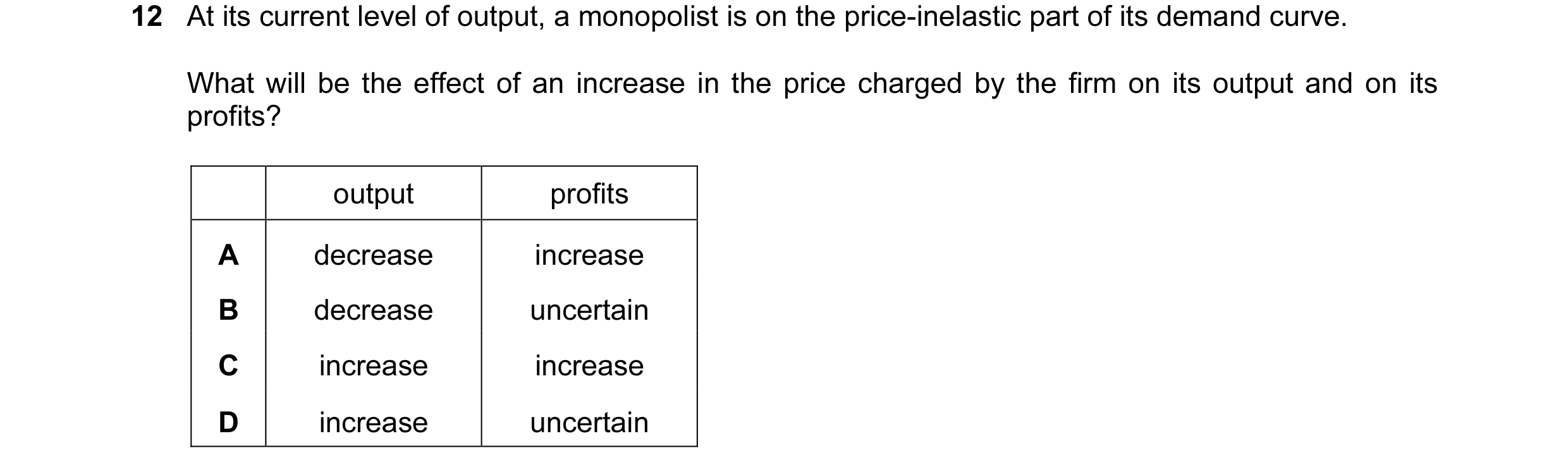
 23 / 68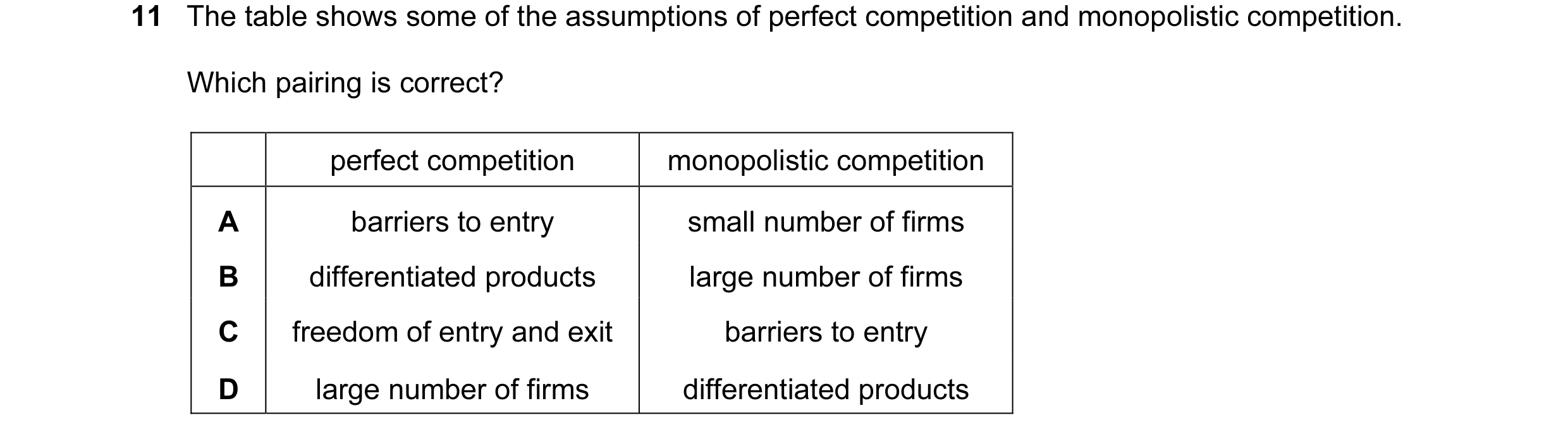
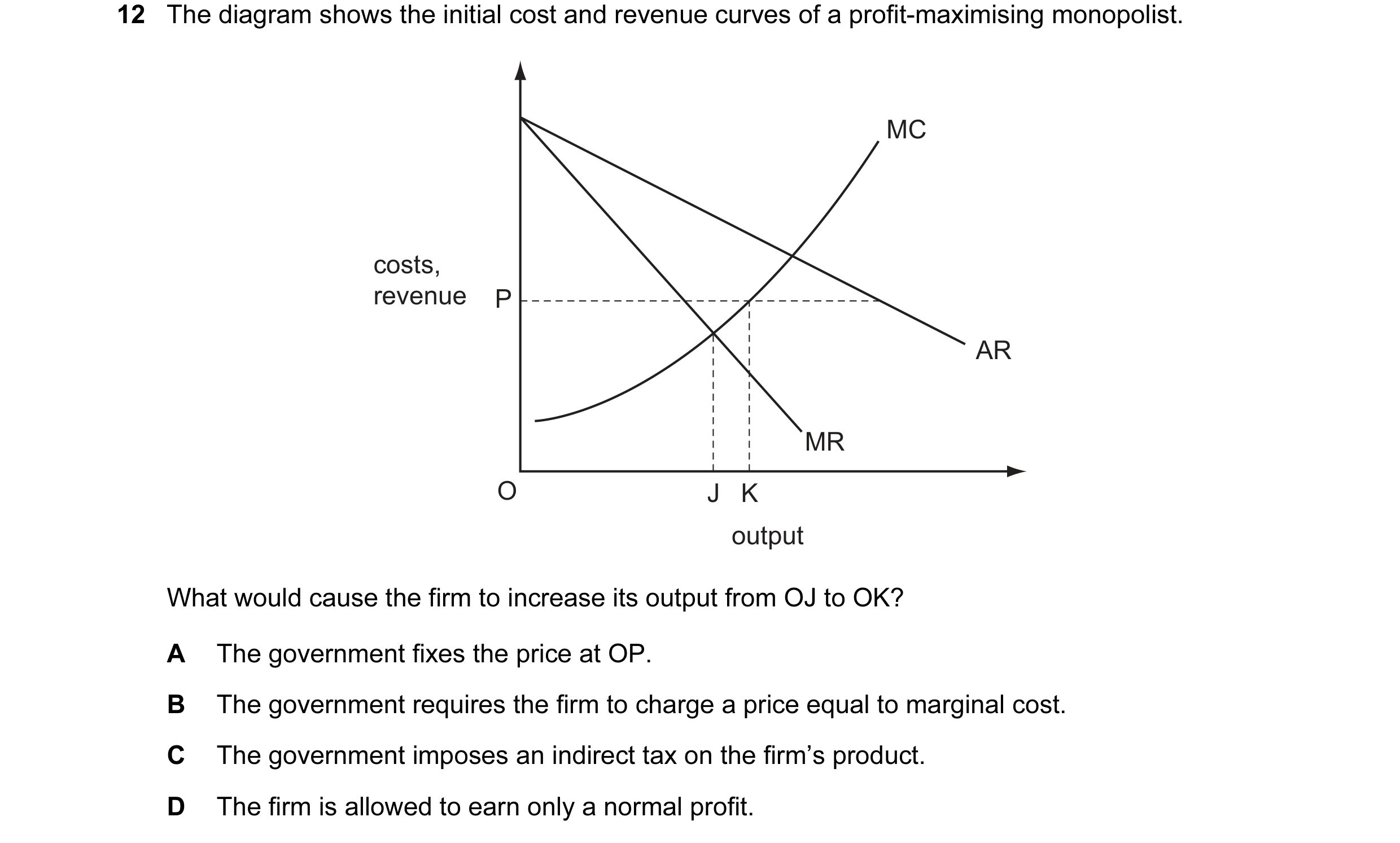
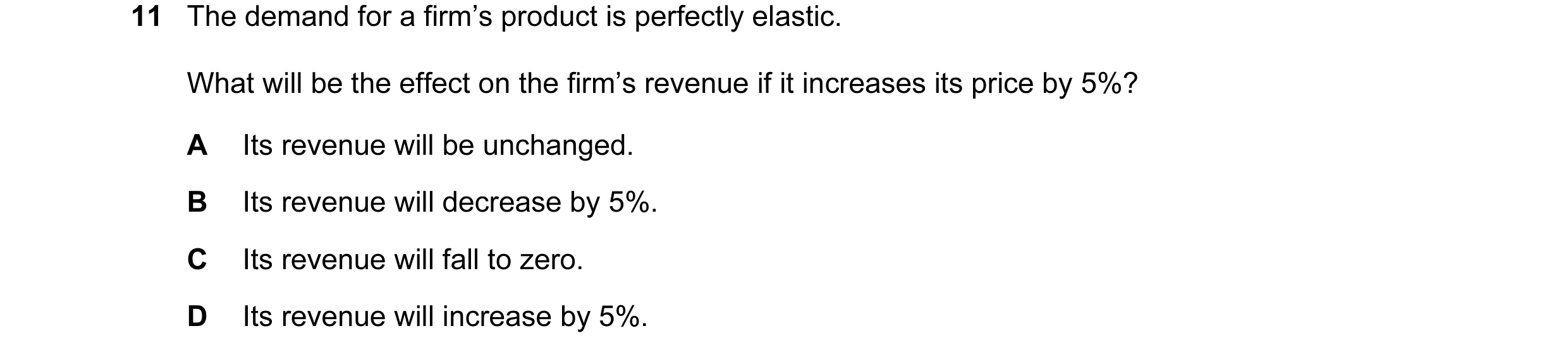 24 / 68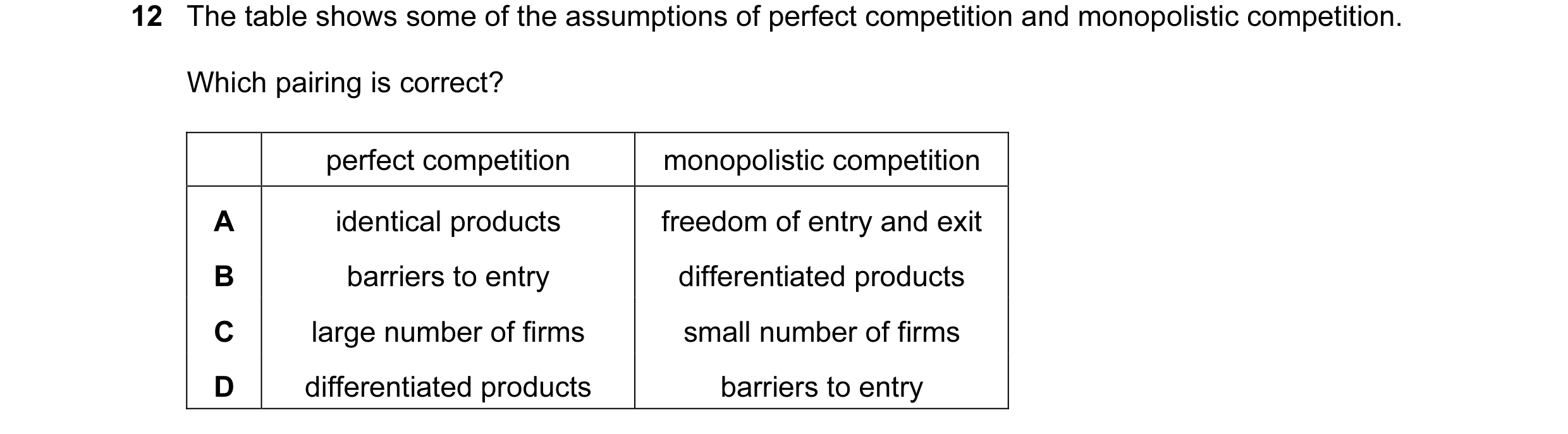

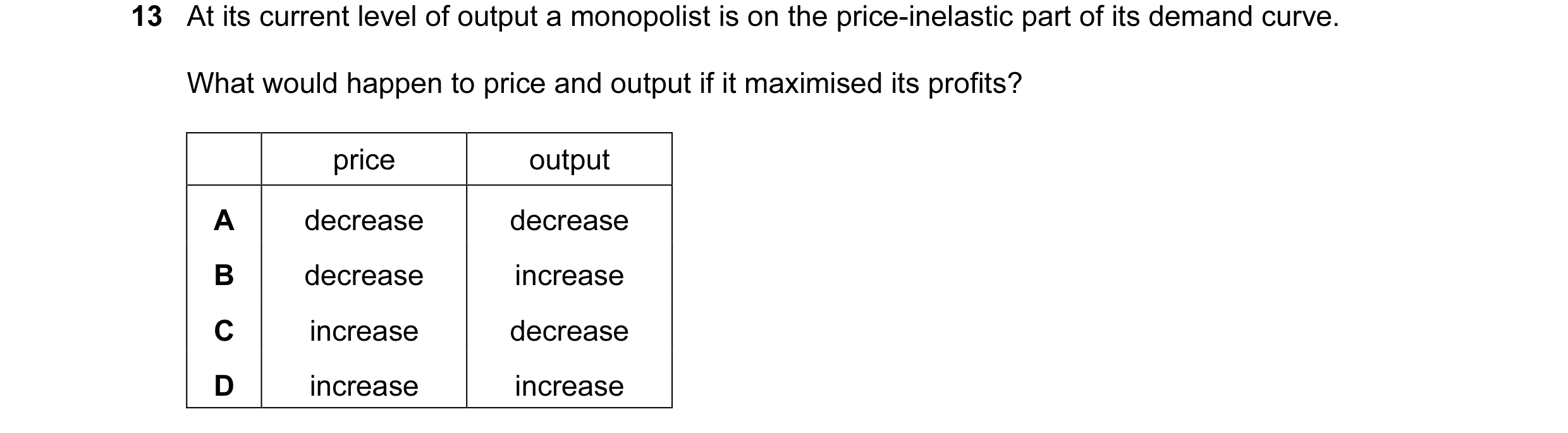
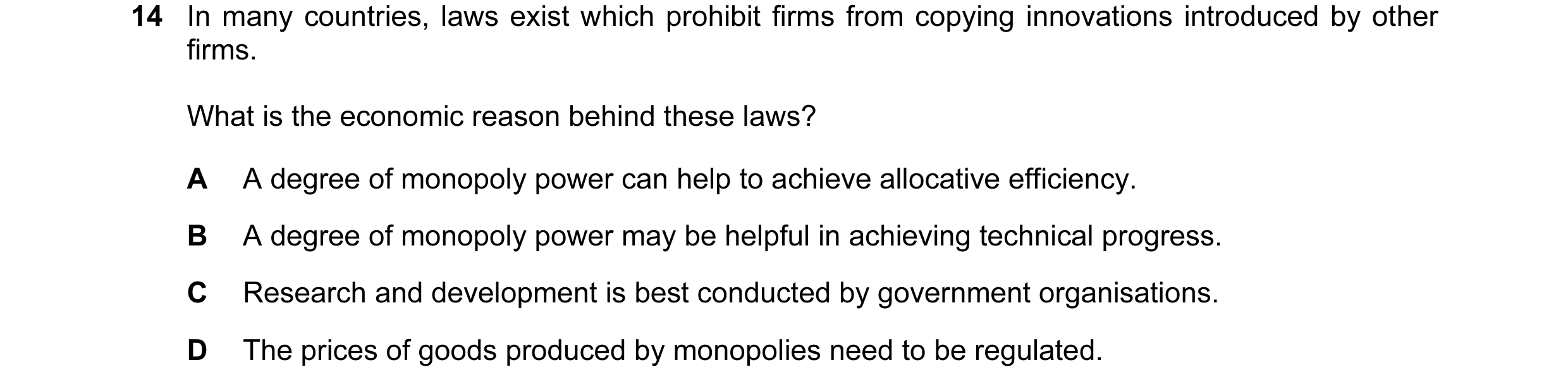
 25 / 68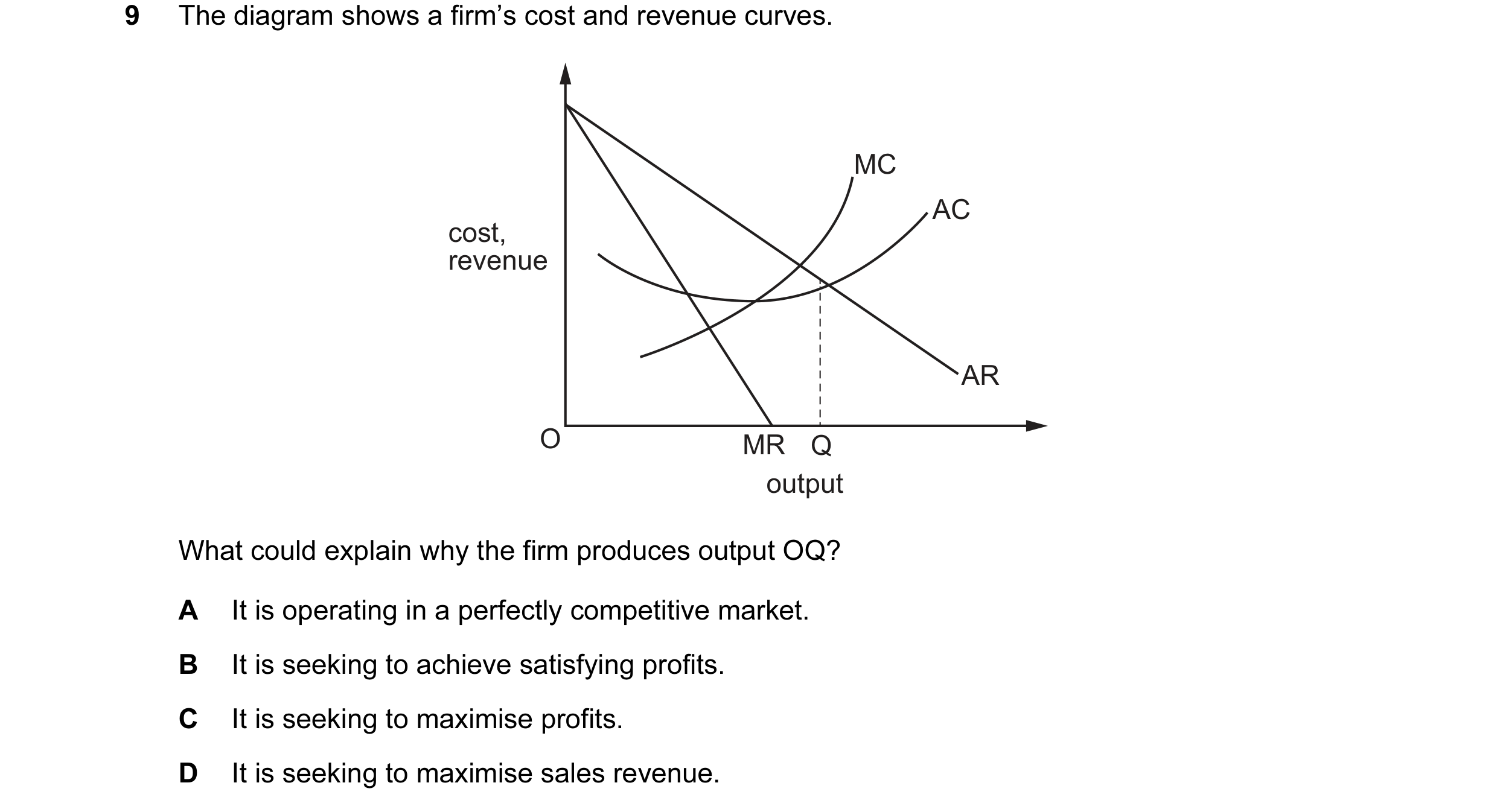
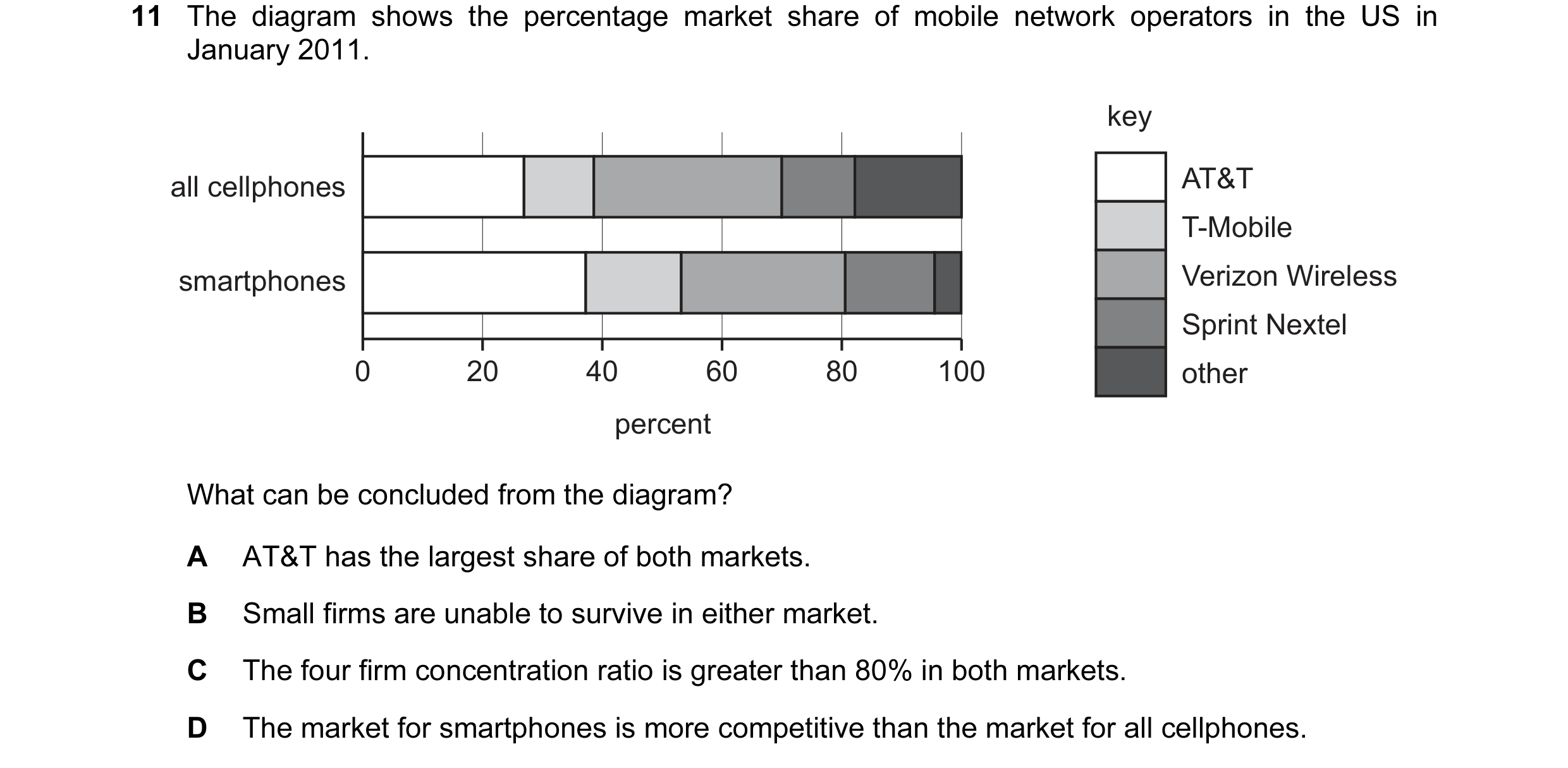 26 / 68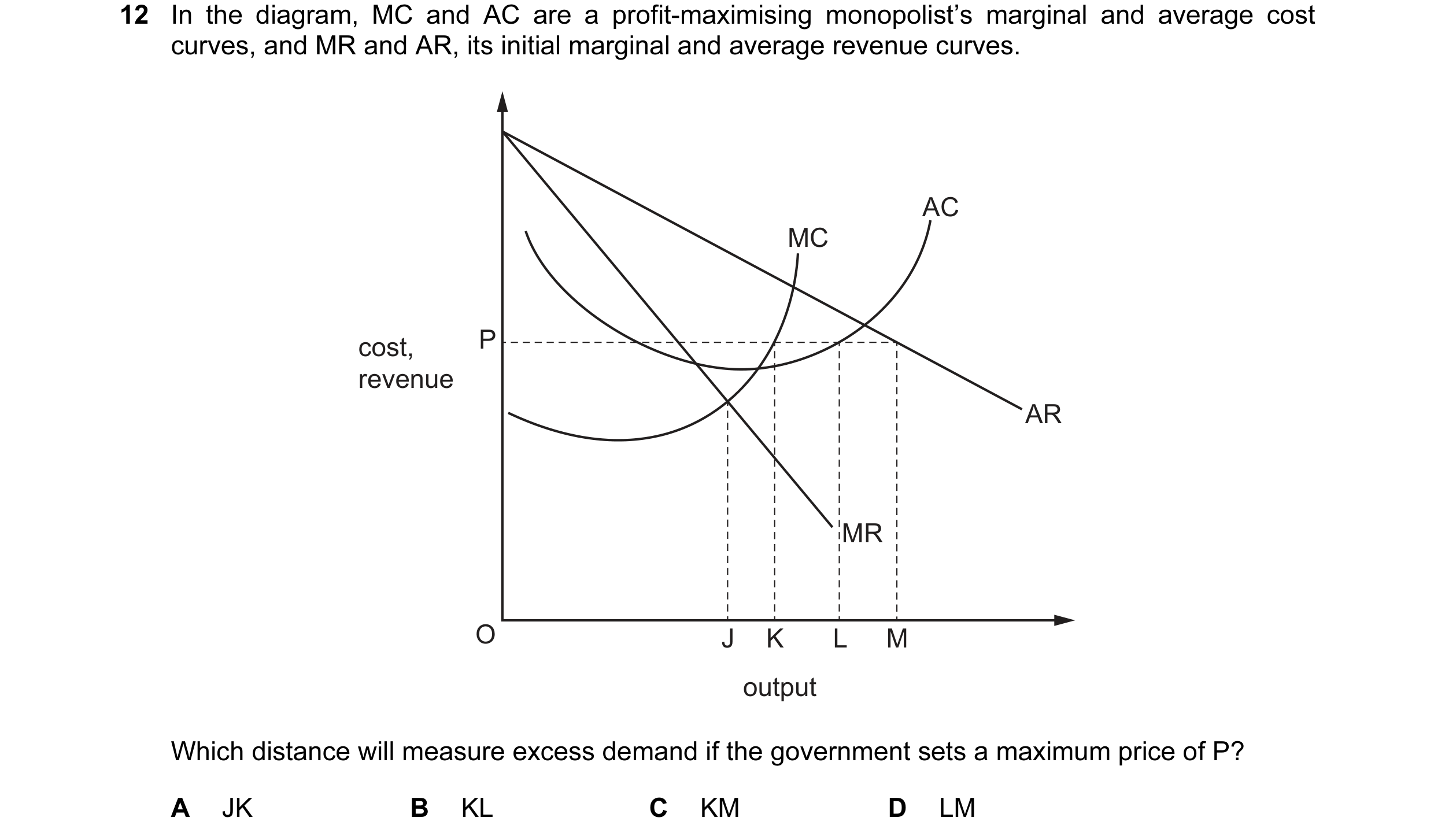
 27 / 68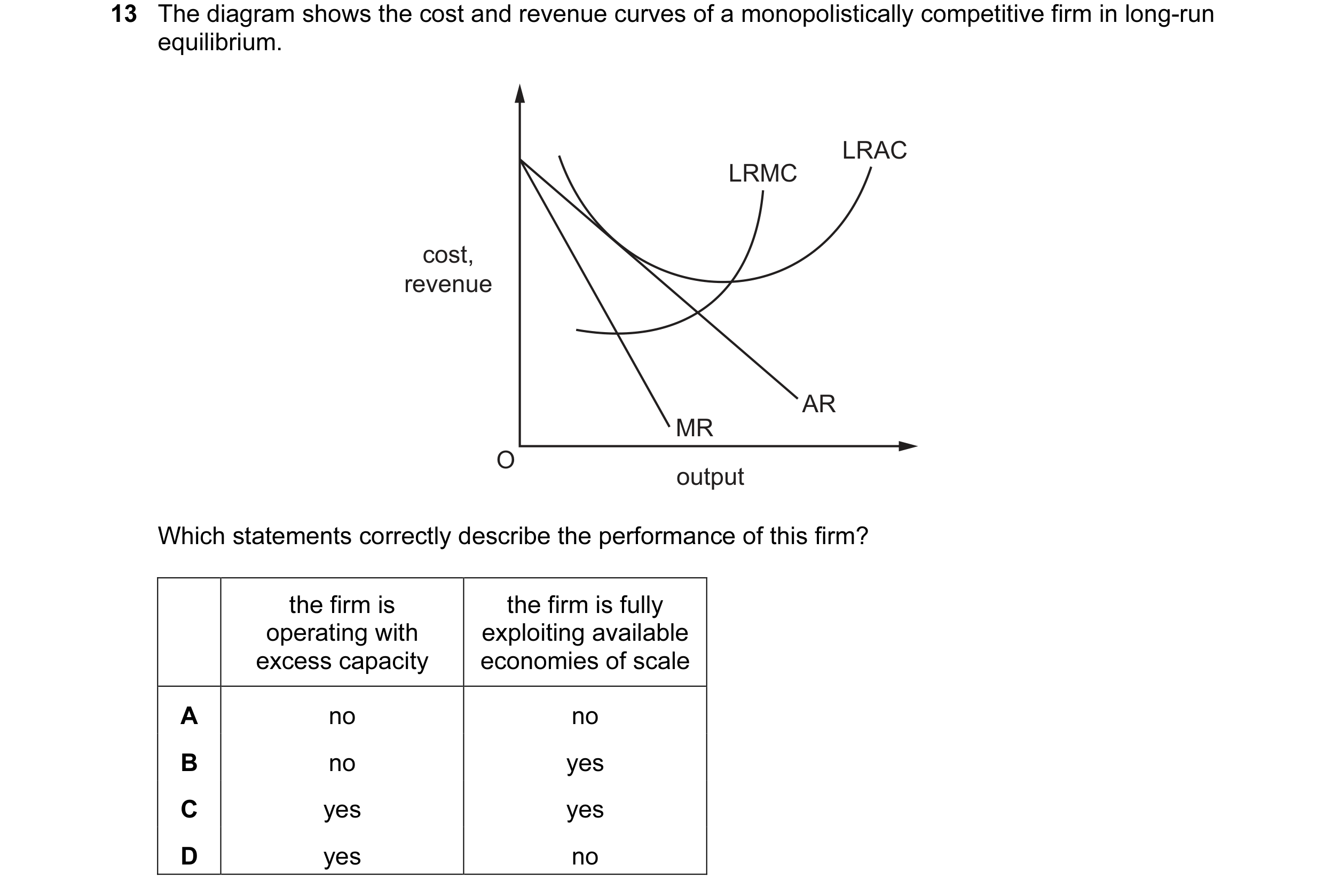
 28 / 68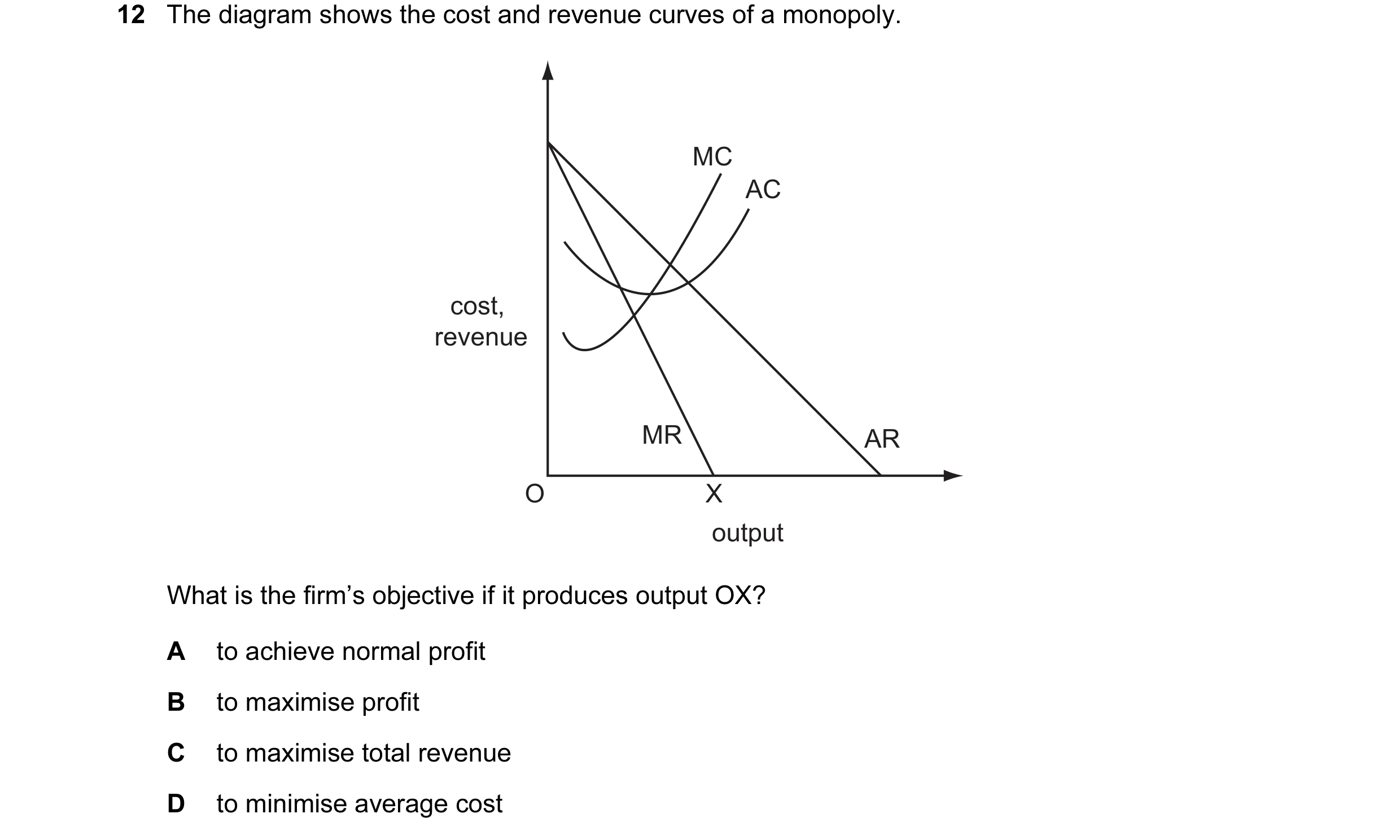
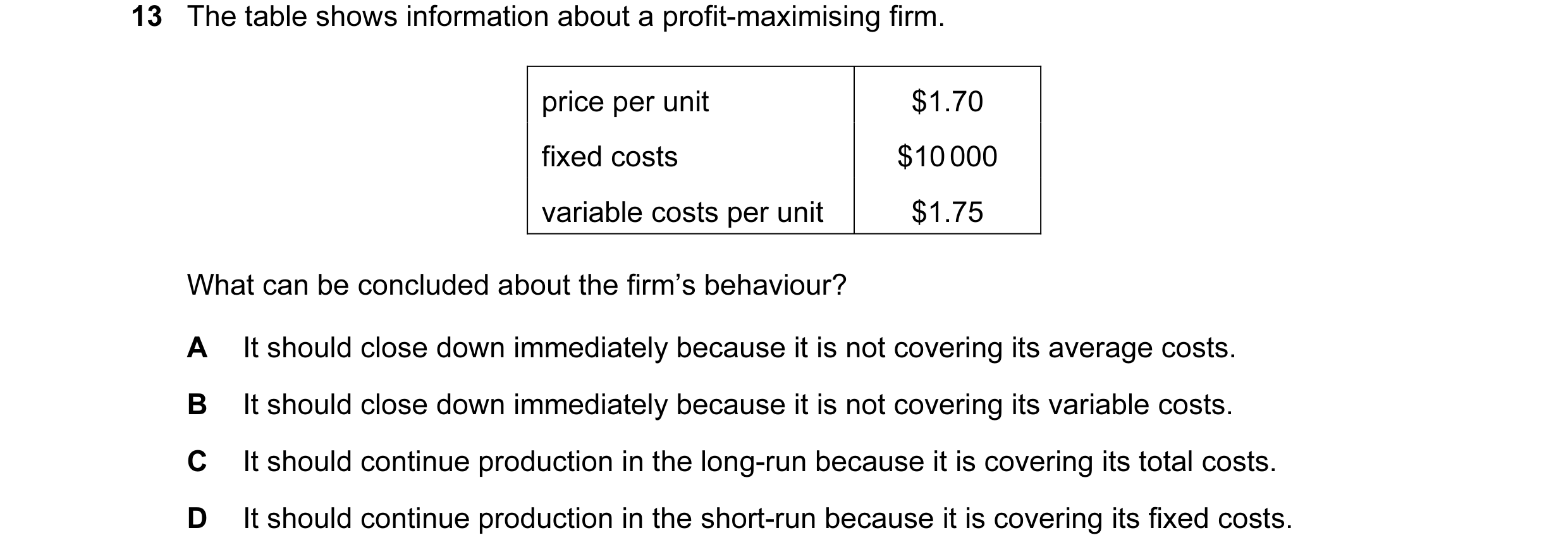
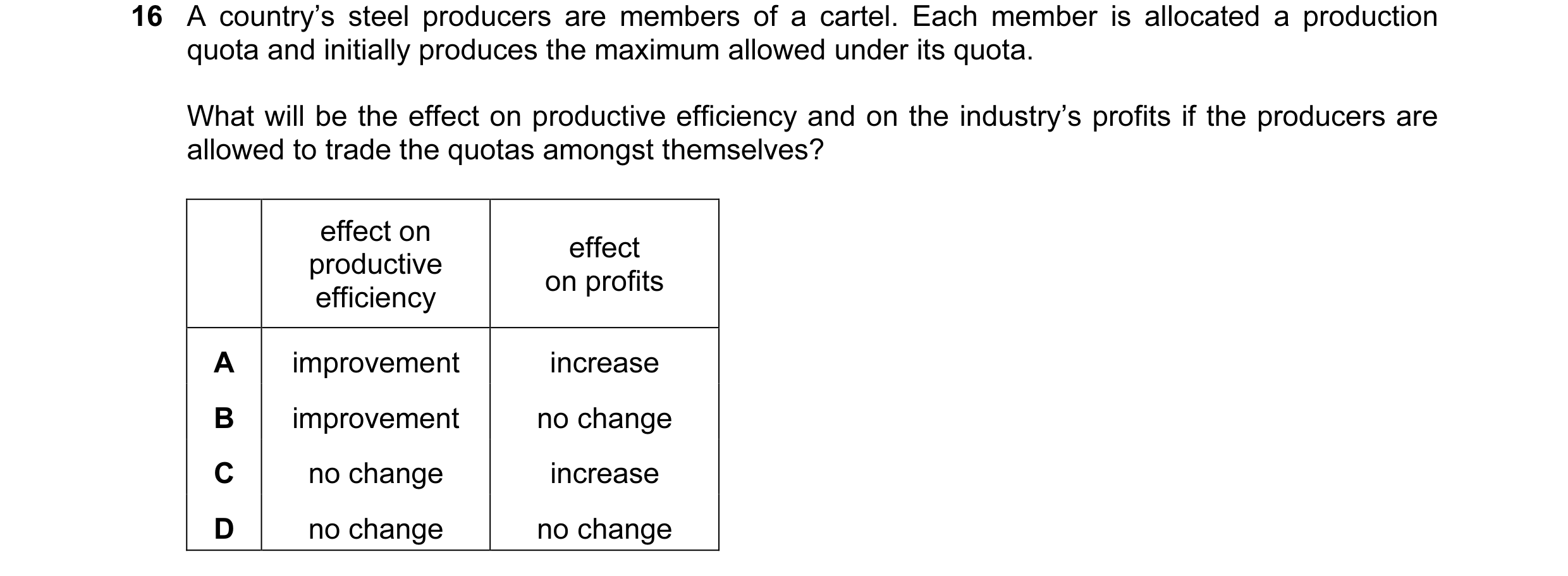 29 / 68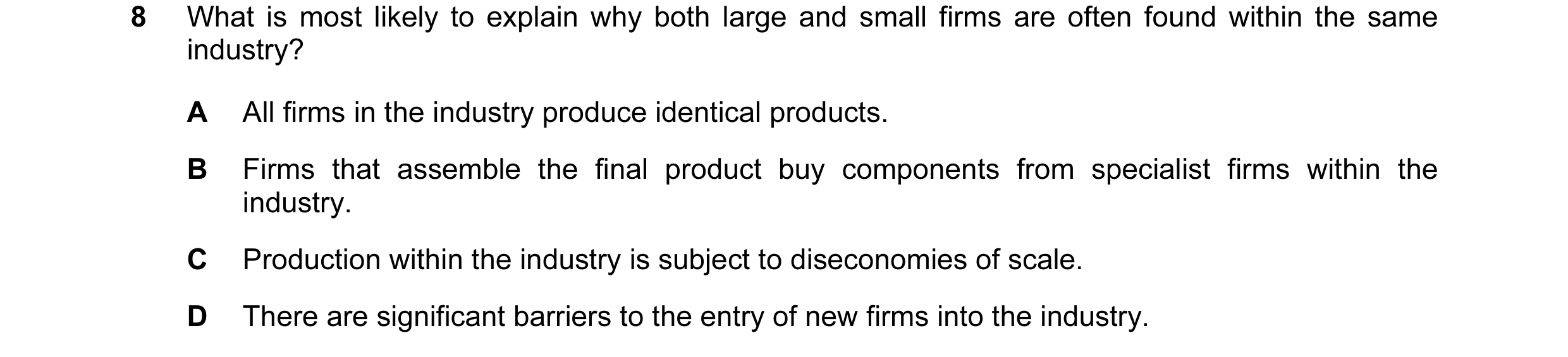
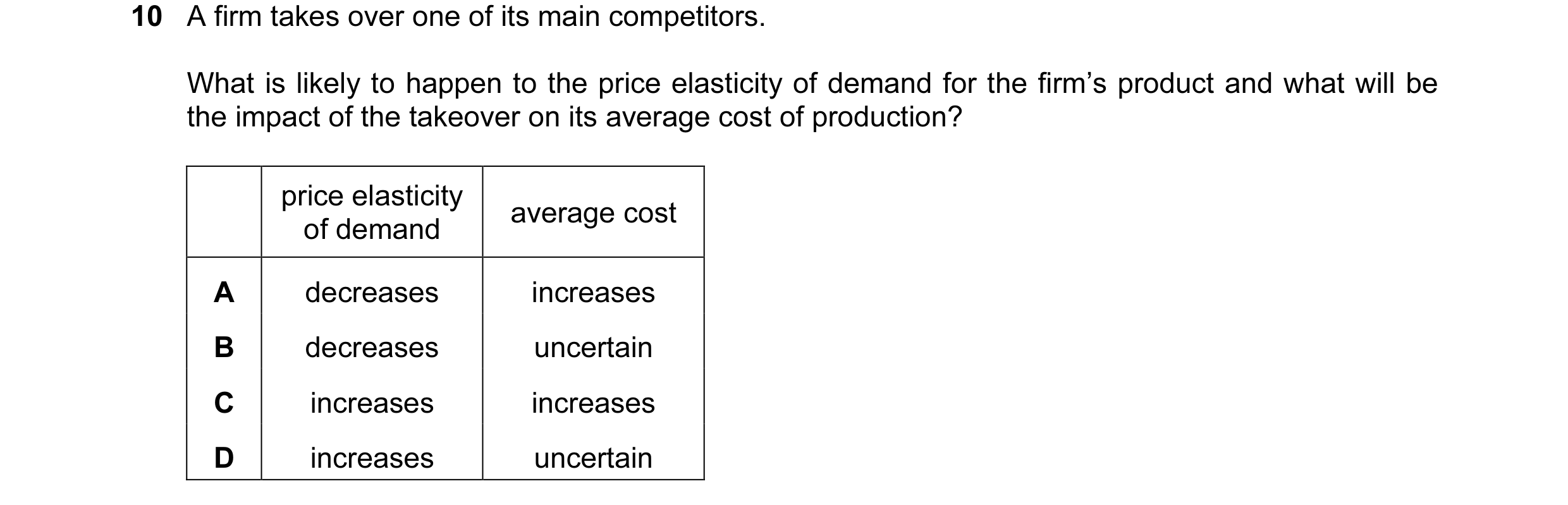
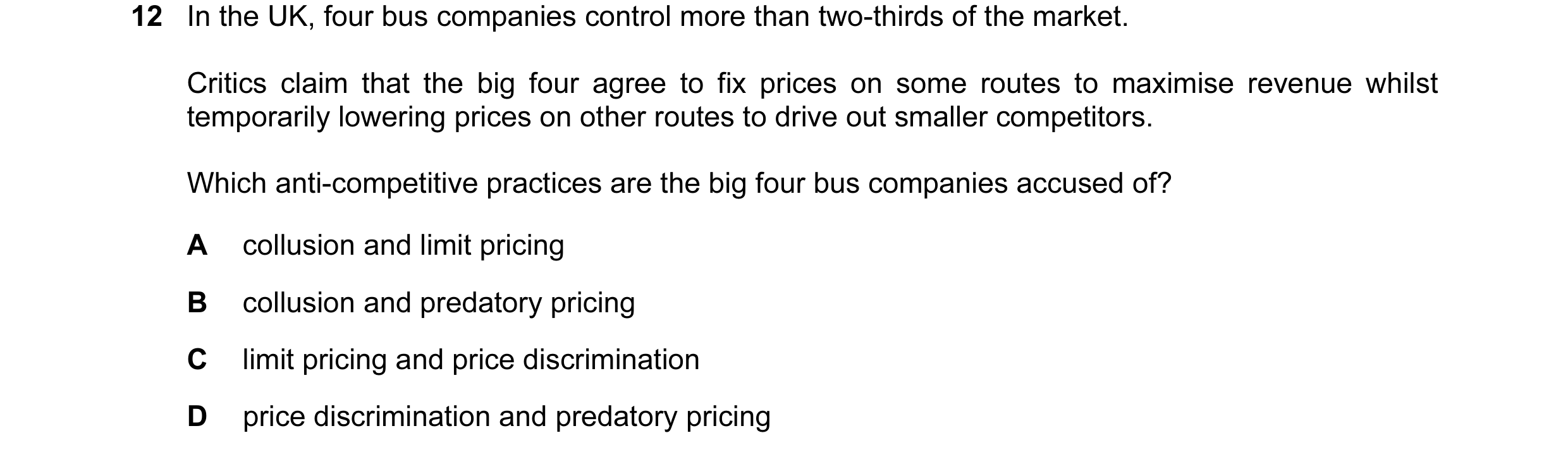
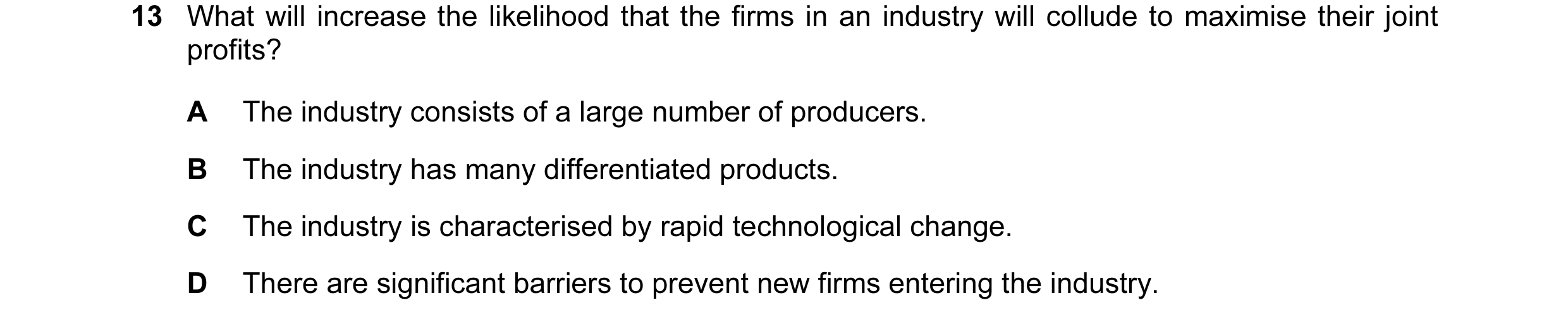
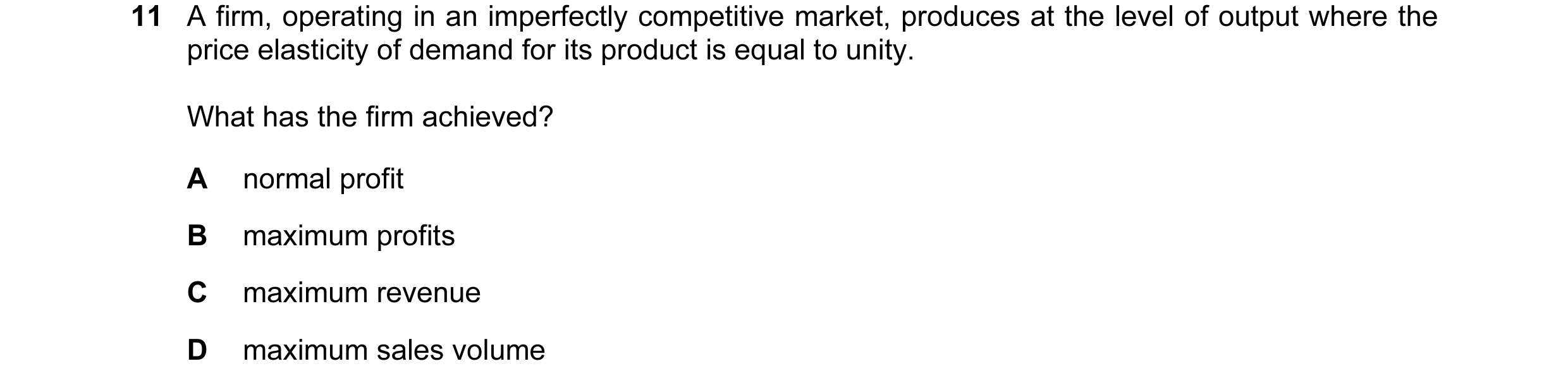 30 / 68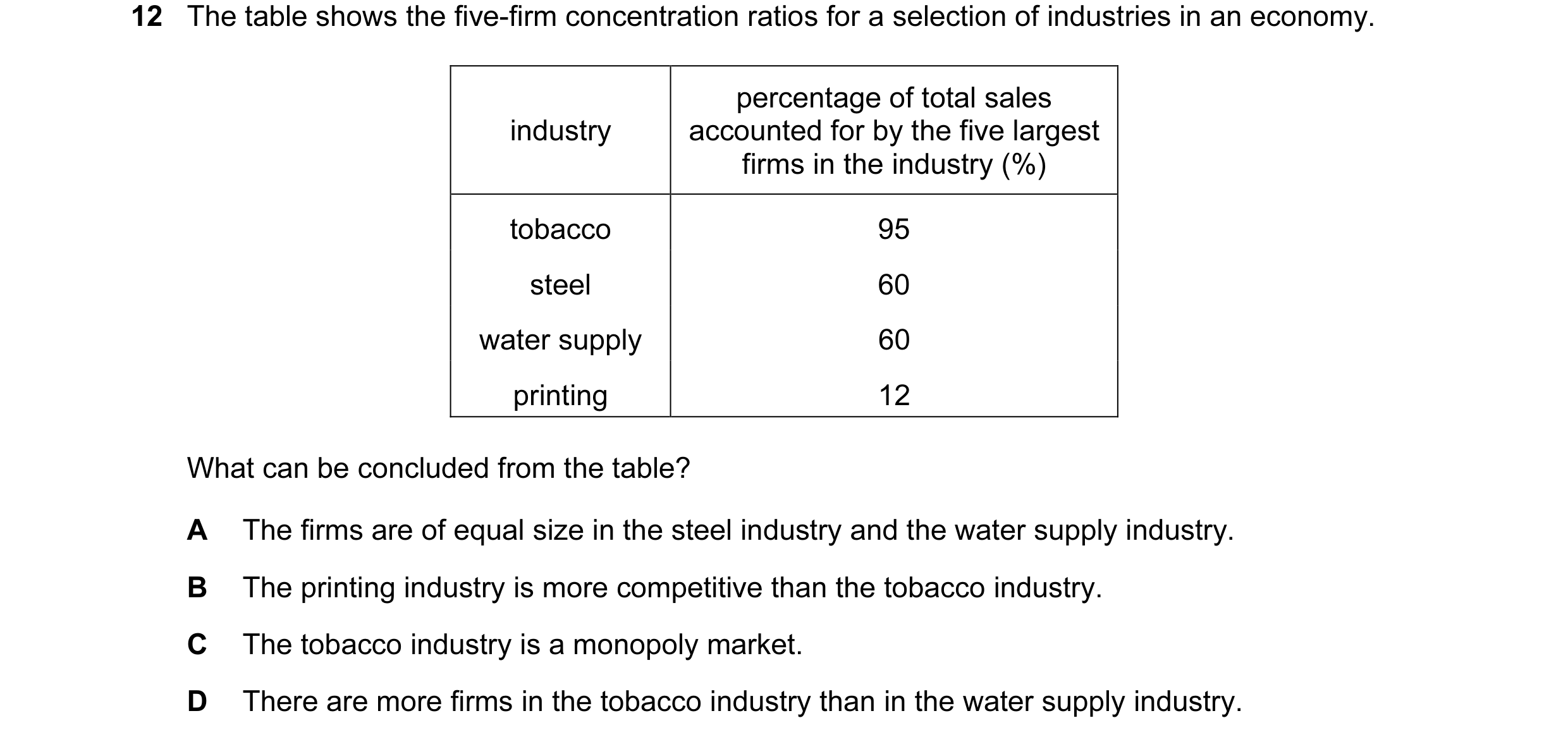
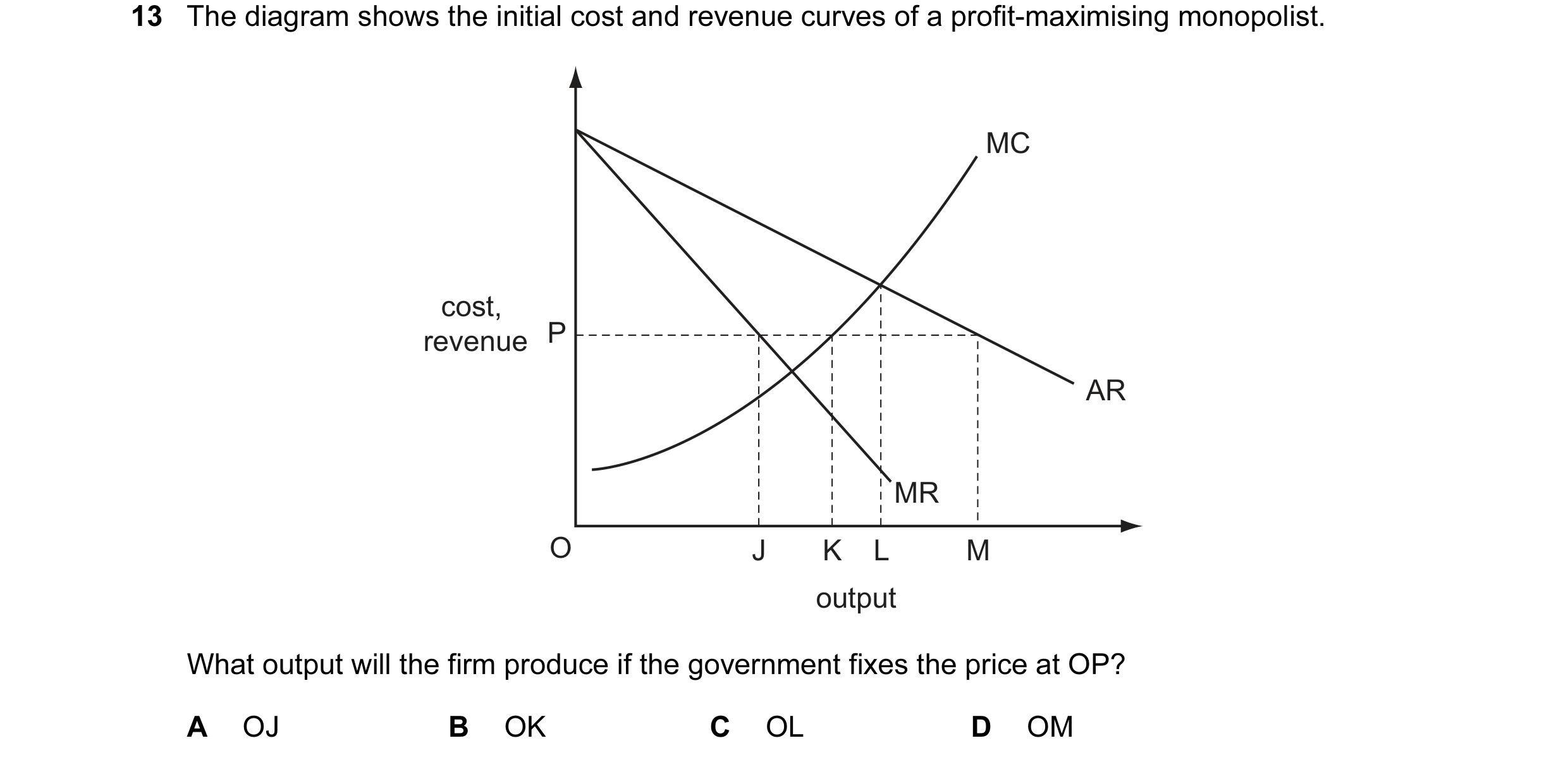
 31 / 68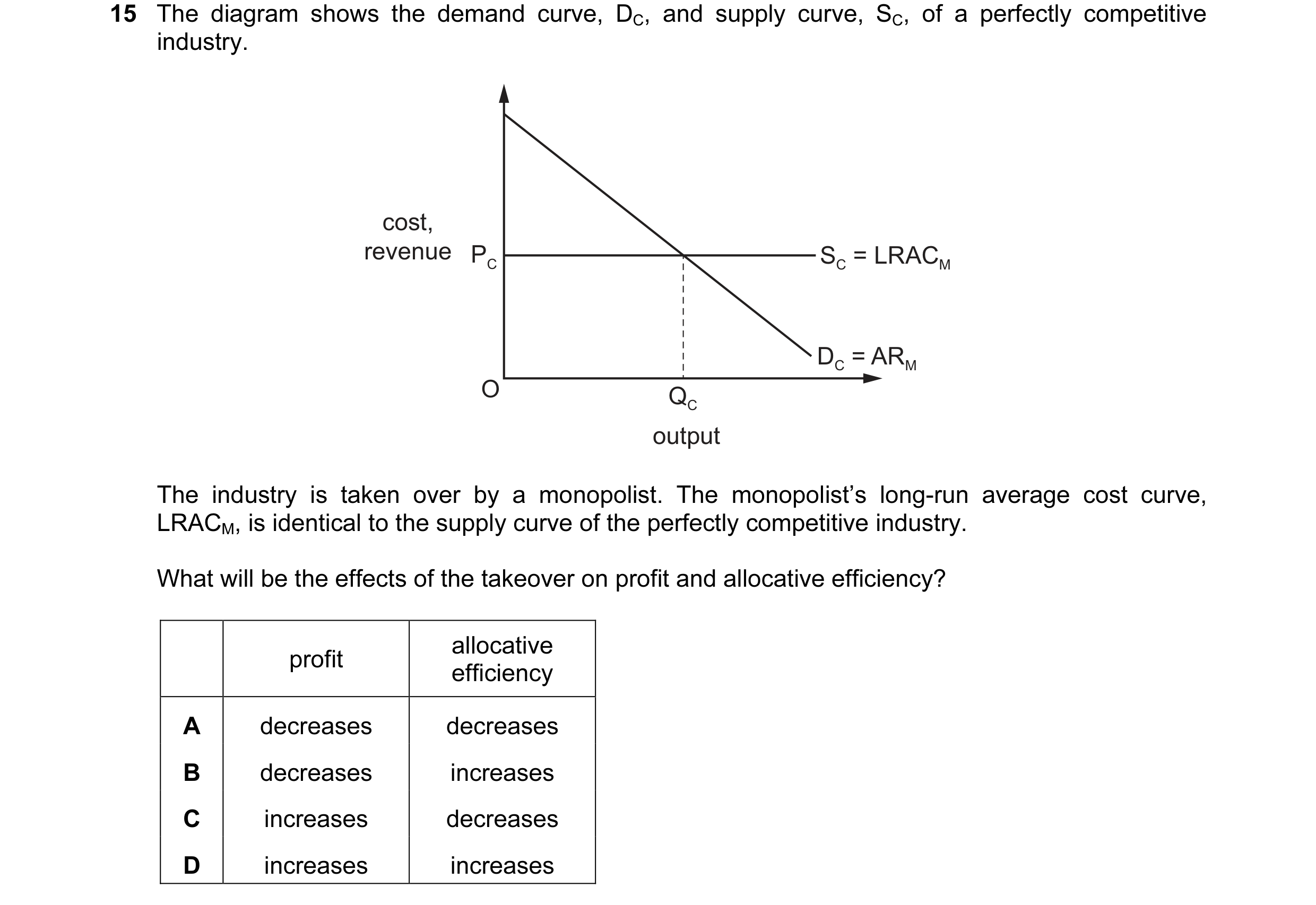
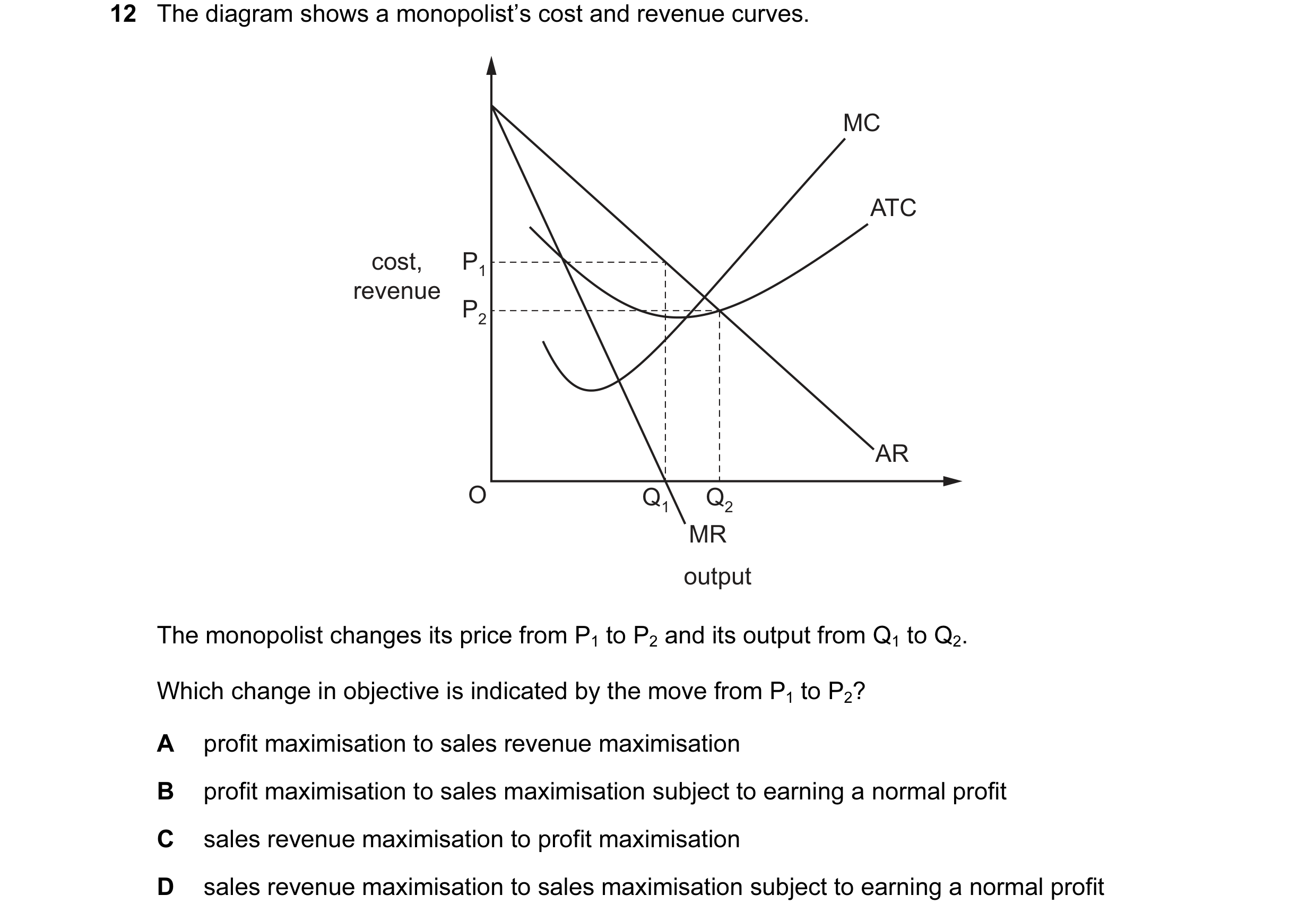 32 / 68
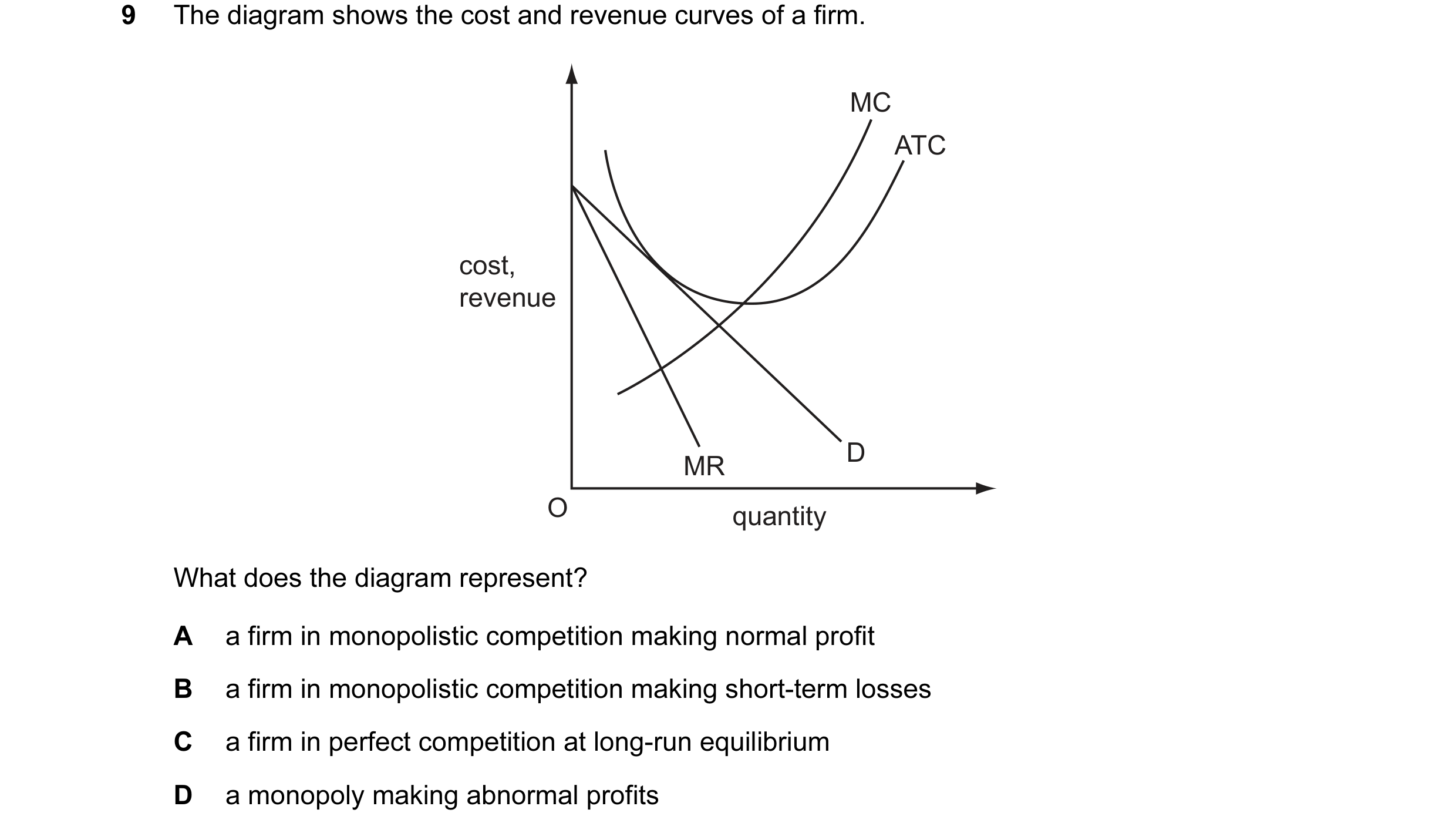
 33 / 68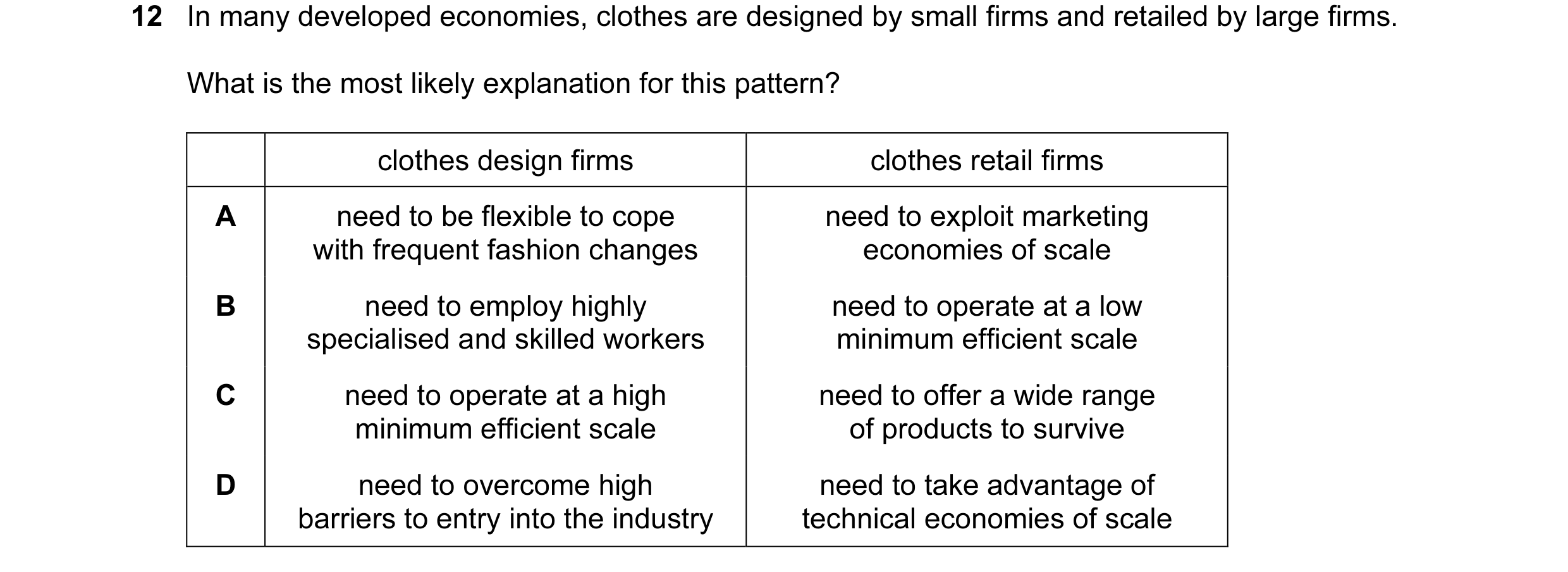

 34 / 68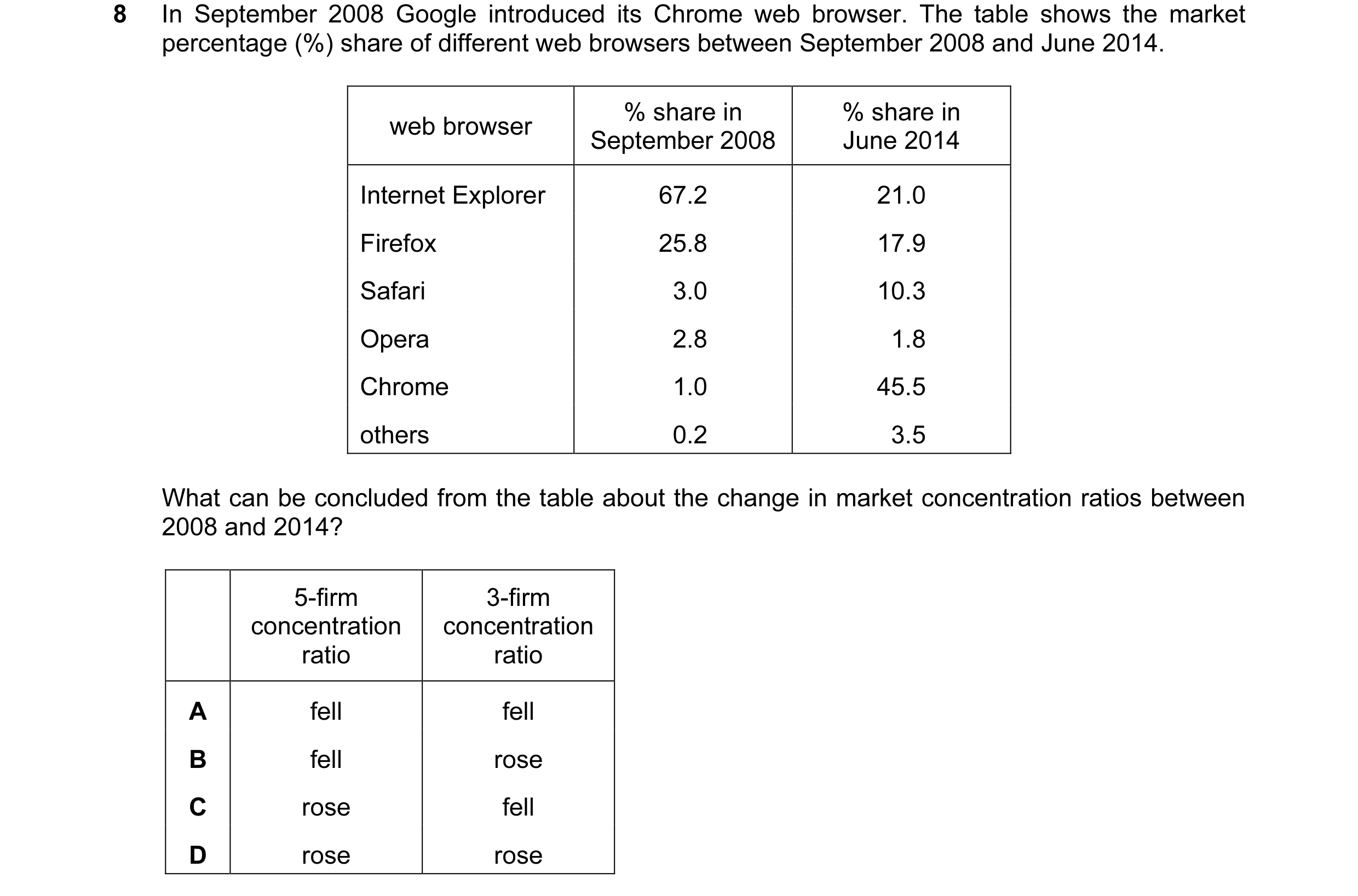
 35 / 68

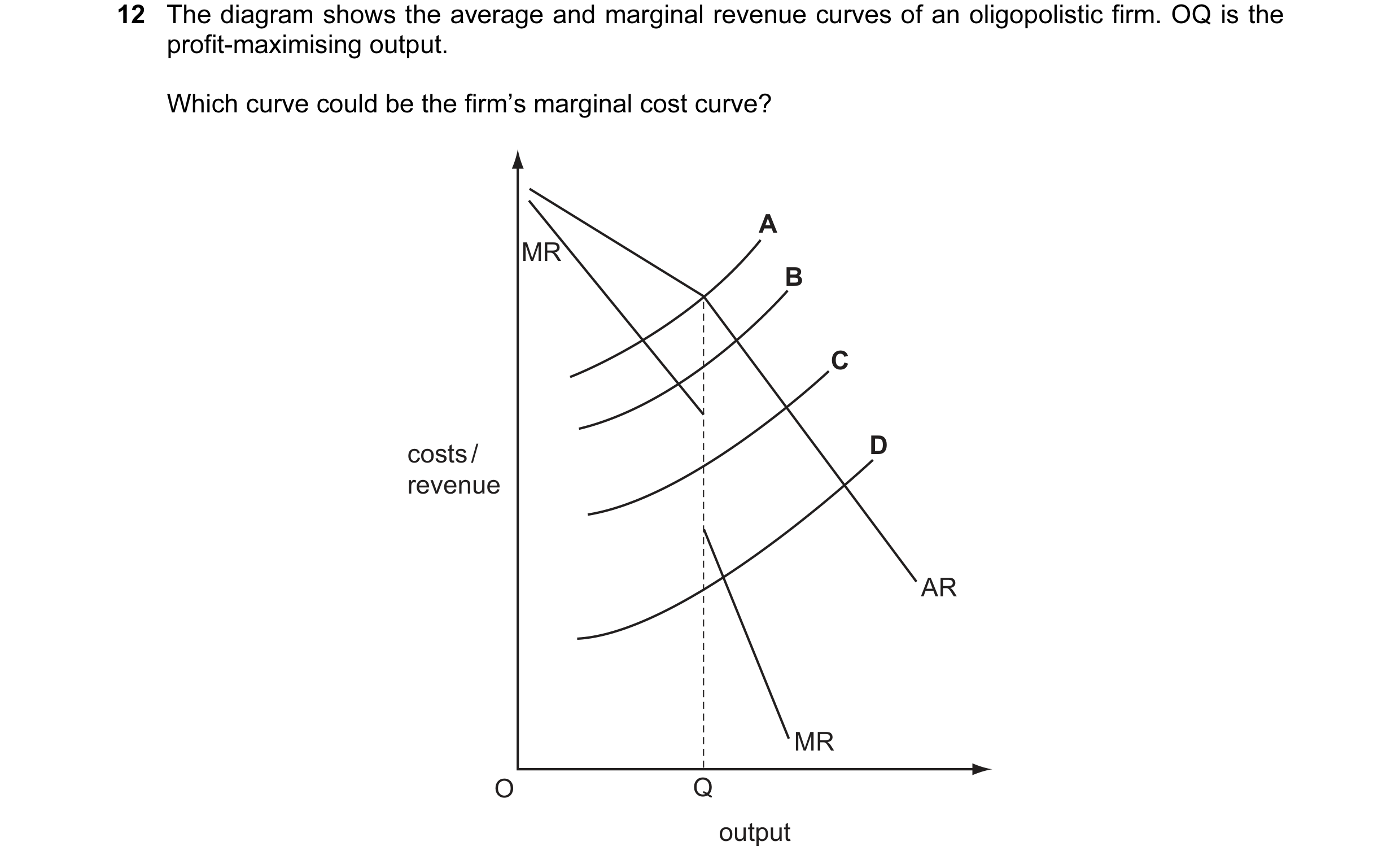
 36 / 68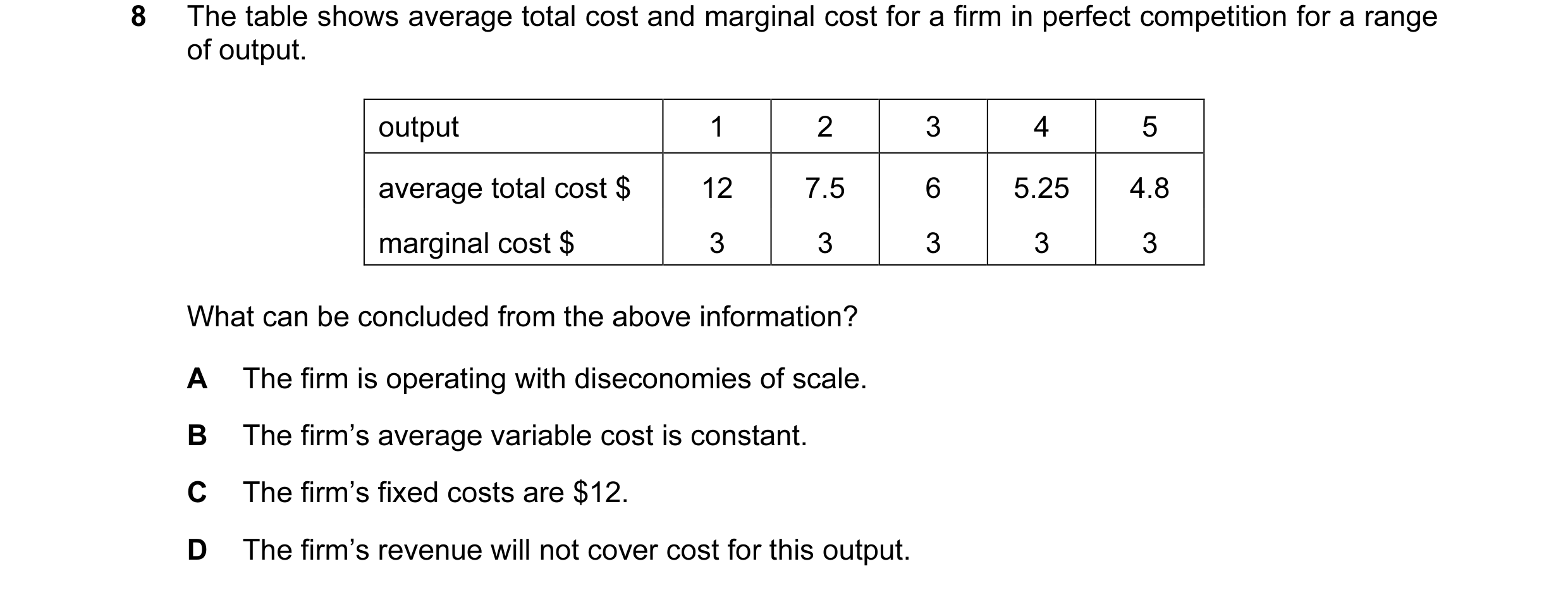
 37 / 68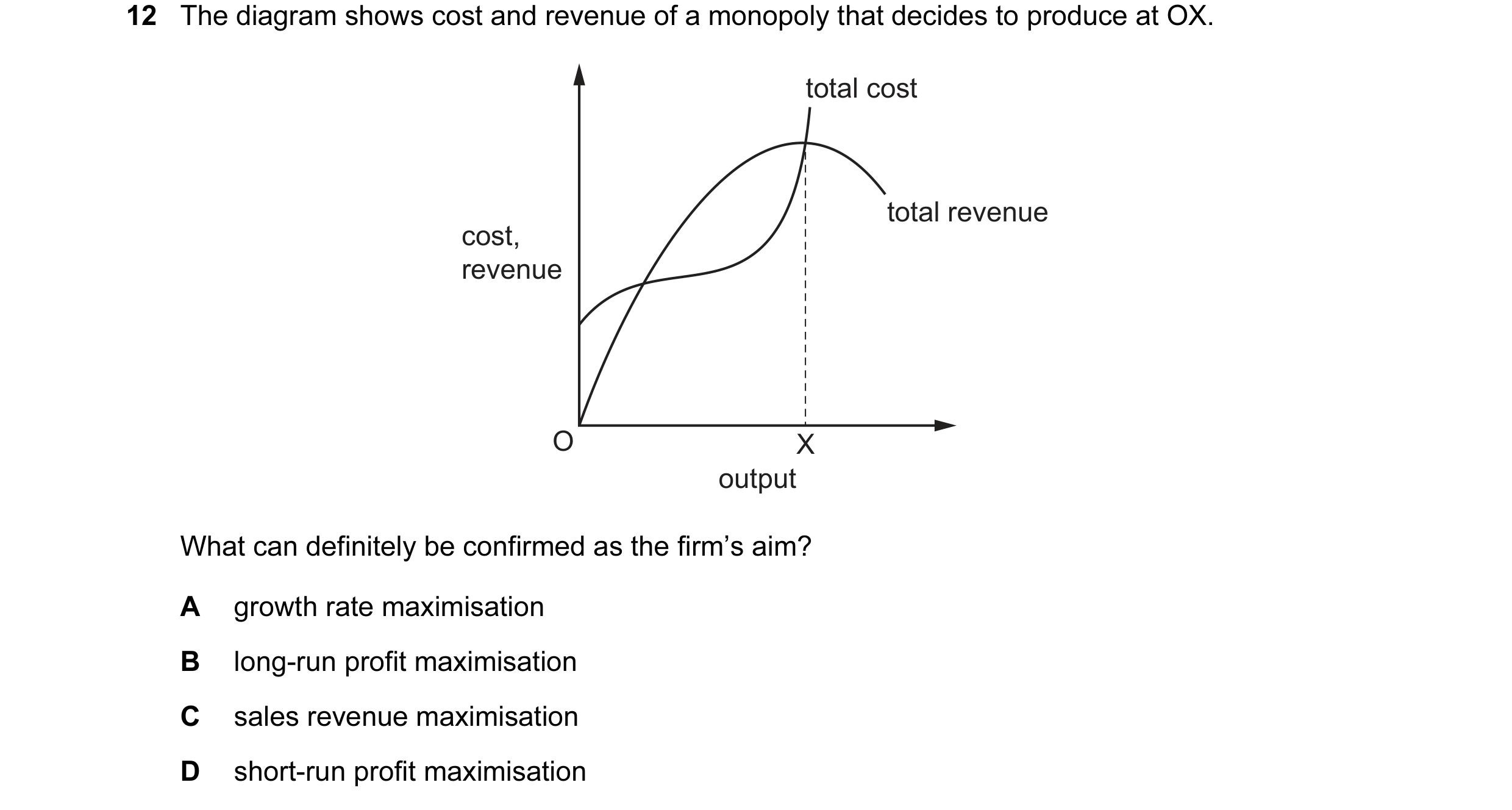
 38 / 68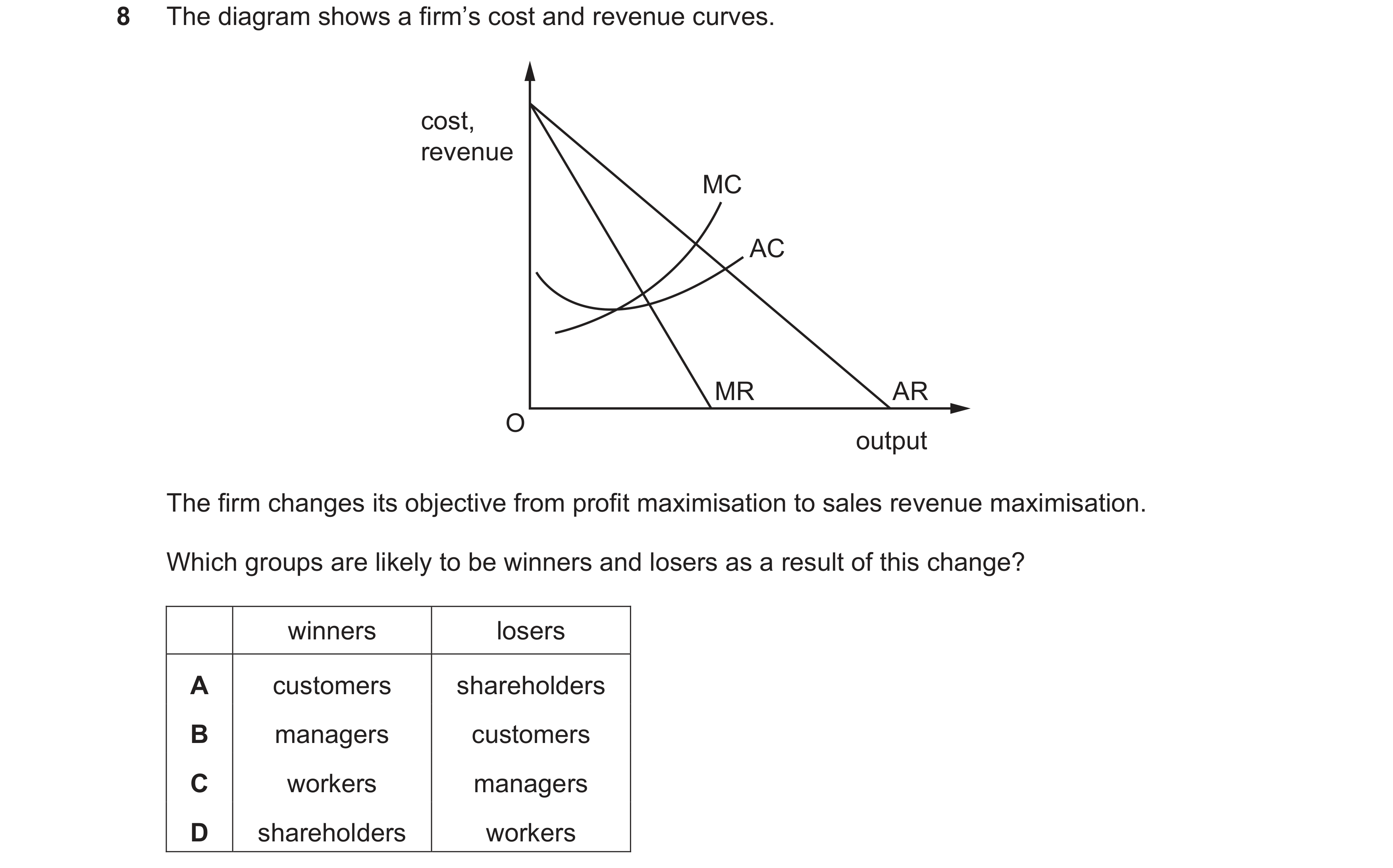
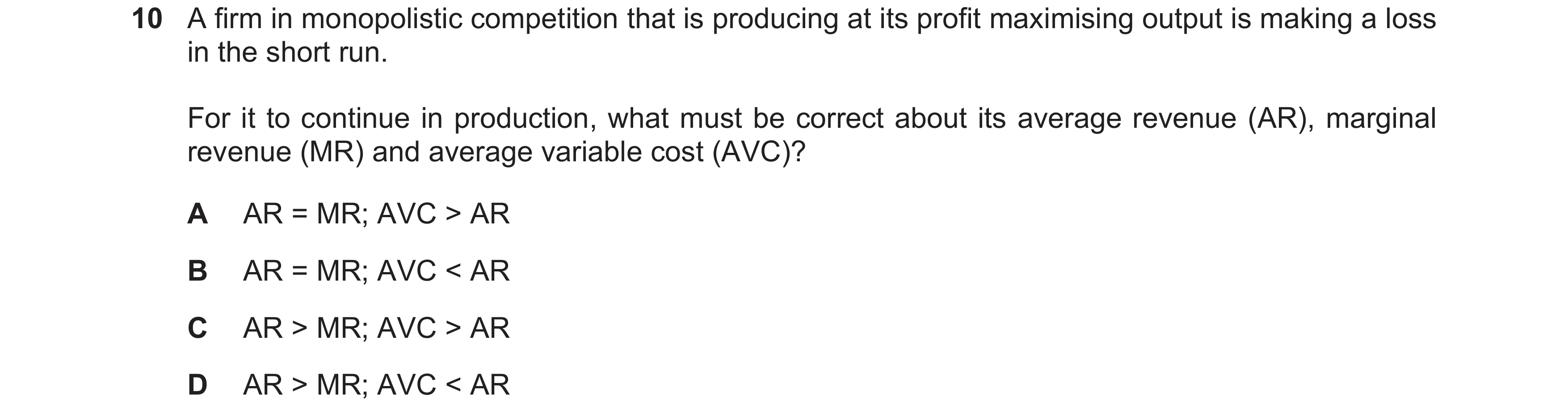 39 / 68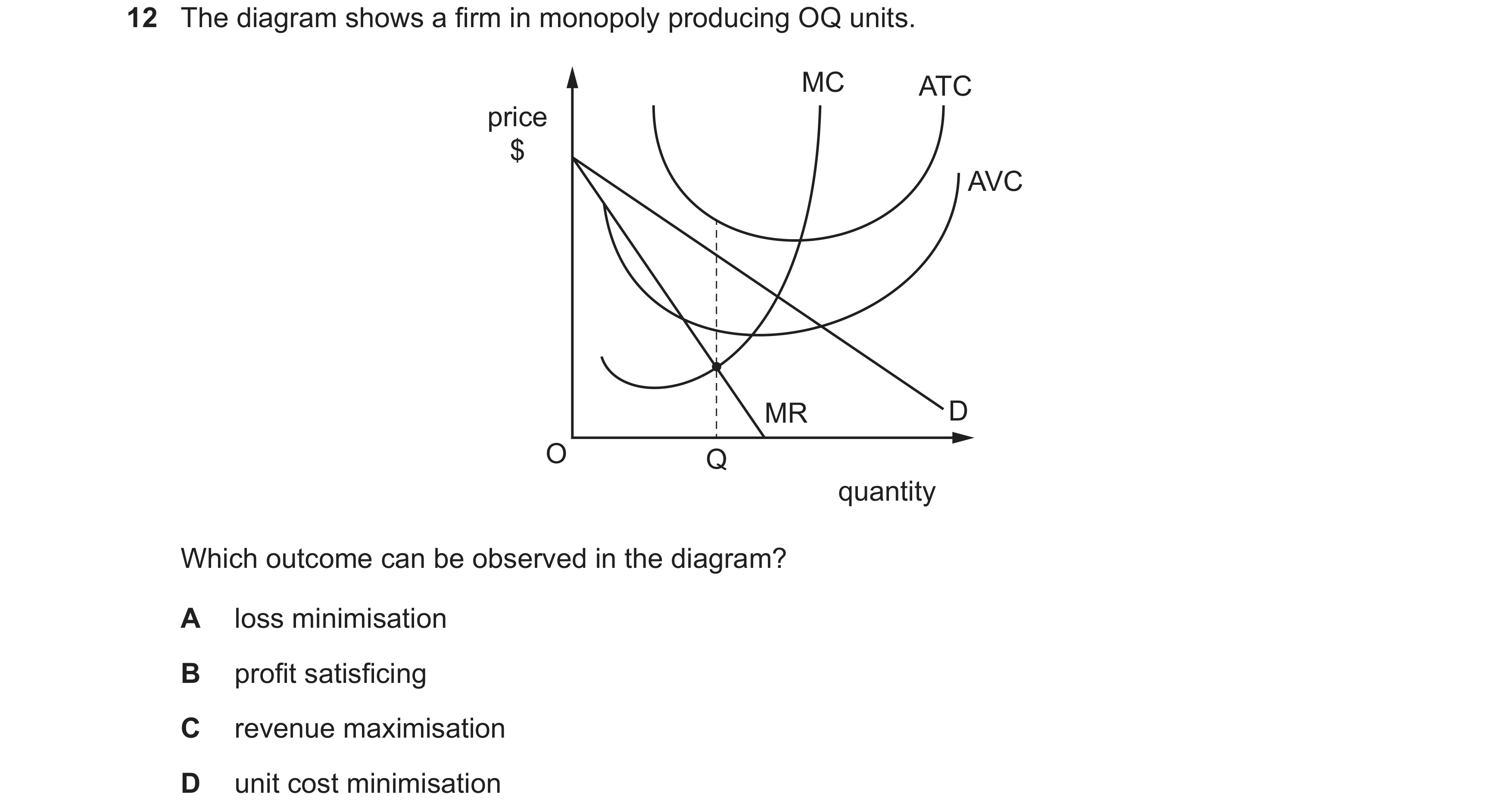
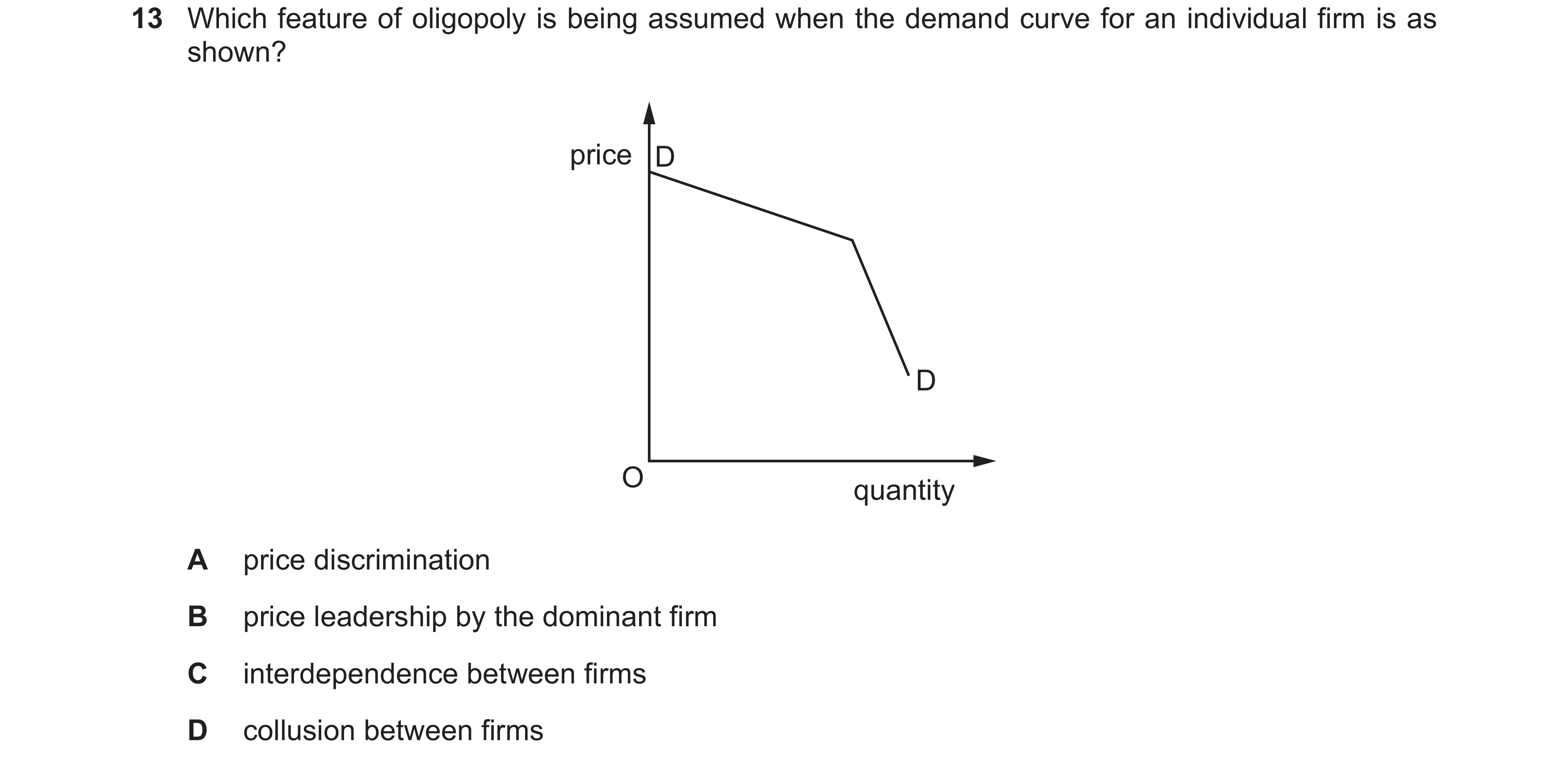 40 / 68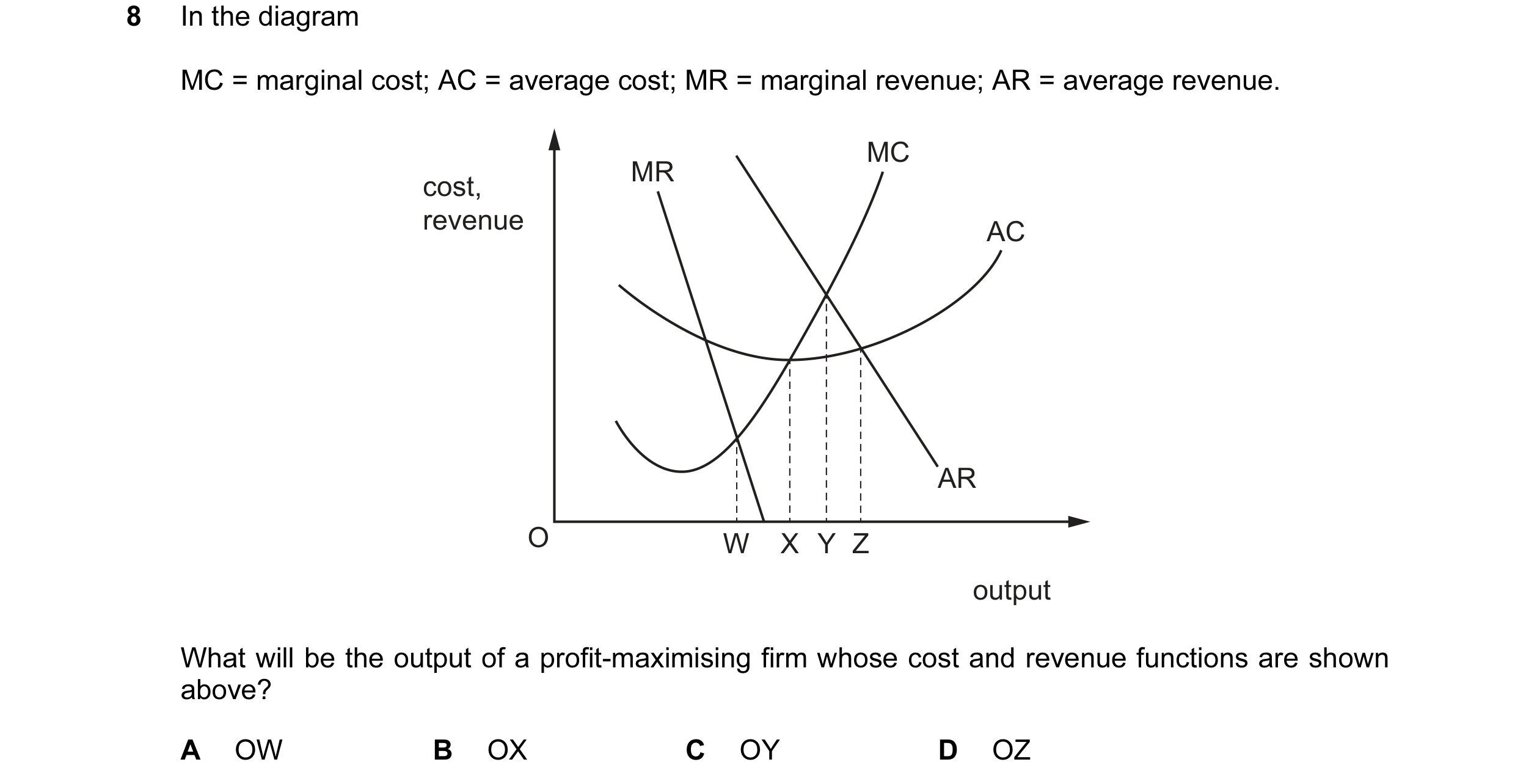
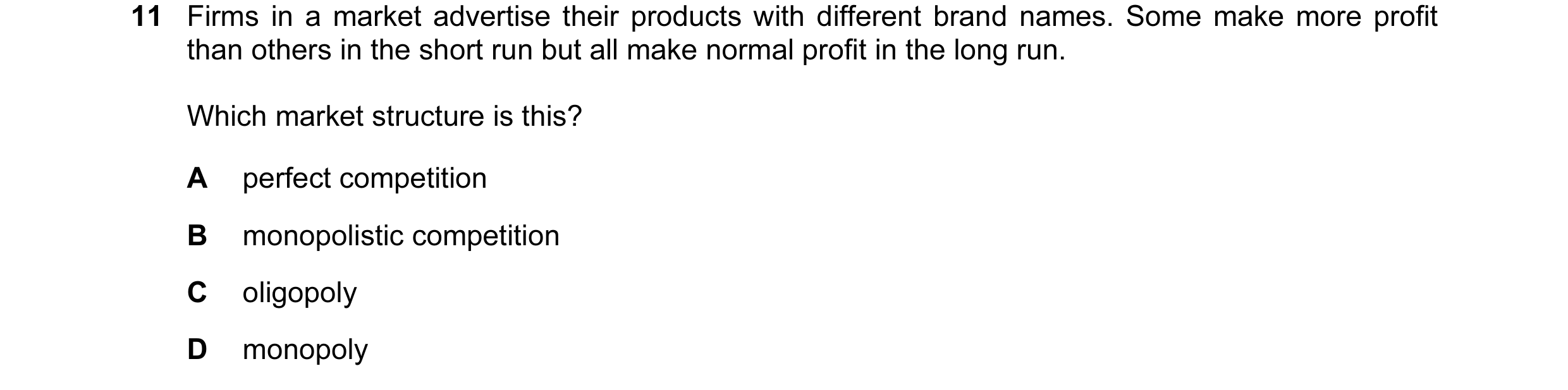
 41 / 68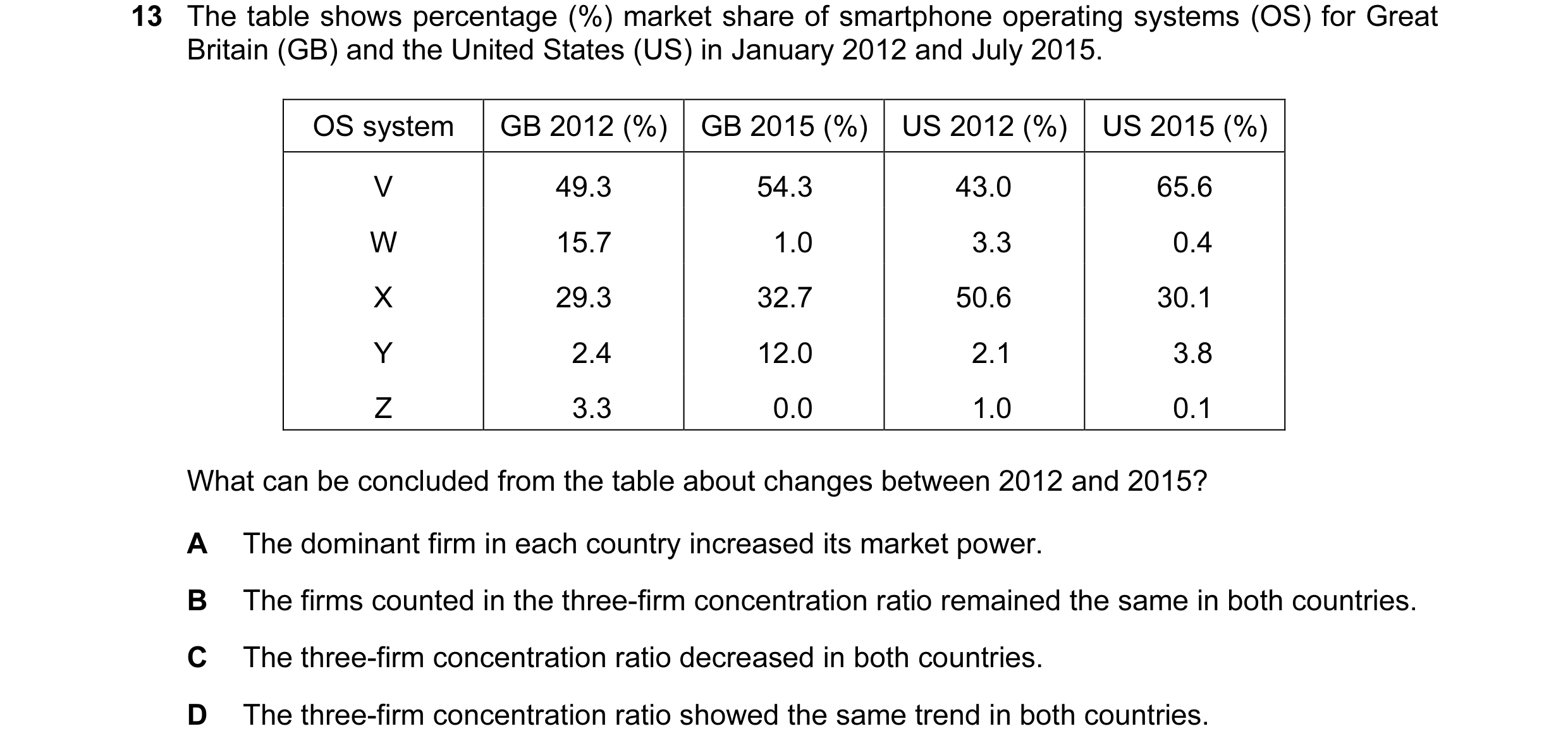

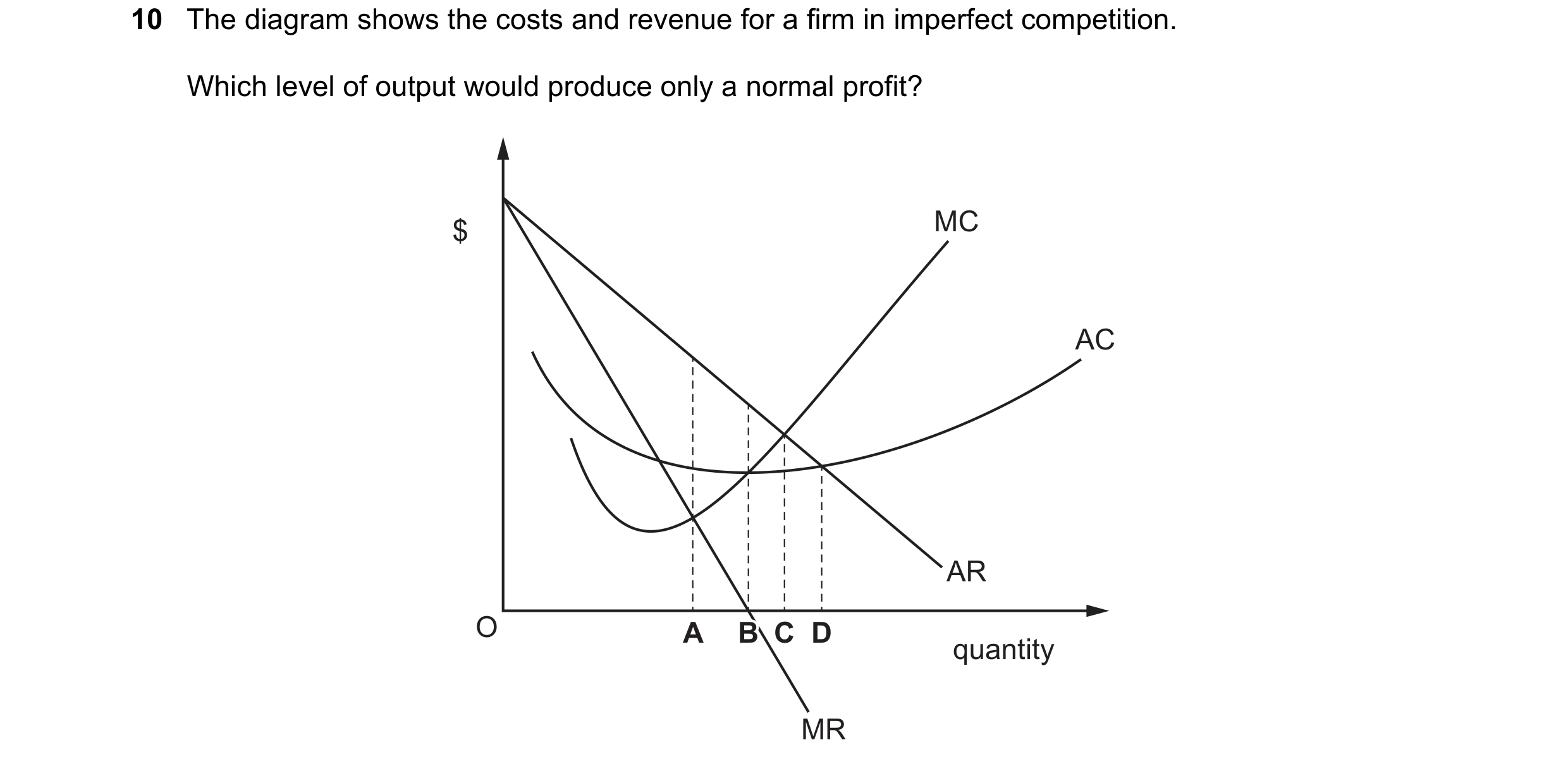
 42 / 68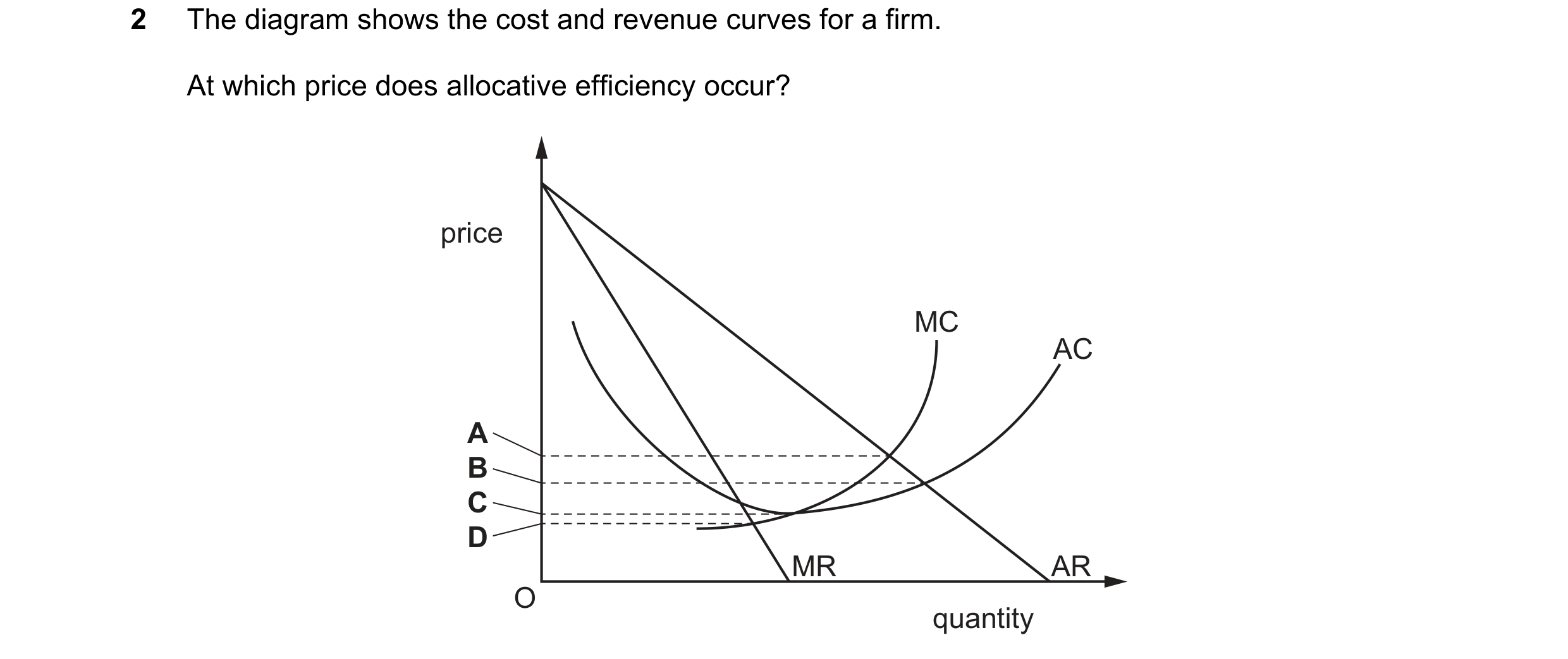
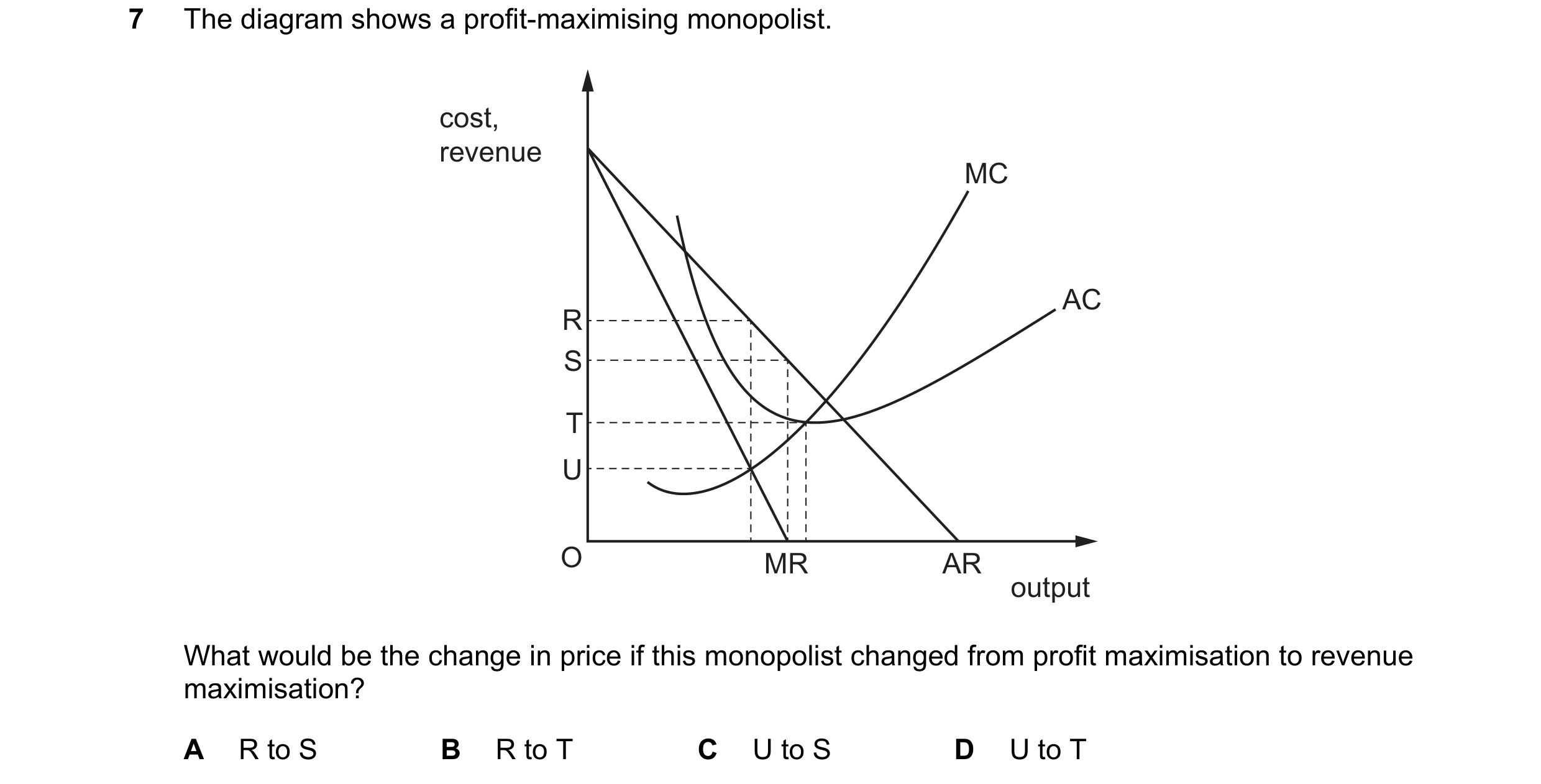
 43 / 68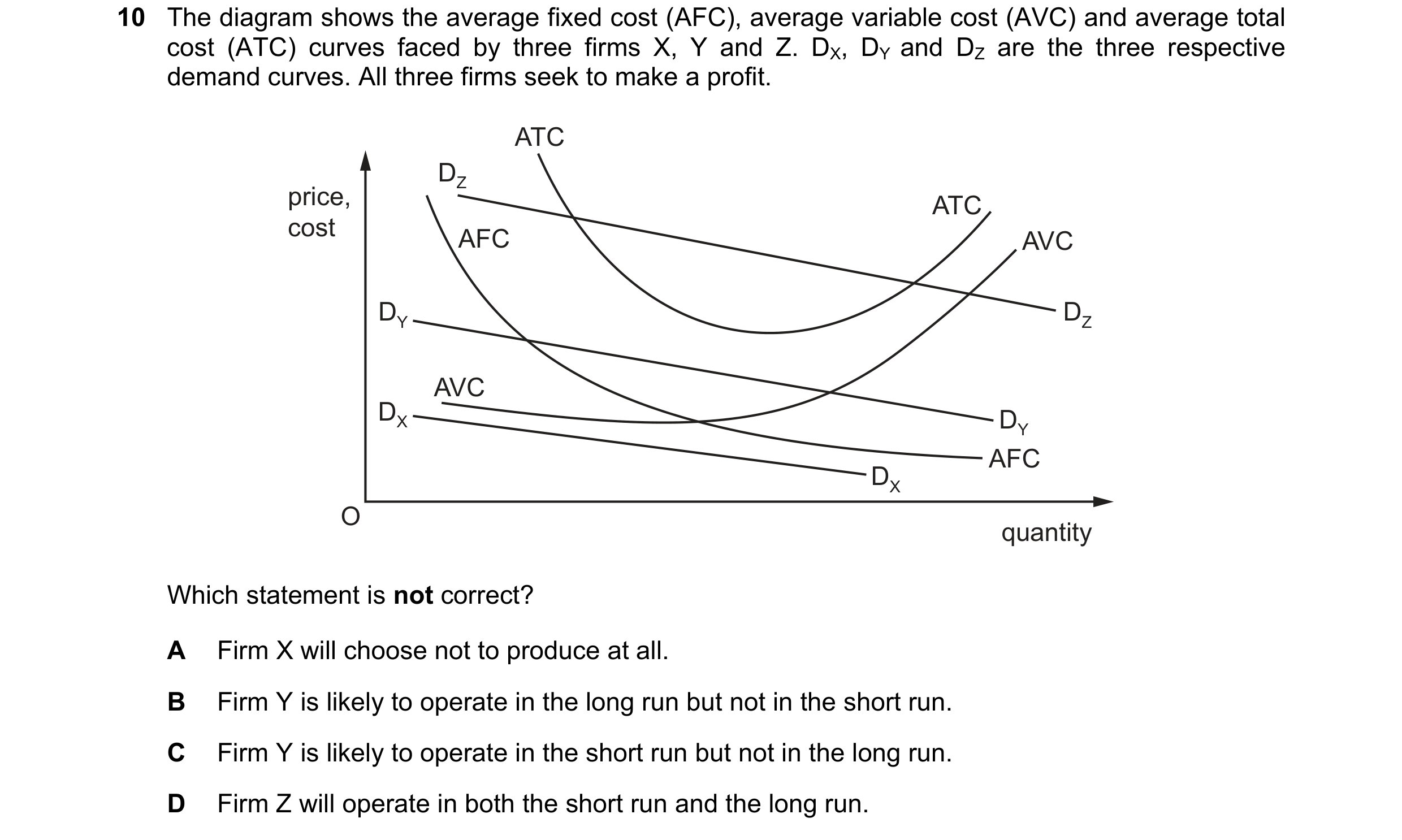
 44 / 68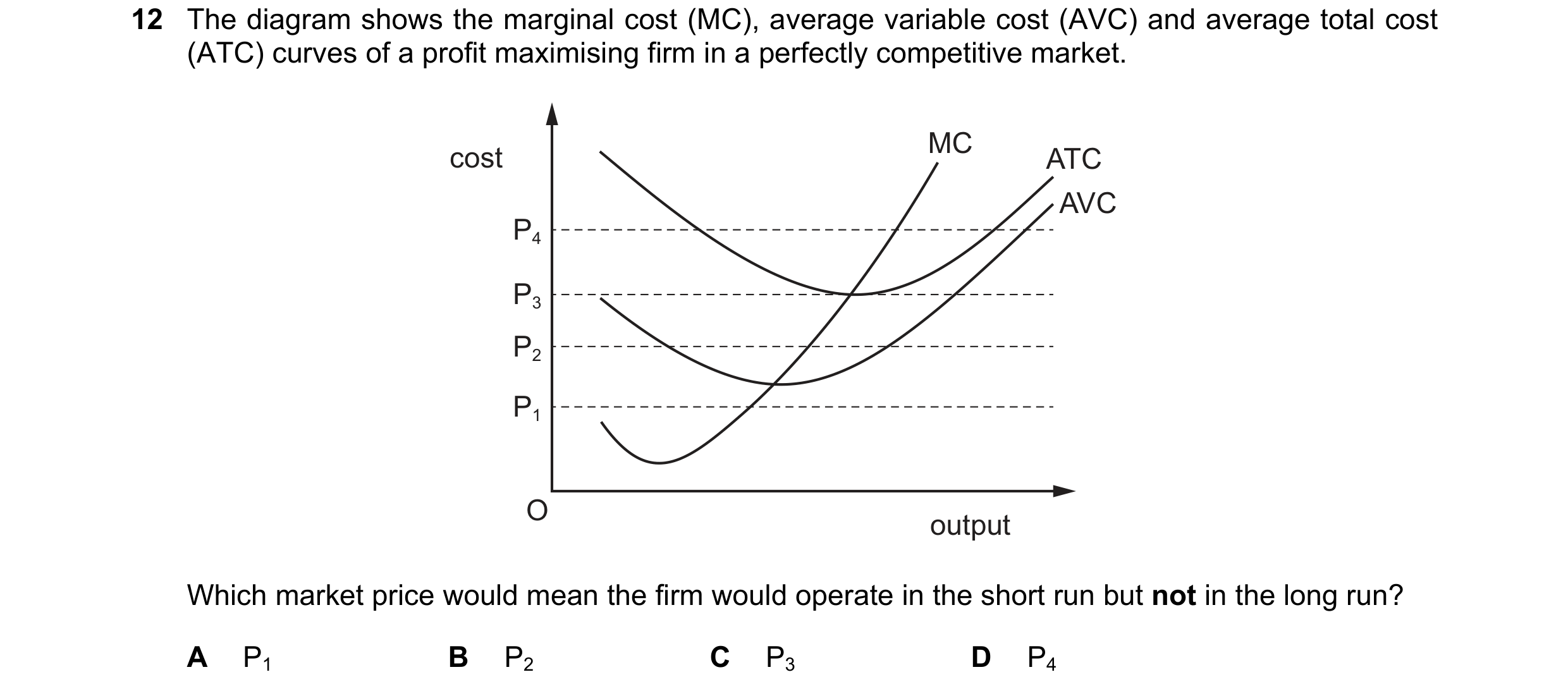


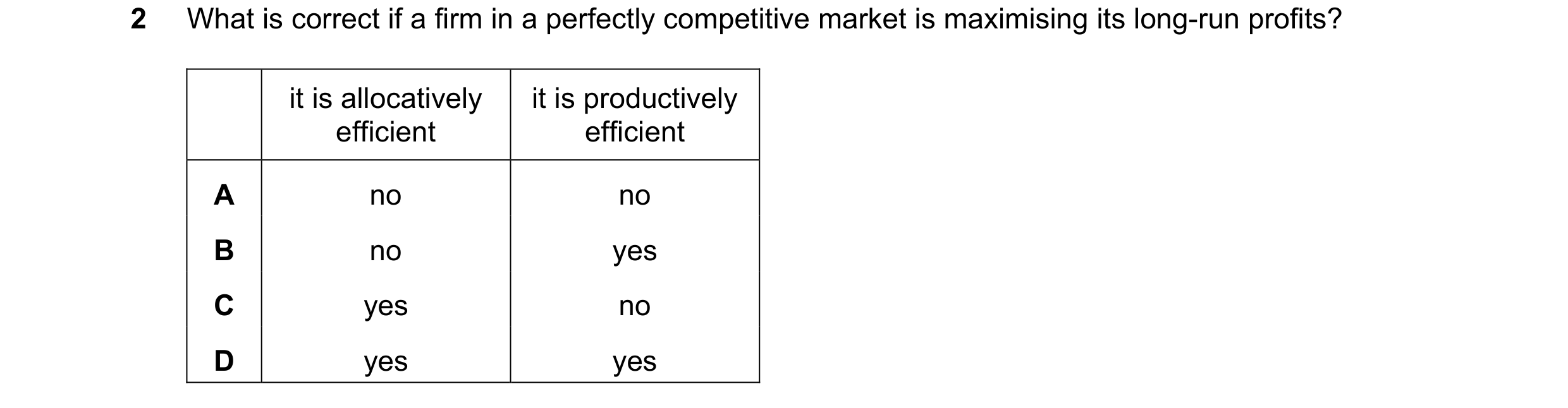 45 / 68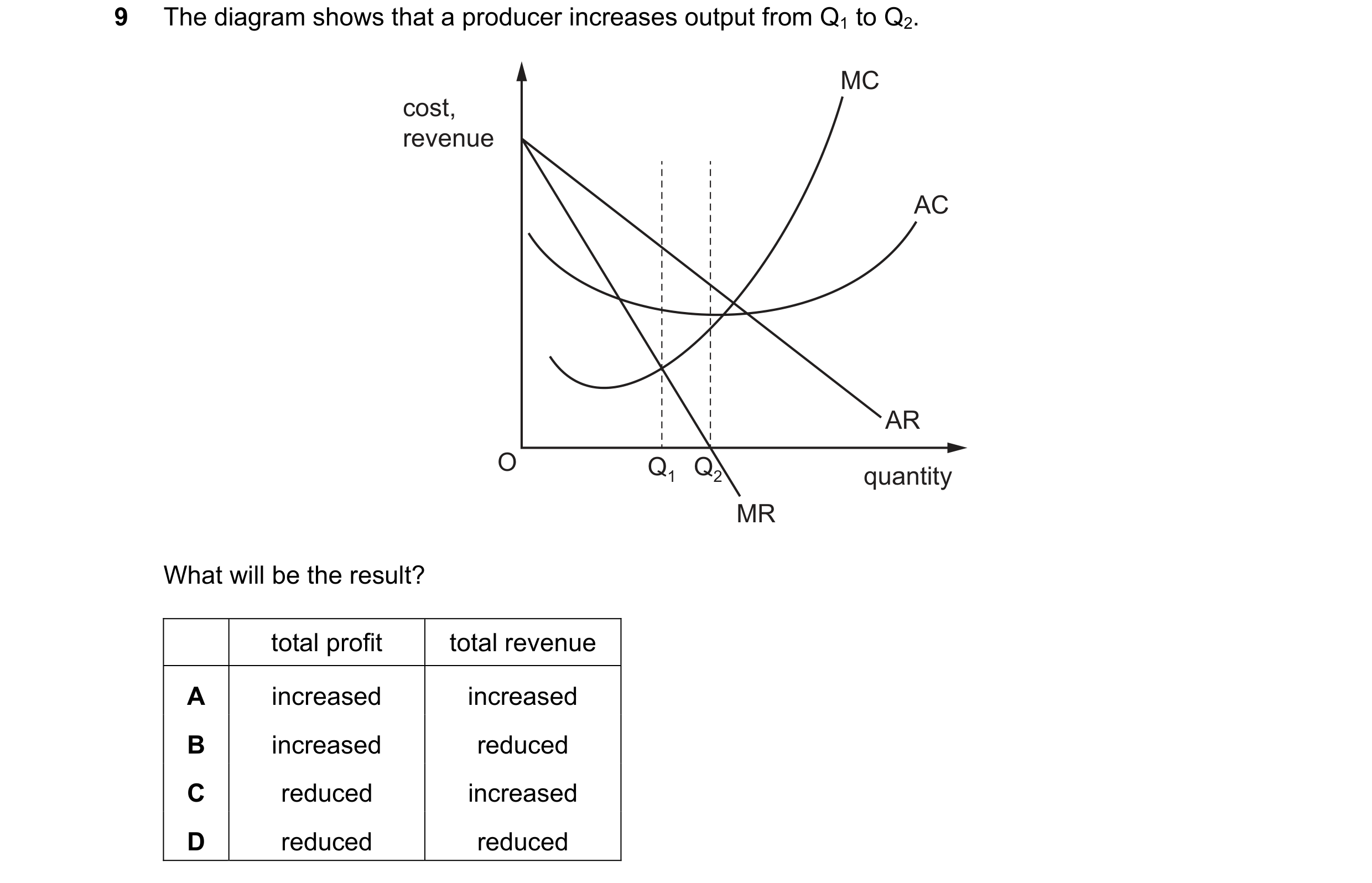
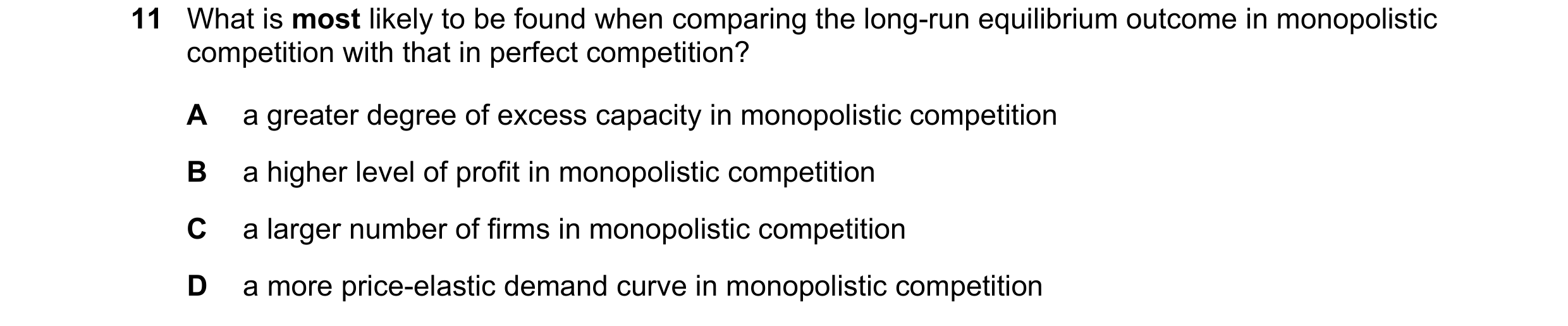
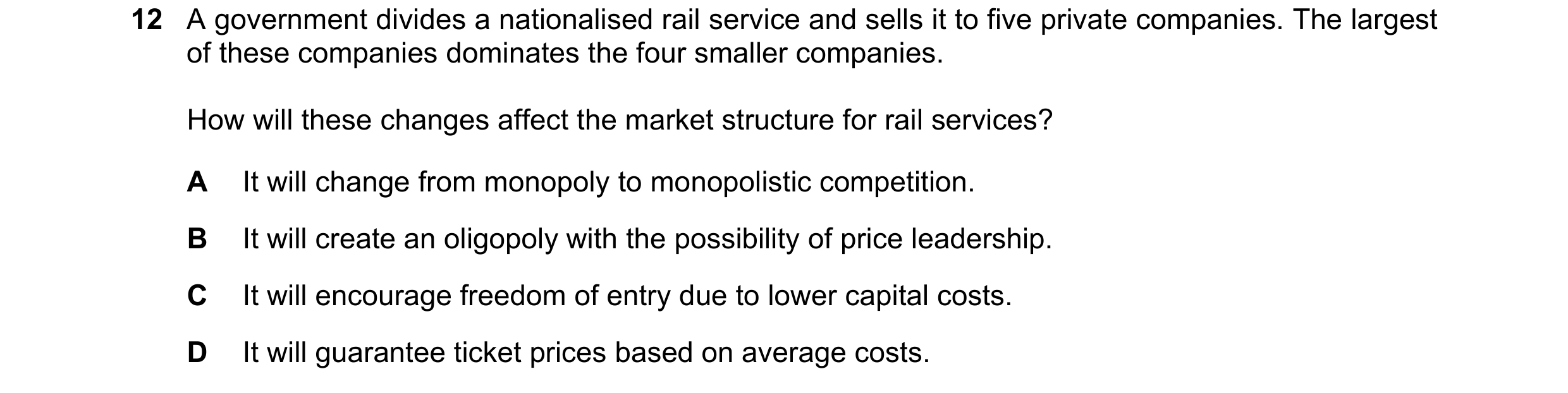 46 / 68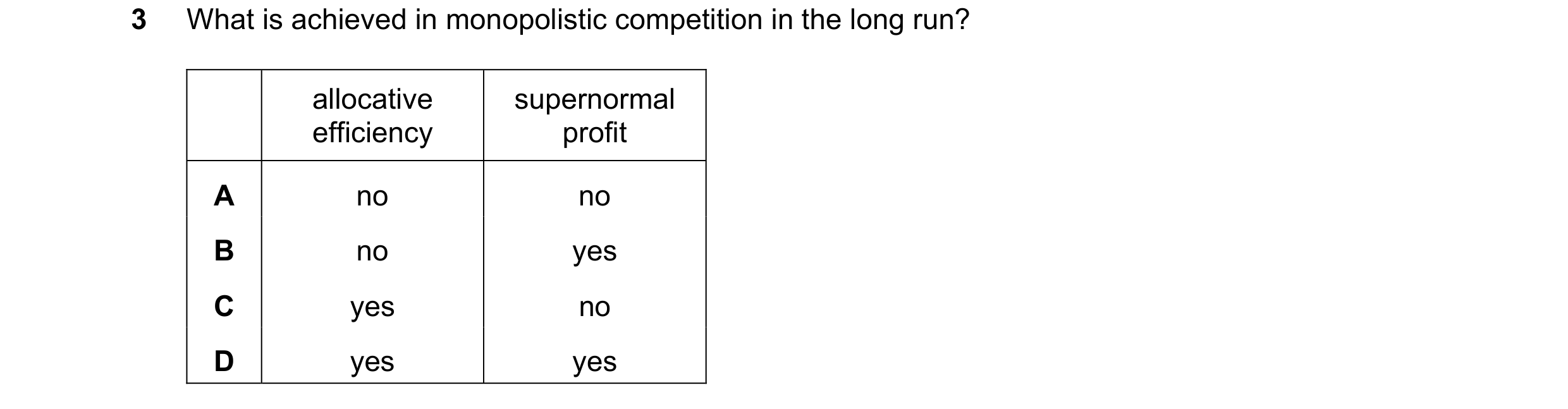

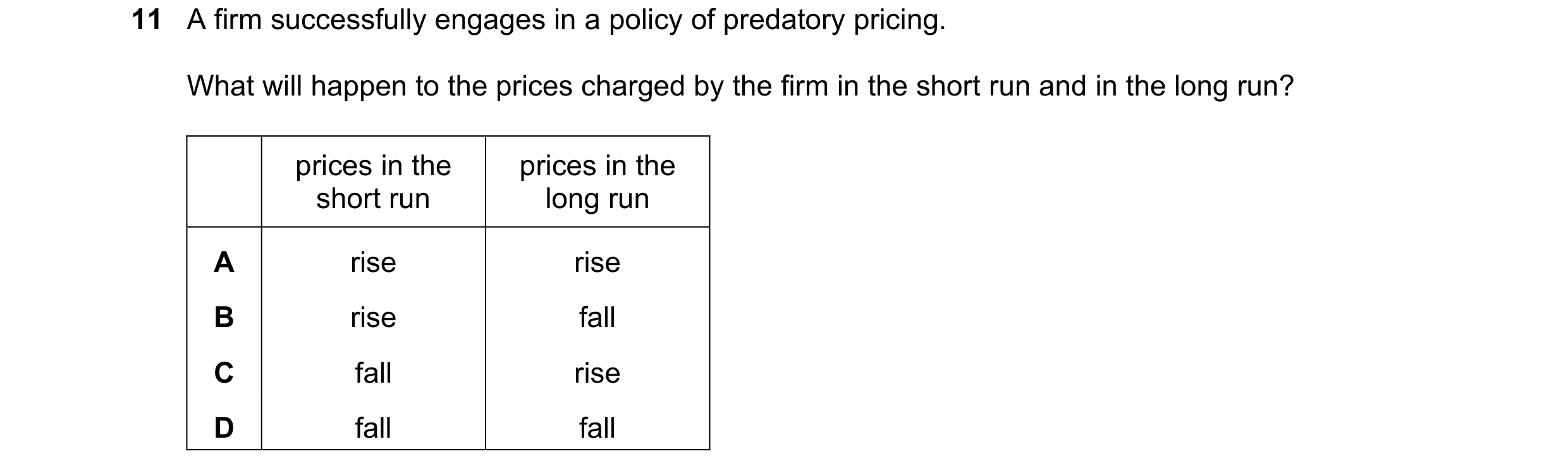
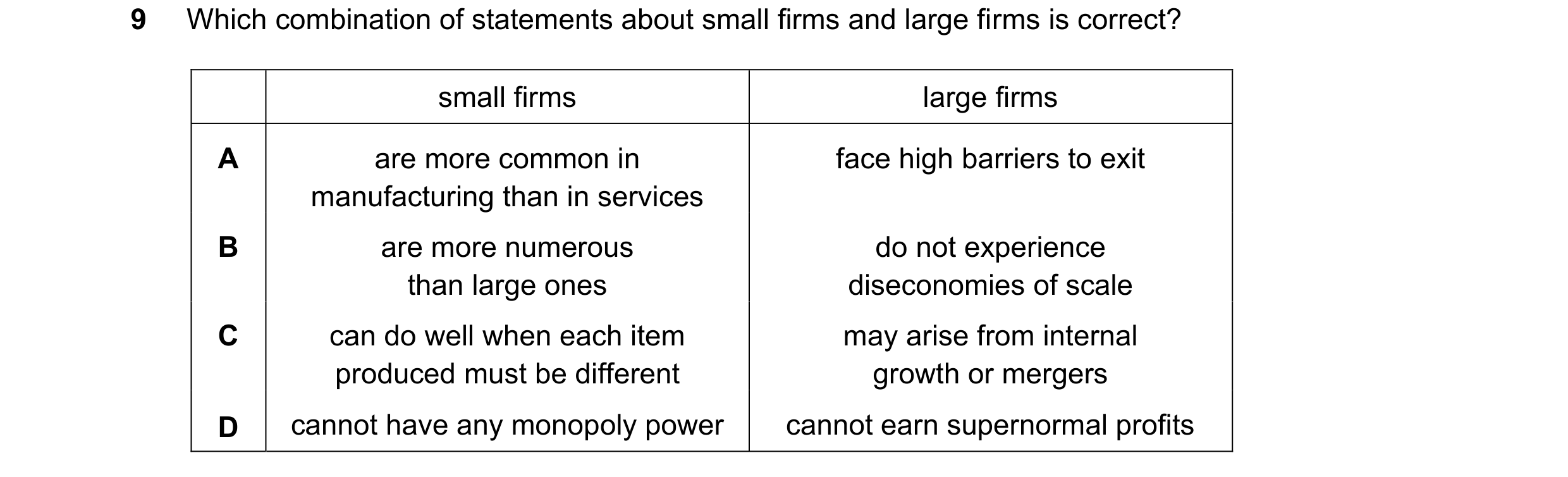
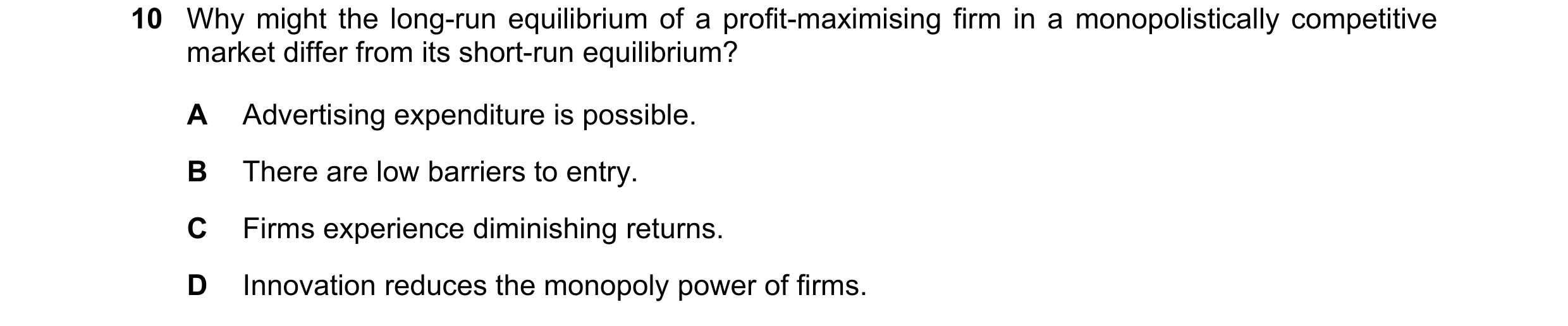 47 / 68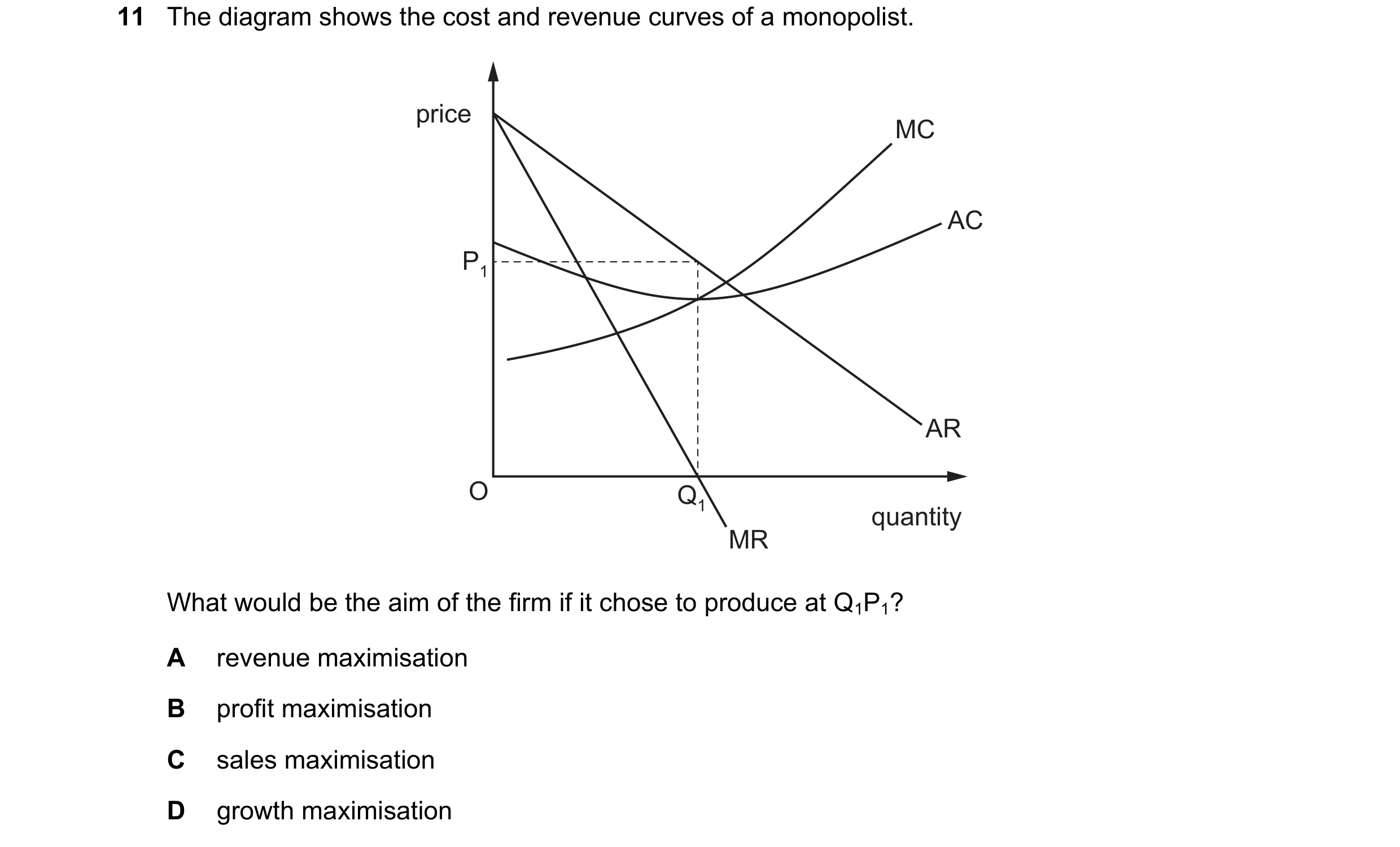
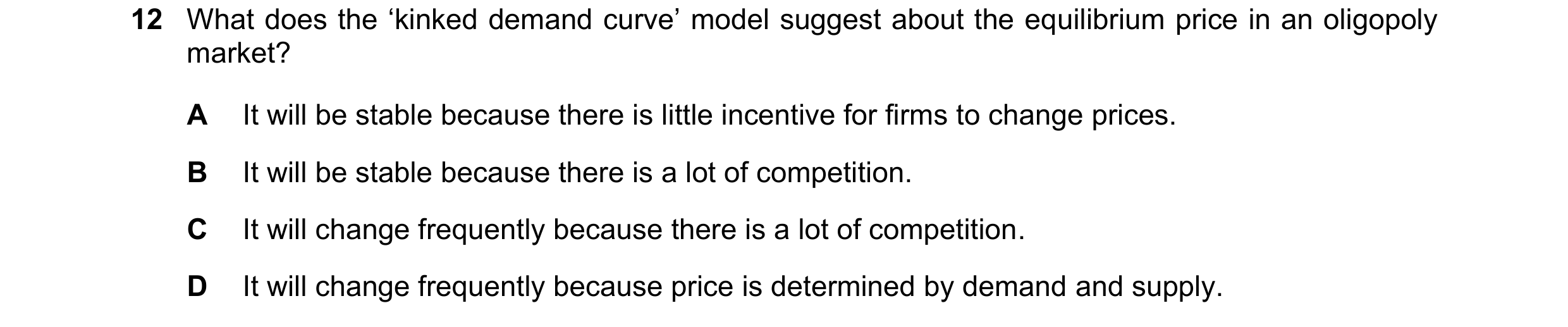
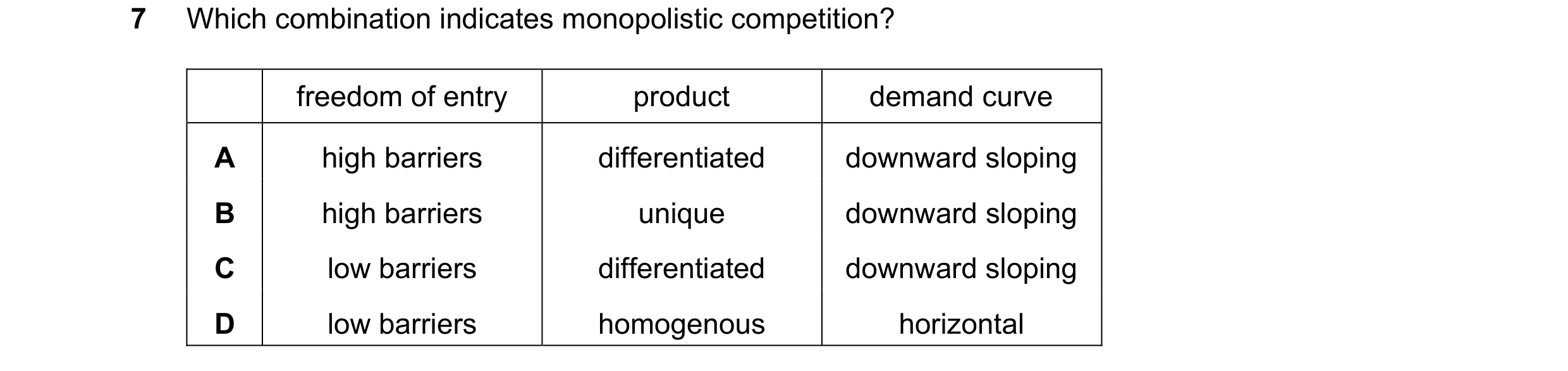 48 / 68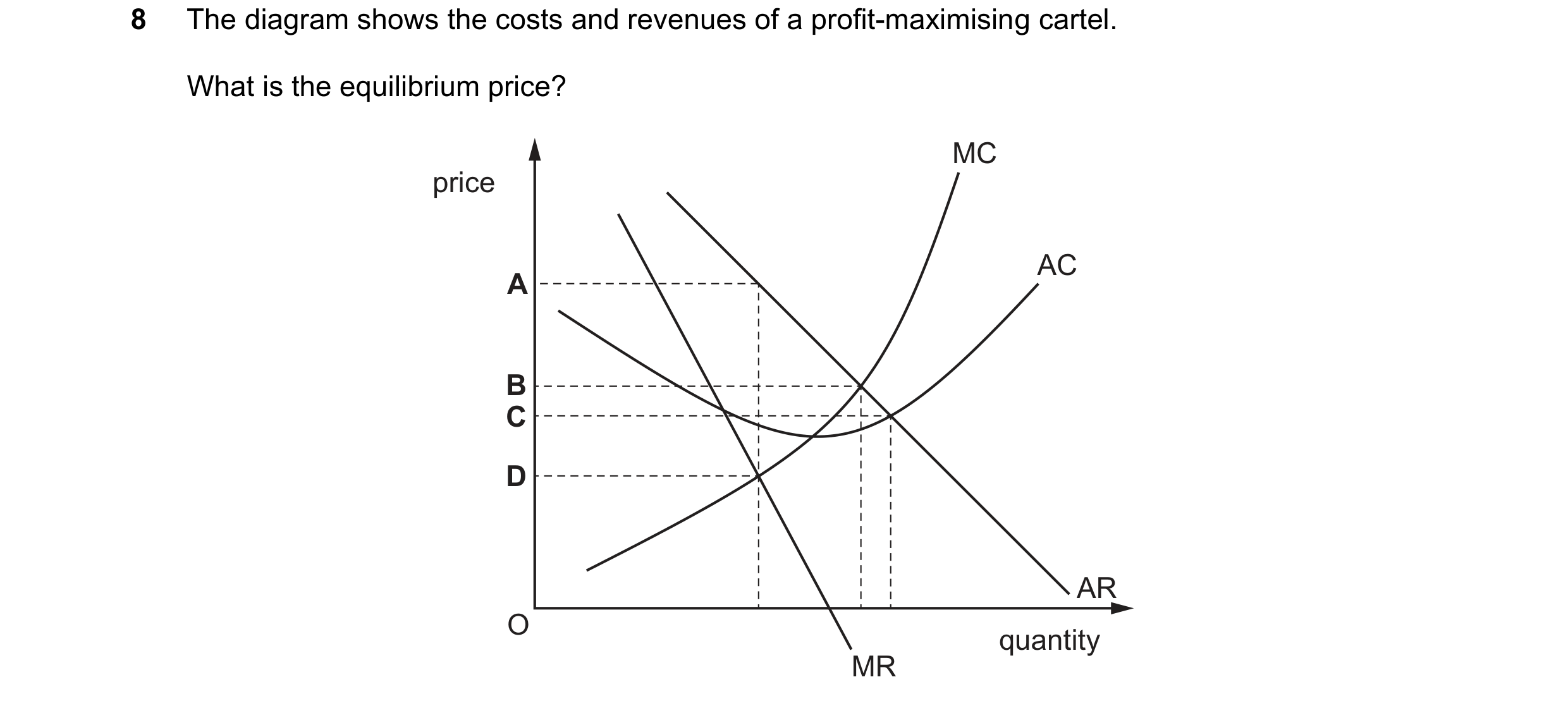

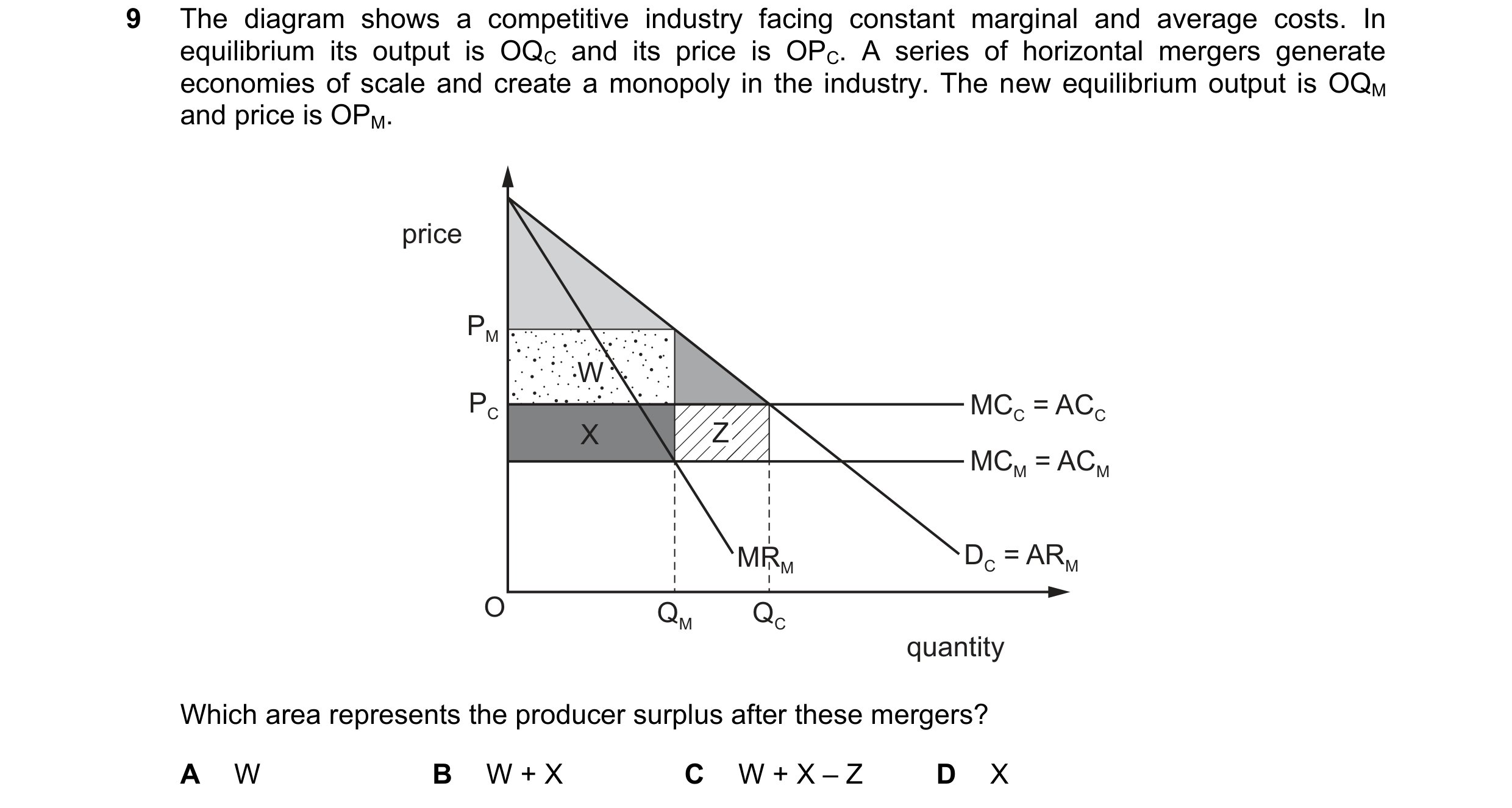 49 / 68
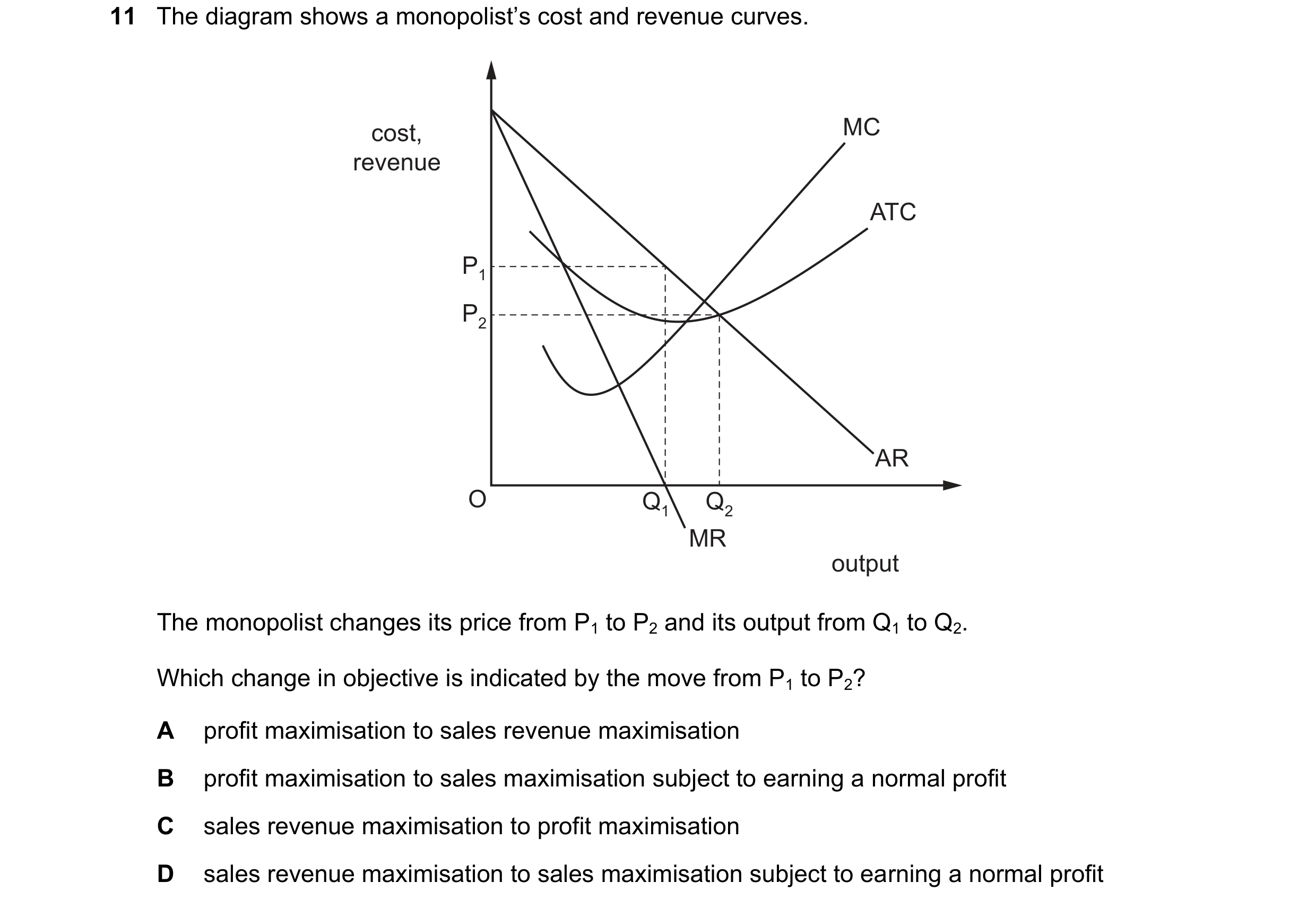 50 / 68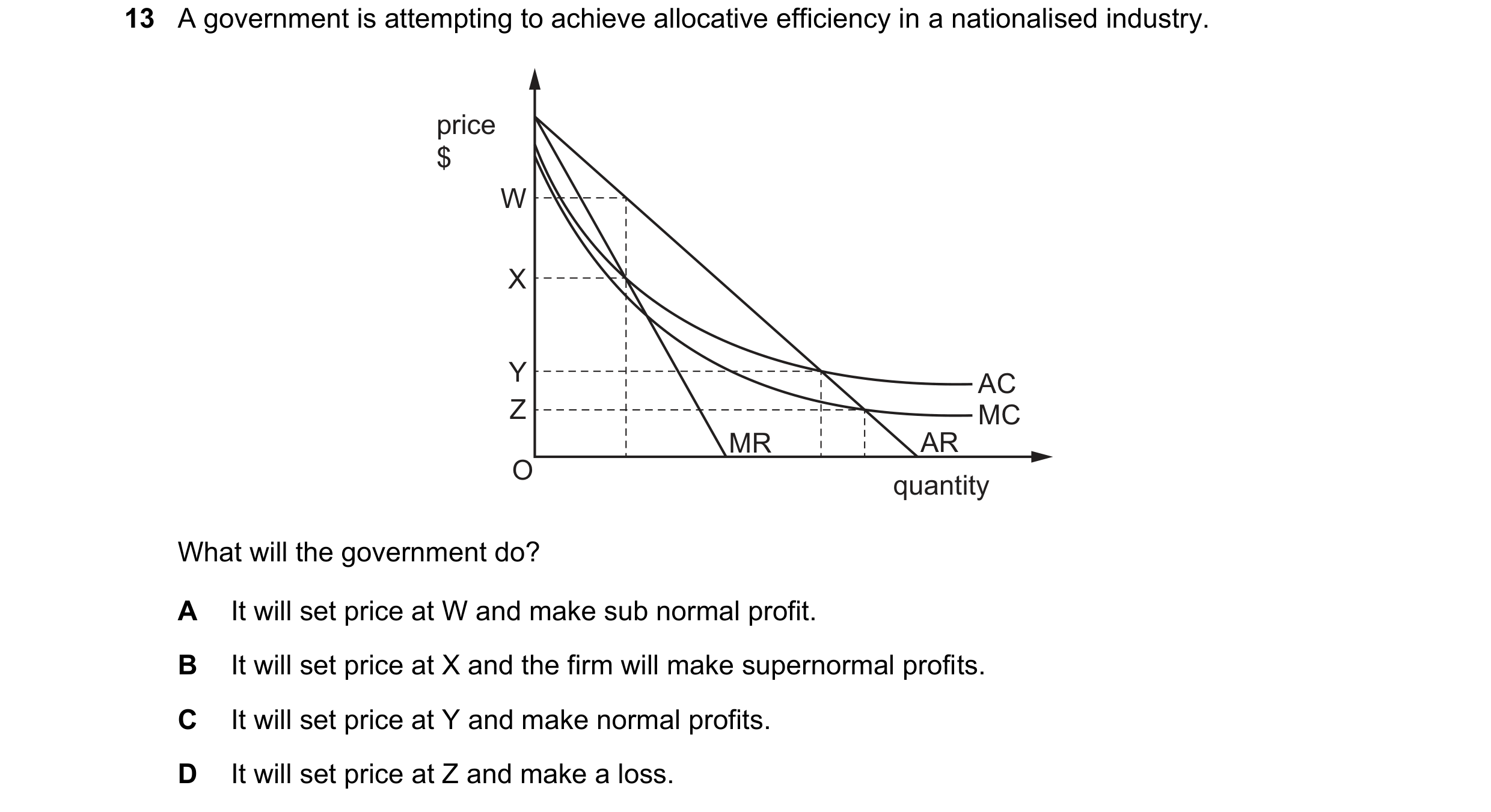
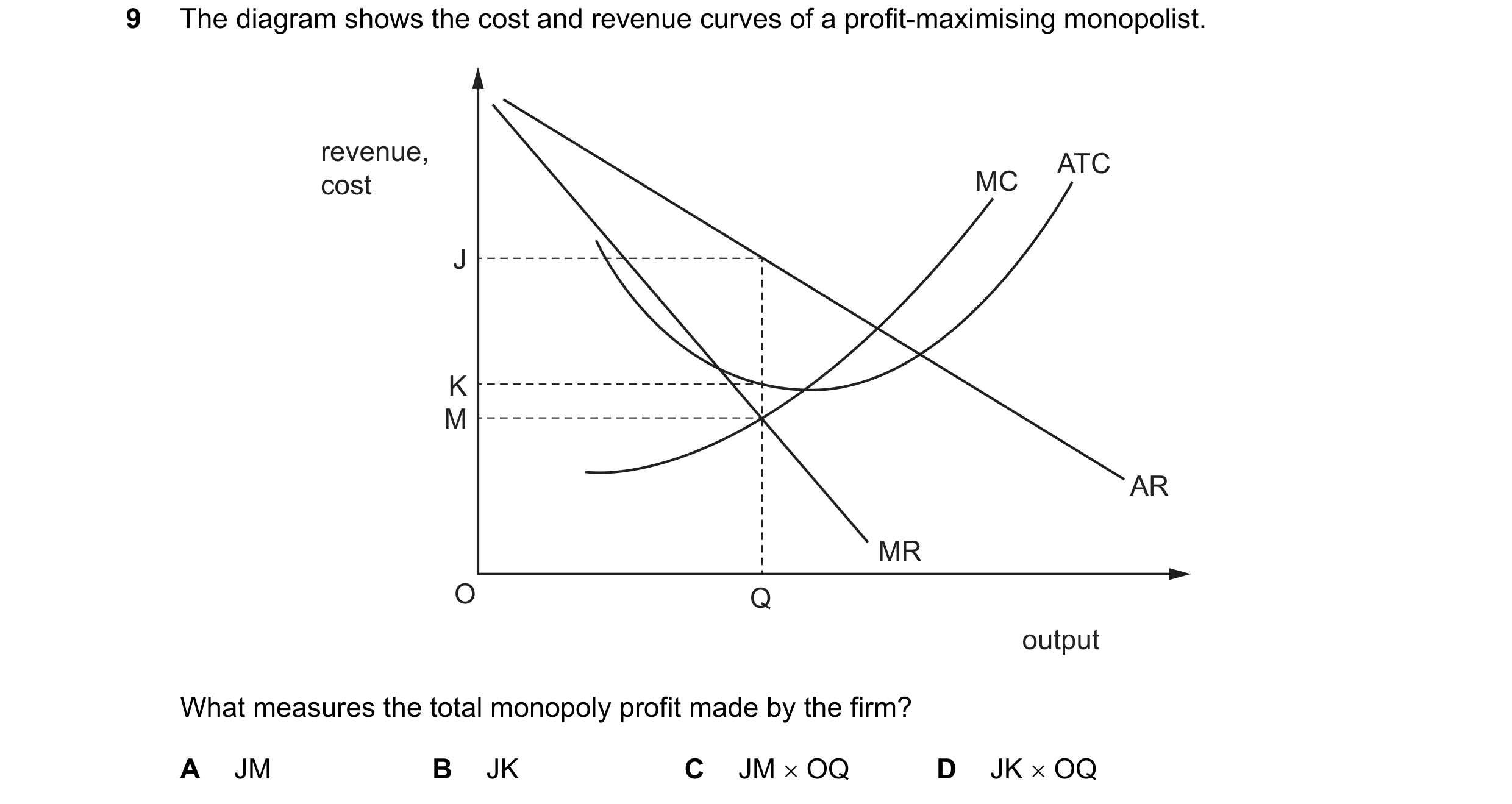 51 / 68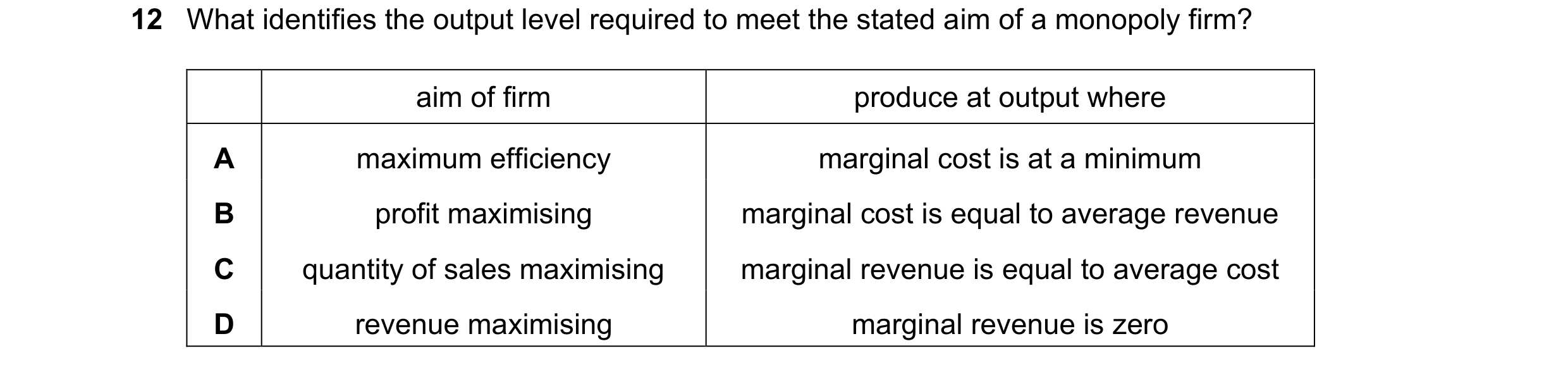
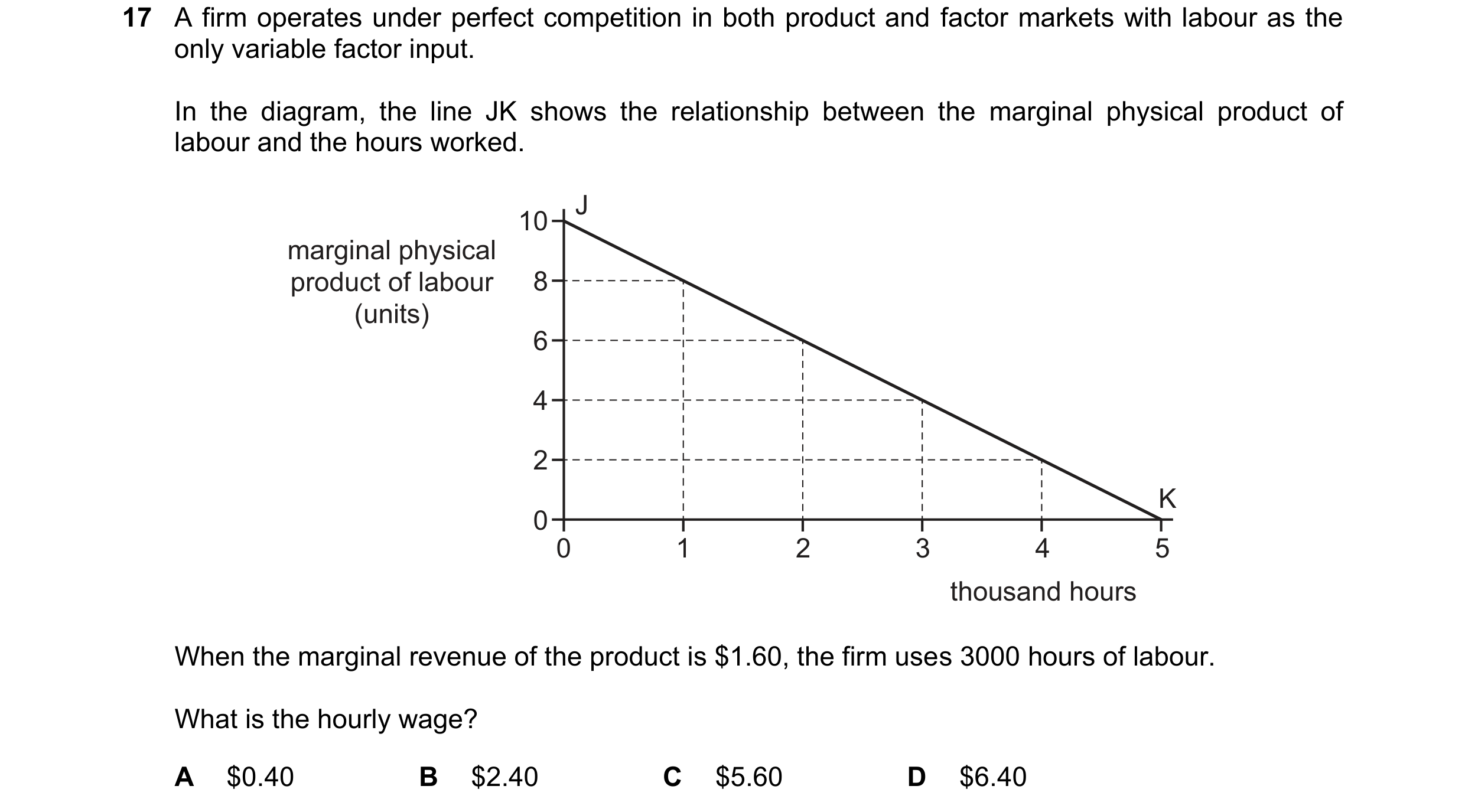
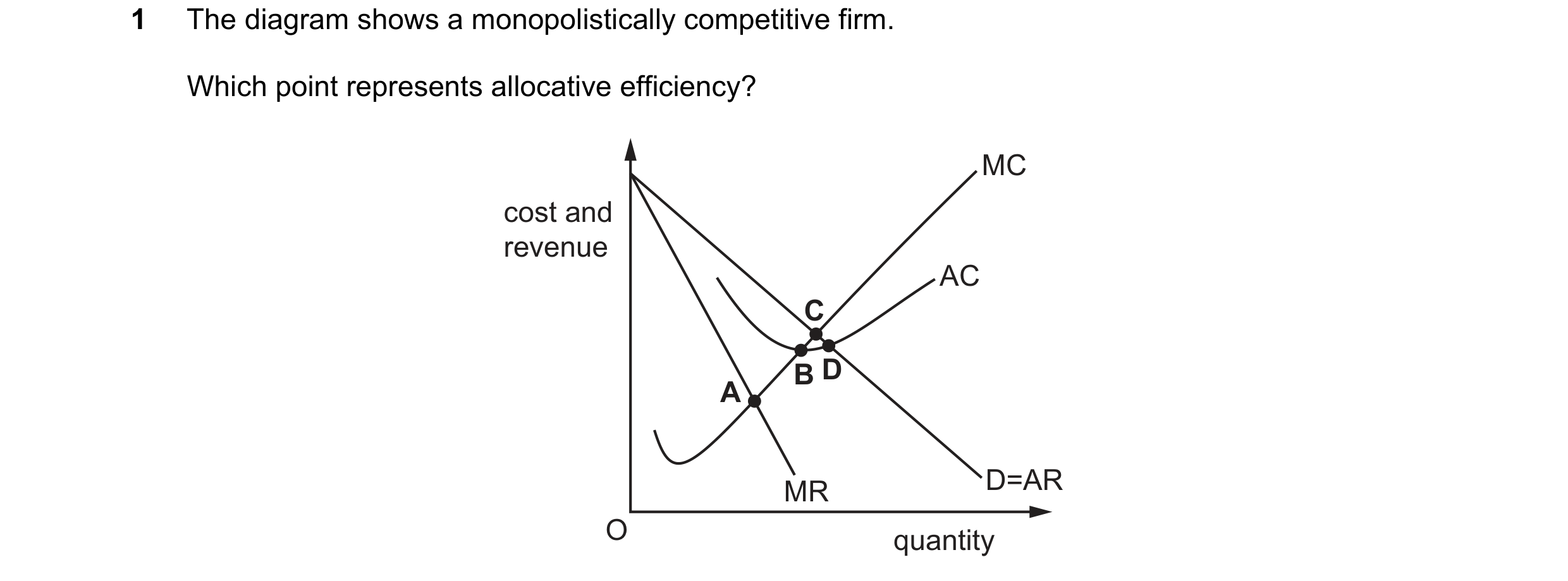
 52 / 68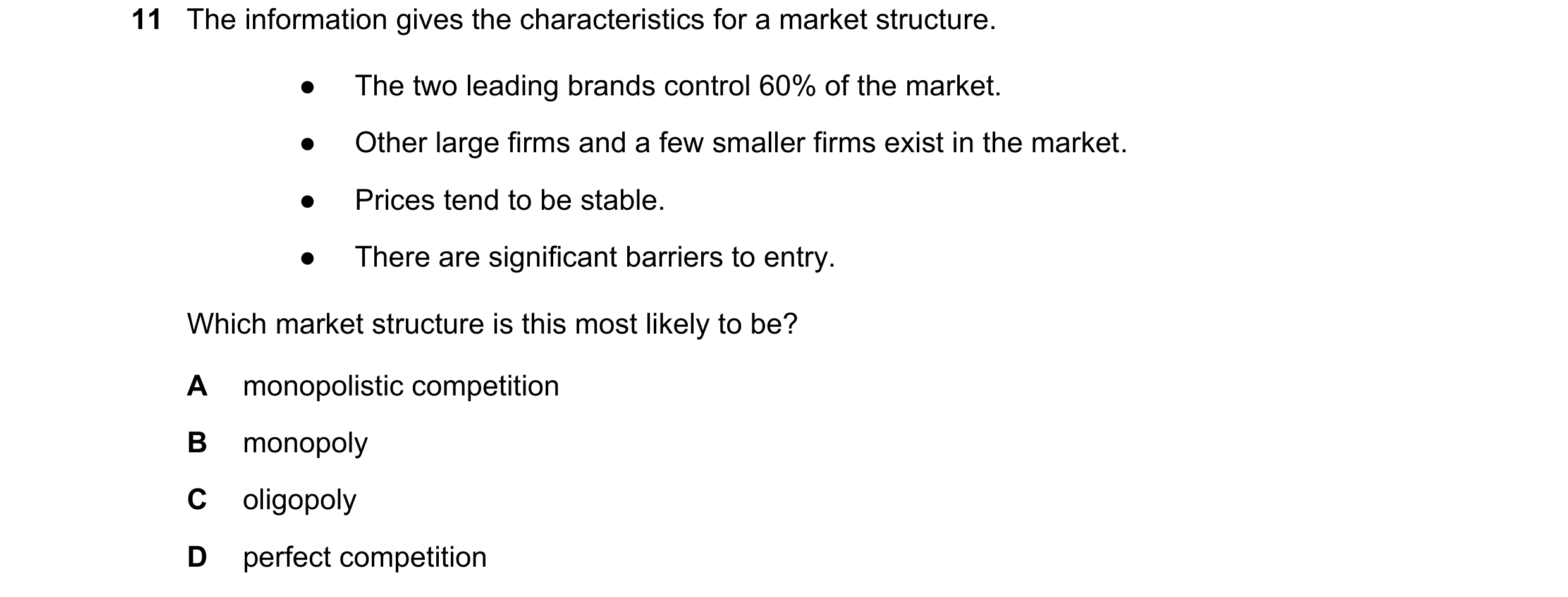
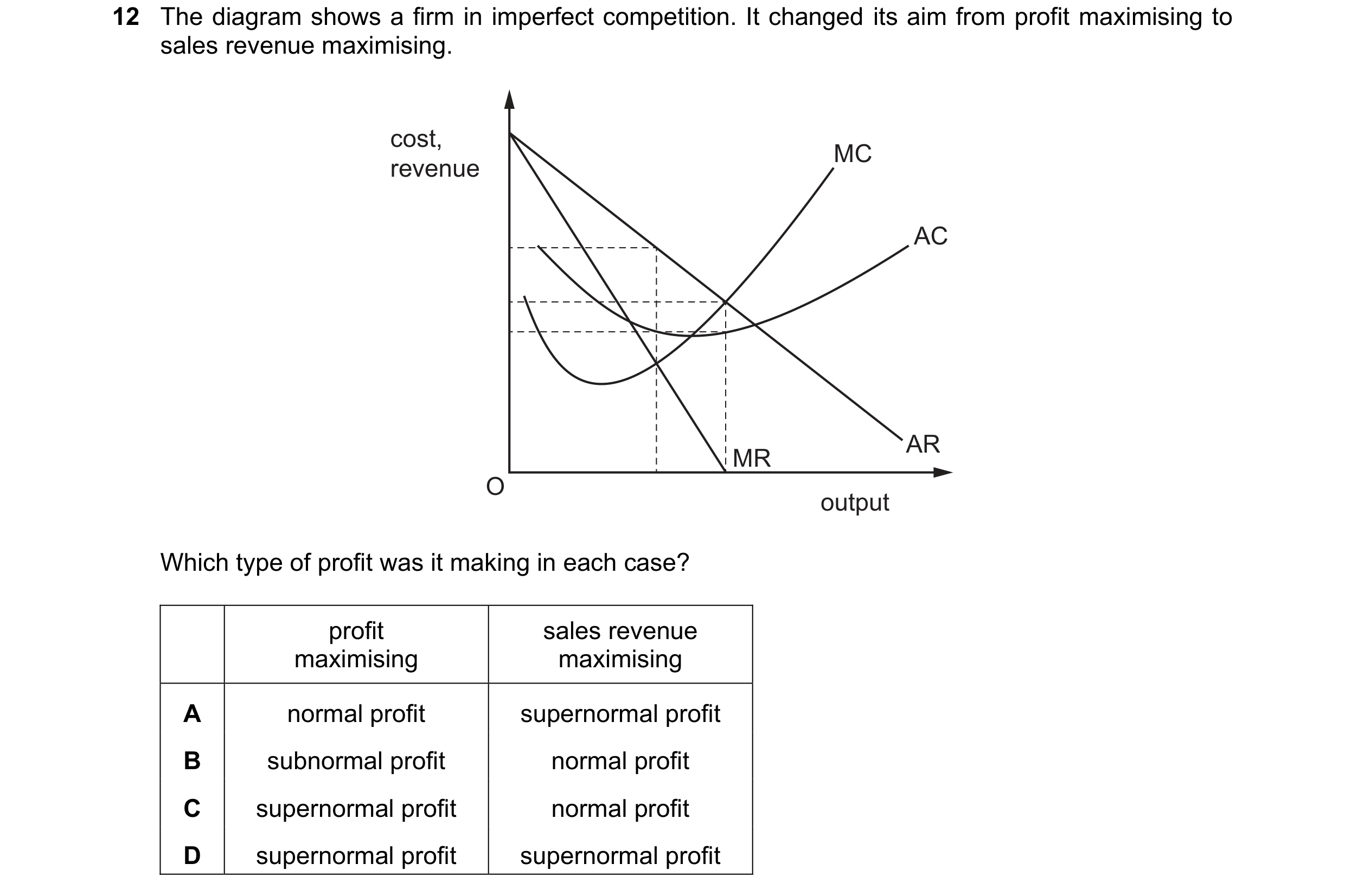
 53 / 68
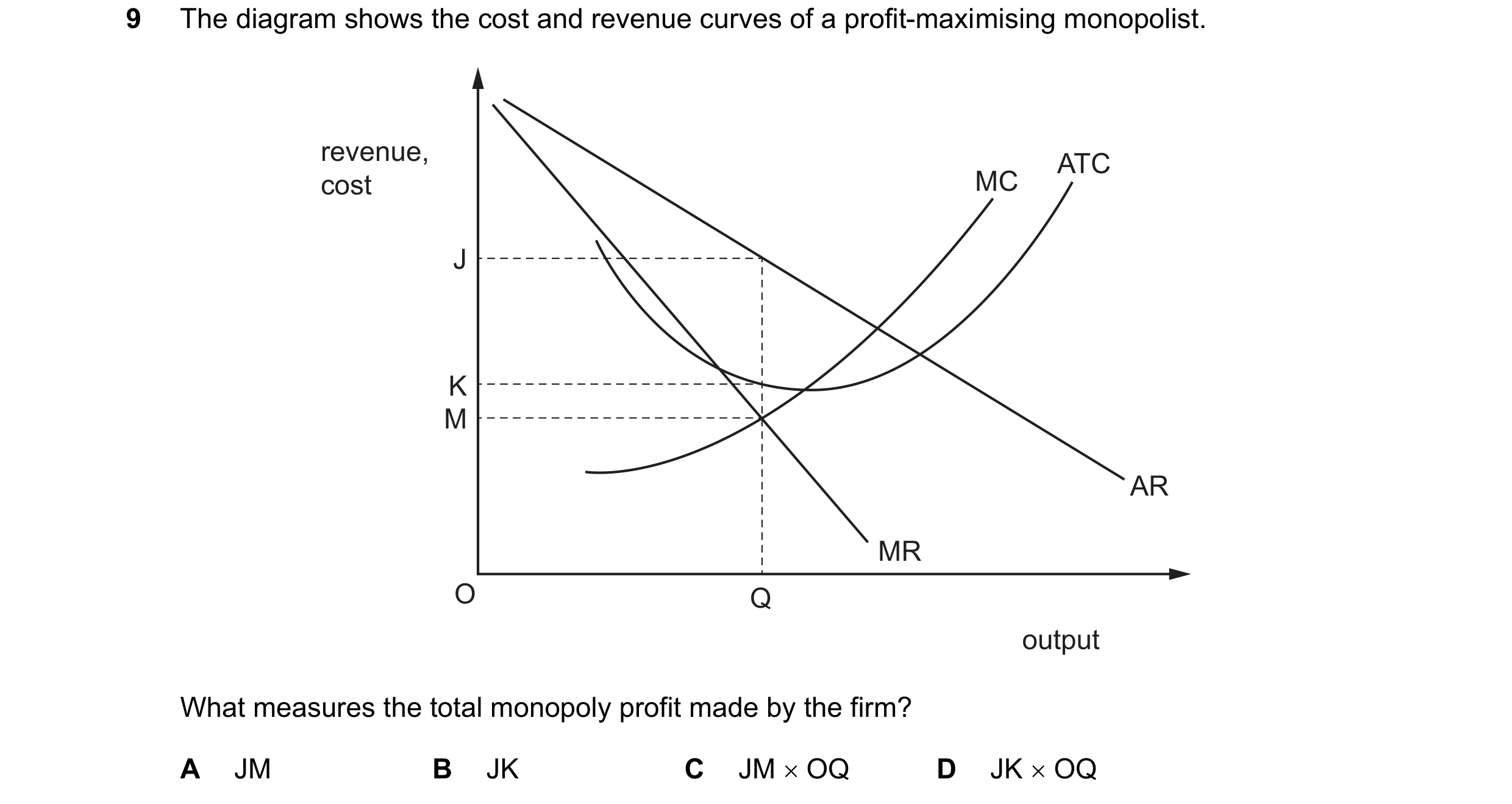
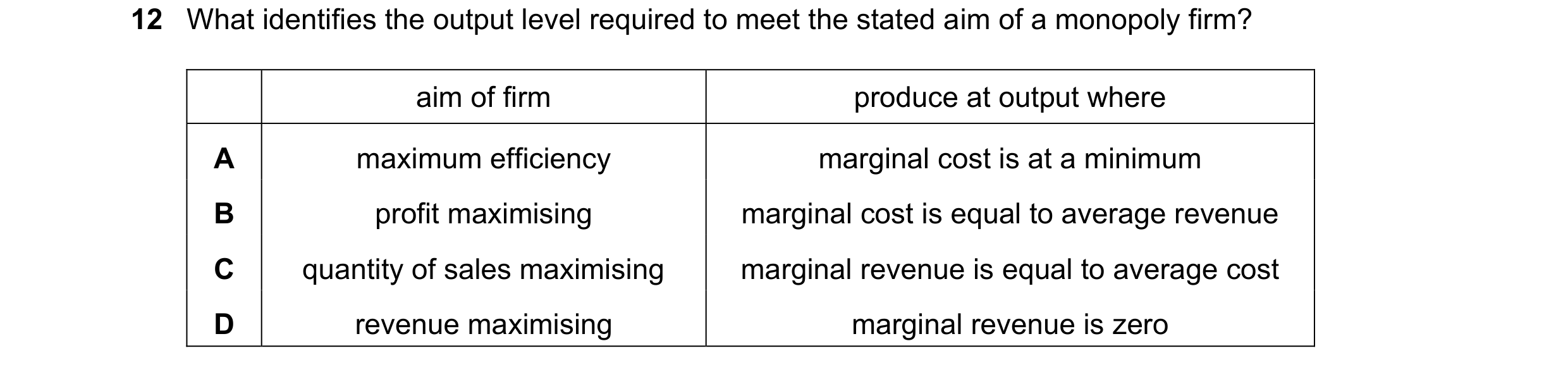 54 / 68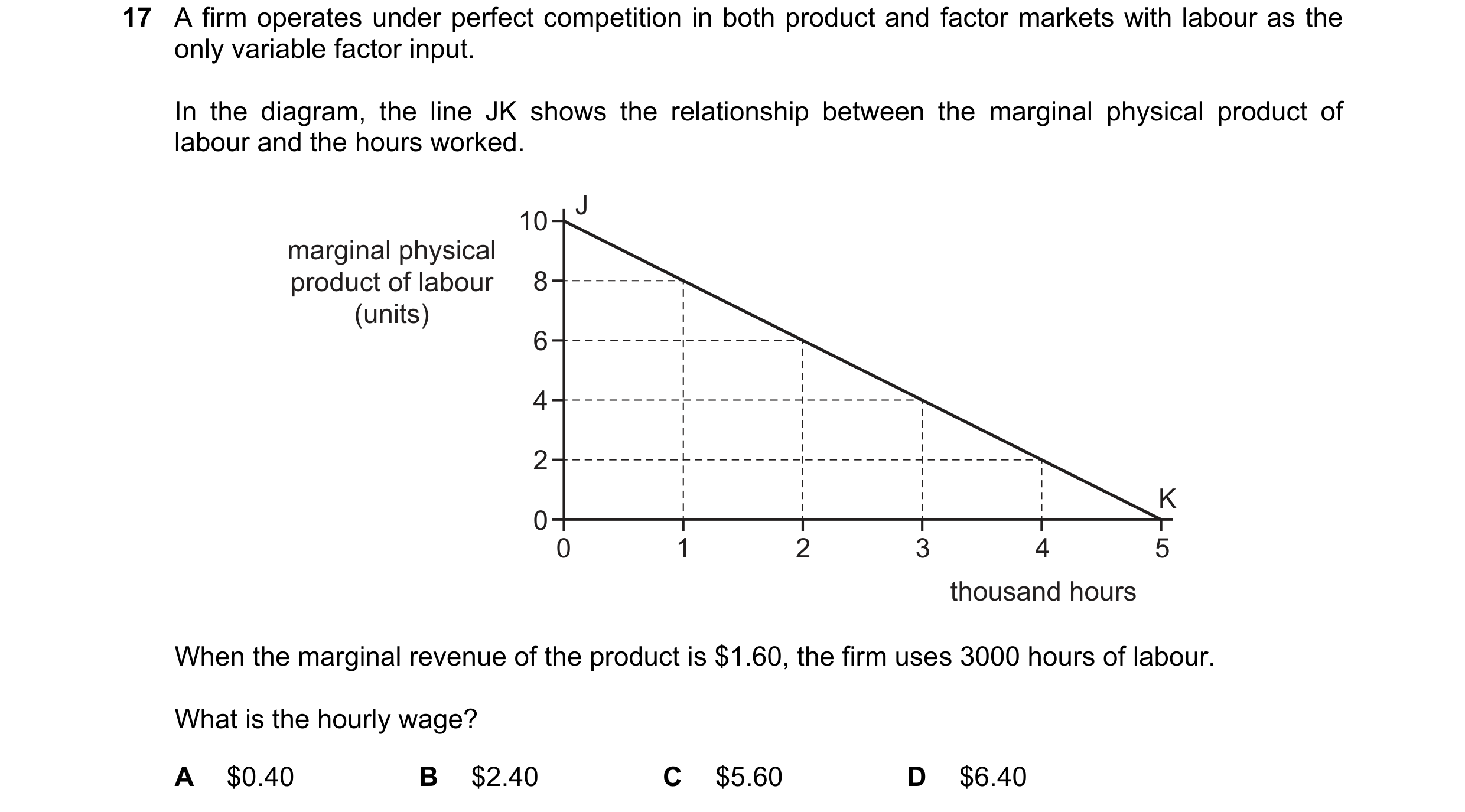
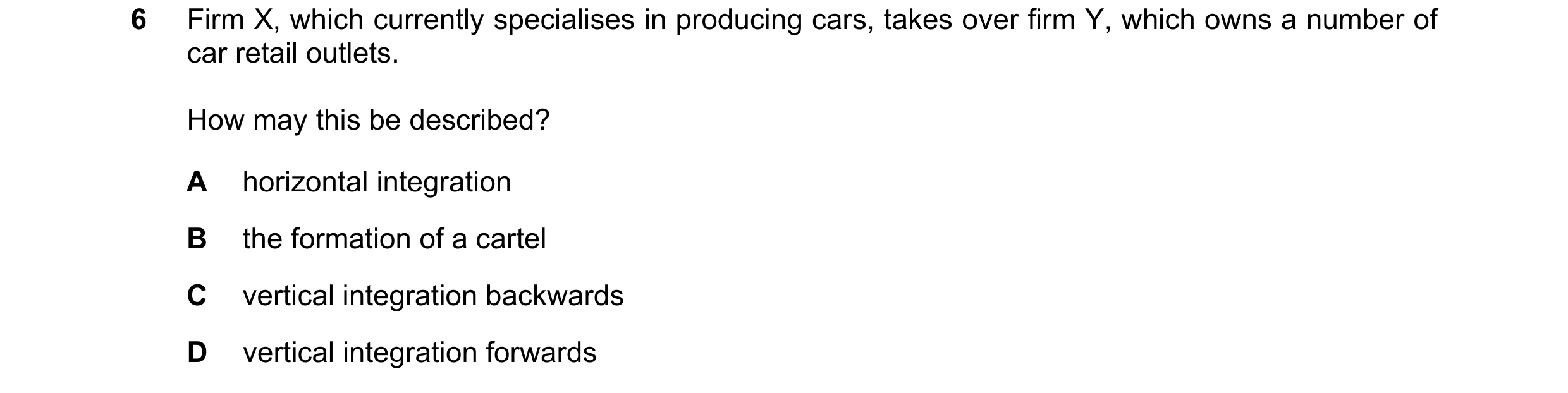
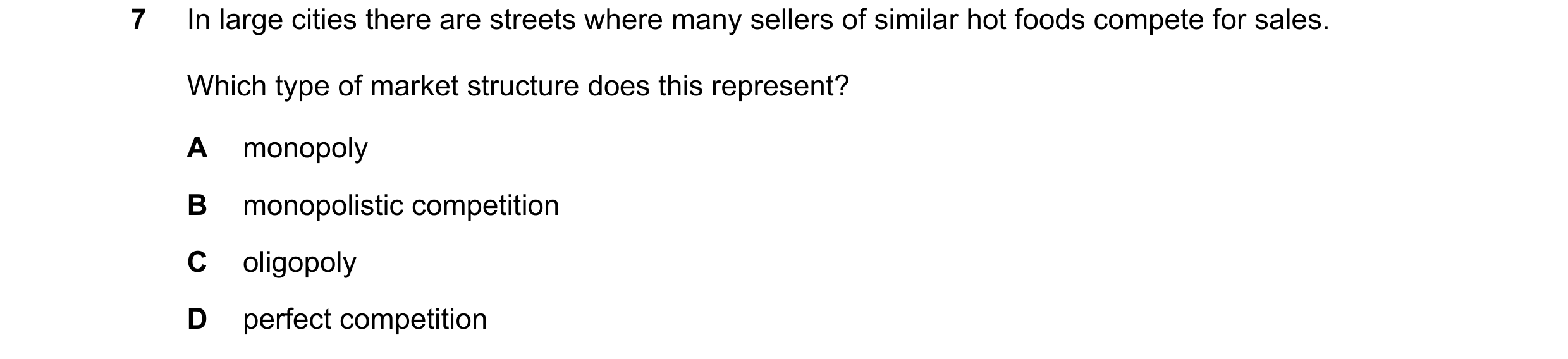
 55 / 68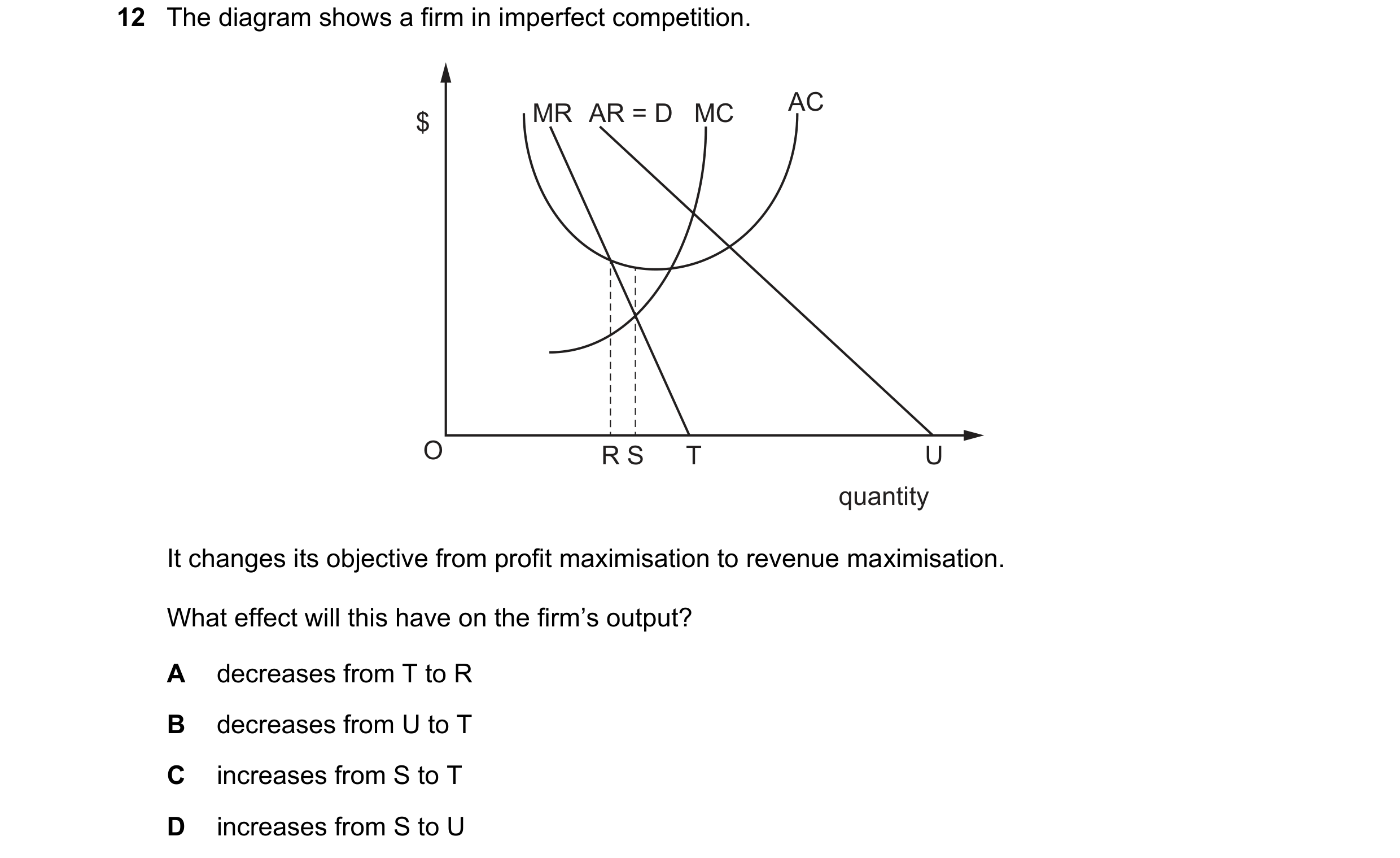
 56 / 68
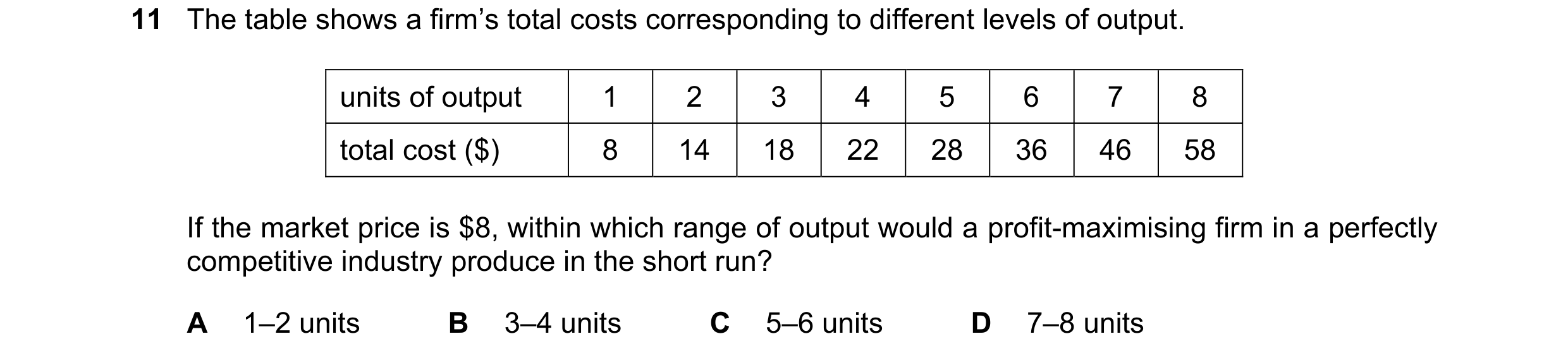
 57 / 68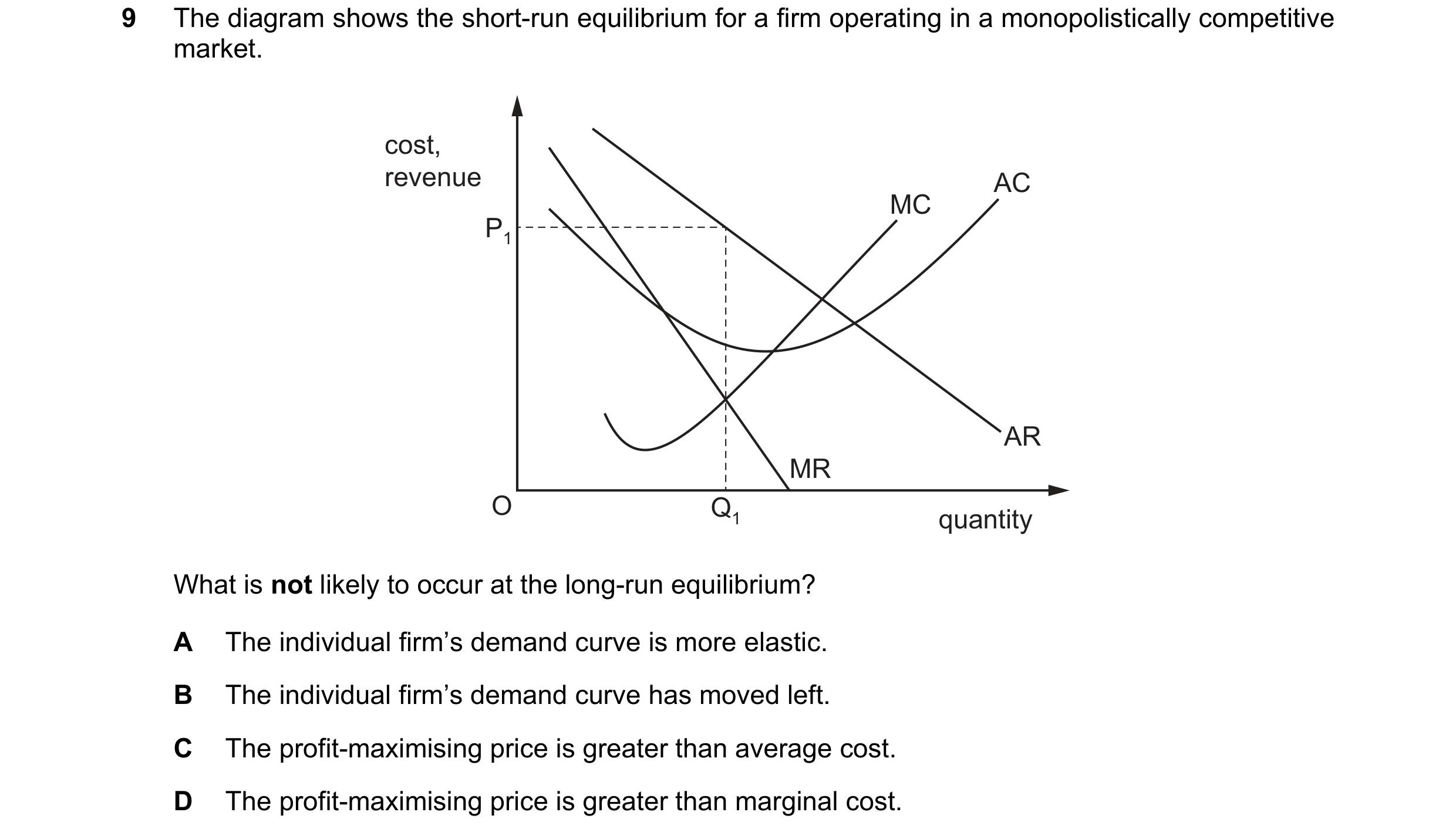
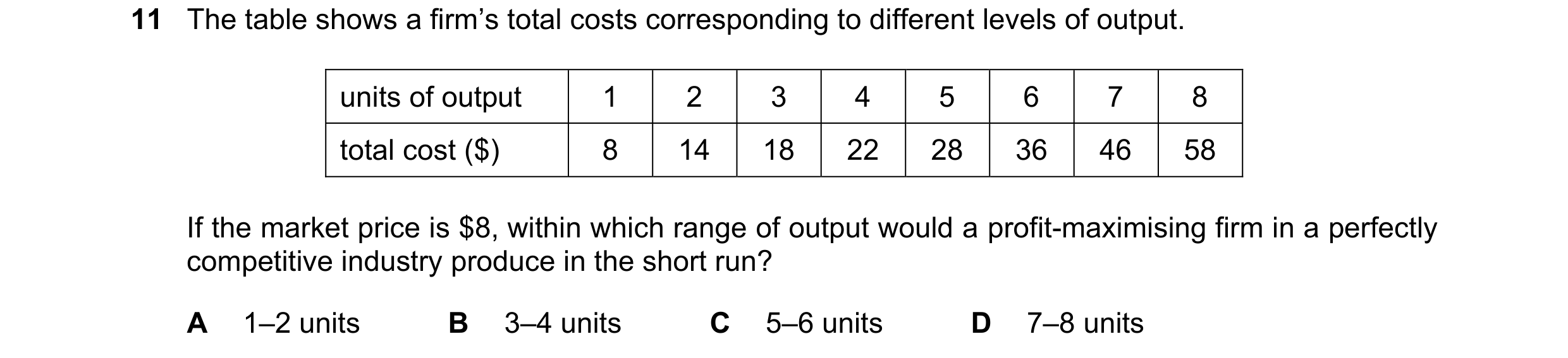 58 / 68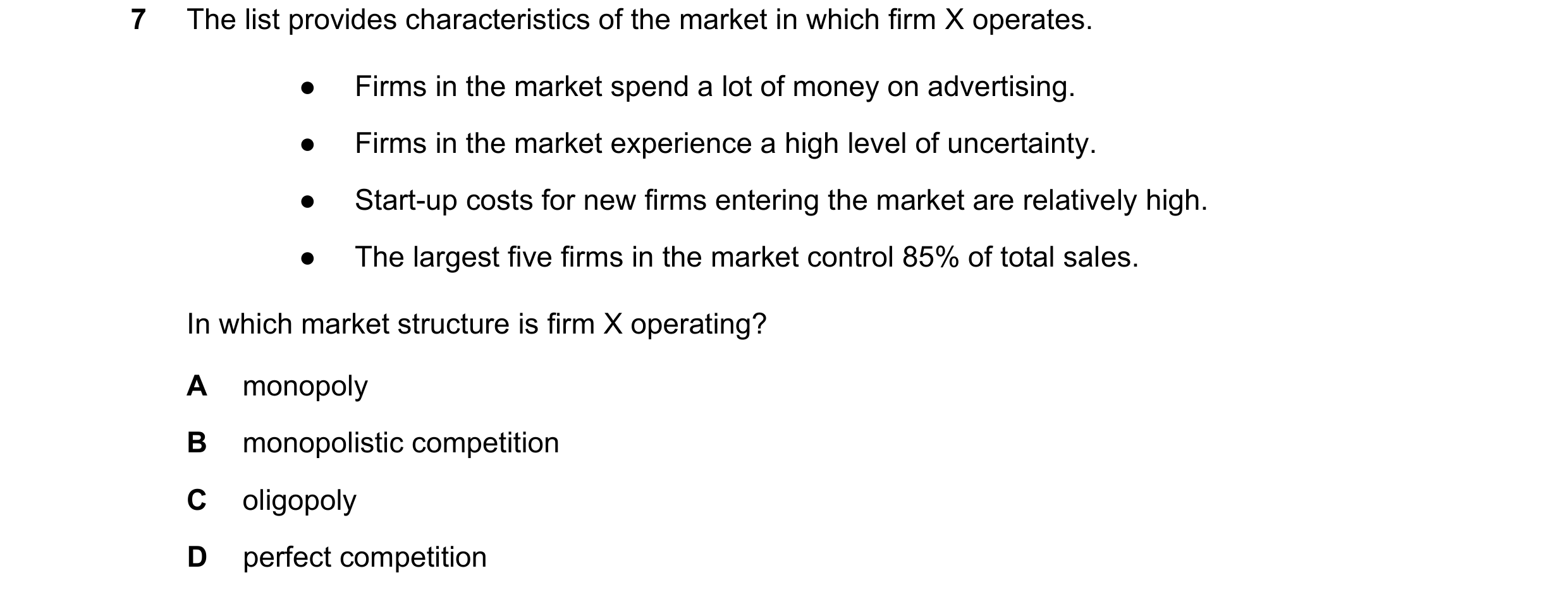


 59 / 68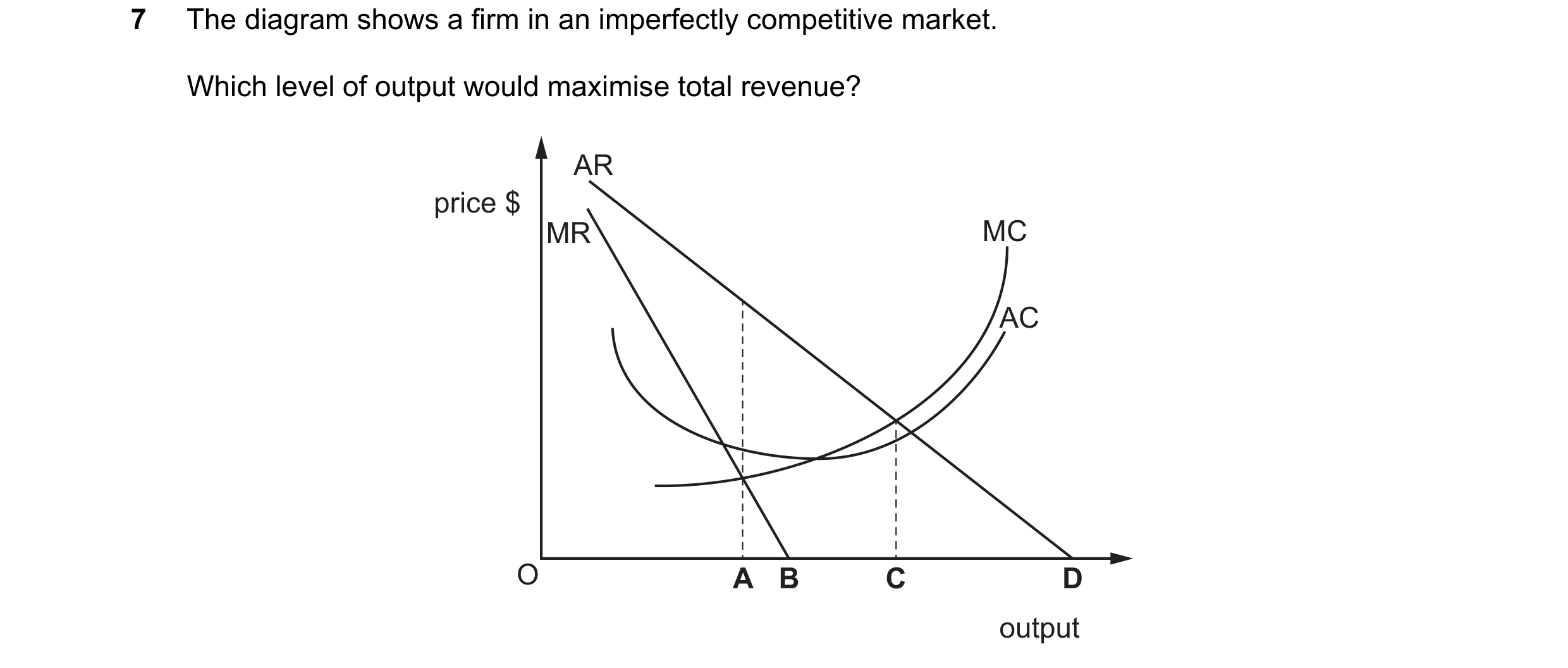
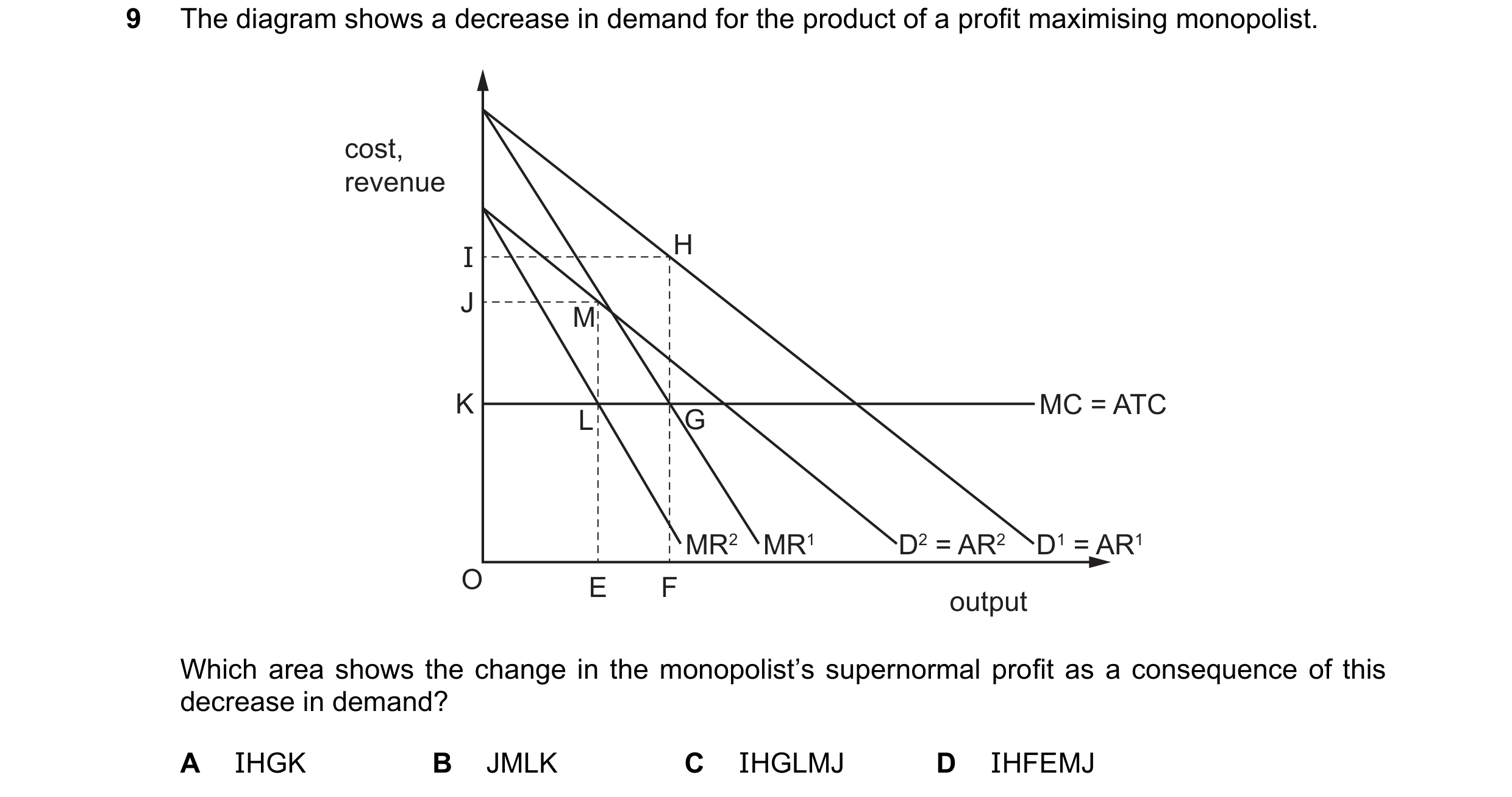 60 / 68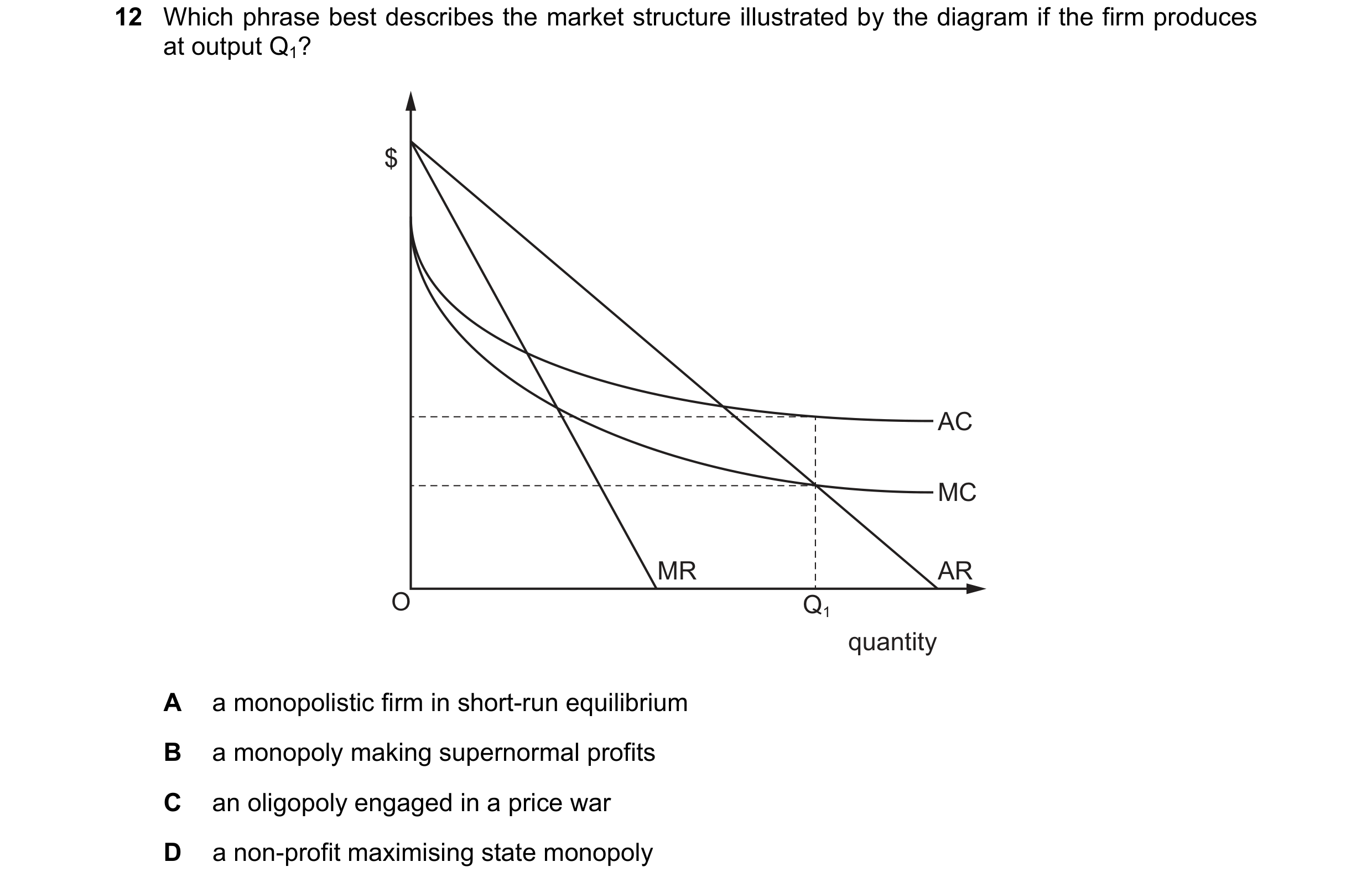
 61 / 68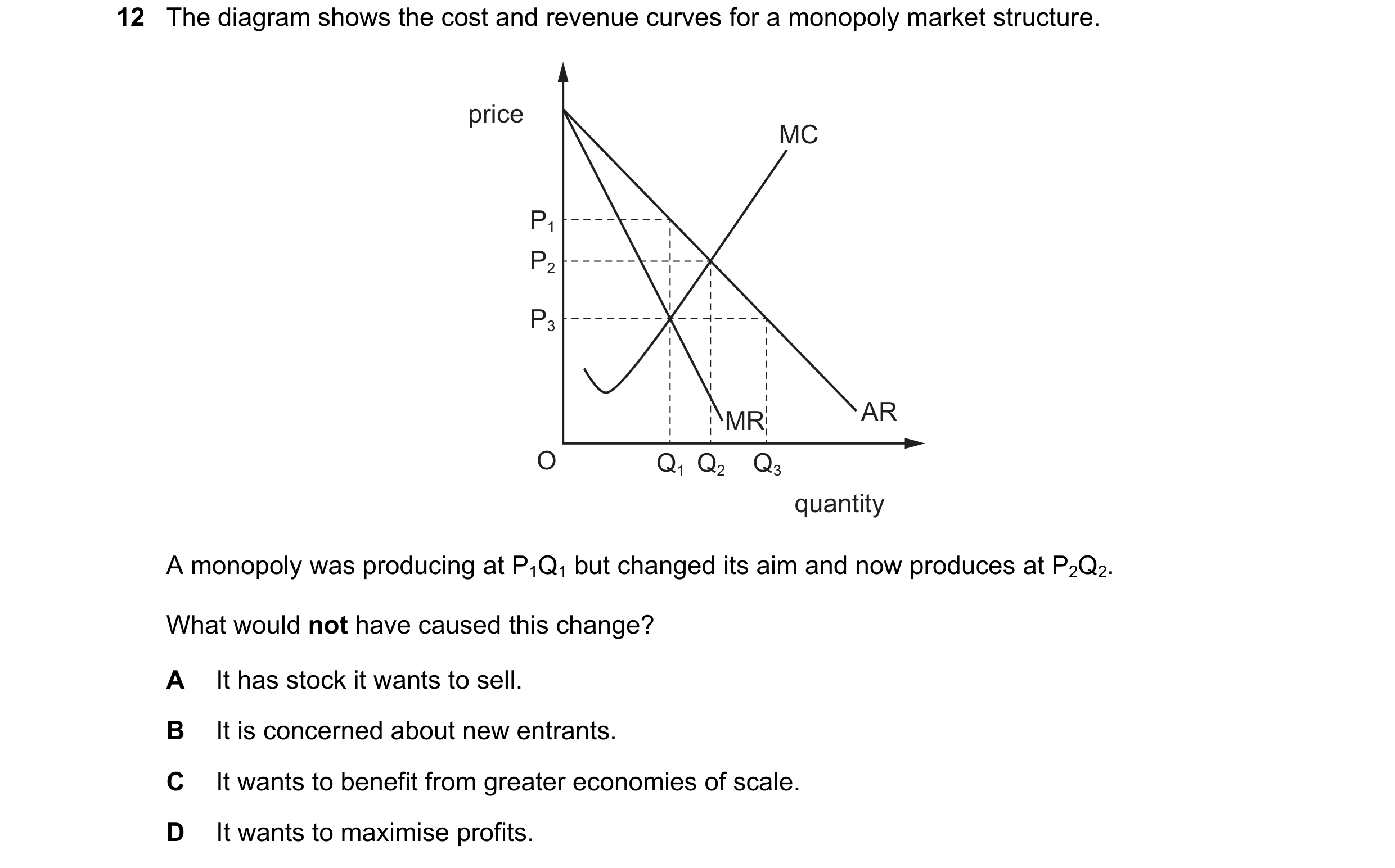
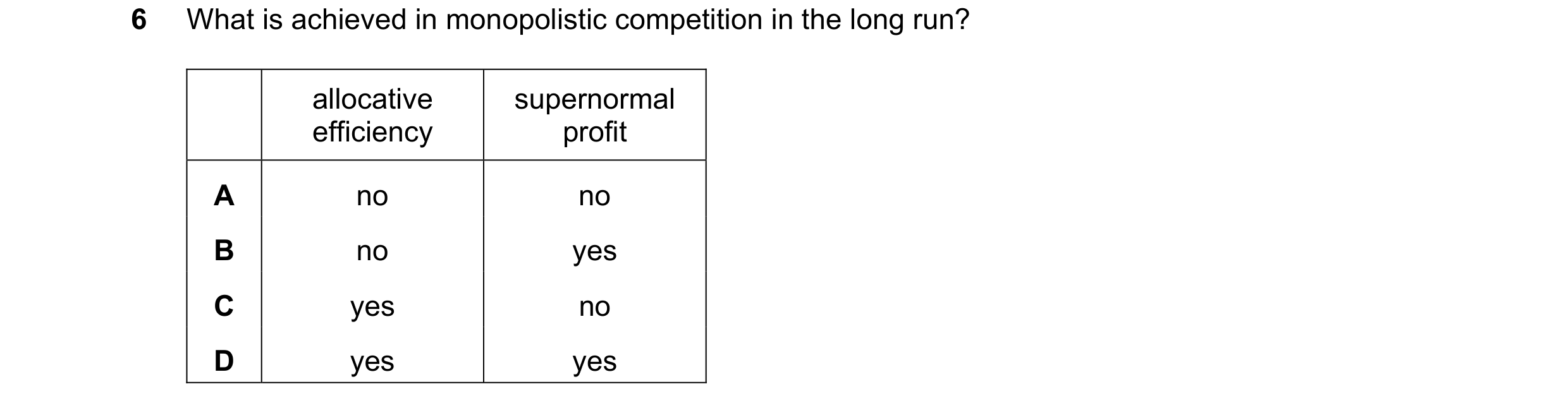
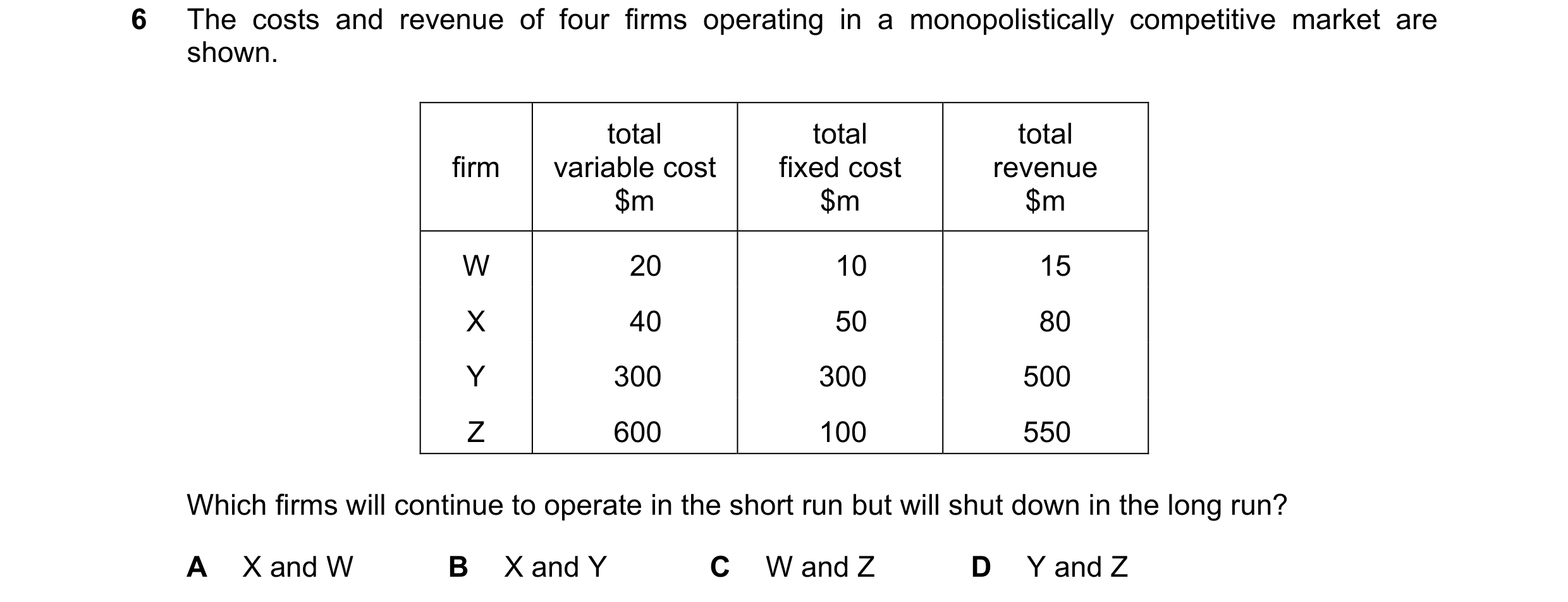 62 / 68
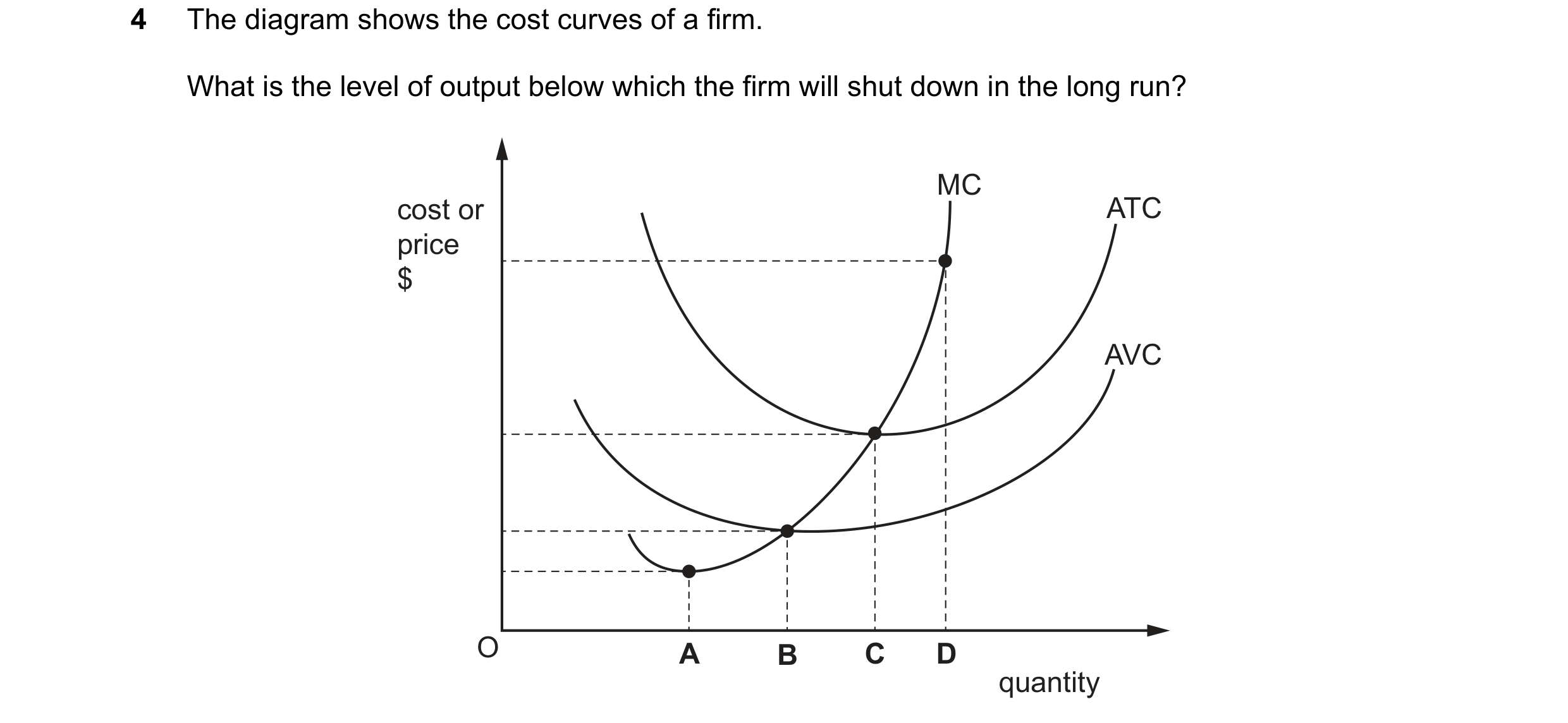
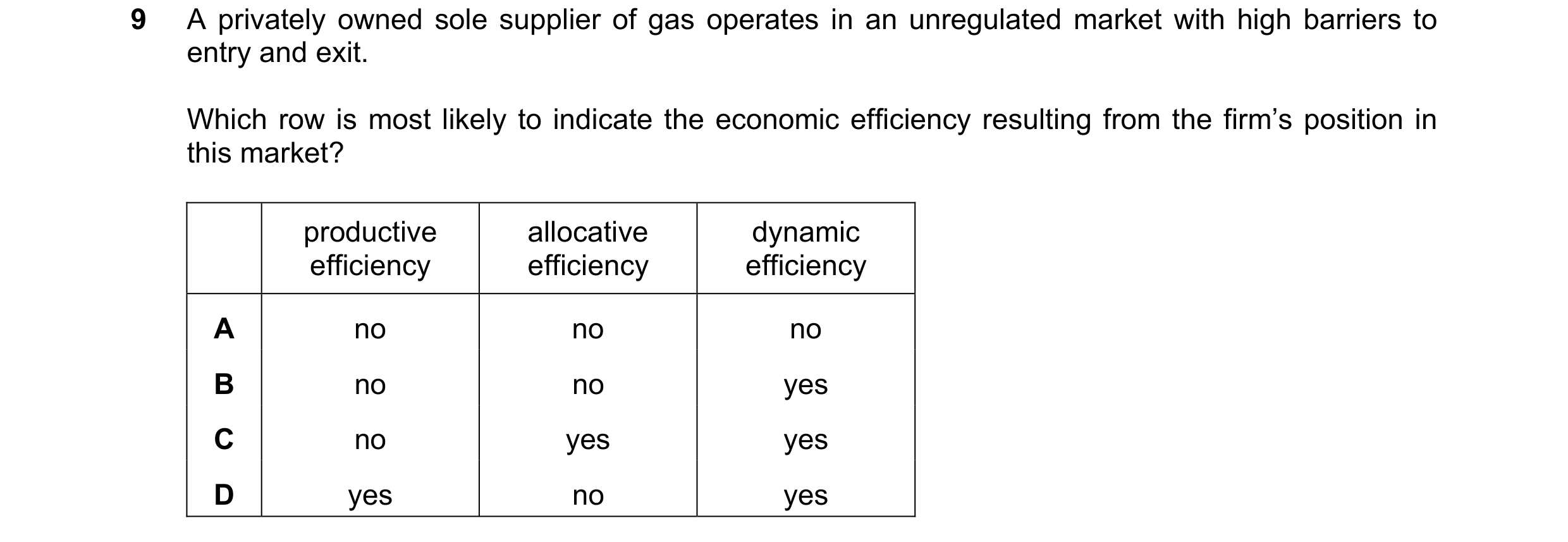
 63 / 68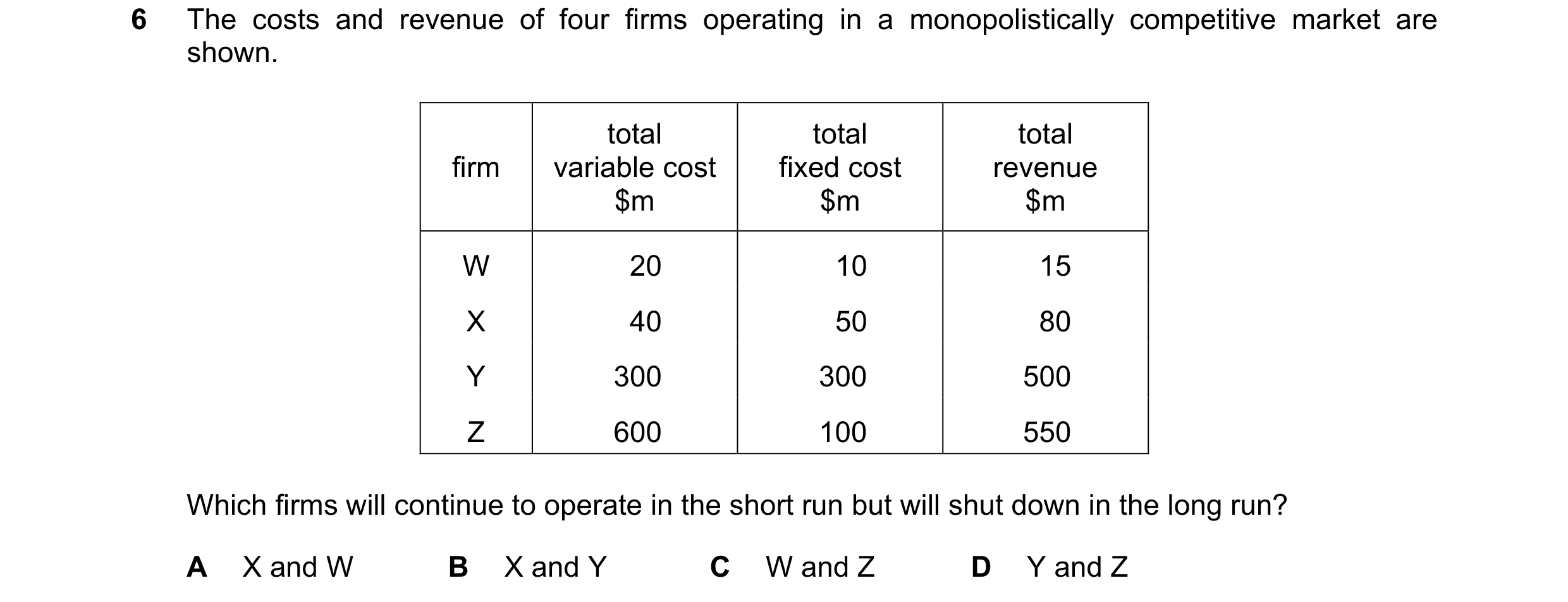
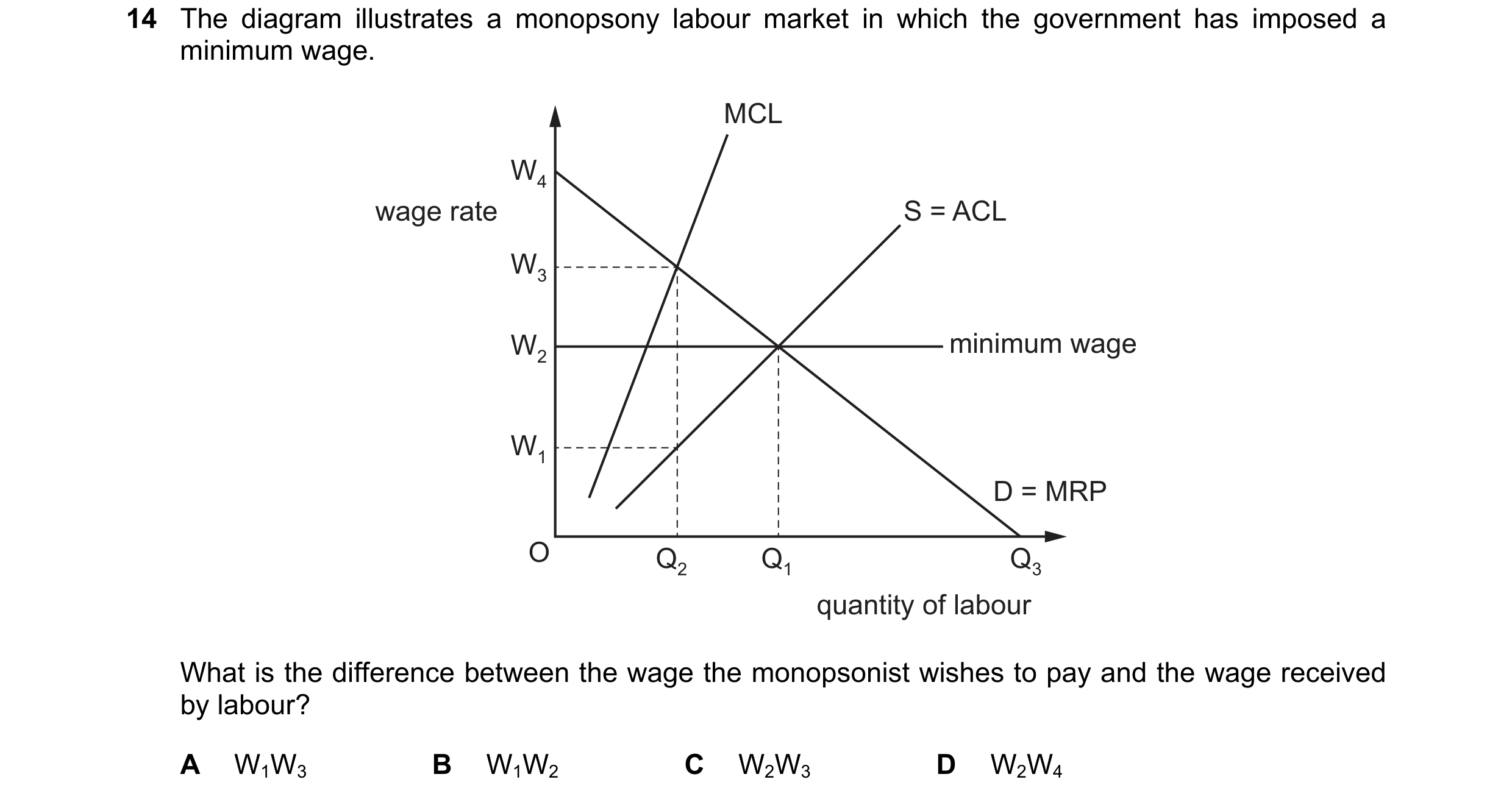
 64 / 68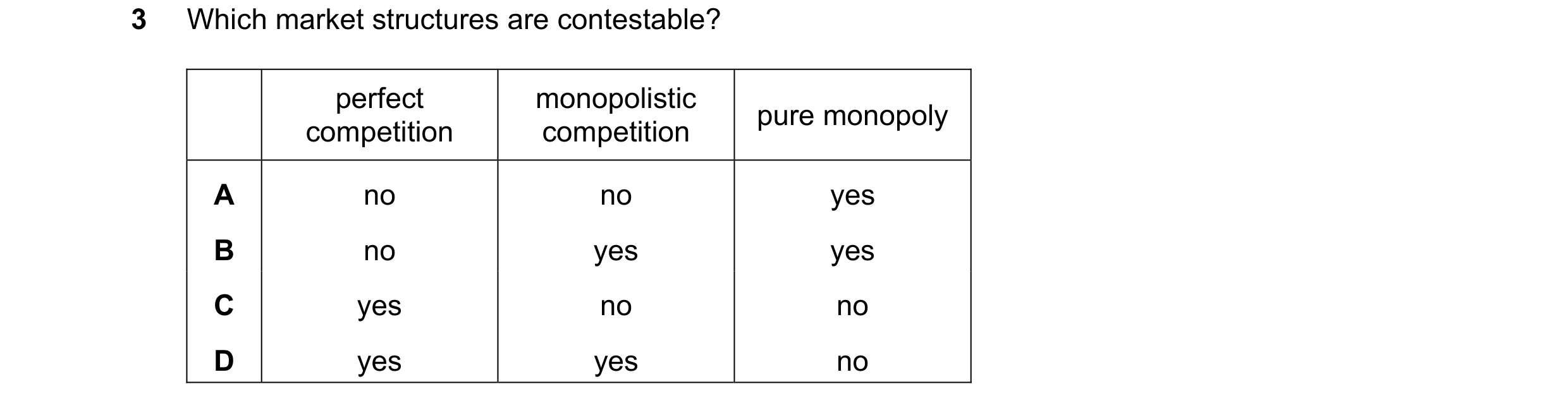
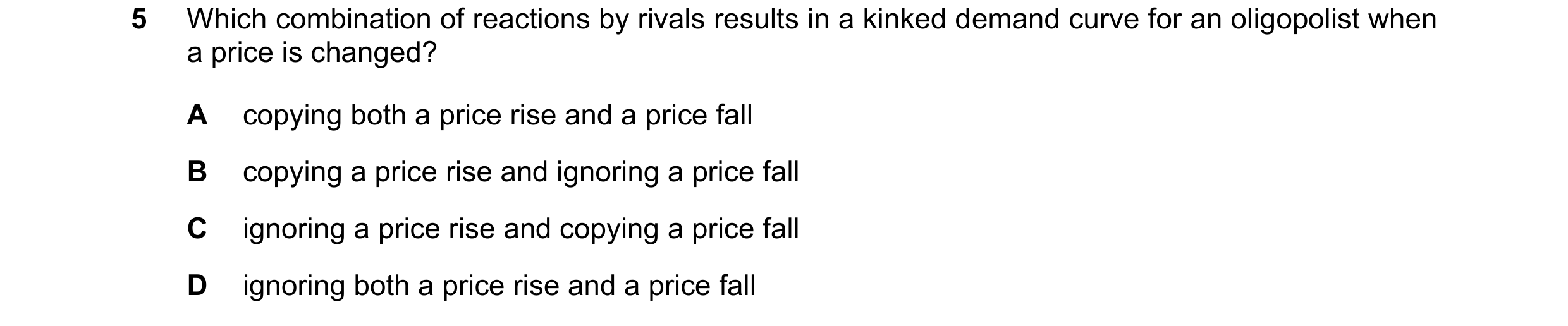

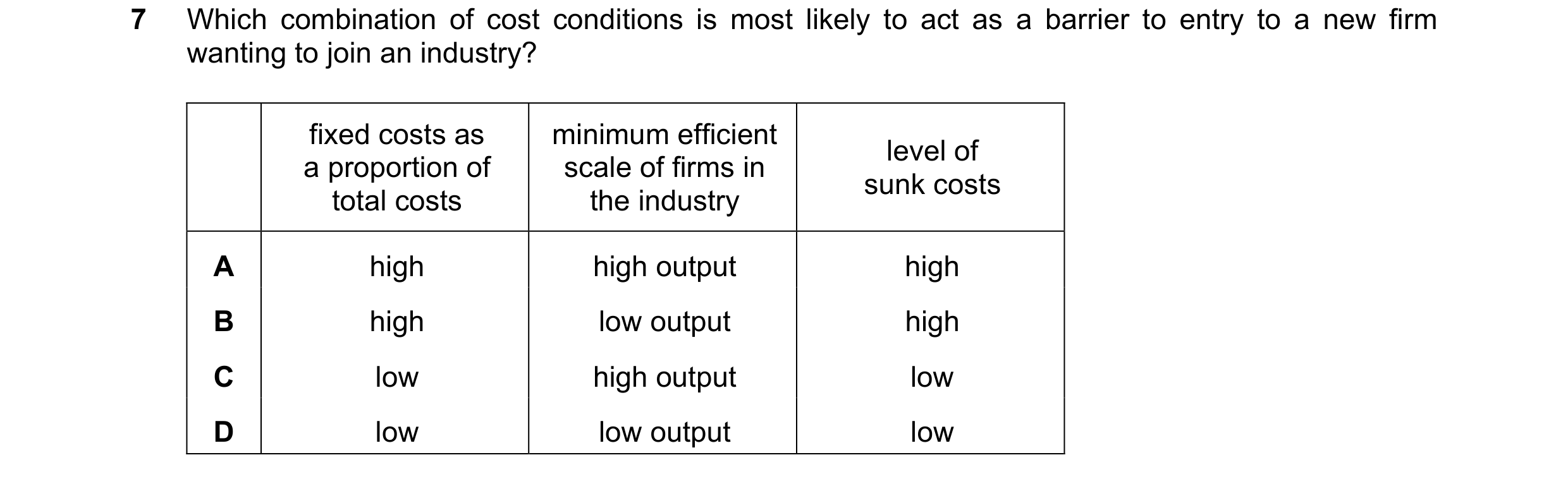 65 / 68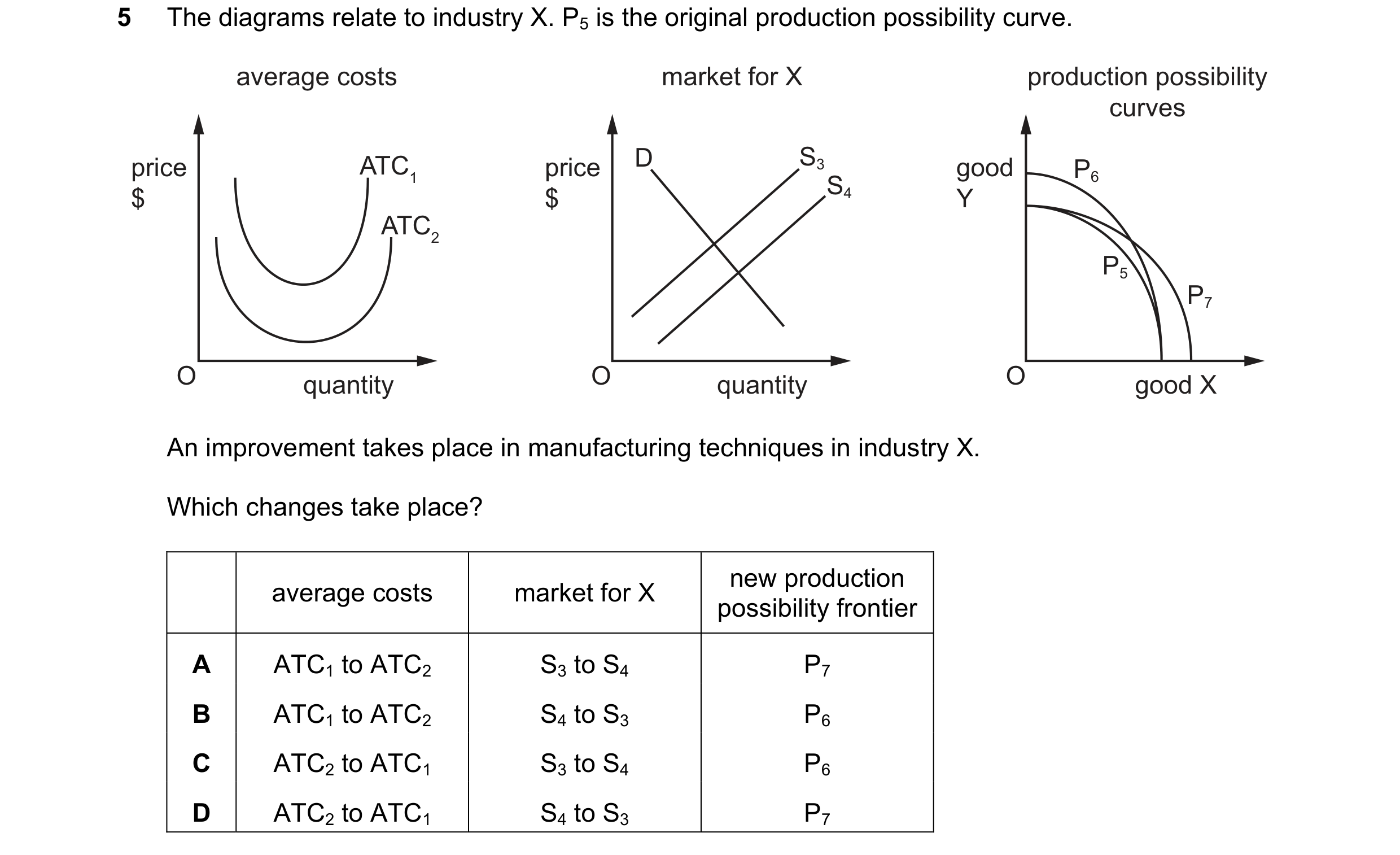

 66 / 68


 67 / 68
 68 / 68