Questions as text
Q1 · The first stage in the synthesis of antipyrine, a drug used in reducing fever, is the… 9701/11 May/June 2006
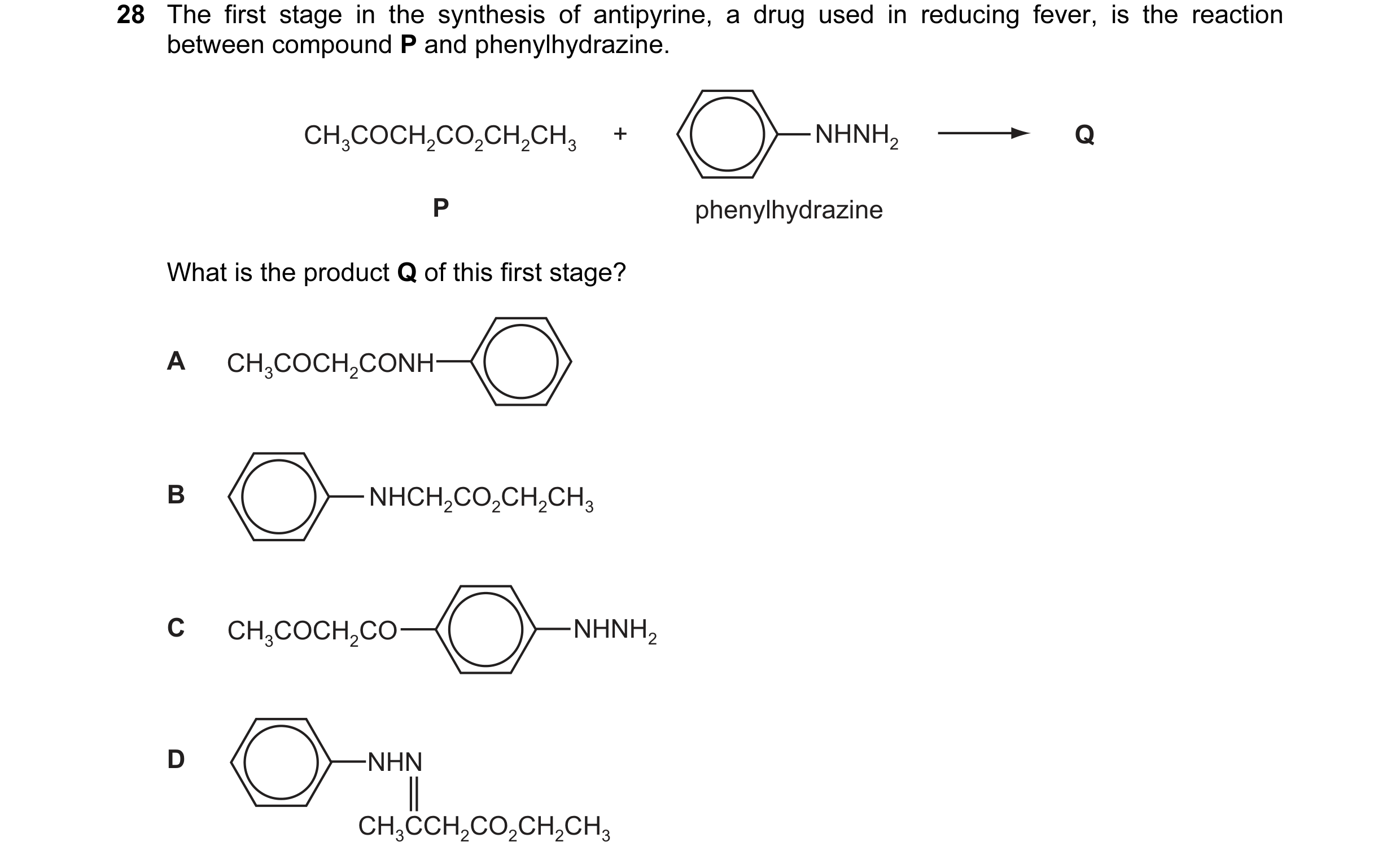
28 The first stage in the synthesis of antipyrine, a drug used in reducing fever, is the reaction between compound P and phenylhydrazine. CH3COCH2CO2CH2CH3 + NHNH2 Q P phenylhydrazine What is the product Q of this first stage? A CH3COCH2CONH B NHCH2CO2CH2CH3 C CH3COCH2CO NHNH2 D NHN CH3CCH2CO2CH2CH3
1 marks
Answer: D
This question in 9701/11 May/June 2006
Q2 · Ethanal, CH3CHO, can be reduced using an aqueous methanolic solution of NaBH4 as the… 9701/11 May/June 2008
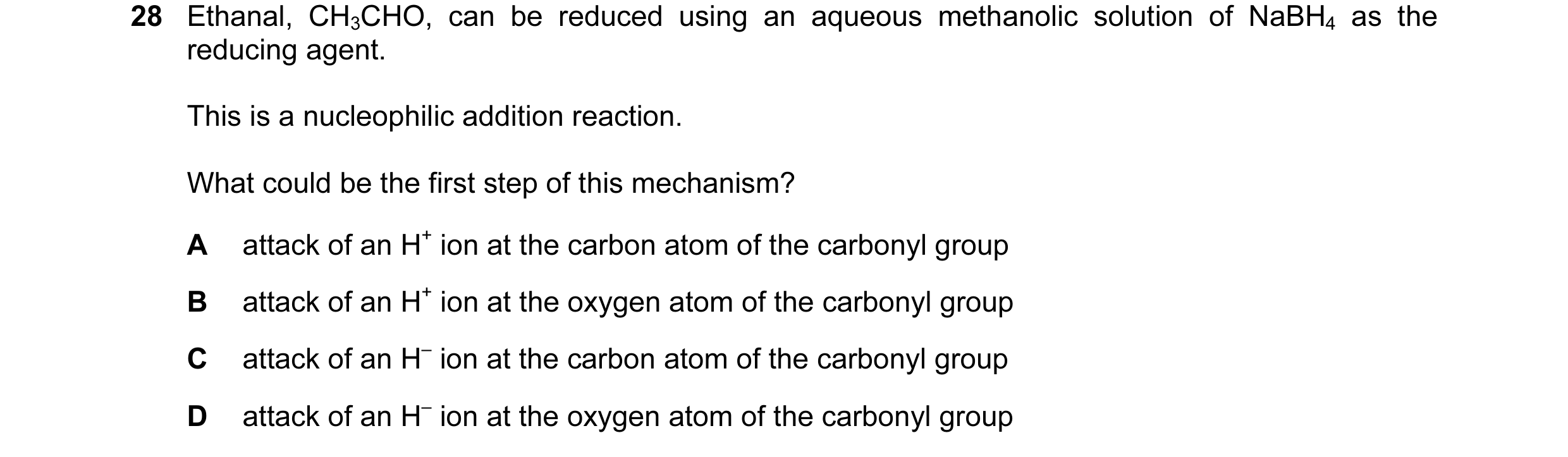
28 Ethanal, CH3CHO, can be reduced using an aqueous methanolic solution of NaBH4 as the reducing agent. This is a nucleophilic addition reaction. What could be the first step of this mechanism? A attack of an H+ ion at the carbon atom of the carbonyl group B attack of an H+ ion at the oxygen atom of the carbonyl group C attack of an H– ion at the carbon atom of the carbonyl group D attack of an H– ion at the oxygen atom of the carbonyl group
1 marks
Answer: C
This question in 9701/11 May/June 2008
Q3 · What always applies to a nucleophile? 9701/11 May/June 2009
21 What always applies to a nucleophile? A It attacks a double bond. B It has a lone pair of electrons. C It is a single atom. D It is negatively charged.
1 marks
Answer: B
This question in 9701/11 May/June 2009
Q4 · Compound X reacts with ethanoic acid in the presence of an H+ catalyst to produce the… 9701/11 Oct/Nov 2010
21 Compound X reacts with ethanoic acid in the presence of an H+ catalyst to produce the compound below. O H H O H3C C C C O C CH3 H H What is the molecular formula of compound X? A C2H6O2 B C2H6O3 C C4H8O D C4H8O2
1 marks
Answer: D
This question in 9701/11 Oct/Nov 2010
Q5 · Which compound would undergo nucleophilic addition? 9701/11 Oct/Nov 2010
27 Which compound would undergo nucleophilic addition? A bromoethane, C2H5Br B ethanal, CH3CHO C ethane, C2H6 D ethene, C2H4
1 marks
Answer: B
This question in 9701/11 Oct/Nov 2010
Q6 · Which compound would undergo nucleophilic addition? 9701/13 Oct/Nov 2010
27 Which compound would undergo nucleophilic addition? A bromoethane, C2H5Br B ethanal, CH3CHO C ethane, C2H6 D ethene, C2H4
1 marks
Answer: B
This question in 9701/13 Oct/Nov 2010
Q7 · Which reagent gives the same visible result with propanal and with propan-2-ol? 9701/12 May/June 2011
20 Which reagent gives the same visible result with propanal and with propan-2-ol? A 2,4-dinitrophenylhydrazine reagent B acidified potassium dichromate(VI) C sodium D Tollens’ reagent
1 marks
Answer: B
This question in 9701/12 May/June 2011
Q8 · This question should be answered by considering the reactions of KMnO4 with different… 9701/12 May/June 2011
29 This question should be answered by considering the reactions of KMnO4 with different functional groups under the stated conditions. The diagram shows the structure of the naturally-occurring molecule cholesterol. H3C CH3 H CH3 H H H HO cholesterol Cholesterol is separately treated with ● cold, dilute acidified KMnO4, ● hot, concentrated acidified KMnO4. What is the change in the number of chiral carbon atoms in the molecule during each reaction? cold, dilute acidified hot, concentrated acidified KMnO4 KMnO4 A +1 0 B +1 –1 C +2 0 D +2 –1
1 marks
Answer: D
This question in 9701/12 May/June 2011
Q9 · The formula CH3 can represent an anion, a cation or a free radical 9701/13 May/June 2011
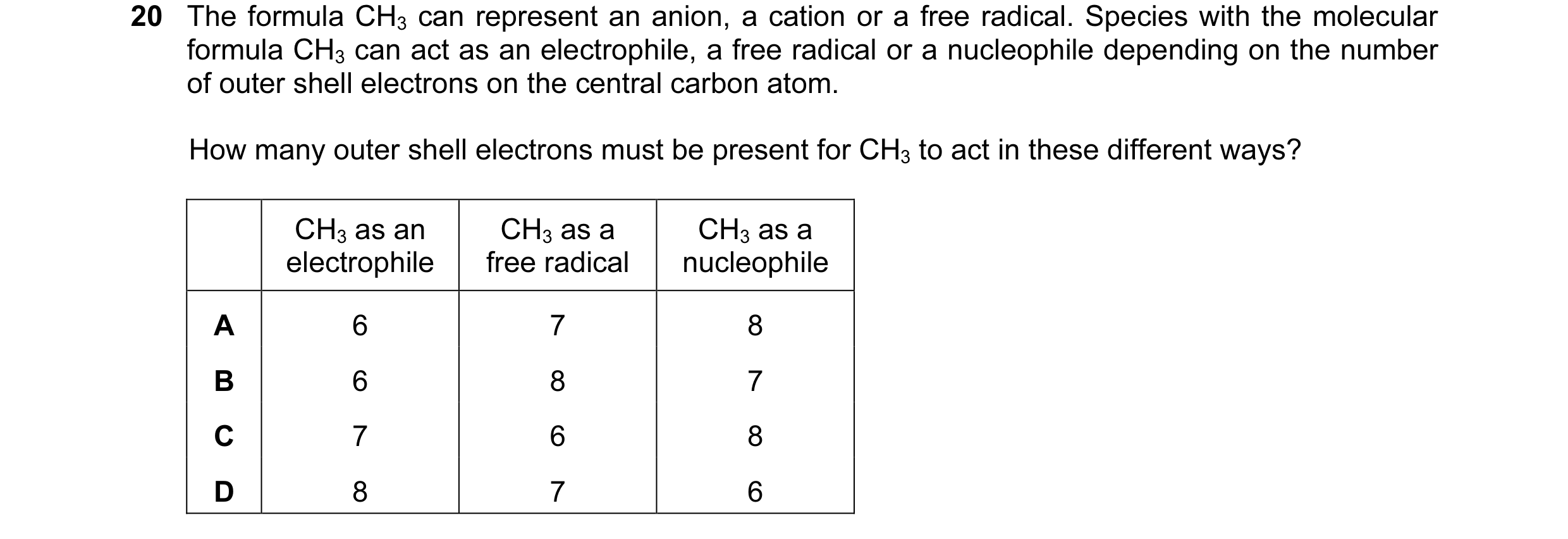
20 The formula CH3 can represent an anion, a cation or a free radical. Species with the molecular formula CH3 can act as an electrophile, a free radical or a nucleophile depending on the number of outer shell electrons on the central carbon atom. How many outer shell electrons must be present for CH3 to act in these different ways? CH3 as an CH3 as a CH3 as a electrophile free radical nucleophile A 6 7 8 B 6 8 7 C 7 6 8 D 8 7 6
1 marks
Answer: A
This question in 9701/13 May/June 2011
Q10 · Buta-1,3-diene is currently obtained from fossil fuel sources 9701/12 Oct/Nov 2011
21 Buta-1,3-diene is currently obtained from fossil fuel sources. In future it may be obtained from ethanol, which can be produced from non-food agricultural crops. The sequence of reactions is as follows. step 1 step 2 step 3 CH3CH2OH CH3CHO CH3CH(OH)CH2CHO CH2=CHCH=CH2 buta-1,3-diene Which term could be used to describe step 1? A condensation B dehydration C dehydrogenation D hydrogenation
1 marks
This question in 9701/12 Oct/Nov 2011
Q11 · Ethanal, CH3CHO, can be reduced using NaBH4 in aqueous ethanol 9701/12 Oct/Nov 2011
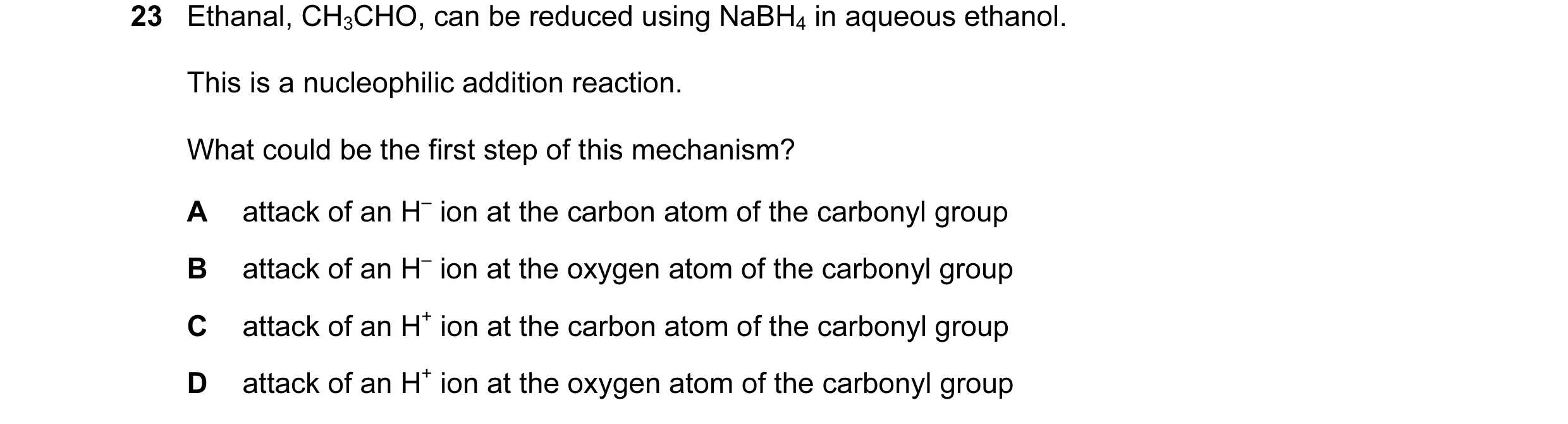
23 Ethanal, CH3CHO, can be reduced using NaBH4 in aqueous ethanol. This is a nucleophilic addition reaction. What could be the first step of this mechanism? A attack of an H– ion at the carbon atom of the carbonyl group B attack of an H– ion at the oxygen atom of the carbonyl group C attack of an H+ ion at the carbon atom of the carbonyl group D attack of an H+ ion at the oxygen atom of the carbonyl group
1 marks
This question in 9701/12 Oct/Nov 2011
Q12 · What is involved in the mechanism of the reaction between aqueous sodium hydroxide and… 9701/12 Oct/Nov 2011
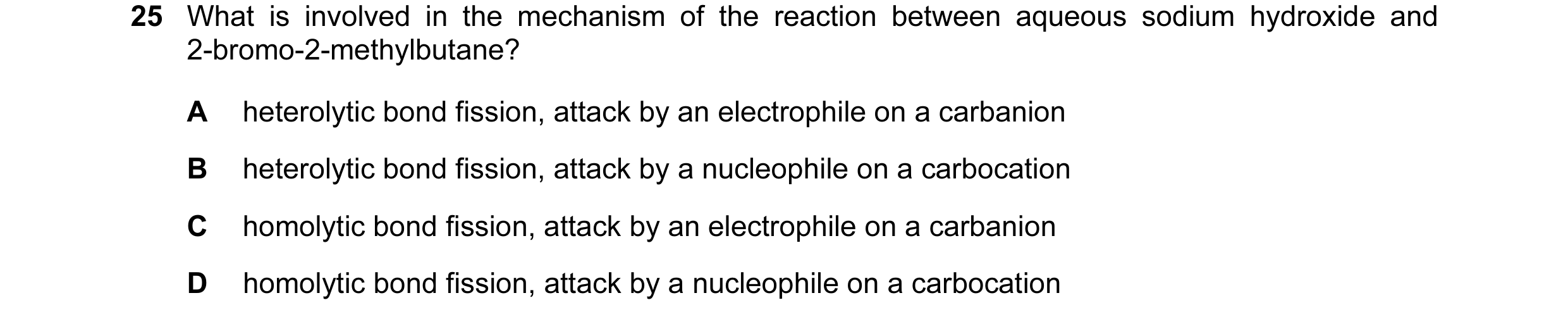
25 What is involved in the mechanism of the reaction between aqueous sodium hydroxide and 2-bromo-2-methylbutane? A heterolytic bond fission, attack by an electrophile on a carbanion B heterolytic bond fission, attack by a nucleophile on a carbocation C homolytic bond fission, attack by an electrophile on a carbanion D homolytic bond fission, attack by a nucleophile on a carbocation
1 marks
This question in 9701/12 Oct/Nov 2011
Q13 · This question should be answered by considering the reactions of KMnO4 with different… 9701/13 Oct/Nov 2011
18 This question should be answered by considering the reactions of KMnO4 with different functional groups under the stated conditions. The diagram shows the structure of the naturally-occurring molecule cholesterol. H3C CH3 H CH3 H H H HO cholesterol Separate oxidation reactions are carried out using different conditions. ● cold, dilute acidified KMnO4 ● hot, concentrated acidified KMnO4 Which statements about the products formed are correct? cold, dilute acidified KMnO4: hot, concentrated acidified KMnO4: number of hydroxy groups number of 6-membered rings present remaining A 1 2 B 1 3 C 3 2 D 3 3
1 marks
Answer: C
This question in 9701/13 Oct/Nov 2011
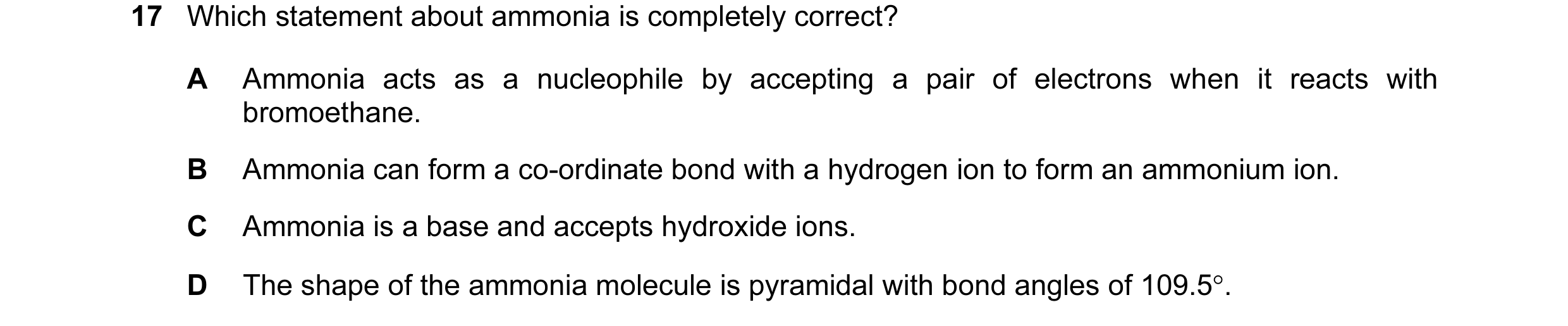
Q14 · Which statement about ammonia is completely correct? 9701/12 May/June 2013
17 Which statement about ammonia is completely correct? A Ammonia acts as a nucleophile by accepting a pair of electrons when it reacts with bromoethane. B Ammonia can form a co-ordinate bond with a hydrogen ion to form an ammonium ion. C Ammonia is a base and accepts hydroxide ions. D The shape of the ammonia molecule is pyramidal with bond angles of 109.5°.
1 marks
Answer: B
This question in 9701/12 May/June 2013
Q15 · Sorbic acid is used as a food preservative because it kills fungi and moulds 9701/12 May/June 2013
21 Sorbic acid is used as a food preservative because it kills fungi and moulds. H H O C C C H3C C C OH H H sorbic acid Sorbic acid will react with • hydrogen in the presence of a nickel catalyst, • bromine in an organic solvent. How many moles of hydrogen and of bromine will be incorporated into one mole of sorbic acid by these reactions? moles of hydrogen moles of bromine A 2 2 1 B 2 2 2 C 3 2 1 D 3 2 2
1 marks
Answer: A
This question in 9701/12 May/June 2013
Q16 · What is true of every nucleophile? 9701/13 May/June 2013
21 What is true of every nucleophile? A It attacks a double bond. B It has a lone pair of electrons. C It is a single atom. D It is negatively charged.
1 marks
Answer: B
This question in 9701/13 May/June 2013
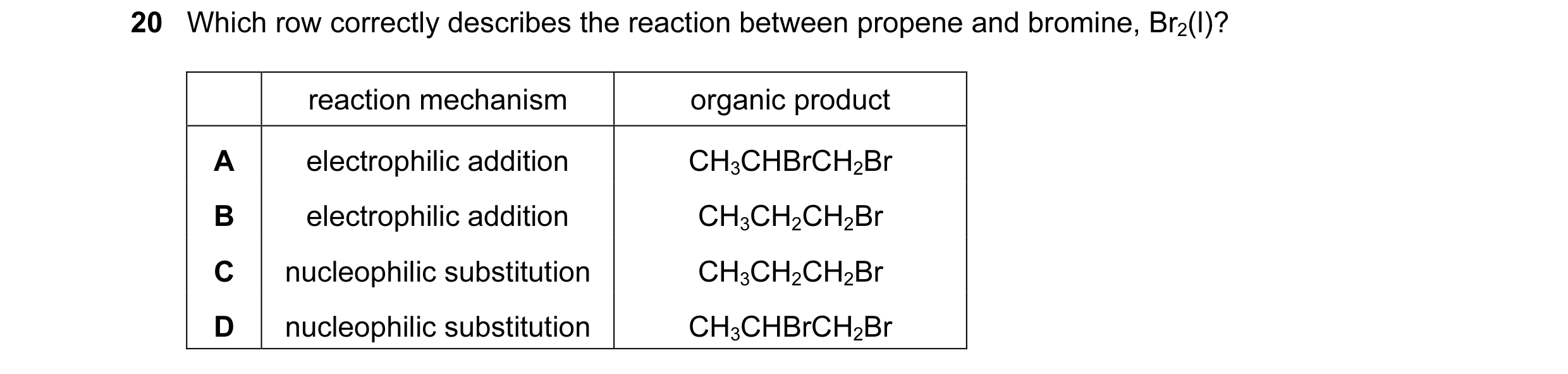
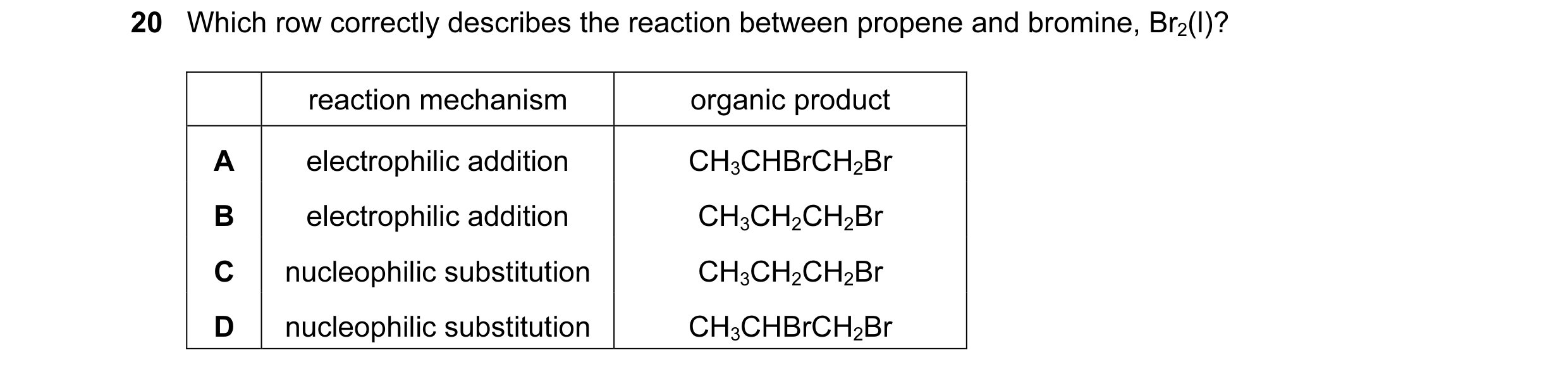
Q17 · Which row correctly describes the reaction between propene and bromine, Br2(l)? 9701/11 Oct/Nov 2014
20 Which row correctly describes the reaction between propene and bromine, Br2(l)? reaction mechanism organic product A electrophilic addition CH3CHBrCH2Br B electrophilic addition CH3CH2CH2Br C nucleophilic substitution CH3CH2CH2Br D nucleophilic substitution CH3CHBrCH2Br
1 marks
Answer: A
This question in 9701/11 Oct/Nov 2014
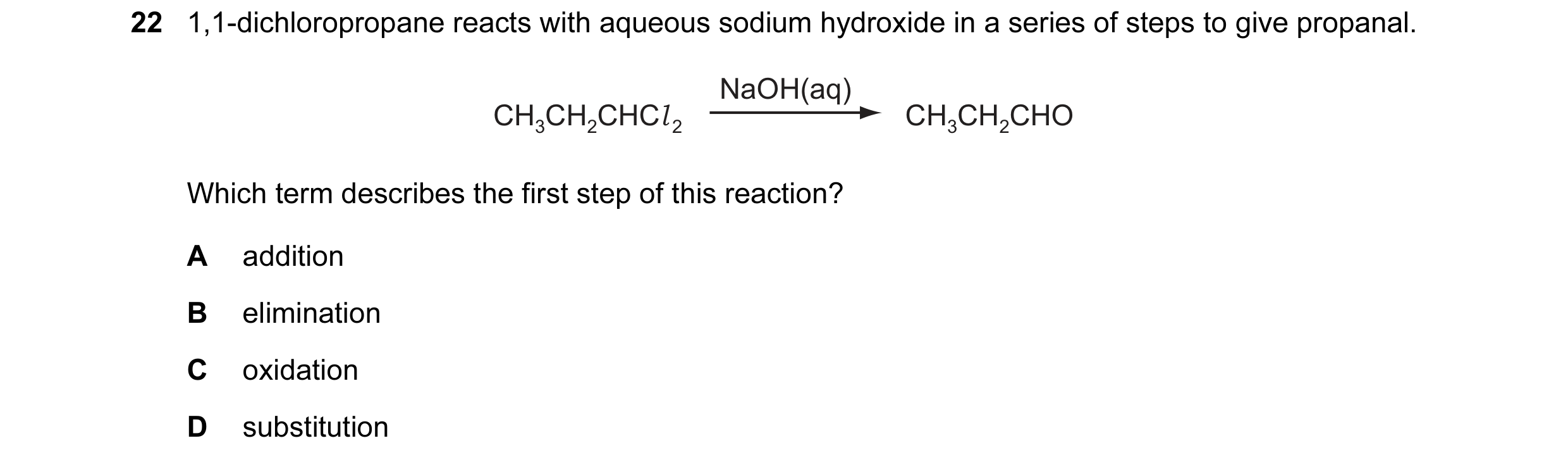
Q18 · 1,1-dichloropropane reacts with aqueous sodium hydroxide in a series of steps to give… 9701/11 Oct/Nov 2014
22 1,1-dichloropropane reacts with aqueous sodium hydroxide in a series of steps to give propanal. NaOH(aq) CH3CH2CHCl 2 CH3CH2CHO Which term describes the first step of this reaction? A addition B elimination C oxidation D substitution
1 marks
Answer: D
This question in 9701/11 Oct/Nov 2014
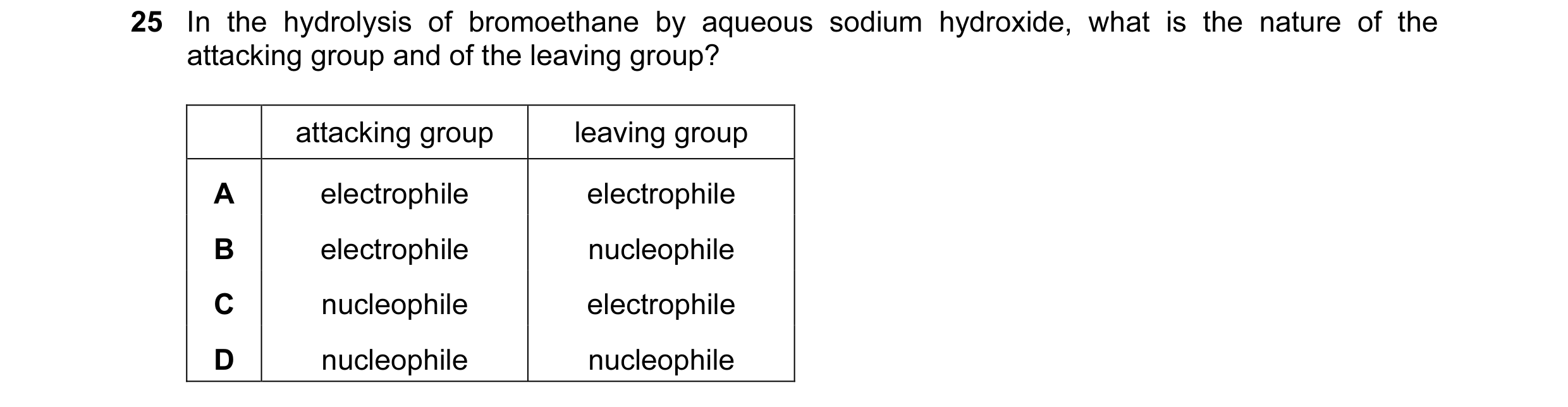
Q19 · In the hydrolysis of bromoethane by aqueous sodium hydroxide, what is the nature of the… 9701/11 Oct/Nov 2014
25 In the hydrolysis of bromoethane by aqueous sodium hydroxide, what is the nature of the attacking group and of the leaving group? attacking group leaving group A electrophile electrophile B electrophile nucleophile C nucleophile electrophile D nucleophile nucleophile
1 marks
Answer: D
This question in 9701/11 Oct/Nov 2014
Q20 · Which row correctly describes the reaction between propene and bromine, Br2(l)? 9701/12 Oct/Nov 2014
20 Which row correctly describes the reaction between propene and bromine, Br2(l)? reaction mechanism organic product A electrophilic addition CH3CHBrCH2Br B electrophilic addition CH3CH2CH2Br C nucleophilic substitution CH3CH2CH2Br D nucleophilic substitution CH3CHBrCH2Br
1 marks
Answer: A
This question in 9701/12 Oct/Nov 2014
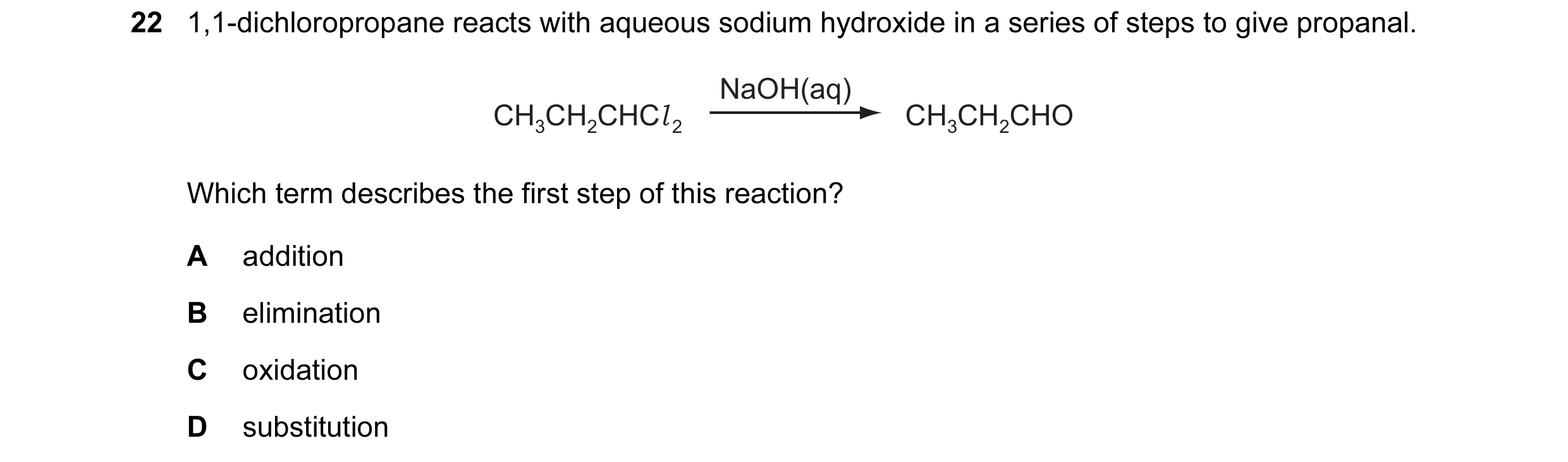
Q21 · 1,1-dichloropropane reacts with aqueous sodium hydroxide in a series of steps to give… 9701/12 Oct/Nov 2014
22 1,1-dichloropropane reacts with aqueous sodium hydroxide in a series of steps to give propanal. NaOH(aq) CH3CH2CHCl 2 CH3CH2CHO Which term describes the first step of this reaction? A addition B elimination C oxidation D substitution
1 marks
Answer: D
This question in 9701/12 Oct/Nov 2014
Q22 · In the hydrolysis of bromoethane by aqueous sodium hydroxide, what is the nature of the… 9701/12 Oct/Nov 2014
25 In the hydrolysis of bromoethane by aqueous sodium hydroxide, what is the nature of the attacking group and of the leaving group? attacking group leaving group A electrophile electrophile B electrophile nucleophile C nucleophile electrophile D nucleophile nucleophile
1 marks
Answer: D
This question in 9701/12 Oct/Nov 2014
Q23 · What is the major product formed when compound Q is warmed with excess HBr? 9701/12 May/June 2015
21 What is the major product formed when compound Q is warmed with excess HBr? OH OH Q A B Br Br OH OH Br Br C D Br Br Br Br Br Br
1 marks
Answer: C
This question in 9701/12 May/June 2015
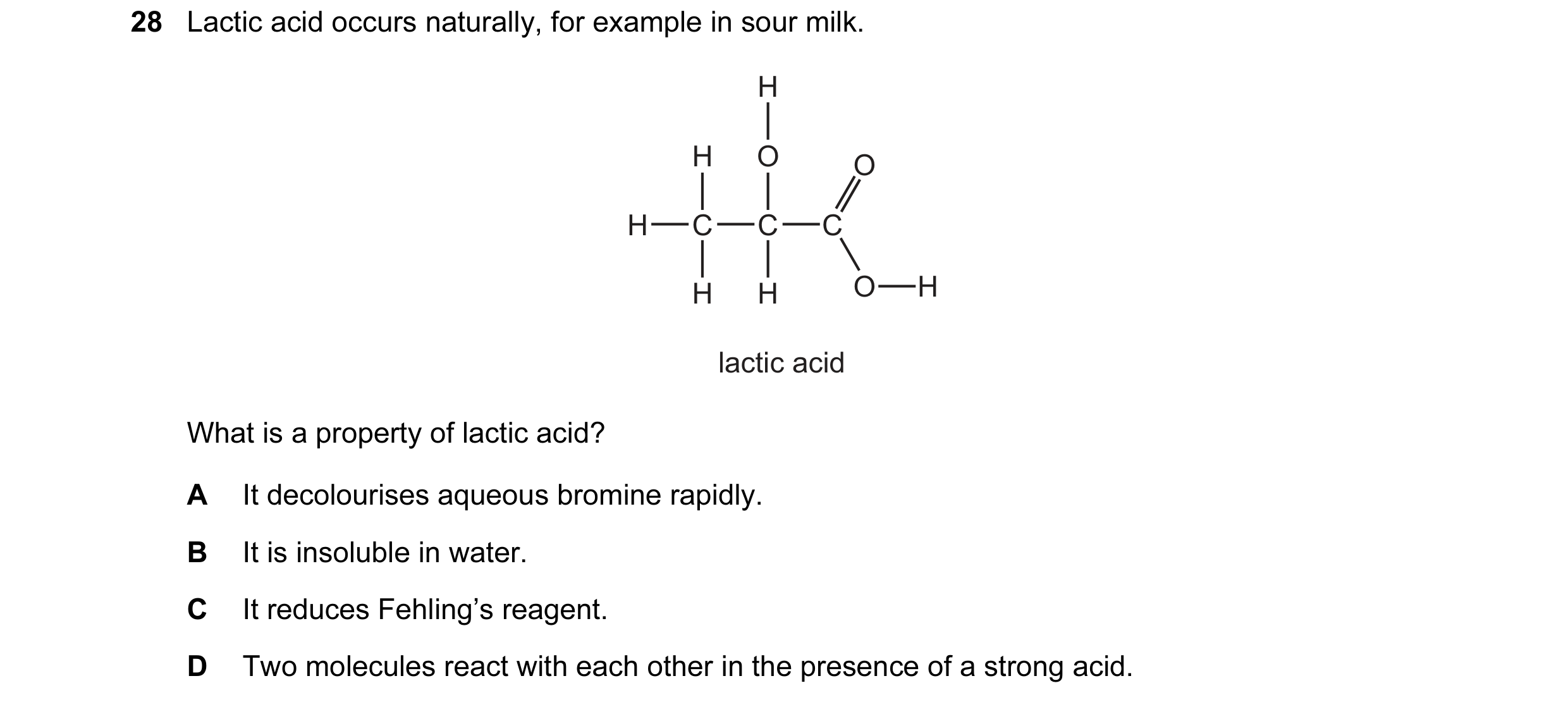
Q24 · Lactic acid occurs naturally, for example in sour milk 9701/12 May/June 2015
28 Lactic acid occurs naturally, for example in sour milk. H H O O H C C C H H O H lactic acid What is a property of lactic acid? A It decolourises aqueous bromine rapidly. B It is insoluble in water. C It reduces Fehling’s reagent. D Two molecules react with each other in the presence of a strong acid.
1 marks
Answer: D
This question in 9701/12 May/June 2015
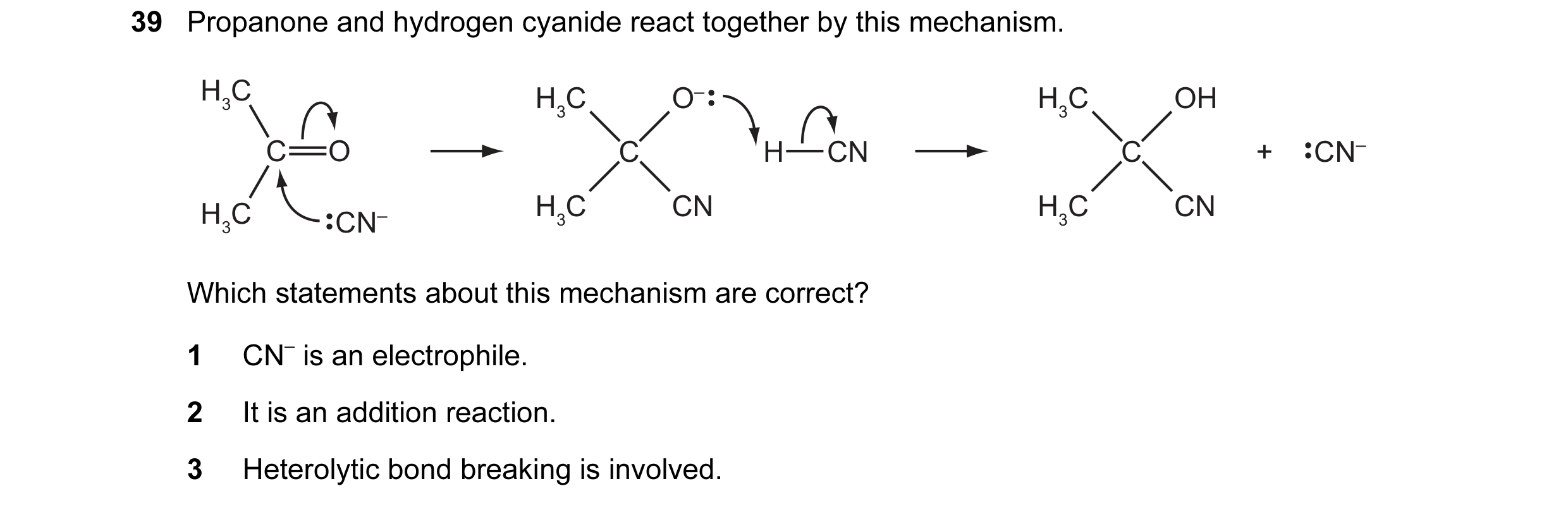
Q25 · Propanone and hydrogen cyanide react together by this mechanism 9701/12 May/June 2015
39 Propanone and hydrogen cyanide react together by this mechanism. H3C H3C O– H3C OH C O C H CN C + CN– H3C H3C CN H3C CN CN– Which statements about this mechanism are correct? 1 CN– is an electrophile. 2 It is an addition reaction. 3 Heterolytic bond breaking is involved.
1 marks
Answer: C
This question in 9701/12 May/June 2015
Q26 · Ethanal and hydrogen cyanide react together to form a compound used in the production of… 9701/13 May/June 2016
38 Ethanal and hydrogen cyanide react together to form a compound used in the production of acrylic fibres. The reaction mechanism involves cyanide ions. CH3 H3C O – H3C OH C O C H CN C + CN– H CN– H CN H CN Which statements about this mechanism are correct? 1 CN– acts as a catalyst. 2 CN– is a nucleophile. 3 It is an addition reaction.
1 marks
Answer: A
This question in 9701/13 May/June 2016
Q27 · Part of the structure of a fungicide, strobilurin, is shown 9701/13 Oct/Nov 2016
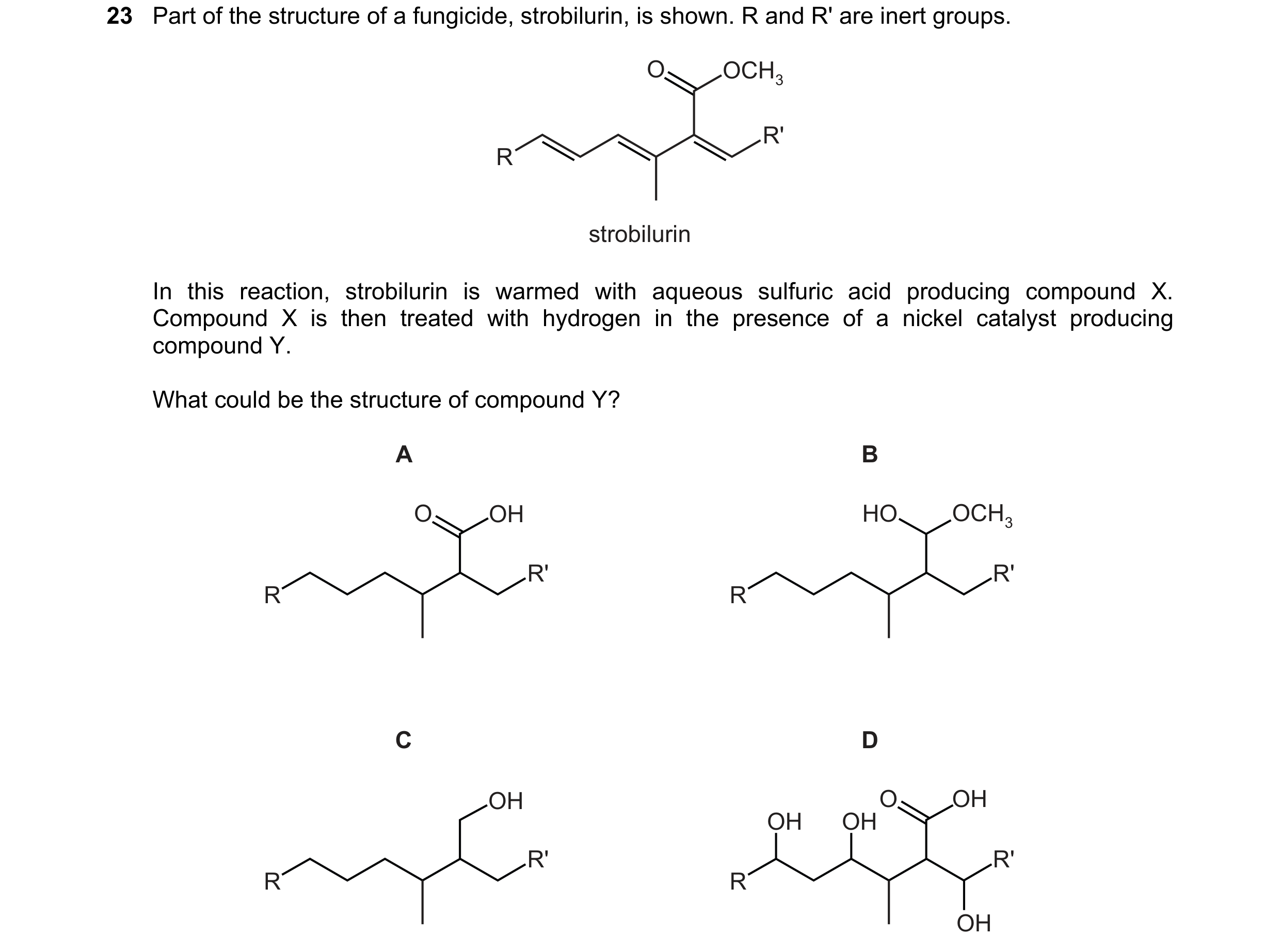
23 Part of the structure of a fungicide, strobilurin, is shown. R and R' are inert groups. O OCH3 R' R strobilurin In this reaction, strobilurin is warmed with aqueous sulfuric acid producing compound X. Compound X is then treated with hydrogen in the presence of a nickel catalyst producing compound Y. What could be the structure of compound Y? A B O OH HO OCH3 R' R' R R C D OH O OH OH OH R' R' R R OH
1 marks
Answer: A
This question in 9701/13 Oct/Nov 2016
Q28 · Propanone reacts with an aqueous mixture of HCN and NaCN by a nucleophilic addition… 9701/13 Oct/Nov 2016
26 Propanone reacts with an aqueous mixture of HCN and NaCN by a nucleophilic addition mechanism. The first stage of the mechanism involves attack by cyanide ions. Which diagram correctly represents this? A B CH3 CH3 – δ+ δ– – δ+ δ– N C C O N C C O CH3 CH3 C D CH3 CH3 – δ+ δ– – δ+ δ– C N C O N C C O CH3 CH3
1 marks
Answer: D
This question in 9701/13 Oct/Nov 2016
Q29 · What is true of every nucleophile? 9701/11 Oct/Nov 2018
20 What is true of every nucleophile? A It attacks a double bond. B It donates a lone pair of electrons. C It is a single atom. D It is negatively charged.
1 marks
Answer: B
This question in 9701/11 Oct/Nov 2018
Q30 · The conversion of propene to propan-2-ol can be carried out in two stages represented by… 9701/11 Oct/Nov 2018
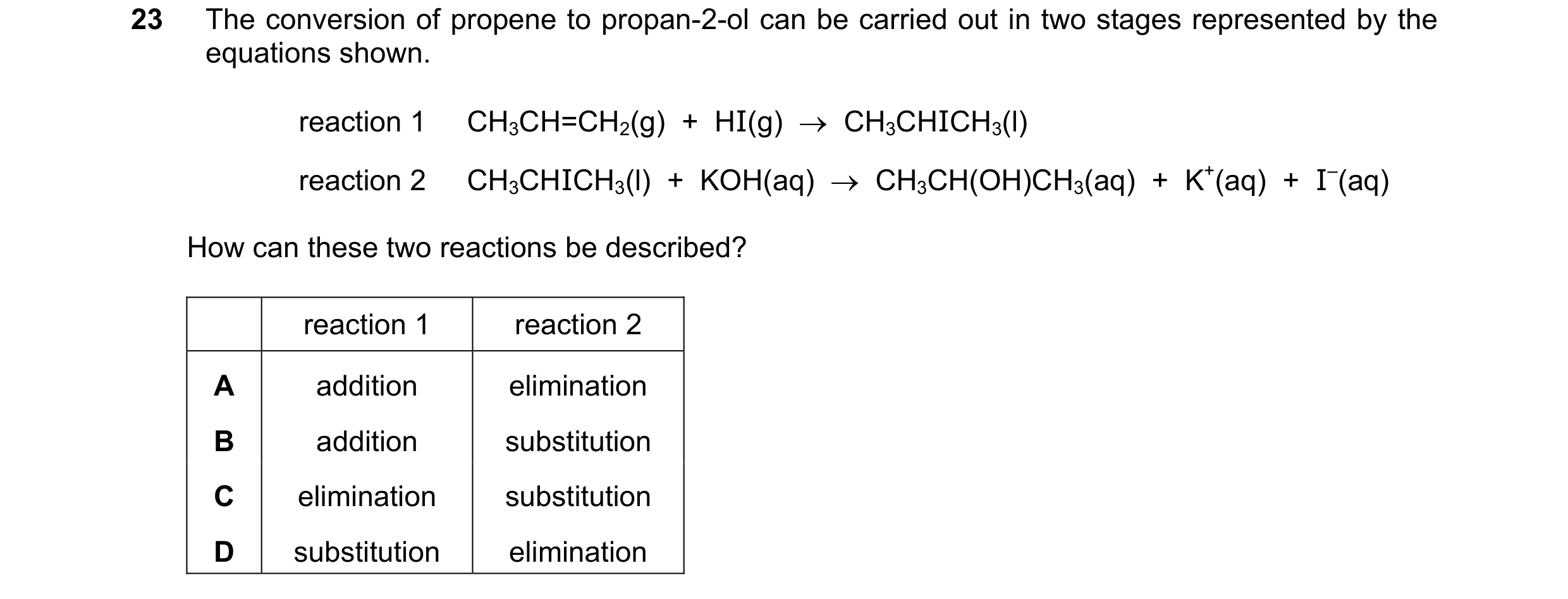
23 The conversion of propene to propan-2-ol can be carried out in two stages represented by the equations shown. reaction 1 CH3CH=CH2(g) + HI(g) → CH3CHICH3(l) reaction 2 CH3CHICH3(l) + KOH(aq) → CH3CH(OH)CH3(aq) + K+(aq) + I–(aq) How can these two reactions be described? reaction 1 reaction 2 A addition elimination B addition substitution C elimination substitution D substitution elimination
1 marks
Answer: B
This question in 9701/11 Oct/Nov 2018
Q31 · What is true of every nucleophile? 9701/13 Oct/Nov 2018
20 What is true of every nucleophile? A It attacks a double bond. B It donates a lone pair of electrons. C It is a single atom. D It is negatively charged.
1 marks
Answer: B
This question in 9701/13 Oct/Nov 2018
Q32 · The conversion of propene to propan-2-ol can be carried out in two stages represented by… 9701/13 Oct/Nov 2018
23 The conversion of propene to propan-2-ol can be carried out in two stages represented by the equations shown. reaction 1 CH3CH=CH2(g) + HI(g) → CH3CHICH3(l) reaction 2 CH3CHICH3(l) + KOH(aq) → CH3CH(OH)CH3(aq) + K+(aq) + I–(aq) How can these two reactions be described? reaction 1 reaction 2 A addition elimination B addition substitution C elimination substitution D substitution elimination
1 marks
Answer: B
This question in 9701/13 Oct/Nov 2018
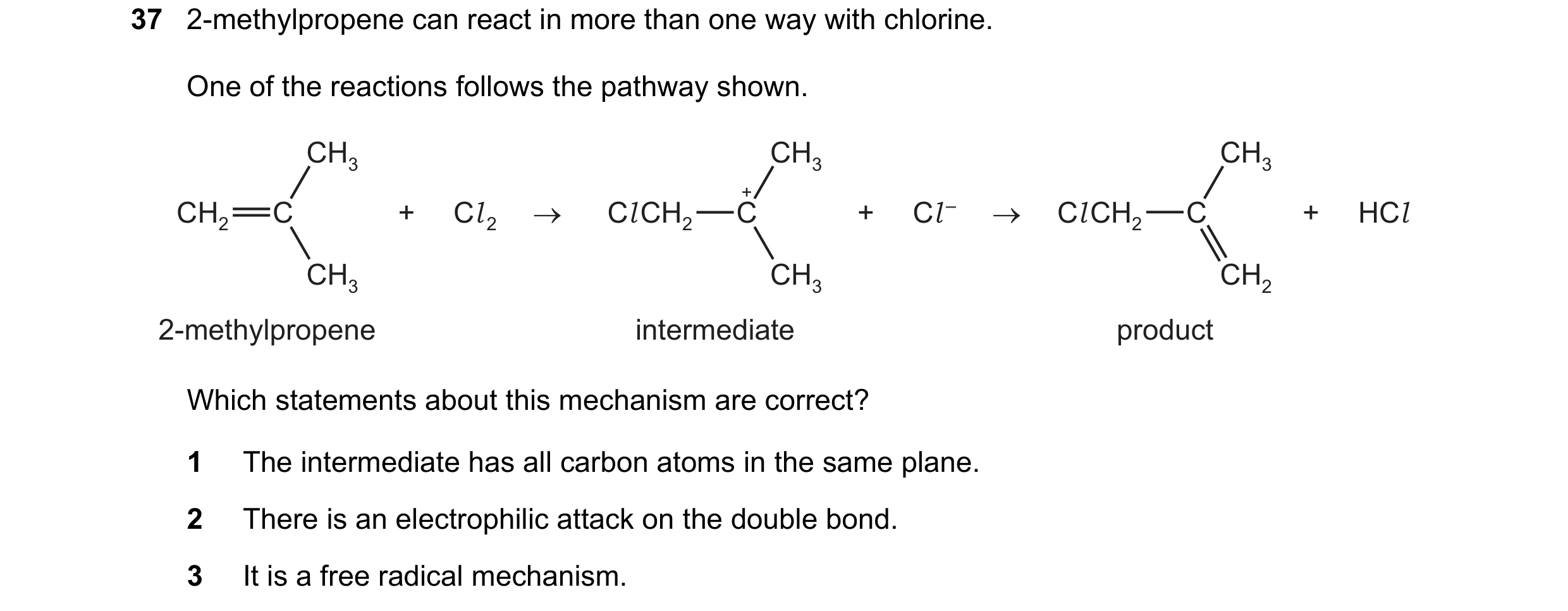
Q33 · 2-methylpropene can react in more than one way with chlorine 9701/13 Oct/Nov 2018
37 2-methylpropene can react in more than one way with chlorine. One of the reactions follows the pathway shown. CH3 CH3 CH3 + CH2 C + Cl 2 → Cl CH2 C + Cl – → Cl CH2 C + HCl CH3 CH3 CH2 2-methylpropene intermediate product Which statements about this mechanism are correct? 1 The intermediate has all carbon atoms in the same plane. 2 There is an electrophilic attack on the double bond. 3 It is a free radical mechanism.
1 marks
Answer: B
This question in 9701/13 Oct/Nov 2018
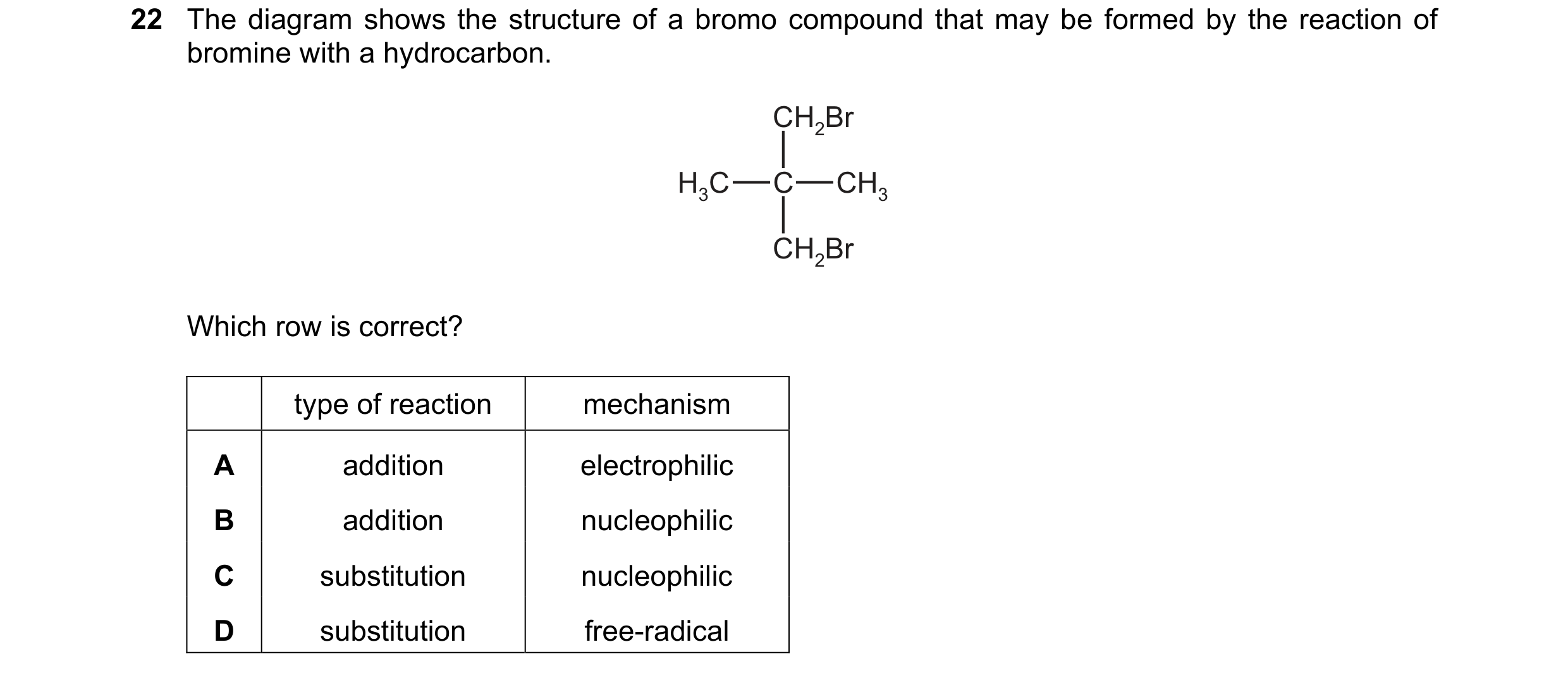
Q34 · The diagram shows the structure of a bromo compound that may be formed by the reaction of… 9701/12 Feb/March 2021
22 The diagram shows the structure of a bromo compound that may be formed by the reaction of bromine with a hydrocarbon. CH2Br H3C C CH3 CH2Br Which row is correct? type of reaction mechanism A addition electrophilic B addition nucleophilic C substitution nucleophilic D substitution free-radical
1 marks
Answer: D
This question in 9701/12 Feb/March 2021
Q35 · The diagram shows the formation of compound Y from compound X in a chemical reaction 9701/12 Feb/March 2021
26 The diagram shows the formation of compound Y from compound X in a chemical reaction. R1 and R2 are alkyl groups. Y R1 OH KCN X + HCN C R2 CN Which row about this reaction is correct? mechanism compound X A electrophilic addition aldehyde B electrophilic addition ketone C nucleophilic addition ketone D nucleophilic addition aldehyde
1 marks
Answer: C
This question in 9701/12 Feb/March 2021
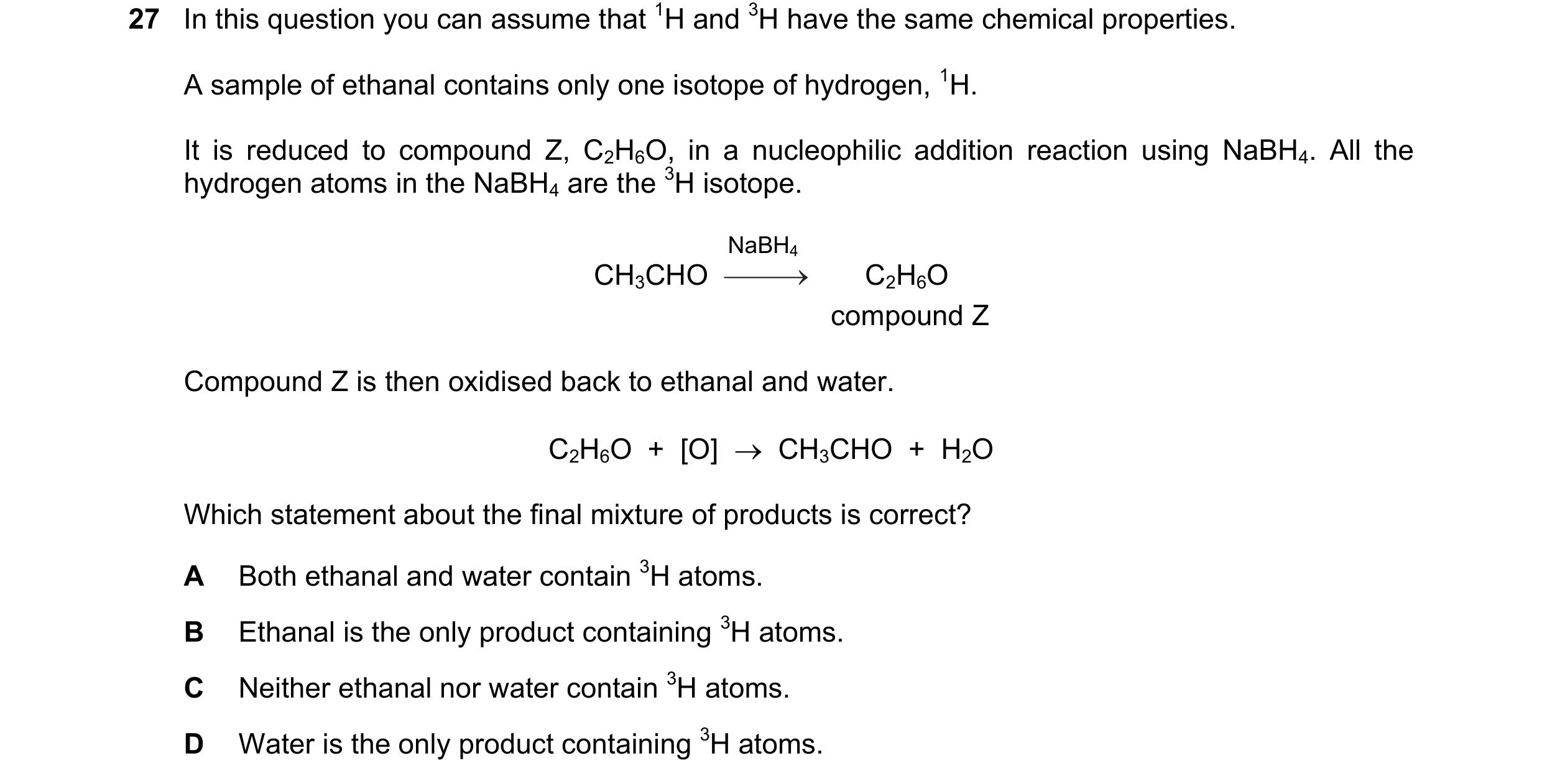
Q36 · In this question you can assume that 1H and 3H have the same chemical properties 9701/12 Feb/March 2021
27 In this question you can assume that 1H and 3H have the same chemical properties. A sample of ethanal contains only one isotope of hydrogen, 1H. It is reduced to compound Z, C2H6O, in a nucleophilic addition reaction using NaBH4. All the hydrogen atoms in the NaBH4 are the 3H isotope. NaBH4 CH3CHO C2H6O compound Z Compound Z is then oxidised back to ethanal and water. C2H6O + [O] CH3CHO + H2O Which statement about the final mixture of products is correct? A Both ethanal and water contain 3H atoms. B Ethanal is the only product containing 3H atoms. C Neither ethanal nor water contain 3H atoms. D Water is the only product containing 3H atoms.
1 marks
Answer: A
This question in 9701/12 Feb/March 2021
Q37 · In which reactions is the major product formed by a nucleophilic substitution reaction? 9701/12 Feb/March 2021
37 In which reactions is the major product formed by a nucleophilic substitution reaction? 1 bromoethane + potassium cyanide in ethanol 2 bromoethane + ammonia in ethanol under pressure 3 bromoethane + hot concentrated sodium hydroxide in ethanol
1 marks
Answer: B
This question in 9701/12 Feb/March 2021
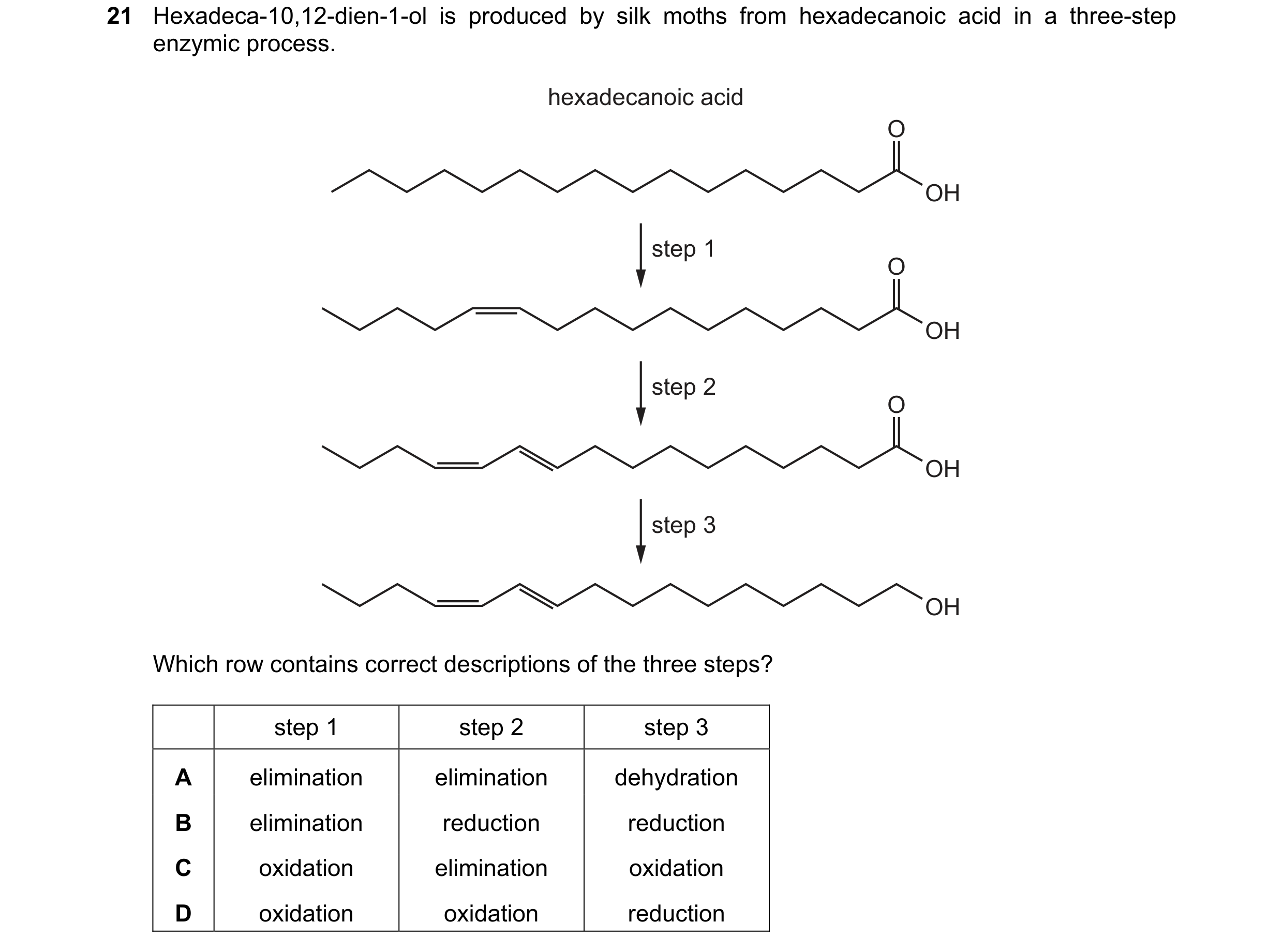
Q38 · Hexadeca-10,12-dien-1-ol is produced by silk moths from hexadecanoic acid in a three-step… 9701/12 May/June 2021
21 Hexadeca-10,12-dien-1-ol is produced by silk moths from hexadecanoic acid in a three-step enzymic process. hexadecanoic acid O OH step 1 O OH step 2 O OH step 3 OH Which row contains correct descriptions of the three steps? step 1 step 2 step 3 A elimination elimination dehydration B elimination reduction reduction C oxidation elimination oxidation D oxidation oxidation reduction
1 marks
Answer: D
This question in 9701/12 May/June 2021
Q39 · Which reaction mechanism for the formation of CzH;CH(OH)(CN) is correct? 9701/12 May/June 2021
28 Which reaction mechanism for the formation of CzH;CH(OH)(CN) is correct?
H*
> or OH
A oy Ss) ———$> 4 ———“—— H
— Cs C
NSC H | |
H*
7 o:J OH
\ ; a +
B wy > —> 4 —_—_>
—c; / C
N=C H | |
N
H*
54 o: OH
O + +
Cc Sf —+» —_>
=c:__” C
NSC H | |
N
H*
1 marks
Answer: D
This question in 9701/12 May/June 2021
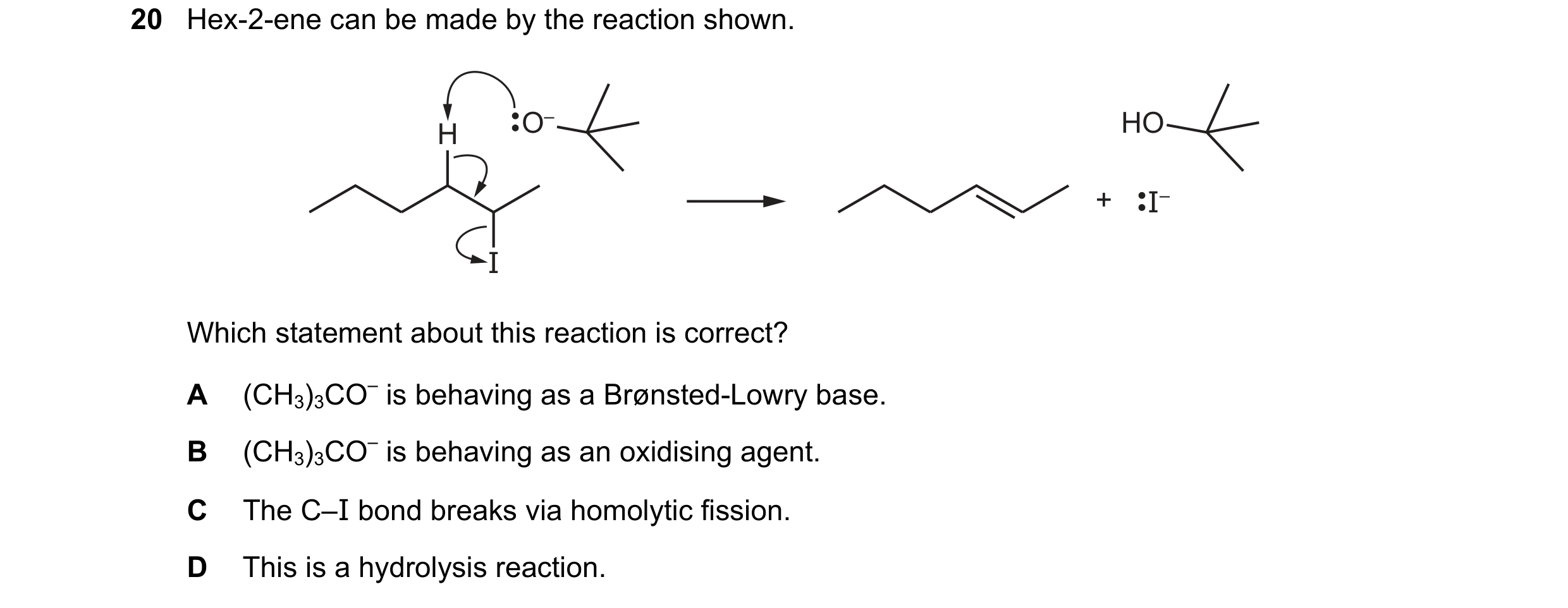
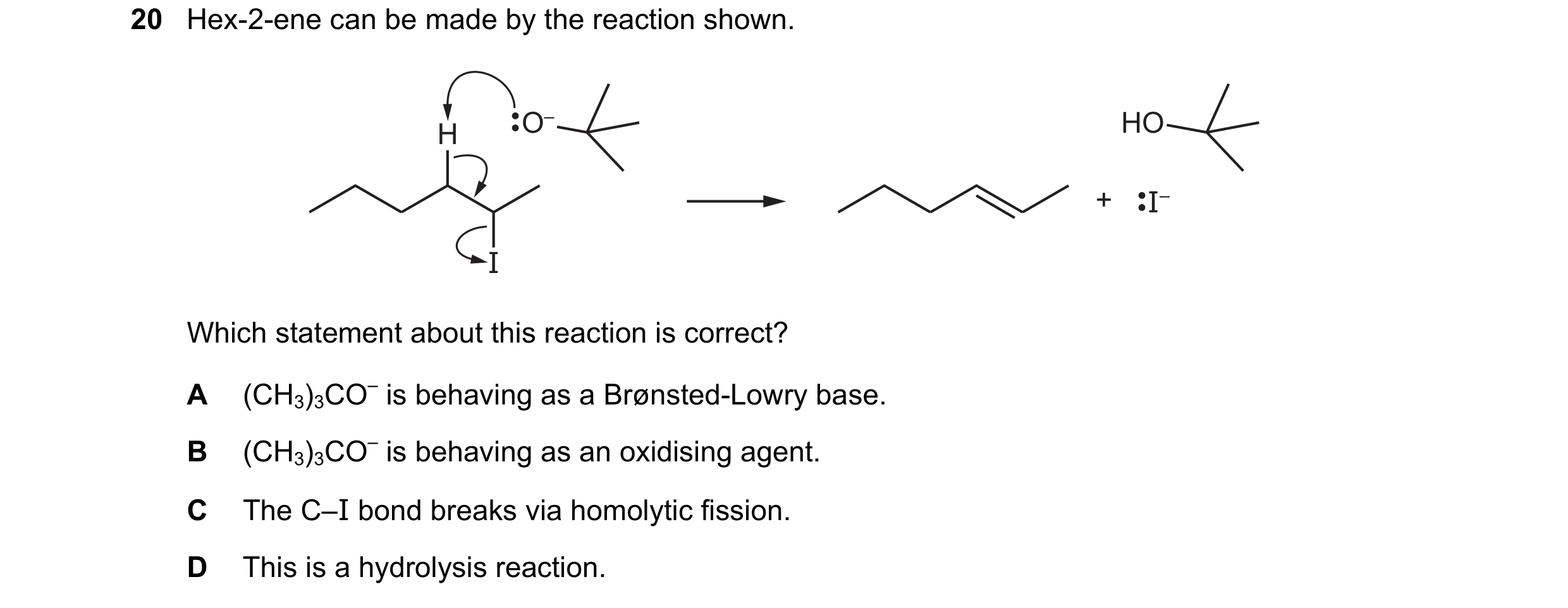
Q40 · Hex-2-ene can be made by the reaction shown 9701/11 Oct/Nov 2021
20 Hex-2-ene can be made by the reaction shown. O– HO H + I– I Which statement about this reaction is correct? A (CH3)3CO– is behaving as a Brønsted-Lowry base. B (CH3)3CO– is behaving as an oxidising agent. C The C–I bond breaks via homolytic fission. D This is a hydrolysis reaction.
1 marks
Answer: A
This question in 9701/11 Oct/Nov 2021
Q41 · When an organic compound, Q, is treated with phosphorus pentachloride, fumes of hydrogen… 9701/11 Oct/Nov 2021
24 When an organic compound, Q, is treated with phosphorus pentachloride, fumes of hydrogen chloride are evolved. When Q is warmed with acidified aqueous potassium dichromate(VI), the solution turns green. What is Q? A CH3CH2CHO B CH3CH2CO2H C CH3CH(OH)CH3 D (CH3)3COH
1 marks
Answer: C
This question in 9701/11 Oct/Nov 2021
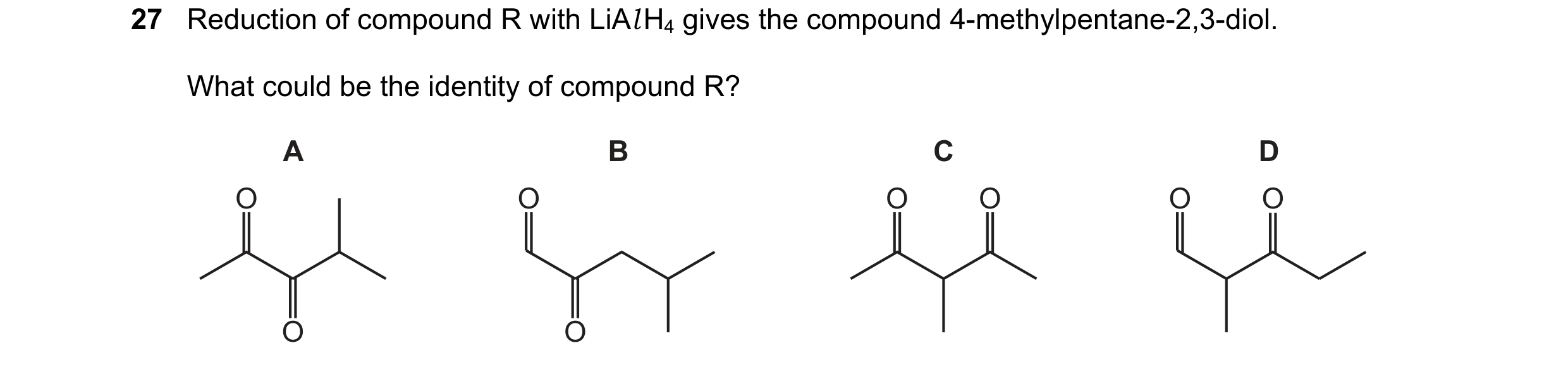
Q42 · Reduction of compound R with LiAl H4 gives the compound 4-methylpentane-2,3-diol 9701/11 Oct/Nov 2021
27 Reduction of compound R with LiAl H4 gives the compound 4-methylpentane-2,3-diol. What could be the identity of compound R? A B C D O O O O O O O O
1 marks
Answer: A
This question in 9701/11 Oct/Nov 2021
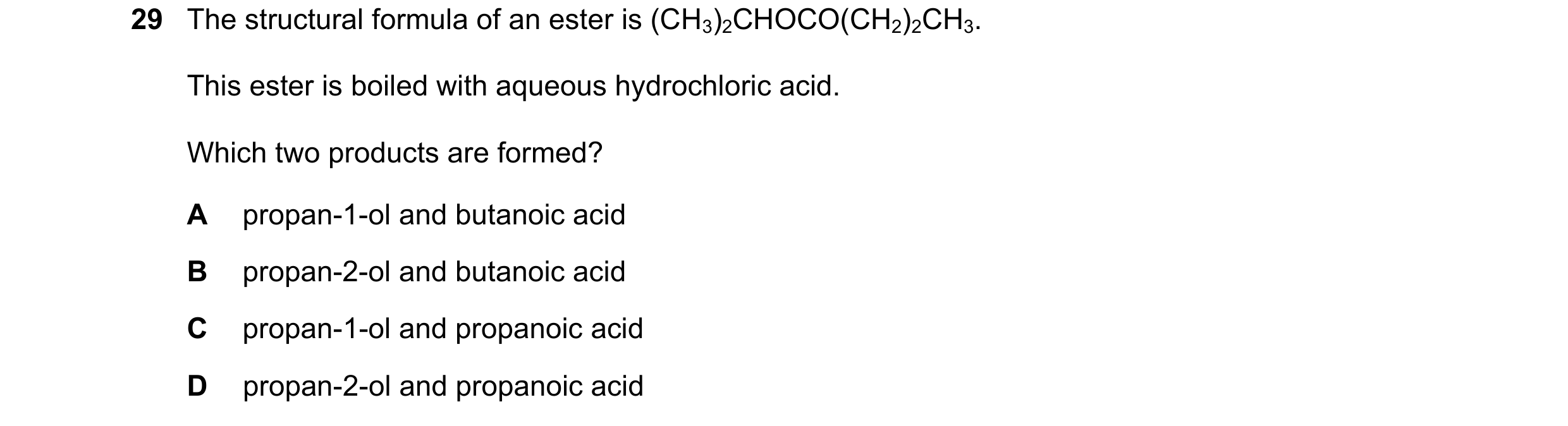
Q43 · The structural formula of an ester is (CH3)2CHOCO(CH2)2CH3 9701/11 Oct/Nov 2021
29 The structural formula of an ester is (CH3)2CHOCO(CH2)2CH3. This ester is boiled with aqueous hydrochloric acid. Which two products are formed? A propan-1-ol and butanoic acid B propan-2-ol and butanoic acid C propan-1-ol and propanoic acid D propan-2-ol and propanoic acid
1 marks
Answer: B
This question in 9701/11 Oct/Nov 2021
Q44 · Hex-2-ene can be made by the reaction shown 9701/13 Oct/Nov 2021
20 Hex-2-ene can be made by the reaction shown. O– HO H + I– I Which statement about this reaction is correct? A (CH3)3CO– is behaving as a Brønsted-Lowry base. B (CH3)3CO– is behaving as an oxidising agent. C The C–I bond breaks via homolytic fission. D This is a hydrolysis reaction.
1 marks
Answer: A
This question in 9701/13 Oct/Nov 2021
Q45 · The molecular formula CH3 can represent an anion, a cation or a free radical 9701/12 May/June 2022
27 The molecular formula CH3 can represent an anion, a cation or a free radical. Species with the molecular formula CH3 can act as an electrophile, a free radical or a nucleophile depending on the number of outer shell electrons on the central carbon atom. How many outer shell electrons on the central carbon atom must be present for CH3 to act in these different ways? CH3 as an CH3 as a CH3 as a electrophile free radical nucleophile A 6 7 8 B 6 8 7 C 7 6 8 D 8 7 6
1 marks
Answer: A
This question in 9701/12 May/June 2022
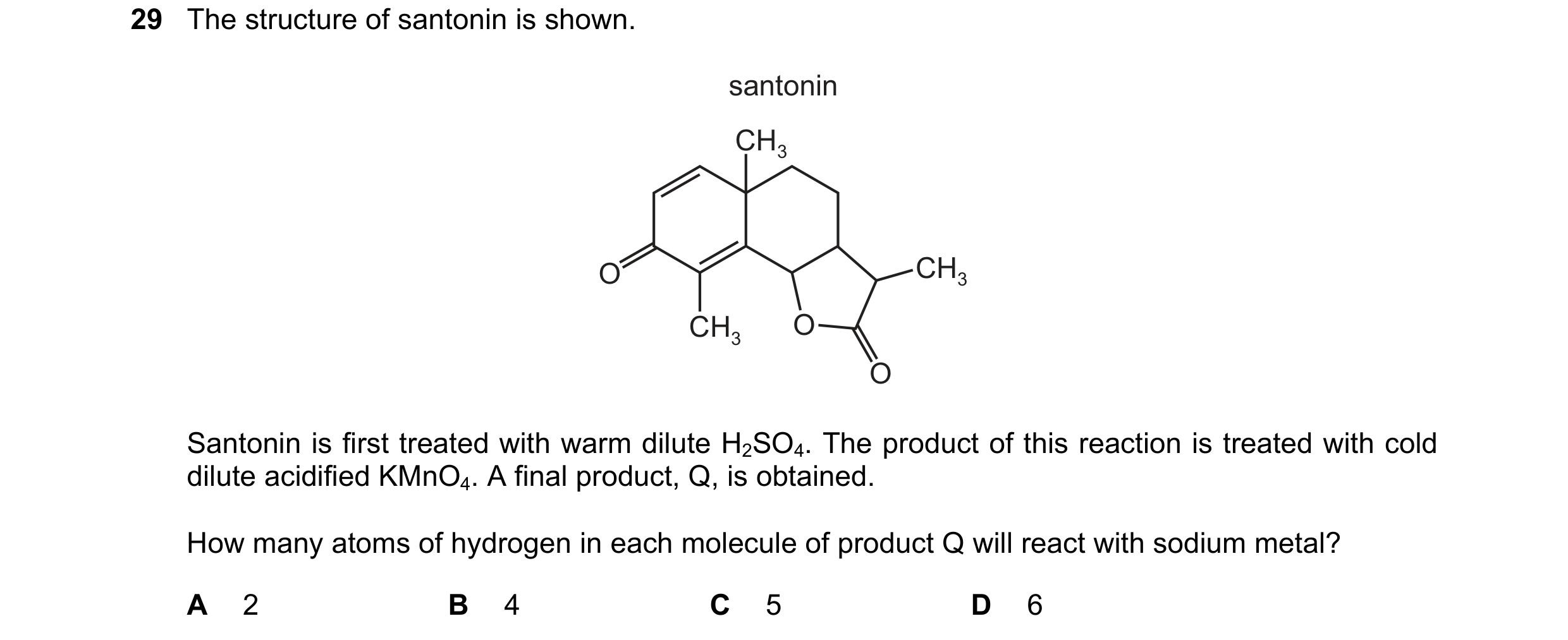
Q46 · The structure of santonin is shown 9701/11 Oct/Nov 2022
29 The structure of santonin is shown. santonin CH3 O CH3 CH3 O O Santonin is first treated with warm dilute H2SO4. The product of this reaction is treated with cold dilute acidified KMnO4. A final product, Q, is obtained. How many atoms of hydrogen in each molecule of product Q will react with sodium metal? A 2 B 4 C 5 D 6
1 marks
Answer: D
This question in 9701/11 Oct/Nov 2022
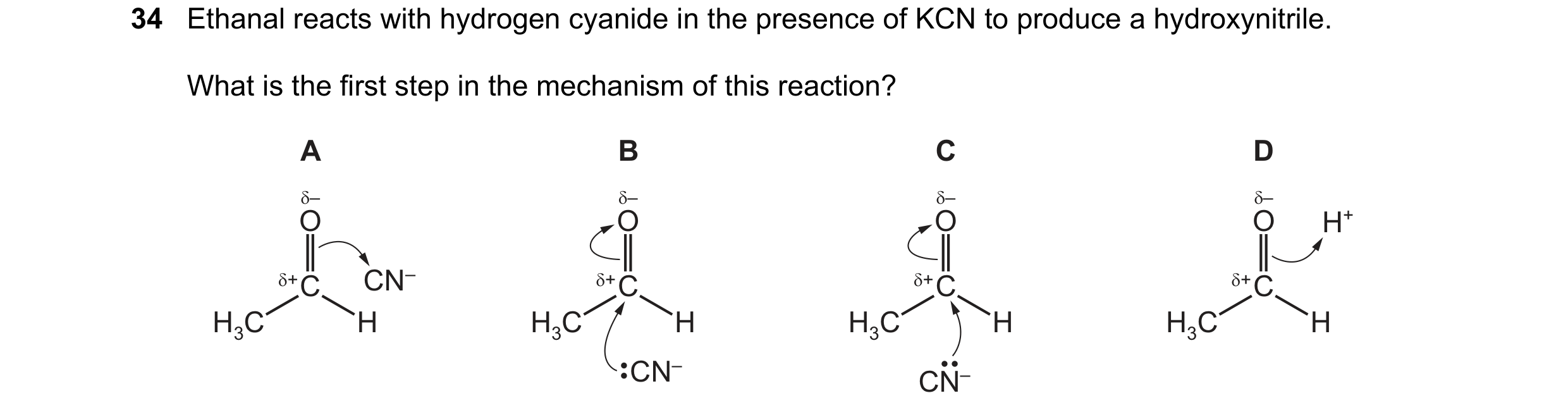
Q47 · Ethanal reacts with hydrogen cyanide in the presence of KCN to produce a hydroxynitrile 9701/11 Oct/Nov 2022
34 Ethanal reacts with hydrogen cyanide in the presence of KCN to produce a hydroxynitrile.
What is the first step in the mechanism of this reaction?
A B c D
0 0 0 0
H*
In, Cl C| |“
st+C ~=CN sC aC tC
H,cC~ H H.07/ ™“H H,c~ oH H,cC~ H
2CN- chi
1 marks
Answer: B
This question in 9701/11 Oct/Nov 2022
Q48 · What is true of every nucleophile? 9701/12 Oct/Nov 2024
28 What is true of every nucleophile? A It attacks a double bond. B It donates a lone pair of electrons. C It is a single atom. D It is negatively charged.
1 marks
Answer: B
This question in 9701/12 Oct/Nov 2024
Q49 · Which intermediate ion forms in the greatest amount during the addition of HBr to propene? 9701/11 Oct/Nov 2025
27 Which intermediate ion forms in the greatest amount during the addition of HBr to propene? A CH3CH+CH3 B CH3CH2CH2 + C CH3CH–CH2Br D CH3CHBrCH2 –
1 marks
Answer: A
This question in 9701/11 Oct/Nov 2025
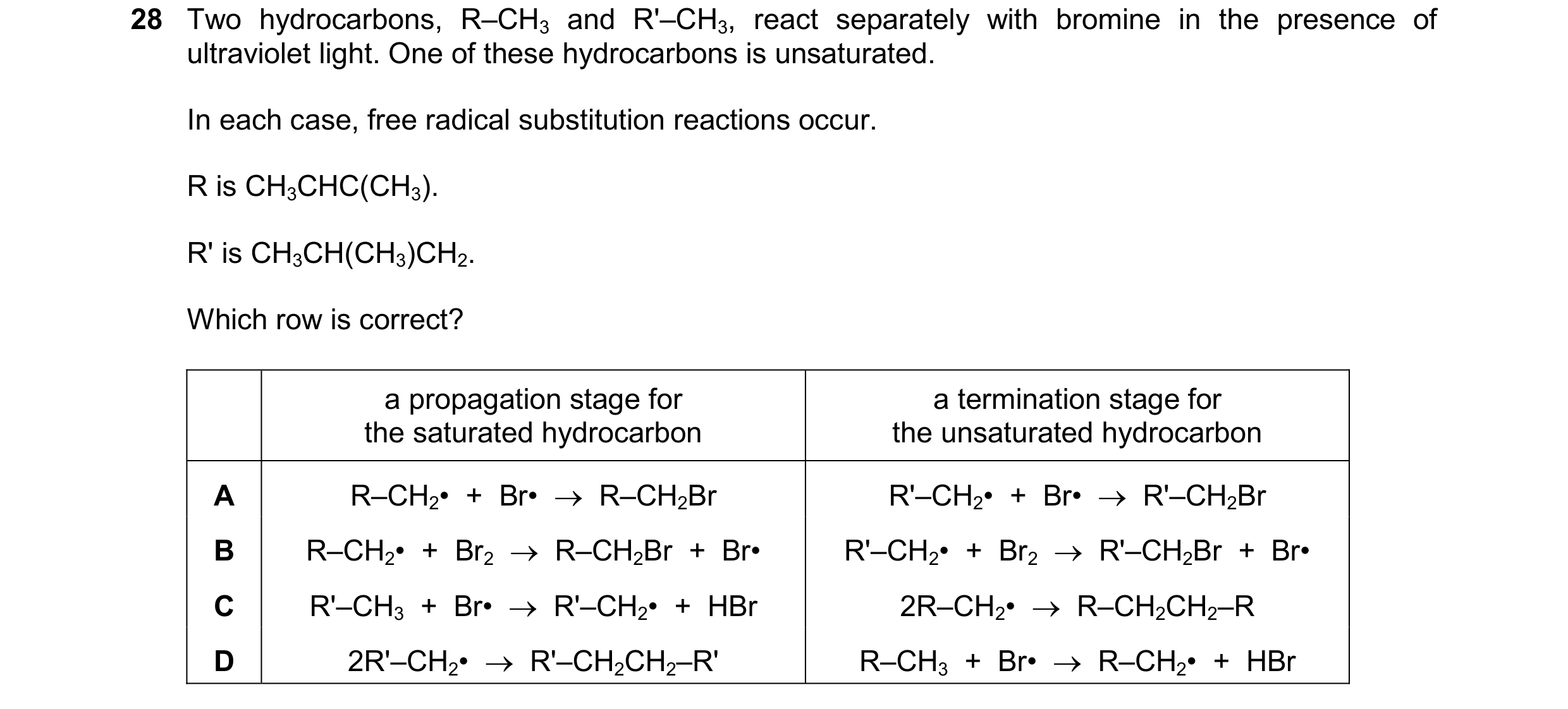
Q50 · Two hydrocarbons, R–CH3 and R'–CH3, react separately with bromine in the presence of… 9701/11 Oct/Nov 2025
28 Two hydrocarbons, R–CH3 and R'–CH3, react separately with bromine in the presence of ultraviolet light. One of these hydrocarbons is unsaturated. In each case, free radical substitution reactions occur. R is CH3CHC(CH3). R' is CH3CH(CH3)CH2. Which row is correct? a propagation stage for the saturated hydrocarbon a termination stage for the unsaturated hydrocarbon A R–CH2• + Br• R–CH2Br R'–CH2• + Br• R'–CH2Br B R–CH2• + Br2 R–CH2Br + Br• R'–CH2• + Br2 R'–CH2Br + Br• C R'–CH3 + Br• R'–CH2• + HBr 2R–CH2• R–CH2CH2–R D 2R'–CH2• R'–CH2CH2–R' R–CH3 + Br• R–CH2• + HBr
1 marks
Answer: C
This question in 9701/11 Oct/Nov 2025
 1 / 17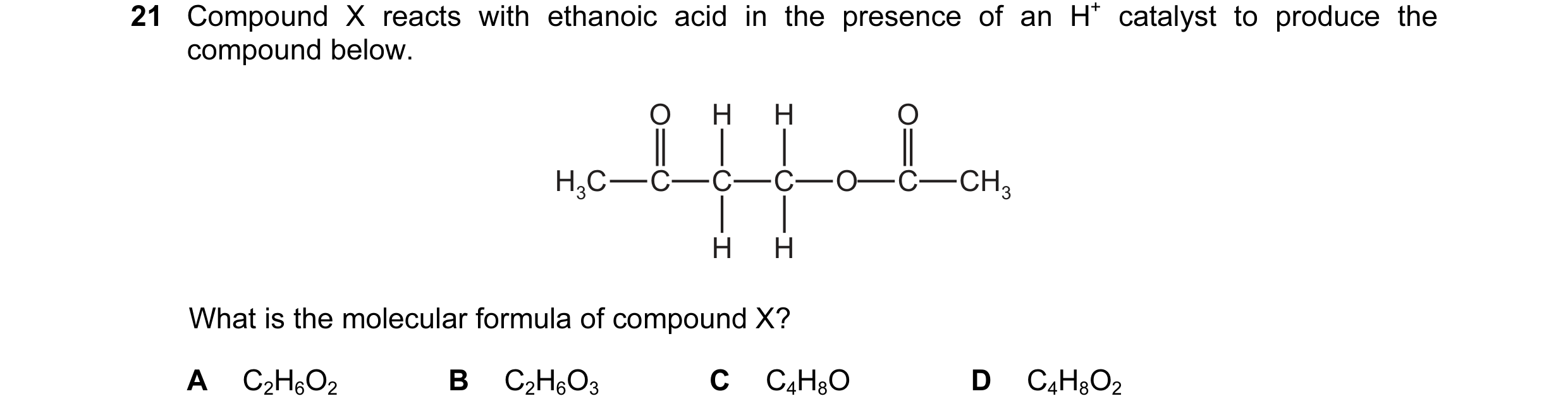


 2 / 17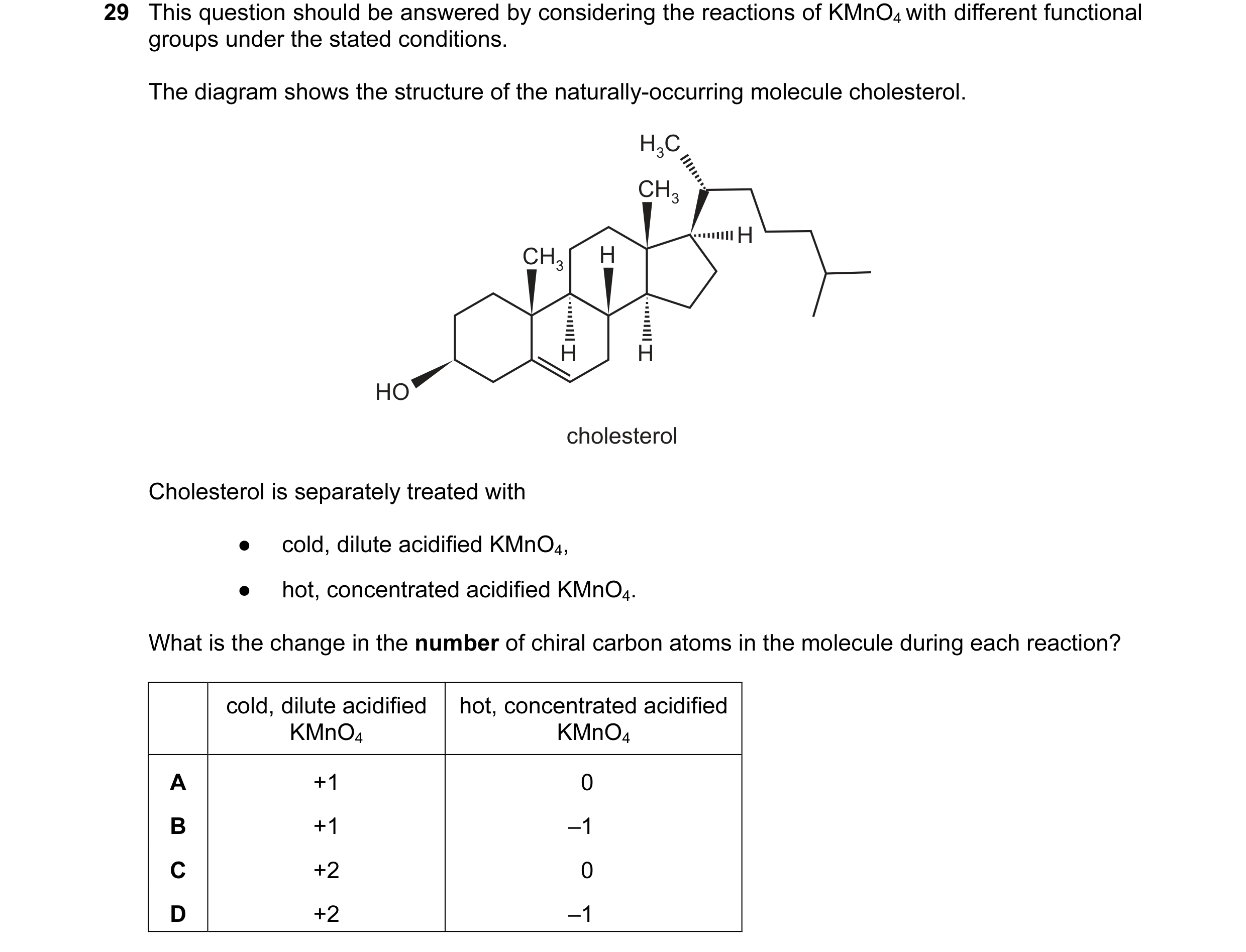
 3 / 17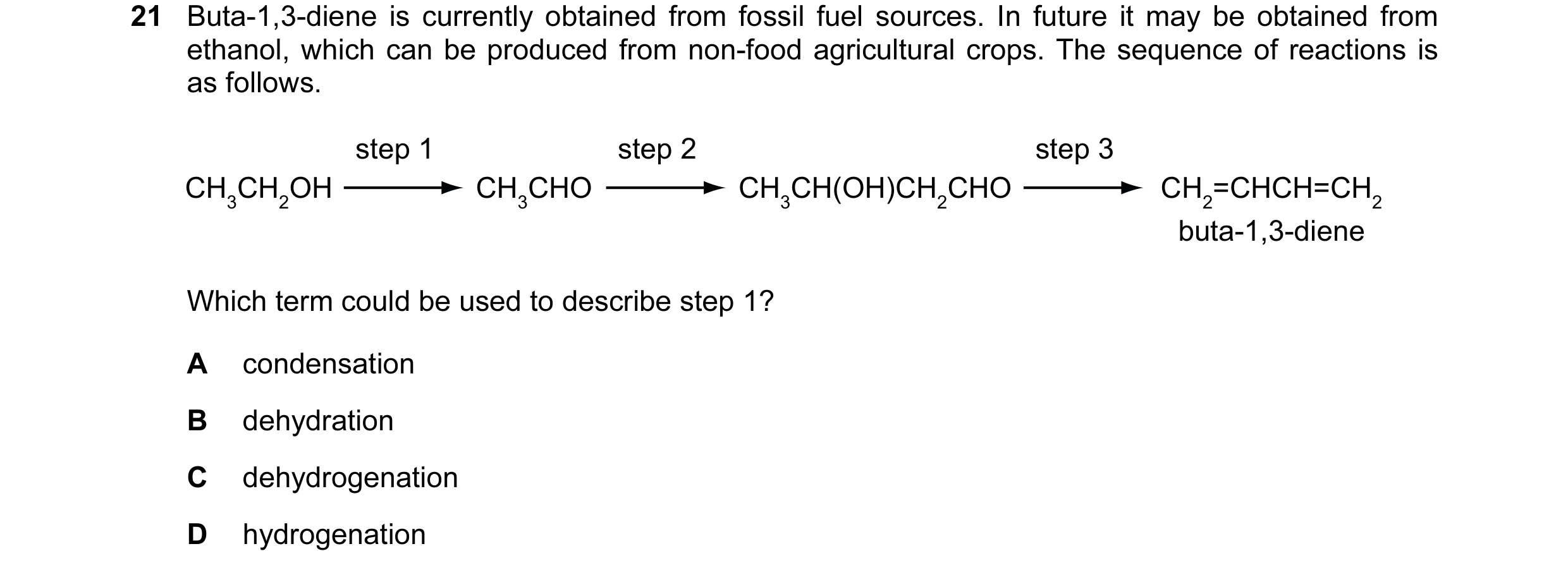
 4 / 17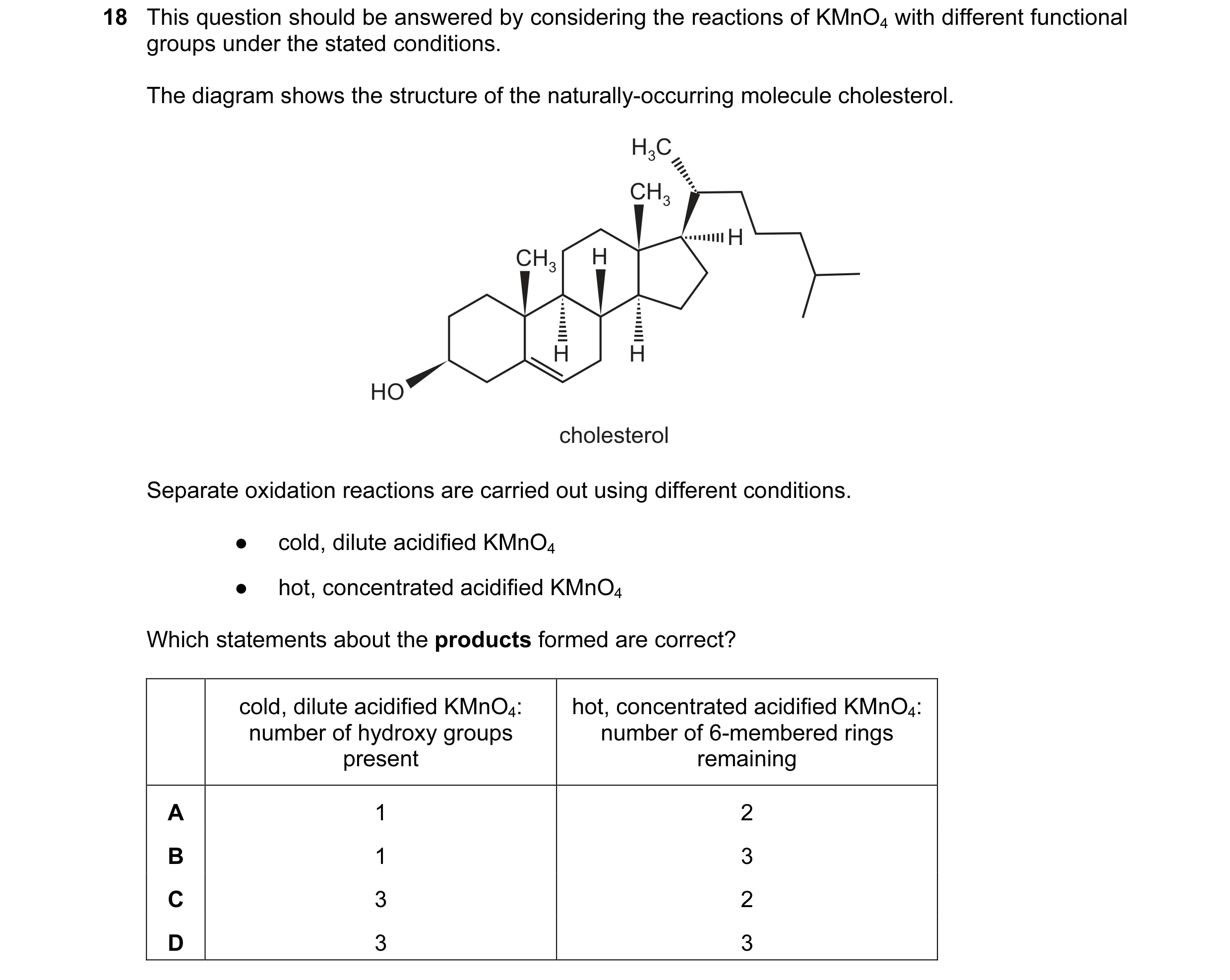
 5 / 17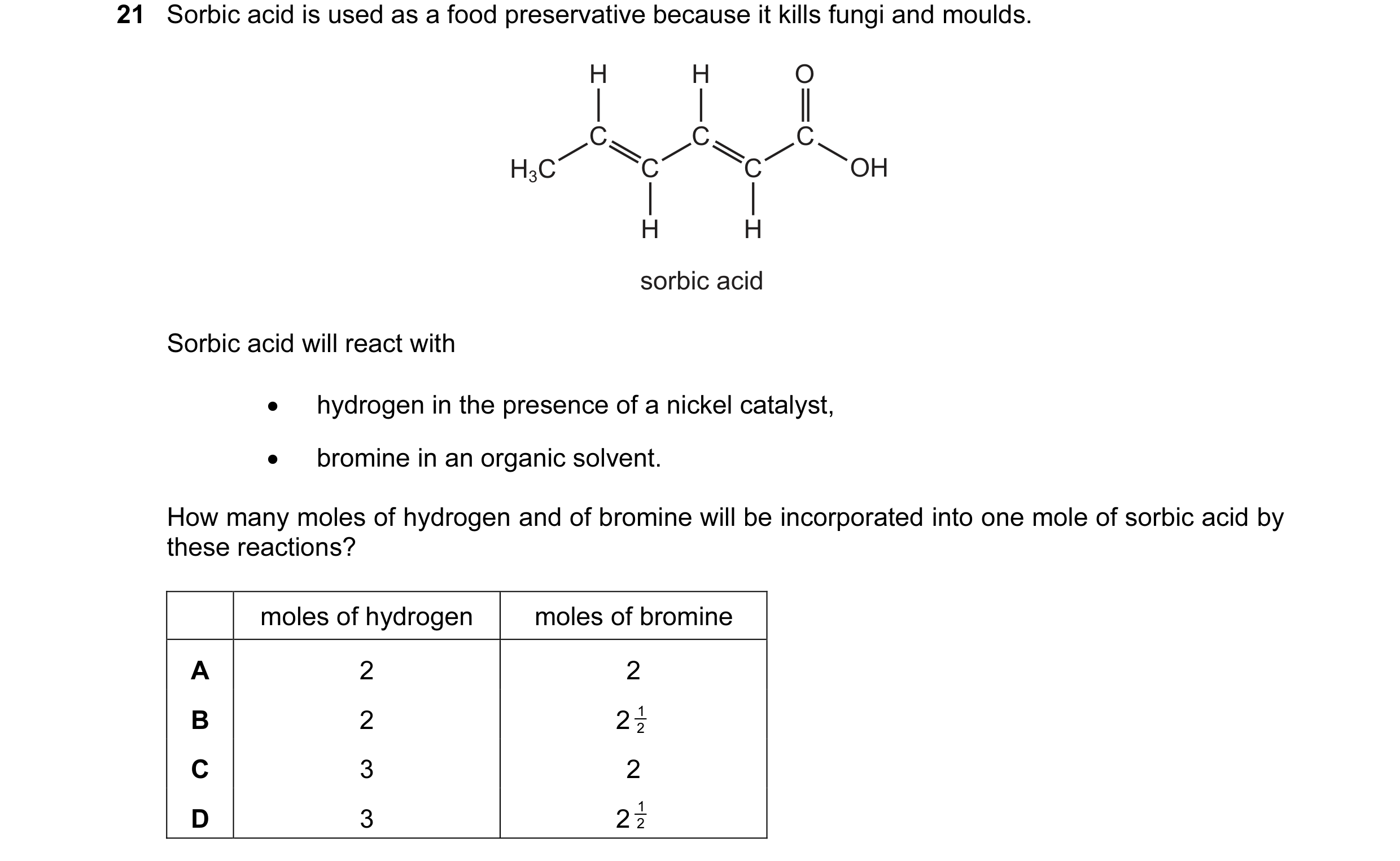

 6 / 17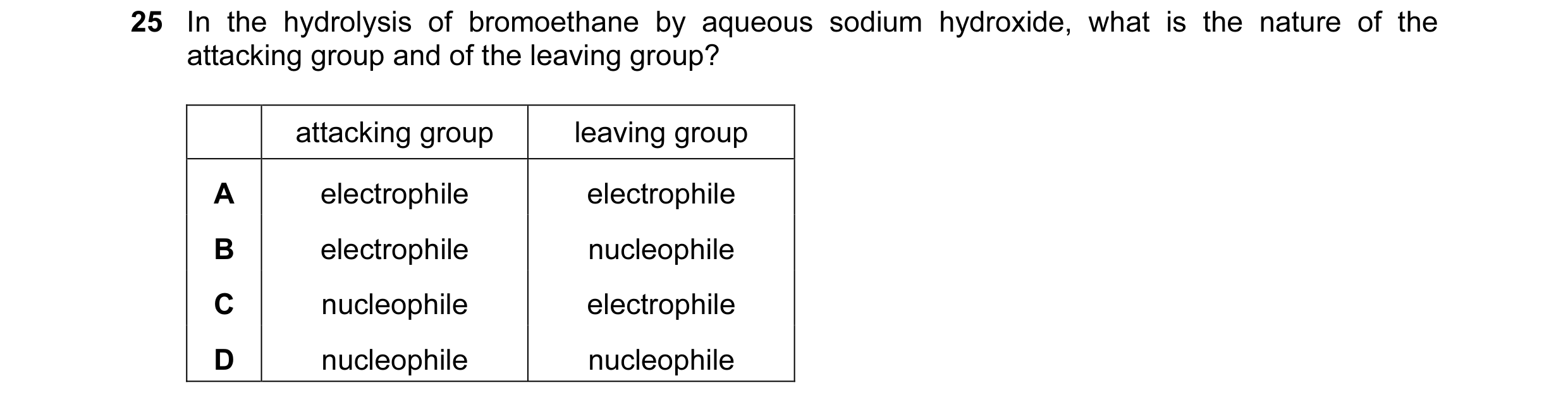
 7 / 17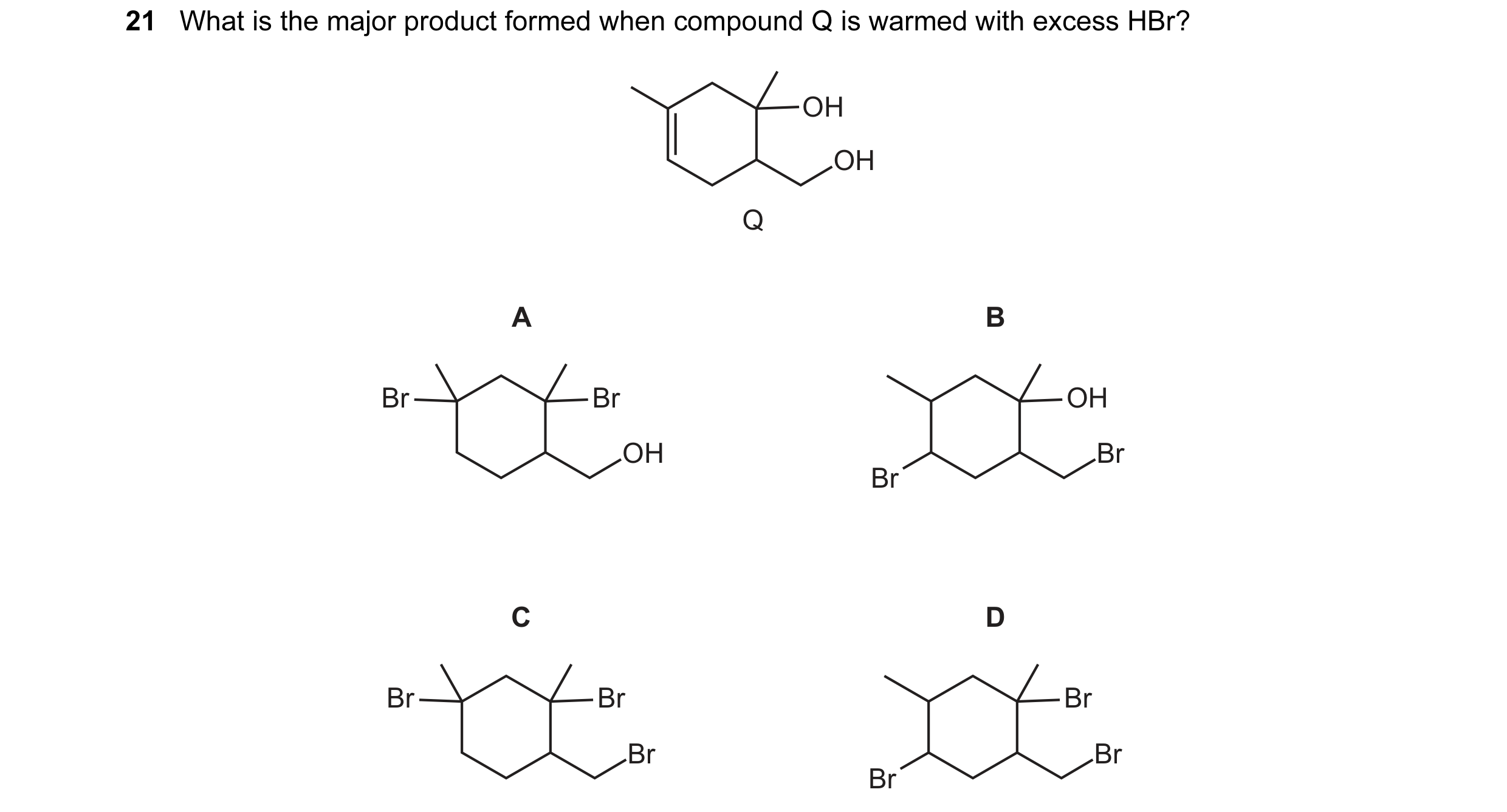
 8 / 17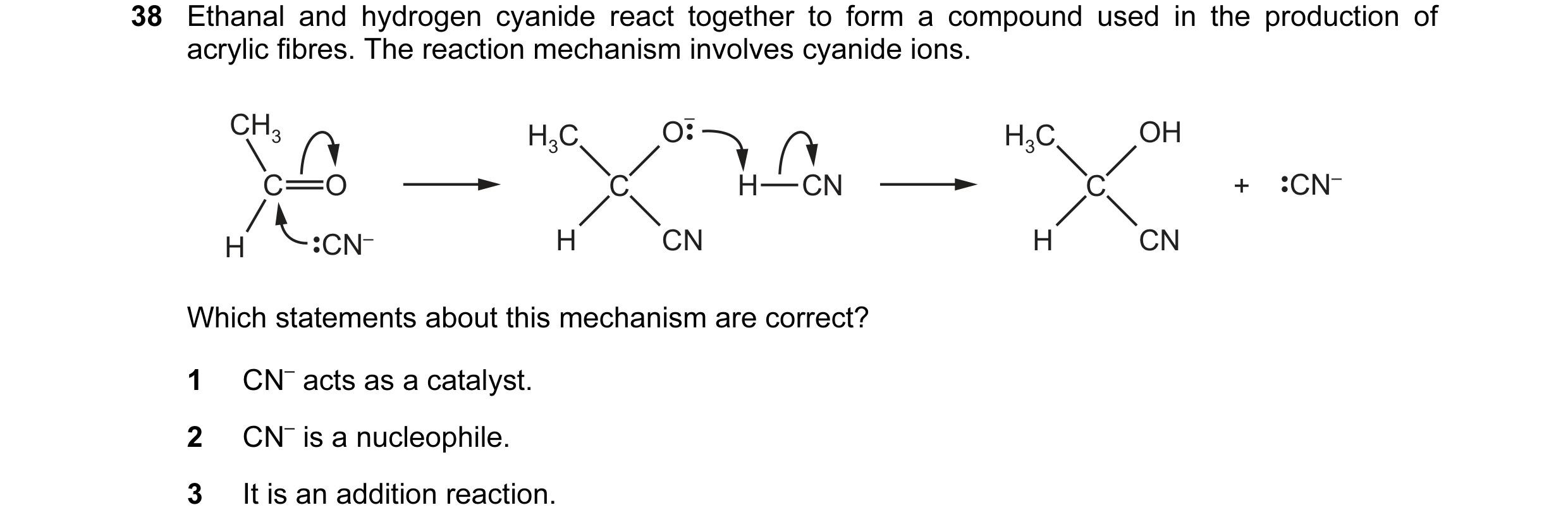
 9 / 17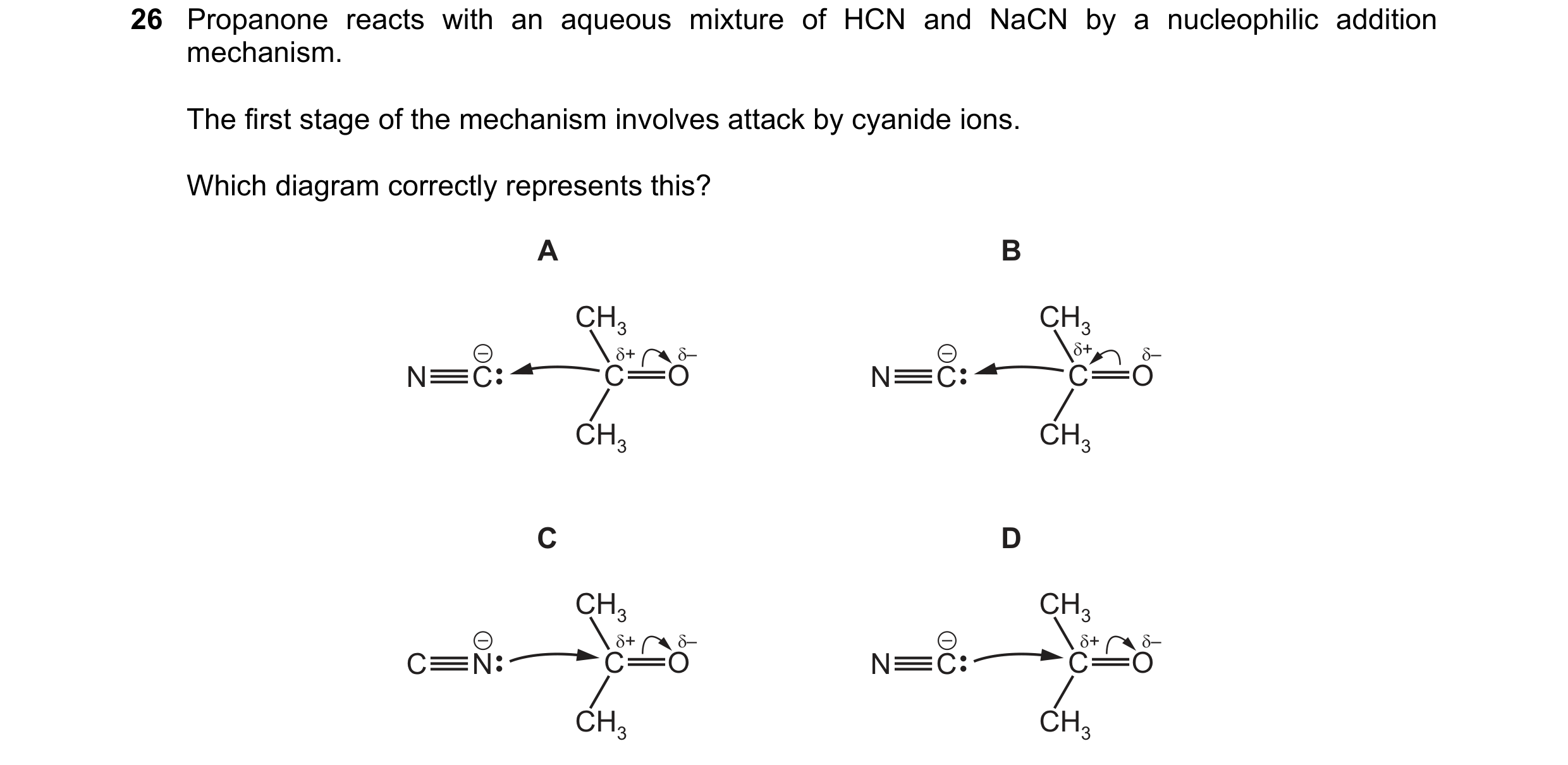

 10 / 17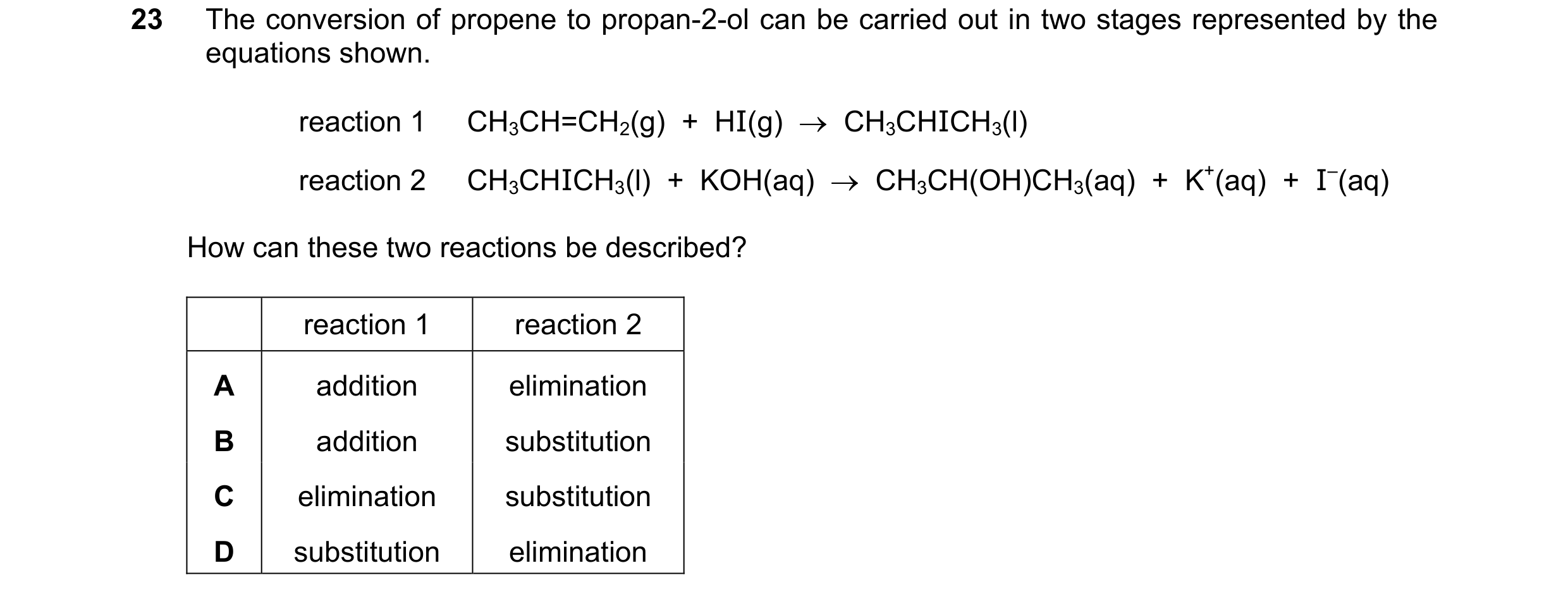
 11 / 17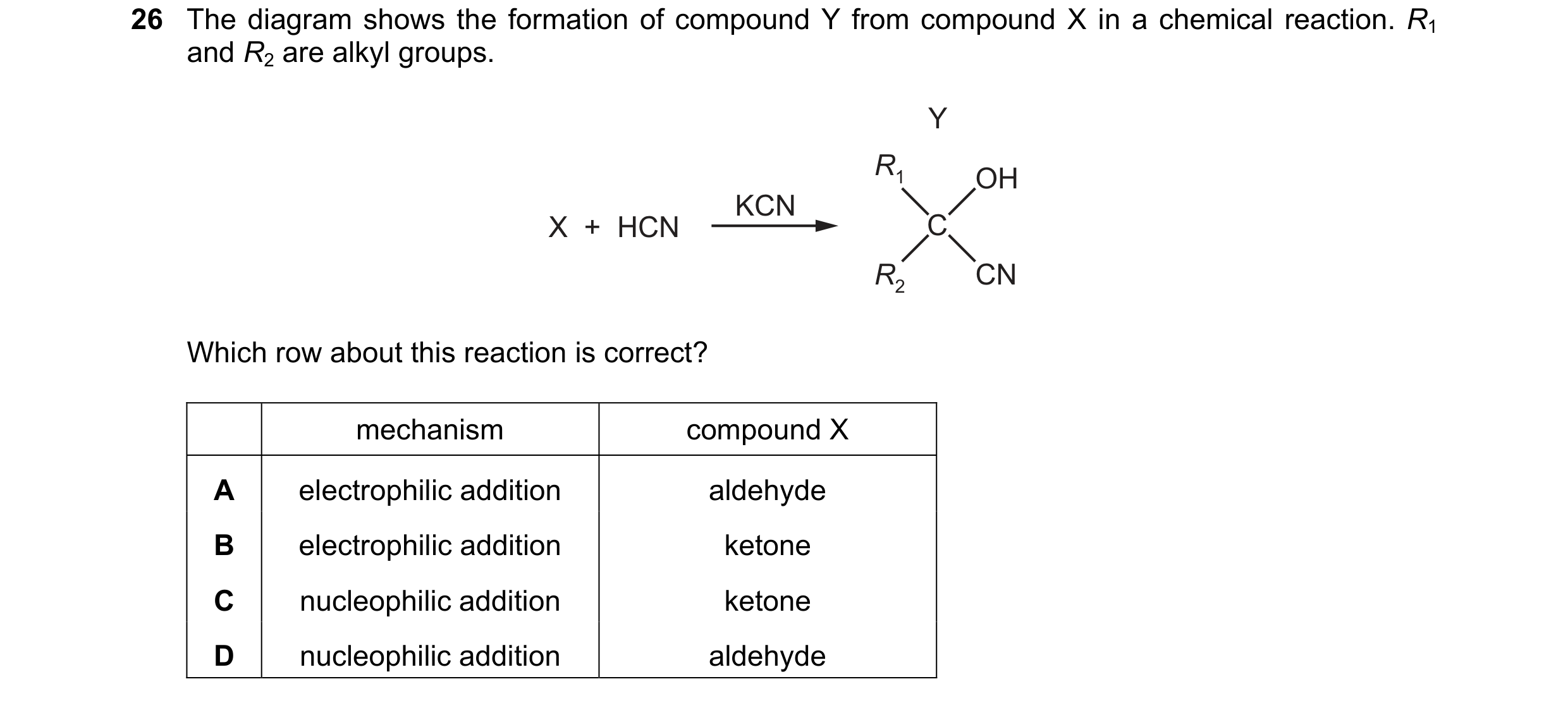
 12 / 17
 13 / 17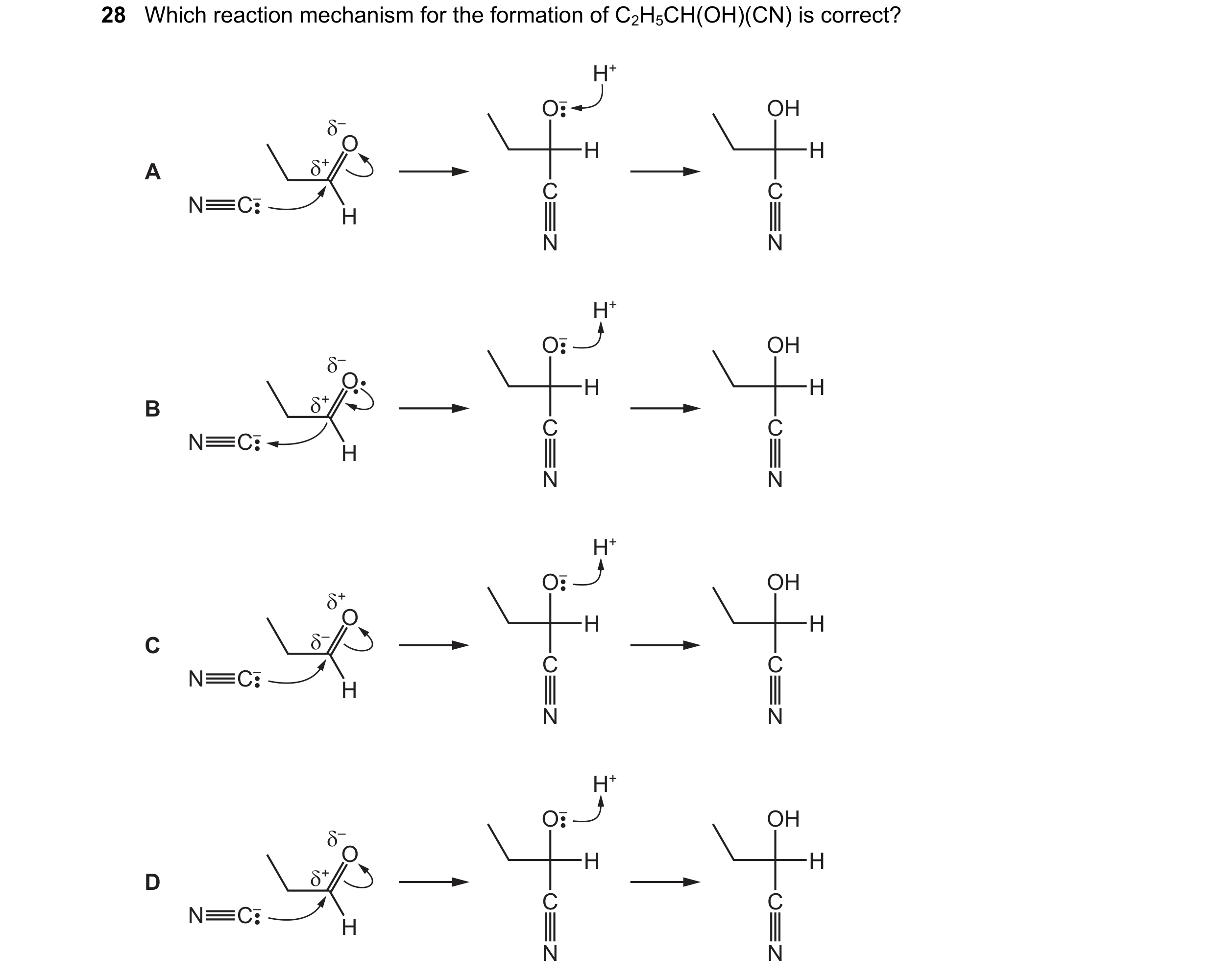
 14 / 17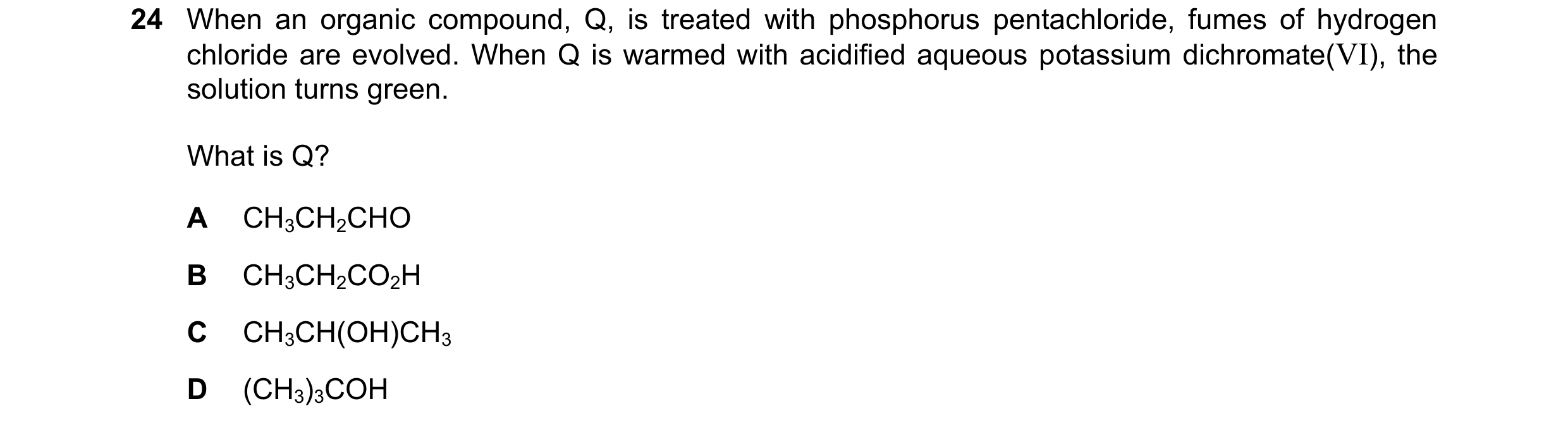
 15 / 17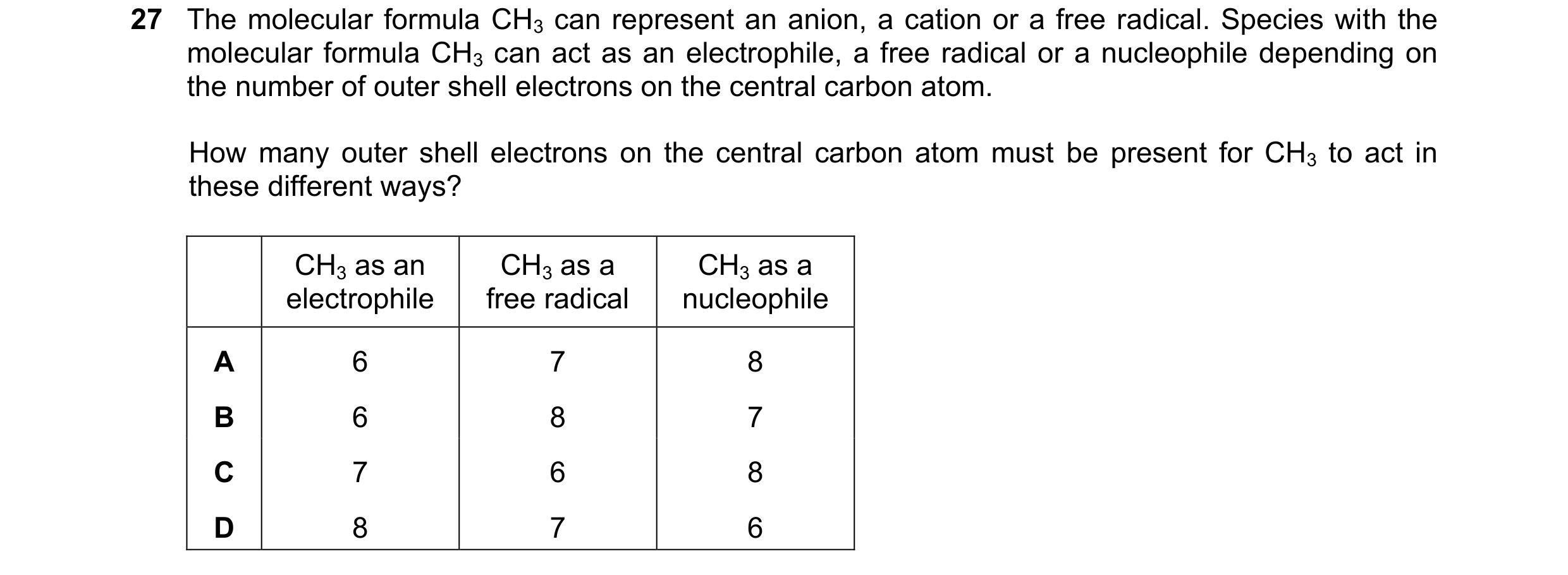
 16 / 17
 17 / 17