Questions as text
Q1 · A snowboarder on a ski slope 0654/31 Oct/Nov 2017
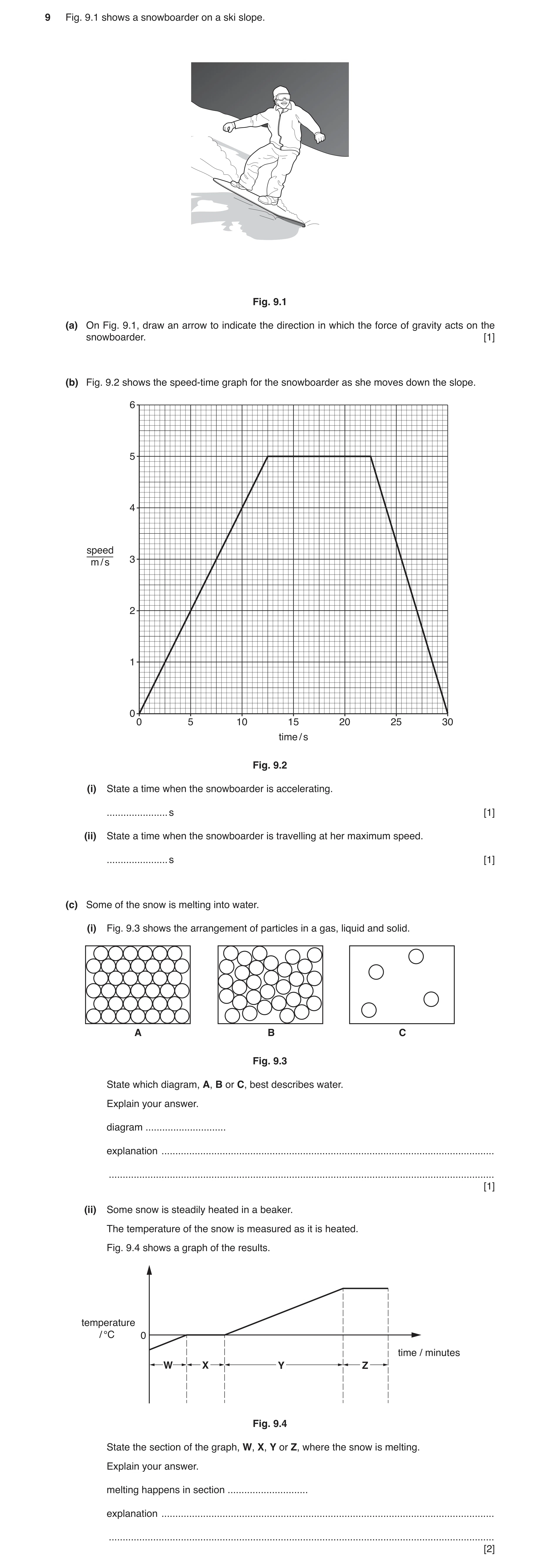
9 Fig. 9.1 shows a snowboarder on a ski slope. Fig. 9.1 (a) On Fig. 9.1, draw an arrow to indicate the direction in which the force of gravity acts on the snowboarder. [1] (b) Fig. 9.2 shows the speed-time graph for the snowboarder as she moves down the slope. 6 5 4 speed 3 m / s 2 1 0 0 5 10 15 20 25 30 time / s Fig. 9.2 (i) State a time when the snowboarder is accelerating. … s [1] (ii) State a time when the snowboarder is travelling at her maximum speed. … s [1] (c) Some of the snow is melting into water. (i) Fig. 9.3 shows the arrangement of particles in a gas, liquid and solid. A B C Fig. 9.3 State which diagram, A, B or C, best describes water. Explain your answer. diagram … explanation … … [1] (ii) Some snow is steadily heated in a beaker. The temperature of the snow is measured as it is heated. Fig. 9.4 shows a graph of the results. temperature / °C 0 time / minutes W X Y Z Fig. 9.4 State the section of the graph, W, X, Y or Z, where the snow is melting. Explain your answer. melting happens in section … explanation … … [2]
6 marks
Mark scheme: 9(a) arrow vertically downwards ; 1 9(b)(i) time between 0–12.5 s ; 1 9(b)(ii) time between 12.5 and 22.5 s ; 1 9(c)(i) B – particles close together and randomly arranged ; 1 9(c)(ii) section X ; ice melts at 0°C / temperature is constant ; 2
This question in 0654/31 Oct/Nov 2017
Q2 · An information booklet about a cooker states that the weight of the cooker is 40 kg 0654/33 Oct/Nov 2017
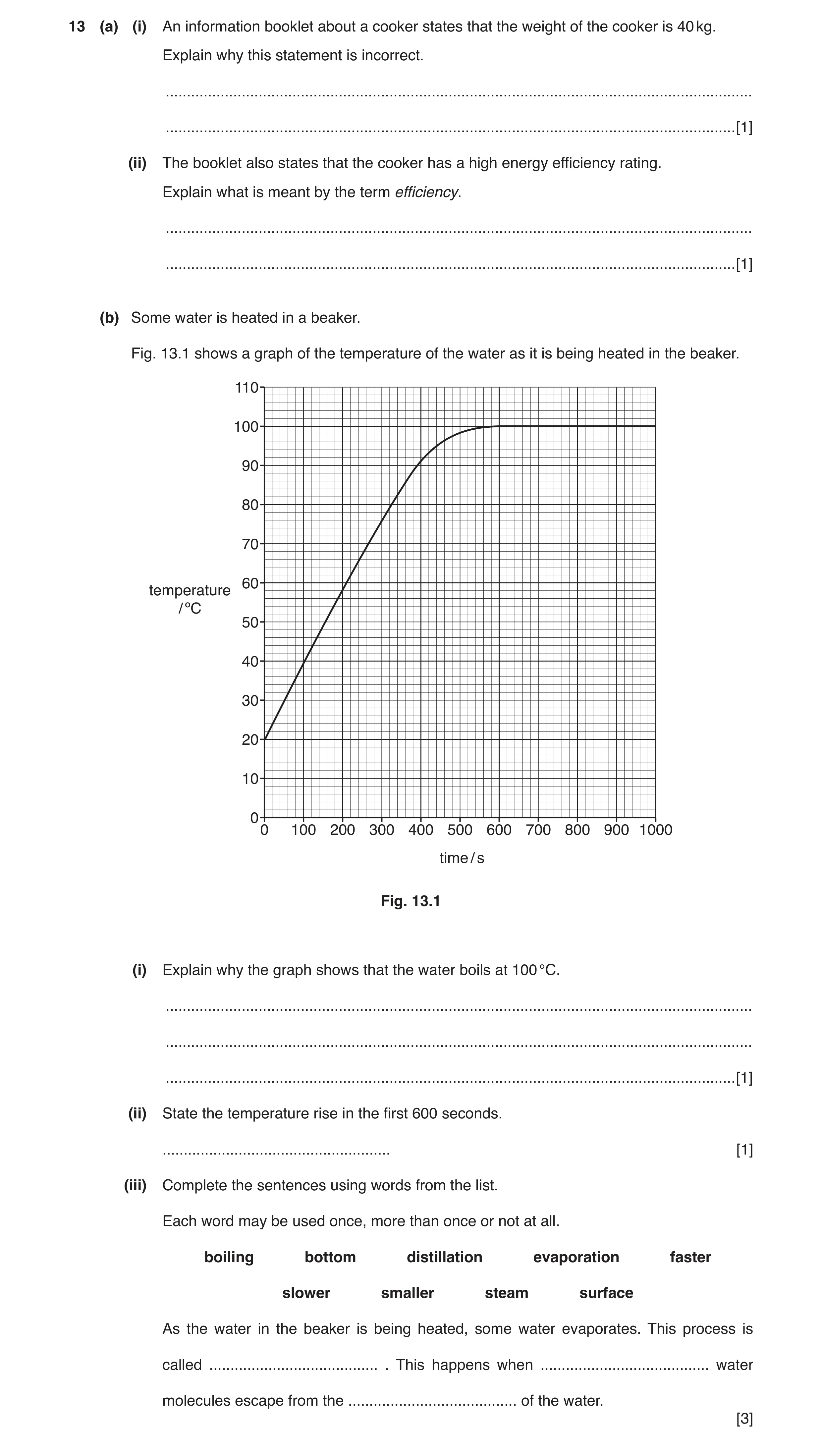
13 (a) (i) An information booklet about a cooker states that the weight of the cooker is 40 kg. Explain why this statement is incorrect. … … [1] (ii) The booklet also states that the cooker has a high energy efficiency rating. Explain what is meant by the term efficiency. … … [1] (b) Some water is heated in a beaker. Fig. 13.1 shows a graph of the temperature of the water as it is being heated in the beaker. 110 100 90 80 70 60 temperature / ºC 50 40 30 20 10 0 0 100 200 300 400 500 600 700 800 900 1000 time / s Fig. 13.1 (i) Explain why the graph shows that the water boils at 100 °C. … … … [1] (ii) State the temperature rise in the first 600 seconds. … [1] (iii) Complete the sentences using words from the list. Each word may be used once, more than once or not at all. boiling bottom distillation evaporation faster slower smaller steam surface As the water in the beaker is being heated, some water evaporates. This process is called … . This happens when … water molecules escape from the … of the water. [3]
7 marks
Mark scheme: 13(a)(i) weight is measured in newtons / mass would be 40 kg ; 1 13(a)(ii) useful energy output compared to energy input / AW ; 1 13(b)(i) boiling happens at a constant temperature / temperature remains constant at 100 ° C ; 1 13(b)(ii) 80 ° C ; 1 13(b)(iii) evaporation ; faster ; surface ; 3
This question in 0654/33 Oct/Nov 2017
Q3 · A bridge between two supports 0654/32 May/June 2019
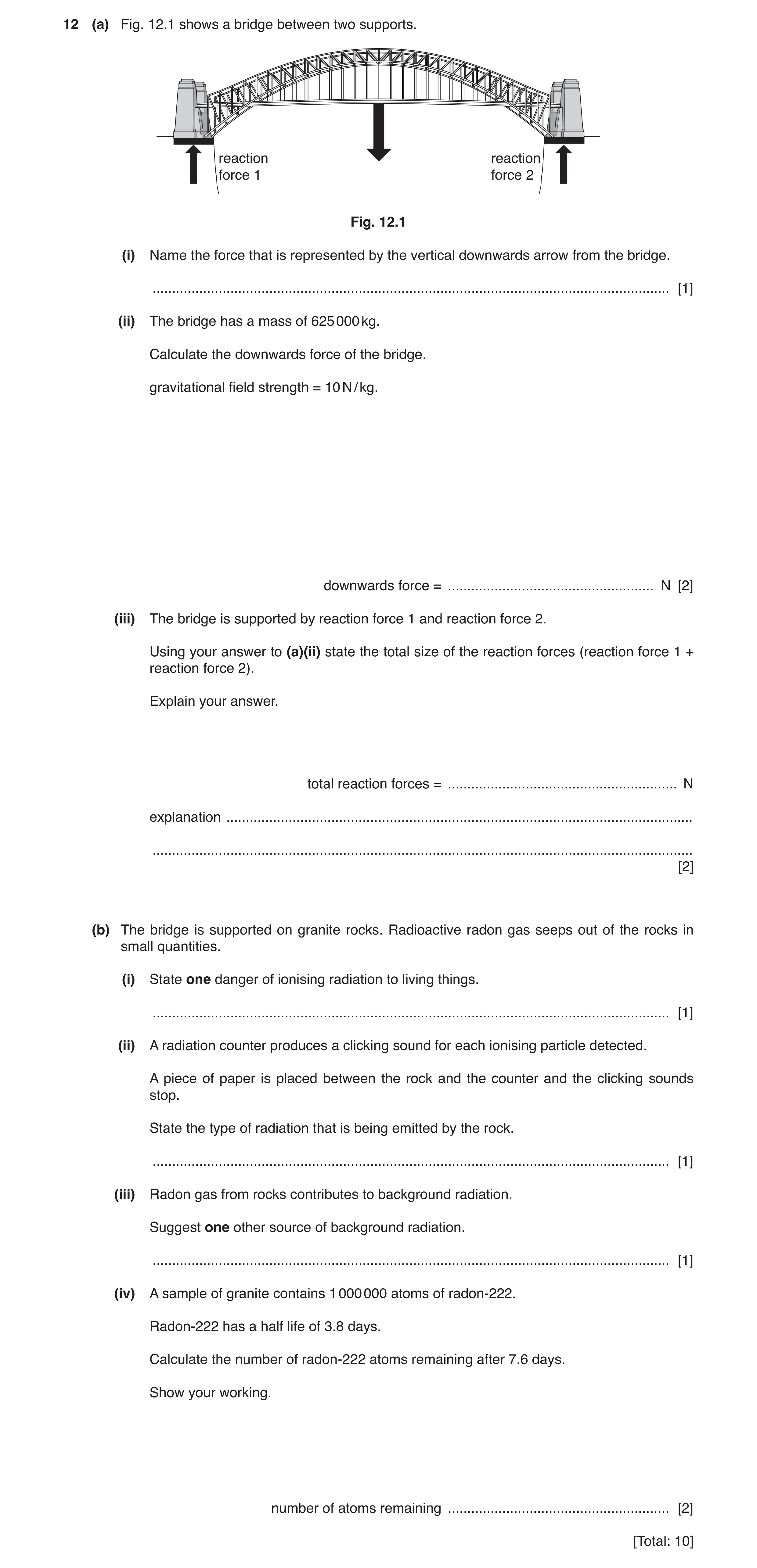
12 (a) Fig. 12.1 shows a bridge between two supports. reaction reaction force 1 force 2 Fig. 12.1 (i) Name the force that is represented by the vertical downwards arrow from the bridge. … [1] (ii) The bridge has a mass of 625 000 kg. Calculate the downwards force of the bridge. gravitational field strength = 10 N / kg. downwards force = … N [2] (iii) The bridge is supported by reaction force 1 and reaction force 2. Using your answer to (a)(ii) state the total size of the reaction forces (reaction force 1 + reaction force 2). Explain your answer. total reaction forces = … N explanation … … [2] (b) The bridge is supported on granite rocks. Radioactive radon gas seeps out of the rocks in small quantities. (i) State one danger of ionising radiation to living things. … [1] (ii) A radiation counter produces a clicking sound for each ionising particle detected. A piece of paper is placed between the rock and the counter and the clicking sounds stop. State the type of radiation that is being emitted by the rock. … [1] (iii) Radon gas from rocks contributes to background radiation. Suggest one other source of background radiation. … [1] (iv) A sample of granite contains 1 000 000 atoms of radon-222. Radon-222 has a half life of 3.8 days. Calculate the number of radon-222 atoms remaining after 7.6 days. Show your working. number of atoms remaining … [2] [Total: 10]
10 marks
Mark scheme: 12(a)(i) weight (of the bridge) ; 1 12(a)(ii) 625 000 × 10 ; 625 0000 (N) ; 2 12(a)(iii) 625 0000 (N) ; upwards force = downwards force ; 2 12(b)(i) causes cancer / cell mutation / damages living cells ; 1 12(b)(ii) α / alpha ; 1 12(b)(iii) cosmic rays / soil / living things ; 1 12(b)(iv) division by 2 seen e.g. 100 0000 / 2 or 2 half-lives ; 500 000 / 2 = 250 000 ; 2
This question in 0654/32 May/June 2019
Q4 · A bridge between two supports 0654/33 May/June 2019
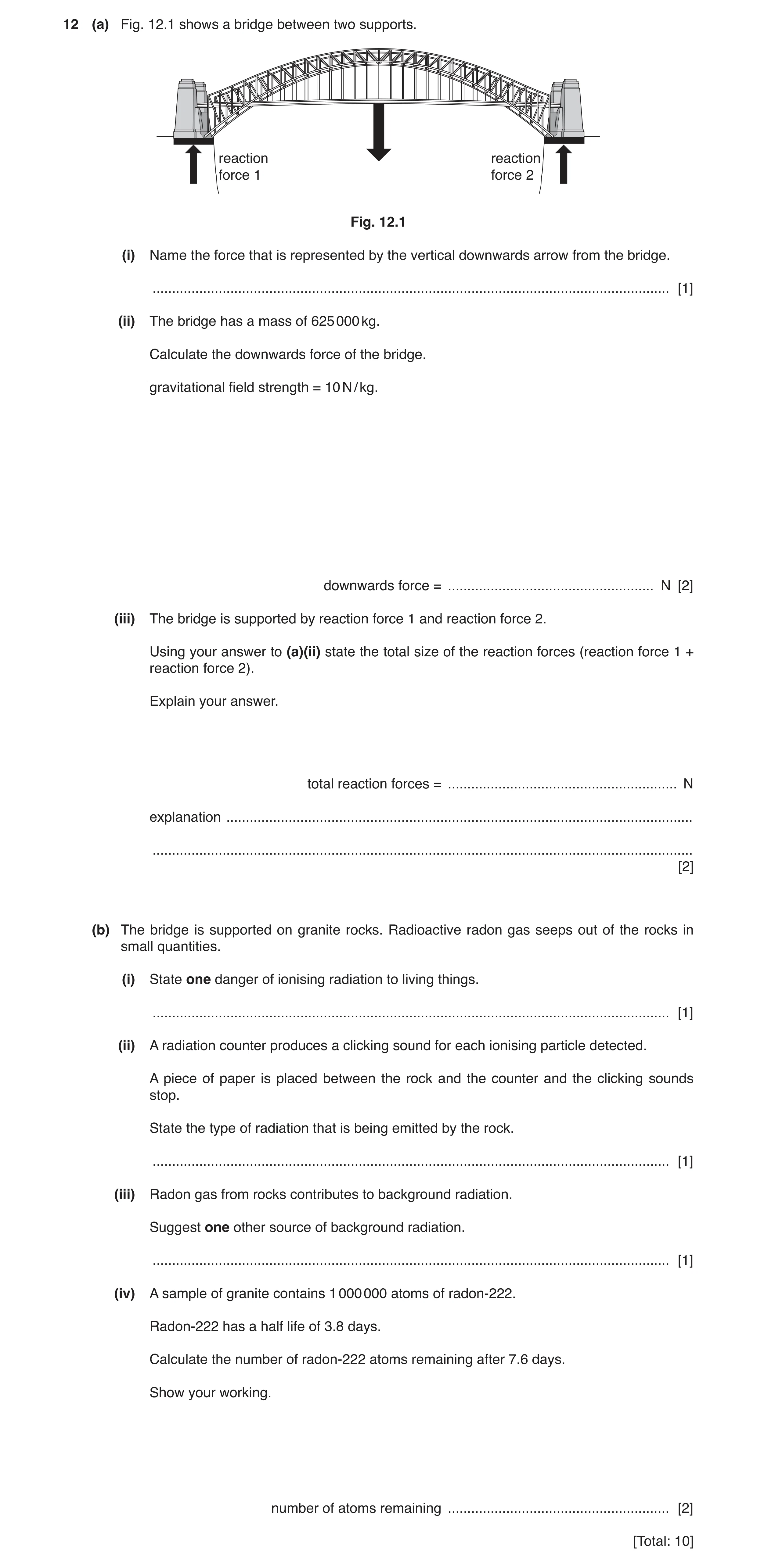
12 (a) Fig. 12.1 shows a bridge between two supports. reaction reaction force 1 force 2 Fig. 12.1 (i) Name the force that is represented by the vertical downwards arrow from the bridge. … [1] (ii) The bridge has a mass of 625 000 kg. Calculate the downwards force of the bridge. gravitational field strength = 10 N / kg. downwards force = … N [2] (iii) The bridge is supported by reaction force 1 and reaction force 2. Using your answer to (a)(ii) state the total size of the reaction forces (reaction force 1 + reaction force 2). Explain your answer. total reaction forces = … N explanation … … [2] (b) The bridge is supported on granite rocks. Radioactive radon gas seeps out of the rocks in small quantities. (i) State one danger of ionising radiation to living things. … [1] (ii) A radiation counter produces a clicking sound for each ionising particle detected. A piece of paper is placed between the rock and the counter and the clicking sounds stop. State the type of radiation that is being emitted by the rock. … [1] (iii) Radon gas from rocks contributes to background radiation. Suggest one other source of background radiation. … [1] (iv) A sample of granite contains 1 000 000 atoms of radon-222. Radon-222 has a half life of 3.8 days. Calculate the number of radon-222 atoms remaining after 7.6 days. Show your working. number of atoms remaining … [2] [Total: 10]
10 marks
Mark scheme: 12(a)(i) weight (of the bridge) ; 1 12(a)(ii) 625 000 × 10 ; 625 0000 (N) ; 2 12(a)(iii) 625 0000 (N) ; upwards force = downwards force ; 2 12(b)(i) causes cancer / cell mutation / damages living cells ; 1 12(b)(ii) α / alpha ; 1 12(b)(iii) cosmic rays / soil / living things ; 1 12(b)(iv) division by 2 seen e.g. 100 0000 / 2 or 2 half-lives ; 500 000 / 2 = 250 000 ; 2
This question in 0654/33 May/June 2019
Q5 · A team of students enter a competition to see who can build the highest tower from… 0654/32 Oct/Nov 2019
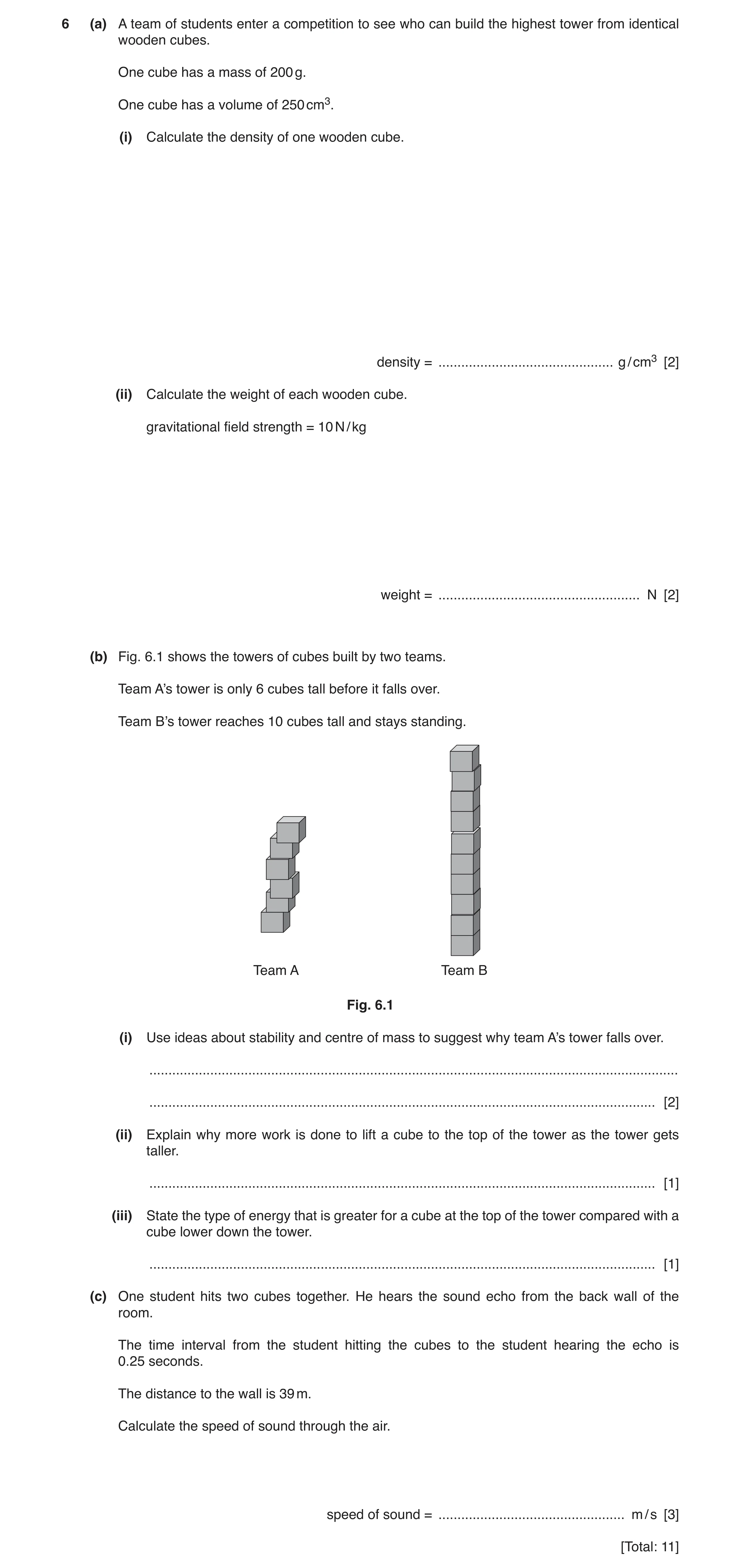
6 (a) A team of students enter a competition to see who can build the highest tower from identical wooden cubes. One cube has a mass of 200 g. One cube has a volume of 250 cm3. (i) Calculate the density of one wooden cube. density = … g / cm3 [2] (ii) Calculate the weight of each wooden cube. gravitational field strength = 10 N / kg weight = … N [2] (b) Fig. 6.1 shows the towers of cubes built by two teams. Team A’s tower is only 6 cubes tall before it falls over. Team B’s tower reaches 10 cubes tall and stays standing. Team A Team B Fig. 6.1 (i) Use ideas about stability and centre of mass to suggest why team A’s tower falls over. … … [2] (ii) Explain why more work is done to lift a cube to the top of the tower as the tower gets taller. … [1] (iii) State the type of energy that is greater for a cube at the top of the tower compared with a cube lower down the tower. … [1] (c) One student hits two cubes together. He hears the sound echo from the back wall of the room. The time interval from the student hitting the cubes to the student hearing the echo is 0.25 seconds. The distance to the wall is 39 m. Calculate the speed of sound through the air. speed of sound = … m / s [3] [Total: 11]
11 marks
Mark scheme: 6(a)(i) ρ = m / v or 200 / 250 ; 0.8 (g / cm3) ; 2 6(a)(ii) W = mg, 0.200 × 10 ; 2 (N) ; 2 6(b)(i) the position of the COM in A is not through the centre of the tower base / COM is not directly above the base ; it is unstable, (or opposite for B) ; 2 6(b)(ii) it is lifted up through the furthest distance compared to the other blocks ; 1 6(b)(iii) gravitational potential ; 1 6(c) s = d / t ; (39 + 39) / 0.25 ; 310 m / s ; 3
This question in 0654/32 Oct/Nov 2019
Q6 · A speed–time graph for a bus journey 0654/31 Oct/Nov 2020
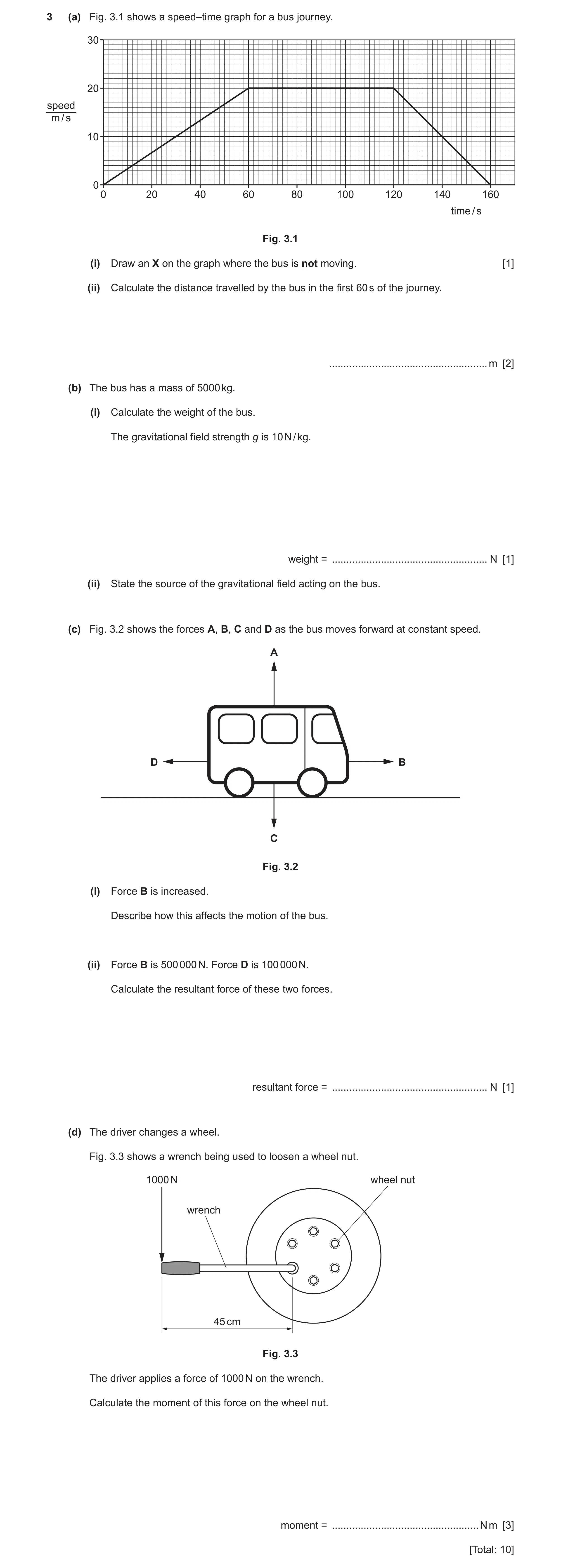
3 (a) Fig. 3.1 shows a speed–time graph for a bus journey. 30 20 speed m / s 10 0 0 20 40 60 80 100 120 140 160 time / s Fig. 3.1 (i) Draw an X on the graph where the bus is not moving. [1] (ii) Calculate the distance travelled by the bus in the first 60 s of the journey. ������������������������������������������������������� m [2] (b) The bus has a mass of 5000 kg. (i) Calculate the weight of the bus. The gravitational field strength g is 10 N / kg. weight = ������������������������������������������������������ N [1] (ii) State the source of the gravitational field acting on the bus. (c) Fig. 3.2 shows the forces A, B, C and D as the bus moves forward at constant speed. A D B C Fig. 3.2 (i) Force B is increased. Describe how this affects the motion of the bus. (ii) Force B is 500 000 N. Force D is 100 000 N. Calculate the resultant force of these two forces. resultant force = ������������������������������������������������������ N [1] (d) The driver changes a wheel. Fig. 3.3 shows a wrench being used to loosen a wheel nut. 1000 N wheel nut wrench 45 cm Fig. 3.3 The driver applies a force of 1000 N on the wrench. Calculate the moment of this force on the wheel nut. moment = ��������������������������������������������������� N m [3] [Total: 10]
10 marks
Mark scheme: 3(a)(i) X at (0,0) or (160,0) ; 1 3(a)(ii) (distance travelled) = area under graph or (60 × 20) / 2 ; 600 (m) ; 2 3(b)(i) 50 000 (N) ; 1 3(b)(ii) Earth ; 1 3(c)(i) it accelerates / goes faster ; 1 3(c)(ii) 400 000 (N) ; 1 3(d) 45cm = 0.45 m ; force × distance or 1000 × 0.45 ; 450 (m) ; 3
This question in 0654/31 Oct/Nov 2020
Q7 · A skydiver jumps from an aircraft high above the ground 0654/32 Oct/Nov 2020
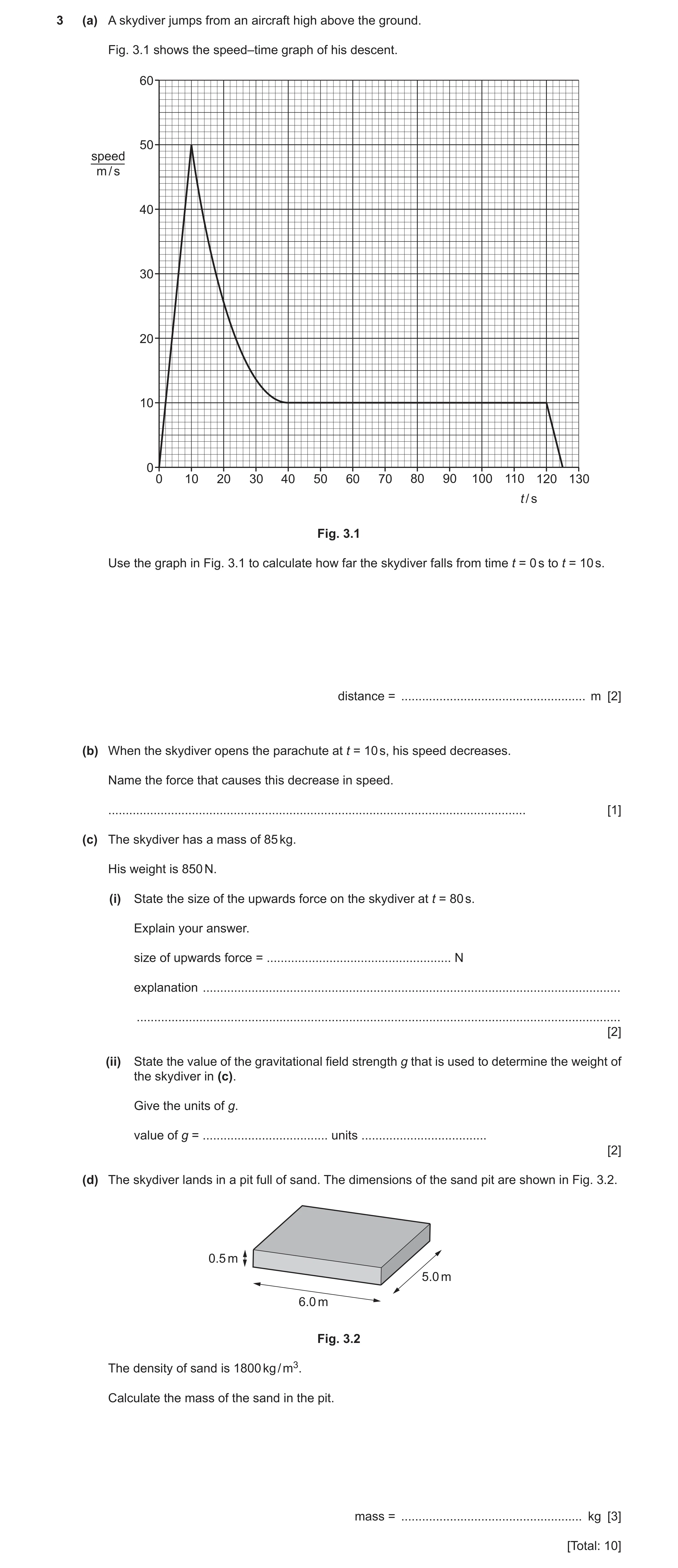
3 (a) A skydiver jumps from an aircraft high above the ground. Fig. 3.1 shows the speed–time graph of his descent. 60 50 speed m / s 40 30 20 10 0 0 10 20 30 40 50 60 70 80 90 100 110 120 130 t / s Fig. 3.1 Use the graph in Fig. 3.1 to calculate how far the skydiver falls from time t = 0 s to t = 10 s. distance = … m [2] (b) When the skydiver opens the parachute at t = 10 s, his speed decreases. Name the force that causes this decrease in speed. … [1] (c) The skydiver has a mass of 85 kg. His weight is 850 N. (i) State the size of the upwards force on the skydiver at t = 80 s. Explain your answer. size of upwards force = … N explanation … … [2] (ii) State the value of the gravitational field strength g that is used to determine the weight of the skydiver in (c). Give the units of g. value of g = … units … [2] (d) The skydiver lands in a pit full of sand. The dimensions of the sand pit are shown in Fig. 3.2. 0.5 m 5.0 m 6.0 m Fig. 3.2 The density of sand is 1800 kg / m3. Calculate the mass of the sand in the pit. mass = … kg [3] [Total: 10]
10 marks
Mark scheme: 3(a)(i) area under graph or 50 × 10/2; 250 (m); 2 3(b) friction / air resistance; 1 3(c)(i) 850(N); forces balance / travelling at constant speed; 2 3(c)(ii) 10; N/kg; 2 3(d) volume calculation – volume = 15 (m3); mass = density × volume or 1800 × 15; 27 000 (kg); 3
This question in 0654/32 Oct/Nov 2020
Q8 · A speed–time graph for a bus journey 0654/33 Oct/Nov 2020
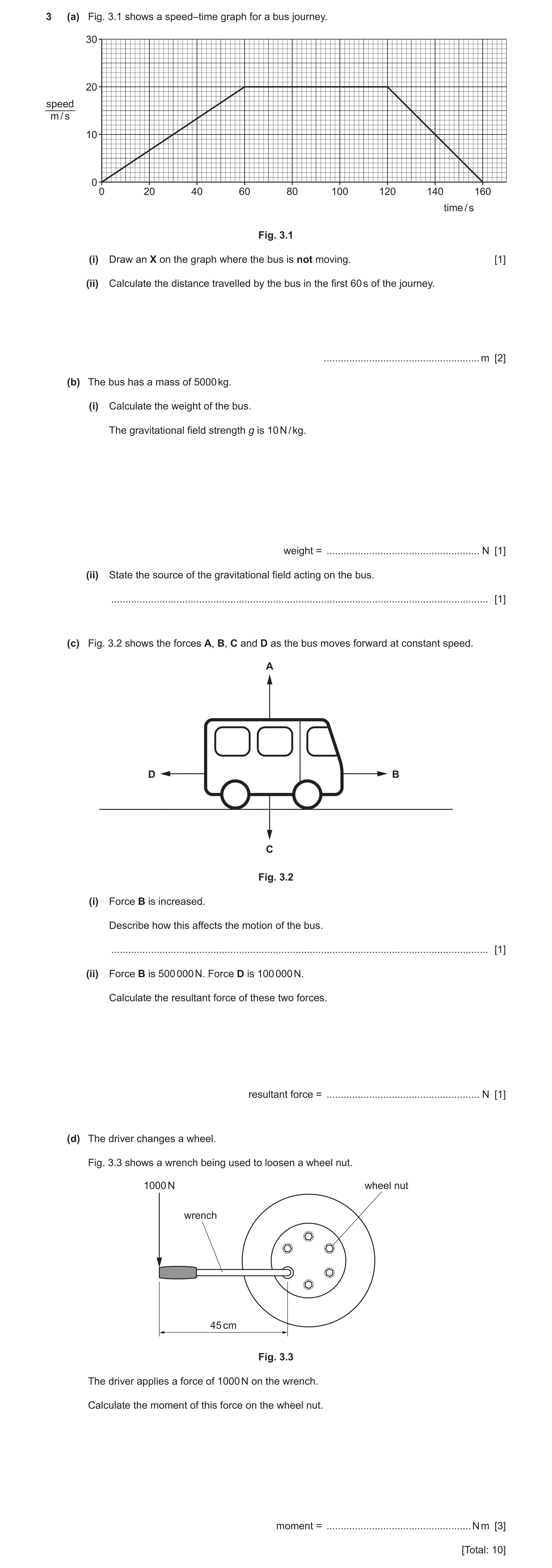
3 (a) Fig. 3.1 shows a speed–time graph for a bus journey. 30 20 speed m / s 10 0 0 20 40 60 80 100 120 140 160 time / s Fig. 3.1 (i) Draw an X on the graph where the bus is not moving. [1] (ii) Calculate the distance travelled by the bus in the first 60 s of the journey. … m [2] (b) The bus has a mass of 5000 kg. (i) Calculate the weight of the bus. The gravitational field strength g is 10 N / kg. weight = … N [1] (ii) State the source of the gravitational field acting on the bus. … [1] (c) Fig. 3.2 shows the forces A, B, C and D as the bus moves forward at constant speed. A D B C Fig. 3.2 (i) Force B is increased. Describe how this affects the motion of the bus. … [1] (ii) Force B is 500 000 N. Force D is 100 000 N. Calculate the resultant force of these two forces. resultant force = … N [1] (d) The driver changes a wheel. Fig. 3.3 shows a wrench being used to loosen a wheel nut. 1000 N wheel nut wrench 45 cm Fig. 3.3 The driver applies a force of 1000 N on the wrench. Calculate the moment of this force on the wheel nut. moment = … N m [3] [Total: 10]
10 marks
Mark scheme: 3(a)(i) X at (0,0) or (160,0) ; 1 3(a)(ii) (distance travelled) = area under graph or (60 × 20) / 2 ; 600 (m) ; 2 3(b)(i) 50 000 (N) ; 1 3(b)(ii) Earth ; 1 3(c)(i) it accelerates / goes faster ; 1 3(c)(ii) 400 000 (N) ; 1 3(d) 45cm = 0.45 m ; force × distance or 1000 × 0.45 ; 450 (m) ; 3
This question in 0654/33 Oct/Nov 2020
Q9 · An information booklet about an electric oven states that the weight of the oven is 50 kg 0654/32 Feb/March 2021
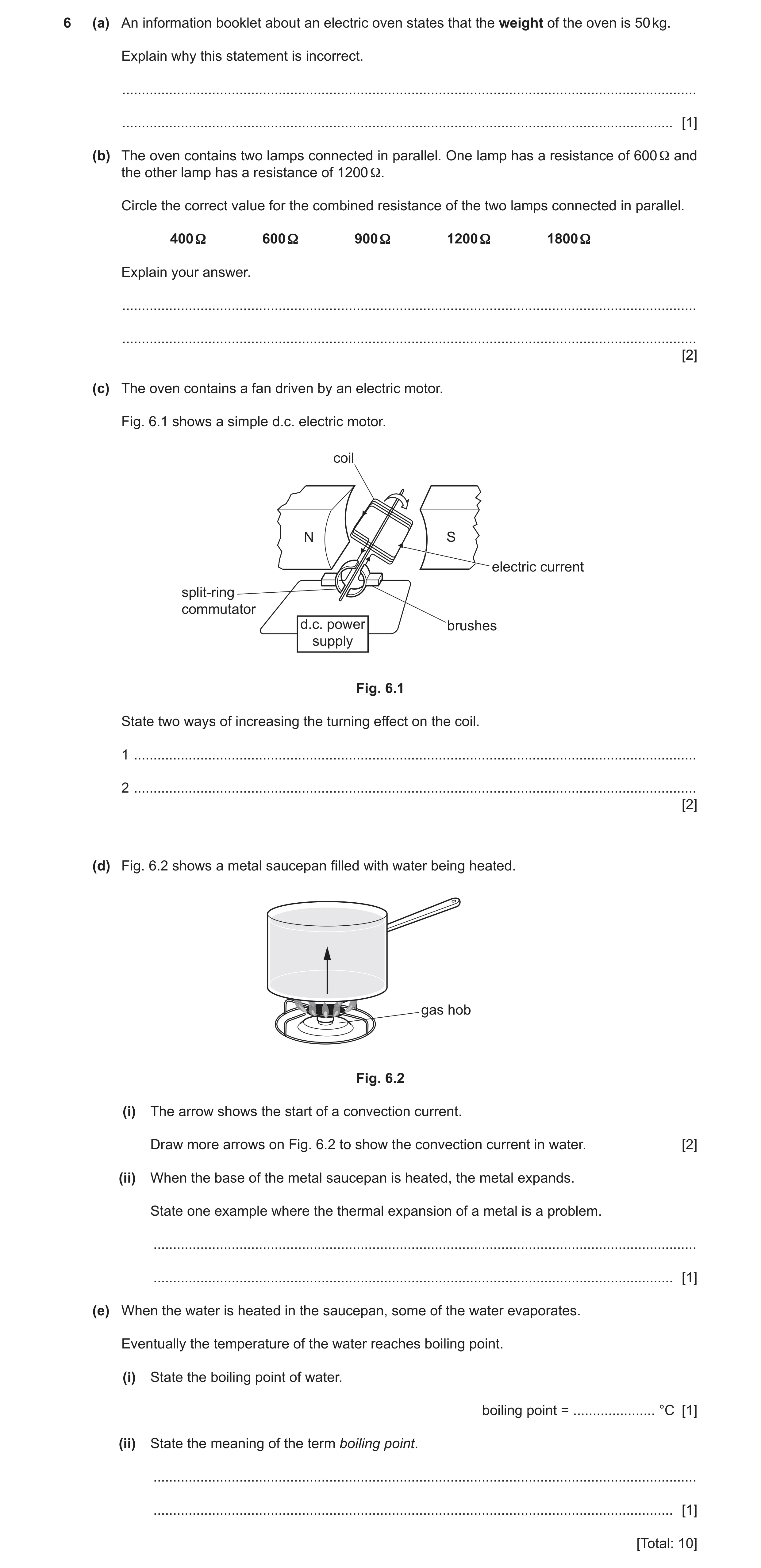
6 (a) An information booklet about an electric oven states that the weight of the oven is 50 kg. Explain why this statement is incorrect. … … [1] (b) The oven contains two lamps connected in parallel. One lamp has a resistance of 600 Ω and the other lamp has a resistance of 1200 Ω. Circle the correct value for the combined resistance of the two lamps connected in parallel. 400 Ω 600 Ω 900 Ω 1200 Ω 1800 Ω Explain your answer. … … [2] (c) The oven contains a fan driven by an electric motor. Fig. 6.1 shows a simple d.c. electric motor. coil N S electric current split-ring commutator d.c. power brushes supply Fig. 6.1 State two ways of increasing the turning effect on the coil. 1 … 2 … [2] (d) Fig. 6.2 shows a metal saucepan filled with water being heated. gas hob Fig. 6.2 (i) The arrow shows the start of a convection current. Draw more arrows on Fig. 6.2 to show the convection current in water. [2] (ii) When the base of the metal saucepan is heated, the metal expands. State one example where the thermal expansion of a metal is a problem. … … [1] (e) When the water is heated in the saucepan, some of the water evaporates. Eventually the temperature of the water reaches boiling point. (i) State the boiling point of water. boiling point = … °C [1] (ii) State the meaning of the term boiling point. … … [1] [Total: 10]
10 marks
Mark scheme: 6(a) mass is measured in kg / weight is measured in Newtons ; 1 6(b) 400 Ω; combined resistances of two resistors in parallel is less than the resistance of either of them; 2 6(c) larger current through coil; greater magnetic field; more turns; max 2 2 6(d)(i) arrow(s) to the right and or left; arrow(s) moving downwards ; 2 6(d)(ii) railway tracks / bridges; 1 6(e)(i) 100 (°C) ; 1 6(e)(ii) the temperature at which a liquid changes into a gas ; 1
This question in 0654/32 Feb/March 2021
Q10 · An astronaut travels to the Moon in a spacecraft 0654/31 Oct/Nov 2021
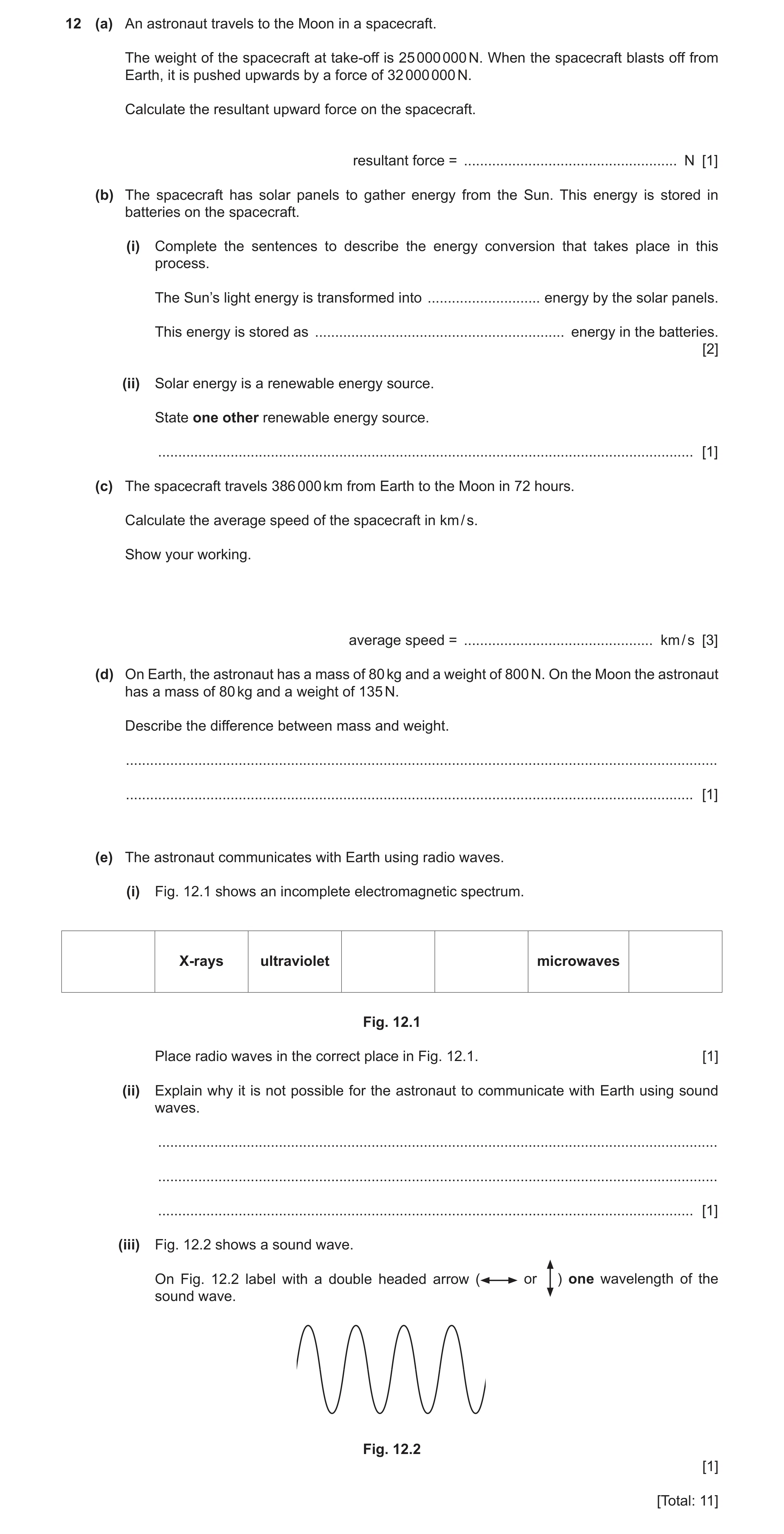
12 (a) An astronaut travels to the Moon in a spacecraft. The weight of the spacecraft at take-off is 25 000 000 N. When the spacecraft blasts off from Earth, it is pushed upwards by a force of 32 000 000 N. Calculate the resultant upward force on the spacecraft. resultant force = … N [1] (b) The spacecraft has solar panels to gather energy from the Sun. This energy is stored in batteries on the spacecraft. (i) Complete the sentences to describe the energy conversion that takes place in this process. The Sun’s light energy is transformed into … energy by the solar panels. This energy is stored as … energy in the batteries. [2] (ii) Solar energy is a renewable energy source. State one other renewable energy source. … [1] (c) The spacecraft travels 386 000 km from Earth to the Moon in 72 hours. Calculate the average speed of the spacecraft in km / s. Show your working. average speed = … km / s [3] (d) On Earth, the astronaut has a mass of 80 kg and a weight of 800 N. On the Moon the astronaut has a mass of 80 kg and a weight of 135 N. Describe the difference between mass and weight. … … [1] (e) The astronaut communicates with Earth using radio waves. (i) Fig. 12.1 shows an incomplete electromagnetic spectrum. X-rays ultraviolet microwaves Fig. 12.1 Place radio waves in the correct place in Fig. 12.1. [1] (ii) Explain why it is not possible for the astronaut to communicate with Earth using sound waves. … … … [1] (iii) Fig. 12.2 shows a sound wave. On Fig. 12.2 label with a double headed arrow ( or ) one wavelength of the sound wave. Fig. 12.2 [1] [Total: 11]
11 marks
Mark scheme: 12(a) 7 000 000 N ; 1 12(b)(i) electrical ; chemical potential ; 2 12(b)(ii) waves / HEP / tides / geothermal / wind ; 1 12(c) 72 hours = 259 200 s ; speed = distance ÷ time or 386 000÷ 259 200 ; 1.49 km / s ; 3 12(d) mass is the actual amount of material contained in a body (measured in kg or g) ; OR weight is the force exerted by the gravity on that object; 1 12(e)(i) radio waves in right hand box ; 1 12(e)(ii) sound waves need a medium / cannot travel through a vacuum ; 1 12(e)(iii) (double headed arrow from) peak to peak OR from trough to trough OR equivalent ; 1
This question in 0654/31 Oct/Nov 2021
Q11 · Four forces, P, Q, R and S, acting on a bus travelling along a level road at constant… 0654/32 Feb/March 2022
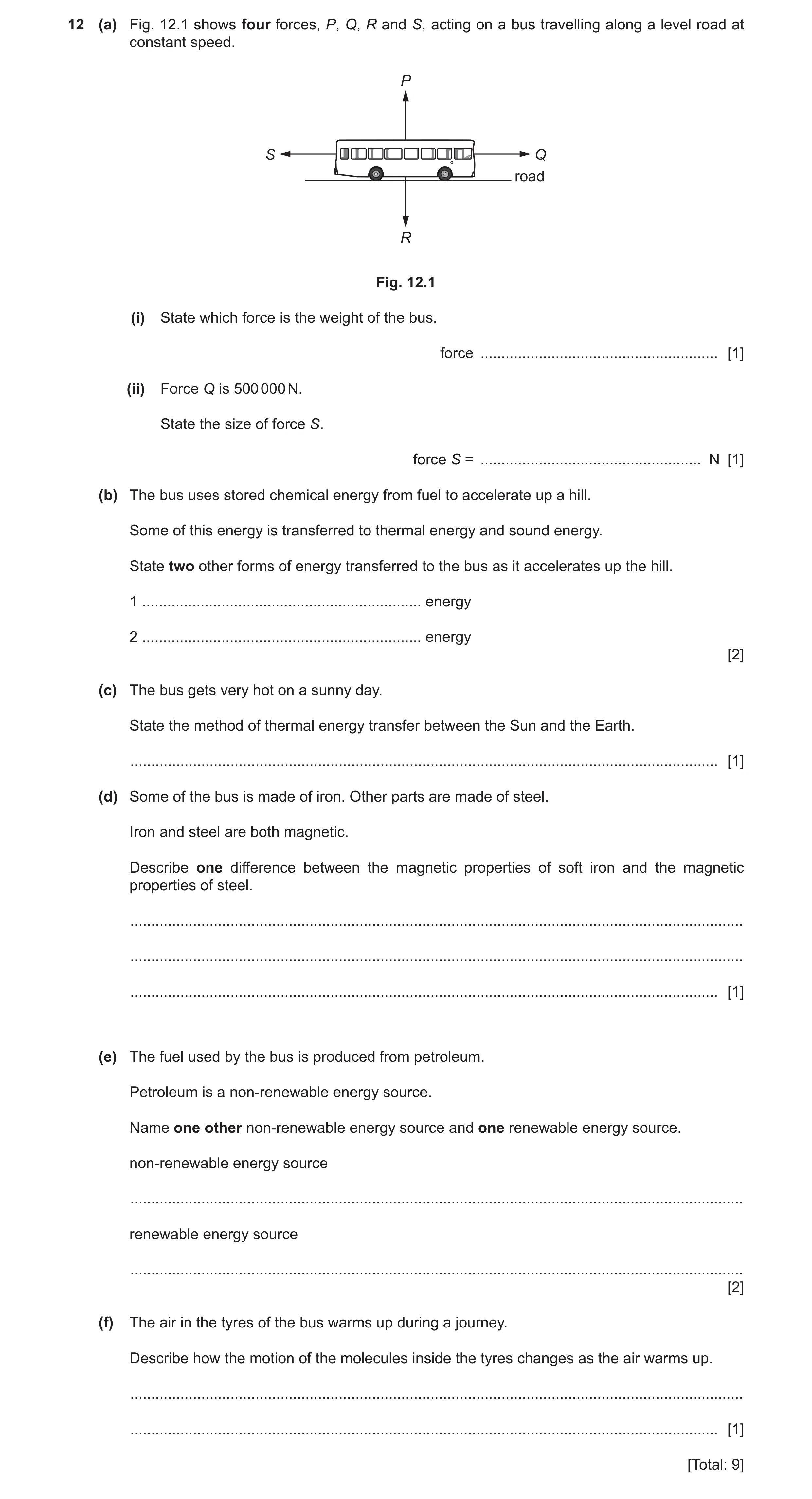
12 (a) Fig. 12.1 shows four forces, P, Q, R and S, acting on a bus travelling along a level road at constant speed. P S Q road R Fig. 12.1 (i) State which force is the weight of the bus. force … [1] (ii) Force Q is 500 000 N. State the size of force S. force S = … N [1] (b) The bus uses stored chemical energy from fuel to accelerate up a hill. Some of this energy is transferred to thermal energy and sound energy. State two other forms of energy transferred to the bus as it accelerates up the hill. 1 … energy 2 … energy [2] (c) The bus gets very hot on a sunny day. State the method of thermal energy transfer between the Sun and the Earth. … [1] (d) Some of the bus is made of iron. Other parts are made of steel. Iron and steel are both magnetic. Describe one difference between the magnetic properties of soft iron and the magnetic properties of steel. … … … [1] (e) The fuel used by the bus is produced from petroleum. Petroleum is a non-renewable energy source. Name one other non-renewable energy source and one renewable energy source. non-renewable energy source … renewable energy source … [2] (f) The air in the tyres of the bus warms up during a journey. Describe how the motion of the molecules inside the tyres changes as the air warms up. … … [1] [Total: 9]
9 marks
Mark scheme: 12(a)(i) R; 1 12(a)(ii) 500 000 N; 1 12(b) kinetic energy; gravitational potential energy; 2 12(c) radiation; 1 12(d) iron magnetises quicker / iron loses magnetism quicker; 1 Question Answer Marks 12(e) coal / natural gas; hydroelectric / solar / tidal / waves / geothermal / biogas / wind; 2 12(f) gain KE / move faster; 1
This question in 0654/32 Feb/March 2022
Q12 · A farmer uses solar panels to generate the electricity needed for his farm 0654/32 May/June 2022
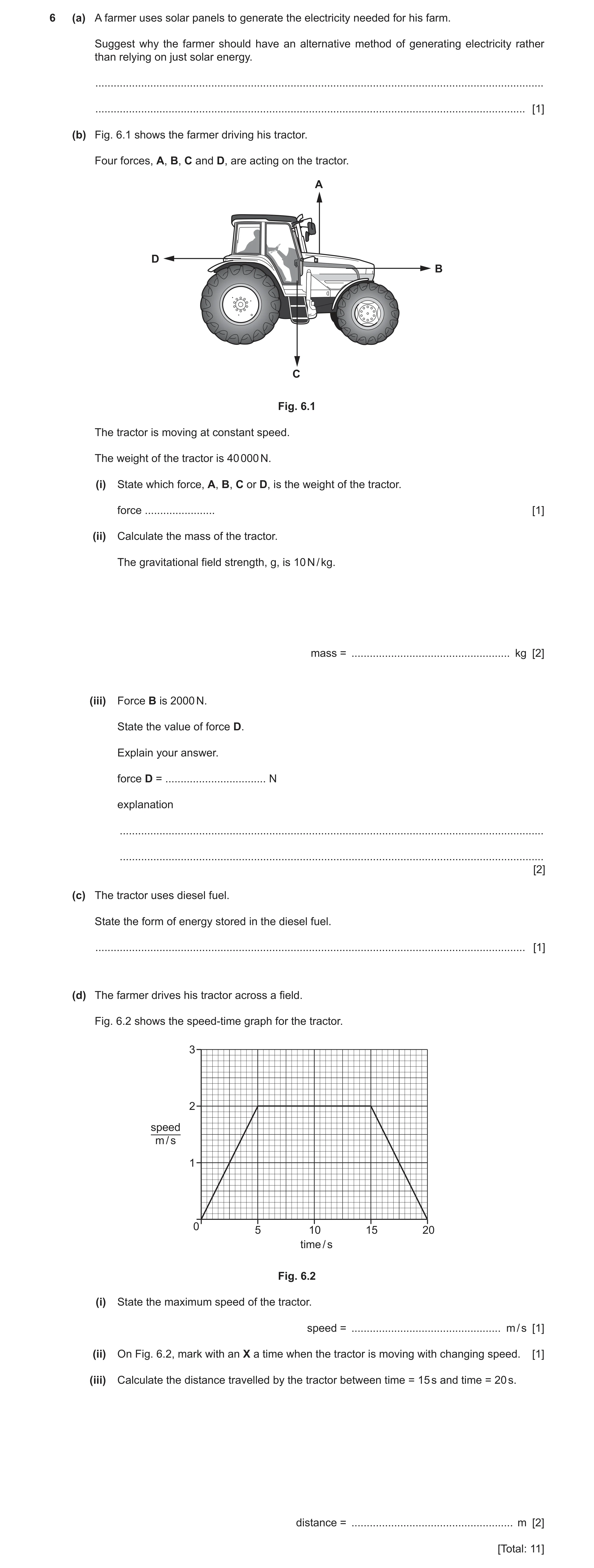
6 (a) A farmer uses solar panels to generate the electricity needed for his farm. Suggest why the farmer should have an alternative method of generating electricity rather than relying on just solar energy. … … [1] (b) Fig. 6.1 shows the farmer driving his tractor. Four forces, A, B, C and D, are acting on the tractor. A D B C Fig. 6.1 The tractor is moving at constant speed. The weight of the tractor is 40 000 N. (i) State which force, A, B, C or D, is the weight of the tractor. force … [1] (ii) Calculate the mass of the tractor. The gravitational field strength, g, is 10 N / kg. mass = … kg [2] (iii) Force B is 2000 N. State the value of force D. Explain your answer. force D = … N explanation … … [2] (c) The tractor uses diesel fuel. State the form of energy stored in the diesel fuel. … [1] (d) The farmer drives his tractor across a field. Fig. 6.2 shows the speed-time graph for the tractor. 3 2 speed m / s 1 0 5 10 15 20 time / s Fig. 6.2 (i) State the maximum speed of the tractor. speed = … m / s [1] (ii) On Fig. 6.2, mark with an X a time when the tractor is moving with changing speed. [1] (iii) Calculate the distance travelled by the tractor between time = 15 s and time = 20 s. distance = … m [2] [Total: 11]
11 marks
Mark scheme: 6(a) electricity will not be generated at night; 1 6(b)(i) C; 1 6(b)(ii) W = mg or m = W / g or mass = 40 000 / 10; mass = 4000 (kg); 2 6(b)(iii) 2000 N; (no resultant force) because constant speed; 2 6(c) chemical (potential) ; 1 6(d)(i) 2.0 m / s; 1 6(d)(ii) any time between 0 and 5 s or between 15 and 20 s; 1 6(d)(iii) evidence of working ½ 5 2 or area under graph; 5 (m) ; 2
This question in 0654/32 May/June 2022
Q13 · Water vapour in the air over the sea comes from liquid water in the sea 0654/31 Oct/Nov 2022
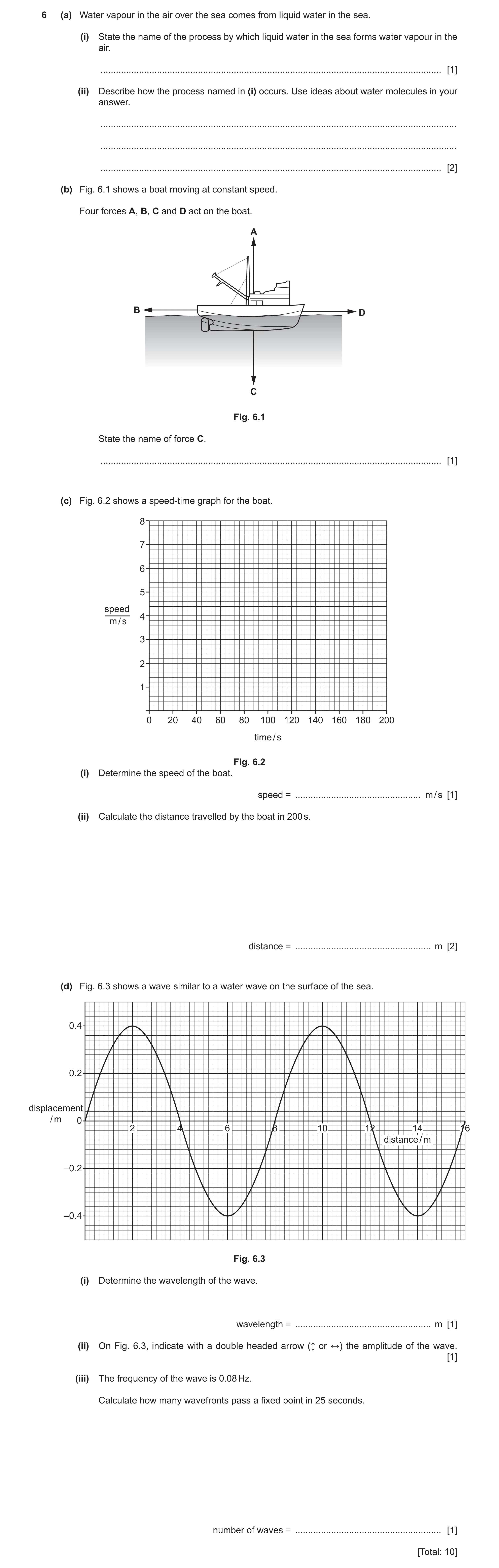
6 (a) Water vapour in the air over the sea comes from liquid water in the sea. (i) State the name of the process by which liquid water in the sea forms water vapour in the air. … [1] (ii) Describe how the process named in (i) occurs. Use ideas about water molecules in your answer. … … … [2] (b) Fig. 6.1 shows a boat moving at constant speed. Four forces A, B, C and D act on the boat. A B D C Fig. 6.1 State the name of force C. … [1] (c) Fig. 6.2 shows a speed-time graph for the boat. 8 7 6 5 speed 4 m / s 3 2 1 0 20 40 60 80 100 120 140 160 180 200 time / s Fig. 6.2 (i) Determine the speed of the boat. speed = … m / s [1] (ii) Calculate the distance travelled by the boat in 200 s. distance = … m [2] (d) Fig. 6.3 shows a wave similar to a water wave on the surface of the sea. 0.4 0.2 displacement / m 0 2 4 6 8 10 12 14 16 distance / m –0.2 –0.4 Fig. 6.3 (i) Determine the wavelength of the wave. wavelength = … m [1] (ii) On Fig. 6.3, indicate with a double headed arrow (↕ or ↔) the amplitude of the wave. [1] (iii) The frequency of the wave is 0.08 Hz. Calculate how many wavefronts pass a fixed point in 25 seconds. number of waves = … [1] [Total: 10]
10 marks
Mark scheme: 6(a)(i) evaporation 1 6(a)(ii) fastest moving / most energetic molecules / particles ; 2 escape from surface ; 6(b) Weight ; 1 6(c)(i) 4.4 (m / s) ; 1 6(c)(ii) distance = speed time (in any form symbols or words) or 4.4 200 or area under graph ; 2 880 (m) ; 6(d)(i) 8 (m) ; 1 6(d)(ii) amplitude correctly indicated ; 1 6(d)(iii) 2.0 ; 1
This question in 0654/31 Oct/Nov 2022
Q14 · A person standing on a warm, sunny beach is exposed to several forms of electromagnetic… 0654/31 Oct/Nov 2022
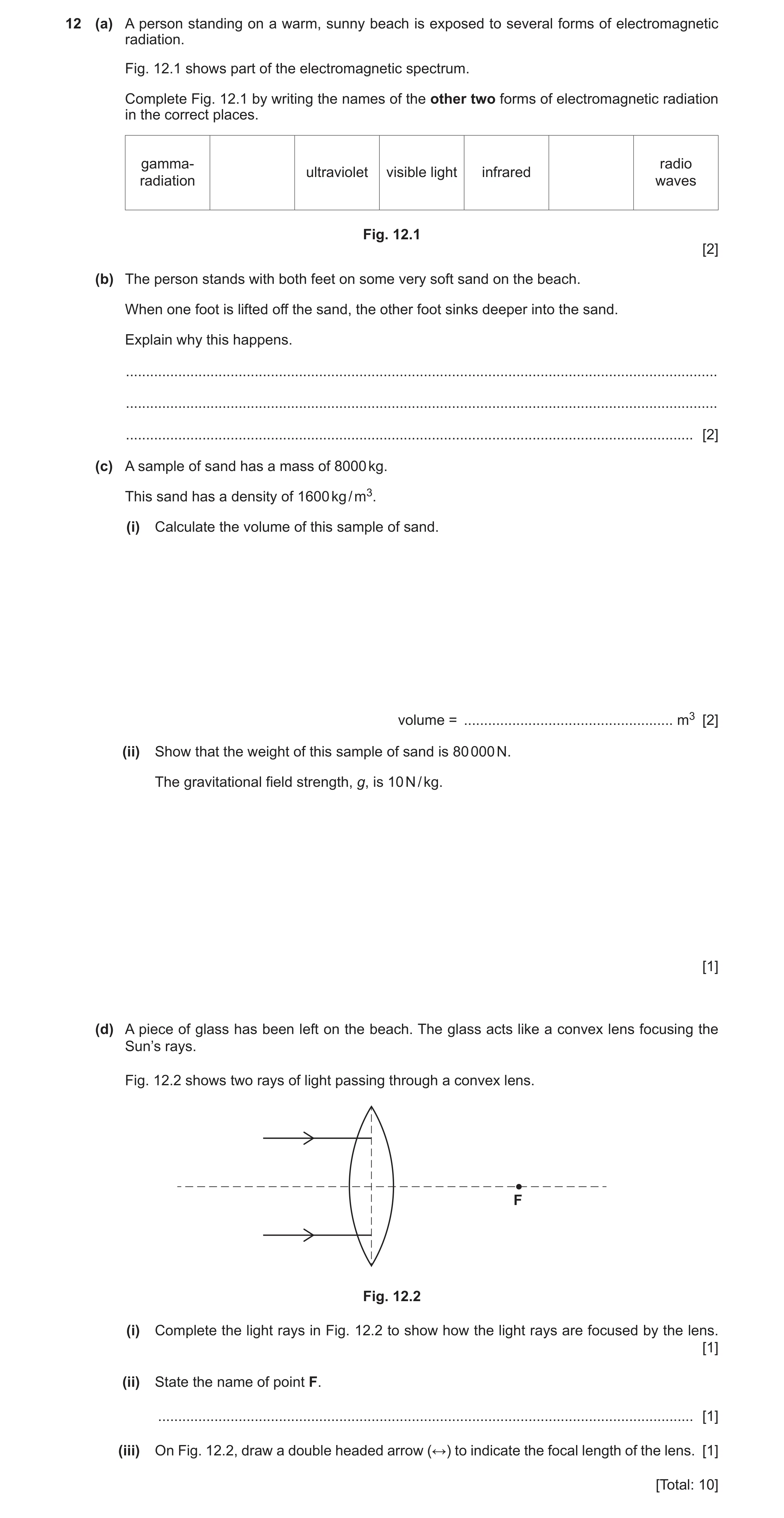
12 (a) A person standing on a warm, sunny beach is exposed to several forms of electromagnetic radiation. Fig. 12.1 shows part of the electromagnetic spectrum. Complete Fig. 12.1 by writing the names of the other two forms of electromagnetic radiation in the correct places. gamma- radio ultraviolet visible light infrared radiation waves Fig. 12.1 [2] (b) The person stands with both feet on some very soft sand on the beach. When one foot is lifted off the sand, the other foot sinks deeper into the sand. Explain why this happens. … … … [2] (c) A sample of sand has a mass of 8000 kg. This sand has a density of 1600 kg / m3. (i) Calculate the volume of this sample of sand. volume = … m3 [2] (ii) Show that the weight of this sample of sand is 80 000 N. The gravitational field strength, g, is 10 N / kg. [1] (d) A piece of glass has been left on the beach. The glass acts like a convex lens focusing the Sun’s rays. Fig. 12.2 shows two rays of light passing through a convex lens. F Fig. 12.2 (i) Complete the light rays in Fig. 12.2 to show how the light rays are focused by the lens. [1] (ii) State the name of point F. … [1] (iii) On Fig. 12.2, draw a double headed arrow (↔) to indicate the focal length of the lens. [1] [Total: 10]
10 marks
Mark scheme: 12(a) 2 -rays X-rays ultraviolet visible light infrared microwaves radio waves microwaves in correct place ; X-rays in correct place ; 12(b) area decreases ; 2 so pressure increases ; 12(c)(i) volume = mass / density (in any form symbols or words) or 8000 / 1600 ; 2 = 5 (m3) ; 12(c)(ii) 8000 10 ; 1 (= 80 000 N) 12(d)(i) rays meet at focus (F) ; 1 12(d)(ii) principal focus ; 1 12(d)(iii) focal length correctly identified ; 1
This question in 0654/31 Oct/Nov 2022
Q15 · Four forces acting on a submarine 0654/33 Oct/Nov 2022
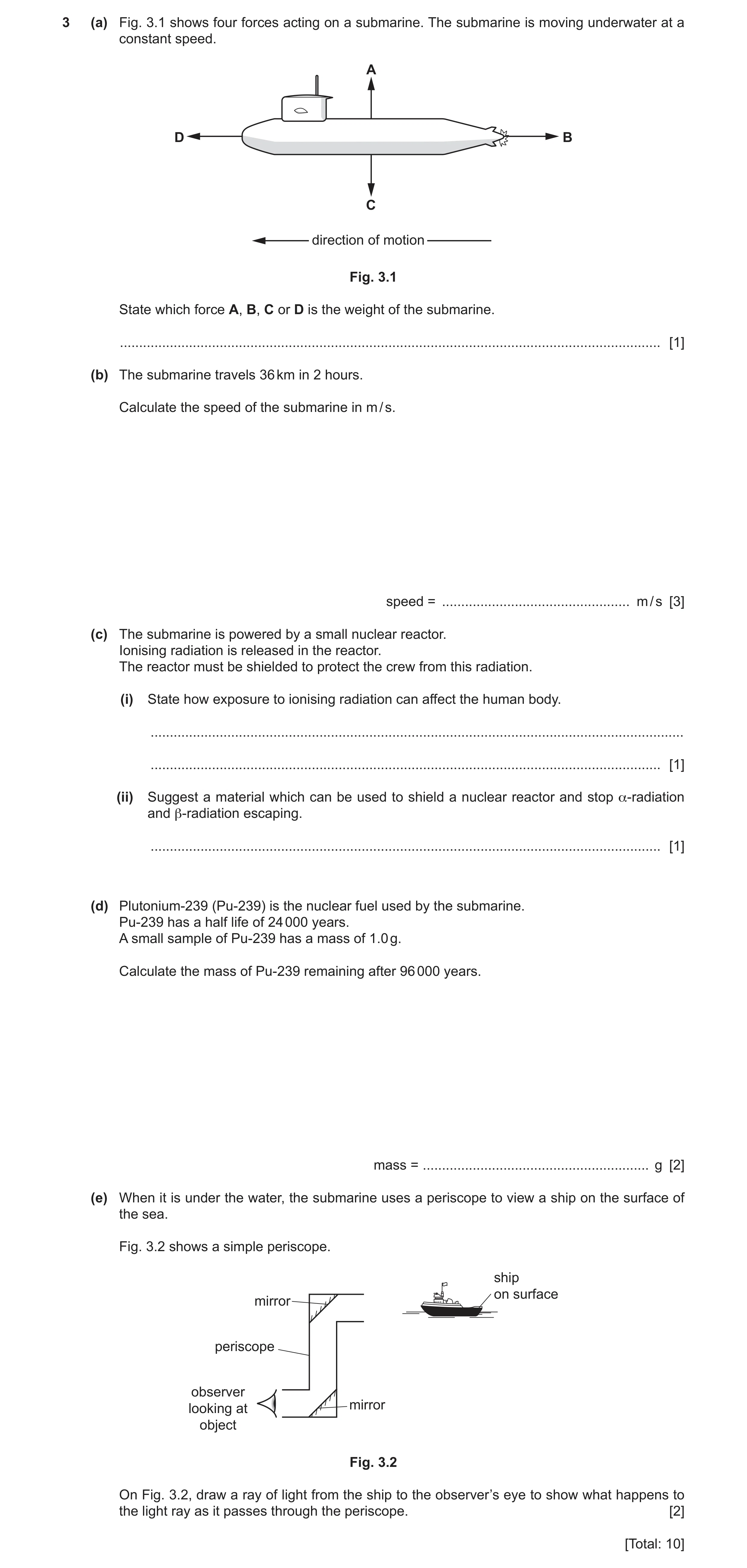
3 (a) Fig. 3.1 shows four forces acting on a submarine. The submarine is moving underwater at a constant speed. A D B C direction of motion Fig. 3.1 State which force A, B, C or D is the weight of the submarine. … [1] (b) The submarine travels 36 km in 2 hours. Calculate the speed of the submarine in m / s. speed = … m / s [3] (c) The submarine is powered by a small nuclear reactor. Ionising radiation is released in the reactor. The reactor must be shielded to protect the crew from this radiation. (i) State how exposure to ionising radiation can affect the human body. … … [1] (ii) Suggest a material which can be used to shield a nuclear reactor and stop α-radiation and β-radiation escaping. … [1] (d) Plutonium-239 (Pu-239) is the nuclear fuel used by the submarine. Pu-239 has a half life of 24 000 years. A small sample of Pu-239 has a mass of 1.0 g. Calculate the mass of Pu-239 remaining after 96 000 years. mass = … g [2] (e) When it is under the water, the submarine uses a periscope to view a ship on the surface of the sea. Fig. 3.2 shows a simple periscope. ship on surface mirror periscope observer looking at mirror object Fig. 3.2 On Fig. 3.2, draw a ray of light from the ship to the observer’s eye to show what happens to the light ray as it passes through the periscope. [2] [Total: 10]
10 marks
Mark scheme: 3(a) C ; 1 3(b) 36 km = 36 000 m and 2 hours = 7200 s ; 3 distance ÷ time (symbols or words) or substitution ; 5 (m / s) ; 3(c)(i) cancer / cell mutation ; 1 3(c)(ii) lead ; 1 3(d) 4 half-lives / division by 16 ; 2 0.0625 (g) ; 3(e) correct reflection at top mirror ; 2 correct reflection at bottom mirror ;
This question in 0654/33 Oct/Nov 2022
Q16 · An aircraft at rest on a runway 0654/33 Oct/Nov 2022
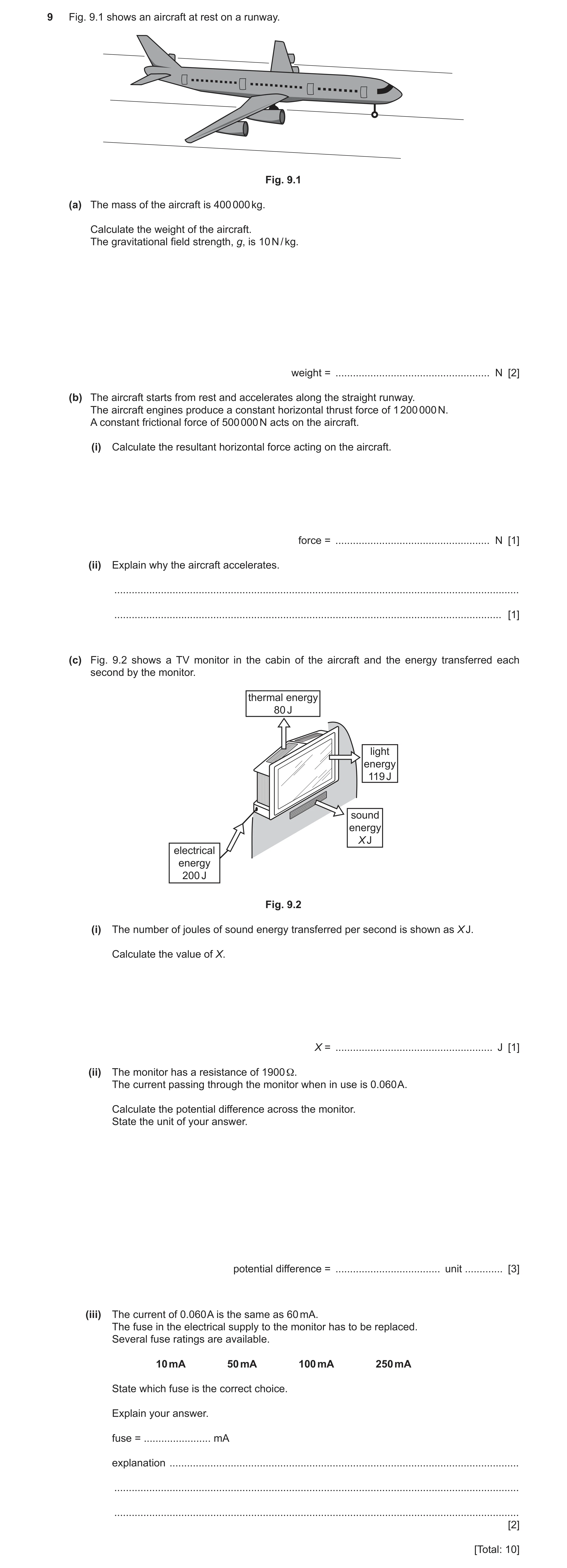
9 Fig. 9.1 shows an aircraft at rest on a runway. Fig. 9.1 (a) The mass of the aircraft is 400 000 kg. Calculate the weight of the aircraft. The gravitational field strength, g, is 10 N / kg. weight = … N [2] (b) The aircraft starts from rest and accelerates along the straight runway. The aircraft engines produce a constant horizontal thrust force of 1 200 000 N. A constant frictional force of 500 000 N acts on the aircraft. (i) Calculate the resultant horizontal force acting on the aircraft. force = … N [1] (ii) Explain why the aircraft accelerates. … … [1] (c) Fig. 9.2 shows a TV monitor in the cabin of the aircraft and the energy transferred each second by the monitor. thermal energy 80 J light energy 119 J sound energy X J electrical energy 200 J Fig. 9.2 (i) The number of joules of sound energy transferred per second is shown as X J. Calculate the value of X. X = … J [1] (ii) The monitor has a resistance of 1900 Ω. The current passing through the monitor when in use is 0.060 A. Calculate the potential difference across the monitor. State the unit of your answer. potential difference = … unit … [3] (iii) The current of 0.060 A is the same as 60 mA. The fuse in the electrical supply to the monitor has to be replaced. Several fuse ratings are available. 10 mA 50 mA 100 mA 250 mA State which fuse is the correct choice. Explain your answer. fuse = … mA explanation … … … [2] [Total: 10]
10 marks
Mark scheme: 9(a) w = mg (symbols or words) or 400 000 10 ; 2 4 000 000 (N) ; 9(b)(i) 700 000 (N) ; 1 9(b)(ii) resultant force (is not zero) ; 1 9(c)(i) 1 (J) ; 1 9(c)(ii) V = IR (words or symbols) or 0.060 1900 ; 3 = 114 ; V or volts ; 9(c)(iii) 100 mA ; 2 must be higher than max current (but not too much higher) ;
This question in 0654/33 Oct/Nov 2022
Q17 · A spacecraft carrying an astronaut travels 384 000 km from the Earth to the Moon in 78… 0654/32 May/June 2023
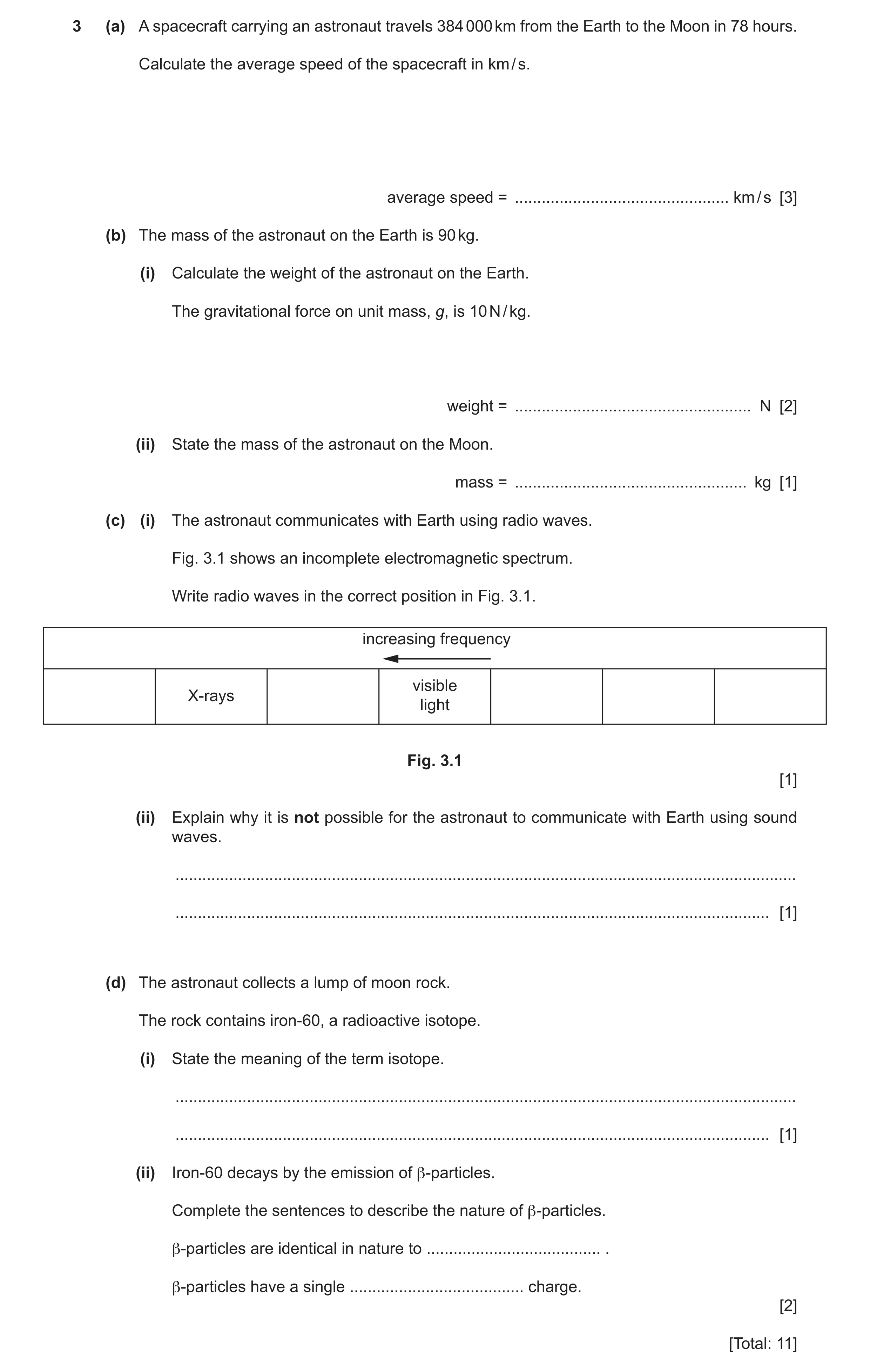
3 (a) A spacecraft carrying an astronaut travels 384 000 km from the Earth to the Moon in 78 hours. Calculate the average speed of the spacecraft in km / s. average speed = … km / s [3] (b) The mass of the astronaut on the Earth is 90 kg. (i) Calculate the weight of the astronaut on the Earth. The gravitational force on unit mass, g, is 10 N / kg. weight = … N [2] (ii) State the mass of the astronaut on the Moon. mass = … kg [1] (c) (i) The astronaut communicates with Earth using radio waves. Fig. 3.1 shows an incomplete electromagnetic spectrum. Write radio waves in the correct position in Fig. 3.1. increasing frequency visible X-rays light Fig. 3.1 [1] (ii) Explain why it is not possible for the astronaut to communicate with Earth using sound waves. … … [1] (d) The astronaut collects a lump of moon rock. The rock contains iron-60, a radioactive isotope. (i) State the meaning of the term isotope. … … [1] (ii) Iron-60 decays by the emission of β-particles. Complete the sentences to describe the nature of β-particles. β-particles are identical in nature to … . β-particles have a single … charge. [2] [Total: 11]
11 marks
Mark scheme: 3(a) speed = distance / time (in any form) or 384 000 / 280 800 ; = 1.37 (km / s) ; 3 3(b)(i) weight = mass g (in any form) or 90 10 ; = 900 (N) ; 2 3(b)(ii) 90 (kg) ; 1 3(c)(i) radio (waves) in right hand box ; 1 3(c)(ii) sound waves need a medium / sound waves do not travel through a vacuum ; 1 3(d)(i) atoms of the same element that have different numbers of neutrons ; OR atoms which have the same number of protons and different numbers of neutrons ; OR atoms which have the same atomic number but different mass number ; 1 Question Answer Marks 3(d)(ii) electrons ; negative ; 2
This question in 0654/32 May/June 2023
Q18 · A spacecraft carrying an astronaut travels 384 000 km from the Earth to the Moon in 78… 0654/33 May/June 2023
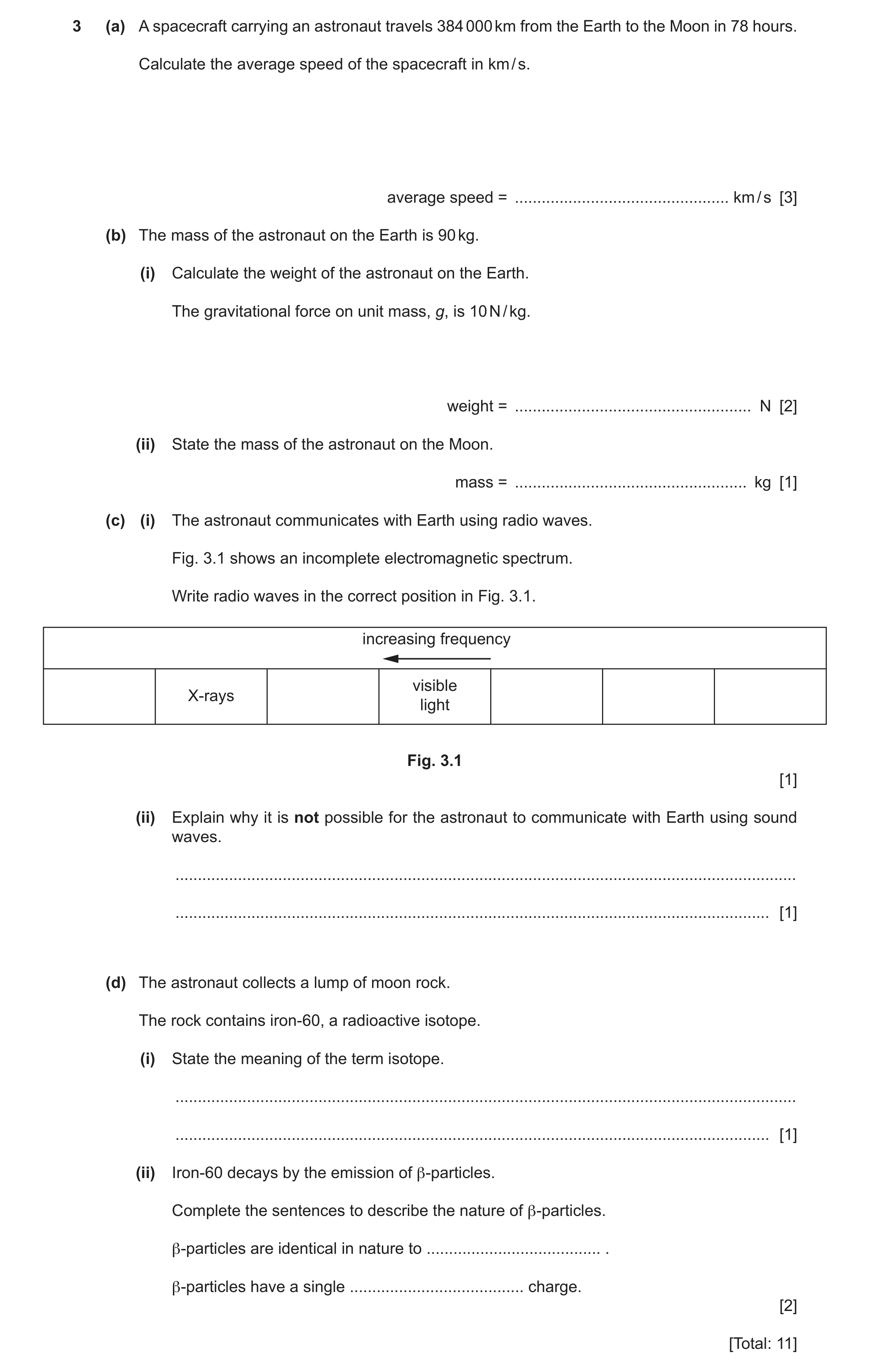
3 (a) A spacecraft carrying an astronaut travels 384 000 km from the Earth to the Moon in 78 hours. Calculate the average speed of the spacecraft in km / s. average speed = … km / s [3] (b) The mass of the astronaut on the Earth is 90 kg. (i) Calculate the weight of the astronaut on the Earth. The gravitational force on unit mass, g, is 10 N / kg. weight = … N [2] (ii) State the mass of the astronaut on the Moon. mass = … kg [1] (c) (i) The astronaut communicates with Earth using radio waves. Fig. 3.1 shows an incomplete electromagnetic spectrum. Write radio waves in the correct position in Fig. 3.1. increasing frequency visible X-rays light Fig. 3.1 [1] (ii) Explain why it is not possible for the astronaut to communicate with Earth using sound waves. … … [1] (d) The astronaut collects a lump of moon rock. The rock contains iron-60, a radioactive isotope. (i) State the meaning of the term isotope. … … [1] (ii) Iron-60 decays by the emission of β-particles. Complete the sentences to describe the nature of β-particles. β-particles are identical in nature to … . β-particles have a single … charge. [2] [Total: 11]
11 marks
Mark scheme: 3(a) speed = distance / time (in any form) or 384 000 / 280 800 ; = 1.37 (km / s) ; 3 3(b)(i) weight = mass g (in any form) or 90 10 ; = 900 (N) ; 2 3(b)(ii) 90 (kg) ; 1 3(c)(i) radio (waves) in right hand box ; 1 3(c)(ii) sound waves need a medium / sound waves do not travel through a vacuum ; 1 3(d)(i) atoms of the same element that have different numbers of neutrons ; OR atoms which have the same number of protons and different numbers of neutrons ; OR atoms which have the same atomic number but different mass number ; 1 Question Answer Marks 3(d)(ii) electrons ; negative ; 2
This question in 0654/33 May/June 2023
Q19 · A man is sitting on a beach on a sunny day 0654/33 Oct/Nov 2023
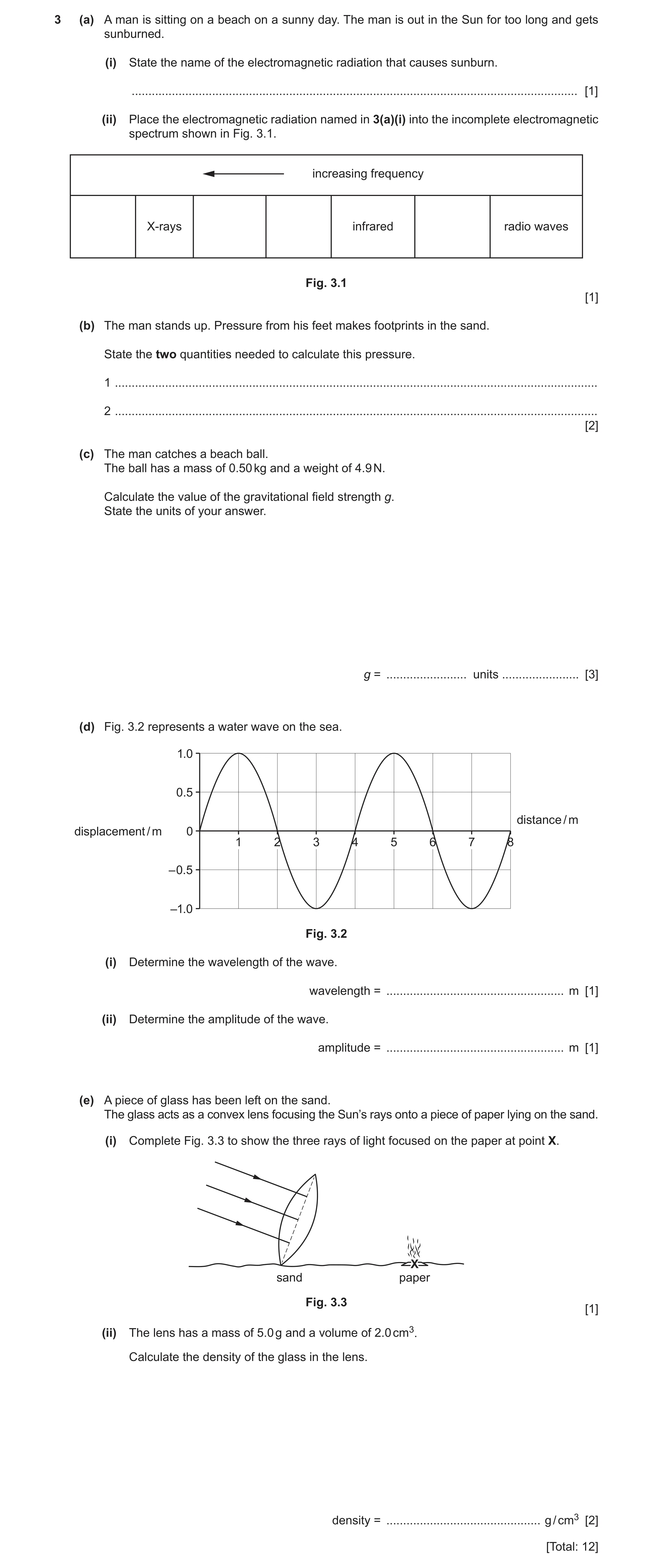
3 (a) A man is sitting on a beach on a sunny day. The man is out in the Sun for too long and gets sunburned. (i) State the name of the electromagnetic radiation that causes sunburn. … [1] (ii) Place the electromagnetic radiation named in 3(a)(i) into the incomplete electromagnetic spectrum shown in Fig. 3.1. increasing frequency X-rays infrared radio waves Fig. 3.1 [1] (b) The man stands up. Pressure from his feet makes footprints in the sand. State the two quantities needed to calculate this pressure. 1 … 2 … [2] (c) The man catches a beach ball. The ball has a mass of 0.50 kg and a weight of 4.9 N. Calculate the value of the gravitational field strength g. State the units of your answer. g = … units … [3] (d) Fig. 3.2 represents a water wave on the sea. 1.0 0.5 distance / m displacement / m 0 1 2 3 4 5 6 7 8 –0.5 –1.0 Fig. 3.2 (i) Determine the wavelength of the wave. wavelength = … m [1] (ii) Determine the amplitude of the wave. amplitude = … m [1] (e) A piece of glass has been left on the sand. The glass acts as a convex lens focusing the Sun’s rays onto a piece of paper lying on the sand. (i) Complete Fig. 3.3 to show the three rays of light focused on the paper at point X. X sand paper Fig. 3.3 [1] (ii) The lens has a mass of 5.0 g and a volume of 2.0 cm3. Calculate the density of the glass in the lens. density = … g / cm3 [2] [Total: 12]
12 marks
Mark scheme: 3(a)(i) ultraviolet ; 1 3(a)(ii) ultraviolet (UV) written in box to the right of X-rays ; 1 3(b) surface area of feet (in contact with sand) ; 2 weight of man ; 3(c) g = weight mass (in any form) / 4.9 0.50 ; 3 9.8 ; N / kg ; 3(d)(i) 4(.0) (m) ; 1 3(d)(ii) 1(.0) (m) ; 1 3(e)(i) three rays coming to a focus at X ; 1 3(e)(ii) density = mass ÷ volume (in any form) / 5.0 ÷ 2.0 ; 2 = 2.5 (g / cm3) ;
This question in 0654/33 Oct/Nov 2023
Q20 · Water in a steel saucepan being heated on an electric cooker 0654/32 May/June 2024
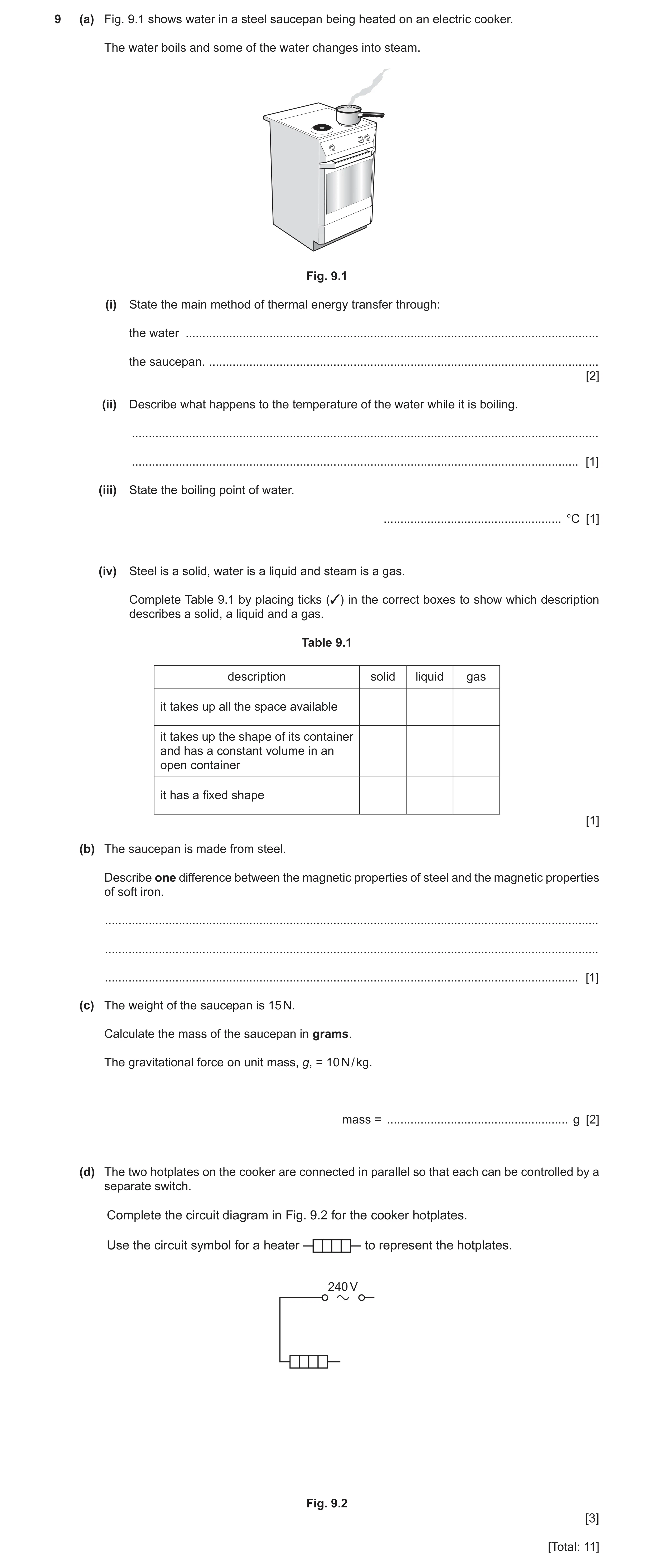
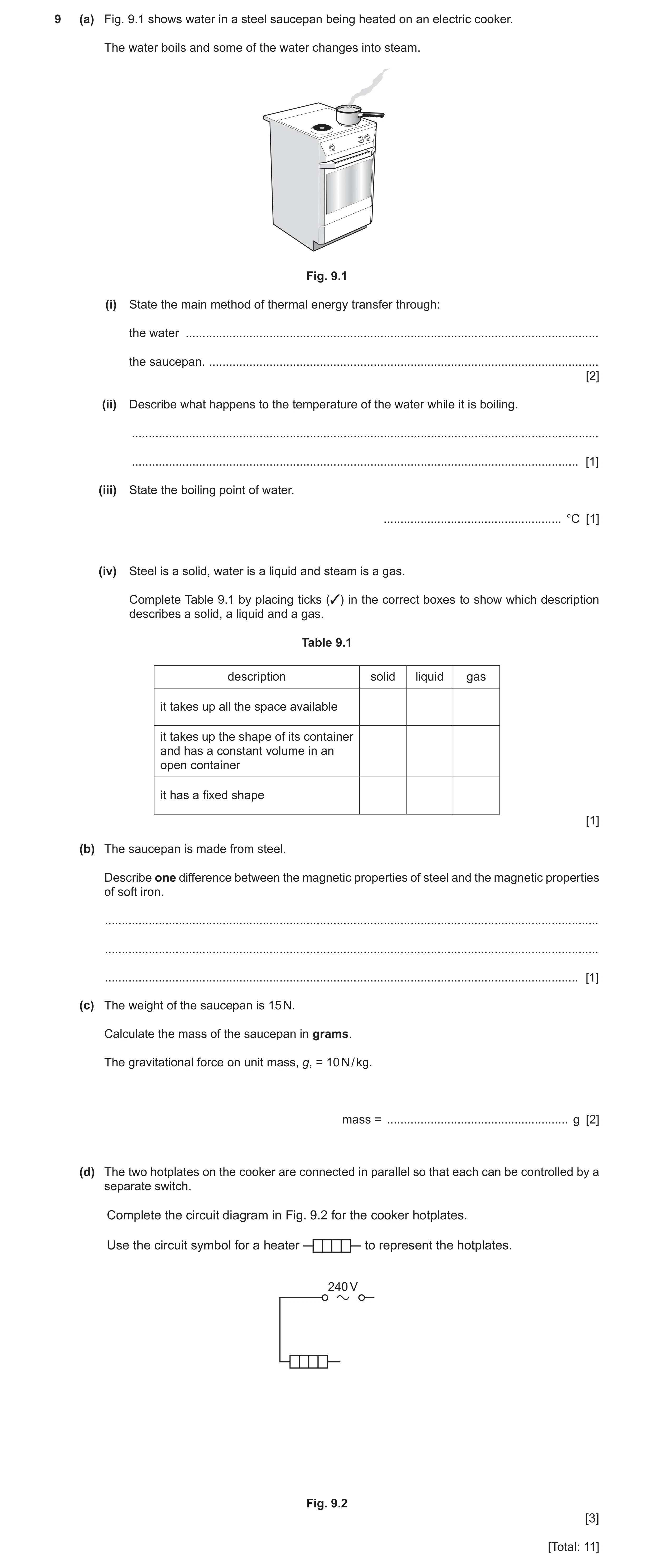
9 (a) Fig. 9.1 shows water in a steel saucepan being heated on an electric cooker. The water boils and some of the water changes into steam. Fig. 9.1 (i) State the main method of thermal energy transfer through: the water … the saucepan. … [2] (ii) Describe what happens to the temperature of the water while it is boiling. … … [1] (iii) State the boiling point of water. … °C [1] (iv) Steel is a solid, water is a liquid and steam is a gas. Complete Table 9.1 by placing ticks (✓) in the correct boxes to show which description describes a solid, a liquid and a gas. Table 9.1 description solid liquid gas it takes up all the space available it takes up the shape of its container and has a constant volume in an open container it has a fixed shape [1] (b) The saucepan is made from steel. Describe one difference between the magnetic properties of steel and the magnetic properties of soft iron. … … … [1] (c) The weight of the saucepan is 15 N. Calculate the mass of the saucepan in grams. The gravitational force on unit mass, g, = 10 N / kg. mass = … g [2] (d) The two hotplates on the cooker are connected in parallel so that each can be controlled by a separate switch. Complete the circuit diagram in Fig. 9.2 for the cooker hotplates. Use the circuit symbol for a heater to represent the hotplates. 240 V Fig. 9.2 [3] [Total: 11]
11 marks
Mark scheme: 9(a)(i) convection ; conduction ; 2 9(a)(ii) remains constant / remains at 100 ºC ; 1 9(a)(iii) 100 ºC ; 1 Question Answer Marks 9(a)(iv) description solid liquid gas it takes up all the space available it takes up the shape of its container and has a constant volume It has a fixed shape ; 1 9(b) steel retains its magnetism better / iron loses its magnetism more readily ; 1 9(c) m = W / g (in any form) or 15 / 10 or 1.5 ; = 1500 (g) ; 2 9(d) correct symbol for switch ; second heater connected in parallel ; each heater controlled by a separate switch ; 3
This question in 0654/32 May/June 2024
Q21 · Water in a steel saucepan being heated on an electric cooker 0654/33 May/June 2024
9 (a) Fig. 9.1 shows water in a steel saucepan being heated on an electric cooker. The water boils and some of the water changes into steam. Fig. 9.1 (i) State the main method of thermal energy transfer through: the water … the saucepan. … [2] (ii) Describe what happens to the temperature of the water while it is boiling. … … [1] (iii) State the boiling point of water. … °C [1] (iv) Steel is a solid, water is a liquid and steam is a gas. Complete Table 9.1 by placing ticks (✓) in the correct boxes to show which description describes a solid, a liquid and a gas. Table 9.1 description solid liquid gas it takes up all the space available it takes up the shape of its container and has a constant volume in an open container it has a fixed shape [1] (b) The saucepan is made from steel. Describe one difference between the magnetic properties of steel and the magnetic properties of soft iron. … … … [1] (c) The weight of the saucepan is 15 N. Calculate the mass of the saucepan in grams. The gravitational force on unit mass, g, = 10 N / kg. mass = … g [2] (d) The two hotplates on the cooker are connected in parallel so that each can be controlled by a separate switch. Complete the circuit diagram in Fig. 9.2 for the cooker hotplates. Use the circuit symbol for a heater to represent the hotplates. 240 V Fig. 9.2 [3] [Total: 11]
11 marks
Mark scheme: 9(a)(i) convection ; conduction ; 2 9(a)(ii) remains constant / remains at 100 ºC ; 1 9(a)(iii) 100 ºC ; 1 Question Answer Marks 9(a)(iv) description solid liquid gas it takes up all the space available it takes up the shape of its container and has a constant volume It has a fixed shape ; 1 9(b) steel retains its magnetism better / iron loses its magnetism more readily ; 1 9(c) m = W / g (in any form) or 15 / 10 or 1.5 ; = 1500 (g) ; 2 9(d) correct symbol for switch ; second heater connected in parallel ; each heater controlled by a separate switch ; 3
This question in 0654/33 May/June 2024
Q22 · A rock that travels through space and hits the Earth’s surface is called a meteorite 0654/31 Oct/Nov 2024
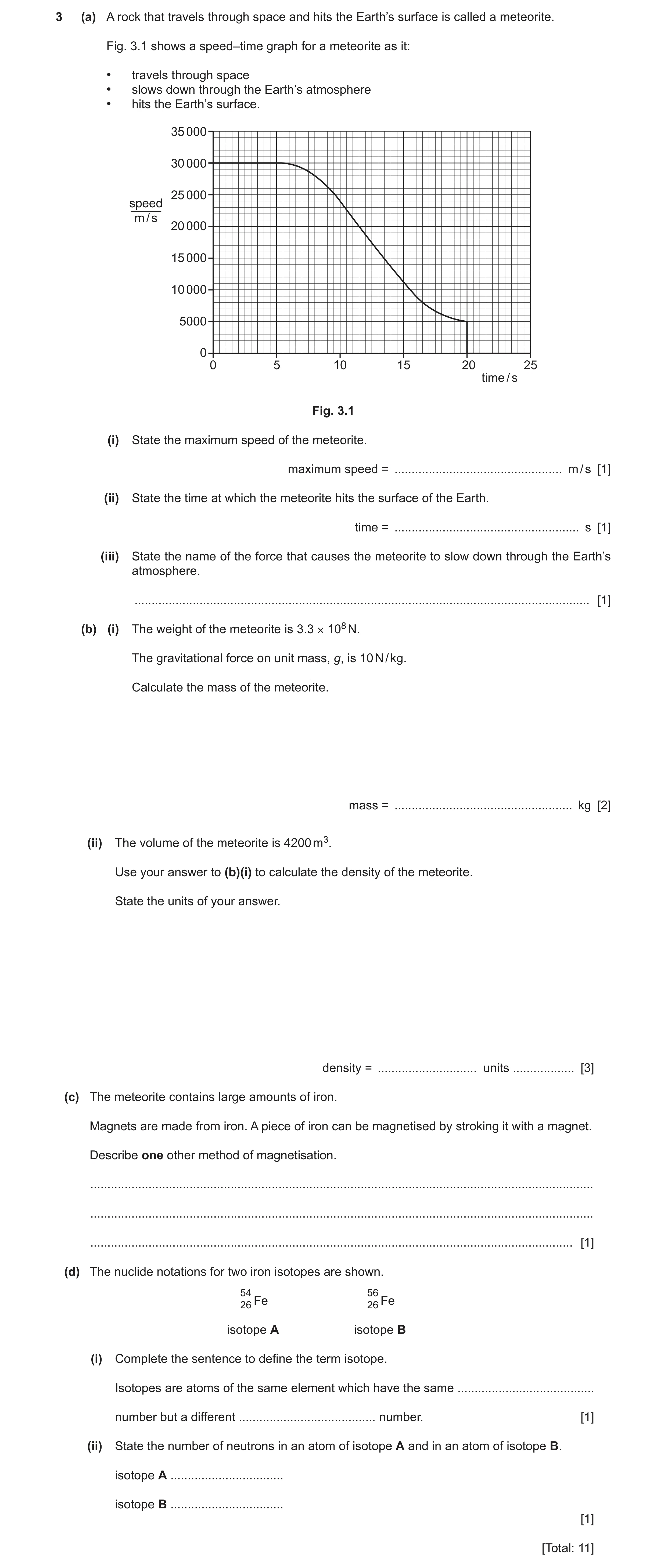
3 (a) A rock that travels through space and hits the Earth’s surface is called a meteorite. Fig. 3.1 shows a speed–time graph for a meteorite as it: • travels through space • slows down through the Earth’s atmosphere • hits the Earth’s surface. 35 000 30 000 25 000 speed m / s 20 000 15 000 10 000 5000 0 0 5 10 15 20 25 time / s Fig. 3.1 (i) State the maximum speed of the meteorite. maximum speed = … m / s [1] (ii) State the time at which the meteorite hits the surface of the Earth. time = … s [1] (iii) State the name of the force that causes the meteorite to slow down through the Earth’s atmosphere. … [1] (b) (i) The weight of the meteorite is 3.3 × 10⁸ N. The gravitational force on unit mass, g, is 10 N / kg. Calculate the mass of the meteorite. mass = … kg [2] (ii) The volume of the meteorite is 4200 m3. Use your answer to (b)(i) to calculate the density of the meteorite. State the units of your answer. density = … units … [3] (c) The meteorite contains large amounts of iron. Magnets are made from iron. A piece of iron can be magnetised by stroking it with a magnet. Describe one other method of magnetisation. … … … [1] (d) The nuclide notations for two iron isotopes are shown. 54 56 26 Fe 26 Fe isotope A isotope B (i) Complete the sentence to define the term isotope. Isotopes are atoms of the same element which have the same … number but a different … number. [1] (ii) State the number of neutrons in an atom of isotope A and in an atom of isotope B. isotope A … isotope B … [1] [Total: 11]
11 marks
Mark scheme: 3(a)(i) 30 000 (m / s) ; 1 3(a)(ii) 20 (s) ; 1 3(a)(iii) friction / air resistance ; 1 3(b)(i) evidence of mass = weight / g or 3.3 108 / 10 ; 2 mass = 3.3 107 (kg) ; 3(b)(ii) evidence of density = mass / volume (in any form) or 3.3 107 ÷ 4200 ; 3 7900 ; kg / m3 ; 3(c) place in solenoid / coil and pass (d.c.) electric current through solenoid / coil or 1 place in direction of Earth’s magnetic field and hammer it (gently) ; 3(d)(i) proton / atomic and 1 nucleon / mass ; 3(d)(ii) isotope A = 28 neutrons and isotope B = 30 neutrons ; 1
This question in 0654/31 Oct/Nov 2024
 6
6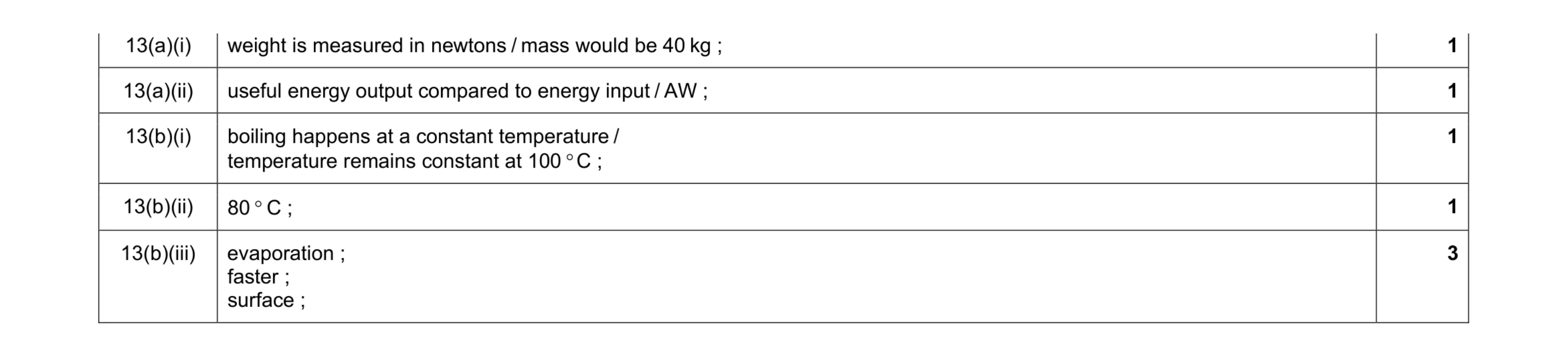 7
7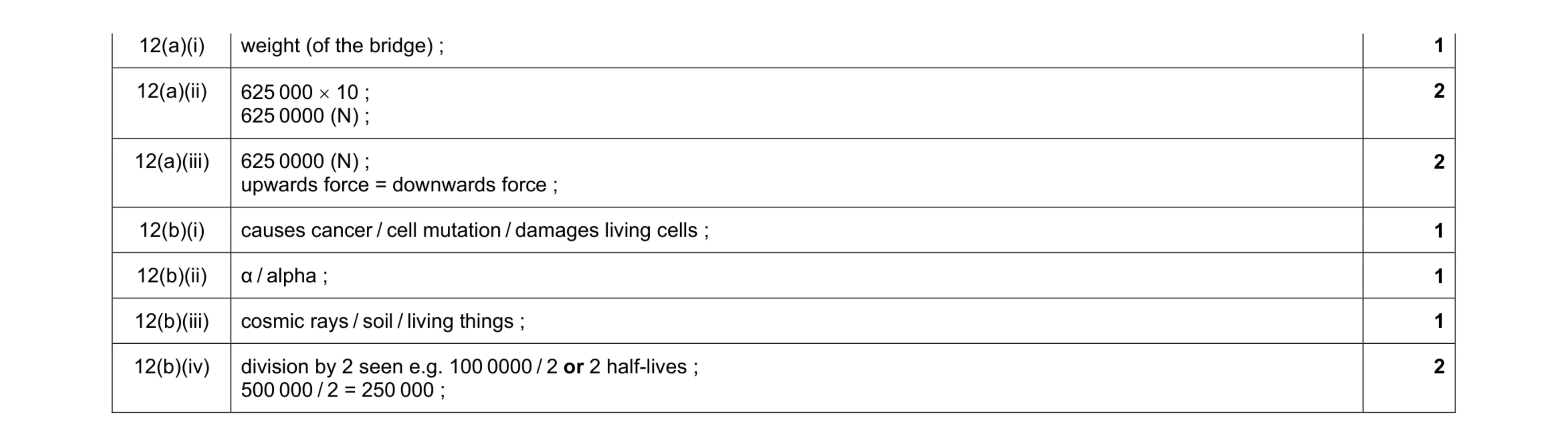 10
10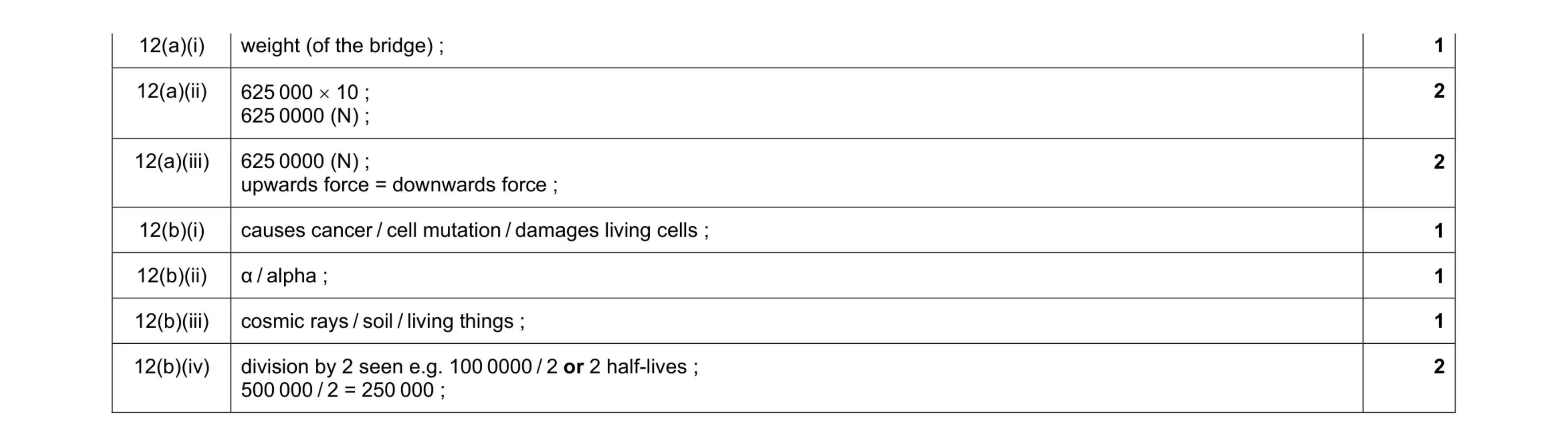 10
10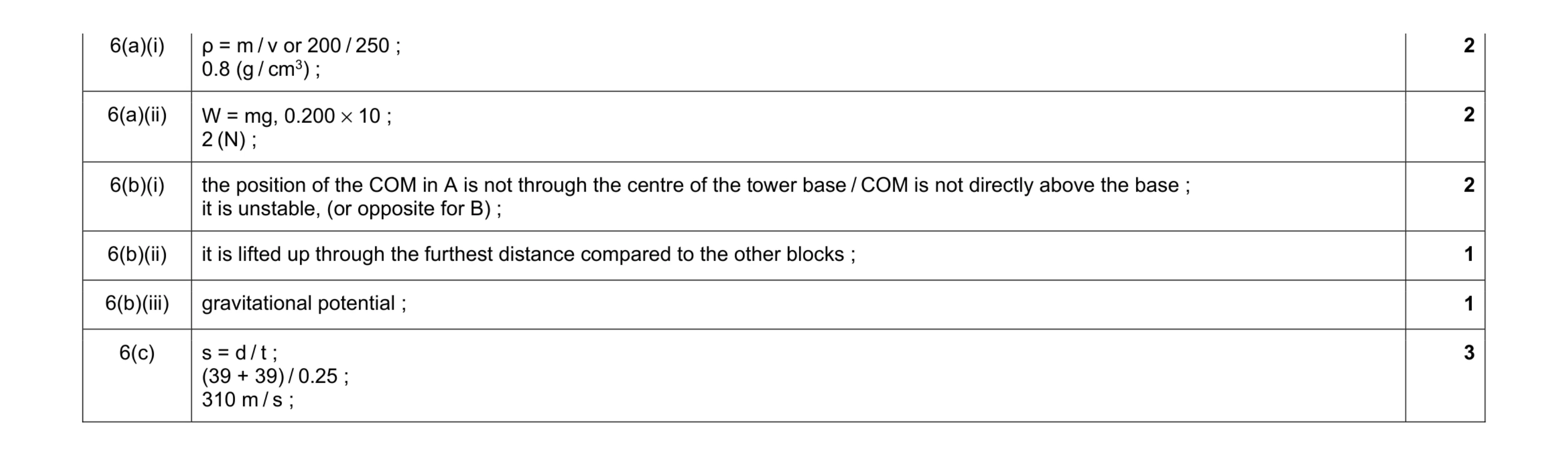 11
11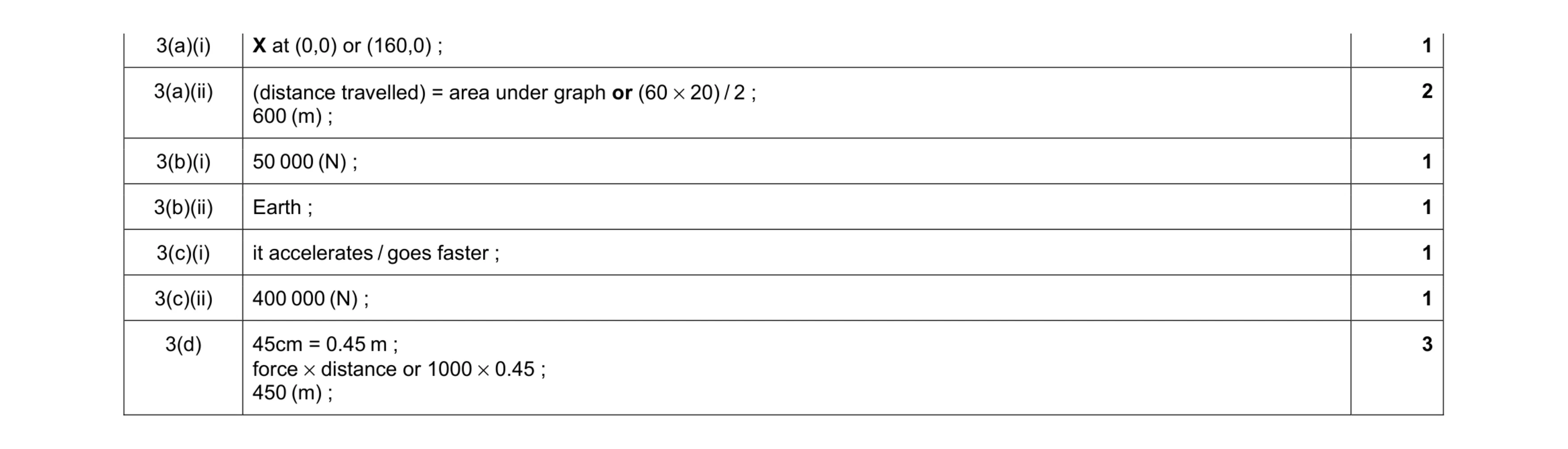 10
10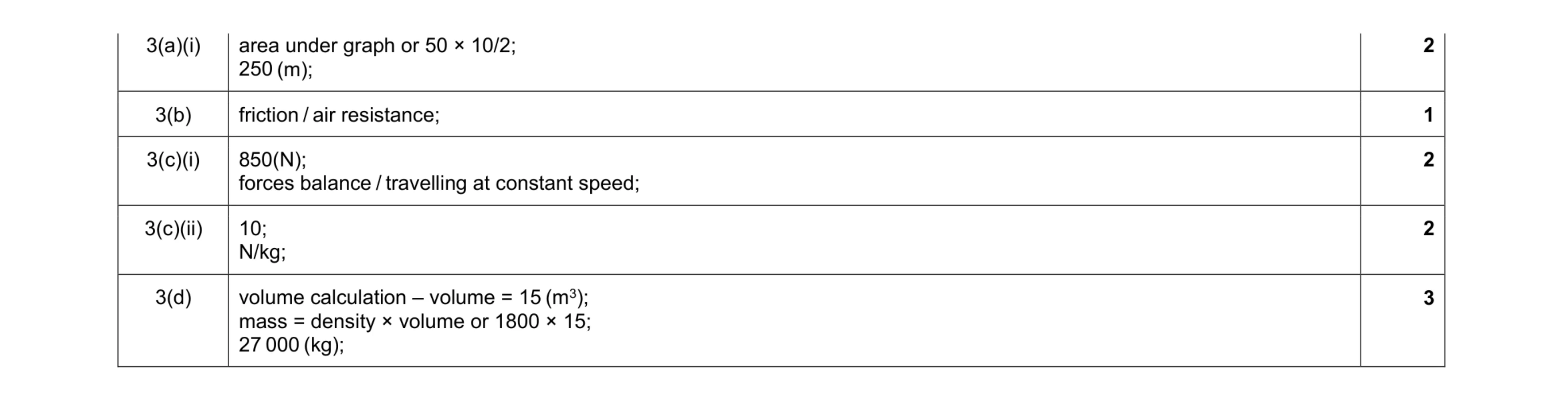 10
10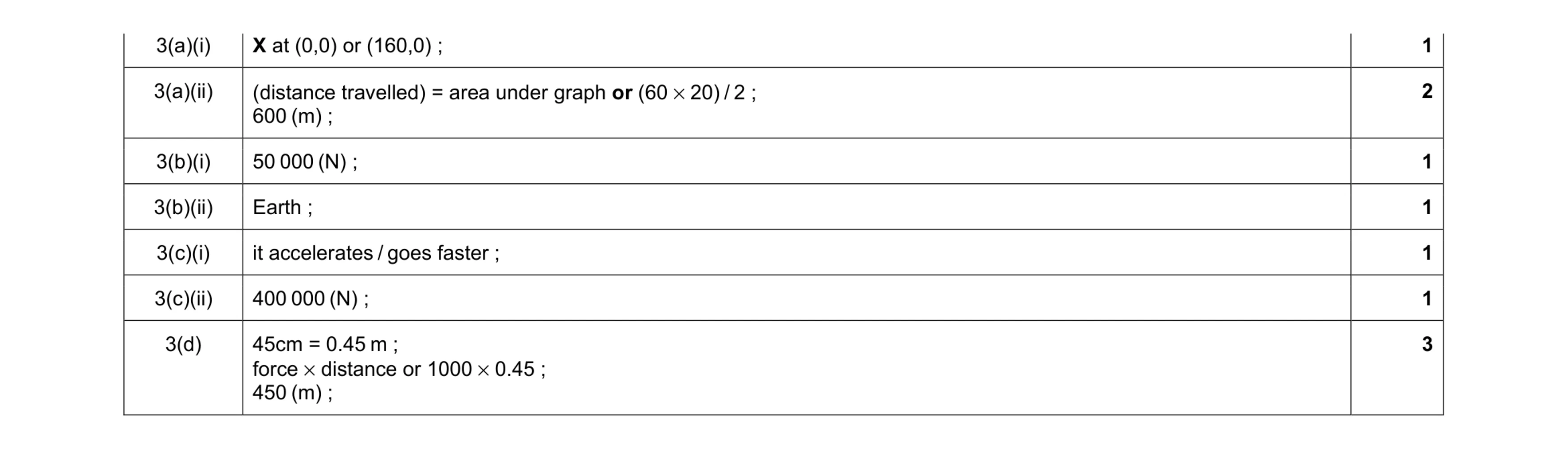 10
10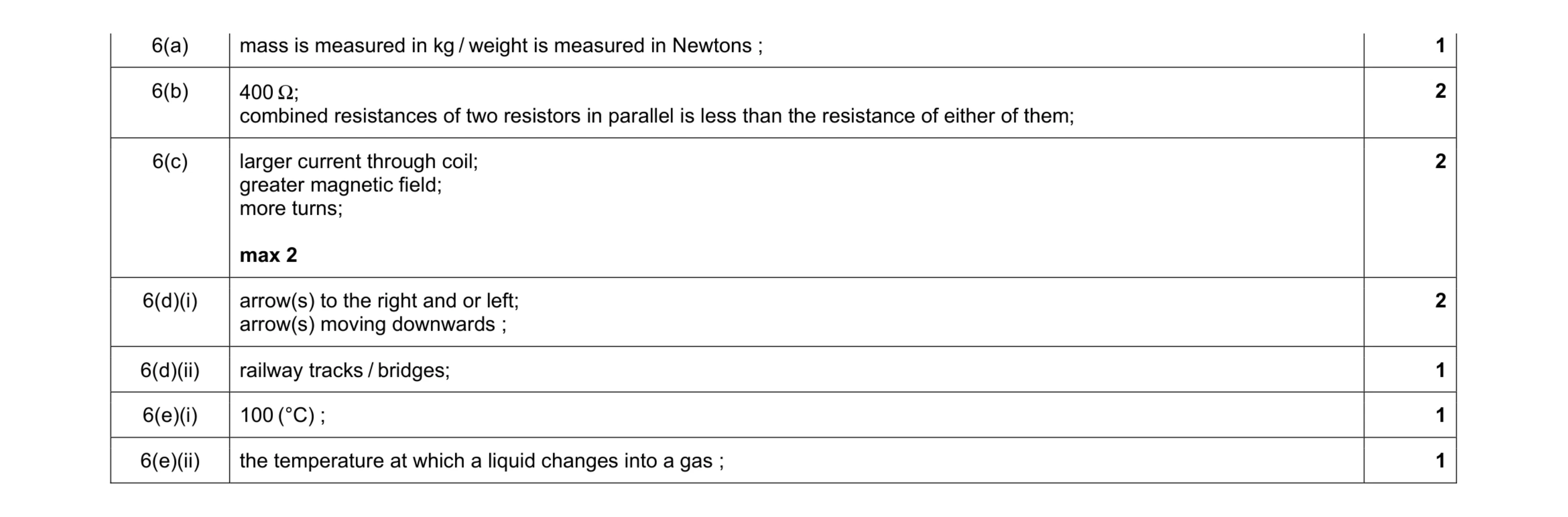 10
10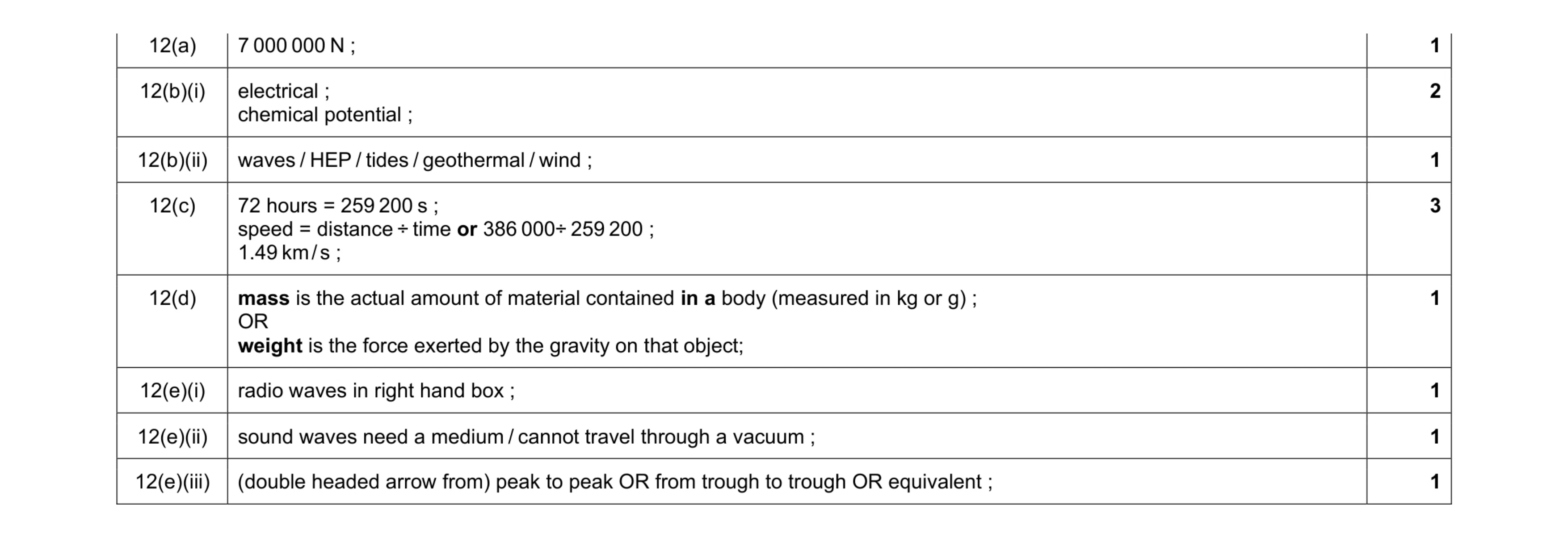 11
11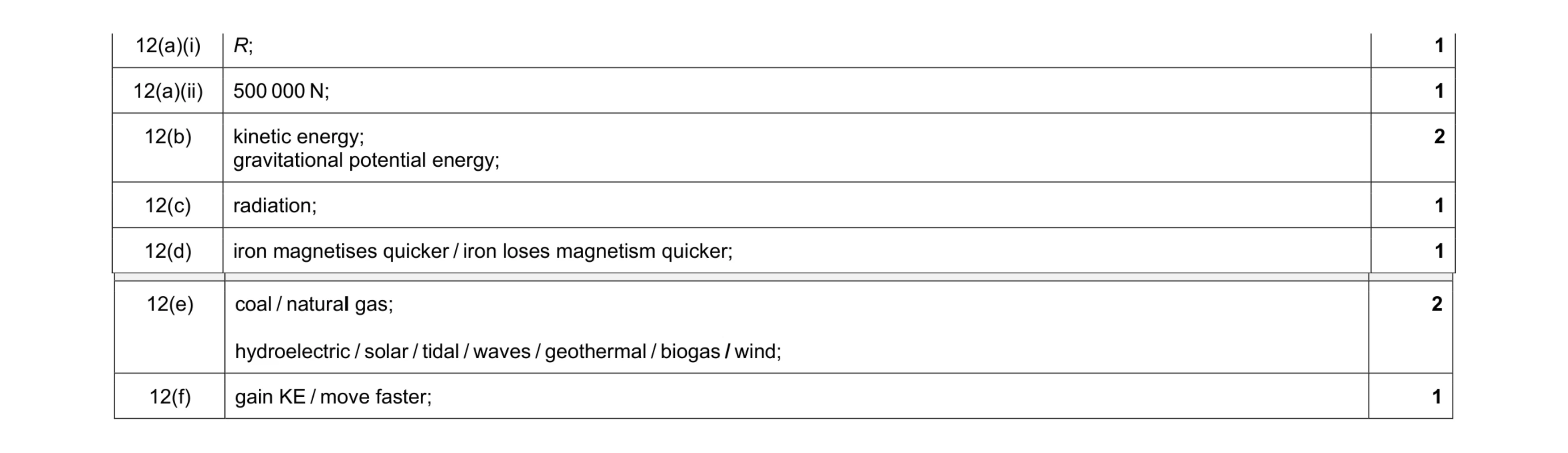 9
9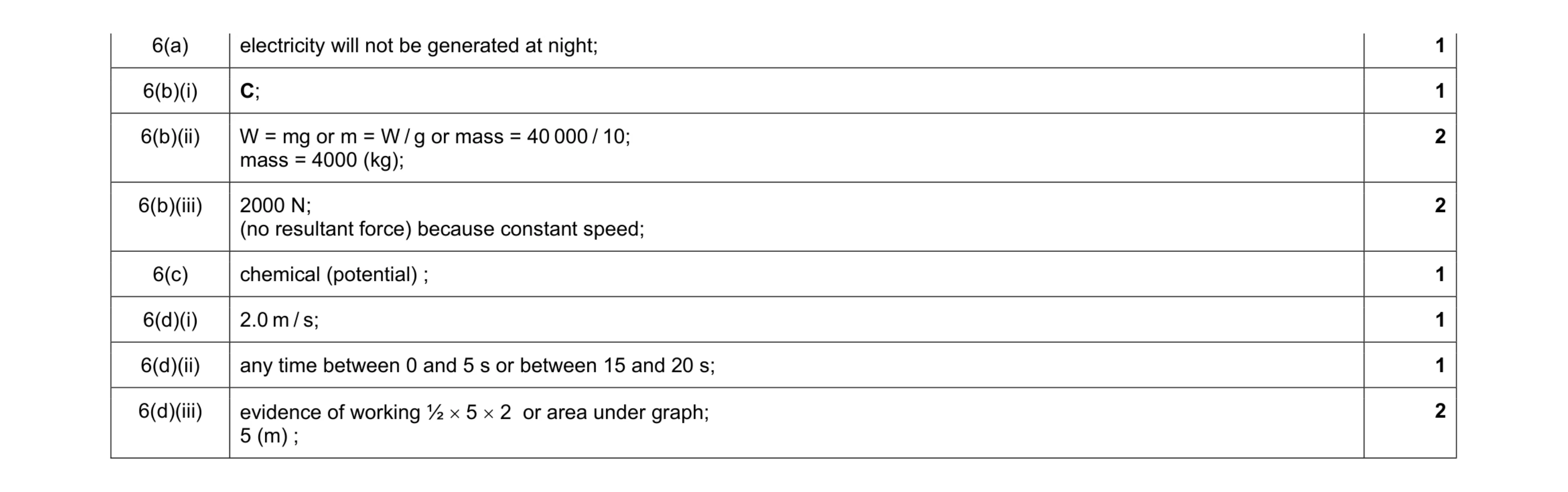 11
11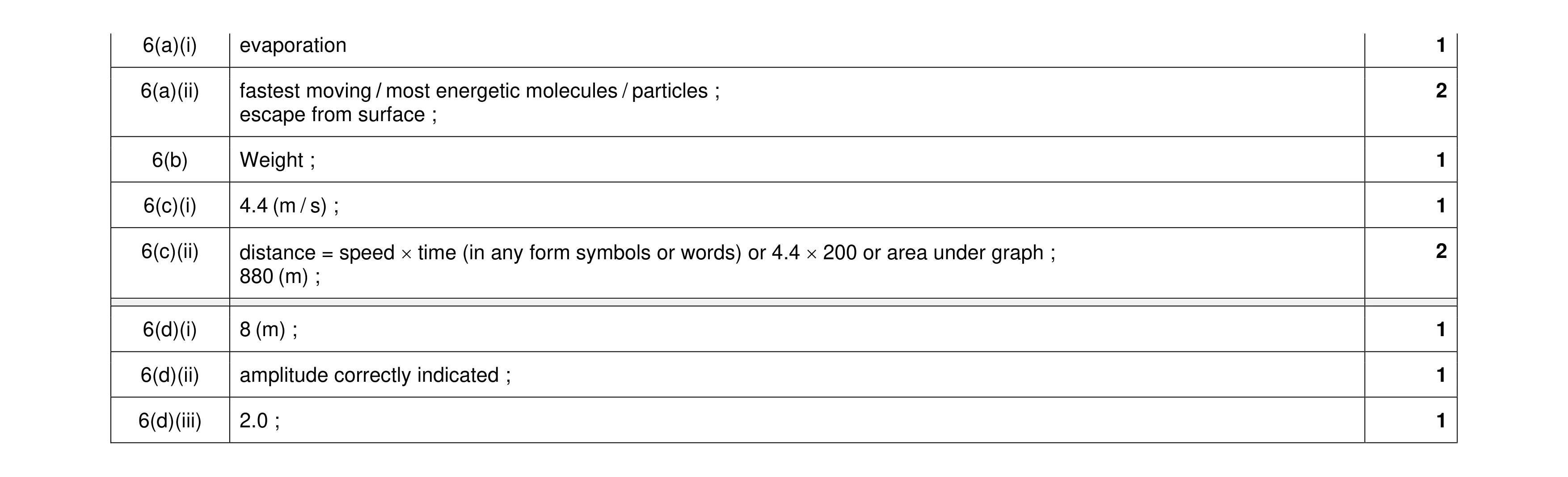 10
10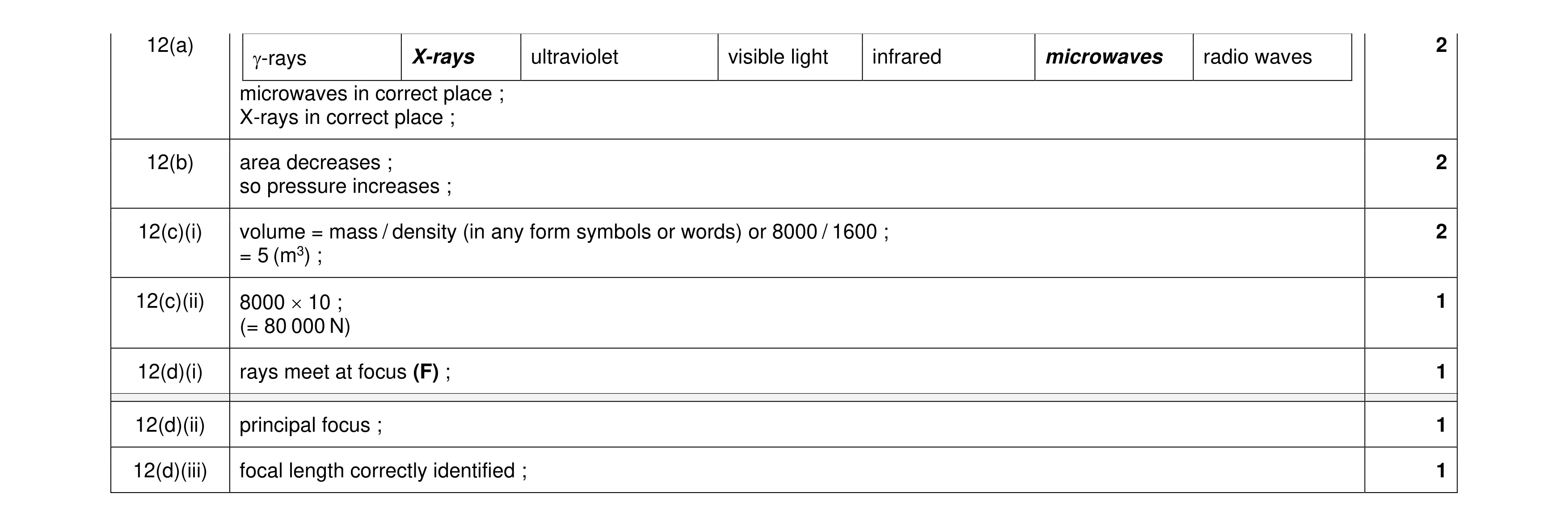 10
10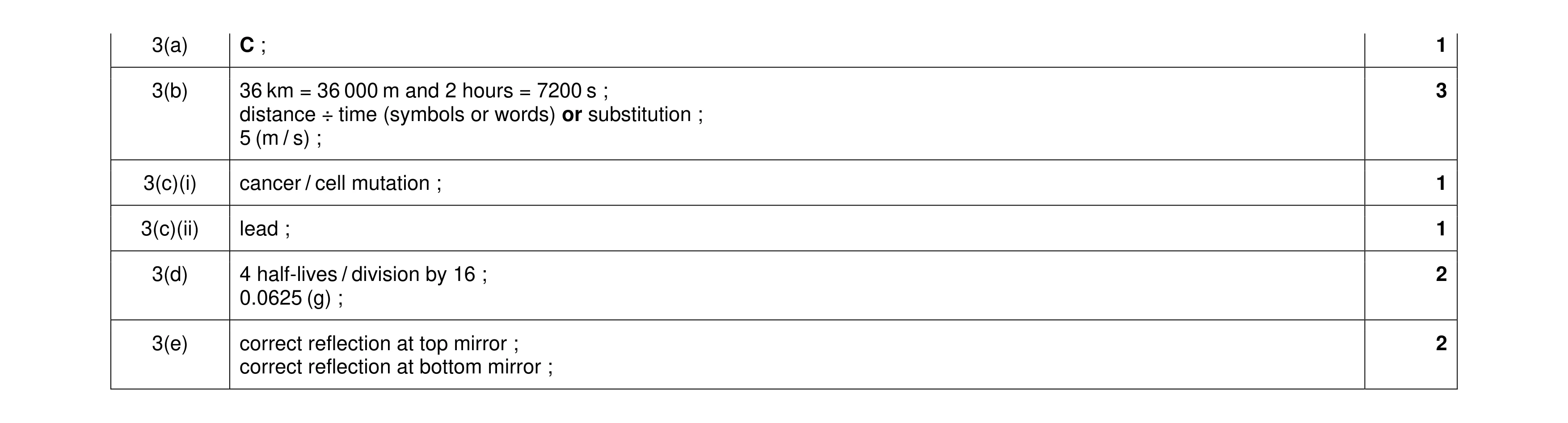 10
10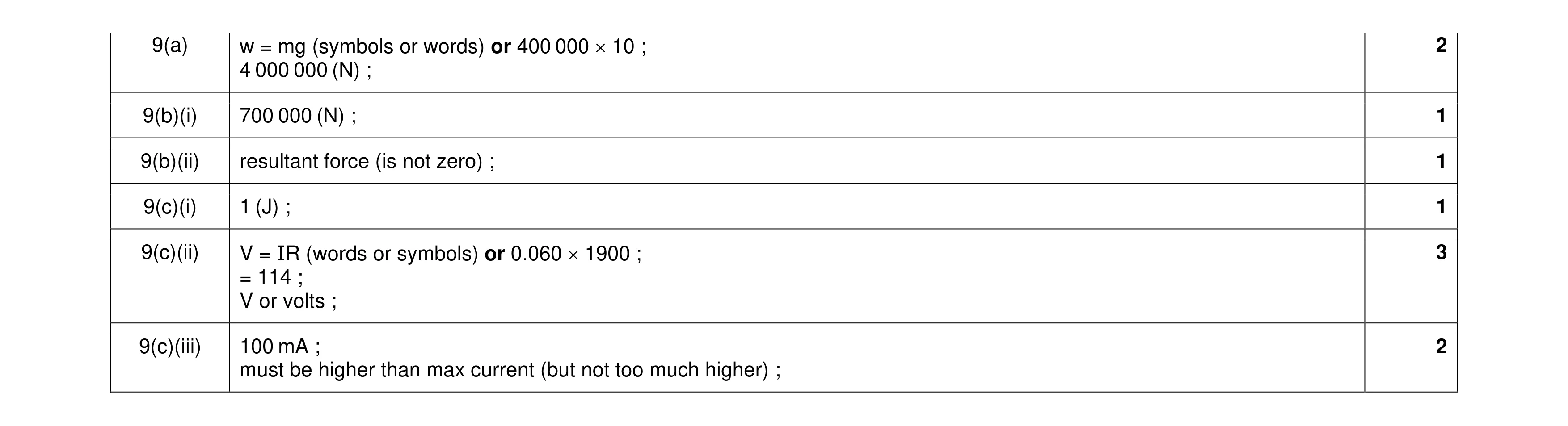 10
10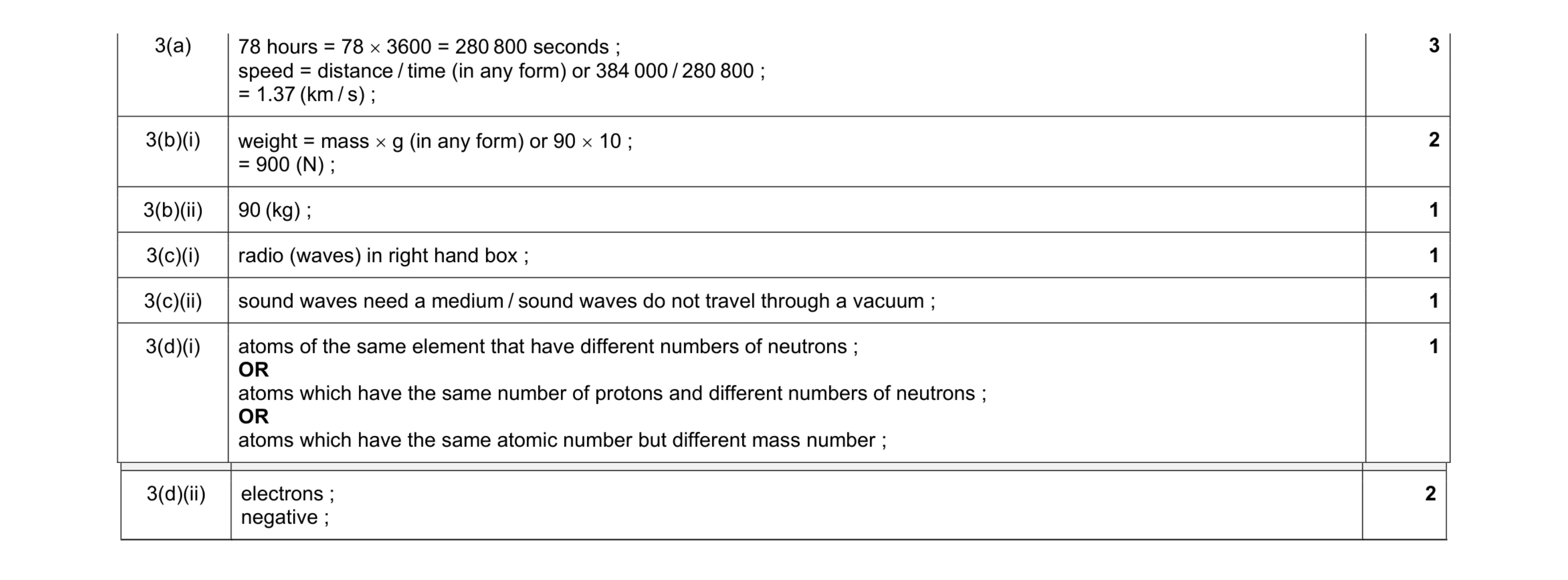 11
11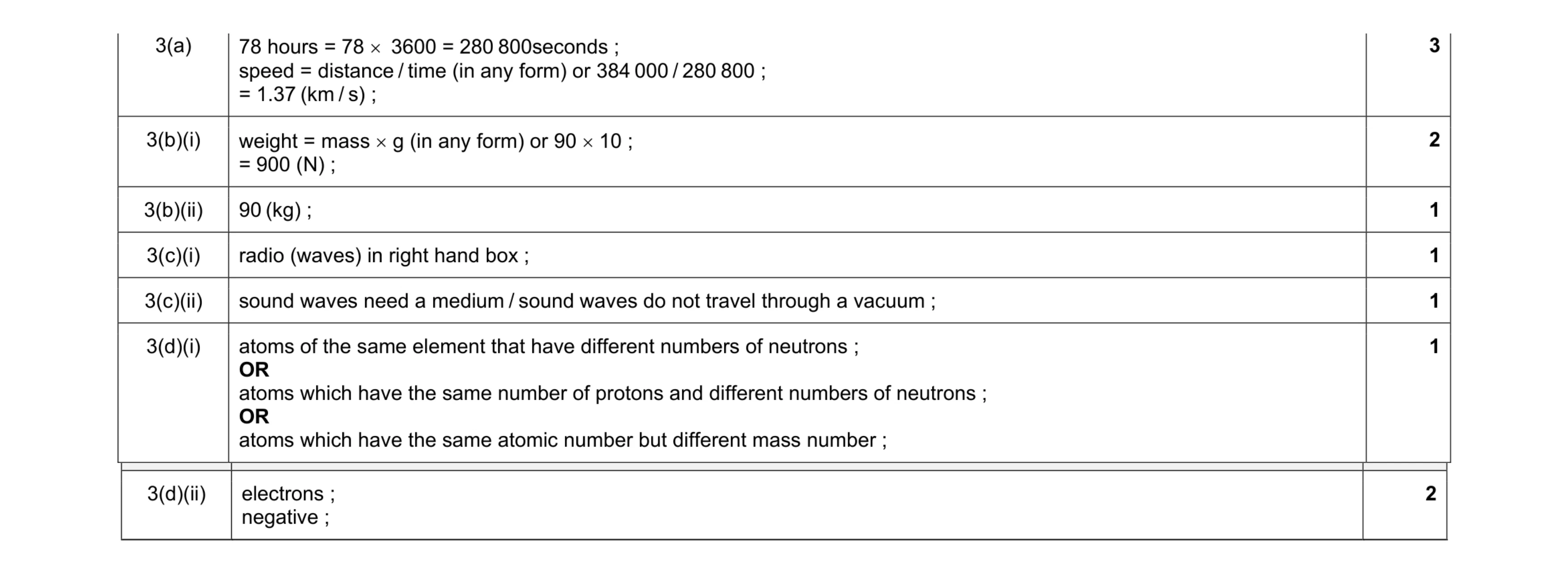 11
11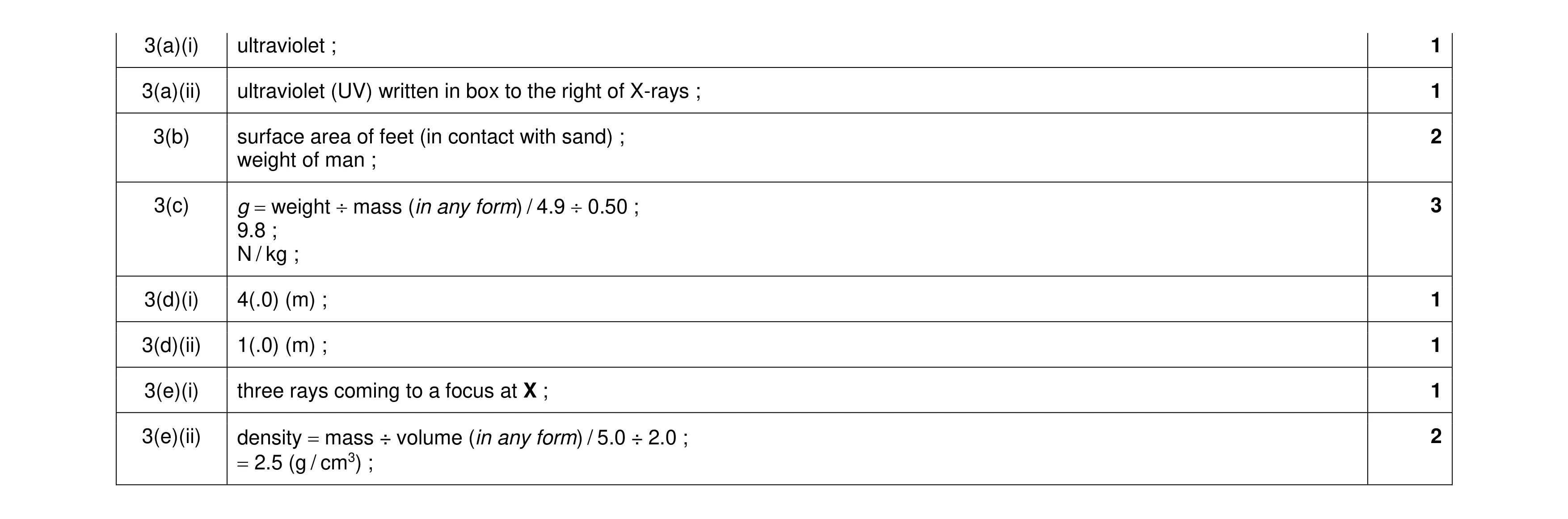 12
12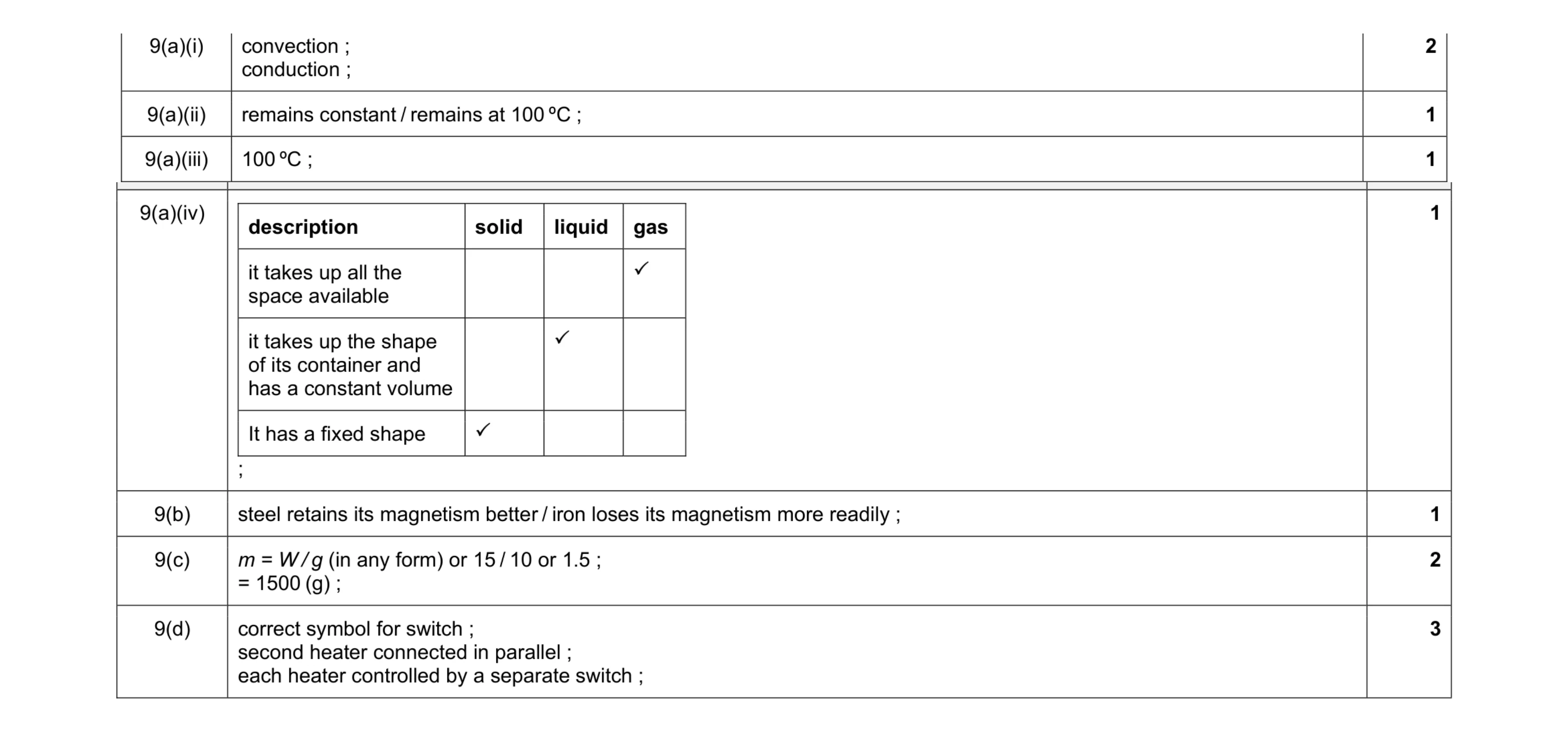 11
11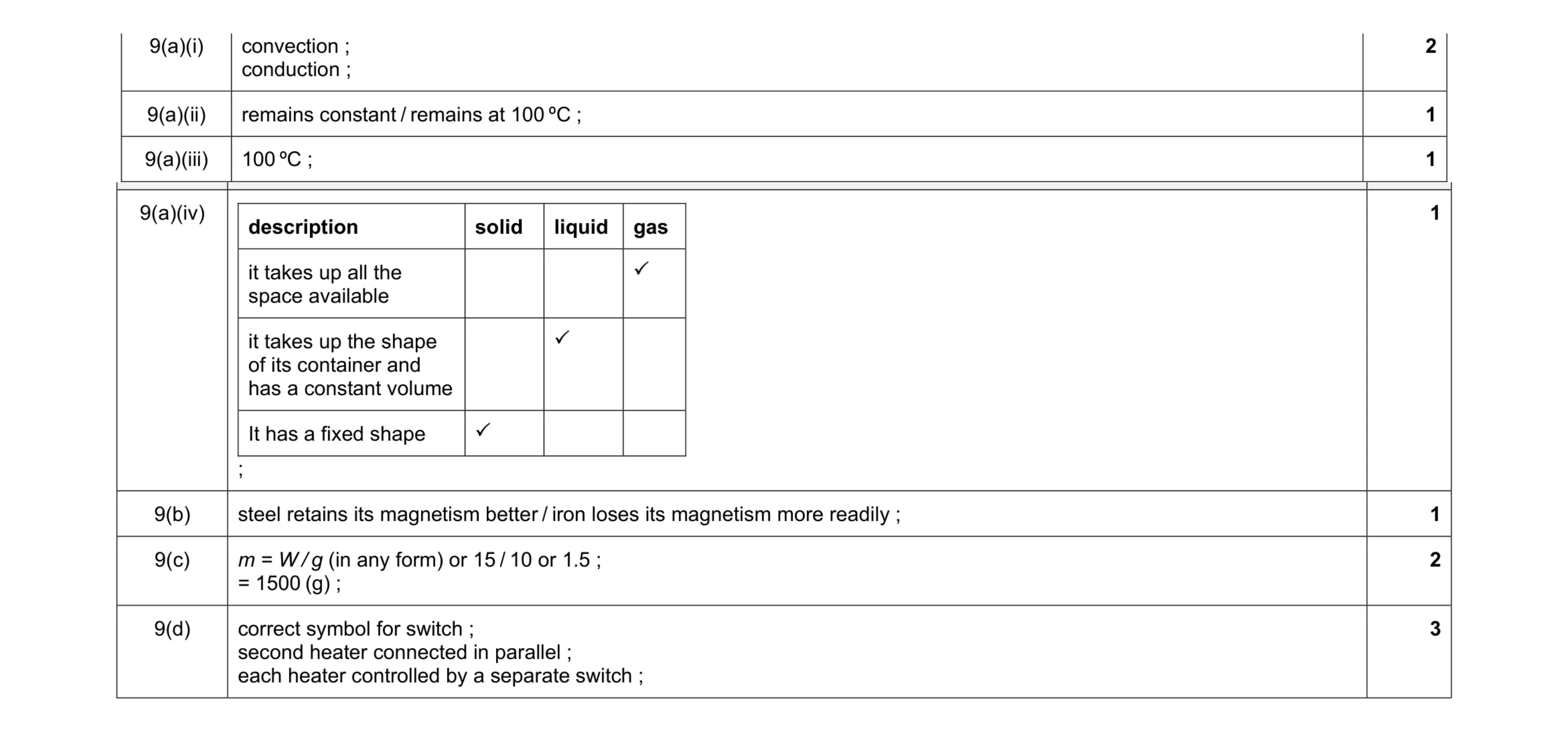 11
11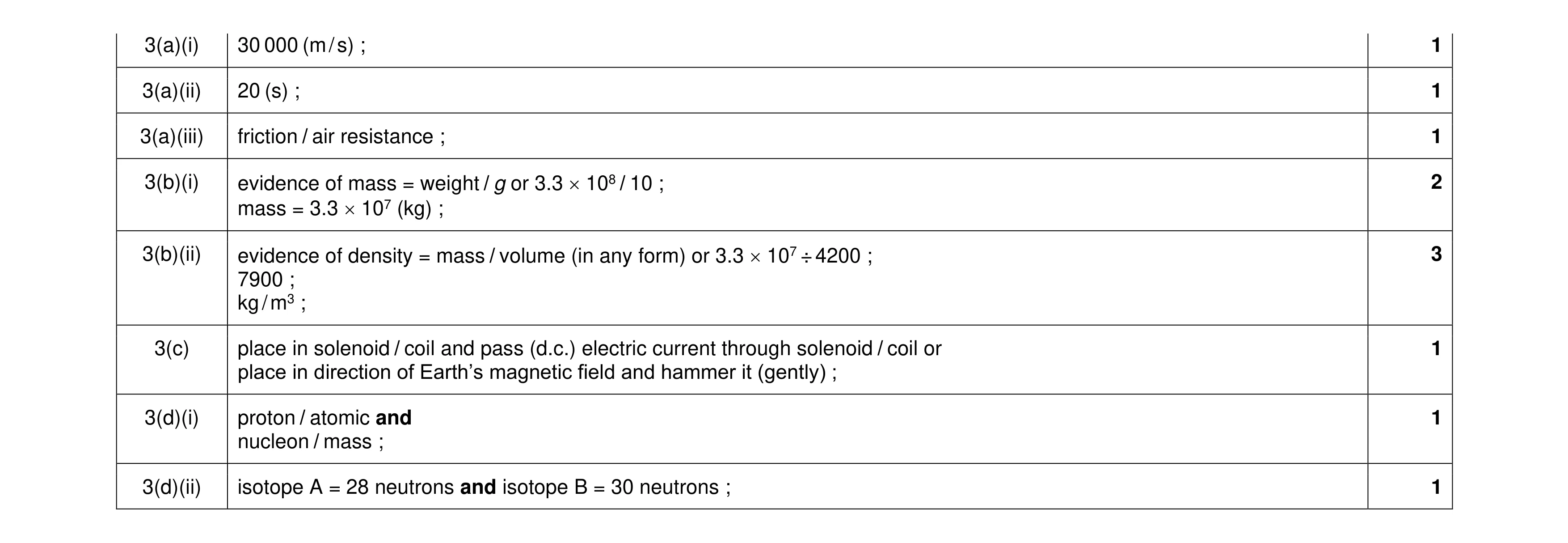 11
11