Questions as text
Q1 · A diagram of a woodland food web 0654/31 May/June 2017
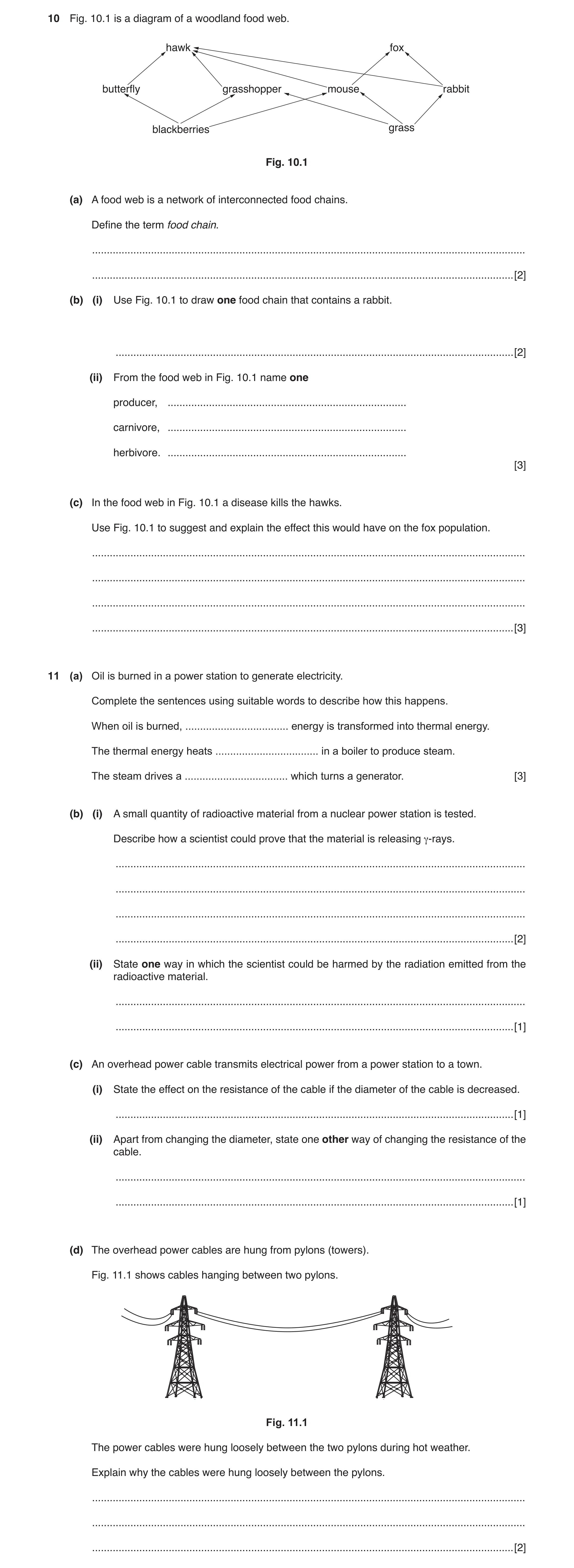
10 Fig. 10.1 is a diagram of a woodland food web. hawk fox butterfly grasshopper mouse rabbit blackberries grass Fig. 10.1 (a) A food web is a network of interconnected food chains. Define the term food chain. … … [2] (b) (i) Use Fig. 10.1 to draw one food chain that contains a rabbit. … [2] (ii) From the food web in Fig. 10.1 name one producer, … carnivore, … herbivore. … [3] (c) In the food web in Fig. 10.1 a disease kills the hawks. Use Fig. 10.1 to suggest and explain the effect this would have on the fox population. … … … … [3] 11 (a) Oil is burned in a power station to generate electricity. Complete the sentences using suitable words to describe how this happens. When oil is burned, … energy is transformed into thermal energy. The thermal energy heats … in a boiler to produce steam. The steam drives a … which turns a generator. [3] (b) (i) A small quantity of radioactive material from a nuclear power station is tested. Describe how a scientist could prove that the material is releasing γ-rays. … … … … [2] (ii) State one way in which the scientist could be harmed by the radiation emitted from the radioactive material. … … [1] (c) An overhead power cable transmits electrical power from a power station to a town. (i) State the effect on the resistance of the cable if the diameter of the cable is decreased. … [1] (ii) Apart from changing the diameter, state one other way of changing the resistance of the cable. … … [1] (d) The overhead power cables are hung from pylons (towers). Fig. 11.1 shows cables hanging between two pylons. Fig. 11.1 The power cables were hung loosely between the two pylons during hot weather. Explain why the cables were hung loosely between the pylons. … … … [2]
20 marks
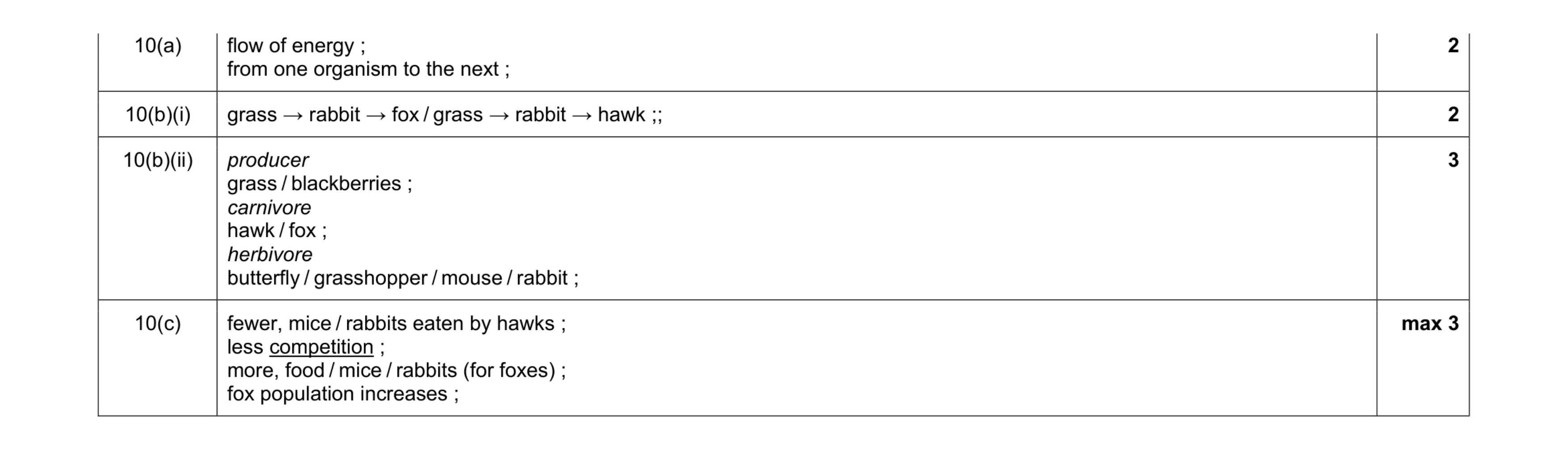
Mark scheme: 10(a) flow of energy ; from one organism to the next ; 2 10(b)(i) grass → rabbit → fox / grass → rabbit → hawk ;; 2 10(b)(ii) producer grass / blackberries ; carnivore hawk / fox ; herbivore butterfly / grasshopper / mouse / rabbit ; 3 10(c) fewer, mice / rabbits eaten by hawks ; less competition ; more, food / mice / rabbits (for foxes) ; fox population increases ; max 3
This question in 0654/31 May/June 2017
Q2 · Food chains show the flow of energy from one organism to another 0654/32 Oct/Nov 2017
4 Food chains show the flow of energy from one organism to another. The following paragraph is a description of some of the organisms in a desert environment and what they feed on. The top predator is a hawk. The hawk eats snakes, which eat desert mice. The desert mice feed on plants such as thorn acacias. (a) (i) Using the information in the paragraph, draw a food chain using all of the organisms. [2] (ii) Name the producer in this food chain. … [1] (iii) Name the herbivore in this food chain. … [1] (b) State the principal source of energy for all food chains. … [1] (c) Organisms such as hawks have evolved to have good eyesight. This is an example of natural selection. Define the term natural selection. … … … [2]
7 marks
Mark scheme: 4(a)(i) organisms in correct order ; arrows in the correct direction ; 2 4(a)(ii) (thorn) acacias ; 1 4(a)(iii) (desert) mice ; 1 4(b) Sun ; 1 4(c) greater chance of passing on genes ; by the best adapted organisms / AW ; 2
This question in 0654/32 Oct/Nov 2017
Q3 · A simplified diagram of the carbon cycle 0654/31 Oct/Nov 2018
13 Fig. 13.1 shows a simplified diagram of the carbon cycle. carbon dioxide in atmosphere A D B C fossil carbon compounds fuels in animals carbon compounds in plants Fig. 13.1 (a) Name the process labelled C in Fig. 13.1. … [1] (b) Describe how an increase in process A contributes to global warming. … … … [2] (c) Explain why increasing the number of forested areas could reduce the rate of global warming. … … … [2] (d) The boxes on the left show some biological terms used when describing the organisms in a food chain. The boxes on the right show the meanings of these terms. Draw four lines to link each term with its meaning. term meaning an organism that gets its energy by carnivore feeding on other plants or animals an animal that gets its energy by eating consumer other animals an organism that makes its own organic herbivore nutrients using energy from the Sun an animal that gets its energy by eating producer plants [3]
8 marks
Mark scheme: 13(a) respiration ; 1 13(b) combustion releases carbon dioxide ; carbon dioxide is a greenhouse gas ; (enhanced) greenhouse effect leads to global warming ; max 2 13(c) ref photosynthesis ; remove carbon dioxide (from the atmosphere) / reducing greenhouse effect ; 2 13(d) term definition carnivore an organism that gets its energy by feeding on plants and animals consumer an animal that gets its energy by eating other animals. herbivore an organism that makes its own organic nutrients using energy from the Sun producer an animal that gets its energy by eating plants 1 correct ; 2 or 3 correct ; 4 correct ; 3
This question in 0654/31 Oct/Nov 2018
Q4 · A forest food web 0654/33 Oct/Nov 2018
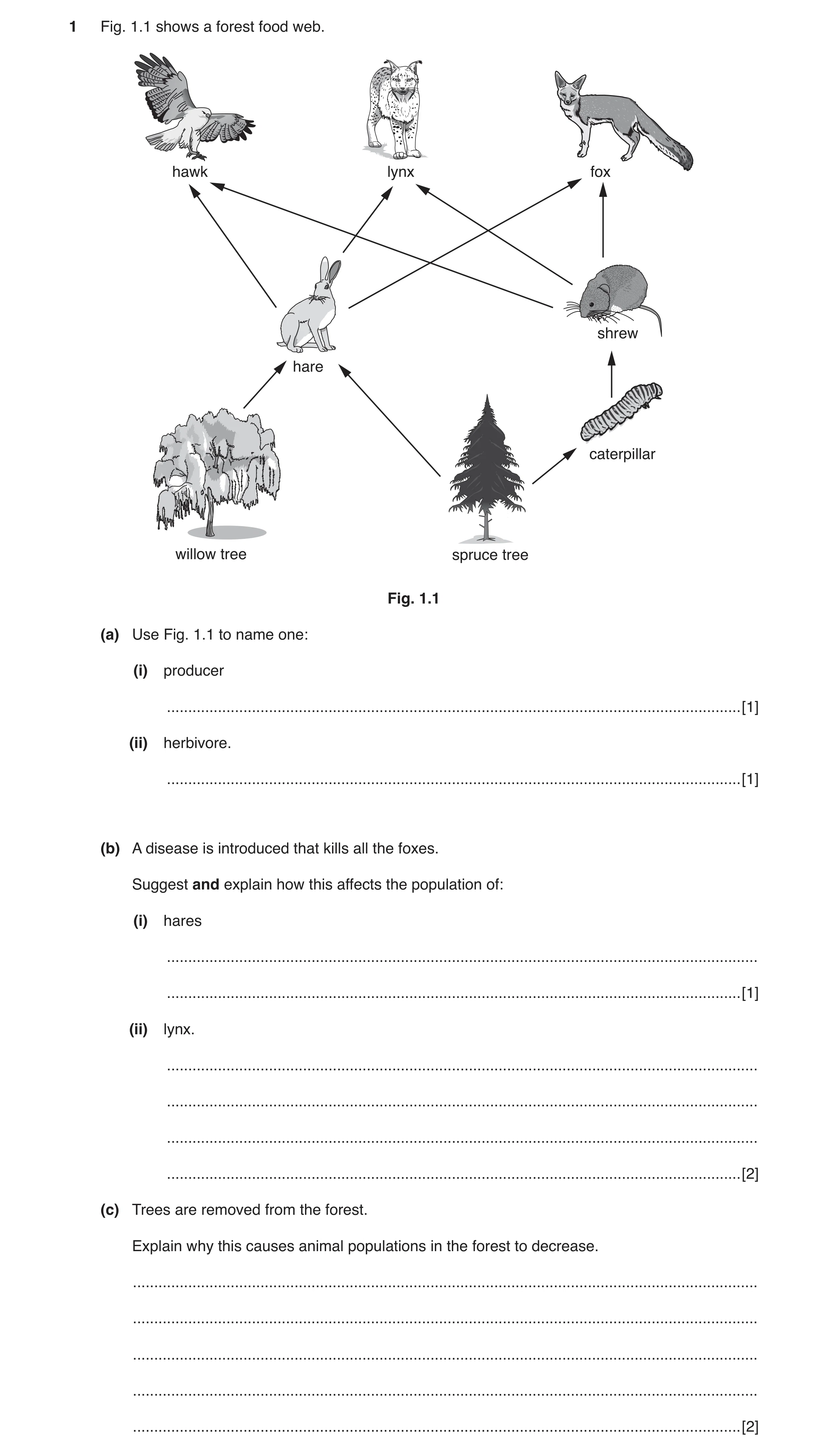
1 Fig. 1.1 shows a forest food web. hawk lynx fox shrew hare caterpillar willow tree spruce tree Fig. 1.1 (a) Use Fig. 1.1 to name one: (i) producer … [1] (ii) herbivore. … [1] (b) A disease is introduced that kills all the foxes. Suggest and explain how this affects the population of: (i) hares … … [1] (ii) lynx. … … … … [2] (c) Trees are removed from the forest. Explain why this causes animal populations in the forest to decrease. … … … … … [2]
7 marks
Mark scheme: 1(a)(i) willow (tree) / spruce (tree) ; 1 1(a)(ii) hare / caterpillar ; 1 1(b)(i) population increase – no mark idea of less predation ; 1 1(b)(ii) population increase – no mark idea of less competition ; increased food (availability) ; 2 1(c) population decrease – no mark less food ; habitat / shelter / breeding sites removed ; food, chains / webs, disrupted ; max 2
This question in 0654/33 Oct/Nov 2018
Question 5 0654/31 Oct/Nov 2019
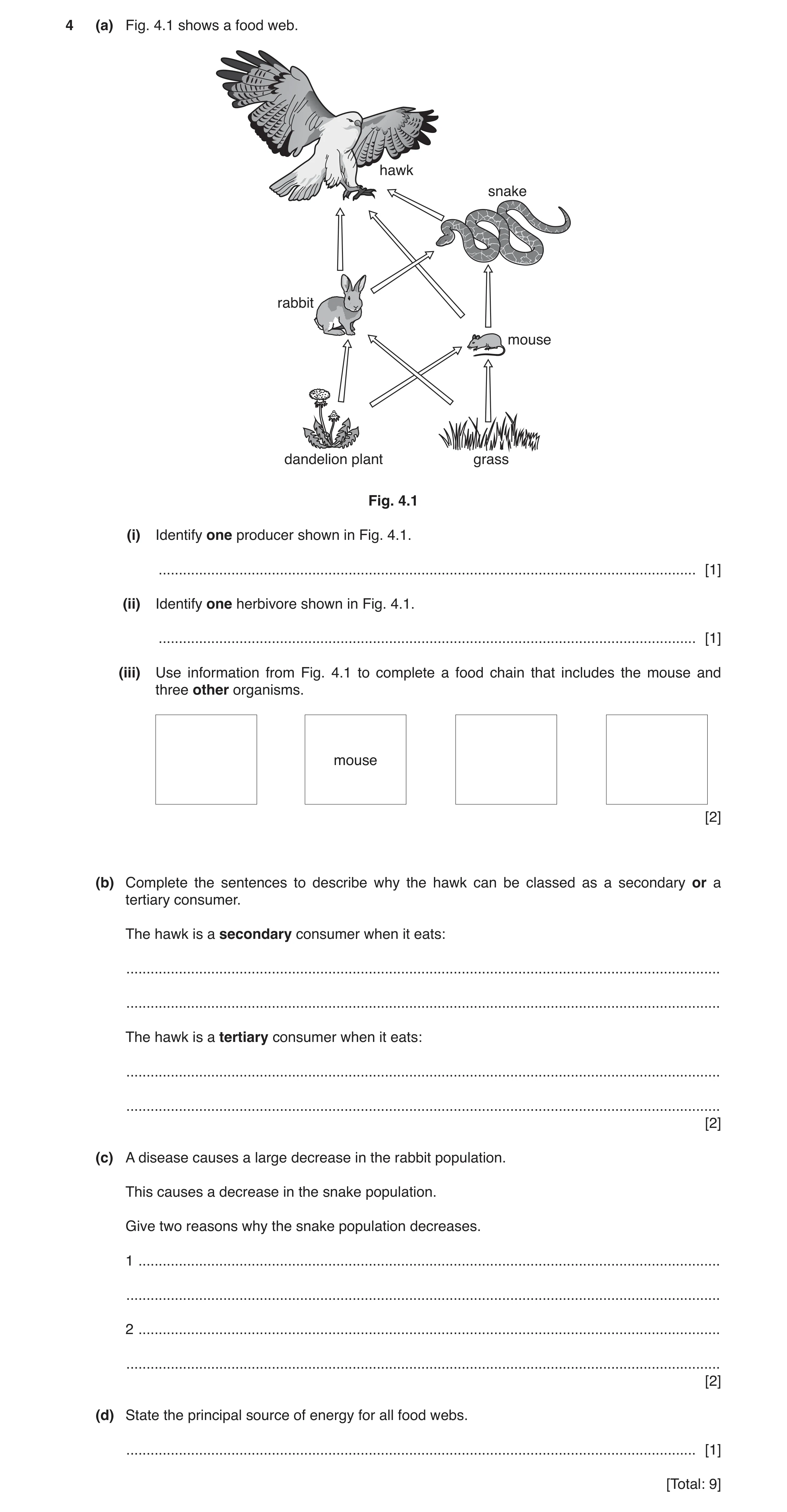
4 (a) Fig. 4.1 shows a food web. hawk snake rabbit mouse dandelion plant grass Fig. 4.1 (i) Identify one producer shown in Fig. 4.1. … [1] (ii) Identify one herbivore shown in Fig. 4.1. … [1] (iii) Use information from Fig. 4.1 to complete a food chain that includes the mouse and three other organisms. mouse [2] (b) Complete the sentences to describe why the hawk can be classed as a secondary or a tertiary consumer. The hawk is a secondary consumer when it eats: … … The hawk is a tertiary consumer when it eats: … … [2] (c) A disease causes a large decrease in the rabbit population. This causes a decrease in the snake population. Give two reasons why the snake population decreases. 1 … … 2 … … [2] (d) State the principal source of energy for all food webs. … [1] [Total: 9]
9 marks
Mark scheme: 4(a)(i) grass / dandelion (plants) ; 1 4(a)(ii) rabbit / mouse ; 1 4(a)(iii) grass / dandelion plants → mouse → snake → hawk ;; 2 4(b) rabbits / mice / primary consumers ; snakes / secondary consumers ; 2 4(c) as there is less food for snakes ; increased predation of snakes ; 2 4(d) Sun ; 1
This question in 0654/31 Oct/Nov 2019
Question 6 0654/32 May/June 2020
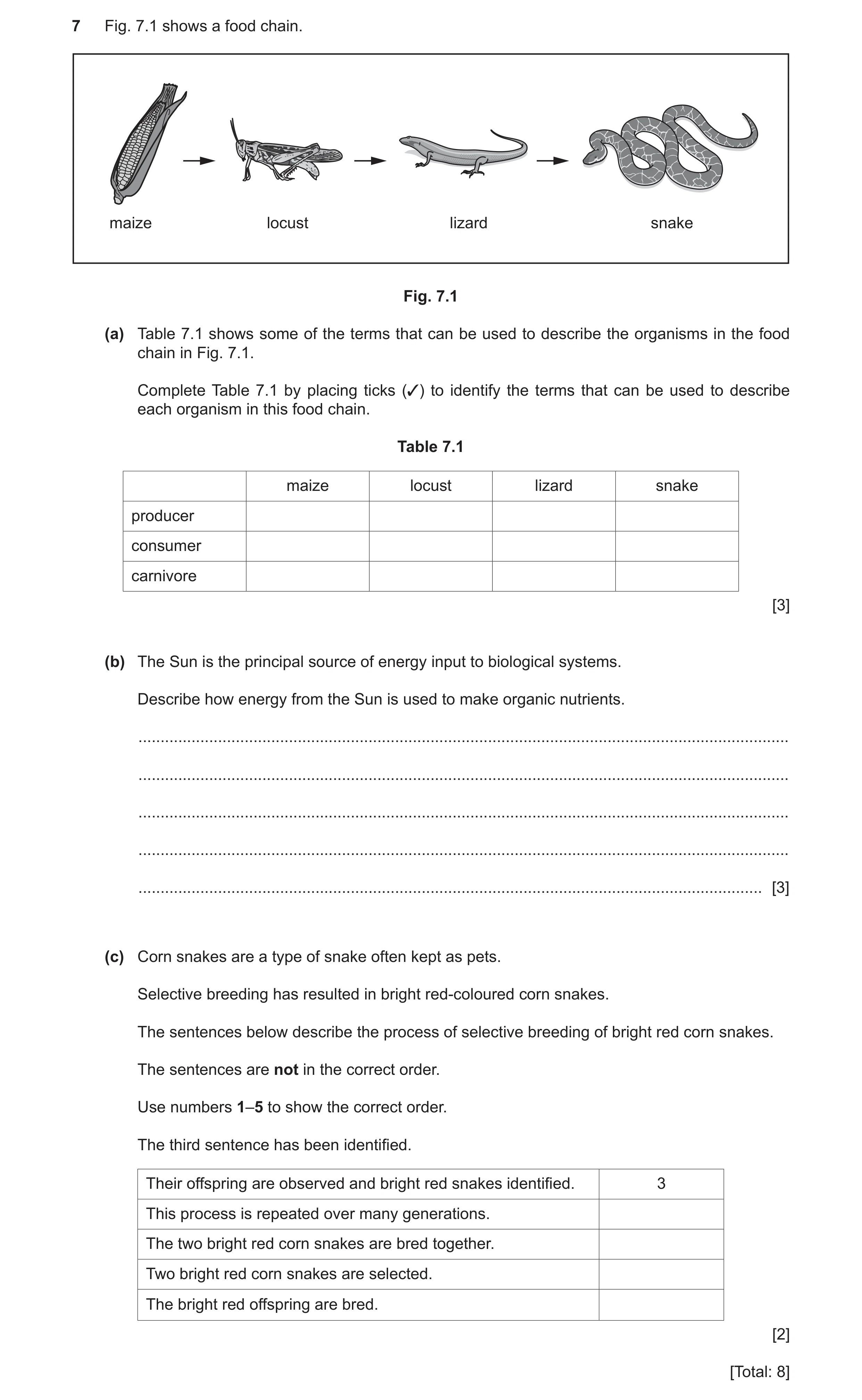
7 Fig. 7.1 shows a food chain. maize locust lizard snake Fig. 7.1 (a) Table 7.1 shows some of the terms that can be used to describe the organisms in the food chain in Fig. 7.1. Complete Table 7.1 by placing ticks (3) to identify the terms that can be used to describe each organism in this food chain. Table 7.1 maize locust lizard snake producer consumer carnivore [3] (b) The Sun is the principal source of energy input to biological systems. Describe how energy from the Sun is used to make organic nutrients. … … … … … [3] (c) Corn snakes are a type of snake often kept as pets. Selective breeding has resulted in bright red-coloured corn snakes. The sentences below describe the process of selective breeding of bright red corn snakes. The sentences are not in the correct order. Use numbers 1–5 to show the correct order. The third sentence has been identified. Their offspring are observed and bright red snakes identified. 3 This process is repeated over many generations. The two bright red corn snakes are bred together. Two bright red corn snakes are selected. The bright red offspring are bred. [2] [Total: 8]
8 marks
Mark scheme: 7(a) producer – maize ticked ; consumer – locust, lizard and snake ticked ; carnivore – lizard and snake ticked ; 3 7(b) ref to photosynthesis ; light energy used ; by producers / plants ; to make carbohydrates ; max 3 7(c) 3 5 2 1 4 ;; 5 at the top and 4 at the bottom for 1 mark 2, 1 in the correct order for 1 mark 2
This question in 0654/32 May/June 2020
Question 7 0654/33 May/June 2020
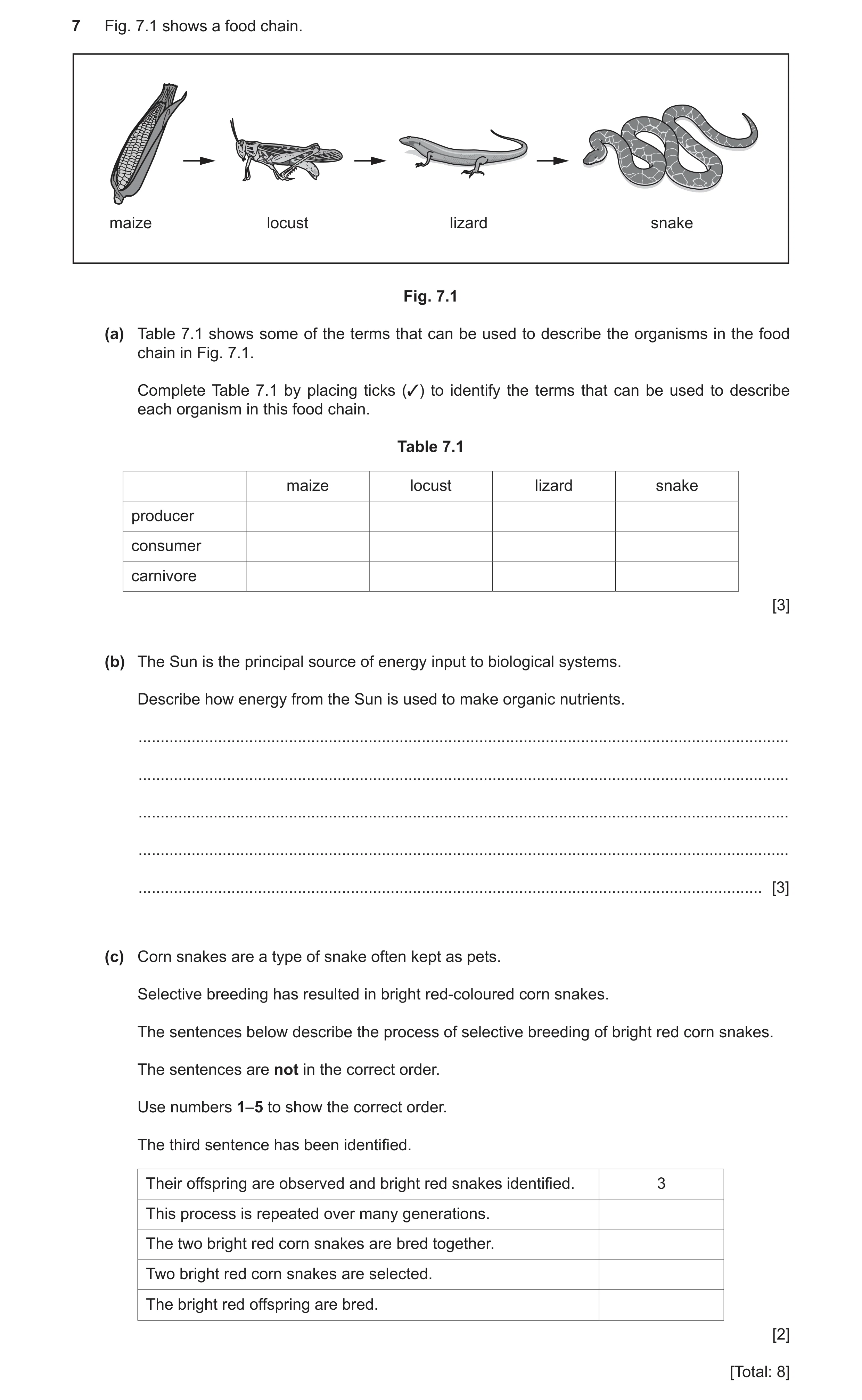
7 Fig. 7.1 shows a food chain. maize locust lizard snake Fig. 7.1 (a) Table 7.1 shows some of the terms that can be used to describe the organisms in the food chain in Fig. 7.1. Complete Table 7.1 by placing ticks (3) to identify the terms that can be used to describe each organism in this food chain. Table 7.1 maize locust lizard snake producer consumer carnivore [3] (b) The Sun is the principal source of energy input to biological systems. Describe how energy from the Sun is used to make organic nutrients. … … … … … [3] (c) Corn snakes are a type of snake often kept as pets. Selective breeding has resulted in bright red-coloured corn snakes. The sentences below describe the process of selective breeding of bright red corn snakes. The sentences are not in the correct order. Use numbers 1–5 to show the correct order. The third sentence has been identified. Their offspring are observed and bright red snakes identified. 3 This process is repeated over many generations. The two bright red corn snakes are bred together. Two bright red corn snakes are selected. The bright red offspring are bred. [2] [Total: 8]
8 marks
Mark scheme: 7(a) producer – maize ticked ; consumer – locust, lizard and snake ticked ; carnivore – lizard and snake ticked ; 3 7(b) ref to photosynthesis ; light energy used ; by producers / plants ; to make carbohydrates ; max 3 7(c) 3 5 2 1 4 ;; 5 at the top and 4 at the bottom for 1 mark 2, 1 in the correct order for 1 mark 2
This question in 0654/33 May/June 2020
Q8 · A diagram of a food web in the sea 0654/32 Oct/Nov 2020
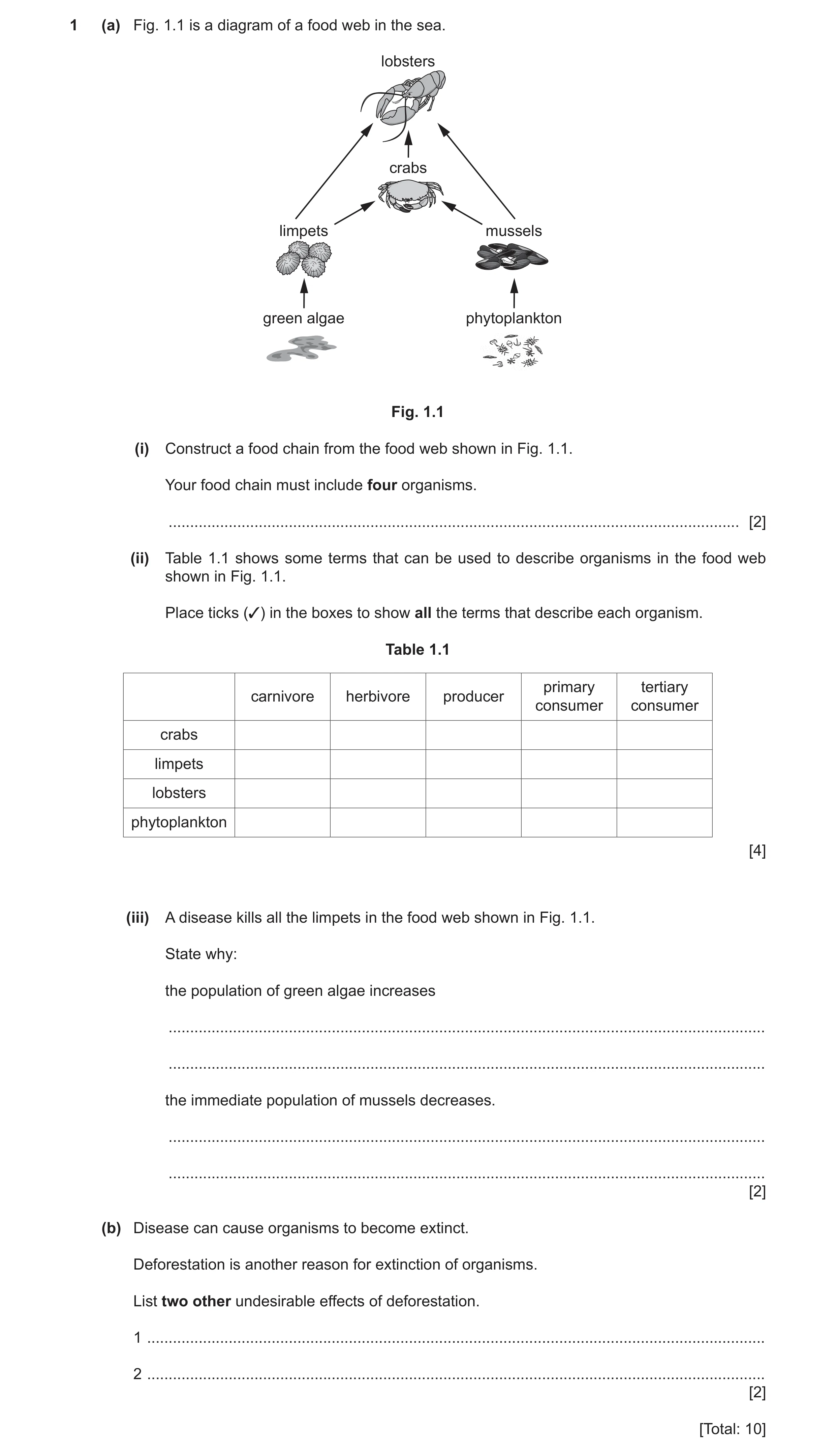
1 (a) Fig. 1.1 is a diagram of a food web in the sea. lobsters crabs limpets mussels green algae phytoplankton Fig. 1.1 (i) Construct a food chain from the food web shown in Fig. 1.1. Your food chain must include four organisms. … [2] (ii) Table 1.1 shows some terms that can be used to describe organisms in the food web shown in Fig. 1.1. Place ticks (3) in the boxes to show all the terms that describe each organism. Table 1.1 primary tertiary carnivore herbivore producer consumer consumer crabs limpets lobsters phytoplankton [4] (iii) A disease kills all the limpets in the food web shown in Fig. 1.1. State why: the population of green algae increases … … the immediate population of mussels decreases. … … [2] (b) Disease can cause organisms to become extinct. Deforestation is another reason for extinction of organisms. List two other undesirable effects of deforestation. 1 … 2 … [2] [Total: 10]
10 marks
Mark scheme: 1(a)(i) green algae → limpets → crab → lobster / phytoplankton → mussels → crab → lobster ;; 2 1(a)(ii) carnivore herbivore producer primary consumer tertiary consumer crab limpets lobster phytoplankton ;;;; 4 1(a)(iii) population of green algae increase due to less predation (by limpets) ; population of mussels decrease more predation of mussels by, crabs / lobsters ; 2 1(b) loss of habitat ; loss of soil ; flooding ; build-up of carbon dioxide in the atmosphere ; AVP ;; 2
This question in 0654/32 Oct/Nov 2020
Q9 · Some information about feeding relationships in a national park 0654/31 May/June 2021
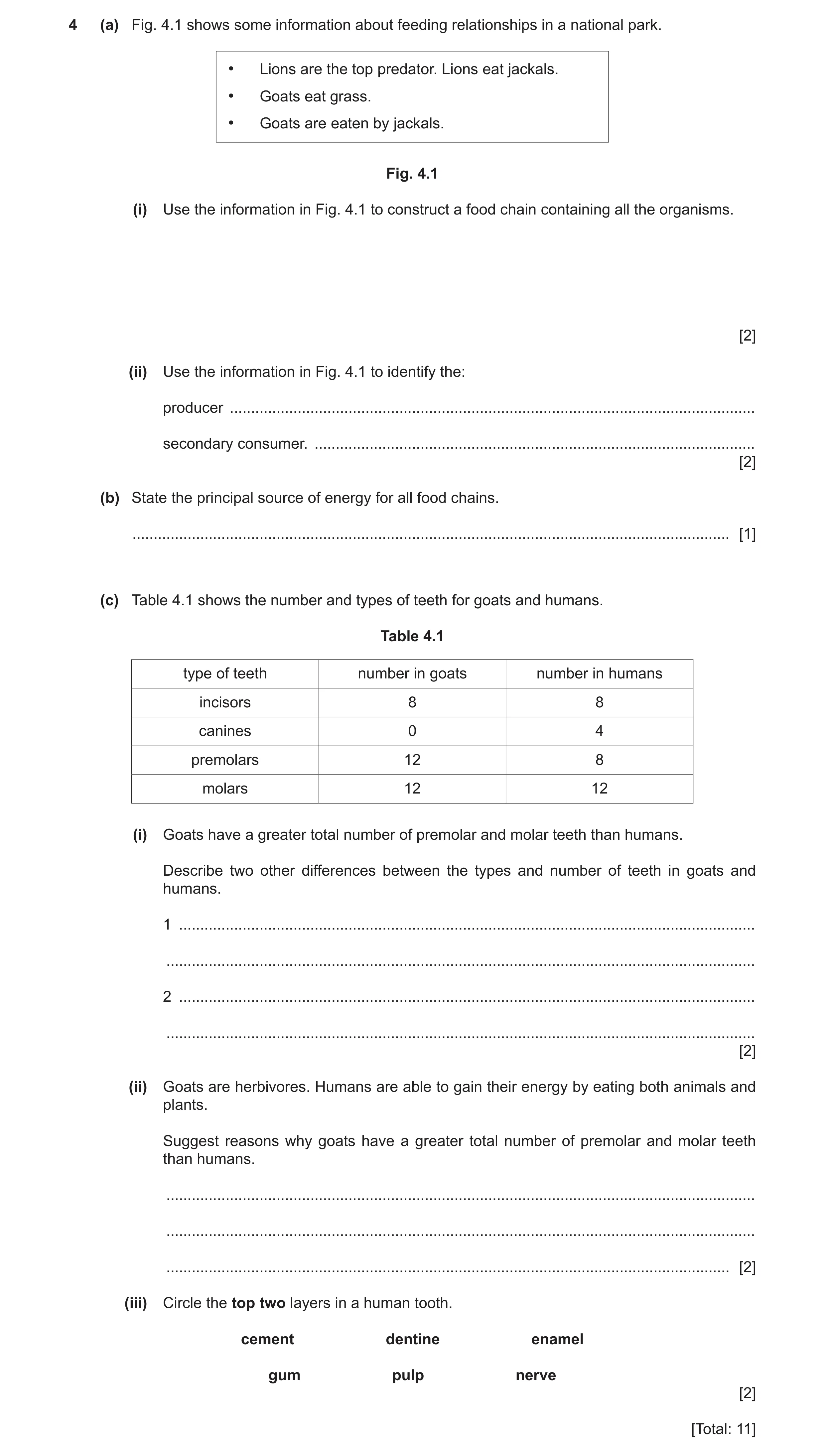
4 (a) Fig. 4.1 shows some information about feeding relationships in a national park. • Lions are the top predator. Lions eat jackals. • Goats eat grass. • Goats are eaten by jackals. Fig. 4.1 (i) Use the information in Fig. 4.1 to construct a food chain containing all the organisms. [2] (ii) Use the information in Fig. 4.1 to identify the: producer … secondary consumer. … [2] (b) State the principal source of energy for all food chains. … [1] (c) Table 4.1 shows the number and types of teeth for goats and humans. Table 4.1 type of teeth number in goats number in humans incisors 8 8 canines 0 4 premolars 12 8 molars 12 12 (i) Goats have a greater total number of premolar and molar teeth than humans. Describe two other differences between the types and number of teeth in goats and humans. 1 … … 2 … … [2] (ii) Goats are herbivores. Humans are able to gain their energy by eating both animals and plants. Suggest reasons why goats have a greater total number of premolar and molar teeth than humans. … … … [2] (iii) Circle the top two layers in a human tooth. cement dentine enamel gum pulp nerve [2] [Total: 11]
11 marks
Mark scheme: 4(a)(i) organisms in correct order ; all arrows drawn in the correct direction ; 2 4(a)(ii) producer grass ; secondary consumer jackal ; 2 4(b) the Sun ; 1 4(c)(i) (goats have) more premolar teeth than humans ; (goats have) fewer / no, canine teeth ; 2 4(c)(ii) goats, gain (all) their energy from plant material / only eats plants ; plant material requires more chewing / breaking down ; molars / premolars needed for chewing ; max 2 2 4(c)(iii) enamel ; dentine ; 2
This question in 0654/31 May/June 2021
Q10 · Part of a desert food web 0654/33 Oct/Nov 2021
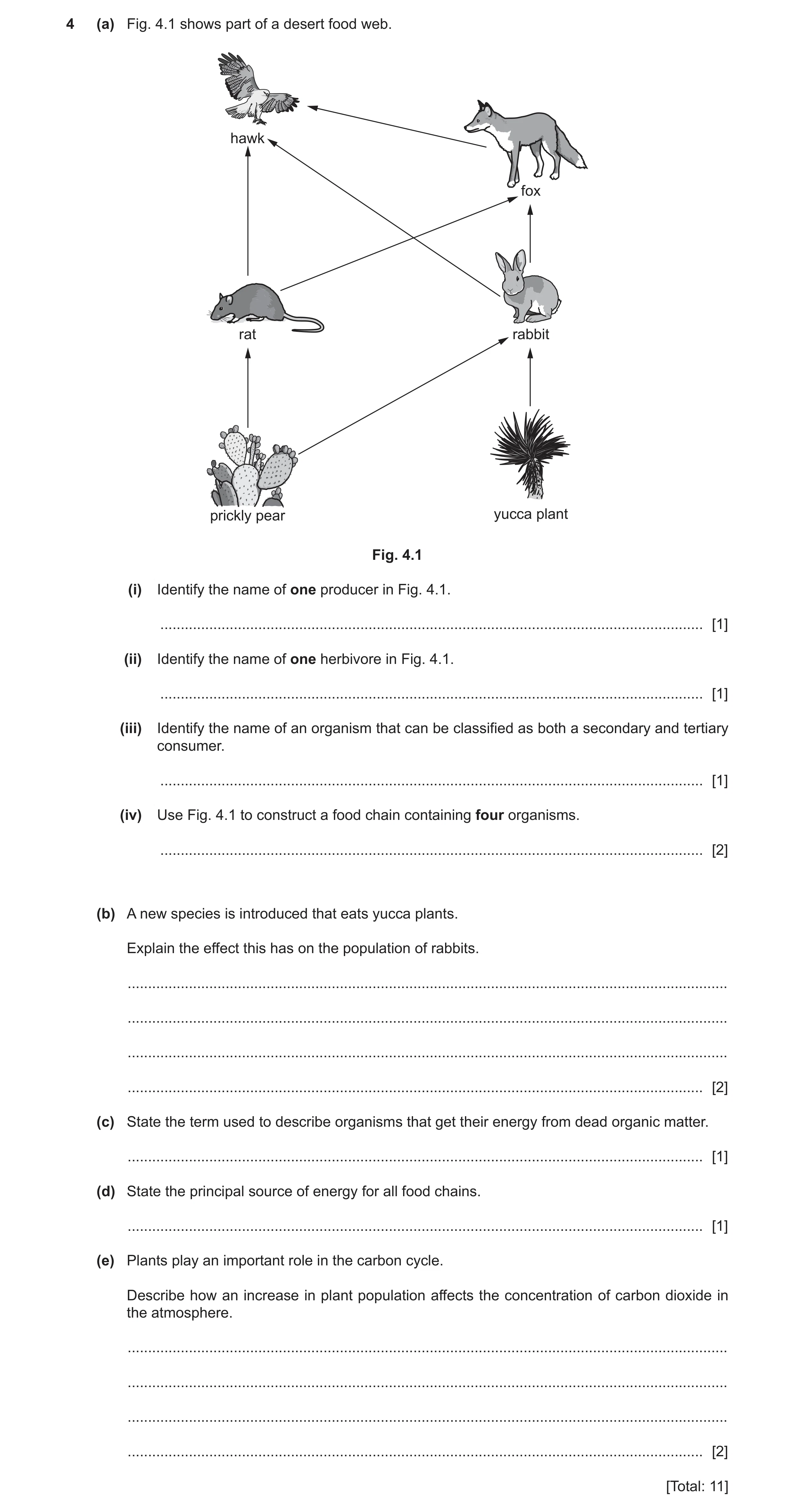
4 (a) Fig. 4.1 shows part of a desert food web. hawk fox rat rabbit prickly pear yucca plant Fig. 4.1 (i) Identify the name of one producer in Fig. 4.1. … [1] (ii) Identify the name of one herbivore in Fig. 4.1. … [1] (iii) Identify the name of an organism that can be classified as both a secondary and tertiary consumer. … [1] (iv) Use Fig. 4.1 to construct a food chain containing four organisms. … [2] (b) A new species is introduced that eats yucca plants. Explain the effect this has on the population of rabbits. … … … … [2] (c) State the term used to describe organisms that get their energy from dead organic matter. … [1] (d) State the principal source of energy for all food chains. … [1] (e) Plants play an important role in the carbon cycle. Describe how an increase in plant population affects the concentration of carbon dioxide in the atmosphere. … … … … [2] [Total: 11]
11 marks
Mark scheme: 4(a)(i) yucca plant / prickly pear ; 1 4(a)(ii) rat / rabbit ; 1 4(a)(iii) hawk ; 1 4(a)(iv) yucca plant → rabbit → fox → hawk or prickly pear → rat → fox → hawk or prickly pear → rabbit → fox → hawk correct organisms ; correct arrows (direction of energy transfer) ; 2 4(b) number of rabbits decrease ; more competition for food / less food to eat ; 2 4(c) decomposers ; 1 4(d) the Sun ; 1 4(e) more carbon dioxide removed ; used as material for photosynthesis ; 2
This question in 0654/33 Oct/Nov 2021
Q11 · A researcher collects some information about organisms that live in a desert environment 0654/31 Oct/Nov 2022
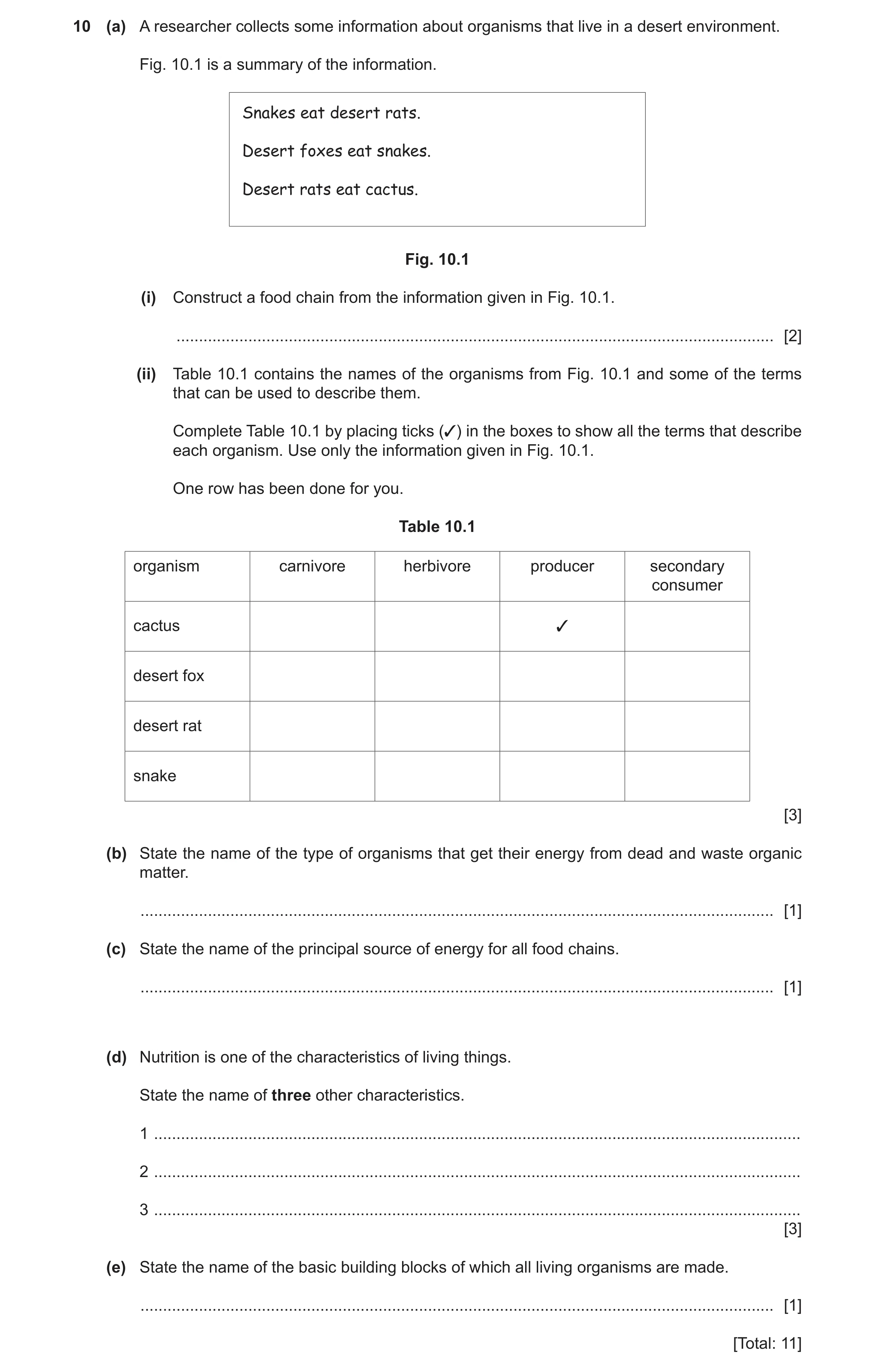
10 (a) A researcher collects some information about organisms that live in a desert environment. Fig. 10.1 is a summary of the information. Snakes eat desert rats. Desert foxes eat snakes. Desert rats eat cactus. Fig. 10.1 (i) Construct a food chain from the information given in Fig. 10.1. … [2] (ii) Table 10.1 contains the names of the organisms from Fig. 10.1 and some of the terms that can be used to describe them. Complete Table 10.1 by placing ticks (3) in the boxes to show all the terms that describe each organism. Use only the information given in Fig. 10.1. One row has been done for you. Table 10.1 organism carnivore herbivore producer secondary consumer cactus 3 desert fox desert rat snake [3] (b) State the name of the type of organisms that get their energy from dead and waste organic matter. … [1] (c) State the name of the principal source of energy for all food chains. … [1] (d) Nutrition is one of the characteristics of living things. State the name of three other characteristics. 1 … 2 … 3 … [3] (e) State the name of the basic building blocks of which all living organisms are made. … [1] [Total: 11]
11 marks
Mark scheme: 10(a)(i) cactus → desert rats → snake → desert fox ;; 2 10(a)(ii) 3 secondary organism carnivore herbivore producer consumer cactus desert fox desert rat snake 1 mark for each correct row ;;; 10(b) decomposer ; 1 10(c) Sun ; 1 10(d) any three from: 3 movement ; respiration ; sensitivity ; growth ; reproduction ; excretion ; 10(e) cells ; 1
This question in 0654/31 Oct/Nov 2022
Question 12 0654/31 Oct/Nov 2023
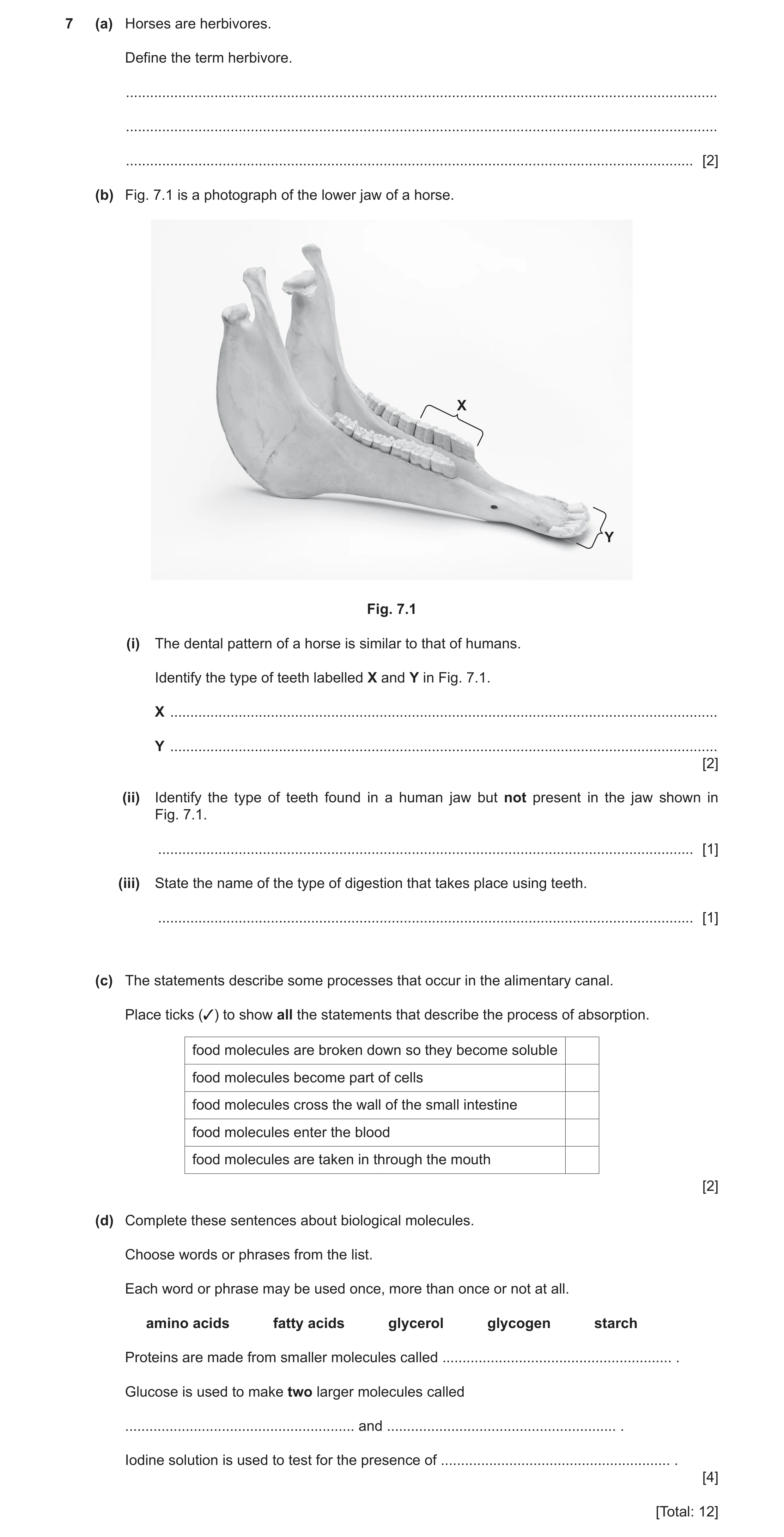
7 (a) Horses are herbivores. Define the term herbivore. … … … [2] (b) Fig. 7.1 is a photograph of the lower jaw of a horse. X Y Fig. 7.1 (i) The dental pattern of a horse is similar to that of humans. Identify the type of teeth labelled X and Y in Fig. 7.1. X … Y … [2] (ii) Identify the type of teeth found in a human jaw but not present in the jaw shown in Fig. 7.1. … [1] (iii) State the name of the type of digestion that takes place using teeth. … [1] (c) The statements describe some processes that occur in the alimentary canal. Place ticks (✓) to show all the statements that describe the process of absorption. food molecules are broken down so they become soluble food molecules become part of cells food molecules cross the wall of the small intestine food molecules enter the blood food molecules are taken in through the mouth [2] (d) Complete these sentences about biological molecules. Choose words or phrases from the list. Each word or phrase may be used once, more than once or not at all. amino acids fatty acids glycerol glycogen starch Proteins are made from smaller molecules called … . Glucose is used to make two larger molecules called … and … . Iodine solution is used to test for the presence of … . [4] [Total: 12]
12 marks
Mark scheme: 7(a) animal that gets its energy ; 2 from eating plants / AW ; 7(b)(i) X – premolars ; 2 Y – incisors ; 7(b)(ii) canines ; 1 7(b)(iii) mechanical ; 1 7(c) 2 food molecules cross the wall of the small intestine food molecules enter the blood ;; 2 ticks and 2 correct = 2 marks 3 ticks and 2 correct = 1 mark otherwise 0 marks 7(d) amino acids ; 4 glycogen ; starch ; starch ;
This question in 0654/31 Oct/Nov 2023
Q13 · A diagram of a marine food web 0654/32 Oct/Nov 2023
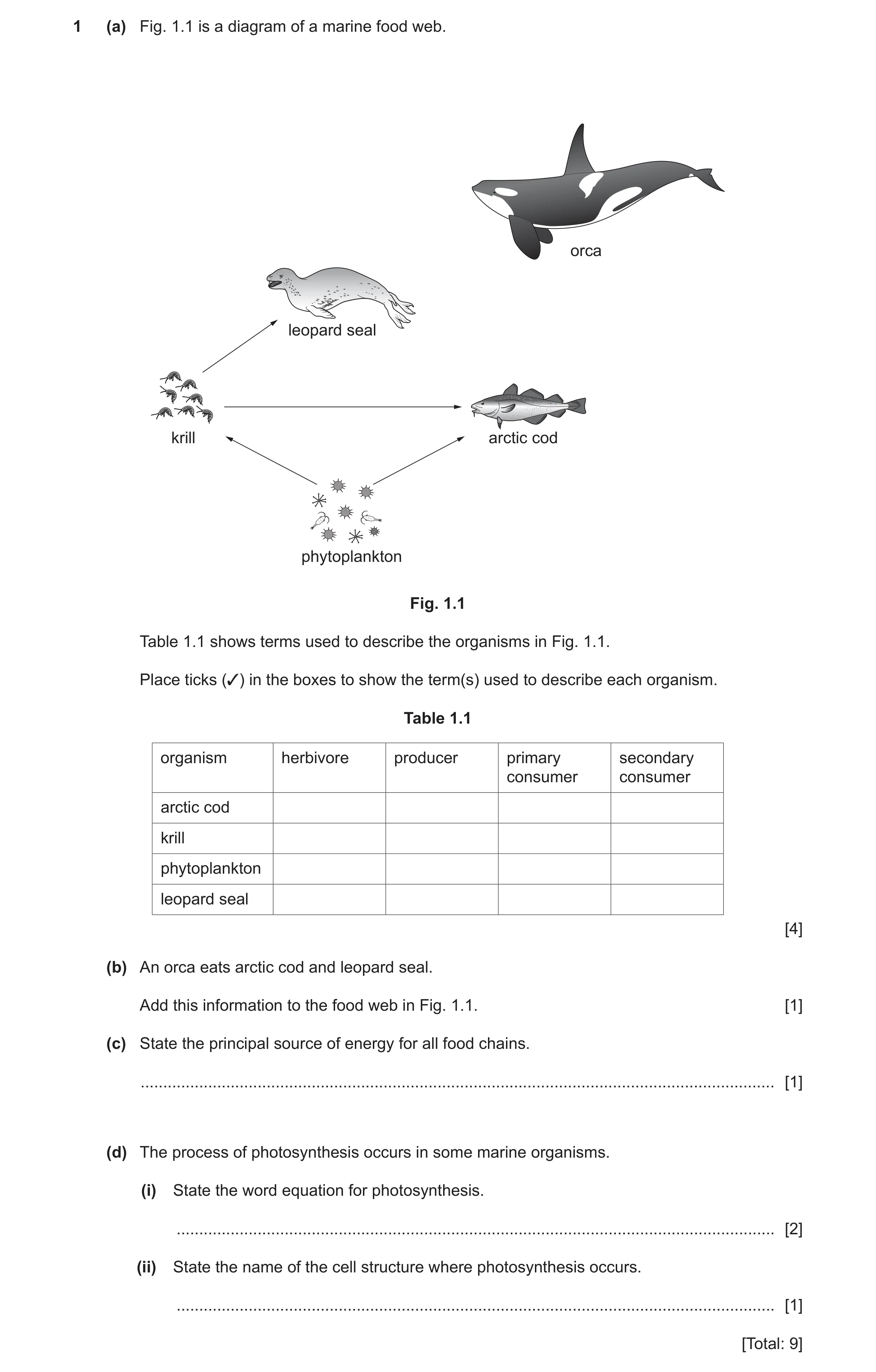
1 (a) Fig. 1.1 is a diagram of a marine food web. orca leopard seal krill arctic cod phytoplankton Fig. 1.1 Table 1.1 shows terms used to describe the organisms in Fig. 1.1. Place ticks (✓) in the boxes to show the term(s) used to describe each organism. Table 1.1 organism herbivore producer primary secondary consumer consumer arctic cod krill phytoplankton leopard seal [4] (b) An orca eats arctic cod and leopard seal. Add this information to the food web in Fig. 1.1. [1] (c) State the principal source of energy for all food chains. … [1] (d) The process of photosynthesis occurs in some marine organisms. (i) State the word equation for photosynthesis. … [2] (ii) State the name of the cell structure where photosynthesis occurs. … [1] [Total: 9]
9 marks
Mark scheme: Question Answer Marks 1(a) 4 organism herbivore producer primary secondary consumer consumer arctic cod krill plankton leopard seal 1 mark for each row ;;;; 1(b) arrows drawn from leopard seal and artic cod to orca ; 1 1(c) Sun ; 1 1(d)(i) carbon dioxide + water → glucose + oxygen ; 2 1(d)(ii) chloroplast ; 1
This question in 0654/32 Oct/Nov 2023
Q14 · A food web from a rainforest environment 0654/31 May/June 2024
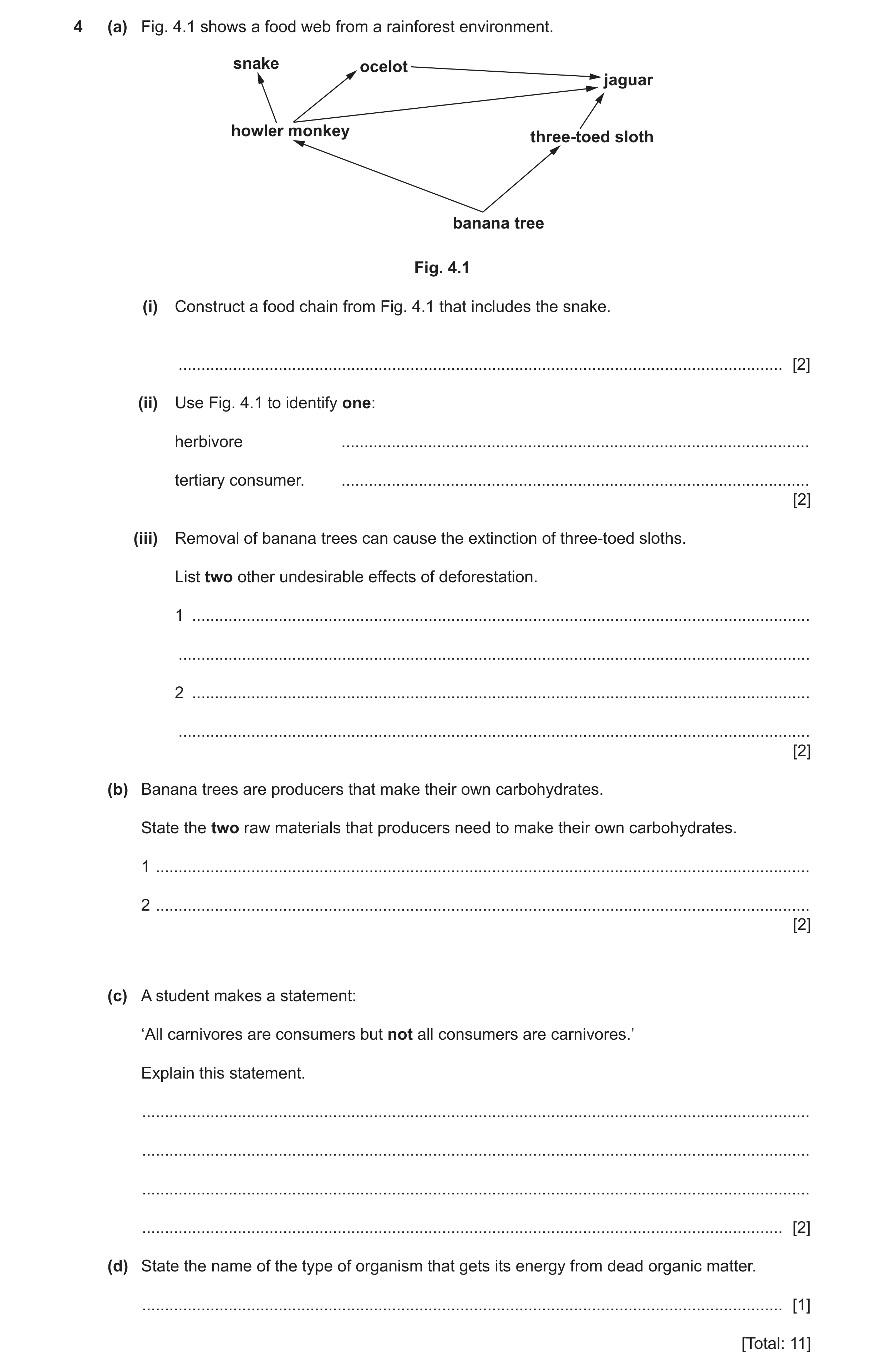
4 (a) Fig. 4.1 shows a food web from a rainforest environment. snake ocelot jaguar howler monkey three-toed sloth banana tree Fig. 4.1 (i) Construct a food chain from Fig. 4.1 that includes the snake. … [2] (ii) Use Fig. 4.1 to identify one: herbivore … tertiary consumer. … [2] (iii) Removal of banana trees can cause the extinction of three‑toed sloths. List two other undesirable effects of deforestation. 1 … … 2 … … [2] (b) Banana trees are producers that make their own carbohydrates. State the two raw materials that producers need to make their own carbohydrates. 1 … 2 … [2] (c) A student makes a statement: ‘All carnivores are consumers but not all consumers are carnivores.’ Explain this statement. … … … … [2] (d) State the name of the type of organism that gets its energy from dead organic matter. … [1] [Total: 11]
11 marks
Mark scheme: 4(a)(i) banana tree → howler monkey → snake ;; 2 4(a)(ii) herbivore howler monkey / three-toed sloth ; tertiary consumer jaguar ; 2 4(a)(iii) any two from: loss of soil / soil erosion ; flooding ; increase of carbon dioxide in the atmosphere ; habitat destruction / animals displaced ; decreased biodiversity ; AVP ;; 2 4(b) carbon dioxide ; water ; 2 4(c) consumers get their energy from eating animals or plants / consumers can be herbivores ; carnivores get their energy from eating (only) animals ; 2 4(d) decomposer ; 1
This question in 0654/31 May/June 2024
Q15 · A diagram of the carbon cycle 0654/32 May/June 2024
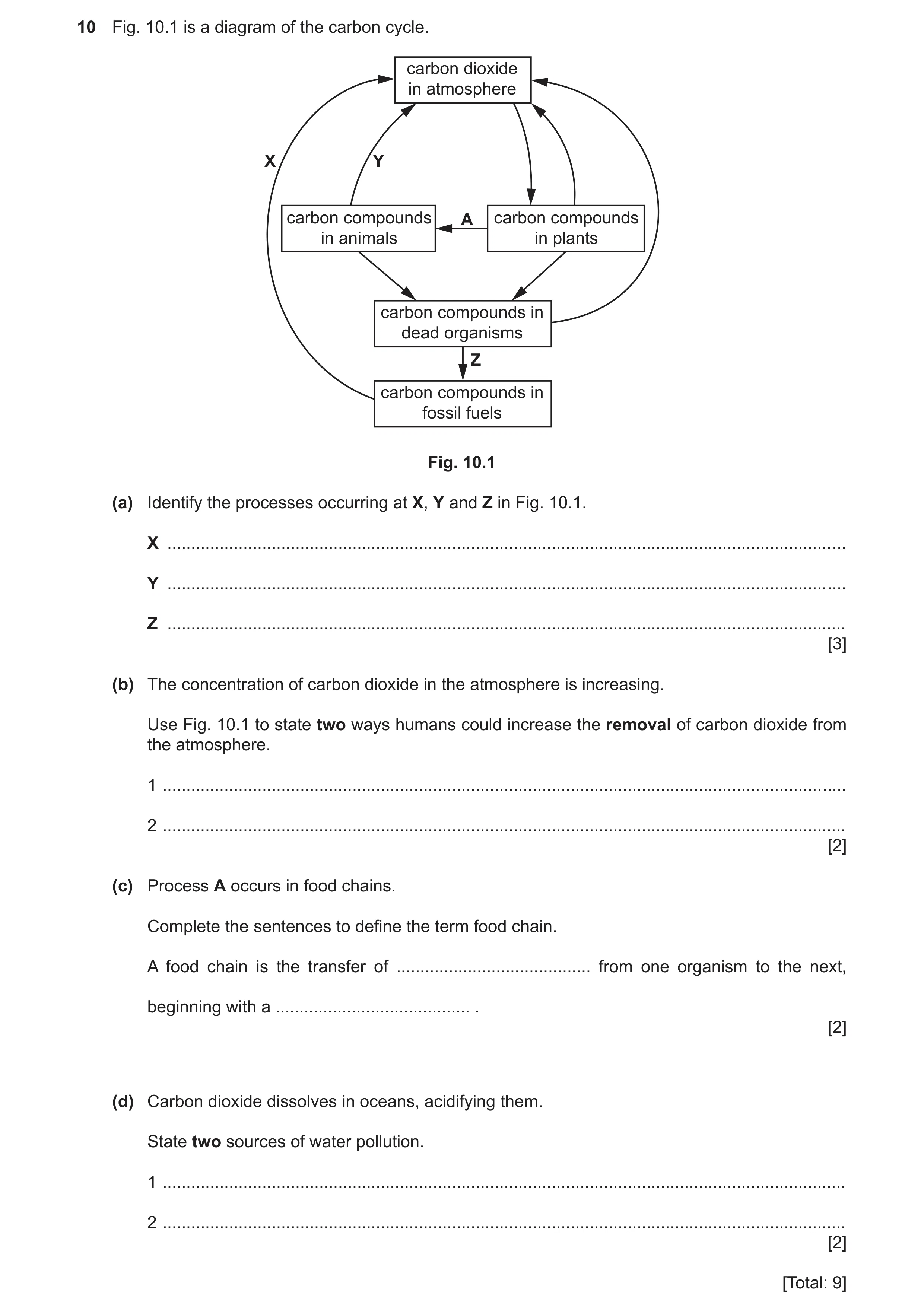
10 Fig. 10.1 is a diagram of the carbon cycle. carbon dioxide in atmosphere X Y carbon compounds A carbon compounds in animals in plants carbon compounds in dead organisms Z carbon compounds in fossil fuels Fig. 10.1 (a) Identify the processes occurring at X, Y and Z in Fig. 10.1. X … Y … Z … [3] (b) The concentration of carbon dioxide in the atmosphere is increasing. Use Fig. 10.1 to state two ways humans could increase the removal of carbon dioxide from the atmosphere. 1 … 2 … [2] (c) Process A occurs in food chains. Complete the sentences to define the term food chain. A food chain is the transfer of … from one organism to the next, beginning with a … . [2] (d) Carbon dioxide dissolves in oceans, acidifying them. State two sources of water pollution. 1 … 2 … [2] [Total: 9]
9 marks
Mark scheme: 10(a) X–combustion ; Y–respiration ; Z–fossilisation ; 3 10(b) plant more trees ; prevent deforestation ; 2 10(c) energy ; producer ; 2 Question Answer Marks 10(d) any two from: chemical waste ; discarded rubbish ; untreated sewage ; fertilisers ; 2
This question in 0654/32 May/June 2024
Q16 · A diagram of the carbon cycle 0654/33 May/June 2024
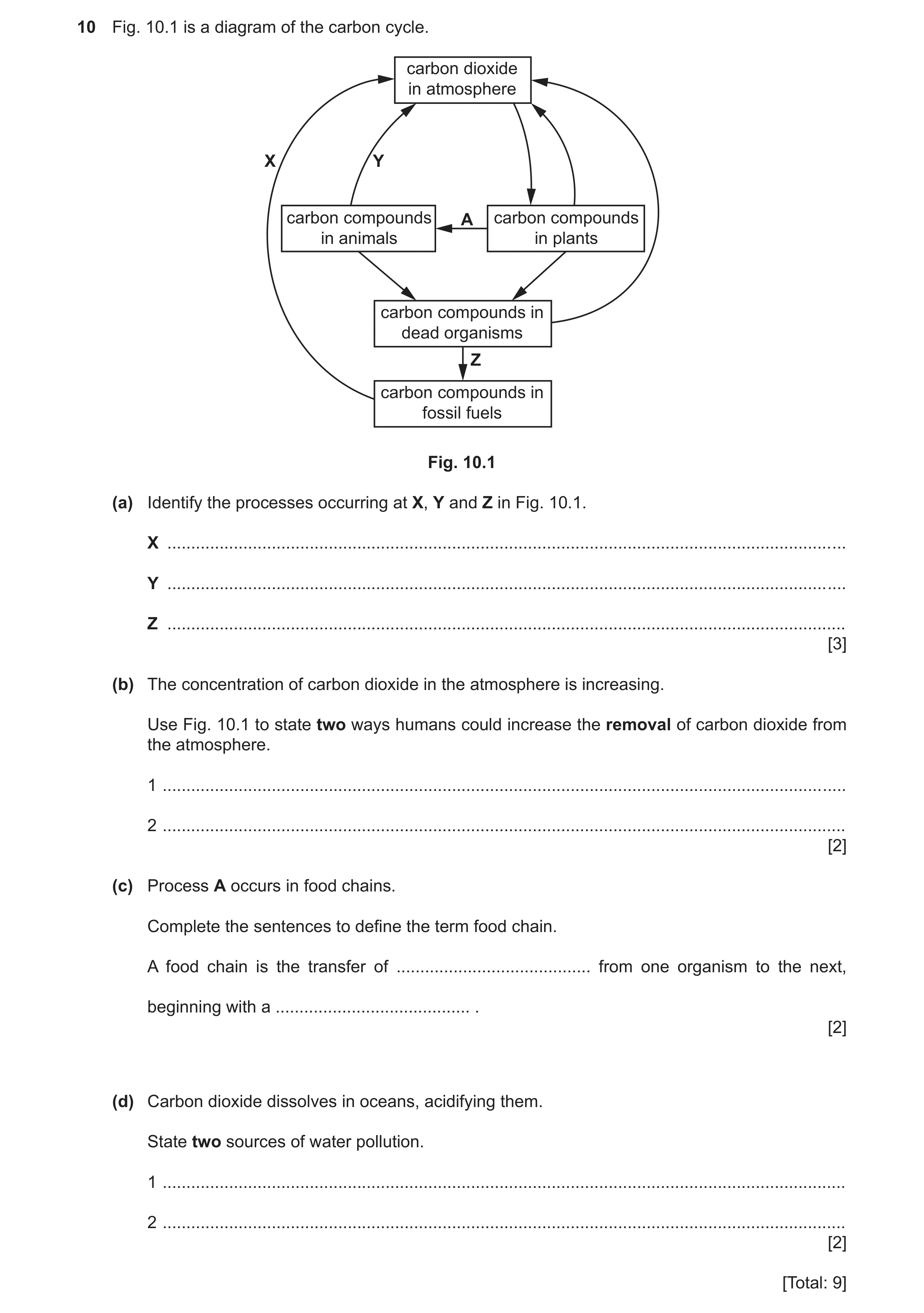
10 Fig. 10.1 is a diagram of the carbon cycle. carbon dioxide in atmosphere X Y carbon compounds A carbon compounds in animals in plants carbon compounds in dead organisms Z carbon compounds in fossil fuels Fig. 10.1 (a) Identify the processes occurring at X, Y and Z in Fig. 10.1. X … Y … Z … [3] (b) The concentration of carbon dioxide in the atmosphere is increasing. Use Fig. 10.1 to state two ways humans could increase the removal of carbon dioxide from the atmosphere. 1 … 2 … [2] (c) Process A occurs in food chains. Complete the sentences to define the term food chain. A food chain is the transfer of … from one organism to the next, beginning with a … . [2] (d) Carbon dioxide dissolves in oceans, acidifying them. State two sources of water pollution. 1 … 2 … [2] [Total: 9]
9 marks
Mark scheme: 10(a) X–combustion ; Y–respiration ; Z–fossilisation ; 3 10(b) plant more trees ; prevent deforestation ; 2 10(c) energy ; producer ; 2 Question Answer Marks 10(d) any two from: chemical waste ; discarded rubbish ; untreated sewage ; fertilisers ; 2
This question in 0654/33 May/June 2024
Q17 · A student investigates responses in seeds 0654/31 Oct/Nov 2024
10 (a) A student investigates responses in seeds. They place germinating seeds in a Petri dish. The Petri dish is left on its side in a dark room. After two days the student observes the direction of root growth. Fig. 10.1 shows the investigation. moist cotton wool Petri dish root seed at start after 2 days Fig. 10.1 (i) Complete the sentences to describe and explain the results in Fig. 10.1. After 2 days the roots have grown downwards. This is a tropic response called … . The roots are growing downwards towards … to receive more water from the soil. [2] (ii) State two uses of water in a plant. 1 … 2 … [2] (iii) State the name of the plant cell that absorbs water from the soil. … [1] (iv) State the name of the vessels that transport water from the roots to the leaves in a plant. … [1] (b) Mineral ions are also absorbed by plants. Circle the main mineral ion required for the synthesis of chlorophyll. calcium iron magnesium phosphate [1] (c) The boxes show some statements about plants. Tick (3) three correct statements. Plants are producers in a food chain. Plants can be selectively bred. Plants do not respire. Plants form the main part of a carnivore’s diet. Plants manufacture carbohydrates. Plants only reproduce asexually. [3] [Total: 10]
10 marks
Mark scheme: 10(a)(i) gravitropism ; 2 gravity ; 10(a)(ii) any two from: 2 photosynthesis ; support ; solvent ; germination ; AVP ; 10(a)(iii) root hair cell ; 1 10(a)(iv) xylem ; 1 10(b) magnesium circled ; 1 10(c) 3 Plants are producers in a food chain. Plants can be selectively bred. Plants do not respire. Plants form the main part of a carnivore’s diet. Plants manufacture carbohydrates. Plants only reproduce asexually. ;;;
This question in 0654/31 Oct/Nov 2024
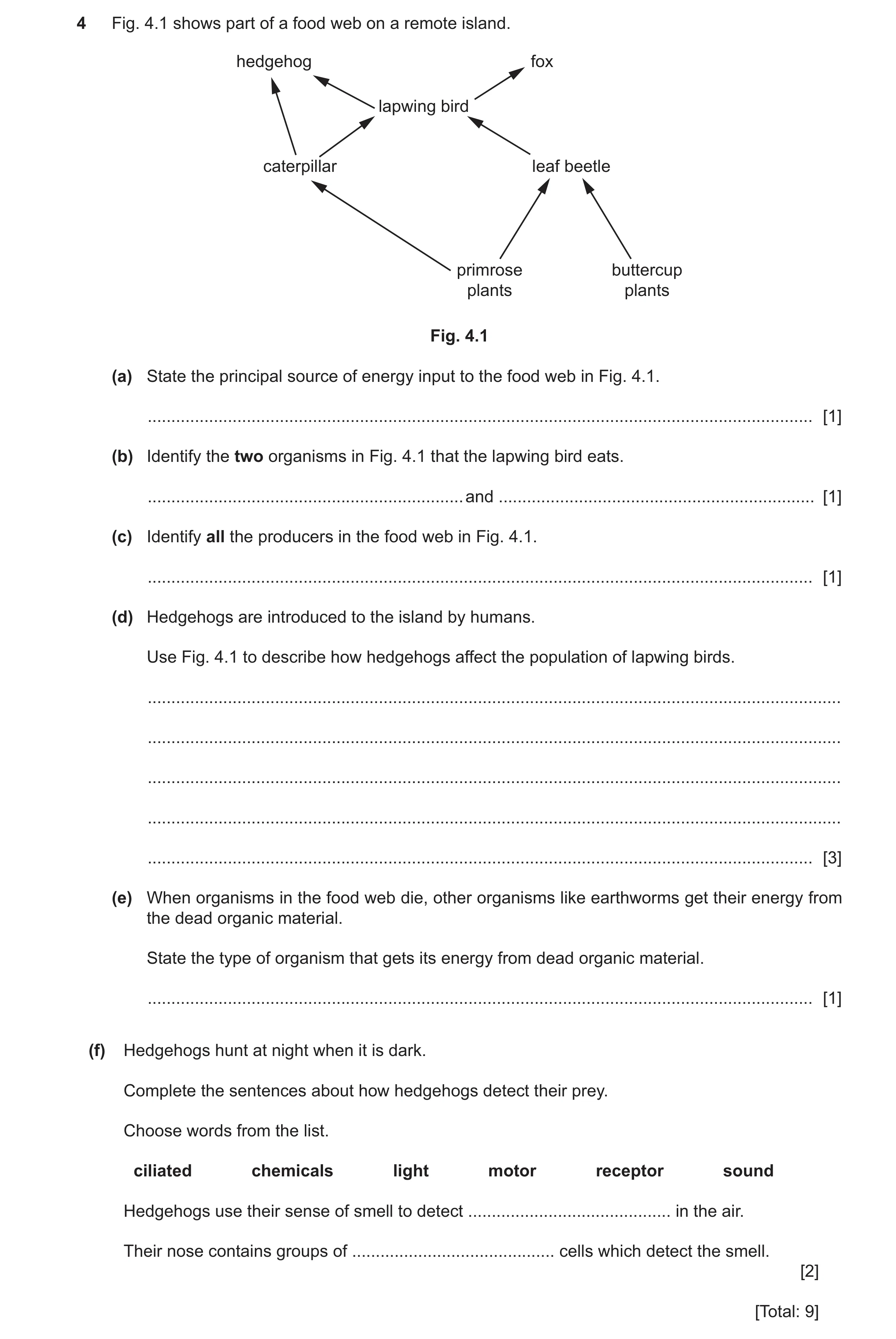
Q18 · Part of a food web on a remote island 0654/31 May/June 2025
4 Fig. 4.1 shows part of a food web on a remote island. hedgehog fox lapwing bird caterpillar leaf beetle primrose buttercup plants plants Fig. 4.1 (a) State the principal source of energy input to the food web in Fig. 4.1. … [1] (b) Identify the two organisms in Fig. 4.1 that the lapwing bird eats. … and … [1] (c) Identify all the producers in the food web in Fig. 4.1. … [1] (d) Hedgehogs are introduced to the island by humans. Use Fig. 4.1 to describe how hedgehogs affect the population of lapwing birds. … … … … … [3] (e) When organisms in the food web die, other organisms like earthworms get their energy from the dead organic material. State the type of organism that gets its energy from dead organic material. … [1] (f) Hedgehogs hunt at night when it is dark. Complete the sentences about how hedgehogs detect their prey. Choose words from the list. ciliated chemicals light motor receptor sound Hedgehogs use their sense of smell to detect … in the air. Their nose contains groups of … cells which detect the smell. [2] [Total: 9]
9 marks
Mark scheme: 4(a) Sun ; 1 4(b) caterpillar and (leaf) beetle ; 1 4(c) Primrose (plants) and buttercup (plants) ; 1 4(d) decrease (the population size of lapwings) ; 3 idea that (hedgehogs) predate / eat, lapwings (so reduce numbers) ; idea that (hedgehogs) eat caterpillars which are also food for lapwings ; 4(e) decomposer ; 1 4(f) chemicals ; 2 receptor ;
This question in 0654/31 May/June 2025
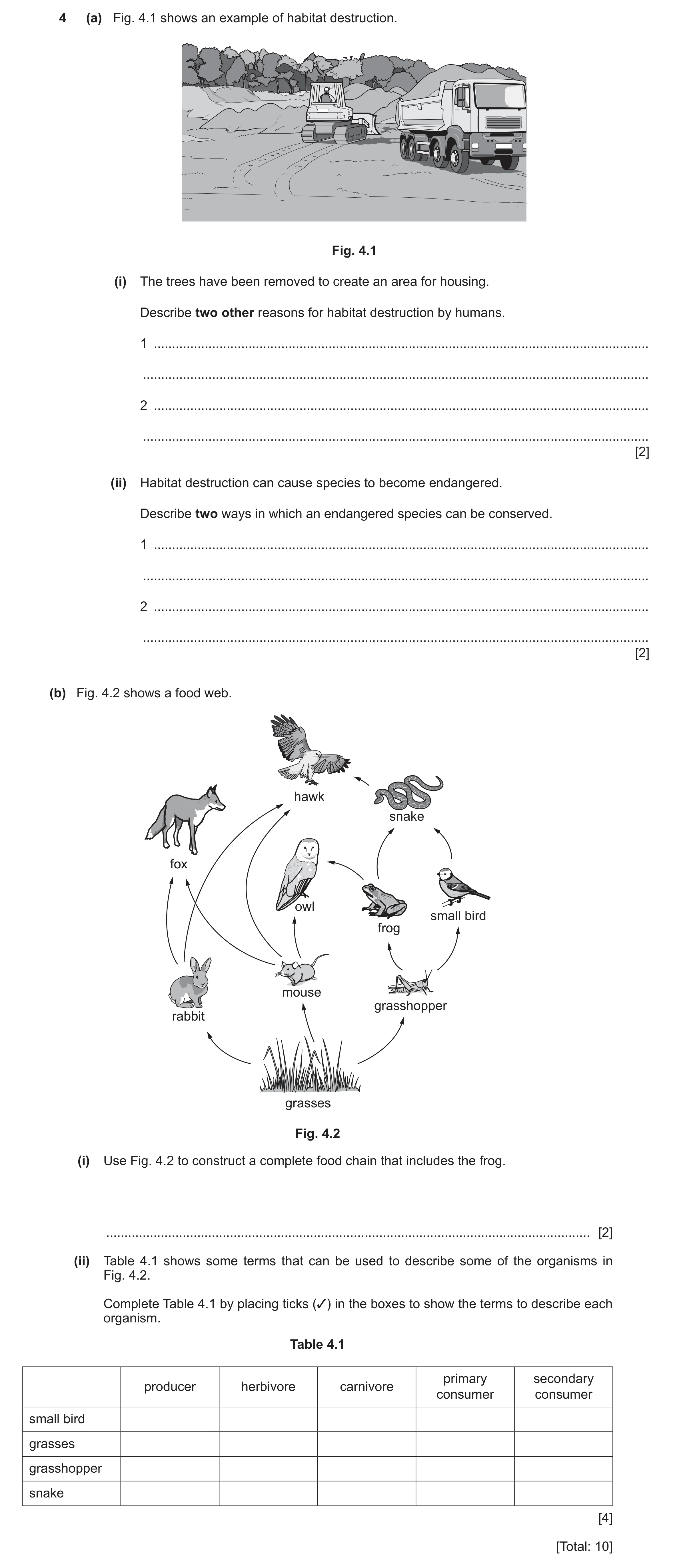
Q19 · An example of habitat destruction 0654/31 Oct/Nov 2025
4 (a) Fig. 4.1 shows an example of habitat destruction. Fig. 4.1 (i) The trees have been removed to create an area for housing. Describe two other reasons for habitat destruction by humans. 1 … … 2 … … [2] (ii) Habitat destruction can cause species to become endangered. Describe two ways in which an endangered species can be conserved. 1 … … 2 … … [2] (b) Fig. 4.2 shows a food web. hawk snake fox owl small bird frog mouse grasshopper rabbit grasses Fig. 4.2 (i) Use Fig. 4.2 to construct a complete food chain that includes the frog. … [2] (ii) Table 4.1 shows some terms that can be used to describe some of the organisms in Fig. 4.2. Complete Table 4.1 by placing ticks (3) in the boxes to show the terms to describe each organism. Table 4.1 primary secondary producer herbivore carnivore consumer consumer small bird grasses grasshopper snake [4] [Total: 10]
10 marks
Mark scheme: 4(a)(i) any two from: 2 • crop production ; • livestock production ; • extraction of natural resources ; • building infrastructure / building factories ; 4(a)(ii) any two from: 2 • method of monitoring species / method of protecting species ; • protecting habitats ; • education ; • captive breeding programmes ; • seed banks ; 4(b)(i) grass → grasshopper → frog → snake → hawk 2 OR grass → grasshopper → frog → owl 1 mark for all arrows in correct direction 1 mark for all organisms in correct order including frog 4(b)(ii) 4 1 mark for each correct row
This question in 0654/31 Oct/Nov 2025
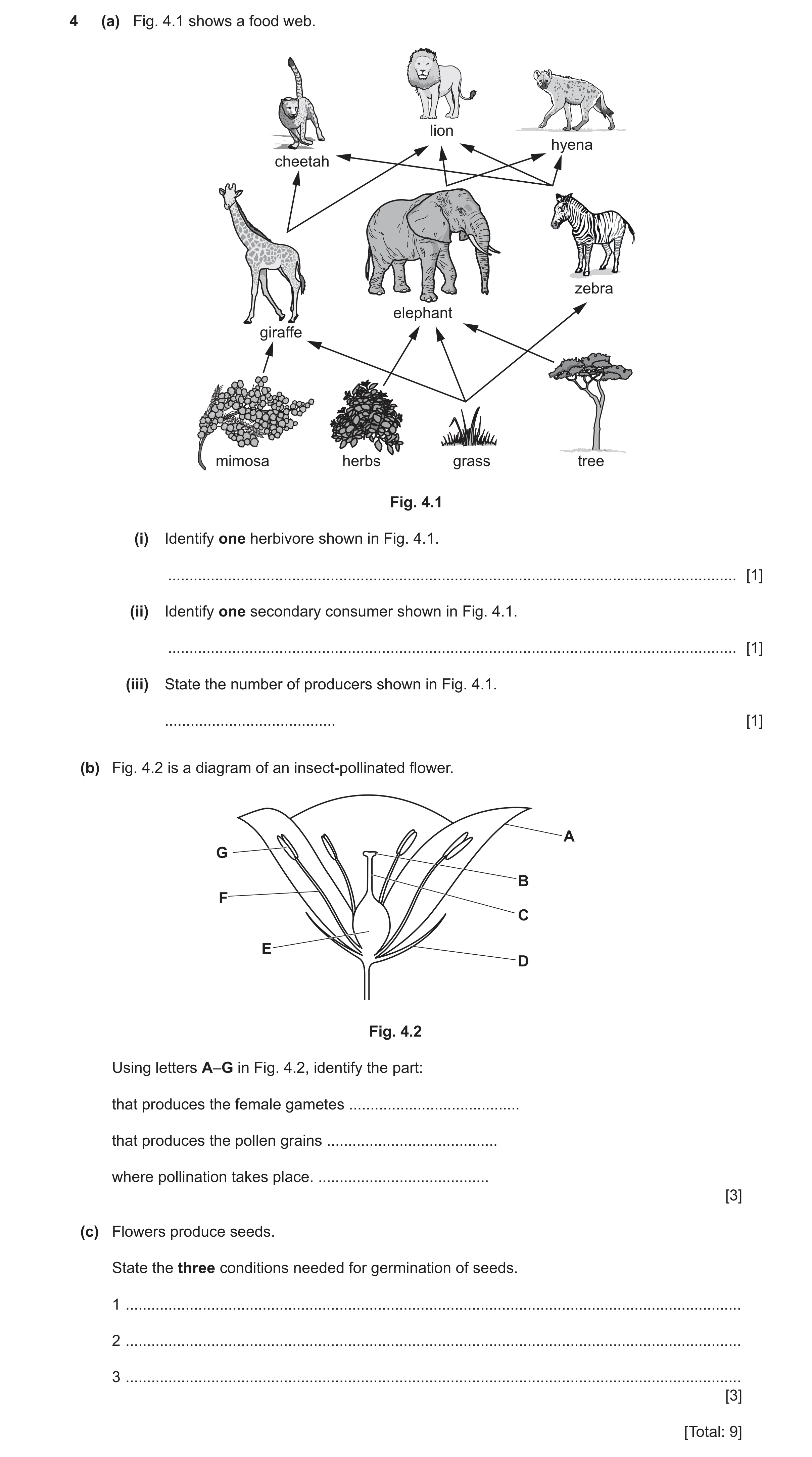
Question 20 0654/32 Oct/Nov 2025
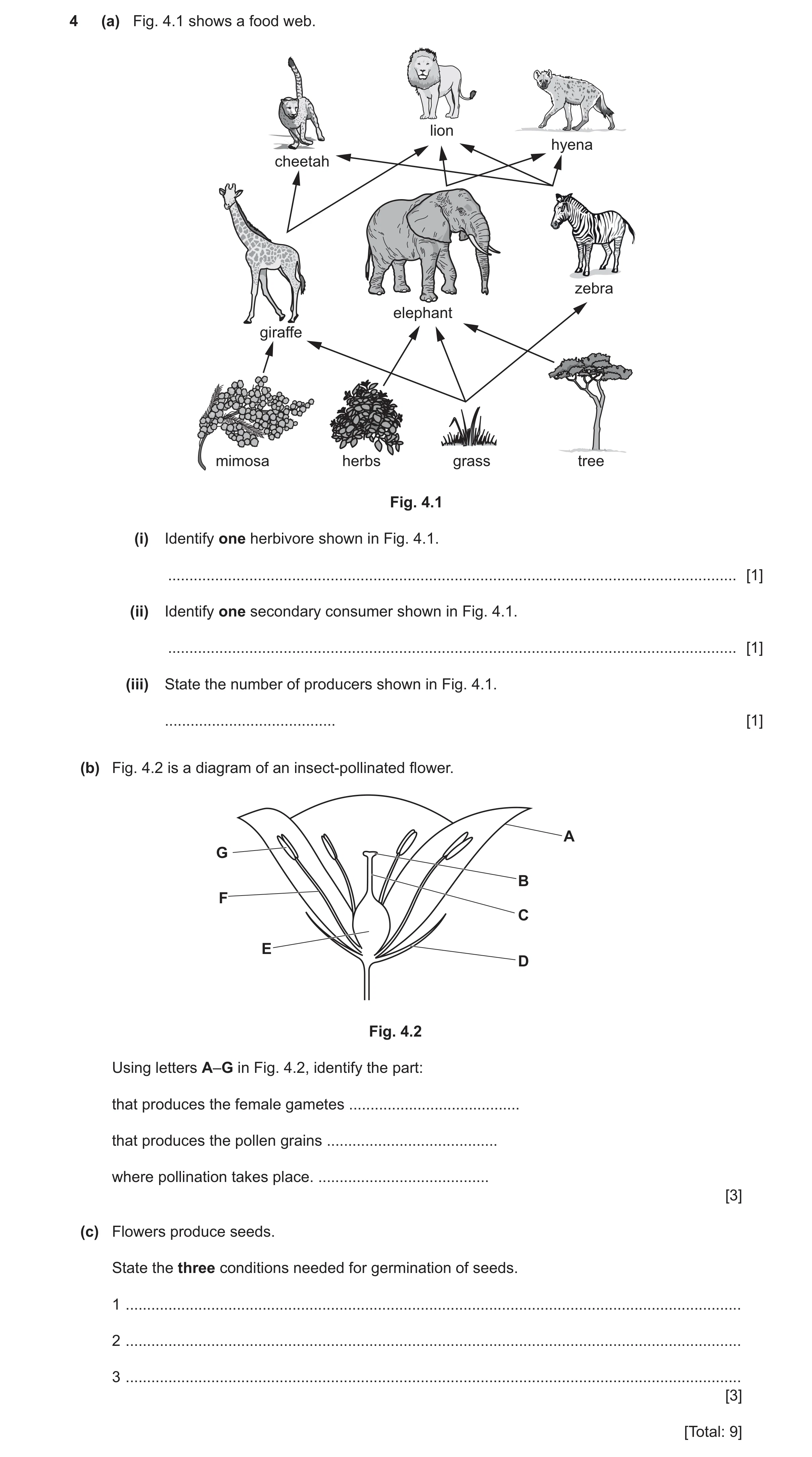
4 (a) Fig. 4.1 shows a food web. lion hyena cheetah zebra elephant giraffe mimosa herbs grass tree Fig. 4.1 (i) Identify one herbivore shown in Fig. 4.1. … [1] (ii) Identify one secondary consumer shown in Fig. 4.1. … [1] (iii) State the number of producers shown in Fig. 4.1. … [1] (b) Fig. 4.2 is a diagram of an insect‑pollinated flower. A G B F C E D Fig. 4.2 Using letters A–G in Fig. 4.2, identify the part: that produces the female gametes … that produces the pollen grains … where pollination takes place. … [3] (c) Flowers produce seeds. State the three conditions needed for germination of seeds. 1 … 2 … 3 … [3] [Total: 9]
9 marks
Mark scheme: 4(a)(i) giraffe / elephant / zebra ; 1 4(a)(ii) cheetah / lion / hyena ; 1 4(a)(iii) 4 ; 1 4(b) E ; 3 G ; B ; 4(c) oxygen ; 3 suitable temperature ; water ;
This question in 0654/32 Oct/Nov 2025
Question 21 0654/33 Oct/Nov 2025
4 (a) Fig. 4.1 shows a food web. lion hyena cheetah zebra elephant giraffe mimosa herbs grass tree Fig. 4.1 (i) Identify one herbivore shown in Fig. 4.1. … [1] (ii) Identify one secondary consumer shown in Fig. 4.1. … [1] (iii) State the number of producers shown in Fig. 4.1. … [1] (b) Fig. 4.2 is a diagram of an insect‑pollinated flower. A G B F C E D Fig. 4.2 Using letters A–G in Fig. 4.2, identify the part: that produces the female gametes … that produces the pollen grains … where pollination takes place. … [3] (c) Flowers produce seeds. State the three conditions needed for germination of seeds. 1 … 2 … 3 … [3] [Total: 9]
9 marks
Mark scheme: 4(a)(i) giraffe / elephant / zebra ; 1 4(a)(ii) cheetah / lion / hyena ; 1 4(a)(iii) 4 ; 1 4(b) E ; 3 G ; B ; 4(c) oxygen ; 3 suitable temperature ; water ;
This question in 0654/33 Oct/Nov 2025
 3 / 28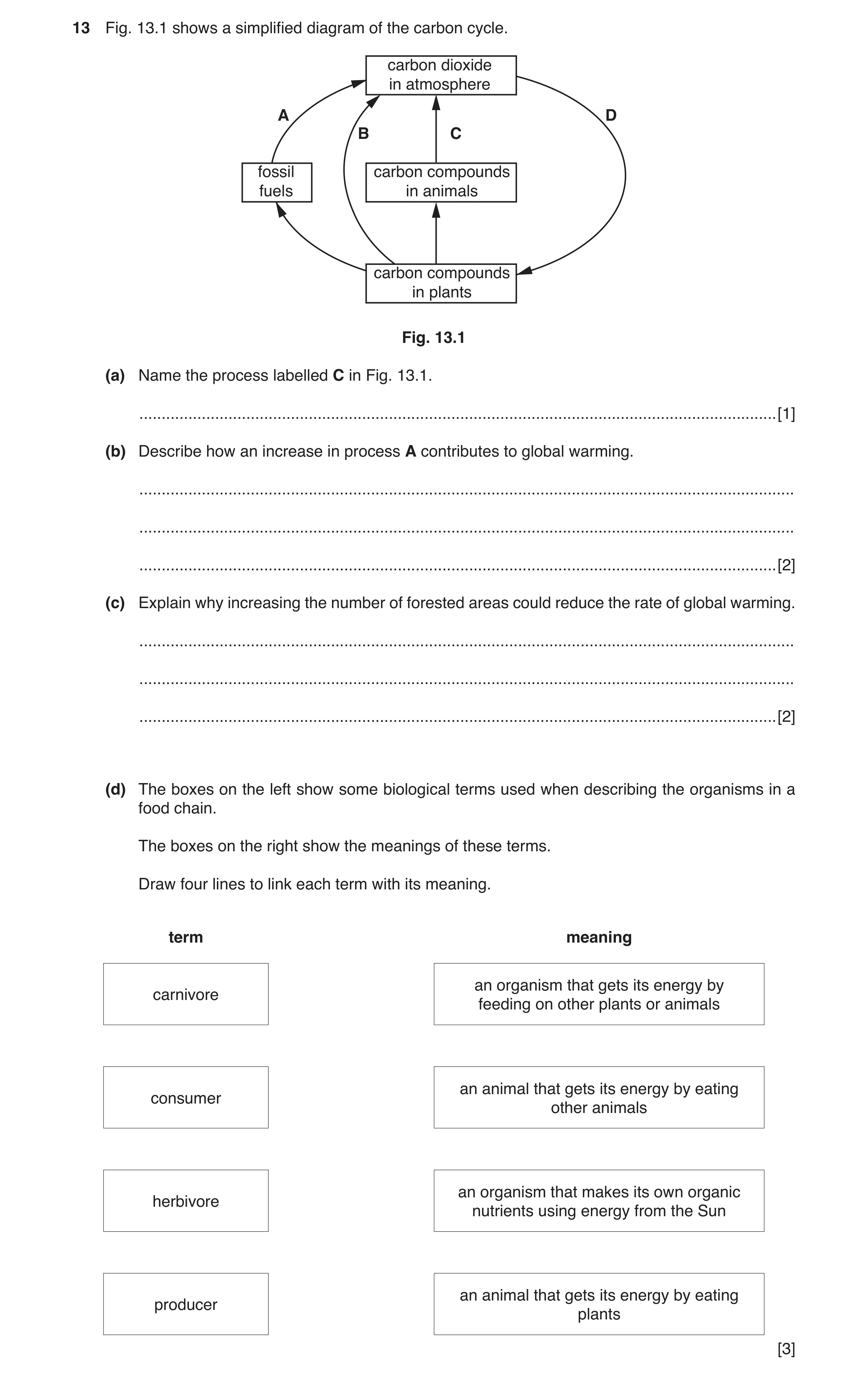
 20 / 28
 21 / 28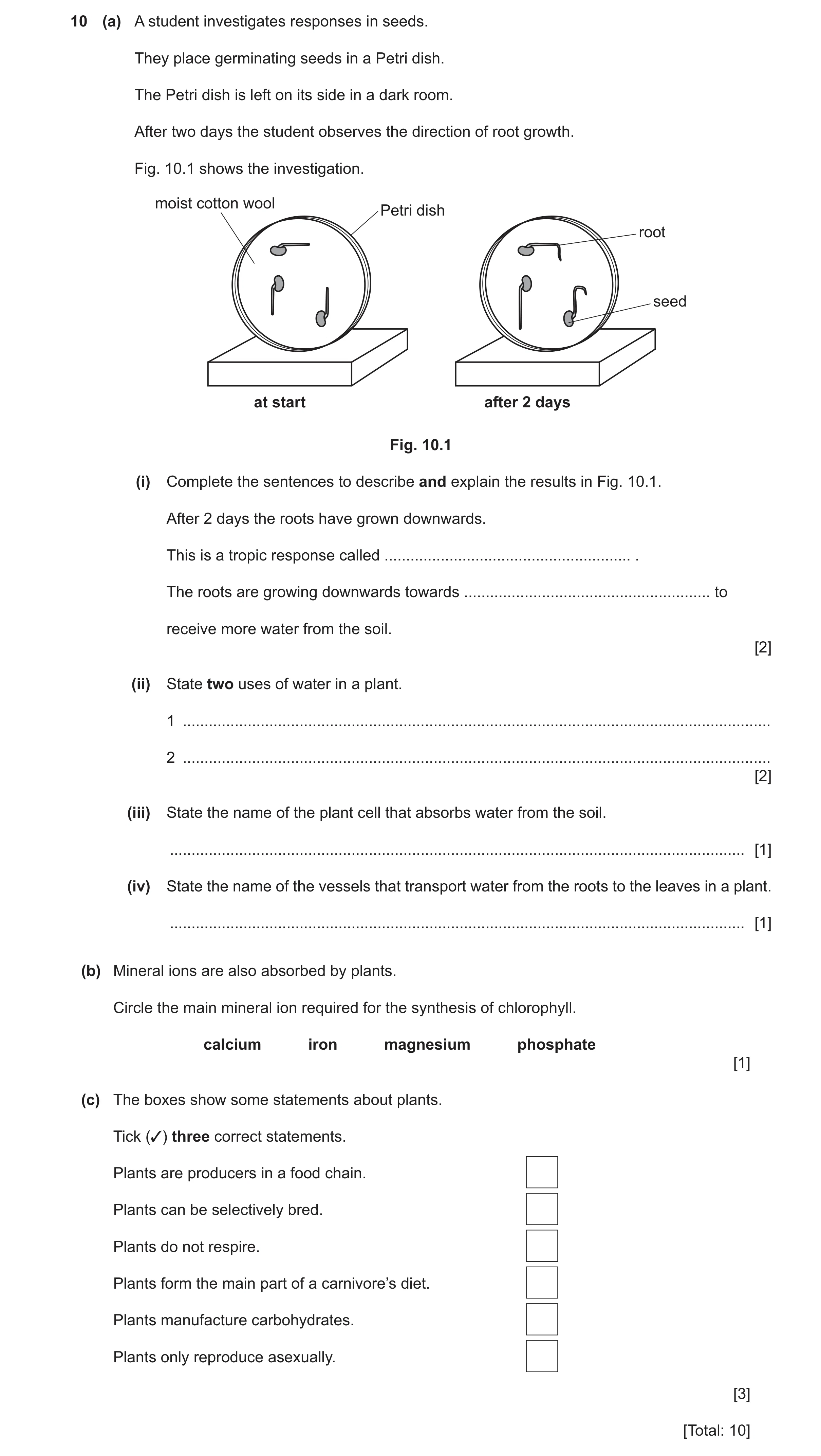
 20
20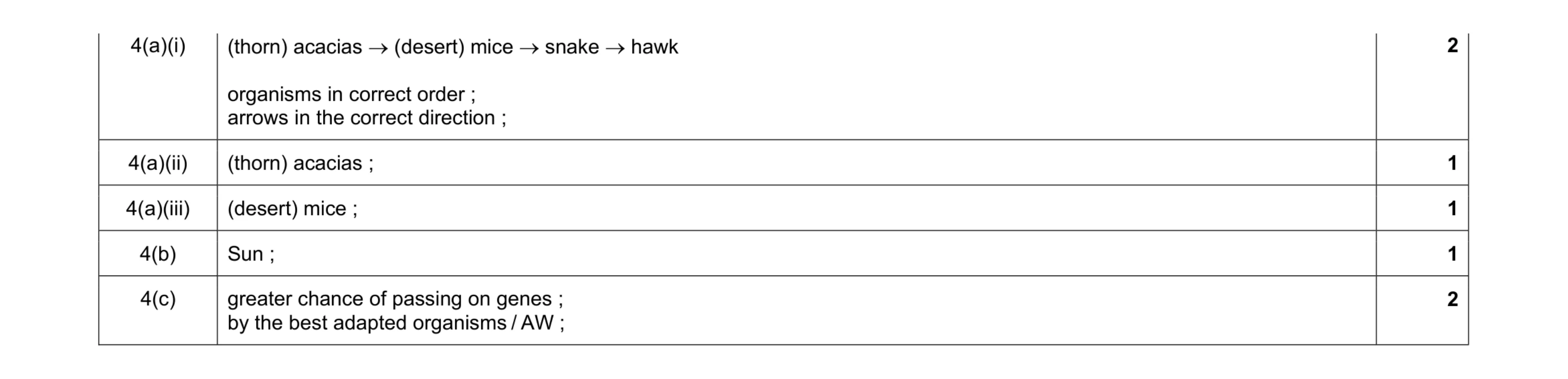 7
7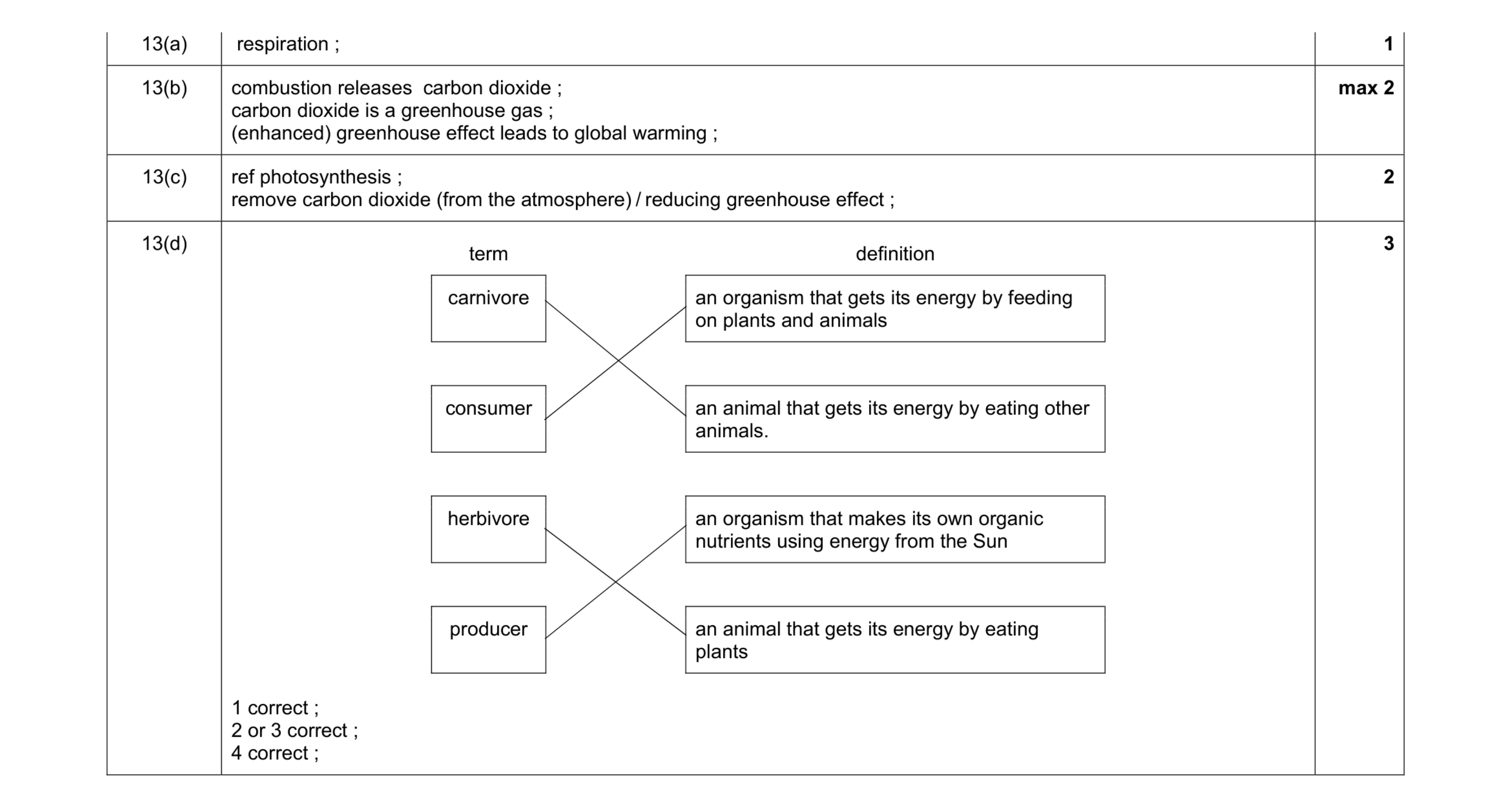 8
8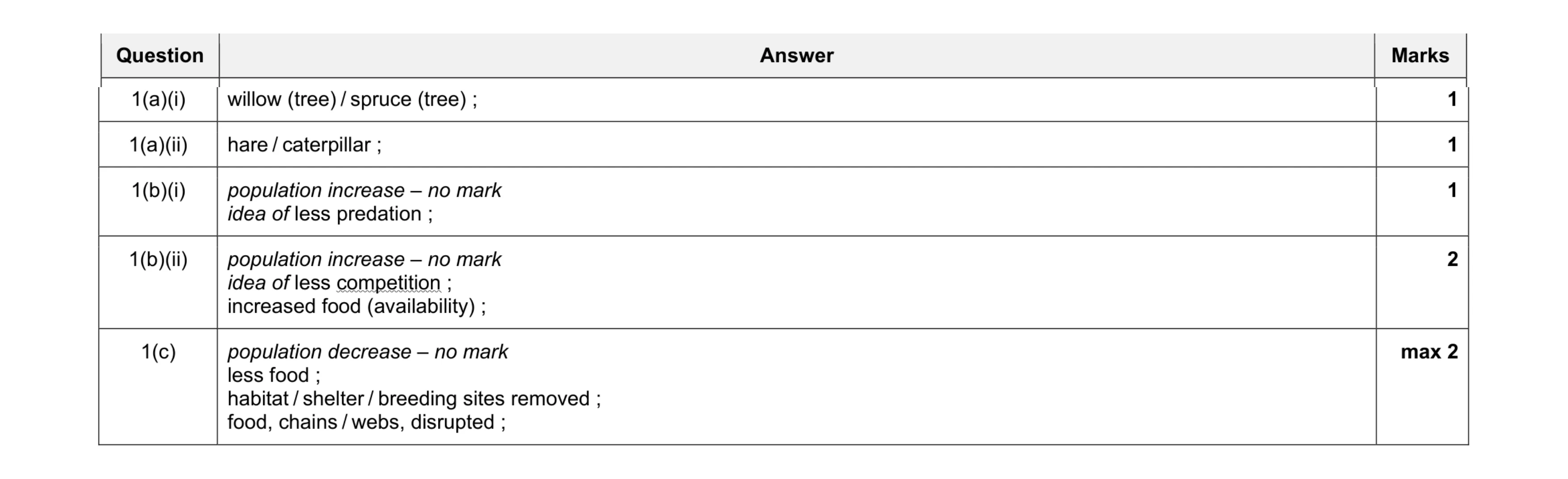 7
7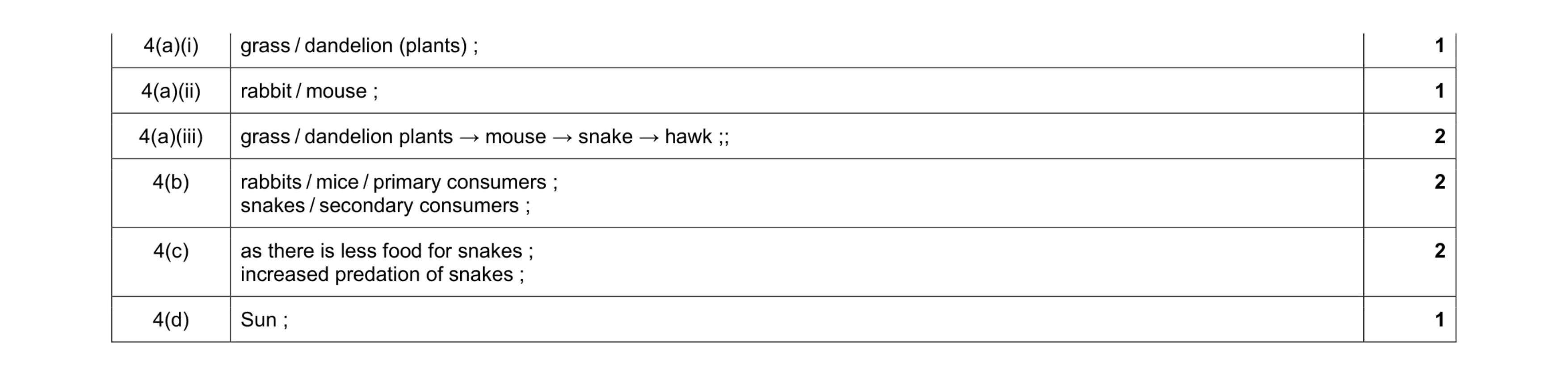 9
9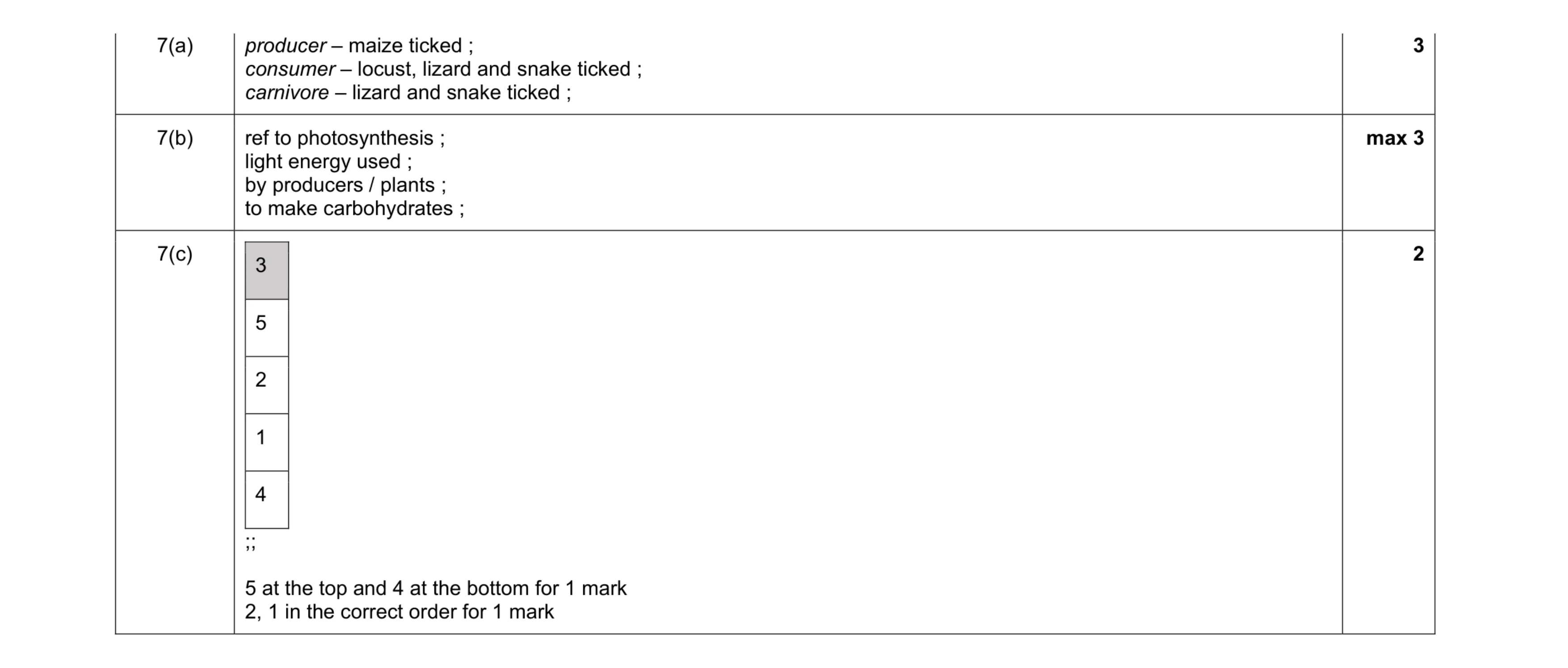 8
8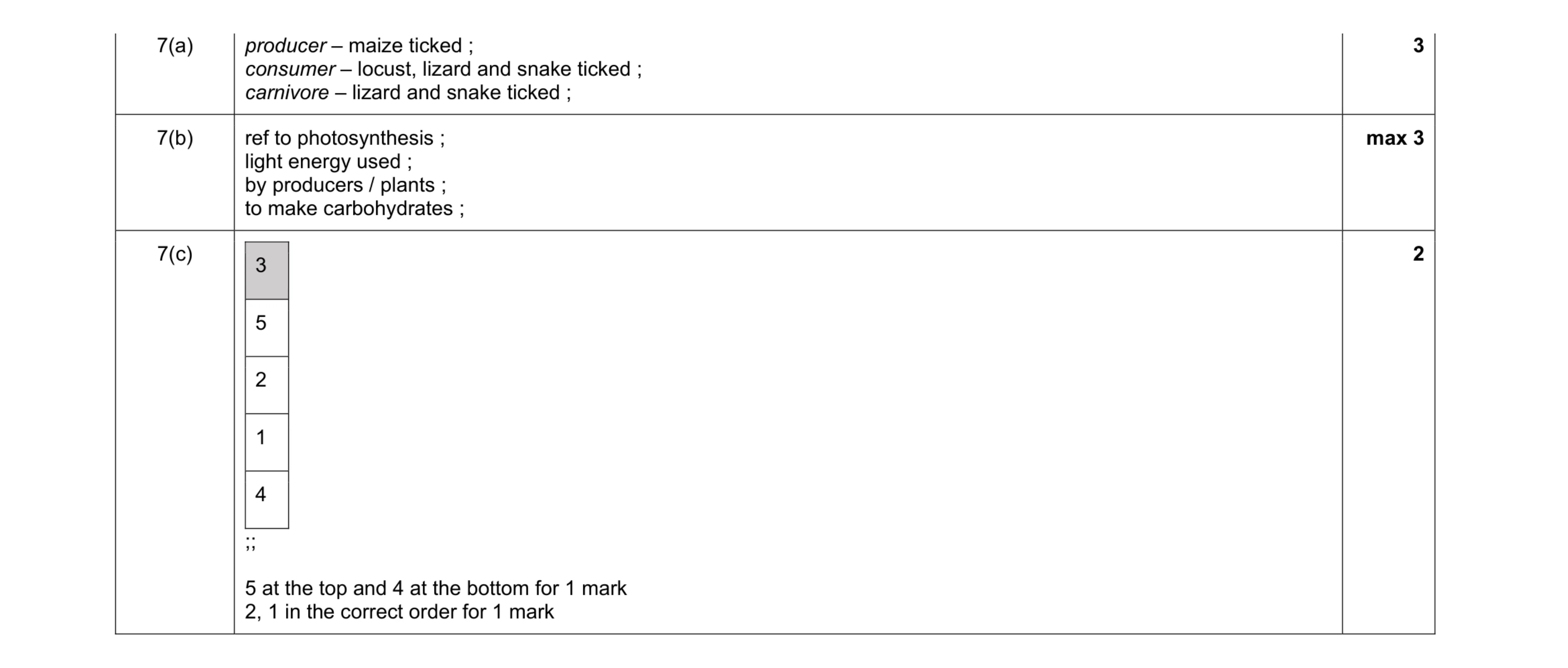 8
8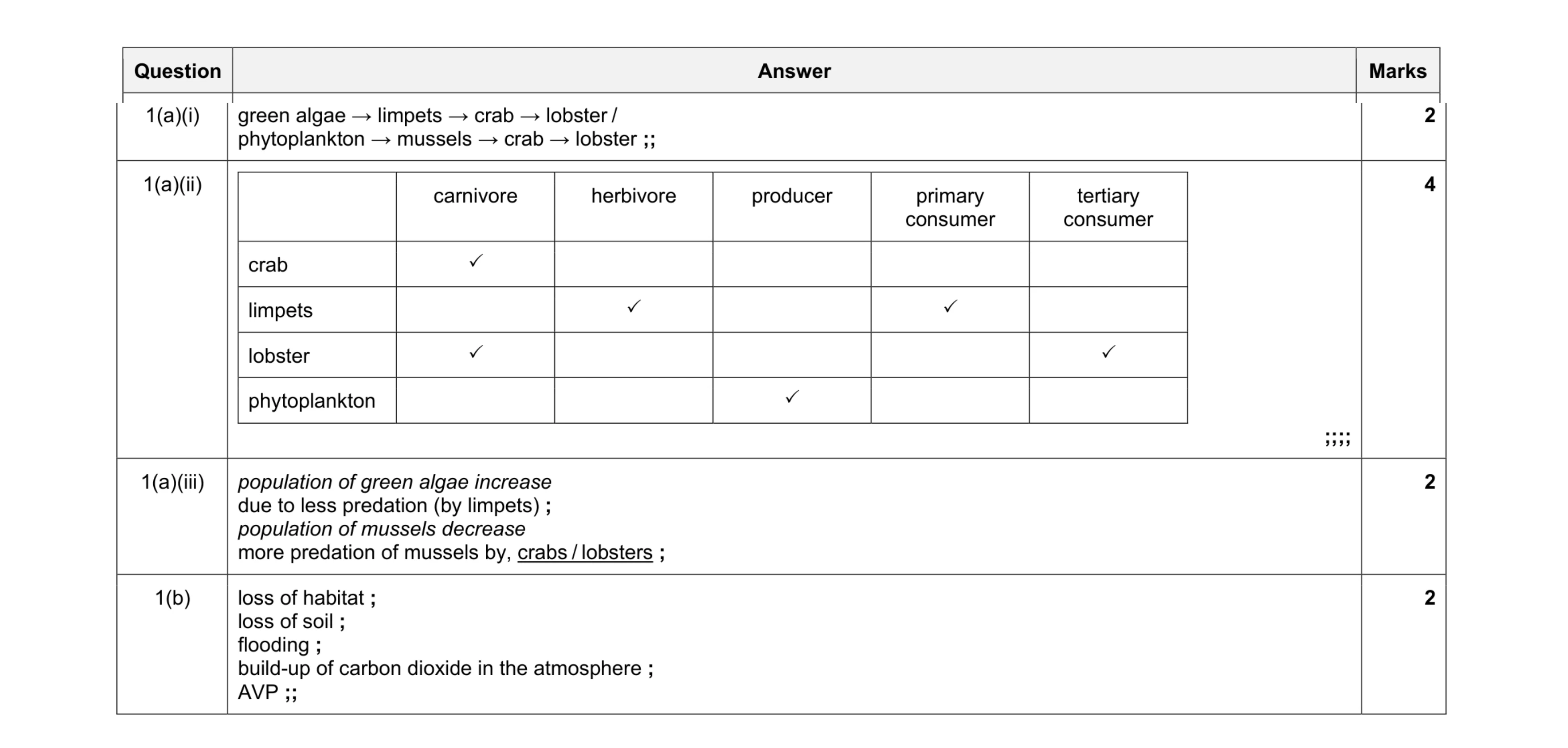 10
10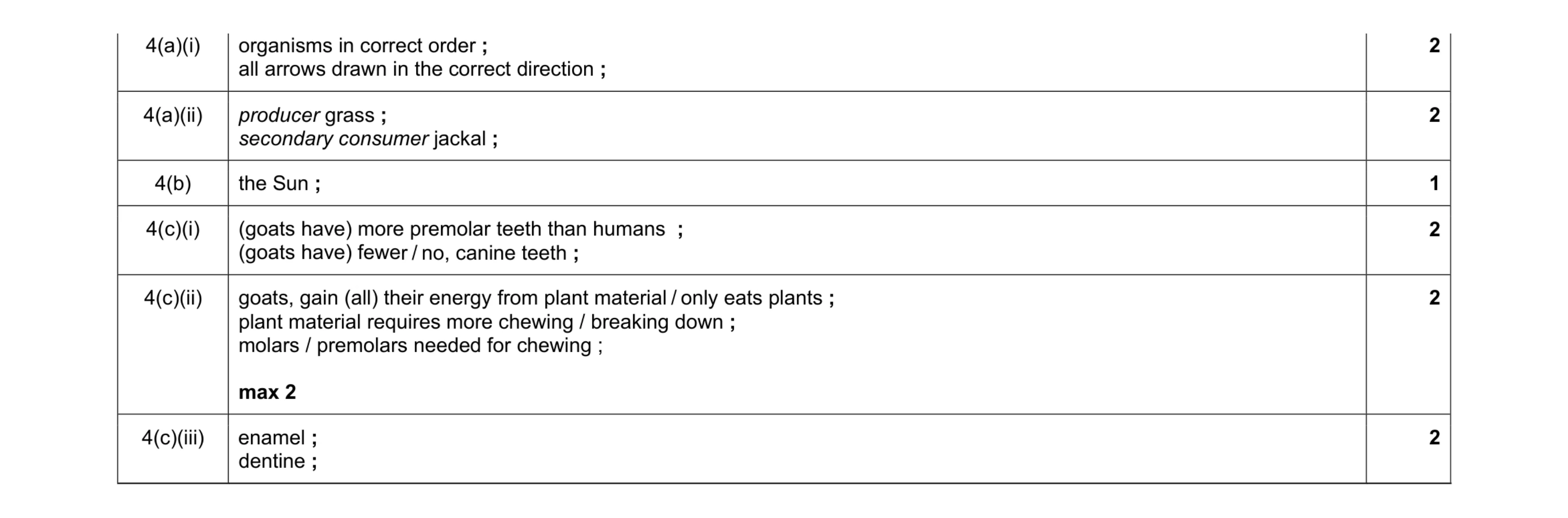 11
11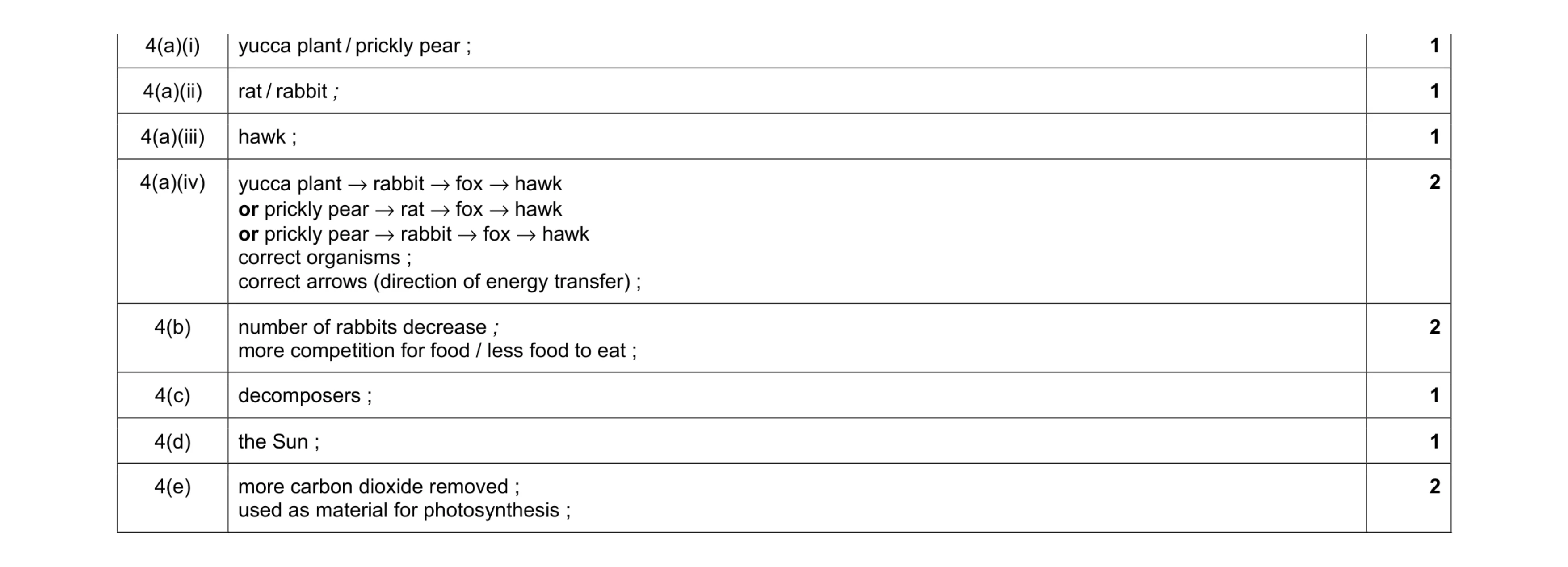 11
11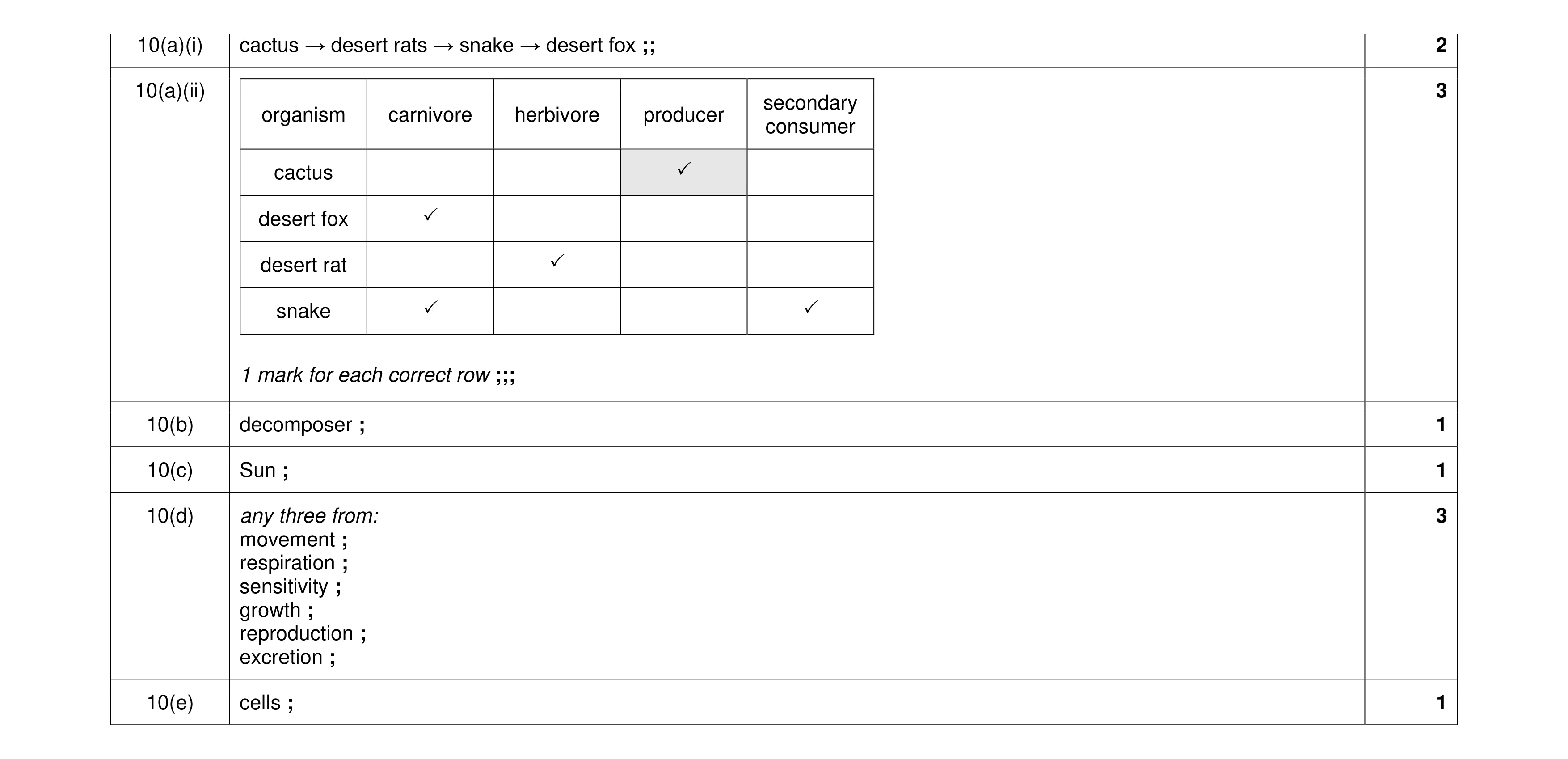 11
11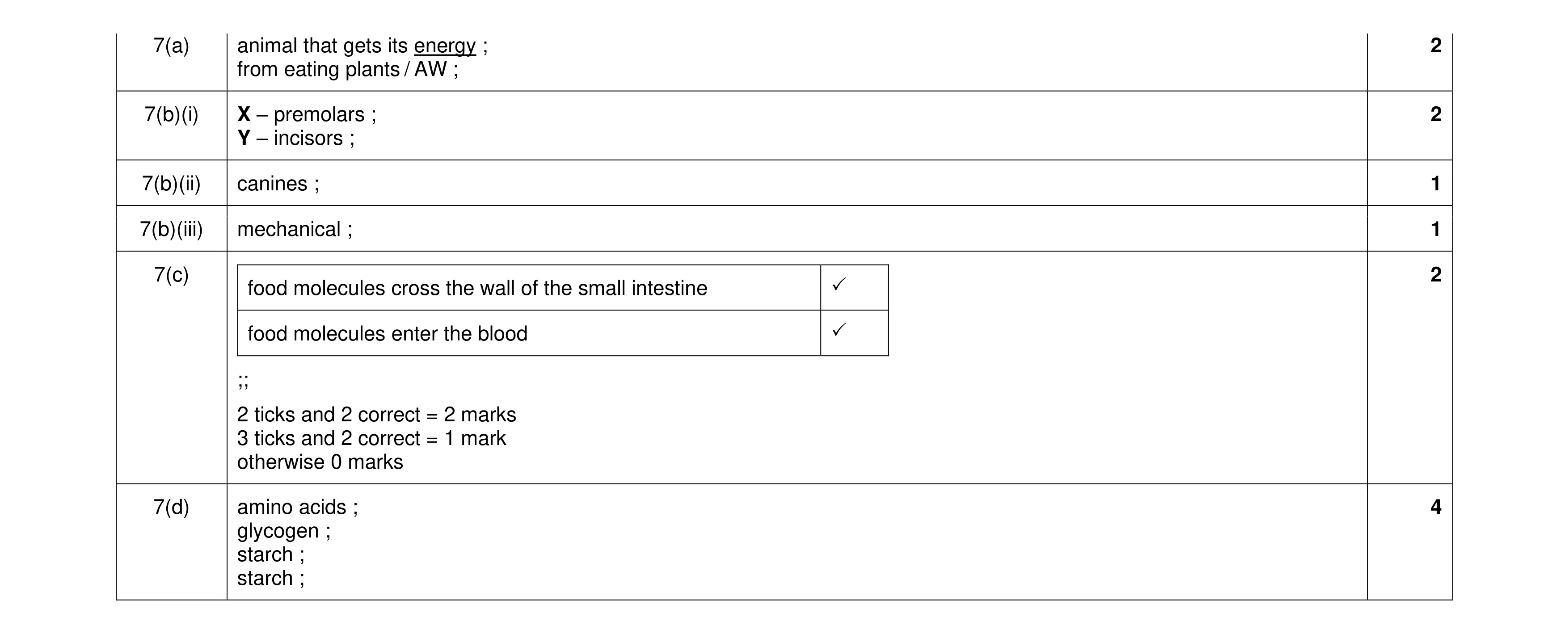 12
12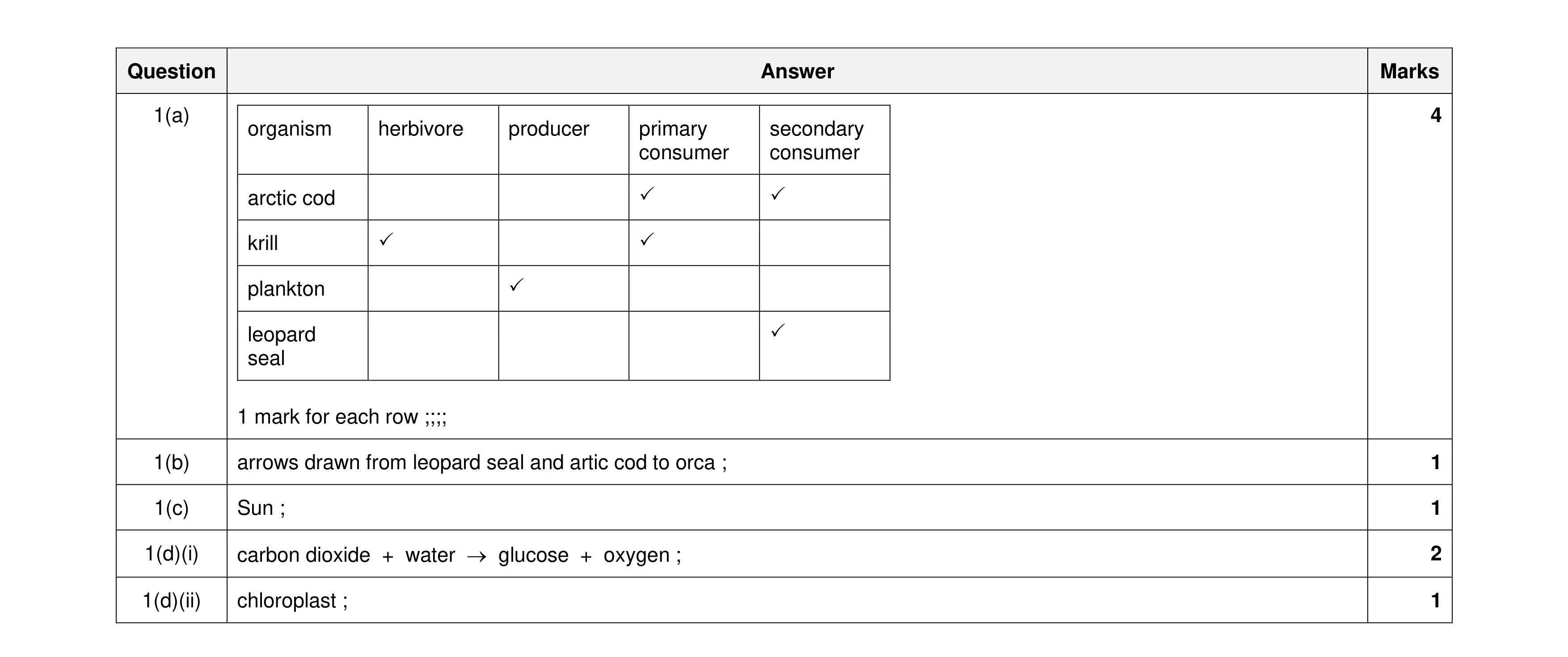 9
9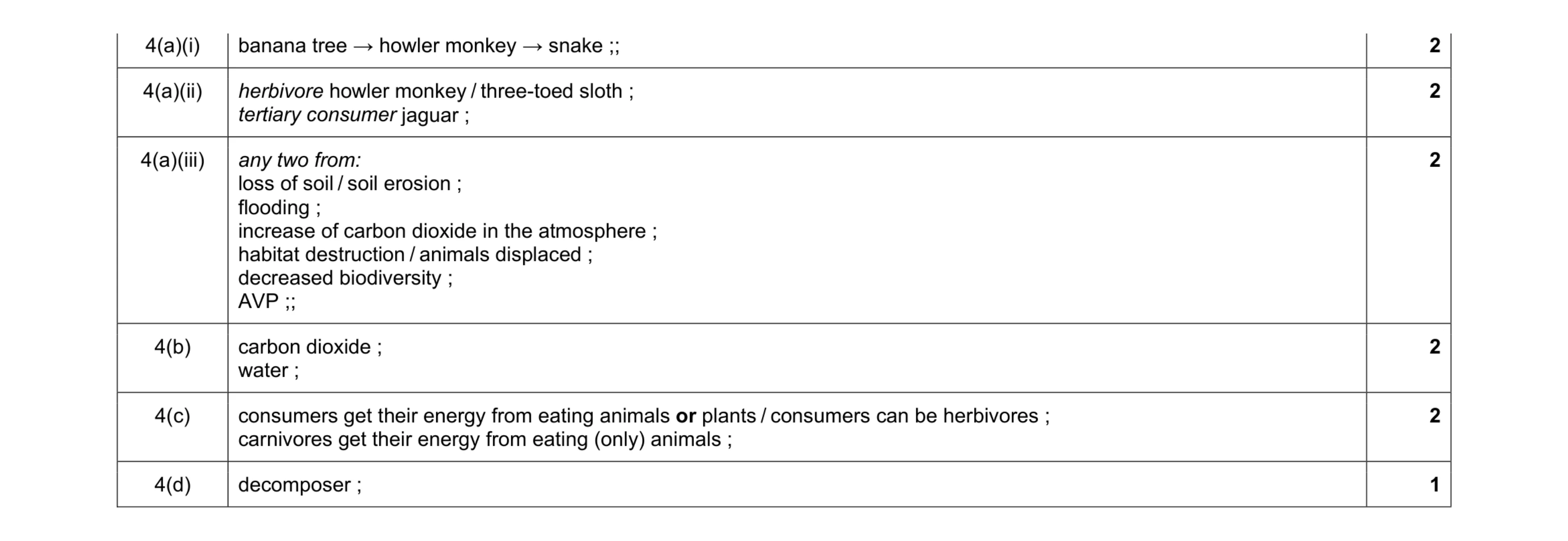 11
11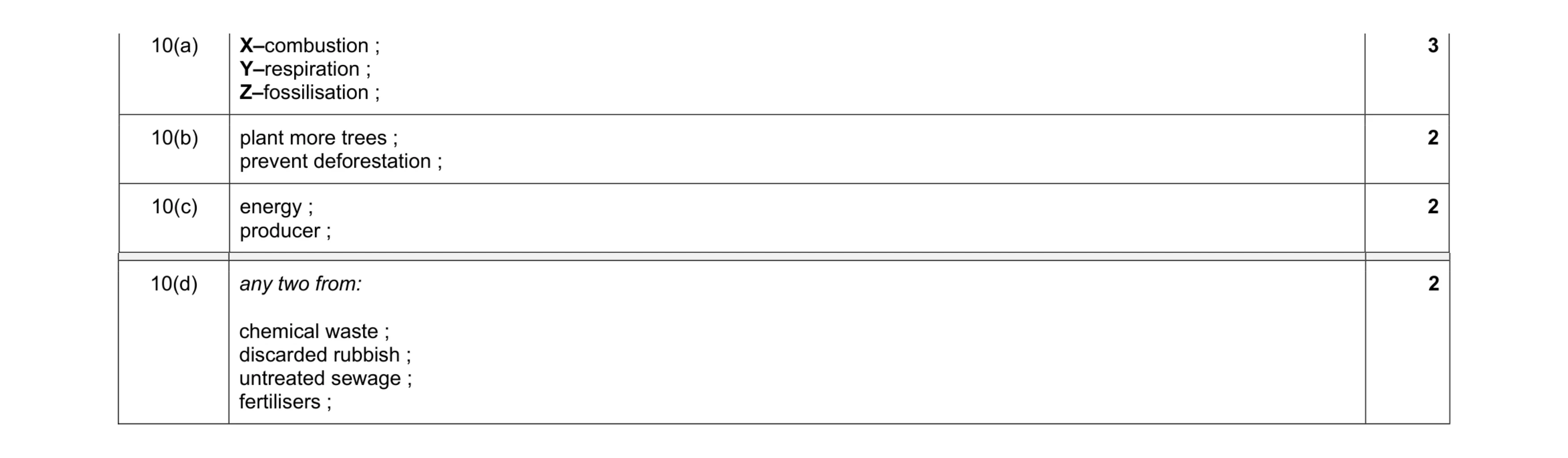 9
9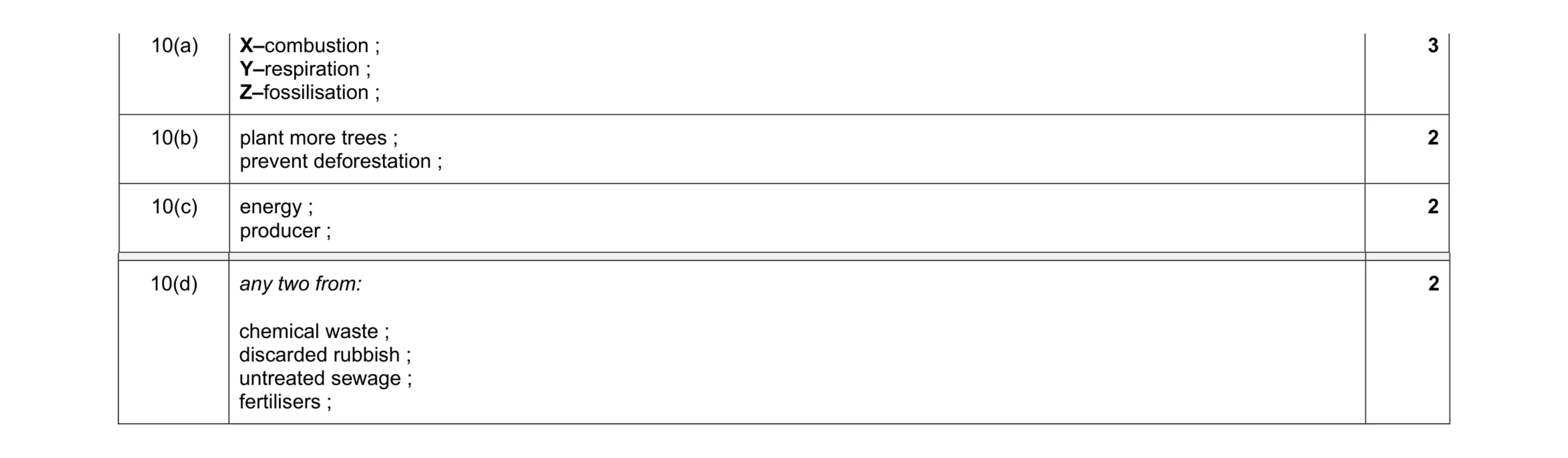 9
9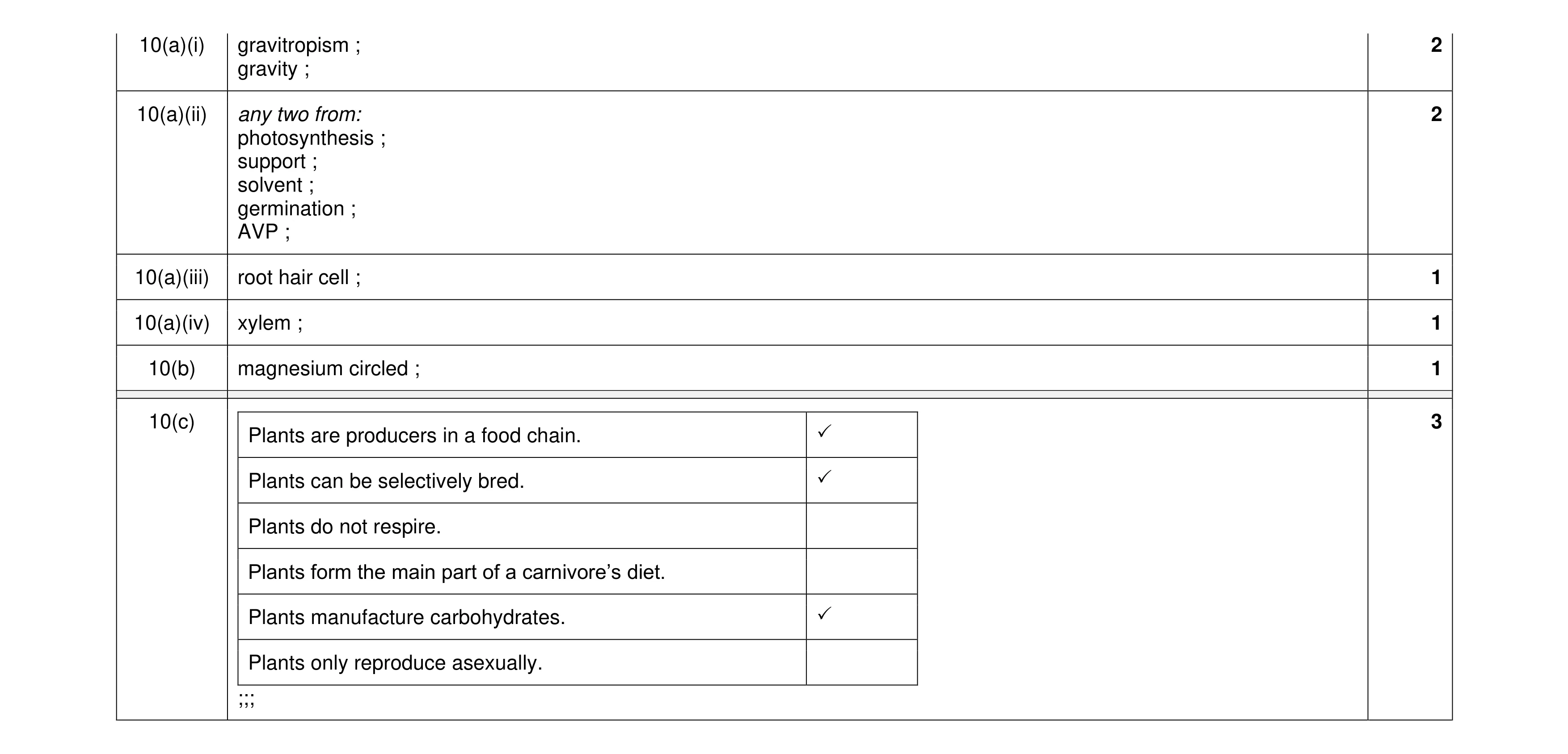 10
10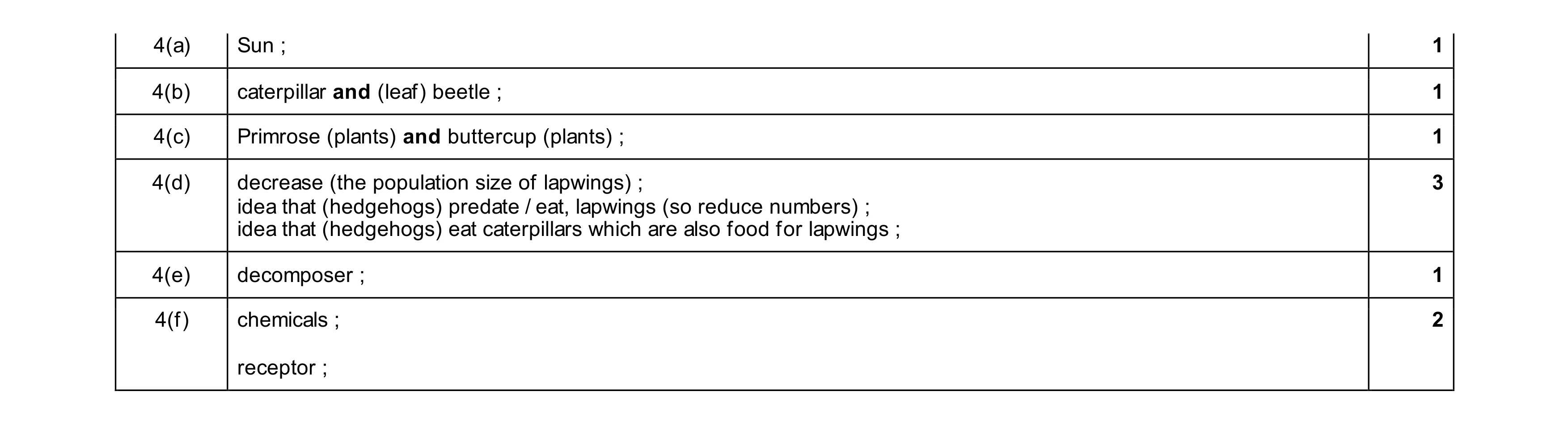 9
9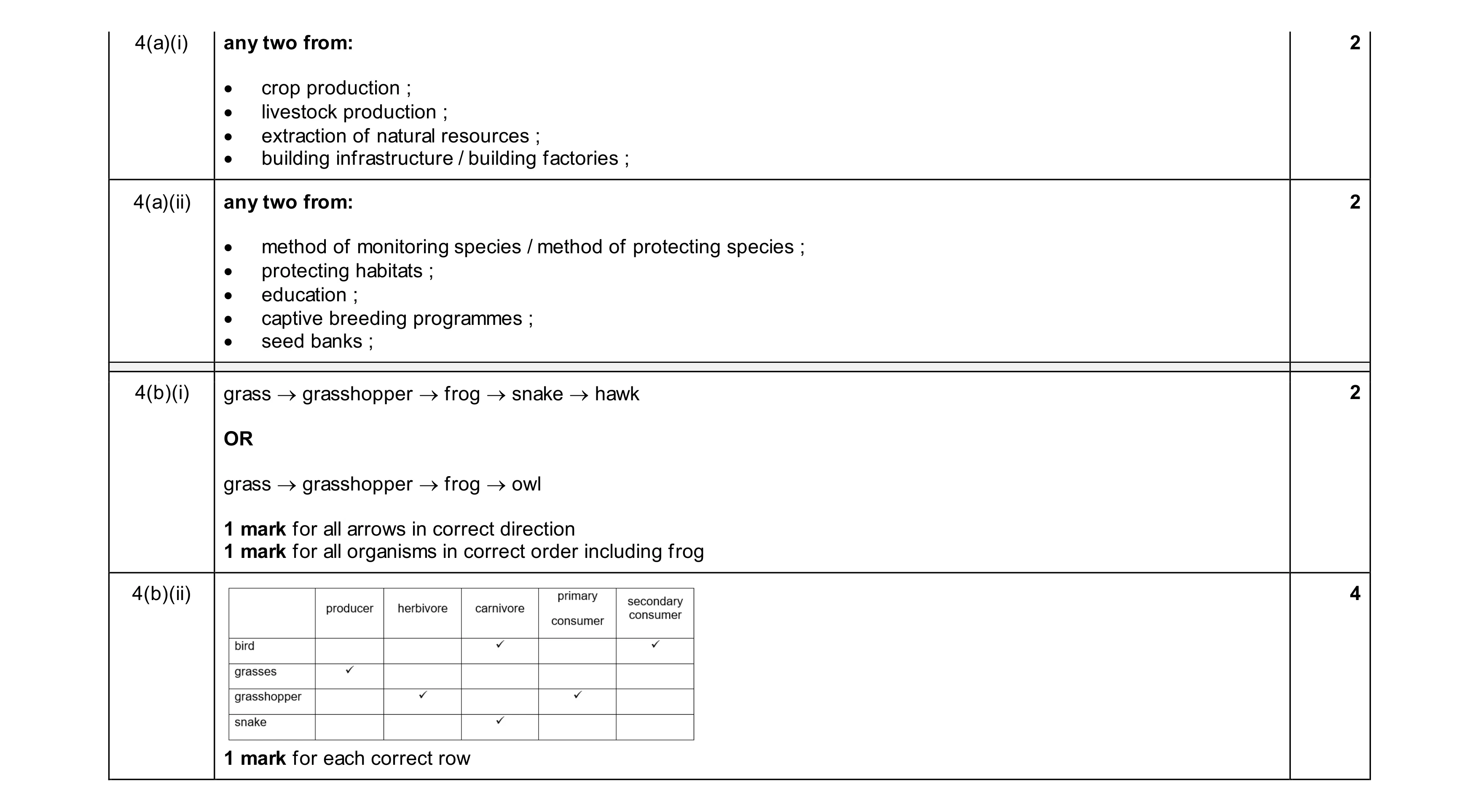 10
10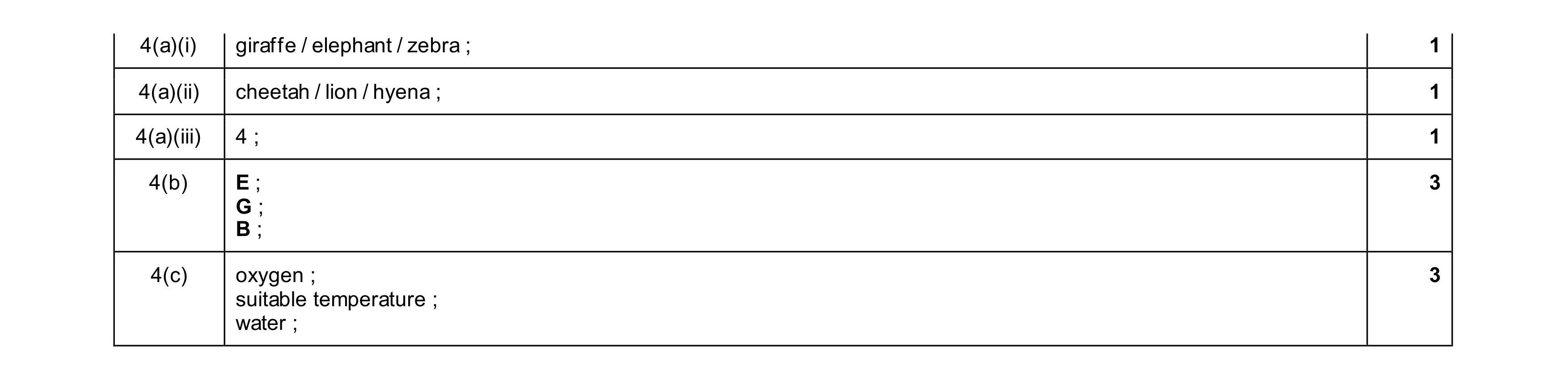 9
9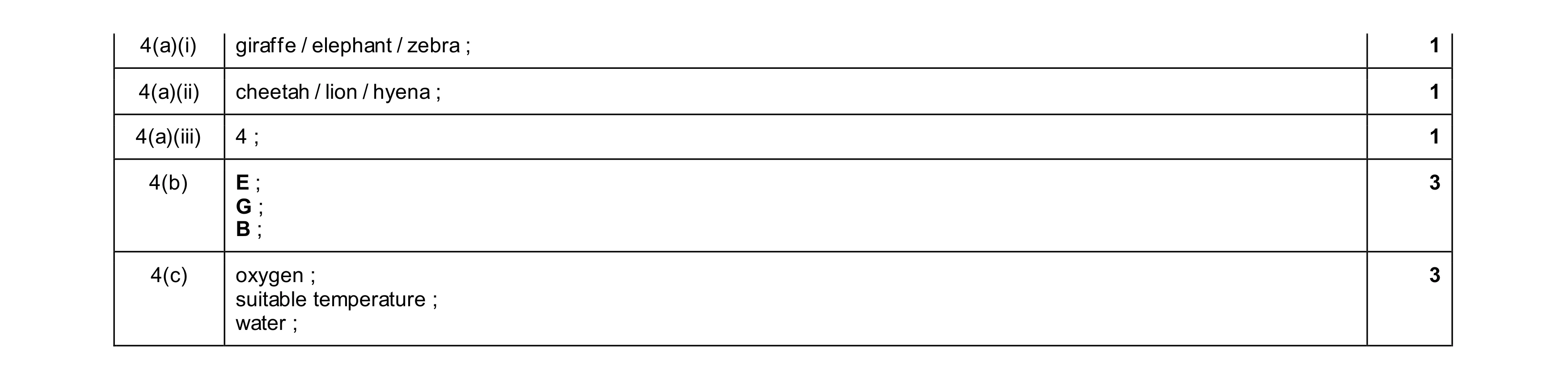 9
9