Questions as text
Q1 · A diagram of a food web 0654/43 May/June 2019
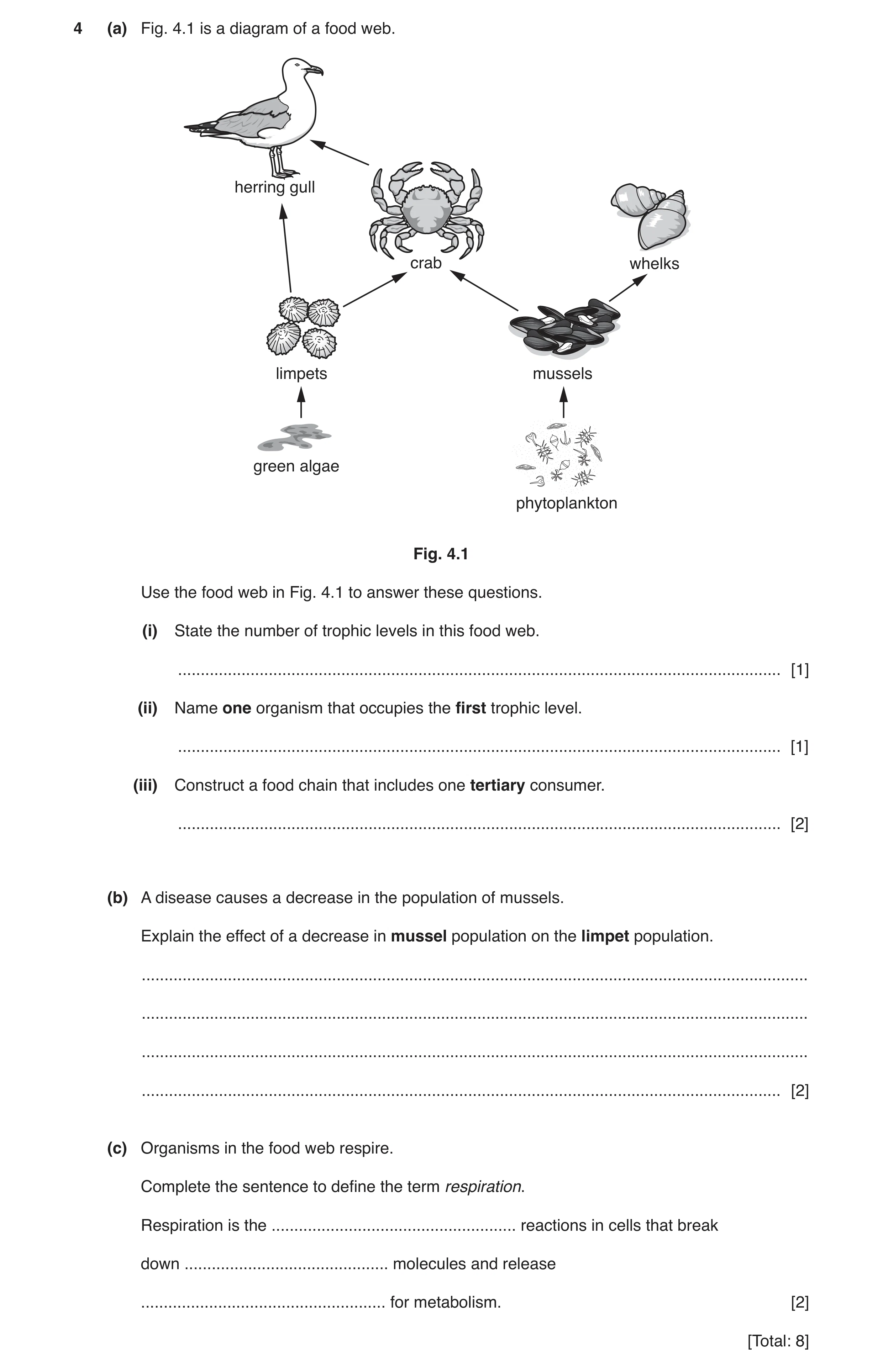
4 (a) Fig. 4.1 is a diagram of a food web. herring gull crab whelks limpets mussels green algae phytoplankton Fig. 4.1 Use the food web in Fig. 4.1 to answer these questions. (i) State the number of trophic levels in this food web. … [1] (ii) Name one organism that occupies the first trophic level. … [1] (iii) Construct a food chain that includes one tertiary consumer. … [2] (b) A disease causes a decrease in the population of mussels. Explain the effect of a decrease in mussel population on the limpet population. … … … … [2] (c) Organisms in the food web respire. Complete the sentence to define the term respiration. Respiration is the … reactions in cells that break down … molecules and release … for metabolism. [2] [Total: 8]
8 marks
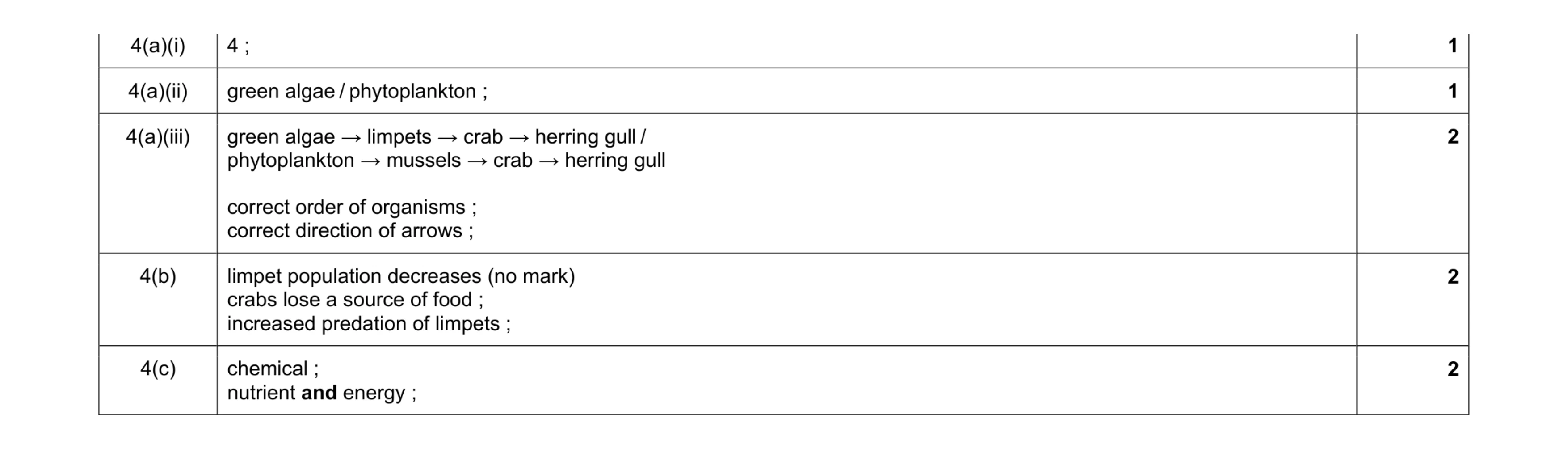
Mark scheme: 4(a)(i) 4 ; 1 4(a)(ii) green algae / phytoplankton ; 1 4(a)(iii) green algae → limpets → crab → herring gull / phytoplankton → mussels → crab → herring gull correct order of organisms ; correct direction of arrows ; 2 4(b) limpet population decreases (no mark) crabs lose a source of food ; increased predation of limpets ; 2 4(c) chemical ; nutrient and energy ; 2
This question in 0654/43 May/June 2019
Q2 · A lake is an example of an ecosystem 0654/42 May/June 2020
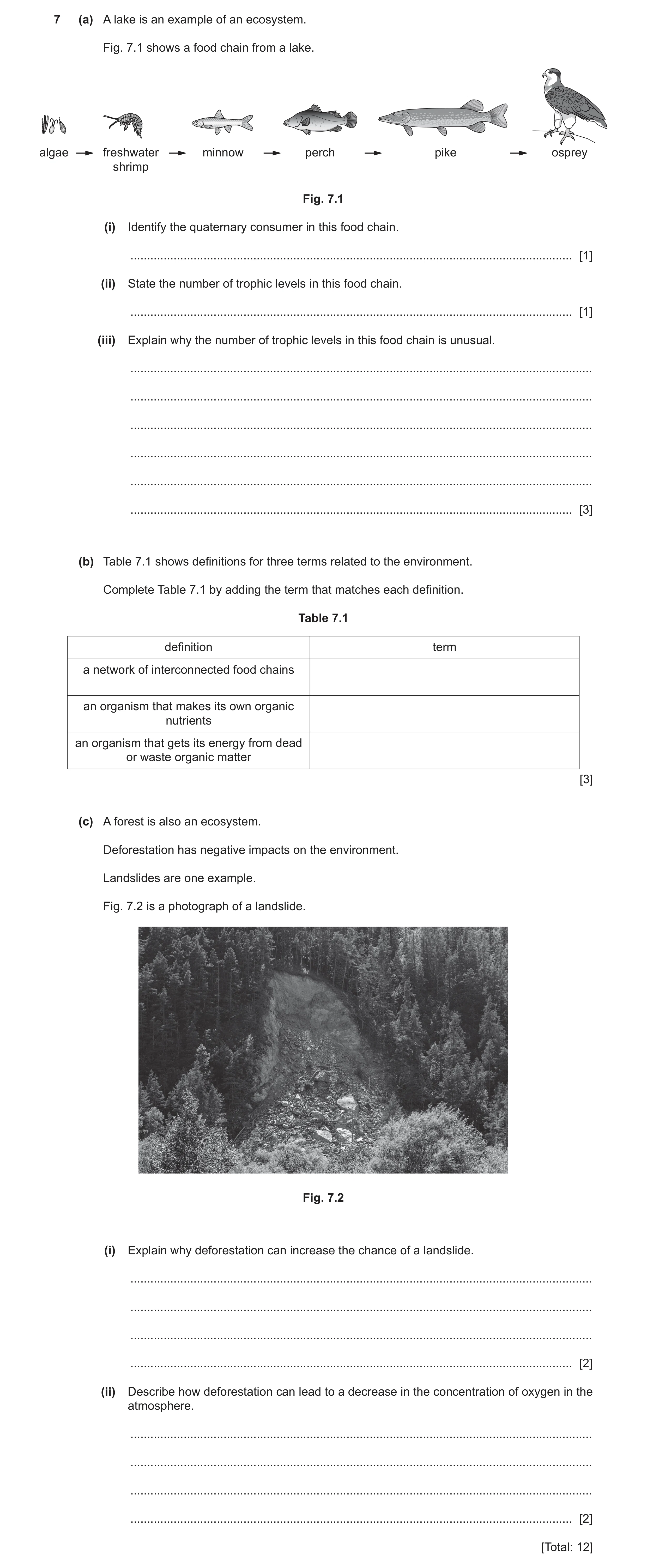
7 (a) A lake is an example of an ecosystem. Fig. 7.1 shows a food chain from a lake. algae freshwater minnow perch pike osprey shrimp Fig. 7.1 (i) Identify the quaternary consumer in this food chain. … [1] (ii) State the number of trophic levels in this food chain. … [1] (iii) Explain why the number of trophic levels in this food chain is unusual. … … … … … … [3] (b) Table 7.1 shows definitions for three terms related to the environment. Complete Table 7.1 by adding the term that matches each definition. Table 7.1 definition term a network of interconnected food chains an organism that makes its own organic nutrients an organism that gets its energy from dead or waste organic matter [3] (c) A forest is also an ecosystem. Deforestation has negative impacts on the environment. Landslides are one example. Fig. 7.2 is a photograph of a landslide. Fig. 7.2 (i) Explain why deforestation can increase the chance of a landslide. … … … … [2] (ii) Describe how deforestation can lead to a decrease in the concentration of oxygen in the atmosphere. … … … … [2] [Total: 12]
12 marks
Mark scheme: 7(a)(i) pike ; 1 7(a)(ii) 6 ; 1 Question Answer Marks 7(a)(iii) it has more than five trophic levels ; energy is lost between the trophic levels ; by respiration / excretion / movement / heat / not all animal is eaten ; there is not usually enough energy to sustain a sixth trophic level ; max 3 7(b) food web ; producer ; decomposer ; 3 7(c)(i) tree roots stabilise soil ; (tree removal causes) soil to be exposed to wind / rain ; causing soil erosion ; max 2 7(c)(ii) photosynthesis produces oxygen ; fewer trees means less photosynthesis ; combustion (of trees) uses oxygen ; max 2
This question in 0654/42 May/June 2020
Q3 · A food web in a desert 0654/41 Oct/Nov 2020
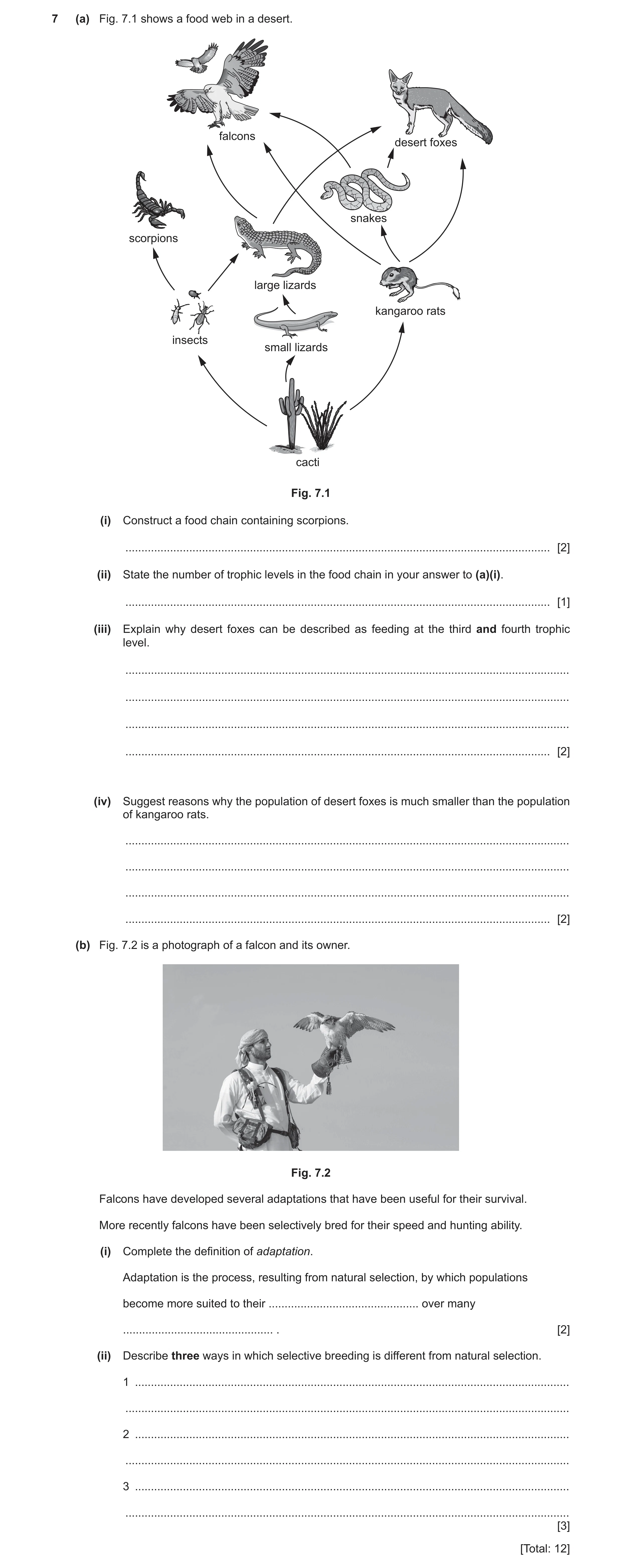
7 (a) Fig. 7.1 shows a food web in a desert. falcons desert foxes snakes scorpions large lizards kangaroo rats insects small lizards cacti Fig. 7.1 (i) Construct a food chain containing scorpions. … [2] (ii) State the number of trophic levels in the food chain in your answer to (a)(i). … [1] (iii) Explain why desert foxes can be described as feeding at the third and fourth trophic level. … … … … [2] (iv) Suggest reasons why the population of desert foxes is much smaller than the population of kangaroo rats. … … … … [2] (b) Fig. 7.2 is a photograph of a falcon and its owner. Fig. 7.2 Falcons have developed several adaptations that have been useful for their survival. More recently falcons have been selectively bred for their speed and hunting ability. (i) Complete the definition of adaptation. Adaptation is the process, resulting from natural selection, by which populations become more suited to their … over many … . [2] (ii) Describe three ways in which selective breeding is different from natural selection. 1 … … 2 … … 3 … … [3] [Total: 12]
12 marks
Mark scheme: 7(a)(i) cacti → insects → scorpions correct organisms ; correct arrows ; 2 7(a)(ii) 3 ; 1 7(a)(iii) they eat kangaroo rats which are primary consumers / on 2nd (trophic) level ; they also eat, snakes/large lizards, which are secondary consumers / on 3rd (trophic) level ; 2 7(a)(iv) energy is lost between the trophic levels ; named example of how energy is lost ; not enough energy to sustain a larger population ; max 2 2 7(b)(i) environment ; generations ; 2 7(b)(ii) any three from humans select the desirable features (instead of nature) ; is a faster process ; results in less variation ; inbreeding is more common ; AVP ; max 3 3
This question in 0654/41 Oct/Nov 2020
Q4 · A flowchart showing the process of eutrophication 0654/41 May/June 2021
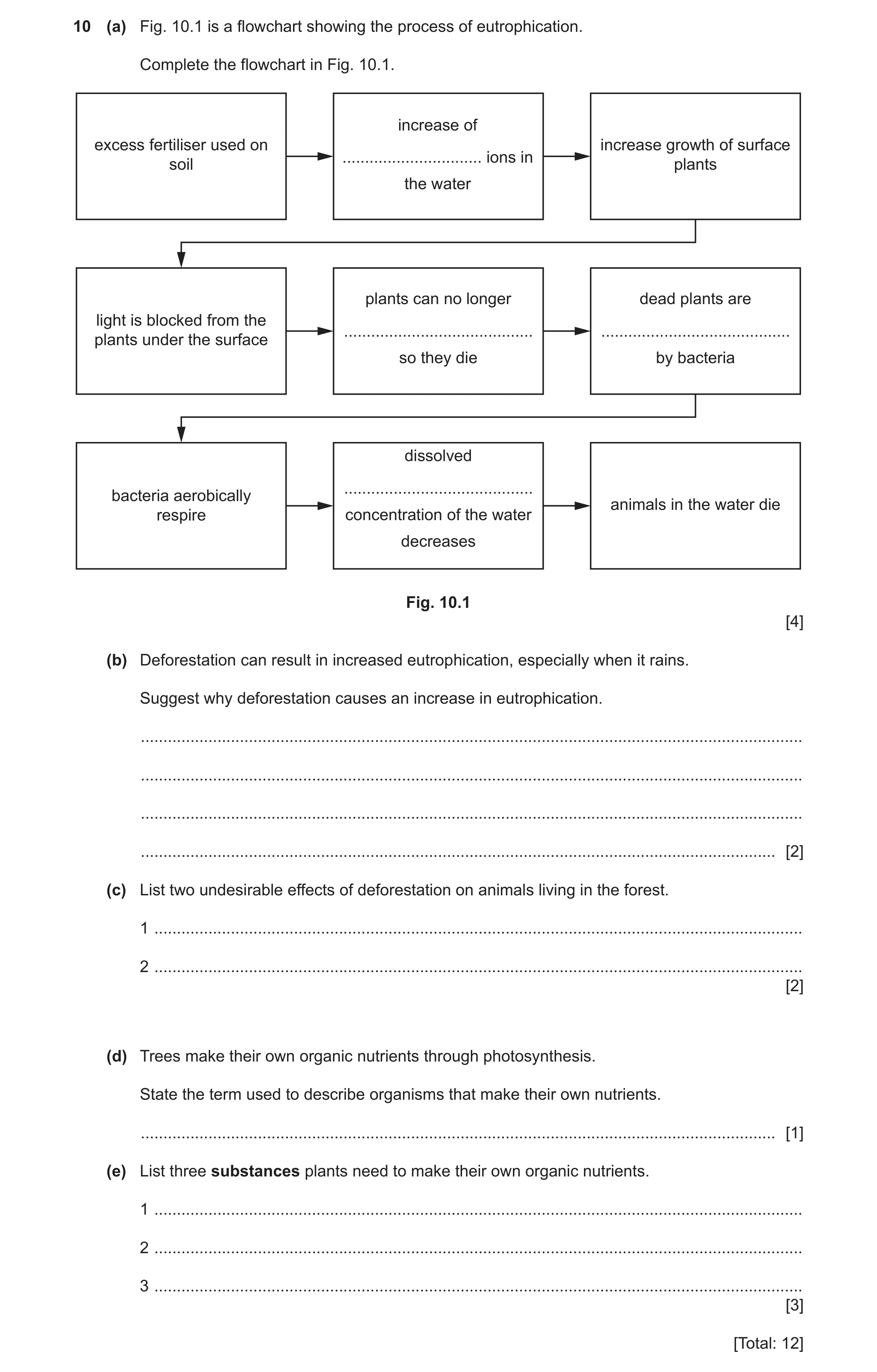
10 (a) Fig. 10.1 is a flowchart showing the process of eutrophication. Complete the flowchart in Fig. 10.1. increase of excess fertiliser used on increase growth of surface … ions in soil plants the water plants can no longer dead plants are light is blocked from the … … plants under the surface so they die by bacteria dissolved … bacteria aerobically animals in the water die respire concentration of the water decreases Fig. 10.1 [4] (b) Deforestation can result in increased eutrophication, especially when it rains. Suggest why deforestation causes an increase in eutrophication. … … … … [2] (c) List two undesirable effects of deforestation on animals living in the forest. 1 … 2 … [2] (d) Trees make their own organic nutrients through photosynthesis. State the term used to describe organisms that make their own nutrients. … [1] (e) List three substances plants need to make their own organic nutrients. 1 … 2 … 3 … [3] [Total: 12]
12 marks
Mark scheme: 10(a) nitrate ; photosynthesise ; decomposed ; oxygen ; 10(b) increased, soil erosion / described ; soil contains nitrate (ions) ; 2 10(c) loss of food / disruption to food chain / web; loss of habitat ; extinction ; migration ; 2 10(d) producer ; 1 Question Answer Marks 10(e) carbon dioxide ; water ; chlorophyll ; (named) mineral ions ; max 3 3
This question in 0654/41 May/June 2021
Q5 · Complete the definition of the term ecosystem 0654/43 Oct/Nov 2021
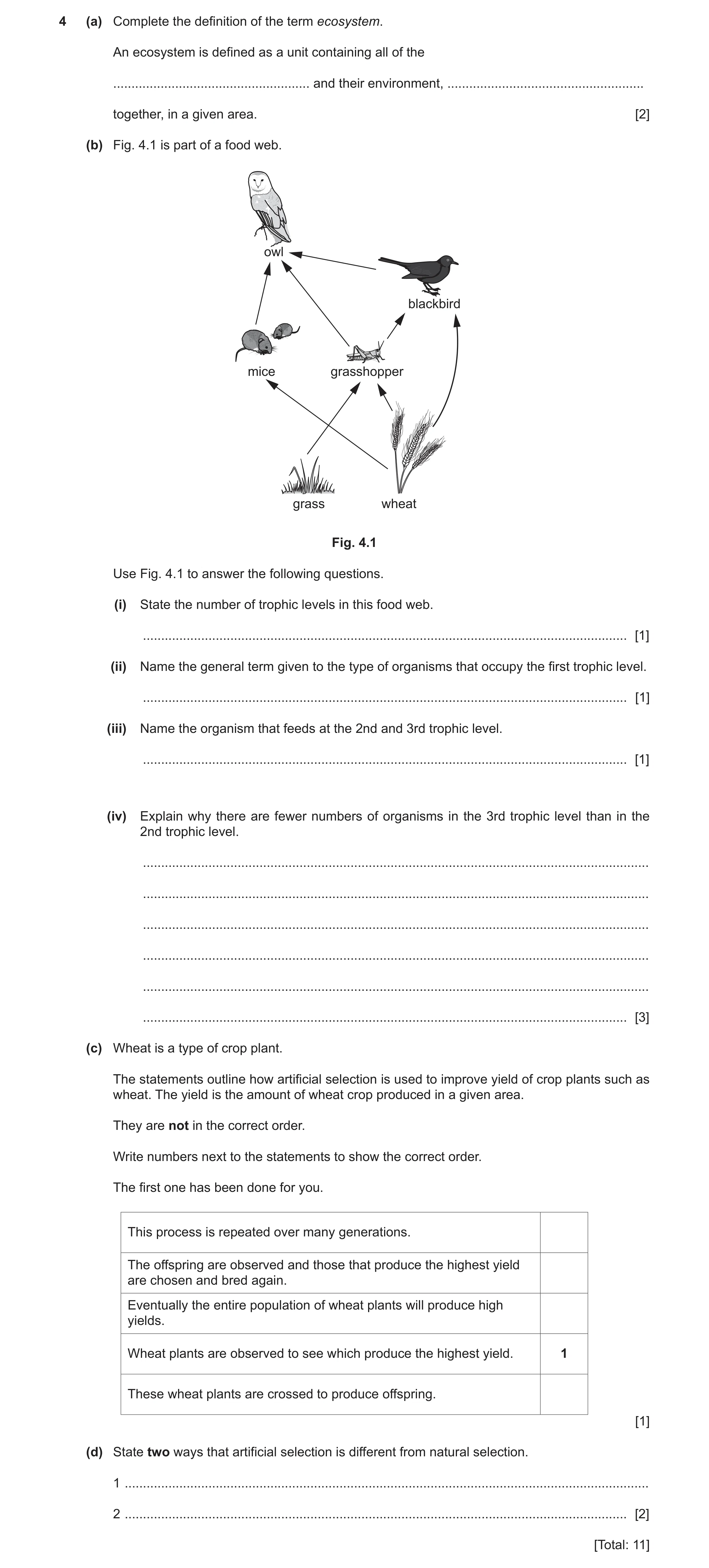
4 (a) Complete the definition of the term ecosystem. An ecosystem is defined as a unit containing all of the … and their environment, … together, in a given area. [2] (b) Fig. 4.1 is part of a food web. owl blackbird mice grasshopper grass wheat Fig. 4.1 Use Fig. 4.1 to answer the following questions. (i) State the number of trophic levels in this food web. … [1] (ii) Name the general term given to the type of organisms that occupy the first trophic level. … [1] (iii) Name the organism that feeds at the 2nd and 3rd trophic level. … [1] (iv) Explain why there are fewer numbers of organisms in the 3rd trophic level than in the 2nd trophic level. … … … … … … [3] (c) Wheat is a type of crop plant. The statements outline how artificial selection is used to improve yield of crop plants such as wheat. The yield is the amount of wheat crop produced in a given area. They are not in the correct order. Write numbers next to the statements to show the correct order. The first one has been done for you. This process is repeated over many generations. The offspring are observed and those that produce the highest yield are chosen and bred again. Eventually the entire population of wheat plants will produce high yields. Wheat plants are observed to see which produce the highest yield. 1 These wheat plants are crossed to produce offspring. [1] (d) State two ways that artificial selection is different from natural selection. 1 … 2 … [2] [Total: 11]
11 marks
Mark scheme: 4(a) organisms ; interacting ; 2 4(b)(i) 4 ; 1 4(b)(ii) producers ; 1 4(b)(iii) blackbirds ; 1 4(b)(iv) any three from: energy is lost between the trophic levels ; energy lost by, respiration / movement / heat / excretion ; not all the organism, is eaten / digested ; not enough energy for larger number of organisms ; 3 4(c) 4 3 5 (1) 2 ; 1 4(d) any two from: traits / characteristics, are selected by humans (in artificial selection) / traits are selected by the environment in natural selection ; traits / characteristics, are usually chosen for economic reasons (in artificial selection) / traits are beneficial for survival (in natural selection) ; faster results (from artificial selection) / ORA ; (artificial selection only) takes place in selected individuals / natural selection takes place in whole populations ; (artificial selection) does not lead to evolution / ORA ; (artificial selection) results in decreased genetic variation / diversity / ORA ; (artificial selection) leads to increased likelihood of inherited / genetic disease ; AVP ; 2
This question in 0654/43 Oct/Nov 2021
Q6 · A marine food web 0654/42 Feb/March 2022
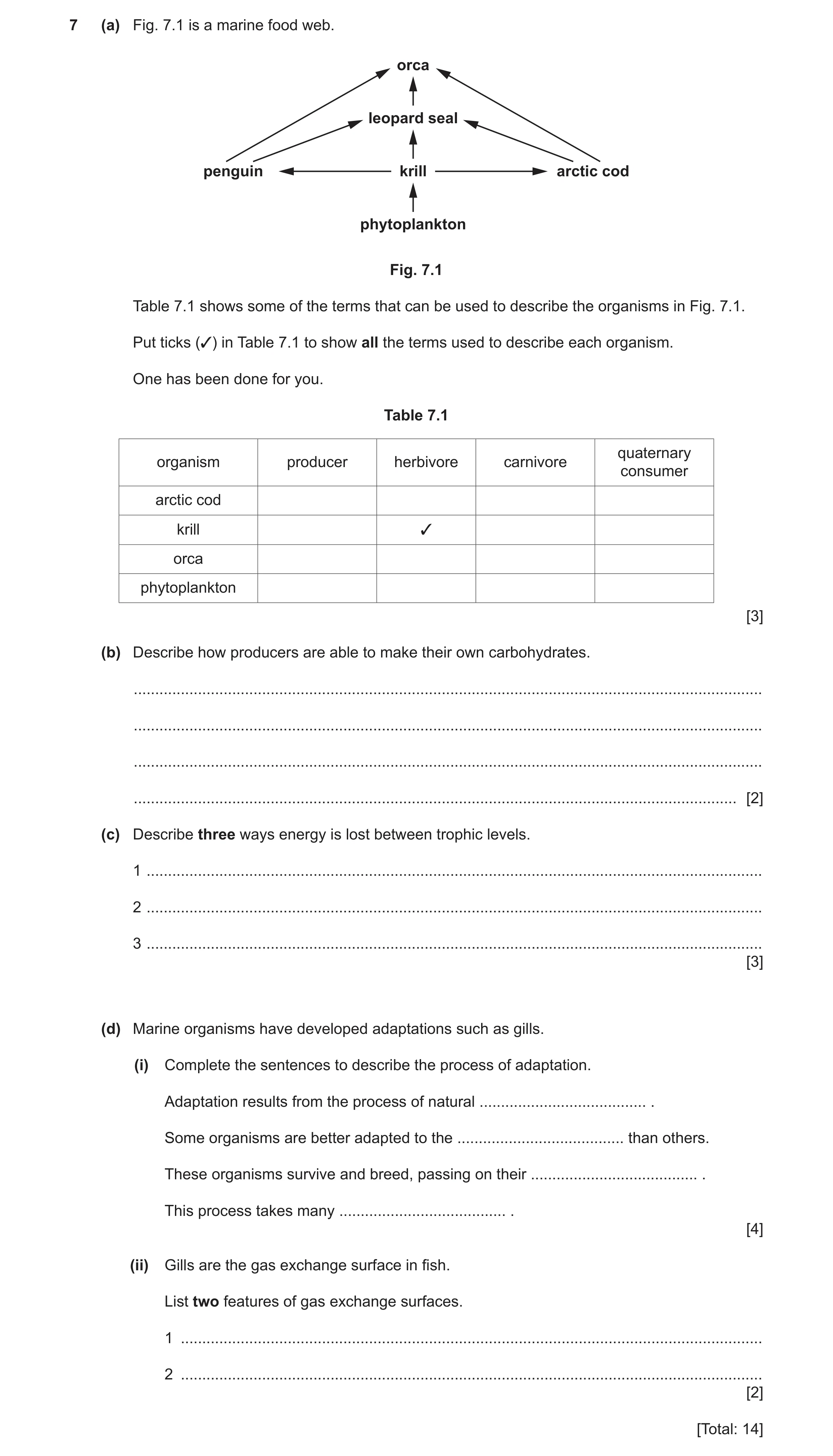
7 (a) Fig. 7.1 is a marine food web. orca leopard seal penguin krill arctic cod phytoplankton Fig. 7.1 Table 7.1 shows some of the terms that can be used to describe the organisms in Fig. 7.1. Put ticks (3) in Table 7.1 to show all the terms used to describe each organism. One has been done for you. Table 7.1 quaternary organism producer herbivore carnivore consumer arctic cod krill 3 orca phytoplankton [3] (b) Describe how producers are able to make their own carbohydrates. … … … … [2] (c) Describe three ways energy is lost between trophic levels. 1 … 2 … 3 … [3] (d) Marine organisms have developed adaptations such as gills. (i) Complete the sentences to describe the process of adaptation. Adaptation results from the process of natural … . Some organisms are better adapted to the … than others. These organisms survive and breed, passing on their … . This process takes many … . [4] (ii) Gills are the gas exchange surface in fish. List two features of gas exchange surfaces. 1 … 2 … [2] [Total: 14]
14 marks
Mark scheme: 7(a) organism producer herbivore carnivore quaternary consumer arctic cod krill orca phytoplankton ;;; 7(b) any two from: by photosynthesis ; using light (energy) ; using carbon dioxide and water ; 2 7(c) any three from: heat / respiration ; excretion / faeces / urea ; (named) movement / (named) metabolic processes ; not all the organism is eaten / some parts are undigested ; not all the organisms from the trophic level are eaten ; 3 7(d)(i) selection ; environment ; alleles ; generations ; 4 7(d)(ii) any two from: good blood supply ; thin (walls/surface) / short diffusion distance ; large surface area ; good ventilation ; AVP ; 2
This question in 0654/42 Feb/March 2022
Question 7 0654/42 May/June 2023
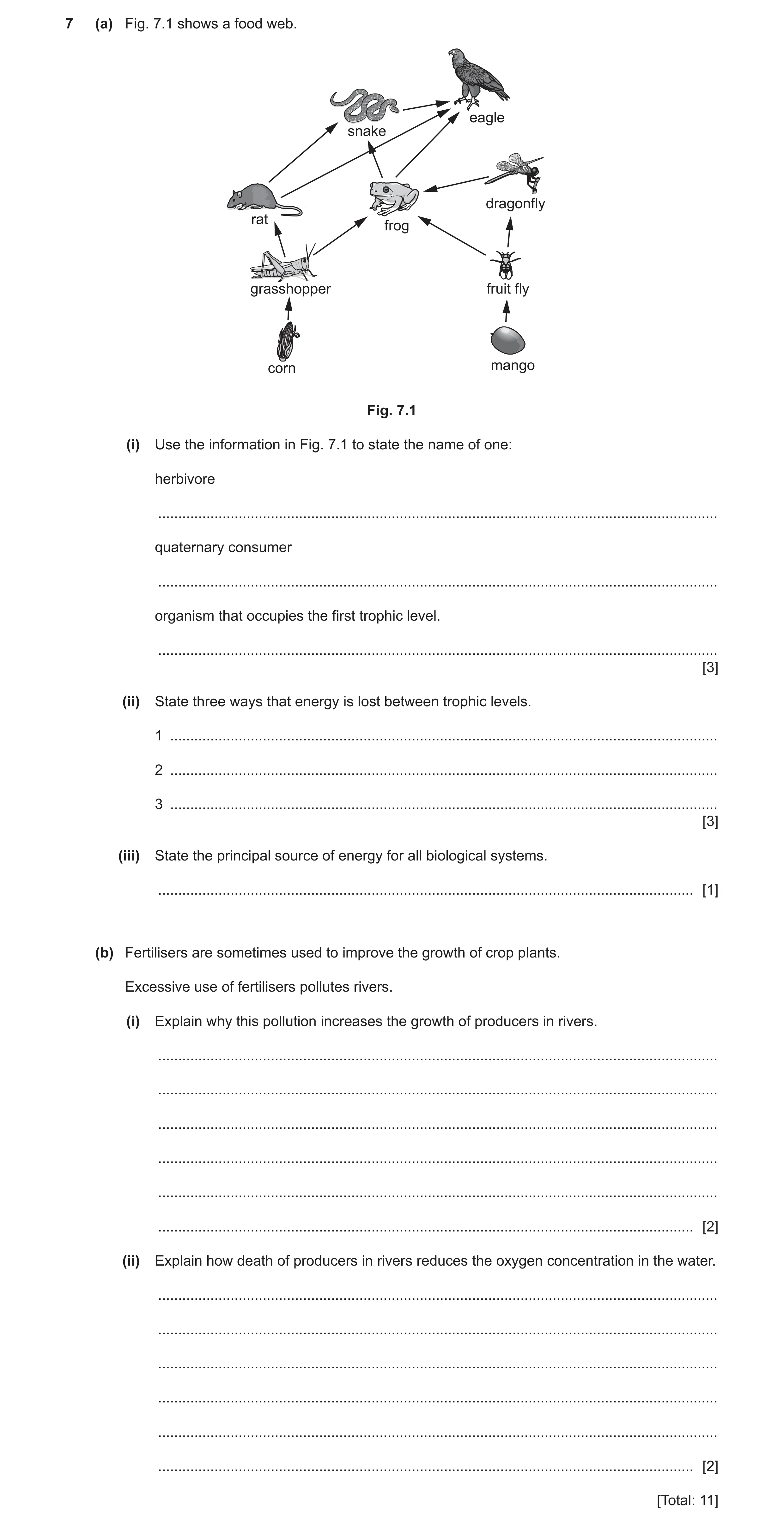
7 (a) Fig. 7.1 shows a food web. eagle snake dragonfly rat frog grasshopper fruit fly corn mango Fig. 7.1 (i) Use the information in Fig. 7.1 to state the name of one: herbivore … quaternary consumer … organism that occupies the first trophic level. … [3] (ii) State three ways that energy is lost between trophic levels. 1 … 2 … 3 … [3] (iii) State the principal source of energy for all biological systems. … [1] (b) Fertilisers are sometimes used to improve the growth of crop plants. Excessive use of fertilisers pollutes rivers. (i) Explain why this pollution increases the growth of producers in rivers. … … … … … … [2] (ii) Explain how death of producers in rivers reduces the oxygen concentration in the water. … … … … … … [2] [Total: 11]
11 marks
Mark scheme: 7(a)(i) grasshopper / fruit fly ; eagle / snake ; mango / corn ; 3 7(a)(ii) any three from: respiration / heat / metabolic processes ; not all of the organism is eaten ; not all the organism is digested / excretion / faeces / urine ; movement ; synthesis of (named) biological molecules / growth ; AVP ; 3 7(a)(iii) Sun ; 1 7(b)(i) fertilisers contain nitrate ions ; (nitrate ions required) for protein synthesis / amino acid production ; 2 7(b)(ii) ref to decomposers / decomposition ; ref to aerobic respiration ; 2
This question in 0654/42 May/June 2023
Q8 · Aerial photographs of the same area taken at different times 0654/41 Oct/Nov 2023
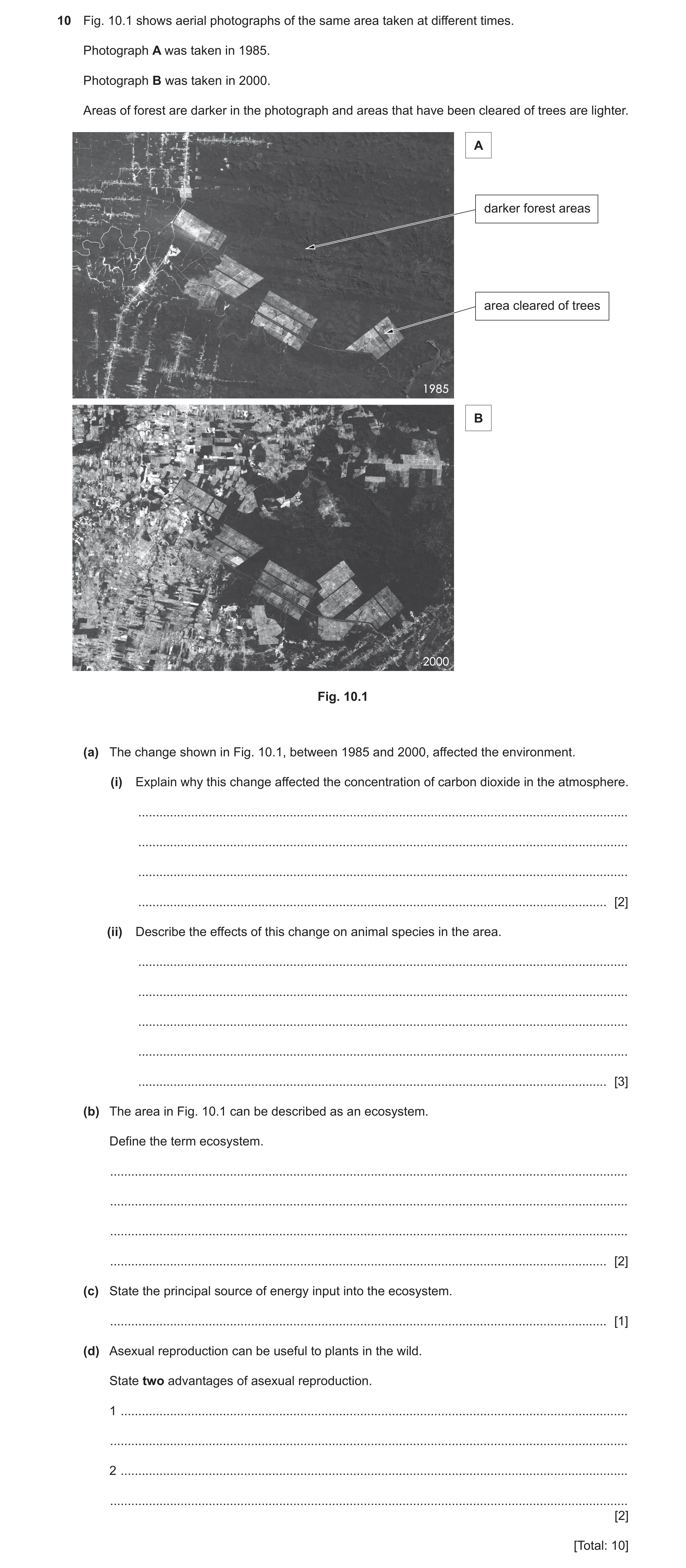
10 Fig. 10.1 shows aerial photographs of the same area taken at different times. Photograph A was taken in 1985. Photograph B was taken in 2000. Areas of forest are darker in the photograph and areas that have been cleared of trees are lighter. A darker forest areas area cleared of trees B Fig. 10.1 (a) The change shown in Fig. 10.1, between 1985 and 2000, affected the environment. (i) Explain why this change affected the concentration of carbon dioxide in the atmosphere. … … … … [2] (ii) Describe the effects of this change on animal species in the area. … … … … … [3] (b) The area in Fig. 10.1 can be described as an ecosystem. Define the term ecosystem. … … … … [2] (c) State the principal source of energy input into the ecosystem. … [1] (d) Asexual reproduction can be useful to plants in the wild. State two advantages of asexual reproduction. 1 … … 2 … … [2] [Total: 10]
10 marks
Mark scheme: 10(a)(i) (fewer trees so) less photosynthesis ; 2 less carbon dioxide removed (by trees) / more carbon dioxide in atmosphere ; 10(a)(ii) any three from: 3 extinction ; migration ; habitat / shelter / breeding grounds, destroyed ; food sources removed ; food chains / food webs, disrupted / affected ; 10(b) (a unit) containing (all of the) organisms and their environment ; 2 interacting together (in a given area) ; 10(c) Sun ; 1 10(d) any two from: 2 faster / quicker ; requires less energy ; idea that favourable traits are kept ; reproduction still possible if plant is isolated ;
This question in 0654/41 Oct/Nov 2023
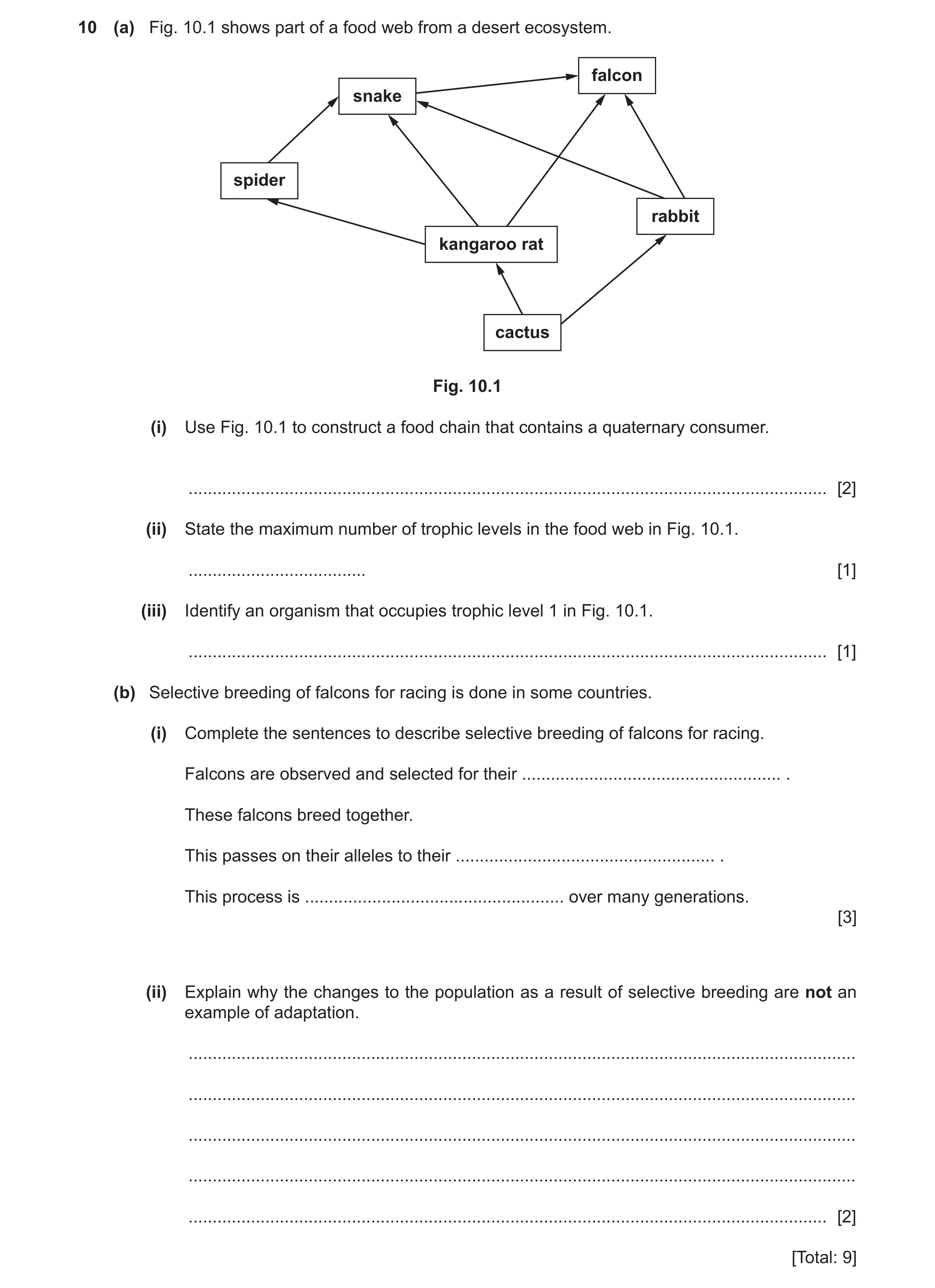
Q9 · Part of a food web from a desert ecosystem 0654/43 May/June 2024
10 (a) Fig. 10.1 shows part of a food web from a desert ecosystem. falcon snake spider rabbit kangaroo rat cactus Fig. 10.1 (i) Use Fig. 10.1 to construct a food chain that contains a quaternary consumer. … [2] (ii) State the maximum number of trophic levels in the food web in Fig. 10.1. … [1] (iii) Identify an organism that occupies trophic level 1 in Fig. 10.1. … [1] (b) Selective breeding of falcons for racing is done in some countries. (i) Complete the sentences to describe selective breeding of falcons for racing. Falcons are observed and selected for their … . These falcons breed together. This passes on their alleles to their … . This process is … over many generations. [3] (ii) Explain why the changes to the population as a result of selective breeding are not an example of adaptation. … … … … … [2] [Total: 9]
9 marks
Mark scheme: 10(a)(i) cactus→kangaroo rat→spider→snake→falcon ;; 2 10(a)(ii) 5 ; 1 10(a)(iii) cactus ; 1 10(b)(i) speed / desirable features ; offspring ; repeated ; 3 Question Answer Marks 10(b)(ii) changes are not caused by natural selection ; population is not more suited to its environment / no change in adaptive features ; 2
This question in 0654/43 May/June 2024
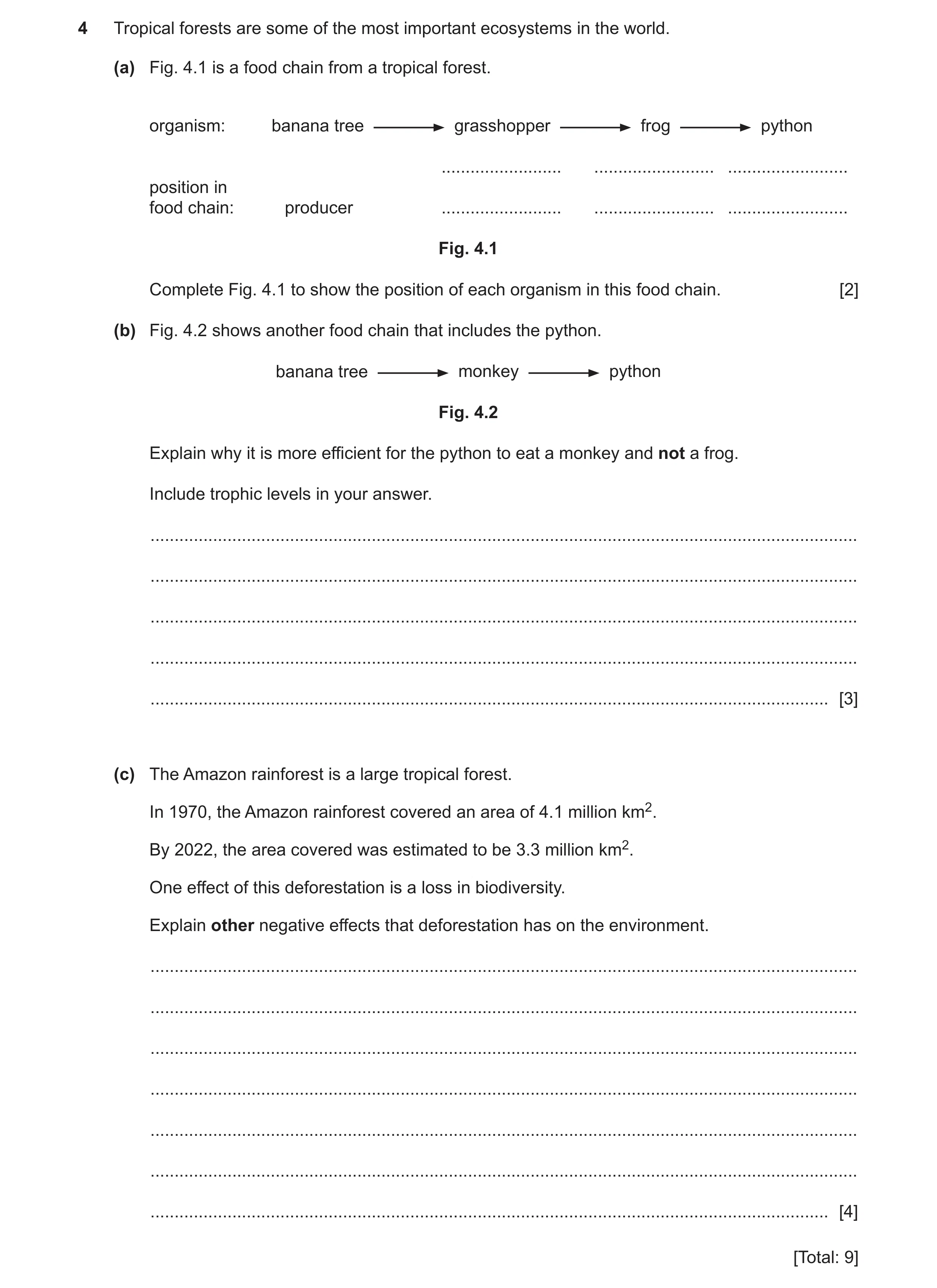
Q10 · Tropical forests are some of the most important ecosystems in the world 0654/41 May/June 2025
4 Tropical forests are some of the most important ecosystems in the world. (a) Fig. 4.1 is a food chain from a tropical forest. organism: banana tree grasshopper frog python … … … position in food chain: producer … … … Fig. 4.1 Complete Fig. 4.1 to show the position of each organism in this food chain. [2] (b) Fig. 4.2 shows another food chain that includes the python. banana tree monkey python Fig. 4.2 Explain why it is more efficient for the python to eat a monkey and not a frog. Include trophic levels in your answer. … … … … … [3] (c) The Amazon rainforest is a large tropical forest. In 1970, the Amazon rainforest covered an area of 4.1 million km2. By 2022, the area covered was estimated to be 3.3 million km2. One effect of this deforestation is a loss in biodiversity. Explain other negative effects that deforestation has on the environment. … … … … … … … [4] [Total: 9]
9 marks
Mark scheme: 4(a) grasshopper frog python 2 primary secondary tertiary or apex consumer consumer consumer predator ;; 4(b) energy is lost between trophic levels / idea that less energy will be lost ; 3 example of energy loss ; monkeys are primary consumers / frogs are higher along the food chain / idea of fewer trophic levels ; 4(c) 4 Effect (max. two) Explanation soil erosion / loss of soil / soil less lack of roots which hold soil in place fertile / landslides / flooding ; ; flooding ; silting up of rivers / rain not dispersed by roots / vegetation not there to slow flow ; loss of soil quality ; disruption of nutrient cycles / lack of humus ; reduced rainfall ; decreased transpiration from leaves ; increase of CO2 in reduced photosynthesis / less trees atmosphere / global to absorb CO2 / burning of trees ; warming / climate change ; increased air pollution ; burning of trees ; extinction ; loss of habitat/foods sources / shelter / breeding grounds ; eutrophication ; soil erosion and runoff (of minerals / nutrients) ;
This question in 0654/41 May/June 2025
Q11 · A diagram showing some of the organisms in the Arctic ecosystem 0654/41 Oct/Nov 2025
3 Fig. 3.1 is a diagram showing some of the organisms in the Arctic ecosystem. polar bear gull seal little auk fish squid amphipods shrimps copepods phytoplankton Fig. 3.1 (a) (i) State the name of the type of diagram shown in Fig. 3.1. … [1] (ii) Identify the producer in Fig. 3.1. … [1] (iii) Identify one organism that occupies the second trophic level in Fig. 3.1. … [1] (iv) Identify one organism that is both a secondary and a tertiary consumer in Fig. 3.1. … [1] (v) The squid is a carnivore. Describe what is meant by the term carnivore. … … [1] (vi) Explain why the energy transfer from one trophic level to another is not efficient. … … … … … [2] (b) Deforestation on land can lead to a loss of soil as shown in Fig. 3.2. Fig. 3.2 (i) Explain how deforestation can increase the concentration of carbon dioxide in the atmosphere. … … … … … [2] (ii) Explain how deforestation can lead to flooding. … … … … … [2] [Total: 11]
11 marks
Mark scheme: 3(a)(i) food web ; 1 3(a)(ii) phytoplankton ; 1 3(a)(iii) copepods ; 1 3(a)(iv) (little) auk / fish ; 1 3(a)(v) (an animal that) gets its energy by eating (other) animals ; 1 3(a)(vi) (energy ‘lost’ by) 2 any two from: • egestion / faeces / indigestible material ; • respiration / heat loss ; • movement / muscle contraction ; • excretion ; • (there are) inedible parts / (there are) bones / (there are) teeth ; • AVP ; 3(b)(i) any two from 2 • (idea that as there are no or fewer trees so) no or less absorption of carbon dioxide OR (idea that as there are no or fewer trees so) no or less taking in of carbon dioxide; • no photosynthesis / less photosynthesis ; • carbon dioxide released by, combustion / burning / decomposition (of trees) / decomposition (of wood) ; 3(b)(ii) any two from: 2 • no or less roots or trees to hold or bind soil ; • no or less water absorbed by the roots or trees or soil OR increase in runoff ; • (increase in) deposition of soil into rivers ;
This question in 0654/41 Oct/Nov 2025
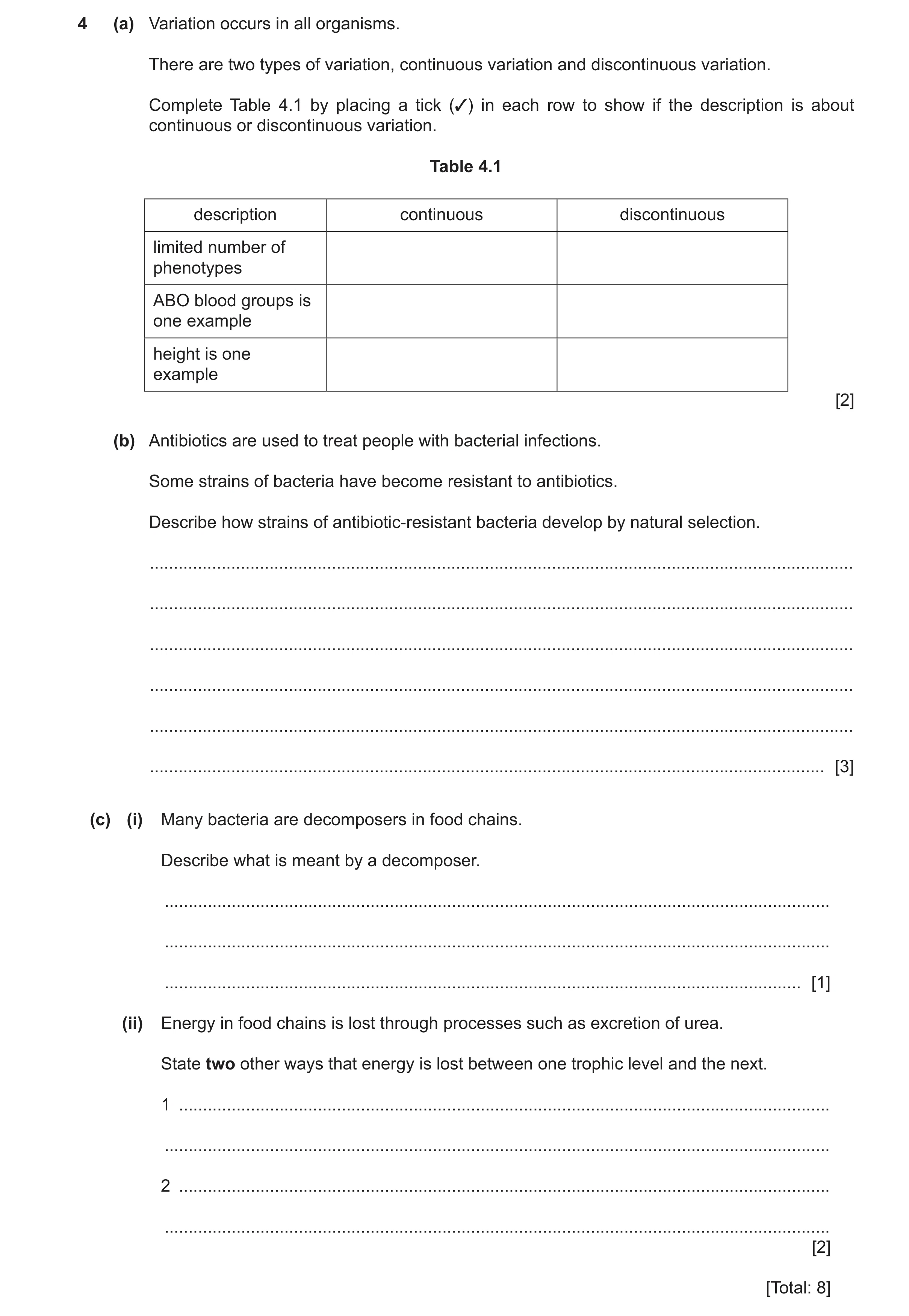
Q12 · Variation occurs in all organisms 0654/43 Oct/Nov 2025
4 (a) Variation occurs in all organisms. There are two types of variation, continuous variation and discontinuous variation. Complete Table 4.1 by placing a tick (3) in each row to show if the description is about continuous or discontinuous variation. Table 4.1 description continuous discontinuous limited number of phenotypes ABO blood groups is one example height is one example [2] (b) Antibiotics are used to treat people with bacterial infections. Some strains of bacteria have become resistant to antibiotics. Describe how strains of antibiotic-resistant bacteria develop by natural selection. … … … … … … [3] (c) (i) Many bacteria are decomposers in food chains. Describe what is meant by a decomposer. … … … [1] (ii) Energy in food chains is lost through processes such as excretion of urea. State two other ways that energy is lost between one trophic level and the next. 1 … … 2 … … [2] [Total: 8]
8 marks
Mark scheme: 4(a) 2 description continuous discontinuous limited number of ✓ phenotypes ABO blood groups is ✓ one example height is one ✓ example 3 correct for 2 marks 2 correct for 1 mark 4(b) some bacteria mutate and become resistant (to antibiotics) ; 3 (idea that these bacteria) survive and divide / reproduce ; pass on alleles (for antibiotic resistance to offspring) ; 4(c)(i) an organism that gets its energy from dead or waste organic material ; 1 4(c)(ii) any two from: 2 • egestion / faeces / indigestible material ; • respiration / heat (loss) ; • movement / muscle contraction ; • (there are), inedible parts / bones / teeth ; • AVP ;
This question in 0654/43 Oct/Nov 2025
 14 / 19
 15 / 19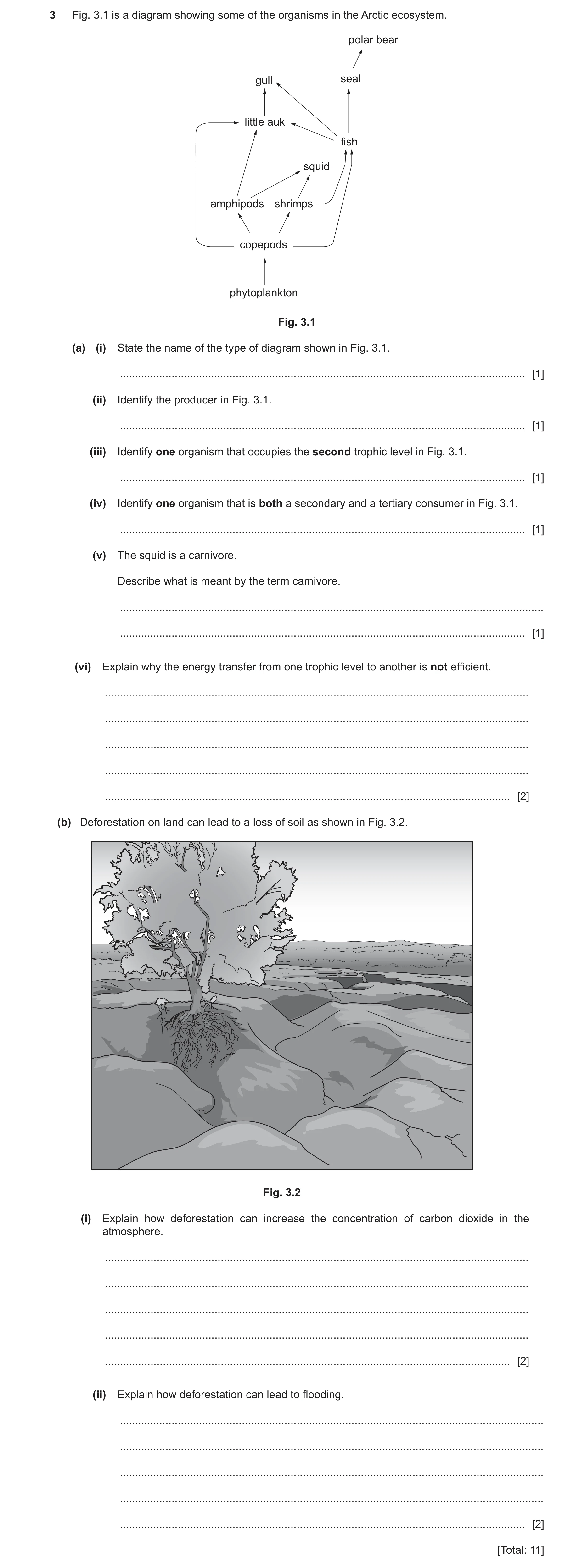
 8
8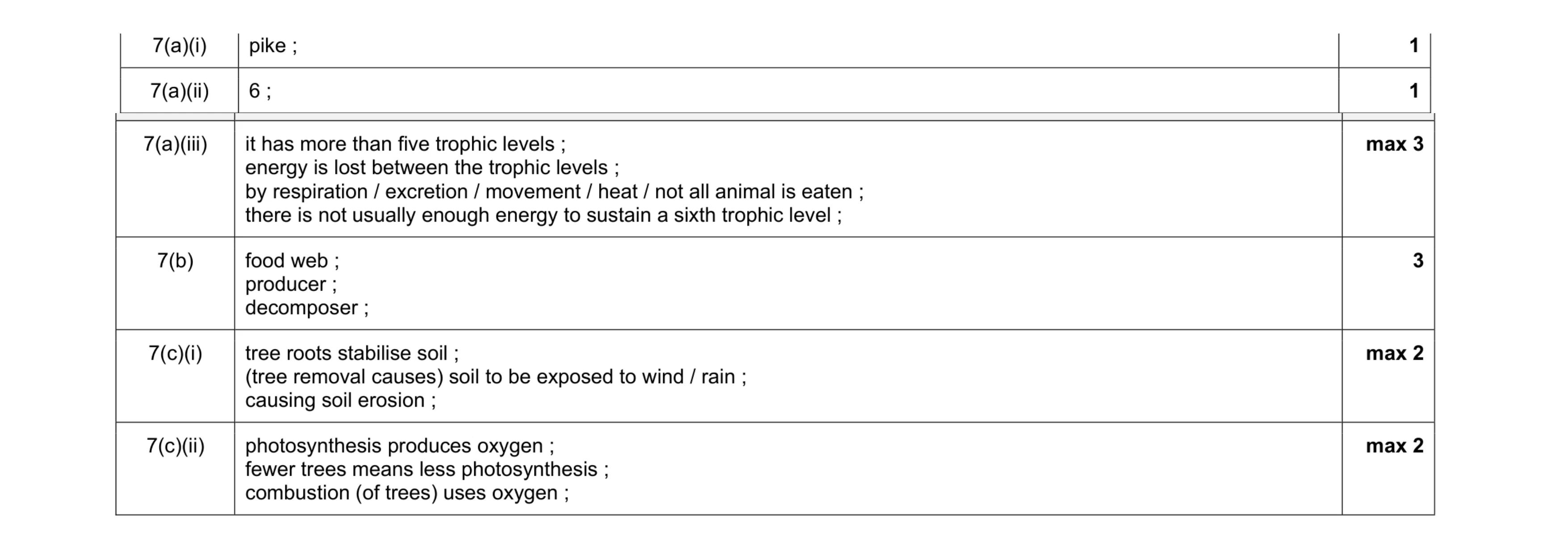 12
12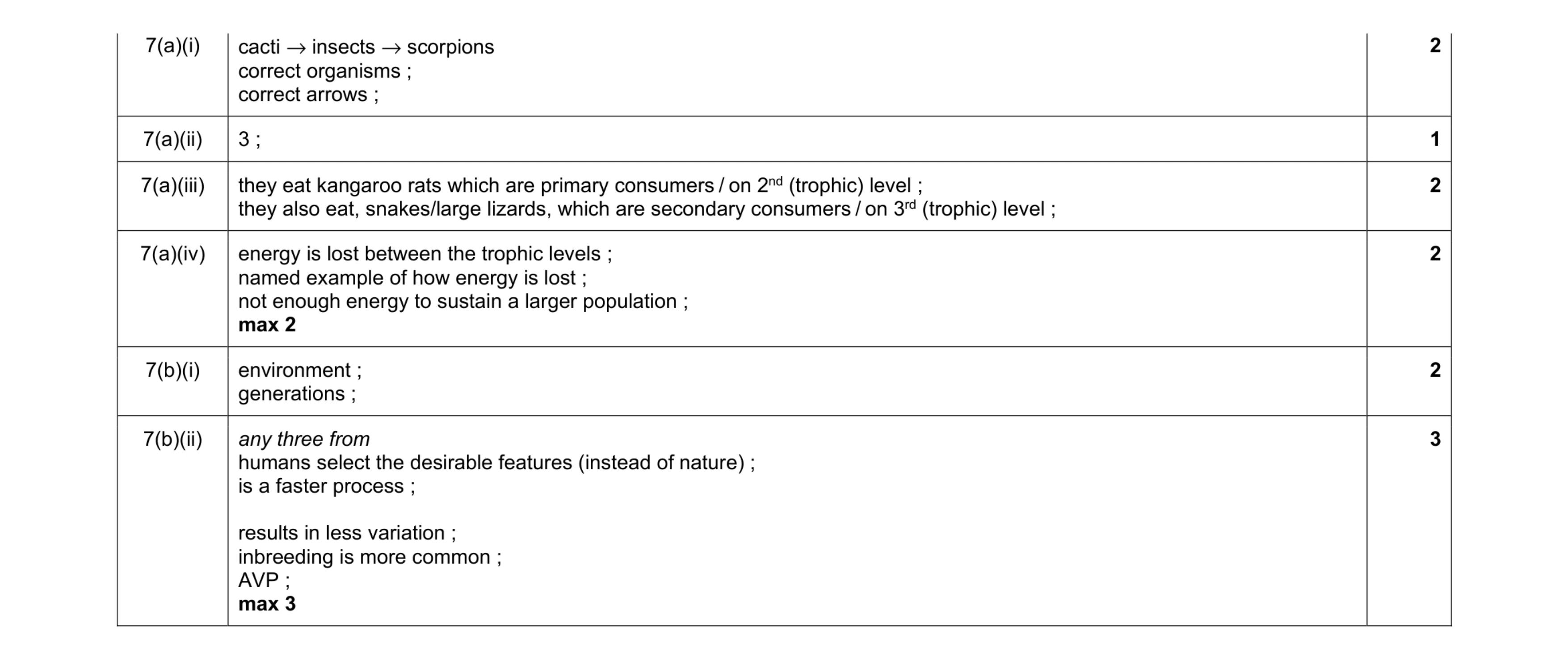 12
12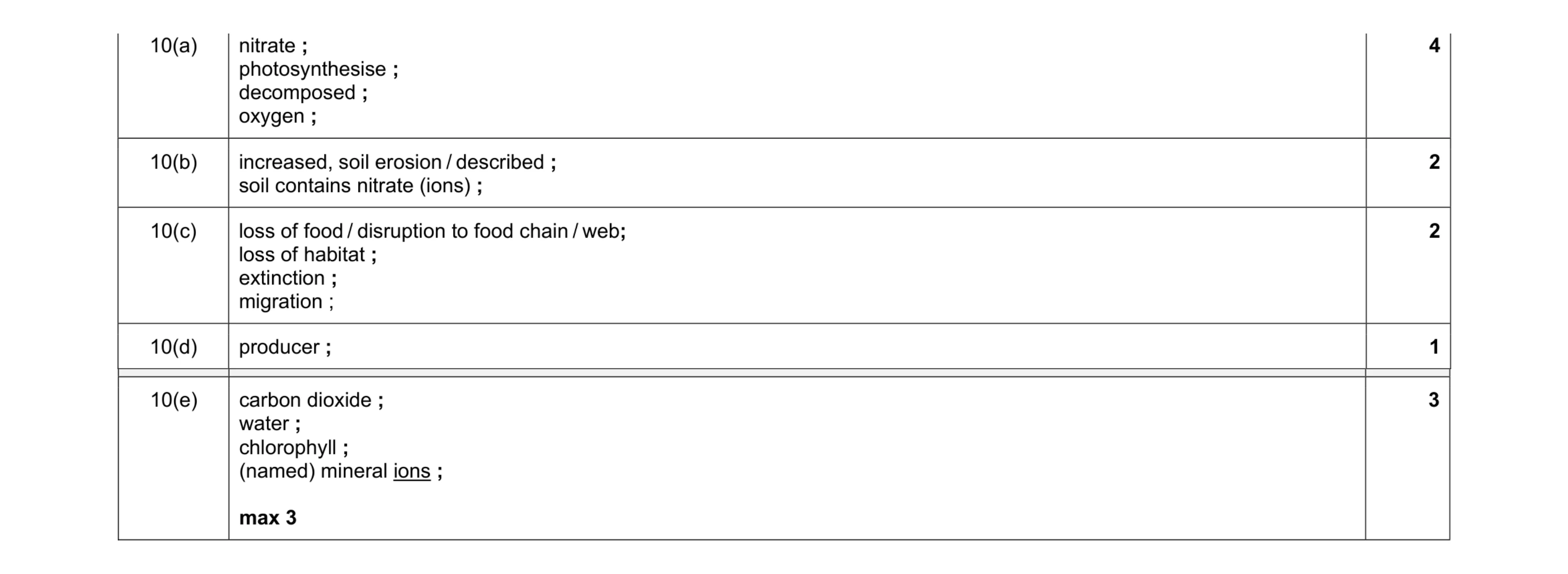 12
12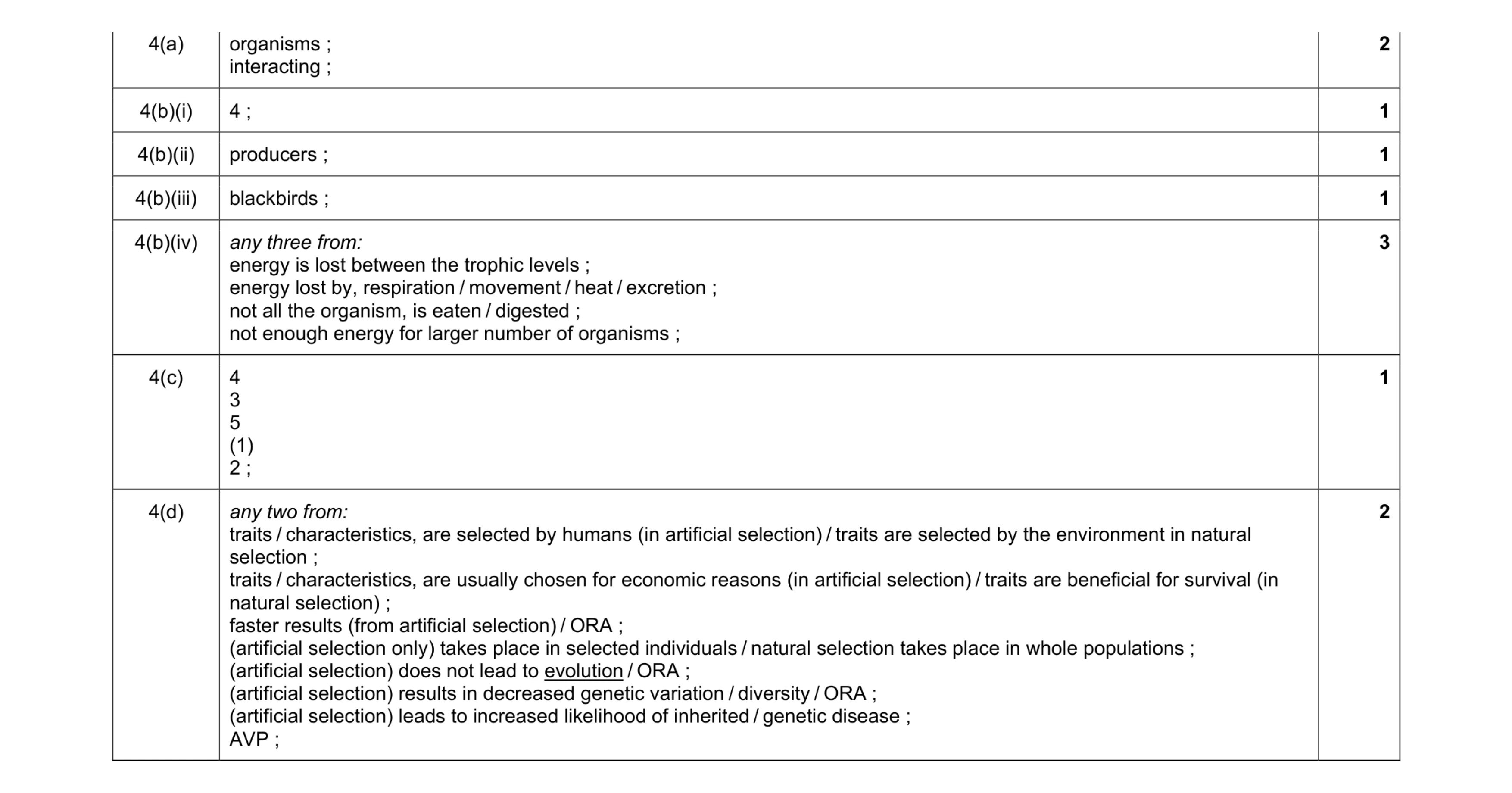 11
11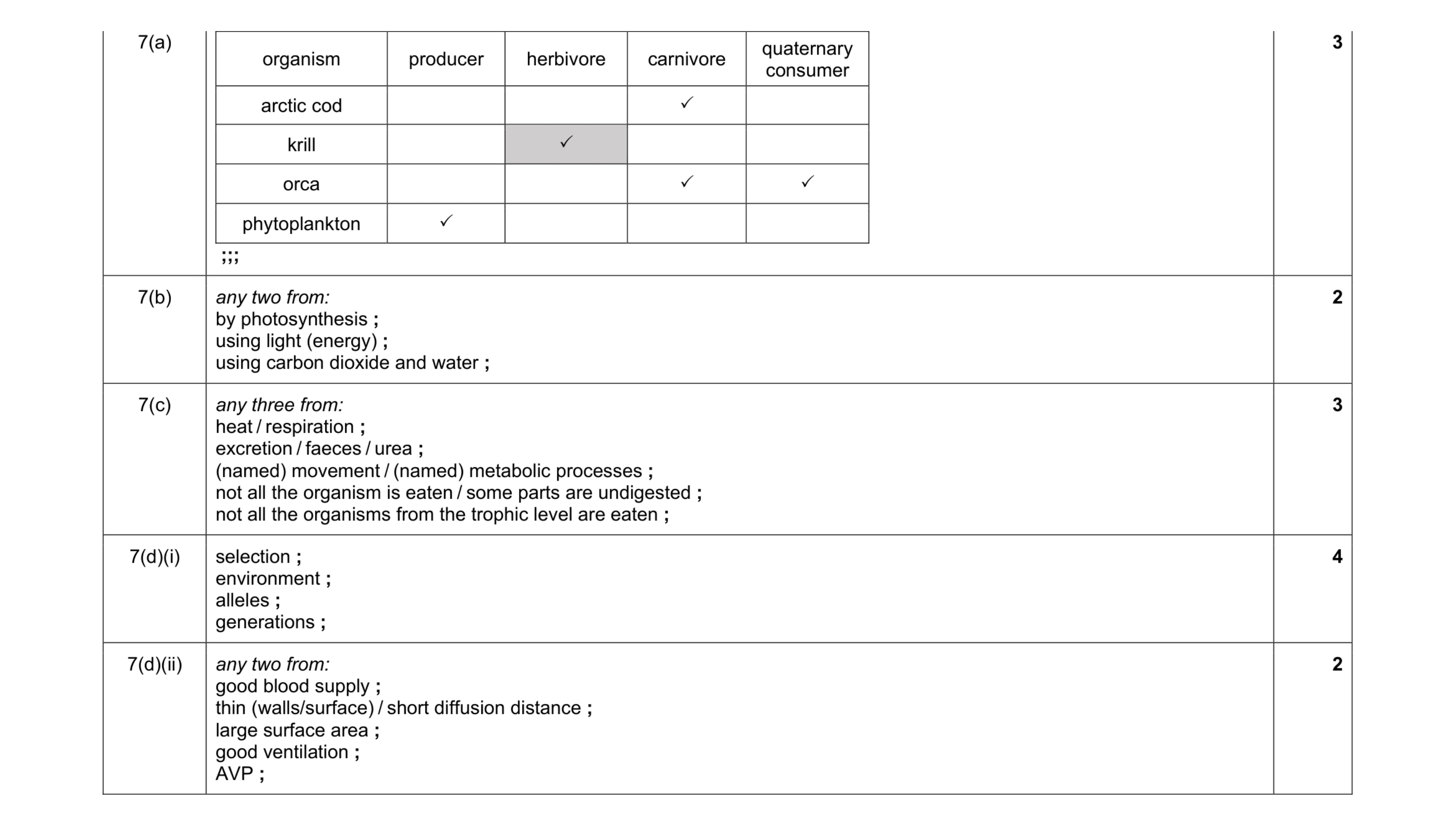 14
14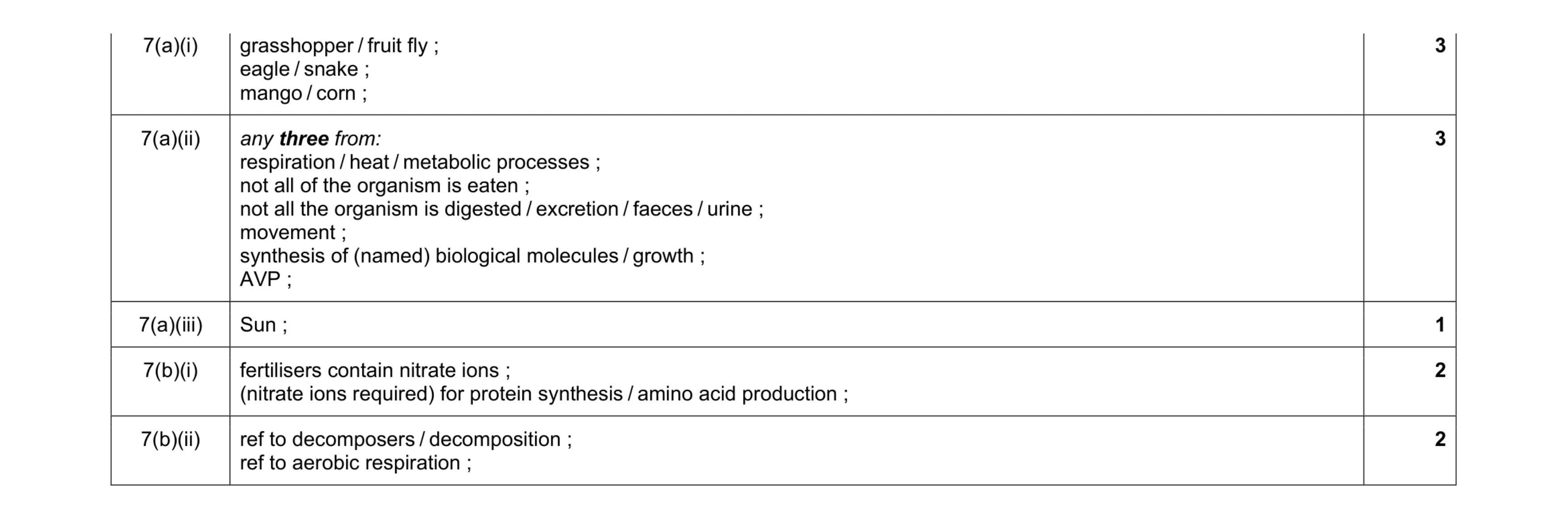 11
11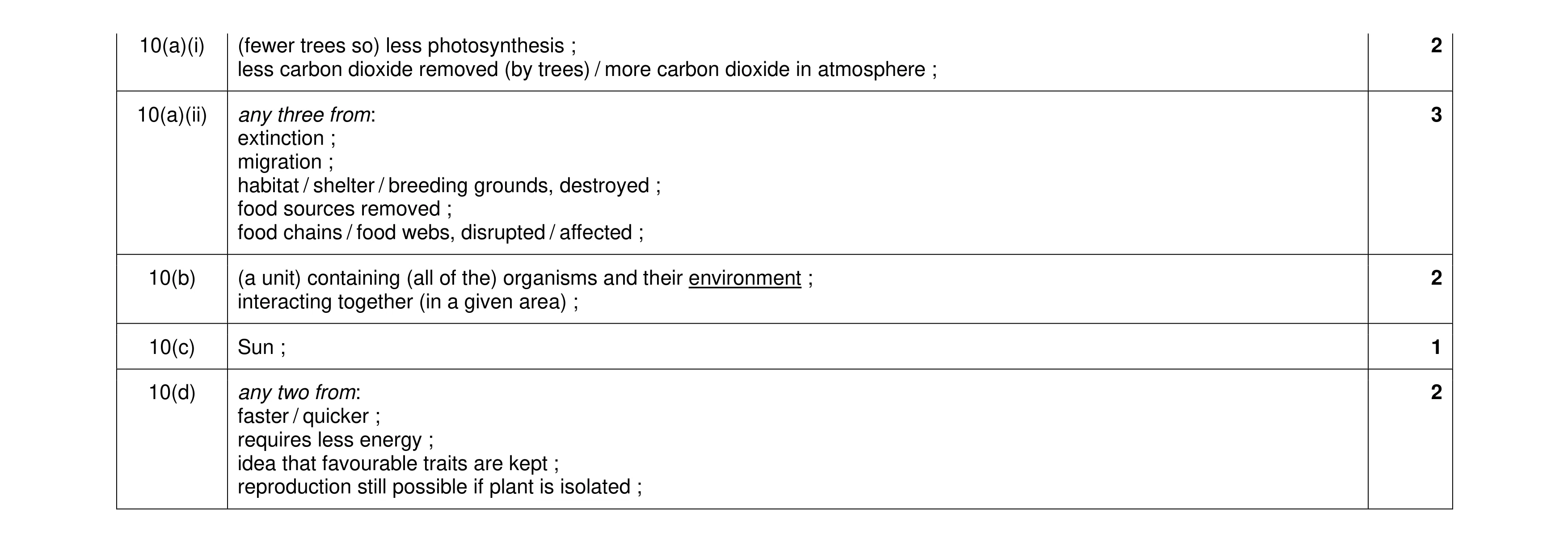 10
10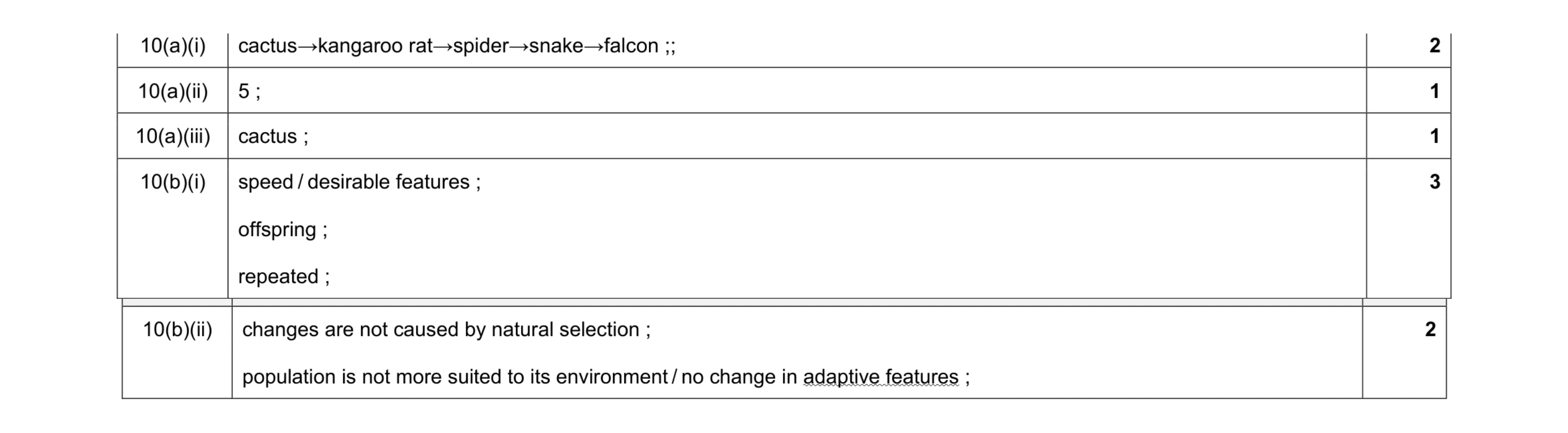 9
9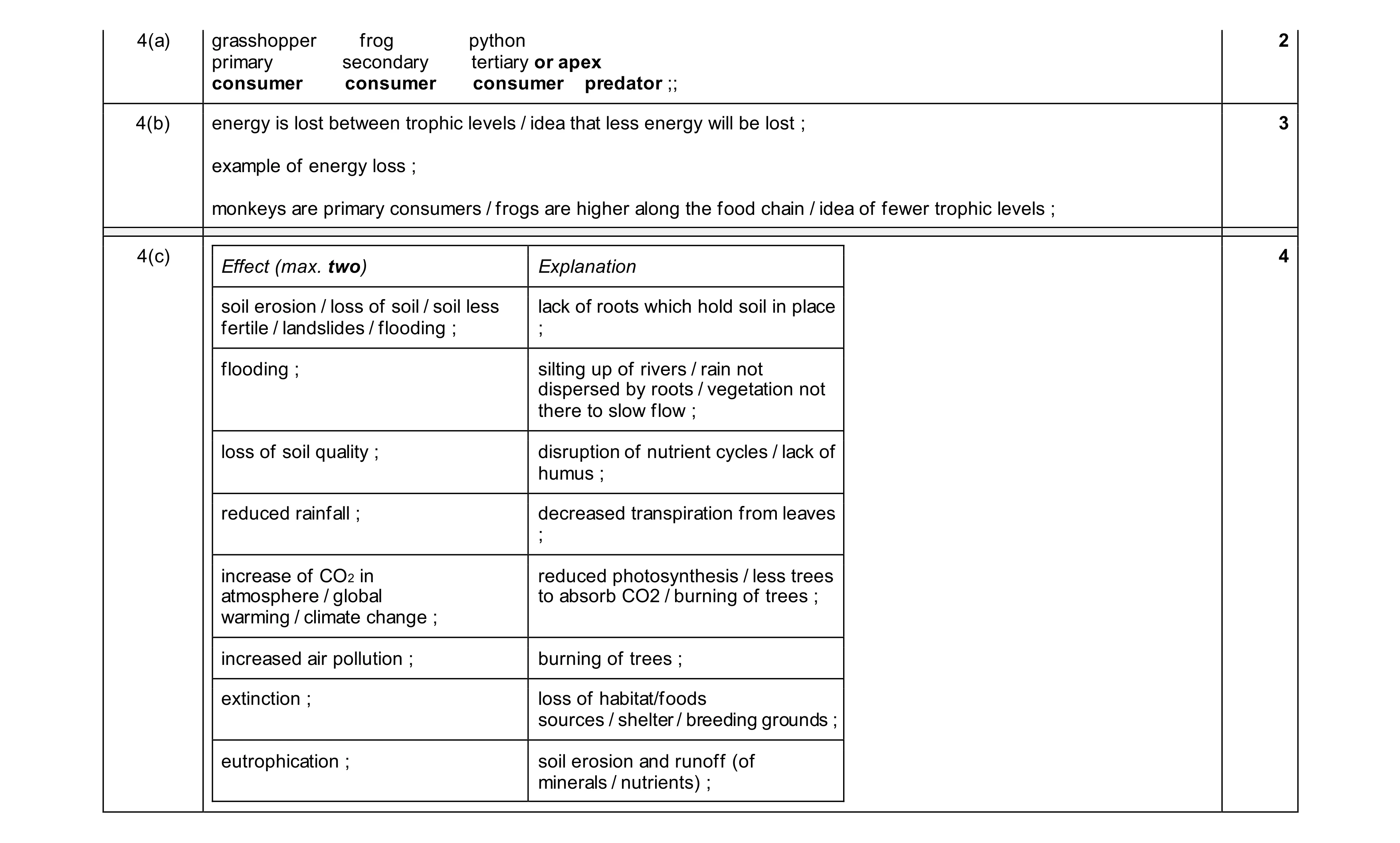 9
9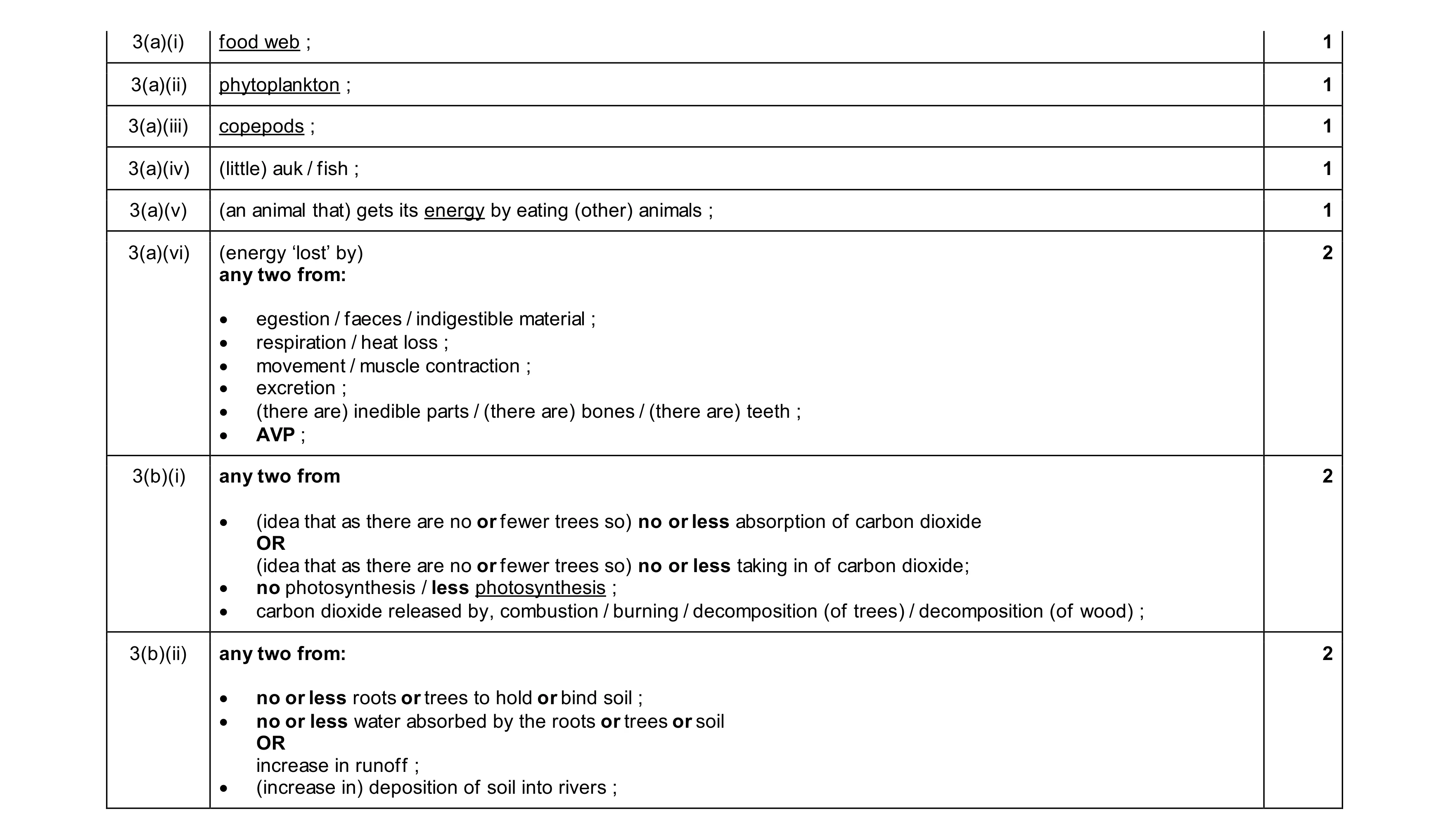 11
11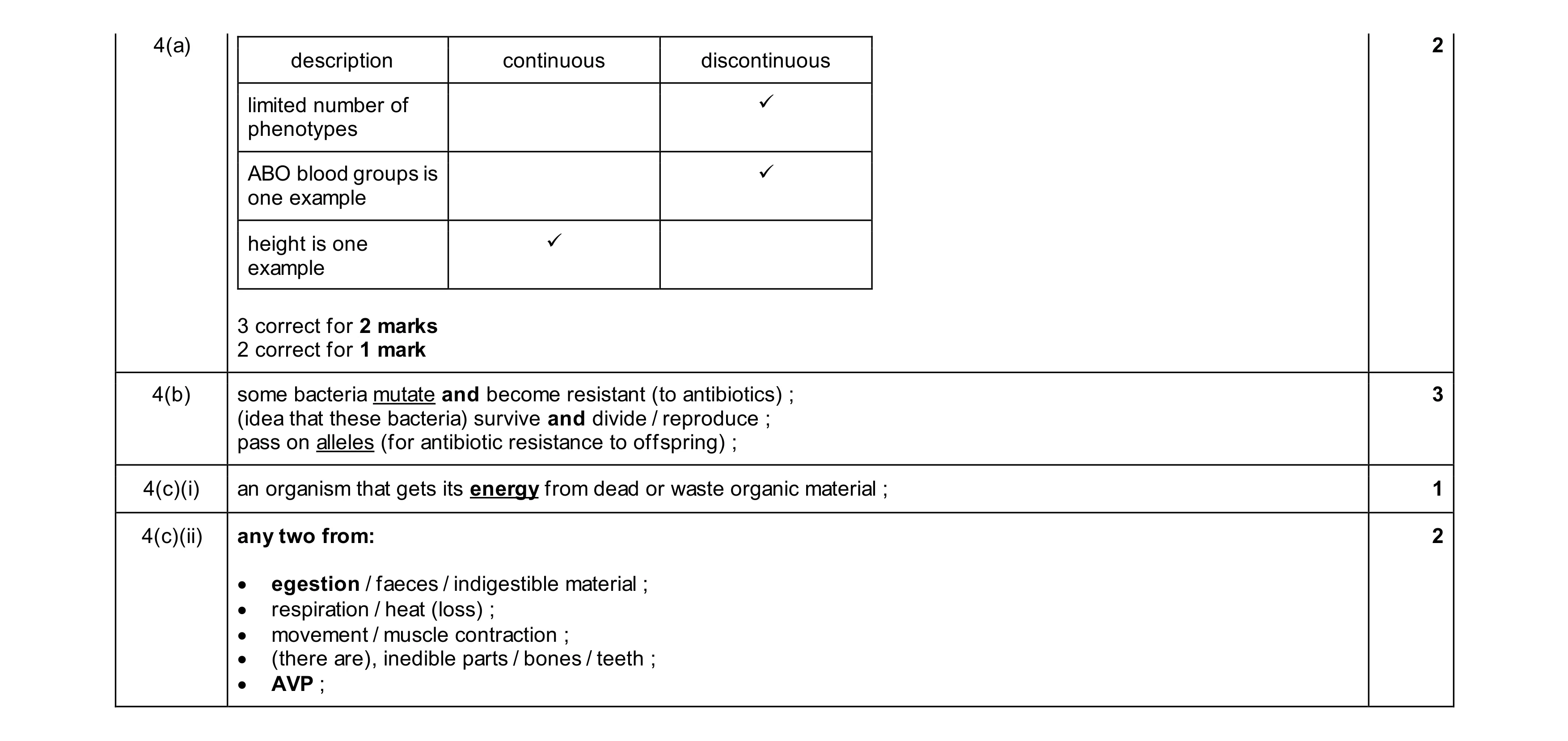 8
8