Questions as text
Q1 · A student investigates the respiration rate of germinating seeds using the apparatus… 0654/41 May/June 2017
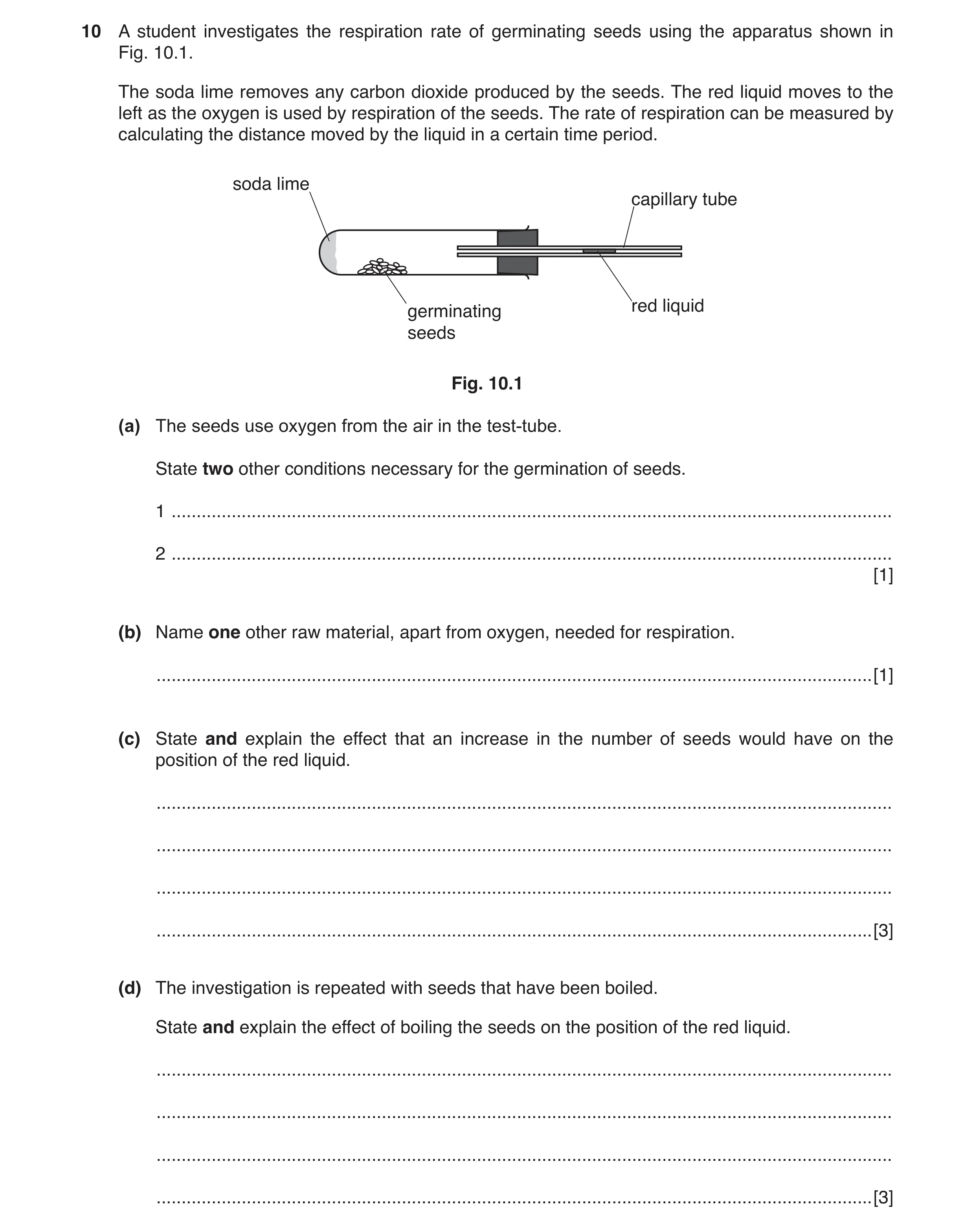
10 A student investigates the respiration rate of germinating seeds using the apparatus shown in Fig. 10.1. The soda lime removes any carbon dioxide produced by the seeds. The red liquid moves to the left as the oxygen is used by respiration of the seeds. The rate of respiration can be measured by calculating the distance moved by the liquid in a certain time period. soda lime capillary tube red liquid germinating seeds Fig. 10.1 (a) The seeds use oxygen from the air in the test-tube. State two other conditions necessary for the germination of seeds. 1 … 2 … [1] (b) Name one other raw material, apart from oxygen, needed for respiration. … [1] (c) State and explain the effect that an increase in the number of seeds would have on the position of the red liquid. … … … … [3] (d) The investigation is repeated with seeds that have been boiled. State and explain the effect of boiling the seeds on the position of the red liquid. … … … … [3]
8 marks
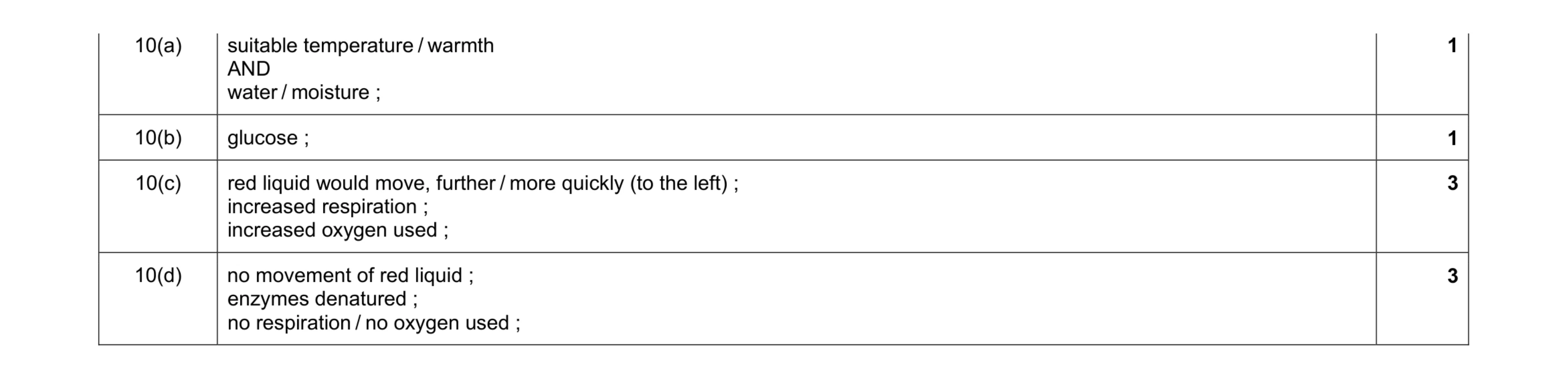
Mark scheme: 10(a) suitable temperature / warmth AND water / moisture ; 1 10(b) glucose ; 1 10(c) red liquid would move, further / more quickly (to the left) ; increased respiration ; increased oxygen used ; 3 10(d) no movement of red liquid ; enzymes denatured ; no respiration / no oxygen used ; 3
This question in 0654/41 May/June 2017
Q2 · A diagram of a grass flower 0654/42 May/June 2017
8 (a) Fig. 8.1 shows a diagram of a grass flower. Grass is an example of a wind-pollinated plant. X Y ovary Fig. 8.1 (i) Name the parts of the flower labelled X and Y. X … Y … [2] (ii) Describe how the following parts of the flower would be different in an insect-pollinated plant. petals … pollen … [2] (b) Pollen is the male sex gamete in plants. Name the process which produces gametes. … [1] (c) In insect-pollinated plants, pollen is transferred by insects to other plants, which may result in fertilisation. This is an example of sexual reproduction. State one advantage and one disadvantage of sexual reproduction. advantage … … disadvantage … … [2] (d) After sexual reproduction, seeds are produced. Seeds are dispersed so that plants can colonise new areas. Describe two ways in which seeds can be dispersed by animals. … … … [2]
9 marks
Mark scheme: 8(a)(i) X anther ; Y stigma ; 2 8(a)(ii) petals larger / brightly coloured ; pollen larger / fewer / rougher surface ; 2 8(b) meiosis ; 1 8(c) advantage genetic variation ; disadvantage two parents needed ; fertilisation is random / mutations can occur ; take more, time / energy ; max 2 8(d) attach to animals, coat / fur / hair ; eaten by animals, dispersed in faeces ; AVP ; max 2
This question in 0654/42 May/June 2017
Q3 · Table 7.1 lists different parts of a flower and their functions 0654/43 Oct/Nov 2017
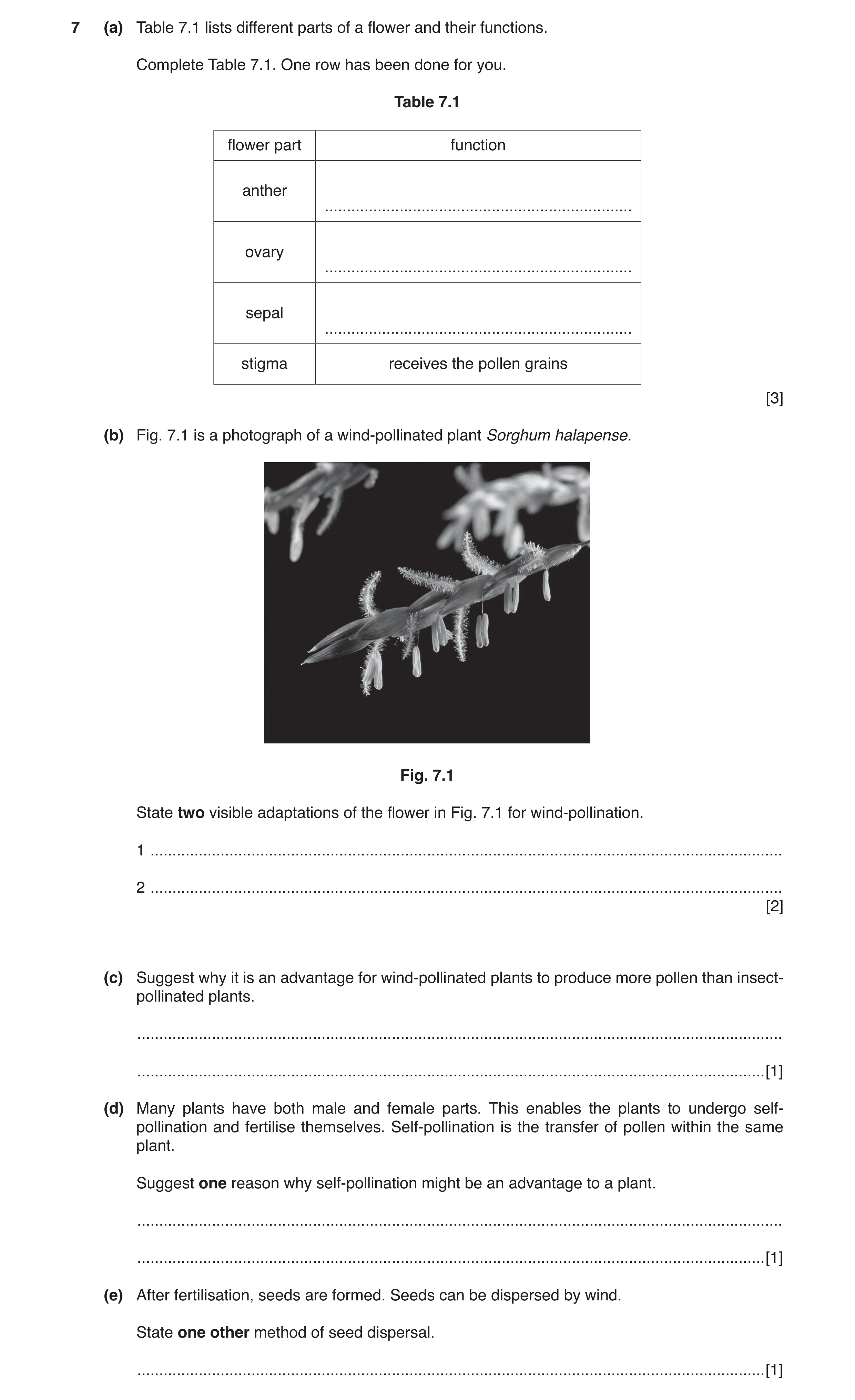
7 (a) Table 7.1 lists different parts of a flower and their functions. Complete Table 7.1. One row has been done for you. Table 7.1 flower part function anther … ovary … sepal … stigma receives the pollen grains [3] (b) Fig. 7.1 is a photograph of a wind-pollinated plant Sorghum halapense. Fig. 7.1 State two visible adaptations of the flower in Fig. 7.1 for wind-pollination. 1 … 2 … [2] (c) Suggest why it is an advantage for wind-pollinated plants to produce more pollen than insect- pollinated plants. … … [1] (d) Many plants have both male and female parts. This enables the plants to undergo self- pollination and fertilise themselves. Self-pollination is the transfer of pollen within the same plant. Suggest one reason why self-pollination might be an advantage to a plant. … … [1] (e) After fertilisation, seeds are formed. Seeds can be dispersed by wind. State one other method of seed dispersal. … [1]
8 marks
Mark scheme: 7(a) anther produces / releases pollen ; ovary produces ovule ; sepal protects flower bud ; 3 7(b) large stigma ; feathery stigma ; long filament(s) ; stigma (hanging) outside flower ; anther / stamen, (hanging) outside flower ; max 2 7(c) more pollen, wasted / lost, in wind pollination / more chance of landing on plant / stigma / fertilising / ORA ; 1 7(d) (can reproduce even if) plant isolated / no other plants near / lack of pollinators / prevent extinction ; 1 7(e) animal / AVP ; 1
This question in 0654/43 Oct/Nov 2017
Q4 · A diagram of an insect-pollinated flower 0654/42 Oct/Nov 2018
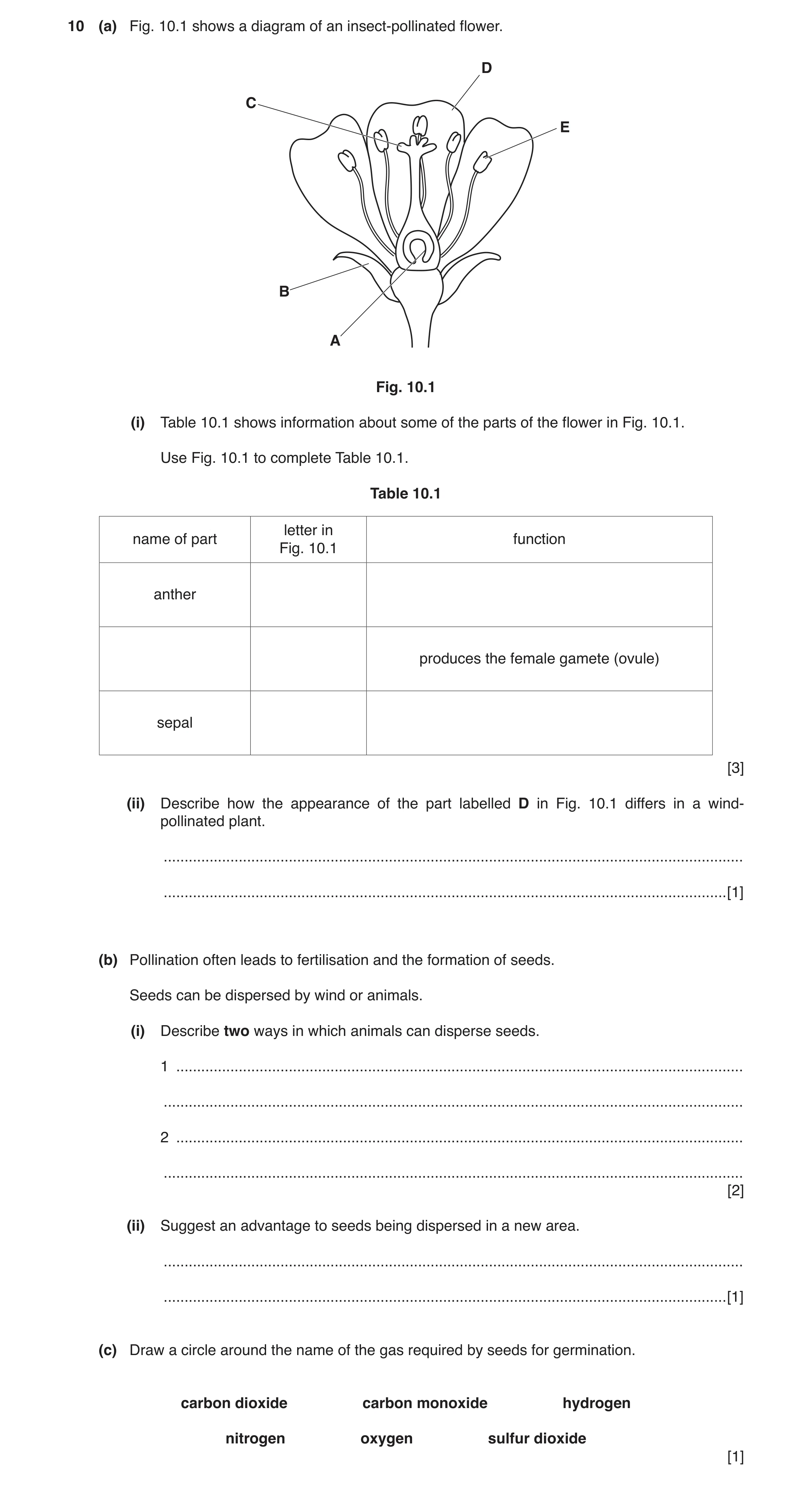
10 (a) Fig. 10.1 shows a diagram of an insect-pollinated flower. D C E B A Fig. 10.1 (i) Table 10.1 shows information about some of the parts of the flower in Fig. 10.1. Use Fig. 10.1 to complete Table 10.1. Table 10.1 letter in name of part function Fig. 10.1 anther produces the female gamete (ovule) sepal [3] (ii) Describe how the appearance of the part labelled D in Fig. 10.1 differs in a wind- pollinated plant. … … [1] (b) Pollination often leads to fertilisation and the formation of seeds. Seeds can be dispersed by wind or animals. (i) Describe two ways in which animals can disperse seeds. 1 … … 2 … … [2] (ii) Suggest an advantage to seeds being dispersed in a new area. … … [1] (c) Draw a circle around the name of the gas required by seeds for germination. carbon dioxide carbon monoxide hydrogen nitrogen oxygen sulfur dioxide [1]
8 marks
Mark scheme: 10(a)(i) name of part letter in Fig 10.1 function anther E produces pollen / male gamete ovary A produces the female gamete (ovule) sepal B protect flower in bud / AW 1 row correct ; 2 rows correct ; 3 rows correct ; 3 10(a)(ii) smaller / absent / dull-coloured ; 1 10(b)(i) attached to, fur / hair ; eaten by animals and egested in faeces / droppings ; AVP ; max 2 10(b)(ii) less competition / more space / more nutrients / more water / more sunlight ; 1 10(c) oxygen circled ; 1
This question in 0654/42 Oct/Nov 2018
Q5 · A photomicrograph of pollen from an insect-pollinated plant 0654/42 May/June 2020
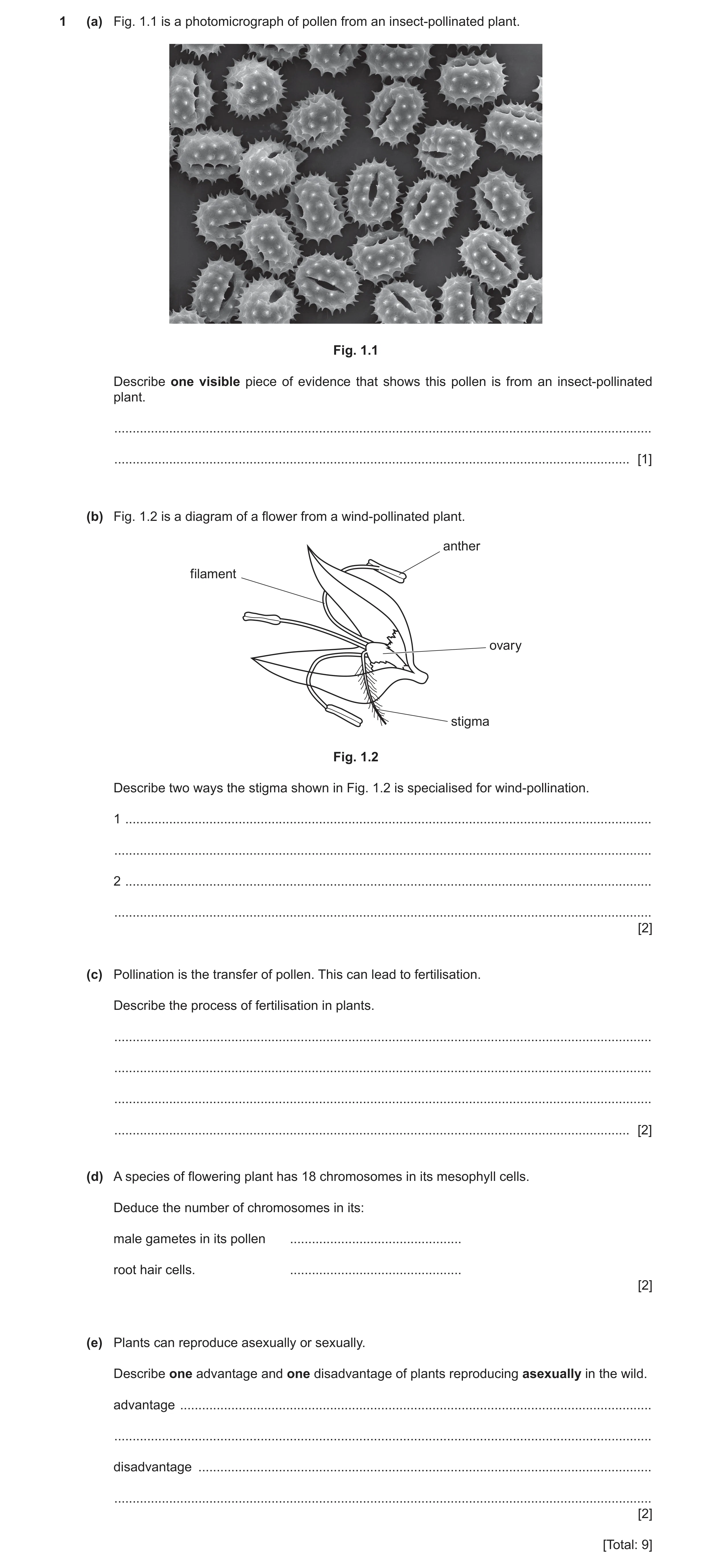
1 (a) Fig. 1.1 is a photomicrograph of pollen from an insect-pollinated plant. Fig. 1.1 Describe one visible piece of evidence that shows this pollen is from an insect-pollinated plant. … … [1] (b) Fig. 1.2 is a diagram of a flower from a wind-pollinated plant. anther filament ovary stigma Fig. 1.2 Describe two ways the stigma shown in Fig. 1.2 is specialised for wind-pollination. 1 … … 2 … … [2] (c) Pollination is the transfer of pollen. This can lead to fertilisation. Describe the process of fertilisation in plants. … … … … [2] (d) A species of flowering plant has 18 chromosomes in its mesophyll cells. Deduce the number of chromosomes in its: male gametes in its pollen … root hair cells. … [2] (e) Plants can reproduce asexually or sexually. Describe one advantage and one disadvantage of plants reproducing asexually in the wild. advantage … … disadvantage … … [2] [Total: 9]
9 marks
Mark scheme: 1(a) spiky (surface) ; 1 1(b) stigma feathery ; stigma hangs outside flower ; 2 1(c) fusion of nuclei ; ref to pollen and ovule ; 2 1(d) 9 ; 18 ; 2 1(e) advantage fast / colonise areas quickly / only requires one parent ; disadvantage no variety / more prone to extinction / more susceptible to disease ; 2
This question in 0654/42 May/June 2020
Q6 · A photograph of wind‑pollinated flowers 0654/41 Oct/Nov 2020
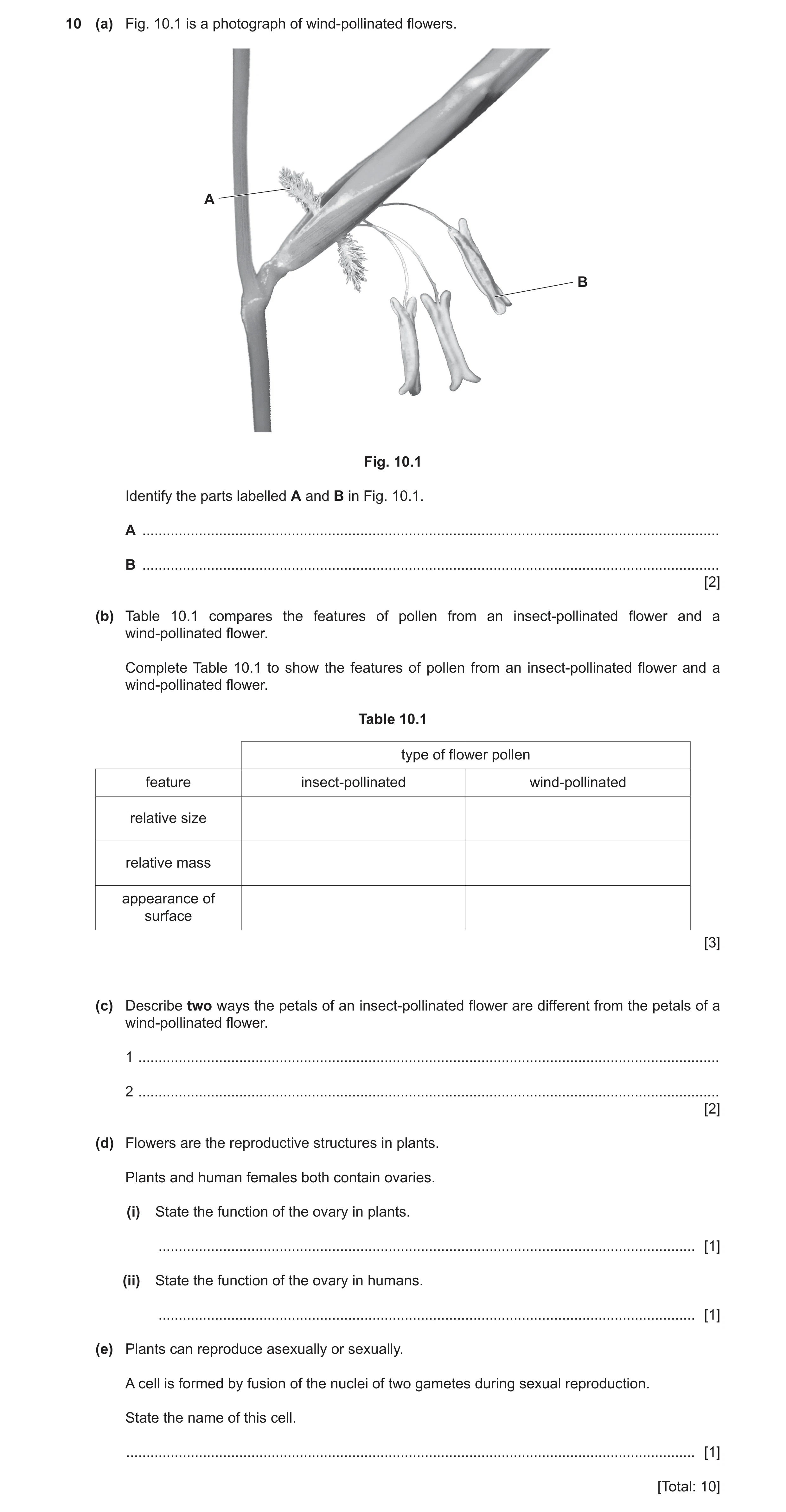
10 (a) Fig. 10.1 is a photograph of wind‑pollinated flowers. A B Fig. 10.1 Identify the parts labelled A and B in Fig. 10.1. A … B … [2] (b) Table 10.1 compares the features of pollen from an insect‑pollinated flower and a wind‑pollinated flower. Complete Table 10.1 to show the features of pollen from an insect‑pollinated flower and a wind‑pollinated flower. Table 10.1 type of flower pollen feature insect‑pollinated wind‑pollinated relative size relative mass appearance of surface [3] (c) Describe two ways the petals of an insect‑pollinated flower are different from the petals of a wind‑pollinated flower. 1 … 2 … [2] (d) Flowers are the reproductive structures in plants. Plants and human females both contain ovaries. (i) State the function of the ovary in plants. … [1] (ii) State the function of the ovary in humans. … [1] (e) Plants can reproduce asexually or sexually. A cell is formed by fusion of the nuclei of two gametes during sexual reproduction. State the name of this cell. … [1] [Total: 10]
10 marks
Mark scheme: 10(a) A stigma ; B anther ; 2 10(b) type of plant feature insect-pollinated wind-pollinated relative size large small relative mass heavy light appearance of surface spiky smooth ;;; 3 Question Answer Marks 10(c) larger ; brightly coloured ; guidelines ; scent ; AVP ; max 2 2 10(d)(i) produce ovules ; 1 10(d)(ii) produce eggs / ova ; 1 10(e) zygote ; 1
This question in 0654/41 Oct/Nov 2020
Q7 · The effects of using fertilisers containing nitrate ions on the yield of pea plants 0654/42 Oct/Nov 2020
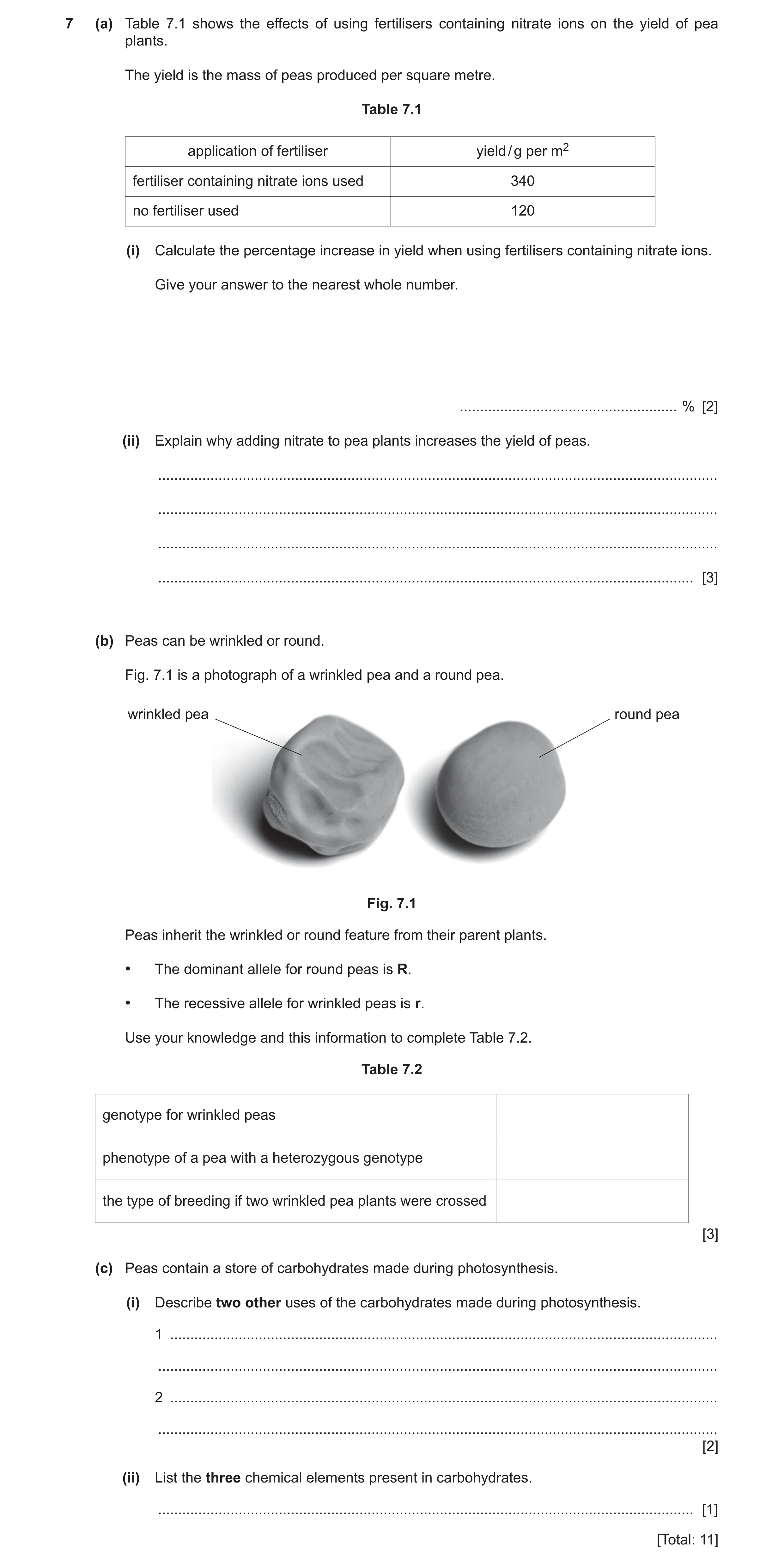
7 (a) Table 7.1 shows the effects of using fertilisers containing nitrate ions on the yield of pea plants. The yield is the mass of peas produced per square metre. Table 7.1 application of fertiliser yield / g per m2 fertiliser containing nitrate ions used 340 no fertiliser used 120 (i) Calculate the percentage increase in yield when using fertilisers containing nitrate ions. Give your answer to the nearest whole number. … % [2] (ii) Explain why adding nitrate to pea plants increases the yield of peas. … … … … [3] (b) Peas can be wrinkled or round. Fig. 7.1 is a photograph of a wrinkled pea and a round pea. wrinkled pea round pea Fig. 7.1 Peas inherit the wrinkled or round feature from their parent plants. • The dominant allele for round peas is R. • The recessive allele for wrinkled peas is r. Use your knowledge and this information to complete Table 7.2. Table 7.2 genotype for wrinkled peas phenotype of a pea with a heterozygous genotype the type of breeding if two wrinkled pea plants were crossed [3] (c) Peas contain a store of carbohydrates made during photosynthesis. (i) Describe two other uses of the carbohydrates made during photosynthesis. 1 … … 2 … … [2] (ii) List the three chemical elements present in carbohydrates. … [1] [Total: 11]
11 marks
Mark scheme: 7(a)(i) 340 – 120 or 220 (220 / 120) × 100 = 183(%) ;; 2 7(a)(ii) nitrate ions are needed to make, amino acids / proteins ; amino acids are needed for protein synthesis ; proteins are needed for growth which increases the yield ; 3 7(b) genotype for wrinkly peas rr ; phenotype of a heterozygous genotype round ; the type of breeding if two wrinkly pea plants were crossed pure ; 3 Question Answer Marks 7(c)(i) as a reactant for respiration / energy source ; used to make cellulose for cell walls ; converted to sucrose for transport ; AVP ;; max 2 2 7(c)(ii) carbon, hydrogen, oxygen ; 1
This question in 0654/42 Oct/Nov 2020
Q8 · A photograph of an insect-pollinated flower 0654/43 May/June 2021
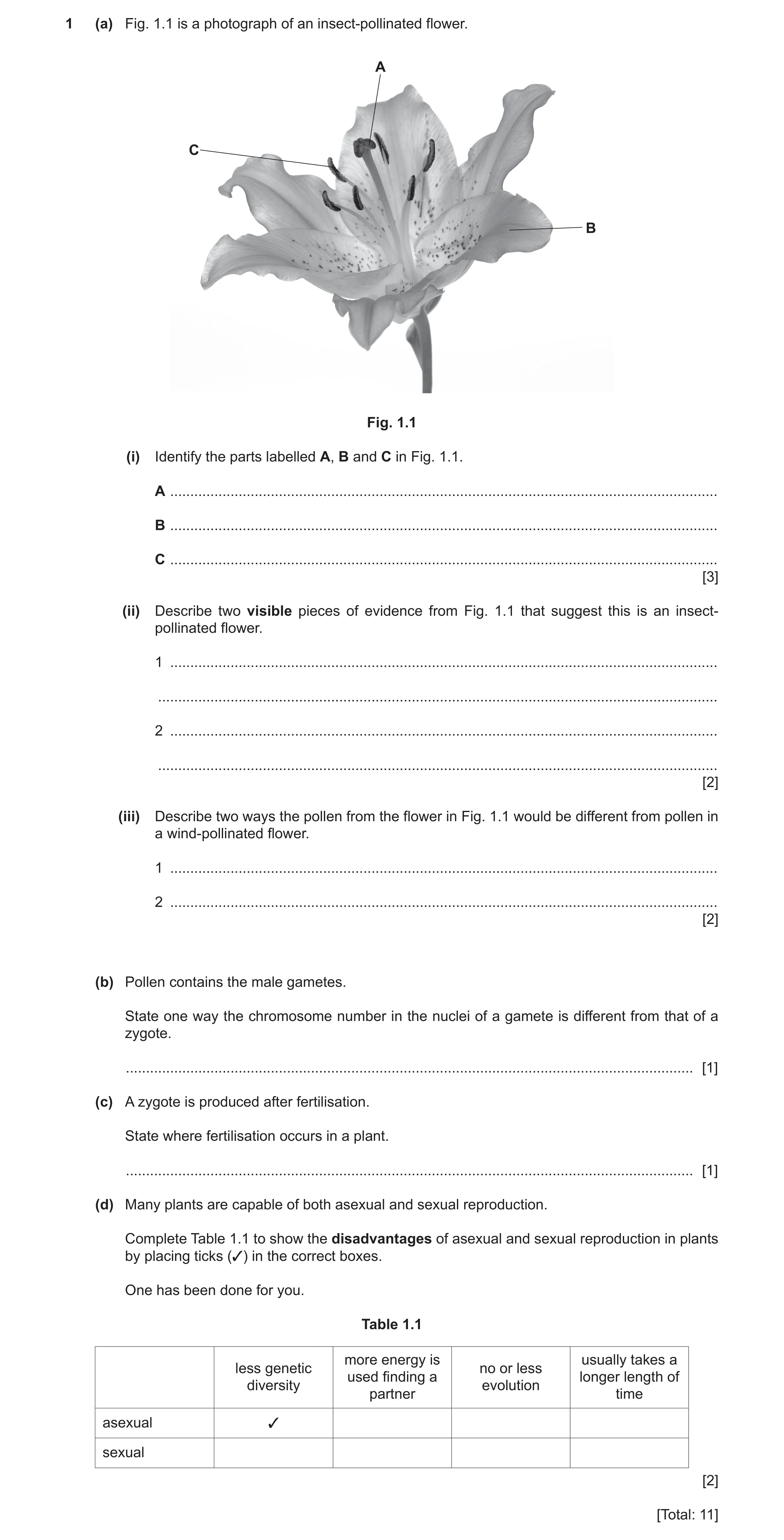
1 (a) Fig. 1.1 is a photograph of an insect-pollinated flower. A C B Fig. 1.1 (i) Identify the parts labelled A, B and C in Fig. 1.1. A … B … C … [3] (ii) Describe two visible pieces of evidence from Fig. 1.1 that suggest this is an insect- pollinated flower. 1 … … 2 … … [2] (iii) Describe two ways the pollen from the flower in Fig. 1.1 would be different from pollen in a wind-pollinated flower. 1 … 2 … [2] (b) Pollen contains the male gametes. State one way the chromosome number in the nuclei of a gamete is different from that of a zygote. … [1] (c) A zygote is produced after fertilisation. State where fertilisation occurs in a plant. … [1] (d) Many plants are capable of both asexual and sexual reproduction. Complete Table 1.1 to show the disadvantages of asexual and sexual reproduction in plants by placing ticks (3) in the correct boxes. One has been done for you. Table 1.1 more energy is usually takes a less genetic no or less used finding a longer length of diversity evolution partner time asexual 3 sexual [2] [Total: 11]
11 marks
Mark scheme: 1(a)(i) A stigma ; B petal ; C anther ; 3 1(a)(ii) (large) petal ; stigma inside of flower ; anther inside of flower ; avp ; max 2 2 1(a)(iii) larger ; heavier ; spiky / sticky ; fewer in number produced ; max 2 2 1(b) haploid / has half the number (of chromosomes) ; 1 1(c) ovary ; 1 1(d) less genetic diversity more energy is used finding a partner no or less evolution usually takes a longer length of time asexual sexual ;; 2
This question in 0654/43 May/June 2021
Q9 · Plants need three essential elements: nitrogen, phosphorus and potassium 0654/42 May/June 2022
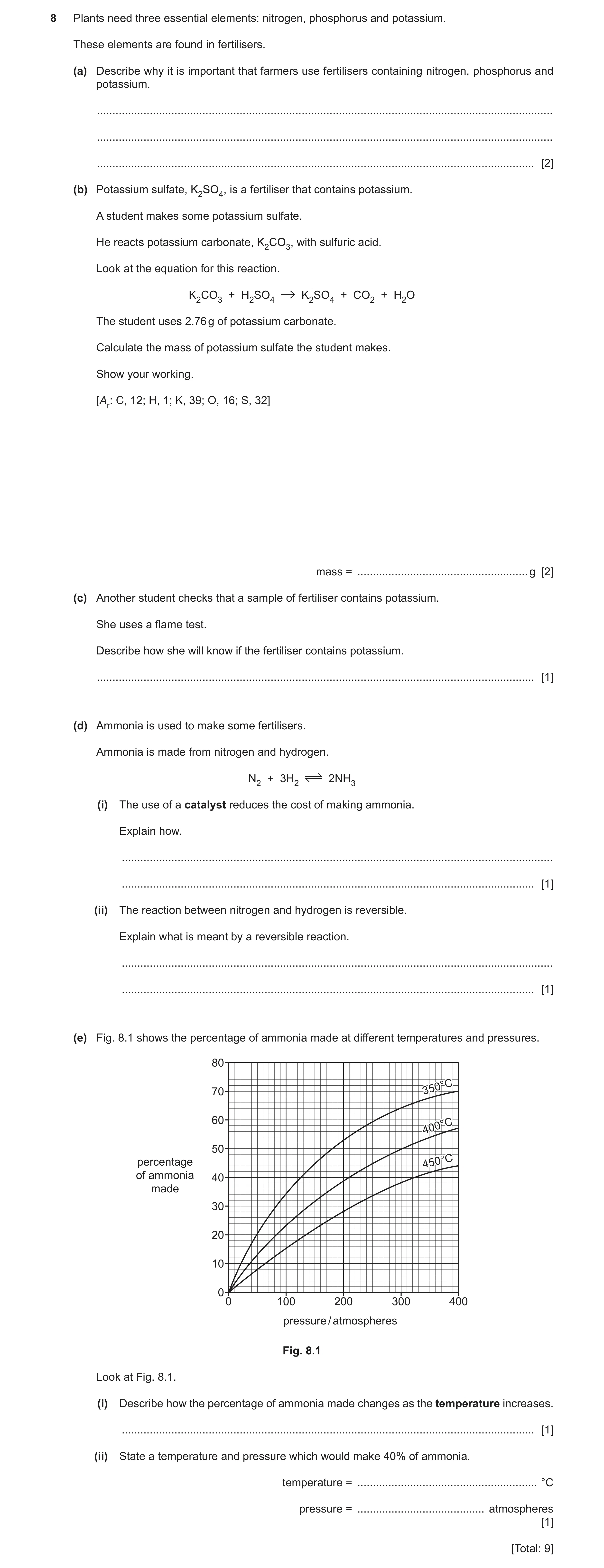
8 Plants need three essential elements: nitrogen, phosphorus and potassium. These elements are found in fertilisers. (a) Describe why it is important that farmers use fertilisers containing nitrogen, phosphorus and potassium. … … … [2] (b) Potassium sulfate, K2SO4, is a fertiliser that contains potassium. A student makes some potassium sulfate. He reacts potassium carbonate, K2CO3, with sulfuric acid. Look at the equation for this reaction. K2CO3 + H2SO4 K2SO4 + CO2 + H2O The student uses 2.76 g of potassium carbonate. Calculate the mass of potassium sulfate the student makes. Show your working. [Ar: C, 12; H, 1; K, 39; O, 16; S, 32] mass = … g [2] (c) Another student checks that a sample of fertiliser contains potassium. She uses a flame test. Describe how she will know if the fertiliser contains potassium. … [1] (d) Ammonia is used to make some fertilisers. Ammonia is made from nitrogen and hydrogen. N2 + 3H2 2NH3 (i) The use of a catalyst reduces the cost of making ammonia. Explain how. … … [1] (ii) The reaction between nitrogen and hydrogen is reversible. Explain what is meant by a reversible reaction. … … [1] (e) Fig. 8.1 shows the percentage of ammonia made at different temperatures and pressures. 80 70 350°C350°C 60 400°C400°C 50 percentage 450°C450°C of ammonia 40 made 30 20 10 0 0 100 200 300 400 pressure / atmospheres Fig. 8.1 Look at Fig. 8.1. (i) Describe how the percentage of ammonia made changes as the temperature increases. … [1] (ii) State a temperature and pressure which would make 40% of ammonia. temperature = … °C pressure = … atmospheres [1] [Total: 9]
9 marks
Mark scheme: 8(a) to, improve quality / increase yield / for growth, (of crop / plant) ; prevents discolouration of leaves / synthesis of (named) proteins or amino acids / replaces (named) minerals or ions in soil ; 2 8(b) relative formula mass of K2CO3 =138 and of K2SO4 = 174 ; 174 2.76 138 = 3.48 g ; 2 8(c) (flame test gives) a lilac / purple (flame) ; 1 Question Answer Marks 8(d)(i) (catalyst) increases rate of reaction ; 1 8(d)(ii) idea that reaction can go both ways / can go in both directions ; 1 8(e)(i) decreases / owtte ; 1 8(e)(ii) 350 °C and 125 atm OR 400 °C and 210 atm OR 450 °C and 325 atm ; 1
This question in 0654/42 May/June 2022
Question 10 0654/41 Oct/Nov 2022
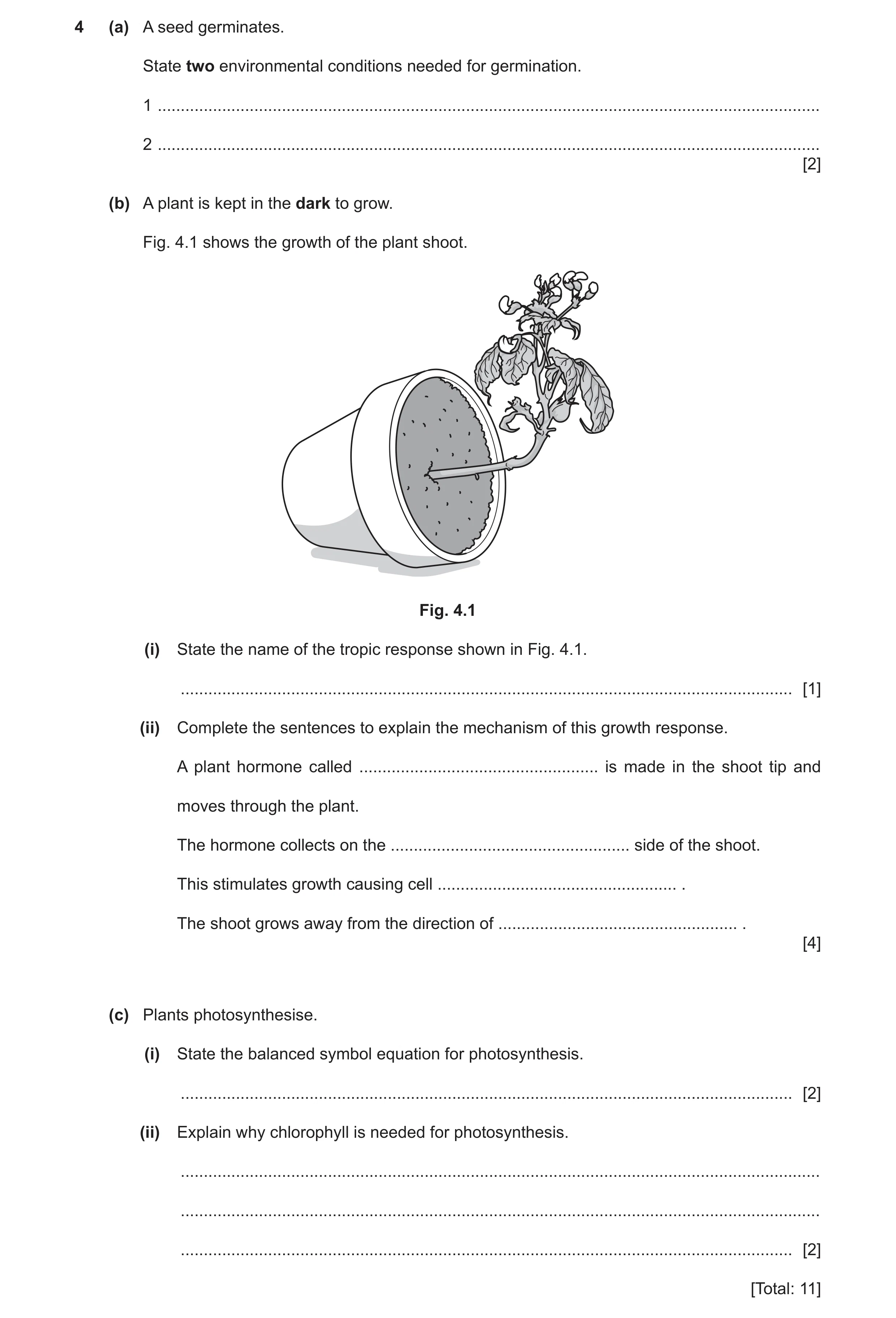
4 (a) A seed germinates. State two environmental conditions needed for germination. 1 … 2 … [2] (b) A plant is kept in the dark to grow. Fig. 4.1 shows the growth of the plant shoot. Fig. 4.1 (i) State the name of the tropic response shown in Fig. 4.1. … [1] (ii) Complete the sentences to explain the mechanism of this growth response. A plant hormone called … is made in the shoot tip and moves through the plant. The hormone collects on the … side of the shoot. This stimulates growth causing cell … . The shoot grows away from the direction of … . [4] (c) Plants photosynthesise. (i) State the balanced symbol equation for photosynthesis. … [2] (ii) Explain why chlorophyll is needed for photosynthesis. … … … [2] [Total: 11]
11 marks
Mark scheme: 4(a) any two from: 2 oxygen ; water / moisture ; warm / suitable temperature ; 4(b)(i) gravitropism ; 1 4(b)(ii) auxin ; 4 lower / owtte ; elongation ; gravity ; 4(c)(i) 6CO2+6H2O →C6H12O6 + 6O2 2 LHS ; RHS ; 4(c)(ii) transfers light energy to chemical energy ; 2 for synthesis of, carbohydrates / glucose ;
This question in 0654/41 Oct/Nov 2022
Q11 · A diagram of a wind‑pollinated flower 0654/42 Feb/March 2023
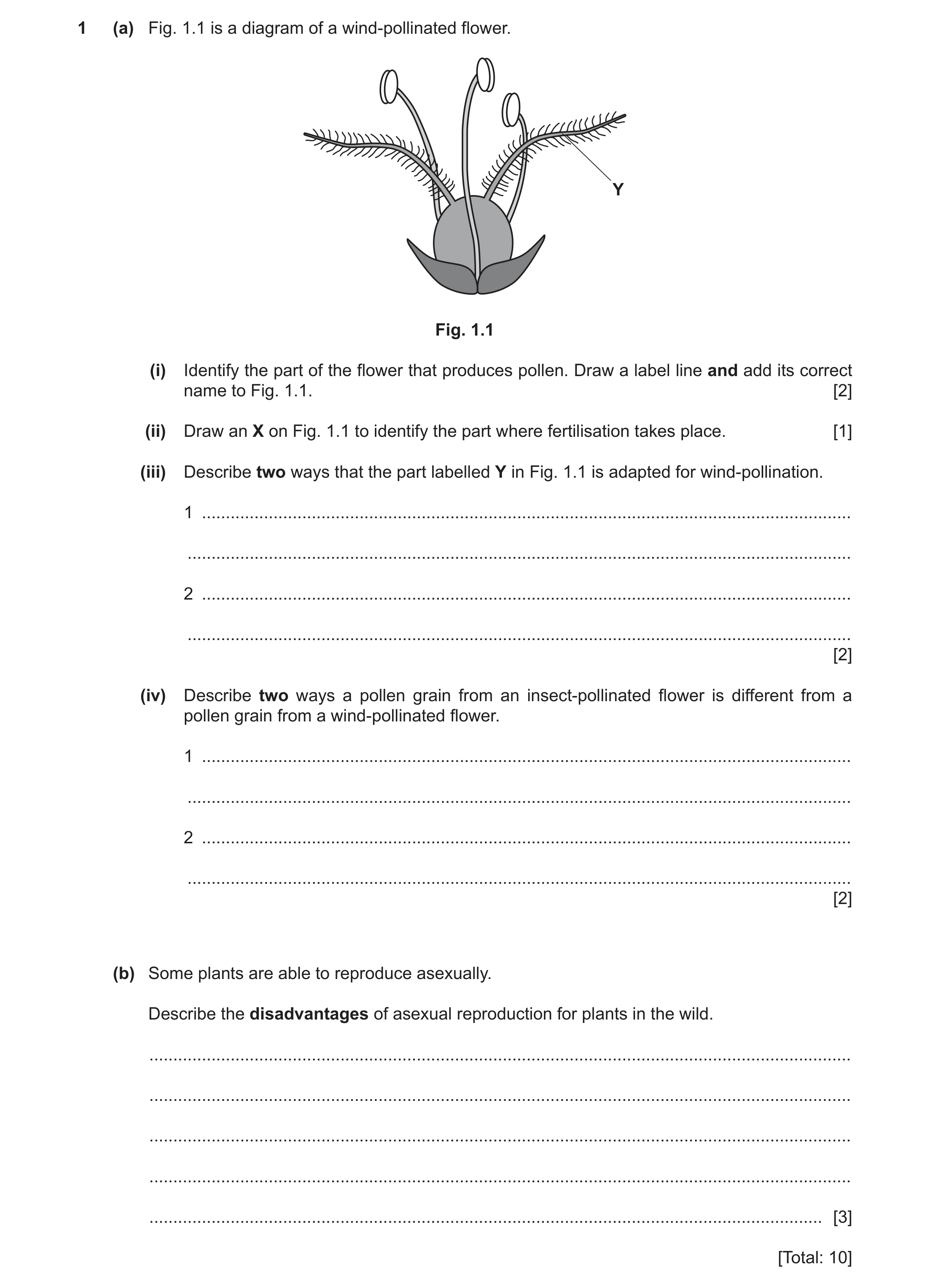
1 (a) Fig. 1.1 is a diagram of a wind‑pollinated flower. Y Fig. 1.1 (i) Identify the part of the flower that produces pollen. Draw a label line and add its correct name to Fig. 1.1. [2] (ii) Draw an X on Fig. 1.1 to identify the part where fertilisation takes place. [1] (iii) Describe two ways that the part labelled Y in Fig. 1.1 is adapted for wind‑pollination. 1 … … 2 … … [2] (iv) Describe two ways a pollen grain from an insect‑pollinated flower is different from a pollen grain from a wind‑pollinated flower. 1 … … 2 … … [2] (b) Some plants are able to reproduce asexually. Describe the disadvantages of asexual reproduction for plants in the wild. … … … … … [3] [Total: 10]
10 marks
Mark scheme: Question Answer Marks 1(a)(i) label line drawn to anther ; 2 labelled as anther ; 1(a)(ii) X placed on ovary ; 1 1(a)(iii) any two from: 2 feathery ; hangs outside of flower ; large ; 1(a)(iv) any two from: 2 larger ; stickier ; rougher surface ; heavier ; 1(b) any three from: 3 no / less, (genetic) variation ; plants will only be adapted to one environment / less likely to adapt to any change in environment ; a disease might cause extinction ; any disadvantageous traits will be inherited by offspring ; AVP ;
This question in 0654/42 Feb/March 2023
Q12 · A diagram of a wind‑pollinated flower 0654/42 May/June 2024
1 (a) Fig. 1.1 is a diagram of a wind‑pollinated flower. A B C D F E Fig. 1.1 (i) State which letter in Fig. 1.1 identifies the part where: fertilisation occurs … pollen is produced. … [2] (ii) Describe two visible pieces of evidence in Fig. 1.1 that show the flower is adapted for wind‑pollination. 1 … … 2 … … [2] (b) Fig. 1.2 is a photomicrograph of pollen from an insect‑pollinated flower. Fig. 1.2 Describe two ways the appearance of pollen from a wind‑pollinated flower is different from the pollen from an insect‑pollinated flower. 1 … … 2 … … [2] (c) Some plants can reproduce asexually and sexually. (i) State two advantages of sexual reproduction compared to asexual reproduction in plants. 1 … … 2 … … [2] (ii) Suggest a situation where asexual reproduction is more useful to a plant in the wild than sexual reproduction. … … … [1] (d) Reproduction is one of the characteristics of living organisms. State two other characteristics of living organisms. 1 … 2 … [2] [Total: 11]
11 marks
Mark scheme: 1(a)(i) C ; E ; 2 1(a)(ii) any two from: feathery stigma ; small / no, petals ; anther hangs outside (the, flower / petals) ; stigma hangs outside (the, flower / petals) ; 2 1(b) smooth(er) / not spiky ; small(er) ; 2 1(c)(i) any two from: genetic diversity ; disease unlikely to wipe out all the plants ; able to adapt to changes in the environment ; allows, natural selection / evolution / adaptation ; 2 1(c)(ii) when the plant becomes isolated (from other plants) / when there is a shortage of pollinators / lack of other plants ; 1 1(d) any two from: movement ; respiration ; sensitivity ; growth ; excretion ; nutrition ; 2
This question in 0654/42 May/June 2024
Q13 · A farmer planted some seeds 0654/43 Oct/Nov 2024
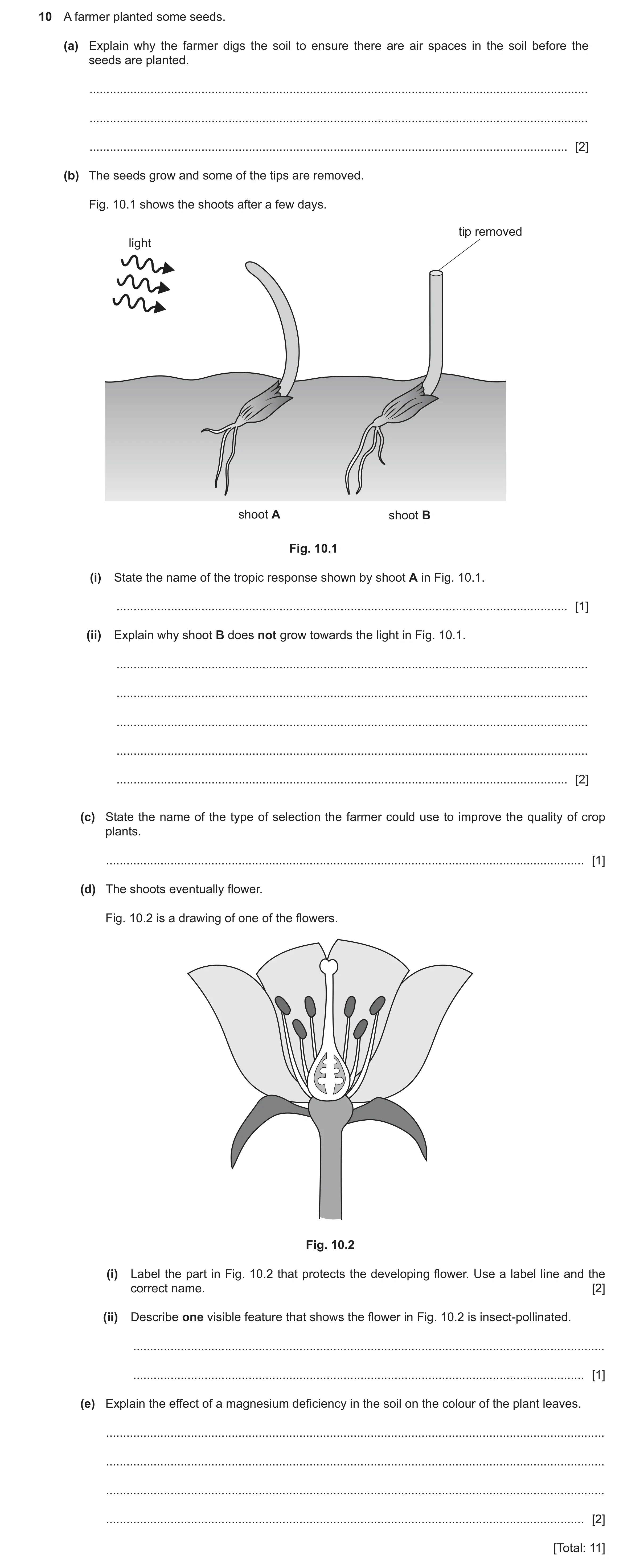
10 A farmer planted some seeds. (a) Explain why the farmer digs the soil to ensure there are air spaces in the soil before the seeds are planted. … … … [2] (b) The seeds grow and some of the tips are removed. Fig. 10.1 shows the shoots after a few days. tip removed light shoot A shoot B Fig. 10.1 (i) State the name of the tropic response shown by shoot A in Fig. 10.1. … [1] (ii) Explain why shoot B does not grow towards the light in Fig. 10.1. … … … … … [2] (c) State the name of the type of selection the farmer could use to improve the quality of crop plants. … [1] (d) The shoots eventually flower. Fig. 10.2 is a drawing of one of the flowers. Fig. 10.2 (i) Label the part in Fig. 10.2 that protects the developing flower. Use a label line and the correct name. [2] (ii) Describe one visible feature that shows the flower in Fig. 10.2 is insect-pollinated. … … [1] (e) Explain the effect of a magnesium deficiency in the soil on the colour of the plant leaves. … … … … [2] [Total: 11]
11 marks
Mark scheme: 10(a) provide oxygen ; 2 for germination ; 10(b)(i) phototropism ; 1 10(b)(ii) auxin is made in the tip only ; 2 so no cell elongation (stimulated) ; 10(c) artificial ; 1 10(d)(i) sepal labelled ;; 2 1 mark for correct part labelled 1 mark for correct name 10(d)(ii) any one from: 1 large petals ; anther / stamen / filament, inside flower ; stigma / style inside flower ; Idea that anther is below the stigma ; 10(e) Less / no, synthesis / making of chlorophyll ; 2 yellow leaves ;
This question in 0654/43 Oct/Nov 2024
Q14 · A violet plant bought from a shop 0654/42 Feb/March 2025
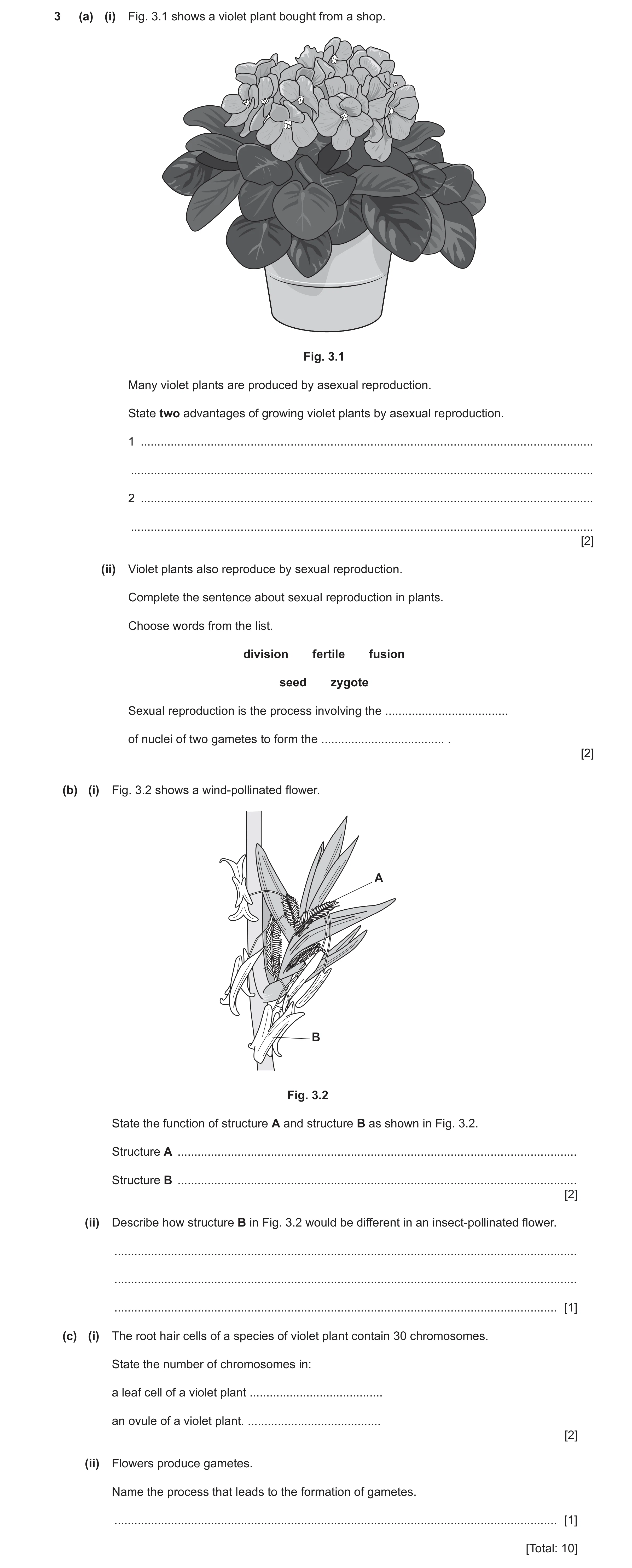
3 (a) (i) Fig. 3.1 shows a violet plant bought from a shop. Fig. 3.1 Many violet plants are produced by asexual reproduction. State two advantages of growing violet plants by asexual reproduction. 1 … … 2 … … [2] (ii) Violet plants also reproduce by sexual reproduction. Complete the sentence about sexual reproduction in plants. Choose words from the list. division fertile fusion seed zygote Sexual reproduction is the process involving the … of nuclei of two gametes to form the … . [2] (b) (i) Fig. 3.2 shows a wind-pollinated flower. A B Fig. 3.2 State the function of structure A and structure B as shown in Fig. 3.2. Structure A … Structure B … [2] (ii) Describe how structure B in Fig. 3.2 would be different in an insect-pollinated flower. … … … [1] (c) (i) The root hair cells of a species of violet plant contain 30 chromosomes. State the number of chromosomes in: a leaf cell of a violet plant … an ovule of a violet plant. … [2] (ii) Flowers produce gametes. Name the process that leads to the formation of gametes. … [1] [Total: 10]
10 marks
Mark scheme: 3(a)(i) any two from: 2 faster less energy required no need to rely on, (named) pollinators / wind / insects no need to produce, flowers / scent only requires one parent more likelihood of success due to lack of random fertilisation genetically identical if has desirable features ; ; 3(a)(ii) fusion ; 2 zygote ; 3(b)(i) A - captures pollen / AW ; 2 B- produces / makes / releases / AW, pollen ; 3(b)(ii) not hanging down / enclosed within the flower or petals ; 1 3(c)(i) leaf cell - 30 ; 2 ovule- 15 ; 3(c)(ii) meiosis ; 1
This question in 0654/42 Feb/March 2025
Q15 · A magnified image of a plant root tip viewed using a light microscope 0654/41 May/June 2025
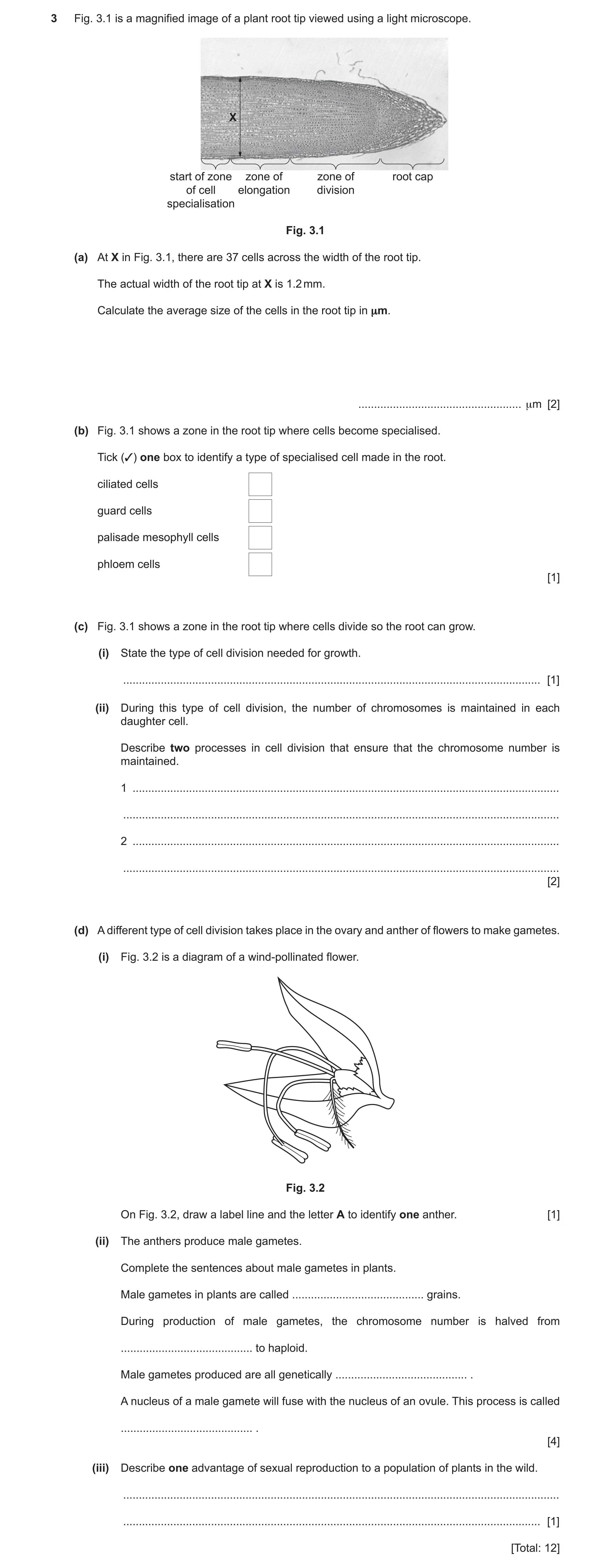
3 Fig. 3.1 is a magnified image of a plant root tip viewed using a light microscope. X start of zone zone of zone of root cap of cell elongation division specialisation Fig. 3.1 (a) At X in Fig. 3.1, there are 37 cells across the width of the root tip. The actual width of the root tip at X is 1.2 mm. Calculate the average size of the cells in the root tip in μm. … μm [2] (b) Fig. 3.1 shows a zone in the root tip where cells become specialised. Tick (3) one box to identify a type of specialised cell made in the root. ciliated cells guard cells palisade mesophyll cells phloem cells [1] (c) Fig. 3.1 shows a zone in the root tip where cells divide so the root can grow. (i) State the type of cell division needed for growth. … [1] (ii) During this type of cell division, the number of chromosomes is maintained in each daughter cell. Describe two processes in cell division that ensure that the chromosome number is maintained. 1 … … 2 … … [2] (d) A different type of cell division takes place in the ovary and anther of flowers to make gametes. (i) Fig. 3.2 is a diagram of a wind-pollinated flower. Fig. 3.2 On Fig. 3.2, draw a label line and the letter A to identify one anther. [1] (ii) The anthers produce male gametes. Complete the sentences about male gametes in plants. Male gametes in plants are called … grains. During production of male gametes, the chromosome number is halved from … to haploid. Male gametes produced are all genetically … . A nucleus of a male gamete will fuse with the nucleus of an ovule. This process is called … . [4] (iii) Describe one advantage of sexual reproduction to a population of plants in the wild. … … [1] [Total: 12]
12 marks
Mark scheme: 3(a) 1.2 / 37 or 0.0324 ; 2 32.4 (μm) ; 3(b) phloem cells ; 1 3(c)(i) mitosis ; 1 3(c)(ii) any two from: 2 replication (of, DNA / chromosomes) ; separation of chromosomes (into two identical sets) ; cells only divide once / splits into two daughter cells; 3(d)(i) 1 A correct labelling of any one anther = 1 mark ; 3(d)(ii) pollen ; 4 diploid ; different ; fertilisation ; 3(d)(iii) any one from: 1 produces (genetic) variation ; able to adapt to change in environment ; spreads offspring through dispersal of pollen / seeds ;
This question in 0654/41 May/June 2025
Q16 · Plants and bacteria are made of cells 0654/43 Oct/Nov 2025
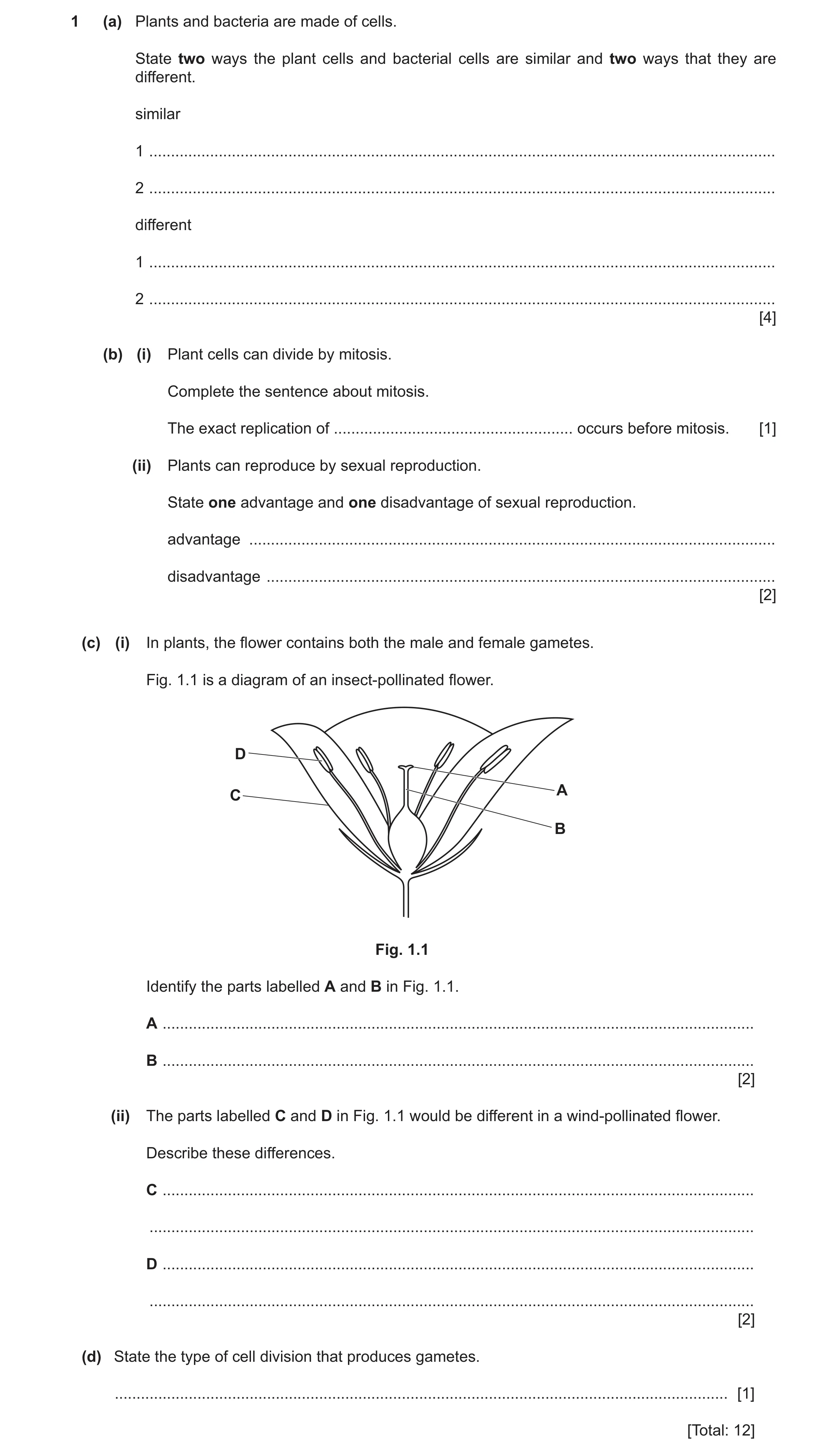
1 (a) Plants and bacteria are made of cells. State two ways the plant cells and bacterial cells are similar and two ways that they are different. similar 1 … 2 … different 1 … 2 … [4] (b) (i) Plant cells can divide by mitosis. Complete the sentence about mitosis. The exact replication of … occurs before mitosis. [1] (ii) Plants can reproduce by sexual reproduction. State one advantage and one disadvantage of sexual reproduction. advantage … disadvantage … [2] (c) (i) In plants, the flower contains both the male and female gametes. Fig. 1.1 is a diagram of an insect-pollinated flower. D A C B Fig. 1.1 Identify the parts labelled A and B in Fig. 1.1. A … B … [2] (ii) The parts labelled C and D in Fig. 1.1 would be different in a wind-pollinated flower. Describe these differences. C … … D … … [2] (d) State the type of cell division that produces gametes. … [1] [Total: 12]
12 marks
Mark scheme: Question Answer Marks 1(a) similar, any two from: 4 • cell wall ; • cell membrane ; • ribosomes ; • DNA/genetic material ; • cytoplasm ; different, any two from: • plant has cellulose cell wall / bacterial has cell wall not made from cellulose OR bacteria has cell wall made of sugars and amino acids / peptidoglycan ; • plant cells have chloroplasts / bacterial cells do not have chloroplasts ; • plant cells have vacuole / bacterial cells do not have vacuole ; • plant cells have a nucleus / bacterial cells do not have a nucleus ; • plant cells have chromosomes / bacterial cells have circular DNA / bacterial cells have plasmids ; 1(b)(i) chromosomes ; 1 1(b)(ii) (advantage) (more) genetic variation ; 2 (disadvantage) process of development takes longer / idea of offspring having to develop from fertilised egg taking longer ; 1(c)(i) A – stigma ; 2 B – style ; 1(c)(ii) C – would not be colourful / dull (colour) / absent / small / have no smell / have no scent ; 2 D – would be hanging outside the flower ; 1(d) meiosis ; 1
This question in 0654/43 Oct/Nov 2025
 1 / 26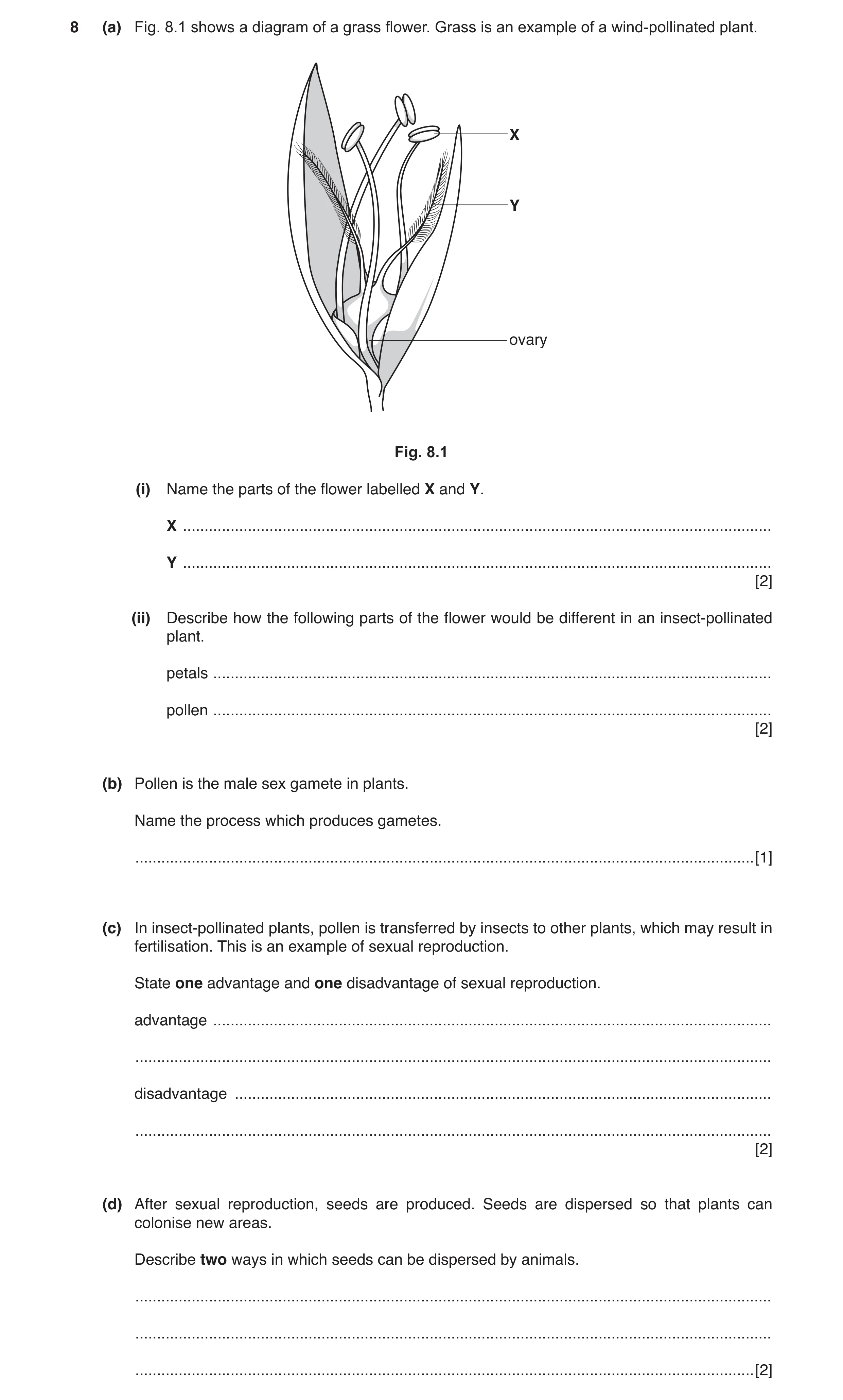
 16 / 26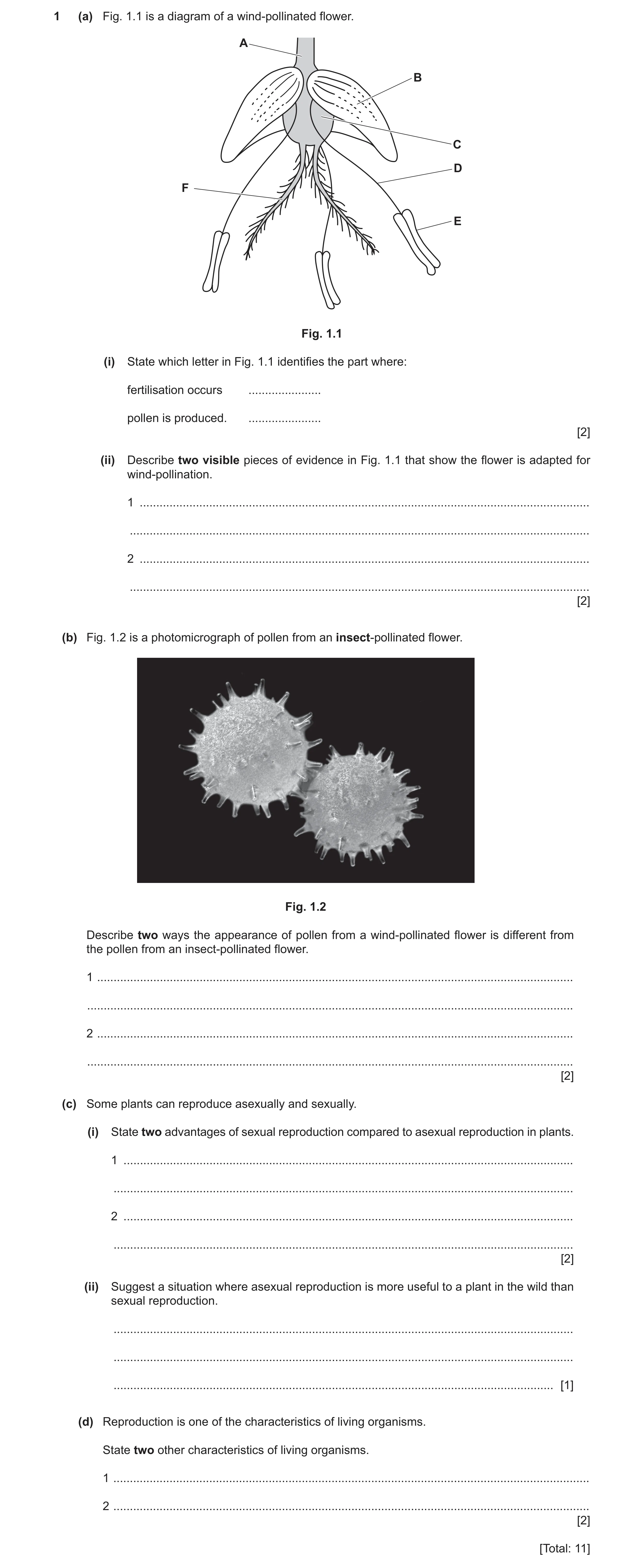
 8
8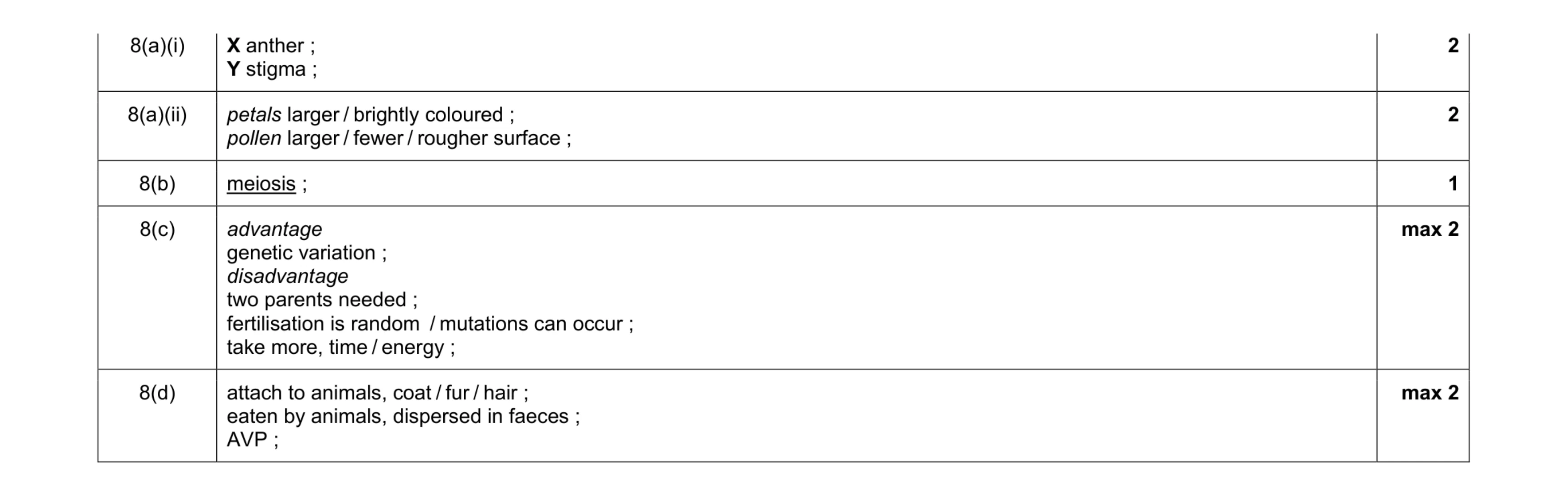 9
9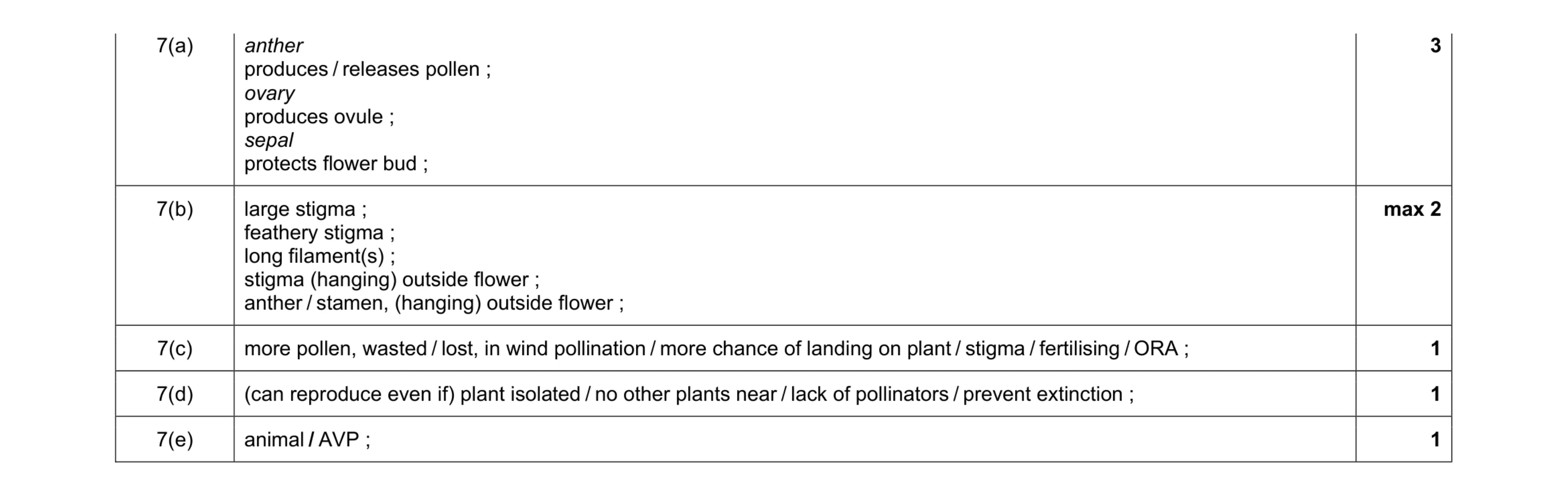 8
8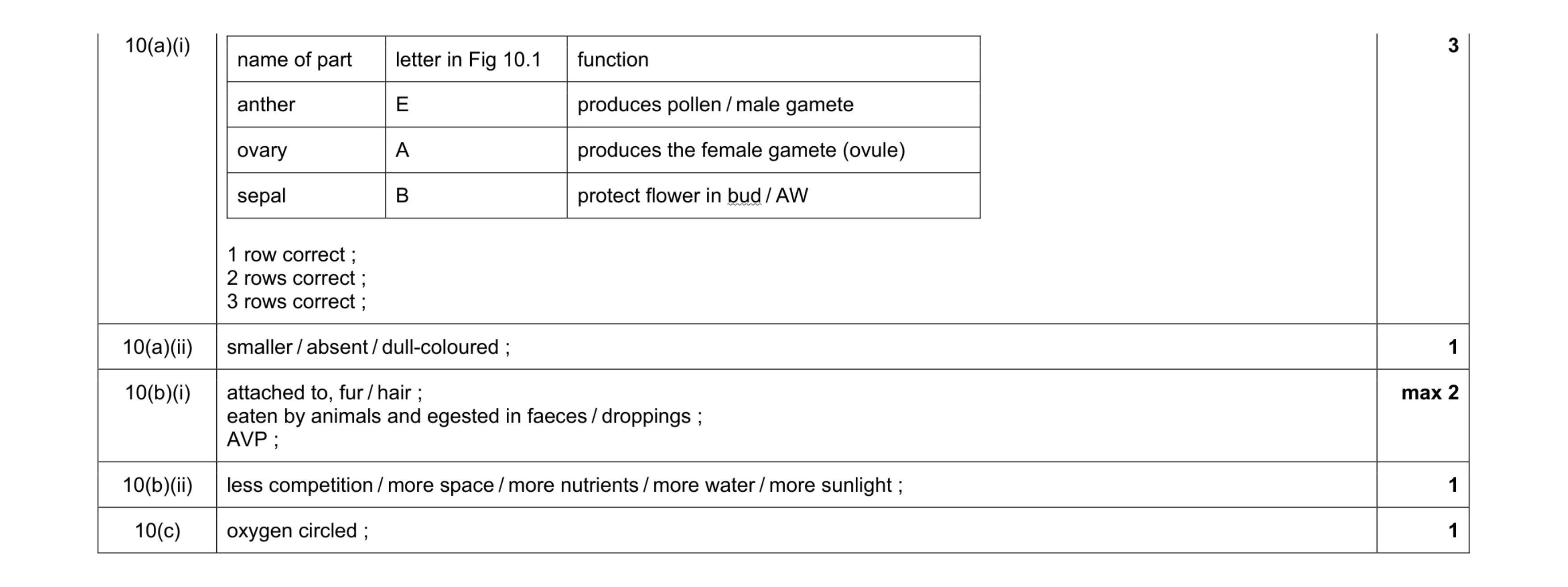 8
8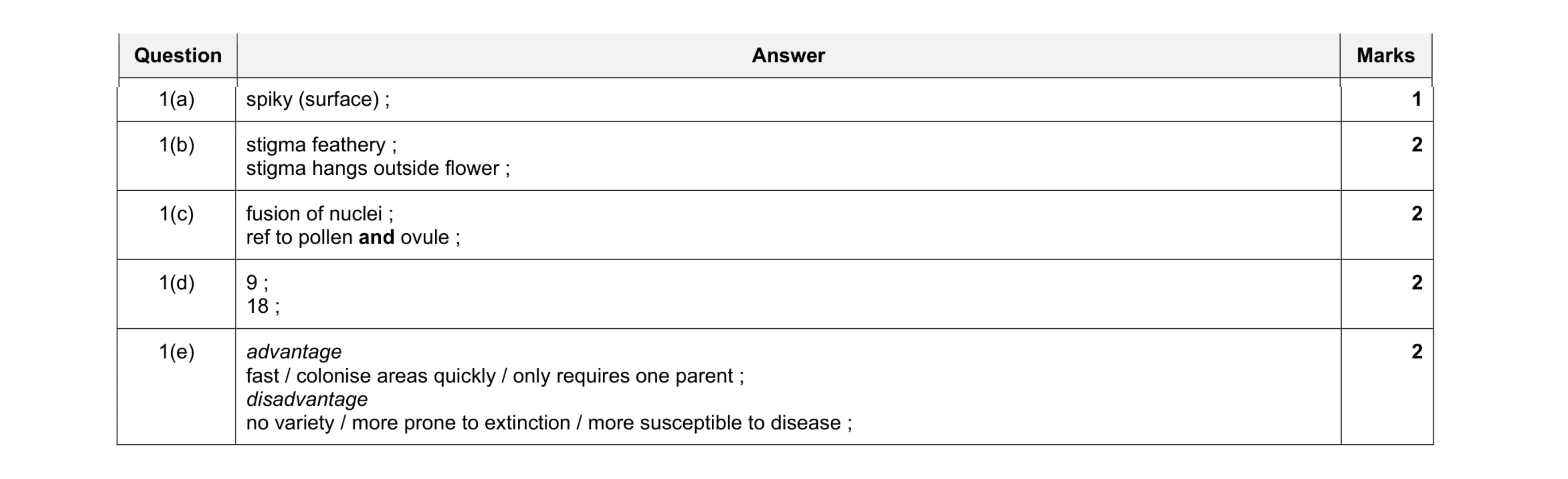 9
9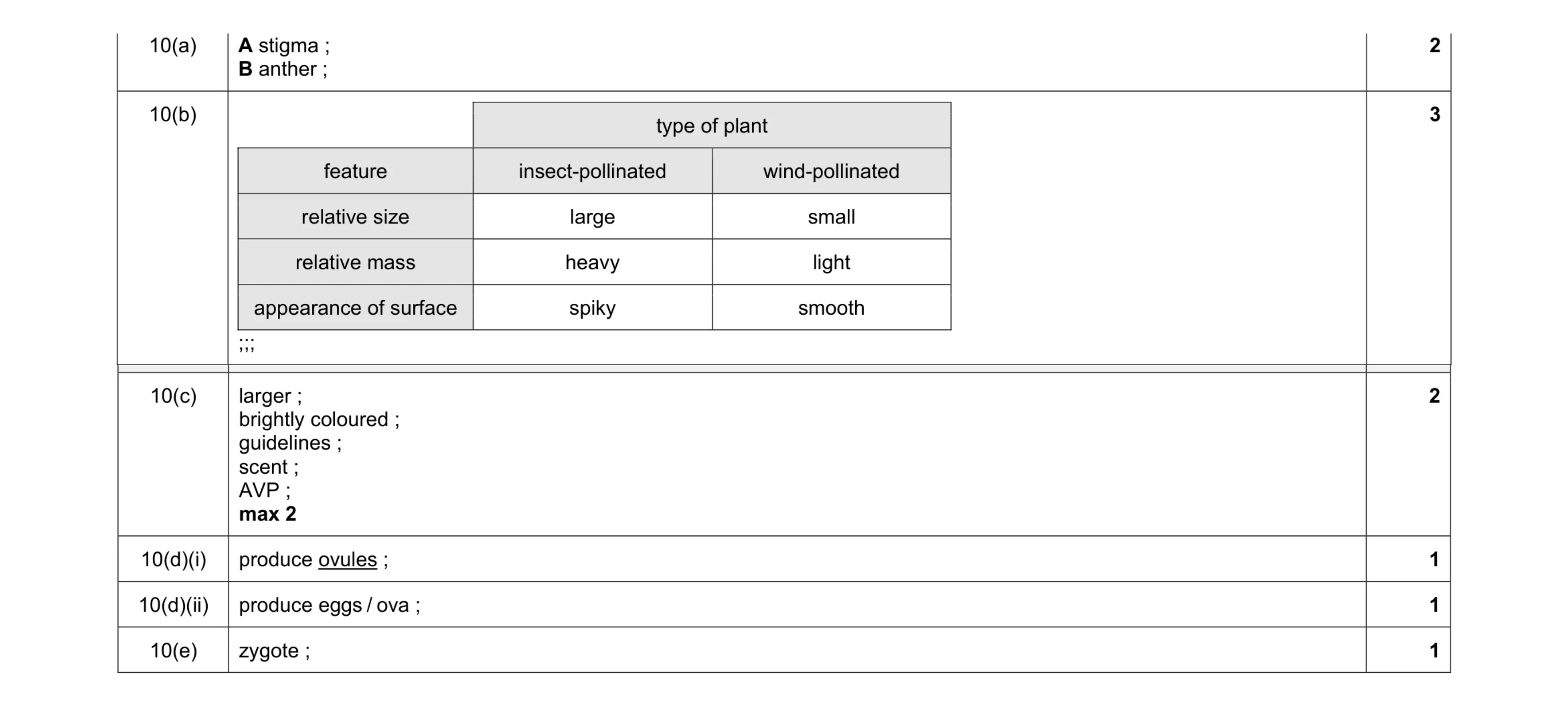 10
10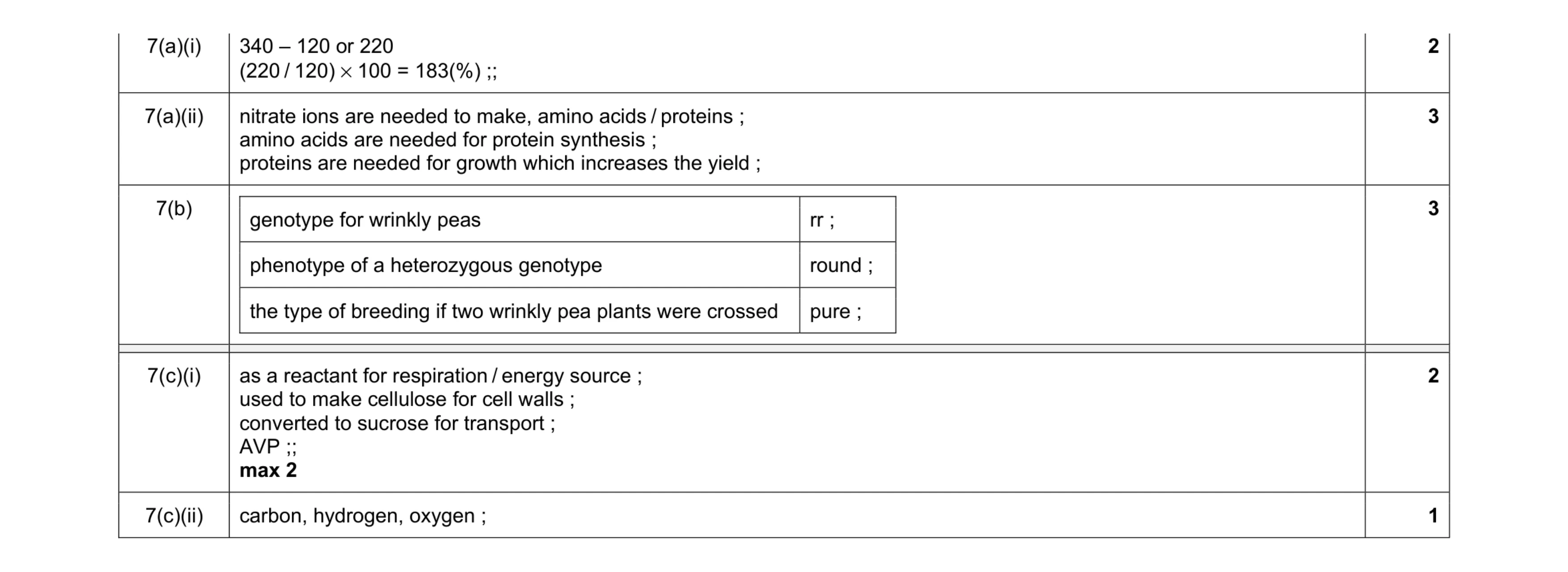 11
11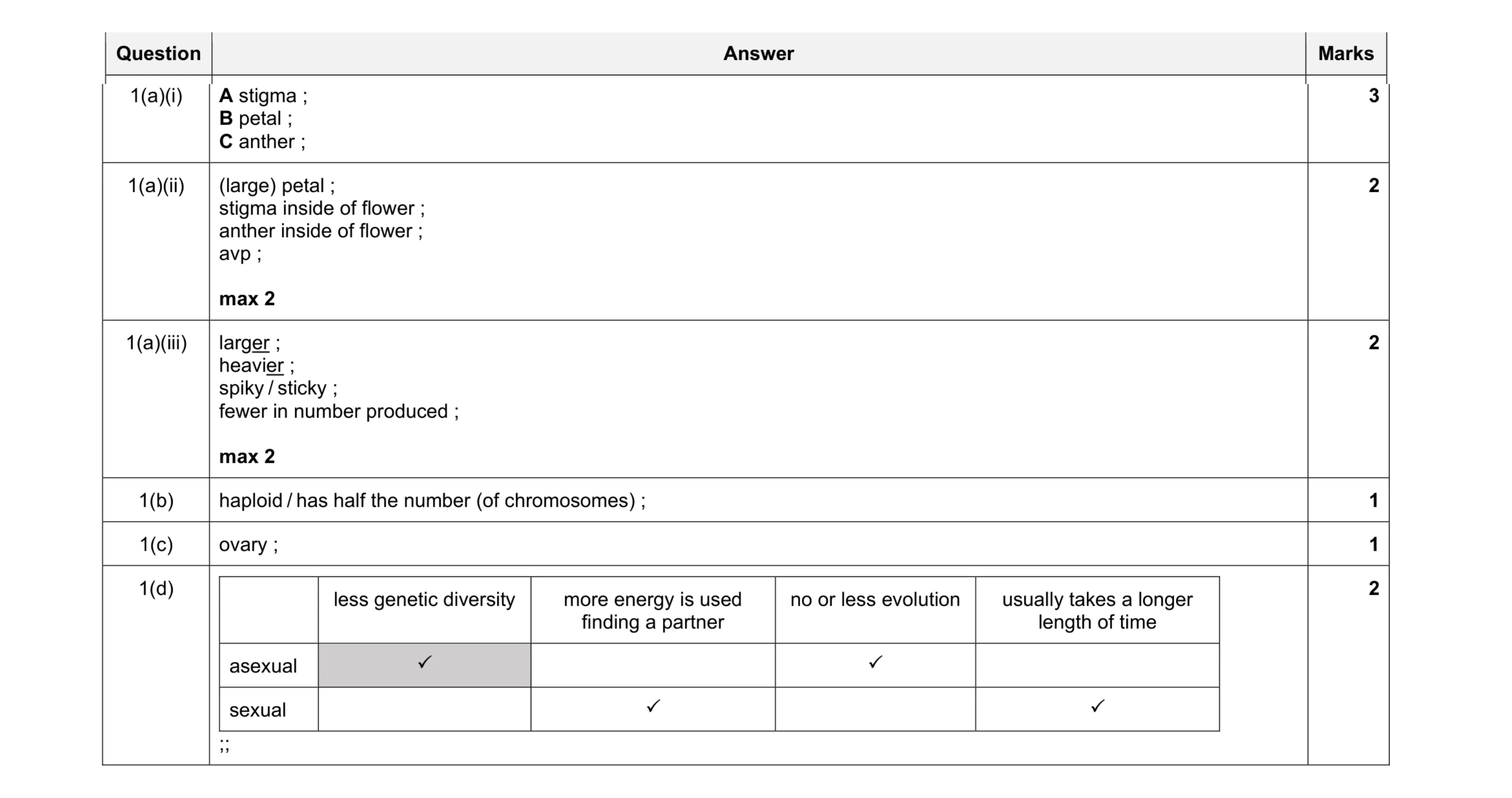 11
11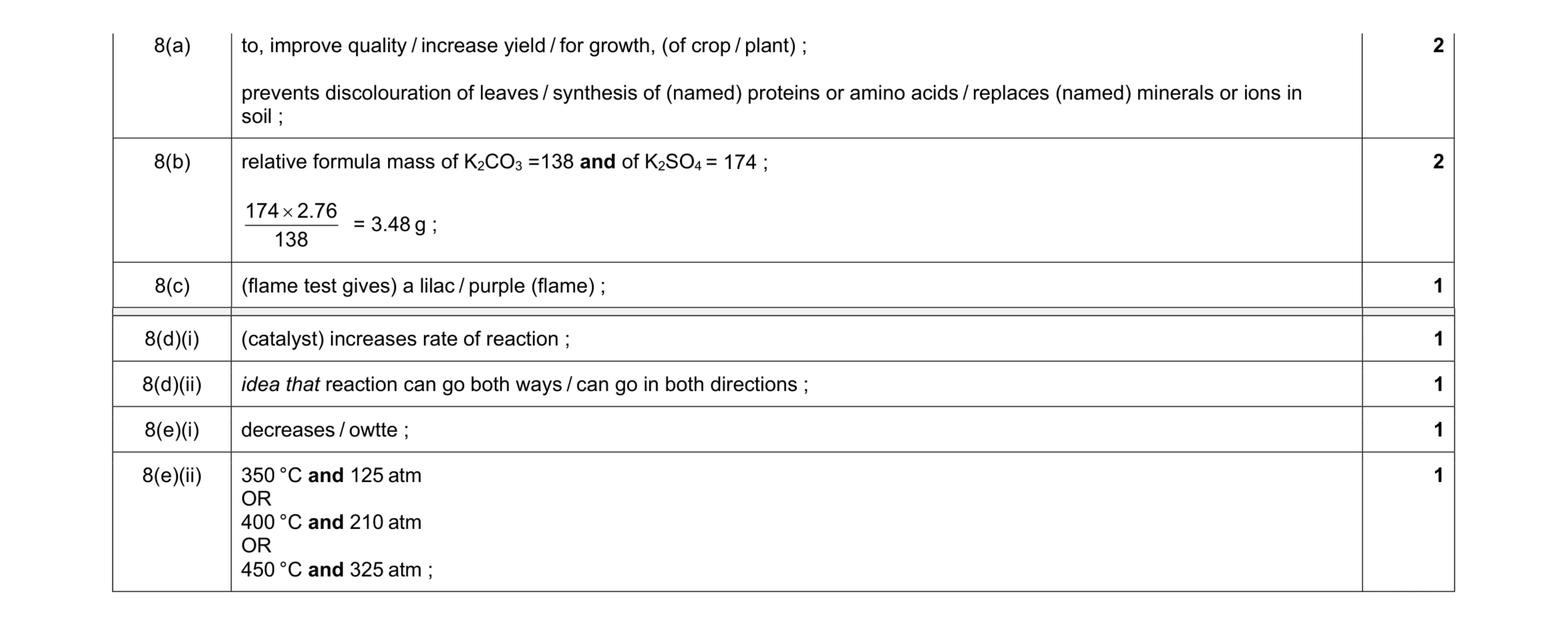 9
9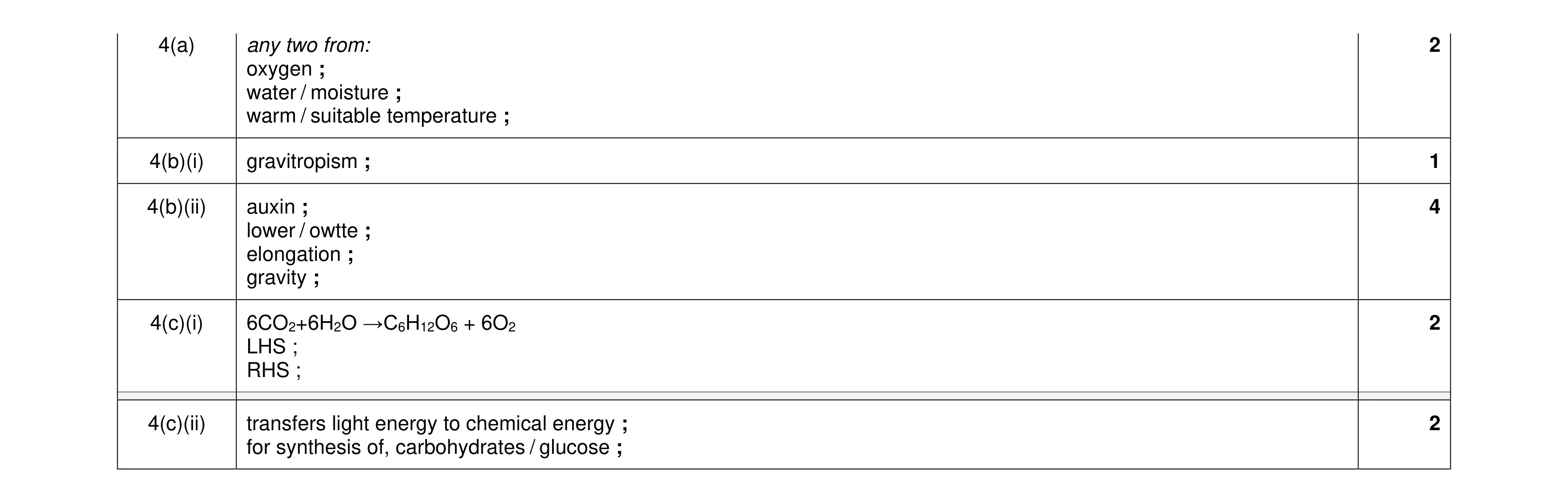 11
11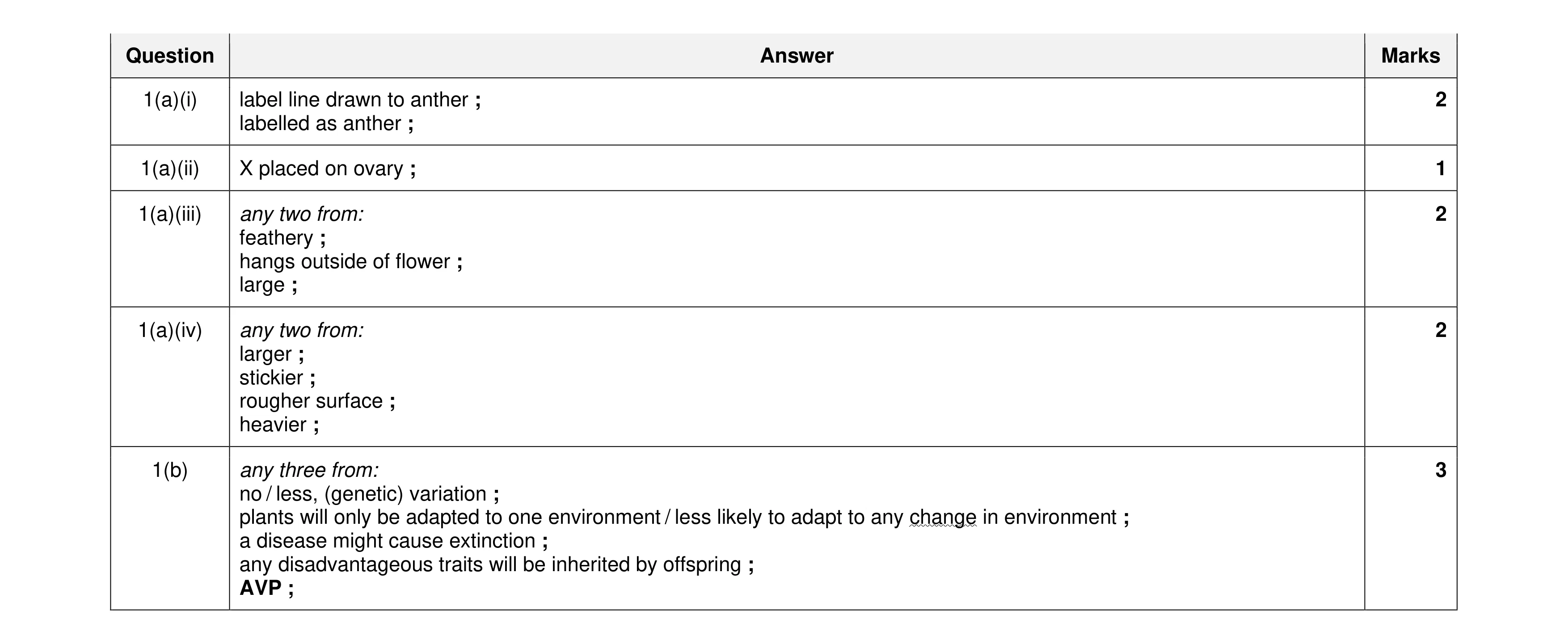 10
10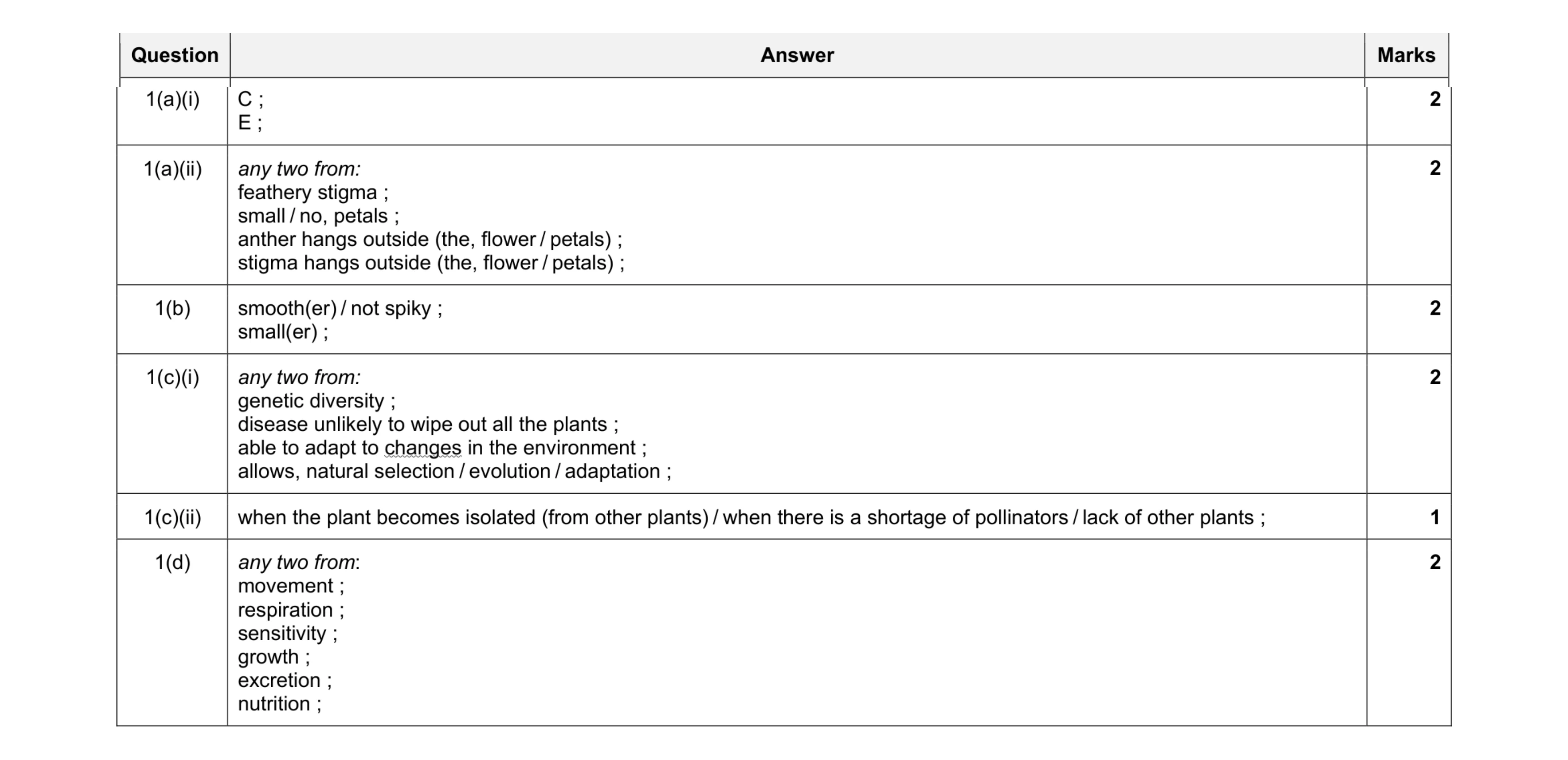 11
11 11
11 10
10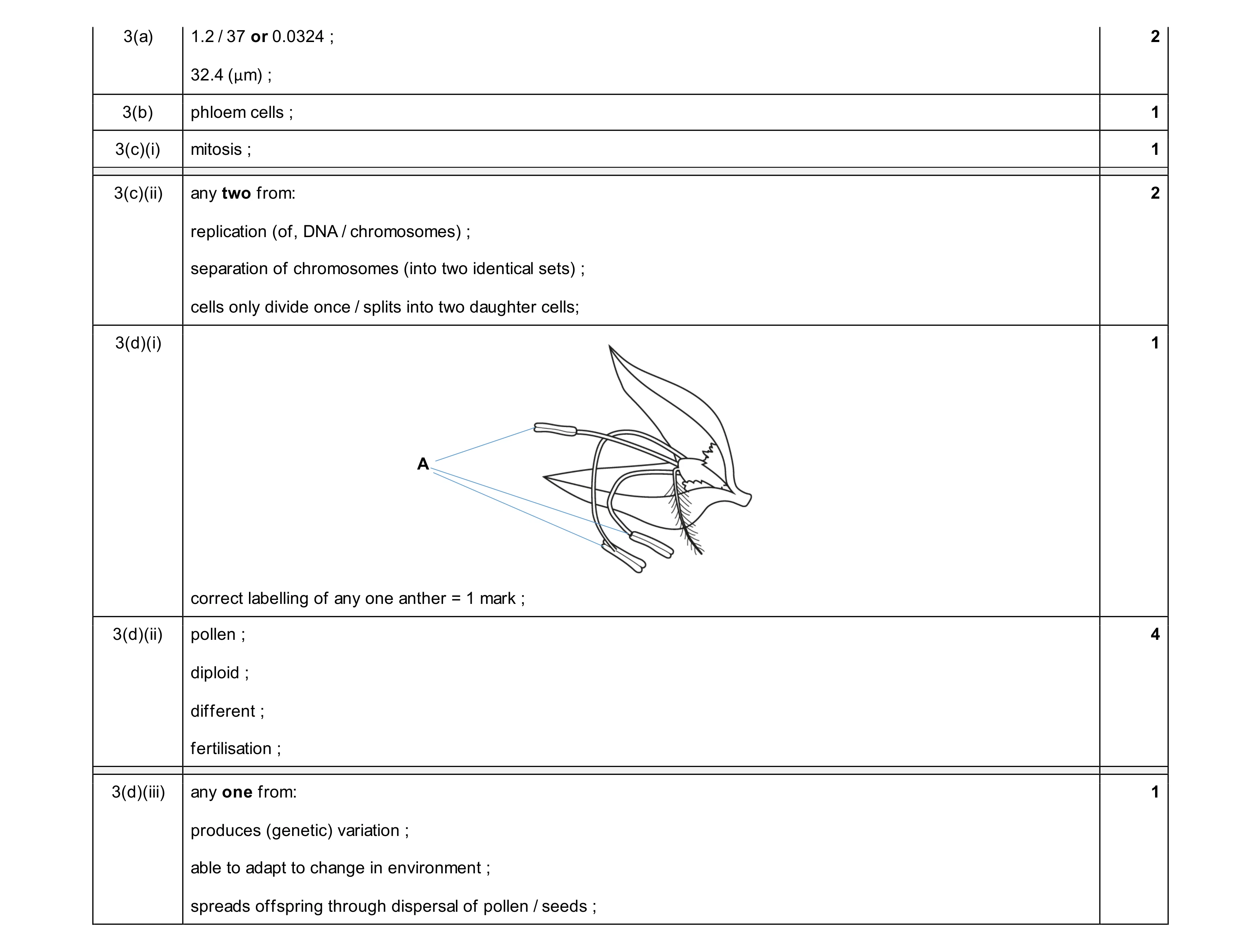 12
12 12
12