Questions as text
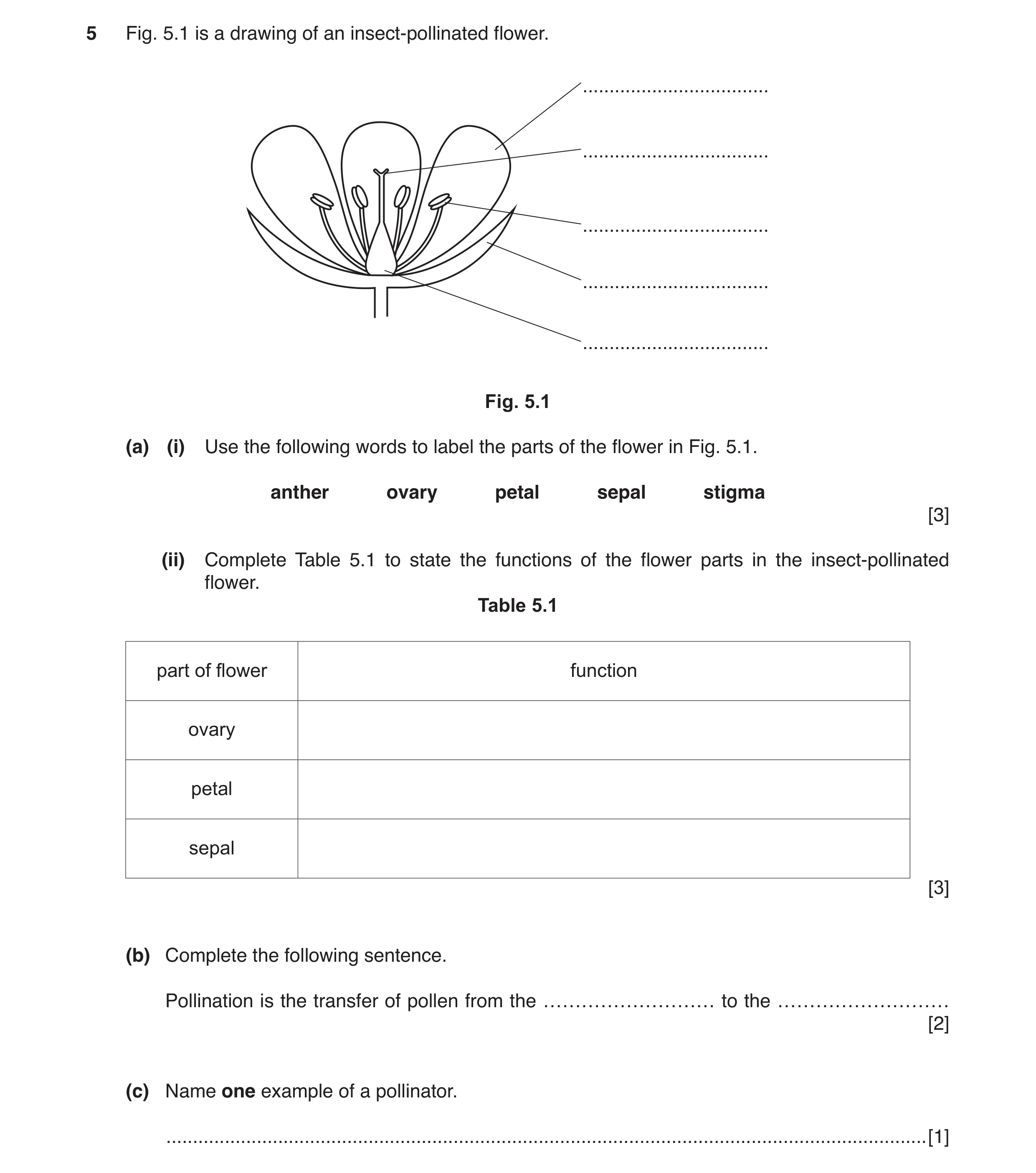
Q1 · A drawing of an insect-pollinated flower 0654/32 May/June 2017
5 Fig. 5.1 is a drawing of an insect-pollinated flower. … … … … … Fig. 5.1 (a) (i) Use the following words to label the parts of the flower in Fig. 5.1. anther ovary petal sepal stigma [3] (ii) Complete Table 5.1 to state the functions of the flower parts in the insect-pollinated flower. Table 5.1 part of flower function ovary petal sepal [3] (b) Complete the following sentence. Pollination is the transfer of pollen from the ……………………… to the ……………………… [2] (c) Name one example of a pollinator. … [1]
9 marks
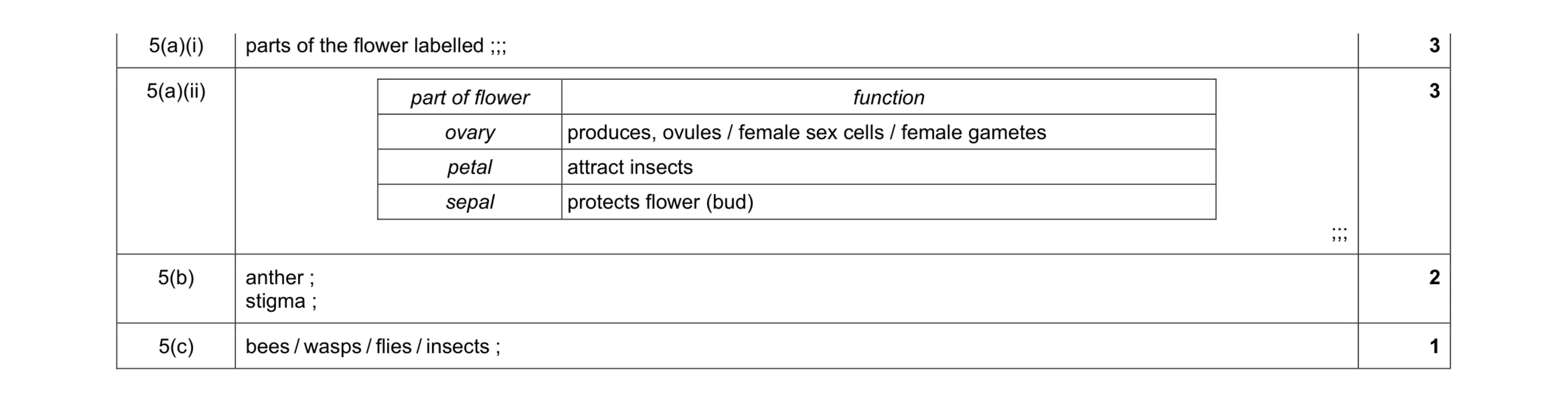
Mark scheme: 5(a)(i) parts of the flower labelled ;;; 3 5(a)(ii) part of flower function ovary produces, ovules / female sex cells / female gametes petal attract insects sepal protects flower (bud) ;;; 3 5(b) anther ; stigma ; 2 5(c) bees / wasps / flies / insects ; 1
This question in 0654/32 May/June 2017
Q2 · A diagram of a flower from a plant 0654/33 Oct/Nov 2017
1 Fig. 1.1 shows a diagram of a flower from a plant. B A C D E Fig. 1.1 (a) State the letter that represents the following parts of the flower in Fig. 1.1. anther … petal … sepal … stigma … [4] (b) Draw one line from each part of the flower to its correct function. part of flower function anther where ovules are produced ovary protects the flower when in bud petal produces pollen sepal often coloured to attract insects stigma where pollen is deposited [3] (c) Plants can undergo sexual or asexual reproduction. State two ways in which sexual reproduction differs from asexual reproduction. 1 … 2 … [2]
9 marks
Mark scheme: 1(a) C ; B ; E ; A ; 4 1(b) 1 or 2 correct ; 3 or 4 correct ; 5 correct ; 3 1(c) sexual reproduction requires two parents ; produces genetically dissimilar offspring ; uses sex cells / gametes / haploid cells ; max 2
This question in 0654/33 Oct/Nov 2017
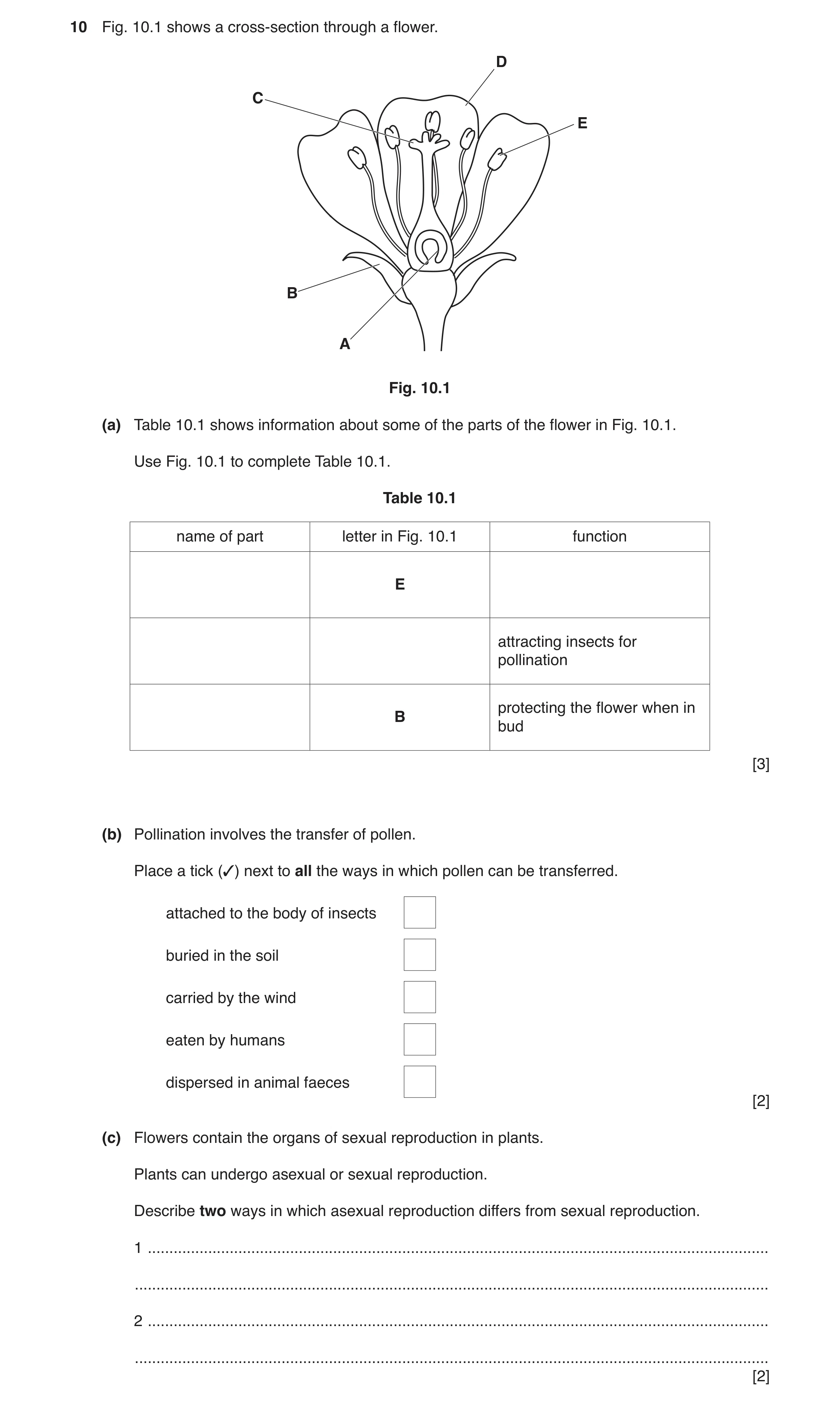
Q3 · A cross‑section through a flower 0654/31 Oct/Nov 2018
10 Fig. 10.1 shows a cross‑section through a flower. D C E B A Fig. 10.1 (a) Table 10.1 shows information about some of the parts of the flower in Fig. 10.1. Use Fig. 10.1 to complete Table 10.1. Table 10.1 name of part letter in Fig. 10.1 function E attracting insects for pollination protecting the flower when in B bud [3] (b) Pollination involves the transfer of pollen. Place a tick (3) next to all the ways in which pollen can be transferred. attached to the body of insects buried in the soil carried by the wind eaten by humans dispersed in animal faeces [2] (c) Flowers contain the organs of sexual reproduction in plants. Plants can undergo asexual or sexual reproduction. Describe two ways in which asexual reproduction differs from sexual reproduction. 1 … … 2 … … [2]
7 marks
Mark scheme: 10(a) 1 row correct ; 2 rows correct ; 3 rows correct ; name of part letter function anther E produces / releases pollen petal D attracting insects for pollination sepal B protecting the plant when in bud 3 10(b) attached to the body of insects ticked ; carried by wind ticked ; 2 10(c) genetically identical offspring ; only one parent required ; doesn’t involve gametes ; AVP ; max 2
This question in 0654/31 Oct/Nov 2018
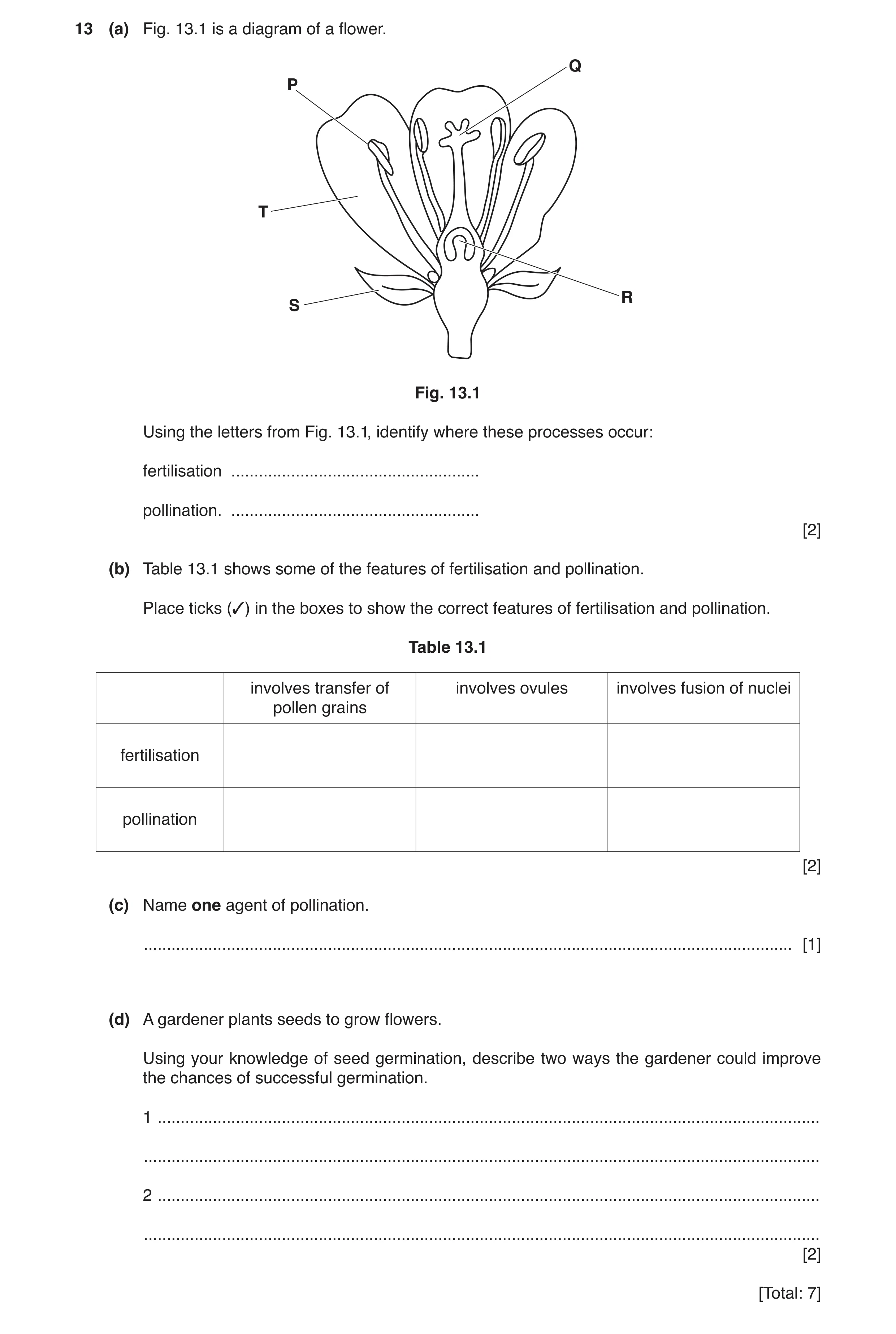
Q4 · A diagram of a flower 0654/31 Oct/Nov 2019
13 (a) Fig. 13.1 is a diagram of a flower. Q P T R S Fig. 13.1 Using the letters from Fig. 13.1, identify where these processes occur: fertilisation … pollination. … [2] (b) Table 13.1 shows some of the features of fertilisation and pollination. Place ticks (3) in the boxes to show the correct features of fertilisation and pollination. Table 13.1 involves transfer of involves ovules involves fusion of nuclei pollen grains fertilisation pollination [2] (c) Name one agent of pollination. … [1] (d) A gardener plants seeds to grow flowers. Using your knowledge of seed germination, describe two ways the gardener could improve the chances of successful germination. 1 … … 2 … … [2] [Total: 7]
7 marks
Mark scheme: 13(a) R ; Q ; 2 13(b) involves transfer of pollen grains involves ovules involves fusion of nuclei fertilisation 9 9 pollination 9 ;; 2 13(c) (named) insect / wind ; 1 13(d) water the seeds ; aerate the soil ; keep seeds warm / germinate indoors / use greenhouse ; max 2 2
This question in 0654/31 Oct/Nov 2019
Q5 · A diagram of a flower 0654/32 Oct/Nov 2019
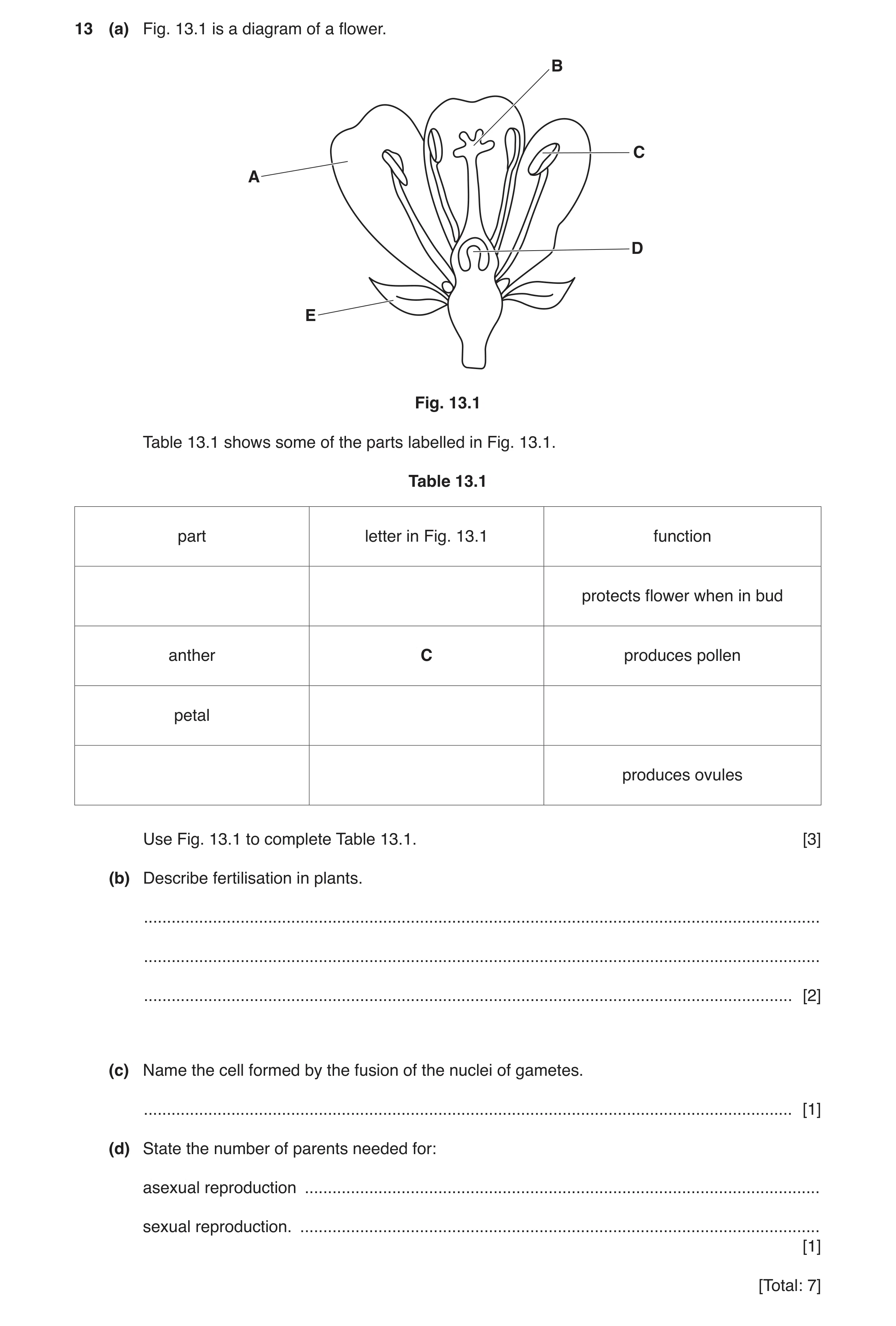
13 (a) Fig. 13.1 is a diagram of a flower. B C A D E Fig. 13.1 Table 13.1 shows some of the parts labelled in Fig. 13.1. Table 13.1 part letter in Fig. 13.1 function protects flower when in bud anther C produces pollen petal produces ovules Use Fig. 13.1 to complete Table 13.1. [3] (b) Describe fertilisation in plants. … … … [2] (c) Name the cell formed by the fusion of the nuclei of gametes. … [1] (d) State the number of parents needed for: asexual reproduction … sexual reproduction. … [1] [Total: 7]
7 marks
Mark scheme: 13(a) part letter in Fig. 5.1 function sepal E protects flower when in bud anther C produces pollen petal A attracts insects ovary D produces ovules ;;; 3 13(b) ref to pollen and ovule ; fusion of nuclei ; 2 13(c) zygote ; 1 13(d) 1 and 2 ; 1
This question in 0654/32 Oct/Nov 2019
Q6 · A student investigates the conditions needed for germination of cress seeds 0654/33 Oct/Nov 2019
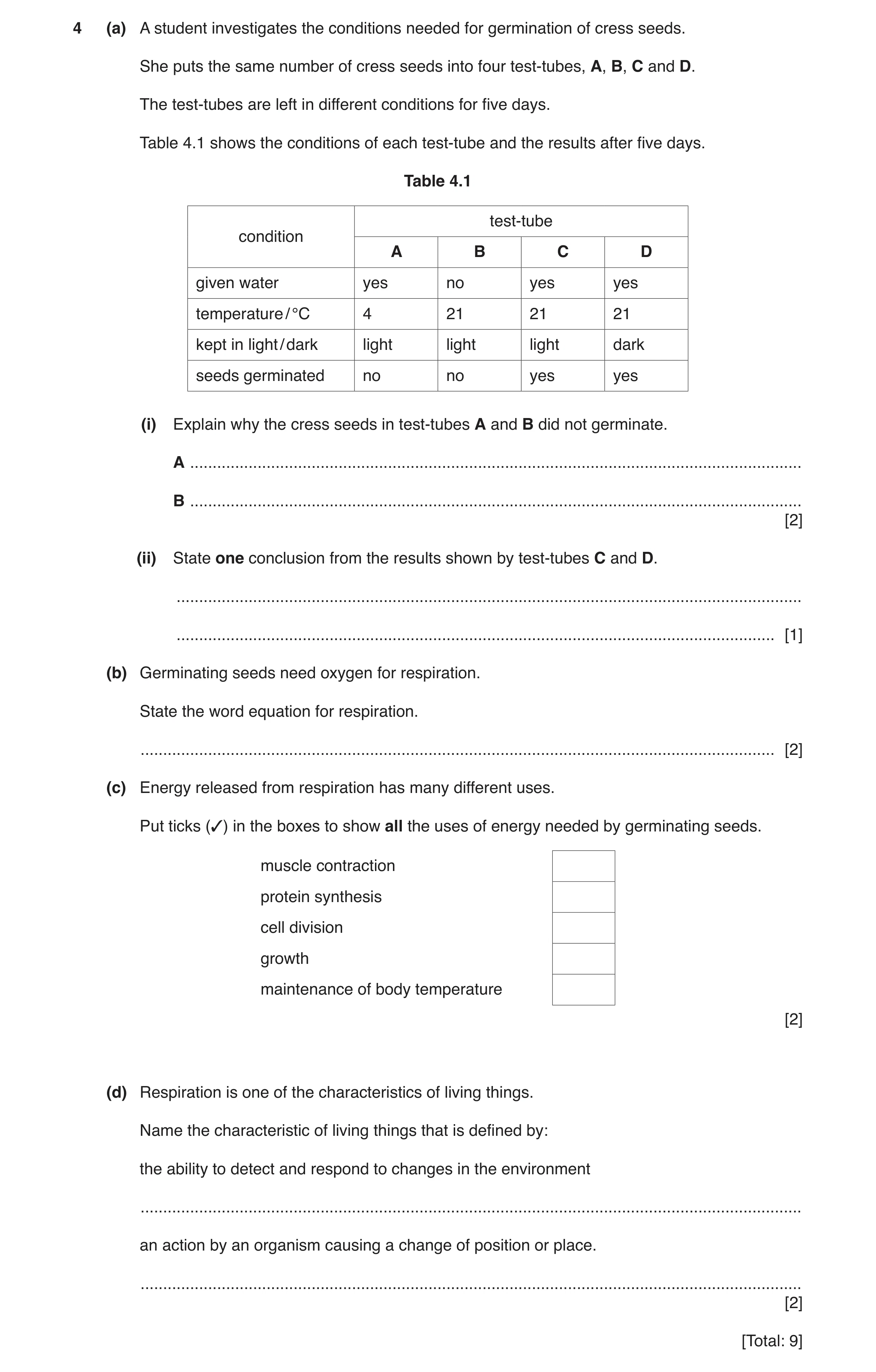
4 (a) A student investigates the conditions needed for germination of cress seeds. She puts the same number of cress seeds into four test-tubes, A, B, C and D. The test-tubes are left in different conditions for five days. Table 4.1 shows the conditions of each test-tube and the results after five days. Table 4.1 test-tube condition A B C D given water yes no yes yes temperature / °C 4 21 21 21 kept in light / dark light light light dark seeds germinated no no yes yes (i) Explain why the cress seeds in test-tubes A and B did not germinate. A … B … [2] (ii) State one conclusion from the results shown by test-tubes C and D. … … [1] (b) Germinating seeds need oxygen for respiration. State the word equation for respiration. … [2] (c) Energy released from respiration has many different uses. Put ticks (3) in the boxes to show all the uses of energy needed by germinating seeds. muscle contraction protein synthesis cell division growth maintenance of body temperature [2] (d) Respiration is one of the characteristics of living things. Name the characteristic of living things that is defined by: the ability to detect and respond to changes in the environment … an action by an organism causing a change of position or place. … [2] [Total: 9]
9 marks
Mark scheme: 4(a)(i) A – too cold / AW; B – not enough water / AW ; 2 4(a)(ii) light is not needed for germination ; 1 4(b) glucose + oxygen → carbon dioxide + water ;; 2 4(c) protein synthesis, cell division, growth ticked ;; 1 or 2 correct = 1 mark, 3 correct = 2 marks 2 4(d) sensitivity ; movement ; 2
This question in 0654/33 Oct/Nov 2019
Q7 · A student investigates the conditions that affect germination of seeds 0654/32 May/June 2020
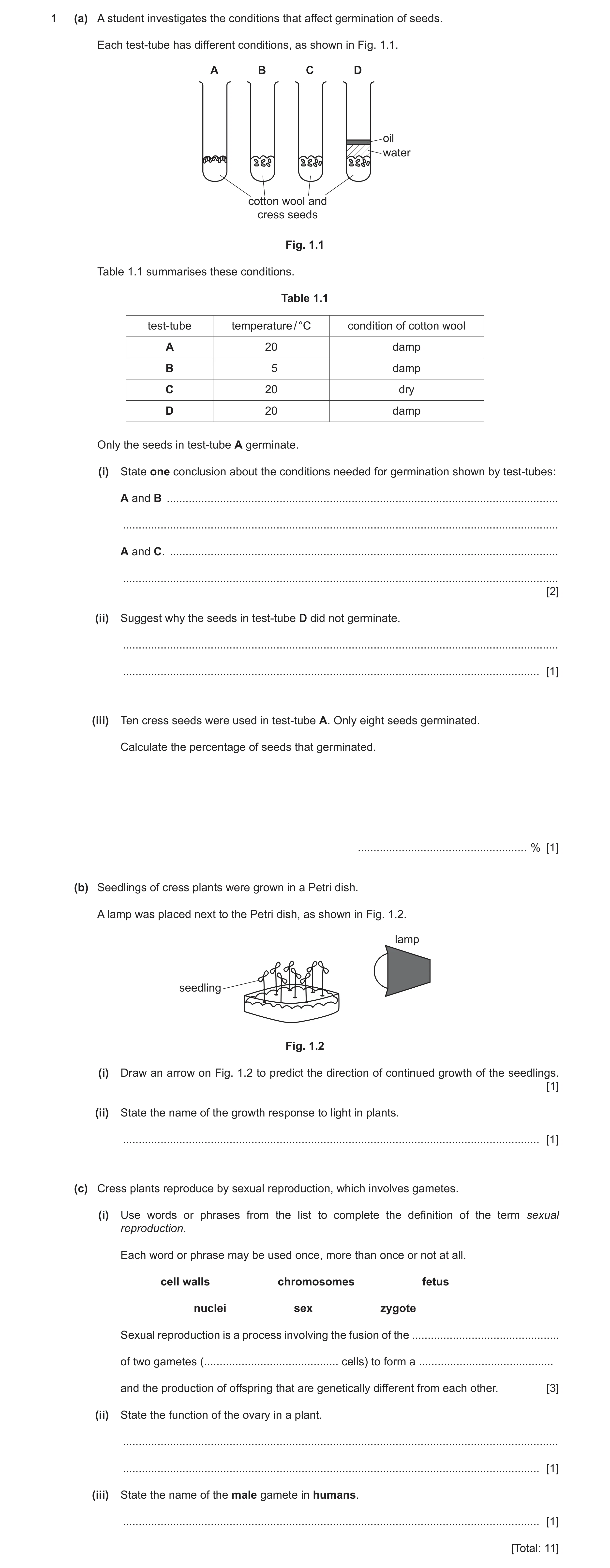
1 (a) A student investigates the conditions that affect germination of seeds. Each test-tube has different conditions, as shown in Fig. 1.1. A B C D oil water cotton wool and cress seeds Fig. 1.1 Table 1.1 summarises these conditions. Table 1.1 test-tube temperature / °C condition of cotton wool A 20 damp B 5 damp C 20 dry D 20 damp Only the seeds in test-tube A germinate. (i) State one conclusion about the conditions needed for germination shown by test-tubes: A and B … … A and C. … … [2] (ii) Suggest why the seeds in test-tube D did not germinate. … … [1] (iii) Ten cress seeds were used in test-tube A. Only eight seeds germinated. Calculate the percentage of seeds that germinated. … % [1] (b) Seedlings of cress plants were grown in a Petri dish. A lamp was placed next to the Petri dish, as shown in Fig. 1.2. lamp seedling Fig. 1.2 (i) Draw an arrow on Fig. 1.2 to predict the direction of continued growth of the seedlings. [1] (ii) State the name of the growth response to light in plants. … [1] (c) Cress plants reproduce by sexual reproduction, which involves gametes. (i) Use words or phrases from the list to complete the definition of the term sexual reproduction. Each word or phrase may be used once, more than once or not at all. cell walls chromosomes fetus nuclei sex zygote Sexual reproduction is a process involving the fusion of the … of two gametes ( … cells) to form a … and the production of offspring that are genetically different from each other. [3] (ii) State the function of the ovary in a plant. … … [1] (iii) State the name of the male gamete in humans. … [1] [Total: 11]
11 marks
Mark scheme: 1(a)(i) warmth / suitable temperature required for germination ; moisture / water required for germination ; 2 1(a)(ii) no oxygen ; 1 1(a)(iii) ( ) 8 100 80 % ; 10 × = 1 1(b)(i) draw an arrow going from left to right ; 1 1(b)(ii) phototropism ; 1 1(c)(i) nuclei ; sex ; zygote ; 3 1(c)(ii) contains ovules / site of fertilisation / produces ovules ; 1 1(c)(iii) sperm ; 1
This question in 0654/32 May/June 2020
Q8 · A student investigates the conditions that affect germination of seeds 0654/33 May/June 2020
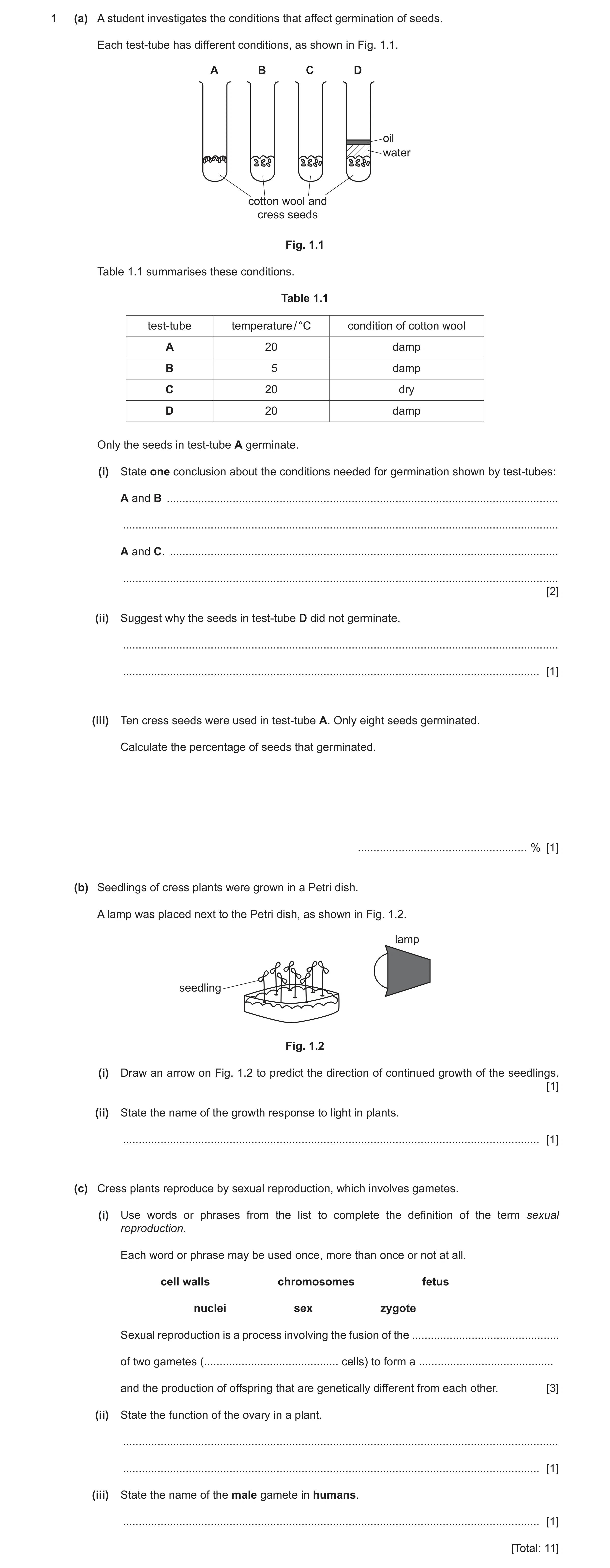
1 (a) A student investigates the conditions that affect germination of seeds. Each test-tube has different conditions, as shown in Fig. 1.1. A B C D oil water cotton wool and cress seeds Fig. 1.1 Table 1.1 summarises these conditions. Table 1.1 test-tube temperature / °C condition of cotton wool A 20 damp B 5 damp C 20 dry D 20 damp Only the seeds in test-tube A germinate. (i) State one conclusion about the conditions needed for germination shown by test-tubes: A and B … … A and C. … … [2] (ii) Suggest why the seeds in test-tube D did not germinate. … … [1] (iii) Ten cress seeds were used in test-tube A. Only eight seeds germinated. Calculate the percentage of seeds that germinated. … % [1] (b) Seedlings of cress plants were grown in a Petri dish. A lamp was placed next to the Petri dish, as shown in Fig. 1.2. lamp seedling Fig. 1.2 (i) Draw an arrow on Fig. 1.2 to predict the direction of continued growth of the seedlings. [1] (ii) State the name of the growth response to light in plants. … [1] (c) Cress plants reproduce by sexual reproduction, which involves gametes. (i) Use words or phrases from the list to complete the definition of the term sexual reproduction. Each word or phrase may be used once, more than once or not at all. cell walls chromosomes fetus nuclei sex zygote Sexual reproduction is a process involving the fusion of the … of two gametes ( … cells) to form a … and the production of offspring that are genetically different from each other. [3] (ii) State the function of the ovary in a plant. … … [1] (iii) State the name of the male gamete in humans. … [1] [Total: 11]
11 marks
Mark scheme: 1(a)(i) warmth / suitable temperature required for germination ; moisture / water required for germination ; 2 1(a)(ii) no oxygen ; 1 1(a)(iii) ( ) 8 100 80 % ; 10 × = 1 1(b)(i) draw an arrow going from left to right ; 1 1(b)(ii) phototropism ; 1 1(c)(i) nuclei ; sex ; zygote ; 3 1(c)(ii) contains ovules / site of fertilisation / produces ovules ; 1 1(c)(iii) sperm ; 1
This question in 0654/33 May/June 2020
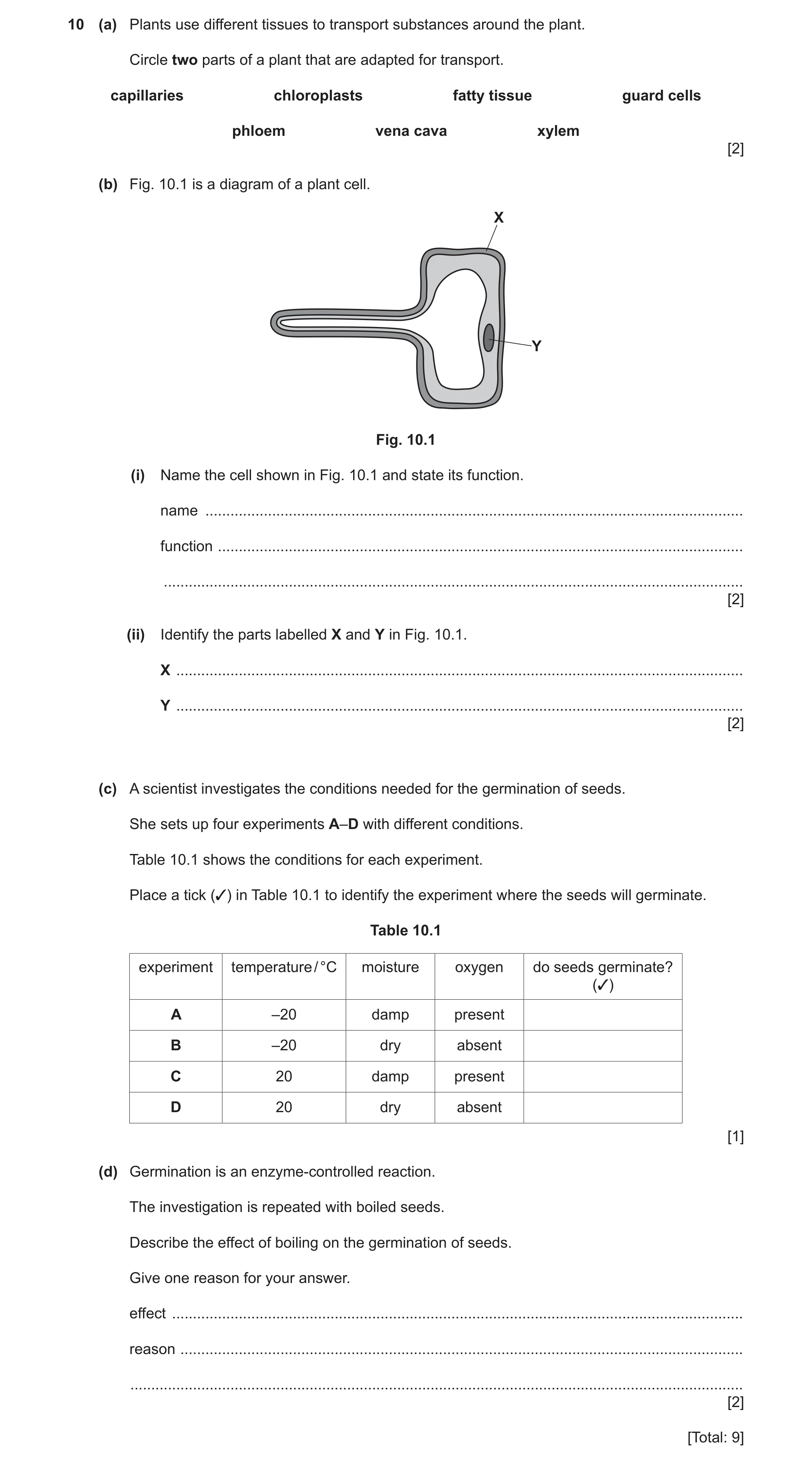
Q9 · Plants use different tissues to transport substances around the plant 0654/31 May/June 2021
10 (a) Plants use different tissues to transport substances around the plant. Circle two parts of a plant that are adapted for transport. capillaries chloroplasts fatty tissue guard cells phloem vena cava xylem [2] (b) Fig. 10.1 is a diagram of a plant cell. X Y Fig. 10.1 (i) Name the cell shown in Fig. 10.1 and state its function. name … function … … [2] (ii) Identify the parts labelled X and Y in Fig. 10.1. X … Y … [2] (c) A scientist investigates the conditions needed for the germination of seeds. She sets up four experiments A–D with different conditions. Table 10.1 shows the conditions for each experiment. Place a tick (3) in Table 10.1 to identify the experiment where the seeds will germinate. Table 10.1 experiment temperature / °C moisture oxygen do seeds germinate? (3) A –20 damp present B –20 dry absent C 20 damp present D 20 dry absent [1] (d) Germination is an enzyme‑controlled reaction. The investigation is repeated with boiled seeds. Describe the effect of boiling on the germination of seeds. Give one reason for your answer. effect … reason … … [2] [Total: 9]
9 marks
Mark scheme: 10(a) phloem circled ; xylem circled ; 2 10(b)(i) name root hair (cell) ; function absorption of, water / mineral ions ; 2 10(b)(ii) X cell wall ; Y nucleus ; 2 Question Answer Marks 10(c) prediction of germination (/ X) X X X ; 1 10(d) effect no germination ; reason (high temperature) decreases enzyme / stops activity ; 2
This question in 0654/31 May/June 2021
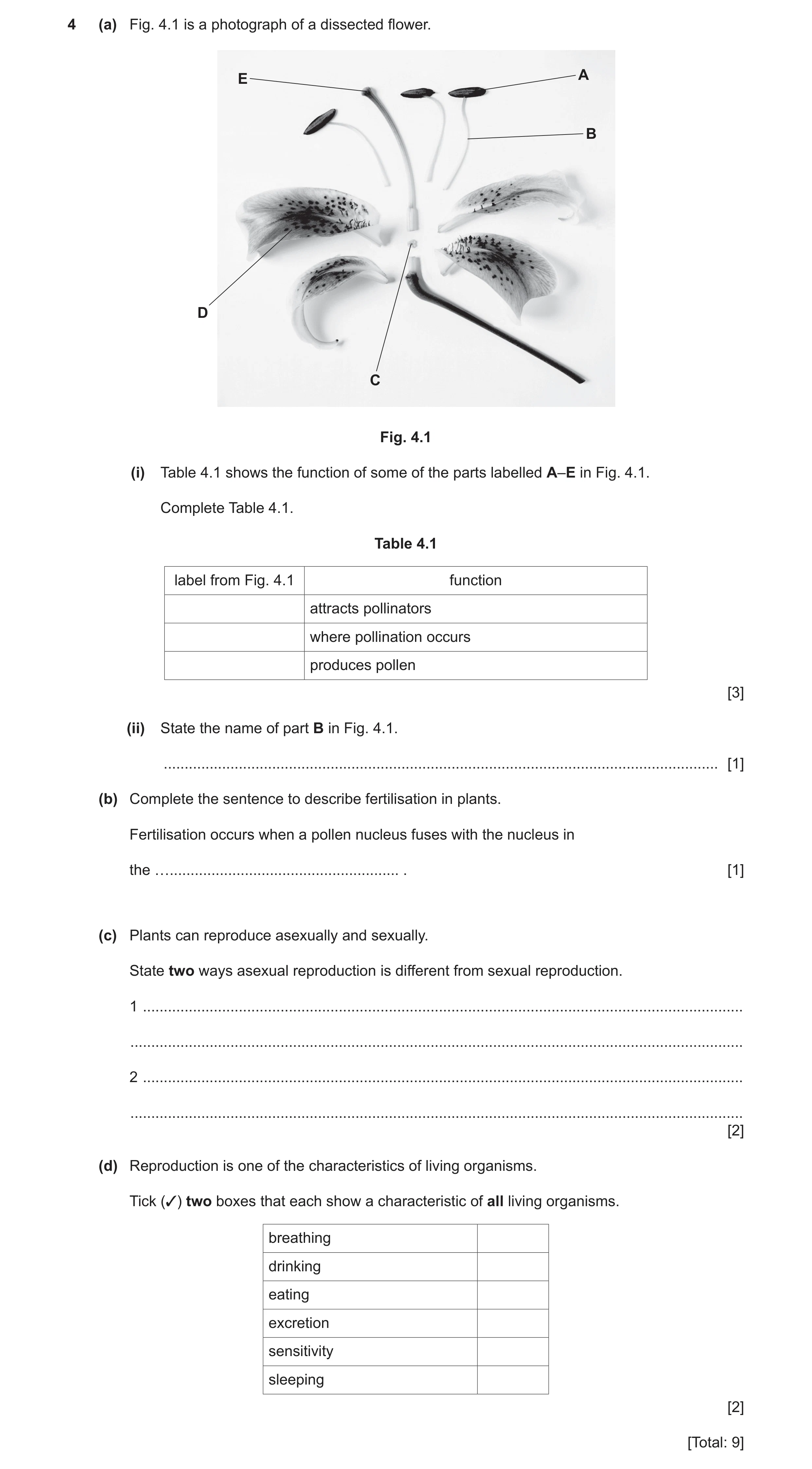
Q10 · A photograph of a dissected flower 0654/32 Feb/March 2022
4 (a) Fig. 4.1 is a photograph of a dissected flower. E A B D C Fig. 4.1 (i) Table 4.1 shows the function of some of the parts labelled A–E in Fig. 4.1. Complete Table 4.1. Table 4.1 label from Fig. 4.1 function attracts pollinators where pollination occurs produces pollen [3] (ii) State the name of part B in Fig. 4.1. … [1] (b) Complete the sentence to describe fertilisation in plants. Fertilisation occurs when a pollen nucleus fuses with the nucleus in the … … . [1] (c) Plants can reproduce asexually and sexually. State two ways asexual reproduction is different from sexual reproduction. 1 … … 2 … … [2] (d) Reproduction is one of the characteristics of living organisms. Tick (3) two boxes that each show a characteristic of all living organisms. breathing drinking eating excretion sensitivity sleeping [2] [Total: 9]
9 marks
Mark scheme: 4(a)(i) D ; E ; A ; 3 4(a)(ii) filament ; 1 4(b) ovule ; 1 4(c) any two from: involves only one parent ; produces genetically identical offspring ; does not involve gametes ; does not involve the process of fertilisation ; 2 4(d) excretion ticked ; sensitivity ticked ; 2
This question in 0654/32 Feb/March 2022
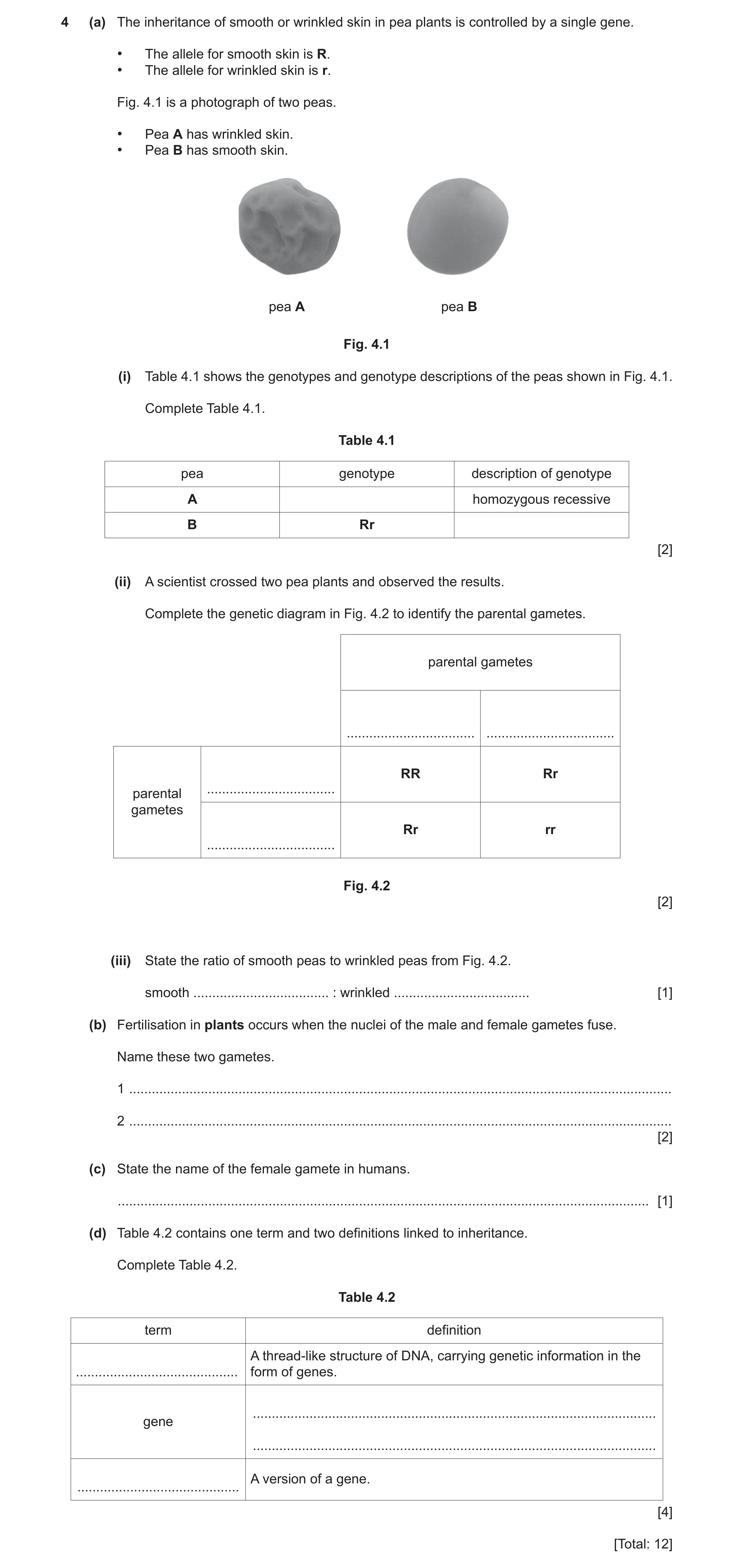
Q11 · The inheritance of smooth or wrinkled skin in pea plants is controlled by a single gene 0654/31 May/June 2022
4 (a) The inheritance of smooth or wrinkled skin in pea plants is controlled by a single gene. • The allele for smooth skin is R. • The allele for wrinkled skin is r. Fig. 4.1 is a photograph of two peas. • Pea A has wrinkled skin. • Pea B has smooth skin. pea A pea B Fig. 4.1 (i) Table 4.1 shows the genotypes and genotype descriptions of the peas shown in Fig. 4.1. Complete Table 4.1. Table 4.1 pea genotype description of genotype A homozygous recessive B Rr [2] (ii) A scientist crossed two pea plants and observed the results. Complete the genetic diagram in Fig. 4.2 to identify the parental gametes. parental gametes … … RR Rr … parental gametes Rr rr … Fig. 4.2 [2] (iii) State the ratio of smooth peas to wrinkled peas from Fig. 4.2. smooth … : wrinkled … [1] (b) Fertilisation in plants occurs when the nuclei of the male and female gametes fuse. Name these two gametes. 1 … 2 … [2] (c) State the name of the female gamete in humans. … [1] (d) Table 4.2 contains one term and two definitions linked to inheritance. Complete Table 4.2. Table 4.2 term definition A thread-like structure of DNA, carrying genetic information in the … form of genes. … gene … A version of a gene … [4] [Total: 12]
12 marks
Mark scheme: 4(a)(i) pea genotype description of genotype A rr ; homozygous recessive B Rr heterozygous ; 2 4(a)(ii) parental gametes R r parental gametes R RR Rr r Rr rr 2 4(a)(iii) smooth 3 : wrinkled 1 ; 1 4(b) pollen ; ovule ; 2 4(c) egg / ovum ; 1 4(d) chromosome ; length of DNA ; that codes for a protein ; allele ; 4
This question in 0654/31 May/June 2022
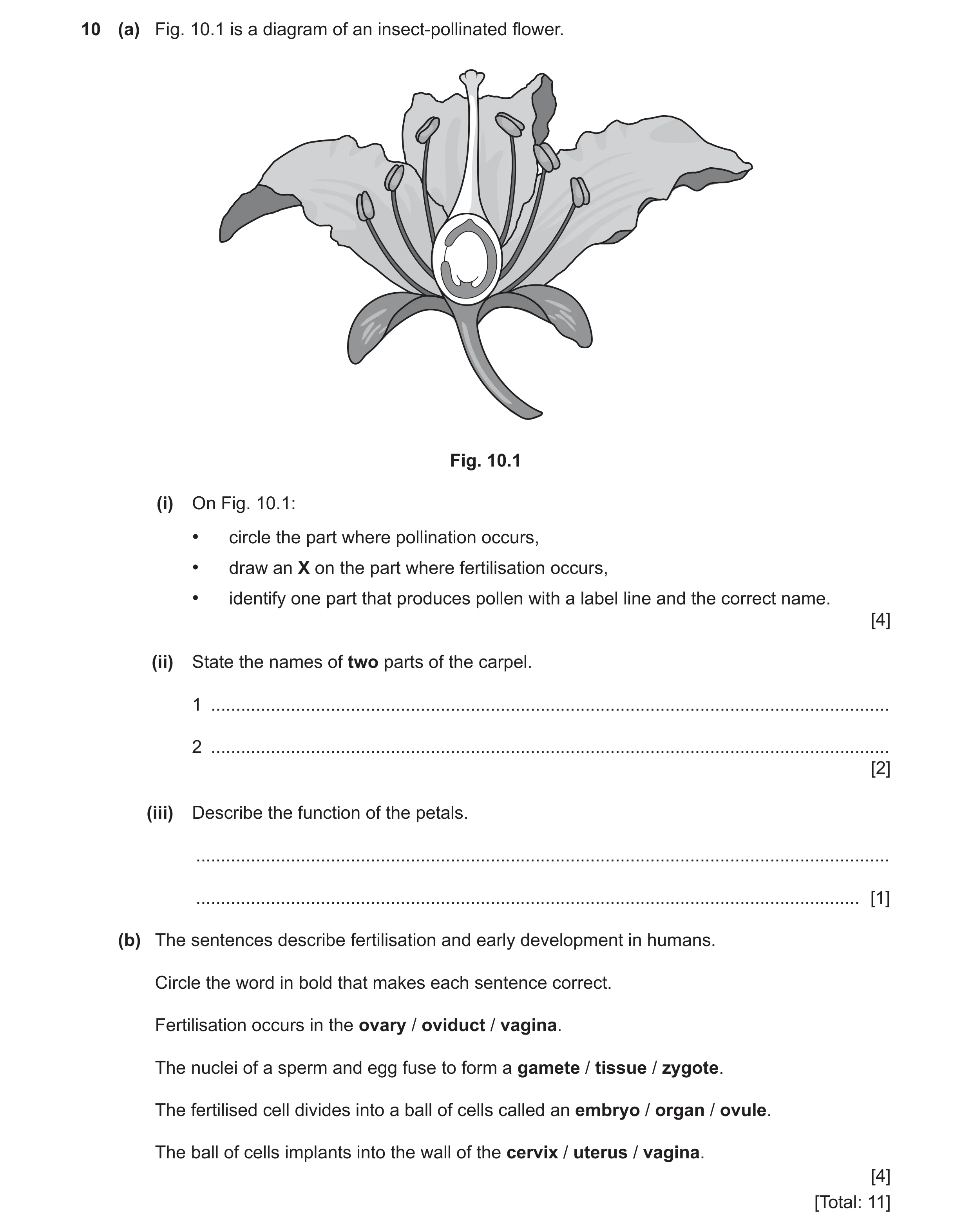
Q12 · A diagram of an insect-pollinated flower 0654/32 Oct/Nov 2022
10 (a) Fig. 10.1 is a diagram of an insect-pollinated flower. Fig. 10.1 (i) On Fig. 10.1: • circle the part where pollination occurs, • draw an X on the part where fertilisation occurs, • identify one part that produces pollen with a label line and the correct name. [4] (ii) State the names of two parts of the carpel. 1 … 2 … [2] (iii) Describe the function of the petals. … … [1] (b) The sentences describe fertilisation and early development in humans. Circle the word in bold that makes each sentence correct. Fertilisation occurs in the ovary / oviduct / vagina. The nuclei of a sperm and egg fuse to form a gamete / tissue / zygote. The fertilised cell divides into a ball of cells called an embryo / organ / ovule. The ball of cells implants into the wall of the cervix / uterus / vagina. [4] [Total: 11]
11 marks
Mark scheme: 10(a)(i) 4 circle around stigma ; X on ovule ; label line to anther with correct name ;; 10(a)(ii) any two from: 2 style ; stigma ; ovary ; 10(a)(iii) attract (named), pollinator/insects (for pollination) ; 1 10(b) oviduct ; 4 zygote ; embryo ; uterus ;
This question in 0654/32 Oct/Nov 2022
Q13 · A student investigates the germination of pea seeds 0654/33 Oct/Nov 2022
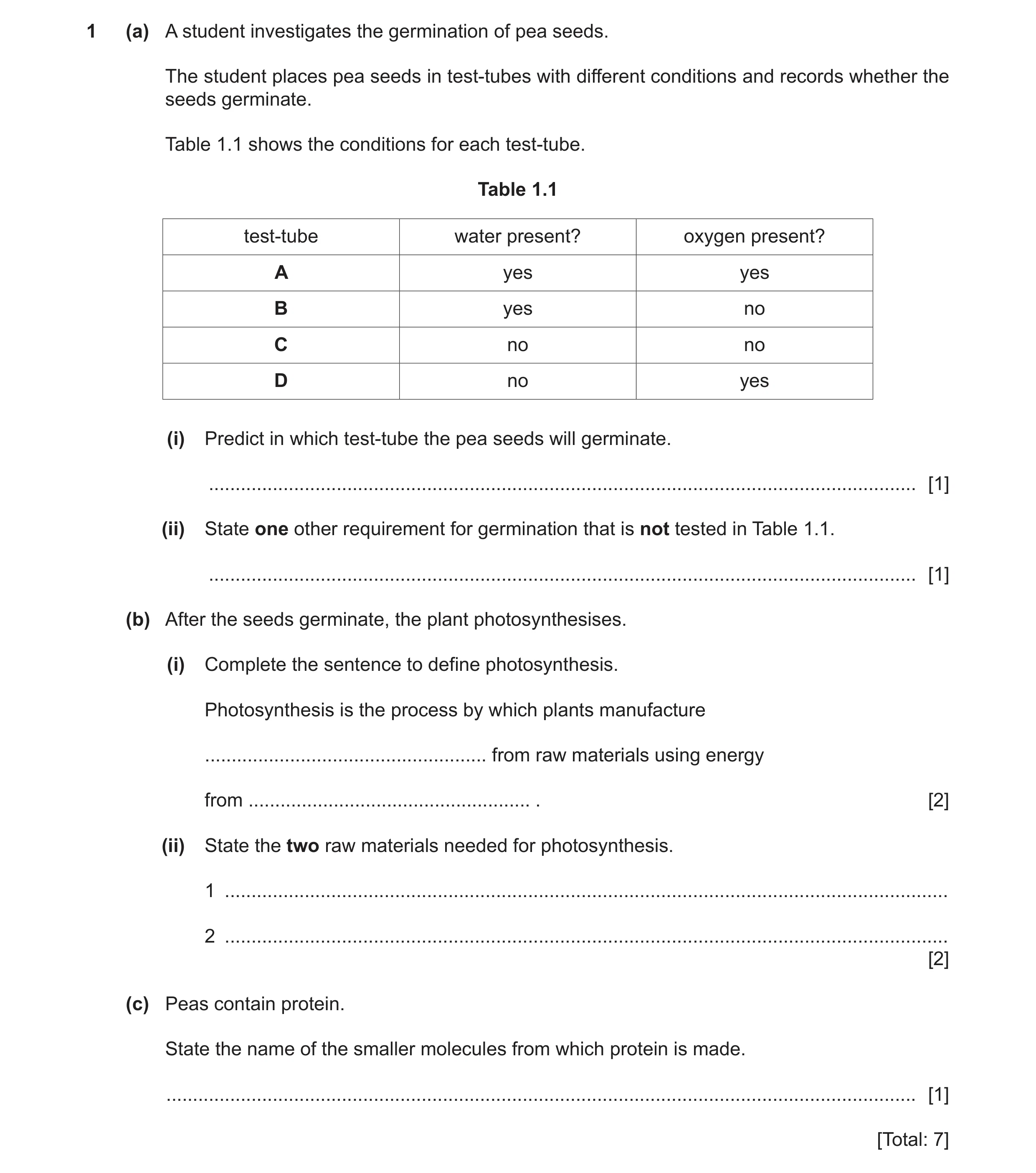
1 (a) A student investigates the germination of pea seeds. The student places pea seeds in test-tubes with different conditions and records whether the seeds germinate. Table 1.1 shows the conditions for each test-tube. Table 1.1 test-tube water present? oxygen present? A yes yes B yes no C no no D no yes (i) Predict in which test-tube the pea seeds will germinate. … [1] (ii) State one other requirement for germination that is not tested in Table 1.1. … [1] (b) After the seeds germinate, the plant photosynthesises. (i) Complete the sentence to define photosynthesis. Photosynthesis is the process by which plants manufacture … from raw materials using energy from … . [2] (ii) State the two raw materials needed for photosynthesis. 1 … 2 … [2] (c) Peas contain protein. State the name of the smaller molecules from which protein is made. … [1] [Total: 7]
7 marks
Mark scheme: Question Answer Marks 1(a)(i) A ; 1 1(a)(ii) suitable temperature ; 1 1(b)(i) carbohydrates ; 2 light ; 1(b)(ii) carbon dioxide ; 2 water ; 1(c) amino acids ; 1
This question in 0654/33 Oct/Nov 2022
Q14 · A diagram of a flower 0654/32 May/June 2023
1 (a) Fig. 1.1 is a diagram of a flower. A E B D C Fig. 1.1 State the letter in Fig. 1.1 that identifies the part: that attracts insects … that produces pollen … where fertilisation occurs. … [3] (b) State the name of the part in the human body where fertilisation takes place. … [1] (c) Some plants reproduce both asexually and sexually. Table 1.1 compares some of the features of asexual reproduction and sexual reproduction. Place ticks (3) in the boxes in Table 1.1 to show the correct features of asexual reproduction and sexual reproduction. Table 1.1 asexual reproduction sexual reproduction involves gametes involves inheritance of genetic information offspring is genetically identical to the parent [2] (d) Bacteria reproduce by a type of asexual reproduction. Fig. 1.2 is a diagram of the reproduction of a bacterium. The original bacterium divides to form two bacteria. original bacterium Fig. 1.2 A bacterium can divide every 30 minutes. Calculate the number of bacteria after 4 hours if you start with one bacterium. … [2] (e) Reproduction is one of the characteristics of living organisms. State three other characteristics of living organisms. 1 … 2 … 3 … [3] [Total: 11]
11 marks
Mark scheme: 1(a) A ; E ; C ; 3 1(b) oviduct ; 1 1(c) asexual reproduction sexual reproduction involves gametes involves inheritance of genetic information offspring is genetically identical to the parent ;; 2 1(d) ref to 8 divisions ; 28 = 256 ; 2 1(e) any three from: movement ; respiration ; sensitivity ; growth ; excretion ; nutrition ; 3
This question in 0654/32 May/June 2023
Q15 · A diagram of a flower 0654/33 May/June 2023
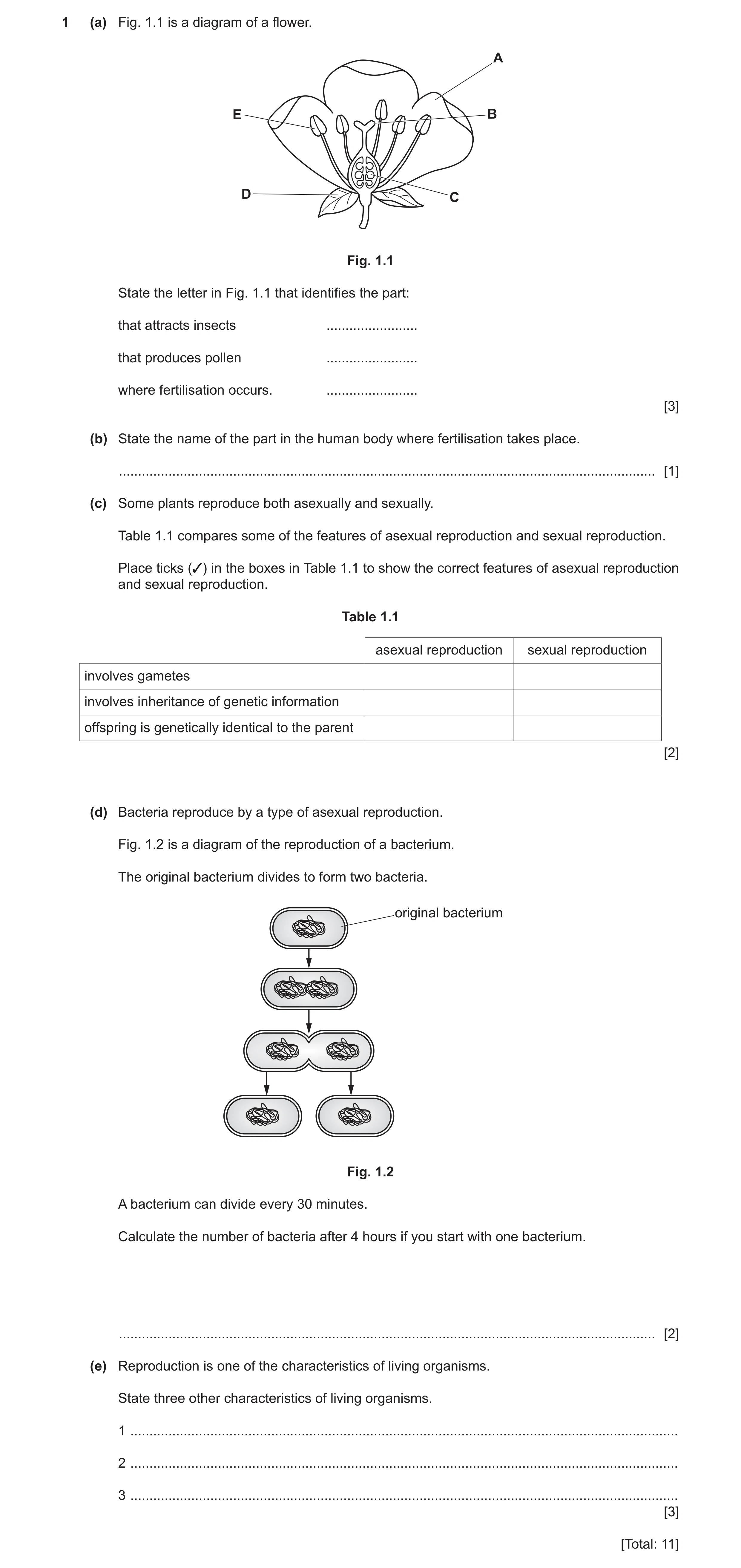
1 (a) Fig. 1.1 is a diagram of a flower. A E B D C Fig. 1.1 State the letter in Fig. 1.1 that identifies the part: that attracts insects … that produces pollen … where fertilisation occurs. … [3] (b) State the name of the part in the human body where fertilisation takes place. … [1] (c) Some plants reproduce both asexually and sexually. Table 1.1 compares some of the features of asexual reproduction and sexual reproduction. Place ticks (3) in the boxes in Table 1.1 to show the correct features of asexual reproduction and sexual reproduction. Table 1.1 asexual reproduction sexual reproduction involves gametes involves inheritance of genetic information offspring is genetically identical to the parent [2] (d) Bacteria reproduce by a type of asexual reproduction. Fig. 1.2 is a diagram of the reproduction of a bacterium. The original bacterium divides to form two bacteria. original bacterium Fig. 1.2 A bacterium can divide every 30 minutes. Calculate the number of bacteria after 4 hours if you start with one bacterium. … [2] (e) Reproduction is one of the characteristics of living organisms. State three other characteristics of living organisms. 1 … 2 … 3 … [3] [Total: 11]
11 marks
Mark scheme: 1(a) A ; E ; C ; 3 1(b) oviduct ; 1 1(c) asexual reproduction sexual reproduction involves gametes involves inheritance of genetic information offspring is genetically identical to the parent ;; 2 1(d) ref to 8 divisions ; 28 = 256 ; 2 1(e) any three from: movement ; respiration ; sensitivity ; growth ; excretion ; nutrition ; 3
This question in 0654/33 May/June 2023
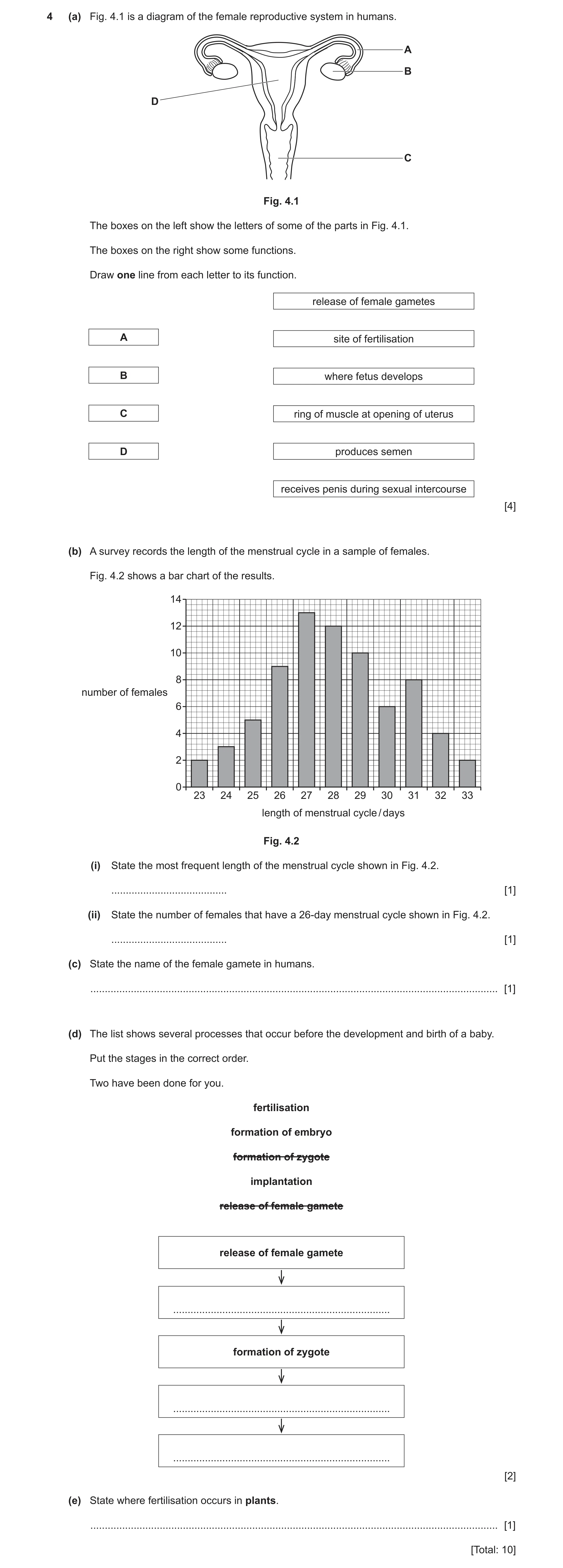
Q16 · A diagram of the female reproductive system in humans 0654/32 May/June 2024
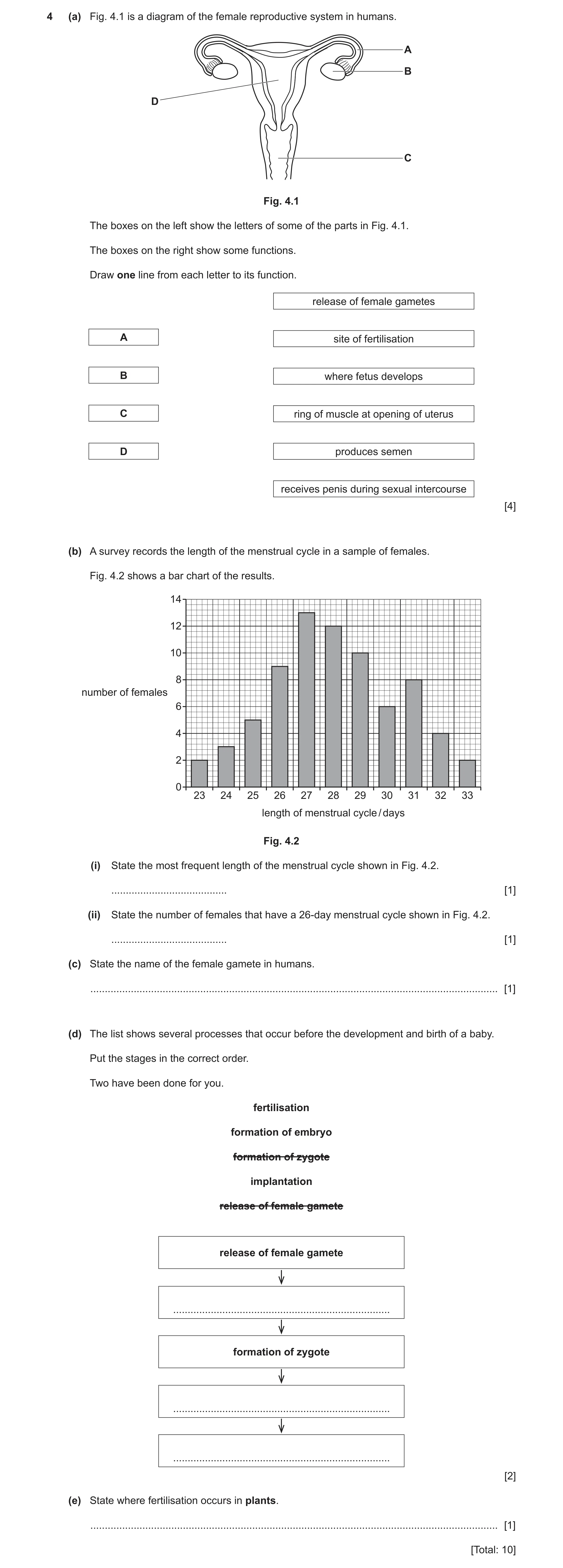
4 (a) Fig. 4.1 is a diagram of the female reproductive system in humans. A B D C Fig. 4.1 The boxes on the left show the letters of some of the parts in Fig. 4.1. The boxes on the right show some functions. Draw one line from each letter to its function. release of female gametes A site of fertilisation B where fetus develops C ring of muscle at opening of uterus D produces semen receives penis during sexual intercourse [4] (b) A survey records the length of the menstrual cycle in a sample of females. Fig. 4.2 shows a bar chart of the results. 14 12 10 8 number of females 6 4 2 0 23 24 25 26 27 28 29 30 31 32 33 length of menstrual cycle / days Fig. 4.2 (i) State the most frequent length of the menstrual cycle shown in Fig. 4.2. … [1] (ii) State the number of females that have a 26‑day menstrual cycle shown in Fig. 4.2. … [1] (c) State the name of the female gamete in humans. … [1] (d) The list shows several processes that occur before the development and birth of a baby. Put the stages in the correct order. Two have been done for you. fertilisation formation of embryo formation of zygote implantation release of female gamete release of female gamete … formation of zygote … … [2] (e) State where fertilisation occurs in plants. … [1] [Total: 10]
10 marks
Mark scheme: 4(a) release of female gametes A site of fertilisation B where fetus develops C ring of muscle at opening of uterus D produces semen receives penis during sexual intercourse ;;;; 4(b)(i) 27 (days) ; 1 4(b)(ii) 9 ; 1 Question Answer Marks 4(c) egg / ovum ; 1 4(d) release of female gamete fertilisation formation of zygote formation of embryo implantation 1 or 2 correct ; 3 correct ; 2 4(e) ovule ; 1
This question in 0654/32 May/June 2024
Q17 · A diagram of the female reproductive system in humans 0654/33 May/June 2024
4 (a) Fig. 4.1 is a diagram of the female reproductive system in humans. A B D C Fig. 4.1 The boxes on the left show the letters of some of the parts in Fig. 4.1. The boxes on the right show some functions. Draw one line from each letter to its function. release of female gametes A site of fertilisation B where fetus develops C ring of muscle at opening of uterus D produces semen receives penis during sexual intercourse [4] (b) A survey records the length of the menstrual cycle in a sample of females. Fig. 4.2 shows a bar chart of the results. 14 12 10 8 number of females 6 4 2 0 23 24 25 26 27 28 29 30 31 32 33 length of menstrual cycle / days Fig. 4.2 (i) State the most frequent length of the menstrual cycle shown in Fig. 4.2. … [1] (ii) State the number of females that have a 26‑day menstrual cycle shown in Fig. 4.2. … [1] (c) State the name of the female gamete in humans. … [1] (d) The list shows several processes that occur before the development and birth of a baby. Put the stages in the correct order. Two have been done for you. fertilisation formation of embryo formation of zygote implantation release of female gamete release of female gamete … formation of zygote … … [2] (e) State where fertilisation occurs in plants. … [1] [Total: 10]
10 marks
Mark scheme: 4(a) release of female gametes A site of fertilisation B where fetus develops C ring of muscle at opening of uterus D produces semen receives penis during sexual intercourse ;;;; 4(b)(i) 27 (days) ; 1 4(b)(ii) 9 ; 1 Question Answer Marks 4(c) egg / ovum ; 1 4(d) release of female gamete fertilisation formation of zygote formation of embryo implantation 1 or 2 correct ; 3 correct ; 2 4(e) ovule ; 1
This question in 0654/33 May/June 2024
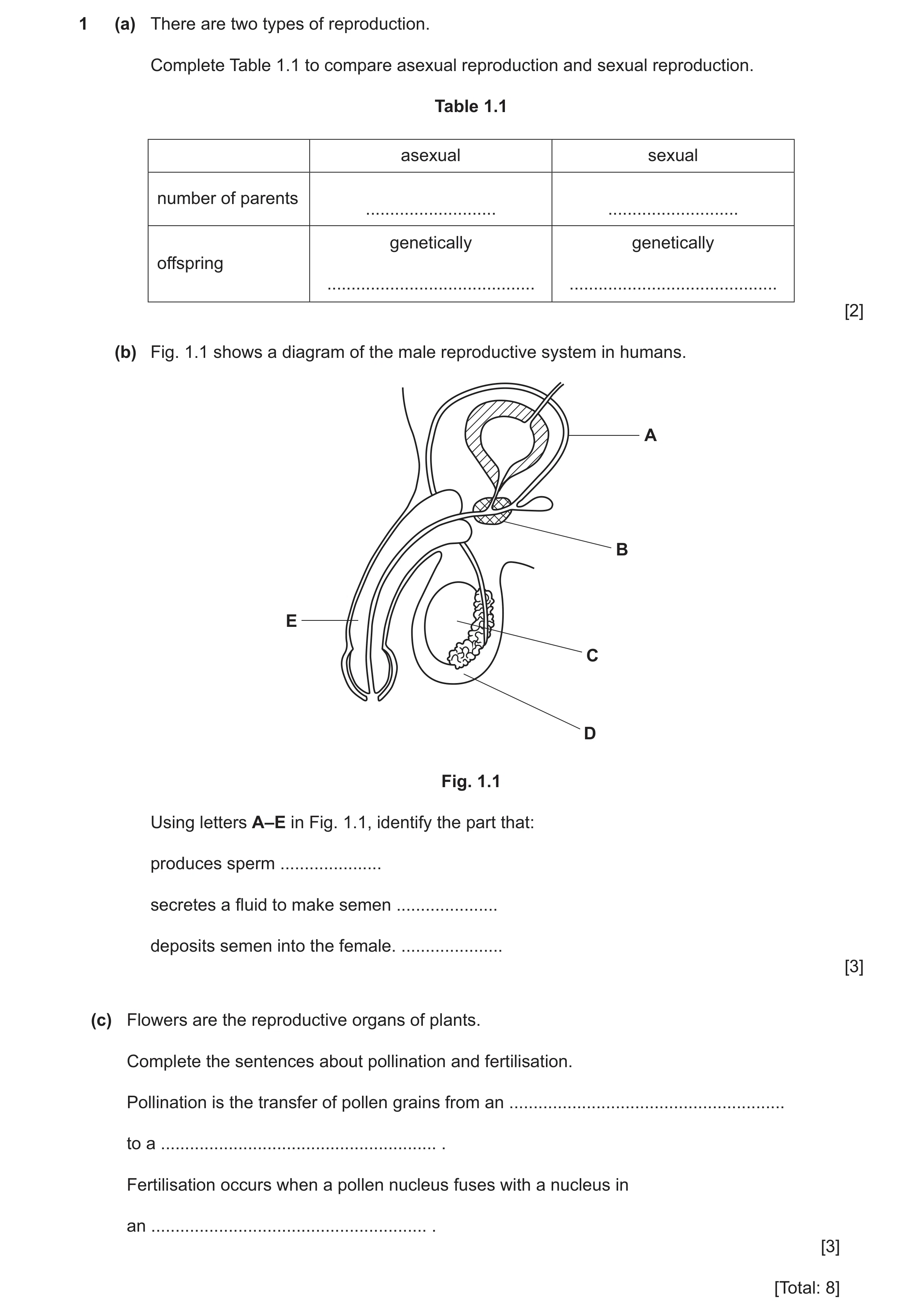
Q18 · There are two types of reproduction 0654/31 Oct/Nov 2025
1 (a) There are two types of reproduction. Complete Table 1.1 to compare asexual reproduction and sexual reproduction. Table 1.1 asexual sexual number of parents … … genetically genetically offspring … … [2] (b) Fig. 1.1 shows a diagram of the male reproductive system in humans. A B E C D Fig. 1.1 Using letters A–E in Fig. 1.1, identify the part that: produces sperm … secretes a fluid to make semen … deposits semen into the female. … [3] (c) Flowers are the reproductive organs of plants. Complete the sentences about pollination and fertilisation. Pollination is the transfer of pollen grains from an … to a … . Fertilisation occurs when a pollen nucleus fuses with a nucleus in an … . [3] [Total: 8]
8 marks
Mark scheme: Question Answer Marks 1(a) 2 asexual sexual number of parents 1 2 offspring identical different 1 mark for each correct row 1(b) (produces sperm) = C ; 3 (fluid) = B ; (deposits semen) = E ; 1(c) anther ; 3 stigma ; ovule ;
This question in 0654/31 Oct/Nov 2025
Question 19 0654/32 Oct/Nov 2025
4 (a) Fig. 4.1 shows a food web. lion hyena cheetah zebra elephant giraffe mimosa herbs grass tree Fig. 4.1 (i) Identify one herbivore shown in Fig. 4.1. … [1] (ii) Identify one secondary consumer shown in Fig. 4.1. … [1] (iii) State the number of producers shown in Fig. 4.1. … [1] (b) Fig. 4.2 is a diagram of an insect‑pollinated flower. A G B F C E D Fig. 4.2 Using letters A–G in Fig. 4.2, identify the part: that produces the female gametes … that produces the pollen grains … where pollination takes place. … [3] (c) Flowers produce seeds. State the three conditions needed for germination of seeds. 1 … 2 … 3 … [3] [Total: 9]
9 marks
Mark scheme: 4(a)(i) giraffe / elephant / zebra ; 1 4(a)(ii) cheetah / lion / hyena ; 1 4(a)(iii) 4 ; 1 4(b) E ; 3 G ; B ; 4(c) oxygen ; 3 suitable temperature ; water ;
This question in 0654/32 Oct/Nov 2025
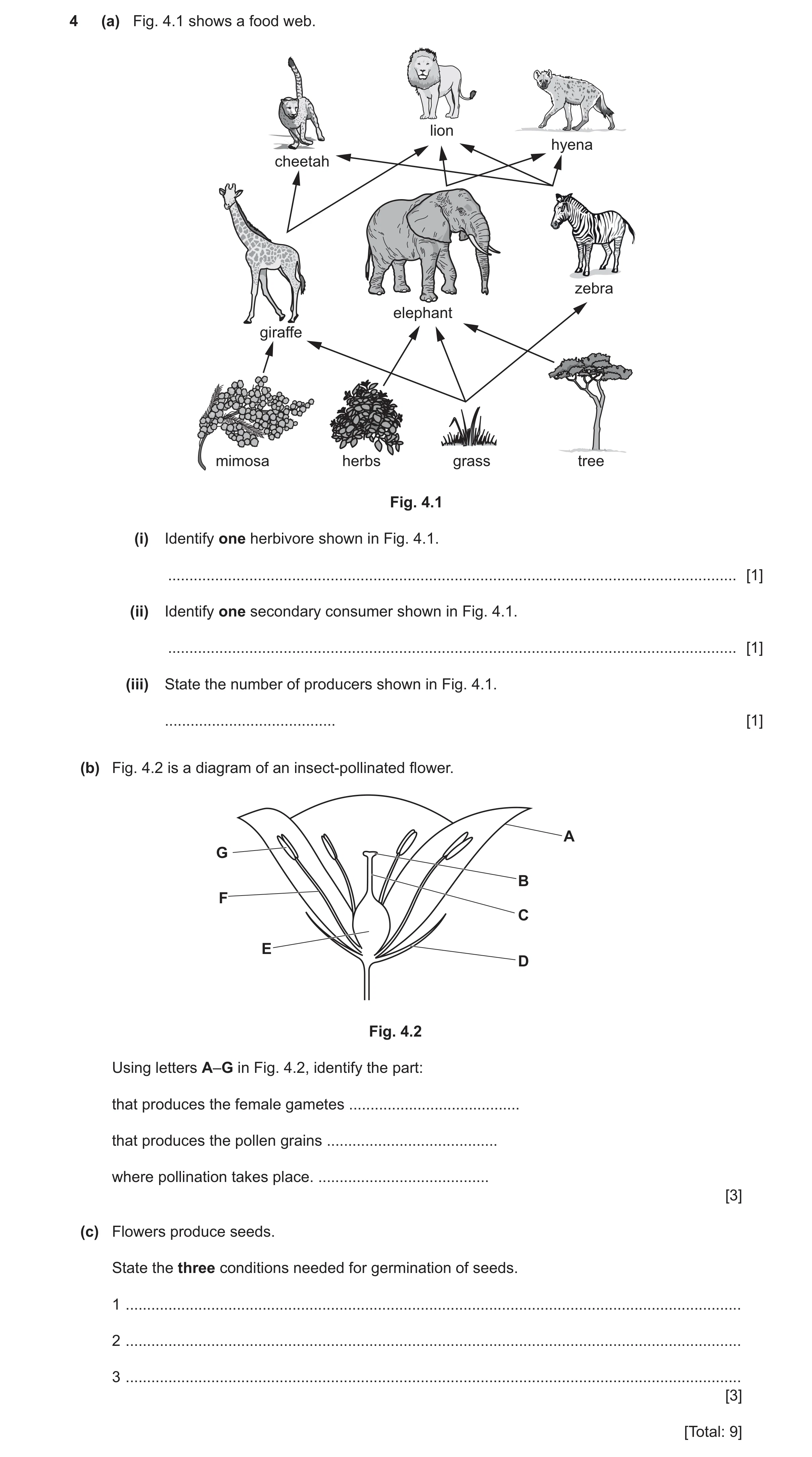
Question 20 0654/33 Oct/Nov 2025
4 (a) Fig. 4.1 shows a food web. lion hyena cheetah zebra elephant giraffe mimosa herbs grass tree Fig. 4.1 (i) Identify one herbivore shown in Fig. 4.1. … [1] (ii) Identify one secondary consumer shown in Fig. 4.1. … [1] (iii) State the number of producers shown in Fig. 4.1. … [1] (b) Fig. 4.2 is a diagram of an insect‑pollinated flower. A G B F C E D Fig. 4.2 Using letters A–G in Fig. 4.2, identify the part: that produces the female gametes … that produces the pollen grains … where pollination takes place. … [3] (c) Flowers produce seeds. State the three conditions needed for germination of seeds. 1 … 2 … 3 … [3] [Total: 9]
9 marks
Mark scheme: 4(a)(i) giraffe / elephant / zebra ; 1 4(a)(ii) cheetah / lion / hyena ; 1 4(a)(iii) 4 ; 1 4(b) E ; 3 G ; B ; 4(c) oxygen ; 3 suitable temperature ; water ;
This question in 0654/33 Oct/Nov 2025
 1 / 30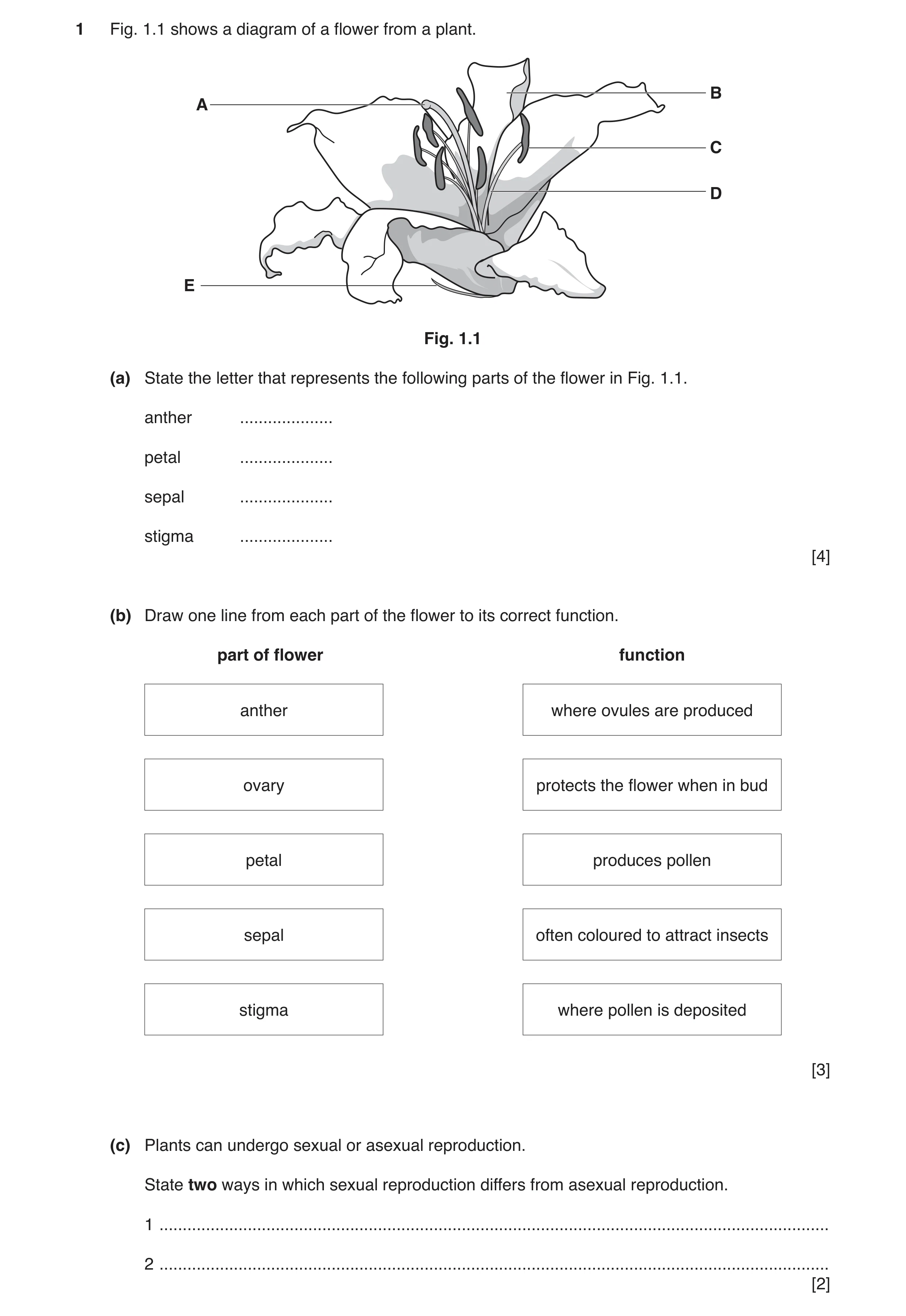
 17 / 30
 18 / 30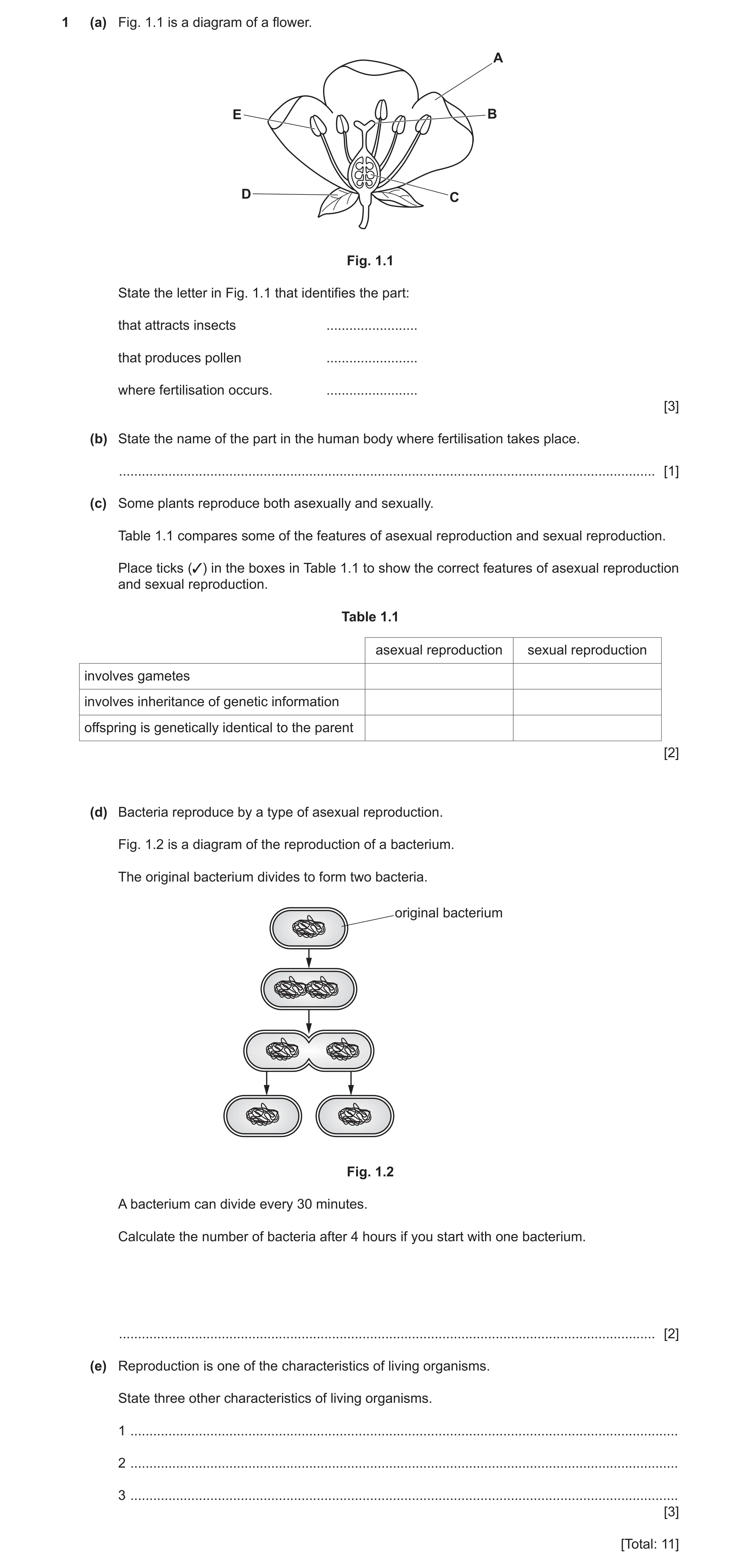
 27 / 30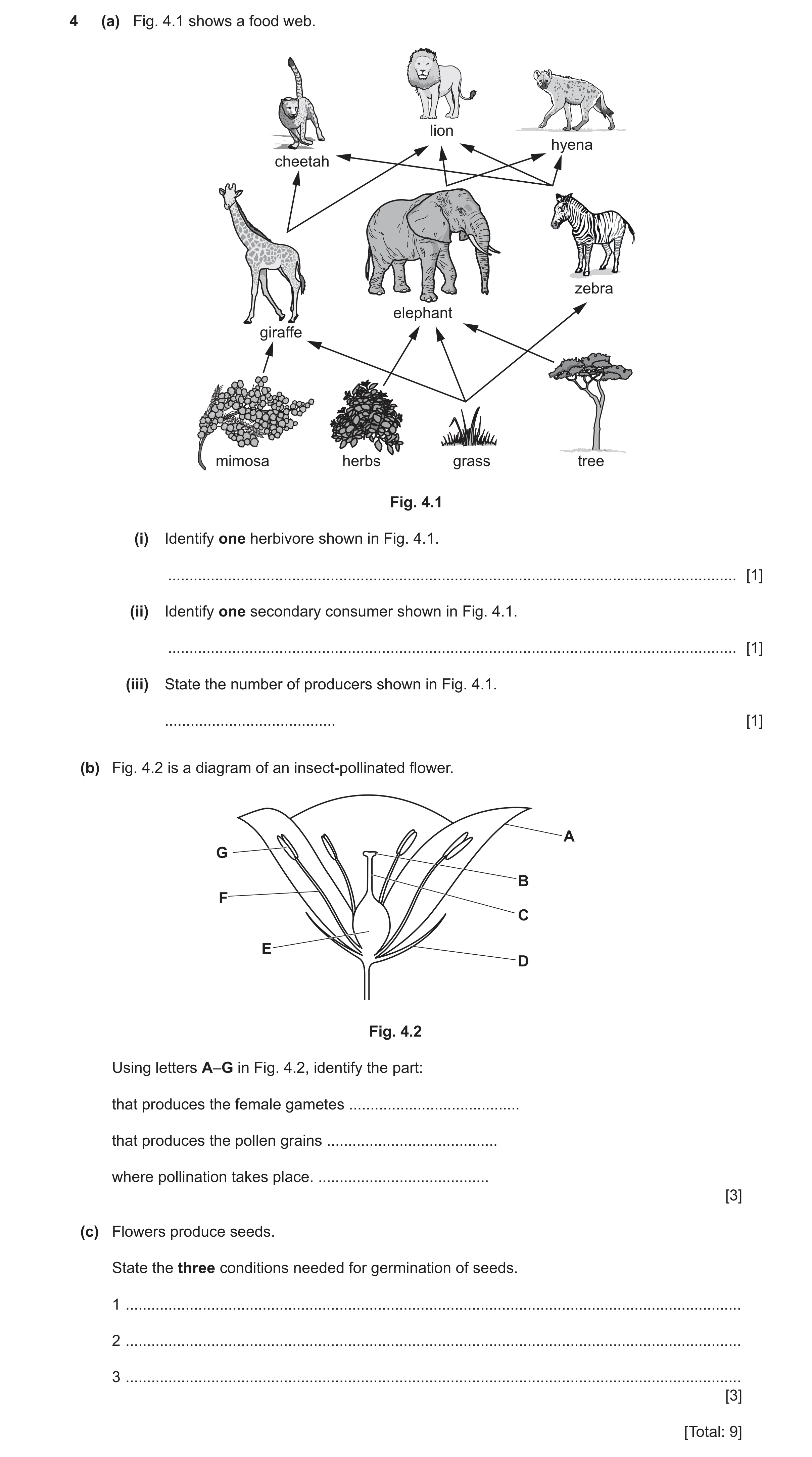
 9
9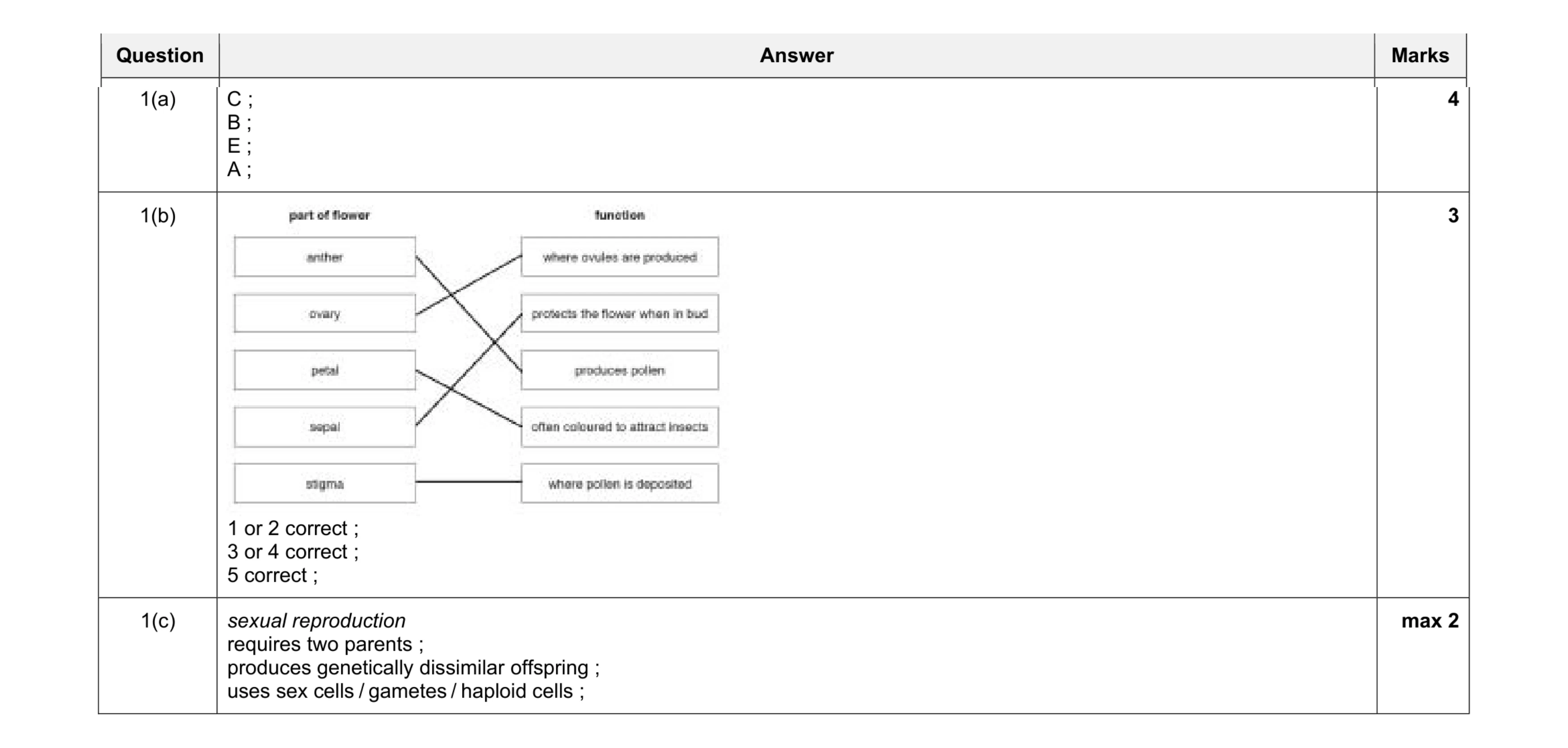 9
9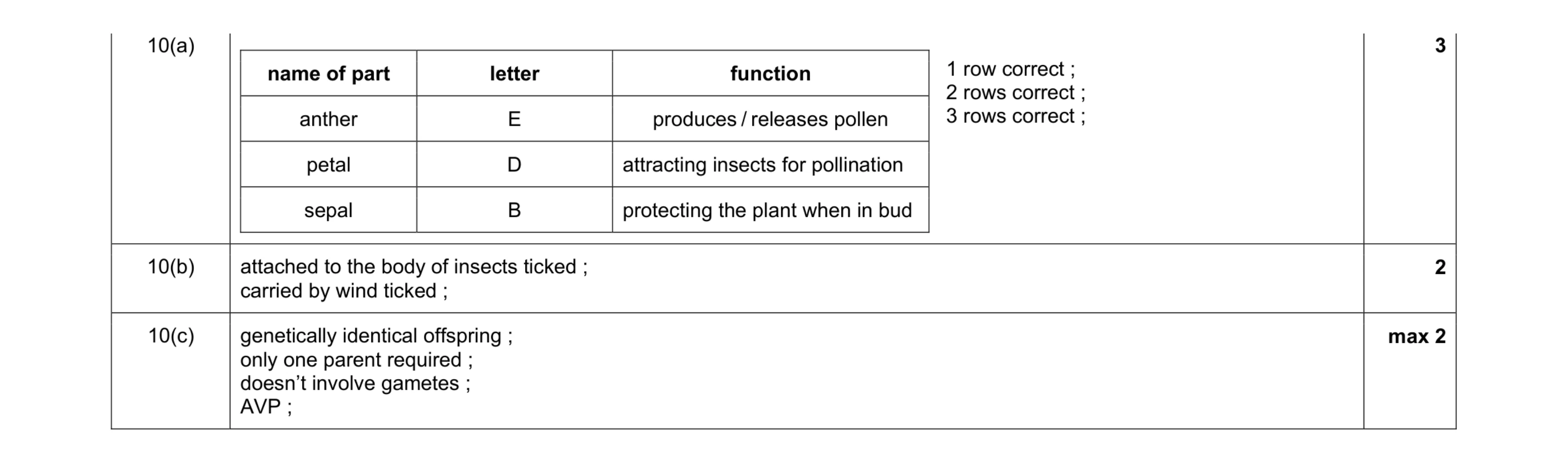 7
7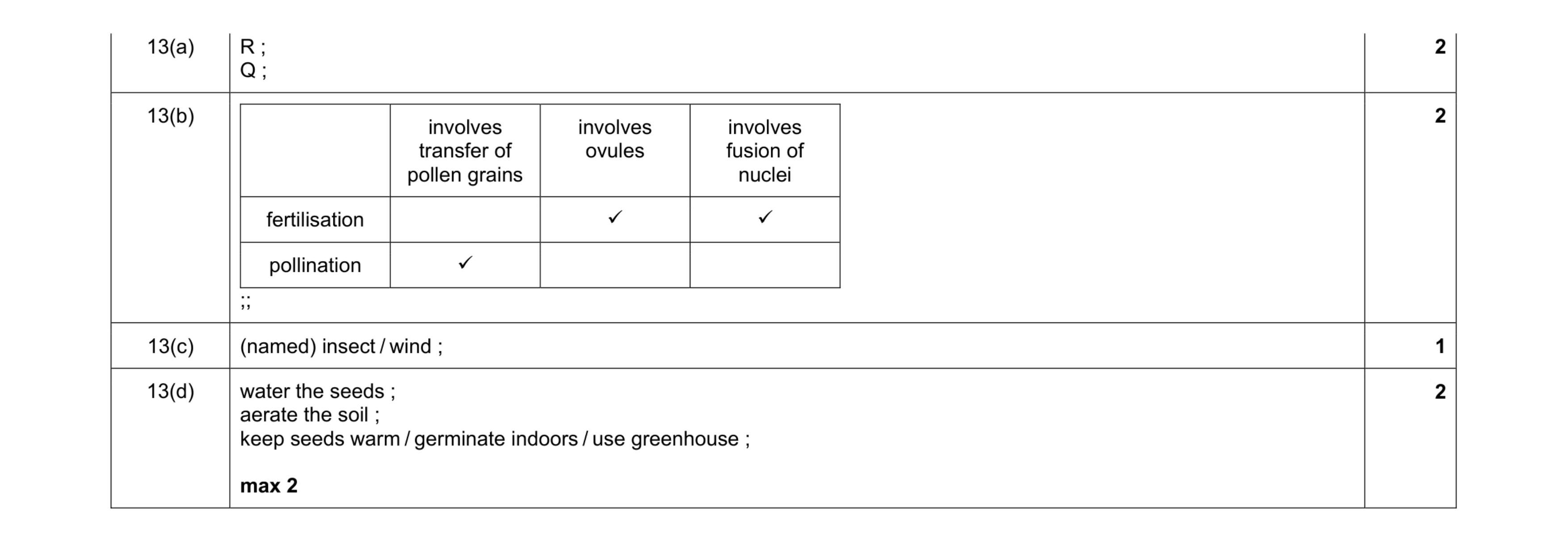 7
7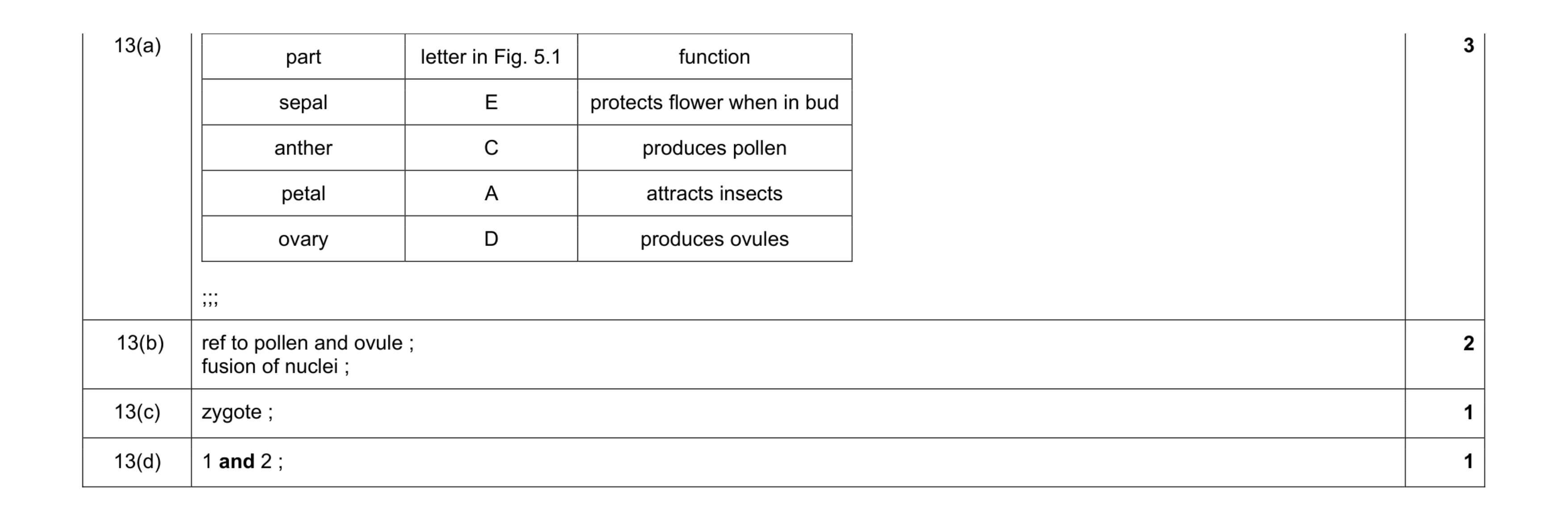 7
7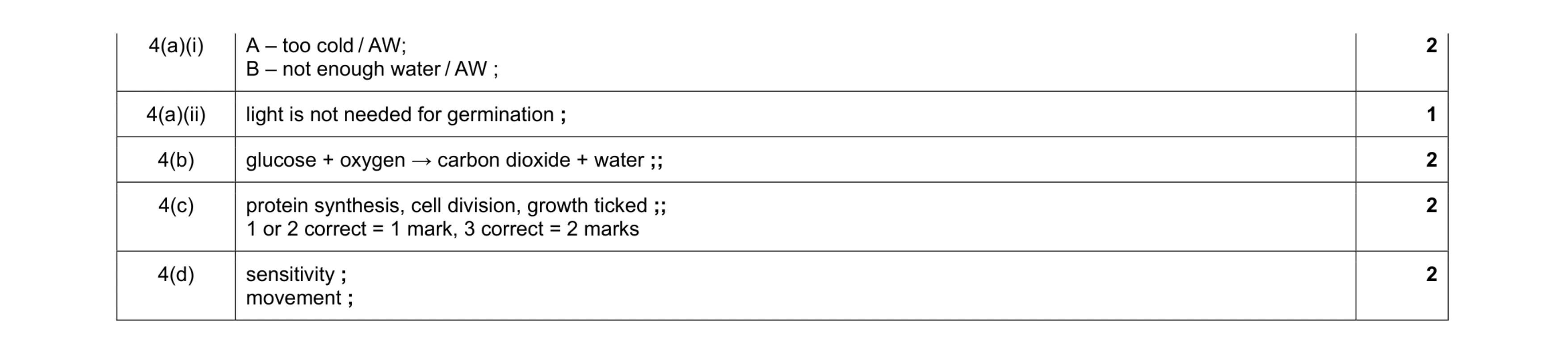 9
9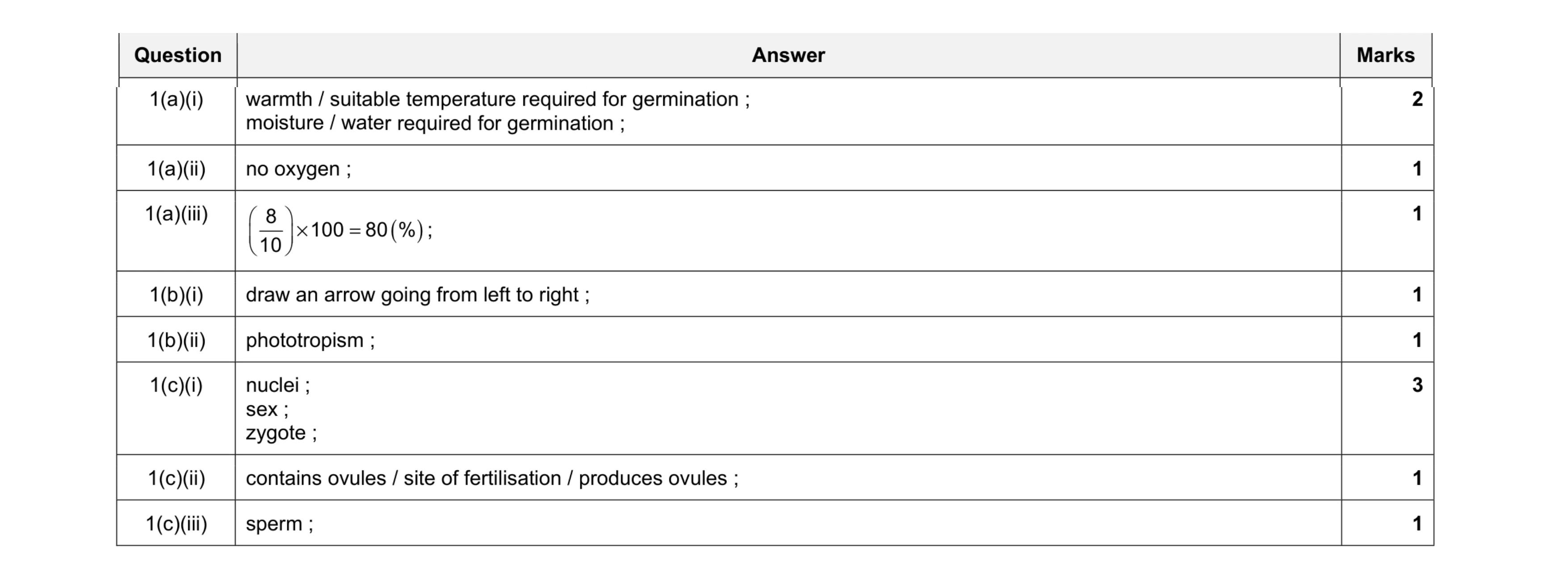 11
11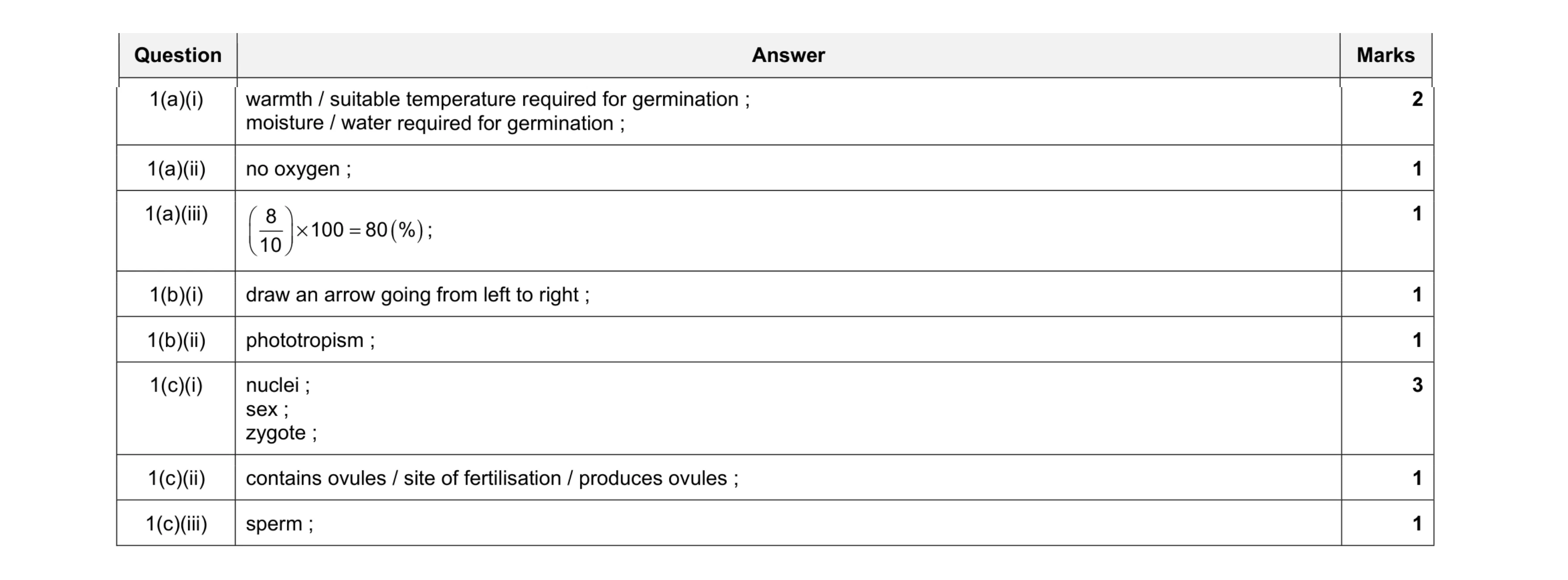 11
11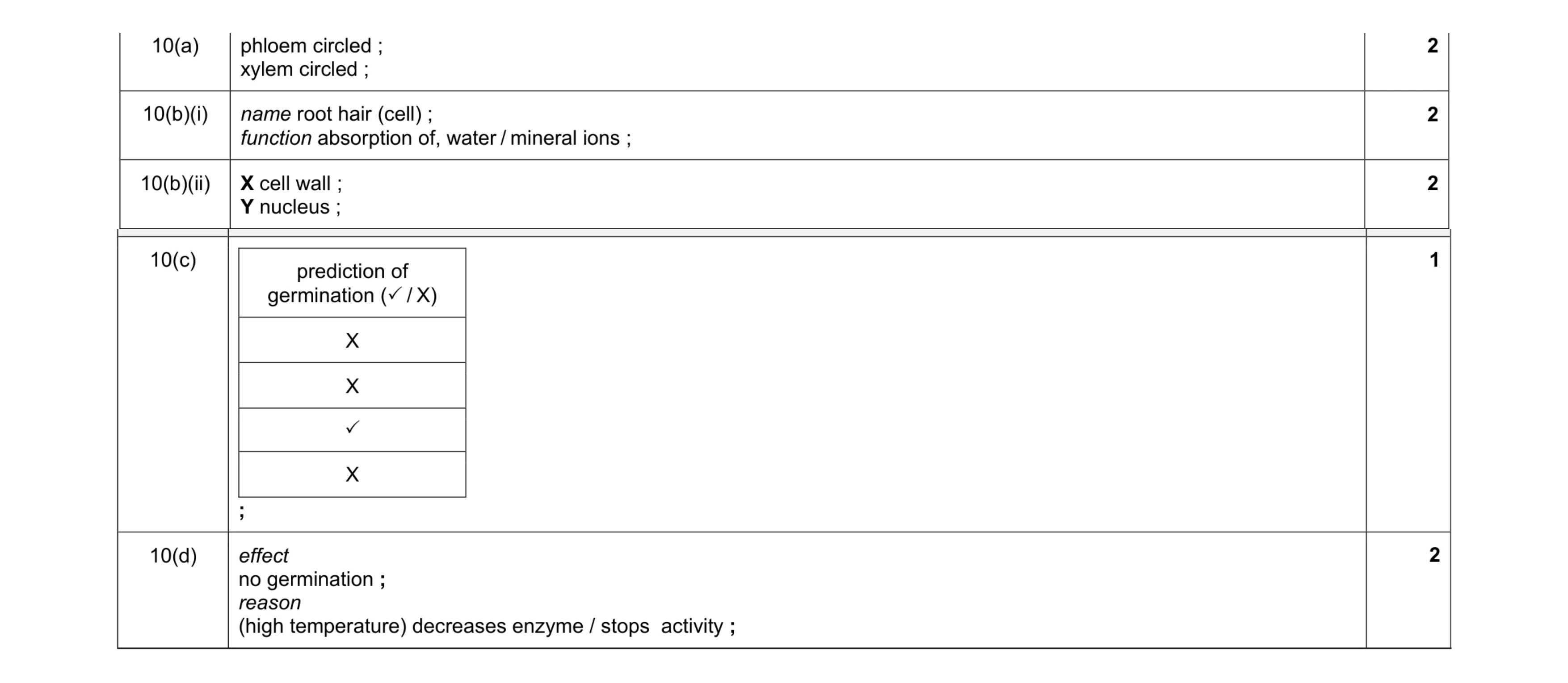 9
9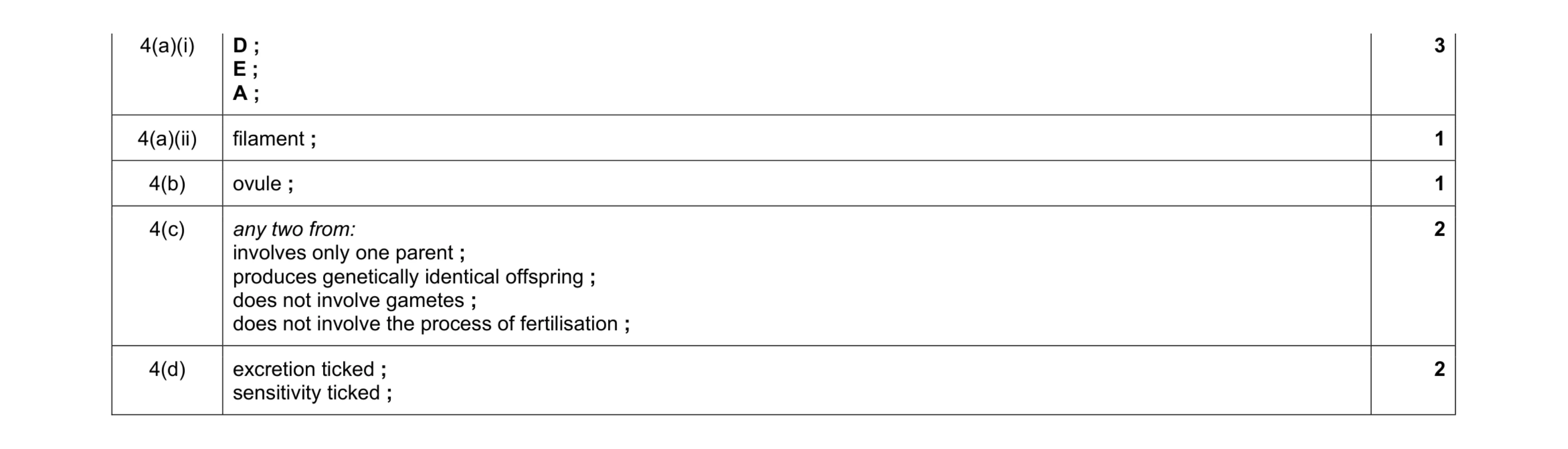 9
9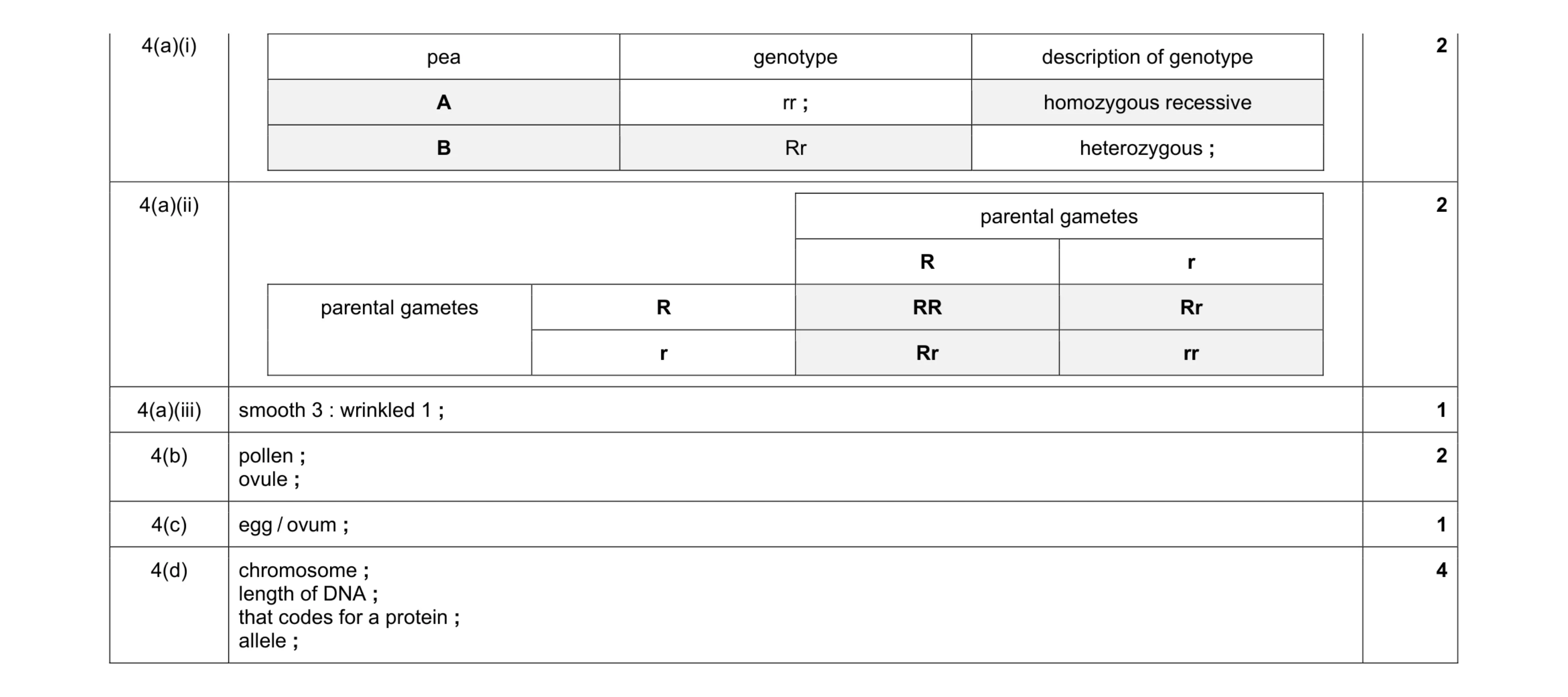 12
12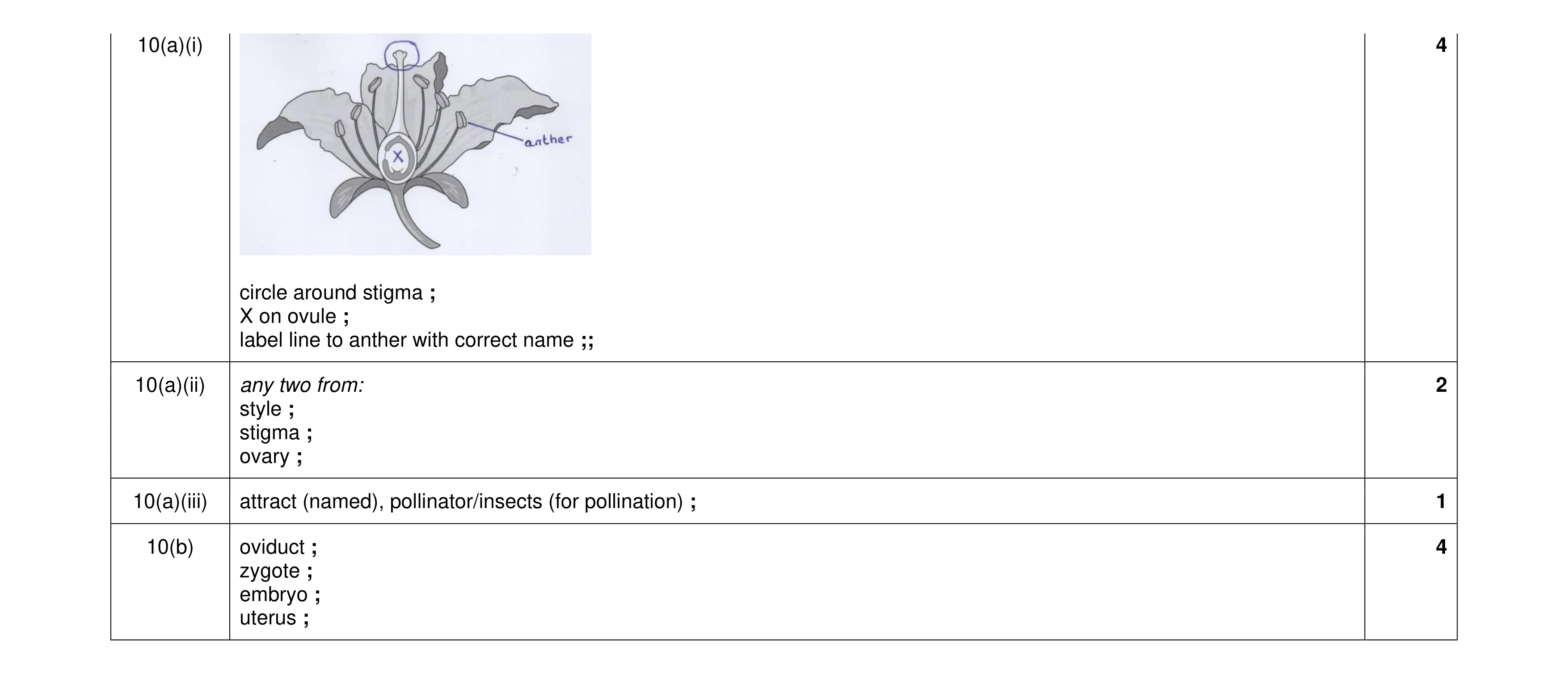 11
11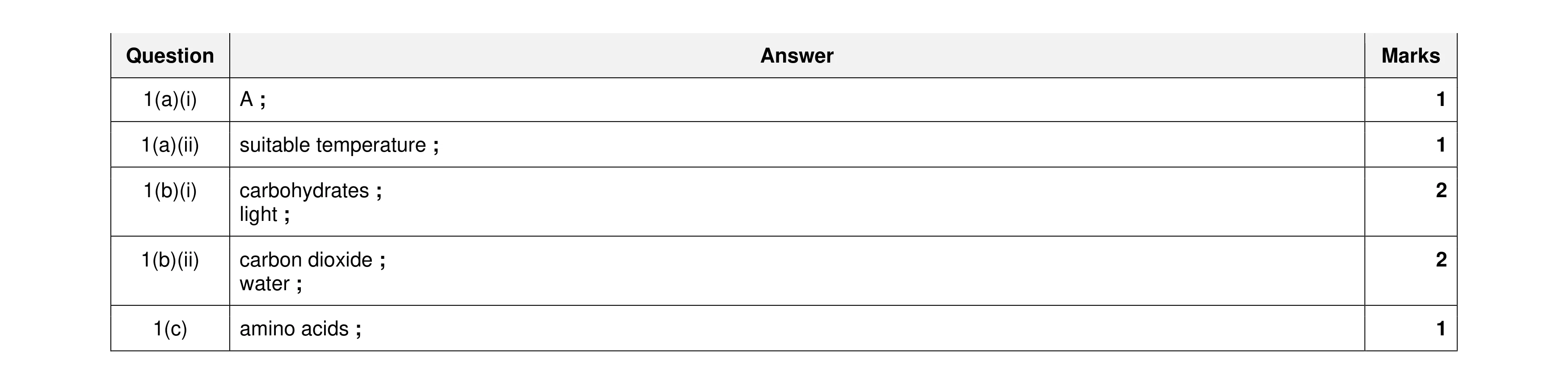 7
7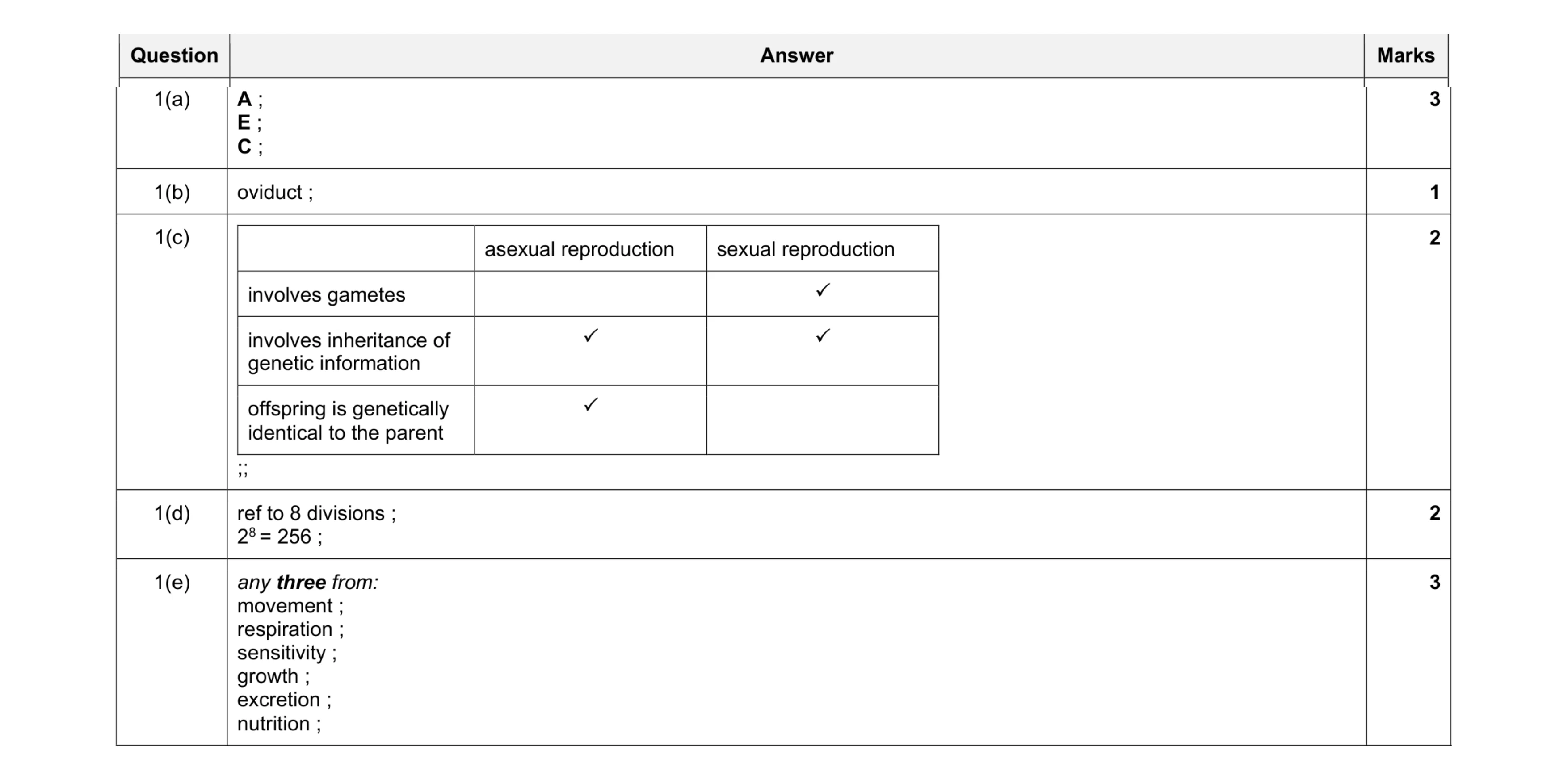 11
11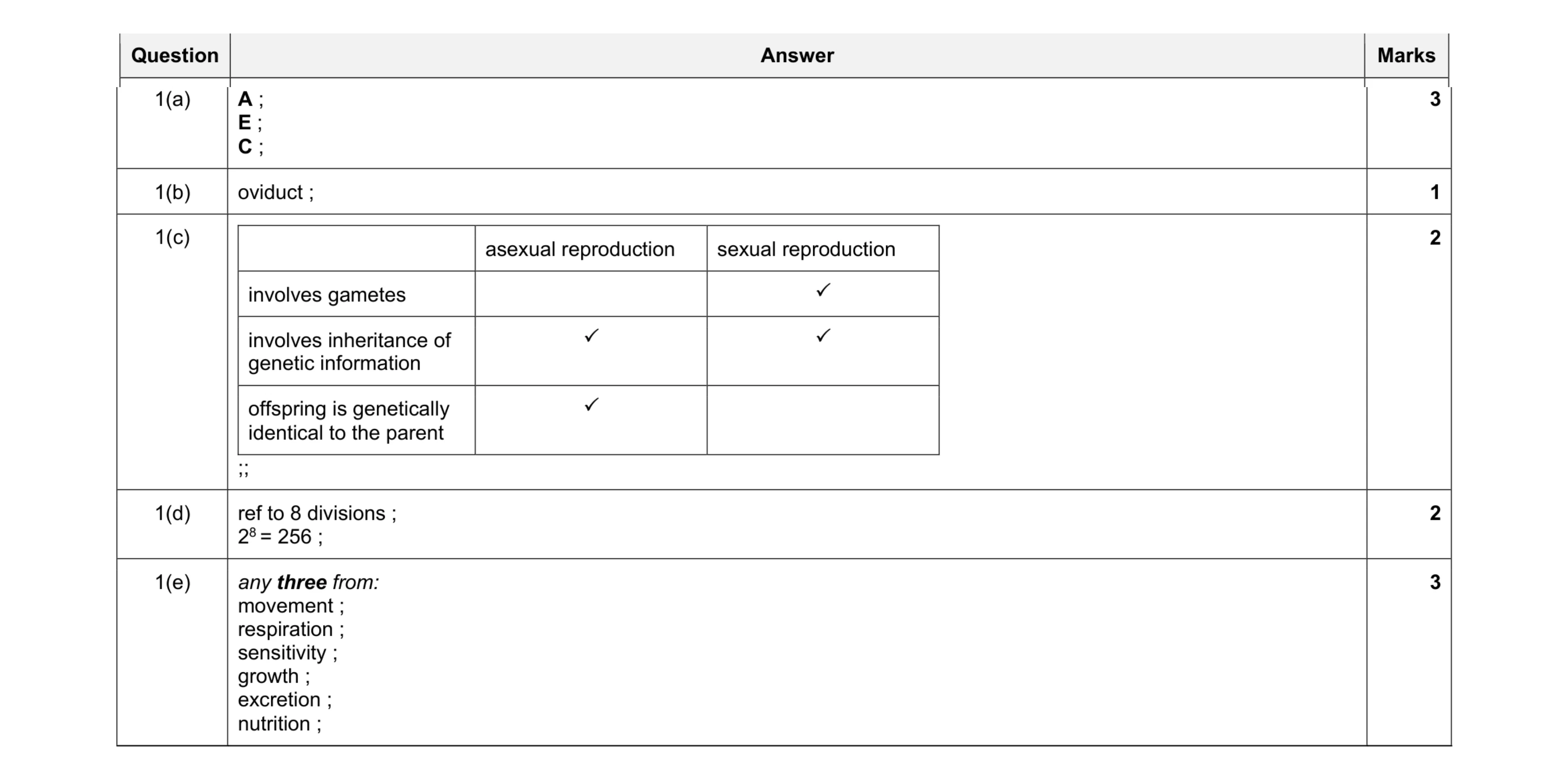 11
11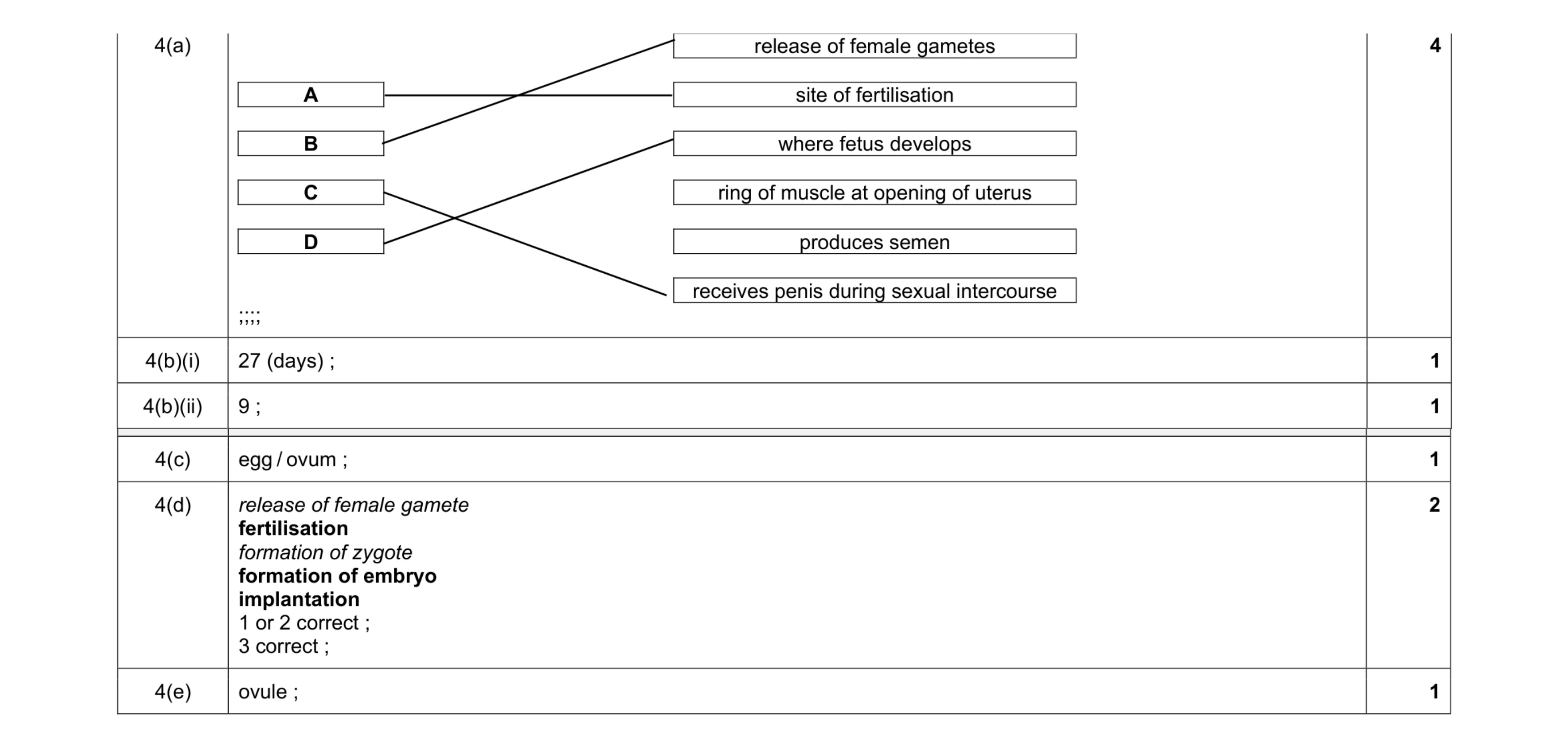 10
10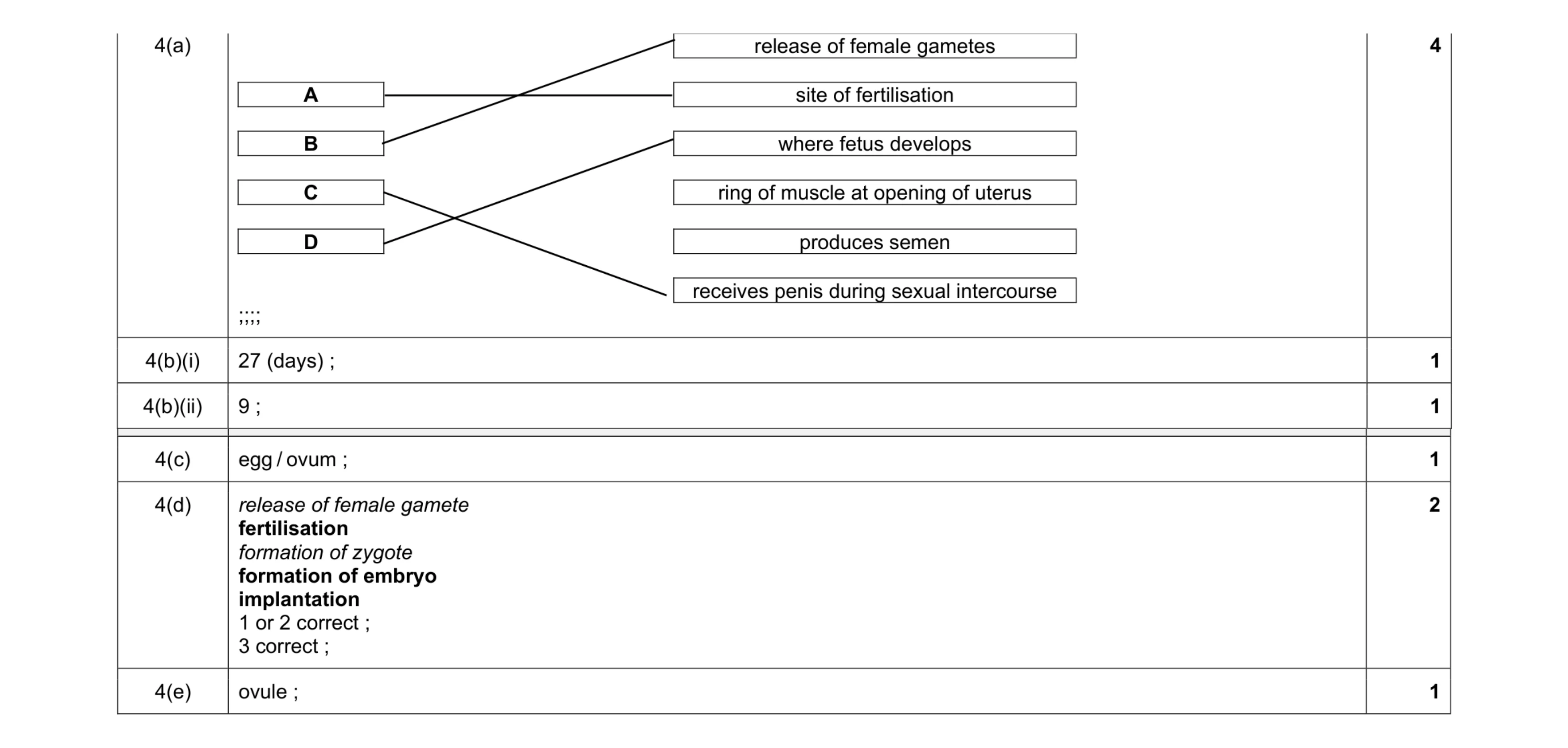 10
10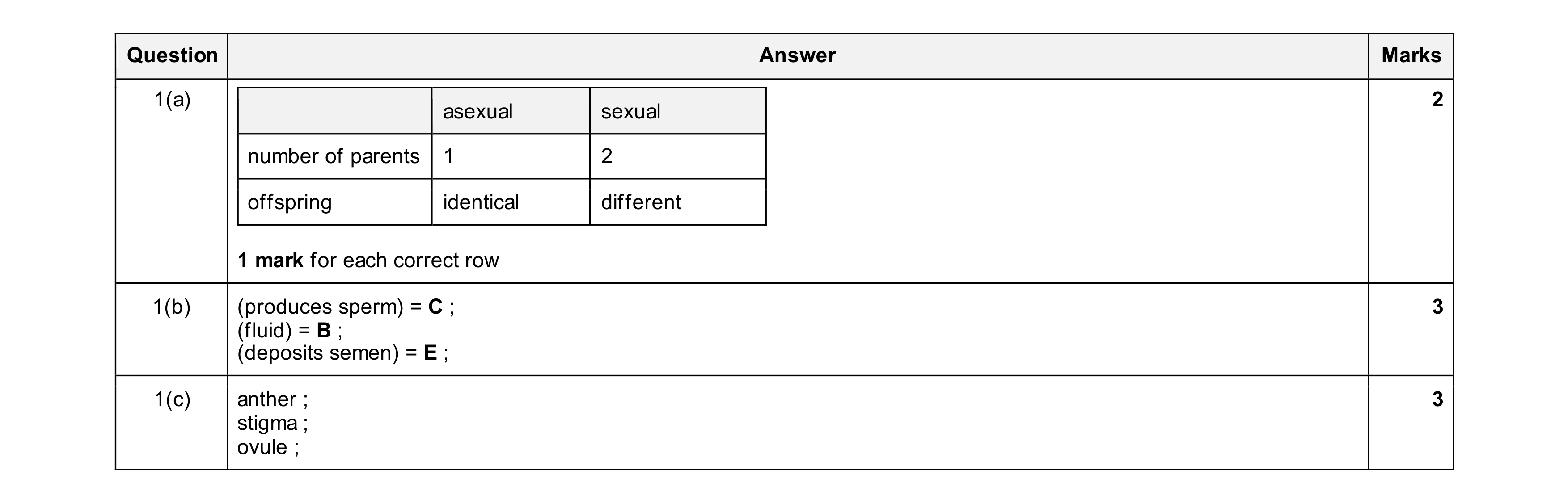 8
8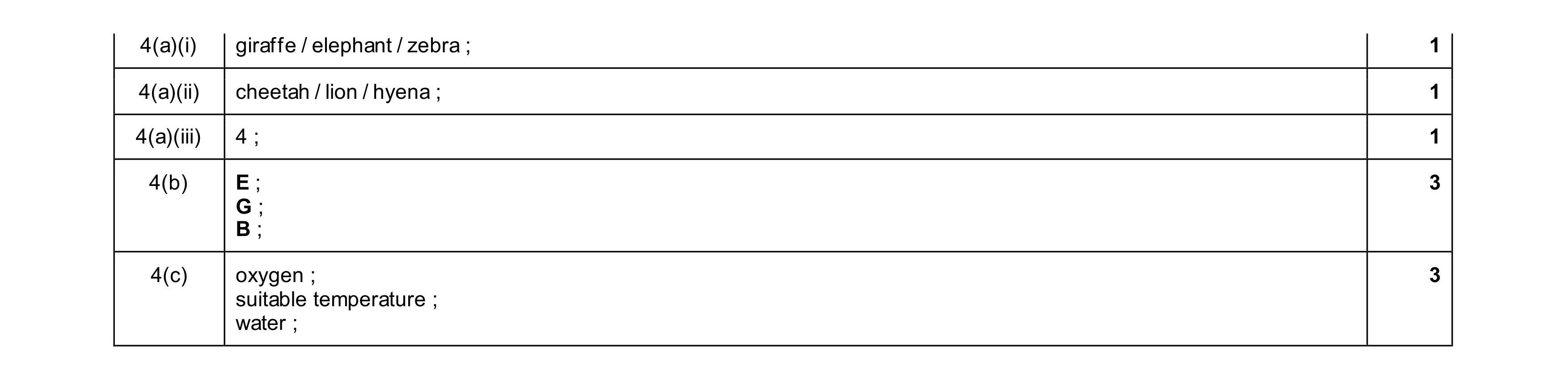 9
9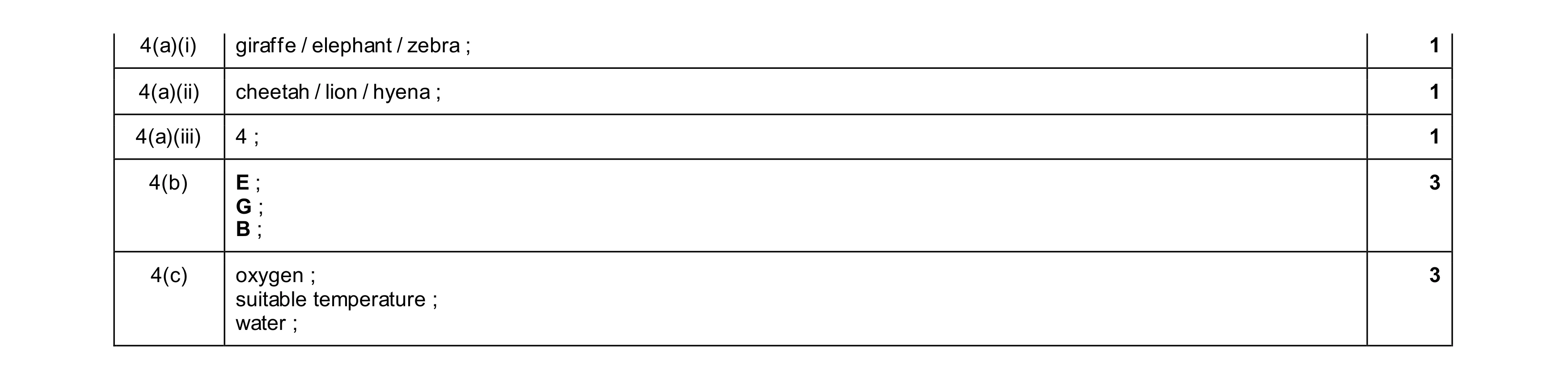 9
9