Questions as text
Q1 · A comparison of nervous control with hormonal control 0654/41 Oct/Nov 2018
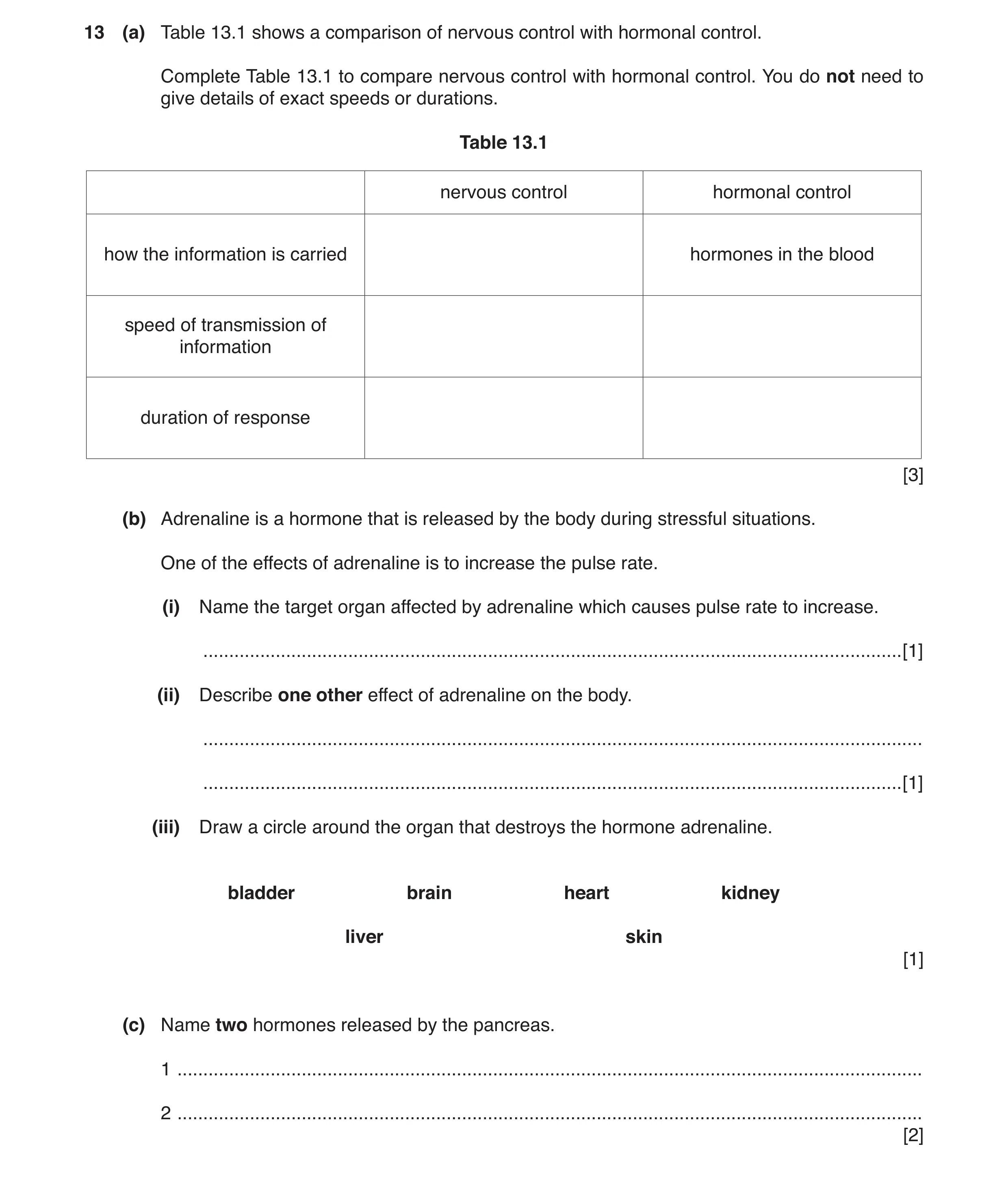
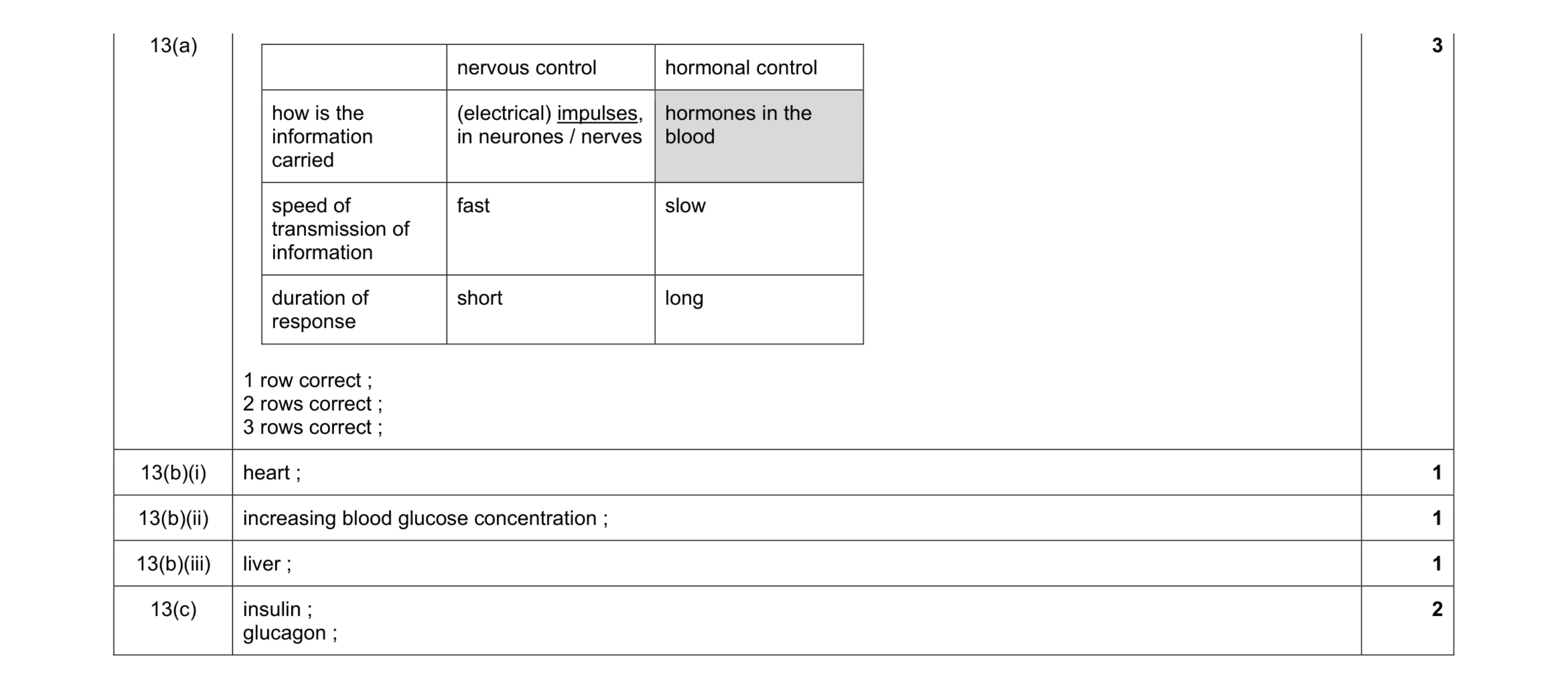
13 (a) Table 13.1 shows a comparison of nervous control with hormonal control. Complete Table 13.1 to compare nervous control with hormonal control. You do not need to give details of exact speeds or durations. Table 13.1 nervous control hormonal control how the information is carried hormones in the blood speed of transmission of information duration of response [3] (b) Adrenaline is a hormone that is released by the body during stressful situations. One of the effects of adrenaline is to increase the pulse rate. (i) Name the target organ affected by adrenaline which causes pulse rate to increase. … [1] (ii) Describe one other effect of adrenaline on the body. … … [1] (iii) Draw a circle around the organ that destroys the hormone adrenaline. bladder brain heart kidney liver skin [1] (c) Name two hormones released by the pancreas. 1 … 2 … [2]
8 marks
Mark scheme: 13(a) nervous control hormonal control how is the information carried (electrical) impulses, in neurones / nerves hormones in the blood speed of transmission of information fast slow duration of response short long 1 row correct ; 2 rows correct ; 3 rows correct ; 3 13(b)(i) heart ; 1 13(b)(ii) increasing blood glucose concentration ; 1 13(b)(iii) liver ; 1 13(c) insulin ; glucagon ; 2
This question in 0654/41 Oct/Nov 2018
Q2 · A cross-section through a vein when seen under a light microscope 0654/41 May/June 2019
10 (a) Fig. 10.1 shows a cross-section through a vein when seen under a light microscope. Fig. 10.1 (i) On Fig. 10.1 draw two label lines to identify the: • lumen • wall of the vein. [2] (ii) Name one structure of veins not visible in Fig. 10.1. … [1] (b) Explain why the wall of an artery is much thicker than the wall of a vein. … … … … [2] (c) Coronary heart disease is caused by a blockage in the coronary arteries. State two lifestyle factors that increase the risk of coronary heart disease. 1 … 2 … [2] (d) Hormones are released into blood. (i) Name the hormone that: • is released in stressful situations … • decreases the glucose concentration of the blood. … [2] (ii) Auxin is a plant hormone. State the effect of auxin on plant cells. … [1] [Total: 10]
10 marks
Mark scheme: 10(a)(i) lumen labelled ; wall labelled ; 2 10(a)(ii) valves ; 1 10(b) carries blood at high pressure ; so it does not rupture / burst ; 2 10(c) any two from high stress ; smoking ; reference to poor / unbalanced diet ; max 2 10(d)(i) adrenalin ; insulin ; 2 10(d)(ii) causes cells to elongate ; 1
This question in 0654/41 May/June 2019
Q3 · Adrenaline is a hormone 0654/42 Oct/Nov 2019
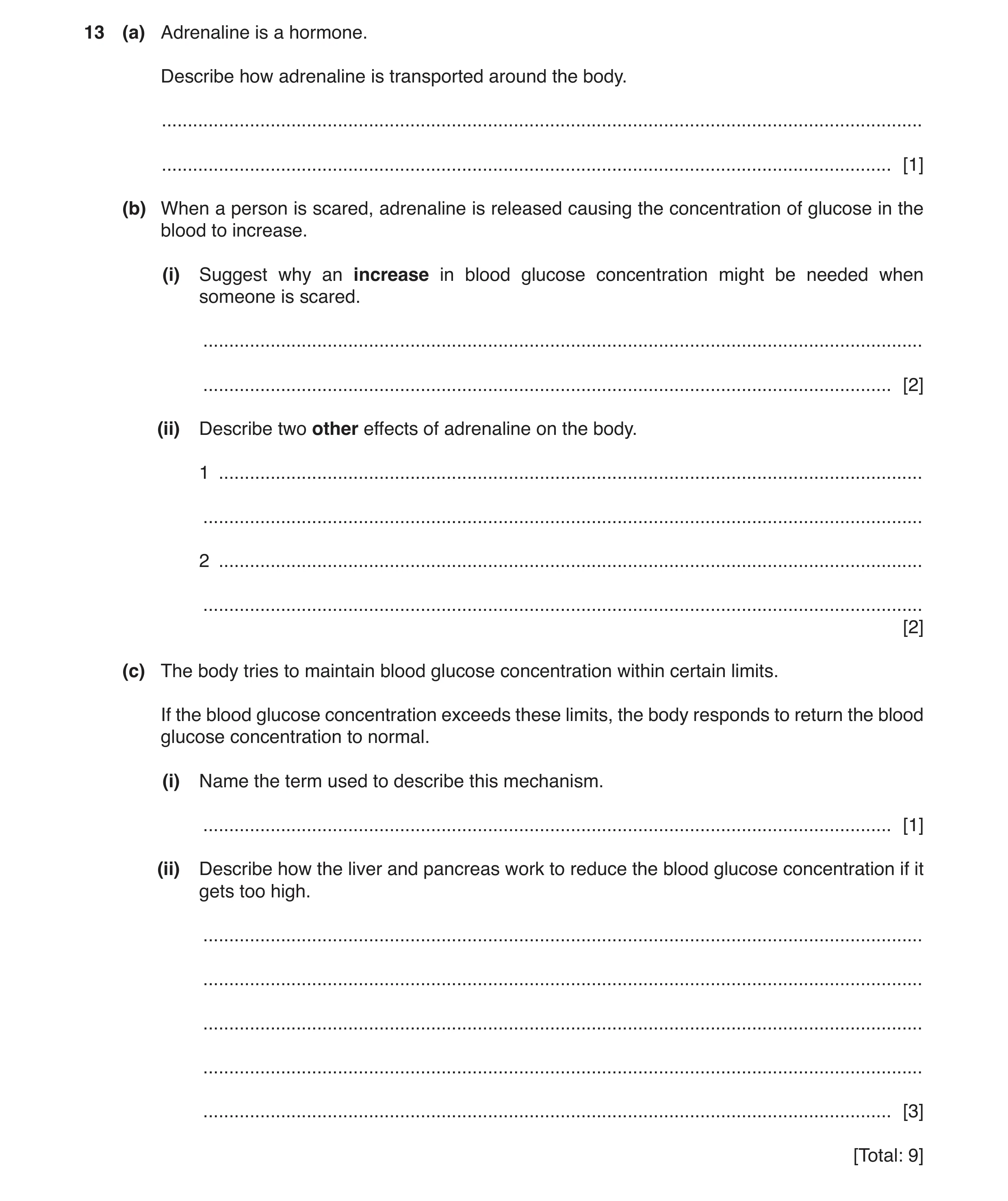
13 (a) Adrenaline is a hormone. Describe how adrenaline is transported around the body. … … [1] (b) When a person is scared, adrenaline is released causing the concentration of glucose in the blood to increase. (i) Suggest why an increase in blood glucose concentration might be needed when someone is scared. … … [2] (ii) Describe two other effects of adrenaline on the body. 1 … … 2 … … [2] (c) The body tries to maintain blood glucose concentration within certain limits. If the blood glucose concentration exceeds these limits, the body responds to return the blood glucose concentration to normal. (i) Name the term used to describe this mechanism. … [1] (ii) Describe how the liver and pancreas work to reduce the blood glucose concentration if it gets too high. … … … … … [3] [Total: 9]
9 marks
Mark scheme: 13(a) in the, blood / plasma ; 1 13(b)(i) (glucose needed) for respiration / to release energy ; for, flight / fight / AW ; 2 13(b)(ii) any two from pupil dilation ; increase in pulse rate ; increase in breathing rate ; avp ; max 2 2 13(c)(i) negative feedback ; 1 13(c)(ii) pancreas produces insulin ; glucose converted to glycogen ; glycogen stored in the liver ; 3
This question in 0654/42 Oct/Nov 2019
Q4 · The blood glucose concentration of a person is monitored for 180 minutes after eating a… 0654/43 Oct/Nov 2019
13 (a) The blood glucose concentration of a person is monitored for 180 minutes after eating a meal. Fig. 13.1 shows the results. 1.6 1.4 1.2 1.0 blood glucose concentration / 0.8 g per cm3 0.6 0.4 0.2 0.0 0 20 40 60 80 100 120 140 160 180 200 time after eating / minutes Fig. 13.1 (i) State the name of the hormone that causes the change between 60–120 minutes. … [1] (ii) Suggest one other way to cause a similar change to blood glucose concentration as shown between 60–120 minutes. … [1] (iii) Describe how the liver and pancreas work together to cause the changes shown between 120–150 minutes. … … … … … [3] (b) State a term that can be used to describe the control of blood glucose concentration. … [1] (c) The blood glucose concentration is controlled by hormones. Some of the body’s responses are controlled by the nervous system. Table 13.1 compares some of the features of the hormonal and nervous control systems. Table 13.1 type of control system hormonal nervous method of information … chemical hormones transfer … speed of information … … transfer … … … longevity of action short-lived … Complete Table 13.1 to compare the hormonal and nervous control systems. [2] [Total: 8]
8 marks
Mark scheme: 13(a)(i) insulin ; 1 13(a)(ii) exercise ; 1 13(a)(iii) pancreas releases glucagon ; glycogen (stored) in liver ; glycogen converted to glucose ; 3 13(b) negative feedback ; 1 13(c) type of control system hormonal nervous method of information transfer chemical hormones electrical impulse speed of information transfer slow fast longevity of action long-lasting / AW short-lived 2
This question in 0654/43 Oct/Nov 2019
Q5 · Plant shoots respond to stimuli such as light 0654/41 May/June 2020
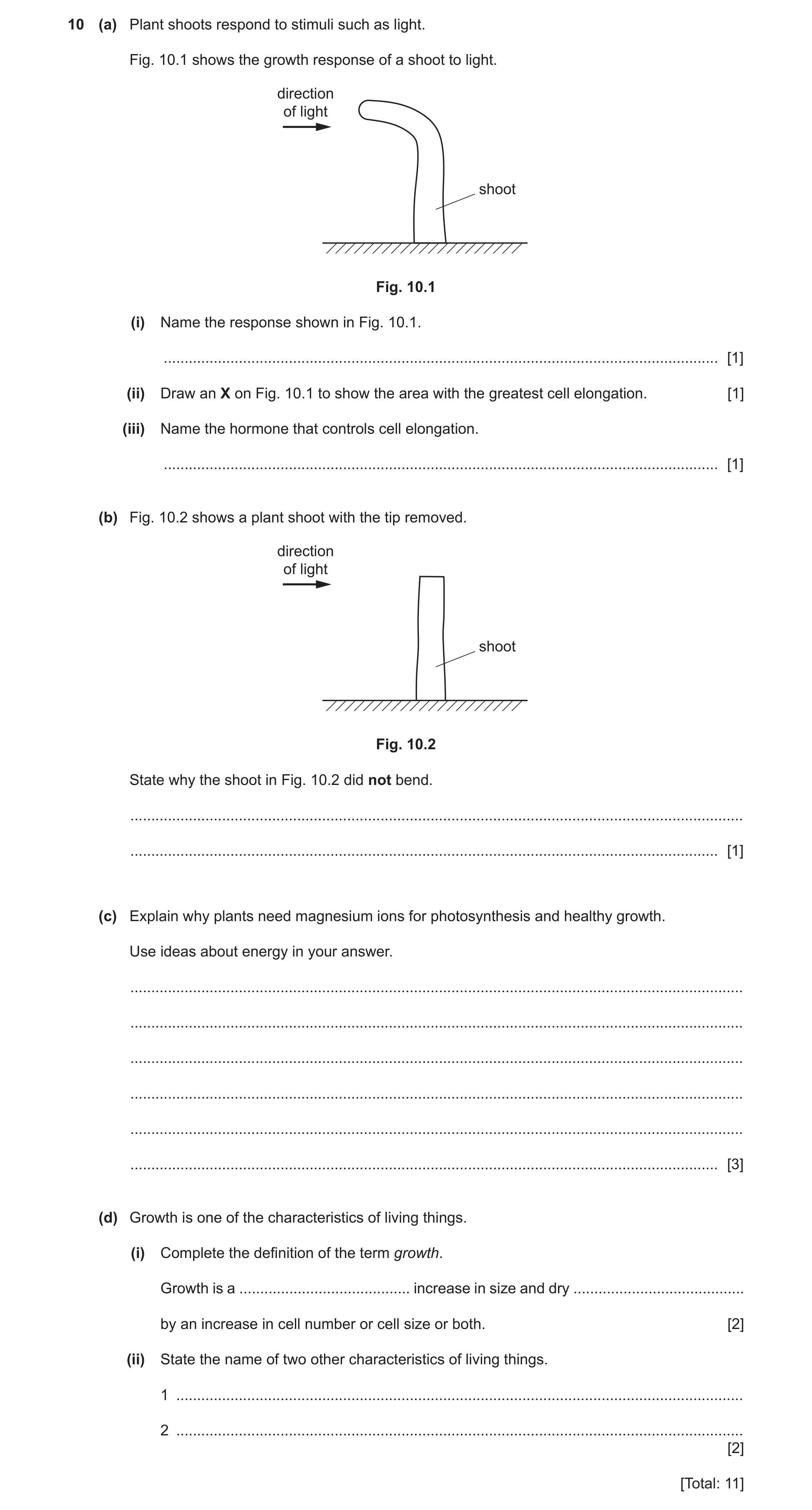
10 (a) Plant shoots respond to stimuli such as light. Fig. 10.1 shows the growth response of a shoot to light. direction of light shoot Fig. 10.1 (i) Name the response shown in Fig. 10.1. … [1] (ii) Draw an X on Fig. 10.1 to show the area with the greatest cell elongation. [1] (iii) Name the hormone that controls cell elongation. … [1] (b) Fig. 10.2 shows a plant shoot with the tip removed. direction of light shoot Fig. 10.2 State why the shoot in Fig. 10.2 did not bend. … … [1] (c) Explain why plants need magnesium ions for photosynthesis and healthy growth. Use ideas about energy in your answer. … … … … … … [3] (d) Growth is one of the characteristics of living things. (i) Complete the definition of the term growth. Growth is a … increase in size and dry … by an increase in cell number or cell size or both. [2] (ii) State the name of two other characteristics of living things. 1 … 2 … [2] [Total: 11]
11 marks
Mark scheme: 10(a)(i) phototropism ; 1 10(a)(ii) X drawn on the upper side of the shoot bend ; 1 10(a)(iii) auxin ; 1 10(b) auxin / hormone / chemical, produced at the shoot tip ; 1 10(c) magnesium ions required to make chlorophyll ; chlorophyll absorbs light energy (and converts this to chemical energy) ; (chemical) energy used to synthesise, carbohydrates or glucose / carbohydrates or glucose are used to make proteins (for growth) ; 3 10(d)(i) permanent ; mass ; 2 10(d)(ii) any two from: movement reproduction sensitivity excretion nutrition respiration ;; 2
This question in 0654/41 May/June 2020
Q6 · A person monitored the concentration of glucose in their blood for 12 hours 0654/42 Feb/March 2021
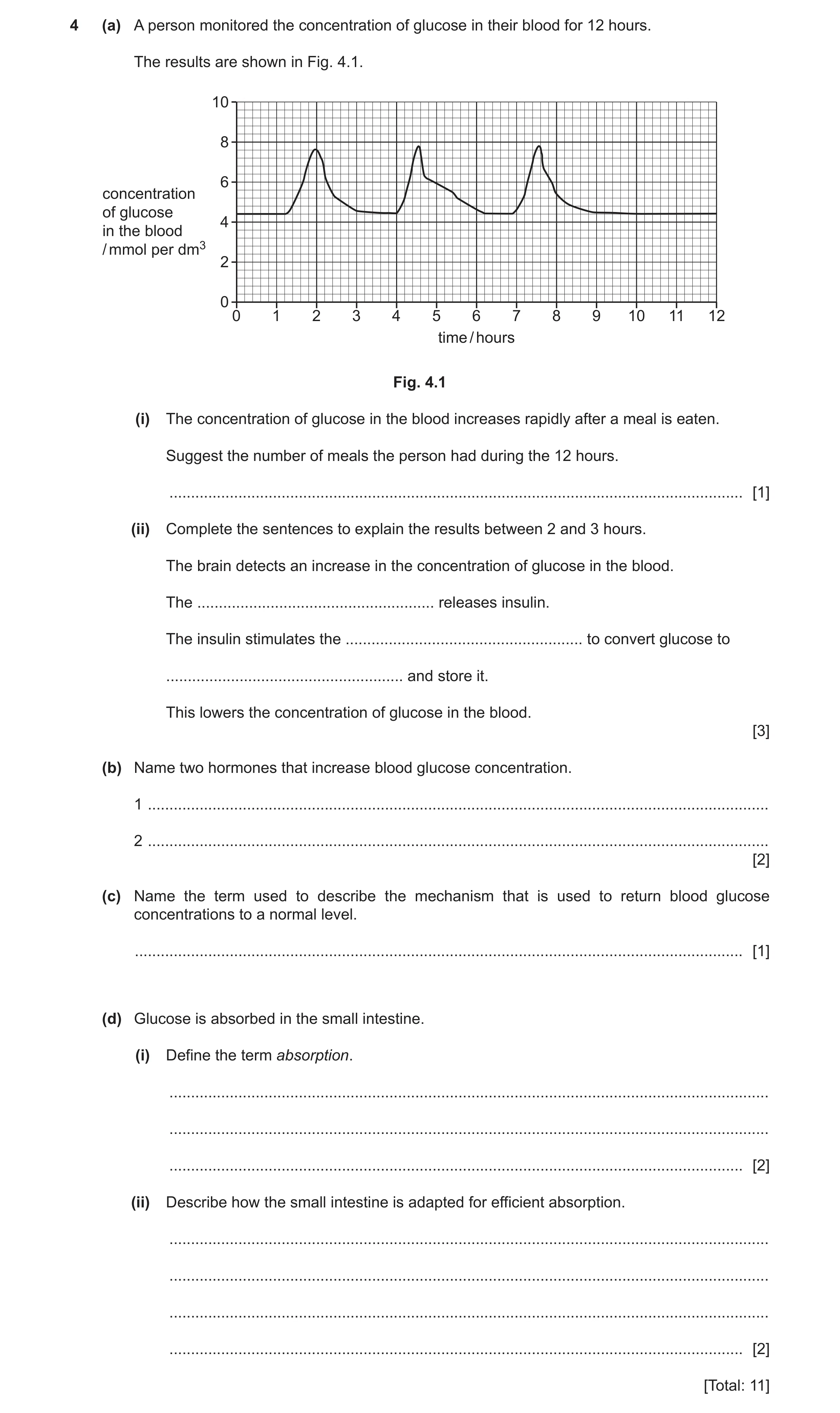
4 (a) A person monitored the concentration of glucose in their blood for 12 hours. The results are shown in Fig. 4.1. 10 8 6 concentration of glucose 4 in the blood / mmol per dm3 2 0 0 1 2 3 4 5 6 7 8 9 10 11 12 time / hours Fig. 4.1 (i) The concentration of glucose in the blood increases rapidly after a meal is eaten. Suggest the number of meals the person had during the 12 hours. … [1] (ii) Complete the sentences to explain the results between 2 and 3 hours. The brain detects an increase in the concentration of glucose in the blood. The … releases insulin. The insulin stimulates the … to convert glucose to … and store it. This lowers the concentration of glucose in the blood. [3] (b) Name two hormones that increase blood glucose concentration. 1 … 2 … [2] (c) Name the term used to describe the mechanism that is used to return blood glucose concentrations to a normal level. … [1] (d) Glucose is absorbed in the small intestine. (i) Define the term absorption. … … … [2] (ii) Describe how the small intestine is adapted for efficient absorption. … … … … [2] [Total: 11]
11 marks
Mark scheme: 4(a)(i) 3 ; 1 4(a)(ii) pancreas ; liver ; glycogen ; 3 4(b) adrenaline ; glucagon ; 2 4(c) negative feedback ; 1 4(d)(i) movement of digested food molecules ; across the (wall of the) small intestine / into the blood ; 2 4(d)(ii) presence of villi ; large surface area for absorption ; AVP 2
This question in 0654/42 Feb/March 2021
Q7 · A plant’s response to light 0654/42 May/June 2021
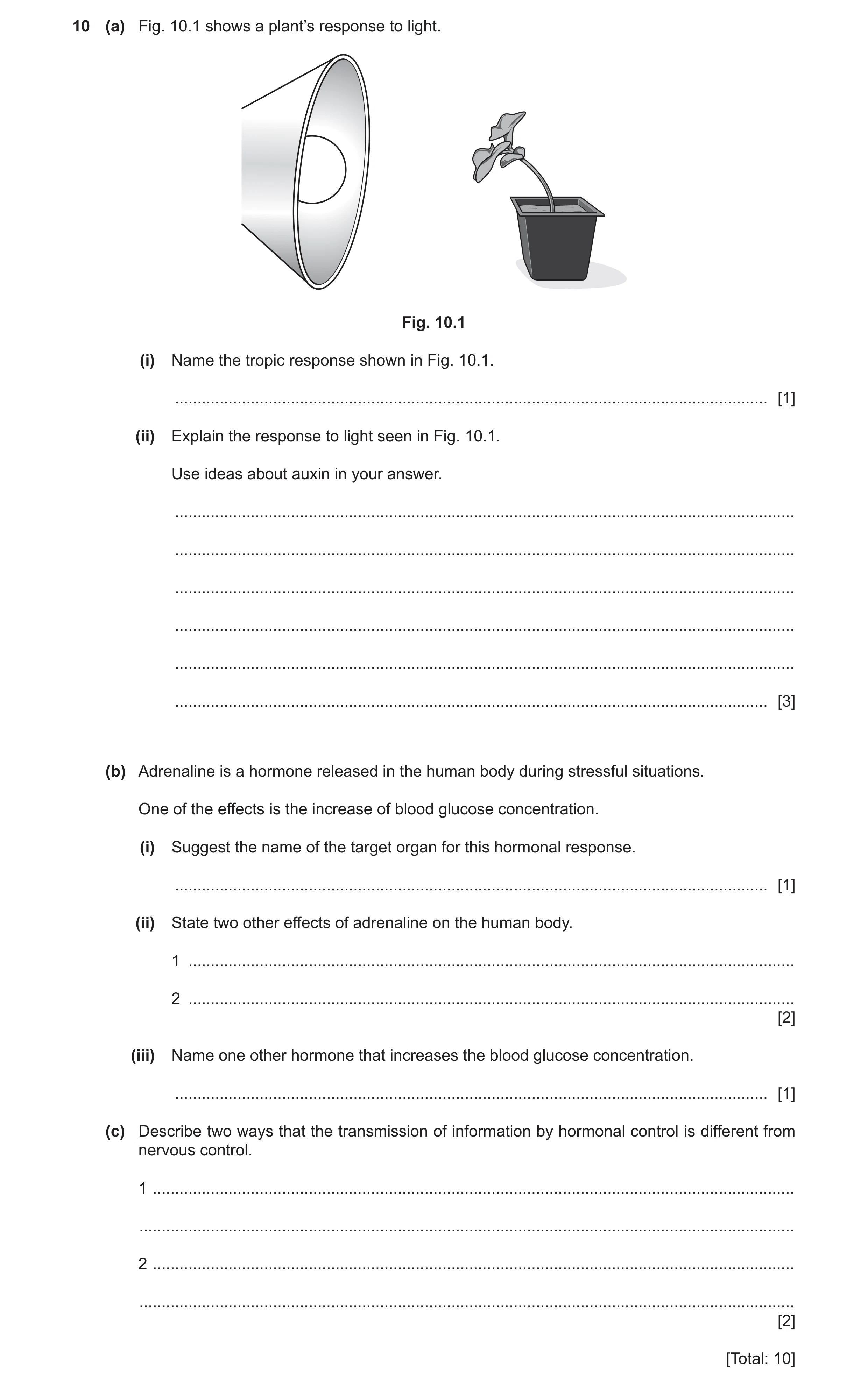
10 (a) Fig. 10.1 shows a plant’s response to light. Fig. 10.1 (i) Name the tropic response shown in Fig. 10.1. … [1] (ii) Explain the response to light seen in Fig. 10.1. Use ideas about auxin in your answer. … … … … … … [3] (b) Adrenaline is a hormone released in the human body during stressful situations. One of the effects is the increase of blood glucose concentration. (i) Suggest the name of the target organ for this hormonal response. … [1] (ii) State two other effects of adrenaline on the human body. 1 … 2 … [2] (iii) Name one other hormone that increases the blood glucose concentration. … [1] (c) Describe two ways that the transmission of information by hormonal control is different from nervous control. 1 … … 2 … … [2] [Total: 10]
10 marks
Mark scheme: 10(a)(i) phototropism ; 1 10(a)(ii) any three from: auxin, made in the tip (moves down stem) ; auxin collects on shaded side ; auxin promotes cell elongation ; reference to unequal growth on side of, stem / plant ; 3 10(b)(i) liver ; 1 10(b)(ii) any two from: increase in pulse rate ; widened pupils ; increase in breathing rate ; avp ;; 2 10(b)(iii) glucagon ; 1 10(c) any two from: takes longer time ; via chemical substances ; transmission is via the blood ; 2
This question in 0654/42 May/June 2021
Q8 · A diagram of a cross-section through human skin 0654/43 May/June 2021
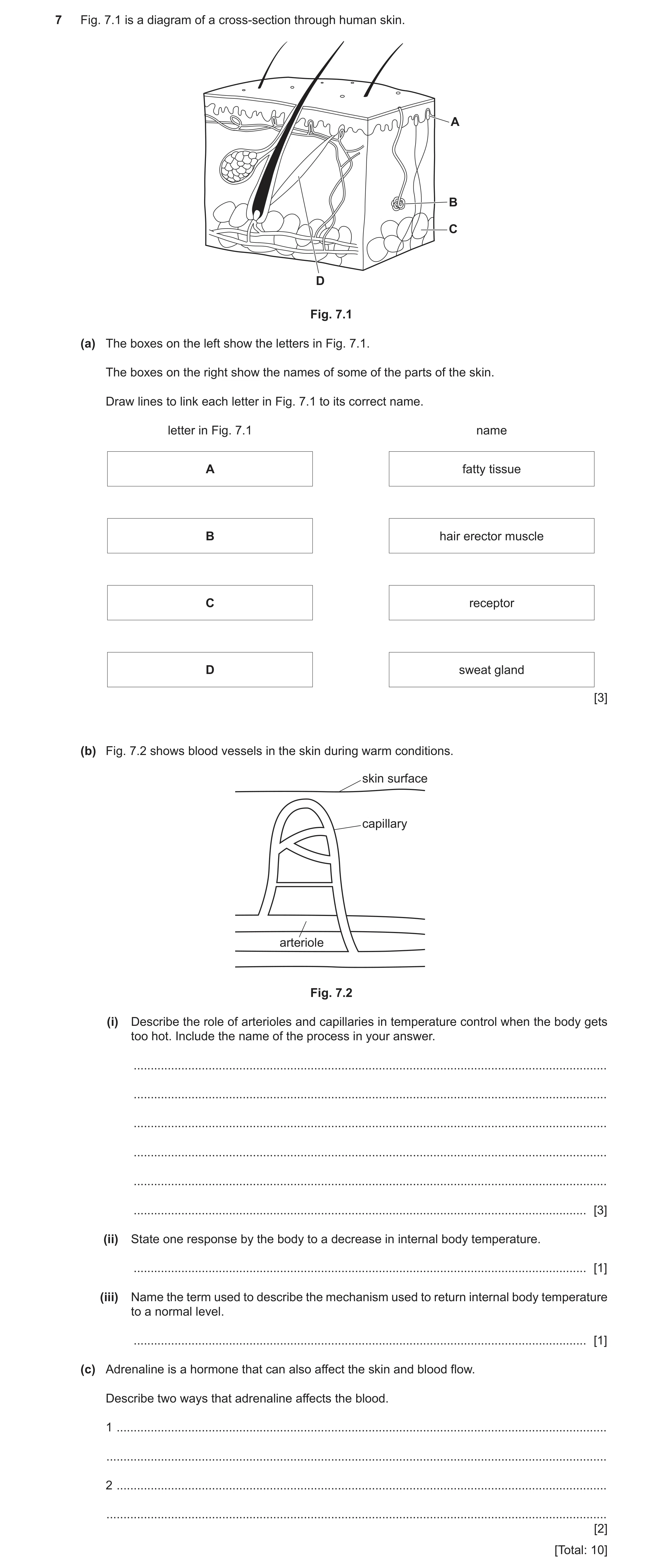
7 Fig. 7.1 is a diagram of a cross-section through human skin. A B C D Fig. 7.1 (a) The boxes on the left show the letters in Fig. 7.1. The boxes on the right show the names of some of the parts of the skin. Draw lines to link each letter in Fig. 7.1 to its correct name. letter in Fig. 7.1 name A fatty tissue B hair erector muscle C receptor D sweat gland [3] (b) Fig. 7.2 shows blood vessels in the skin during warm conditions. skin surface capillary arteriole Fig. 7.2 (i) Describe the role of arterioles and capillaries in temperature control when the body gets too hot. Include the name of the process in your answer. … … … … … … [3] (ii) State one response by the body to a decrease in internal body temperature. … [1] (iii) Name the term used to describe the mechanism used to return internal body temperature to a normal level. … [1] (c) Adrenaline is a hormone that can also affect the skin and blood flow. Describe two ways that adrenaline affects the blood. 1 … … 2 … … [2] [Total: 10]
10 marks
Mark scheme: 7(a) A fatty tissue B hair erector muscle C receptor D sweat gland ;;; 7(b)(i) ref to vasodilation ; arterioles, widen / dilate / AW ; more blood flows through capillaries ; 3 7(b)(ii) shivering / hair stands on end / vasoconstriction ; 1 7(b)(iii) negative feedback ; 1 Question Answer Marks 7(c) increase blood flow / pulse rate ; increase the (blood) glucose (concentration) ; avp ; 2
This question in 0654/43 May/June 2021
Q9 · Hormones control blood glucose concentration 0654/41 Oct/Nov 2021
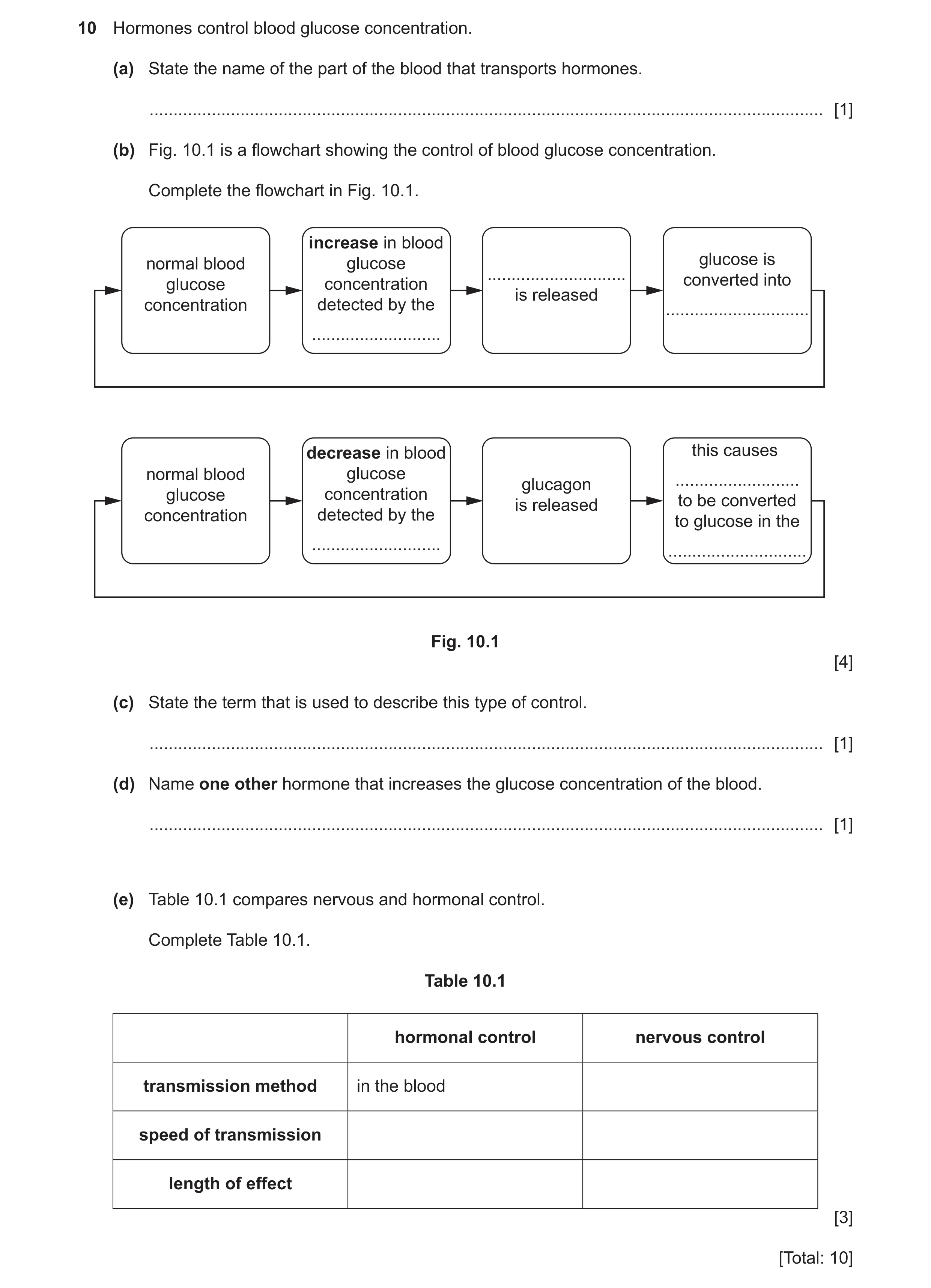
10 Hormones control blood glucose concentration. (a) State the name of the part of the blood that transports hormones. … [1] (b) Fig. 10.1 is a flowchart showing the control of blood glucose concentration. Complete the flowchart in Fig. 10.1. increase in blood normal blood glucose glucose is … glucose concentration converted into is released concentration detected by the … … decrease in blood this causes normal blood glucose glucagon … glucose concentration is released to be converted concentration detected by the to glucose in the … … Fig. 10.1 [4] (c) State the term that is used to describe this type of control. … [1] (d) Name one other hormone that increases the glucose concentration of the blood. … [1] (e) Table 10.1 compares nervous and hormonal control. Complete Table 10.1. Table 10.1 hormonal control nervous control transmission method in the blood speed of transmission length of effect [3] [Total: 10]
10 marks
Mark scheme: 10(a) plasma ; 1 10(b) pancreas in boxes 2 and 6 ; insulin in box 3 ; glycogen in box 4 and 8 ; liver in box 8 ; 4 10(c) negative feedback ; 1 10(d) adrenaline ; 1 10(e) hormonal control nervous control transmission method in the blood by neurones / electrical impulses ; relative speed of transmission slow fast ; relative length of effect long lasting short-lived ; 3
This question in 0654/41 Oct/Nov 2021
Q10 · The effect of an injection of adrenaline on pulse rate is recorded 0654/43 May/June 2022
7 (a) The effect of an injection of adrenaline on pulse rate is recorded. The adrenaline is injected at 1 minute. Fig. 7.1 shows a graph of the results. 110 100 90 80 pulse rate / beats per minute 70 60 50 40 0 2 4 6 8 10 time / minutes Fig. 7.1 (i) Identify in Fig. 7.1 the pulse rate before the adrenaline injection. … beats per minute [1] (ii) Describe the immediate effect of the adrenaline injection on pulse rate shown in Fig. 7.1. Use data from the graph to support your answer. … … … [2] (b) (i) State one effect adrenaline has on the eye. … [1] (ii) Name the nerve that carries impulses from the eye to the brain. … [1] (c) A hormone decreases blood glucose concentration by causing the glucose to be stored. (i) State the name of the hormone that decreases blood glucose concentration. … [1] (ii) State the name of the organ that produces this hormone. … [1] (iii) State the name of the organ that stores the excess glucose. … [1] (d) Describe two ways the actions of the hormonal system are different from the nervous system. 1 … … 2 … … [2] [Total: 10]
10 marks
Mark scheme: 7(a)(i) 65 (beats per minute) ; 1 7(a)(ii) (steep) increase ; to 98 beats per minute / by 33 beats per minute ; 2 7(b)(i) pupils widen ; 1 7(b)(ii) optic (nerve) ; 1 7(c)(i) insulin ; 1 7(c)(ii) pancreas ; 1 7(c)(iii) liver ; 1 7(d) hormonal actions are slower to act ; hormonal actions last longer ; 2
This question in 0654/43 May/June 2022
Q11 · One cause of the pupil reflex is a change in light intensity 0654/42 Feb/March 2023
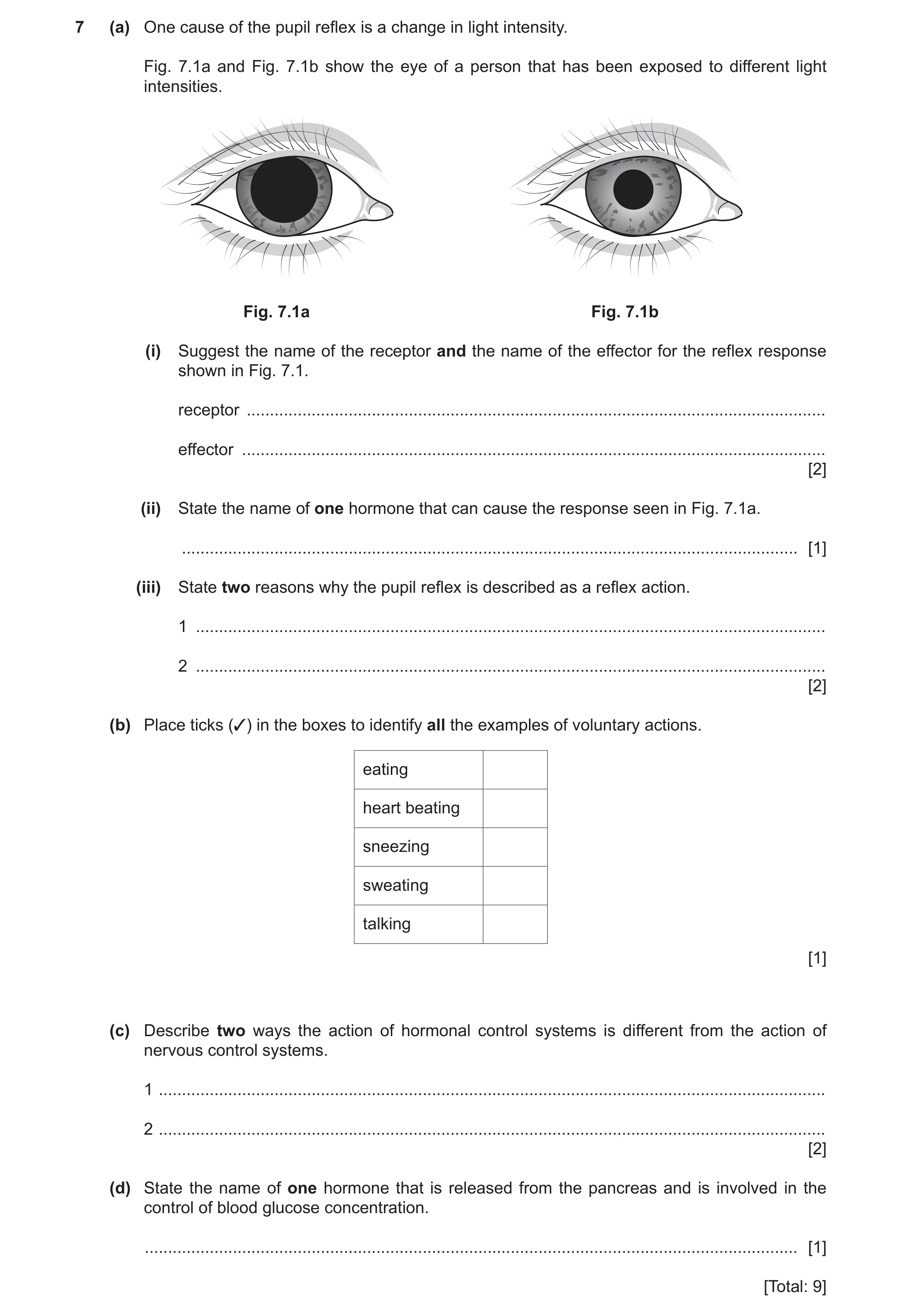
7 (a) One cause of the pupil reflex is a change in light intensity. Fig. 7.1a and Fig. 7.1b show the eye of a person that has been exposed to different light intensities. Fig. 7.1a Fig. 7.1b (i) Suggest the name of the receptor and the name of the effector for the reflex response shown in Fig. 7.1. receptor … effector … [2] (ii) State the name of one hormone that can cause the response seen in Fig. 7.1a. … [1] (iii) State two reasons why the pupil reflex is described as a reflex action. 1 … 2 … [2] (b) Place ticks (3) in the boxes to identify all the examples of voluntary actions. eating heart beating sneezing sweating talking [1] (c) Describe two ways the action of hormonal control systems is different from the action of nervous control systems. 1 … 2 … [2] (d) State the name of one hormone that is released from the pancreas and is involved in the control of blood glucose concentration. … [1] [Total: 9]
9 marks
Mark scheme: 7(a)(i) receptor – retina ; 2 effector – circular or radial muscles in the iris ; 7(a)(ii) adrenaline ; 1 7(a)(iii) it is automatic / requires no conscious thought ; 2 it is rapid ; 7(b) eating ticked and talking ticked only ; 1 7(c) longer lasting ; 2 slower ; 7(d) insulin / glucagon ; 1
This question in 0654/42 Feb/March 2023
Q12 · A diagram of a cross‑section of skin 0654/41 May/June 2023
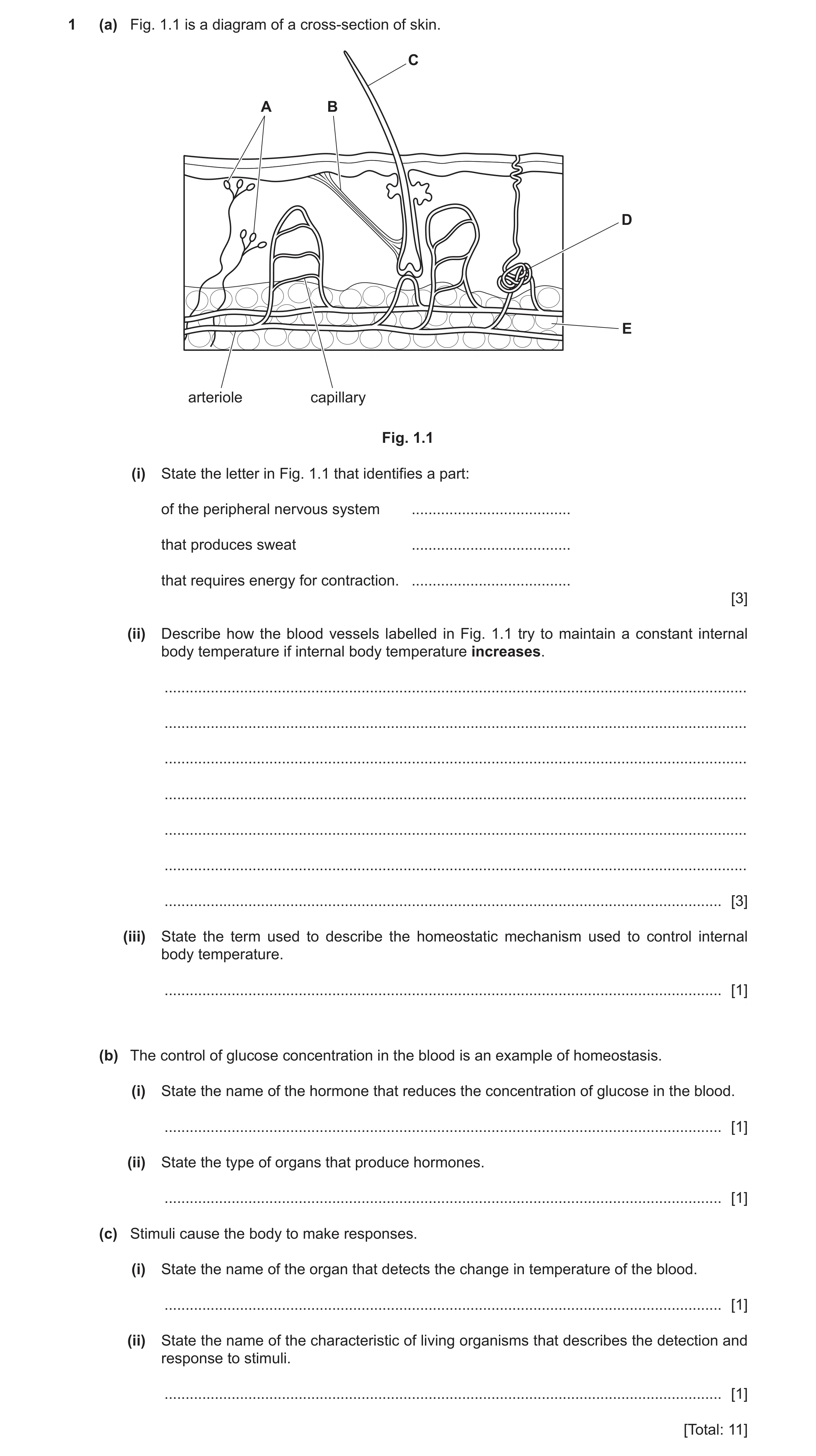
1 (a) Fig. 1.1 is a diagram of a cross‑section of skin. C A B D E arteriole capillary Fig. 1.1 (i) State the letter in Fig. 1.1 that identifies a part: of the peripheral nervous system … that produces sweat … that requires energy for contraction. … [3] (ii) Describe how the blood vessels labelled in Fig. 1.1 try to maintain a constant internal body temperature if internal body temperature increases. … … … … … … … [3] (iii) State the term used to describe the homeostatic mechanism used to control internal body temperature. … [1] (b) The control of glucose concentration in the blood is an example of homeostasis. (i) State the name of the hormone that reduces the concentration of glucose in the blood. … [1] (ii) State the type of organs that produce hormones. … [1] (c) Stimuli cause the body to make responses. (i) State the name of the organ that detects the change in temperature of the blood. … [1] (ii) State the name of the characteristic of living organisms that describes the detection and response to stimuli. … [1] [Total: 11]
11 marks
Mark scheme: 1(a)(i) A ; D ; B ; 3 1(a)(ii) any three from: ref to vasodilation ; arterioles widen / dilate ; increase in blood flow to, skin surface / capillaries ; AVP ; 3 1(a)(iii) negative feedback ; 1 1(b)(i) insulin ; 1 1(b)(ii) glands ; 1 1(c)(i) brain ; 1 1(c)(ii) sensitivity ; 1
This question in 0654/41 May/June 2023
Q13 · The effect of adrenaline on blood glucose concentration 0654/42 Oct/Nov 2023
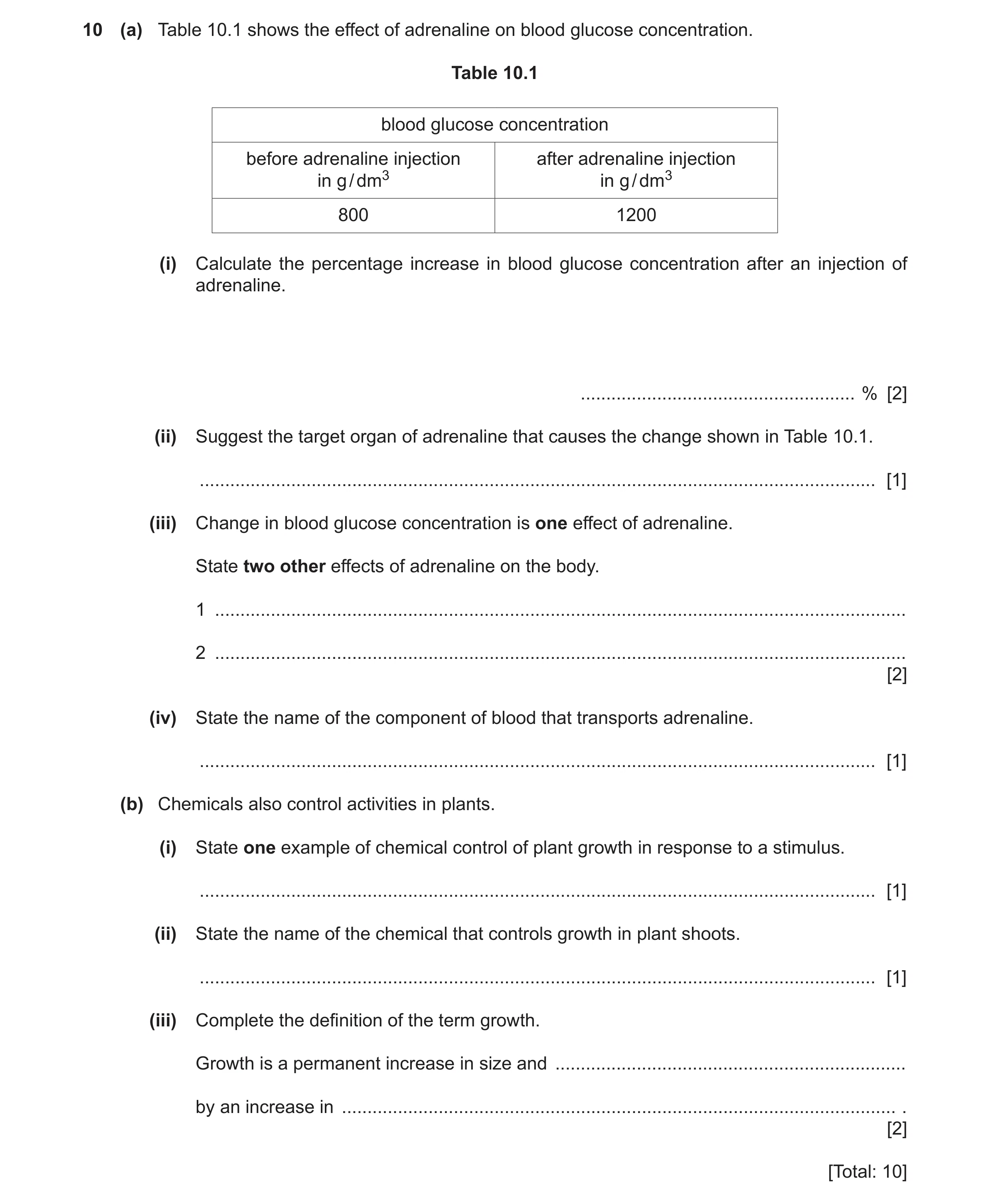
10 (a) Table 10.1 shows the effect of adrenaline on blood glucose concentration. Table 10.1 blood glucose concentration before adrenaline injection after adrenaline injection in g / dm3 in g / dm3 800 1200 (i) Calculate the percentage increase in blood glucose concentration after an injection of adrenaline. … % [2] (ii) Suggest the target organ of adrenaline that causes the change shown in Table 10.1. … [1] (iii) Change in blood glucose concentration is one effect of adrenaline. State two other effects of adrenaline on the body. 1 … 2 … [2] (iv) State the name of the component of blood that transports adrenaline. … [1] (b) Chemicals also control activities in plants. (i) State one example of chemical control of plant growth in response to a stimulus. … [1] (ii) State the name of the chemical that controls growth in plant shoots. … [1] (iii) Complete the definition of the term growth. Growth is a permanent increase in size and … by an increase in … . [2] [Total: 10]
10 marks
Mark scheme: 10(a)(i) (1200 – 800) = 400 ; 2 ((400/800) 100) = 50 (%) ; 10(a)(ii) liver ; 1 10(a)(iii) any two from: 2 widen pupils / pupils dilate ; increases pulse rate / increases heart rate ; AVP ;; 10(a)(iv) plasma ; 1 10(b)(i) phototropism / gravitropism ; 1 10(b)(ii) auxin ; 1 10(b)(iii) dry mass ; 2 cell size / cell number ;
This question in 0654/42 Oct/Nov 2023
Q14 · The effect of adrenaline on blood glucose concentration 0654/43 Oct/Nov 2023
10 (a) Fig. 10.1 shows the effect of adrenaline on blood glucose concentration. 2000 1800 1600 blood glucose concentration 1400 g / m3 1200 1000 800 0 10 20 30 40 50 time / minutes time of adrenaline release Fig. 10.1 (i) Calculate the percentage increase in blood glucose concentration between 0 and 10 minutes in Fig. 10.1. blood glucose concentration at 0 minutes … g / m3 blood glucose concentration at 10 minutes … g / m3 percentage increase = … % [2] (ii) Explain the changes to blood glucose concentration shown between 10 and 30 minutes in Fig. 10.1. … … … … … [3] (b) State the name of one hormone, apart from adrenaline, that increases the blood glucose concentration. … [1] (c) Table 10.1 contains some definitions of processes that occur in the alimentary canal. Complete Table 10.1 with the terms of each definition. Table 10.1 term definition breakdown of food into smaller pieces without chemical change to the food molecules movement of digested food molecules into the cells of the body where they are used, becoming part of the cells movement of digested food molecules through the wall of the intestine into the blood [3] (d) Fig. 10.2 is a diagram of a structure found lining the small intestine. X Fig. 10.2 (i) State the name of the structure shown in Fig. 10.2. … [1] (ii) State the name and function of the part labelled X in Fig. 10.2. name … function … [2] [Total: 12]
12 marks
Mark scheme: 10(a)(i) 1050( 10) and 1900(10) ; 2 (((1900–1050) / 1050) 100) = 81 (%) ; 10(a)(ii) any three from: 3 increase in blood glucose concentration detected by pancreas ; insulin released (by pancreas) ; conversion of glucose to glycogen ; glycogen stored in liver ; 10(b) glucagon ; 1 10(c) 3 mechanical digestion ; assimilation ; absorption ; 10(d)(i) villus ; 1 10(d)(ii) lacteal ; 2 fat / lipid absorption ;
This question in 0654/43 Oct/Nov 2023
Q15 · Hormones are chemical substances produced in the body 0654/41 Oct/Nov 2025
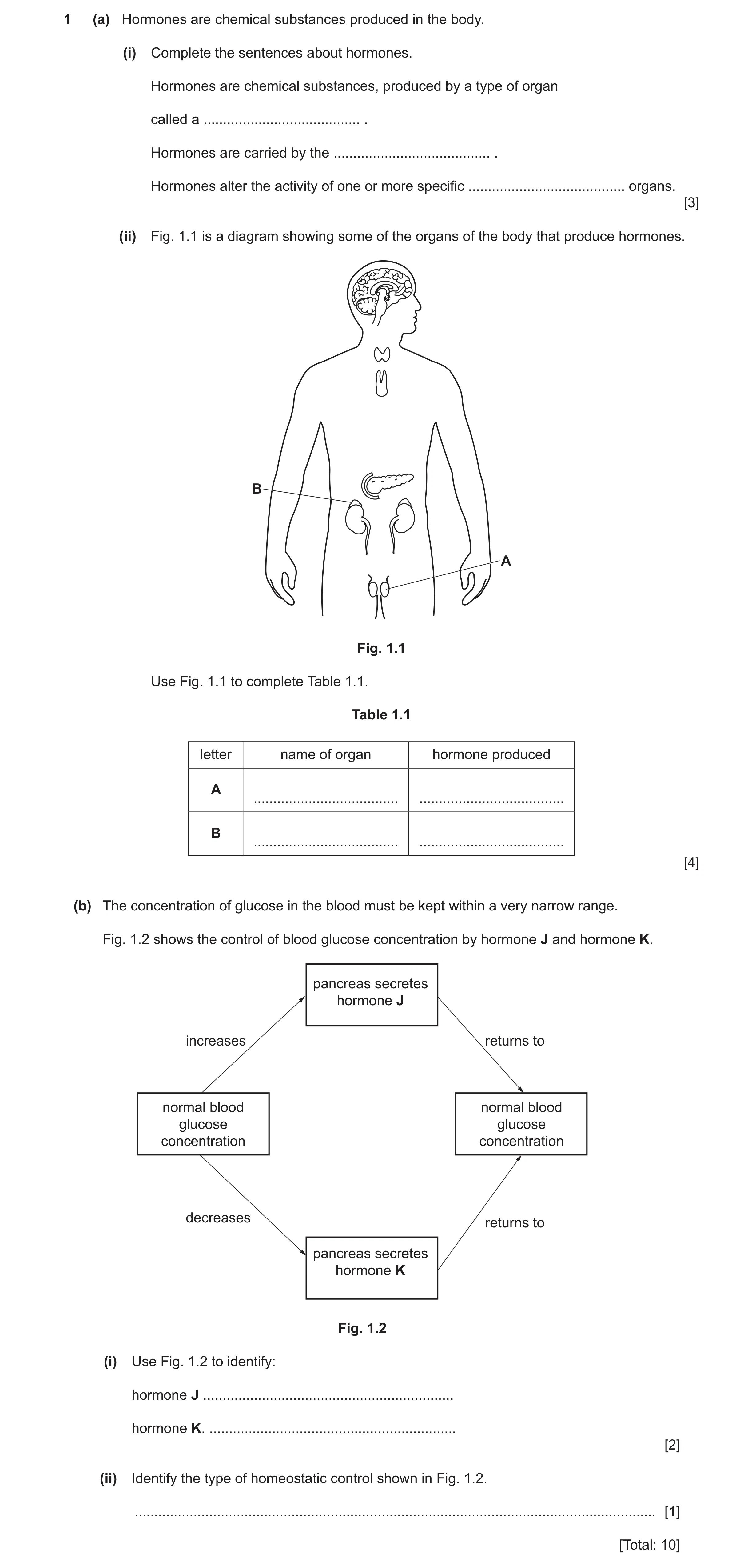
1 (a) Hormones are chemical substances produced in the body. (i) Complete the sentences about hormones. Hormones are chemical substances, produced by a type of organ called a … . Hormones are carried by the … . Hormones alter the activity of one or more specific … organs. [3] (ii) Fig. 1.1 is a diagram showing some of the organs of the body that produce hormones. B A Fig. 1.1 Use Fig. 1.1 to complete Table 1.1. Table 1.1 letter name of organ hormone produced A … … B … … [4] (b) The concentration of glucose in the blood must be kept within a very narrow range. Fig. 1.2 shows the control of blood glucose concentration by hormone J and hormone K. pancreas secretes hormone J increases returns to normal blood normal blood glucose glucose concentration concentration decreases returns to pancreas secretes hormone K Fig. 1.2 (i) Use Fig. 1.2 to identify: hormone J … hormone K. … [2] (ii) Identify the type of homeostatic control shown in Fig. 1.2. … [1] [Total: 10]
10 marks
Mark scheme: Question Answer Marks 1(a)(i) gland ; 3 blood / plasma ; target ; 1(a)(ii) 4 letter name of organ hormone produced A testes / testicle(s) ; testosterone ; B adrenal (gland) ; adrenaline ; 1(b)(i) insulin ; 2 glucagon ; 1(b)(ii) negative feedback ; 1
This question in 0654/41 Oct/Nov 2025
 1 / 20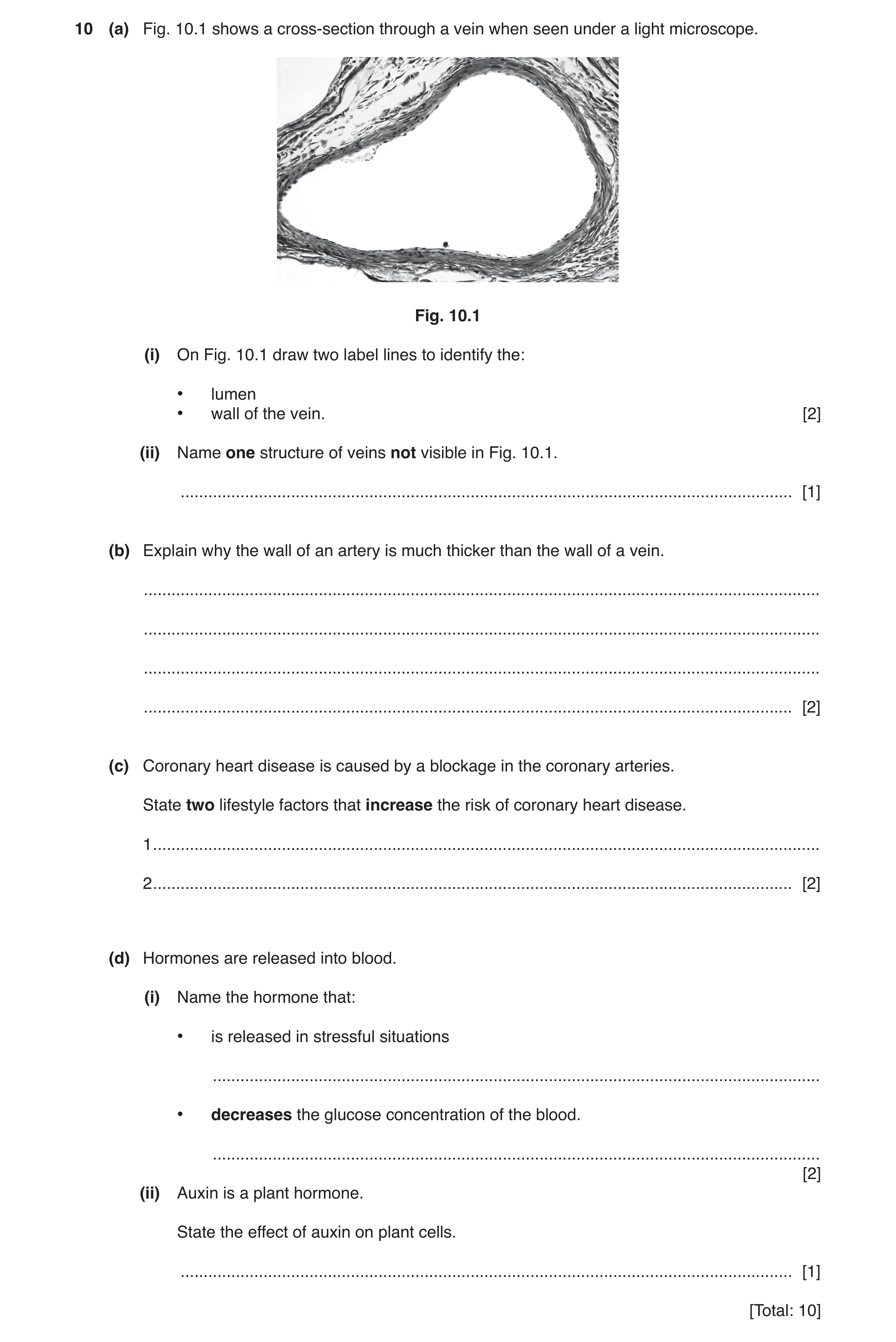
 3 / 20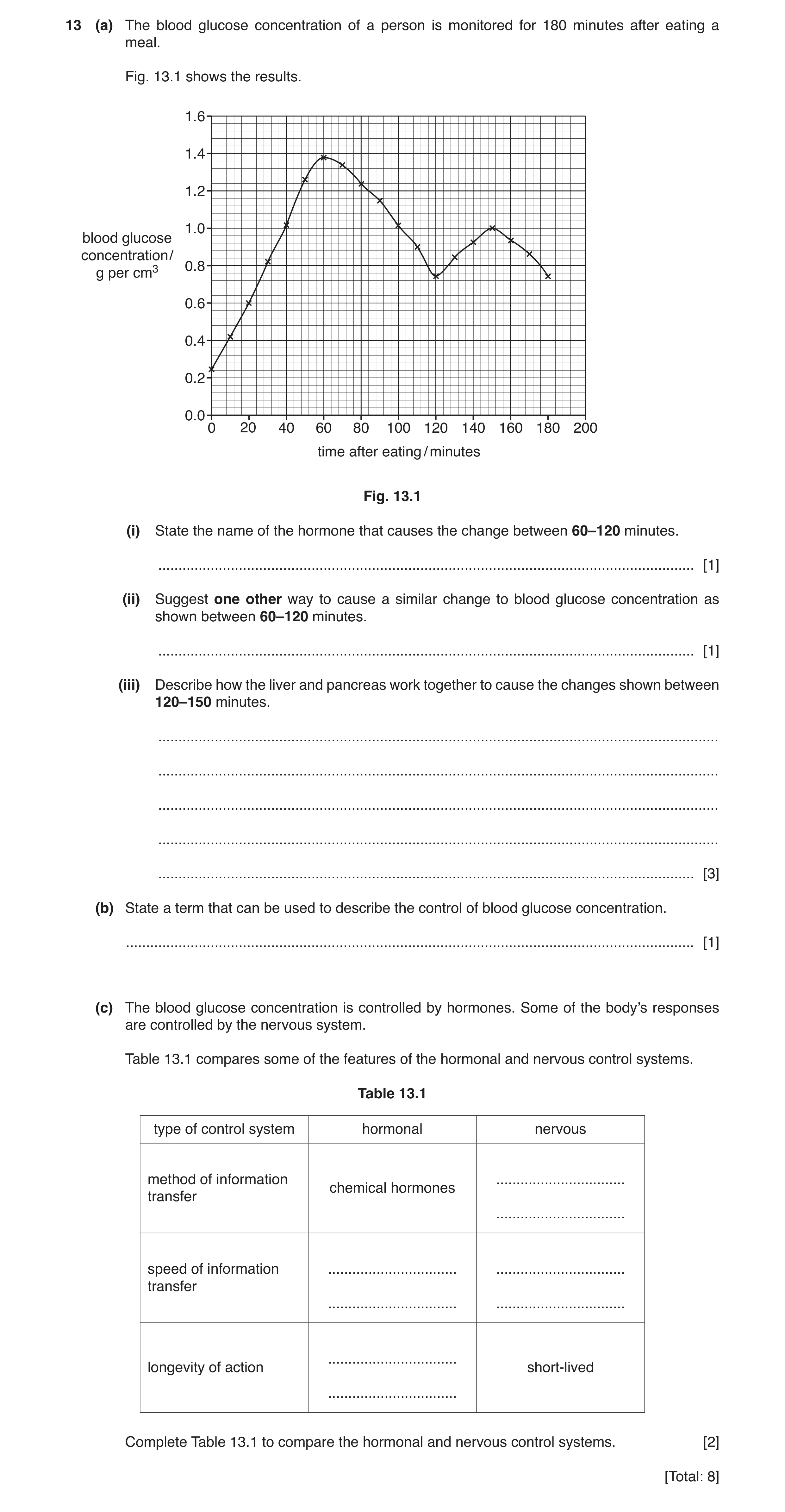
 11 / 20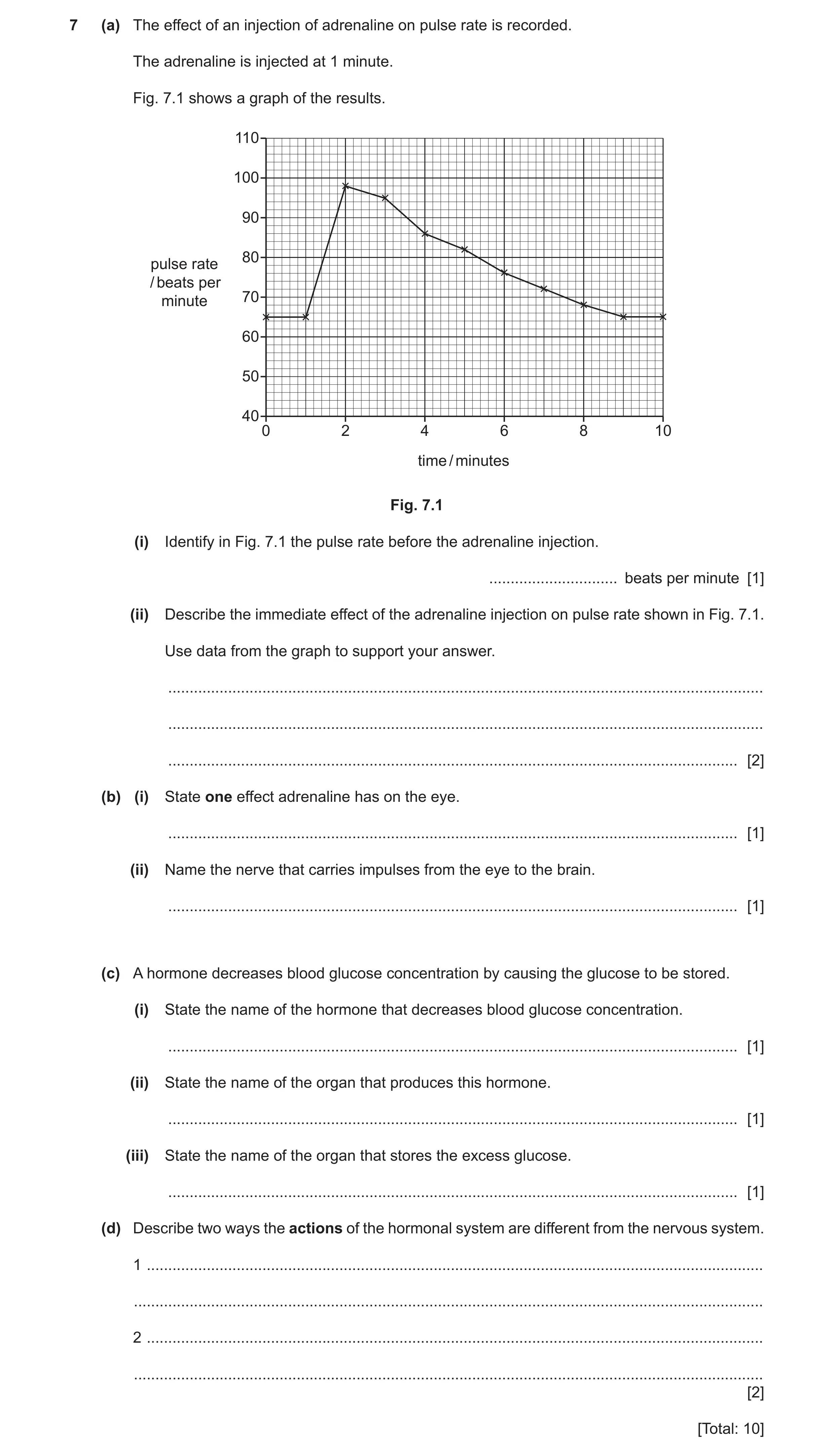
 16 / 20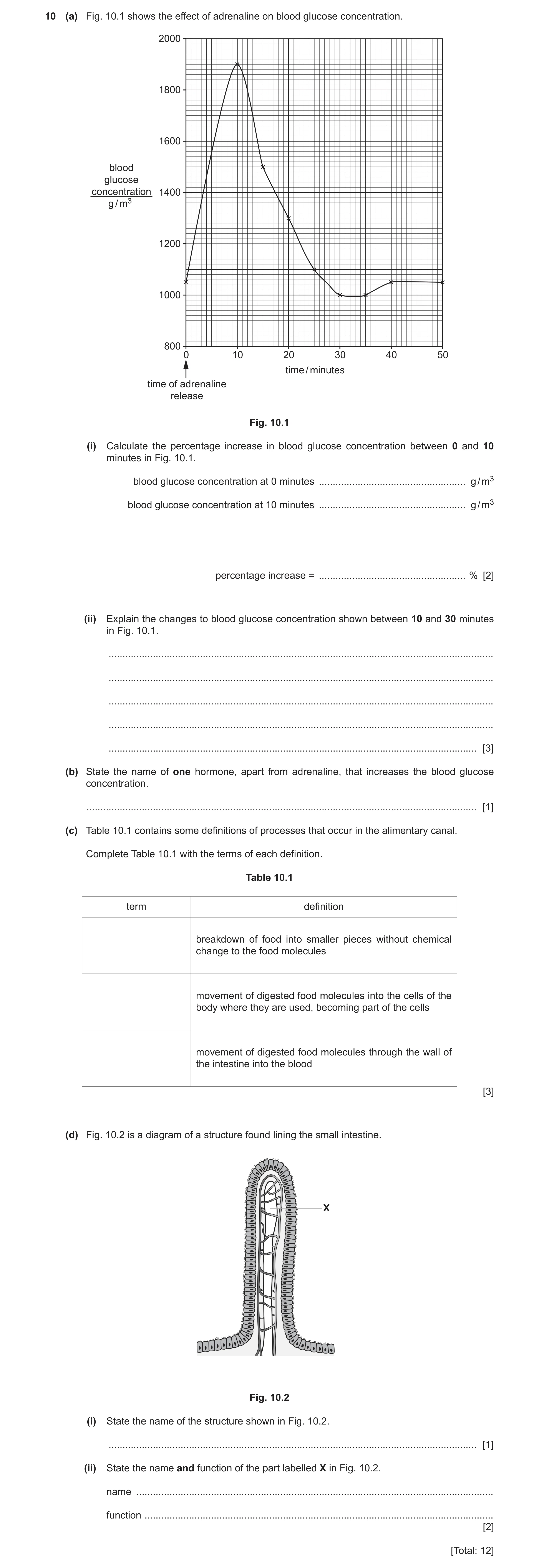
 8
8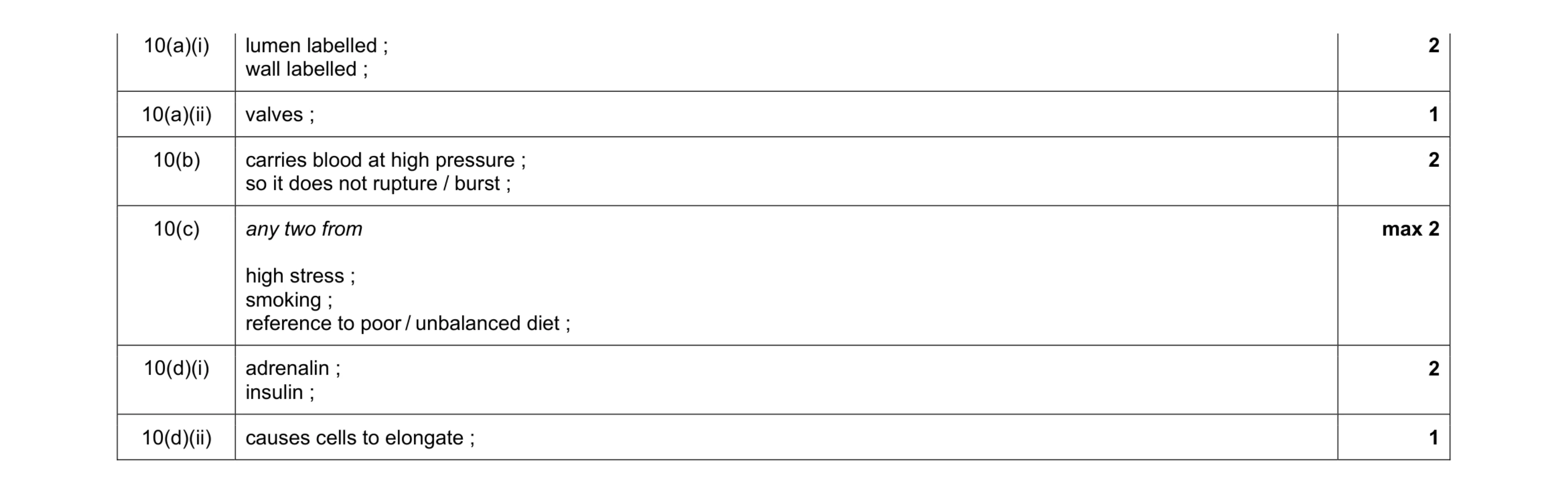 10
10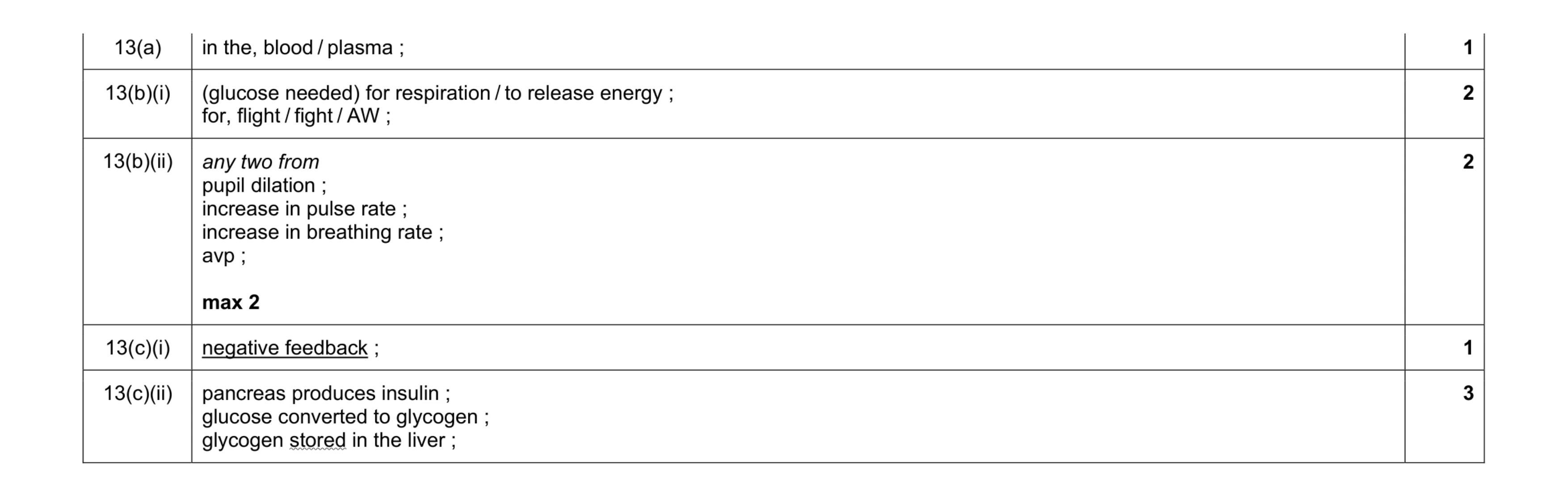 9
9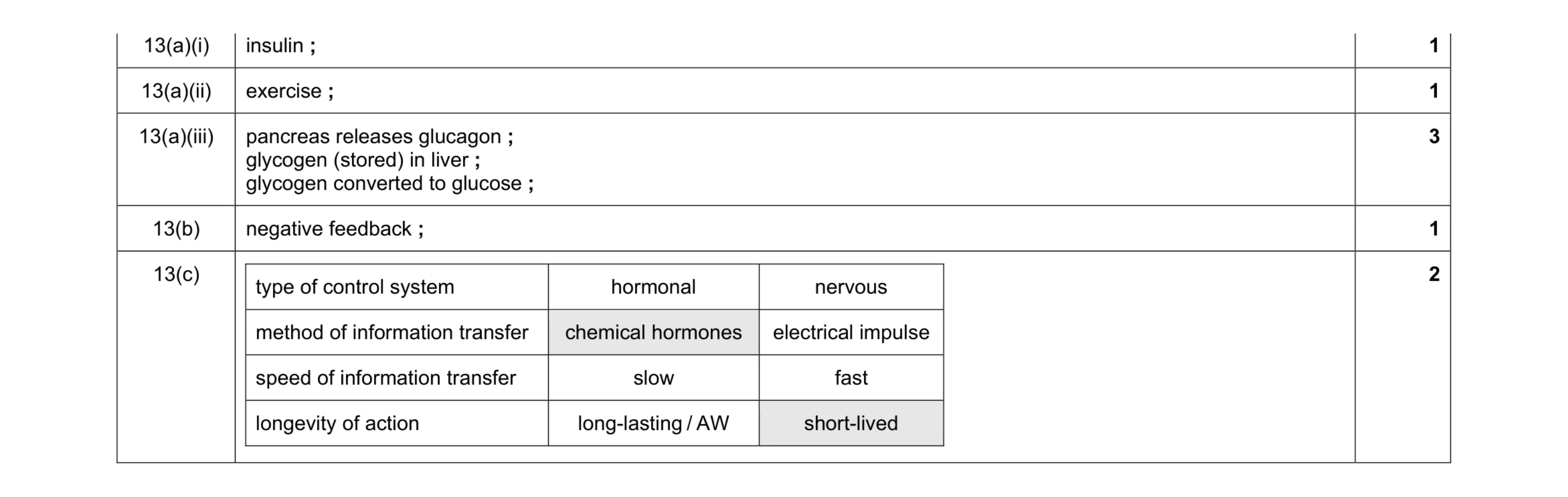 8
8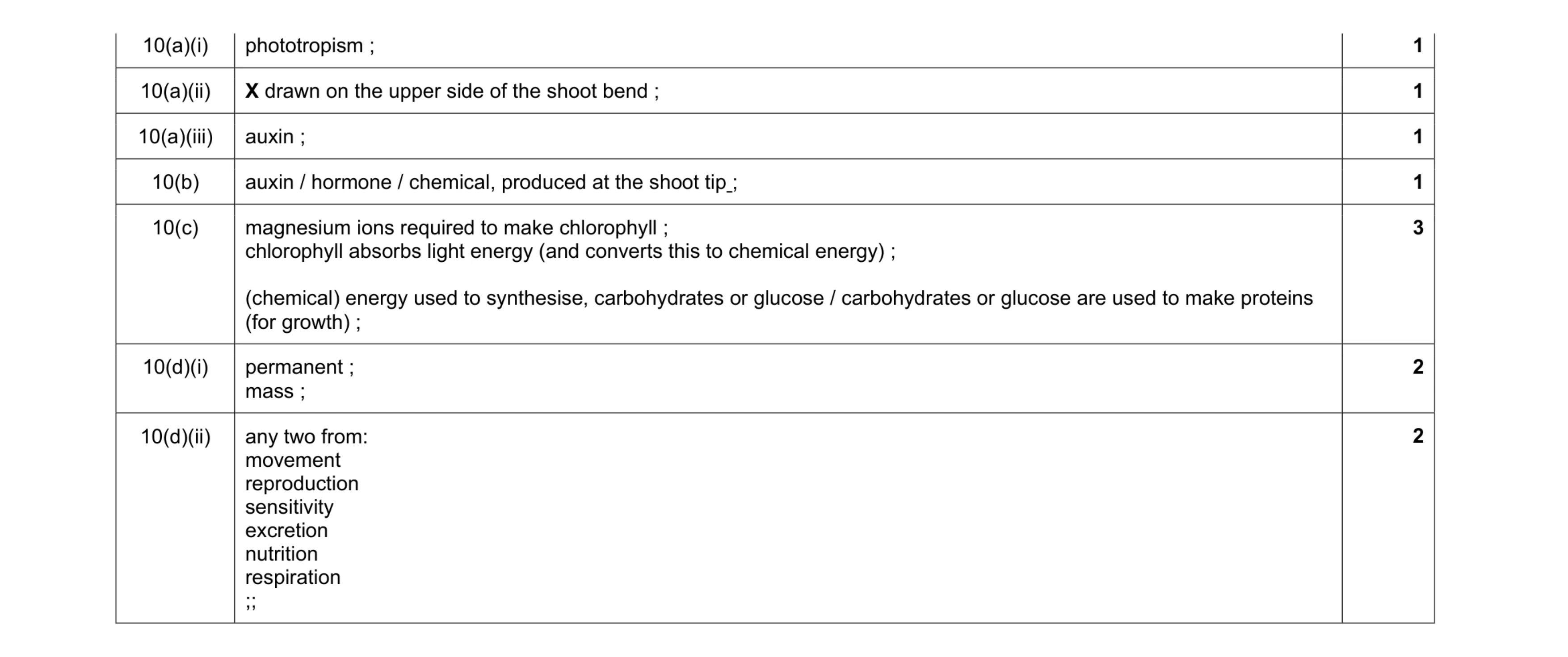 11
11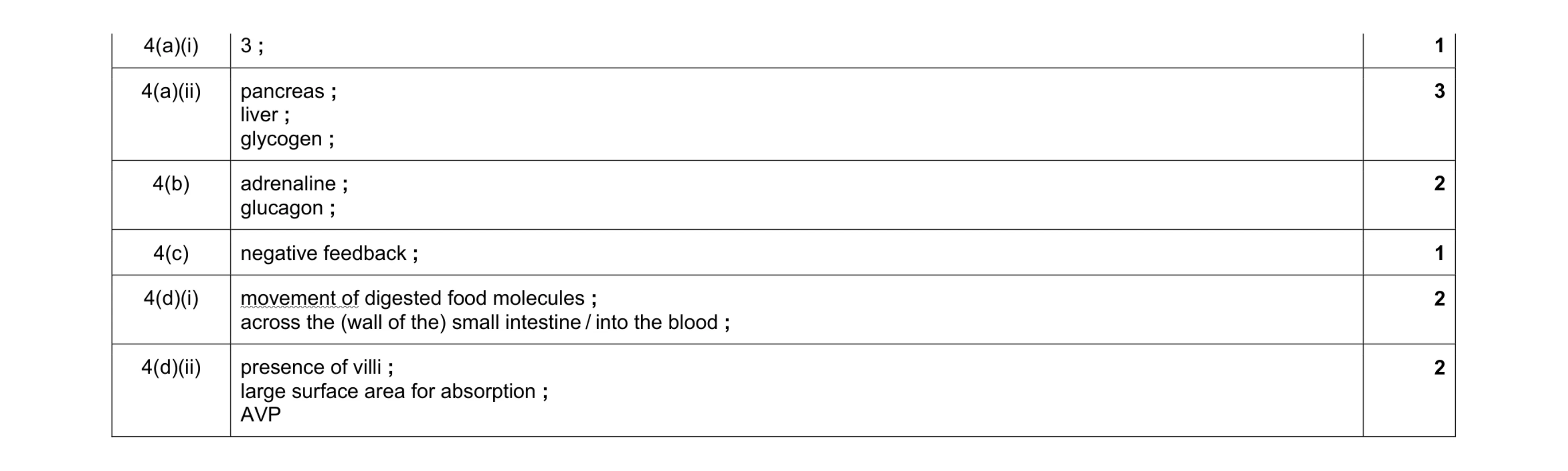 11
11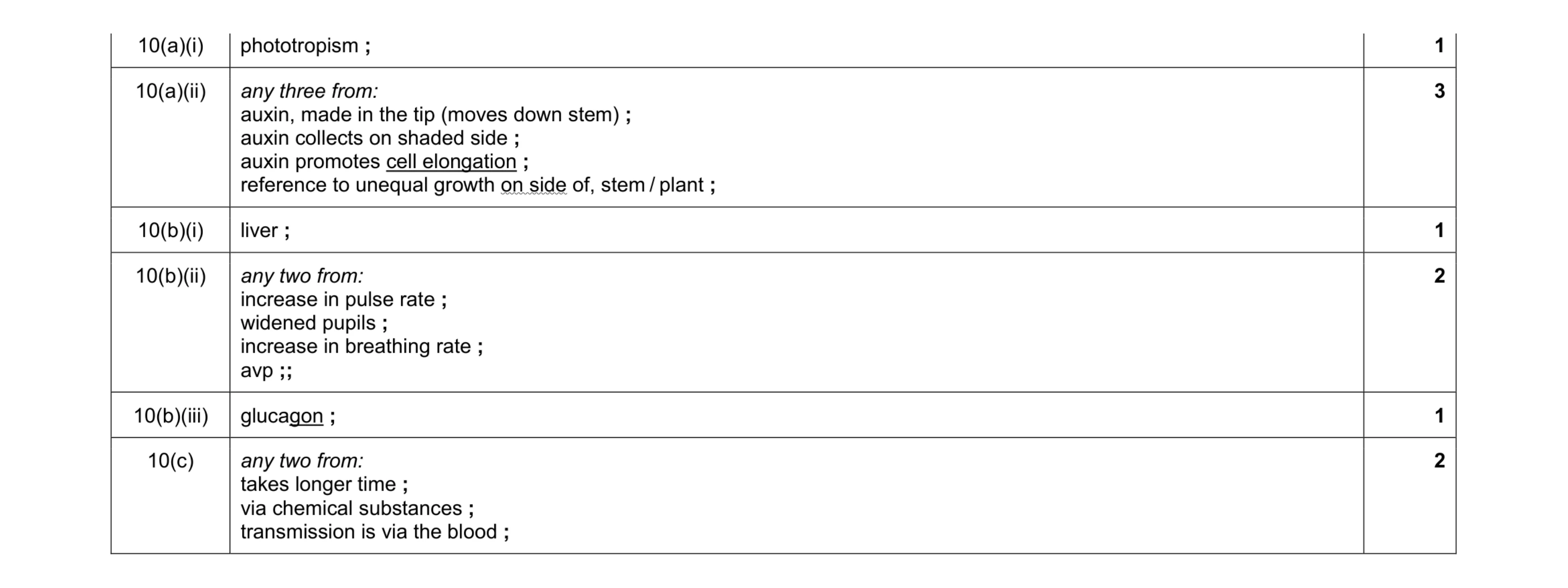 10
10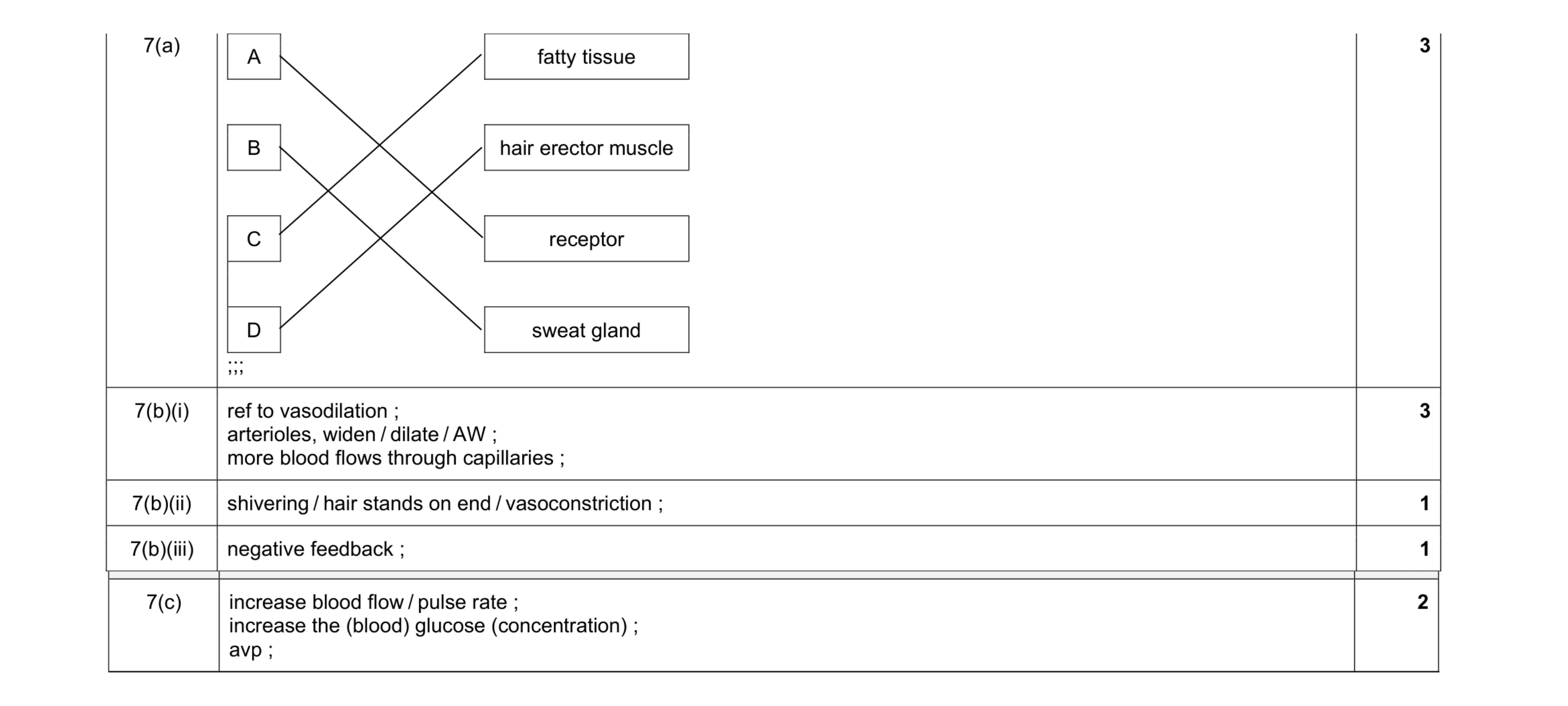 10
10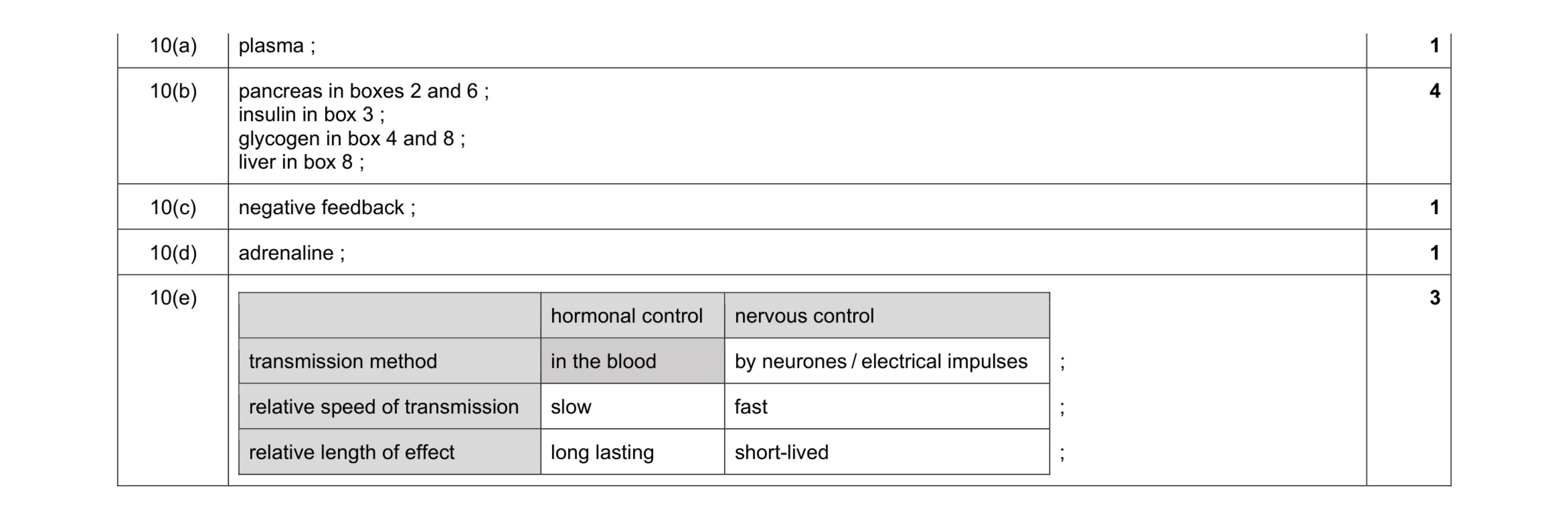 10
10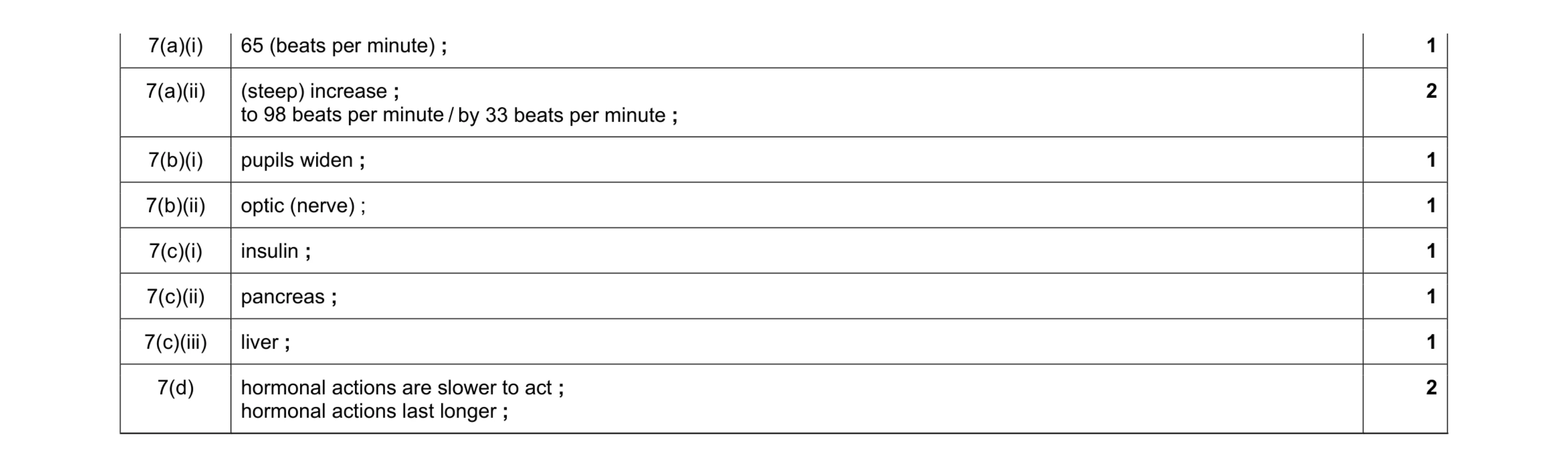 10
10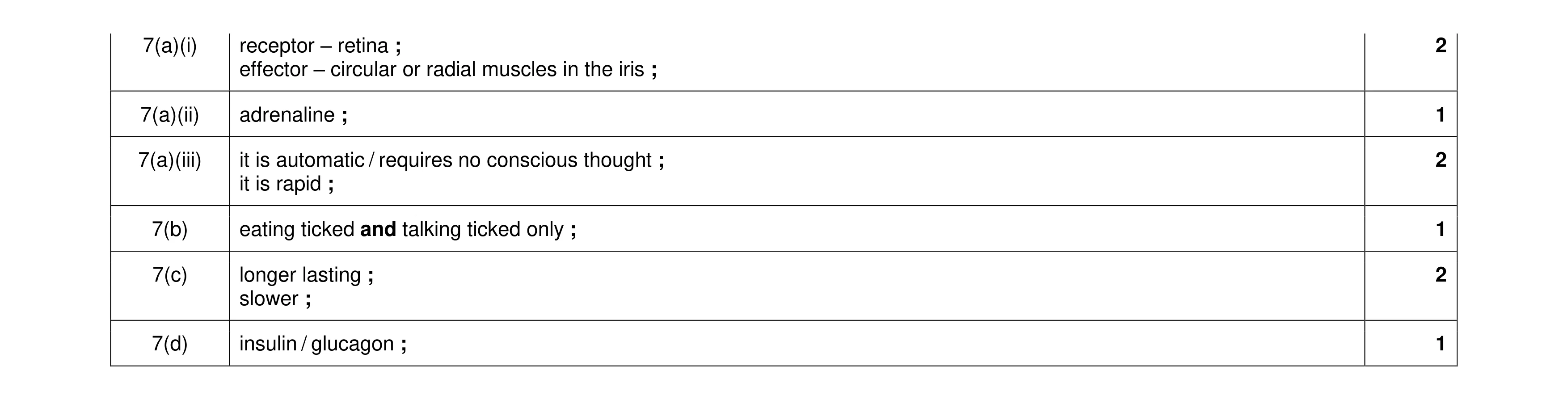 9
9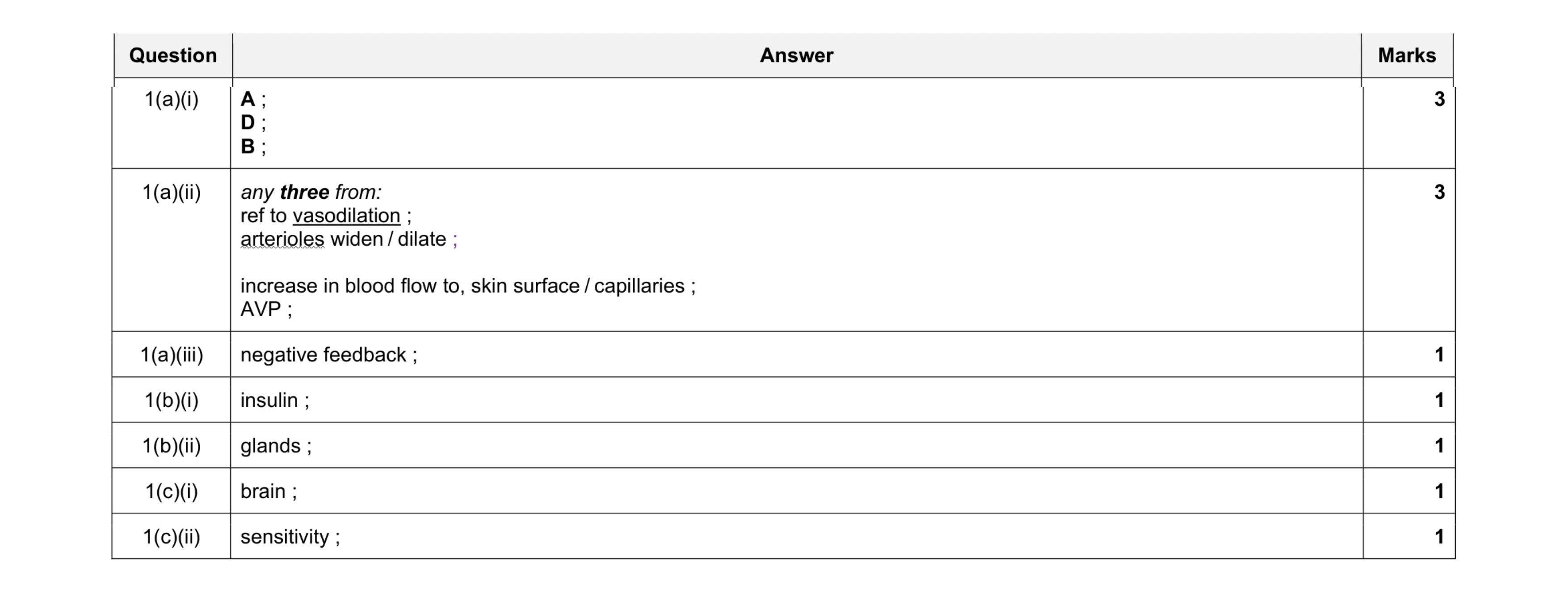 11
11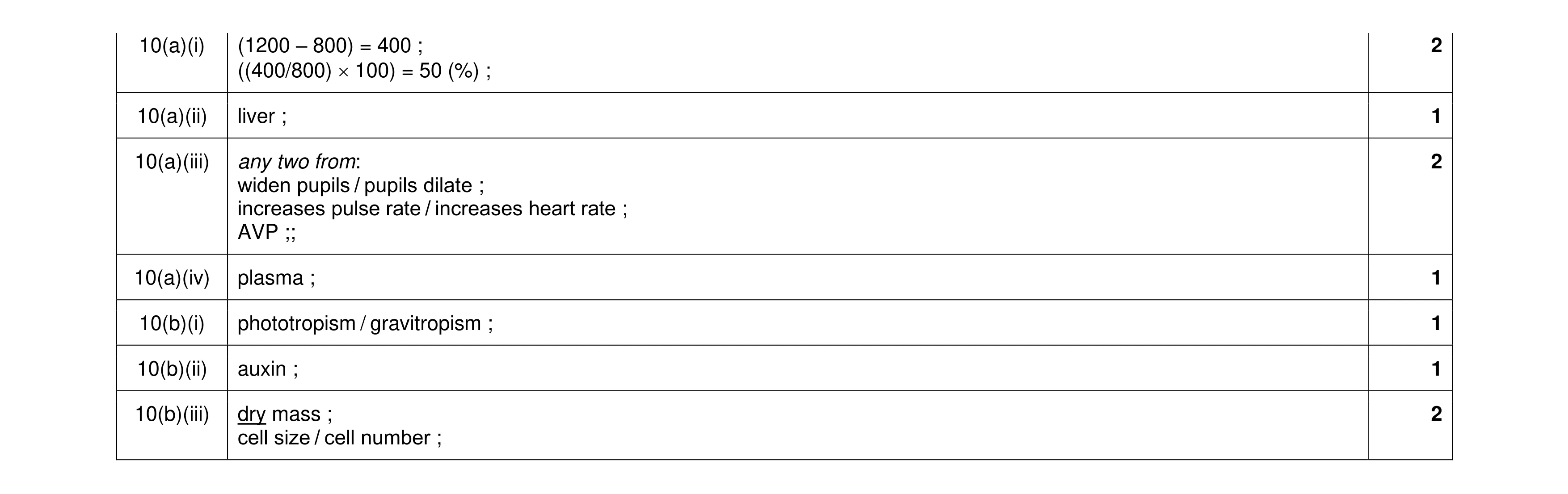 10
10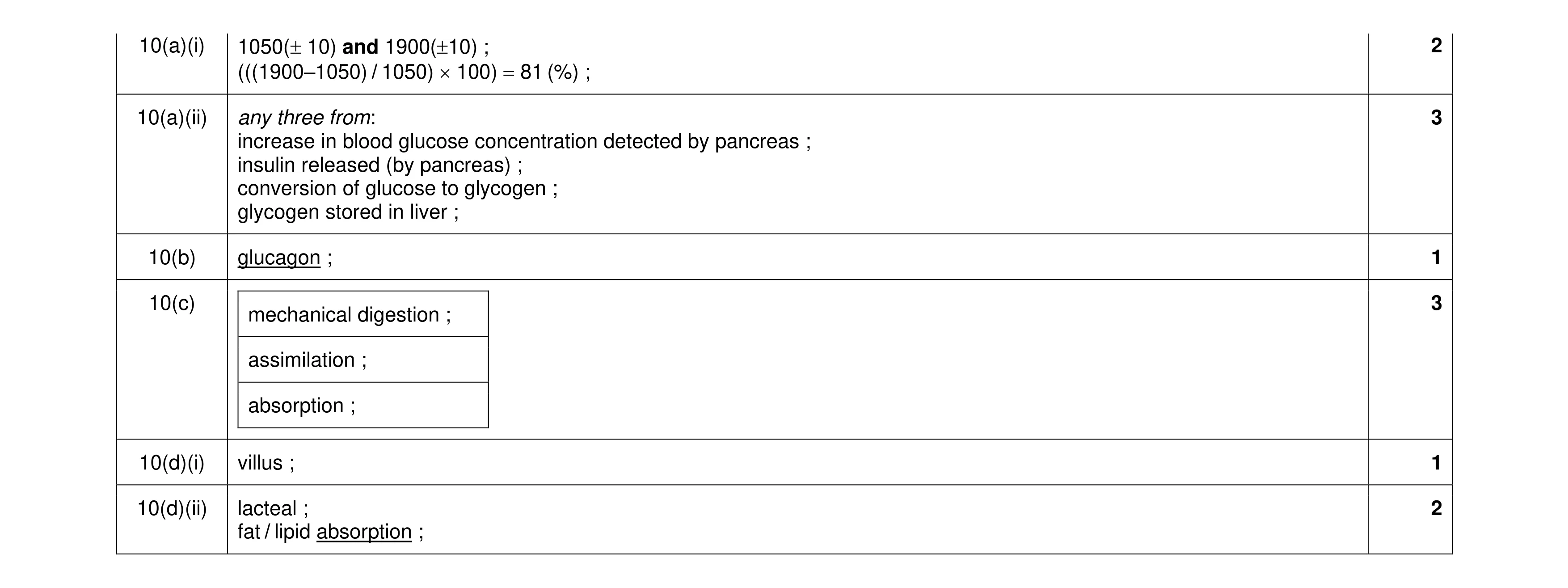 12
12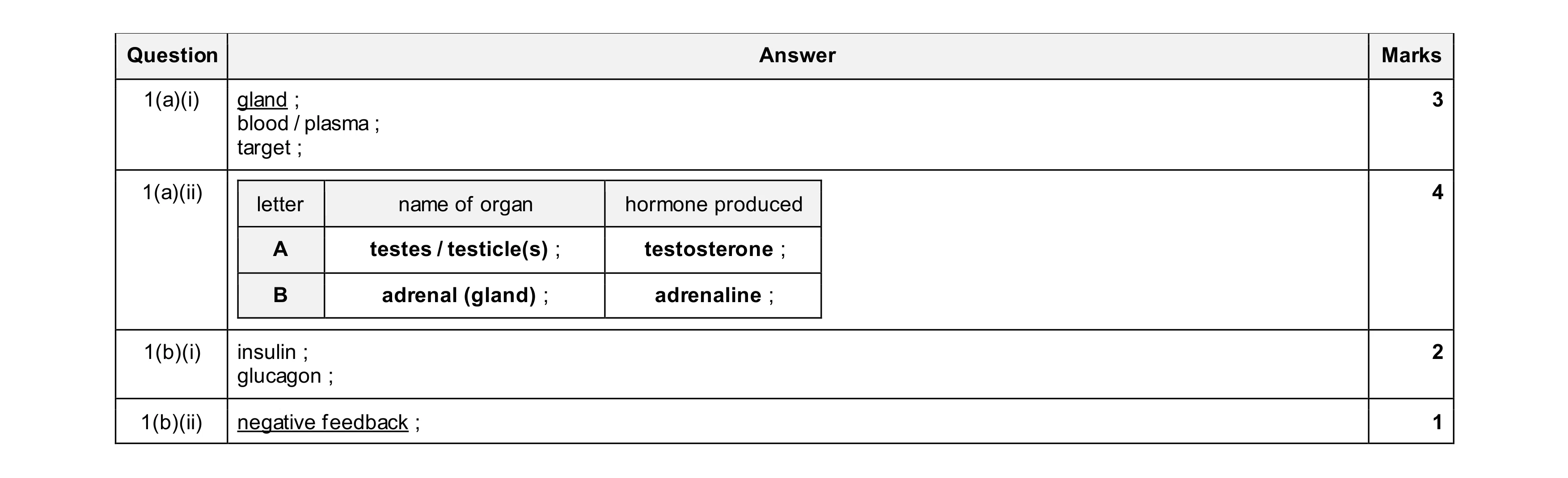 10
10