Questions as text
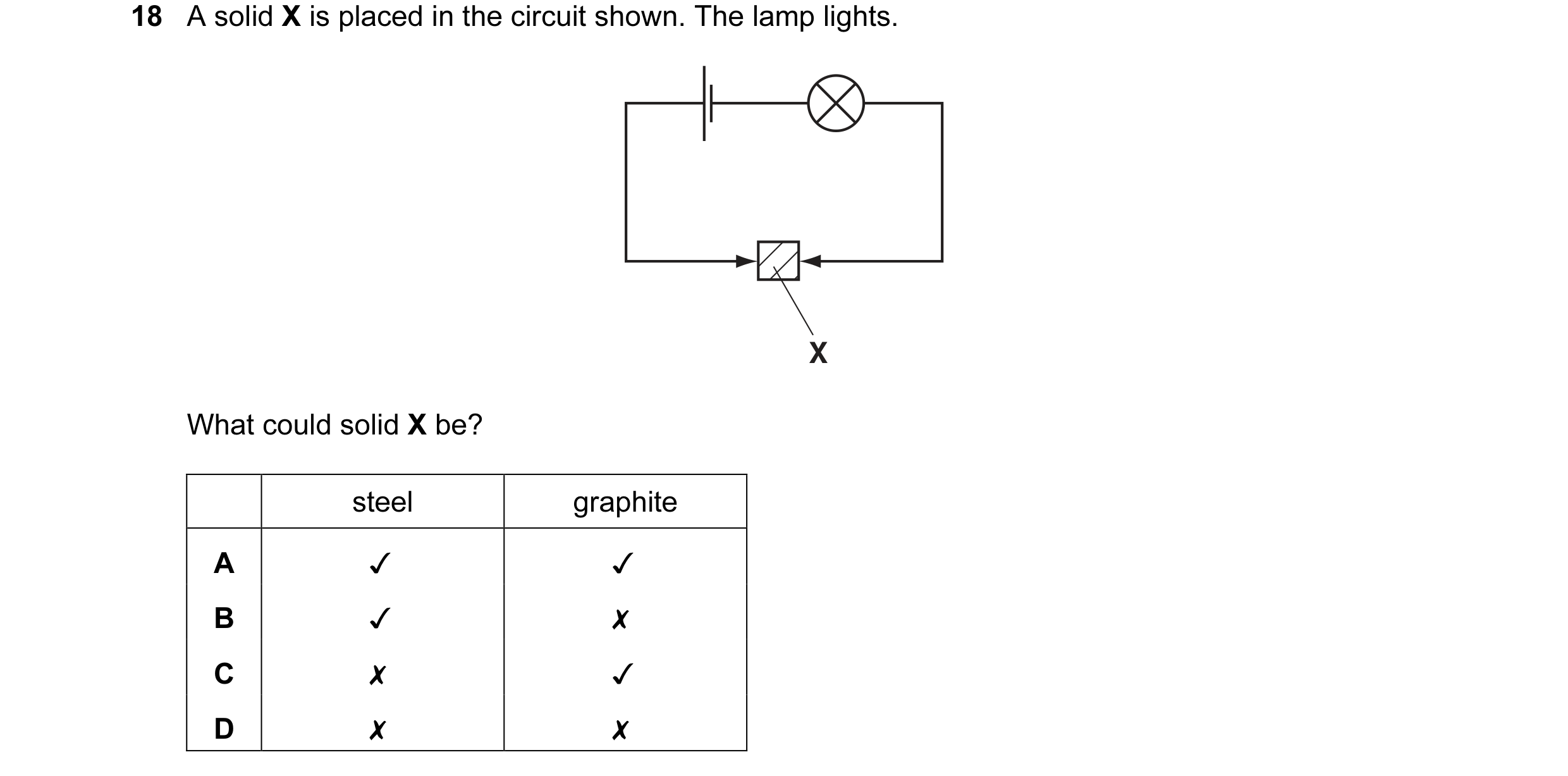
Q1 · A solid X is placed in the circuit shown 0653/11 May/June 2008
18 A solid X is placed in the circuit shown. The lamp lights.
What could solid X be?
steel graphite
A v v
B v x
Cc x v
D x x
1 marks
Answer: A
This question in 0653/11 May/June 2008
Q2 · What happens to a piece of magnesium when it burns in air? 0653/11 May/June 2010
24 What happens to a piece of magnesium when it burns in air? A oxidation and combustion B oxidation and thermal decomposition C reduction and combustion D reduction and thermal decomposition
1 marks
Answer: A
This question in 0653/11 May/June 2010
Q3 · What happens to a piece of magnesium when it burns in air? 0653/13 May/June 2010
25 What happens to a piece of magnesium when it burns in air? A oxidation and combustion B oxidation and thermal decomposition C reduction and combustion D reduction and thermal decomposition
1 marks
Answer: A
This question in 0653/13 May/June 2010
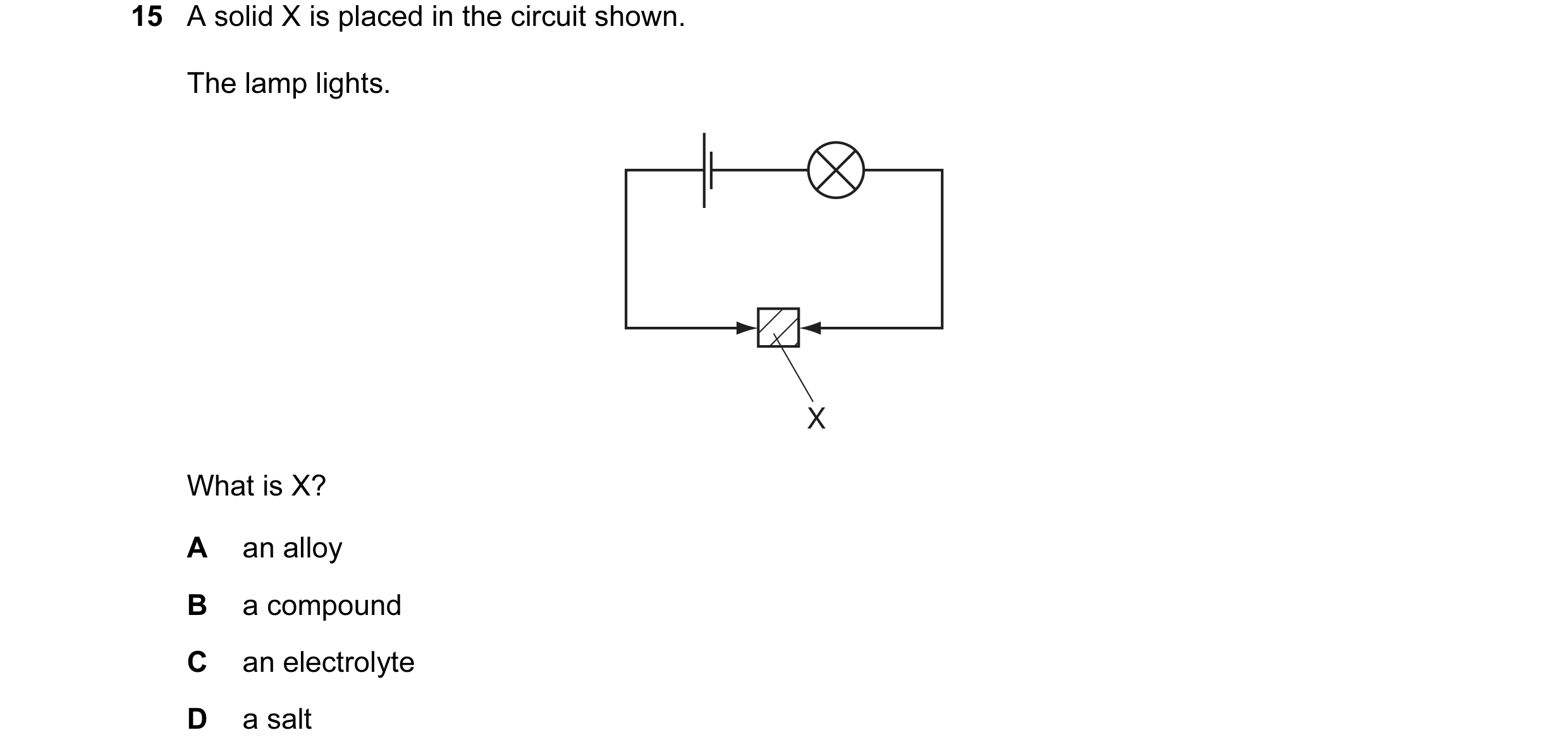
Q4 · A solid X is placed in the circuit shown 0653/12 May/June 2013
15 A solid X is placed in the circuit shown. The lamp lights. X What is X? A an alloy B a compound C an electrolyte D a salt
1 marks
Answer: A
This question in 0653/12 May/June 2013
Q5 · An unknown element is tested using the apparatus shown 0653/11 May/June 2014
24 An unknown element is tested using the apparatus shown. battery lamp unknown element The lamp did not light. Which statement about the element is correct? A It is a Group I metal. B It is an alloy. C It is a non-metal. D It is a transition element.
1 marks
Answer: C
This question in 0653/11 May/June 2014
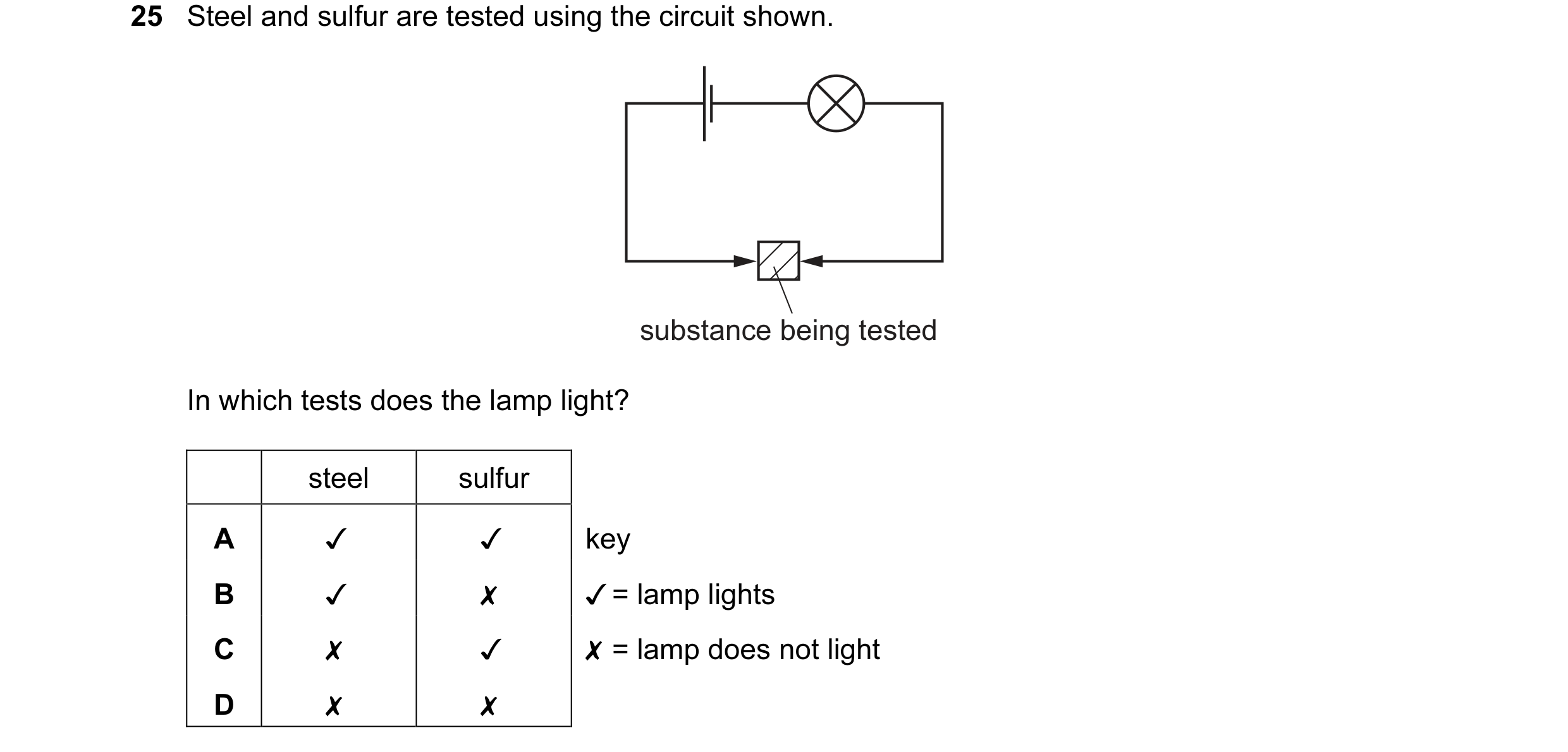
Q6 · Steel and sulfur are tested using the circuit shown 0653/12 May/June 2014
25 Steel and sulfur are tested using the circuit shown.
substance being tested
In which tests does the lamp light?
steel sulfur
A v key
B x ¥ = lamp lights
Cc v X = lamp does not light
D x
1 marks
Answer: B
This question in 0653/12 May/June 2014
Q7 · An unknown element is tested using the apparatus shown 0653/13 May/June 2014
23 An unknown element is tested using the apparatus shown. battery lamp unknown element The lamp did not light. Which statement about the element is correct? A It is a Group I metal. B It is an alloy. C It is a non-metal. D It is a transition element.
1 marks
Answer: C
This question in 0653/13 May/June 2014
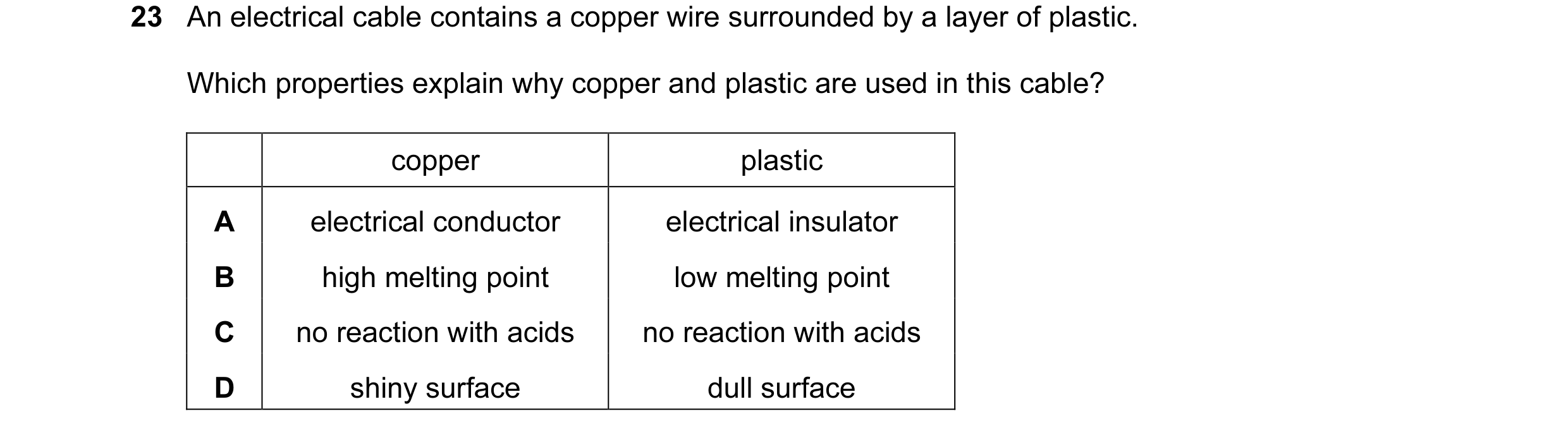
Q8 · An electrical cable contains a copper wire surrounded by a layer of plastic 0653/11 May/June 2015
23 An electrical cable contains a copper wire surrounded by a layer of plastic. Which properties explain why copper and plastic are used in this cable? copper plastic A electrical conductor electrical insulator B high melting point low melting point C no reaction with acids no reaction with acids D shiny surface dull surface
1 marks
Answer: A
This question in 0653/11 May/June 2015
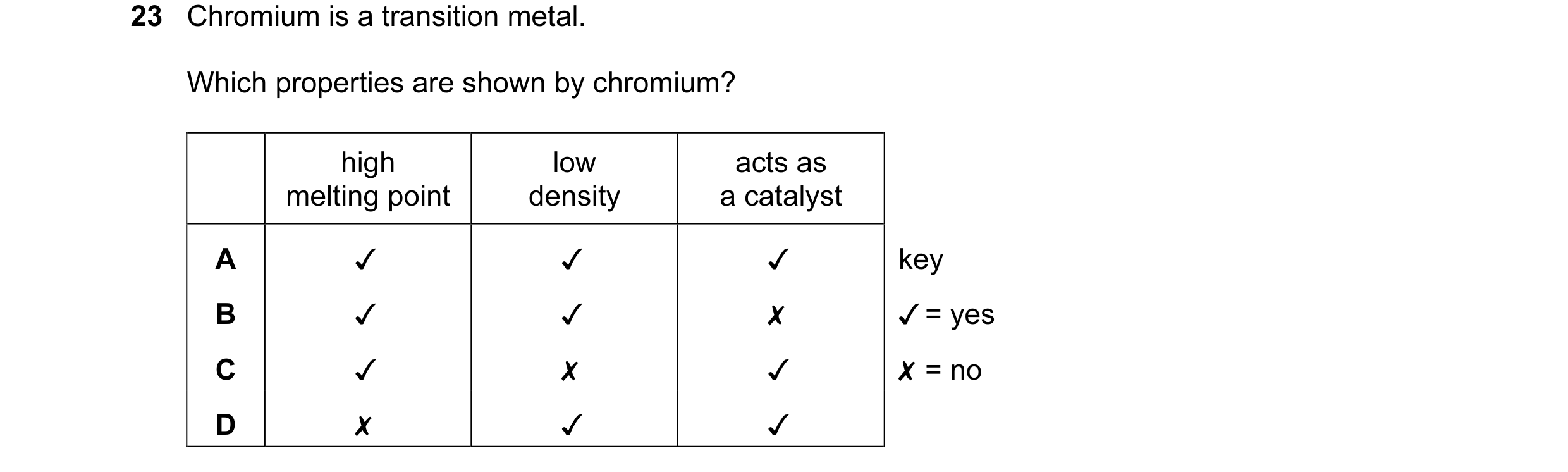
Q9 · Chromium is a transition metal 0653/13 May/June 2015
23 Chromium is a transition metal.
Which properties are shown by chromium?
0 Oo WwW >
high
melting point
v
v
v
x
low
density
v
v
x
v
acts as
a catalyst
v
x
v
v
key
v/=yes
X =no
1 marks
Answer: C
This question in 0653/13 May/June 2015
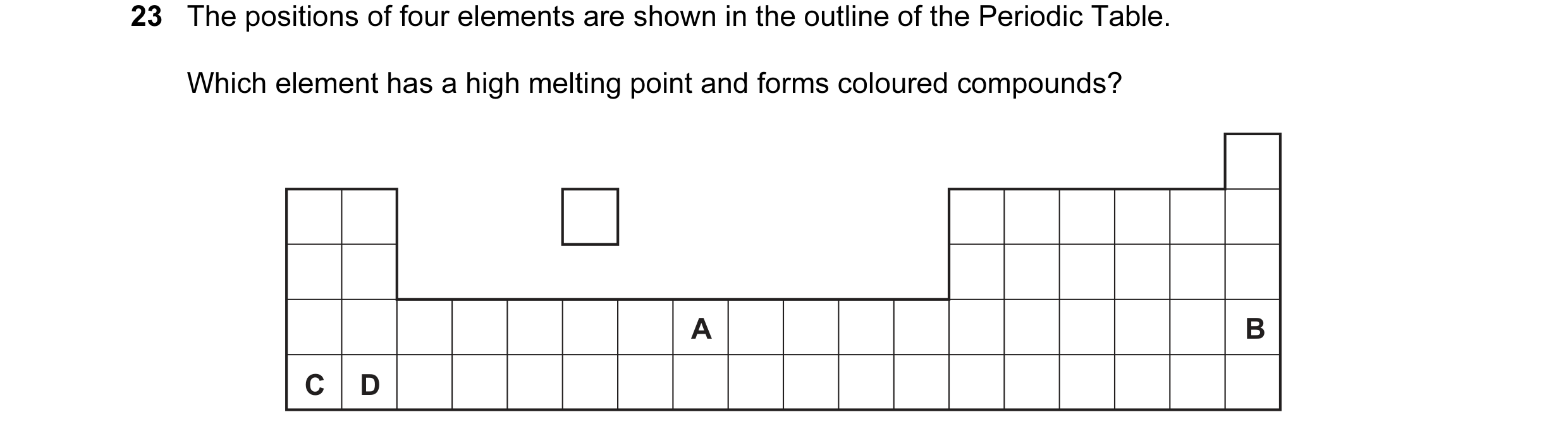
Q10 · The positions of four elements are shown in the outline of the Periodic Table 0653/13 Oct/Nov 2015
23 The positions of four elements are shown in the outline of the Periodic Table. Which element has a high melting point and forms coloured compounds? A B C D
1 marks
Answer: A
This question in 0653/13 Oct/Nov 2015
Q11 · Many coins are made of an alloy 0653/11 Oct/Nov 2016
25 Many coins are made of an alloy. Which property of an alloy makes it suitable for coins? A conducts electricity B expensive to buy C resistant to corrosion D soft and malleable
1 marks
Answer: C
This question in 0653/11 Oct/Nov 2016
Q12 · Which property is used to distinguish between metals and non-metals? 0653/12 Oct/Nov 2017
24 Which property is used to distinguish between metals and non-metals? A boiling point B colour C density D electrical conduction
1 marks
Answer: D
This question in 0653/12 Oct/Nov 2017
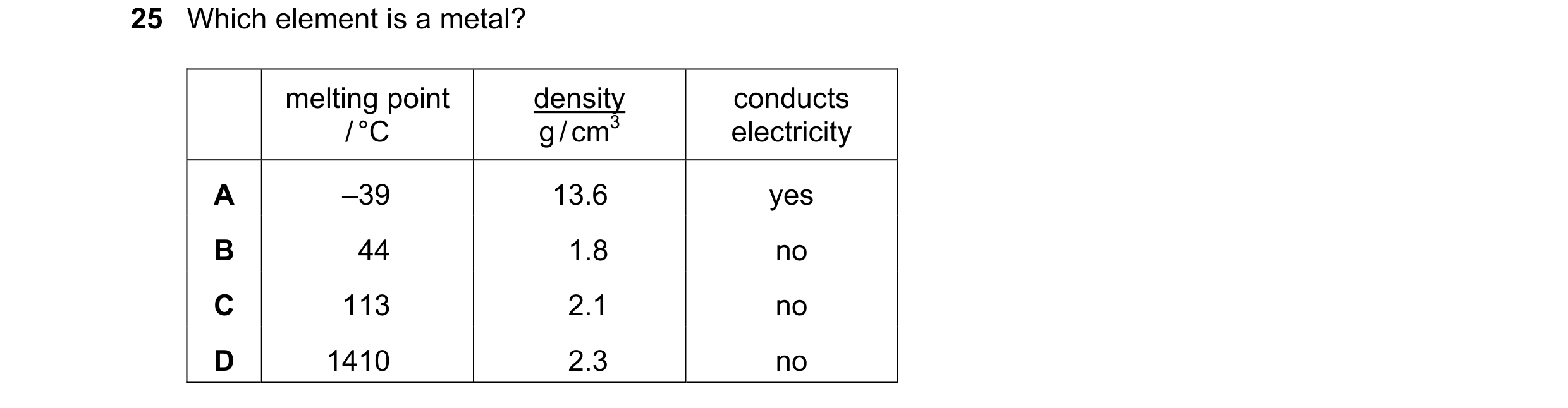
Q13 · Which element is a metal? 0653/11 May/June 2018
25 Which element is a metal? melting point density conducts / °C g / cm3 electricity A –39 13.6 yes B 44 1.8 no C 113 2.1 no D 1410 2.3 no
1 marks
Answer: A
This question in 0653/11 May/June 2018
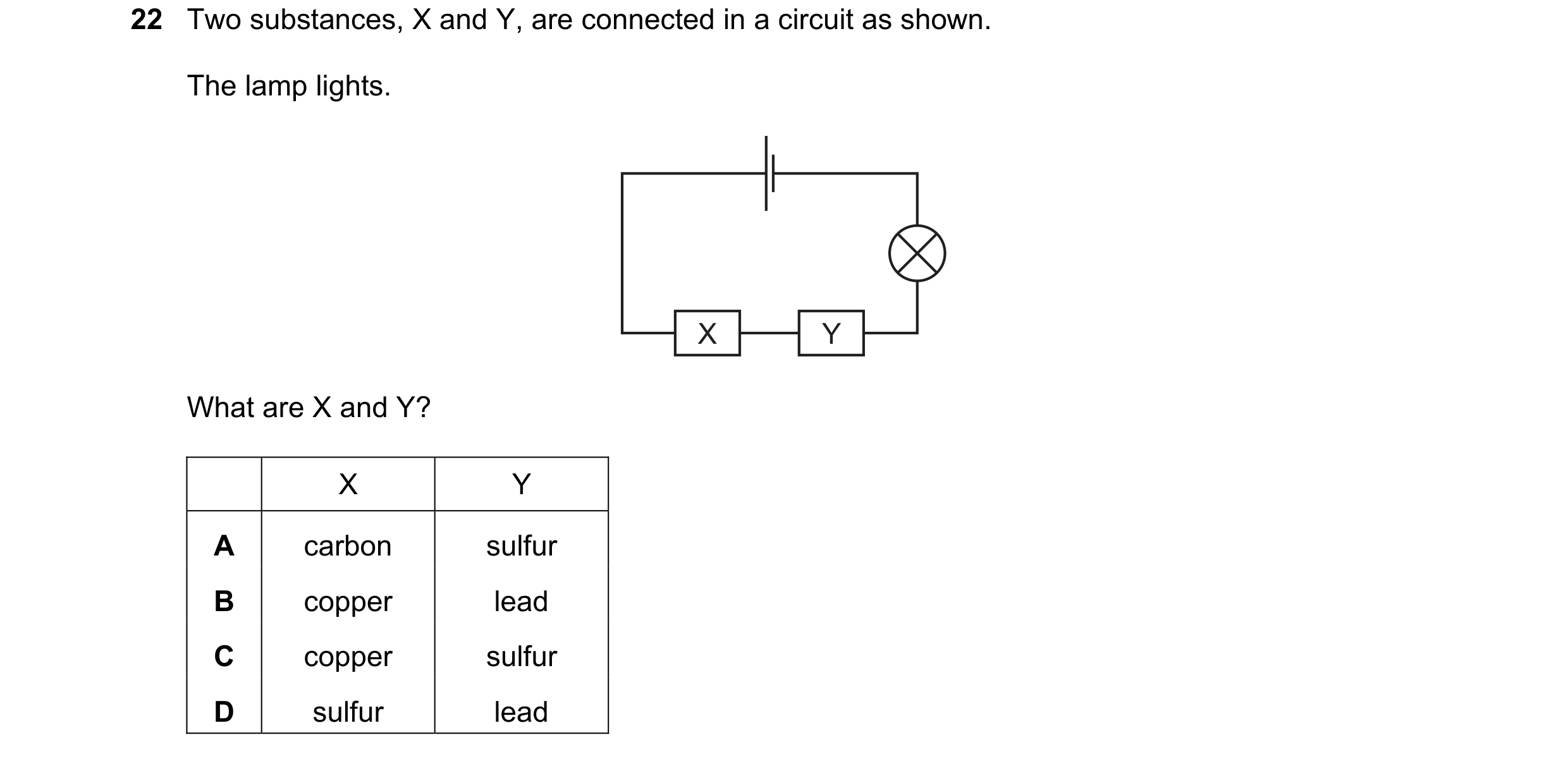
Q14 · Two substances, X and Y, are connected in a circuit as shown 0653/11 Oct/Nov 2018
22 Two substances, X and Y, are connected in a circuit as shown. The lamp lights. X Y What are X and Y? X Y A carbon sulfur B copper lead C copper sulfur D sulfur lead
1 marks
Answer: B
This question in 0653/11 Oct/Nov 2018
Q15 · Which ion is formed from a metal? 0653/11 May/June 2020
17 Which ion is formed from a metal? A Cl – B H+ C Na+ D NH4 +
1 marks
Answer: C
This question in 0653/11 May/June 2020
Q16 · Which substances conduct electricity when molten? 0653/11 May/June 2021
24 Which substances conduct electricity when molten? 1 sodium chloride 2 naphtha 3 brass A 1 and 2 only B 1 and 3 only C 2 and 3 only D 1, 2 and 3
1 marks
Answer: B
This question in 0653/11 May/June 2021
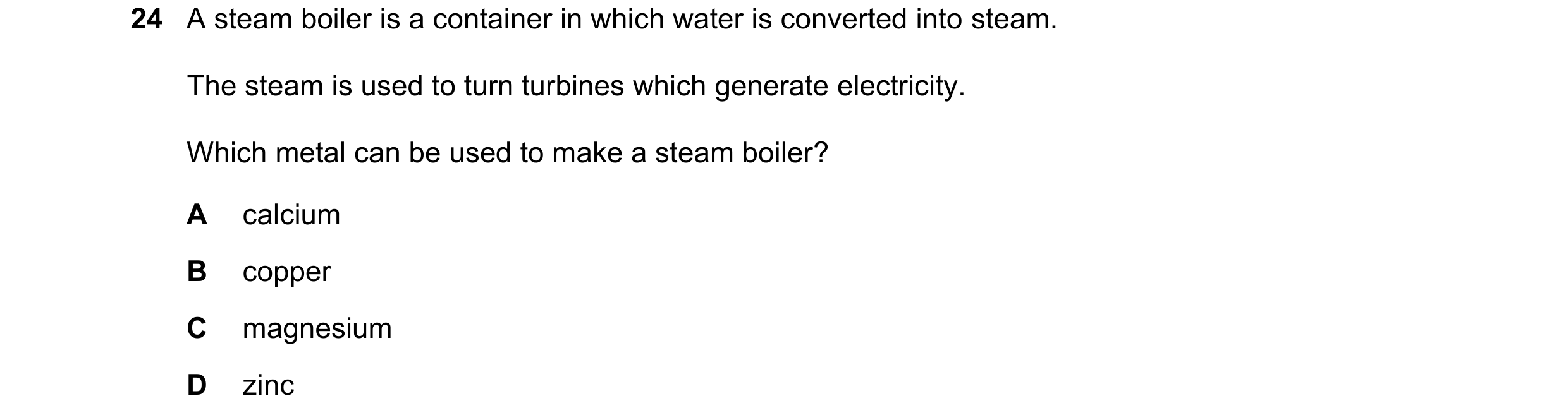
Q17 · A steam boiler is a container in which water is converted into steam 0653/13 May/June 2021
24 A steam boiler is a container in which water is converted into steam. The steam is used to turn turbines which generate electricity. Which metal can be used to make a steam boiler? A calcium B copper C magnesium D zinc
1 marks
Answer: B
This question in 0653/13 May/June 2021
Q18 · Iodine is a non-metal 0653/12 Feb/March 2022
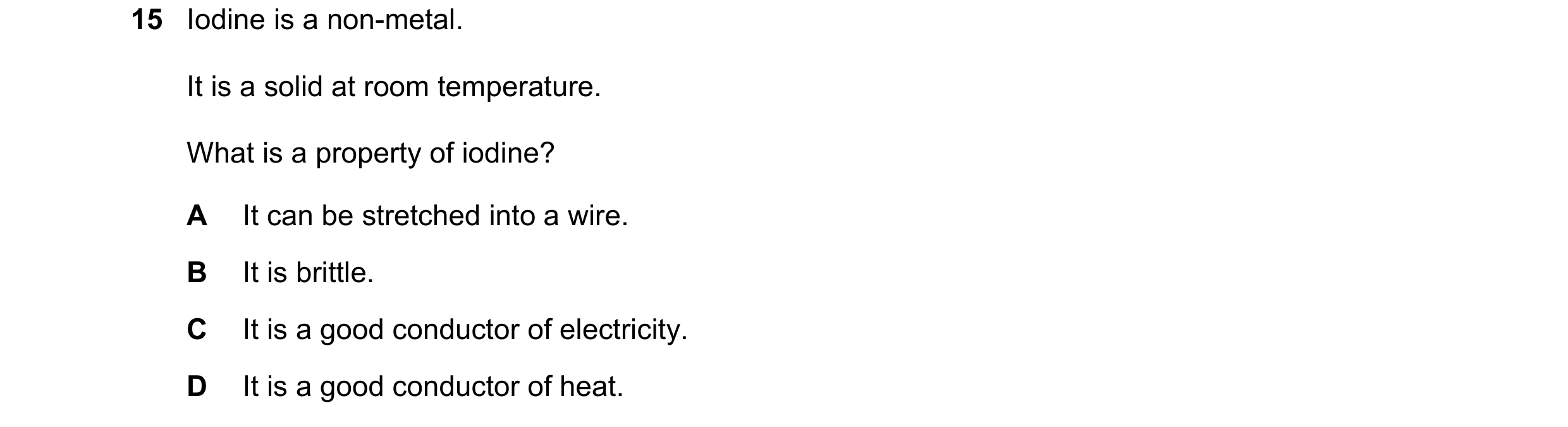
15 Iodine is a non-metal. It is a solid at room temperature. What is a property of iodine? A It can be stretched into a wire. B It is brittle. C It is a good conductor of electricity. D It is a good conductor of heat.
1 marks
Answer: B
This question in 0653/12 Feb/March 2022
Q19 · Element X has a high density and conducts electricity when solid and when molten 0653/12 Oct/Nov 2022
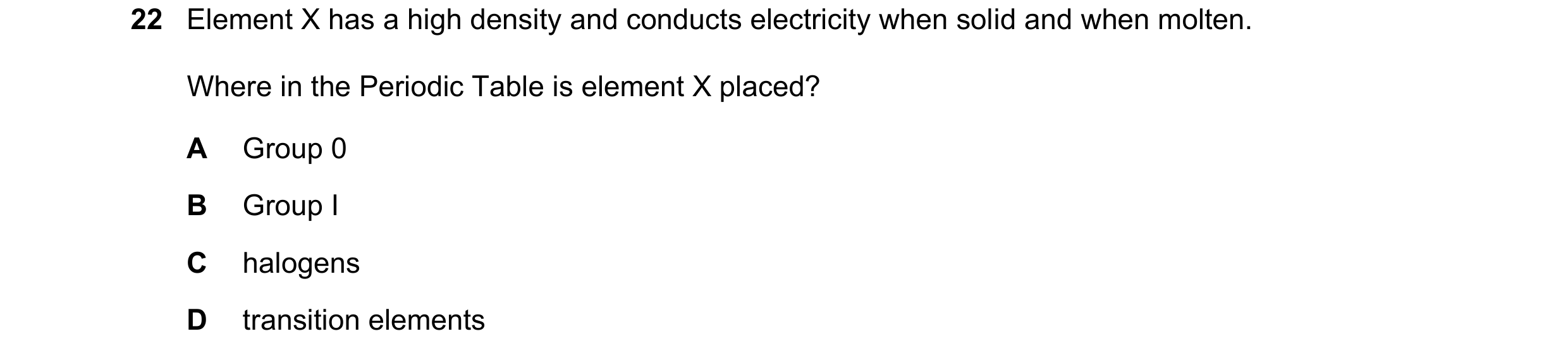
22 Element X has a high density and conducts electricity when solid and when molten. Where in the Periodic Table is element X placed? A Group 0 B Group I C halogens D transition elements
1 marks
Answer: D
This question in 0653/12 Oct/Nov 2022
Q20 · Element X has a high density and conducts electricity when solid and when molten 0653/13 Oct/Nov 2022
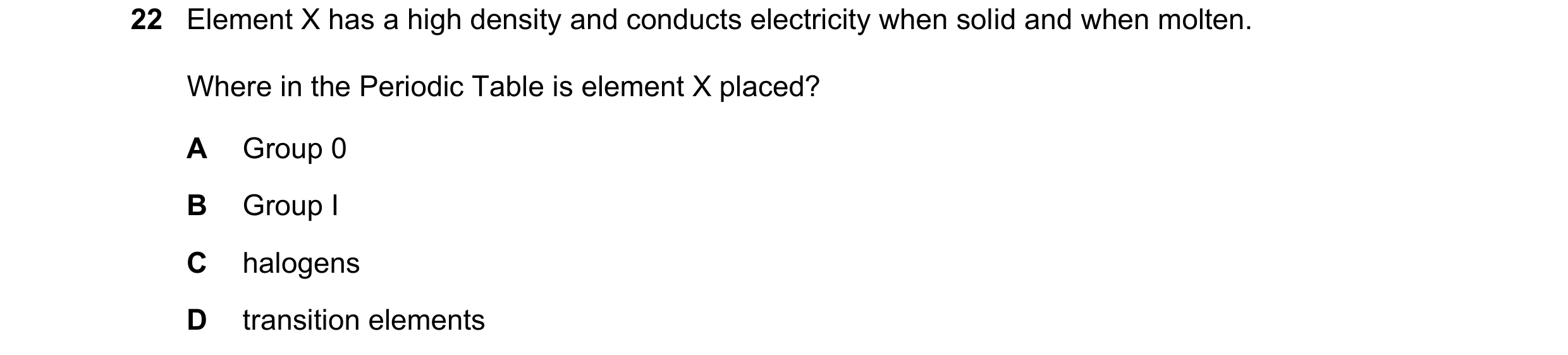
22 Element X has a high density and conducts electricity when solid and when molten. Where in the Periodic Table is element X placed? A Group 0 B Group I C halogens D transition elements
1 marks
Answer: D
This question in 0653/13 Oct/Nov 2022
Q21 · Which substances conduct electricity when molten? 0653/12 Feb/March 2024
23 Which substances conduct electricity when molten? 1 sodium chloride 2 naphtha 3 brass A 1, 2 and 3 B 1 and 2 only C 1 and 3 only D 2 and 3 only
1 marks
Answer: C
This question in 0653/12 Feb/March 2024
Q22 · Which property is the same for sodium and copper? 0653/11 May/June 2024
22 Which property is the same for sodium and copper? A colour B density at room temperature C melting point D state at room temperature
1 marks
Answer: D
This question in 0653/11 May/June 2024


 1 / 6
1 / 6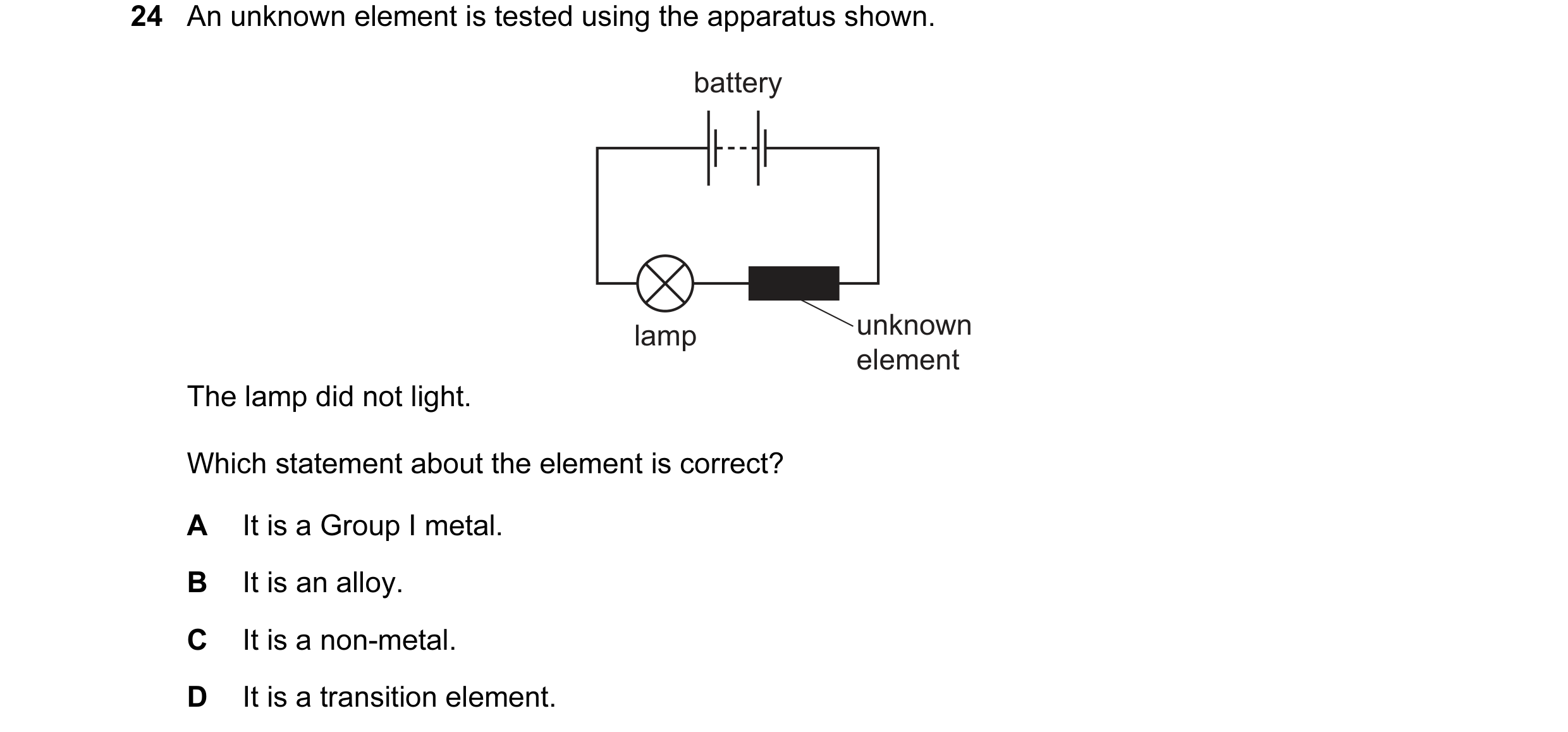
 2 / 6
2 / 6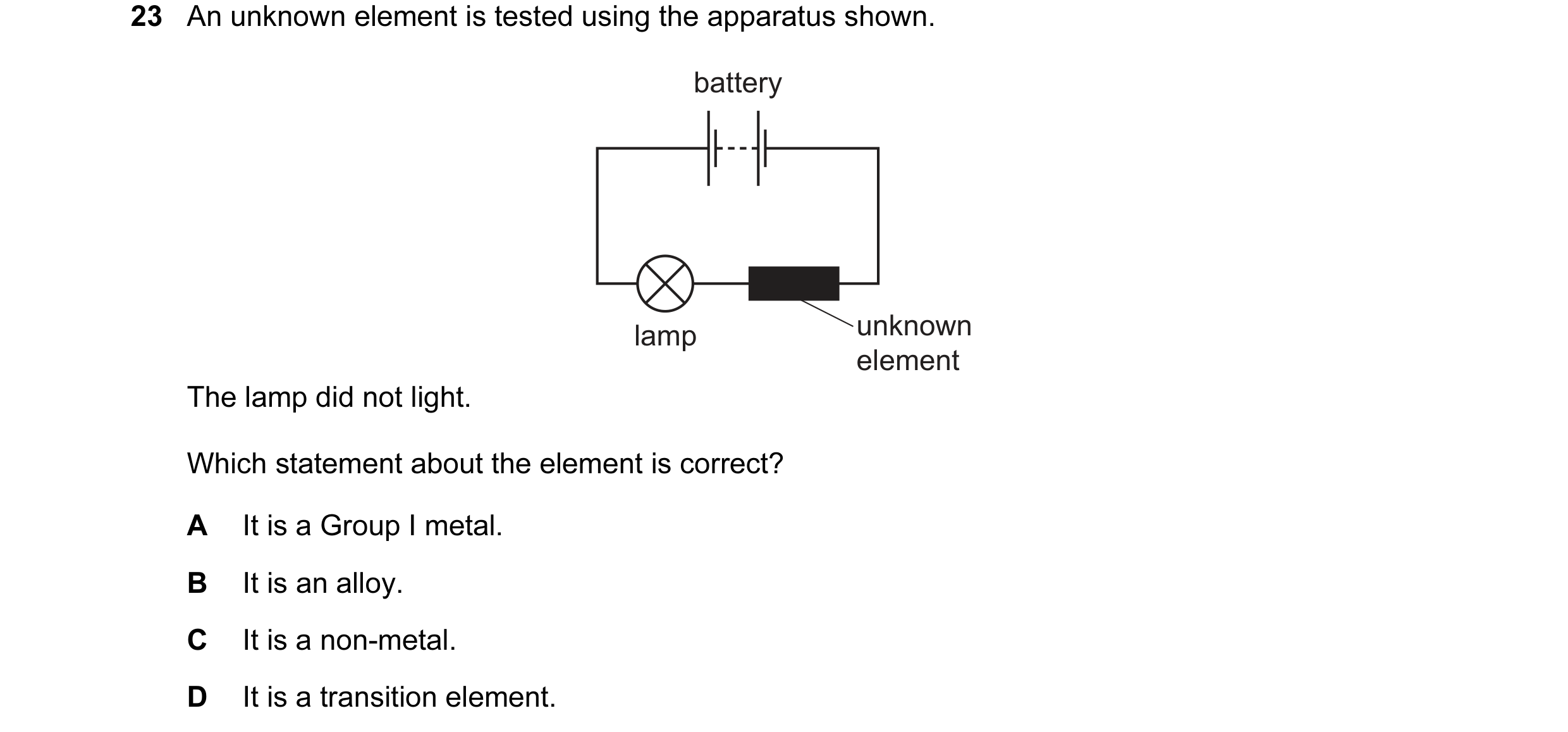
 3 / 6
3 / 6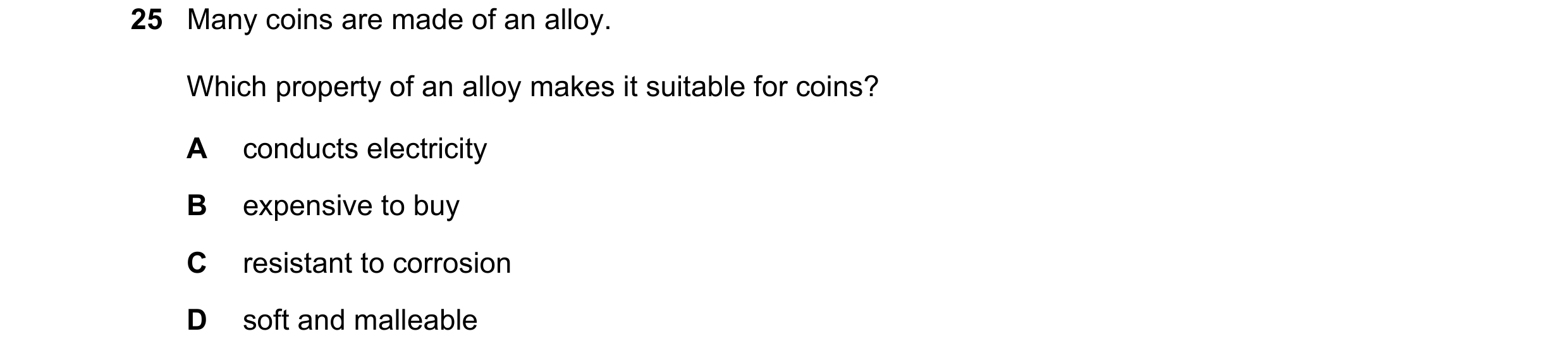

 4 / 6
4 / 6
 5 / 6
5 / 6
 6 / 6
6 / 6