Questions as text
Q1 · A simple test circuit for testing different materials to see how well they conduct… 0653/31 May/June 2017
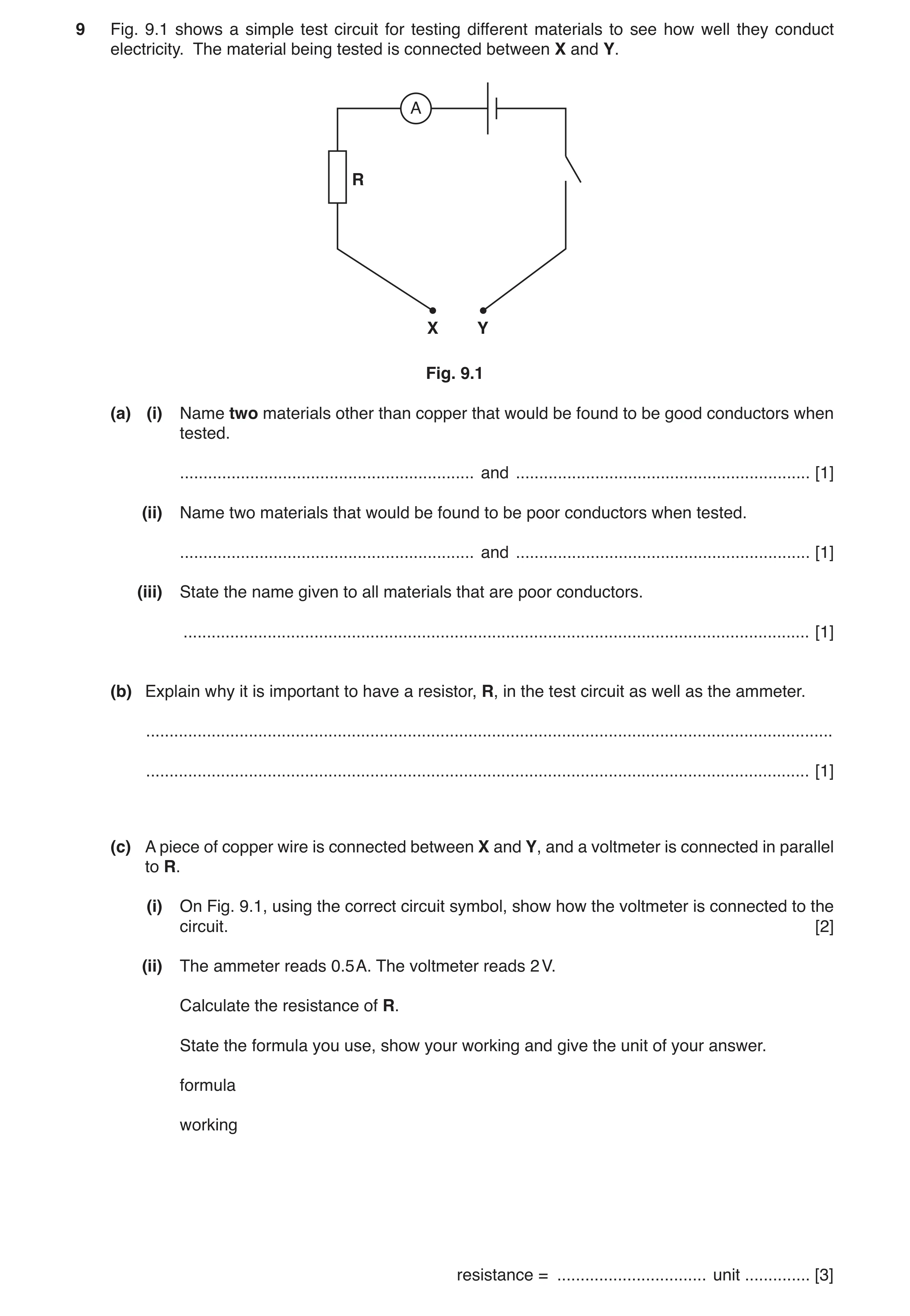
9 Fig. 9.1 shows a simple test circuit for testing different materials to see how well they conduct electricity. The material being tested is connected between X and Y. A R X Y Fig. 9.1 (a) (i) Name two materials other than copper that would be found to be good conductors when tested. … and … [1] (ii) Name two materials that would be found to be poor conductors when tested. … and … [1] (iii) State the name given to all materials that are poor conductors. … [1] (b) Explain why it is important to have a resistor, R, in the test circuit as well as the ammeter. … … [1] (c) A piece of copper wire is connected between X and Y, and a voltmeter is connected in parallel to R. (i) On Fig. 9.1, using the correct circuit symbol, show how the voltmeter is connected to the circuit. [2] (ii) The ammeter reads 0.5 A. The voltmeter reads 2 V. Calculate the resistance of R. State the formula you use, show your working and give the unit of your answer. formula working resistance = … unit … [3]
9 marks
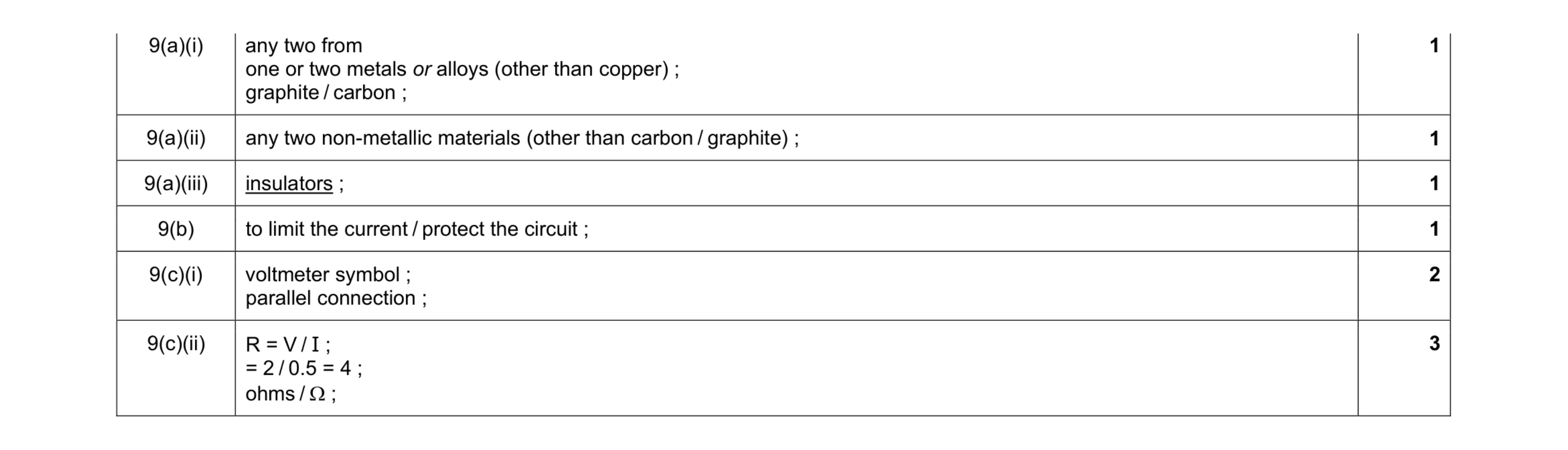
Mark scheme: 9(a)(i) any two from one or two metals or alloys (other than copper) ; graphite / carbon ; 1 9(a)(ii) any two non-metallic materials (other than carbon / graphite) ; 1 9(a)(iii) insulators ; 1 9(b) to limit the current / protect the circuit ; 1 9(c)(i) voltmeter symbol ; parallel connection ; 2 9(c)(ii) R = V / I ; = 2 / 0.5 = 4 ; ohms / Ω ; 3
This question in 0653/31 May/June 2017
Q2 · Some iron objects are shown in Fig 0653/33 Oct/Nov 2017
2 (a) Some iron objects are shown in Fig. 2.1. Fig. 2.1 (i) State two physical properties of all metals. 1. … 2. … [2] (ii) Iron is a transition metal. State one physical property of transition metals that is not a physical property of Group I metals. … [1] (b) A student adds some iron nails to dilute sulfuric acid. Iron sulfate and hydrogen gas are produced. (i) Complete the word equation to show this reaction. iron + + [1] (ii) The student tests another dilute acid with aqueous silver nitrate. A white solid forms. Deduce the anion present and name the acid. anion … acid … [2] (c) The atomic number of iron is 26. Explain what is meant by atomic number. … … [1]
7 marks
Mark scheme: 2(a)(i) Any two from electrical conductor ; thermal / heat conductor ; malleable ; ductile ; sonorous ; max 2 2(a)(ii) high density / high melting point / coloured compounds ; 1 2(b)(i) (iron) + sulfuric acid Î iron sulfate + hydrogen ; 1 2(b)(ii) (anion) chloride ; (acid) hydrochloric (acid) ; 2 2(c) number of protons in an atom / nucleus ; 1
This question in 0653/33 Oct/Nov 2017
Q3 · A student investigates the reactivity of four different metals 0653/31 May/June 2018
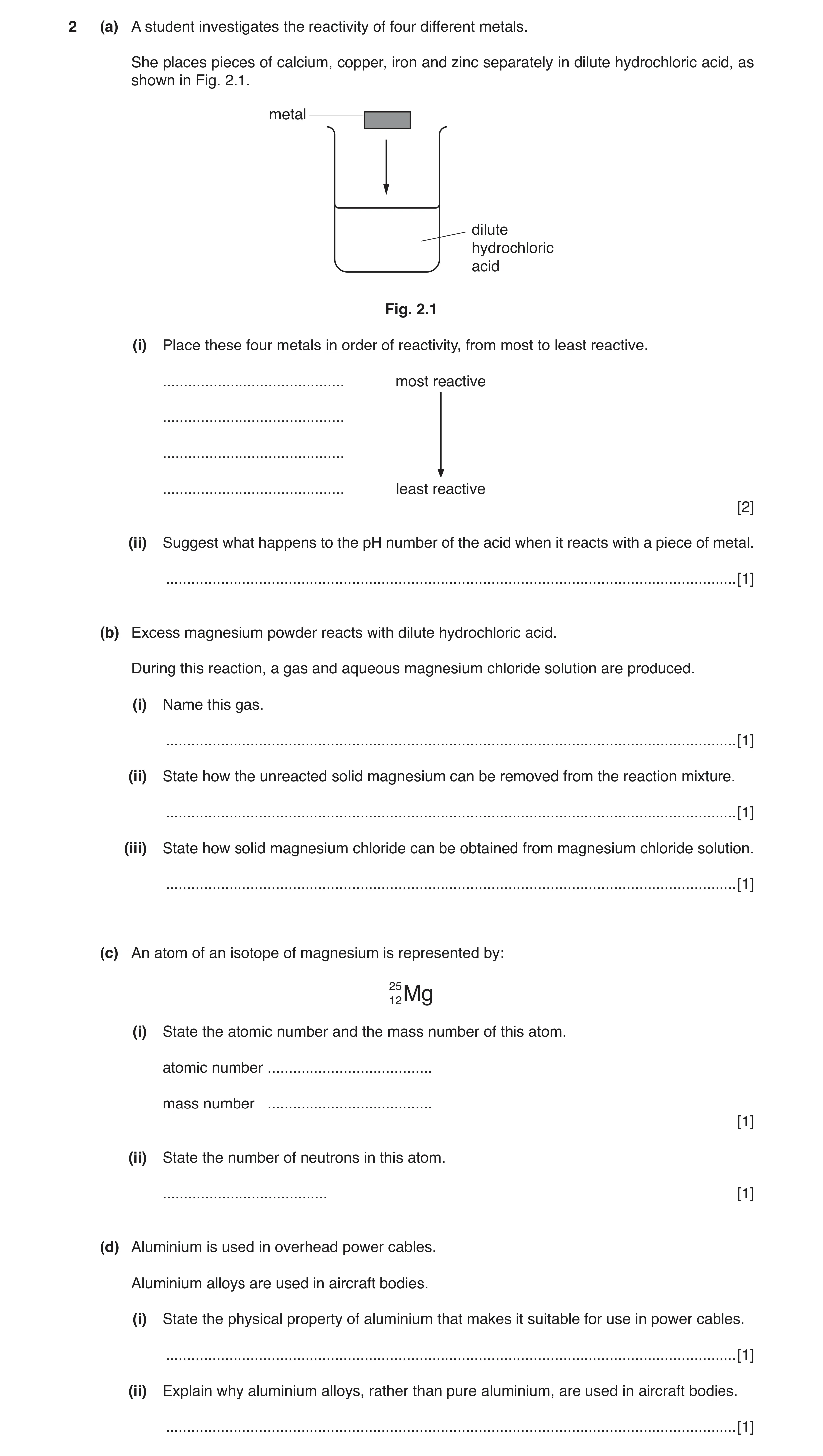
2 (a) A student investigates the reactivity of four different metals. She places pieces of calcium, copper, iron and zinc separately in dilute hydrochloric acid, as shown in Fig. 2.1. metal dilute hydrochloric acid Fig. 2.1 (i) Place these four metals in order of reactivity, from most to least reactive. … most reactive … … … least reactive [2] (ii) Suggest what happens to the pH number of the acid when it reacts with a piece of metal. … [1] (b) Excess magnesium powder reacts with dilute hydrochloric acid. During this reaction, a gas and aqueous magnesium chloride solution are produced. (i) Name this gas. … [1] (ii) State how the unreacted solid magnesium can be removed from the reaction mixture. … [1] (iii) State how solid magnesium chloride can be obtained from magnesium chloride solution. … [1] (c) An atom of an isotope of magnesium is represented by: 2512Mg (i) State the atomic number and the mass number of this atom. atomic number … mass number … [1] (ii) State the number of neutrons in this atom. … [1] (d) Aluminium is used in overhead power cables. Aluminium alloys are used in aircraft bodies. (i) State the physical property of aluminium that makes it suitable for use in power cables. … [1] (ii) Explain why aluminium alloys, rather than pure aluminium, are used in aircraft bodies. … [1]
10 marks
Mark scheme: 2(a)(i) calcium Ca zinc / Zn iron / Fe copper / Cu ;; 1 mark for calcium first and copper last 2 marks for all four correct 2 2(a)(ii) increases / goes up / gets (closer) to 7 ; 1 2(b)(i) hydrogen ; 1 2(b)(ii) filter / filtering / filtration ; 1 2(b)(iii) crystallisation / evaporation / heat ; 1 2(c)(i) (atomic no.) 12 and (mass no.) 25 ; 1 2(c)(ii) 13 ; 1 2(d)(i) (electrical) conductor ; 1 2(d)(ii) higher strength ; 1
This question in 0653/31 May/June 2018
Q4 · A student makes magnesium sulfate by reacting magnesium with a dilute acid 0653/31 Oct/Nov 2018
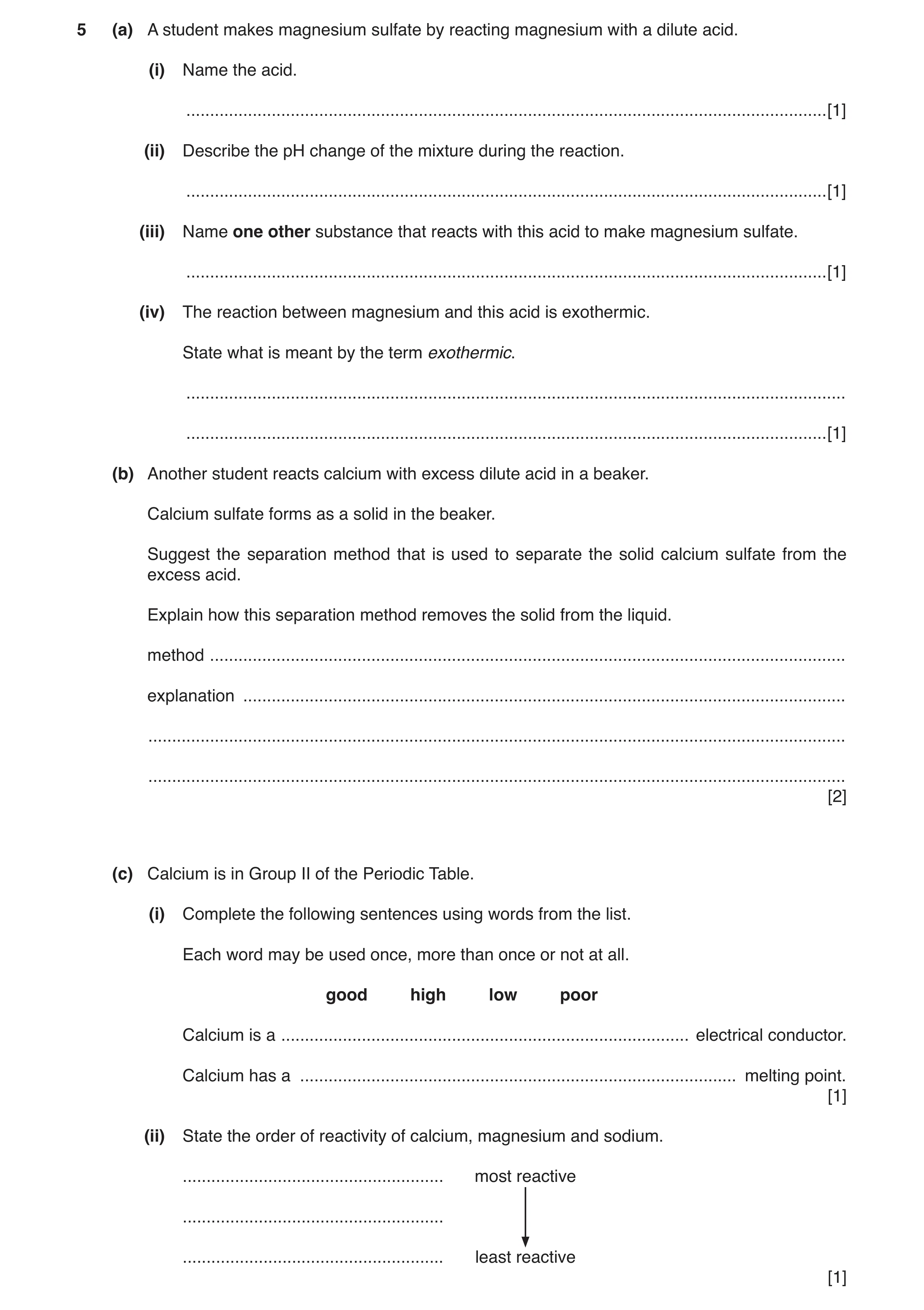
5 (a) A student makes magnesium sulfate by reacting magnesium with a dilute acid. (i) Name the acid. … [1] (ii) Describe the pH change of the mixture during the reaction. … [1] (iii) Name one other substance that reacts with this acid to make magnesium sulfate. … [1] (iv) The reaction between magnesium and this acid is exothermic. State what is meant by the term exothermic. … … [1] (b) Another student reacts calcium with excess dilute acid in a beaker. Calcium sulfate forms as a solid in the beaker. Suggest the separation method that is used to separate the solid calcium sulfate from the excess acid. Explain how this separation method removes the solid from the liquid. method … explanation … … … [2] (c) Calcium is in Group II of the Periodic Table. (i) Complete the following sentences using words from the list. Each word may be used once, more than once or not at all. good high low poor Calcium is a … electrical conductor. Calcium has a … melting point. [1] (ii) State the order of reactivity of calcium, magnesium and sodium. … most reactive … … least reactive [1]
8 marks
Mark scheme: 5(a)(i) sulfuric (acid) ; 1 5(a)(ii) increases ; 1 5(a)(iii) magnesium oxide / magnesium hydroxide / magnesium carbonate; 1 5(a)(iv) temperature increases / release of heat (thermal energy) ; 1 5(b) (method) filter / filtering / filtration ; (explanation) solid (particles) stays on filter paper / cannot pass through filter paper / liquid (particles) can ; 2 5(c)(i) good and high 1 5(c)(ii) (most reactive) sodium / Na calcium / Ca (least reactive) magnesium / Mg ; 1
This question in 0653/31 Oct/Nov 2018
Q5 · A student investigates the reactivities of four metals, calcium, magnesium, tin and zinc 0653/31 May/June 2019
5 A student investigates the reactivities of four metals, calcium, magnesium, tin and zinc. She reacts 1 g pieces of each metal separately with excess dilute hydrochloric acid. She collects and measures the gas from each reaction using a measuring cylinder, as shown in Fig. 5.1. gas measuring cylinder excess dilute hydrochloric acid metal Fig. 5.1 The time taken to collect 20 cm3 of gas in each experiment is recorded in Table 5.1. Table 5.1 metal time taken / s calcium 20 magnesium 55 tin more than 300 zinc 100 (a) (i) Deduce the order of reactivity of the four metals, calcium, magnesium, tin and zinc, from most reactive to least reactive. … most reactive … … … least reactive [2] (ii) Suggest two changes that can be made to increase the rate of reaction of a metal with hydrochloric acid. 1. … 2. … [2] (b) (i) Identify the gas produced when zinc reacts with dilute hydrochloric acid. … [1] (ii) Fig. 5.2 shows some gases and tests for gases. The boxes on the left show the gases. The boxes on the right show the tests. gas test ammonia glowing splint carbon dioxide damp red litmus paper oxygen limewater Fig. 5.2 On Fig. 5.2 draw one line from each gas to the test used for the gas. [2] (c) The four metals, calcium, magnesium, tin and zinc, have high melting points and high boiling points. Suggest two other physical properties of these metals. 1. … 2. … [2] [Total: 9]
9 marks
Mark scheme: 5(a)(i) (most) calcium magnesium zinc (least) tin Ca most reactive & Sn least reactive ; Mg & Zn in the middle in the correct order ; 2 5(a)(ii) any two from increase temperature ; increase concentration (of acid) ; reduce particle size / use a powder / increase the surface area (of the metal) ; 2 5(b)(i) hydrogen / H2 ; 1 5(b)(ii) three correct ;; two or one correct ; 2 5(c) any two from: malleable ; (good) heat conductor ; (good) electrical conductor ; 2
This question in 0653/31 May/June 2019
Q6 · Duralumin is a mixture of aluminium and copper 0653/32 Oct/Nov 2019
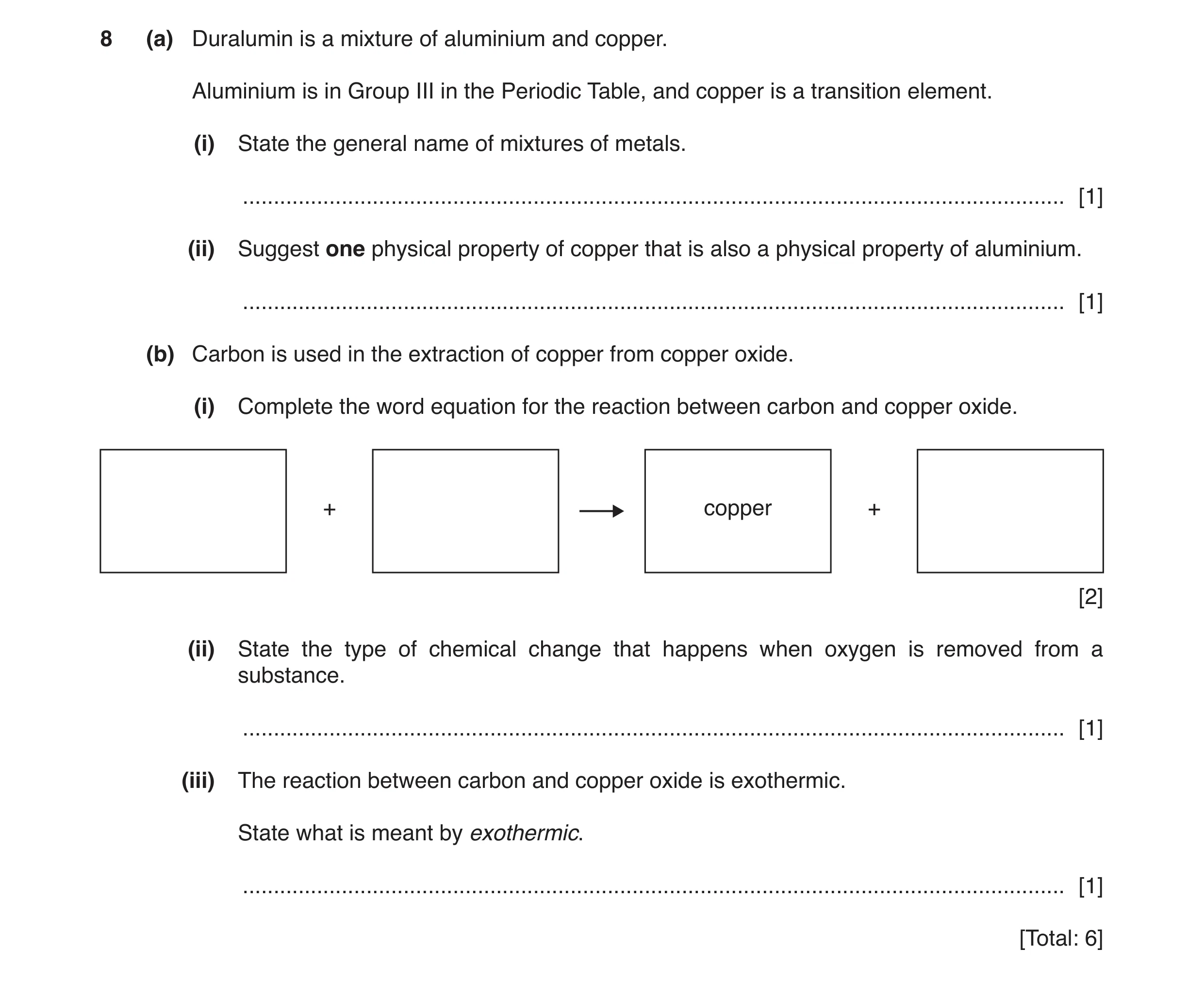
8 (a) Duralumin is a mixture of aluminium and copper. Aluminium is in Group III in the Periodic Table, and copper is a transition element. (i) State the general name of mixtures of metals. … [1] (ii) Suggest one physical property of copper that is also a physical property of aluminium. … [1] (b) Carbon is used in the extraction of copper from copper oxide. (i) Complete the word equation for the reaction between carbon and copper oxide. + copper + [2] (ii) State the type of chemical change that happens when oxygen is removed from a substance. … [1] (iii) The reaction between carbon and copper oxide is exothermic. State what is meant by exothermic. … [1] [Total: 6]
6 marks
Mark scheme: 8(a)(i) alloy(s) ; 1 8(a)(ii) (electrical / heat / thermal) conductor / malleable / high melting point / high boiling point ; 1 8(b)(i) LHS ; carbon dioxide ; 2 8(b)(ii) reduction ; 1 8(b)(iii) releases / gives out (heat / thermal) energy ; 1
This question in 0653/32 Oct/Nov 2019
Q7 · Duralumin is a mixture of aluminium and copper 0653/33 Oct/Nov 2019
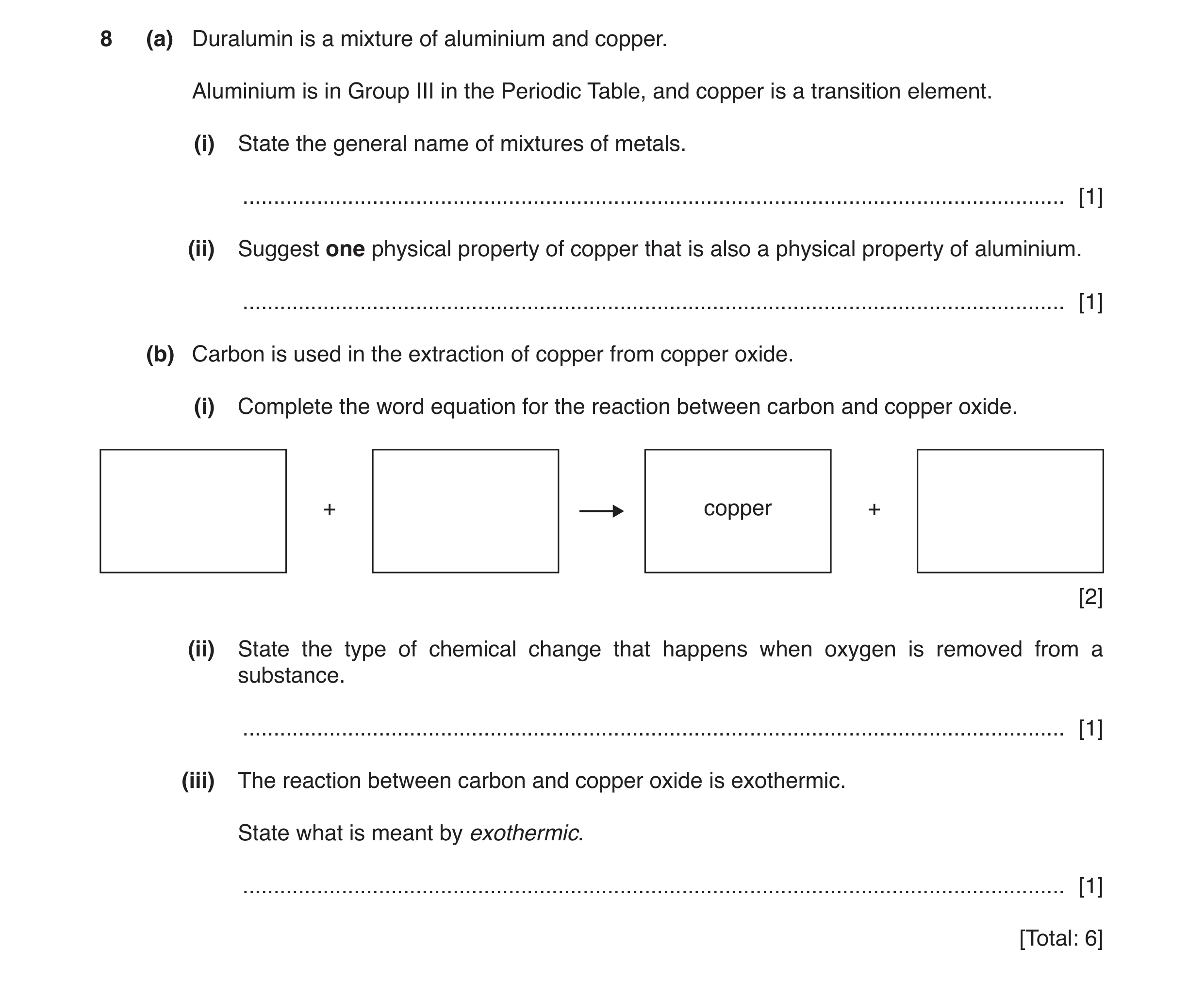
8 (a) Duralumin is a mixture of aluminium and copper. Aluminium is in Group III in the Periodic Table, and copper is a transition element. (i) State the general name of mixtures of metals. … [1] (ii) Suggest one physical property of copper that is also a physical property of aluminium. … [1] (b) Carbon is used in the extraction of copper from copper oxide. (i) Complete the word equation for the reaction between carbon and copper oxide. + copper + [2] (ii) State the type of chemical change that happens when oxygen is removed from a substance. … [1] (iii) The reaction between carbon and copper oxide is exothermic. State what is meant by exothermic. … [1] [Total: 6]
6 marks
Mark scheme: 8(a)(i) alloy(s) ; 1 8(a)(ii) (electrical / heat / thermal) conductor / malleable / high melting point / high boiling point ; 1 8(b)(i) LHS ; carbon dioxide ; 2 8(b)(ii) reduction ; 1 8(b)(iii) releases / gives out (heat / thermal) energy ; 1
This question in 0653/33 Oct/Nov 2019
Q8 · An iron paperclip, shown in Fig 0653/32 Feb/March 2021
5 (a) An iron paperclip, shown in Fig. 5.1, is used to hold pieces of paper together. Fig. 5.1 Iron can be described as a strong metal. Name one other property of iron that makes it suitable for use as a paperclip. … [1] (b) A spanner, shown in Fig. 5.2, is made from an alloy of iron. Fig. 5.2 (i) Describe what is meant by an alloy. … … [1] (ii) Suggest why the spanner is made from an alloy of iron and not from pure iron. … … [1] (c) Lithium, sodium and potassium are Group I metals. Describe the trend in density and the trend in reaction with water of the Group I metals going down the group. density … … reaction with water … … [2] (d) Copper and iron are part of a collection of metals in the Periodic Table. (i) State the name of this collection of metals. … [1] (ii) Copper and iron are less reactive than Group I metals. Copper and iron have high melting points and high densities, but Group I metals do not. State one other property of copper and iron that is not a property of Group I metals. … [1] (e) When sodium reacts with chlorine, sodium chloride is formed. Fig. 5.3 shows the electronic structures of a sodium atom and of a chlorine atom. sodium atom chlorine atom Fig. 5.3 Sodium chloride contains sodium ions and chloride ions. Complete Fig. 5.4 to show the electronic structures of a sodium ion and a chloride ion. sodium ion chloride ion Fig. 5.4 [2] [Total: 9]
9 marks
Mark scheme: 5(a) malleable ; 1 5(b)(i) a mixture of a metal with other element(s) ; 1 5(b)(ii) pure iron is too soft / alloys are stronger / alloys resist, corrosion / rusting ; 1 5(c) (density) increases (down the group) ; (reaction with water) reactivity increases (down the group) ; 2 5(d)(i) transition (elements/metals) ; 1 5(d)(ii) form coloured compounds / (act as) catalysts ; 1 5(e) (sodium ion) 2,8 ; (chloride ion) 2,8,8 ; 2
This question in 0653/32 Feb/March 2021
Q9 · The order of reactivity for some metals is shown in Fig 0653/31 Oct/Nov 2021
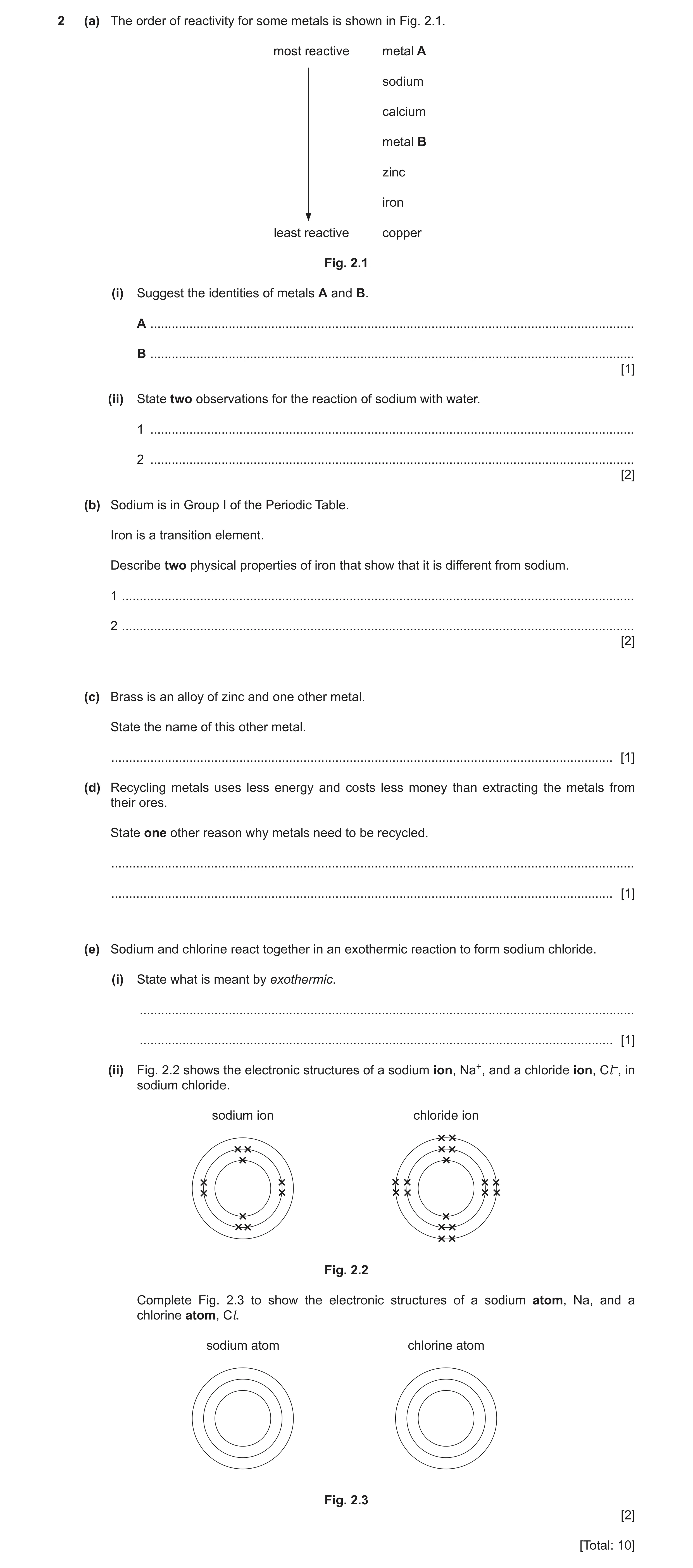
2 (a) The order of reactivity for some metals is shown in Fig. 2.1. most reactive metal A sodium calcium metal B zinc iron least reactive copper Fig. 2.1 (i) Suggest the identities of metals A and B. A … B … [1] (ii) State two observations for the reaction of sodium with water. 1 … 2 … [2] (b) Sodium is in Group I of the Periodic Table. Iron is a transition element. Describe two physical properties of iron that show that it is different from sodium. 1 … 2 … [2] (c) Brass is an alloy of zinc and one other metal. State the name of this other metal. … [1] (d) Recycling metals uses less energy and costs less money than extracting the metals from their ores. State one other reason why metals need to be recycled. … … [1] (e) Sodium and chlorine react together in an exothermic reaction to form sodium chloride. (i) State what is meant by exothermic. … … [1] (ii) Fig. 2.2 shows the electronic structures of a sodium ion, Na+, and a chloride ion, Cl–, in sodium chloride. sodium ion chloride ion ×× ×× ×× × × ×× ×× ×××× ×× ×× × × ×× ×× × × Fig. 2.2 Complete Fig. 2.3 to show the electronic structures of a sodium atom, Na, and a chlorine atom, Cl. sodium atom chlorine atom Fig. 2.3 [2] [Total: 10]
10 marks
Mark scheme: 2(a)(i) A potassium AND B magnesium / aluminium ; 1 2(a)(ii) any two from: fizzes / bubbles ; gets smaller ; floats ; moves ; 2 2(b) any two from: (iron has) high(er) density / ORA ; (iron has) high(er) melting point / ORA ; (iron is) magnetic / ORA ; 2 2(c) copper ; 1 2(d) metals are finite (resources) / will run out ; 1 2(e)(i) (thermal) energy is released ; 1 2(e)(ii) (sodium atom) 2, 8, 1 ; (chlorine atom) 2, 8, 7 ; 2
This question in 0653/31 Oct/Nov 2021
Q10 · Copper and aluminium are metals 0653/31 Oct/Nov 2022
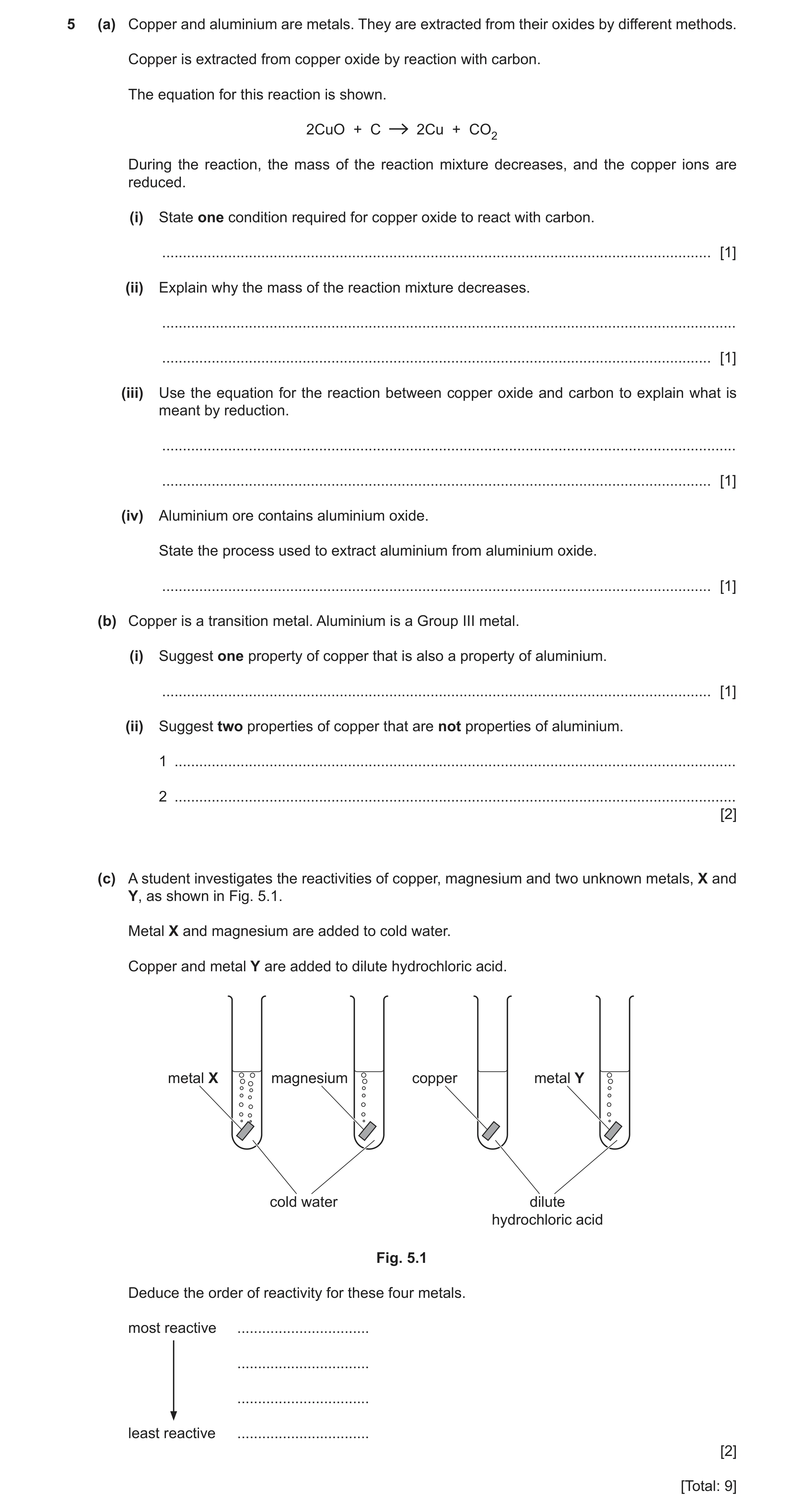
5 (a) Copper and aluminium are metals. They are extracted from their oxides by different methods. Copper is extracted from copper oxide by reaction with carbon. The equation for this reaction is shown. 2CuO + C 2Cu + CO2 During the reaction, the mass of the reaction mixture decreases, and the copper ions are reduced. (i) State one condition required for copper oxide to react with carbon. … [1] (ii) Explain why the mass of the reaction mixture decreases. … … [1] (iii) Use the equation for the reaction between copper oxide and carbon to explain what is meant by reduction. … … [1] (iv) Aluminium ore contains aluminium oxide. State the process used to extract aluminium from aluminium oxide. … [1] (b) Copper is a transition metal. Aluminium is a Group III metal. (i) Suggest one property of copper that is also a property of aluminium. … [1] (ii) Suggest two properties of copper that are not properties of aluminium. 1 … 2 … [2] (c) A student investigates the reactivities of copper, magnesium and two unknown metals, X and Y, as shown in Fig. 5.1. Metal X and magnesium are added to cold water. Copper and metal Y are added to dilute hydrochloric acid. metal X magnesium copper metal Y cold water dilute hydrochloric acid Fig. 5.1 Deduce the order of reactivity for these four metals. most reactive … … … least reactive … [2] [Total: 9]
9 marks
Mark scheme: 5(a)(i) high temperature ; 1 5(a)(ii) a gas is produced (that leaves the reaction mixture) ; 1 5(a)(iii) oxygen is, lost / removed (from the copper ions) ; 1 5(a)(iv) electrolysis ; 1 5(b)(i) any one from: 1 (good) conductor of electricity ; (good) conductor of heat ; high melting point ; high boiling point ; malleable ; 5(b)(ii) any two from: 2 copper / ORA, forms coloured compounds ; acts as catalyst ; has high density ; has high melting point ; 5(c) metal X 2 magnesium metal Y copper metal X (most reactive) and copper (least reactive) ; magnesium more reactive than metal Y;
This question in 0653/31 Oct/Nov 2022
Q11 · Copper is a transition element 0653/31 Oct/Nov 2023
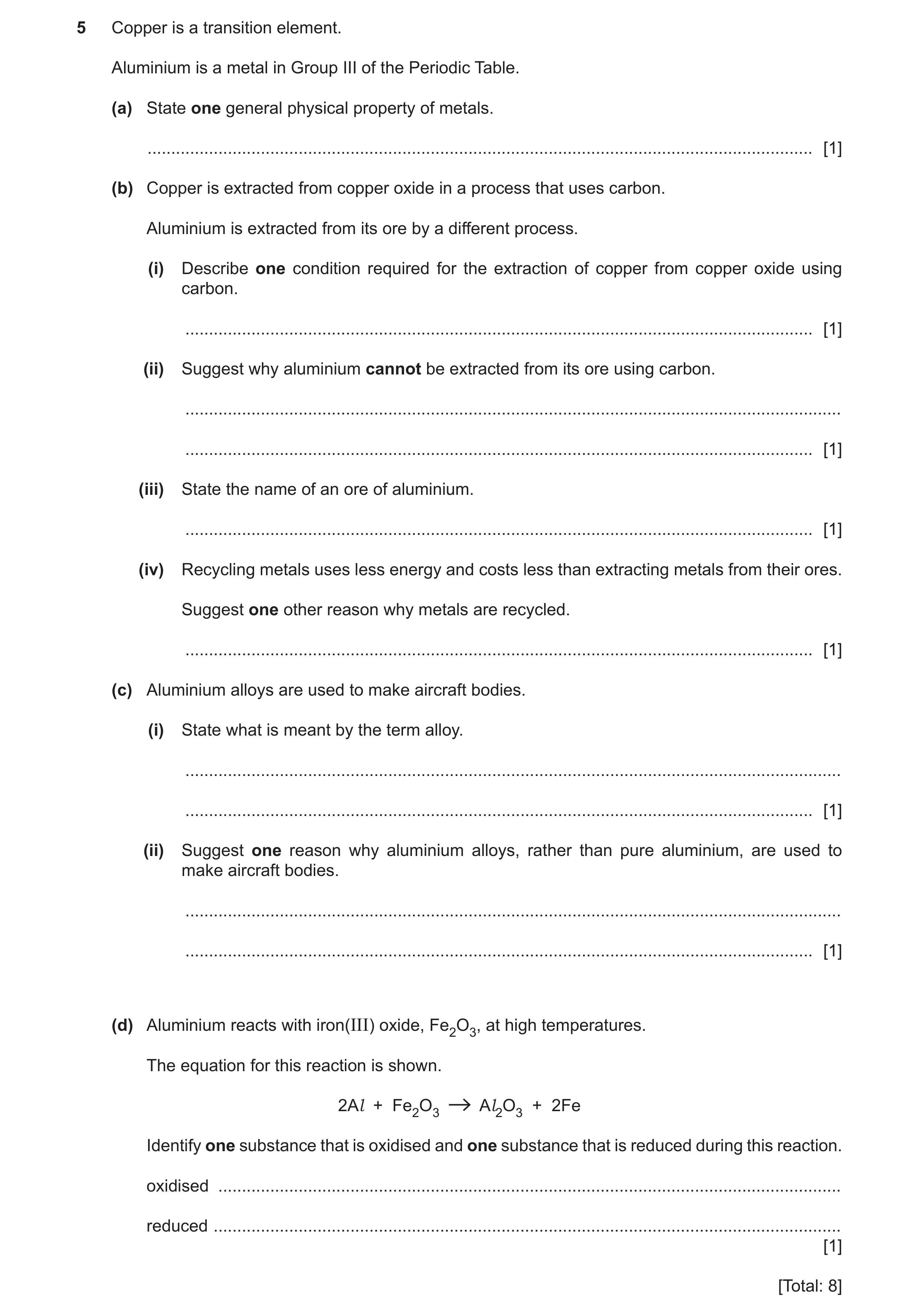
5 Copper is a transition element. Aluminium is a metal in Group III of the Periodic Table. (a) State one general physical property of metals. … [1] (b) Copper is extracted from copper oxide in a process that uses carbon. Aluminium is extracted from its ore by a different process. (i) Describe one condition required for the extraction of copper from copper oxide using carbon. … [1] (ii) Suggest why aluminium cannot be extracted from its ore using carbon. … … [1] (iii) State the name of an ore of aluminium. … [1] (iv) Recycling metals uses less energy and costs less than extracting metals from their ores. Suggest one other reason why metals are recycled. … [1] (c) Aluminium alloys are used to make aircraft bodies. (i) State what is meant by the term alloy. … … [1] (ii) Suggest one reason why aluminium alloys, rather than pure aluminium, are used to make aircraft bodies. … … [1] (d) Aluminium reacts with iron(III) oxide, Fe2O3, at high temperatures. The equation for this reaction is shown. 2Al + Fe2O3 Al2O3 + 2Fe Identify one substance that is oxidised and one substance that is reduced during this reaction. oxidised … reduced … [1] [Total: 8]
8 marks
Mark scheme: 5(a) any one from: 1 malleable ; (good) electrical / heat / thermal, conductor ; high, melting / boiling, point ; 5(b)(i) heat / high temperature ; 1 5(b)(ii) (aluminium is) more reactive (than carbon) / ORA ; 1 5(b)(iii) bauxite ; 1 5(b)(iv) metal ores are a finite resource / may run out ; 1 5(c)(i) a mixture of a metal with other element(s) ; 1 5(c)(ii) stronger (for the same mass) OR less dense (for the same strength) ; 1 5(d) (oxidised) Al / aluminium AND 1 (reduced) Fe ions / iron(III) / Fe3+ ;
This question in 0653/31 Oct/Nov 2023
Q12 · Copper is a metal 0653/31 Oct/Nov 2024
6 Copper is a metal. (a) Copper is used to make wires for electrical circuits. State one property of copper that makes it suitable for use as a wire for electrical circuits. … [1] (b) (i) Complete the sentences about copper. Use one word in each gap. Copper is a solid at a room temperature of 21 °C. The … point of copper is 1080 °C. At this temperature, copper changes state from a solid to a liquid. The … point of copper is 2560 °C. At this temperature, copper changes state from a liquid to a gas. [2] (ii) Describe how the arrangement and the separation of molecules in a solid differ from the arrangement and the separation of molecules in a gas. arrangement … … separation … … [2] (c) A smooth piece of copper is used as a plane mirror. Fig. 6.1 shows a ray of light incident on the copper mirror. copper mirror Fig. 6.1 On Fig. 6.1, draw: • the normal • the angle of incidence i • the reflected ray of light. [3] [Total: 8]
8 marks
Mark scheme: 6(a) (good) conductor (of electricity) ; 1 6(b)(i) melting ; 2 boiling ; 6(b)(ii) in a solid (ORA), the molecules are: 2 regular / ordered ; close together ; 6(c) 3 normal drawn ; angle of incidence shown AND labelled ; reflected ray drawn AND angle of reflection equal to angle of incidence, by eye ;
This question in 0653/31 Oct/Nov 2024
Q13 · Some cars are powered by petrol (gasoline) engines made of iron 0653/31 May/June 2025
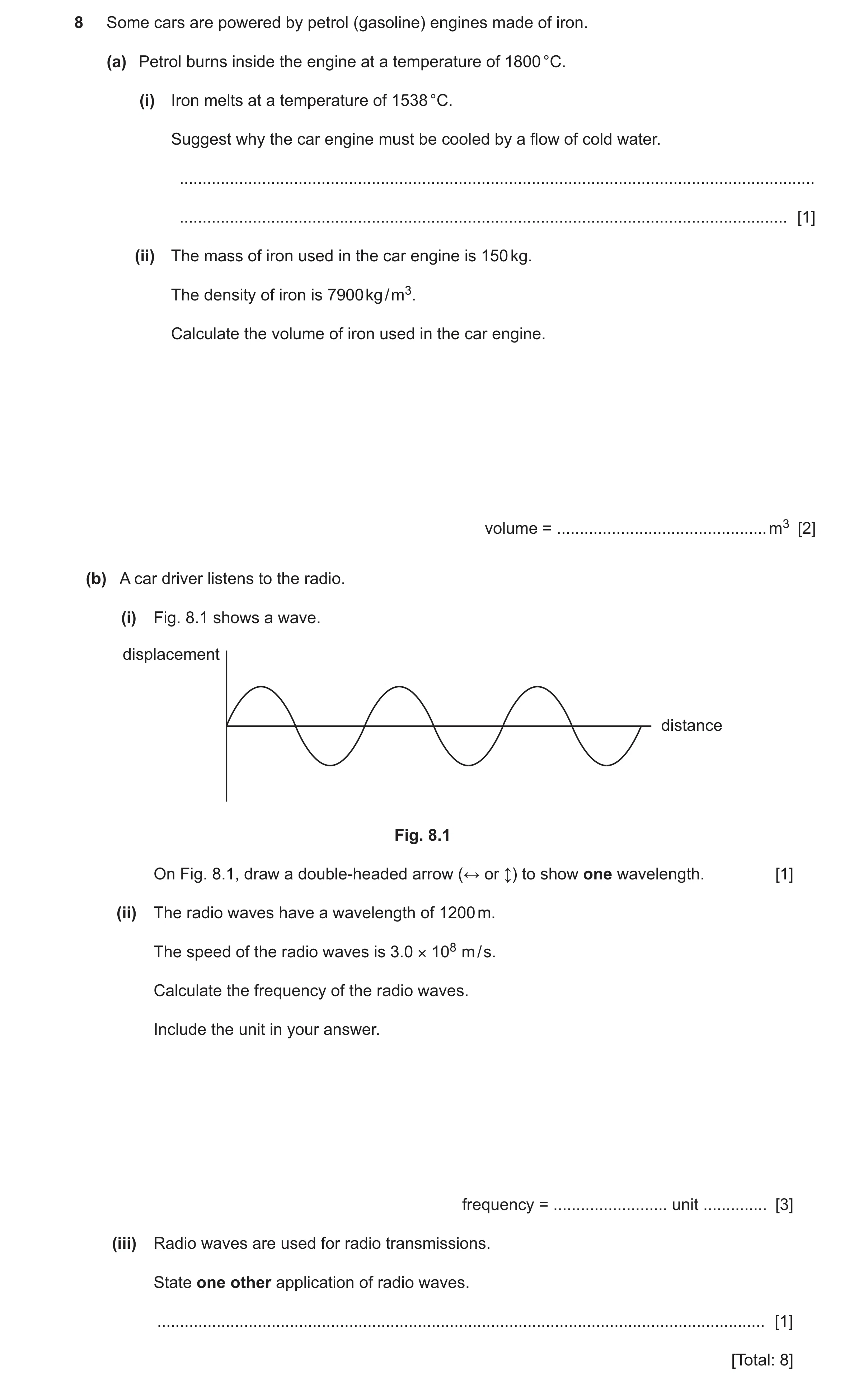
8 Some cars are powered by petrol (gasoline) engines made of iron. (a) Petrol burns inside the engine at a temperature of 1800 °C. (i) Iron melts at a temperature of 1538 °C. Suggest why the car engine must be cooled by a flow of cold water. … … [1] (ii) The mass of iron used in the car engine is 150 kg. The density of iron is 7900 kg / m3. Calculate the volume of iron used in the car engine. volume = … m3 [2] (b) A car driver listens to the radio. (i) Fig. 8.1 shows a wave. displacement distance Fig. 8.1 On Fig. 8.1, draw a double‑headed arrow (↔ or ↕) to show one wavelength. [1] (ii) The radio waves have a wavelength of 1200 m. The speed of the radio waves is 3.0 × 10⁸ m / s. Calculate the frequency of the radio waves. Include the unit in your answer. frequency = … unit … [3] (iii) Radio waves are used for radio transmissions. State one other application of radio waves. … [1] [Total: 8]
8 marks
Mark scheme: 8(a)(i) because temperature is higher than melting point (of iron) / to prevent the iron / engine, from melting ; 1 8(a)(ii) V = m ÷ / volume = mass ÷ density / 150 ÷ 7900 ; 2 0.019 (m3) ; 8(b)(i) horizontal double-headed arrow accurately showing one wavelength ; 1 8(b)(ii) f = v / / frequency = speed ÷ wavelength / 3.0 108 ÷ 1200 ; 3 2.5 105 / 250 000 ; Hz ; 8(b)(iii) television (transmissions) / radar ; 1
This question in 0653/31 May/June 2025
 1 / 18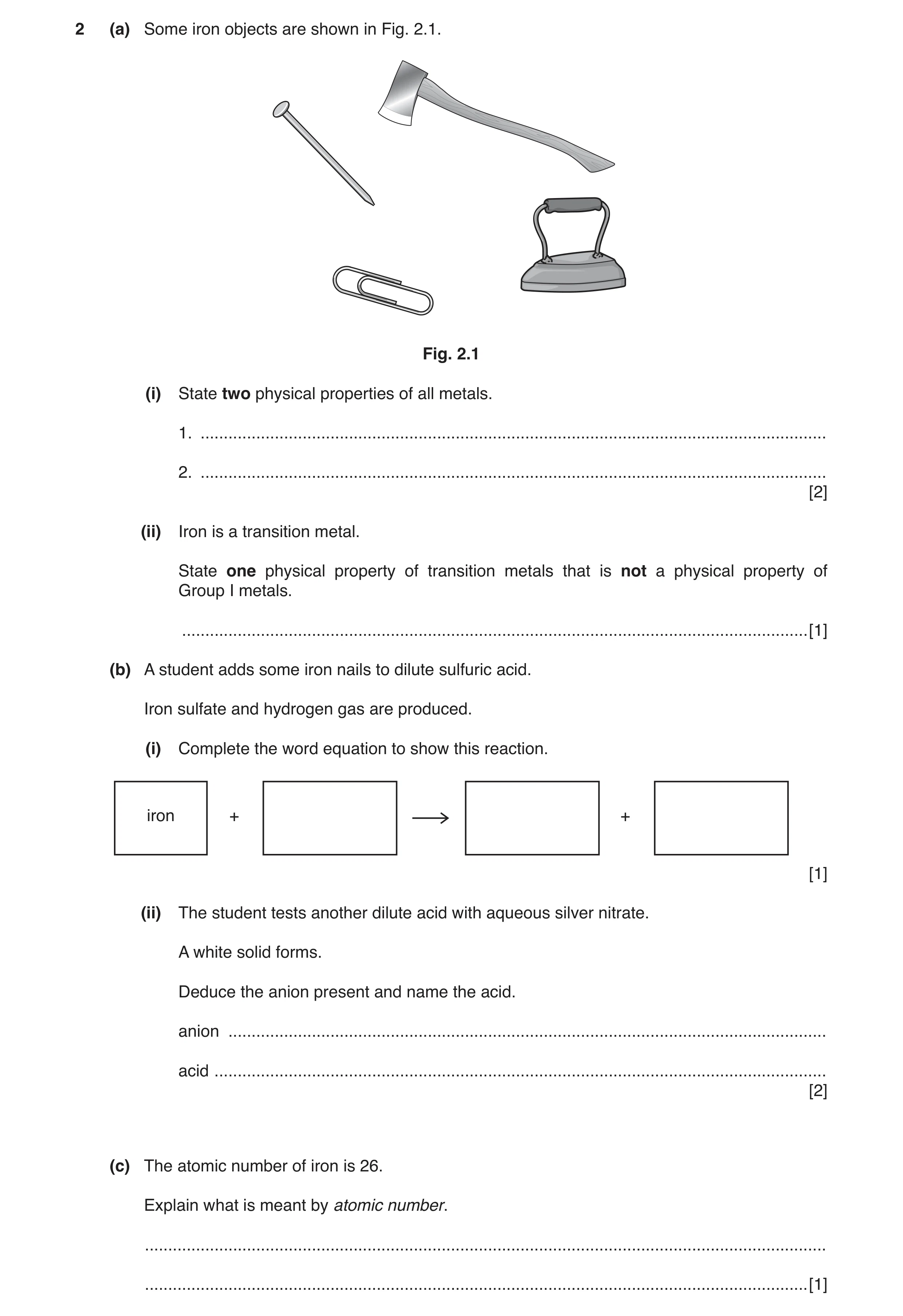
 5 / 18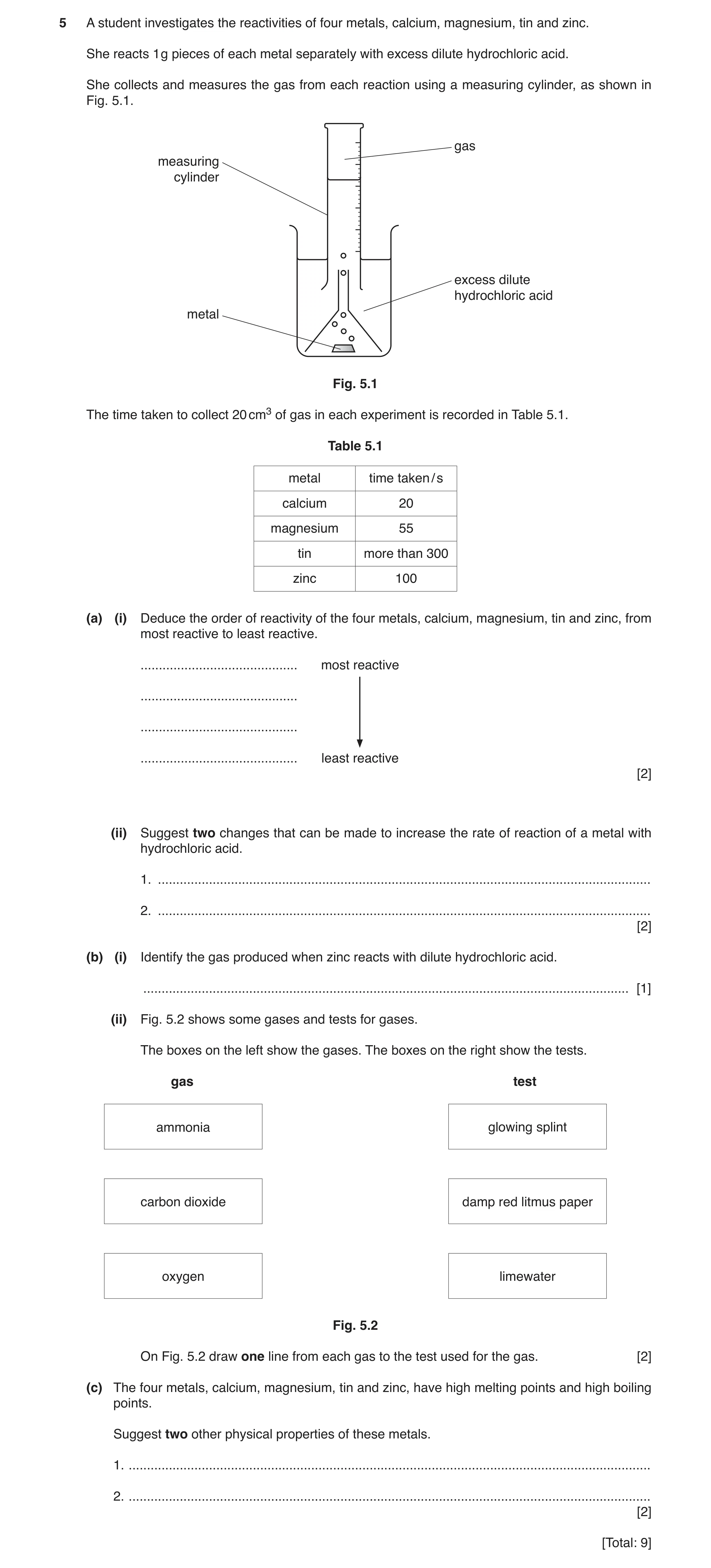
 8 / 18
 9 / 18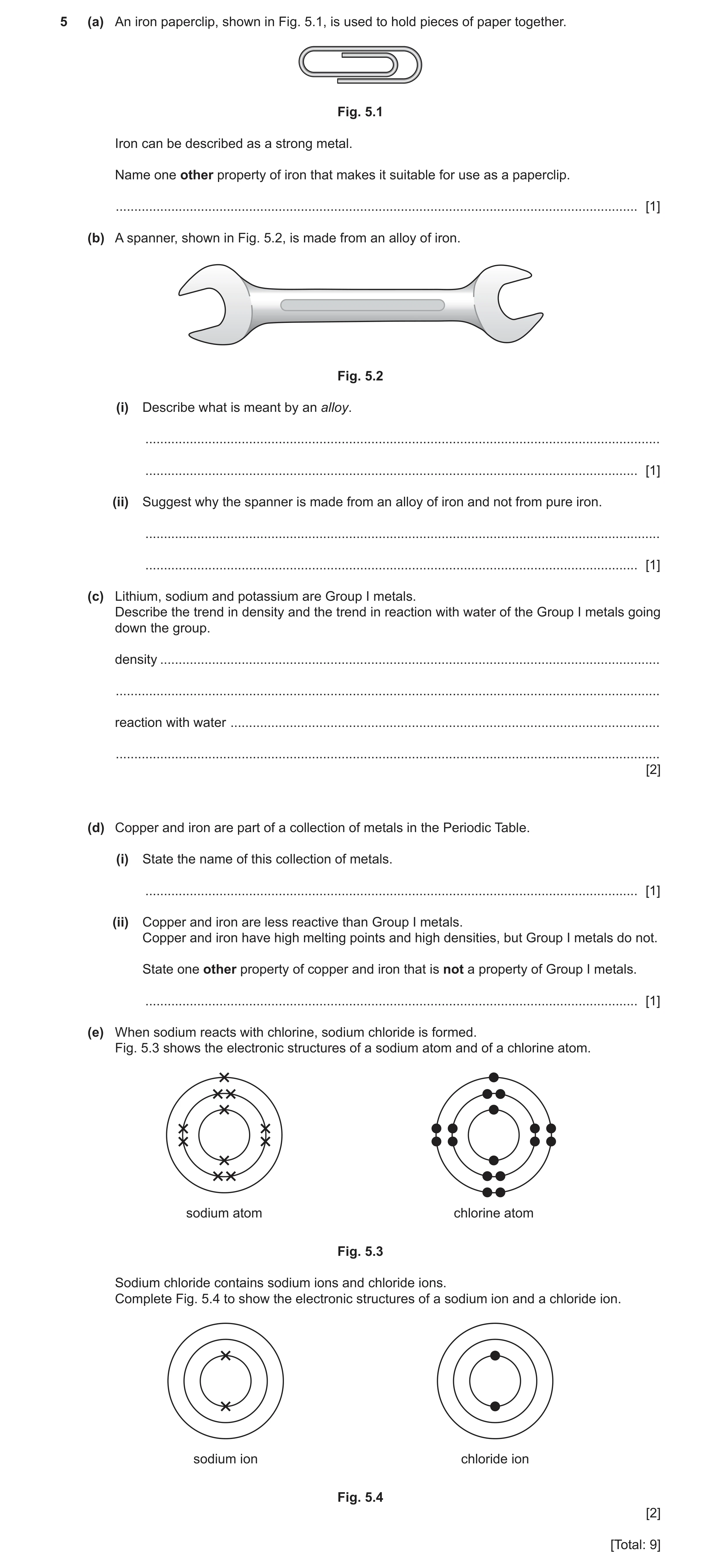
 15 / 18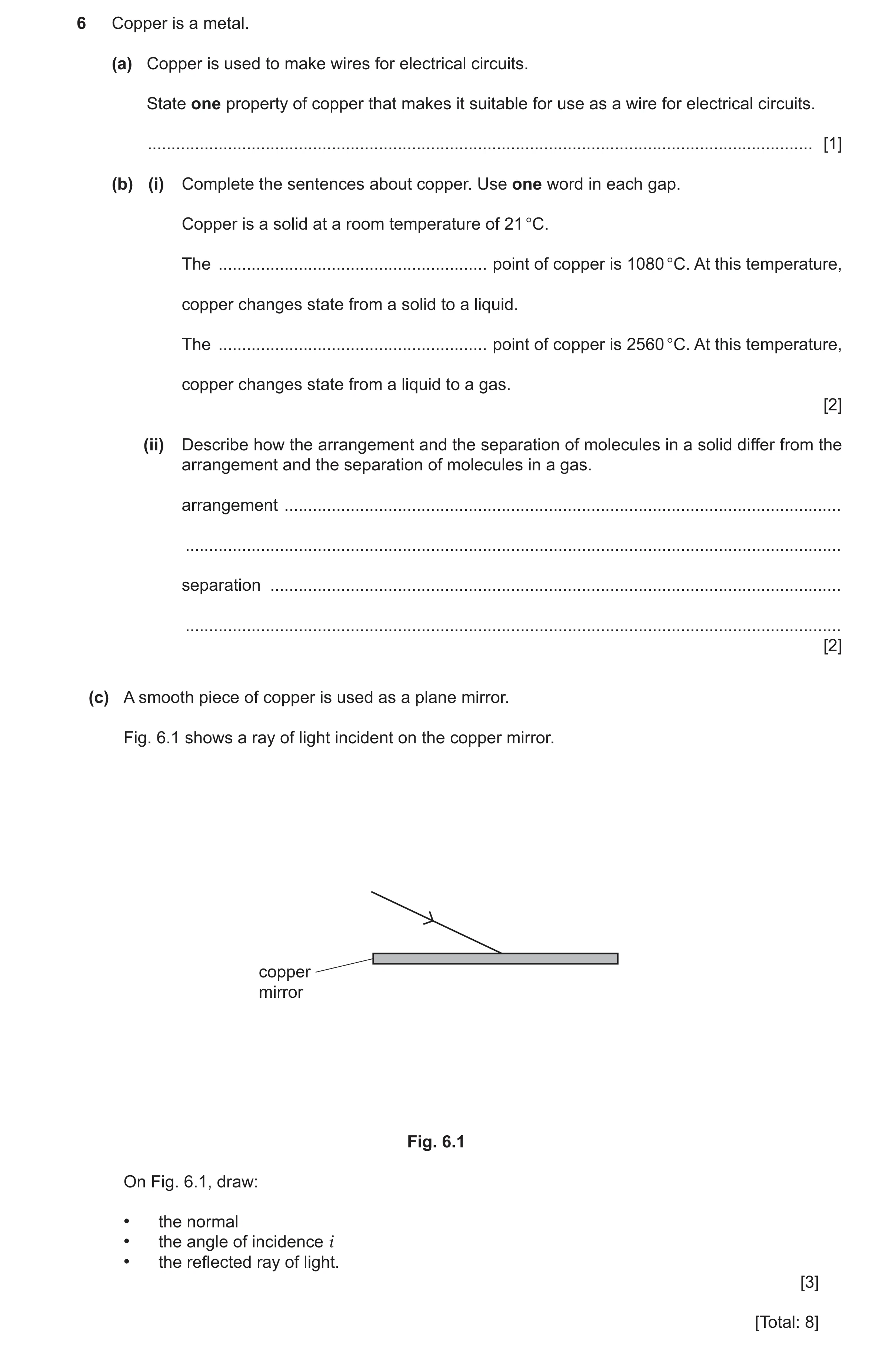
 9
9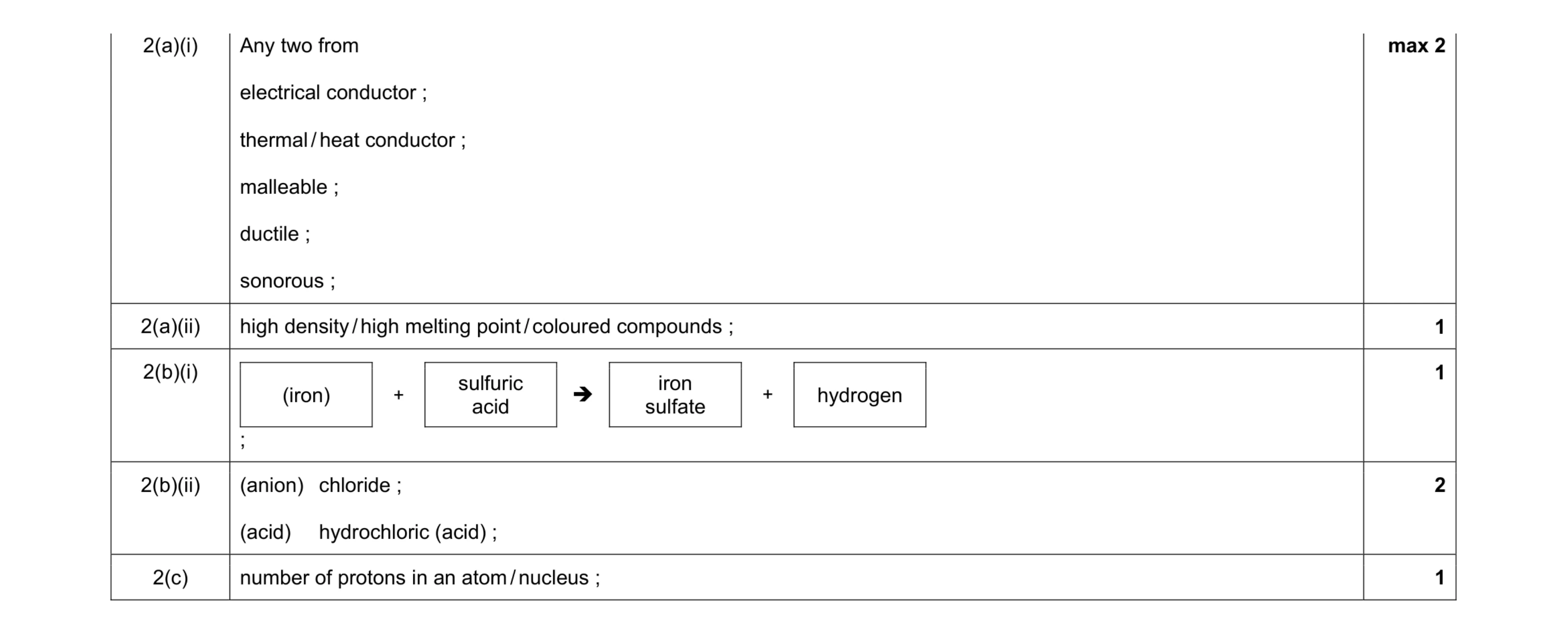 7
7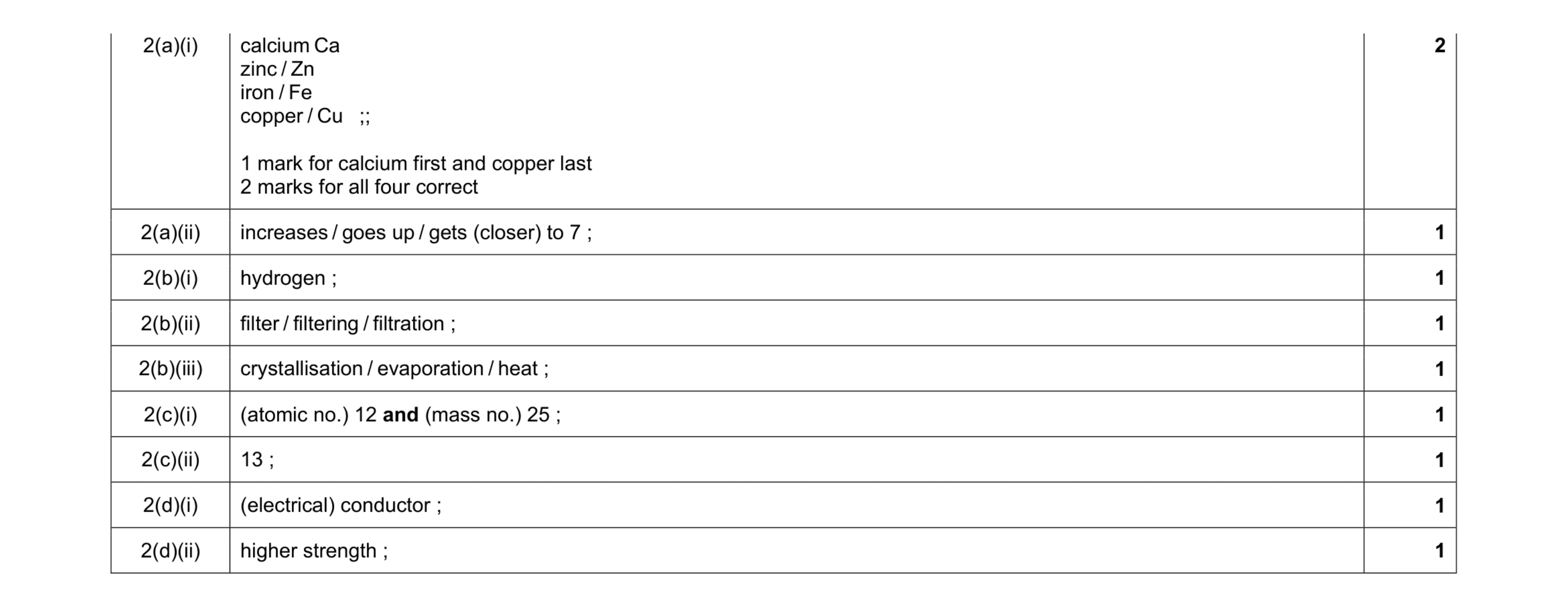 10
10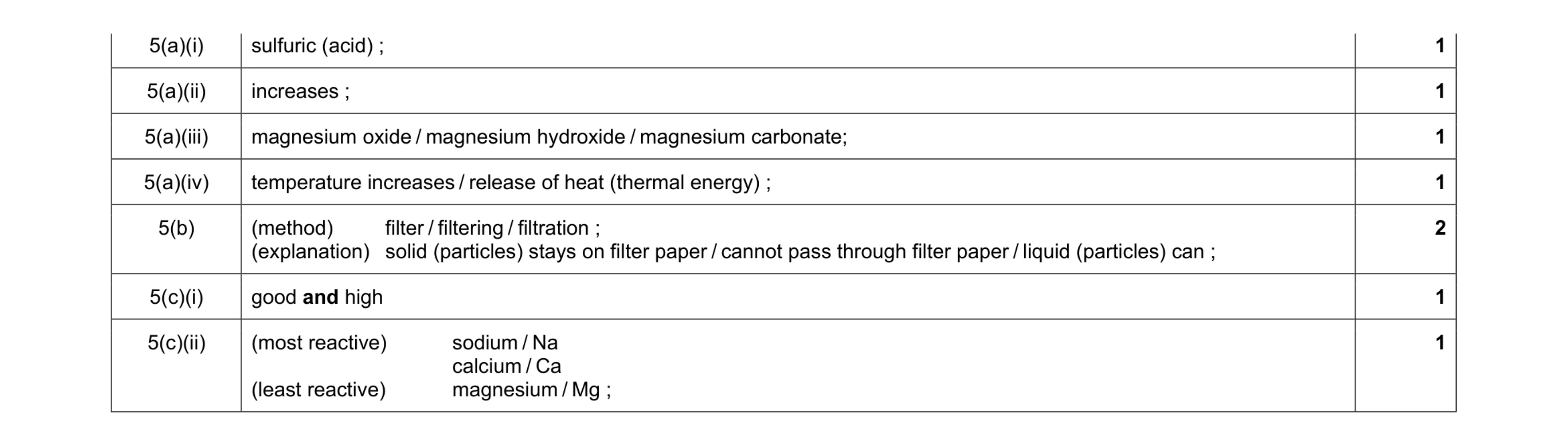 8
8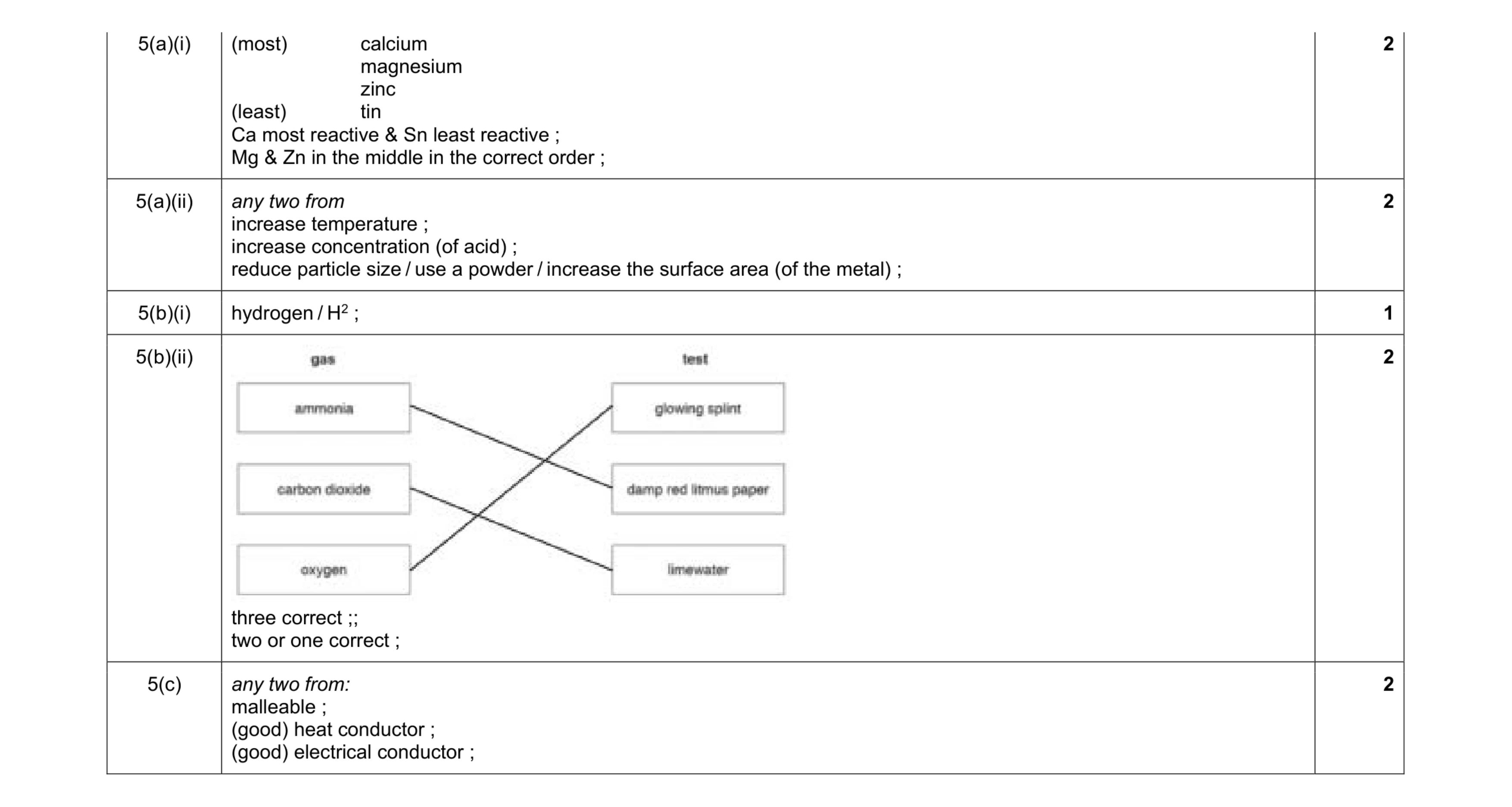 9
9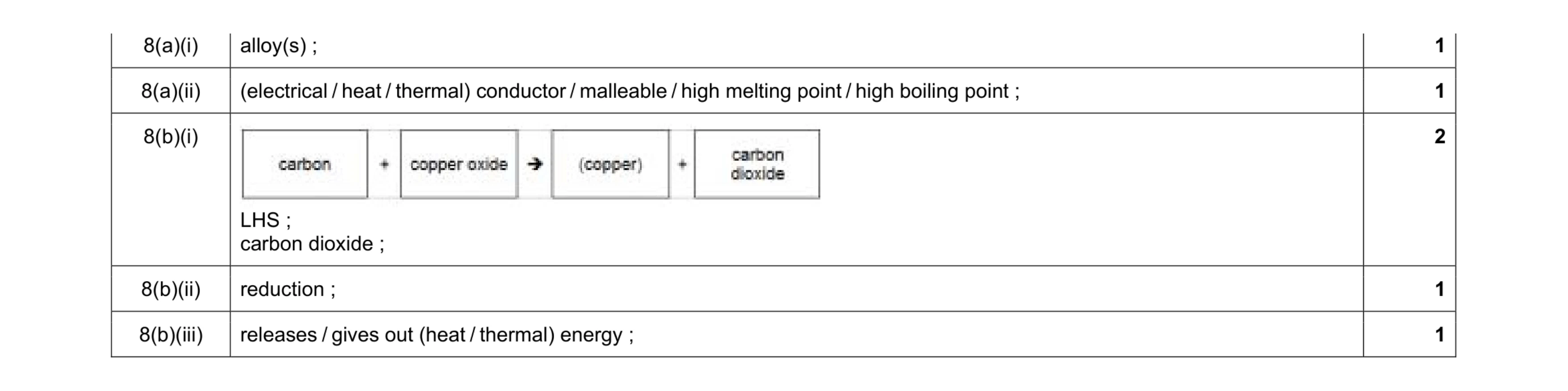 6
6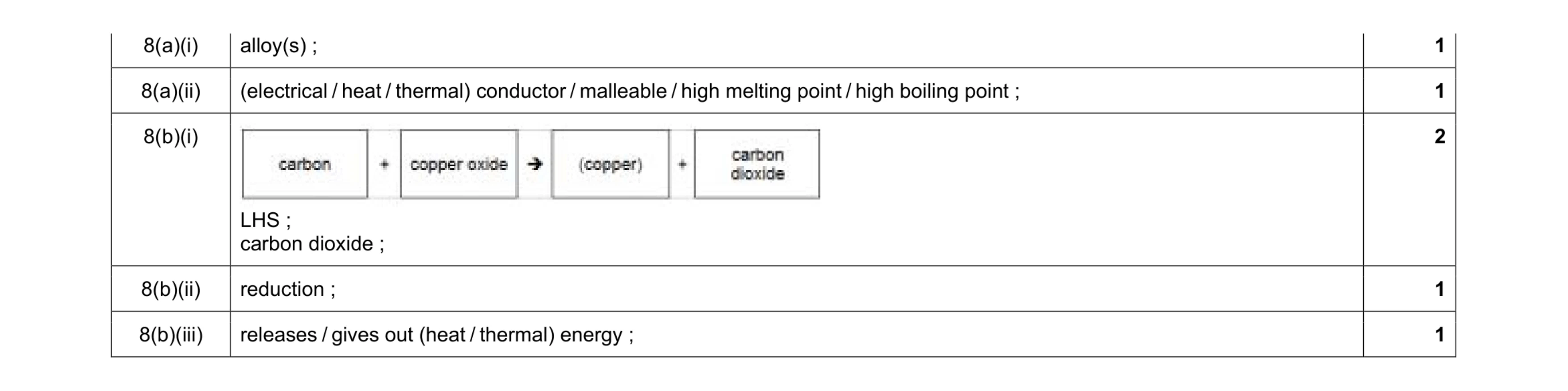 6
6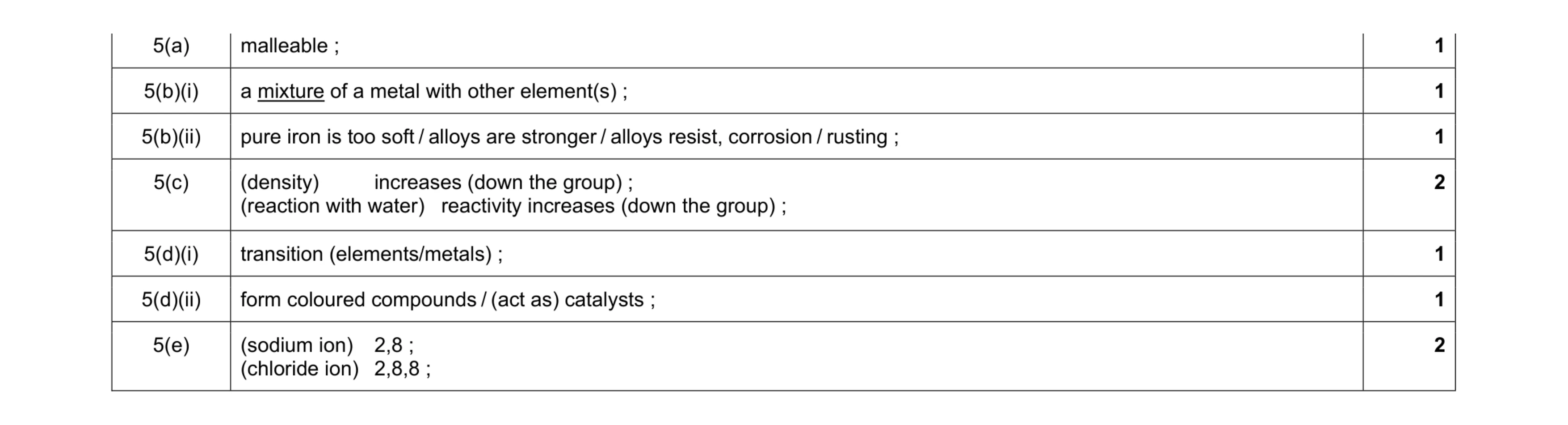 9
9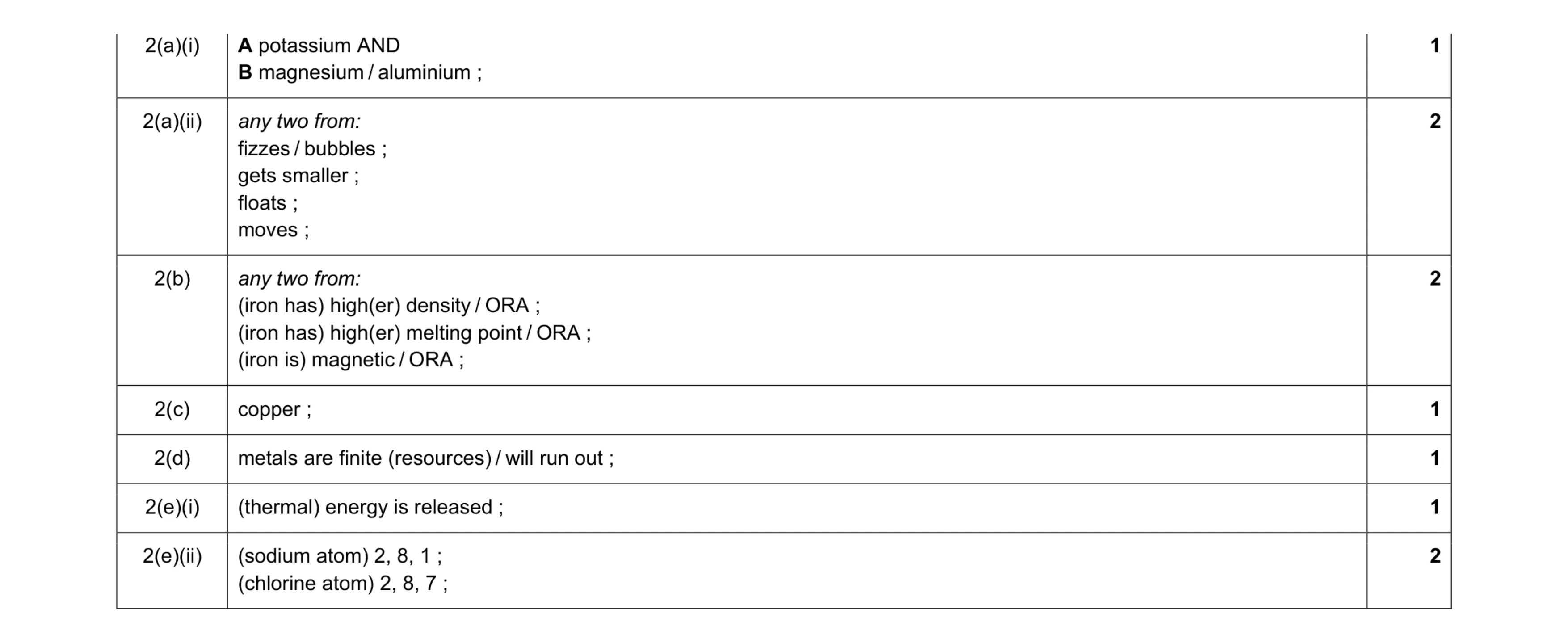 10
10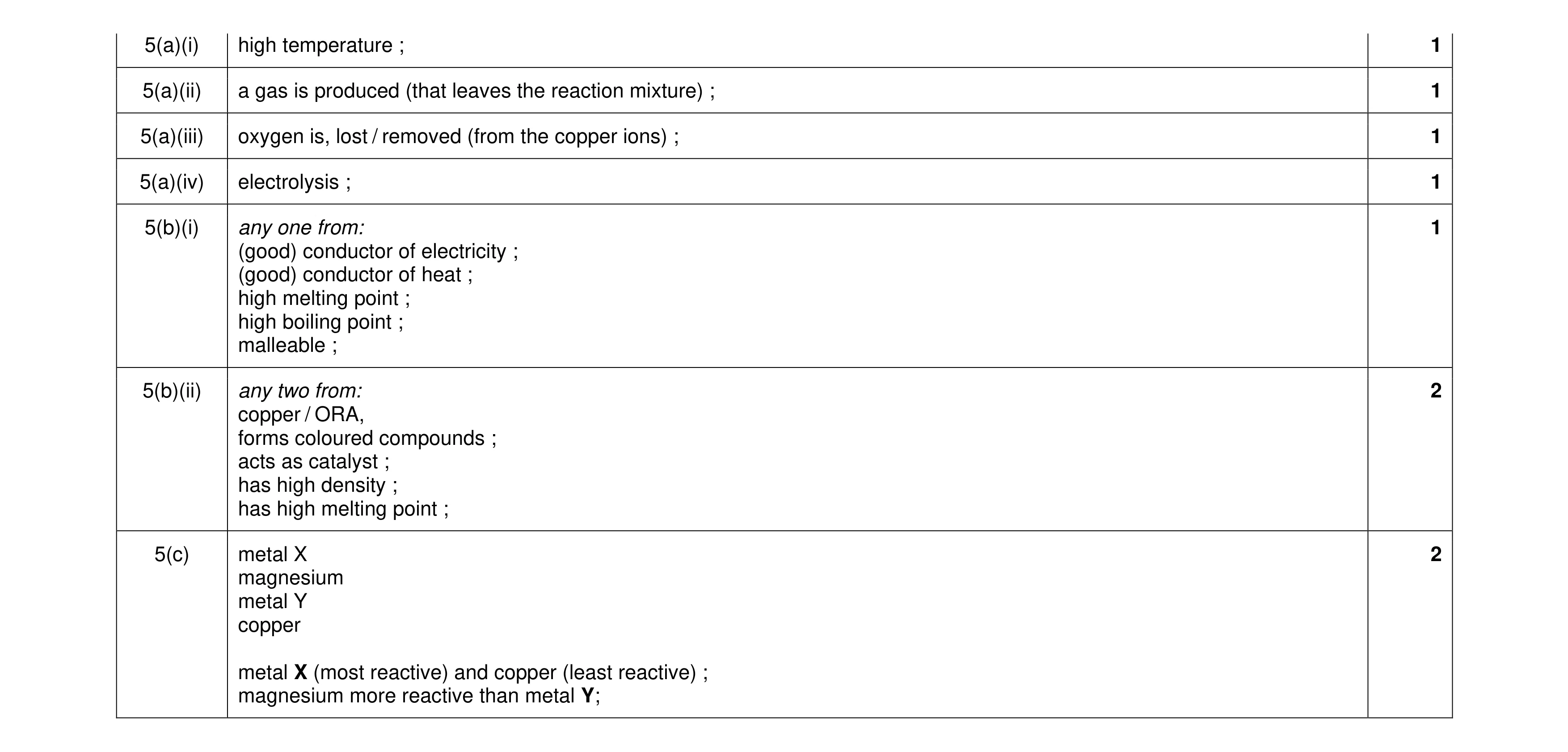 9
9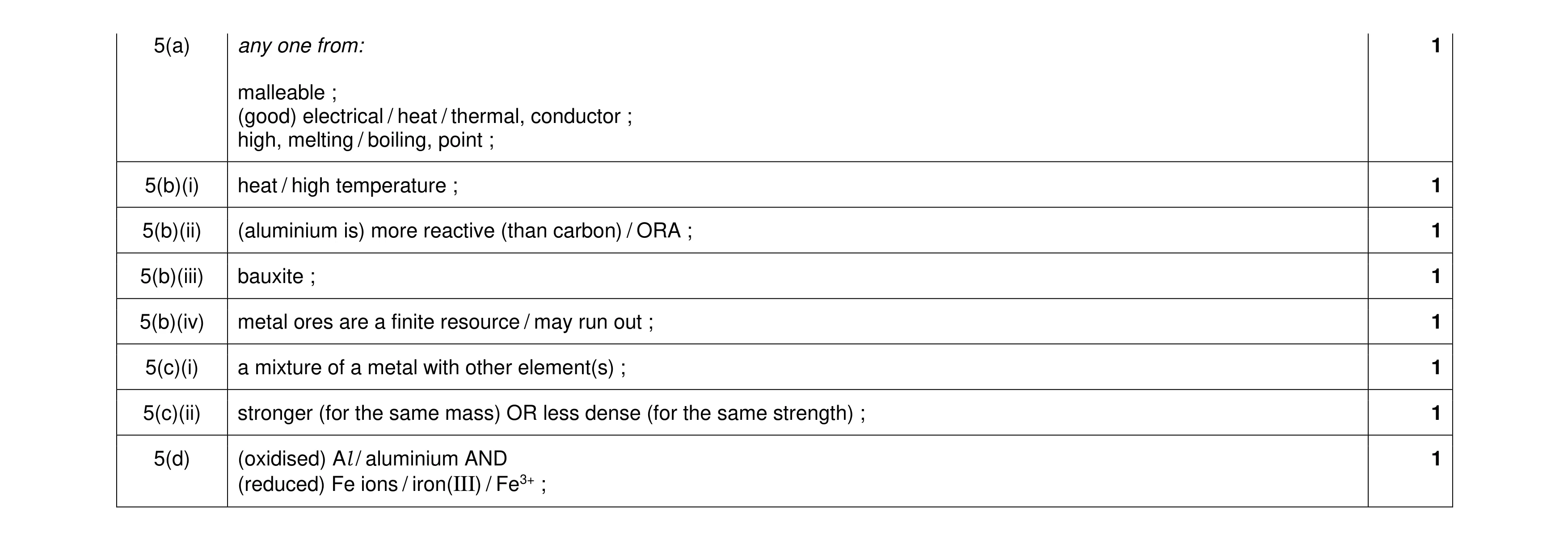 8
8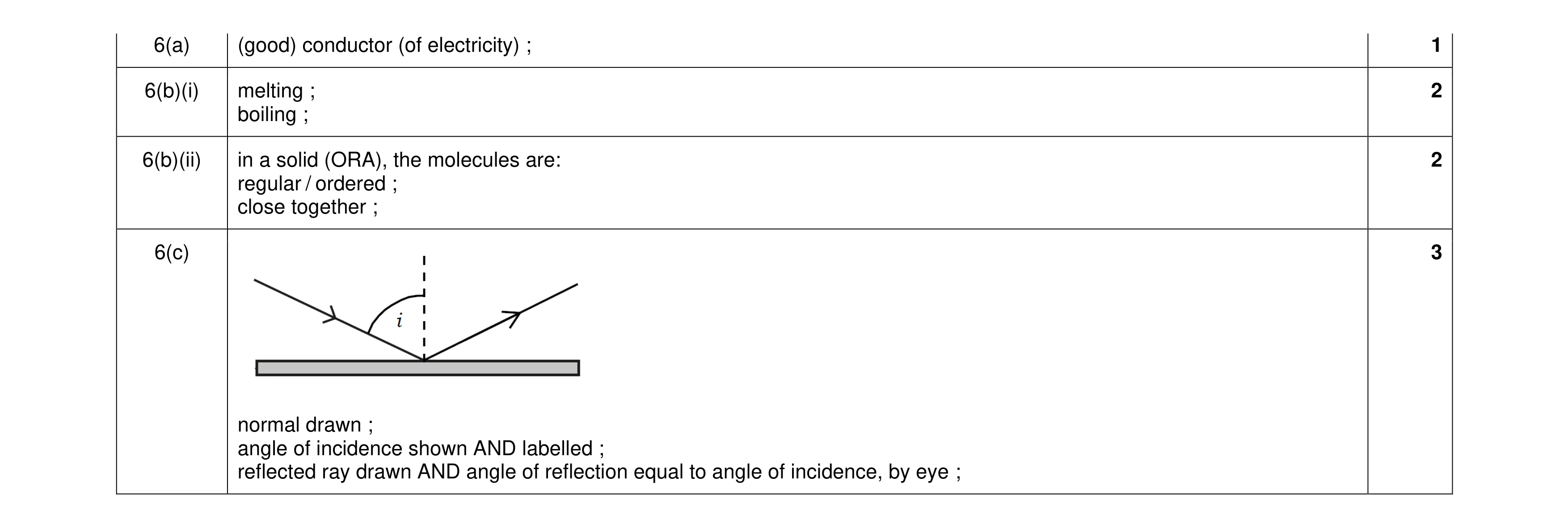 8
8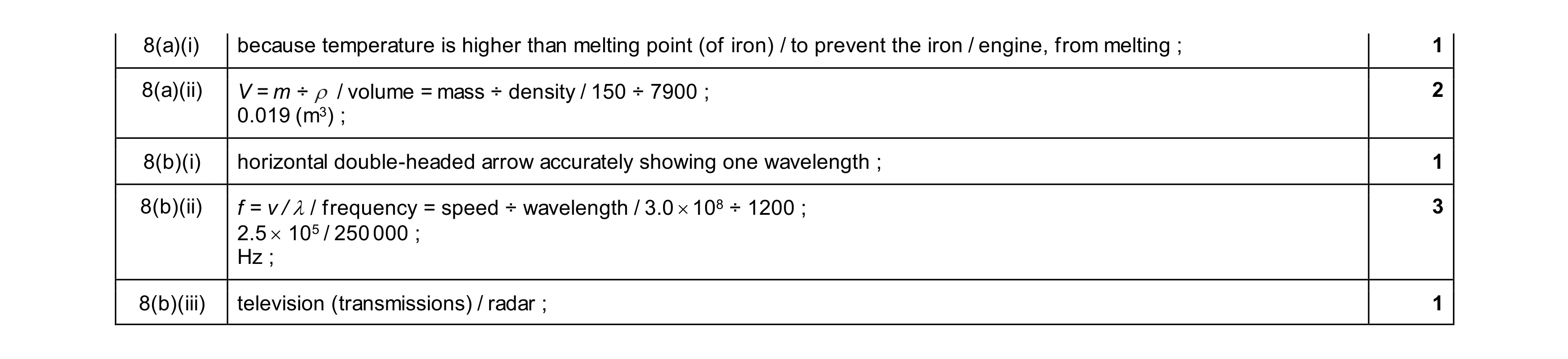 8
8