Questions as text
Q1 · A student investigates the rate of reaction between calcium carbonate and dilute… 0653/42 Feb/March 2017
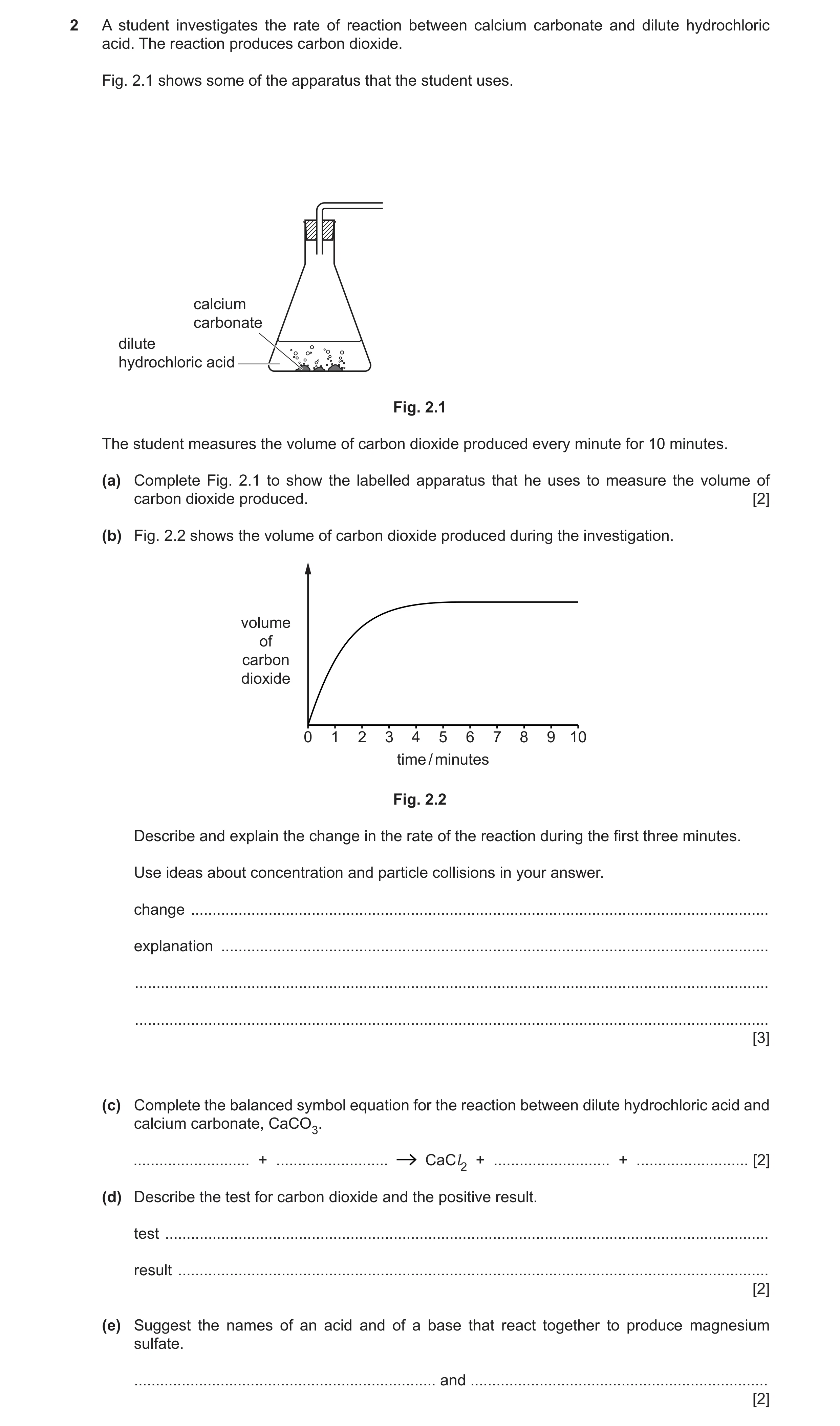
2 A student investigates the rate of reaction between calcium carbonate and dilute hydrochloric acid. The reaction produces carbon dioxide. Fig. 2.1 shows some of the apparatus that the student uses. calcium carbonate dilute hydrochloric acid Fig. 2.1 The student measures the volume of carbon dioxide produced every minute for 10 minutes. (a) Complete Fig. 2.1 to show the labelled apparatus that he uses to measure the volume of carbon dioxide produced. [2] (b) Fig. 2.2 shows the volume of carbon dioxide produced during the investigation. volume of carbon dioxide 0 1 2 3 4 5 6 7 8 9 10 time / minutes Fig. 2.2 Describe and explain the change in the rate of the reaction during the first three minutes. Use ideas about concentration and particle collisions in your answer. change … explanation … … … [3] (c) Complete the balanced symbol equation for the reaction between dilute hydrochloric acid and calcium carbonate, CaCO3. … + … CaCl2 + … + … [2] (d) Describe the test for carbon dioxide and the positive result. test … result … [2] (e) Suggest the names of an acid and of a base that react together to produce magnesium sulfate. … and … [2]
11 marks
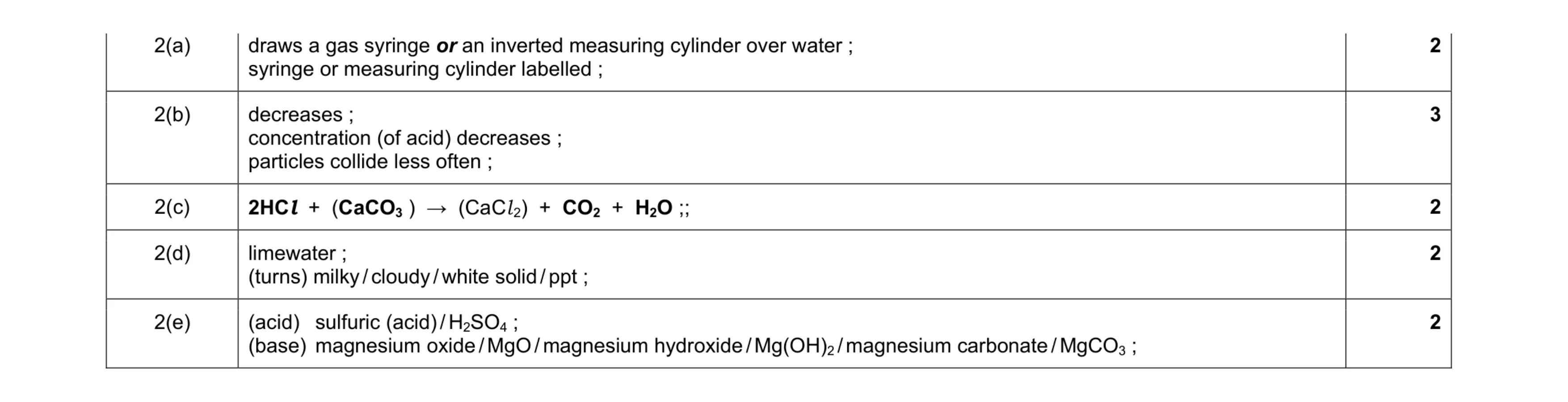
Mark scheme: 2(a) draws a gas syringe or an inverted measuring cylinder over water ; syringe or measuring cylinder labelled ; 2 2(b) decreases ; concentration (of acid) decreases ; particles collide less often ; 3 2(c) 2HCl + (CaCO3 ) → (CaCl 2) + CO2 + H2O ;; 2 2(d) limewater ; (turns) milky / cloudy / white solid / ppt ; 2 2(e) (acid) sulfuric (acid) / H2SO4 ; (base) magnesium oxide / MgO / magnesium hydroxide / Mg(OH)2 / magnesium carbonate / MgCO3 ; 2
This question in 0653/42 Feb/March 2017
Q2 · Iron is extracted from iron oxide in the blast furnace, as shown in Fig 0653/42 Feb/March 2017
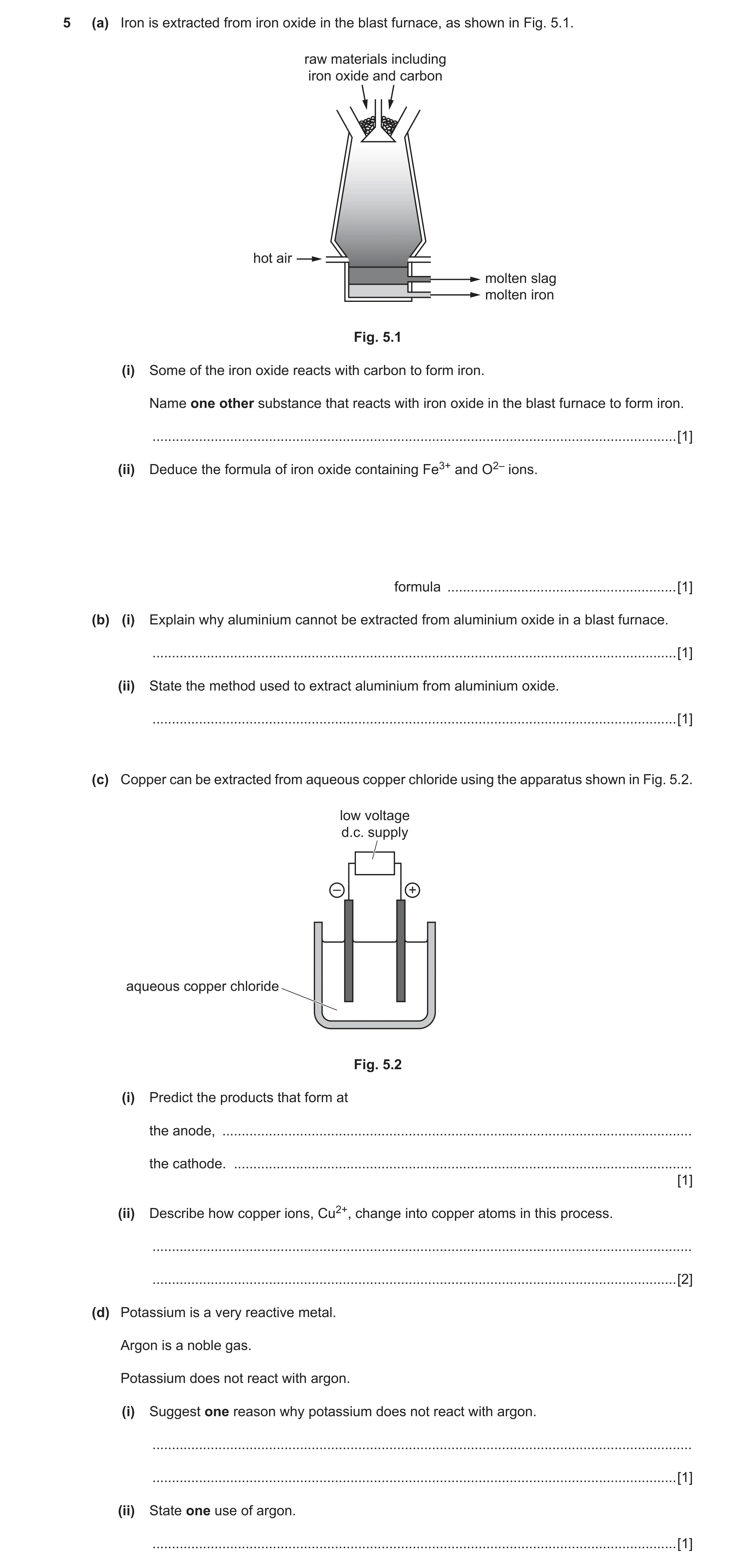
5 (a) Iron is extracted from iron oxide in the blast furnace, as shown in Fig. 5.1. raw materials including iron oxide and carbon hot air molten slag molten iron Fig. 5.1 (i) Some of the iron oxide reacts with carbon to form iron. Name one other substance that reacts with iron oxide in the blast furnace to form iron. … [1] (ii) Deduce the formula of iron oxide containing Fe3+ and O2– ions. formula … [1] (b) (i) Explain why aluminium cannot be extracted from aluminium oxide in a blast furnace. … [1] (ii) State the method used to extract aluminium from aluminium oxide. … [1] (c) Copper can be extracted from aqueous copper chloride using the apparatus shown in Fig. 5.2. low voltage d.c. supply – + aqueous copper chloride Fig. 5.2 (i) Predict the products that form at the anode, … the cathode. … [1] (ii) Describe how copper ions, Cu2+, change into copper atoms in this process. … … [2] (d) Potassium is a very reactive metal. Argon is a noble gas. Potassium does not react with argon. (i) Suggest one reason why potassium does not react with argon. … … [1] (ii) State one use of argon. … [1]
9 marks
Mark scheme: 5(a)(i) carbon monoxide ; 1 5(a)(ii) Fe2O3 ; 1 5(b)(i) (Aluminium is) too reactive / more reactive than C / carbon ; 1 5(b)(ii) electrolysis ; 1 5(c)(i) (anode) chlorine / Cl2 (cathode) copper ; (both required) 1 5(c)(ii) (Cu ions) gain electrons ; two electrons (gained) ; 2 Question Answer Marks 5(d)(i) Noble gases chemically stable / inert / unreactive / atoms have full outer electron shells / argon atoms do not lose or gain electrons to become stable ; 1 5(d)(ii) (to provide) inert atmosphere / used in lamps / in light bulbs / lasers / steel making ; 1
This question in 0653/42 Feb/March 2017
Q3 · Explain why the proportion of carbon dioxide in the air is increasing 0653/42 Oct/Nov 2017
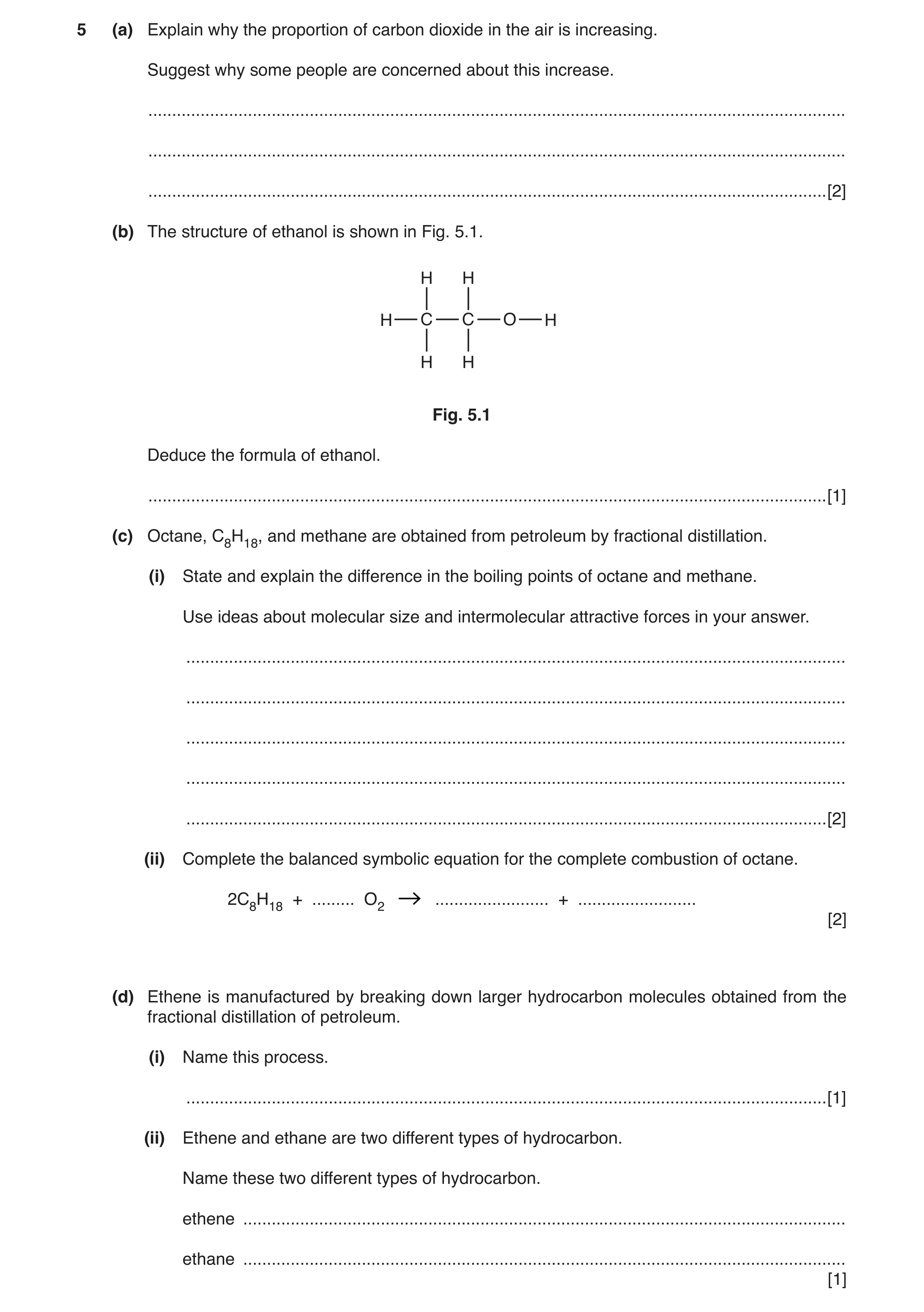
5 (a) Explain why the proportion of carbon dioxide in the air is increasing. Suggest why some people are concerned about this increase. … … … [2] (b) The structure of ethanol is shown in Fig. 5.1. H H H C C O H H H Fig. 5.1 Deduce the formula of ethanol. … [1] (c) Octane, C8H18, and methane are obtained from petroleum by fractional distillation. (i) State and explain the difference in the boiling points of octane and methane. Use ideas about molecular size and intermolecular attractive forces in your answer. … … … … … [2] (ii) Complete the balanced symbolic equation for the complete combustion of octane. 2C8H18 + … O2 … + … [2] (d) Ethene is manufactured by breaking down larger hydrocarbon molecules obtained from the fractional distillation of petroleum. (i) Name this process. … [1] (ii) Ethene and ethane are two different types of hydrocarbon. Name these two different types of hydrocarbon. ethene … ethane … [1]
9 marks
Mark scheme: 5(a) reference to use of (fossil) fuel / named fuel / industrialisation / deforestation ; global warming / any named effect of global warming ; 2 5(b) C2H5OH / C2H6O ; 1 5(c)(i) (octane has higher boiling point / ora) (octane has) larger molecules / ora ; (octane has ) greater intermolecular forces (of attraction) / ora ; 2 5(c)(ii) (2C8H18) + 25«(O2) → «16 CO2 + «18 H2O correct species ; balanced (dependent on correct species) ; 2 5(d)(i) cracking ; 1 5(d)(ii) (ethene) alkene / unsaturated and (ethane) alkane / saturated ; 1
This question in 0653/42 Oct/Nov 2017
Q4 · The arrangements of particles in four substances are shown in Fig 0653/43 Oct/Nov 2017
2 (a) The arrangements of particles in four substances are shown in Fig. 2.1. A B C D Fig. 2.1 Use letters A, B, C and D to identify a pure substance, … a mixture, … an alloy, … a compound. … [2] (b) A student adds pieces of calcium to dilute hydrochloric acid. A vigorous reaction is observed. (i) Complete the balanced equation to show this reaction. Include state symbols in the equation. Ca(s) + 2 HCl ( … ) … ( … ) + … ( … ) [2] (ii) The student repeats the reaction using a solution of hydrochloric acid that has a lower concentration. State the effect of this change on the rate of the reaction. Explain this effect using ideas about colliding particles in your answer. effect on rate … explanation … … … [2] (iii) State a simple chemical test that shows the presence of chloride ions in dilute hydrochloric acid. test … result … [2] (c) A salt contains iron(III) ions, Fe3+, and sulfide ions, S2−. Determine the formula of this salt. formula … [1]
9 marks
Mark scheme: 2(a) (a pure substance) A or D ; (a mixture) B or C ; (an alloy) C ; (a compound) D ; (1) for any two or three correct (2) for all four correct 2 2(b)(i) (Ca(s)) + 2HCl )(aq) Î «CaCl 2«(aq) + «H2«(g) ;; species RHS (1) state symbols (1) for species given 2 2(b)(ii) (effect on rate) decreases ; (explanation) particles collide less often / less frequently / less chance of collisions ; 2 2(b)(iii) silver nitrate solution ; white solid / precipitate ; 2 2(c) Fe2S3 ; 1
This question in 0653/43 Oct/Nov 2017
Q5 · Useful substances are obtained from petroleum using the processes shown in Fig 0653/41 Oct/Nov 2018
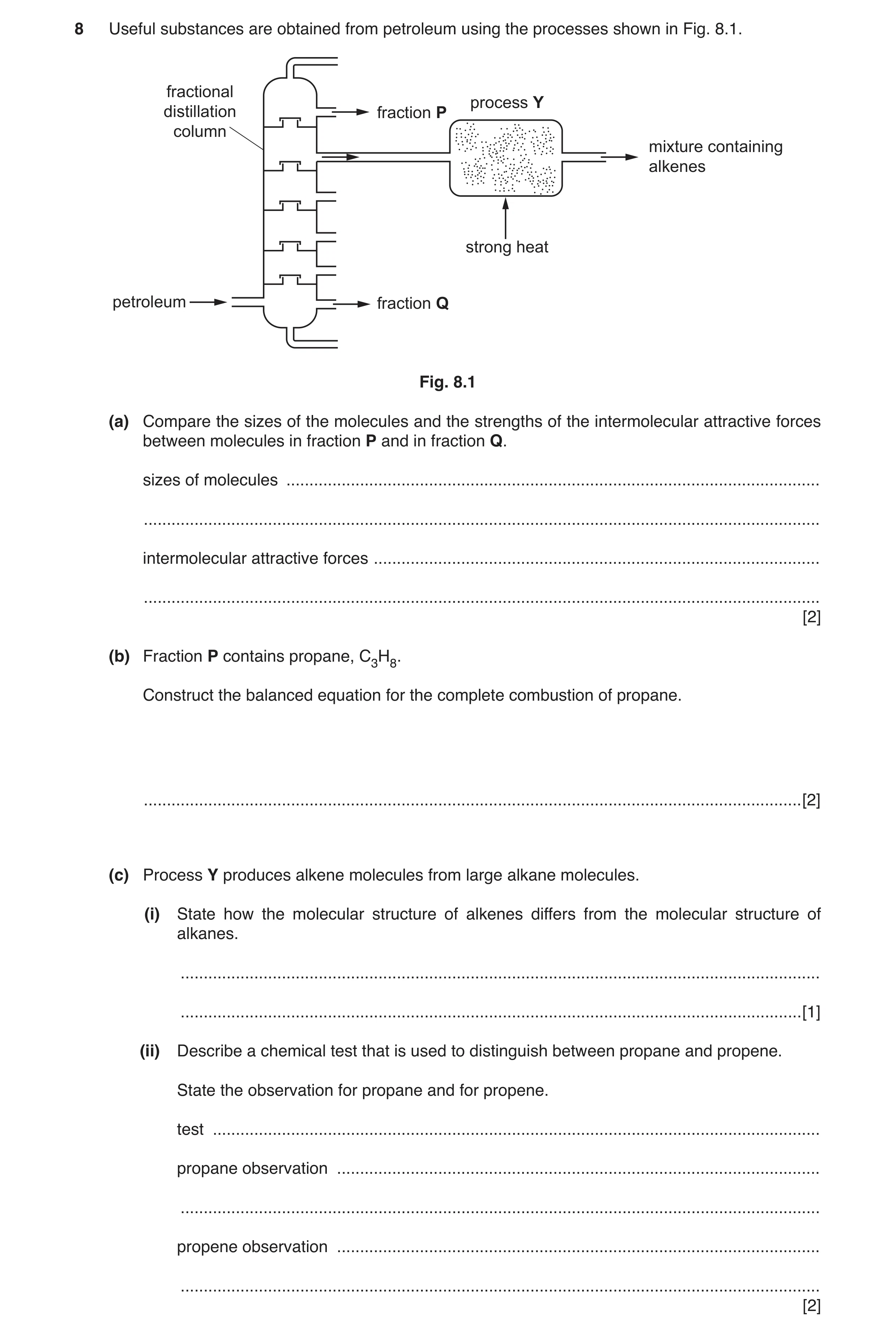
8 Useful substances are obtained from petroleum using the processes shown in Fig. 8.1. fractional process Y distillation fraction P column mixture containing alkenes strong heat petroleum fraction Q Fig. 8.1 (a) Compare the sizes of the molecules and the strengths of the intermolecular attractive forces between molecules in fraction P and in fraction Q. sizes of molecules … … intermolecular attractive forces … … [2] (b) Fraction P contains propane, C3H8. Construct the balanced equation for the complete combustion of propane. … [2] (c) Process Y produces alkene molecules from large alkane molecules. (i) State how the molecular structure of alkenes differs from the molecular structure of alkanes. … … [1] (ii) Describe a chemical test that is used to distinguish between propane and propene. State the observation for propane and for propene. test … propane observation … … propene observation … … [2]
7 marks
Mark scheme: 8(a) (size of molecules) P smaller than Q / ora ; (intermolecular forces) P smaller than Q / ora ; 2 8(b) C3H8 + 5O2 → 3CO2 + 4H2O species ; balancing ; 2 8(c)(i) alkenes have (one) (carbon-carbon) double bond / C=C ; or alkanes have only (carbon-carbon) single bonds / C-C ; 1 8(c)(ii) (test) (add) bromine (water) / Br2 ; (propane) no (visible) change and (propene) decolourises ; 2
This question in 0653/41 Oct/Nov 2018
Q6 · Magnesium is an element in Group II and Period 3 of the Periodic Table 0653/43 Oct/Nov 2020
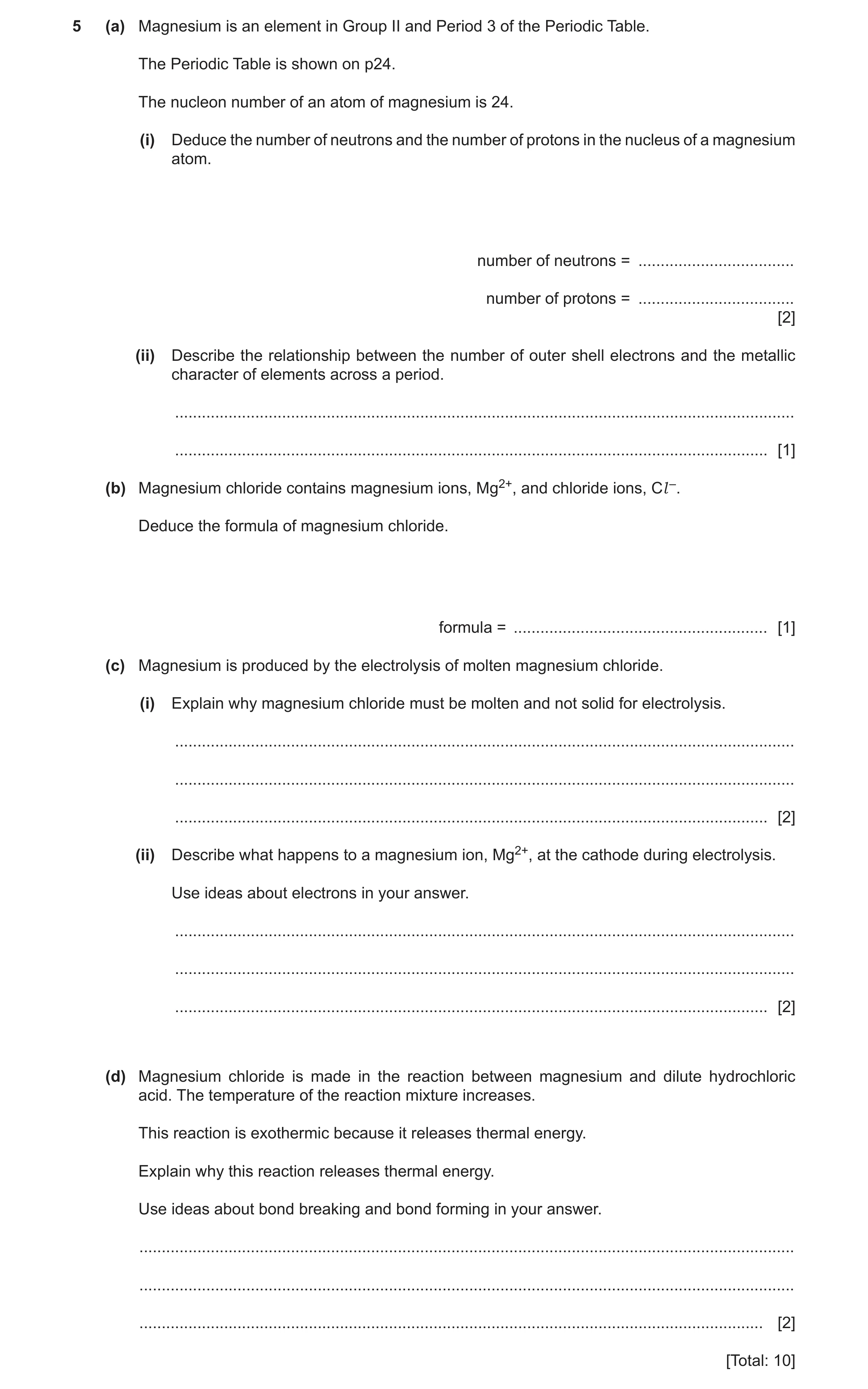
5 (a) Magnesium is an element in Group II and Period 3 of the Periodic Table. The Periodic Table is shown on p24. The nucleon number of an atom of magnesium is 24. (i) Deduce the number of neutrons and the number of protons in the nucleus of a magnesium atom. number of neutrons = … number of protons = … [2] (ii) Describe the relationship between the number of outer shell electrons and the metallic character of elements across a period. … … [1] (b) Magnesium chloride contains magnesium ions, Mg2+, and chloride ions, Cl –. Deduce the formula of magnesium chloride. formula = … [1] (c) Magnesium is produced by the electrolysis of molten magnesium chloride. (i) Explain why magnesium chloride must be molten and not solid for electrolysis. … … … [2] (ii) Describe what happens to a magnesium ion, Mg2+, at the cathode during electrolysis. Use ideas about electrons in your answer. … … … [2] (d) Magnesium chloride is made in the reaction between magnesium and dilute hydrochloric acid. The temperature of the reaction mixture increases. This reaction is exothermic because it releases thermal energy. Explain why this reaction releases thermal energy. Use ideas about bond breaking and bond forming in your answer. … … … [2] [Total: 10]
10 marks
Mark scheme: 5(a)(i) neutrons: 12 ; protons: 12 ; 2 5(a)(ii) as the number of electrons increases the element becomes less metallic ; 1 5(b) MgCl2 ; 1 5(c)(i) ions must be mobile / ions in a solid cannot move ; ions can move to the electrodes / for conduction of electricity 2 5(c)(ii) gains electrons ; (gains) two electrons / is discharged ; 2 5(d) energy is taken in for bond breaking / energy is released when bonds are formed / owtte ; (reaction is exothermic because) more energy released than taken in ; 2
This question in 0653/43 Oct/Nov 2020
Q7 · Iron is extracted from hematite, an iron ore, in the blast furnace 0653/42 Feb/March 2021
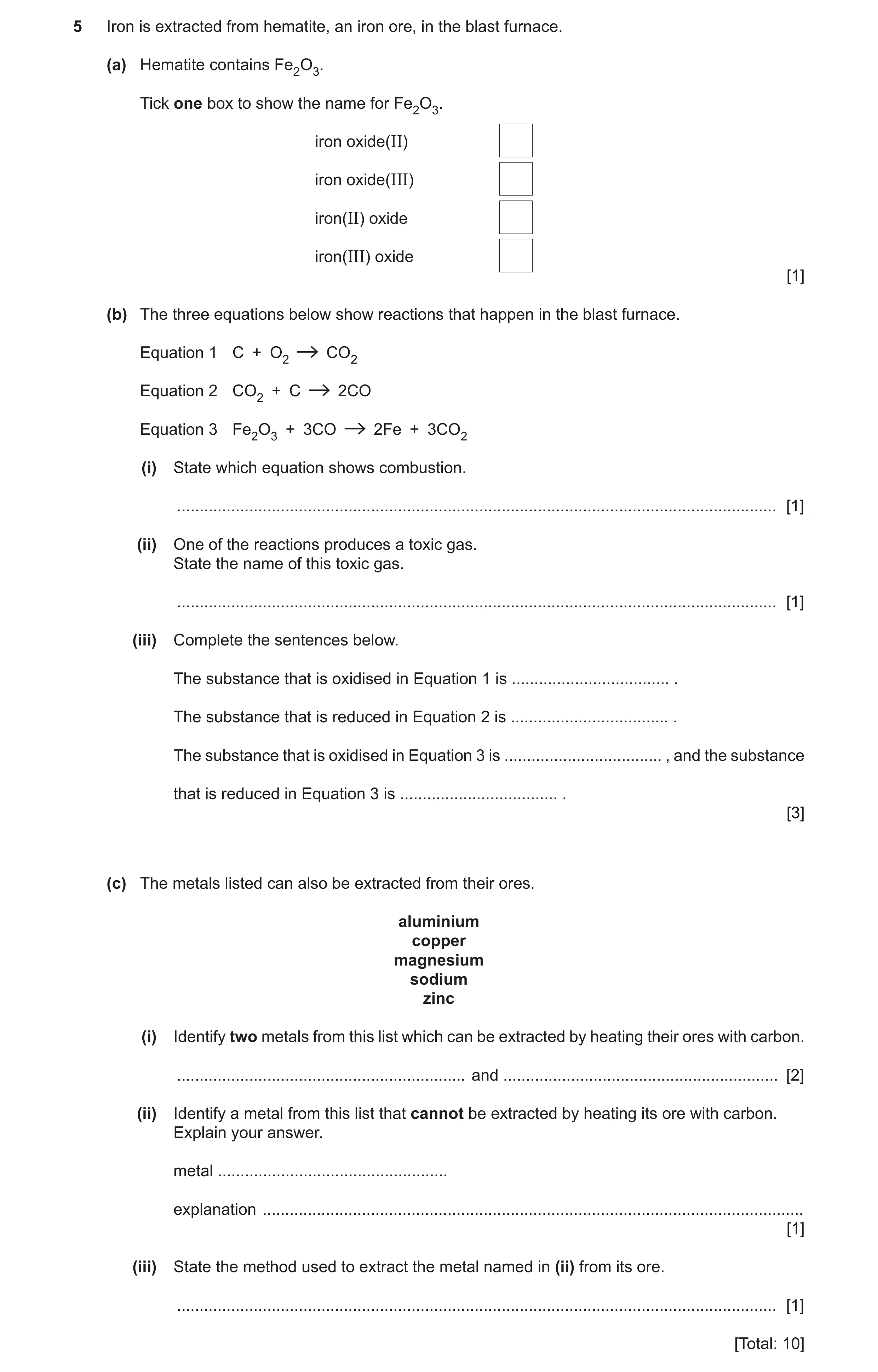
5 Iron is extracted from hematite, an iron ore, in the blast furnace. (a) Hematite contains Fe2O3. Tick one box to show the name for Fe2O3. iron oxide(II) iron oxide(III) iron(II) oxide iron(III) oxide [1] (b) The three equations below show reactions that happen in the blast furnace. Equation 1 C + O2 CO2 Equation 2 CO2 + C 2CO Equation 3 Fe2O3 + 3CO 2Fe + 3CO2 (i) State which equation shows combustion. … [1] (ii) One of the reactions produces a toxic gas. State the name of this toxic gas. … [1] (iii) Complete the sentences below. The substance that is oxidised in Equation 1 is … . The substance that is reduced in Equation 2 is … . The substance that is oxidised in Equation 3 is … , and the substance that is reduced in Equation 3 is … . [3] (c) The metals listed can also be extracted from their ores. aluminium copper magnesium sodium zinc (i) Identify two metals from this list which can be extracted by heating their ores with carbon. … and … [2] (ii) Identify a metal from this list that cannot be extracted by heating its ore with carbon. Explain your answer. metal … explanation … [1] (iii) State the method used to extract the metal named in (ii) from its ore. … [1] [Total: 10]
10 marks
Mark scheme: 5(a) iron(III) oxide ; 1 5(b)(i) equation 1 / C + O2 → CO2 ; 1 5(b)(ii) carbon monoxide ; 1 5(b)(iii) carbon / C ; carbon dioxide / CO2 ; CO / carbon monoxide (gap 1) and Fe2O3 / iron oxide (gap 2) ; 3 5(c)(i) copper ; zinc ; 2 Question Answer Marks 5(c)(ii) (aluminium/magnesium/sodium) AND because too reactive / very reactive / more reactive than carbon ; 1 5(c)(iii) electrolysis ; 1
This question in 0653/42 Feb/March 2021
Q8 · Some names and some formulae of four metal oxides 0653/41 Oct/Nov 2021
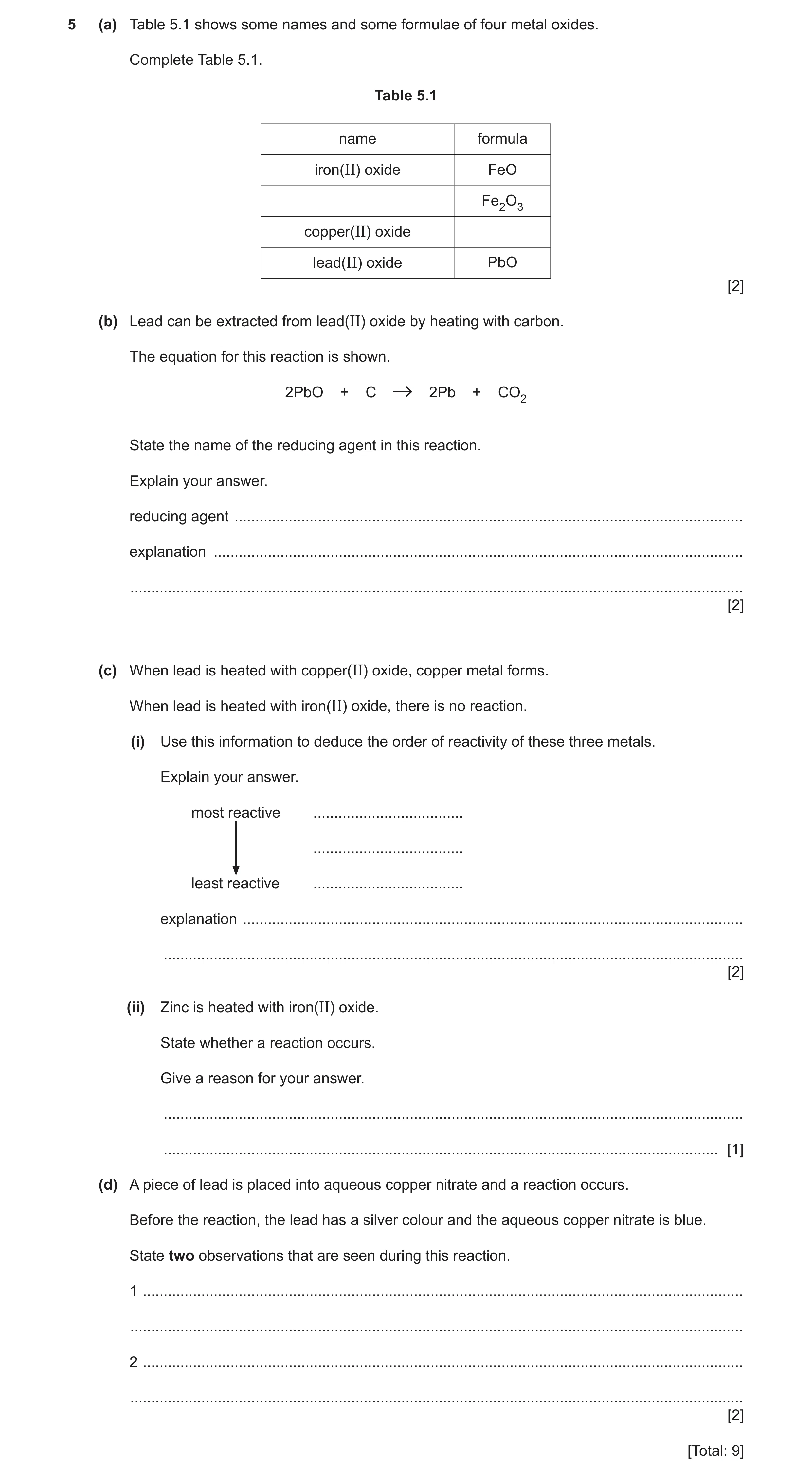
5 (a) Table 5.1 shows some names and some formulae of four metal oxides. Complete Table 5.1. Table 5.1 name formula iron(II) oxide FeO Fe2O3 copper(II) oxide lead(II) oxide PbO [2] (b) Lead can be extracted from lead(II) oxide by heating with carbon. The equation for this reaction is shown. 2PbO + C 2Pb + CO2 State the name of the reducing agent in this reaction. Explain your answer. reducing agent … explanation … … [2] (c) When lead is heated with copper(II) oxide, copper metal forms. When lead is heated with iron(II) oxide, there is no reaction. (i) Use this information to deduce the order of reactivity of these three metals. Explain your answer. most reactive … … least reactive … explanation … … [2] (ii) Zinc is heated with iron(II) oxide. State whether a reaction occurs. Give a reason for your answer. … … [1] (d) A piece of lead is placed into aqueous copper nitrate and a reaction occurs. Before the reaction, the lead has a silver colour and the aqueous copper nitrate is blue. State two observations that are seen during this reaction. 1 … … 2 … … [2] [Total: 9]
9 marks
Mark scheme: 5(a) iron(III) oxide ; CuO ; 2 5(b) carbon ; removes oxygen from the lead(II) oxide / reducing agents remove oxygen from another substance / it reduces lead(II) oxide / reduces lead ions ; 2 5(c)(i) iron (most) lead copper (least) in correct order; the more reactive metal displaces the less reactive / AW ; 2 5(c)(ii) (yes, because) zinc is more reactive (than iron) ; 1 5(d) solution goes colourless / blue colour fades / decolourises ; lead has a brown / orange coating / dark brown / orange solid appears ; 2
This question in 0653/41 Oct/Nov 2021
Q9 · Calcium carbonate reacts with dilute hydrochloric acid to produce a gas 0653/43 May/June 2022
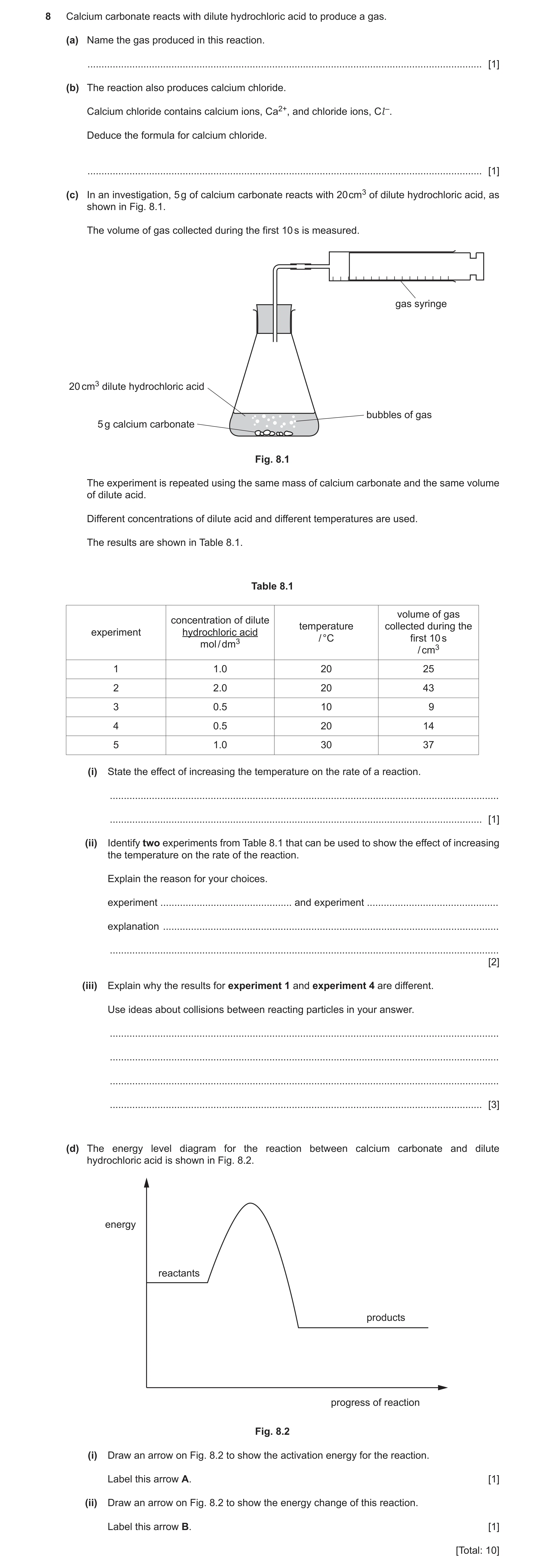
8 Calcium carbonate reacts with dilute hydrochloric acid to produce a gas. (a) Name the gas produced in this reaction. … [1] (b) The reaction also produces calcium chloride. Calcium chloride contains calcium ions, Ca2+, and chloride ions, Cl –. Deduce the formula for calcium chloride. … [1] (c) In an investigation, 5 g of calcium carbonate reacts with 20 cm3 of dilute hydrochloric acid, as shown in Fig. 8.1. The volume of gas collected during the first 10 s is measured. gas syringe 20 cm3 dilute hydrochloric acid bubbles of gas 5 g calcium carbonate Fig. 8.1 The experiment is repeated using the same mass of calcium carbonate and the same volume of dilute acid. Different concentrations of dilute acid and different temperatures are used. The results are shown in Table 8.1. Table 8.1 volume of gas concentration of dilute temperature collected during the experiment hydrochloric acid / °C first 10 s mol / dm3 / cm3 1 1.0 20 25 2 2.0 20 43 3 0.5 10 9 4 0.5 20 14 5 1.0 30 37 (i) State the effect of increasing the temperature on the rate of a reaction. … … [1] (ii) Identify two experiments from Table 8.1 that can be used to show the effect of increasing the temperature on the rate of the reaction. Explain the reason for your choices. experiment … and experiment … explanation … … [2] (iii) Explain why the results for experiment 1 and experiment 4 are different. Use ideas about collisions between reacting particles in your answer. … … … … [3] (d) The energy level diagram for the reaction between calcium carbonate and dilute hydrochloric acid is shown in Fig. 8.2. energy reactants products progress of reaction Fig. 8.2 (i) Draw an arrow on Fig. 8.2 to show the activation energy for the reaction. Label this arrow A. [1] (ii) Draw an arrow on Fig. 8.2 to show the energy change of this reaction. Label this arrow B. [1] [Total: 10]
10 marks
Mark scheme: 8(a) carbon dioxide ; 1 8(b) CaCl2 ; 1 8(c)(i) increases rate / higher rate / faster ; 1 8(c)(ii) 3 and 4 OR 1 and 5 ; need to keep concentration same / 3 and 4 both have concentration of 0.5 / 1 and 5 both have concentration of 1.0 ; 2 Question Answer Marks 8(c)(iii) 4 has a lower concentration than 1 / lower concentration has a lower rate ORA ; particles are further apart in 4 / fewer particles per unit volume ORA ; collisions less frequent in 4 / fewer successful collisions in 4 ORA ; 3 8(d)(i) arrow A starts and ends in the correct place ; e.g. 1 8(d)(ii) arrow B starts and ends in the correct place ; 1
This question in 0653/43 May/June 2022
Q10 · An iron nail is placed in a test-tube, as shown in Fig 0653/41 May/June 2023
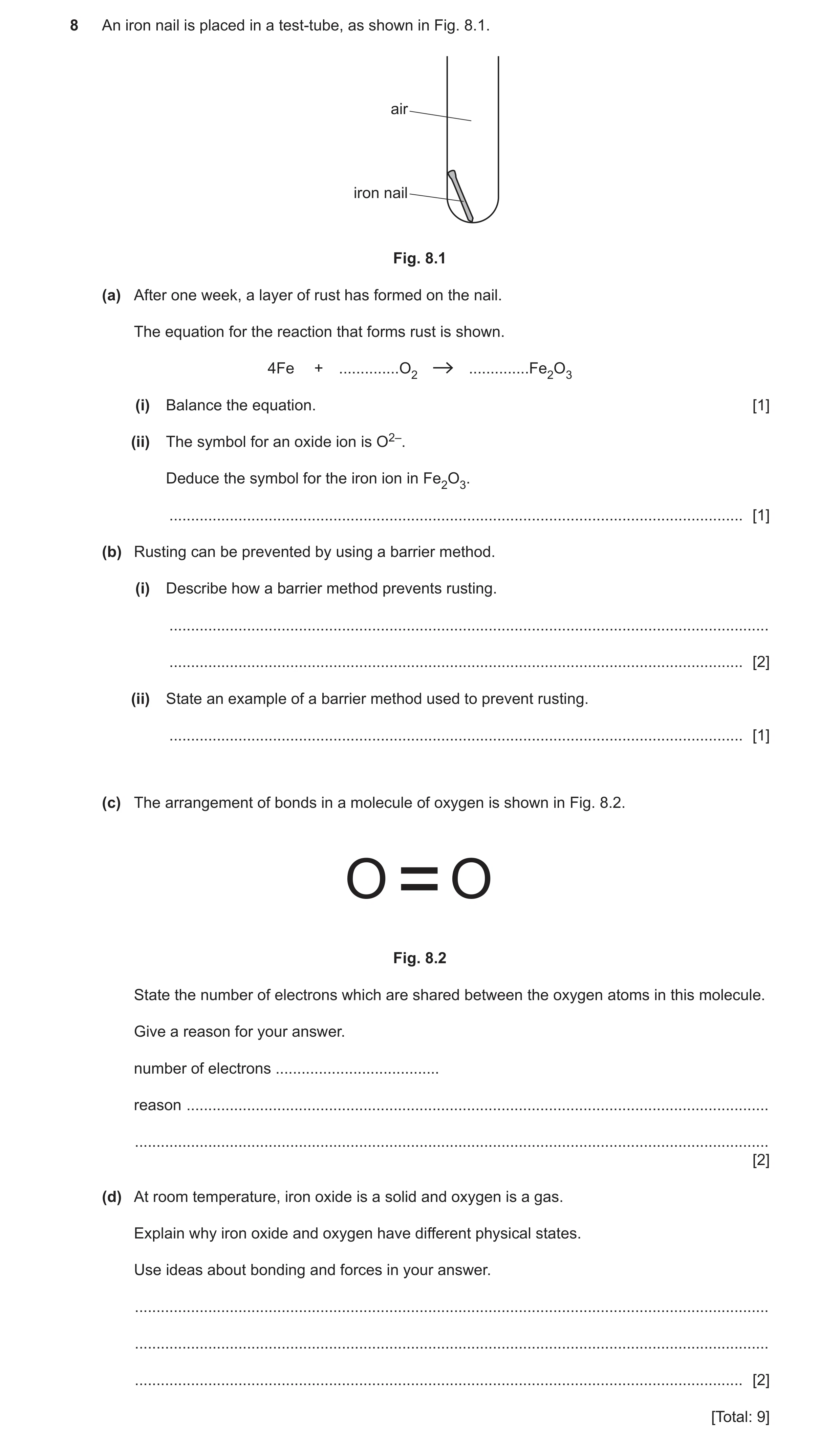
8 An iron nail is placed in a test-tube, as shown in Fig. 8.1. air iron nail Fig. 8.1 (a) After one week, a layer of rust has formed on the nail. The equation for the reaction that forms rust is shown. 4Fe + … O2 … Fe2O3 (i) Balance the equation. [1] (ii) The symbol for an oxide ion is O2–. Deduce the symbol for the iron ion in Fe2O3. … [1] (b) Rusting can be prevented by using a barrier method. (i) Describe how a barrier method prevents rusting. … … [2] (ii) State an example of a barrier method used to prevent rusting. … [1] (c) The arrangement of bonds in a molecule of oxygen is shown in Fig. 8.2. O O Fig. 8.2 State the number of electrons which are shared between the oxygen atoms in this molecule. Give a reason for your answer. number of electrons … reason … … [2] (d) At room temperature, iron oxide is a solid and oxygen is a gas. Explain why iron oxide and oxygen have different physical states. Use ideas about bonding and forces in your answer. … … … [2] [Total: 9]
9 marks
Mark scheme: 8(a)(i) 3 and 2 ; 1 8(a)(ii) Fe3+ ; 1 8(b)(i) excludes, oxygen / air ; excludes water ; 2 8(b)(ii) paint / grease / oil / other suitable coating ; 1 8(c) 4 ; it has a double bond with two electrons in each bond / two pairs of electrons are shared ; 2 8(d) oxygen, is covalent / has a simple (molecular) structure and iron oxide, is ionic / has a giant structure ; forces between particles / ions, in iron oxide, are stronger than in oxygen (particles / molecules) ; 2
This question in 0653/41 May/June 2023
Q11 · Solid ammonium nitrate, NH4NO3, dissolves to form aqueous ammonium nitrate 0653/43 May/June 2023
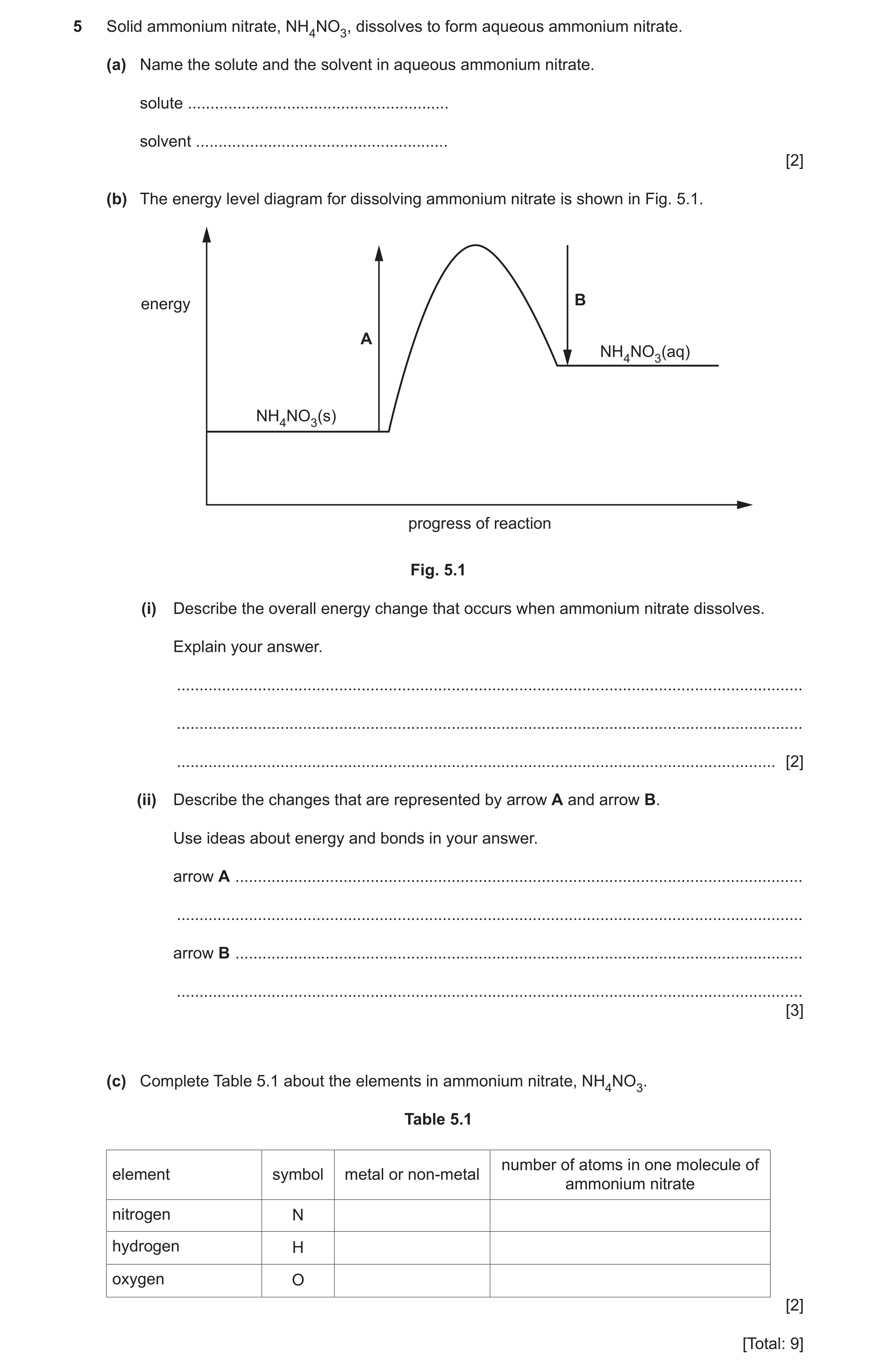
5 Solid ammonium nitrate, NH4NO3, dissolves to form aqueous ammonium nitrate. (a) Name the solute and the solvent in aqueous ammonium nitrate. solute … solvent … [2] (b) The energy level diagram for dissolving ammonium nitrate is shown in Fig. 5.1. energy B A NH4NO3(aq) NH4NO3(s) progress of reaction Fig. 5.1 (i) Describe the overall energy change that occurs when ammonium nitrate dissolves. Explain your answer. … … … [2] (ii) Describe the changes that are represented by arrow A and arrow B. Use ideas about energy and bonds in your answer. arrow A … … arrow B … … [3] (c) Complete Table 5.1 about the elements in ammonium nitrate, NH4NO3. Table 5.1 number of atoms in one molecule of element symbol metal or non-metal ammonium nitrate nitrogen N hydrogen H oxygen O [2] [Total: 9]
9 marks
Mark scheme: 5(a) (solute) ammonium nitrate ; (solvent) water ; 2 5(b)(i) endothermic / energy taken in ; the idea expressed that the energy of products is greater than reactants / products at higher energy level ; 2 5(b)(ii) A bonds are breaking ; B bonds are forming ; A energy is taken in / B energy is given out ; 3 5(c) all non-metals ; atoms in one molecule: 2,4,3 ; 2
This question in 0653/43 May/June 2023
Q12 · The electrolysis of molten zinc chloride using inert electrodes 0653/42 Feb/March 2024
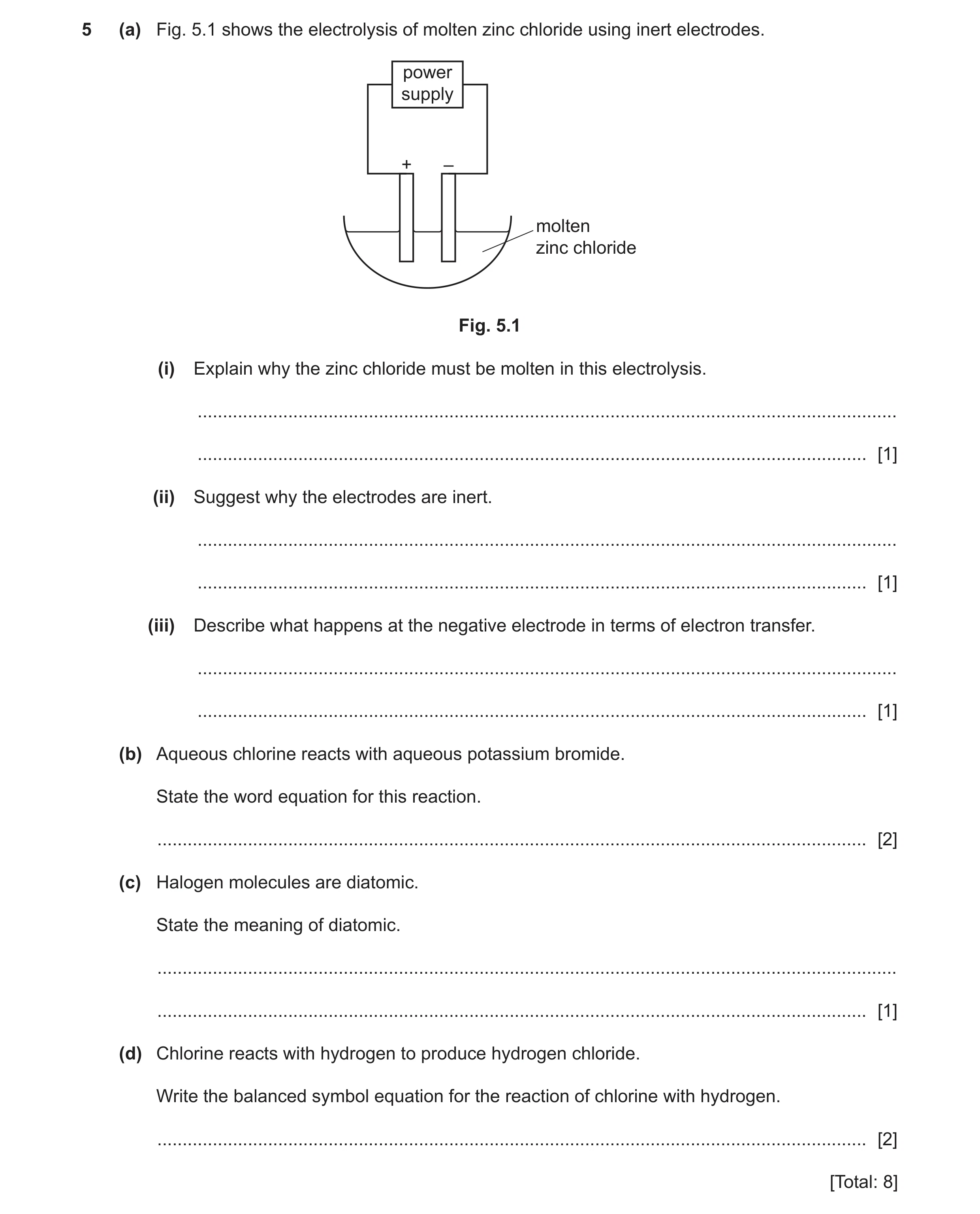
5 (a) Fig. 5.1 shows the electrolysis of molten zinc chloride using inert electrodes. power supply + – molten zinc chloride Fig. 5.1 (i) Explain why the zinc chloride must be molten in this electrolysis. … … [1] (ii) Suggest why the electrodes are inert. … … [1] (iii) Describe what happens at the negative electrode in terms of electron transfer. … … [1] (b) Aqueous chlorine reacts with aqueous potassium bromide. State the word equation for this reaction. … [2] (c) Halogen molecules are diatomic. State the meaning of diatomic. … … [1] (d) Chlorine reacts with hydrogen to produce hydrogen chloride. Write the balanced symbol equation for the reaction of chlorine with hydrogen. … [2] [Total: 8]
8 marks
Mark scheme: 5(a)(i) (molten because) ions must, be free to move / be mobile / migrate ; 1 5(a)(ii) (so that they) do not react / only provide a surface for electron transfer (to or from ions) ; 1 5(a)(iii) gain of electrons by, cations / (zinc) ions ; 1 5(b) chlorine + potassium bromide → ; ( → or = required) 2 potassium chloride + bromine ; 5(c) (molecule made of) two atoms, combined / bonded ; 1 5(d) Cl 2 + H2 → 2HCl ;; 2 reactants and products [1] balanced [1]
This question in 0653/42 Feb/March 2024
Q13 · Excess solid zinc is added to dilute hydrochloric acid in a conical flask 0653/43 Oct/Nov 2024
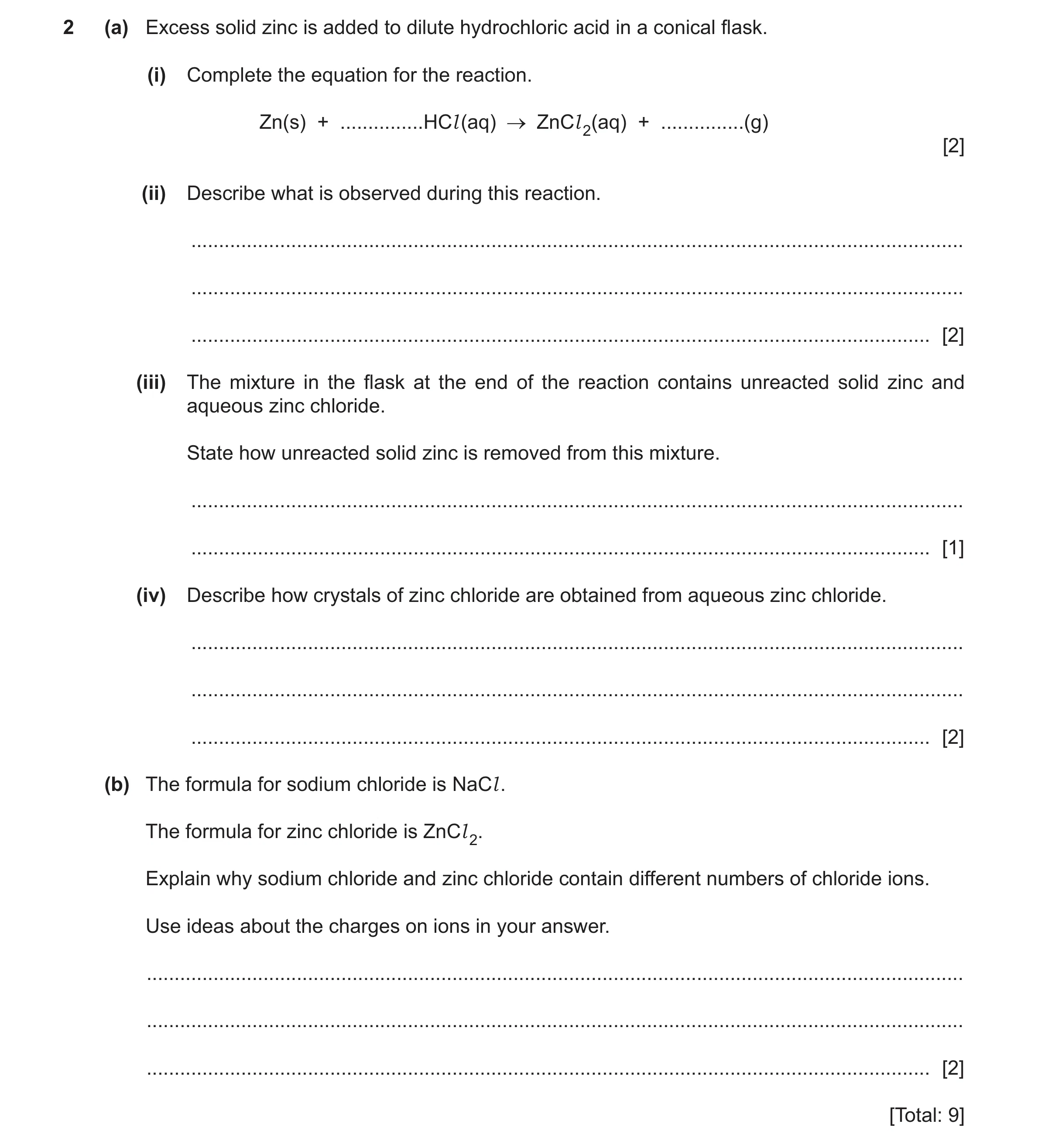
2 (a) Excess solid zinc is added to dilute hydrochloric acid in a conical flask. (i) Complete the equation for the reaction. Zn(s) + … HCl (aq) ZnCl 2(aq) + … (g) [2] (ii) Describe what is observed during this reaction. … … … [2] (iii) The mixture in the flask at the end of the reaction contains unreacted solid zinc and aqueous zinc chloride. State how unreacted solid zinc is removed from this mixture. … … [1] (iv) Describe how crystals of zinc chloride are obtained from aqueous zinc chloride. … … … [2] (b) The formula for sodium chloride is NaCl . The formula for zinc chloride is ZnCl 2. Explain why sodium chloride and zinc chloride contain different numbers of chloride ions. Use ideas about the charges on ions in your answer. … … … [2] [Total: 9]
9 marks
Mark scheme: 2(a)(i) Zn(s) + ...2...HCl (aq) → ZnCl (aq) + 2 2 ...H2...(g) 2 added for balancing ; H2 as product ; 2(a)(ii) any two from: 2 solid zinc reduces in size / AW ; fizzing / bubbles (of gas) ; AVP ; 2(a)(iii) by filtration ; 1 2(a)(iv) heat ; 2 evaporate / remove water ; 2(b) sodium has a +1 charge AND zinc has a +2 charge ; 2 chloride ions have a -1 charge AND idea that charges must balance ;
This question in 0653/43 Oct/Nov 2024
Q14 · Calcium oxide, CaO, is used to make cement 0653/42 May/June 2025
5 (a) Calcium oxide, CaO, is used to make cement. Calcium oxide is formed by the decomposition of calcium carbonate, CaCO3, at a very high temperature. The equation for the reaction is shown. CaCO3(s) CaO(s) + CO2(g) (i) Suggest why making cement contributes to global warming. … … … … [2] (ii) The reaction is endothermic. Explain what is meant by an endothermic reaction. Use ideas about making bonds and breaking bonds in your answer. … … … … … [3] (iii) Fig. 5.1 shows the incomplete reaction pathway diagram for an endothermic reaction. Complete Fig. 5.1. Include: • the energy level of the products • a labelled arrow to show the activation energy, Ea • a labelled arrow to show the overall energy change of the reaction. energy reactants progress of reaction Fig. 5.1 [3] (b) Calcium oxide reacts with water to form calcium hydroxide. (i) The ions in calcium hydroxide are Ca2+ and OH–. Deduce the formula for calcium hydroxide. … [1] (ii) Aqueous calcium hydroxide is an alkali. State the colour of methyl orange indicator in aqueous calcium hydroxide. … [1] [Total: 10]
10 marks
Mark scheme: 5(a)(i) (because decomposition / use of fossil fuels) produces CO2 ; 2 (CO2) is a greenhouse gas ; 5(a)(ii) bond breaking takes in energy ; 3 bond forming gives out energy ; more energy taken in than given out ; 5(a)(iii) products labelled and higher than reactants and a maximum shown ; 3 Ea correctly labelled ; overall energy change labelled and upward arrow only ; 5(b)(i) Ca(OH)2 ; 1 5(b)(ii) yellow ; 1
This question in 0653/42 May/June 2025
Q15 · Copper metal reacts with oxygen to form copper oxide, CuO 0653/41 Oct/Nov 2025
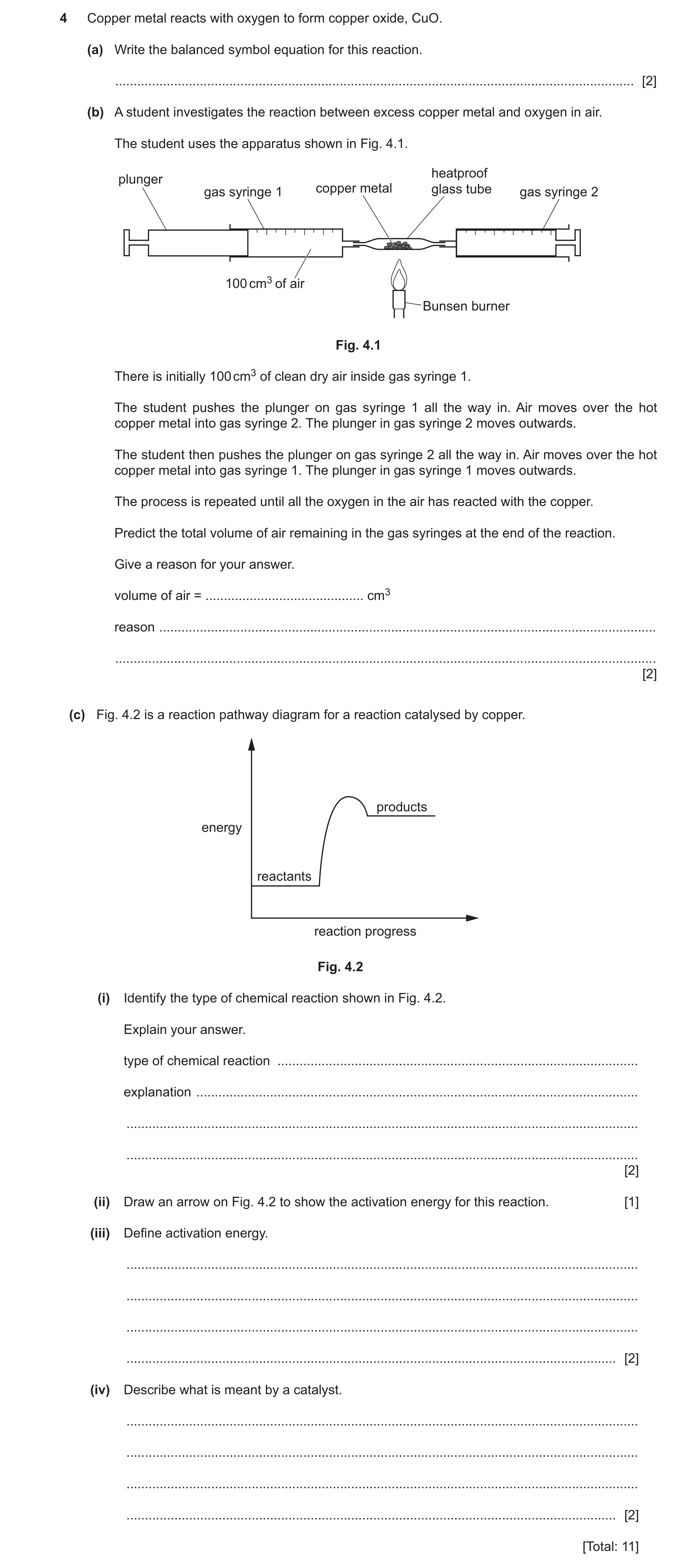
4 Copper metal reacts with oxygen to form copper oxide, CuO. (a) Write the balanced symbol equation for this reaction. … [2] (b) A student investigates the reaction between excess copper metal and oxygen in air. The student uses the apparatus shown in Fig. 4.1. heatproof plunger gas syringe 1 copper metal glass tube gas syringe 2 100 cm3 of air Bunsen burner Fig. 4.1 There is initially 100 cm3 of clean dry air inside gas syringe 1. The student pushes the plunger on gas syringe 1 all the way in. Air moves over the hot copper metal into gas syringe 2. The plunger in gas syringe 2 moves outwards. The student then pushes the plunger on gas syringe 2 all the way in. Air moves over the hot copper metal into gas syringe 1. The plunger in gas syringe 1 moves outwards. The process is repeated until all the oxygen in the air has reacted with the copper. Predict the total volume of air remaining in the gas syringes at the end of the reaction. Give a reason for your answer. volume of air = … cm3 reason … … [2] (c) Fig. 4.2 is a reaction pathway diagram for a reaction catalysed by copper. products energy reactants reaction progress Fig. 4.2 (i) Identify the type of chemical reaction shown in Fig. 4.2. Explain your answer. type of chemical reaction … explanation … … … [2] (ii) Draw an arrow on Fig. 4.2 to show the activation energy for this reaction. [1] (iii) Define activation energy. … … … … [2] (iv) Describe what is meant by a catalyst. … … … … [2] [Total: 11]
11 marks
Mark scheme: 4(a) 2Cu + O2 → 2CuO 2 correct formulae ; correct balancing ; 4(b) 79 (cm3) ; 2 oxygen is 21% of air ; 4(c)(i) M1 endothermic ; 2 M2 EITHER products have higher energy than reactants / (thermal) energy is taken in OR Energy required for bond breaking greater than energy released when bonds form; 4(c)(ii) any label showing activation energy from level of reactants to top of peak ; 1 4(c)(iii) M1 energy needed for a reaction ; 2 but M2 minimum energy needed to for a reaction ; ; 4(c)(iv) increases rate of reaction ; 2 is unchanged at the end of the reaction / idea that catalyst is not used up ;
This question in 0653/41 Oct/Nov 2025
Q16 · A student investigates the rate of reaction between large pieces of magnesium carbonate… 0653/43 Oct/Nov 2025
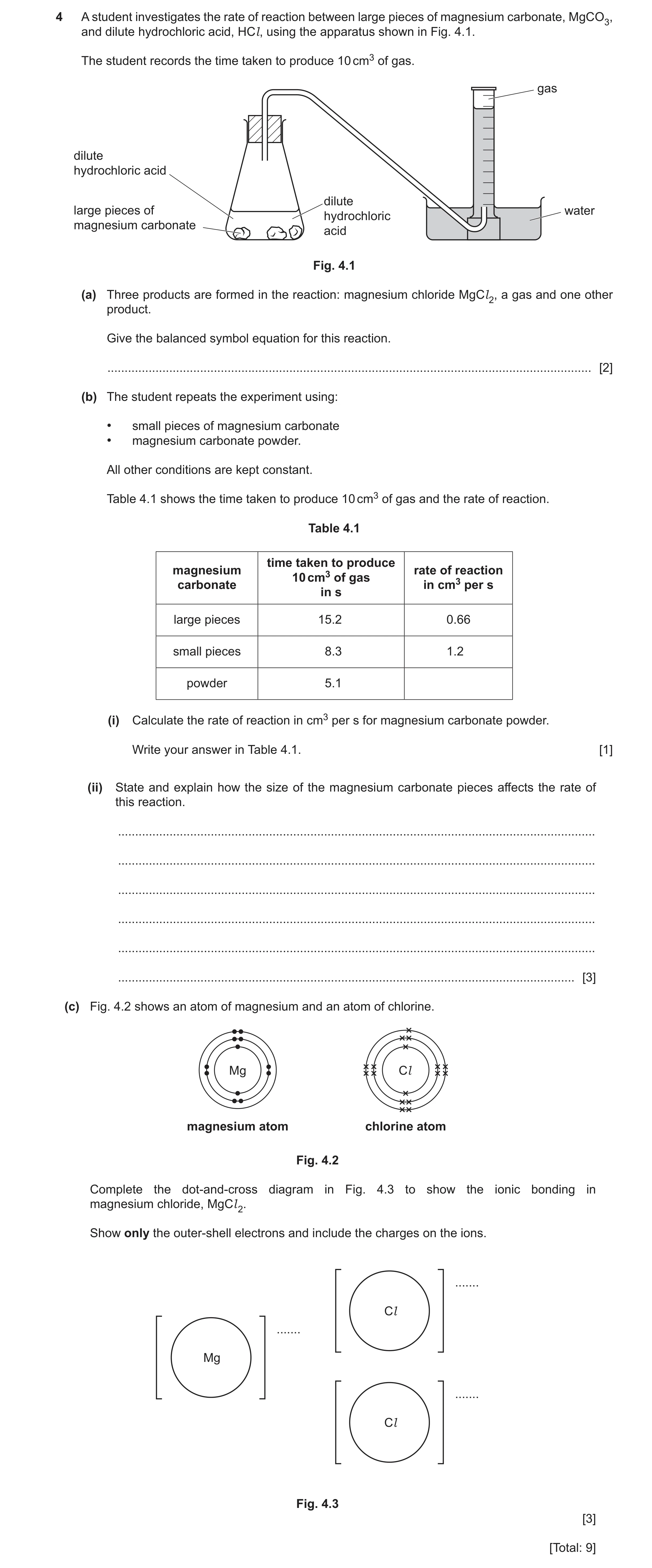
4 A student investigates the rate of reaction between large pieces of magnesium carbonate, MgCO3, and dilute hydrochloric acid, HCl , using the apparatus shown in Fig. 4.1. The student records the time taken to produce 10 cm3 of gas. gas dilute hydrochloric acid dilute large pieces of water hydrochloric magnesium carbonate acid Fig. 4.1 (a) Three products are formed in the reaction: magnesium chloride MgCl 2, a gas and one other product. Give the balanced symbol equation for this reaction. … [2] (b) The student repeats the experiment using: • small pieces of magnesium carbonate • magnesium carbonate powder. All other conditions are kept constant. Table 4.1 shows the time taken to produce 10 cm3 of gas and the rate of reaction. Table 4.1 time taken to produce magnesium rate of reaction 10 cm3 of gas carbonate in cm3 per s in s large pieces 15.2 0.66 small pieces 8.3 1.2 powder 5.1 (i) Calculate the rate of reaction in cm3 per s for magnesium carbonate powder. Write your answer in Table 4.1. [1] (ii) State and explain how the size of the magnesium carbonate pieces affects the rate of this reaction. … … … … … … [3] (c) Fig. 4.2 shows an atom of magnesium and an atom of chlorine. Mg Cl magnesium atom chlorine atom Fig. 4.2 Complete the dot-and-cross diagram in Fig. 4.3 to show the ionic bonding in magnesium chloride, MgCl 2. Show only the outer-shell electrons and include the charges on the ions. … Cl … Mg … Cl Fig. 4.3 [3] [Total: 9]
9 marks
Mark scheme: 4(a) MgCO3 + 2HCl → MgCl2 + H2O + CO2 2 correct formulae ; correct balancing ; 4(b)(i) 2.0 ; 1 4(b)(ii) smaller the pieces the faster the reaction / ora ; 3 (smaller pieces) surface area higher / greater exposure to acid with smaller pieces/powder ; (so) more collisions per second / more frequent collision / more (chance of) successful collisions ; 4(c) 8 dot electrons on outer shell of magnesium ion ; 3 7 X electrons on outer shell of both chloride ions and 1 dot electron ; correct charges on all ions ;
This question in 0653/43 Oct/Nov 2025
 4 / 22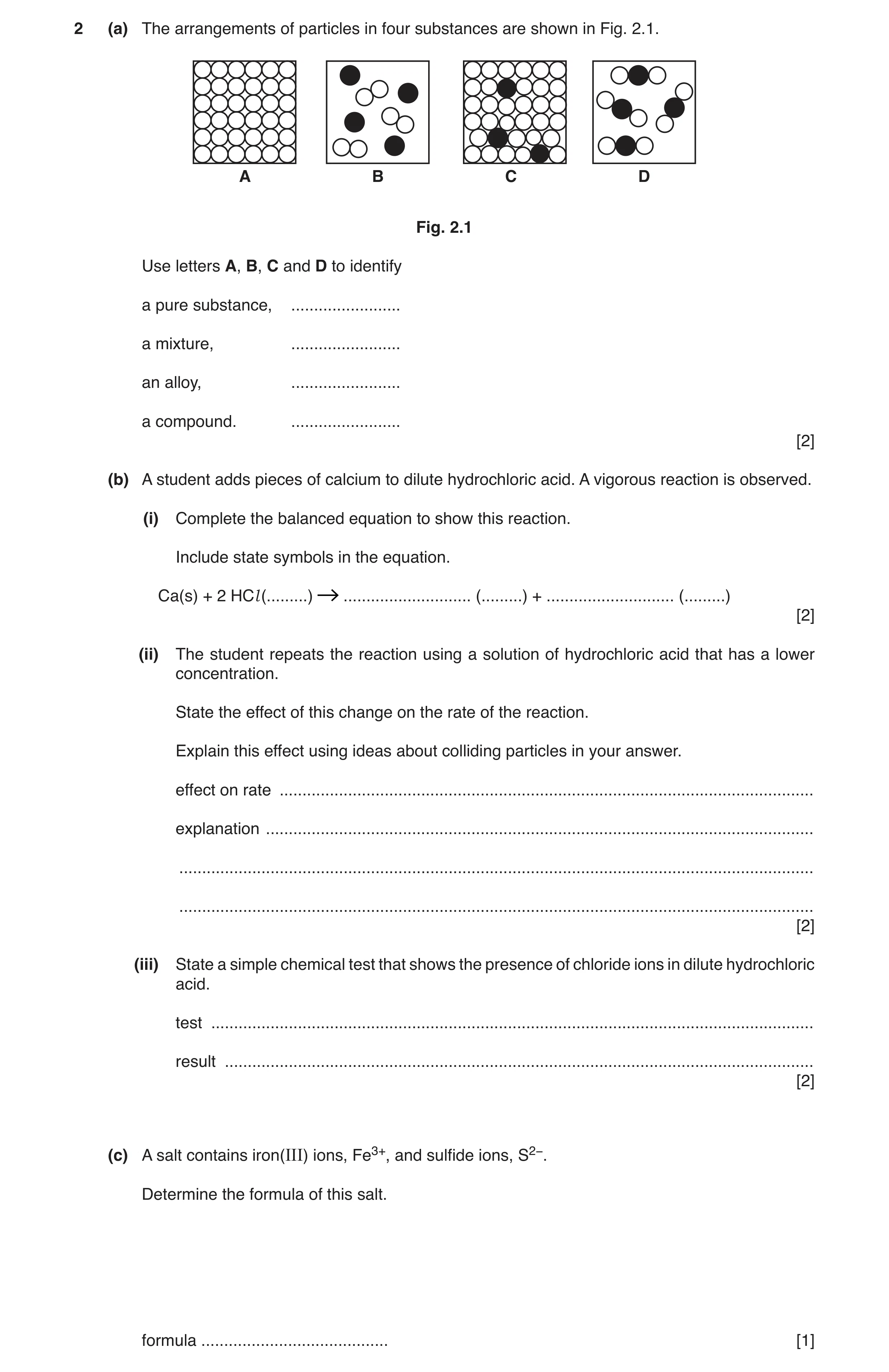
 16 / 22
 17 / 22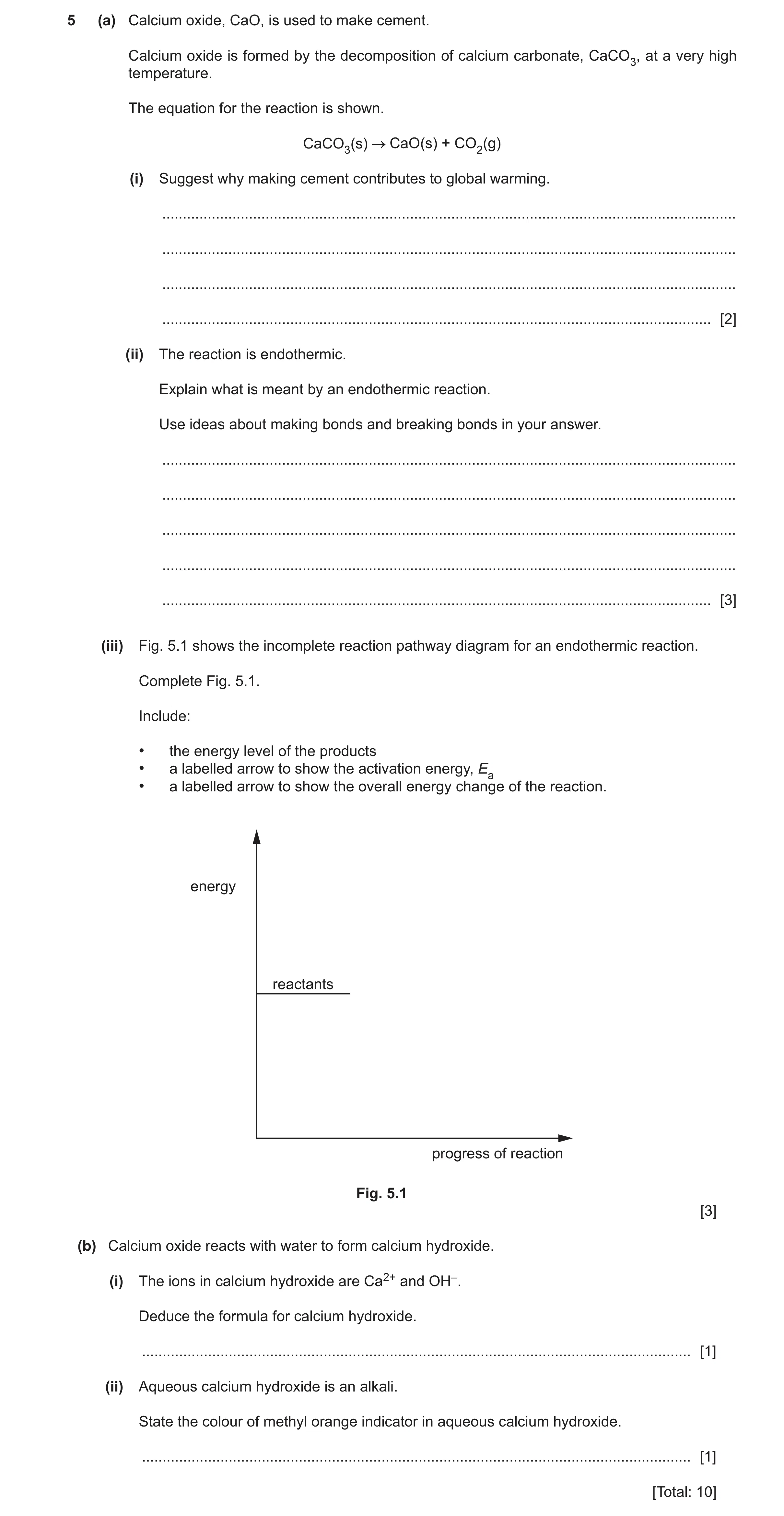
 11
11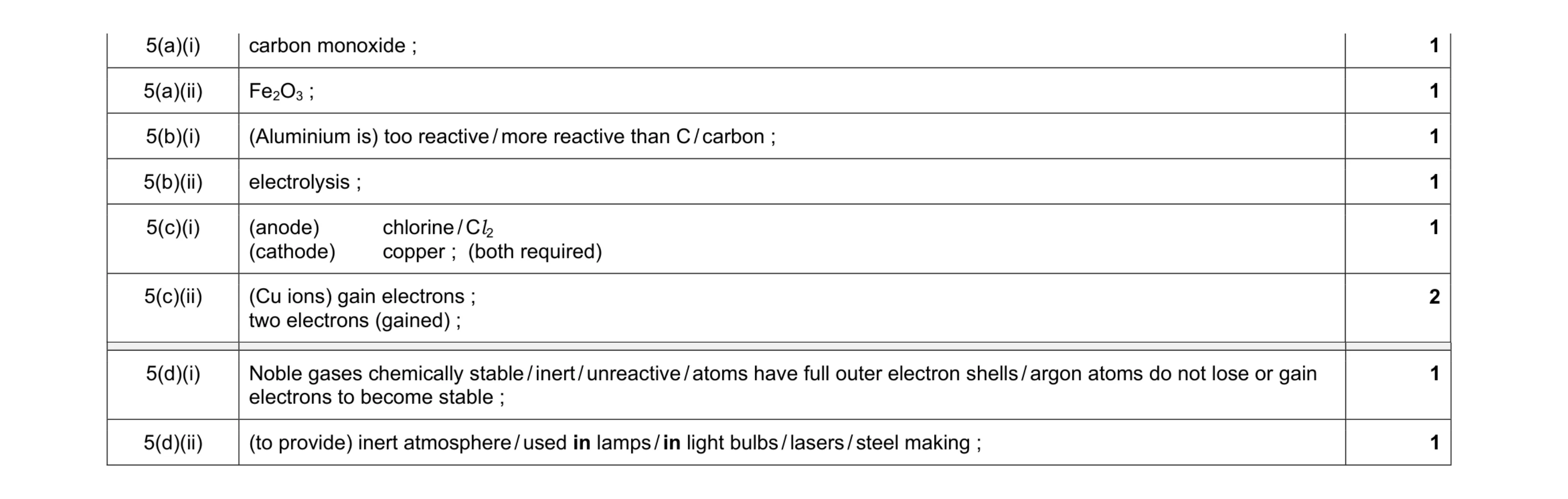 9
9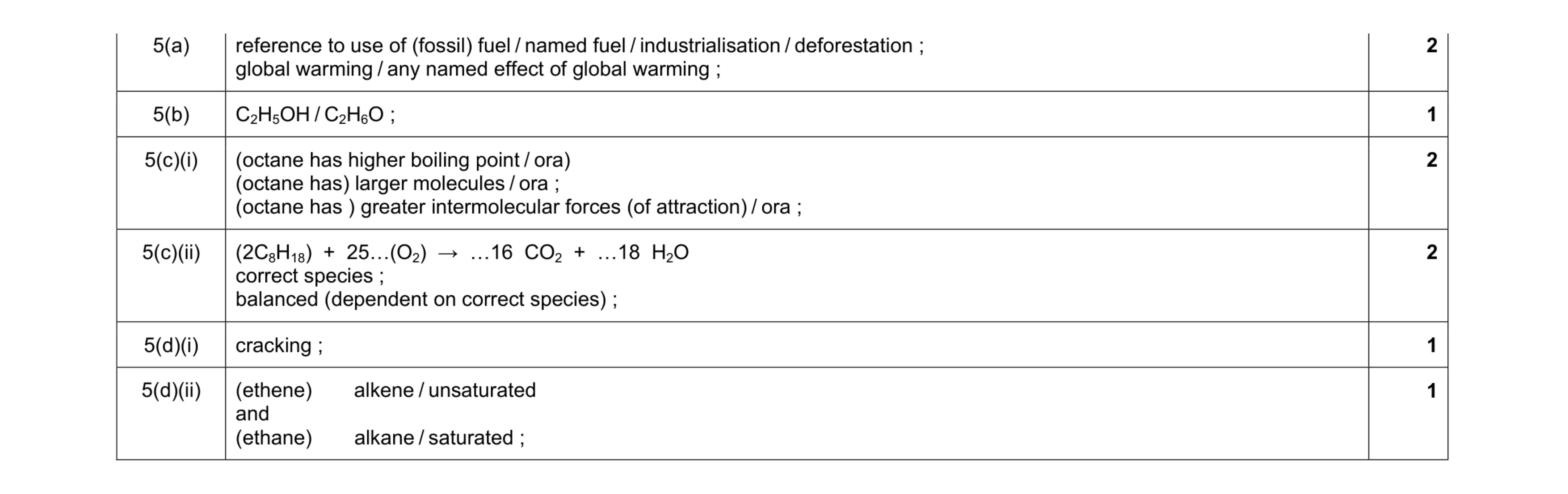 9
9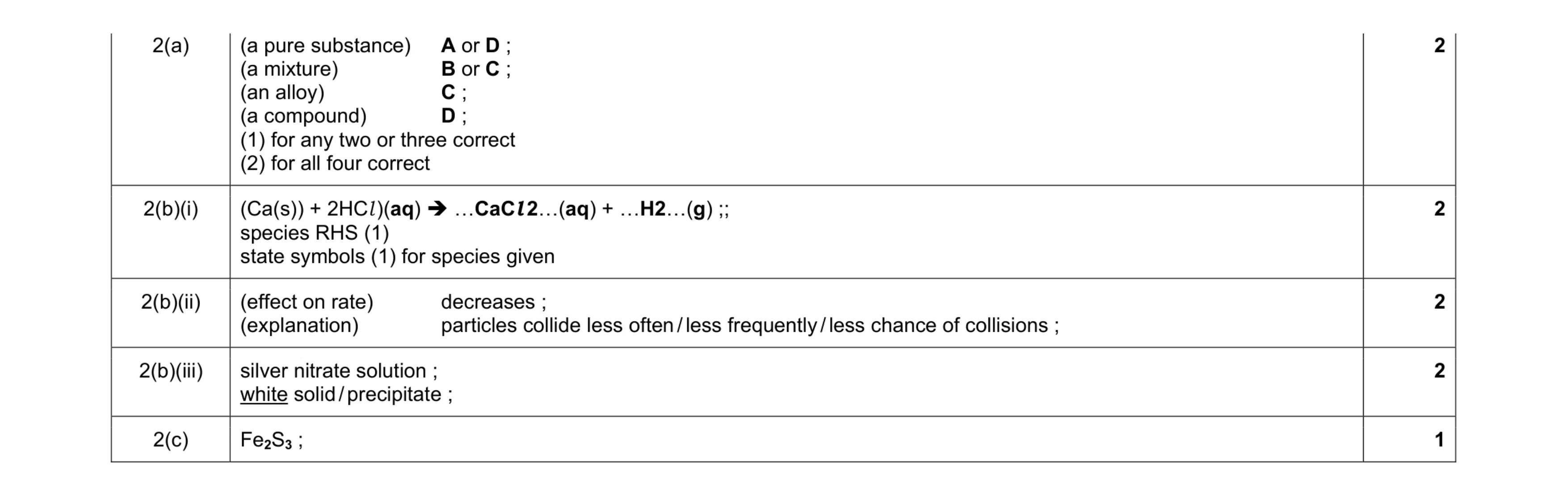 9
9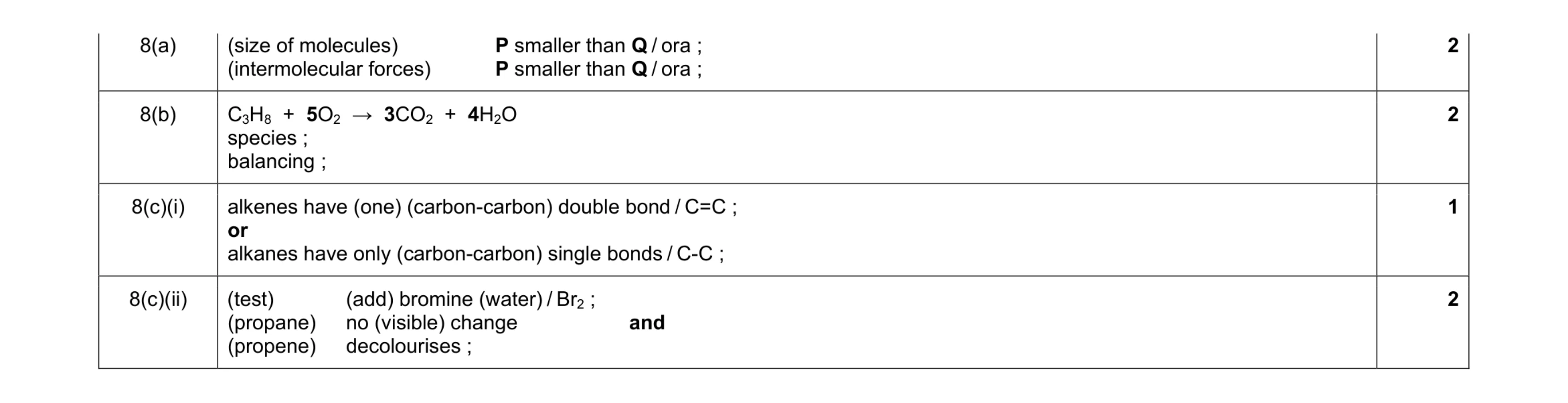 7
7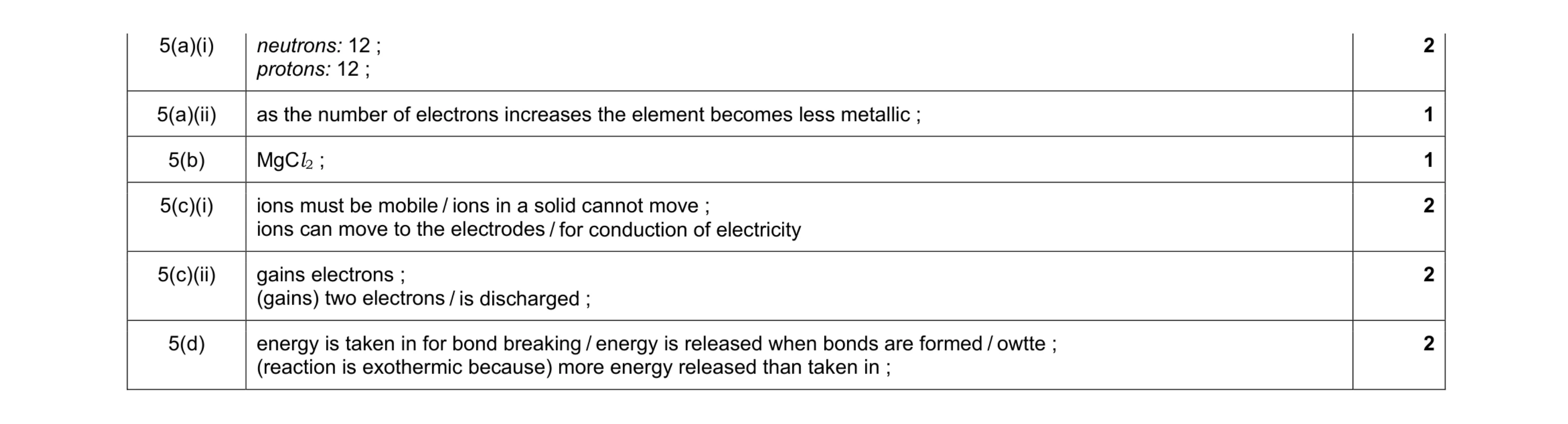 10
10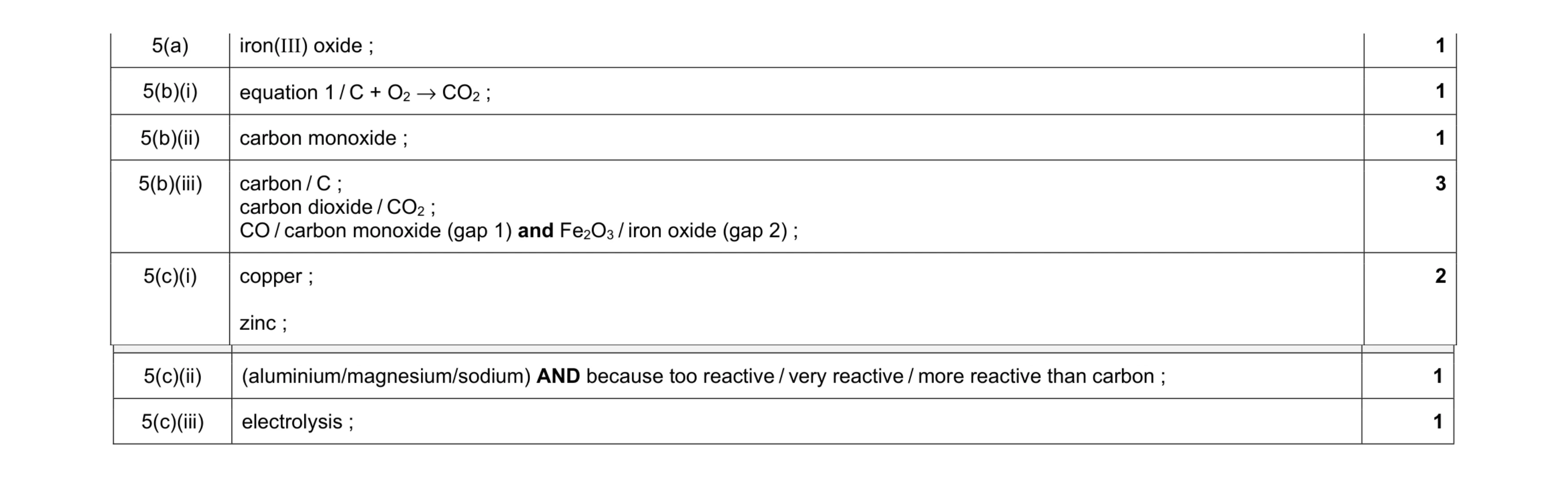 10
10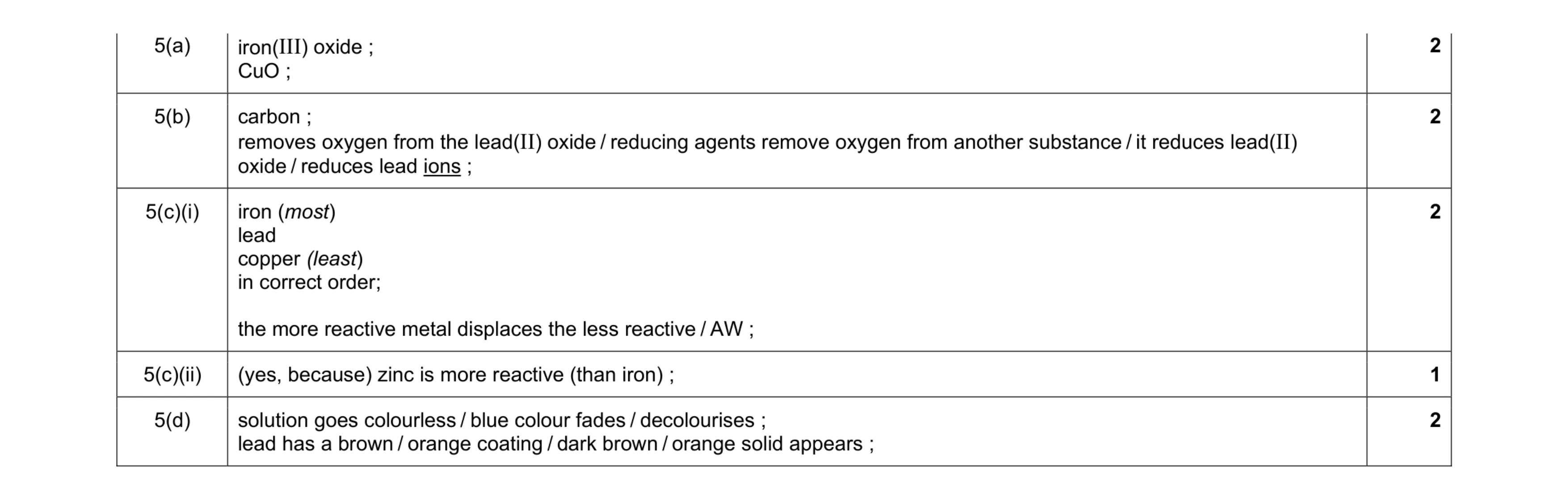 9
9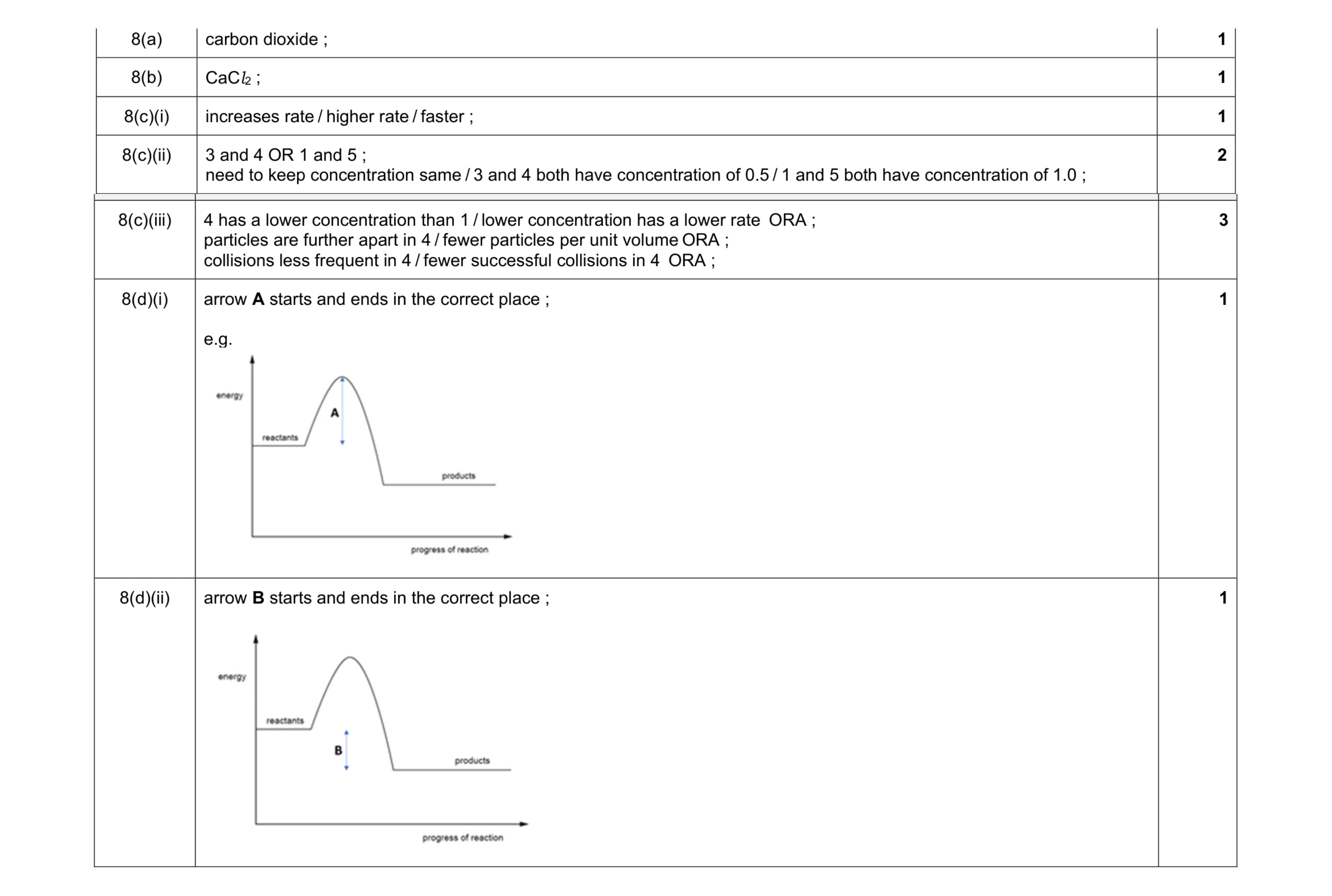 10
10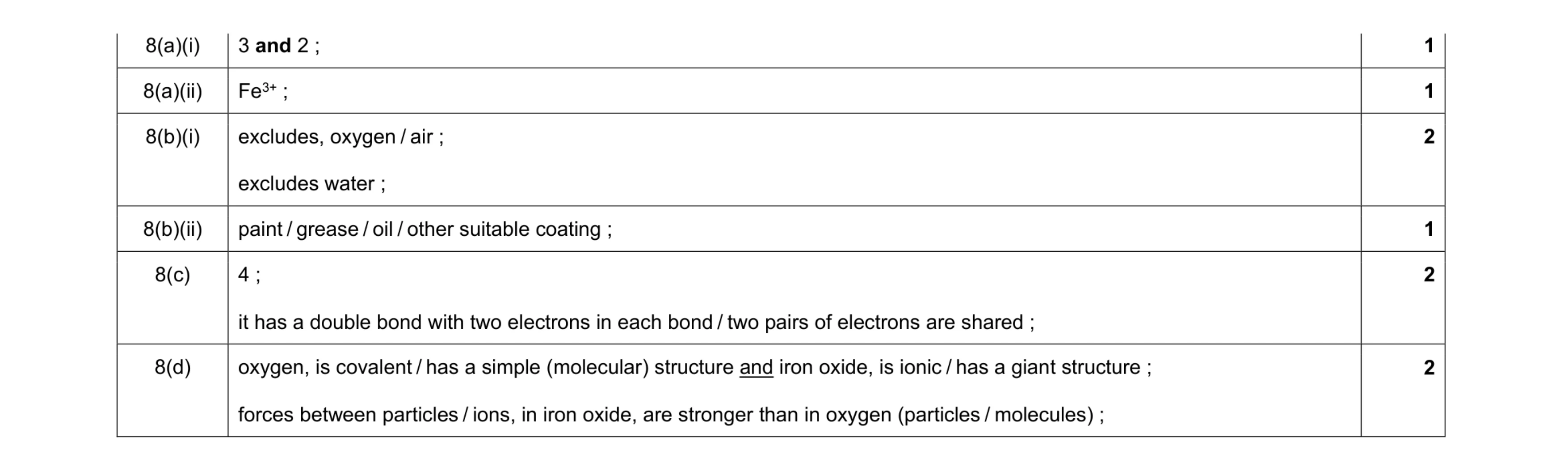 9
9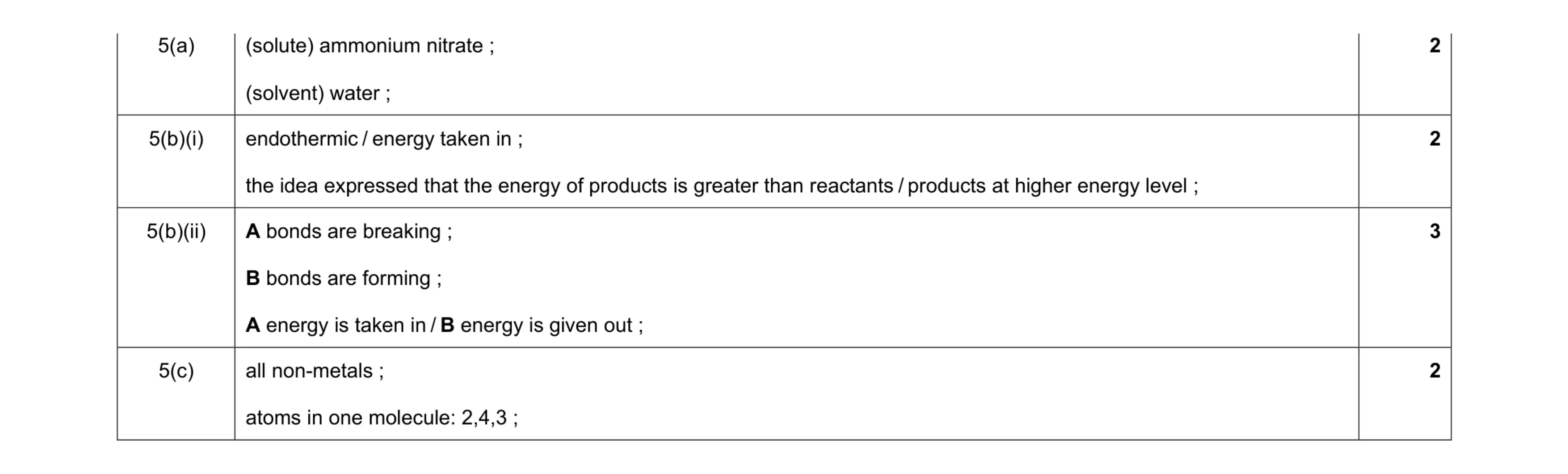 9
9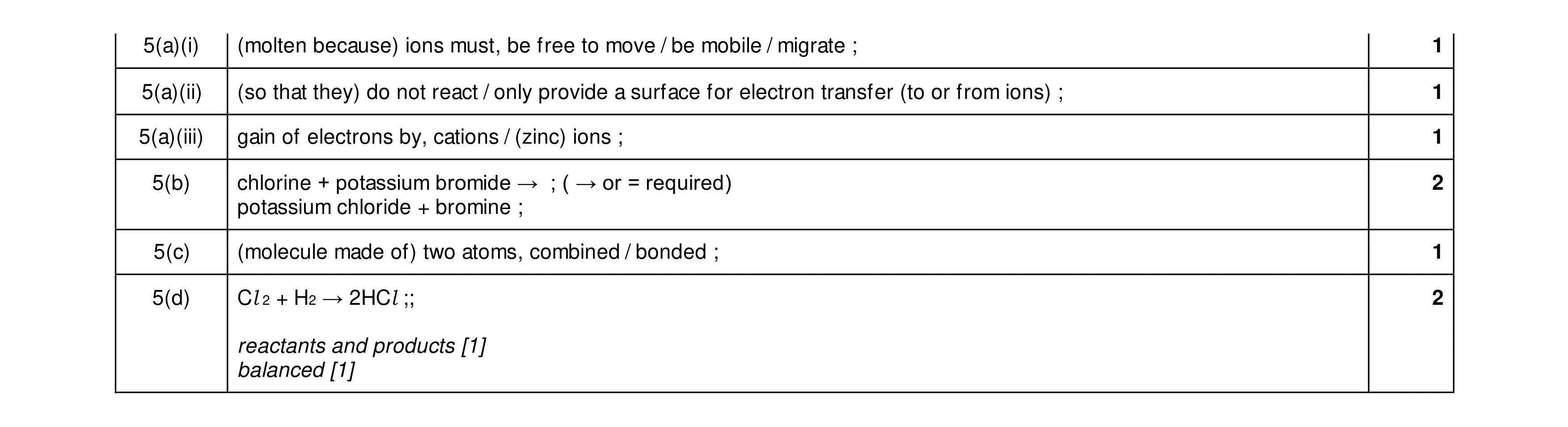 8
8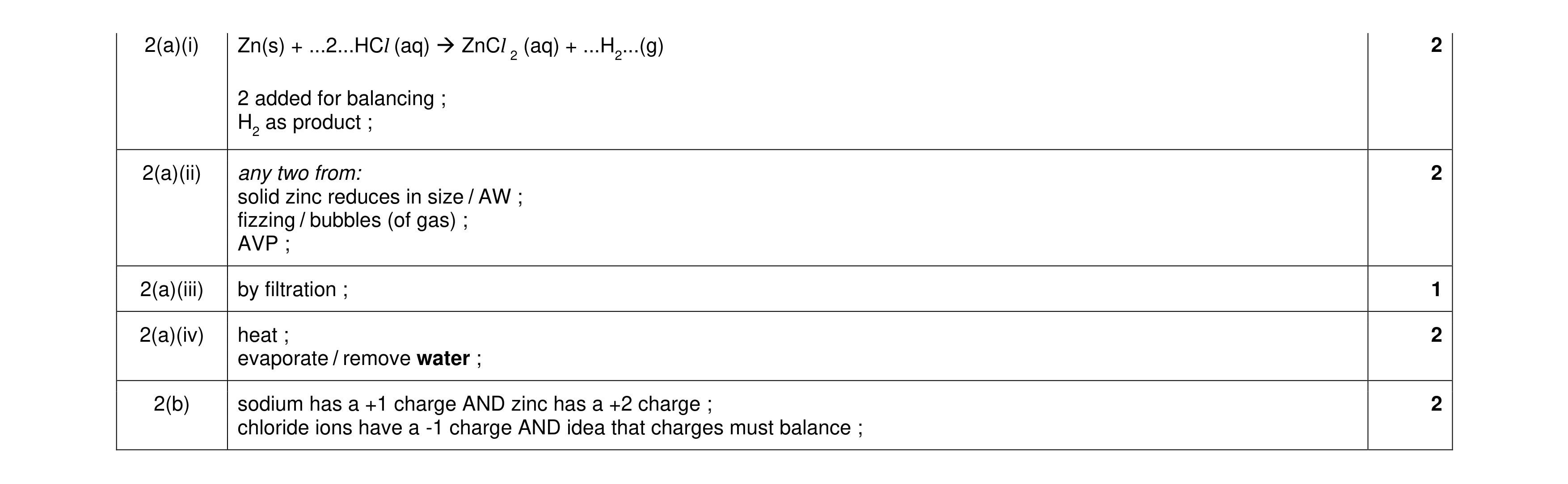 9
9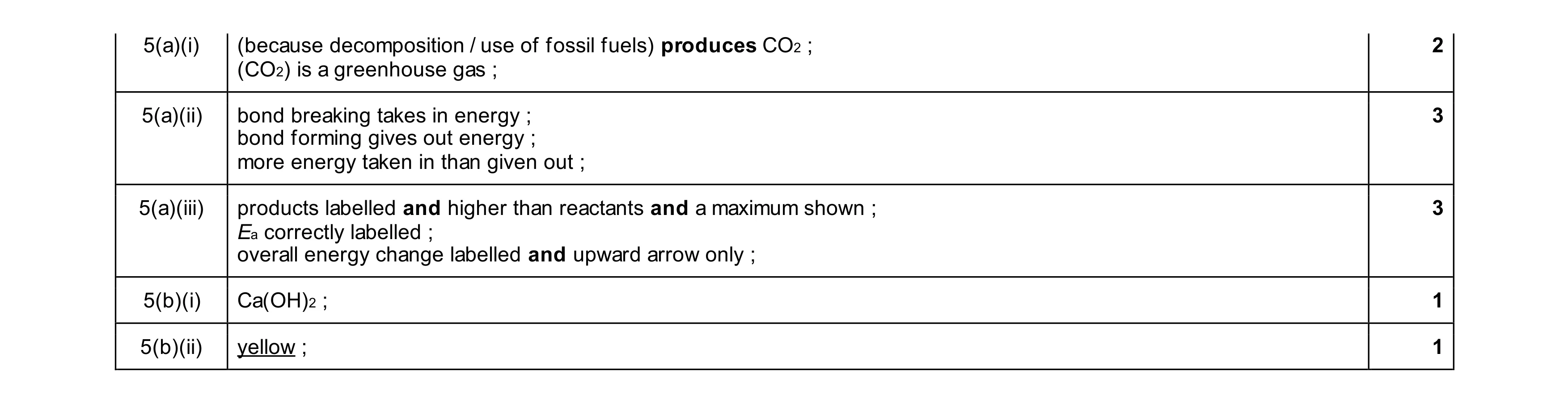 10
10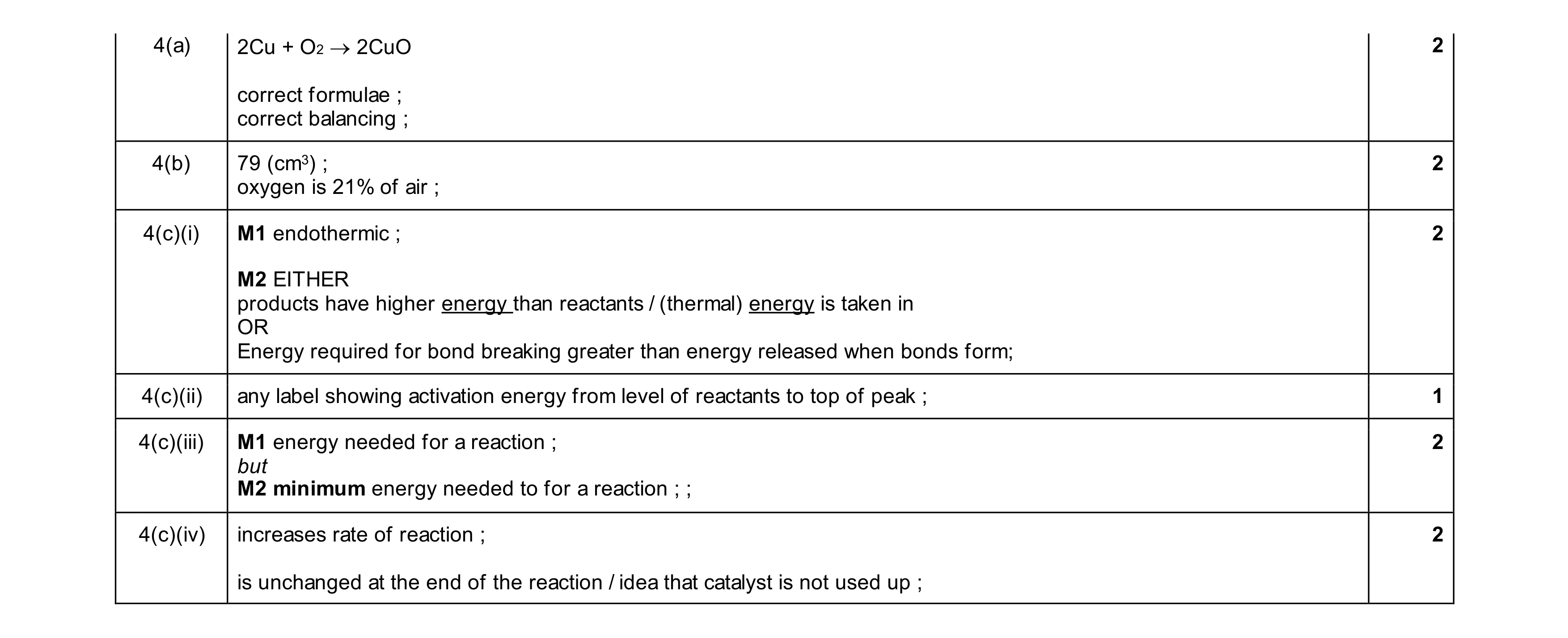 11
11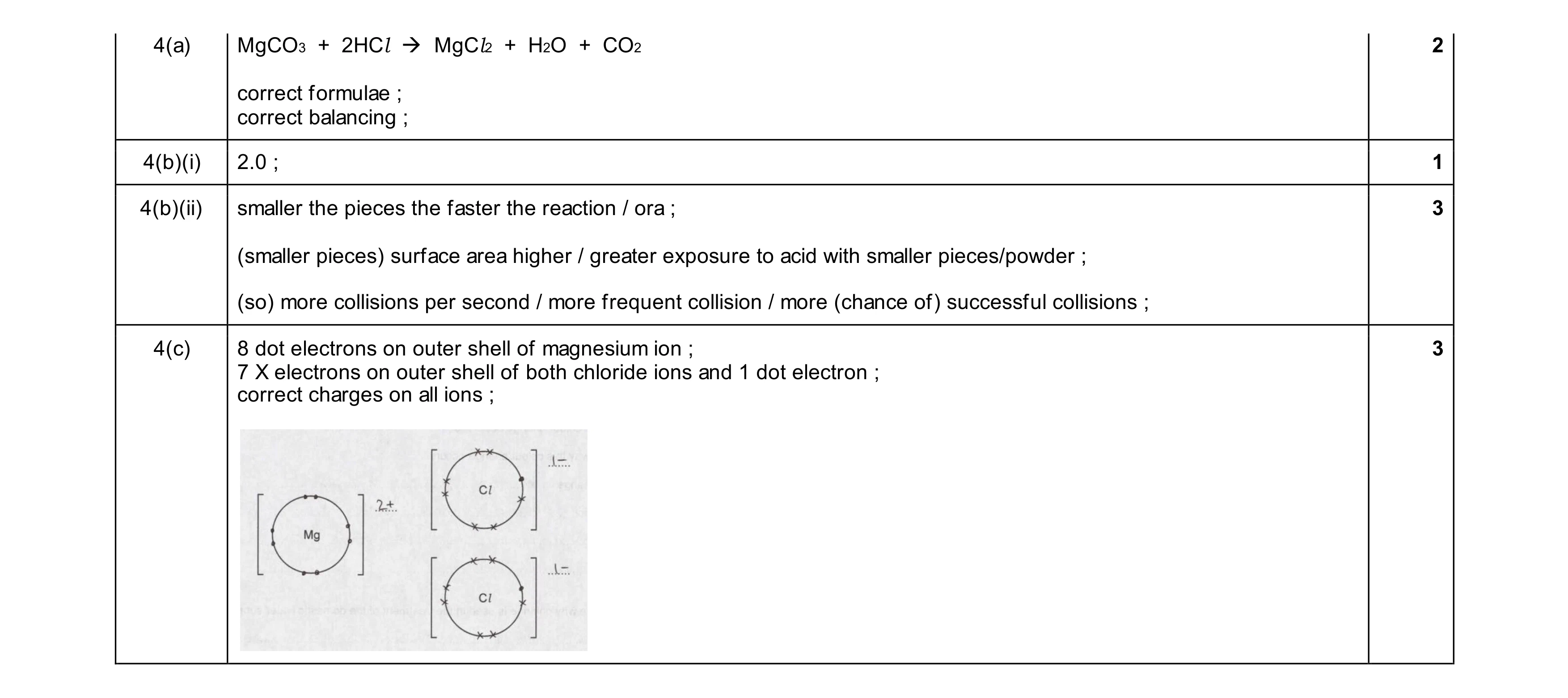 9
9