Questions as text
Q1 · The mass of some of the contents of three foods in a 100 gram sample of each food 0653/41 May/June 2017
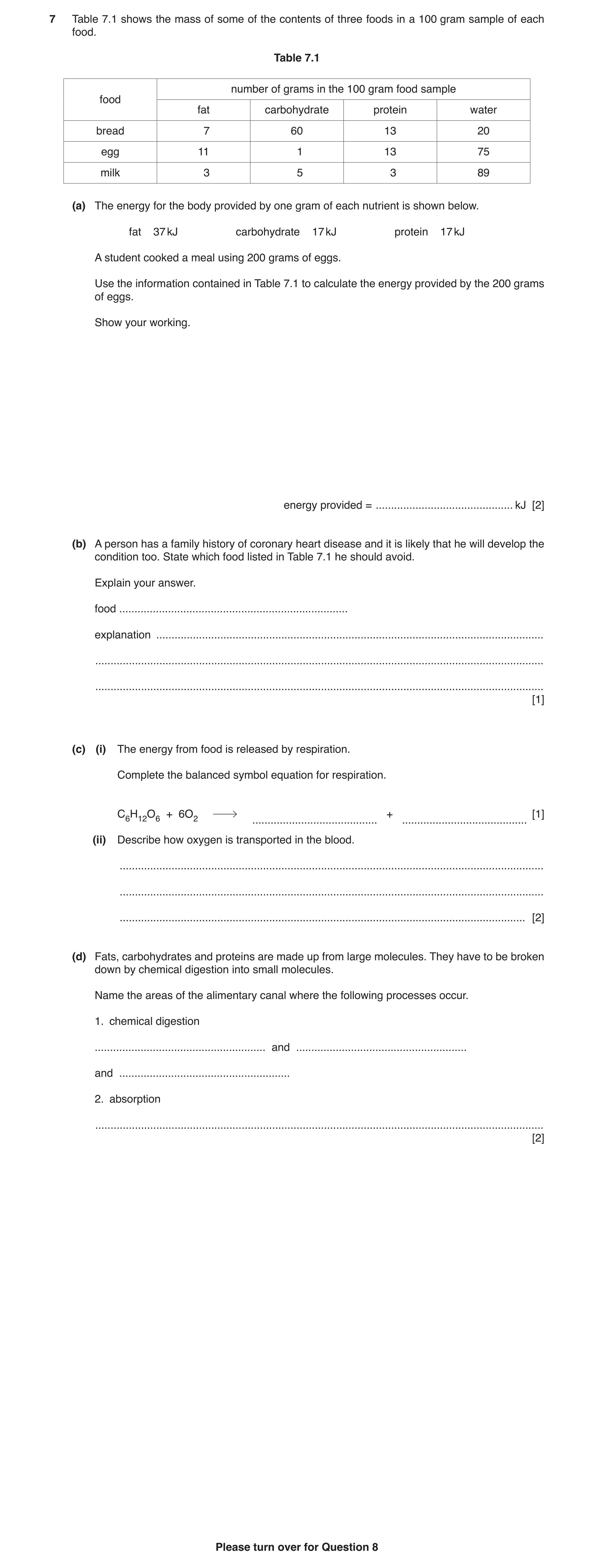
7 Table 7.1 shows the mass of some of the contents of three foods in a 100 gram sample of each food. Table 7.1 number of grams in the 100 gram food sample food fat carbohydrate protein water bread 7 60 13 20 egg 11 1 13 75 milk 3 5 3 89 (a) The energy for the body provided by one gram of each nutrient is shown below. fat 37 kJ carbohydrate 17 kJ protein 17 kJ A student cooked a meal using 200 grams of eggs. Use the information contained in Table 7.1 to calculate the energy provided by the 200 grams of eggs. Show your working. energy provided = … kJ [2] (b) A person has a family history of coronary heart disease and it is likely that he will develop the condition too. State which food listed in Table 7.1 he should avoid. Explain your answer. food … explanation … … … [1] (c) (i) The energy from food is released by respiration. Complete the balanced symbol equation for respiration. C6H12O6 + 6O2 + [1] … … (ii) Describe how oxygen is transported in the blood. … … … [2] (d) Fats, carbohydrates and proteins are made up from large molecules. They have to be broken down by chemical digestion into small molecules. Name the areas of the alimentary canal where the following processes occur. 1. chemical digestion … and … and … 2. absorption … [2] Please turn over for Question 8
8 marks
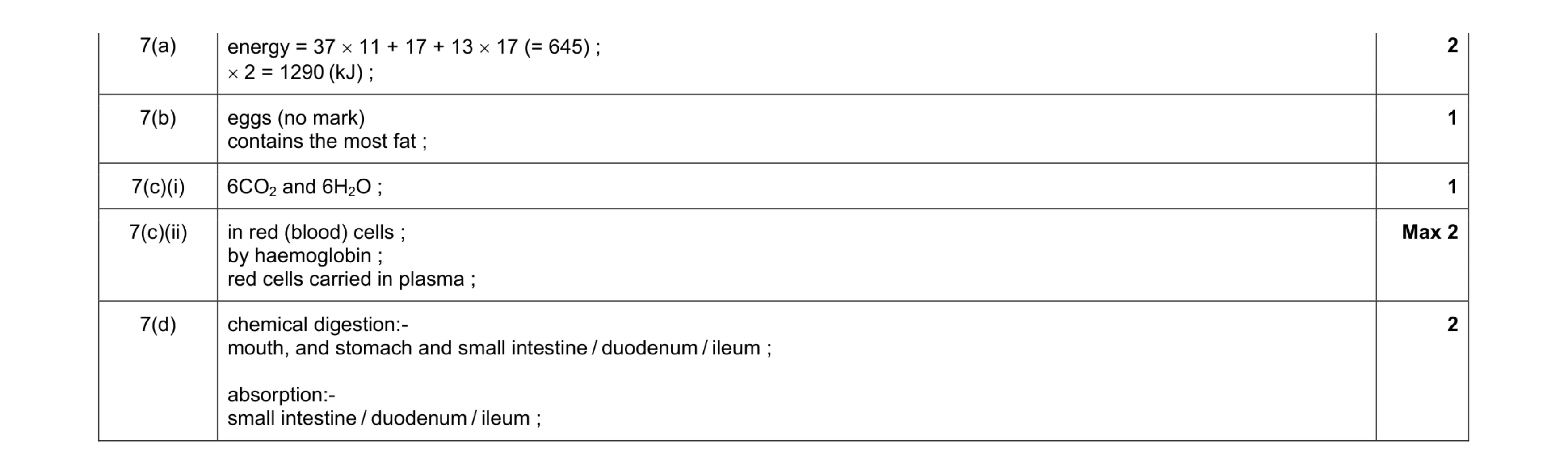
Mark scheme: 7(a) × 2 = 1290 (kJ) ; 2 7(b) eggs (no mark) contains the most fat ; 1 7(c)(i) 6CO2 and 6H2O ; 1 7(c)(ii) in red (blood) cells ; by haemoglobin ; red cells carried in plasma ; Max 2 7(d) chemical digestion:- mouth, and stomach and small intestine / duodenum / ileum ; absorption:- small intestine / duodenum / ileum ; 2
This question in 0653/41 May/June 2017
Q2 · Breast milk contains all the nutrients needed for a newborn baby 0653/42 Feb/March 2018
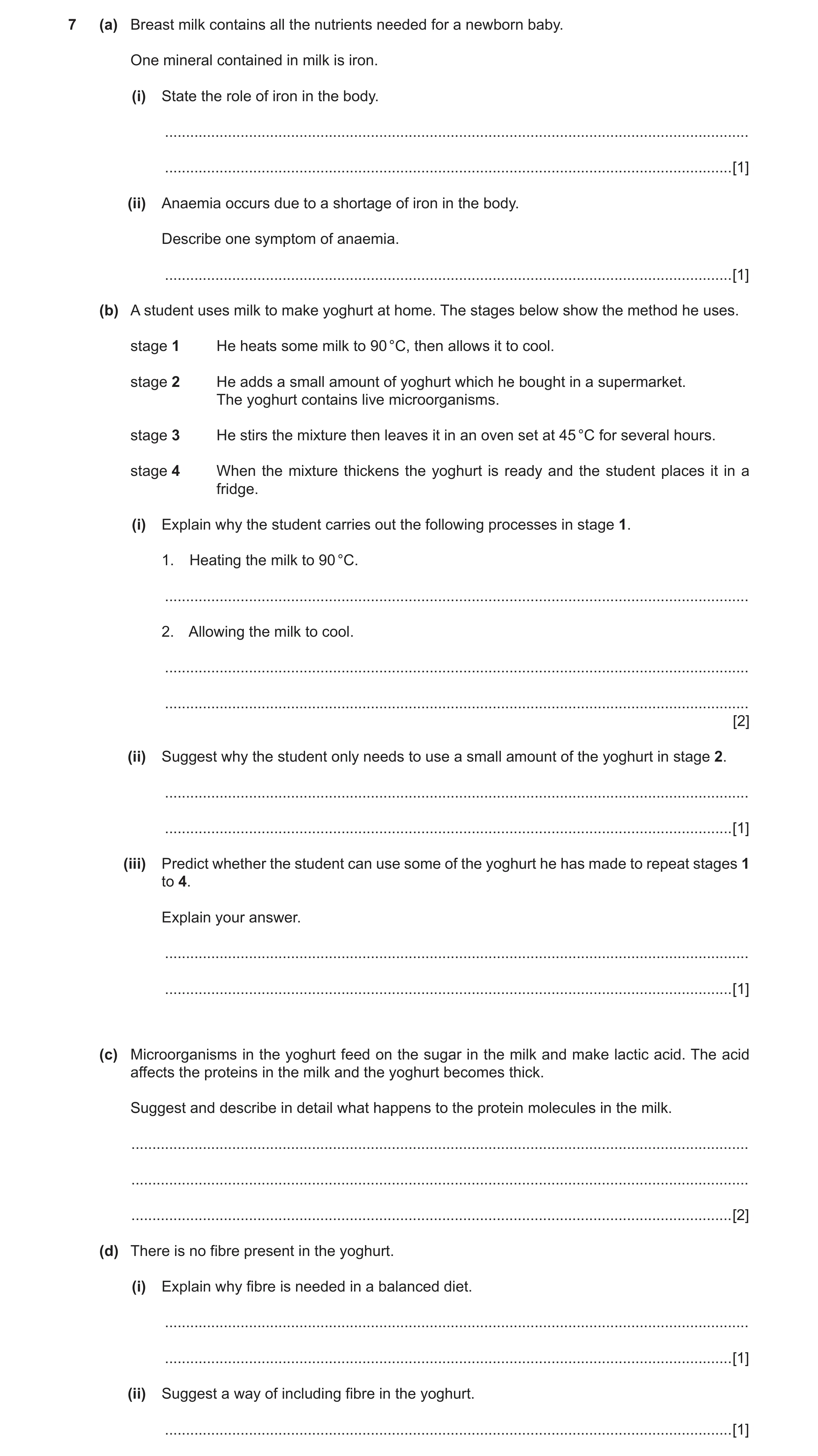
7 (a) Breast milk contains all the nutrients needed for a newborn baby. One mineral contained in milk is iron. (i) State the role of iron in the body. … … [1] (ii) Anaemia occurs due to a shortage of iron in the body. Describe one symptom of anaemia. … [1] (b) A student uses milk to make yoghurt at home. The stages below show the method he uses. stage 1 He heats some milk to 90 °C, then allows it to cool. stage 2 He adds a small amount of yoghurt which he bought in a supermarket. The yoghurt contains live microorganisms. stage 3 He stirs the mixture then leaves it in an oven set at 45 °C for several hours. stage 4 When the mixture thickens the yoghurt is ready and the student places it in a fridge. (i) Explain why the student carries out the following processes in stage 1. 1. Heating the milk to 90 °C. … 2. Allowing the milk to cool. … … [2] (ii) Suggest why the student only needs to use a small amount of the yoghurt in stage 2. … … [1] (iii) Predict whether the student can use some of the yoghurt he has made to repeat stages 1 to 4. Explain your answer. … … [1] (c) Microorganisms in the yoghurt feed on the sugar in the milk and make lactic acid. The acid affects the proteins in the milk and the yoghurt becomes thick. Suggest and describe in detail what happens to the protein molecules in the milk. … … … [2] (d) There is no fibre present in the yoghurt. (i) Explain why fibre is needed in a balanced diet. … … [1] (ii) Suggest a way of including fibre in the yoghurt. … [1]
10 marks
Mark scheme: 7(a)(i) making of / contained in haemoglobin ; 1 7(a)(ii) feel tired / dizzy / other correct symptoms ; 1 7(b)(i) 1 to pasteurise the milk / kill unwanted microbes ; 2 so that the microorganisms in the (added) yoghurt do not get killed ; 2 7(b)(ii) microorganisms will multiply in the milk ; 1 7(b)(iii) yes –no mark (student’s yoghurt) contains live organisms ; 1 7(c) the acid denatures / destroys the proteins in the milk ; the proteins lose their (3D) shape / owtte ; 2 7(d)(i) prevents constipation; 1 7(d)(ii) adding fruit ; 1
This question in 0653/42 Feb/March 2018
Q3 · Four substances found in food, and elements they may contain 0653/41 May/June 2018
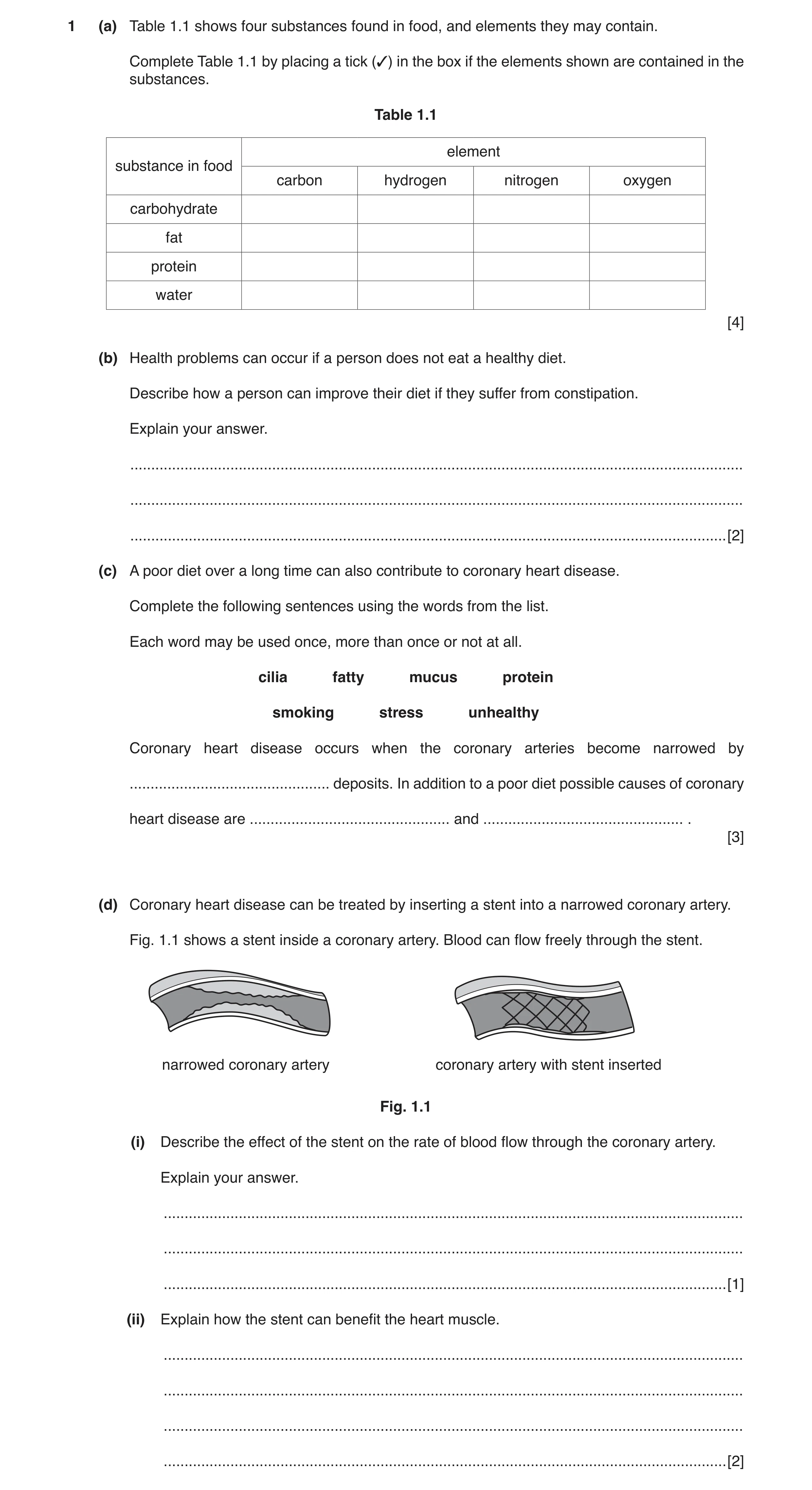
1 (a) Table 1.1 shows four substances found in food, and elements they may contain. Complete Table 1.1 by placing a tick (3) in the box if the elements shown are contained in the substances. Table 1.1 element substance in food carbon hydrogen nitrogen oxygen carbohydrate fat protein water [4] (b) Health problems can occur if a person does not eat a healthy diet. Describe how a person can improve their diet if they suffer from constipation. Explain your answer. … … … [2] (c) A poor diet over a long time can also contribute to coronary heart disease. Complete the following sentences using the words from the list. Each word may be used once, more than once or not at all. cilia fatty mucus protein smoking stress unhealthy Coronary heart disease occurs when the coronary arteries become narrowed by … deposits. In addition to a poor diet possible causes of coronary heart disease are … and … . [3] (d) Coronary heart disease can be treated by inserting a stent into a narrowed coronary artery. Fig. 1.1 shows a stent inside a coronary artery. Blood can flow freely through the stent. narrowed coronary artery coronary artery with stent inserted Fig. 1.1 (i) Describe the effect of the stent on the rate of blood flow through the coronary artery. Explain your answer. … … … [1] (ii) Explain how the stent can benefit the heart muscle. … … … … [2]
12 marks
Mark scheme: 1(a) substance in food element carbon hydrogen nitrogen oxygen carbohydrate 9 9 9 fat 9 9 9 protein 9 9 9 9 water 9 9 one mark for each correct row ;;;; 4 1(b) include more fibre / roughage / fruit / vegetables ; (fibre) helps to move food through digestive system ; 2 1(c) fatty ; (first space) smoking ; stress ; 3 1(d)(i) (increases blood flow) (because the artery is) wider / the idea of more space (for blood to pass through) ; 1 1(d)(ii) increases supply of glucose / oxygen (reaching the heart muscle) ; for respiration (in heart muscle cells) / to release energy (in muscle cells) / for contraction / action (of heart muscle) ; 2
This question in 0653/41 May/June 2018
Q4 · A food chain of some organisms in a garden 0653/42 Feb/March 2019
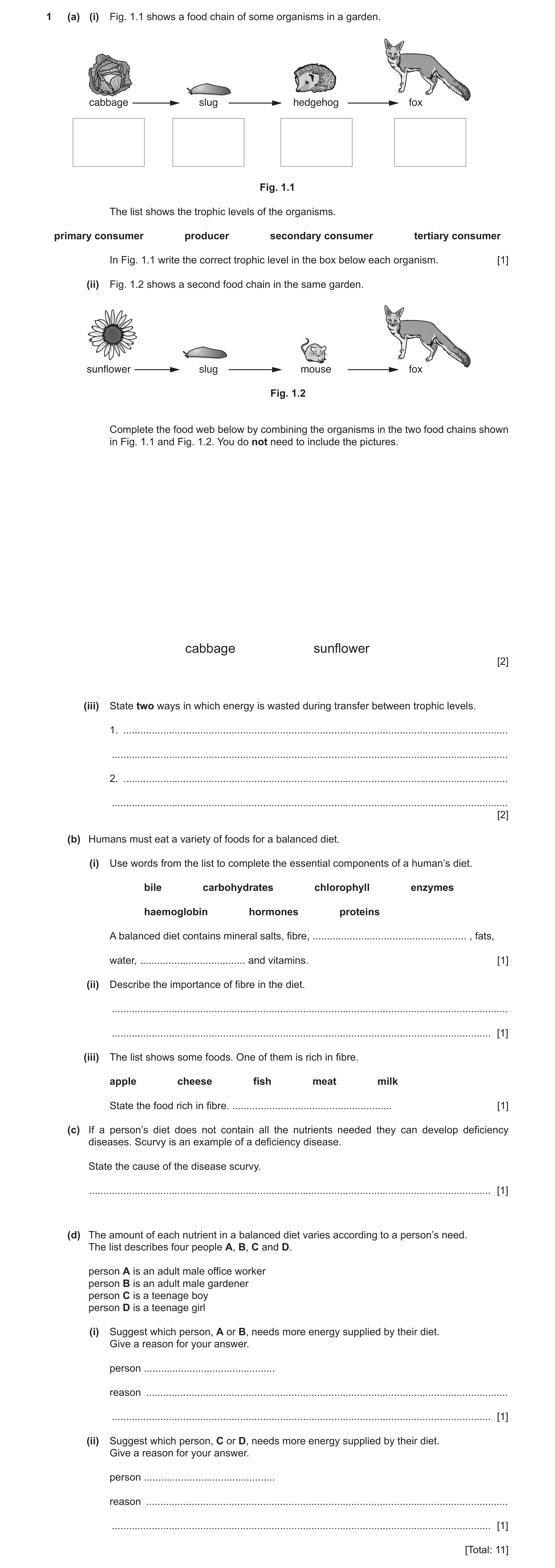
1 (a) (i) Fig. 1.1 shows a food chain of some organisms in a garden. cabbage slug hedgehog fox Fig. 1.1 The list shows the trophic levels of the organisms. primary consumer producer secondary consumer tertiary consumer In Fig. 1.1 write the correct trophic level in the box below each organism. [1] (ii) Fig. 1.2 shows a second food chain in the same garden. sunflower slug mouse fox Fig. 1.2 Complete the food web below by combining the organisms in the two food chains shown in Fig. 1.1 and Fig. 1.2. You do not need to include the pictures. cabbage sunflower [2] (iii) State two ways in which energy is wasted during transfer between trophic levels. 1. … … 2. … … [2] (b) Humans must eat a variety of foods for a balanced diet. (i) Use words from the list to complete the essential components of a human’s diet. bile carbohydrates chlorophyll enzymes haemoglobin hormones proteins A balanced diet contains mineral salts, fibre, … , fats, water, … and vitamins. [1] (ii) Describe the importance of fibre in the diet. … … [1] (iii) The list shows some foods. One of them is rich in fibre. apple cheese fish meat milk State the food rich in fibre. … [1] (c) If a person’s diet does not contain all the nutrients needed they can develop deficiency diseases. Scurvy is an example of a deficiency disease. State the cause of the disease scurvy. … [1] (d) The amount of each nutrient in a balanced diet varies according to a person’s need. The list describes four people A, B, C and D. person A is an adult male office worker person B is an adult male gardener person C is a teenage boy person D is a teenage girl (i) Suggest which person, A or B, needs more energy supplied by their diet. Give a reason for your answer. person … reason … … [1] (ii) Suggest which person, C or D, needs more energy supplied by their diet. Give a reason for your answer. person … reason … … [1] [Total: 11]
11 marks
Mark scheme: 1(a)(i) trophic levels in boxes in the order producer, primary consumer, secondary consumer, tertiary consumer ; 1 1(a)(ii) food web drawn as follows all organisms correct ; arrows pointing in the correct direction ; 2 1(a)(iii) any two from respiration / heat ; not all (prey) eaten ; not all (prey) digested / ref. to egestion (of faeces) ; excretion of waste products / urine ; max 2 1(b)(i) carbohydrates, proteins ; 1 1(b)(ii) prevents constipation / owtte ; 1 1(b)(iii) apple ; 1 1(c) lack of vitamin C ; 1 fox slug cabbage sunflower hedgehog mouse Question Answer Marks 1(d)(i) (person B) reference to a more active occupation ; 1 1(d)(ii) (person C) males need more energy than females ; 1
This question in 0653/42 Feb/March 2019
Q5 · A balanced diet for a person contains all nutrients in the correct amounts for their needs 0653/41 May/June 2019
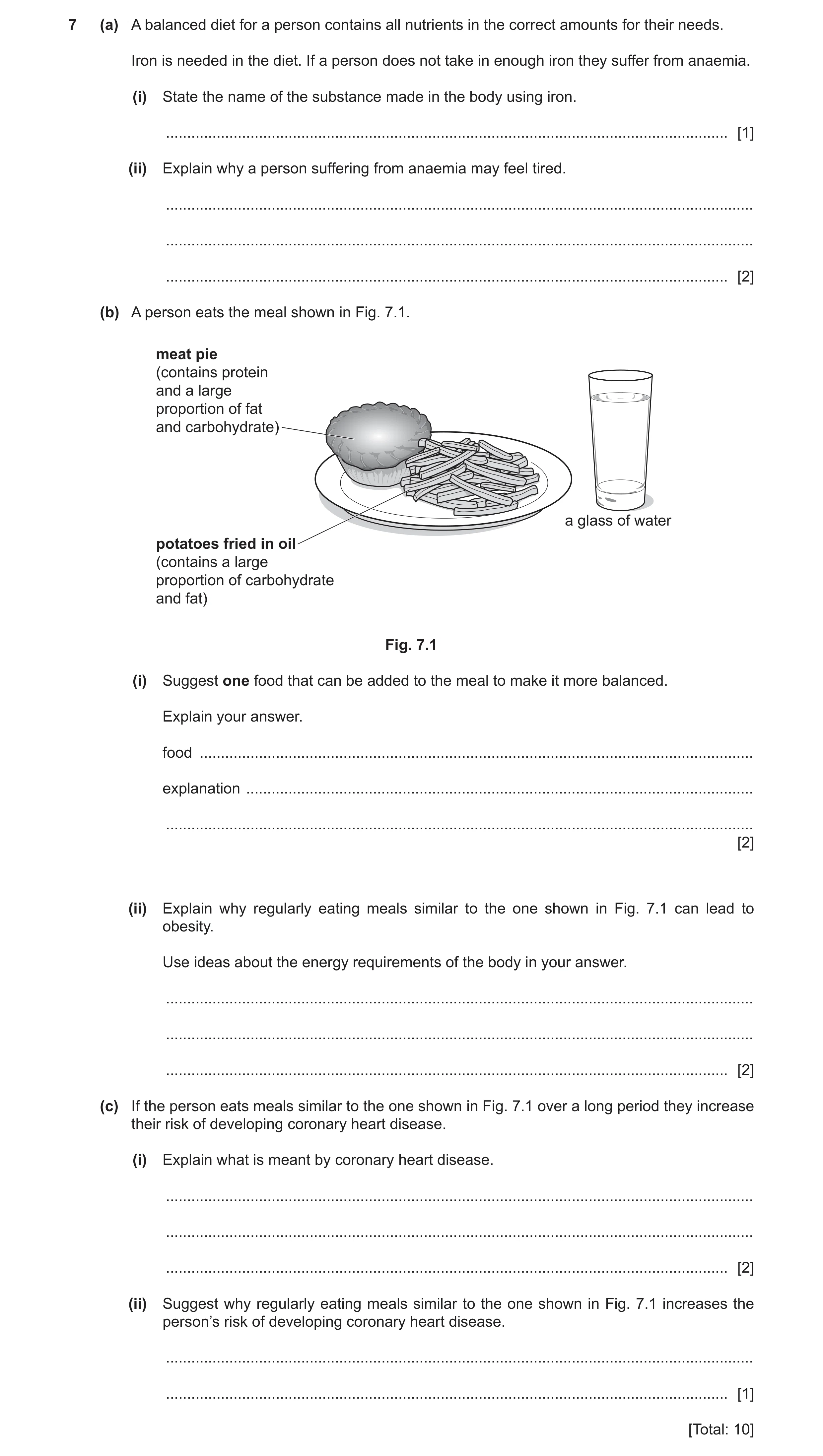
7 (a) A balanced diet for a person contains all nutrients in the correct amounts for their needs. Iron is needed in the diet. If a person does not take in enough iron they suffer from anaemia. (i) State the name of the substance made in the body using iron. … [1] (ii) Explain why a person suffering from anaemia may feel tired. … … … [2] (b) A person eats the meal shown in Fig. 7.1. meat pie (contains protein and a large proportion of fat and carbohydrate) a glass of water potatoes fried in oil (contains a large proportion of carbohydrate and fat) Fig. 7.1 (i) Suggest one food that can be added to the meal to make it more balanced. Explain your answer. food … explanation … … [2] (ii) Explain why regularly eating meals similar to the one shown in Fig. 7.1 can lead to obesity. Use ideas about the energy requirements of the body in your answer. … … … [2] (c) If the person eats meals similar to the one shown in Fig. 7.1 over a long period they increase their risk of developing coronary heart disease. (i) Explain what is meant by coronary heart disease. … … … [2] (ii) Suggest why regularly eating meals similar to the one shown in Fig. 7.1 increases the person’s risk of developing coronary heart disease. … … [1] [Total: 10]
10 marks
Mark scheme: 7(a)(i) haemoglobin ; 1 7(a)(ii) any two of not enough red blood cells / haemoglobin ; not enough oxygen taken to body / cells / muscles ; less (energy released by) respiration ; max 2 7(b)(i) fruit / vegetable / named example ; to add vitamins / minerals / fibre ; 2 7(b)(ii) energy taken in by body exceeds energy needed by body ; excess (energy) is stored as fat ; 2 7(c)(i) coronary arteries ; become blocked / narrowed ; 2 7(c)(ii) too much fat (contained in the food) ; 1
This question in 0653/41 May/June 2019
Q6 · A root hair cell and soil particles 0653/42 Oct/Nov 2019
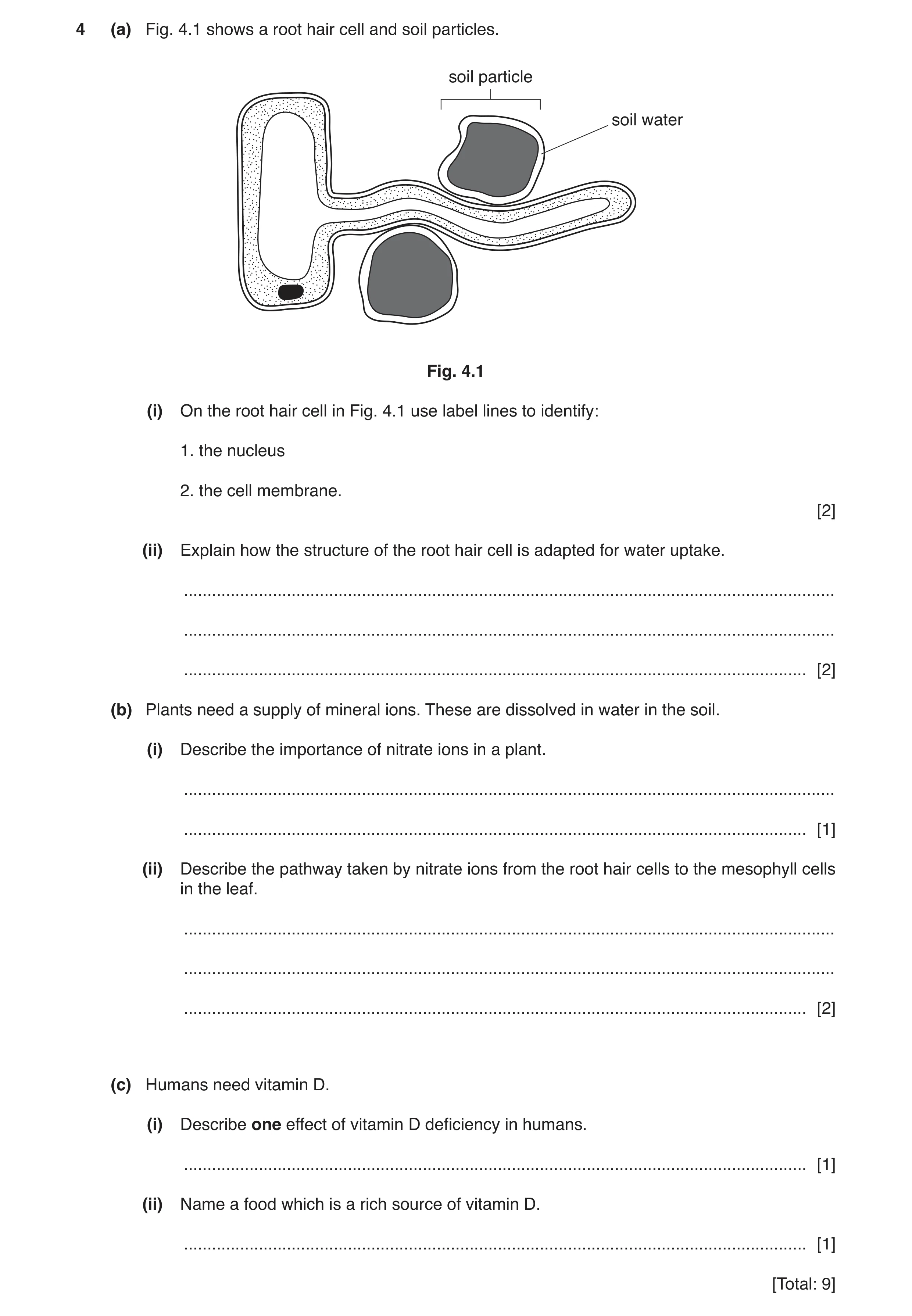
4 (a) Fig. 4.1 shows a root hair cell and soil particles. soil particle soil water Fig. 4.1 (i) On the root hair cell in Fig. 4.1 use label lines to identify: 1. the nucleus 2. the cell membrane. [2] (ii) Explain how the structure of the root hair cell is adapted for water uptake. … … … [2] (b) Plants need a supply of mineral ions. These are dissolved in water in the soil. (i) Describe the importance of nitrate ions in a plant. … … [1] (ii) Describe the pathway taken by nitrate ions from the root hair cells to the mesophyll cells in the leaf. … … … [2] (c) Humans need vitamin D. (i) Describe one effect of vitamin D deficiency in humans. … [1] (ii) Name a food which is a rich source of vitamin D. … [1] [Total: 9]
9 marks
Mark scheme: 4(a)(i) nucleus correctly labelled ; cell membrane correctly labelled ; 2 4(a)(ii) large surface area ; increases rate of water uptake ; 2 4(b)(i) needed to make amino acids ; 1 4(b)(ii) across root cortex ; up stem ; in xylem ; Max. 2 4(c)(i) rickets / soft (and deformed) bones ; 1 4(c)(ii) butter / margarine / egg (yolks) / milk ; 1
This question in 0653/42 Oct/Nov 2019
Q7 · Some pasta noodles and some vegetable noodles 0653/42 Oct/Nov 2020
1 Fig. 1.1 shows some pasta noodles and some vegetable noodles. pasta noodles vegetable noodles Fig. 1.1 Table 1.1 compares the nutrients and energy listed on a packet of each type of noodles. Table 1.1 typical value in 100 g of typical value in 100 g of nutrient pasta noodles vegetable noodles carbohydrate 31 g 6.2 g (fibre) (1.3 g) (2 g) protein 5.8 g 2.4 g fat 0.9 g 0.6 g calcium 7 mg 32 mg vitamin C 0 mg 36 mg iron 1.3 mg 0.7 mg energy content 664 kJ 143 kJ (a) Use the information in Table 1.1 to suggest why the vegetable noodles may be better than the pasta noodles at preventing scurvy. … … [1] (b) A doctor advises an obese person to eat vegetable noodles rather than pasta noodles. Use the information in Table 1.1 to explain why the doctor gives this advice. … … … … [2] (c) State one nutrient shown in Table 1.1 that must be broken down by chemical digestion before it can be used in the body. … [1] (d) Describe the importance of fibre in the diet. … … [1] (e) The word equation for aerobic respiration is shown. glucose + oxygen carbon dioxide + water (i) Describe how oxygen is transported by the blood. … … … [2] (ii) Explain the effect of exercise on the pattern of breathing. Refer to concentration of carbon dioxide in the blood in your answer. … … … … … [3] [Total: 10]
10 marks
Mark scheme: 1(a) (vegetable noodles) contain (more) vitamin C ; 1 1(b) (vegetable noodles) contain less energy ; excess energy would be stored as fat / owtte ; 2 1(c) carbohydrate / fat / protein ; 1 1(d) prevents constipation ; 1 1(e)(i) by haemoglobin ; in red blood cells ; 2 1(e)(ii) rate / depth of breathing increases ; (due to) increased carbon dioxide (concentration in the blood) ; (because), (rate of) respiration increases / CO2 is a product of respiration ; 3
This question in 0653/42 Oct/Nov 2020
Q8 · A balanced diet contains all the nutrients in the correct proportions to meet a person’s… 0653/43 Oct/Nov 2020
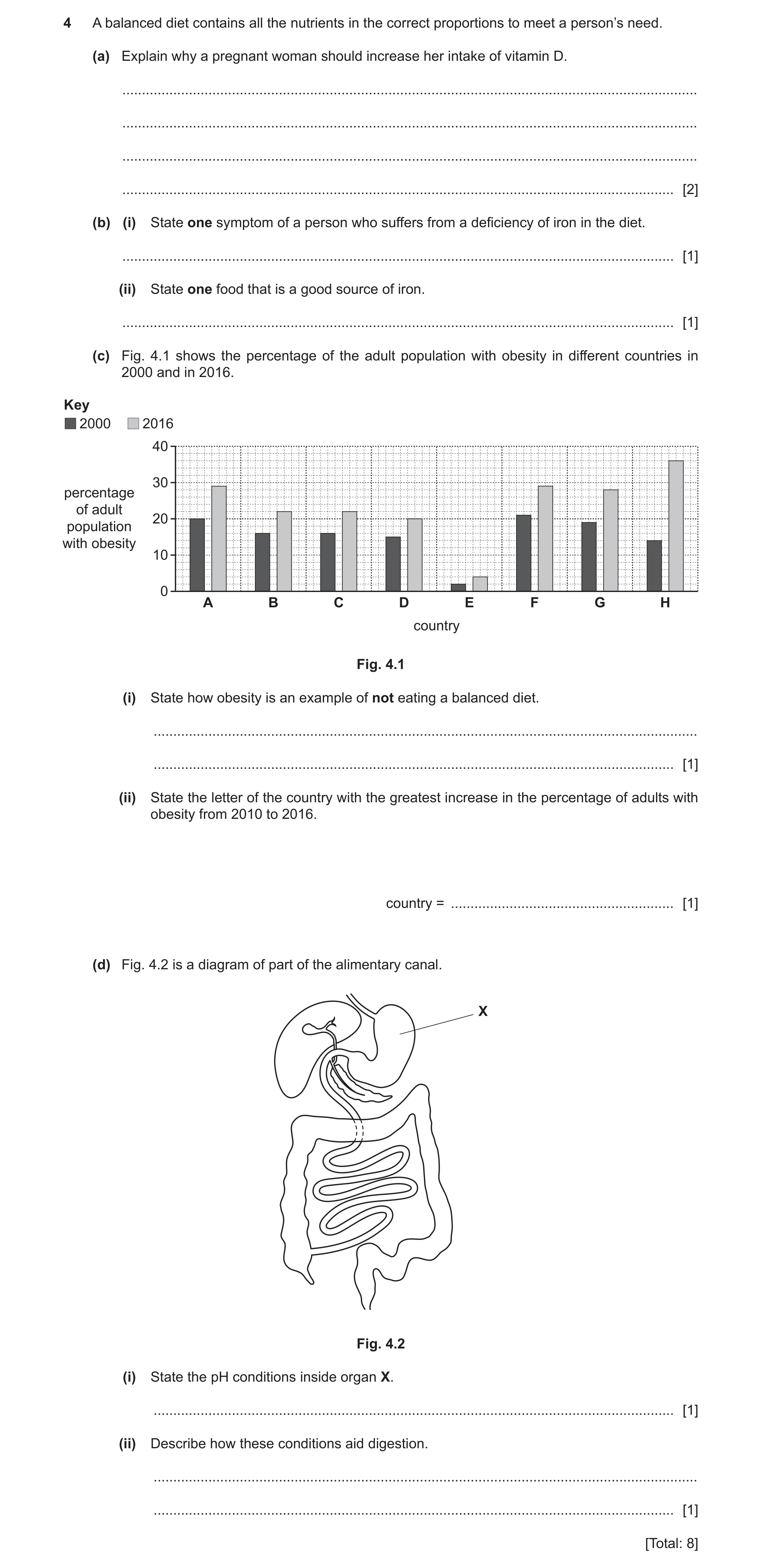
4 A balanced diet contains all the nutrients in the correct proportions to meet a person’s need. (a) Explain why a pregnant woman should increase her intake of vitamin D. … … … … [2] (b) (i) State one symptom of a person who suffers from a deficiency of iron in the diet. … [1] (ii) State one food that is a good source of iron. … [1] (c) Fig. 4.1 shows the percentage of the adult population with obesity in different countries in 2000 and in 2016. Key 2000 2016 40 30 percentage of adult 20 population with obesity 10 0 A B C D E F G H country Fig. 4.1 (i) State how obesity is an example of not eating a balanced diet. … … [1] (ii) State the letter of the country with the greatest increase in the percentage of adults with obesity from 2010 to 2016. country = … [1] (d) Fig. 4.2 is a diagram of part of the alimentary canal. X Fig. 4.2 (i) State the pH conditions inside organ X. … [1] (ii) Describe how these conditions aid digestion. … … [1] [Total: 8]
8 marks
Mark scheme: 4(a) any two from: for growth of bones (of the fetus) ; to, prevent soft bones / keep bones strong / prevent loss of calcium in mother’s bones ; to assist calcium absorption ; 2 4(b)(i) tiredness / feeling dizzy / pale complexion / anaemia ; 1 4(b)(ii) liver / red meat / green leafy vegetables ; 1 4(c)(i) the energy (in the food) taken in exceeds the energy needs of the person ; 1 4(c)(ii) country H ; 1 4(d)(i) acidic conditions / low pH ; 1 4(d)(ii) best pH for, pepsin / enzyme action in the stomach ; 1
This question in 0653/43 Oct/Nov 2020
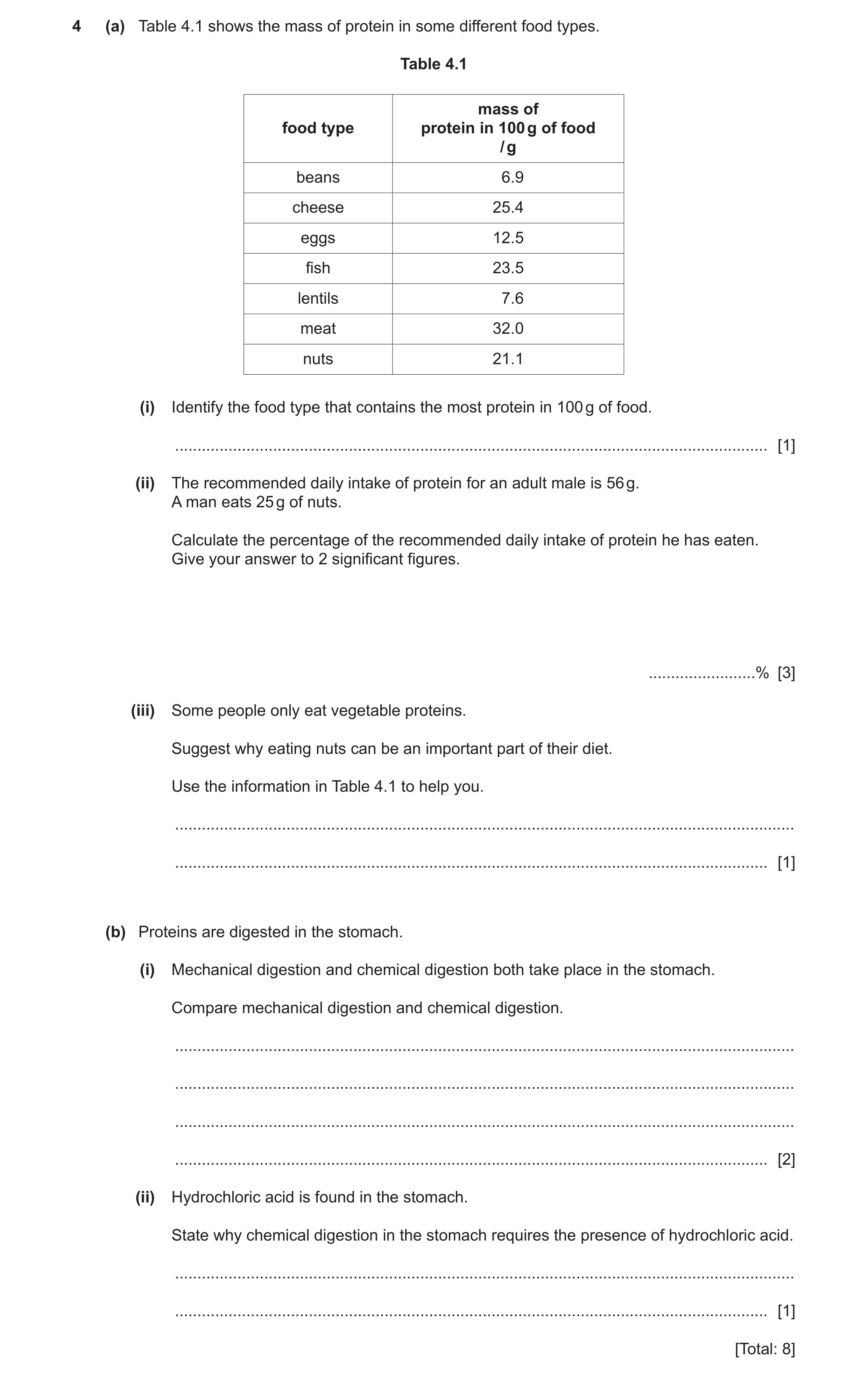
Q9 · The mass of protein in some different food types 0653/41 May/June 2021
4 (a) Table 4.1 shows the mass of protein in some different food types. Table 4.1 mass of food type protein in 100 g of food / g beans 6.9 cheese 25.4 eggs 12.5 fish 23.5 lentils 7.6 meat 32.0 nuts 21.1 (i) Identify the food type that contains the most protein in 100 g of food. … [1] (ii) The recommended daily intake of protein for an adult male is 56 g. A man eats 25 g of nuts. Calculate the percentage of the recommended daily intake of protein he has eaten. Give your answer to 2 significant figures. … % [3] (iii) Some people only eat vegetable proteins. Suggest why eating nuts can be an important part of their diet. Use the information in Table 4.1 to help you. … … [1] (b) Proteins are digested in the stomach. (i) Mechanical digestion and chemical digestion both take place in the stomach. Compare mechanical digestion and chemical digestion. … … … … [2] (ii) Hydrochloric acid is found in the stomach. State why chemical digestion in the stomach requires the presence of hydrochloric acid. … … [1] [Total: 8]
8 marks
Mark scheme: 4(a)(i) meat ; 1 4(a)(ii) 9.4 / 9.5(%) ;;; MP1 21.1 ÷ 4 / = 5.275 / 5.3 ; MP2 (5.275 ÷ 56) × 100 / = 9.42 OR (5.3 ÷ 56) × 100 / = 9.46 ; MP3 answer given as two significant figures 9.4 or 9.5 % ; 3 4(a)(iii) higher in protein than, the other vegetable based proteins / beans / lentils OWTTE ; 1 4(b)(i) any two from: both types break down, food / protein ; the idea that mechanical digestion results in smaller pieces (of food) AND idea that chemical digestion results in smaller molecules ; chemical digestion involves enzymes / mechanical digestion does not use enzymes ; chemical digestion produces soluble molecules / mechanical digestion may not result in soluble molecules ; 2 4(b)(ii) (provides an acidic pH) for enzymes / for enzymes to work ; 1
This question in 0653/41 May/June 2021
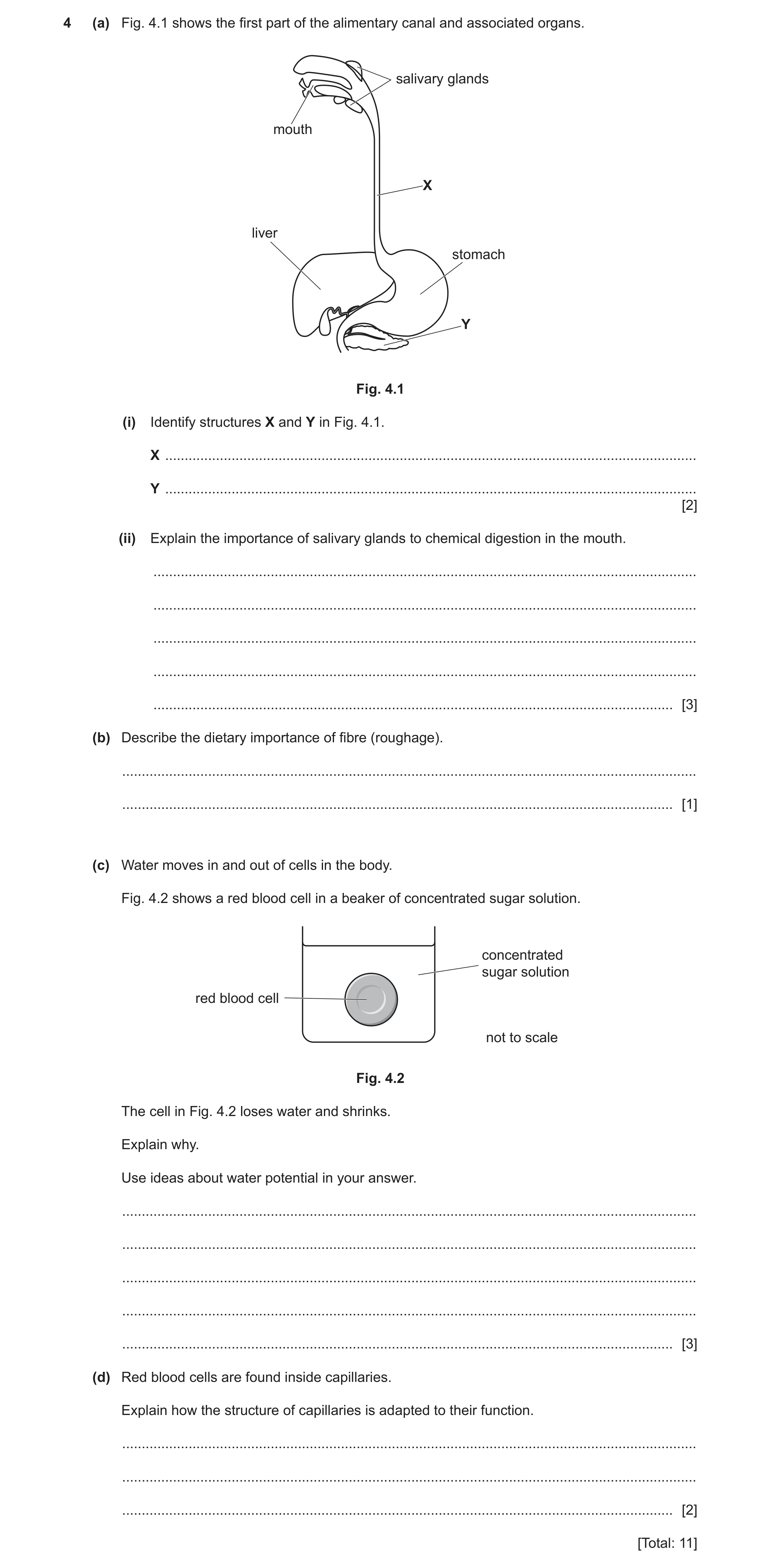
Q10 · The first part of the alimentary canal and associated organs 0653/42 Feb/March 2022
4 (a) Fig. 4.1 shows the first part of the alimentary canal and associated organs. salivary glands mouth X liver stomach Y Fig. 4.1 (i) Identify structures X and Y in Fig. 4.1. X … Y … [2] (ii) Explain the importance of salivary glands to chemical digestion in the mouth. … … … … … [3] (b) Describe the dietary importance of fibre (roughage). … … [1] (c) Water moves in and out of cells in the body. Fig. 4.2 shows a red blood cell in a beaker of concentrated sugar solution. concentrated sugar solution red blood cell not to scale Fig. 4.2 The cell in Fig. 4.2 loses water and shrinks. Explain why. Use ideas about water potential in your answer. … … … … … [3] (d) Red blood cells are found inside capillaries. Explain how the structure of capillaries is adapted to their function. … … … [2] [Total: 11]
11 marks
Mark scheme: 4(a)(i) X – oesophagus ; Y – pancreas ; 2 4(a)(ii) produce / secrete, amylase ; digest starch ; to produce, simpler sugars / glucose ; 3 4(b) prevents constipation ; 1 4(c) water moves from higher to lower water potential ; through a partially permeable membrane ; (by the process of) osmosis ; 3 4(d) thin wall / wall one cell thick ; allow (efficient) exchange of substances ; 2
This question in 0653/42 Feb/March 2022
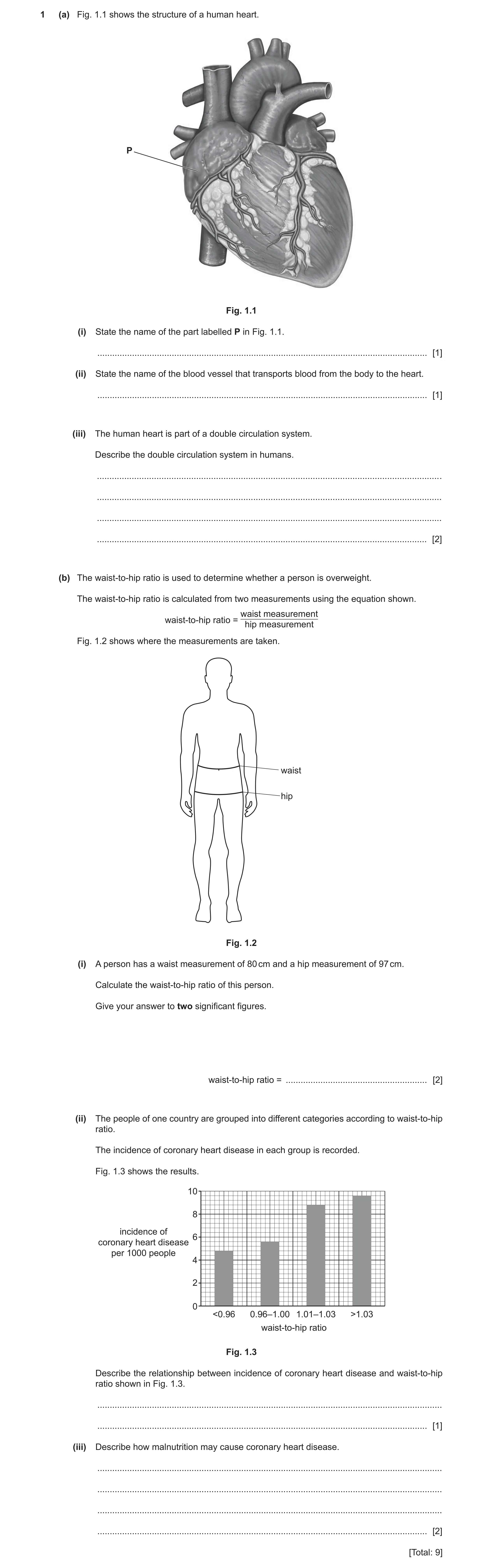
Q11 · The structure of a human heart 0653/41 Oct/Nov 2022
1 (a) Fig. 1.1 shows the structure of a human heart. P Fig. 1.1 (i) State the name of the part labelled P in Fig. 1.1. … [1] (ii) State the name of the blood vessel that transports blood from the body to the heart. … [1] (iii) The human heart is part of a double circulation system. Describe the double circulation system in humans. … … … … [2] (b) The waist-to-hip ratio is used to determine whether a person is overweight. The waist-to-hip ratio is calculated from two measurements using the equation shown. waist measurement waist-to-hip ratio = hip measurement Fig. 1.2 shows where the measurements are taken. waist hip Fig. 1.2 (i) A person has a waist measurement of 80 cm and a hip measurement of 97 cm. Calculate the waist-to-hip ratio of this person. Give your answer to two significant figures. waist-to-hip ratio = … [2] (ii) The people of one country are grouped into different categories according to waist-to-hip ratio. The incidence of coronary heart disease in each group is recorded. Fig. 1.3 shows the results. 10 8 incidence of 6 coronary heart disease per 1000 people 4 2 0 <0.96 0.96–1.00 1.01–1.03 >1.03 waist-to-hip ratio Fig. 1.3 Describe the relationship between incidence of coronary heart disease and waist-to-hip ratio shown in Fig. 1.3. … … [1] (iii) Describe how malnutrition may cause coronary heart disease. … … … … [2] [Total: 9]
9 marks
Mark scheme: Question Answer Marks 1(a)(i) (right) atrium ; 1 1(a)(ii) vena cava ; 1 1(a)(iii) any two from: 2 blood passes through the heart twice (in one circuit of the body) ; the idea that one circulation is to lungs ; the idea that one circulation is to the body (tissues) ; 1(b)(i) 80 ÷ 97 / 0.824742268 ; 2 0.82 ; 1(b)(ii) (incidence of) coronary heart disease increases with increased waist-to-hip ratio ; 1 1(b)(iii) high fat diet / obesity ; 2 causes blockage of coronary artery ;
This question in 0653/41 Oct/Nov 2022
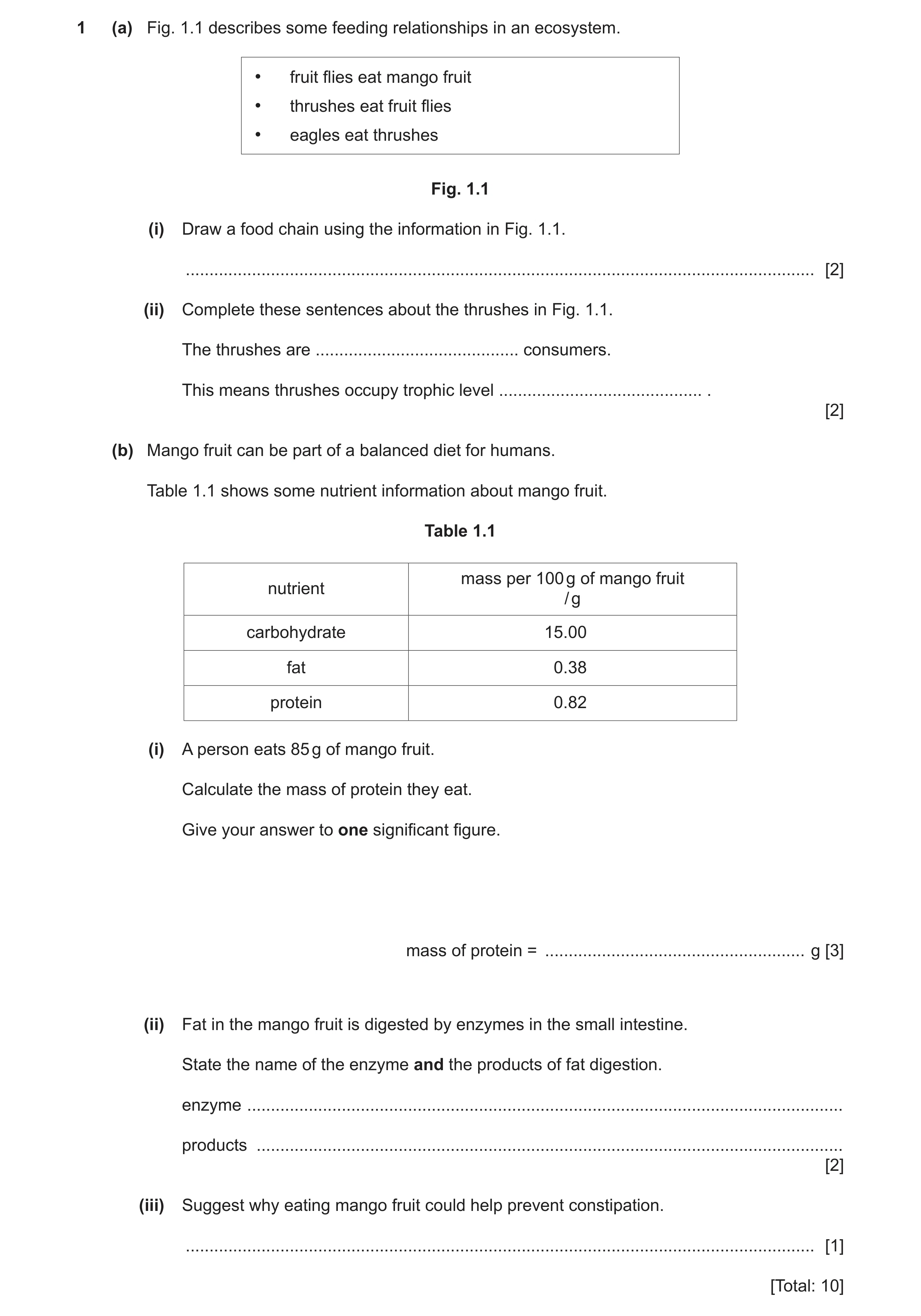
Question 12 0653/42 May/June 2023
1 (a) Fig. 1.1 describes some feeding relationships in an ecosystem. • fruit flies eat mango fruit • thrushes eat fruit flies • eagles eat thrushes Fig. 1.1 (i) Draw a food chain using the information in Fig. 1.1. … [2] (ii) Complete these sentences about the thrushes in Fig. 1.1. The thrushes are … consumers. This means thrushes occupy trophic level … . [2] (b) Mango fruit can be part of a balanced diet for humans. Table 1.1 shows some nutrient information about mango fruit. Table 1.1 mass per 100 g of mango fruit nutrient / g carbohydrate 15.00 fat 0.38 protein 0.82 (i) A person eats 85 g of mango fruit. Calculate the mass of protein they eat. Give your answer to one significant figure. mass of protein = … g [3] (ii) Fat in the mango fruit is digested by enzymes in the small intestine. State the name of the enzyme and the products of fat digestion. enzyme … products … [2] (iii) Suggest why eating mango fruit could help prevent constipation. … [1] [Total: 10]
10 marks
Mark scheme: 1(a)(i) mango (fruit) (fruit) flies thrushes eagle ;; correct order = one mark arrows in correct direction = one mark 2 1(a)(ii) secondary ; three ; 2 1(b)(i) 0.82 85 ; 100 0.697 ; 0.7 ; 3 1(b)(ii) lipase ; fatty acids and glycerol ; 2 1(b)(iii) contains fibre ; 1
This question in 0653/42 May/June 2023
Q13 · A model of the alimentary canal and associated organs of humans 0653/43 May/June 2024
4 (a) Fig. 4.1 shows a model of the alimentary canal and associated organs of humans. The model is viewed from the back. stomach Fig. 4.1 (i) On Fig. 4.1, draw a label line and the letter P to identify the pancreas. [1] (ii) Amylase is an enzyme in the alimentary canal. Explain why amylase does not break down proteins. … … … [2] (iii) State the name of the product when proteins are digested. … [1] (b) Vitamins and minerals are absorbed into blood capillaries in the alimentary canal. (i) A diet that lacks vitamin D is a cause of vitamin D deficiency in humans. State one other cause of vitamin D deficiency in humans. … [1] (ii) Describe one effect of vitamin D deficiency in humans. … [1] (iii) Explain how capillaries are adapted to their function. … … … [2] [Total: 8]
8 marks
Mark scheme: 4(a)(i) pancreas labelled ; 1 4(a)(ii) amylase breaks down or digests, starch / carbohydrate, or amylase has an active site complementary to starch ; protein (shape), is not complementary to / will not fit active site ; 2 4(a)(iii) amino acids ; 1 4(b)(i) lack of sunlight ; 1 4(b)(ii) soft, bones / teeth ; 1 4(b)(iii) thin walls / permeable walls / short diffusion distance ; to allow exchange of material / to allow substances to, diffuse / pass through the walls (between cells and blood) ; 2
This question in 0653/43 May/June 2024
 10 / 22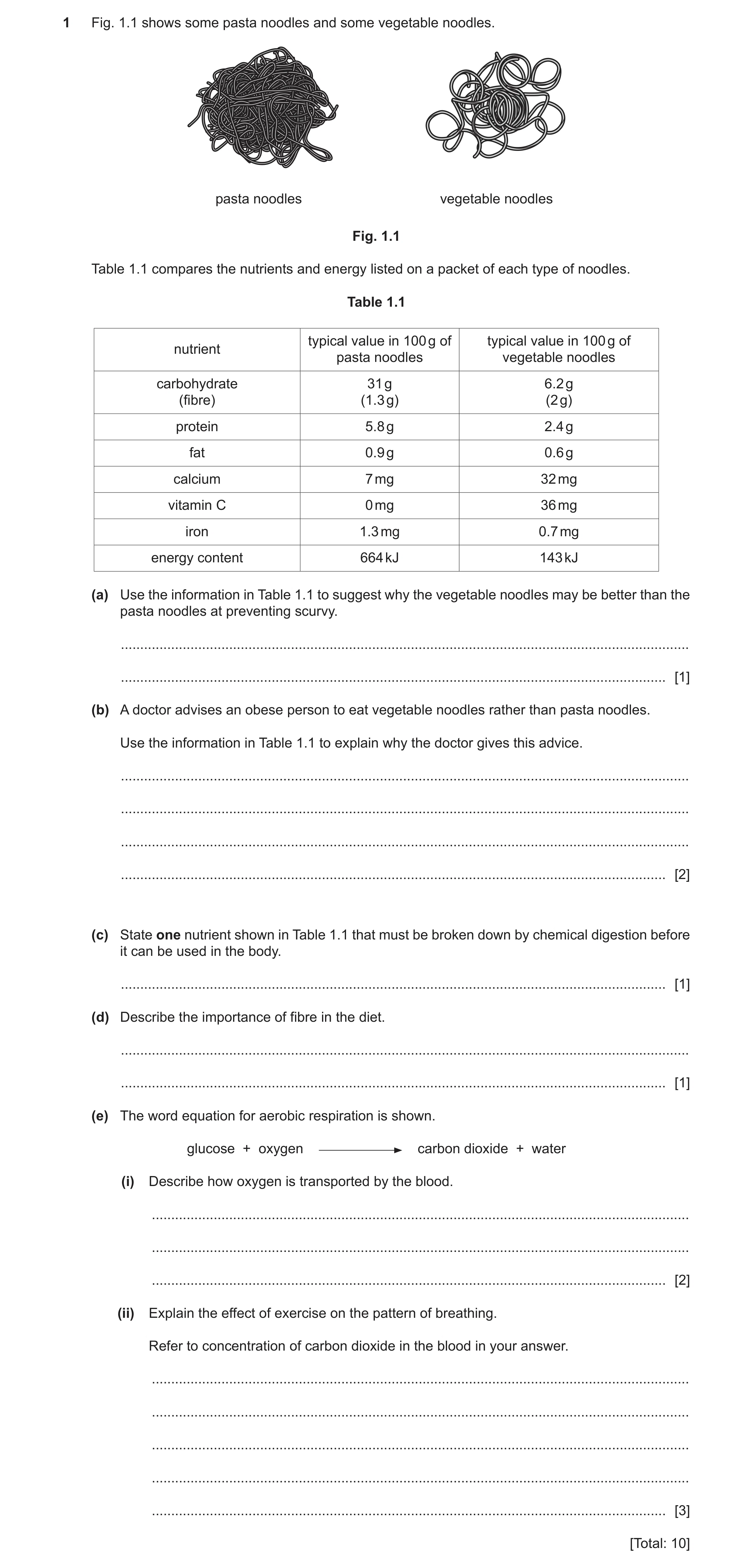
 20 / 22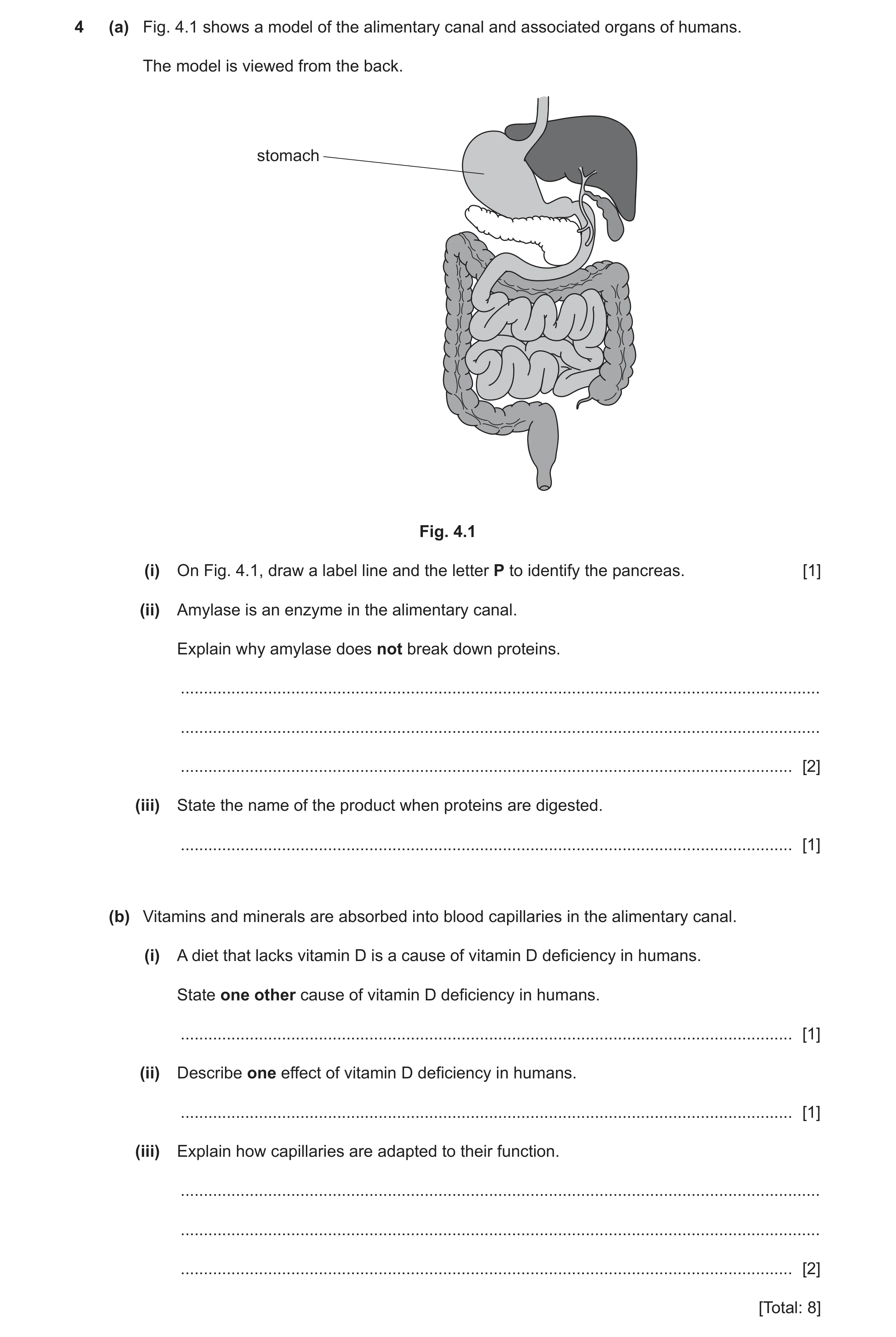
 8
8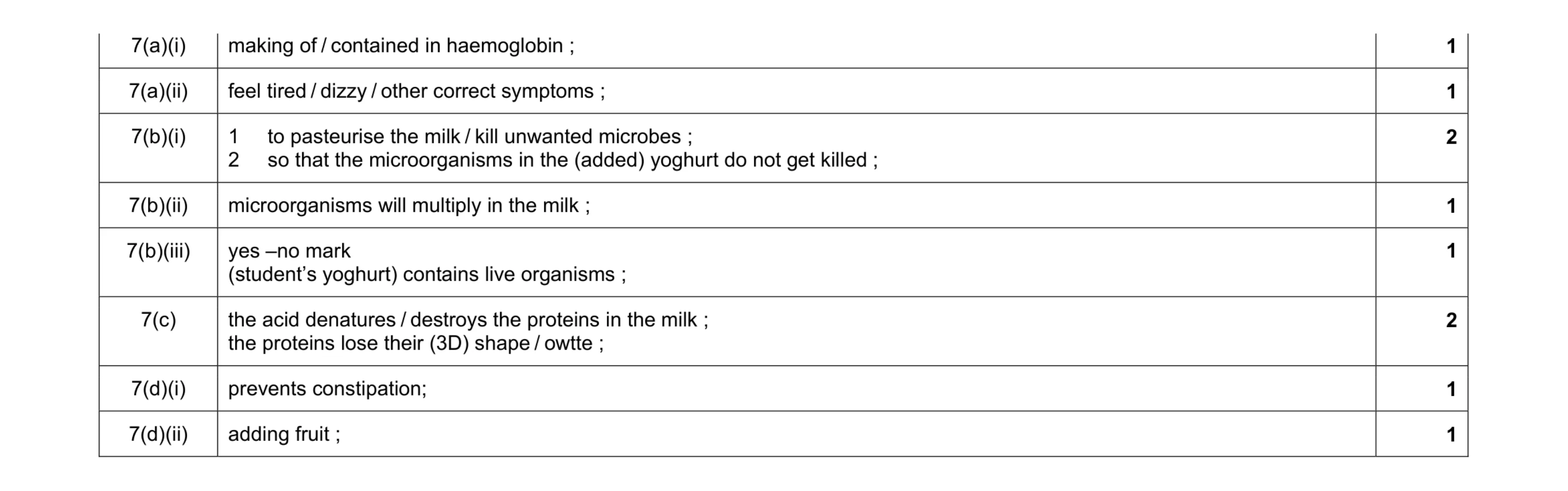 10
10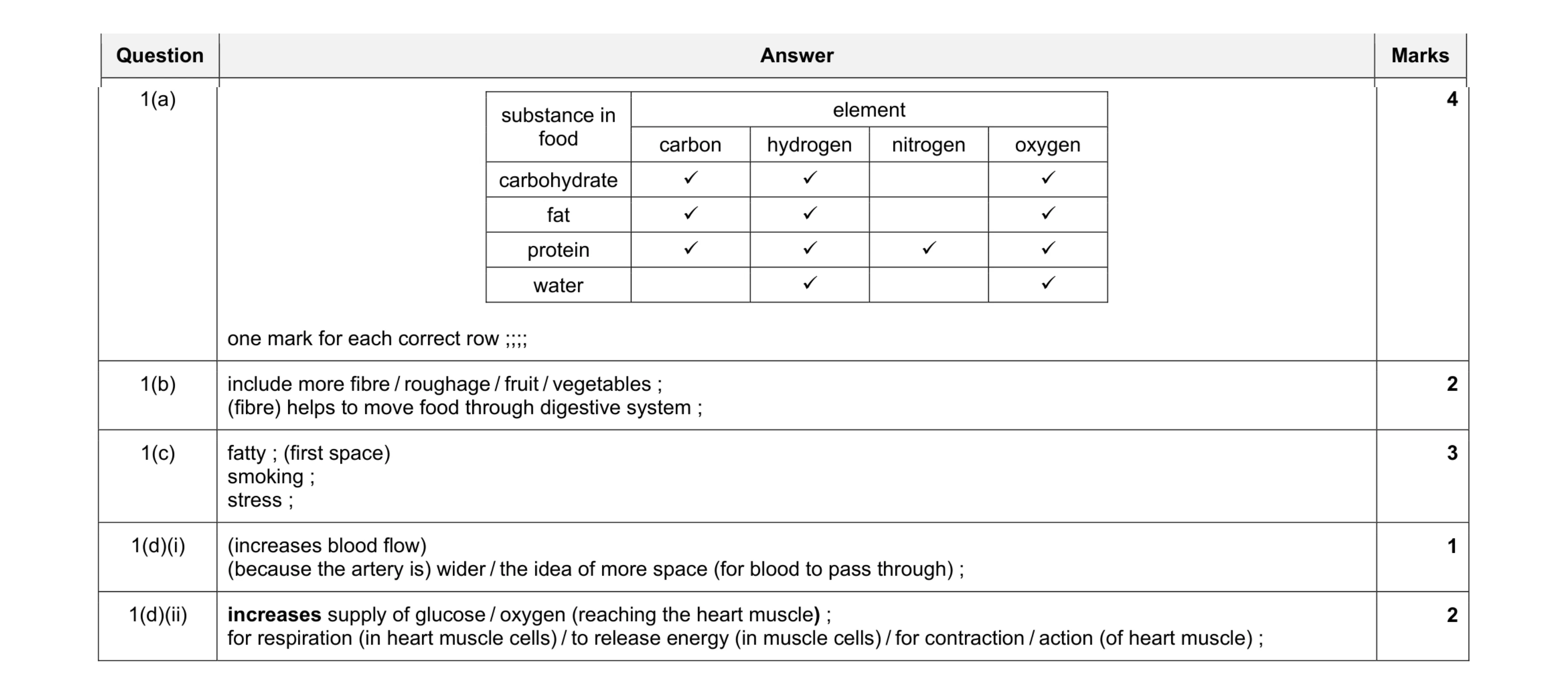 12
12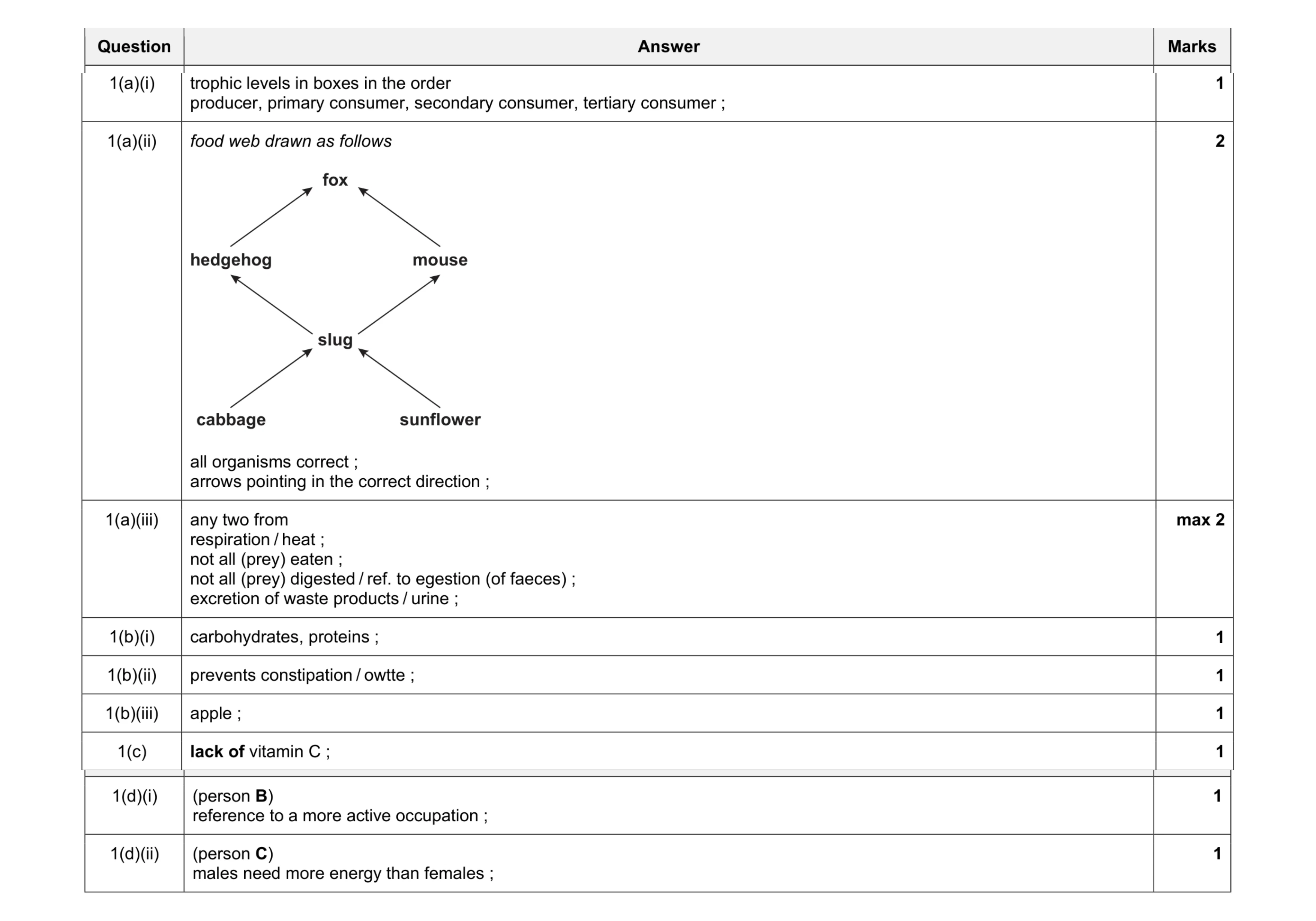 11
11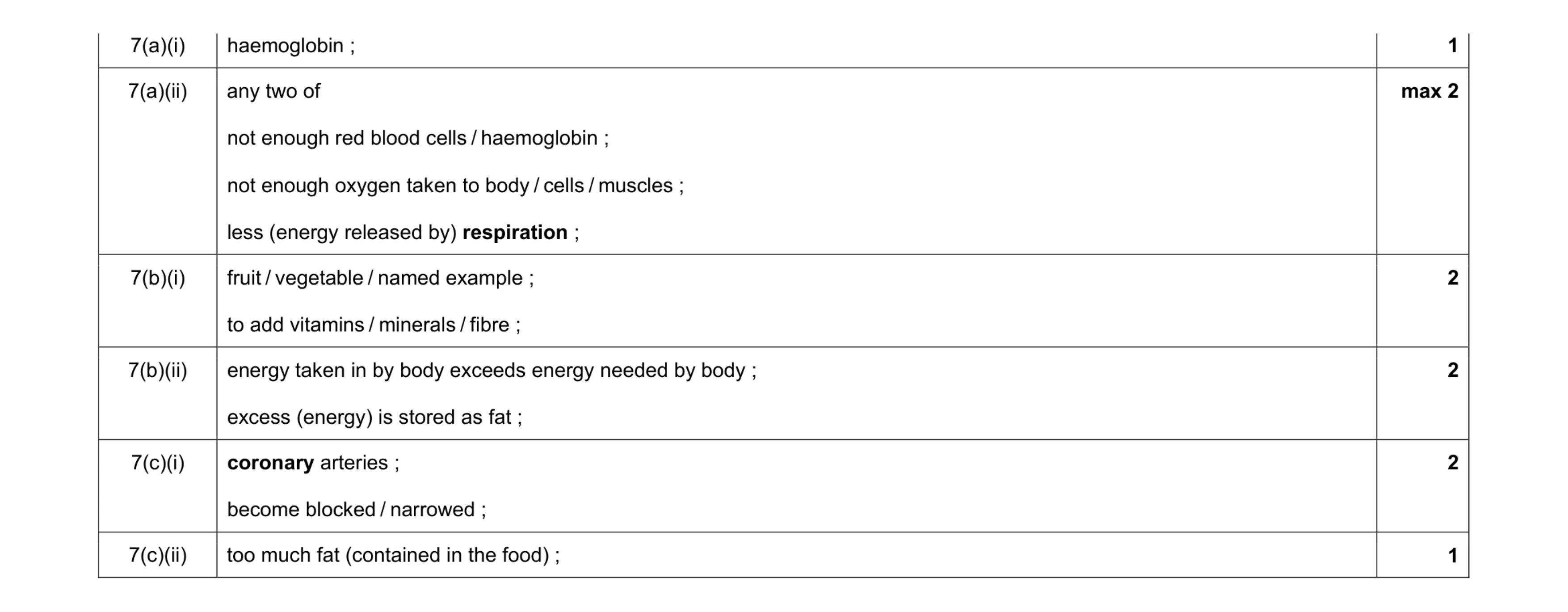 10
10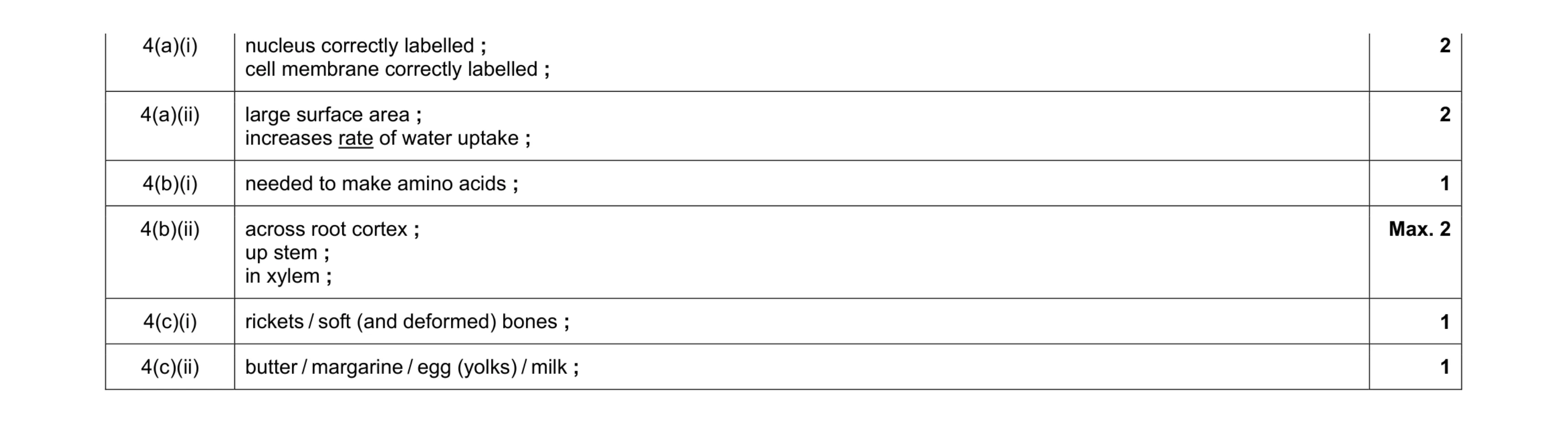 9
9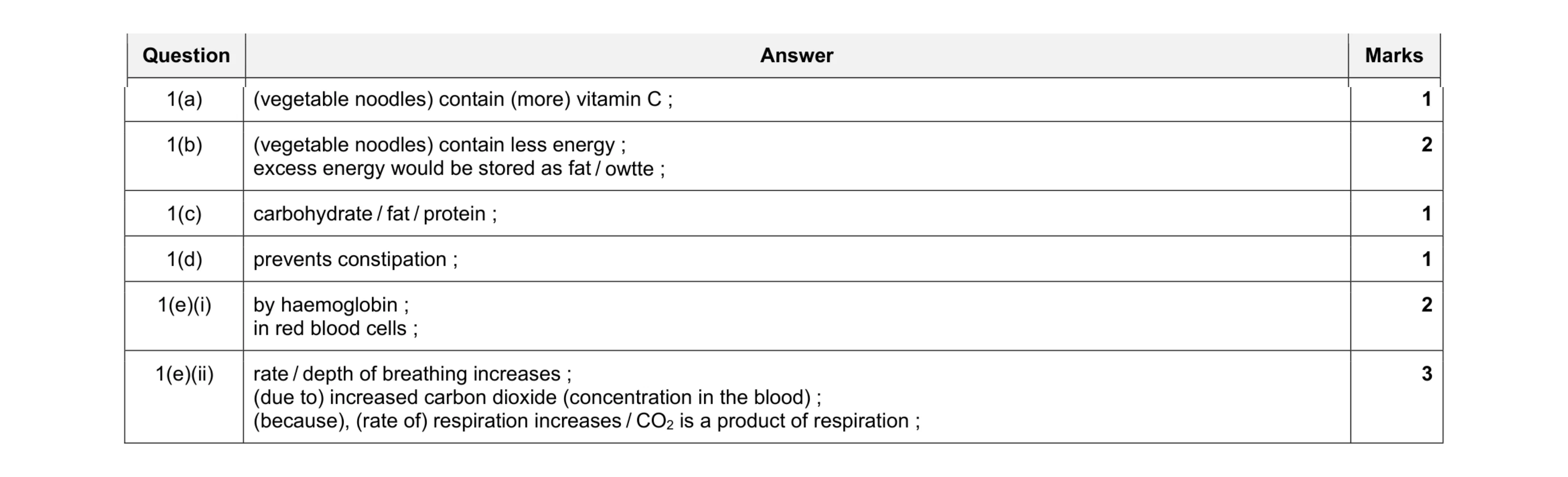 10
10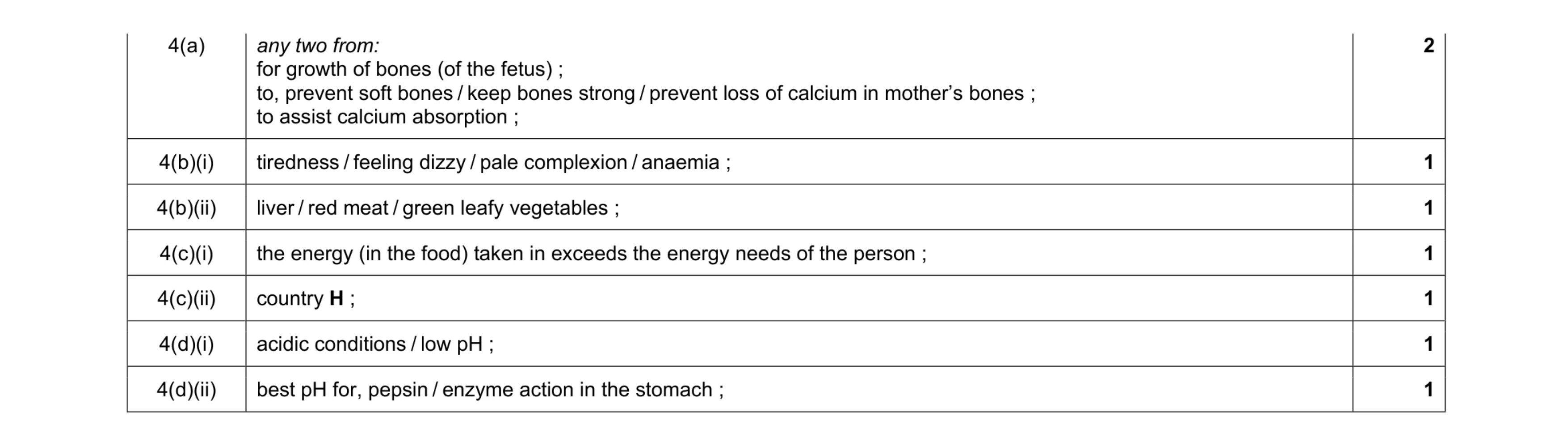 8
8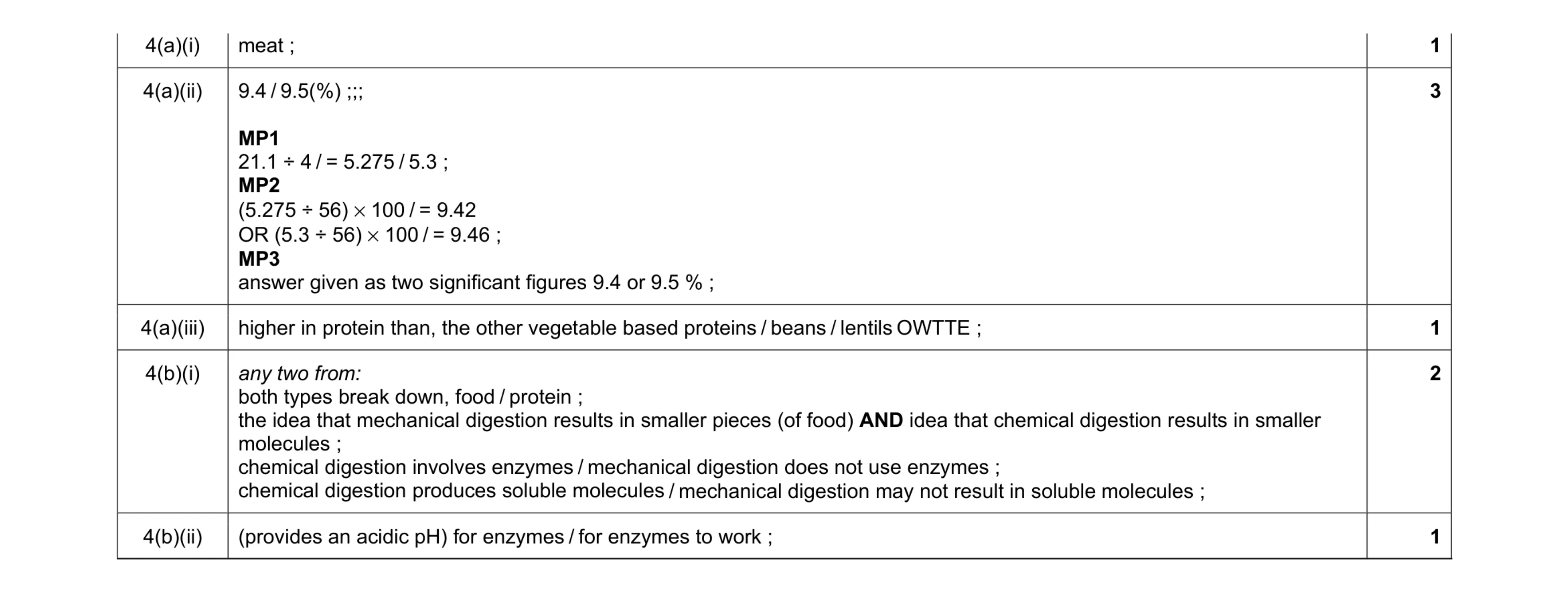 8
8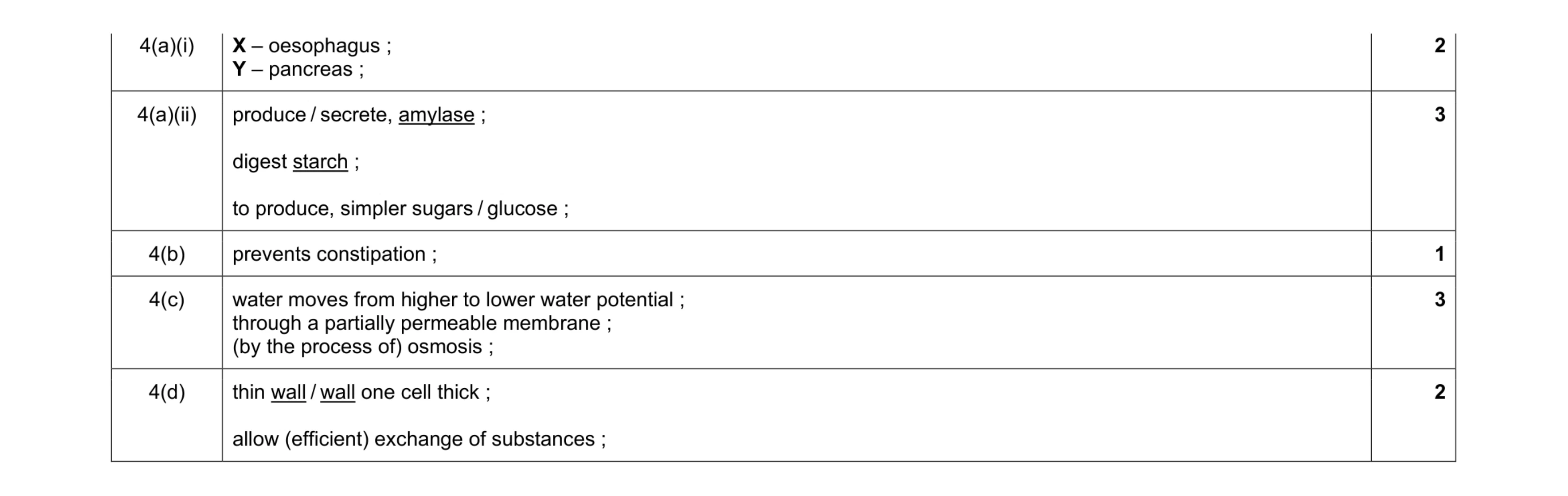 11
11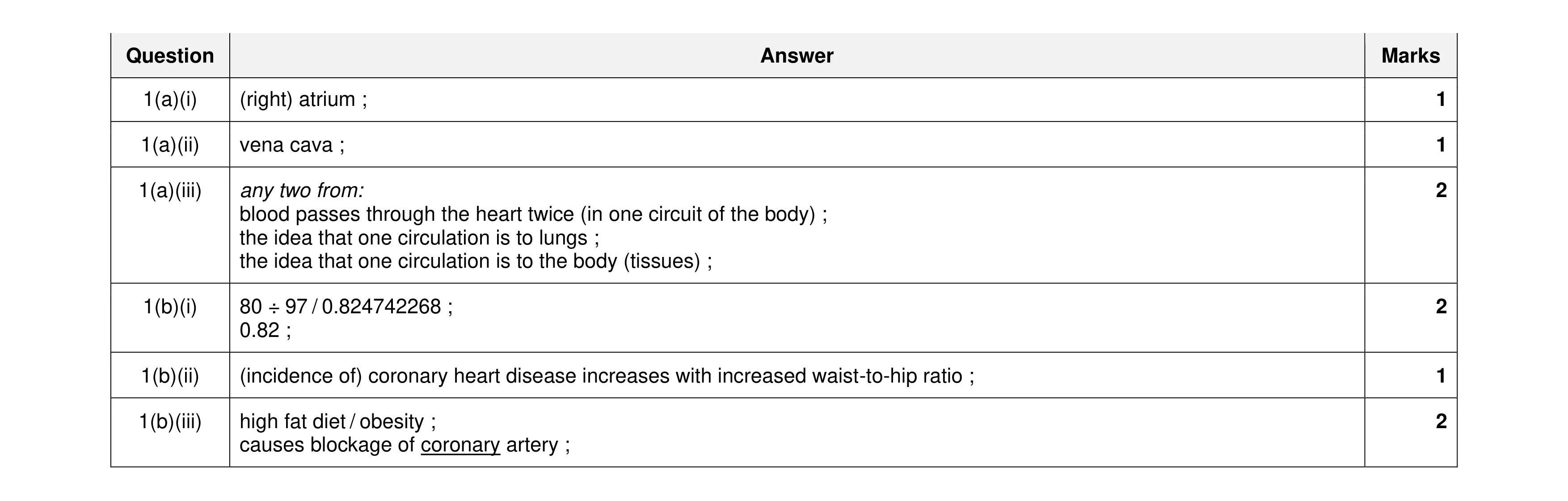 9
9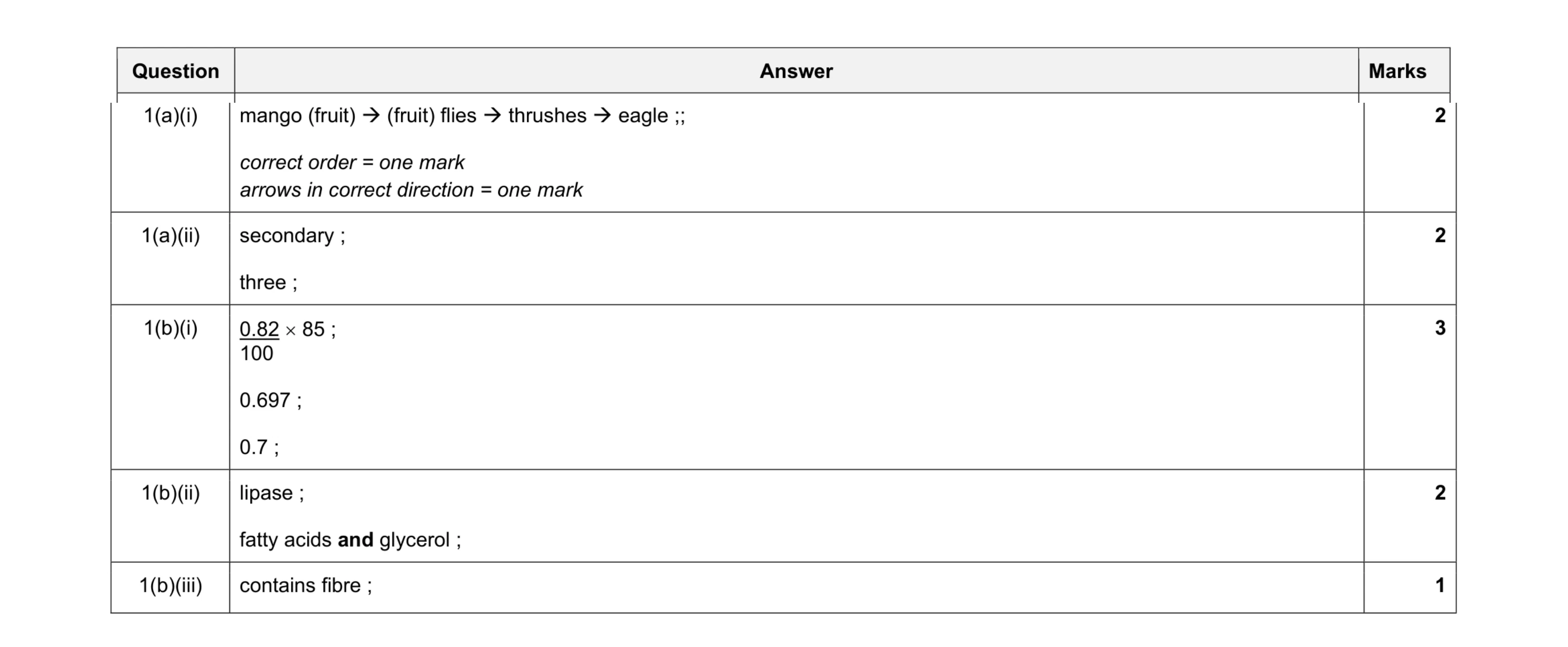 10
10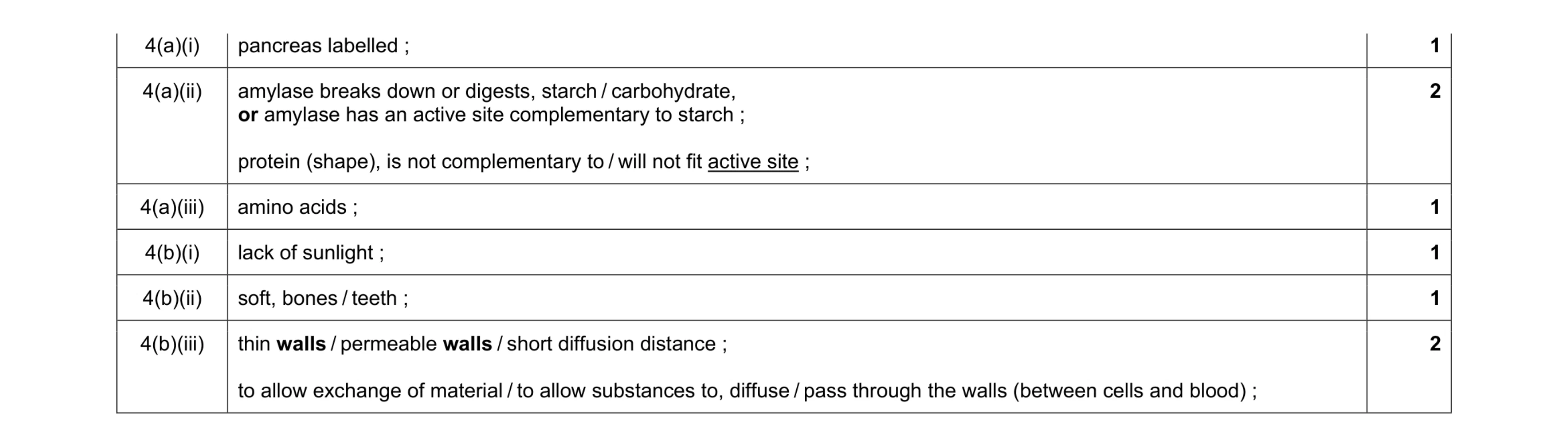 8
8