Questions as text
Q1 · The external structures of the heart 0653/43 Oct/Nov 2018
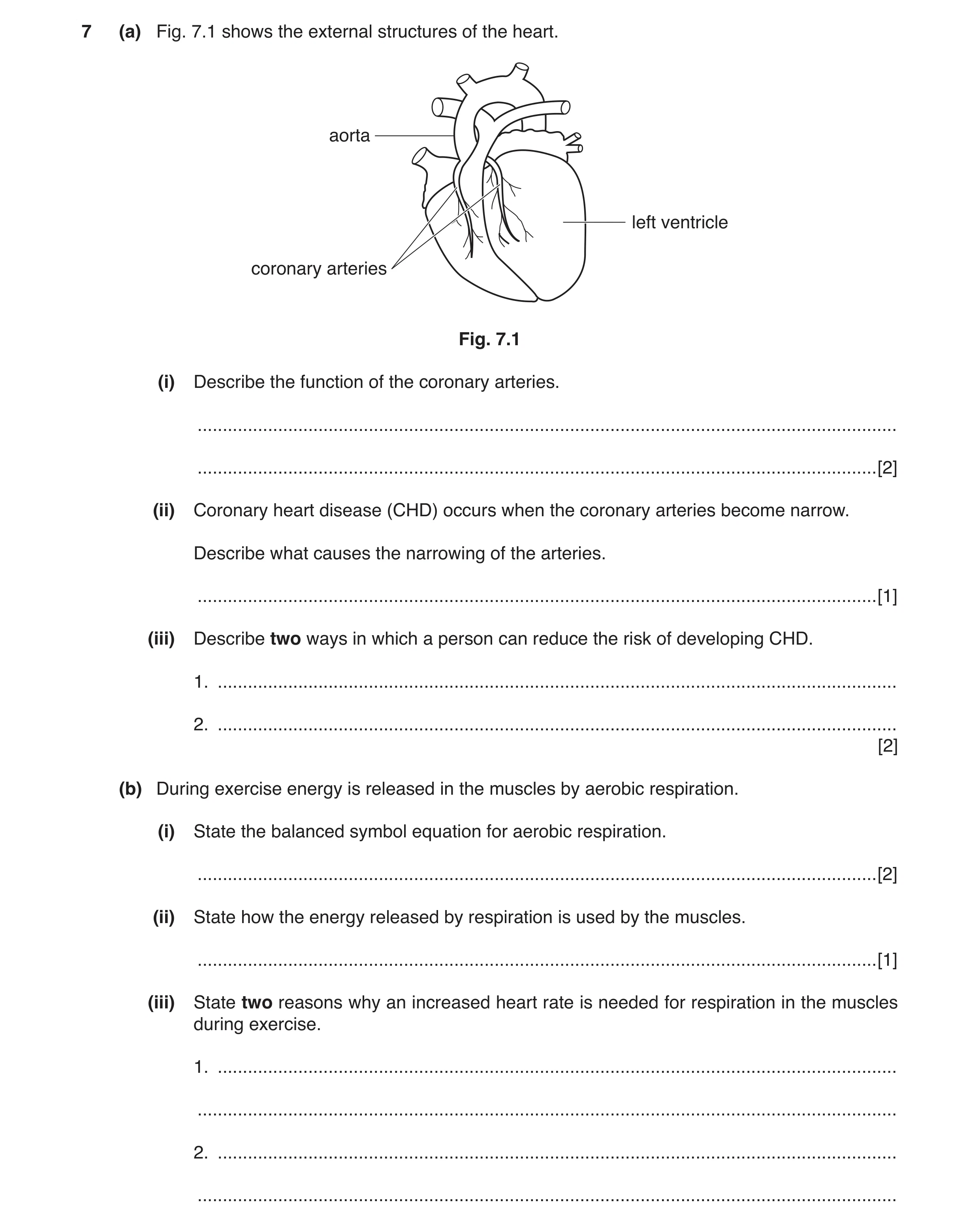
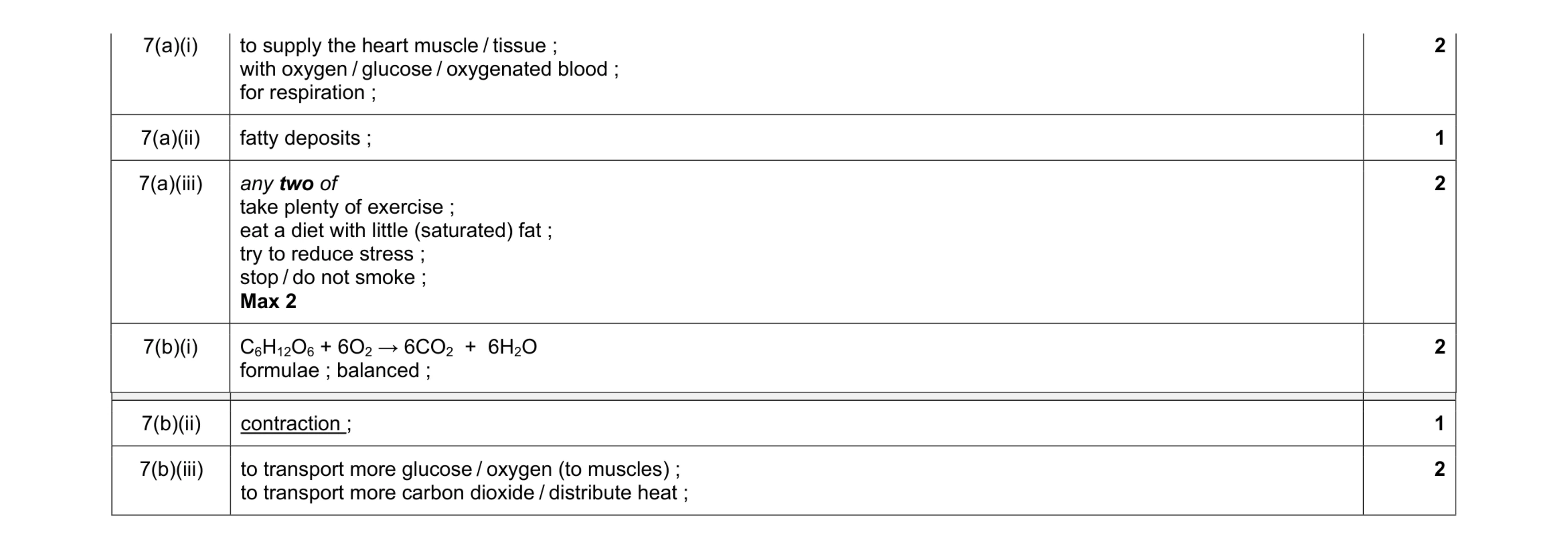
7 (a) Fig. 7.1 shows the external structures of the heart. aorta left ventricle coronary arteries Fig. 7.1 (i) Describe the function of the coronary arteries. … … [2] (ii) Coronary heart disease (CHD) occurs when the coronary arteries become narrow. Describe what causes the narrowing of the arteries. … [1] (iii) Describe two ways in which a person can reduce the risk of developing CHD. 1. … 2. … [2] (b) During exercise energy is released in the muscles by aerobic respiration. (i) State the balanced symbol equation for aerobic respiration. … [2] (ii) State how the energy released by respiration is used by the muscles. … [1] (iii) State two reasons why an increased heart rate is needed for respiration in the muscles during exercise. 1. … … 2. … …
10 marks
Mark scheme: 7(a)(i) to supply the heart muscle / tissue ; with oxygen / glucose / oxygenated blood ; for respiration ; 2 7(a)(ii) fatty deposits ; 1 7(a)(iii) any two of take plenty of exercise ; eat a diet with little (saturated) fat ; try to reduce stress ; stop / do not smoke ; Max 2 2 7(b)(i) C6H12O6 + 6O2 → 6CO2 + 6H2O formulae ; balanced ; 2 Question Answer Marks 7(b)(ii) contraction ; 1 7(b)(iii) to transport more glucose / oxygen (to muscles) ; to transport more carbon dioxide / distribute heat ; 2
This question in 0653/43 Oct/Nov 2018
Q2 · A food chain of some organisms in a garden 0653/42 Feb/March 2019
1 (a) (i) Fig. 1.1 shows a food chain of some organisms in a garden. cabbage slug hedgehog fox Fig. 1.1 The list shows the trophic levels of the organisms. primary consumer producer secondary consumer tertiary consumer In Fig. 1.1 write the correct trophic level in the box below each organism. [1] (ii) Fig. 1.2 shows a second food chain in the same garden. sunflower slug mouse fox Fig. 1.2 Complete the food web below by combining the organisms in the two food chains shown in Fig. 1.1 and Fig. 1.2. You do not need to include the pictures. cabbage sunflower [2] (iii) State two ways in which energy is wasted during transfer between trophic levels. 1. … … 2. … … [2] (b) Humans must eat a variety of foods for a balanced diet. (i) Use words from the list to complete the essential components of a human’s diet. bile carbohydrates chlorophyll enzymes haemoglobin hormones proteins A balanced diet contains mineral salts, fibre, … , fats, water, … and vitamins. [1] (ii) Describe the importance of fibre in the diet. … … [1] (iii) The list shows some foods. One of them is rich in fibre. apple cheese fish meat milk State the food rich in fibre. … [1] (c) If a person’s diet does not contain all the nutrients needed they can develop deficiency diseases. Scurvy is an example of a deficiency disease. State the cause of the disease scurvy. … [1] (d) The amount of each nutrient in a balanced diet varies according to a person’s need. The list describes four people A, B, C and D. person A is an adult male office worker person B is an adult male gardener person C is a teenage boy person D is a teenage girl (i) Suggest which person, A or B, needs more energy supplied by their diet. Give a reason for your answer. person … reason … … [1] (ii) Suggest which person, C or D, needs more energy supplied by their diet. Give a reason for your answer. person … reason … … [1] [Total: 11]
11 marks
Mark scheme: 1(a)(i) trophic levels in boxes in the order producer, primary consumer, secondary consumer, tertiary consumer ; 1 1(a)(ii) food web drawn as follows all organisms correct ; arrows pointing in the correct direction ; 2 1(a)(iii) any two from respiration / heat ; not all (prey) eaten ; not all (prey) digested / ref. to egestion (of faeces) ; excretion of waste products / urine ; max 2 1(b)(i) carbohydrates, proteins ; 1 1(b)(ii) prevents constipation / owtte ; 1 1(b)(iii) apple ; 1 1(c) lack of vitamin C ; 1 fox slug cabbage sunflower hedgehog mouse Question Answer Marks 1(d)(i) (person B) reference to a more active occupation ; 1 1(d)(ii) (person C) males need more energy than females ; 1
This question in 0653/42 Feb/March 2019
Q3 · A plant responding to light coming from one side 0653/42 May/June 2019
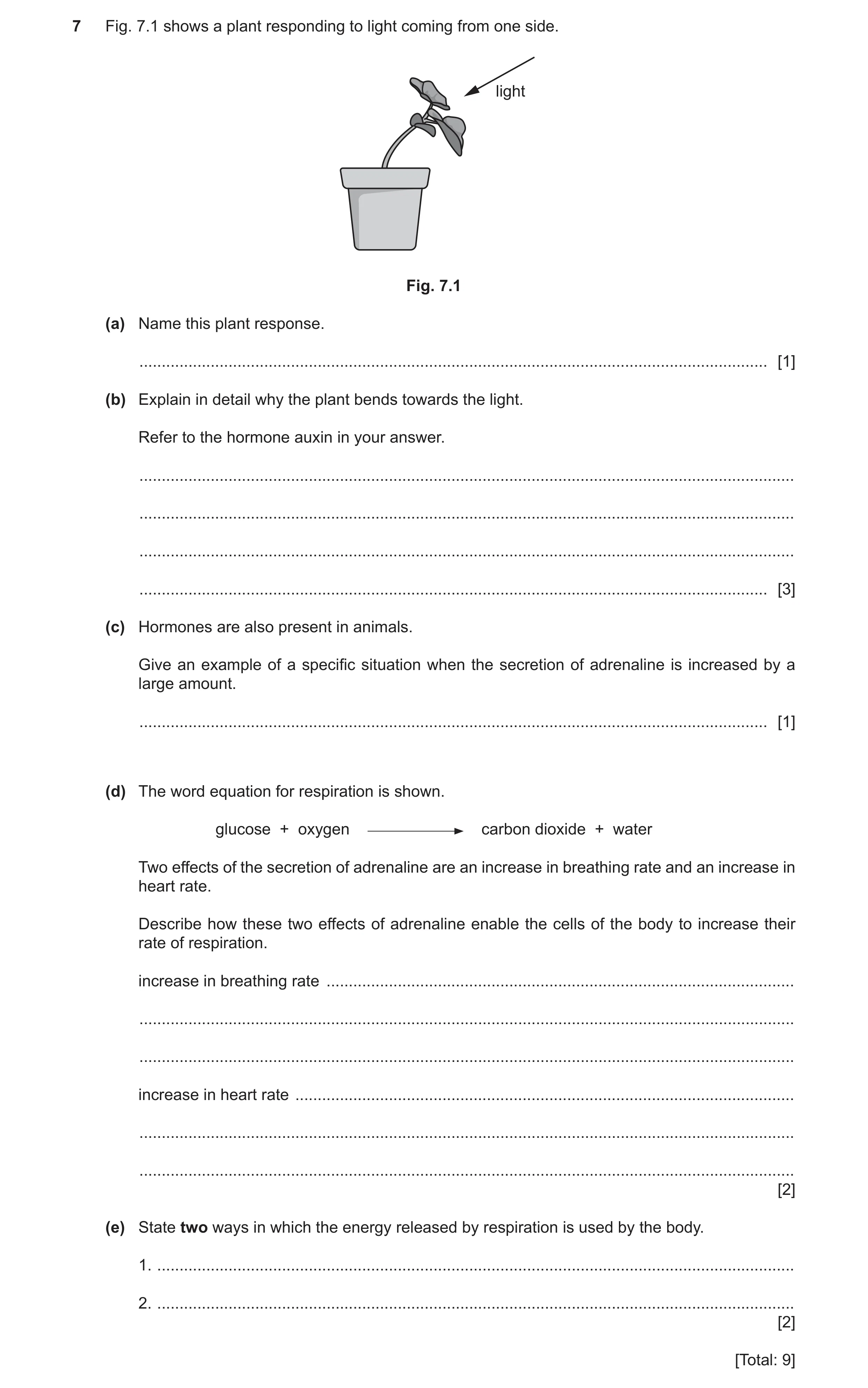
7 Fig. 7.1 shows a plant responding to light coming from one side. light Fig. 7.1 (a) Name this plant response. … [1] (b) Explain in detail why the plant bends towards the light. Refer to the hormone auxin in your answer. … … … … [3] (c) Hormones are also present in animals. Give an example of a specific situation when the secretion of adrenaline is increased by a large amount. … [1] (d) The word equation for respiration is shown. glucose + oxygen carbon dioxide + water Two effects of the secretion of adrenaline are an increase in breathing rate and an increase in heart rate. Describe how these two effects of adrenaline enable the cells of the body to increase their rate of respiration. increase in breathing rate … … … increase in heart rate … … … [2] (e) State two ways in which the energy released by respiration is used by the body. 1. … 2. … [2] [Total: 9]
9 marks
Mark scheme: 7(a) phototropism ; 1 7(b) auxin produced at tip ; more auxin in cells in dark side ; auxin causes (cell) elongation ; (cell) elongation greater on dark side ; max 3 7(c) any example of a fight or flight situation described ; 1 7(d) (breathing rate) enables more oxygen to enter blood / be taken in (at lungs) ; (heart rate) increases rate of delivery of oxygen / glucose to cells ; 2 Question Answer Marks 7(e) any two from muscle contraction protein synthesis growth maintenance of body temperature ;; 2
This question in 0653/42 May/June 2019
Q4 · A diagram of the internal structure of the heart and the blood vessels to and from the… 0653/42 May/June 2020
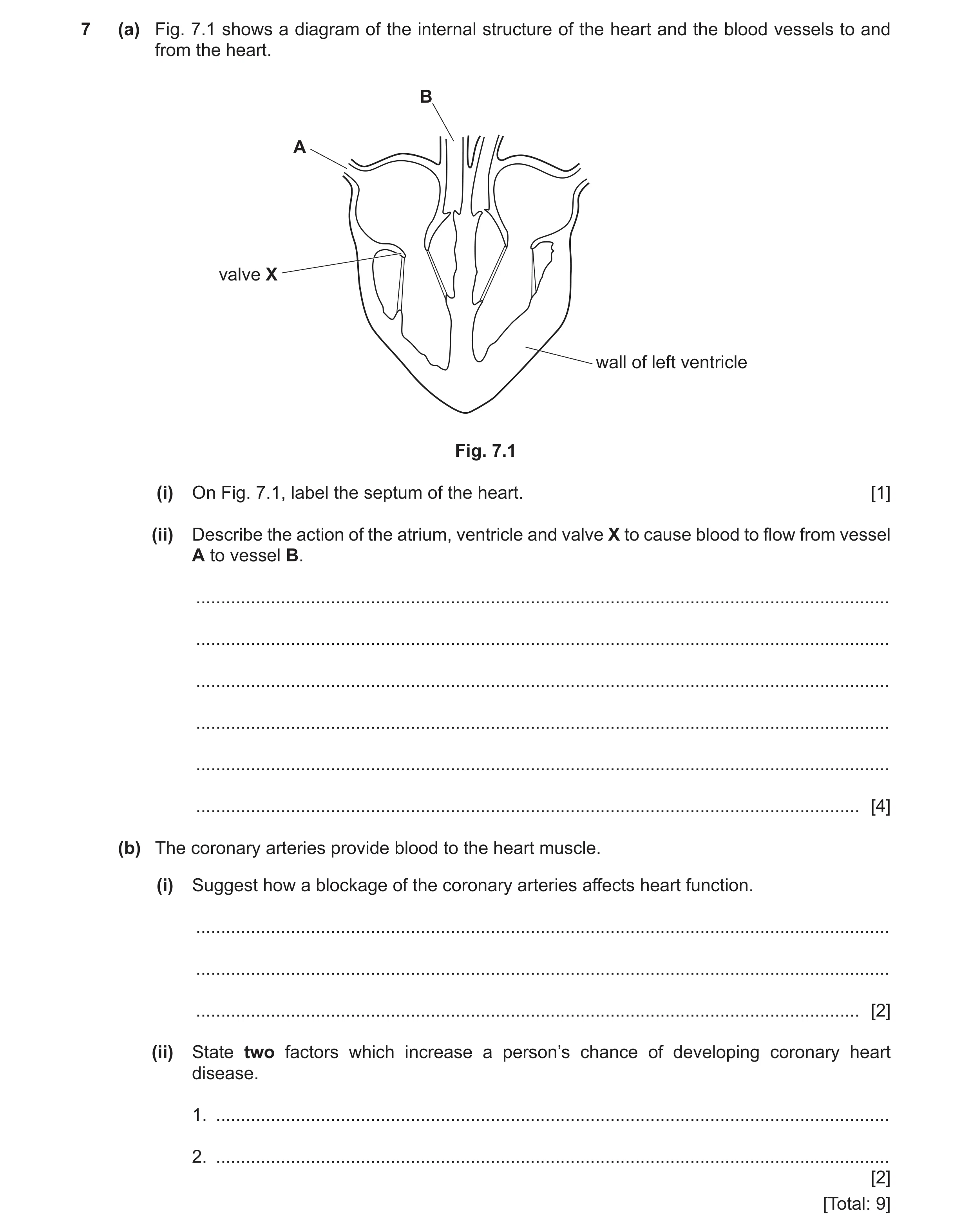
7 (a) Fig. 7.1 shows a diagram of the internal structure of the heart and the blood vessels to and from the heart. B A valve X wall of left ventricle Fig. 7.1 (i) On Fig. 7.1, label the septum of the heart. [1] (ii) Describe the action of the atrium, ventricle and valve X to cause blood to flow from vessel A to vessel B. … … … … … … [4] (b) The coronary arteries provide blood to the heart muscle. (i) Suggest how a blockage of the coronary arteries affects heart function. … … … [2] (ii) State two factors which increase a person’s chance of developing coronary heart disease. 1. … 2. … [2] [Total: 9]
9 marks
Mark scheme: 7(a)(i) septum labelled ; 1 7(a)(ii) any four from: (deoxygenated) blood enters (right) atrium from, vein A / vena cava) ; (right) atrium contracts and valve X opens ; blood flows into (right) ventricle ; (right) ventricle contracts and valve X closes ; blood flows into, B / pulmonary artery ; valve X prevents backflow of blood ; 4 7(b)(i) less, oxygen / glucose supplied to heart muscle ; and any one from: reduces respiration in heart muscle ; reduces, ability / efficiency of contraction of heart muscle ; 2 Question Answer Marks 7(b)(ii) any two from: poor diet ; stress ; smoking ; genetic predisposition ; (increasing risk with) age ; sex / males more likely to get CHD ; AVP, e.g. lack of exercise / overweight ; 2
This question in 0653/42 May/June 2020
Q5 · A diagram of a section through a human heart 0653/43 May/June 2021
4 (a) Fig. 4.1 is a diagram of a section through a human heart. muscular wall Fig. 4.1 (i) On Fig. 4.1 use a label line and the letter R to identify the right ventricle of the heart. [1] (ii) Describe the role of the muscular wall in the function of the heart. … … … [2] (b) Fig. 4.2 is a graph that compares the number of males and females with coronary heart disease in different age categories. 250 200 Key number of males patients per 150 females 1000 of population 100 50 0 34 years 35–44 45–54 55–64 65–74 75 years and years years years years and under over age group Fig. 4.2 (i) Identify the age group that has no women with coronary heart disease. … [1] (ii) Describe two general trends shown in Fig. 4.2. 1 … … 2 … … [2] (c) Risk factors for coronary heart disease include age, diet and your sex. (i) List two other risk factors for coronary heart disease. 1 … 2 … [2] (ii) Describe how malnutrition can cause coronary heart disease. … … … [2] [Total: 10]
10 marks
Mark scheme: 4(a)(i) right ventricle labelled ; 1 4(a)(ii) contracts ; to push / pump, blood out of heart ; 2 4(b)(i) 34 years and under ; 1 4(b)(ii) coronary heart disease increases with age ; more men than women have coronary heart disease (in each age group) ; 2 4(c)(i) any two from: genetic predisposition ; stress ; smoking ; 2 4(c)(ii) high fat diet ; cause blockage of coronary artery ; 2
This question in 0653/43 May/June 2021
Q6 · A diagram of the alimentary canal and associated organs in humans 0653/43 May/June 2022
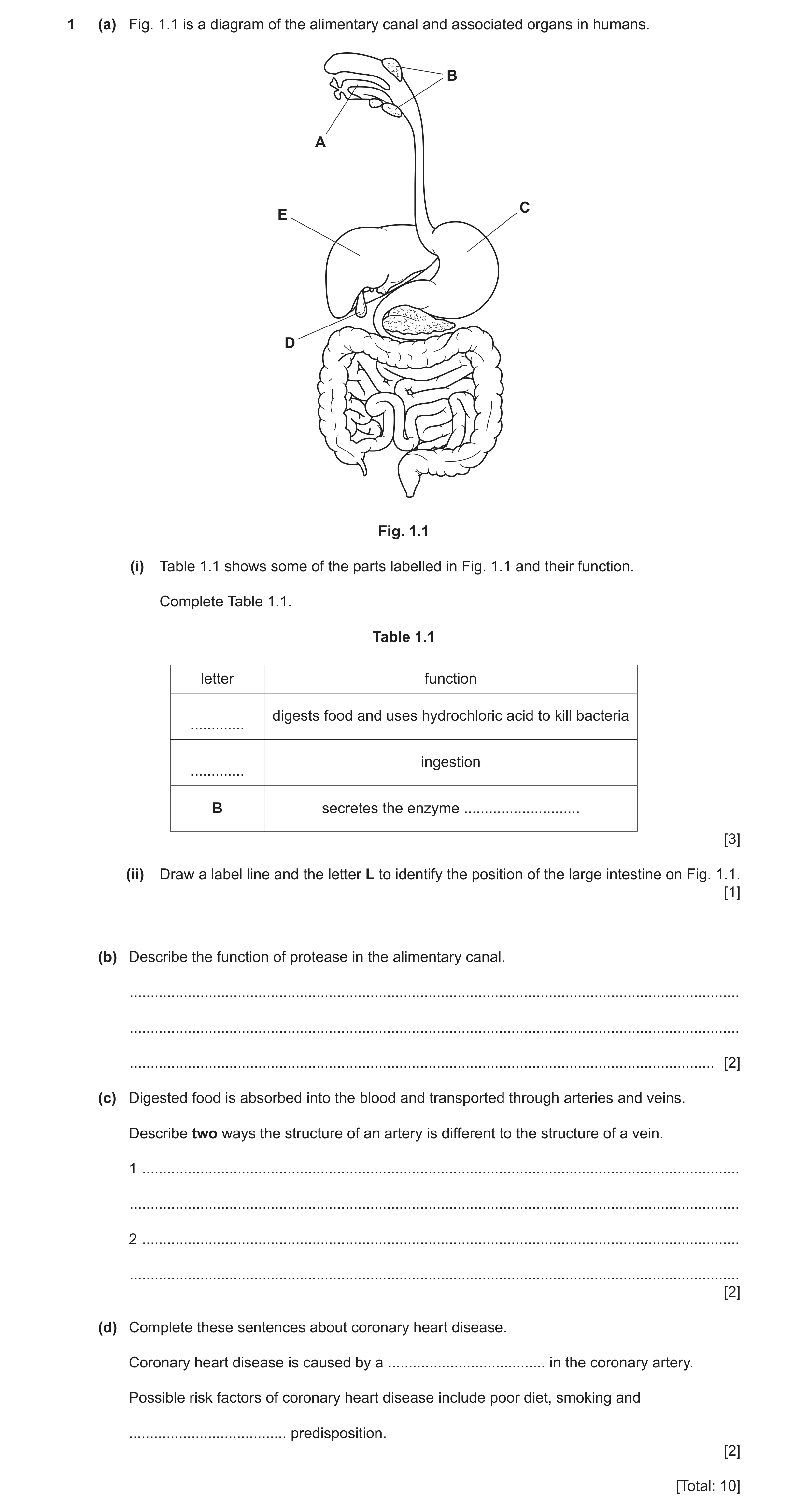
1 (a) Fig. 1.1 is a diagram of the alimentary canal and associated organs in humans. B A C E D Fig. 1.1 (i) Table 1.1 shows some of the parts labelled in Fig. 1.1 and their function. Complete Table 1.1. Table 1.1 letter function digests food and uses hydrochloric acid to kill bacteria … ingestion … B secretes the enzyme … [3] (ii) Draw a label line and the letter L to identify the position of the large intestine on Fig. 1.1. [1] (b) Describe the function of protease in the alimentary canal. … … … [2] (c) Digested food is absorbed into the blood and transported through arteries and veins. Describe two ways the structure of an artery is different to the structure of a vein. 1 … … 2 … … [2] (d) Complete these sentences about coronary heart disease. Coronary heart disease is caused by a … in the coronary artery. Possible risk factors of coronary heart disease include poor diet, smoking and … predisposition. [2] [Total: 10]
10 marks
Mark scheme: 1(a)(i) letter function C ; (digests protein and uses hydrochloric acid to kill bacteria) A ; (ingestion) (B) (secretes the enzyme) amylase ; 3 1(a)(ii) label line to large intestine labelled L ; 1 1(b) digestion of protein ; to form amino acids ; 2 1(c) any two from: arteries have a thicker (muscle) wall / ORA ; arteries have a smaller centre / ORA ; only veins have valves ; 2 1(d) blockage ; genetic ; 2
This question in 0653/43 May/June 2022
Q7 · A diagram of the human heart 0653/42 Oct/Nov 2022
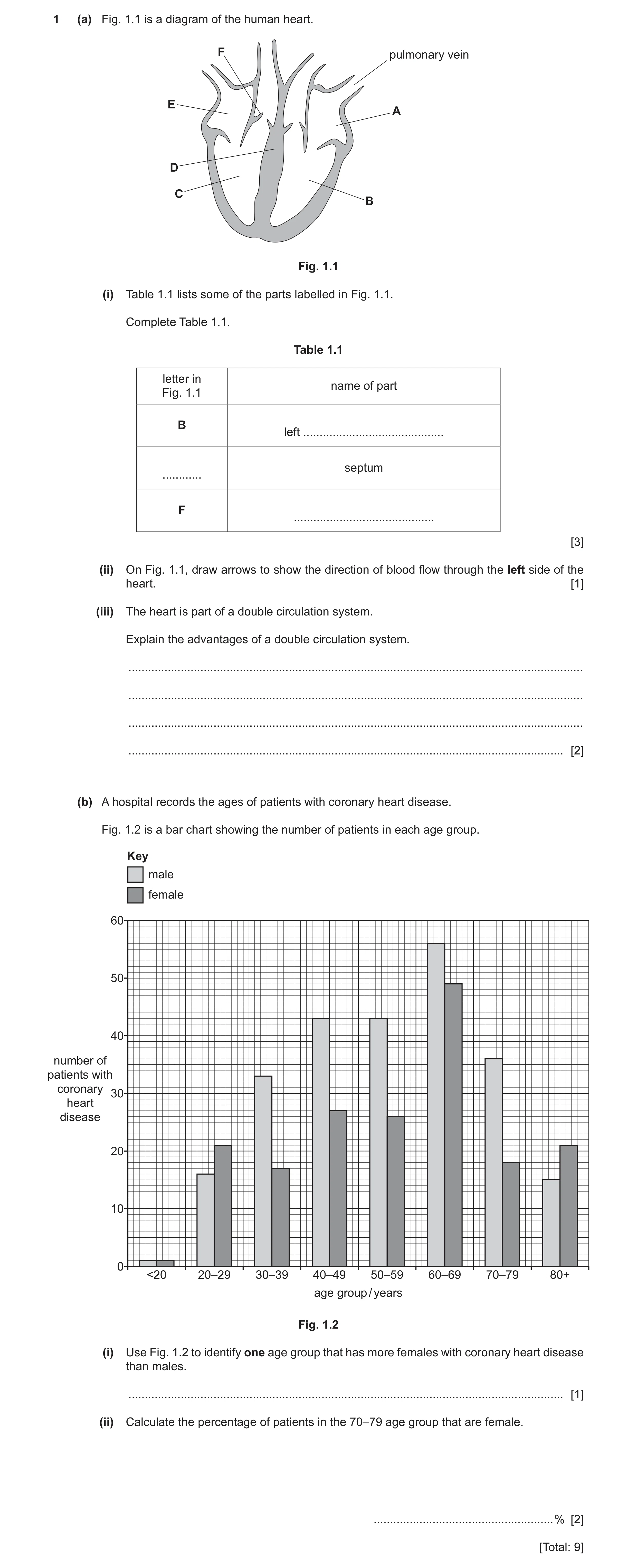
1 (a) Fig. 1.1 is a diagram of the human heart. F pulmonary vein E A D C B Fig. 1.1 (i) Table 1.1 lists some of the parts labelled in Fig. 1.1. Complete Table 1.1. Table 1.1 letter in name of part Fig. 1.1 B left … septum … F … [3] (ii) On Fig. 1.1, draw arrows to show the direction of blood flow through the left side of the heart. [1] (iii) The heart is part of a double circulation system. Explain the advantages of a double circulation system. … … … … [2] (b) A hospital records the ages of patients with coronary heart disease. Fig. 1.2 is a bar chart showing the number of patients in each age group. Key male female 60 50 40 number of patients with coronary 30 heart disease 20 10 0 <20 20–29 30–39 40–49 50–59 60–69 70–79 80+ age group / years Fig. 1.2 (i) Use Fig. 1.2 to identify one age group that has more females with coronary heart disease than males. … [1] (ii) Calculate the percentage of patients in the 70–79 age group that are female. … % [2] [Total: 9]
9 marks
Mark scheme: Question Answer Marks 1(a)(i) 3 letter in name of part Fig. 1.1 (B) (left) ventricle ; D ; (septum) (F) valve ; 1(a)(ii) arrow(s) showing correct direction ; 1 1(a)(iii) separates oxygenated and deoxygenated blood ; 2 allows for different levels of blood pressure / AW ; 1(b)(i) 20–29 / 80+ ; 1 1(b)(ii) 18 100 ÷ 54 / 18 + 36 / 54 ; 2 33(%) ;
This question in 0653/42 Oct/Nov 2022
Q8 · A diagram of the double circulatory system in humans 0653/43 Oct/Nov 2024
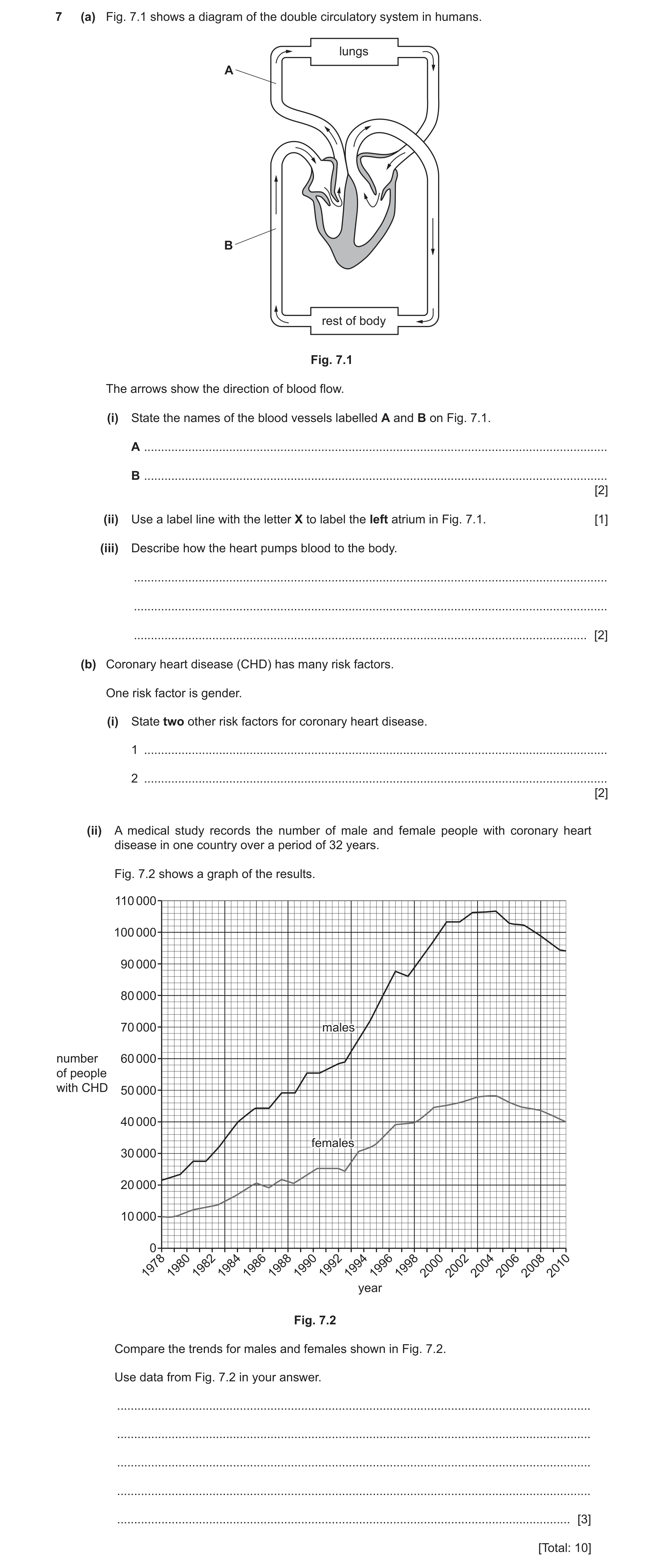
7 (a) Fig. 7.1 shows a diagram of the double circulatory system in humans. lungs A B rest of body Fig. 7.1 The arrows show the direction of blood flow. (i) State the names of the blood vessels labelled A and B on Fig. 7.1. A … B … [2] (ii) Use a label line with the letter X to label the left atrium in Fig. 7.1. [1] (iii) Describe how the heart pumps blood to the body. … … … [2] (b) Coronary heart disease (CHD) has many risk factors. One risk factor is gender. (i) State two other risk factors for coronary heart disease. 1 … 2 … [2] (ii) A medical study records the number of male and female people with coronary heart disease in one country over a period of 32 years. Fig. 7.2 shows a graph of the results. 110 000 100 000 90 000 80 000 70 000 malesmales number 60 000 of people with CHD 50 000 40 000 femalesfemales 30 000 20 000 10 000 0 19781980198219841986198819901992199419961998200020022004200620082010 year Fig. 7.2 Compare the trends for males and females shown in Fig. 7.2. Use data from Fig. 7.2 in your answer. … … … … … [3] [Total: 10]
10 marks
Mark scheme: 7(a)(i) A pulmonary artery ; 2 B vena cava ; 7(a)(ii) left atrium labelled ; 1 7(a)(iii) reference to contraction ; 2 (muscles of) ventricles (contract) ; 7(b)(i) any two from: 2 diet ; stress ; smoking ; genetic predisposition ; age ; AVP ; 7(b)(ii) any two from: 3 both / male / female / number of people increasing AND then decreasing ; males higher (than females) ORA ; AVP ; plus one for: correct use of supporting data, e.g. both graphs reach peak in 2004 / 10 000 females and 22 000 males in 1978 ;
This question in 0653/43 Oct/Nov 2024
Q9 · A diagram of the structure of the human heart 0653/42 Feb/March 2025
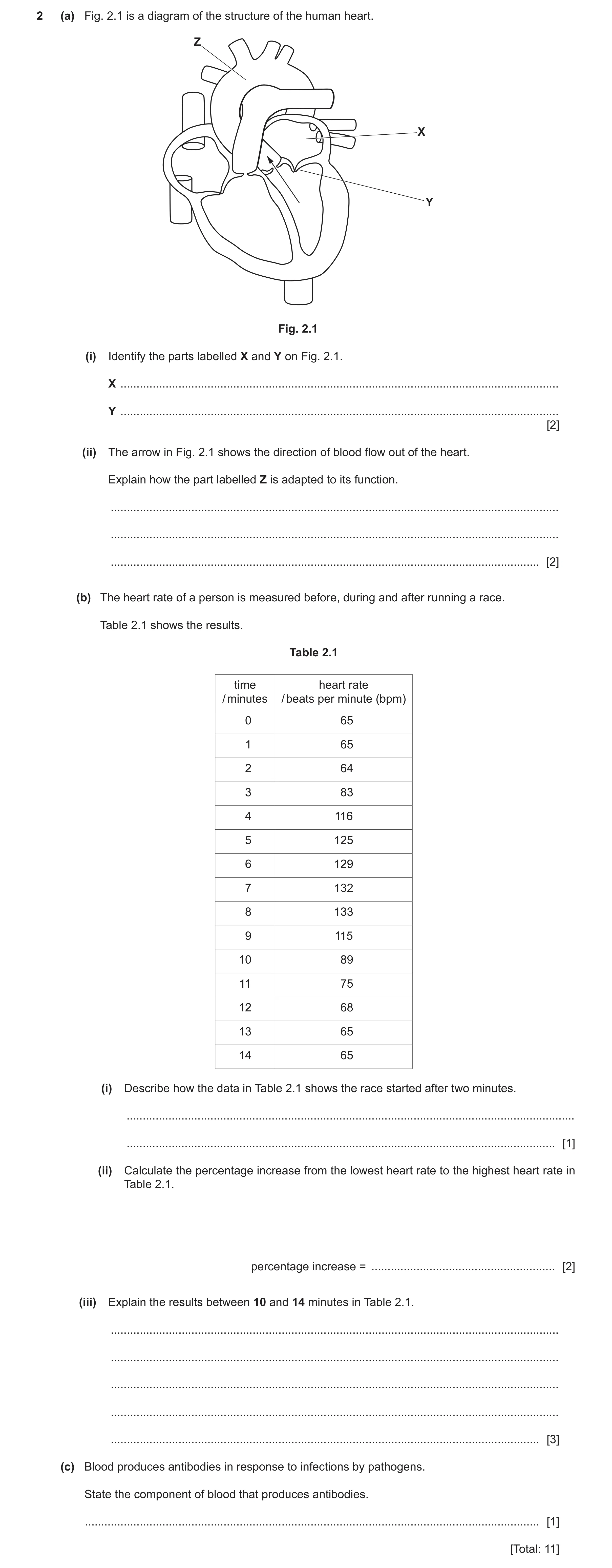
2 (a) Fig. 2.1 is a diagram of the structure of the human heart. Z X Y Fig. 2.1 (i) Identify the parts labelled X and Y on Fig. 2.1. X … Y … [2] (ii) The arrow in Fig. 2.1 shows the direction of blood flow out of the heart. Explain how the part labelled Z is adapted to its function. … … … [2] (b) The heart rate of a person is measured before, during and after running a race. Table 2.1 shows the results. Table 2.1 time heart rate / minutes / beats per minute (bpm) 0 65 1 65 2 64 3 83 4 116 5 125 6 129 7 132 8 133 9 115 10 89 11 75 12 68 13 65 14 65 (i) Describe how the data in Table 2.1 shows the race started after two minutes. … … [1] (ii) Calculate the percentage increase from the lowest heart rate to the highest heart rate in Table 2.1. percentage increase = … [2] (iii) Explain the results between 10 and 14 minutes in Table 2.1. … … … … … [3] (c) Blood produces antibodies in response to infections by pathogens. State the component of blood that produces antibodies. … [1] [Total: 11]
11 marks
Mark scheme: 2(a)(i) (left) atrium ; 2 valve ; 2(a)(ii) thick (muscular) wall / elastic wall ; 2 the idea of allowing or withstanding the transport of blood at high pressure ; OR narrow lumen ; to maintain high blood pressure ; 2(b)(i) heart rate increases (from 3 min) ; 1 2(b)(ii) 133 – 64 / 69 ; 2 133 − 64 100 / 107.8(125) / 108 ; 64 2(b)(iii) any three from: 3 the person has stopped running / owtte ; muscle contraction decreases ; less energy / oxygen required ; reduction in respiration rate ; 2(c) white blood cells ; 1
This question in 0653/42 Feb/March 2025
Q10 · A diagram showing a cross‑section of a bacterial cell 0653/41 May/June 2025
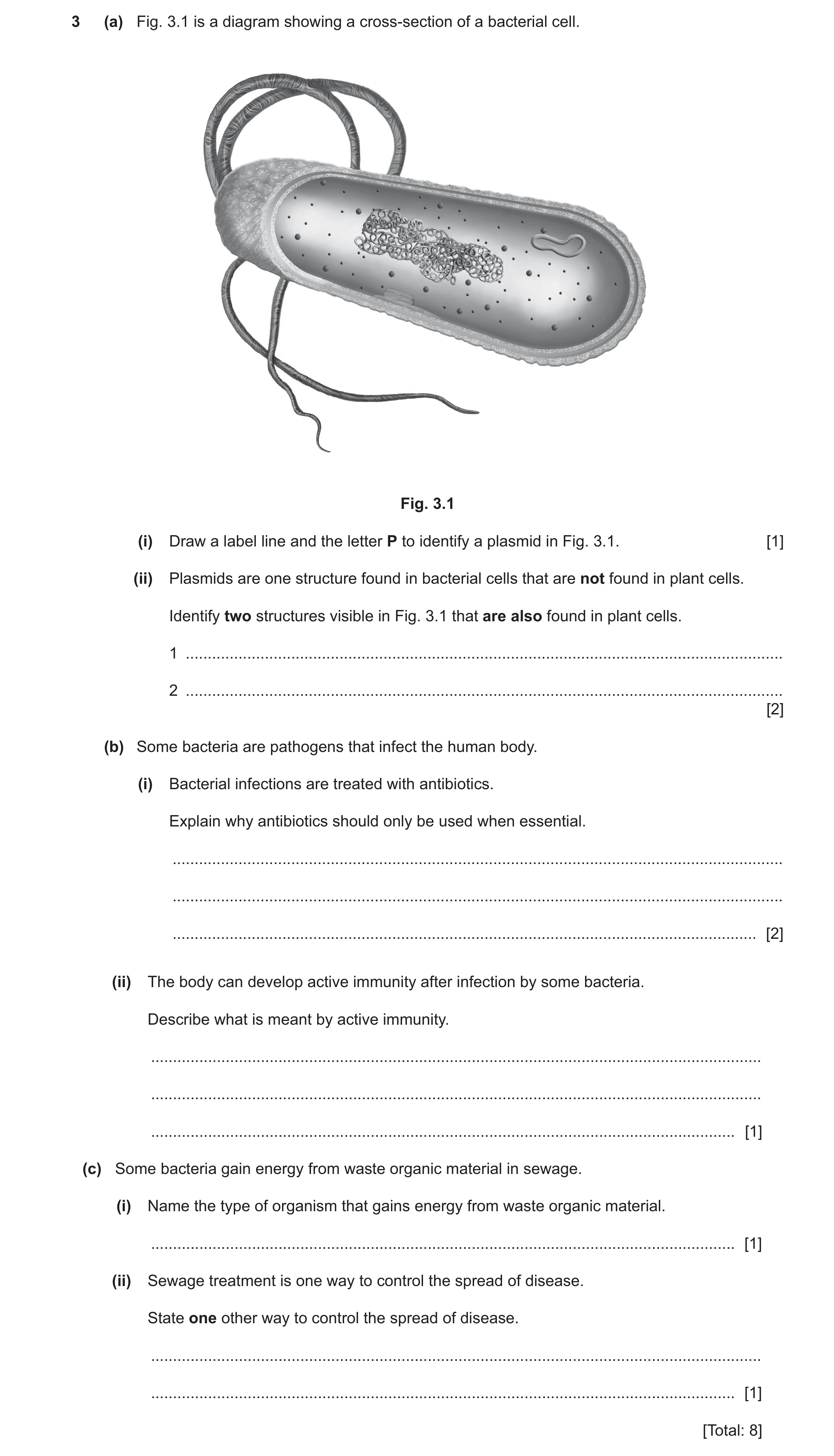
3 (a) Fig. 3.1 is a diagram showing a cross‑section of a bacterial cell. Fig. 3.1 (i) Draw a label line and the letter P to identify a plasmid in Fig. 3.1. [1] (ii) Plasmids are one structure found in bacterial cells that are not found in plant cells. Identify two structures visible in Fig. 3.1 that are also found in plant cells. 1 … 2 … [2] (b) Some bacteria are pathogens that infect the human body. (i) Bacterial infections are treated with antibiotics. Explain why antibiotics should only be used when essential. … … … [2] (ii) The body can develop active immunity after infection by some bacteria. Describe what is meant by active immunity. … … … [1] (c) Some bacteria gain energy from waste organic material in sewage. (i) Name the type of organism that gains energy from waste organic material. … [1] (ii) Sewage treatment is one way to control the spread of disease. State one other way to control the spread of disease. … … [1] [Total: 8]
8 marks
Mark scheme: 3(a)(i) plasmid labelled ; 1 3(a)(ii) any two from: 2 cell wall ; ribosomes ; cell membrane ; cytoplasm ; 3(b)(i) idea that it helps prevent antibiotic resistance in bacteria ; 2 idea that antibiotic becomes less effective (due to over use) / owtte ; 3(b)(ii) (defence against a pathogen by) production of antibodies ; 1 3(c)(i) decomposer ; 1 3(c)(ii) any one from: 1 hygienic food preparation ; personal hygiene / good hygiene ; clean water supply ; waste disposal ; AVP, e.g. vaccination ;
This question in 0653/41 May/June 2025
Q11 · A person is infected by a pathogen 0653/42 May/June 2025
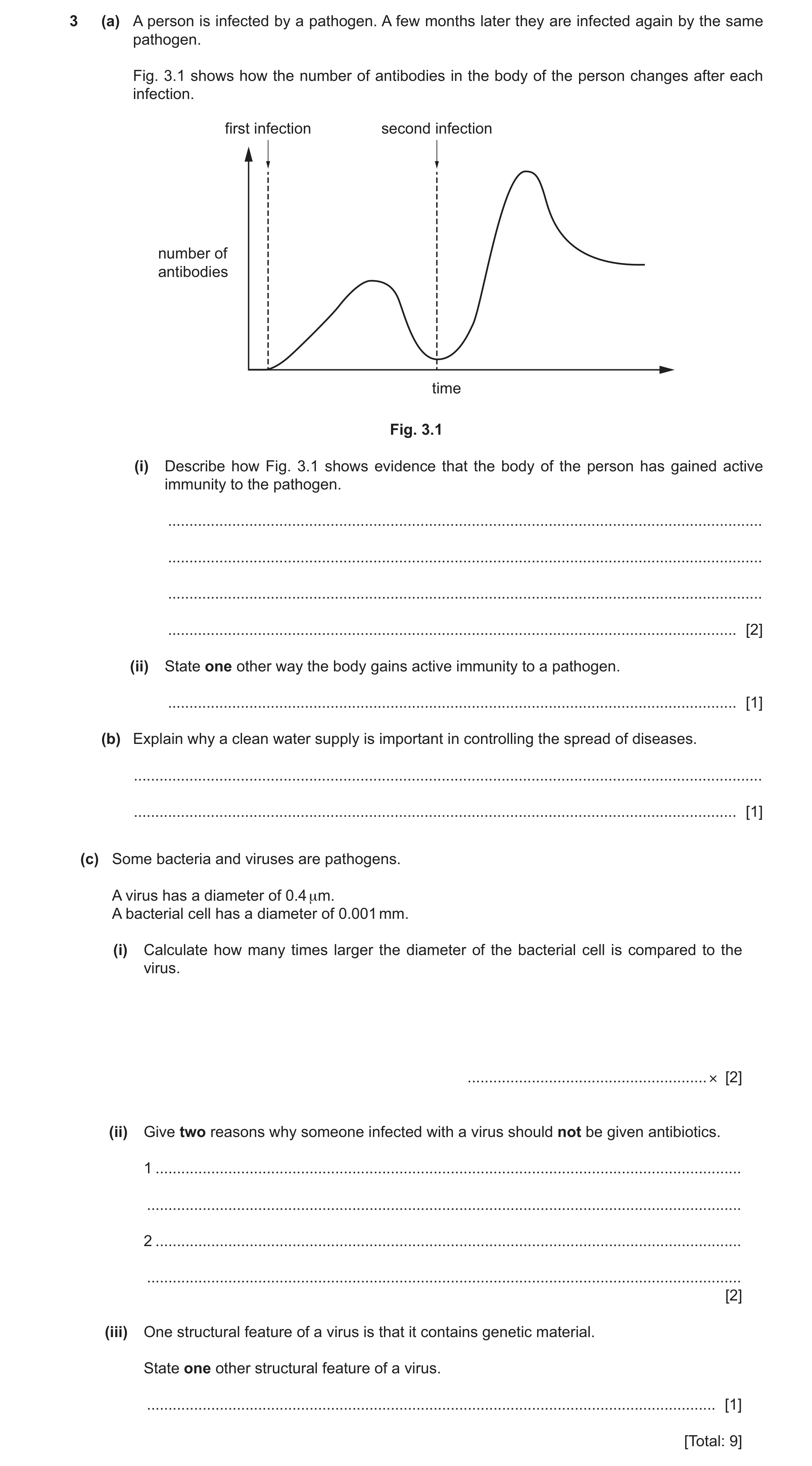
3 (a) A person is infected by a pathogen. A few months later they are infected again by the same pathogen. Fig. 3.1 shows how the number of antibodies in the body of the person changes after each infection. first infection second infection number of antibodies time Fig. 3.1 (i) Describe how Fig. 3.1 shows evidence that the body of the person has gained active immunity to the pathogen. … … … … [2] (ii) State one other way the body gains active immunity to a pathogen. … [1] (b) Explain why a clean water supply is important in controlling the spread of diseases. … … [1] (c) Some bacteria and viruses are pathogens. A virus has a diameter of 0.4 µm. A bacterial cell has a diameter of 0.001 mm. (i) Calculate how many times larger the diameter of the bacterial cell is compared to the virus. … × [2] (ii) Give two reasons why someone infected with a virus should not be given antibiotics. 1 … … 2 … … [2] (iii) One structural feature of a virus is that it contains genetic material. State one other structural feature of a virus. … [1] [Total: 9]
9 marks
Mark scheme: 3(a)(i) any two from: 2 second infection results in higher number of antibodies (compared to first infection) ; less time to release antibodies in second infection / faster response to second infection ; antibody number remains high(er) after infection ; 3(a)(ii) vaccination ; 1 3(b) (clean water contains) no pathogens (to transmit diseases) ; 1 3(c)(i) converts units to match or bacteria diameter ÷ virus diameter (seen) ; 2 2.5 (×) ; 3(c)(ii) antibiotics, have no effect on virus / only kill bacteria ; 2 (excessive use / misuse, of antibiotics) results in bacteria with antibiotic resistance ; 3(c)(iii) protein coat ; 1
This question in 0653/42 May/June 2025
Q12 · A diagram of a bacterial cell 0653/42 Oct/Nov 2025
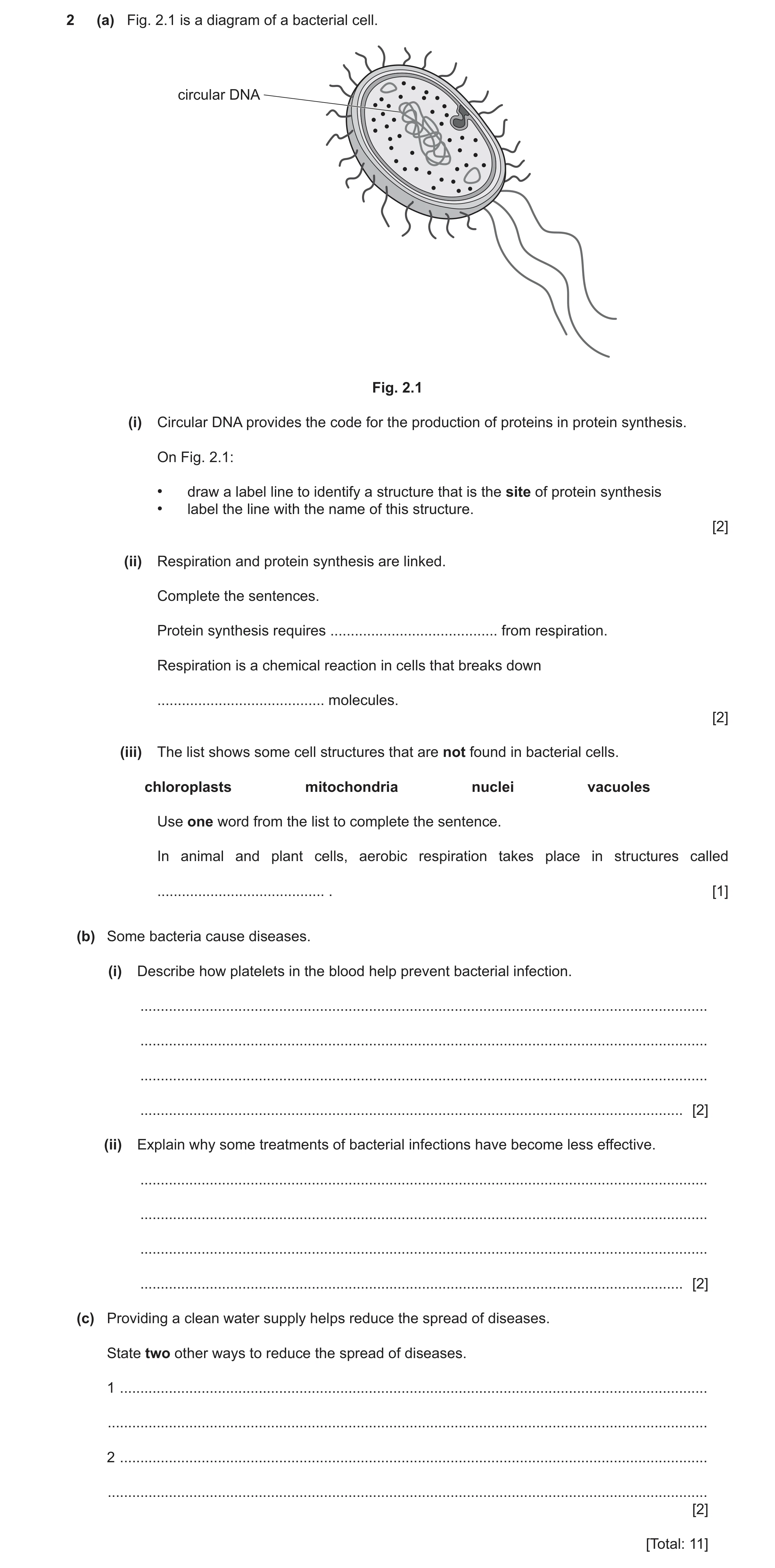
2 (a) Fig. 2.1 is a diagram of a bacterial cell. circular DNA Fig. 2.1 (i) Circular DNA provides the code for the production of proteins in protein synthesis. On Fig. 2.1: • draw a label line to identify a structure that is the site of protein synthesis • label the line with the name of this structure. [2] (ii) Respiration and protein synthesis are linked. Complete the sentences. Protein synthesis requires … from respiration. Respiration is a chemical reaction in cells that breaks down … molecules. [2] (iii) The list shows some cell structures that are not found in bacterial cells. chloroplasts mitochondria nuclei vacuoles Use one word from the list to complete the sentence. In animal and plant cells, aerobic respiration takes place in structures called … . [1] (b) Some bacteria cause diseases. (i) Describe how platelets in the blood help prevent bacterial infection. … … … … [2] (ii) Explain why some treatments of bacterial infections have become less effective. … … … … [2] (c) Providing a clean water supply helps reduce the spread of diseases. State two other ways to reduce the spread of diseases. 1 … … 2 … … [2] [Total: 11]
11 marks
Mark scheme: 2(a)(i) one of the small dots labelled ; 2 ribosome ; 2(a)(ii) energy ; 2 nutrient ; 2(a)(iii) mitochondria ; 1 2(b)(i) idea of involved in blood clotting ; 2 clot prevents entry of bacteria / clotting forms a barrier to bacteria ; 2(b)(ii) antibiotics and overuse / increased use / incorrect use / non-essential use 2 resulted in bacteria become resistant to (antibiotics) ; 2(c) any two from : 2 hygienic food preparation ; personal hygiene / good hygiene; waste disposal ; sewage treatment ; AVP, e.g. vaccination ; ;
This question in 0653/42 Oct/Nov 2025
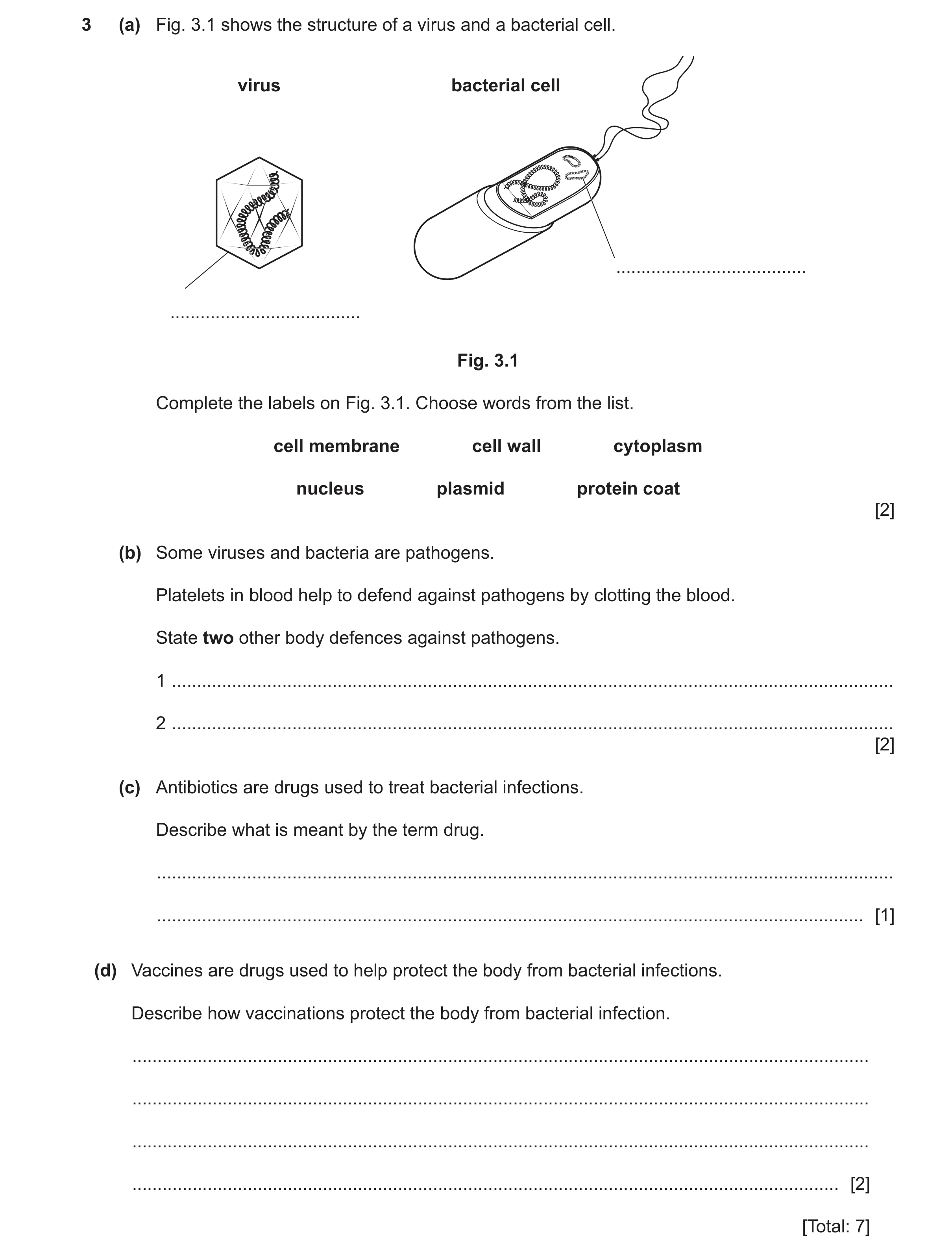
Q13 · The structure of a virus and a bacterial cell 0653/43 Oct/Nov 2025
3 (a) Fig. 3.1 shows the structure of a virus and a bacterial cell. virus bacterial cell … … Fig. 3.1 Complete the labels on Fig. 3.1. Choose words from the list. cell membrane cell wall cytoplasm nucleus plasmid protein coat [2] (b) Some viruses and bacteria are pathogens. Platelets in blood help to defend against pathogens by clotting the blood. State two other body defences against pathogens. 1 … 2 … [2] (c) Antibiotics are drugs used to treat bacterial infections. Describe what is meant by the term drug. … … [1] (d) Vaccines are drugs used to help protect the body from bacterial infections. Describe how vaccinations protect the body from bacterial infection. … … … … [2] [Total: 7]
7 marks
Mark scheme: 3(a) as (virus) protein coat ; 2 (bacterial cell) plasmid ; 3(b) any two from: 2 skin ; hairs in the nose ; mucus ; stomach acid ; white blood cells / antibodies ; AVP ; 3(c) substance (taken into the body) that modifies/affects (chemical) reactions in the body ; 1 3(d) cause the body to make antibodies ; 2 provide active immunity ;
This question in 0653/43 Oct/Nov 2025
 1 / 21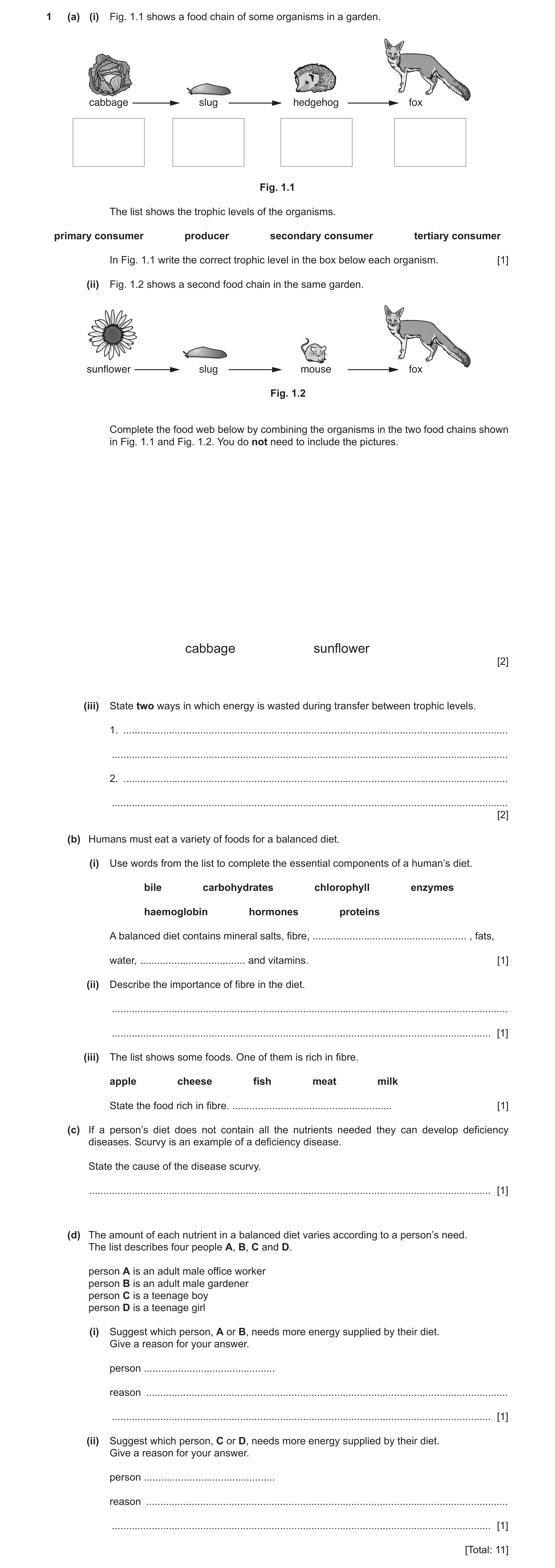
 6 / 21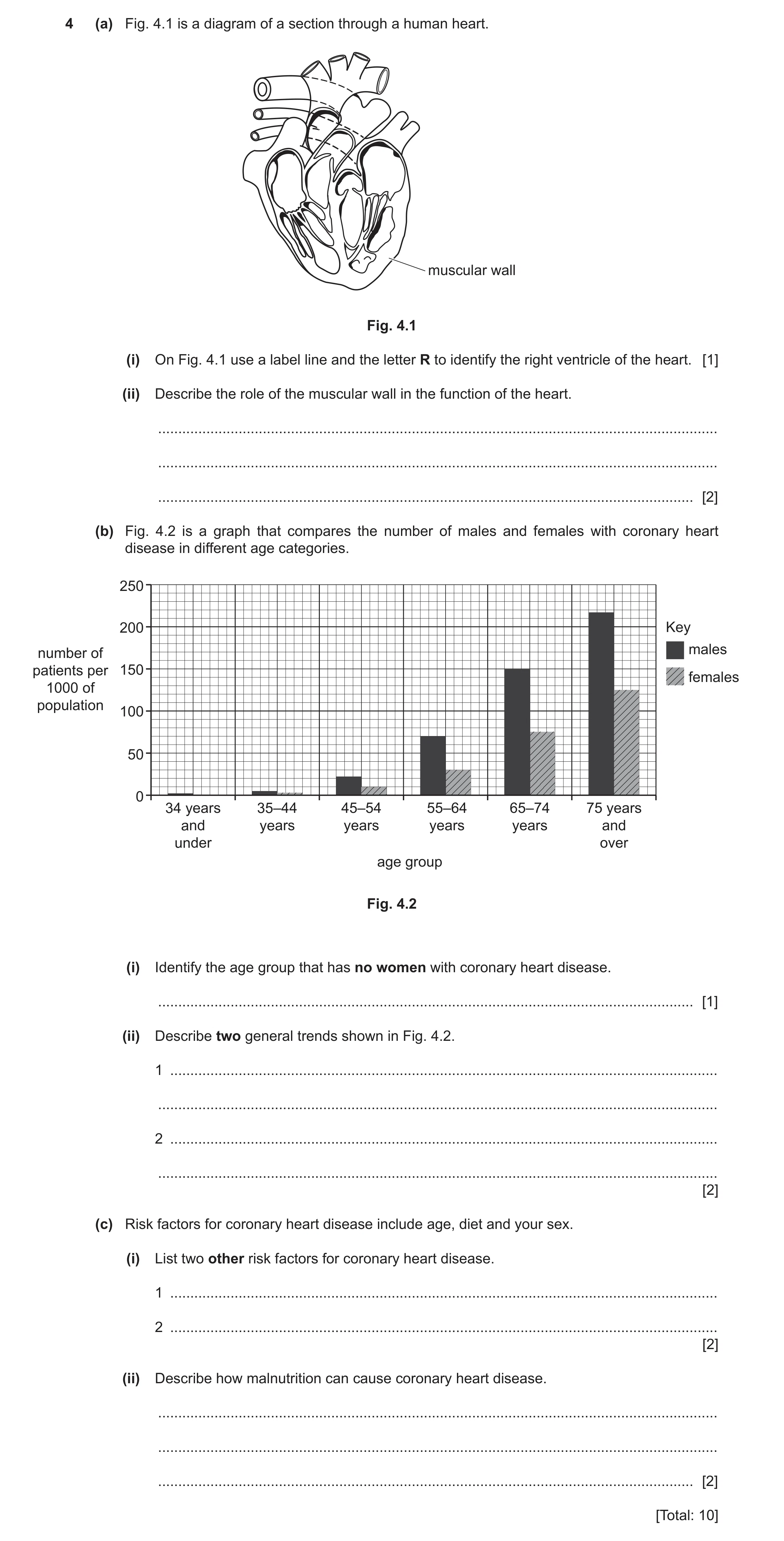
 21 / 21
 10
10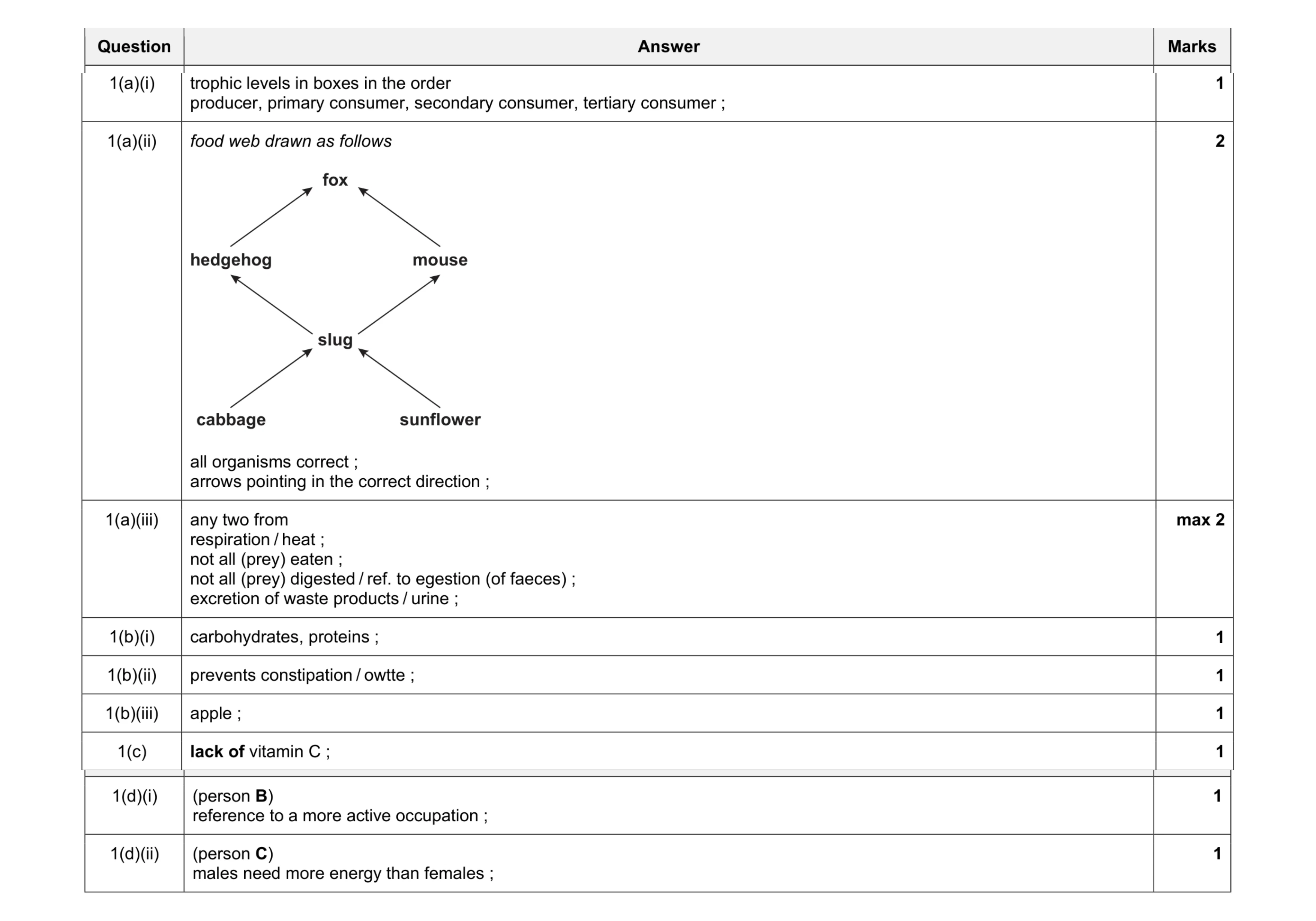 11
11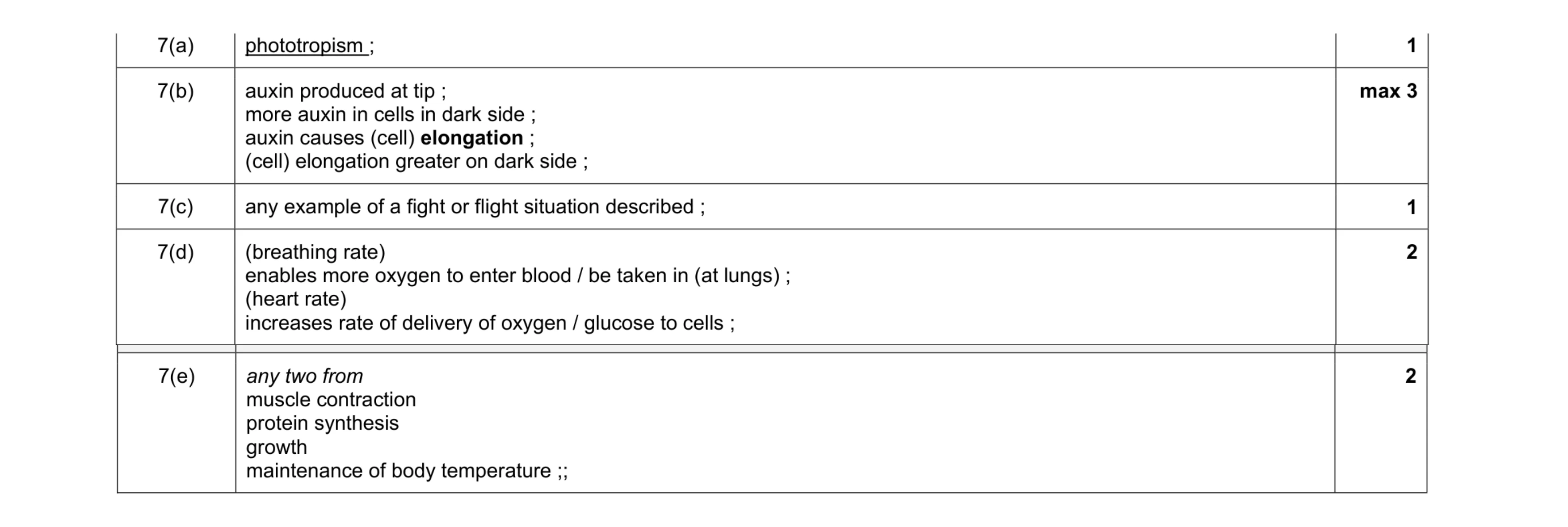 9
9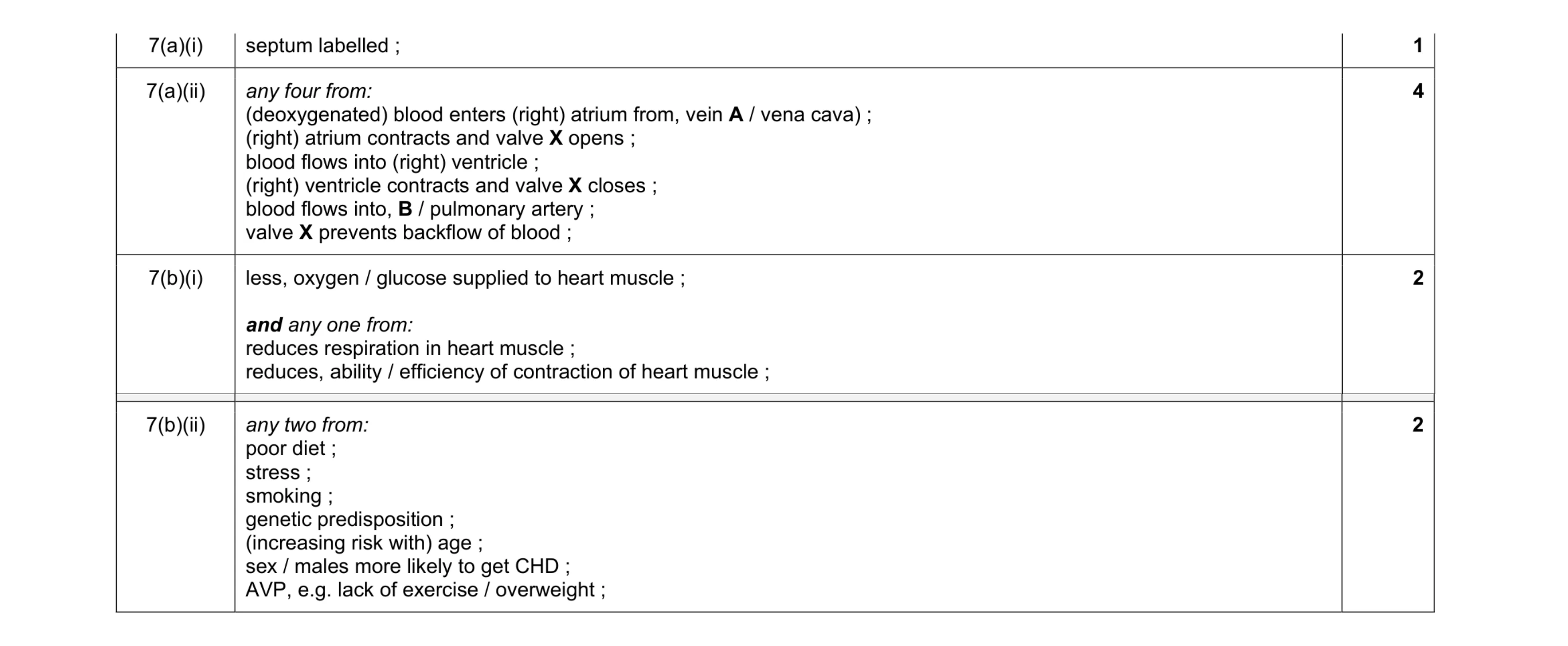 9
9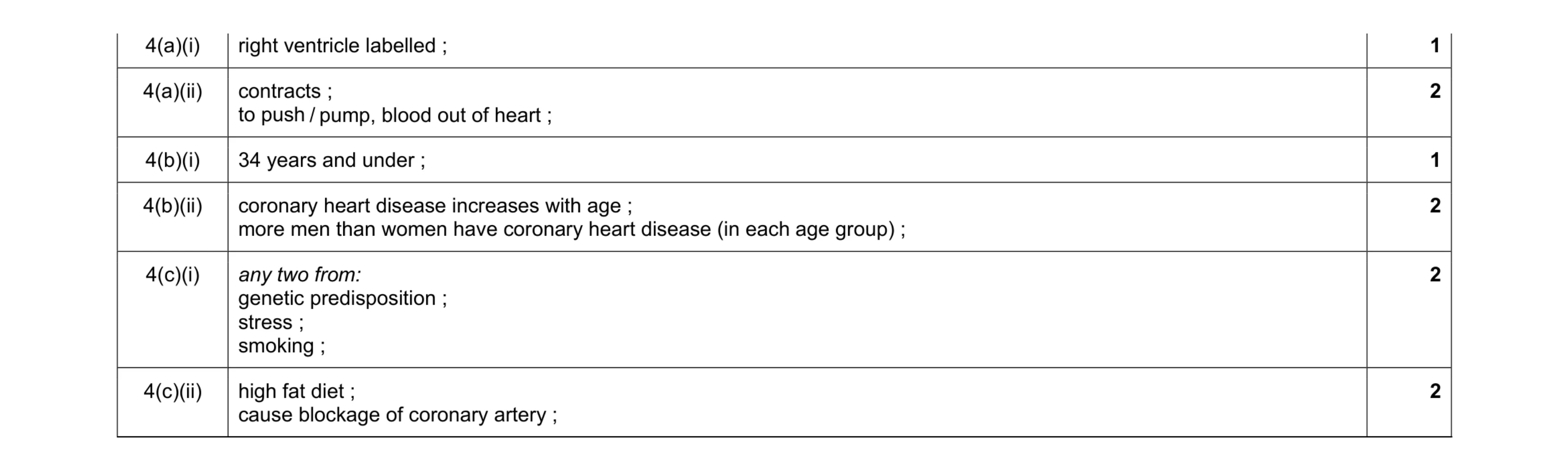 10
10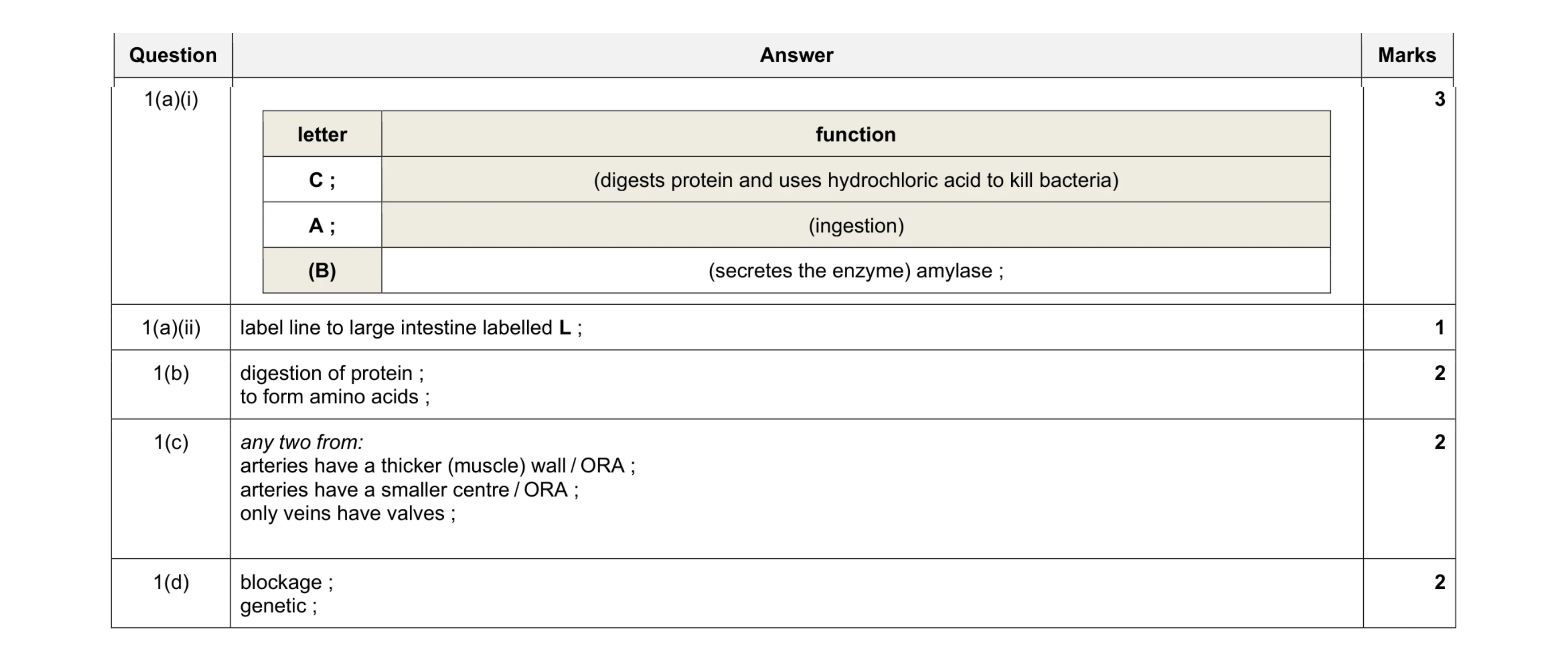 10
10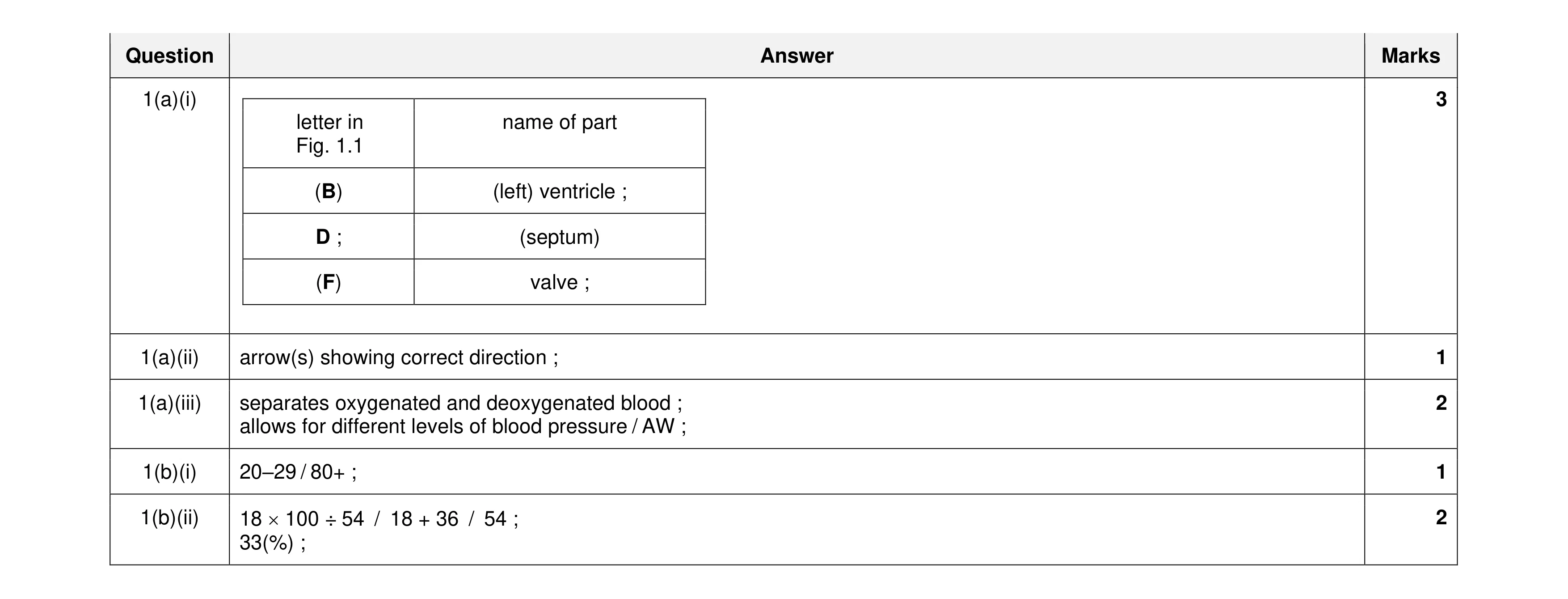 9
9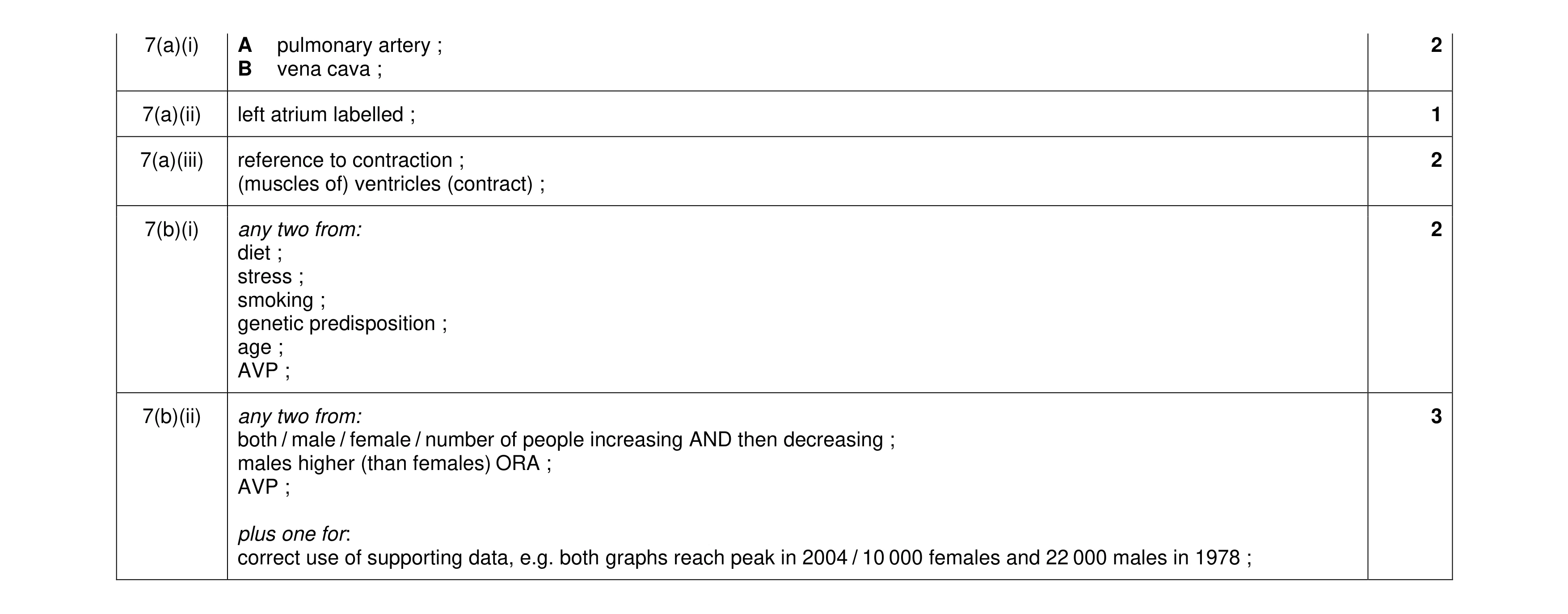 10
10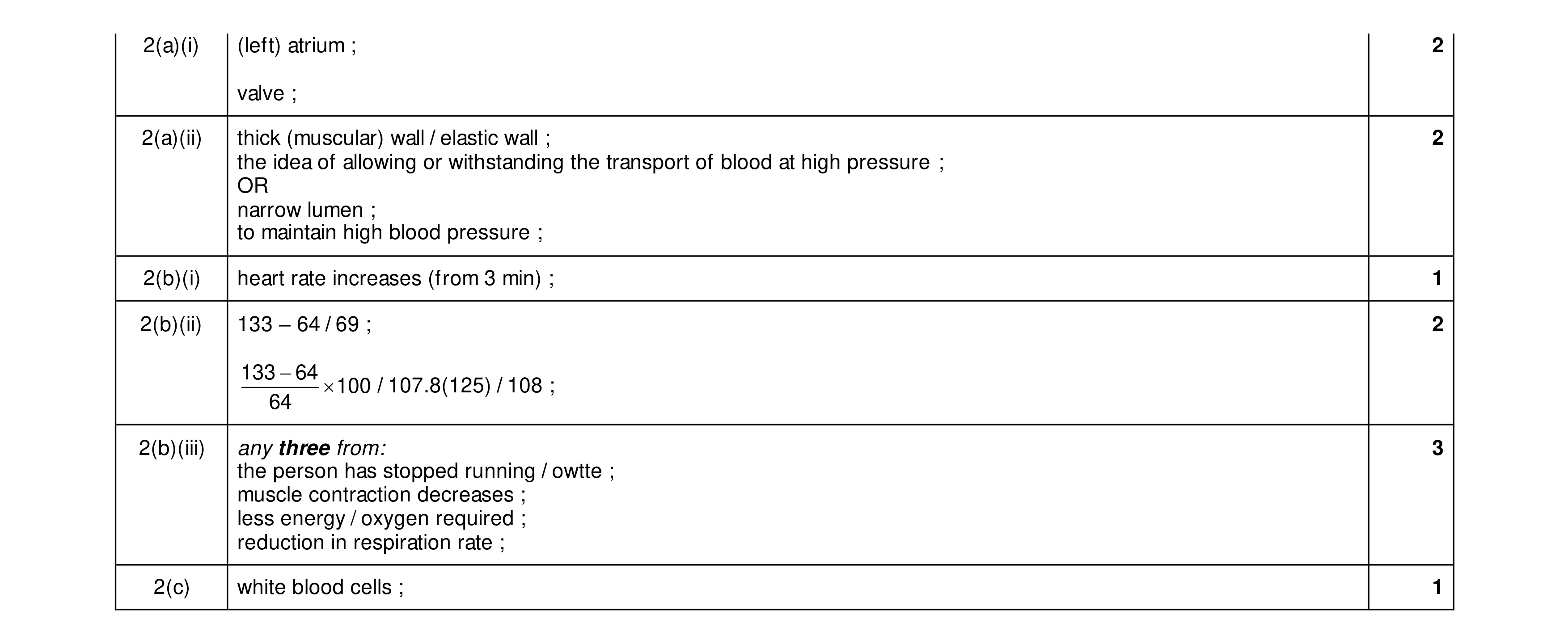 11
11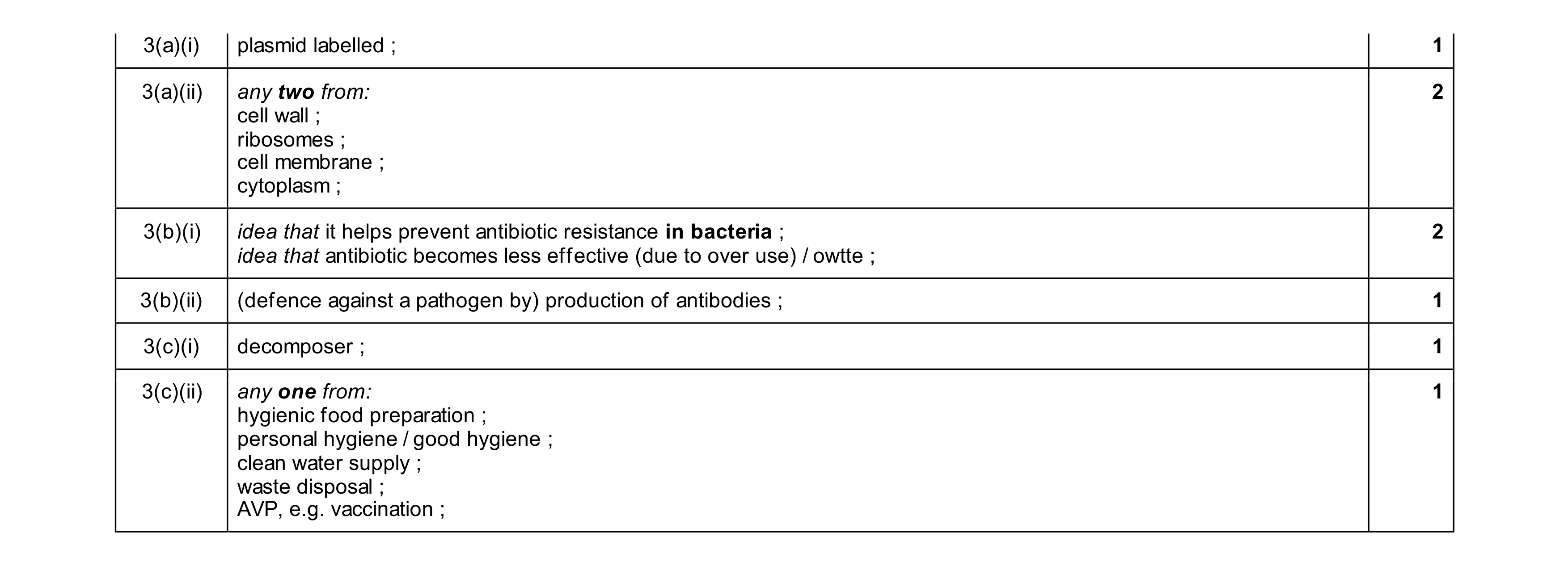 8
8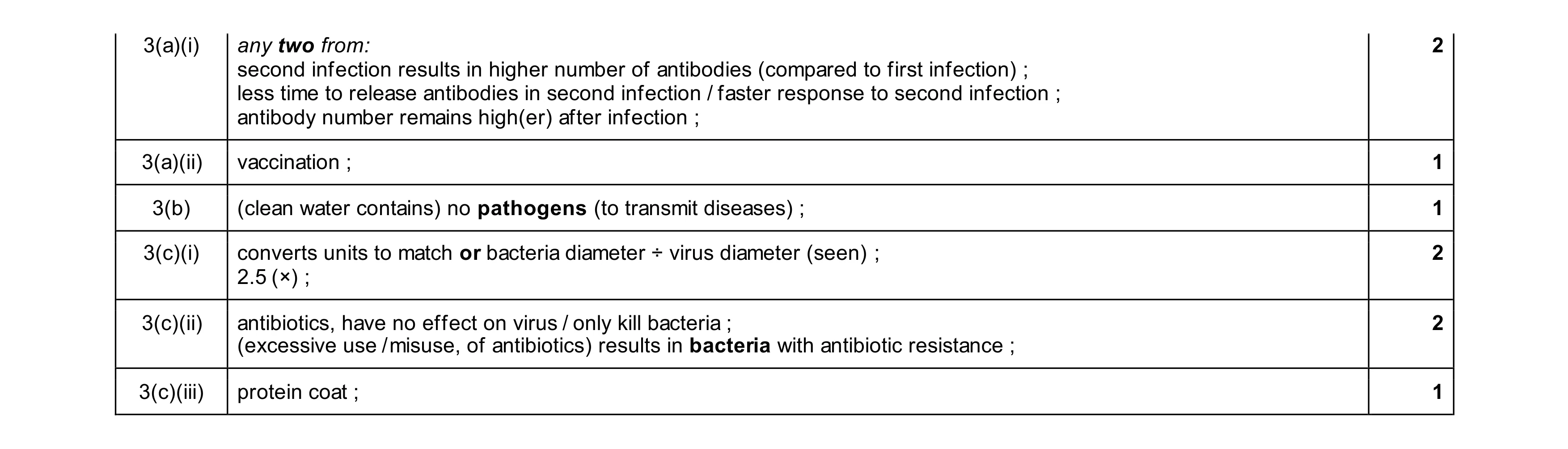 9
9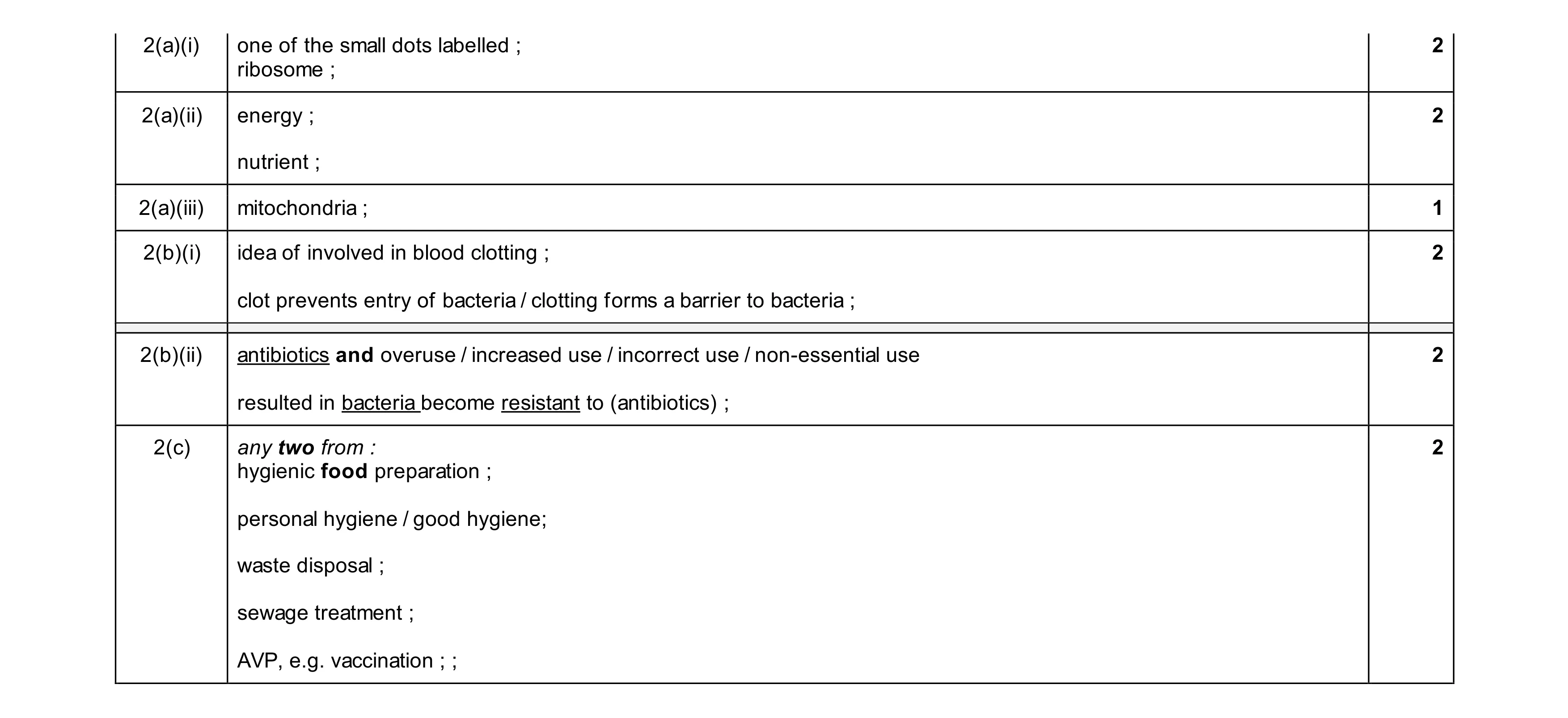 11
11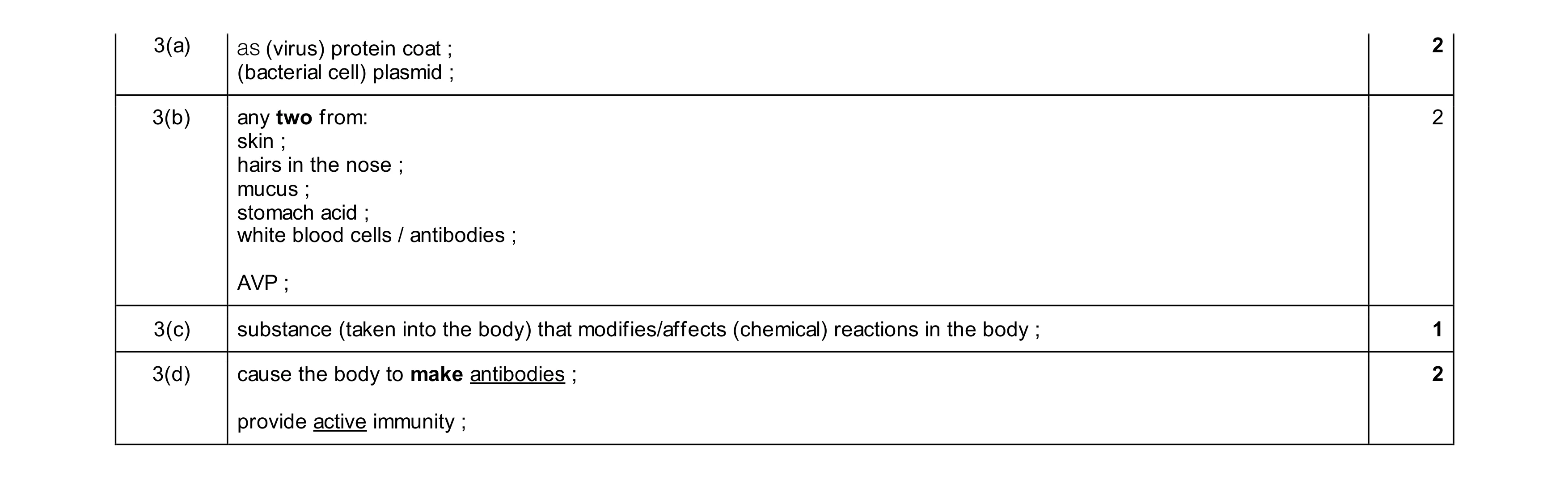 7
7