Questions as text
Q1 · Use the following words or phrases to complete the flow chart about the transport of… 0653/31 Oct/Nov 2017
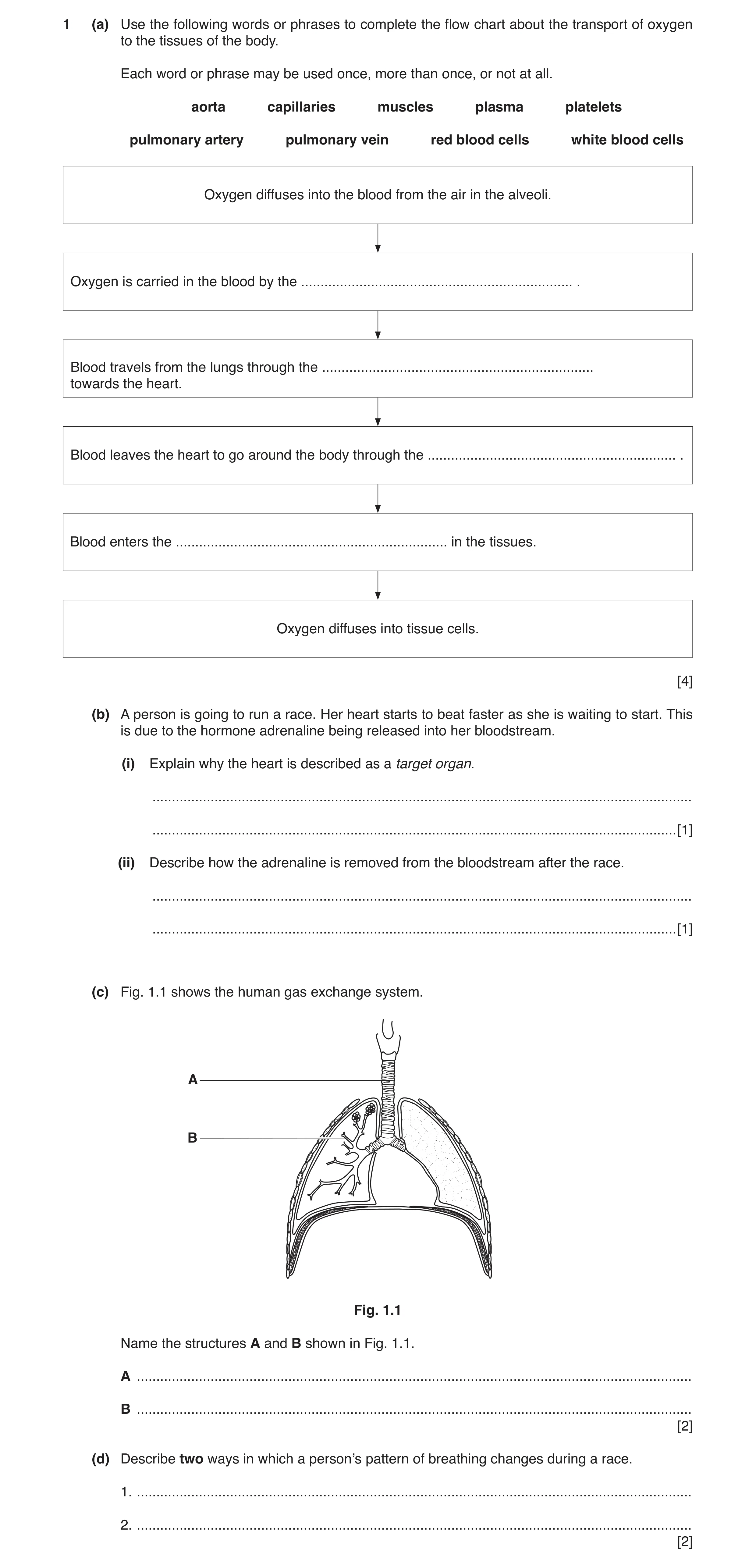
1 (a) Use the following words or phrases to complete the flow chart about the transport of oxygen to the tissues of the body. Each word or phrase may be used once, more than once, or not at all. aorta capillaries muscles plasma platelets pulmonary artery pulmonary vein red blood cells white blood cells Oxygen diffuses into the blood from the air in the alveoli. Oxygen is carried in the blood by the … . Blood travels from the lungs through the … towards the heart. Blood leaves the heart to go around the body through the … . Blood enters the … in the tissues. Oxygen diffuses into tissue cells. [4] (b) A person is going to run a race. Her heart starts to beat faster as she is waiting to start. This is due to the hormone adrenaline being released into her bloodstream. (i) Explain why the heart is described as a target organ. … … [1] (ii) Describe how the adrenaline is removed from the bloodstream after the race. … … [1] (c) Fig. 1.1 shows the human gas exchange system. A B Fig. 1.1 Name the structures A and B shown in Fig. 1.1. A … B … [2] (d) Describe two ways in which a person’s pattern of breathing changes during a race. 1. … 2. … [2]
10 marks
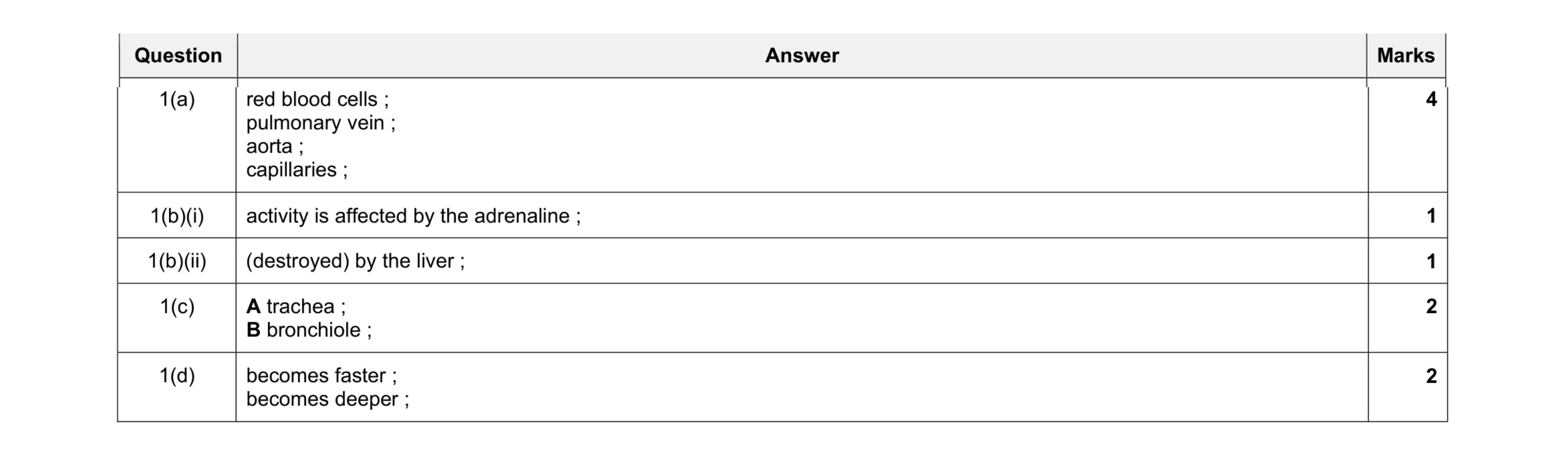
Mark scheme: 1(a) red blood cells ; pulmonary vein ; aorta ; capillaries ; 4 1(b)(i) activity is affected by the adrenaline ; 1 1(b)(ii) (destroyed) by the liver ; 1 1(c) A trachea ; B bronchiole ; 2 1(d) becomes faster ; becomes deeper ; 2
This question in 0653/31 Oct/Nov 2017
Q2 · Some features of arteries, veins and capillaries 0653/31 Oct/Nov 2018
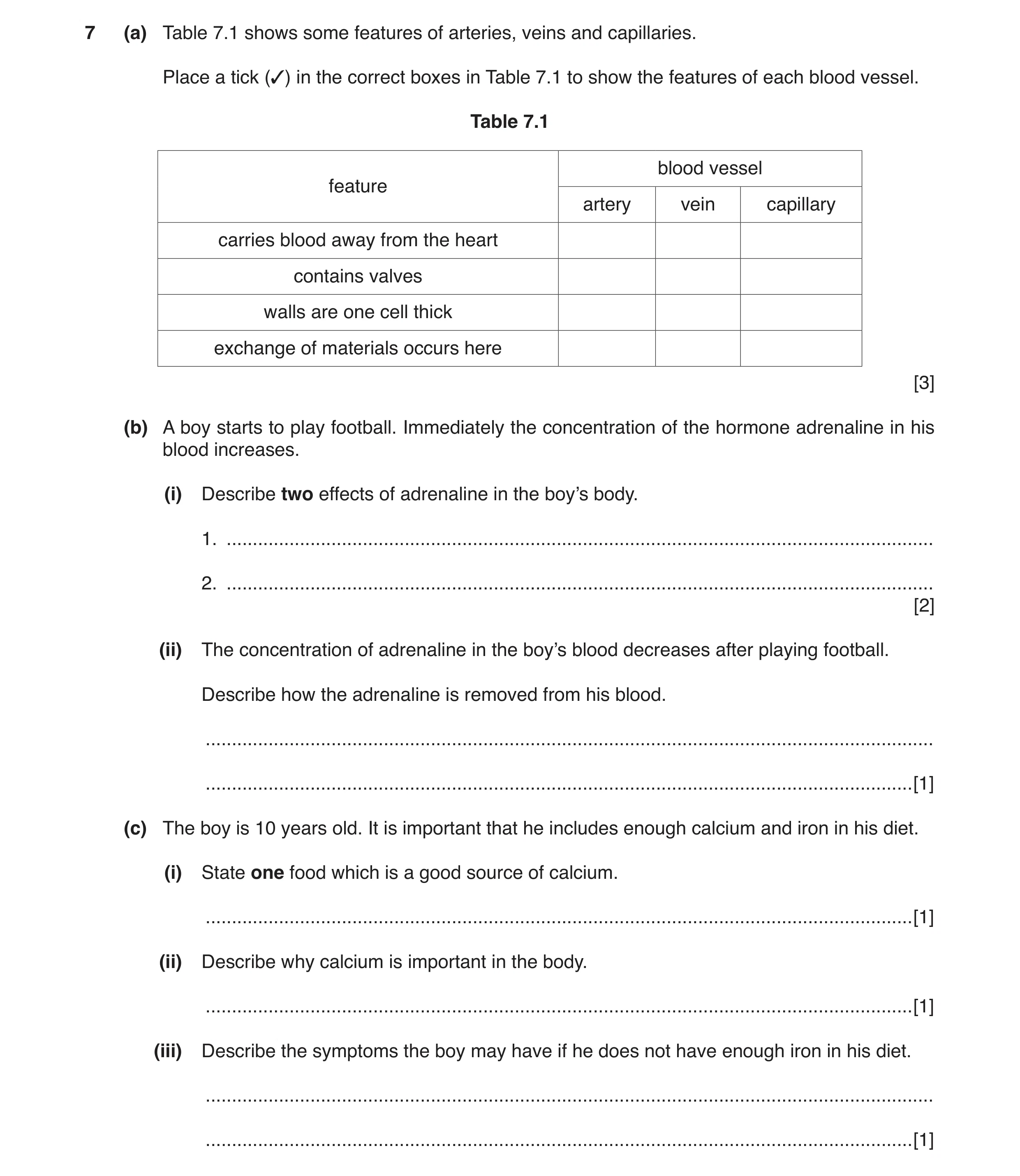
7 (a) Table 7.1 shows some features of arteries, veins and capillaries. Place a tick (3) in the correct boxes in Table 7.1 to show the features of each blood vessel. Table 7.1 blood vessel feature artery vein capillary carries blood away from the heart contains valves walls are one cell thick exchange of materials occurs here [3] (b) A boy starts to play football. Immediately the concentration of the hormone adrenaline in his blood increases. (i) Describe two effects of adrenaline in the boy’s body. 1. … 2. … [2] (ii) The concentration of adrenaline in the boy’s blood decreases after playing football. Describe how the adrenaline is removed from his blood. … … [1] (c) The boy is 10 years old. It is important that he includes enough calcium and iron in his diet. (i) State one food which is a good source of calcium. … [1] (ii) Describe why calcium is important in the body. … [1] (iii) Describe the symptoms the boy may have if he does not have enough iron in his diet. … … [1]
9 marks
Mark scheme: 7(a) characteristic blood vessel artery vein capillary carries blood away from the heart 3 contains valves 3 walls are one cell thick 3 exchange of materials occurs here 3 ;;; 3 7(b)(i) any two from increases (blood) glucose concentration ; increases heart rate / pulse ; increases rate of respiration ; Max 2 2 7(b)(ii) destroyed by the liver ; 1 7(c)(i) milk / yoghurt / fish / green vegetables ; 1 7(c)(ii) strengthens bones / teeth ; 1 7(c)(iii) tiredness / pale skin / shortness of breath / dizziness ; 1
This question in 0653/31 Oct/Nov 2018
Q3 · A piece of potato in a solution of hydrogen peroxide 0653/32 Oct/Nov 2018
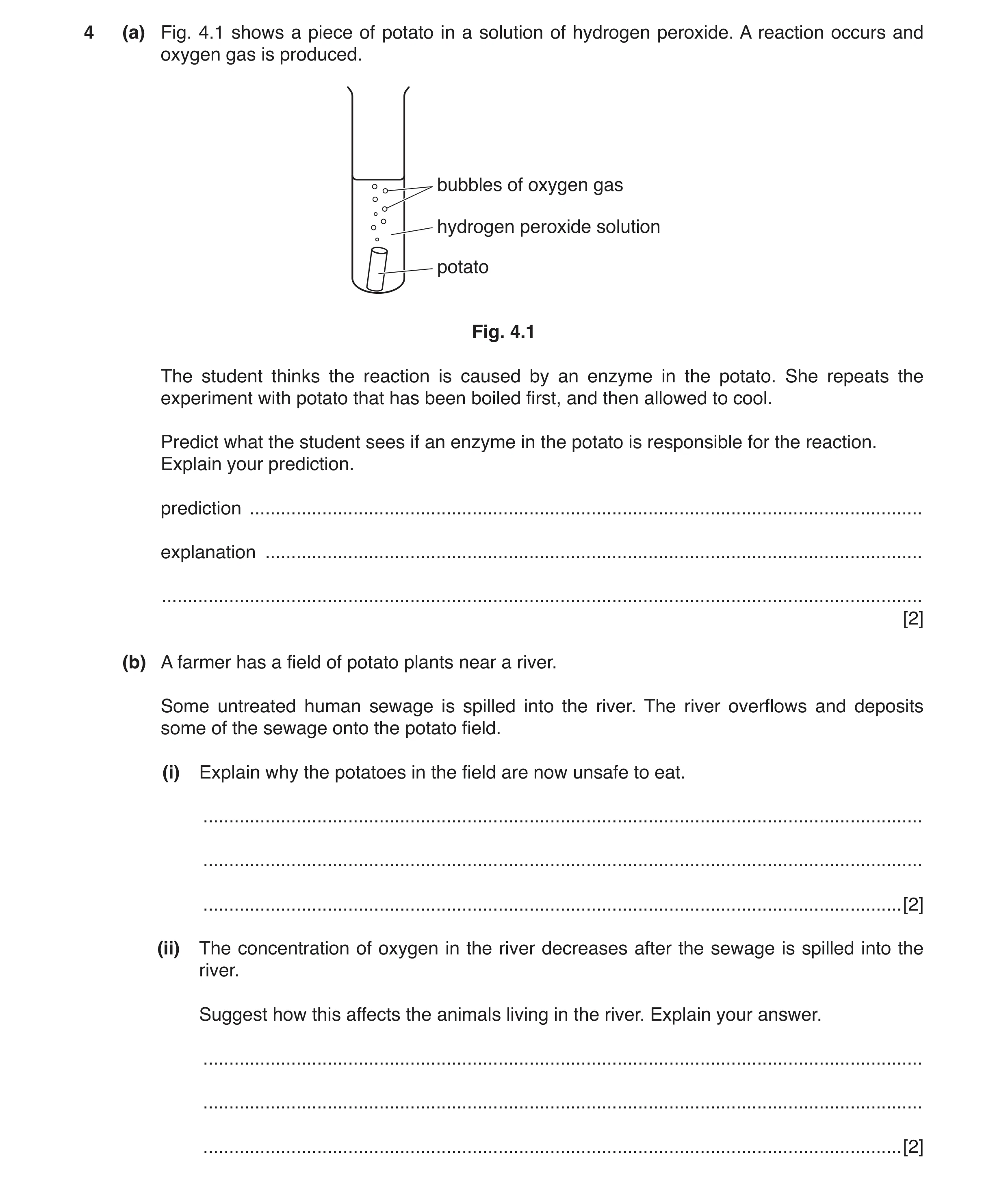
4 (a) Fig. 4.1 shows a piece of potato in a solution of hydrogen peroxide. A reaction occurs and oxygen gas is produced. bubbles of oxygen gas hydrogen peroxide solution potato Fig. 4.1 The student thinks the reaction is caused by an enzyme in the potato. She repeats the experiment with potato that has been boiled first, and then allowed to cool. Predict what the student sees if an enzyme in the potato is responsible for the reaction. Explain your prediction. prediction … explanation … … [2] (b) A farmer has a field of potato plants near a river. Some untreated human sewage is spilled into the river. The river overflows and deposits some of the sewage onto the potato field. (i) Explain why the potatoes in the field are now unsafe to eat. … … … [2] (ii) The concentration of oxygen in the river decreases after the sewage is spilled into the river. Suggest how this affects the animals living in the river. Explain your answer. … … … [2]
6 marks
Mark scheme: 4(a) no reaction ; the increased temperature / boiling has removed enzyme activity ; 2 4(b)(i) the water / river is polluted ; contains bacteria / viruses / microbes / pathogens ; that cause disease ; Max 2 2 4(b)(ii) animals / fish will die / move away ; due to suffocation / less oxygen for respiration ; 2
This question in 0653/32 Oct/Nov 2018
Q4 · A diagram showing five of the characteristics of living organisms 0653/32 May/June 2019
1 (a) Fig. 1.1 is a diagram showing five of the characteristics of living organisms. excretion … nutrition characteristics of reproduction living organisms … sensitivity movement Fig. 1.1 (i) Complete Fig. 1.1 by adding the two missing characteristics of living organisms. [2] (ii) Describe the differences in how plants and animals obtain their nutrition. Plants obtain their nutrition by … … Animals obtain their nutrition by … … [2] (b) Plants and animals can detect and respond to changes in their environment. (i) Name this characteristic. … [1] (ii) Use words in the list to complete the following sentences about plant responses. You may use each word once, more than once or not at all. downwards gravitropism gravity photosynthesis phototropism sideways upwards When a seed germinates in the soil the radicle (young root) grows … . This response is called … . When the plumule (young shoot) is above ground it grows towards light. This response is called … . [3] (c) Animals can use hormones to produce responses. An example of a hormone is adrenaline which is secreted into the blood when the body is under stress. State two effects of adrenaline on the body. 1. … 2. … [2] [Total: 10]
10 marks
Mark scheme: 1(a)(i) either order growth ; respiration ; 2 1(a)(ii) (plants obtain their nutrition by) photosynthesis ; (animals obtain their nutrition by) eating ; 2 1(b)(i) sensitivity ; 1 1(b)(ii) downwards ; gravitropism ; phototropism ; 3 1(c) any two of increased breathing rate ; increased pulse rate ; widened pupils ; 2
This question in 0653/32 May/June 2019
Q5 · The male reproductive organs 0653/32 May/June 2020
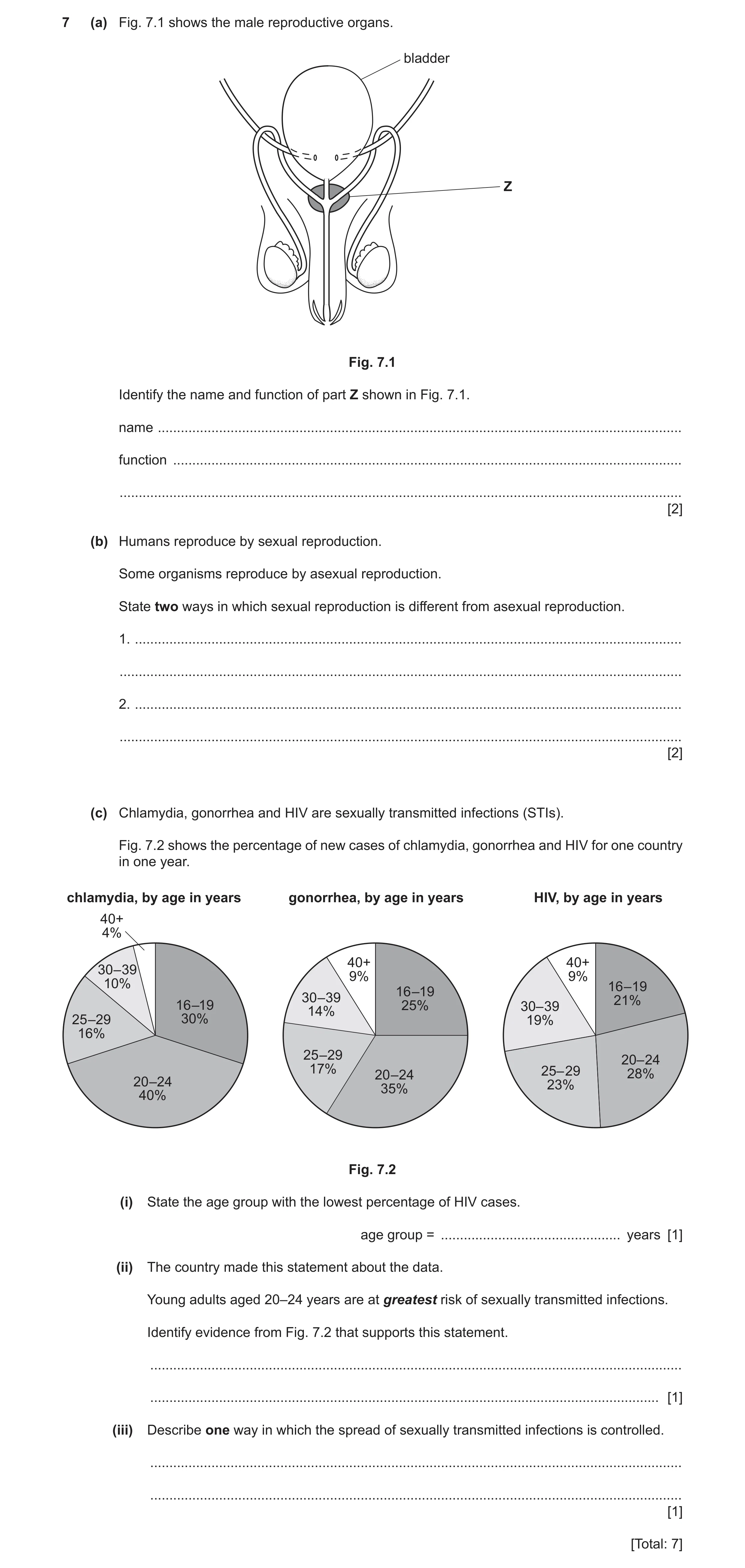
7 (a) Fig. 7.1 shows the male reproductive organs. bladder Z Fig. 7.1 Identify the name and function of part Z shown in Fig. 7.1. name … function … … [2] (b) Humans reproduce by sexual reproduction. Some organisms reproduce by asexual reproduction. State two ways in which sexual reproduction is different from asexual reproduction. 1. … … 2. … … [2] (c) Chlamydia, gonorrhea and HIV are sexually transmitted infections (STIs). Fig. 7.2 shows the percentage of new cases of chlamydia, gonorrhea and HIV for one country in one year. chlamydia, by age in years gonorrhea, by age in years HIV, by age in years 40+ 4% 40+ 40+ 30–39 9% 9% 10% 16–19 16–19 30–39 21% 16–19 25% 30–39 14% 25–29 30% 19% 16% 25–29 20–24 17% 25–29 28% 20–24 20–24 23% 35% 40% Fig. 7.2 (i) State the age group with the lowest percentage of HIV cases. age group = … years [1] (ii) The country made this statement about the data. Young adults aged 20–24 years are at greatest risk of sexually transmitted infections. Identify evidence from Fig. 7.2 that supports this statement. … … [1] (iii) Describe one way in which the spread of sexually transmitted infections is controlled. … … [1] [Total: 7]
7 marks
Mark scheme: 7(a) (name) prostate (gland) ; (function) secretes fluid for sperm to swim in / owtte ; 2 7(b) any two from: offspring show genetic variation ; zygote formed ; fertilisation takes place / nuclei fuse ; involves gametes ; 2 7(c)(i) 40+ ; 1 Question Answer Marks 7(c)(ii) 20–24 years has the highest percentage of cases in all three charts ; 1 7(c)(iii) any one from: idea of protective sexual intercourse ; abstinence ; 1
This question in 0653/32 May/June 2020
Q6 · The boxes on the left show some parts of the male reproductive system in humans 0653/31 Oct/Nov 2020
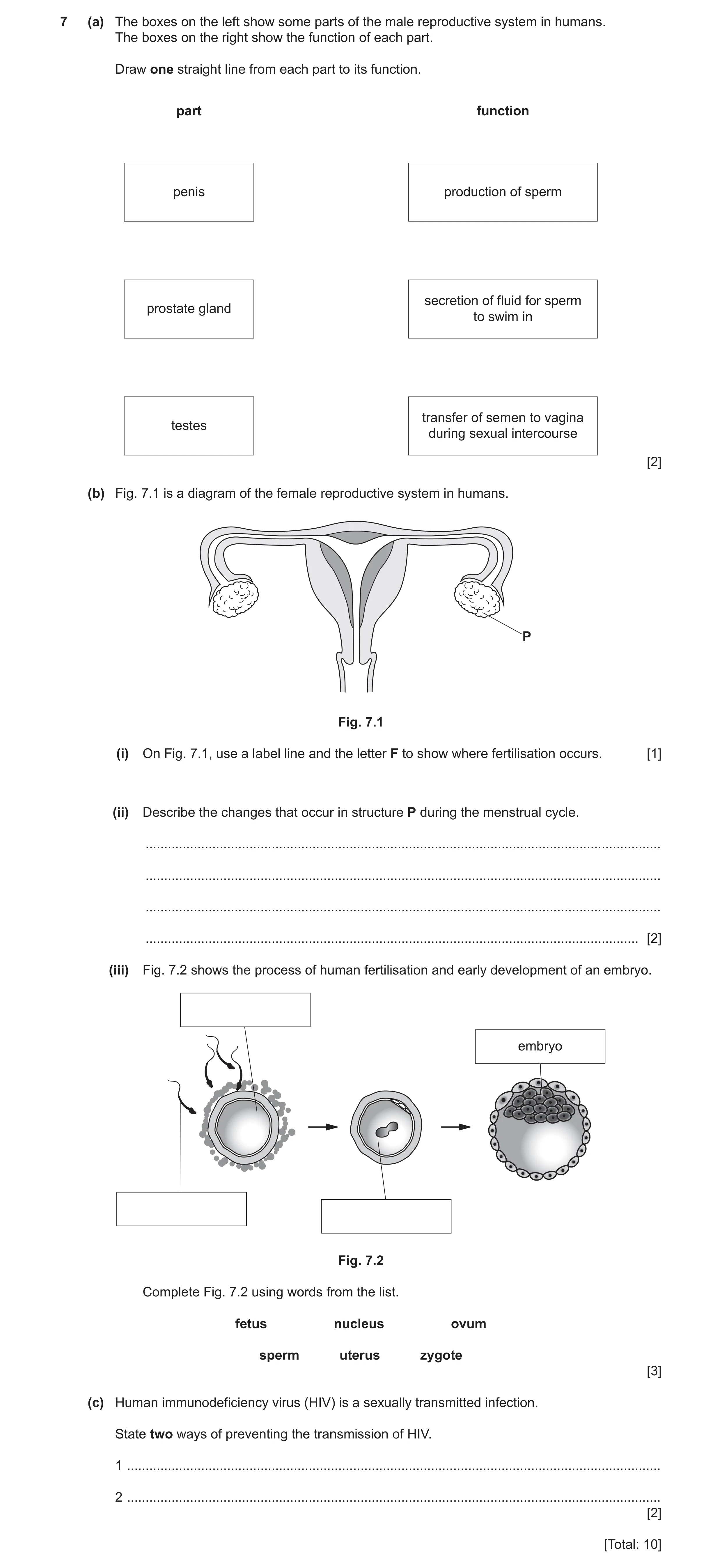
7 (a) The boxes on the left show some parts of the male reproductive system in humans. The boxes on the right show the function of each part. Draw one straight line from each part to its function. part function penis production of sperm secretion of fluid for sperm prostate gland to swim in transfer of semen to vagina testes during sexual intercourse [2] (b) Fig. 7.1 is a diagram of the female reproductive system in humans. P Fig. 7.1 (i) On Fig. 7.1, use a label line and the letter F to show where fertilisation occurs. [1] (ii) Describe the changes that occur in structure P during the menstrual cycle. … … … … [2] (iii) Fig. 7.2 shows the process of human fertilisation and early development of an embryo. embryo Fig. 7.2 Complete Fig. 7.2 using words from the list. fetus nucleus ovum sperm uterus zygote [3] (c) Human immunodeficiency virus (HIV) is a sexually transmitted infection. State two ways of preventing the transmission of HIV. 1 … 2 … [2] [Total: 10]
10 marks
Mark scheme: 7(a) penis production of sperm prostate gland secretion of fluid for sperm to swim in testes transfer of semen to vagina during sexual intercourse 1 correct ; 3 correct ; 2 Question Answer Marks 7(b)(i) line labelled F to either oviduct ; 1 7(b)(ii) any two from: female gamete / ova / egg (cell), develops / matures ; follicle develops ; female gamete / ova / egg (cell), released ; correct reference to time ; 2 7(b)(iii) ovum ; sperm ; zygote ; 3 7(c) any two from: idea of protective sexual intercourse ; abstinence ; not sharing needles ; 2
This question in 0653/31 Oct/Nov 2020
Q7 · Parts of the human gas exchange system 0653/32 Oct/Nov 2020
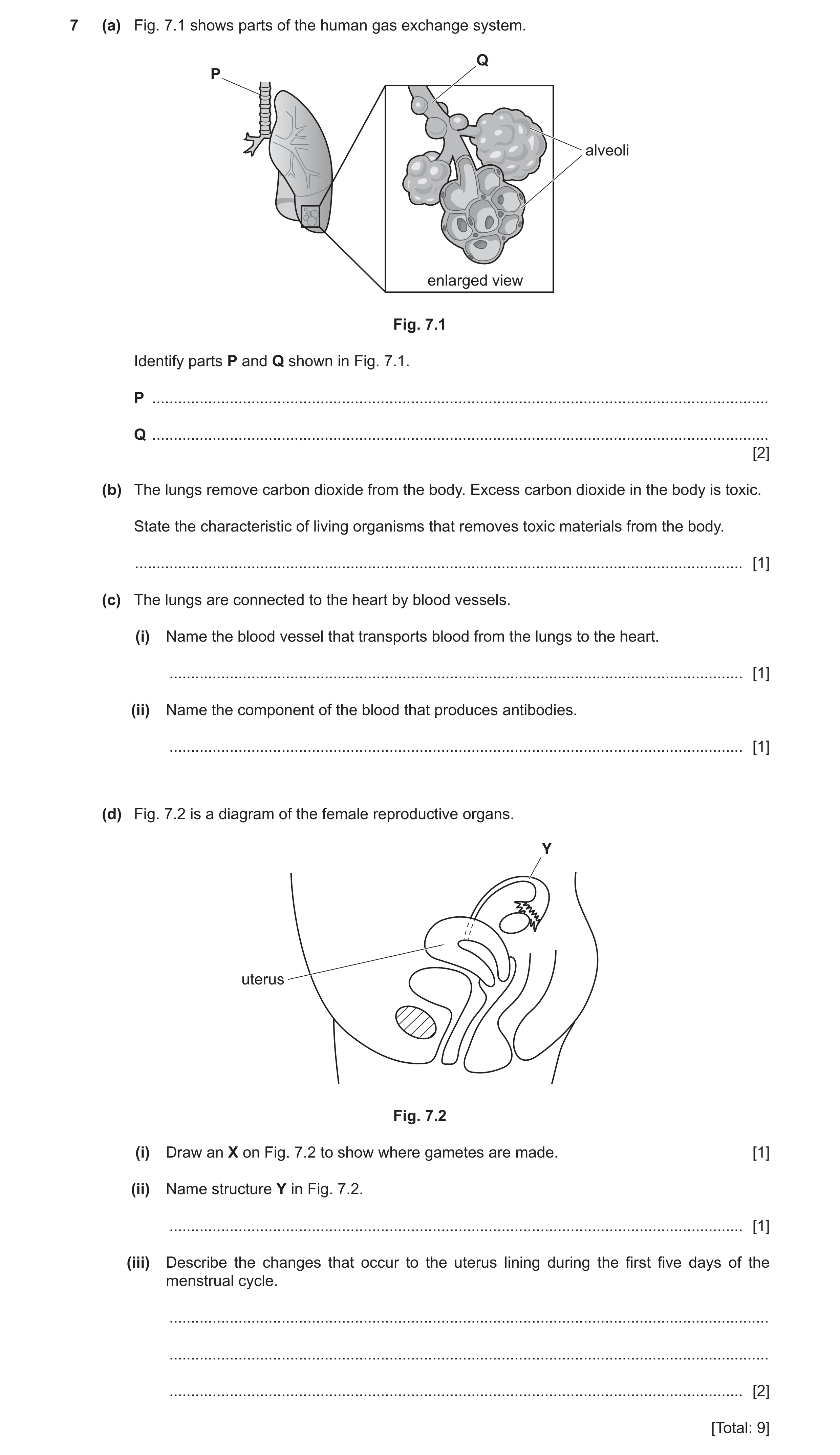
7 (a) Fig. 7.1 shows parts of the human gas exchange system. Q P alveoli enlarged view Fig. 7.1 Identify parts P and Q shown in Fig. 7.1. P … Q … [2] (b) The lungs remove carbon dioxide from the body. Excess carbon dioxide in the body is toxic. State the characteristic of living organisms that removes toxic materials from the body. … [1] (c) The lungs are connected to the heart by blood vessels. (i) Name the blood vessel that transports blood from the lungs to the heart. … [1] (ii) Name the component of the blood that produces antibodies. … [1] (d) Fig. 7.2 is a diagram of the female reproductive organs. Y uterus Fig. 7.2 (i) Draw an X on Fig. 7.2 to show where gametes are made. [1] (ii) Name structure Y in Fig. 7.2. … [1] (iii) Describe the changes that occur to the uterus lining during the first five days of the menstrual cycle. … … … [2] [Total: 9]
9 marks
Mark scheme: 7(a) P trachea ; Q bronchiole ; 2 7(b) excretion ; 1 7(c)(i) pulmonary vein ; 1 7(c)(ii) white blood cell ; 1 Question Answer Marks 7(d)(i) centre of X on ovary ; 1 7(d)(ii) oviduct ; 1 7(d)(iii) any two from: (uterus lining) breaks down ; (uterus lining) is shed ; (uterus) thickness decreases ; 2
This question in 0653/32 Oct/Nov 2020
Q8 · A diagram of the human heart 0653/32 May/June 2021
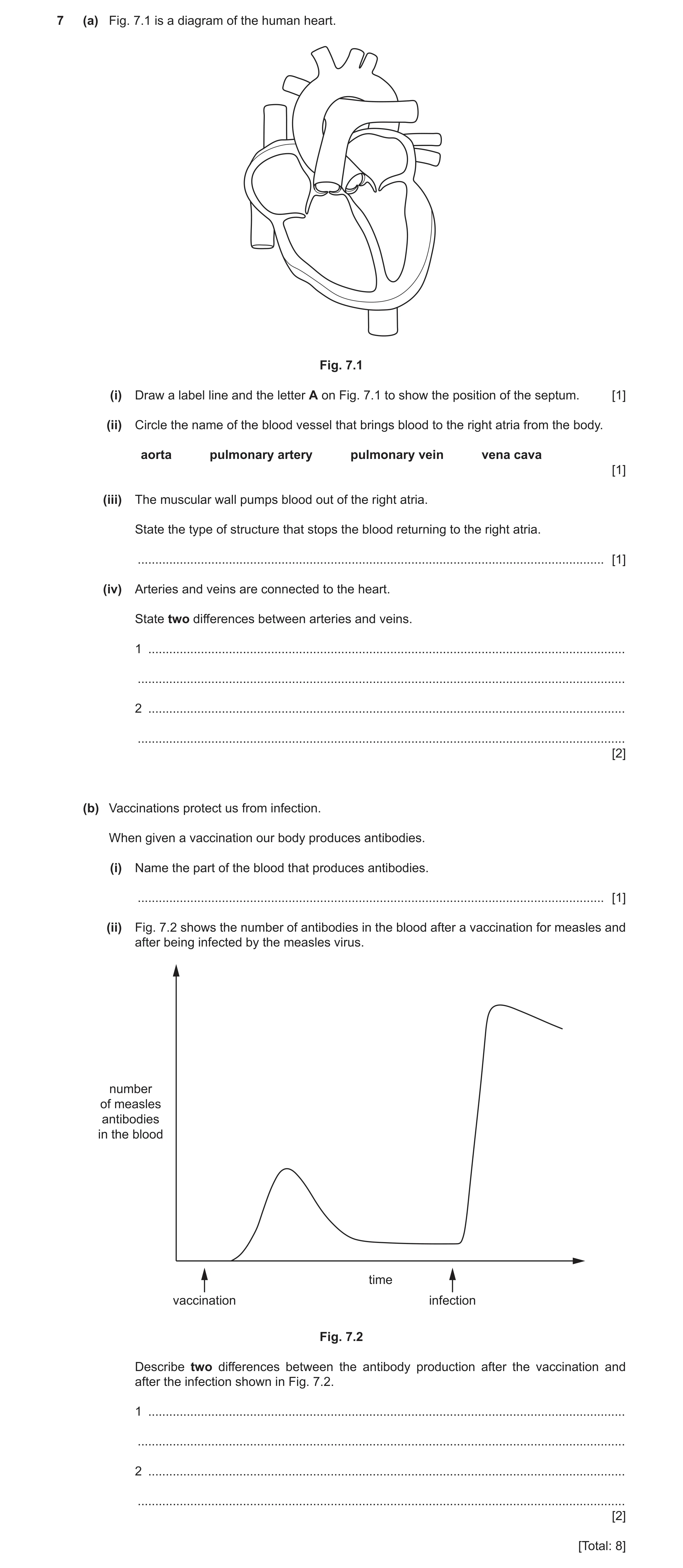
7 (a) Fig. 7.1 is a diagram of the human heart. Fig. 7.1 (i) Draw a label line and the letter A on Fig. 7.1 to show the position of the septum. [1] (ii) Circle the name of the blood vessel that brings blood to the right atria from the body. aorta pulmonary artery pulmonary vein vena cava [1] (iii) The muscular wall pumps blood out of the right atria. State the type of structure that stops the blood returning to the right atria. … [1] (iv) Arteries and veins are connected to the heart. State two differences between arteries and veins. 1 … … 2 … … [2] (b) Vaccinations protect us from infection. When given a vaccination our body produces antibodies. (i) Name the part of the blood that produces antibodies. … [1] (ii) Fig. 7.2 shows the number of antibodies in the blood after a vaccination for measles and after being infected by the measles virus. number of measles antibodies in the blood time vaccination infection Fig. 7.2 Describe two differences between the antibody production after the vaccination and after the infection shown in Fig. 7.2. 1 … … 2 … … [2] [Total: 8]
8 marks
Mark scheme: 7(a)(i) line touching septum ; 1 7(a)(ii) vena cava ; 1 7(a)(iii) valve ; 1 7(a)(iv) any two from: arteries have thicker (muscular) walls ORA ; arteries have smaller, cavity ORA ; arteries take blood away from heart / veins bring blood to heart ; veins have valves (arteries do not) ; 2 7(b)(i) white blood cells ; 1 7(b)(ii) any two from: fewer antibodies made after vaccination (than after infection) ORA ; antibodies reach maximum quicker after infection ORA ; antibody numbers remain higher for longer after infection ; 2
This question in 0653/32 May/June 2021
Q9 · The boxes on the left show different components of blood 0653/33 May/June 2021
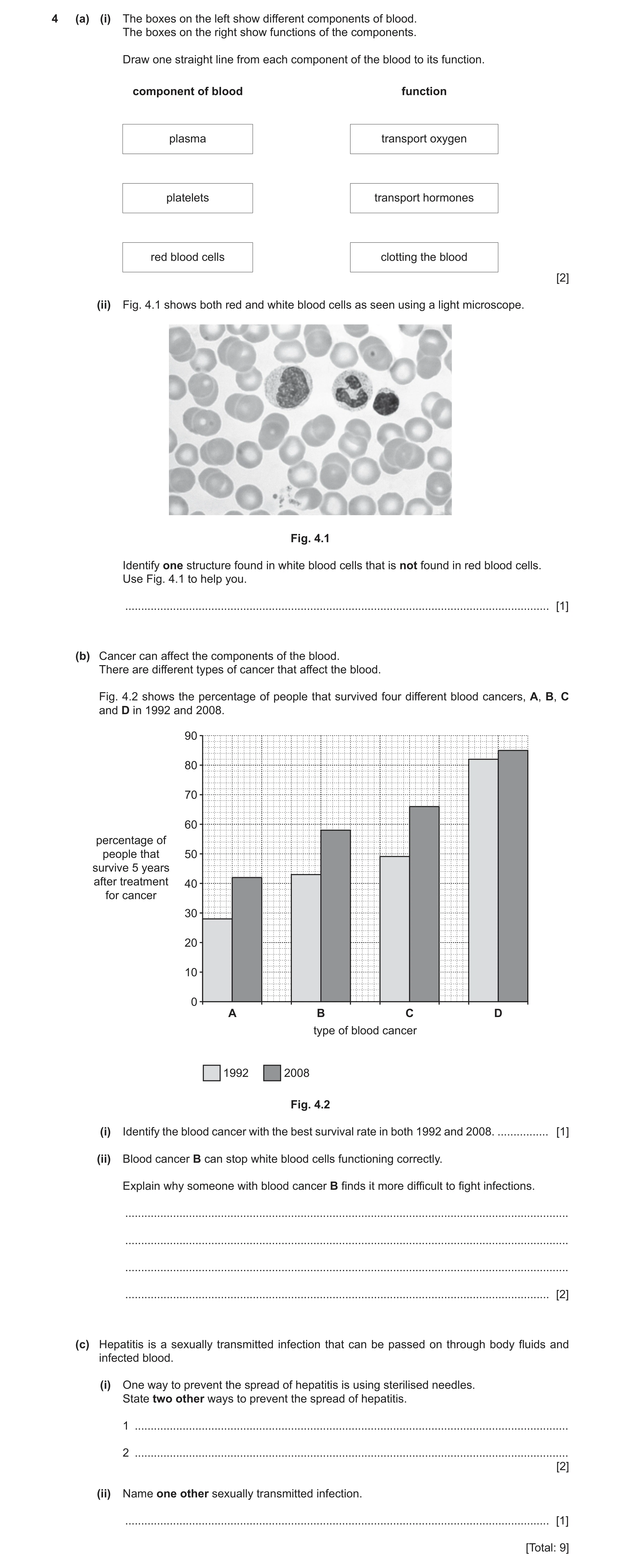
4 (a) (i) The boxes on the left show different components of blood. The boxes on the right show functions of the components. Draw one straight line from each component of the blood to its function. component of blood function plasma transport oxygen platelets transport hormones red blood cells clotting the blood [2] (ii) Fig. 4.1 shows both red and white blood cells as seen using a light microscope. Fig. 4.1 Identify one structure found in white blood cells that is not found in red blood cells. Use Fig. 4.1 to help you. … [1] (b) Cancer can affect the components of the blood. There are different types of cancer that affect the blood. Fig. 4.2 shows the percentage of people that survived four different blood cancers, A, B, C and D in 1992 and 2008. 90 80 70 60 percentage of people that 50 survive 5 years after treatment 40 for cancer 30 20 10 0 A B C D type of blood cancer 1992 2008 Fig. 4.2 (i) Identify the blood cancer with the best survival rate in both 1992 and 2008. … [1] (ii) Blood cancer B can stop white blood cells functioning correctly. Explain why someone with blood cancer B finds it more difficult to fight infections. … … … … [2] (c) Hepatitis is a sexually transmitted infection that can be passed on through body fluids and infected blood. (i) One way to prevent the spread of hepatitis is using sterilised needles. State two other ways to prevent the spread of hepatitis. 1 … 2 … [2] (ii) Name one other sexually transmitted infection. … [1] [Total: 9]
9 marks
Mark scheme: 4(a)(i) plasma transport oxygen platelets transport hormones red blood cells clotting the blood ;; all correct = 2 marks one or two correct = 1 mark 2 4(a)(ii) nucleus ; 1 4(b)(i) D ; 1 4(b)(ii) idea of not being able to make antibodies ; idea of not being able to engulf microbes / not able to carry out phagocytosis ; 2 4(c)(i) any two from: abstinence from, sex / sexual intercourse ; use of condom / femidom ; blood screening ; not sharing (syringe) needles ; gloves used by health professionals ; better education / raise awareness ; 2 4(c)(ii) HIV / AIDS ; 1
This question in 0653/33 May/June 2021
Q10 · The boxes on the left show some of the components of blood 0653/32 Feb/March 2022
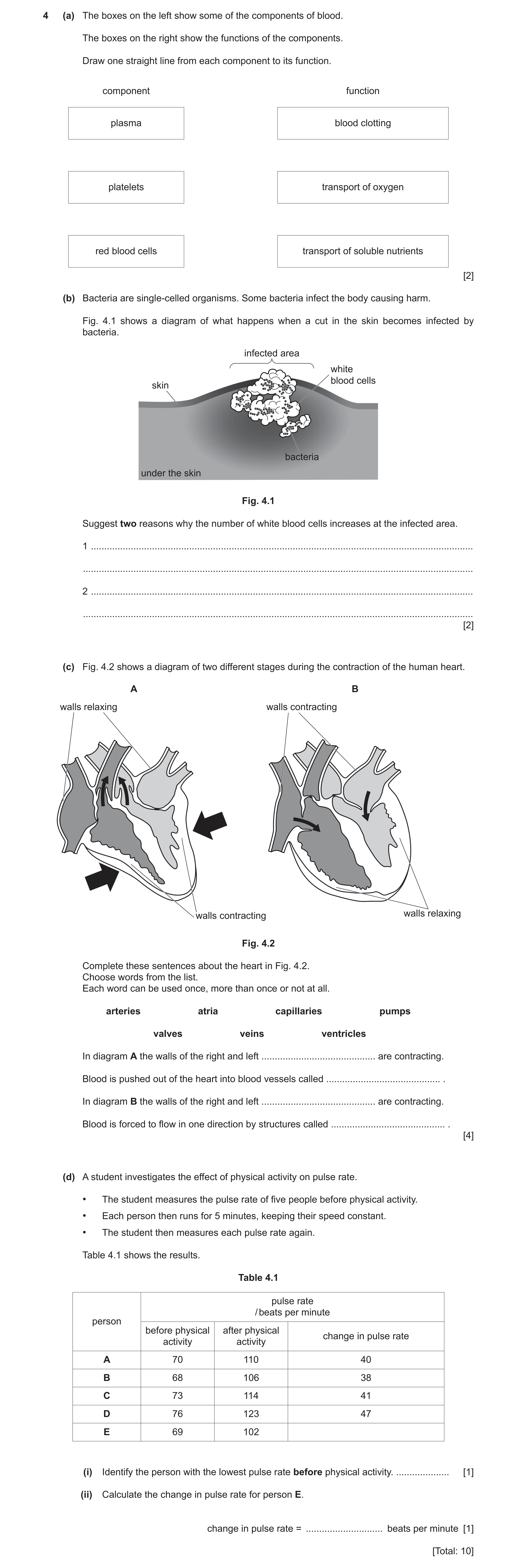
4 (a) The boxes on the left show some of the components of blood. The boxes on the right show the functions of the components. Draw one straight line from each component to its function. component function plasma blood clotting platelets transport of oxygen red blood cells transport of soluble nutrients [2] (b) Bacteria are single-celled organisms. Some bacteria infect the body causing harm. Fig. 4.1 shows a diagram of what happens when a cut in the skin becomes infected by bacteria. infected area white blood cells skin bacteria under the skin Fig. 4.1 Suggest two reasons why the number of white blood cells increases at the infected area. 1 … … 2 … … [2] (c) Fig. 4.2 shows a diagram of two different stages during the contraction of the human heart. A B walls relaxing walls contracting walls contracting walls relaxing Fig. 4.2 Complete these sentences about the heart in Fig. 4.2. Choose words from the list. Each word can be used once, more than once or not at all. arteries atria capillaries pumps valves veins ventricles In diagram A the walls of the right and left … are contracting. Blood is pushed out of the heart into blood vessels called … . In diagram B the walls of the right and left … are contracting. Blood is forced to flow in one direction by structures called … . [4] (d) A student investigates the effect of physical activity on pulse rate. • The student measures the pulse rate of five people before physical activity. • Each person then runs for 5 minutes, keeping their speed constant. • The student then measures each pulse rate again. Table 4.1 shows the results. Table 4.1 pulse rate / beats per minute person before physical after physical change in pulse rate activity activity A 70 110 40 B 68 106 38 C 73 114 41 D 76 123 47 E 69 102 (i) Identify the person with the lowest pulse rate before physical activity. … [1] (ii) Calculate the change in pulse rate for person E. change in pulse rate = … beats per minute [1] [Total: 10]
10 marks
Mark scheme: 4(a) plasma blood clotting platelets transport of oxygen red blood cells transport of soluble nutrients ;; 4(b) phagocytosis ; to produce antibodies ; 2 4(c) ventricles ; arteries ; atria ; valves ; 4 4(d)(i) B ; 1 4(d)(ii) 33 (bpm) ; 1
This question in 0653/32 Feb/March 2022
Q11 · A photograph of an insect‑pollinated flower 0653/33 Oct/Nov 2022
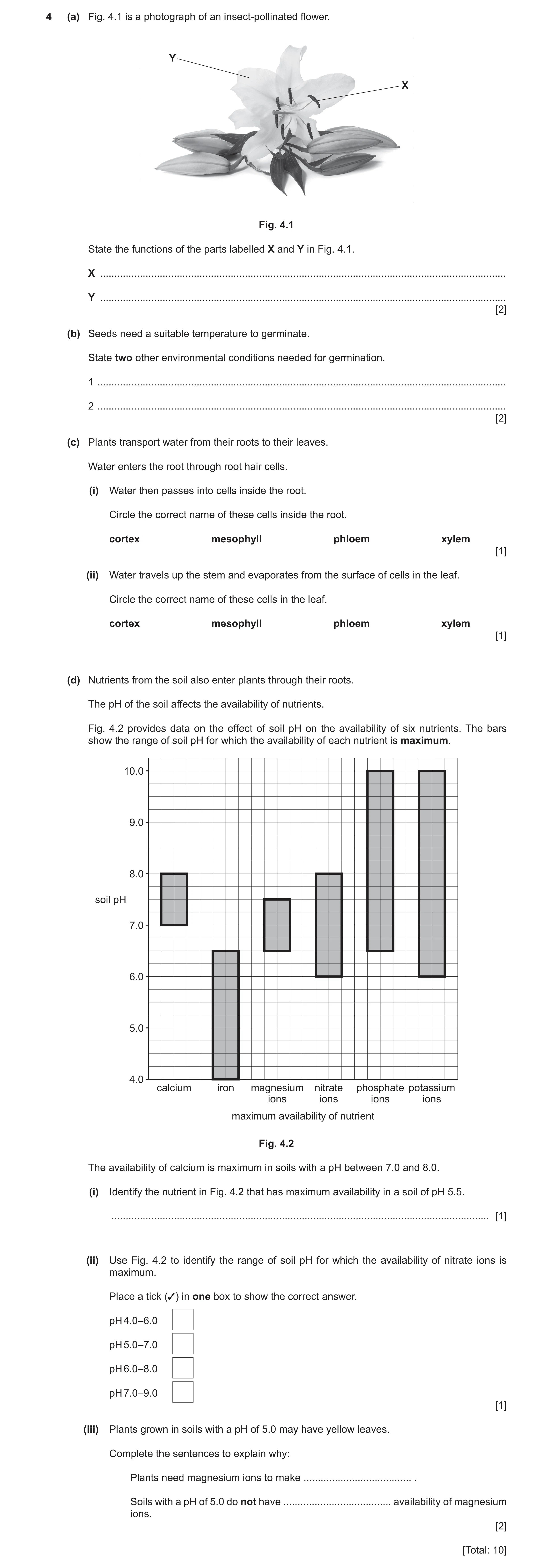
4 (a) Fig. 4.1 is a photograph of an insect‑pollinated flower. Y X Fig. 4.1 State the functions of the parts labelled X and Y in Fig. 4.1. X … Y … [2] (b) Seeds need a suitable temperature to germinate. State two other environmental conditions needed for germination. 1 … 2 … [2] (c) Plants transport water from their roots to their leaves. Water enters the root through root hair cells. (i) Water then passes into cells inside the root. Circle the correct name of these cells inside the root. cortex mesophyll phloem xylem [1] (ii) Water travels up the stem and evaporates from the surface of cells in the leaf. Circle the correct name of these cells in the leaf. cortex mesophyll phloem xylem [1] (d) Nutrients from the soil also enter plants through their roots. The pH of the soil affects the availability of nutrients. Fig. 4.2 provides data on the effect of soil pH on the availability of six nutrients. The bars show the range of soil pH for which the availability of each nutrient is maximum. 10.0 9.0 8.0 soil pH 7.0 6.0 5.0 4.0 calcium iron magnesium nitrate phosphate potassium ions ions ions ions maximum availability of nutrient Fig. 4.2 The availability of calcium is maximum in soils with a pH between 7.0 and 8.0. (i) Identify the nutrient in Fig. 4.2 that has maximum availability in a soil of pH 5.5. … [1] (ii) Use Fig. 4.2 to identify the range of soil pH for which the availability of nitrate ions is maximum. Place a tick (✓) in one box to show the correct answer. pH 4.0–6.0 pH 5.0–7.0 pH 6.0–8.0 pH 7.0–9.0 [1] (iii) Plants grown in soils with a pH of 5.0 may have yellow leaves. Complete the sentences to explain why: Plants need magnesium ions to make … . Soils with a pH of 5.0 do not have … availability of magnesium ions. [2] [Total: 10]
10 marks
Mark scheme: 4(a) X produce / release, pollen ; 2 Y attract insects (for pollination) ; 4(b) (presence of) water ; 2 (presence of) oxygen ; 4(c)(i) cortex ; 1 4(c)(ii) mesophyll ; 1 4(d)(i) iron ; 1 4(d)(ii) pH 6.0–8.0 ; 1 4(d)(iii) chlorophyll ; 2 maximum ;
This question in 0653/33 Oct/Nov 2022
Q12 · The female reproductive system in humans 0653/31 Oct/Nov 2023
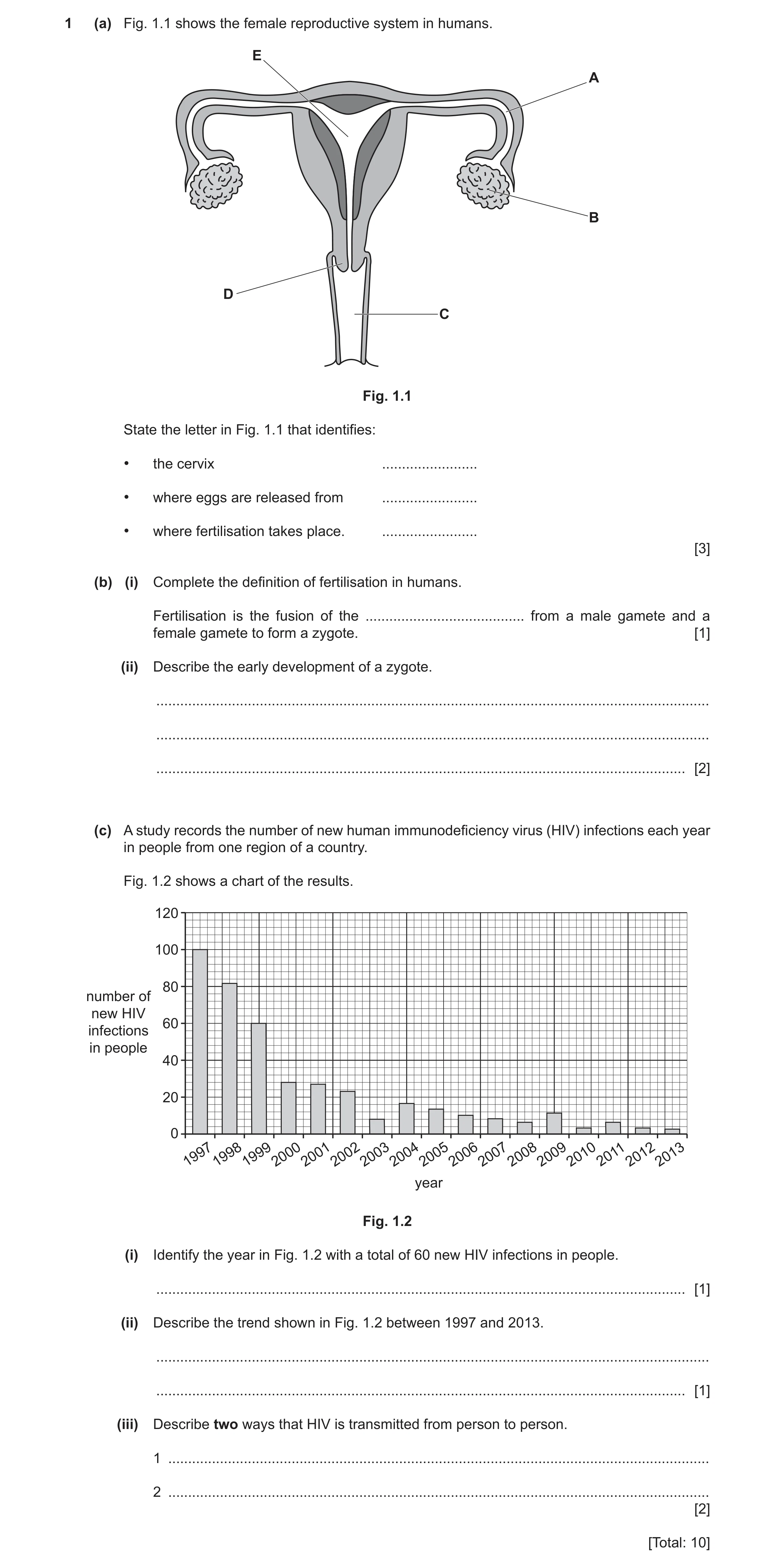
1 (a) Fig. 1.1 shows the female reproductive system in humans. E A B D C Fig. 1.1 State the letter in Fig. 1.1 that identifies: • the cervix … • where eggs are released from … • where fertilisation takes place. … [3] (b) (i) Complete the definition of fertilisation in humans. Fertilisation is the fusion of the … from a male gamete and a female gamete to form a zygote. [1] (ii) Describe the early development of a zygote. … … … [2] (c) A study records the number of new human immunodeficiency virus (HIV) infections each year in people from one region of a country. Fig. 1.2 shows a chart of the results. 120 100 80number of new HIV 60infections in people 40 20 0 19971998199920002001200220032004200520062007200820092010201120122013 year Fig. 1.2 (i) Identify the year in Fig. 1.2 with a total of 60 new HIV infections in people. … [1] (ii) Describe the trend shown in Fig. 1.2 between 1997 and 2013. … … [1] (iii) Describe two ways that HIV is transmitted from person to person. 1 … 2 … [2] [Total: 10]
10 marks
Mark scheme: Question Answer Marks 1(a) D ; 3 B ; A ; 1(b)(i) nuclei ; 1 1(b)(ii) any two from: 2 forms a ball of cells ; (called an / forms an) embryo ; implants into (wall of) uterus ; 1(c)(i) 1999 ; 1 1(c)(ii) the number of people infected decreased (over the period) ; 1 1(c)(iii) any two from: 2 contaminated blood / contaminated transfusion ; sexual intercourse ; sharing needles ; mother to baby, e.g. across the placenta / during birth / breast feeding ;
This question in 0653/31 Oct/Nov 2023
Q13 · Blood contains different components 0653/32 Feb/March 2025
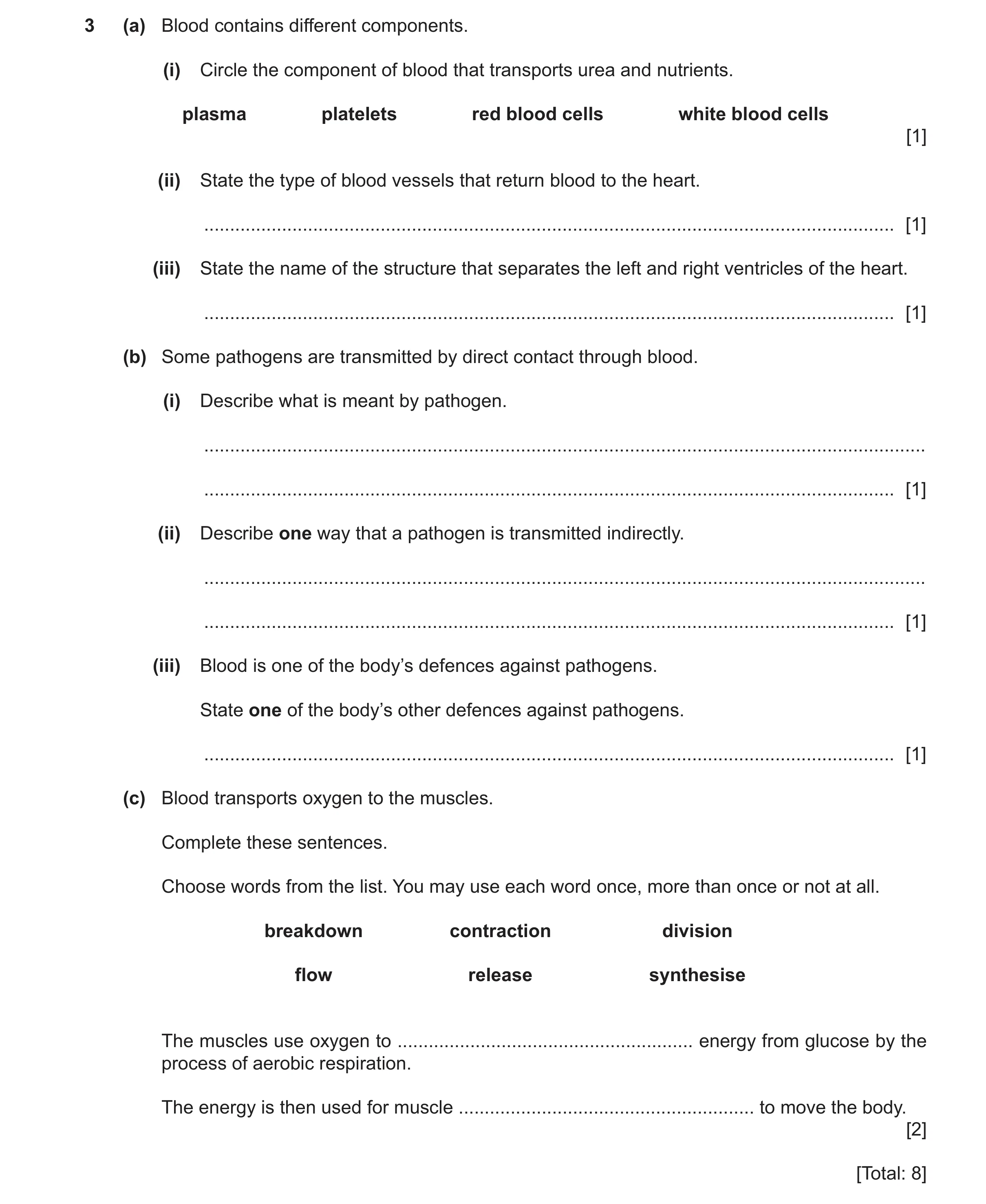
3 (a) Blood contains different components. (i) Circle the component of blood that transports urea and nutrients. plasma platelets red blood cells white blood cells [1] (ii) State the type of blood vessels that return blood to the heart. … [1] (iii) State the name of the structure that separates the left and right ventricles of the heart. … [1] (b) Some pathogens are transmitted by direct contact through blood. (i) Describe what is meant by pathogen. … … [1] (ii) Describe one way that a pathogen is transmitted indirectly. … … [1] (iii) Blood is one of the body’s defences against pathogens. State one of the body’s other defences against pathogens. … [1] (c) Blood transports oxygen to the muscles. Complete these sentences. Choose words from the list. You may use each word once, more than once or not at all. breakdown contraction division flow release synthesise The muscles use oxygen to … energy from glucose by the process of aerobic respiration. The energy is then used for muscle … to move the body. [2] [Total: 8]
8 marks
Mark scheme: 3(a)(i) plasma ; 1 more than one answer circled = 0 marks 3(a)(ii) vein ; 1 3(a)(iii) septum ; 1 3(b)(i) disease-causing organism ; 1 3(b)(ii) (contaminated) surfaces / food / animals / air ; 1 3(b)(iii) skin / nose hairs / mucus / stomach acid ; 1 3(c) release ; 2 contraction ;
This question in 0653/32 Feb/March 2025
Q14 · A diagram of the male reproductive system in humans 0653/31 Oct/Nov 2025
2 (a) Fig. 2.1 is a diagram of the male reproductive system in humans. X Y Fig. 2.1 (i) Name the parts labelled X and Y in Fig. 2.1. X … Y … [2] (ii) Draw a line labelled with the letter T on Fig. 2.1 to identify the testis. [1] (b) Sperm are the male gametes in humans that fertilise female gametes. (i) Name the female gametes in humans. … [1] (ii) Circle the part of the female reproductive system where fertilisation takes place. ovary oviduct uterus vagina [1] (c) Hepatitis B is an infectious disease transmitted through body fluids. (i) Hepatitis B is caused by a virus infection. Explain why hepatitis B should not be treated with antibiotics. … … [1] (ii) Scientists investigate the number of people infected with hepatitis B in a population. The scientists test 100 females and 100 males in each of four different age groups. Fig. 2.2 is a chart of the results. 8 Key female male 6 number of people with 4 hepatitis B 2 0 18 to 34 35 to 54 55 to 74 75+ age group / years Fig. 2.2 Calculate the percentage increase in males with hepatitis B between age group 18 to 34 years and age group 35 to 54 years. number of males with hepatitis B in age group 18 to 34 years = … number of males with hepatitis B in age group 35 to 54 years = … increase in number of males = … percentage increase in number of males = … % [3] [Total: 9]
9 marks
Mark scheme: 2(a)(i) sperm duct ; 2 penis; 2(a)(ii) testes labelled ; 1 2(b)(i) egg (cell) ; 1 2(b)(ii) oviduct ; 1 2(c)(i) antibiotics have no effect on viruses ; 1 2(c)(ii) 4 AND 7 and difference of 3 ; 3 3 ÷ 4 100 ; 75 (%) ;
This question in 0653/31 Oct/Nov 2025
 3 / 22
 4 / 22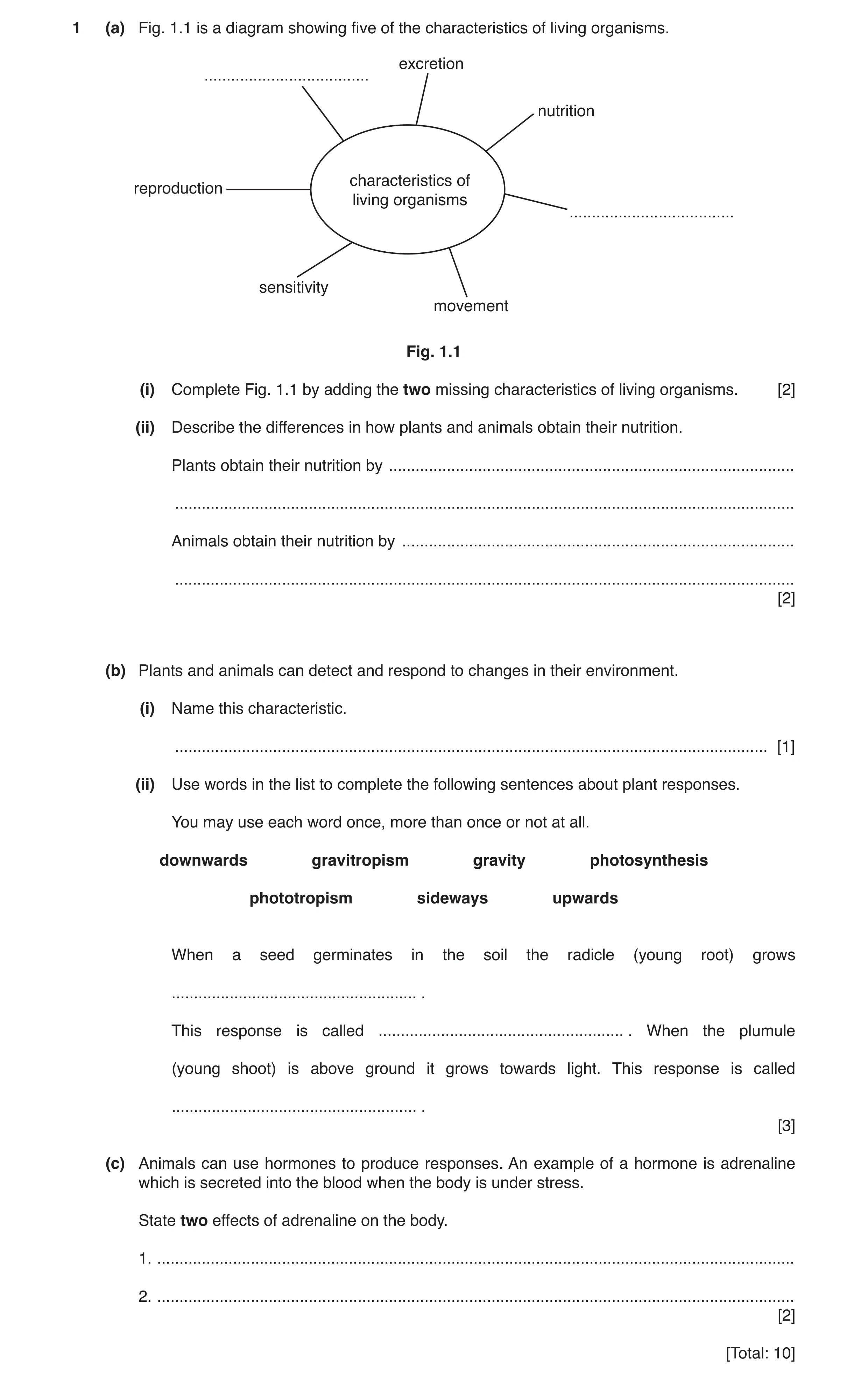
 20 / 22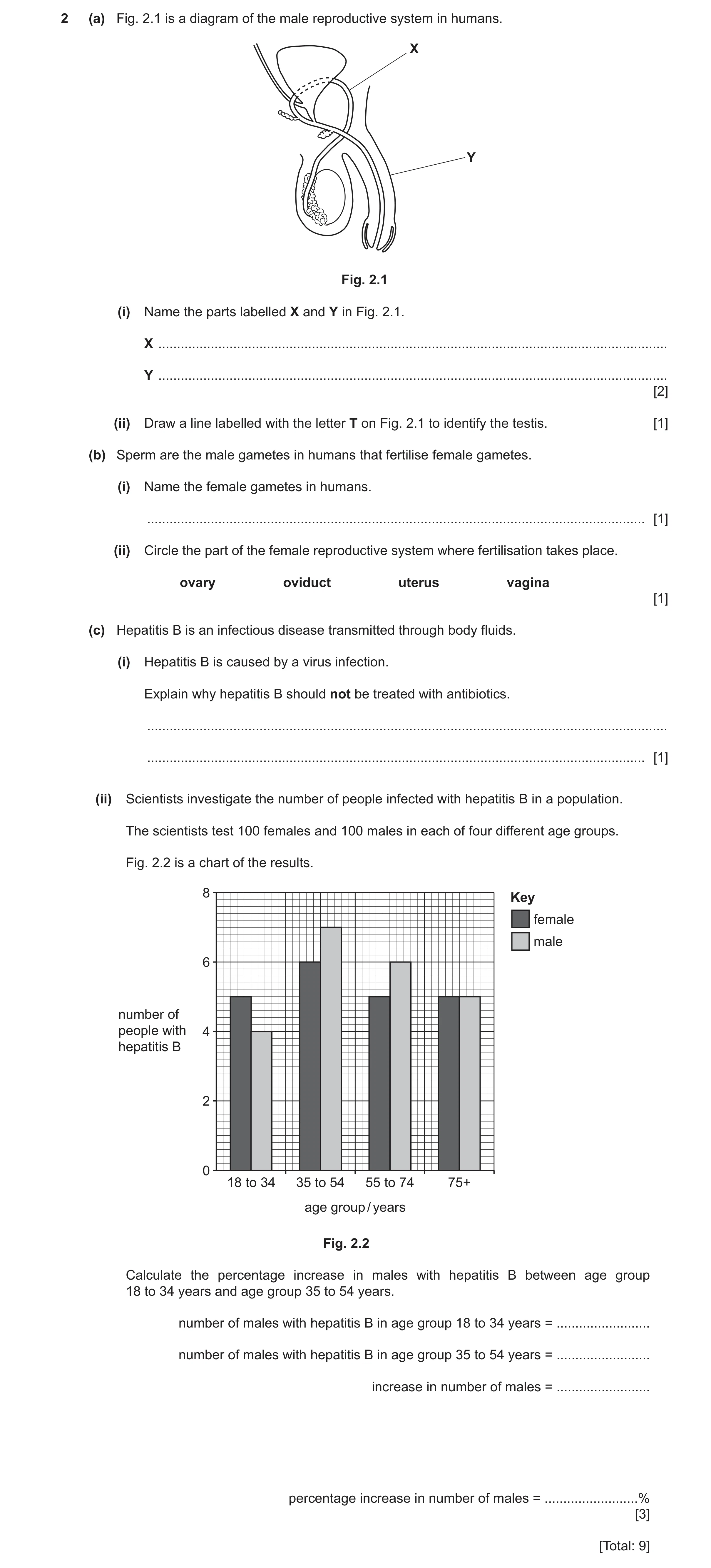
 10
10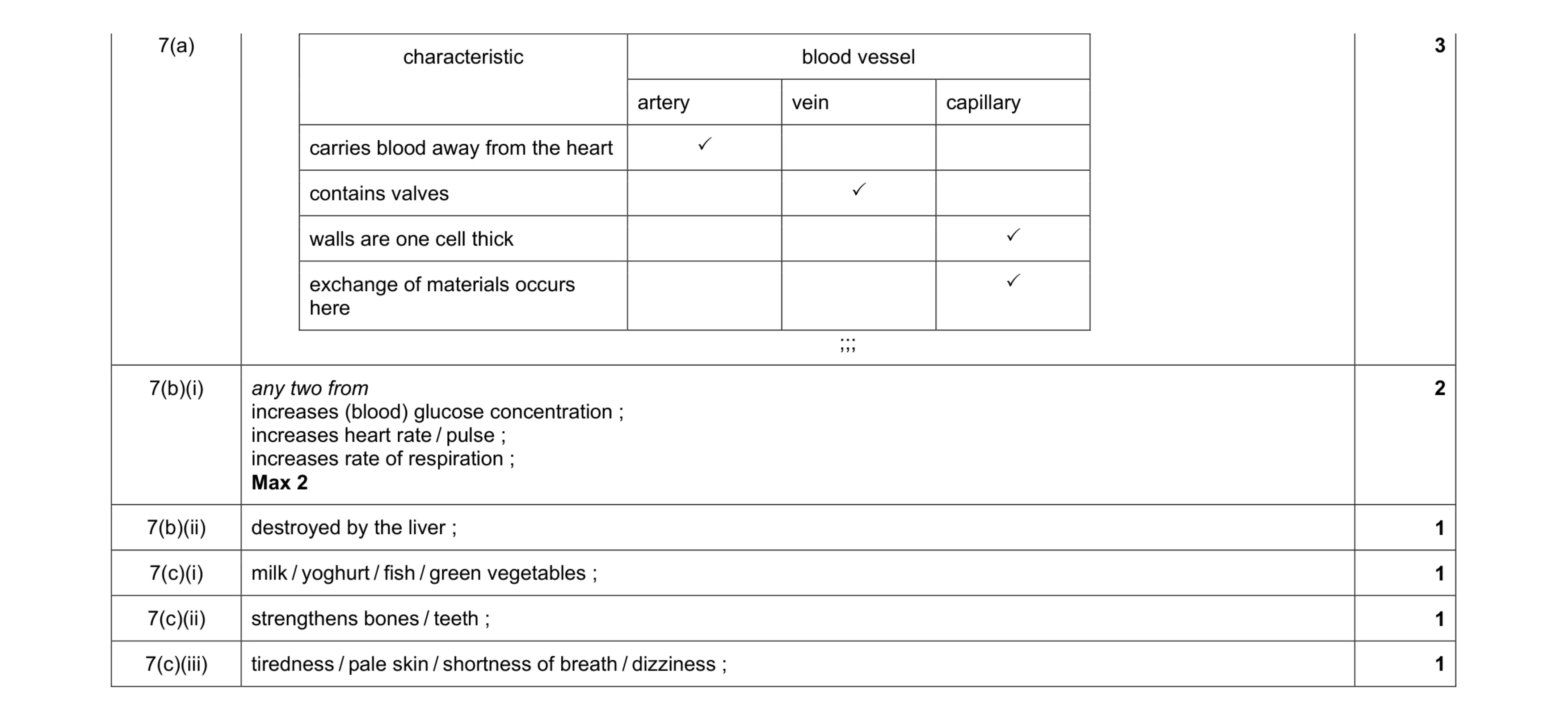 9
9 6
6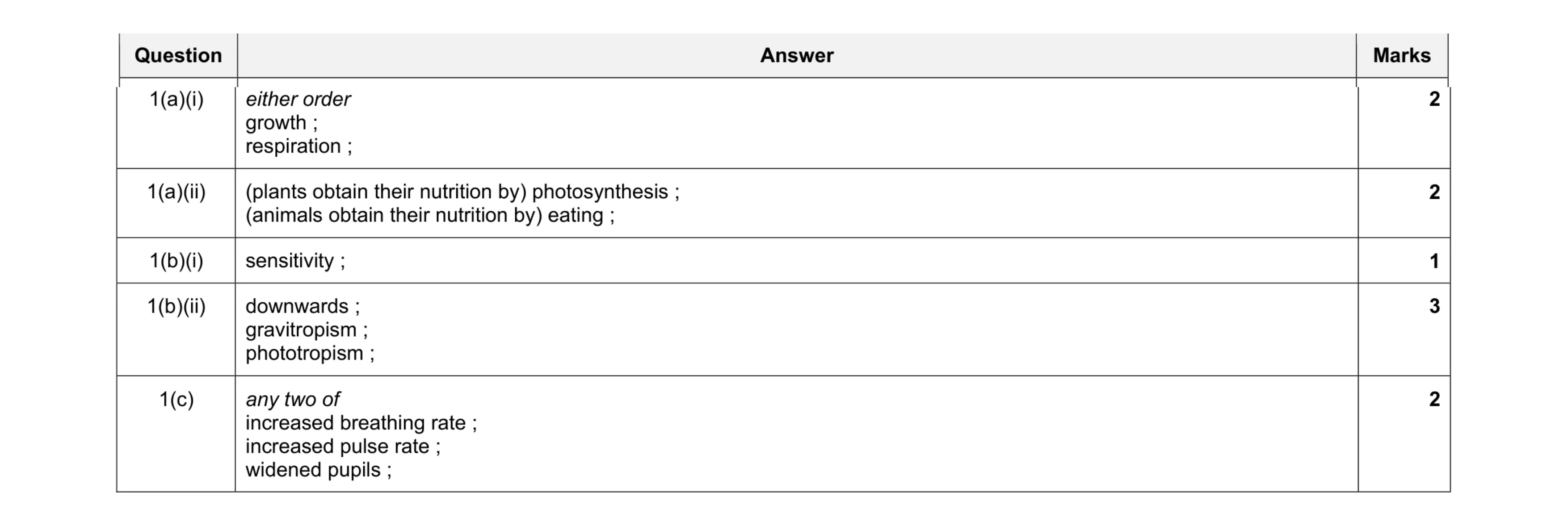 10
10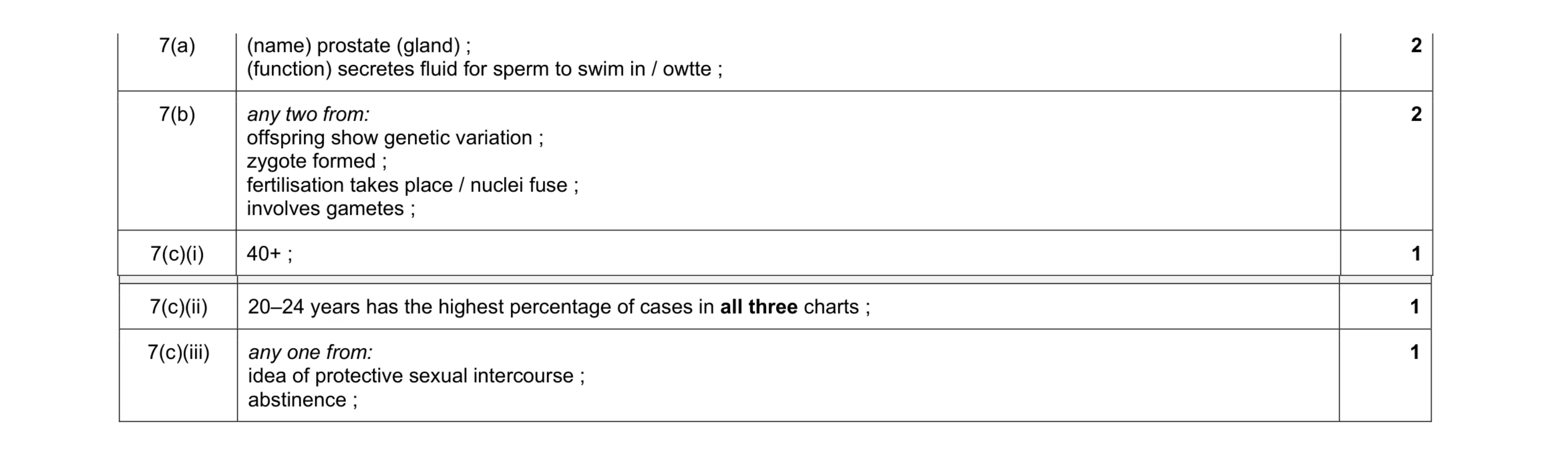 7
7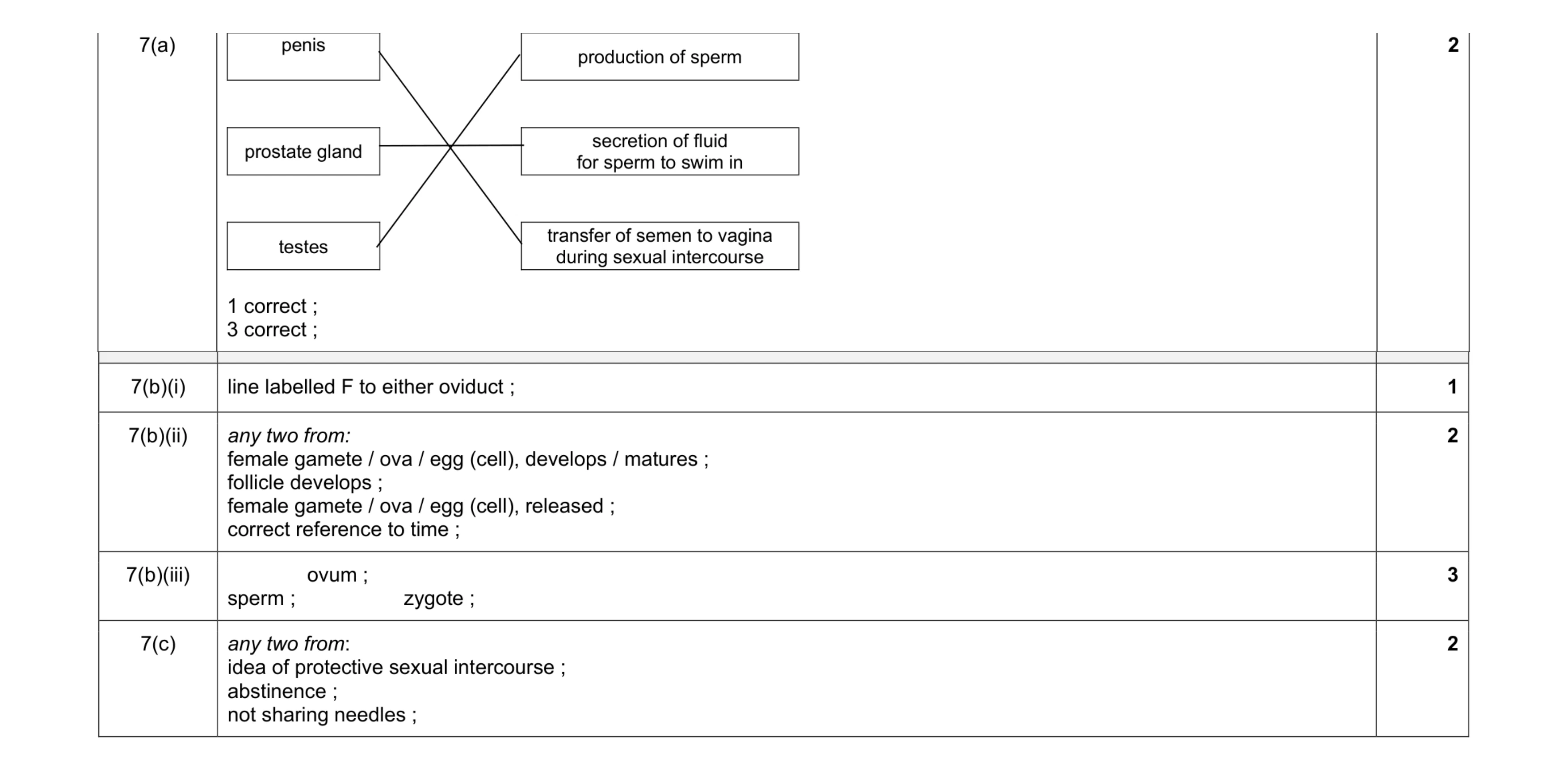 10
10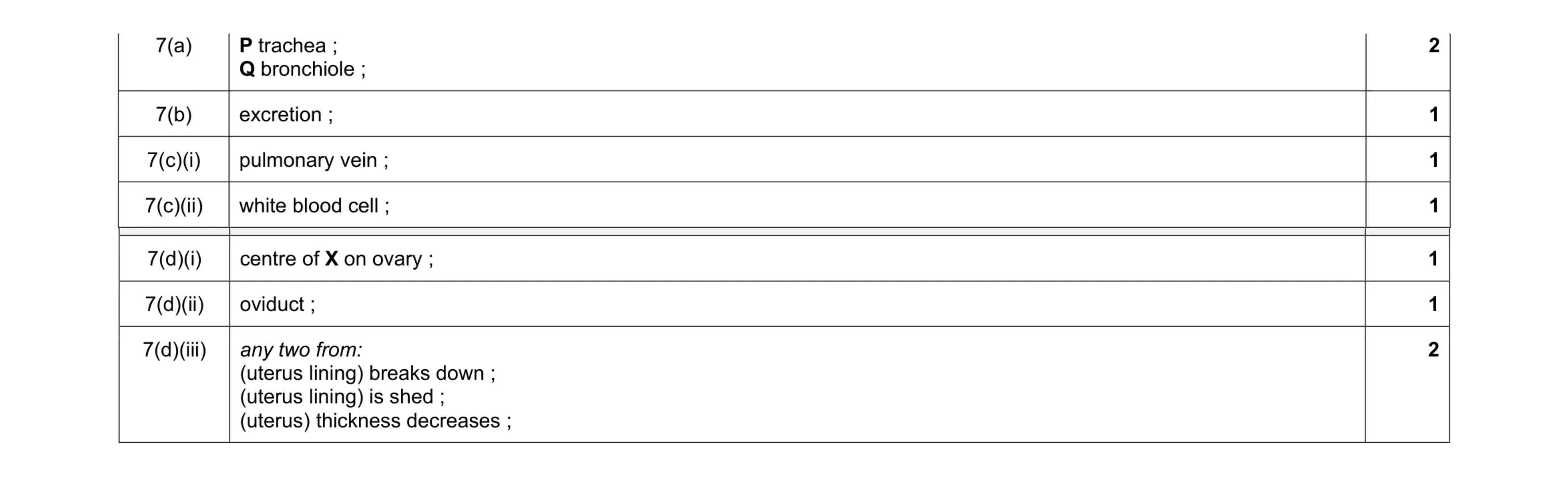 9
9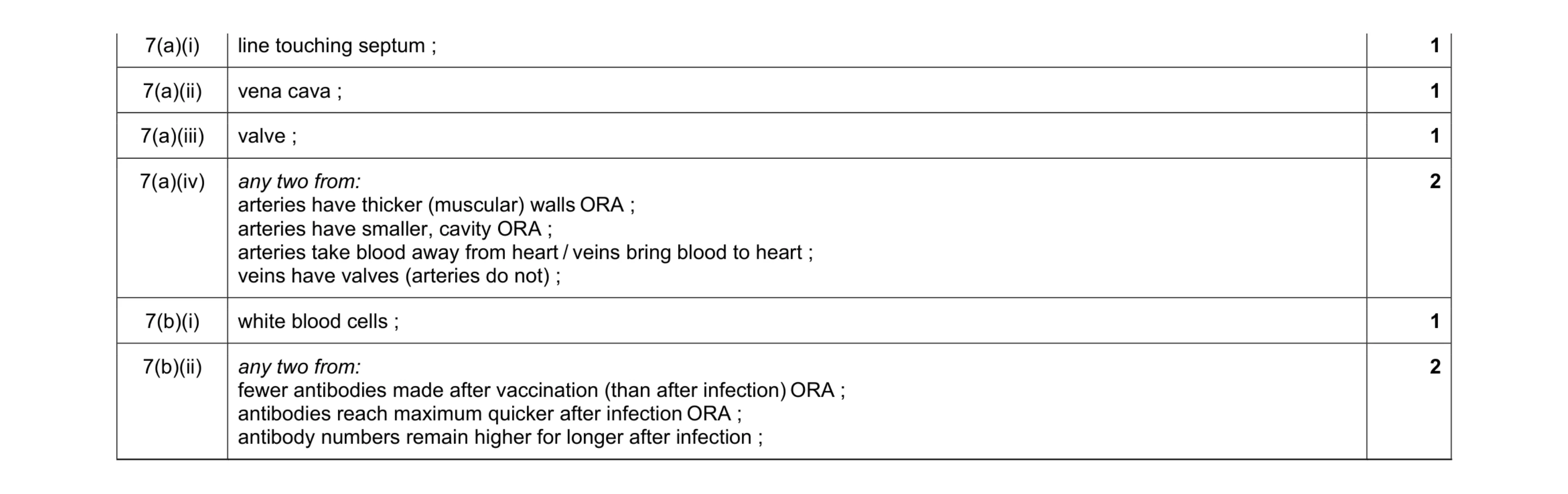 8
8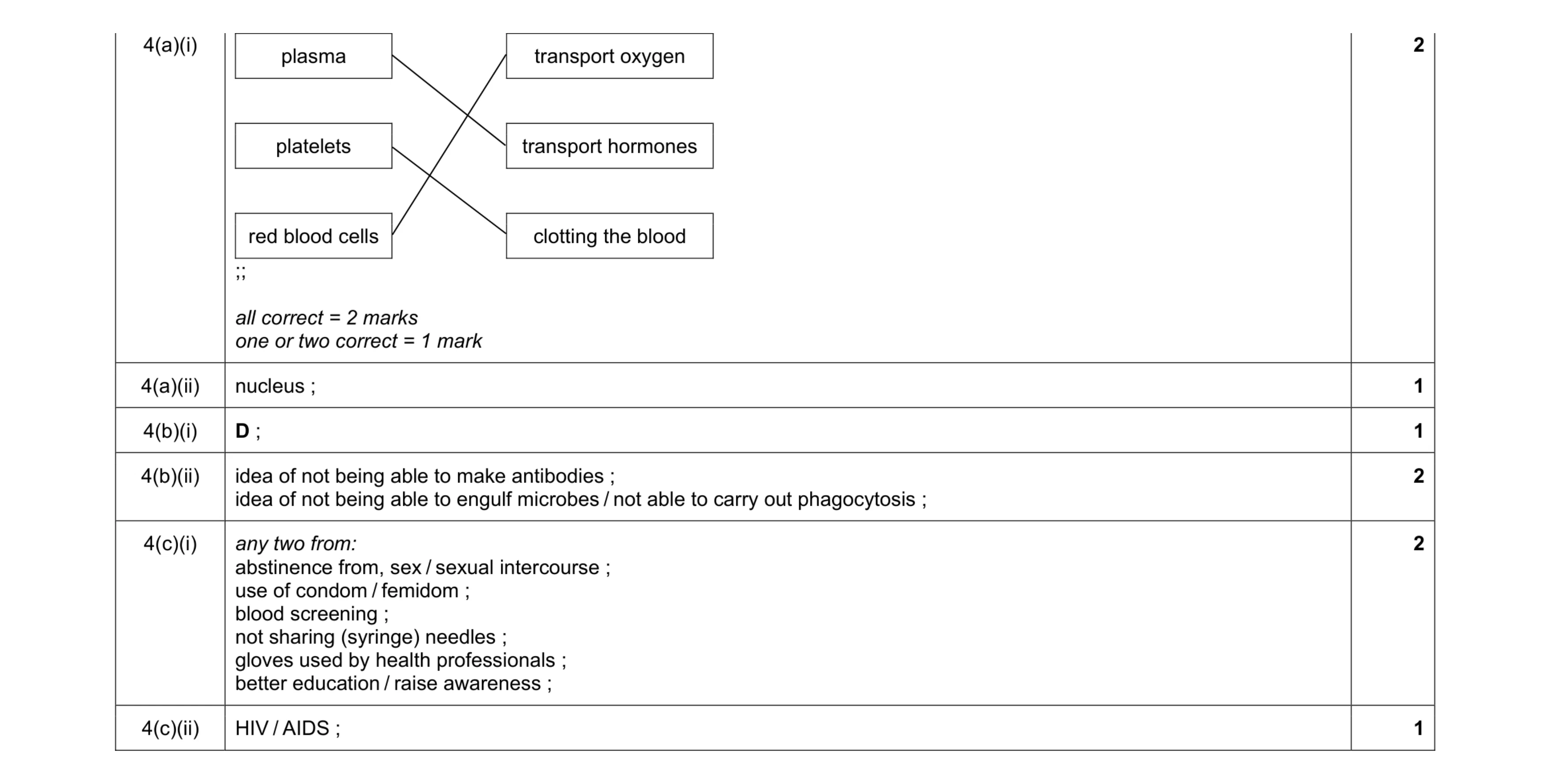 9
9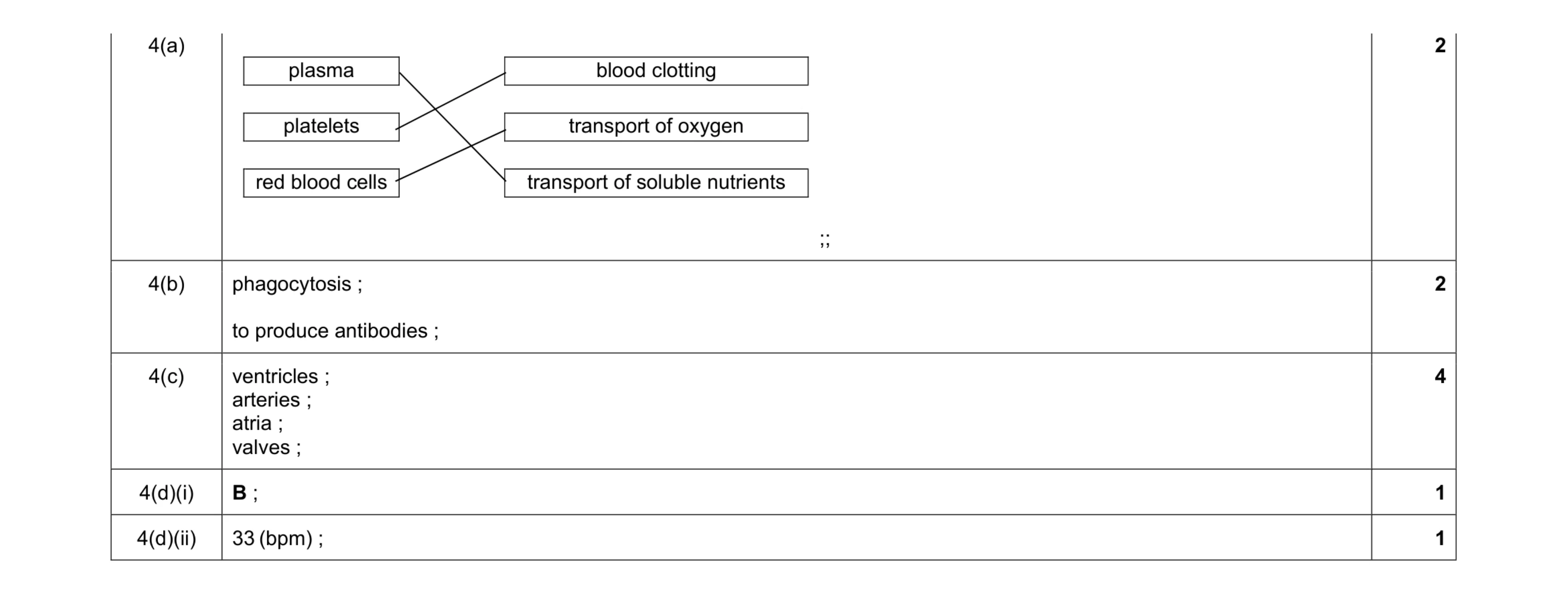 10
10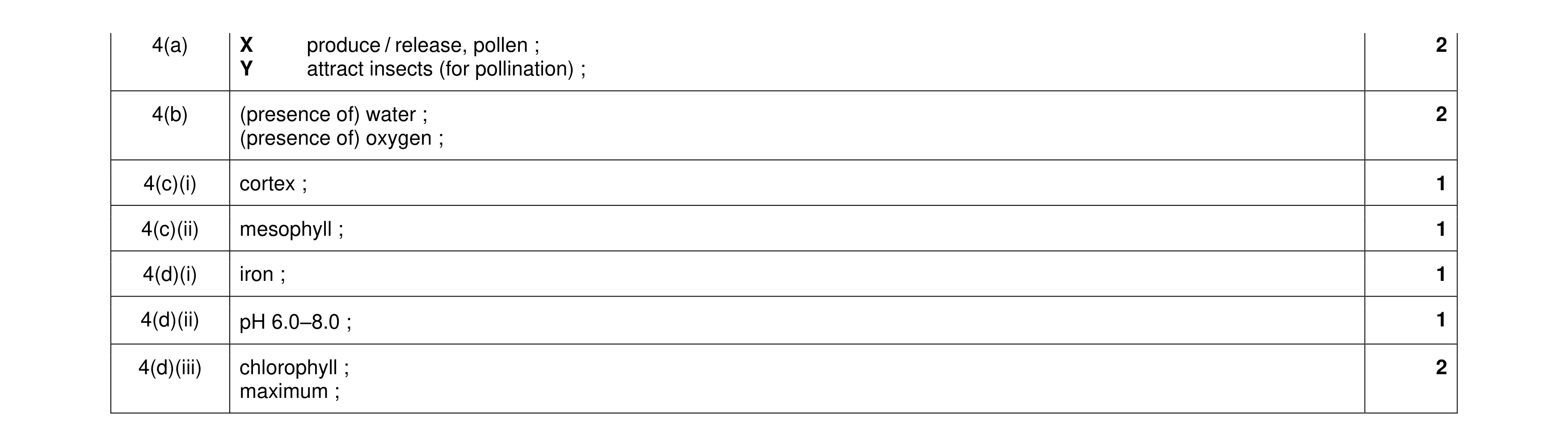 10
10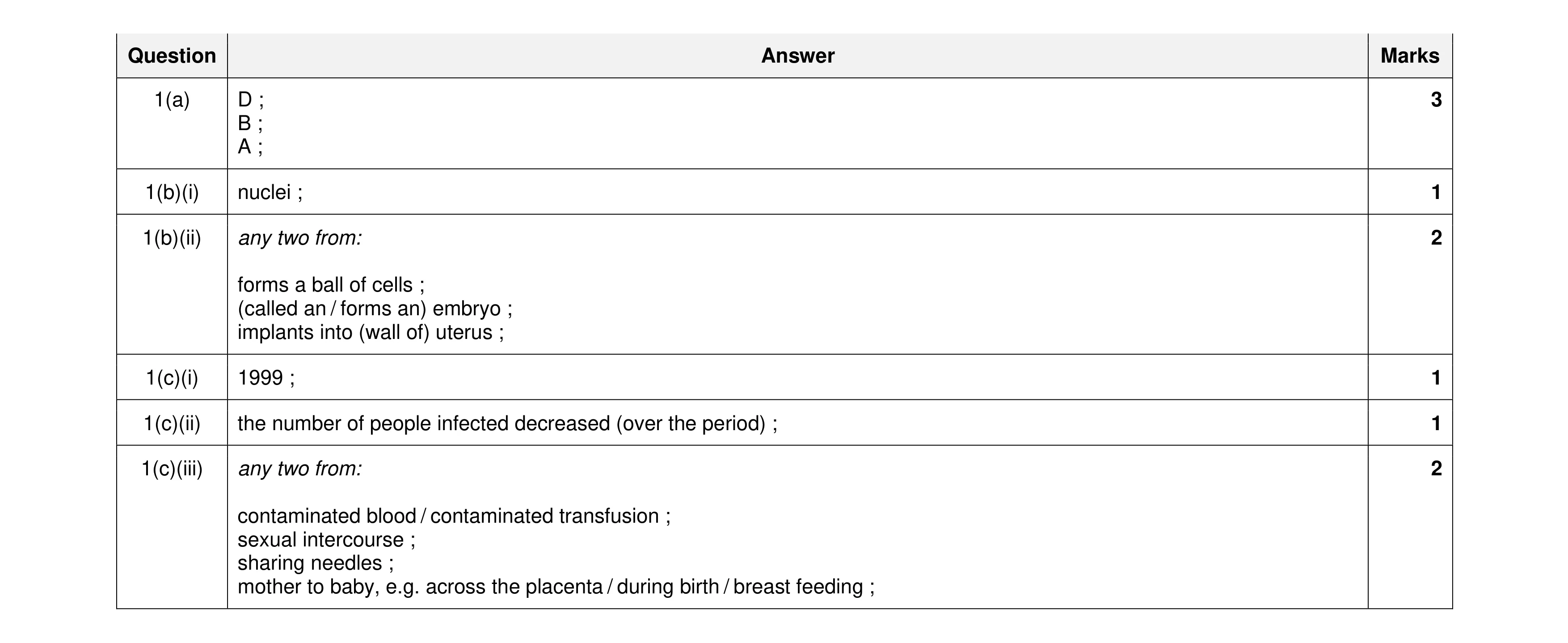 10
10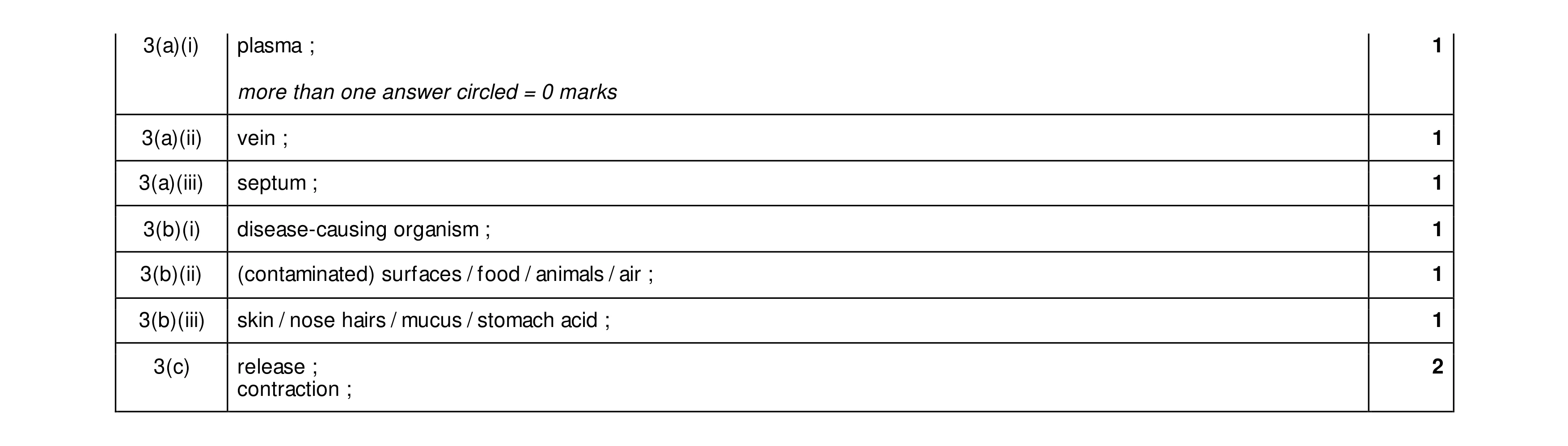 8
8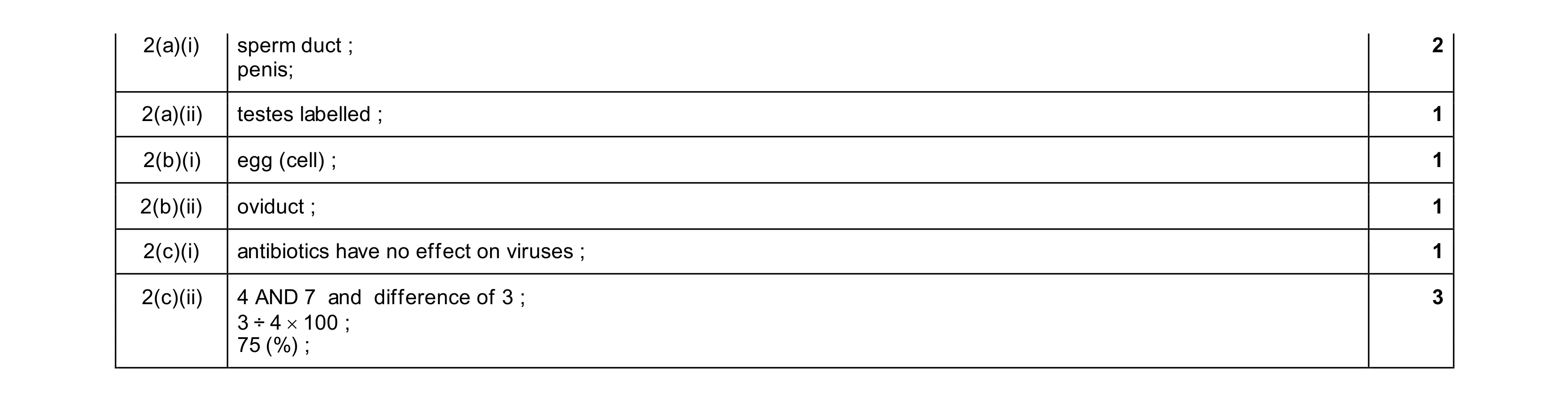 9
9