Questions as text
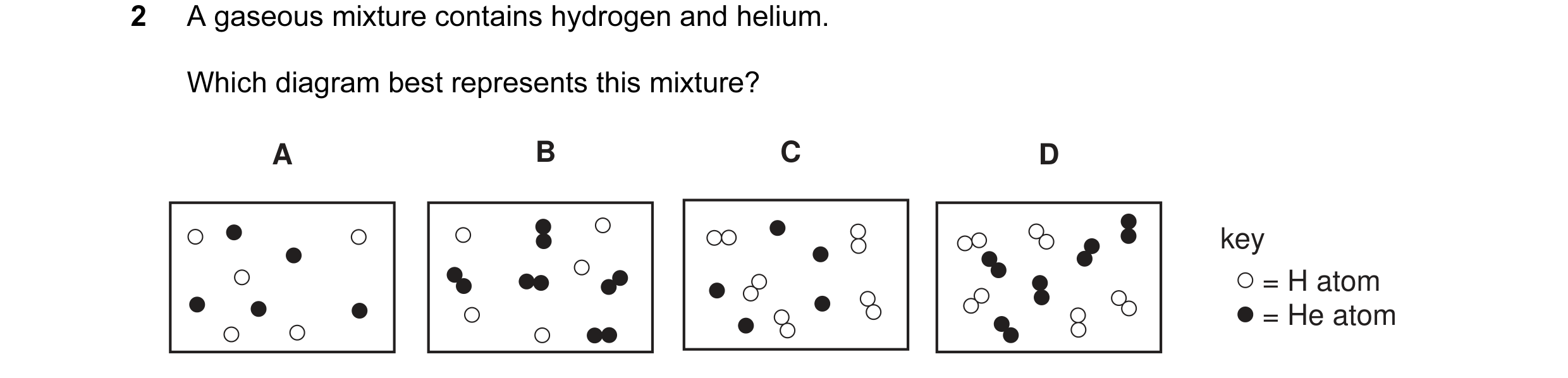
Q1 · A gaseous mixture contains hydrogen and helium 0652/11 Oct/Nov 2005
2 A gaseous mixture contains hydrogen and helium. Which diagram best represents this mixture? A B C D key = H atom = He atom
1 marks
Answer: C
This question in 0652/11 Oct/Nov 2005
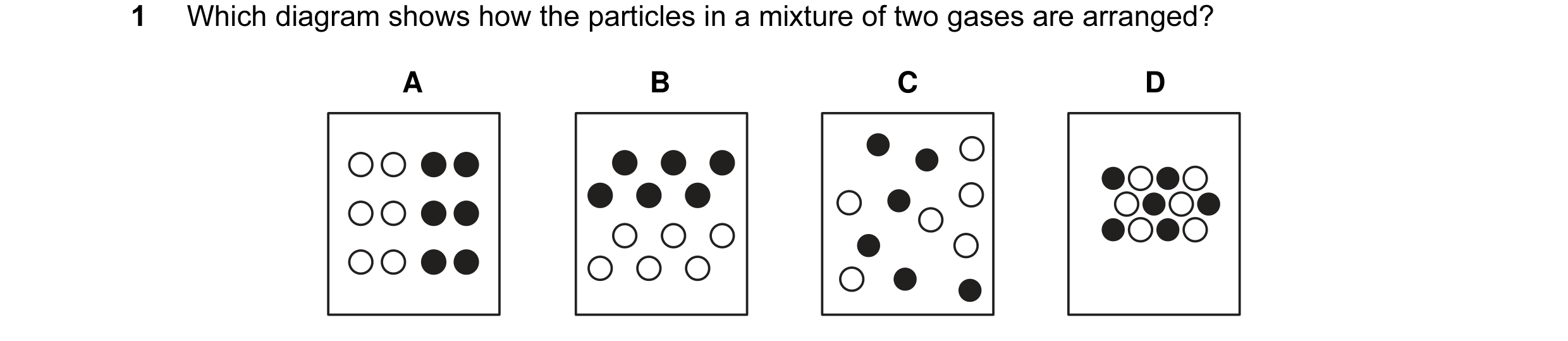
Q2 · Which diagram shows how the particles in a mixture of two gases are arranged? 0652/11 Oct/Nov 2006
1 Which diagram shows how the particles in a mixture of two gases are arranged? A B C D
1 marks
Answer: C
This question in 0652/11 Oct/Nov 2006
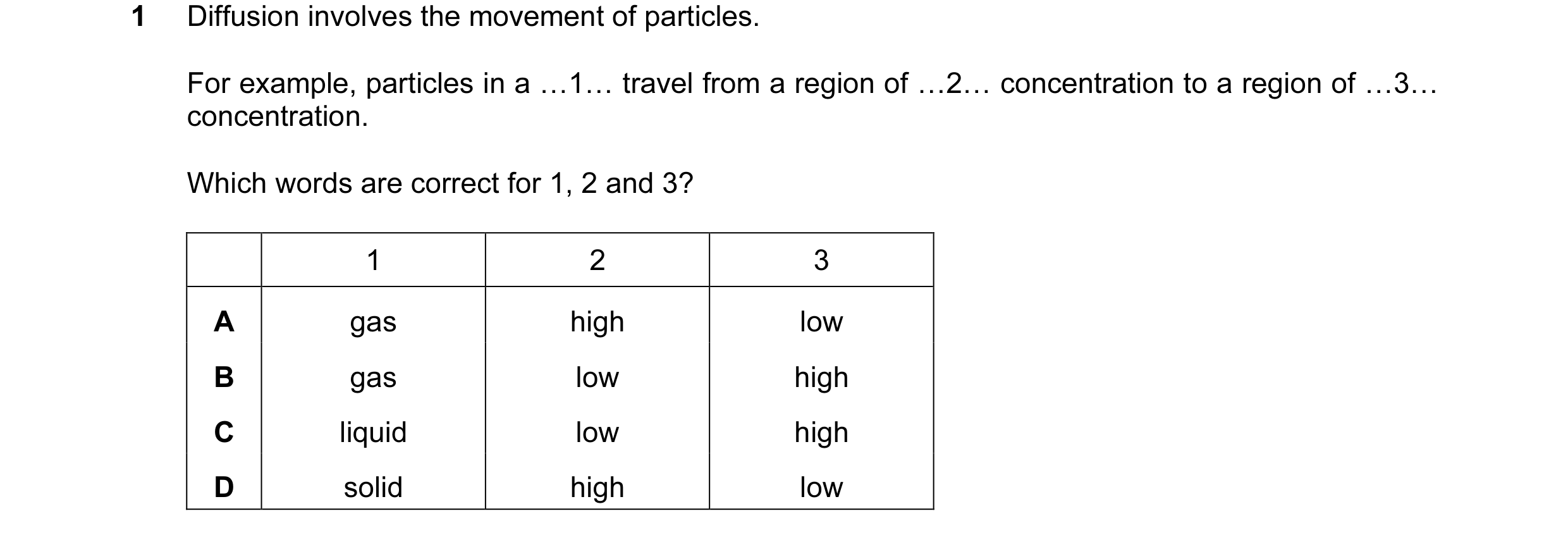
Q3 · Diffusion involves the movement of particles 0652/11 Oct/Nov 2007
1 Diffusion involves the movement of particles. For example, particles in a …1… travel from a region of …2… concentration to a region of …3… concentration. Which words are correct for 1, 2 and 3? 1 2 3 A gas high low B gas low high C liquid low high D solid high low
1 marks
Answer: A
This question in 0652/11 Oct/Nov 2007
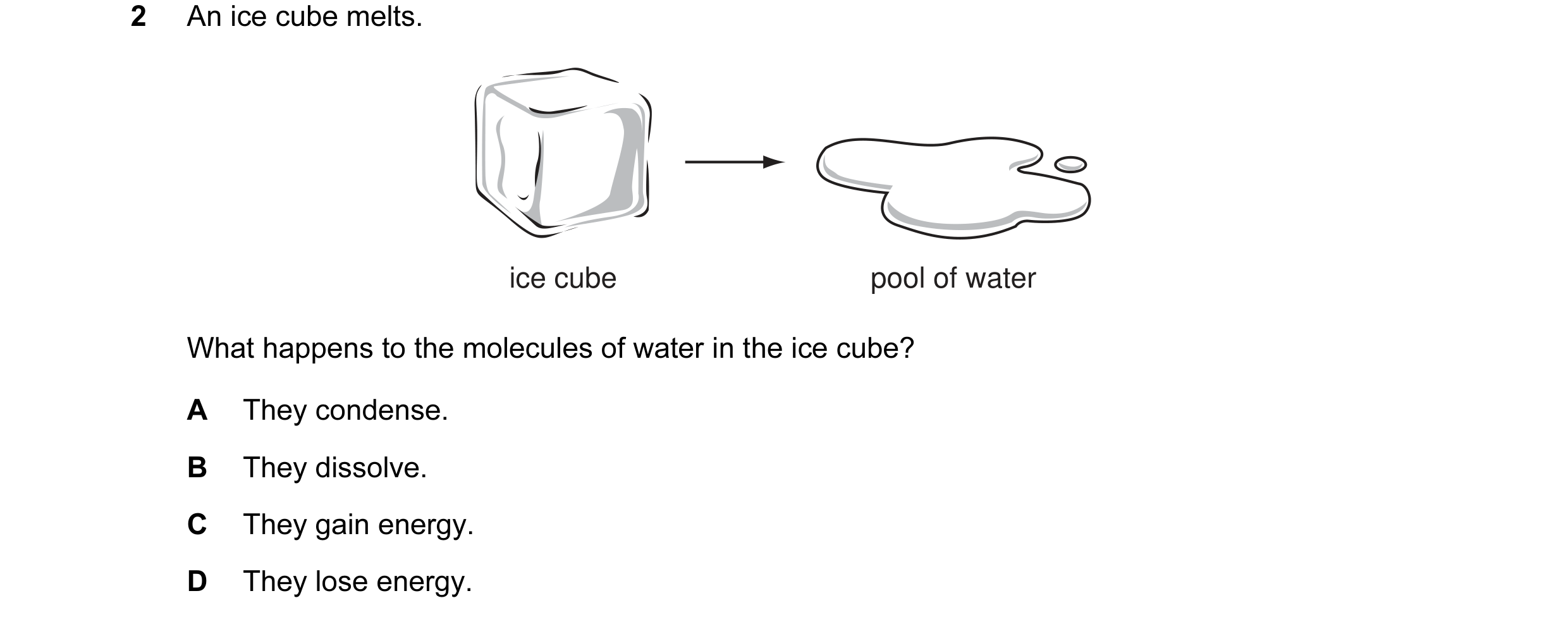
Q4 · An ice cube melts 0652/11 Oct/Nov 2008
2 An ice cube melts. ice cube pool of water What happens to the molecules of water in the ice cube? A They condense. B They dissolve. C They gain energy. D They lose energy.
1 marks
Answer: C
This question in 0652/11 Oct/Nov 2008
Q5 · Which statement explains why toffee can move and change its shape while it is a liquid… 0652/11 Oct/Nov 2009
1 Which statement explains why toffee can move and change its shape while it is a liquid but not when it is cooled and solid? toffee plastic dish containing ice metal tray A The particles in a liquid are much further apart than those in a solid. B The particles in a liquid are separate but a solid is one large particle. C The particles in a liquid can move past each other but are fixed in place in a solid. D The particles in a liquid change shape when it becomes a solid.
1 marks
Answer: C
This question in 0652/11 Oct/Nov 2009
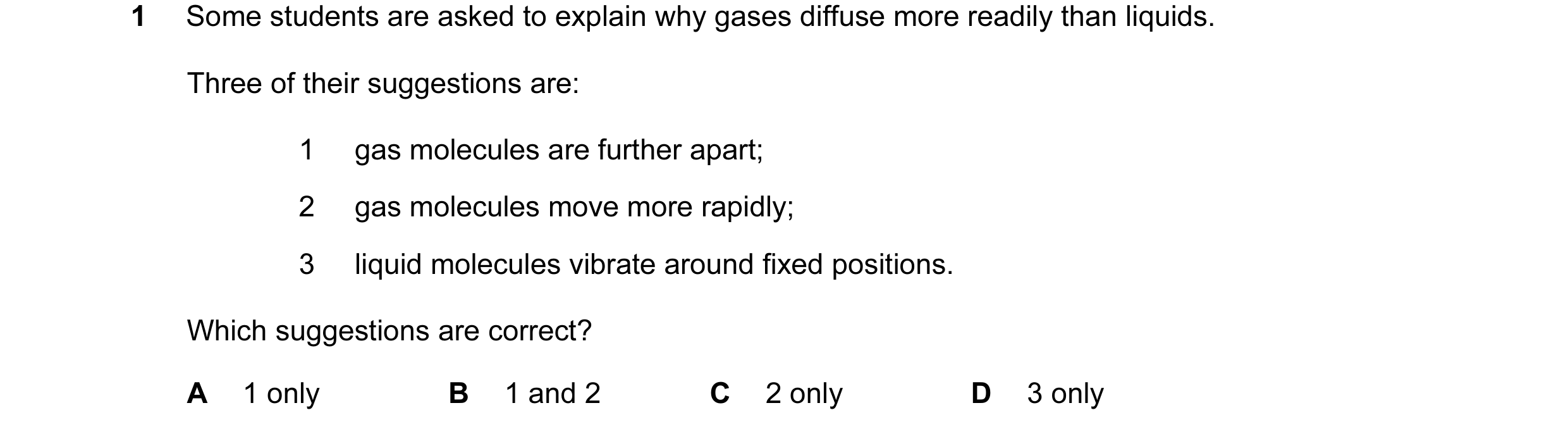
Q6 · Some students are asked to explain why gases diffuse more readily than liquids 0652/11 Oct/Nov 2010
1 Some students are asked to explain why gases diffuse more readily than liquids. Three of their suggestions are: 1 gas molecules are further apart; 2 gas molecules move more rapidly; 3 liquid molecules vibrate around fixed positions. Which suggestions are correct? A 1 only B 1 and 2 C 2 only D 3 only
1 marks
Answer: C
This question in 0652/11 Oct/Nov 2010
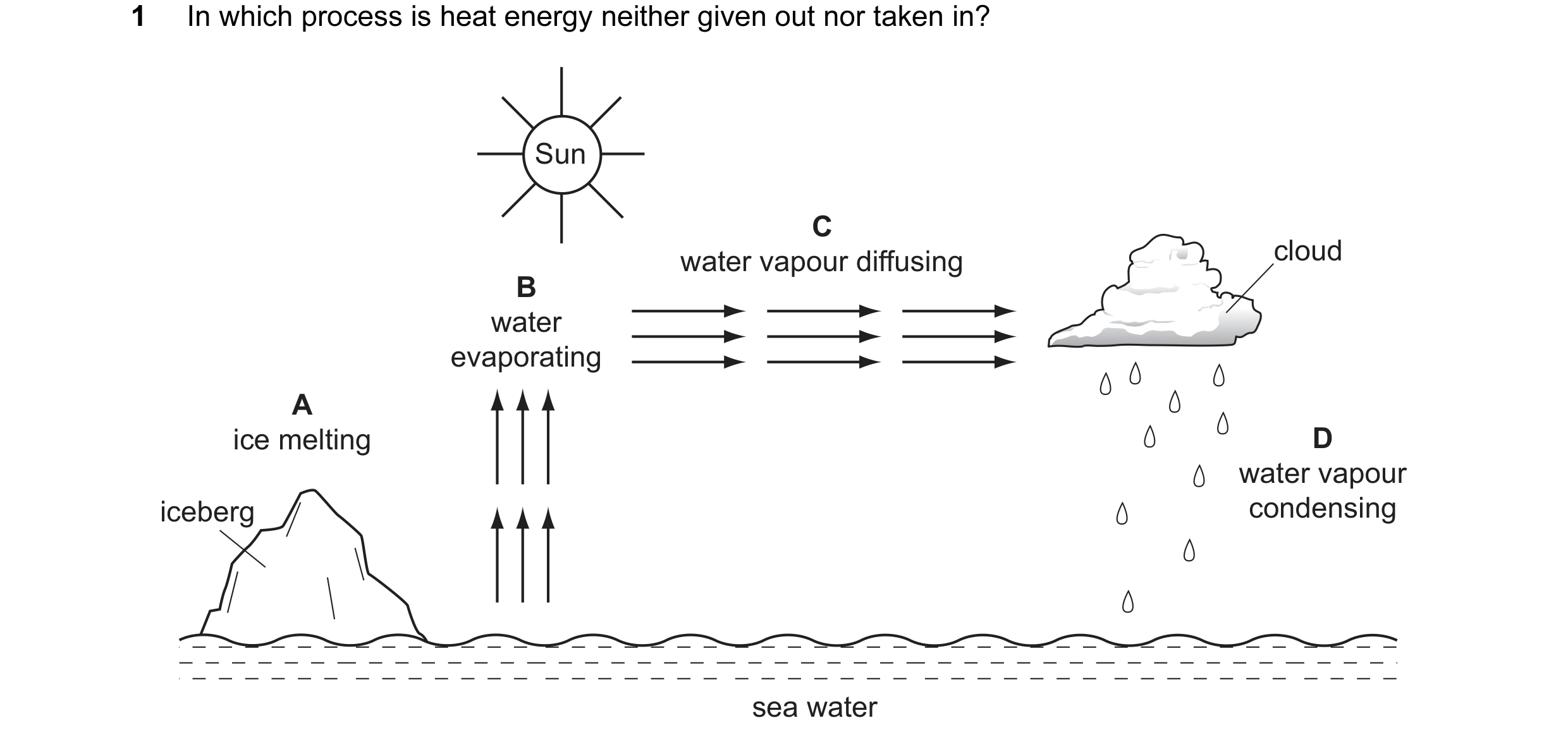
Q7 · In which process is heat energy neither given out nor taken in? 0652/11 Oct/Nov 2011
1 In which process is heat energy neither given out nor taken in? Sun C water vapour di f fusin g cloud B water evaporating A ice melting D water vapour iceberg condensing sea water
1 marks
Answer: C
This question in 0652/11 Oct/Nov 2011
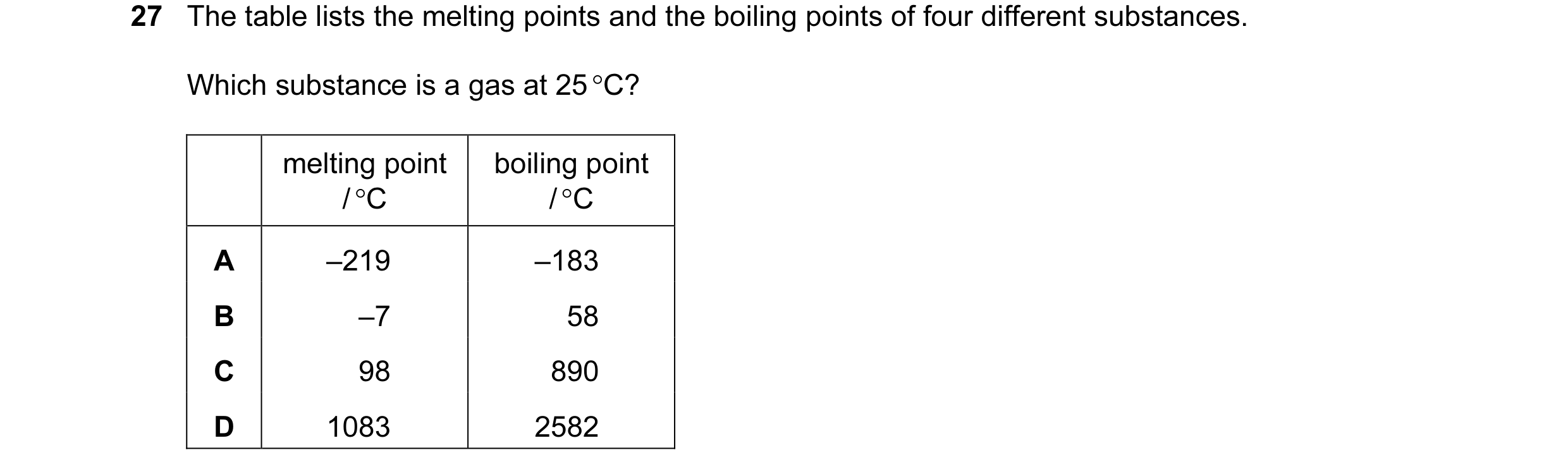
Q8 · The table lists the melting points and the boiling points of four different substances 0652/11 Oct/Nov 2014
27 The table lists the melting points and the boiling points of four different substances. Which substance is a gas at 25 °C? melting point boiling point / °C / °C A –219 –183 B –7 58 C 98 890 D 1083 2582
1 marks
Answer: A
This question in 0652/11 Oct/Nov 2014
Q9 · The table lists the melting points and the boiling points of four different substances 0652/12 Oct/Nov 2014
27 The table lists the melting points and the boiling points of four different substances. Which substance is a gas at 25 °C? melting point boiling point / °C / °C A –219 –183 B –7 58 C 98 890 D 1083 2582
1 marks
Answer: A
This question in 0652/12 Oct/Nov 2014
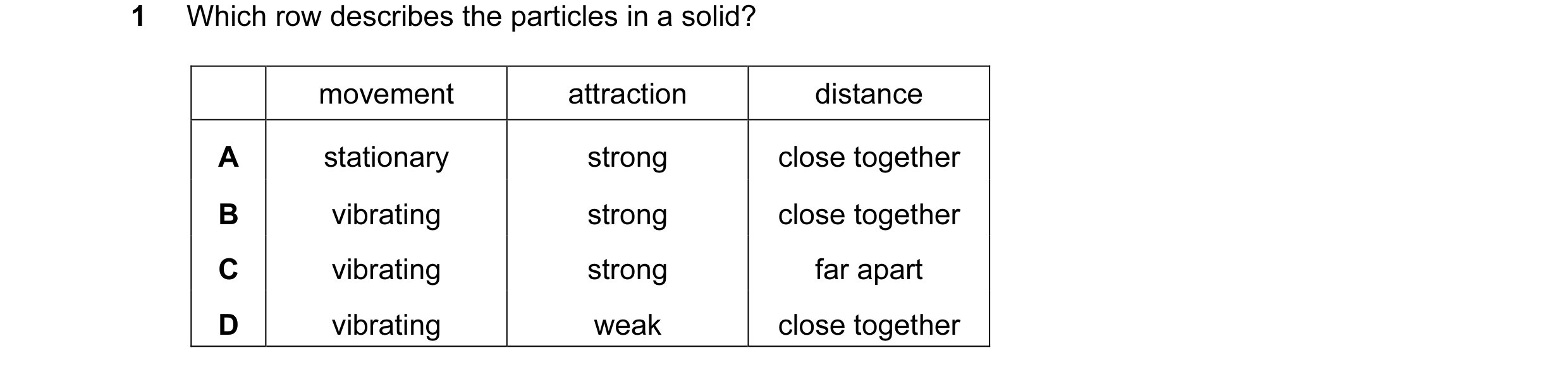
Q10 · Which row describes the particles in a solid? 0652/11 Oct/Nov 2015
1 Which row describes the particles in a solid? movement attraction distance A stationary strong close together B vibrating strong close together C vibrating strong far apart D vibrating weak close together
1 marks
Answer: B
This question in 0652/11 Oct/Nov 2015
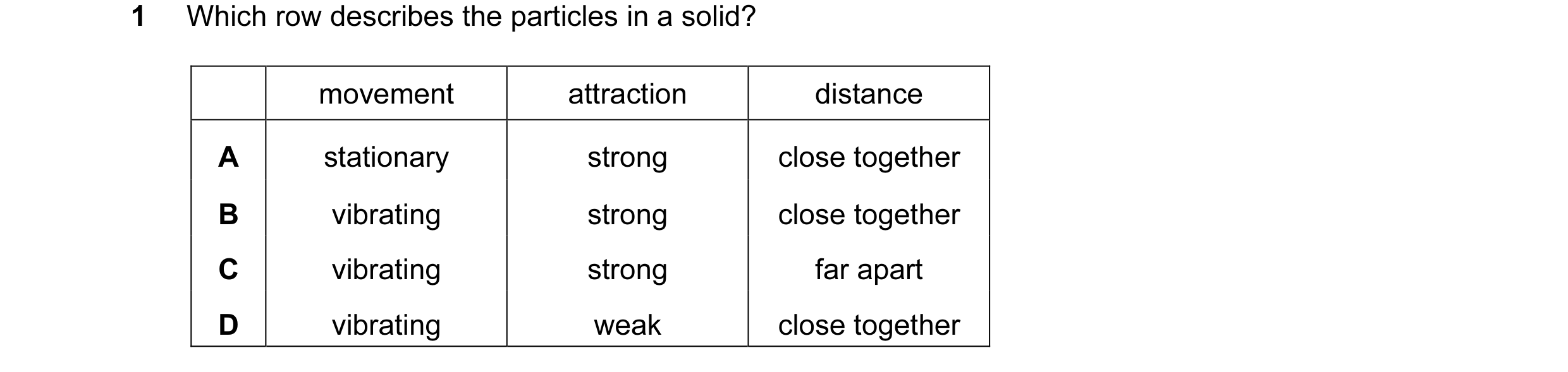
Q11 · Which row describes the particles in a solid? 0652/12 Oct/Nov 2015
1 Which row describes the particles in a solid? movement attraction distance A stationary strong close together B vibrating strong close together C vibrating strong far apart D vibrating weak close together
1 marks
Answer: B
This question in 0652/12 Oct/Nov 2015
Q12 · In which process is heat energy neither given out nor taken in? 0652/12 Oct/Nov 2016
1 In which process is heat energy neither given out nor taken in? Sun C water vapour di f fusin g cloud B water evaporating A ice melting D water vapour iceberg condensing sea water
1 marks
Answer: C
This question in 0652/12 Oct/Nov 2016
Q13 · What is the name of the process by which gas particles move to occupy all the available… 0652/11 Oct/Nov 2017
1 What is the name of the process by which gas particles move to occupy all the available space? A boiling B condensation C diffusion D evaporation
1 marks
Answer: C
This question in 0652/11 Oct/Nov 2017
Q14 · What is the name of the process by which gas particles move to occupy all the available… 0652/12 Oct/Nov 2017
1 What is the name of the process by which gas particles move to occupy all the available space? A boiling B condensation C diffusion D evaporation
1 marks
Answer: C
This question in 0652/12 Oct/Nov 2017
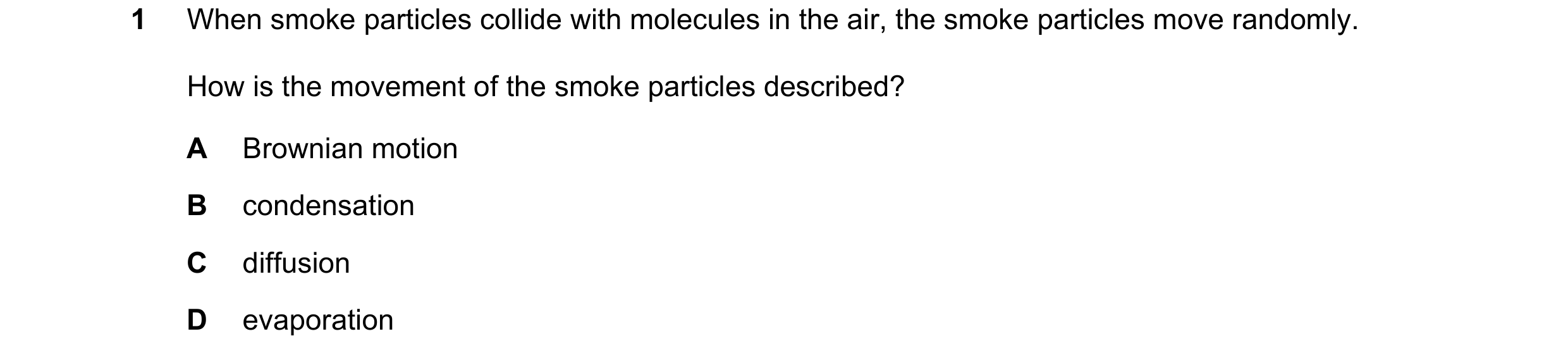
Q15 · When smoke particles collide with molecules in the air, the smoke particles move randomly 0652/11 Oct/Nov 2018
1 When smoke particles collide with molecules in the air, the smoke particles move randomly. How is the movement of the smoke particles described? A Brownian motion B condensation C diffusion D evaporation
1 marks
Answer: A
This question in 0652/11 Oct/Nov 2018
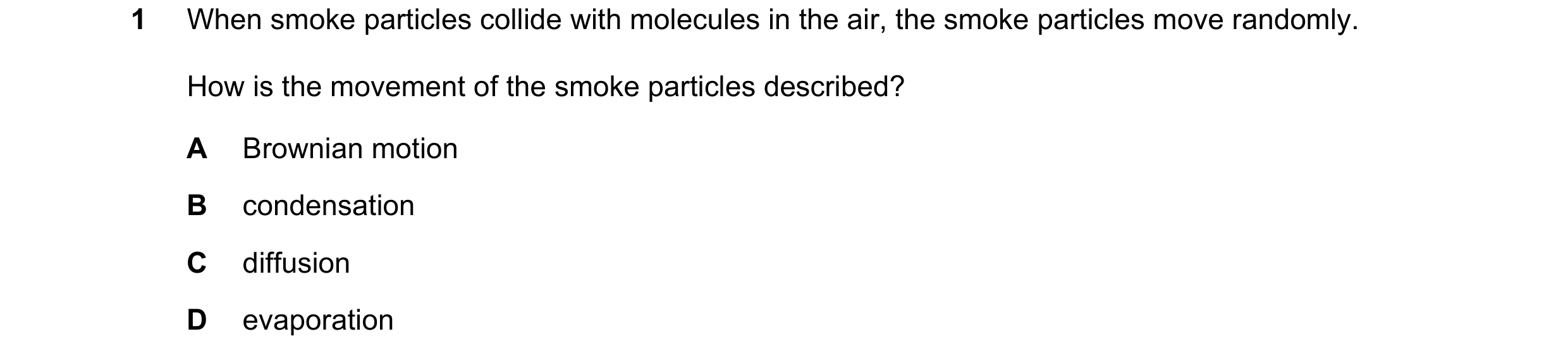
Q16 · When smoke particles collide with molecules in the air, the smoke particles move randomly 0652/12 Oct/Nov 2018
1 When smoke particles collide with molecules in the air, the smoke particles move randomly. How is the movement of the smoke particles described? A Brownian motion B condensation C diffusion D evaporation
1 marks
Answer: A
This question in 0652/12 Oct/Nov 2018
Q17 · Carbon dioxide is a solid at temperatures below –78 °C 0652/11 Oct/Nov 2019
1 Carbon dioxide is a solid at temperatures below –78 °C. What is not a property of solid carbon dioxide? A It has a fixed shape. B It is incompressible. C Its particles are very close together. D Its particles slide past each other.
1 marks
Answer: D
This question in 0652/11 Oct/Nov 2019
Q18 · Which statement about a liquid at 60 °C is not correct? 0652/12 Oct/Nov 2019
1 Which statement about a liquid at 60 °C is not correct? A It has a fixed volume. B It takes the shape of the container. C Its particles are far apart. D Its particles have enough energy to move around.
1 marks
Answer: C
This question in 0652/12 Oct/Nov 2019
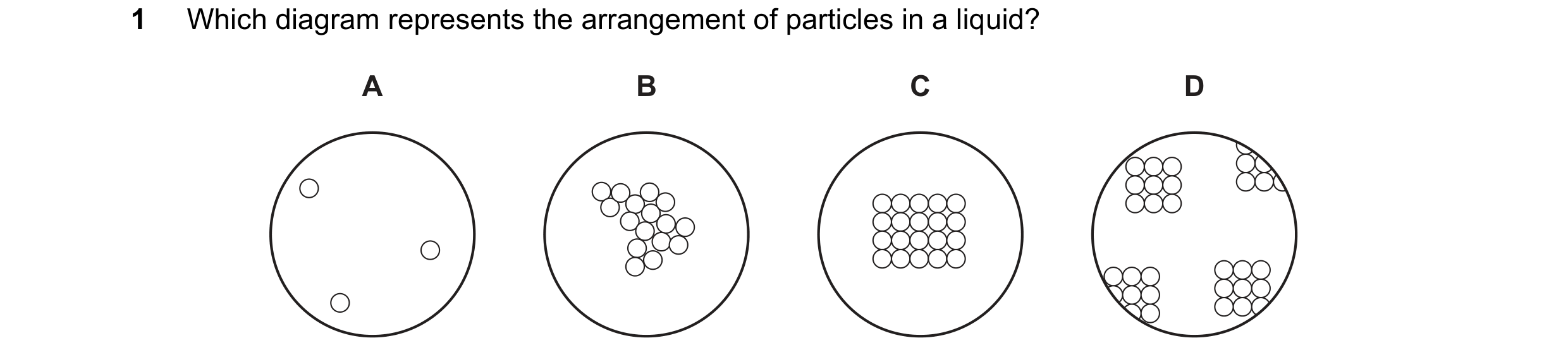
Q19 · Which diagram represents the arrangement of particles in a liquid? 0652/11 Oct/Nov 2020
1 Which diagram represents the arrangement of particles in a liquid? A B C D
1 marks
Answer: B
This question in 0652/11 Oct/Nov 2020
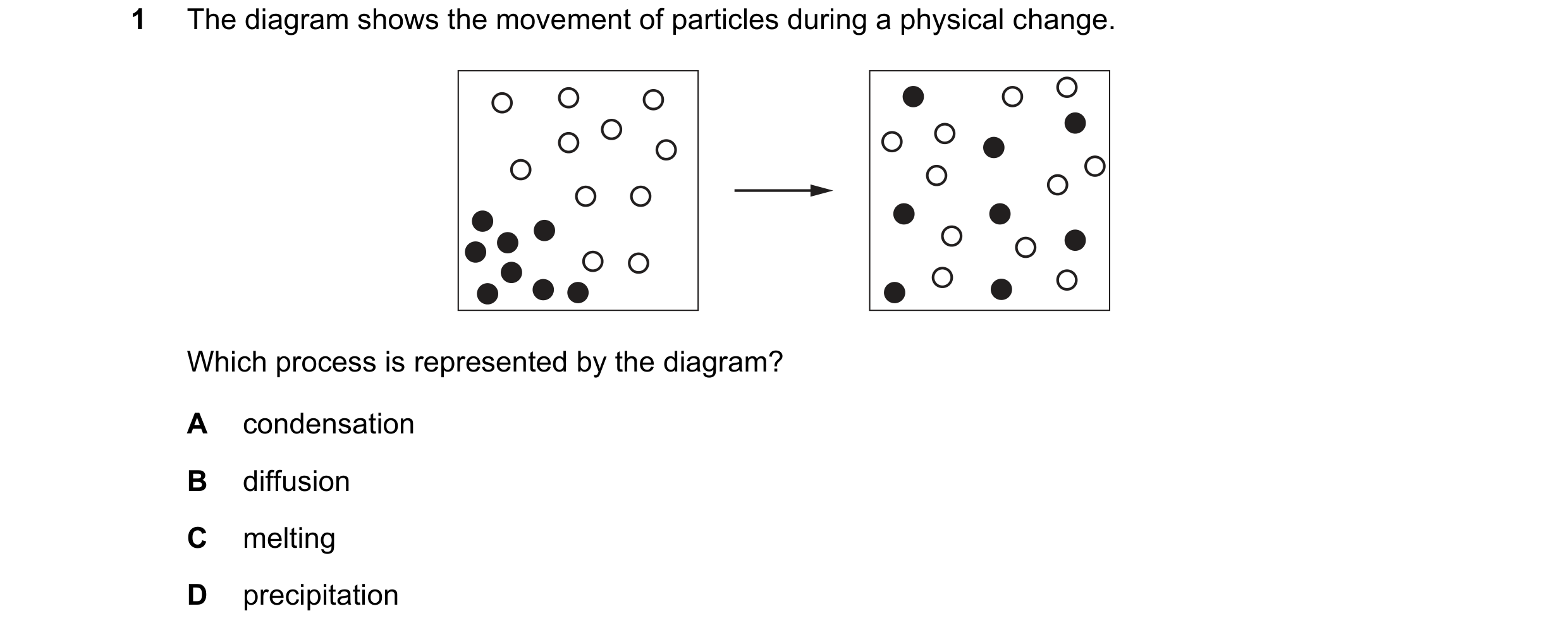
Q20 · The diagram shows the movement of particles during a physical change 0652/11 Oct/Nov 2021
1 The diagram shows the movement of particles during a physical change. Which process is represented by the diagram? A condensation B diffusion C melting D precipitation
1 marks
Answer: B
This question in 0652/11 Oct/Nov 2021
Q21 · Some statements about particles in solids, liquids and gases are listed 0652/11 Oct/Nov 2023
1 Some statements about particles in solids, liquids and gases are listed. 1 Particles in gases are closer together than particles in solids. 2 Particles in solids are more ordered than particles in liquids. 3 Particles in solids diffuse because they are in fixed positions. 4 Particles in liquids move slower than particles in gases. Which statements are correct? A 1 and 2 B 1 and 3 C 2 and 4 D 3 and 4
1 marks
Answer: C
This question in 0652/11 Oct/Nov 2023
Q22 · Some statements about particles in solids, liquids and gases are listed 0652/12 Oct/Nov 2023
1 Some statements about particles in solids, liquids and gases are listed. 1 Particles in gases are closer together than particles in solids. 2 Particles in solids are more ordered than particles in liquids. 3 Particles in solids diffuse because they are in fixed positions. 4 Particles in liquids move slower than particles in gases. Which statements are correct? A 1 and 2 B 1 and 3 C 2 and 4 D 3 and 4
1 marks
Answer: C
This question in 0652/12 Oct/Nov 2023
Q23 · Ammonia gas has a strong smell 0652/11 Oct/Nov 2024
1 Ammonia gas has a strong smell. A gas jar of ammonia with its lid on is placed in the corner of a room. The lid is removed and after 30 minutes the smell of ammonia is detected all around the room. Which statements about this process are correct? 1 The particles of ammonia are breaking away from their fixed positions in the gas jar. 2 The particles of ammonia are diffusing through the air. 3 The particles of ammonia are moving randomly. A 1, 2 and 3 B 1 and 2 only C 1 and 3 only D 2 and 3 only
1 marks
Answer: D
This question in 0652/11 Oct/Nov 2024
 1 / 6
1 / 6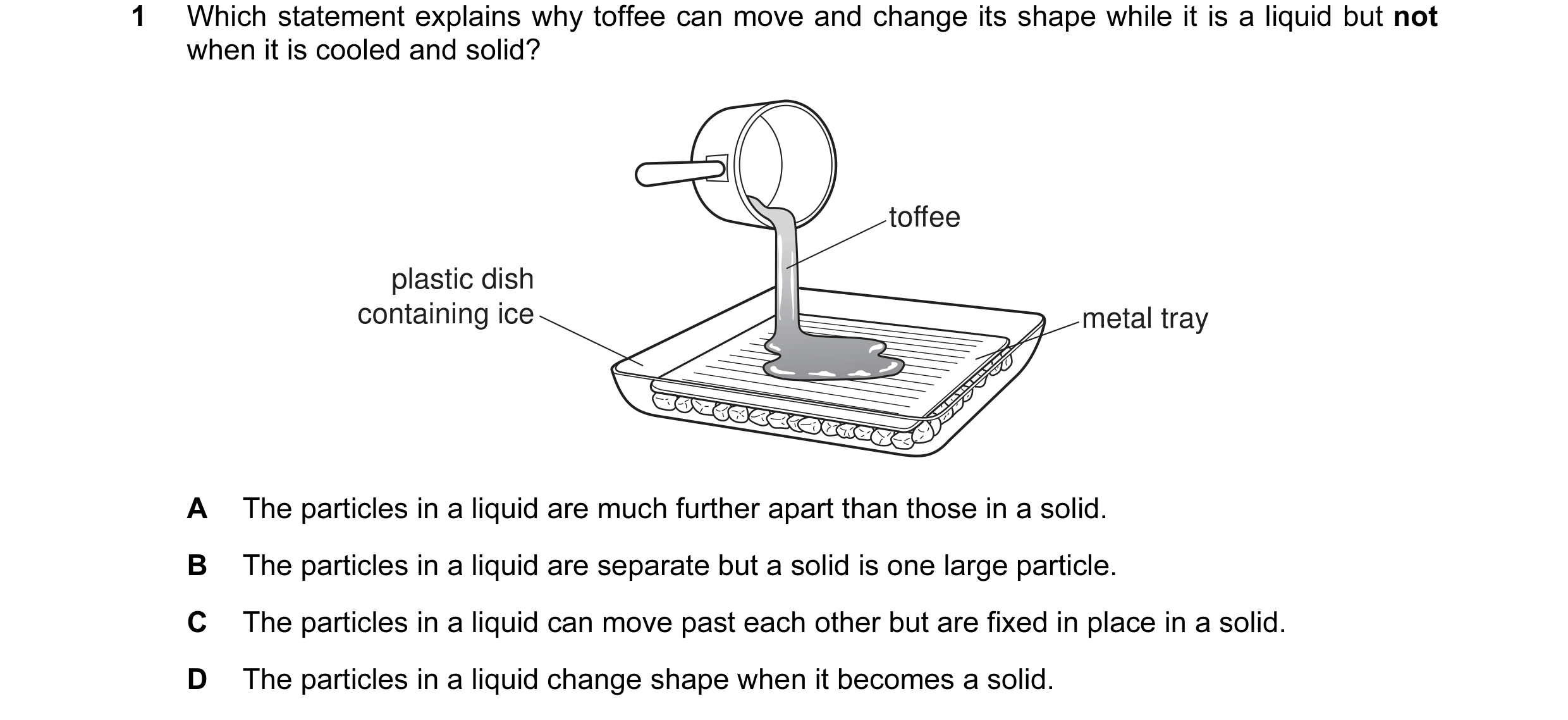
 2 / 6
2 / 6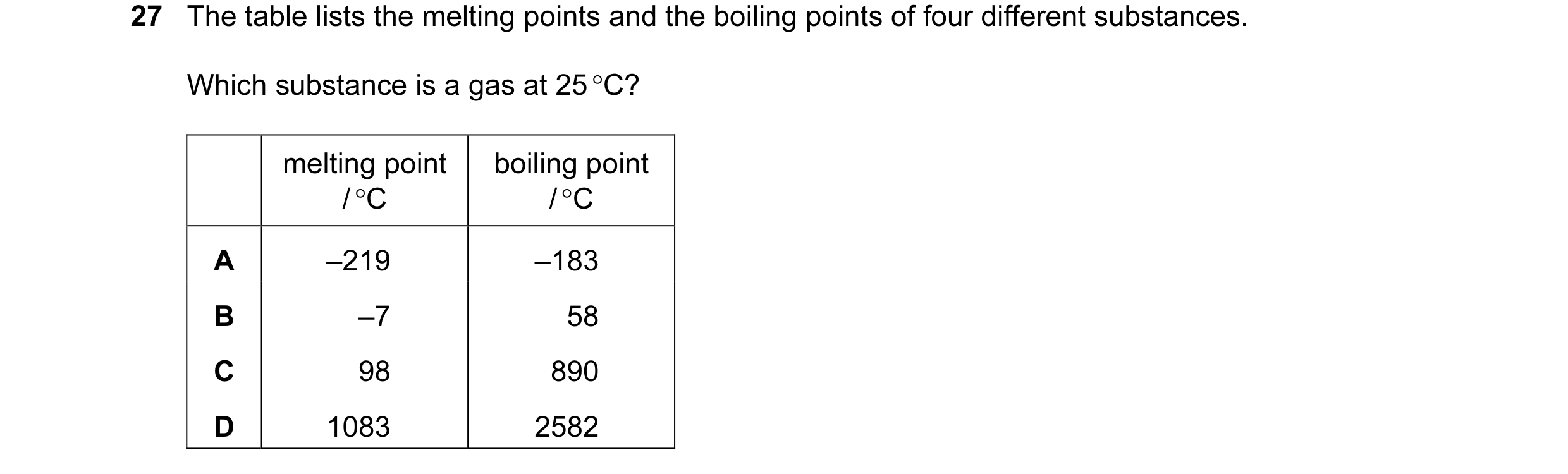
 3 / 6
3 / 6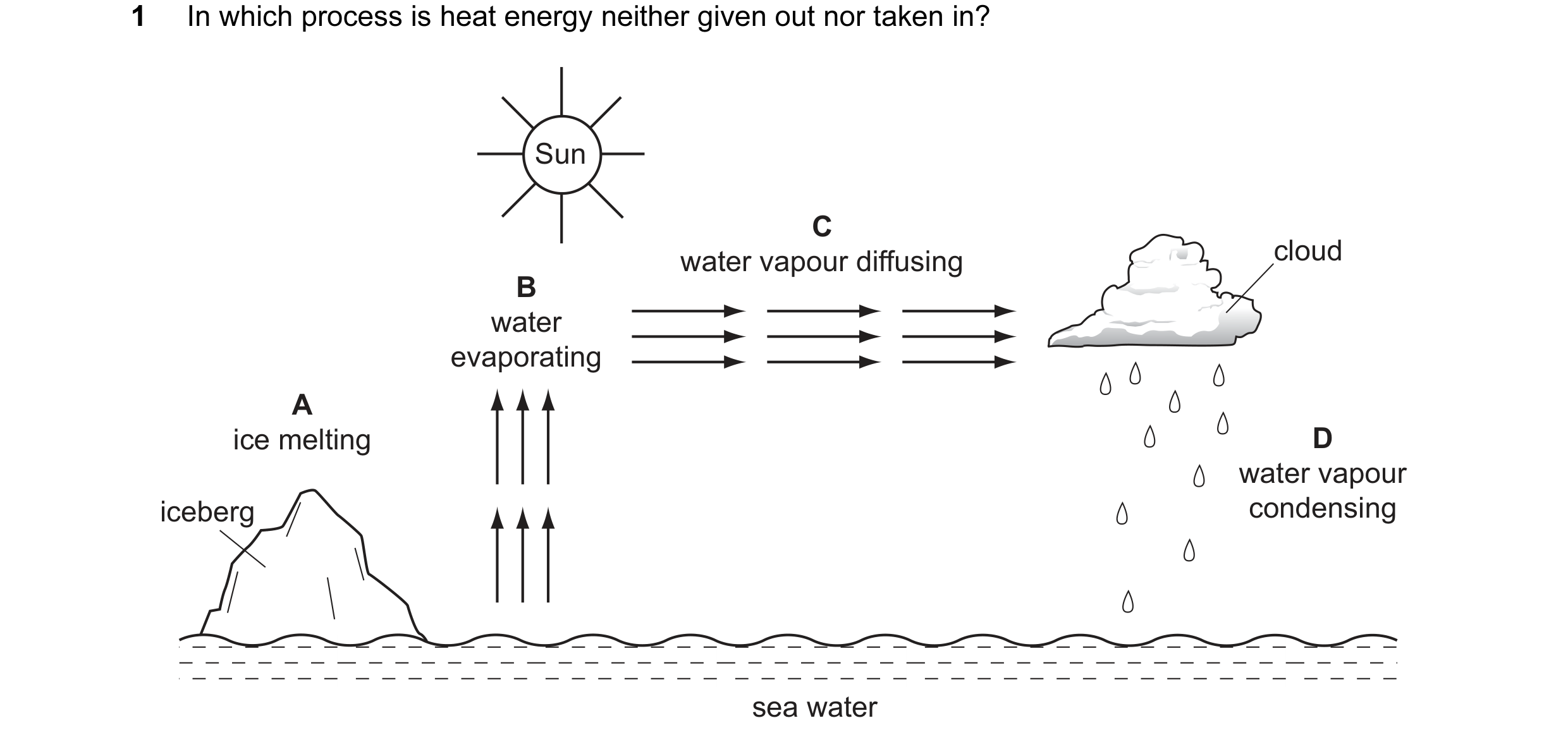


 4 / 6
4 / 6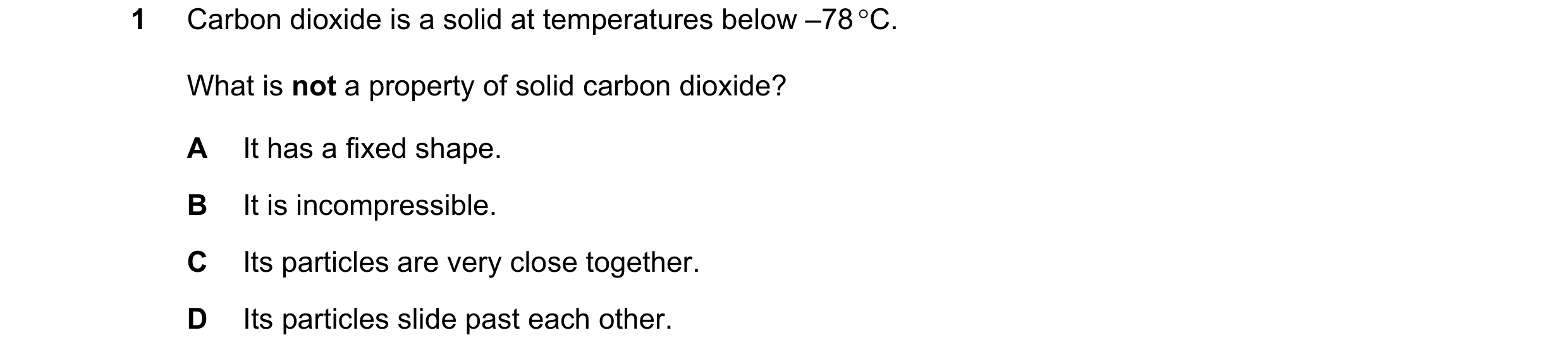

 5 / 6
5 / 6
 6 / 6
6 / 6