Questions as text
Q1 · Three metals, X, Y and Z, were reacted with water 0971/11 May/June 2018
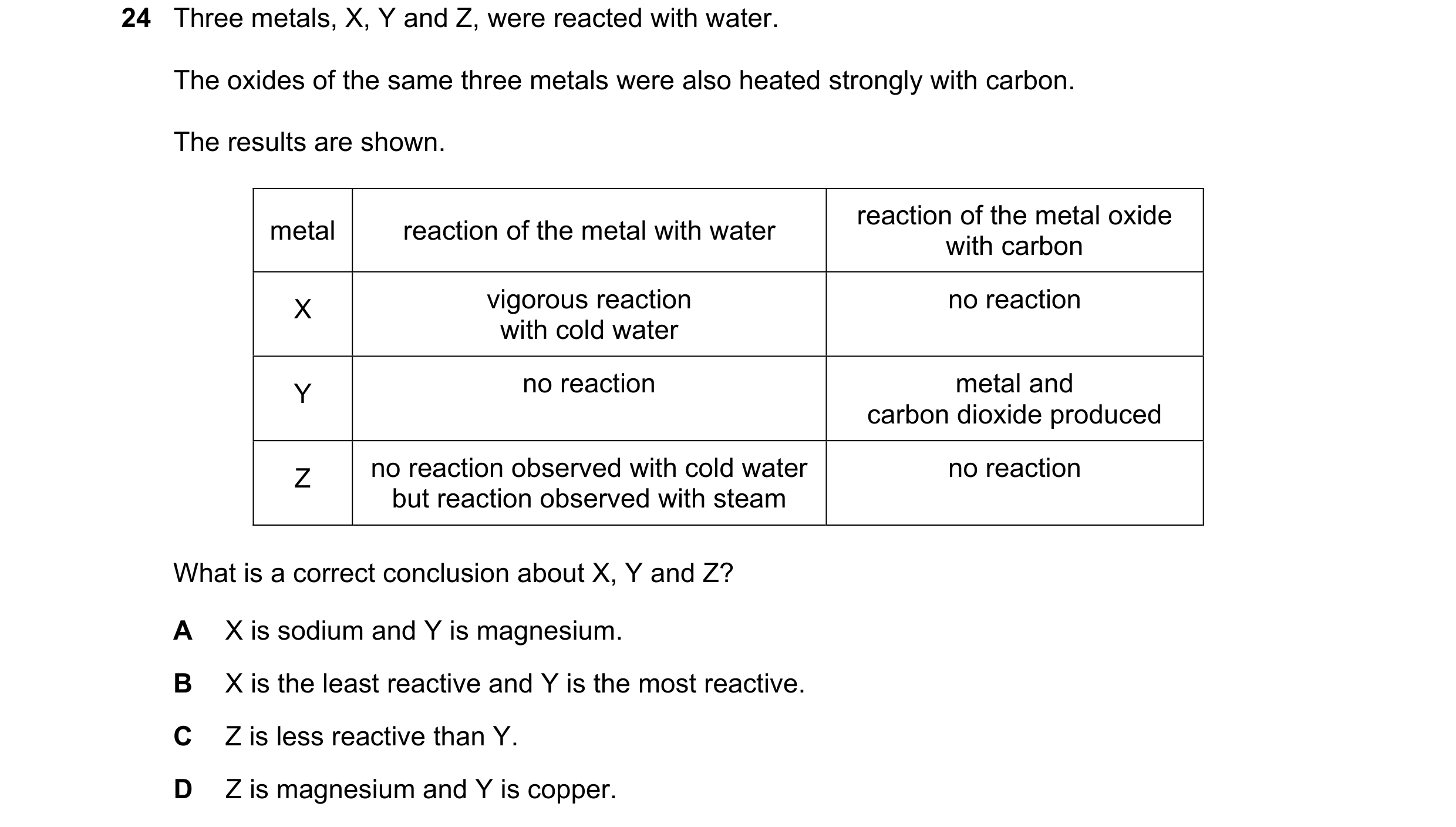
24 Three metals, X, Y and Z, were reacted with water. The oxides of the same three metals were also heated strongly with carbon. The results are shown. reaction of the metal oxide metal reaction of the metal with water with carbon X vigorous reaction no reaction with cold water Y no reaction metal and carbon dioxide produced Z no reaction observed with cold water no reaction but reaction observed with steam What is a correct conclusion about X, Y and Z? A X is sodium and Y is magnesium. B X is the least reactive and Y is the most reactive. C Z is less reactive than Y. D Z is magnesium and Y is copper.
1 marks
Answer: D
This question in 0971/11 May/June 2018
Q2 · The reactions of three metals, P, Q and R, are shown 0971/11 May/June 2019
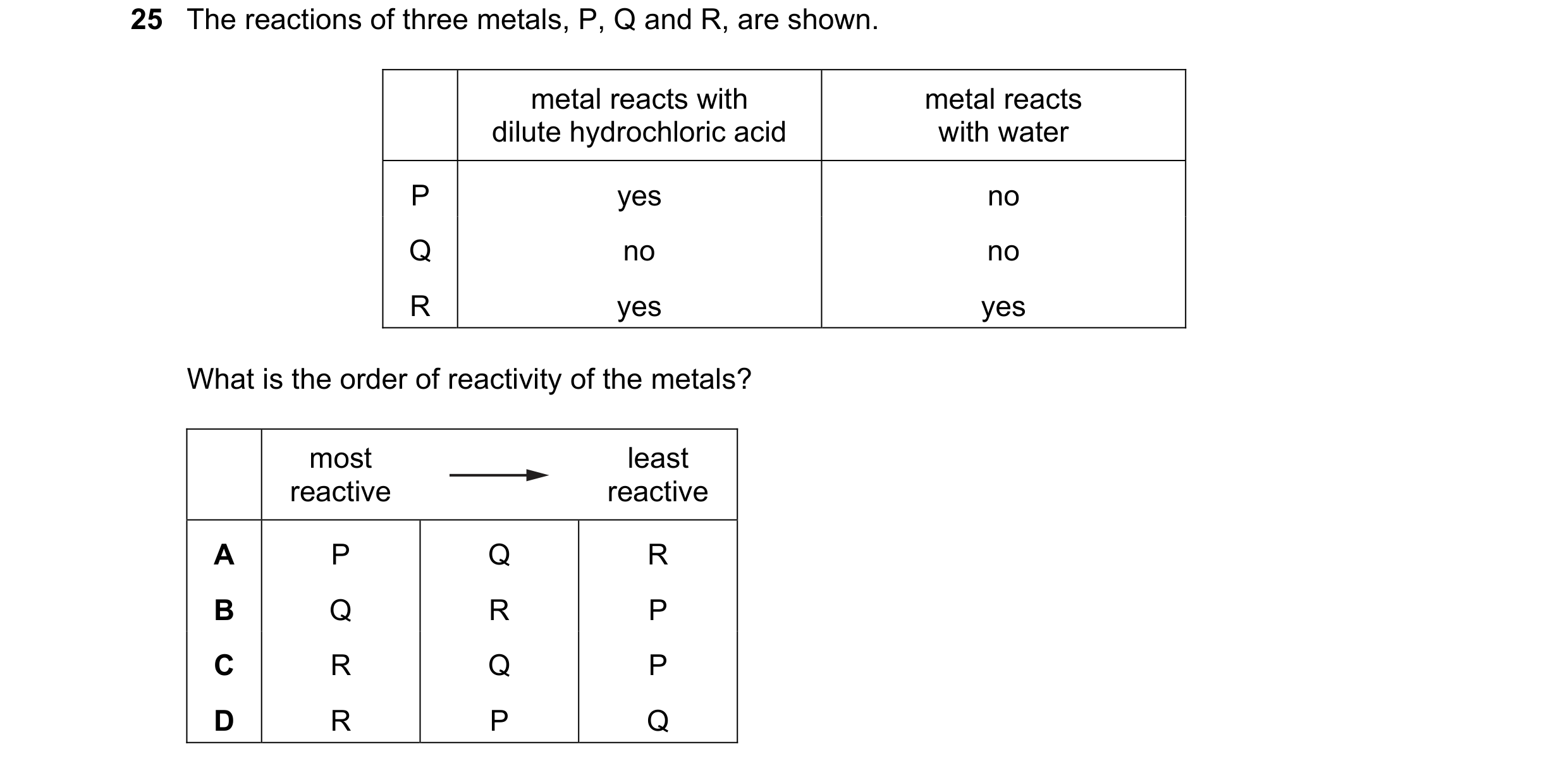
25 The reactions of three metals, P, Q and R, are shown. metal reacts with metal reacts dilute hydrochloric acid with water P yes no Q no no R yes yes What is the order of reactivity of the metals? most least reactive reactive A P Q R B Q R P C R Q P D R P Q
1 marks
Answer: D
This question in 0971/11 May/June 2019
Q3 · When magnesium is heated with zinc oxide a reaction occurs 0971/12 Oct/Nov 2019
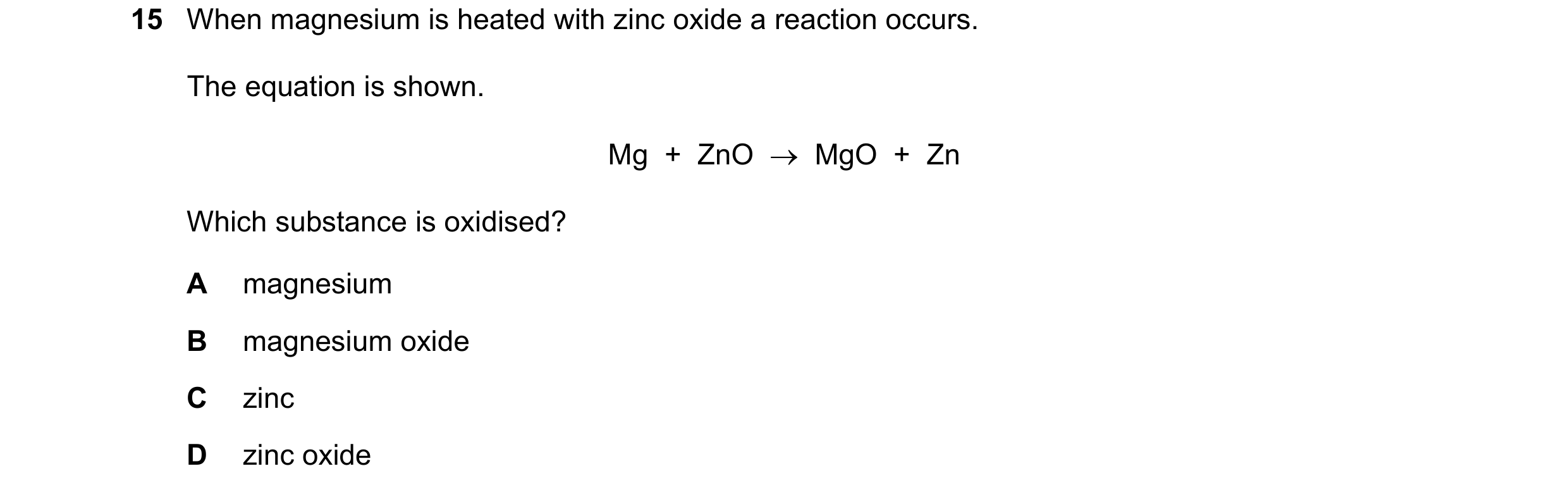
15 When magnesium is heated with zinc oxide a reaction occurs. The equation is shown. Mg + ZnO → MgO + Zn Which substance is oxidised? A magnesium B magnesium oxide C zinc D zinc oxide
1 marks
Answer: A
This question in 0971/12 Oct/Nov 2019
Q4 · Four unknown metals, Q, R, S and T, are reacted with water, steam and dilute hydrochloric… 0971/12 Oct/Nov 2019
25 Four unknown metals, Q, R, S and T, are reacted with water, steam and dilute hydrochloric acid. The results are shown in the table. reaction with reaction with reaction with dilute water steam hydrochloric acid Q slow reaction fast reaction fast reaction R no reaction no reaction no reaction S no reaction very slow reaction slow reaction T fast reaction explodes explodes Which statements are correct? 1 R is the least reactive metal. 2 T could be potassium. 3 S is more reactive than Q and R. 4 Metals react faster with steam than they do with water. A 1, 2 and 4 only B 1 and 2 only C 2 and 3 only D 3 and 4 only
1 marks
Answer: A
This question in 0971/12 Oct/Nov 2019
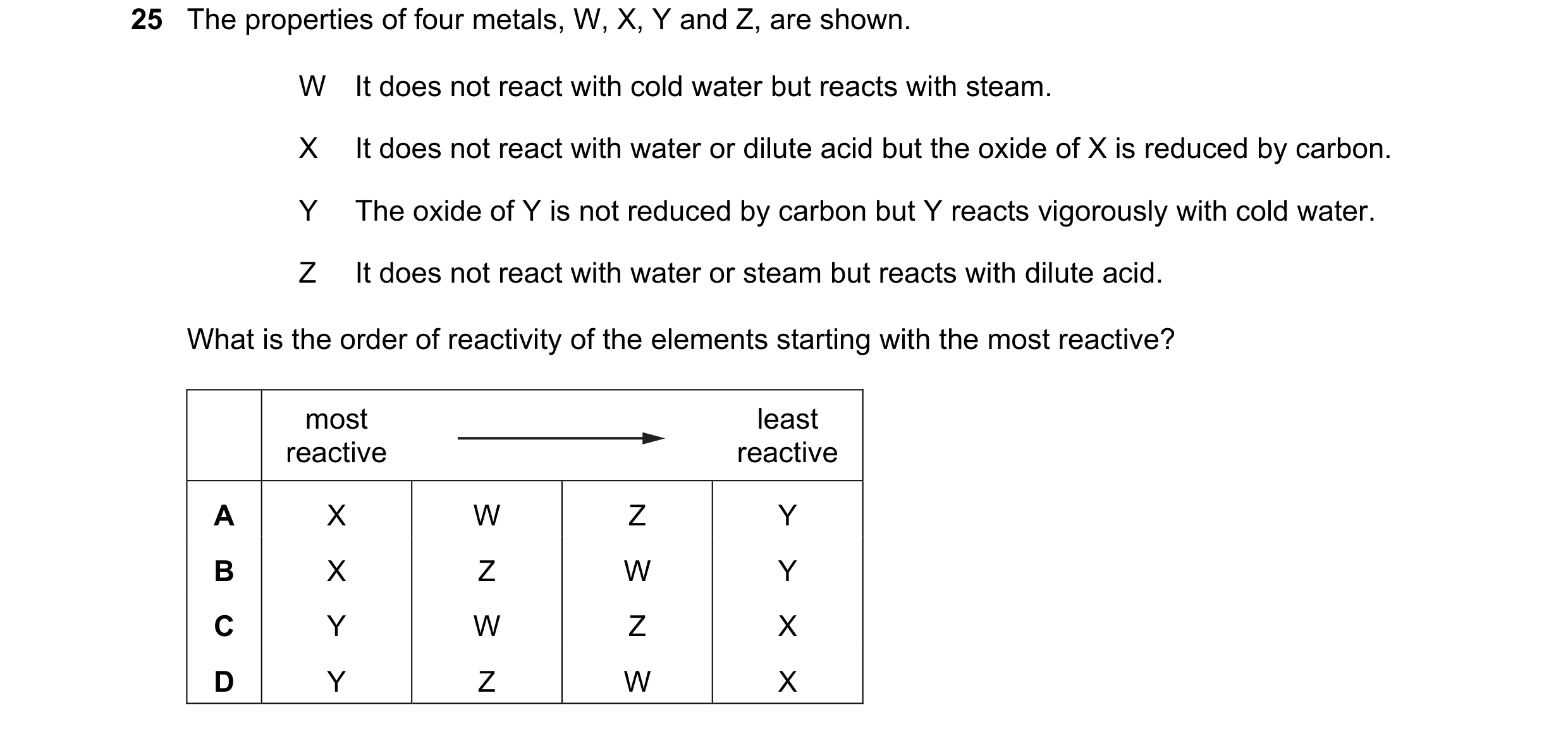
Q5 · The properties of four metals, W, X, Y and Z, are shown 0971/11 May/June 2020
25 The properties of four metals, W, X, Y and Z, are shown. W It does not react with cold water but reacts with steam. X It does not react with water or dilute acid but the oxide of X is reduced by carbon. Y The oxide of Y is not reduced by carbon but Y reacts vigorously with cold water. Z It does not react with water or steam but reacts with dilute acid. What is the order of reactivity of the elements starting with the most reactive? most least reactive reactive A X W Z Y B X Z W Y C Y W Z X D Y Z W X
1 marks
Answer: C
This question in 0971/11 May/June 2020
Q6 · The reactions of four metals, W, X, Y and Z, are shown 0971/12 May/June 2020
25 The reactions of four metals, W, X, Y and Z, are shown. metal observations W reacts with steam and hydrochloric acid but not cold water X reacts with hydrochloric acid but not with steam or cold water Y reacts with hydrochloric acid and cold water Z does not react with hydrochloric acid What is the order of reactivity for metals W, X, Y and Z? most least reactive reactive A Y W X Z B Y X W Z C Z W X Y D Z X W Y
1 marks
Answer: A
This question in 0971/12 May/June 2020
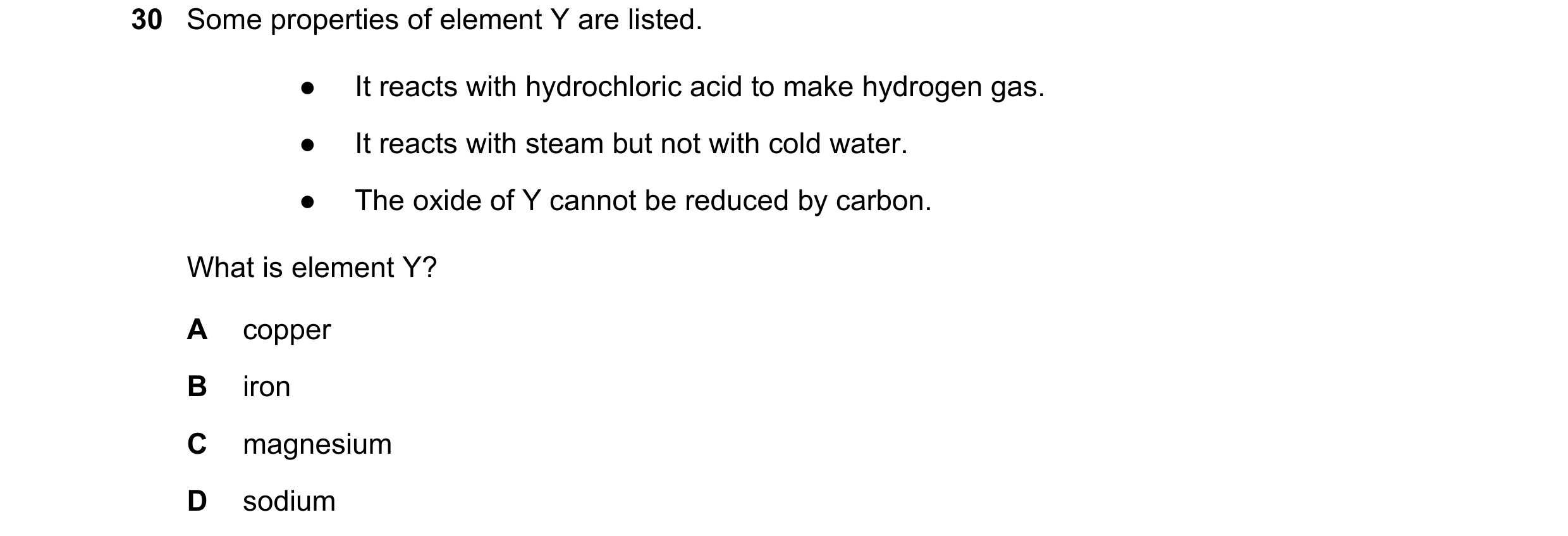
Q7 · Some properties of element Y are listed 0971/12 Oct/Nov 2020
30 Some properties of element Y are listed. ● It reacts with hydrochloric acid to make hydrogen gas. ● It reacts with steam but not with cold water. ● The oxide of Y cannot be reduced by carbon. What is element Y? A copper B iron C magnesium D sodium
1 marks
Answer: C
This question in 0971/12 Oct/Nov 2020
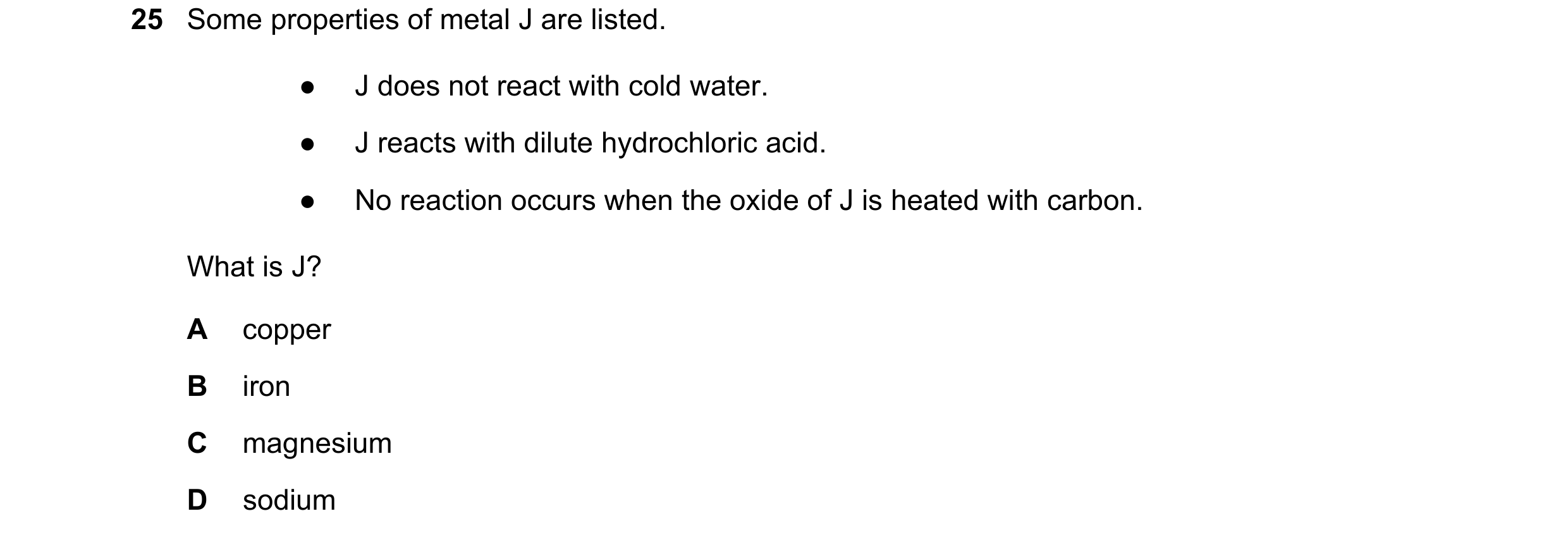
Q8 · Some properties of metal J are listed 0971/11 May/June 2021
25 Some properties of metal J are listed. ● J does not react with cold water. ● J reacts with dilute hydrochloric acid. ● No reaction occurs when the oxide of J is heated with carbon. What is J? A copper B iron C magnesium D sodium
1 marks
Answer: C
This question in 0971/11 May/June 2021
Q9 · Reactions of three metals and their oxides are shown 0971/11 May/June 2022
27 Reactions of three metals and their oxides are shown.
add dilute heat
metal | hydrochloric acid metal oxide
to metal with carbon
1 Jv Jv key
2 Jv x J/ = reacts
3 x Jv X = does not react
What is the order of reactivity of these metals, from most reactive to least reactive?
A 135253 B 15352 C 251593 DB 253-51
1 marks
Answer: C
This question in 0971/11 May/June 2022
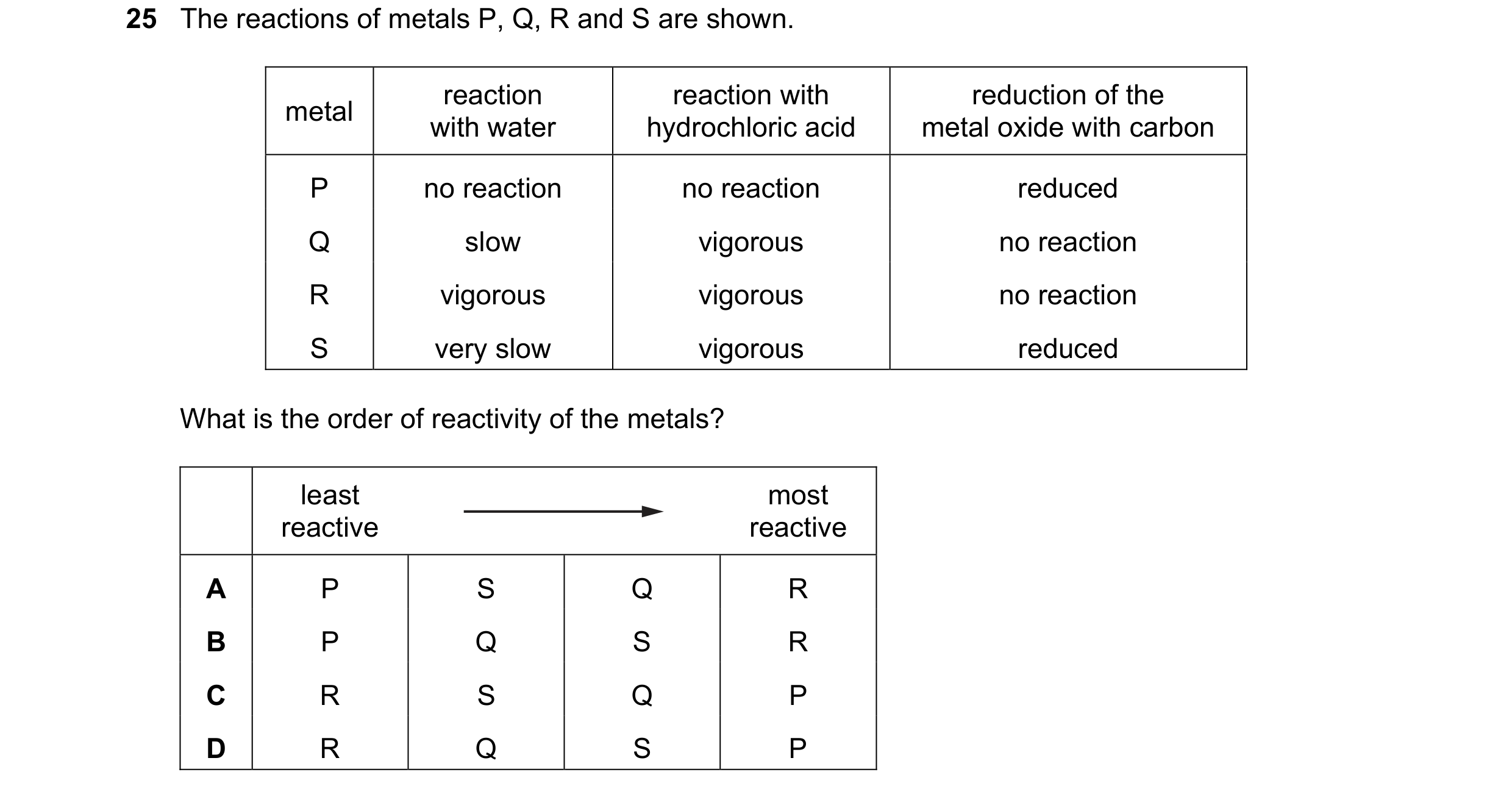
Q10 · The reactions of metals P, Q, R and S are shown 0971/12 May/June 2022
25 The reactions of metals P, Q, R and S are shown. reaction reaction with reduction of the metal with water hydrochloric acid metal oxide with carbon P no reaction no reaction reduced Q slow vigorous no reaction R vigorous vigorous no reaction S very slow vigorous reduced What is the order of reactivity of the metals? least most reactive reactive A P S Q R B P Q S R C R S Q P D R Q S P
1 marks
Answer: A
This question in 0971/12 May/June 2022
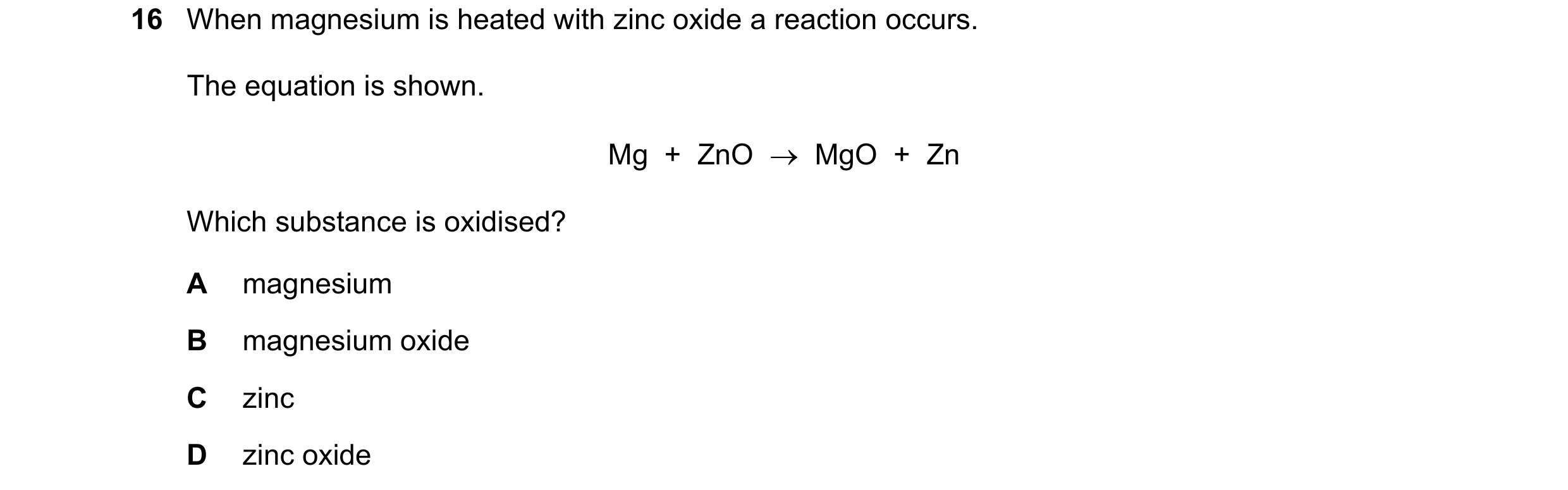
Q11 · When magnesium is heated with zinc oxide a reaction occurs 0971/12 Oct/Nov 2022
16 When magnesium is heated with zinc oxide a reaction occurs. The equation is shown. Mg + ZnO MgO + Zn Which substance is oxidised? A magnesium B magnesium oxide C zinc D zinc oxide
1 marks
Answer: A
This question in 0971/12 Oct/Nov 2022
Q12 · Elements J and K are in the same period in the Periodic Table 0971/12 Oct/Nov 2022
21 Elements J and K are in the same period in the Periodic Table. J reacts with acids to produce a salt and hydrogen. K reacts with sodium to form an ionic compound. Which statement about J and K is correct? A An atom of J has more electrons than an atom of K. B J and K are both metals. C J and K are both non-metals. D J is to the left of K in the Periodic Table.
1 marks
Answer: D
This question in 0971/12 Oct/Nov 2022
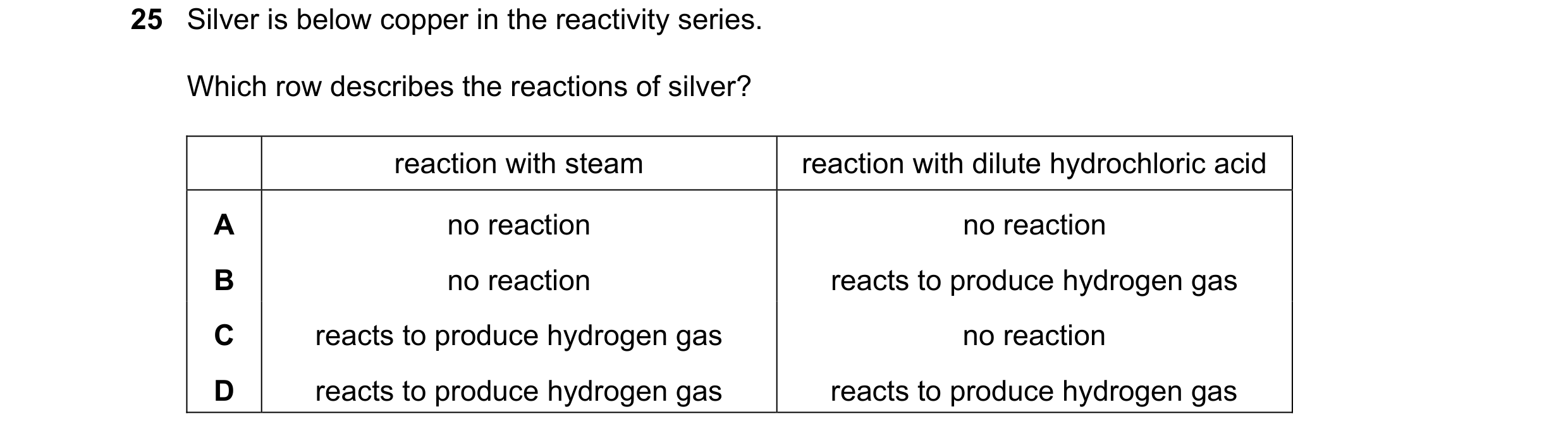
Q13 · Silver is below copper in the reactivity series 0971/12 Oct/Nov 2022
25 Silver is below copper in the reactivity series. Which row describes the reactions of silver? reaction with steam reaction with dilute hydrochloric acid A no reaction no reaction B no reaction reacts to produce hydrogen gas C reacts to produce hydrogen gas no reaction D reacts to produce hydrogen gas reacts to produce hydrogen gas
1 marks
Answer: A
This question in 0971/12 Oct/Nov 2022
Q14 · Which gas is made when powdered zinc is added to dilute hydrochloric acid? 0971/11 May/June 2023
23 Which gas is made when powdered zinc is added to dilute hydrochloric acid? A carbon dioxide B chlorine C hydrogen D oxygen
1 marks
Answer: C
This question in 0971/11 May/June 2023
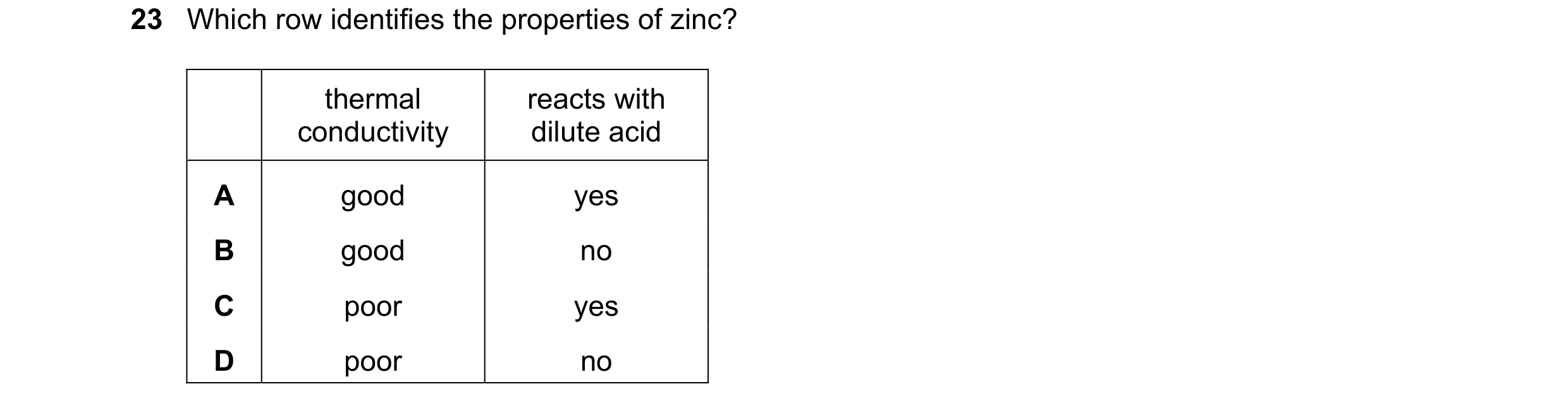
Q15 · Which row identifies the properties of zinc? 0971/12 May/June 2023
23 Which row identifies the properties of zinc? thermal reacts with conductivity dilute acid A good yes B good no C poor yes D poor no
1 marks
Answer: A
This question in 0971/12 May/June 2023
Q16 · P, Q, R and S are metals 0971/12 May/June 2023
26 P, Q, R and S are metals. P reacts with dilute hydrochloric acid, forming hydrogen. Q reacts violently with water. R reacts with water to give hydrogen. S is formed by heating its oxide with carbon. Which row identifies the metals? P Q R S A copper sodium potassium iron B zinc magnesium calcium iron C zinc sodium calcium magnesium D iron potassium sodium zinc
1 marks
Answer: D
This question in 0971/12 May/June 2023
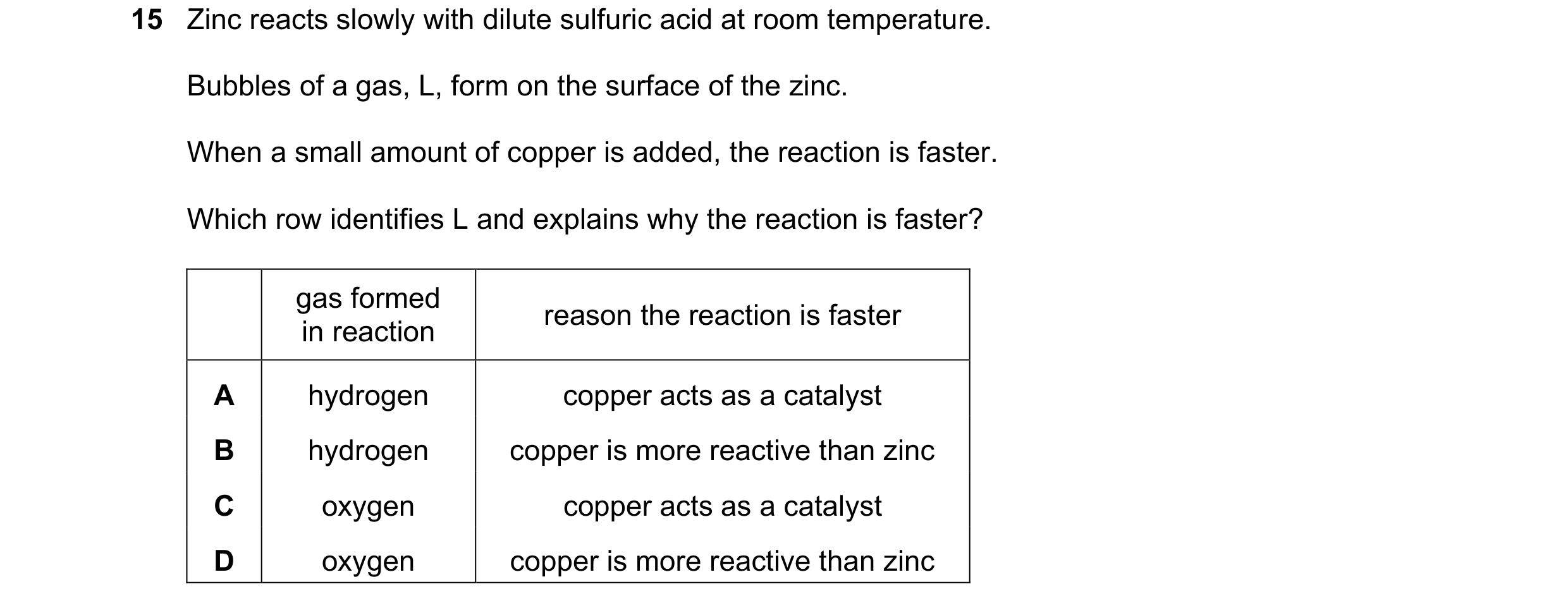
Q17 · Zinc reacts slowly with dilute sulfuric acid at room temperature 0971/12 Oct/Nov 2023
15 Zinc reacts slowly with dilute sulfuric acid at room temperature. Bubbles of a gas, L, form on the surface of the zinc. When a small amount of copper is added, the reaction is faster. Which row identifies L and explains why the reaction is faster? gas formed reason the reaction is faster in reaction A hydrogen copper acts as a catalyst B hydrogen copper is more reactive than zinc C oxygen copper acts as a catalyst D oxygen copper is more reactive than zinc
1 marks
Answer: A
This question in 0971/12 Oct/Nov 2023
Q18 · The list gives the order of some metals and hydrogen in the reactivity series 0971/12 Oct/Nov 2023
27 The list gives the order of some metals and hydrogen in the reactivity series. Metal X is also included. most reactive K Mg Zn H X least reactive Cu Which row shows the properties of metal X? reacts with oxide reduced dilute acids by carbon A no no B no yes C yes no D yes yes
1 marks
Answer: B
This question in 0971/12 Oct/Nov 2023
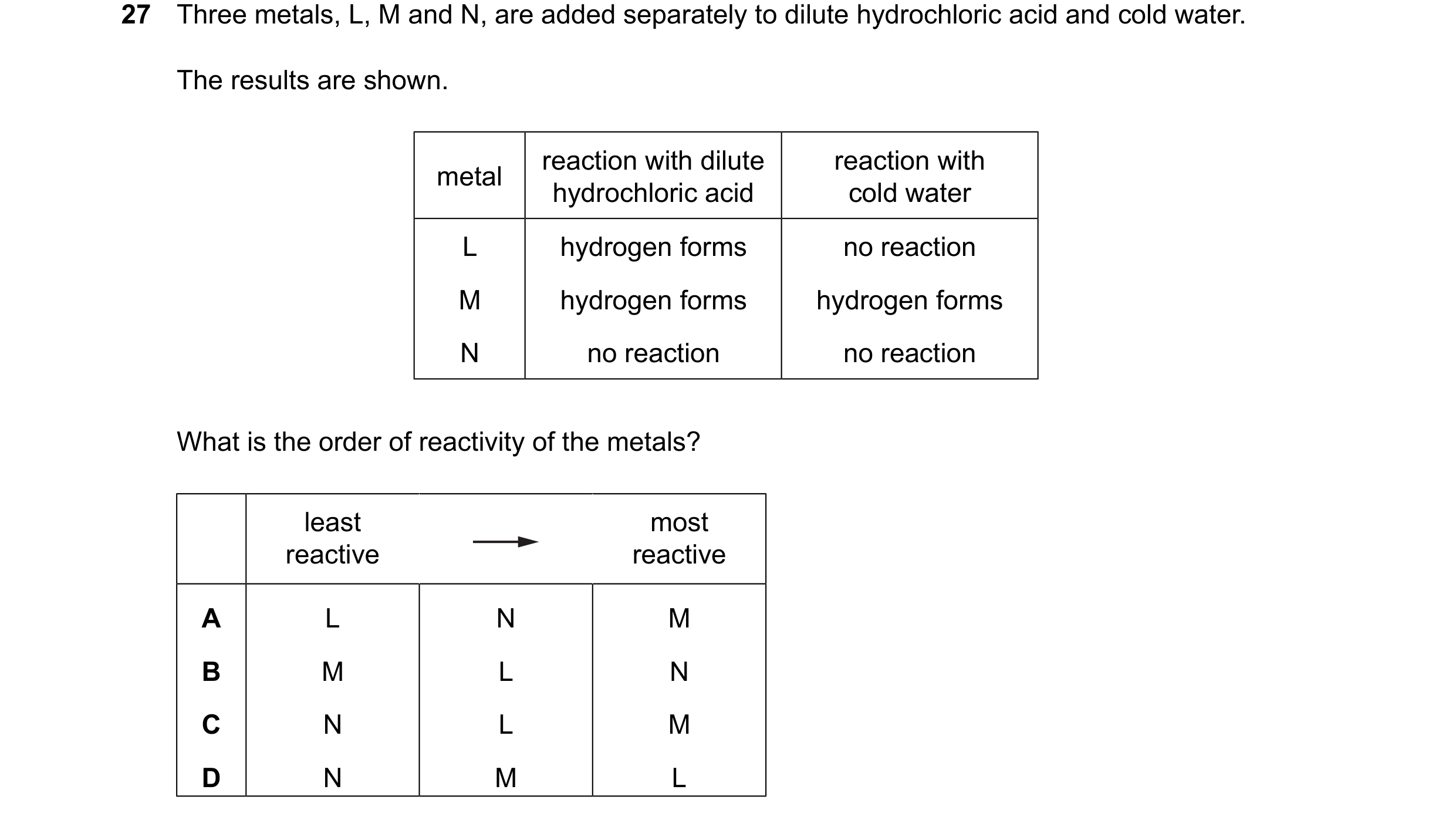
Q19 · Three metals, L, M and N, are added separately to dilute hydrochloric acid and cold water 0971/11 May/June 2024
27 Three metals, L, M and N, are added separately to dilute hydrochloric acid and cold water. The results are shown. reaction with dilute reaction with metal hydrochloric acid cold water L hydrogen forms no reaction M hydrogen forms hydrogen forms N no reaction no reaction What is the order of reactivity of the metals? least most reactive reactive A L N M B M L N C N L M D N M L
1 marks
Answer: C
This question in 0971/11 May/June 2024
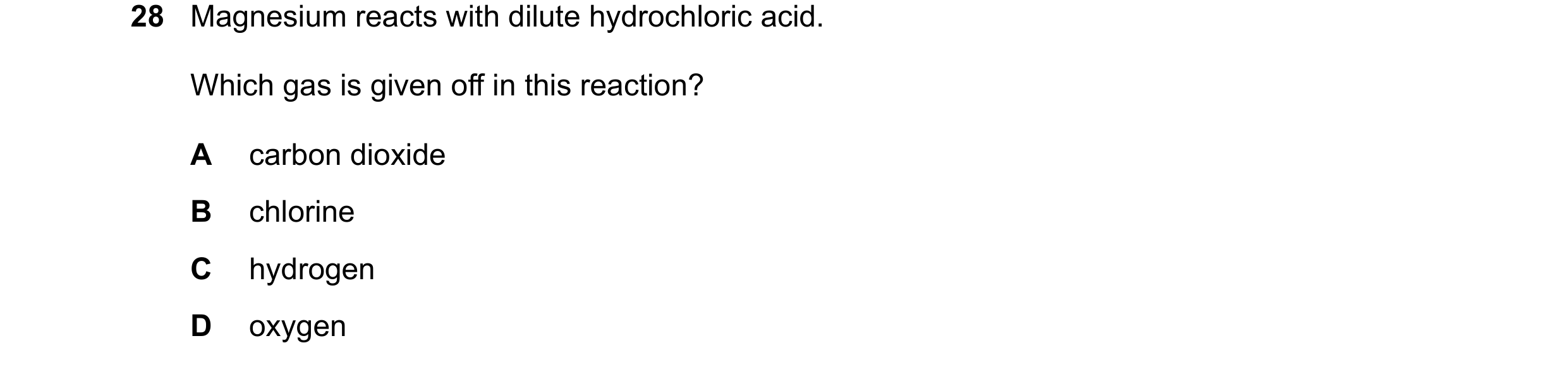
Q20 · Magnesium reacts with dilute hydrochloric acid 0971/12 May/June 2024
28 Magnesium reacts with dilute hydrochloric acid. Which gas is given off in this reaction? A carbon dioxide B chlorine C hydrogen D oxygen
1 marks
Answer: C
This question in 0971/12 May/June 2024
Q21 · The equation for the reaction of magnesium with copper(II) oxide is shown 0971/12 Oct/Nov 2024
19 The equation for the reaction of magnesium with copper(II) oxide is shown. Mg + CuO MgO + Cu Which word describes this reaction? A combustion B decomposition C neutralisation D redox
1 marks
Answer: D
This question in 0971/12 Oct/Nov 2024
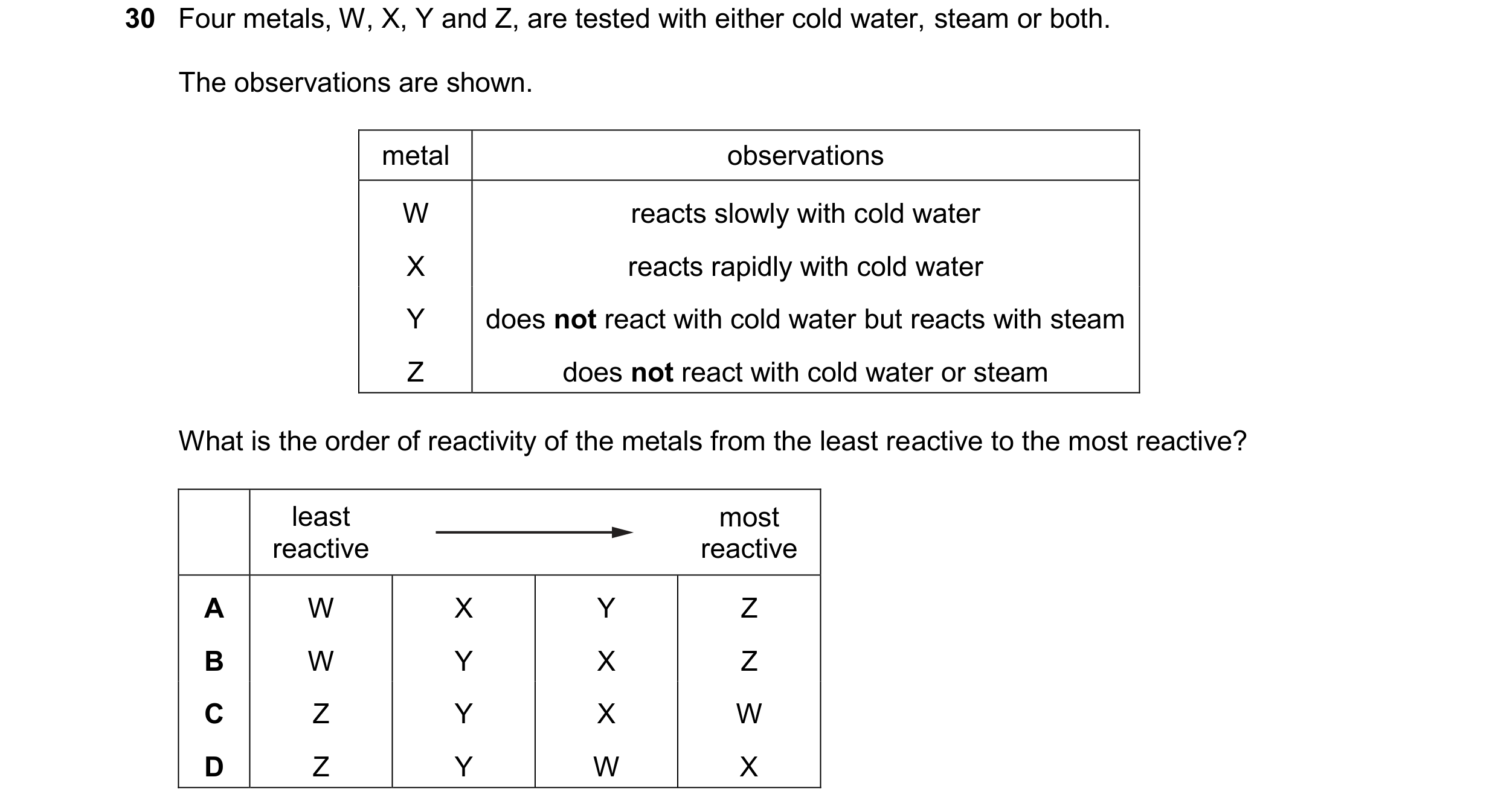
Q22 · Four metals, W, X, Y and Z, are tested with either cold water, steam or both 0971/12 Oct/Nov 2024
30 Four metals, W, X, Y and Z, are tested with either cold water, steam or both. The observations are shown. metal observations W reacts slowly with cold water X reacts rapidly with cold water Y does not react with cold water but reacts with steam Z does not react with cold water or steam What is the order of reactivity of the metals from the least reactive to the most reactive? least most reactive reactive A W X Y Z B W Y X Z C Z Y X W D Z Y W X
1 marks
Answer: D
This question in 0971/12 Oct/Nov 2024
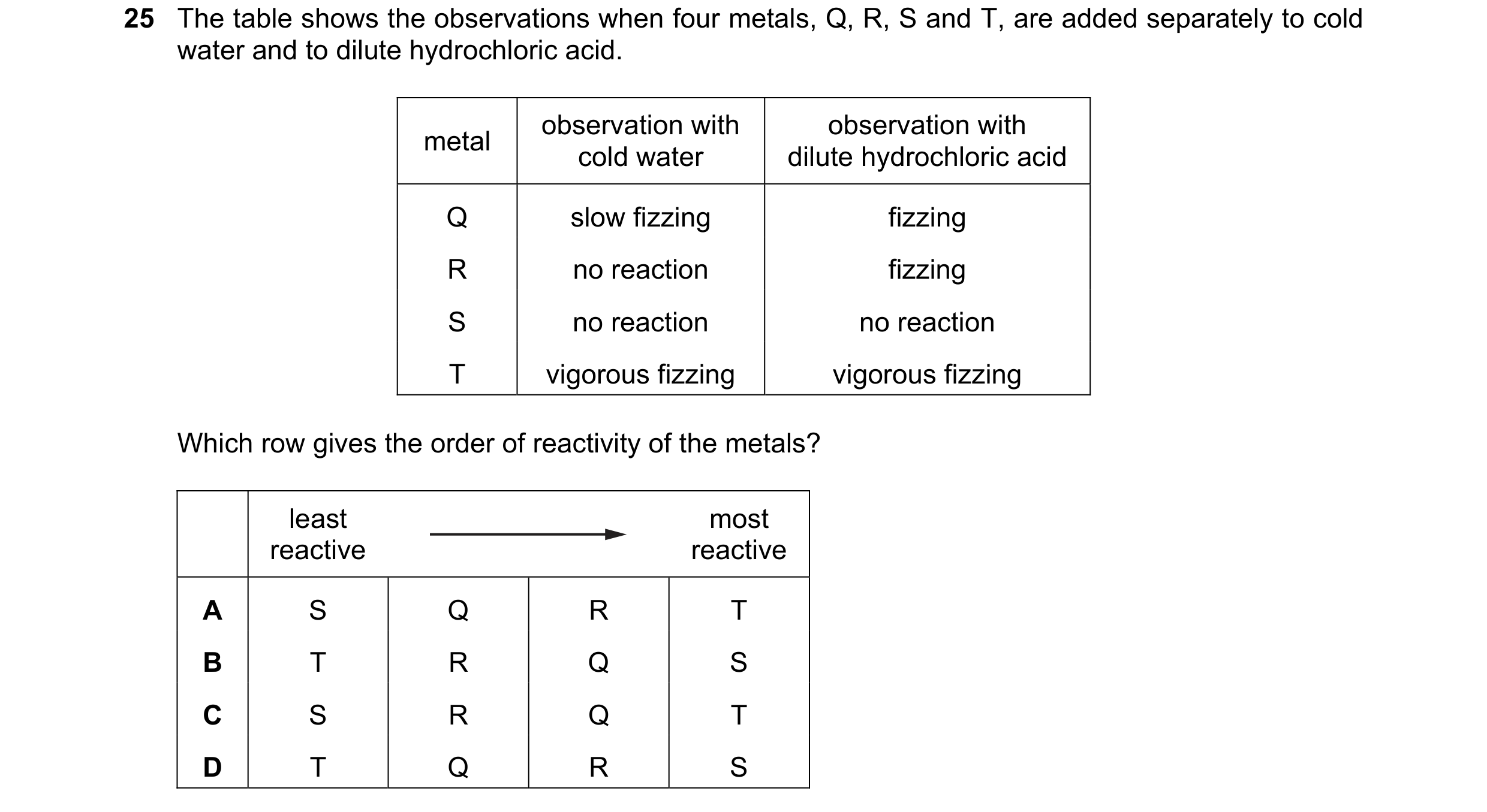
Q23 · The table shows the observations when four metals, Q, R, S and T, are added separately to… 0971/11 May/June 2025
25 The table shows the observations when four metals, Q, R, S and T, are added separately to cold water and to dilute hydrochloric acid. observation with observation with metal cold water dilute hydrochloric acid Q slow fizzing fizzing R no reaction fizzing S no reaction no reaction T vigorous fizzing vigorous fizzing Which row gives the order of reactivity of the metals? least most reactive reactive A S Q R T B T R Q S C S R Q T D T Q R S
1 marks
Answer: C
This question in 0971/11 May/June 2025
Q24 · Magnesium is reacted separately with dilute sulfuric acid and with steam 0971/11 May/June 2025
26 Magnesium is reacted separately with dilute sulfuric acid and with steam.
Which row correctly identifies if hydrogen is formed as a product in each reaction?
reaction with reaction with
dilute sulfuric acid steam
Jv v key
¥ = hydrogen is formed
0 0O WwW >
v x
x Jv X = hydrogen is not formed
x x
1 marks
Answer: A
This question in 0971/11 May/June 2025
Q25 · Which statements about metals are correct? 0971/12 May/June 2025
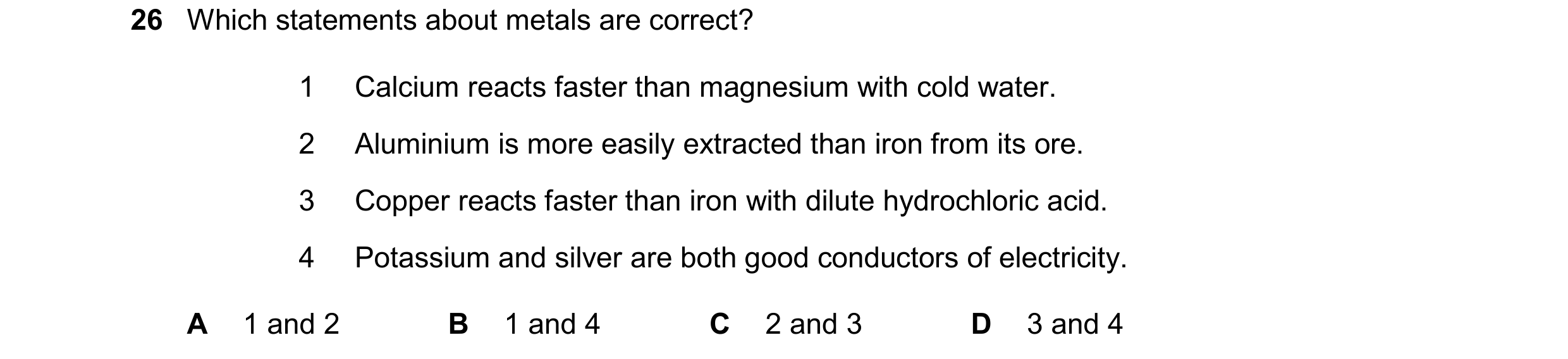
26 Which statements about metals are correct? 1 Calcium reacts faster than magnesium with cold water. 2 Aluminium is more easily extracted than iron from its ore. 3 Copper reacts faster than iron with dilute hydrochloric acid. 4 Potassium and silver are both good conductors of electricity. A 1 and 2 B 1 and 4 C 2 and 3 D 3 and 4
1 marks
Answer: B
This question in 0971/12 May/June 2025
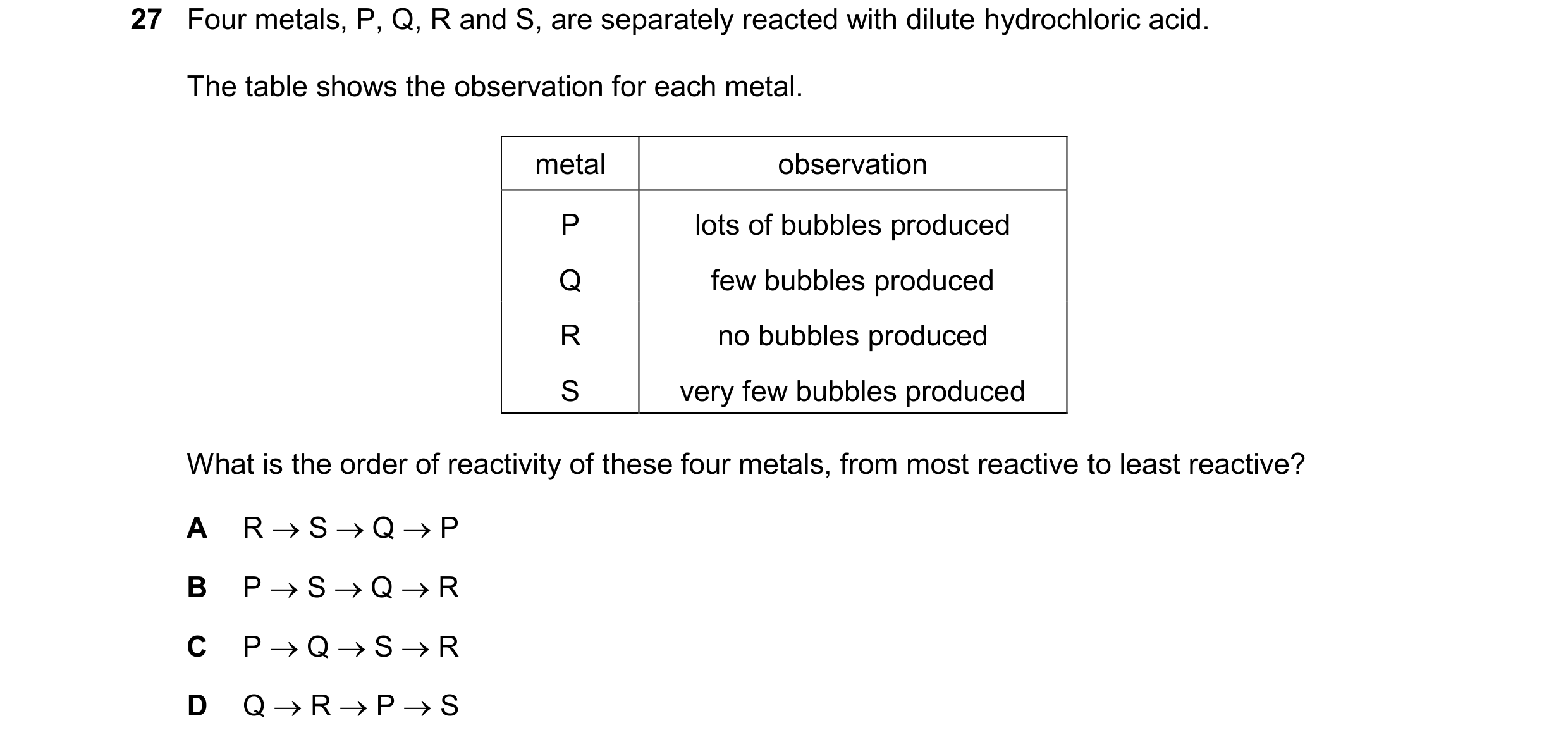
Q26 · Four metals, P, Q, R and S, are separately reacted with dilute hydrochloric acid 0971/12 May/June 2025
27 Four metals, P, Q, R and S, are separately reacted with dilute hydrochloric acid. The table shows the observation for each metal. metal observation P lots of bubbles produced Q few bubbles produced R no bubbles produced S very few bubbles produced What is the order of reactivity of these four metals, from most reactive to least reactive? A R S Q P B P S Q R C P Q S R D Q R P S
1 marks
Answer: C
This question in 0971/12 May/June 2025
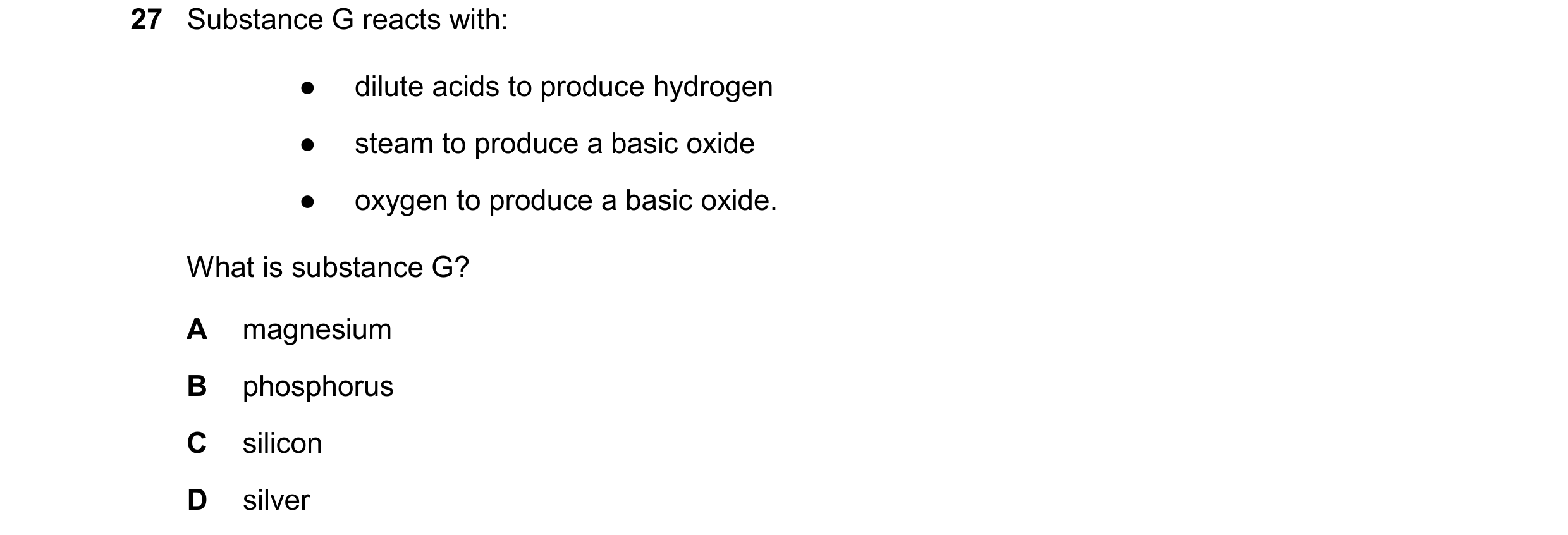
Q27 · Substance G reacts with: ● dilute acids to produce hydrogen ● steam to produce a basic… 0971/12 Oct/Nov 2025
27 Substance G reacts with: ● dilute acids to produce hydrogen ● steam to produce a basic oxide ● oxygen to produce a basic oxide. What is substance G? A magnesium B phosphorus C silicon D silver
1 marks
Answer: A
This question in 0971/12 Oct/Nov 2025
 1 / 9
1 / 9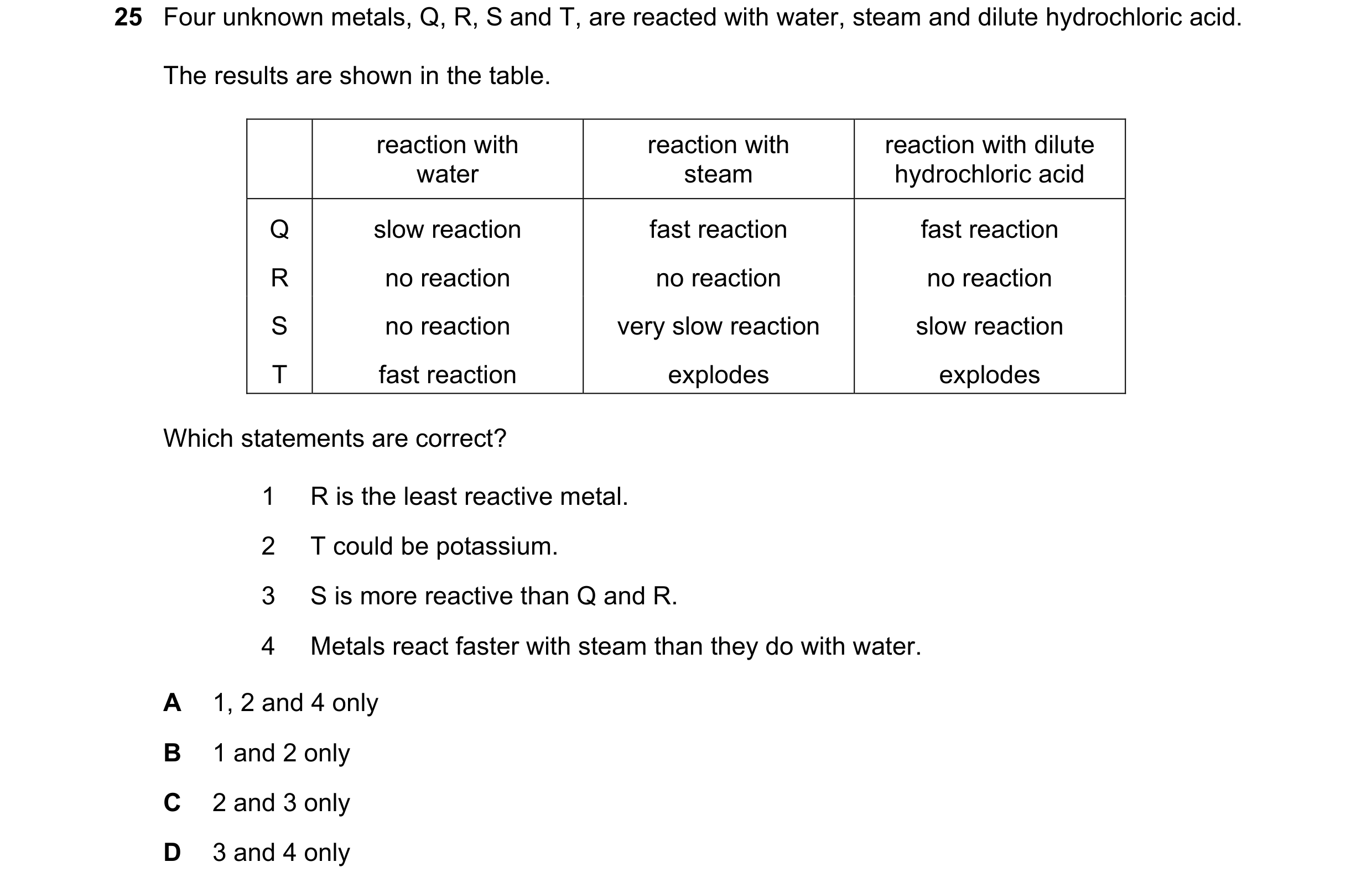
 2 / 9
2 / 9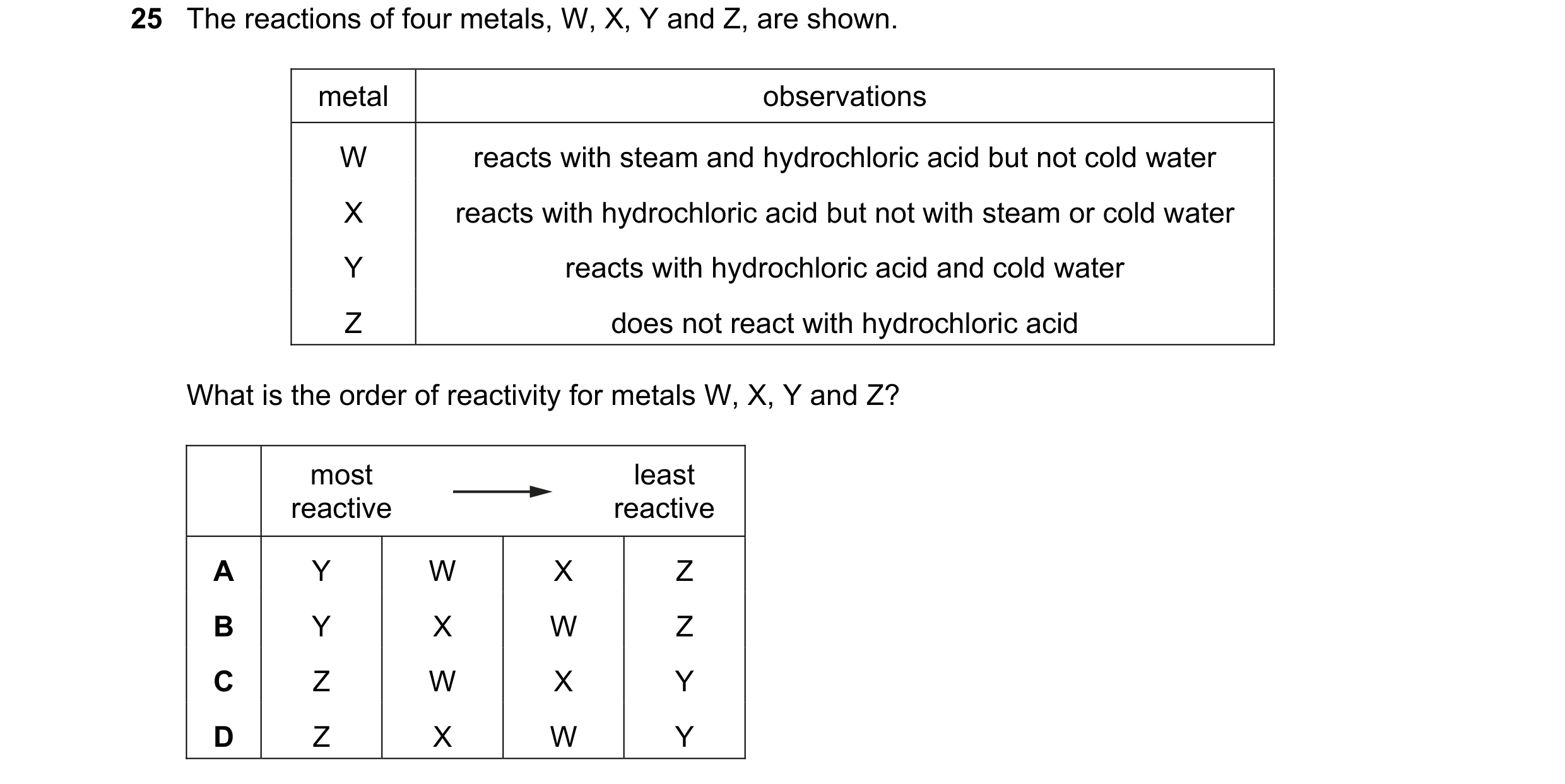
 3 / 9
3 / 9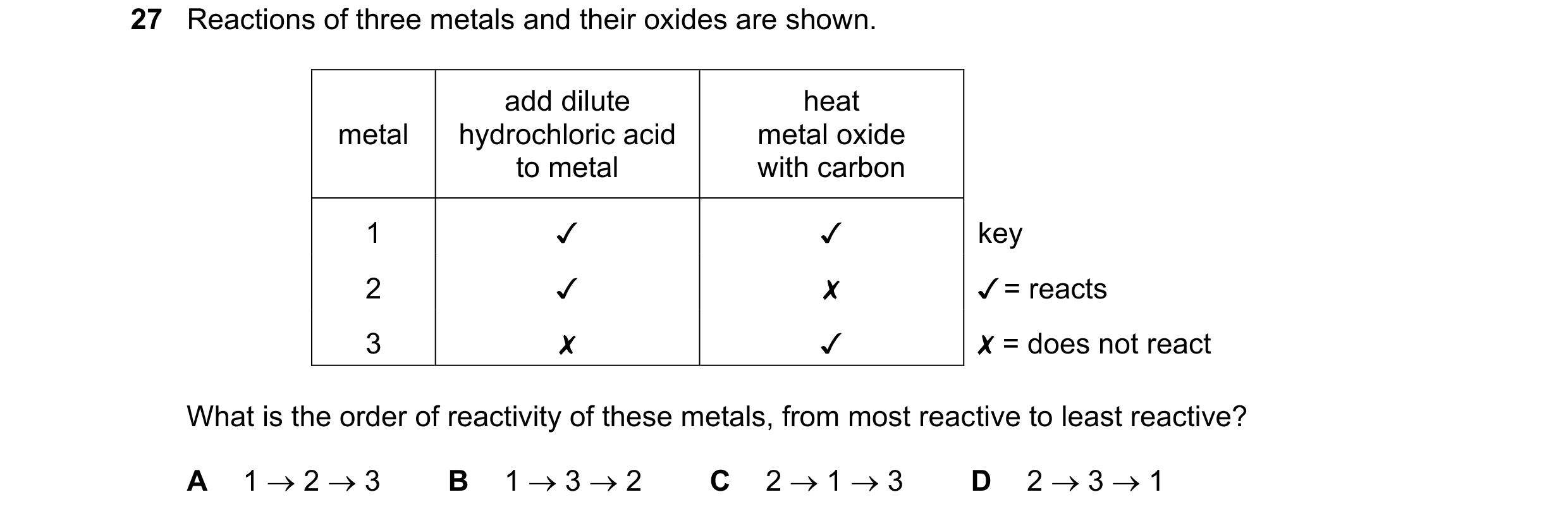
 4 / 9
4 / 9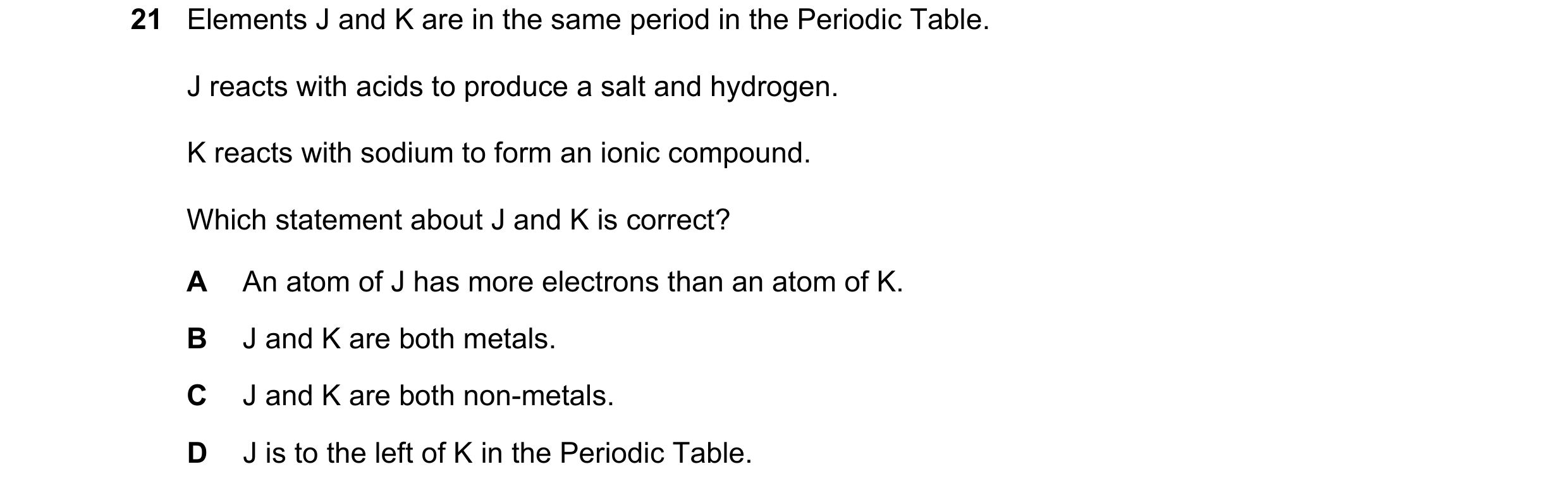

 5 / 9
5 / 9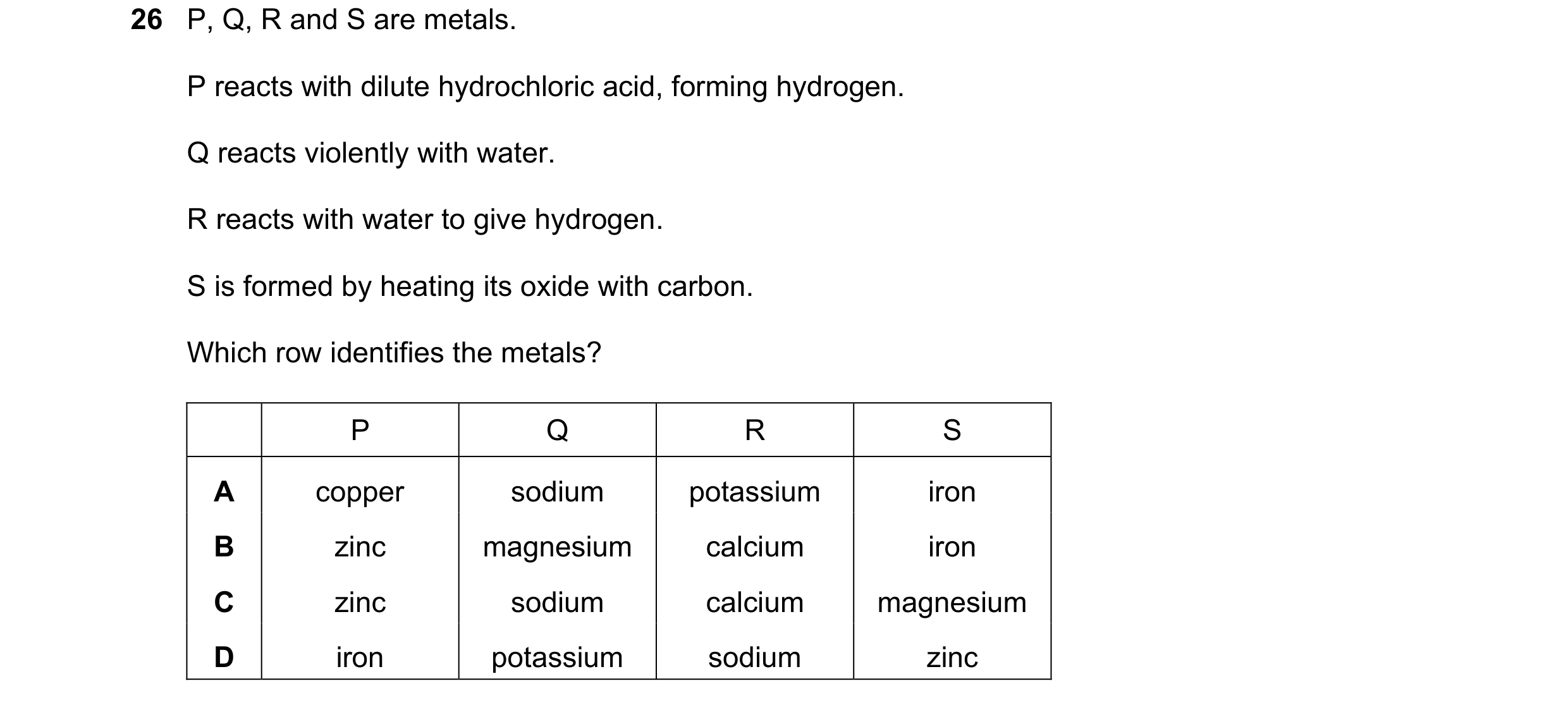
 6 / 9
6 / 9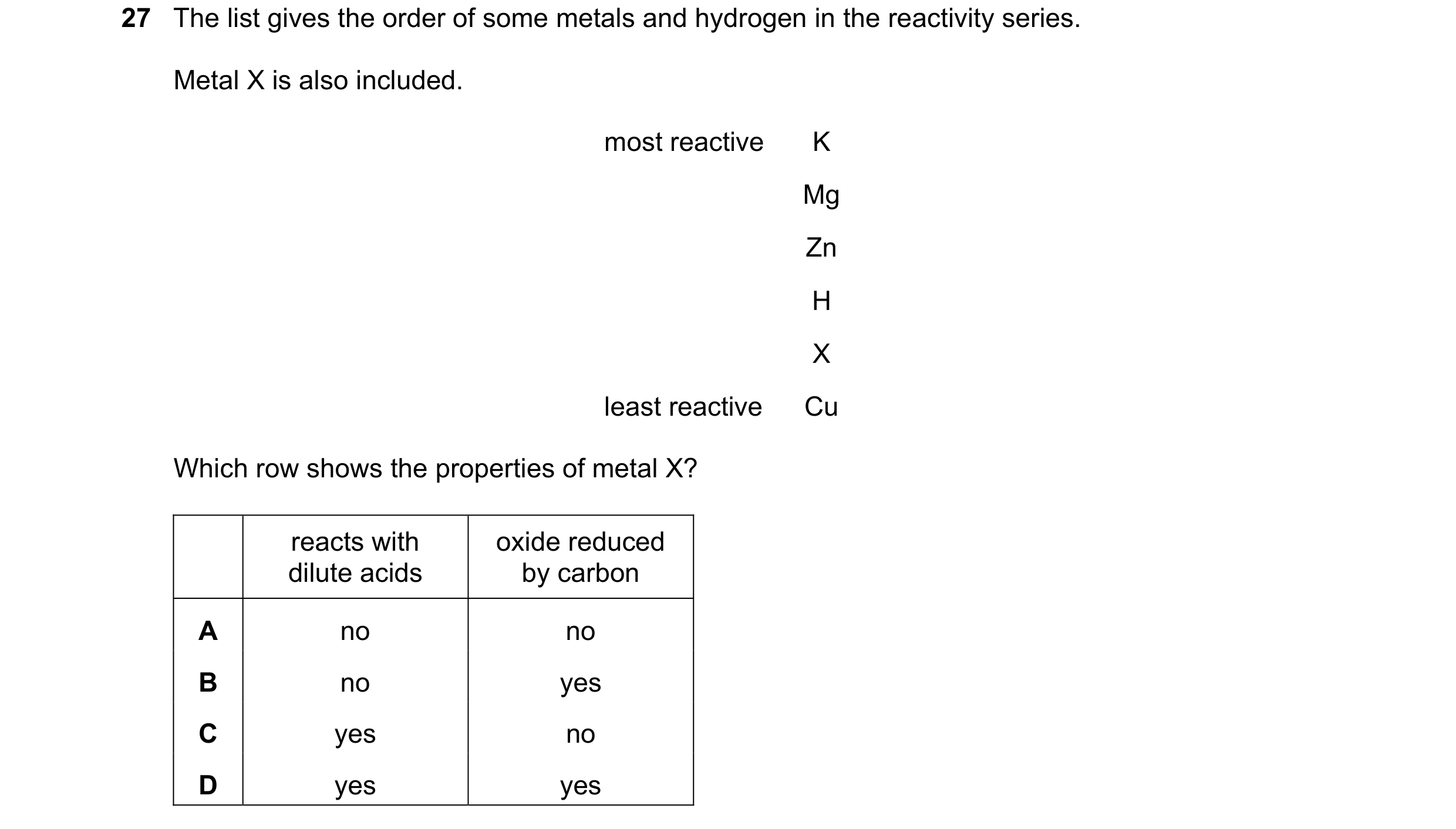
 7 / 9
7 / 9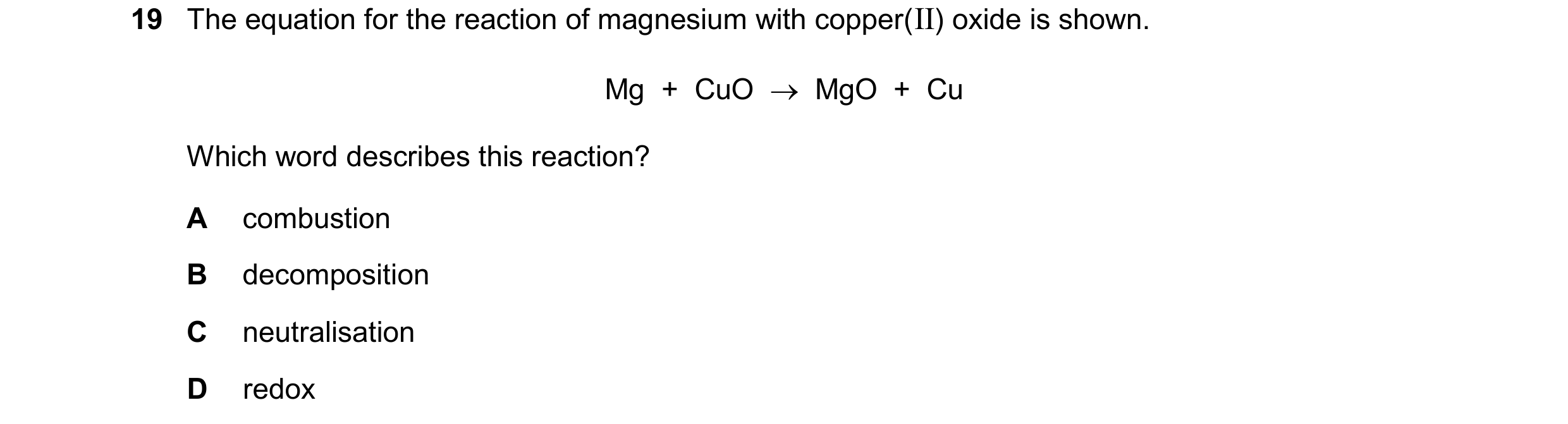
 8 / 9
8 / 9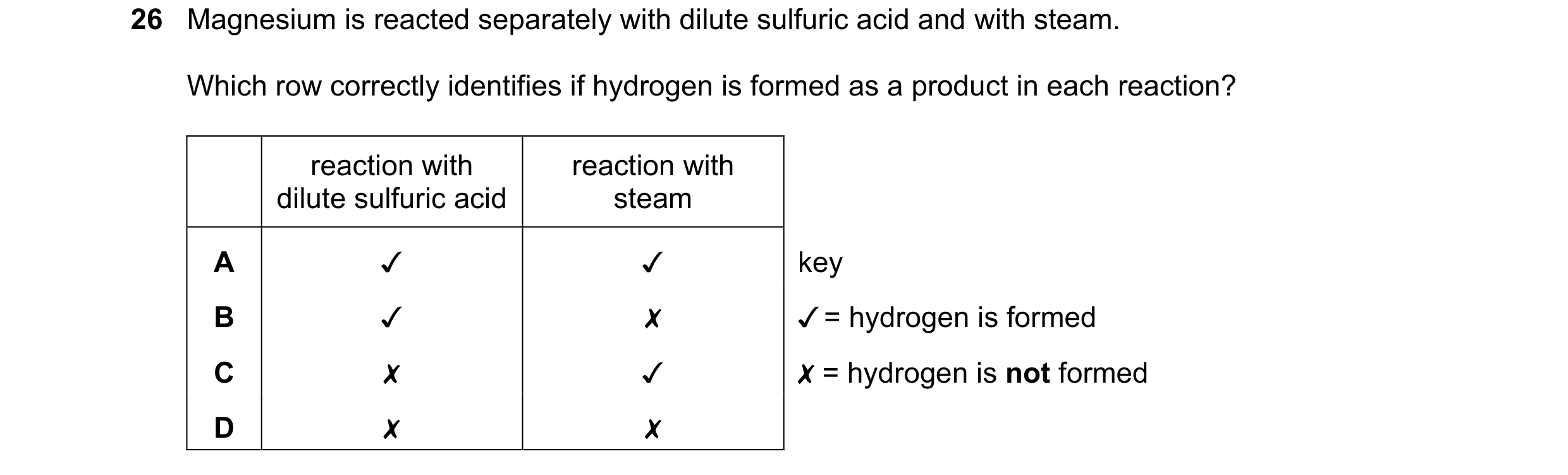
 9 / 9
9 / 9