Questions as text
Q1 · The following statements are made about the metals copper, iron, magnesium and zinc 0971/21 May/June 2018
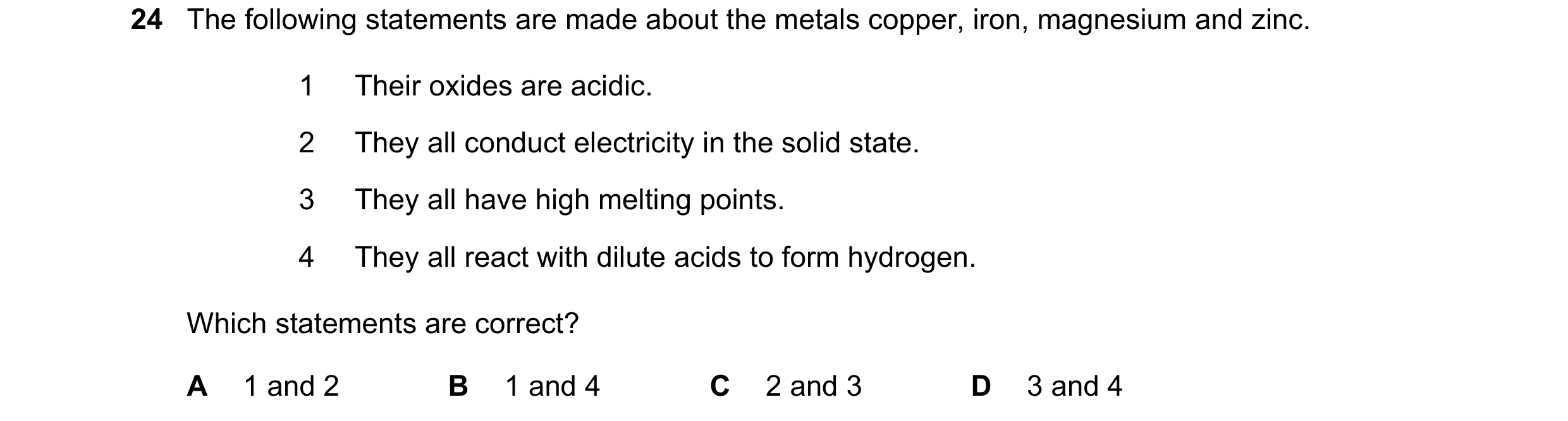
24 The following statements are made about the metals copper, iron, magnesium and zinc. 1 Their oxides are acidic. 2 They all conduct electricity in the solid state. 3 They all have high melting points. 4 They all react with dilute acids to form hydrogen. Which statements are correct? A 1 and 2 B 1 and 4 C 2 and 3 D 3 and 4
1 marks
Answer: C
This question in 0971/21 May/June 2018
Q2 · Silver is a less reactive metal than cadmium 0971/21 May/June 2018
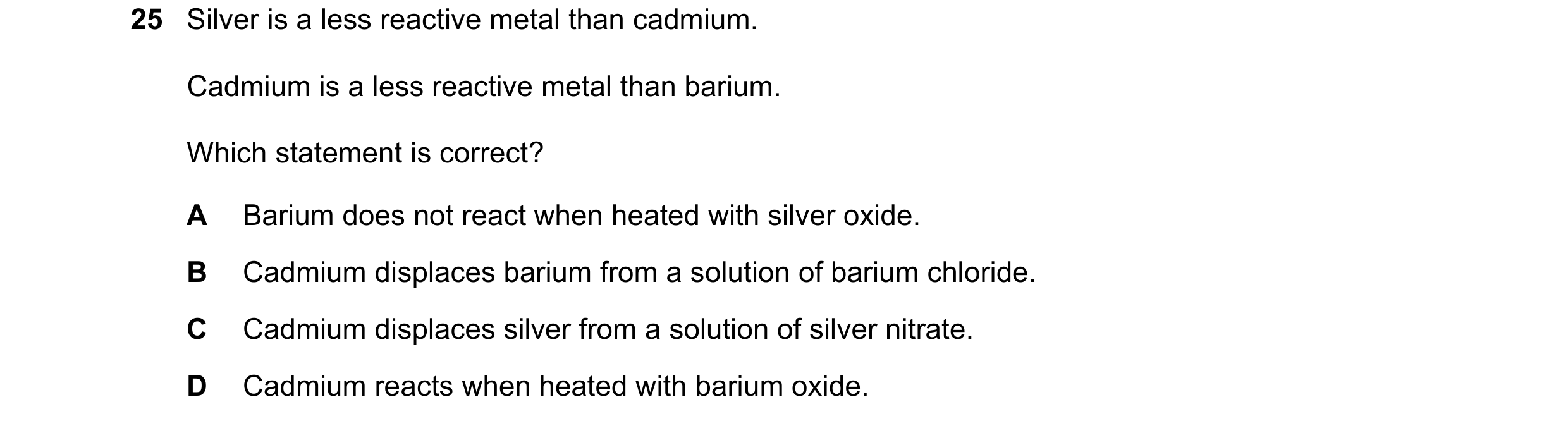
25 Silver is a less reactive metal than cadmium. Cadmium is a less reactive metal than barium. Which statement is correct? A Barium does not react when heated with silver oxide. B Cadmium displaces barium from a solution of barium chloride. C Cadmium displaces silver from a solution of silver nitrate. D Cadmium reacts when heated with barium oxide.
1 marks
Answer: C
This question in 0971/21 May/June 2018
Q3 · The thermite reaction can be used to produce iron from iron(III) oxide 0971/22 Oct/Nov 2018
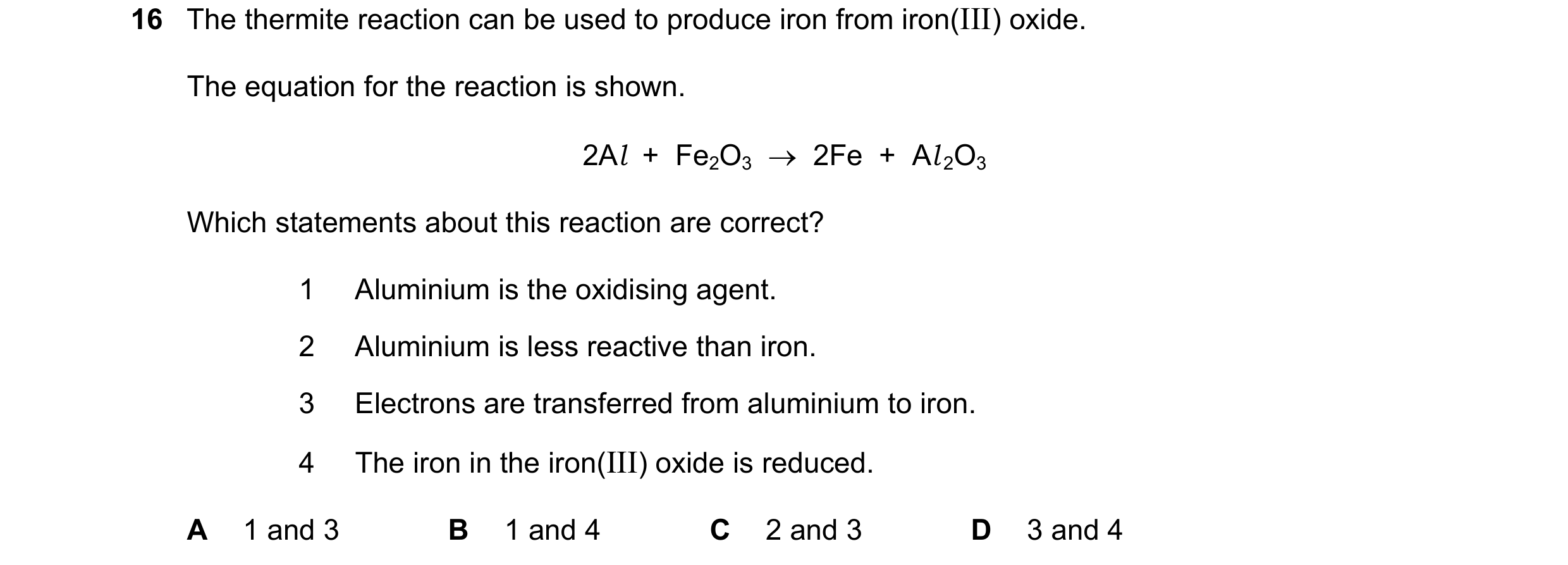
16 The thermite reaction can be used to produce iron from iron(III) oxide. The equation for the reaction is shown. 2Al + Fe2O3 → 2Fe + Al 2O3 Which statements about this reaction are correct? 1 Aluminium is the oxidising agent. 2 Aluminium is less reactive than iron. 3 Electrons are transferred from aluminium to iron. 4 The iron in the iron(III) oxide is reduced. A 1 and 3 B 1 and 4 C 2 and 3 D 3 and 4
1 marks
Answer: D
This question in 0971/22 Oct/Nov 2018
Q4 · Four metals, W, X, Y and Z, are separately reacted with water and dilute hydrochloric acid 0971/22 Oct/Nov 2018
25 Four metals, W, X, Y and Z, are separately reacted with water and dilute hydrochloric acid. The results are shown. metal W X Y Z reaction with water fizzes no reaction fizzes no reaction vigorously reaction with dilute fizzes no reaction fizzes fizzes hydrochloric acid violently What is the order of reactivity of the four metals starting with the least reactive? least reactive most reactive A X W Z Y B X Z W Y C Y W Z X D Y Z W X
1 marks
Answer: B
This question in 0971/22 Oct/Nov 2018
Q5 · Four metals, zinc, M, copper and magnesium, are reacted with aqueous solutions of their… 0971/21 May/June 2019
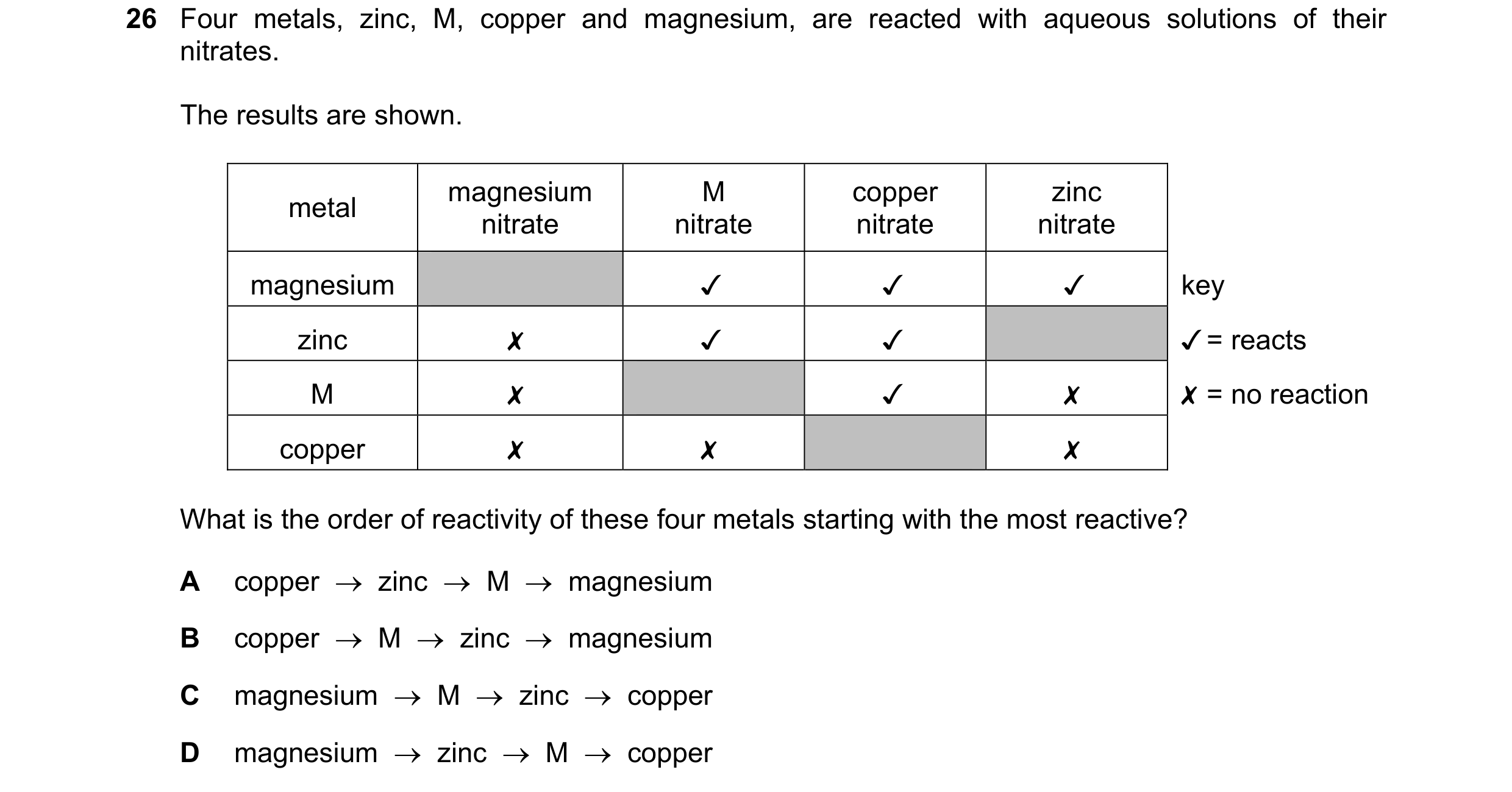
26 Four metals, zinc, M, copper and magnesium, are reacted with aqueous solutions of their
nitrates.
The results are shown.
magnesium M copper zinc
metal . . ; ;
nitrate nitrate nitrate nitrate
magnesium v v v key
zinc x Jv v J/ = reacts
M x Jv x X =no reaction
copper x x
What is the order of reactivity of these four metals starting with the most reactive?
A copper > zinc + M + magnesium
B copper > M -> zinc + magnesium
C magnesium > M -> zinc > copper
D
magnesium — zinc + M -— copper
1 marks
Answer: D
This question in 0971/21 May/June 2019
Q6 · The diagram shows a simple cell 0971/22 Oct/Nov 2019
11 The diagram shows a simple cell. voltmeter wire metal P metal Q dilute sulfuric acid Which pair of metals produces the largest voltage? metal P metal Q A magnesium iron B magnesium copper C zinc iron D zinc copper
1 marks
Answer: B
This question in 0971/22 Oct/Nov 2019
Q7 · The properties of four metals are listed 0971/22 Oct/Nov 2019
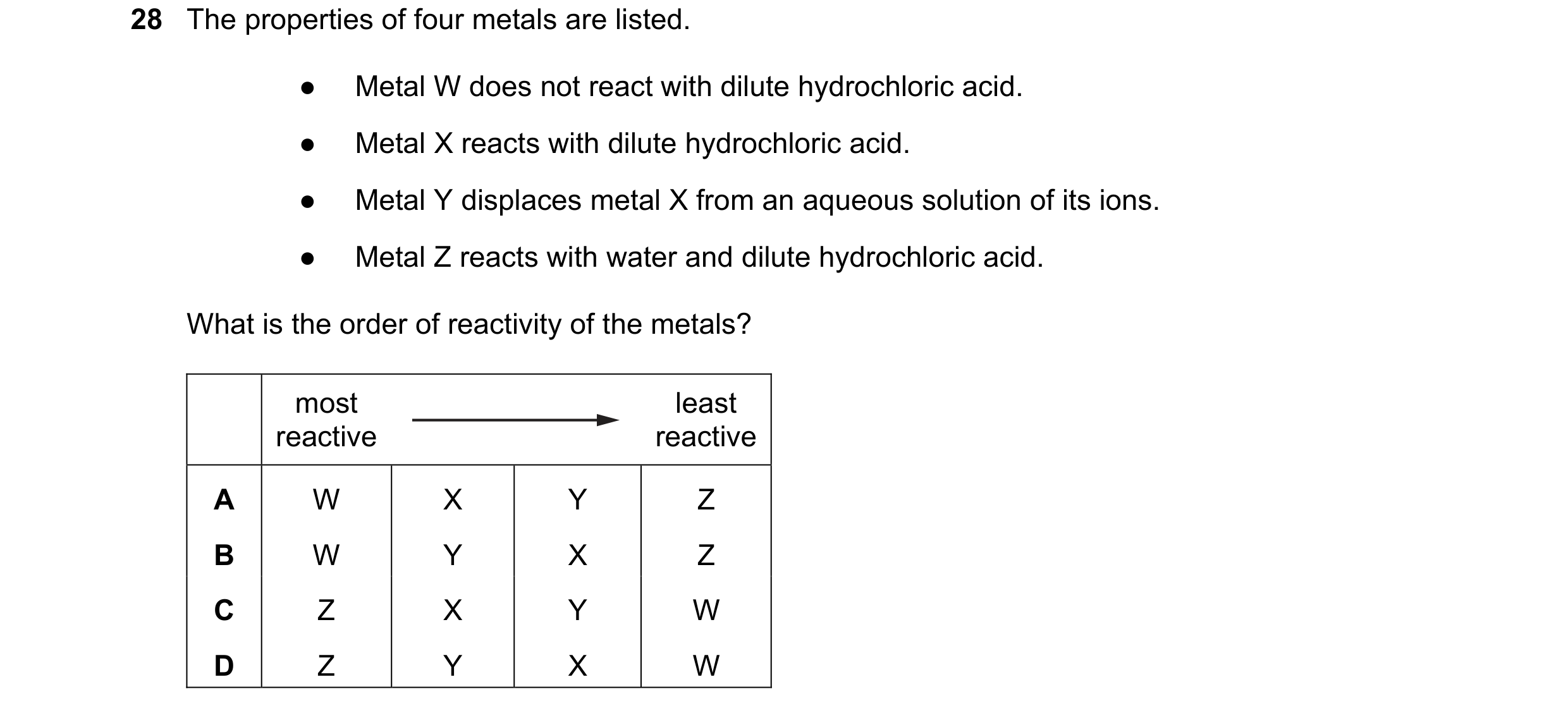
28 The properties of four metals are listed. ● Metal W does not react with dilute hydrochloric acid. ● Metal X reacts with dilute hydrochloric acid. ● Metal Y displaces metal X from an aqueous solution of its ions. ● Metal Z reacts with water and dilute hydrochloric acid. What is the order of reactivity of the metals? most least reactive reactive A W X Y Z B W Y X Z C Z X Y W D Z Y X W
1 marks
Answer: D
This question in 0971/22 Oct/Nov 2019
Q8 · Element Y reacts with copper(II) oxide to form copper 0971/21 May/June 2020
28 Element Y reacts with copper(II) oxide to form copper. Element Y will not react with zinc oxide. Copper has no reaction with zinc oxide. What is the order of reactivity of these three elements, most reactive first? A Cu → Y → Zn B Cu → Zn → Y C Zn → Cu → Y D Zn → Y → Cu
1 marks
Answer: D
This question in 0971/21 May/June 2020
Q9 · Four iron nails are added to four different metal sulfate solutions 0971/22 May/June 2020
28 Four iron nails are added to four different metal sulfate solutions. In which solution does a displacement reaction occur? A copper(II) sulfate B magnesium sulfate C sodium sulfate D zinc sulfate
1 marks
Answer: A
This question in 0971/22 May/June 2020
Q10 · An organic compound, P, reacts with zinc to produce a gas, Q 0971/22 May/June 2020
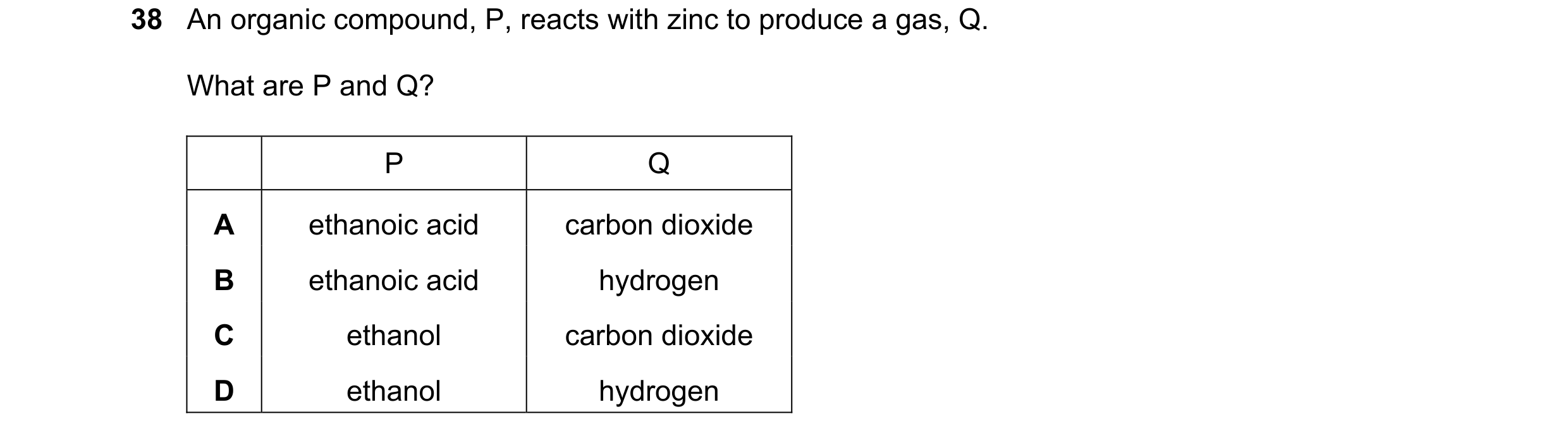
38 An organic compound, P, reacts with zinc to produce a gas, Q. What are P and Q? P Q A ethanoic acid carbon dioxide B ethanoic acid hydrogen C ethanol carbon dioxide D ethanol hydrogen
1 marks
Answer: B
This question in 0971/22 May/June 2020
Q11 · Some properties of metal J are listed 0971/21 May/June 2021
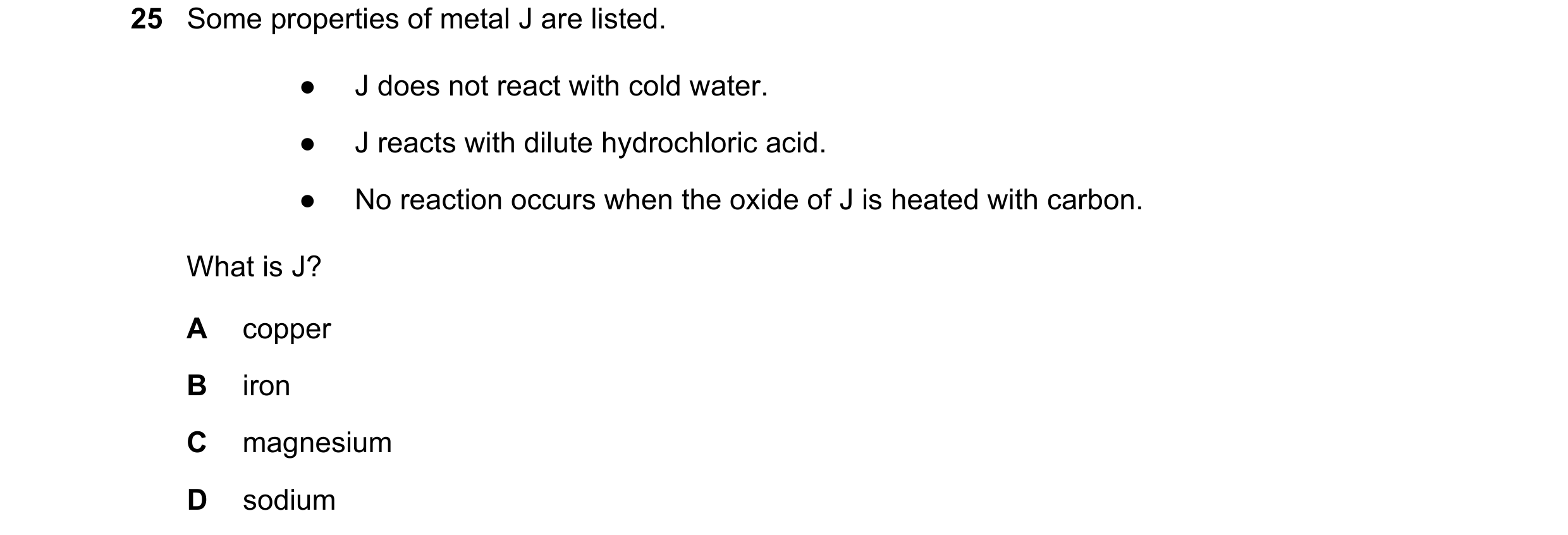
25 Some properties of metal J are listed. ● J does not react with cold water. ● J reacts with dilute hydrochloric acid. ● No reaction occurs when the oxide of J is heated with carbon. What is J? A copper B iron C magnesium D sodium
1 marks
Answer: C
This question in 0971/21 May/June 2021
Q12 · A piece of aluminium is dropped into dilute hydrochloric acid 0971/22 May/June 2021
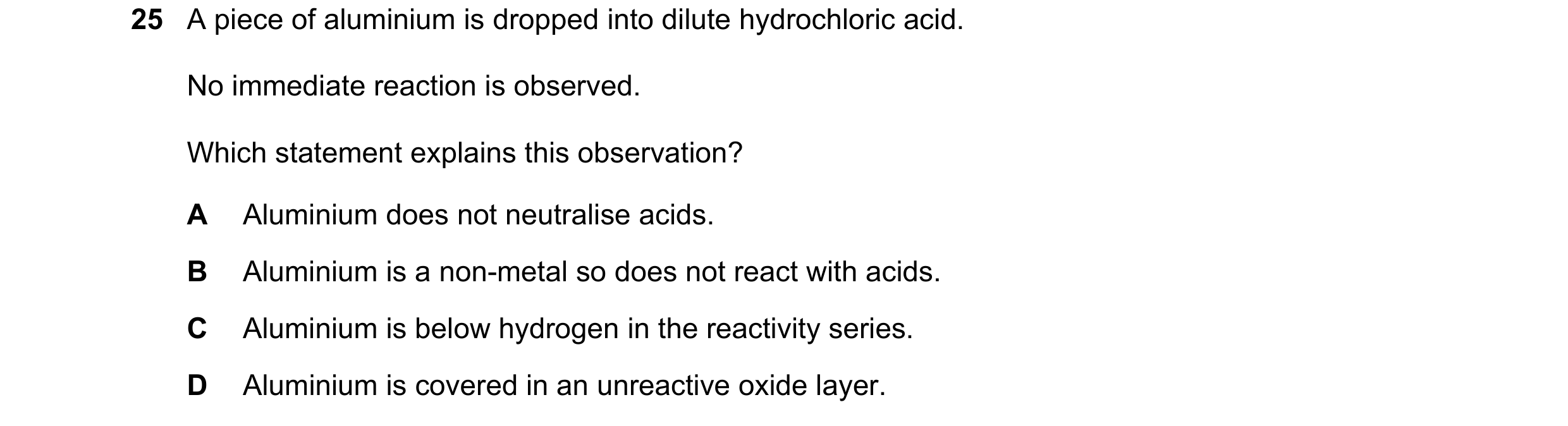
25 A piece of aluminium is dropped into dilute hydrochloric acid. No immediate reaction is observed. Which statement explains this observation? A Aluminium does not neutralise acids. B Aluminium is a non-metal so does not react with acids. C Aluminium is below hydrogen in the reactivity series. D Aluminium is covered in an unreactive oxide layer.
1 marks
Answer: D
This question in 0971/22 May/June 2021
Q13 · Which statements explain why zinc is used to protect iron from rusting? 0971/22 Oct/Nov 2021
28 Which statements explain why zinc is used to protect iron from rusting? 1 Zinc is more reactive than iron. 2 Zinc is less reactive than iron. 3 Zinc can form alloys with iron. 4 Zinc acts as a sacrificial metal. A 1 and 3 B 1 and 4 C 2 and 3 D 2 and 4
1 marks
Answer: B
This question in 0971/22 Oct/Nov 2021
Q14 · Reactions of three metals and their oxides are shown 0971/21 May/June 2022
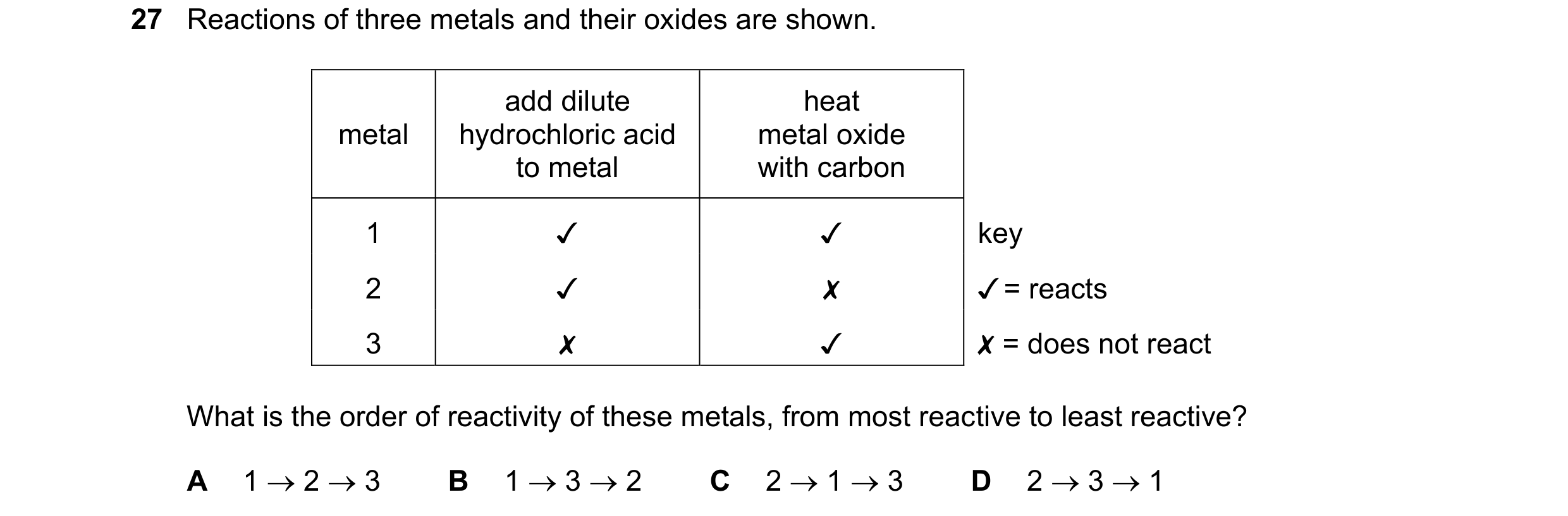
27 Reactions of three metals and their oxides are shown.
add dilute heat
metal | hydrochloric acid metal oxide
to metal with carbon
1 Jv Jv key
2 Jv x J/ = reacts
3 x Jv X = does not react
What is the order of reactivity of these metals, from most reactive to least reactive?
A 135253 B 15352 C 251593 DB 253-51
1 marks
Answer: C
This question in 0971/21 May/June 2022
Q15 · The reactions of metals P, Q, R and S are shown 0971/22 May/June 2022
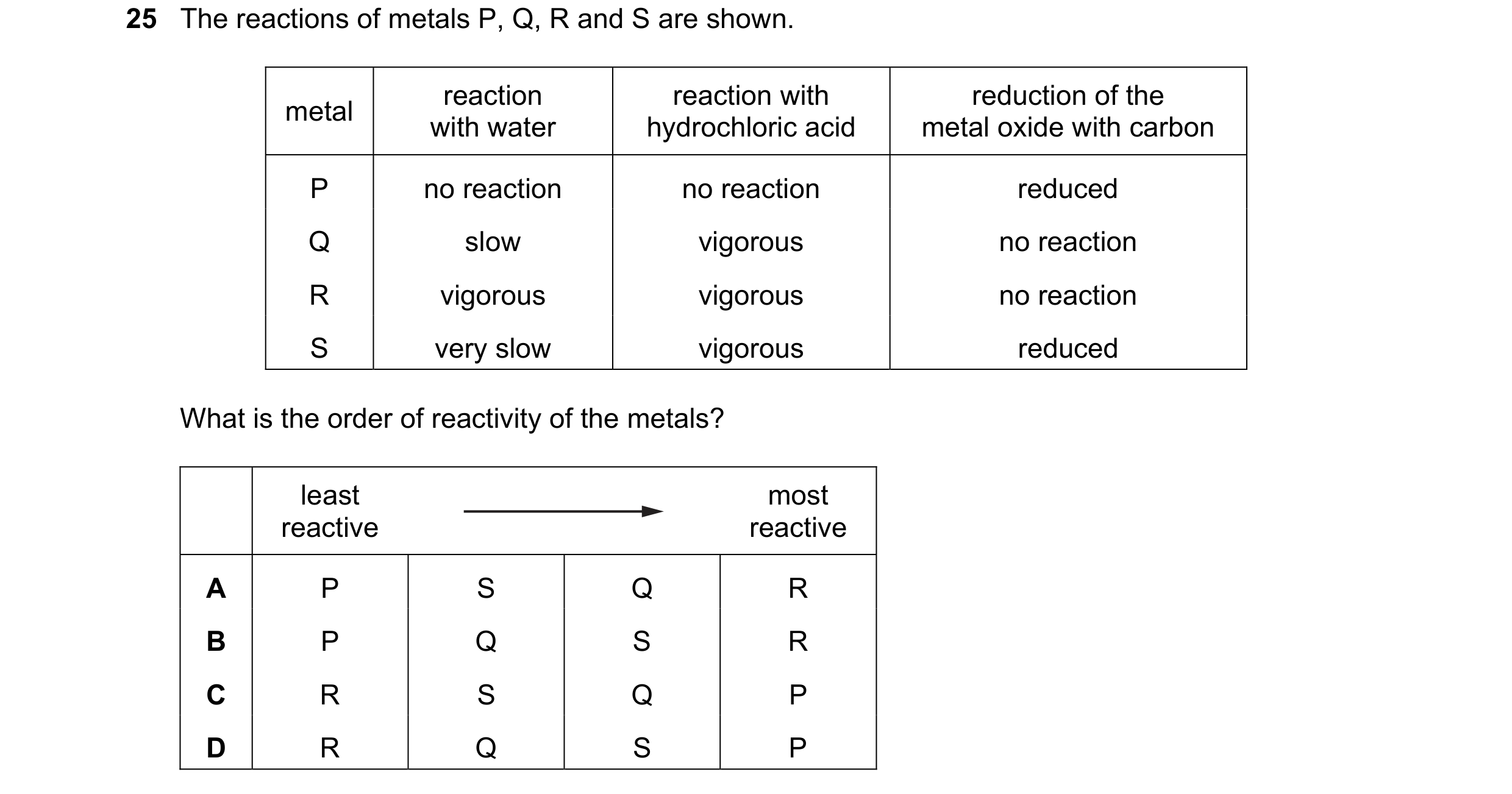
25 The reactions of metals P, Q, R and S are shown. reaction reaction with reduction of the metal with water hydrochloric acid metal oxide with carbon P no reaction no reaction reduced Q slow vigorous no reaction R vigorous vigorous no reaction S very slow vigorous reduced What is the order of reactivity of the metals? least most reactive reactive A P S Q R B P Q S R C R S Q P D R Q S P
1 marks
Answer: A
This question in 0971/22 May/June 2022
Q16 · The electrical energy, or voltage, of two simple cells is measured 0971/22 Oct/Nov 2022
13 The electrical energy, or voltage, of two simple cells is measured. V V zinc magnesium magnesium copper electrolyte electrolyte cell 1 cell 2 statement 1 The voltage of cell 1 is greater than cell 2. statement 2 Zinc is more reactive than copper. statement 3 Magnesium is oxidised in both cells. statement 4 Magnesium atoms lose electrons to form magnesium ions. Which option is correct? A All the statements are correct. B Only statements 1 and 3 are correct. C Statement 2 is correct and explains statement 1. D Statement 4 is correct and explains statement 3.
1 marks
Answer: D
This question in 0971/22 Oct/Nov 2022
Q17 · When magnesium is heated with zinc oxide a reaction occurs 0971/22 Oct/Nov 2022
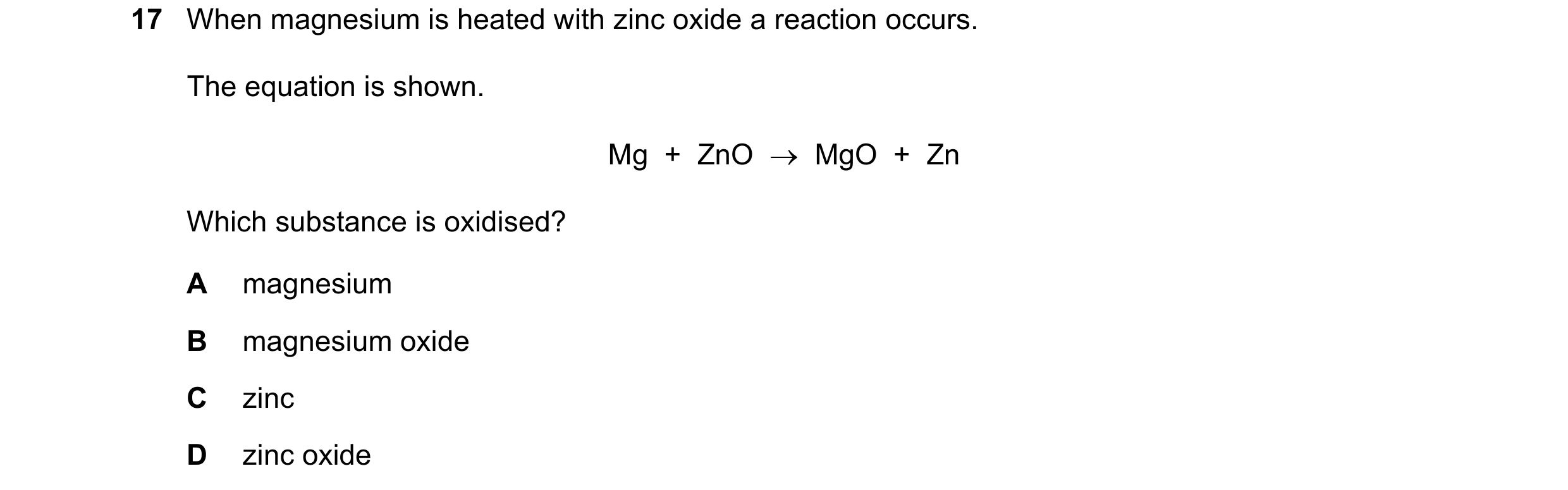
17 When magnesium is heated with zinc oxide a reaction occurs. The equation is shown. Mg + ZnO MgO + Zn Which substance is oxidised? A magnesium B magnesium oxide C zinc D zinc oxide
1 marks
Answer: A
This question in 0971/22 Oct/Nov 2022
Q18 · The reactions of four metals, W, X, Y and Z, are listed 0971/22 Oct/Nov 2022
24 The reactions of four metals, W, X, Y and Z, are listed. ● Metal W displaces metal X from the oxide of metal X. ● Metal Y has a greater tendency to form positive ions than metal W. ● Aqueous ions of metal Z are reduced by metal X. What is the order of reactivity of the metals? least most reactive reactive A Y W X Z B Y X W Z C Z W X Y D Z X W Y
1 marks
Answer: D
This question in 0971/22 Oct/Nov 2022
Q19 · Silver is below copper in the reactivity series 0971/22 Oct/Nov 2022
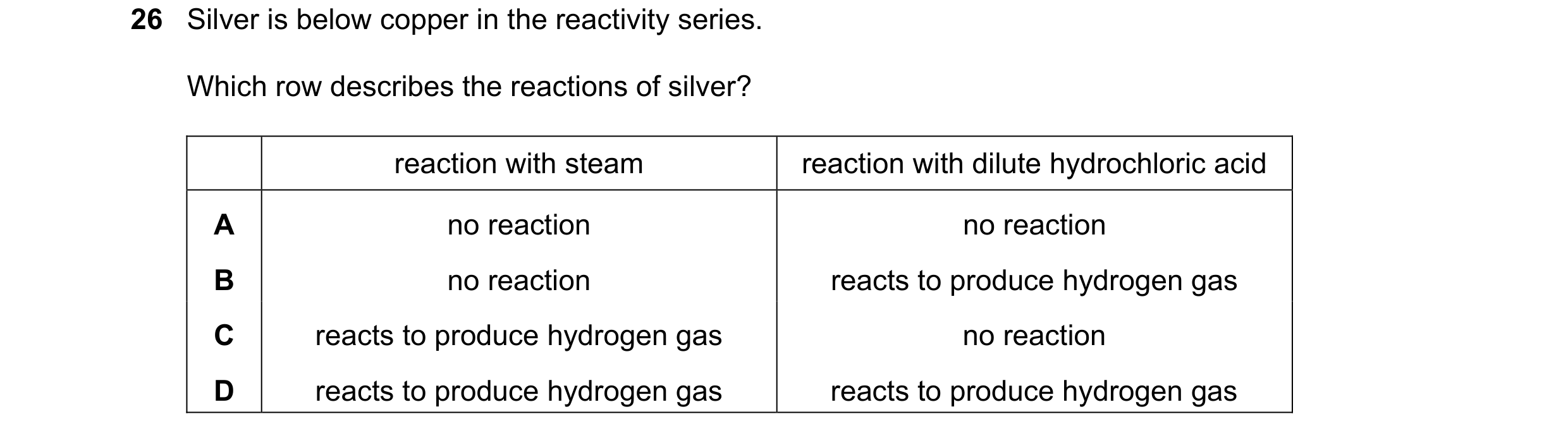
26 Silver is below copper in the reactivity series. Which row describes the reactions of silver? reaction with steam reaction with dilute hydrochloric acid A no reaction no reaction B no reaction reacts to produce hydrogen gas C reacts to produce hydrogen gas no reaction D reacts to produce hydrogen gas reacts to produce hydrogen gas
1 marks
Answer: A
This question in 0971/22 Oct/Nov 2022
Q20 · Which gas is made when powdered zinc is added to dilute hydrochloric acid? 0971/21 May/June 2023
23 Which gas is made when powdered zinc is added to dilute hydrochloric acid? A carbon dioxide B chlorine C hydrogen D oxygen
1 marks
Answer: C
This question in 0971/21 May/June 2023
Q21 · P, Q, R and S are metals 0971/22 May/June 2023
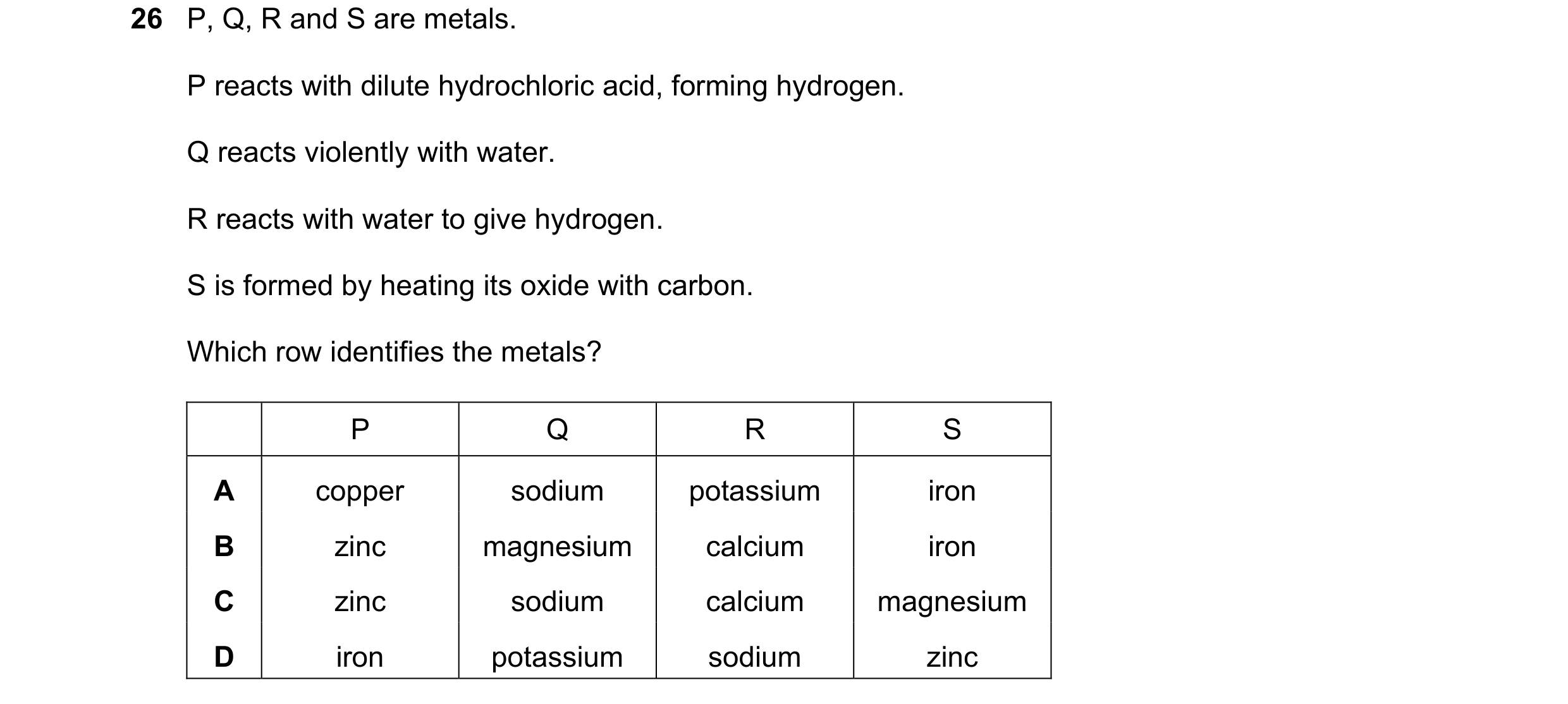
26 P, Q, R and S are metals. P reacts with dilute hydrochloric acid, forming hydrogen. Q reacts violently with water. R reacts with water to give hydrogen. S is formed by heating its oxide with carbon. Which row identifies the metals? P Q R S A copper sodium potassium iron B zinc magnesium calcium iron C zinc sodium calcium magnesium D iron potassium sodium zinc
1 marks
Answer: D
This question in 0971/22 May/June 2023
Q22 · The list gives the order of some metals and hydrogen in the reactivity series 0971/22 Oct/Nov 2023
25 The list gives the order of some metals and hydrogen in the reactivity series. Metal X is also included. most reactive K Mg Zn H X least reactive Cu Which row shows the properties of metal X? reacts with oxide reduced dilute acids by carbon A no no B no yes C yes no D yes yes
1 marks
Answer: B
This question in 0971/22 Oct/Nov 2023
Q23 · When zinc is added to an aqueous solution containing magnesium ions, there is no reaction 0971/22 Oct/Nov 2023
26 When zinc is added to an aqueous solution containing magnesium ions, there is no reaction. Which species has the greatest tendency to lose electrons? A Mg B Mg2+ C Zn D Zn2+
1 marks
Answer: A
This question in 0971/22 Oct/Nov 2023
Q24 · An iron nail is added to aqueous copper(II) sulfate and a different iron nail is added to… 0971/21 May/June 2024
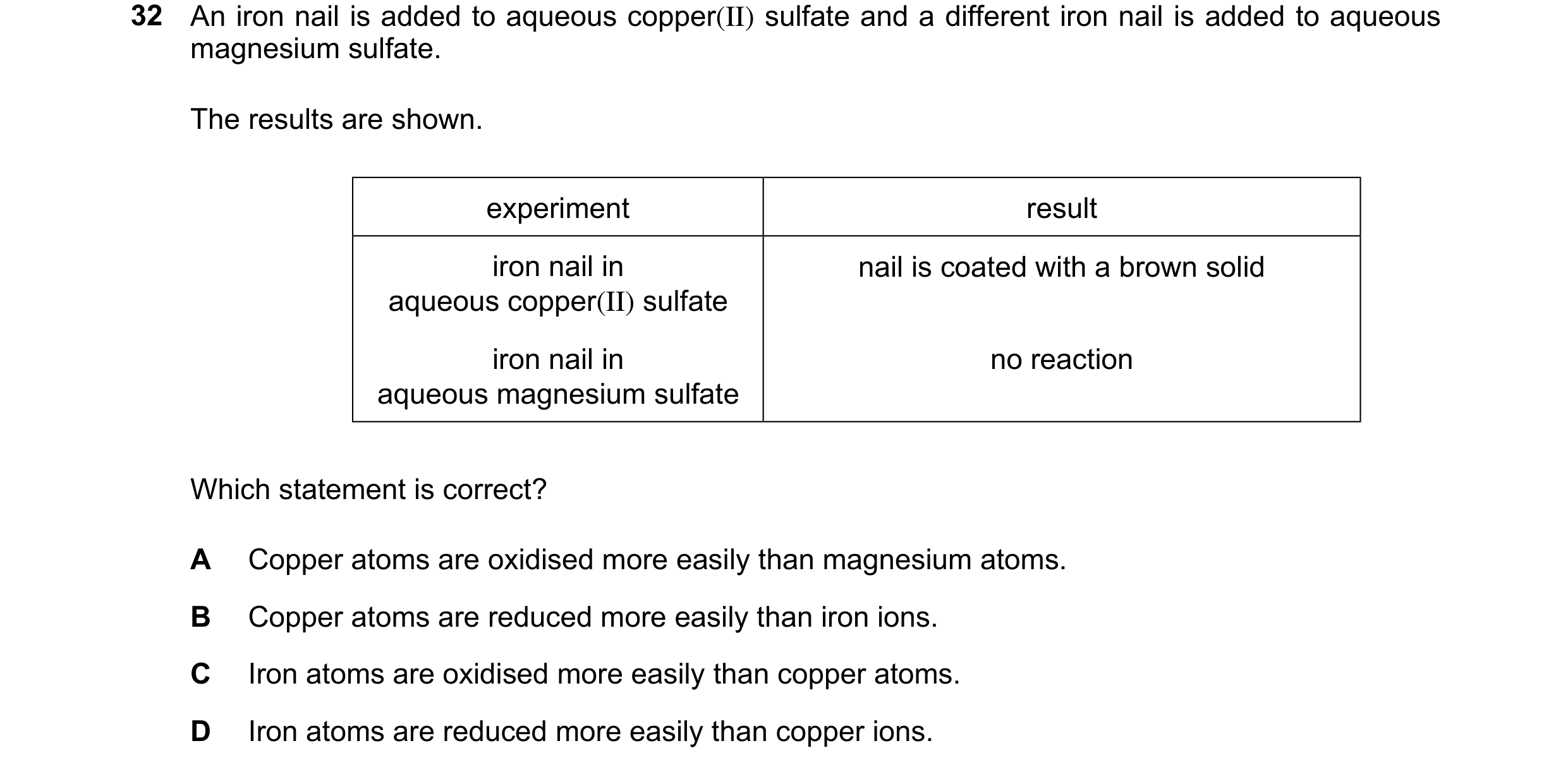
32 An iron nail is added to aqueous copper(II) sulfate and a different iron nail is added to aqueous magnesium sulfate. The results are shown. experiment result iron nail in nail is coated with a brown solid aqueous copper(II) sulfate iron nail in no reaction aqueous magnesium sulfate Which statement is correct? A Copper atoms are oxidised more easily than magnesium atoms. B Copper atoms are reduced more easily than iron ions. C Iron atoms are oxidised more easily than copper atoms. D Iron atoms are reduced more easily than copper ions.
1 marks
Answer: C
This question in 0971/21 May/June 2024
Q25 · Four metals, Q, R, S and T, are each added to separate samples of water, steam and dilute… 0971/22 May/June 2024
24 Four metals, Q, R, S and T, are each added to separate samples of water, steam and dilute hydrochloric acid. The results are shown. observation with observation with observation with dilute water steam hydrochloric acid Q slow reaction fast reaction fast reaction R no reaction no reaction no reaction S no reaction very slow reaction slow reaction T fast reaction explodes explodes Which statements are correct? 1 R is the least reactive metal. 2 T could be potassium. 3 S is more reactive than Q and R. 4 Metals generally react faster with steam than they react with water. A 1, 2 and 4 B 1 and 2 only C 2 and 3 D 3 and 4
1 marks
Answer: A
This question in 0971/22 May/June 2024
Q26 · Metal X acts as a sacrificial metal to prevent iron from corroding 0971/22 May/June 2024
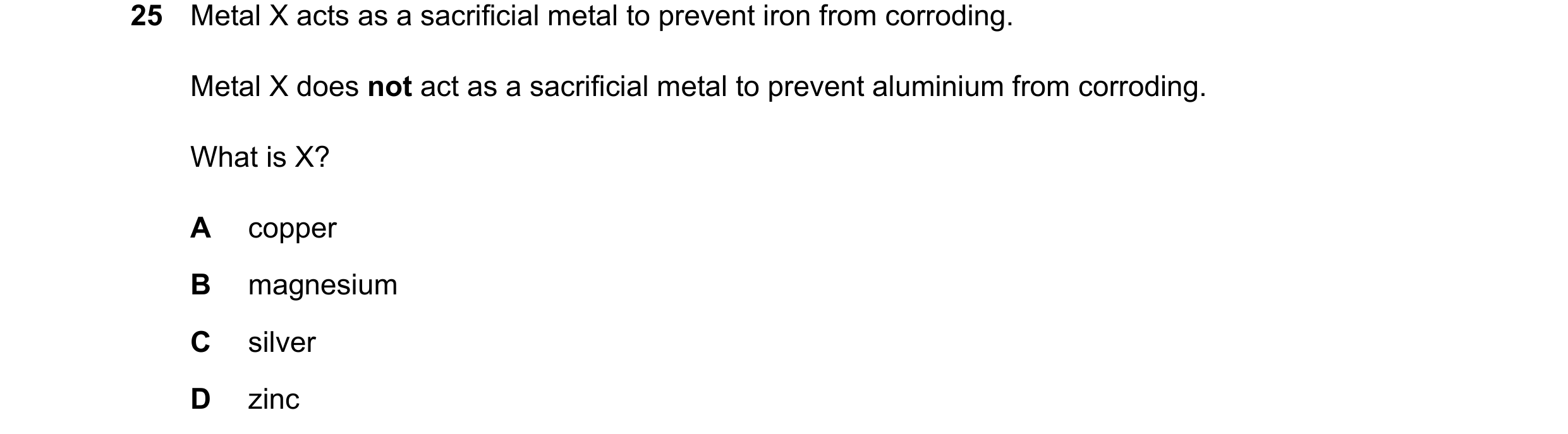
25 Metal X acts as a sacrificial metal to prevent iron from corroding. Metal X does not act as a sacrificial metal to prevent aluminium from corroding. What is X? A copper B magnesium C silver D zinc
1 marks
Answer: D
This question in 0971/22 May/June 2024
Q27 · When aluminium is placed in dilute hydrochloric acid, there is no reaction 0971/22 Oct/Nov 2024
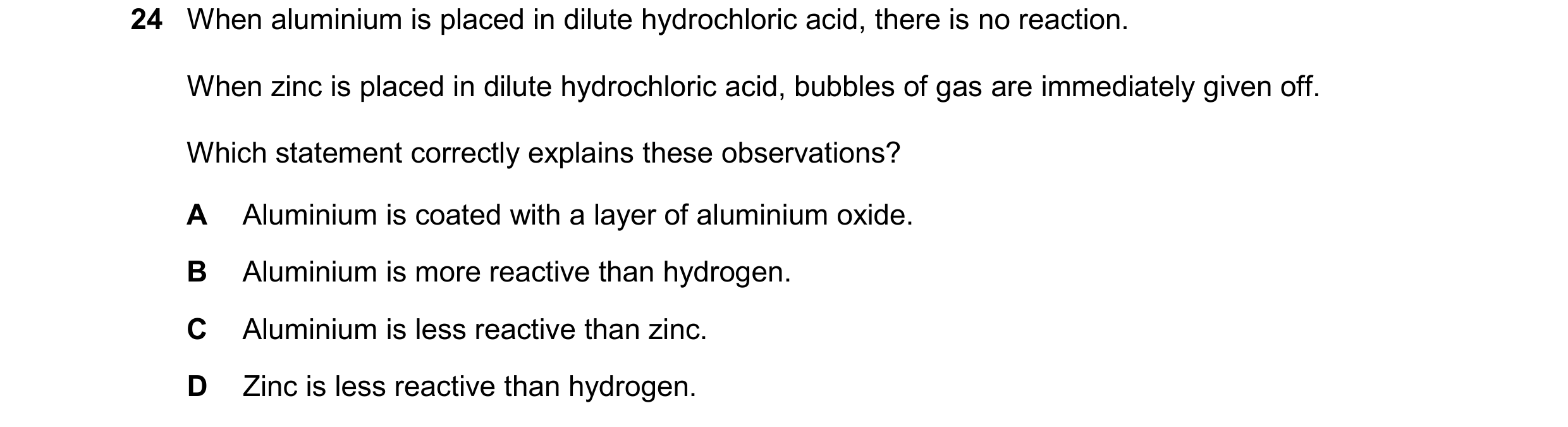
24 When aluminium is placed in dilute hydrochloric acid, there is no reaction. When zinc is placed in dilute hydrochloric acid, bubbles of gas are immediately given off. Which statement correctly explains these observations? A Aluminium is coated with a layer of aluminium oxide. B Aluminium is more reactive than hydrogen. C Aluminium is less reactive than zinc. D Zinc is less reactive than hydrogen.
1 marks
Answer: A
This question in 0971/22 Oct/Nov 2024
Q28 · Which statements about the use of sacrificial protection to prevent iron from rusting are… 0971/22 Oct/Nov 2024
25 Which statements about the use of sacrificial protection to prevent iron from rusting are correct? 1 A more reactive metal than iron is used as a sacrificial protector because it undergoes reduction before iron. 2 Zinc is used as a sacrificial protector because it gains electrons more readily than iron. 3 Copper is not used as a sacrificial protector because it is less reactive than iron. 4 Magnesium is used as a sacrificial protector because it loses electrons more readily than iron. A 1 and 2 B 1 and 4 C 2 and 3 D 3 and 4
1 marks
Answer: D
This question in 0971/22 Oct/Nov 2024
Q29 · The ionic equations for some reactions between metals and aqueous metal ions are shown 0971/22 May/June 2025
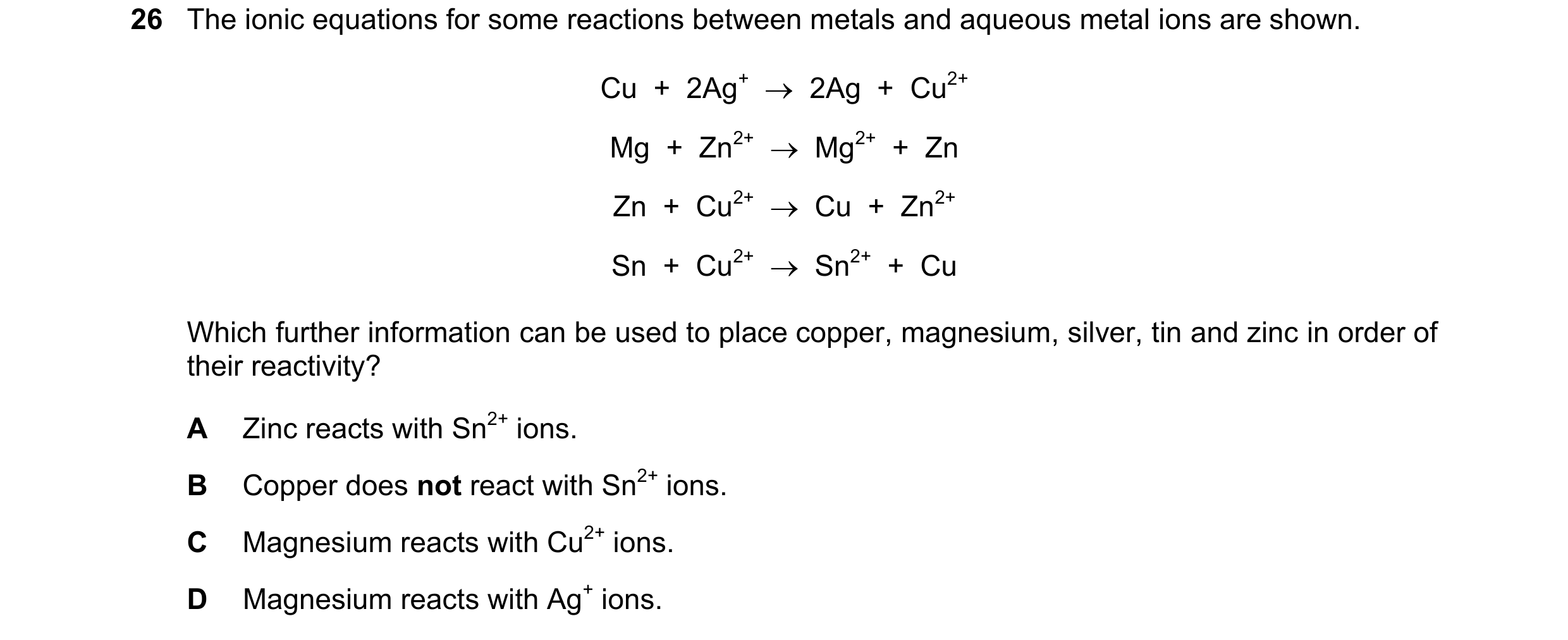
26 The ionic equations for some reactions between metals and aqueous metal ions are shown. Cu + 2Ag+ 2Ag + Cu2+ Mg + Zn2+ Mg2+ + Zn Zn + Cu2+ Cu + Zn2+ Sn + Cu2+ Sn2+ + Cu Which further information can be used to place copper, magnesium, silver, tin and zinc in order of their reactivity? A Zinc reacts with Sn2+ ions. B Copper does not react with Sn2+ ions. C Magnesium reacts with Cu2+ ions. D Magnesium reacts with Ag+ ions.
1 marks
Answer: A
This question in 0971/22 May/June 2025
Q30 · Zinc is used to galvanise iron to prevent it from rusting 0971/22 May/June 2025
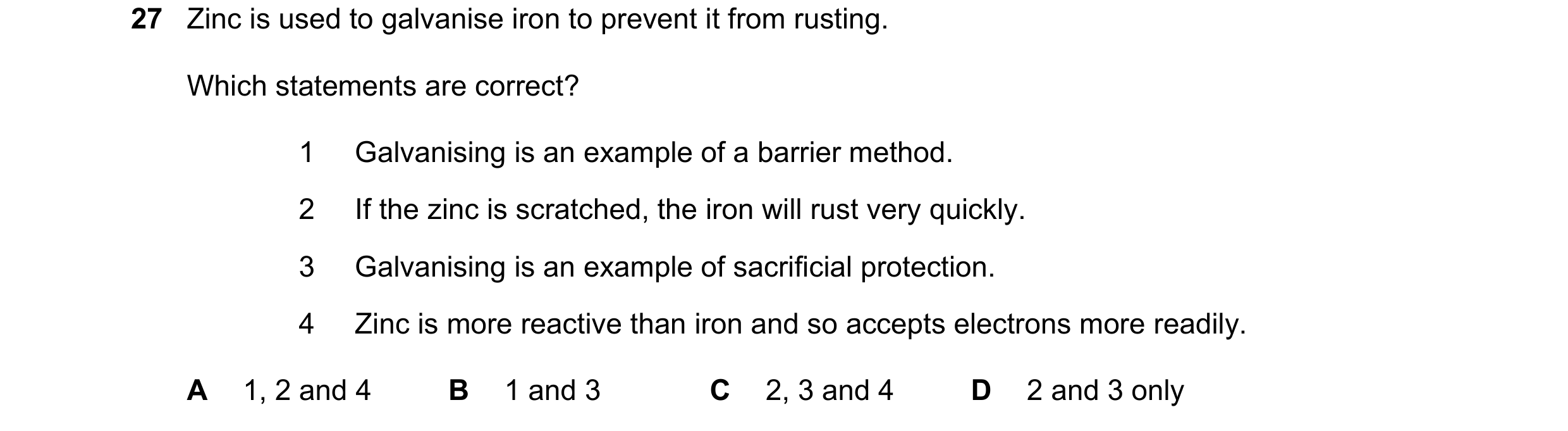
27 Zinc is used to galvanise iron to prevent it from rusting. Which statements are correct? 1 Galvanising is an example of a barrier method. 2 If the zinc is scratched, the iron will rust very quickly. 3 Galvanising is an example of sacrificial protection. 4 Zinc is more reactive than iron and so accepts electrons more readily. A 1, 2 and 4 B 1 and 3 C 2, 3 and 4 D 2 and 3 only
1 marks
Answer: B
This question in 0971/22 May/June 2025
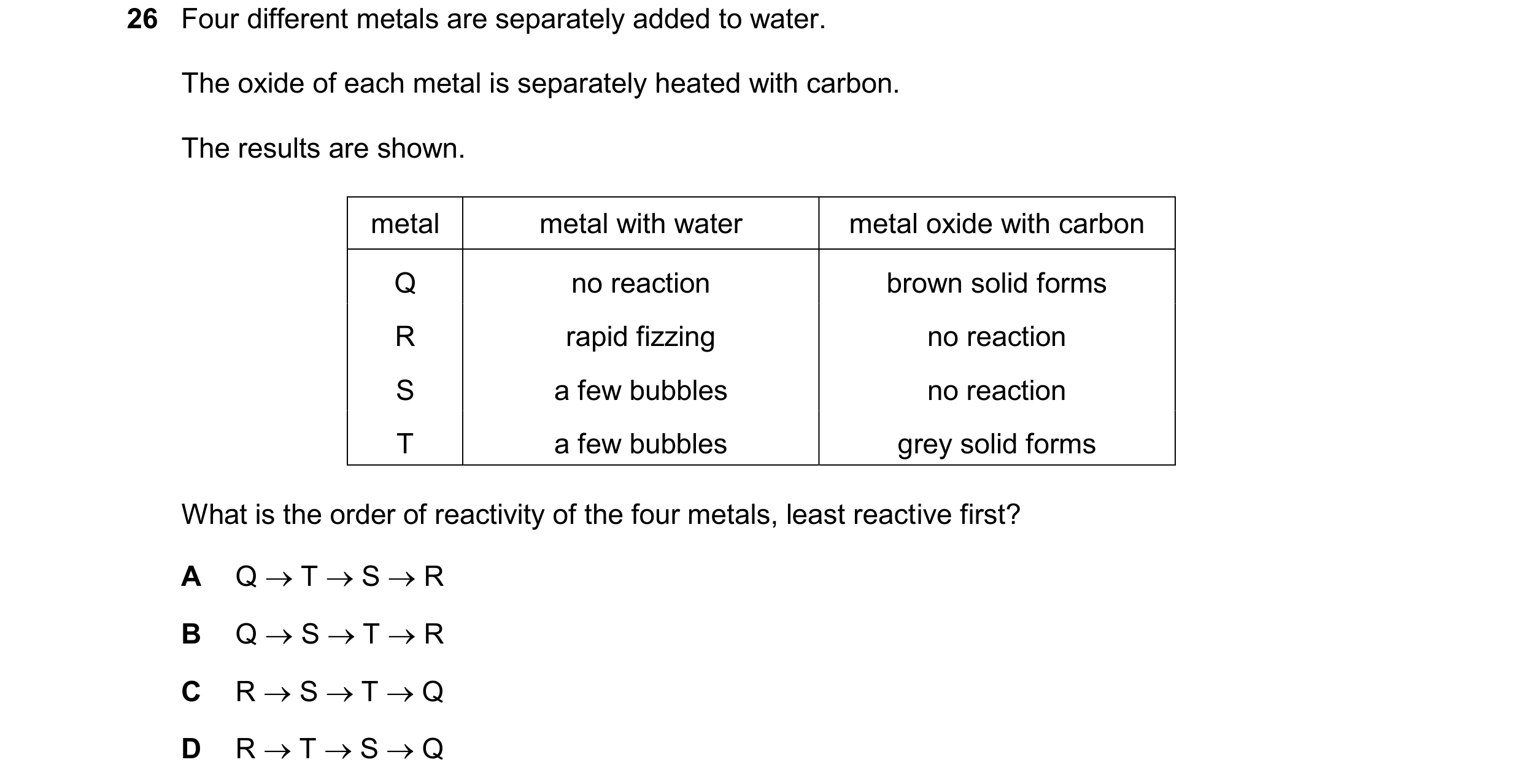
Q31 · Four different metals are separately added to water 0971/22 Oct/Nov 2025
26 Four different metals are separately added to water. The oxide of each metal is separately heated with carbon. The results are shown. metal metal with water metal oxide with carbon Q no reaction brown solid forms R rapid fizzing no reaction S a few bubbles no reaction T a few bubbles grey solid forms What is the order of reactivity of the four metals, least reactive first? A Q T S R B Q S T R C R S T Q D R T S Q
1 marks
Answer: A
This question in 0971/22 Oct/Nov 2025
 1 / 11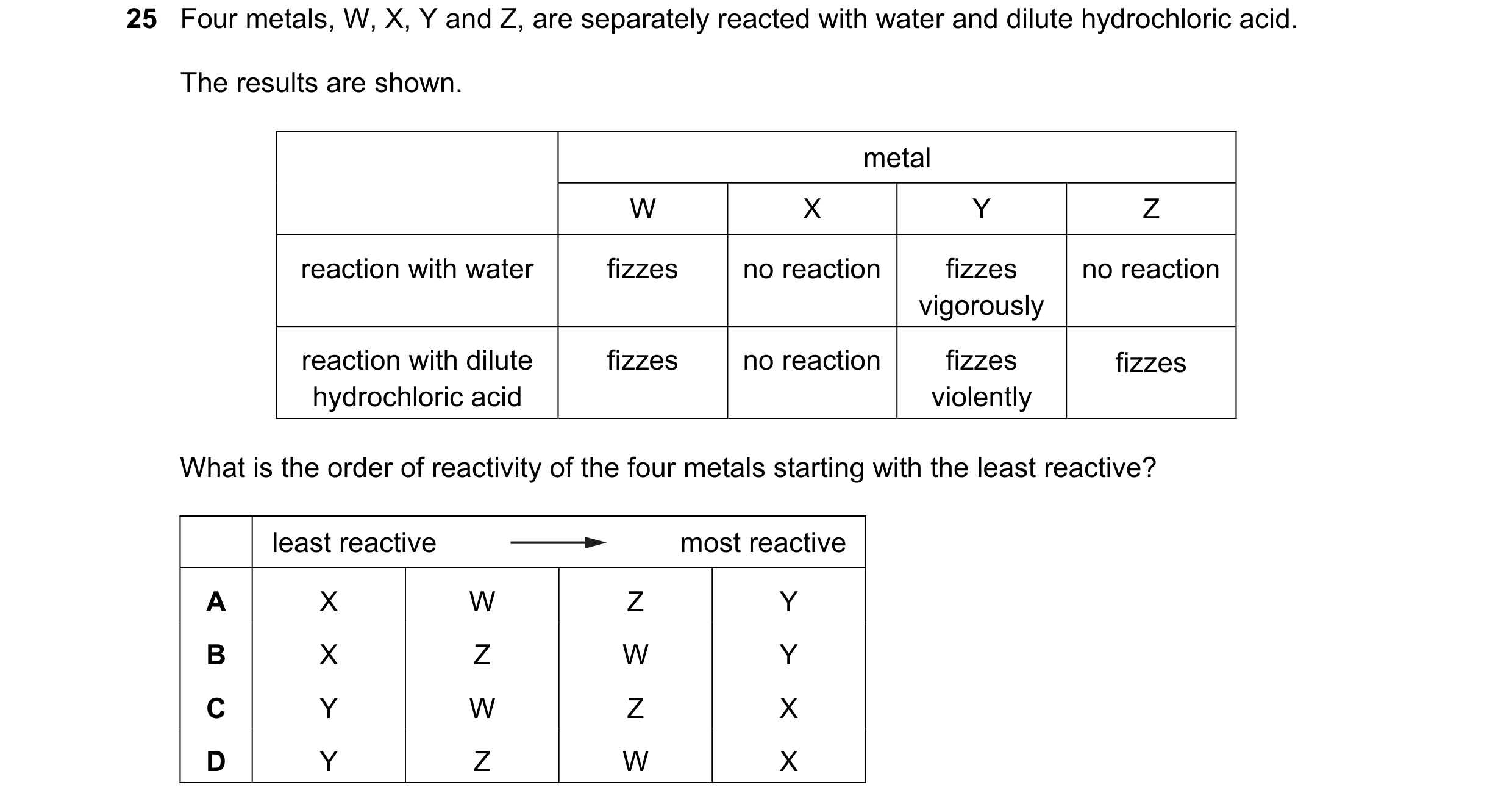
 2 / 11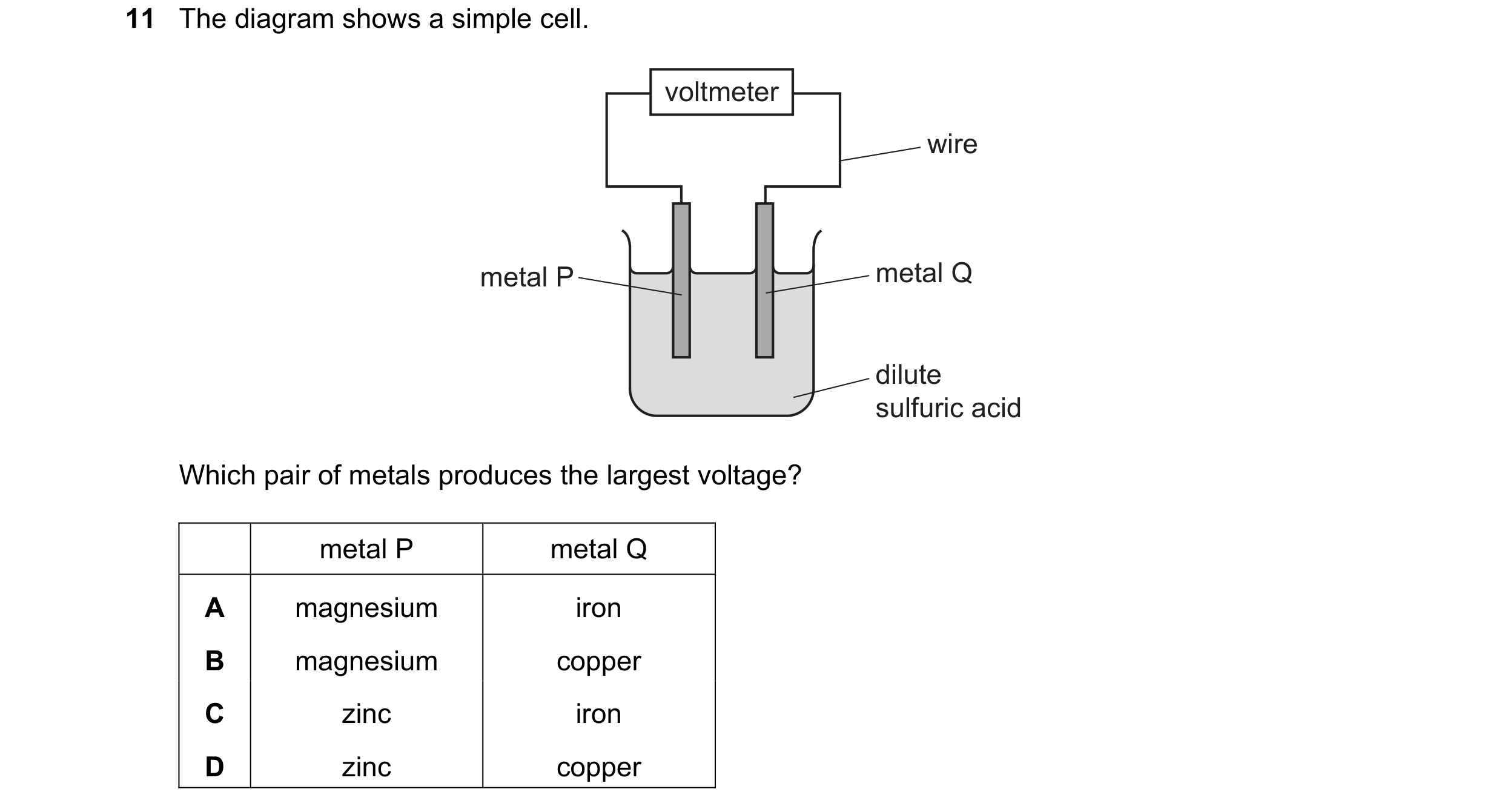
 3 / 11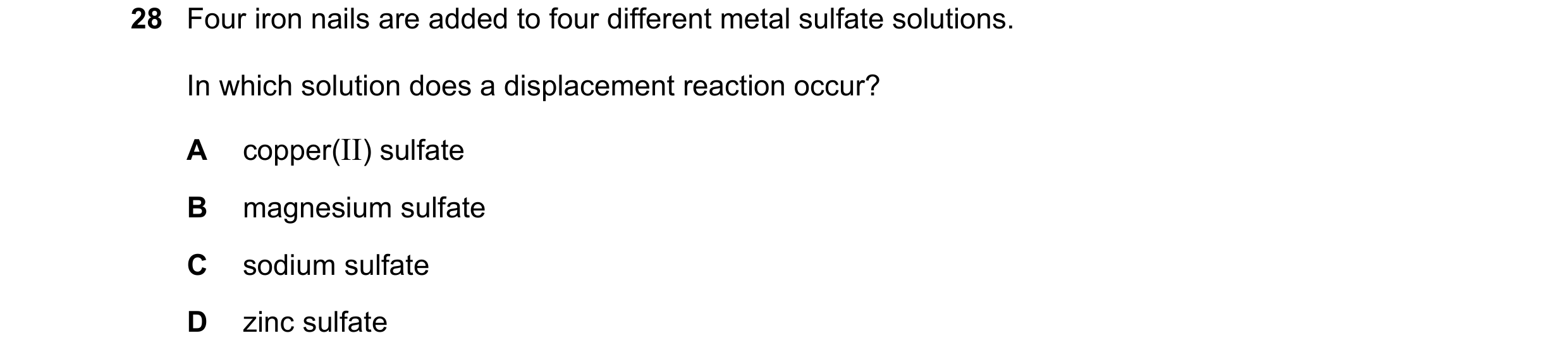
 4 / 11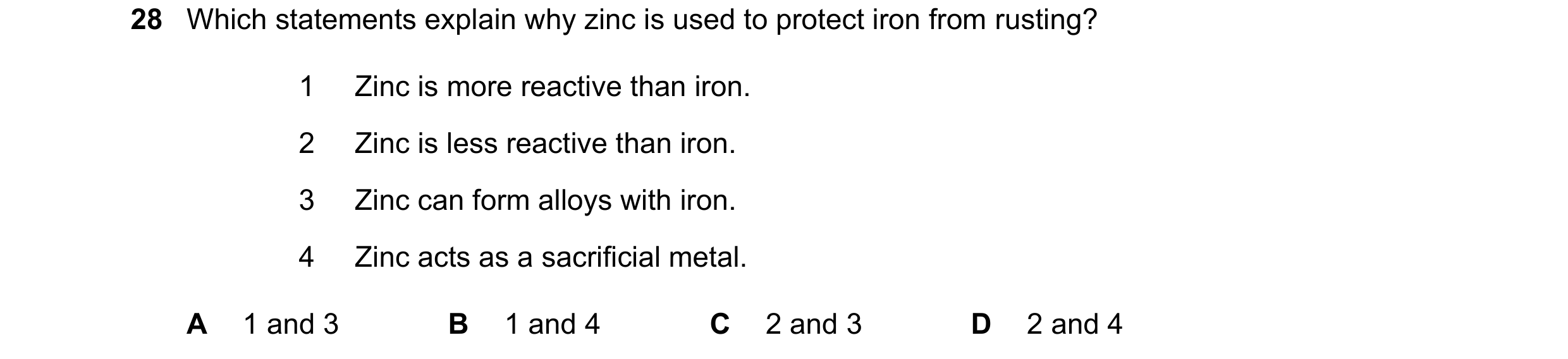
 5 / 11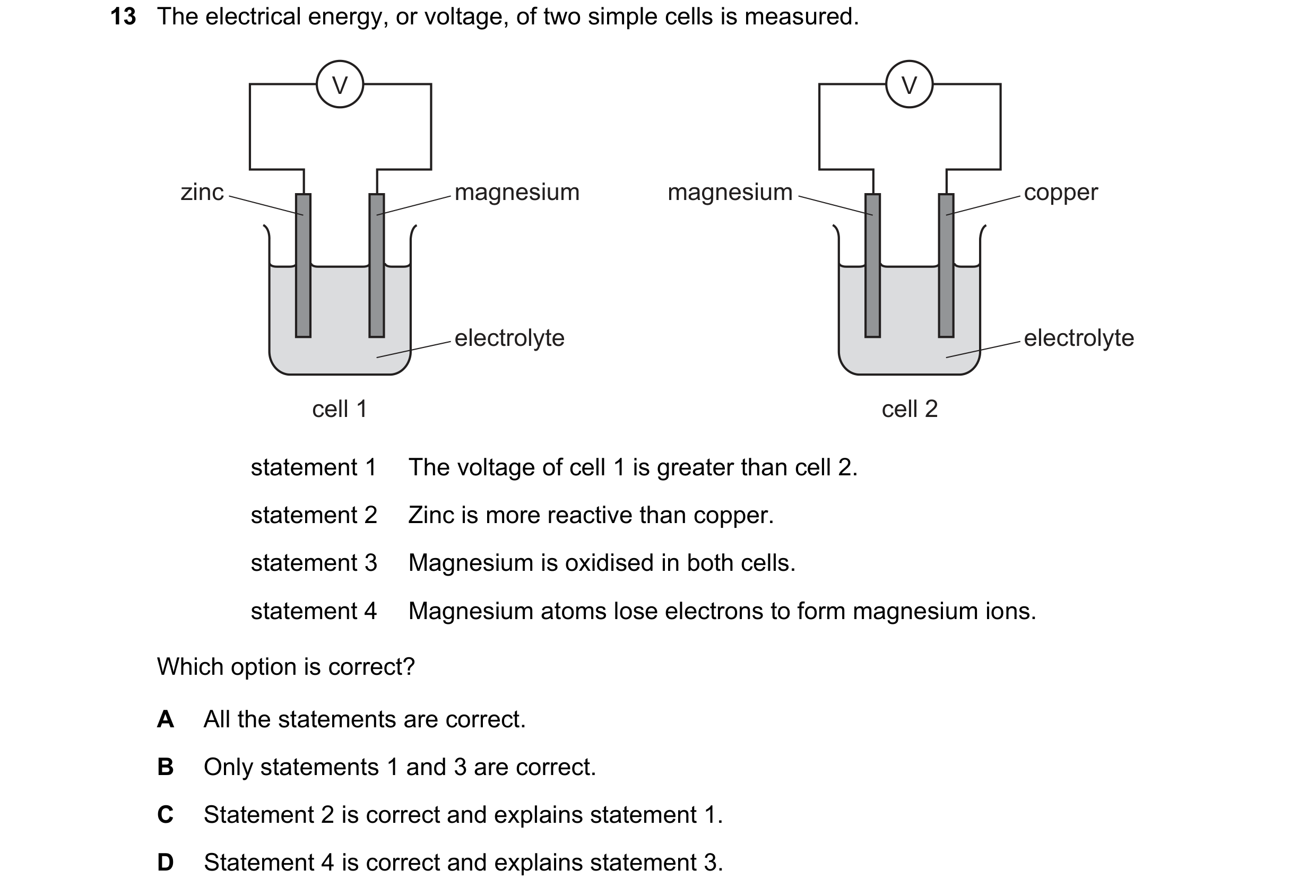
 6 / 11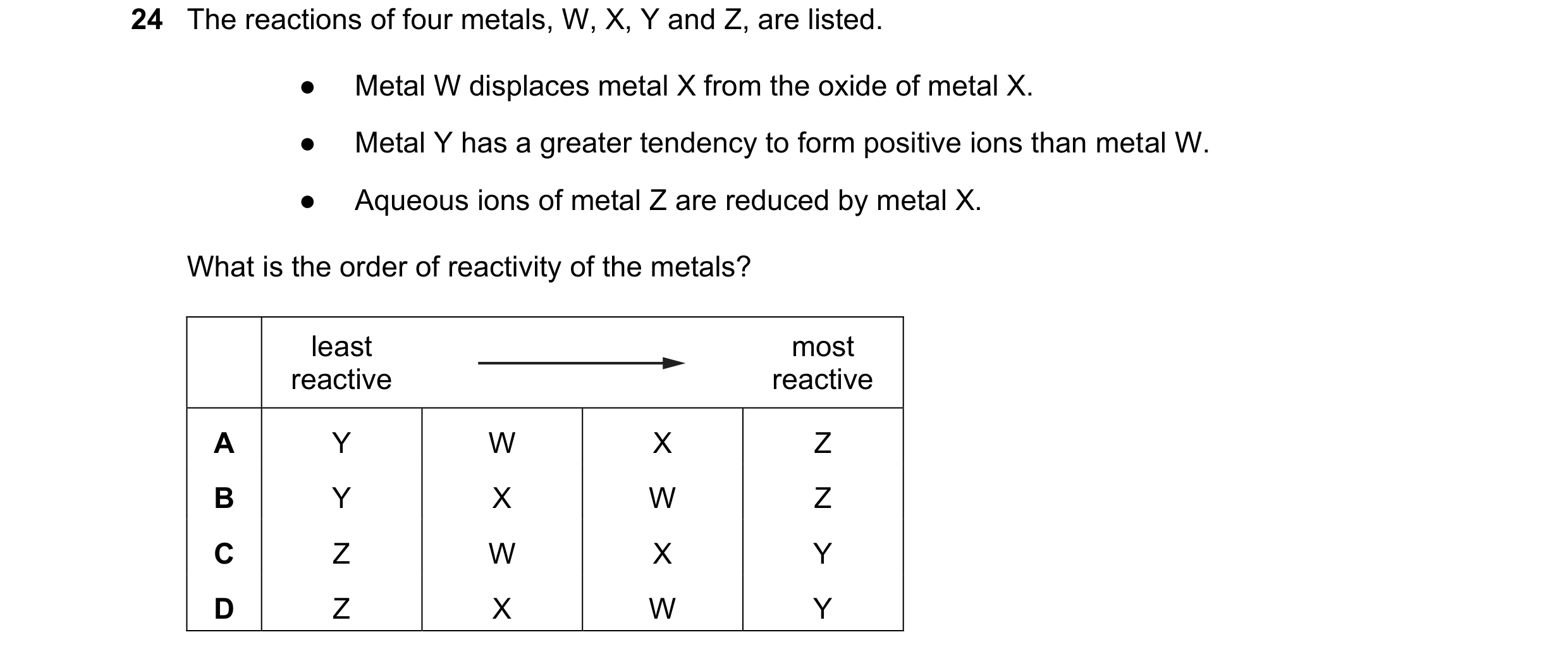

 7 / 11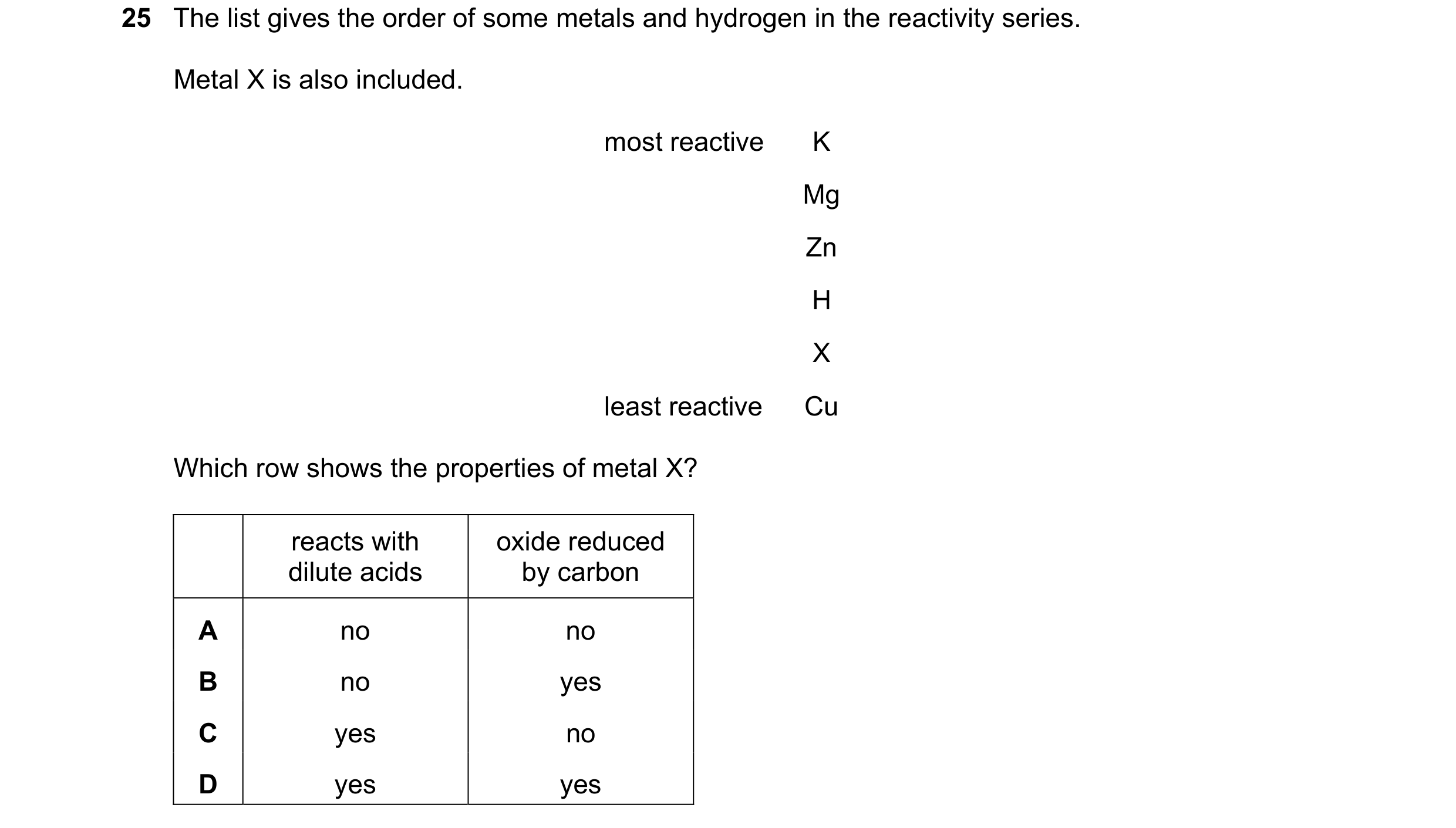

 8 / 11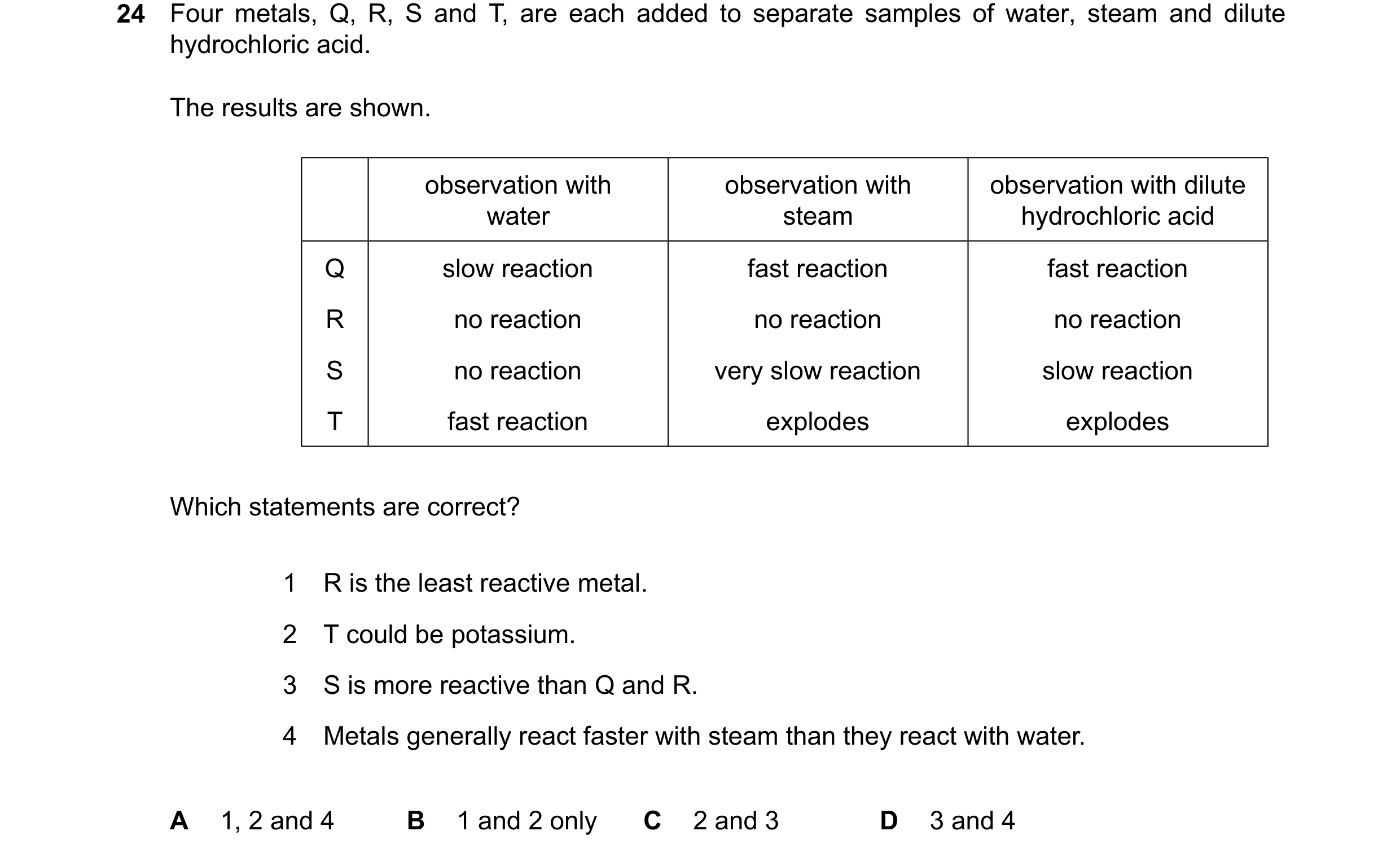
 9 / 11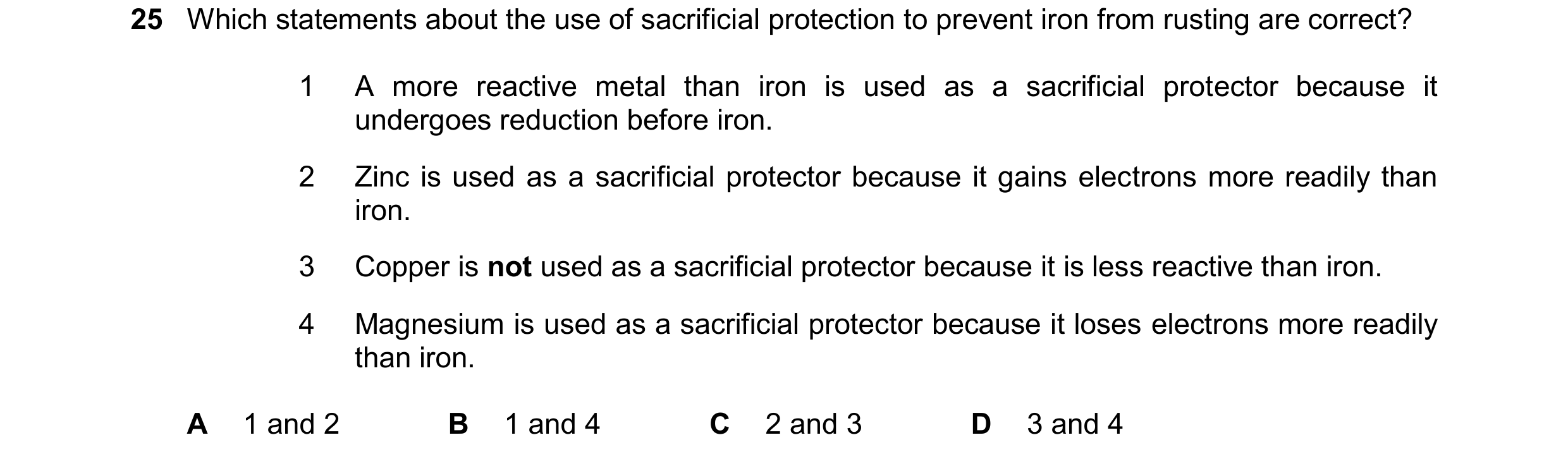
 10 / 11
 11 / 11