Questions as text
Q1 · Which statement about oxides is correct? 0971/21 May/June 2018
17 Which statement about oxides is correct? A A solution of magnesium oxide has a pH less than pH 7. B A solution of sulfur dioxide has a pH greater than pH 7. C Magnesium oxide reacts with nitric acid to make a salt. D Sulfur dioxide reacts with hydrochloric acid to make a salt.
1 marks
Answer: C
This question in 0971/21 May/June 2018
Q2 · Which solution has the lowest pH? 0971/21 May/June 2018
18 Which solution has the lowest pH? A 0.1 mol / dm3 ammonia solution B 0.1 mol / dm3 ethanoic acid C 0.1 mol / dm3 lithium hydroxide D 0.1 mol / dm3 nitric acid
1 marks
Answer: D
This question in 0971/21 May/June 2018
Q3 · When dilute sulfuric acid is added to solid X, a colourless solution is formed and a gas… 0971/22 Oct/Nov 2018
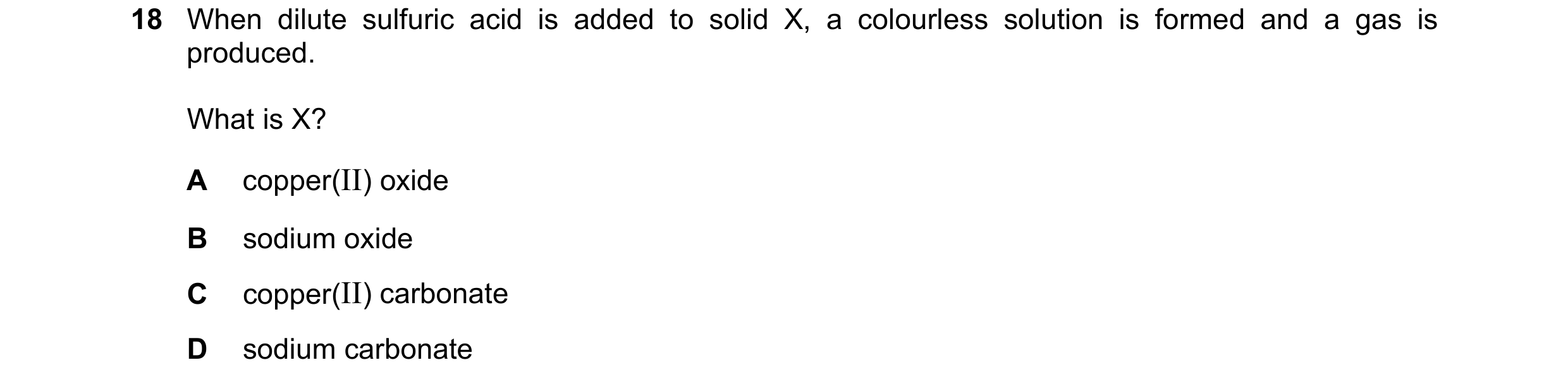
18 When dilute sulfuric acid is added to solid X, a colourless solution is formed and a gas is produced. What is X? A copper(II) oxide B sodium oxide C copper(II) carbonate D sodium carbonate
1 marks
Answer: D
This question in 0971/22 Oct/Nov 2018
Q4 · A few drops of methyl orange are added to a reaction mixture 0971/22 Oct/Nov 2018
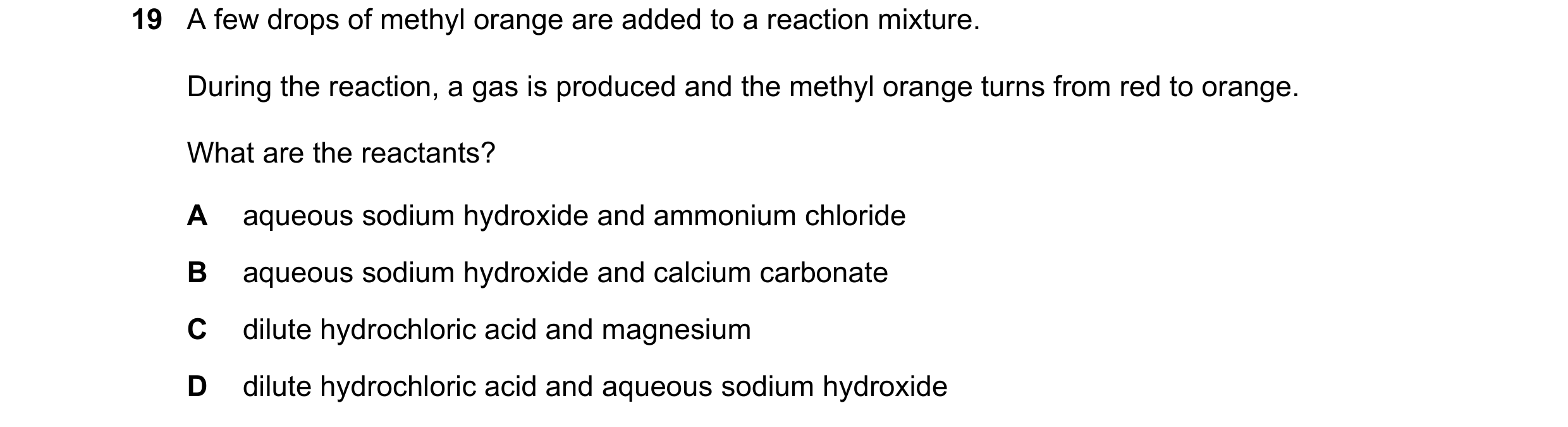
19 A few drops of methyl orange are added to a reaction mixture. During the reaction, a gas is produced and the methyl orange turns from red to orange. What are the reactants? A aqueous sodium hydroxide and ammonium chloride B aqueous sodium hydroxide and calcium carbonate C dilute hydrochloric acid and magnesium D dilute hydrochloric acid and aqueous sodium hydroxide
1 marks
Answer: C
This question in 0971/22 Oct/Nov 2018
Q5 · What is not a use of lime? 0971/22 Oct/Nov 2018
34 What is not a use of lime? A It is used as a bleach in the manufacture of wood pulp. B It is used to desulfurise flue gases. C It is used to neutralise acidic industrial waste. D It is used to treat acidic soil.
1 marks
Answer: A
This question in 0971/22 Oct/Nov 2018
Q6 · Ethanoic acid is a weak acid 0971/21 May/June 2019
19 Ethanoic acid is a weak acid. Hydrochloric acid is a strong acid. Which statements are correct? 1 Ethanoic acid molecules are partially dissociated into ions. 2 1.0 mol / dm3 ethanoic acid has a higher pH than 1.0 mol / dm3 hydrochloric acid. 3 Ethanoic acid is always more dilute than hydrochloric acid. 4 Ethanoic acid is a proton acceptor. A 1 and 2 B 1 and 3 C 2 and 4 D 3 and 4
1 marks
Answer: A
This question in 0971/21 May/June 2019
Q7 · Which statements about aqueous ethanoic acid are correct? 0971/21 May/June 2019
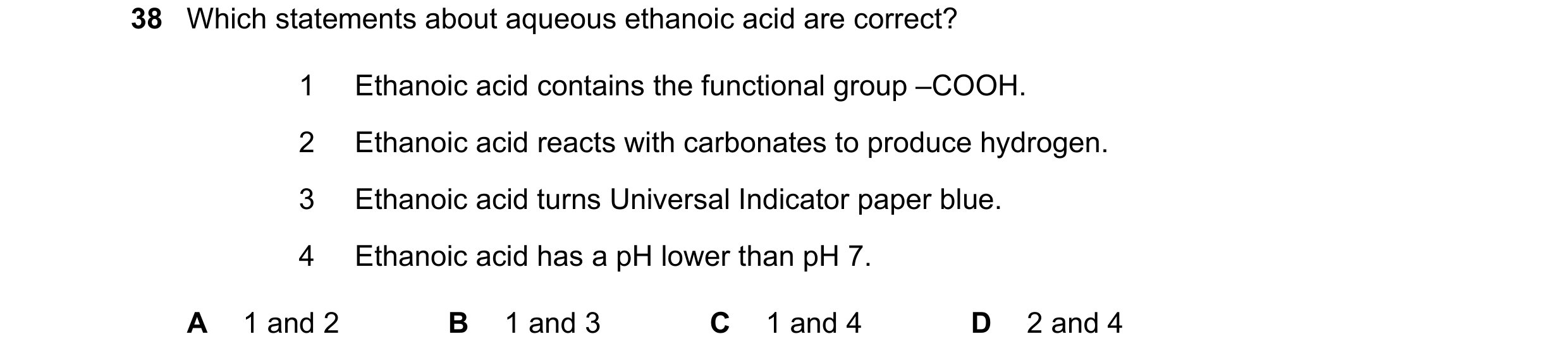
38 Which statements about aqueous ethanoic acid are correct? 1 Ethanoic acid contains the functional group –COOH. 2 Ethanoic acid reacts with carbonates to produce hydrogen. 3 Ethanoic acid turns Universal Indicator paper blue. 4 Ethanoic acid has a pH lower than pH 7. A 1 and 2 B 1 and 3 C 1 and 4 D 2 and 4
1 marks
Answer: C
This question in 0971/21 May/June 2019
Q8 · Which statement describes the properties of hydrochloric acid? 0971/22 Oct/Nov 2019
20 Which statement describes the properties of hydrochloric acid? A Carbon dioxide is produced when limestone reacts with hydrochloric acid. B Hydrogen is produced when sodium hydroxide reacts with hydrochloric acid. C Methyl orange turns yellow in strong hydrochloric acid. D Red litmus paper turns blue when dipped into hydrochloric acid.
1 marks
Answer: A
This question in 0971/22 Oct/Nov 2019
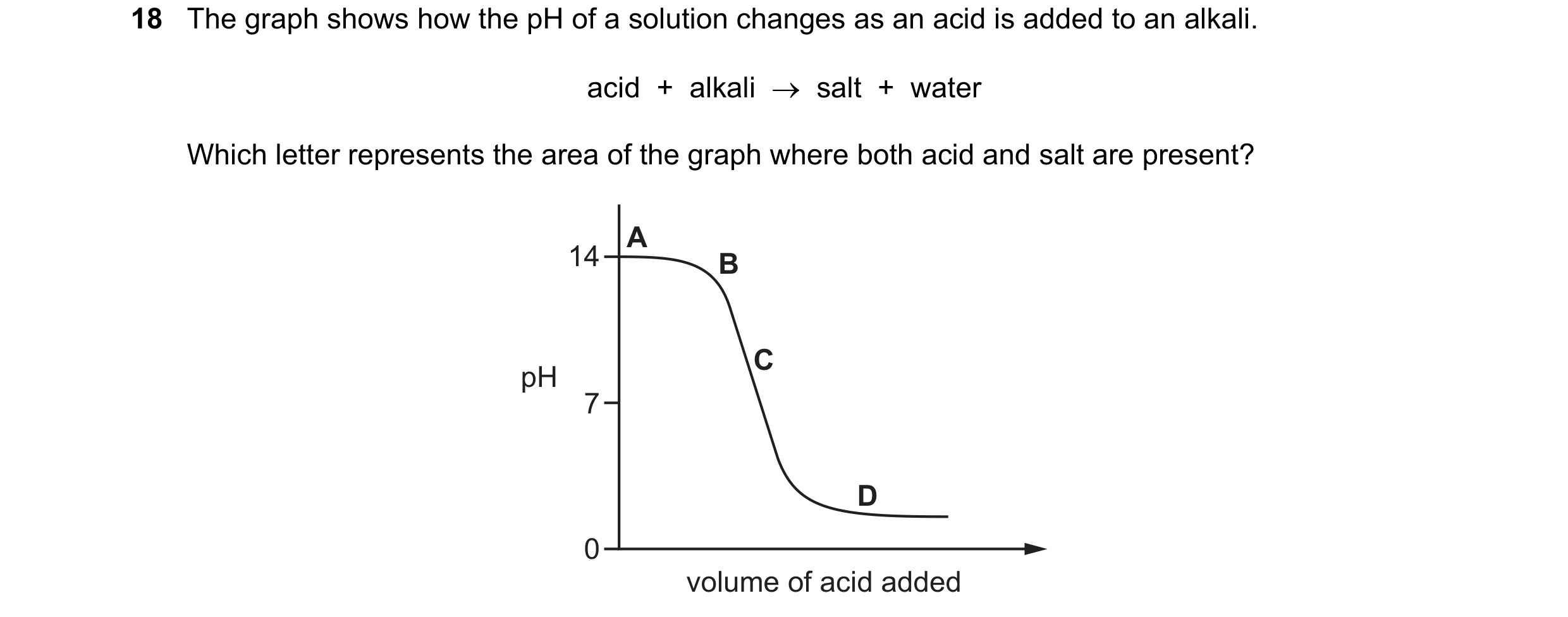
Q9 · The graph shows how the pH of a solution changes as an acid is added to an alkali 0971/21 May/June 2020
18 The graph shows how the pH of a solution changes as an acid is added to an alkali. acid + alkali → salt + water Which letter represents the area of the graph where both acid and salt are present? A 14 B C pH 7 D 0 volume of acid added
1 marks
Answer: D
This question in 0971/21 May/June 2020
Q10 · Which statement describes a weak acid? 0971/21 May/June 2020
19 Which statement describes a weak acid? A It is a proton acceptor and is fully ionised in aqueous solution. B It is a proton acceptor and is partially ionised in aqueous solution. C It is a proton donor and is fully ionised in aqueous solution. D It is a proton donor and is partially ionised in aqueous solution.
1 marks
Answer: D
This question in 0971/21 May/June 2020
Q11 · The graph shows how the pH of a solution changes as an acid is added to an alkali 0971/22 May/June 2020
18 The graph shows how the pH of a solution changes as an acid is added to an alkali. acid + alkali → salt + water Which letter represents the area of the graph where both acid and salt are present? A 14 B C pH 7 D 0 volume of acid added
1 marks
Answer: D
This question in 0971/22 May/June 2020
Q12 · Which statement describes a weak acid? 0971/22 May/June 2020
19 Which statement describes a weak acid? A It is a proton acceptor and is fully ionised in aqueous solution. B It is a proton acceptor and is partially ionised in aqueous solution. C It is a proton donor and is fully ionised in aqueous solution. D It is a proton donor and is partially ionised in aqueous solution.
1 marks
Answer: D
This question in 0971/22 May/June 2020
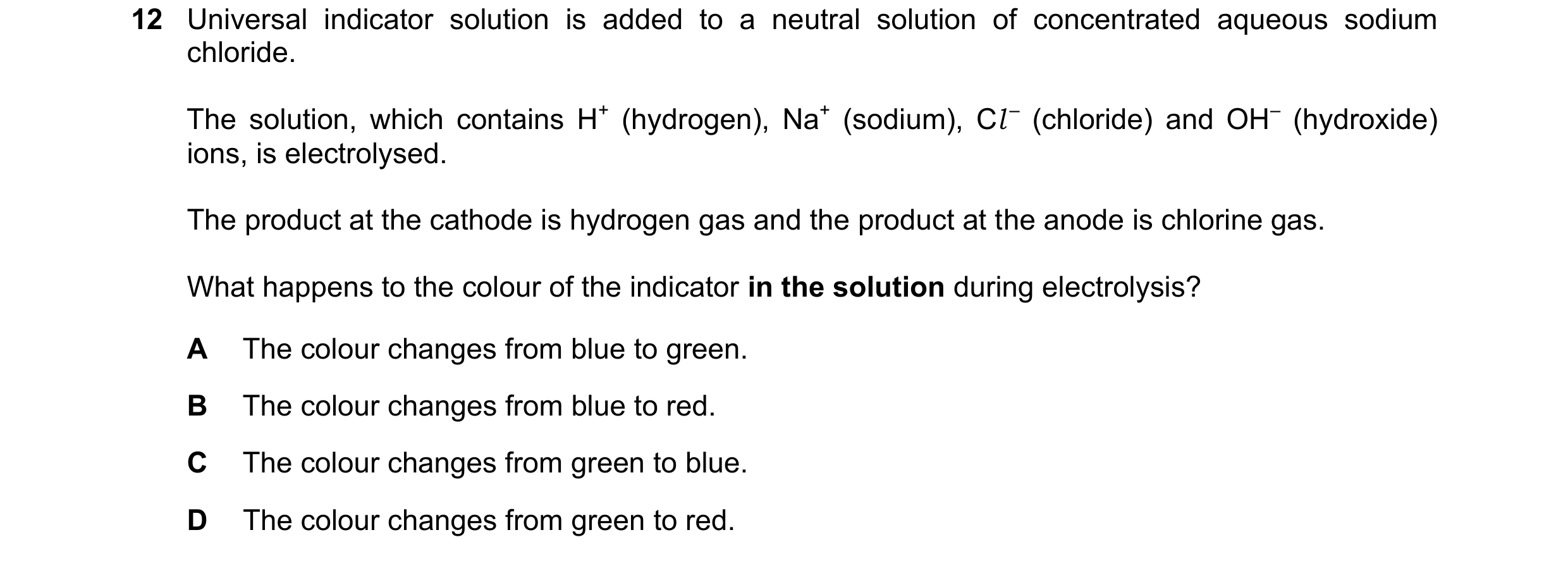
Q13 · Universal indicator solution is added to a neutral solution of concentrated aqueous… 0971/22 Oct/Nov 2020
12 Universal indicator solution is added to a neutral solution of concentrated aqueous sodium chloride. The solution, which contains H+ (hydrogen), Na+ (sodium), Cl – (chloride) and OH– (hydroxide) ions, is electrolysed. The product at the cathode is hydrogen gas and the product at the anode is chlorine gas. What happens to the colour of the indicator in the solution during electrolysis? A The colour changes from blue to green. B The colour changes from blue to red. C The colour changes from green to blue. D The colour changes from green to red.
1 marks
Answer: C
This question in 0971/22 Oct/Nov 2020
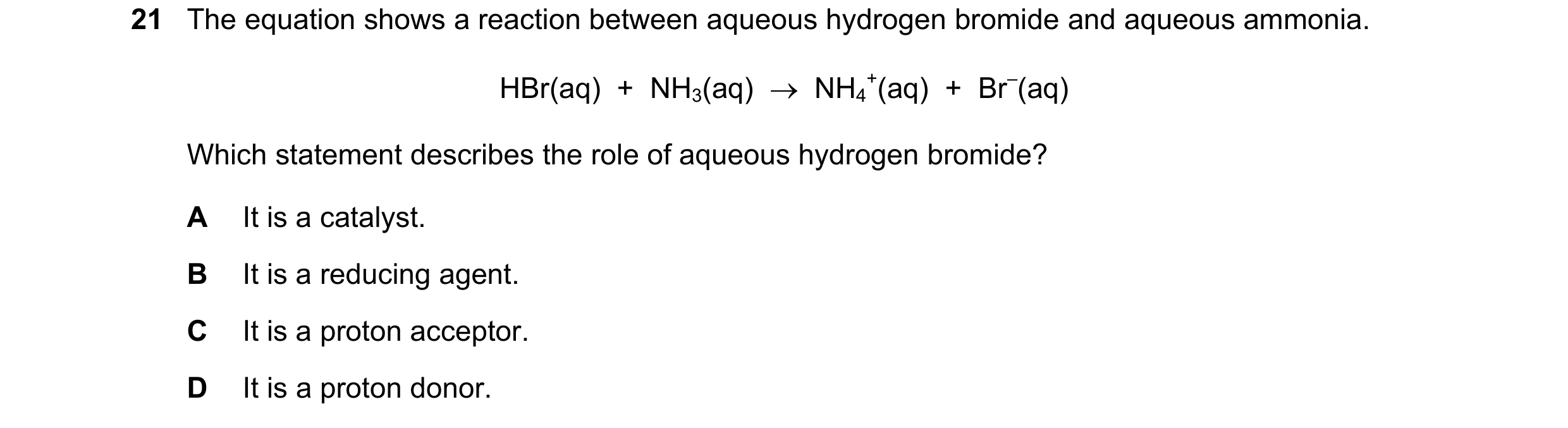
Q14 · The equation shows a reaction between aqueous hydrogen bromide and aqueous ammonia 0971/22 Oct/Nov 2020
21 The equation shows a reaction between aqueous hydrogen bromide and aqueous ammonia. HBr(aq) + NH3(aq) NH4 +(aq) + Br–(aq) Which statement describes the role of aqueous hydrogen bromide? A It is a catalyst. B It is a reducing agent. C It is a proton acceptor. D It is a proton donor.
1 marks
Answer: D
This question in 0971/22 Oct/Nov 2020
Q15 · In which equation is the underlined reactant acting as a base? 0971/21 May/June 2021
21 In which equation is the underlined reactant acting as a base? A CH3COO– + H3O+ CH3COOH + H2O B NH4 + + OH– NH3 + H2O C CO2 + 2H2O H3O+ + HCO3 – D H+ + OH– H2O
1 marks
Answer: C
This question in 0971/21 May/June 2021
Q16 · Burning fossil fuels releases sulfur dioxide which leads to acid rain 0971/22 May/June 2021
21 Burning fossil fuels releases sulfur dioxide which leads to acid rain. Which ion in the rain water causes it to be acidic? A H+ B OH– C O2– D SO4 2–
1 marks
Answer: A
This question in 0971/22 May/June 2021
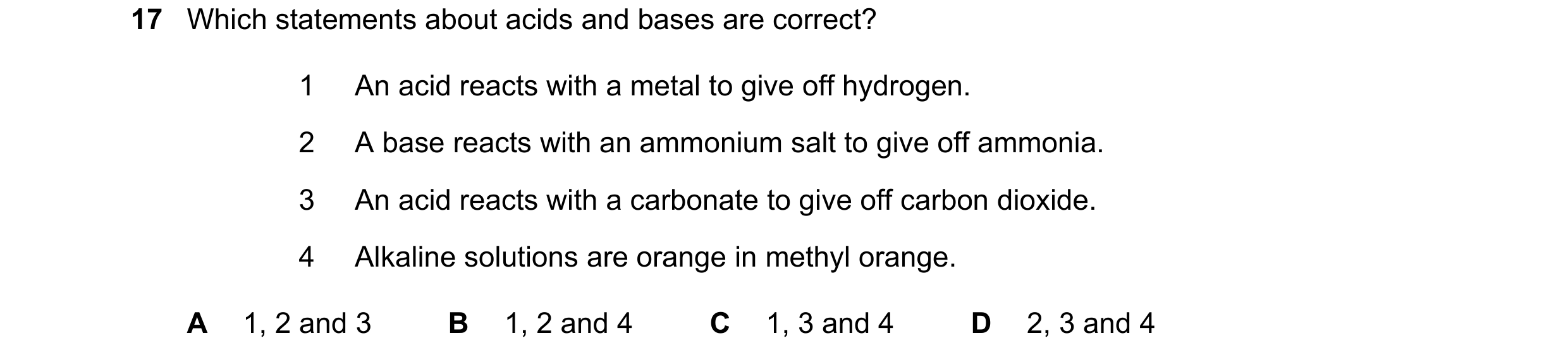
Q17 · Which statements about acids and bases are correct? 0971/22 Oct/Nov 2021
17 Which statements about acids and bases are correct? 1 An acid reacts with a metal to give off hydrogen. 2 A base reacts with an ammonium salt to give off ammonia. 3 An acid reacts with a carbonate to give off carbon dioxide. 4 Alkaline solutions are orange in methyl orange. A 1, 2 and 3 B 1, 2 and 4 C 1, 3 and 4 D 2, 3 and 4
1 marks
Answer: A
This question in 0971/22 Oct/Nov 2021
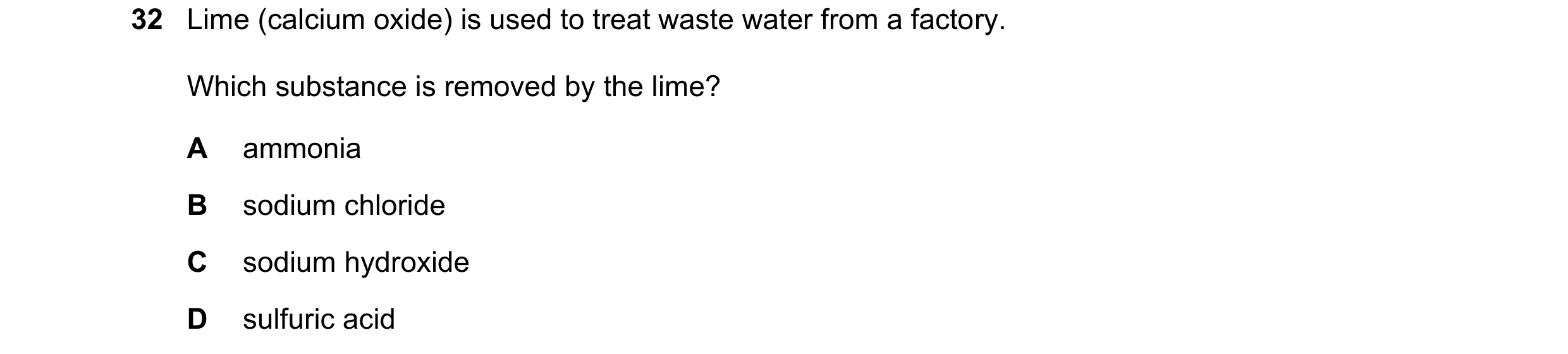
Q18 · Lime (calcium oxide) is used to treat waste water from a factory 0971/22 Oct/Nov 2021
32 Lime (calcium oxide) is used to treat waste water from a factory. Which substance is removed by the lime? A ammonia B sodium chloride C sodium hydroxide D sulfuric acid
1 marks
Answer: D
This question in 0971/22 Oct/Nov 2021
Q19 · Which statement about acids is correct? 0971/21 May/June 2022
17 Which statement about acids is correct? A A strong acid has a higher pH than a weak acid of the same concentration. B A strong acid is a proton acceptor. C A weak acid is a proton donor. D A weak acid is fully ionised in aqueous solution.
1 marks
Answer: C
This question in 0971/21 May/June 2022
Q20 · Which statement about acids is correct? 0971/22 May/June 2022
22 Which statement about acids is correct? A Acids are proton acceptors. B Acids transfer electrons to bases in aqueous solution. C Hydrochloric acid reacts with ammonium hydroxide to produce ammonia. D Ethanoic acid partially ionises in aqueous solution.
1 marks
Answer: D
This question in 0971/22 May/June 2022
Q21 · When an acid is added to an alkali, the temperature of the reaction mixture rises 0971/22 Oct/Nov 2022
11 When an acid is added to an alkali, the temperature of the reaction mixture rises. Which words describe this reaction? A decomposition and endothermic B decomposition and exothermic C neutralisation and endothermic D neutralisation and exothermic
1 marks
Answer: D
This question in 0971/22 Oct/Nov 2022
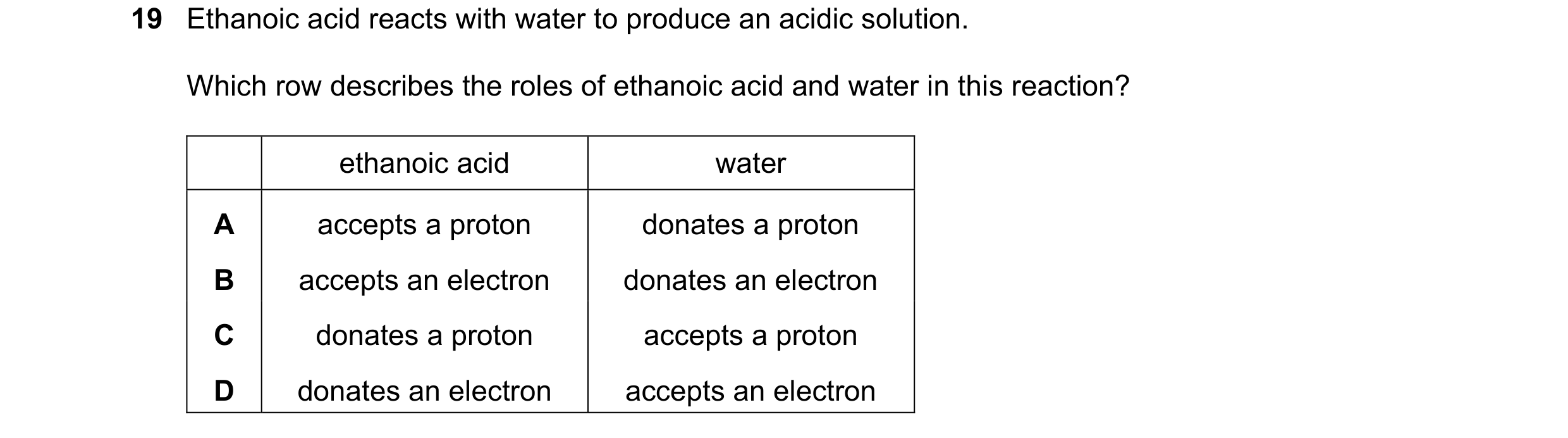
Q22 · Ethanoic acid reacts with water to produce an acidic solution 0971/22 Oct/Nov 2022
19 Ethanoic acid reacts with water to produce an acidic solution. Which row describes the roles of ethanoic acid and water in this reaction? ethanoic acid water A accepts a proton donates a proton B accepts an electron donates an electron C donates a proton accepts a proton D donates an electron accepts an electron
1 marks
Answer: C
This question in 0971/22 Oct/Nov 2022
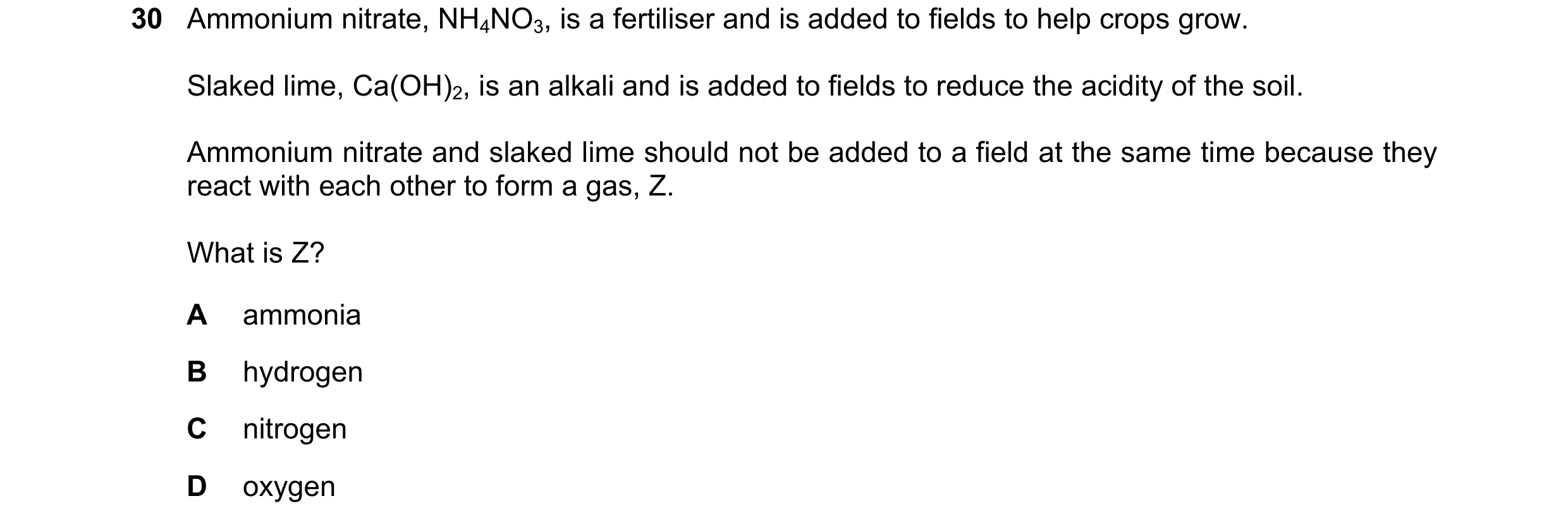
Q23 · Ammonium nitrate, NH4NO3, is a fertiliser and is added to fields to help crops grow 0971/22 Oct/Nov 2022
30 Ammonium nitrate, NH4NO3, is a fertiliser and is added to fields to help crops grow. Slaked lime, Ca(OH)2, is an alkali and is added to fields to reduce the acidity of the soil. Ammonium nitrate and slaked lime should not be added to a field at the same time because they react with each other to form a gas, Z. What is Z? A ammonia B hydrogen C nitrogen D oxygen
1 marks
Answer: A
This question in 0971/22 Oct/Nov 2022
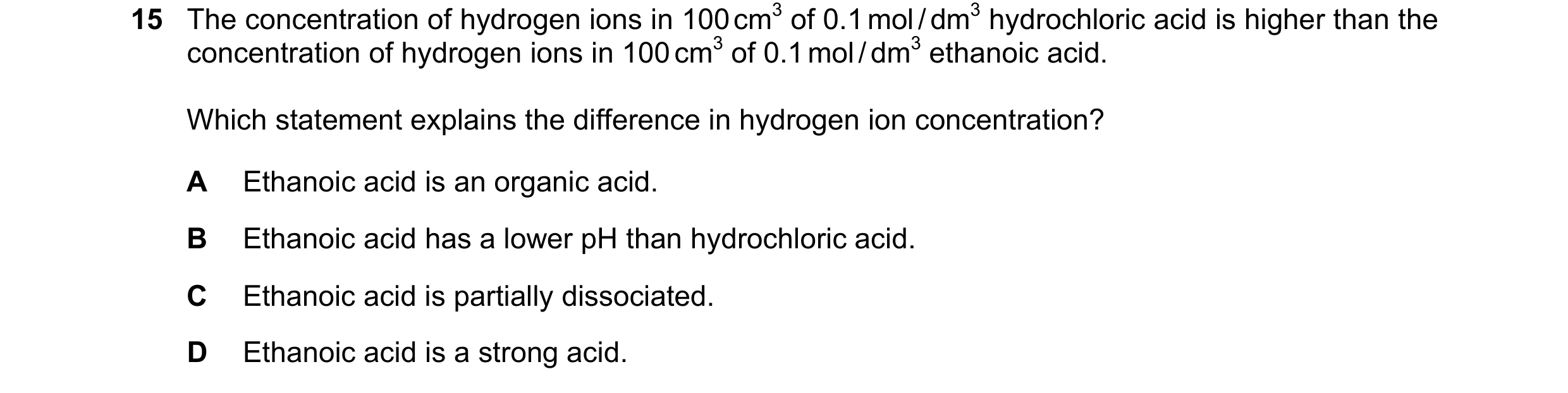
Q24 · The concentration of hydrogen ions in 100 cm3 of 0.1 mol / dm3 hydrochloric acid is… 0971/21 May/June 2023
15 The concentration of hydrogen ions in 100 cm3 of 0.1 mol / dm3 hydrochloric acid is higher than the concentration of hydrogen ions in 100 cm3 of 0.1 mol / dm3 ethanoic acid. Which statement explains the difference in hydrogen ion concentration? A Ethanoic acid is an organic acid. B Ethanoic acid has a lower pH than hydrochloric acid. C Ethanoic acid is partially dissociated. D Ethanoic acid is a strong acid.
1 marks
Answer: C
This question in 0971/21 May/June 2023
Q25 · What is the definition of a strong acid? 0971/22 May/June 2023
16 What is the definition of a strong acid? A a proton acceptor that is completely dissociated in aqueous solution B a proton acceptor that is partially dissociated in aqueous solution C a proton donor that is completely dissociated in aqueous solution D a proton donor that is partially dissociated in aqueous solution
1 marks
Answer: C
This question in 0971/22 May/June 2023
Q26 · When acid is added to salt X, a gas is produced which turns limewater milky 0971/22 May/June 2023
40 When acid is added to salt X, a gas is produced which turns limewater milky. When sodium hydroxide is added to salt X, a gas is produced which turns litmus paper blue. What is X? A CaCO3 B (NH4)2CO3 C NH4NO3 D ZnCO3
1 marks
Answer: B
This question in 0971/22 May/June 2023
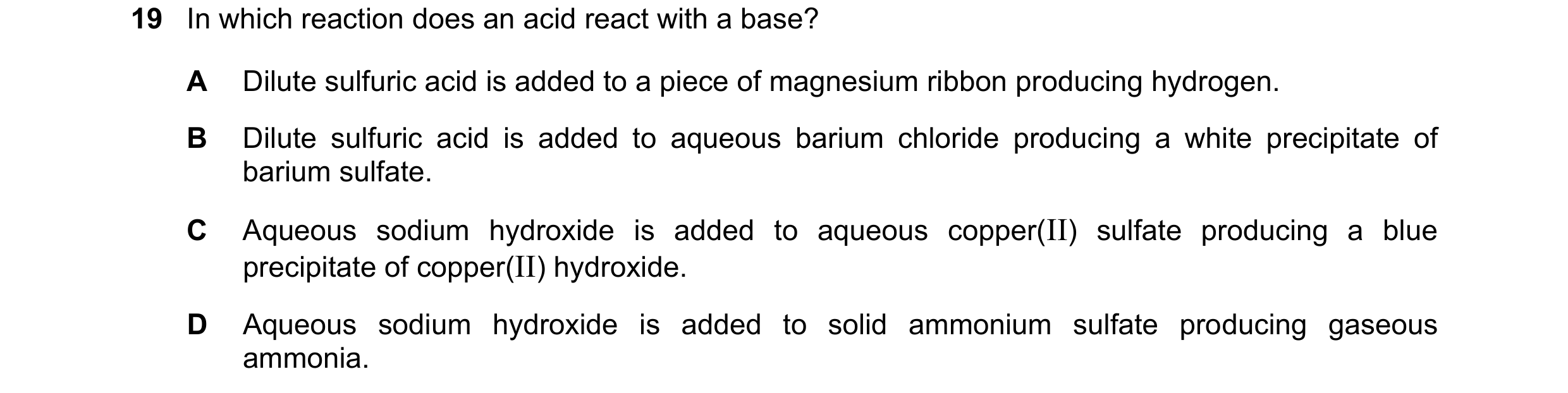
Q27 · In which reaction does an acid react with a base? 0971/22 Oct/Nov 2023
19 In which reaction does an acid react with a base? A Dilute sulfuric acid is added to a piece of magnesium ribbon producing hydrogen. B Dilute sulfuric acid is added to aqueous barium chloride producing a white precipitate of barium sulfate. C Aqueous sodium hydroxide is added to aqueous copper(II) sulfate producing a blue precipitate of copper(II) hydroxide. D Aqueous sodium hydroxide is added to solid ammonium sulfate producing gaseous ammonia.
1 marks
Answer: D
This question in 0971/22 Oct/Nov 2023
Q28 · Which equation represents a solution of ethanoic acid in water? 0971/21 May/June 2024
25 Which equation represents a solution of ethanoic acid in water? A HCOOH(aq) ⇌HCOO–(aq) + H+(aq) B HCOOH(aq) →HCOO–(aq) + H+(aq) C CH3COOH(aq) ⇌CH3COO–(aq) + H+(aq) D CH3COOH(aq) →CH3COO–(aq) + H+(aq)
1 marks
Answer: C
This question in 0971/21 May/June 2024
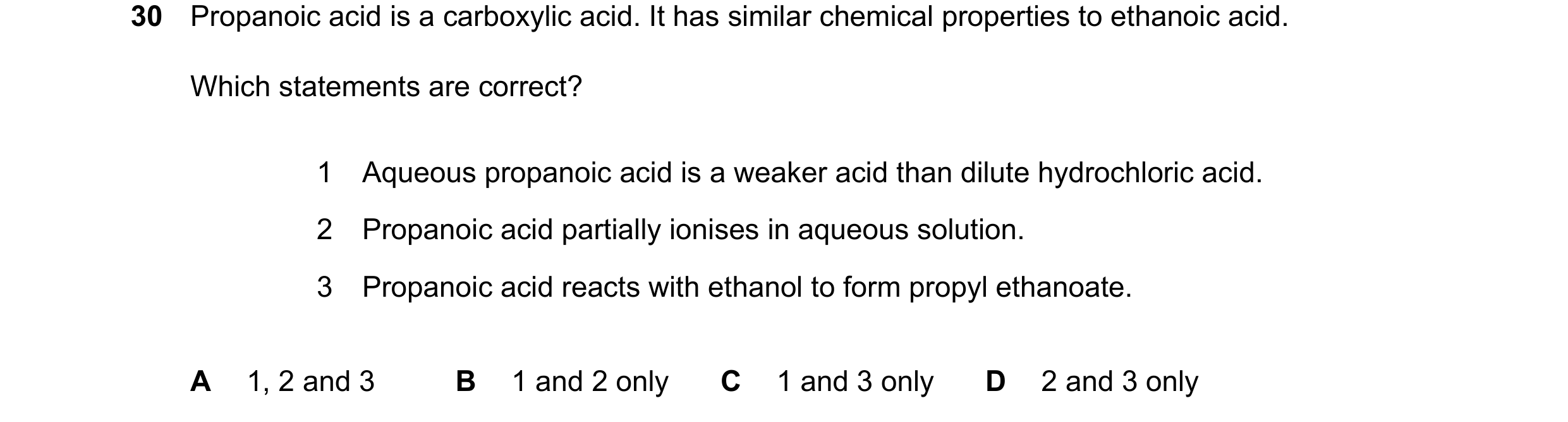
Q29 · Propanoic acid is a carboxylic acid 0971/21 May/June 2024
30 Propanoic acid is a carboxylic acid. It has similar chemical properties to ethanoic acid. Which statements are correct? 1 Aqueous propanoic acid is a weaker acid than dilute hydrochloric acid. 2 Propanoic acid partially ionises in aqueous solution. 3 Propanoic acid reacts with ethanol to form propyl ethanoate. A 1, 2 and 3 B 1 and 2 only C 1 and 3 only D 2 and 3 only
1 marks
Answer: B
This question in 0971/21 May/June 2024
Q30 · What is the colour of thymolphthalein in dilute hydrochloric acid? 0971/22 May/June 2024
18 What is the colour of thymolphthalein in dilute hydrochloric acid? A blue B red C yellow D colourless
1 marks
Answer: D
This question in 0971/22 May/June 2024
Q31 · Two acids, P and Q, with the same concentration and volume are reacted separately with… 0971/22 May/June 2024
19 Two acids, P and Q, with the same concentration and volume are reacted separately with the same mass of magnesium ribbon. The reactions produce the same total volume of hydrogen gas but acid Q reacts much more slowly than acid P. Which explanation for the difference between P and Q is correct? A Acid P has a higher pH than acid Q. B Acid P has a lower concentration of hydrogen ions. C Acid Q is partially dissociated and acid P is fully dissociated. D Acid Q is a proton acceptor.
1 marks
Answer: C
This question in 0971/22 May/June 2024
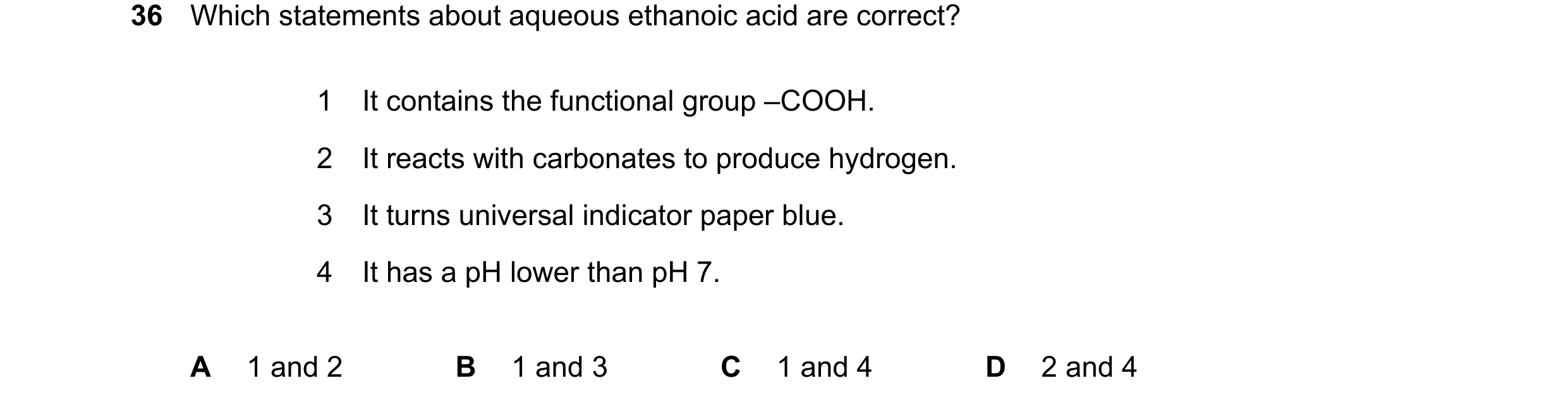
Q32 · Which statements about aqueous ethanoic acid are correct? 0971/22 May/June 2024
36 Which statements about aqueous ethanoic acid are correct? 1 It contains the functional group –COOH. 2 It reacts with carbonates to produce hydrogen. 3 It turns universal indicator paper blue. 4 It has a pH lower than pH 7. A 1 and 2 B 1 and 3 C 1 and 4 D 2 and 4
1 marks
Answer: C
This question in 0971/22 May/June 2024
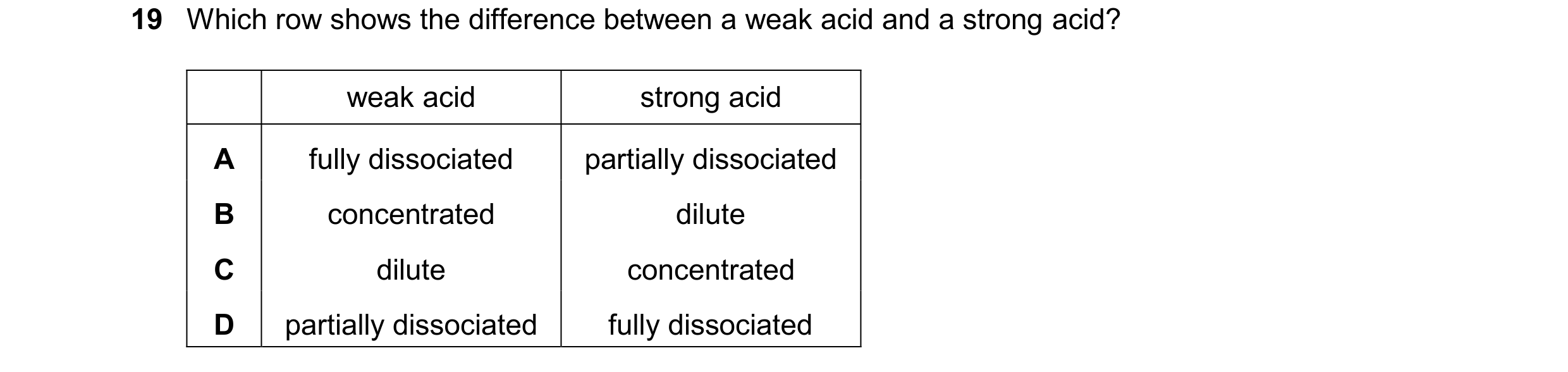
Q33 · Which row shows the difference between a weak acid and a strong acid? 0971/22 Oct/Nov 2024
19 Which row shows the difference between a weak acid and a strong acid? weak acid strong acid A fully dissociated partially dissociated B concentrated dilute C dilute concentrated D partially dissociated fully dissociated
1 marks
Answer: D
This question in 0971/22 Oct/Nov 2024
Q34 · Which substance turns methyl orange red? 0971/22 Oct/Nov 2024
20 Which substance turns methyl orange red? A aqueous ammonia B dilute hydrochloric acid C aqueous sodium hydroxide D distilled water
1 marks
Answer: B
This question in 0971/22 Oct/Nov 2024
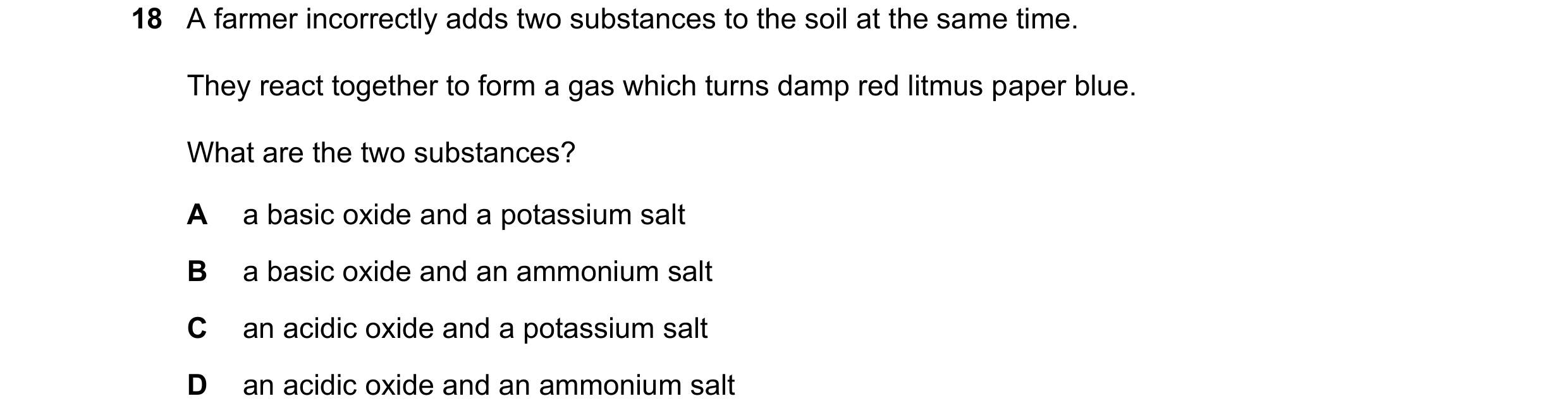
Q35 · A farmer incorrectly adds two substances to the soil at the same time 0971/22 May/June 2025
18 A farmer incorrectly adds two substances to the soil at the same time. They react together to form a gas which turns damp red litmus paper blue. What are the two substances? A a basic oxide and a potassium salt B a basic oxide and an ammonium salt C an acidic oxide and a potassium salt D an acidic oxide and an ammonium salt
1 marks
Answer: B
This question in 0971/22 May/June 2025
Q36 · Which row shows the equations for the dissociation of hydrochloric acid and of ethanoic… 0971/22 May/June 2025
19 Which row shows the equations for the dissociation of hydrochloric acid and of ethanoic acid in
aqueous solution?
hydrochloric acid ethanoic acid
HCl(aq) > H*(aq) + Cl-(aq) CH,COOH(aq) = H*(aq) + CH,COO (aq)
HCi(aq) = H’*(aq) + Cl-(aq) CH,COOH(aq) = H*(aq) + CH,COO (aq)
HCl(aq) — H*(aq) + Cl-(aq) CH,COOH(aq) — H*(aq) + CH,COO (aq)
0 |QO WD PY}
HCl(aq) — H’*(aq) + Cl(aq) CH,COOH(aq) — H*(aq) + CH,COO (aq)
1 marks
Answer: A
This question in 0971/22 May/June 2025
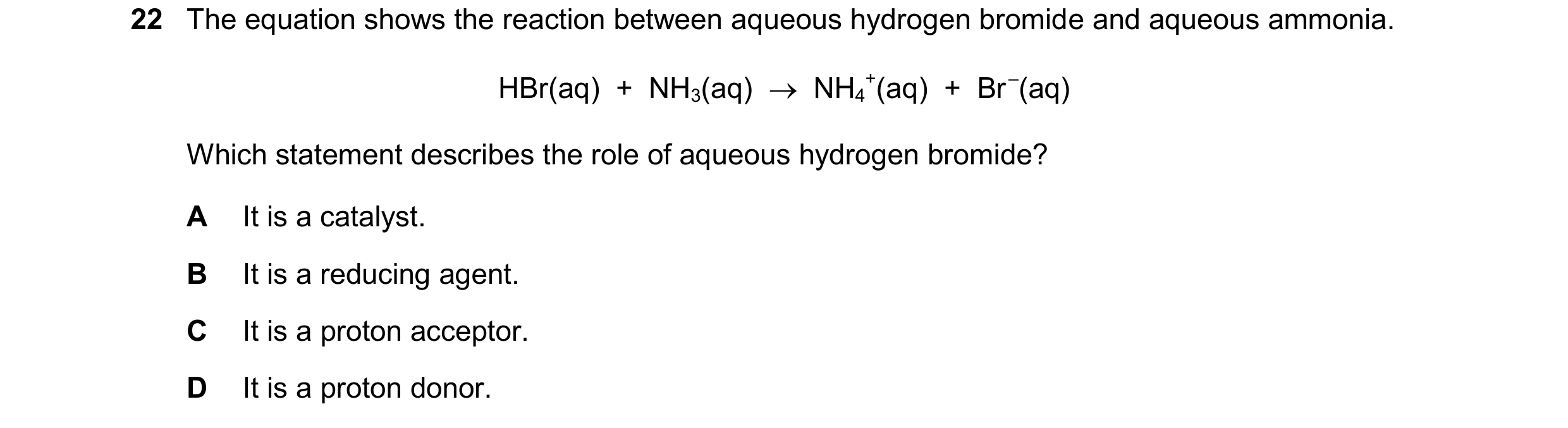
Q37 · The equation shows the reaction between aqueous hydrogen bromide and aqueous ammonia 0971/22 Oct/Nov 2025
22 The equation shows the reaction between aqueous hydrogen bromide and aqueous ammonia. HBr(aq) + NH3(aq) NH4 +(aq) + Br –(aq) Which statement describes the role of aqueous hydrogen bromide? A It is a catalyst. B It is a reducing agent. C It is a proton acceptor. D It is a proton donor.
1 marks
Answer: D
This question in 0971/22 Oct/Nov 2025


 1 / 8
1 / 8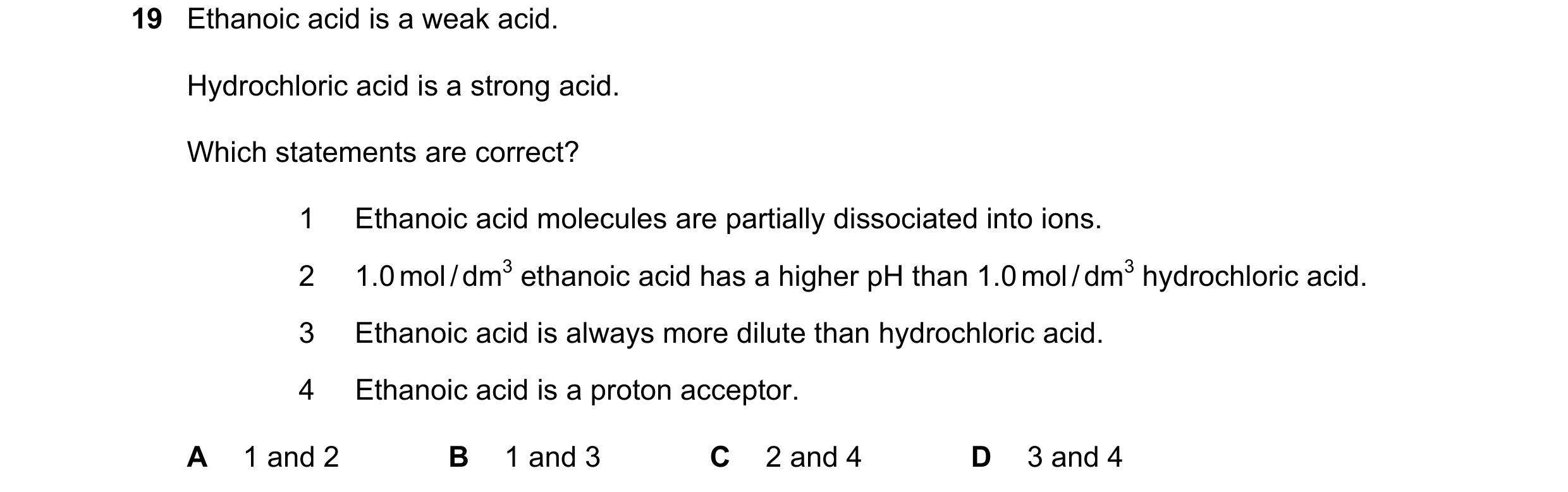

 2 / 8
2 / 8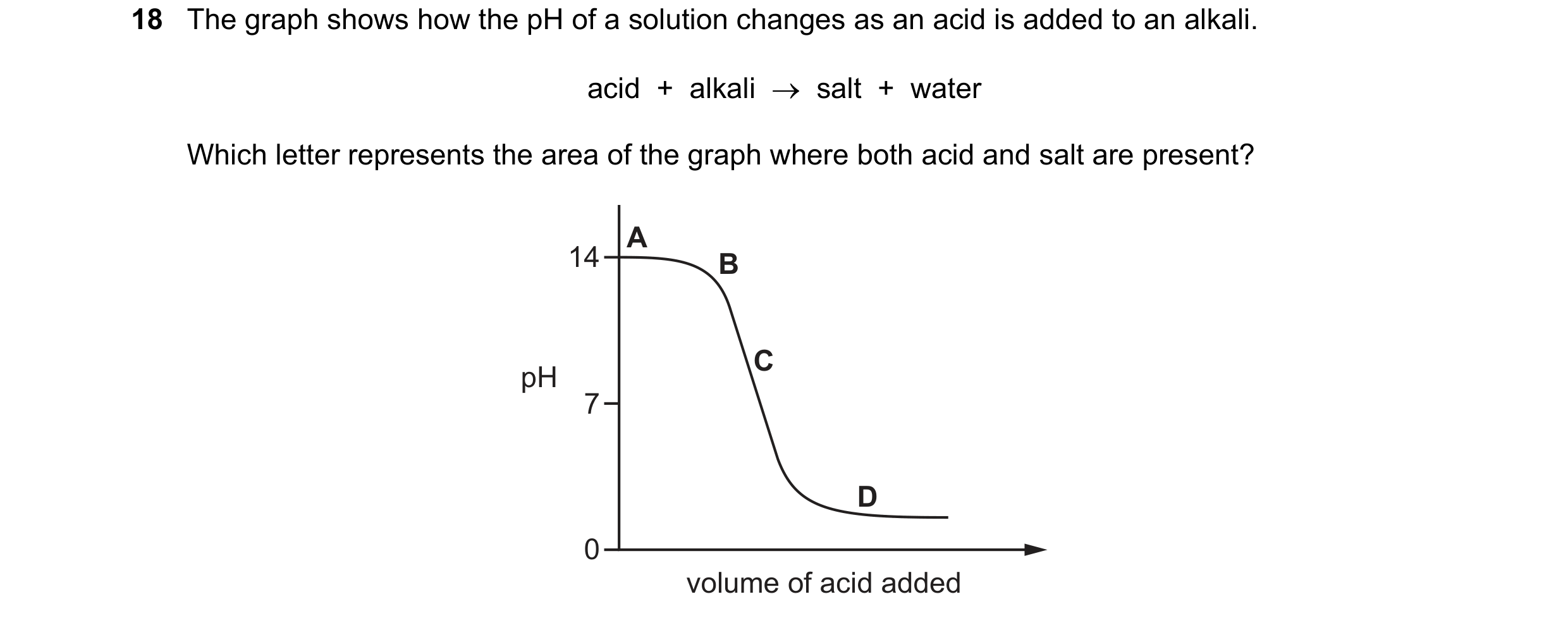

 3 / 8
3 / 8


 4 / 8
4 / 8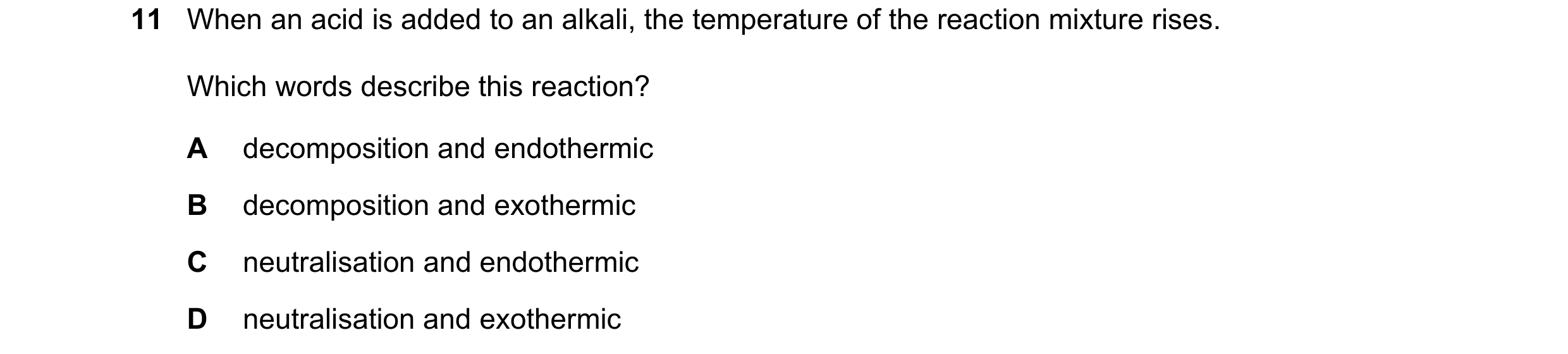
 5 / 8
5 / 8

 6 / 8
6 / 8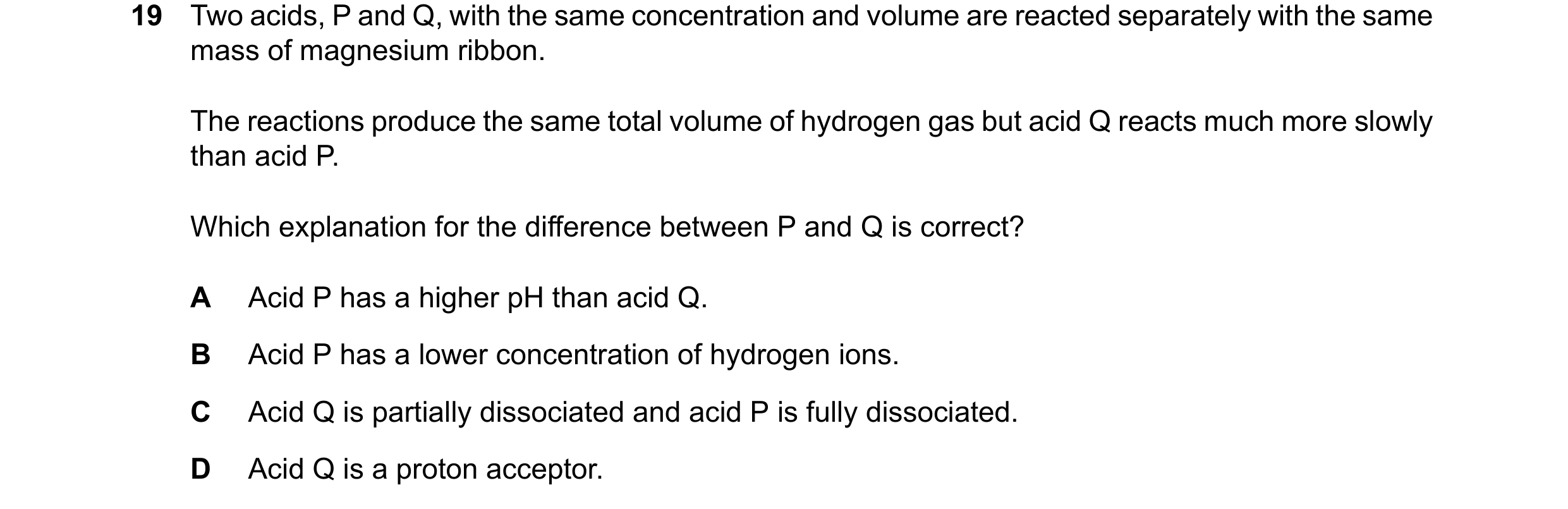

 7 / 8
7 / 8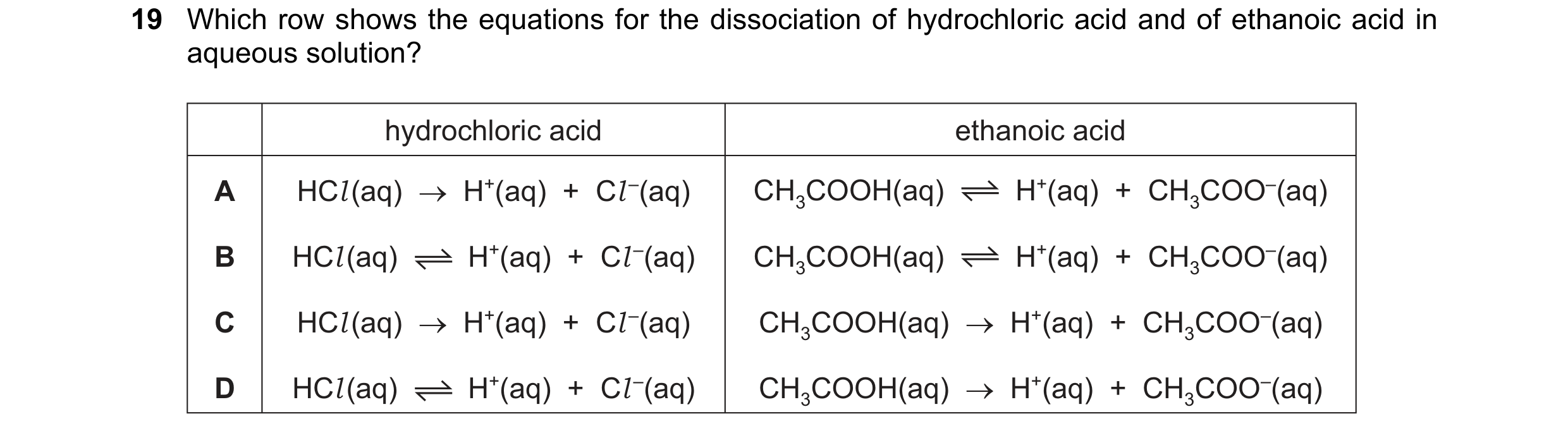
 8 / 8
8 / 8