Cambridge IGCSE Chemistry (9-1) 0971 — 2024 May/June Paper 2 · Variant 2
0971/22/M/J/24 · 40 questions · 40 marks · 45 min
The question paper and its mark scheme, free to read here and free to download. This is Cambridge’s own paper, exactly as it was sat.
Question paper16 pages

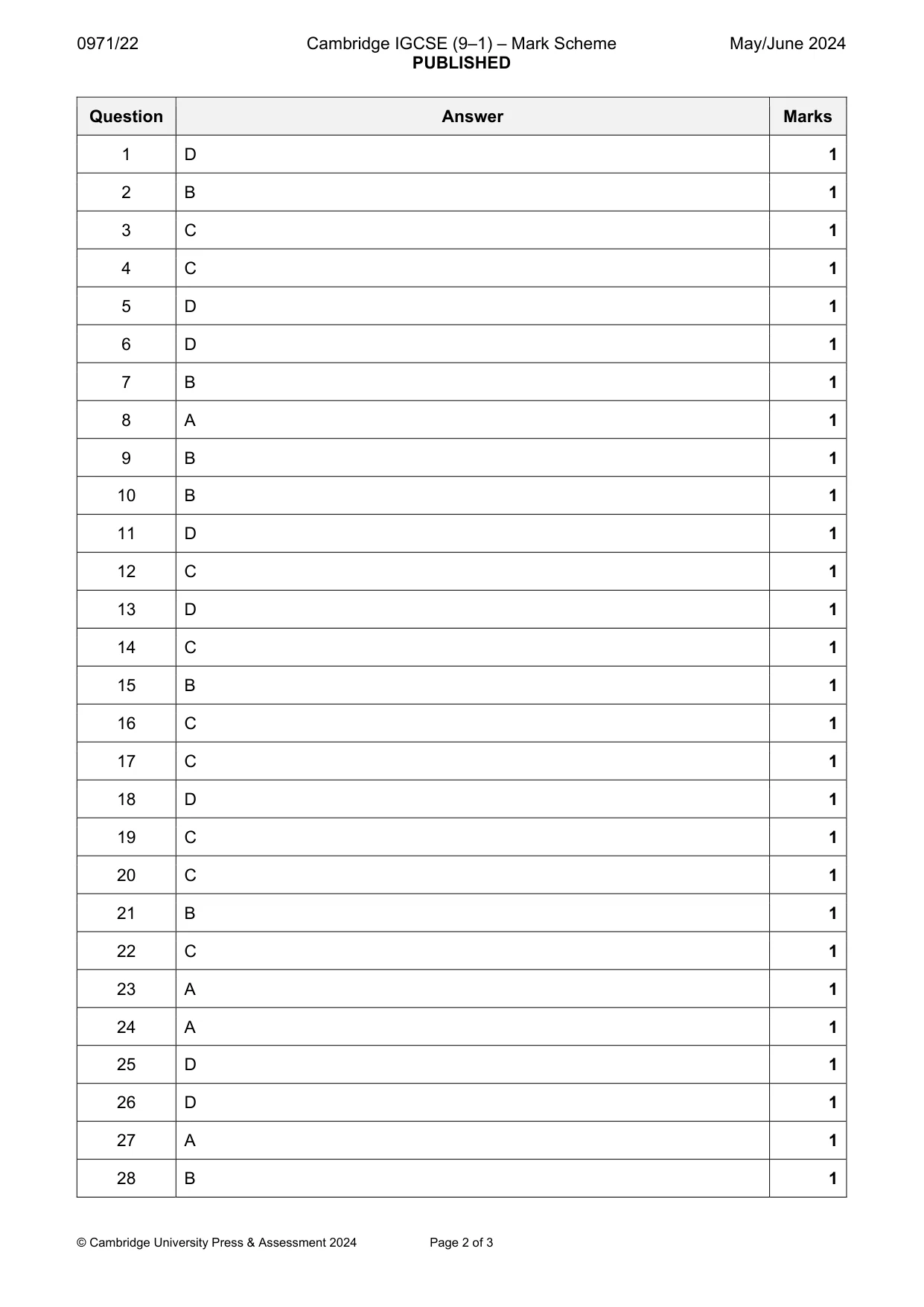
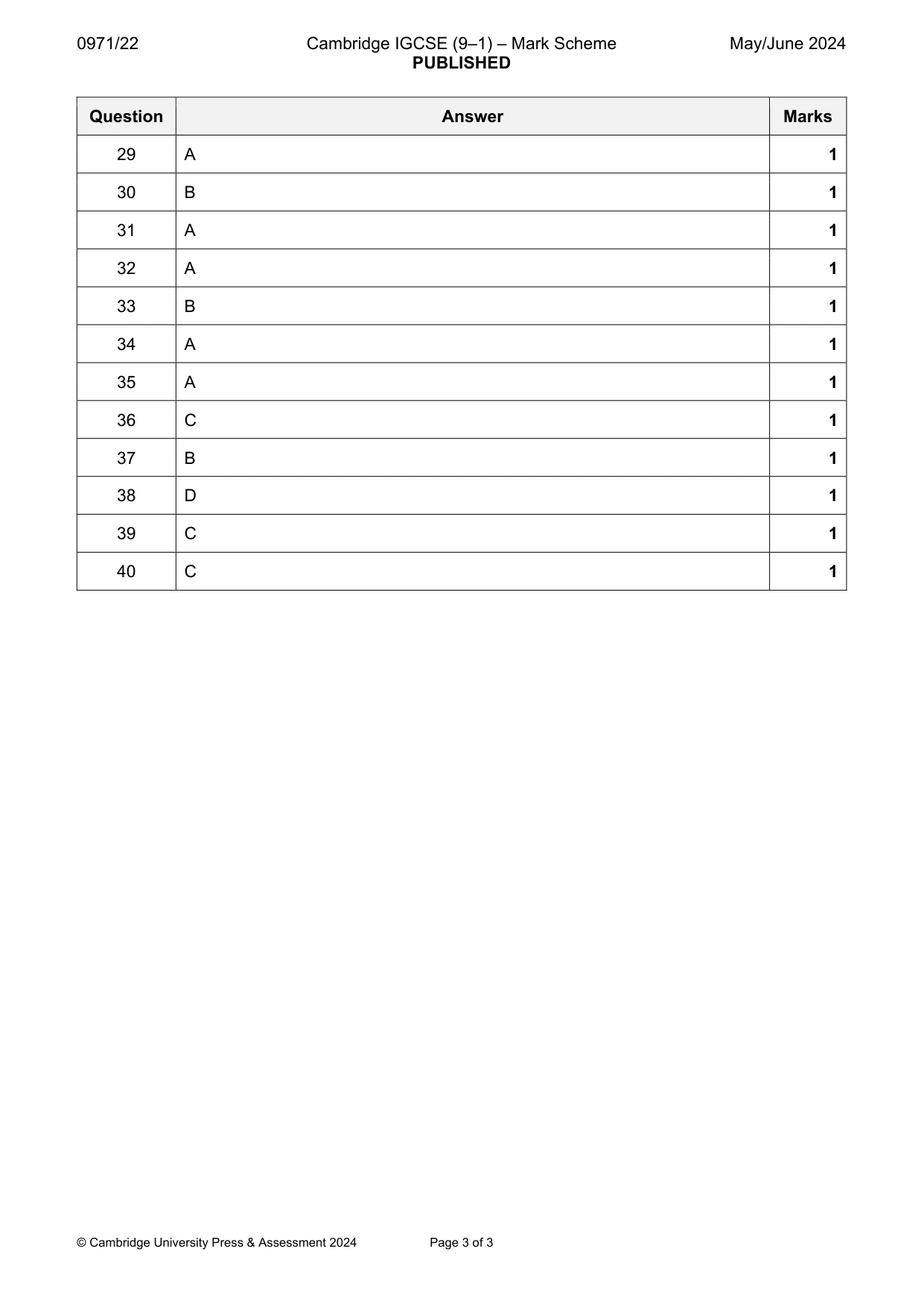
Mark scheme3 pages
Answers below. Sit the paper first if you are practising.
Questions as text
Q1 · Which gas has the slowest rate of diffusion?
1 Which gas has the slowest rate of diffusion? A H2 B NH3 C CH4 D CO2
Mark scheme: D
Q2 · Which statements about the position of the elements in the Periodic Table are correct?
2 Which statements about the position of the elements in the Periodic Table are correct? 1 Elements in the same group have similar chemical properties. 2 Elements in the same period have similar chemical properties. 3 Elements in the same group have the same number of electron shells. 4 Elements in the same group have the same number of outer shell electrons. A 1 and 3 B 1 and 4 C 2 and 3 D 2 and 4
Mark scheme: B
Q3 · Which statements about isotopes are correct?
3 Which statements about isotopes are correct? 1 Isotopes are atoms of different elements with the same number of protons. 2 Isotopes of the same element have the same chemical properties. 3 Isotopes are atoms with the same relative atomic mass. 4 Isotopes of the same element have the same electronic configuration. A 1 and 2 B 1 and 3 C 2 and 4 D 3 and 4
Mark scheme: C
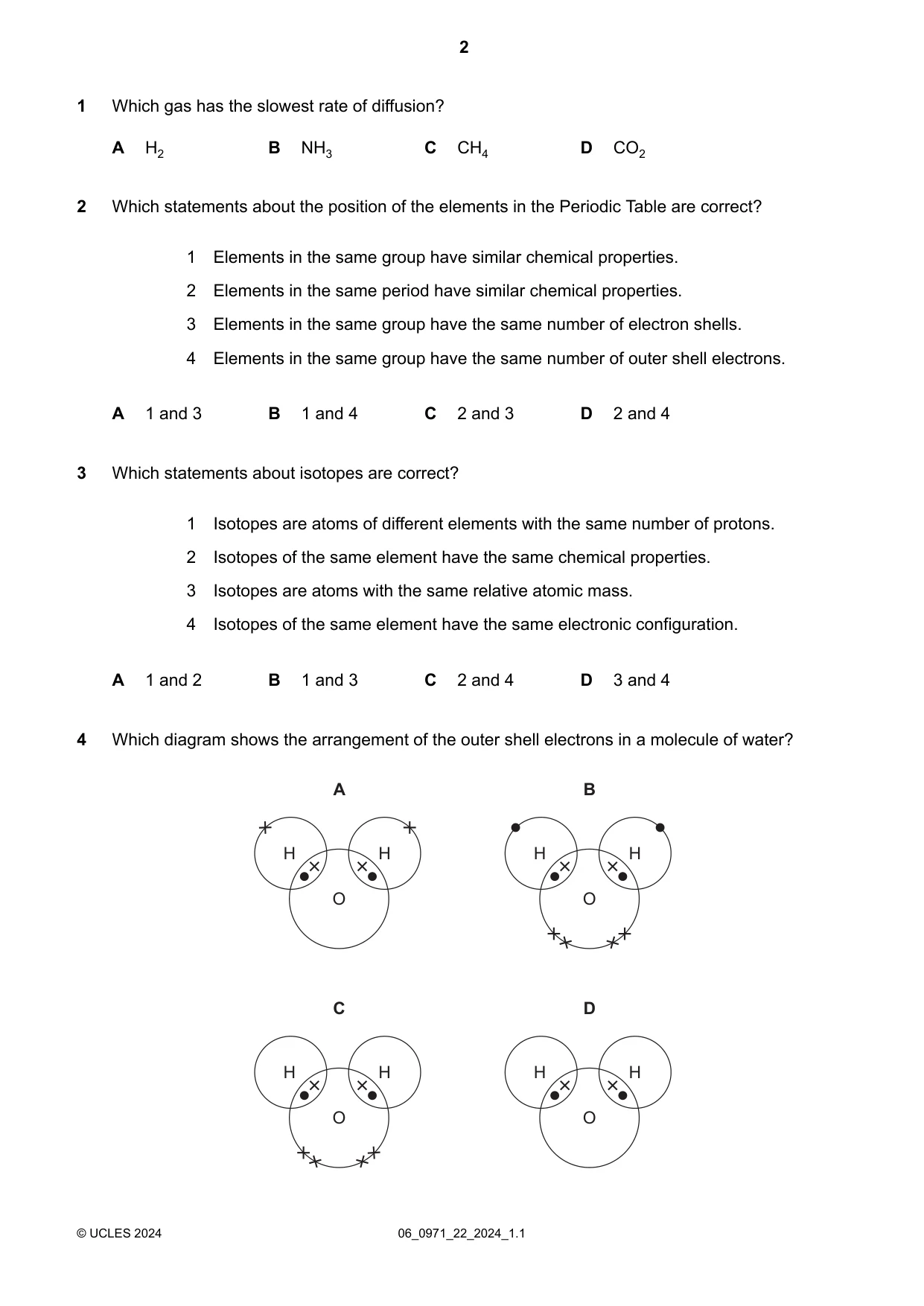
Q4 · Which diagram shows the arrangement of the outer shell electrons in a molecule of water?
4 Which diagram shows the arrangement of the outer shell electrons in a molecule of water? A B H H H H O O C D H H H H O O
Mark scheme: C
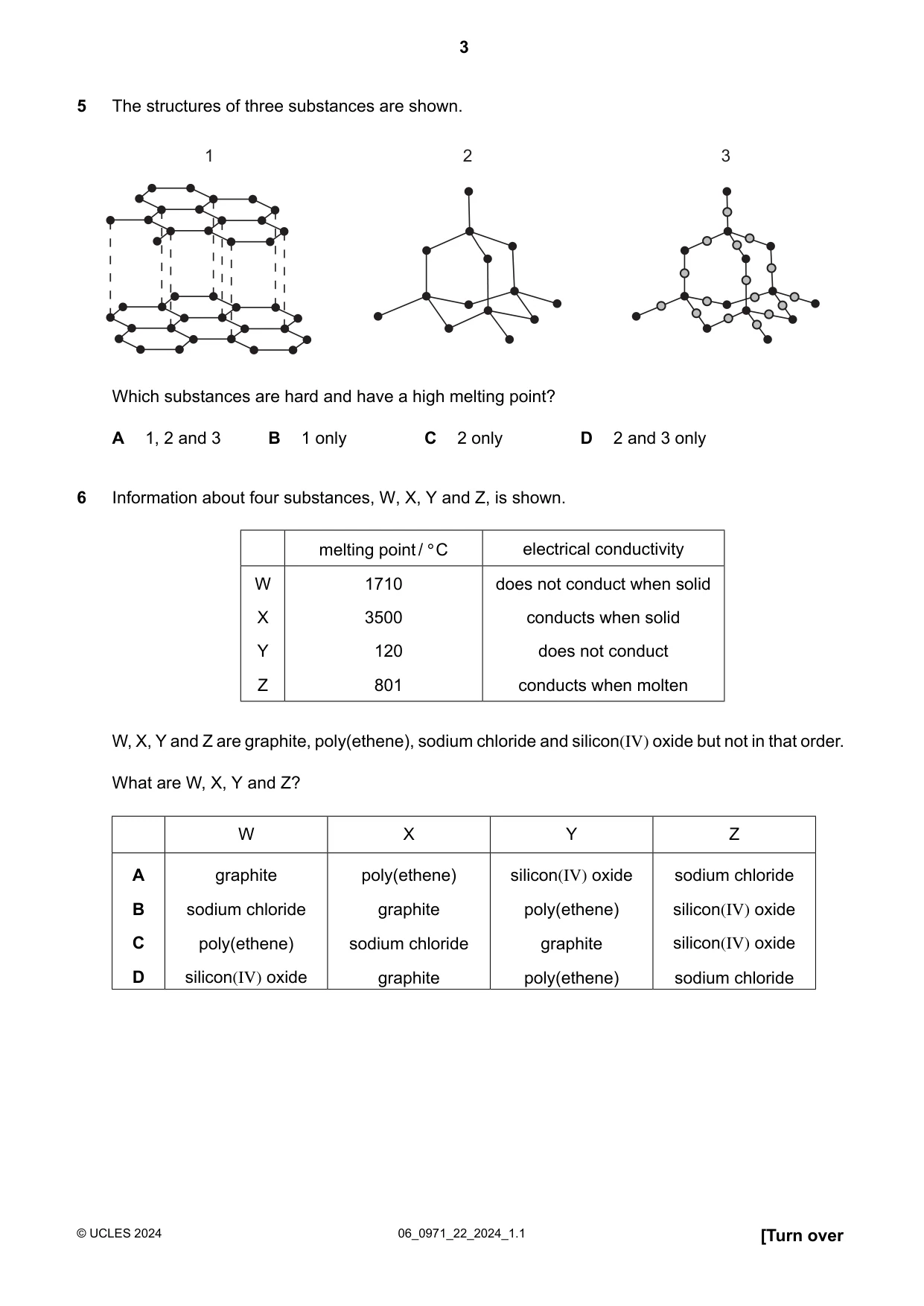
Q5 · The structures of three substances are shown
5 The structures of three substances are shown. 1 2 3 Which substances are hard and have a high melting point? A 1, 2 and 3 B 1 only C 2 only D 2 and 3 only
Mark scheme: D
Q6 · Information about four substances, W, X, Y and Z, is shown
6 Information about four substances, W, X, Y and Z, is shown. melting point/°C electrical conductivity W 1710 does not conduct when solid X 3500 conducts when solid Y 120 does not conduct Z 801 conducts when molten W, X, Y and Z are graphite, poly(ethene), sodium chloride and silicon(IV) oxide but not in that order. What are W, X, Y and Z? W X Y Z A graphite poly(ethene) silicon(IV) oxide sodium chloride B sodium chloride graphite poly(ethene) silicon(IV) oxide C poly(ethene) sodium chloride graphite silicon(IV) oxide D silicon(IV) oxide graphite poly(ethene) sodium chloride
Mark scheme: D
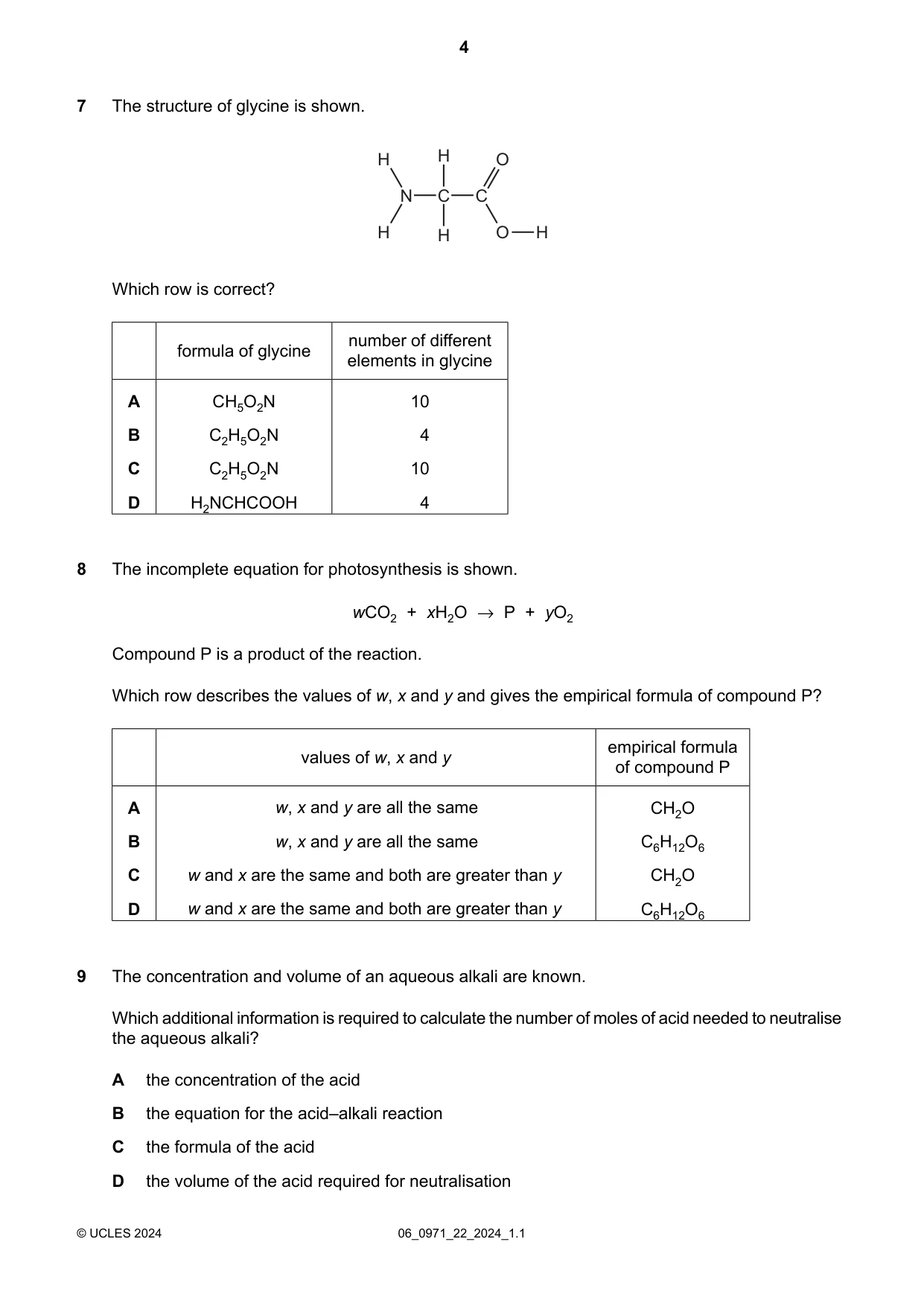
Q7 · The structure of glycine is shown
7 The structure of glycine is shown. H H O N C C H H O H Which row is correct? number of different formula of glycine elements in glycine A CH5O2N 10 B C2H5O2N 4 C C2H5O2N 10 D H2NCHCOOH 4
Mark scheme: B
Q8 · The incomplete equation for photosynthesis is shown
8 The incomplete equation for photosynthesis is shown. wCO2 + xH2O →P + yO2 Compound P is a product of the reaction. Which row describes the values of w, x and y and gives the empirical formula of compound P? empirical formula values of w, x and y of compound P A w, x and y are all the same CH2O B w, x and y are all the same C6H12O6 C w and x are the same and both are greater than y CH2O D w and x are the same and both are greater than y C6H12O6
Mark scheme: A
Q9 · The concentration and volume of an aqueous alkali are known
9 The concentration and volume of an aqueous alkali are known. Which additional information is required to calculate the number of moles of acid needed to neutralise the aqueous alkali? A the concentration of the acid B the equation for the acid–alkali reaction C the formula of the acid D the volume of the acid required for neutralisation
Mark scheme: B
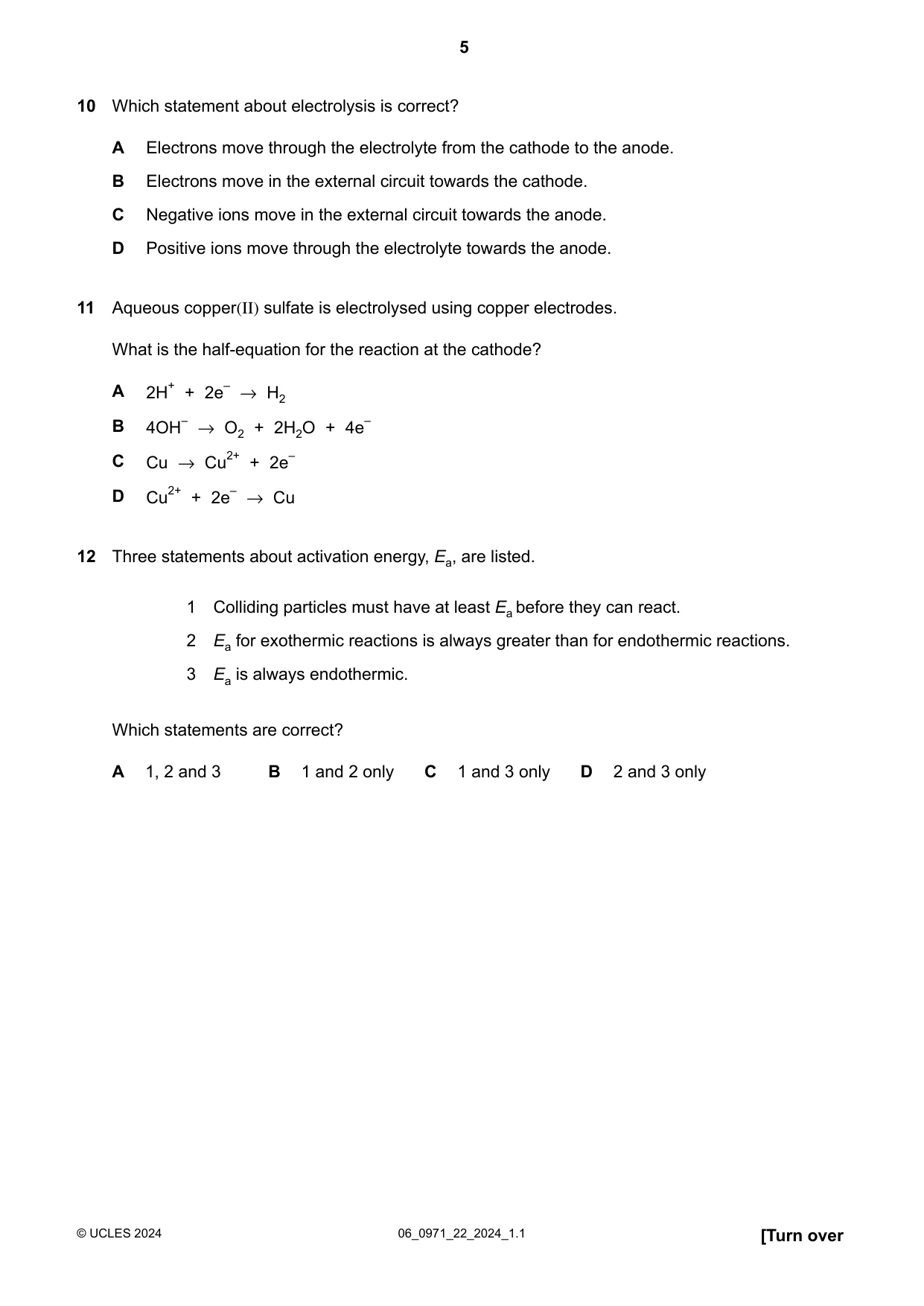
Q10 · Which statement about electrolysis is correct?
10 Which statement about electrolysis is correct? A Electrons move through the electrolyte from the cathode to the anode. B Electrons move in the external circuit towards the cathode. C Negative ions move in the external circuit towards the anode. D Positive ions move through the electrolyte towards the anode.
Mark scheme: B
Q11 · Aqueous copper(II) sulfate is electrolysed using copper electrodes
11 Aqueous copper(II) sulfate is electrolysed using copper electrodes. What is the half-equation for the reaction at the cathode? 2H+ + 2e– →H2 A 4OH– →O2 + 2H2O + 4e– B C Cu →Cu2+ + 2e– Cu2+ + 2e– →Cu D
Mark scheme: D
Q12 · Three statements about activation energy, Ea, are listed
12 Three statements about activation energy, Ea, are listed. 1 Colliding particles must have at least Ea before they can react. 2 Ea for exothermic reactions is always greater than for endothermic reactions. 3 Ea is always endothermic. Which statements are correct? A 1, 2 and 3 B 1 and 2 only C 1 and 3 only D 2 and 3 only A student adds excess magnesium ribbon to 10cm3 of 0.5mol/dm3 sulfuric acid.
Mark scheme: C
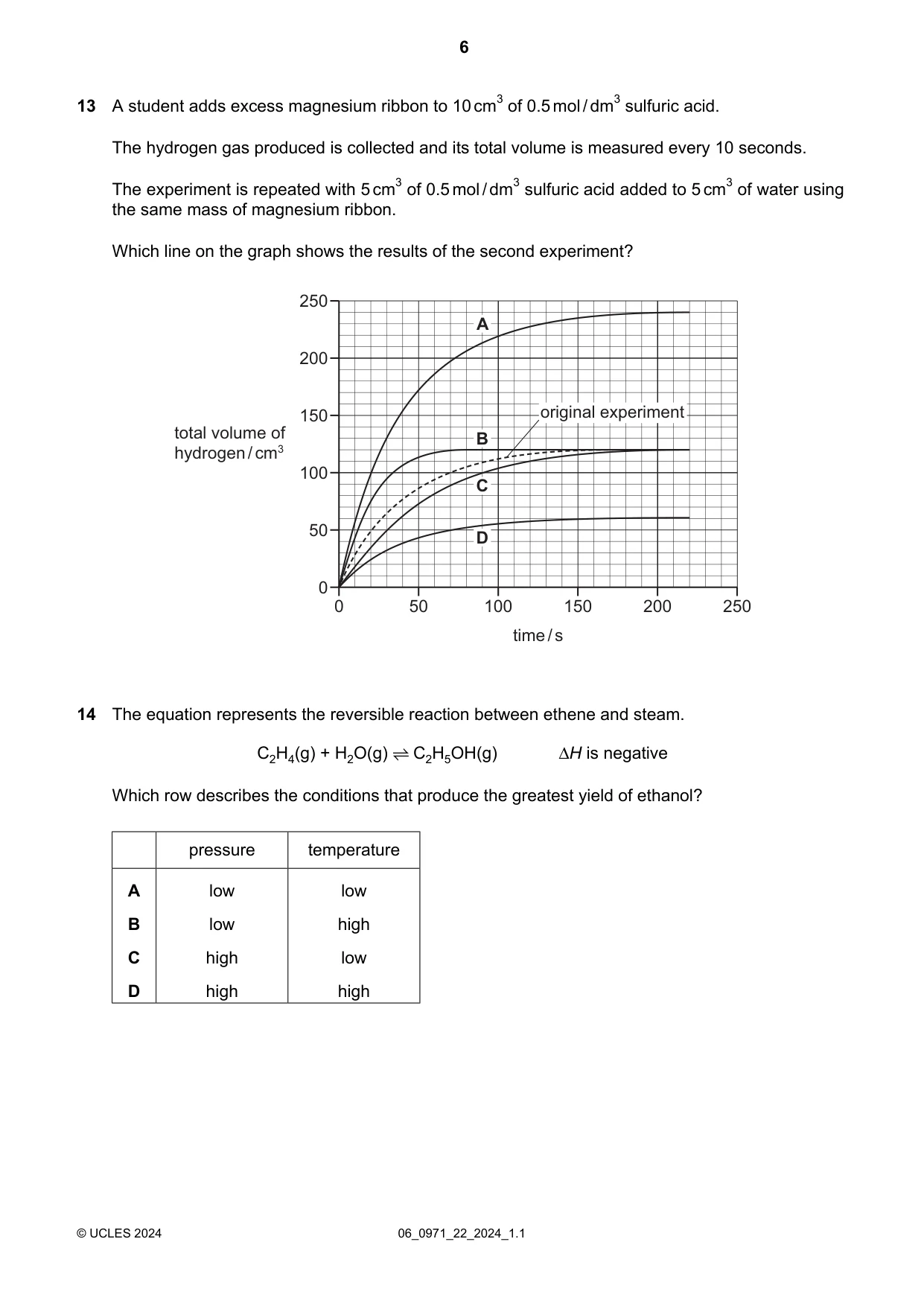
Q13 · The hydrogen gas produced is collected and its total volume is measured every 10 seconds
13 The hydrogen gas produced is collected and its total volume is measured every 10 seconds. The experiment is repeated with 5cm3 of 0.5mol/dm3 sulfuric acid added to 5cm3 of water using the same mass of magnesium ribbon. Which line on the graph shows the results of the second experiment? 250 A 200 150 original experiment total volume of B hydrogen / cm3 100 C 50 D 0 0 50 100 150 200 250 time / s
Mark scheme: D
Q14 · The equation represents the reversible reaction between ethene and steam
14 The equation represents the reversible reaction between ethene and steam. C2H4(g) + H2O(g) ⇌ C2H5OH(g) ∆H is negative Which row describes the conditions that produce the greatest yield of ethanol? pressure temperature A low low B low high C high low D high high
Mark scheme: C
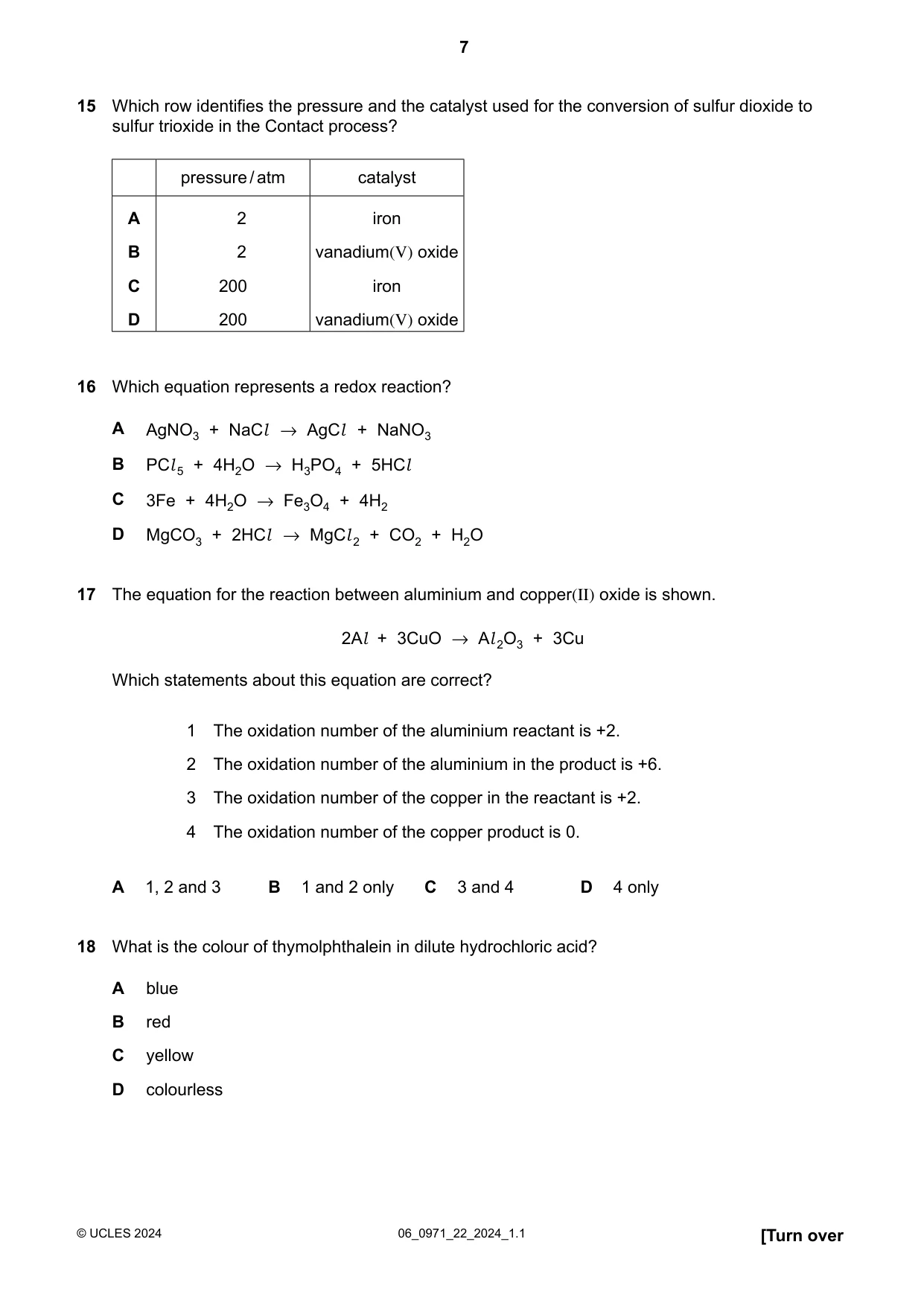
Q15 · Which row identifies the pressure and the catalyst used for the conversion of sulfur…
15 Which row identifies the pressure and the catalyst used for the conversion of sulfur dioxide to sulfur trioxide in the Contact process? pressure/atm catalyst A 2 iron B 2 vanadium(V) oxide C 200 iron D 200 vanadium(V) oxide
Mark scheme: B
Q16 · Which equation represents a redox reaction?
16 Which equation represents a redox reaction? A AgNO3 + NaCl →AgCl + NaNO3 B PCl 5 + 4H2O →H3PO4 + 5HCl C 3Fe + 4H2O →Fe3O4 + 4H2 D MgCO3 + 2HCl →MgCl 2 + CO2 + H2O
Mark scheme: C
Q17 · The equation for the reaction between aluminium and copper(II) oxide is shown
17 The equation for the reaction between aluminium and copper(II) oxide is shown. 2Al + 3CuO →Al 2O3 + 3Cu Which statements about this equation are correct? 1 The oxidation number of the aluminium reactant is +2. 2 The oxidation number of the aluminium in the product is +6. 3 The oxidation number of the copper in the reactant is +2. 4 The oxidation number of the copper product is 0. A 1, 2 and 3 B 1 and 2 only C 3 and 4 D 4 only
Mark scheme: C
Q18 · What is the colour of thymolphthalein in dilute hydrochloric acid?
18 What is the colour of thymolphthalein in dilute hydrochloric acid? A blue B red C yellow D colourless
Mark scheme: D
More questions on The characteristic properties of acids and bases
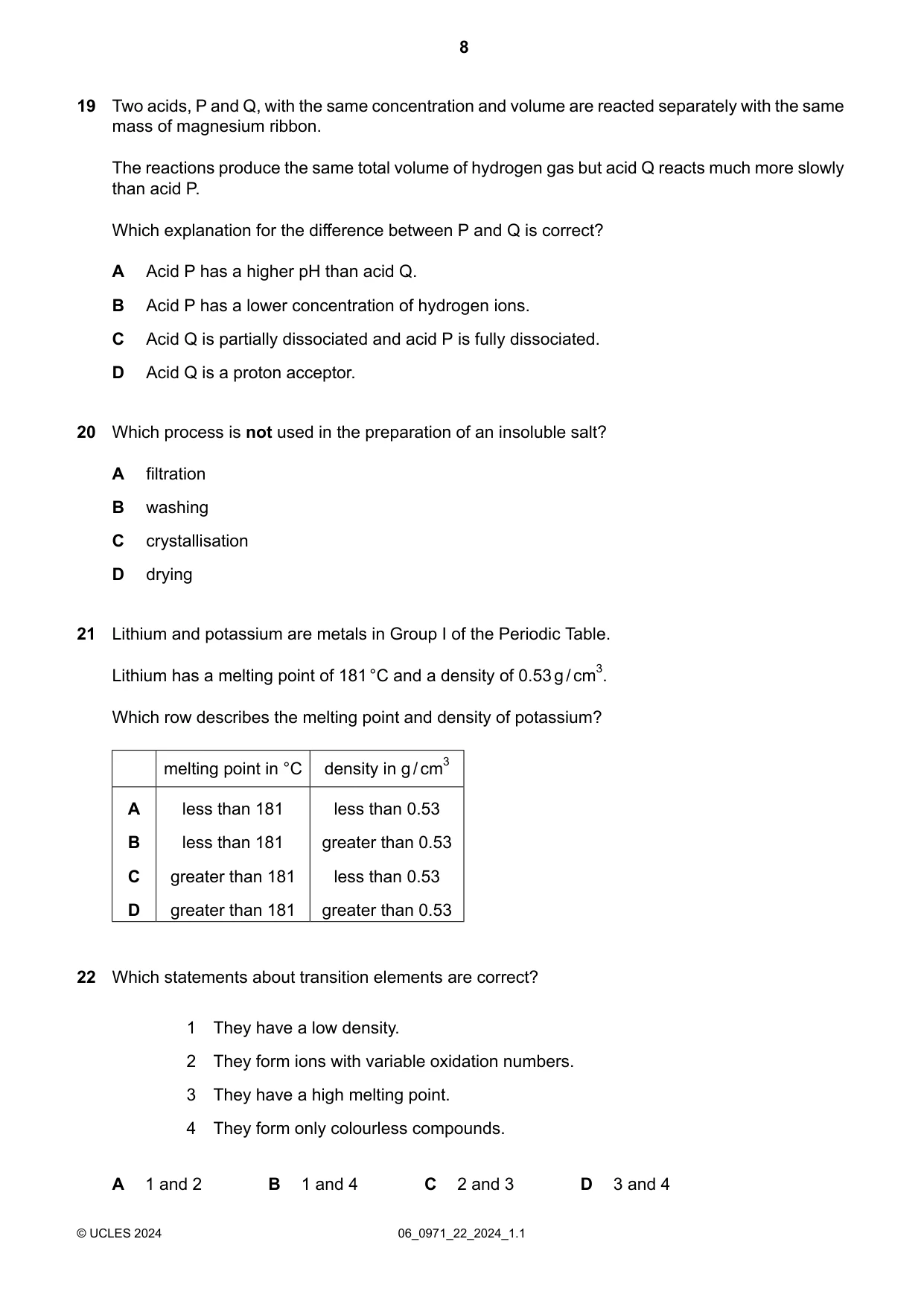
Q19 · Two acids, P and Q, with the same concentration and volume are reacted separately with…
19 Two acids, P and Q, with the same concentration and volume are reacted separately with the same mass of magnesium ribbon. The reactions produce the same total volume of hydrogen gas but acid Q reacts much more slowly than acid P. Which explanation for the difference between P and Q is correct? A Acid P has a higher pH than acid Q. B Acid P has a lower concentration of hydrogen ions. C Acid Q is partially dissociated and acid P is fully dissociated. D Acid Q is a proton acceptor.
Mark scheme: C
More questions on The characteristic properties of acids and bases
Q20 · Which process is not used in the preparation of an insoluble salt?
20 Which process is not used in the preparation of an insoluble salt? A filtration B washing C crystallisation D drying
Mark scheme: C
Q21 · Lithium and potassium are metals in Group I of the Periodic Table
21 Lithium and potassium are metals in Group I of the Periodic Table. Lithium has a melting point of 181°C and a density of 0.53g/cm3. Which row describes the melting point and density of potassium? melting point in °C density in g/cm3 A less than 181 less than 0.53 B less than 181 greater than 0.53 C greater than 181 less than 0.53 D greater than 181 greater than 0.53
Mark scheme: B
Q22 · Which statements about transition elements are correct?
22 Which statements about transition elements are correct? 1 They have a low density. 2 They form ions with variable oxidation numbers. 3 They have a high melting point. 4 They form only colourless compounds. A 1 and 2 B 1 and 4 C 2 and 3 D 3 and 4
Mark scheme: C
Q23 · Which statements describe the elements in Group VIII of the Periodic Table?
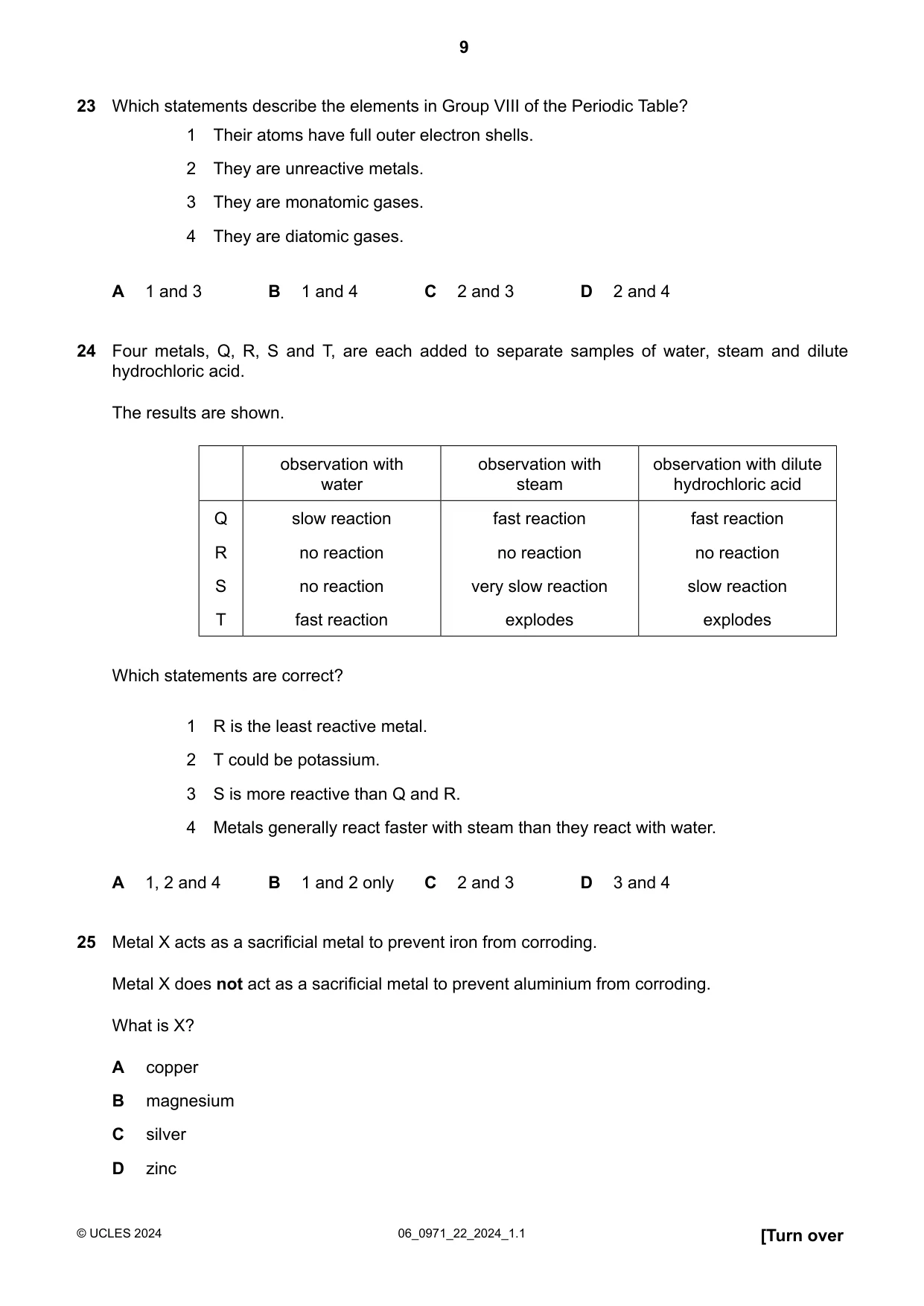
23 Which statements describe the elements in Group VIII of the Periodic Table? 1 Their atoms have full outer electron shells. 2 They are unreactive metals. 3 They are monatomic gases. 4 They are diatomic gases. A 1 and 3 B 1 and 4 C 2 and 3 D 2 and 4
Mark scheme: A
Q24 · Four metals, Q, R, S and T, are each added to separate samples of water, steam and dilute…
24 Four metals, Q, R, S and T, are each added to separate samples of water, steam and dilute hydrochloric acid. The results are shown. observation with observation with observation with dilute water steam hydrochloric acid Q slow reaction fast reaction fast reaction R no reaction no reaction no reaction S no reaction very slow reaction slow reaction T fast reaction explodes explodes Which statements are correct? 1 R is the least reactive metal. 2 T could be potassium. 3 S is more reactive than Q and R. 4 Metals generally react faster with steam than they react with water. A 1, 2 and 4 B 1 and 2 only C 2 and 3 D 3 and 4
Mark scheme: A
Q25 · Metal X acts as a sacrificial metal to prevent iron from corroding
25 Metal X acts as a sacrificial metal to prevent iron from corroding. Metal X does not act as a sacrificial metal to prevent aluminium from corroding. What is X? A copper B magnesium C silver D zinc
Mark scheme: D
Q26 · Which equation represents the reduction of a compound found in hematite in the blast…
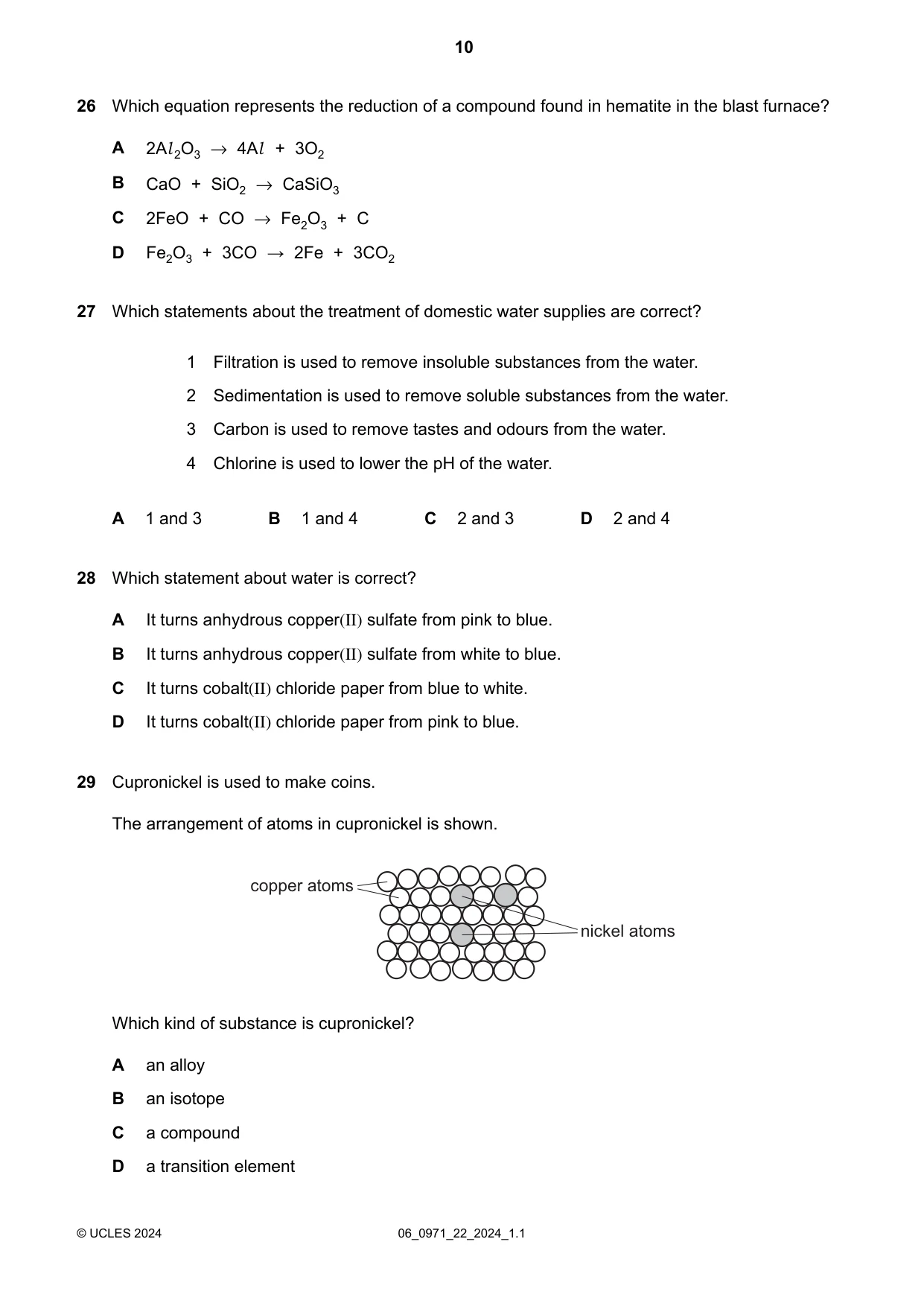
26 Which equation represents the reduction of a compound found in hematite in the blast furnace? A 2Al 2O3 →4Al + 3O2 B CaO + SiO2 →CaSiO3 C 2FeO + CO →Fe2O3 + C D Fe2O3 + 3CO →2Fe + 3CO2
Mark scheme: D
Q27 · Which statements about the treatment of domestic water supplies are correct?
27 Which statements about the treatment of domestic water supplies are correct? 1 Filtration is used to remove insoluble substances from the water. 2 Sedimentation is used to remove soluble substances from the water. 3 Carbon is used to remove tastes and odours from the water. 4 Chlorine is used to lower the pH of the water. A 1 and 3 B 1 and 4 C 2 and 3 D 2 and 4
Mark scheme: A
Q28 · Which statement about water is correct?
28 Which statement about water is correct? A It turns anhydrous copper(II) sulfate from pink to blue. B It turns anhydrous copper(II) sulfate from white to blue. C It turns cobalt(II) chloride paper from blue to white. D It turns cobalt(II) chloride paper from pink to blue.
Mark scheme: B
Q29 · Cupronickel is used to make coins
29 Cupronickel is used to make coins. The arrangement of atoms in cupronickel is shown. copper atoms nickel atoms Which kind of substance is cupronickel? A an alloy B an isotope C a compound D a transition element
Mark scheme: A
Q30 · Which physical properties are typical of all metals?
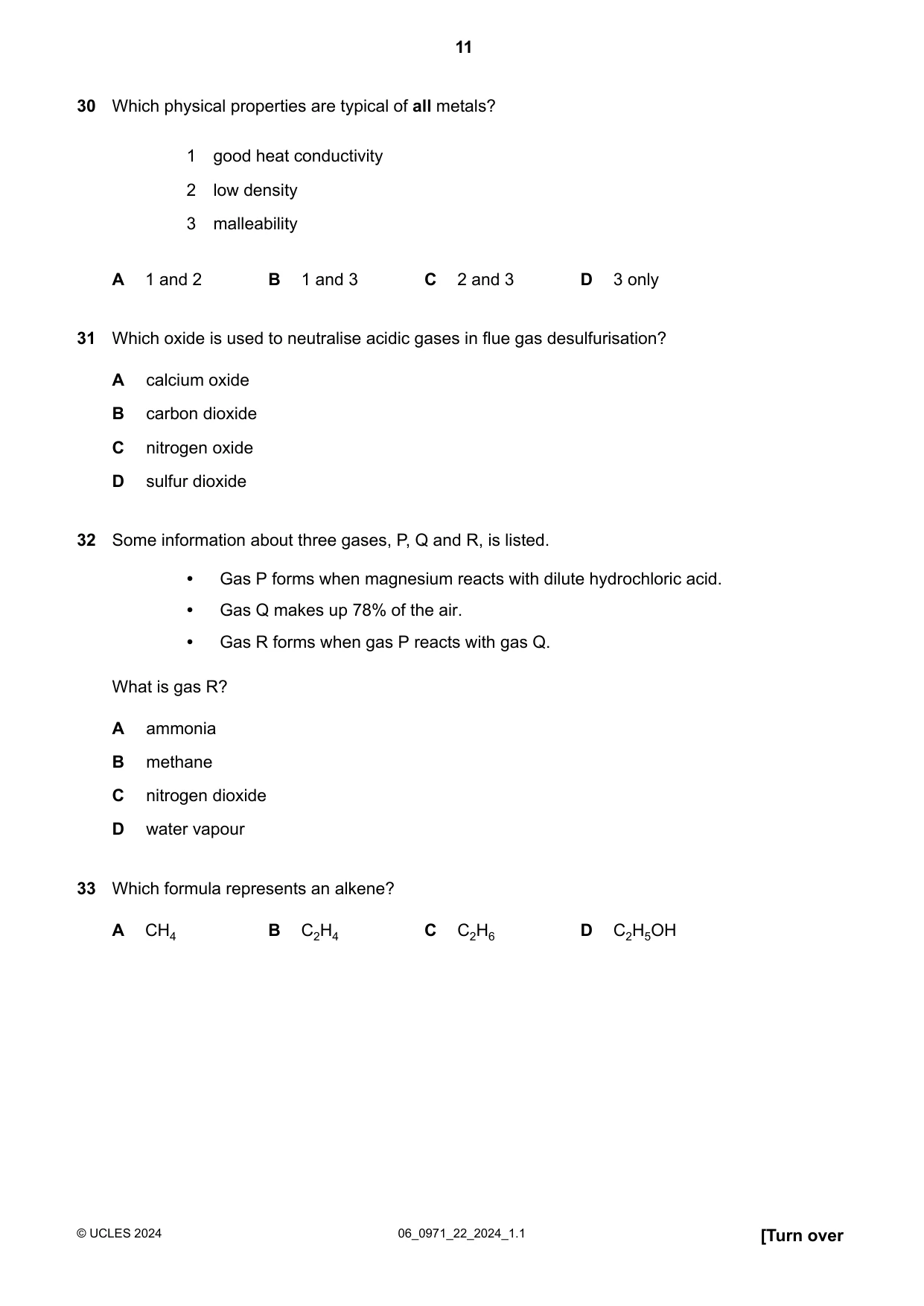
30 Which physical properties are typical of all metals? 1 good heat conductivity 2 low density 3 malleability A 1 and 2 B 1 and 3 C 2 and 3 D 3 only
Mark scheme: B
Q31 · Which oxide is used to neutralise acidic gases in flue gas desulfurisation?
31 Which oxide is used to neutralise acidic gases in flue gas desulfurisation? A calcium oxide B carbon dioxide C nitrogen oxide D sulfur dioxide
Mark scheme: A
Q32 · Some information about three gases, P, Q and R, is listed
32 Some information about three gases, P, Q and R, is listed. • Gas P forms when magnesium reacts with dilute hydrochloric acid. • Gas Q makes up 78% of the air. • Gas R forms when gas P reacts with gas Q. What is gas R? A ammonia B methane C nitrogen dioxide D water vapour
Mark scheme: A
Q33 · Which formula represents an alkene?
33 Which formula represents an alkene? A CH4 B C2H4 C C2H6 D C2H5OH
Mark scheme: B
Q34 · The structures of two compounds used to make an ester are shown
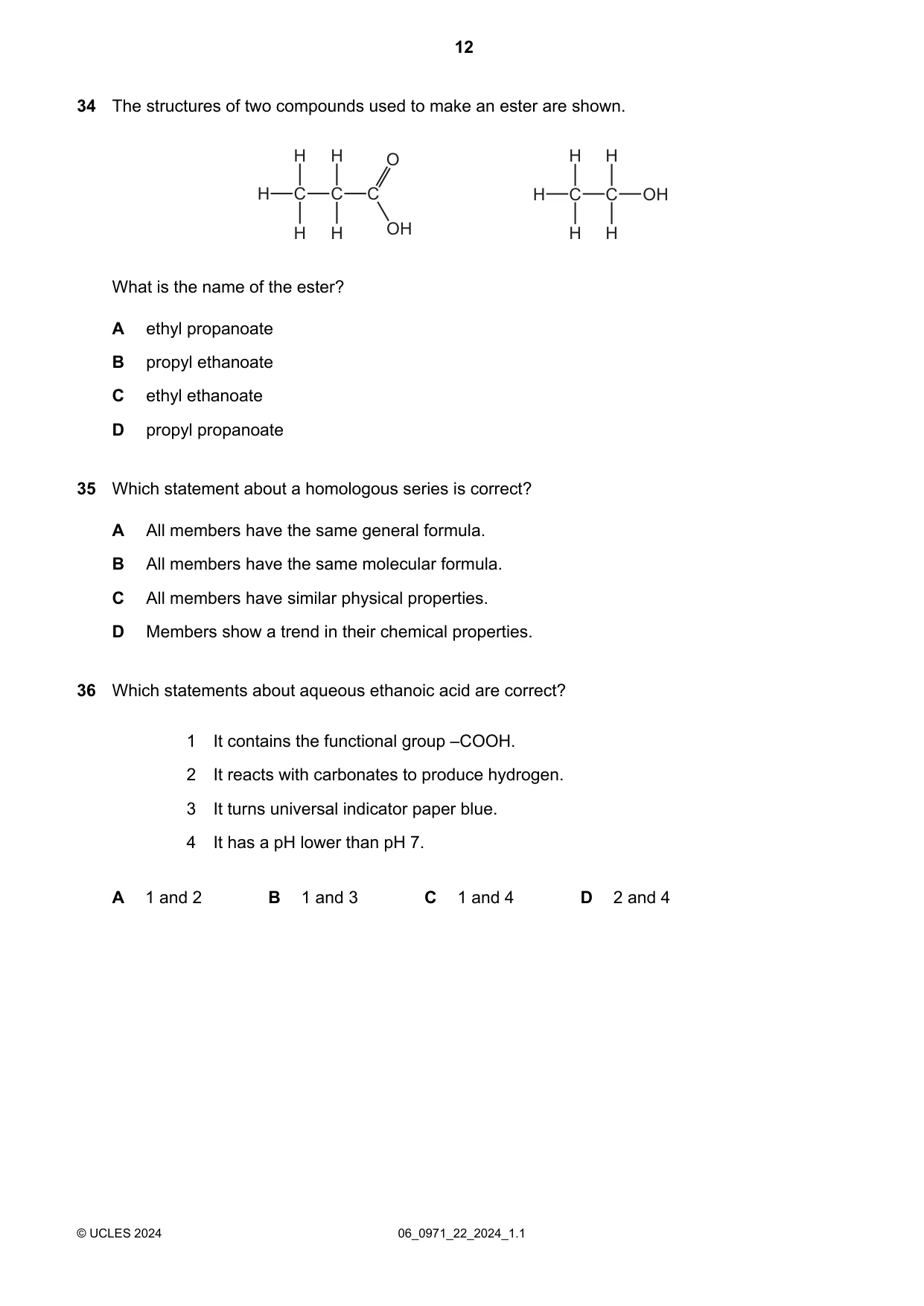
34 The structures of two compounds used to make an ester are shown. H H O H H H C C C H C C OH H H OH H H What is the name of the ester? A ethyl propanoate B propyl ethanoate C ethyl ethanoate D propyl propanoate
Mark scheme: A
Q35 · Which statement about a homologous series is correct?
35 Which statement about a homologous series is correct? A All members have the same general formula. B All members have the same molecular formula. C All members have similar physical properties. D Members show a trend in their chemical properties.
Mark scheme: A
More questions on Formulae, functional groups and terminology
Q36 · Which statements about aqueous ethanoic acid are correct?
36 Which statements about aqueous ethanoic acid are correct? 1 It contains the functional group –COOH. 2 It reacts with carbonates to produce hydrogen. 3 It turns universal indicator paper blue. 4 It has a pH lower than pH 7. A 1 and 2 B 1 and 3 C 1 and 4 D 2 and 4
Mark scheme: C
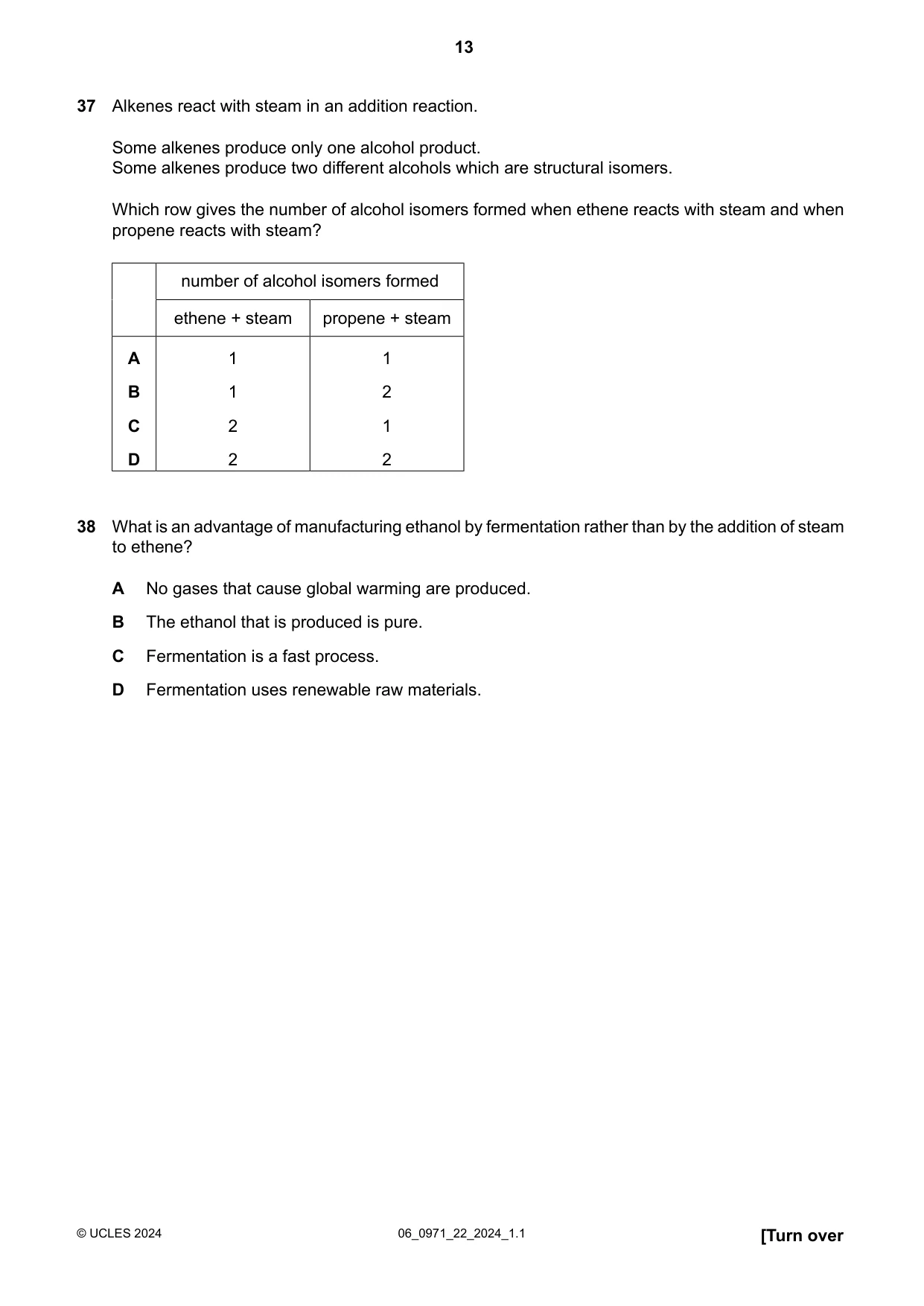
Q37 · Alkenes react with steam in an addition reaction
37 Alkenes react with steam in an addition reaction. Some alkenes produce only one alcohol product. Some alkenes produce two different alcohols which are structural isomers. Which row gives the number of alcohol isomers formed when ethene reacts with steam and when propene reacts with steam? number of alcohol isomers formed ethene + steam propene + steam A 1 1 B 1 2 C 2 1 D 2 2
Mark scheme: B
Q38 · What is an advantage of manufacturing ethanol by fermentation rather than by the addition…
38 What is an advantage of manufacturing ethanol by fermentation rather than by the addition of steam to ethene? A No gases that cause global warming are produced. B The ethanol that is produced is pure. C Fermentation is a fast process. D Fermentation uses renewable raw materials.
Mark scheme: D
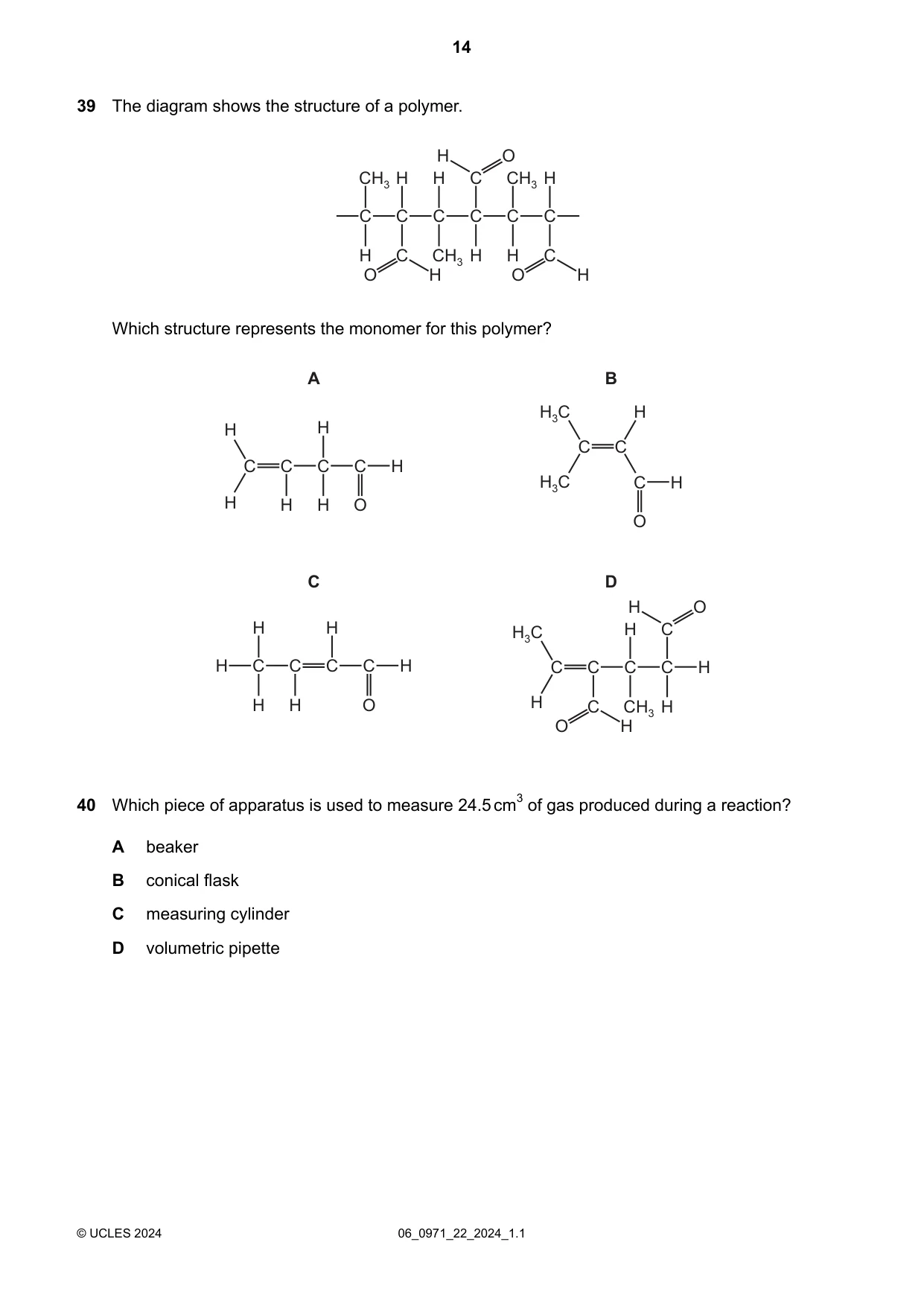
Q39 · The diagram shows the structure of a polymer
39 The diagram shows the structure of a polymer. H O CH3 H H C CH3 H C C C C C C H C CH3 H H C O H O H Which structure represents the monomer for this polymer? A B H3C H H H C C C C C C H H3C C H H H H O O C D H O H H H3C H C H C C C C H C C C C H H H O H C CH3 H O H Which piece of apparatus is used to measure 24.5cm3 of gas produced during a reaction?
Mark scheme: C
Q40 · A beaker B conical flask C measuring cylinder D volumetric pipette
40 A beaker B conical flask C measuring cylinder D volumetric pipette
Mark scheme: C
What was in this paper
The subtopics covered by these 40 questions, and how many questions each got. Open one in a new tab to see every Cambridge question on it.
2Alkenes2Carboxylic acids2Electrolysis2Formulae2Redox2Reversible reactions and equilibrium2The characteristic properties of acids and bases2Water2Acid–base titrations1Alcohols1Alloys and their properties1Arrangement of elements1Corrosion of metals1Diffusion1Exothermic and endothermic reactions1Experimental design1Extraction of metals1Formulae, functional groups and terminology1Giant covalent structures1Group I properties1Identification of ions and gases1Isotopes1Noble gases1Polymers1Preparation of salts1Properties of metals1Rate of reaction1Reactivity series1Simple molecules and covalent bonds1Transition elements1What you needed in this session
Cambridge’s own grade thresholds for 2024 May/June, Paper 2 · Variant 2. A higher threshold means an easier paper — the bar moves with how the cohort did.