Cambridge IGCSE Chemistry (9-1) 0971 — 2020 May/June Paper 2 · Variant 2
0971/22/M/J/20 · 40 questions · 40 marks · ≈45 min
The question paper and its mark scheme, free to read here and free to download. This is Cambridge’s own paper, exactly as it was sat.
Question paper16 pages

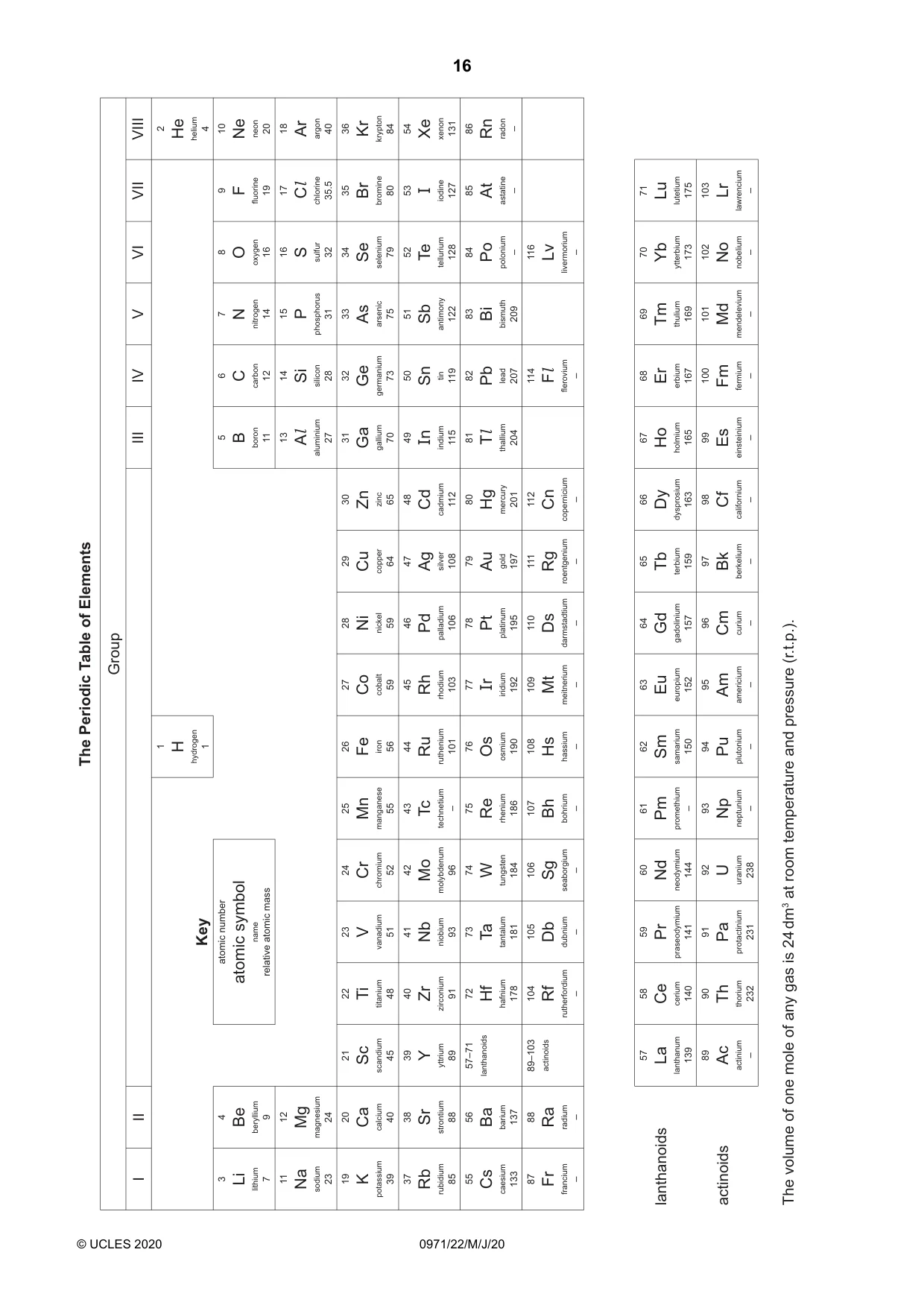
Mark scheme3 pages
Answers below. Sit the paper first if you are practising.
Questions as text
Q1 · A mixture of ice and water is left to stand and the ice melts
1 A mixture of ice and water is left to stand and the ice melts. Which row describes what happens as the ice is melting? temperature of mixture energy changes A increases average kinetic energy of particles increases B increases energy is used to overcome attractive forces C stays the same average kinetic energy of particles increases D stays the same energy is used to overcome attractive forces
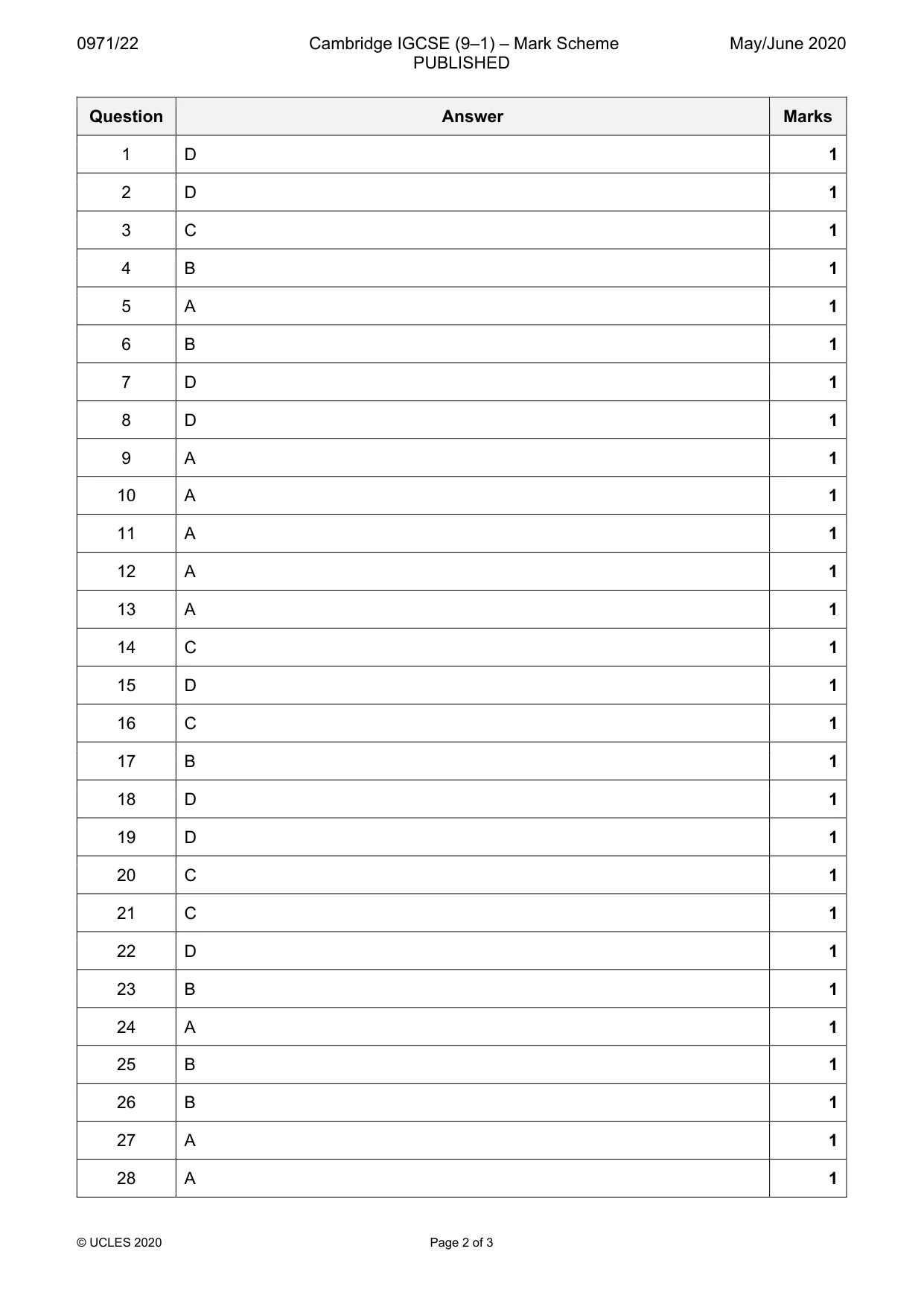
Mark scheme: D
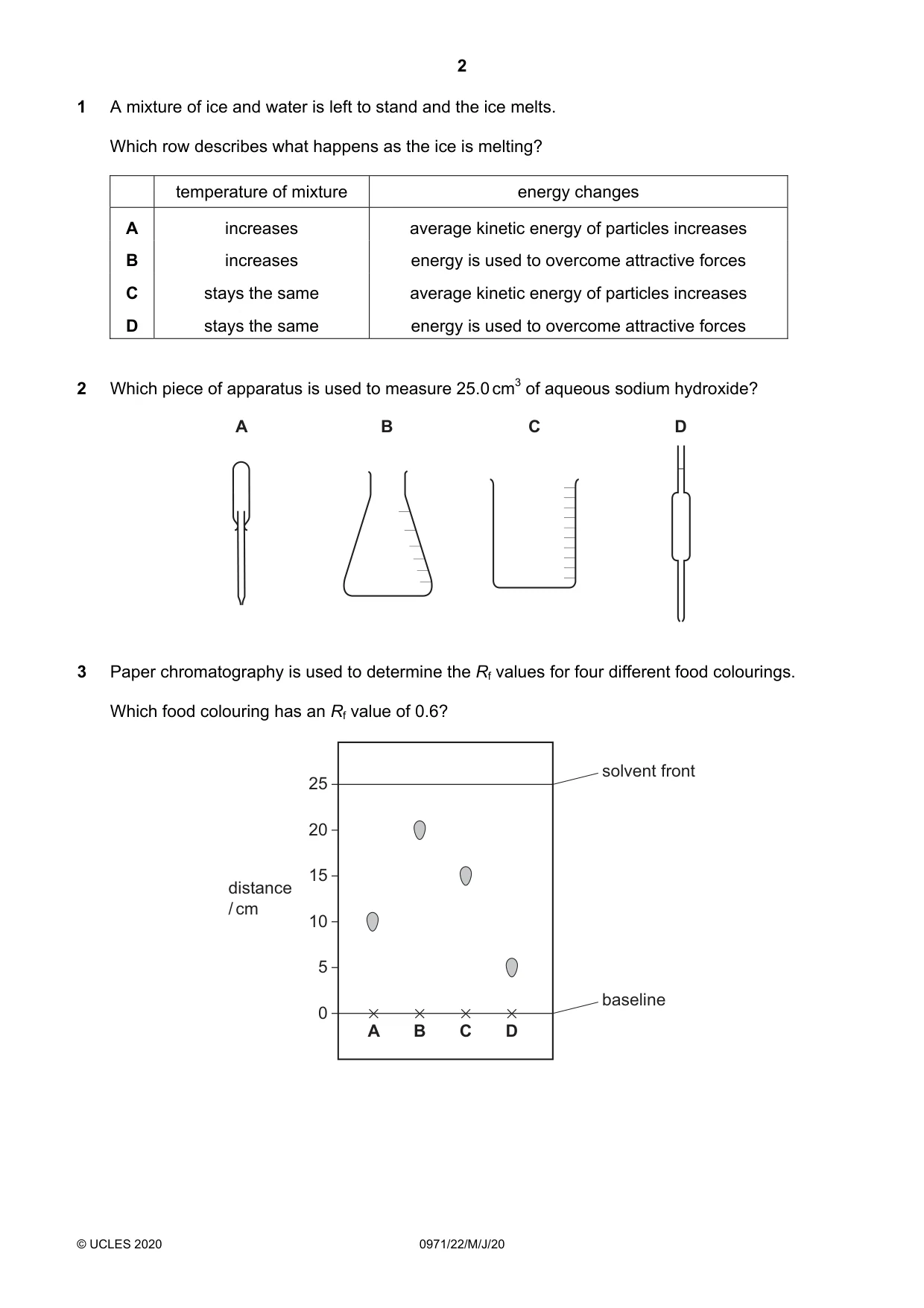
Q2 · Which piece of apparatus is used to measure 25.0 cm3 of aqueous sodium hydroxide?
2 Which piece of apparatus is used to measure 25.0 cm3 of aqueous sodium hydroxide? A B C D
Mark scheme: D
Q3 · Paper chromatography is used to determine the Rf values for four different food colourings
3 Paper chromatography is used to determine the Rf values for four different food colourings. Which food colouring has an Rf value of 0.6? solvent front 25 20 15 distance / cm 10 5 baseline 0 A B C D
Mark scheme: C
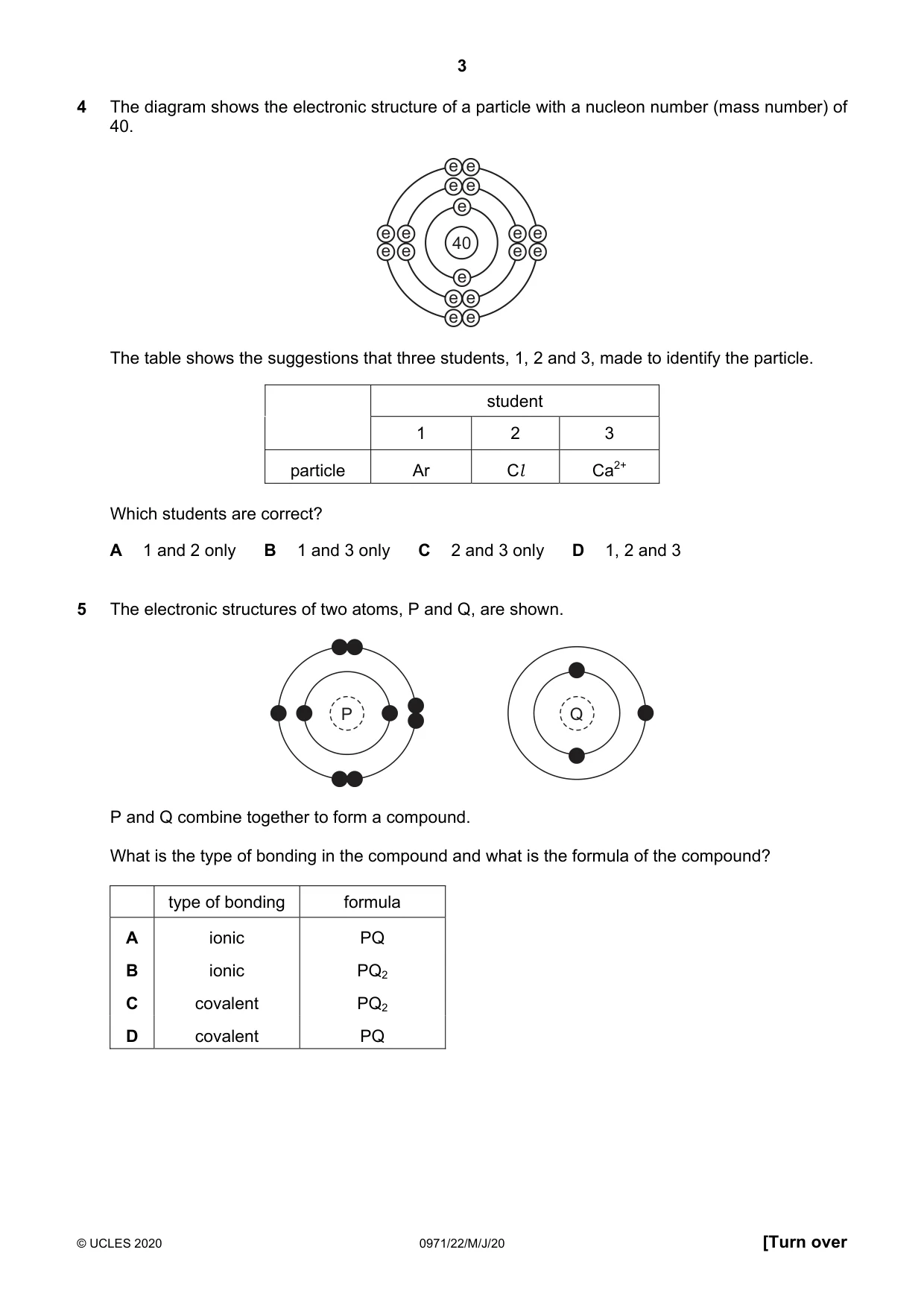
Q4 · The diagram shows the electronic structure of a particle with a nucleon number (mass…
4 The diagram shows the electronic structure of a particle with a nucleon number (mass number) of 40. e e e e e e e e e e e 40 e e e e e e e The table shows the suggestions that three students, 1, 2 and 3, made to identify the particle. student 1 2 3 particle Ar Cl Ca2+ Which students are correct? A 1 and 2 only B 1 and 3 only C 2 and 3 only D 1, 2 and 3
Mark scheme: B
Q5 · The electronic structures of two atoms, P and Q, are shown
5 The electronic structures of two atoms, P and Q, are shown. P Q P and Q combine together to form a compound. What is the type of bonding in the compound and what is the formula of the compound? type of bonding formula A ionic PQ B ionic PQ2 C covalent PQ2 D covalent PQ
Mark scheme: A
Q6 · Which statement about the structure of a metal explains why metals are malleable?
6 Which statement about the structure of a metal explains why metals are malleable? A The electrons can move freely throughout the lattice. B The layers of metal ions can slide over each other. C The metal ions are positively charged. D There is a strong force of attraction between the metal ions and the electrons.
Mark scheme: B
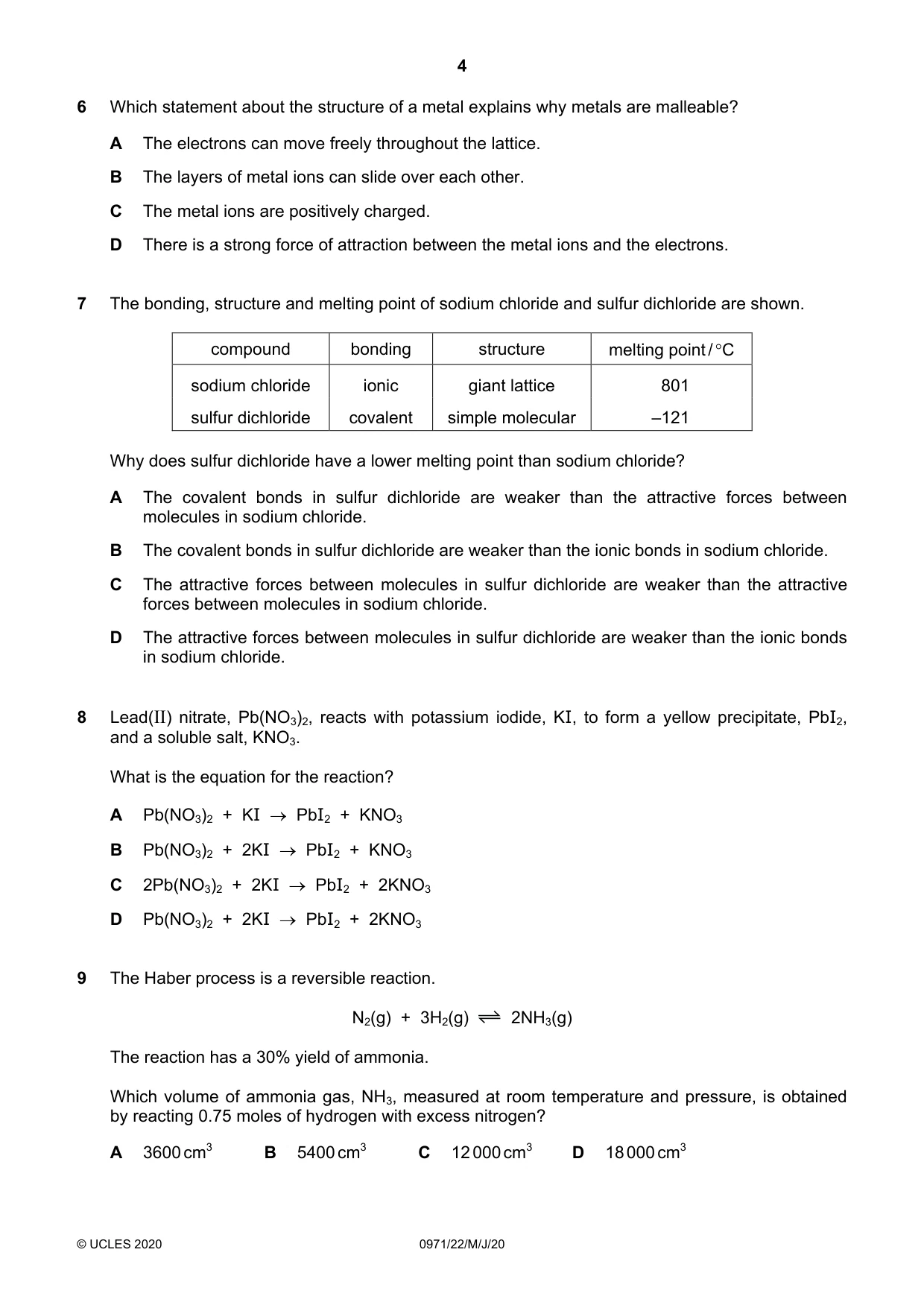
Q7 · The bonding, structure and melting point of sodium chloride and sulfur dichloride are…
7 The bonding, structure and melting point of sodium chloride and sulfur dichloride are shown. compound bonding structure melting point / °C sodium chloride ionic giant lattice 801 sulfur dichloride covalent simple molecular –121 Why does sulfur dichloride have a lower melting point than sodium chloride? A The covalent bonds in sulfur dichloride are weaker than the attractive forces between molecules in sodium chloride. B The covalent bonds in sulfur dichloride are weaker than the ionic bonds in sodium chloride. C The attractive forces between molecules in sulfur dichloride are weaker than the attractive forces between molecules in sodium chloride. D The attractive forces between molecules in sulfur dichloride are weaker than the ionic bonds in sodium chloride.
Mark scheme: D
Q8 · Lead(II) nitrate, Pb(NO3)2, reacts with potassium iodide, KI, to form a yellow…
8 Lead(II) nitrate, Pb(NO3)2, reacts with potassium iodide, KI, to form a yellow precipitate, PbI2, and a soluble salt, KNO3. What is the equation for the reaction? A Pb(NO3)2 + KI → PbI2 + KNO3 B Pb(NO3)2 + 2KI → PbI2 + KNO3 C 2Pb(NO3)2 + 2KI → PbI2 + 2KNO3 D Pb(NO3)2 + 2KI → PbI2 + 2KNO3
Mark scheme: D
Q9 · The Haber process is a reversible reaction
9 The Haber process is a reversible reaction. N2(g) + 3H2(g) 2NH3(g) The reaction has a 30% yield of ammonia. Which volume of ammonia gas, NH3, measured at room temperature and pressure, is obtained by reacting 0.75 moles of hydrogen with excess nitrogen? A 3600 cm3 B 5400 cm3 C 12 000 cm3 D 18 000 cm3
Mark scheme: A
Q10 · Electrolytes can be broken down by electrolysis
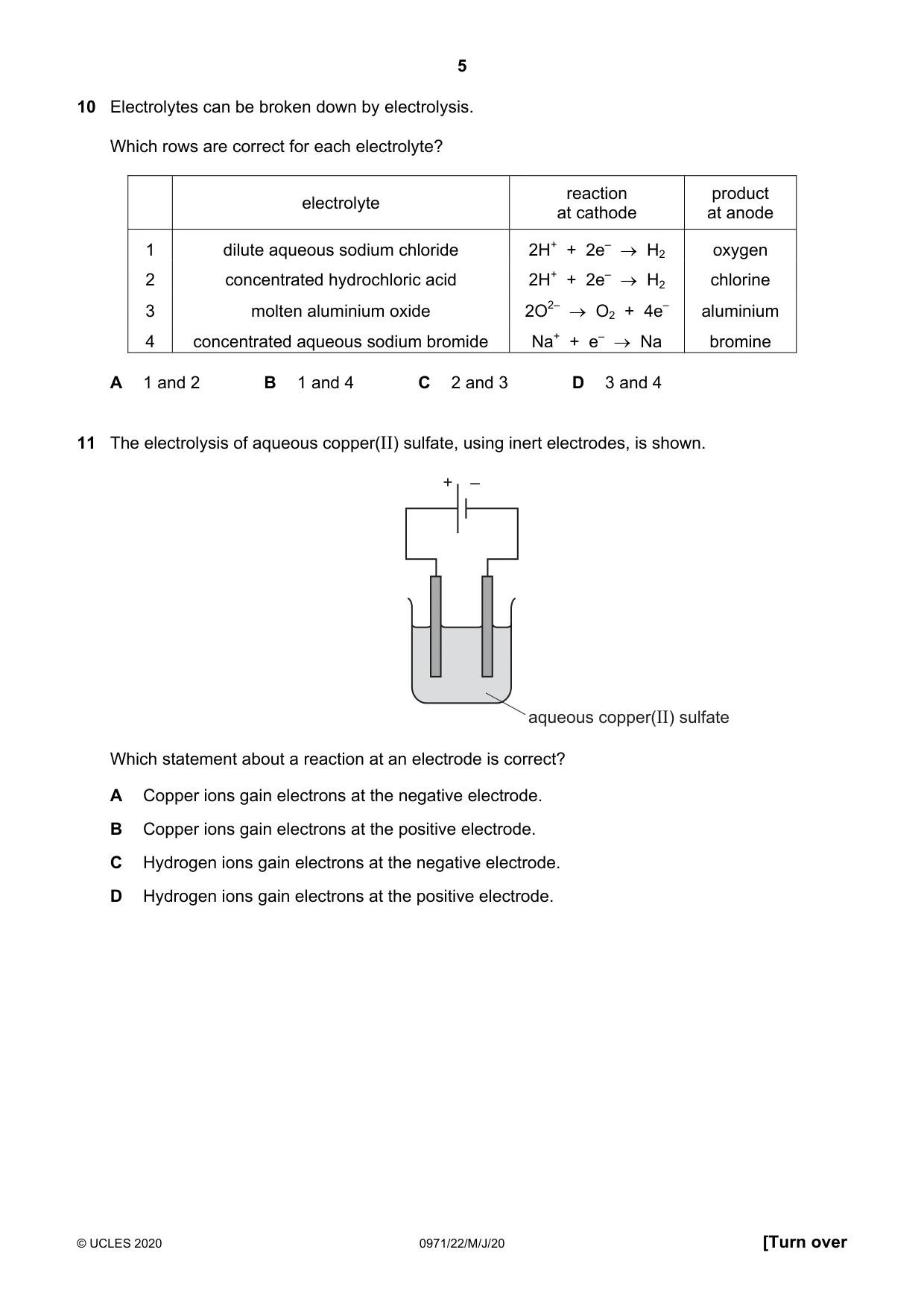
10 Electrolytes can be broken down by electrolysis. Which rows are correct for each electrolyte? reaction product electrolyte at cathode at anode 1 dilute aqueous sodium chloride 2H+ + 2e– → H2 oxygen 2 concentrated hydrochloric acid 2H+ + 2e– → H2 chlorine 3 molten aluminium oxide 2O2– → O2 + 4e– aluminium 4 concentrated aqueous sodium bromide Na+ + e– → Na bromine A 1 and 2 B 1 and 4 C 2 and 3 D 3 and 4
Mark scheme: A
Q11 · The electrolysis of aqueous copper(II) sulfate, using inert electrodes, is shown
11 The electrolysis of aqueous copper(II) sulfate, using inert electrodes, is shown. + – aqueous copper(II) sulfate Which statement about a reaction at an electrode is correct? A Copper ions gain electrons at the negative electrode. B Copper ions gain electrons at the positive electrode. C Hydrogen ions gain electrons at the negative electrode. D Hydrogen ions gain electrons at the positive electrode.
Mark scheme: A
Q12 · Methane burns in excess oxygen
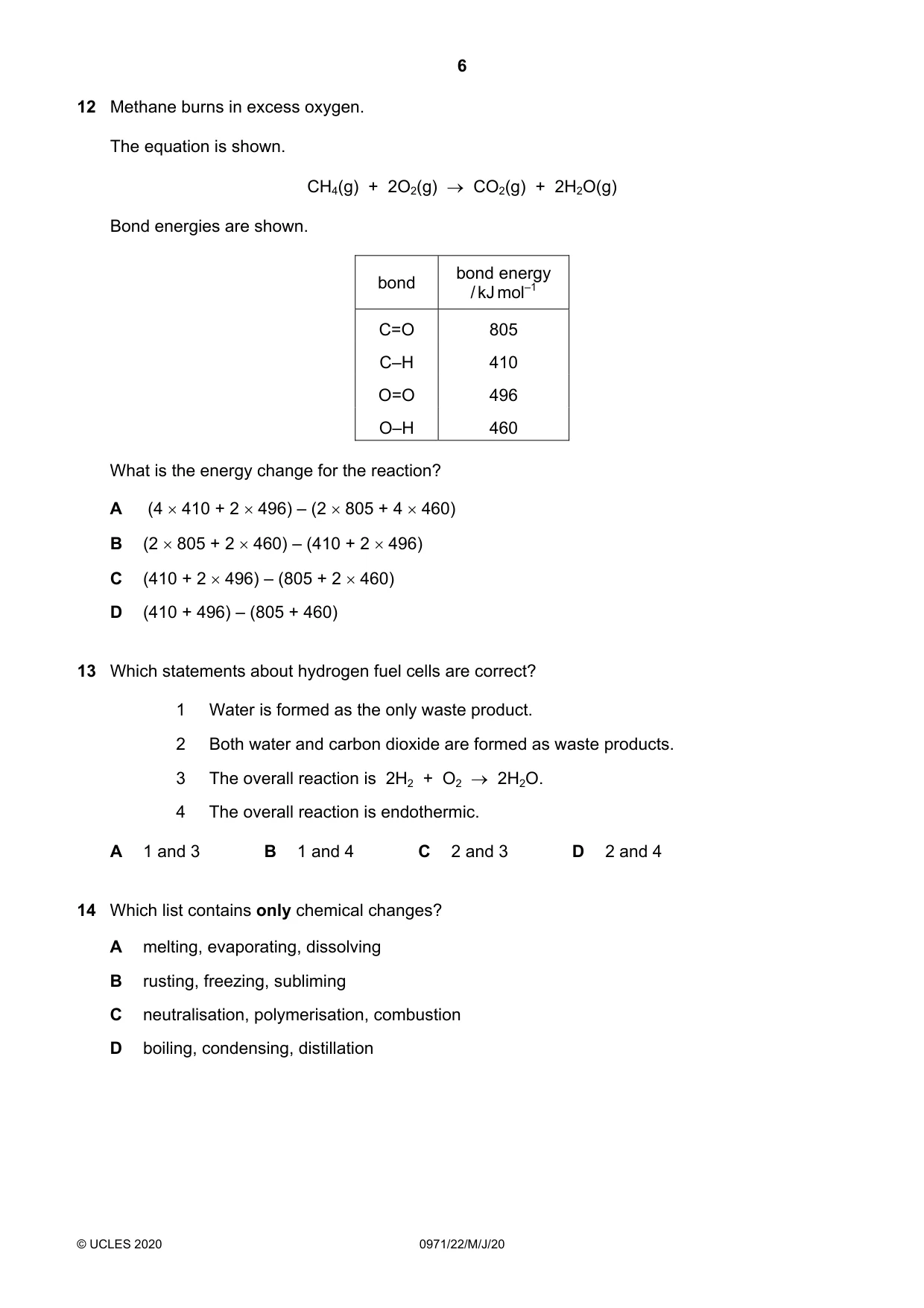
12 Methane burns in excess oxygen. The equation is shown. CH4(g) + 2O2(g) → CO2(g) + 2H2O(g) Bond energies are shown. bond energy bond / kJ mol–1 C=O 805 C–H 410 O=O 496 O–H 460 What is the energy change for the reaction? A (4 × 410 + 2 × 496) – (2 × 805 + 4 × 460) B (2 × 805 + 2 × 460) – (410 + 2 × 496) C (410 + 2 × 496) – (805 + 2 × 460) D (410 + 496) – (805 + 460)
Mark scheme: A
Q13 · Which statements about hydrogen fuel cells are correct?
13 Which statements about hydrogen fuel cells are correct? 1 Water is formed as the only waste product. 2 Both water and carbon dioxide are formed as waste products. 3 The overall reaction is 2H2 + O2 → 2H2O. 4 The overall reaction is endothermic. A 1 and 3 B 1 and 4 C 2 and 3 D 2 and 4
Mark scheme: A
Q14 · Which list contains only chemical changes?
14 Which list contains only chemical changes? A melting, evaporating, dissolving B rusting, freezing, subliming C neutralisation, polymerisation, combustion D boiling, condensing, distillation
Mark scheme: C
Q15 · The results of adding excess marble chips (calcium carbonate) to hydrochloric acid at 50…
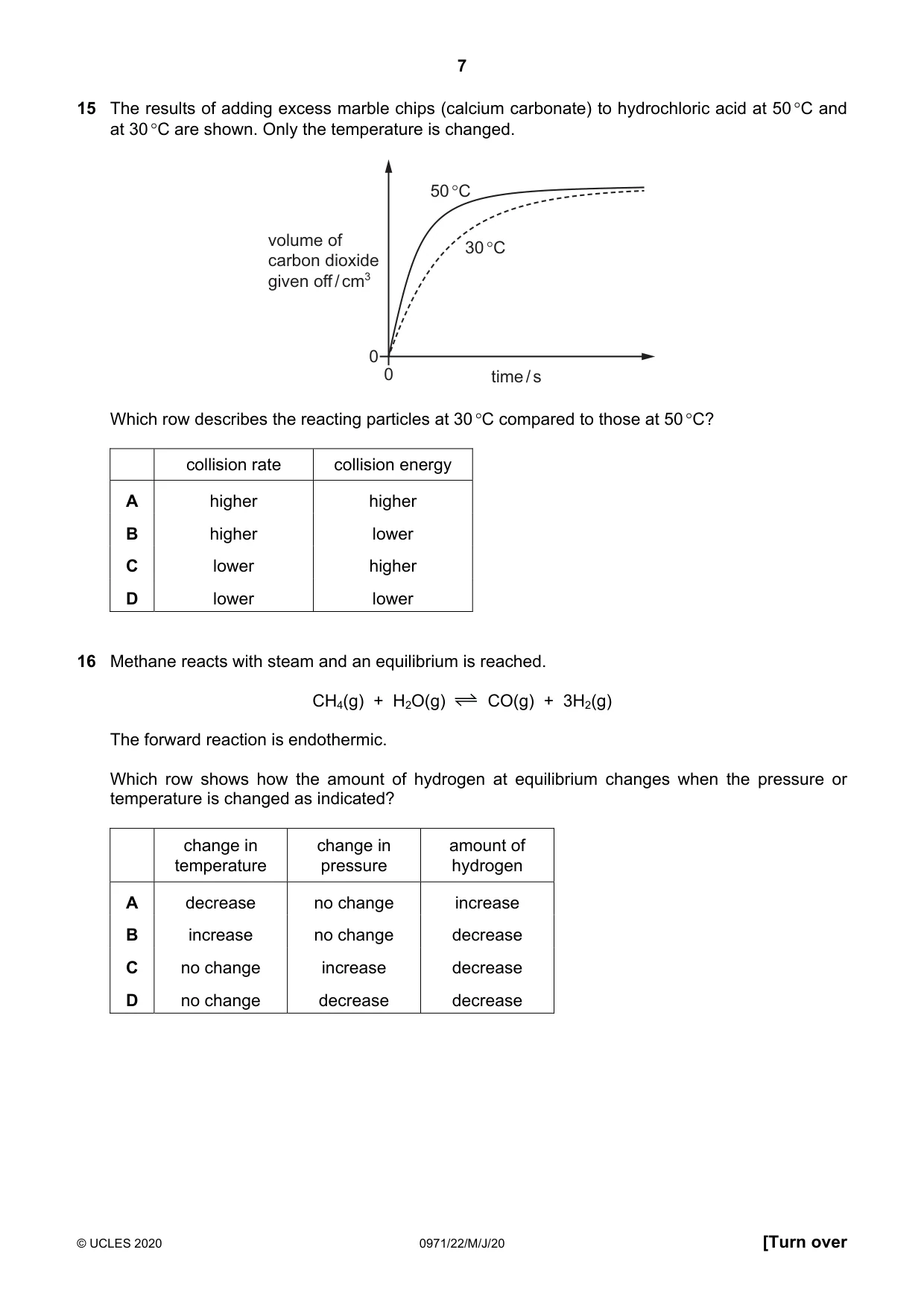
15 The results of adding excess marble chips (calcium carbonate) to hydrochloric acid at 50 °C and at 30 °C are shown. Only the temperature is changed. 50 °C volume of 30 °C carbon dioxide given off / cm3 0 0 time / s Which row describes the reacting particles at 30 °C compared to those at 50 °C? collision rate collision energy A higher higher B higher lower C lower higher D lower lower
Mark scheme: D
Q16 · Methane reacts with steam and an equilibrium is reached
16 Methane reacts with steam and an equilibrium is reached. CH4(g) + H2O(g) CO(g) + 3H2(g) The forward reaction is endothermic. Which row shows how the amount of hydrogen at equilibrium changes when the pressure or temperature is changed as indicated? change in change in amount of temperature pressure hydrogen A decrease no change increase B increase no change decrease C no change increase decrease D no change decrease decrease
Mark scheme: C
Q17 · When aqueous iron(III) chloride is added to aqueous potassium iodide a chemical reaction…
17 When aqueous iron(III) chloride is added to aqueous potassium iodide a chemical reaction occurs and iodine is formed. Which statement is correct? A Iodide ions are oxidised, they gain electrons in this reaction. B Iodide ions are oxidised, they lose electrons in this reaction. C Iron(III) chloride is oxidised in this reaction. D Neither iodide ions nor iron(III) chloride is oxidised in this reaction.
Mark scheme: B
Q18 · The graph shows how the pH of a solution changes as an acid is added to an alkali
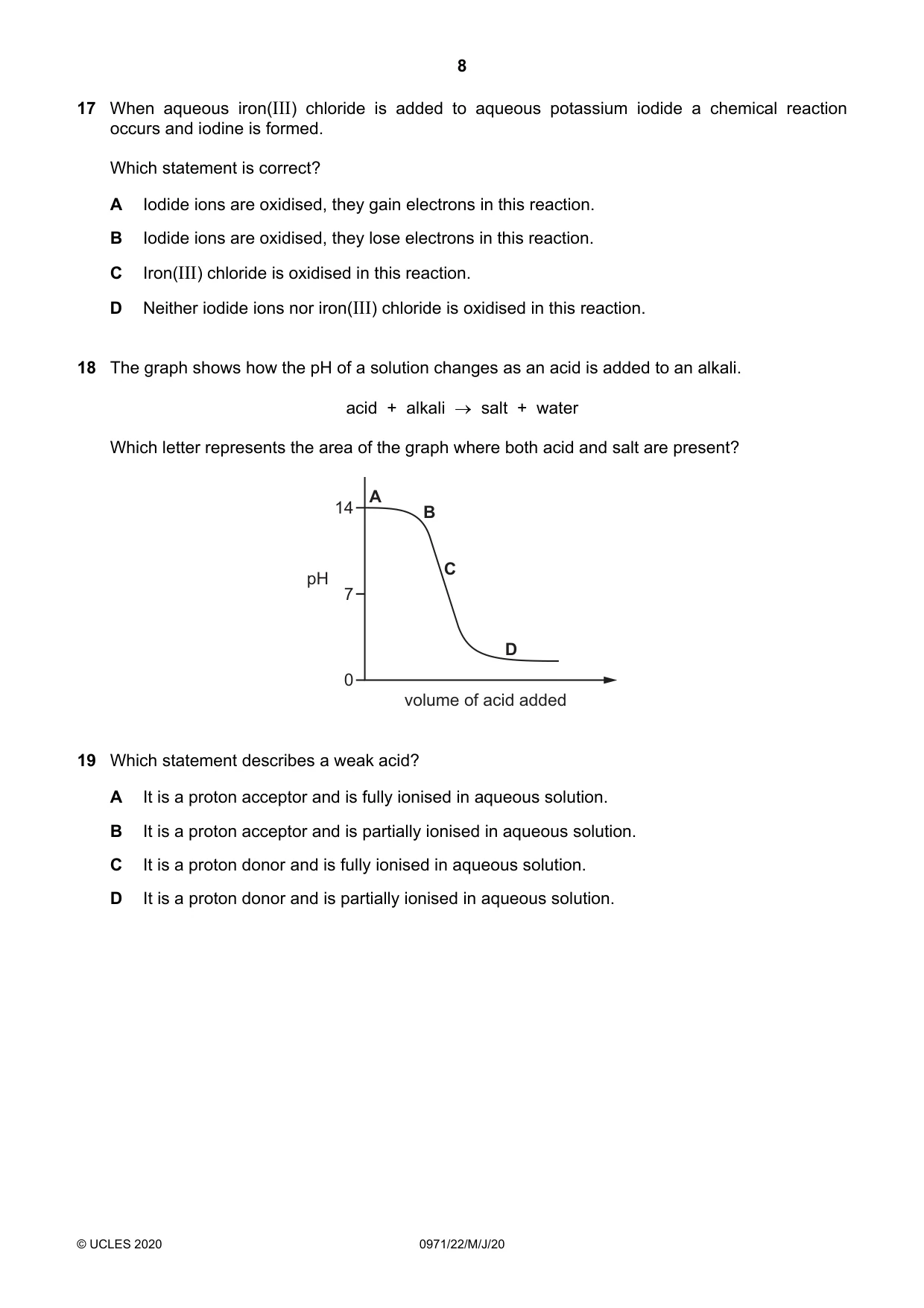
18 The graph shows how the pH of a solution changes as an acid is added to an alkali. acid + alkali → salt + water Which letter represents the area of the graph where both acid and salt are present? A 14 B C pH 7 D 0 volume of acid added
Mark scheme: D
More questions on The characteristic properties of acids and bases
Q19 · Which statement describes a weak acid?
19 Which statement describes a weak acid? A It is a proton acceptor and is fully ionised in aqueous solution. B It is a proton acceptor and is partially ionised in aqueous solution. C It is a proton donor and is fully ionised in aqueous solution. D It is a proton donor and is partially ionised in aqueous solution.
Mark scheme: D
More questions on The characteristic properties of acids and bases
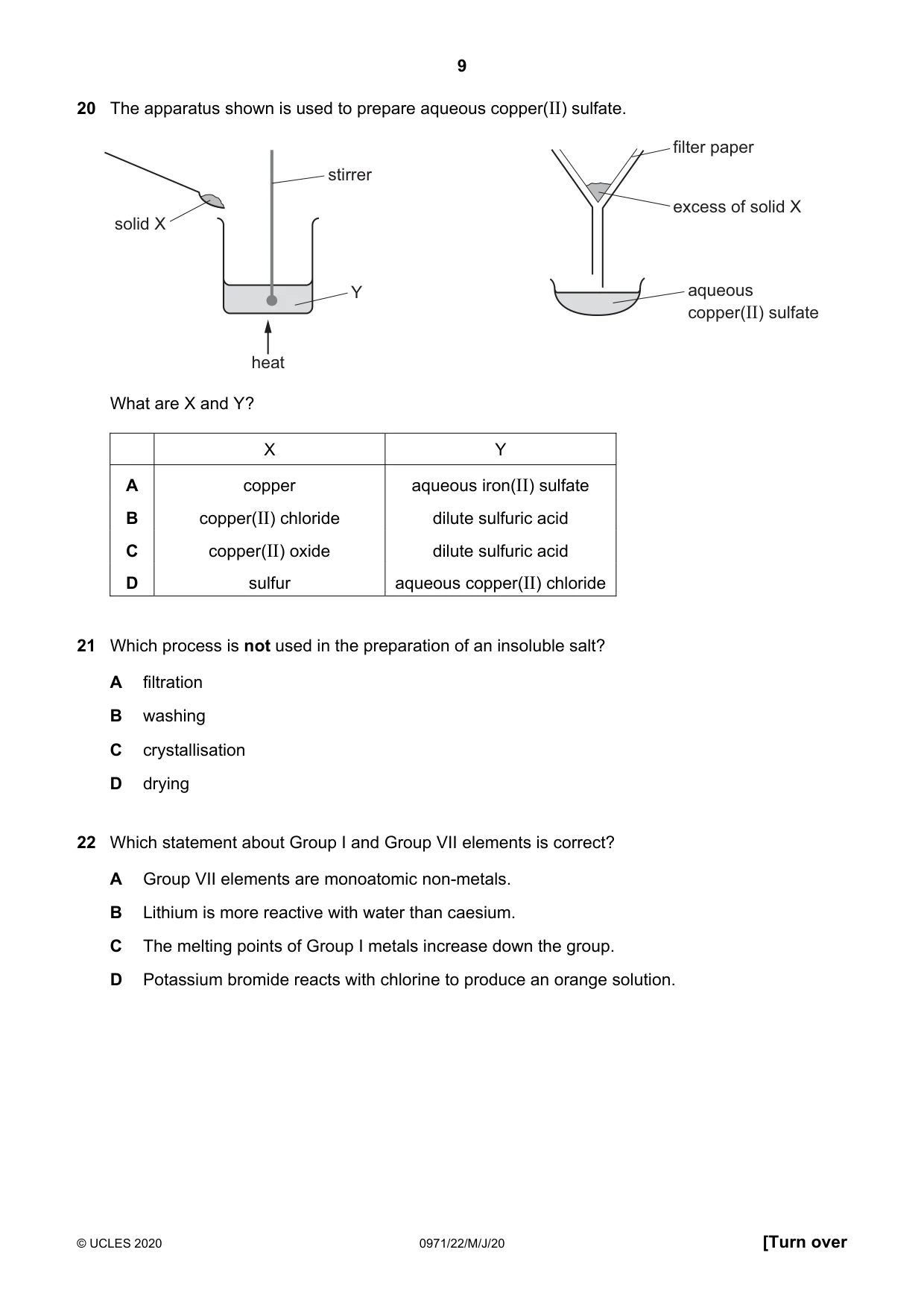
Q20 · The apparatus shown is used to prepare aqueous copper(II) sulfate
20 The apparatus shown is used to prepare aqueous copper(II) sulfate. filter paper stirrer excess of solid X solid X Y aqueous copper(II) sulfate heat What are X and Y? X Y A copper aqueous iron(II) sulfate B copper(II) chloride dilute sulfuric acid C copper(II) oxide dilute sulfuric acid D sulfur aqueous copper(II) chloride
Mark scheme: C
Q21 · Which process is not used in the preparation of an insoluble salt?
21 Which process is not used in the preparation of an insoluble salt? A filtration B washing C crystallisation D drying
Mark scheme: C
Q22 · Which statement about Group I and Group VII elements is correct?
22 Which statement about Group I and Group VII elements is correct? A Group VII elements are monoatomic non-metals. B Lithium is more reactive with water than caesium. C The melting points of Group I metals increase down the group. D Potassium bromide reacts with chlorine to produce an orange solution.
Mark scheme: D
Q23 · The properties of the element titanium, Ti, can be predicted from its position in the…
23 The properties of the element titanium, Ti, can be predicted from its position in the Periodic Table. Which row identifies the properties of titanium? forms coloured compounds can be used conducts electricity as a catalyst when solid has low density v v x v v v v x v x v v
Mark scheme: B
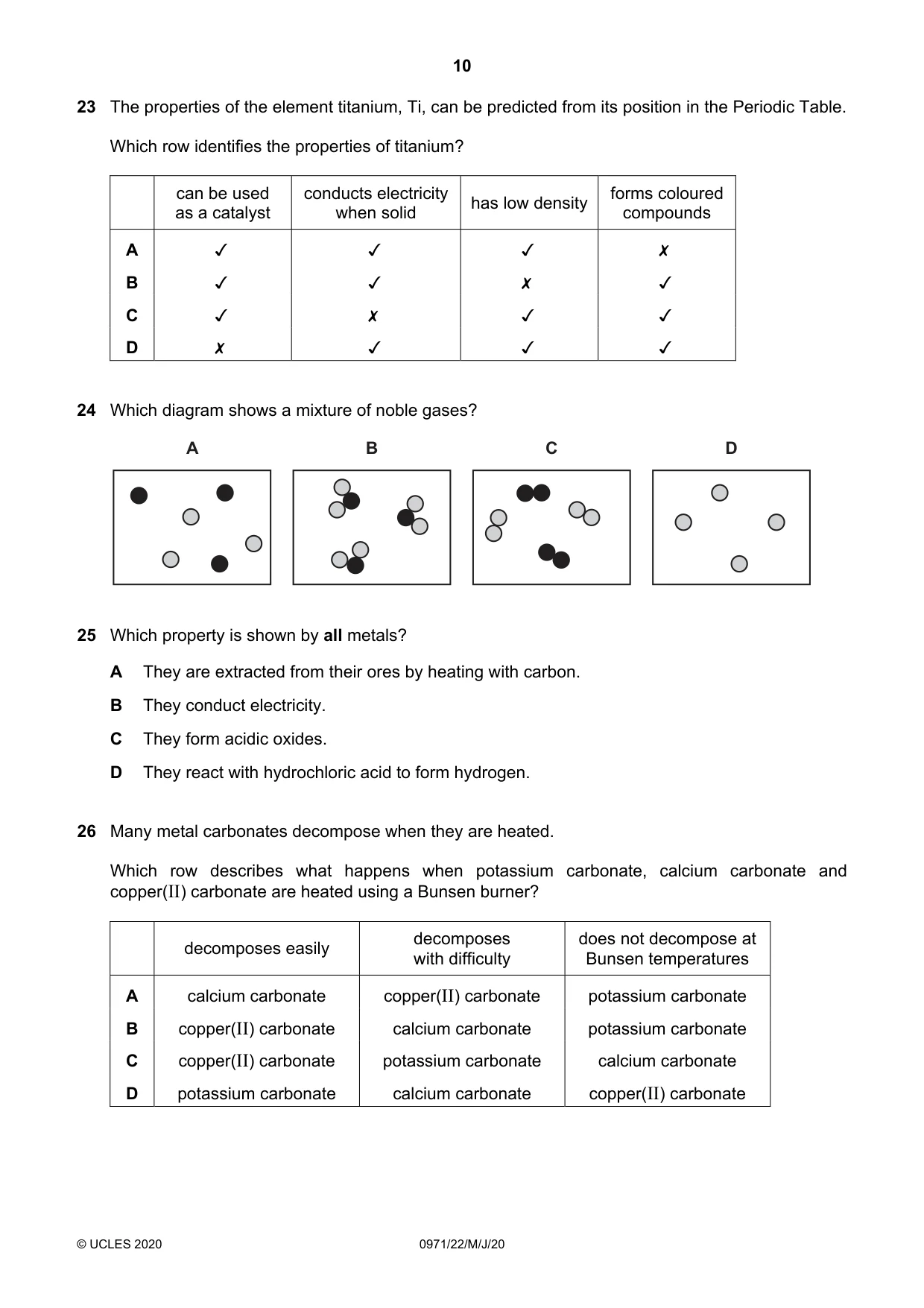
Q24 · Which diagram shows a mixture of noble gases?
24 Which diagram shows a mixture of noble gases? A B C D
Mark scheme: A
Q25 · Which property is shown by all metals?
25 Which property is shown by all metals? A They are extracted from their ores by heating with carbon. B They conduct electricity. C They form acidic oxides. D They react with hydrochloric acid to form hydrogen.
Mark scheme: B
Q26 · Many metal carbonates decompose when they are heated
26 Many metal carbonates decompose when they are heated. Which row describes what happens when potassium carbonate, calcium carbonate and copper(II) carbonate are heated using a Bunsen burner? decomposes does not decompose at decomposes easily with difficulty Bunsen temperatures A calcium carbonate copper(II) carbonate potassium carbonate B copper(II) carbonate calcium carbonate potassium carbonate C copper(II) carbonate potassium carbonate calcium carbonate D potassium carbonate calcium carbonate copper(II) carbonate
Mark scheme: B
Q27 · Molten iron from the blast furnace contains impurities
27 Molten iron from the blast furnace contains impurities. The process of turning the impure iron into steel involves blowing oxygen into the molten iron and adding calcium oxide. What are the reasons for blowing in oxygen and adding calcium oxide? blowing in oxygen adding calcium oxide A carbon is removed by reacting with oxygen reacts with acidic impurities making slag B carbon is removed by reacting with oxygen reacts with slag and so removes it C iron reacts with the oxygen reacts with acidic impurities making slag D iron reacts with the oxygen reacts with slag and so removes it
Mark scheme: A
Q28 · Four iron nails are added to four different metal sulfate solutions
28 Four iron nails are added to four different metal sulfate solutions. In which solution does a displacement reaction occur? A copper(II) sulfate B magnesium sulfate C sodium sulfate D zinc sulfate
Mark scheme: A
Q29 · Which statement about pure water is not correct?
29 Which statement about pure water is not correct? A It condenses at 100 °C. B It freezes at 0 °C. C It turns cobalt(II) chloride paper blue. D It turns anhydrous copper(II) sulfate blue.
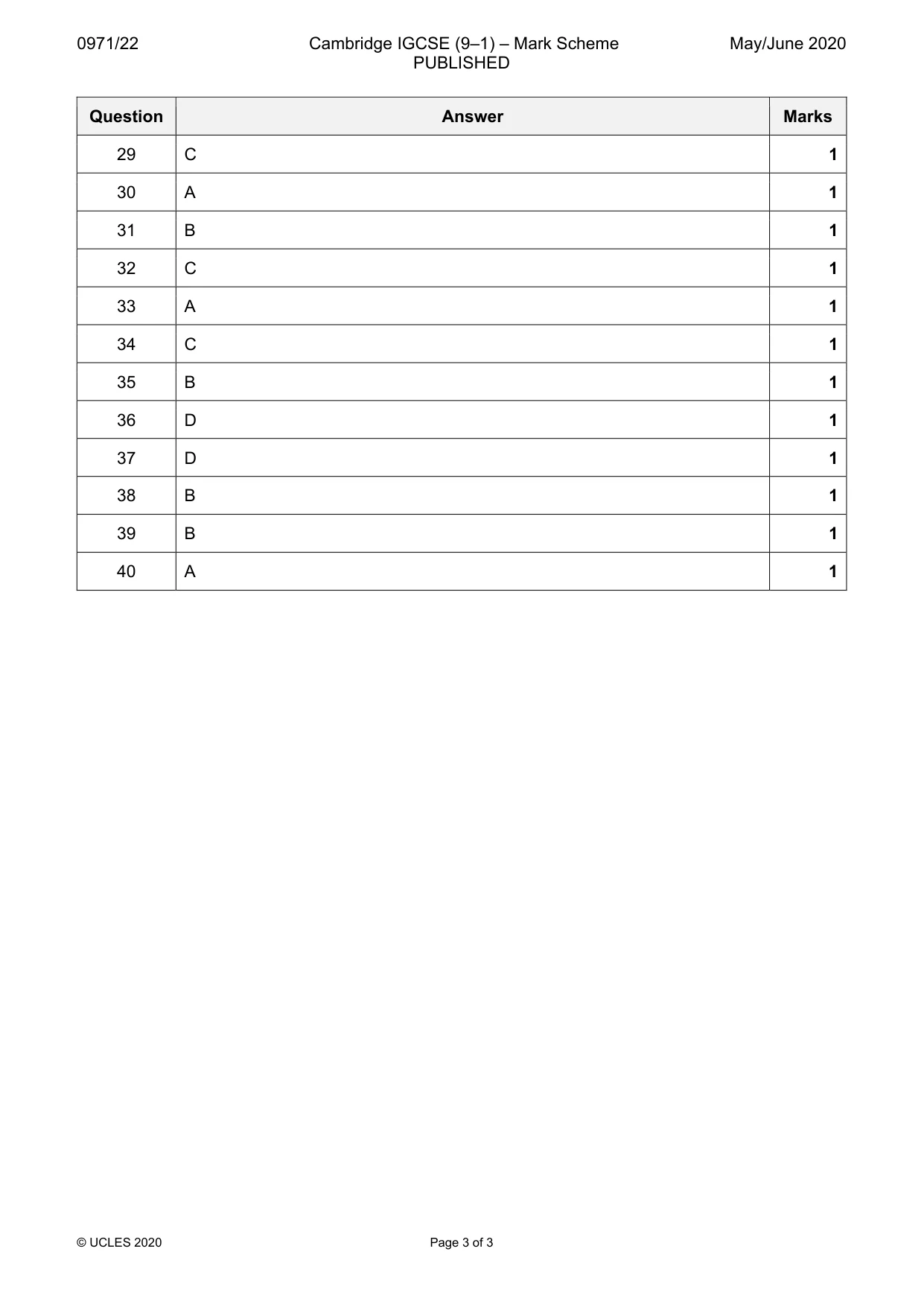
Mark scheme: C
Q30 · Three processes in the carbon cycle are shown
30 Three processes in the carbon cycle are shown. 1 Methane reacts with oxygen producing carbon dioxide and water. 2 Carbon dioxide and water are absorbed and used by plants to make oxygen. 3 Oxygen is used by living things to release energy. Which processes have taken place? 1 2 3 A combustion photosynthesis respiration B combustion respiration photosynthesis C photosynthesis combustion respiration D respiration photosynthesis combustion
Mark scheme: A
Q31 · In the Haber process, nitrogen and hydrogen are reacted to make ammonia
31 In the Haber process, nitrogen and hydrogen are reacted to make ammonia. N2(g) + 3H2(g) 2NH3(g) The forward reaction is exothermic. Which conditions produce the maximum yield of ammonia? pressure temperature A high high B high low C low high D low low
Mark scheme: B
Q32 · Which process, used to prevent iron from rusting, involves sacrificial protection?
32 Which process, used to prevent iron from rusting, involves sacrificial protection? A alloying B electroplating C galvanising D painting
Mark scheme: C
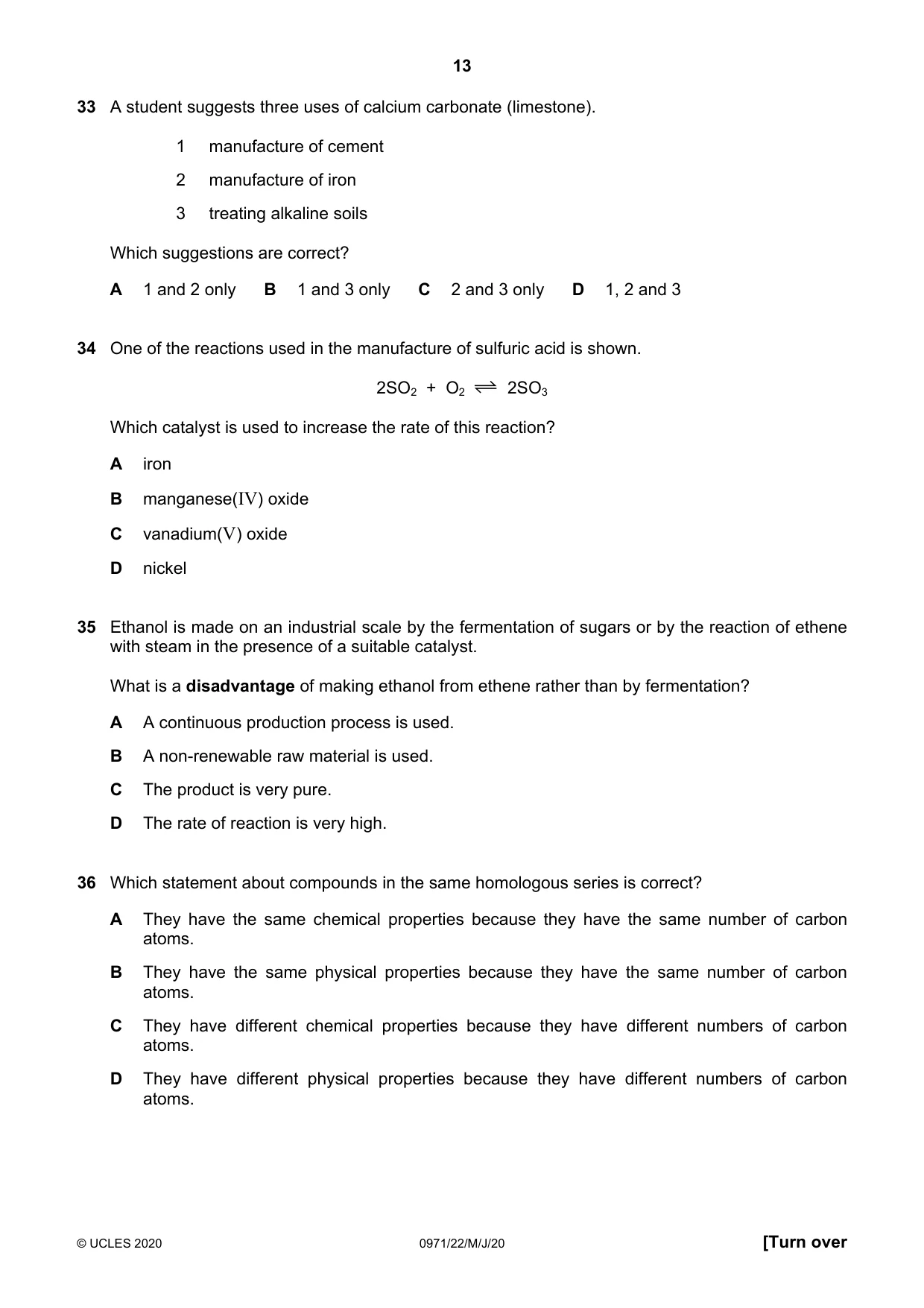
Q33 · A student suggests three uses of calcium carbonate (limestone)
33 A student suggests three uses of calcium carbonate (limestone). 1 manufacture of cement 2 manufacture of iron 3 treating alkaline soils Which suggestions are correct? A 1 and 2 only B 1 and 3 only C 2 and 3 only D 1, 2 and 3
Mark scheme: A
Q34 · One of the reactions used in the manufacture of sulfuric acid is shown
34 One of the reactions used in the manufacture of sulfuric acid is shown. 2SO2 + O2 2SO3 Which catalyst is used to increase the rate of this reaction? A iron B manganese(IV) oxide C vanadium(V) oxide D nickel
Mark scheme: C
Q35 · Ethanol is made on an industrial scale by the fermentation of sugars or by the reaction…
35 Ethanol is made on an industrial scale by the fermentation of sugars or by the reaction of ethene with steam in the presence of a suitable catalyst. What is a disadvantage of making ethanol from ethene rather than by fermentation? A A continuous production process is used. B A non-renewable raw material is used. C The product is very pure. D The rate of reaction is very high.
Mark scheme: B
Q36 · Which statement about compounds in the same homologous series is correct?
36 Which statement about compounds in the same homologous series is correct? A They have the same chemical properties because they have the same number of carbon atoms. B They have the same physical properties because they have the same number of carbon atoms. C They have different chemical properties because they have different numbers of carbon atoms. D They have different physical properties because they have different numbers of carbon atoms.
Mark scheme: D
More questions on Formulae, functional groups and terminology
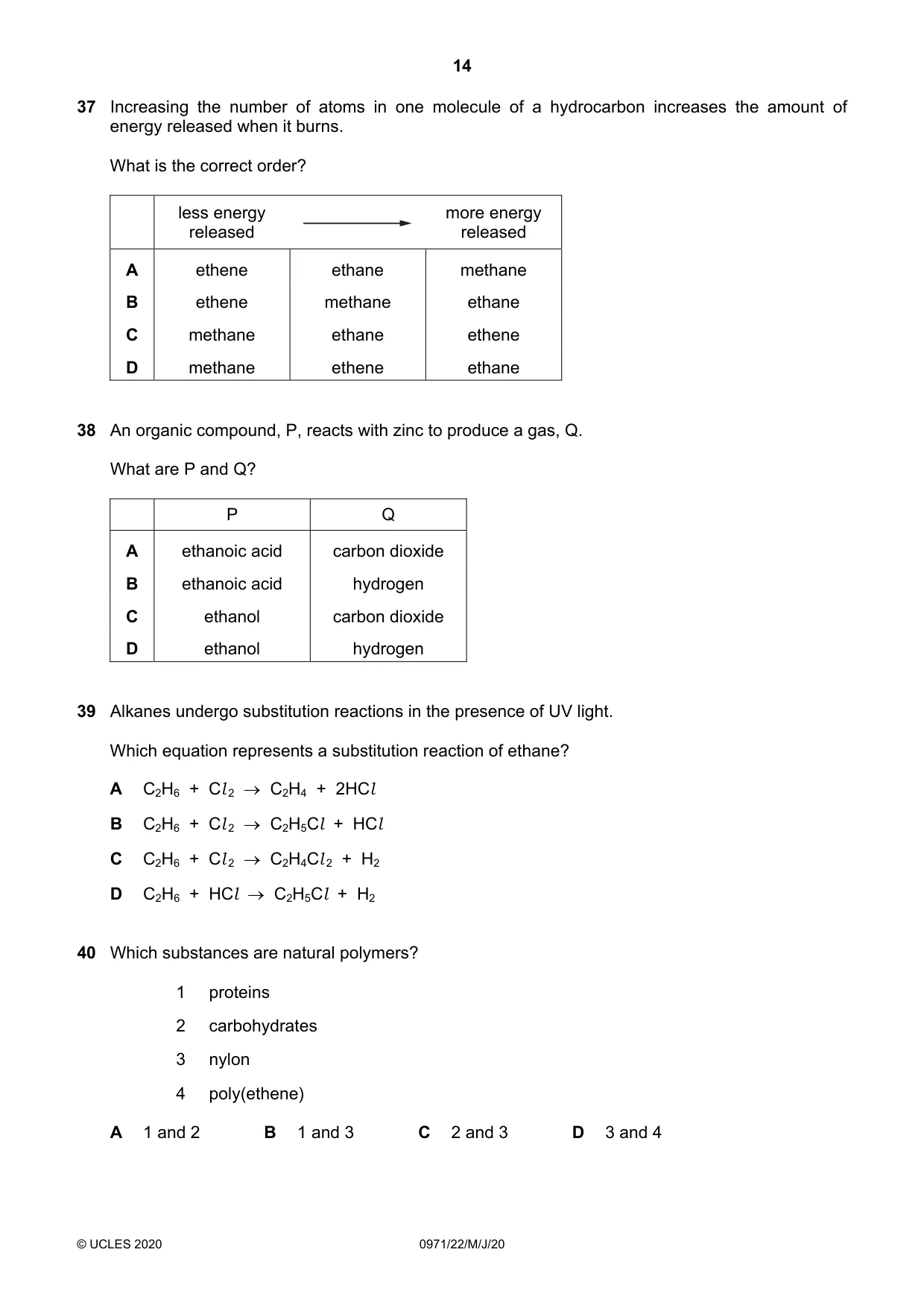
Q37 · Increasing the number of atoms in one molecule of a hydrocarbon increases the amount of…
37 Increasing the number of atoms in one molecule of a hydrocarbon increases the amount of energy released when it burns. What is the correct order? less energy more energy released released A ethene ethane methane B ethene methane ethane C methane ethane ethene D methane ethene ethane
Mark scheme: D
Q38 · An organic compound, P, reacts with zinc to produce a gas, Q
38 An organic compound, P, reacts with zinc to produce a gas, Q. What are P and Q? P Q A ethanoic acid carbon dioxide B ethanoic acid hydrogen C ethanol carbon dioxide D ethanol hydrogen
Mark scheme: B
Q39 · Alkanes undergo substitution reactions in the presence of UV light
39 Alkanes undergo substitution reactions in the presence of UV light. Which equation represents a substitution reaction of ethane? A C2H6 + Cl 2 → C2H4 + 2HCl B C2H6 + Cl 2 → C2H5Cl + HCl C C2H6 + Cl 2 → C2H4Cl 2 + H2 D C2H6 + HCl → C2H5Cl + H2
Mark scheme: B
Q40 · Which substances are natural polymers?
40 Which substances are natural polymers? 1 proteins 2 carbohydrates 3 nylon 4 poly(ethene) A 1 and 2 B 1 and 3 C 2 and 3 D 3 and 4
Mark scheme: A
What was in this paper
The subtopics covered by these 40 questions, and how many questions each got. Open one in a new tab to see every Cambridge question on it.
2Electrolysis2Extraction of metals2Fuels2Preparation of salts2Rate of reaction2Reversible reactions and equilibrium2The characteristic properties of acids and bases2Alkanes1Atomic structure and the Periodic Table1Carboxylic acids1Chromatography1Corrosion of metals1Exothermic and endothermic reactions1Experimental design1Formulae1Formulae, functional groups and terminology1Group VII properties1Hydrogen–oxygen fuel cells1Ions and ionic bonds1Metallic bonding1Noble gases1Physical and chemical changes1Polymers1Properties of metals1Reactivity series1Redox1Simple molecules and covalent bonds1Solids, liquids and gases1The mole and the Avogadro constant1Transition elements1Water1