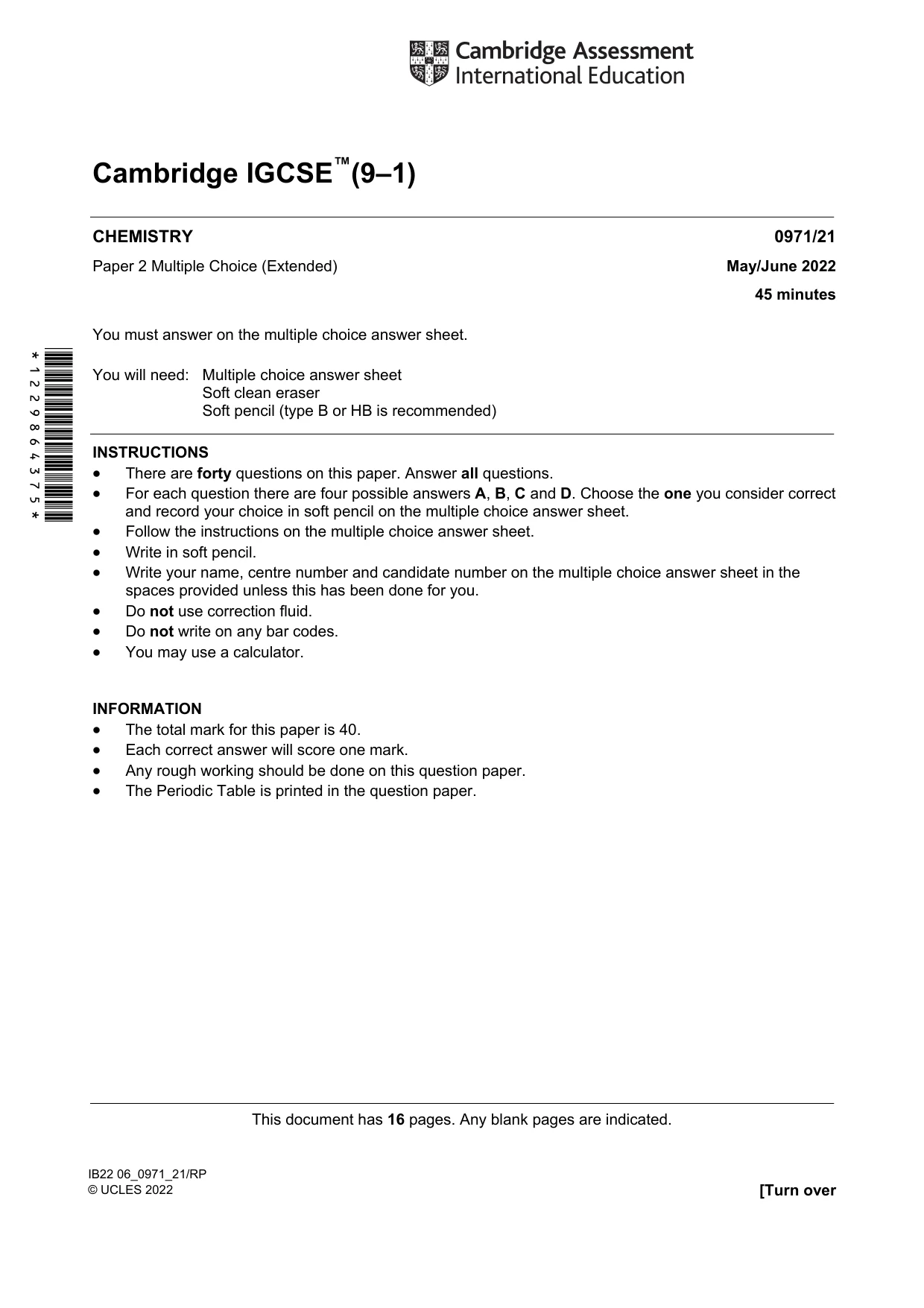
Cambridge IGCSE Chemistry (9-1) 0971 — 2022 May/June Paper 2 · Variant 1
0971/21/M/J/22 · 40 questions · 40 marks · ≈45 min
The question paper and its mark scheme, free to read here and free to download. This is Cambridge’s own paper, exactly as it was sat.
Question paper16 pages


Mark scheme3 pages
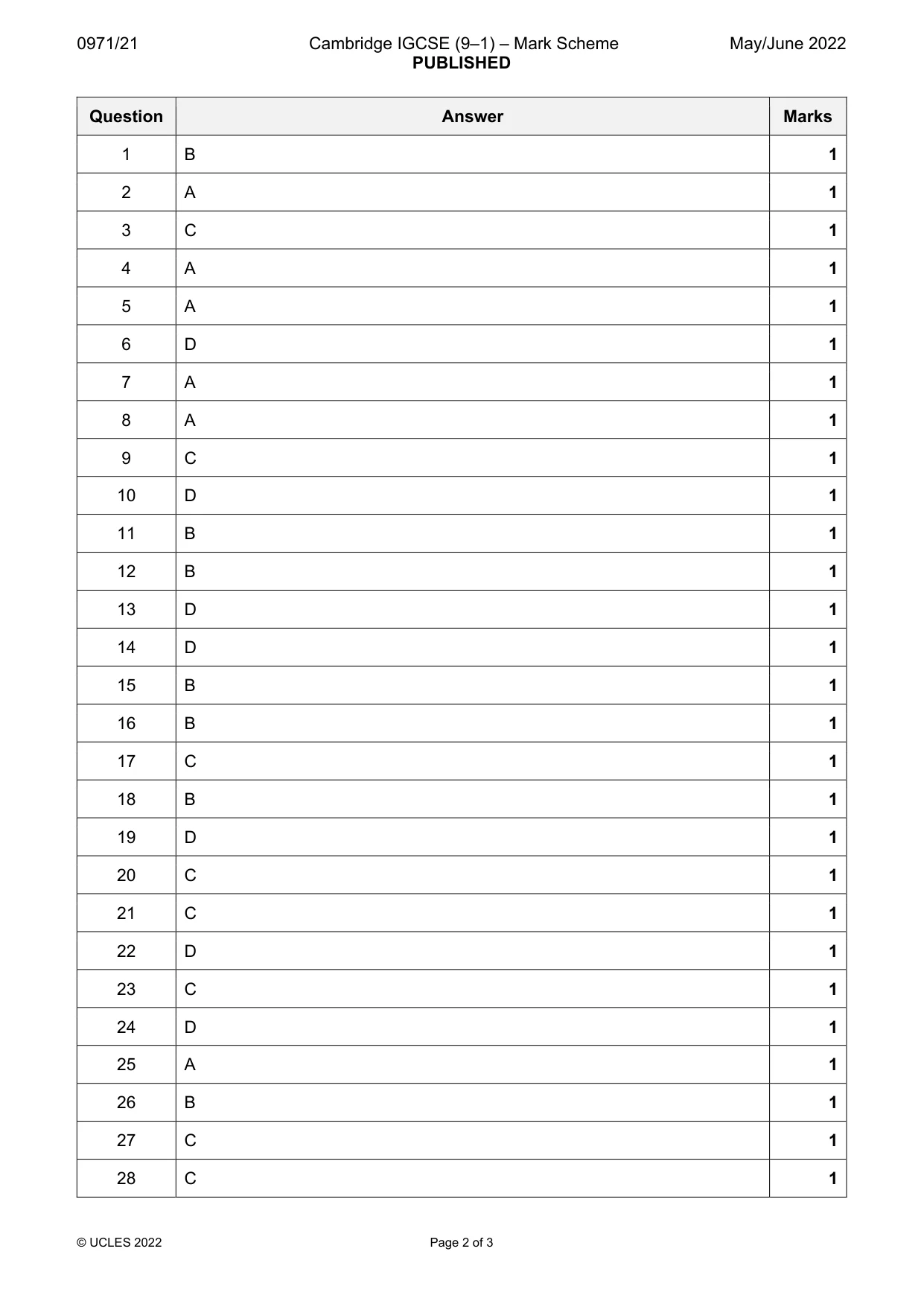
Answers below. Sit the paper first if you are practising.
Questions as text
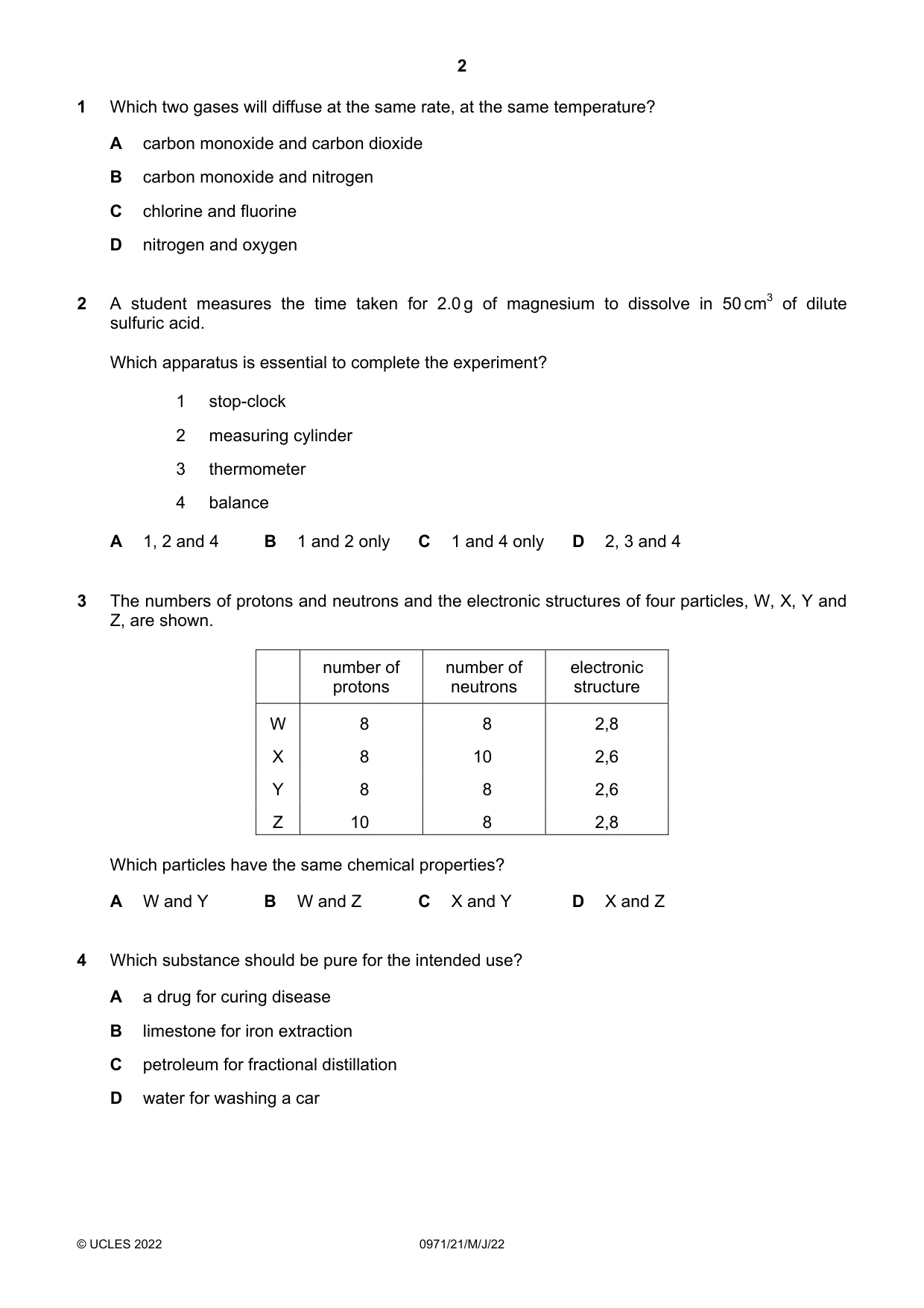
Q1 · Which two gases will diffuse at the same rate, at the same temperature?
1 Which two gases will diffuse at the same rate, at the same temperature? A carbon monoxide and carbon dioxide B carbon monoxide and nitrogen C chlorine and fluorine D nitrogen and oxygen
Mark scheme: B
Q2 · A student measures the time taken for 2.0 g of magnesium to dissolve in 50 cm3 of dilute…
2 A student measures the time taken for 2.0 g of magnesium to dissolve in 50 cm3 of dilute sulfuric acid. Which apparatus is essential to complete the experiment? 1 stop-clock 2 measuring cylinder 3 thermometer 4 balance A 1, 2 and 4 B 1 and 2 only C 1 and 4 only D 2, 3 and 4
Mark scheme: A
Q3 · The numbers of protons and neutrons and the electronic structures of four particles, W…
3 The numbers of protons and neutrons and the electronic structures of four particles, W, X, Y and Z, are shown. number of number of electronic protons neutrons structure W 8 8 2,8 X 8 10 2,6 Y 8 8 2,6 Z 10 8 2,8 Which particles have the same chemical properties? A W and Y B W and Z C X and Y D X and Z
Mark scheme: C
Q4 · Which substance should be pure for the intended use?
4 Which substance should be pure for the intended use? A a drug for curing disease B limestone for iron extraction C petroleum for fractional distillation D water for washing a car
Mark scheme: A
Q5 · Metals and ionic compounds have similarities and differences in their structure and…
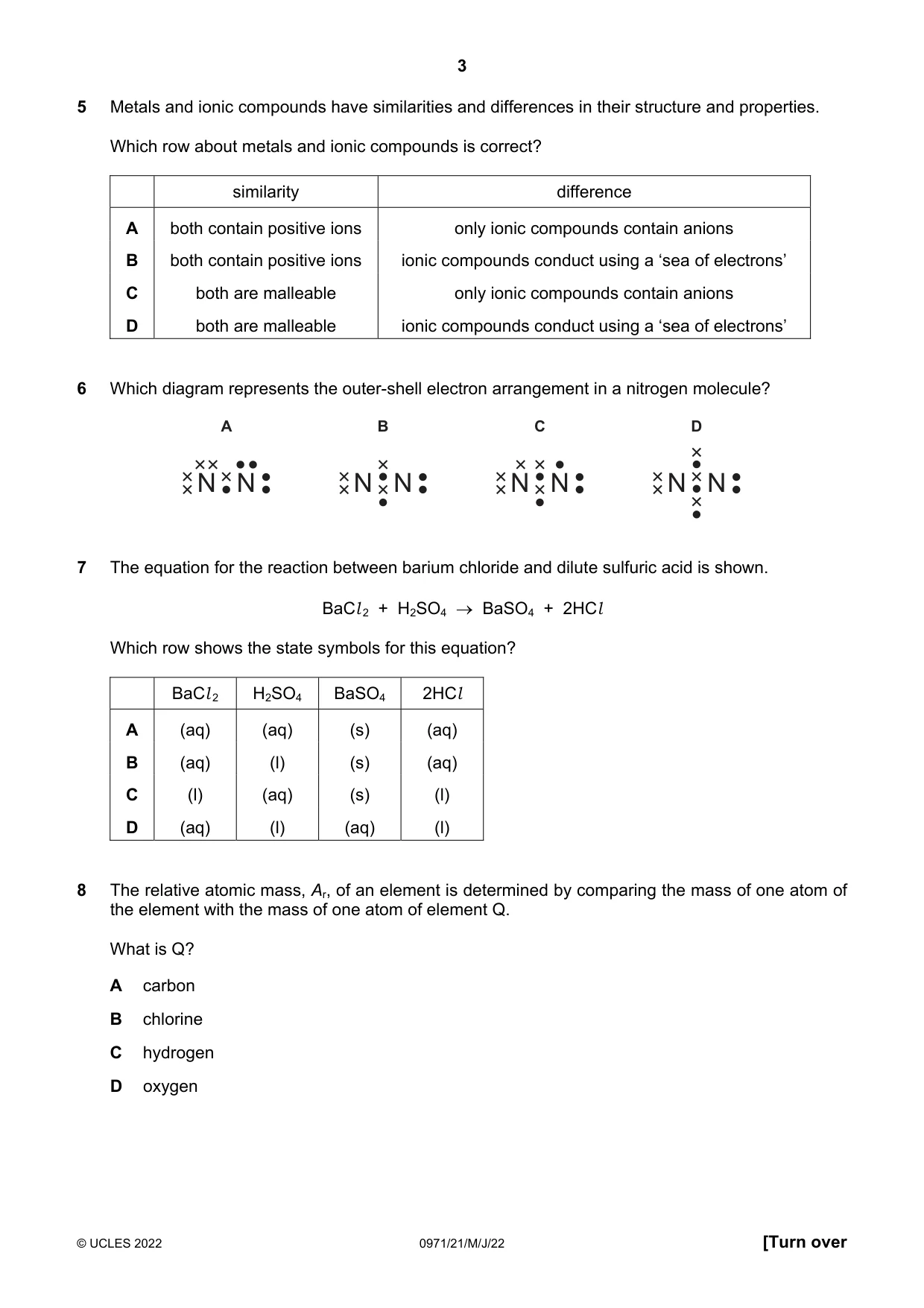
5 Metals and ionic compounds have similarities and differences in their structure and properties. Which row about metals and ionic compounds is correct? similarity difference A both contain positive ions only ionic compounds contain anions B both contain positive ions ionic compounds conduct using a ‘sea of electrons’ C both are malleable only ionic compounds contain anions D both are malleable ionic compounds conduct using a ‘sea of electrons’
Mark scheme: A
Q6 · Which diagram represents the outer-shell electron arrangement in a nitrogen molecule?
6 Which diagram represents the outer-shell electron arrangement in a nitrogen molecule? A B C D N N N N N N N N
Mark scheme: D
Q7 · The equation for the reaction between barium chloride and dilute sulfuric acid is shown
7 The equation for the reaction between barium chloride and dilute sulfuric acid is shown. BaCl 2 + H2SO4 BaSO4 + 2HCl Which row shows the state symbols for this equation? BaCl 2 H2SO4 BaSO4 2HCl A (aq) (aq) (s) (aq) B (aq) (l) (s) (aq) C (l) (aq) (s) (l) D (aq) (l) (aq) (l)
Mark scheme: A
Q8 · The relative atomic mass, Ar, of an element is determined by comparing the mass of one…
8 The relative atomic mass, Ar, of an element is determined by comparing the mass of one atom of the element with the mass of one atom of element Q. What is Q? A carbon B chlorine C hydrogen D oxygen
Mark scheme: A
Q9 · The equation for the reaction between aqueous lead(II) nitrate and aqueous sodium…
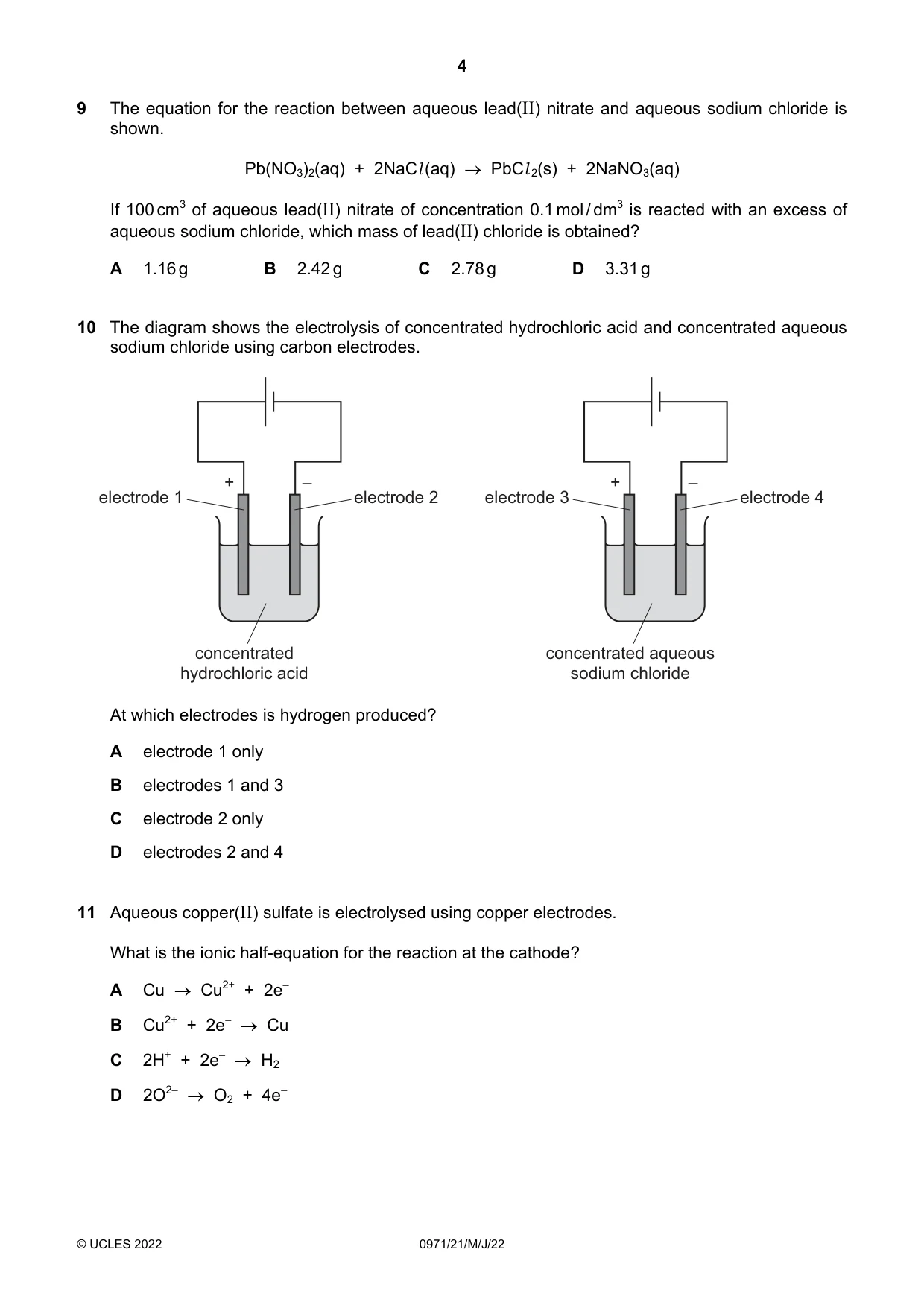
9 The equation for the reaction between aqueous lead(II) nitrate and aqueous sodium chloride is shown. Pb(NO3)2(aq) + 2NaCl (aq) PbCl 2(s) + 2NaNO3(aq) If 100 cm3 of aqueous lead(II) nitrate of concentration 0.1 mol / dm3 is reacted with an excess of aqueous sodium chloride, which mass of lead(II) chloride is obtained? A 1.16 g B 2.42 g C 2.78 g D 3.31 g
Mark scheme: C
Q10 · The diagram shows the electrolysis of concentrated hydrochloric acid and concentrated…
10 The diagram shows the electrolysis of concentrated hydrochloric acid and concentrated aqueous sodium chloride using carbon electrodes. + – + – electrode 1 electrode 2 electrode 3 electrode 4 concentrated concentrated aqueous hydrochloric acid sodium chloride At which electrodes is hydrogen produced? A electrode 1 only B electrodes 1 and 3 C electrode 2 only D electrodes 2 and 4
Mark scheme: D
Q11 · Aqueous copper(II) sulfate is electrolysed using copper electrodes
11 Aqueous copper(II) sulfate is electrolysed using copper electrodes. What is the ionic half-equation for the reaction at the cathode? A Cu Cu2+ + 2e– B Cu2+ + 2e– Cu C 2H+ + 2e– H2 D 2O2– O2 + 4e–
Mark scheme: B
Q12 · Which row identifies a chemical change and a physical change?
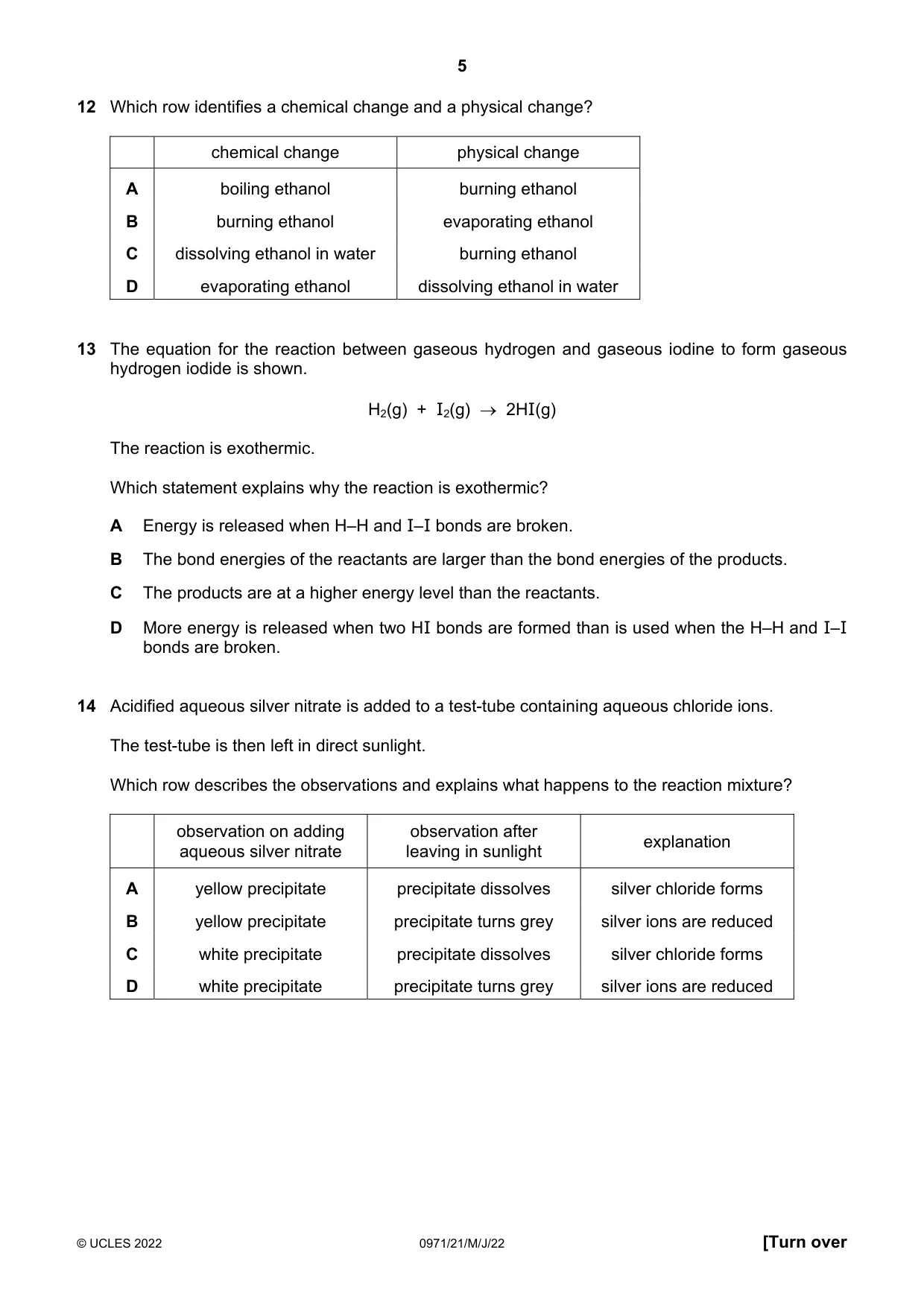
12 Which row identifies a chemical change and a physical change? chemical change physical change A boiling ethanol burning ethanol B burning ethanol evaporating ethanol C dissolving ethanol in water burning ethanol D evaporating ethanol dissolving ethanol in water
Mark scheme: B
Q13 · The equation for the reaction between gaseous hydrogen and gaseous iodine to form gaseous…
13 The equation for the reaction between gaseous hydrogen and gaseous iodine to form gaseous hydrogen iodide is shown. H2(g) + I2(g) 2HI(g) The reaction is exothermic. Which statement explains why the reaction is exothermic? A Energy is released when H–H and I–I bonds are broken. B The bond energies of the reactants are larger than the bond energies of the products. C The products are at a higher energy level than the reactants. D More energy is released when two HI bonds are formed than is used when the H–H and I–I bonds are broken.
Mark scheme: D
Q14 · Acidified aqueous silver nitrate is added to a test-tube containing aqueous chloride ions
14 Acidified aqueous silver nitrate is added to a test-tube containing aqueous chloride ions. The test-tube is then left in direct sunlight. Which row describes the observations and explains what happens to the reaction mixture? observation on adding observation after explanation aqueous silver nitrate leaving in sunlight A yellow precipitate precipitate dissolves silver chloride forms B yellow precipitate precipitate turns grey silver ions are reduced C white precipitate precipitate dissolves silver chloride forms D white precipitate precipitate turns grey silver ions are reduced
Mark scheme: D
Q15 · Water is added to anhydrous copper(II) sulfate
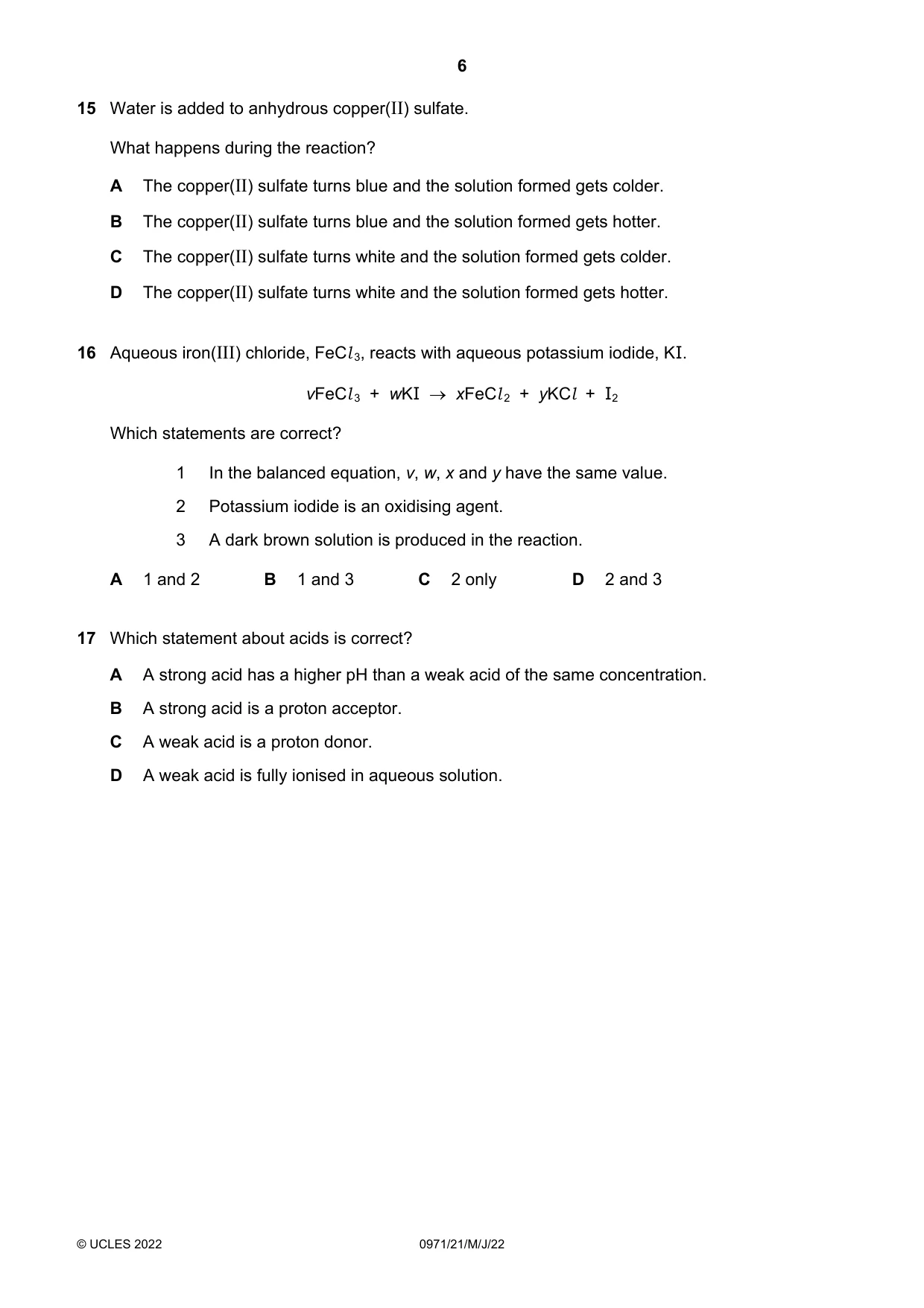
15 Water is added to anhydrous copper(II) sulfate. What happens during the reaction? A The copper(II) sulfate turns blue and the solution formed gets colder. B The copper(II) sulfate turns blue and the solution formed gets hotter. C The copper(II) sulfate turns white and the solution formed gets colder. D The copper(II) sulfate turns white and the solution formed gets hotter.
Mark scheme: B
Q16 · Aqueous iron(III) chloride, FeCl 3, reacts with aqueous potassium iodide, KI
16 Aqueous iron(III) chloride, FeCl 3, reacts with aqueous potassium iodide, KI. vFeCl 3 + wKI xFeCl 2 + yKCl + I2 Which statements are correct? 1 In the balanced equation, v, w, x and y have the same value. 2 Potassium iodide is an oxidising agent. 3 A dark brown solution is produced in the reaction. A 1 and 2 B 1 and 3 C 2 only D 2 and 3
Mark scheme: B
Q17 · Which statement about acids is correct?
17 Which statement about acids is correct? A A strong acid has a higher pH than a weak acid of the same concentration. B A strong acid is a proton acceptor. C A weak acid is a proton donor. D A weak acid is fully ionised in aqueous solution.
Mark scheme: C
More questions on The characteristic properties of acids and bases
Q18 · The oxides of two elements, X and Y, are separately dissolved in water and the pH of each…
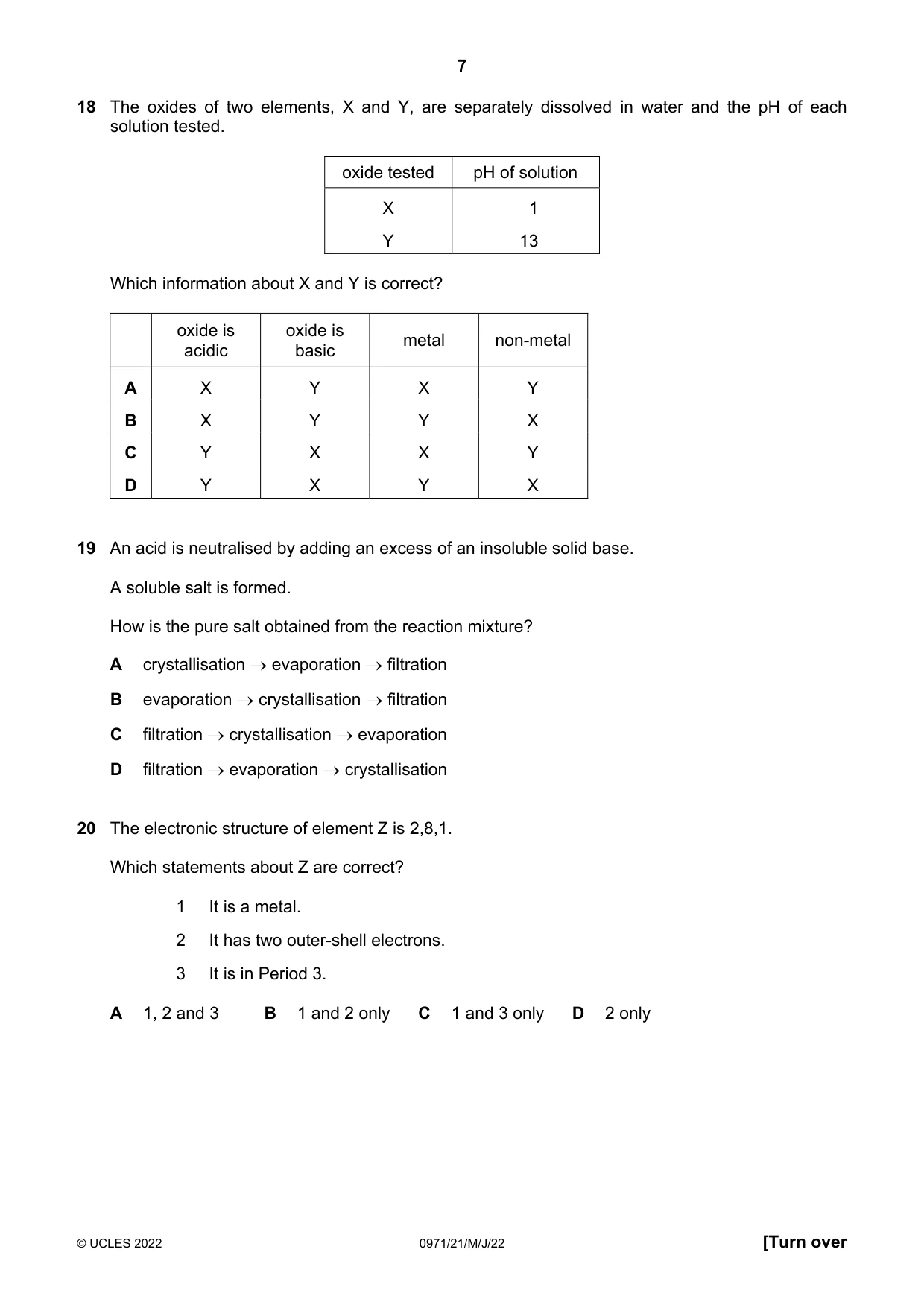
18 The oxides of two elements, X and Y, are separately dissolved in water and the pH of each solution tested. oxide tested pH of solution X 1 Y 13 Which information about X and Y is correct? oxide is oxide is metal non-metal acidic basic A X Y X Y B X Y Y X C Y X X Y D Y X Y X
Mark scheme: B
Q19 · An acid is neutralised by adding an excess of an insoluble solid base
19 An acid is neutralised by adding an excess of an insoluble solid base. A soluble salt is formed. How is the pure salt obtained from the reaction mixture? A crystallisation evaporation filtration B evaporation crystallisation filtration C filtration crystallisation evaporation D filtration evaporation crystallisation
Mark scheme: D
Q20 · The electronic structure of element Z is 2,8,1
20 The electronic structure of element Z is 2,8,1. Which statements about Z are correct? 1 It is a metal. 2 It has two outer-shell electrons. 3 It is in Period 3. A 1, 2 and 3 B 1 and 2 only C 1 and 3 only D 2 only
Mark scheme: C
Q21 · Elements in Group IV of the Periodic Table are shown
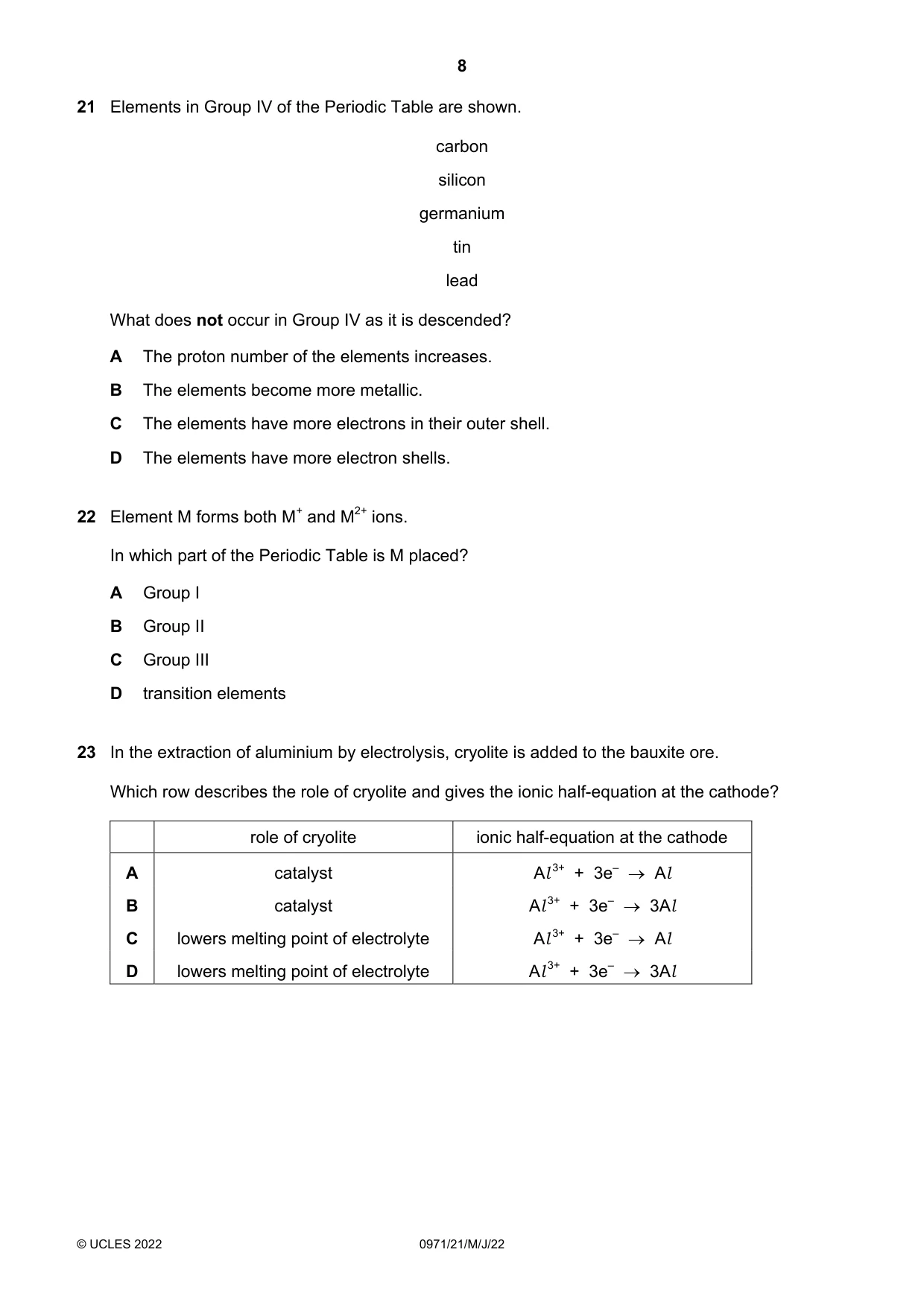
21 Elements in Group IV of the Periodic Table are shown. carbon silicon germanium tin lead What does not occur in Group IV as it is descended? A The proton number of the elements increases. B The elements become more metallic. C The elements have more electrons in their outer shell. D The elements have more electron shells.
Mark scheme: C
Q22 · Element M forms both M+ and M2+ ions
22 Element M forms both M+ and M2+ ions. In which part of the Periodic Table is M placed? A Group I B Group II C Group III D transition elements
Mark scheme: D
Q23 · In the extraction of aluminium by electrolysis, cryolite is added to the bauxite ore
23 In the extraction of aluminium by electrolysis, cryolite is added to the bauxite ore. Which row describes the role of cryolite and gives the ionic half-equation at the cathode? role of cryolite ionic half-equation at the cathode A catalyst Al 3+ + 3e– Al B catalyst Al 3+ + 3e– 3Al C lowers melting point of electrolyte Al 3+ + 3e– Al D lowers melting point of electrolyte Al 3+ + 3e– 3Al
Mark scheme: C
Q24 · Mild steel is galvanised to prevent corrosion of the iron
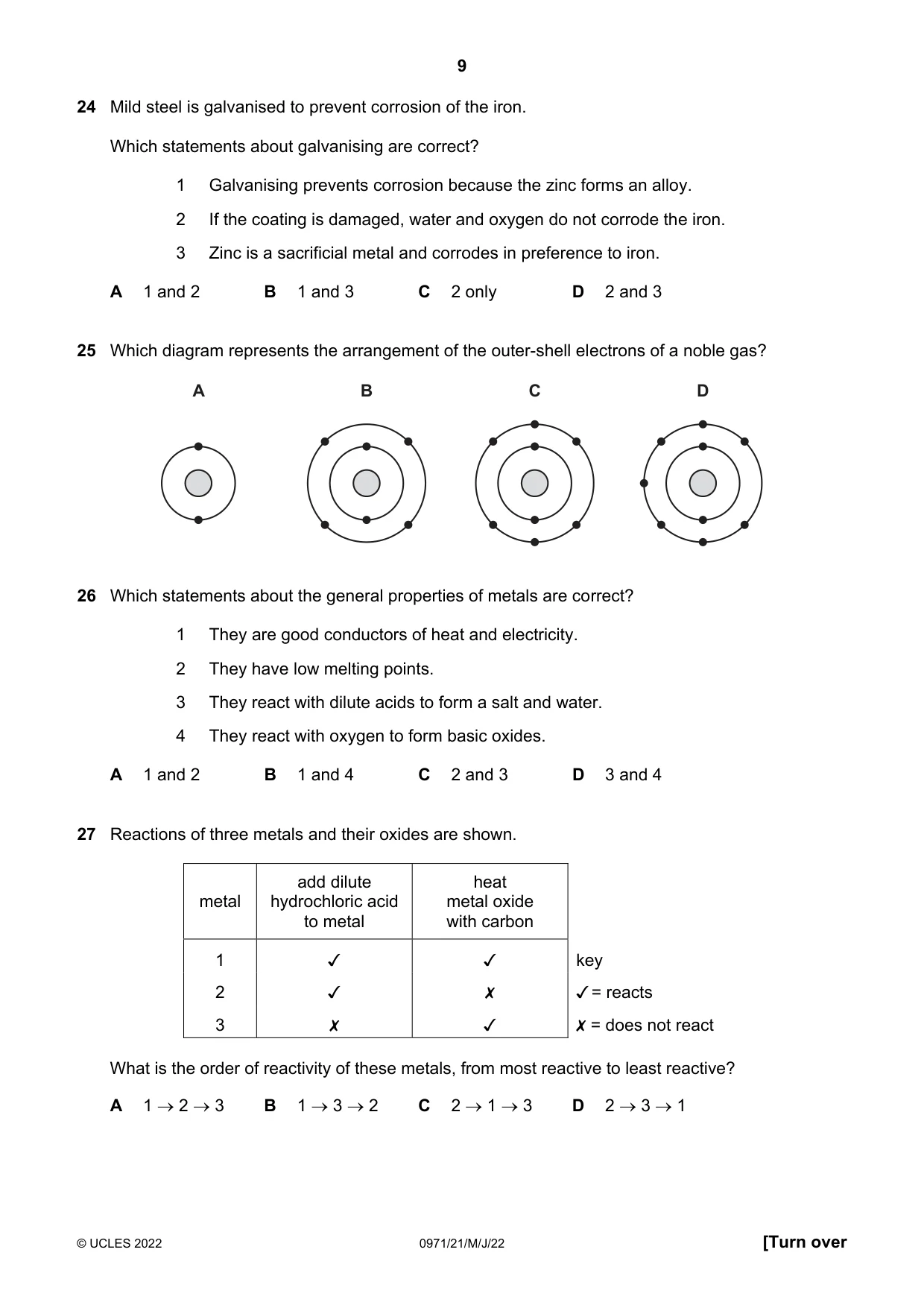
24 Mild steel is galvanised to prevent corrosion of the iron. Which statements about galvanising are correct? 1 Galvanising prevents corrosion because the zinc forms an alloy. 2 If the coating is damaged, water and oxygen do not corrode the iron. 3 Zinc is a sacrificial metal and corrodes in preference to iron. A 1 and 2 B 1 and 3 C 2 only D 2 and 3
Mark scheme: D
Q25 · Which diagram represents the arrangement of the outer-shell electrons of a noble gas?
25 Which diagram represents the arrangement of the outer-shell electrons of a noble gas? A B C D
Mark scheme: A
Q26 · Which statements about the general properties of metals are correct?
26 Which statements about the general properties of metals are correct? 1 They are good conductors of heat and electricity. 2 They have low melting points. 3 They react with dilute acids to form a salt and water. 4 They react with oxygen to form basic oxides. A 1 and 2 B 1 and 4 C 2 and 3 D 3 and 4
Mark scheme: B
Q27 · Reactions of three metals and their oxides are shown
27 Reactions of three metals and their oxides are shown. add dilute heat metal | hydrochloric acid metal oxide to metal with carbon 1 Jv Jv key 2 Jv x J/ = reacts 3 x Jv X = does not react What is the order of reactivity of these metals, from most reactive to least reactive? A 135253 B 15352 C 251593 DB 253-51
Mark scheme: C
Q28 · Three metal compounds, J, K and L, are heated using a Bunsen burner
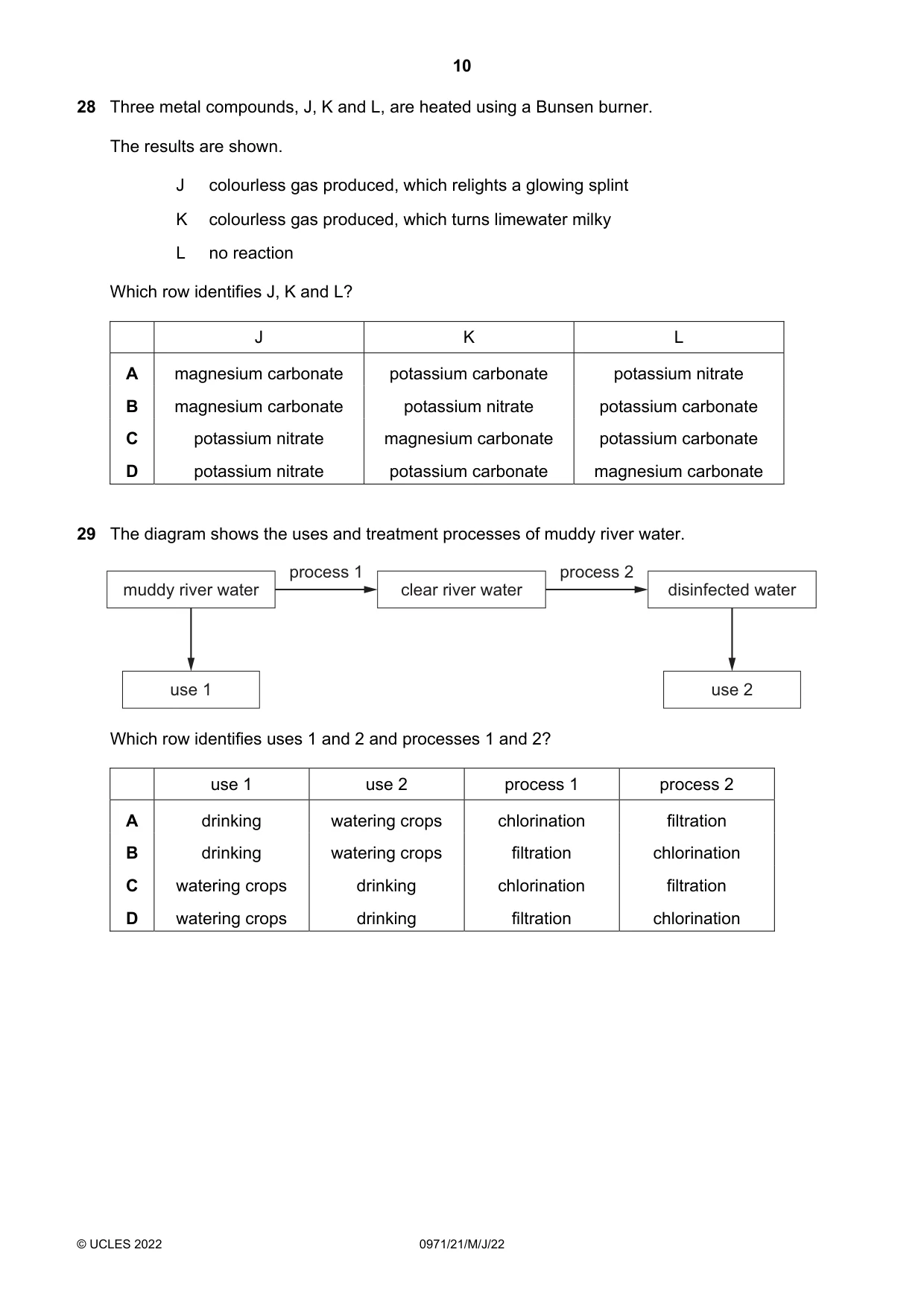
28 Three metal compounds, J, K and L, are heated using a Bunsen burner. The results are shown. J colourless gas produced, which relights a glowing splint K colourless gas produced, which turns limewater milky L no reaction Which row identifies J, K and L? J K L A magnesium carbonate potassium carbonate potassium nitrate B magnesium carbonate potassium nitrate potassium carbonate C potassium nitrate magnesium carbonate potassium carbonate D potassium nitrate potassium carbonate magnesium carbonate
Mark scheme: C
Q29 · The diagram shows the uses and treatment processes of muddy river water
29 The diagram shows the uses and treatment processes of muddy river water. process 1 process 2 muddy river water clear river water disinfected water use 1 use 2 Which row identifies uses 1 and 2 and processes 1 and 2? use 1 use 2 process 1 process 2 A drinking watering crops chlorination filtration B drinking watering crops filtration chlorination C watering crops drinking chlorination filtration D watering crops drinking filtration chlorination
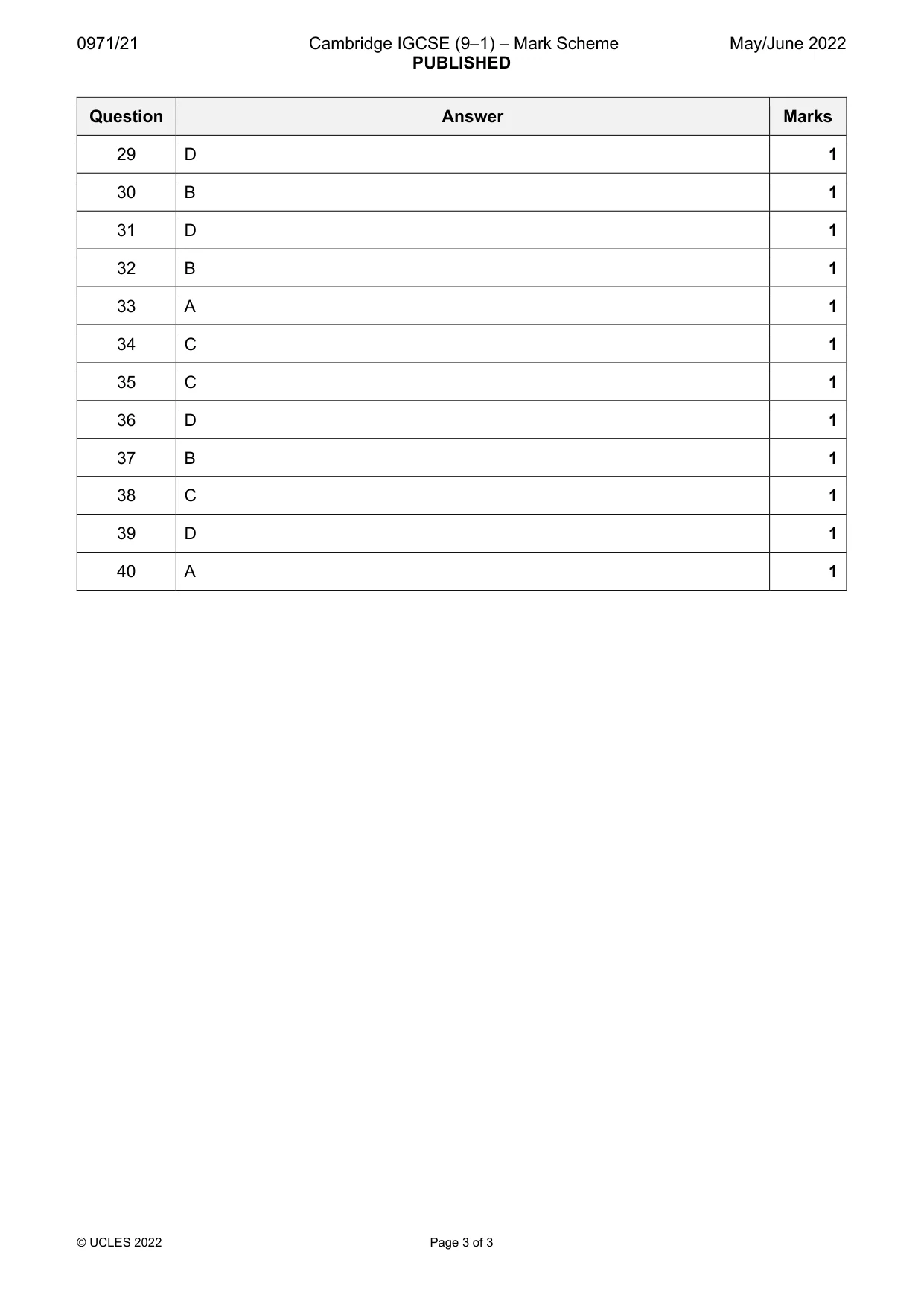
Mark scheme: D
Q30 · The equation for the manufacture of ammonia in the Haber process is shown
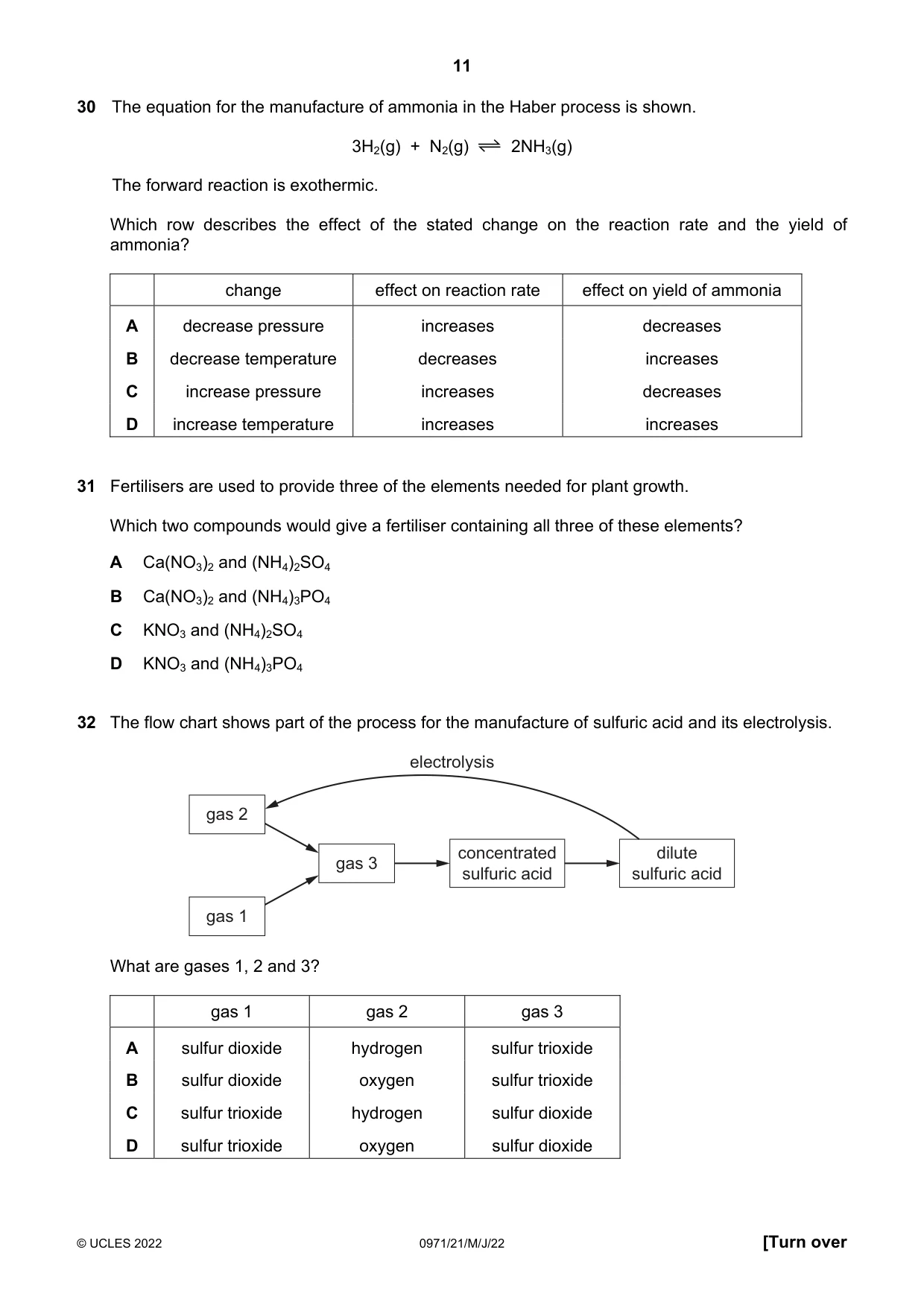
30 The equation for the manufacture of ammonia in the Haber process is shown. 3H2(g) + N2(g) 2NH3(g) The forward reaction is exothermic. Which row describes the effect of the stated change on the reaction rate and the yield of ammonia? change effect on reaction rate effect on yield of ammonia A decrease pressure increases decreases B decrease temperature decreases increases C increase pressure increases decreases D increase temperature increases increases
Mark scheme: B
Q31 · Fertilisers are used to provide three of the elements needed for plant growth
31 Fertilisers are used to provide three of the elements needed for plant growth. Which two compounds would give a fertiliser containing all three of these elements? A Ca(NO3)2 and (NH4)2SO4 B Ca(NO3)2 and (NH4)3PO4 C KNO3 and (NH4)2SO4 D KNO3 and (NH4)3PO4
Mark scheme: D
Q32 · The flow chart shows part of the process for the manufacture of sulfuric acid and its…
32 The flow chart shows part of the process for the manufacture of sulfuric acid and its electrolysis. electrolysis gas 2 concentrated dilute gas 3 sulfuric acid sulfuric acid gas 1 What are gases 1, 2 and 3? gas 1 gas 2 gas 3 A sulfur dioxide hydrogen sulfur trioxide B sulfur dioxide oxygen sulfur trioxide C sulfur trioxide hydrogen sulfur dioxide D sulfur trioxide oxygen sulfur dioxide
Mark scheme: B
Q33 · Which statements about sulfur dioxide are correct?
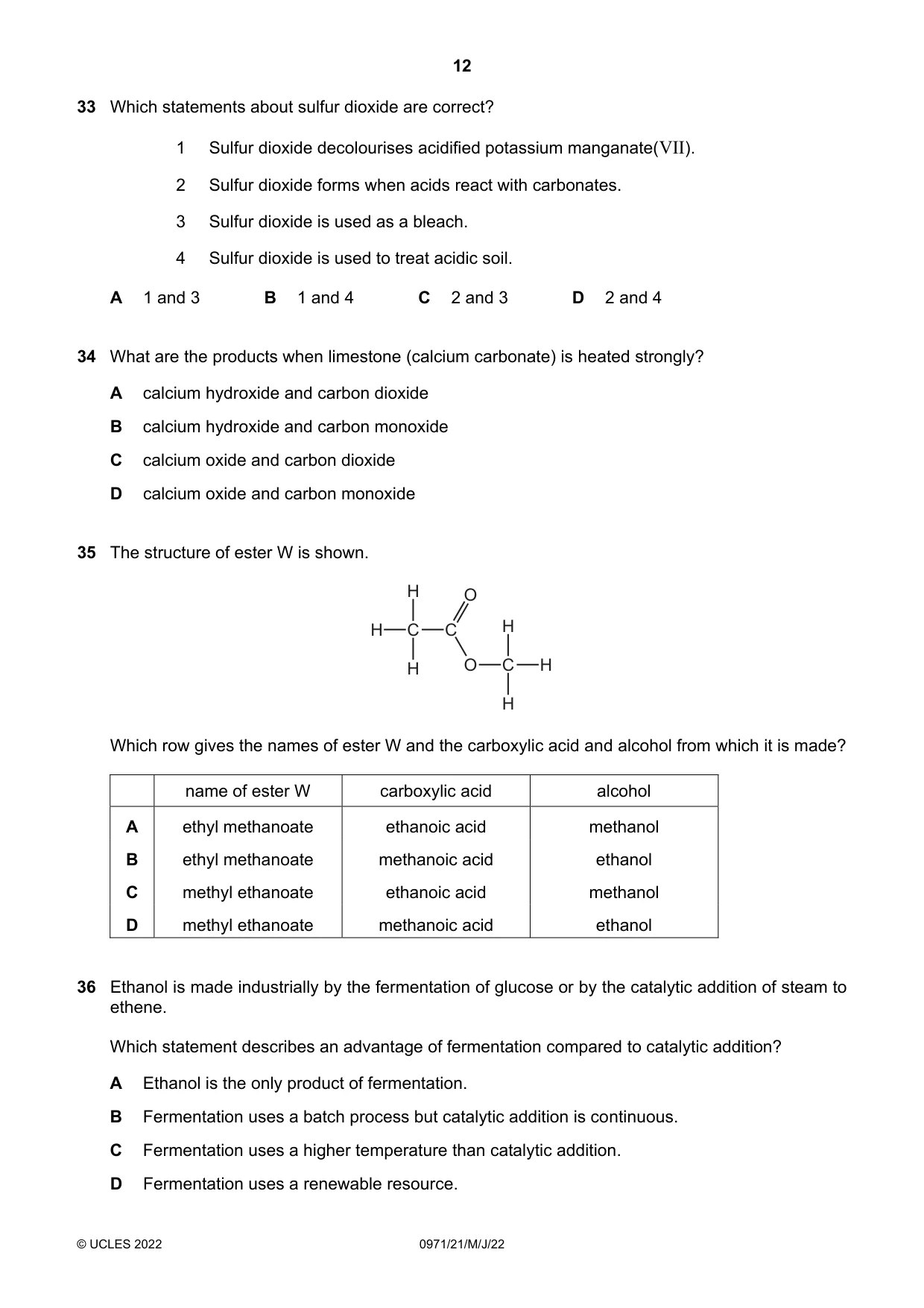
33 Which statements about sulfur dioxide are correct? 1 Sulfur dioxide decolourises acidified potassium manganate(VII). 2 Sulfur dioxide forms when acids react with carbonates. 3 Sulfur dioxide is used as a bleach. 4 Sulfur dioxide is used to treat acidic soil. A 1 and 3 B 1 and 4 C 2 and 3 D 2 and 4
Mark scheme: A
Q34 · What are the products when limestone (calcium carbonate) is heated strongly?
34 What are the products when limestone (calcium carbonate) is heated strongly? A calcium hydroxide and carbon dioxide B calcium hydroxide and carbon monoxide C calcium oxide and carbon dioxide D calcium oxide and carbon monoxide
Mark scheme: C
Q35 · The structure of ester W is shown
35 The structure of ester W is shown. H O H C C H H O C H H Which row gives the names of ester W and the carboxylic acid and alcohol from which it is made? name of ester W carboxylic acid alcohol A ethyl methanoate ethanoic acid methanol B ethyl methanoate methanoic acid ethanol C methyl ethanoate ethanoic acid methanol D methyl ethanoate methanoic acid ethanol
Mark scheme: C
More questions on Formulae, functional groups and terminology
Q36 · Ethanol is made industrially by the fermentation of glucose or by the catalytic addition…
36 Ethanol is made industrially by the fermentation of glucose or by the catalytic addition of steam to ethene. Which statement describes an advantage of fermentation compared to catalytic addition? A Ethanol is the only product of fermentation. B Fermentation uses a batch process but catalytic addition is continuous. C Fermentation uses a higher temperature than catalytic addition. D Fermentation uses a renewable resource.
Mark scheme: D
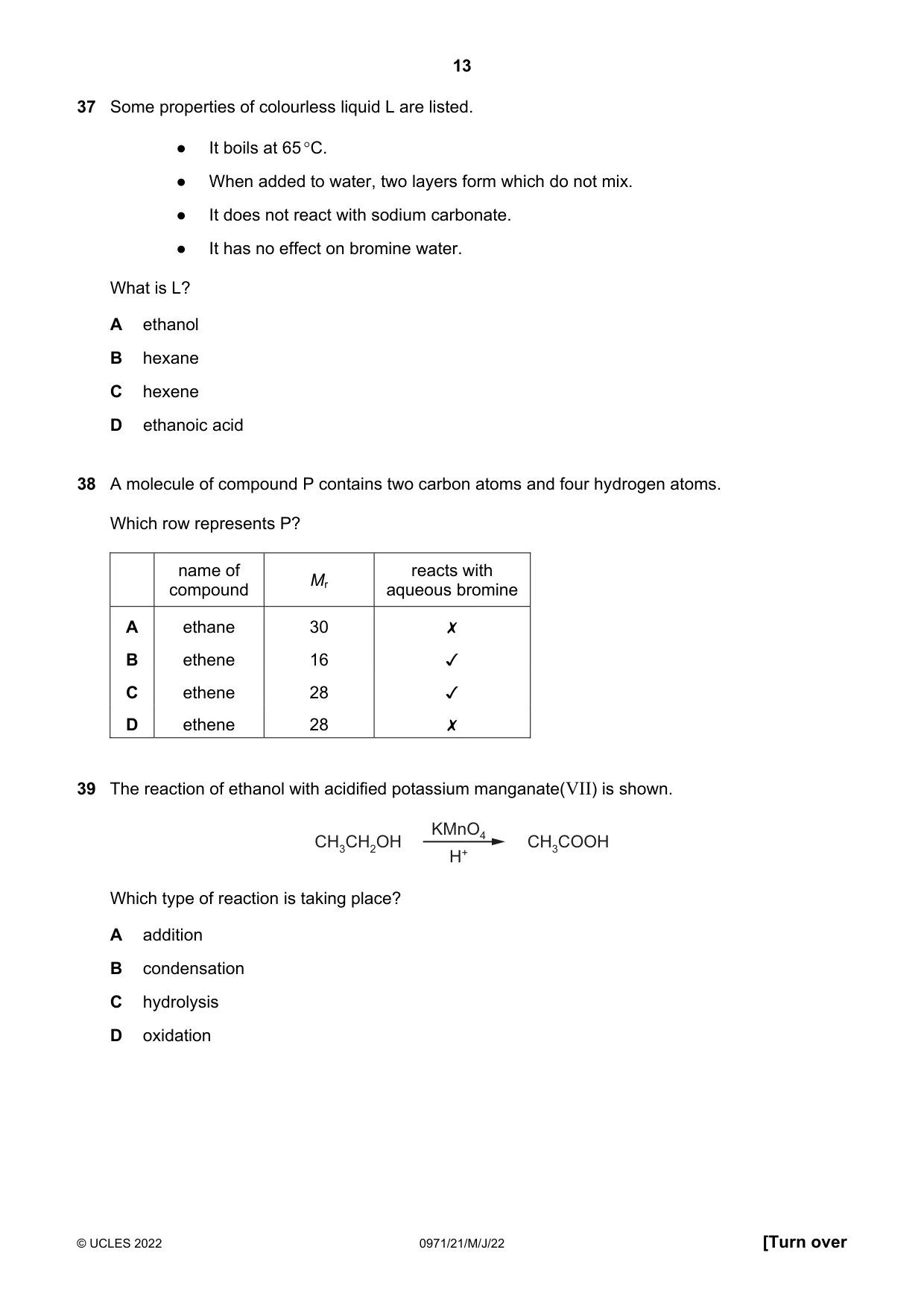
Q37 · Some properties of colourless liquid L are listed
37 Some properties of colourless liquid L are listed. ● It boils at 65 C. ● When added to water, two layers form which do not mix. ● It does not react with sodium carbonate. ● It has no effect on bromine water. What is L? A ethanol B hexane C hexene D ethanoic acid
Mark scheme: B
Q38 · A molecule of compound P contains two carbon atoms and four hydrogen atoms
38 A molecule of compound P contains two carbon atoms and four hydrogen atoms. Which row represents P? name of reacts with compound aqueous bromine ethane ethene ethene ethene
Mark scheme: C
Q39 · The reaction of ethanol with acidified potassium manganate(VII) is shown
39 The reaction of ethanol with acidified potassium manganate(VII) is shown. KMnO4 CH3CH2OH CH3COOH H+ Which type of reaction is taking place? A addition B condensation C hydrolysis D oxidation
Mark scheme: D
Q40 · Which polymer is a synthetic polyamide?
40 Which polymer is a synthetic polyamide? A nylon B poly(ethene) C protein D Terylene
Mark scheme: A
What was in this paper
The subtopics covered by these 40 questions, and how many questions each got. Open one in a new tab to see every Cambridge question on it.
3Alcohols2Arrangement of elements2Exothermic and endothermic reactions2Identification of ions and gases2Oxides2Air quality and climate1Alkanes1Alkenes1Corrosion of metals1Diffusion1Experimental design1Extraction of metals1Fertilisers1Formulae1Formulae, functional groups and terminology1Isotopes1Metallic bonding1Noble gases1Physical and chemical changes1Polymers1Preparation of salts1Properties of metals1Reactivity series1Redox1Relative masses of atoms and molecules1Reversible reactions and equilibrium1Separation and purification1Simple molecules and covalent bonds1The characteristic properties of acids and bases1The mole and the Avogadro constant1Transition elements1Water1What you needed in this session
Cambridge’s own grade thresholds for 2022 May/June, Paper 2 · Variant 1. A higher threshold means an easier paper — the bar moves with how the cohort did.