Cambridge IGCSE Chemistry (9-1) 0971 — 2023 Oct/Nov Paper 2 · Variant 2
0971/22/O/N/23 · 40 questions · 40 marks · 45 min
The question paper and its mark scheme, free to read here and free to download. This is Cambridge’s own paper, exactly as it was sat.
Question paper16 pages
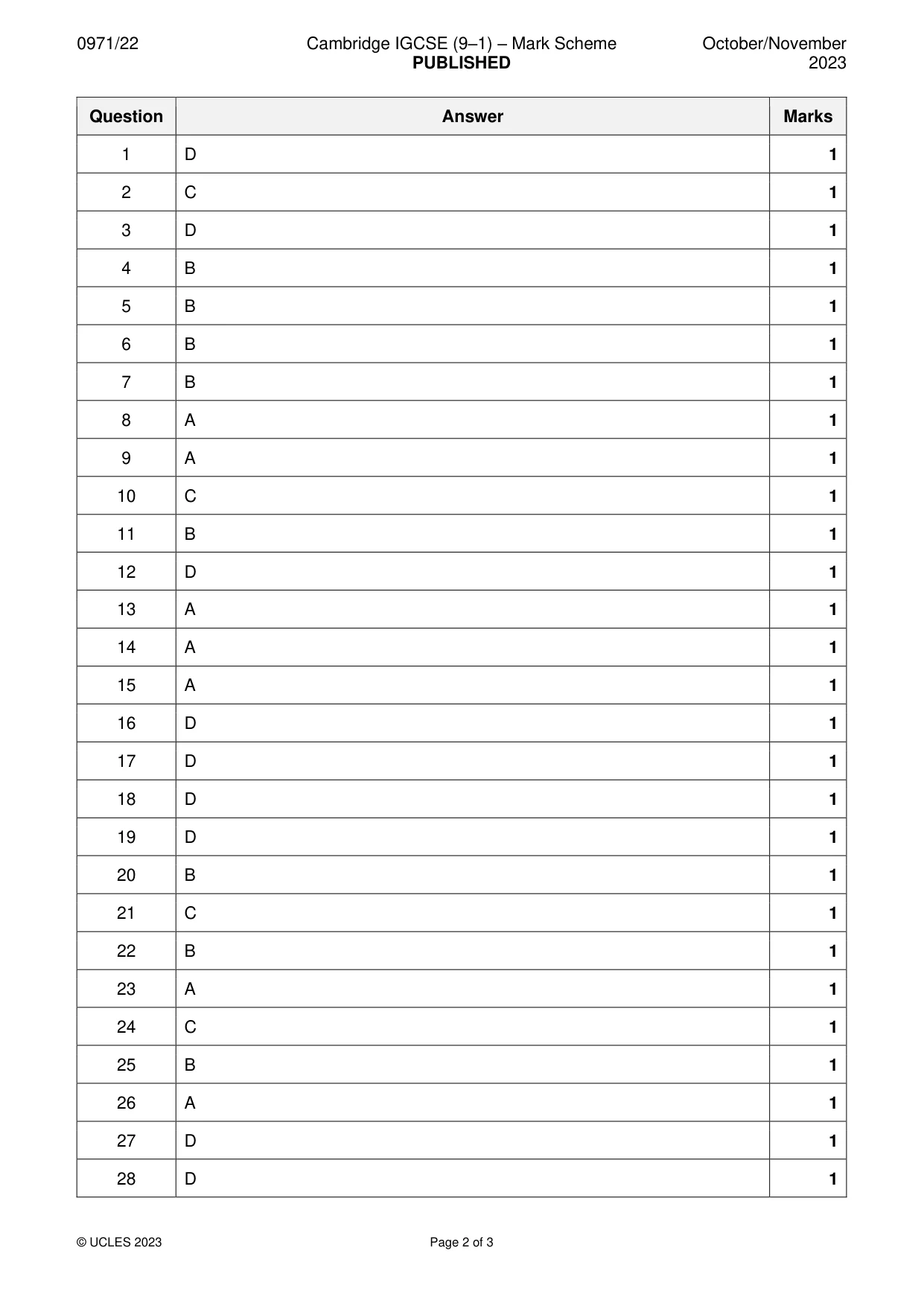
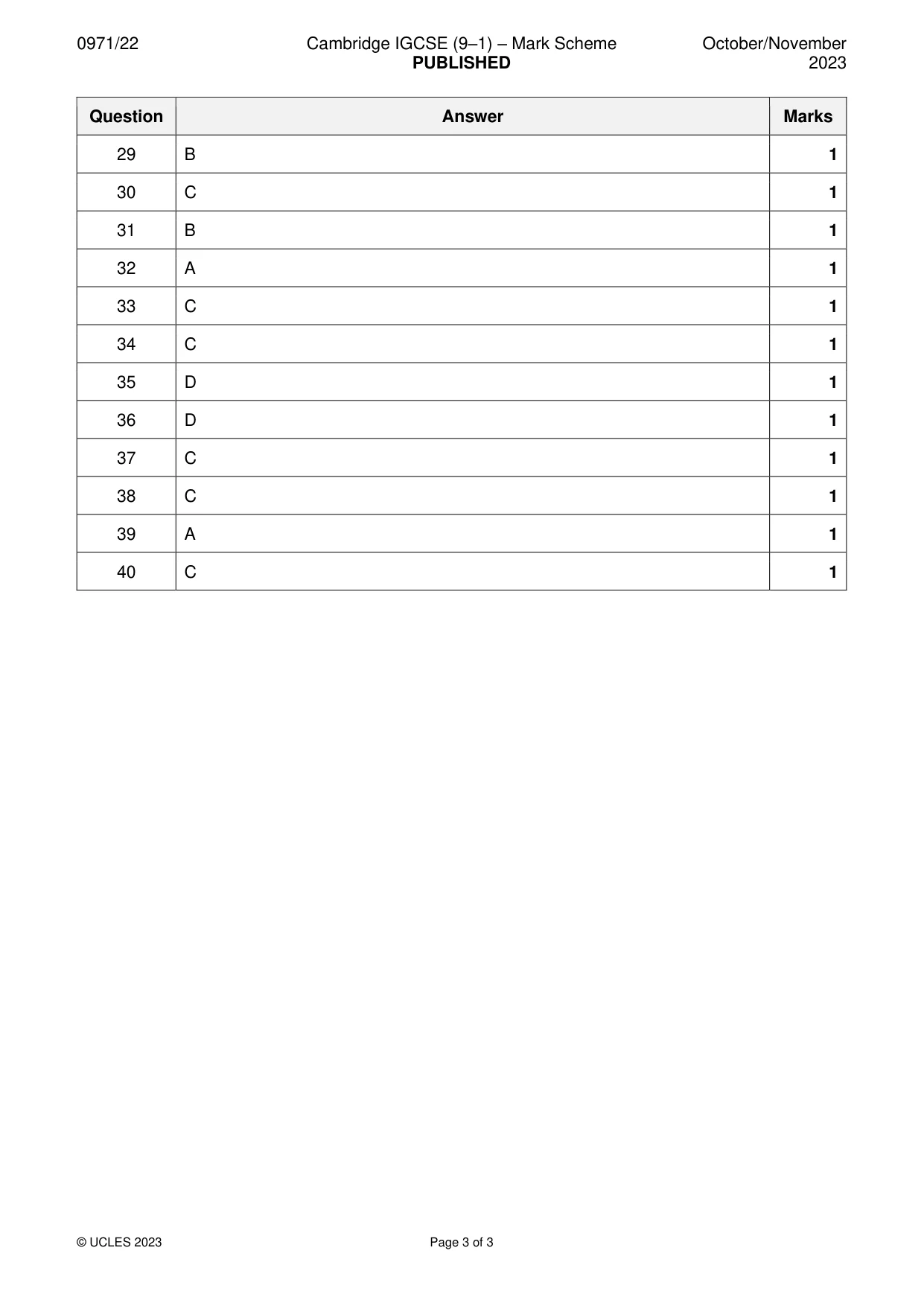
Mark scheme3 pages
Answers below. Sit the paper first if you are practising.
Questions as text
Q1 · Part of a cooling curve for water is shown
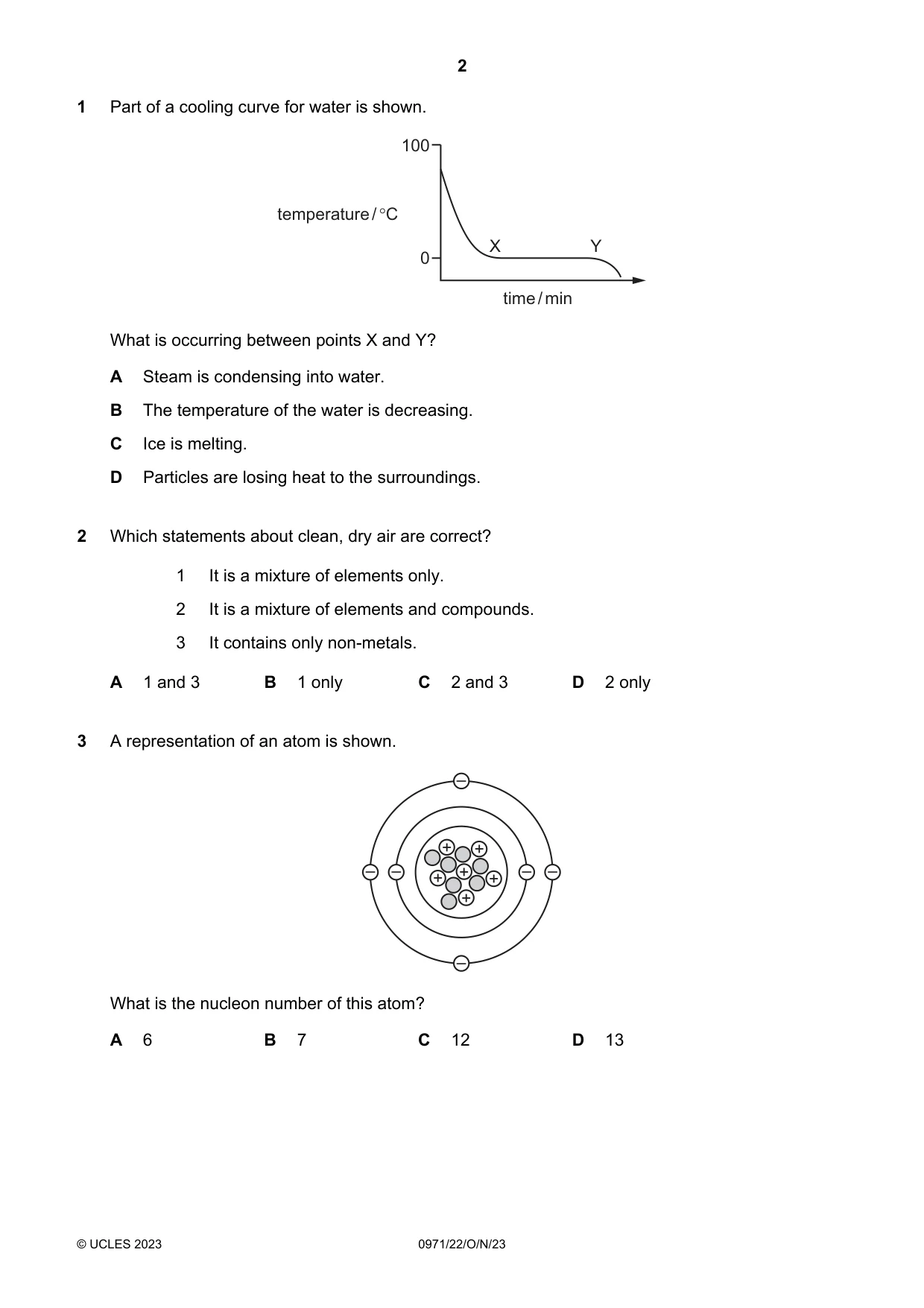
1. Part of a cooling curve for water is shown. 100 temperature /°C time/min What is occurring between points X and Y? A Steam is condensing into water. B- The temperature of the water is decreasing. C Ice is melting. D Particles are losing heat to the surroundings.
Mark scheme: D
Q2 · Which statements about clean, dry air are correct?
2 Which statements about clean, dry air are correct? 1 It is a mixture of elements only. 2 It is a mixture of elements and compounds. 3 It contains only non-metals. A 1 and 3 B 1 only C 2 and 3 D 2 only
Mark scheme: C
Q3 · A representation of an atom is shown
3 A representation of an atom is shown. – + + – – + + – – + + – What is the nucleon number of this atom? A 6 B 7 C 12 D 13
Mark scheme: D
Q4 · The percentage abundances of three isotopes in a sample of neon are shown
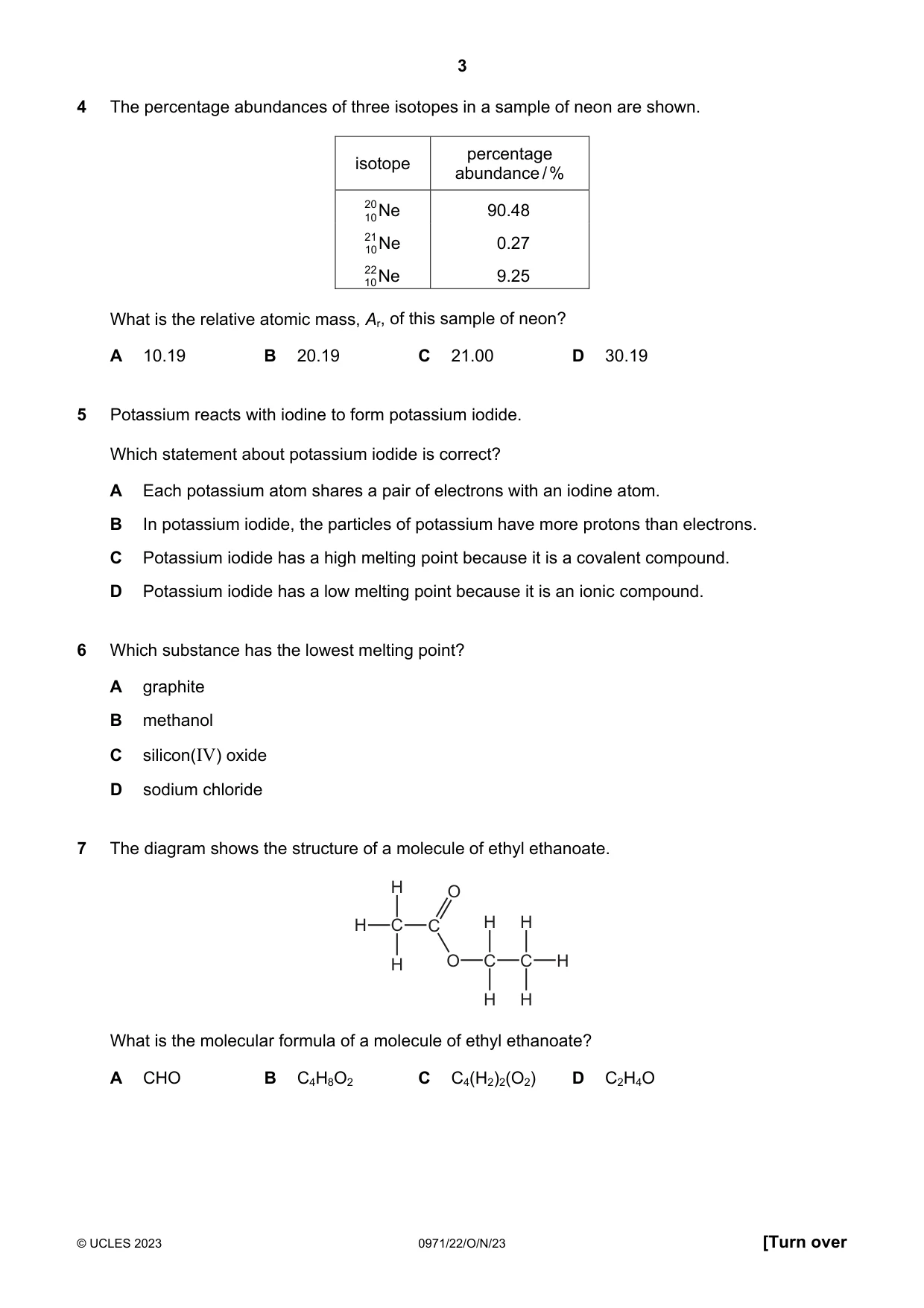
4 The percentage abundances of three isotopes in a sample of neon are shown. percentage isotope abundance / % 20 Ne 90.48 10 21 Ne 0.27 10 22 Ne 9.25 10 What is the relative atomic mass, Ar, of this sample of neon? A 10.19 B 20.19 C 21.00 D 30.19
Mark scheme: B
Q5 · Potassium reacts with iodine to form potassium iodide
5 Potassium reacts with iodine to form potassium iodide. Which statement about potassium iodide is correct? A Each potassium atom shares a pair of electrons with an iodine atom. B In potassium iodide, the particles of potassium have more protons than electrons. C Potassium iodide has a high melting point because it is a covalent compound. D Potassium iodide has a low melting point because it is an ionic compound.
Mark scheme: B
Q6 · Which substance has the lowest melting point?
6 Which substance has the lowest melting point? A graphite B methanol C silicon(IV) oxide D sodium chloride
Mark scheme: B
Q7 · The diagram shows the structure of a molecule of ethyl ethanoate
7 The diagram shows the structure of a molecule of ethyl ethanoate. H O H C C H H H O C C H H H What is the molecular formula of a molecule of ethyl ethanoate? A CHO B C4H8O2 C C4(H2)2(O2) D C2H4O
Mark scheme: B
More questions on Formulae, functional groups and terminology
Q8 · A hydrocarbon contains 85.7% of carbon by mass
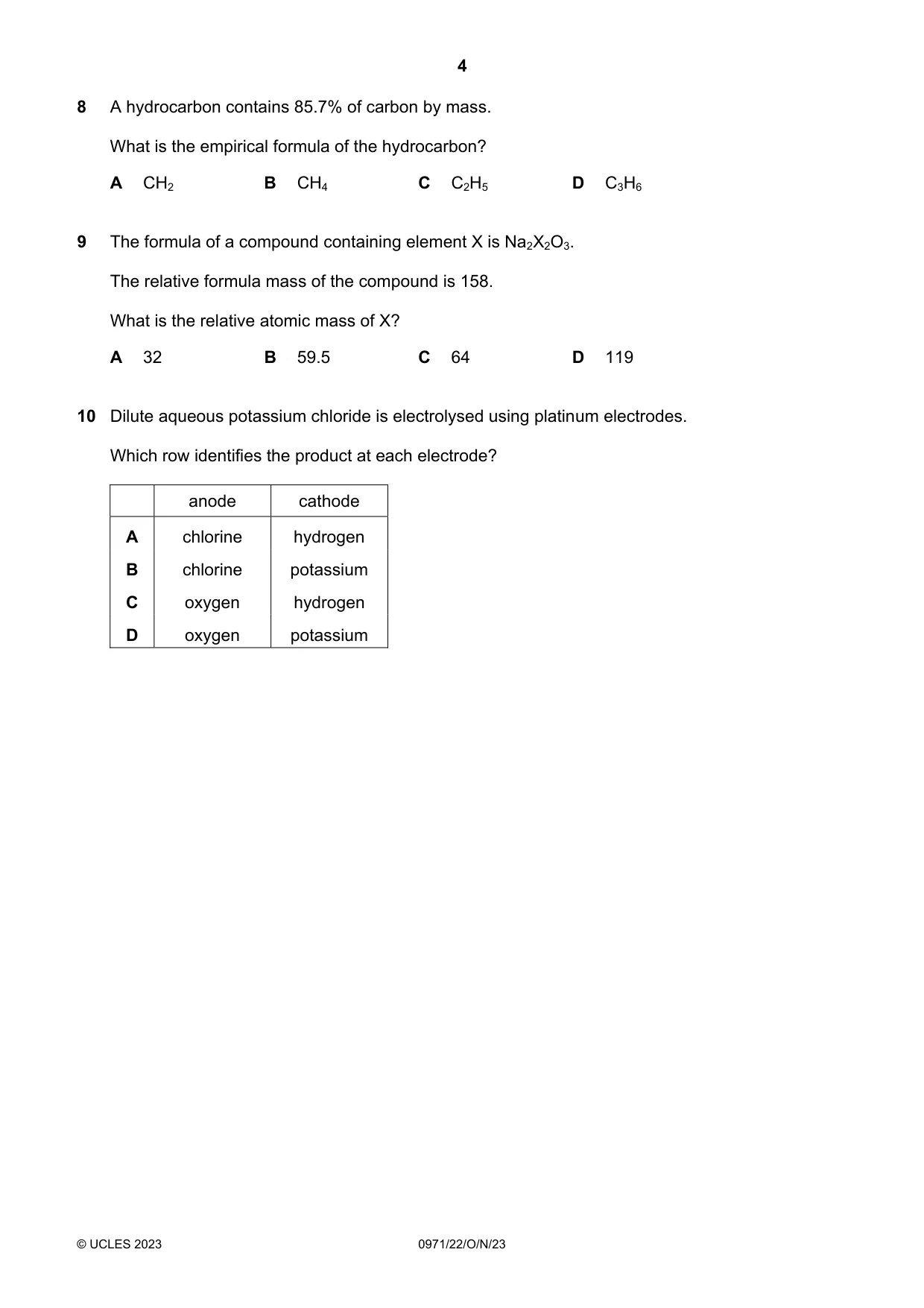
8 A hydrocarbon contains 85.7% of carbon by mass. What is the empirical formula of the hydrocarbon? A CH2 B CH4 C C2H5 D C3H6
Mark scheme: A
Q9 · The formula of a compound containing element X is Na2X2O3
9 The formula of a compound containing element X is Na2X2O3. The relative formula mass of the compound is 158. What is the relative atomic mass of X? A 32 B 59.5 C 64 D 119
Mark scheme: A
Q10 · Dilute aqueous potassium chloride is electrolysed using platinum electrodes
10 Dilute aqueous potassium chloride is electrolysed using platinum electrodes. Which row identifies the product at each electrode? anode cathode A chlorine hydrogen B chlorine potassium C oxygen hydrogen D oxygen potassium
Mark scheme: C
Q11 · Concentrated aqueous copper(II) chloride is electrolysed using copper electrodes, as shown
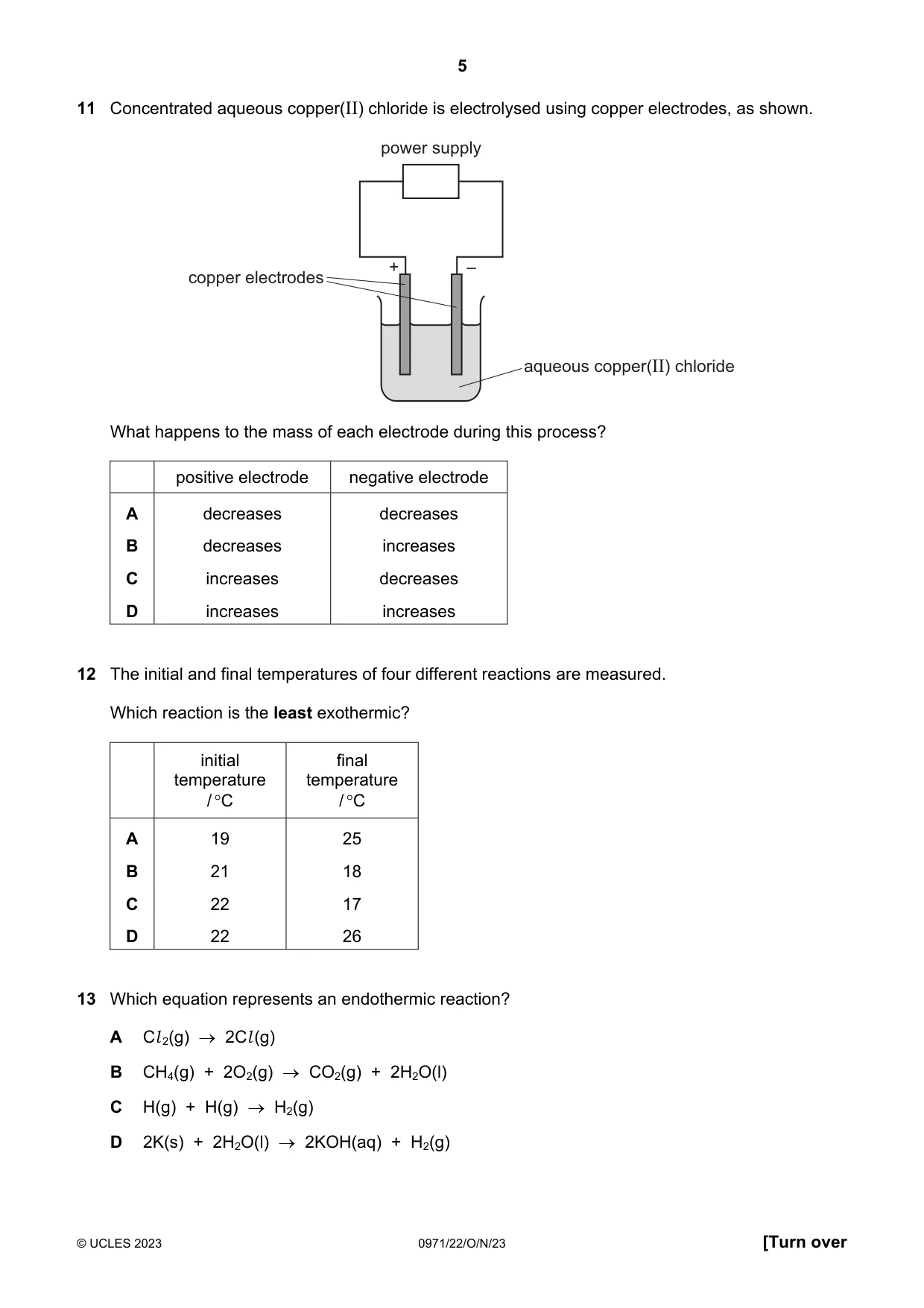
11 Concentrated aqueous copper(II) chloride is electrolysed using copper electrodes, as shown. power supply + – copper electrodes aqueous copper(II) chloride What happens to the mass of each electrode during this process? positive electrode negative electrode A decreases decreases B decreases increases C increases decreases D increases increases
Mark scheme: B
Q12 · The initial and final temperatures of four different reactions are measured
12 The initial and final temperatures of four different reactions are measured. Which reaction is the least exothermic? initial final temperature temperature / C / C A 19 25 B 21 18 C 22 17 D 22 26
Mark scheme: D
Q13 · Which equation represents an endothermic reaction?
13 Which equation represents an endothermic reaction? A Cl 2(g) 2Cl (g) B CH4(g) + 2O2(g) CO2(g) + 2H2O(l) C H(g) + H(g) H2(g) D 2K(s) + 2H2O(l) 2KOH(aq) + H2(g)
Mark scheme: A
Q14 · Methane burns in oxygen to form carbon dioxide and water
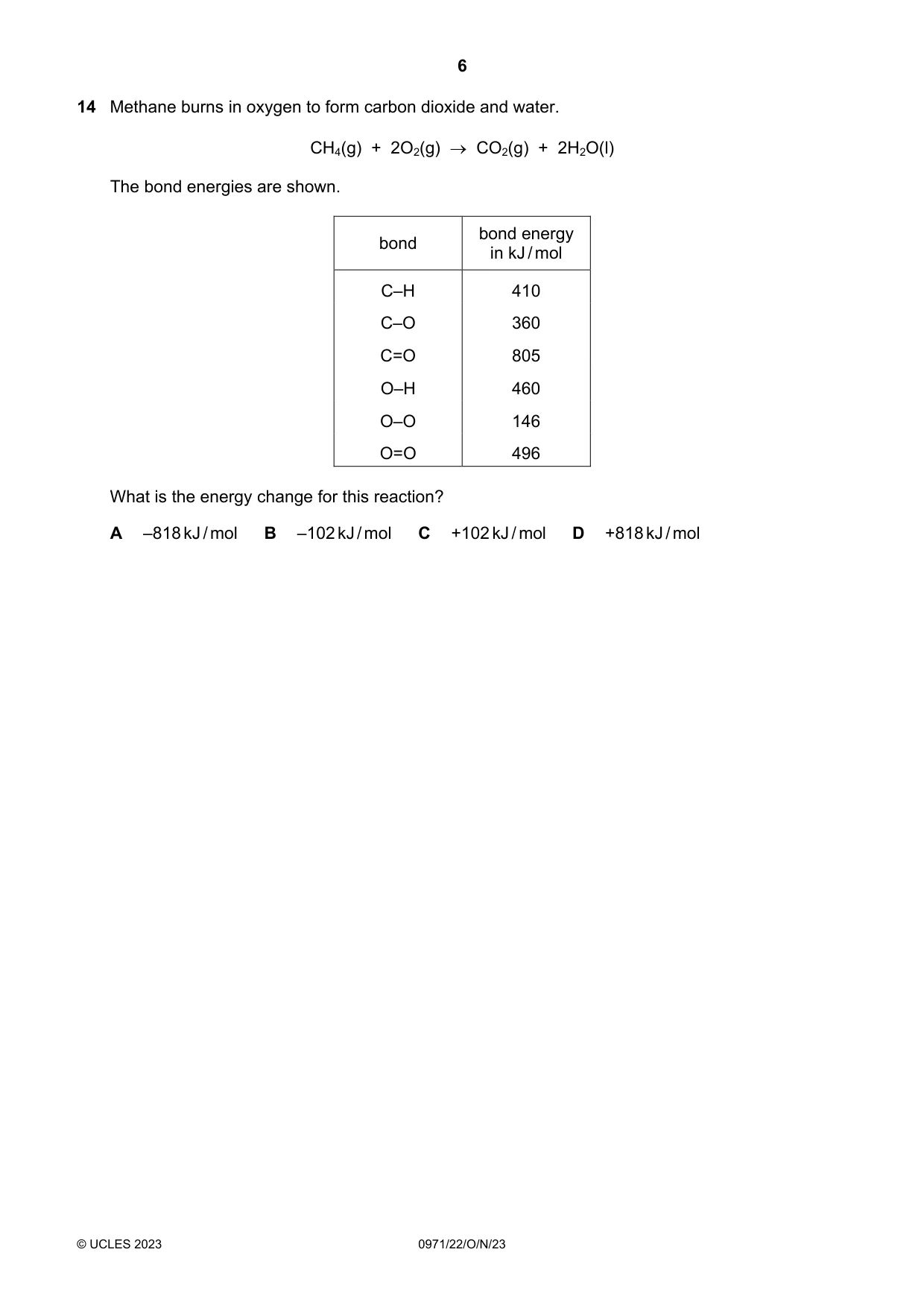
14 Methane burns in oxygen to form carbon dioxide and water. CH4(g) + 2O2(g) CO2(g) + 2H2O(l) The bond energies are shown. bond energy bond in kJ / mol C–H 410 C–O 360 C=O 805 O–H 460 O–O 146 O=O 496 What is the energy change for this reaction? A –818 kJ / mol B –102 kJ / mol C +102 kJ / mol D +818 kJ / mol
Mark scheme: A
Q15 · Hydrochloric acid is added to excess calcium carbonate in two separate experiments
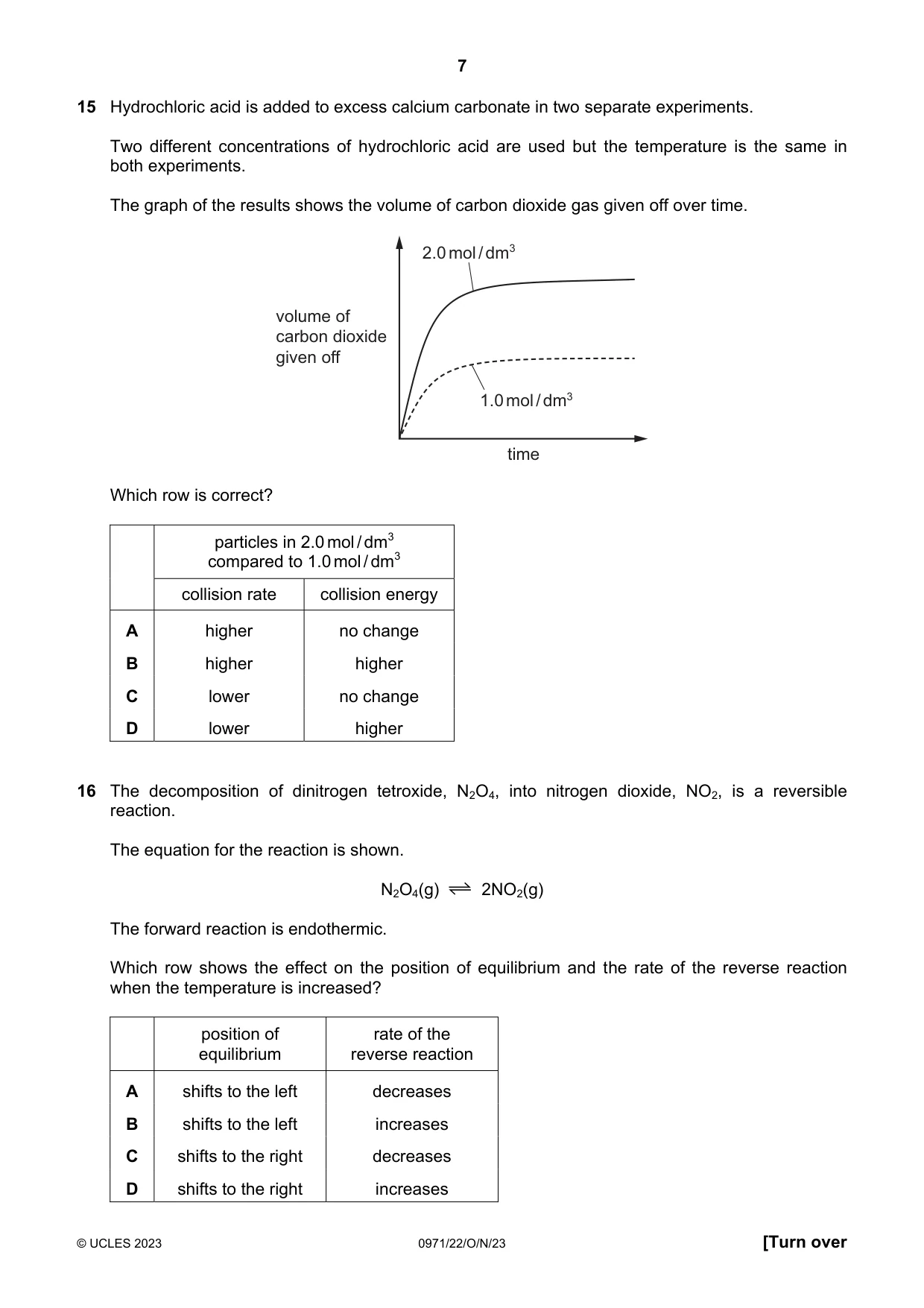
15 Hydrochloric acid is added to excess calcium carbonate in two separate experiments. Two different concentrations of hydrochloric acid are used but the temperature is the same in both experiments. The graph of the results shows the volume of carbon dioxide gas given off over time. 2.0 mol / dm3 volume of carbon dioxide given off 1.0 mol / dm3 time Which row is correct? particles in 2.0 mol / dm3 compared to 1.0 mol / dm3 collision rate collision energy A higher no change B higher higher C lower no change D lower higher
Mark scheme: A
Q16 · The decomposition of dinitrogen tetroxide, N2O4, into nitrogen dioxide, NO2, is a…
16 The decomposition of dinitrogen tetroxide, N2O4, into nitrogen dioxide, NO2, is a reversible reaction. The equation for the reaction is shown. N2O4(g) 2NO2(g) The forward reaction is endothermic. Which row shows the effect on the position of equilibrium and the rate of the reverse reaction when the temperature is increased? position of rate of the equilibrium reverse reaction A shifts to the left decreases B shifts to the left increases C shifts to the right decreases D shifts to the right increases
Mark scheme: D
Q17 · In a blast furnace, iron(III) oxide is converted to iron and carbon monoxide is converted…
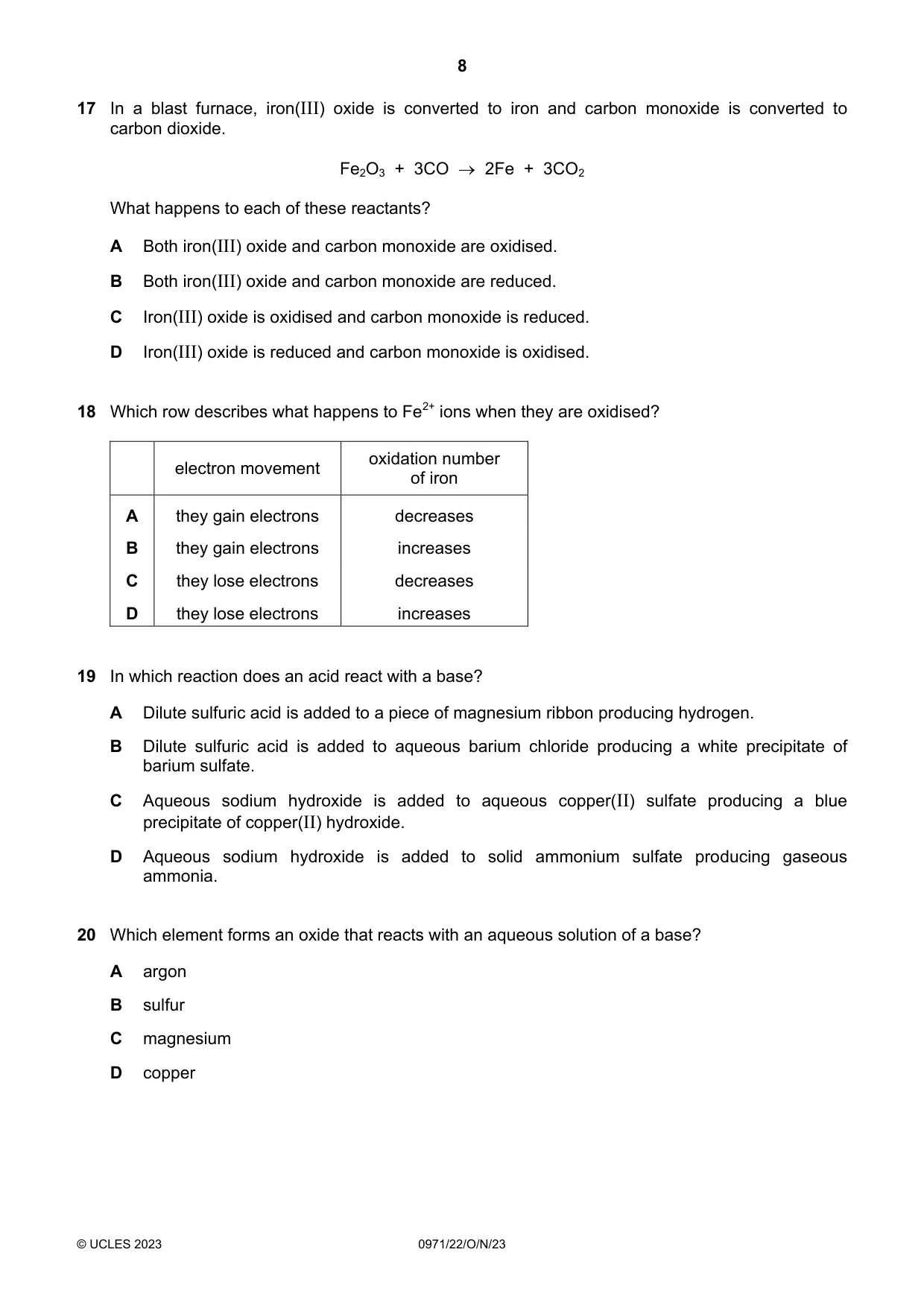
17 In a blast furnace, iron(III) oxide is converted to iron and carbon monoxide is converted to carbon dioxide. Fe2O3 + 3CO 2Fe + 3CO2 What happens to each of these reactants? A Both iron(III) oxide and carbon monoxide are oxidised. B Both iron(III) oxide and carbon monoxide are reduced. C Iron(III) oxide is oxidised and carbon monoxide is reduced. D Iron(III) oxide is reduced and carbon monoxide is oxidised.
Mark scheme: D
Q18 · Which row describes what happens to Fe2+ ions when they are oxidised?
18 Which row describes what happens to Fe2+ ions when they are oxidised? oxidation number electron movement of iron A they gain electrons decreases B they gain electrons increases C they lose electrons decreases D they lose electrons increases
Mark scheme: D
Q19 · In which reaction does an acid react with a base?
19 In which reaction does an acid react with a base? A Dilute sulfuric acid is added to a piece of magnesium ribbon producing hydrogen. B Dilute sulfuric acid is added to aqueous barium chloride producing a white precipitate of barium sulfate. C Aqueous sodium hydroxide is added to aqueous copper(II) sulfate producing a blue precipitate of copper(II) hydroxide. D Aqueous sodium hydroxide is added to solid ammonium sulfate producing gaseous ammonia.
Mark scheme: D
More questions on The characteristic properties of acids and bases
Q20 · Which element forms an oxide that reacts with an aqueous solution of a base?
20 Which element forms an oxide that reacts with an aqueous solution of a base? A argon B sulfur C magnesium D copper
Mark scheme: B
Q21 · Which method is used to produce insoluble salts?
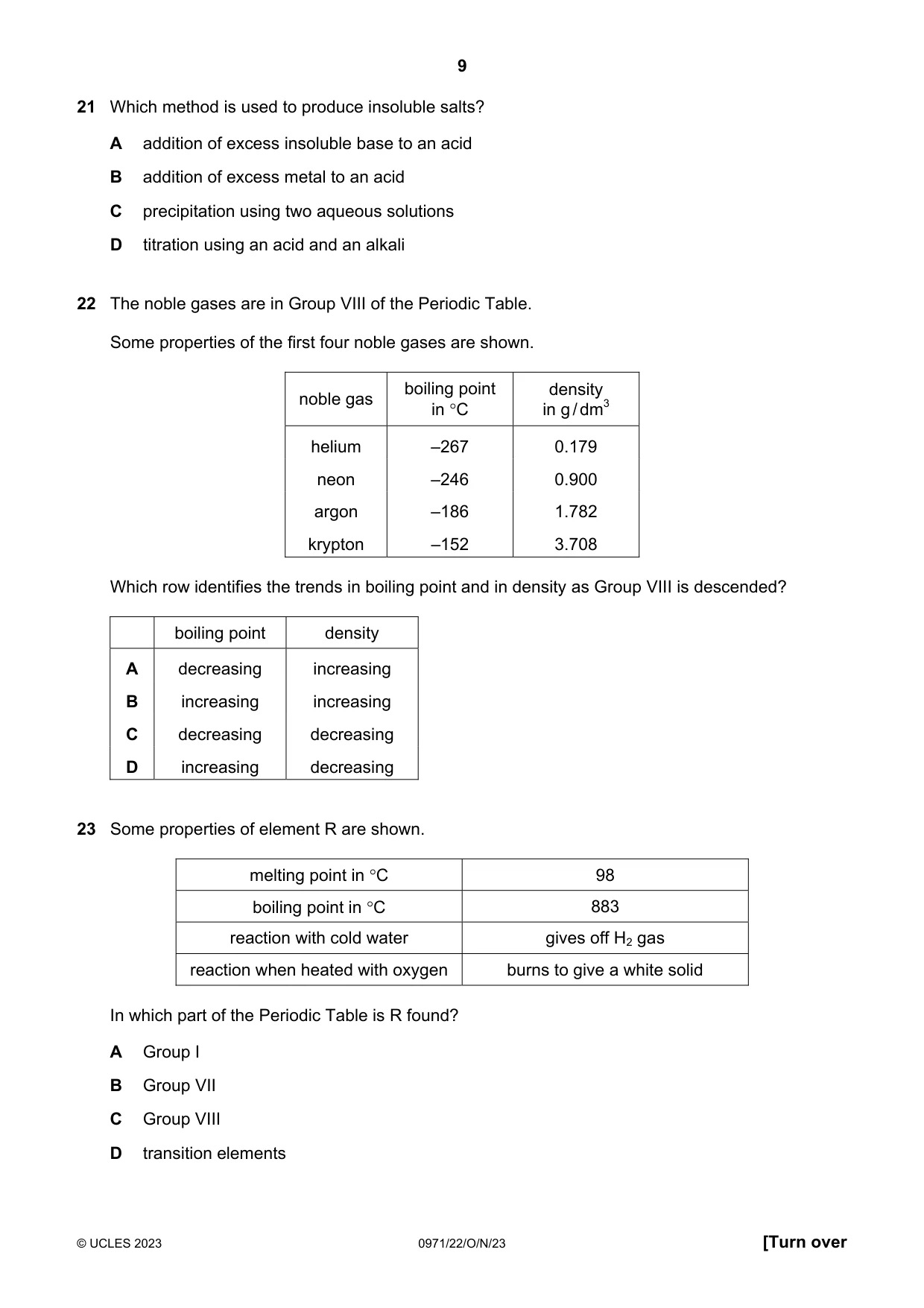
21 Which method is used to produce insoluble salts? A addition of excess insoluble base to an acid B addition of excess metal to an acid C precipitation using two aqueous solutions D titration using an acid and an alkali
Mark scheme: C
Q22 · The noble gases are in Group VIII of the Periodic Table
22 The noble gases are in Group VIII of the Periodic Table. Some properties of the first four noble gases are shown. boiling point density noble gas in g / dm3 in C helium –267 0.179 neon –246 0.900 argon –186 1.782 krypton –152 3.708 Which row identifies the trends in boiling point and in density as Group VIII is descended? boiling point density A decreasing increasing B increasing increasing C decreasing decreasing D increasing decreasing
Mark scheme: B
Q23 · Some properties of element R are shown
23 Some properties of element R are shown. melting point in C 98 boiling point in C 883 reaction with cold water gives off H2 gas reaction when heated with oxygen burns to give a white solid In which part of the Periodic Table is R found? A Group I B Group VII C Group VIII D transition elements
Mark scheme: A
Q24 · Which pair of compounds shows that transition elements have variable oxidation states?
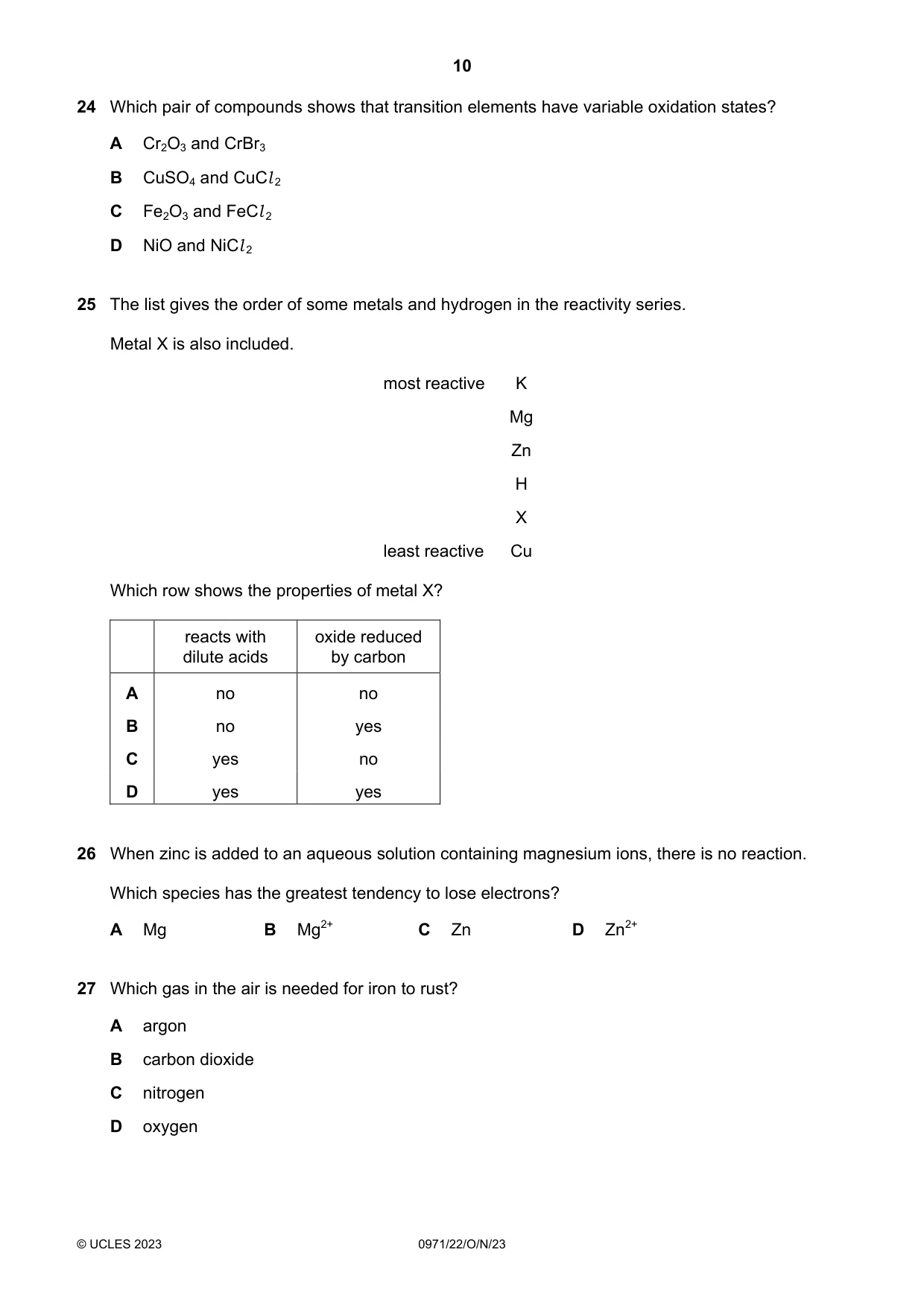
24 Which pair of compounds shows that transition elements have variable oxidation states? A Cr2O3 and CrBr3 B CuSO4 and CuCl 2 C Fe2O3 and FeCl 2 D NiO and NiCl 2
Mark scheme: C
Q25 · The list gives the order of some metals and hydrogen in the reactivity series
25 The list gives the order of some metals and hydrogen in the reactivity series. Metal X is also included. most reactive K Mg Zn H X least reactive Cu Which row shows the properties of metal X? reacts with oxide reduced dilute acids by carbon A no no B no yes C yes no D yes yes
Mark scheme: B
Q26 · When zinc is added to an aqueous solution containing magnesium ions, there is no reaction
26 When zinc is added to an aqueous solution containing magnesium ions, there is no reaction. Which species has the greatest tendency to lose electrons? A Mg B Mg2+ C Zn D Zn2+
Mark scheme: A
Q27 · Which gas in the air is needed for iron to rust?
27 Which gas in the air is needed for iron to rust? A argon B carbon dioxide C nitrogen D oxygen
Mark scheme: D
Q28 · Which coating prevents iron from rusting even when the coating is damaged?
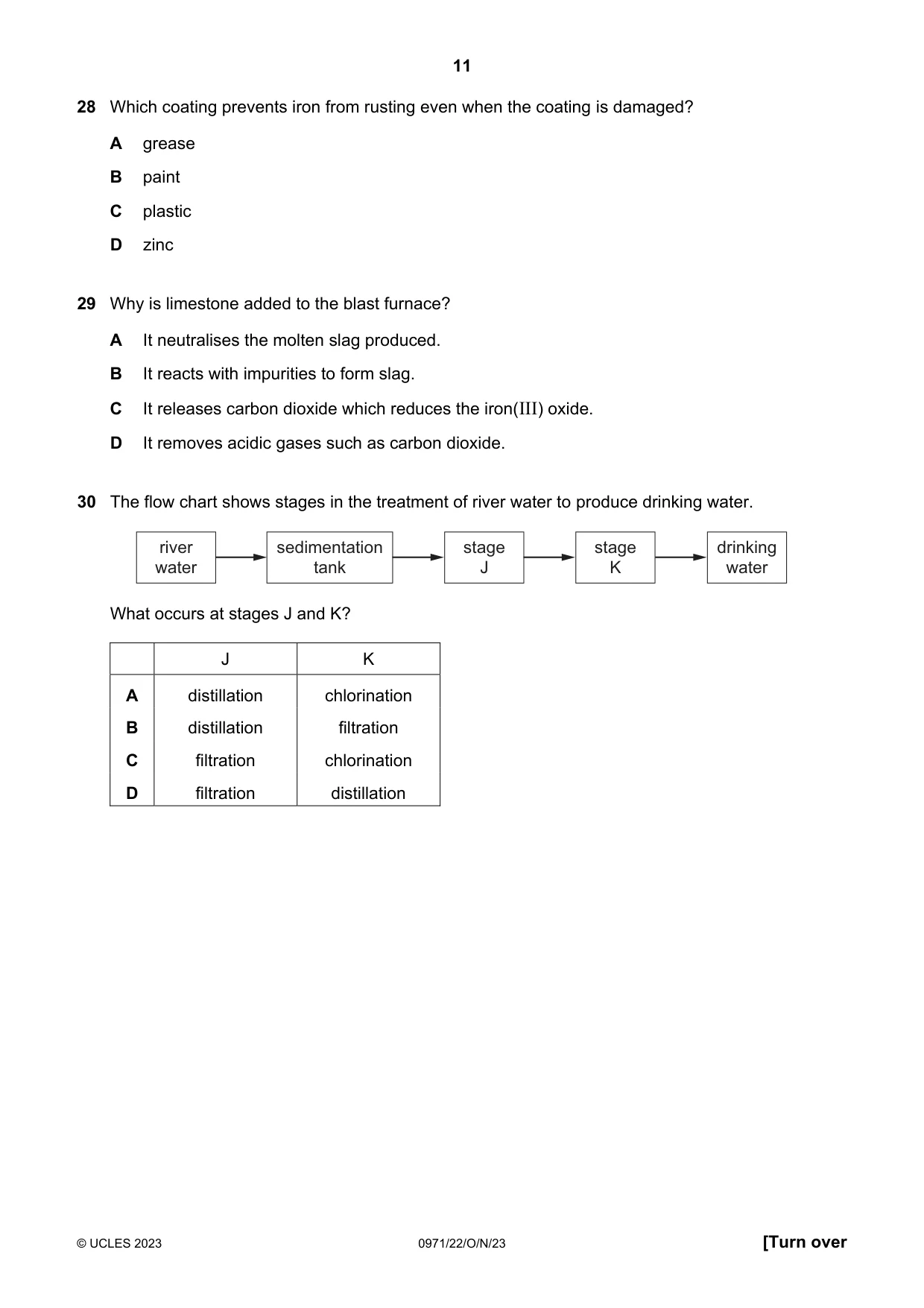
28 Which coating prevents iron from rusting even when the coating is damaged? A grease B paint C plastic D zinc
Mark scheme: D
Q29 · Why is limestone added to the blast furnace?
29 Why is limestone added to the blast furnace? A It neutralises the molten slag produced. B It reacts with impurities to form slag. C It releases carbon dioxide which reduces the iron(III) oxide. D It removes acidic gases such as carbon dioxide.
Mark scheme: B
Q30 · The flow chart shows stages in the treatment of river water to produce drinking water
30 The flow chart shows stages in the treatment of river water to produce drinking water. river sedimentation stage stage drinking water tank J K water What occurs at stages J and K? J K A distillation chlorination B distillation filtration C filtration chlorination D filtration distillation
Mark scheme: C
Q31 · Carbon dioxide acts as a greenhouse gas by interacting with a particular type of energy…
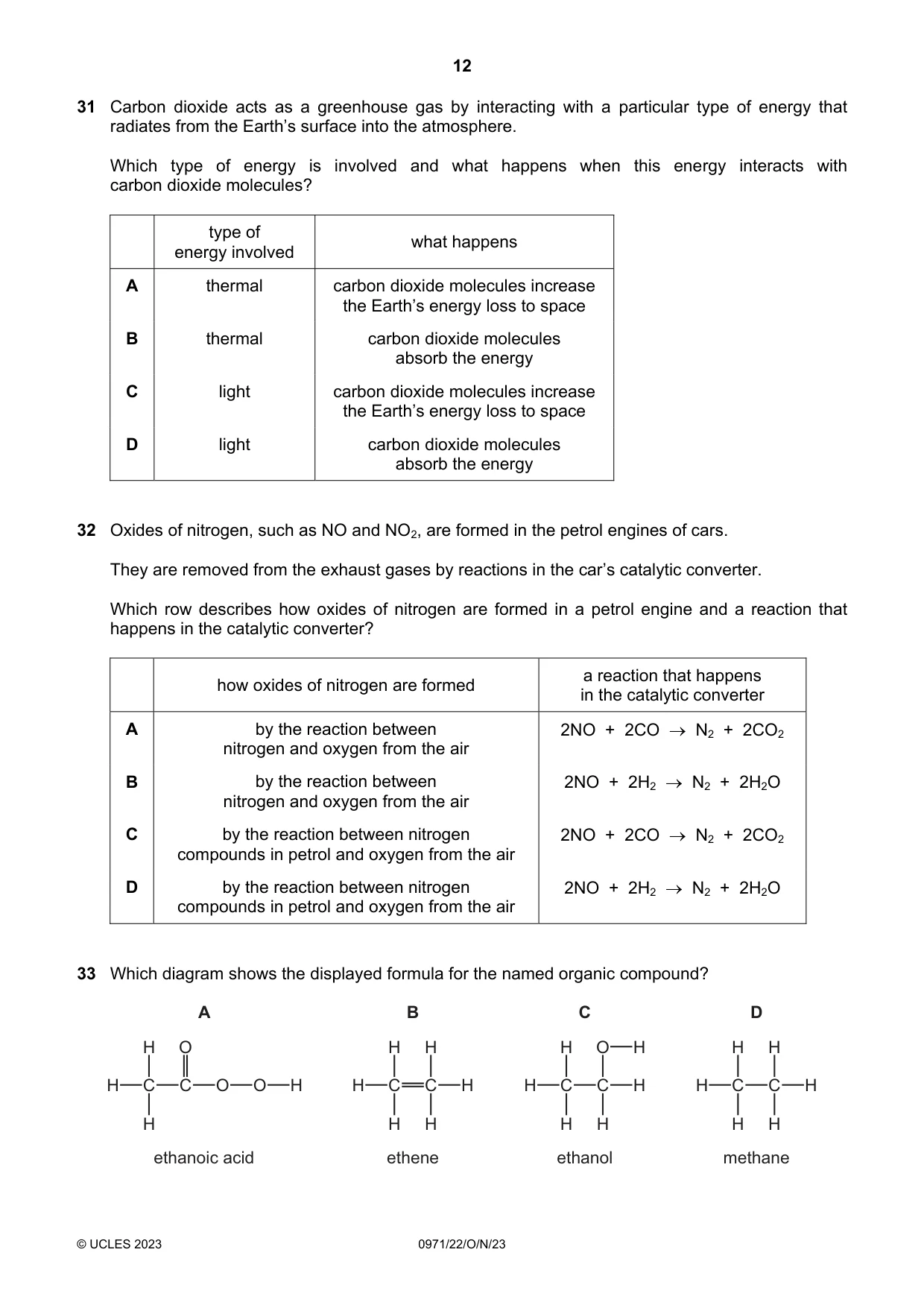
31 Carbon dioxide acts as a greenhouse gas by interacting with a particular type of energy that radiates from the Earth’s surface into the atmosphere. Which type of energy is involved and what happens when this energy interacts with carbon dioxide molecules? type of what happens energy involved A thermal carbon dioxide molecules increase the Earth’s energy loss to space B thermal carbon dioxide molecules absorb the energy C light carbon dioxide molecules increase the Earth’s energy loss to space D light carbon dioxide molecules absorb the energy
Mark scheme: B
Q32 · Oxides of nitrogen, such as NO and NO2, are formed in the petrol engines of cars
32 Oxides of nitrogen, such as NO and NO2, are formed in the petrol engines of cars. They are removed from the exhaust gases by reactions in the car’s catalytic converter. Which row describes how oxides of nitrogen are formed in a petrol engine and a reaction that happens in the catalytic converter? a reaction that happens how oxides of nitrogen are formed in the catalytic converter A by the reaction between 2NO + 2CO N2 + 2CO2 nitrogen and oxygen from the air B by the reaction between 2NO + 2H2 N2 + 2H2O nitrogen and oxygen from the air C by the reaction between nitrogen 2NO + 2CO N2 + 2CO2 compounds in petrol and oxygen from the air D by the reaction between nitrogen 2NO + 2H2 N2 + 2H2O compounds in petrol and oxygen from the air
Mark scheme: A
Q33 · Which diagram shows the displayed formula for the named organic compound?
33 Which diagram shows the displayed formula for the named organic compound? A B C D H O H H H O H H H H C C O O H H C C H H C C H H C C H H H H H H H H ethanoic acid ethene ethanol methane
Mark scheme: C
More questions on Formulae, functional groups and terminology
Q34 · What is the total number of covalent bonds in a molecule of butane, C4H10?
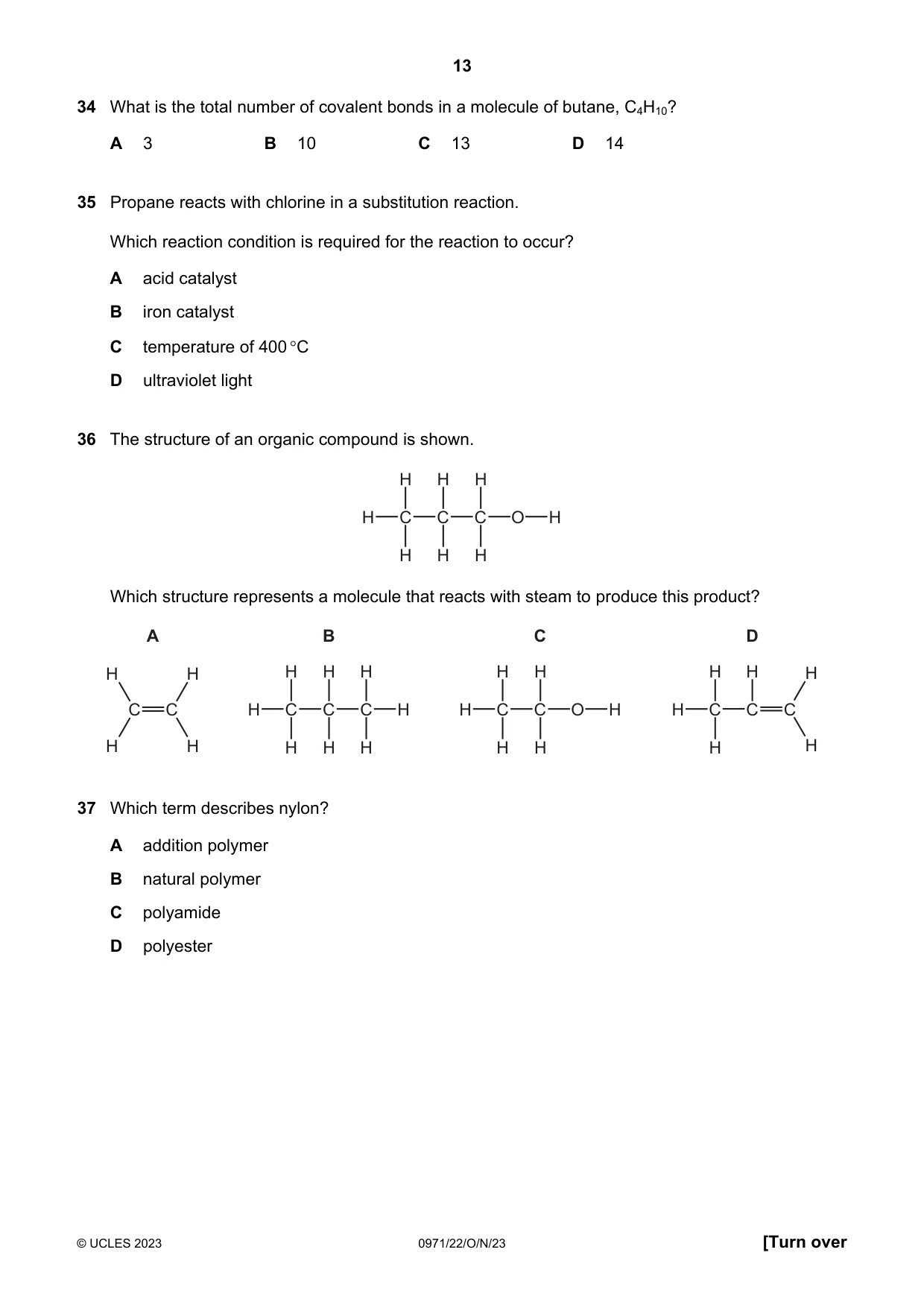
34 What is the total number of covalent bonds in a molecule of butane, C4H10? A 3 B 10 C 13 D 14
Mark scheme: C
Q35 · Propane reacts with chlorine in a substitution reaction
35 Propane reacts with chlorine in a substitution reaction. Which reaction condition is required for the reaction to occur? A acid catalyst B iron catalyst C temperature of 400 C D ultraviolet light
Mark scheme: D
Q36 · The structure of an organic compound is shown
36 The structure of an organic compound is shown. H H H H C C C O H H H H Which structure represents a molecule that reacts with steam to produce this product? A B C D H H H H H H H H H H C C H C C C H H C C O H H C C C H H H H H H H H H
Mark scheme: D
Q37 · Which term describes nylon?
37 Which term describes nylon? A addition polymer B natural polymer C polyamide D polyester
Mark scheme: C
Q38 · Ethene can be polymerised
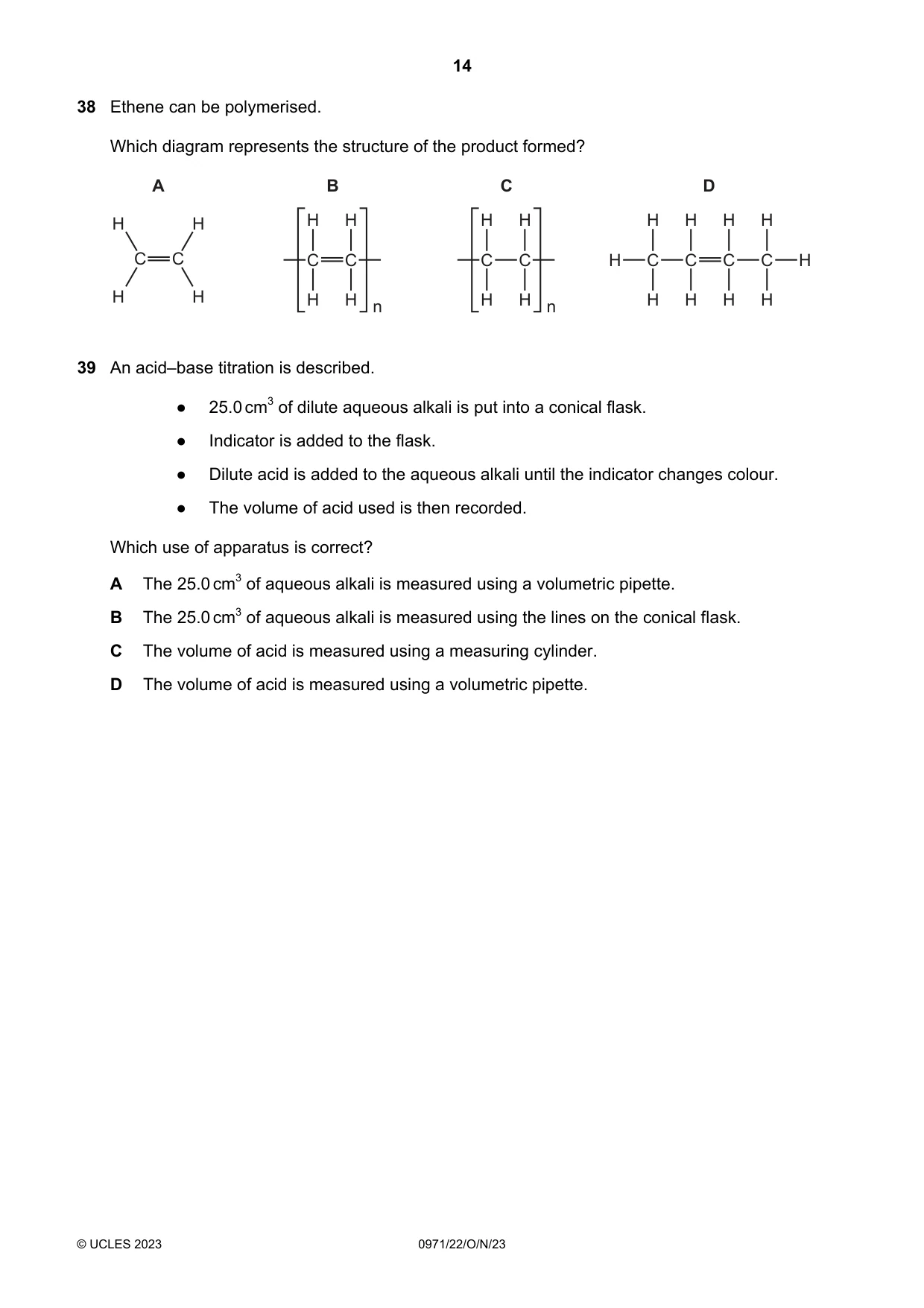
38 Ethene can be polymerised. Which diagram represents the structure of the product formed? A B C D H H H H H H H H H H C C C C C C H C C C C H H H H H H H H H H H n n
Mark scheme: C
Q39 · An acid–base titration is described
39 An acid–base titration is described. ● 25.0 cm3 of dilute aqueous alkali is put into a conical flask. ● Indicator is added to the flask. ● Dilute acid is added to the aqueous alkali until the indicator changes colour. ● The volume of acid used is then recorded. Which use of apparatus is correct? A The 25.0 cm3 of aqueous alkali is measured using a volumetric pipette. B The 25.0 cm3 of aqueous alkali is measured using the lines on the conical flask. C The volume of acid is measured using a measuring cylinder. D The volume of acid is measured using a volumetric pipette.
Mark scheme: A
Q40 · Substance Q is investigated using chromatography
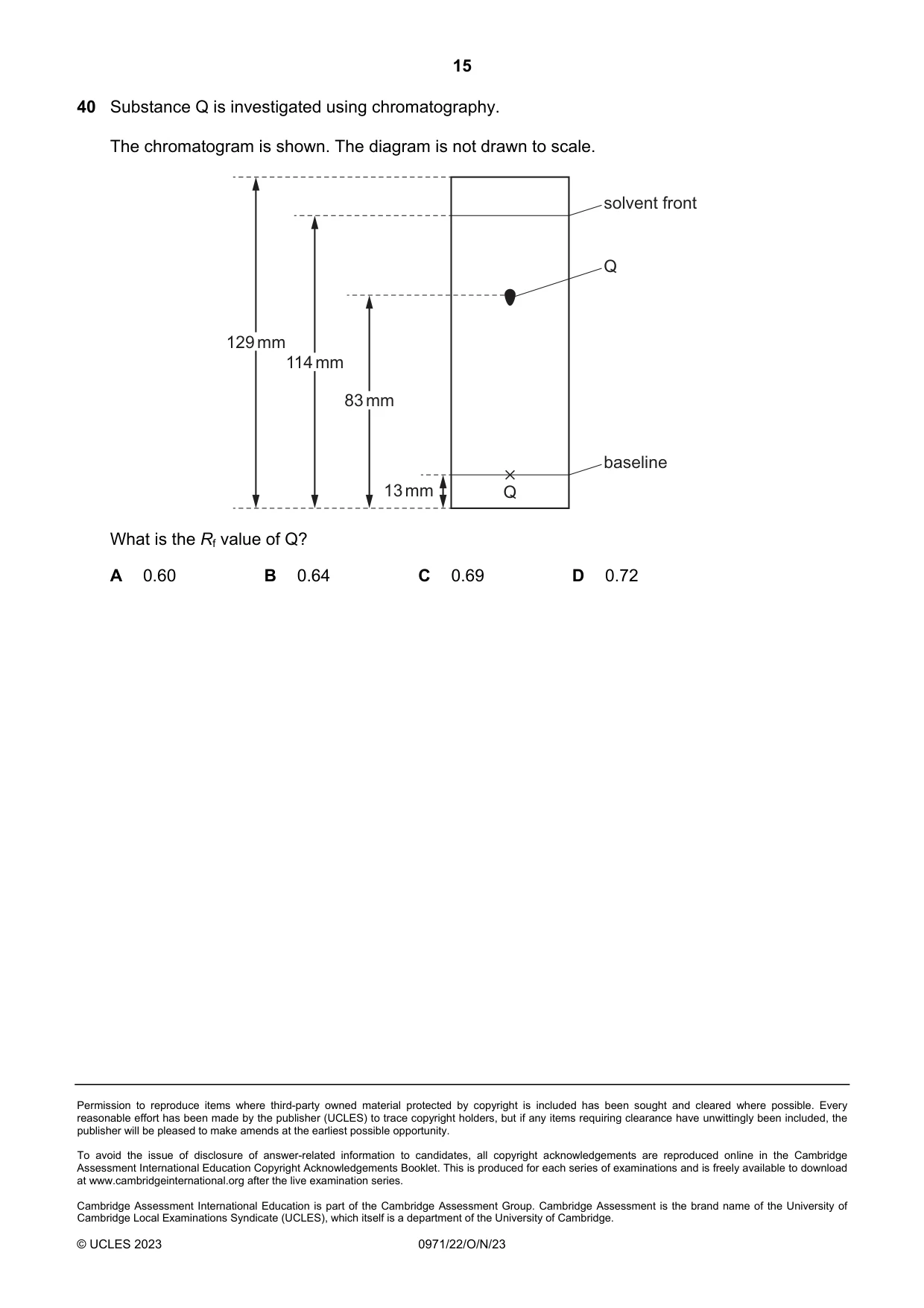
40 Substance Q is investigated using chromatography. The chromatogram is shown. The diagram is not drawn to scale. solvent front Q 129 mm 114 mm 83 mm baseline 13 mm Q What is the Rf value of Q? A 0.60 B 0.64 C 0.69 D 0.72
Mark scheme: C
What was in this paper
The subtopics covered by these 40 questions, and how many questions each got. Open one in a new tab to see every Cambridge question on it.
3Air quality and climate2Alkanes2Corrosion of metals2Electrolysis2Formulae, functional groups and terminology2Polymers2Reactivity series2Redox2Acid–base titrations1Alkenes1Atomic structure and the Periodic Table1Chromatography1Elements, compounds and mixtures1Extraction of metals1Formulae1Group I properties1Ions and ionic bonds1Isotopes1Noble gases1Oxides1Preparation of salts1Rate of reaction1Relative masses of atoms and molecules1Reversible reactions and equilibrium1Simple molecules and covalent bonds1Solids, liquids and gases1The characteristic properties of acids and bases1Transition elements1Water1What you needed in this session
Cambridge’s own grade thresholds for 2023 Oct/Nov, Paper 2 · Variant 2. A higher threshold means an easier paper — the bar moves with how the cohort did.