Cambridge IGCSE Chemistry (9-1) 0971 — 2024 Oct/Nov Paper 2 · Variant 2
0971/22/O/N/24 · 40 questions · 40 marks · 45 min
The question paper and its mark scheme, free to read here and free to download. This is Cambridge’s own paper, exactly as it was sat.
Question paper16 pages


Mark scheme3 pages
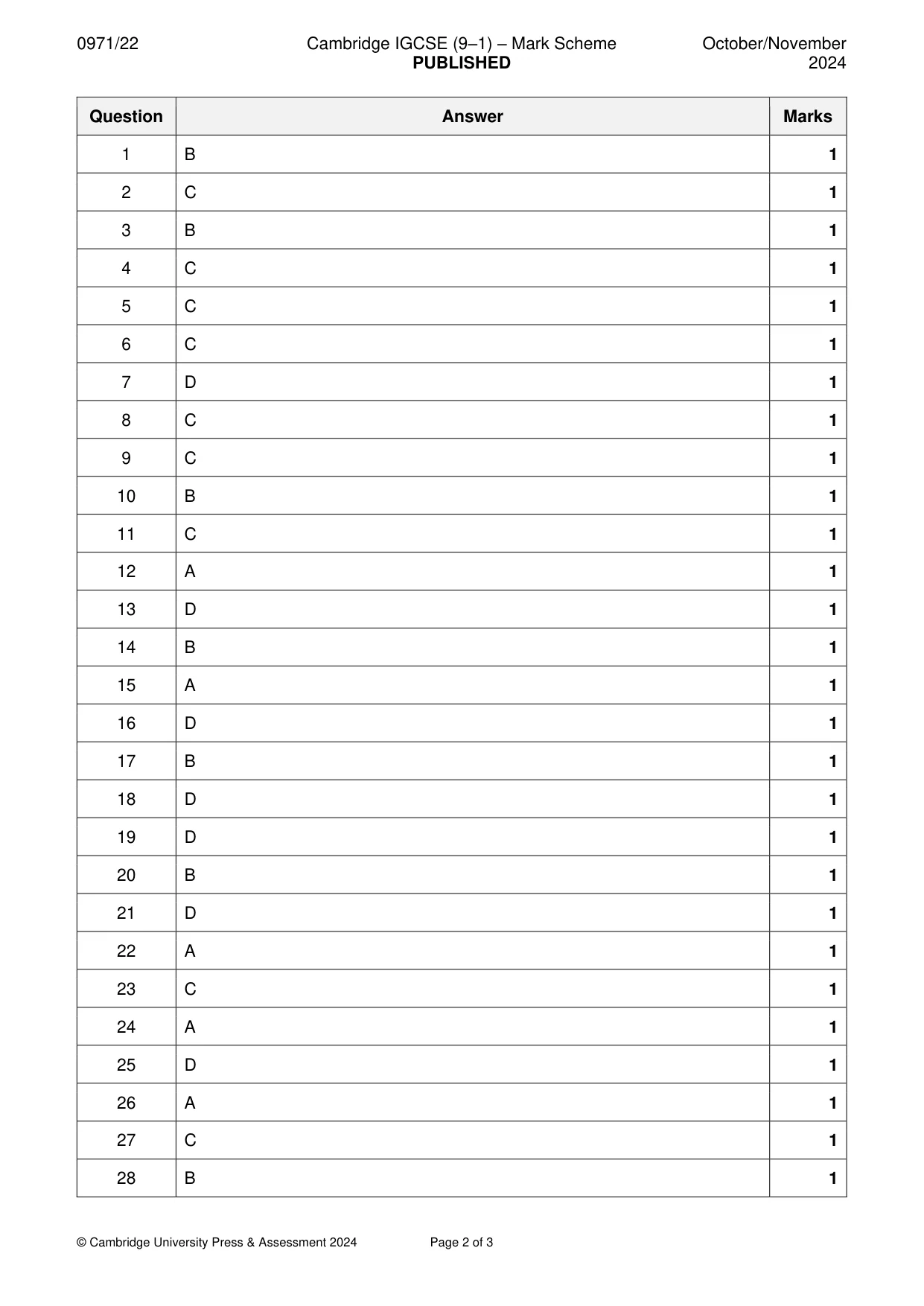
Answers below. Sit the paper first if you are practising.
Questions as text
Q1 · Oxygen melts at –219 C and boils at –183 C
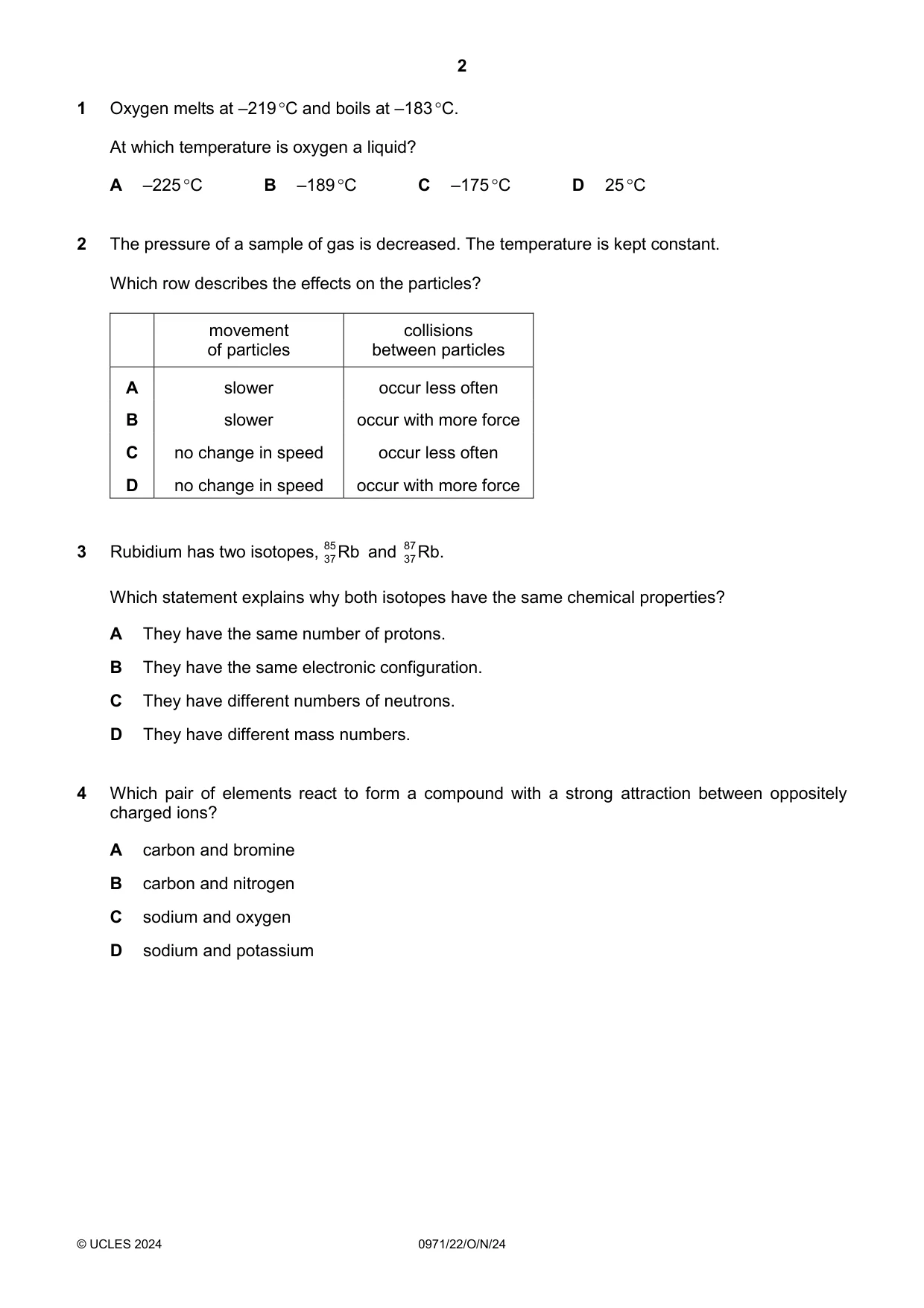
1 Oxygen melts at –219 C and boils at –183 C. At which temperature is oxygen a liquid? A –225 C B –189 C C –175 C D 25 C
Mark scheme: B
Q2 · The pressure of a sample of gas is decreased
2 The pressure of a sample of gas is decreased. The temperature is kept constant. Which row describes the effects on the particles? movement collisions of particles between particles A slower occur less often B slower occur with more force C no change in speed occur less often D no change in speed occur with more force
Mark scheme: C
Q3 · Rubidium has two isotopes, 85 Rb and 87 Rb
3 Rubidium has two isotopes, 85 Rb and 87 Rb. 37 37 Which statement explains why both isotopes have the same chemical properties? A They have the same number of protons. B They have the same electronic configuration. C They have different numbers of neutrons. D They have different mass numbers.
Mark scheme: B
Q4 · Which pair of elements react to form a compound with a strong attraction between…
4 Which pair of elements react to form a compound with a strong attraction between oppositely charged ions? A carbon and bromine B carbon and nitrogen C sodium and oxygen D sodium and potassium
Mark scheme: C
Q5 · Four substances, P, Q, R and S, are described
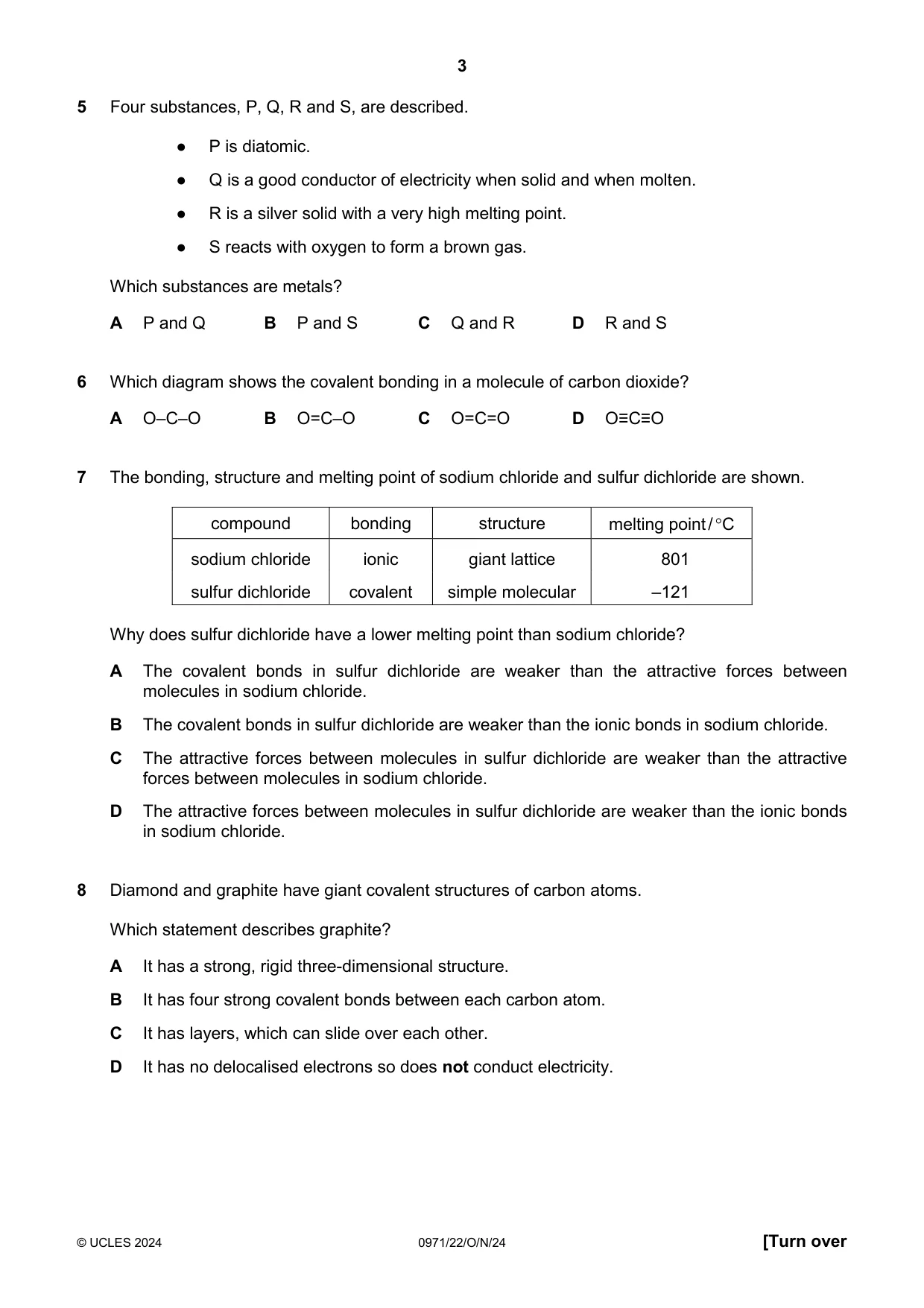
5 Four substances, P, Q, R and S, are described. ● P is diatomic. ● Q is a good conductor of electricity when solid and when molten. ● R is a silver solid with a very high melting point. ● S reacts with oxygen to form a brown gas. Which substances are metals? A P and Q B P and S C Q and R D R and S
Mark scheme: C
Q6 · Which diagram shows the covalent bonding in a molecule of carbon dioxide?
6 Which diagram shows the covalent bonding in a molecule of carbon dioxide? A O–C–O B O=C–O C O=C=O D O≡C≡O
Mark scheme: C
Q7 · The bonding, structure and melting point of sodium chloride and sulfur dichloride are…
7 The bonding, structure and melting point of sodium chloride and sulfur dichloride are shown. compound bonding structure melting point / C sodium chloride ionic giant lattice 801 sulfur dichloride covalent simple molecular –121 Why does sulfur dichloride have a lower melting point than sodium chloride? A The covalent bonds in sulfur dichloride are weaker than the attractive forces between molecules in sodium chloride. B The covalent bonds in sulfur dichloride are weaker than the ionic bonds in sodium chloride. C The attractive forces between molecules in sulfur dichloride are weaker than the attractive forces between molecules in sodium chloride. D The attractive forces between molecules in sulfur dichloride are weaker than the ionic bonds in sodium chloride.
Mark scheme: D
Q8 · Diamond and graphite have giant covalent structures of carbon atoms
8 Diamond and graphite have giant covalent structures of carbon atoms. Which statement describes graphite? A It has a strong, rigid three-dimensional structure. B It has four strong covalent bonds between each carbon atom. C It has layers, which can slide over each other. D It has no delocalised electrons so does not conduct electricity.
Mark scheme: C
Q9 · Which row explains the malleability and electrical conductivity of a solid metal?
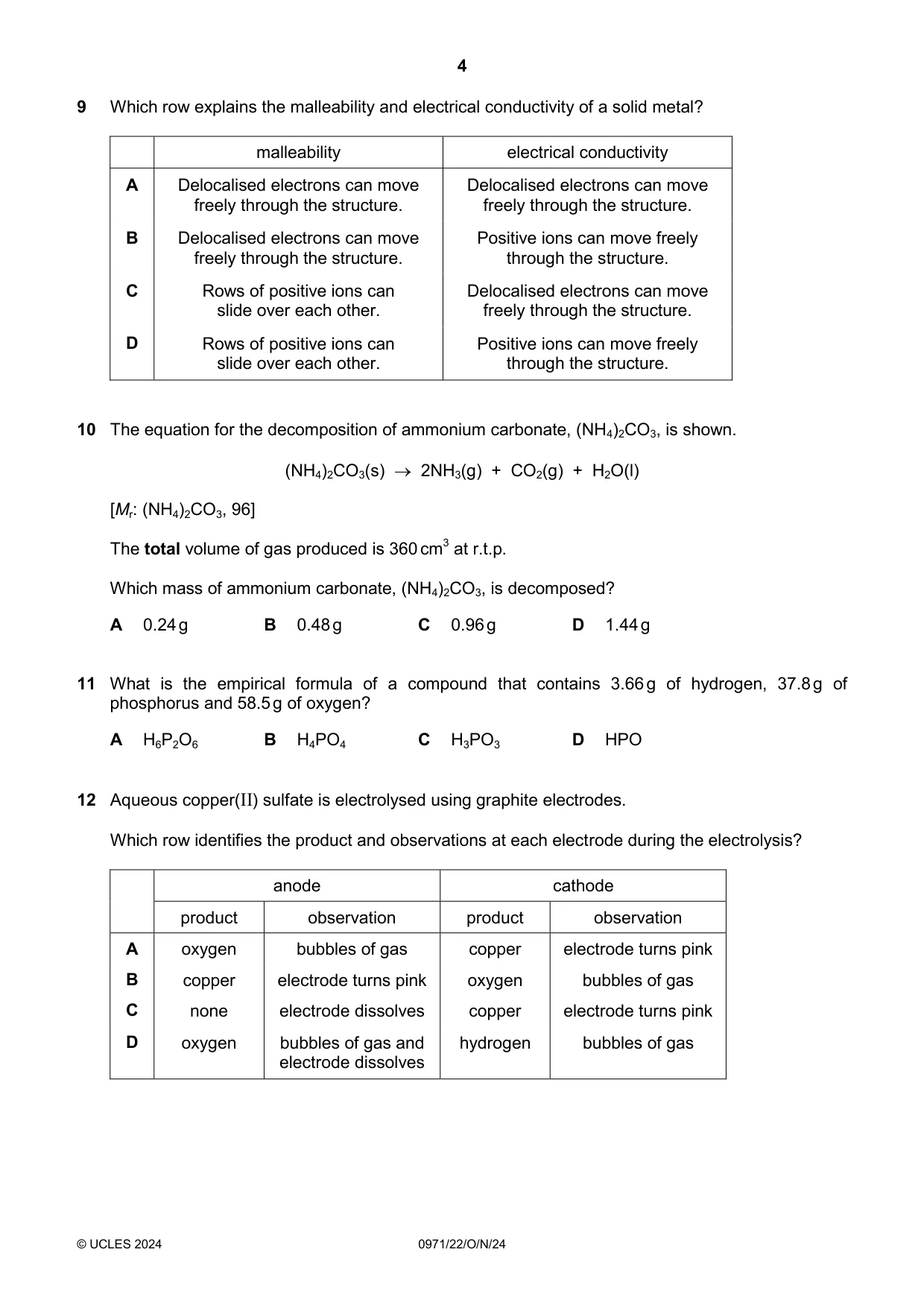
9 Which row explains the malleability and electrical conductivity of a solid metal? malleability electrical conductivity A Delocalised electrons can move Delocalised electrons can move freely through the structure. freely through the structure. B Delocalised electrons can move Positive ions can move freely freely through the structure. through the structure. C Rows of positive ions can Delocalised electrons can move slide over each other. freely through the structure. D Rows of positive ions can Positive ions can move freely slide over each other. through the structure.
Mark scheme: C
Q10 · The equation for the decomposition of ammonium carbonate, (NH4)2CO3, is shown
10 The equation for the decomposition of ammonium carbonate, (NH4)2CO3, is shown. (NH4)2CO3(s) 2NH3(g) + CO2(g) + H2O(l) [Mr: (NH4)2CO3, 96] The total volume of gas produced is 360 cm3 at r.t.p. Which mass of ammonium carbonate, (NH4)2CO3, is decomposed? A 0.24 g B 0.48 g C 0.96 g D 1.44 g
Mark scheme: B
Q11 · What is the empirical formula of a compound that contains 3.66 g of hydrogen, 37.8 g of…
11 What is the empirical formula of a compound that contains 3.66 g of hydrogen, 37.8 g of phosphorus and 58.5 g of oxygen? A H6P2O6 B H4PO4 C H3PO3 D HPO
Mark scheme: C
Q12 · Aqueous copper(II) sulfate is electrolysed using graphite electrodes
12 Aqueous copper(II) sulfate is electrolysed using graphite electrodes. Which row identifies the product and observations at each electrode during the electrolysis? anode cathode product observation product observation A oxygen bubbles of gas copper electrode turns pink B copper electrode turns pink oxygen bubbles of gas C none electrode dissolves copper electrode turns pink D oxygen bubbles of gas and hydrogen bubbles of gas electrode dissolves
Mark scheme: A
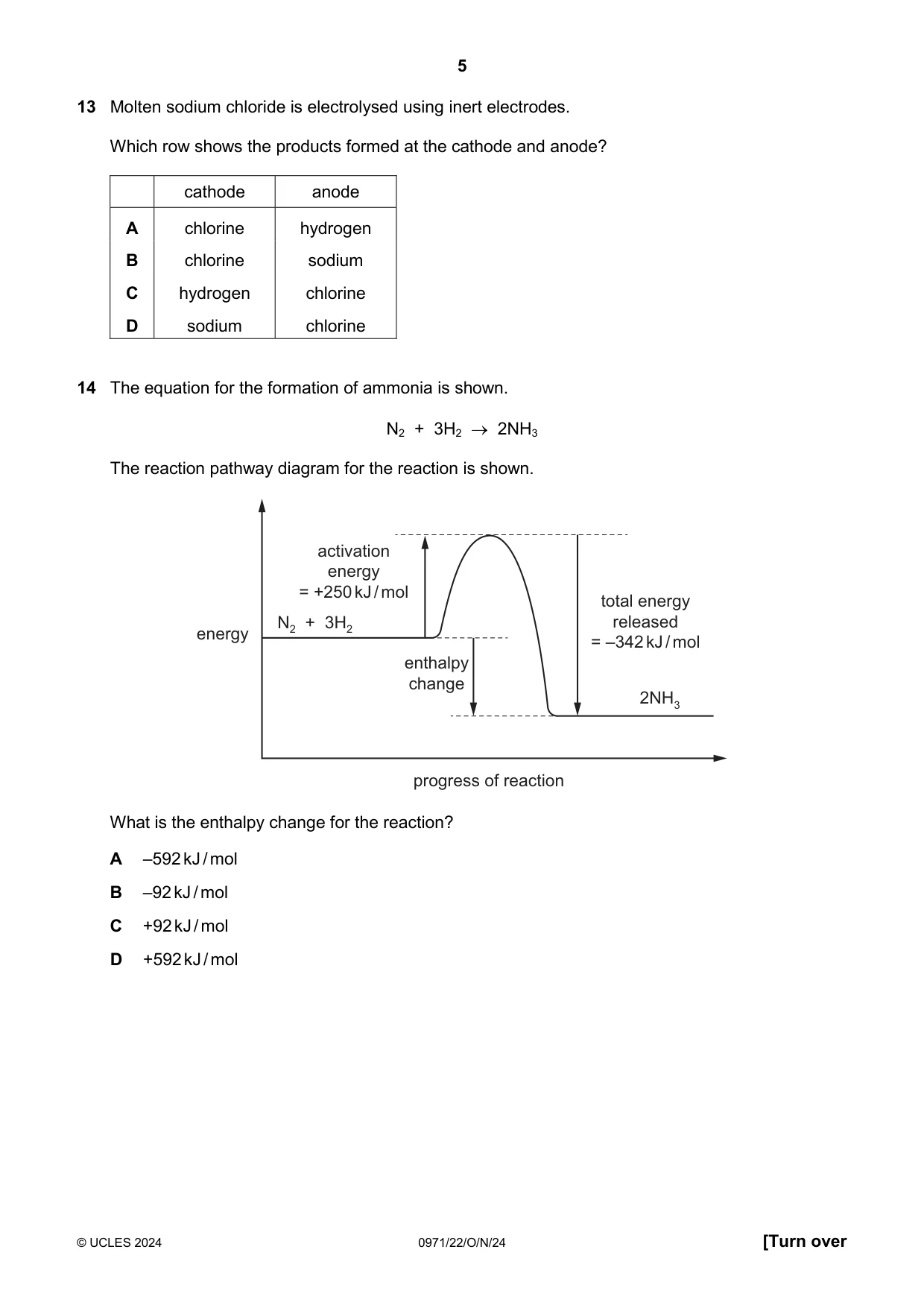
Q13 · Molten sodium chloride is electrolysed using inert electrodes
13 Molten sodium chloride is electrolysed using inert electrodes. Which row shows the products formed at the cathode and anode? cathode anode A chlorine hydrogen B chlorine sodium C hydrogen chlorine D sodium chlorine
Mark scheme: D
Q14 · The equation for the formation of ammonia is shown
14 The equation for the formation of ammonia is shown. N2 + 3H2 2NH3 The reaction pathway diagram for the reaction is shown. activation energy = +250 kJ / mol total energy N2 + 3H2 released energy = –342 kJ / mol enthalpy change 2NH3 progress of reaction What is the enthalpy change for the reaction? A –592 kJ / mol B –92 kJ / mol C +92 kJ / mol D +592 kJ / mol
Mark scheme: B
Q15 · Sulfur dioxide is converted to sulfur trioxide in the Contact process
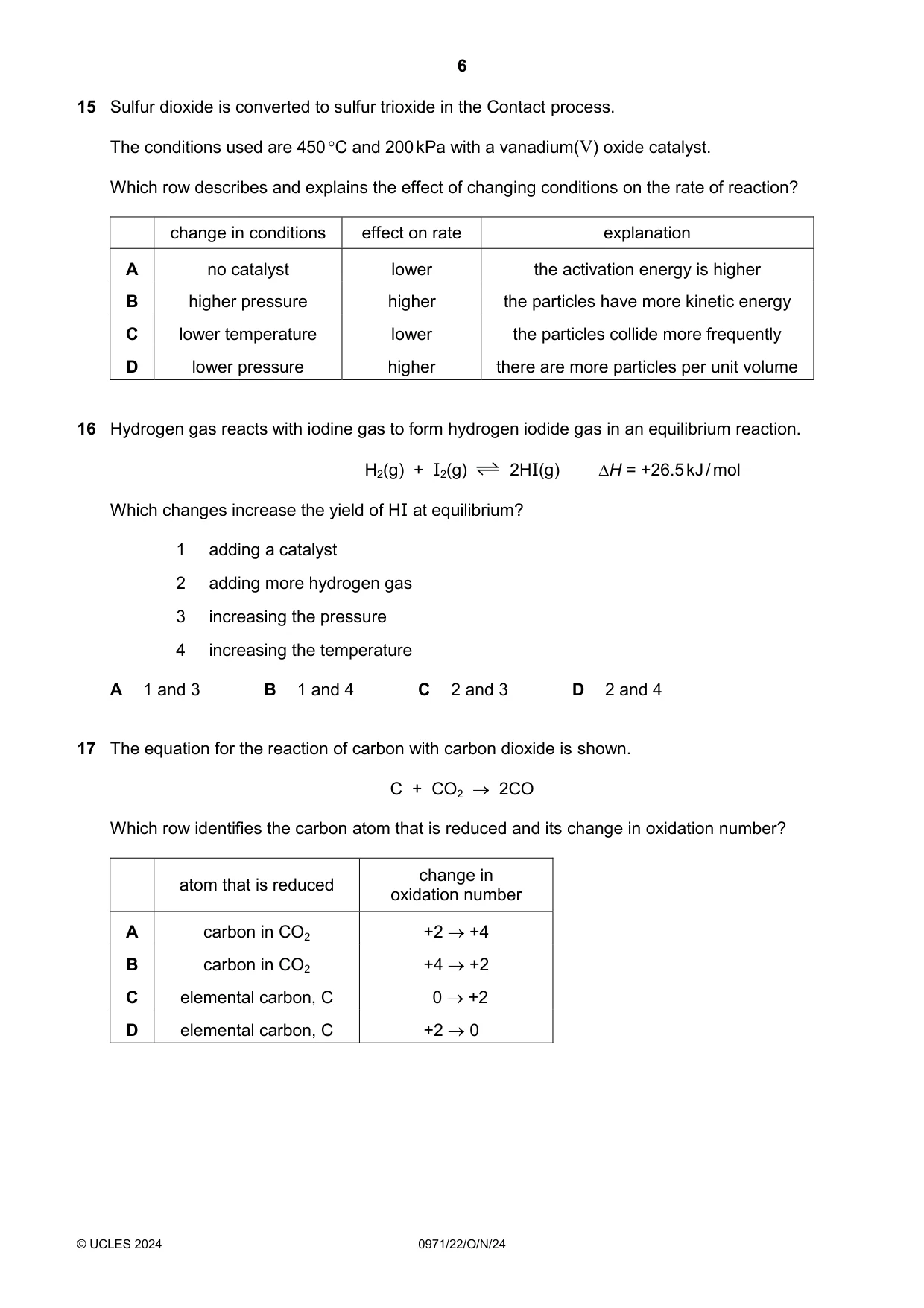
15 Sulfur dioxide is converted to sulfur trioxide in the Contact process. The conditions used are 450 C and 200 kPa with a vanadium(V) oxide catalyst. Which row describes and explains the effect of changing conditions on the rate of reaction? change in conditions effect on rate explanation A no catalyst lower the activation energy is higher B higher pressure higher the particles have more kinetic energy C lower temperature lower the particles collide more frequently D lower pressure higher there are more particles per unit volume
Mark scheme: A
Q16 · Hydrogen gas reacts with iodine gas to form hydrogen iodide gas in an equilibrium reaction
16 Hydrogen gas reacts with iodine gas to form hydrogen iodide gas in an equilibrium reaction. H2(g) + I2(g) 2HI(g) ∆H = +26.5 kJ / mol Which changes increase the yield of HI at equilibrium? 1 adding a catalyst 2 adding more hydrogen gas 3 increasing the pressure 4 increasing the temperature A 1 and 3 B 1 and 4 C 2 and 3 D 2 and 4
Mark scheme: D
Q17 · The equation for the reaction of carbon with carbon dioxide is shown
17 The equation for the reaction of carbon with carbon dioxide is shown. C + CO2 2CO Which row identifies the carbon atom that is reduced and its change in oxidation number? change in atom that is reduced oxidation number A carbon in CO2 +2 +4 B carbon in CO2 +4 +2 C elemental carbon, C 0 +2 D elemental carbon, C +2 0
Mark scheme: B
Q18 · Aqueous iron(II) sulfate is added to acidified potassium manganate(VII)
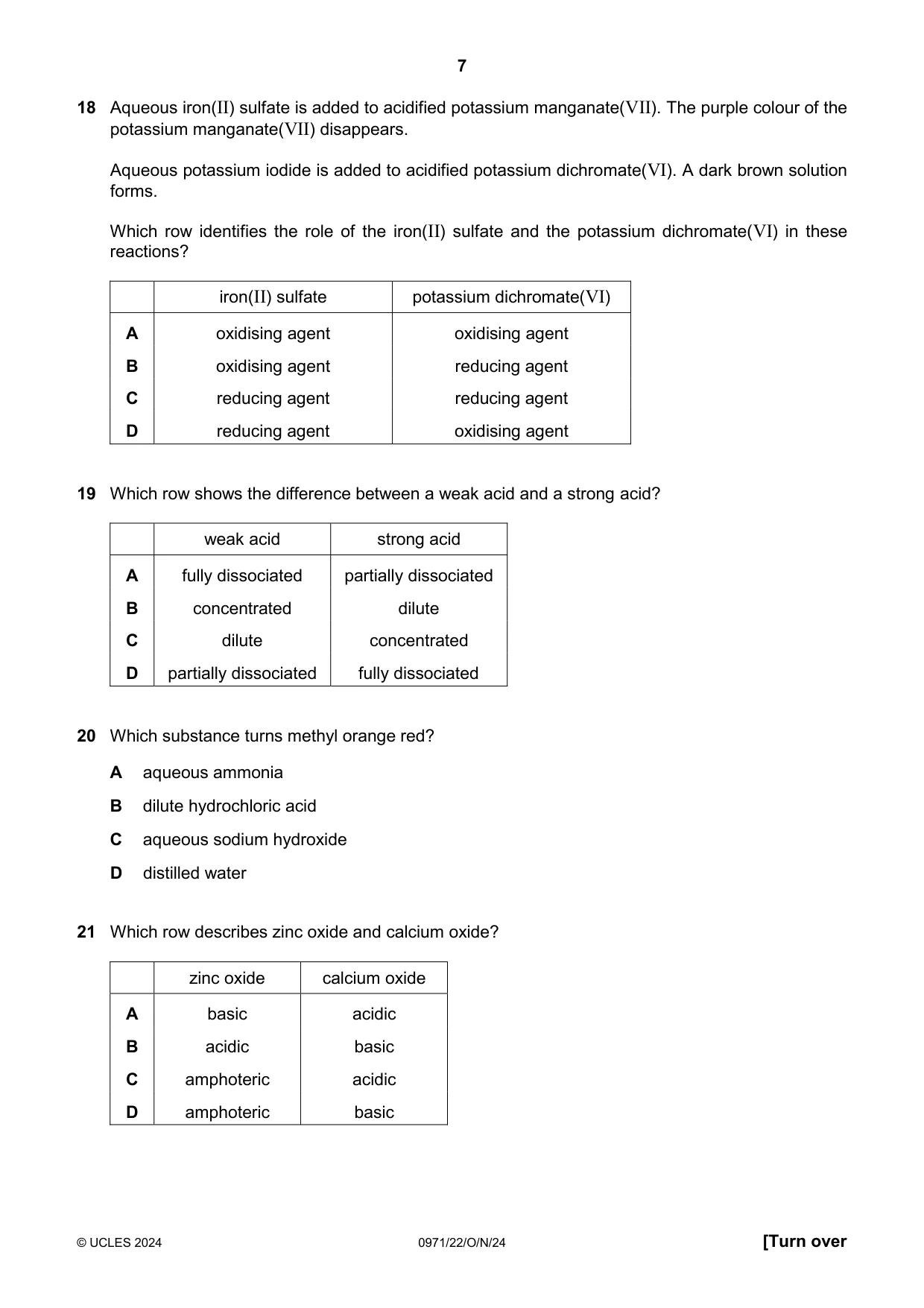
18 Aqueous iron(II) sulfate is added to acidified potassium manganate(VII). The purple colour of the potassium manganate(VII) disappears. Aqueous potassium iodide is added to acidified potassium dichromate(VI). A dark brown solution forms. Which row identifies the role of the iron(II) sulfate and the potassium dichromate(VI) in these reactions? iron(II) sulfate potassium dichromate(VI) A oxidising agent oxidising agent B oxidising agent reducing agent C reducing agent reducing agent D reducing agent oxidising agent
Mark scheme: D
Q19 · Which row shows the difference between a weak acid and a strong acid?
19 Which row shows the difference between a weak acid and a strong acid? weak acid strong acid A fully dissociated partially dissociated B concentrated dilute C dilute concentrated D partially dissociated fully dissociated
Mark scheme: D
More questions on The characteristic properties of acids and bases
Q20 · Which substance turns methyl orange red?
20 Which substance turns methyl orange red? A aqueous ammonia B dilute hydrochloric acid C aqueous sodium hydroxide D distilled water
Mark scheme: B
More questions on The characteristic properties of acids and bases
Q21 · Which row describes zinc oxide and calcium oxide?
21 Which row describes zinc oxide and calcium oxide? zinc oxide calcium oxide A basic acidic B acidic basic C amphoteric acidic D amphoteric basic
Mark scheme: D
Q22 · Which row shows the properties of a transition element?
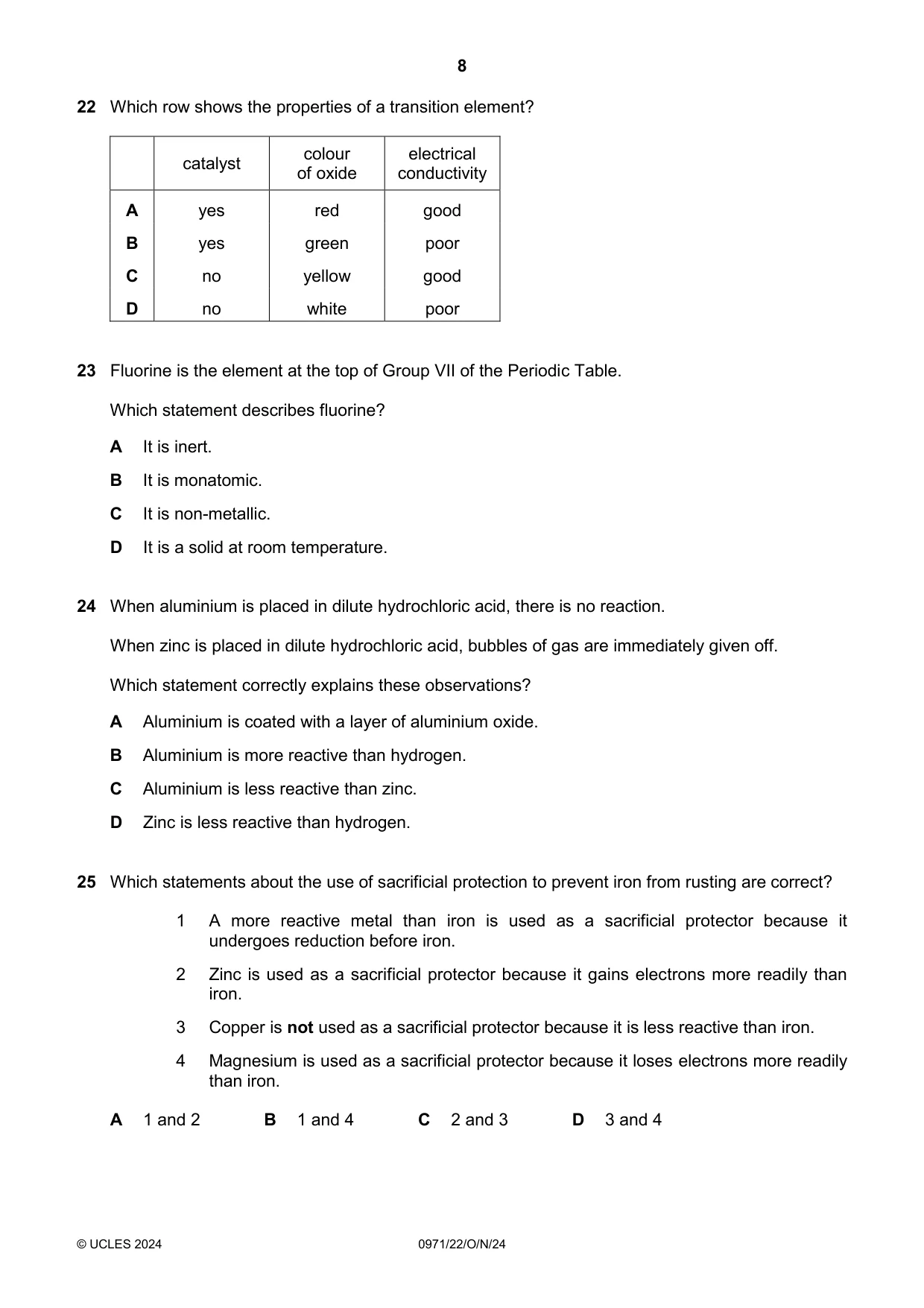
22 Which row shows the properties of a transition element? colour electrical catalyst of oxide conductivity A yes red good B yes green poor C no yellow good D no white poor
Mark scheme: A
Q23 · Fluorine is the element at the top of Group VII of the Periodic Table
23 Fluorine is the element at the top of Group VII of the Periodic Table. Which statement describes fluorine? A It is inert. B It is monatomic. C It is non-metallic. D It is a solid at room temperature.
Mark scheme: C
Q24 · When aluminium is placed in dilute hydrochloric acid, there is no reaction
24 When aluminium is placed in dilute hydrochloric acid, there is no reaction. When zinc is placed in dilute hydrochloric acid, bubbles of gas are immediately given off. Which statement correctly explains these observations? A Aluminium is coated with a layer of aluminium oxide. B Aluminium is more reactive than hydrogen. C Aluminium is less reactive than zinc. D Zinc is less reactive than hydrogen.
Mark scheme: A
Q25 · Which statements about the use of sacrificial protection to prevent iron from rusting are…
25 Which statements about the use of sacrificial protection to prevent iron from rusting are correct? 1 A more reactive metal than iron is used as a sacrificial protector because it undergoes reduction before iron. 2 Zinc is used as a sacrificial protector because it gains electrons more readily than iron. 3 Copper is not used as a sacrificial protector because it is less reactive than iron. 4 Magnesium is used as a sacrificial protector because it loses electrons more readily than iron. A 1 and 2 B 1 and 4 C 2 and 3 D 3 and 4
Mark scheme: D
Q26 · Aluminium is extracted from its ore by electrolysis
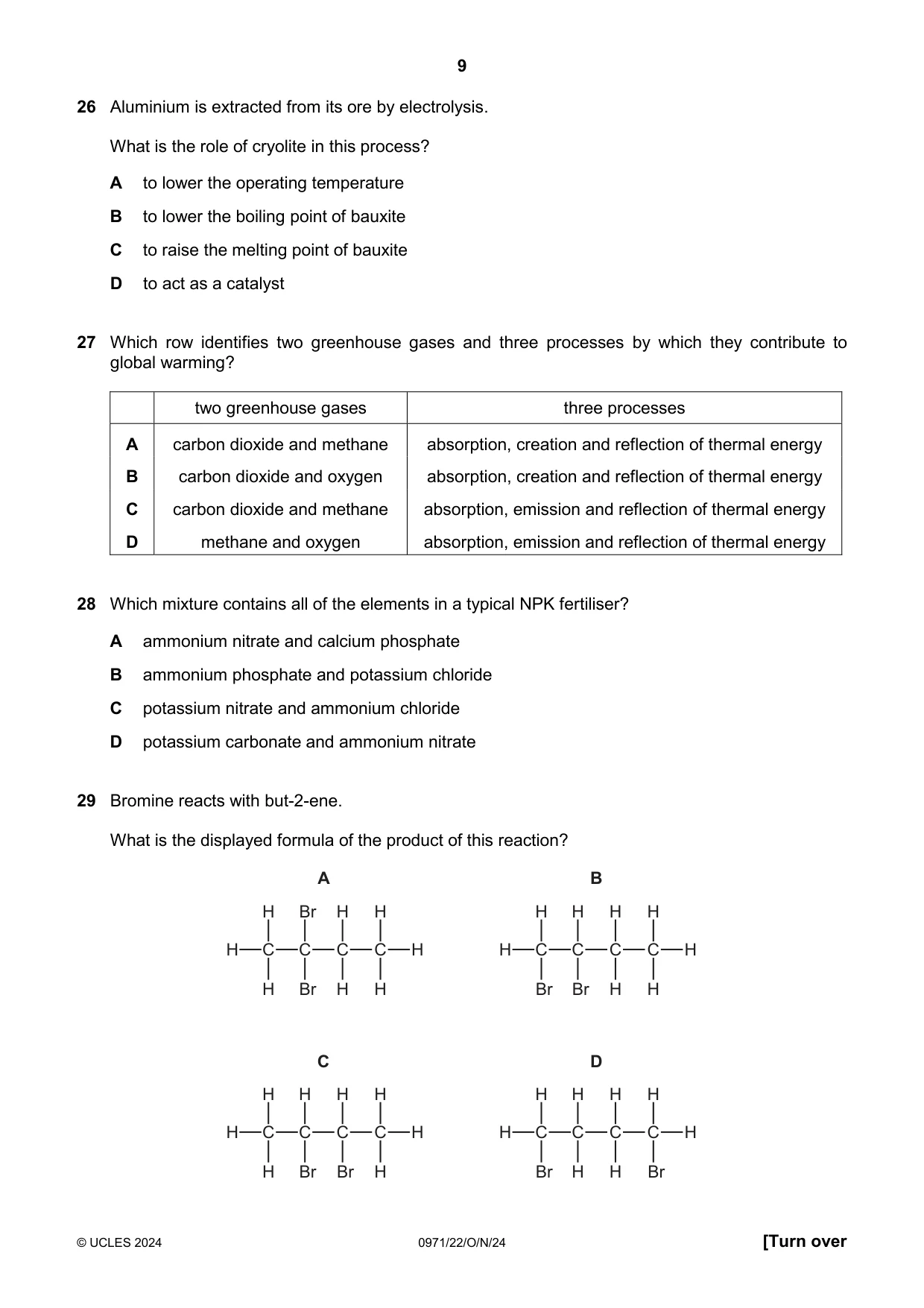
26 Aluminium is extracted from its ore by electrolysis. What is the role of cryolite in this process? A to lower the operating temperature B to lower the boiling point of bauxite C to raise the melting point of bauxite D to act as a catalyst
Mark scheme: A
Q27 · Which row identifies two greenhouse gases and three processes by which they contribute to…
27 Which row identifies two greenhouse gases and three processes by which they contribute to global warming? two greenhouse gases three processes A carbon dioxide and methane absorption, creation and reflection of thermal energy B carbon dioxide and oxygen absorption, creation and reflection of thermal energy C carbon dioxide and methane absorption, emission and reflection of thermal energy D methane and oxygen absorption, emission and reflection of thermal energy
Mark scheme: C
Q28 · Which mixture contains all of the elements in a typical NPK fertiliser?
28 Which mixture contains all of the elements in a typical NPK fertiliser? A ammonium nitrate and calcium phosphate B ammonium phosphate and potassium chloride C potassium nitrate and ammonium chloride D potassium carbonate and ammonium nitrate
Mark scheme: B
Q29 · Bromine reacts with but-2-ene
29 Bromine reacts with but-2-ene. What is the displayed formula of the product of this reaction? A B H Br H H H H H H H C C C C H H C C C C H H Br H H Br Br H H C D H H H H H H H H H C C C C H H C C C C H H Br Br H Br H H Br
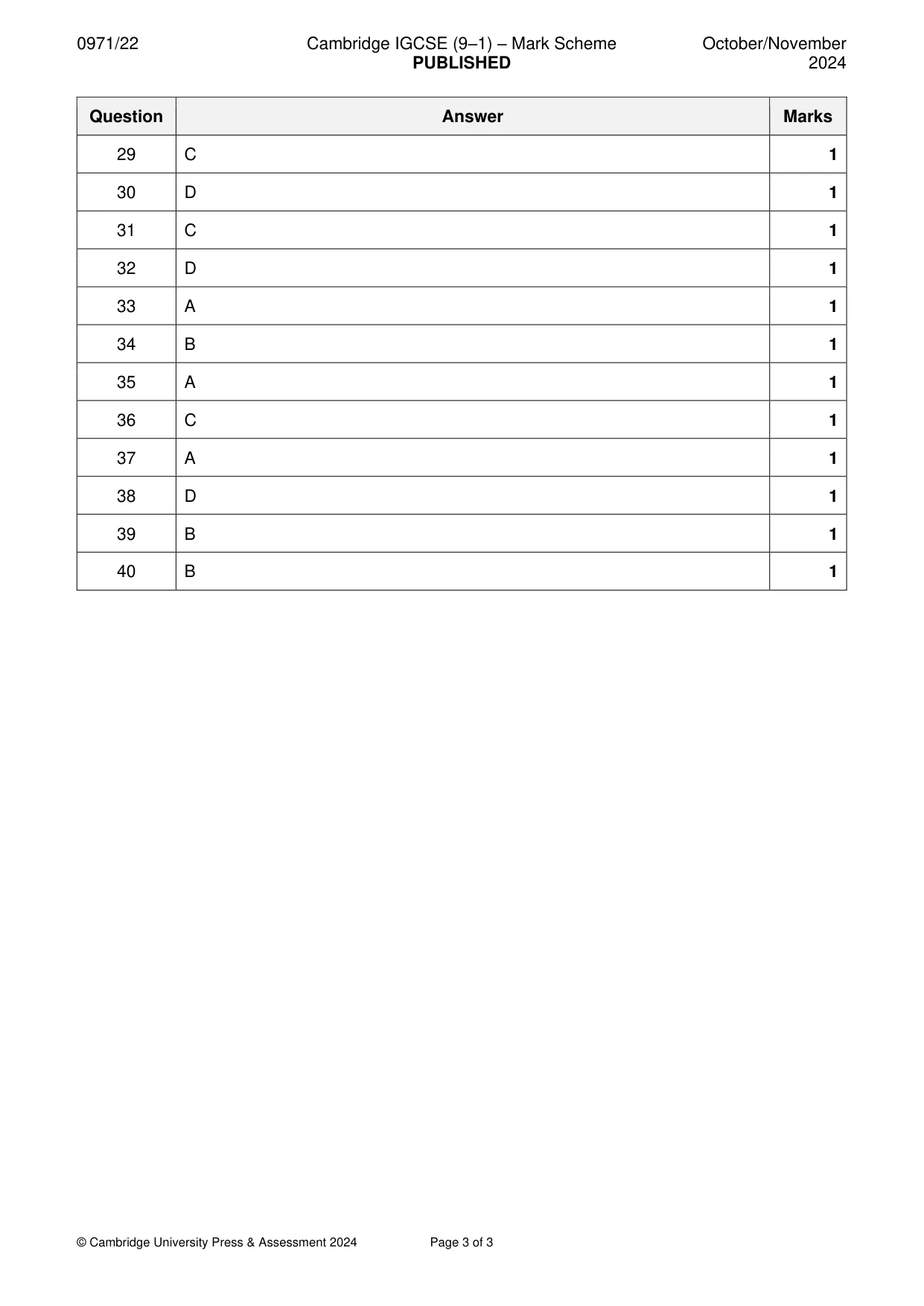
Mark scheme: C
Q30 · Which statement is correct?
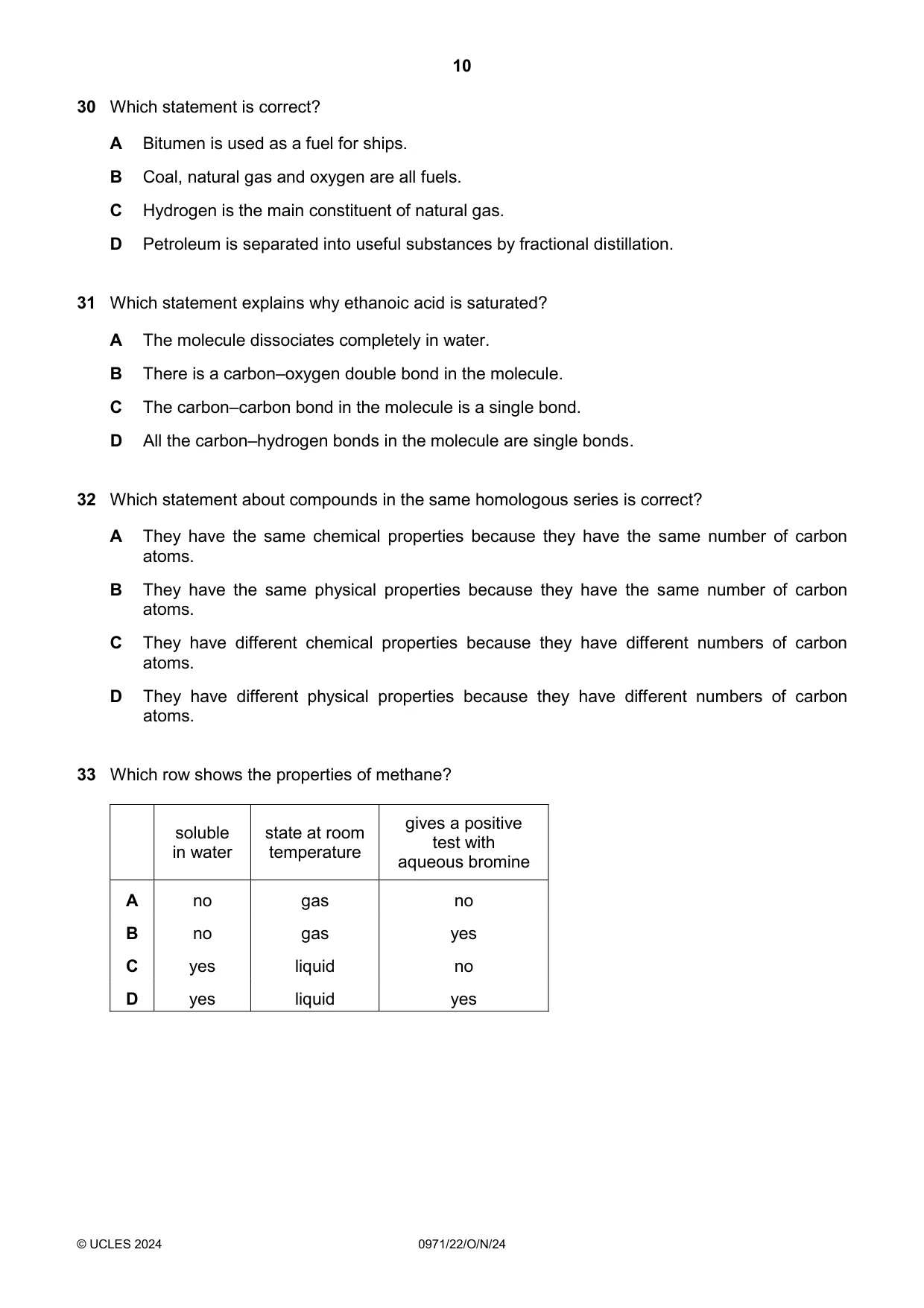
30 Which statement is correct? A Bitumen is used as a fuel for ships. B Coal, natural gas and oxygen are all fuels. C Hydrogen is the main constituent of natural gas. D Petroleum is separated into useful substances by fractional distillation.
Mark scheme: D
Q31 · Which statement explains why ethanoic acid is saturated?
31 Which statement explains why ethanoic acid is saturated? A The molecule dissociates completely in water. B There is a carbon–oxygen double bond in the molecule. C The carbon–carbon bond in the molecule is a single bond. D All the carbon–hydrogen bonds in the molecule are single bonds.
Mark scheme: C
Q32 · Which statement about compounds in the same homologous series is correct?
32 Which statement about compounds in the same homologous series is correct? A They have the same chemical properties because they have the same number of carbon atoms. B They have the same physical properties because they have the same number of carbon atoms. C They have different chemical properties because they have different numbers of carbon atoms. D They have different physical properties because they have different numbers of carbon atoms.
Mark scheme: D
More questions on Formulae, functional groups and terminology
Q33 · Which row shows the properties of methane?
33 Which row shows the properties of methane? gives a positive soluble state at room test with in water temperature aqueous bromine A no gas no B no gas yes C yes liquid no D yes liquid yes
Mark scheme: A
Q34 · The table shows two methods used to make ethanol
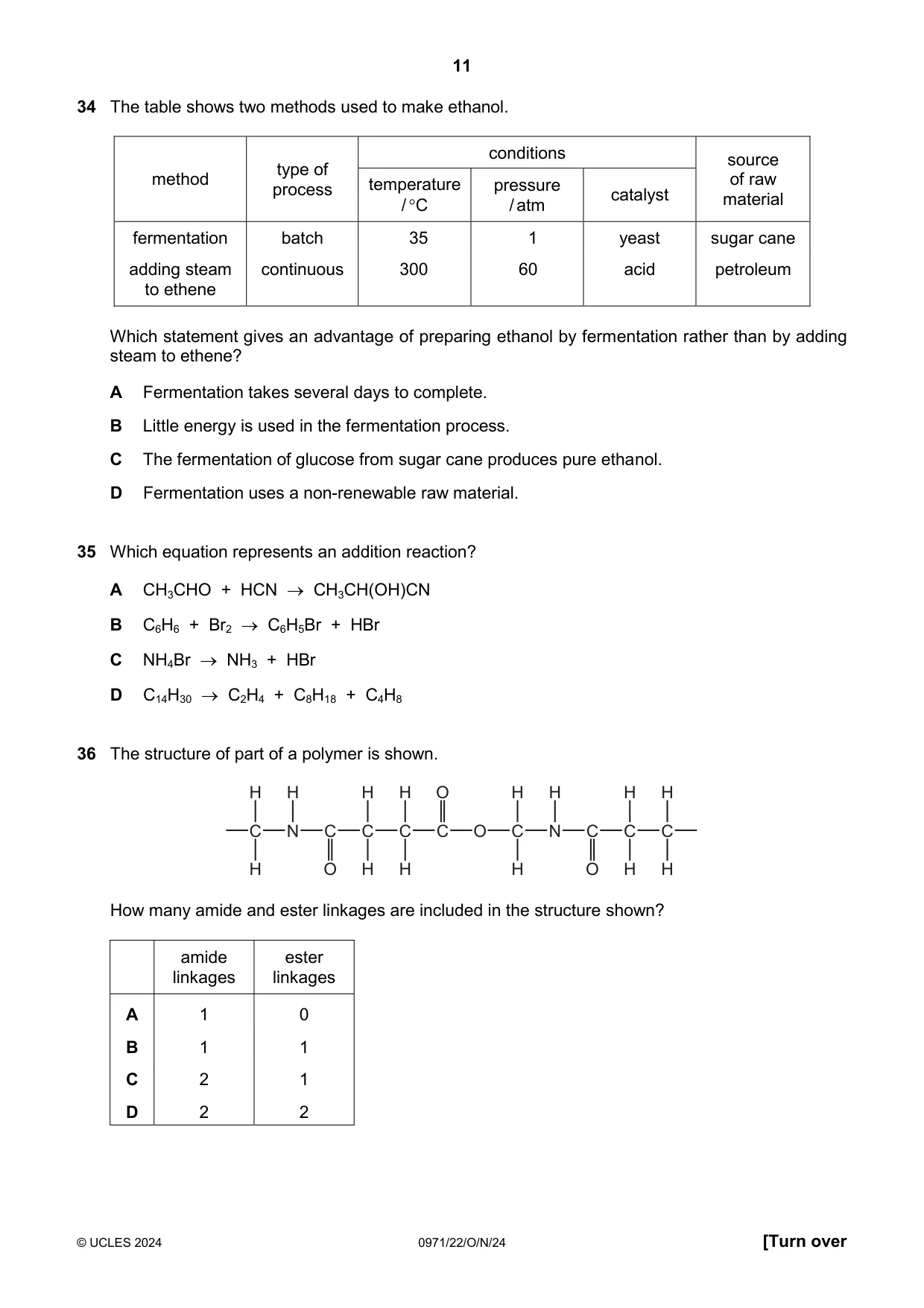
34 The table shows two methods used to make ethanol. conditions source type of method temperature pressure of raw process catalyst / C / atm material fermentation batch 35 1 yeast sugar cane adding steam continuous 300 60 acid petroleum to ethene Which statement gives an advantage of preparing ethanol by fermentation rather than by adding steam to ethene? A Fermentation takes several days to complete. B Little energy is used in the fermentation process. C The fermentation of glucose from sugar cane produces pure ethanol. D Fermentation uses a non-renewable raw material.
Mark scheme: B
Q35 · Which equation represents an addition reaction?
35 Which equation represents an addition reaction? A CH3CHO + HCN CH3CH(OH)CN B C6H6 + Br2 C6H5Br + HBr C NH4Br NH3 + HBr D C14H30 C2H4 + C8H18 + C4H8
Mark scheme: A
Q36 · The structure of part of a polymer is shown
36 The structure of part of a polymer is shown. H H H H O H H H H C N C C C C O C N C C C H O H H H O H H How many amide and ester linkages are included in the structure shown? amide ester linkages linkages A 1 0 B 1 1 C 2 1 D 2 2
Mark scheme: C
Q37 · Which structure represents part of a protein?
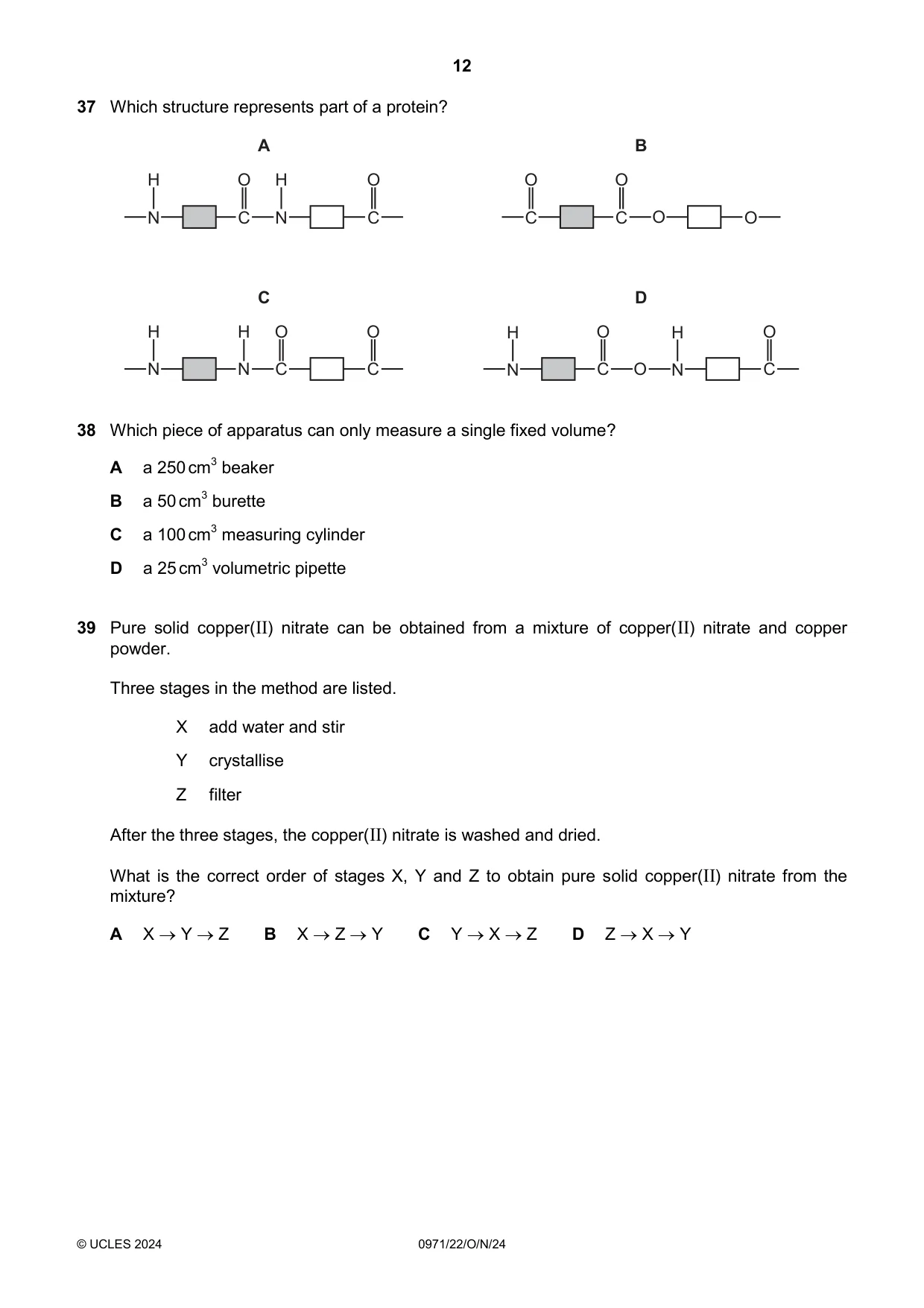
37 Which structure represents part of a protein? A B H O H O O O N C N C C C O O C D H H O O H O H O N N C C N C O N C
Mark scheme: A
Q38 · Which piece of apparatus can only measure a single fixed volume?
38 Which piece of apparatus can only measure a single fixed volume? A a 250 cm3 beaker B a 50 cm3 burette C a 100 cm3 measuring cylinder D a 25 cm3 volumetric pipette
Mark scheme: D
Q39 · Pure solid copper(II) nitrate can be obtained from a mixture of copper(II) nitrate and…
39 Pure solid copper(II) nitrate can be obtained from a mixture of copper(II) nitrate and copper powder. Three stages in the method are listed. X add water and stir Y crystallise Z filter After the three stages, the copper(II) nitrate is washed and dried. What is the correct order of stages X, Y and Z to obtain pure solid copper(II) nitrate from the mixture? A X Y Z B X Z Y C Y X Z D Z X Y
Mark scheme: B
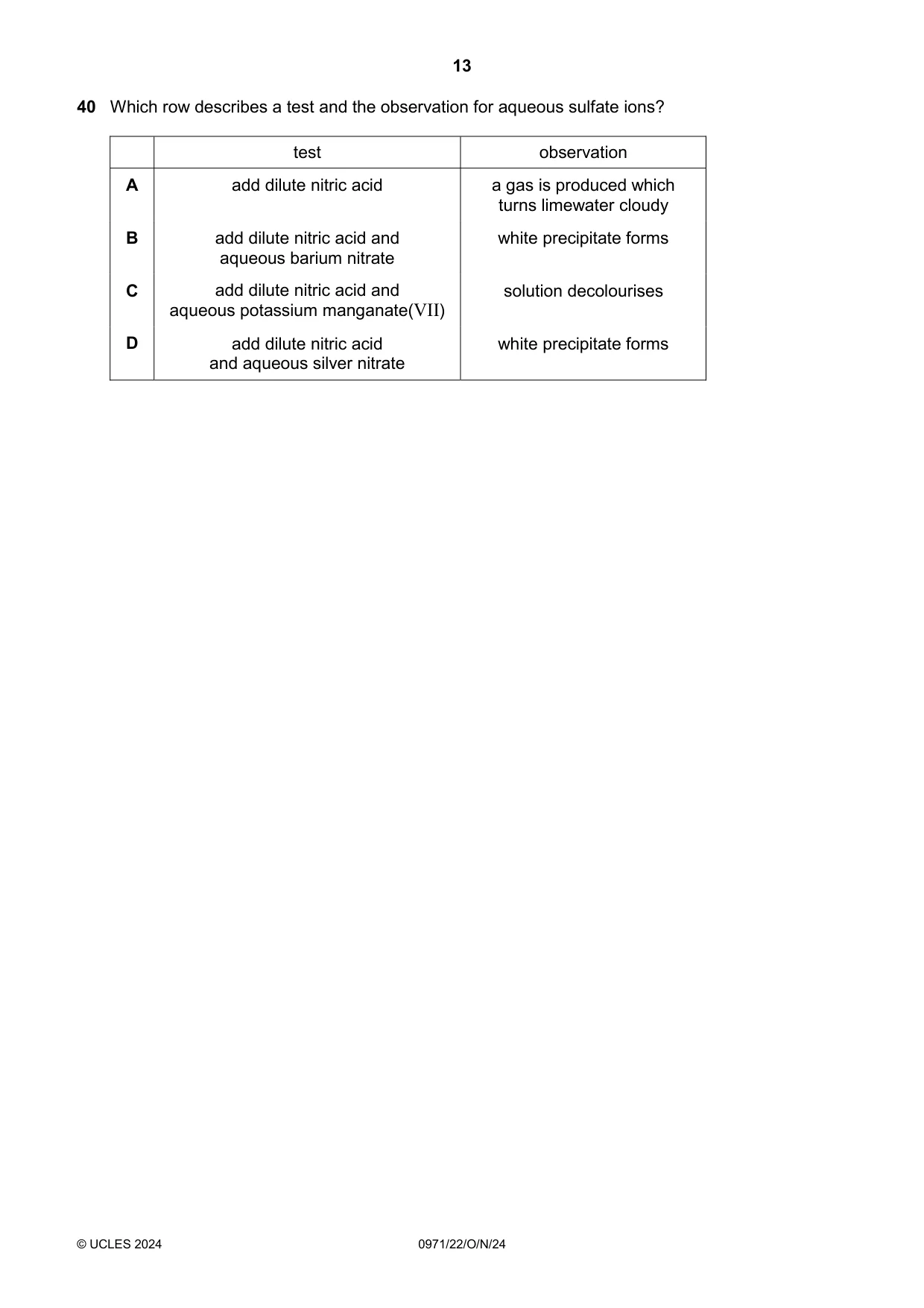
Q40 · Which row describes a test and the observation for aqueous sulfate ions?
40 Which row describes a test and the observation for aqueous sulfate ions? test observation A add dilute nitric acid a gas is produced which turns limewater cloudy B add dilute nitric acid and white precipitate forms aqueous barium nitrate C add dilute nitric acid and solution decolourises aqueous potassium manganate(VII) D add dilute nitric acid white precipitate forms and aqueous silver nitrate
Mark scheme: B
What was in this paper
The subtopics covered by these 40 questions, and how many questions each got. Open one in a new tab to see every Cambridge question on it.
2Electrolysis2Polymers2Redox2Simple molecules and covalent bonds2Solids, liquids and gases2The characteristic properties of acids and bases2Air quality and climate1Alcohols1Alkanes1Carboxylic acids1Corrosion of metals1Exothermic and endothermic reactions1Experimental design1Extraction of metals1Fertilisers1Formulae1Formulae, functional groups and terminology1Fuels1Giant covalent structures1Group VII properties1Identification of ions and gases1Ions and ionic bonds1Isotopes1Metallic bonding1Oxides1Properties of metals1Rate of reaction1Reactivity series1Reversible reactions and equilibrium1Separation and purification1The mole and the Avogadro constant1Transition elements1What you needed in this session
Cambridge’s own grade thresholds for 2024 Oct/Nov, Paper 2 · Variant 2. A higher threshold means an easier paper — the bar moves with how the cohort did.